1
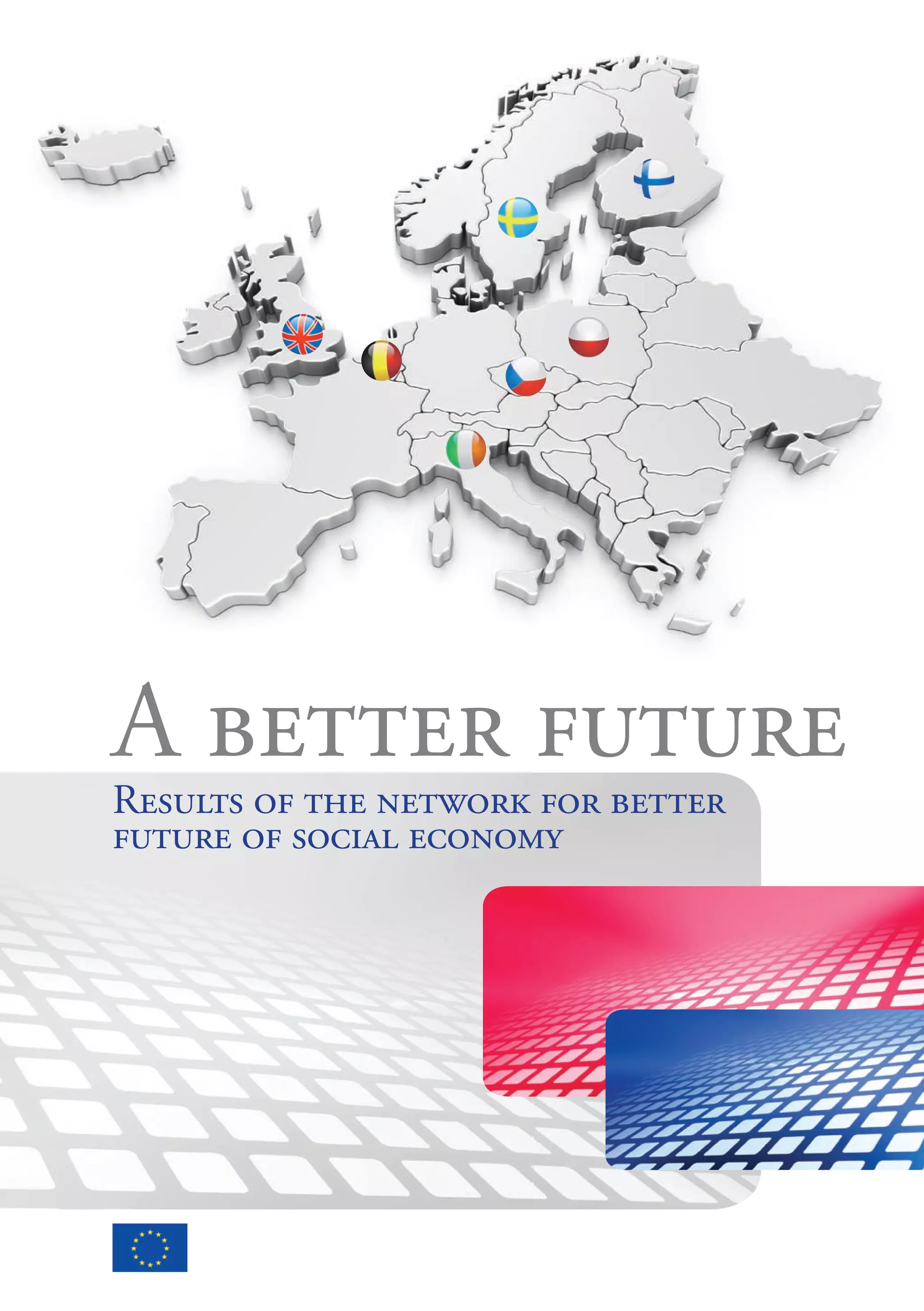
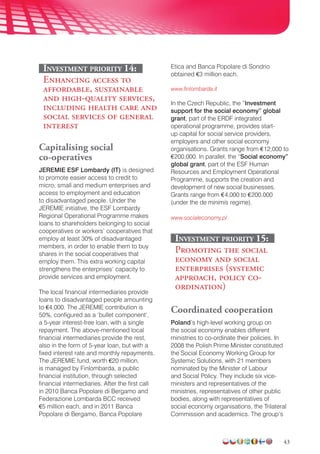
A better future
Results of the network for better
future of social economy
2
3
A better future
Results of the network for better
future of social economy
4
5
Foreword
Dear Madam / Sir,
We present this
publication, which
sums up the three-
year cooperation of
European Member
State institutions
managing programmes
co-financed by the
European Social Fund. During this time
we have shared our knowledge and
practice, and learnt from each other how to
effectively support the development of the
social economy, to make it a modern and
innovative tool for achieving the European
Social Fund’s goals.
This work is published in June 2012, at
a moment when policy on many of the
issues considered is still in the process
of formulation. For instance the legislative
framework for the 2014-2020 structural
funds, the reform of public procurement,
the modernisation of the state aid regime or
the European Social Entrepreneurship Fund
have been drafted but are not yet definitive.
We have tried to use the latest documents
and updated information, but the reader
should be aware that changes could have
occurred meanwhile.
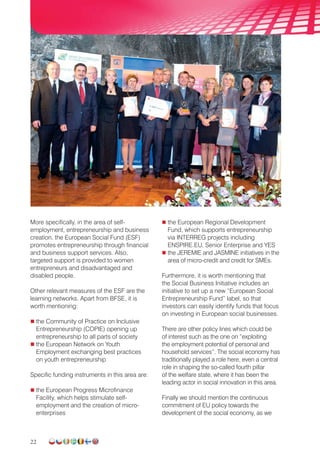
I would like to express my thanks to the
network coordinators: Małgorzata Lublińska
and Monika Andrzejewska (Poland), Filip
Kucera (Czech Republic), Adriana Cheber
(Lombardy region, Italy), Anna-Lena
Wettergren Wessman and Bosse Olsson
(Sweden) and Bianca Buijs (Flanders) as well
as the other European and member state
officials, social economy representatives and
experts who have contributed.
I am deeply convinced that mutual
learning and transnational co-operation,
although it requires an additional effort
during our everyday activities, is of great
benefit for the development of concepts
and the improvement of practice. I hope
that the network’s effort will be continued
in future years.
This publication has been put together by
a team of international experts coordinated
by DIESIS. Samuel Barco Serrano,
Gordon Hahn and Gianluca Pastorelli, with
invaluable assistance from Toby Johnson
and Dorotea Daniele, wrote part 1 and
edited part 2 on the basis of the work of
the national BFSE experts: Sven Bartilsson
(social franchising), Marek Jetmar (financial
instruments), Floriana Nappini and Daniela
Gatti (social added value), Krzysztof Herbst
and Mikołaj Gurdała (socially responsible
public procurement) and Bianca Buijs (state
aid and social services of general interest).
I hope you will read it with interest and find
in it inspiration for programming future
European Social Fund interventions to
improve social and economic cohesion
in your countries, regions and local
environments.
Paweł Orłowski
Undersecretary of State
in the Ministry of Regional Development
Warsaw, June 2012
^
6
7
Introduction 11
Overall recommendations 13
What is the social economy? 15
What role should the social economy play in delivering the ESF’s 18
investment priorities in 2014-2020? 19
Promoting employment and supporting labour mobility 21
Investing in education, skills and lifelong learning 31
Promoting social inclusion and combating poverty 37
Enhancing institutional and administrative capacities 47
Chart of social economy needs from the ESF 52
Social franchising 57
Financial instruments and mechanisms
of fund allocation to social economy 63
Measuring social added value 71
Socially responsible public procurement and public social partnership 81
State aids and social services of general interest 91
List of abbreviations 98
Part 2: Thematic recommendations
Part 1: The social economy and the 18 investment
priorities of the ESF
Contents
8
Part 1: The social economy
and the 18 investment
priorities of the ESF
A better future
Results of the BFSE network
9
10
11
The Better Future for the Social Economy
(BFSE) Network is a Learning Network
promoted by Managing Authorities of the
European Social Fund, which exchanges
knowledge and experiences and shares best
practices, in order to foster the development
of the social economy within ESF operational
programmes.
The network is led by the Polish Ministry of
Regional Development in partnership with
the ESF Managing Authorities of Flanders
(Belgium), Sweden, the Czech Republic
and Lombardy Region (Italy). As well as
these core partners, other ESF Managing
Authorities (namely England and Finland),
public authorities, experts and social
economy representatives at local, regional,
national and European level are involved
in the network’s activities. The Network
is funded by a grant from the European
Commission for 2009-2012.
Over the last three years the network
has worked together with partners and
stakeholders in order to reach its objectives,
namely:
Improving the quality and efficiency of
Structural Fund programmes and their
impact on employment, social inclusion and
training across Europe;
Promoting support for social economy in
participating Member States;
Identifying, sharing and disseminating good
practices regarding support measures,
especially to countries where the social
economy is less developed;
Developing EU policy and tools (vertical
mainstreaming).
BFSE has worked on solutions for the social
economy in five thematic strands focusing on:
1. social franchising
2.financial instruments and fund allocation
mechanisms to social economy
3. measuring social added value
4. socially responsible public procurement and
public-social partnership
5. Community law (state aid) and social
services of general interest (SSGIs)
In each strand the members of the network
have shared their knowledge and good
practices, and taken part in peer reviews and
learning seminars in order to understand
how Managing Authorities can better
support the development of social economy
through the ESF.
The products of each strand’s work
(good practices, recommendations, tools)
are available on the project web site
www.socialeconomy.pl
This publication is the result of the common
work of the network partners and aims to
provide a set of recommendations on how to
support social economy through the Structural
Funds. The recommendations are based on
solutions already tested within the ESF or
other programmes in different Member States.
The publication is divided
into two parts.
Part 1 suggests what role the social economy
should play in the ESF’s investment
priorities for the forthcoming planning
period 2014-2020. It identifies the main
challenges, the present European
policy trends and the role of social
economy for each thematic area
covered by the new ESF regulation.
It also proposes, for each of the
18 investment priorities, concrete
Introduction
12
examples of successful solutions
implemented by social economy
organisations in different Member
States. A few overall outstanding
recommendations are proposed to
Managing Authorities and policy-
makers at national and European level.
Part 2 summarises the results of the work
done in each thematic strand. Each
chapter (one per strand) analyses the
policy context and the current issues
at European level, describes some
good practices and proposes some
recommendations on each specific
theme.
We hope that this publication will be
interesting and useful for you and will
contribute to building a
BETTER FUTURE FOR
THE SOCIAL ECONOMY!
contribute to building a
BETTER FUTURE FOR
THE SOCIAL ECONOMY!
Overall recommendations
European Social Fund support for the social
economy should form part of an integrated
strategic approach which is designed,
implemented and assessed through
partnerships.
1. A partnership
framework
These partnerships should suit the local
context and should include the relevant
actors in the territory concerned: the public
authorities, social entrepreneurs themselves
(directly or through umbrella bodies), and
also researchers, funders, businesses,
support organisations and advisers.
The governance system should be based
on transparency, a pluralistic approach and
respect for the role of every actor.
2. An integrated
strategic approach
The policy framework should be
comprehensive, ideally covering the
following issues:
Institutions: egal forms, recognition of
social economy actors, administrative
bodies and procedures
Knowledge: research, education,
awareness raising, etc.
Business development: advice,
training, mentoring, management
development, access to larger markets
etc.
Finance: a sound financial ecosystem
covering tax, grants, loans, guarantees,
impact investment, financial
engineering etc.
Assessment: The partnership should
develop an assessment system that
includes process and other quality
indicators.
Whenever possible they should be organised
into thematic programmes on issues such
as socially responsible public procurement.
Coherence of approach should be
ensured through a dedicated department
or structures for interdepartmental
collaboration.
3. Use of the Structural
Funds
The social economy can contribute to many
of the 11 Structural Fund thematic objectives
and to all 18 of the European Social Fund
investment priorities. It is well known for its
innovative, well-targeted and sustainable
approach. The examples given in this book
show how its potential can be maximised.
13
14
15
Like many key concepts in the economic
field, the definition of social economy is
controversial. As this report assesses the
relevance of social economy as a policy
issue, it seeks to provide a definition which
serves the purposes of political actors, be
they public authorities or organisations
working in the policy field.
There are several definitions of what social
economy is, but we will use the one produced
by one of the most active EU institutions in
this regard: the European Economic and
Social Committee. Its website says:
The social economy sector covers a range of
concepts used in the various Member States
such as “the solidarity economy” and “the
third sector”. Beyond national differences
regarding terminology and legal forms,
social economy enterprises are all inspired
by common values such as solidarity, social
cohesion, the primacy of the individual over
capital, social responsibility, democratic
management and the fact that they are not
driven by profit and any profits are reinvested
into the company and into society.
Social economy is therefore a different
way of doing business, which continuously
associates the general interest, economic
performance, social considerations and
democratic operation.1
This definition brings out the three basic
ideas of the social economy: it comprises
enterprises (economic actors), which pursue
social as well as economic goals, and do
so in a different way from other companies.
Another relevant factor is that the social
economy has different realities depending
on the local and national context, and even
has different names. Nevertheless, these
differences are not an insurmountable
obstacle, not even the fact that in some
countries the concept (though not the
reality it represents) is unknown (or partially
unknown to key actors in policy-making).
Furthermore, the social economy represents
a significant reality in the European
economy. Thus, according to the European
Parliament own initiative report on Social
Economy it “represents 10% of all European
businesses, with 2 million undertakings or
6% of total employment”. 2
Over the last few years, new concepts such
as solidarity economy, social entrepren-
eurship, social enterprise, social business and
even social business enterprise have grown
up, whose exact meanings are perhaps
even more fluid than that of social economy.
They share the general thrust of seeking to
conceptualise and popularise better ways
to use capital to satisfy human needs – on
the one hand through grassroots citizen
involvement, and on the other hand through
the reorientation of financial and business
structures.
This is a tremendously positive development,
but does not in any way mean that the
established forms of social economy
organisation are outdated. As these
processes of organisational innovation and
hybridisation continue, the social economy
remains at the heart of delivering goods and
services in ways which meet human and
social needs.
1
http://www.eesc.europa.eu/?i=portal.en.social-economy-category
2
http://www.europarl.europa.eu/sides/getDoc.do?pubRef=-//EP//TEXT+TA+P6-TA-2009-0062+0+DOC+XML+V0//EN
What is the social economy?
16
The European
policy framework
In fact, European social economy policy was
born at a moment where in many countries
this concept did not exist. The first milestone
is the 1989 EC communication,3
along with
the creation of the Social Economy Unit within
DG XXIII (the Directorate General for Small and
Medium-sized Enterprises), which may have
been inspired by the renaissance of this concept
in the seventies in France. In the following years
there were many initiatives of institutionalisation
and political recognition that favoured the
introduction of social economy as a policy
object in the ESF initiatives in the nineties.
Although there is no “genuine European
specific policy with its own legal instruments”4
in the area of entrepreneurship or social
economy, the most relevant issue in this
area has been the promotion of the different
European statutes (for co-operatives,
mutuals, associations and foundations), but,
after a long period of stalemate, only the first
has come into force (2003). Nevertheless,
these actors have played a role in other areas
such as the European Employment Strategy.
Thus, from the birth of the Luxembourg
process back in 1997, the social economy
started to receive attention as a relevant
vehicle. Within the ESF, social economy
organisations, as well as regularly using
ESF programmes for training and capacity
building, achieved major results in terms of
innovation and systemic support thanks to
the Community Initiatives Now, Horizon and
Euroform between 1990 and 1993 and Adapt
and Employment between 1995 and 2000.
The social economy’s role in employment
was further explored during a pilot action
called Third System and Employment, which
was managed directly by the Commission
between 1997 and 2000. However the
most relevant policy in terms of results
was EQUAL, the Community Initiative
against inequality and discrimination in
the labour market,5
which made social
economy a specific theme (2D) within
the entrepreneurship pillar. In this case it
must be highlighted that, though in many
countries (such as Spain) this theme was
not included in the national strategy, there
were very numerous projects led by and/
or aimed at the social economy. With 424
develop­ment partnerships (DPs) involving
some 3,500 organisations, social economy
was the third most popular theme in EQUAL,
and over six years attracted resources of
some €600 m (an average budget per
DP €1.3 m). However its real impact was
much higher because the social economy
showed its role as a social innovator in
all other pillars (increasing employability,
encouraging inclusive entrepreneurship,
facilitating adaptability, promoting gender
equality and integrating asylum seekers)
and took part in numerous development
partnerships in those pillars.
In the 2007-13 programming period the ESF
continued to support the social economy,
though this work has been less visible due to the
absence of a dedicated Community Initiative.
Thus, the ESF has continued to promote
transnational cooperation and mutual
learning (the BFSE network is a good
example of this) and has also built on
work and innovations from preceding
programmes. Thus we have seen some
3
Businesses in the Social Economy Sector – Europe’s frontier-free market, SEC (89) 2187, 18.12.89
4
Learning for Change – A Better Future for the Social Economy baseline study. Available at: http://www.socialeconomy.pl/
x/566857?projekt=531302
5
http://ec.europa.eu/employment_social/equal_consolidated/
17
operational programmes working on social
franchising, some Progress initiatives in
the area of socially responsible public
procurement, the continuation of work
on lifelong learning initiatives for social
economy organisations in Spain, and
several other examples that will be
addressed in this publication.
Furthermore, it is worth mentioning
other new initiatives such as the Social
Business Initiative,6
which represents a
more integrated attempt to promote social
entrepreneurship. It saw the light in October
2011 after intense preparatory work which
involved workshops and an opinion of the
European Economic and Social Committee.
This new initiative raised much interest
from the social economy sector since it
addresses several key challenges such as:
 an integrated policy approach
 the legal framework
 access to funding
 visibility and awareness raising
 networking
Among the 11 key actions the Commission
proposes:
“that an investment priority for ‘social
enterprises’ be expressly introduced in the
ERDF and ESF regulations from 2014 in order
to provide a clear legal basis and enable
the Member States and regions to include
targeted activities in their ESF and ERDF
programmes for 2014-2020”.7
Under the common thematic objective of
promoting social inclusion and combating
poverty the subsequent draft regulations
include an investment priority on support for
social enterprises in the ERDF and one on
promoting the social economy and social
enterprises in the ESF.8
Social economy
and the public sector
This prefigures what is shown in this publication,
that the social economy is a very suitable vehicle
for promoting employment, inclusion and
entrepreneurship, and it has proven its role in
producing more sustainable local, regional and
national economic systems. Not only this, but it is
also one of the best partners for social innovation
in many policy areas. This could be summarised in
the first article of the Toia report:9
“Points out that the social economy plays
an essential role in the European economy,
by combining profitability with solidarity,
creating high-quality jobs, strengthening
social, economic and regional cohesion,
generating social capital, promoting active
citizenship, solidarity and a type of economy
with democratic values which puts people
first, in addition to supporting sustainable
development and social, environmental and
technological innovation.”
All these capabilities have been tested in
close collaboration with public authorities,
enhancing the sustainability of the solutions
thanks to their different corporate forms.
On the other hand public authorities have
responded to this by improving the legal
framework, for example introducing new
legal forms such as the social co-operative
model. This model was born in 199110
in Italy and immediately improved both
social entrepreneurs’ access to funding,
governance models, legal security, hybrid
6
http://ec.europa.eu/internal_market/social_business/index_en.htm
7
Social Business Initiative. Creating a favourable climate for social enterprises, key stakeholders in the social economy and innovation,
25.10.2011. COM(2011) 682
8
Proposal for a Regulation of the European Parliament and of the Council on the European Social Fund and repealing Council Regulation (EC)
No 1081/2006, Brussels, 14.3.2012 COM(2011) 607 final /2
9
European Parliament resolution of 19 February 2009 on Social Economy (2008/2250(INI)).
18
models of resources, etc; and the capacity
of local authorities to find innovative local
ways to meet emerging social needs in the
area of local welfare systems. As a result,
more than 7,000 social co-operatives were
born and this legal innovation has been
transferred to several countries.
But the response of public authorities
has not been only in the area of the legal
framework. The social economy has become
a key actor in the partnership approach to
local development and led, for example,
to the creation of the first international
organisation focused on partnership more
than 15 years ago: the REVES Network.11
Furthermore, there are relevant examples
of comprehensive partnerships such as the
Global Compact and the Social Enterprise
Strategy (UK), the Andalusian Pact for
Social Economy (Spain), the Małopolska
one (Poland) and the Public-Social Partner­
ships (Scotland). In all of them, public
authorities have recognised the relevance of
the social economy within their own power
and competences. These partnerships
have mobilised public and private funds
but also intangible resources such as
knowledge, social capital and legitimacy.
They have addressed issues such as
social and techno­logical innovation, public
procurement, rural development, organic
production, social inclusion and promoting
entrepreneurship in all levels of education.
The social economy has been able to
deliver on all these issues, at the same
time addressing other pressing challenges,
because it benefits from a series
of features such as:
 it is close to the people and their problems;
 it is flexible and can combine multiple

resources, such as grants, contracts, sales,
volunteer time and commitment, to produce
multiple benefits for multiple stakeholders;
 it has an honourable history of being the
first to come up with solutions to social
problems, which are then taken up by the
state (examples can be found in many
countries such as the Barka Foundation in
Poland, charities in the UK and Wohlfahrts-
verbände in Germany);
 the surplus stays in the community and is
reinvested;
 it is open to excluded people (principle of
open and voluntary membership) and has a
history of caring about excluded groups;
 its basis of mutual trust means that it sup-
ports development;
 it is mutually supportive – co-operatives
help each other to grow. They do this
through creating secondary/federal struc-
tures which are democratically controlled by
their member co-operatives, as shown by
the success of CGM Gruppo Cooperativo12
and Corporación Mondragón.13
All of this makes the social economy a first
level partner for the Europe 2020 strategy in
all its pillars and all the more in the cohesion
policy for the next programming period.
10
Law N. 381/91 of 8 November 1991, “Regulation of social co-operativesco-operativeco-operative”
11
http//www.revesnetwork.eu
12
CGM is the main and oldest Italian consortium of social cooperatives associating more than 1,000 social co-operatives and over 45,000 workers
(72% women) all over Italy – http://www.consorziocgm.org/.
13
MCC (Mondragón Corporación Cooperativa) is the best-known co-operative group, and has been operating in the Basque region in different
sectors (industry, finance, distribution and knowledge) since 1956. It has a turnover of almost €14 billion (2010) and employs almost 84,000
workers – http://www.mondragon-corporation.com/.
19
What role should the social economy
play in delivering the ESF’s 18 investment
priorities in 2014-2020?
As we have seen, the European Union has
been developing a policy on the social
economy for several decades. This form of
entrepreneurship was very soon identified
as a relevant instrument for achieving
complex goals and addressing problematic
challenges. Its qualities also made it a very
suitable instrument for employment and social
policies, and it has long been a partner in ESF
programmes. All this previous work can now
be exploited in the new programming period,
and specifically in the implementation of ESF
programmes and projects.
According to the proposed new regulation:14
the ESF shall promote high levels of
employment and job quality, support the
geographical and occupational mobility
of workers, facilitate their adaptation to
change, encourage a high level of education
and training, promote gender equality,
equal opportunities and non-discrimination,
enhance social inclusion and combat poverty,
thereby contributing to the priorities of the
European Union as regards strengthening
economic, social and territorial cohesion. It
shall do so by supporting Member States in
pursuing the priorities and headline targets
of the Europe 2020 strategy for smart,
sustainable and inclusive growth.
The new regulation identifies four thematic
objectives and, for each of them, several
investment priorities – 18 in all. A specific
investment priority is devoted to the
development of the social economy and
social enterprises. Nevertheless, as is
already the case, social economy can and
should also play a role in the other priorities.
The following sections, and their
accompanying examples, show how a
better use can be made of ESF funds
in collaboration with social economy
companies and organisations.
For each thematic objective, we delineate
the problem to tackle, provide some figures
showing the situation in the EU as a whole
and in some countries, and indicate the
main EU policies and documents. We
also provide examples of how the social
economy contributes and can contribute to
delivering each investment priority.
14
Proposal for a Regulation of the European Parliament and of the Council on the European Social Fund and repealing Council Regulation (EC)
No 1081/2006, Brussels, 14.3.2012 COM(2011) 607 final /2
20
21
15
http://ec.europa.eu/social/main.jsp?catId=101langId=en
16
http://ec.europa.eu/social/main.jsp?langId=encatId=89newsId=1093
What is the challenge?
There is not much more that can be said on
the imposing challenges for the European
Union in terms of employment. Eurostat
estimates that currently 24.5 million men
and women in the EU27 are unemployed –
10.8% of the labour force. More worryingly,
this is a growing trend, since these figures
have been increasing every month for the
last year.
In the case of the younger generation the
situation is even more dramatic: in February
2012, 5.5 million young persons (under 25)
were unemployed in the EU27, of whom 3.3
million were in the euro area. Compared
with February 2011, youth unemployment
increased by 262,000 in the EU27 and
by 106,000 in the euro area. In the same
month, the youth unemployment rate
reached 22.4% in the EU27 and 21.6% in the
euro area, growing from 21.0% and 20.5%
respectively the year before.
But these figures hide some enormous
differences among the regions, where
we can find some with only 3% total
unemployment and others with well over
30%, and examples ranging from 5% to
60% in young unemployment. This is highly
pertinent for the ESF since this tool has
shown its capacity to adapt to different
local and regional realities providing a very
flexible tool for social innovation.
EU policy in this area
The main reference for Europe’s
employment policy is the European
Employment Strategy, based on
the Open Method of Coordination,
which consists of a framework for EU
countries to share information, and
discuss and coordinate their employment
policies.15
The EES is one of the policy
instruments to achieve the Europe 2020
goals. The National Reform Programmes
(NRPs) within this EES, which describe
the employment policies of the Member
States, are analysed by the Commission for
compliance with the Europe 2020 targets
and flagship initiatives.
Funding instruments at EU level include
the Progress programme, the European
Social Fund and the European Globalisation
Adjustment Fund (EGF). In the current
proposal for the EU’s regional, employment
and social policy for 2014-2020, there is a
new programme: the Programme for Social
Change and Innovation (PSCI). This is to be
managed directly by the Commission, and
will incorporate three existing programmes:
Progress (Programme for Employment
and Social Solidarity), EURES (European
Employment Services) and the European
Progress Microfinance Facility and extend
their coverage – notably by allocating
€95.5 m for investment in social enterprises.16
Promoting employment and
supporting labour mobility
22
More specifically, in the area of self-
employment, entrepreneurship and business
creation, the European Social Fund (ESF)
promotes entrepreneurship through financial
and business support services. Also,
targeted support is provided to women
entrepreneurs and disadvantaged and
disabled people.
Other relevant measures of the ESF are the
learning networks. Apart from BFSE, it is
worth mentioning:
 the Community of Practice on Inclusive
Entrepreneurship (COPIE) opening up
entrepreneurship to all parts of society
 the European Network on Youth
Employment exchanging best practices
on youth entrepreneurship
Specific funding instruments in this area are:
 the European Progress Microfinance
Facility, which helps stimulate self-
employment and the creation of micro-
enterprises
 the European Regional Development
Fund, which supports entrepreneurship
via INTERREG projects including
ENSPIRE.EU, Senior Enterprise and YES
 the JEREMIE and JASMINE initiatives in the
area of micro-credit and credit for SMEs.
Furthermore, it is worth mentioning that
the Social Business Initiative includes an
initiative to set up a new “European Social
Entrepreneurship Fund” label, so that
investors can easily identify funds that focus
on investing in European social businesses.
There are other policy lines which could be
of interest such as the one on “exploiting
the employment potential of personal and
household services”. The social economy has
traditionally played a role here, even a central
role in shaping the so-called fourth pillar
of the welfare state, where it has been the
leading actor in social innovation in this area.
Finally we should mention the continuous
commitment of EU policy towards the
development of the social economy, as we
23
17
COM(2012) 173 final, 18 April 2012
can see in the Commission communication
Towards a job-rich recovery17
which states:
Social economy actors and social enterprises
are important drivers of inclusive job
creation and social innovation and require
specific support, including through public
procurement and access to finance.
The role of social economy
The current situation poses many and very
complex challenges. Among the most
pressing – and the most suitable to be
addressed by social economy policies
– are the following:
 Quality of employment: in many
countries we have seen how sustainability,
salaries, working conditions, etc.
are worsening rapidly. The social
economy provides for higher levels
in most of them.
 Differences among regions and countries
are growing, but that does not mean
that these (countries and regions) are
not interdependent, so deterioration
in one place will end up affecting the
other places. The social economy
is a recognised key actor in local
development.
 Due to credit difficulties and austerity
measures investment is scarce, and
therefore we need to improve the
employment creation efficiency of
investment. The social economy is one
of the best actors in producing more
and better employment with less initial
investment.
 A more business-like approach can
increase the sustainability of projects by
obliging promoters to plan at the start
ways to balance the books.
 Vulnerable groups are also suffering more
from the crisis. The social economy has a
proven record in addressing this.
Apart from this, the social economy offers
a series of features which give it a highly
relevant role in tackling the complex
problems mentioned.
For instance, local employment initiatives
are vital because increased mobility cannot
absorb the enormous regional disparities
that are opening up. In local development
actions, the social economy has shown
its ability to produce wealth by mobilising
endogenous resources (both tangible and
intangible) even in areas where external
investment has been non-existent. Moreover
this wealth is more evenly distributed, given
the principle of avoiding (or minimising) the
distribution of profit to shareholders.
The current crisis has proven again that
social economy enterprises are highly
resilient companies in term of maintaining
employment in times of crisis. There are
several well-known examples that show
how some co-operative groups such as
Mondragón or CGM develop supportive
strategies to maintain employment in such
times. Also, social economy companies
have traditionally shown more internal
flexibility. Workers can choose to reduce/
postpone wages when times are hard,
and/or transfer workers to other
enterprises in social economy groupings,
thus reducing layoffs.
24
They offer easier access to entrepreneurship
for people with little access to external
investment, as for example the coopératives
d’activité in France have shown.
Finally, the current climate of increasing
retirement ages makes job quality and
resilience to lay-outs even more important.
Other factors that make the social economy
relevant to these priorities are:
 Empowerment: as it is based on
individuals rather than capital, has open
and voluntary membership and insists
on democratic voting, it promotes active
citizenship, empowers people, and is by its
nature inclusive;
 Entrepreneurial biodiversity: an economy
is healthier and more sustainable if it is
made up of a variety of corporate types;
 Gender equality: social economy
organisations not only employ a high
proportion of women, but also give them
access to management positions and
promote female entrepreneurship. From
the point of view of reconciliation between
work and private life they are more prone to
adapt working times to suit workers’ private
commitments;
 Social economy organisations, owing to
their multistakeholder governance structure,
are more likely to address and satisfy the
needs of multiple stakeholders.
Investment priority 1:
Access to employment
for job-seekers and
inactive people including
local employment
initiatives and support
for labour mobility
Clean green jobs for the most
disadvantaged
Catalyst Pluss (UK) sprang out of Pluss,
a social enterprise employing some 500
people, half of them disabled, owned by
a number of local authorities in southwest
England. It uses the social enterprise
model as a vehicle to enable those most
disadvantaged in the labour market to
gain access to paid employment, work
experience and training. The ESF-funded
project supports the setting up of new social
enterprises, enabling those not in work
to develop and have control of their own
business or to gain other work or training.
The support is intended to create viable
employee-led enterprises that employ the
most disadvantaged people. Since April
2010, Catalyst Pluss has created around 20
paid jobs in washing cars, charity shops,
online shops and grounds maintenance.
The eco-friendly hand car-washing
enterprise, Future Clean, was set up in
partnership with a private company, 2G,
and inspired on the German model used
by Nordberliner Werkgemeinschaft. It has
proved to be very successful providing
employment opportunities and attracting
interest nationally and internationally.
Future Clean works in partnership with
local authorities and operates from local
authority controlled city-centre car parks. It
has created about 40 jobs for people with
moderate to severe learning difficulties,
25
complex mental health issues and multiple
physical disabilities.
Catalyst Pluss has been refining the model
for Future Clean and has introduced
working interviews for the recruitment of
staff and has adopted the intermediate
labour market model for its employees.
Employees are issued with a temporary
contract of employment and during their
period of employment they are assisted
with job seeking activities to enable them to
move into external employment. This model
is now being formalised into a traineeship
programme that will see employees issued
with a contract for 21 hours per week for six
months which will include in-work training
and help to find external employment.
http://www.esf-works.com/projects/short-
reviews/projects/401140
Investment priority 2:
Sustainable integration
of young people not in
employment, education or
training into the labour
market
Flanders bridges the gap
between school and
a proper job
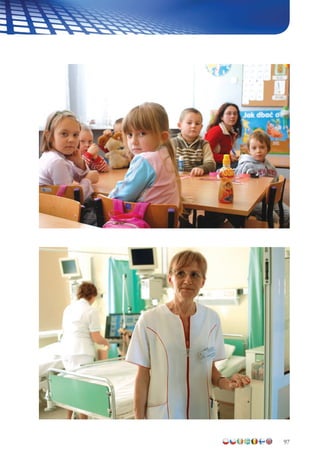
The Flemish city of Mechelen is working
with two social economy companies to
enable youngsters to combine part-time
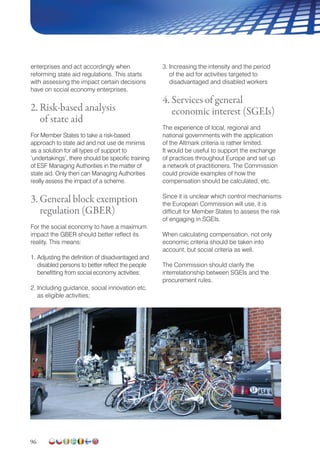
education with employment. The evaluation
of De Ploeg and Levanto shows that giving
youngsters the chance to combine their
training with appropriate work experience
means they are better equipped to
find a job, and can avoid prolonged
unemployment.
Levanto provides work placements and
training for around 50 young people a year,
at a cost of €47,500. The young people work
part-time in places like nursing homes, a
wholefood shop, Mechelen football club,
Planckendael zoo or the youth hostel. The
project has a success rate of 94% compared
with the 80% achieved by the city itself. A
further nine students have found work in the
context of the Social Maribel (a reduction
in social security contributions for new jobs
created in the non-profit sector).
De Ploeg finds work for 21 youngsters a
year, and in return for receives a payment
of €21,000. It has 13 partners offering
part-time jobs to young people, such as the
Nekker sports centre, Prisma multicultural
integration centre, nursing homes and
kindergartens. Even young people with
specific problems such as attention
deficit hyperactivity disorder (ADHD) and
unaccompanied refugees may find an
opportunity at De Ploeg.
www.deploeg.be, www.levanto.be
Investment priority 3:
Self-employment,
entrepreneurship and
business creation
A test bed for new businesses
An activity co-operative is a launch pad, a
business incubator that provides budding
business people with an easy transition from
inactivity to self-employment. It provides
entrepreneurs with financial and legal cover
during the trial business period. Intending
entre­preneurs benefit from a safe legal
status and an income guarantee as the
business builds up, as well as peer support
(but not necessarily premises). They pass
through three stages:
26
1. First, they remain technically unemployed
but develop their business idea under the
wing of the activity co-operative;
2. Next, if it looks like being a success, they
become a ‘salaried entrepreneur’ with the
security of a part-time employment contract;
3. Finally they become a self-sufficient
business, sharing in the ownership and
management of the co-operative.
The structure thus provides the small
business person with the best of both
worlds – control over their working life, but
with the support of a group of people who
are facing the same problems and want to
pool their enthusiasm and expertise. It helps
to overcome one of the most discouraging
features of becoming self-employed – the
isolation. Activity co-operative clients are in
all sorts of activities from cookery, industrial
cleaning, furniture restoration and organic
horti­culture to violin making, jewellery,
translation and web design.
Activity co-operatives are operating in
around 100 locations across France,
and there are eight in Belgium as well as
examples in Sweden, Morocco and Quebec.
At any one time, they are supporting around
3,500 nascent enterprises.
http://www.apce.com/pid648/cooperatives-
activites.html
Investment priority 4:
Equality between men
and women and
reconciliation between
work and private life
Child care co-operatives
all over Europe
The existence of child care structures is an
important pre-condition to ensure equality
between men and women and reconciliation
of private and professional life.
In Italy, the major consortia of social
co-operatives together with one of the
major national banks created in 2004
PAN consortium. PAN develops services
for children through the social enterprise
formula, an entrepreneurial form coherent
with the ‘public’ purpose of these services.
Local governments responsible for the
administration of child care services and
families or private/public companies
interested in creating “company
nurseries” are also playing an important
role as partners.
PAN offers planning, start-up assistance and
loans to organisations and people interested
in establishing new types of services for
children in the form of social enterprises.
A guaranteed quality trademark is given to
all social enterprises members of PAN with
quality check tools. PAN also helps families
with personal loans focused on making
the access to early childhood services
less expensive.
In just four years, PAN has successfully
built 150 new infant schools with 4,500
available places and more than 1,000 new
jobs. Nowadays there are in Italy more than
400 day nursery centres which take care
27
of about 12,000 children and employ more
than 3,000 people.
www.consorziopan.it
In Andalusia there is a tripartite programme
where Municipalities offer buildings and/
or surface to a co-operative to build a
kindergarten and the regional government
signs an agreement to cover some public
places in the school. Social entrepreneurs
have to build the building and they receive
technical support from CEPES-Andalucia for
the design and development of the project.
There exist also some agreements with
some regional financial institutions (banks).
All childhood schools are in rural areas.
http://escuelasinfantiles.innoves.es/
escuelas/?q=node/37
Sweden is faced with sparsely populated
areas where public services are increasingly
disappearing. Long distances to childcare
make the work-life balance unsustainable.
One example where this was prevented was
in the village of Brännberg in the north of
Sweden. The public preschool was closed
due to a small number of children. The
parents in the village decided to create a
parent co-operative, and thereby avoid the
daily extra travelling to take the children
to daycare in a neighbour village. Parent
co-operatives are owned and managed by
the parents of the children on the daycare
centre. The parents are responsible for
the management of the daycare centres,
although hired staff account for most of
the daily work. The parents are involved in
the board, economy, maintenance etc. In
this way the parents have the possibility to
ensure participation, influence, and safety
when leaving their kids in childcare.
www.kfo.se, www.coompanion.se
Investment priority 5:
Adaptation of workers,
enterprises and
entrepreneurs to change
Equipping managers
to meet new needs
Adaptation to change is a key challenge
for most enterprises and so it is for the
social economy. In the case of Andalusia,
one key line of development has been the
role of leadership. This is a role that cannot
be addressed in the same way as within
profit-maximising, individualistic enterprises.
The sector and the government realised the
need to set up a highly innovative instrument
to address the multifaceted nature of
leadership and change in social economy
organisations. This is how the Andalusian
School of Social Economy was born in
2002. It is a top-level education institution
managed by a foundation set up by
CEPES-Andalucía (the umbrella organisation
representing the social economy in this
Spanish region) and FAECTA (the regional
federation of workers’ co-operatives) and
funded by the regional government. Its
headquarters is a restored 17th century
convent in Osuna, in the centre of Andalusia,
where it can accommodate more than
25 people. In its more than 12 years of
history it has set up a range of training
programmes:
 FIDES for Senior Managers (FIDES
Directivos y Directivas): an MBA-type
programme to prepare senior managers
and officials to respond to the changing
conditions in society.
 FIDES Entrepreneurs (FIDES Emprende):
for start-up social entrepreneurs,
paying special attention to collective
entrepreneurship.
28
 FIDES tutors (FIDES Tutor) to train alumni
from ‘FIDES for senior managers’, as
coaches and teachers. It also serves to
keep the school in contact with its alumni.
 FIDES leaders (FIDES Rector) aimed at
leaders of organisations representing
social economy in Andalusia. The
speakers are first-level figures in the
subject such as former prime ministers,
leading journalists, top officials both
national and from other countries, etc.
 Social Economy and Care (FIDES
Economía Social y Dependencia):
an MBA-type programme for senior
managers of social enterprises in the
social and health care sector.
http://www.escueladeeconomiasocial.es/
investment Priority 6:
Active and healthy ageing
Tackling the challenges of
the new welfare
In Italy, Legacoop has recently launched an
intersectoral project on health, responding
to demographic changes and new needs of
the population (active and healthy ageing,
new models of care services). The project
aims to create a network among the various
actors in the co-operative and mutual
sectors in order to integrate the supply of
care and health services. Collaboration with
the public sector is crucial to the reform of
the welfare system. Cooperation among
the different actors will promote more
efficient services and a new culture of a
sustainable welfare system based on “fewer
hospitals – more prevention, home care and
management of chronic diseases”.
http://www.legacoop.it/VisualizzaPagina.
aspx?idpagina=123
Welfare Italia Servizi is a social enterprise
created in 2009 by the CGM Consortium,
Intesa Sanpaolo and Banco Popolare, to
propose an innovative model of welfare
in the health services. Welfare Italia is a
network of medical and dental practices
offering high-quality services at affordable
prices. Welfare Italia is organised through
a franchising system based on values
such as the central role of the person and
the family, a welcoming environment, and
paying special attention to people in difficult
situations. Welfare Italia has so far opened
12 clinics in different parts of Italy.
www.welfareitalia.eu
investment Priority 7:
Modernisation and
strengthening of labour
market institutions,
including actions to
enhance transnational
labour mobility
Going abroad for new
business ideas
In 2009 the European Commission launched
Erasmus for Young Entrepreneurs, an
exchange programme that helps new
entrepreneurs to acquire relevant skills for
managing a small or medium-sized enterprise
by spending time (1 to 6 months) in an
enterprise managed by an experienced
entrepreneur in another European country.
The co-operative movement participated
in the programme with the consortium
COOPERASMUS, led by Cooperatives
Europe and involving partners from 6
European countries. Co-operative umbrella
organisations from UK, IT, SE, BG, BE and
ES have been selected as intermediaries
to help new and host entrepreneurs to get
in contact and to assist them during the
relationship. The programme was a great
opportunity for the co-operative movement.
Firstly, this project responded to a need which
co-operative businesses have expressed
several times in the past: new entrepreneurs/
co-operators, especially in the start-up
phase, need to exchange experience with
experienced entrepreneurs. Secondly, it was
another official recognition of co-operatives
as key actors in the current market context.
Thirdly, it constituted a great chance to foster
the creation of new co-operative businesses
and to enable co-operatives to gain an
international dimension. The members of the
CoopErasmus consortium collected some
100 applications and succeeded in organising
20 successful relationships and one failed
relationships, involving 22 entrepreneurs.
http://ns39179.ovh.net/~coopsue/spip.
php?article753
29
30
What is the challenge?
Education and training has always been a
primary policy goal in the European Union,
but in the current situation of crisis and
austerity measures this objective is even
more relevant. Sometimes the short-termism
brought on by the crisis situation makes it
more difficult to align the key actors behind
these long-term, structural objectives.
Furthermore, in an era characterised by
“liquidity”, or rapid changes in paradigms
and in solid references, the tools provided
by solid education and training play an
even more necessary role, as the joint
progress report of the Council and the
Commission on the “Education  Training
2010” work programme18
acknowledges.
However, education is not only a tool
for employment but also a factor of full
participation in society and this is something
the social economy understood from the
very beginning, as the fifth of the Rochdale
Principles (or Co-operative Principles) states:
co-operative societies provide education and
training to their members and the public.19
On the other hand, the crisis and rising
unemployment can favour a return to school
and a reduction in school dropouts, and
therefore there is also an opportunity that
should be seized. However this depends on
a reversal of the worsening conditions in the
labour market (in terms of less job security
for example) which may affect the capacity
to upgrade the skills and competences of
the workforce.
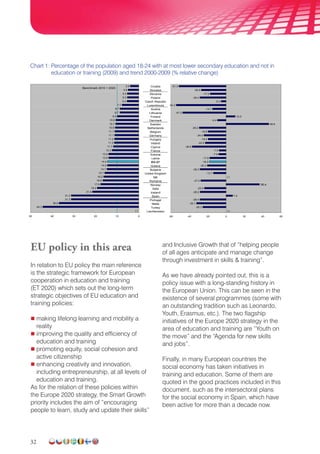
Nevertheless, figures for early school leaving
in the EU remain high: over 14% (over 15.5%
for the euro area) of the population aged
18-24 have at most lower secondary
education and are not in further education
or training (2010).
In relation to lifelong learning the situation is
worsening rapidly: in 2010, the proportion of
persons aged 25 to 64 in the EU receiving
some form of education or training in the four
weeks preceding the labour force survey was
9.1%; a share that was 0.7 percentage points
lower than the corresponding share for 2005,
which makes it more difficult to achieve the
2020 goal of 15%.
Nevertheless, here again figures are very
different depending on the country, varying
from 1.3% in Romania and 3% in Greece to
32.8% in Denmark.
Finally, as the Commission states, it is worth
noting that “the EU has around 80 million
people with low or basic skills – benefiting
less from lifelong learning than more
educated people”.
18
Key competences for a changing world, Official Journal C 117 of 6 May 2010.
19
The Rochdale Principles are a set of ideals for the operation of co-operatives. They were first set out by the Rochdale Society of Equitable Pio-
neers in Rochdale, England, in 1844, and have formed the basis for the principles on which co-operatives around the world operate to this day.
31
Investing in education, skills
and lifelong learning
32
Croatia
Slovakia
Slovenia
Poland
Czech Republic
Luxembourg
Austria
Lithuania
Finland
Denmark
Sweden
Netherlands
Belgium
Germany
Hungary
Ireland
Cyprus
France
Estonia
Latvia
EU-27
Greece
Bulgaria
United Kingdom
MK
Romania
Norway
Italia
Iceland
Spain
Portugal
Malta
Turkey
Liechtenstein
-27.5
-13.7
-20.3
-17.8
-7.5
-36.8
-19.4
-19.6
-29.2
-9.4
-54.2
-28.4
-17.2
-26.9
36.4
7.2
-28.3
-18.2
-22.6
-24.0
-14.7
-28.2
(:)
-7.9
46.6
-5.3
-51.3
10.0
-47.3
-23.5
(:)
-25.3
-32.1
-28.4
-60 -40 -20 0 20 40 60
31.2
31.2
21.4
19.2
17.6
16.6
16.2
15.7
14.7
14.5
14.4
13.9
13.9
12.3
11.7
11.3
11.2
11.1
11.1
10.9
10.7
10.6
9.9
8.7
7.7
5.4
5.3
4.9
(:)
44.3
36.8
8.7
5.3
3.9
01020304050
Benchmark 2010 + 2020
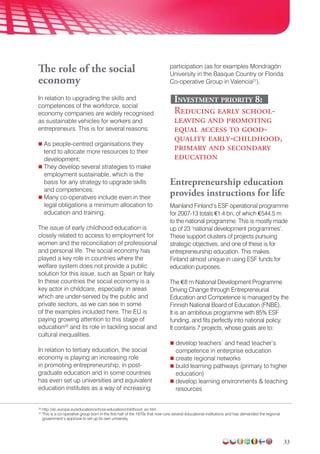
Chart 1: Percentage of the population aged 18-24 with at most lower secondary education and not in
education or training (2009) and trend 2000-2009 (% relative change)
EU policy in this area
In relation to EU policy the main reference
is the strategic framework for European
cooperation in education and training
(ET 2020) which sets out the long-term
strategic objectives of EU education and
training policies:
 making lifelong learning and mobility a
reality
 improving the quality and efficiency of
education and training
 promoting equity, social cohesion and
active citizenship
 enhancing creativity and innovation,
including entrepreneurship, at all levels of
education and training.
As for the relation of these policies within
the Europe 2020 strategy, the Smart Growth
priority includes the aim of “encouraging
people to learn, study and update their skills”
and Inclusive Growth that of “helping people
of all ages anticipate and manage change
through investment in skills  training”.
As we have already pointed out, this is a
policy issue with a long-standing history in
the European Union. This can be seen in the
existence of several programmes (some with
an outstanding tradition such as Leonardo,
Youth, Erasmus, etc.). The two flagship
initiatives of the Europe 2020 strategy in the
area of education and training are “Youth on
the move” and the “Agenda for new skills
and jobs”.
Finally, in many European countries the
social economy has taken initiatives in
training and education. Some of them are
quoted in the good practices included in this
document, such as the intersectoral plans
for the social economy in Spain, which have
been active for more than a decade now.
33
The role of the social
economy
In relation to upgrading the skills and
competences of the workforce, social
economy companies are widely recognised
as sustainable vehicles for workers and
entre­preneurs. This is for several reasons:
 As people-centred organisations they
tend to allocate more resources to their
development;
 They develop several strategies to make
employment sustainable, which is the
basis for any strategy to upgrade skills
and competences;
 Many co-operatives include even in their
legal obligations a minimum allocation to
education and training.
The issue of early childhood education is
closely related to access to employment for
women and the reconciliation of professional
and personal life. The social economy has
played a key role in countries where the
welfare system does not provide a public
solution for this issue, such as Spain or Italy.
In these countries the social economy is a
key actor in childcare, especially in areas
which are under-served by the public and
private sectors, as we can see in some
of the examples included here. The EU is
paying growing attention to this stage of
education20
and its role in tackling social and
cultural inequalities.
In relation to tertiary education, the social
economy is playing an increasing role
in promoting entrepreneurship, in post-
graduate education and in some countries
has even set up universities and equivalent
education institutes as a way of increasing
participation (as for examples Mondragón
University in the Basque Country or Florida
Co-operative Group in Valencia21
).
Investment priority 8:
Reducing early school-
leaving and promoting
equal access to good-
quality early-childhood,
primary and secondary
education
Entrepreneurship education
provides instructions for life
Mainland Finland’s ESF operational programme
for 2007-13 totals €1.4 bn, of which €544.5 m
to the national programme. This is mostly made
up of 23 ‘national development programmes’.
These support clusters of projects pursuing
strategic objectives, and one of these is for
entrepreneurship education. This makes
Finland almost unique in using ESF funds for
education purposes.
The €8 m National Development Programme
Driving Change through Entrepreneurial
Education and Competence is managed by the
Finnish National Board of Education (FNBE).
It is an ambitious programme with 85% ESF
funding, and fits perfectly into national policy.
It contains 7 projects, whose goals are to:
 develop teachers’ and head teacher’s
competence in enterprise education
 create regional networks
 build learning pathways (primary to higher
education)
 develop learning environments  teaching
resources
20
http://ec.europa.eu/education/school-education/childhood_en.htm
21
This is a co-operative group born in the first half of the 1970s that now runs several educational institutions and has demanded the regional
government’s approval to set up its own university.
34
The programme’s rationale is that
entrepreneurship education and
entrepreneurial skills provide young people
with the resources to cope in a world
of continuous change and ever greater
complexity. In addition, these projects highlight
creative and innovative aspects, alongside the
willingness to take risks in education, as well
as the ability to plan and manage activities in
order to achieve one’s goals.
The long-term effects of the projects enhance
growth, competitiveness, productivity and
finding employment. As a country with a
welfare system, it is important to Finland that
its young people view entrepreneurship as a
valued career option. It is also vital that they
participate in creating new entrepreneurship
opportunities and business activity for Finland.
The experience is transferable as all
Finland’s ESF operational programmes have
an objective for teacher training, and this
can be used for enterprise education.
http://www.rakennerahastot.fi/rakennerahastot/
tiedostot/esitteet/TEM_National_Development_
Programmes_lores.pdf
Investment priority 9:
Improving the quality,
efficiency and openness of
tertiary and equivalent
education with a view to
increasing participation
and attainment levels
Masters degrees in the
social economy
Spanish policy for social economy has
always paid attention to knowledge-related
measures and it has realised that masters
degrees can open up access to post-
graduate education for potential social
entrepreneurs. As a result, this type of
programme has a longstanding tradition
and they are present throughout the country.
In Spain there are three different types of
masters degree:
 Those taught by universities such as
the Master in Social Economy at the
universities of Valencia or Barcelona
 Those taught by social economy
organisations (universities or not) such as
those from Mondragón University or the
Andalusian School of Social Economy
 Those taught by other types of tertiary
education institutions not directly related
to the social economy, such as business
schools like ESADE or EOI (both among
the four best business schools in Spain)
or university institutes such as IGOP in
Catalunya.
In Italy several universities deliver MBA-
type programmes, often in cooperation with
social economy umbrella organisations.
Often co-funded by the ESF, they focus
either on management of non-profit and
third sector organisations or on co-operative
studies. Social economy companies offer
internships for trainees.
In Poland several universities use the ESF
to fund post-graduate courses on social
economy, namely Warsaw University
(Institute of Social Policy), Wrocław
University (Institute of Political Studies),
Kraków University (Małopolska School
of Administration). There are also some
courses not connected with the ESF,
such as those offered by Lublin University
(Maria Skłodowska-Curie University) and
Bydgoszcz Higher School of Economy.
35
Investment priority 10:
Enhancing access to
lifelong learning,
upgrading the skills
and competences of the
workforce and increasing
the labour market
relevance of education
and training systems
Training in partnership
On the one hand, lifelong learning plays
a key role in the social economy. On the
other hand, the social economy has long
been accepted as a strategic sector for the
Spanish economy, so one would expect to
find specific measures for it in the national
plan for lifelong learning. The public
authorities have included the Intersectoral
Plans for the Social Economy within it.
These are special plans exclusively for
workers in social economy organisations
and enterprises. The national programme
is co-funded by the ESF (it represents
less than 8% of the total funding) within
the Multiregional Operational Programme
(Adaptability and Employment) and so
are the regional plans. They are managed
in partnership, with the national and
regional umbrella organisations sharing
the management and even providing part
of the training either themselves or through
specialised social economy enterprises. In
2011 the budget for all national intersectoral
plans was €44.9 m, of which €7.3 m went
to the social economy ones. A similar
amount is allocated to the regional plans.
The national Intersectoral Plans for Social
Economy trained 20,371 people for 908,000
training hours.
http://www.fundaciontripartita.org/orientacion/
planes_de_formacion_financiados_economia_
social.htm
36
37
2006 2007 2008 2009 2010
What is the challenge?
According to the Joint Report by the
Commission and the Council on Social
Inclusion, social exclusion is:
… a process whereby certain individuals are
pushed to the edge of society and prevented from
participating fully by virtue of their poverty, or
lack of basic competencies and lifelong learning
opportunities, or as a result of discrimination.
This distances them from job, income and
education opportunities as well as social and
community networks and activities. They have
little access to power and decision-making
bodies and thus often feel powerless and unable
to take control over the decisions that affect
their day to day lives.22
The crisis is producing a sharp rise in
inequalities in Europe as the daily lives
of many social entrepreneurs attest.
This deterioration can be seen in several
indicators, such as the Gini coefficient (see
below), growing financial exclusion and over-
indebtedness, and the increasing social and
political exclusion of vulnerable groups such
as the Roma and migrant communities.
These trends are challenging the basis of the
welfare state in some EU countries and they
affect the social fabric of many communities.
Nevertheless, we should not only consider
this to be a conjunctural issue. There were
other negative trends prior to the crisis which
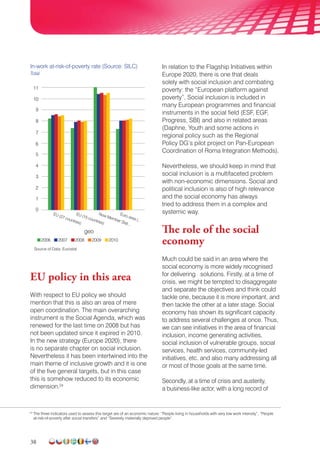
are also a major concern, such as in-work
poverty (see below).
Furthermore, the austerity measures are also
posing a major challenge for social services.
These have been affected in many countries
by severe cuts in public spending as the
Commission states:
SSGIs in all Member States have come
under serious pressures as a result of
the economic and public budget crisis.
The contracting economy has led to
the growth of the need and demand
for social services and, at the same
time, has significantly constrained the
financing basis in public budgets.23
22
Joint report by the Commission and the Council on social inclusion. 7101/04, 5 March 2004
23
Second biennial report on social services of general interest. Commission staff working document. SEC(2010) 1284 final, 22 October 2010
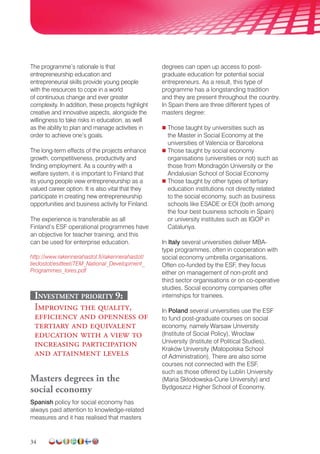
People at-risk-of-poverty or social exclusion %
and 1000 persons
1000 persons
Source of Data: Eurostat
geo
120 k
110 k
90 k
70 k
50 k
30 k
80 k
60 k
40 k
20 k
10 k
0
100 k
EU (27 countries) Euro area
Promoting social inclusion
and combating Poverty
38
24
The three indicators used to assess this target are of an economic nature: “People living in households with very low work intensity”, “People
at-risk-of-poverty after social transfers” and “Severely materially deprived people”.
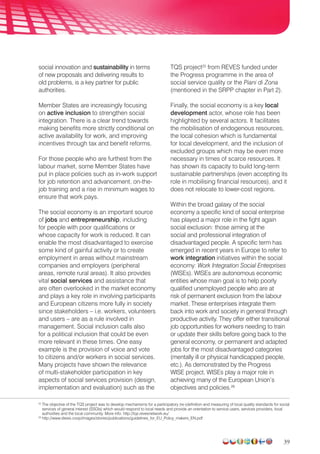
In-work at-risk-of-poverty rate (Source: SILC)
Total
Source of Data: Eurostat
geo
2006 2007 2008 2009 2010
11
9
7
5
3
8
6
4
2
1
0
10
EU (27 countries)
EU (15 countries)
Now Member Stat...
Euro area (...
EU policy in this area
With respect to EU policy we should
mention that this is also an area of mere
open coordination. The main overarching
instrument is the Social Agenda, which was
renewed for the last time on 2008 but has
not been updated since it expired in 2010.
In the new strategy (Europe 2020), there
is no separate chapter on social inclusion.
Nevertheless it has been intertwined into the
main theme of inclusive growth and it is one
of the five general targets, but in this case
this is somehow reduced to its economic
dimension.24
In relation to the Flagship Initiatives within
Europe 2020, there is one that deals
solely with social inclusion and combating
poverty: the “European platform against
poverty”. Social inclusion is included in
many European programmes and financial
instruments in the social field (ESF, EGF,
Progress, SBI) and also in related areas
(Daphne, Youth and some actions in
regional policy such as the Regional
Policy DG’s pilot project on Pan-European
Coordination of Roma Integration Methods).
Nevertheless, we should keep in mind that
social inclusion is a multifaceted problem
with non-economic dimensions. Social and
political inclusion is also of high relevance
and the social economy has always
tried to address them in a complex and
systemic way.
The role of the social
economy
Much could be said in an area where the
social economy is more widely recognised
for delivering solutions. Firstly, at a time of
crisis, we might be tempted to disaggregate
and separate the objectives and think could
tackle one, because it is more important, and
then tackle the other at a later stage. Social
economy has shown its significant capacity
to address several challenges at once. Thus,
we can see initiatives in the area of financial
inclusion, income generating activities,
social inclusion of vulnerable groups, social
services, health services, community-led
initiatives, etc. and also many addressing all
or most of those goals at the same time.
Secondly, at a time of crisis and austerity,
a business-like actor, with a long record of
39
social innovation and sustainability in terms
of new proposals and delivering results to
old problems, is a key partner for public
authorities.
Member States are increasingly focusing
on active inclusion to strengthen social
integration. There is a clear trend towards
making benefits more strictly conditional on
active availability for work, and improving
incentives through tax and benefit reforms.
For those people who are furthest from the
labour market, some Member States have
put in place policies such as in-work support
for job retention and advancement, on-the-
job training and a rise in minimum wages to
ensure that work pays.
The social economy is an important source
of jobs and entrepreneurship, including
for people with poor qualifications or
whose capacity for work is reduced. It can
enable the most disadvantaged to exercise
some kind of gainful activity or to create
employment in areas without mainstream
companies and employers (peripheral
areas, remote rural areas). It also provides
vital social services and assistance that
are often overlooked in the market economy
and plays a key role in involving participants
and European citizens more fully in society
since stakeholders – i.e. workers, volunteers
and users – are as a rule involved in
management. Social inclusion calls also
for a political inclusion that could be even
more relevant in these times. One easy
example is the provision of voice and vote
to citizens and/or workers in social services.
Many projects have shown the relevance
of multi-stakeholder participation in key
aspects of social services provision (design,
implementation and evaluation) such as the
TQS project25
from REVES funded under
the Progress programme in the area of
social service quality or the Piani di Zona
(mentioned in the SRPP chapter in Part 2).
Finally, the social economy is a key local
development actor, whose role has been
highlighted by several actors. It facilitates
the mobilisation of endogenous resources,
the local cohesion which is fundamental
for local development, and the inclusion of
excluded groups which may be even more
necessary in times of scarce resources. It
has shown its capacity to build long-term
sustainable partnerships (even accepting its
role in mobilising financial resources), and it
does not relocate to lower-cost regions.
Within the broad galaxy of the social
economy a specific kind of social enterprise
has played a major role in the fight again
social exclusion: those aiming at the
social and professional integration of
disadvantaged people. A specific term has
emerged in recent years in Europe to refer to
work integration initiatives within the social
economy: Work Integration Social Enterprises
(WISEs). WISEs are autonomous economic
entities whose main goal is to help poorly
qualified unemployed people who are at
risk of permanent exclusion from the labour
market. These enterprises integrate them
back into work and society in general through
productive activity. They offer either transitional
job opportunities for workers needing to train
or update their skills before going back to the
general economy, or permanent and adapted
jobs for the most disadvantaged categories
(mentally ill or physical handicapped people,
etc.). As demonstrated by the Progress
WISE project, WISEs play a major role in
achieving many of the European Union’s
objectives and policies.26
25
The objective of the TQS project was to develop mechanisms for a participatory (re-)definition and measuring of local quality standards for social
services of general interest (SSGIs) which would respond to local needs and provide an orientation to service users, services providers, local
authorities and the local community. More info: http://tqs.revesnetwork.eu/
26
http://www.diesis.coop/images/stories/publications/guidelines_for_EU_Policy_makers_EN.pdf
40
Investment priority 11:
Active inclusion
Le Mat: travelling with social
entrepreneurs
Le Mat is a brand and a social franchise
system of social entrepreneurs in tourism.
Le Mat officially started in 2004, through
an EQUAL project, by distilling good and
sustainable practice from Trieste in the north-
east of Italy. Il Posto delle Fragole (Le Mat
founder member) is a worker-owned social
co-operative composed of young psychiatric
patients, artists, drug addicts, physicians
and sympathisers, that has managed a small
hotel in Trieste since the late 1980s. As Le Mat
developed further, the EQUAL project distilled
more than just one model
– a 30-room hotel in main cities, near
transport links, completely accessible and
usable by people with disabilities – but there
are many different ways to be a Le Mat
Special Place. Even if there are common
quality elements, each Le Mat is different
and unique, there are variations in culture,
geography, architecture, entrepreneurship
and social aspects. Thanks to a bottom-
up process, Le Mat social entrepreneurs
discover and share interesting and innovative
practices in inclusive tourism, hospitality and
sustainable local development, identifying
needs, demand, processes and quality
standards. Step by step Le Mat distils the
different experiences it knows and meets,
extracts the most significant quality elements
and it tries to replicate them. Le Mat is
working to become a well-known brand for
travellers who are curious to know the world
of social entrepreneurs: special places,
special people, special values!
Le Mat is owned in Italy and in Europe by
social-co-operatives. In Italy it is a consortium
(a co-operative society of social co-
operatives), owned by 9 social co-operatives,
3 consortia of social co-operatives, the Le
Mat Travellers Association and Coopfond,
a co-operative development agency. At the
European level Le Mat is also a co-operative
owned by Le Mat Italy and Le Mat Sweden.
Presently, in Italy there are 18 approved Le
Mat Special Places. In Sweden at the moment
there are two Le Mat BBs. Nowadays Le
Mat is growing up also in UK and in Bosnia –
Herzegovina.
http://www.lemat.coop/
41
Investment priority 12:
Integration of
marginalised communities
such as the Roma
Green job opportunities
for Roma
In the Odry region, the Czech ESF is
supporting a project to help the socially
excluded Roma minority (which represents a
significant share of the inhabitants)
and, at the same time, to promote
the development of the Odry nature
conservation area. The work integration
social enterprise “AC AERO s.r.o.” was
established to offer gardening services (in
private houses, town parks and company
premises) and to cultivate vegetation in the
countryside. AC Aero also builds, maintains
and repairs smaller buildings. The income
earned is invested in the development
of the company (widening its activities,
mechanisation and marketing) and in
establishing further jobs for members
of the target group.
The key project activities are individual
consultancy and support to help Roma
employees to change their attitudes to work
and life style and to improve their financial
situation. The management holds regular
group discussions with the employees
to solve problems on either side. These
discussions could result in changes
in work organisation and conditions, which
lead to improved quality and productivity,
and generally to more positive working
relations. Support services and management
of the firm is provided by a highly
motivated team, experienced in garden
design and working with the target group.
Thanks to the project, 17 Roma people have
been employed by AC Aero since the start of
the project on 1 January 2011. The present
number of Roma employees is six.
http://www.esfcr.cz/projekty/ac-aero-kultivace-
krajiny-oderska
Investment priority 13:
Combating discrimination
based on sex, racial
or ethnic origin, religion
or belief, disability,
age or sexual orientation
U Pana Cogito
About 400,000 people are estimated to
suffer from schizophrenia in Poland. It is
extremely difficult for them to find a job.
At the end of the 90s, representatives of
non-governmental organisations, local
government units and Kraków schools
were invited to Edinburgh to witness how
Six Mary’s Place, a guesthouse employing
people with psychic disturbances,
functioned. The idea to undertake a similar
venture in Kraków occurred. An NGO
from Edinburgh, along with two Polish
associations, applied jointly for a grant to
the National Lottery Charities Board in Great
Britain to acquire funds for the investment.
They were successful! In 2000–2002, the
grant covered the administration costs and
assured financing of 20% of the costs for the
investment. Scottish NGOs supported and
supervised completion of the project. Funds
were also acquired from private sponsors
and public resources. As reflected in the
marketing analysis a three-star guesthouse
was the most suitable for the guests visiting
Kraków. It was decided that the hotel should
operate as an institution of vocational
activation for the schizophrenia patients.
The Kraków authorities offered a historical
building needing renovation on a 40-year
lease. Opening of the guesthouse cost 1.2
42
million PLN (€300,000). PFRON (the State
Fund for Rehabilitation of Handicapped
Persons) granted 40%, and the remaining
part was acquired through grants.
In 2003, ‘Mr Cogito’s’ guesthouse
opened its doors. Before it happened,
the association organised courses for
employees, kitchen help works, reception
asset works, cleaning services etc. Later
on there were catering courses as well as
computer literacy courses, internship and
apprenticeship organised in cooperation
with Kraków hotels such as Holiday Inn and
Regent, and Fundacja Kawiarnia “Hamlet”
(Hamlet Foundation) and Occupational
Therapy Workshops. About 40 people with
the past mental illness were trained. 21
people suffering mainly from schizophrenia
work in the guesthouse.
The entire income is allocated for
rehabilitation of the workers, subsidised
medicines, rehabilitation camps, and
additional training sessions. After 2 years,
in 2005, the association opened the second
facility, a social enterprise in the form of a
limited liability company, supporting the
work of the guest house. Start-up costs
were financed by the ESF (430 000 PLN
€108,000 – 52% of the total investment).
Recently the association has also developed
other activities such as bicycle hire and
catering services for conferences, training,
outdoor events, and private events.
http://www.pcogito.pl/language,4,english.htm
43
Investment priority 14:
Enhancing access to
affordable, sustainable
and high-quality services,
including health care and
social services of general
interest
Capitalising social
co-operatives
JEREMIE ESF Lombardy (IT) is designed
to promote easier access to credit to
micro, small and medium enterprises and
access to employment and education
to disadvantaged people. Under the
JEREMIE initiative, the ESF Lombardy
Regional Operational Programme makes
loans to shareholders belonging to social
cooperatives or workers’ cooperatives that
employ at least 30% of disadvantaged
members, in order to enable them to buy
shares in the social cooperatives that
employ them. This extra working capital
strengthens the enterprises’ capacity to
provide services and employment.
The local financial intermediaries provide
loans to disadvantaged people amounting
to €4,000. The JEREMIE contribution is
50%, configured as a ‘bullet component’,
a 5-year interest-free loan, with a single
repayment. The above-mentioned local
financial intermediaries provide the rest,
also in the form of 5-year loan, but with a
fixed interest rate and monthly repayments.
The JEREMIE fund, worth €20 million,
is managed by Finlombarda, a public
financial institution, through selected
financial intermediaries. After the first call
in 2010 Banca Popolare di Bergamo and
Federazione Lombarda BCC received
€5 million each, and in 2011 Banca
Popolare di Bergamo, Banca Popolare
Etica and Banca Popolare di Sondrio
obtained €3 million each.
www.finlombarda.it
In the Czech Republic, the “Investment
support for the social economy” global
grant, part of the ERDF integrated
operational programme, provides start-
up capital for social service providers,
employers and other social economy
organisations. Grants range from €12,000 to
€200,000. In parallel, the “Social economy”
global grant, part of the ESF Human
Resources and Employment Operational
Programme, supports the creation and
development of new social businesses.
Grants range from €4,000 to €200,000
(under the de minimis regime).
www.socialeconomy.pl
Investment priority 15:
Promoting the social
economy and social
enterprises (systemic
approach, policy co-
ordination)
Coordinated cooperation
Poland’s high-level working group on
the social economy enables different
ministries to co-ordinate their policies. In
2008 the Polish Prime Minister constituted
the Social Economy Working Group for
Systemic Solutions, with 21 members
nominated by the Minister of Labour
and Social Policy. They include six vice-
ministers and representatives of the
ministries, representatives of other public
bodies, along with representatives of
social economy organisa­tions, the Trilateral
Commission and academics. The group’s
44
main task is to discuss strategies and
proposals to foster the development of the
social economy and to make sure that it
is taken into account in the government’s
strategic documents such as strategies for
regional develop­ment, social capital, human
capital, an efficient state, innovativeness,
and sustainable rural development. It has
four sub-groups dealing with legal issues,
financial infrastructure, education and
strategy, so as to create synergies and
coordination between different policies
and tools affecting the social economy.
The group’s first strategic document
is a draft Social Economy Pact for the
Modernisation of the Polish Social Model
2030, as a contribution to the Poland 2030
report. But the most recent achievements
are the drafting and consultation on a new
law on social entrepreneurship and social
enterprise (ready to be submitted to the
Parliament) as well as a policy paper on
Long-Term Social Economy Development.
In Scotland the social economy goes back
hundreds of years, but the first national
strategy was launched only in 2007, with
cross-party support. It aims to reduce
poverty, create jobs and develop businesses.
Andalusia was the first region in the
world to sign a tripartite document with
a comprehensive and detailed policy
programme for the development of the
social economy back in 2002. Since then,
two new versions have been signed (2006
and 2011) and it has inspired similar
policy instruments in other contexts
such as the Małopolska Pact (2008).
There are differences due to the different
political contexts, but both are based
on a partnership approach and develop
a set of concrete measures. In the first
case, the signatories are the regional
government (which has extensive political
competencies), the trade unions and the
recognised unique representative of the
whole social economy in Andalusia (CEPES-
Andalucía). The Andalusian Pact includes a
follow-up system which foresees a session
in the regional parliament to assess it. In
all the sessions the assessments from all
parties in parliament were highly positive
asking the govern­ment to pursue them.
Andalusia has become the leading region
in terms of number of social economy
enterprises, employment in social economy
enterprises and in budget allocation, and
it is recognised at world level for its policy
framework for social economy.
Investment priority 16:
Community-led local
development strategies
Revitalising local retailing
through work integration
CAP Märkte (CAP Markets) are medium-
sized neighbourhood supermarkets in
Germany employing disabled people. Each
unit is typically run by a local disablement
association, but the brand is owned by
a co-operative of sheltered workshops. As
well work integration under good working
conditions, they revitalise empty retail sites
and provide a cherished community service,
especially for less mobile residents.
The first CAP Markt opened in Sindelfingen,
near Stuttgart, in 1999. Using the social
franchising principle, the chain has grown
steadily to nearly 90 shops across Germany.
They provide some 1,200 jobs, of which 650
are for severely disabled people.
CAP Markets provide multiple benefits to
multiple stakeholders. A CAP Markt not
only provides satisfying work for disabled
people, but also supplies staple foodstuffs
within walking distance of people’s homes,
reduces car use (which has health, energy
45
and congestion benefits), and regenerates
the local economy by recirculating money
locally. They counter exclusion by offer­ing
services such as home delivery of meals or
post office services.
They also demonstrate synergy between
different families within the social economy
– the shops are usually operated by local
disablement associations, the brand is
owned by a co-operative of sheltered
workshops and supplies come from a
retailer’s co-operative. The chain is still
growing steadily, and as demand from local
authorities across Germany shows, it has so
far only scraped the surface of the potential
demand that is there.
http://www.cap-markt.de
46
47
In this chapter we are not dealing with
a specific problem or challenge. This is
somehow a more instrumental objective so
we cannot keep the same structure as for
the other three. Nevertheless, we would like
to address here an issue which is closely
related to the objectives and methodological
approach of the ESF: the issue of partnership.
As we have already mentioned above,
partnerships are crucial for local development
and at the same time they offer the best
conditions for mutual capacity development.
There is a growing consensus among local
development practitioners and researchers
on the benefits of the networking/partnership
approach and on the basic strategy of
building the capacity of territories by working
on the mutual reinforcement of public and
private actors. In this area the European Union
can claim a leading position since it has very
early identified the relevance of partnerships
but also given the fact of its prevalence in the
most relevant policy documents. One of the
latest examples of this is the Commission staff
working document “The partnership principle
in the implementation of the Common
Strategic Framework Funds – elements for a
European Code of Conduct on Partnership”27
which starts:
Action for growth and jobs requires both
ownership at the top political level and
mobilisation from all actors across Europe.
Partnership has therefore been identified as
key to delivering the Europe 2020 Strategy.
In a context of diminishing public funds,
the need for higher efficiency is even more
pressing and demands the development of
innovative approaches such as the use of
public procurement in a more coherent and
comprehensive way to achieve multiple goals.
Policy networks are born in a context where
a wider or narrower range of stakeholders
can collaborate to address complex
problems. Their most efficient results are
partnerships which ensure a certain degree
of sustainability. Such partnerships have
been in action in Europe to address various
challenges: environmental ones (Agenda
21), rural development (PRODER and
LEADER) and RD (technology parks). They
have also been active in employment and
social policy, the primary example being
the partnerships within the cohesion policy
funds (ESF being the most relevant one).
In the area of social economy development,
the experience is also quite relevant, as
the examples mentioned in this publication
show (Andalusian Pact, Małopolska
Pact, Scottish PSP, etc.). Furthermore, an
accumulated practice exists in the field of
social economy/social entrepreneurship in
Europe thanks to the REVES network,
a unique network made of public authorities
and social entrepreneurs which celebrated
its 15th birthday in 2011.
These and other patterns may also demand
the development of the institutional
capacity of public administrations and
public services, so as to be able to harness
these changes. Enhanced capacities
for coordination, management of the
27
Brussels, 24.4.2012. SWD(2012) 106 final
enHancing institutional and
administrative caPacities
(convergence regions only)
48
participatory process, quality assessment,
etc. are also needed. A particular issue
is the need to develop new approaches
to evaluation, for instance methods of
measuring social value (see the good
example on this below).
Furthermore, as we show in the examples
of good practice, there are several regional
examples in different countries and contexts
that show this. There are also national
strategies like the one in Spain or the Social
Enterprise Strategy in the UK.
Capacity building on
specific issues
In a more specific way, there are several
issues where capacity building may
be of special significance, for example some
of the themes that the BFSE network has been
working on: social value, socially responsible
public procurement, financial instruments and
social services of general interest.
In the first case, social value, enhancing
the capacity of a political system in terms
of quality assessment and indicators is
of even greater significance in a situation
of diminishing resources available to
public policy. Social value is one of
the strands of an international trend to
improve measurement instruments such
as the Stiglitz commission in France, the
Happy Planet Index, and social return on
investment (SROI). This is linked with the
recent development of impact finance,
which requires the measurement of the
social goals and results of the investment.
The growing relevance of private funding
with social and environmental aims makes
more desirable the development of policy to
build financial ecosystems that foster social
innovation and social entrepreneurship.
This is a policy area (financial instruments
or financial engineering) where public
actors and public funds can have a
considerable impact. But this requires
capacity building based on partnership with
social economy actors.
In the case of socially responsible public
procurement it is also very clear that capacity
building on both sides (public authorities
and social economy) is fundamental for it
to deliver results. SRPP is a complex policy
instrument that requires adaptation from both
key actors – public authorities and the social
economy sector. The EU cohesion funds
have already addressed this task – as the
BFSE network in the case of ESF or the PASE
project28
in the case of ERDF show.
Finally, in the case of social services of
general interest, the social economy has
played a role in developing many of them
(childcare, training, social inclusion, elderly
care, marginalised groups, equal rights, etc.)
and many examples of this can be seen in this
publication. Furthermore, these developments
came with an enhanced capacity for local
and regional administration to deal with
complexity. Many of them brought in more
complex management systems, or more open
systems, which stimulate to social innovation.
The EU funds have also been in the front line,
for example the Territorial Quality Standards
in Social Services of General Interest (TQS)
project shows. This is one of eight Progress-
financed projects on social services quality
and it provided instruments for a participatory
definition and measurement of local quality
standards, applicable to any social service
at local and regional level, mainly in the
field of long-term care and related health
services. Thus, it provides partnerships with
highly innovative and complex instruments to
develop more resilient local welfare systems.
28
Public Policies and Social Enterprise, an Interreg IV C Project completed in 2011. http://www.pase-project.eu/
49
Investment priority 17:
Investment in
institutional capacity
and in the efficiency of
public administrations
and public services with
a view to reforms, better
regulation and good
governance
Regional support centres
for the social economy
In Poland the ESF Human Capital
Operational Programme 2007–2013 includes
a specific priority (implemented regionally)
for the promotion of social integration, whose
objective is to strengthen and develop
the social economy sector. Measure 7.2.
(Counteracting exclusion and strengthening the
social economy sector) has a budget of €435
million devoted to projects addressing people
threatened by exclusion, social economy
institutions, and institutions supporting the
social economy environment (public-social
partnerships, pacts, local authorities).
In order to build the support system for
SE institutions at the regional level, the
programme has funded the creation of
Social Economy Support Centres (SESCs)
in each region. Appointed through a call for
proposals these institutions:
 provide legal, bookkeeping and marketing
services
 work as advisory centres / points, social
economy incubators
 provide training on how to start up and
lead social economy entities
 help building local partnerships for social
economy development
 promote the social economy as a source
of employment.
The same OP measure also supports
individuals planning to start up social co-
operatives through grants of up to 20,000
PLN/€5,000 per person.
Up to now the programme has supported
292 Social Economy Support Centres which
have served about 5,400 social economy
organisations, thus permitting the creation of
1,500 jobs in the sector.
A mid-term evaluation of the programme
shows that the number of appointed
social economy support centres was too
big and support was too short. It will be
better to fund one SESC per sub-region
for at least 24 months. A major strength
of the programme is the multidimensional
and integrated support (training, grants,
advisory, and partnership) and its capacity
to influence regional authorities and
strategies in order to build local/regional
coalitions for social economy development.
Investment priority 18:
Capacity building for
stakeholders delivering
employment, education
and social policies
and for sectoral and
territorial pacts to
mobilise for reform at
national, regional and
local level
Tools to measure social valuen
As an activity during the BFSE network,
the Lombardy Region worked on the
creation of a tool for evaluating the social
value produced by social enterprises.
The main aim of this work was to provide
public authorities (as well as other potential
investors both public and private) with a
50
practical tool they could use when taking
decisions concerning funding allocation.
The tool in fact allows for an assessment of
the social value produced by both a social
enterprise as a whole and by a specific
project/intervention. Moreover, the tool
has been conceived with a high degree
of modularity so that it will be possible to
adapt it to specific regional, local or national
contexts. The main goal was in fact to
create a tool which would be as close as
possible to the actual needs of the players
involved and would be applicable in their
everyday life. While a detailed description
of the tool is provided in Part 2 – Chapter
3 Measuring Social Added Value – of this
publication, it is important to highlight here
that instruments of this type are increasingly
becoming an important support for public
authorities. For example, in February 2012
a new law was passed in the UK – the
Public Services (Social Value) Act – which
established, for the first time, that all public
bodies in England and Wales (including
local authorities, government departments,
National Health Service Trusts, fire and
rescue services, housing associations etc.)
will be required to consider how the services
they commission and procure might improve
the economic, social and environmental
well-being of the area. This new legislation
is very important and it will inevitably bring
local authorities in the UK to introduce
specific tools and procedures for evaluating
social value in their daily working life. More
information concerning this new initiative is
available at:
http://www.socialenterprise.org.uk/uploads/
files/2012/03/public_services_act_2012_a_
brief_guide_web_version_final.pdf
http://www.wikipreneurship.eu/index.
php5?title=Social_value
51
52
WHat tHe social economy
SPECIFIC
Awareness
raising
Spread
social
franchises
Braided
business
support
Training for public
officials (public
procurement)
Training for workers
and managers
imProve
tHe ecosystem
for tHe social
economy
by addressing
key obstacles
to tHe
birtH and
scaling-uP
of social
economy
enterPrises
53
needs from tHe esf
MEASURES
Networking
Financial
tools and
partnerships
Measure
social value
Improve knowledge
base (statistics,
models, etc.)
Coordinated
strategies
Trans-
national
exchange
imProve
tHe
caPacity
of local
systems
and
territories
to Produce
social
innovations
54
55
Part 2: Thematic
recommendations
A better future
Results of the BFSE network
56
57
1. The policy context
and current issues
Social franchising (see below for a more
detailed definition) is primarily a method for
transferring knowledge from one established
social enterprise to another that wants
to achieve the same social and financial
goals. Social franchising is one of the clear
successes of ESF funding. The EQUAL
initiative (2000–2008) has been the single
most important financial resource for social
franchising. This programme contained a
phase in which applications could be made
for separate dissemination projects and social
franchising was the main issue in some of
them. For social franchisors, this participation
in EQUAL made financing the development
phase possible and that should be a lesson
for future ESF, or any other cohesion policy
programmes. From this point on, it is
desirable for future programmes to contain
the opportunity to disseminate projects that
have been successful earlier.
Social franchising has also been included in
some ESF operational programmes in the
2007-13 programming period, such as the OP
for England and Gibraltar. Nevertheless, given
its nature, it has not been mainstreamed into
other EU policy, although it has attracted the
attention of relevant EU institutions such as the
European Economic and Social Committee:
3.2.2 Social enterprises are often locally
based, and expansion is not always an
obvious interest or priority. Rather than
competing or expanding their model, they
often prefer other approaches to growth.
This must be considered when exploring
cross-border social enterprise initiatives.
The EU and Member States should fund
and support the setting up forums, trainee
exchanges, ‘social innovation camps’ and
social franchising, which may be a better
way of encouraging new ideas and cross-
border cooperation.1
Furthermore, social franchising is a strategy
for scaling up and replicating social
enterprises and social innovation. Thus it fits
well in those initiatives and priorities related
to this, such as the Social Business Initiative
and the Social Innovation Europe. Thus, in
the first case we find:
Dedicating efforts to exploiting expertise
and resources across Europe will generate
significant value added, e.g. by scaling-
up proven businesses and business
models across the EU, establishing EU-wide
platforms and networks of businesses,
investors and providers of business
development services.2
In the case of social innovation, scaling-up is
one of the main themes. In both cases, a tested
entrepreneurial instrument with a proven record
in replication and scaling-up social enterprises
and social innovation can play a relevant role.
In addition, social franchising is a way of
disseminating solutions to other local or
national contexts. Although many of the
business ideas behind social enterprises
respond to the needs of local markets, and
they are often based on national regulations
such as salary contributions or work in a
market for social services formed by local
or national governments, it is also true that
Social franchising
1
Opinion of the European Economic and Social Committee on ‘Social entrepreneurship and social enterprise’ (exploratory opinion). (2012/C 24/01)
2
European Commission, Memo/11/735. Brussels, 25 October 2011
58
many of the ideas and solutions from social
enterprises could be successfully transferred
to other countries. Proof of this is the
example of Le Mat, the Italian network which
was transferred to Sweden with the active
participation of the ESF. The ownership of
the Le Mat brand is now in the hands of Le
Mat Europe, which is attempting to establish
the brand in further countries. The process
of extending Le Mat to Sweden was financed
entirely by the ESF (the development phase
by EQUAL, and the start-up of the Göteborg
hotel using mainstream ESF). Other
examples are:
 Future Clean, run by Pluss (UK), also
funded by the ESF, has been able to set up
a franchise in France;
 Dialogue in the Dark (DE), has been spread
to 16 countries all over the world;
 In a project funded by the ESF, CASA, the
UK social franchisor of domicile care, is to
spread to Sweden.
1.1 Why should we foster
social franchising?
In the work carried out by the social
franchising strand of the BFSE network, social
franchising has been defined as follows:
In a social franchise both the social franchisor
and franchisees are social enterprises
(i.e. businesses that trade and have a social
purpose) sharing the same values.
In a social franchise there are:
 an organisation that replicates a social
enterprise business model – the social
franchisor
 at least one independent social franchisee
that has been replicated by the social
franchisor
 a common brand under which the social
franchisees operate
 an interchange of knowledge between
members
 an agreement that regulates rights and
obligations and secures the sustainability
of the franchise as a system
Social franchising is a recent phenomenom
that has achieved a rapid expansion
and impact in the EU. In a a web-based
questionnaire during spring 2011, 63 social
franchises across Europe were identified. They
are spread across the continent and exist
in 12 European countries. The UK leads in
terms of numbers of social franchises with 31,
followed by Germany with 11.
Ten of these 63 social franchises are still not
confirmed as franchises. It may be that they
have a model which does not fall within a strict
definition of franchising or do not perceive
themselves as franchisors. However, the
general idea is that there are more social
franchisors than those already identified in the
research. For example, as it was conducted
in English, some existing franchises may have
been missed in countries such as France or
Spain (in this case the fact that this country is
not a member of the BFSE network may have
also had an impact).
When that research was carried out, 50
possible social franchisors had been
identified, 19 social franchisors were operating
20 social franchises (one organisation
provided results for two social franchises) and
four aspiring social franchises responded and
completed the survey.
Social franchises are having a significant
impact in a short period of time. The results for
the 19 existing social franchises show that:
 They employ 6,766 employees;
 65% of their employees are disadvantaged
in the labour market (e.g. have a disability);
 They have a combined turnover of € 200
million;
59
 They have in total 324 social franchisees
and the average social franchisor has
21 franchises.
From this research, and though no reliable
data exist, we can can assume that there are
over 10,000 employees in the social franchise
sector in Europe.
Evidence from the survey indicates that the
promise of rapid growth is beginning to be
realised. Most social franchises are relatively
new and have thus grown relatively rapidly,
with 40% of our sample having established
their first franchise in the last five years and
over 80% in the last ten years.
But in order to deliver, some issues need to
be addressed. Thus, in the survey’s opening
questions, several respondents expressed the
opinion that the greatest difficulty was financing
expansion. One respondent expressed it thus:
“We need to reach a high number of franchisees
in order to become sustainable as a franchisor.
The social franchisees are weak and so the
franchising processes is very slow if there is no
development money we can provide to them.
We would need a huge European project to
develop more quickly, and with more risk capital
in order to more quickly reach break-even.”
2. Good practices
AETES Environment
AETES Environment provides cleaning
services to businesses. The company started
in 2009 by linking together Augias, a company
offering cleaning services located in Yutz in
north-eastern France, and A.S.P.P Association
de Sauvegarde et Promotion de la Personne,
an organisation focusing on helping people far
away from the labour market, disabled children,
adults and families based in Augen, France.
The reality of AETES is typical. Since the
franchising concept at AETES is still in the
start-up phase, it is run by one person. Jean-
Pierre Lloret is both manager and person
responsible for the setting up and support
of new franchisees. In addition he provides
administrative help if needed. “It is a lot of work
but the start-up is important for the future. I want
to give the new partner conditions that are as
good as possible. When up and running, the
franchisee needs to focus on the services he
provides his clients.”
http://www.socialfranchising.coop/uploaded/
Aetes_ESFN_Case_Study_8.pdf
Care and Share Associates
Care and Share Associates (CASA) was
established in 2004 to provide essential support
services to older and disabled people, through
developing a franchise network of majority
employee-owned social care providers. It
is based on the award-winning Sunderland
Home Care Associates model, which has been
delivering quality domiciliary support since
1994 (350 employees). CASA has developed
five CASA franchise companies operating
across six territories with 270 workers.
Core funding for CASA in its development
phase was provided by the European EQUAL-
funded project INSPIRE, while each new
business requires an initial investment of
€ 175,000 from local funders and a commitment
from the local authority to purchase a specified
number of hours once the company is
established. In addition, CASA has an ongoing
relationship with a social finance provider, which
has made loan agreements with each new unit
to contribute towards working capital.
CASA is now completely self-financing. Once
franchise companies achieve break-even,
they pay CASA a royalty/licence fee of 4.2%
of their turnover.
http://www.casaltd.com/
60
Komosie
Unlike many social franchises, the business
operation of the biggest social franchisor in
Europe, KOMOSIE, predated the formation
of the franchise. In the early 1990s a number
of second-hand shops were set up to
provide employment for disadvantaged
people – at that time there were 14
organisations with 15 shops. However, they
began to recognise that they were facing
increasing competitive pressures and that
they needed to speak with a common voice
when talking to government.
They accordingly came together in
1994 as a federation (KVK – Koepel van
Vlaamse Kringloopcentra) and from this
set up KOMOSIE. With a three-year grant
of € 50,000 per year from a philanthropic
foundation, they developed the brand of ‘De
Kringwinkel’ which 65% of their members
adopted on its launch in 2002. Now 95% of
their second-hand shops in Flanders are
branded De Kringwinkel.
Over time, KOMOSIE provided more and
more support to those operating under
the Kringwinkel brand. It developed a
shop format to improve shop layouts,
provided marketing support, created quality
standards and carried on a range of other
activities.
Although KOMOSIE did not recognise it at
the time, they had effectively set up a social
franchise with members paying KOMOSIE
to manage the Kringwinkel brand and to
provide support to its members.
This support transformed the impact of
members and led to the rapid growth of the
Kringwinkel brand.
When KOMOSIE and the Kringwinkel brand
was set up, the 39 organisations ran 93
shops with a turnover of € 14.2 million and
employed 1,831 people. Now they employ
3,861 people and have a turnover o € 28.5
million.
http://www.komosie.be/
Vägen ut!
There are some 60,000 drug addicts in
Sweden, and the idea of starting halfway
houses for recovering addicts sprang
from their own personal experience. In
2003, some of the people from these
self-help organisations opened the first
halfway house, Villa Vägen ut! Solberg.
This is a cooperative that is member of the
consortium Vägen ut! kooperativen, which
consists of ten workers’ co-operatives.
Vägen ut! wanted to spread this successful
halfway house concept and decided to use
social franchising to do so.
Villa Vägen ut! Solberg and some of the
other cooperatives were started within an
EQUAL partnership. The development of the
franchise was also done in a project funded
by EQUAL and promoted by Coompanion,
which made a special call for projects to
give the opportunity for the dissemination
of good practice. Working from scratch
to set up the halfway house franchise
system, the consortium and Coompanion
in Göteborg distilled the experience and
know-how obtained from the pilot into
a set of key documents: the handbook,
the quality handbook, the final franchise
agreement and a training package. During
this project, some initial work was done with
some franchisee prospects. However, the
future franchisees in three locations applied
for their own standard ESF projects, and
the ESF became an important financier,
primarily for training the new entrepreneurs,
who came from social exclusion caused by
criminality and addiction.
http://www.vagenut.coop/
61
Barka Foundation
For twenty years, the Barka Foundation
has been working in Poland with excluded
and vulnerable people. Among its many
projects, Barka has developed vocational
schools for the unemployed (Centres of
Social Integration), numerous social and
economic enterprises, and a programme
of accessible housing and self-sufficient
communities in the countryside. Similar
needs are everywhere in Europe. Since 2007
when Barka started in London, it has been
approached several times by different actors
in large European cities. Today Barka is in
the process of starting centres in Stockholm,
the Hague, Utrecht, Berlin and Bremen.
Barka first adopted a franchise model in
1989-2008 within Poland, establishing 20
associations and 20 social cooperatives in
a network. Barka has recently been working
in 40 sub-regions of Poland on a franchising
basis, creating partnerships with councils
and entrepreneurs as well as organisations
within government projects. In every sub-
region, Barka creates social integration
centres and cooperatives. Barka started
to develop the franchising model outside
Poland in 1995 when starting new Barka
Associations in France, the Netherlands, the
UK and Ireland, but within a very specific
“business area”: helping excluded and
vulnerable people back to a decent life and
in many cases a socially accepted life.
http://www.barka.org.pl/
3. Recommendations
As we have seen, the ESF has played a very
important role in the financing of the first
social franchisors. In order to be capable of
playing this role in the future, there are above
all two things that are crucial. In the first place,
the successful completion of the development
phase, i.e. reaching the point where
dissemination is possible. And secondly,
working in partnership with other financers.
1. Emphasise growth!
As well as their use in starting social
enterprises, ESF programmes can now
have a greater impact on unemployment
and exclusion by replicating successful
models. Social franchising is one model,
and even though the method does not
suit all social enterprises it can provide
inspiration. Social franchising produces
results – 10,000 jobs have been created
by social franchisors. ESF is the most
important source of funding for these jobs.
There are no structures or actors to
implement innovative social enterprise
projects except for the enterprises
themselves. They have scarce resources
for expansion. Support for replication is as
essential as support for innovation.
 Include social franchising and replication
in operational programmes by highlighting
it as a means of generating employment
and social inclusion.
 Managing Authorities must build links
with support and expert organisations
and stimulate them to work with social
franchising and other replication techniques.
2. Facilitate the growth
of good examples by
designing programmes with
better opportunities for
replication.
The ESF could reduce the financial gap
when a successful project enters the
development phase prior to its growth
phase. This can be done:
62
 If ESF programmes had a phase of
development in which the tools for
dissemination could be created with few
or no requirements for co-financing. If
such an option existed, the investment
already carried out in experimental
projects will give better results. This would
turbo-charge the effect of the investments
made by the programme.
 If capacity-building networks for future
social franchisors were funded and
funding was available for mentoring by
existing networks of social franchisors.
 By actively engaging potential social
franchisors in forthcoming transnational
programmes
3. Play an active role in making
finance available
To reduce the financial gap in social franchising
ESF could play a more active role by:
 building networks with financial actors to
create a mix of finance for franchising.
National authorities, ESF and ERDF
need to work together with financial
intermediaries to create partnerships
for financing franchisors. This includes
Managing Authorities’ active involvement
in the creation of national Social
Entrepreneurship Funds following
the Social Business Initiative funding
mechanism for these funds.
 Increase competence within Managing
Authorities.
4. Reduce suspicion
There is a natural suspicion among actors
and potential entrepreneurs towards all
franchising. Actions to overcome this include:
 Supporting the creation of a widely known
code of conduct and quality standards
developed by the social franchisors of
the European Social Franchising Network
(ESFN), and convincing projects
to adhere to this code once it exists.
Working together with the ESFN to
develop this code.
 Highlighting good practice and successful
social franchises.
 Matching evidence of impact of social
franchising with measurement of social
added value
5. Employ social franchising as
a means of transnationality
The aim of transnationality is to spread from
one region to others learning that could be
useful in overcoming European challenges.
Social franchising is a way of spreading
solutions to other sites.
 Social franchising can be a means of
enabling effective transnationality and
should be declared a natural part of
forthcoming transnational programmes.
 Make use of the ESF network to
spread social franchises developed
with the support of the ESF to potential
entrepreneurs or project promoters.
63
1. The policy context
and current issues
In its Social Business Initiative3
the European
Commission states that it considers that
the funding system for social enterprises is
underdeveloped compared with that used
by other businesses. Different financial tools
and an appropriate regulatory framework are
necessary in order to establish equal access
to capital for social enterprises.
Social enterprises constitute an emerging
sector in the EU. They are undertakings whose
primary objective is to achieve social impacts,
rather than generate profits for shareholders.
In achieving these impacts, social enterprises
seek to build on business techniques –
including business finance. The sector is
characterised by rapid growth. According to
the Global Enterprise Monitor 2009 report,
between 3% and 7.5% of the workforce in
selected EU Member States were employed in
various forms of social businesses.
The social mission of social enterprises
correlates with a strong focus on sustainable
or inclusive development, and on tackling
social challenges across EU societies: this
means that investment in social enterprises
is likely to have a greater positive social
impact than investment in SMEs generally.
J. P. Morgan suggests that social investment
could grow rapidly to become a market well
in excess of € 100 billion, underlining the
potential of this emerging sector.4
Ensuring that this sector continues to grow
and flourish would therefore be a valuable
contribution to meeting the objectives of
the Europe 2020 strategy. The sustainable
growth of the EU’s social enterprise sector
depends on drawing on a wide range of
investment and financing sources. The EU
level has just taken some initiatives and
others are on the way.
For example, the Commission has proposed
a microcredit initiative for social enterprises
as part of the Programme for Social
Change and Innovation, which is to start in
2014.5
This programme includes a funding
instrument for the start-up, development and
expansion of social enterprises. The aim
is to provide approximately € 450 million in
microloans as well as approximately € 100
million dedicated to direct support to social
enterprise development.
Another financial instrument is the regulation
for the European Social Entrepreneurship Fund
(EuSEF)6
, proposed by the Commission at
the end of 2011. The aim is to facilitate access
to the financial markets for social enterprises
by harmonising rules for investment funds.
The objective is to stimulate the creation of
dedicated funds, enabling them to be active
across the whole EU single market.
Even if all these instruments are welcome in
order to improve the supply of appropriate
capital for social enterprises, more is needed.
These initiatives need to be regarded as
Financial instruments and mechanisms
of fund allocation to social economy
3
COM(2011) 682, 25.10.2011
4
See J.P. Morgan, Impact Investments: An Emerging Asset Class, 2011.
5
http://ec.europa.eu/social/main.jsp?langId=encatId=89newsId=1093
6
COM(2011) 862, 7.12.2011
64
the first step towards tailored financial
instruments that still need to be explored.
It is also important, when designing an
appropriate financial framework, to look at
existing investment instruments specifically
developed and adapted for social
enterprises. These include social investment
funds, cooperative banks7
, ethical and
social banks8
, commercial banks with social
programmes9
, innovative instruments such
as “social impact bonds”10
and favourable
tax-funded solutions. Such instruments could
be used as part of a hybrid capital approach,
which is often seen as the most appropriate
model for financing social enterprises.
As investment priorities for the 2014-
2020 programming period, the European
Commission has proposed “Support
for social enterprises” in the ERDF and
“Promoting the social economy and social
enterprises” in the ESF, in order to provide a
clear legal basis and an inclusive approach
to diverse financial instruments targeting
social enterprises.11
This is further developed
in the Commission working paper “Common
strategic framework for implementation of
structural funds 2014-2020”.12
In addition to the most welcome initiatives of
financial instruments for social enterprises
there is a need for further actions to be taken
when implementing EU programmes with
regard to financial instruments, especially in
the areas of:
1. cooperation between the financial sector,
NGOs and the public sector in providing
funding for social enterprises
2. integrated support schemes
3. strengthening capacity.
1.1 Cooperation between
different sectors in
providing funding for
social enterprises
Financial market imperfections weaken
the ability of social enterprises to obtain
appropriate resources on the open market.
The reasons usually presented are a
slow return on investment, lack of own
resources for co-financing, lack of property
as a guarantee for the loans and in some
cases, short business history. Private
financial institutions have traditionally been
very conservative in assessing business
opportunities and very risk-averse. The
implementation of the Basel II and Basel III
rules will greatly affect banking practices and
will result in a re-tightening of lending rules.
This development will have an adverse impact
on funding of social enterprises. Borrowed
funds are often covered by several collaterals.
This policy, however, significantly reduces the
chance for social entrepreneurs starting up to
obtain loans on the financial market.
Another aspect is the market situation in the
segment of financial intermediaries. In many
countries there is a wide range of small and
large banks, credit cooperatives, municipal
unions and other financial institutions
operating nationally or regionally, which, owing
to high competition in the market segment, are
able to distinguish their products according to
the special needs of target groups. A different
situation concerns oligopolistic markets
controlled by large banks, which have little
interest in dealing with small interest groups,
or investing in the development of a new
segment of financial products.
7
www.eurocoopbanks.coop.
8
www.triodos.be. 9 For example www.bancaprossima.com, https://www.unicredit.it/it/chisiamo/per-le-imprese/per-il-nonprofit/
universo-non-profit.html and www.ubibanca.com/page/ubi-comunita
10
www.socialfinance.org.uk/sib
11
http://ec.europa.eu/regional_policy/what/future/proposals_2014_2020_fr.cfm
12
http://ec.europa.eu/regional_policy/what/future/index_en.cfm
65
Another factor influencing the decision of
financial intermediaries to finance social
enterprises is corporate strategy based on
CSR. It is possible to demonstrate examples
of products for social enterprises closely
linked to marketing and promotion policy. On
the other hand, for a number of large banks,
creating special products for social enterprises
and their financing is too expensive that they
do not find these strategies.
In countries with a strong tradition of
civic engagement by civil society, non-
governmental or mutual organisations operate
in order to provide equity or lending capital.
These entities focus on mobilising citizens
in order to provide resources for financing
investment by social enterprises, usually in
social services. However in many countries
these organisations are not financially strong
enough to provide financial resources to start
social enterprises on a larger scale. Another
problem is the scarce experience of these
organisations in providing financial services.
The public sector reacts to this situation in
different ways. It can contribute to creating
alternative financial mechanisms to provide
investment resources for social enterprises.
Public authorities traditionally create grant
mechanisms whose aim is to provide initial
capital for start-ups, which complement the
range of commercial tools on the market.
It may focus its activities on the financial
intermediaries, influencing their decisions on
the financing of business plans by reducing
credit risk and portfolio risk, or by providing
additional financial resources for low interest
rate loans and microcredits. It uses the mix
of tools that are supported by the public
sector, but are implemented by private
financial intermediaries. A typical example
is providing guarantees for loans, providing
capital to create new financial instruments
administered by financial intermediaries
or providing additional capital for a joint
financial product. This form of support might
encourage financial intermediaries to create
a range of other products tailored to the
needs of social enterprises.
The structural funds – ERDF (guarantees,
loans and resources for the JEREMIE
initiative) and ESF (microcredits, JEREMIE
in Lombardy) play an important role. These
examples show that the creation of favourable
conditions encourages local banks to solve
the specific needs of their clients. In providing
these loans, they represented an opportunity
to supplement the existing range of products
and to reach new customers.
1.2 Integrated support
schemes
Social enterprises, like all types of
businesses, face the need to obtain funds at
various stages of their business development.
They need initial capital for starting up and
stabilising the business, working capital for
continuous operations and funds for further
corporate development. Moreover, specific
needs for social finance for start-ups have
been identified in countries with a short social
economy tradition, where it is first necessary
to create a functional social economy sector.
An important aspect of this is to identify and
create financial intermediaries that understand
the value orientation of social enterprises and
their specific financial needs. It is unrealistic
to think that the future development of social
enter­prises will be based solely on income
from their operations.
Smaller financial institutions operating in
the regions have greater understanding
of the needs of social enterprises. These
mutual financial institutions, credit unions
and ethical banks know the local business
environment and business opportunities well,
and can usually better reflect local needs.
Although the procedures for assessing
66
business plans and applications are similar
and result from efforts to reduce risks,
greater knowledge of the social environment,
personal contact with the applicant,
close familiarity with his or her situation
and possibilities, as well as the ability to
appreciate his or her social capital, increase
the chance of receiving funds. Ethical banks,
in addition to assessing the financial and
business risks, examine the consistency of
the business plan with their values and those
of stakeholders. There is also an opportunity
to invest available funds of savers only into
narrowly-defined thematic areas.
Local financial intermediaries are more willing
to provide a wider range of financial products
(particularly different types of loans) for
social enterprises, and to flexibly respond to
changing requirements. They are able to meet
most of the financial needs that arise in the life
of a business. In situations where this is not
possible, under existing conditions, to provide
an investment loan, there is an opportunity
to establish cooperation with the public
sector. The possibility of using knowledge of
finance, professional staff and the existence
of distribution channels for the provision of
preferential products is a big advantage.
The importance of these financial institutions
is in providing short-term funding and
liquidity to social enterprises. They provide
funds that supplement current income from
the sale of goods, charges for services etc.
Another source of financing the investment
needs of social enterprises is venture capital
– seed and venture funds. The accumulated
capital is contributed by private investors,
banks, government (unclaimed assets,
dormant accounts), capital injections from
public institutions indirectly controlled by
the government or a combination of these
sources. Funds are then used directly for
social enterprises, or to capitalise financial
intermediaries.
The possibility of using the ESF and ERDF
to kick off these financial instruments
is important. Legislative support for
the establishment of European Social
Entrepreneur­ship Funds or European Venture
Capital Funds (as proposed by the European
Commission) can then create the necessary
institutional framework for the functioning of
these mechanisms.
1.3 Strengthening capacity
Like all businesses, social entrepreneurs face
many problems when starting up. Moreover,
in social enterprises, enthusiasm all too often
goes along with a lack of realistic assessment
of business opportunities (setting up a
sustainable business strategy) and limited
access to capital to realise their ideas and
plans. Since the main driving force behind the
business is often societal change, in many
cases business experience and knowledge
of the business environment, including the
regulatory framework, is limited.
Successful start-up business must overcome
this handicap. It is therefore important to
invest in human resources, strengthening their
ability to operate in the changing business
environment, and enabling them to capture
business opportunities. Strengthening the
capacity of social entrepreneurs before
starting and when developing their business
is an important step towards a successful
business. It is a necessary prerequisite for
the initiation and operation of a sustainable
social business. Furthermore, to increase the
efficiency of support for the development of
social entrepreneurship it is necessary to see
all aspects of the business cycle. Therefore
a chain of interconnected, complementary
measures is needed that will also focus on
skills development.
Knowledge of the specificities of social
entrepreneurship among financial institutions
67
is generally weak. Most of them do not
distinguish between traditional small
and medium-size enterprises and social
businesses and therefore they apply the
same scoring and evaluation rules when they
assess business plans. Resources could be
used to strengthen the capacities of other
actors such as local financial intermediaries,
so that they may better understand the needs
of social enterprises and adapt their products
and services for this business segment.
The ESF represents a unique tool that can
address most of these problems. It may be
used to strengthen the capacity of social
entrepreneurs and their employees in such
areas as marketing, management, financial
management, business planning and
professional knowledge. Resources can also
be used for capacity building of providers of
these services.
2. Good practices
2.1 A good practice in
cooperation between
different sectors in
providing funding for
social enterprises
JEREMIE ESF Lombardy (IT) is designed
to promote easier access to credit to micro,
small and medium enterprises and access to
employment and education to disadvantaged
people. Under the JEREMIE initiative, the ESF
Lombardy Regional Operational Programme
makes loans to shareholders belonging to social
cooperatives or workers’ cooperatives that
hire at least 30% of disadvantaged members,
in order to enable them to buy shares in the
social cooperatives that employ them. This extra
working capital strengthens the enterprises’
capacity to provide services and employment.
The local financial intermediaries provide
loans to disadvantaged people amounting to
€ 4,000. The JEREMIE contribution is 50%,
configured as a ‘bullet component’, a 5-year
interest-free loan, with a single repayment. The
above-mentioned local financial intermediaries
provide the rest, also in the form of 5-year
loan, but with a fixed interest rate and monthly
repayments. The JEREMIE fund, worth € 20
million, is managed by Finlombarda, a public
financial institution, through selected financial
intermediaries. After the first call in 2010
Banca Popolare di Bergamo and Federazione
Lombarda BCC received € 5 million each, and
in 2011 Banca Popolare di Bergamo, Banca
Popolare Etica and Banca Popolare di Sondrio
obtained € 3 million each.
http://www.finlombarda.it
2.2 Good practices of
integrated support
schemes
In the Czech Republic, the “Investment
support for the social economy” global
grant, part of the ERDF integrated
operational programme, provides start-
up capital for social service providers,
employers and other social economy
organisations. Grants range from €12,000 to
€ 200,000. In parallel, the “Social economy”
global grant, part of the ESF Human
Resources and Employment Operational
Programme, supports the creation and
development of new social businesses.
Grants range from € 4,000 to € 200,000
(under the de minimis regime).
http://www.eesc.europa.eu/resources/docs/
presentation-by-linda-marsikova.pdf
Ekobanken is a Swedish ethical bank where
the public good and the benefit of members
are the main driving forces and the reason
68
why Ekobanken finances initiatives within
the social economy. Loans varying between
approximately € 2,000 and € 250,000 granted
primarily to initiatives that involve the social
economy or have ecological aims.
http://www.ekobanken.se/?id=2951
Trividend is a Belgian cooperative that
provides venture capital to organisations with
a social value. It is a public-private partnership
created by the Flemish government and
stakeholders from the social economy, and its
name refers to the “triple bottom line”: people,
planet and profit. Trividend invests money, in
the form of risk capital and subordinated loans,
but also offers business support in the form of
guidance (shaping the business plan), support
and monitoring. Trividend provides direct
equity investments of up to € 150,000 per
customer, becoming a minority shareholder
with the right to appoint a director to the board.
Exit is usually after a maximum of six years, but
this can be extended. Trividend also provides
subordinated loans to companies and
associations, whose maximum duration
is normally 10 years.
http://www.trividend.be/
The Social Investment Fund (SIFO) in
Belgium offers a solution to a market
deficiency, in that traditional banks are not
interested in offering loans to the social
economy at a rate that is acceptable by
social economic organisations. SIFO offers
funds at a discounted rate to intermediary
financial organisations that meet certain
criteria. These organisations can combine
these funds with their own finance to
offer social economy organisations loans
at a discounted rate. The target group
is organisations that are part of what in
Flanders is called the inclusion economy
and are recognised as such by the Flemish
government. SIFO aims to support
organisations in all phases of entrepreneurial
development and offers co-financing of up
to € 200,000.
http://www.belsif.be/default
aspx?ref=ACAAAYlang=EN
2.3 Good practices in
strengthening capacity
Human Capital Operational Programme
Poland’s ESF sub-measure 7.2.2 of the
human capital operational programme
is entitled Support to social economy and
makes it possible inter alia to provide grants
for advice and training to individual and
groups. The focus is on the knowledge and
skills necessary to set up and run social
cooperatives. The sub-measure focuses
on building the support system for social
economy institutions at the regional level, and
is based on a call for proposals for existing
institutions (at least 2 in each region) which
provide legal, bookkeeping and marketing
services, advice centres, social economy
incubators, training on how to start up and
lead social economy organisations, building
local partnerships for social economy
development, and promoting the social
economy as a source of employment. The
initiative has led to 292 social economy
support centres being created. 5.400 social
economy organisations have received
support and 53,129 people within the social
economy have been reached. Furthermore,
1,500 jobs have been created as a direct
result of the initiative, and the share of own
revenues in the income of the social economy
organisations has increased up to 45%.
3. Recommendations
1. Co-operation between the financial sector,
NGOs and the public sector in providing
funding for social enterprises is necessary.
69
From this perspective, local financial
intermediaries need to understand the
role and needs of social enterprises and
recognise their financing as a business
opportunity. Policy-makers and Managing
Authorities should understand the
constraints of financial intermediaries so
as to strengthen their capacity to work with
the social economy. The lack of capital
or increased risk of lending can then be
remedied by involving public resources
– primarily in the form of guarantees
– with a fair distribution of risk.
2. It is necessary to set up integrated
support schemes allowing the use of
various types of financial instruments and
their combination (grant mechanisms,
loans using financial engineering
instruments). The aim is to make funds
available for the different stages of
development of social enterprises.
Besides the initial capital investment
it is also necessary to consider the
availability of working capital to ensure the
sustainability of social business.
3. It is efficient to couple the investment
in social enterprises with investment
in human capital. The ESF should be
significantly focused on strengthening
the capacity of social entrepreneurs and
their employees, using already existing
or developing new business support
services for coaching and mentoring
of social enterprises. Ensuring access
to capital without the corresponding
business services (advice, coaching,
mentoring) only partly helps the
development of social enterprises.
4. Finally, it would be appropriate to continue
to strengthen the ability and capacity of
Managing Authorities and other policy-
makers to create integrated financial
mechanisms co-funded by the ESF or
ERDF. It would be fruitful to continue to
promote the exchange of experience
among Managing Authorities regarding
the provision of support for innovative
solutions in ensuring resources for social
enterprises.
70
71
1. The policy context
and current issues
Social enterprises are increasingly
recognised as key economic actors
in Europe. In the introduction to the
Communication on the Social Business
Initiative,13
the Commission underlines that
“social enterprises contribute to the Europe
2020 strategy through smart growth by
responding with social innovation to needs
that have not yet been met; they create
sustainable growth by taking into account
their environmental impact and by their long-
term vision; they are at the heart of inclusive
growth due to their emphasis on people and
social cohesion.”
Many communications relating to social
enterprises in Europe emphasise the social
impact that these enterprises produce. Still,
in order to support the argument in favour
of social enterprise development, very often
quantitative data are the only sources used
(e.g. the social enterprise sector employs
around 11 million people in EU countries; it
represents one in four European businesses
and it stands for €100 billion in future
investment potential).
As emphasised in the Social Business
Initiative, a social enterprise is an operator
in the social economy whose main objective
is to have a social impact rather than make
a profit for its owners or shareholders: it is
indeed important not only to recognise the
quantitative and purely economic impacts
of social enterprises, but also to recognise,
measure and underline that the core of
social business is represented by the social
value and social impacts it produces. Social
value is in fact one of the key measures of
the success of social enterprises, together
with other undoubtedly positive results such
as financial turnover, number of employees,
economic growth or innovativeness.
Similar arguments can be found in
many recent EU documents, where the
measurement of social added value,
social change or social impact seems
to be a precondition for the successful
implementation of directives, programmes
or activities. For example, European Social
Entrepreneurship Funds, proposed by the
Commission at the end of 2011,14
are based
on the possibility of measuring social impact
at three levels: firstly of the enterprises in
the portfolio set up for investment funding,
secondly of the social fund itself and thirdly
of the EU instrument of funds for social
enterprises as whole.
This striving after one measurement method
that would answer all efforts to capture social
added value was mentioned in 2009, in
the European Commission’s Beyond GDP
initiative,15
which aimed to develop indicators
that could be as clear and appealing as GDP,
but more inclusive of environmental and social
aspects of progress. In 2010, a commission led
by Nobel Prize winner Mr Joseph E. Stiglitz was
created by the French government with the aim
of collecting best practices related to measuring
economic performance and social progress.16
Measuring social added value
13
COM(2011) 682, 25.10.2011
14
COM(2011) 862, 7.12.2011
15
http://www.beyond-gdp.eu
16
http://www.stiglitz-sen-fitoussi.fr/documents/rapport_anglais.pdf
72
In recent decades, several initiatives and
projects (also financed through the EU
EQUAL Initiative), have developed different
techniques and instruments for measuring
social added value and social impact.
These include Social Accounting,
Social Reporting, quality standards like
EFQM (European Framework for Quality
Management) and SROI (Social Return
on Investment). Even though a detailed
description of all these techniques would
be beyond the scope of this chapter, it is
important to describe briefly at least two of
these techniques since they are at the basis
of most (though not all) of the best examples
presented here.
Social Accounting attempts to broaden
the scope of accounting (and particularly
of financial accounting) by introducing
additional elements into accounting
processes. It starts from the idea that
enterprises in general have impacts on
and interactions with local society which
go beyond what is normally measured in
financial terms by standard accounting.
Therefore, accounting processes should
take into account social aspects and not
only financial ones, so that companies can
be better accountable for the effects they
produce. To do this, the technique involves
a larger number of stakeholders of any given
company – the classes of people affected
by its activities – to assess the results they
obtain (positive or negative). Through the
elaboration of specific indicators, social
accounting allows for the monitoring of the
social performance of enterprises as well
as the comparison and benchmarking of
results with other enterprises. Hence, social
accounting represents a very good model
for linking economic profit to social (and
environmental) objectives.
SROI – social return on investment – is
a way to measure and account for the
value created by any type of activity. Like
other outcomes approaches, SROI also
contributes to managing and improving
services, and it is especially useful if the
funders of an activity require outcomes
information in financial terms. SROI is
different from many other approaches in
that it values outcomes by using financial
proxies, so that they can be added up and
compared to the investment made. While the
ratio is important, SROI is about much more
than this. It presents a story of change in a
compelling way and provides information to
help organisations maximise their outcomes.
Most of the best examples presented in this
chapter are based on these two techniques.
All these techniques, practices and
instruments represent very positive
developments, even though fundamental
progress is still needed in order to find a way
to measure social added value that is fit for
purpose.
Social value and social impact are widely
perceived as being difficult to account for:
the concept of ‘social value or impact’ refers
to the idea that goods or services can have
an additional dimension or value (besides
the economic one), which represents a
benefit for society, but one which is not
normally captured by purely financial
measurement. This is what economists call
a ‘positive externality’.
The work carried out under the Measuring
social added value strand of the BFSE
project has tackled this difficulty and made
a useful contribution towards the
introduction of practices which could
account for social value. The case in
favour of the introduction of such practices
at different levels (certainly regional and
national but also European) relies on a
number of arguments.
The first key aspect is access to capital and
funding for social enterprises. The Commission
73
acknowledges in various recent publications
that “above all, social enterprises have
difficulties finding funding”17
. Among the causes
of this difficulty, the Commission finds that
investors often believe that social businesses
are too risky to invest in. Yet perceived risk
decreases as potential benefits increases. It
is therefore clear that a system which could
measure the social value produced by social
enterprises may well have a very positive
influence in terms of a change of attitude
among investors (both private and public).
A second important aspect concerns the
evaluation of social value in the context of
the transformations currently occurring in
national and international welfare systems.
In a context of rising needs and, at the same
time, scarce resources, it becomes a priority
to improve the efficiency and effectiveness
of public authorities’ and social enterprises’
decisions. Effective social added value
measures may provide better conditions
for the development of welfare systems,
nationally and internationally.
Furthermore, there are several reasons for
the introduction of evaluation practices of
social value within public systems. Firstly
there is a need for strong governance in
the implementation of inclusion policies and
intervention programmes. Secondly, there
is a need to contain the costs of inclusion
policies and services, as well as the need to
justify choices and investments on the basis
of the results achieved. Thirdly, there is a
need to guarantee quality levels in service
delivery, by measuring and comparing
performance and efficiency as well as costs.
Together with macro-level aspects of
measuring social added value, it is
important to consider micro-level aspects.
In fact, social enterprises strongly need
to monitor performance and curb costs
in order to improve organisational
processes and management. At the same
time, evaluation processes allow social
enterprises to show their identity as well as
to improve and affirm the distinctive
value of their actions. With the aim
of making the use of social value
measurement tools accessible to social
enterprises, a number of initiatives,
interventions and policies could be put in
place at different levels.
2. Good practices
Social added value can be measured in
different ways, and different methods and
concepts exist to do this. In this section, a
few common approaches are mentioned and
exemplified via concrete examples of good use.
The BFSE Tool
The Measuring Social Added Value strand
of the BFSE network (led by the Lombardy
Region) has elaborated a practical tool to be
used by potential investors (and particularly
public authorities) as a support in deciding
funding allocation. The work done is
based on wide-ranging desk research,
questionnaires filled in by project partners,
and in-depth interviews with selected
stakeholders such as social enterprises and
credit institutions.
With the aim of building a tool which is
comprehensive but at the same time
relatively simple, the model was created
with a high degree of modularity. Modularity
means that the tool is highly flexible and
that it gives the opportunity of not using all
of its parts while still obtaining coherent and
significant results. The first key element of
17
e.g. COM(2011) 682  COM(2011) 862
74
modularity is its structure. The evaluation
system introduced in the model is in fact
made up of two parts which can be used
jointly or separately, as needs dictate.
Part 1 – Evaluation of the overall social
added value produced by social enterprises
This part of the tool was built largely on the
basis of the social accounting reporting
experiences developed in recent years at
national and international levels. It contains
objective indicators covering 11 dimensions
(e.g. economic and financial stability, profes-
sional resources, equal opportunities, socio-
occupational integration, environmental
sustainability) to help grasp and quantify
aspects of the social value added produced
by social enterprises. Thus, it is a cost-
effective way of getting a broad picture of
the status and development of aspects that
are assumed to lead to social added value.
The tool’s structure allows for a partial use
of this part – i.e. the selection of dimensions
and indicators to suit specific needs and
hence build specific measurement tools.
This aspect is very important since it
contributes to the modularity (and hence
applicability) of the model. Users can adapt
the model to their own circumstances.
Part 2 – Evaluation of the social added value
produced by single projects or interventions
The BFSE tool suggests the use of SROI
(social return on investment) techniques
to evaluate the social impact generated
by projects and interventions. SROI is a
very flexible tool in itself since it allows for
specific applications, which could be more
or less complex or detailed depending on
the context, project or enterprise in which
it is applied. Project stakeholders asked
for a simple, user-friendly and accessible
tool, so the tool applies SROI only to single
projects and interventions and not to entire
enterprises. This approach has been
taken in order to promote the application
of SROI techniques to a large number of
organisations in the context of funding
allocation.
The tool (parts 1 and 2 together) has a
relatively complex structure which takes
into account as many dimensions of social
enterprises’ activity as possible – their
quality, social responsibility, interventions,
projects and the impact they produce.
On the one hand, by applying the entire
evaluation model, investors (public or
private) obtain a complete and detailed
picture of the social added value and the
impacts produced by each social enterprise
examined. On the other hand, to allow for a
simplified and prompt implementation, the
measurement tool also has a high degree of
flexibility which allows it be adapted to local,
regional or national contexts. It provides
investors with a “European Toolkit” from
which each investor, public authority etc. can
extract one or more tools relating to specific
economic contexts, sectors and types of
social enterprises.
For more information or to download the tool
it is possible to visit the network website:
www.socialeconomy.pl
The TESSEA project in the
Czech Republic
The TESSEA project (Thematic Network
for the Development of Social Economy)
was funded through the Czech Republic’s
Human Resources and Employment
operational programme and actively
involved a wide range of experts who directly
contributed to the work. Its general objective
was to support the development of social
entrepreneurship in the Czech Republic by
raising awareness of the importance and
75
role of the social economy and by carrying
out a number of studies on key issues.
The work of the project was divided into
thematic strands which covered all the key
issues such as definitions, finance and
communication. One strand dealt with
measuring social value, and one of its main
activities was an SROI (social return on
investment) study of a Czech social firm.
The results were manifold. On one hand, the
work was very useful in terms of shedding
light on the limitations and bottlenecks
which hinder the development and use of
measurement tools (and particularly SROI
tools) in the Czech Republic. On the other
hand, it has allowed a model to be built to
assess social enterprises against a number
of principles and specific characteristics.
On the basis of such principles, the project’s
experts have been able to identify and
classify specific indicators related to social
enterprises and more specifically to work
integration social enterprises (WISEs).
As a consequence, two sets of indicators
(one for social enterprises generally and the
other for WISEs) were elaborated together
with specific verification means and specific
weights. Because of time and resource
constraints, the project has not been able to
test the model, even though TESSEA experts
plan to fundraise for its piloting. However,
the principles elaborated by the project have
been already been adopted at national level
by a foundation working on microcredit for
the social economy.
While further work in the field is surely
needed in the Czech Republic, the TESSEA
project represents a cornerstone and a
very good example of initiatives which
can promote and gradually favour the
76
introduction of measurement tools in public
administrations procedures within EU
Member States.
The SOUL and DAIN projects
The Swedish ESF project SOUL (a Swedish
acronym for learning and development
within organisations in the social economy)
trained over 170 people from more than
130 organisations in SROI. As a result,
twelve SROI analyses were finalised,
which gave the organisations studied an
important insight into the consequences of
their work. Several of them have therefore
changed their processes to increase the
value they create, and also focused on
outcomes in their planning and follow-up.
Another consequence is that by measuring
outcomes, the organisations have affected
their main stakeholders, making them reflect
on their own personal development. In total,
the participants express the importance of
using a tool such as SROI since it focuses
on the right aspects of the organisation.
And since it is highly scalable, the
organisations can choose which parts to dig
deeper within, and what parts to use
in a more overarching manner.
http://www.sroi.se
In the UK, several ESF projects have
developed SROI or have been evaluated
using the SROI method. One example is
the DAIN project in the East Midlands,
which aims to develop, test and deliver
approaches to challenge the digital divide
and help widen participation in employment
and learning across the region. The DAIN
project has developed an evaluation strategy
with a particular focus on SROI, especially
relating to the transnational dimension. SROI
is of growing importance across Europe
as a means to evidence impact and in
particular influence policy-makers looking
for solutions and actions to support. DAIN
conducted collaborative development and
exchange between different partners across
the EU in order to pilot an appropriate
process. The SROI approach has helped to
define an intervention which can be used to
test SROI ideas in relation to collaborative,
international exchange and how it might
impact on practice. DAIN is using a standard
SROI process of identifying and engaging
with stakeholders in order to establish the
nature of their involvement, identifying the
actual impact of the invested ESF money
and ascribing values to different elements of
the project.
http://www.dainproject.org
The SEIF experience in the UK
An important UK example relates to the
Social Enterprise Investment Fund (SEIF)
initiated by the Department of Health in the
UK in 2007. The aim was to enhance the
role of social enterprise in providing health
and social care. Since then the SEIF has
invested more than £ 80 million ( €100m) in
the sector. During 2011, the SROI Network
was assigned the mission to work with 31
organisations that received funding during
2009/10 or 2010/11, to train them in SROI
and conduct an SROI analysis of at least
a part of each organisation. The amount
of investment that these organisations had
gained ranged from £62,000 (€77,000) to
£3 million (€3.7m). The aim of the mission is
to increase the understanding of the social
added value created from the investments,
both from an investor and an investee
perspective. The work is still going on, but
it shows that the analysis adds value for
investors by helping investees achieve better
indicators for decision making, creates
important information to base decisions on
thanks to access to real evidence rather
than anecdotal stories, and it demonstrates
77
the value of funds. From the investee
perspective the initiative has for example
helped them to understand the value their
enterprise creates and who it creates it for,
establish a framework for monitoring value
in the future, and become more accountable
to investors.
The examples presented of the use of SROI
are just a fraction of all the good examples
available from the EU countries where
measuring social added value is being used
and tested nowadays. It is worth noting that
the use of the SROI concept is spreading
quite fast across Europe. Additionally,
the CSI (Centre for Social Investment) at
Heidelberg University is currently doing a
SROI meta-study that might provide some
interesting input on impact assessment
for the proposal on European Social
Entrepreneurship Funds.18
http://www.thesocialinvestmentbusiness.org/
our-funds/seif/
A Belgian experience
of quality assurance
The ESF Managing Authority in Flanders
has elaborated a specific tool for quality
assessment of Flemish enterprises
accessing ESF funding. This tool is based
on the EFQM (European Framework
for Quality Management) and is a self-
developed quality growth model. The model
takes into account nine main areas within
which it has identified 22 points of attention
which need to be deeply investigated during
organisation-wide quality assessment.
The points of attention include financial
and organisational aspects (e.g. financial
management, control of the key processes
and governance structure) but they also
touch on more social issues such as
corporate social responsibility. Together with
the points of attention, the Flemish quality
system has determined five development
phases which organisations need to go
through to achieve excellence: 1-focus on
activities; 2-process-oriented; 3-integral
involvement of employees, departments,
teams etc.; 4-externally-oriented;
5-excellence. Of these, phase 2 (i.e.
process-oriented) represents the minimum
threshold.
The assessment tool promotes
improvement: it invites organisations not
only to guarantee minimum quality but also
to optimise quality (to this end coaching
is provided both during and after the
assessment). The quality assessments are
carried out by the ESF agency through visits
and interviews which assess organisation-
wide quality (not single projects) in order
to verify whether ESF funding was well
invested.
The Flanders ESF Agency has also applied
this very useful tool to social enterprises. In
fact the Agency is currently implementing
an ESF project on “quality management
in the social economy” with the aim of
professionalising the sector. The project
is in its second and final year and has
so far assessed 166 social economy
organisations. Together with the general
aim of verifying the use of ESF funding, this
project has two further objectives: to draw
up an up-to-date inventory of the strengths/
weaknesses/opportunities/threats for the
whole sector from a quality point of view,
and to draft recommendations for both
social enterprises and national and local
policy-makers in relation to the further
development of the sector.
http://www.esf-agentschap.be
Erik Conings – erik.conings@esf.vlaanderen.be
18
https://www.csi.uni-heidelberg.de/SROI/
78
A Polish experience of social
value measurement
In Poland, the Kraków University of
Economics has drafted and tested a tool
to measure social impact which looked at
three aspects: social value added, social
credibility and economic credibility. The aim
of the tool was to assess and measure the
social value produced by the organisations’
processes. To carry out this assessment,
the university drafted a set of indicators
(specific to the Polish context) related to
three main areas: social inclusion (including
work inclusion), social capital and local
community. In each of these areas the
indicators selected were also converted into
one general and cumulative index in order
to create a single evaluation parameter.
The index of the social value added was
supplemented with three parallel indexes
that perform complementary and control
functions: economic value added, social
credibility and economic credibility.
The main features of the model elaborated
include:
1. Multidimensionality – assessing both the
economic the social spheres.
2. Comprehensiveness – social enterprises
are assessed using both objective
measures and recommendations
(subjective approach).
3. Flexibility – the model can be used in
different ways. Social enterprises are
assessed using individual indicators, sub-
indices or the second order indices – the
operator can choose his preferred way of
evaluating.
4 Comparability – social enterprises
are evaluated by comparing their
achievements with the achievements of
reference entities (i.e. similar in terms of
key features).
Once the model was drafted, the university
carried out a pilot action to test it by sending
social enterprises an on-line questionnaire
which asked them to provide all relevant
data for the indicators. The results from
each enterprise were compared to the
average results of all the social enterprises
participating to the pilot.
This experience was the very first attempt
to measure social added value in Poland.
In most cases it showed that the Polish
social economy is generally sceptical of the
idea of measuring social value. Most social
enterprises do not seem to understand
the benefits that they would gain from
demonstrating the added value that their
work brings to local society. The work has
therefore been very useful in paving the
way for additional activities and initiatives to
be carried out with a bottom-up approach,
involving social enterprises directly so
as to increase a sense of ownership of
the activities themselves but also of their
objectives, results and benefits.
http://swd.msap.uek.krakow.pl
3. Recommendations
It is indeed possible to use the work carried
out within the Measuring social added value
strand of BFSE, together with other best
examples in Europe, to draw up a number
of key conclusions and recommendations.
These recommendations are provided from
a stakeholder perspective:
European Institutions
1. Social value measurement tools could be
a practice to be emphasised within the
Social Business Initiative promoted by the
European Commission.
79
2. The European Commission should
promote social value as an EU horizontal
issue in Structural Funds implementation
(similarly to equal opportunities,
environment etc.).
ESF managing authorities and
other public authorities
3. In addition to evaluation systems already
used in ESF operational programmes,
Managing Authorities could introduce
elements of social added value measure­
ment. Such elements introduced in ESF
operational programmes would be based
on the specific regional and national
needs.
4. Managing Authorities and public
authorities could invest resources from
their ESF operational programmes to
fund training and capacity building
so as to endow public authorities with
effective evaluation systems assessing
social value.
5. The Commission proposal for the 2014-
2020 ESF regulation19
states that “at least
20% of the ESF allocation should be
dedicated to promoting social inclusion
and combating poverty”. Managing
Authorities could use tools for measuring
social added value to implement,
verify and demonstrate the effective
implementation of this new rule.
Social enterprises
6. Social enterprises can use social value
measurement tools to improve the quality
and effectiveness of their services, to
promote stakeholders’ engagement and
to better communicate their business to
public and private investors.
19
(COM(2011) 607 fin/2)
80
81
1. The policy context
and current issues
Public procurement is one of the key areas
currently under revision at European Union
level. The Europe 2020 strategy identified
procurement as one of the market-based
instruments to achieve smart, sustainable
and inclusive growth, and this reform is one
of the 12 ‘levers of growth’ included in the
Single Market Act, with the aim of
“underpinning a balanced policy which
fosters demand for environmentally
sustainable, socially responsible and
innovative goods, services and works.” 20
The reform aims to make public procurement
simpler and more flexible, to open up
access to SMEs, and also to clarify the use
of purchasing to achieve other policy goals.
The Commission explicitly aims to ensure
“greater consideration for social and
environmental criteria such as life-cycle
costs or the integration of vulnerable and
disadvantaged persons.” 21
The directives currently in force date from
2004 when they replaced the 1993 package.
They allow for companies to be required hire
disabled people or to subcontract to sheltered
workshops. Furthermore, they allow for the
introduction in the contract performance
conditions of social criteria such as
“to recruit long-term job-seekers or to
implement training measures for the
unemployed or young persons, to comply in
substance with the provisions of the basic
International Labour Organisation (ILO)
Conventions, assuming that such provisions
have not been implemented in national law,
and to recruit more handicapped persons
than are required under national legislation”. 22
These so called social clauses have allowed
for a certain degree of experimentation in
the field of social economy policy – but with
uneven results.
Therefore, during the current process of
reform, many voices, coming from public
authorities as well as the social economy,
have called for the introduction in the new
package of some elements to foster SRPP.
Among these efforts, some have been
addressed at clarifying the social criteria
mentioned in the regulations, so as to
elevate them to the same level as the
environmental ones, for example the
United Kingdom response to the European
Commission Green paper states:
“We also consider that the Directives should
provide clarification and clearer guidance
on how social and environmental issues
can be taken into account, how they can
help to achieve value for money, and in what
circumstances they may be considered
relevant to the subject matter.” 23
Socially responsible public procurement
and public social partnership
20
http://ec.europa.eu/internal_market/smact/docs/20110413-communication_en.pdf
21
Press release IP/11/1580, 20 Dec 2011
22
Directive 2004/18/EC, recital 33
23
http://www.scotland.gov.uk/Topics/Government/Procurement/policy/procurecombenefits
82
Another relevant issue, but less successful for
the time being, is the introduction of elements
to achieve greater coherence between public
procurement and broader public authority
policy, especially at the local level, for
example the community benefit clause, as
proposed by some UK public actors.
Finally, most actors (including the European
Commission) have in view the need to
increase the participation of the social
economy in public procurement, although
they may not always agree on the best way
to achieve it. As a result, the current proposal
focuses on further enhancing “the element of
quality in awarding contracts”24
, leaving the
other issues mentioned unresolved.
Nevertheless, the European Commission
has made significant efforts to foster socially
responsible public procurement, such as the
Buying Social guide, included in the 2007-13
Progress Programme25
. Here we find the
following definition:
“SRPP means procurement operations that
take into account one or more of (…) social
considerations.”
and the statement that:
“SRPP can be a powerful tool both for
advancing sustainable development and for
achieving the EU’s (and Member States’)
social objectives.”
Furthermore, EC documents identify a
number of inherent deficiencies in the
existing mechanism. The Social Business
Initiative points to the following major barriers
to the participation of social economy
businesses in public procurement:
1. significant differences between
legislations applicable to the social
economy on the European level and in
individual Member States;
2. “gold plating” (going beyond what
is strictly necessary) and problems
with taking full advantage of public
procurement directives;
3. the directives’ failure to emphasise
adequately the possibility to apply social
and environmental criteria in public
procurement, or to use the innovative
potential of social services.26
As we have pointed out, the current reform
proposal makes some improvements,
clarifying the social considerations to be
included in public procurement and widening
the room for the application of a special
regime for social services – for example, they
may include the services provided for by trade
unions (see Chapter I, Art 74 ff and Annex XVI).
Though the reform package has moved
in the right direction to allow for a public
procurement system that is more capable
of taking into consideration the potential of
the social economy as a partner in achieving
multifaceted goals (both economic and social),
there is still room for improvement. This is also
the direction shown in the recent Commission
communication Towards a Job-rich Recovery:
“Social economy actors and social
enterprises are important drivers of inclusive
job creation and social innovation and
require specific support, including through
public procurement and access to finance”
Such an improvement may be facilitated
by the advance in social added value for
example. This will permit organisations
24
Although the Social Business Initiative also calls for working conditions to be taken into account in the contract
performance conditions, little change has been made on this issue in the proposed directive.
25
http://ec.europa.eu/social/main.jsp?langId=encatId=89newsId=978
26
COM(2011) 682 Social Business Initiative, op. cit. p. 12
83
in the social economy other than those
addressed by the directive (mainly WISEs)
to play a more relevant role in SRPP.
The potential is clear in certain areas of
public policy (different from Social Public
Procurement addressed in Chapter I, Art 74
ff of the reform proposal) such as housing,
agriculture  fishing, culture, tourism, rural
development, etc.
Currently, there seem to be some problems
in assessing social added value though
it is commonly agreed that there is often
a ‘social added value’ to be gained from
organising the delivery of public services
through social economy enterprises, which
stems from their participative and locally-
rooted nature. The benefits that they provide
extend beyond the simple delivery of a
service into the quality of the social relations
that are implicit in its quality. For example
in the area of care the recently finished
EU-funded project PRE.VIO has produced
results showing that the cooperative form
is better prepared to address issues such
as hidden violence against the elderly,
burn-out, and the participation of workers,
other stakeholders and the extended
community. Furthermore, the quality of a
social care service cannot be measured
purely in terms of hours of work; it also
depends on the client having some degree
of power – for instance being able to choose
his or her carer – and also on the sense of
engagement of the carer – as expressed in
the quality of their terms of employment and
the rate of labour turnover. Other experience
suggests that co-operative and participative
forms of organisation excel in these areas.27
Why should we foster
SRPP with the improved
participation of the social
economy?
Social economy policy offers numerous
examples of fruitful cooperation between
public authorities and social economy
enterprises, and some of the most
successful stories are based on the leading
role of coherent strategies, including public
procurement. Many of the astonishing
achievements in advancing local welfare,
producing social innovations and creating
more inclusive societies through the
use of social cooperatives in Italy are
related to the strategic use of thresholds,
reserved contracts, supporting measures,
co-production and a whole set of policy
measures at the disposal of local authorities.
In recent years the growing interest in
making better use of public procurement for
strategic local development has highlighted
the role of the social economy in these
policies. European Union initiatives and
cohesion funds have played a key part in
many of them, as the PASE project and the
above-mentioned Buying Social guide show.
In the current situation SRPP could be even
more relevant, given the need to make
a more efficient use of the public funds
available. Social economy organisations
can demonstrate that they are trustworthy
partners with a long history of delivering in
local development. Their ability to combine
social goals with economic sustainability, their
capacity to mobilise endogenous resources
and to reinvest in their communities, and their
record of producing significant employment
impacts (from the point of view of both quality
and quantity) with less investment than
27
See for example the case of Sunderland Home Care Associates – Sharing the Caring Model – at
http://ec.europa.eu/employment_social/equal_consolidated/activities/etg2.html
84
other types of companies recommend their
participation in the strategic use of SRPP.
Public funds are intended for the good and
development of territorial units. Success
or failure is dependent upon: a) physical
factors: the infrastructure, urban fabric, etc.
and b) the strengths and weaknesses of
territorial communities: the quality of civic
society, social capital, governance, social
integration, initiatives and self-help.
Social economy is about investing social
capital in development. Its key features are
democratic governance, reinvestment of
surpluses in achieving the common goal
and restrictions on the rewards paid to
anonymous (external) capital.
More in line with ESF we could also signal
some other elements which play a role
in giving the social economy enhanced
relevance in SRPP:
(a) it helps the absorption of the Structural
Funds;
(b) it increases the sustainability of projects
by obliging promoters to take a more
businesslike approach;
(c) it provides a framework for resilient
partnership;
(d) it mobilises all actors available;
(e) it structures and furthers the
accountability and participation of the
local population.
2. Good practices
Opening Markets – Scottish
Integrated Socially Responsible
Public Procurement Plan
In 2011 the Scottish government decided to
set up a programme with two clear aims:
 increasing public sector understanding of
the third sector; and
 increasing the capability and the capacity
of the third sector to bid for and win public
sector contracts.
This is a very straightforward example of an
integrated approach to develop an SRPP
strategy. It has put in place the following
measures:
(1) Increasing public sector understanding
of the third sector:
Developing Markets for Third Sector
Suppliers. This a service to assist the
public sector involved in commissioning and
procurement to:
 improve their understanding of third
sector suppliers and thereby open
markets;
 strengthen understanding and use of
Community Benefits in Procurement; and
 encourage routine use of co-production
in the design of public services and
support the development of Public-Social
Partnerships.
Public-Social Partnerships (PSPs). This
a local system which involves third sector
organisations in all three stages of public
services (design, implementation and
assessment). The Scottish government
published guidance on developing and running
Public-Social Partnerships in July 2011.
Community Benefits in Procurement. This
is another initiative in the area of enhanced
participation of Social Enterprises in Public
Procurement or Socially Responsible Public
Procurement.
Supported Businesses in Scotland. This is
a programme to extend reserved contracts
for Supported Businesses (Sheltered
Workshops).
85
(2) Increasing the capability and capacity of
Scotland’s enterprising third sector to bid
for and win public sector contracts:
Just Enterprise Programme. The Scottish
government has put in place a new national
programme to provide business support
for enterprising third sector organisations
and this includes a range of activity for
organisations with the greatest potential
to grow and develop sustainably – that
could be in terms of income, employment
or contracts secured. This service offers
four main themes, and organisations may
register for programmes on business
support, procurement, start-up and learning
 development.
Supplier development. Scotland’s
Supplier Development Programme (SDP)
is a local authority partnership programme
established to offer small and medium-
sized enterprises (SMEs) the opportunity to
grow and diversify through procurement. It
helps SMEs to improve their performance
in winning contracts with public sector
organisations. Scottish government funding
enables third sector organisations to benefit
from the programme no matter where
they are based. The programme offers
information, support and training events to
help unravel the tendering process.
http://www.scotland.gov.uk/Topics/
People/15300/enterprising-organisation/
Opening-Markets
Flemish Action plan for sustainable
public procurement 28
These plans shall specify in great detail the
rules for implementing sustainable public
procurement. They give detailed instructions
for planning and implementing public
contracts in various sectors, and a schedule
for cooperation between institutions dealing
with individual components of an action
plan. They set out the tasks and subtasks,
the initiators of the tasks and subtasks, the
affiliates, and financing of the project. Tasks
are assigned to partners from different
sectors and the diversification of funding
sources is specified. Each part of the Action
Plan includes a preliminary analysis of the
problem and proposed solutions, which are
included in a table containing the detailed
description of the steps, implementers, cost
and time.
In 2007, the VVSG (Association of Flemish
Towns and Municipalities) developed a
set of guidelines on ‘social tendering’ that
supports local authorities in the integration
of social criteria in their tendering policy.
Ghent’s social services department put the
cleaning of its windows out to tender. In the
specifications, it included an employment
performance contract condition. For the
duration of the agreement, a†semi- or
unskilled worker will be employed full-
time as a window cleaner. Major success
factors were good cooperation between
the training and employment centre linked
to Ghent’s social services department, and
the strong commitment of the buyer and
the policy-makers. The choice of a shortage
occupation in the selection of the contract
led to the project’s success.
By using a similar employment clause,
the city of Kortrijk was able to link the
outsourcing of minor repair works to social
employment.
The social services department in Beringen
included in its specifications for the supply
of bread to an old age people’s home that
the position of baker/supplier should go to
28
ESF Agency Flanders questionnaire
86
a student in part-time education. Beringen
also used the social preference principle
and reserved a contract for the construction
of a gate to shut off a former local road for a
company from the social economy”.29
Criteria for sustainable procurement must
comply with generally applicable national
and Community law, in particular:
1 the principle of non-discrimination: the
participation of bidders from other member
states cannot be blocked or obstructed by
national regulations.
2 the principle of equal treatment: all bidders
have the right to a fair assessment and
equal opportunities to make an offer
based on the principle of competition.
3 the principle of transparency: measures of
a public body must be logical, reasonable
and transparent.
In 2009 the Flemish department of work
and social economy set up pilots using the
‘new style contract performance clauses’
regarding construction and maintenance of
social housing infrastructure.30
Illustrative co-planning of local
activities, Italy
The framework law 328/2000 provides for
a specific planning method to create an
integrated system of interventions and social
services, define minimum welfare levels,
ensure the use of the services by families
and people in general, and underline the
contributions that third sector bodies (as
defined by article 1 of the law itself) will provide.
The law also identifies three specific tools
to accompany and promote the whole
process: one at national, one at regional and
one at local level.
The “Piani di Zona” is the local tool which
favours the reorganisation, empowerment and
networking of services and interventions so
that they are programmed and implemented
as an integrated system. It is the standard tool
to manage the process of adapting services,
providing more opportunities to people,
families and disadvantaged persons. It is a
strengthened tool of collaboration between
different subjects in public and private social
sector. Its strengthening comes from both its
contents and its development.
A very important element introduced
by law 328/00 is the process known
as “co-planning”. This element is an
interesting procedure. In fact, this method
of awarding a contract for a social welfare
service introduces the possibility for
social enterprises to implement a plan
with objectives related to the territory and
designed within synergies established with
local services.The ‘institutional coordination’
is generally made up of: an Institutional
Coordinator, the Piani di Zona Coordinator,
all the mayors involved in the plan, the
President or the representatives of Mayors’
Consortiums (where existing), a manager
from the Local Health Authority (‘ASL’),
representatives of Mountain Communities (if
relevant to the Piani di Zona) and delegates
from the third sector.
Małopolska and Andalusian Pacts
for Social Economy (Spain and
Poland)
Andalusia was the first region in the
world to sign a tripartite document with
a comprehensive and detailed policy
programme for the development of social
economy back in 2002. Since then, two
new versions have been signed (in 2006
29
ESF Agency Flanders questionnaire
30
ibid.
87
and 2011) and it has also inspired similar
policy instruments in other contexts such
as the Małopolska Pact (2008). There are
differences mainly due to the different political
contexts but both are based on a partnership
approach and develop a set of concrete
measures. In the first case, the signatories
are the regional government (with extensive
political competencies), the trade unions and
the recognised unique representative of the
whole social economy in Andalusia (CEPES-
AndalucÌa). In the second it is signed by a
platform of support for social enterprise, with
more than 30 institutions.
The assessments of the pacts done by actors
(or, in the case of Andalusia, also by the
regional parliament) have shown their benefits
in terms of policy development, mobilisation of
resources, awareness raising, etc.
In the former case, it is worth noting that
Andalusia is now the leading region in
Spain in almost all figures related to social
economy (25% of all social economy
companies, 20% of employment, budget
allocated by the government, level of co-
production of policy, etc.).
Com-Com Zone, Poland
The Com-Com Zone Development Centre
is a multifunctional sports and recreation
facility of about 6,000 m2
in Nowa Huta
(Kraków), run by the Siemacha Association,
which specialises in the social integration of
young people in difficulties. The “Com-Com
Zone” Development Centre is a good, but
unfortunately infrequent, example of joint
business and social activity and effective
public-social-private partnership. It is a
win-win situation: the city has completed this
recreational project which is now managed
by a good operator, Siemacha Association
has a reliable source of income, while the
company has recreational facilities for its
employees. More importantly, both Kraków
residents and association’s clients benefit
from that. Siemacha offers services to the
local population at competitive process,
and uses the surplus to cross-subsidise
services for disadvantaged children. In
this way it reinvests 2 million zlotys a year
(10% of sales). It relies on a public-private
partnership, and is supported not only by
local authorities but by ArcelorMittal,
owners of the Nowa Huta steelworks.
The city of Kraków provided the building,
and the association also bids
competitively for council contracts.
This link with the city gives the association
legitimacy.
Specialised unit introducing
socially responsible procurement
practices, France
The authorities of the town of Angers
appointed a specialist legal adviser on
environmental procurement. His task was to
promote socially responsible procurement
practices with a view to introducing them
city-wide. The adviser delivered an internal
training course for his colleagues, which
raised awareness as well as transmitting
technical and legal information. During
the training, needs were identified, tender
documents prepared and announced,
tenders analysed and evaluated in close
collaboration with enterprises.
Angers considers public works and services
to be priority sectors for socially responsible
procurement, especially the construction
and maintenance of public buildings, roads
and green spaces.
88
Two tools for sustainable
procurement: a prioritisation
methodology and a flexible
framework
The UK’s Sustainable Procurement Task
Force (SPTF), in charge of social and
environmental protection issues, was
established in May 2005 and published
its Action Plan on July 2006. The Action
Plan analysed the cost-effectiveness
of sustainable public procurement,
recommended specific actions in six broad
areas and provided two tools. The first, a
prioritisation methodology, is a risk analysis-
based tool which helps agencies and institu-
tions to focus their efforts and resources.
Rather than relying solely on expenditure
data, this methodology enables users to
consider environmental and socio-economic
risks, the ability to influence suppliers and
existing sustainable growth improvement
capabilities. The second, a flexible public
procurement framework, helps users to
recognise the steps that should be taken
regarding organisations and processes
in order to improve public procurement
procedures and ensure their sustainability.
3. Recommendations
1. Strategic partnerships have demonstrated
their role in the development of coherent
strategies including SRPP, as shown
by solutions such as regional contracts
(including the French Contrat de Plan or
Contrat de Projet). The local partnership
effect should be strengthened by
preparing a methodology for strategic
partnerships between public and social
parties. Partner cooperation between
public and non-governmental sectors
should develop the forms and qualities of
sustainable cooperation on the national
policy or strategy level. The experience of
the Andalusian and Małopolska Pacts and
the British Compacts should be drawn on.
2. It is necessary to develop and
disseminate in Member States a contract
methodology which specifies the role
of social economy in territorial policy
implementation.
Ensure that the entire social economy
sector contributes to the development,
social integration and quality of life of
every resident. The exclusion of various
parts of the sector by uncoordinated
regulations should be avoided. Periodic
assessments should be made of
social economy participation in public
procurement, and appropriate measures
should be put in place to guarantee
access to public contracts on a basis
of equality. Implementation of the new
public procurement directive should be
monitored.
Social clauses and SRPP in general
should be inserted in a coherent and
strategic policy framework with the above-
mentioned objectives. This strategy,
in line with the objective of enhancing
quality in public procurement, should
include instruments such as exemptions
for low-value contracts, appropriate
use of thresholds, reserved contracts,
community benefit clauses, etc. National
legislation, for example clauses excluding
certain categories of bidders, should be
reviewed. Guidelines on this should be
published.
3. The links between the social economy
and public procurement should be
monitored. An evidence system should
be created and the EC should include a
monitoring system in the reform proposal.
4. Promoting the assessment of project
(not only product) life cycles into SRPP:
89
although this tool, included in the reform
proposal, seems geared towards the
use of environmental consideration,
it can also serve the introduction of
social considerations. Thus, with the
launching of new projects, establishing
support units and contracting should be
associated with responsibility for their
future (continuation), product life cycle
and evaluation of these parameters. This
should be the matter of evaluation and/or
measurement.
5. The EC should develop a multiannual
programme to develop a model for a
single-purpose public-social partnership
(PSP), drawing on the lessons of public-
private partnerships (PPPs).
6. Promote the use of competitive dialogue
and any other instruments that allow the
social economy to play a proactive role
in the initiation of the process. Another
instrument with the same objective could
be the introduction of a procedure similar
to the Italian “private initiative” for PPP
(which enables a private entity to initiate,
under specific terms and conditions, the
procedure of PPP formation, if the public
entity fails to take action), or the American
“unsolicited proposal” procedure.
90
91
1. The policy context
and current issues
The issue of state aids and SSGIs is a “hot”
topic at European level. The Europe 2020
growth strategy recognises the role of state
aid for growth and its capacity
“to actively and positively contribute to the
Europe 2020 objectives by prompting and
supporting initiatives for more innovative,
efficient and greener technologies, while
facilitating access to public support for
investment, risk capital and funding for
research and development”.31
On 8 May 2012, the Commission set out an
ambitious state aid reform programme.32
Modernised state aid control should facilitate
the treatment of aid which is well designed,
targeted at identified market failures and
objectives of common interest, and least
distortive (“good aid”). This shall ensure that
public support stimulates innovation, green
technologies, human capital development,
avoids environmental harm and ultimately
promotes growth, employment and
EU competitiveness. Such aid will best
contribute to growth when it targets a market
failure and thereby complements, not
replaces, private spending.
The Commission proposals include:
 To identify common principles for
assessing the compatibility of aid with the
internal market, across various guidelines
and frameworks
 To revise, streamline and possibly
consolidate state aid guidelines to make
them consistent with those common
principles (first, the guidelines on
regional aid, research  development
and innovation, environmental aid, risk
capital and broadband; followed by other
guidelines)
 To revise the block exemption regulation
and the Council enabling regulation (and,
possibly, the de minimis regulation)
 To clarify and better explain the notion of
state aid
 To modernise the procedural regulation
with regard to complaint-handling and
market information tools.
1.1 The European Social Fund
and state aid
ESF Managing Authorities have the
responsibility to ensure that all operations
comply with state aid rules. Council regulation
1260/99 art. 29 s.3 and s.4 require that state
aid rules are applied when resources from the
ESF are granted.
Since resources from the ESF are considered
state resources they may constitute state aid.
State aids and social services
of general interest
31
Commission Communication “Europe 2020 – a strategy for smart, sustainable and inclusive growth”, COM
(2010) 2020 final, 3.3.2010, p 20.
31
Commission Communication “EU State Aid Modernisation (SAM) “, COM(2012) 209 final, 8.05.2012
92
Making a proper assessment of the state
aid issues is becoming an increasingly
important and frequent aspect of policy-
making right across government. Failing to
take proper account of the state aid rules
can have major implications for the delivery
of government policies, including stopping a
scheme from being implemented, damaging
the overall objectives of the policy or, in
the worst case, requiring funds paid under
a scheme to be recovered. However, an
over-cautious approach to state aid can
lead to unnecessary delays in policies being
implemented, or to sub-optimal policy-
making. It is therefore important to consider
state aid issues properly before policies are
implemented.
To decide whether ESF funding can be
considered state aid, the following four
criteria should be met:
1. Transfer of state resources
ESF grants are considered state resources,
so the first criterion is satisfied. Even if it
is not the public authority itself that grants
the aid, for example the grants are given by
private or public intermediate bodies, it is
still considered as a state resource.
Second, the financial transfer can take
many forms, for example loan guarantees,
accelerated depreciation allowances or
capital injections.
2. Economic advantage
The aid should constitute an economic
advantage that the undertaking would
not have received in the normal course of
business.
The term undertaking is to be interpreted in
a very broad sense. Following the Court of
Justice it is ‘any entity which exercises an
activity of an economic nature and which
offers goods and services on the market,
regardless the legal form and the way of
financing of the entity’.
If an entity is not profit-oriented, state aid
rules will apply as long as it competes with
companies that are profit-oriented.
The fact that the activity in question is termed
‘social’ is not of itself enough for it to avoid
being regarded as an ‘economic activity’.
The activity will be considered economic if
it is provided in a market environment. The
economic nature of certain activities can
therefore differ from one Member State to
another.
3. Selectivity
State aid must be selective and affect the
balance between certain undertakings and
their competitors.
Selectivity is also satisfied if only part of the
territory of a Member State is considered.
Since some of the ESF programmes are on
a regional basis this criterion is also met in
these cases.
4. Effect on competition and trade
The criterion is already fulfilled if an aid
has a potential effect on competition and
trade between Member States. If it can be
shown that the beneficiary is involved in an
economic activity and that it operates in
a market in which there is trade between
Member States, it is sufficient for it to be
considered to have an effect on competition
and trade.
If these four criteria are met simultaneously,
the aid, grant, etc. is considered state aid
and the scheme should comply with state
aid rules and be provided as compatible aid.
The Structural Funds regulation sets
out generally applicable ceilings on the
93
contributions of the funds as a proportion
of eligible project costs. The state aid
ceilings may differ from the ceilings set in
the Structural Funds. The state aid ceilings
take precedence over the ceilings in the
Structural Funds when one of the four criteria
is fulfilled.
1.2 The social economy and
state aid
Social economy organisations in the EU
Member States take different legal forms
and undertake different activities.
According to the European definition of the
social economy, approved in March 200233
,
it is already clear that social economy
organisations are active in different sectors
and that they can be economic in nature.
Social economy organisations generally
act in the market and therefore can be
considered ‘undertakings’ as defined above.
If a particular social economy organisation is
an undertaking then Member States should
be aware that state aid rules apply when
providing funds to it. The fact that an activity
of a social economy organisation is termed
‘social’ is not in itself enough for it to avoid
being regarded as an ‘economic activity’.
ESF Managing Authorities should therefore
always check if funding from the ESF can
be considered state aid when dealing with
social economy organisations.
1.3 Compatible state aid
The Commission has declared a range of
aid measures to be compatible with the
state aid regulation.
1. The General Block Exemption
Regulation34
This gives automatic approval for a range
of aid measures. When applying the GBER
the Member States is relieved of notifying
the Commission. The regulation authorises
aid in favour of SMEs, research, innovation,
regional development, training, employment
and risk capital. It also authorises
environmental protection aid, aid measures
promoting entrepreneurship, such as aid
for young innovative businesses, aid for
newly-created small businesses in assisted
regions, and measures tackling problems
– such as difficulties in access to finance
– faced by female entrepreneurs. These
measures should allow Member States to
focus their state resources on aid that will be
of real benefit to job creation.
2. De minimis35
The de minimis rule was introduced in order
to exempt small amounts of aid. It sets a
ceiling below which aid is deemed not to
fall within the scope of Article 107(1) TFEU
and is therefore exempt from the notification
requirement laid down in Article 108(3) TFEU.
Aid of no more than €200,000 granted over a
period of three years is not regarded as state
aid within the meaning of Article 107(1) TFEU.
33
“The organisations of the social economy are economic and social actors active in all sectors. They are characterised principally by their aims
and by their distinctive form of entrepreneurship. The social economy includes organisations such as cooperatives, mutual societies, associations
and foundations. These enterprises are particularly active in certain fields such as social protection, social services, health, banking, insurance,
agricultural production, consumer affairs, associative work, craft trades, housing, neighbourhood services,
education and training, culture, sport and leisure activities”. - Charter of Social Economy, published in 2002 by
CEP-CMAF (European Standing Conference of Co-operatives, Mutual Societies, Associations and Foundations)
the former name of Social Economy Europe.
34
Commission Regulation (EC) No 800/2008 of 6 August 2008 declaring certain categories of aid compatible with
the common market in application of Article 87 and 88 of the Treaty (General Block Exemption Regulation)
35
Commission Regulation (EC) No 1998/2006 of 15 December 2006 on the application of Articles 87 and 88 of the Treaty to de minimis aid
94
3. Services of General Economic
Interest36
The ‘SGEI Package’ defines the conditions
under which state aid in the form of public
service compensation can be considered
compatible with the EU rules.
In its communication of 20 December
201137
the Commission clarifies the basic
principles of the state aid regulation,
allowing an insight into its interpretation of
the application of the Altmark criteria. If the
aid complies with these Altmark criteria the
aid will not be considered state aid.
The decision states the conditions under
which services of general economic interest
are exempt from notification and are
compatible with the internal market. SGEIs
meeting social needs as regards health and
long-term care, childcare, access to and
reintegration into the labour market, social
housing and the care and social inclusion
of vulnerable groups are within the scope of
the decision as well.
The principles set out in the framework apply
to public service compensation only in so
far as it constitutes state aid not covered
by the decision of 12 December 2011.
Such compensation is subject to the prior
notification requirement under Article 108(3)
of the Treaty. The framework spells out the
conditions under which such state aid can
be found compatible with the internal market
pursuant to Article 106(2) of the Treaty.
Practice in the Member States shows that
the de minimis rule is widely used because
it is easy, flexible and the Member States
do not have to notify the aid being given.
However for the beneficiary de minimis
poses several problems. First of all the
beneficiary cannot predict the amount of
aid they will get over a three-year period.
Secondly the de minimis aid can come from
multiple donors which makes it more difficult
to manage. And last but not least if there is
an infringement the aid will be withdrawn.
The GBER is not fully compatible with
the reality in which social economy
organisations operate. The GBER does not
fit all activities performed by social economy
organisations. For example guidance of
disadvantaged workers cannot be provided
under the GBER, only wage subsidies.
Guidance however is a very important part
of the reintegration process into the labour
market.
The definition of disadvantaged workers
as laid out in the GBER does not fit all
vulnerable groups targeted by social
economy organisations, for example addicts
and ex-offenders.
The intensity and the eligible period do
not always reflect the needs of the most
vulnerable groups.
The new SGEI package clarifies a lot of
issues raised by the former communications,
but for ESF Managing Authorities and ESF
operational programmes the SGEI package
is too difficult and not suited to the smaller
scale of the projects
36
Communication from the Commission on the application of the European Union State aid rules to compensation granted for the provision of
services of general economic interest – Official Journal C8, 11.01.2012, p. 4-14
37
Commission Decision of 20 December 2011 on the application of Article 106(2) of the Treaty on the Functioning of the European Union to State
aid in the form of public service compensation granted to certain undertakings entrusted with the operation of services of general economic inter-
est - Official Journal L7, 11.01.2012, pp. 3-10d
95
2. Good practices
Flemish ESF Agency – state aid
checklist
The Flemish ESF Managing Authority takes
a two-step approach to the control of state
aid. The quality handbook sets out a specific
procedure for the control of state aid at two
levels: (1) during the preparation of a call for
proposals; and (2) at project level.
(1) When drafting a call for proposals the
four criteria for state aid are checked:
 transfer of state resources
 economic advantage
 selectivity
 effect on competition and trade
If the four criteria are met simultaneously we
are dealing with state aid and therefore the
call should comply with the state aid rules.
The first step then is to see if the call can be
placed under the general block exemption
rules. The call should in that case specify
under which regulation it operates.
If the call does not meet the criteria of the
GBER de minimis, a public procurement
procedure and SSGIs are considered:
 In the first case the beneficiary has to sign
a statement undertaking not to exceed the
limits of de minimis and in the contract
with the managing authority an article is
written on de minimis. Also the call has to
refer to de minimis so that the beneficiary
knows beforehand that the financial aid is
considered as de minimis aid.
 In the case of a public procurement
procedure the market will be consulted
according to the regulation in force.
Flanders does not yet have any experience
of SSGIs. However specifically for the social
economy sector a new regulation
is being worked out on the basis of the
SSGI package.
If none of the above options is suitable,
a notification will be considered.
(2) On the project level Flanders has four
possible moments in time at which state aid
will be considered:
1. Evaluation of the project: GBER: check
that the ‘maximum allowable aid amount’
and the ‘aid intensity ceiling’ are not
exceeded. De minimis: check if the
beneficiaries have signed the ‘statement’.
2. At the start-up meeting: the beneficiaries
will receive information through a
presentation on the GBER or de minimis.
3. Desk control: GBER: check that the
‘maximum allowable aid amount’ and the
‘aid intensity ceiling’ are not exceeded. De
minimis: check if the beneficiaries have
signed the ‘statement’.
4. Audit: GBER: check if the beneficiary
is not combining multiple sources of
finance for the same costs and as a result
exceeding the limits. De minimis: check
for other sources of de minimis aid and
check if the ceiling is not exceeded
3. Recommendations
1. Recognition of the social
economy
The European Commission should accept
the specific role of the social economy
and the added value of social economy
96
enterprises and act accordingly when
reforming state aid regulations. This starts
with assessing the impact certain decisions
have on social economy enterprises.
2. Risk-based analysis
of state aid
For Member States to take a risk-based
approach to state aid and not use de minimis
as a solution for all types of support to
‘undertakings’, there should be specific training
of ESF Managing Authorities in the matter of
state aid. Only then can Managing Authorities
really assess the impact of a scheme.
3. General block exemption
regulation (GBER)
For the social economy to have a maximum
impact the GBER should better reflect its
reality. This means:
1. Adjusting the definition of disadvantaged and
disabled persons to better reflect the people
benefitting from social economy activities;
2. Including guidance, social innovation etc.
as eligible activities;
3. Increasing the intensity and the period
of the aid for activities targeted to
disadvantaged and disabled workers
4. Services of general
economic interest (SGEIs)
The experience of local, regional and
national governments with the application
of the Altmark criteria is rather limited.
It would be useful to support the exchange
of practices throughout Europe and set up
a network of practitioners. The Commission
could provide examples of how the
compensation should be calculated, etc.
Since it is unclear which control mechanisms
the European Commission will use, it is
difficult for Member States to assess the risk
of engaging in SGEIs.
When calculating compensation, not only
economic criteria should be taken into
account, but social criteria as well.
The Commission should clarify the
interrelationship between SGEIs and the
procurement rules.
97
98
List of abbreviations
BFSE	 Better future of social economy
CSR	 Corporate Social Responsibility
DP 	 Development Partnership
EC	 European Commission
EES	 European Employment Strategy
ERDF	 European Regional Development Fund
ESF	 European Social Fund
GBER	 General Block Exemption Regulation
GDP	 Gross Domestic Product
MA	 Managing Authority
MS	 Member State
NGO	 Non-governmental organisation
NRP 	 National Reform Programme
OP	 Operational Programme
PPP	 Public Private Partnership
PSP	 Public Social Partnership
SROI	 Social Return on Investment
SRPP	 Socially Responsible Public Procurement
SGEI	 Services of General Economic Interest
SSGI	 Social Services of General Interest
WISE	 Work Integration Social Enterprise
99
Published by:
Ministry of Regional Development
Department for European Social Fund Management
2/4 Wspolna Street
00-926 Warsaw
www.efs.gov.pl
Design and printing:
CMC Group sp. z o.o.
www.cmc-group.pl
biuro@cmc-group.pl
Text: Samuel Barco Serrano, Gordon Hahn, Gianluca Pastorelli
Contributors: Sven Bartilsson, Bianca Buijs, Dorotea Daniele, Daniela Gatti, Mikołaj Gurdała,
Krzysztof Herbst, Marek Jetmar, Toby Johnson, Floriana Nappini
Photos provided by: FISE (fot. Mikołaj Grynberg, Magda Huszcza, Tomasz Ślęzak), Zorka Projekt,
Pracownia Rzeczy Różnych SYNAPSIS, Le Mat, Siemacha, MSAP, Toby Johnson
The contents of this publication do not necessarily reflect the position
or opinion of the European Commission.
This publication is free. It was co-financed with European Union funds by the European Social Fund.
100
www.socialeconomy.pl
A better future
Results of the network for better
future of social economy

2012 publication a better future

  • 1.
    1 A better future Resultsof the network for better future of social economy
  • 2.
  • 3.
    3 A better future Resultsof the network for better future of social economy
  • 4.
  • 5.
    5 Foreword Dear Madam /Sir, We present this publication, which sums up the three- year cooperation of European Member State institutions managing programmes co-financed by the European Social Fund. During this time we have shared our knowledge and practice, and learnt from each other how to effectively support the development of the social economy, to make it a modern and innovative tool for achieving the European Social Fund’s goals. This work is published in June 2012, at a moment when policy on many of the issues considered is still in the process of formulation. For instance the legislative framework for the 2014-2020 structural funds, the reform of public procurement, the modernisation of the state aid regime or the European Social Entrepreneurship Fund have been drafted but are not yet definitive. We have tried to use the latest documents and updated information, but the reader should be aware that changes could have occurred meanwhile. I would like to express my thanks to the network coordinators: Małgorzata Lublińska and Monika Andrzejewska (Poland), Filip Kucera (Czech Republic), Adriana Cheber (Lombardy region, Italy), Anna-Lena Wettergren Wessman and Bosse Olsson (Sweden) and Bianca Buijs (Flanders) as well as the other European and member state officials, social economy representatives and experts who have contributed. I am deeply convinced that mutual learning and transnational co-operation, although it requires an additional effort during our everyday activities, is of great benefit for the development of concepts and the improvement of practice. I hope that the network’s effort will be continued in future years. This publication has been put together by a team of international experts coordinated by DIESIS. Samuel Barco Serrano, Gordon Hahn and Gianluca Pastorelli, with invaluable assistance from Toby Johnson and Dorotea Daniele, wrote part 1 and edited part 2 on the basis of the work of the national BFSE experts: Sven Bartilsson (social franchising), Marek Jetmar (financial instruments), Floriana Nappini and Daniela Gatti (social added value), Krzysztof Herbst and Mikołaj Gurdała (socially responsible public procurement) and Bianca Buijs (state aid and social services of general interest). I hope you will read it with interest and find in it inspiration for programming future European Social Fund interventions to improve social and economic cohesion in your countries, regions and local environments. Paweł Orłowski Undersecretary of State in the Ministry of Regional Development Warsaw, June 2012 ^
  • 6.
  • 7.
    7 Introduction 11 Overall recommendations13 What is the social economy? 15 What role should the social economy play in delivering the ESF’s 18 investment priorities in 2014-2020? 19 Promoting employment and supporting labour mobility 21 Investing in education, skills and lifelong learning 31 Promoting social inclusion and combating poverty 37 Enhancing institutional and administrative capacities 47 Chart of social economy needs from the ESF 52 Social franchising 57 Financial instruments and mechanisms of fund allocation to social economy 63 Measuring social added value 71 Socially responsible public procurement and public social partnership 81 State aids and social services of general interest 91 List of abbreviations 98 Part 2: Thematic recommendations Part 1: The social economy and the 18 investment priorities of the ESF Contents
  • 8.
  • 9.
    Part 1: Thesocial economy and the 18 investment priorities of the ESF A better future Results of the BFSE network 9
  • 10.
  • 11.
    11 The Better Futurefor the Social Economy (BFSE) Network is a Learning Network promoted by Managing Authorities of the European Social Fund, which exchanges knowledge and experiences and shares best practices, in order to foster the development of the social economy within ESF operational programmes. The network is led by the Polish Ministry of Regional Development in partnership with the ESF Managing Authorities of Flanders (Belgium), Sweden, the Czech Republic and Lombardy Region (Italy). As well as these core partners, other ESF Managing Authorities (namely England and Finland), public authorities, experts and social economy representatives at local, regional, national and European level are involved in the network’s activities. The Network is funded by a grant from the European Commission for 2009-2012. Over the last three years the network has worked together with partners and stakeholders in order to reach its objectives, namely: Improving the quality and efficiency of Structural Fund programmes and their impact on employment, social inclusion and training across Europe; Promoting support for social economy in participating Member States; Identifying, sharing and disseminating good practices regarding support measures, especially to countries where the social economy is less developed; Developing EU policy and tools (vertical mainstreaming). BFSE has worked on solutions for the social economy in five thematic strands focusing on: 1. social franchising 2.financial instruments and fund allocation mechanisms to social economy 3. measuring social added value 4. socially responsible public procurement and public-social partnership 5. Community law (state aid) and social services of general interest (SSGIs) In each strand the members of the network have shared their knowledge and good practices, and taken part in peer reviews and learning seminars in order to understand how Managing Authorities can better support the development of social economy through the ESF. The products of each strand’s work (good practices, recommendations, tools) are available on the project web site www.socialeconomy.pl This publication is the result of the common work of the network partners and aims to provide a set of recommendations on how to support social economy through the Structural Funds. The recommendations are based on solutions already tested within the ESF or other programmes in different Member States. The publication is divided into two parts. Part 1 suggests what role the social economy should play in the ESF’s investment priorities for the forthcoming planning period 2014-2020. It identifies the main challenges, the present European policy trends and the role of social economy for each thematic area covered by the new ESF regulation. It also proposes, for each of the 18 investment priorities, concrete Introduction
  • 12.
    12 examples of successfulsolutions implemented by social economy organisations in different Member States. A few overall outstanding recommendations are proposed to Managing Authorities and policy- makers at national and European level. Part 2 summarises the results of the work done in each thematic strand. Each chapter (one per strand) analyses the policy context and the current issues at European level, describes some good practices and proposes some recommendations on each specific theme. We hope that this publication will be interesting and useful for you and will contribute to building a BETTER FUTURE FOR THE SOCIAL ECONOMY! contribute to building a BETTER FUTURE FOR THE SOCIAL ECONOMY!
  • 13.
    Overall recommendations European SocialFund support for the social economy should form part of an integrated strategic approach which is designed, implemented and assessed through partnerships. 1. A partnership framework These partnerships should suit the local context and should include the relevant actors in the territory concerned: the public authorities, social entrepreneurs themselves (directly or through umbrella bodies), and also researchers, funders, businesses, support organisations and advisers. The governance system should be based on transparency, a pluralistic approach and respect for the role of every actor. 2. An integrated strategic approach The policy framework should be comprehensive, ideally covering the following issues: Institutions: egal forms, recognition of social economy actors, administrative bodies and procedures Knowledge: research, education, awareness raising, etc. Business development: advice, training, mentoring, management development, access to larger markets etc. Finance: a sound financial ecosystem covering tax, grants, loans, guarantees, impact investment, financial engineering etc. Assessment: The partnership should develop an assessment system that includes process and other quality indicators. Whenever possible they should be organised into thematic programmes on issues such as socially responsible public procurement. Coherence of approach should be ensured through a dedicated department or structures for interdepartmental collaboration. 3. Use of the Structural Funds The social economy can contribute to many of the 11 Structural Fund thematic objectives and to all 18 of the European Social Fund investment priorities. It is well known for its innovative, well-targeted and sustainable approach. The examples given in this book show how its potential can be maximised. 13
  • 14.
  • 15.
    15 Like many keyconcepts in the economic field, the definition of social economy is controversial. As this report assesses the relevance of social economy as a policy issue, it seeks to provide a definition which serves the purposes of political actors, be they public authorities or organisations working in the policy field. There are several definitions of what social economy is, but we will use the one produced by one of the most active EU institutions in this regard: the European Economic and Social Committee. Its website says: The social economy sector covers a range of concepts used in the various Member States such as “the solidarity economy” and “the third sector”. Beyond national differences regarding terminology and legal forms, social economy enterprises are all inspired by common values such as solidarity, social cohesion, the primacy of the individual over capital, social responsibility, democratic management and the fact that they are not driven by profit and any profits are reinvested into the company and into society. Social economy is therefore a different way of doing business, which continuously associates the general interest, economic performance, social considerations and democratic operation.1 This definition brings out the three basic ideas of the social economy: it comprises enterprises (economic actors), which pursue social as well as economic goals, and do so in a different way from other companies. Another relevant factor is that the social economy has different realities depending on the local and national context, and even has different names. Nevertheless, these differences are not an insurmountable obstacle, not even the fact that in some countries the concept (though not the reality it represents) is unknown (or partially unknown to key actors in policy-making). Furthermore, the social economy represents a significant reality in the European economy. Thus, according to the European Parliament own initiative report on Social Economy it “represents 10% of all European businesses, with 2 million undertakings or 6% of total employment”. 2 Over the last few years, new concepts such as solidarity economy, social entrepren- eurship, social enterprise, social business and even social business enterprise have grown up, whose exact meanings are perhaps even more fluid than that of social economy. They share the general thrust of seeking to conceptualise and popularise better ways to use capital to satisfy human needs – on the one hand through grassroots citizen involvement, and on the other hand through the reorientation of financial and business structures. This is a tremendously positive development, but does not in any way mean that the established forms of social economy organisation are outdated. As these processes of organisational innovation and hybridisation continue, the social economy remains at the heart of delivering goods and services in ways which meet human and social needs. 1 http://www.eesc.europa.eu/?i=portal.en.social-economy-category 2 http://www.europarl.europa.eu/sides/getDoc.do?pubRef=-//EP//TEXT+TA+P6-TA-2009-0062+0+DOC+XML+V0//EN What is the social economy?
  • 16.
    16 The European policy framework Infact, European social economy policy was born at a moment where in many countries this concept did not exist. The first milestone is the 1989 EC communication,3 along with the creation of the Social Economy Unit within DG XXIII (the Directorate General for Small and Medium-sized Enterprises), which may have been inspired by the renaissance of this concept in the seventies in France. In the following years there were many initiatives of institutionalisation and political recognition that favoured the introduction of social economy as a policy object in the ESF initiatives in the nineties. Although there is no “genuine European specific policy with its own legal instruments”4 in the area of entrepreneurship or social economy, the most relevant issue in this area has been the promotion of the different European statutes (for co-operatives, mutuals, associations and foundations), but, after a long period of stalemate, only the first has come into force (2003). Nevertheless, these actors have played a role in other areas such as the European Employment Strategy. Thus, from the birth of the Luxembourg process back in 1997, the social economy started to receive attention as a relevant vehicle. Within the ESF, social economy organisations, as well as regularly using ESF programmes for training and capacity building, achieved major results in terms of innovation and systemic support thanks to the Community Initiatives Now, Horizon and Euroform between 1990 and 1993 and Adapt and Employment between 1995 and 2000. The social economy’s role in employment was further explored during a pilot action called Third System and Employment, which was managed directly by the Commission between 1997 and 2000. However the most relevant policy in terms of results was EQUAL, the Community Initiative against inequality and discrimination in the labour market,5 which made social economy a specific theme (2D) within the entrepreneurship pillar. In this case it must be highlighted that, though in many countries (such as Spain) this theme was not included in the national strategy, there were very numerous projects led by and/ or aimed at the social economy. With 424 develop­ment partnerships (DPs) involving some 3,500 organisations, social economy was the third most popular theme in EQUAL, and over six years attracted resources of some €600 m (an average budget per DP €1.3 m). However its real impact was much higher because the social economy showed its role as a social innovator in all other pillars (increasing employability, encouraging inclusive entrepreneurship, facilitating adaptability, promoting gender equality and integrating asylum seekers) and took part in numerous development partnerships in those pillars. In the 2007-13 programming period the ESF continued to support the social economy, though this work has been less visible due to the absence of a dedicated Community Initiative. Thus, the ESF has continued to promote transnational cooperation and mutual learning (the BFSE network is a good example of this) and has also built on work and innovations from preceding programmes. Thus we have seen some 3 Businesses in the Social Economy Sector – Europe’s frontier-free market, SEC (89) 2187, 18.12.89 4 Learning for Change – A Better Future for the Social Economy baseline study. Available at: http://www.socialeconomy.pl/ x/566857?projekt=531302 5 http://ec.europa.eu/employment_social/equal_consolidated/
  • 17.
    17 operational programmes workingon social franchising, some Progress initiatives in the area of socially responsible public procurement, the continuation of work on lifelong learning initiatives for social economy organisations in Spain, and several other examples that will be addressed in this publication. Furthermore, it is worth mentioning other new initiatives such as the Social Business Initiative,6 which represents a more integrated attempt to promote social entrepreneurship. It saw the light in October 2011 after intense preparatory work which involved workshops and an opinion of the European Economic and Social Committee. This new initiative raised much interest from the social economy sector since it addresses several key challenges such as:  an integrated policy approach  the legal framework  access to funding  visibility and awareness raising  networking Among the 11 key actions the Commission proposes: “that an investment priority for ‘social enterprises’ be expressly introduced in the ERDF and ESF regulations from 2014 in order to provide a clear legal basis and enable the Member States and regions to include targeted activities in their ESF and ERDF programmes for 2014-2020”.7 Under the common thematic objective of promoting social inclusion and combating poverty the subsequent draft regulations include an investment priority on support for social enterprises in the ERDF and one on promoting the social economy and social enterprises in the ESF.8 Social economy and the public sector This prefigures what is shown in this publication, that the social economy is a very suitable vehicle for promoting employment, inclusion and entrepreneurship, and it has proven its role in producing more sustainable local, regional and national economic systems. Not only this, but it is also one of the best partners for social innovation in many policy areas. This could be summarised in the first article of the Toia report:9 “Points out that the social economy plays an essential role in the European economy, by combining profitability with solidarity, creating high-quality jobs, strengthening social, economic and regional cohesion, generating social capital, promoting active citizenship, solidarity and a type of economy with democratic values which puts people first, in addition to supporting sustainable development and social, environmental and technological innovation.” All these capabilities have been tested in close collaboration with public authorities, enhancing the sustainability of the solutions thanks to their different corporate forms. On the other hand public authorities have responded to this by improving the legal framework, for example introducing new legal forms such as the social co-operative model. This model was born in 199110 in Italy and immediately improved both social entrepreneurs’ access to funding, governance models, legal security, hybrid 6 http://ec.europa.eu/internal_market/social_business/index_en.htm 7 Social Business Initiative. Creating a favourable climate for social enterprises, key stakeholders in the social economy and innovation, 25.10.2011. COM(2011) 682 8 Proposal for a Regulation of the European Parliament and of the Council on the European Social Fund and repealing Council Regulation (EC) No 1081/2006, Brussels, 14.3.2012 COM(2011) 607 final /2 9 European Parliament resolution of 19 February 2009 on Social Economy (2008/2250(INI)).
  • 18.
    18 models of resources,etc; and the capacity of local authorities to find innovative local ways to meet emerging social needs in the area of local welfare systems. As a result, more than 7,000 social co-operatives were born and this legal innovation has been transferred to several countries. But the response of public authorities has not been only in the area of the legal framework. The social economy has become a key actor in the partnership approach to local development and led, for example, to the creation of the first international organisation focused on partnership more than 15 years ago: the REVES Network.11 Furthermore, there are relevant examples of comprehensive partnerships such as the Global Compact and the Social Enterprise Strategy (UK), the Andalusian Pact for Social Economy (Spain), the Małopolska one (Poland) and the Public-Social Partner­ ships (Scotland). In all of them, public authorities have recognised the relevance of the social economy within their own power and competences. These partnerships have mobilised public and private funds but also intangible resources such as knowledge, social capital and legitimacy. They have addressed issues such as social and techno­logical innovation, public procurement, rural development, organic production, social inclusion and promoting entrepreneurship in all levels of education. The social economy has been able to deliver on all these issues, at the same time addressing other pressing challenges, because it benefits from a series of features such as:  it is close to the people and their problems;  it is flexible and can combine multiple resources, such as grants, contracts, sales, volunteer time and commitment, to produce multiple benefits for multiple stakeholders;  it has an honourable history of being the first to come up with solutions to social problems, which are then taken up by the state (examples can be found in many countries such as the Barka Foundation in Poland, charities in the UK and Wohlfahrts- verbände in Germany);  the surplus stays in the community and is reinvested;  it is open to excluded people (principle of open and voluntary membership) and has a history of caring about excluded groups;  its basis of mutual trust means that it sup- ports development;  it is mutually supportive – co-operatives help each other to grow. They do this through creating secondary/federal struc- tures which are democratically controlled by their member co-operatives, as shown by the success of CGM Gruppo Cooperativo12 and Corporación Mondragón.13 All of this makes the social economy a first level partner for the Europe 2020 strategy in all its pillars and all the more in the cohesion policy for the next programming period. 10 Law N. 381/91 of 8 November 1991, “Regulation of social co-operativesco-operativeco-operative” 11 http//www.revesnetwork.eu 12 CGM is the main and oldest Italian consortium of social cooperatives associating more than 1,000 social co-operatives and over 45,000 workers (72% women) all over Italy – http://www.consorziocgm.org/. 13 MCC (Mondragón Corporación Cooperativa) is the best-known co-operative group, and has been operating in the Basque region in different sectors (industry, finance, distribution and knowledge) since 1956. It has a turnover of almost €14 billion (2010) and employs almost 84,000 workers – http://www.mondragon-corporation.com/.
  • 19.
    19 What role shouldthe social economy play in delivering the ESF’s 18 investment priorities in 2014-2020? As we have seen, the European Union has been developing a policy on the social economy for several decades. This form of entrepreneurship was very soon identified as a relevant instrument for achieving complex goals and addressing problematic challenges. Its qualities also made it a very suitable instrument for employment and social policies, and it has long been a partner in ESF programmes. All this previous work can now be exploited in the new programming period, and specifically in the implementation of ESF programmes and projects. According to the proposed new regulation:14 the ESF shall promote high levels of employment and job quality, support the geographical and occupational mobility of workers, facilitate their adaptation to change, encourage a high level of education and training, promote gender equality, equal opportunities and non-discrimination, enhance social inclusion and combat poverty, thereby contributing to the priorities of the European Union as regards strengthening economic, social and territorial cohesion. It shall do so by supporting Member States in pursuing the priorities and headline targets of the Europe 2020 strategy for smart, sustainable and inclusive growth. The new regulation identifies four thematic objectives and, for each of them, several investment priorities – 18 in all. A specific investment priority is devoted to the development of the social economy and social enterprises. Nevertheless, as is already the case, social economy can and should also play a role in the other priorities. The following sections, and their accompanying examples, show how a better use can be made of ESF funds in collaboration with social economy companies and organisations. For each thematic objective, we delineate the problem to tackle, provide some figures showing the situation in the EU as a whole and in some countries, and indicate the main EU policies and documents. We also provide examples of how the social economy contributes and can contribute to delivering each investment priority. 14 Proposal for a Regulation of the European Parliament and of the Council on the European Social Fund and repealing Council Regulation (EC) No 1081/2006, Brussels, 14.3.2012 COM(2011) 607 final /2
  • 20.
  • 21.
    21 15 http://ec.europa.eu/social/main.jsp?catId=101langId=en 16 http://ec.europa.eu/social/main.jsp?langId=encatId=89newsId=1093 What is thechallenge? There is not much more that can be said on the imposing challenges for the European Union in terms of employment. Eurostat estimates that currently 24.5 million men and women in the EU27 are unemployed – 10.8% of the labour force. More worryingly, this is a growing trend, since these figures have been increasing every month for the last year. In the case of the younger generation the situation is even more dramatic: in February 2012, 5.5 million young persons (under 25) were unemployed in the EU27, of whom 3.3 million were in the euro area. Compared with February 2011, youth unemployment increased by 262,000 in the EU27 and by 106,000 in the euro area. In the same month, the youth unemployment rate reached 22.4% in the EU27 and 21.6% in the euro area, growing from 21.0% and 20.5% respectively the year before. But these figures hide some enormous differences among the regions, where we can find some with only 3% total unemployment and others with well over 30%, and examples ranging from 5% to 60% in young unemployment. This is highly pertinent for the ESF since this tool has shown its capacity to adapt to different local and regional realities providing a very flexible tool for social innovation. EU policy in this area The main reference for Europe’s employment policy is the European Employment Strategy, based on the Open Method of Coordination, which consists of a framework for EU countries to share information, and discuss and coordinate their employment policies.15 The EES is one of the policy instruments to achieve the Europe 2020 goals. The National Reform Programmes (NRPs) within this EES, which describe the employment policies of the Member States, are analysed by the Commission for compliance with the Europe 2020 targets and flagship initiatives. Funding instruments at EU level include the Progress programme, the European Social Fund and the European Globalisation Adjustment Fund (EGF). In the current proposal for the EU’s regional, employment and social policy for 2014-2020, there is a new programme: the Programme for Social Change and Innovation (PSCI). This is to be managed directly by the Commission, and will incorporate three existing programmes: Progress (Programme for Employment and Social Solidarity), EURES (European Employment Services) and the European Progress Microfinance Facility and extend their coverage – notably by allocating €95.5 m for investment in social enterprises.16 Promoting employment and supporting labour mobility
  • 22.
    22 More specifically, inthe area of self- employment, entrepreneurship and business creation, the European Social Fund (ESF) promotes entrepreneurship through financial and business support services. Also, targeted support is provided to women entrepreneurs and disadvantaged and disabled people. Other relevant measures of the ESF are the learning networks. Apart from BFSE, it is worth mentioning:  the Community of Practice on Inclusive Entrepreneurship (COPIE) opening up entrepreneurship to all parts of society  the European Network on Youth Employment exchanging best practices on youth entrepreneurship Specific funding instruments in this area are:  the European Progress Microfinance Facility, which helps stimulate self- employment and the creation of micro- enterprises  the European Regional Development Fund, which supports entrepreneurship via INTERREG projects including ENSPIRE.EU, Senior Enterprise and YES  the JEREMIE and JASMINE initiatives in the area of micro-credit and credit for SMEs. Furthermore, it is worth mentioning that the Social Business Initiative includes an initiative to set up a new “European Social Entrepreneurship Fund” label, so that investors can easily identify funds that focus on investing in European social businesses. There are other policy lines which could be of interest such as the one on “exploiting the employment potential of personal and household services”. The social economy has traditionally played a role here, even a central role in shaping the so-called fourth pillar of the welfare state, where it has been the leading actor in social innovation in this area. Finally we should mention the continuous commitment of EU policy towards the development of the social economy, as we
  • 23.
    23 17 COM(2012) 173 final,18 April 2012 can see in the Commission communication Towards a job-rich recovery17 which states: Social economy actors and social enterprises are important drivers of inclusive job creation and social innovation and require specific support, including through public procurement and access to finance. The role of social economy The current situation poses many and very complex challenges. Among the most pressing – and the most suitable to be addressed by social economy policies – are the following:  Quality of employment: in many countries we have seen how sustainability, salaries, working conditions, etc. are worsening rapidly. The social economy provides for higher levels in most of them.  Differences among regions and countries are growing, but that does not mean that these (countries and regions) are not interdependent, so deterioration in one place will end up affecting the other places. The social economy is a recognised key actor in local development.  Due to credit difficulties and austerity measures investment is scarce, and therefore we need to improve the employment creation efficiency of investment. The social economy is one of the best actors in producing more and better employment with less initial investment.  A more business-like approach can increase the sustainability of projects by obliging promoters to plan at the start ways to balance the books.  Vulnerable groups are also suffering more from the crisis. The social economy has a proven record in addressing this. Apart from this, the social economy offers a series of features which give it a highly relevant role in tackling the complex problems mentioned. For instance, local employment initiatives are vital because increased mobility cannot absorb the enormous regional disparities that are opening up. In local development actions, the social economy has shown its ability to produce wealth by mobilising endogenous resources (both tangible and intangible) even in areas where external investment has been non-existent. Moreover this wealth is more evenly distributed, given the principle of avoiding (or minimising) the distribution of profit to shareholders. The current crisis has proven again that social economy enterprises are highly resilient companies in term of maintaining employment in times of crisis. There are several well-known examples that show how some co-operative groups such as Mondragón or CGM develop supportive strategies to maintain employment in such times. Also, social economy companies have traditionally shown more internal flexibility. Workers can choose to reduce/ postpone wages when times are hard, and/or transfer workers to other enterprises in social economy groupings, thus reducing layoffs.
  • 24.
    24 They offer easieraccess to entrepreneurship for people with little access to external investment, as for example the coopératives d’activité in France have shown. Finally, the current climate of increasing retirement ages makes job quality and resilience to lay-outs even more important. Other factors that make the social economy relevant to these priorities are:  Empowerment: as it is based on individuals rather than capital, has open and voluntary membership and insists on democratic voting, it promotes active citizenship, empowers people, and is by its nature inclusive;  Entrepreneurial biodiversity: an economy is healthier and more sustainable if it is made up of a variety of corporate types;  Gender equality: social economy organisations not only employ a high proportion of women, but also give them access to management positions and promote female entrepreneurship. From the point of view of reconciliation between work and private life they are more prone to adapt working times to suit workers’ private commitments;  Social economy organisations, owing to their multistakeholder governance structure, are more likely to address and satisfy the needs of multiple stakeholders. Investment priority 1: Access to employment for job-seekers and inactive people including local employment initiatives and support for labour mobility Clean green jobs for the most disadvantaged Catalyst Pluss (UK) sprang out of Pluss, a social enterprise employing some 500 people, half of them disabled, owned by a number of local authorities in southwest England. It uses the social enterprise model as a vehicle to enable those most disadvantaged in the labour market to gain access to paid employment, work experience and training. The ESF-funded project supports the setting up of new social enterprises, enabling those not in work to develop and have control of their own business or to gain other work or training. The support is intended to create viable employee-led enterprises that employ the most disadvantaged people. Since April 2010, Catalyst Pluss has created around 20 paid jobs in washing cars, charity shops, online shops and grounds maintenance. The eco-friendly hand car-washing enterprise, Future Clean, was set up in partnership with a private company, 2G, and inspired on the German model used by Nordberliner Werkgemeinschaft. It has proved to be very successful providing employment opportunities and attracting interest nationally and internationally. Future Clean works in partnership with local authorities and operates from local authority controlled city-centre car parks. It has created about 40 jobs for people with moderate to severe learning difficulties,
  • 25.
    25 complex mental healthissues and multiple physical disabilities. Catalyst Pluss has been refining the model for Future Clean and has introduced working interviews for the recruitment of staff and has adopted the intermediate labour market model for its employees. Employees are issued with a temporary contract of employment and during their period of employment they are assisted with job seeking activities to enable them to move into external employment. This model is now being formalised into a traineeship programme that will see employees issued with a contract for 21 hours per week for six months which will include in-work training and help to find external employment. http://www.esf-works.com/projects/short- reviews/projects/401140 Investment priority 2: Sustainable integration of young people not in employment, education or training into the labour market Flanders bridges the gap between school and a proper job The Flemish city of Mechelen is working with two social economy companies to enable youngsters to combine part-time education with employment. The evaluation of De Ploeg and Levanto shows that giving youngsters the chance to combine their training with appropriate work experience means they are better equipped to find a job, and can avoid prolonged unemployment. Levanto provides work placements and training for around 50 young people a year, at a cost of €47,500. The young people work part-time in places like nursing homes, a wholefood shop, Mechelen football club, Planckendael zoo or the youth hostel. The project has a success rate of 94% compared with the 80% achieved by the city itself. A further nine students have found work in the context of the Social Maribel (a reduction in social security contributions for new jobs created in the non-profit sector). De Ploeg finds work for 21 youngsters a year, and in return for receives a payment of €21,000. It has 13 partners offering part-time jobs to young people, such as the Nekker sports centre, Prisma multicultural integration centre, nursing homes and kindergartens. Even young people with specific problems such as attention deficit hyperactivity disorder (ADHD) and unaccompanied refugees may find an opportunity at De Ploeg. www.deploeg.be, www.levanto.be Investment priority 3: Self-employment, entrepreneurship and business creation A test bed for new businesses An activity co-operative is a launch pad, a business incubator that provides budding business people with an easy transition from inactivity to self-employment. It provides entrepreneurs with financial and legal cover during the trial business period. Intending entre­preneurs benefit from a safe legal status and an income guarantee as the business builds up, as well as peer support (but not necessarily premises). They pass through three stages:
  • 26.
    26 1. First, theyremain technically unemployed but develop their business idea under the wing of the activity co-operative; 2. Next, if it looks like being a success, they become a ‘salaried entrepreneur’ with the security of a part-time employment contract; 3. Finally they become a self-sufficient business, sharing in the ownership and management of the co-operative. The structure thus provides the small business person with the best of both worlds – control over their working life, but with the support of a group of people who are facing the same problems and want to pool their enthusiasm and expertise. It helps to overcome one of the most discouraging features of becoming self-employed – the isolation. Activity co-operative clients are in all sorts of activities from cookery, industrial cleaning, furniture restoration and organic horti­culture to violin making, jewellery, translation and web design. Activity co-operatives are operating in around 100 locations across France, and there are eight in Belgium as well as examples in Sweden, Morocco and Quebec. At any one time, they are supporting around 3,500 nascent enterprises. http://www.apce.com/pid648/cooperatives- activites.html Investment priority 4: Equality between men and women and reconciliation between work and private life Child care co-operatives all over Europe The existence of child care structures is an important pre-condition to ensure equality between men and women and reconciliation of private and professional life. In Italy, the major consortia of social co-operatives together with one of the major national banks created in 2004 PAN consortium. PAN develops services for children through the social enterprise formula, an entrepreneurial form coherent with the ‘public’ purpose of these services. Local governments responsible for the administration of child care services and families or private/public companies interested in creating “company nurseries” are also playing an important role as partners. PAN offers planning, start-up assistance and loans to organisations and people interested in establishing new types of services for children in the form of social enterprises. A guaranteed quality trademark is given to all social enterprises members of PAN with quality check tools. PAN also helps families with personal loans focused on making the access to early childhood services less expensive. In just four years, PAN has successfully built 150 new infant schools with 4,500 available places and more than 1,000 new jobs. Nowadays there are in Italy more than 400 day nursery centres which take care
  • 27.
    27 of about 12,000children and employ more than 3,000 people. www.consorziopan.it In Andalusia there is a tripartite programme where Municipalities offer buildings and/ or surface to a co-operative to build a kindergarten and the regional government signs an agreement to cover some public places in the school. Social entrepreneurs have to build the building and they receive technical support from CEPES-Andalucia for the design and development of the project. There exist also some agreements with some regional financial institutions (banks). All childhood schools are in rural areas. http://escuelasinfantiles.innoves.es/ escuelas/?q=node/37 Sweden is faced with sparsely populated areas where public services are increasingly disappearing. Long distances to childcare make the work-life balance unsustainable. One example where this was prevented was in the village of Brännberg in the north of Sweden. The public preschool was closed due to a small number of children. The parents in the village decided to create a parent co-operative, and thereby avoid the daily extra travelling to take the children to daycare in a neighbour village. Parent co-operatives are owned and managed by the parents of the children on the daycare centre. The parents are responsible for the management of the daycare centres, although hired staff account for most of the daily work. The parents are involved in the board, economy, maintenance etc. In this way the parents have the possibility to ensure participation, influence, and safety when leaving their kids in childcare. www.kfo.se, www.coompanion.se Investment priority 5: Adaptation of workers, enterprises and entrepreneurs to change Equipping managers to meet new needs Adaptation to change is a key challenge for most enterprises and so it is for the social economy. In the case of Andalusia, one key line of development has been the role of leadership. This is a role that cannot be addressed in the same way as within profit-maximising, individualistic enterprises. The sector and the government realised the need to set up a highly innovative instrument to address the multifaceted nature of leadership and change in social economy organisations. This is how the Andalusian School of Social Economy was born in 2002. It is a top-level education institution managed by a foundation set up by CEPES-Andalucía (the umbrella organisation representing the social economy in this Spanish region) and FAECTA (the regional federation of workers’ co-operatives) and funded by the regional government. Its headquarters is a restored 17th century convent in Osuna, in the centre of Andalusia, where it can accommodate more than 25 people. In its more than 12 years of history it has set up a range of training programmes:  FIDES for Senior Managers (FIDES Directivos y Directivas): an MBA-type programme to prepare senior managers and officials to respond to the changing conditions in society.  FIDES Entrepreneurs (FIDES Emprende): for start-up social entrepreneurs, paying special attention to collective entrepreneurship.
  • 28.
    28  FIDES tutors(FIDES Tutor) to train alumni from ‘FIDES for senior managers’, as coaches and teachers. It also serves to keep the school in contact with its alumni.  FIDES leaders (FIDES Rector) aimed at leaders of organisations representing social economy in Andalusia. The speakers are first-level figures in the subject such as former prime ministers, leading journalists, top officials both national and from other countries, etc.  Social Economy and Care (FIDES Economía Social y Dependencia): an MBA-type programme for senior managers of social enterprises in the social and health care sector. http://www.escueladeeconomiasocial.es/ investment Priority 6: Active and healthy ageing Tackling the challenges of the new welfare In Italy, Legacoop has recently launched an intersectoral project on health, responding to demographic changes and new needs of the population (active and healthy ageing, new models of care services). The project aims to create a network among the various actors in the co-operative and mutual sectors in order to integrate the supply of care and health services. Collaboration with the public sector is crucial to the reform of the welfare system. Cooperation among the different actors will promote more efficient services and a new culture of a sustainable welfare system based on “fewer hospitals – more prevention, home care and management of chronic diseases”. http://www.legacoop.it/VisualizzaPagina. aspx?idpagina=123 Welfare Italia Servizi is a social enterprise created in 2009 by the CGM Consortium, Intesa Sanpaolo and Banco Popolare, to propose an innovative model of welfare in the health services. Welfare Italia is a network of medical and dental practices offering high-quality services at affordable prices. Welfare Italia is organised through a franchising system based on values such as the central role of the person and the family, a welcoming environment, and paying special attention to people in difficult situations. Welfare Italia has so far opened 12 clinics in different parts of Italy. www.welfareitalia.eu investment Priority 7: Modernisation and strengthening of labour market institutions, including actions to enhance transnational labour mobility Going abroad for new business ideas In 2009 the European Commission launched Erasmus for Young Entrepreneurs, an exchange programme that helps new entrepreneurs to acquire relevant skills for managing a small or medium-sized enterprise by spending time (1 to 6 months) in an enterprise managed by an experienced entrepreneur in another European country. The co-operative movement participated in the programme with the consortium COOPERASMUS, led by Cooperatives Europe and involving partners from 6 European countries. Co-operative umbrella organisations from UK, IT, SE, BG, BE and ES have been selected as intermediaries
  • 29.
    to help newand host entrepreneurs to get in contact and to assist them during the relationship. The programme was a great opportunity for the co-operative movement. Firstly, this project responded to a need which co-operative businesses have expressed several times in the past: new entrepreneurs/ co-operators, especially in the start-up phase, need to exchange experience with experienced entrepreneurs. Secondly, it was another official recognition of co-operatives as key actors in the current market context. Thirdly, it constituted a great chance to foster the creation of new co-operative businesses and to enable co-operatives to gain an international dimension. The members of the CoopErasmus consortium collected some 100 applications and succeeded in organising 20 successful relationships and one failed relationships, involving 22 entrepreneurs. http://ns39179.ovh.net/~coopsue/spip. php?article753 29
  • 30.
  • 31.
    What is thechallenge? Education and training has always been a primary policy goal in the European Union, but in the current situation of crisis and austerity measures this objective is even more relevant. Sometimes the short-termism brought on by the crisis situation makes it more difficult to align the key actors behind these long-term, structural objectives. Furthermore, in an era characterised by “liquidity”, or rapid changes in paradigms and in solid references, the tools provided by solid education and training play an even more necessary role, as the joint progress report of the Council and the Commission on the “Education Training 2010” work programme18 acknowledges. However, education is not only a tool for employment but also a factor of full participation in society and this is something the social economy understood from the very beginning, as the fifth of the Rochdale Principles (or Co-operative Principles) states: co-operative societies provide education and training to their members and the public.19 On the other hand, the crisis and rising unemployment can favour a return to school and a reduction in school dropouts, and therefore there is also an opportunity that should be seized. However this depends on a reversal of the worsening conditions in the labour market (in terms of less job security for example) which may affect the capacity to upgrade the skills and competences of the workforce. Nevertheless, figures for early school leaving in the EU remain high: over 14% (over 15.5% for the euro area) of the population aged 18-24 have at most lower secondary education and are not in further education or training (2010). In relation to lifelong learning the situation is worsening rapidly: in 2010, the proportion of persons aged 25 to 64 in the EU receiving some form of education or training in the four weeks preceding the labour force survey was 9.1%; a share that was 0.7 percentage points lower than the corresponding share for 2005, which makes it more difficult to achieve the 2020 goal of 15%. Nevertheless, here again figures are very different depending on the country, varying from 1.3% in Romania and 3% in Greece to 32.8% in Denmark. Finally, as the Commission states, it is worth noting that “the EU has around 80 million people with low or basic skills – benefiting less from lifelong learning than more educated people”. 18 Key competences for a changing world, Official Journal C 117 of 6 May 2010. 19 The Rochdale Principles are a set of ideals for the operation of co-operatives. They were first set out by the Rochdale Society of Equitable Pio- neers in Rochdale, England, in 1844, and have formed the basis for the principles on which co-operatives around the world operate to this day. 31 Investing in education, skills and lifelong learning
  • 32.
    32 Croatia Slovakia Slovenia Poland Czech Republic Luxembourg Austria Lithuania Finland Denmark Sweden Netherlands Belgium Germany Hungary Ireland Cyprus France Estonia Latvia EU-27 Greece Bulgaria United Kingdom MK Romania Norway Italia Iceland Spain Portugal Malta Turkey Liechtenstein -27.5 -13.7 -20.3 -17.8 -7.5 -36.8 -19.4 -19.6 -29.2 -9.4 -54.2 -28.4 -17.2 -26.9 36.4 7.2 -28.3 -18.2 -22.6 -24.0 -14.7 -28.2 (:) -7.9 46.6 -5.3 -51.3 10.0 -47.3 -23.5 (:) -25.3 -32.1 -28.4 -60-40 -20 0 20 40 60 31.2 31.2 21.4 19.2 17.6 16.6 16.2 15.7 14.7 14.5 14.4 13.9 13.9 12.3 11.7 11.3 11.2 11.1 11.1 10.9 10.7 10.6 9.9 8.7 7.7 5.4 5.3 4.9 (:) 44.3 36.8 8.7 5.3 3.9 01020304050 Benchmark 2010 + 2020 Chart 1: Percentage of the population aged 18-24 with at most lower secondary education and not in education or training (2009) and trend 2000-2009 (% relative change) EU policy in this area In relation to EU policy the main reference is the strategic framework for European cooperation in education and training (ET 2020) which sets out the long-term strategic objectives of EU education and training policies:  making lifelong learning and mobility a reality  improving the quality and efficiency of education and training  promoting equity, social cohesion and active citizenship  enhancing creativity and innovation, including entrepreneurship, at all levels of education and training. As for the relation of these policies within the Europe 2020 strategy, the Smart Growth priority includes the aim of “encouraging people to learn, study and update their skills” and Inclusive Growth that of “helping people of all ages anticipate and manage change through investment in skills training”. As we have already pointed out, this is a policy issue with a long-standing history in the European Union. This can be seen in the existence of several programmes (some with an outstanding tradition such as Leonardo, Youth, Erasmus, etc.). The two flagship initiatives of the Europe 2020 strategy in the area of education and training are “Youth on the move” and the “Agenda for new skills and jobs”. Finally, in many European countries the social economy has taken initiatives in training and education. Some of them are quoted in the good practices included in this document, such as the intersectoral plans for the social economy in Spain, which have been active for more than a decade now.
  • 33.
    33 The role ofthe social economy In relation to upgrading the skills and competences of the workforce, social economy companies are widely recognised as sustainable vehicles for workers and entre­preneurs. This is for several reasons:  As people-centred organisations they tend to allocate more resources to their development;  They develop several strategies to make employment sustainable, which is the basis for any strategy to upgrade skills and competences;  Many co-operatives include even in their legal obligations a minimum allocation to education and training. The issue of early childhood education is closely related to access to employment for women and the reconciliation of professional and personal life. The social economy has played a key role in countries where the welfare system does not provide a public solution for this issue, such as Spain or Italy. In these countries the social economy is a key actor in childcare, especially in areas which are under-served by the public and private sectors, as we can see in some of the examples included here. The EU is paying growing attention to this stage of education20 and its role in tackling social and cultural inequalities. In relation to tertiary education, the social economy is playing an increasing role in promoting entrepreneurship, in post- graduate education and in some countries has even set up universities and equivalent education institutes as a way of increasing participation (as for examples Mondragón University in the Basque Country or Florida Co-operative Group in Valencia21 ). Investment priority 8: Reducing early school- leaving and promoting equal access to good- quality early-childhood, primary and secondary education Entrepreneurship education provides instructions for life Mainland Finland’s ESF operational programme for 2007-13 totals €1.4 bn, of which €544.5 m to the national programme. This is mostly made up of 23 ‘national development programmes’. These support clusters of projects pursuing strategic objectives, and one of these is for entrepreneurship education. This makes Finland almost unique in using ESF funds for education purposes. The €8 m National Development Programme Driving Change through Entrepreneurial Education and Competence is managed by the Finnish National Board of Education (FNBE). It is an ambitious programme with 85% ESF funding, and fits perfectly into national policy. It contains 7 projects, whose goals are to:  develop teachers’ and head teacher’s competence in enterprise education  create regional networks  build learning pathways (primary to higher education)  develop learning environments teaching resources 20 http://ec.europa.eu/education/school-education/childhood_en.htm 21 This is a co-operative group born in the first half of the 1970s that now runs several educational institutions and has demanded the regional government’s approval to set up its own university.
  • 34.
    34 The programme’s rationaleis that entrepreneurship education and entrepreneurial skills provide young people with the resources to cope in a world of continuous change and ever greater complexity. In addition, these projects highlight creative and innovative aspects, alongside the willingness to take risks in education, as well as the ability to plan and manage activities in order to achieve one’s goals. The long-term effects of the projects enhance growth, competitiveness, productivity and finding employment. As a country with a welfare system, it is important to Finland that its young people view entrepreneurship as a valued career option. It is also vital that they participate in creating new entrepreneurship opportunities and business activity for Finland. The experience is transferable as all Finland’s ESF operational programmes have an objective for teacher training, and this can be used for enterprise education. http://www.rakennerahastot.fi/rakennerahastot/ tiedostot/esitteet/TEM_National_Development_ Programmes_lores.pdf Investment priority 9: Improving the quality, efficiency and openness of tertiary and equivalent education with a view to increasing participation and attainment levels Masters degrees in the social economy Spanish policy for social economy has always paid attention to knowledge-related measures and it has realised that masters degrees can open up access to post- graduate education for potential social entrepreneurs. As a result, this type of programme has a longstanding tradition and they are present throughout the country. In Spain there are three different types of masters degree:  Those taught by universities such as the Master in Social Economy at the universities of Valencia or Barcelona  Those taught by social economy organisations (universities or not) such as those from Mondragón University or the Andalusian School of Social Economy  Those taught by other types of tertiary education institutions not directly related to the social economy, such as business schools like ESADE or EOI (both among the four best business schools in Spain) or university institutes such as IGOP in Catalunya. In Italy several universities deliver MBA- type programmes, often in cooperation with social economy umbrella organisations. Often co-funded by the ESF, they focus either on management of non-profit and third sector organisations or on co-operative studies. Social economy companies offer internships for trainees. In Poland several universities use the ESF to fund post-graduate courses on social economy, namely Warsaw University (Institute of Social Policy), Wrocław University (Institute of Political Studies), Kraków University (Małopolska School of Administration). There are also some courses not connected with the ESF, such as those offered by Lublin University (Maria Skłodowska-Curie University) and Bydgoszcz Higher School of Economy.
  • 35.
    35 Investment priority 10: Enhancingaccess to lifelong learning, upgrading the skills and competences of the workforce and increasing the labour market relevance of education and training systems Training in partnership On the one hand, lifelong learning plays a key role in the social economy. On the other hand, the social economy has long been accepted as a strategic sector for the Spanish economy, so one would expect to find specific measures for it in the national plan for lifelong learning. The public authorities have included the Intersectoral Plans for the Social Economy within it. These are special plans exclusively for workers in social economy organisations and enterprises. The national programme is co-funded by the ESF (it represents less than 8% of the total funding) within the Multiregional Operational Programme (Adaptability and Employment) and so are the regional plans. They are managed in partnership, with the national and regional umbrella organisations sharing the management and even providing part of the training either themselves or through specialised social economy enterprises. In 2011 the budget for all national intersectoral plans was €44.9 m, of which €7.3 m went to the social economy ones. A similar amount is allocated to the regional plans. The national Intersectoral Plans for Social Economy trained 20,371 people for 908,000 training hours. http://www.fundaciontripartita.org/orientacion/ planes_de_formacion_financiados_economia_ social.htm
  • 36.
  • 37.
    37 2006 2007 20082009 2010 What is the challenge? According to the Joint Report by the Commission and the Council on Social Inclusion, social exclusion is: … a process whereby certain individuals are pushed to the edge of society and prevented from participating fully by virtue of their poverty, or lack of basic competencies and lifelong learning opportunities, or as a result of discrimination. This distances them from job, income and education opportunities as well as social and community networks and activities. They have little access to power and decision-making bodies and thus often feel powerless and unable to take control over the decisions that affect their day to day lives.22 The crisis is producing a sharp rise in inequalities in Europe as the daily lives of many social entrepreneurs attest. This deterioration can be seen in several indicators, such as the Gini coefficient (see below), growing financial exclusion and over- indebtedness, and the increasing social and political exclusion of vulnerable groups such as the Roma and migrant communities. These trends are challenging the basis of the welfare state in some EU countries and they affect the social fabric of many communities. Nevertheless, we should not only consider this to be a conjunctural issue. There were other negative trends prior to the crisis which are also a major concern, such as in-work poverty (see below). Furthermore, the austerity measures are also posing a major challenge for social services. These have been affected in many countries by severe cuts in public spending as the Commission states: SSGIs in all Member States have come under serious pressures as a result of the economic and public budget crisis. The contracting economy has led to the growth of the need and demand for social services and, at the same time, has significantly constrained the financing basis in public budgets.23 22 Joint report by the Commission and the Council on social inclusion. 7101/04, 5 March 2004 23 Second biennial report on social services of general interest. Commission staff working document. SEC(2010) 1284 final, 22 October 2010 People at-risk-of-poverty or social exclusion % and 1000 persons 1000 persons Source of Data: Eurostat geo 120 k 110 k 90 k 70 k 50 k 30 k 80 k 60 k 40 k 20 k 10 k 0 100 k EU (27 countries) Euro area Promoting social inclusion and combating Poverty
  • 38.
    38 24 The three indicatorsused to assess this target are of an economic nature: “People living in households with very low work intensity”, “People at-risk-of-poverty after social transfers” and “Severely materially deprived people”. In-work at-risk-of-poverty rate (Source: SILC) Total Source of Data: Eurostat geo 2006 2007 2008 2009 2010 11 9 7 5 3 8 6 4 2 1 0 10 EU (27 countries) EU (15 countries) Now Member Stat... Euro area (... EU policy in this area With respect to EU policy we should mention that this is also an area of mere open coordination. The main overarching instrument is the Social Agenda, which was renewed for the last time on 2008 but has not been updated since it expired in 2010. In the new strategy (Europe 2020), there is no separate chapter on social inclusion. Nevertheless it has been intertwined into the main theme of inclusive growth and it is one of the five general targets, but in this case this is somehow reduced to its economic dimension.24 In relation to the Flagship Initiatives within Europe 2020, there is one that deals solely with social inclusion and combating poverty: the “European platform against poverty”. Social inclusion is included in many European programmes and financial instruments in the social field (ESF, EGF, Progress, SBI) and also in related areas (Daphne, Youth and some actions in regional policy such as the Regional Policy DG’s pilot project on Pan-European Coordination of Roma Integration Methods). Nevertheless, we should keep in mind that social inclusion is a multifaceted problem with non-economic dimensions. Social and political inclusion is also of high relevance and the social economy has always tried to address them in a complex and systemic way. The role of the social economy Much could be said in an area where the social economy is more widely recognised for delivering solutions. Firstly, at a time of crisis, we might be tempted to disaggregate and separate the objectives and think could tackle one, because it is more important, and then tackle the other at a later stage. Social economy has shown its significant capacity to address several challenges at once. Thus, we can see initiatives in the area of financial inclusion, income generating activities, social inclusion of vulnerable groups, social services, health services, community-led initiatives, etc. and also many addressing all or most of those goals at the same time. Secondly, at a time of crisis and austerity, a business-like actor, with a long record of
  • 39.
    39 social innovation andsustainability in terms of new proposals and delivering results to old problems, is a key partner for public authorities. Member States are increasingly focusing on active inclusion to strengthen social integration. There is a clear trend towards making benefits more strictly conditional on active availability for work, and improving incentives through tax and benefit reforms. For those people who are furthest from the labour market, some Member States have put in place policies such as in-work support for job retention and advancement, on-the- job training and a rise in minimum wages to ensure that work pays. The social economy is an important source of jobs and entrepreneurship, including for people with poor qualifications or whose capacity for work is reduced. It can enable the most disadvantaged to exercise some kind of gainful activity or to create employment in areas without mainstream companies and employers (peripheral areas, remote rural areas). It also provides vital social services and assistance that are often overlooked in the market economy and plays a key role in involving participants and European citizens more fully in society since stakeholders – i.e. workers, volunteers and users – are as a rule involved in management. Social inclusion calls also for a political inclusion that could be even more relevant in these times. One easy example is the provision of voice and vote to citizens and/or workers in social services. Many projects have shown the relevance of multi-stakeholder participation in key aspects of social services provision (design, implementation and evaluation) such as the TQS project25 from REVES funded under the Progress programme in the area of social service quality or the Piani di Zona (mentioned in the SRPP chapter in Part 2). Finally, the social economy is a key local development actor, whose role has been highlighted by several actors. It facilitates the mobilisation of endogenous resources, the local cohesion which is fundamental for local development, and the inclusion of excluded groups which may be even more necessary in times of scarce resources. It has shown its capacity to build long-term sustainable partnerships (even accepting its role in mobilising financial resources), and it does not relocate to lower-cost regions. Within the broad galaxy of the social economy a specific kind of social enterprise has played a major role in the fight again social exclusion: those aiming at the social and professional integration of disadvantaged people. A specific term has emerged in recent years in Europe to refer to work integration initiatives within the social economy: Work Integration Social Enterprises (WISEs). WISEs are autonomous economic entities whose main goal is to help poorly qualified unemployed people who are at risk of permanent exclusion from the labour market. These enterprises integrate them back into work and society in general through productive activity. They offer either transitional job opportunities for workers needing to train or update their skills before going back to the general economy, or permanent and adapted jobs for the most disadvantaged categories (mentally ill or physical handicapped people, etc.). As demonstrated by the Progress WISE project, WISEs play a major role in achieving many of the European Union’s objectives and policies.26 25 The objective of the TQS project was to develop mechanisms for a participatory (re-)definition and measuring of local quality standards for social services of general interest (SSGIs) which would respond to local needs and provide an orientation to service users, services providers, local authorities and the local community. More info: http://tqs.revesnetwork.eu/ 26 http://www.diesis.coop/images/stories/publications/guidelines_for_EU_Policy_makers_EN.pdf
  • 40.
    40 Investment priority 11: Activeinclusion Le Mat: travelling with social entrepreneurs Le Mat is a brand and a social franchise system of social entrepreneurs in tourism. Le Mat officially started in 2004, through an EQUAL project, by distilling good and sustainable practice from Trieste in the north- east of Italy. Il Posto delle Fragole (Le Mat founder member) is a worker-owned social co-operative composed of young psychiatric patients, artists, drug addicts, physicians and sympathisers, that has managed a small hotel in Trieste since the late 1980s. As Le Mat developed further, the EQUAL project distilled more than just one model – a 30-room hotel in main cities, near transport links, completely accessible and usable by people with disabilities – but there are many different ways to be a Le Mat Special Place. Even if there are common quality elements, each Le Mat is different and unique, there are variations in culture, geography, architecture, entrepreneurship and social aspects. Thanks to a bottom- up process, Le Mat social entrepreneurs discover and share interesting and innovative practices in inclusive tourism, hospitality and sustainable local development, identifying needs, demand, processes and quality standards. Step by step Le Mat distils the different experiences it knows and meets, extracts the most significant quality elements and it tries to replicate them. Le Mat is working to become a well-known brand for travellers who are curious to know the world of social entrepreneurs: special places, special people, special values! Le Mat is owned in Italy and in Europe by social-co-operatives. In Italy it is a consortium (a co-operative society of social co- operatives), owned by 9 social co-operatives, 3 consortia of social co-operatives, the Le Mat Travellers Association and Coopfond, a co-operative development agency. At the European level Le Mat is also a co-operative owned by Le Mat Italy and Le Mat Sweden. Presently, in Italy there are 18 approved Le Mat Special Places. In Sweden at the moment there are two Le Mat BBs. Nowadays Le Mat is growing up also in UK and in Bosnia – Herzegovina. http://www.lemat.coop/
  • 41.
    41 Investment priority 12: Integrationof marginalised communities such as the Roma Green job opportunities for Roma In the Odry region, the Czech ESF is supporting a project to help the socially excluded Roma minority (which represents a significant share of the inhabitants) and, at the same time, to promote the development of the Odry nature conservation area. The work integration social enterprise “AC AERO s.r.o.” was established to offer gardening services (in private houses, town parks and company premises) and to cultivate vegetation in the countryside. AC Aero also builds, maintains and repairs smaller buildings. The income earned is invested in the development of the company (widening its activities, mechanisation and marketing) and in establishing further jobs for members of the target group. The key project activities are individual consultancy and support to help Roma employees to change their attitudes to work and life style and to improve their financial situation. The management holds regular group discussions with the employees to solve problems on either side. These discussions could result in changes in work organisation and conditions, which lead to improved quality and productivity, and generally to more positive working relations. Support services and management of the firm is provided by a highly motivated team, experienced in garden design and working with the target group. Thanks to the project, 17 Roma people have been employed by AC Aero since the start of the project on 1 January 2011. The present number of Roma employees is six. http://www.esfcr.cz/projekty/ac-aero-kultivace- krajiny-oderska Investment priority 13: Combating discrimination based on sex, racial or ethnic origin, religion or belief, disability, age or sexual orientation U Pana Cogito About 400,000 people are estimated to suffer from schizophrenia in Poland. It is extremely difficult for them to find a job. At the end of the 90s, representatives of non-governmental organisations, local government units and Kraków schools were invited to Edinburgh to witness how Six Mary’s Place, a guesthouse employing people with psychic disturbances, functioned. The idea to undertake a similar venture in Kraków occurred. An NGO from Edinburgh, along with two Polish associations, applied jointly for a grant to the National Lottery Charities Board in Great Britain to acquire funds for the investment. They were successful! In 2000–2002, the grant covered the administration costs and assured financing of 20% of the costs for the investment. Scottish NGOs supported and supervised completion of the project. Funds were also acquired from private sponsors and public resources. As reflected in the marketing analysis a three-star guesthouse was the most suitable for the guests visiting Kraków. It was decided that the hotel should operate as an institution of vocational activation for the schizophrenia patients. The Kraków authorities offered a historical building needing renovation on a 40-year lease. Opening of the guesthouse cost 1.2
  • 42.
    42 million PLN (€300,000).PFRON (the State Fund for Rehabilitation of Handicapped Persons) granted 40%, and the remaining part was acquired through grants. In 2003, ‘Mr Cogito’s’ guesthouse opened its doors. Before it happened, the association organised courses for employees, kitchen help works, reception asset works, cleaning services etc. Later on there were catering courses as well as computer literacy courses, internship and apprenticeship organised in cooperation with Kraków hotels such as Holiday Inn and Regent, and Fundacja Kawiarnia “Hamlet” (Hamlet Foundation) and Occupational Therapy Workshops. About 40 people with the past mental illness were trained. 21 people suffering mainly from schizophrenia work in the guesthouse. The entire income is allocated for rehabilitation of the workers, subsidised medicines, rehabilitation camps, and additional training sessions. After 2 years, in 2005, the association opened the second facility, a social enterprise in the form of a limited liability company, supporting the work of the guest house. Start-up costs were financed by the ESF (430 000 PLN €108,000 – 52% of the total investment). Recently the association has also developed other activities such as bicycle hire and catering services for conferences, training, outdoor events, and private events. http://www.pcogito.pl/language,4,english.htm
  • 43.
    43 Investment priority 14: Enhancingaccess to affordable, sustainable and high-quality services, including health care and social services of general interest Capitalising social co-operatives JEREMIE ESF Lombardy (IT) is designed to promote easier access to credit to micro, small and medium enterprises and access to employment and education to disadvantaged people. Under the JEREMIE initiative, the ESF Lombardy Regional Operational Programme makes loans to shareholders belonging to social cooperatives or workers’ cooperatives that employ at least 30% of disadvantaged members, in order to enable them to buy shares in the social cooperatives that employ them. This extra working capital strengthens the enterprises’ capacity to provide services and employment. The local financial intermediaries provide loans to disadvantaged people amounting to €4,000. The JEREMIE contribution is 50%, configured as a ‘bullet component’, a 5-year interest-free loan, with a single repayment. The above-mentioned local financial intermediaries provide the rest, also in the form of 5-year loan, but with a fixed interest rate and monthly repayments. The JEREMIE fund, worth €20 million, is managed by Finlombarda, a public financial institution, through selected financial intermediaries. After the first call in 2010 Banca Popolare di Bergamo and Federazione Lombarda BCC received €5 million each, and in 2011 Banca Popolare di Bergamo, Banca Popolare Etica and Banca Popolare di Sondrio obtained €3 million each. www.finlombarda.it In the Czech Republic, the “Investment support for the social economy” global grant, part of the ERDF integrated operational programme, provides start- up capital for social service providers, employers and other social economy organisations. Grants range from €12,000 to €200,000. In parallel, the “Social economy” global grant, part of the ESF Human Resources and Employment Operational Programme, supports the creation and development of new social businesses. Grants range from €4,000 to €200,000 (under the de minimis regime). www.socialeconomy.pl Investment priority 15: Promoting the social economy and social enterprises (systemic approach, policy co- ordination) Coordinated cooperation Poland’s high-level working group on the social economy enables different ministries to co-ordinate their policies. In 2008 the Polish Prime Minister constituted the Social Economy Working Group for Systemic Solutions, with 21 members nominated by the Minister of Labour and Social Policy. They include six vice- ministers and representatives of the ministries, representatives of other public bodies, along with representatives of social economy organisa­tions, the Trilateral Commission and academics. The group’s
  • 44.
    44 main task isto discuss strategies and proposals to foster the development of the social economy and to make sure that it is taken into account in the government’s strategic documents such as strategies for regional develop­ment, social capital, human capital, an efficient state, innovativeness, and sustainable rural development. It has four sub-groups dealing with legal issues, financial infrastructure, education and strategy, so as to create synergies and coordination between different policies and tools affecting the social economy. The group’s first strategic document is a draft Social Economy Pact for the Modernisation of the Polish Social Model 2030, as a contribution to the Poland 2030 report. But the most recent achievements are the drafting and consultation on a new law on social entrepreneurship and social enterprise (ready to be submitted to the Parliament) as well as a policy paper on Long-Term Social Economy Development. In Scotland the social economy goes back hundreds of years, but the first national strategy was launched only in 2007, with cross-party support. It aims to reduce poverty, create jobs and develop businesses. Andalusia was the first region in the world to sign a tripartite document with a comprehensive and detailed policy programme for the development of the social economy back in 2002. Since then, two new versions have been signed (2006 and 2011) and it has inspired similar policy instruments in other contexts such as the Małopolska Pact (2008). There are differences due to the different political contexts, but both are based on a partnership approach and develop a set of concrete measures. In the first case, the signatories are the regional government (which has extensive political competencies), the trade unions and the recognised unique representative of the whole social economy in Andalusia (CEPES- Andalucía). The Andalusian Pact includes a follow-up system which foresees a session in the regional parliament to assess it. In all the sessions the assessments from all parties in parliament were highly positive asking the govern­ment to pursue them. Andalusia has become the leading region in terms of number of social economy enterprises, employment in social economy enterprises and in budget allocation, and it is recognised at world level for its policy framework for social economy. Investment priority 16: Community-led local development strategies Revitalising local retailing through work integration CAP Märkte (CAP Markets) are medium- sized neighbourhood supermarkets in Germany employing disabled people. Each unit is typically run by a local disablement association, but the brand is owned by a co-operative of sheltered workshops. As well work integration under good working conditions, they revitalise empty retail sites and provide a cherished community service, especially for less mobile residents. The first CAP Markt opened in Sindelfingen, near Stuttgart, in 1999. Using the social franchising principle, the chain has grown steadily to nearly 90 shops across Germany. They provide some 1,200 jobs, of which 650 are for severely disabled people. CAP Markets provide multiple benefits to multiple stakeholders. A CAP Markt not only provides satisfying work for disabled people, but also supplies staple foodstuffs within walking distance of people’s homes, reduces car use (which has health, energy
  • 45.
    45 and congestion benefits),and regenerates the local economy by recirculating money locally. They counter exclusion by offer­ing services such as home delivery of meals or post office services. They also demonstrate synergy between different families within the social economy – the shops are usually operated by local disablement associations, the brand is owned by a co-operative of sheltered workshops and supplies come from a retailer’s co-operative. The chain is still growing steadily, and as demand from local authorities across Germany shows, it has so far only scraped the surface of the potential demand that is there. http://www.cap-markt.de
  • 46.
  • 47.
    47 In this chapterwe are not dealing with a specific problem or challenge. This is somehow a more instrumental objective so we cannot keep the same structure as for the other three. Nevertheless, we would like to address here an issue which is closely related to the objectives and methodological approach of the ESF: the issue of partnership. As we have already mentioned above, partnerships are crucial for local development and at the same time they offer the best conditions for mutual capacity development. There is a growing consensus among local development practitioners and researchers on the benefits of the networking/partnership approach and on the basic strategy of building the capacity of territories by working on the mutual reinforcement of public and private actors. In this area the European Union can claim a leading position since it has very early identified the relevance of partnerships but also given the fact of its prevalence in the most relevant policy documents. One of the latest examples of this is the Commission staff working document “The partnership principle in the implementation of the Common Strategic Framework Funds – elements for a European Code of Conduct on Partnership”27 which starts: Action for growth and jobs requires both ownership at the top political level and mobilisation from all actors across Europe. Partnership has therefore been identified as key to delivering the Europe 2020 Strategy. In a context of diminishing public funds, the need for higher efficiency is even more pressing and demands the development of innovative approaches such as the use of public procurement in a more coherent and comprehensive way to achieve multiple goals. Policy networks are born in a context where a wider or narrower range of stakeholders can collaborate to address complex problems. Their most efficient results are partnerships which ensure a certain degree of sustainability. Such partnerships have been in action in Europe to address various challenges: environmental ones (Agenda 21), rural development (PRODER and LEADER) and RD (technology parks). They have also been active in employment and social policy, the primary example being the partnerships within the cohesion policy funds (ESF being the most relevant one). In the area of social economy development, the experience is also quite relevant, as the examples mentioned in this publication show (Andalusian Pact, Małopolska Pact, Scottish PSP, etc.). Furthermore, an accumulated practice exists in the field of social economy/social entrepreneurship in Europe thanks to the REVES network, a unique network made of public authorities and social entrepreneurs which celebrated its 15th birthday in 2011. These and other patterns may also demand the development of the institutional capacity of public administrations and public services, so as to be able to harness these changes. Enhanced capacities for coordination, management of the 27 Brussels, 24.4.2012. SWD(2012) 106 final enHancing institutional and administrative caPacities (convergence regions only)
  • 48.
    48 participatory process, qualityassessment, etc. are also needed. A particular issue is the need to develop new approaches to evaluation, for instance methods of measuring social value (see the good example on this below). Furthermore, as we show in the examples of good practice, there are several regional examples in different countries and contexts that show this. There are also national strategies like the one in Spain or the Social Enterprise Strategy in the UK. Capacity building on specific issues In a more specific way, there are several issues where capacity building may be of special significance, for example some of the themes that the BFSE network has been working on: social value, socially responsible public procurement, financial instruments and social services of general interest. In the first case, social value, enhancing the capacity of a political system in terms of quality assessment and indicators is of even greater significance in a situation of diminishing resources available to public policy. Social value is one of the strands of an international trend to improve measurement instruments such as the Stiglitz commission in France, the Happy Planet Index, and social return on investment (SROI). This is linked with the recent development of impact finance, which requires the measurement of the social goals and results of the investment. The growing relevance of private funding with social and environmental aims makes more desirable the development of policy to build financial ecosystems that foster social innovation and social entrepreneurship. This is a policy area (financial instruments or financial engineering) where public actors and public funds can have a considerable impact. But this requires capacity building based on partnership with social economy actors. In the case of socially responsible public procurement it is also very clear that capacity building on both sides (public authorities and social economy) is fundamental for it to deliver results. SRPP is a complex policy instrument that requires adaptation from both key actors – public authorities and the social economy sector. The EU cohesion funds have already addressed this task – as the BFSE network in the case of ESF or the PASE project28 in the case of ERDF show. Finally, in the case of social services of general interest, the social economy has played a role in developing many of them (childcare, training, social inclusion, elderly care, marginalised groups, equal rights, etc.) and many examples of this can be seen in this publication. Furthermore, these developments came with an enhanced capacity for local and regional administration to deal with complexity. Many of them brought in more complex management systems, or more open systems, which stimulate to social innovation. The EU funds have also been in the front line, for example the Territorial Quality Standards in Social Services of General Interest (TQS) project shows. This is one of eight Progress- financed projects on social services quality and it provided instruments for a participatory definition and measurement of local quality standards, applicable to any social service at local and regional level, mainly in the field of long-term care and related health services. Thus, it provides partnerships with highly innovative and complex instruments to develop more resilient local welfare systems. 28 Public Policies and Social Enterprise, an Interreg IV C Project completed in 2011. http://www.pase-project.eu/
  • 49.
    49 Investment priority 17: Investmentin institutional capacity and in the efficiency of public administrations and public services with a view to reforms, better regulation and good governance Regional support centres for the social economy In Poland the ESF Human Capital Operational Programme 2007–2013 includes a specific priority (implemented regionally) for the promotion of social integration, whose objective is to strengthen and develop the social economy sector. Measure 7.2. (Counteracting exclusion and strengthening the social economy sector) has a budget of €435 million devoted to projects addressing people threatened by exclusion, social economy institutions, and institutions supporting the social economy environment (public-social partnerships, pacts, local authorities). In order to build the support system for SE institutions at the regional level, the programme has funded the creation of Social Economy Support Centres (SESCs) in each region. Appointed through a call for proposals these institutions:  provide legal, bookkeeping and marketing services  work as advisory centres / points, social economy incubators  provide training on how to start up and lead social economy entities  help building local partnerships for social economy development  promote the social economy as a source of employment. The same OP measure also supports individuals planning to start up social co- operatives through grants of up to 20,000 PLN/€5,000 per person. Up to now the programme has supported 292 Social Economy Support Centres which have served about 5,400 social economy organisations, thus permitting the creation of 1,500 jobs in the sector. A mid-term evaluation of the programme shows that the number of appointed social economy support centres was too big and support was too short. It will be better to fund one SESC per sub-region for at least 24 months. A major strength of the programme is the multidimensional and integrated support (training, grants, advisory, and partnership) and its capacity to influence regional authorities and strategies in order to build local/regional coalitions for social economy development. Investment priority 18: Capacity building for stakeholders delivering employment, education and social policies and for sectoral and territorial pacts to mobilise for reform at national, regional and local level Tools to measure social valuen As an activity during the BFSE network, the Lombardy Region worked on the creation of a tool for evaluating the social value produced by social enterprises. The main aim of this work was to provide public authorities (as well as other potential investors both public and private) with a
  • 50.
    50 practical tool theycould use when taking decisions concerning funding allocation. The tool in fact allows for an assessment of the social value produced by both a social enterprise as a whole and by a specific project/intervention. Moreover, the tool has been conceived with a high degree of modularity so that it will be possible to adapt it to specific regional, local or national contexts. The main goal was in fact to create a tool which would be as close as possible to the actual needs of the players involved and would be applicable in their everyday life. While a detailed description of the tool is provided in Part 2 – Chapter 3 Measuring Social Added Value – of this publication, it is important to highlight here that instruments of this type are increasingly becoming an important support for public authorities. For example, in February 2012 a new law was passed in the UK – the Public Services (Social Value) Act – which established, for the first time, that all public bodies in England and Wales (including local authorities, government departments, National Health Service Trusts, fire and rescue services, housing associations etc.) will be required to consider how the services they commission and procure might improve the economic, social and environmental well-being of the area. This new legislation is very important and it will inevitably bring local authorities in the UK to introduce specific tools and procedures for evaluating social value in their daily working life. More information concerning this new initiative is available at: http://www.socialenterprise.org.uk/uploads/ files/2012/03/public_services_act_2012_a_ brief_guide_web_version_final.pdf http://www.wikipreneurship.eu/index. php5?title=Social_value
  • 51.
  • 52.
    52 WHat tHe socialeconomy SPECIFIC Awareness raising Spread social franchises Braided business support Training for public officials (public procurement) Training for workers and managers imProve tHe ecosystem for tHe social economy by addressing key obstacles to tHe birtH and scaling-uP of social economy enterPrises
  • 53.
    53 needs from tHeesf MEASURES Networking Financial tools and partnerships Measure social value Improve knowledge base (statistics, models, etc.) Coordinated strategies Trans- national exchange imProve tHe caPacity of local systems and territories to Produce social innovations
  • 54.
  • 55.
    55 Part 2: Thematic recommendations Abetter future Results of the BFSE network
  • 56.
  • 57.
    57 1. The policycontext and current issues Social franchising (see below for a more detailed definition) is primarily a method for transferring knowledge from one established social enterprise to another that wants to achieve the same social and financial goals. Social franchising is one of the clear successes of ESF funding. The EQUAL initiative (2000–2008) has been the single most important financial resource for social franchising. This programme contained a phase in which applications could be made for separate dissemination projects and social franchising was the main issue in some of them. For social franchisors, this participation in EQUAL made financing the development phase possible and that should be a lesson for future ESF, or any other cohesion policy programmes. From this point on, it is desirable for future programmes to contain the opportunity to disseminate projects that have been successful earlier. Social franchising has also been included in some ESF operational programmes in the 2007-13 programming period, such as the OP for England and Gibraltar. Nevertheless, given its nature, it has not been mainstreamed into other EU policy, although it has attracted the attention of relevant EU institutions such as the European Economic and Social Committee: 3.2.2 Social enterprises are often locally based, and expansion is not always an obvious interest or priority. Rather than competing or expanding their model, they often prefer other approaches to growth. This must be considered when exploring cross-border social enterprise initiatives. The EU and Member States should fund and support the setting up forums, trainee exchanges, ‘social innovation camps’ and social franchising, which may be a better way of encouraging new ideas and cross- border cooperation.1 Furthermore, social franchising is a strategy for scaling up and replicating social enterprises and social innovation. Thus it fits well in those initiatives and priorities related to this, such as the Social Business Initiative and the Social Innovation Europe. Thus, in the first case we find: Dedicating efforts to exploiting expertise and resources across Europe will generate significant value added, e.g. by scaling- up proven businesses and business models across the EU, establishing EU-wide platforms and networks of businesses, investors and providers of business development services.2 In the case of social innovation, scaling-up is one of the main themes. In both cases, a tested entrepreneurial instrument with a proven record in replication and scaling-up social enterprises and social innovation can play a relevant role. In addition, social franchising is a way of disseminating solutions to other local or national contexts. Although many of the business ideas behind social enterprises respond to the needs of local markets, and they are often based on national regulations such as salary contributions or work in a market for social services formed by local or national governments, it is also true that Social franchising 1 Opinion of the European Economic and Social Committee on ‘Social entrepreneurship and social enterprise’ (exploratory opinion). (2012/C 24/01) 2 European Commission, Memo/11/735. Brussels, 25 October 2011
  • 58.
    58 many of theideas and solutions from social enterprises could be successfully transferred to other countries. Proof of this is the example of Le Mat, the Italian network which was transferred to Sweden with the active participation of the ESF. The ownership of the Le Mat brand is now in the hands of Le Mat Europe, which is attempting to establish the brand in further countries. The process of extending Le Mat to Sweden was financed entirely by the ESF (the development phase by EQUAL, and the start-up of the Göteborg hotel using mainstream ESF). Other examples are:  Future Clean, run by Pluss (UK), also funded by the ESF, has been able to set up a franchise in France;  Dialogue in the Dark (DE), has been spread to 16 countries all over the world;  In a project funded by the ESF, CASA, the UK social franchisor of domicile care, is to spread to Sweden. 1.1 Why should we foster social franchising? In the work carried out by the social franchising strand of the BFSE network, social franchising has been defined as follows: In a social franchise both the social franchisor and franchisees are social enterprises (i.e. businesses that trade and have a social purpose) sharing the same values. In a social franchise there are:  an organisation that replicates a social enterprise business model – the social franchisor  at least one independent social franchisee that has been replicated by the social franchisor  a common brand under which the social franchisees operate  an interchange of knowledge between members  an agreement that regulates rights and obligations and secures the sustainability of the franchise as a system Social franchising is a recent phenomenom that has achieved a rapid expansion and impact in the EU. In a a web-based questionnaire during spring 2011, 63 social franchises across Europe were identified. They are spread across the continent and exist in 12 European countries. The UK leads in terms of numbers of social franchises with 31, followed by Germany with 11. Ten of these 63 social franchises are still not confirmed as franchises. It may be that they have a model which does not fall within a strict definition of franchising or do not perceive themselves as franchisors. However, the general idea is that there are more social franchisors than those already identified in the research. For example, as it was conducted in English, some existing franchises may have been missed in countries such as France or Spain (in this case the fact that this country is not a member of the BFSE network may have also had an impact). When that research was carried out, 50 possible social franchisors had been identified, 19 social franchisors were operating 20 social franchises (one organisation provided results for two social franchises) and four aspiring social franchises responded and completed the survey. Social franchises are having a significant impact in a short period of time. The results for the 19 existing social franchises show that:  They employ 6,766 employees;  65% of their employees are disadvantaged in the labour market (e.g. have a disability);  They have a combined turnover of € 200 million;
  • 59.
    59  They havein total 324 social franchisees and the average social franchisor has 21 franchises. From this research, and though no reliable data exist, we can can assume that there are over 10,000 employees in the social franchise sector in Europe. Evidence from the survey indicates that the promise of rapid growth is beginning to be realised. Most social franchises are relatively new and have thus grown relatively rapidly, with 40% of our sample having established their first franchise in the last five years and over 80% in the last ten years. But in order to deliver, some issues need to be addressed. Thus, in the survey’s opening questions, several respondents expressed the opinion that the greatest difficulty was financing expansion. One respondent expressed it thus: “We need to reach a high number of franchisees in order to become sustainable as a franchisor. The social franchisees are weak and so the franchising processes is very slow if there is no development money we can provide to them. We would need a huge European project to develop more quickly, and with more risk capital in order to more quickly reach break-even.” 2. Good practices AETES Environment AETES Environment provides cleaning services to businesses. The company started in 2009 by linking together Augias, a company offering cleaning services located in Yutz in north-eastern France, and A.S.P.P Association de Sauvegarde et Promotion de la Personne, an organisation focusing on helping people far away from the labour market, disabled children, adults and families based in Augen, France. The reality of AETES is typical. Since the franchising concept at AETES is still in the start-up phase, it is run by one person. Jean- Pierre Lloret is both manager and person responsible for the setting up and support of new franchisees. In addition he provides administrative help if needed. “It is a lot of work but the start-up is important for the future. I want to give the new partner conditions that are as good as possible. When up and running, the franchisee needs to focus on the services he provides his clients.” http://www.socialfranchising.coop/uploaded/ Aetes_ESFN_Case_Study_8.pdf Care and Share Associates Care and Share Associates (CASA) was established in 2004 to provide essential support services to older and disabled people, through developing a franchise network of majority employee-owned social care providers. It is based on the award-winning Sunderland Home Care Associates model, which has been delivering quality domiciliary support since 1994 (350 employees). CASA has developed five CASA franchise companies operating across six territories with 270 workers. Core funding for CASA in its development phase was provided by the European EQUAL- funded project INSPIRE, while each new business requires an initial investment of € 175,000 from local funders and a commitment from the local authority to purchase a specified number of hours once the company is established. In addition, CASA has an ongoing relationship with a social finance provider, which has made loan agreements with each new unit to contribute towards working capital. CASA is now completely self-financing. Once franchise companies achieve break-even, they pay CASA a royalty/licence fee of 4.2% of their turnover. http://www.casaltd.com/
  • 60.
    60 Komosie Unlike many socialfranchises, the business operation of the biggest social franchisor in Europe, KOMOSIE, predated the formation of the franchise. In the early 1990s a number of second-hand shops were set up to provide employment for disadvantaged people – at that time there were 14 organisations with 15 shops. However, they began to recognise that they were facing increasing competitive pressures and that they needed to speak with a common voice when talking to government. They accordingly came together in 1994 as a federation (KVK – Koepel van Vlaamse Kringloopcentra) and from this set up KOMOSIE. With a three-year grant of € 50,000 per year from a philanthropic foundation, they developed the brand of ‘De Kringwinkel’ which 65% of their members adopted on its launch in 2002. Now 95% of their second-hand shops in Flanders are branded De Kringwinkel. Over time, KOMOSIE provided more and more support to those operating under the Kringwinkel brand. It developed a shop format to improve shop layouts, provided marketing support, created quality standards and carried on a range of other activities. Although KOMOSIE did not recognise it at the time, they had effectively set up a social franchise with members paying KOMOSIE to manage the Kringwinkel brand and to provide support to its members. This support transformed the impact of members and led to the rapid growth of the Kringwinkel brand. When KOMOSIE and the Kringwinkel brand was set up, the 39 organisations ran 93 shops with a turnover of € 14.2 million and employed 1,831 people. Now they employ 3,861 people and have a turnover o € 28.5 million. http://www.komosie.be/ Vägen ut! There are some 60,000 drug addicts in Sweden, and the idea of starting halfway houses for recovering addicts sprang from their own personal experience. In 2003, some of the people from these self-help organisations opened the first halfway house, Villa Vägen ut! Solberg. This is a cooperative that is member of the consortium Vägen ut! kooperativen, which consists of ten workers’ co-operatives. Vägen ut! wanted to spread this successful halfway house concept and decided to use social franchising to do so. Villa Vägen ut! Solberg and some of the other cooperatives were started within an EQUAL partnership. The development of the franchise was also done in a project funded by EQUAL and promoted by Coompanion, which made a special call for projects to give the opportunity for the dissemination of good practice. Working from scratch to set up the halfway house franchise system, the consortium and Coompanion in Göteborg distilled the experience and know-how obtained from the pilot into a set of key documents: the handbook, the quality handbook, the final franchise agreement and a training package. During this project, some initial work was done with some franchisee prospects. However, the future franchisees in three locations applied for their own standard ESF projects, and the ESF became an important financier, primarily for training the new entrepreneurs, who came from social exclusion caused by criminality and addiction. http://www.vagenut.coop/
  • 61.
    61 Barka Foundation For twentyyears, the Barka Foundation has been working in Poland with excluded and vulnerable people. Among its many projects, Barka has developed vocational schools for the unemployed (Centres of Social Integration), numerous social and economic enterprises, and a programme of accessible housing and self-sufficient communities in the countryside. Similar needs are everywhere in Europe. Since 2007 when Barka started in London, it has been approached several times by different actors in large European cities. Today Barka is in the process of starting centres in Stockholm, the Hague, Utrecht, Berlin and Bremen. Barka first adopted a franchise model in 1989-2008 within Poland, establishing 20 associations and 20 social cooperatives in a network. Barka has recently been working in 40 sub-regions of Poland on a franchising basis, creating partnerships with councils and entrepreneurs as well as organisations within government projects. In every sub- region, Barka creates social integration centres and cooperatives. Barka started to develop the franchising model outside Poland in 1995 when starting new Barka Associations in France, the Netherlands, the UK and Ireland, but within a very specific “business area”: helping excluded and vulnerable people back to a decent life and in many cases a socially accepted life. http://www.barka.org.pl/ 3. Recommendations As we have seen, the ESF has played a very important role in the financing of the first social franchisors. In order to be capable of playing this role in the future, there are above all two things that are crucial. In the first place, the successful completion of the development phase, i.e. reaching the point where dissemination is possible. And secondly, working in partnership with other financers. 1. Emphasise growth! As well as their use in starting social enterprises, ESF programmes can now have a greater impact on unemployment and exclusion by replicating successful models. Social franchising is one model, and even though the method does not suit all social enterprises it can provide inspiration. Social franchising produces results – 10,000 jobs have been created by social franchisors. ESF is the most important source of funding for these jobs. There are no structures or actors to implement innovative social enterprise projects except for the enterprises themselves. They have scarce resources for expansion. Support for replication is as essential as support for innovation.  Include social franchising and replication in operational programmes by highlighting it as a means of generating employment and social inclusion.  Managing Authorities must build links with support and expert organisations and stimulate them to work with social franchising and other replication techniques. 2. Facilitate the growth of good examples by designing programmes with better opportunities for replication. The ESF could reduce the financial gap when a successful project enters the development phase prior to its growth phase. This can be done:
  • 62.
    62  If ESFprogrammes had a phase of development in which the tools for dissemination could be created with few or no requirements for co-financing. If such an option existed, the investment already carried out in experimental projects will give better results. This would turbo-charge the effect of the investments made by the programme.  If capacity-building networks for future social franchisors were funded and funding was available for mentoring by existing networks of social franchisors.  By actively engaging potential social franchisors in forthcoming transnational programmes 3. Play an active role in making finance available To reduce the financial gap in social franchising ESF could play a more active role by:  building networks with financial actors to create a mix of finance for franchising. National authorities, ESF and ERDF need to work together with financial intermediaries to create partnerships for financing franchisors. This includes Managing Authorities’ active involvement in the creation of national Social Entrepreneurship Funds following the Social Business Initiative funding mechanism for these funds.  Increase competence within Managing Authorities. 4. Reduce suspicion There is a natural suspicion among actors and potential entrepreneurs towards all franchising. Actions to overcome this include:  Supporting the creation of a widely known code of conduct and quality standards developed by the social franchisors of the European Social Franchising Network (ESFN), and convincing projects to adhere to this code once it exists. Working together with the ESFN to develop this code.  Highlighting good practice and successful social franchises.  Matching evidence of impact of social franchising with measurement of social added value 5. Employ social franchising as a means of transnationality The aim of transnationality is to spread from one region to others learning that could be useful in overcoming European challenges. Social franchising is a way of spreading solutions to other sites.  Social franchising can be a means of enabling effective transnationality and should be declared a natural part of forthcoming transnational programmes.  Make use of the ESF network to spread social franchises developed with the support of the ESF to potential entrepreneurs or project promoters.
  • 63.
    63 1. The policycontext and current issues In its Social Business Initiative3 the European Commission states that it considers that the funding system for social enterprises is underdeveloped compared with that used by other businesses. Different financial tools and an appropriate regulatory framework are necessary in order to establish equal access to capital for social enterprises. Social enterprises constitute an emerging sector in the EU. They are undertakings whose primary objective is to achieve social impacts, rather than generate profits for shareholders. In achieving these impacts, social enterprises seek to build on business techniques – including business finance. The sector is characterised by rapid growth. According to the Global Enterprise Monitor 2009 report, between 3% and 7.5% of the workforce in selected EU Member States were employed in various forms of social businesses. The social mission of social enterprises correlates with a strong focus on sustainable or inclusive development, and on tackling social challenges across EU societies: this means that investment in social enterprises is likely to have a greater positive social impact than investment in SMEs generally. J. P. Morgan suggests that social investment could grow rapidly to become a market well in excess of € 100 billion, underlining the potential of this emerging sector.4 Ensuring that this sector continues to grow and flourish would therefore be a valuable contribution to meeting the objectives of the Europe 2020 strategy. The sustainable growth of the EU’s social enterprise sector depends on drawing on a wide range of investment and financing sources. The EU level has just taken some initiatives and others are on the way. For example, the Commission has proposed a microcredit initiative for social enterprises as part of the Programme for Social Change and Innovation, which is to start in 2014.5 This programme includes a funding instrument for the start-up, development and expansion of social enterprises. The aim is to provide approximately € 450 million in microloans as well as approximately € 100 million dedicated to direct support to social enterprise development. Another financial instrument is the regulation for the European Social Entrepreneurship Fund (EuSEF)6 , proposed by the Commission at the end of 2011. The aim is to facilitate access to the financial markets for social enterprises by harmonising rules for investment funds. The objective is to stimulate the creation of dedicated funds, enabling them to be active across the whole EU single market. Even if all these instruments are welcome in order to improve the supply of appropriate capital for social enterprises, more is needed. These initiatives need to be regarded as Financial instruments and mechanisms of fund allocation to social economy 3 COM(2011) 682, 25.10.2011 4 See J.P. Morgan, Impact Investments: An Emerging Asset Class, 2011. 5 http://ec.europa.eu/social/main.jsp?langId=encatId=89newsId=1093 6 COM(2011) 862, 7.12.2011
  • 64.
    64 the first steptowards tailored financial instruments that still need to be explored. It is also important, when designing an appropriate financial framework, to look at existing investment instruments specifically developed and adapted for social enterprises. These include social investment funds, cooperative banks7 , ethical and social banks8 , commercial banks with social programmes9 , innovative instruments such as “social impact bonds”10 and favourable tax-funded solutions. Such instruments could be used as part of a hybrid capital approach, which is often seen as the most appropriate model for financing social enterprises. As investment priorities for the 2014- 2020 programming period, the European Commission has proposed “Support for social enterprises” in the ERDF and “Promoting the social economy and social enterprises” in the ESF, in order to provide a clear legal basis and an inclusive approach to diverse financial instruments targeting social enterprises.11 This is further developed in the Commission working paper “Common strategic framework for implementation of structural funds 2014-2020”.12 In addition to the most welcome initiatives of financial instruments for social enterprises there is a need for further actions to be taken when implementing EU programmes with regard to financial instruments, especially in the areas of: 1. cooperation between the financial sector, NGOs and the public sector in providing funding for social enterprises 2. integrated support schemes 3. strengthening capacity. 1.1 Cooperation between different sectors in providing funding for social enterprises Financial market imperfections weaken the ability of social enterprises to obtain appropriate resources on the open market. The reasons usually presented are a slow return on investment, lack of own resources for co-financing, lack of property as a guarantee for the loans and in some cases, short business history. Private financial institutions have traditionally been very conservative in assessing business opportunities and very risk-averse. The implementation of the Basel II and Basel III rules will greatly affect banking practices and will result in a re-tightening of lending rules. This development will have an adverse impact on funding of social enterprises. Borrowed funds are often covered by several collaterals. This policy, however, significantly reduces the chance for social entrepreneurs starting up to obtain loans on the financial market. Another aspect is the market situation in the segment of financial intermediaries. In many countries there is a wide range of small and large banks, credit cooperatives, municipal unions and other financial institutions operating nationally or regionally, which, owing to high competition in the market segment, are able to distinguish their products according to the special needs of target groups. A different situation concerns oligopolistic markets controlled by large banks, which have little interest in dealing with small interest groups, or investing in the development of a new segment of financial products. 7 www.eurocoopbanks.coop. 8 www.triodos.be. 9 For example www.bancaprossima.com, https://www.unicredit.it/it/chisiamo/per-le-imprese/per-il-nonprofit/ universo-non-profit.html and www.ubibanca.com/page/ubi-comunita 10 www.socialfinance.org.uk/sib 11 http://ec.europa.eu/regional_policy/what/future/proposals_2014_2020_fr.cfm 12 http://ec.europa.eu/regional_policy/what/future/index_en.cfm
  • 65.
    65 Another factor influencingthe decision of financial intermediaries to finance social enterprises is corporate strategy based on CSR. It is possible to demonstrate examples of products for social enterprises closely linked to marketing and promotion policy. On the other hand, for a number of large banks, creating special products for social enterprises and their financing is too expensive that they do not find these strategies. In countries with a strong tradition of civic engagement by civil society, non- governmental or mutual organisations operate in order to provide equity or lending capital. These entities focus on mobilising citizens in order to provide resources for financing investment by social enterprises, usually in social services. However in many countries these organisations are not financially strong enough to provide financial resources to start social enterprises on a larger scale. Another problem is the scarce experience of these organisations in providing financial services. The public sector reacts to this situation in different ways. It can contribute to creating alternative financial mechanisms to provide investment resources for social enterprises. Public authorities traditionally create grant mechanisms whose aim is to provide initial capital for start-ups, which complement the range of commercial tools on the market. It may focus its activities on the financial intermediaries, influencing their decisions on the financing of business plans by reducing credit risk and portfolio risk, or by providing additional financial resources for low interest rate loans and microcredits. It uses the mix of tools that are supported by the public sector, but are implemented by private financial intermediaries. A typical example is providing guarantees for loans, providing capital to create new financial instruments administered by financial intermediaries or providing additional capital for a joint financial product. This form of support might encourage financial intermediaries to create a range of other products tailored to the needs of social enterprises. The structural funds – ERDF (guarantees, loans and resources for the JEREMIE initiative) and ESF (microcredits, JEREMIE in Lombardy) play an important role. These examples show that the creation of favourable conditions encourages local banks to solve the specific needs of their clients. In providing these loans, they represented an opportunity to supplement the existing range of products and to reach new customers. 1.2 Integrated support schemes Social enterprises, like all types of businesses, face the need to obtain funds at various stages of their business development. They need initial capital for starting up and stabilising the business, working capital for continuous operations and funds for further corporate development. Moreover, specific needs for social finance for start-ups have been identified in countries with a short social economy tradition, where it is first necessary to create a functional social economy sector. An important aspect of this is to identify and create financial intermediaries that understand the value orientation of social enterprises and their specific financial needs. It is unrealistic to think that the future development of social enter­prises will be based solely on income from their operations. Smaller financial institutions operating in the regions have greater understanding of the needs of social enterprises. These mutual financial institutions, credit unions and ethical banks know the local business environment and business opportunities well, and can usually better reflect local needs. Although the procedures for assessing
  • 66.
    66 business plans andapplications are similar and result from efforts to reduce risks, greater knowledge of the social environment, personal contact with the applicant, close familiarity with his or her situation and possibilities, as well as the ability to appreciate his or her social capital, increase the chance of receiving funds. Ethical banks, in addition to assessing the financial and business risks, examine the consistency of the business plan with their values and those of stakeholders. There is also an opportunity to invest available funds of savers only into narrowly-defined thematic areas. Local financial intermediaries are more willing to provide a wider range of financial products (particularly different types of loans) for social enterprises, and to flexibly respond to changing requirements. They are able to meet most of the financial needs that arise in the life of a business. In situations where this is not possible, under existing conditions, to provide an investment loan, there is an opportunity to establish cooperation with the public sector. The possibility of using knowledge of finance, professional staff and the existence of distribution channels for the provision of preferential products is a big advantage. The importance of these financial institutions is in providing short-term funding and liquidity to social enterprises. They provide funds that supplement current income from the sale of goods, charges for services etc. Another source of financing the investment needs of social enterprises is venture capital – seed and venture funds. The accumulated capital is contributed by private investors, banks, government (unclaimed assets, dormant accounts), capital injections from public institutions indirectly controlled by the government or a combination of these sources. Funds are then used directly for social enterprises, or to capitalise financial intermediaries. The possibility of using the ESF and ERDF to kick off these financial instruments is important. Legislative support for the establishment of European Social Entrepreneur­ship Funds or European Venture Capital Funds (as proposed by the European Commission) can then create the necessary institutional framework for the functioning of these mechanisms. 1.3 Strengthening capacity Like all businesses, social entrepreneurs face many problems when starting up. Moreover, in social enterprises, enthusiasm all too often goes along with a lack of realistic assessment of business opportunities (setting up a sustainable business strategy) and limited access to capital to realise their ideas and plans. Since the main driving force behind the business is often societal change, in many cases business experience and knowledge of the business environment, including the regulatory framework, is limited. Successful start-up business must overcome this handicap. It is therefore important to invest in human resources, strengthening their ability to operate in the changing business environment, and enabling them to capture business opportunities. Strengthening the capacity of social entrepreneurs before starting and when developing their business is an important step towards a successful business. It is a necessary prerequisite for the initiation and operation of a sustainable social business. Furthermore, to increase the efficiency of support for the development of social entrepreneurship it is necessary to see all aspects of the business cycle. Therefore a chain of interconnected, complementary measures is needed that will also focus on skills development. Knowledge of the specificities of social entrepreneurship among financial institutions
  • 67.
    67 is generally weak.Most of them do not distinguish between traditional small and medium-size enterprises and social businesses and therefore they apply the same scoring and evaluation rules when they assess business plans. Resources could be used to strengthen the capacities of other actors such as local financial intermediaries, so that they may better understand the needs of social enterprises and adapt their products and services for this business segment. The ESF represents a unique tool that can address most of these problems. It may be used to strengthen the capacity of social entrepreneurs and their employees in such areas as marketing, management, financial management, business planning and professional knowledge. Resources can also be used for capacity building of providers of these services. 2. Good practices 2.1 A good practice in cooperation between different sectors in providing funding for social enterprises JEREMIE ESF Lombardy (IT) is designed to promote easier access to credit to micro, small and medium enterprises and access to employment and education to disadvantaged people. Under the JEREMIE initiative, the ESF Lombardy Regional Operational Programme makes loans to shareholders belonging to social cooperatives or workers’ cooperatives that hire at least 30% of disadvantaged members, in order to enable them to buy shares in the social cooperatives that employ them. This extra working capital strengthens the enterprises’ capacity to provide services and employment. The local financial intermediaries provide loans to disadvantaged people amounting to € 4,000. The JEREMIE contribution is 50%, configured as a ‘bullet component’, a 5-year interest-free loan, with a single repayment. The above-mentioned local financial intermediaries provide the rest, also in the form of 5-year loan, but with a fixed interest rate and monthly repayments. The JEREMIE fund, worth € 20 million, is managed by Finlombarda, a public financial institution, through selected financial intermediaries. After the first call in 2010 Banca Popolare di Bergamo and Federazione Lombarda BCC received € 5 million each, and in 2011 Banca Popolare di Bergamo, Banca Popolare Etica and Banca Popolare di Sondrio obtained € 3 million each. http://www.finlombarda.it 2.2 Good practices of integrated support schemes In the Czech Republic, the “Investment support for the social economy” global grant, part of the ERDF integrated operational programme, provides start- up capital for social service providers, employers and other social economy organisations. Grants range from €12,000 to € 200,000. In parallel, the “Social economy” global grant, part of the ESF Human Resources and Employment Operational Programme, supports the creation and development of new social businesses. Grants range from € 4,000 to € 200,000 (under the de minimis regime). http://www.eesc.europa.eu/resources/docs/ presentation-by-linda-marsikova.pdf Ekobanken is a Swedish ethical bank where the public good and the benefit of members are the main driving forces and the reason
  • 68.
    68 why Ekobanken financesinitiatives within the social economy. Loans varying between approximately € 2,000 and € 250,000 granted primarily to initiatives that involve the social economy or have ecological aims. http://www.ekobanken.se/?id=2951 Trividend is a Belgian cooperative that provides venture capital to organisations with a social value. It is a public-private partnership created by the Flemish government and stakeholders from the social economy, and its name refers to the “triple bottom line”: people, planet and profit. Trividend invests money, in the form of risk capital and subordinated loans, but also offers business support in the form of guidance (shaping the business plan), support and monitoring. Trividend provides direct equity investments of up to € 150,000 per customer, becoming a minority shareholder with the right to appoint a director to the board. Exit is usually after a maximum of six years, but this can be extended. Trividend also provides subordinated loans to companies and associations, whose maximum duration is normally 10 years. http://www.trividend.be/ The Social Investment Fund (SIFO) in Belgium offers a solution to a market deficiency, in that traditional banks are not interested in offering loans to the social economy at a rate that is acceptable by social economic organisations. SIFO offers funds at a discounted rate to intermediary financial organisations that meet certain criteria. These organisations can combine these funds with their own finance to offer social economy organisations loans at a discounted rate. The target group is organisations that are part of what in Flanders is called the inclusion economy and are recognised as such by the Flemish government. SIFO aims to support organisations in all phases of entrepreneurial development and offers co-financing of up to € 200,000. http://www.belsif.be/default aspx?ref=ACAAAYlang=EN 2.3 Good practices in strengthening capacity Human Capital Operational Programme Poland’s ESF sub-measure 7.2.2 of the human capital operational programme is entitled Support to social economy and makes it possible inter alia to provide grants for advice and training to individual and groups. The focus is on the knowledge and skills necessary to set up and run social cooperatives. The sub-measure focuses on building the support system for social economy institutions at the regional level, and is based on a call for proposals for existing institutions (at least 2 in each region) which provide legal, bookkeeping and marketing services, advice centres, social economy incubators, training on how to start up and lead social economy organisations, building local partnerships for social economy development, and promoting the social economy as a source of employment. The initiative has led to 292 social economy support centres being created. 5.400 social economy organisations have received support and 53,129 people within the social economy have been reached. Furthermore, 1,500 jobs have been created as a direct result of the initiative, and the share of own revenues in the income of the social economy organisations has increased up to 45%. 3. Recommendations 1. Co-operation between the financial sector, NGOs and the public sector in providing funding for social enterprises is necessary.
  • 69.
    69 From this perspective,local financial intermediaries need to understand the role and needs of social enterprises and recognise their financing as a business opportunity. Policy-makers and Managing Authorities should understand the constraints of financial intermediaries so as to strengthen their capacity to work with the social economy. The lack of capital or increased risk of lending can then be remedied by involving public resources – primarily in the form of guarantees – with a fair distribution of risk. 2. It is necessary to set up integrated support schemes allowing the use of various types of financial instruments and their combination (grant mechanisms, loans using financial engineering instruments). The aim is to make funds available for the different stages of development of social enterprises. Besides the initial capital investment it is also necessary to consider the availability of working capital to ensure the sustainability of social business. 3. It is efficient to couple the investment in social enterprises with investment in human capital. The ESF should be significantly focused on strengthening the capacity of social entrepreneurs and their employees, using already existing or developing new business support services for coaching and mentoring of social enterprises. Ensuring access to capital without the corresponding business services (advice, coaching, mentoring) only partly helps the development of social enterprises. 4. Finally, it would be appropriate to continue to strengthen the ability and capacity of Managing Authorities and other policy- makers to create integrated financial mechanisms co-funded by the ESF or ERDF. It would be fruitful to continue to promote the exchange of experience among Managing Authorities regarding the provision of support for innovative solutions in ensuring resources for social enterprises.
  • 70.
  • 71.
    71 1. The policycontext and current issues Social enterprises are increasingly recognised as key economic actors in Europe. In the introduction to the Communication on the Social Business Initiative,13 the Commission underlines that “social enterprises contribute to the Europe 2020 strategy through smart growth by responding with social innovation to needs that have not yet been met; they create sustainable growth by taking into account their environmental impact and by their long- term vision; they are at the heart of inclusive growth due to their emphasis on people and social cohesion.” Many communications relating to social enterprises in Europe emphasise the social impact that these enterprises produce. Still, in order to support the argument in favour of social enterprise development, very often quantitative data are the only sources used (e.g. the social enterprise sector employs around 11 million people in EU countries; it represents one in four European businesses and it stands for €100 billion in future investment potential). As emphasised in the Social Business Initiative, a social enterprise is an operator in the social economy whose main objective is to have a social impact rather than make a profit for its owners or shareholders: it is indeed important not only to recognise the quantitative and purely economic impacts of social enterprises, but also to recognise, measure and underline that the core of social business is represented by the social value and social impacts it produces. Social value is in fact one of the key measures of the success of social enterprises, together with other undoubtedly positive results such as financial turnover, number of employees, economic growth or innovativeness. Similar arguments can be found in many recent EU documents, where the measurement of social added value, social change or social impact seems to be a precondition for the successful implementation of directives, programmes or activities. For example, European Social Entrepreneurship Funds, proposed by the Commission at the end of 2011,14 are based on the possibility of measuring social impact at three levels: firstly of the enterprises in the portfolio set up for investment funding, secondly of the social fund itself and thirdly of the EU instrument of funds for social enterprises as whole. This striving after one measurement method that would answer all efforts to capture social added value was mentioned in 2009, in the European Commission’s Beyond GDP initiative,15 which aimed to develop indicators that could be as clear and appealing as GDP, but more inclusive of environmental and social aspects of progress. In 2010, a commission led by Nobel Prize winner Mr Joseph E. Stiglitz was created by the French government with the aim of collecting best practices related to measuring economic performance and social progress.16 Measuring social added value 13 COM(2011) 682, 25.10.2011 14 COM(2011) 862, 7.12.2011 15 http://www.beyond-gdp.eu 16 http://www.stiglitz-sen-fitoussi.fr/documents/rapport_anglais.pdf
  • 72.
    72 In recent decades,several initiatives and projects (also financed through the EU EQUAL Initiative), have developed different techniques and instruments for measuring social added value and social impact. These include Social Accounting, Social Reporting, quality standards like EFQM (European Framework for Quality Management) and SROI (Social Return on Investment). Even though a detailed description of all these techniques would be beyond the scope of this chapter, it is important to describe briefly at least two of these techniques since they are at the basis of most (though not all) of the best examples presented here. Social Accounting attempts to broaden the scope of accounting (and particularly of financial accounting) by introducing additional elements into accounting processes. It starts from the idea that enterprises in general have impacts on and interactions with local society which go beyond what is normally measured in financial terms by standard accounting. Therefore, accounting processes should take into account social aspects and not only financial ones, so that companies can be better accountable for the effects they produce. To do this, the technique involves a larger number of stakeholders of any given company – the classes of people affected by its activities – to assess the results they obtain (positive or negative). Through the elaboration of specific indicators, social accounting allows for the monitoring of the social performance of enterprises as well as the comparison and benchmarking of results with other enterprises. Hence, social accounting represents a very good model for linking economic profit to social (and environmental) objectives. SROI – social return on investment – is a way to measure and account for the value created by any type of activity. Like other outcomes approaches, SROI also contributes to managing and improving services, and it is especially useful if the funders of an activity require outcomes information in financial terms. SROI is different from many other approaches in that it values outcomes by using financial proxies, so that they can be added up and compared to the investment made. While the ratio is important, SROI is about much more than this. It presents a story of change in a compelling way and provides information to help organisations maximise their outcomes. Most of the best examples presented in this chapter are based on these two techniques. All these techniques, practices and instruments represent very positive developments, even though fundamental progress is still needed in order to find a way to measure social added value that is fit for purpose. Social value and social impact are widely perceived as being difficult to account for: the concept of ‘social value or impact’ refers to the idea that goods or services can have an additional dimension or value (besides the economic one), which represents a benefit for society, but one which is not normally captured by purely financial measurement. This is what economists call a ‘positive externality’. The work carried out under the Measuring social added value strand of the BFSE project has tackled this difficulty and made a useful contribution towards the introduction of practices which could account for social value. The case in favour of the introduction of such practices at different levels (certainly regional and national but also European) relies on a number of arguments. The first key aspect is access to capital and funding for social enterprises. The Commission
  • 73.
    73 acknowledges in variousrecent publications that “above all, social enterprises have difficulties finding funding”17 . Among the causes of this difficulty, the Commission finds that investors often believe that social businesses are too risky to invest in. Yet perceived risk decreases as potential benefits increases. It is therefore clear that a system which could measure the social value produced by social enterprises may well have a very positive influence in terms of a change of attitude among investors (both private and public). A second important aspect concerns the evaluation of social value in the context of the transformations currently occurring in national and international welfare systems. In a context of rising needs and, at the same time, scarce resources, it becomes a priority to improve the efficiency and effectiveness of public authorities’ and social enterprises’ decisions. Effective social added value measures may provide better conditions for the development of welfare systems, nationally and internationally. Furthermore, there are several reasons for the introduction of evaluation practices of social value within public systems. Firstly there is a need for strong governance in the implementation of inclusion policies and intervention programmes. Secondly, there is a need to contain the costs of inclusion policies and services, as well as the need to justify choices and investments on the basis of the results achieved. Thirdly, there is a need to guarantee quality levels in service delivery, by measuring and comparing performance and efficiency as well as costs. Together with macro-level aspects of measuring social added value, it is important to consider micro-level aspects. In fact, social enterprises strongly need to monitor performance and curb costs in order to improve organisational processes and management. At the same time, evaluation processes allow social enterprises to show their identity as well as to improve and affirm the distinctive value of their actions. With the aim of making the use of social value measurement tools accessible to social enterprises, a number of initiatives, interventions and policies could be put in place at different levels. 2. Good practices Social added value can be measured in different ways, and different methods and concepts exist to do this. In this section, a few common approaches are mentioned and exemplified via concrete examples of good use. The BFSE Tool The Measuring Social Added Value strand of the BFSE network (led by the Lombardy Region) has elaborated a practical tool to be used by potential investors (and particularly public authorities) as a support in deciding funding allocation. The work done is based on wide-ranging desk research, questionnaires filled in by project partners, and in-depth interviews with selected stakeholders such as social enterprises and credit institutions. With the aim of building a tool which is comprehensive but at the same time relatively simple, the model was created with a high degree of modularity. Modularity means that the tool is highly flexible and that it gives the opportunity of not using all of its parts while still obtaining coherent and significant results. The first key element of 17 e.g. COM(2011) 682 COM(2011) 862
  • 74.
    74 modularity is itsstructure. The evaluation system introduced in the model is in fact made up of two parts which can be used jointly or separately, as needs dictate. Part 1 – Evaluation of the overall social added value produced by social enterprises This part of the tool was built largely on the basis of the social accounting reporting experiences developed in recent years at national and international levels. It contains objective indicators covering 11 dimensions (e.g. economic and financial stability, profes- sional resources, equal opportunities, socio- occupational integration, environmental sustainability) to help grasp and quantify aspects of the social value added produced by social enterprises. Thus, it is a cost- effective way of getting a broad picture of the status and development of aspects that are assumed to lead to social added value. The tool’s structure allows for a partial use of this part – i.e. the selection of dimensions and indicators to suit specific needs and hence build specific measurement tools. This aspect is very important since it contributes to the modularity (and hence applicability) of the model. Users can adapt the model to their own circumstances. Part 2 – Evaluation of the social added value produced by single projects or interventions The BFSE tool suggests the use of SROI (social return on investment) techniques to evaluate the social impact generated by projects and interventions. SROI is a very flexible tool in itself since it allows for specific applications, which could be more or less complex or detailed depending on the context, project or enterprise in which it is applied. Project stakeholders asked for a simple, user-friendly and accessible tool, so the tool applies SROI only to single projects and interventions and not to entire enterprises. This approach has been taken in order to promote the application of SROI techniques to a large number of organisations in the context of funding allocation. The tool (parts 1 and 2 together) has a relatively complex structure which takes into account as many dimensions of social enterprises’ activity as possible – their quality, social responsibility, interventions, projects and the impact they produce. On the one hand, by applying the entire evaluation model, investors (public or private) obtain a complete and detailed picture of the social added value and the impacts produced by each social enterprise examined. On the other hand, to allow for a simplified and prompt implementation, the measurement tool also has a high degree of flexibility which allows it be adapted to local, regional or national contexts. It provides investors with a “European Toolkit” from which each investor, public authority etc. can extract one or more tools relating to specific economic contexts, sectors and types of social enterprises. For more information or to download the tool it is possible to visit the network website: www.socialeconomy.pl The TESSEA project in the Czech Republic The TESSEA project (Thematic Network for the Development of Social Economy) was funded through the Czech Republic’s Human Resources and Employment operational programme and actively involved a wide range of experts who directly contributed to the work. Its general objective was to support the development of social entrepreneurship in the Czech Republic by raising awareness of the importance and
  • 75.
    75 role of thesocial economy and by carrying out a number of studies on key issues. The work of the project was divided into thematic strands which covered all the key issues such as definitions, finance and communication. One strand dealt with measuring social value, and one of its main activities was an SROI (social return on investment) study of a Czech social firm. The results were manifold. On one hand, the work was very useful in terms of shedding light on the limitations and bottlenecks which hinder the development and use of measurement tools (and particularly SROI tools) in the Czech Republic. On the other hand, it has allowed a model to be built to assess social enterprises against a number of principles and specific characteristics. On the basis of such principles, the project’s experts have been able to identify and classify specific indicators related to social enterprises and more specifically to work integration social enterprises (WISEs). As a consequence, two sets of indicators (one for social enterprises generally and the other for WISEs) were elaborated together with specific verification means and specific weights. Because of time and resource constraints, the project has not been able to test the model, even though TESSEA experts plan to fundraise for its piloting. However, the principles elaborated by the project have been already been adopted at national level by a foundation working on microcredit for the social economy. While further work in the field is surely needed in the Czech Republic, the TESSEA project represents a cornerstone and a very good example of initiatives which can promote and gradually favour the
  • 76.
    76 introduction of measurementtools in public administrations procedures within EU Member States. The SOUL and DAIN projects The Swedish ESF project SOUL (a Swedish acronym for learning and development within organisations in the social economy) trained over 170 people from more than 130 organisations in SROI. As a result, twelve SROI analyses were finalised, which gave the organisations studied an important insight into the consequences of their work. Several of them have therefore changed their processes to increase the value they create, and also focused on outcomes in their planning and follow-up. Another consequence is that by measuring outcomes, the organisations have affected their main stakeholders, making them reflect on their own personal development. In total, the participants express the importance of using a tool such as SROI since it focuses on the right aspects of the organisation. And since it is highly scalable, the organisations can choose which parts to dig deeper within, and what parts to use in a more overarching manner. http://www.sroi.se In the UK, several ESF projects have developed SROI or have been evaluated using the SROI method. One example is the DAIN project in the East Midlands, which aims to develop, test and deliver approaches to challenge the digital divide and help widen participation in employment and learning across the region. The DAIN project has developed an evaluation strategy with a particular focus on SROI, especially relating to the transnational dimension. SROI is of growing importance across Europe as a means to evidence impact and in particular influence policy-makers looking for solutions and actions to support. DAIN conducted collaborative development and exchange between different partners across the EU in order to pilot an appropriate process. The SROI approach has helped to define an intervention which can be used to test SROI ideas in relation to collaborative, international exchange and how it might impact on practice. DAIN is using a standard SROI process of identifying and engaging with stakeholders in order to establish the nature of their involvement, identifying the actual impact of the invested ESF money and ascribing values to different elements of the project. http://www.dainproject.org The SEIF experience in the UK An important UK example relates to the Social Enterprise Investment Fund (SEIF) initiated by the Department of Health in the UK in 2007. The aim was to enhance the role of social enterprise in providing health and social care. Since then the SEIF has invested more than £ 80 million ( €100m) in the sector. During 2011, the SROI Network was assigned the mission to work with 31 organisations that received funding during 2009/10 or 2010/11, to train them in SROI and conduct an SROI analysis of at least a part of each organisation. The amount of investment that these organisations had gained ranged from £62,000 (€77,000) to £3 million (€3.7m). The aim of the mission is to increase the understanding of the social added value created from the investments, both from an investor and an investee perspective. The work is still going on, but it shows that the analysis adds value for investors by helping investees achieve better indicators for decision making, creates important information to base decisions on thanks to access to real evidence rather than anecdotal stories, and it demonstrates
  • 77.
    77 the value offunds. From the investee perspective the initiative has for example helped them to understand the value their enterprise creates and who it creates it for, establish a framework for monitoring value in the future, and become more accountable to investors. The examples presented of the use of SROI are just a fraction of all the good examples available from the EU countries where measuring social added value is being used and tested nowadays. It is worth noting that the use of the SROI concept is spreading quite fast across Europe. Additionally, the CSI (Centre for Social Investment) at Heidelberg University is currently doing a SROI meta-study that might provide some interesting input on impact assessment for the proposal on European Social Entrepreneurship Funds.18 http://www.thesocialinvestmentbusiness.org/ our-funds/seif/ A Belgian experience of quality assurance The ESF Managing Authority in Flanders has elaborated a specific tool for quality assessment of Flemish enterprises accessing ESF funding. This tool is based on the EFQM (European Framework for Quality Management) and is a self- developed quality growth model. The model takes into account nine main areas within which it has identified 22 points of attention which need to be deeply investigated during organisation-wide quality assessment. The points of attention include financial and organisational aspects (e.g. financial management, control of the key processes and governance structure) but they also touch on more social issues such as corporate social responsibility. Together with the points of attention, the Flemish quality system has determined five development phases which organisations need to go through to achieve excellence: 1-focus on activities; 2-process-oriented; 3-integral involvement of employees, departments, teams etc.; 4-externally-oriented; 5-excellence. Of these, phase 2 (i.e. process-oriented) represents the minimum threshold. The assessment tool promotes improvement: it invites organisations not only to guarantee minimum quality but also to optimise quality (to this end coaching is provided both during and after the assessment). The quality assessments are carried out by the ESF agency through visits and interviews which assess organisation- wide quality (not single projects) in order to verify whether ESF funding was well invested. The Flanders ESF Agency has also applied this very useful tool to social enterprises. In fact the Agency is currently implementing an ESF project on “quality management in the social economy” with the aim of professionalising the sector. The project is in its second and final year and has so far assessed 166 social economy organisations. Together with the general aim of verifying the use of ESF funding, this project has two further objectives: to draw up an up-to-date inventory of the strengths/ weaknesses/opportunities/threats for the whole sector from a quality point of view, and to draft recommendations for both social enterprises and national and local policy-makers in relation to the further development of the sector. http://www.esf-agentschap.be Erik Conings – erik.conings@esf.vlaanderen.be 18 https://www.csi.uni-heidelberg.de/SROI/
  • 78.
    78 A Polish experienceof social value measurement In Poland, the Kraków University of Economics has drafted and tested a tool to measure social impact which looked at three aspects: social value added, social credibility and economic credibility. The aim of the tool was to assess and measure the social value produced by the organisations’ processes. To carry out this assessment, the university drafted a set of indicators (specific to the Polish context) related to three main areas: social inclusion (including work inclusion), social capital and local community. In each of these areas the indicators selected were also converted into one general and cumulative index in order to create a single evaluation parameter. The index of the social value added was supplemented with three parallel indexes that perform complementary and control functions: economic value added, social credibility and economic credibility. The main features of the model elaborated include: 1. Multidimensionality – assessing both the economic the social spheres. 2. Comprehensiveness – social enterprises are assessed using both objective measures and recommendations (subjective approach). 3. Flexibility – the model can be used in different ways. Social enterprises are assessed using individual indicators, sub- indices or the second order indices – the operator can choose his preferred way of evaluating. 4 Comparability – social enterprises are evaluated by comparing their achievements with the achievements of reference entities (i.e. similar in terms of key features). Once the model was drafted, the university carried out a pilot action to test it by sending social enterprises an on-line questionnaire which asked them to provide all relevant data for the indicators. The results from each enterprise were compared to the average results of all the social enterprises participating to the pilot. This experience was the very first attempt to measure social added value in Poland. In most cases it showed that the Polish social economy is generally sceptical of the idea of measuring social value. Most social enterprises do not seem to understand the benefits that they would gain from demonstrating the added value that their work brings to local society. The work has therefore been very useful in paving the way for additional activities and initiatives to be carried out with a bottom-up approach, involving social enterprises directly so as to increase a sense of ownership of the activities themselves but also of their objectives, results and benefits. http://swd.msap.uek.krakow.pl 3. Recommendations It is indeed possible to use the work carried out within the Measuring social added value strand of BFSE, together with other best examples in Europe, to draw up a number of key conclusions and recommendations. These recommendations are provided from a stakeholder perspective: European Institutions 1. Social value measurement tools could be a practice to be emphasised within the Social Business Initiative promoted by the European Commission.
  • 79.
    79 2. The EuropeanCommission should promote social value as an EU horizontal issue in Structural Funds implementation (similarly to equal opportunities, environment etc.). ESF managing authorities and other public authorities 3. In addition to evaluation systems already used in ESF operational programmes, Managing Authorities could introduce elements of social added value measure­ ment. Such elements introduced in ESF operational programmes would be based on the specific regional and national needs. 4. Managing Authorities and public authorities could invest resources from their ESF operational programmes to fund training and capacity building so as to endow public authorities with effective evaluation systems assessing social value. 5. The Commission proposal for the 2014- 2020 ESF regulation19 states that “at least 20% of the ESF allocation should be dedicated to promoting social inclusion and combating poverty”. Managing Authorities could use tools for measuring social added value to implement, verify and demonstrate the effective implementation of this new rule. Social enterprises 6. Social enterprises can use social value measurement tools to improve the quality and effectiveness of their services, to promote stakeholders’ engagement and to better communicate their business to public and private investors. 19 (COM(2011) 607 fin/2)
  • 80.
  • 81.
    81 1. The policycontext and current issues Public procurement is one of the key areas currently under revision at European Union level. The Europe 2020 strategy identified procurement as one of the market-based instruments to achieve smart, sustainable and inclusive growth, and this reform is one of the 12 ‘levers of growth’ included in the Single Market Act, with the aim of “underpinning a balanced policy which fosters demand for environmentally sustainable, socially responsible and innovative goods, services and works.” 20 The reform aims to make public procurement simpler and more flexible, to open up access to SMEs, and also to clarify the use of purchasing to achieve other policy goals. The Commission explicitly aims to ensure “greater consideration for social and environmental criteria such as life-cycle costs or the integration of vulnerable and disadvantaged persons.” 21 The directives currently in force date from 2004 when they replaced the 1993 package. They allow for companies to be required hire disabled people or to subcontract to sheltered workshops. Furthermore, they allow for the introduction in the contract performance conditions of social criteria such as “to recruit long-term job-seekers or to implement training measures for the unemployed or young persons, to comply in substance with the provisions of the basic International Labour Organisation (ILO) Conventions, assuming that such provisions have not been implemented in national law, and to recruit more handicapped persons than are required under national legislation”. 22 These so called social clauses have allowed for a certain degree of experimentation in the field of social economy policy – but with uneven results. Therefore, during the current process of reform, many voices, coming from public authorities as well as the social economy, have called for the introduction in the new package of some elements to foster SRPP. Among these efforts, some have been addressed at clarifying the social criteria mentioned in the regulations, so as to elevate them to the same level as the environmental ones, for example the United Kingdom response to the European Commission Green paper states: “We also consider that the Directives should provide clarification and clearer guidance on how social and environmental issues can be taken into account, how they can help to achieve value for money, and in what circumstances they may be considered relevant to the subject matter.” 23 Socially responsible public procurement and public social partnership 20 http://ec.europa.eu/internal_market/smact/docs/20110413-communication_en.pdf 21 Press release IP/11/1580, 20 Dec 2011 22 Directive 2004/18/EC, recital 33 23 http://www.scotland.gov.uk/Topics/Government/Procurement/policy/procurecombenefits
  • 82.
    82 Another relevant issue,but less successful for the time being, is the introduction of elements to achieve greater coherence between public procurement and broader public authority policy, especially at the local level, for example the community benefit clause, as proposed by some UK public actors. Finally, most actors (including the European Commission) have in view the need to increase the participation of the social economy in public procurement, although they may not always agree on the best way to achieve it. As a result, the current proposal focuses on further enhancing “the element of quality in awarding contracts”24 , leaving the other issues mentioned unresolved. Nevertheless, the European Commission has made significant efforts to foster socially responsible public procurement, such as the Buying Social guide, included in the 2007-13 Progress Programme25 . Here we find the following definition: “SRPP means procurement operations that take into account one or more of (…) social considerations.” and the statement that: “SRPP can be a powerful tool both for advancing sustainable development and for achieving the EU’s (and Member States’) social objectives.” Furthermore, EC documents identify a number of inherent deficiencies in the existing mechanism. The Social Business Initiative points to the following major barriers to the participation of social economy businesses in public procurement: 1. significant differences between legislations applicable to the social economy on the European level and in individual Member States; 2. “gold plating” (going beyond what is strictly necessary) and problems with taking full advantage of public procurement directives; 3. the directives’ failure to emphasise adequately the possibility to apply social and environmental criteria in public procurement, or to use the innovative potential of social services.26 As we have pointed out, the current reform proposal makes some improvements, clarifying the social considerations to be included in public procurement and widening the room for the application of a special regime for social services – for example, they may include the services provided for by trade unions (see Chapter I, Art 74 ff and Annex XVI). Though the reform package has moved in the right direction to allow for a public procurement system that is more capable of taking into consideration the potential of the social economy as a partner in achieving multifaceted goals (both economic and social), there is still room for improvement. This is also the direction shown in the recent Commission communication Towards a Job-rich Recovery: “Social economy actors and social enterprises are important drivers of inclusive job creation and social innovation and require specific support, including through public procurement and access to finance” Such an improvement may be facilitated by the advance in social added value for example. This will permit organisations 24 Although the Social Business Initiative also calls for working conditions to be taken into account in the contract performance conditions, little change has been made on this issue in the proposed directive. 25 http://ec.europa.eu/social/main.jsp?langId=encatId=89newsId=978 26 COM(2011) 682 Social Business Initiative, op. cit. p. 12
  • 83.
    83 in the socialeconomy other than those addressed by the directive (mainly WISEs) to play a more relevant role in SRPP. The potential is clear in certain areas of public policy (different from Social Public Procurement addressed in Chapter I, Art 74 ff of the reform proposal) such as housing, agriculture fishing, culture, tourism, rural development, etc. Currently, there seem to be some problems in assessing social added value though it is commonly agreed that there is often a ‘social added value’ to be gained from organising the delivery of public services through social economy enterprises, which stems from their participative and locally- rooted nature. The benefits that they provide extend beyond the simple delivery of a service into the quality of the social relations that are implicit in its quality. For example in the area of care the recently finished EU-funded project PRE.VIO has produced results showing that the cooperative form is better prepared to address issues such as hidden violence against the elderly, burn-out, and the participation of workers, other stakeholders and the extended community. Furthermore, the quality of a social care service cannot be measured purely in terms of hours of work; it also depends on the client having some degree of power – for instance being able to choose his or her carer – and also on the sense of engagement of the carer – as expressed in the quality of their terms of employment and the rate of labour turnover. Other experience suggests that co-operative and participative forms of organisation excel in these areas.27 Why should we foster SRPP with the improved participation of the social economy? Social economy policy offers numerous examples of fruitful cooperation between public authorities and social economy enterprises, and some of the most successful stories are based on the leading role of coherent strategies, including public procurement. Many of the astonishing achievements in advancing local welfare, producing social innovations and creating more inclusive societies through the use of social cooperatives in Italy are related to the strategic use of thresholds, reserved contracts, supporting measures, co-production and a whole set of policy measures at the disposal of local authorities. In recent years the growing interest in making better use of public procurement for strategic local development has highlighted the role of the social economy in these policies. European Union initiatives and cohesion funds have played a key part in many of them, as the PASE project and the above-mentioned Buying Social guide show. In the current situation SRPP could be even more relevant, given the need to make a more efficient use of the public funds available. Social economy organisations can demonstrate that they are trustworthy partners with a long history of delivering in local development. Their ability to combine social goals with economic sustainability, their capacity to mobilise endogenous resources and to reinvest in their communities, and their record of producing significant employment impacts (from the point of view of both quality and quantity) with less investment than 27 See for example the case of Sunderland Home Care Associates – Sharing the Caring Model – at http://ec.europa.eu/employment_social/equal_consolidated/activities/etg2.html
  • 84.
    84 other types ofcompanies recommend their participation in the strategic use of SRPP. Public funds are intended for the good and development of territorial units. Success or failure is dependent upon: a) physical factors: the infrastructure, urban fabric, etc. and b) the strengths and weaknesses of territorial communities: the quality of civic society, social capital, governance, social integration, initiatives and self-help. Social economy is about investing social capital in development. Its key features are democratic governance, reinvestment of surpluses in achieving the common goal and restrictions on the rewards paid to anonymous (external) capital. More in line with ESF we could also signal some other elements which play a role in giving the social economy enhanced relevance in SRPP: (a) it helps the absorption of the Structural Funds; (b) it increases the sustainability of projects by obliging promoters to take a more businesslike approach; (c) it provides a framework for resilient partnership; (d) it mobilises all actors available; (e) it structures and furthers the accountability and participation of the local population. 2. Good practices Opening Markets – Scottish Integrated Socially Responsible Public Procurement Plan In 2011 the Scottish government decided to set up a programme with two clear aims:  increasing public sector understanding of the third sector; and  increasing the capability and the capacity of the third sector to bid for and win public sector contracts. This is a very straightforward example of an integrated approach to develop an SRPP strategy. It has put in place the following measures: (1) Increasing public sector understanding of the third sector: Developing Markets for Third Sector Suppliers. This a service to assist the public sector involved in commissioning and procurement to:  improve their understanding of third sector suppliers and thereby open markets;  strengthen understanding and use of Community Benefits in Procurement; and  encourage routine use of co-production in the design of public services and support the development of Public-Social Partnerships. Public-Social Partnerships (PSPs). This a local system which involves third sector organisations in all three stages of public services (design, implementation and assessment). The Scottish government published guidance on developing and running Public-Social Partnerships in July 2011. Community Benefits in Procurement. This is another initiative in the area of enhanced participation of Social Enterprises in Public Procurement or Socially Responsible Public Procurement. Supported Businesses in Scotland. This is a programme to extend reserved contracts for Supported Businesses (Sheltered Workshops).
  • 85.
    85 (2) Increasing thecapability and capacity of Scotland’s enterprising third sector to bid for and win public sector contracts: Just Enterprise Programme. The Scottish government has put in place a new national programme to provide business support for enterprising third sector organisations and this includes a range of activity for organisations with the greatest potential to grow and develop sustainably – that could be in terms of income, employment or contracts secured. This service offers four main themes, and organisations may register for programmes on business support, procurement, start-up and learning development. Supplier development. Scotland’s Supplier Development Programme (SDP) is a local authority partnership programme established to offer small and medium- sized enterprises (SMEs) the opportunity to grow and diversify through procurement. It helps SMEs to improve their performance in winning contracts with public sector organisations. Scottish government funding enables third sector organisations to benefit from the programme no matter where they are based. The programme offers information, support and training events to help unravel the tendering process. http://www.scotland.gov.uk/Topics/ People/15300/enterprising-organisation/ Opening-Markets Flemish Action plan for sustainable public procurement 28 These plans shall specify in great detail the rules for implementing sustainable public procurement. They give detailed instructions for planning and implementing public contracts in various sectors, and a schedule for cooperation between institutions dealing with individual components of an action plan. They set out the tasks and subtasks, the initiators of the tasks and subtasks, the affiliates, and financing of the project. Tasks are assigned to partners from different sectors and the diversification of funding sources is specified. Each part of the Action Plan includes a preliminary analysis of the problem and proposed solutions, which are included in a table containing the detailed description of the steps, implementers, cost and time. In 2007, the VVSG (Association of Flemish Towns and Municipalities) developed a set of guidelines on ‘social tendering’ that supports local authorities in the integration of social criteria in their tendering policy. Ghent’s social services department put the cleaning of its windows out to tender. In the specifications, it included an employment performance contract condition. For the duration of the agreement, a†semi- or unskilled worker will be employed full- time as a window cleaner. Major success factors were good cooperation between the training and employment centre linked to Ghent’s social services department, and the strong commitment of the buyer and the policy-makers. The choice of a shortage occupation in the selection of the contract led to the project’s success. By using a similar employment clause, the city of Kortrijk was able to link the outsourcing of minor repair works to social employment. The social services department in Beringen included in its specifications for the supply of bread to an old age people’s home that the position of baker/supplier should go to 28 ESF Agency Flanders questionnaire
  • 86.
    86 a student inpart-time education. Beringen also used the social preference principle and reserved a contract for the construction of a gate to shut off a former local road for a company from the social economy”.29 Criteria for sustainable procurement must comply with generally applicable national and Community law, in particular: 1 the principle of non-discrimination: the participation of bidders from other member states cannot be blocked or obstructed by national regulations. 2 the principle of equal treatment: all bidders have the right to a fair assessment and equal opportunities to make an offer based on the principle of competition. 3 the principle of transparency: measures of a public body must be logical, reasonable and transparent. In 2009 the Flemish department of work and social economy set up pilots using the ‘new style contract performance clauses’ regarding construction and maintenance of social housing infrastructure.30 Illustrative co-planning of local activities, Italy The framework law 328/2000 provides for a specific planning method to create an integrated system of interventions and social services, define minimum welfare levels, ensure the use of the services by families and people in general, and underline the contributions that third sector bodies (as defined by article 1 of the law itself) will provide. The law also identifies three specific tools to accompany and promote the whole process: one at national, one at regional and one at local level. The “Piani di Zona” is the local tool which favours the reorganisation, empowerment and networking of services and interventions so that they are programmed and implemented as an integrated system. It is the standard tool to manage the process of adapting services, providing more opportunities to people, families and disadvantaged persons. It is a strengthened tool of collaboration between different subjects in public and private social sector. Its strengthening comes from both its contents and its development. A very important element introduced by law 328/00 is the process known as “co-planning”. This element is an interesting procedure. In fact, this method of awarding a contract for a social welfare service introduces the possibility for social enterprises to implement a plan with objectives related to the territory and designed within synergies established with local services.The ‘institutional coordination’ is generally made up of: an Institutional Coordinator, the Piani di Zona Coordinator, all the mayors involved in the plan, the President or the representatives of Mayors’ Consortiums (where existing), a manager from the Local Health Authority (‘ASL’), representatives of Mountain Communities (if relevant to the Piani di Zona) and delegates from the third sector. Małopolska and Andalusian Pacts for Social Economy (Spain and Poland) Andalusia was the first region in the world to sign a tripartite document with a comprehensive and detailed policy programme for the development of social economy back in 2002. Since then, two new versions have been signed (in 2006 29 ESF Agency Flanders questionnaire 30 ibid.
  • 87.
    87 and 2011) andit has also inspired similar policy instruments in other contexts such as the Małopolska Pact (2008). There are differences mainly due to the different political contexts but both are based on a partnership approach and develop a set of concrete measures. In the first case, the signatories are the regional government (with extensive political competencies), the trade unions and the recognised unique representative of the whole social economy in Andalusia (CEPES- AndalucÌa). In the second it is signed by a platform of support for social enterprise, with more than 30 institutions. The assessments of the pacts done by actors (or, in the case of Andalusia, also by the regional parliament) have shown their benefits in terms of policy development, mobilisation of resources, awareness raising, etc. In the former case, it is worth noting that Andalusia is now the leading region in Spain in almost all figures related to social economy (25% of all social economy companies, 20% of employment, budget allocated by the government, level of co- production of policy, etc.). Com-Com Zone, Poland The Com-Com Zone Development Centre is a multifunctional sports and recreation facility of about 6,000 m2 in Nowa Huta (Kraków), run by the Siemacha Association, which specialises in the social integration of young people in difficulties. The “Com-Com Zone” Development Centre is a good, but unfortunately infrequent, example of joint business and social activity and effective public-social-private partnership. It is a win-win situation: the city has completed this recreational project which is now managed by a good operator, Siemacha Association has a reliable source of income, while the company has recreational facilities for its employees. More importantly, both Kraków residents and association’s clients benefit from that. Siemacha offers services to the local population at competitive process, and uses the surplus to cross-subsidise services for disadvantaged children. In this way it reinvests 2 million zlotys a year (10% of sales). It relies on a public-private partnership, and is supported not only by local authorities but by ArcelorMittal, owners of the Nowa Huta steelworks. The city of Kraków provided the building, and the association also bids competitively for council contracts. This link with the city gives the association legitimacy. Specialised unit introducing socially responsible procurement practices, France The authorities of the town of Angers appointed a specialist legal adviser on environmental procurement. His task was to promote socially responsible procurement practices with a view to introducing them city-wide. The adviser delivered an internal training course for his colleagues, which raised awareness as well as transmitting technical and legal information. During the training, needs were identified, tender documents prepared and announced, tenders analysed and evaluated in close collaboration with enterprises. Angers considers public works and services to be priority sectors for socially responsible procurement, especially the construction and maintenance of public buildings, roads and green spaces.
  • 88.
    88 Two tools forsustainable procurement: a prioritisation methodology and a flexible framework The UK’s Sustainable Procurement Task Force (SPTF), in charge of social and environmental protection issues, was established in May 2005 and published its Action Plan on July 2006. The Action Plan analysed the cost-effectiveness of sustainable public procurement, recommended specific actions in six broad areas and provided two tools. The first, a prioritisation methodology, is a risk analysis- based tool which helps agencies and institu- tions to focus their efforts and resources. Rather than relying solely on expenditure data, this methodology enables users to consider environmental and socio-economic risks, the ability to influence suppliers and existing sustainable growth improvement capabilities. The second, a flexible public procurement framework, helps users to recognise the steps that should be taken regarding organisations and processes in order to improve public procurement procedures and ensure their sustainability. 3. Recommendations 1. Strategic partnerships have demonstrated their role in the development of coherent strategies including SRPP, as shown by solutions such as regional contracts (including the French Contrat de Plan or Contrat de Projet). The local partnership effect should be strengthened by preparing a methodology for strategic partnerships between public and social parties. Partner cooperation between public and non-governmental sectors should develop the forms and qualities of sustainable cooperation on the national policy or strategy level. The experience of the Andalusian and Małopolska Pacts and the British Compacts should be drawn on. 2. It is necessary to develop and disseminate in Member States a contract methodology which specifies the role of social economy in territorial policy implementation. Ensure that the entire social economy sector contributes to the development, social integration and quality of life of every resident. The exclusion of various parts of the sector by uncoordinated regulations should be avoided. Periodic assessments should be made of social economy participation in public procurement, and appropriate measures should be put in place to guarantee access to public contracts on a basis of equality. Implementation of the new public procurement directive should be monitored. Social clauses and SRPP in general should be inserted in a coherent and strategic policy framework with the above- mentioned objectives. This strategy, in line with the objective of enhancing quality in public procurement, should include instruments such as exemptions for low-value contracts, appropriate use of thresholds, reserved contracts, community benefit clauses, etc. National legislation, for example clauses excluding certain categories of bidders, should be reviewed. Guidelines on this should be published. 3. The links between the social economy and public procurement should be monitored. An evidence system should be created and the EC should include a monitoring system in the reform proposal. 4. Promoting the assessment of project (not only product) life cycles into SRPP:
  • 89.
    89 although this tool,included in the reform proposal, seems geared towards the use of environmental consideration, it can also serve the introduction of social considerations. Thus, with the launching of new projects, establishing support units and contracting should be associated with responsibility for their future (continuation), product life cycle and evaluation of these parameters. This should be the matter of evaluation and/or measurement. 5. The EC should develop a multiannual programme to develop a model for a single-purpose public-social partnership (PSP), drawing on the lessons of public- private partnerships (PPPs). 6. Promote the use of competitive dialogue and any other instruments that allow the social economy to play a proactive role in the initiation of the process. Another instrument with the same objective could be the introduction of a procedure similar to the Italian “private initiative” for PPP (which enables a private entity to initiate, under specific terms and conditions, the procedure of PPP formation, if the public entity fails to take action), or the American “unsolicited proposal” procedure.
  • 90.
  • 91.
    91 1. The policycontext and current issues The issue of state aids and SSGIs is a “hot” topic at European level. The Europe 2020 growth strategy recognises the role of state aid for growth and its capacity “to actively and positively contribute to the Europe 2020 objectives by prompting and supporting initiatives for more innovative, efficient and greener technologies, while facilitating access to public support for investment, risk capital and funding for research and development”.31 On 8 May 2012, the Commission set out an ambitious state aid reform programme.32 Modernised state aid control should facilitate the treatment of aid which is well designed, targeted at identified market failures and objectives of common interest, and least distortive (“good aid”). This shall ensure that public support stimulates innovation, green technologies, human capital development, avoids environmental harm and ultimately promotes growth, employment and EU competitiveness. Such aid will best contribute to growth when it targets a market failure and thereby complements, not replaces, private spending. The Commission proposals include:  To identify common principles for assessing the compatibility of aid with the internal market, across various guidelines and frameworks  To revise, streamline and possibly consolidate state aid guidelines to make them consistent with those common principles (first, the guidelines on regional aid, research development and innovation, environmental aid, risk capital and broadband; followed by other guidelines)  To revise the block exemption regulation and the Council enabling regulation (and, possibly, the de minimis regulation)  To clarify and better explain the notion of state aid  To modernise the procedural regulation with regard to complaint-handling and market information tools. 1.1 The European Social Fund and state aid ESF Managing Authorities have the responsibility to ensure that all operations comply with state aid rules. Council regulation 1260/99 art. 29 s.3 and s.4 require that state aid rules are applied when resources from the ESF are granted. Since resources from the ESF are considered state resources they may constitute state aid. State aids and social services of general interest 31 Commission Communication “Europe 2020 – a strategy for smart, sustainable and inclusive growth”, COM (2010) 2020 final, 3.3.2010, p 20. 31 Commission Communication “EU State Aid Modernisation (SAM) “, COM(2012) 209 final, 8.05.2012
  • 92.
    92 Making a properassessment of the state aid issues is becoming an increasingly important and frequent aspect of policy- making right across government. Failing to take proper account of the state aid rules can have major implications for the delivery of government policies, including stopping a scheme from being implemented, damaging the overall objectives of the policy or, in the worst case, requiring funds paid under a scheme to be recovered. However, an over-cautious approach to state aid can lead to unnecessary delays in policies being implemented, or to sub-optimal policy- making. It is therefore important to consider state aid issues properly before policies are implemented. To decide whether ESF funding can be considered state aid, the following four criteria should be met: 1. Transfer of state resources ESF grants are considered state resources, so the first criterion is satisfied. Even if it is not the public authority itself that grants the aid, for example the grants are given by private or public intermediate bodies, it is still considered as a state resource. Second, the financial transfer can take many forms, for example loan guarantees, accelerated depreciation allowances or capital injections. 2. Economic advantage The aid should constitute an economic advantage that the undertaking would not have received in the normal course of business. The term undertaking is to be interpreted in a very broad sense. Following the Court of Justice it is ‘any entity which exercises an activity of an economic nature and which offers goods and services on the market, regardless the legal form and the way of financing of the entity’. If an entity is not profit-oriented, state aid rules will apply as long as it competes with companies that are profit-oriented. The fact that the activity in question is termed ‘social’ is not of itself enough for it to avoid being regarded as an ‘economic activity’. The activity will be considered economic if it is provided in a market environment. The economic nature of certain activities can therefore differ from one Member State to another. 3. Selectivity State aid must be selective and affect the balance between certain undertakings and their competitors. Selectivity is also satisfied if only part of the territory of a Member State is considered. Since some of the ESF programmes are on a regional basis this criterion is also met in these cases. 4. Effect on competition and trade The criterion is already fulfilled if an aid has a potential effect on competition and trade between Member States. If it can be shown that the beneficiary is involved in an economic activity and that it operates in a market in which there is trade between Member States, it is sufficient for it to be considered to have an effect on competition and trade. If these four criteria are met simultaneously, the aid, grant, etc. is considered state aid and the scheme should comply with state aid rules and be provided as compatible aid. The Structural Funds regulation sets out generally applicable ceilings on the
  • 93.
    93 contributions of thefunds as a proportion of eligible project costs. The state aid ceilings may differ from the ceilings set in the Structural Funds. The state aid ceilings take precedence over the ceilings in the Structural Funds when one of the four criteria is fulfilled. 1.2 The social economy and state aid Social economy organisations in the EU Member States take different legal forms and undertake different activities. According to the European definition of the social economy, approved in March 200233 , it is already clear that social economy organisations are active in different sectors and that they can be economic in nature. Social economy organisations generally act in the market and therefore can be considered ‘undertakings’ as defined above. If a particular social economy organisation is an undertaking then Member States should be aware that state aid rules apply when providing funds to it. The fact that an activity of a social economy organisation is termed ‘social’ is not in itself enough for it to avoid being regarded as an ‘economic activity’. ESF Managing Authorities should therefore always check if funding from the ESF can be considered state aid when dealing with social economy organisations. 1.3 Compatible state aid The Commission has declared a range of aid measures to be compatible with the state aid regulation. 1. The General Block Exemption Regulation34 This gives automatic approval for a range of aid measures. When applying the GBER the Member States is relieved of notifying the Commission. The regulation authorises aid in favour of SMEs, research, innovation, regional development, training, employment and risk capital. It also authorises environmental protection aid, aid measures promoting entrepreneurship, such as aid for young innovative businesses, aid for newly-created small businesses in assisted regions, and measures tackling problems – such as difficulties in access to finance – faced by female entrepreneurs. These measures should allow Member States to focus their state resources on aid that will be of real benefit to job creation. 2. De minimis35 The de minimis rule was introduced in order to exempt small amounts of aid. It sets a ceiling below which aid is deemed not to fall within the scope of Article 107(1) TFEU and is therefore exempt from the notification requirement laid down in Article 108(3) TFEU. Aid of no more than €200,000 granted over a period of three years is not regarded as state aid within the meaning of Article 107(1) TFEU. 33 “The organisations of the social economy are economic and social actors active in all sectors. They are characterised principally by their aims and by their distinctive form of entrepreneurship. The social economy includes organisations such as cooperatives, mutual societies, associations and foundations. These enterprises are particularly active in certain fields such as social protection, social services, health, banking, insurance, agricultural production, consumer affairs, associative work, craft trades, housing, neighbourhood services, education and training, culture, sport and leisure activities”. - Charter of Social Economy, published in 2002 by CEP-CMAF (European Standing Conference of Co-operatives, Mutual Societies, Associations and Foundations) the former name of Social Economy Europe. 34 Commission Regulation (EC) No 800/2008 of 6 August 2008 declaring certain categories of aid compatible with the common market in application of Article 87 and 88 of the Treaty (General Block Exemption Regulation) 35 Commission Regulation (EC) No 1998/2006 of 15 December 2006 on the application of Articles 87 and 88 of the Treaty to de minimis aid
  • 94.
    94 3. Services ofGeneral Economic Interest36 The ‘SGEI Package’ defines the conditions under which state aid in the form of public service compensation can be considered compatible with the EU rules. In its communication of 20 December 201137 the Commission clarifies the basic principles of the state aid regulation, allowing an insight into its interpretation of the application of the Altmark criteria. If the aid complies with these Altmark criteria the aid will not be considered state aid. The decision states the conditions under which services of general economic interest are exempt from notification and are compatible with the internal market. SGEIs meeting social needs as regards health and long-term care, childcare, access to and reintegration into the labour market, social housing and the care and social inclusion of vulnerable groups are within the scope of the decision as well. The principles set out in the framework apply to public service compensation only in so far as it constitutes state aid not covered by the decision of 12 December 2011. Such compensation is subject to the prior notification requirement under Article 108(3) of the Treaty. The framework spells out the conditions under which such state aid can be found compatible with the internal market pursuant to Article 106(2) of the Treaty. Practice in the Member States shows that the de minimis rule is widely used because it is easy, flexible and the Member States do not have to notify the aid being given. However for the beneficiary de minimis poses several problems. First of all the beneficiary cannot predict the amount of aid they will get over a three-year period. Secondly the de minimis aid can come from multiple donors which makes it more difficult to manage. And last but not least if there is an infringement the aid will be withdrawn. The GBER is not fully compatible with the reality in which social economy organisations operate. The GBER does not fit all activities performed by social economy organisations. For example guidance of disadvantaged workers cannot be provided under the GBER, only wage subsidies. Guidance however is a very important part of the reintegration process into the labour market. The definition of disadvantaged workers as laid out in the GBER does not fit all vulnerable groups targeted by social economy organisations, for example addicts and ex-offenders. The intensity and the eligible period do not always reflect the needs of the most vulnerable groups. The new SGEI package clarifies a lot of issues raised by the former communications, but for ESF Managing Authorities and ESF operational programmes the SGEI package is too difficult and not suited to the smaller scale of the projects 36 Communication from the Commission on the application of the European Union State aid rules to compensation granted for the provision of services of general economic interest – Official Journal C8, 11.01.2012, p. 4-14 37 Commission Decision of 20 December 2011 on the application of Article 106(2) of the Treaty on the Functioning of the European Union to State aid in the form of public service compensation granted to certain undertakings entrusted with the operation of services of general economic inter- est - Official Journal L7, 11.01.2012, pp. 3-10d
  • 95.
    95 2. Good practices FlemishESF Agency – state aid checklist The Flemish ESF Managing Authority takes a two-step approach to the control of state aid. The quality handbook sets out a specific procedure for the control of state aid at two levels: (1) during the preparation of a call for proposals; and (2) at project level. (1) When drafting a call for proposals the four criteria for state aid are checked:  transfer of state resources  economic advantage  selectivity  effect on competition and trade If the four criteria are met simultaneously we are dealing with state aid and therefore the call should comply with the state aid rules. The first step then is to see if the call can be placed under the general block exemption rules. The call should in that case specify under which regulation it operates. If the call does not meet the criteria of the GBER de minimis, a public procurement procedure and SSGIs are considered:  In the first case the beneficiary has to sign a statement undertaking not to exceed the limits of de minimis and in the contract with the managing authority an article is written on de minimis. Also the call has to refer to de minimis so that the beneficiary knows beforehand that the financial aid is considered as de minimis aid.  In the case of a public procurement procedure the market will be consulted according to the regulation in force. Flanders does not yet have any experience of SSGIs. However specifically for the social economy sector a new regulation is being worked out on the basis of the SSGI package. If none of the above options is suitable, a notification will be considered. (2) On the project level Flanders has four possible moments in time at which state aid will be considered: 1. Evaluation of the project: GBER: check that the ‘maximum allowable aid amount’ and the ‘aid intensity ceiling’ are not exceeded. De minimis: check if the beneficiaries have signed the ‘statement’. 2. At the start-up meeting: the beneficiaries will receive information through a presentation on the GBER or de minimis. 3. Desk control: GBER: check that the ‘maximum allowable aid amount’ and the ‘aid intensity ceiling’ are not exceeded. De minimis: check if the beneficiaries have signed the ‘statement’. 4. Audit: GBER: check if the beneficiary is not combining multiple sources of finance for the same costs and as a result exceeding the limits. De minimis: check for other sources of de minimis aid and check if the ceiling is not exceeded 3. Recommendations 1. Recognition of the social economy The European Commission should accept the specific role of the social economy and the added value of social economy
  • 96.
    96 enterprises and actaccordingly when reforming state aid regulations. This starts with assessing the impact certain decisions have on social economy enterprises. 2. Risk-based analysis of state aid For Member States to take a risk-based approach to state aid and not use de minimis as a solution for all types of support to ‘undertakings’, there should be specific training of ESF Managing Authorities in the matter of state aid. Only then can Managing Authorities really assess the impact of a scheme. 3. General block exemption regulation (GBER) For the social economy to have a maximum impact the GBER should better reflect its reality. This means: 1. Adjusting the definition of disadvantaged and disabled persons to better reflect the people benefitting from social economy activities; 2. Including guidance, social innovation etc. as eligible activities; 3. Increasing the intensity and the period of the aid for activities targeted to disadvantaged and disabled workers 4. Services of general economic interest (SGEIs) The experience of local, regional and national governments with the application of the Altmark criteria is rather limited. It would be useful to support the exchange of practices throughout Europe and set up a network of practitioners. The Commission could provide examples of how the compensation should be calculated, etc. Since it is unclear which control mechanisms the European Commission will use, it is difficult for Member States to assess the risk of engaging in SGEIs. When calculating compensation, not only economic criteria should be taken into account, but social criteria as well. The Commission should clarify the interrelationship between SGEIs and the procurement rules.
  • 97.
  • 98.
    98 List of abbreviations BFSE Better future of social economy CSR Corporate Social Responsibility DP Development Partnership EC European Commission EES European Employment Strategy ERDF European Regional Development Fund ESF European Social Fund GBER General Block Exemption Regulation GDP Gross Domestic Product MA Managing Authority MS Member State NGO Non-governmental organisation NRP National Reform Programme OP Operational Programme PPP Public Private Partnership PSP Public Social Partnership SROI Social Return on Investment SRPP Socially Responsible Public Procurement SGEI Services of General Economic Interest SSGI Social Services of General Interest WISE Work Integration Social Enterprise
  • 99.
    99 Published by: Ministry ofRegional Development Department for European Social Fund Management 2/4 Wspolna Street 00-926 Warsaw www.efs.gov.pl Design and printing: CMC Group sp. z o.o. www.cmc-group.pl biuro@cmc-group.pl Text: Samuel Barco Serrano, Gordon Hahn, Gianluca Pastorelli Contributors: Sven Bartilsson, Bianca Buijs, Dorotea Daniele, Daniela Gatti, Mikołaj Gurdała, Krzysztof Herbst, Marek Jetmar, Toby Johnson, Floriana Nappini Photos provided by: FISE (fot. Mikołaj Grynberg, Magda Huszcza, Tomasz Ślęzak), Zorka Projekt, Pracownia Rzeczy Różnych SYNAPSIS, Le Mat, Siemacha, MSAP, Toby Johnson The contents of this publication do not necessarily reflect the position or opinion of the European Commission. This publication is free. It was co-financed with European Union funds by the European Social Fund.
  • 100.
    100 www.socialeconomy.pl A better future Resultsof the network for better future of social economy