Fraternity & Sorority Life   at Washington State University
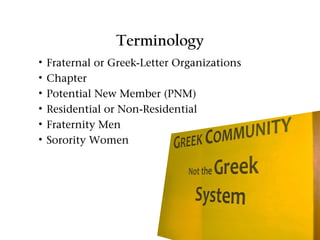
Terminology
•   Fraternal or Greek-Letter Organizations
•   Chapter
•   Potential New Member (PNM)
•   Residential or Non-Residential
•   Fraternity Men
•   Sorority Women
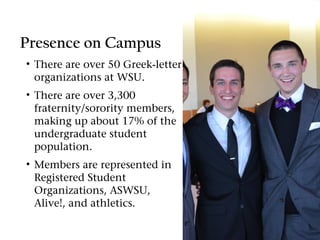
Presence on Campus
• There are over 50 Greek-letter
  organizations at WSU.
• There are over 3,300
  fraternity/sorority members,
  making up about 17% of the
  undergraduate student
  population.
• Members are represented in
  Registered Student
  Organizations, ASWSU,
  Alive!, and athletics.
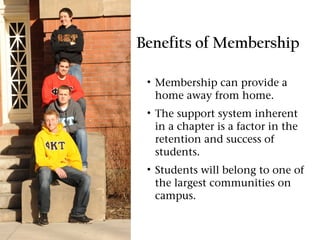
Benefits of Membership

 • Membership can provide a
   home away from home.
 • The support system inherent
   in a chapter is a factor in the
   retention and success of
   students.
 • Students will belong to one of
   the largest communities on
   campus.
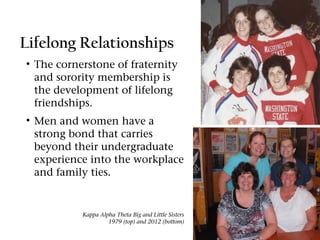
Lifelong Relationships
• The cornerstone of fraternity
  and sorority membership is
  the development of lifelong
  friendships.
• Men and women have a
  strong bond that carries
  beyond their undergraduate
  experience into the workplace
  and family ties.


           Kappa Alpha Theta Big and Little Sisters
                    1979 (top) and 2012 (bottom)
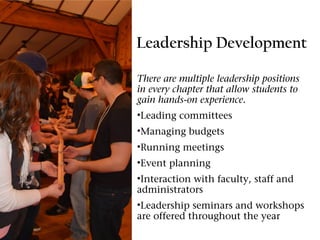
Leadership Development

There are multiple leadership positions
in every chapter that allow students to
gain hands-on experience.
•Leading committees
•Managing budgets
•Running meetings
•Event planning
•Interaction with faculty, staff and
administrators
•Leadership seminars and workshops
are offered throughout the year
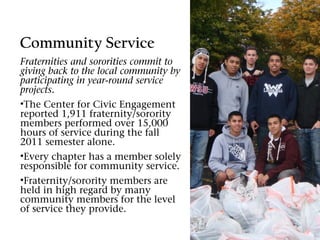
Community Service
Fraternities and sororities commit to
giving back to the local community by
participating in year-round service
projects.
•The Center for Civic Engagement
reported 1,911 fraternity/sorority
members performed over 15,000
hours of service during the fall
2011 semester alone.
•Every chapter has a member solely
responsible for community service.
•Fraternity/sorority members are
held in high regard by many
community members for the level
of service they provide.
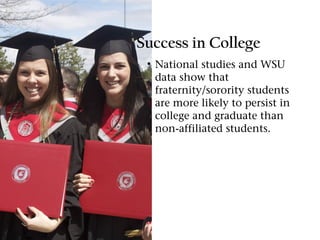
Success in College
 • National studies and WSU
   data show that
   fraternity/sorority students
   are more likely to persist in
   college and graduate than
   non-affiliated students.
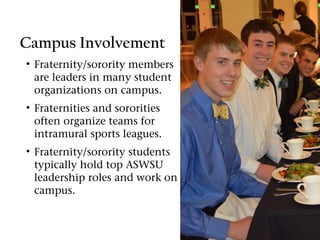
Campus Involvement
• Fraternity/sorority members
  are leaders in many student
  organizations on campus.
• Fraternities and sororities
  often organize teams for
  intramural sports leagues.
• Fraternity/sorority students
  typically hold top ASWSU
  leadership roles and work on
  campus.
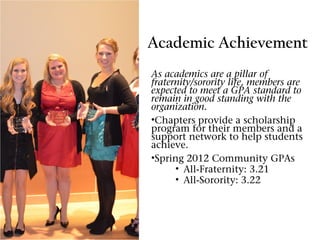
Academic Achievement
As academics are a pillar of
fraternity/sorority life, members are
expected to meet a GPA standard to
remain in good standing with the
organization.
•Chapters provide a scholarship
program for their members and a
support network to help students
achieve.
•Spring 2012 Community GPAs
      • All-Fraternity: 3.21
      • All-Sorority: 3.22
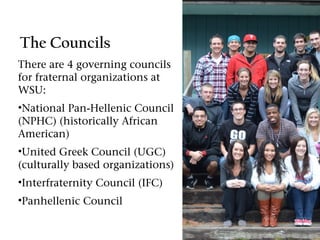
The Councils
There are 4 governing councils
for fraternal organizations at
WSU:
•National Pan-Hellenic Council
(NPHC) (historically African
American)
•United Greek Council (UGC)
(culturally based organizations)
•Interfraternity Council (IFC)
•Panhellenic Council
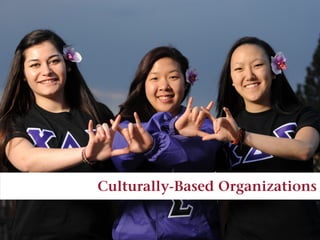
Culturally-Based Organizations
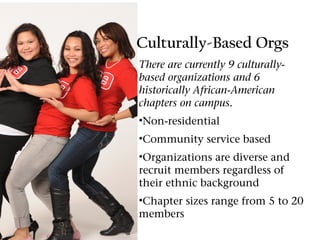
Culturally-Based Orgs
There are currently 9 culturally-
based organizations and 6
historically African-American
chapters on campus.
•Non-residential
•Community service based
•Organizations are diverse and
recruit members regardless of
their ethnic background
•Chapter sizes range from 5 to 20
members
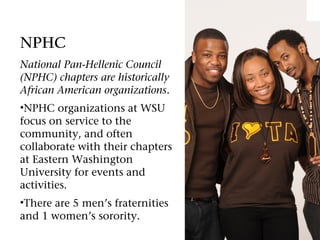
NPHC
National Pan-Hellenic Council
(NPHC) chapters are historically
African American organizations.
•NPHC organizations at WSU
focus on service to the
community, and often
collaborate with their chapters
at Eastern Washington
University for events and
activities.
•There are 5 men’s fraternities
and 1 women’s sorority.
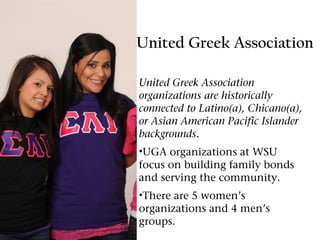
United Greek Association

United Greek Association
organizations are historically
connected to Latino(a), Chicano(a),
or Asian American Pacific Islander
backgrounds.
•UGA organizations at WSU
focus on building family bonds
and serving the community.
•There are 5 women’s
organizations and 4 men’s
groups.
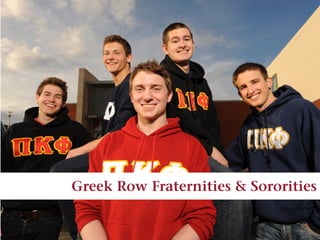
Greek Row Fraternities & Sororities
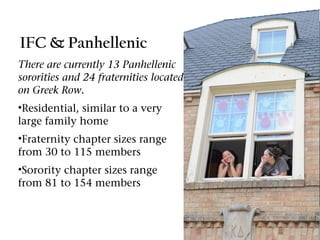
IFC & Panhellenic
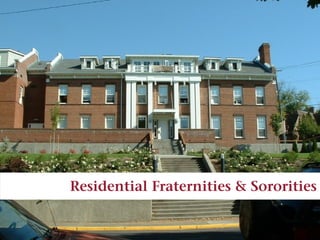
There are currently 13 Panhellenic
sororities and 24 fraternities located
on Greek Row.
•Residential, similar to a very
large family home
•Fraternity chapter sizes range
from 30 to 115 members
•Sorority chapter sizes range
from 81 to 154 members
Fraternity & Sorority Recruitment
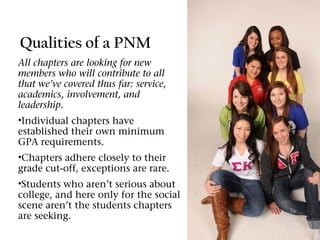
Qualities of a PNM
All chapters are looking for new
members who will contribute to all
that we’ve covered thus far: service,
academics, involvement, and
leadership.
•Individual chapters have
established their own minimum
GPA requirements.
•Chapters adhere closely to their
grade cut-off, exceptions are rare.
•Students who aren’t serious about
college, and here only for the social
scene aren’t the students chapters
are seeking.
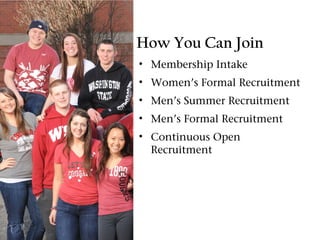
How You Can Join
• Membership Intake
• Women’s Formal Recruitment
• Men’s Summer Recruitment
• Men’s Formal Recruitment
• Continuous Open
  Recruitment
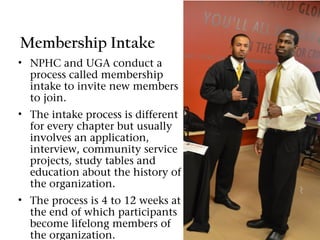
Membership Intake
• NPHC and UGA conduct a
  process called membership
  intake to invite new members
  to join.
• The intake process is different
  for every chapter but usually
  involves an application,
  interview, community service
  projects, study tables and
  education about the history of
  the organization.
• The process is 4 to 12 weeks at
  the end of which participants
  become lifelong members of
  the organization.
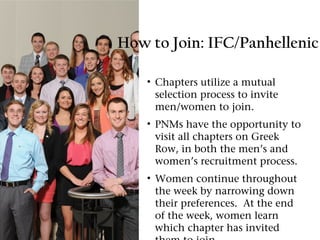
How to Join: IFC/Panhellenic

    • Chapters utilize a mutual
      selection process to invite
      men/women to join.
    • PNMs have the opportunity to
      visit all chapters on Greek
      Row, in both the men’s and
      women’s recruitment process.
    • Women continue throughout
      the week by narrowing down
      their preferences. At the end
      of the week, women learn
      which chapter has invited
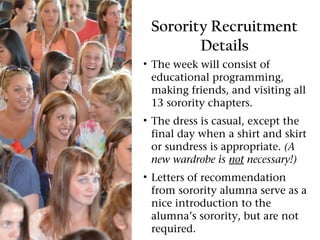
Sorority Recruitment
        Details
• The week will consist of
  educational programming,
  making friends, and visiting all
  13 sorority chapters.
• The dress is casual, except the
  final day when a shirt and skirt
  or sundress is appropriate. (A
  new wardrobe is not necessary!)
• Letters of recommendation
  from sorority alumna serve as a
  nice introduction to the
  alumna’s sorority, but are not
  required.
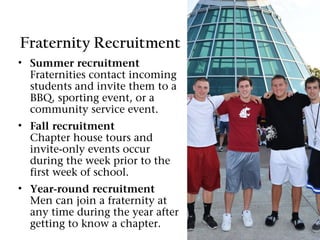
Fraternity Recruitment
• Summer recruitment
  Fraternities contact incoming
  students and invite them to a
  BBQ, sporting event, or a
  community service event.
• Fall recruitment
  Chapter house tours and
  invite-only events occur
  during the week prior to the
  first week of school.
• Year-round recruitment
  Men can join a fraternity at
  any time during the year after
  getting to know a chapter.
Men’s Housing
 • To live in a fraternity house
   as a first-year member, men
   must join a chapter over the
   summer and break their hall
   contract.
 • Men who choose to go
   through fall or year-round
   recruitment will live in the
   residence hall for at least one
   semester before moving into
   the chapter house.
Residential Fraternities & Sororities
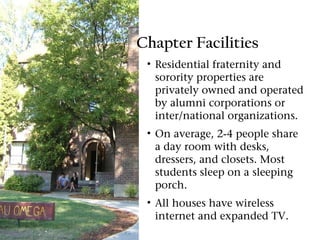
Chapter Facilities
 • Residential fraternity and
   sorority properties are
   privately owned and operated
   by alumni corporations or
   inter/national organizations.
 • On average, 2-4 people share
   a day room with desks,
   dressers, and closets. Most
   students sleep on a sleeping
   porch.
 • All houses have wireless
   internet and expanded TV.
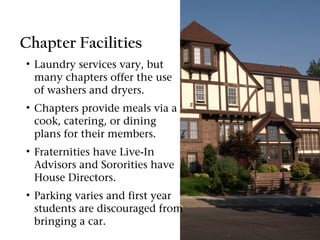
Chapter Facilities
• Laundry services vary, but
  many chapters offer the use
  of washers and dryers.
• Chapters provide meals via a
  cook, catering, or dining
  plans for their members.
• Fraternities have Live-In
  Advisors and Sororities have
  House Directors.
• Parking varies and first year
  students are discouraged from
  bringing a car.
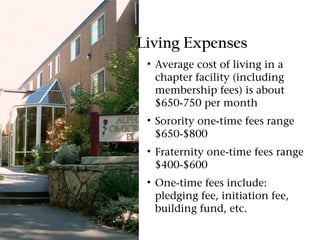
Living Expenses
 • Average cost of living in a
   chapter facility (including
   membership fees) is about
   $650-750 per month
 • Sorority one-time fees range
   $650-$800
 • Fraternity one-time fees range
   $400-$600
 • One-time fees include:
   pledging fee, initiation fee,
   building fund, etc.
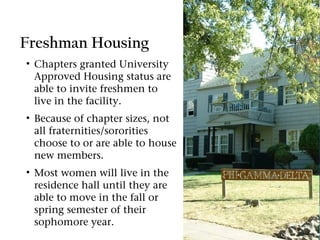
Freshman Housing
• Chapters granted University
  Approved Housing status are
  able to invite freshmen to
  live in the facility.
• Because of chapter sizes, not
  all fraternities/sororities
  choose to or are able to house
  new members.
• Most women will live in the
  residence hall until they are
  able to move in the fall or
  spring semester of their
  sophomore year.
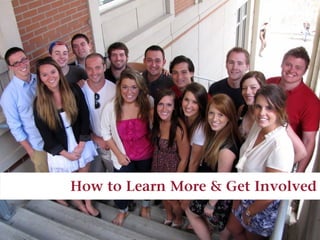
How to Learn More & Get Involved
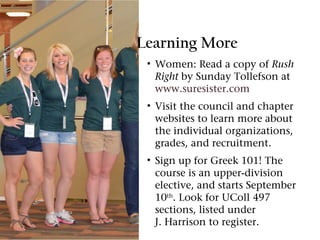
Learning More
 • Women: Read a copy of Rush
   Right by Sunday Tollefson at
   www.suresister.com
 • Visit the council and chapter
   websites to learn more about
   the individual organizations,
   grades, and recruitment.
 • Sign up for Greek 101! The
   course is an upper-division
   elective, and starts September
   10th. Look for UColl 497
   sections, listed under
   J. Harrison to register.
More Information
Center for Fraternity & Sorority Life   /WSUCFSL
www.gogreek.wsu.edu                     /WSUIFC
CUB 315                                 /WSU.Sororities
greeklife@wsu.edu                       /UnitedGreekAssociationWSU
509-335-5433
                                        @WSUGreeks
Council Office                          @WSUPanhellenic
CUB 323                                 @WSUIFC
509-335-5929                            @WSU_UGC
Panhellenic Council
www.wsusororities.com
panrecruitment@wsu.edu
Interfraternity Council
www.wsufraternities.com
ifcrecruitment@wsu.edu
United Greek Council
wsugreek.orgsync.com/org/ugc
wsu.ugc.president@gmail.com

2012 alive! imagine u promgram

  • 1.
    Fraternity & SororityLife at Washington State University
  • 2.
    Terminology • Fraternal or Greek-Letter Organizations • Chapter • Potential New Member (PNM) • Residential or Non-Residential • Fraternity Men • Sorority Women
  • 3.
    Presence on Campus •There are over 50 Greek-letter organizations at WSU. • There are over 3,300 fraternity/sorority members, making up about 17% of the undergraduate student population. • Members are represented in Registered Student Organizations, ASWSU, Alive!, and athletics.
  • 4.
    Benefits of Membership • Membership can provide a home away from home. • The support system inherent in a chapter is a factor in the retention and success of students. • Students will belong to one of the largest communities on campus.
  • 5.
    Lifelong Relationships • Thecornerstone of fraternity and sorority membership is the development of lifelong friendships. • Men and women have a strong bond that carries beyond their undergraduate experience into the workplace and family ties. Kappa Alpha Theta Big and Little Sisters 1979 (top) and 2012 (bottom)
  • 6.
    Leadership Development There aremultiple leadership positions in every chapter that allow students to gain hands-on experience. •Leading committees •Managing budgets •Running meetings •Event planning •Interaction with faculty, staff and administrators •Leadership seminars and workshops are offered throughout the year
  • 7.
    Community Service Fraternities andsororities commit to giving back to the local community by participating in year-round service projects. •The Center for Civic Engagement reported 1,911 fraternity/sorority members performed over 15,000 hours of service during the fall 2011 semester alone. •Every chapter has a member solely responsible for community service. •Fraternity/sorority members are held in high regard by many community members for the level of service they provide.
  • 8.
    Success in College • National studies and WSU data show that fraternity/sorority students are more likely to persist in college and graduate than non-affiliated students.
  • 9.
    Campus Involvement • Fraternity/sororitymembers are leaders in many student organizations on campus. • Fraternities and sororities often organize teams for intramural sports leagues. • Fraternity/sorority students typically hold top ASWSU leadership roles and work on campus.
  • 10.
    Academic Achievement As academicsare a pillar of fraternity/sorority life, members are expected to meet a GPA standard to remain in good standing with the organization. •Chapters provide a scholarship program for their members and a support network to help students achieve. •Spring 2012 Community GPAs • All-Fraternity: 3.21 • All-Sorority: 3.22
  • 11.
    The Councils There are4 governing councils for fraternal organizations at WSU: •National Pan-Hellenic Council (NPHC) (historically African American) •United Greek Council (UGC) (culturally based organizations) •Interfraternity Council (IFC) •Panhellenic Council
  • 12.
  • 13.
    Culturally-Based Orgs There arecurrently 9 culturally- based organizations and 6 historically African-American chapters on campus. •Non-residential •Community service based •Organizations are diverse and recruit members regardless of their ethnic background •Chapter sizes range from 5 to 20 members
  • 14.
    NPHC National Pan-Hellenic Council (NPHC)chapters are historically African American organizations. •NPHC organizations at WSU focus on service to the community, and often collaborate with their chapters at Eastern Washington University for events and activities. •There are 5 men’s fraternities and 1 women’s sorority.
  • 15.
    United Greek Association UnitedGreek Association organizations are historically connected to Latino(a), Chicano(a), or Asian American Pacific Islander backgrounds. •UGA organizations at WSU focus on building family bonds and serving the community. •There are 5 women’s organizations and 4 men’s groups.
  • 16.
  • 17.
    IFC & Panhellenic Thereare currently 13 Panhellenic sororities and 24 fraternities located on Greek Row. •Residential, similar to a very large family home •Fraternity chapter sizes range from 30 to 115 members •Sorority chapter sizes range from 81 to 154 members
  • 18.
  • 19.
    Qualities of aPNM All chapters are looking for new members who will contribute to all that we’ve covered thus far: service, academics, involvement, and leadership. •Individual chapters have established their own minimum GPA requirements. •Chapters adhere closely to their grade cut-off, exceptions are rare. •Students who aren’t serious about college, and here only for the social scene aren’t the students chapters are seeking.
  • 20.
    How You CanJoin • Membership Intake • Women’s Formal Recruitment • Men’s Summer Recruitment • Men’s Formal Recruitment • Continuous Open Recruitment
  • 21.
    Membership Intake • NPHCand UGA conduct a process called membership intake to invite new members to join. • The intake process is different for every chapter but usually involves an application, interview, community service projects, study tables and education about the history of the organization. • The process is 4 to 12 weeks at the end of which participants become lifelong members of the organization.
  • 22.
    How to Join:IFC/Panhellenic • Chapters utilize a mutual selection process to invite men/women to join. • PNMs have the opportunity to visit all chapters on Greek Row, in both the men’s and women’s recruitment process. • Women continue throughout the week by narrowing down their preferences. At the end of the week, women learn which chapter has invited
  • 23.
    Sorority Recruitment Details • The week will consist of educational programming, making friends, and visiting all 13 sorority chapters. • The dress is casual, except the final day when a shirt and skirt or sundress is appropriate. (A new wardrobe is not necessary!) • Letters of recommendation from sorority alumna serve as a nice introduction to the alumna’s sorority, but are not required.
  • 24.
    Fraternity Recruitment • Summerrecruitment Fraternities contact incoming students and invite them to a BBQ, sporting event, or a community service event. • Fall recruitment Chapter house tours and invite-only events occur during the week prior to the first week of school. • Year-round recruitment Men can join a fraternity at any time during the year after getting to know a chapter.
  • 25.
    Men’s Housing •To live in a fraternity house as a first-year member, men must join a chapter over the summer and break their hall contract. • Men who choose to go through fall or year-round recruitment will live in the residence hall for at least one semester before moving into the chapter house.
  • 26.
  • 27.
    Chapter Facilities •Residential fraternity and sorority properties are privately owned and operated by alumni corporations or inter/national organizations. • On average, 2-4 people share a day room with desks, dressers, and closets. Most students sleep on a sleeping porch. • All houses have wireless internet and expanded TV.
  • 28.
    Chapter Facilities • Laundryservices vary, but many chapters offer the use of washers and dryers. • Chapters provide meals via a cook, catering, or dining plans for their members. • Fraternities have Live-In Advisors and Sororities have House Directors. • Parking varies and first year students are discouraged from bringing a car.
  • 29.
    Living Expenses •Average cost of living in a chapter facility (including membership fees) is about $650-750 per month • Sorority one-time fees range $650-$800 • Fraternity one-time fees range $400-$600 • One-time fees include: pledging fee, initiation fee, building fund, etc.
  • 30.
    Freshman Housing • Chaptersgranted University Approved Housing status are able to invite freshmen to live in the facility. • Because of chapter sizes, not all fraternities/sororities choose to or are able to house new members. • Most women will live in the residence hall until they are able to move in the fall or spring semester of their sophomore year.
  • 31.
    How to LearnMore & Get Involved
  • 32.
    Learning More •Women: Read a copy of Rush Right by Sunday Tollefson at www.suresister.com • Visit the council and chapter websites to learn more about the individual organizations, grades, and recruitment. • Sign up for Greek 101! The course is an upper-division elective, and starts September 10th. Look for UColl 497 sections, listed under J. Harrison to register.
  • 33.
    More Information Center forFraternity & Sorority Life /WSUCFSL www.gogreek.wsu.edu /WSUIFC CUB 315 /WSU.Sororities greeklife@wsu.edu /UnitedGreekAssociationWSU 509-335-5433 @WSUGreeks Council Office @WSUPanhellenic CUB 323 @WSUIFC 509-335-5929 @WSU_UGC Panhellenic Council www.wsusororities.com panrecruitment@wsu.edu Interfraternity Council www.wsufraternities.com ifcrecruitment@wsu.edu United Greek Council wsugreek.orgsync.com/org/ugc wsu.ugc.president@gmail.com

Editor's Notes