
Presentation Created by Micah Melling, CRVP
               for 2011-2012
   To explain Career and Technical Education (CTE)
    and Career and Technical Student Organizations
    (CTSOs)
   To establish the importance of the presentation’s
    topic
   To give information about the government’s
    impact on CTE and CTSOs
   To specifically discuss why legislators are the
    target audience
   To provide strategies for reaching out to legislators
   Career and Technical Education (CTE) prepares
    students to be “college and career ready.”
   CTE helps students to develop employability skills,
    core-academic skills, and job-specific skills.
   Examples of CTE classes: marketing, business
    management, agriculture, welding, and auto
    mechanics.
   CTE programs are the basis for Career and
    Technical Student Organizations (CTSOs).
   CTSOs give students the opportunity to apply what
    they have learned in the classroom to real-world
    situations.
   DECA is one of ten CTSOs recognized by the U.S.
    Department of Education.
   State and federal legislators appropriate funding
    for CTE.
   Legislation that affects CTE also impacts CTSOs.
     If funding for CTE is reduced, CTSOs will be negatively
      affected.
     If funding for CTE is increased, CTSOs will be more likely
      to thrive.
   The Carl D. Perkins Career and Technical Education
    Act is the federal law the funds CTE.
   Currently, the Perkins Act provides approximately
    $1.13 billion per fiscal year to be shared among
    states.
   The programs, funding, and requirements in the
    Perkins Act affect CTE programs throughout the
    nation.
                              A PowerPoint presentation about
                              the Perkins Act can be found on
                              www.slideshare.net/decainc.
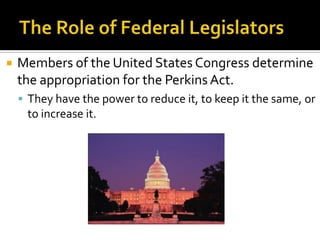
   Members of the United States Congress determine
    the appropriation for the Perkins Act.
     They have the power to reduce it, to keep it the same, or
     to increase it.
   The Office of Vocational and Adult Education
    (OVAE) is the section of the U.S. Department of
    Education that focuses on CTE.
   The OVAE distributes Perkins funds to states.
     A formula is used to determine how much money each
     state should receive.
   They assist states in running their CTE programs.
   The OVAE also conducts year-end reviews with
    states.
   Many state legislatures appropriate funding for
    CTE.
     In many cases, the state-level funding for CTE
      monetarily exceeds the amount of Perkins funding a
      state receives.
   Please note that not all state legislatures provide
    funding for CTE.
    Each state legislature has a website,
    which can be a great resource to use
    when determining how to gain
    legislators’ support.
   A state’s education department is part of its
    government.
     State education departments operate through funding
     appropriated by their state legislature.
   In 2008, state education departments were
    required to submit a State Plan to the U.S.
    Department of Education. The State Plan outlined
    the state’s strategy for using their federal Perkins
    funds.
   State education departments distribute CTE-
    earmarked funds to school districts.
     This funding helps school districts operate their CTE
     programs.
   Many CTSOs are administered through state
    education departments.
     They provide a state advisor and offer general support.
   After the 2006 reauthorization of the Perkins Act,
    school districts were required to develop a Local
    Plan.
   The Local Plan explained the school district’s
    strategy for using their Perkins funds.
   State and federal legislators ultimately determine
    the level of funding for CTE.
   Therefore, legislators are the target audience
    because they play a large role in determining the
    future of CTE and, by association, CTSOs.
1.   To educate them about CTE and CTSOs,
     particularly DECA
2.   To show them the value of CTE and CTSOs
3.   To convince them to pledge their support for CTE
     and CTSOs
4.   To interest them in becoming involved with DECA
   Appointments
     Set up a meeting with your state legislators when they
      are in the district.
     Take chapter officers to your state’s capitol for a visit
      with your legislators.
     When your U.S. Representative is in the district, request
      to meet with him/her to discuss the benefits of CTE and
      CTSOs.
   Involvement with the Chapter
     Invite your state legislators to a chapter meeting.
     Ask your state legislators to help students prepare for
     competition.
      ▪ Read written projects.
      ▪ Critique presentations.
      ▪ Be a judge for practice role plays.
     Welcome them to join your chapter as a “professional
     member.”
                       Helpful Hint: Whenever you meet with your legislators,
                       give them something to take with them (e.g. a chapter
                       newsletter or an informational handout).
    State Congressional Advisory Board (CAB)
      Create a nonpartisan CAB for members of your state’s
         General Assembly.
        Develop a signature form and informational letter.
        Ask legislators to sign if they support CTE and DECA.
        Send a thank-you letter if they join.
        Invite members of your State CAB to judge at district
         competitions and/or the state competition.
    What exactly is a CAB? A CAB is a          Helpful Hint: Partner with at least
    nonpartisan group of legislators who are   one state legislator who is willing to
    supportive of CTE and DECA. That’s all!    help start and grow your State CAB.
   National Congressional Advisory Board (CAB)
     Send a CAB invitation to the members of Congress from
      your state.
     View sample invitations in the “Political Outreach Kit”
      on DECA’s SlideShare Account.
     Mail a thank-you letter if they join.
     If they don’t join, follow up with a phone call or an email
      and offer to provide more information.
   Activities at the State Capitol
     Organize a proclamation signing with your Governor’s
     office.
      ▪ This can be for “DECA Week,” “Global Entrepreneurship Week,”
        or “CTE Month.”
     As a state officer team, go to your state’s capitol and
      visit with legislators.
     Set up a day for DECA members to go to your state’s
      capitol and meet their legislators.
       Helpful Hint: The Association for Career and Technical Education
       (ACTE) is present in all 50 states. Your state’s ACTE can help be a
       helpful resource when coordinating activities at your state capital.
   Informational Documents
     Develop a statewide DECA newsletter to give to
      legislators.
     Give legislators a polished “pride points” document
      about your state association of DECA.
                                      Helpful Hints:
                                       1). Before meeting with
                                      legislators, develop a formal
                                      document of “talking points”
                                      to use.
                                      2). Encourage legislators to
                                      visit deca.org as well as your
                                      state association’s website.
   CTE and CTSOs are vital parts of the nation’s
    educational system. These educational
    opportunities prepare students to be “college and
    career ready.”
   CTE is federally funded by the Perkins Act. Many
    state legislatures also appropriate funding for CTE.
   State and federal legislators ultimately determine
    the level of funding for CTE; therefore, they are the
    target audience.
   The Office of Vocational and Adult Education is the
    section of the U.S. Department of Education that
    focuses on CTE.
   State education departments determine a
    direction for their state’s CTE programs, distribute
    funds to local recipients, and often provide state
    advisors to administer CTSOs.
   School districts determine how to most effectively
    use the funds they have been given.
   To preserve a bright future for DECA, chapter
    members and state officers must reach out to
    legislators.
   Legislators should be invited to CTSO events and
    asked to openly pledge their support for CTE.
   With more supportive legislators, CTE and CTSOs
    will have a more secure future.
   Three other political outreach resources can be
    found on DECA’s SlideShare Account.
     A “DECA and Politics” document
     A “Political Outreach Kit”
     A “Perkins Act” PowerPoint
   Email Central Region Vice President Micah Melling.
     decavpmicah@gmail.com.


   After May of 2012, contact John Fistolera.
     john_fistolera@deca.org

DECA Members: Obtaining Legislators' Support

  • 1.
    Presentation Created byMicah Melling, CRVP for 2011-2012
  • 2.
    To explain Career and Technical Education (CTE) and Career and Technical Student Organizations (CTSOs)  To establish the importance of the presentation’s topic  To give information about the government’s impact on CTE and CTSOs  To specifically discuss why legislators are the target audience  To provide strategies for reaching out to legislators
  • 3.
    Career and Technical Education (CTE) prepares students to be “college and career ready.”  CTE helps students to develop employability skills, core-academic skills, and job-specific skills.  Examples of CTE classes: marketing, business management, agriculture, welding, and auto mechanics.
  • 4.
    CTE programs are the basis for Career and Technical Student Organizations (CTSOs).  CTSOs give students the opportunity to apply what they have learned in the classroom to real-world situations.  DECA is one of ten CTSOs recognized by the U.S. Department of Education.
  • 5.
    State and federal legislators appropriate funding for CTE.  Legislation that affects CTE also impacts CTSOs.  If funding for CTE is reduced, CTSOs will be negatively affected.  If funding for CTE is increased, CTSOs will be more likely to thrive.
  • 6.
    The Carl D. Perkins Career and Technical Education Act is the federal law the funds CTE.  Currently, the Perkins Act provides approximately $1.13 billion per fiscal year to be shared among states.  The programs, funding, and requirements in the Perkins Act affect CTE programs throughout the nation. A PowerPoint presentation about the Perkins Act can be found on www.slideshare.net/decainc.
  • 7.
    Members of the United States Congress determine the appropriation for the Perkins Act.  They have the power to reduce it, to keep it the same, or to increase it.
  • 8.
    The Office of Vocational and Adult Education (OVAE) is the section of the U.S. Department of Education that focuses on CTE.  The OVAE distributes Perkins funds to states.  A formula is used to determine how much money each state should receive.  They assist states in running their CTE programs.  The OVAE also conducts year-end reviews with states.
  • 9.
    Many state legislatures appropriate funding for CTE.  In many cases, the state-level funding for CTE monetarily exceeds the amount of Perkins funding a state receives.  Please note that not all state legislatures provide funding for CTE. Each state legislature has a website, which can be a great resource to use when determining how to gain legislators’ support.
  • 10.
    A state’s education department is part of its government.  State education departments operate through funding appropriated by their state legislature.  In 2008, state education departments were required to submit a State Plan to the U.S. Department of Education. The State Plan outlined the state’s strategy for using their federal Perkins funds.
  • 11.
    State education departments distribute CTE- earmarked funds to school districts.  This funding helps school districts operate their CTE programs.  Many CTSOs are administered through state education departments.  They provide a state advisor and offer general support.
  • 12.
    After the 2006 reauthorization of the Perkins Act, school districts were required to develop a Local Plan.  The Local Plan explained the school district’s strategy for using their Perkins funds.
  • 13.
    State and federal legislators ultimately determine the level of funding for CTE.  Therefore, legislators are the target audience because they play a large role in determining the future of CTE and, by association, CTSOs.
  • 14.
    1. To educate them about CTE and CTSOs, particularly DECA 2. To show them the value of CTE and CTSOs 3. To convince them to pledge their support for CTE and CTSOs 4. To interest them in becoming involved with DECA
  • 15.
    Appointments  Set up a meeting with your state legislators when they are in the district.  Take chapter officers to your state’s capitol for a visit with your legislators.  When your U.S. Representative is in the district, request to meet with him/her to discuss the benefits of CTE and CTSOs.
  • 16.
    Involvement with the Chapter  Invite your state legislators to a chapter meeting.  Ask your state legislators to help students prepare for competition. ▪ Read written projects. ▪ Critique presentations. ▪ Be a judge for practice role plays.  Welcome them to join your chapter as a “professional member.” Helpful Hint: Whenever you meet with your legislators, give them something to take with them (e.g. a chapter newsletter or an informational handout).
  • 17.
    State Congressional Advisory Board (CAB)  Create a nonpartisan CAB for members of your state’s General Assembly.  Develop a signature form and informational letter.  Ask legislators to sign if they support CTE and DECA.  Send a thank-you letter if they join.  Invite members of your State CAB to judge at district competitions and/or the state competition. What exactly is a CAB? A CAB is a Helpful Hint: Partner with at least nonpartisan group of legislators who are one state legislator who is willing to supportive of CTE and DECA. That’s all! help start and grow your State CAB.
  • 18.
    National Congressional Advisory Board (CAB)  Send a CAB invitation to the members of Congress from your state.  View sample invitations in the “Political Outreach Kit” on DECA’s SlideShare Account.  Mail a thank-you letter if they join.  If they don’t join, follow up with a phone call or an email and offer to provide more information.
  • 19.
    Activities at the State Capitol  Organize a proclamation signing with your Governor’s office. ▪ This can be for “DECA Week,” “Global Entrepreneurship Week,” or “CTE Month.”  As a state officer team, go to your state’s capitol and visit with legislators.  Set up a day for DECA members to go to your state’s capitol and meet their legislators. Helpful Hint: The Association for Career and Technical Education (ACTE) is present in all 50 states. Your state’s ACTE can help be a helpful resource when coordinating activities at your state capital.
  • 20.
    Informational Documents  Develop a statewide DECA newsletter to give to legislators.  Give legislators a polished “pride points” document about your state association of DECA. Helpful Hints: 1). Before meeting with legislators, develop a formal document of “talking points” to use. 2). Encourage legislators to visit deca.org as well as your state association’s website.
  • 21.
    CTE and CTSOs are vital parts of the nation’s educational system. These educational opportunities prepare students to be “college and career ready.”  CTE is federally funded by the Perkins Act. Many state legislatures also appropriate funding for CTE.  State and federal legislators ultimately determine the level of funding for CTE; therefore, they are the target audience.
  • 22.
    The Office of Vocational and Adult Education is the section of the U.S. Department of Education that focuses on CTE.  State education departments determine a direction for their state’s CTE programs, distribute funds to local recipients, and often provide state advisors to administer CTSOs.  School districts determine how to most effectively use the funds they have been given.
  • 23.
    To preserve a bright future for DECA, chapter members and state officers must reach out to legislators.  Legislators should be invited to CTSO events and asked to openly pledge their support for CTE.  With more supportive legislators, CTE and CTSOs will have a more secure future.
  • 24.
    Three other political outreach resources can be found on DECA’s SlideShare Account.  A “DECA and Politics” document  A “Political Outreach Kit”  A “Perkins Act” PowerPoint
  • 25.
    Email Central Region Vice President Micah Melling.  decavpmicah@gmail.com.  After May of 2012, contact John Fistolera.  john_fistolera@deca.org