Amazon Consulting Terms of Use

The information in this presentation is produced by Amazon Consulting and may contain previously unpublished
synthesis of materials.

Permission to use, copy, modify and distribute any material from Amazon Consulting is hereby granted provided
that the contents of this "Terms of Use" notice appear with all copies. In addition, if the material used includes other
credit or copyright information, then this source information should also be included with all copies.

Use of Amazon Consulting content (documents, white papers, articles, research, etc.) is for informational and non-
commercial or personal use only. You may not modify any content, copy, distribute, transmit, display, perform,
reproduce, publish, license, create derivative works from, transfer, post on any network, broadcast in any media or
sell any information unless expressly permitted by Amazon Consulting. Content other than that belonging to
Amazon Consulting is licensed or otherwise published by Amazon Consulting with the permission of the owner of
the material. All rights in such materials are reserved to the respective owners.

For questions and media requests, please contact:

Cathy Sperrazzo
Eye-to-Eye Communications, Inc.
858-565-9800
cathy@eyetoeyepr.com


Amazon Consulting 2011
- Research Report -


      Amazon Consulting 2011
Amazon Consulting 2011         Influencing the Influencers: Research Executive Brief   0
2011: Skills Diversification and Services Engagement

    For five years, Amazon Consulting has been researching the partnering plans and
    priorities of the IT vendor community. The last couple of years have been a bit
    tumultuous, with a stronger current of overhaul than optimism. The turbulent economy,
    increased globalization, introduction of disruptive technologies and evolving solution
    provider business models have made it a challenging environment in which to partner
    in a predictable and positive way.

    This research contains reflections on the challenges, priorities, metrics and
    investments of technology vendors as they go to market with and through various
    indirect channels. It is the only study we do annually which is exclusively vendor
    focused. As such, it affords great insights into where the vendor community is directing
    its resources and energies for 2011.


    Key Trends
    From this broad body of research, we see several notable trends:

    Partner types:    Service providers are the new “it” channel and is a big focus this year for infrastructure and software vendors.

    Globalization:   Global program frameworks are the new standard. Partners applaud the simplicity and vendors are saving time and money.

    Enablement:      Technical certifications still equate to high value, but sales skills will continue as a big priority for competency.

    Coverage:        2011 investments focus on business planning and field and phone-based partner management.

    Services:        Vendors continue to drive partners to build services and are increasing the sharing of services assets selling/delivery support
                     to mentoring investments.

    Cloud:           Cloud program and engagement models are coming of age. Contrary to rumors, vendors are going to market with partners
                     for these solutions.

    Spending:        High ROI expectations remain, but vendors are making strategic investments in diversifying partner skills.


        Amazon Consulting 2011
Amazon Consulting 2011                                                                       5th Annual State of Partnering Study: Research Report     1
Global Value-Based Program Structures Now Standard
     As we‟ve watched vendors‟ focus and investment throughout the last five
     years, there have been a number of drivers moving vendors to a more
     streamlined and consistent global partner program structure. These
     include:

      The ongoing consolidation of the solution provider community;
      The increased global access of end-users for IT products and services,
       driving partners‟ business model to be more globally aware and
       responsive;
      Vendors‟ need for more cost effective and scalable partner support
       programs;
      Solution providers‟ need for simplicity and reduction in administrative
       overhead in working with their suppliers.

     The strongest global program structures we see allow for a number of
     important regional variations to meet the economic requirements and
     business practice variations of different regions. These elements typically
     include resale discounting, deal registration payouts, annual revenue
     targets and MDF percentages. Very few (<20%) of vendors indicated
     their regions still have their own distinct channel programs.

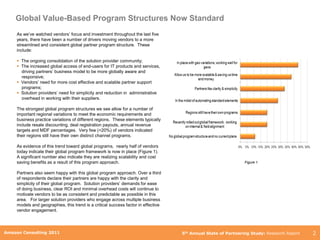
     As evidence of this trend toward global programs, nearly half of vendors
     today indicate their global program framework is now in place (Figure 1).
     A significant number also indicate they are realizing scalability and cost
     saving benefits as a result of this program approach.                                                      Figure 1


     Partners also seem happy with this global program approach. Over a third
     of respondents declare their partners are happy with the clarity and
     simplicity of their global program. Solution providers‟ demands for ease
     of doing business, clear ROI and minimal overhead costs will continue to
     motivate vendors to be as consistent and predictable as possible in this
     area. For larger solution providers who engage across multiple business
     models and geographies, this trend is a critical success factor in effective
     vendor engagement.


        Amazon Consulting 2011
Amazon Consulting 2011                                                              5th Annual State of Partnering Study: Research Report   2
New Business and Competitive Marketshare Lead Value Metrics
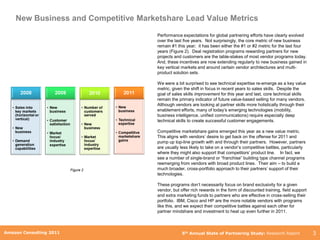
                                      Performance expectations for global partnering efforts have clearly evolved
                                      over the last five years. Not surprisingly, the core metric of new business
                                      remain #1 this year; it has been either the #1 or #2 metric for the last four
                                      years (Figure 2). Deal registration programs rewarding partners for new
                                      projects and customers are the table-stakes of most vendor programs today.
                                      And, these incentives are now extending regularly to new business gained in
                                      key vertical markets and around certain vendor architectures and multi-
                                      product solution sets.

                                      We were a bit surprised to see technical expertise re-emerge as a key value
                                      metric, given the shift in focus in recent years to sales skills. Despite the
                                      goal of sales skills improvement for this year and last, core technical skills
                                      remain the primary indicator of future value-based selling for many vendors.
                                      Although vendors are looking at partner skills more holistically through their
                                      enablement efforts, many of today‟s emerging technologies (mobility,
                                      business intelligence, unified communications) require especially deep
                                      technical skills to create successful customer engagements.

                                      Competitive marketshare gains emerged this year as a new value metric.
                                      This aligns with vendors‟ desire to get back on the offense for 2011 and
                                      pump up top-line growth with and through their partners. However, partners
                                      are usually less likely to take on a vendor‟s competitive battles, particularly
                                      where they might also support that competitors‟ product line. In fact, we
                                      see a number of single-brand or “franchise” building type channel programs
                                      reemerging from vendors with broad product lines. Their aim – to build a
                         Figure 2     much broader, cross-portfolio approach to their partners‟ support of their
                                      technologies.

                                      These programs don‟t necessarily focus on brand exclusivity for a given
                                      vendor, but offer rich rewards in the form of discounted training, field support
                                      and extra marketing funds to partners who are effective in cross-selling their
                                      portfolio. IBM, Cisco and HP are the more notable vendors with programs
                                      like this, and we expect their competitive battles against each other for
                                      partner mindshare and investment to heat up even further in 2011.


       Amazon Consulting 2011
Amazon Consulting 2011                             5th Annual State of Partnering Study: Research Report                 3
Service Providers Come into the Spotlight
     The IT market has been moving slowly but surely to a converged services model
     over the last 5-7 years. Converged services is an IT delivery model where pre-and
     post-sale professional services, products and support all come together in an
     integrated offering that solves a specific business pain-point. And, both vendors
     and solution providers have been jumping on the bandwagon to evolve their
     services sales and delivery models in this direction. Customer adoption of cloud
     services has just accelerated that trend.

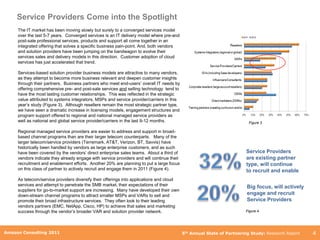
     Services-based solution provider business models are attractive to many vendors,
     as they attempt to become more business relevant and deepen customer insights
     through their partners. Business partners who meet end-users‟ overall IT needs by
     offering comprehensive pre- and post-sale services and selling technology tend to
     have the most lasting customer relationships. This was reflected in the strategic
     value attributed to systems integrators, MSPs and service provider/carriers in this
     year‟s study (Figure 3). Although resellers remain the most strategic partner type,
     we have seen a dramatic increase in licensing models, engagement structures and
     program support offered to regional and national managed service providers as
     well as national and global service provider/carriers in the last 9-12 months.                                      Figure 3

     Regional managed service providers are easier to address and support in broad-
     based channel programs than are their larger telecom counterparts. Many of the
     larger telecom/service providers (Terremark, AT&T, Verizon, BT, Savvis) have
     historically been handled by vendors as large enterprise customers, and as such
     have been covered by the vendors‟ direct enterprise sales teams. About a third of                                 Service Providers
     vendors indicate they already engage with service providers and will continue their                               are existing partner
     recruitment and enablement efforts. Another 20% are planning to put a large focus                                 type, will continue
     on this class of partner to actively recruit and engage them in 2011 (Figure 4).                                  to recruit and enable
     As telecom/service providers diversify their offerings into applications and cloud
     services and attempt to penetrate the SMB market, their expectations of their                                      Big focus, will actively
     suppliers for go-to-market support are increasing. Many have developed their own
     down-stream channel programs to attract smaller MSPs and VARs to sell and                                          engage and recruit
     promote their broad infrastructure services. They often look to their leading                                      Service Providers
     vendors partners (EMC, NetApp, Cisco, HP) to achieve that sales and marketing
     success through the vendor‟s broader VAR and solution provider network.                                           Figure 4


        Amazon Consulting 2011
Amazon Consulting 2011                                                                     5th Annual State of Partnering Study: Research Report   4
Cloud Engagement Models Reveal Partner Dependence
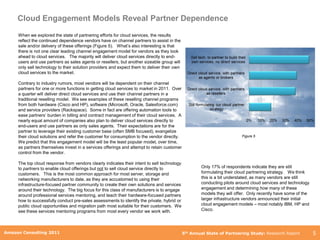
     When we explored the state of partnering efforts for cloud services, the results
     reflect the continued dependence vendors have on channel partners to assist in the
     sale and/or delivery of these offerings (Figure 5). What‟s also interesting is that
     there is not one clear leading channel engagement model for vendors as they look
     ahead to cloud services. The majority will deliver cloud services directly to end-
     users and use partners as sales agents or resellers, but another sizeable group will
     only sell technology to their solution providers and expect them to deliver their own
     cloud services to the market.

     Contrary to industry rumors, most vendors will be dependent on their channel
     partners for one or more functions in getting cloud services to market in 2011. Over
     a quarter will deliver direct cloud services and use their channel partners in a
     traditional reselling model. We see examples of these reselling channel programs
     from both hardware (Cisco and HP), software (Microsoft, Oracle, Salesforce.com)
     and service providers (Rackspace). Some in fact are offering automation tools to
     ease partners‟ burden in billing and contract management of their cloud services. A
     nearly equal amount of companies also plan to deliver cloud services directly to
     end-users and use partners as only sales agents. Their expectations are for the
     partner to leverage their existing customer base (often SMB focused), evangelize
     their cloud solutions and refer the customer for consumption to the vendor directly.                                Figure 5
     We predict that this engagement model will be the least popular model, over time,
     as partners themselves invest in a services offerings and attempt to retain customer
     control from the vendor.

     The top cloud response from vendors clearly indicates their intent to sell technology
     to partners to enable cloud offerings but not to sell cloud service directly to                 Only 17% of respondents indicate they are still
     customers. This is the most common approach for most server, storage and                        formulating their cloud partnering strategy. We think
     networking manufacturers to date, as they are accustomed to using their                         this is a bit understated, as many vendors are still
     infrastructure-focused partner community to create their own solutions and services             conducting pilots around cloud services and technology
     around their technology. The big focus for this class of manufacturers is to engage             engagement and determining how many of these
     around professional services mentoring, and teach their hardware-focused partners               models they will offer. Only recently have some of the
     how to successfully conduct pre-sales assessments to identify the private, hybrid or            larger infrastructure vendors announced their initial
     public cloud opportunities and migration path most suitable for their customers. We             cloud engagement models – most notably IBM, HP and
     see these services mentoring programs from most every vendor we work with.                      Cisco.


        Amazon Consulting 2011
Amazon Consulting 2011                                                                       5th Annual State of Partnering Study: Research Report            5
Business Planning and High Touch Support a Priority
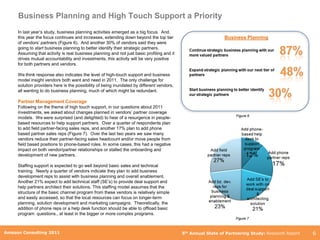
     In last year‟s study, business planning activities emerged as a big focus. And,
     this year the focus continues and increases, extending down beyond the top tier                           Business Planning
     of vendors‟ partners (Figure 6). And another 30% of vendors said they were
     going to start business planning to better identify their strategic partners.
     Assuming that activity is real business planning and not just basic profiling and it
     drives mutual accountability and investments, this activity will be very positive
     for both partners and vendors.

     We think response also indicates the level of high-touch support and business
     model insight vendors both want and need in 2011. The only challenge for
     solution providers here is the possibility of being inundated by different vendors,
     all wanting to do business planning, much of which might be redundant.

     Partner Management Coverage
     Following on the theme of high touch support, in our questions about 2011
     investments, we asked about changes planned in vendors‟ partner coverage
                                                                                                                    Figure 6
     models. We were surprised (and delighted) to hear of a resurgence in people-
     based resources to help support partners. Over a quarter of respondents plan
     to add field partner-facing sales reps, and another 17% plan to add phone
     based partner sales reps (Figure 7). Over the last two years we saw many
     vendors reduce their partner-facing sales headcount and/or move people from
     field based positions to phone-based roles. In some cases, this had a negative
     impact on both vendor/partner relationships or stalled the onboarding and
     development of new partners.

     Staffing support is expected to go well beyond basic sales and technical
     training. Nearly a quarter of vendors indicate they plan to add business
     development reps to assist with business planning and overall enablement.
     Another 21% expect to add technical staff (SE‟s) to provide deal support and
     help partners architect their solutions. This staffing model assumes that the
     structure of the basic channel program from these vendors is relatively simple
     and easily accessed, so that the local resources can focus on longer-term
     planning, solution development and marketing campaigns. Theoretically, the
     addition of phone reps or a help desk function should be able to offload basic
     program questions., at least in the bigger or more complex programs.
                                                                                                                    Figure 7

        Amazon Consulting 2011
Amazon Consulting 2011                                                                      5th Annual State of Partnering Study: Research Report   6
Enablement Focused on Sales Skills
     Vendors who view their channel partners holistically tend to have greater
     success through indirect channels than those who look at only isolated skills
     sets. Most vendors indicate their ultimate goal in applying any enablement
     resources is to create a self-sufficient and relatively autonomous partner
     community (Figure 8). Beyond the basics of business acumen, vendors has
     significantly broadened their enablement efforts to include solution selling and
     prospecting skills, service delivery skills and marketing skills. And, those
     enablement efforts tend to be directed at those partners who have demonstrated
     the most commitment to building technical skills and certifications and those with
     the highest probability of driving incremental market reach and revenue for the
     vendor.

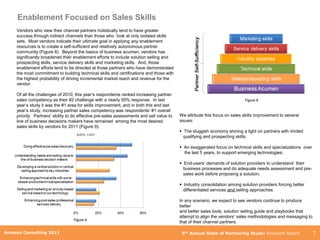
     Of all the challenges of 2010, this year‟s respondents ranked increasing partner
     sales competency as their #2 challenge with a nearly 50% response. In last                                             Figure 8
     year‟s study it was the #1 area for skills improvement, and in both this and last
     year‟s study, increasing partner sales competency was respondents‟ #1 overall
     priority. Partners‟ ability to do effective pre-sales assessments and sell value to   We attribute this focus on sales skills improvement to several
     line of business decisions makers have remained among the most desired                issues:
     sales skills by vendors for 2011 (Figure 9).
                                                                                            The sluggish economy shining a light on partners with limited
                                                                                             qualifying and prospecting skills;

                                                                                            An exaggerated focus on technical skills and specializations over
                                                                                             the last 5 years, to support emerging technologies;

                                                                                            End-users‟ demands of solution providers to understand their
                                                                                             business processes and do adequate needs assessment and pre-
                                                                                             sales work before proposing a solution;

                                                                                            Industry consolidation among solution providers forcing better
                                                                                             differentiated services and selling approaches.

                                                                                           In any scenario, we expect to see vendors continue to produce
                                                                                           better
                                                                                           and better sales tools, solution selling guide and playbooks that
                                                                                           attempt to align the vendors‟ sales methodologies and messaging to
                                   Figure 9
                                                                                           that of their channel partners.
        Amazon Consulting 2011
Amazon Consulting 2011                                                                      5th Annual State of Partnering Study: Research Report                7
State of P2P Collaboration and Social Media

                                                                                      One of the business value promises of social media has been the ease
                                                                                      with which it puts us in contact and collaboration with each other.
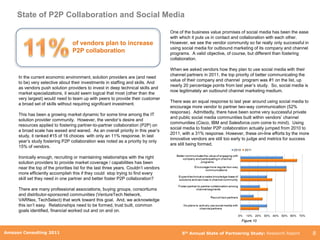
                                  of vendors plan to increase                         However, we see the vendor community so far really only successful in
                                                                                      using social media for outbound marketing of its company and channel
                                  P2P collaboration                                   programs. A valid objective, of course, but different than fostering
                                                                                      collaboration.

                                                                                      When we asked vendors how they plan to use social media with their
                                                                                      channel partners in 2011, the top priority of better communicating the
     In the current economic environment, solution providers are (and need
                                                                                      value of their company and channel program was #1 on the list, up
     to be) very selective about their investments in staffing and skills. And
                                                                                      nearly 20 percentage points from last year‟s study. So, social media is
     as vendors push solution providers to invest in deep technical skills and
                                                                                      now legitimately an outbound channel marketing medium.
     market specializations, it would seem logical that most (other than the
     very largest) would need to team up with peers to provide their customer
                                                                                      There was an equal response to last year around using social media to
     a broad set of skills without requiring significant investment.
                                                                                      encourage more vendor to partner two-way communication (52%
                                                                                      response). Admittedly, there have been some very successful private
     This has been a growing market dynamic for some time among the IT
                                                                                      and public social media communities built within vendors‟ channel
     solution provider community. However, the vendor‟s desire and
                                                                                      communities (Cisco, IBM and Salesforce.com come to mind). Using
     resources applied to fostering partner-to-partner collaboration (P2P) on
                                                                                      social media to foster P2P collaboration actually jumped from 2010 to
     a broad scale has waxed and waned. As an overall priority in this year‟s
                                                                                      2011, with a 31% response. However, these on-line efforts by the more
     study, it ranked #15 of 16 choices with only an 11% response. In last
                                                                                      innovative vendors are still too early to judge and metrics for success
     year‟s study fostering P2P collaboration was noted as a priority by only
                                                                                      are still being formed.
     15% of vendors.

     Ironically enough, recruiting or maintaining relationships with the right
     solution providers to provide market coverage / capabilities has been
     near the top of the priorities list for the last three years. Couldn‟t vendors
     more efficiently accomplish this if they could stop trying to find every
     skill set they need in one partner and better foster P2P collaboration?

     There are many professional associations, buying groups, consortiums
     and distributor-sponsored communities (VentureTech Network,
     VARNex, TechSelect) that work toward this goal. And, we acknowledge
     this isn‟t easy. Relationships need to be formed, trust built, common
     goals identified, financial worked out and on and on.

                                                                                                                          Figure 10

        Amazon Consulting 2011
Amazon Consulting 2011                                                                      5th Annual State of Partnering Study: Research Report               8
Services Readiness is New Enablement Priority
     Some of the top priorities around skills development for 2011 equally relate to                               Services Conflict/
     sales skills as they do to services skills. The ability to do effective pre-sales                        Rules of Engagement Clarity
     assessments and enhance post-sale professional services methodology were
     both in our vendor respondents‟ top priority list for 2010 and 2011, indicating the
     growing importance of service skills to the vendor community.                                                    2010                          2011
     In our ongoing consulting work, we‟ve seen a steady and notable increase in
     focus on services engagement models and services-tailored channel programs.
                                                                                                         57%                           23%
     What‟s interesting is we see an overall desire from partners to become                                                            unclear/
     increasingly autonomous for services delivery from their leading suppliers, while                   unclear
     vendors are increasingly focused on closer engagement in the form of sharing                                                      conflict
     tools, mentoring and doing co-delivery.
                                                                                                                           Figure 12
     Another data point supporting the solution providers‟ desire for autonomy is the
     decline of partners as purely sales agents, decreasing from nearly 70% of
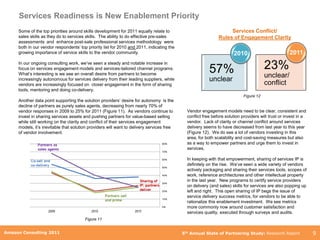
     vendor responses in 2009 to 25% for 2011 (Figure 11). As vendors continue to            Vendor engagement models need to be clear, consistent and
     invest in sharing services assets and pushing partners for value-based selling          conflict free before solution providers will trust or invest in a
     while still working on the clarity and conflict of their services engagement            vendor. Lack of clarity or channel conflict around services
     models, it‟s inevitable that solution providers will want to delivery services free     delivery seems to have decreased from last year to this year
     of vendor involvement.                                                                  (Figure 12). We do see a lot of vendors investing in this
                                                                                             area, for both scalability and cost-saving measures but also
                                                                                             as a way to empower partners and urge them to invest in
                                                                                             services.

                                                                                             In keeping with that empowerment, sharing of services IP is
                                                                                             definitely on the rise. We‟ve seen a wide variety of vendors
                                                                                             actively packaging and sharing their services tools, scopes of
                                                                                             work, reference architectures and other intellectual property
                                                                                             in the last year. New programs to certify service providers
                                                                                             on delivery (and sales) skills for services are also popping up
                                                                                             left and right. This open sharing of IP begs the issue of
                                                                                             service delivery success metrics, for vendors to be able to
                                                                                             rationalize this enablement investment. We see metrics
                                                                                             more commonly now around customer satisfaction and
                                                                                             services quality, executed through surveys and audits.
                                        Figure 11

       Amazon Consulting 2011
Amazon Consulting 2011                                                                     5th Annual State of Partnering Study: Research Report                 9
Partner Profitability Plans & Services Growth Barriers
     Services Investment Barriers
     Despite the intense desire many vendors have to get their channel partners to
     invest in a more services-centric business model, this economic environment
     has not been an easy time to make that demand.

     When we polled our vendor respondents this year about the barriers they‟ve
     seen to their partners further investing in a services-based business model,
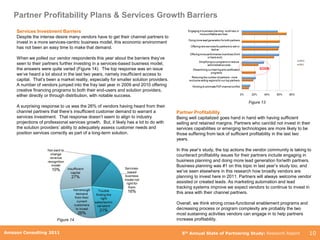
     the answers were quite varied (Figure 14). The top response was an issue
     we„ve heard a lot about in the last two years, namely insufficient access to
     capital. That‟s been a market reality, especially for smaller solution providers.
     A number of vendors jumped into the fray last year in 2009 and 2010 offering
     creative financing programs to both their end-users and solution providers,
     either directly or through distribution, with notable success.
                                                                                                                               Figure 13
     A surprising response to us was the 26% of vendors having heard from their
     channel partners that there‟s insufficient customer demand to warrant a             Partner Profitability
     services investment. That response doesn‟t seem to align to industry                Being well capitalized goes hand in hand with having sufficient
     projections of professional services growth. But, it likely has a lot to do with    selling and retained margins. Partners who can/did not invest in their
     the solution providers‟ ability to adequately assess customer needs and             services capabilities or emerging technologies are more likely to be
     position services correctly as part of a long-term solution.                        those suffering from lack of sufficient profitability in the last two
                                                                                         years.

                                                                                         In this year‟s study, the top actions the vendor community is taking to
                                                                                         counteract profitability issues for their partners include engaging in
                                                                                         business planning and doing more lead generation for/with partners.
                                                                                         Business planning was #1 on this topic in last year‟s study too, and
                                                                                         we‟ve seen elsewhere in this research how broadly vendors are
                                                                                         planning to invest here in 2011. Partners will always welcome vendor
                                                                                         assisted or created leads. As marketing automation and lead
                                                                                         tracking systems improve we expect vendors to continue to invest in
                                                                                         this area with their channel partners.

                                                                                         Overall, we think strong cross-functional enablement programs and
                                                                                         decreasing process or program complexity are probably the two
                                                                                         most sustaining activities vendors can engage in to help partners
                          Figure 14                                                      increase profitability.

        Amazon Consulting 2011
Amazon Consulting 2011                                                                     5th Annual State of Partnering Study: Research Report              10
Investment Appetite is Strong, with High ROI Expectations
    The last two years have been challenging for any economic investment that wasn‟t
    well understood and rationalized. And our respondents indicate that 2010 was
    indeed a year where they highly scrutinized most every partner-related
    investments (Figure 15). A higher level of ROI expectations seemed to emerge
    after 2009‟s economic low point, and the “new normal” is for both variable and
    fixed partnering expenses to undergo a high level of scrutiny.

    What‟s encouraging (and a bit surprising) is that vendors made few reductions in
    fixed or variable expenses in 2010. Much of that happened in 2009. Some
    vendors (30%) even pressed the accelerator in 2010 and spent ahead of 2009
    levels in an effort to help counteract the anticipated lack of investment by their
    partners. We saw these investment come most in the form of new deal
    incentives, solution-selling incentives and selective demand generation marketing
    efforts.

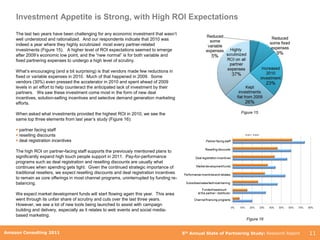
    When asked what investments provided the highest ROI in 2010, we see the                                          Figure 15
    same top three elements from last year‟s study (Figure 16):

     partner facing staff
     reselling discounts
     deal registration incentives

    The high ROI on partner-facing staff supports the previously mentioned plans to
    significantly expand high touch people support in 2011. Pay-for-performance
    programs such as deal registration and reselling discounts are usually what
    continues when spending gets tight. Given the continued strategic importance of
    traditional resellers, we expect reselling discounts and deal registration incentives
    to remain as core offerings in most channel programs, uninterrupted by funding re-
    balancing.

    We expect market development funds will start flowing again this year. This area
    went through its unfair share of scrutiny and cuts over the last three years.
    However, we see a lot of new tools being launched to assist with campaign
    building and delivery, especially as it relates to web events and social media-
    based marketing.
                                                                                                                         Figure 16

        Amazon Consulting 2011
Amazon Consulting 2011                                                                      5th Annual State of Partnering Study: Research Report   11
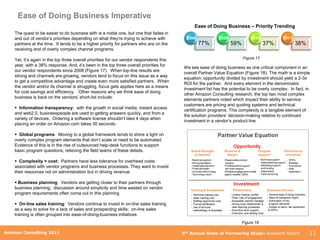
Ease of Doing Business Imperative
                                                                                               Ease of Doing Business – Priority Trending
    The quest to be easier to do business with is a noble one, but one that fades in
    and out of vendor‟s priorities depending on what they‟re trying to achieve with         2008            2009             2010             2011
    partners at the time. It tends to be a higher priority for partners who are on the             77%             59%               37%             38%
    receiving end of overly complex channel programs.

    Yet, it‟s again in the top three overall priorities for our vendor respondents this                                  Figure 17
    year, with a 38% response. And, it‟s been in the top three overall priorities for
                                                                                          We see ease of doing business as one critical component in an
    our vendor respondents since 2008 (Figure 17). When top-line results are
                                                                                          overall Partner Value Equation (Figure 18). The math is a simple
    strong and channels are growing, vendors tend to focus on this issue as a way
                                                                                          equation: opportunity divided by investment should yield a 2-3x
    to get a competitive advantage and create even more satisfied partners. When
                                                                                          ROI for the partner. And every element in the denominator
    the vendor and/or its channel is struggling, focus gets applies here as a means
                                                                                          investment list has the potential to be overly complex. In fact, in
    for cost savings and efficiency. Other reasons why we think ease of doing
                                                                                          other Amazon Consulting research, the top two most complex
    business is back on the vendors‟ short-list include:
                                                                                          elements partners noted which impact their ability to service
                                                                                          customers are pricing and quoting systems and technical
     Information transparency: with the growth in social media, instant access
                                                                                          certification programs. This complexity is a tangible element of
    and web2.0, businesspeople are used to getting answers quickly, and from a
                                                                                          the solution providers‟ decision-making relative to continued
    variety of devices. Ordering a software license shouldn‟t take 4 days when
                                                                                          investment in a vendor‟s product line.
    placing an order on Amazon.com takes 30 seconds.

     Global programs: Moving to a global framework tends to shine a light on
    overly complex program elements that don‟t scale or need to be automated.
    Evidence of this is in the rise of outsourced help-desk functions to support
    basic program questions, relieving the field teams of these details.

     Complexity = cost: Partners have less tolerance for overhead costs
    associated with vendor programs and business processes. They want to invest
    their resources not on administration but in driving revenue.

     Business planning: Vendors are getting closer to their partners through
    business planning; discussion around simplicity and time wasted on vendor
    program requirements often come out in this planning

     On-line sales training: Vendors continue to invest in on-line sales training
    as a way to solve for a lack of sales and prospecting skills; on-line sales
    training is often grouped into ease-of-doing-business initiatives
                                                                                                                         Figure 18
         Amazon Consulting 2011
Amazon Consulting 2011                                                                    5th Annual State of Partnering Study: Research Report             12
Essential Vendor Guidance
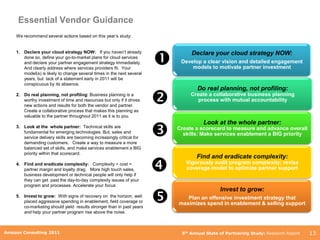
    We recommend several actions based on this year‟s study:


                                                                        
    1. Declare your cloud strategy NOW: If you haven‟t already                   Declare your cloud strategy NOW:
       done so, define your go-to-market plans for cloud services
       and declare your partner engagement strategy immediately.             Develop a clear vision and detailed engagement
       And clearly address where services providers fit. Your                    models to motivate partner investment
       model(s) is likely to change several times in the next several
       years, but lack of a statement early in 2011 will be
       conspicuous by its absence.
                                                                                   Do real planning, not profiling:
    2. Do real planning, not profiling: Business planning is a
       worthy investment of time and resources but only if it drives
       new actions and results for both the vendor and partner.
       Create a collaborative process that makes this planning as
                                                                                Create a collaborative business planning
                                                                                    process with mutual accountability

       valuable to the partner throughout 2011 as it is to you.


                                                                        
                                                                                      Look at the whole partner:
    3. Look at the whole partner: Technical skills are                      Create a scorecard to measure and advance overall
       fundamental for emerging technologies. But, sales and                  skills: Make services enablement a BIG priority
       service delivery skills are becoming increasingly critical for
       demanding customers. Create a way to measure a more
       balanced set of skills, and make services enablement a BIG
       priority within that scorecard.
                                                                                   Find and eradicate complexity:
    4. Find and eradicate complexity: Complexity = cost =
       partner margin and loyalty drag. More high touch sales,
       business development or technical people will only help if
                                                                              Vigorously audit program complexity; revise
                                                                               coverage model to optimize partner support

       they can get past the day-to-day complexity issues of your
       program and processes. Accelerate your focus


                                                                        
                                                                                              Invest to grow:
    5. Invest to grow: With signs of recovery on the horizon, well             Plan an offensive investment strategy that
       placed aggressive spending in enablement, field coverage or          maximizes spend in enablement & selling support
       co-marketing should yield results stronger than in past years
       and help your partner program rise above the noise.


        Amazon Consulting 2011
Amazon Consulting 2011                                                       5th Annual State of Partnering Study: Research Report   13
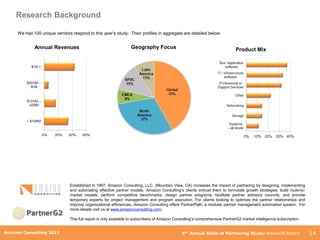
Research Background

     We had 100 unique vendors respond to this year‟s study. Their profiles in aggregate are detailed below:


             Annual Revenues                                     Geography Focus                                            Product Mix


                               Established in 1997, Amazon Consulting, LLC, (Mountain View, CA) increases the impact of partnering by designing, implementing
                               and automating effective partner models. Amazon Consulting‟s clients entrust them to formulate growth strategies, build route-to-
                               market models, perform competitive benchmarks, design partner programs, facilitate partner advisory councils, and provide
                               temporary experts for project management and program execution. For clients looking to optimize the partner relationships and
                               improve organizational efficiencies, Amazon Consulting offers PartnerPath, a modular partner management automation system. For
                               more details visit us at www.amazonconsulting.com.

                               This full report is only available to subscribers of Amazon Consulting‟s comprehensive PartnerG2 market intelligence subscription.

        Amazon Consulting 2011
Amazon Consulting 2011                                                                        5th Annual State of Partnering Study: Research Report                 14

2011 State of Partnering

  • 1.
    Amazon Consulting Termsof Use The information in this presentation is produced by Amazon Consulting and may contain previously unpublished synthesis of materials. Permission to use, copy, modify and distribute any material from Amazon Consulting is hereby granted provided that the contents of this "Terms of Use" notice appear with all copies. In addition, if the material used includes other credit or copyright information, then this source information should also be included with all copies. Use of Amazon Consulting content (documents, white papers, articles, research, etc.) is for informational and non- commercial or personal use only. You may not modify any content, copy, distribute, transmit, display, perform, reproduce, publish, license, create derivative works from, transfer, post on any network, broadcast in any media or sell any information unless expressly permitted by Amazon Consulting. Content other than that belonging to Amazon Consulting is licensed or otherwise published by Amazon Consulting with the permission of the owner of the material. All rights in such materials are reserved to the respective owners. For questions and media requests, please contact: Cathy Sperrazzo Eye-to-Eye Communications, Inc. 858-565-9800 cathy@eyetoeyepr.com Amazon Consulting 2011
  • 2.
    - Research Report- Amazon Consulting 2011 Amazon Consulting 2011 Influencing the Influencers: Research Executive Brief 0
  • 3.
    2011: Skills Diversificationand Services Engagement For five years, Amazon Consulting has been researching the partnering plans and priorities of the IT vendor community. The last couple of years have been a bit tumultuous, with a stronger current of overhaul than optimism. The turbulent economy, increased globalization, introduction of disruptive technologies and evolving solution provider business models have made it a challenging environment in which to partner in a predictable and positive way. This research contains reflections on the challenges, priorities, metrics and investments of technology vendors as they go to market with and through various indirect channels. It is the only study we do annually which is exclusively vendor focused. As such, it affords great insights into where the vendor community is directing its resources and energies for 2011. Key Trends From this broad body of research, we see several notable trends: Partner types: Service providers are the new “it” channel and is a big focus this year for infrastructure and software vendors. Globalization: Global program frameworks are the new standard. Partners applaud the simplicity and vendors are saving time and money. Enablement: Technical certifications still equate to high value, but sales skills will continue as a big priority for competency. Coverage: 2011 investments focus on business planning and field and phone-based partner management. Services: Vendors continue to drive partners to build services and are increasing the sharing of services assets selling/delivery support to mentoring investments. Cloud: Cloud program and engagement models are coming of age. Contrary to rumors, vendors are going to market with partners for these solutions. Spending: High ROI expectations remain, but vendors are making strategic investments in diversifying partner skills. Amazon Consulting 2011 Amazon Consulting 2011 5th Annual State of Partnering Study: Research Report 1
  • 4.
    Global Value-Based ProgramStructures Now Standard As we‟ve watched vendors‟ focus and investment throughout the last five years, there have been a number of drivers moving vendors to a more streamlined and consistent global partner program structure. These include:  The ongoing consolidation of the solution provider community;  The increased global access of end-users for IT products and services, driving partners‟ business model to be more globally aware and responsive;  Vendors‟ need for more cost effective and scalable partner support programs;  Solution providers‟ need for simplicity and reduction in administrative overhead in working with their suppliers. The strongest global program structures we see allow for a number of important regional variations to meet the economic requirements and business practice variations of different regions. These elements typically include resale discounting, deal registration payouts, annual revenue targets and MDF percentages. Very few (<20%) of vendors indicated their regions still have their own distinct channel programs. As evidence of this trend toward global programs, nearly half of vendors today indicate their global program framework is now in place (Figure 1). A significant number also indicate they are realizing scalability and cost saving benefits as a result of this program approach. Figure 1 Partners also seem happy with this global program approach. Over a third of respondents declare their partners are happy with the clarity and simplicity of their global program. Solution providers‟ demands for ease of doing business, clear ROI and minimal overhead costs will continue to motivate vendors to be as consistent and predictable as possible in this area. For larger solution providers who engage across multiple business models and geographies, this trend is a critical success factor in effective vendor engagement. Amazon Consulting 2011 Amazon Consulting 2011 5th Annual State of Partnering Study: Research Report 2
  • 5.
    New Business andCompetitive Marketshare Lead Value Metrics Performance expectations for global partnering efforts have clearly evolved over the last five years. Not surprisingly, the core metric of new business remain #1 this year; it has been either the #1 or #2 metric for the last four years (Figure 2). Deal registration programs rewarding partners for new projects and customers are the table-stakes of most vendor programs today. And, these incentives are now extending regularly to new business gained in key vertical markets and around certain vendor architectures and multi- product solution sets. We were a bit surprised to see technical expertise re-emerge as a key value metric, given the shift in focus in recent years to sales skills. Despite the goal of sales skills improvement for this year and last, core technical skills remain the primary indicator of future value-based selling for many vendors. Although vendors are looking at partner skills more holistically through their enablement efforts, many of today‟s emerging technologies (mobility, business intelligence, unified communications) require especially deep technical skills to create successful customer engagements. Competitive marketshare gains emerged this year as a new value metric. This aligns with vendors‟ desire to get back on the offense for 2011 and pump up top-line growth with and through their partners. However, partners are usually less likely to take on a vendor‟s competitive battles, particularly where they might also support that competitors‟ product line. In fact, we see a number of single-brand or “franchise” building type channel programs reemerging from vendors with broad product lines. Their aim – to build a Figure 2 much broader, cross-portfolio approach to their partners‟ support of their technologies. These programs don‟t necessarily focus on brand exclusivity for a given vendor, but offer rich rewards in the form of discounted training, field support and extra marketing funds to partners who are effective in cross-selling their portfolio. IBM, Cisco and HP are the more notable vendors with programs like this, and we expect their competitive battles against each other for partner mindshare and investment to heat up even further in 2011. Amazon Consulting 2011 Amazon Consulting 2011 5th Annual State of Partnering Study: Research Report 3
  • 6.
    Service Providers Comeinto the Spotlight The IT market has been moving slowly but surely to a converged services model over the last 5-7 years. Converged services is an IT delivery model where pre-and post-sale professional services, products and support all come together in an integrated offering that solves a specific business pain-point. And, both vendors and solution providers have been jumping on the bandwagon to evolve their services sales and delivery models in this direction. Customer adoption of cloud services has just accelerated that trend. Services-based solution provider business models are attractive to many vendors, as they attempt to become more business relevant and deepen customer insights through their partners. Business partners who meet end-users‟ overall IT needs by offering comprehensive pre- and post-sale services and selling technology tend to have the most lasting customer relationships. This was reflected in the strategic value attributed to systems integrators, MSPs and service provider/carriers in this year‟s study (Figure 3). Although resellers remain the most strategic partner type, we have seen a dramatic increase in licensing models, engagement structures and program support offered to regional and national managed service providers as well as national and global service provider/carriers in the last 9-12 months. Figure 3 Regional managed service providers are easier to address and support in broad- based channel programs than are their larger telecom counterparts. Many of the larger telecom/service providers (Terremark, AT&T, Verizon, BT, Savvis) have historically been handled by vendors as large enterprise customers, and as such have been covered by the vendors‟ direct enterprise sales teams. About a third of Service Providers vendors indicate they already engage with service providers and will continue their are existing partner recruitment and enablement efforts. Another 20% are planning to put a large focus type, will continue on this class of partner to actively recruit and engage them in 2011 (Figure 4). to recruit and enable As telecom/service providers diversify their offerings into applications and cloud services and attempt to penetrate the SMB market, their expectations of their Big focus, will actively suppliers for go-to-market support are increasing. Many have developed their own down-stream channel programs to attract smaller MSPs and VARs to sell and engage and recruit promote their broad infrastructure services. They often look to their leading Service Providers vendors partners (EMC, NetApp, Cisco, HP) to achieve that sales and marketing success through the vendor‟s broader VAR and solution provider network. Figure 4 Amazon Consulting 2011 Amazon Consulting 2011 5th Annual State of Partnering Study: Research Report 4
  • 7.
    Cloud Engagement ModelsReveal Partner Dependence When we explored the state of partnering efforts for cloud services, the results reflect the continued dependence vendors have on channel partners to assist in the sale and/or delivery of these offerings (Figure 5). What‟s also interesting is that there is not one clear leading channel engagement model for vendors as they look ahead to cloud services. The majority will deliver cloud services directly to end- users and use partners as sales agents or resellers, but another sizeable group will only sell technology to their solution providers and expect them to deliver their own cloud services to the market. Contrary to industry rumors, most vendors will be dependent on their channel partners for one or more functions in getting cloud services to market in 2011. Over a quarter will deliver direct cloud services and use their channel partners in a traditional reselling model. We see examples of these reselling channel programs from both hardware (Cisco and HP), software (Microsoft, Oracle, Salesforce.com) and service providers (Rackspace). Some in fact are offering automation tools to ease partners‟ burden in billing and contract management of their cloud services. A nearly equal amount of companies also plan to deliver cloud services directly to end-users and use partners as only sales agents. Their expectations are for the partner to leverage their existing customer base (often SMB focused), evangelize their cloud solutions and refer the customer for consumption to the vendor directly. Figure 5 We predict that this engagement model will be the least popular model, over time, as partners themselves invest in a services offerings and attempt to retain customer control from the vendor. The top cloud response from vendors clearly indicates their intent to sell technology to partners to enable cloud offerings but not to sell cloud service directly to Only 17% of respondents indicate they are still customers. This is the most common approach for most server, storage and formulating their cloud partnering strategy. We think networking manufacturers to date, as they are accustomed to using their this is a bit understated, as many vendors are still infrastructure-focused partner community to create their own solutions and services conducting pilots around cloud services and technology around their technology. The big focus for this class of manufacturers is to engage engagement and determining how many of these around professional services mentoring, and teach their hardware-focused partners models they will offer. Only recently have some of the how to successfully conduct pre-sales assessments to identify the private, hybrid or larger infrastructure vendors announced their initial public cloud opportunities and migration path most suitable for their customers. We cloud engagement models – most notably IBM, HP and see these services mentoring programs from most every vendor we work with. Cisco. Amazon Consulting 2011 Amazon Consulting 2011 5th Annual State of Partnering Study: Research Report 5
  • 8.
    Business Planning andHigh Touch Support a Priority In last year‟s study, business planning activities emerged as a big focus. And, this year the focus continues and increases, extending down beyond the top tier Business Planning of vendors‟ partners (Figure 6). And another 30% of vendors said they were going to start business planning to better identify their strategic partners. Assuming that activity is real business planning and not just basic profiling and it drives mutual accountability and investments, this activity will be very positive for both partners and vendors. We think response also indicates the level of high-touch support and business model insight vendors both want and need in 2011. The only challenge for solution providers here is the possibility of being inundated by different vendors, all wanting to do business planning, much of which might be redundant. Partner Management Coverage Following on the theme of high touch support, in our questions about 2011 investments, we asked about changes planned in vendors‟ partner coverage Figure 6 models. We were surprised (and delighted) to hear of a resurgence in people- based resources to help support partners. Over a quarter of respondents plan to add field partner-facing sales reps, and another 17% plan to add phone based partner sales reps (Figure 7). Over the last two years we saw many vendors reduce their partner-facing sales headcount and/or move people from field based positions to phone-based roles. In some cases, this had a negative impact on both vendor/partner relationships or stalled the onboarding and development of new partners. Staffing support is expected to go well beyond basic sales and technical training. Nearly a quarter of vendors indicate they plan to add business development reps to assist with business planning and overall enablement. Another 21% expect to add technical staff (SE‟s) to provide deal support and help partners architect their solutions. This staffing model assumes that the structure of the basic channel program from these vendors is relatively simple and easily accessed, so that the local resources can focus on longer-term planning, solution development and marketing campaigns. Theoretically, the addition of phone reps or a help desk function should be able to offload basic program questions., at least in the bigger or more complex programs. Figure 7 Amazon Consulting 2011 Amazon Consulting 2011 5th Annual State of Partnering Study: Research Report 6
  • 9.
    Enablement Focused onSales Skills Vendors who view their channel partners holistically tend to have greater success through indirect channels than those who look at only isolated skills sets. Most vendors indicate their ultimate goal in applying any enablement resources is to create a self-sufficient and relatively autonomous partner community (Figure 8). Beyond the basics of business acumen, vendors has significantly broadened their enablement efforts to include solution selling and prospecting skills, service delivery skills and marketing skills. And, those enablement efforts tend to be directed at those partners who have demonstrated the most commitment to building technical skills and certifications and those with the highest probability of driving incremental market reach and revenue for the vendor. Of all the challenges of 2010, this year‟s respondents ranked increasing partner sales competency as their #2 challenge with a nearly 50% response. In last Figure 8 year‟s study it was the #1 area for skills improvement, and in both this and last year‟s study, increasing partner sales competency was respondents‟ #1 overall priority. Partners‟ ability to do effective pre-sales assessments and sell value to We attribute this focus on sales skills improvement to several line of business decisions makers have remained among the most desired issues: sales skills by vendors for 2011 (Figure 9).  The sluggish economy shining a light on partners with limited qualifying and prospecting skills;  An exaggerated focus on technical skills and specializations over the last 5 years, to support emerging technologies;  End-users‟ demands of solution providers to understand their business processes and do adequate needs assessment and pre- sales work before proposing a solution;  Industry consolidation among solution providers forcing better differentiated services and selling approaches. In any scenario, we expect to see vendors continue to produce better and better sales tools, solution selling guide and playbooks that attempt to align the vendors‟ sales methodologies and messaging to Figure 9 that of their channel partners. Amazon Consulting 2011 Amazon Consulting 2011 5th Annual State of Partnering Study: Research Report 7
  • 10.
    State of P2PCollaboration and Social Media One of the business value promises of social media has been the ease with which it puts us in contact and collaboration with each other. of vendors plan to increase However, we see the vendor community so far really only successful in using social media for outbound marketing of its company and channel P2P collaboration programs. A valid objective, of course, but different than fostering collaboration. When we asked vendors how they plan to use social media with their channel partners in 2011, the top priority of better communicating the In the current economic environment, solution providers are (and need value of their company and channel program was #1 on the list, up to be) very selective about their investments in staffing and skills. And nearly 20 percentage points from last year‟s study. So, social media is as vendors push solution providers to invest in deep technical skills and now legitimately an outbound channel marketing medium. market specializations, it would seem logical that most (other than the very largest) would need to team up with peers to provide their customer There was an equal response to last year around using social media to a broad set of skills without requiring significant investment. encourage more vendor to partner two-way communication (52% response). Admittedly, there have been some very successful private This has been a growing market dynamic for some time among the IT and public social media communities built within vendors‟ channel solution provider community. However, the vendor‟s desire and communities (Cisco, IBM and Salesforce.com come to mind). Using resources applied to fostering partner-to-partner collaboration (P2P) on social media to foster P2P collaboration actually jumped from 2010 to a broad scale has waxed and waned. As an overall priority in this year‟s 2011, with a 31% response. However, these on-line efforts by the more study, it ranked #15 of 16 choices with only an 11% response. In last innovative vendors are still too early to judge and metrics for success year‟s study fostering P2P collaboration was noted as a priority by only are still being formed. 15% of vendors. Ironically enough, recruiting or maintaining relationships with the right solution providers to provide market coverage / capabilities has been near the top of the priorities list for the last three years. Couldn‟t vendors more efficiently accomplish this if they could stop trying to find every skill set they need in one partner and better foster P2P collaboration? There are many professional associations, buying groups, consortiums and distributor-sponsored communities (VentureTech Network, VARNex, TechSelect) that work toward this goal. And, we acknowledge this isn‟t easy. Relationships need to be formed, trust built, common goals identified, financial worked out and on and on. Figure 10 Amazon Consulting 2011 Amazon Consulting 2011 5th Annual State of Partnering Study: Research Report 8
  • 11.
    Services Readiness isNew Enablement Priority Some of the top priorities around skills development for 2011 equally relate to Services Conflict/ sales skills as they do to services skills. The ability to do effective pre-sales Rules of Engagement Clarity assessments and enhance post-sale professional services methodology were both in our vendor respondents‟ top priority list for 2010 and 2011, indicating the growing importance of service skills to the vendor community. 2010 2011 In our ongoing consulting work, we‟ve seen a steady and notable increase in focus on services engagement models and services-tailored channel programs. 57% 23% What‟s interesting is we see an overall desire from partners to become unclear/ increasingly autonomous for services delivery from their leading suppliers, while unclear vendors are increasingly focused on closer engagement in the form of sharing conflict tools, mentoring and doing co-delivery. Figure 12 Another data point supporting the solution providers‟ desire for autonomy is the decline of partners as purely sales agents, decreasing from nearly 70% of vendor responses in 2009 to 25% for 2011 (Figure 11). As vendors continue to Vendor engagement models need to be clear, consistent and invest in sharing services assets and pushing partners for value-based selling conflict free before solution providers will trust or invest in a while still working on the clarity and conflict of their services engagement vendor. Lack of clarity or channel conflict around services models, it‟s inevitable that solution providers will want to delivery services free delivery seems to have decreased from last year to this year of vendor involvement. (Figure 12). We do see a lot of vendors investing in this area, for both scalability and cost-saving measures but also as a way to empower partners and urge them to invest in services. In keeping with that empowerment, sharing of services IP is definitely on the rise. We‟ve seen a wide variety of vendors actively packaging and sharing their services tools, scopes of work, reference architectures and other intellectual property in the last year. New programs to certify service providers on delivery (and sales) skills for services are also popping up left and right. This open sharing of IP begs the issue of service delivery success metrics, for vendors to be able to rationalize this enablement investment. We see metrics more commonly now around customer satisfaction and services quality, executed through surveys and audits. Figure 11 Amazon Consulting 2011 Amazon Consulting 2011 5th Annual State of Partnering Study: Research Report 9
  • 12.
    Partner Profitability Plans& Services Growth Barriers Services Investment Barriers Despite the intense desire many vendors have to get their channel partners to invest in a more services-centric business model, this economic environment has not been an easy time to make that demand. When we polled our vendor respondents this year about the barriers they‟ve seen to their partners further investing in a services-based business model, the answers were quite varied (Figure 14). The top response was an issue we„ve heard a lot about in the last two years, namely insufficient access to capital. That‟s been a market reality, especially for smaller solution providers. A number of vendors jumped into the fray last year in 2009 and 2010 offering creative financing programs to both their end-users and solution providers, either directly or through distribution, with notable success. Figure 13 A surprising response to us was the 26% of vendors having heard from their channel partners that there‟s insufficient customer demand to warrant a Partner Profitability services investment. That response doesn‟t seem to align to industry Being well capitalized goes hand in hand with having sufficient projections of professional services growth. But, it likely has a lot to do with selling and retained margins. Partners who can/did not invest in their the solution providers‟ ability to adequately assess customer needs and services capabilities or emerging technologies are more likely to be position services correctly as part of a long-term solution. those suffering from lack of sufficient profitability in the last two years. In this year‟s study, the top actions the vendor community is taking to counteract profitability issues for their partners include engaging in business planning and doing more lead generation for/with partners. Business planning was #1 on this topic in last year‟s study too, and we‟ve seen elsewhere in this research how broadly vendors are planning to invest here in 2011. Partners will always welcome vendor assisted or created leads. As marketing automation and lead tracking systems improve we expect vendors to continue to invest in this area with their channel partners. Overall, we think strong cross-functional enablement programs and decreasing process or program complexity are probably the two most sustaining activities vendors can engage in to help partners Figure 14 increase profitability. Amazon Consulting 2011 Amazon Consulting 2011 5th Annual State of Partnering Study: Research Report 10
  • 13.
    Investment Appetite isStrong, with High ROI Expectations The last two years have been challenging for any economic investment that wasn‟t well understood and rationalized. And our respondents indicate that 2010 was indeed a year where they highly scrutinized most every partner-related investments (Figure 15). A higher level of ROI expectations seemed to emerge after 2009‟s economic low point, and the “new normal” is for both variable and fixed partnering expenses to undergo a high level of scrutiny. What‟s encouraging (and a bit surprising) is that vendors made few reductions in fixed or variable expenses in 2010. Much of that happened in 2009. Some vendors (30%) even pressed the accelerator in 2010 and spent ahead of 2009 levels in an effort to help counteract the anticipated lack of investment by their partners. We saw these investment come most in the form of new deal incentives, solution-selling incentives and selective demand generation marketing efforts. When asked what investments provided the highest ROI in 2010, we see the Figure 15 same top three elements from last year‟s study (Figure 16):  partner facing staff  reselling discounts  deal registration incentives The high ROI on partner-facing staff supports the previously mentioned plans to significantly expand high touch people support in 2011. Pay-for-performance programs such as deal registration and reselling discounts are usually what continues when spending gets tight. Given the continued strategic importance of traditional resellers, we expect reselling discounts and deal registration incentives to remain as core offerings in most channel programs, uninterrupted by funding re- balancing. We expect market development funds will start flowing again this year. This area went through its unfair share of scrutiny and cuts over the last three years. However, we see a lot of new tools being launched to assist with campaign building and delivery, especially as it relates to web events and social media- based marketing. Figure 16 Amazon Consulting 2011 Amazon Consulting 2011 5th Annual State of Partnering Study: Research Report 11
  • 14.
    Ease of DoingBusiness Imperative Ease of Doing Business – Priority Trending The quest to be easier to do business with is a noble one, but one that fades in and out of vendor‟s priorities depending on what they‟re trying to achieve with 2008 2009 2010 2011 partners at the time. It tends to be a higher priority for partners who are on the 77% 59% 37% 38% receiving end of overly complex channel programs. Yet, it‟s again in the top three overall priorities for our vendor respondents this Figure 17 year, with a 38% response. And, it‟s been in the top three overall priorities for We see ease of doing business as one critical component in an our vendor respondents since 2008 (Figure 17). When top-line results are overall Partner Value Equation (Figure 18). The math is a simple strong and channels are growing, vendors tend to focus on this issue as a way equation: opportunity divided by investment should yield a 2-3x to get a competitive advantage and create even more satisfied partners. When ROI for the partner. And every element in the denominator the vendor and/or its channel is struggling, focus gets applies here as a means investment list has the potential to be overly complex. In fact, in for cost savings and efficiency. Other reasons why we think ease of doing other Amazon Consulting research, the top two most complex business is back on the vendors‟ short-list include: elements partners noted which impact their ability to service customers are pricing and quoting systems and technical  Information transparency: with the growth in social media, instant access certification programs. This complexity is a tangible element of and web2.0, businesspeople are used to getting answers quickly, and from a the solution providers‟ decision-making relative to continued variety of devices. Ordering a software license shouldn‟t take 4 days when investment in a vendor‟s product line. placing an order on Amazon.com takes 30 seconds.  Global programs: Moving to a global framework tends to shine a light on overly complex program elements that don‟t scale or need to be automated. Evidence of this is in the rise of outsourced help-desk functions to support basic program questions, relieving the field teams of these details.  Complexity = cost: Partners have less tolerance for overhead costs associated with vendor programs and business processes. They want to invest their resources not on administration but in driving revenue.  Business planning: Vendors are getting closer to their partners through business planning; discussion around simplicity and time wasted on vendor program requirements often come out in this planning  On-line sales training: Vendors continue to invest in on-line sales training as a way to solve for a lack of sales and prospecting skills; on-line sales training is often grouped into ease-of-doing-business initiatives Figure 18 Amazon Consulting 2011 Amazon Consulting 2011 5th Annual State of Partnering Study: Research Report 12
  • 15.
    Essential Vendor Guidance We recommend several actions based on this year‟s study:  1. Declare your cloud strategy NOW: If you haven‟t already Declare your cloud strategy NOW: done so, define your go-to-market plans for cloud services and declare your partner engagement strategy immediately. Develop a clear vision and detailed engagement And clearly address where services providers fit. Your models to motivate partner investment model(s) is likely to change several times in the next several years, but lack of a statement early in 2011 will be conspicuous by its absence. Do real planning, not profiling: 2. Do real planning, not profiling: Business planning is a worthy investment of time and resources but only if it drives new actions and results for both the vendor and partner. Create a collaborative process that makes this planning as  Create a collaborative business planning process with mutual accountability valuable to the partner throughout 2011 as it is to you.  Look at the whole partner: 3. Look at the whole partner: Technical skills are Create a scorecard to measure and advance overall fundamental for emerging technologies. But, sales and skills: Make services enablement a BIG priority service delivery skills are becoming increasingly critical for demanding customers. Create a way to measure a more balanced set of skills, and make services enablement a BIG priority within that scorecard. Find and eradicate complexity: 4. Find and eradicate complexity: Complexity = cost = partner margin and loyalty drag. More high touch sales, business development or technical people will only help if  Vigorously audit program complexity; revise coverage model to optimize partner support they can get past the day-to-day complexity issues of your program and processes. Accelerate your focus  Invest to grow: 5. Invest to grow: With signs of recovery on the horizon, well Plan an offensive investment strategy that placed aggressive spending in enablement, field coverage or maximizes spend in enablement & selling support co-marketing should yield results stronger than in past years and help your partner program rise above the noise. Amazon Consulting 2011 Amazon Consulting 2011 5th Annual State of Partnering Study: Research Report 13
  • 16.
    Research Background We had 100 unique vendors respond to this year‟s study. Their profiles in aggregate are detailed below: Annual Revenues Geography Focus Product Mix Established in 1997, Amazon Consulting, LLC, (Mountain View, CA) increases the impact of partnering by designing, implementing and automating effective partner models. Amazon Consulting‟s clients entrust them to formulate growth strategies, build route-to- market models, perform competitive benchmarks, design partner programs, facilitate partner advisory councils, and provide temporary experts for project management and program execution. For clients looking to optimize the partner relationships and improve organizational efficiencies, Amazon Consulting offers PartnerPath, a modular partner management automation system. For more details visit us at www.amazonconsulting.com. This full report is only available to subscribers of Amazon Consulting‟s comprehensive PartnerG2 market intelligence subscription. Amazon Consulting 2011 Amazon Consulting 2011 5th Annual State of Partnering Study: Research Report 14