Knowledge Sharing
2010 Book of Abstracts


An EMC Proven Professional Publication
Designing and Implementing an Effective Backup
                                  Solution
                                  Anuj Mediratta, Director, and Neeraj Mediratta
                                  Ace Data Devices Pvt. Ltd., India


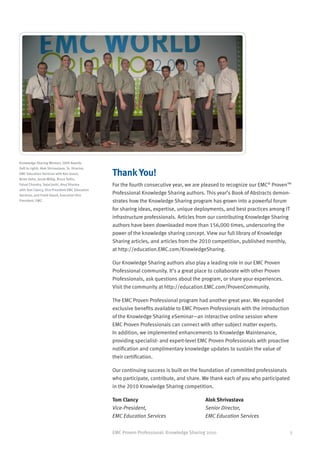
Knowledge Sharing Winners 2009 Awards


                                                        Thank You!
(left to right): Alok Shrivastava, Sr. Director,
EMC Education Services with Ken Guest,
Brian Dehn, Jacob Willig, Bruce Yellin,
Faisal Choudry, Sejal Joshi, Anuj Sharma                For the fourth consecutive year, we are pleased to recognize our EMC® Proven™
with Tom Clancy, Vice President EMC Education
Services, and Frank Hauck, Executive Vice
                                                        Professional Knowledge Sharing authors. This year’s Book of Abstracts demon-
President, EMC.                                         strates how the Knowledge Sharing program has grown into a powerful forum
                                                        for sharing ideas, expertise, unique deployments, and best practices among IT
                                                        infrastructure professionals. Articles from our contributing Knowledge Sharing
                                                        authors have been downloaded more than 156,000 times, underscoring the
                                                        power of the knowledge sharing concept. View our full library of Knowledge
                                                        Sharing articles, and articles from the 2010 competition, published monthly,
                                                        at http://education.EMC.com/KnowledgeSharing.

                                                        Our Knowledge Sharing authors also play a leading role in our EMC Proven
                                                        Professional community. It’s a great place to collaborate with other Proven
                                                        Professionals, ask questions about the program, or share your experiences.
                                                        Visit the community at http://education.EMC.com/ProvenCommunity.

                                                        The EMC Proven Professional program had another great year. We expanded
                                                        exclusive benefits available to EMC Proven Professionals with the introduction
                                                        of the Knowledge Sharing eSeminar—an interactive online session where
                                                        EMC Proven Professionals can connect with other subject matter experts.
                                                        In addition, we implemented enhancements to Knowledge Maintenance,
                                                        providing specialist- and expert-level EMC Proven Professionals with proactive
                                                        notification and complimentary knowledge updates to sustain the value of
                                                        their certification.

                                                        Our continuing success is built on the foundation of committed professionals
                                                        who participate, contribute, and share. We thank each of you who participated
                                                        in the 2010 Knowledge Sharing competition.

                                                        Tom Clancy	                               Alok Shrivastava
                                                        Vice-President, 	                         Senior Director,
                                                        EMC Education Services	                   EMC Education Services


                                                        EMC Proven Professional: Knowledge Sharing 2010                                  3
Table of Contents
F I R ST- P L ACE KNOWLEDGE SHARING ARTICLE

Above the Clouds—Best Practices in Creating a Sustainable Computing
Infrastructure to Achieve Business Value and Growth..................................................... 9
    Paul Brant, EMC


SECO N D - P LACE KNOWLEDGE SHARING ARTICLE

Applying Composite Data Deduplication to Simplify Hybrid Clouds............................10
    Mohammed Hashim, Wipro Technologies
    Rejaneesh Sasidharan, Wipro Technologies


T H I R D - P L ACE KNOWLEDGE SHARING ARTICLE

SAN Performance—Getting the Most ‘Bang’ for the Buck. ............................................11
    John Bowling, Private Financial Institution


B EST O F C LOUD

How to Trust the Cloud—“Be Careful Up There”.............................................................11
    Paul Brant, EMC
    Denis Guyadeen, EMC


B EST O F S KILLS

The Convergence Factor—When IT Service Silos Collide................................................12
    Ben Dingley, EMC Consulting


B EST O F CONSOLIDATION

Growing Storage Area Network Consolidation and Migration: Is it for You?................12
    Sejal Joshi, Large Telecom Company
    Ken Guest, Large Telecom Company


A P P L I C AT ION INTEGRATION

Designing Documentum Applications, a Multi-Dimensional Challenge.......................13
    Jacob Willig, Lazymen/MatchFirst


ARCHIVE

Save Costs on E-mail Infrastructure: Obtain Value-added Benefits
of E-mail Retention and Archiving...................................................................................14
    Satheesh Mc, PMC-Sierra


AVA M A R

Are You Ready for ‘AVA’ Generation?...............................................................................14
    Randeep Singh, HCL Comnet


BAC K U P A ND RECOVERY

Backup and Recovery of Microsoft SharePoint—A Complete Solution.........................15
    Douglas Collimore, EMC


EMC Proven Professional: Knowledge Sharing 2010                                                                     5
EMC PowerSnap Implementation—Challenges and Examples......................................16
        Hrvoje Crvelin, Orchestra Service

    Enhancing Throughput with Multi-Homed Feature in NetWorker Storage Node..........16
        Gururaj Kulkarni, EMC
        Anand Subramanian, EMC

    Scheduling Operations in NetWorker..............................................................................17
        Aaron Kleinsmith, EMC

    The Union of Snapshot-Based Backup Technology and Data Deduplication. ..............18
        Chris Mavromatis, EMC


    B U S I N ESS CONTINUITY

    EMC Business Continuity Offerings: Another Differentiator of Midrange
    and High-end Storage Arrays...........................................................................................19
        Denis Serov, EMC


    B U S I N ESS PROCESS

    Revisiting Business Information Management Re-Engineering:
    A Never Ending Cycle........................................................................................................19
        Eugene Demigillo, EMC


    C L A R i i ON

    Best Practices for Designing, Deploying, and Administering SAN
    using EMC CLARiiON Storage Systems . .........................................................................20
        Anuj Sharma, EMC

    How to Shrink a LUN or MetaLUN with CLARiiON CX4....................................................21
        Markus Langenberg, Fujitsu Technology Solutions

    Performance—Feeling or Reality in a CLARiiON Environment. ......................................21
        Octavio Palomino, EMC
        Javier Alvarez Dasnoy, EMC


    C LO U D

    Managing the Cloud—Out of the Fog. .............................................................................22
        Brian Dehn, EMC


    CO N T E NT MANAGEMENT

    Building a Knowledge Management System with Documentum. .................................23
        Kaiyin Hu, EMC
        Hongfeng Sun, PATAC

    Documentum Disaster Recovery Implementation..........................................................24
        Narsingarao Miriyala, EMC

    EMC Documentum Single Sign-on using Standard Tools...............................................24
        Sander Hendriks, Informed Consulting

    Enterprise Content Management: Yesterday’s Lessons and Today’s Challenges........25
        Himakara Pieris, Daedal Consulting


6   EMC Proven Professional: Knowledge Sharing 2009
Integrating SharePoint and Documentum......................................................................26
    Rami A Al Ghanim, Saudi Aramco
    Sara AlMansour, Saudi Aramco

Media Asset Management in the Broadcasting Industry using Documentum.............26
    Derrick Lau, Contractor

Understanding In-Depth Documentum Security............................................................27
    Narsingarao Miriyala, EMC

WCM with DITA and Documentum...................................................................................28
    Jaimala D. Bondre

Working with Documentum Composer and Without It...................................................28
    Andrew Fitzpatrick, Capgemini

Zero-Cost Single Sign-On for Documentum Web Applications
with Integrated Windows Authentication.......................................................................29
    Fangjian Wu, Booz Allen Hamilton


DATA CE N TER MIGRATION

The Art and Science of a Data Center Migration.............................................................30
    Michael Breshears, EMC


R ECOV E R P OINT

Host-Based Write Splitting in a Solaris RecoverPoint Environment. ............................30
    Arthur Johnson, EMC


R ES O U R CE MANAGEMENT

Building a ControlCenter Infrastructure in a Windows 2003
Clustered Environment.....................................................................................................31
    Kevin Atkin, Thomson Reuters


SECU R I TY

A Practical Approach to Data Loss Prevention................................................................31
    Sonali Bhavsar, Paragon Solutions
    A subsidiary of ParagonComputer Professionals, Inc.

RAID! Digital Forensics, SANs, and Virtualization..........................................................32
    Charles Brooks, EMC


STO R A G E

Cost-Effective Methods of Remote Data Storage ...........................................................33
    Johny Jose, Don Bosco College
    Mitchel Valentina D’Souza, National Institute of Technology Karnataka

Failure Points in Storage Configurations: From the Application
to the Physical Disk..........................................................................................................33
    Charles Macdonald, TELUS

Procedures to Migrate Data between Storage Arrays: IBM and Symmetrix.................34
    Alvaro Clemente, EMC

Role of EMC Storage in the Media Industry....................................................................34
    Preethi Vasudevan, EMC


EMC Proven Professional: Knowledge Sharing 2010                                                                               7
Storage, a Cloud Storm or Not.........................................................................................35
    Roy Mikes, Mondriaan Zorggroep

The Illusion of Space and the Science of Data Compression and Deduplication.........36
    Bruce Yellin, EMC


V I RT UALIZATION

Design Considerations for Block-Based Storage Virtualization Applications .............36
    Venugopal Reddy, EMC

Unified Storage Computing in the Data Center. .............................................................37
    Amrith Raj Radhakrishnan, TATA Consultancy Services Limited
FIRST-PLACE KNOWLEDGE SHARING ARTICLE


    Above the Clouds—Best Practices in Creating a
    Sustainable Computing Infrastructure to Achieve
    Business Value and Growth
    Paul Brant, EMC

                      The IT industry is embarking on a new service delivery paradigm. From the start, each infor-
                      mation technology wave—from mainframe, minicomputer, PC/microprocessor to networked
                      distributed computing—offered new challenges and benefits. We are embarking on a new
                      wave, one that offers innovative methods and technologies to achieve sustainable growth
                      while increasing business value for small businesses to major multi-national corporations.

                      There are various new technologies and approaches that businesses can use to enable more
                      efficient and sustainable growth such as cloud computing, cloud services, private clouds,
                      and warehouse-scale data center design. Other “services-on-demand” offerings are begin-
                      ning to make their mark on the corporate IT landscape.

                      Every business has its own requirements and challenges in creating a sustainable IT business
                      model that addresses the need for continued growth and scalability. Can this new wave—
                      fostered by burgeoning new technologies such as cloud computing and the accelerating
                      information growth curve—turn the IT industry into a level playing field? What are the metrics
                      that would enable a systematic determination as to what technology should be imple-
                      mented? What are the standards and best practices in the evaluation of each technology?
                      Will one technology fit all business, environmental, and sustainable possibilities?

                      For example, to sustain business growth, IT consumers require specific standards so that
                      data and applications are not held captive by non-interoperable cloud services providers.
                      Otherwise, we end up with walled gardens as we had with CompuServe, AOL, and Prodigy in
                      the period before the Internet and worldwide web emerged. Data and application portability
                      standards have to be firmly in place with solid cloud service provider backing.

                      Data centers are changing at a rapid and exponential pace. However, with all the changes,
                      data center facilities and the associated information management technologies, IT profes-
                      sionals face numerous challenges in unifying their peers to solve problems for their compa-
                      nies. Sometimes you may feel as if you are speaking different languages or living on different
                      planets. What do virtual computers and three-phase power have in common? Has your IT staff
                      or department ever come to you asking for more power without considering that additional
                      power and cooling is required? Do you have thermal hot spots in places you never expected
                      or contemplated? Has virtualization changed your network architecture or your security proto-
                      cols? What exactly does cloud computing mean to your data center?

                      Is cloud computing, storage, or software as a service (SaaS) being performed in your data
                      center already? More importantly, how do you align the different data center disciplines to
                      understand how new technologies will work together to solve data center sustainability
                      problems? One potential best practice discussed in this article is to have a standardized
                      data center stack framework to address these issues enabling us to achieve a sustained
                      business value growth trajectory.

                      How do we tier data center efficiency and map it back to business value and growth?

                      In 2008, American data centers consumed more power than American televisions.
                      Collectively, data centers consumed more power than all the televisions in every home and
                      every sports bar in America. That really puts a new perspective on it, doesn’t it? This article
                      addresses all of these questions and offers possible solutions.

                      In summary, this article goes above the cloud, offering best practices to align with the most
                      important goal—creating a sustainable computing infrastructure to achieve business value
                      and growth.


9                     EMC Proven Professional: Knowledge Sharing 2009
                                                                 2010                                                   9
SECO N D - P L A CE K N OW L E D G E S H A R I N G A RT I C L E


     Applying Composite Data Deduplication to Simplify
     Hybrid Clouds
     Mohammed Hashim, Wipro Technologies
     Rejaneesh Sasidharan, Wipro Technologies

                          Enterprises are constantly seeking new methods to tackle ever increasing data and are chal-
                          lenged by requirements for security, data protection, and computing capacity. Although data
                          growth is not new, the pace of growth has become more rapid; the location of data more dis-
                          persed; and the linkage between data sets more complex. Hence, enterprises are planning
                          phases to move from the current physical, to virtual, then to private cloud setups. This is
                          leading to data center consolidation with the adoption of virtualization and deduplication
                          with the intent to optimize capacity and reduce data.

                          As private clouds and collaboration with public clouds gain maturity with just-in-time com-
                          puting power, managing data and flow across cloud boundaries is becoming more complex—
                          particularly when maintaining diverse storage system scales and types. The applications of
                          the hybrid cloud computing model are expanding rapidly with improved public-private collab-
                          oration, thinner boundaries, dropping connectivity costs, and efficient computing hardware.
                          The services that can be delivered from the cloud have expanded past web applications to
                          include data storage, raw computing, and access to different specialized services.

                          Composite data deduplication offers companies the opportunity to: dramatically reduce the
                          amount of storage required for backups; effectively implement security and data protection;
                          more efficiently centralize backups to multiple sites for assured disaster recovery; and dissi-
                          pate pockets of computing power across hybrid clouds. The technological attempts continue
                          to decouple hardware from software applications so that each resource can be optimally
                          scaled, utilized, and managed.

                          As with all IT investments, data deduplication makes business sense. At one level, the value
                          is easily established. For instance, adding disk to your backup strategy can provide faster
                          backup and restore performance, as well as offer RAID levels fault tolerance. However, with
                          conventional storage technology, the number of disks needed for backup is simply too costly.
                          Data deduplication solves that problem because it lets users put 10 to 50 times more backup
                          data on the same amount of disks. Additionally, deduplication dramatically reduces the
                          backup window and space. Actually, the biggest value proposition is when it all comes down
                          to more effectively protecting data and cost. The economic benefits when doing an ROI look-
                          ing at total cost of ownership is tremendous when you deep dive into data deduplication.

                          This article focuses on applying data composite deduplication techniques to simplify the
                          data processing and management within hybrid cloud based setups. It also describes how
                          deduplication operates interacting with file systems, the data flow, backup and restore, pros
                          and cons, and comparison with and without deduplication. The discussion includes:
                          •	An overview of data deduplication and its features
                          •	Understanding hybrid clouds
                          •	Architecture and applying deduplication to hybrid clouds
                          •	How to simplify hybrid clouds by adopting composite data deduplication
                          •	Analyzing the pros and cons
                          •	The future of data dedupe and its industrial outcome


10                        EMC Proven Professional: Knowledge Sharing 2010
THIRD-PLACE KNOWLEDGE SHARING ARTICLE


SAN Performance—Getting the Most ‘Bang’ for the Buck
John Bowling, Private Financial Institution

                       “The SAN is slow.” There is not a single storage administrator who has not heard these four
                       dreaded words. What does slow actually mean? How did ‘they’ determine the underlying
                       issue was storage related? Do ‘they’ have the proper tools and information to pinpoint the
                       root-cause?

                       As a storage professional, how do you combat the perception that any server or database
                       related performance issue is directly attributed to the SAN? Do you have the proper tools and
                       information required to repudiate or corroborate their findings?

                       This article outlines several key metrics and examples that every storage administrator
                       should have readily available. Having timely and accurate data is crucial to identify current
                       and potential bottlenecks within the storage infrastructure.

                       Although several examples within this document are focused on EMC platforms, many of
                       the concepts and methodologies can be applied across heterogeneous environments.


 B EST O F C LO U D


How to Trust the Cloud—“Be Careful Up There”
Paul Brant, EMC
Denis Guyadeen, EMC

                       Can we trust the cloud? As many organizations look to the cloud as a way to become more
                       agile and efficient, the impact to Governance, Risk, and Compliance (GRC), security, and
                       privacy cannot be overlooked.

                       Cloud computing delivers convenient, on-demand access to shared pools of data, applica-
                       tions and hardware over the Internet. Cloud computing erases many of the traditional physi-
                       cal boundaries that help define and protect an organization’s data assets. Some might find
                       it reassuring to know that information security in the cloud doesn’t deviate dramatically from
                       ensuring information security in traditional enterprise IT infrastructures. The same require-
                       ments—threats, policies, and controls, as well as governance and compliance issues—apply.
                       However, adaptations to how time-tested security practices and tools are applied given the
                       inherent differences in how cloud resources can be shared, divided, controlled, and managed
                       need to be addressed. Each cloud provider takes a different approach to security and no
                       official security industry-standard has been ratified. Most cloud providers (including Amazon
                       EC2) do not allow vulnerability scanning; many cloud providers are not forthcoming about
                       their security architectures and policies. Compliance auditors are wary of the cloud and are
                       awaiting guidelines on audit testing procedures.

                       This article discusses how to make cloud security better, faster, cheaper, more efficient, and
                       less intrusive and to expand the definition of user identity. We will identify the role of trust
                       relationships between organizations; deciding who to trust is a requirement for cloud com-
                       puting. Private versus public clouds as they relate to security also is discussed as well as
                       expectations between parties that can be formalized and organized through ties of federa-
                       tion. This will hopefully result in not just a safer community of users, but one that interacts
                       more conveniently, openly and productively. In summary, this article addresses GRC security
                       and privacy best practices that will align with business value and growth.


                       EMC Proven Professional: Knowledge Sharing 2010                                                 11
BEST OF SKILLS


     The Convergence Factor—When IT Service Silos Collide
     Ben Dingley, EMC Consulting

                           With the advent of data center virtualization and cloud computing, a lot has been written
                           regarding the convergence of storage, server, and networking technologies. The blending of
                           these core data center technologies into one homogenous mixing pot means IT departments
                           will be able to supply computing requirements as an on-demand, highly available service.

                           However, there is the collision course this new computing utopia has created from the per-
                           spective of the traditional IT support team. Previously, discussions around combining SANs
                           with data networks using Fibre Channel over Ethernet technology have alluded to how this
                           may affect the traditional support model. But now with VMware®, Cisco, and EMC amongst
                           others, combining to virtualize the data center, the scope for IT support consolidation has
                           rapidly increased and changed almost overnight.

                           Many organizations have some form of virtual server infrastructure within their data center,
                           and up until now this has not fundamentally changed the way in which IT departments have
                           provided support. This is now changing. When we virtualize the data center converging
                           server, storage, and network technologies, we are also converging the traditional IT support
                           model. Having dedicated lines of support for each individual technology, each with its own
                           manager, budget, and agenda can lead to inefficiencies in overall functionality, performance,
                           and configuration of the newly virtualized data center.

                           There are examples of the existing IT support model hindering the full potential and limiting
                           the benefits of what the virtual data center private cloud can achieve. For example, in place
                           upgrades of VMware Infrastructure 3 to vSphere™ without proper review and the creation of
                           a strategic roadmap is destined to fall well short of the promised cloud computing benefits.
                           Critically, unless all of the core components are included as part of a virtual infrastructure
                           review, the strategic roadmap for creating a virtual data center cannot be defined, and
                           required changes to the IT support model will not be identified.

                           This article examines what considerations are needed for changing the way IT departments
                           restructure their support models for the virtual data center age. New ways of thinking about
                           how IT service support areas should interact, and key considerations when defining a strate-
                           gic vision for the IT support of the virtual data center are discussed in depth.


      B E S T O F C O N S O L I D AT I O N


     Growing Storage Area Network Consolidation and Migration:
     Is it for You?
     Sejal Joshi, Large Telecom Company
     Ken Guest, Large Telecom Company

                           For IT managers, consolidation and migration have become one of the most routine and
                           challenging facts of life. Technology refreshes, mergers/acquisitions, bandwidth require-
                           ments, data classification, availability, ease of access, and cost savings are all major drivers
                           for consolidation and migration. Consolidating resources is usually a key factor in lowering
                           total cost of ownership (TCO), as well as simplifying the IT environment, which is as complex
                           as it gets. Consolidation makes good business sense. We will explain how to simplify the IT
                           storage area network (SAN) infrastructure and reduce operating costs through consolidation
                           and migration. It can help your company dramatically reduce high maintenance costs, more
                           fully utilize IT assets, and improve the quality of services that IT offers to the enterprise.

                           IT Infrastructure relies on SAN solutions to provide accessibility to critical business data.
                           The increasing complexity and ever changing requirements of SAN and storage solutions
                           drives the need to consolidate SAN islands. However, consolidation for consolidation’s sake


12                         EMC Proven Professional: Knowledge Sharing 2010
might not be the best idea. Each IT infrastructure is different, and careful analysis is required
                       to compare consolidation’s advantages with total costs, including equipment and personnel.

                       Growth, impact on the disaster recovery process, and impact on IT budgets are other factors
                       that need to be considered. As the demand for bandwidth grows, so does the reach of net-
                       works. Users need to access data globally, from multiple locations, quickly and transparently
                       without breaking the budget. Cost, bandwidth, reach, latency, and ease-of-access are the
                       driving metrics behind today’s SANs.

                       Although the terms consolidation and migration are often used to refer to several different
                       operations, this article focuses on SAN fabric consolidation and migration as the process
                       of moving connectivity from one fabric (source) to another (destination), as in a technology
                       refresh or changing a switch vendor. This article discusses the process to consolidate SAN
                       islands. The process to migrate host and storage devices from multi SAN switch vendor plat-
                       forms, SAN standards, and several migrations to and from the three major SAN switch vendors
                       (McData, Brocade, and Cisco) still prominent in the SAN arena are also discussed. Sample
                       migration plans to help simplify the migration/consolidation process are provided as well.


 A P P L I C AT I O N I N T E G R AT I O N


Designing Documentum Applications, a Multi-Dimensional
Challenge
Jacob Willig, Lazymen/MatchFirst

                       Designing one application is relatively easy. Most important is to deliver what the customer
                       and business requires. They need it for their daily operations and typically provide the bud-
                       get. Designing another application is just as easy if you target a totally separate environment
                       to host it in. As soon as you want to host the second application in the same environment,
                       things become more complex. You must consider extra dimensions of complexity while
                       designing. The more applications you are going to be building and hosting in the same envi-
                       ronment, the more complex the situation can become.

                       These dimensions of complexity do not apply just to IT development. There are very interest-
                       ing examples outside IT that have many parallels. One of those is the way IKEA is designing
                       their products.

                       Simply designing a nice product based on customers’ needs alone is not good enough.
                       Many benefits will be gained by taking into account more considerations. IKEA designers
                       have a challenging task, as they need to be responsible for many dimensions of complexity
                       while designing a new product:
                       •	Retail price
                       •	Appeal
                       •	Durability
                       •	Material
                       •	Transportation
                       •	Reuse of components
                       •	Usefulness
                       •	Ease of assembly by customer
                       •	Environmental impact

                       Many of the IKEA products are built out of smaller (generic) components that are easier
                       to produce, ship, replace, and assemble. (See http://designinnovationinstitute.org/
                       behindikea_trans.html where IKEA designer Knut Hagberg gives a nice example of how
                       they designed the Mörker lamp.)

                       Likely more considerations apply while designing document management applications on
                       an EMC Documentum® platform. New applications must be supported by a central support


                       EMC Proven Professional: Knowledge Sharing 2010                                                13
team. They need to be compatible with the platform while simultaneously being maintainable
                          and upgradable without interfering with other applications and with the least expensive
                          effort possible.

                          We can categorize most design considerations into separate dimensions that have a certain
                          correlation. If one consideration (beauty and style) is maximized, it typically will have a nega-
                          tive effect on other considerations (efficient shipping and ease and cost of production). Many
                          different dimensions can also be defined that all should be maximized if possible. This is
                          a significant challenge as still more dimensions are discovered while improving quality of
                          design.

                          In this article, all dimensions involved when designing new Documentum-based applications
                          for an existing enterprise-wide Documentum platform are discussed. Topics are focused on
                          Documentum applications, but will also easily apply to many other IT development contexts.


      ARCHIVE


     Save Costs on E-mail Infrastructure: Obtain Value-added
     Benefits of E-mail Retention and Archiving
     Satheesh Mc, PMC-Sierra

                          E-mail has become a primary channel of business communication. It provides organizations
                          with a fast medium to convey business correspondence such as purchase orders, quotations,
                          and sales transactions, in virtually any geographical area with the least physical effort possi-
                          ble. This drastic escalation in storage requirements is mainly attributed to the increase in the
                          use of e-mail, added to the upsurge of each attachment up to 20 MB. This has doubled pri-
                          mary storage requirements in IT environments.

                          Various pieces of legislation have been enacted to protect personal privacy, enforce corpo-
                          rate governance standards, and maintain ethical conduct due to e-mails’ predominance
                          in the business industry. Examples include The Sarbanes-Oxley Act (SOX), Gramm-Leach
                          Bliley act (GLBA), and the Freedom of Information Act (FOIA). They require retaining e-mail
                          for a longer duration due to compliance requirements.

                          These requirements present us with two problems: ever-increasing primary storage require-
                          ments; and how to retain and archive e-mail retention for compliance purposes. In addition,
                          corporate policies and regulations require us to save that data for longer periods of time. That
                          means storage, which translates into additional floor space, power, staff, and complexity.

                          This article explores a solution using EMC EmailXtender™ and EMC Centera®, enabling orga-
                          nizations to drastically reduce their primary storage requirements and achieve the added
                          benefit of e-mail archiving and retention. It explores issues such as cost-effective solutions,
                          decreasing primary storage requirements, deduplication, intelligent ways of storing data, site
                          disaster recovery model, and implementing effective e-mail retention and archive policies.


      AVAMAR


     Are You Ready for ‘AVA’ Generation?
     Randeep Singh, HCL Comnet

                          Backup windows that roll into production hours, network constraints, too much storage under
                          management, data protection, continuing growth of data per year, the need for extra storage,
                          and data residing at remote offices are some of the problems in traditional backups. What if
                          we could solve these issues?


14                       EMC Proven Professional: Knowledge Sharing 2010
EMC Avamar® software solves all these challenges by bringing you the advanced deduplica-
                    tion concept that identifies redundant data segments at the source before transfer across the
                    network. It moves only new, unique subfile variable length data segments and reduces the
                    daily network bandwidth by up to 500x. In addition to backup to disk, it also works with exist-
                    ing tape and traditional backup software such as EMC NetWorker™. Avamar’s architecture
                    provides online scalability; the patented RAIN (redundant array of independent nodes) tech-
                    nology provides high availability.

                    This article presents the new ‘AVA’ generation over traditional backup and will discuss:
                    •	Rise of dedupe concept
                    •	Introduction of RAIN technology
                    •	Active/passive replication phase
                    •	Integration with traditional backup civilization
                    •	Protection of data in VMware environment
                    •	Architecting Avamar to ensure maximum system availability
                    •	Tuning client cache to optimize backup performance
                    •	Proactive steps to manage health and capacity
                    •	Tape integration


 B A C K U P A N D R ECOV E R Y


Backup and Recovery of Microsoft SharePoint—
A Complete Solution
Douglas Collimore, EMC

                    Microsoft® SharePoint® has grown from a simple collaboration tool to a highly important
                    tool at many small and medium size businesses and large enterprises. Many important
                    custom applications, such as human resources and sales databases, have been migrated
                    to SharePoint portals, and it is now viewed as a Tier 1 application, limiting the amount of
                    downtime it can sustain to almost zero. In addition, the ease with which a site can be setup
                    and configured by anyone makes SharePoint resemble an application virus that pervades
                    many companies’ infrastructure.

                    The standard backup and recovery paradigm no longer suffices when SharePoint is prevalent
                    within the data center. There are many servers that support a SharePoint farm requiring
                    backup of more than a single application server. Storage needs grow exponentially extending
                    a backup window; possibly past the time allowed to complete the backup process. Restore
                    requirements become more granular as more sites and objects are created by a growing
                    number of business units. More stringent service-level agreements need to be authored to
                    maintain service to the business units. Finally, tighter requirements and restrictions must
                    be in place to support backup and recovery to balance the infrastructure and administrative
                    cost of sustaining the application with business results.

                    In this article, the needs and requirements for a federated backup/recovery solution for
                    Microsoft SharePoint are addressed.

                    The requirements include the ability to backup and restore the farm infrastructure including:
                    •	Web front-end servers (WFE)
                    •	Application server(s)
                    •	SQL servers supporting the content and config databases
                    •	Search and index servers
                    •	Repository servers including Documentum
                    •	Security servers including RSA®


                     EMC Proven Professional: Knowledge Sharing 2010                                               15
We will also discuss best practices for building your SharePoint farm in support of these
                            requirements. This section includes information on disk sizing, server sizing, and other
                            pertinent guidelines. Finally, operating SharePoint in a virtual environment is also discussed
                            as virtualization adds an entirely new level of complexity and set of operations to the backup
                            and recovery solution.


     EMC PowerSnap Implementation—Challenges and Examples
     Hrvoje Crvelin, Orchestra Service

                            When dealing with modern technologies and data centers, we are told about multiple
                            approaches based on what we have and what may be the best to suit our needs in respect to
                            scalability, ease of use, and availability. Nevertheless, we always have some mission-critical
                            data that resides within databases. Among those there is always a single crown jewel which
                            tends to be large and looking for special attention. Such a database or databases require
                            protection. They require backup to be prepared for restore. The nightmare scenario of con-
                            ducting disaster recovery of your large database is sometimes what we fear the most. This
                            is why we prepare for such a scenario, no matter how unlikely it might be.

                            I started my career implementing small systems. However, they have grown to more complex
                            environments where the peak of my experience has been reached working at data centers
                            around the globe and implementing backup solutions based on the EMC NetWorker family.
                            While there is no single or unique approach to this subject, from a high level point of view we
                            always have our large database(s) which require fast backup and no load during this opera-
                            tion. Having a fast restore is, of course, another requirement—business today is based on
                            24x7 availability and every second matters. Modern network designs are full of VLANs build-
                            ing isolated islands in network forests imposing rather challenging tasks for the architects
                            and those leading an implementation. Is there a simple answer and approach to this subject?
                            It may depend on your components, but overall the answer is yes!

                            This article describes how to implement EMC PowerSnap™ to achieve the above mentioned
                            goals. Our task will be to protect SAP with an Oracle database with 15 TB storage. Our net-
                            work infrastructure will be isolated and we will see how to address this problem. Our primary
                            storage will be EMC Symmetrix® while backup to tape will be achieved using EMC EDL 4406
                            system. Our backup and restore strategy is based on the EMC NetWorker family of products.
                            You will read about the details and challenges you might face as well as get a glimpse into
                            the future.


     Enhancing Throughput with Multi-Homed Feature
     in NetWorker Storage Node
     Gururaj Kulkarni, EMC
     Anand Subramanian, EMC

                            EMC NetWorker is an enterprise-class backup and recovery solution. It is three-tiered soft-
                            ware with components including the NetWorker client (hosts the data to be backed up), the
                            NetWorker server (coordinates the entire backup/recovery process, tracks the metadata) and
                            the NetWorker storage node (connects to diverse storage devices and writes/reads data).

                            The NetWorker storage node is a key player during the backup and recovery of data. It must
                            have tremendous power to transfer data from and to storage devices, since the rate at which
                            data is backed up and retrieved determines the overall speed of the backup-recovery applica-
                            tion. In most enterprise backup infrastructures, the storage node is a powerful server with
                            superior system configuration. With most high-end machines having multiple NIC ports, it is
                            worthwhile to use the power of more than one NIC and improve overall system throughput.

                            In any backup infrastructure, I/O operations are the most expensive. By having a multi-homed
                            NetWorker storage node, the system’s bus speed, CPU speed, and disk throughput will be
                            used to its maximum capabilities, therefore providing improved performance throughput.


16                          EMC Proven Professional: Knowledge Sharing 2010
Another important outcome is the reduced backup window realized by the improved net
                        throughput, therefore meeting the recovery-time objective (RTO).

                        The following are some of the important components that play a major role during data
                        transfer on storage nodes:
                    •	CPU speed
                    •	Number of CPUs
                    •	Disk utilization
                    •	System bus speed
                    •	Network bandwidth
                    •	Physical memory on the storage node
                    •	Fibre Channel (FC) connectivity

                        The response time on storage nodes is impacted if any of these underlying components
                        exceed their manufacturer’s rated capacity. For example, if the incoming or outgoing data
                        exceeds the rated Gigabit Ethernet capacity, there will be contention for read or write opera-
                        tions. This will result in lower device throughput. In such cases, it is necessary to have a load
                        sharing mechanism to improve the data transfer rate. Configuring multiple NICs is one solu-
                        tion to this problem.

                        Industry standard benchmarks have demonstrated that with a GigE network, you can achieve
                        up to 90 percent of NIC utilization, which is approximately 90–110 MB/s. If a dual NIC setup
                        is used on the storage node, you can expect up to 180 percent of increased NIC utilization.
                        This will increase the backup speed and reduce the backup window.

                        This article describes the detailed steps for configuring more than one NIC port on the
                        storage node to transfer data. We also present recommendations and best practices when
                        configuring a NetWorker storage node with multiple NICs. By following these simple steps
                        and guidelines, you can achieve increased backup and recovery throughput to help reduce
                        the backup window size.


Scheduling Operations in NetWorker
Aaron Kleinsmith, EMC

                        As an EMC instructor, I meet many NetWorker administrators in my education classes every
                        week and find that many of them struggle to find the correct configuration to meet their orga-
                        nization’s backup requirements. There are strategies used by professional services and cus-
                        tomers to work around limitations related to scheduling, but I have not seen many of these
                        documented for general consumption.

                        For example, NetWorker uses a Group setting to define a start time for a backup of one or
                        more backup clients. A typical Group will start a backup of these backup clients once a day;
                        that was a typical requirement when NetWorker was first designed 20 years ago. More
                        recently, customers are required to back up data either more frequently (every hour) or less
                        frequently (once a month). New requirements such as Sarbanes-Oxley in the United States
                        and similar technology-driven laws in other countries are requiring reconfiguration of existing
                        backup environments as well. NetWorker was not originally designed to handle some of these
                        requirements.

                        The type of data and the requirements for protecting that data have changed greatly over
                        the years as well. The addition of new media types for storing back up data such as disk and
                        virtual tape libraries have also changed the way NetWorker administrators schedule backups.
                        Cloning and staging operations are used more frequently since the number of devices avail-
                        able for these operations has increased.

                        This article describes different ways to schedule operations in NetWorker such as backups,
                        cloning, and staging operations. It also includes alternative methods and best practices for
                        scheduling backups, and cloning and staging operations in NetWorker that are used to meet
                        specific business requirements.


                        EMC Proven Professional: Knowledge Sharing 2010                                                 17
Backup administrators who are required to configure and monitor backups, cloning opera-
                         tions, and staging operations through NetWorker are the target audience for this article.

                         The following topics are discussed:
                         •	Overview and explanation of Groups, Schedules, and Directives in NetWorker
                         	 –	 Different ways to schedule a Group
                         	 –	 Different ways of using Schedules
                         	 –	 How to use Directives effectively
                         	 –	 Using Groups, Schedules, and Directives for database backups
                         	 –	 Using Groups to schedule bootstrap and index backups

                         •	Overview and explanation of cloning and staging in NetWorker
                         	 –	 How cloning and staging can be used with various device types
                         	 –	 Different ways to schedule and run cloning and staging operations
                         	 –	
                             Examples of using Groups, Schedules, and Cloning configurations to meet different
                             backup and recovery business requirements


     The Union of Snapshot-Based Backup Technology
     and Data Deduplication
     Chris Mavromatis, EMC

                         Organizations are finding it an increasingly daunting task to meet consistently shrinking
                         backup windows while contending with the current explosive data growth rates requiring
                         daily protection.

                         EMC is focused on assisting customers to meet this challenge by providing solution-based
                         services that transform their infrastructure to deliver seamless collaboration with various
                         types of hardware and software components and providing a superior backup solution.

                         One such solution-based delivery is the integration of EMC technologies:
                         •	NetWorker
                         •	Avamar
                         •	PowerSnap
                         •	Symmetrix
                         •	EMC CLARiiON®

                         This article illustrates the integration of EMC’s key technologies that provide customers
                         with the ability to create instant backups of large amounts of data by leveraging the
                         mature dependability of disk arrays such as Symmetrix or CLARiiON®. Simultaneously,
                         using an enterprise-level backup platform, we offer the ability to store only unique data
                         (deduplication) across the data zone.

                         This article outlines installation, configuration, pitfalls, and best practices for this solution.
                         It will empower Sales, SEs, Support, and customers to better leverage EMC’s robust product
                         offerings.


18                       EMC Proven Professional: Knowledge Sharing 2010
B U S I N ESS CO N T I N U I TY


EMC Business Continuity Offerings: Another Differentiator
of Midrange and High-end Storage Arrays
Denis Serov, EMC

                     EMC storage array technologies develop very quickly. In particular, disk arrays’ scalability
                     and performance is doubling every two years. This is true for both midrange and high-end
                     storage systems. Array performance is constantly growing year over year. Flash drives break
                     performance barriers for midrange arrays. Storage systems that have been considered high-
                     end several years ago are now less than half the size of today’s midrange systems. Some
                     time ago, array size was a primary differentiator, but now array size is less important for
                     medium size companies, who themselves contribute to major parts of EMC’s business.

                     If a CLARiiON array scales to 960 drives and Symmetrix scales to 2,400 drives, does it matter
                     to a company who is considering purchasing 300 drives? Isn’t it obvious that CLARiiON, as
                     the less expensive choice, should be selected? More and more EMC customers want to have
                     a clear understanding about how the two array capabilities are differentiated. There are a
                     number of major differences between CLARiiON and Symmetrix. Scalability, tiered storage
                     functionality, fault tolerance, and performance availability, security, data mobility, energy
                     efficiency, and product lifecycle are included in this list. There is, however, another extremely
                     important practical differentiator. Business continuity capability differences are usually shad-
                     owed by other spectacular differentiators. While, at a first glance, both storage arrays offer
                     similar functionality (local and remote replication), these functionalities differ in important
                     practical details that must be well understood during the array selection process.

                     This article reviews practical differences for both local site protection and disaster recovery of
                     two arrays, and shows how Symmetrix is the better choice for business continuity of critical
                     applications.


 BUSINESS PROCESS


Revisiting Business Information Management Re-Engineering:
A Never Ending Cycle
Eugene Demigillo, EMC

                     In a past article, I discussed establishing a Business Information Management Re-Engineering
                     (BIMR) strategy. This is a re-engineering strategy I’ve coined to establish a strategy/method-
                     ology to manage information infrastructures. It aims to establish a formal committee that
                     involves the customer, technology, and application vendor, and information owners who
                     define the architecture, design, and management of the information infrastructure.

                     The establishment of BIMR is not only meant for implementing a new information storage,
                     protection, or security solution. It can begin with implementing a new infrastructure, but it is
                     a living strategy that should be regularly reviewed and re-engineered as and when the busi-
                     ness information ecosystem changes. As a business thrives or contracts, the requirements to
                     store, protect, and secure data continuously changes. Thus, managing the information needs
                     to evolve to remain aligned with business.

                     More often than not, it is left to the customer to establish their information management
                     strategies after an infrastructure or solution is implemented. Where technology vendors
                     ensure a successful implementation, failure sometimes occurs in the post implementation
                     and operation. What causes these failures? They can be attributed to hardware or application
                     failure, environmental failure, or human error. But how do we account for the changes in the
                     business: corporate restructuring, business re-alignment, and business relocation? There


                     EMC Proven Professional: Knowledge Sharing 2010                                                 19
are a number of business evolutions that the information infrastructure should be able to
                        support and where we should employ appropriate management strategies.

                        Topics in this article include:
                        •	Revisiting the BIMR methodology
                        •	Elements of the BIMR strategy
                        •	BIMR strategy as a unique approach


      CLARiiON


     Best Practices for Designing, Deploying, and Administering
     SAN using EMC CLARiiON Storage Systems
     Anuj Sharma, EMC

                        If your Microsoft Windows® or UNIX networks are expanding to keep pace with a growing
                        business, you need more than simple, server-based information storage solutions. You need
                        an enterprise-capable, fault-tolerant, high-availability solution. EMC CLARiiON storage sys-
                        tems are the answer. They employ the industry’s most extensive set of data integrity and data
                        availability features, such as dual-active storage processors, mirrored write caching, data ver-
                        ification, and fault-recovery algorithms. CLARiiON systems support complex cluster configura-
                        tions, including Oracle and Microsoft software. They have been recognized as the most
                        robust and innovative in the industry.

                        Features of CLARiiON systems include:
                        •	Flash drives
                        •	EMC UltraFlex™ technology
                        •	Fibre Channel/iSCSI connectivity
                        •	Virtual provisioning
                        •	Tiered storage
                        •	Virtualization-aware management
                        •	Virtual LUN technology

                        The performance and flexibility of CLARiiON systems is backed by superior availability, and
                        here is where CLARiiON really shines. Its design has no single-point-of-failure, all the way
                        down to the fans and power cords.

                        This article includes the practices that I propose should be followed from the initial solution
                        design to implementation and then to administration of EMC CLARiiON. This will help you
                        to optimally use the resources and get the optimal performance out of the CLARiiON.

                        This article will benefit anyone who implements, manages, or administers a SAN using
                        EMC CLARiiON systems.

                        There are many important things that you need to consider before you design a SAN. You
                        need to know how the components fit together in order to choose a SAN design that will
                        work for you. Like most storage managers, you’ll want to design your SAN to fit today’s stor-
                        age needs as well as tomorrow’s increased storage capacity. Aside from being scalable, the
                        ideal SAN should also be designed for resiliency and high availability with the least amount
                        of latency. This article addresses most of the aspects of designing a SAN using CLARiiON
                        systems.

                        This article touches upon the following topics:
                        •	Initial SAN solution designing (i.e., calculating storage capacity required, desired IOPS,
                          tiering the disk types)
                        •	SAN topologies to be considered for different SAN deployments
                        •	Zoning best practices


20                      EMC Proven Professional: Knowledge Sharing 2010
•	Practices while implementing the SAN (i.e., creation of RAID groups, types of RAID groups,
                        and LUN sizes)
                      •	Using thin provisioning
                      •	How thin provisioning offers utilization and capacity benefits
                      •	Tuning the SAN according to the application that will access the storage
                        (i.e., OLTP applications, Exchange)
                      •	Best practices for implementing EMC MirrorView™ and EMC SnapView™
                      •	Disaster recovery site readiness best practices
                      •	VMware ESX® server using EMC CLARiiON systems


How to Shrink a LUN or MetaLUN with CLARiiON CX4
Markus Langenberg, Fujitsu Technology Solutions

                      There are two problems with oversized LUNs at customer sites. The customer has:
                      1.	 Oversized a LUN and wants to reduce the physical space used
                      2.	 Created an oversized MetaLUN and wants to release consumed space

                      The formatted space could not be easily reclaimed if the LUN is already used and bound
                      inside the operating system. Normally data has to be backed up, LUNs have to be unbound,
                      and a new LUN has to be bound, and we have to restore the data. All of this must be done
                      offline.

                      With the new FLARE R29 revision, it is possible to shrink LUNs that are mapped to a host.
                      The first step is to shrink the host accessible volume space. The underlying storage will be
                      freed by reducing the capacity of a FLARE LUN. This is managed by using operating system
                      and storage APIs, such as the Virtual Disk Service (VDS) provider to detect the size of capacity
                      reduction, to ensure no host I/O is present before and during the shrink operation, and to
                      ensure that no used host data is deleted.

                      This article guides you step-by-step through the shrinking process and explains the require-
                      ments and restrictions.


Performance—Feeling or Reality in a CLARiiON Environment
Octavio Palomino, EMC
Javier Alvarez Dasnoy, EMC

                      Performance is a topic often discussed among professionals and it allows a variety of inter-
                      pretations. Given this dispersion of information, it is interesting to summarize what we mean
                      by performance and why it is important to analyze it at the implementation stage and not
                      only when the customer “feels” that there is a performance problem. We begin our work by
                      analyzing what we hear and say when we talk about performance.


                      What we hear when we talk about performance
                      At this point we try to summarize the various comments offered by the customer (which refers
                      to the people to which the storage is providing services) when identifying or “feeling” a per-
                      formance problem. We must hear what the customer says and interpret the data that the stor-
                      age system provides. We then continue with the analysis but from the point of view of the
                      storage administrator.


                      What we say when we talk about performance
                      Here we will develop different performance analyses from the storage administrator’s point
                      of view. We develop different conversations with the customer when the problem has already
                      occurred. The analysis will be identified as a random problem (it was produced and is being
                      analyzed) or a specific problem (is currently occurring). Instead of trying to relate the problem


                      EMC Proven Professional: Knowledge Sharing 2010                                                21
to another cause, we dive into the problem as if it really existed within our environment and
                       was hiding. We develop a conclusion only after gathering enough information.

                       As noted above, we believe the performance should be analyzed first at the implementation
                       stage. Therefore, we analyze how to implement a CLARiiON with the customer.


                       Implementing a CLARiiON with the customer
                       There was an implementation before every problem. At this point, we perform an analysis
                       when implementing a CLARiiON. What kind of operating environment will you receive? Will it
                       be a new environment? Is it possible to collect data that can be used to compare and predict
                       performance behavior?

                       By collecting this information we will present the tables we use to calculate the spindles
                       and project the performance behavior of the CLARiiON according to the customers’ needs.
                       We implement what the customer has, not necessarily the ideal for his environment. In the
                       implementation stage, we can identify behaviors that help us to “set” customer
                       expectations.


                       What information we request and how we read it
                       It is important to collect data prior to the implementation since it will help us understand the
                       behavior of applications and implement accordingly.


                       What solutions are available and what is the scope
                       There is no magic. The spindles of the disks support a finite number of IOPS (we will describe
                       them), and distributions and protections have their costs (in terms of performance and avail-
                       ability). At this point we will discuss these options and will evaluate the advantages and dis-
                       advantages of each alternative.


                       Tips
                       We will outline some tips that we use in our implementations that you may find useful.

                       We believe our work will present a method of analysis that could help professionals in a sub-
                       ject as diverse as performance. It is inevitable that everyone has a different “feeling” about
                       performance, but we also believe that while the performance analysis is not an exact science,
                       there is information that, if collected and organized properly, enables us to better understand
                       the platform and enables the customer to grow with us once we achieve that knowledge.

                       Our profession requires that we learn something new every day. However, we believe it
                       is important to take the time to analyze what we have seen many times in a different way.
                       We hope that this article will be of value to this community of knowledge.


      C LO U D


     Managing the Cloud—Out of the Fog
     Brian Dehn, EMC

                       Cloud computing, private cloud, virtualization, federation, and abstraction are today’s
                       buzzwords in the IT industry. IT has begun its journey toward the cloud, and the movement
                       is gaining momentum.

                       Virtualization is a major step on the journey toward the cloud and is being introduced at all
                       levels of the IT “stack”—application, server, network, and storage—at an increasingly fast
                       pace. The journey toward the cloud commonly begins with the virtualization of existing data
                       centers. In fact, based on EMC’s definition, the internal cloud is just another name for the
                       fully virtualized data center (refer to Chuck Hollis’ blog). In conjunction with the external
                       cloud (i.e. services and resources outside the virtualized data center), the combination of
                       the two comprises the private cloud (also visit www.privatecloud.com).


22                     EMC Proven Professional: Knowledge Sharing 2010
One of the challenges with clouds is that they are a “foggy” concept—intangible, hard to
                      corral, difficult to track, and ever changing. These characteristics result in an environment
                      that is more difficult to manage than ever before. Virtualization complicates the matter
                      because you can no longer walk up to an IT resource, reach out and touch it, and perform
                      whatever critical tasks are required to keep that resource in optimal shape.

                      In reality, automation (a key component of the virtualized data center) probably already
                      relocated that virtualized resource, possibly to a completely different area of the world.
                      Throw abstraction and federation into the mix, and the fog becomes as thick as pea soup.
                      The bottom line is: as the level of virtualization grows, the cloud becomes more difficult
                      to visualize and the ability to manage the cloud becomes all the more vital.

                      Adequate management solutions are frequently an afterthought occurring far into the jour-
                      ney. It is not uncommon for IT departments to evaluate and implement virtualization and
                      automation solutions with little or no thought as to how they will manage them. The expan-
                      sion of virtualization in a data center usually causes the need for management solutions to
                      become more obvious, usually as a result of painful incidents and problems. Lack of fore-
                      thought regarding a management solution frequently produces a hodgepodge of tools, simi-
                      lar to a collection of pieces from different jigsaw puzzles, from which you attempt in vain to
                      create a single picture. These tools may each be sufficient for managing specific IT resources,
                      but do not integrate with each other, provide a line of sight through the fog of the virtualized
                      data center, or allow management of IT from the perspective of the business or of the ser-
                      vices provided to end-user customers.

                      This article was written to emphasize the importance of a cohesive management solution in
                      a cloud environment. The following topics are discussed:
                      •	An overview of cloud computing
                      •	The nature of cloud management
                      •	Challenges associated with managing the cloud
                      •	Recommendations for choosing a cloud management solution set

                      The goal of this article is to help you understand why cloud management is critical and to
                      help you get “out of the fog.”


 CO N T E N T M A N A G E M E N T


Building a Knowledge Management System with Documentum
Kaiyin Hu, EMC
Hongfeng Sun, PATAC

                      This article describes best practices to architect and build a knowledge management system
                      with the Documentum platform. It is derived from a well-known automotive customer, but it
                      can be applied throughout other industries.

                      Knowledge has already become a key competitive advantage for large companies. There are
                      urgent requirements to build systems to manage these assets and make them easy to be cre-
                      ated, shared, identified, consolidated, and retained.

                      Let’s take a real example. In a knowledge management system, any document can be gener-
                      ated by collaboration among colleagues or different lines of business. The document goes
                      through a recommendation process. When reviewed and approved by knowledge experts
                      in specific areas, it becomes published knowledge that can be shared within the enterprise.
                      Comments or questions and answers can be attached to the published knowledge to assist
                      other workers needing this relevant information.

                      The most exciting point is that the workers may get inspired based on the knowledge in the
                      system, work for further inspections, and turn the knowledge into a company patent or other
                      intellectual property. It also supports the companies’ culture by calling for teamwork.


                      EMC Proven Professional: Knowledge Sharing 2010                                                 23
This article discusses the four functional models needed for knowledge management
                          systems:
                          •	Knowledge Center: to create, review, and publish knowledge
                          •	Knowledge Set: to organize the knowledge from several different views
                          •	Expert Base: to communicate with experts online and to perform knowledge evaluations,
                            for example, assign a grade or add comments and recommendations, reading materials, etc.
                          •	Personal Space: to manage draft-state knowledge


     Documentum Disaster Recovery Implementation
     Narsingarao Miriyala, EMC

                          In most of my enterprise engagements, clients ask about EMC recommendations for
                          Documentum application disaster recovery (DR). I have not found any document which
                          talks in-depth about different models for implementing DR for Documentum.

                          This article explains infrastructure requirements for successfully recovering a Documentum
                          application at a DR site. It also explains a few DR models with Symmetrix, CLARiiON, and
                          Centera storage and replication software like EMC SRDF® IP-Replicator etc. How clients can
                          have homogenous storage systems and still implement DR solutions for Documentum also
                          is explained.


     EMC Documentum Single Sign-on using Standard Tools
     Sander Hendriks, Informed Consulting

                          Single sign-on is every system user’s dream. Start up your PC in the morning and never worry
                          about your password for the rest of the day. All the applications will be informed of your iden-
                          tity securely, so they can authorize your for the data and functionality you need. Everyone
                          wins: the users, the applications, and the network security person.

                          The reason why Documentum applications in most organizations still display a login screen
                          the browser is started is because the technical implementation of single sign-on can be
                          difficult.

                          Documentum applications are usually implemented as web applications, so there are three
                          main parts in the architecture:
                          •	The user’s browser
                          •	The application server
                          •	The content server

                          The difficulty is in getting the user’s identity all the way from the user’s PC to the content
                          server in a secure way, leaving no opportunity for impersonation or other abuse.

                          This article describes ways of achieving single sign-on for Documentum applications using:
                          •	A specialized product, such as RSA, or CA SiteMinder
                          •	A third-party Kerberos implementation, offered by Solfit
                          •	Kerberos and a trust relation between the application and the content server
                          •	Kerberos all the way to the content server

                          To select which approach is best for you, we will discuss several design choices:
                          •	When to use a specialized product
                          •	What can be configured and customized in the application server
                          •	Content server authentication: using trust or an authentication plug-in


24                        EMC Proven Professional: Knowledge Sharing 2010
Since the single sign-on offerings by RSA, CA, and Solfit are extensively documented, the
                      rest of the article focuses on the custom Kerberos solution. It also shows that several viable
                      options for implementation exist and some pointers and best practices are offered.

                      This article is helpful for anyone facing single sign-on implementation for a Documentum
                      system.


Enterprise Content Management:
Yesterday’s Lessons and Today’s Challenges
Himakara Pieris, Daedal Consulting

                      In less than a decade, enterprise content management (ECM) has grown from a vision to real-
                      ity. It is safe to say that any large organization owns and operates content management sys-
                      tems at some level. The industry has overcome phenomenal challenges during this period of
                      growth and adoption; a process primarily influenced by regulatory measures, business value,
                      cost savings, and business continuity efforts. Key events of the last decade have shaped the
                      way we live, travel, and conduct business. This is also true for enterprise content manage-
                      ment. The impact of events such as the Enron scandal has profoundly altered the cause of
                      ECM, and any recent and future events such as the mortgage crisis will continue to shape the
                      way we do business and how we manage content.

                      There are many past lessons: industry and our customers have grown to recognize the value
                      of open platforms; and they have learned that picking the right product is not all that matters.
                      All of us have come to appreciate the value of using extensible frameworks instead of appli-
                      cation silos with similar core operations. We have learned what roles constitute an ECM
                      implementation team and what skills to look for. Implementers have realized an “all IT” team
                      would not implement the most usable system or, in other words, the importance of cross-
                      functional representation during all stages of an implementation. We have learned which
                      implementation methodologies work and which will not. We have come to appreciate the
                      regulatory, legal, and business implications from ECM systems.

                      The road ahead for content management is nevertheless challenging. The practice of ECM has
                      become an integral part of business. ECM systems have to be scalable, conform to standards,
                      and interoperate with a host of other systems—internal and external. The future signals stan-
                      dardization, structured content initiatives, knowledge mining, and more distributed systems
                      As content management practitioners and implementers, we must understand the core les-
                      sons we have learned and use that knowledge to build better systems. This article estab-
                      lishes key lessons from the past and describes how not applying them could result in project
                      failures. For example, AIMM’s “State of the ECM Industry 2009” ranks “underestimated pro-
                      cess and organizational issues” at the top of its implementation issues list. This situation
                      occurs due to lack of cross-functional representation during the project cycle and not retain-
                      ing the correct mix of skills. The importance of a cross-functional project team is one of the
                      lessons discussed in this article.

                      While we are satisfied with how much ECM has progressed over the years, it is important to
                      prepare for the challenges that lay ahead. This article discusses some key challenges: scalabil-
                      ity, standardization, interoperability, structured content initiatives, knowledge mining, and
                      distributing content management systems. The industries’ response to these challenges, such
                      as content management interoperability services and the ECM maturity model, is also
                      analyzed.

                      This article’s goal is to spark a conversation about the lessons and challenges faced by con-
                      tent management practitioners and users.


                      EMC Proven Professional: Knowledge Sharing 2010                                              25
Integrating SharePoint and Documentum
     Rami A Al Ghanim, Saudi Aramco
     Sara AlMansour, Saudi Aramco

                               This article explains how Saudi Aramco integrated Microsoft Office SharePoint 2007 with
                               EMC Documentum using EMC Documentum Repository Services for Microsoft SharePoint
                               (EDRSMS). This enabled us to create a single point of access to our Knowledge Sharing
                               system and our Content Management system using SharePoint 2007 as the user friendly
                               interface to the robust document management features of EMC Documentum. The
                               integration enabled us to eliminate redundancy, reduce SQL Server bloat, and capitalize
                               on Documentum’s Records Management features.

                               This article offers a brief description of Saudi Aramco, our business needs and requirements,
                               what EDRSMS is, and why we picked it. It also describes our EMC Documentum and
                               SharePoint environments before and after implementing the integration. It also illustrates
                               the flow of documents before and after EDRSMS. This topic is relevant to the broader commu-
                               nity of EMC Proven professionals because it addresses many issues and concerns that we
                               face in the ECM world today. Most EMC Proven professionals work in companies who have
                               both SharePoint and Documentum, or have Documentum and see a need to have SharePoint.
                               This topic would be beneficial to them as it would explain why and how our company inte-
                               grated the two products. The article affects anyone who currently has or is thinking about
                               implementing SharePoint, has both SharePoint and Documentum, or is thinking about inte-
                               grating or has already integrated SharePoint with Documentum.

                               You will learn why Saudi Aramco implemented a Knowledge Sharing system and a Content
                               Management system, what issues we faced by having the two systems separated, why we
                               needed to integrate them, and the steps we took—from creating the project team to rolling
                               out the integrated system to production. You will see the whole journey Saudi Aramco took
                               starting from the history of the Knowledge Sharing system, to our current position after inte-
                               grating the two systems, and finally our future vision for this integration.


     Media Asset Management in the Broadcasting Industry
     using Documentum
     Derrick Lau, Contractor

                               Media asset management consists of management processes and decisions surrounding
                               the ingestion, annotation, cataloguing, storage, retrieval, and distribution of audio or video
                               assets. These can include small web-sized mp3 files or QuickTime video, as well as large
                               mpeg files and high quality Grass Valley video files.

                               Media asset management is relevant to television broadcasters because they traditionally
                               store vast amounts of media data in the form of commercial spots, secondary event media,
                               television episodes, and feature films. These media assets need to be catalogued, reviewed,
                               and eventually played on air. They also need to be accessible by different systems as there
                               are many different users within the broadcaster’s operations who must ingest and input
                               metadata on the media as well as prepare cue sheets for each media asset to ascertain when
                               to play which segment.

                               Traditionally, Documentum has been used as an enterprise document management system,
                               but with its rich media product suite, it has expanded into the media and publishing indus-
                               tries, and can also be integrated into broadcasting environments. This opens up a whole new
                               market for Documentum contractors, and in particular those with EMC Proven Professional
                               certification, to implement Documentum and integrate it with other broadcasting systems
                               to provide competitive advantage to broadcasters.

                               This article provides a high-level methodology on how Documentum can fulfill some media
                               asset management requirements specific to broadcasters. The goal is to describe these pos-
                               sible solutions as suggested design patterns, and present them in layman’s terms for use in
                               potential discussions with broadcasters. These solutions will be drawn from personal


26                             EMC Proven Professional: Knowledge Sharing 2010
experience and not from other sources. This article does not provide a complete media asset
                     management solution, but rather outlines the basics so you can expand upon the solutions
                     to meet unique requirements.

                     This article discusses major solutions that will be of interest to EMC Proven professionals
                     seeking to enter the broadcast market. They include:
                     •	Designing a practical object model to catalogue the media
                     •	Designing the repository taxonomy
                     •	Archiving media assets
                     •	Integrating with broadcast trafficking systems and
                     •	Integrating with broadcast automation systems

                     Finally, some user interface issues encountered in the broadcast environment are briefly
                     described, as well as what Documentum customizations were quickly provided to compen-
                     sate for them. This will essentially be a catalogue of quick wins to help gain user acceptance
                     of media asset management.

                     Although there are plenty of broadcasters using Documentum as an enterprise document
                     management system, this article focuses solely on its media asset management potential.
                     It is not assumed that the reader has Documentum technical knowledge. After reading this
                     article, you should have a high-level understanding of how to present Documentum to
                     broadcasters as a solution for their media asset management needs, and be able to list the
                     high-level steps required to integrate Documentum into their technical environment. This is
                     important to both the reader and the television broadcaster in understanding Documentum’s
                     full potential and ensuring that the broadcaster gets the full value of a Documentum imple-
                     mentation. Finally, this article provides a launching point for EMC Proven professionals in the
                     hardware space with regard to structuring a solutions package with EMC hardware, alongside
                     EMC software, to effectively meet broadcast requirements.


Understanding In-Depth Documentum Security
Narsingarao Miriyala, EMC

                     During the last nine years with EMC, I have done more than 40 Documentum repository
                     deployments. Some were complex and required presenting the architecture to clients’
                     infrastructure and application security teams.

                     Most of the questions from client Information Security Officers are:
                     •	How does Documentum secure the data?
                     •	How does Documentum encrypt the content on disk?
                     •	How does Documentum ensure classified content is not accessed by system
                       administrators?
                     •	What type of encryption do you use in the repository and what is the algorithm?
                     •	How does Documentum encrypt data communication?

                     Compiling the required information to answer these questions was a challenge. This article:
                     •	Explains Documentum’s built-in security features, certificates, encryption keys, security
                       algorithms, and the data encryption mechanism
                     •	Reviews how content on storage gets encrypted with Trusted Content Services
                     •	Covers how to encrypt the transmission from end-to-end when the user tries to access
                       content from the repository
                     •	Reviews how to encrypt content on the remote BOCS servers
                     •	Discusses auditing and how a client can mitigate the risk of rogue Documentum system
                       administrators from unauthorized access to the data


                     EMC Proven Professional: Knowledge Sharing 2010                                               27
WCM with DITA and Documentum
     Jaimala D. Bondre

                          Most large organizations use some form of web content management (WCM), enabling them
                          to publish huge and diverse data to the web. Publishing is just one part of the whole spec-
                          trum of the WCM, which needs to co-exist with effective and easy content authoring. Content
                          in large organizations grows rapidly and there is a need for a complete and structured pub-
                          lishing solution.

                          Darwin Information Typing Architecture (DITA) takes a very structured approach toward con-
                          tent authoring, enabling content to be produced in a standard way in different formats. This
                          article attempts to combine the Documentum content management, workflow, and publish-
                          ing capabilities with the universally accepted DITA for content authoring. It walks through the
                          evolution of unstructured data to structured xml data, retaining the DITA structures within
                          Documentum that can be reused. It also reviews the transformation of this data and passing
                          this structured data through workflow for review, and finally publishing this data to form a
                          complete and effective end-to-end structured publishing solution.


     Working with Documentum Composer and Without It
     Andrew Fitzpatrick, Capgemini

                          Documentum Composer has made significant steps forward for developers and analysts
                          who want to develop for Documentum. However, there are still some issues with using it.
                          The first section of this article discusses the issues I faced and how I overcame them. The
                          second section discusses two simple tools that I created to complement Composer and
                          solve some of the issues discussed in the first section. The final section details an agile
                          development methodology, some of the supporting tools, and how Composer and my tools
                          can be used to achieve agility.

                          Composer is now the primary way to create Documentum applications. In short, it provides
                          a friendly interface for business analysts to create artifacts, a development environment
                          in which to create custom code, and a platform that is extensible through plug-ins. I have
                          now used Composer for over 12 months and have found it to be a vast improvement over
                          Documentum Application Builder (DAB).

                          The issues detailed in this article are not program bugs, instead they are issues I have had
                          with fitting Composer to the development process. As my issues have been process-related,
                          I believe that many other developers working with Composer are also contending with them.
                          By detailing the solutions I have put in place, my knowledge is presented so it may be reused
                          in future. Therefore, this article is useful for all ECM professionals who are using Composer
                          as their development tool and can use the knowledge herein to solve similar issues on their
                          own projects.

                          The article’s contents are presented from the point-of-view of a developer. However, all roles
                          within the project lifecycle are discussed within the relevant sections. This article is also use-
                          ful for project teams who are working to develop ECM but don’t necessarily fit into a particu-
                          lar methodology. One agile approach is presented that has been used with success and the
                          role of Composer within that methodology is discussed.

                          By reading this article, you should be able to overcome the development issues that I have
                          faced, and I believe will be common. You also will be able to determine what Composer can
                          be used for and how its use can be extended. Finally, you will be able to use Composer suc-
                          cessfully within a methodology that supports agility, high quality, and simplicity.


28                        EMC Proven Professional: Knowledge Sharing 2010
Zero-Cost Single Sign-On for Documentum Web Applications
with Integrated Windows Authentication
Fangjian Wu, Booz Allen Hamilton

                     Have you ever found yourself typing the same user name and password many times at work?
                     You may have heard buzzwords such as LDAP, Kerberos, single sign-on, and Webtop. Will
                     any of these buzzwords help you eliminate the embarrassment of forgetting, trying, and typ-
                     ing many Documentum web applications’ user names and passwords? What about when you
                     are required to change your passwords and you cannot synchronize them all simultaneously?
                     Would it be possible for you to remember a single password and be done with it? You may be
                     tasked to propose a single sign-on (SSO) solution for your Documentum web applications
                     without adding additional licensing cost. It’s tough, isn’t it?

                     As a Documentum solution architect, I have been asked the following questions numerous
                     times by our clients:
                     •	Why should I type my Windows login again to gain access to Documentum Webtop,
                       Records Manager, or Web Publisher if they are the same and I had just typed it when
                       I logged in to my Windows workstation?
                     •	I am not interested in SSO for multiple Java Web applications, and what is Java? I just don’t
                       want to type my Windows user name and password again for Webtop, period.
                     •	This year’s budget is really tight because of the recession, I don’t have room for additional
                       costs. Don’t tell me your solution would take weeks to implement.
                     •	How secure is your free and open SSO solution?
                     •	How could Documentum Webtop, a Java-based technology (and I know what Java is)
                       possibly be seamlessly linked with Integrated Windows authentication?

                     On the other hand, in recent years, I have also seen great technological advances from
                     Microsoft Windows Server, the Open Source community, Java Application Server vendors,
                     and EMC Documentum. That means something that was unimaginable is feasible now, which
                     translates into a zero-cost Windows SSO Integration for Documentum Web applications.

                     This article examines the concepts and applications of two ticket-based login mechanisms,
                     namely, the Kerberos ticket for Integrated Windows Authentication and the Login ticket for
                     Documentum Content Server. It explores key issues such as Windows IIS and Java Application
                     Server (Tomcat/OC4J) integration, get “Remote User”, and LDAP integration. By comparing
                     and linking these two mechanisms, this article offers a straightforward, complete, open, and
                     zero-cost SSO solution for Documentum Web applications. The result is that when a user logs
                     in to their Windows workstation they are also transparently and automatically authenticated
                     to Documentum Web applications such as Webtop.

                     This article is based on a real-world project for a large federal agency with collective input
                     from experts on Microsoft Windows, Oracle Application Server, and EMC Documentum. A
                     complete Visio diagram and two step-by-step reference implementations are provided for
                     Webtop running on Apache Tomcat and Oracle Application Server, respectively.

                     This article covers the open standard technologies (Kerberos, LDAP, and J2EE) only and meets
                     stringent government security standards. It gives the end-user community a compelling rea-
                     son to adopt Documentum Webtop as a single ECM platform because it niches out a key dif-
                     ferentiator for Documentum. With Documentum login ticket technology, only Documentum
                     Webtop can be integrated seamlessly with Windows SSO without additional cost while other
                     “Java-based” ECM products fail.


                     EMC Proven Professional: Knowledge Sharing 2010                                                  29
D AT A C E N T E R M I G R AT I O N


     The Art and Science of a Data Center Migration
     Michael Breshears, EMC

                             There are many reasons why CIOs are considering data center migrations and consolidations:
                           •	Through the course of doing business with mergers, acquisitions, and divestitures, many
                             organizations have found their IT organizations sprawled across multiple regions and data
                             centers, many containing a mixed set of infrastructure and technologies. The rising cost
                             and resource demands of managing multiple data centers is, to say the least, inefficient
                             and illogical.
                           •	According to Gartner research, “half of all data centers will need to overhaul their power
                             and cooling solutions within the next few years” (May 2007). With older facilities
                             approaching their limits of power, cooling, and floor space, organizations are being
                             confronted by the fact that it is not cost effective or, in some cases, even possible to
                             upgrade current facilities.
                           •	Efforts to become eco-friendly with “green” initiatives are driving organizations to make
                             substantial changes in the way they do business with regards to data center operations.

                             IT consolidation and data center relocation continue to emerge as primary IT initiatives for
                             organizations trying to reduce costs, improve operational efficiency, and meet their growing
                             service demands while striving to be better world citizens. Given the findings of the May
                             2007 Gartner research study, it is estimated that nearly three-quarters of the Global 1000
                             organizations will either need to move or significantly modify their data center operations
                             in the coming years. This is a tremendous opportunity for EMC.

                             EMC is well positioned to be the leading service provider in this space. Over the past five
                             years, EMC Consulting has focused extensively on developing methodologies for data center
                             migration, virtualization, and consolidation.

                             This article explains the methods that EMC uses to combine its portfolio of hardware,
                             software, and services to show how we have perfected the art and science around the
                             data center migration service offering. It is particularly useful to the EMC sales community
                             to help position this service offering within established accounts as well as opening doors
                             in prospective accounts where EMC has previously been unable to penetrate.


      R ECOV E R P O I N T


     Host-Based Write Splitting in a Solaris RecoverPoint
     Environment
     Arthur Johnson, EMC

                             This article discusses the theory of operations for write splitting and replication within a
                             RecoverPoint environment. Through this discussion, in-depth technical details on functional-
                             ity, planning and design, and implementation will be documented.

                             Business case examples for implementing different splitter types with RecoverPoint are also
                             discussed along with associated caveats, implementation details, and how the technology
                             operates at a fundamental level.

                             In dealing with some of the specific technical details contained in this article, readers will
                             gain a better understanding and appreciation for how the RecoverPoint product replicates
                             and works to protect users’ and customers’ data.


30                         EMC Proven Professional: Knowledge Sharing 2010
After reading this article, you will have a better sense of:
                      •	Write splitting
                      •	Host protocols in a RecoverPoint environment
                      •	Different operational states for splitters
                      •	How to install and manage RecoverPoint Kdrivers on host platforms
                      •	Upgrading and handling troublesome areas within a host-based write-splitting
                        RecoverPoint environment

                      Lastly, this article provides the details required to better manage host-based splitting and
                      user data, and to better protect valuable data within a RecoverPoint environment.


 RESOURCE MANAGEMENT


Building a ControlCenter Infrastructure in a Windows 2003
Clustered Environment
Kevin Atkin, Thomson Reuters

                      This article describes the knowledge I gained building an EMC ControlCenter® Infrastructure
                      in a Windows 2003 Clustered environment and the steps required to build a ControlCenter
                      Infrastructure on a cluster. It also shows how to successfully upgrade from ControlCenter 6.0
                      to ControlCenter 6.1.

                      The infrastructure and associated pitfalls are reviewed. This article was developed by reading
                      EMC literature, along with experience gained from actual deployments. I have been able to
                      compile a proven way to make the upgrade work in the real world.


 SECURITY


A Practical Approach to Data Loss Prevention
Sonali Bhavsar, Paragon Solutions
A subsidiary of ParagonComputer Professionals, Inc.

                      With the changing economy, companies must be vigilant when employees leave or are
                      “asked to leave”. Knowledge leaves with the employees and so does propriety intellectual
                      property. What should you do to prevent knowledge from leaking? Is the solution simply
                      implementing a third-party tool? What are the best practices that you should be following
                      in a successful data loss prevention program? The time has come to look beyond tools
                      and identify the core knowledge your company needs to protect, and to identify sustainable
                      processes for a successful data loss prevention (DLP) program.

                      When you are implementing a DLP program in your company, the information and knowledge
                      at risk goes beyond just the IT staff. It extends to internal policies/decision makers like HR,
                      Legal, Technology, and Compliance to incorporate true DLP controls. Technology decision
                      makers are the champions for this program to convey the right message affecting all stake-
                      holders for a successful DLP program.

                      For a successful data loss prevention program you have to consider three main characteristics
                      for all types of data (including data in motion, data at rest, and data at endpoints). The first
                      challenge is to execute deep content analysis of the data at all levels, like e-mails, IMs, web
                      traffic, USB drive downloads, etc. The second challenge is to determine an effective central
                      policy management that is aligned with the corporate structure, identify what data to protect,
                      develop policies, maintain existing policies, and define what proactive steps you can take
                      for preventing data loss. Lastly, all data (in motion, at rest, and at the endpoint) needs to be
                      classified, monitored, protected, and made discoverable across multiple platforms and
                      locations.


                      EMC Proven Professional: Knowledge Sharing 2010                                                31
Some of the industry metrics suggest that you need to be aware of the data loss in your
                           company before it is too late. “Seven out of 10 companies rely on out-dated and insecure
                           methods to exchange sensitive data when passing it between themselves and their business
                           partners with 35 percent choosing to e-mail sensitive data, 35 percent sending it via a cou-
                           rier, 22 percent using FTP and 4 percent still relying on the postal system.”1

                           This article explores the challenges faced by technology decision makers in looking at all
                           aspects of data, not just storage, but the data that can be leaked on USB drives, FTP sites,
                           personal e-mails, etc. The article helps to identify best practices for protecting data and pre-
                           venting data leakage.

                           1
                               www.cyber-ark.com/news-events/pr_20080619.asp


     RAID! Digital Forensics, SANs, and Virtualization
     Charles Brooks, EMC

                           Digital forensics is the ability to retrieve and analyze information from digital media (whether
                           it is disk, computer memory, cell phones, or various handheld devices) in such a way that the
                           information obtained could be introduced as evidence in a court of law. As the use of storage
                           area networks (SANs) (either FC, iSCSI, or NAS) has increased, so has the necessity to quickly
                           and efficiently capture data from storage subsystems for forensic purposes. But there are sig-
                           nificant differences between capturing data from a direct access storage device (DASD) that
                           is part of the physical form factor of a desktop or laptop computer, and data that is actually
                           stored on a network-accessible device that is physically and logically separate from the end-
                           user computing platform.

                           This article presents the similarities and differences encountered when collecting data from
                           a “disk structure” that is implemented as part of a storage array. Although techniques used
                           for local disks are similar, the implementation of logical volumes in the SAN as well as the
                           size of the underlying storage abstraction means that certain techniques are not as effective
                           as they would be when applied to local disks. Although these differences can prove to be a
                           significant impediment to the forensics examiner, storage administrators have access to a
                           different set of tools and techniques that can be applied to the retrieval of data for forensics
                           examination. In addition, some of these tools enable actions that are now currently difficult,
                           such as creating copies of information that represent the state of a computer’s memory and
                           disk at a particular moment in time.

                           This article begins by reviewing the standard means of creating forensic copies of data,
                           and then addresses the issues of creating these copies when the data is stored in the
                           SAN (either FC, iSCSI, or NAS). Next, various anti-forensics techniques are considered that
                           an attacker can use to attempt to hide data when operating in this environment. Finally,
                           techniques and methods are addressed that a storage administrator can use to support
                           the creation of a working copy of this electronic material.

                           In addition to SANs, the virtualization of storage and servers has increased the complexity
                           of digital forensics. This article concludes with a discussion of tools and techniques as they
                           apply to both storage virtualization and server virtualization; particularly in the cases where
                           the virtualization server (such as VMware ESX) is using SANs for storing the various compo-
                           nents of each virtual machine.

                           Nothing in this article should be construed as legal advice, but rather as a review of options
                           that exist for collecting information about a possible breach to understand and remediate
                           vulnerabilities that may exist within an enterprise.

                           This article is useful to anyone who may have occasion to respond to a potential security
                           breach that involves SANs, virtualized servers, or both. These roles include storage adminis-
                           trators, information security specialists, and incident responders.


32                         EMC Proven Professional: Knowledge Sharing 2010
STORAGE


Cost-Effective Methods of Remote Data Storage
Johny Jose, Don Bosco College
Mitchel Valentina D’Souza, National Institute of Technology Karnataka

                      The threat of data loss is on the rise as technology develops. Therefore, each organization
                      needs to employ efficient methods to store and retrieve data against malicious attacks.
                      However, the financial constraints of small organizations do not permit them to own a dedi-
                      cated SAN environment for remote data storage. The already congested IP network is not a
                      suitable solution for large scale data transfers.

                      I propose a cost-effective method of remote data storage. This method employs storage
                      devices fitted on a vehicle. The vehicles are loaded with data through a wireless medium.
                      When the vehicles reach the storage area, the data is downloaded, again through a wireless
                      medium.

                      This system does not use dedicated vehicles. Vehicles that move from the organization’s site
                      toward the storage site can be carriers. The vehicles need not halt at the organization prem-
                      ises to collect the data. Short contact duration, while plying, can be used to upload a portion
                      of the data.

                      Any vehicle that is plying towards the storage area can be used to carry the data. If a vehicle
                      does not reach the storage area, the data can be handed over to another vehicle in a position
                      to make the data reach closer.

                      I have developed a protocol to implement this approach. Simulations are currently being
                      done to test its efficiency.


Failure Points in Storage Configurations:
From the Application to the Physical Disk
Charles Macdonald, TELUS

                      In large organizations, responsibility for the several configuration items that exist between
                      the application and the physical disks that may affect storage availability and performance
                      often crosses several functional groups (e.g. storage operations, systems administration,
                      database administration, application support, and design/architecture). Configuration errors
                      or omissions at any level can contribute to performance degradation, or decreased availabil-
                      ity, but requirements are often not understood by all of the groups involved. This article pro-
                      vides a general overview of the path an I/O operation takes between the application and the
                      storage to illustrate how the various configurable items work together to provide optimal per-
                      formance and availability. It is intended to assist storage administrators to create a common
                      understanding of potential configuration issues with:
                      •	Systems administrators
                      •	Database administrators
                      •	Application support
                      •	Design/architecture
                      •	Managers responsible for technical groups

                      A common understanding between management and the technical groups will assist in
                      ensuring that they all work together to deploy and maintain systems with appropriate config-
                      urations to meet performance and availability requirements.


                      EMC Proven Professional: Knowledge Sharing 2010                                               33
Procedures to Migrate Data between Storage Arrays:
     IBM and Symmetrix
     Alvaro Clemente, EMC

                            This article presents a survey on different ways of moving data between IBM’s thorough
                            PPRC, migrating with EMC Open Replicator between IBM Storage Array and Symmetrix
                            DMX-4™, and intelligent control of the SAN and the hosts involved. AIX inside cluster
                            (HACMP, Veritas Cluster) and stand-alone frameworks are the hosts used. Different types
                            of operating systems are presented: LVM, VxVM, and Oracle ASM.

                            The data migration process is explained as a step-by-step procedure focused on how, when,
                            and why these actions are relevant for success. This article covers the utilization of tools like
                            PPRC’s between IBM systems, Open Replicator between DS8000 IBM storage, and EMC
                            Symmetrix.

                            This survey addresses the constant growth in the compatibility between operating systems,
                            volume management, and cluster software. AIX operating with LVM, HAMCP, Veritas Volume
                            Manager, and Veritas Cluster is analyzed before, during, and after the migration process.

                            These methods have been successfully tested over more than 100 migrations. The procedure
                            to move data between storage arrays is methodical, secure, and functional, and may serve as
                            a guide for specialists.


     Role of EMC Storage in the Media Industry
     Preethi Vasudevan, EMC

                            The amount of digital content created by film post-production companies is growing at an
                            exponential rate. From the retention of final cuts and raw content that may find life in future
                            projects to digital preservation efforts, more and more content is being maintained. As a
                            result, companies of all sizes are struggling with how to balance the revenue-generating
                            potential of their unique, often impossible to recreate content against mounting storage
                            costs. To prevent overwhelming budgets that impact other parts of the business, archiving
                            is becoming a critical factor to many post-production companies’ success.

                            To understand the demand for digital storage in the post-production market, it is important to
                            begin with a discussion about the growth in digital content retained by all forms of entertain-
                            ment and media companies, from broadcast to post, and animation to digital imaging and
                            pre-press.

                            For companies participating in the entertainment and professional media markets, their
                            assets are primarily the rich content that they create and manage. A movie, a piece of music,
                            a television program, a documentary, a video or audio file for web download, and news or
                            advertising pieces all generate revenue. They also contain large amounts of data and con-
                            sume storage capacity. It is also important to note that the raw data collected to make these
                            assets is much greater than what will be used in an actual product.

                            For instance, a professional animal videographer can shoot 10 hours of high-resolution video
                            for five minutes of selected and edited footage for a television documentary. Those 10 hours
                            of video were captured in 10 to 40 minute periods over the course of many months while
                            waiting outside for hours at a time. Some days no images are obtained. Obviously, for con-
                            tent creation professionals there is a tremendous investment in the raw content.

                            Storing all of this content on active disk arrays is not feasible. For this reason, the entertain-
                            ment and media industry is at the forefront of using high-performance storage to cost-­
                            effectively retain and manage content. An EMC CLARiiON storage system with its new XPRI
                            Digital Content Creation System helps to optimize the storage for image processed files.


34                          EMC Proven Professional: Knowledge Sharing 2010
This article explores the current trends related to EMC CLARiiON storage systems with XPRI
                    for digital archiving in post-production environments. The solution enables broadcast and
                    post-production organizations to process archived content faster and go to air quickly across
                    multiple distribution points.

                    We will explore EMC’s proven methodology and technologies for image content management,
                    and support for future requirements. We will also examine the requirements for long-term
                    content storage, look at various storage options, and discuss how storage administrators can
                    create a reliable long-term storage archive leveraging an CLARiiON system with XPRI software
                    and hardware capabilities.


Storage, a Cloud Storm or Not
Roy Mikes, Mondriaan Zorggroep

                    “Isn’t storage something you can buy in you local computer store or a discount shopping
                    mall?” That question might sound like a joke, but I have heard it several times.

                    Over the past year and a half, I have been working intensively to redesign backup and
                    recovery, move inactive data to another tier layer, implement archiving, introduce new
                    NAS storage, and upgrade our SAN with two new CLARiiON systems. This effort has paid
                    off because finally it’s on management’s agenda. Let’s face it, we cannot ignore data growth
                    annually 2009–2011 and beyond. If you think storing your enterprise data is difficult now,
                    it’s nothing compared to what it might be in just a few years. These findings should serve to
                    alert enterprises.

                    Many struggle with trying to explain why we should not buy storage in a discount shopping
                    mall. Point out that there are probably more than 100 people working simultaneously and
                    using the same disks and disk space. Refer to Microsoft Exchange® or your fileserver(s) as an
                    example. You have to deal with availability to prevent data loss; protect your data by putting
                    your disks in a RAID; and use local or even remote replication by mirroring your data between
                    more than one data center in case of a disaster. This requires some technical complexity.

                    Data integrity is an important consideration. It refers to mechanisms such as error correction
                    codes or parity bits that ensure that data is written to disks exactly as it was received. Any
                    variation in data during retrieval implies corruption that may affect the operations of the
                    organization.

                    Data center operations require adequate resources to store and process large amounts
                    of data. When capacity requirements increase, the data center must be able to provide the
                    additional capacity. Expanding the same sources also requires some technical complexity
                    and therefore you need an advanced storage solution. Local cheap disks will not perform
                    to this degree.

                    You must establish security that includes policies, procedures, and proper integeration of
                    the data center core elements that prevent unauthorized access to information. The level of
                    security depends on what kind of data or information is being stored. In most countries there
                    are exceedingly high government security requirements regarding business information.

                    Tight IT budgets can achieve immediate solace in cheap disks, but in the long-term you
                    still have to deal with performance. During the past year, I have seen a shift from capacity
                    to performance. Applications have become heavier than in the past. Hardware and servers
                    are faster as well but there is also a growth in complexity and dependency regarding these
                    applications. Ask yourself again why you should purchase durable storage. The answer is
                    the user experience is more valuable than the measured value.


                    EMC Proven Professional: Knowledge Sharing 2010                                                35
The Illusion of Space and the Science of Data Compression
     and Deduplication
     Bruce Yellin, EMC

                              In just the last 12 years, Google has increased its index from 26 million pages to well over
                              one trillion pages. Last year, Americans sent 110 billion text messages in a single month
                              with a projected annual rate of two trillion messages. As the world embraces the digital age,
                              we are drowning in data. The information explosion is forcing the corporate world to increase
                              its storage requirements by as much as 60 percent a year worldwide at a time when we are
                              steeped in a global recession. Faced with dire financial constraints, companies have tried to
                              manage the growth, but in the end, they are faced with the same overall problem: the need to
                              store more and more data, back up that data, and even transmit it using limited bandwidth.

                              In an attempt to keep 0s and 1s afloat, the IT world is starting to employ a technique whose
                              origin is perhaps thousands of years old. While its beginning is unknown, the ancient Greeks
                              used a system that allowed data to be stored in less space. Fast forward to 2010 and we are
                              using some of the same underlying approaches to compress and deduplicate our digital world.

                              Tell people that you can store the 74-terabyte Library of Congress’ digital collection on a
                              single hard drive and most would look at you with disbelief. After you explain the science of
                              data compression and deduplication, that skepticism will disappear. Over the last 50 years,
                              the data processing world has developed the means to cost-effectively combat the seemingly
                              unending increase in information.

                              You will be shown where and when to apply the techniques of data compression and dedupli-
                              cation. Topics include compression basics and strategies, deduplication concepts, optimiza-
                              tion topologies, and legal issues. Along the way, products are examined, approaches are
                              dissected, features are discussed, issues are raised, and guidance is given on how to benefit
                              from a discipline poised to be as ubiquitous as the automobile.


      V I R T U A L I Z AT I O N


     Design Considerations for Block-Based Storage Virtualization
     Applications
     Venugopal Reddy, EMC

                              The tumultuous global events over the past couple of years accentuate the need for organiza-
                              tions to optimize their information technology budgets by increasing resource utilization,
                              reducing infrastructure costs, and accelerating deployment cycles. Simultaneously, regula-
                              tory framework and compliance requirements mandated by legislative bodies are imposing
                              new demands on the ways the data is stored, accessed, and managed.

                              Block-based storage virtualization applications are innovative technologies that are part
                              of a framework to optimize information lifecycle management in data centers. Some of the
                              innovations include the ability to create and manage dynamic storage resource pools, per-
                              form seamless data migrations, encrypt stored data, offer sophisticated disaster recovery
                              and data protection, and support long distance data replication.

                              The core functionality of a block-based storage virtualization application is to efficiently map,
                              redirect, or make a copy of the data without impacting the I/O chain. The block-level I/O data
                              that can be mapped, redirected, or copied fosters unprecedented flexibility and facilitates
                              some of the innovations mentioned above. Products such as RecoverPoint and Invista® from
                              EMC, and Storage Encryption and Data Mobility solutions from Brocade and Cisco, are some
                              of the block-based storage virtualization applications that implement virtualization in the
                              “network” to achieve innovative uses of data without impacting I/O performance. The intelli-
                              gent appliances and SAN switches implementing the virtualization layer provide high perfor-
                              mance and scalability to match the needs of enterprise scale environments.


36                            EMC Proven Professional: Knowledge Sharing 2010
Block-based storage virtualization, while enabling a number of innovative applications,
                     poses some important design challenges. The implementation of the technology requires
                     specialized appliances and/or ‘virtualizing modules’ in the SAN switches that are highly ven-
                     dor-specific and hardware dependent. The inherent complexities and the interdisciplinary
                     nature of the technologies also call for special consideration when designing, deploying, and
                     maintaining these new generation applications.

                     Successful deployment of block-based storage virtualization applications requires meticu-
                     lous planning and design and an intimate understanding of the intelligence implemented
                     in these technologies. The discussion in this article provides a practitioner’s perspective on
                     implementing these solutions and aims to:
                     •	Extend the understanding of the mechanisms of various entities that merit consideration
                       while designing a block-based storage virtualization applications
                     •	Provide insight into a broad range of applications that benefit from block-based storage
                       virtualization
                     •	Share recommendations and best practices for successful virtualized infrastructure
                       planning, design and deployment—with considerations for scalability, availability, and
                       reliability
                     •	Describe techniques to maintain the virtualized infrastructure while sustaining performance


Unified Storage Computing in the Data Center
Amrith Raj Radhakrishnan, TATA Consultancy Services Limited

                     Today’s data centers constitute hundreds of servers, switches, network interfaces, storage
                     arrays, power supplies, cables, cooling units, and the list goes on. The servers are manufac-
                     tured and supplied by different vendors; so are the switches and the storage arrays. Each
                     has their own standards, protocols they support, features, advantages, and disadvantages.
                     All of these components are put together to enable computing. However, only 40 to 60 per-
                     cent of each component’s features are used. The remaining features are either not useful in
                     the environment or are too expensive to implement for the current computing requirement.
                     When there are multiple components that need to communicate, there should be several
                     mediums to transfer data. That is achieved using interconnecting connections, cables, and
                     additional I/O slots. As each is a separate physical component, each requires its own rack,
                     power supply units, and separate cooling. All of the above mentioned are additional over-
                     head to achieve one single goal, which is to enable computing.

                     Virtualization has always been the option to share the available physical resources to create
                     multiple logical entities. All of these physical resources are a combination of several multiple
                     components mentioned above. Also, several market leaders are using multiple physical
                     server components and achieving several logical servers, similar to Logical Partitioned
                     Servers. However, they still use the networking and the storage residing in physically sepa-
                     rate locations. The problems we face are manageability, degraded performance, scalability,
                     power and cooling cost, and less utilization of all the features in each component.

                     Unified Computing may be the answer to these problems. It is a single entity that constitutes
                     scalable multiple CPUs, multiple memory boards, network adapters, a large scalable pool
                     of intelligent storage similar to enterprise arrays, multiple I/O adapters that support TCP/IP,
                     FCP, iSCSI, and all other major protocols used in a data center and a NAS appliance. This
                     “Unified Computer” will provide answers to all of the problems faced in a traditional data
                     center. Performance will be improved when the CPU count can be increased, additional stor-
                     age can be added as needed, and CPUs can be added dynamically—all with multiple redun-
                     dant components to remove a single-point-of-failure in a single large “box”.

                     The major point is that all components exist inside one physical entity enabling extremely
                     high throughput, reliability, and fewer failures. Each and every component should be hot-
                     swappable. To enable business continuity, geographically separated, identical Unified
                     Computer and storage replication can be used. The “server components” inside the Unified
                     Computer can be used as nodes of a cluster in the primary data center. The I/O channels


                     EMC Proven Professional: Knowledge Sharing 2010                                               37
inside this box will have the capability to connect to other storage arrays, Fibre Channel/
     Ethernet switches, servers, etc. This can be the best path to the much hyped cloud
     computing.

     Although this sounds very complex, once it is implemented, and the right solutions are
     added, it will result in an easily manageable, very high-performing, scalable, power saving,
     cost-effective solution to the existing traditional data centers.


38   EMC Proven Professional: Knowledge Sharing 2010
Information is your most valuable asset. EMC knows how to make
                                                                             that asset pay dividends—through integrated hardware, software,
                                                                             and services. We’ve been doing it for some of the greatest companies
                                                                             around the globe for almost 30 years—and we can do it for you.

                                                                             Our reputation for excellence doesn’t end there. Our world-class
                                                                             education is offered in every corner of the world; and EMC Proven
                                                                             Professional certification is the leading storage and information
                                                                             management certification program in the industry. It aligns our
                                                                             award-winning training with exams, letting you choose a certification
                                                                             in a variety of areas by role or interest.

                                                                             Want to learn more? Visit us on the web at http://education.EMC.com.


                                                                                    Contact Us
                                                                                    Online: http://education.EMC.com
                                                                                    E-mail: EdServices@EMC.com
                                                                                    Phone: 1-888-EMC-TRNG (888-362-8764)
                                                                                    International:
                                                                                    EMEA_Education@EMC.com
                                                                                    +44 208 758 6080 (UK)
                                                                                    +49 6196 4728 666 (Germany)
                                                                                    APEducation@EMC.com
                                                                                    +61 3 9212 6859 (ANZ)
                                                                                    +65 6333 6200 (South Asia)
                                                                                    Japan_Education@EMC.com
                                                                                    +81 3 3345 5900 (Japan)
                                                                                    Korea_Education@EMC.com
                                                                                    +82 22125 7503


EMC2, EMC, EMC Centera, EMC Proven, Avamar, CLARiiON, ControlCenter, Documentum, EmailXtender, FLARE, Invista, MirrorView, NetWorker, PowerSnap, SnapView, SRDF, Symmetrix, Symmetrix DMX, UltraFlex, and where
information lives are registered trademarks or trademarks of EMC Corporation in the United States and other countries. Data Domain is a registered trademark of Data Domain, Inc. RSA is a registered trademark of RSA Security,
Inc. VMware, VMware vSphere, and ESX are registered trademarks or trademarks of VMware, Inc. in the United States and other jurisdictions. All other trademarks used herein are the property of their respective owners.
© Copyright 2010 EMC Corporation. All rights reserved. Published in the USA. 5/10 Brochure H2771.7

EMC Proven Professional Knowledge Sharing 2010 Book of Abstracts

  • 1.
    Knowledge Sharing 2010 Bookof Abstracts An EMC Proven Professional Publication
  • 3.
    Designing and Implementingan Effective Backup Solution Anuj Mediratta, Director, and Neeraj Mediratta Ace Data Devices Pvt. Ltd., India Knowledge Sharing Winners 2009 Awards Thank You! (left to right): Alok Shrivastava, Sr. Director, EMC Education Services with Ken Guest, Brian Dehn, Jacob Willig, Bruce Yellin, Faisal Choudry, Sejal Joshi, Anuj Sharma For the fourth consecutive year, we are pleased to recognize our EMC® Proven™ with Tom Clancy, Vice President EMC Education Services, and Frank Hauck, Executive Vice Professional Knowledge Sharing authors. This year’s Book of Abstracts demon- President, EMC. strates how the Knowledge Sharing program has grown into a powerful forum for sharing ideas, expertise, unique deployments, and best practices among IT infrastructure professionals. Articles from our contributing Knowledge Sharing authors have been downloaded more than 156,000 times, underscoring the power of the knowledge sharing concept. View our full library of Knowledge Sharing articles, and articles from the 2010 competition, published monthly, at http://education.EMC.com/KnowledgeSharing. Our Knowledge Sharing authors also play a leading role in our EMC Proven Professional community. It’s a great place to collaborate with other Proven Professionals, ask questions about the program, or share your experiences. Visit the community at http://education.EMC.com/ProvenCommunity. The EMC Proven Professional program had another great year. We expanded exclusive benefits available to EMC Proven Professionals with the introduction of the Knowledge Sharing eSeminar—an interactive online session where EMC Proven Professionals can connect with other subject matter experts. In addition, we implemented enhancements to Knowledge Maintenance, providing specialist- and expert-level EMC Proven Professionals with proactive notification and complimentary knowledge updates to sustain the value of their certification. Our continuing success is built on the foundation of committed professionals who participate, contribute, and share. We thank each of you who participated in the 2010 Knowledge Sharing competition. Tom Clancy Alok Shrivastava Vice-President, Senior Director, EMC Education Services EMC Education Services EMC Proven Professional: Knowledge Sharing 2010 3
  • 5.
    Table of Contents FI R ST- P L ACE KNOWLEDGE SHARING ARTICLE Above the Clouds—Best Practices in Creating a Sustainable Computing Infrastructure to Achieve Business Value and Growth..................................................... 9 Paul Brant, EMC SECO N D - P LACE KNOWLEDGE SHARING ARTICLE Applying Composite Data Deduplication to Simplify Hybrid Clouds............................10 Mohammed Hashim, Wipro Technologies Rejaneesh Sasidharan, Wipro Technologies T H I R D - P L ACE KNOWLEDGE SHARING ARTICLE SAN Performance—Getting the Most ‘Bang’ for the Buck. ............................................11 John Bowling, Private Financial Institution B EST O F C LOUD How to Trust the Cloud—“Be Careful Up There”.............................................................11 Paul Brant, EMC Denis Guyadeen, EMC B EST O F S KILLS The Convergence Factor—When IT Service Silos Collide................................................12 Ben Dingley, EMC Consulting B EST O F CONSOLIDATION Growing Storage Area Network Consolidation and Migration: Is it for You?................12 Sejal Joshi, Large Telecom Company Ken Guest, Large Telecom Company A P P L I C AT ION INTEGRATION Designing Documentum Applications, a Multi-Dimensional Challenge.......................13 Jacob Willig, Lazymen/MatchFirst ARCHIVE Save Costs on E-mail Infrastructure: Obtain Value-added Benefits of E-mail Retention and Archiving...................................................................................14 Satheesh Mc, PMC-Sierra AVA M A R Are You Ready for ‘AVA’ Generation?...............................................................................14 Randeep Singh, HCL Comnet BAC K U P A ND RECOVERY Backup and Recovery of Microsoft SharePoint—A Complete Solution.........................15 Douglas Collimore, EMC EMC Proven Professional: Knowledge Sharing 2010 5
  • 6.
    EMC PowerSnap Implementation—Challengesand Examples......................................16 Hrvoje Crvelin, Orchestra Service Enhancing Throughput with Multi-Homed Feature in NetWorker Storage Node..........16 Gururaj Kulkarni, EMC Anand Subramanian, EMC Scheduling Operations in NetWorker..............................................................................17 Aaron Kleinsmith, EMC The Union of Snapshot-Based Backup Technology and Data Deduplication. ..............18 Chris Mavromatis, EMC B U S I N ESS CONTINUITY EMC Business Continuity Offerings: Another Differentiator of Midrange and High-end Storage Arrays...........................................................................................19 Denis Serov, EMC B U S I N ESS PROCESS Revisiting Business Information Management Re-Engineering: A Never Ending Cycle........................................................................................................19 Eugene Demigillo, EMC C L A R i i ON Best Practices for Designing, Deploying, and Administering SAN using EMC CLARiiON Storage Systems . .........................................................................20 Anuj Sharma, EMC How to Shrink a LUN or MetaLUN with CLARiiON CX4....................................................21 Markus Langenberg, Fujitsu Technology Solutions Performance—Feeling or Reality in a CLARiiON Environment. ......................................21 Octavio Palomino, EMC Javier Alvarez Dasnoy, EMC C LO U D Managing the Cloud—Out of the Fog. .............................................................................22 Brian Dehn, EMC CO N T E NT MANAGEMENT Building a Knowledge Management System with Documentum. .................................23 Kaiyin Hu, EMC Hongfeng Sun, PATAC Documentum Disaster Recovery Implementation..........................................................24 Narsingarao Miriyala, EMC EMC Documentum Single Sign-on using Standard Tools...............................................24 Sander Hendriks, Informed Consulting Enterprise Content Management: Yesterday’s Lessons and Today’s Challenges........25 Himakara Pieris, Daedal Consulting 6 EMC Proven Professional: Knowledge Sharing 2009
  • 7.
    Integrating SharePoint andDocumentum......................................................................26 Rami A Al Ghanim, Saudi Aramco Sara AlMansour, Saudi Aramco Media Asset Management in the Broadcasting Industry using Documentum.............26 Derrick Lau, Contractor Understanding In-Depth Documentum Security............................................................27 Narsingarao Miriyala, EMC WCM with DITA and Documentum...................................................................................28 Jaimala D. Bondre Working with Documentum Composer and Without It...................................................28 Andrew Fitzpatrick, Capgemini Zero-Cost Single Sign-On for Documentum Web Applications with Integrated Windows Authentication.......................................................................29 Fangjian Wu, Booz Allen Hamilton DATA CE N TER MIGRATION The Art and Science of a Data Center Migration.............................................................30 Michael Breshears, EMC R ECOV E R P OINT Host-Based Write Splitting in a Solaris RecoverPoint Environment. ............................30 Arthur Johnson, EMC R ES O U R CE MANAGEMENT Building a ControlCenter Infrastructure in a Windows 2003 Clustered Environment.....................................................................................................31 Kevin Atkin, Thomson Reuters SECU R I TY A Practical Approach to Data Loss Prevention................................................................31 Sonali Bhavsar, Paragon Solutions A subsidiary of ParagonComputer Professionals, Inc. RAID! Digital Forensics, SANs, and Virtualization..........................................................32 Charles Brooks, EMC STO R A G E Cost-Effective Methods of Remote Data Storage ...........................................................33 Johny Jose, Don Bosco College Mitchel Valentina D’Souza, National Institute of Technology Karnataka Failure Points in Storage Configurations: From the Application to the Physical Disk..........................................................................................................33 Charles Macdonald, TELUS Procedures to Migrate Data between Storage Arrays: IBM and Symmetrix.................34 Alvaro Clemente, EMC Role of EMC Storage in the Media Industry....................................................................34 Preethi Vasudevan, EMC EMC Proven Professional: Knowledge Sharing 2010 7
  • 8.
    Storage, a CloudStorm or Not.........................................................................................35 Roy Mikes, Mondriaan Zorggroep The Illusion of Space and the Science of Data Compression and Deduplication.........36 Bruce Yellin, EMC V I RT UALIZATION Design Considerations for Block-Based Storage Virtualization Applications .............36 Venugopal Reddy, EMC Unified Storage Computing in the Data Center. .............................................................37 Amrith Raj Radhakrishnan, TATA Consultancy Services Limited
  • 9.
    FIRST-PLACE KNOWLEDGE SHARINGARTICLE Above the Clouds—Best Practices in Creating a Sustainable Computing Infrastructure to Achieve Business Value and Growth Paul Brant, EMC The IT industry is embarking on a new service delivery paradigm. From the start, each infor- mation technology wave—from mainframe, minicomputer, PC/microprocessor to networked distributed computing—offered new challenges and benefits. We are embarking on a new wave, one that offers innovative methods and technologies to achieve sustainable growth while increasing business value for small businesses to major multi-national corporations. There are various new technologies and approaches that businesses can use to enable more efficient and sustainable growth such as cloud computing, cloud services, private clouds, and warehouse-scale data center design. Other “services-on-demand” offerings are begin- ning to make their mark on the corporate IT landscape. Every business has its own requirements and challenges in creating a sustainable IT business model that addresses the need for continued growth and scalability. Can this new wave— fostered by burgeoning new technologies such as cloud computing and the accelerating information growth curve—turn the IT industry into a level playing field? What are the metrics that would enable a systematic determination as to what technology should be imple- mented? What are the standards and best practices in the evaluation of each technology? Will one technology fit all business, environmental, and sustainable possibilities? For example, to sustain business growth, IT consumers require specific standards so that data and applications are not held captive by non-interoperable cloud services providers. Otherwise, we end up with walled gardens as we had with CompuServe, AOL, and Prodigy in the period before the Internet and worldwide web emerged. Data and application portability standards have to be firmly in place with solid cloud service provider backing. Data centers are changing at a rapid and exponential pace. However, with all the changes, data center facilities and the associated information management technologies, IT profes- sionals face numerous challenges in unifying their peers to solve problems for their compa- nies. Sometimes you may feel as if you are speaking different languages or living on different planets. What do virtual computers and three-phase power have in common? Has your IT staff or department ever come to you asking for more power without considering that additional power and cooling is required? Do you have thermal hot spots in places you never expected or contemplated? Has virtualization changed your network architecture or your security proto- cols? What exactly does cloud computing mean to your data center? Is cloud computing, storage, or software as a service (SaaS) being performed in your data center already? More importantly, how do you align the different data center disciplines to understand how new technologies will work together to solve data center sustainability problems? One potential best practice discussed in this article is to have a standardized data center stack framework to address these issues enabling us to achieve a sustained business value growth trajectory. How do we tier data center efficiency and map it back to business value and growth? In 2008, American data centers consumed more power than American televisions. Collectively, data centers consumed more power than all the televisions in every home and every sports bar in America. That really puts a new perspective on it, doesn’t it? This article addresses all of these questions and offers possible solutions. In summary, this article goes above the cloud, offering best practices to align with the most important goal—creating a sustainable computing infrastructure to achieve business value and growth. 9 EMC Proven Professional: Knowledge Sharing 2009 2010 9
  • 10.
    SECO N D- P L A CE K N OW L E D G E S H A R I N G A RT I C L E Applying Composite Data Deduplication to Simplify Hybrid Clouds Mohammed Hashim, Wipro Technologies Rejaneesh Sasidharan, Wipro Technologies Enterprises are constantly seeking new methods to tackle ever increasing data and are chal- lenged by requirements for security, data protection, and computing capacity. Although data growth is not new, the pace of growth has become more rapid; the location of data more dis- persed; and the linkage between data sets more complex. Hence, enterprises are planning phases to move from the current physical, to virtual, then to private cloud setups. This is leading to data center consolidation with the adoption of virtualization and deduplication with the intent to optimize capacity and reduce data. As private clouds and collaboration with public clouds gain maturity with just-in-time com- puting power, managing data and flow across cloud boundaries is becoming more complex— particularly when maintaining diverse storage system scales and types. The applications of the hybrid cloud computing model are expanding rapidly with improved public-private collab- oration, thinner boundaries, dropping connectivity costs, and efficient computing hardware. The services that can be delivered from the cloud have expanded past web applications to include data storage, raw computing, and access to different specialized services. Composite data deduplication offers companies the opportunity to: dramatically reduce the amount of storage required for backups; effectively implement security and data protection; more efficiently centralize backups to multiple sites for assured disaster recovery; and dissi- pate pockets of computing power across hybrid clouds. The technological attempts continue to decouple hardware from software applications so that each resource can be optimally scaled, utilized, and managed. As with all IT investments, data deduplication makes business sense. At one level, the value is easily established. For instance, adding disk to your backup strategy can provide faster backup and restore performance, as well as offer RAID levels fault tolerance. However, with conventional storage technology, the number of disks needed for backup is simply too costly. Data deduplication solves that problem because it lets users put 10 to 50 times more backup data on the same amount of disks. Additionally, deduplication dramatically reduces the backup window and space. Actually, the biggest value proposition is when it all comes down to more effectively protecting data and cost. The economic benefits when doing an ROI look- ing at total cost of ownership is tremendous when you deep dive into data deduplication. This article focuses on applying data composite deduplication techniques to simplify the data processing and management within hybrid cloud based setups. It also describes how deduplication operates interacting with file systems, the data flow, backup and restore, pros and cons, and comparison with and without deduplication. The discussion includes: • An overview of data deduplication and its features • Understanding hybrid clouds • Architecture and applying deduplication to hybrid clouds • How to simplify hybrid clouds by adopting composite data deduplication • Analyzing the pros and cons • The future of data dedupe and its industrial outcome 10 EMC Proven Professional: Knowledge Sharing 2010
  • 11.
    THIRD-PLACE KNOWLEDGE SHARINGARTICLE SAN Performance—Getting the Most ‘Bang’ for the Buck John Bowling, Private Financial Institution “The SAN is slow.” There is not a single storage administrator who has not heard these four dreaded words. What does slow actually mean? How did ‘they’ determine the underlying issue was storage related? Do ‘they’ have the proper tools and information to pinpoint the root-cause? As a storage professional, how do you combat the perception that any server or database related performance issue is directly attributed to the SAN? Do you have the proper tools and information required to repudiate or corroborate their findings? This article outlines several key metrics and examples that every storage administrator should have readily available. Having timely and accurate data is crucial to identify current and potential bottlenecks within the storage infrastructure. Although several examples within this document are focused on EMC platforms, many of the concepts and methodologies can be applied across heterogeneous environments. B EST O F C LO U D How to Trust the Cloud—“Be Careful Up There” Paul Brant, EMC Denis Guyadeen, EMC Can we trust the cloud? As many organizations look to the cloud as a way to become more agile and efficient, the impact to Governance, Risk, and Compliance (GRC), security, and privacy cannot be overlooked. Cloud computing delivers convenient, on-demand access to shared pools of data, applica- tions and hardware over the Internet. Cloud computing erases many of the traditional physi- cal boundaries that help define and protect an organization’s data assets. Some might find it reassuring to know that information security in the cloud doesn’t deviate dramatically from ensuring information security in traditional enterprise IT infrastructures. The same require- ments—threats, policies, and controls, as well as governance and compliance issues—apply. However, adaptations to how time-tested security practices and tools are applied given the inherent differences in how cloud resources can be shared, divided, controlled, and managed need to be addressed. Each cloud provider takes a different approach to security and no official security industry-standard has been ratified. Most cloud providers (including Amazon EC2) do not allow vulnerability scanning; many cloud providers are not forthcoming about their security architectures and policies. Compliance auditors are wary of the cloud and are awaiting guidelines on audit testing procedures. This article discusses how to make cloud security better, faster, cheaper, more efficient, and less intrusive and to expand the definition of user identity. We will identify the role of trust relationships between organizations; deciding who to trust is a requirement for cloud com- puting. Private versus public clouds as they relate to security also is discussed as well as expectations between parties that can be formalized and organized through ties of federa- tion. This will hopefully result in not just a safer community of users, but one that interacts more conveniently, openly and productively. In summary, this article addresses GRC security and privacy best practices that will align with business value and growth. EMC Proven Professional: Knowledge Sharing 2010 11

  • 12.
    BEST OF SKILLS The Convergence Factor—When IT Service Silos Collide Ben Dingley, EMC Consulting With the advent of data center virtualization and cloud computing, a lot has been written regarding the convergence of storage, server, and networking technologies. The blending of these core data center technologies into one homogenous mixing pot means IT departments will be able to supply computing requirements as an on-demand, highly available service. However, there is the collision course this new computing utopia has created from the per- spective of the traditional IT support team. Previously, discussions around combining SANs with data networks using Fibre Channel over Ethernet technology have alluded to how this may affect the traditional support model. But now with VMware®, Cisco, and EMC amongst others, combining to virtualize the data center, the scope for IT support consolidation has rapidly increased and changed almost overnight. Many organizations have some form of virtual server infrastructure within their data center, and up until now this has not fundamentally changed the way in which IT departments have provided support. This is now changing. When we virtualize the data center converging server, storage, and network technologies, we are also converging the traditional IT support model. Having dedicated lines of support for each individual technology, each with its own manager, budget, and agenda can lead to inefficiencies in overall functionality, performance, and configuration of the newly virtualized data center. There are examples of the existing IT support model hindering the full potential and limiting the benefits of what the virtual data center private cloud can achieve. For example, in place upgrades of VMware Infrastructure 3 to vSphere™ without proper review and the creation of a strategic roadmap is destined to fall well short of the promised cloud computing benefits. Critically, unless all of the core components are included as part of a virtual infrastructure review, the strategic roadmap for creating a virtual data center cannot be defined, and required changes to the IT support model will not be identified. This article examines what considerations are needed for changing the way IT departments restructure their support models for the virtual data center age. New ways of thinking about how IT service support areas should interact, and key considerations when defining a strate- gic vision for the IT support of the virtual data center are discussed in depth. B E S T O F C O N S O L I D AT I O N Growing Storage Area Network Consolidation and Migration: Is it for You? Sejal Joshi, Large Telecom Company Ken Guest, Large Telecom Company For IT managers, consolidation and migration have become one of the most routine and challenging facts of life. Technology refreshes, mergers/acquisitions, bandwidth require- ments, data classification, availability, ease of access, and cost savings are all major drivers for consolidation and migration. Consolidating resources is usually a key factor in lowering total cost of ownership (TCO), as well as simplifying the IT environment, which is as complex as it gets. Consolidation makes good business sense. We will explain how to simplify the IT storage area network (SAN) infrastructure and reduce operating costs through consolidation and migration. It can help your company dramatically reduce high maintenance costs, more fully utilize IT assets, and improve the quality of services that IT offers to the enterprise. IT Infrastructure relies on SAN solutions to provide accessibility to critical business data. The increasing complexity and ever changing requirements of SAN and storage solutions drives the need to consolidate SAN islands. However, consolidation for consolidation’s sake 12 EMC Proven Professional: Knowledge Sharing 2010
  • 13.
    might not bethe best idea. Each IT infrastructure is different, and careful analysis is required to compare consolidation’s advantages with total costs, including equipment and personnel. Growth, impact on the disaster recovery process, and impact on IT budgets are other factors that need to be considered. As the demand for bandwidth grows, so does the reach of net- works. Users need to access data globally, from multiple locations, quickly and transparently without breaking the budget. Cost, bandwidth, reach, latency, and ease-of-access are the driving metrics behind today’s SANs. Although the terms consolidation and migration are often used to refer to several different operations, this article focuses on SAN fabric consolidation and migration as the process of moving connectivity from one fabric (source) to another (destination), as in a technology refresh or changing a switch vendor. This article discusses the process to consolidate SAN islands. The process to migrate host and storage devices from multi SAN switch vendor plat- forms, SAN standards, and several migrations to and from the three major SAN switch vendors (McData, Brocade, and Cisco) still prominent in the SAN arena are also discussed. Sample migration plans to help simplify the migration/consolidation process are provided as well. A P P L I C AT I O N I N T E G R AT I O N Designing Documentum Applications, a Multi-Dimensional Challenge Jacob Willig, Lazymen/MatchFirst Designing one application is relatively easy. Most important is to deliver what the customer and business requires. They need it for their daily operations and typically provide the bud- get. Designing another application is just as easy if you target a totally separate environment to host it in. As soon as you want to host the second application in the same environment, things become more complex. You must consider extra dimensions of complexity while designing. The more applications you are going to be building and hosting in the same envi- ronment, the more complex the situation can become. These dimensions of complexity do not apply just to IT development. There are very interest- ing examples outside IT that have many parallels. One of those is the way IKEA is designing their products. Simply designing a nice product based on customers’ needs alone is not good enough. Many benefits will be gained by taking into account more considerations. IKEA designers have a challenging task, as they need to be responsible for many dimensions of complexity while designing a new product: • Retail price • Appeal • Durability • Material • Transportation • Reuse of components • Usefulness • Ease of assembly by customer • Environmental impact Many of the IKEA products are built out of smaller (generic) components that are easier to produce, ship, replace, and assemble. (See http://designinnovationinstitute.org/ behindikea_trans.html where IKEA designer Knut Hagberg gives a nice example of how they designed the Mörker lamp.) Likely more considerations apply while designing document management applications on an EMC Documentum® platform. New applications must be supported by a central support EMC Proven Professional: Knowledge Sharing 2010 13
  • 14.
    team. They needto be compatible with the platform while simultaneously being maintainable and upgradable without interfering with other applications and with the least expensive effort possible. We can categorize most design considerations into separate dimensions that have a certain correlation. If one consideration (beauty and style) is maximized, it typically will have a nega- tive effect on other considerations (efficient shipping and ease and cost of production). Many different dimensions can also be defined that all should be maximized if possible. This is a significant challenge as still more dimensions are discovered while improving quality of design. In this article, all dimensions involved when designing new Documentum-based applications for an existing enterprise-wide Documentum platform are discussed. Topics are focused on Documentum applications, but will also easily apply to many other IT development contexts. ARCHIVE Save Costs on E-mail Infrastructure: Obtain Value-added Benefits of E-mail Retention and Archiving Satheesh Mc, PMC-Sierra E-mail has become a primary channel of business communication. It provides organizations with a fast medium to convey business correspondence such as purchase orders, quotations, and sales transactions, in virtually any geographical area with the least physical effort possi- ble. This drastic escalation in storage requirements is mainly attributed to the increase in the use of e-mail, added to the upsurge of each attachment up to 20 MB. This has doubled pri- mary storage requirements in IT environments. Various pieces of legislation have been enacted to protect personal privacy, enforce corpo- rate governance standards, and maintain ethical conduct due to e-mails’ predominance in the business industry. Examples include The Sarbanes-Oxley Act (SOX), Gramm-Leach Bliley act (GLBA), and the Freedom of Information Act (FOIA). They require retaining e-mail for a longer duration due to compliance requirements. These requirements present us with two problems: ever-increasing primary storage require- ments; and how to retain and archive e-mail retention for compliance purposes. In addition, corporate policies and regulations require us to save that data for longer periods of time. That means storage, which translates into additional floor space, power, staff, and complexity. This article explores a solution using EMC EmailXtender™ and EMC Centera®, enabling orga- nizations to drastically reduce their primary storage requirements and achieve the added benefit of e-mail archiving and retention. It explores issues such as cost-effective solutions, decreasing primary storage requirements, deduplication, intelligent ways of storing data, site disaster recovery model, and implementing effective e-mail retention and archive policies. AVAMAR Are You Ready for ‘AVA’ Generation? Randeep Singh, HCL Comnet Backup windows that roll into production hours, network constraints, too much storage under management, data protection, continuing growth of data per year, the need for extra storage, and data residing at remote offices are some of the problems in traditional backups. What if we could solve these issues? 14 EMC Proven Professional: Knowledge Sharing 2010
  • 15.
    EMC Avamar® softwaresolves all these challenges by bringing you the advanced deduplica- tion concept that identifies redundant data segments at the source before transfer across the network. It moves only new, unique subfile variable length data segments and reduces the daily network bandwidth by up to 500x. In addition to backup to disk, it also works with exist- ing tape and traditional backup software such as EMC NetWorker™. Avamar’s architecture provides online scalability; the patented RAIN (redundant array of independent nodes) tech- nology provides high availability. This article presents the new ‘AVA’ generation over traditional backup and will discuss: • Rise of dedupe concept • Introduction of RAIN technology • Active/passive replication phase • Integration with traditional backup civilization • Protection of data in VMware environment • Architecting Avamar to ensure maximum system availability • Tuning client cache to optimize backup performance • Proactive steps to manage health and capacity • Tape integration B A C K U P A N D R ECOV E R Y Backup and Recovery of Microsoft SharePoint— A Complete Solution Douglas Collimore, EMC Microsoft® SharePoint® has grown from a simple collaboration tool to a highly important tool at many small and medium size businesses and large enterprises. Many important custom applications, such as human resources and sales databases, have been migrated to SharePoint portals, and it is now viewed as a Tier 1 application, limiting the amount of downtime it can sustain to almost zero. In addition, the ease with which a site can be setup and configured by anyone makes SharePoint resemble an application virus that pervades many companies’ infrastructure. The standard backup and recovery paradigm no longer suffices when SharePoint is prevalent within the data center. There are many servers that support a SharePoint farm requiring backup of more than a single application server. Storage needs grow exponentially extending a backup window; possibly past the time allowed to complete the backup process. Restore requirements become more granular as more sites and objects are created by a growing number of business units. More stringent service-level agreements need to be authored to maintain service to the business units. Finally, tighter requirements and restrictions must be in place to support backup and recovery to balance the infrastructure and administrative cost of sustaining the application with business results. In this article, the needs and requirements for a federated backup/recovery solution for Microsoft SharePoint are addressed. The requirements include the ability to backup and restore the farm infrastructure including: • Web front-end servers (WFE) • Application server(s) • SQL servers supporting the content and config databases • Search and index servers • Repository servers including Documentum • Security servers including RSA® EMC Proven Professional: Knowledge Sharing 2010 15
  • 16.
    We will alsodiscuss best practices for building your SharePoint farm in support of these requirements. This section includes information on disk sizing, server sizing, and other pertinent guidelines. Finally, operating SharePoint in a virtual environment is also discussed as virtualization adds an entirely new level of complexity and set of operations to the backup and recovery solution. EMC PowerSnap Implementation—Challenges and Examples Hrvoje Crvelin, Orchestra Service When dealing with modern technologies and data centers, we are told about multiple approaches based on what we have and what may be the best to suit our needs in respect to scalability, ease of use, and availability. Nevertheless, we always have some mission-critical data that resides within databases. Among those there is always a single crown jewel which tends to be large and looking for special attention. Such a database or databases require protection. They require backup to be prepared for restore. The nightmare scenario of con- ducting disaster recovery of your large database is sometimes what we fear the most. This is why we prepare for such a scenario, no matter how unlikely it might be. I started my career implementing small systems. However, they have grown to more complex environments where the peak of my experience has been reached working at data centers around the globe and implementing backup solutions based on the EMC NetWorker family. While there is no single or unique approach to this subject, from a high level point of view we always have our large database(s) which require fast backup and no load during this opera- tion. Having a fast restore is, of course, another requirement—business today is based on 24x7 availability and every second matters. Modern network designs are full of VLANs build- ing isolated islands in network forests imposing rather challenging tasks for the architects and those leading an implementation. Is there a simple answer and approach to this subject? It may depend on your components, but overall the answer is yes! This article describes how to implement EMC PowerSnap™ to achieve the above mentioned goals. Our task will be to protect SAP with an Oracle database with 15 TB storage. Our net- work infrastructure will be isolated and we will see how to address this problem. Our primary storage will be EMC Symmetrix® while backup to tape will be achieved using EMC EDL 4406 system. Our backup and restore strategy is based on the EMC NetWorker family of products. You will read about the details and challenges you might face as well as get a glimpse into the future. Enhancing Throughput with Multi-Homed Feature in NetWorker Storage Node Gururaj Kulkarni, EMC Anand Subramanian, EMC EMC NetWorker is an enterprise-class backup and recovery solution. It is three-tiered soft- ware with components including the NetWorker client (hosts the data to be backed up), the NetWorker server (coordinates the entire backup/recovery process, tracks the metadata) and the NetWorker storage node (connects to diverse storage devices and writes/reads data). The NetWorker storage node is a key player during the backup and recovery of data. It must have tremendous power to transfer data from and to storage devices, since the rate at which data is backed up and retrieved determines the overall speed of the backup-recovery applica- tion. In most enterprise backup infrastructures, the storage node is a powerful server with superior system configuration. With most high-end machines having multiple NIC ports, it is worthwhile to use the power of more than one NIC and improve overall system throughput. In any backup infrastructure, I/O operations are the most expensive. By having a multi-homed NetWorker storage node, the system’s bus speed, CPU speed, and disk throughput will be used to its maximum capabilities, therefore providing improved performance throughput. 16 EMC Proven Professional: Knowledge Sharing 2010
  • 17.
    Another important outcomeis the reduced backup window realized by the improved net throughput, therefore meeting the recovery-time objective (RTO). The following are some of the important components that play a major role during data transfer on storage nodes: • CPU speed • Number of CPUs • Disk utilization • System bus speed • Network bandwidth • Physical memory on the storage node • Fibre Channel (FC) connectivity The response time on storage nodes is impacted if any of these underlying components exceed their manufacturer’s rated capacity. For example, if the incoming or outgoing data exceeds the rated Gigabit Ethernet capacity, there will be contention for read or write opera- tions. This will result in lower device throughput. In such cases, it is necessary to have a load sharing mechanism to improve the data transfer rate. Configuring multiple NICs is one solu- tion to this problem. Industry standard benchmarks have demonstrated that with a GigE network, you can achieve up to 90 percent of NIC utilization, which is approximately 90–110 MB/s. If a dual NIC setup is used on the storage node, you can expect up to 180 percent of increased NIC utilization. This will increase the backup speed and reduce the backup window. This article describes the detailed steps for configuring more than one NIC port on the storage node to transfer data. We also present recommendations and best practices when configuring a NetWorker storage node with multiple NICs. By following these simple steps and guidelines, you can achieve increased backup and recovery throughput to help reduce the backup window size. Scheduling Operations in NetWorker Aaron Kleinsmith, EMC As an EMC instructor, I meet many NetWorker administrators in my education classes every week and find that many of them struggle to find the correct configuration to meet their orga- nization’s backup requirements. There are strategies used by professional services and cus- tomers to work around limitations related to scheduling, but I have not seen many of these documented for general consumption. For example, NetWorker uses a Group setting to define a start time for a backup of one or more backup clients. A typical Group will start a backup of these backup clients once a day; that was a typical requirement when NetWorker was first designed 20 years ago. More recently, customers are required to back up data either more frequently (every hour) or less frequently (once a month). New requirements such as Sarbanes-Oxley in the United States and similar technology-driven laws in other countries are requiring reconfiguration of existing backup environments as well. NetWorker was not originally designed to handle some of these requirements. The type of data and the requirements for protecting that data have changed greatly over the years as well. The addition of new media types for storing back up data such as disk and virtual tape libraries have also changed the way NetWorker administrators schedule backups. Cloning and staging operations are used more frequently since the number of devices avail- able for these operations has increased. This article describes different ways to schedule operations in NetWorker such as backups, cloning, and staging operations. It also includes alternative methods and best practices for scheduling backups, and cloning and staging operations in NetWorker that are used to meet specific business requirements. EMC Proven Professional: Knowledge Sharing 2010 17
  • 18.
    Backup administrators whoare required to configure and monitor backups, cloning opera- tions, and staging operations through NetWorker are the target audience for this article. The following topics are discussed: • Overview and explanation of Groups, Schedules, and Directives in NetWorker – Different ways to schedule a Group – Different ways of using Schedules – How to use Directives effectively – Using Groups, Schedules, and Directives for database backups – Using Groups to schedule bootstrap and index backups • Overview and explanation of cloning and staging in NetWorker – How cloning and staging can be used with various device types – Different ways to schedule and run cloning and staging operations – Examples of using Groups, Schedules, and Cloning configurations to meet different backup and recovery business requirements The Union of Snapshot-Based Backup Technology and Data Deduplication Chris Mavromatis, EMC Organizations are finding it an increasingly daunting task to meet consistently shrinking backup windows while contending with the current explosive data growth rates requiring daily protection. EMC is focused on assisting customers to meet this challenge by providing solution-based services that transform their infrastructure to deliver seamless collaboration with various types of hardware and software components and providing a superior backup solution. One such solution-based delivery is the integration of EMC technologies: • NetWorker • Avamar • PowerSnap • Symmetrix • EMC CLARiiON® This article illustrates the integration of EMC’s key technologies that provide customers with the ability to create instant backups of large amounts of data by leveraging the mature dependability of disk arrays such as Symmetrix or CLARiiON®. Simultaneously, using an enterprise-level backup platform, we offer the ability to store only unique data (deduplication) across the data zone. This article outlines installation, configuration, pitfalls, and best practices for this solution. It will empower Sales, SEs, Support, and customers to better leverage EMC’s robust product offerings. 18 EMC Proven Professional: Knowledge Sharing 2010
  • 19.
    B U SI N ESS CO N T I N U I TY EMC Business Continuity Offerings: Another Differentiator of Midrange and High-end Storage Arrays Denis Serov, EMC EMC storage array technologies develop very quickly. In particular, disk arrays’ scalability and performance is doubling every two years. This is true for both midrange and high-end storage systems. Array performance is constantly growing year over year. Flash drives break performance barriers for midrange arrays. Storage systems that have been considered high- end several years ago are now less than half the size of today’s midrange systems. Some time ago, array size was a primary differentiator, but now array size is less important for medium size companies, who themselves contribute to major parts of EMC’s business. If a CLARiiON array scales to 960 drives and Symmetrix scales to 2,400 drives, does it matter to a company who is considering purchasing 300 drives? Isn’t it obvious that CLARiiON, as the less expensive choice, should be selected? More and more EMC customers want to have a clear understanding about how the two array capabilities are differentiated. There are a number of major differences between CLARiiON and Symmetrix. Scalability, tiered storage functionality, fault tolerance, and performance availability, security, data mobility, energy efficiency, and product lifecycle are included in this list. There is, however, another extremely important practical differentiator. Business continuity capability differences are usually shad- owed by other spectacular differentiators. While, at a first glance, both storage arrays offer similar functionality (local and remote replication), these functionalities differ in important practical details that must be well understood during the array selection process. This article reviews practical differences for both local site protection and disaster recovery of two arrays, and shows how Symmetrix is the better choice for business continuity of critical applications. BUSINESS PROCESS Revisiting Business Information Management Re-Engineering: A Never Ending Cycle Eugene Demigillo, EMC In a past article, I discussed establishing a Business Information Management Re-Engineering (BIMR) strategy. This is a re-engineering strategy I’ve coined to establish a strategy/method- ology to manage information infrastructures. It aims to establish a formal committee that involves the customer, technology, and application vendor, and information owners who define the architecture, design, and management of the information infrastructure. The establishment of BIMR is not only meant for implementing a new information storage, protection, or security solution. It can begin with implementing a new infrastructure, but it is a living strategy that should be regularly reviewed and re-engineered as and when the busi- ness information ecosystem changes. As a business thrives or contracts, the requirements to store, protect, and secure data continuously changes. Thus, managing the information needs to evolve to remain aligned with business. More often than not, it is left to the customer to establish their information management strategies after an infrastructure or solution is implemented. Where technology vendors ensure a successful implementation, failure sometimes occurs in the post implementation and operation. What causes these failures? They can be attributed to hardware or application failure, environmental failure, or human error. But how do we account for the changes in the business: corporate restructuring, business re-alignment, and business relocation? There EMC Proven Professional: Knowledge Sharing 2010 19
  • 20.
    are a numberof business evolutions that the information infrastructure should be able to support and where we should employ appropriate management strategies. Topics in this article include: • Revisiting the BIMR methodology • Elements of the BIMR strategy • BIMR strategy as a unique approach CLARiiON Best Practices for Designing, Deploying, and Administering SAN using EMC CLARiiON Storage Systems Anuj Sharma, EMC If your Microsoft Windows® or UNIX networks are expanding to keep pace with a growing business, you need more than simple, server-based information storage solutions. You need an enterprise-capable, fault-tolerant, high-availability solution. EMC CLARiiON storage sys- tems are the answer. They employ the industry’s most extensive set of data integrity and data availability features, such as dual-active storage processors, mirrored write caching, data ver- ification, and fault-recovery algorithms. CLARiiON systems support complex cluster configura- tions, including Oracle and Microsoft software. They have been recognized as the most robust and innovative in the industry. Features of CLARiiON systems include: • Flash drives • EMC UltraFlex™ technology • Fibre Channel/iSCSI connectivity • Virtual provisioning • Tiered storage • Virtualization-aware management • Virtual LUN technology The performance and flexibility of CLARiiON systems is backed by superior availability, and here is where CLARiiON really shines. Its design has no single-point-of-failure, all the way down to the fans and power cords. This article includes the practices that I propose should be followed from the initial solution design to implementation and then to administration of EMC CLARiiON. This will help you to optimally use the resources and get the optimal performance out of the CLARiiON. This article will benefit anyone who implements, manages, or administers a SAN using EMC CLARiiON systems. There are many important things that you need to consider before you design a SAN. You need to know how the components fit together in order to choose a SAN design that will work for you. Like most storage managers, you’ll want to design your SAN to fit today’s stor- age needs as well as tomorrow’s increased storage capacity. Aside from being scalable, the ideal SAN should also be designed for resiliency and high availability with the least amount of latency. This article addresses most of the aspects of designing a SAN using CLARiiON systems. This article touches upon the following topics: • Initial SAN solution designing (i.e., calculating storage capacity required, desired IOPS, tiering the disk types) • SAN topologies to be considered for different SAN deployments • Zoning best practices 20 EMC Proven Professional: Knowledge Sharing 2010
  • 21.
    • Practices while implementingthe SAN (i.e., creation of RAID groups, types of RAID groups, and LUN sizes) • Using thin provisioning • How thin provisioning offers utilization and capacity benefits • Tuning the SAN according to the application that will access the storage (i.e., OLTP applications, Exchange) • Best practices for implementing EMC MirrorView™ and EMC SnapView™ • Disaster recovery site readiness best practices • VMware ESX® server using EMC CLARiiON systems How to Shrink a LUN or MetaLUN with CLARiiON CX4 Markus Langenberg, Fujitsu Technology Solutions There are two problems with oversized LUNs at customer sites. The customer has: 1. Oversized a LUN and wants to reduce the physical space used 2. Created an oversized MetaLUN and wants to release consumed space The formatted space could not be easily reclaimed if the LUN is already used and bound inside the operating system. Normally data has to be backed up, LUNs have to be unbound, and a new LUN has to be bound, and we have to restore the data. All of this must be done offline. With the new FLARE R29 revision, it is possible to shrink LUNs that are mapped to a host. The first step is to shrink the host accessible volume space. The underlying storage will be freed by reducing the capacity of a FLARE LUN. This is managed by using operating system and storage APIs, such as the Virtual Disk Service (VDS) provider to detect the size of capacity reduction, to ensure no host I/O is present before and during the shrink operation, and to ensure that no used host data is deleted. This article guides you step-by-step through the shrinking process and explains the require- ments and restrictions. Performance—Feeling or Reality in a CLARiiON Environment Octavio Palomino, EMC Javier Alvarez Dasnoy, EMC Performance is a topic often discussed among professionals and it allows a variety of inter- pretations. Given this dispersion of information, it is interesting to summarize what we mean by performance and why it is important to analyze it at the implementation stage and not only when the customer “feels” that there is a performance problem. We begin our work by analyzing what we hear and say when we talk about performance. What we hear when we talk about performance At this point we try to summarize the various comments offered by the customer (which refers to the people to which the storage is providing services) when identifying or “feeling” a per- formance problem. We must hear what the customer says and interpret the data that the stor- age system provides. We then continue with the analysis but from the point of view of the storage administrator. What we say when we talk about performance Here we will develop different performance analyses from the storage administrator’s point of view. We develop different conversations with the customer when the problem has already occurred. The analysis will be identified as a random problem (it was produced and is being analyzed) or a specific problem (is currently occurring). Instead of trying to relate the problem EMC Proven Professional: Knowledge Sharing 2010 21
  • 22.
    to another cause,we dive into the problem as if it really existed within our environment and was hiding. We develop a conclusion only after gathering enough information. As noted above, we believe the performance should be analyzed first at the implementation stage. Therefore, we analyze how to implement a CLARiiON with the customer. Implementing a CLARiiON with the customer There was an implementation before every problem. At this point, we perform an analysis when implementing a CLARiiON. What kind of operating environment will you receive? Will it be a new environment? Is it possible to collect data that can be used to compare and predict performance behavior? By collecting this information we will present the tables we use to calculate the spindles and project the performance behavior of the CLARiiON according to the customers’ needs. We implement what the customer has, not necessarily the ideal for his environment. In the implementation stage, we can identify behaviors that help us to “set” customer expectations. What information we request and how we read it It is important to collect data prior to the implementation since it will help us understand the behavior of applications and implement accordingly. What solutions are available and what is the scope There is no magic. The spindles of the disks support a finite number of IOPS (we will describe them), and distributions and protections have their costs (in terms of performance and avail- ability). At this point we will discuss these options and will evaluate the advantages and dis- advantages of each alternative. Tips We will outline some tips that we use in our implementations that you may find useful. We believe our work will present a method of analysis that could help professionals in a sub- ject as diverse as performance. It is inevitable that everyone has a different “feeling” about performance, but we also believe that while the performance analysis is not an exact science, there is information that, if collected and organized properly, enables us to better understand the platform and enables the customer to grow with us once we achieve that knowledge. Our profession requires that we learn something new every day. However, we believe it is important to take the time to analyze what we have seen many times in a different way. We hope that this article will be of value to this community of knowledge. C LO U D Managing the Cloud—Out of the Fog Brian Dehn, EMC Cloud computing, private cloud, virtualization, federation, and abstraction are today’s buzzwords in the IT industry. IT has begun its journey toward the cloud, and the movement is gaining momentum. Virtualization is a major step on the journey toward the cloud and is being introduced at all levels of the IT “stack”—application, server, network, and storage—at an increasingly fast pace. The journey toward the cloud commonly begins with the virtualization of existing data centers. In fact, based on EMC’s definition, the internal cloud is just another name for the fully virtualized data center (refer to Chuck Hollis’ blog). In conjunction with the external cloud (i.e. services and resources outside the virtualized data center), the combination of the two comprises the private cloud (also visit www.privatecloud.com). 22 EMC Proven Professional: Knowledge Sharing 2010
  • 23.
    One of thechallenges with clouds is that they are a “foggy” concept—intangible, hard to corral, difficult to track, and ever changing. These characteristics result in an environment that is more difficult to manage than ever before. Virtualization complicates the matter because you can no longer walk up to an IT resource, reach out and touch it, and perform whatever critical tasks are required to keep that resource in optimal shape. In reality, automation (a key component of the virtualized data center) probably already relocated that virtualized resource, possibly to a completely different area of the world. Throw abstraction and federation into the mix, and the fog becomes as thick as pea soup. The bottom line is: as the level of virtualization grows, the cloud becomes more difficult to visualize and the ability to manage the cloud becomes all the more vital. Adequate management solutions are frequently an afterthought occurring far into the jour- ney. It is not uncommon for IT departments to evaluate and implement virtualization and automation solutions with little or no thought as to how they will manage them. The expan- sion of virtualization in a data center usually causes the need for management solutions to become more obvious, usually as a result of painful incidents and problems. Lack of fore- thought regarding a management solution frequently produces a hodgepodge of tools, simi- lar to a collection of pieces from different jigsaw puzzles, from which you attempt in vain to create a single picture. These tools may each be sufficient for managing specific IT resources, but do not integrate with each other, provide a line of sight through the fog of the virtualized data center, or allow management of IT from the perspective of the business or of the ser- vices provided to end-user customers. This article was written to emphasize the importance of a cohesive management solution in a cloud environment. The following topics are discussed: • An overview of cloud computing • The nature of cloud management • Challenges associated with managing the cloud • Recommendations for choosing a cloud management solution set The goal of this article is to help you understand why cloud management is critical and to help you get “out of the fog.” CO N T E N T M A N A G E M E N T Building a Knowledge Management System with Documentum Kaiyin Hu, EMC Hongfeng Sun, PATAC This article describes best practices to architect and build a knowledge management system with the Documentum platform. It is derived from a well-known automotive customer, but it can be applied throughout other industries. Knowledge has already become a key competitive advantage for large companies. There are urgent requirements to build systems to manage these assets and make them easy to be cre- ated, shared, identified, consolidated, and retained. Let’s take a real example. In a knowledge management system, any document can be gener- ated by collaboration among colleagues or different lines of business. The document goes through a recommendation process. When reviewed and approved by knowledge experts in specific areas, it becomes published knowledge that can be shared within the enterprise. Comments or questions and answers can be attached to the published knowledge to assist other workers needing this relevant information. The most exciting point is that the workers may get inspired based on the knowledge in the system, work for further inspections, and turn the knowledge into a company patent or other intellectual property. It also supports the companies’ culture by calling for teamwork. EMC Proven Professional: Knowledge Sharing 2010 23
  • 24.
    This article discussesthe four functional models needed for knowledge management systems: • Knowledge Center: to create, review, and publish knowledge • Knowledge Set: to organize the knowledge from several different views • Expert Base: to communicate with experts online and to perform knowledge evaluations, for example, assign a grade or add comments and recommendations, reading materials, etc. • Personal Space: to manage draft-state knowledge Documentum Disaster Recovery Implementation Narsingarao Miriyala, EMC In most of my enterprise engagements, clients ask about EMC recommendations for Documentum application disaster recovery (DR). I have not found any document which talks in-depth about different models for implementing DR for Documentum. This article explains infrastructure requirements for successfully recovering a Documentum application at a DR site. It also explains a few DR models with Symmetrix, CLARiiON, and Centera storage and replication software like EMC SRDF® IP-Replicator etc. How clients can have homogenous storage systems and still implement DR solutions for Documentum also is explained. EMC Documentum Single Sign-on using Standard Tools Sander Hendriks, Informed Consulting Single sign-on is every system user’s dream. Start up your PC in the morning and never worry about your password for the rest of the day. All the applications will be informed of your iden- tity securely, so they can authorize your for the data and functionality you need. Everyone wins: the users, the applications, and the network security person. The reason why Documentum applications in most organizations still display a login screen the browser is started is because the technical implementation of single sign-on can be difficult. Documentum applications are usually implemented as web applications, so there are three main parts in the architecture: • The user’s browser • The application server • The content server The difficulty is in getting the user’s identity all the way from the user’s PC to the content server in a secure way, leaving no opportunity for impersonation or other abuse. This article describes ways of achieving single sign-on for Documentum applications using: • A specialized product, such as RSA, or CA SiteMinder • A third-party Kerberos implementation, offered by Solfit • Kerberos and a trust relation between the application and the content server • Kerberos all the way to the content server To select which approach is best for you, we will discuss several design choices: • When to use a specialized product • What can be configured and customized in the application server • Content server authentication: using trust or an authentication plug-in 24 EMC Proven Professional: Knowledge Sharing 2010
  • 25.
    Since the singlesign-on offerings by RSA, CA, and Solfit are extensively documented, the rest of the article focuses on the custom Kerberos solution. It also shows that several viable options for implementation exist and some pointers and best practices are offered. This article is helpful for anyone facing single sign-on implementation for a Documentum system. Enterprise Content Management: Yesterday’s Lessons and Today’s Challenges Himakara Pieris, Daedal Consulting In less than a decade, enterprise content management (ECM) has grown from a vision to real- ity. It is safe to say that any large organization owns and operates content management sys- tems at some level. The industry has overcome phenomenal challenges during this period of growth and adoption; a process primarily influenced by regulatory measures, business value, cost savings, and business continuity efforts. Key events of the last decade have shaped the way we live, travel, and conduct business. This is also true for enterprise content manage- ment. The impact of events such as the Enron scandal has profoundly altered the cause of ECM, and any recent and future events such as the mortgage crisis will continue to shape the way we do business and how we manage content. There are many past lessons: industry and our customers have grown to recognize the value of open platforms; and they have learned that picking the right product is not all that matters. All of us have come to appreciate the value of using extensible frameworks instead of appli- cation silos with similar core operations. We have learned what roles constitute an ECM implementation team and what skills to look for. Implementers have realized an “all IT” team would not implement the most usable system or, in other words, the importance of cross- functional representation during all stages of an implementation. We have learned which implementation methodologies work and which will not. We have come to appreciate the regulatory, legal, and business implications from ECM systems. The road ahead for content management is nevertheless challenging. The practice of ECM has become an integral part of business. ECM systems have to be scalable, conform to standards, and interoperate with a host of other systems—internal and external. The future signals stan- dardization, structured content initiatives, knowledge mining, and more distributed systems As content management practitioners and implementers, we must understand the core les- sons we have learned and use that knowledge to build better systems. This article estab- lishes key lessons from the past and describes how not applying them could result in project failures. For example, AIMM’s “State of the ECM Industry 2009” ranks “underestimated pro- cess and organizational issues” at the top of its implementation issues list. This situation occurs due to lack of cross-functional representation during the project cycle and not retain- ing the correct mix of skills. The importance of a cross-functional project team is one of the lessons discussed in this article. While we are satisfied with how much ECM has progressed over the years, it is important to prepare for the challenges that lay ahead. This article discusses some key challenges: scalabil- ity, standardization, interoperability, structured content initiatives, knowledge mining, and distributing content management systems. The industries’ response to these challenges, such as content management interoperability services and the ECM maturity model, is also analyzed. This article’s goal is to spark a conversation about the lessons and challenges faced by con- tent management practitioners and users. EMC Proven Professional: Knowledge Sharing 2010 25
  • 26.
    Integrating SharePoint andDocumentum Rami A Al Ghanim, Saudi Aramco Sara AlMansour, Saudi Aramco This article explains how Saudi Aramco integrated Microsoft Office SharePoint 2007 with EMC Documentum using EMC Documentum Repository Services for Microsoft SharePoint (EDRSMS). This enabled us to create a single point of access to our Knowledge Sharing system and our Content Management system using SharePoint 2007 as the user friendly interface to the robust document management features of EMC Documentum. The integration enabled us to eliminate redundancy, reduce SQL Server bloat, and capitalize on Documentum’s Records Management features. This article offers a brief description of Saudi Aramco, our business needs and requirements, what EDRSMS is, and why we picked it. It also describes our EMC Documentum and SharePoint environments before and after implementing the integration. It also illustrates the flow of documents before and after EDRSMS. This topic is relevant to the broader commu- nity of EMC Proven professionals because it addresses many issues and concerns that we face in the ECM world today. Most EMC Proven professionals work in companies who have both SharePoint and Documentum, or have Documentum and see a need to have SharePoint. This topic would be beneficial to them as it would explain why and how our company inte- grated the two products. The article affects anyone who currently has or is thinking about implementing SharePoint, has both SharePoint and Documentum, or is thinking about inte- grating or has already integrated SharePoint with Documentum. You will learn why Saudi Aramco implemented a Knowledge Sharing system and a Content Management system, what issues we faced by having the two systems separated, why we needed to integrate them, and the steps we took—from creating the project team to rolling out the integrated system to production. You will see the whole journey Saudi Aramco took starting from the history of the Knowledge Sharing system, to our current position after inte- grating the two systems, and finally our future vision for this integration. Media Asset Management in the Broadcasting Industry using Documentum Derrick Lau, Contractor Media asset management consists of management processes and decisions surrounding the ingestion, annotation, cataloguing, storage, retrieval, and distribution of audio or video assets. These can include small web-sized mp3 files or QuickTime video, as well as large mpeg files and high quality Grass Valley video files. Media asset management is relevant to television broadcasters because they traditionally store vast amounts of media data in the form of commercial spots, secondary event media, television episodes, and feature films. These media assets need to be catalogued, reviewed, and eventually played on air. They also need to be accessible by different systems as there are many different users within the broadcaster’s operations who must ingest and input metadata on the media as well as prepare cue sheets for each media asset to ascertain when to play which segment. Traditionally, Documentum has been used as an enterprise document management system, but with its rich media product suite, it has expanded into the media and publishing indus- tries, and can also be integrated into broadcasting environments. This opens up a whole new market for Documentum contractors, and in particular those with EMC Proven Professional certification, to implement Documentum and integrate it with other broadcasting systems to provide competitive advantage to broadcasters. This article provides a high-level methodology on how Documentum can fulfill some media asset management requirements specific to broadcasters. The goal is to describe these pos- sible solutions as suggested design patterns, and present them in layman’s terms for use in potential discussions with broadcasters. These solutions will be drawn from personal 26 EMC Proven Professional: Knowledge Sharing 2010
  • 27.
    experience and notfrom other sources. This article does not provide a complete media asset management solution, but rather outlines the basics so you can expand upon the solutions to meet unique requirements. This article discusses major solutions that will be of interest to EMC Proven professionals seeking to enter the broadcast market. They include: • Designing a practical object model to catalogue the media • Designing the repository taxonomy • Archiving media assets • Integrating with broadcast trafficking systems and • Integrating with broadcast automation systems Finally, some user interface issues encountered in the broadcast environment are briefly described, as well as what Documentum customizations were quickly provided to compen- sate for them. This will essentially be a catalogue of quick wins to help gain user acceptance of media asset management. Although there are plenty of broadcasters using Documentum as an enterprise document management system, this article focuses solely on its media asset management potential. It is not assumed that the reader has Documentum technical knowledge. After reading this article, you should have a high-level understanding of how to present Documentum to broadcasters as a solution for their media asset management needs, and be able to list the high-level steps required to integrate Documentum into their technical environment. This is important to both the reader and the television broadcaster in understanding Documentum’s full potential and ensuring that the broadcaster gets the full value of a Documentum imple- mentation. Finally, this article provides a launching point for EMC Proven professionals in the hardware space with regard to structuring a solutions package with EMC hardware, alongside EMC software, to effectively meet broadcast requirements. Understanding In-Depth Documentum Security Narsingarao Miriyala, EMC During the last nine years with EMC, I have done more than 40 Documentum repository deployments. Some were complex and required presenting the architecture to clients’ infrastructure and application security teams. Most of the questions from client Information Security Officers are: • How does Documentum secure the data? • How does Documentum encrypt the content on disk? • How does Documentum ensure classified content is not accessed by system administrators? • What type of encryption do you use in the repository and what is the algorithm? • How does Documentum encrypt data communication? Compiling the required information to answer these questions was a challenge. This article: • Explains Documentum’s built-in security features, certificates, encryption keys, security algorithms, and the data encryption mechanism • Reviews how content on storage gets encrypted with Trusted Content Services • Covers how to encrypt the transmission from end-to-end when the user tries to access content from the repository • Reviews how to encrypt content on the remote BOCS servers • Discusses auditing and how a client can mitigate the risk of rogue Documentum system administrators from unauthorized access to the data EMC Proven Professional: Knowledge Sharing 2010 27
  • 28.
    WCM with DITAand Documentum Jaimala D. Bondre Most large organizations use some form of web content management (WCM), enabling them to publish huge and diverse data to the web. Publishing is just one part of the whole spec- trum of the WCM, which needs to co-exist with effective and easy content authoring. Content in large organizations grows rapidly and there is a need for a complete and structured pub- lishing solution. Darwin Information Typing Architecture (DITA) takes a very structured approach toward con- tent authoring, enabling content to be produced in a standard way in different formats. This article attempts to combine the Documentum content management, workflow, and publish- ing capabilities with the universally accepted DITA for content authoring. It walks through the evolution of unstructured data to structured xml data, retaining the DITA structures within Documentum that can be reused. It also reviews the transformation of this data and passing this structured data through workflow for review, and finally publishing this data to form a complete and effective end-to-end structured publishing solution. Working with Documentum Composer and Without It Andrew Fitzpatrick, Capgemini Documentum Composer has made significant steps forward for developers and analysts who want to develop for Documentum. However, there are still some issues with using it. The first section of this article discusses the issues I faced and how I overcame them. The second section discusses two simple tools that I created to complement Composer and solve some of the issues discussed in the first section. The final section details an agile development methodology, some of the supporting tools, and how Composer and my tools can be used to achieve agility. Composer is now the primary way to create Documentum applications. In short, it provides a friendly interface for business analysts to create artifacts, a development environment in which to create custom code, and a platform that is extensible through plug-ins. I have now used Composer for over 12 months and have found it to be a vast improvement over Documentum Application Builder (DAB). The issues detailed in this article are not program bugs, instead they are issues I have had with fitting Composer to the development process. As my issues have been process-related, I believe that many other developers working with Composer are also contending with them. By detailing the solutions I have put in place, my knowledge is presented so it may be reused in future. Therefore, this article is useful for all ECM professionals who are using Composer as their development tool and can use the knowledge herein to solve similar issues on their own projects. The article’s contents are presented from the point-of-view of a developer. However, all roles within the project lifecycle are discussed within the relevant sections. This article is also use- ful for project teams who are working to develop ECM but don’t necessarily fit into a particu- lar methodology. One agile approach is presented that has been used with success and the role of Composer within that methodology is discussed. By reading this article, you should be able to overcome the development issues that I have faced, and I believe will be common. You also will be able to determine what Composer can be used for and how its use can be extended. Finally, you will be able to use Composer suc- cessfully within a methodology that supports agility, high quality, and simplicity. 28 EMC Proven Professional: Knowledge Sharing 2010
  • 29.
    Zero-Cost Single Sign-Onfor Documentum Web Applications with Integrated Windows Authentication Fangjian Wu, Booz Allen Hamilton Have you ever found yourself typing the same user name and password many times at work? You may have heard buzzwords such as LDAP, Kerberos, single sign-on, and Webtop. Will any of these buzzwords help you eliminate the embarrassment of forgetting, trying, and typ- ing many Documentum web applications’ user names and passwords? What about when you are required to change your passwords and you cannot synchronize them all simultaneously? Would it be possible for you to remember a single password and be done with it? You may be tasked to propose a single sign-on (SSO) solution for your Documentum web applications without adding additional licensing cost. It’s tough, isn’t it? As a Documentum solution architect, I have been asked the following questions numerous times by our clients: • Why should I type my Windows login again to gain access to Documentum Webtop, Records Manager, or Web Publisher if they are the same and I had just typed it when I logged in to my Windows workstation? • I am not interested in SSO for multiple Java Web applications, and what is Java? I just don’t want to type my Windows user name and password again for Webtop, period. • This year’s budget is really tight because of the recession, I don’t have room for additional costs. Don’t tell me your solution would take weeks to implement. • How secure is your free and open SSO solution? • How could Documentum Webtop, a Java-based technology (and I know what Java is) possibly be seamlessly linked with Integrated Windows authentication? On the other hand, in recent years, I have also seen great technological advances from Microsoft Windows Server, the Open Source community, Java Application Server vendors, and EMC Documentum. That means something that was unimaginable is feasible now, which translates into a zero-cost Windows SSO Integration for Documentum Web applications. This article examines the concepts and applications of two ticket-based login mechanisms, namely, the Kerberos ticket for Integrated Windows Authentication and the Login ticket for Documentum Content Server. It explores key issues such as Windows IIS and Java Application Server (Tomcat/OC4J) integration, get “Remote User”, and LDAP integration. By comparing and linking these two mechanisms, this article offers a straightforward, complete, open, and zero-cost SSO solution for Documentum Web applications. The result is that when a user logs in to their Windows workstation they are also transparently and automatically authenticated to Documentum Web applications such as Webtop. This article is based on a real-world project for a large federal agency with collective input from experts on Microsoft Windows, Oracle Application Server, and EMC Documentum. A complete Visio diagram and two step-by-step reference implementations are provided for Webtop running on Apache Tomcat and Oracle Application Server, respectively. This article covers the open standard technologies (Kerberos, LDAP, and J2EE) only and meets stringent government security standards. It gives the end-user community a compelling rea- son to adopt Documentum Webtop as a single ECM platform because it niches out a key dif- ferentiator for Documentum. With Documentum login ticket technology, only Documentum Webtop can be integrated seamlessly with Windows SSO without additional cost while other “Java-based” ECM products fail. EMC Proven Professional: Knowledge Sharing 2010 29
  • 30.
    D AT AC E N T E R M I G R AT I O N The Art and Science of a Data Center Migration Michael Breshears, EMC There are many reasons why CIOs are considering data center migrations and consolidations: • Through the course of doing business with mergers, acquisitions, and divestitures, many organizations have found their IT organizations sprawled across multiple regions and data centers, many containing a mixed set of infrastructure and technologies. The rising cost and resource demands of managing multiple data centers is, to say the least, inefficient and illogical. • According to Gartner research, “half of all data centers will need to overhaul their power and cooling solutions within the next few years” (May 2007). With older facilities approaching their limits of power, cooling, and floor space, organizations are being confronted by the fact that it is not cost effective or, in some cases, even possible to upgrade current facilities. • Efforts to become eco-friendly with “green” initiatives are driving organizations to make substantial changes in the way they do business with regards to data center operations. IT consolidation and data center relocation continue to emerge as primary IT initiatives for organizations trying to reduce costs, improve operational efficiency, and meet their growing service demands while striving to be better world citizens. Given the findings of the May 2007 Gartner research study, it is estimated that nearly three-quarters of the Global 1000 organizations will either need to move or significantly modify their data center operations in the coming years. This is a tremendous opportunity for EMC. EMC is well positioned to be the leading service provider in this space. Over the past five years, EMC Consulting has focused extensively on developing methodologies for data center migration, virtualization, and consolidation. This article explains the methods that EMC uses to combine its portfolio of hardware, software, and services to show how we have perfected the art and science around the data center migration service offering. It is particularly useful to the EMC sales community to help position this service offering within established accounts as well as opening doors in prospective accounts where EMC has previously been unable to penetrate. R ECOV E R P O I N T Host-Based Write Splitting in a Solaris RecoverPoint Environment Arthur Johnson, EMC This article discusses the theory of operations for write splitting and replication within a RecoverPoint environment. Through this discussion, in-depth technical details on functional- ity, planning and design, and implementation will be documented. Business case examples for implementing different splitter types with RecoverPoint are also discussed along with associated caveats, implementation details, and how the technology operates at a fundamental level. In dealing with some of the specific technical details contained in this article, readers will gain a better understanding and appreciation for how the RecoverPoint product replicates and works to protect users’ and customers’ data. 30 EMC Proven Professional: Knowledge Sharing 2010
  • 31.
    After reading thisarticle, you will have a better sense of: • Write splitting • Host protocols in a RecoverPoint environment • Different operational states for splitters • How to install and manage RecoverPoint Kdrivers on host platforms • Upgrading and handling troublesome areas within a host-based write-splitting RecoverPoint environment Lastly, this article provides the details required to better manage host-based splitting and user data, and to better protect valuable data within a RecoverPoint environment. RESOURCE MANAGEMENT Building a ControlCenter Infrastructure in a Windows 2003 Clustered Environment Kevin Atkin, Thomson Reuters This article describes the knowledge I gained building an EMC ControlCenter® Infrastructure in a Windows 2003 Clustered environment and the steps required to build a ControlCenter Infrastructure on a cluster. It also shows how to successfully upgrade from ControlCenter 6.0 to ControlCenter 6.1. The infrastructure and associated pitfalls are reviewed. This article was developed by reading EMC literature, along with experience gained from actual deployments. I have been able to compile a proven way to make the upgrade work in the real world. SECURITY A Practical Approach to Data Loss Prevention Sonali Bhavsar, Paragon Solutions A subsidiary of ParagonComputer Professionals, Inc. With the changing economy, companies must be vigilant when employees leave or are “asked to leave”. Knowledge leaves with the employees and so does propriety intellectual property. What should you do to prevent knowledge from leaking? Is the solution simply implementing a third-party tool? What are the best practices that you should be following in a successful data loss prevention program? The time has come to look beyond tools and identify the core knowledge your company needs to protect, and to identify sustainable processes for a successful data loss prevention (DLP) program. When you are implementing a DLP program in your company, the information and knowledge at risk goes beyond just the IT staff. It extends to internal policies/decision makers like HR, Legal, Technology, and Compliance to incorporate true DLP controls. Technology decision makers are the champions for this program to convey the right message affecting all stake- holders for a successful DLP program. For a successful data loss prevention program you have to consider three main characteristics for all types of data (including data in motion, data at rest, and data at endpoints). The first challenge is to execute deep content analysis of the data at all levels, like e-mails, IMs, web traffic, USB drive downloads, etc. The second challenge is to determine an effective central policy management that is aligned with the corporate structure, identify what data to protect, develop policies, maintain existing policies, and define what proactive steps you can take for preventing data loss. Lastly, all data (in motion, at rest, and at the endpoint) needs to be classified, monitored, protected, and made discoverable across multiple platforms and locations. EMC Proven Professional: Knowledge Sharing 2010 31
  • 32.
    Some of theindustry metrics suggest that you need to be aware of the data loss in your company before it is too late. “Seven out of 10 companies rely on out-dated and insecure methods to exchange sensitive data when passing it between themselves and their business partners with 35 percent choosing to e-mail sensitive data, 35 percent sending it via a cou- rier, 22 percent using FTP and 4 percent still relying on the postal system.”1 This article explores the challenges faced by technology decision makers in looking at all aspects of data, not just storage, but the data that can be leaked on USB drives, FTP sites, personal e-mails, etc. The article helps to identify best practices for protecting data and pre- venting data leakage. 1 www.cyber-ark.com/news-events/pr_20080619.asp RAID! Digital Forensics, SANs, and Virtualization Charles Brooks, EMC Digital forensics is the ability to retrieve and analyze information from digital media (whether it is disk, computer memory, cell phones, or various handheld devices) in such a way that the information obtained could be introduced as evidence in a court of law. As the use of storage area networks (SANs) (either FC, iSCSI, or NAS) has increased, so has the necessity to quickly and efficiently capture data from storage subsystems for forensic purposes. But there are sig- nificant differences between capturing data from a direct access storage device (DASD) that is part of the physical form factor of a desktop or laptop computer, and data that is actually stored on a network-accessible device that is physically and logically separate from the end- user computing platform. This article presents the similarities and differences encountered when collecting data from a “disk structure” that is implemented as part of a storage array. Although techniques used for local disks are similar, the implementation of logical volumes in the SAN as well as the size of the underlying storage abstraction means that certain techniques are not as effective as they would be when applied to local disks. Although these differences can prove to be a significant impediment to the forensics examiner, storage administrators have access to a different set of tools and techniques that can be applied to the retrieval of data for forensics examination. In addition, some of these tools enable actions that are now currently difficult, such as creating copies of information that represent the state of a computer’s memory and disk at a particular moment in time. This article begins by reviewing the standard means of creating forensic copies of data, and then addresses the issues of creating these copies when the data is stored in the SAN (either FC, iSCSI, or NAS). Next, various anti-forensics techniques are considered that an attacker can use to attempt to hide data when operating in this environment. Finally, techniques and methods are addressed that a storage administrator can use to support the creation of a working copy of this electronic material. In addition to SANs, the virtualization of storage and servers has increased the complexity of digital forensics. This article concludes with a discussion of tools and techniques as they apply to both storage virtualization and server virtualization; particularly in the cases where the virtualization server (such as VMware ESX) is using SANs for storing the various compo- nents of each virtual machine. Nothing in this article should be construed as legal advice, but rather as a review of options that exist for collecting information about a possible breach to understand and remediate vulnerabilities that may exist within an enterprise. This article is useful to anyone who may have occasion to respond to a potential security breach that involves SANs, virtualized servers, or both. These roles include storage adminis- trators, information security specialists, and incident responders. 32 EMC Proven Professional: Knowledge Sharing 2010
  • 33.
    STORAGE Cost-Effective Methods ofRemote Data Storage Johny Jose, Don Bosco College Mitchel Valentina D’Souza, National Institute of Technology Karnataka The threat of data loss is on the rise as technology develops. Therefore, each organization needs to employ efficient methods to store and retrieve data against malicious attacks. However, the financial constraints of small organizations do not permit them to own a dedi- cated SAN environment for remote data storage. The already congested IP network is not a suitable solution for large scale data transfers. I propose a cost-effective method of remote data storage. This method employs storage devices fitted on a vehicle. The vehicles are loaded with data through a wireless medium. When the vehicles reach the storage area, the data is downloaded, again through a wireless medium. This system does not use dedicated vehicles. Vehicles that move from the organization’s site toward the storage site can be carriers. The vehicles need not halt at the organization prem- ises to collect the data. Short contact duration, while plying, can be used to upload a portion of the data. Any vehicle that is plying towards the storage area can be used to carry the data. If a vehicle does not reach the storage area, the data can be handed over to another vehicle in a position to make the data reach closer. I have developed a protocol to implement this approach. Simulations are currently being done to test its efficiency. Failure Points in Storage Configurations: From the Application to the Physical Disk Charles Macdonald, TELUS In large organizations, responsibility for the several configuration items that exist between the application and the physical disks that may affect storage availability and performance often crosses several functional groups (e.g. storage operations, systems administration, database administration, application support, and design/architecture). Configuration errors or omissions at any level can contribute to performance degradation, or decreased availabil- ity, but requirements are often not understood by all of the groups involved. This article pro- vides a general overview of the path an I/O operation takes between the application and the storage to illustrate how the various configurable items work together to provide optimal per- formance and availability. It is intended to assist storage administrators to create a common understanding of potential configuration issues with: • Systems administrators • Database administrators • Application support • Design/architecture • Managers responsible for technical groups A common understanding between management and the technical groups will assist in ensuring that they all work together to deploy and maintain systems with appropriate config- urations to meet performance and availability requirements. EMC Proven Professional: Knowledge Sharing 2010 33
  • 34.
    Procedures to MigrateData between Storage Arrays: IBM and Symmetrix Alvaro Clemente, EMC This article presents a survey on different ways of moving data between IBM’s thorough PPRC, migrating with EMC Open Replicator between IBM Storage Array and Symmetrix DMX-4™, and intelligent control of the SAN and the hosts involved. AIX inside cluster (HACMP, Veritas Cluster) and stand-alone frameworks are the hosts used. Different types of operating systems are presented: LVM, VxVM, and Oracle ASM. The data migration process is explained as a step-by-step procedure focused on how, when, and why these actions are relevant for success. This article covers the utilization of tools like PPRC’s between IBM systems, Open Replicator between DS8000 IBM storage, and EMC Symmetrix. This survey addresses the constant growth in the compatibility between operating systems, volume management, and cluster software. AIX operating with LVM, HAMCP, Veritas Volume Manager, and Veritas Cluster is analyzed before, during, and after the migration process. These methods have been successfully tested over more than 100 migrations. The procedure to move data between storage arrays is methodical, secure, and functional, and may serve as a guide for specialists. Role of EMC Storage in the Media Industry Preethi Vasudevan, EMC The amount of digital content created by film post-production companies is growing at an exponential rate. From the retention of final cuts and raw content that may find life in future projects to digital preservation efforts, more and more content is being maintained. As a result, companies of all sizes are struggling with how to balance the revenue-generating potential of their unique, often impossible to recreate content against mounting storage costs. To prevent overwhelming budgets that impact other parts of the business, archiving is becoming a critical factor to many post-production companies’ success. To understand the demand for digital storage in the post-production market, it is important to begin with a discussion about the growth in digital content retained by all forms of entertain- ment and media companies, from broadcast to post, and animation to digital imaging and pre-press. For companies participating in the entertainment and professional media markets, their assets are primarily the rich content that they create and manage. A movie, a piece of music, a television program, a documentary, a video or audio file for web download, and news or advertising pieces all generate revenue. They also contain large amounts of data and con- sume storage capacity. It is also important to note that the raw data collected to make these assets is much greater than what will be used in an actual product. For instance, a professional animal videographer can shoot 10 hours of high-resolution video for five minutes of selected and edited footage for a television documentary. Those 10 hours of video were captured in 10 to 40 minute periods over the course of many months while waiting outside for hours at a time. Some days no images are obtained. Obviously, for con- tent creation professionals there is a tremendous investment in the raw content. Storing all of this content on active disk arrays is not feasible. For this reason, the entertain- ment and media industry is at the forefront of using high-performance storage to cost-­ effectively retain and manage content. An EMC CLARiiON storage system with its new XPRI Digital Content Creation System helps to optimize the storage for image processed files. 34 EMC Proven Professional: Knowledge Sharing 2010
  • 35.
    This article exploresthe current trends related to EMC CLARiiON storage systems with XPRI for digital archiving in post-production environments. The solution enables broadcast and post-production organizations to process archived content faster and go to air quickly across multiple distribution points. We will explore EMC’s proven methodology and technologies for image content management, and support for future requirements. We will also examine the requirements for long-term content storage, look at various storage options, and discuss how storage administrators can create a reliable long-term storage archive leveraging an CLARiiON system with XPRI software and hardware capabilities. Storage, a Cloud Storm or Not Roy Mikes, Mondriaan Zorggroep “Isn’t storage something you can buy in you local computer store or a discount shopping mall?” That question might sound like a joke, but I have heard it several times. Over the past year and a half, I have been working intensively to redesign backup and recovery, move inactive data to another tier layer, implement archiving, introduce new NAS storage, and upgrade our SAN with two new CLARiiON systems. This effort has paid off because finally it’s on management’s agenda. Let’s face it, we cannot ignore data growth annually 2009–2011 and beyond. If you think storing your enterprise data is difficult now, it’s nothing compared to what it might be in just a few years. These findings should serve to alert enterprises. Many struggle with trying to explain why we should not buy storage in a discount shopping mall. Point out that there are probably more than 100 people working simultaneously and using the same disks and disk space. Refer to Microsoft Exchange® or your fileserver(s) as an example. You have to deal with availability to prevent data loss; protect your data by putting your disks in a RAID; and use local or even remote replication by mirroring your data between more than one data center in case of a disaster. This requires some technical complexity. Data integrity is an important consideration. It refers to mechanisms such as error correction codes or parity bits that ensure that data is written to disks exactly as it was received. Any variation in data during retrieval implies corruption that may affect the operations of the organization. Data center operations require adequate resources to store and process large amounts of data. When capacity requirements increase, the data center must be able to provide the additional capacity. Expanding the same sources also requires some technical complexity and therefore you need an advanced storage solution. Local cheap disks will not perform to this degree. You must establish security that includes policies, procedures, and proper integeration of the data center core elements that prevent unauthorized access to information. The level of security depends on what kind of data or information is being stored. In most countries there are exceedingly high government security requirements regarding business information. Tight IT budgets can achieve immediate solace in cheap disks, but in the long-term you still have to deal with performance. During the past year, I have seen a shift from capacity to performance. Applications have become heavier than in the past. Hardware and servers are faster as well but there is also a growth in complexity and dependency regarding these applications. Ask yourself again why you should purchase durable storage. The answer is the user experience is more valuable than the measured value. EMC Proven Professional: Knowledge Sharing 2010 35
  • 36.
    The Illusion ofSpace and the Science of Data Compression and Deduplication Bruce Yellin, EMC In just the last 12 years, Google has increased its index from 26 million pages to well over one trillion pages. Last year, Americans sent 110 billion text messages in a single month with a projected annual rate of two trillion messages. As the world embraces the digital age, we are drowning in data. The information explosion is forcing the corporate world to increase its storage requirements by as much as 60 percent a year worldwide at a time when we are steeped in a global recession. Faced with dire financial constraints, companies have tried to manage the growth, but in the end, they are faced with the same overall problem: the need to store more and more data, back up that data, and even transmit it using limited bandwidth. In an attempt to keep 0s and 1s afloat, the IT world is starting to employ a technique whose origin is perhaps thousands of years old. While its beginning is unknown, the ancient Greeks used a system that allowed data to be stored in less space. Fast forward to 2010 and we are using some of the same underlying approaches to compress and deduplicate our digital world. Tell people that you can store the 74-terabyte Library of Congress’ digital collection on a single hard drive and most would look at you with disbelief. After you explain the science of data compression and deduplication, that skepticism will disappear. Over the last 50 years, the data processing world has developed the means to cost-effectively combat the seemingly unending increase in information. You will be shown where and when to apply the techniques of data compression and dedupli- cation. Topics include compression basics and strategies, deduplication concepts, optimiza- tion topologies, and legal issues. Along the way, products are examined, approaches are dissected, features are discussed, issues are raised, and guidance is given on how to benefit from a discipline poised to be as ubiquitous as the automobile. V I R T U A L I Z AT I O N Design Considerations for Block-Based Storage Virtualization Applications Venugopal Reddy, EMC The tumultuous global events over the past couple of years accentuate the need for organiza- tions to optimize their information technology budgets by increasing resource utilization, reducing infrastructure costs, and accelerating deployment cycles. Simultaneously, regula- tory framework and compliance requirements mandated by legislative bodies are imposing new demands on the ways the data is stored, accessed, and managed. Block-based storage virtualization applications are innovative technologies that are part of a framework to optimize information lifecycle management in data centers. Some of the innovations include the ability to create and manage dynamic storage resource pools, per- form seamless data migrations, encrypt stored data, offer sophisticated disaster recovery and data protection, and support long distance data replication. The core functionality of a block-based storage virtualization application is to efficiently map, redirect, or make a copy of the data without impacting the I/O chain. The block-level I/O data that can be mapped, redirected, or copied fosters unprecedented flexibility and facilitates some of the innovations mentioned above. Products such as RecoverPoint and Invista® from EMC, and Storage Encryption and Data Mobility solutions from Brocade and Cisco, are some of the block-based storage virtualization applications that implement virtualization in the “network” to achieve innovative uses of data without impacting I/O performance. The intelli- gent appliances and SAN switches implementing the virtualization layer provide high perfor- mance and scalability to match the needs of enterprise scale environments. 36 EMC Proven Professional: Knowledge Sharing 2010
  • 37.
    Block-based storage virtualization,while enabling a number of innovative applications, poses some important design challenges. The implementation of the technology requires specialized appliances and/or ‘virtualizing modules’ in the SAN switches that are highly ven- dor-specific and hardware dependent. The inherent complexities and the interdisciplinary nature of the technologies also call for special consideration when designing, deploying, and maintaining these new generation applications. Successful deployment of block-based storage virtualization applications requires meticu- lous planning and design and an intimate understanding of the intelligence implemented in these technologies. The discussion in this article provides a practitioner’s perspective on implementing these solutions and aims to: • Extend the understanding of the mechanisms of various entities that merit consideration while designing a block-based storage virtualization applications • Provide insight into a broad range of applications that benefit from block-based storage virtualization • Share recommendations and best practices for successful virtualized infrastructure planning, design and deployment—with considerations for scalability, availability, and reliability • Describe techniques to maintain the virtualized infrastructure while sustaining performance Unified Storage Computing in the Data Center Amrith Raj Radhakrishnan, TATA Consultancy Services Limited Today’s data centers constitute hundreds of servers, switches, network interfaces, storage arrays, power supplies, cables, cooling units, and the list goes on. The servers are manufac- tured and supplied by different vendors; so are the switches and the storage arrays. Each has their own standards, protocols they support, features, advantages, and disadvantages. All of these components are put together to enable computing. However, only 40 to 60 per- cent of each component’s features are used. The remaining features are either not useful in the environment or are too expensive to implement for the current computing requirement. When there are multiple components that need to communicate, there should be several mediums to transfer data. That is achieved using interconnecting connections, cables, and additional I/O slots. As each is a separate physical component, each requires its own rack, power supply units, and separate cooling. All of the above mentioned are additional over- head to achieve one single goal, which is to enable computing. Virtualization has always been the option to share the available physical resources to create multiple logical entities. All of these physical resources are a combination of several multiple components mentioned above. Also, several market leaders are using multiple physical server components and achieving several logical servers, similar to Logical Partitioned Servers. However, they still use the networking and the storage residing in physically sepa- rate locations. The problems we face are manageability, degraded performance, scalability, power and cooling cost, and less utilization of all the features in each component. Unified Computing may be the answer to these problems. It is a single entity that constitutes scalable multiple CPUs, multiple memory boards, network adapters, a large scalable pool of intelligent storage similar to enterprise arrays, multiple I/O adapters that support TCP/IP, FCP, iSCSI, and all other major protocols used in a data center and a NAS appliance. This “Unified Computer” will provide answers to all of the problems faced in a traditional data center. Performance will be improved when the CPU count can be increased, additional stor- age can be added as needed, and CPUs can be added dynamically—all with multiple redun- dant components to remove a single-point-of-failure in a single large “box”. The major point is that all components exist inside one physical entity enabling extremely high throughput, reliability, and fewer failures. Each and every component should be hot- swappable. To enable business continuity, geographically separated, identical Unified Computer and storage replication can be used. The “server components” inside the Unified Computer can be used as nodes of a cluster in the primary data center. The I/O channels EMC Proven Professional: Knowledge Sharing 2010 37
  • 38.
    inside this boxwill have the capability to connect to other storage arrays, Fibre Channel/ Ethernet switches, servers, etc. This can be the best path to the much hyped cloud computing. Although this sounds very complex, once it is implemented, and the right solutions are added, it will result in an easily manageable, very high-performing, scalable, power saving, cost-effective solution to the existing traditional data centers. 38 EMC Proven Professional: Knowledge Sharing 2010
  • 40.
    Information is yourmost valuable asset. EMC knows how to make that asset pay dividends—through integrated hardware, software, and services. We’ve been doing it for some of the greatest companies around the globe for almost 30 years—and we can do it for you. Our reputation for excellence doesn’t end there. Our world-class education is offered in every corner of the world; and EMC Proven Professional certification is the leading storage and information management certification program in the industry. It aligns our award-winning training with exams, letting you choose a certification in a variety of areas by role or interest. Want to learn more? Visit us on the web at http://education.EMC.com. Contact Us Online: http://education.EMC.com E-mail: EdServices@EMC.com Phone: 1-888-EMC-TRNG (888-362-8764) International: EMEA_Education@EMC.com +44 208 758 6080 (UK) +49 6196 4728 666 (Germany) APEducation@EMC.com +61 3 9212 6859 (ANZ) +65 6333 6200 (South Asia) Japan_Education@EMC.com +81 3 3345 5900 (Japan) Korea_Education@EMC.com +82 22125 7503 EMC2, EMC, EMC Centera, EMC Proven, Avamar, CLARiiON, ControlCenter, Documentum, EmailXtender, FLARE, Invista, MirrorView, NetWorker, PowerSnap, SnapView, SRDF, Symmetrix, Symmetrix DMX, UltraFlex, and where information lives are registered trademarks or trademarks of EMC Corporation in the United States and other countries. Data Domain is a registered trademark of Data Domain, Inc. RSA is a registered trademark of RSA Security, Inc. VMware, VMware vSphere, and ESX are registered trademarks or trademarks of VMware, Inc. in the United States and other jurisdictions. All other trademarks used herein are the property of their respective owners. © Copyright 2010 EMC Corporation. All rights reserved. Published in the USA. 5/10 Brochure H2771.7