Energy Savings Initiative  Presented for Review To ENTER COMPANY NAME DATE 1 Kenwood Circle • Franklin, MA 02038 1-800 -343-1182  www.rtgreensystems.com  RT GREEN SYSTEMS
Target Industries Manufacturing  Processing Water / Wastewater Commercial Agriculture Universities / Schools Hospitals Ski Industry Golf Courses Water parks
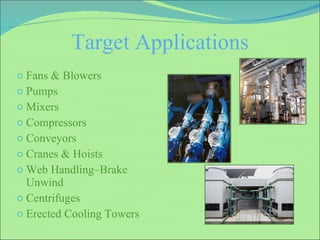
Target Applications Fans & Blowers Pumps Mixers Compressors Conveyors Cranes & Hoists Web Handling–Brake Unwind Centrifuges Erected Cooling Towers
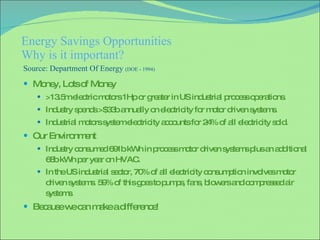
Energy Savings Opportunities Why is it important? Money, Lots of Money >13.5m electric motors 1Hp or greater in US industrial process operations. Industry spends >$33b annually on electricity for motor driven systems. Industrial motors system electricity accounts for 24% of all electricity sold. Our Environment Industry consumed 691b kWh in process motor driven systems plus an additional 68b kWh per year on HVAC.  In the US industrial sector, 70% of all electricity consumption involves motor driven systems. 59% of this goes to pumps, fans, blowers and compressed air systems . Because we can make a difference! Source: Department Of Energy  (DOE - 1994)
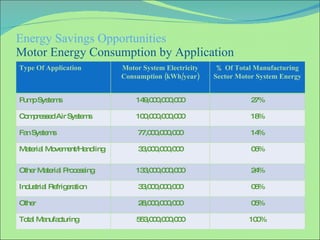
Energy Savings Opportunities  Motor Energy Consumption by Application Type Of Application Motor System Electricity Consumption (kWh/year) % Of Total Manufacturing Sector Motor System Energy Pump Systems 149,000,000,000 27% Compressed Air Systems 100,000,000,000 18% Fan Systems 77,000,000,000 14% Material Movement/Handling 33,000,000,000 06% Other Material Processing 133,000,000,000 24% Industrial Refrigeration 33,000,000,000 06% Other 28,000,000,000 05% Total Manufacturing 553,000,000,000 100%
From Motors to System Solutions In the early to mid 90’s the public and private sector focused on lighting & motor efficiency as primary means to save energy. In the past 4 years the market is shifting to more of a system solution. Some of the activities being undertaken are: Increased focus on process, system, and overall solution as means to save energy. Stronger attempt to quantify savings and present to management in financial terms. These have led towards increased use of variable speed drives and motion controls to achieve process improvements, improve quality & reduce costs. better matching of pumps & motors to the load requirements Operating equipment at optimal speeds
Utility & Government Sponsored Rebates Many utilities & states promote energy efficiency through rebates. Programs provide rebates for pumps, motors and / or Variable Frequency Drives (VFDs). Example Rebates are $3-$10 per hp for Premium Efficient motors and $30-$50 per hp for VFDs.  Contact your electric utility for details. Example:  Duke Energy will provide following on a 20hp pump application – using one application. Pump $400 Motor  20hp x $8/hp = $160 VFD  20hp x $40/hp = $800
States with Rebate Programs (generally vary by electric utility) Blue = motor and/or drive program Source CEE 2007 13c/kWh 5c/kWh 6c/kWh 9c/kWh
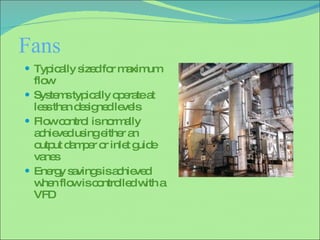
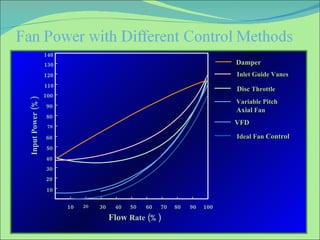
Fans Typically sized for maximum flow Systems typically operate at less than designed levels Flow control is normally achieved using either an output damper or inlet guide vanes Energy savings is achieved when flow is controlled with a VFD
Flow  Rate (%) Input Power (%) 10 10 20 30 40 50 60 70 80 90 100 20 30 40 50 60 70 80 90 100 110 120 130 140 Damper Inlet Guide Vanes Disc  Throttle Ideal Fan  Control Variable Pitch Axial  Fan VFD
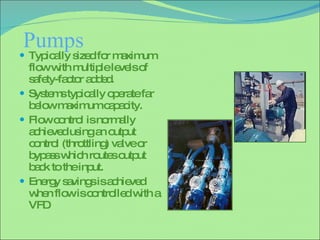
Pumps  Typically sized for maximum flow with multiple levels of safety-factor added. Systems typically operate far below maximum capacity. Flow control is normally achieved using an output control (throttling) valve or bypass which routes output back to the input. Energy savings is achieved when flow is controlled with a VFD
Pumping Systems Efficiency  Average pumping efficiency is below 40% Over 10% of pumps run below 10% efficiency Major causes: Oversized pump & system not designed to run near pump’s best efficiency point (BEP). Pump draws too much power - results in added vibration, bearings run hot with substantially reduced life, packing has short life, high rate of mechanical seal failure. Over-use of Bypass Valves & Throttling Valves Oversized valves make good process control nearly impossible. 65% of control valves <50% open, with many <30% open and 15% at startup. Finnish study of 1690 pumps at 20 process plants  (Expert Systems for Diagnosis of the Condition and Performance of Centrifugal Pumps)
VFDs and Pumps A VFD will provide significant energy savings when: Centrifugal Pumps are operated at low flow rates Existing system has bypass control Local electricity costs are high Any  one  item will often provide payback within 2 years. Additional Benefits  Elimination of expensive valves and valve control Reduces power surges and stress associated with across the line starting Provides accurate flow control Longer Pump and seal life Reduced wear & noise
 
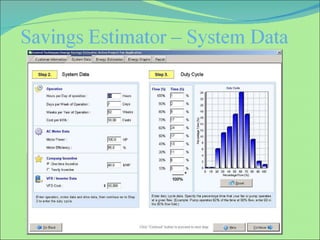
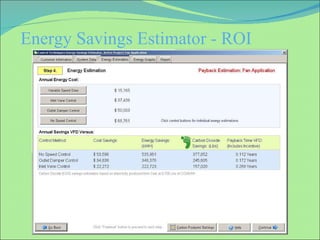
Energy Savings Estimator - ROI
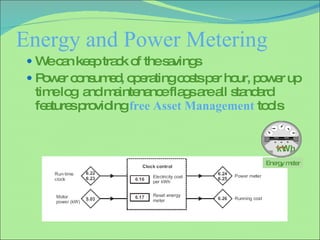
Energy and Power Metering We can keep track of the savings Power consumed, operating costs per hour, power up time log  and maintenance flags are all standard features providing  free Asset Management  tools kWh Energy meter
Summary of Benefits Energy Savings kWh  savings  (especially variable torque loads) Improve power factor – AC drives above 0.95 power factor  Reduce peak demand surcharges Process Improvements Match speed to need & eliminate the starts & stops  Maintenance  Less stress on mechanical equipment including belts & couplings. Controllable via a BMS, PLC or fieldbus (Ethernet, Metasys, DeviceNet, Profibus, Modbus, & others). Comfort Reduced fan / pump noise  Reduce water hammer and air duct rumble No light dimming on start up
THREE SIMPLE STEPS Schedule a free Energy Evaluation. Review evaluation report to determine costs and ROI. Place your order for equipment upgrades and process your rebate.
 
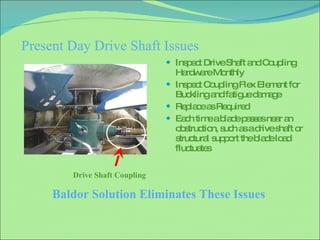
Present Day Drive Shaft Issues Inspect Drive Shaft and Coupling Hardware Monthly Inspect Coupling Flex Element for Buckling and fatigue damage Replace as Required Each time a blade passes near an obstruction, such as a drive shaft or structural support the blade load fluctuates Baldor Solution Eliminates These Issues Drive Shaft Coupling
Beta Site Location On the campus of Clemson University in Clemson, SC
Clemson Installation Existing Design Amarillo 155 Gearbox With Drive Shaft Baldor Solution  Drop In Replacement No Pedestal Modification Hudson 5 blade  18 ft Dia Fan Mounts directly to  Motor Shaft
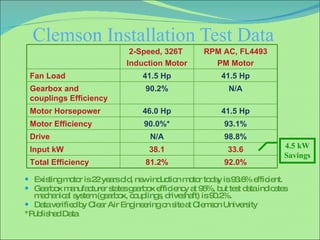
Clemson Installation Test Data Existing motor is 22 years old, new induction motor today is 93.6% efficient. Gearbox manufacturer states gearbox efficiency at 96%, but test data indicates mechanical system (gearbox, couplings, driveshaft) is 90.2%. Data verified by Clear Air Engineering on site at Clemson University *Published Data 4.5 kW Savings 2-Speed, 326T  Induction Motor RPM AC, FL4493 PM Motor Fan Load 41.5 Hp 41.5 Hp Gearbox and couplings Efficiency 90.2% N/A Motor Horsepower 46.0 Hp 41.5 Hp Motor Efficiency 90.0%* 93.1% Drive N/A 98.8% Input kW 38.1 33.6 Total Efficiency 81.2% 92.0%
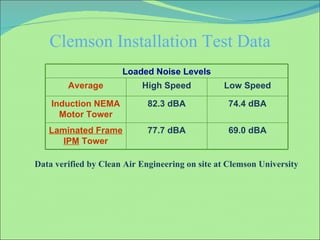
Clemson Installation Test Data Data verified by Clean Air Engineering on site at Clemson University Loaded Noise Levels Average High Speed Low Speed Induction NEMA Motor Tower 82.3 dBA 74.4 dBA Laminated Frame IPM  Tower 77.7 dBA 69.0 dBA
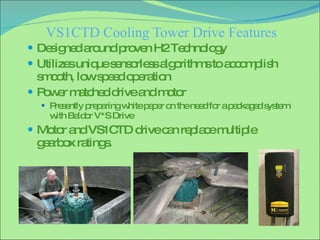
VS1CTD Cooling Tower Drive Features Designed around proven H2 Technology Utilizes unique sensorless algorithms to accomplish smooth, low speed operation Power matched drive and motor Presently preparing white paper on the need for a packaged system with Baldor V*S Drive Motor and VS1CTD drive can replace multiple gearbox ratings.
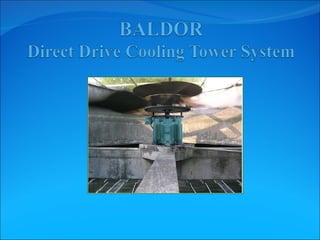
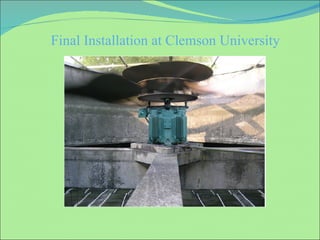
Final Installation at Clemson University
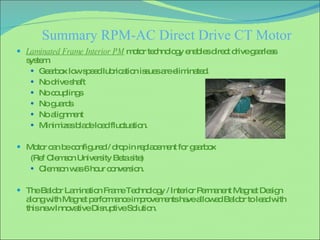
Summary RPM-AC Direct Drive CT Motor Laminated Frame Interior PM  motor technology enables direct drive gearless system. Gearbox low speed lubrication issues are eliminated.  No drive shaft No couplings No guards No alignment Minimizes blade load fluctuation. Motor can be configured / drop in replacement for gearbox  (Ref Clemson University Beta site) Clemson was 6 hour conversion. The Baldor Lamination Frame Technology / Interior Permanent Magnet Design along with Magnet performance improvements have allowed Baldor to lead with this new Innovative Disruptive Solution.
Summary (cont’d) Vastly simplified system greatly improves reliability and maintainability. Significant improvements in overall system efficiency can be realized. Elimination of gearbox provides biggest improvement in overall fan drive system efficiency. Although a Baldor V*S drive is required, the majority of cooling towers are being retrofitted with VFDs. Ref ASHRAE Std 90.1 variable speed requirements Direct Drive motor reduces noise level of cooling tower Elimination of drive shaft improves noise level.
THREE SIMPLE STEPS Schedule free Evaluation. Review evaluation report to determine costs and ROI. Place your order for equipment upgrades and process your rebate.

2010 Energy Audit Presentation

  • 1.
    Energy Savings Initiative Presented for Review To ENTER COMPANY NAME DATE 1 Kenwood Circle • Franklin, MA 02038 1-800 -343-1182 www.rtgreensystems.com RT GREEN SYSTEMS
  • 2.
    Target Industries Manufacturing Processing Water / Wastewater Commercial Agriculture Universities / Schools Hospitals Ski Industry Golf Courses Water parks
  • 3.
    Target Applications Fans& Blowers Pumps Mixers Compressors Conveyors Cranes & Hoists Web Handling–Brake Unwind Centrifuges Erected Cooling Towers
  • 4.
    Energy Savings OpportunitiesWhy is it important? Money, Lots of Money >13.5m electric motors 1Hp or greater in US industrial process operations. Industry spends >$33b annually on electricity for motor driven systems. Industrial motors system electricity accounts for 24% of all electricity sold. Our Environment Industry consumed 691b kWh in process motor driven systems plus an additional 68b kWh per year on HVAC. In the US industrial sector, 70% of all electricity consumption involves motor driven systems. 59% of this goes to pumps, fans, blowers and compressed air systems . Because we can make a difference! Source: Department Of Energy (DOE - 1994)
  • 5.
    Energy Savings Opportunities Motor Energy Consumption by Application Type Of Application Motor System Electricity Consumption (kWh/year) % Of Total Manufacturing Sector Motor System Energy Pump Systems 149,000,000,000 27% Compressed Air Systems 100,000,000,000 18% Fan Systems 77,000,000,000 14% Material Movement/Handling 33,000,000,000 06% Other Material Processing 133,000,000,000 24% Industrial Refrigeration 33,000,000,000 06% Other 28,000,000,000 05% Total Manufacturing 553,000,000,000 100%
  • 6.
    From Motors toSystem Solutions In the early to mid 90’s the public and private sector focused on lighting & motor efficiency as primary means to save energy. In the past 4 years the market is shifting to more of a system solution. Some of the activities being undertaken are: Increased focus on process, system, and overall solution as means to save energy. Stronger attempt to quantify savings and present to management in financial terms. These have led towards increased use of variable speed drives and motion controls to achieve process improvements, improve quality & reduce costs. better matching of pumps & motors to the load requirements Operating equipment at optimal speeds
  • 7.
    Utility & GovernmentSponsored Rebates Many utilities & states promote energy efficiency through rebates. Programs provide rebates for pumps, motors and / or Variable Frequency Drives (VFDs). Example Rebates are $3-$10 per hp for Premium Efficient motors and $30-$50 per hp for VFDs. Contact your electric utility for details. Example: Duke Energy will provide following on a 20hp pump application – using one application. Pump $400 Motor 20hp x $8/hp = $160 VFD 20hp x $40/hp = $800
  • 8.
    States with RebatePrograms (generally vary by electric utility) Blue = motor and/or drive program Source CEE 2007 13c/kWh 5c/kWh 6c/kWh 9c/kWh
  • 9.
    Fans Typically sizedfor maximum flow Systems typically operate at less than designed levels Flow control is normally achieved using either an output damper or inlet guide vanes Energy savings is achieved when flow is controlled with a VFD
  • 10.
    Flow Rate(%) Input Power (%) 10 10 20 30 40 50 60 70 80 90 100 20 30 40 50 60 70 80 90 100 110 120 130 140 Damper Inlet Guide Vanes Disc Throttle Ideal Fan Control Variable Pitch Axial Fan VFD
  • 11.
    Pumps Typicallysized for maximum flow with multiple levels of safety-factor added. Systems typically operate far below maximum capacity. Flow control is normally achieved using an output control (throttling) valve or bypass which routes output back to the input. Energy savings is achieved when flow is controlled with a VFD
  • 12.
    Pumping Systems Efficiency Average pumping efficiency is below 40% Over 10% of pumps run below 10% efficiency Major causes: Oversized pump & system not designed to run near pump’s best efficiency point (BEP). Pump draws too much power - results in added vibration, bearings run hot with substantially reduced life, packing has short life, high rate of mechanical seal failure. Over-use of Bypass Valves & Throttling Valves Oversized valves make good process control nearly impossible. 65% of control valves <50% open, with many <30% open and 15% at startup. Finnish study of 1690 pumps at 20 process plants (Expert Systems for Diagnosis of the Condition and Performance of Centrifugal Pumps)
  • 13.
    VFDs and PumpsA VFD will provide significant energy savings when: Centrifugal Pumps are operated at low flow rates Existing system has bypass control Local electricity costs are high Any one item will often provide payback within 2 years. Additional Benefits Elimination of expensive valves and valve control Reduces power surges and stress associated with across the line starting Provides accurate flow control Longer Pump and seal life Reduced wear & noise
  • 14.
  • 15.
  • 16.
    Energy and PowerMetering We can keep track of the savings Power consumed, operating costs per hour, power up time log and maintenance flags are all standard features providing free Asset Management tools kWh Energy meter
  • 17.
    Summary of BenefitsEnergy Savings kWh savings (especially variable torque loads) Improve power factor – AC drives above 0.95 power factor Reduce peak demand surcharges Process Improvements Match speed to need & eliminate the starts & stops Maintenance Less stress on mechanical equipment including belts & couplings. Controllable via a BMS, PLC or fieldbus (Ethernet, Metasys, DeviceNet, Profibus, Modbus, & others). Comfort Reduced fan / pump noise Reduce water hammer and air duct rumble No light dimming on start up
  • 18.
    THREE SIMPLE STEPSSchedule a free Energy Evaluation. Review evaluation report to determine costs and ROI. Place your order for equipment upgrades and process your rebate.
  • 19.
  • 20.
    Present Day DriveShaft Issues Inspect Drive Shaft and Coupling Hardware Monthly Inspect Coupling Flex Element for Buckling and fatigue damage Replace as Required Each time a blade passes near an obstruction, such as a drive shaft or structural support the blade load fluctuates Baldor Solution Eliminates These Issues Drive Shaft Coupling
  • 21.
    Beta Site LocationOn the campus of Clemson University in Clemson, SC
  • 22.
    Clemson Installation ExistingDesign Amarillo 155 Gearbox With Drive Shaft Baldor Solution Drop In Replacement No Pedestal Modification Hudson 5 blade 18 ft Dia Fan Mounts directly to Motor Shaft
  • 23.
    Clemson Installation TestData Existing motor is 22 years old, new induction motor today is 93.6% efficient. Gearbox manufacturer states gearbox efficiency at 96%, but test data indicates mechanical system (gearbox, couplings, driveshaft) is 90.2%. Data verified by Clear Air Engineering on site at Clemson University *Published Data 4.5 kW Savings 2-Speed, 326T Induction Motor RPM AC, FL4493 PM Motor Fan Load 41.5 Hp 41.5 Hp Gearbox and couplings Efficiency 90.2% N/A Motor Horsepower 46.0 Hp 41.5 Hp Motor Efficiency 90.0%* 93.1% Drive N/A 98.8% Input kW 38.1 33.6 Total Efficiency 81.2% 92.0%
  • 24.
    Clemson Installation TestData Data verified by Clean Air Engineering on site at Clemson University Loaded Noise Levels Average High Speed Low Speed Induction NEMA Motor Tower 82.3 dBA 74.4 dBA Laminated Frame IPM Tower 77.7 dBA 69.0 dBA
  • 25.
    VS1CTD Cooling TowerDrive Features Designed around proven H2 Technology Utilizes unique sensorless algorithms to accomplish smooth, low speed operation Power matched drive and motor Presently preparing white paper on the need for a packaged system with Baldor V*S Drive Motor and VS1CTD drive can replace multiple gearbox ratings.
  • 26.
    Final Installation atClemson University
  • 27.
    Summary RPM-AC DirectDrive CT Motor Laminated Frame Interior PM motor technology enables direct drive gearless system. Gearbox low speed lubrication issues are eliminated. No drive shaft No couplings No guards No alignment Minimizes blade load fluctuation. Motor can be configured / drop in replacement for gearbox (Ref Clemson University Beta site) Clemson was 6 hour conversion. The Baldor Lamination Frame Technology / Interior Permanent Magnet Design along with Magnet performance improvements have allowed Baldor to lead with this new Innovative Disruptive Solution.
  • 28.
    Summary (cont’d) Vastlysimplified system greatly improves reliability and maintainability. Significant improvements in overall system efficiency can be realized. Elimination of gearbox provides biggest improvement in overall fan drive system efficiency. Although a Baldor V*S drive is required, the majority of cooling towers are being retrofitted with VFDs. Ref ASHRAE Std 90.1 variable speed requirements Direct Drive motor reduces noise level of cooling tower Elimination of drive shaft improves noise level.
  • 29.
    THREE SIMPLE STEPSSchedule free Evaluation. Review evaluation report to determine costs and ROI. Place your order for equipment upgrades and process your rebate.

Editor's Notes

  • #18 The benefits are significant:- Most efficient operation of the motor and enhanced savings. High accuracy and repeatability with low maintenance. Constant power factor regardless of load. Reduced audible noise. Reduced cavitation in pumps and enhanced pump life. Reduced resonance in duct systems. Soft start every time - increased motor life, reduced max demand. Fully integrated system control from any modern control systems.