April 2010
Energy Saving in Automation & ControlEnergy Saving in Automation & Control
INTRODUCTION TO Softstart UK
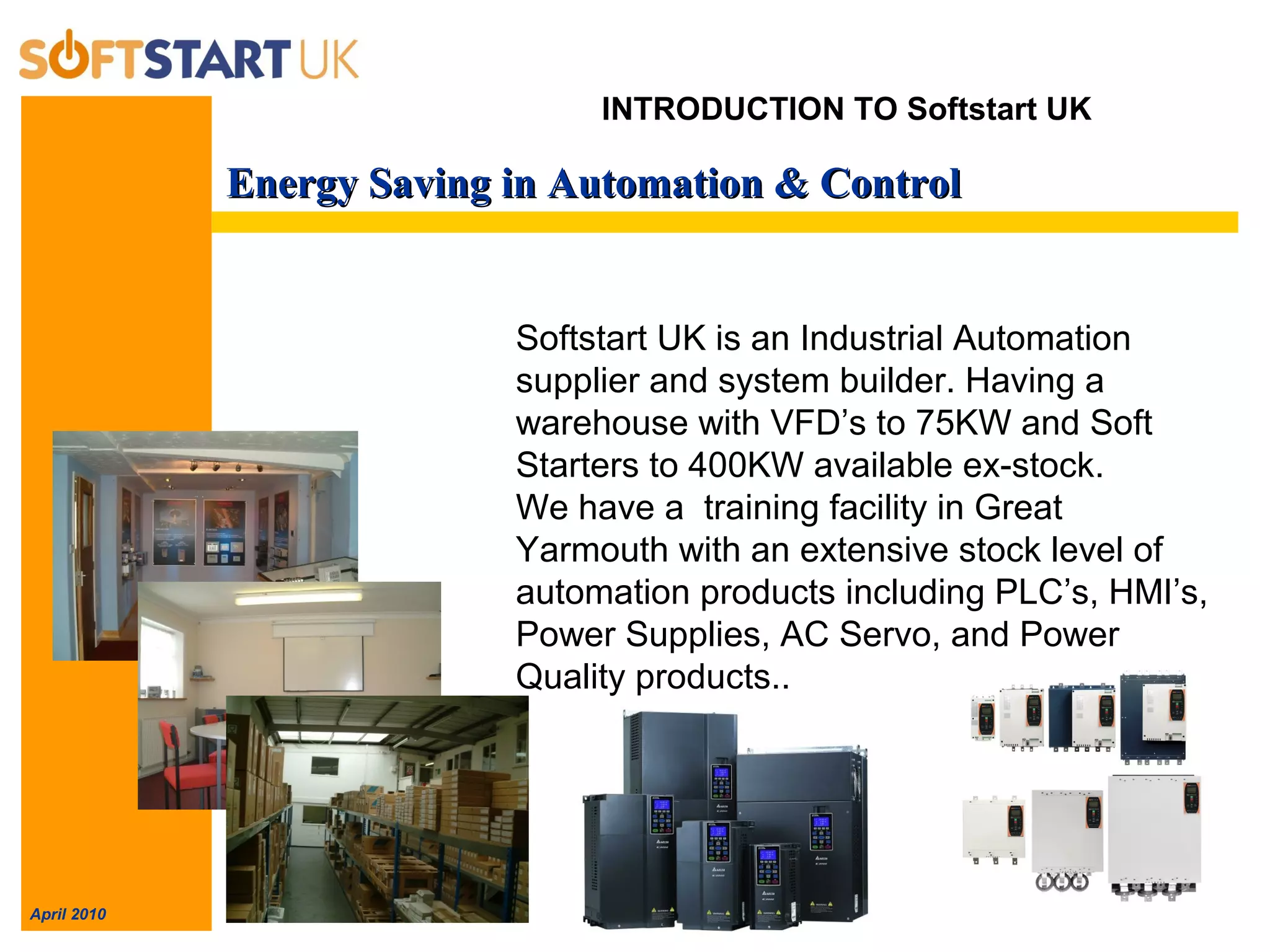
Softstart UK is an Industrial Automation
supplier and system builder. Having a
warehouse with VFD’s to 75KW and Soft
Starters to 400KW available ex-stock.
We have a training facility in Great
Yarmouth with an extensive stock level of
automation products including PLC’s, HMI’s,
Power Supplies, AC Servo, and Power
Quality products..
April 2010
Energy Saving in Automation & ControlEnergy Saving in Automation & Control
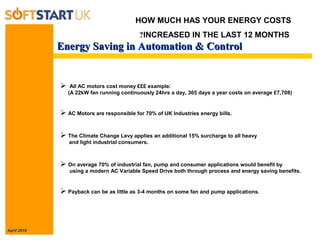
HOW MUCH HAS YOUR ENERGY COSTS
INCREASED IN THE LAST 12 MONTHS?
 All AC motors cost money £££ example:
(A 22kW fan running continuously 24hrs a day, 365 days a year costs on average £7,708)
 AC Motors are responsible for 70% of UK Industries energy bills.
 The Climate Change Levy applies an additional 15% surcharge to all heavy
and light industrial consumers.
 On average 70% of industrial fan, pump and consumer applications would benefit by
using a modern AC Variable Speed Drive both through process and energy saving benefits.
 Payback can be as little as 3-4 months on some fan and pump applications.
April 2010
Energy Saving in Automation & ControlEnergy Saving in Automation & Control
INTRODUCTION TO VARIABLE SPEED DRIVES
 What is a VSD
 Where to use VSDs
 Example application for VSDs
April 2010
Energy Saving in Automation & ControlEnergy Saving in Automation & Control
INTRODUCTION TO VARIABLE SPEED DRIVES
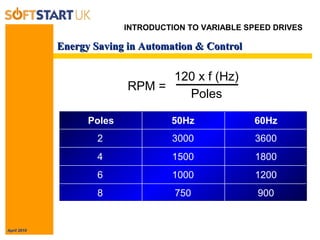
Poles 50Hz 60Hz
2 3000 3600
4 1500 1800
6 1000 1200
8 750 900
RPM =
120 x f (Hz)
Poles
April 2010
Energy Saving in Automation & ControlEnergy Saving in Automation & Control
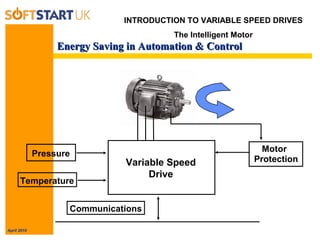
Pressure
Temperature
Variable Speed
Drive
Motor
Protection
Communications
INTRODUCTION TO VARIABLE SPEED DRIVES
The Intelligent Motor
April 2010
Energy Saving in Automation & ControlEnergy Saving in Automation & Control
 Energy saving ability
 PID Control with sleep modes
 Built in 10K step PLC
 Multi-pump control
 Improved process control
 Near-DC performance without the maintenance
 Good power factor
 Built-in soft-start
 Built-in energy optimising
 Controllable via a BMS or PLC
INTRODUCTION TO VARIABLE SPEED DRIVES
The Benefits
April 2010
Energy Saving in Automation & ControlEnergy Saving in Automation & Control
 Flow proportional to the speed
 Pressure proportional to the speed squared
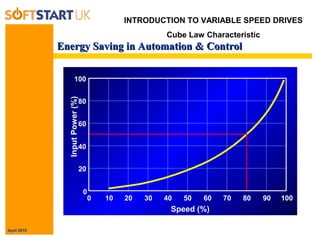
 Power proportional to the speed cubed
INTRODUCTION TO VARIABLE SPEED DRIVES
Fan Affinity Laws
April 2010
Energy Saving in Automation & ControlEnergy Saving in Automation & Control
INTRODUCTION TO VARIABLE SPEED DRIVES
Cube Law Characteristic
Speed (%)
InputPower(%)
100
0
80
60
40
20
0
10 20 30 40 50 60 70 80 90 100
April 2010
Energy Saving in Automation & ControlEnergy Saving in Automation & Control
INTRODUCTION TO VARIABLE SPEED DRIVES
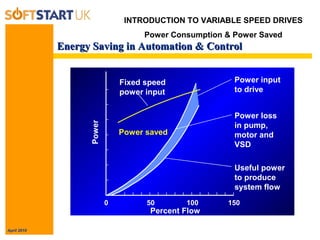
Power Consumption & Power Saved
Percent Flow
Power
50 100 150
Fixed speed
power input
0
Power saved
Power input
to drive
Power loss
in pump,
motor and
VSD
Useful power
to produce
system flow
April 2010
Energy Saving in Automation & ControlEnergy Saving in Automation & Control
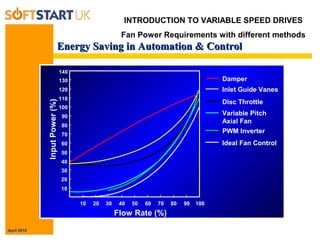
Flow Rate (%)
InputPower(%)
10
10 20 30 40 50 60 70 80 90 100
20
30
40
50
60
70
80
90
100
110
120
130
140
Damper
Inlet Guide Vanes
Disc Throttle
Ideal Fan Control
Variable Pitch
Axial Fan
PWM Inverter
INTRODUCTION TO VARIABLE SPEED DRIVES
Fan Power Requirements with different methods
April 2010
Energy Saving in Automation & ControlEnergy Saving in Automation & Control
Look for: . . .
 Centrifugal Fans and Pumps
 Systems with a low static head
 Compressors
INTRODUCTION TO VARIABLE SPEED DRIVES
Saving Energy with VSD’s
April 2010
Energy Saving in Automation & ControlEnergy Saving in Automation & Control
A VSD controls the speed of the motor to match the load imposed on it under varying process and
environmental conditions. As power consumption is proportional to the cube of the motor speed,
significant savings can be achieved. Although several industrial applications can benefit from inverter
control, the most significant savings can be made with centrifugal loads such as fans and pumps.
Typical Saving Calculations;
Motor running costs £ Cost of Electricity to run the motor for 1 year.
Motor power kW Power rating of motor.
Run Hours Number of hours run for 1 year assumed to be 1 x 365 x 24 = 8760 hrs.
Cost of electricity Assumed to be 4p/unit. One unit equals 1kWhr
Energy Saving factor Fans and Pumps operate on a cube law principle the energy saved reduces by
the cube of the speed reduction therefore a motor running at 50% speed will use
0.5 x 0.5 x 0.5 of the power ie: 0.125 or only consume 12.5% of the normal power.
Savings Savings are the difference between the normal running costs and the running
costs with an inverter.
Pay Back The number of months taken to pay for the cost of an inverter and installation.
VARIABLE SPEED / ENERGY SAVING
April 2010
Energy Saving in Automation & ControlEnergy Saving in Automation & Control
Formula;
Motor Running Costs = Motor Power x Saving Factor x Hours Run x Electricity Costs
Savings = Normal Running Costs – Inverter driven running costs
Pay Back in months = (Cost of Inverter ÷ Savings per annum) x 12
Example;
45kW Centrifugal Pump running continuously. Calculate normal running costs and cost when driven
by an inverter at 90% for 8 hours a day and 50% for the remaining part of the day.
DOL Motor running costs = 45 x 1 x 8760 x 0.04 = £15768 per annum
Inverter running costs = (45 x 0.729 x 2920 x 0.04) + (45 x 0.125 x 5840 x 0.04) = £5156 per annum
Savings = £15768 - £5156 = £10612 per annum
Typical cost of 45kW Inverter = £2795
Pay Back = (£2795 ÷ £10612) x 12 = 3.16 months
VARIABLE SPEED / ENERGY SAVING
April 2010
Energy Saving in Automation & ControlEnergy Saving in Automation & Control
VARIABLE SPEED / ENERGY SAVING
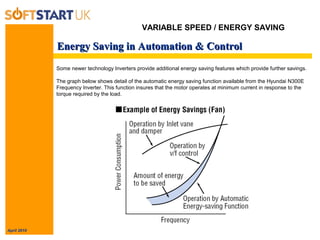
Some newer technology Inverters provide additional energy saving features which provide further savings.
The graph below shows detail of the automatic energy saving function available from the Hyundai N300E
Frequency Inverter. This function insures that the motor operates at minimum current in response to the
torque required by the load.
April 2010
Energy Saving in Automation & ControlEnergy Saving in Automation & Control
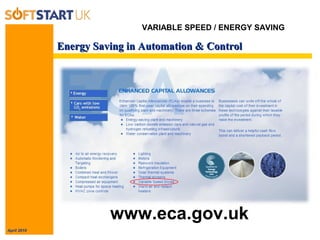
www.eca.gov.uk
VARIABLE SPEED / ENERGY SAVING
April 2010
Energy Saving in Automation & ControlEnergy Saving in Automation & Control
INTRODUCTION TO SOFT STARTERS
 What is a Soft Starter
 Where to use Soft Starters
 Example application for Soft Starters
April 2010
Energy Saving in Automation & ControlEnergy Saving in Automation & Control
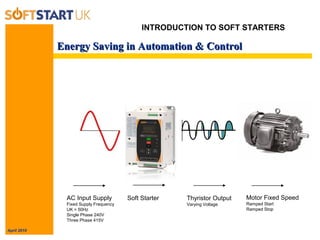
AC Input Supply
Fixed Supply Frequency
UK = 50Hz
Single Phase 240V
Three Phase 415V
Soft Starter Thyristor Output
Varying Voltage
Motor Fixed Speed
Ramped Start
Ramped Stop
INTRODUCTION TO SOFT STARTERS
April 2010
Energy Saving in Automation & ControlEnergy Saving in Automation & Control
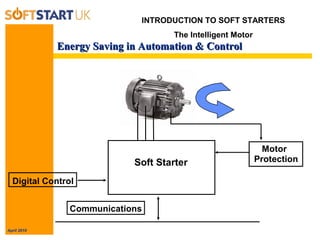
Digital Control
Soft Starter
Motor
Protection
Communications
INTRODUCTION TO SOFT STARTERS
The Intelligent Motor
April 2010
Energy Saving in Automation & ControlEnergy Saving in Automation & Control
INTRODUCTION TO SOFT STARTERS
The Benefits
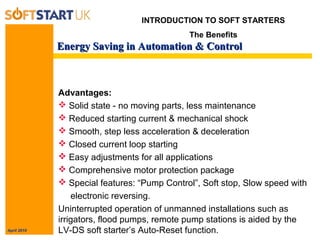
Advantages:
 Solid state - no moving parts, less maintenance
 Reduced starting current & mechanical shock
 Smooth, step less acceleration & deceleration
 Closed current loop starting
 Easy adjustments for all applications
 Comprehensive motor protection package
 Special features: “Pump Control”, Soft stop, Slow speed with
electronic reversing.
Uninterrupted operation of unmanned installations such as
irrigators, flood pumps, remote pump stations is aided by the
LV-DS soft starter’s Auto-Reset function.
April 2010
Energy Saving in Automation & ControlEnergy Saving in Automation & Control
INTRODUCTION TO SOFT STARTERS
The Benefits
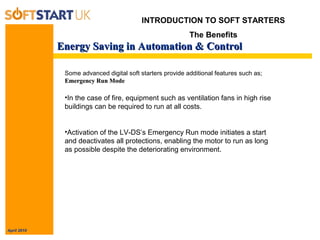
Some advanced digital soft starters provide additional features such as;
Emergency Run ModeEmergency Run Mode
•In the case of fire, equipment such as ventilation fans in high rise
buildings can be required to run at all costs.
•Activation of the LV-DS’s Emergency Run mode initiates a start
and deactivates all protections, enabling the motor to run as long
as possible despite the deteriorating environment.
April 2010
Energy Saving in Automation & ControlEnergy Saving in Automation & Control
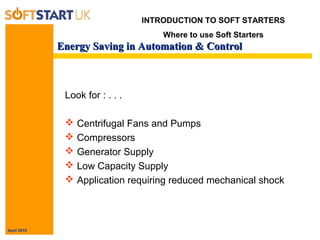
Look for : . . .
 Centrifugal Fans and Pumps
 Compressors
 Generator Supply
 Low Capacity Supply
 Application requiring reduced mechanical shock
INTRODUCTION TO SOFT STARTERS
Where to use Soft Starters

Soft start UK guide to energy saving new

  • 1.
    April 2010 Energy Savingin Automation & ControlEnergy Saving in Automation & Control INTRODUCTION TO Softstart UK Softstart UK is an Industrial Automation supplier and system builder. Having a warehouse with VFD’s to 75KW and Soft Starters to 400KW available ex-stock. We have a training facility in Great Yarmouth with an extensive stock level of automation products including PLC’s, HMI’s, Power Supplies, AC Servo, and Power Quality products..
  • 2.
    April 2010 Energy Savingin Automation & ControlEnergy Saving in Automation & Control HOW MUCH HAS YOUR ENERGY COSTS INCREASED IN THE LAST 12 MONTHS?  All AC motors cost money £££ example: (A 22kW fan running continuously 24hrs a day, 365 days a year costs on average £7,708)  AC Motors are responsible for 70% of UK Industries energy bills.  The Climate Change Levy applies an additional 15% surcharge to all heavy and light industrial consumers.  On average 70% of industrial fan, pump and consumer applications would benefit by using a modern AC Variable Speed Drive both through process and energy saving benefits.  Payback can be as little as 3-4 months on some fan and pump applications.
  • 3.
    April 2010 Energy Savingin Automation & ControlEnergy Saving in Automation & Control INTRODUCTION TO VARIABLE SPEED DRIVES  What is a VSD  Where to use VSDs  Example application for VSDs
  • 4.
    April 2010 Energy Savingin Automation & ControlEnergy Saving in Automation & Control INTRODUCTION TO VARIABLE SPEED DRIVES Poles 50Hz 60Hz 2 3000 3600 4 1500 1800 6 1000 1200 8 750 900 RPM = 120 x f (Hz) Poles
  • 5.
    April 2010 Energy Savingin Automation & ControlEnergy Saving in Automation & Control Pressure Temperature Variable Speed Drive Motor Protection Communications INTRODUCTION TO VARIABLE SPEED DRIVES The Intelligent Motor
  • 6.
    April 2010 Energy Savingin Automation & ControlEnergy Saving in Automation & Control  Energy saving ability  PID Control with sleep modes  Built in 10K step PLC  Multi-pump control  Improved process control  Near-DC performance without the maintenance  Good power factor  Built-in soft-start  Built-in energy optimising  Controllable via a BMS or PLC INTRODUCTION TO VARIABLE SPEED DRIVES The Benefits
  • 7.
    April 2010 Energy Savingin Automation & ControlEnergy Saving in Automation & Control  Flow proportional to the speed  Pressure proportional to the speed squared  Power proportional to the speed cubed INTRODUCTION TO VARIABLE SPEED DRIVES Fan Affinity Laws
  • 8.
    April 2010 Energy Savingin Automation & ControlEnergy Saving in Automation & Control INTRODUCTION TO VARIABLE SPEED DRIVES Cube Law Characteristic Speed (%) InputPower(%) 100 0 80 60 40 20 0 10 20 30 40 50 60 70 80 90 100
  • 9.
    April 2010 Energy Savingin Automation & ControlEnergy Saving in Automation & Control INTRODUCTION TO VARIABLE SPEED DRIVES Power Consumption & Power Saved Percent Flow Power 50 100 150 Fixed speed power input 0 Power saved Power input to drive Power loss in pump, motor and VSD Useful power to produce system flow
  • 10.
    April 2010 Energy Savingin Automation & ControlEnergy Saving in Automation & Control Flow Rate (%) InputPower(%) 10 10 20 30 40 50 60 70 80 90 100 20 30 40 50 60 70 80 90 100 110 120 130 140 Damper Inlet Guide Vanes Disc Throttle Ideal Fan Control Variable Pitch Axial Fan PWM Inverter INTRODUCTION TO VARIABLE SPEED DRIVES Fan Power Requirements with different methods
  • 11.
    April 2010 Energy Savingin Automation & ControlEnergy Saving in Automation & Control Look for: . . .  Centrifugal Fans and Pumps  Systems with a low static head  Compressors INTRODUCTION TO VARIABLE SPEED DRIVES Saving Energy with VSD’s
  • 12.
    April 2010 Energy Savingin Automation & ControlEnergy Saving in Automation & Control A VSD controls the speed of the motor to match the load imposed on it under varying process and environmental conditions. As power consumption is proportional to the cube of the motor speed, significant savings can be achieved. Although several industrial applications can benefit from inverter control, the most significant savings can be made with centrifugal loads such as fans and pumps. Typical Saving Calculations; Motor running costs £ Cost of Electricity to run the motor for 1 year. Motor power kW Power rating of motor. Run Hours Number of hours run for 1 year assumed to be 1 x 365 x 24 = 8760 hrs. Cost of electricity Assumed to be 4p/unit. One unit equals 1kWhr Energy Saving factor Fans and Pumps operate on a cube law principle the energy saved reduces by the cube of the speed reduction therefore a motor running at 50% speed will use 0.5 x 0.5 x 0.5 of the power ie: 0.125 or only consume 12.5% of the normal power. Savings Savings are the difference between the normal running costs and the running costs with an inverter. Pay Back The number of months taken to pay for the cost of an inverter and installation. VARIABLE SPEED / ENERGY SAVING
  • 13.
    April 2010 Energy Savingin Automation & ControlEnergy Saving in Automation & Control Formula; Motor Running Costs = Motor Power x Saving Factor x Hours Run x Electricity Costs Savings = Normal Running Costs – Inverter driven running costs Pay Back in months = (Cost of Inverter ÷ Savings per annum) x 12 Example; 45kW Centrifugal Pump running continuously. Calculate normal running costs and cost when driven by an inverter at 90% for 8 hours a day and 50% for the remaining part of the day. DOL Motor running costs = 45 x 1 x 8760 x 0.04 = £15768 per annum Inverter running costs = (45 x 0.729 x 2920 x 0.04) + (45 x 0.125 x 5840 x 0.04) = £5156 per annum Savings = £15768 - £5156 = £10612 per annum Typical cost of 45kW Inverter = £2795 Pay Back = (£2795 ÷ £10612) x 12 = 3.16 months VARIABLE SPEED / ENERGY SAVING
  • 14.
    April 2010 Energy Savingin Automation & ControlEnergy Saving in Automation & Control VARIABLE SPEED / ENERGY SAVING Some newer technology Inverters provide additional energy saving features which provide further savings. The graph below shows detail of the automatic energy saving function available from the Hyundai N300E Frequency Inverter. This function insures that the motor operates at minimum current in response to the torque required by the load.
  • 15.
    April 2010 Energy Savingin Automation & ControlEnergy Saving in Automation & Control www.eca.gov.uk VARIABLE SPEED / ENERGY SAVING
  • 16.
    April 2010 Energy Savingin Automation & ControlEnergy Saving in Automation & Control INTRODUCTION TO SOFT STARTERS  What is a Soft Starter  Where to use Soft Starters  Example application for Soft Starters
  • 17.
    April 2010 Energy Savingin Automation & ControlEnergy Saving in Automation & Control AC Input Supply Fixed Supply Frequency UK = 50Hz Single Phase 240V Three Phase 415V Soft Starter Thyristor Output Varying Voltage Motor Fixed Speed Ramped Start Ramped Stop INTRODUCTION TO SOFT STARTERS
  • 18.
    April 2010 Energy Savingin Automation & ControlEnergy Saving in Automation & Control Digital Control Soft Starter Motor Protection Communications INTRODUCTION TO SOFT STARTERS The Intelligent Motor
  • 19.
    April 2010 Energy Savingin Automation & ControlEnergy Saving in Automation & Control INTRODUCTION TO SOFT STARTERS The Benefits Advantages:  Solid state - no moving parts, less maintenance  Reduced starting current & mechanical shock  Smooth, step less acceleration & deceleration  Closed current loop starting  Easy adjustments for all applications  Comprehensive motor protection package  Special features: “Pump Control”, Soft stop, Slow speed with electronic reversing. Uninterrupted operation of unmanned installations such as irrigators, flood pumps, remote pump stations is aided by the LV-DS soft starter’s Auto-Reset function.
  • 20.
    April 2010 Energy Savingin Automation & ControlEnergy Saving in Automation & Control INTRODUCTION TO SOFT STARTERS The Benefits Some advanced digital soft starters provide additional features such as; Emergency Run ModeEmergency Run Mode •In the case of fire, equipment such as ventilation fans in high rise buildings can be required to run at all costs. •Activation of the LV-DS’s Emergency Run mode initiates a start and deactivates all protections, enabling the motor to run as long as possible despite the deteriorating environment.
  • 21.
    April 2010 Energy Savingin Automation & ControlEnergy Saving in Automation & Control Look for : . . .  Centrifugal Fans and Pumps  Compressors  Generator Supply  Low Capacity Supply  Application requiring reduced mechanical shock INTRODUCTION TO SOFT STARTERS Where to use Soft Starters