
YOUR LOGO GOES 
HERE!! 
Buying Your First Home
Housing & Mortgage Markets are 
Like Florida After a Hurricane!
Is Housing a Good Investment? 
• Home Price Risks 
– Home Values Will Go 
Up 
– Home Values Will Go 
Down 
– Home Values Will Stay 
the Same
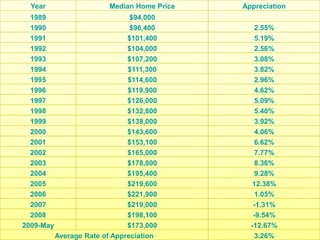
Year Median Home Price Appreciation 
1989 $94,000 
1990 $96,400 2.55% 
1991 Median Housing $101,400 Prices 
5.19% 
1992 $104,000 2.56% 
1993 $107,200 3.08% 
1994 $111,300 3.82% 
1995 $114,600 2.96% 
1996 $119,900 4.62% 
1997 $126,000 5.09% 
1998 $132,800 5.40% 
1999 $138,000 3.92% 
2000 $143,600 4.06% 
2001 $153,100 6.62% 
2002 $165,000 7.77% 
2003 $178,800 8.36% 
2004 $195,400 9.28% 
2005 $219,600 12.38% 
2006 $221,900 1.05% 
2007 $219,000 -1.31% 
2008 $198,100 -9.54% 
2009-May $173,000 -12.67% 
Average Rate of Appreciation 3.26%
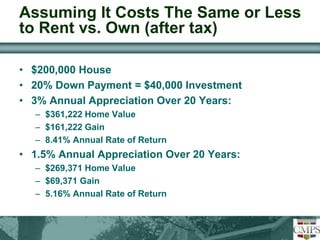
Assuming It Costs The Same or Less 
to Rent vs. Own (after tax) 
• $200,000 House 
• 20% Down Payment = $40,000 Investment 
• 3% Annual Appreciation Over 20 Years: 
– $361,222 Home Value 
– $161,222 Gain 
– 8.41% Annual Rate of Return 
• 1.5% Annual Appreciation Over 20 Years: 
– $269,371 Home Value 
– $69,371 Gain 
– 5.16% Annual Rate of Return
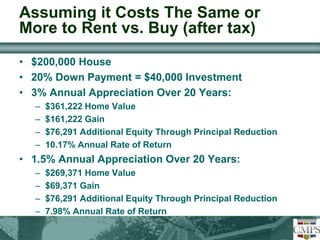
Assuming it Costs The Same or 
More to Rent vs. Buy (after tax) 
• $200,000 House 
• 20% Down Payment = $40,000 Investment 
• 3% Annual Appreciation Over 20 Years: 
– $361,222 Home Value 
– $161,222 Gain 
– $76,291 Additional Equity Through Principal Reduction 
– 10.17% Annual Rate of Return 
• 1.5% Annual Appreciation Over 20 Years: 
– $269,371 Home Value 
– $69,371 Gain 
– $76,291 Additional Equity Through Principal Reduction 
– 7.98% Annual Rate of Return
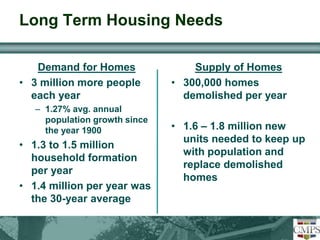
Long Term Housing Needs 
Demand for Homes 
• 3 million more people 
each year 
– 1.27% avg. annual 
population growth since 
the year 1900 
• 1.3 to 1.5 million 
household formation 
per year 
• 1.4 million per year was 
the 30-year average 
Supply of Homes 
• 300,000 homes 
demolished per year 
• 1.6 – 1.8 million new 
units needed to keep up 
with population and 
replace demolished 
homes
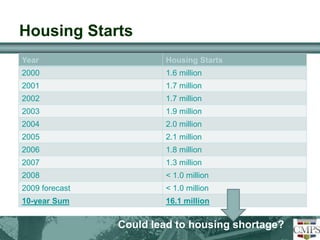
Housing Starts 
Year Housing Starts 
2000 1.6 million 
2001 1.7 million 
2002 1.7 million 
2003 1.9 million 
2004 2.0 million 
2005 2.1 million 
2006 1.8 million 
2007 1.3 million 
2008 < 1.0 million 
2009 forecast < 1.0 million 
10-year Sum 16.1 million 
Could lead to housing shortage?
Is this a good time to buy? 
• Warren Buffet: 
– “I buy on the assumption that they could close the market 
the next day and not reopen it for five years.” 
– “The dumbest reason in the world to buy a stock is because 
it’s going up.” [buy value] 
• Imagine going shopping a department store, and getting all 
emotional and buying all you can when prices are rising. Then, 
when prices are falling because of a blow-out sale, you stay 
away from the store, or worse, you go back to the store and sell 
everything at rummage sale prices that you bought before at a 
high price. That is what people do every day in the real estate 
market.
Understanding the Costs of 
Owning a Home 
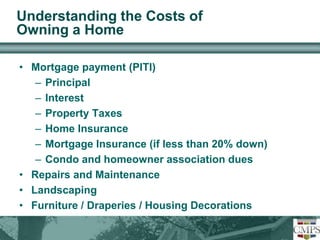
• Mortgage payment (PITI) 
– Principal 
– Interest 
– Property Taxes 
– Home Insurance 
– Mortgage Insurance (if less than 20% down) 
– Condo and homeowner association dues 
• Repairs and Maintenance 
• Landscaping 
• Furniture / Draperies / Housing Decorations
Understanding the Costs of 
Selling a Home 
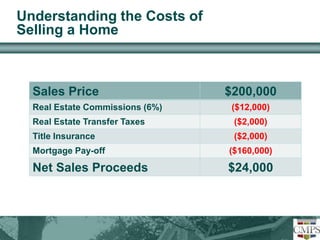
Sales Price $200,000 
Real Estate Commissions (6%) ($12,000) 
Real Estate Transfer Taxes ($2,000) 
Title Insurance ($2,000) 
Mortgage Pay-off ($160,000) 
Net Sales Proceeds $24,000
Understanding the Costs of 
Buying a Home 
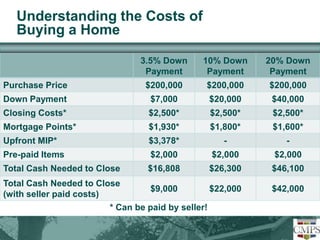
3.5% Down 
Payment 
10% Down 
Payment 
20% Down 
Payment 
Purchase Price $200,000 $200,000 $200,000 
Down Payment $7,000 $20,000 $40,000 
Closing Costs* $2,500* $2,500* $2,500* 
Mortgage Points* $1,930* $1,800* $1,600* 
Upfront MIP* $3,378* - - 
Pre-paid Items $2,000 $2,000 $2,000 
Total Cash Needed to Close $16,808 $26,300 $46,100 
Total Cash Needed to Close 
$9,000 $22,000 $42,000 
(with seller paid costs) 
* Can be paid by seller!
Have the Seller Pay Points and Closing 
Costs on Your Behalf 
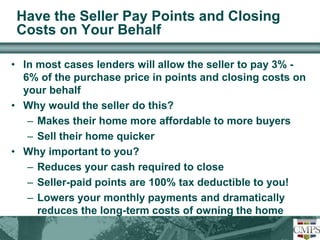
• In most cases lenders will allow the seller to pay 3% - 
6% of the purchase price in points and closing costs on 
your behalf 
• Why would the seller do this? 
– Makes their home more affordable to more buyers 
– Sell their home quicker 
• Why important to you? 
– Reduces your cash required to close 
– Seller-paid points are 100% tax deductible to you! 
– Lowers your monthly payments and dramatically 
reduces the long-term costs of owning the home
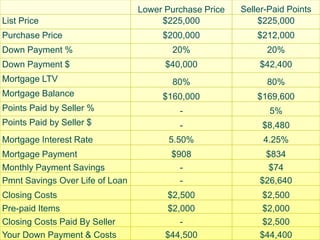
Seller-Paid Points 
Lower Purchase Price Seller-Paid Points 
List Price $225,000 $225,000 
Purchase Price $200,000 $212,000 
Down Payment % 20% 20% 
Down Payment $ $40,000 $42,400 
Mortgage LTV 80% 80% 
Mortgage Balance $160,000 $169,600 
Points Paid by Seller % - 5% 
Points Paid by Seller $ - $8,480 
Mortgage Interest Rate 5.50% 4.25% 
Mortgage Payment $908 $834 
Monthly Payment Savings - $74 
Pmnt Savings Over Life of Loan - $26,640 
Closing Costs $2,500 $2,500 
Pre-paid Items $2,000 $2,000 
Closing Costs Paid By Seller - $2,500 
Your Down Payment & Costs $44,500 $44,400
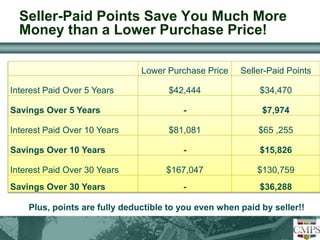
Seller-Paid Points Save You Much More 
Money than a Lower Purchase Price! 
Lower Purchase Price Seller-Paid Points 
Interest Paid Over 5 Years $42,444 $34,470 
Savings Over 5 Years - $7,974 
Interest Paid Over 10 Years $81,081 $65 ,255 
Savings Over 10 Years - $15,826 
Interest Paid Over 30 Years $167,047 $130,759 
Savings Over 30 Years - $36,288 
Plus, points are fully deductible to you even when paid by seller!!
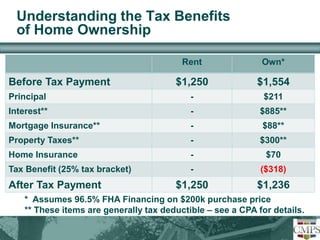
Understanding the Tax Benefits 
of Home Ownership 
Rent Own* 
Before Tax Payment $1,250 $1,554 
Principal - $211 
Interest** - $885** 
Mortgage Insurance** - $88** 
Property Taxes** - $300** 
Home Insurance - $70 
Tax Benefit (25% tax bracket) - ($318) 
After Tax Payment $1,250 $1,236 
* Assumes 96.5% FHA Financing on $200k purchase price 
** These items are generally tax deductible – see a CPA for details.
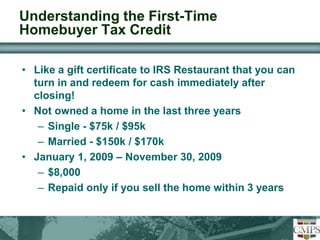
Understanding the First-Time 
Homebuyer Tax Credit 
• Like a gift certificate to IRS Restaurant that you can 
turn in and redeem for cash immediately after 
closing! 
• Not owned a home in the last three years 
– Single - $75k / $95k 
– Married - $150k / $170k 
• January 1, 2009 – November 30, 2009 
– $8,000 
– Repaid only if you sell the home within 3 years
First-Time Homebuyer Tax Credit: More 
Rules… 
• Married couples - both must be first-time buyers 
• No purchases from related parties 
– Spouse, Ancestors, Lineal descendants 
• Unmarried FTHB can split credit “in any reasonable 
manner” - generally based on ownership % and/or $$ 
contributions to the purchase price; total credit cannot 
exceed $8,000 
– Of the buyers, only the ones who are qualified FTHB 
can claim the credit (income, whether owned a 
home, etc.) 
– Co-purchasers and Co-signors OK!
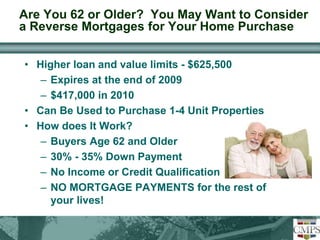
Are You 62 or Older? You May Want to Consider 
a Reverse Mortgages for Your Home Purchase 
• Higher loan and value limits - $625,500 
– Expires at the end of 2009 
– $417,000 in 2010 
• Can Be Used to Purchase 1-4 Unit Properties 
• How does It Work? 
– Buyers Age 62 and Older 
– 30% - 35% Down Payment 
– No Income or Credit Qualification 
– NO MORTGAGE PAYMENTS for the rest of 
your lives!
Can’t Qualify Now? Participate in Our 
“Tenant-to-Homeowner Program” 
• Rent-to-Own 
• Investors 
– Willing and able to invest $40,000 - $50,000 
– Timeframe is 3-4 years 
– Qualified for NOO financing 
• Tenant-Home Buyers 
– Willing and able to re-establish credit within 2-3 years 
– Likely to qualify for FHA or conventional financing in 2-3 
years 
– Willing to contribute 5% toward non-refundable deposit
CMPS® Professionals: Committed 
Qualified & Equipped to Focus on Life 
Issues in YOUR WORLD 
• College Funding - Four years, including room and board; 
PER CHILD 
– $84k = public 
– $148k = private 
– $196k = Ivy League 
• Retirement Planning 
– Average LE = 79 
• Elder-Care Issues 
– 4.9 million Americans with Alzheimer’s disease 
– 27% of adult Americans care financially for elderly friends or 
relatives 
Bottom Line: This Decision Will Impact Your Life for Years to Come!
Next Steps: How Can I Help? 
• Schedule meeting to review your situation 
• Help me understand your timelines, goals and 
objectives 
• Develop a home buying budget that meets your 
housing and cash flow needs 
• Discuss and select the home buying and mortgage 
planning strategies that make the most sense for 
your situation

First Time Home Buyer Presentation 2009

  • 1.
    YOUR LOGO GOES HERE!! Buying Your First Home
  • 2.
    Housing & MortgageMarkets are Like Florida After a Hurricane!
  • 3.
    Is Housing aGood Investment? • Home Price Risks – Home Values Will Go Up – Home Values Will Go Down – Home Values Will Stay the Same
  • 4.
    Year Median HomePrice Appreciation 1989 $94,000 1990 $96,400 2.55% 1991 Median Housing $101,400 Prices 5.19% 1992 $104,000 2.56% 1993 $107,200 3.08% 1994 $111,300 3.82% 1995 $114,600 2.96% 1996 $119,900 4.62% 1997 $126,000 5.09% 1998 $132,800 5.40% 1999 $138,000 3.92% 2000 $143,600 4.06% 2001 $153,100 6.62% 2002 $165,000 7.77% 2003 $178,800 8.36% 2004 $195,400 9.28% 2005 $219,600 12.38% 2006 $221,900 1.05% 2007 $219,000 -1.31% 2008 $198,100 -9.54% 2009-May $173,000 -12.67% Average Rate of Appreciation 3.26%
  • 5.
    Assuming It CostsThe Same or Less to Rent vs. Own (after tax) • $200,000 House • 20% Down Payment = $40,000 Investment • 3% Annual Appreciation Over 20 Years: – $361,222 Home Value – $161,222 Gain – 8.41% Annual Rate of Return • 1.5% Annual Appreciation Over 20 Years: – $269,371 Home Value – $69,371 Gain – 5.16% Annual Rate of Return
  • 6.
    Assuming it CostsThe Same or More to Rent vs. Buy (after tax) • $200,000 House • 20% Down Payment = $40,000 Investment • 3% Annual Appreciation Over 20 Years: – $361,222 Home Value – $161,222 Gain – $76,291 Additional Equity Through Principal Reduction – 10.17% Annual Rate of Return • 1.5% Annual Appreciation Over 20 Years: – $269,371 Home Value – $69,371 Gain – $76,291 Additional Equity Through Principal Reduction – 7.98% Annual Rate of Return
  • 7.
    Long Term HousingNeeds Demand for Homes • 3 million more people each year – 1.27% avg. annual population growth since the year 1900 • 1.3 to 1.5 million household formation per year • 1.4 million per year was the 30-year average Supply of Homes • 300,000 homes demolished per year • 1.6 – 1.8 million new units needed to keep up with population and replace demolished homes
  • 8.
    Housing Starts YearHousing Starts 2000 1.6 million 2001 1.7 million 2002 1.7 million 2003 1.9 million 2004 2.0 million 2005 2.1 million 2006 1.8 million 2007 1.3 million 2008 < 1.0 million 2009 forecast < 1.0 million 10-year Sum 16.1 million Could lead to housing shortage?
  • 9.
    Is this agood time to buy? • Warren Buffet: – “I buy on the assumption that they could close the market the next day and not reopen it for five years.” – “The dumbest reason in the world to buy a stock is because it’s going up.” [buy value] • Imagine going shopping a department store, and getting all emotional and buying all you can when prices are rising. Then, when prices are falling because of a blow-out sale, you stay away from the store, or worse, you go back to the store and sell everything at rummage sale prices that you bought before at a high price. That is what people do every day in the real estate market.
  • 10.
    Understanding the Costsof Owning a Home • Mortgage payment (PITI) – Principal – Interest – Property Taxes – Home Insurance – Mortgage Insurance (if less than 20% down) – Condo and homeowner association dues • Repairs and Maintenance • Landscaping • Furniture / Draperies / Housing Decorations
  • 11.
    Understanding the Costsof Selling a Home Sales Price $200,000 Real Estate Commissions (6%) ($12,000) Real Estate Transfer Taxes ($2,000) Title Insurance ($2,000) Mortgage Pay-off ($160,000) Net Sales Proceeds $24,000
  • 12.
    Understanding the Costsof Buying a Home 3.5% Down Payment 10% Down Payment 20% Down Payment Purchase Price $200,000 $200,000 $200,000 Down Payment $7,000 $20,000 $40,000 Closing Costs* $2,500* $2,500* $2,500* Mortgage Points* $1,930* $1,800* $1,600* Upfront MIP* $3,378* - - Pre-paid Items $2,000 $2,000 $2,000 Total Cash Needed to Close $16,808 $26,300 $46,100 Total Cash Needed to Close $9,000 $22,000 $42,000 (with seller paid costs) * Can be paid by seller!
  • 13.
    Have the SellerPay Points and Closing Costs on Your Behalf • In most cases lenders will allow the seller to pay 3% - 6% of the purchase price in points and closing costs on your behalf • Why would the seller do this? – Makes their home more affordable to more buyers – Sell their home quicker • Why important to you? – Reduces your cash required to close – Seller-paid points are 100% tax deductible to you! – Lowers your monthly payments and dramatically reduces the long-term costs of owning the home
  • 14.
    Seller-Paid Points LowerPurchase Price Seller-Paid Points List Price $225,000 $225,000 Purchase Price $200,000 $212,000 Down Payment % 20% 20% Down Payment $ $40,000 $42,400 Mortgage LTV 80% 80% Mortgage Balance $160,000 $169,600 Points Paid by Seller % - 5% Points Paid by Seller $ - $8,480 Mortgage Interest Rate 5.50% 4.25% Mortgage Payment $908 $834 Monthly Payment Savings - $74 Pmnt Savings Over Life of Loan - $26,640 Closing Costs $2,500 $2,500 Pre-paid Items $2,000 $2,000 Closing Costs Paid By Seller - $2,500 Your Down Payment & Costs $44,500 $44,400
  • 15.
    Seller-Paid Points SaveYou Much More Money than a Lower Purchase Price! Lower Purchase Price Seller-Paid Points Interest Paid Over 5 Years $42,444 $34,470 Savings Over 5 Years - $7,974 Interest Paid Over 10 Years $81,081 $65 ,255 Savings Over 10 Years - $15,826 Interest Paid Over 30 Years $167,047 $130,759 Savings Over 30 Years - $36,288 Plus, points are fully deductible to you even when paid by seller!!
  • 16.
    Understanding the TaxBenefits of Home Ownership Rent Own* Before Tax Payment $1,250 $1,554 Principal - $211 Interest** - $885** Mortgage Insurance** - $88** Property Taxes** - $300** Home Insurance - $70 Tax Benefit (25% tax bracket) - ($318) After Tax Payment $1,250 $1,236 * Assumes 96.5% FHA Financing on $200k purchase price ** These items are generally tax deductible – see a CPA for details.
  • 17.
    Understanding the First-Time Homebuyer Tax Credit • Like a gift certificate to IRS Restaurant that you can turn in and redeem for cash immediately after closing! • Not owned a home in the last three years – Single - $75k / $95k – Married - $150k / $170k • January 1, 2009 – November 30, 2009 – $8,000 – Repaid only if you sell the home within 3 years
  • 18.
    First-Time Homebuyer TaxCredit: More Rules… • Married couples - both must be first-time buyers • No purchases from related parties – Spouse, Ancestors, Lineal descendants • Unmarried FTHB can split credit “in any reasonable manner” - generally based on ownership % and/or $$ contributions to the purchase price; total credit cannot exceed $8,000 – Of the buyers, only the ones who are qualified FTHB can claim the credit (income, whether owned a home, etc.) – Co-purchasers and Co-signors OK!
  • 19.
    Are You 62or Older? You May Want to Consider a Reverse Mortgages for Your Home Purchase • Higher loan and value limits - $625,500 – Expires at the end of 2009 – $417,000 in 2010 • Can Be Used to Purchase 1-4 Unit Properties • How does It Work? – Buyers Age 62 and Older – 30% - 35% Down Payment – No Income or Credit Qualification – NO MORTGAGE PAYMENTS for the rest of your lives!
  • 20.
    Can’t Qualify Now?Participate in Our “Tenant-to-Homeowner Program” • Rent-to-Own • Investors – Willing and able to invest $40,000 - $50,000 – Timeframe is 3-4 years – Qualified for NOO financing • Tenant-Home Buyers – Willing and able to re-establish credit within 2-3 years – Likely to qualify for FHA or conventional financing in 2-3 years – Willing to contribute 5% toward non-refundable deposit
  • 21.
    CMPS® Professionals: Committed Qualified & Equipped to Focus on Life Issues in YOUR WORLD • College Funding - Four years, including room and board; PER CHILD – $84k = public – $148k = private – $196k = Ivy League • Retirement Planning – Average LE = 79 • Elder-Care Issues – 4.9 million Americans with Alzheimer’s disease – 27% of adult Americans care financially for elderly friends or relatives Bottom Line: This Decision Will Impact Your Life for Years to Come!
  • 22.
    Next Steps: HowCan I Help? • Schedule meeting to review your situation • Help me understand your timelines, goals and objectives • Develop a home buying budget that meets your housing and cash flow needs • Discuss and select the home buying and mortgage planning strategies that make the most sense for your situation