





How mortgage
insurance
works for you
a guide for homebuyers
You scrimped, saved,
searched for and
found your version of
the American Dream.
Now it comes down to financing your home-
to-be — a good time to learn about your
options — including conventional financing with
mortgage insurance.
MORTGAGE INSURANCE does not
provide coverage in the event of a borrower’s
death. That is mortgage life insurance.
Mortgage insurance also does not protect
against theft or damage from fire and other
disasters. That type of protection is known
as homeowner’s insurance.
What is mortgage
insurance?
It is an insurance policy that reduces the
amount a lender loses in the event that
borrowers do not repay their mortgage.
Also called MI, private MI or PMI,
mortgage insurance is generally required
on mortgages whose down payments
are less than 20% of the property value.
Historically, making a 20% down
payment has been a difficult hurdle to
clear for many homebuyers. Mortgage
insurance was created to reduce that
barrier and help more people afford
homeownership.
howdoesmiwork?
How can you benefit
by using mortgage
insurance?
Beyond being able to buy a home with less
than 20% down, there are other benefits to
using mortgage insurance:
–– You increase your home-purchase power
–– You have more options for the way you
use your money
–– Your monthly mortgage payment is
reduced once mortgage insurance can be
cancelled
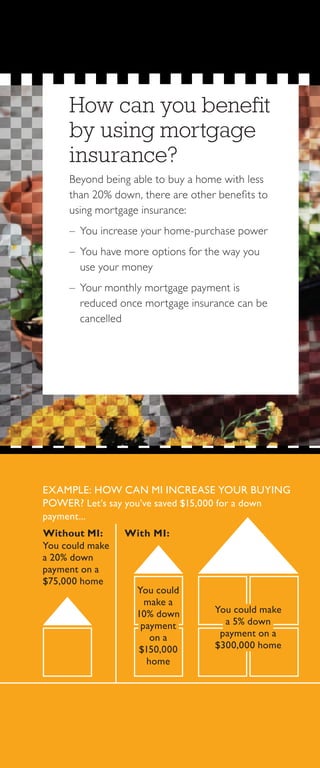
EXAMPLE: HOW CAN MI INCREASE YOUR BUYING
POWER? Let’s say you’ve saved $15,000 for a down
payment...
Without MI: With MI:
You could make
a 20% down
payment on a
$75,000 home
You could
make a
10% down
payment
on a
$150,000
home
You could make
a 5% down
payment on a
$300,000 home
howcanyoubenefitbyusingmortgageinsurance?
Increase your home
purchase power
Mortgage insurance boosts your
buying power, allowing you to
consider a wider range of home
prices and available homes for sale.
For example, if you saved $15,000
to use toward your home purchase:
–– Without mortgage insurance,
you would be able to buy a
$75,000 home with the required
20% down
–– By financing with mortgage
insurance, you could make a
smaller down payment on a
more expensive home (see
below)
Reduce your monthly payment
when your MI is cancelled
Unlike FHA loans, private MI can
be cancelled when extra payments,
appreciation or home improvements bring
your loan balance below 80% of its original
value. In some situations, you may be able
to cancel mortgage insurance based on a
current appraisal. Contact your lender for
cancellation requirements.
Mortgage insurance on most loans must be
cancelled automatically by the lender when
the loan is scheduled to reach 78% of its
original value through amortization.
Once your mortgage insurance is cancelled,
your monthly mortgage payment will be
reduced by the amount of your MI payment.
howcanyoubenefitbyusingmortgageinsurance?
Broaden your financial
options
Financing with mortgage insurance
gives you more control over your
money.
Let’s say you have your eye on
a $150,000 home. Instead of
using all of your $15,000 savings
toward a 10% down payment,
you have the option to make a
5% down payment of $7,500 and
use the other $7,500 toward new
appliances or maybe a rainy day
fund.
Explore your options with your
mortgage origination professional.
Reduce your taxes
Private MI is tax-deductible for
many households. Depending on
your income, you may be able to
deduct the entire cost or a portion
of it.
Households whose adjusted gross
income is $100,000 or less can
deduct 100% of their MI premiums
attributable to the tax year. The
deduction is reduced by 10% for
each additional $1,000 of adjusted
gross income, phasing out after
$109,000.
Visit MGIC’s website for details and
the most current information about
MI tax deductibility. Please consult
a professional tax advisor for details
about MI tax deductibility.
MGIC BORROWER-PAID
MONTHLY MI most often works out
to be the best option for borrowers
with high-quality credit — even over
FHA financing.
By financing with MGIC monthly
mortgage insurance rather than FHA,
you typically benefit from:
–– Not having to pay an upfront
premium, which most FHA
borrowers finance into their loan
amount
–– A lower loan amount (no financed
upfront premium)
–– A lower monthly mortgage
payment
–– Greater home equity and
–– The chance to cancel MI sooner
A no-premium-due-at-closing option
reduces closing costs. You pay the
monthly premium as part of your
monthly mortgage payment.
Ask your mortgage origination
professional to compare the cost of
MGIC Monthly MI with FHA.
thecostofmortgageinsurance
The cost of
mortgage
insurance
While mortgage insurance is indeed an
expense, relative to the buying power
and other financial benefits you can reap
from it, it is not expensive.
Let’s say you buy a $150,000 home using
mortgage insurance. You make a 5%
down payment of $7,500 and finance
the balance, $142,500, with a 30-year,
fixed-rate mortgage at 4.5%.* (Without
MI, your 20% down payment would
amount to $30,000, meaning you’d need
to come up with another $22,500 —
and hope that the house of your dreams
is still on the market when your bank
account is ready.)
If your credit score is 720 or higher,
you could expect to pay about $80 a
month for your MGIC monthly mortgage
insurance premium. (Higher premium
rates apply for lower credit scores.) Ask
your mortgage origination professional
to run some numbers for you.
Assuming the value of the house doesn’t
change, the 95% LTV loan would
amortize to less than 80% after around
100 payments, and you could request
cancellation. In that time, you would
have spent approximately $8,000 on
mortgage insurance, but you would have
been living in a home of your own for
nearly 9 years.
* Based on current interest rates at the time of
publication. Lower or higher rates will affect loan
amortization rate and, therefore, the number of months
it takes to reach 80% of value and the amount spent on
mortgage insurance will vary.
How do you qualify for
mortgage insurance?
The approval process is similar to what your
lender uses to determine whether you qualify for
a mortgage. In broad terms, the mortgage insurer
considers:
–– Your willingness to repay the loan, based on your
prior use of credit
–– Your ability to repay, based on the amount and
stability of your income
–– The amount of your down payment — from
savings, gifts and other sources
–– Whether the property’s value and marketability
provide adequate security for the loan
The information on your loan application and on
the documentation your lender gathers serves to
measure, support and substantiate your financial
standing and the property’s value.
The ultimate goal is to determine that you will be
able to successfully maintain homeownership.
Consult a mortgage
origination
professional
Have a conversation with your mortgage
origination professional. Discuss mortgage
financing with and without private mortgage
insurance.
In some cases, using MI may not work out to
be the best answer; but in many cases, it will.
Once you know all of your options, you can
pick the one that works best for you. haveaconversationwithyourmortgageoriginationprofessional
Mortgage Guaranty Insurance Corporation
MGIC Plaza, Milwaukee, Wisconsin 53202 • www.mgic.com
© 2011-2013 Mortgage Guaranty Insurance Corporation. All rights reserved.
71-42265 3/13
MGIC resources
to help you
prepare for the
responsibility of
homeownership
–– Homebuyers Education at
www.homebuyers.mgic.com, online
homebuyer and landlord education
and certification, provided by MGIC
at no charge
++ Learn about the home-buying
process through easy-to-digest
chapters that cover credit,
budgeting, getting a mortgage
and being a responsible,
successful homeowner
++ Study at your own pace
++ Ask your lender about
participating in the program
++ Learn more about your options
for buying a home using MI
++ Pick up some tips on home
maintenance and maintaining
homeownership
++ Access the Get Ready newsletter
series: Budgeting, The importance
of credit, Protecting your identity
and Understanding your credit
report

How Mortgage Insurance Works For You

  • 1.
    How mortgage insurance works foryou a guide for homebuyers
  • 2.
    You scrimped, saved, searchedfor and found your version of the American Dream. Now it comes down to financing your home- to-be — a good time to learn about your options — including conventional financing with mortgage insurance. MORTGAGE INSURANCE does not provide coverage in the event of a borrower’s death. That is mortgage life insurance. Mortgage insurance also does not protect against theft or damage from fire and other disasters. That type of protection is known as homeowner’s insurance.
  • 3.
    What is mortgage insurance? Itis an insurance policy that reduces the amount a lender loses in the event that borrowers do not repay their mortgage. Also called MI, private MI or PMI, mortgage insurance is generally required on mortgages whose down payments are less than 20% of the property value. Historically, making a 20% down payment has been a difficult hurdle to clear for many homebuyers. Mortgage insurance was created to reduce that barrier and help more people afford homeownership. howdoesmiwork?
  • 4.
    How can youbenefit by using mortgage insurance? Beyond being able to buy a home with less than 20% down, there are other benefits to using mortgage insurance: –– You increase your home-purchase power –– You have more options for the way you use your money –– Your monthly mortgage payment is reduced once mortgage insurance can be cancelled EXAMPLE: HOW CAN MI INCREASE YOUR BUYING POWER? Let’s say you’ve saved $15,000 for a down payment... Without MI: With MI: You could make a 20% down payment on a $75,000 home You could make a 10% down payment on a $150,000 home You could make a 5% down payment on a $300,000 home
  • 5.
    howcanyoubenefitbyusingmortgageinsurance? Increase your home purchasepower Mortgage insurance boosts your buying power, allowing you to consider a wider range of home prices and available homes for sale. For example, if you saved $15,000 to use toward your home purchase: –– Without mortgage insurance, you would be able to buy a $75,000 home with the required 20% down –– By financing with mortgage insurance, you could make a smaller down payment on a more expensive home (see below)
  • 6.
    Reduce your monthlypayment when your MI is cancelled Unlike FHA loans, private MI can be cancelled when extra payments, appreciation or home improvements bring your loan balance below 80% of its original value. In some situations, you may be able to cancel mortgage insurance based on a current appraisal. Contact your lender for cancellation requirements. Mortgage insurance on most loans must be cancelled automatically by the lender when the loan is scheduled to reach 78% of its original value through amortization. Once your mortgage insurance is cancelled, your monthly mortgage payment will be reduced by the amount of your MI payment.
  • 7.
    howcanyoubenefitbyusingmortgageinsurance? Broaden your financial options Financingwith mortgage insurance gives you more control over your money. Let’s say you have your eye on a $150,000 home. Instead of using all of your $15,000 savings toward a 10% down payment, you have the option to make a 5% down payment of $7,500 and use the other $7,500 toward new appliances or maybe a rainy day fund. Explore your options with your mortgage origination professional. Reduce your taxes Private MI is tax-deductible for many households. Depending on your income, you may be able to deduct the entire cost or a portion of it. Households whose adjusted gross income is $100,000 or less can deduct 100% of their MI premiums attributable to the tax year. The deduction is reduced by 10% for each additional $1,000 of adjusted gross income, phasing out after $109,000. Visit MGIC’s website for details and the most current information about MI tax deductibility. Please consult a professional tax advisor for details about MI tax deductibility.
  • 8.
    MGIC BORROWER-PAID MONTHLY MImost often works out to be the best option for borrowers with high-quality credit — even over FHA financing. By financing with MGIC monthly mortgage insurance rather than FHA, you typically benefit from: –– Not having to pay an upfront premium, which most FHA borrowers finance into their loan amount –– A lower loan amount (no financed upfront premium) –– A lower monthly mortgage payment –– Greater home equity and –– The chance to cancel MI sooner A no-premium-due-at-closing option reduces closing costs. You pay the monthly premium as part of your monthly mortgage payment. Ask your mortgage origination professional to compare the cost of MGIC Monthly MI with FHA.
  • 9.
    thecostofmortgageinsurance The cost of mortgage insurance Whilemortgage insurance is indeed an expense, relative to the buying power and other financial benefits you can reap from it, it is not expensive. Let’s say you buy a $150,000 home using mortgage insurance. You make a 5% down payment of $7,500 and finance the balance, $142,500, with a 30-year, fixed-rate mortgage at 4.5%.* (Without MI, your 20% down payment would amount to $30,000, meaning you’d need to come up with another $22,500 — and hope that the house of your dreams is still on the market when your bank account is ready.) If your credit score is 720 or higher, you could expect to pay about $80 a month for your MGIC monthly mortgage insurance premium. (Higher premium rates apply for lower credit scores.) Ask your mortgage origination professional to run some numbers for you. Assuming the value of the house doesn’t change, the 95% LTV loan would amortize to less than 80% after around 100 payments, and you could request cancellation. In that time, you would have spent approximately $8,000 on mortgage insurance, but you would have been living in a home of your own for nearly 9 years. * Based on current interest rates at the time of publication. Lower or higher rates will affect loan amortization rate and, therefore, the number of months it takes to reach 80% of value and the amount spent on mortgage insurance will vary.
  • 10.
    How do youqualify for mortgage insurance? The approval process is similar to what your lender uses to determine whether you qualify for a mortgage. In broad terms, the mortgage insurer considers: –– Your willingness to repay the loan, based on your prior use of credit –– Your ability to repay, based on the amount and stability of your income –– The amount of your down payment — from savings, gifts and other sources –– Whether the property’s value and marketability provide adequate security for the loan The information on your loan application and on the documentation your lender gathers serves to measure, support and substantiate your financial standing and the property’s value. The ultimate goal is to determine that you will be able to successfully maintain homeownership.
  • 11.
    Consult a mortgage origination professional Havea conversation with your mortgage origination professional. Discuss mortgage financing with and without private mortgage insurance. In some cases, using MI may not work out to be the best answer; but in many cases, it will. Once you know all of your options, you can pick the one that works best for you. haveaconversationwithyourmortgageoriginationprofessional
  • 12.
    Mortgage Guaranty InsuranceCorporation MGIC Plaza, Milwaukee, Wisconsin 53202 • www.mgic.com © 2011-2013 Mortgage Guaranty Insurance Corporation. All rights reserved. 71-42265 3/13 MGIC resources to help you prepare for the responsibility of homeownership –– Homebuyers Education at www.homebuyers.mgic.com, online homebuyer and landlord education and certification, provided by MGIC at no charge ++ Learn about the home-buying process through easy-to-digest chapters that cover credit, budgeting, getting a mortgage and being a responsible, successful homeowner ++ Study at your own pace ++ Ask your lender about participating in the program ++ Learn more about your options for buying a home using MI ++ Pick up some tips on home maintenance and maintaining homeownership ++ Access the Get Ready newsletter series: Budgeting, The importance of credit, Protecting your identity and Understanding your credit report