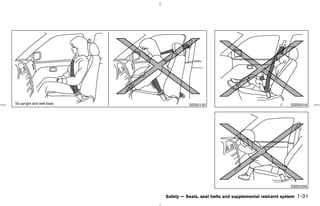
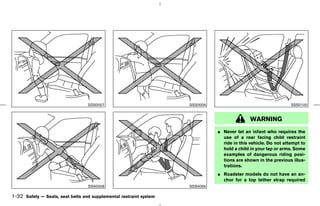
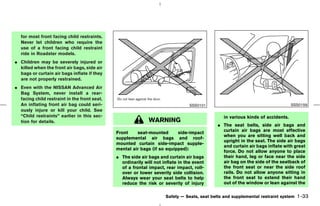
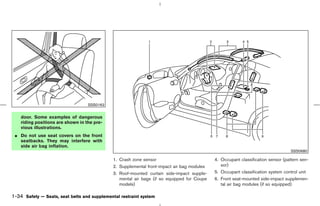
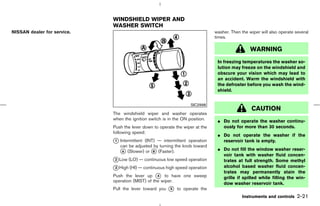
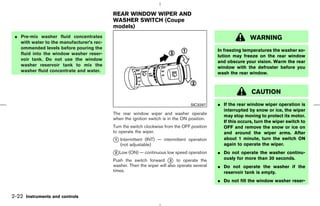
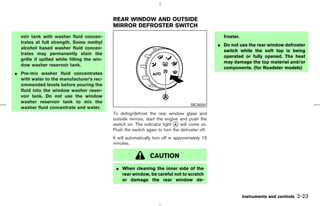
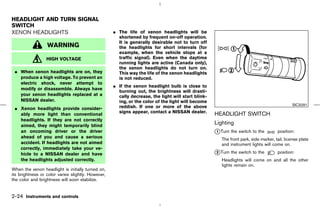
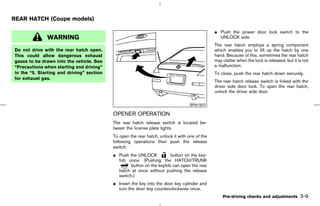
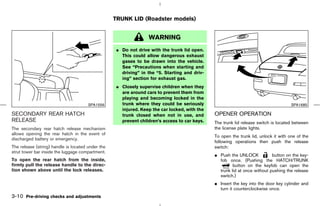
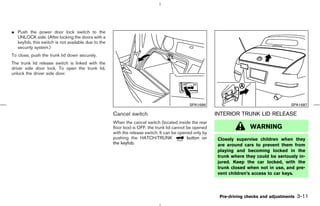
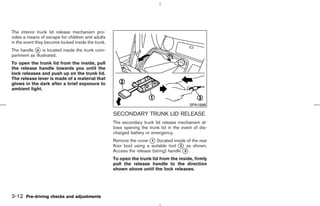
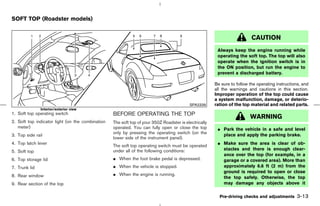
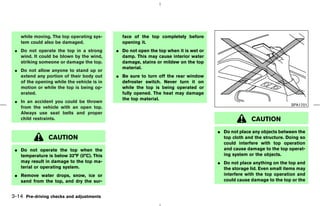
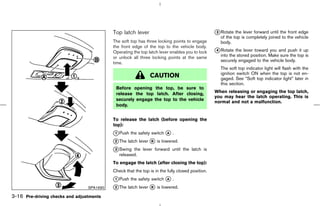
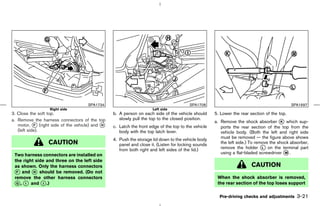
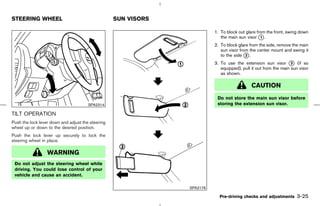
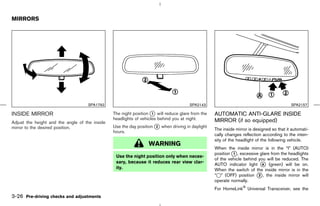
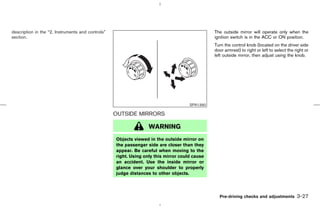
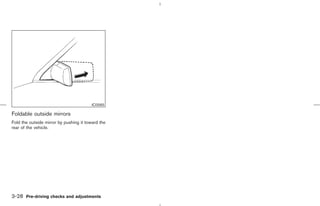
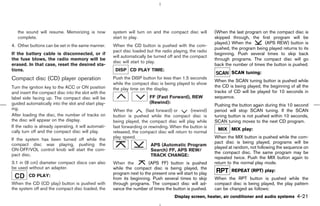
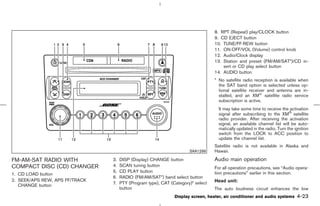
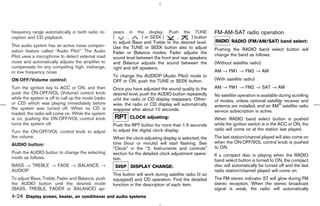
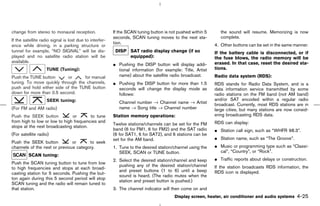
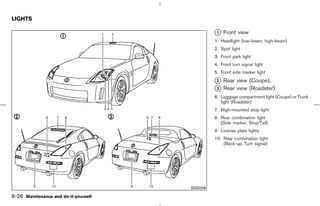
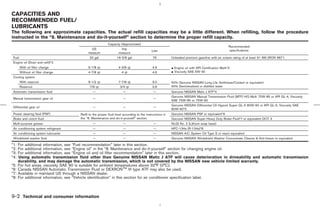
Foreword
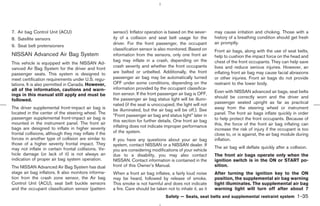
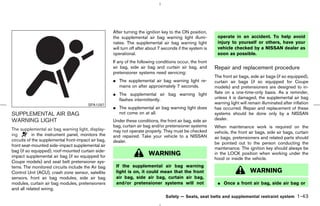
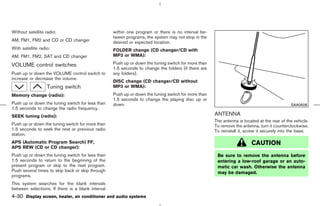
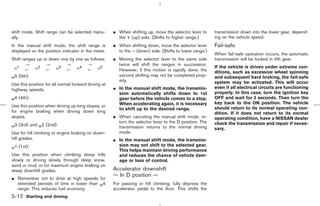
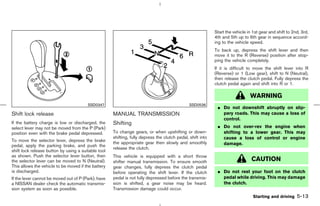
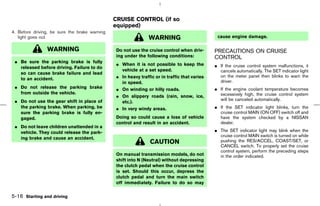
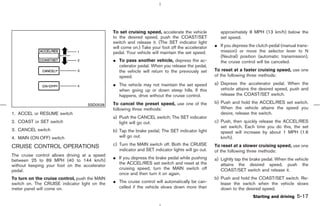
Welcome to the growing family of new NISSAN                                                      tures to all occupants of the vehicle.
owners. This vehicle is delivered to you with                     WARNING
confidence. It was produced using the latest                                                   ¼ ALWAYS review this Owner’s Manual
techniques and strict quality control.                                                           for important safety information.
                                                    IMPORTANT SAFETY INFORMA-
This manual was prepared to help you under-         TION
stand the operation and maintenance of your
vehicle so that you may enjoy many miles of         REMINDERS FOR SAFETY!                      MODIFICATION OF YOUR VEHICLE
driving pleasure. Please read through this          Follow these important driving rules to
manual before operating your vehicle.                                                          This vehicle should not be modified. Modi-
                                                    help ensure a safe and comfortable trip    fication could affect its performance,
A separate Warranty Information Booklet             for you and your passengers!               safety or durability, and may even violate
explains details about the warranties cov-          ¼ NEVER drive under the influence of       governmental regulations. In addition,
ering your vehicle. The NISSAN Service                                                         damage or performance problems result-
                                                      alcohol or drugs.
and Maintenance Guide explains details                                                         ing from modification may not be covered
about maintaining and servicing your ve-            ¼ ALWAYS observe posted speed limits       under NISSAN warranties.
hicle. Additionally, a separate Customer              and never drive too fast for condi-
Care/Lemon Law Booklet (U.S. only) will               tions.                                   WHEN READING THE MANUAL
explain how to resolve any concerns you
may have with your vehicle, as well as              ¼ ALWAYS give your full attention to       This manual includes information for all
clarify your rights under your state’s lemon          driving and avoid using vehicle fea-     options available on this model. There-
law.                                                  tures or taking other actions that       fore, you may find some information that
Your NISSAN dealer knows your vehicle best.           could distract you.                      does not apply to your vehicle.
When you require any service or have any            ¼ ALWAYS use your seat belts. Refer to     All information, specifications and illustrations in
questions, we will be glad to assist you with the     “Child safety” and “Child restraints”    this manual are those in effect at the time of
extensive resources available to us.                                                           printing. NISSAN reserves the right to change
                                                      in the “Safety — Seats, seat belts and
READ FIRST — THEN DRIVE                               supplemental restraint system” sec-      specifications or design at any time without
                                                                                               notice.
SAFELY                                                tion for precautions regarding chil-
Before driving your vehicle please read               dren.
your Owner’s Manual carefully. This will            ¼ ALWAYS provide information about
ensure familiarity with controls and main-            the proper use of vehicle safety fea-
tenance requirements, assisting you in the
safe operation of your vehicle.


                                                                                    ੬ 07.7.25/Z33-D/V5.0 ੭
IMPORTANT INFORMATION
ABOUT THIS MANUAL
You will see various symbols in this manual.
They are used in the following ways:

                WARNING
This is used to indicate the presence of a
hazard that could cause death or serious
personal injury. To avoid or reduce the
risk, the procedures must be followed
precisely.

                                                                                          SIC0697

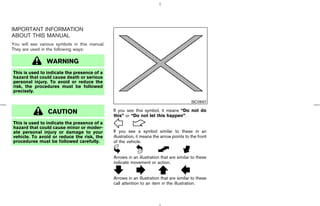
                 CAUTION                       If you see this symbol, it means “Do not do
                                               this” or “Do not let this happen”.
This is used to indicate the presence of a
hazard that could cause minor or moder-
ate personal injury or damage to your          If you see a symbol similar to these in an
vehicle. To avoid or reduce the risk, the      illustration, it means the arrow points to the front
procedures must be followed carefully.         of the vehicle.


                                               Arrows in an illustration that are similar to these
                                               indicate movement or action.


                                               Arrows in an illustration that are similar to these
                                               call attention to an item in the illustration.


                                                                                        ੬ 07.7.25/Z33-D/V5.0 ੭
CALIFORNIA PROPOSITION 65
WARNING

                WARNING
Engine exhaust, some of its constituents,
and certain vehicle components contain
or emit chemicals known to the State of
California to cause cancer and birth
defects or other reproductive harm. In
addition, certain fluids contained in ve-
hicles and certain products of compo-
nent wear contain or emit chemicals
known to the State of California to cause
cancer and birth defects or other repro-
ductive harm.
CALIFORNIA PERCHLORATE
ADVISORY
Some vehicle parts, such as lithium batter-
ies, may contain perchlorate material. The
following advisory is provided: “Perchlor-
ate Material — special handling may apply,
See www.dtsc.ca.gov/hazardouswaste/
perchlorate.”
                BLUETOOTH is a trademark
                owned by Bluetooth SIG, Inc.,                  © 2007 NISSAN MOTOR CO., LTD.
                U.S.A. and licenced to Visteon                         TOKYO, JAPAN
                Corporation.
                                                          All rights reserved. No part of this Owner’s Manual may be
                                                          reproduced or stored in a retrieval system, or transmitted
                                                          in any form, or by any means, electronic, mechanical,
                                                          photocopying, recording or otherwise, without the prior
                                                          written permission of Nissan Motor Co., Ltd.


                                                 ੬ 07.7.25/Z33-D/V5.0 ੭
NISSAN CUSTOMER CARE
PROGRAM
NISSAN CARES ...
Both NISSAN and your NISSAN dealer are dedicated to serving all your automotive needs. Your satisfaction with your vehicle and your NISSAN dealer
are our primary concerns. Your NISSAN dealer is always available to assist you with all your automobile sales and service needs.

However, if there is something that your         The Consumer Affairs Department will ask for       You can write to NISSAN with the information
NISSAN dealer cannot assist you with or you      the following information:                         on the left at:
would like to provide NISSAN directly with       — Your name, address, and telephone
                                                                                                    For U.S. customers
comments or questions, please contact the           number
                                                                                                      Nissan North America, Inc.
NISSAN Consumer Affairs Department using         — Vehicle identification number (attached to the
                                                                                                      Consumer Affairs Department
our toll-free number:                               top of the instrument panel on the driver’s
                                                                                                      P.O. Box 685003
                                                    side)
For U.S. customers                               — Date of purchase
                                                                                                      Franklin, TN 37068-5003
  1-800-NISSAN-1                                 — Current odometer reading                         For Canadian customers
  (1-800-647-7261)                               — Your NISSAN dealer’s name                          Nissan Canada Inc.
For Canadian customers                           — Your comments or questions                         5290 Orbitor Drive
  1-800-387-0122                                 OR                                                   Mississauga, Ontario L4W 4Z5


                            We appreciate your interest in NISSAN and thank you for buying a quality NISSAN vehicle.


                                                                                       ੬ 07.7.25/Z33-D/V5.0 ੭
Table of   Illustrated table of contents
Contents   Safety — Seats, seat belts and supplemental
           restraint system
           Instruments and controls

           Pre-driving checks and adjustments
           Display screen, heater, air conditioner and audio
           systems
           Starting and driving

           In case of emergency

           Appearance and care

           Maintenance and do-it-yourself

           Technical and consumer information

           Index


                                   ੬ 07.7.25/Z33-D/V5.0 ੭
0               Illustrated table of contents


Air bags, seat belts and child restraints ..........................                         0-2      Coupe models .................................................................. 0-6
Exterior front ...........................................................................   0-3      Roadster models .............................................................. 0-8
Exterior rear ............................................................................   0-4   Instrument panel ................................................................. 0-10
    Coupe models ..................................................................          0-4   Meters and gauges ........................................................... 0-11
    Roadster models ..............................................................           0-5   Engine compartment ......................................................... 0-12
Passenger compartment ......................................................                 0-6


                                                                                                                  ੬ 07.7.25/Z33-D/V5.0 ੭
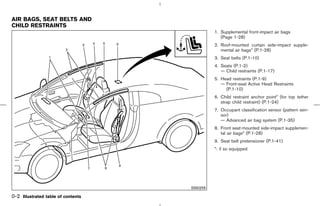
AIR BAGS, SEAT BELTS AND
CHILD RESTRAINTS
                                               1. Supplemental front-impact air bags
                                                  (Page 1-28)
                                               2. Roof-mounted curtain side-impact supple-
                                                  mental air bags* (P.1-28)
                                               3. Seat belts (P.1-10)
                                               4. Seats (P.1-2)
                                                  — Child restraints (P.1-17)
                                               5. Head restraints (P.1-9)
                                                  — Front-seat Active Head Restraints
                                                    (P.1-10)
                                               6. Child restraint anchor point* (for top tether
                                                  strap child restraint) (P.1-24)
                                               7. Occupant classification sensor (pattern sen-
                                                  sor)
                                                  — Advanced air bag system (P.1-35)
                                               8. Front seat-mounted side-impact supplemen-
                                                  tal air bags* (P.1-28)
                                               9. Seat belt pretensioner (P.1-41)
                                               *: if so equipped


                                     SSI0255

0-2 Illustrated table of contents


                                    ੬ 07.7.25/Z33-D/V5.0 ੭
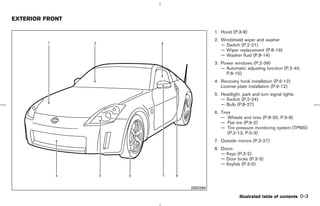
EXTERIOR FRONT

                            1. Hood (P.3-8)
                            2. Windshield wiper and washer
                               — Switch (P.2-21)
                               — Wiper replacement (P.8-19)
                               — Washer fluid (P.8-14)
                            3. Power windows (P.2-39)
                               — Automatic adjusting function (P.2-40,
                                 P.8-15)
                            4. Recovery hook installation (P.6-12)
                               License plate installation (P.9-12)
                            5. Headlight, park and turn signal lights
                               — Switch (P.2-24)
                               — Bulb (P.8-27)
                            6. Tires
                               — Wheels and tires (P.8-30, P.9-8)
                               — Flat tire (P.6-2)
                               — Tire pressure monitoring system (TPMS)
                                   (P.2-13, P.5-3)
                            7. Outside mirrors (P.3-27)
                            8. Doors
                               — Keys (P.3-2)
                               — Door locks (P.3-3)
                               — Keyfob (P.3-5)


                  SSI0289

                                        Illustrated table of contents   0-3


                 ੬ 07.7.25/Z33-D/V5.0 ੭
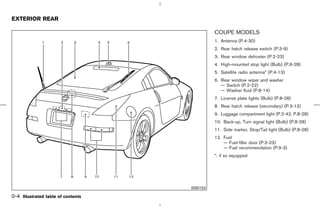
EXTERIOR REAR

                                               COUPE MODELS
                                               1. Antenna (P.4-30)
                                               2. Rear hatch release switch (P.3-9)
                                               3. Rear window defroster (P.2-23)
                                               4. High-mounted stop light (Bulb) (P.8-28)
                                               5. Satellite radio antenna* (P.4-13)
                                               6. Rear window wiper and washer
                                                  — Switch (P.2-22)
                                                  — Washer fluid (P.8-14)
                                               7. License plate lights (Bulb) (P.8-28)
                                               8. Rear hatch release (secondary) (P.3-12)
                                               9. Luggage compartment light (P.2-42, P.8-28)
                                               10. Back-up, Turn signal light (Bulb) (P.8-28)
                                               11. Side marker, Stop/Tail light (Bulb) (P.8-28)
                                               12. Fuel
                                                   — Fuel-filler door (P.3-23)
                                                   — Fuel recommendation (P.9-3)
                                               *: if so equipped


                                     SSI0152

0-4 Illustrated table of contents


                                    ੬ 07.7.25/Z33-D/V5.0 ੭
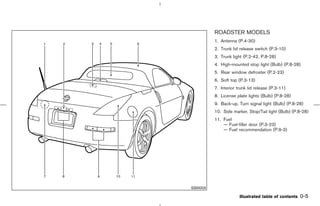
ROADSTER MODELS
           1. Antenna (P.4-30)
           2. Trunk lid release switch (P.3-10)
           3. Trunk light (P.2-42, P.8-28)
           4. High-mounted stop light (Bulb) (P.8-28)
           5. Rear window defroster (P.2-23)
           6. Soft top (P.3-13)
           7. Interior trunk lid release (P.3-11)
           8. License plate lights (Bulb) (P.8-28)
           9. Back-up, Turn signal light (Bulb) (P.8-28)
           10. Side marker, Stop/Tail light (Bulb) (P.8-28)
           11. Fuel
               — Fuel-filler door (P.3-23)
               — Fuel recommendation (P.9-3)


 SSI0003

                        Illustrated table of contents   0-5


੬ 07.7.25/Z33-D/V5.0 ੭
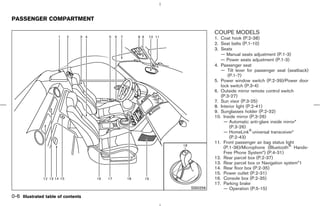
PASSENGER COMPARTMENT

                                               COUPE MODELS
                                               1. Coat hook (P.2-38)
                                               2. Seat belts (P.1-10)
                                               3. Seats
                                                  — Manual seats adjustment (P.1-3)
                                                  — Power seats adjustment (P.1-3)
                                               4. Passenger seat
                                                  — Tilt lever for passenger seat (seatback)
                                                      (P.1-7)
                                               5. Power window switch (P.2-39)/Power door
                                                  lock switch (P.3-4)
                                               6. Outside mirror remote control switch
                                                  (P.3-27)
                                               7. Sun visor (P.3-25)
                                               8. Interior light (P.2-41)
                                               9. Sunglasses holder (P.2-32)
                                               10. Inside mirror (P.3-26)
                                                    — Automatic anti-glare inside mirror*
                                                       (P.3-26)
                                                    — HomeLink universal transceiver*
                                                       (P.2-43)
                                               11. Front passenger air bag status light
                                                    (P.1-36)/Microphone (Bluetooth Hands-
                                                    Free Phone System*) (P.4-31)
                                               12. Rear parcel box (P.2-37)
                                               13. Rear parcel box or Navigation system*1
                                               14. Rear floor box (P.2-35)
                                               15. Power outlet (P.2-31)
                                               16. Console box (P.2-35)
                                               17. Parking brake
                                     SSI0256        — Operation (P.5-15)
0-6 Illustrated table of contents


                                    ੬ 07.7.25/Z33-D/V5.0 ੭
— Parking/Parking on hills (P.5-19)
        — Checking (P.8-21)
18.     Selector lever or shift lever
        — Automatic transmission (P.5-10)
        — Manual transmission (P.5-13)
19.     Cargo net (P.2-33)
*: if   so equipped
*1:     Refer to the separate Navigation System
        Owner’s Manual.


                                                                   Illustrated table of contents   0-7


                                                  ੬ 07.7.25/Z33-D/V5.0 ੭
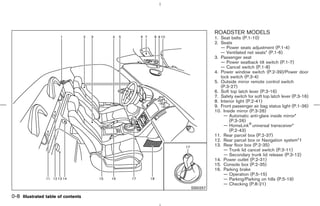
ROADSTER MODELS
                                               1. Seat belts (P.1-10)
                                               2. Seats
                                                  — Power seats adjustment (P.1-4)
                                                  — Ventilated net seats* (P.1-6)
                                               3. Passenger seat
                                                  — Power seatback tilt switch (P.1-7)
                                                  — Cancel switch (P.1-8)
                                               4. Power window switch (P.2-39)/Power door
                                                  lock switch (P.3-4)
                                               5. Outside mirror remote control switch
                                                  (P.3-27)
                                               6. Soft top latch lever (P.3-16)
                                               7. Safety switch for soft top latch lever (P.3-16)
                                               8. Interior light (P.2-41)
                                               9. Front passenger air bag status light (P.1-36)
                                               10. Inside mirror (P.3-26)
                                                    — Automatic anti-glare inside mirror*
                                                       (P.3-26)
                                                    — HomeLink universal transceiver*
                                                       (P.2-43)
                                               11. Rear parcel box (P.2-37)
                                               12. Rear parcel box or Navigation system*1
                                               13. Rear floor box (P.2-35)
                                                    — Trunk lid cancel switch (P.3-11)
                                                    — Secondary trunk lid release (P.3-12)
                                               14. Power outlet (P.2-31)
                                               15. Console box (P.2-35)
                                               16. Parking brake
                                                    — Operation (P.5-15)
                                                    — Parking/Parking on hills (P.5-19)
                                                    — Checking (P.8-21)
                                     SSI0257

0-8 Illustrated table of contents


                                    ੬ 07.7.25/Z33-D/V5.0 ੭
17. Selector lever or shift lever
      — Automatic transmission (P.5-10)
      — Manual transmission (P.5-13)
18. Cargo net (P.2-33)
*: if so equipped
*1: Refer to the separate Navigation System
      Owner’s Manual.


                                                               Illustrated table of contents   0-9


                                              ੬ 07.7.25/Z33-D/V5.0 ੭
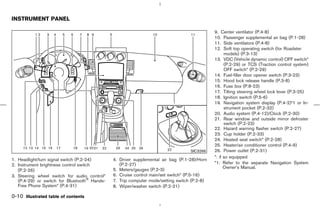
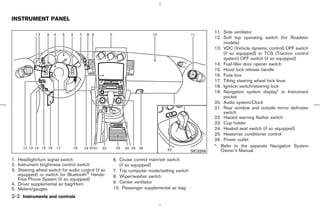
INSTRUMENT PANEL

                                                                                             9. Center ventilator (P.4-8)
                                                                                             10. Passenger supplemental air bag (P.1-28)
                                                                                             11. Side ventilators (P.4-8)
                                                                                             12. Soft top operating switch (for Roadster
                                                                                                   models) (P.3-13)
                                                                                             13. VDC (Vehicle dynamic control) OFF switch*
                                                                                                   (P.2-29) or TCS (Traction control system)
                                                                                                   OFF switch* (P.2-29)
                                                                                             14. Fuel-filler door opener switch (P.3-23)
                                                                                             15. Hood lock release handle (P.3-8)
                                                                                             16. Fuse box (P.8-23)
                                                                                             17. Tilting steering wheel lock lever (P.3-25)
                                                                                             18. Ignition switch (P.5-6)
                                                                                             19. Navigation system display (P.4-2)*1 or In-
                                                                                                   strument pocket (P.2-32)
                                                                                             20. Audio system (P.4-12)/Clock (P.2-30)
                                                                                             21. Rear window and outside mirror defroster
                                                                                                   switch (P.2-23)
                                                                                             22. Hazard warning flasher switch (P.2-27)
                                                                                             23. Cup holder (P.2-33)
                                                                                             24. Heated seat switch* (P.2-28)
                                                                                             25. Heater/air conditioner control (P.4-9)
                                                                                  SIC3266    26. Power outlet (P.2-31)
                                                                                             *: if so equipped
1. Headlight/turn signal switch (P.2-24)      4. Driver supplemental air bag (P.1-28)/Horn
2. Instrument brightness control switch          (P.2-27)                                    *1: Refer to the separate Navigation System
                                              5. Meters/gauges (P.2-3)                             Owner’s Manual.
   (P.2-26)
3. Steering wheel switch for audio control*   6. Cruise control main/set switch* (P.5-16)
   (P.4-29) or switch for Bluetooth Hands-    7. Trip computer mode/setting switch (P.2-8)
   Free Phone System* (P.4-31)                8. Wiper/washer switch (P.2-21)

0-10 Illustrated table of contents


                                                                                 ੬ 07.7.25/Z33-D/V5.0 ੭
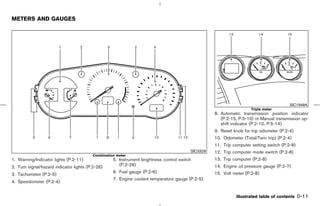
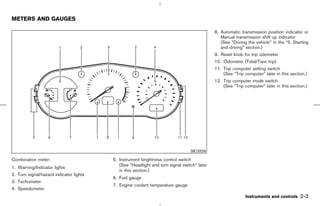
METERS AND GAUGES


                                                                                                                                         SIC1948A
                                                                                                                      Triple meter
                                                                                                    8. Automatic transmission position indicator
                                                                                                       (P.2-15, P.5-10) or Manual transmission up-
                                                                                                       shift indicator (P.2-10, P.5-14)
                                                                                                    9. Reset knob for trip odometer (P.2-4)
                                                                                                    10. Odometer (Total/Twin trip) (P.2-4)
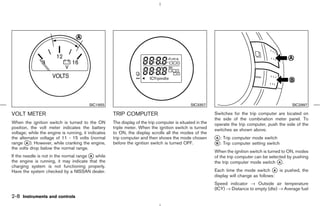
                                                                                                    11. Trip computer setting switch (P.2-8)
                                                                                          SIC3329   12. Trip computer mode switch (P.2-8)
                                          Combination meter
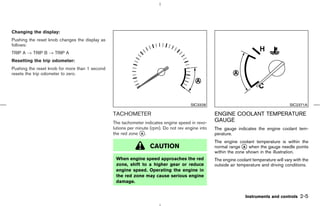
1. Warning/Indicator lights (P.2-11)                5. Instrument brightness control switch         13. Trip computer (P.2-8)
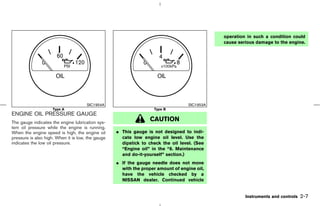
2. Turn signal/hazard indicator lights (P.2-26)        (P.2-26)                                     14. Engine oil pressure gauge (P.2-7)
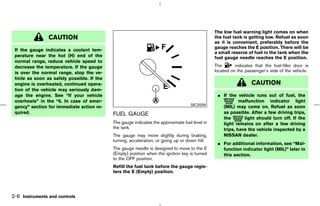
                                                    6. Fuel gauge (P.2-6)                           15. Volt meter (P.2-8)
3. Tachometer (P.2-5)
                                                    7. Engine coolant temperature gauge (P.2-5)
4. Speedometer (P.2-4)


                                                                                                              Illustrated table of contents    0-11


                                                                                         ੬ 07.7.25/Z33-D/V5.0 ੭
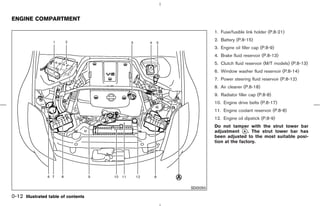
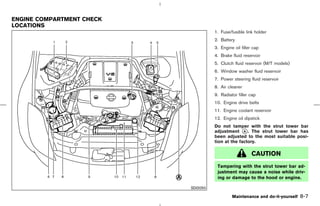
ENGINE COMPARTMENT

                                                1. Fuse/fusible link holder (P.8-21)
                                                2. Battery (P.8-15)
                                                3. Engine oil filler cap (P.8-9)
                                                4. Brake fluid reservoir (P.8-13)
                                                5. Clutch fluid reservoir (M/T models) (P.8-13)
                                                6. Window washer fluid reservoir (P.8-14)
                                                7. Power steering fluid reservoir (P.8-12)
                                                8. Air cleaner (P.8-18)
                                                9. Radiator filler cap (P.8-8)
                                                10. Engine drive belts (P.8-17)
                                                11. Engine coolant reservoir (P.8-8)
                                                12. Engine oil dipstick (P.8-9)
                                                Do not tamper with the strut tower bar
                                                adjustment k . The strut tower bar has
                                                              A
                                                been adjusted to the most suitable posi-
                                                tion at the factory.


                                      SDI2050

0-12 Illustrated table of contents


                                     ੬ 07.7.25/Z33-D/V5.0 ੭
1               Safety — Seats, seat belts and supple-
                mental restraint system

Seats ........................................................................................ 1-2     Three-point type seat belt with retractor ...............                                  1-14
  Front manual seat adjustment                                                                         Seat belt extenders ......................................................                 1-16
  (for Coupe models) ........................................................ 1-3                      Seat belt maintenance ................................................                     1-17
  Front power seat adjustment                                                                        Child restraints ...................................................................         1-17
  (for Coupe models — if so equipped) ...................... 1-3                                       Precautions on child restraints .................................                          1-17
  Front power seat adjustment                                                                          Child restraint installation on front passenger
  (for Roadster models) .................................................... 1-4                       seat (Coupe models only) ..........................................                        1-20
  Seat lifter (for driver’s seat) ......................................... 1-6                        Top tether strap child restraint
  Tilting and reclining passenger’s seat from driver’s                                                 (Coupe models only) ...................................................                    1-24
  seat ..................................................................................... 1-7
                                                                                                     Booster seats .......................................................................        1-25
  Head restraint adjustment ............................................ 1-9
                                                                                                       Precautions on booster seats ....................................                          1-25
  Front-seat Active Head Restraints (except for
                                                                                                       Booster seat installation on front passenger
  ventilated net seats)...................................................... 1-10
                                                                                                       seat....................................................................................   1-27
Seat belts ............................................................................. 1-10
  Precautions on seat belt usage ................................ 1-10                               Supplemental restraint system .......................................                        1-28
  Child safety .................................................................... 1-12               Precautions on supplemental restraint system .....                                         1-28
  Pregnant women .......................................................... 1-13                       Supplemental air bag warning labels ......................                                 1-42
  Injured persons ............................................................. 1-14                   Supplemental air bag warning light .........................                               1-43


                                                                                                                      ੬ 07.7.25/Z33-D/V5.0 ੭
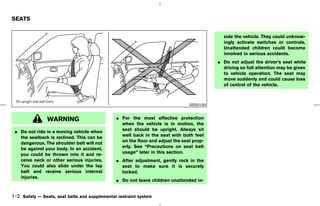
SEATS


                                                                                            side the vehicle. They could unknow-
                                                                                            ingly activate switches or controls.
                                                                                            Unattended children could become
                                                                                            involved in serious accidents.
                                                                                          ¼ Do not adjust the driver’s seat while
                                                                                            driving so full attention may be given
                                                                                            to vehicle operation. The seat may
                                                                                            move suddenly and could cause loss
                                                                                            of control of the vehicle.


                                                                                SSS0133


                WARNING                        ¼ For the most effective protection
                                                 when the vehicle is in motion, the
 ¼ Do not ride in a moving vehicle when          seat should be upright. Always sit
   the seatback is reclined. This can be         well back in the seat with both feet
   dangerous. The shoulder belt will not         on the floor and adjust the seat prop-
   be against your body. In an accident,         erly. See “Precautions on seat belt
   you could be thrown into it and re-           usage” later in this section.
   ceive neck or other serious injuries.       ¼ After adjustment, gently rock in the
   You could also slide under the lap            seat to make sure it is securely
   belt and receive serious internal             locked.
   injuries.
                                               ¼ Do not leave children unattended in-


1-2 Safety — Seats, seat belts and supplemental restraint system


                                                                               ੬ 07.7.25/Z33-D/V5.0 ੭
FRONT POWER SEAT
                                                                                                          ADJUSTMENT (for Coupe models —
                                                                                                          if so equipped)
                                                                                                          Operating tips
                                                                                                          ¼ The seat motor has an auto-reset overload
                                                                                                            protection circuit. If the motor stops during
                                                                                                            operation, wait 30 seconds, then reactivate
                                                                                                            the switch.
                                                                                                          ¼ Do not operate the power support seat
                                                                                                            for a long period of time when the engine is
                                                                                                            off. This will discharge the battery.
                                                                                             SSS0394

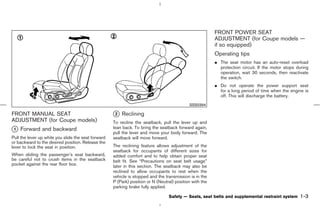
FRONT MANUAL SEAT                                    k Reclining
                                                     2
ADJUSTMENT (for Coupe models)                        To recline the seatback, pull the lever up and
k Forward and backward
1                                                    lean back. To bring the seatback forward again,
                                                     pull the lever and move your body forward. The
Pull the lever up while you slide the seat forward   seatback will move forward.
or backward to the desired position. Release the
lever to lock the seat in position.                  The reclining feature allows adjustment of the
                                                     seatback for occupants of different sizes for
When sliding the passenger’s seat backward,          added comfort and to help obtain proper seat
be careful not to crush items in the seatback        belt fit. See “Precautions on seat belt usage”
pocket against the rear floor box.                   later in this section. The seatback may also be
                                                     reclined to allow occupants to rest when the
                                                     vehicle is stopped and the transmission is in the
                                                     P (Park) position or N (Neutral) position with the
                                                     parking brake fully applied.

                                                                                  Safety — Seats, seat belts and supplemental restraint system      1-3


                                                                                            ੬ 07.7.25/Z33-D/V5.0 ੭
FRONT POWER SEAT
                                                                                                       ADJUSTMENT (for Roadster models)
                                                                                                       Operating tips
                                                                                                       ¼ The seat motor has an auto-reset overload
                                                                                                         protection circuit. If the motor stops during
                                                                                                         operation, wait 30 seconds, then reactivate
                                                                                                         the switch.
                                                                                                       ¼ Do not operate the power support seat
                                                                                                         for a long period of time when the engine is
                                                                                                         off. This will discharge the battery.


                                                                                          SPA1793

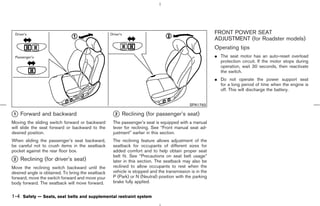
k Forward and backward
1                                                  k Reclining (for passenger’s seat)
                                                   2
Moving the sliding switch forward or backward      The passenger’s seat is equipped with a manual
will slide the seat forward or backward to the     lever for reclining. See “Front manual seat ad-
desired position.                                  justment” earlier in this section.
When sliding the passenger’s seat backward,        The reclining feature allows adjustment of the
be careful not to crush items in the seatback      seatback for occupants of different sizes for
pocket against the rear floor box.                 added comfort and to help obtain proper seat
                                                   belt fit. See “Precautions on seat belt usage”
k Reclining (for driver’s seat)
2                                                  later in this section. The seatback may also be
Move the reclining switch backward until the       reclined to allow occupants to rest when the
desired angle is obtained. To bring the seatback   vehicle is stopped and the transmission is in the
forward, move the switch forward and move your     P (Park) or N (Neutral) position with the parking
body forward. The seatback will move forward.      brake fully applied.


1-4 Safety — Seats, seat belts and supplemental restraint system


                                                                                          ੬ 07.7.25/Z33-D/V5.0 ੭
function or when a child restraint is installed in
                                                                                                       the passenger’s seat, push the seatback tilt
                                                                                                       cancel switch to the CANCEL position. For more
                                                                                                       information about operation conditions, see
                                                                                                       “Soft top” in the “3. Pre-driving checks and
                                                                                                       adjustments” section. For the cancel switch, see
                                                                                                       “Tilting and reclining passenger’s seat from driv-
                                                                                                       er’s seat” later in this section.


                                                                                          SSS0472

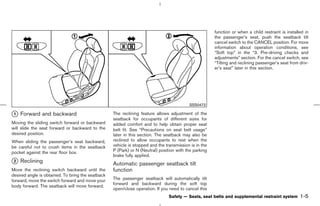
k Forward and backward
1                                                  The reclining feature allows adjustment of the
                                                   seatback for occupants of different sizes for
Moving the sliding switch forward or backward      added comfort and to help obtain proper seat
will slide the seat forward or backward to the     belt fit. See “Precautions on seat belt usage”
desired position.                                  later in this section. The seatback may also be
When sliding the passenger’s seat backward,        reclined to allow occupants to rest when the
be careful not to crush items in the seatback      vehicle is stopped and the transmission is in the
pocket against the rear floor box.                 P (Park) or N (Neutral) position with the parking
                                                   brake fully applied.
k Reclining
2
                                                   Automatic passenger seatback tilt
Move the reclining switch backward until the       function
desired angle is obtained. To bring the seatback
forward, move the switch forward and move your     The passenger seatback will automatically tilt
                                                   forward and backward during the soft top
body forward. The seatback will move forward.
                                                   open/close operation. If you need to cancel this
                                                                                Safety — Seats, seat belts and supplemental restraint system        1-5


                                                                                          ੬ 07.7.25/Z33-D/V5.0 ੭
¼ When using these seats, avoid wear-
                                                        ing clothing with soft fabrics (wool,
                                                        etc.). Clothing may be damaged as it
                                                        rubs against the netted material.


                                         SSS0272                                                                                        SPA1715
                                                                                                                     Type A
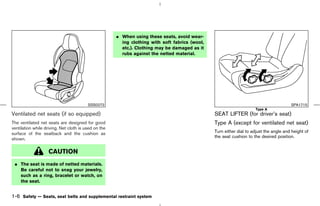
Ventilated net seats (if so equipped)                                                           SEAT LIFTER (for driver’s seat)
The ventilated net seats are designed for good                                                  Type A (except for ventilated net seat)
ventilation while driving. Net cloth is used on the
surface of the seatback and the cushion as                                                      Turn either dial to adjust the angle and height of
                                                                                                the seat cushion to the desired position.
shown.

                    CAUTION
 ¼ The seat is made of netted materials.
   Be careful not to snag your jewelry,
   such as a ring, bracelet or watch, on
   the seat.


1-6 Safety — Seats, seat belts and supplemental restraint system


                                                                                     ੬ 07.7.25/Z33-D/V5.0 ੭
SSS0202                                                SSS0203                                             SSS0273
                    Type B                                          Coupe models                                     Roadster models — Type A
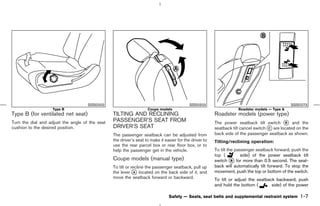
Type B (for ventilated net seat)                 TILTING AND RECLINING                                   Roadster models (power type)
Turn the dial and adjust the angle of the seat   PASSENGER’S SEAT FROM                                   The power seatback tilt switch k and the
                                                                                                                                             B
cushion to the desired position.                 DRIVER’S SEAT                                           seatback tilt cancel switch k are located on the
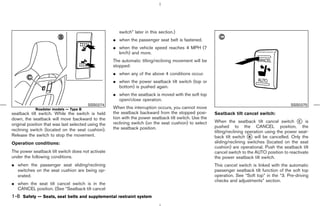
                                                                                                                                     C

                                                 The passenger seatback can be adjusted from             back side of the passenger seatback as shown.
                                                 the driver’s seat to make it easier for the driver to   Tilting/reclining operation:
                                                 use the rear parcel box or rear floor box, or to
                                                 help the passenger get in the vehicle.                  To tilt the passenger seatback forward, push the
                                                                                                         top (          side) of the power seatback tilt
                                                 Coupe models (manual type)                              switch k for more than 0.5 second. The seat-
                                                                                                                   B

                                                 To tilt or recline the passenger seatback, pull up      back will automatically tilt forward. To stop the
                                                 the lever k located on the back side of it, and
                                                              A                                          movement, push the top or bottom of the switch.
                                                 move the seatback forward or backward.                  To tilt or adjust the seatback backward, push
                                                                                                         and hold the bottom (        side) of the power

                                                                                Safety — Seats, seat belts and supplemental restraint system         1-7


                                                                                           ੬ 07.7.25/Z33-D/V5.0 ੭
switch” later in this section.)
                                                     ¼ when the passenger seat belt is fastened.
                                                     ¼ when the vehicle speed reaches 4 MPH (7
                                                       km/h) and more.
                                                     The automatic tilting/reclining movement will be
                                                     stopped:
                                                     ¼ when any of the above 4 conditions occur.
                                                     ¼ when the power seatback tilt switch (top or
                                                       bottom) is pushed again.
                                                     ¼ when the seatback is moved with the soft top
                                                       open/close operation.
                                        SSS0274                                                                                                 SSS0275
            Roadster models — Type B                 When this interruption occurs, you cannot move
seatback tilt switch. While the switch is held       the seatback backward from the stopped posi-        Seatback tilt cancel switch:
down, the seatback will move backward to the         tion with the power seatback tilt switch. Use the
                                                     reclining switch (on the seat cushion) to select    When the seatback tilt cancel switch k is   C
original position that was last selected using the                                                       pushed to the CANCEL position, the
reclining switch (located on the seat cushion).      the seatback position.
                                                                                                         tilting/reclining operation using the power seat-
Release the switch to stop the movement.                                                                 back tilt switch k will be cancelled. Only the
                                                                                                                            B

Operation conditions:                                                                                    sliding/reclining switches (located on the seat
                                                                                                         cushion) are operational. Push the seatback tilt
The power seatback tilt switch does not activate                                                         cancel switch to the AUTO position to reactivate
under the following conditions.                                                                          the power seatback tilt switch.
¼ when the passenger seat sliding/reclining                                                              This cancel switch is linked with the automatic
  switches on the seat cushion are being op-                                                             passenger seatback tilt function of the soft top
  erated.                                                                                                operation. See “Soft top” in the “3. Pre-driving
                                                                                                         checks and adjustments” section.
¼ when the seat tilt cancel switch is in the
  CANCEL position. (See “Seatback tilt cancel
1-8 Safety — Seats, seat belts and supplemental restraint system


                                                                                            ੬ 07.7.25/Z33-D/V5.0 ੭
CAUTION
When a child restraint is installed in the
passenger seat, be sure to turn the seat-
back tilt cancel switch to the CANCEL
position. Otherwise, the child restraint
may be damaged.


                                                                                    SSS0204                                           SSS0178A

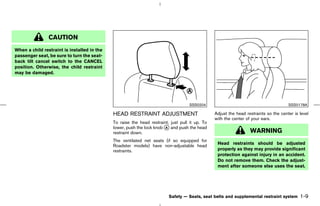
                                             HEAD RESTRAINT ADJUSTMENT                          Adjust the head restraints so the center is level
                                                                                                with the center of your ears.
                                             To raise the head restraint, just pull it up. To
                                             lower, push the lock knob k and push the head
                                                                       A
                                             restraint down.                                                      WARNING
                                             The ventilated net seats (if so equipped for
                                                                                                 Head restraints should be adjusted
                                             Roadster models) have non-adjustable head
                                             restraints.                                         properly as they may provide significant
                                                                                                 protection against injury in an accident.
                                                                                                 Do not remove them. Check the adjust-
                                                                                                 ment after someone else uses the seat.


                                                                         Safety — Seats, seat belts and supplemental restraint system       1-9


                                                                                   ੬ 07.7.25/Z33-D/V5.0 ੭
SEAT BELTS

                                                                                                   PRECAUTIONS ON SEAT BELT
                                                  to supplement other safety systems.              USAGE
                                                  Always wear seat belts. No system
                                                  can prevent all injuries in any acci-            If you are wearing your seat belt properly ad-
                                                  dent.                                            justed and you are sitting upright and well back
                                                                                                   in your seat with both feet on the floor, your
                                               ¼ Do not attach anything to the head                chances of being injured or killed in an accident
                                                 restraint stalks. Doing so could im-              and/or the severity of injury may be greatly
                                                 pair Active Head Restraint function.              reduced. NISSAN strongly encourages you and
                                                                                                   all of your passengers to buckle up every time
                                                                                                   you drive, even if your seating position includes a
                                              The Active Head Restraint moves forward utiliz-      supplemental air bag.
                                              ing the force that the seatback receives from the
                                              occupant in a rear-end collision. The movement       Most U.S. states and Canadian provinces
                                              of the head restraint helps support the occu-        or territories require that seat belts be
                                  SSS0508                                                          worn at all times when a vehicle is being
                                              pant’s head by reducing its backward movement
                                              and helping absorb some of the forces that may       driven.
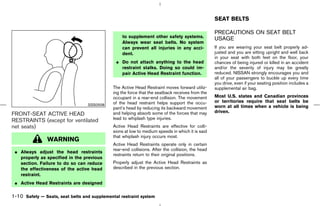
FRONT-SEAT ACTIVE HEAD
                                              lead to whiplash type injuries.
RESTRAINTS (except for ventilated
net seats)                                    Active Head Restraints are effective for colli-
                                              sions at low to medium speeds in which it is said
                                              that whiplash injury occurs most.
                WARNING
                                              Active Head Restraints operate only in certain
                                              rear-end collisions. After the collision, the head
 ¼ Always adjust the head restraints
                                              restraints return to their original positions.
   properly as specified in the previous
   section. Failure to do so can reduce       Properly adjust the Active Head Restraints as
   the effectiveness of the active head       described in the previous section.
   restraint.
 ¼ Active Head Restraints are designed

1-10 Safety — Seats, seat belts and supplemental restraint system


                                                                                     ੬ 07.7.25/Z33-D/V5.0 ੭
¼ Position the lap belt as low and snug
                                                                                            as possible AROUND THE HIPS, NOT
                                                                                            THE WAIST. A lap belt worn too high
                                                                                            could increase the risk of internal
                                                                                            injuries in an accident.
                                                                                          ¼ Be sure the seat belt tongue is se-
                                                                                            curely fastened to the proper buckle.
                                                                                          ¼ Do not wear the seat belt inside out
                                                                                            or twisted. Doing so may reduce its
                                                                                            effectiveness.
                                                                                          ¼ Do not allow more than one person
                                                                             SSS0136
                                                                                            to use the same seat belt.
                                                                                          ¼ Never carry more people in the ve-
              WARNING                        an accident. Serious injury or death
                                                                                            hicle than there are seat belts. This
                                             can occur if the seat belt is not worn
                                                                                            vehicle has only two seating posi-
¼ Every person who drives or rides in        properly.
                                                                                            tions. Never allow anyone to ride in
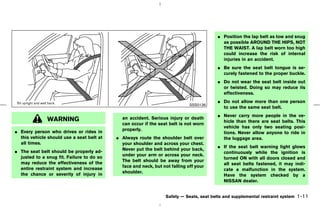
  this vehicle should use a seat belt at   ¼ Always route the shoulder belt over            the luggage area.
  all times.                                 your shoulder and across your chest.
                                                                                          ¼ If the seat belt warning light glows
¼ The seat belt should be properly ad-       Never put the belt behind your back,
                                                                                            continuously while the ignition is
  justed to a snug fit. Failure to do so     under your arm or across your neck.
                                                                                            turned ON with all doors closed and
  may reduce the effectiveness of the        The belt should be away from your
                                                                                            all seat belts fastened, it may indi-
  entire restraint system and increase       face and neck, but not falling off your
                                                                                            cate a malfunction in the system.
  the chance or severity of injury in        shoulder.
                                                                                            Have the system checked by a
                                                                                            NISSAN dealer.


                                                                  Safety — Seats, seat belts and supplemental restraint system   1-11


                                                                            ੬ 07.7.25/Z33-D/V5.0 ੭
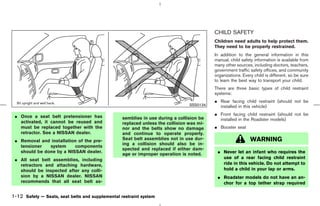
CHILD SAFETY
                                                                                          Children need adults to help protect them.
                                                                                          They need to be properly restrained.
                                                                                          In addition to the general information in this
                                                                                          manual, child safety information is available from
                                                                                          many other sources, including doctors, teachers,
                                                                                          government traffic safety offices, and community
                                                                                          organizations. Every child is different, so be sure
                                                                                          to learn the best way to transport your child.
                                                                                          There are three basic types of child restraint
                                                                                          systems:
                                                                                          ¼ Rear facing child restraint (should not be
                                                                                SSS0134     installed in this vehicle)

 ¼ Once a seat belt pretensioner has                                                      ¼ Front facing child restraint (should not be
                                                  semblies in use during a collision be     installed in the Roadster models)
   activated, it cannot be reused and             replaced unless the collision was mi-
   must be replaced together with the             nor and the belts show no damage        ¼ Booster seat
   retractor. See a NISSAN dealer.                and continue to operate properly.
 ¼ Removal and installation of the pre-           Seat belt assemblies not in use dur-                       WARNING
                                                  ing a collision should also be in-
   tensioner   system     components
                                                  spected and replaced if either dam-
   should be done by a NISSAN dealer.
                                                  age or improper operation is noted.      ¼ Never let an infant who requires the
 ¼ All seat belt assemblies, including                                                       use of a rear facing child restraint
   retractors and attaching hardware,                                                        ride in this vehicle. Do not attempt to
   should be inspected after any colli-                                                      hold a child in your lap or arms.
   sion by a NISSAN dealer. NISSAN                                                         ¼ Roadster models do not have an an-
   recommends that all seat belt as-                                                         chor for a top tether strap required

1-12 Safety — Seats, seat belts and supplemental restraint system


                                                                               ੬ 07.7.25/Z33-D/V5.0 ੭
transported in this vehicle.                             Larger children
    for most front facing child restraints.
                                                    All US states and provinces of Canada require            Children who are too large for child restraint
    Never let children who require the
                                                    the use of approved child restraints for infants         systems should be seated and restrained by the
    use of a front facing child restraint           and small children. (See “Child restraints” later in     seat belts which are provided. The seat belt may
    ride in Roadster models.                        this section.)                                           not fit properly if the child is less than 4 ft 9 in
 ¼ Children need special protection. The            Also, there are other types of child restraints          (142.5 cm) tall and weighs between 40 lbs (18
   vehicle’s seat belts may not fit them            available for larger children for additional protec-     kg) and 80 lbs (36 kg). A booster seat should be
   properly. The shoulder belt may come             tion.                                                    used to obtain proper seat belt fit.
   too close to the face or neck. The lap                                                                    NISSAN recommends that a child be placed in a
                                                    Infants                                                  commercially available booster seat if the shoul-
   belt may not fit over their small hip
   bones. In an accident, an improperly             Infants up to at least 1 year old should be placed       der belt in the child’s seating position fits close
   fitting seat belt could cause serious            in a rear facing child restraint. Because a rear         to the face or neck or if the lap portion of the seat
   or fatal injury. Always use appropri-            facing child restraint is not suitable for use in this   belt goes across the abdomen. The booster seat
   ate child restraints.                            vehicle, infants should not be transported in it.        should raise the child so that the shoulder belt is
                                                                                                             properly positioned across the top, middle por-
 ¼ Never let a child stand or kneel on              Small children                                           tion of the shoulder and the lap belt is low on the
   any seat and do not allow a child in             Children that are over 1 year old and weigh at           hips. A booster seat can only be used in seating
   the cargo areas while the vehicle is             least 20 lbs (9 kg) can be placed in a forward           positions that have a three-point type seat belt.
   moving. The child could be seriously             facing child restraint (except Roadster models).         The booster seat should fit the vehicle seat and
                                                    Refer to the manufacturer’s instructions for mini-       have a label certifying that it complies with
   injured or killed in an accident or
                                                    mum and maximum weight and height recom-                 Federal Motor Vehicle Safety Standards or Ca-
   sudden stop.                                                                                              nadian Motor Vehicle Safety Standards. Once
                                                    mendations. NISSAN recommends that small
                                                    children be placed in child restraints that comply       the child has grown so the shoulder belt is no
Your vehicle is equipped with a supplemental        with Federal Motor Vehicle Safety Standards or           longer on or near the face and neck, use the
front impact air bag system for the front passen-   Canadian Motor Vehicle Safety Standards. You             shoulder belt without the booster seat.
ger. See “Supplemental restraint system” later in   should choose a child restraint that fits your           PREGNANT WOMEN
this section. The passenger seat is not suitable    vehicle and always follow the manufacturer’s
for use with a rear facing child restraint needed   instructions for installation and use.                   NISSAN recommends that pregnant women use
for infants. Therefore, infants should not be                                                                seat belts. The seat belt should be worn snug,
                                                                                                             and always position the lap belt as low as
                                                                                   Safety — Seats, seat belts and supplemental restraint system            1-13


                                                                                               ੬ 07.7.25/Z33-D/V5.0 ੭
possible around the hips, not the waist. Place
the shoulder belt over your shoulder and across      belt and receive serious internal inju-
your chest. Never run the lap/shoulder belt over     ries.
your abdominal area. Contact your doctor for
                                                   ¼ For the most effective protection
specific recommendations.
                                                     when the vehicle is in motion, the
INJURED PERSONS                                      seat should be upright. Always sit
                                                     well back in the seat with both feet
NISSAN recommends that injured persons use
                                                     on the floor and adjust the seat belt
seat belts, depending on the injury. Check with
                                                     properly.
your doctor for specific recommendations.
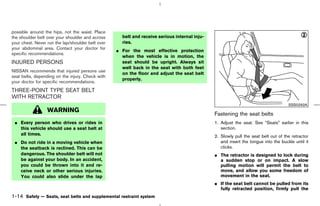
THREE-POINT TYPE SEAT BELT
WITH RETRACTOR
                                                                                                                                     SSS0292A
                  WARNING
                                                                                               Fastening the seat belts
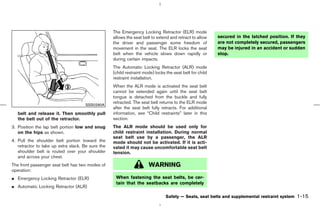
 ¼ Every person who drives or rides in                                                         1. Adjust the seat. See “Seats” earlier in this
   this vehicle should use a seat belt at                                                         section.
   all times.                                                                                  2. Slowly pull the seat belt out of the retractor
 ¼ Do not ride in a moving vehicle when                                                           and insert the tongue into the buckle until it
   the seatback is reclined. This can be                                                          clicks.
   dangerous. The shoulder belt will not                                                       ¼ The retractor is designed to lock during
   be against your body. In an accident,                                                         a sudden stop or on impact. A slow
   you could be thrown into it and re-                                                           pulling motion will permit the belt to
   ceive neck or other serious injuries.                                                         move, and allow you some freedom of
   You could also slide under the lap                                                            movement in the seat.
                                                                                               ¼ If the seat belt cannot be pulled from its
                                                                                                 fully retracted position, firmly pull the
1-14 Safety — Seats, seat belts and supplemental restraint system


                                                                                    ੬ 07.7.25/Z33-D/V5.0 ੭
The Emergency Locking Retractor (ELR) mode
                                                   allows the seat belt to extend and retract to allow    secured in the latched position. If they
                                                   the driver and passenger some freedom of               are not completely secured, passengers
                                                   movement in the seat. The ELR locks the seat           may be injured in an accident or sudden
                                                   belt when the vehicle slows down rapidly or            stop.
                                                   during certain impacts.
                                                   The Automatic Locking Retractor (ALR) mode
                                                   (child restraint mode) locks the seat belt for child
                                                   restraint installation.
                                                   When the ALR mode is activated the seat belt
                                                   cannot be extended again until the seat belt
                                                   tongue is detached from the buckle and fully
                                                   retracted. The seat belt returns to the ELR mode
                                     SSS0290A
                                                   after the seat belt fully retracts. For additional
   belt and release it. Then smoothly pull         information, see “Child restraints” later in this
   the belt out of the retractor.                  section.
3. Position the lap belt portion low and snug      The ALR mode should be used only for
   on the hips as shown.                           child restraint installation. During normal
                                                   seat belt use by a passenger, the ALR
4. Pull the shoulder belt portion toward the       mode should not be activated. If it is acti-
   retractor to take up extra slack. Be sure the   vated it may cause uncomfortable seat belt
   shoulder belt is routed over your shoulder      tension.
   and across your chest.
The front passenger seat belt has two modes of                        WARNING
operation:
¼ Emergency Locking Retractor (ELR)                 When fastening the seat belts, be cer-
                                                    tain that the seatbacks are completely
¼ Automatic Locking Retractor (ALR)

                                                                                Safety — Seats, seat belts and supplemental restraint system   1-15


                                                                                            ੬ 07.7.25/Z33-D/V5.0 ੭
ward. The retractor should lock and restrict
                                                       further belt movement.
                                                    If the retractor does not lock during this check or
                                                    if you have any questions about belt operation,
                                                    see a NISSAN dealer.


                                       SSS0326                                                                                                     SSS0588

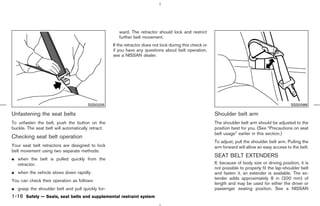
Unfastening the seat belts                                                                                Shoulder belt arm
To unfasten the belt, push the button on the                                                              The shoulder belt arm should be adjusted to the
buckle. The seat belt will automatically retract.                                                         position best for you. (See “Precautions on seat
                                                                                                          belt usage” earlier in this section.)
Checking seat belt operation
                                                                                                          To adjust, pull the shoulder belt arm. Pulling the
Your seat belt retractors are designed to lock                                                            arm forward will allow an easy access to the belt.
belt movement using two separate methods:
                                                                                                          SEAT BELT EXTENDERS
¼ when the belt is pulled quickly from the
  retractor.                                                                                              If, because of body size or driving position, it is
                                                                                                          not possible to properly fit the lap-shoulder belt
¼ when the vehicle slows down rapidly.                                                                    and fasten it, an extender is available. The ex-
                                                                                                          tender adds approximately 8 in (200 mm) of
You can check their operation as follows:
                                                                                                          length and may be used for either the driver or
¼ grasp the shoulder belt and pull quickly for-                                                           passenger seating position. See a NISSAN
1-16 Safety — Seats, seat belts and supplemental restraint system


                                                                                            ੬ 07.7.25/Z33-D/V5.0 ੭
CHILD RESTRAINTS

dealer for assistance if the extender is required.      the seat belts to retract until they are com-
                                                        pletely dry.
                  WARNING                            ¼ If dirt builds up in the shoulder belt guide of
                                                       the seat belt anchors, the seat belts may
 ¼ Only NISSAN seat belt extenders,                    retract slowly. Wipe the shoulder belt guide
                                                       with a clean, dry cloth.
   made by the same company which
   made the original equipment seat                  ¼ Periodically check to see that the seat
   belts, should be used with NISSAN                   belt and the metal components such as
   seat belts.                                         buckles, tongues, retractors, flexible wires
                                                       and anchors work properly. If loose parts,
 ¼ Persons who can use the standard                    deterioration, cuts or other damage on the
   seat belt should not use an extender.               webbing is found, the entire belt assembly
   Such unnecessary use could result in                should be replaced.
   serious personal injury in the event                                                                                                    SSS0099
   of an accident.
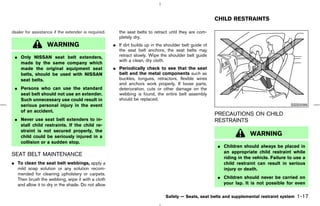
                                                                                                         PRECAUTIONS ON CHILD
 ¼ Never use seat belt extenders to in-                                                                  RESTRAINTS
   stall child restraints. If the child re-
   straint is not secured properly, the
   child could be seriously injured in a                                                                                WARNING
   collision or a sudden stop.
                                                                                                         ¼ Children should always be placed in
                                                                                                           an appropriate child restraint while
SEAT BELT MAINTENANCE
                                                                                                           riding in the vehicle. Failure to use a
¼ To clean the seat belt webbings, apply a                                                                 child restraint can result in serious
  mild soap solution or any solution recom-                                                                injury or death.
  mended for cleaning upholstery or carpets.
  Then brush the webbing, wipe it with a cloth                                                           ¼ Children should never be carried on
  and allow it to dry in the shade. Do not allow                                                           your lap. It is not possible for even

                                                                                Safety — Seats, seat belts and supplemental restraint system   1-17


                                                                                            ੬ 07.7.25/Z33-D/V5.0 ੭
the strongest adult to resist the                                                          Never let children who require the
    forces of a severe accident. The child                                                     use of a front facing child restraint
    could be crushed between the adult                                                         ride in Roadster models.
    and parts of the vehicle. Also, do not
                                                                                             ¼ Improper use or improper installation
    put the same seat belt around both
                                                                                               of a child restraint can increase the
    your child and yourself.
                                                                                               risk or severity of injury for both the
                                                                                               child and other occupants of the ve-
                                                                                               hicle and can lead to serious injury or
                                                                                               death in an accident.
                                                                                             ¼ Follow all of the child restraint manu-
                                                                                               facturer’s instructions for installation
                                                                                  SSS0100
                                                                                               and use. When purchasing a child
                                                                                               restraint, be sure to select one which
                                               ¼ Even with the NISSAN Advanced Air             will fit your child and vehicle. It may
                                                 Bag System, never install a rear-             not be possible to properly install
                                                 facing child restraint in the front seat.     some types of child restraints in your
                                                 An inflating supplemental air bag             vehicle.
                                                 could seriously injure or kill your
                                                 child.                                      ¼ If the child restraint is not anchored
                                                                                               properly, the risk of a child being
                                               ¼ Never let an infant who requires the          injured in a collision or a sudden stop
                                                 use of a rear facing child restraint          greatly increases.
                                                 ride in this vehicle.
                                                                                             ¼ Child restraint anchor point is de-
                                               ¼ Roadster models do not have an an-            signed to withstand only those loads
                                                 chor for a top tether strap required          imposed by correctly fitted child re-
                                                 for most front facing child restraints.       straint. Under no circumstances is it
1-18 Safety — Seats, seat belts and supplemental restraint system


                                                                                  ੬ 07.7.25/Z33-D/V5.0 ੭
Safety Standard 213 or Canadian Motor
   to be used for adult seat belts or
   harnesses.
                                                                  CAUTION                              Vehicle Safety Standard 213.
                                                                                                    ¼ Check the child restraint in your vehicle to be
¼ Adjustable seatbacks should be po-           ¼ For Roadster models, when installing                 sure it is compatible with the vehicle’s seat
  sitioned to fit the child restraint, but       a booster seat, be sure to turn off the              and seat belt system.
  as upright as possible.                        automatic passenger seatback tilt                  ¼ If the child restraint is compatible with your
¼ After attaching the child restraint,           function with the seatback tilt cancel               vehicle, place your child in the child restraint
  test it before you place the child in it.      switch (located on the back of the                   and check the various adjustments to be sure
                                                 passenger seatback). Otherwise, the                  the child restraint is compatible with your
  Push it from side to side while hold-
                                                 booster seat may be damaged. See                     child. Choose a child restraint that is de-
  ing the seat by the seat belt path. Try                                                             signed for your child’s height and weight.
  to tug it forward and check to see if          “Tilting and reclining passenger’s
                                                 seat from driver’s seat” earlier in this             Always follow all recommended procedures.
  the belt holds the restraint in place.
  The child restraint should not move            section for detailed information.                  The passenger seat is not suitable for use with a
                                                                                                    rear facing child restraint for infants. Therefore,
  more than 1 in (25 mm). If the re-           ¼ Remember that a child restraint left               infants should not be transported in this vehicle.
  straint is not secure, tighten the belt        in a closed vehicle can become very
  as necessary, or put the restraint in          hot. Check the seating surface and                 All U.S. states and Canadian provinces or
  another seating position and test it           buckles before placing your child in               territories require that infants and small
  again. You may need to try a different                                                            children be restrained in approved child
                                                 the child restraint.
                                                                                                    restraint at all times while the vehicle is
  child restraint. Not all child restraints
                                                                                                    being operated.
  fit in all types of vehicles.
                                              In general, child restraints are designed to be
¼ When your child restraint is not in         installed with the lap portion of a lap/shoulder
  use, keep it secured with a seat belt       seat belt.
  to prevent it from being thrown             Several manufacturers offer child restraints for
  around in case of a sudden stop or          children of various sizes. When selecting any
  accident.                                   child restraint, keep the following points in mind:
                                              ¼ Choose only a restraint with a label certifying
                                                that it complies with Federal Motor Vehicle
                                                                          Safety — Seats, seat belts and supplemental restraint system          1-19


                                                                                      ੬ 07.7.25/Z33-D/V5.0 ੭
¼ The three-point seat belt in your ve-
                                                                                             hicle is equipped with an Automatic
                                                                                             Locking Retractor (ALR) which must
                                                                                             be used when installing a child re-
                                                                                             straint.
                                                                                           ¼ Failure to use the ALR mode will
                                                                                             result in the child restraint not being
                                                                                             properly secured. The restraint could
                                                                                             tip over or otherwise be unsecured
                                                                                             and cause injury to the child in a
                                                                                             sudden stop or collision.
                                                                                 SSS0261

CHILD RESTRAINT INSTALLATION
                                                  air bag in a crash and could seriously
ON FRONT PASSENGER SEAT
                                                  injure or kill your child.
(Coupe models only)
                                               ¼ If you must install a forward facing
                                                 child restraint in the front passenger
                WARNING                          seat, move the passenger seat to the
                                                 rearmost position. Also, be sure the
 ¼ Even with the NISSAN Advanced Air             front passenger air bag status light is
   Bag System, never install a rear-             illuminated to indicate the passenger
   facing child restraint in the front pas-      air bag is OFF. See “Front passenger
   senger seat. Front air bags inflate           air bag and status light” in this sec-
   with great force. A rear-facing child         tion for details.
   restraint could be struck by the front


1-20 Safety — Seats, seat belts and supplemental restraint system


                                                                                ੬ 07.7.25/Z33-D/V5.0 ੭
“Head restraint adjustment” earlier in this
                                                     section. If the head restraint is removed, store
                                                     it in a secure place. Be sure to install the
                                                     head restraint when the child restraint is
                                                     removed. If the seating position does not
                                                     have an adjustable head restraint and it is
                                                     interfering with the proper child restraint fit,
                                                     try a different child restraint.


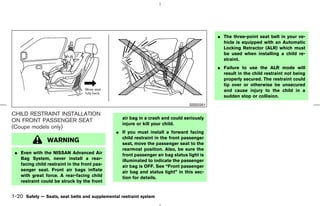
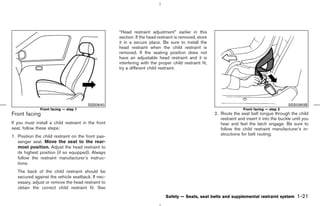
                                        SSS0640                                                                                                 SSS0360B
               Front facing — step 1                                                                                   Front facing — step 2
Front facing                                                                                            2. Route the seat belt tongue through the child
                                                                                                           restraint and insert it into the buckle until you
If you must install a child restraint in the front                                                         hear and feel the latch engage. Be sure to
seat, follow these steps:                                                                                  follow the child restraint manufacturer’s in-
1. Position the child restraint on the front pas-                                                          structions for belt routing.
   senger seat. Move the seat to the rear-
   most position. Adjust the head restraint to
   its highest position (if so equipped). Always
   follow the restraint manufacturer’s instruc-
   tions.
   The back of the child restraint should be
   secured against the vehicle seatback. If nec-
   essary, adjust or remove the head restraint to
   obtain the correct child restraint fit. See
                                                                              Safety — Seats, seat belts and supplemental restraint system           1-21


                                                                                          ੬ 07.7.25/Z33-D/V5.0 ੭
SSS0651                                             SSS0652                                               SSS0653
               Front facing — step 3                               Front facing — step 4                                Front facing — step 5
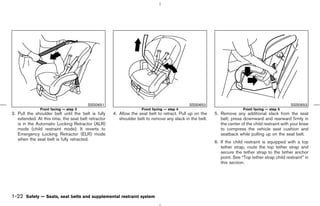
3. Pull the shoulder belt until the belt is fully    4. Allow the seat belt to retract. Pull up on the   5. Remove any additional slack from the seat
   extended. At this time, the seat belt retractor      shoulder belt to remove any slack in the belt.      belt; press downward and rearward firmly in
   is in the Automatic Locking Retractor (ALR)                                                              the center of the child restraint with your knee
   mode (child restraint mode). It reverts to                                                               to compress the vehicle seat cushion and
   Emergency Locking Retractor (ELR) mode                                                                   seatback while pulling up on the seat belt.
   when the seat belt is fully retracted.
                                                                                                         6. If the child restraint is equipped with a top
                                                                                                            tether strap, route the top tether strap and
                                                                                                            secure the tether strap to the tether anchor
                                                                                                            point. See “Top tether strap child restraint” in
                                                                                                            this section.


1-22 Safety — Seats, seat belts and supplemental restraint system


                                                                                            ੬ 07.7.25/Z33-D/V5.0 ੭
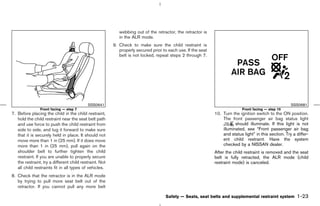
webbing out of the retractor, the retractor is
                                                            in the ALR mode.
                                                         9. Check to make sure the child restraint is
                                                            properly secured prior to each use. If the seat
                                                            belt is not locked, repeat steps 2 through 7.


                                           SSS0641                                                                                                      SSS0681
                Front facing — step 7                                                                                        Front facing — step 10
7. Before placing the child in the child restraint,                                                           10. Turn the ignition switch to the ON position.
   hold the child restraint near the seat belt path                                                               The front passenger air bag status light
   and use force to push the child restraint from                                                                        should illuminate. If this light is not
   side to side, and tug it forward to make sure                                                                  illuminated, see “Front passenger air bag
   that it is securely held in place. It should not                                                               and status light” in this section. Try a differ-
   move more than 1 in (25 mm). If it does move                                                                   ent child restraint. Have the system
   more than 1 in (25 mm), pull again on the                                                                      checked by a NISSAN dealer.
   shoulder belt to further tighten the child                                                                 After the child restraint is removed and the seat
   restraint. If you are unable to properly secure                                                            belt is fully retracted, the ALR mode (child
   the restraint, try a different child restraint. Not                                                        restraint mode) is canceled.
   all child restraints fit in all types of vehicles.
8. Check that the retractor is in the ALR mode
   by trying to pull more seat belt out of the
   retractor. If you cannot pull any more belt

                                                                                     Safety — Seats, seat belts and supplemental restraint system          1-23


                                                                                                ੬ 07.7.25/Z33-D/V5.0 ੭
WARNING
                                                       ¼ Child restraint anchor point is de-
                                                         signed to withstand only those loads
                                                         imposed by correctly fitted child re-
                                                         straints. Under no circumstance is it
                                                         to be used for adult seat belts or
                                                         harnesses.
                                                       ¼ Do not allow cargo to contact the top
                                                         tether strap when it is attached to the
                                                         top tether anchor. Properly secure
                                          SSS0207        the cargo so it does not contact the                                             SPA1644
                                                         top tether strap. Cargo that is not
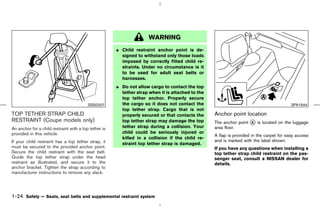
TOP TETHER STRAP CHILD                                   properly secured or that contacts the     Anchor point location
RESTRAINT (Coupe models only)                            top tether strap may damage the top       The anchor point k is located on the luggage
                                                                                                                    A
An anchor for a child restraint with a top tether is     tether strap during a collision. Your     area floor.
provided in this vehicle.                                child could be seriously injured or
                                                                                                   A flap is provided in the carpet for easy access
                                                         killed in a collision if the child re-
If your child restraint has a top tether strap, it                                                 and is marked with the label shown.
                                                         straint top tether strap is damaged.
must be secured to the provided anchor point.                                                      If you have any questions when installing a
Secure the child restraint with the seat belt.                                                     top tether strap child restraint on the pas-
Guide the top tether strap under the head                                                          senger seat, consult a NISSAN dealer for
restraint as illustrated, and secure it to the                                                     details.
anchor bracket. Tighten the strap according to
manufacturer instructions to remove any slack.


1-24 Safety — Seats, seat belts and supplemental restraint system


                                                                                        ੬ 07.7.25/Z33-D/V5.0 ੭
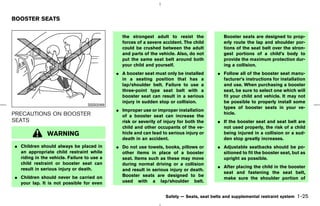
BOOSTER SEATS


                                              the strongest adult to resist the               Booster seats are designed to prop-
                                              forces of a severe accident. The child          erly route the lap and shoulder por-
                                              could be crushed between the adult              tions of the seat belt over the stron-
                                              and parts of the vehicle. Also, do not          gest portions of a child’s body to
                                              put the same seat belt around both              provide the maximum protection dur-
                                              your child and yourself.                        ing a collision.
                                            ¼ A booster seat must only be installed        ¼ Follow all of the booster seat manu-
                                              in a seating position that has a               facturer’s instructions for installation
                                              lap/shoulder belt. Failure to use a            and use. When purchasing a booster
                                              three-point type seat belt with a              seat, be sure to select one which will
                                              booster seat can result in a serious           fit your child and vehicle. It may not
                                              injury in sudden stop or collision.            be possible to properly install some
                                  SSS0099
                                                                                             types of booster seats in your ve-
                                            ¼ Improper use or improper installation
PRECAUTIONS ON BOOSTER                                                                       hicle.
                                              of a booster seat can increase the
SEATS                                         risk or severity of injury for both the      ¼ If the booster seat and seat belt are
                                              child and other occupants of the ve-           not used properly, the risk of a child
               WARNING                        hicle and can lead to serious injury or        being injured in a collision or a sud-
                                              death in an accident.                          den stop greatly increases.
¼ Children should always be placed in       ¼ Do not use towels, books, pillows or         ¼ Adjustable seatbacks should be po-
  an appropriate child restraint while        other items in place of a booster              sitioned to fit the booster seat, but as
  riding in the vehicle. Failure to use a     seat. Items such as these may move             upright as possible.
  child restraint or booster seat can         during normal driving or a collision
  result in serious injury or death.                                                       ¼ After placing the child in the booster
                                              and result in serious injury or death.
                                                                                             seat and fastening the seat belt,
¼ Children should never be carried on         Booster seats are designed to be
                                                                                             make sure the shoulder portion of
  your lap. It is not possible for even       used with a lap/shoulder belt.


                                                                   Safety — Seats, seat belts and supplemental restraint system   1-25


                                                                             ੬ 07.7.25/Z33-D/V5.0 ੭
the belt is away from the child’s face        seat from driver’s seat” earlier in this
    and neck and the lap portion of the           section for detailed information.
    belt does not cross the abdomen.
                                               ¼ Remember that a booster seat left in
 ¼ Do not put the shoulder belt behind           a closed vehicle can become very hot.
   the child or under the child’s arm. If        Check the seating surface and buck-
   you must install a booster seat in the        les before placing your child in the
   front seat, see “Booster seat instal-         booster seat.
   lation on front passenger seat” later
   in this section.
 ¼ When your booster seat is not in use,
   keep it secured with a seat belt to
   prevent it from being thrown around                                                                                              LRS0455
   in case of a sudden stop or accident.
                                                                                             Booster seats of various sizes are offered by
                                                                                             several manufacturers. When selecting any
                                                                                             booster seat, keep the following points in mind:
                CAUTION                                                                      ¼ Choose only a booster seat with a label
                                                                                               certifying that it complies with Federal Motor
 ¼ For Roadster models, when installing                                                        Vehicle Safety Standard 213 or Canadian
   a booster seat, be sure to turn off the                                                     Motor Vehicle Safety Standard 213.
   automatic passenger seatback tilt
   function with the seatback tilt cancel
   switch (located on the back of the
   passenger seatback). Otherwise, the
   booster seat may be damaged. See
   “Tilting and reclining passenger’s


1-26 Safety — Seats, seat belts and supplemental restraint system


                                                                                  ੬ 07.7.25/Z33-D/V5.0 ੭
BOOSTER SEAT INSTALLATION
                                                                                                     ON FRONT PASSENGER SEAT

                                                                                                                         CAUTION
                                                                                                      Do not use the lap/shoulder belt Auto-
                                                                                                      matic Locking Retractor mode when us-
                                                                                                      ing a booster seat with the seat belts.


                                                                                                     Follow these steps to install a booster seat in the
                                                                                                     front passenger seat:

                                       SSS0363                                           LRS0454
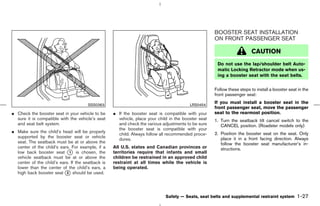
                                                                                                     If you must install a booster seat in the
                                                                                                     front passenger seat, move the passenger
¼ Check the booster seat in your vehicle to be     ¼ If the booster seat is compatible with your     seat to the rearmost position.
  sure it is compatible with the vehicle’s seat      vehicle, place your child in the booster seat   1. Turn the seatback tilt cancel switch to the
  and seat belt system.                              and check the various adjustments to be sure       CANCEL position. (Roadster models only)
                                                     the booster seat is compatible with your
¼ Make sure the child’s head will be properly                                                        2. Position the booster seat on the seat. Only
                                                     child. Always follow all recommended proce-
  supported by the booster seat or vehicle                                                              place it in a front facing direction. Always
                                                     dures.
  seat. The seatback must be at or above the                                                            follow the booster seat manufacturer’s in-
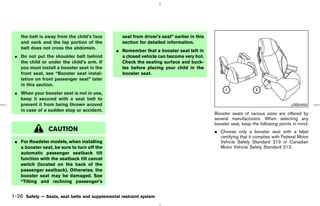
  center of the child’s ears. For example, if a    All U.S. states and Canadian provinces or            structions.
  low back booster seat k is chosen, the
                             1                     territories require that infants and small
  vehicle seatback must be at or above the         children be restrained in an approved child
  center of the child’s ears. If the seatback is   restraint at all times while the vehicle is
  lower than the center of the child’s ears, a     being operated.
  high back booster seat k should be used.
                           2


                                                                             Safety — Seats, seat belts and supplemental restraint system        1-27


                                                                                        ੬ 07.7.25/Z33-D/V5.0 ੭
SUPPLEMENTAL RESTRAINT
                                                                                                           SYSTEM
                                                         structions for adjusting the belt routing.        PRECAUTIONS ON
                                                      5. Pull the shoulder belt portion of the seat belt   SUPPLEMENTAL RESTRAINT
                                                         toward the retractor to take up extra slack. Be   SYSTEM
                                                         sure the shoulder belt is positioned across
                                                         the top, middle portion of the child’s shoul-     This Supplemental Restraint System (SRS) sec-
                                                         der. Be sure to follow the booster seat manu-     tion contains important information concerning
                                                         facturer’s instructions for adjusting the belt    the following systems:
                                                         routing.
                                                                                                           ¼ Driver and passenger supplemental front-
                                                      6. Follow the warnings, cautions and instruc-          impact air bag (NISSAN Advanced Air Bag
                                                         tions for properly fastening a seat belt shown      System)
                                                         in the “Three-point type seat belt with retrac-
                                                         tor” earlier in this section.                     ¼ Front seat-mounted side-impact supplemen-
                                                                                                             tal air bag (if so equipped)
                                                      7. If the booster seat is installed in the front
                                         LRS0454
                                                         passenger seat, turn the ignition switch to the   ¼ Roof-mounted curtain side-impact supple-
                                                         ON position. The front passenger air bag            mental air bag (if so equipped for Coupe
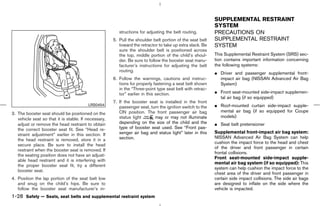
3. The booster seat should be positioned on the
                                                         status light      may or may not illuminate         models)
   vehicle seat so that it is stable. If necessary,
   adjust or remove the head restraint to obtain         depending on the size of the child and the        ¼ Seat belt pretensioner
   the correct booster seat fit. See “Head re-           type of booster seat used. See “Front pas-
                                                         senger air bag and status light” later in this    Supplemental front-impact air bag system:
   straint adjustment” earlier in this section. If
                                                         section.                                          NISSAN Advanced Air Bag System can help
   the head restraint is removed, store it in a
                                                                                                           cushion the impact force to the head and chest
   secure place. Be sure to install the head
                                                                                                           of the driver and front passenger in certain
   restraint when the booster seat is removed. If
                                                                                                           frontal collisions.
   the seating position does not have an adjust-
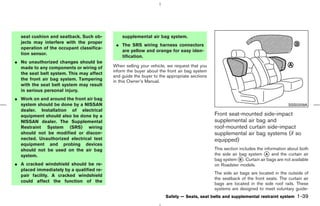
                                                                                                           Front seat-mounted side-impact supple-
   able head restraint and it is interfering with
                                                                                                           mental air bag system (if so equipped): This
   the proper booster seat fit, try a different
                                                                                                           system can help cushion the impact force to the
   booster seat.
                                                                                                           chest area of the driver and front passenger in
4. Position the lap portion of the seat belt low                                                           certain side impact collisions. The side air bags
   and snug on the child’s hips. Be sure to                                                                are designed to inflate on the side where the
   follow the booster seat manufacturer’s in-                                                              vehicle is impacted.
1-28 Safety — Seats, seat belts and supplemental restraint system


                                                                                              ੬ 07.7.25/Z33-D/V5.0 ੭
Roof-mounted curtain side-impact supple-
mental air bag system (if so equipped for
Coupe models): This system can help cushion
the impact force to the head of occupants in
certain side impact collisions. The curtain air
bags are designed to inflate on the side where
the vehicle is impacted.
The supplemental restraint system is designed
to supplement the crash protection provided
by the driver and passenger seat belts and is
not a substitute for them. Seat belts should
always be correctly worn and the occupant
seated a suitable distance away from the steer-
ing wheel, instrument panel, door finishers and
                                                                                                                                      SSS0131
side roof rails. (See “Seat belts” earlier in this
section for instructions and precautions on seat
belt usage.)                                                                                           light is lit or if the front passenger
                                                                    WARNING
The supplemental air bags operate only                                                                 seat is unoccupied. See “Front pas-
when the ignition switch is in the ON or             ¼ The front air bags ordinarily will not          senger air bag and status light” later
START position.                                                                                        in this section.
                                                       inflate in the event of a side impact,
After turning the ignition key to the ON               rear impact, rollover, or lower sever-       ¼ The seat belts and the front air bags
position, the supplemental air bag warning             ity frontal collision. Always wear your        are most effective when you are sit-
light illuminates. The supplemental air bag            seat belts to help reduce the risk or          ting well back and upright in the seat
warning light will turn off after about 7              severity of injury in various kinds of         with both feet on the floor. The front
seconds if the systems are operational.
                                                       accidents.                                     air bags inflate with great force. Even
                                                     ¼ The front passenger air bag will not           with the NISSAN Advanced Air Bag
                                                       inflate if the passenger air bag status        System, if you are unrestrained, lean-
                                                                                                      ing forward, sitting sideways or out

                                                                            Safety — Seats, seat belts and supplemental restraint system   1-29


                                                                                      ੬ 07.7.25/Z33-D/V5.0 ੭
of position in any way, you are at            erly seated and wearing the seat belt
    greater risk of injury or death in a          can increase the risk or severity of
    crash. You may also receive serious           injury in an accident. See “Front pas-
    or fatal injuries from the front air bag      senger air bag and status light” later
    if you are up against it when it in-          in this section.
    flates. Always sit back against the
                                               ¼ Keep hands on the outside of the
    seatback and as far away as practical
                                                 steering wheel. Placing them inside
    from the steering wheel or instru-
                                                 the steering wheel rim could increase
    ment panel. Always use the seat
                                                 the risk that they are injured when
    belts.
                                                 the front air bag inflates.
 ¼ The driver and front passenger seat
   belt buckles are equipped with sen-
   sors that detect if the seat belts are
   fastened. The Advanced Air Bag Sys-
   tem monitors the severity of a colli-
   sion and seat belt usage then inflates
   the air bags. Failure to properly wear
   seat belts can increase the risk or
   severity of injury in an accident.
 ¼ The front passenger seat is equipped
   with an occupant classification sen-
   sor (pattern sensor) that turns the
   front passenger air bag OFF under
   some conditions. This sensor is only
   used in this seat. Failure to be prop-


1-30 Safety — Seats, seat belts and supplemental restraint system


                                                                                ੬ 07.7.25/Z33-D/V5.0 ੭
SSS0132                                        SSS0016


                                                          SSS0006

Safety — Seats, seat belts and supplemental restraint system   1-31


          ੬ 07.7.25/Z33-D/V5.0 ੭
SSS0007                           SSS0009                                     SSS0100


                                                                                             WARNING
                                                                              ¼ Never let an infant who requires the
                                                                                use of a rear facing child restraint
                                                                                ride in this vehicle. Do not attempt to
                                                                                hold a child in your lap or arms. Some
                                                                                examples of dangerous riding posi-
                                                                                tions are shown in the previous illus-
                                                                                trations.
                                                                              ¼ Roadster models do not have an an-
                                                                                chor for a top tether strap required
                                  SSS0008                           SSS0099

1-32 Safety — Seats, seat belts and supplemental restraint system


                                                                    ੬ 07.7.25/Z33-D/V5.0 ੭
for most front facing child restraints.
   Never let children who require the
   use of a front facing child restraint
   ride in Roadster models.
¼ Children may be severely injured or
  killed when the front air bags, side air
  bags or curtain air bags inflate if they
  are not properly restrained.
¼ Even with the NISSAN Advanced Air
  Bag System, never install a rear-
  facing child restraint in the front seat.
  An inflating front air bag could seri-                                         SSS0101                                         SSS0159
  ously injure or kill your child. See
  “Child restraints” earlier in this sec-                                                       in various kinds of accidents.
  tion for details.                                          WARNING
                                                                                             ¼ The seat belts, side air bags and
                                                                                               curtain air bags are most effective
                                              Front    seat-mounted       side-impact
                                                                                               when you are sitting well back and
                                              supplemental air bags and roof-
                                                                                               upright in the seat. The side air bags
                                              mounted curtain side-impact supple-
                                                                                               and curtain air bags inflate with great
                                              mental air bags (if so equipped):
                                                                                               force. Do not allow anyone to place
                                              ¼ The side air bags and curtain air bags         their hand, leg or face near the side
                                                ordinarily will not inflate in the event       air bag on the side of the seatback of
                                                of a frontal impact, rear impact, roll-        the front seat or near the side roof
                                                over or lower severity side collision.         rails. Do not allow anyone sitting in
                                                Always wear your seat belts to help            the front seat to extend their hand
                                                reduce the risk or severity of injury          out of the window or lean against the

                                                                     Safety — Seats, seat belts and supplemental restraint system   1-33


                                                                                ੬ 07.7.25/Z33-D/V5.0 ੭
SSS0162


    door. Some examples of dangerous
    riding positions are shown in the pre-
    vious illustrations.
 ¼ Do not use seat covers on the front
   seatbacks. They may interfere with
   side air bag inflation.
                                                                                                                                   SSS0680

                                              1. Crash zone sensor                           4. Occupant classification sensor (pattern sen-
                                              2. Supplemental front-impact air bag modules      sor)
                                              3. Roof-mounted curtain side-impact supple-    5. Occupant classification system control unit
                                                 mental air bags (if so equipped for Coupe   6. Front seat-mounted side-impact supplemen-
                                                 models)                                        tal air bag modules (if so equipped)

1-34 Safety — Seats, seat belts and supplemental restraint system


                                                                                 ੬ 07.7.25/Z33-D/V5.0 ੭
7. Air bag Control Unit (ACU)                          sensor). Inflator operation is based on the sever-     may cause irritation and choking. Those with a
8. Satellite sensors                                   ity of a collision and seat belt usage for the         history of a breathing condition should get fresh
                                                       driver. For the front passenger, the occupant          air promptly.
9. Seat belt pretensioners
                                                       classification sensor is also monitored. Based on      Front air bags, along with the use of seat belts,
NISSAN Advanced Air Bag System                         information from the sensors, only one front air       help to cushion the impact force on the head and
                                                       bag may inflate in a crash, depending on the           chest of the front occupants. They can help save
This vehicle is equipped with the NISSAN Ad-
                                                       crash severity and whether the front occupants         lives and reduce serious injuries. However, an
vanced Air Bag System for the driver and front
passenger seats. This system is designed to            are belted or unbelted. Additionally, the front        inflating front air bag may cause facial abrasions
meet certification requirements under U.S. regu-       passenger air bag may be automatically turned          or other injuries. Front air bags do not provide
lations. It is also permitted in Canada. However,      OFF under some conditions, depending on the            restraint to the lower body.
all of the information, cautions and warn-             information provided by the occupant classifica-
                                                       tion sensor. If the front passenger air bag is OFF,    Even with NISSAN advanced air bags, seat belts
ings in this manual still apply and must be                                                                   should be correctly worn and the driver and
followed.                                              the passenger air bag status light will be illumi-
                                                       nated (if the seat is unoccupied, the light will not   passenger seated upright as far as practical
The driver supplemental front-impact air bag is        be illuminated, but the air bag will be off.). See     away from the steering wheel or instrument
located in the center of the steering wheel. The                                                              panel. The front air bags inflate quickly in order
                                                       “Front passenger air bag and status light” later in
passenger supplemental front-impact air bag is                                                                to help protect the front occupants. Because of
                                                       this section for further details. One front air bag
mounted in the instrument panel. The front air                                                                this, the force of the front air bag inflating can
bags are designed to inflate in higher severity        inflating does not indicate improper performance
                                                                                                              increase the risk of injury if the occupant is too
frontal collisions, although they may inflate if the   of the system.
                                                                                                              close to, or is against, the air bag module during
forces in another type of collision are similar to     If you have any questions about your air bag           inflation.
those of a higher severity frontal impact. They        system, contact NISSAN or a NISSAN dealer. If
may not inflate in certain frontal collisions. Ve-                                                            The air bag will deflate quickly after a collision.
                                                       you are considering modifications of your vehicle
hicle damage (or lack of it) is not always an          due to a disability, you may also contact              The front air bags operate only when the
indication of proper air bag system operation.         NISSAN. Contact information is contained in the        ignition switch is in the ON or START po-
The NISSAN Advanced Air Bag System has dual            front of this Owner’s Manual.                          sition.
stage air bag inflators. It also monitors informa-     When a front air bag inflates, a fairly loud noise     After turning the ignition key to the ON
tion from the crash zone sensor, the Air bag           may be heard, followed by release of smoke.            position, the supplemental air bag warning
Control Unit (ACU), seat belt buckle sensors           This smoke is not harmful and does not indicate        light illuminates. The supplemental air bag
and the occupant classification sensor (pattern        a fire. Care should be taken not to inhale it, as it   warning light will turn off after about 7
                                                                                    Safety — Seats, seat belts and supplemental restraint system           1-35


                                                                                                ੬ 07.7.25/Z33-D/V5.0 ੭
seconds if the system is operational.
                                                                                                   Failure to follow all instructions in this
                                                                                                   manual concerning the use of seats,
                                                                                                   seat belts and child restraints can in-
                                                                                                   crease the risk or severity of injury in an
                                                                                                   accident.


                                                                                                  Status light:
                                                                                                  The front passenger air bag status light    is
                                                                                                  located on the overhead console. The light op-
                                                                                                  erates as follows:
                                                                                                  ¼ Unoccupied passenger seat: The       light
                                                                                        SSS0681     is OFF and the front passenger air bag is
                                                     Front passenger air bag status light           OFF and will not inflate in a crash.
                                              Front passenger air bag and status                  ¼ Passenger seat occupied by a small adult,
                                              light                                                 child or child restraint as outlined in this
                                                                                                    section: The          light illuminates to indicate
                                                                                                    that the front passenger air bag is OFF and
                                                                WARNING                             will not inflate in a crash.
                                                                                                  ¼ Occupied passenger seat and the passenger
                                               The front passenger air bag is designed              meets the conditions outlined in this section:
                                               to automatically turn OFF under some                 The        light is OFF to indicate that the
                                               conditions. Read this section carefully              front passenger air bag is operational.
                                               to learn how it operates. Proper use of            Front passenger air bag:
                                               the seat, seat belt and child restraints is
                                               necessary for most effective protection.           The front passenger air bag is designed to
                                                                                                  automatically turn OFF when the vehicle is op-
                                                                                                  erated under some conditions as described
1-36 Safety — Seats, seat belts and supplemental restraint system


                                                                                       ੬ 07.7.25/Z33-D/V5.0 ੭
below in accordance with U.S. regulations. If the       be seated and wearing the seat belt properly for          pied. The light will not illuminate when the front
front passenger air bag is OFF, it will not inflate     the most effective protection by the seat belt and        passenger seat is unoccupied.
in a crash. The driver air bag and other air bags       supplemental air bag.
                                                                                                                  If an adult occupant is in the seat but the
in your vehicle are not part of this system.
                                                        The occupant classification sensor is designed            passenger air bag status light is illuminated
The purpose of the regulation is to help reduce         to operate as described above to turn the front           (indicating that the air bag is OFF), it could be
the risk of injury or death from an inflating air bag   passenger air bag OFF for specified child re-             that the person is a small adult, or is not sitting
to certain front passenger seat occupants, such         straints as required by the regulations. Failing to       on the seat properly.
as children, by requiring the air bag to be             properly secure child restrains and to use the
                                                                                                                  If a child restraint must be used in the front seat,
automatically turned OFF.                               Automatic Locking Retractor (ALR) mode (child
                                                                                                                  the passenger air bag status light may or may not
                                                        restraint mode) may allow the restraint to tip or
The occupant classification sensor (pattern sen-                                                                  be illuminated, depending on the size of the child
                                                        move in an accident or sudden stop. This can
sor) is in the front passenger seat cushion and is                                                                and the type of child restraint being used. If the
                                                        also result in the passenger air bag inflating in a
designed to detect an occupant and objects on                                                                     air bag status light is not illuminated (indicating
                                                        crash instead of being OFF. See “Child re-
the seat. For example, if a child is in the front                                                                 that the air bag might inflate in a crash), it could
                                                        straints” earlier in this section for proper use and
passenger seat, the Advanced Air Bag System is                                                                    be that the child restraint or seat belt is not being
                                                        installation.
designed to turn the passenger air bag OFF in                                                                     used properly. Make sure that the child restraint
accordance with the regulations. Also, if a child       If the front passenger seat is not occupied, the          is installed properly, the seat belt is used prop-
restraint of the type specified in the regulations      passenger air bag is designed not to inflate in a         erly and the occupant is positioned properly. If
is on the seat, the occupant classification sensor      crash. However, heavy objects placed on the               the air bag status light is still not illuminated, try
can detect it and cause the air bag to turn OFF.        seat could result in air bag inflation, because of        a different child restraint.
                                                        the object being detected by the occupant
Front passenger seat adult occupants who are                                                                      If the passenger air bag status light will not
                                                        classification sensor. Other conditions could
properly seated and using the seat belt as                                                                        illuminate even though you believe that the child
                                                        also result in air bag inflation, such as if a child is
outlined in this manual should not cause the                                                                      restraint, the seat belts and the occupant are
                                                        standing on the seat, or if two children are on the
passenger air bag to be automatically turned                                                                      properly positioned, the system may be sensing
                                                        seat, contrary to the instructions in this manual.
OFF. For small adults it may be turned OFF,                                                                       an unoccupied seat (in which case the air bag is
                                                        Always be sure that you and all vehicle occu-
however, if the occupant does not sit in the seat                                                                 OFF). A NISSAN dealer can check that the
                                                        pants are seated and restrained properly.
properly (for example, by not sitting upright, by                                                                 system is OFF by using a special tool. However,
sitting on an edge of the seat, or by otherwise         Using the passenger air bag status light, you can         until you have confirmed with your dealer that
being out of position), this could cause the            monitor when the front passenger air bag is               your air bag is working properly, do not transport
sensor to turn the air bag OFF. Always be sure to       automatically turned OFF with the seat occu-              a child in this vehicle.
                                                                                      Safety — Seats, seat belts and supplemental restraint system               1-37


                                                                                                   ੬ 07.7.25/Z33-D/V5.0 ੭
The air bag system and passenger air bag status
light will take a few seconds to register a change     heavy objects on the seat that will       ¼ Do not make unauthorized changes
in the passenger seat status. However, if the          leave permanent impressions in the          to your vehicle’s electrical system,
seat becomes unoccupied, the air bag status            seat. Such objects can damage the           suspension system or front end
light will remain off.                                 seat or occupant classification sen-        structure. This could affect proper
                                                       sor (pattern sensor). This can affect       operation of the front air bag system.
If a malfunction occurs in the front passenger air
bag system, the supplemental air bag warning           the operation of the air bag system       ¼ Tampering with the front air bag sys-
light       , located in the meter and gauges          and result in serious personal injury.      tem may result in serious personal
area, will blink. Have the system checked by a       ¼ Do not use water or acidic cleaners         injury. Tampering includes changes
NISSAN dealer.                                         (hot steam cleaners) on the seat. This      to the steering wheel and the instru-
                                                       can damage the seat or occupant             ment panel assembly by placing ma-
Other supplemental front-impact air
                                                       classification sensor. This can also        terial over the steering wheel pad
bag precautions                                                                                    and above the instrument panel or by
                                                       affect the operation of the air bag
                                                       system and result in serious personal       installing additional trim material
                  WARNING                              injury.                                     around the air bag system.
                                                     ¼ Immediately after inflation, several      ¼ Modifying or tampering with the front
 ¼ Do not place any objects on the                                                                 passenger seat may result in serious
                                                       front air bag system components will
   steering wheel pad or on the instru-                                                            personal injury. For example, do not
                                                       be hot. Do not touch them; you may
   ment panel. Also, do not place any                                                              change the front seats by placing
                                                       severely burn yourself.
   objects between any occupant and                                                                material on the seat cushion or by
   the steering wheel or instrument                  ¼ No unauthorized changes should be           installing additional trim material,
   panel. Such objects may become                      made to any components or wiring of         such as seat covers, on the seat that
   dangerous projectiles and cause in-                 the supplemental air bag system.            are not specifically designed to as-
   jury if the front air bag inflates.                 This is to prevent accidental inflation     sure proper air bag operation. Addi-
                                                       of the supplemental air bag or dam-
 ¼ Do not place objects with sharp                                                                 tionally, do not stow any objects un-
                                                       age to the supplemental air bag             der the front passenger seat or the
   edges on the seat. Also, do not place
                                                       system.


1-38 Safety — Seats, seat belts and supplemental restraint system


                                                                                      ੬ 07.7.25/Z33-D/V5.0 ੭
seat cushion and seatback. Such ob-         supplemental air bag system.
  jects may interfere with the proper
                                           ¼ The SRS wiring harness connectors
  operation of the occupant classifica-
                                             are yellow and orange for easy iden-
  tion sensor.
                                             tification.
¼ No unauthorized changes should be
  made to any components or wiring of     When selling your vehicle, we request that you
                                          inform the buyer about the front air bag system
  the seat belt system. This may affect
                                          and guide the buyer to the appropriate sections
  the front air bag system. Tampering     in this Owner’s Manual.
  with the seat belt system may result
  in serious personal injury.
¼ Work on and around the front air bag
  system should be done by a NISSAN                                                                                               SSS0209A
  dealer. Installation of electrical
  equipment should also be done by a                                                        Front seat-mounted side-impact
  NISSAN dealer. The Supplemental                                                           supplemental air bag and
  Restraint System (SRS) wiring                                                             roof-mounted curtain side-impact
  should not be modified or discon-                                                         supplemental air bag systems (if so
  nected. Unauthorized electrical test                                                      equipped)
  equipment and probing devices
  should not be used on the air bag                                                         This section includes the information about both
  system.                                                                                   the side air bag system k and the curtain air
                                                                                                                       A
                                                                                            bag system k . Curtain air bags are not available
                                                                                                         B
¼ A cracked windshield should be re-                                                        on Roadster models.
  placed immediately by a qualified re-
                                                                                            The side air bags are located in the outside of
  pair facility. A cracked windshield
                                                                                            the seatback of the front seats. The curtain air
  could affect the function of the
                                                                                            bags are located in the side roof rails. These
                                                                                            systems are designed to meet voluntary guide-
                                                                    Safety — Seats, seat belts and supplemental restraint system       1-39


                                                                               ੬ 07.7.25/Z33-D/V5.0 ੭
lines to help reduce the risk of injury to out-of-    do not provide restraint to the lower body.
position occupants. However, all of the infor-                                                                not place any objects (an umbrella,
                                                      The seat belts should be correctly worn and the
mation, cautions and warnings in this                                                                         bag, etc.) between the front door fin-
                                                      driver and passenger seated upright as far as
manual still apply and must be followed.                                                                      isher and the front seat. Such objects
                                                      practical away from the side air bag, and seated
The side air bags and curtain air bags are            as far away as practical from the door finishers        may become dangerous projectiles
designed to inflate in higher severity side colli-    and side roof rails. The side air bags and curtain      and cause injury if a side air bag
sions on the side that the vehicle is impacted,       air bags inflate quickly in order to help protect       inflates.
although they may inflate if the forces in another    the front occupants. Because of this, the force of
type of collision are similar to those of a higher                                                          ¼ Right after inflation, several side air
                                                      the side air bags and curtain air bags inflating
severity side impact. They are designed to inflate                                                            bag and curtain air bag system com-
                                                      can increase the risk of injury if the occupant is
on the side where the vehicle is impacted. They                                                               ponents will be hot. Do not touch
                                                      too close to, or is against these air bag modules
may not inflate in certain side collisions.           during inflation. The side air bags and curtain air     them; you may severely burn your-
Vehicle damage (or lack of it) is not always an       bags will deflate quickly after the collision is        self.
indication of proper side air bag and curtain air     over.                                                 ¼ No unauthorized changes should be
bag operation.                                                                                                made to any components or wiring of
                                                      The side air bags and curtain air bags
When the side air bags and curtain air bags           operate only when the ignition switch is in             the side air bag and curtain air bag
inflate, a fairly loud noise may be heard, followed   the ON or START position.                               systems. This is to prevent accidental
by release of smoke. This smoke is not harmful                                                                inflation of the side air bags and
and does not indicate a fire. Care should be          After turning the ignition key to the ON
                                                      position, the supplemental air bag warning              curtain air bags or damage to the
taken not to inhale it, as it may cause irritation
                                                      light illuminates. The air bag warning light            side air bag and curtain air bag sys-
and choking. Those with a history of a breathing
condition should get fresh air promptly.              will turn off after about 7 seconds if the              tems.
                                                      systems are operational.                              ¼ Do not make unauthorized changes
Side air bags, along with the use of seat belts,
help to cushion the impact force on the chest of                                                              to your vehicle’s electrical system,
the front occupants. Curtain air bags help to                            WARNING                              suspension system or side panel.
cushion the impact force to the head of occu-                                                                 This could affect proper operation of
pants. They can help save lives and reduce             ¼ Do not place any objects near the                    the side air bag and curtain air bag
serious injuries. However, an inflating side air
                                                         seatback of the front seats. Also, do                systems.
bag and curtain air bag may cause abrasions or
other injuries. Side air bags and curtain air bags
1-40 Safety — Seats, seat belts and supplemental restraint system


                                                                                              ੬ 07.7.25/Z33-D/V5.0 ੭
Seat belts with pretensioners
 ¼ Tampering with the side air bag sys-                                                               NISSAN dealer. Installation of elec-
   tem may result in serious personal                                                                 trical equipment should also be done
   injury. For example, do not change                              WARNING                            by a NISSAN dealer. Unauthorized
   the front seats by placing material                                                                electrical test equipment and probing
   near the seatback or by installing               ¼ The pretensioners cannot be reused              devices should not be used on the
   additional trim material, such as seat             after activation. They must be re-              pretensioner system.
   covers, around the side air bag.                   placed together with the retractor
                                                      and buckle as a unit.                        ¼ If you need to dispose of a pre-
 ¼ Work around and on the side air bag                                                               tensioner or scrap the vehicle, con-
   and curtain air bag systems should               ¼ If the vehicle becomes involved in a           tact a NISSAN dealer. Correct pre-
   be done by a NISSAN dealer. Instal-                frontal collision but a pretensioner is        tensioner disposal procedures are
   lation of electrical equipment should              not activated, be sure to have the             set forth in the appropriate NISSAN
   also be done by a NISSAN dealer.                   pretensioner system checked and, if            Service Manual. Incorrect disposal
   The SRS wiring harnesses* should                   necessary, replaced by a NISSAN                procedures could cause personal
   not be modified or disconnected. Un-               dealer.                                        injury.
   authorized electrical test equipment             ¼ No unauthorized changes should be
   and probing devices should not be                  made to any components or wiring of        The pretensioner system activates in conjunction
   used on the side air bag system.                   the pretensioner system.                   with the front air bag system. Working with the
 * The SRS wiring harness connectors                                                             seat belt retractor, it helps tighten the seat belt
                                                      This is to prevent damage to or acci-      when the vehicle becomes involved in certain
   are yellow and orange for easy iden-               dental activation of the pretension-       types of collisions, helping to restrain front seat
   tification.                                        ers. Tampering with the pretensioner       occupants.
When selling your vehicle, we request that you        system may result in serious per-
                                                                                                 The pretensioner is encased with the seat belt
inform the buyer about the side air bag and           sonal injury.
                                                                                                 retractor. These seat belts are used the same
curtain air bag systems and guide the buyer to      ¼ Work around and on the preten-             way as conventional seat belts.
the appropriate sections in this Owner’s Manual.      sioner system should be done by a          When a pretensioner activates, smoke is re-
                                                                                                 leased and a loud noise may be heard. The
                                                                                                 smoke is not harmful and does not indicate a fire.
                                                                           Safety — Seats, seat belts and supplemental restraint system      1-41


                                                                                     ੬ 07.7.25/Z33-D/V5.0 ੭
Care should be taken not to inhale it as it may
cause irritation and choking. Those with a history
of a breathing condition should get fresh air
promptly.
If any abnormality occurs in the pretensioner
system, the supplemental air bag warning light
        will not come on, will flash intermittently or
will turn on for 7 seconds and remain on after the
ignition key has been turned to the ON or
START position. In this case, the pretensioner
may not function properly. They must be
checked and repaired. Take your vehicle to a
NISSAN dealer.
When selling your vehicle, we request that you                                                                       SSS0206
inform the buyer about the pretensioner and
guide the buyer to the appropriate sections in           SUPPLEMENTAL AIR BAG
this Owner’s Manual.                                     WARNING LABELS
                                                         Warning labels about the supplemental front-
                                                         impact air bag and front seat-mounted side-
                                                         impact supplemental air bag (if so equipped)
                                                         systems are placed in the vehicle as shown in
                                                         the illustration.


1-42 Safety — Seats, seat belts and supplemental restraint system


                                                                                            ੬ 07.7.25/Z33-D/V5.0 ੭
After turning the ignition key to the ON position,
                                                     the supplemental air bag warning light illumi-          operate in an accident. To help avoid
                                                     nates. The supplemental air bag warning light           injury to yourself or others, have your
                                                     will turn off after about 7 seconds if the system is    vehicle checked by a NISSAN dealer as
                                                     operational.                                            soon as possible.
                                                     If any of the following conditions occur, the front
                                                     air bag, side air bag and curtain air bag, and         Repair and replacement procedure
                                                     pretensioner systems need servicing:
                                                                                                            The front air bags, side air bags (if so equipped),
                                                     ¼ The supplemental air bag warning light re-           curtain air bags (if so equipped for Coupe
                                                       mains on after approximately 7 seconds.              models) and pretensioners are designed to in-
                                                     ¼ The supplemental air bag warning light               flate on a one-time-only basis. As a reminder,
                                                       flashes intermittently.                              unless it is damaged, the supplemental air bag
                                        SPA1097                                                             warning light will remain illuminated after inflation
                                                     ¼ The supplemental air bag warning light does          has occurred. Repair and replacement of these
SUPPLEMENTAL AIR BAG                                   not come on at all.                                  systems should be done only by a NISSAN
WARNING LIGHT                                        Under these conditions, the front air bag, side air    dealer.
                                                     bag, curtain air bag and/or pretensioner systems       When maintenance work is required on the
The supplemental air bag warning light, display-     may not operate properly. They must be checked         vehicle, the front air bags, side air bags, curtain
ing         in the instrument panel, monitors the    and repaired. Take your vehicle to a NISSAN            air bags, pretensioners and related parts should
circuits of the supplemental front-impact air bag,   dealer.                                                be pointed out to the person conducting the
front seat-mounted side-impact supplemental air
                                                                                                            maintenance. The ignition key should always be
bag (if so equipped), roof-mounted curtain side-
impact supplemental air bag (if so equipped for                         WARNING                             in the LOCK position when working under the
                                                                                                            hood or inside the vehicle.
Coupe models) and seat belt pretensioner sys-
tems. The monitored circuits include the Air bag      If the supplemental air bag warning
Control Unit (ACU), crash zone sensor, satellite      light is on, it could mean that the front                                 WARNING
sensors, front air bag modules, side air bag          air bag, side air bag, curtain air bag,
modules, curtain air bag modules, pretensioners       and/or pretensioner systems will not                   ¼ Once a front air bag, side air bag or
and all related wiring.
                                                                                  Safety — Seats, seat belts and supplemental restraint system            1-43


                                                                                              ੬ 07.7.25/Z33-D/V5.0 ੭
curtain air bag has inflated, the air
    bag module will not function again
    and must be replaced. Additionally, if
    any of the front air bags inflate, the
    activated pretensioners must also be
    replaced. The air bag module and
    pretensioner system should be re-
    placed by a NISSAN dealer. The air
    bag module and pretensioner system
    cannot be repaired.
 ¼ The front air bag, side air bag, curtain
   air bag and pretensioner systems
   should be inspected by a NISSAN
   dealer if there is any damage to the
   front end or side portion of the ve-
   hicle.
 ¼ If you need to dispose of these
   supplemental systems or scrap the
   vehicle, contact a NISSAN dealer.
    Correct disposal procedures are set
    forth in the appropriate NISSAN Ser-
    vice Manual. Incorrect disposal pro-
    cedures could cause personal injury.


1-44 Safety — Seats, seat belts and supplemental restraint system


                                                                    ੬ 07.7.25/Z33-D/V5.0 ੭
MEMO


       Safety — Seats, seat belts and supplemental restraint system   1-45


                 ੬ 07.7.25/Z33-D/V5.0 ੭
2 Instruments and controls


Instrument panel ................................................................... 2-2          Daytime running light system (Canada only) ........                                        2-25
Meters and gauges .............................................................. 2-3              Turn signal switch ........................................................                2-26
   Speedometer and odometer ........................................ 2-4                          Instrument brightness control ...................................                          2-26
   Tachometer ....................................................................... 2-5     Hazard warning flasher switch .......................................                          2-27
   Engine coolant temperature gauge ............................ 2-5                          Horn .......................................................................................   2-27
   Fuel gauge ........................................................................ 2-6    Heated seats (if so equipped) ........................................                         2-28
   Engine oil pressure gauge ........................................... 2-7                  Vehicle Dynamic Control (VDC) off switch
   Volt meter ......................................................................... 2-8   (if so equipped) ..................................................................            2-29
   Trip computer .................................................................. 2-8       Traction Control System (TCS) off switch
Warning/indicator lights and audible reminders ........ 2-11                                  (if so equipped) ..................................................................            2-29
   Checking bulbs ............................................................. 2-11          Clock .....................................................................................    2-30
   Warning lights ............................................................... 2-11            Adjusting the time ........................................................                2-30
   Indicator lights ............................................................... 2-15      Power outlet ........................................................................          2-31
   Audible reminders ........................................................ 2-17            Storage .................................................................................      2-32
Security systems ................................................................ 2-18            Instrument pocket (except for navigation system
   Vehicle security system .............................................. 2-18                    equipped models) ........................................................                  2-32
   NISSAN Vehicle Immobilizer System ...................... 2-19                                  Sunglasses holder (Coupe models) ........................                                  2-32
Windshield wiper and washer switch ........................... 2-21                               Cargo net.........................................................................         2-33
Rear window wiper and washer switch                                                               Cup holders ...................................................................            2-33
(Coupe models) .................................................................. 2-22            Console box ..................................................................             2-35
Rear window and outside mirror defroster switch .... 2-23                                         Rear floor box ................................................................            2-35
Headlight and turn signal switch ................................... 2-24                         Rear parcel box ............................................................               2-37
   Xenon headlights .......................................................... 2-24               Stowing golf bags .........................................................                2-37
   Headlight switch ........................................................... 2-24              Coat hook (Coupe models) ........................................                          2-38


                                                                                                                ੬ 07.7.25/Z33-D/V5.0 ੭
Windows ..............................................................................     2-39   HomeLink Universal Transceiver (if so equipped)....                                   2-43
    Power windows ............................................................             2-39     Programming HomeLink ...........................................                    2-43
    Automatic adjusting function ......................................                    2-40     Programming HomeLink for Canadian
Interior lights ........................................................................   2-41     customers .......................................................................   2-45
    Room light ......................................................................      2-41     Operating the HomeLink Universal
                                                                                                    Transceiver .....................................................................   2-45
    Map lights ......................................................................      2-41
                                                                                                    Programming trouble-diagnosis ...............................                       2-45
Vanity mirror light ...............................................................        2-42
                                                                                                    Clearing the programmed information ....................                            2-45
Luggage compartment light (Coupe models) .............                                     2-42     Reprogramming a single HomeLink button ........                                     2-45
Trunk light (Roadster models)..........................................                    2-42     If your vehicle is stolen ...............................................           2-46


                                                                                                                  ੬ 07.7.25/Z33-D/V5.0 ੭
INSTRUMENT PANEL

                                                                                                     11. Side ventilator
                                                                                                     12. Soft top operating switch (for Roadster
                                                                                                         models)
                                                                                                     13. VDC (Vehicle dynamic control) OFF switch
                                                                                                         (if so equipped) or TCS (Traction control
                                                                                                         system) OFF switch (if so equipped)
                                                                                                     14. Fuel-filler door opener switch
                                                                                                     15. Hood lock release handle
                                                                                                     16. Fuse box
                                                                                                     17. Tilting steering wheel lock lever
                                                                                                     18. Ignition switch/steering lock
                                                                                                     19. Navigation system display* or Instrument
                                                                                                         pocket
                                                                                                     20. Audio system/Clock
                                                                                                     21. Rear window and outside mirror defroster
                                                                                                         switch
                                                                                                     22. Hazard warning flasher switch
                                                                                                     23. Cup holder
                                                                                                     24. Heated seat switch (if so equipped)
                                                                                                     25. Heater/air conditioner control
                                                                                                     26. Power outlet
                                                                                                     *: Refer to the separate Navigation System
                                                                                           SIC3266      Owner’s Manual.
1. Headlight/turn signal switch                     6. Cruise control main/set switch
2. Instrument brightness control switch                (if so equipped)
3. Steering wheel switch for audio control (if so   7. Trip computer mode/setting switch
   equipped) or switch for Bluetooth Hands-         8. Wiper/washer switch
   Free Phone System (if so equipped)
4. Driver supplemental air bag/Horn                 9. Center ventilator
5. Meters/gauges                                    10. Passenger supplemental air bag
2-2 Instruments and controls


                                                                                       ੬ 07.7.25/Z33-D/V5.0 ੭
METERS AND GAUGES

                                                                                            8. Automatic transmission position indicator or
                                                                                               Manual transmission shift up indicator
                                                                                               (See “Driving the vehicle” in the “5. Starting
                                                                                               and driving” section.)
                                                                                            9. Reset knob for trip odometer
                                                                                            10. Odometer (Total/Twin trip)
                                                                                            11. Trip computer setting switch
                                                                                                (See “Trip computer” later in this section.)
                                                                                            12. Trip computer mode switch
                                                                                                (See “Trip computer” later in this section.)


                                                                                SIC3329

Combination meter:                       5. Instrument brightness control switch
                                            (See “Headlight and turn signal switch” later
1. Warning/Indicator lights
                                            in this section.)
2. Turn signal/hazard indicator lights
                                         6. Fuel gauge
3. Tachometer
                                         7. Engine coolant temperature gauge
4. Speedometer
                                                                                                            Instruments and controls    2-3


                                                                               ੬ 07.7.25/Z33-D/V5.0 ੭
The odometer records the total distance the
                                                                                           vehicle has been driven.
                                                                                           The twin trip odometer records the distance of
                                                                                           individual trips.


                               SIC1948                                        SIC1949A

Triple meter:                            k Speedometer
                                         1

1. Trip computer                         k Odometer
                                         2
                                         k Twin trip odometer
                                         3
2. Engine oil pressure gauge             k Reset knob for trip odometer
                                         4
3. Volt meter
                                         SPEEDOMETER AND ODOMETER
                                         Speedometer
                                         The speedometer indicates vehicle speed in
                                         miles per hour (MPH) and kilometers per hour
                                         (km/h).
                                         Odometer/Twin trip odometer
                                         The odometer/twin trip odometer are displayed
                                         when the ignition switch is in the ON position.
2-4 Instruments and controls


                                                                              ੬ 07.7.25/Z33-D/V5.0 ੭
Changing the display:
Pushing the reset knob changes the display as
follows:
TRIP A → TRIP B → TRIP A
Resetting the trip odometer:
Pushing the reset knob for more than 1 second
resets the trip odometer to zero.


                                                                                       SIC3328                                            SIC2371A

                                                TACHOMETER                                         ENGINE COOLANT TEMPERATURE
                                                The tachometer indicates engine speed in revo-
                                                                                                   GAUGE
                                                lutions per minute (rpm). Do not rev engine into   The gauge indicates the engine coolant tem-
                                                the red zone k .
                                                               A                                   perature.
                                                                                                   The engine coolant temperature is within the
                                                                  CAUTION                          normal range k when the gauge needle points
                                                                                                                  A
                                                                                                   within the zone shown in the illustration.
                                                 When engine speed approaches the red              The engine coolant temperature will vary with the
                                                 zone, shift to a higher gear or reduce            outside air temperature and driving conditions.
                                                 engine speed. Operating the engine in
                                                 the red zone may cause serious engine
                                                 damage.


                                                                                                                   Instruments and controls    2-5


                                                                                      ੬ 07.7.25/Z33-D/V5.0 ੭
The low fuel warning light comes on when
                CAUTION                                                                         the fuel tank is getting low. Refuel as soon
                                                                                                as it is convenient, preferably before the
                                                                                                gauge reaches the E position. There will be
 If the gauge indicates a coolant tem-
                                                                                                a small reserve of fuel in the tank when the
 perature near the hot (H) end of the                                                           fuel gauge needle reaches the E position.
 normal range, reduce vehicle speed to
 decrease the temperature. If the gauge                                                         The       indicates that the fuel-filler door is
 is over the normal range, stop the ve-                                                         located on the passenger’s side of the vehicle.
 hicle as soon as safely possible. If the
 engine is overheated, continued opera-                                                                           CAUTION
 tion of the vehicle may seriously dam-
 age the engine. See “If your vehicle                                                            ¼ If the vehicle runs out of fuel, the
 overheats” in the “6. In case of emer-                                                                    malfunction indicator light
                                                                                    SIC2556
 gency” section for immediate action re-                                                           (MIL) may come on. Refuel as soon
 quired.                                    FUEL GAUGE                                             as possible. After a few driving trips,
                                                                                                   the       light should turn off. If the
                                            The gauge indicates the approximate fuel level in      light remains on after a few driving
                                            the tank.                                              trips, have the vehicle inspected by a
                                            The gauge may move slightly during braking,            NISSAN dealer.
                                            turning, acceleration, or going up or down hill.
                                                                                                 ¼ For additional information, see “Mal-
                                            The gauge needle is designed to move to the E          function indicator light (MIL)” later in
                                            (Empty) position when the ignition key is turned       this section.
                                            to the OFF position.
                                            Refill the fuel tank before the gauge regis-
                                            ters the E (Empty) position.


2-6 Instruments and controls


                                                                                   ੬ 07.7.25/Z33-D/V5.0 ੭
operation in such a condition could
                                                                                              cause serious damage to the engine.


                                      SIC1954A                                     SIC1953A
                     Type A                                        Type B
ENGINE OIL PRESSURE GAUGE
The gauge indicates the engine lubrication sys-
                                                                  CAUTION
tem oil pressure while the engine is running.
When the engine speed is high, the engine oil      ¼ This gauge is not designed to indi-
pressure is also high. When it is low, the gauge     cate low engine oil level. Use the
indicates the low oil pressure.                      dipstick to check the oil level. (See
                                                     “Engine oil” in the “8. Maintenance
                                                     and do-it-yourself” section.)
                                                   ¼ If the gauge needle does not move
                                                     with the proper amount of engine oil,
                                                     have the vehicle checked by a
                                                     NISSAN dealer. Continued vehicle


                                                                                                       Instruments and controls   2-7


                                                                                  ੬ 07.7.25/Z33-D/V5.0 ੭
SIC1955                                               SIC3357                                           SIC2997

VOLT METER                                           TRIP COMPUTER                                         Switches for the trip computer are located on
                                                                                                           the side of the combination meter panel. To
When the ignition switch is turned to the ON         The display of the trip computer is situated in the   operate the trip computer, push the side of the
position, the volt meter indicates the battery       triple meter. When the ignition switch is turned      switches as shown above.
voltage; while the engine is running, it indicates   to ON, the display scrolls all the modes of the
the alternator voltage of 11 - 15 volts (normal      trip computer and then shows the mode chosen          k : Trip computer mode switch
                                                                                                           A
range k ). However, while cranking the engine,
        A                                            before the ignition switch is turned OFF.             k : Trip computer setting switch
                                                                                                           B
the volts drop below the normal range.
                                                                                                           When the ignition switch is turned to ON, modes
If the needle is not in the normal range k while
                                         A                                                                 of the trip computer can be selected by pushing
the engine is running, it may indicate that the                                                            the trip computer mode switch k .A
charging system is not functioning properly.
Have the system checked by a NISSAN dealer.                                                                Each time the mode switch k is pushed, the
                                                                                                                                         A
                                                                                                           display will change as follows:
                                                                                                           Speed indicator → Outside air temperature
                                                                                                           (ICY) → Distance to empty (dte) → Average fuel
2-8 Instruments and controls


                                                                                             ੬ 07.7.25/Z33-D/V5.0 ੭
consumption and speed → Elapsed time and             by road or engine heat, wind directions and            turned OFF may continue to be dis-
trip odometer → Stopwatch → Up-shift indica-         other driving conditions. The display may differ       played.
tor setting (for M/T models) → Speed indicator       from the actual ambient temperature or the
                                                                                                         ¼ When driving uphill or rounding curves,
                                                     temperature displayed on various signs or bill-
Speed indicator (mph or km/h)                        boards.
                                                                                                           the fuel in the tank shifts, which may
                                                                                                           momentarily change the display.
The vehicle speed is displayed in MPH or km/h
while driving.
                                                     Distance to empty (dte — mls or km)                 Average fuel consumption
The speed indicator in the trip computer             The distance to empty (dte) mode provides you       (mpg or l (liter)/100 km) and speed
indicates the reference speed. The actual            with an estimation of the distance that can be      (av. mph or av. km/h)
speed indicated by the speedometer (com-             driven before refueling. The dte is constantly
bination meter) may differ from the one in           being calculated, based on the amount of fuel in    Fuel consumption:
the trip computer.                                   the fuel tank and the actual fuel consumption.      The average fuel consumption mode shows the
Outside air temperature                              The display is updated every 30 seconds.            average fuel consumption since the last reset.
                                                                                                         Resetting is done by pushing the trip computer
(ICY — °F or °C)                                     The dte mode includes a low range warning           setting switch k for more than approximately 1
                                                                                                                        B
The outside air temperature is displayed in °F or    feature: when the fuel level is low, the dte mode   second. (The average speed is also reset at the
°C in the range of −22 to 131°F (−30 to 55°C).       is automatically selected and the digits blink in   same time.)
                                                     order to draw the driver’s attention. Press the
The outside air temperature mode includes a low      mode switch k if you wish to return to the mode
                                                                    A                                    The display is updated every 30 seconds. At
temperature warning feature: below 37°F (3°C),       that was selected before the warning occurred.      about the first 1/3 miles (500 m) after a reset,
the outside air temperature mode is automati-        The dte indicator will remain blinking until the    the display shows (----).
cally selected and the ICY indicator will illumi-    vehicle is refueled.
nate in order to draw the driver’s attention. Push                                                       Speed:
the mode switch k if you wish to return to the
                   A                                 When the fuel level drops even lower, the dte       The average speed mode shows the average
mode that was selected before the warning            display will change to (----).                      vehicle speed since the last reset. Resetting is
occurred. The ICY indicator will continue blink-
                                                     NOTE:                                               done by pushing the setting switch k for more
                                                                                                                                              B
ing as long as the temperature remains below
                                                                                                         than approximately 1 second. (The average fuel
39°F (4°C).                                          ¼ If the amount of fuel added while the             consumption is also reset at the same time.)
The ambient temperature sensor is located in           ignition switch is OFF is small, the dis-
front of the radiator. The sensor may be affected      play just before the ignition switch is           The display is updated every 30 seconds. The

                                                                                                                        Instruments and controls    2-9


                                                                                            ੬ 07.7.25/Z33-D/V5.0 ੭
first 30 seconds after a reset, the display shows     Even if the display is switched to the other mode      Display priority
(----).                                               while the time is starting, the stopwatch contin-
                                                      ues to advance until you stop the time in the          If a low outside air temperature warning,
Elapsed time (h:m:s) and trip                         stopwatch mode. When the ignition switch is            low dte (distance to empty) range warning
odometer (mls or km)                                  turned to the OFF position, the time is reset.         and low tire pressure warning occur simul-
                                                                                                             taneously, other display modes switch au-
Elapsed time:                                         Up-shift indicator setting (rpm) (for                  tomatically to the outside air temperature
The elapsed time mode shows the time since the        manual transmission models)                            display.
last reset. The displayed time can be reset by        The up-shift indicator setting mode is used to         When trip computer mode switch k is   A
pushing the trip computer setting switch k for
                                          B           set the desired engine speed (rpm) for the             pressed, the display switches to the mode
more than approximately 1 second. (The trip           up-shift indicator (situated in the tachometer) to     chosen before the warning display, but the
odometer is also reset at the same time.)             illuminate. When the engine speed approaches           ICY indicator will continue blinking.
Trip odometer:                                        or reaches the set figure, the up-shift indicator
                                                      will flash or illuminate to show the driver the
The trip odometer mode shows the total dis-           timing for shifting into a higher gear. See “Driving
tance the vehicle has been driven since the last      the vehicle” in the “5. Starting and driving”
reset. Resetting is done by pushing the setting       section for the use of the up-shift indicator.
switch k for more than approximately 1 second.
        B
(The elapsed time is also reset at the same time.)    When the up-shift indicator setting mode is
                                                      selected, the rpm indicator blinks and the engine
Stopwatch (h:m:s)                                     speed currently set is displayed. (The initial
                                                      factory setting is 7,500 rpm.) The figure can be
You can use the trip computer as a stopwatch.         changed between 2,000 and 9,000 rpm by
Each time the trip computer setting switch k is
                                           B
                                                      pushing trip computer setting switch k . Press-
                                                                                              B
pushed, the stopwatch will be operated as fol-        ing the switch for less than approximately 1
lows:                                                 second will add the figure by 100 rpm. If pushing
                                                      for more than approximately 1 second, the figure
                                                      will increase by 500 rpm.
                                                      If the battery cable is disconnected, the set
After 100 hours, the time will start from the reset   engine speed will be returned to the initial figure
display again.                                        (7,500 rpm).
2-10 Instruments and controls


                                                                                               ੬ 07.7.25/Z33-D/V5.0 ੭
WARNING/INDICATOR LIGHTS
AND AUDIBLE REMINDERS
          or              Anti-lock Braking System
                                                                 Low washer fluid warning light                           High beam indicator light (Blue)
                          (ABS) warning light
               Automatic transmission check warning
                                                                 Seat belt warning light                                  Malfunction Indicator Light (MIL)
               light (A/T models)

          or              Brake warning light                    Supplemental air bag warning light                       Slip indicator light

                                                                 Automatic transmission position indicator                Traction Control System (TCS) off indica-
               Charge warning light
                                                                 light (A/T models)                                       tor light (if so equipped)
                                                                 Cruise main switch indicator light                       Vehicle Dynamic Control (VDC) off indi-
               Door open warning light
                                                                 (if so equipped)                                         cator light (if so equipped)
                                                                 Cruise set switch indicator light
               Engine oil pressure warning light                                                                          Soft top indicator light (Roadster models)
                                                                 (if so equipped)

               Low tire pressure warning light                   Front passenger air bag status light                     Turn signal/hazard indicator lights


CHECKING BULBS                                        trical system.    Have     the   system        repaired   If the ABS warning light illuminates while the
Apply the parking brake and turn the ignition key     promptly.                                                 engine is running, or while driving, it may indicate
to ON without starting the engine. The following                                                                the ABS is not functioning properly. Have the
lights will come on:
                                                      WARNING LIGHTS                                            system checked by a NISSAN dealer.
       ,      or      ,     ,                                   or             Anti-lock Braking                If an ABS malfunction occurs, the anti-lock
The following lights come on briefly and then go                               System (ABS)                     function is turned off. The brake system then
                                                                                                                operates normally, but without anti-lock assis-
off:                                                                           warning light                    tance. See “Brake system” in the “5. Starting
      ,          or      ,         ,      ,     ,
                                                      When the ignition switch is in the ON position,           and driving” section.
      ,
                                                      the Anti-lock Braking System (ABS) warning
If any light fails to come on, it may indicate a      light illuminates and then turns off. This indicates
burned-out bulb or an open circuit in the elec-       the ABS is operational.
                                                                                                                                Instruments and controls        2-11


                                                                                                  ੬ 07.7.25/Z33-D/V5.0 ੭
Automatic transmission check                                                                   Anti-lock Braking System (ABS) warning
         warning light (A/T models)                                    WARNING                          indicator:
When the ignition switch is turned to the ON                                                            When the parking brake is released and the
position, the automatic transmission check            ¼ Your brake system may not be work-              brake fluid level is sufficient, if both the brake
warning light comes on and then turns off. This         ing properly if the warning light is on.        warning light and the ABS warning light illumi-
indicates that the automatic transmission system        Driving could be dangerous. If you              nate, it may indicate the ABS is not functioning
is operational.
                                                        judge it to be safe, drive carefully to         properly. Have the brake system checked by a
If the light comes on while the engine is running       the nearest service station for re-             NISSAN dealer. See “Anti-lock Braking System
or while driving, it may indicate that the auto-                                                        (ABS) warning light” earlier in this section.
                                                        pairs. Otherwise, have your vehicle
matic transmission system is not functioning
                                                        towed because driving it could be
properly. Have a NISSAN dealer check and                                                                         Charge warning light
repair the transmission.                                dangerous.
                                                      ¼ Pressing the brake pedal with the               If the light comes on while the engine is running,
         or           Brake warning light                                                               it may indicate that the charging system is not
                                                        engine stopped and/or a low brake
This light functions for both the parking brake                                                         functioning properly. Turn the engine off and
                                                        fluid level may increase your stop-
and the foot brake systems.                                                                             check the alternator belt. If the belt is loose,
                                                        ping distance and braking will re-
                                                                                                        broken, missing or if the light remains on, see a
Parking brake indicator:                                quire greater pedal effort as well as           NISSAN dealer immediately.
                                                        pedal travel.
When the ignition switch is in the ON position,
the light comes on when the parking brake is          ¼ If the brake fluid level is below the                              CAUTION
applied.                                                MINIMUM or MIN mark on the brake
                                                        fluid reservoir, do not drive until the
Low brake fluid warning light:                                                                           Do not continue driving if the belt is
                                                        brake system has been checked at a
The light warns of a low brake fluid level. If the                                                       loose, broken or missing.
                                                        NISSAN dealer.
light comes on while the engine is running with
the parking brake not applied, stop the vehicle      2. If the brake fluid level is correct, have the            Door open warning light
and perform the following:                              warning system checked by a NISSAN
                                                        dealer.                                         This light comes on when any of the doors
1. Check the brake fluid level. Add brake fluid as
   necessary. See “Brake and clutch fluid” in the                                                       and/or rear hatch are not closed securely while
   “8. Maintenance and do-it-yourself” section.                                                         the ignition switch is in the ON position.

2-12 Instruments and controls


                                                                                           ੬ 07.7.25/Z33-D/V5.0 ੭
Engine oil pressure warning                  tire pressure or indicates that the TPMS is not       turned ON. The light will remain on after the 1
         light                                        functioning properly.                                 minute. Have the system checked by a NISSAN
This light warns of low engine oil pressure. If the                                                         dealer.
                                                      After the ignition switch is turned ON, this light
light flickers or comes on during normal driving,     illuminates for about 1 second and turns off.         For additional information, see “Tire pressure
pull off the road in a safe area, stop the engine                                                           monitoring system (TPMS)” in the “5. Starting
immediately and call a NISSAN dealer or other         Low tire pressure warning:
                                                                                                            and driving” section.
authorized repair shop.                               If the vehicle is being driven with low tire pres-
                                                      sure, the warning light will illuminate.
The engine oil pressure warning light is not                                                                                 WARNING
designed to indicate a low oil level. Use the         When the low tire pressure warning light illumi-
dipstick to check the oil level. See “Engine          nates, you should stop and adjust the tire pres-       ¼ If the light does not illuminate with
oil” in the “8. Maintenance and do-it-yourself”       sure to the recommended COLD tire pressure               the ignition switch turned ON, have
section.                                              shown on the Tire and Loading Information label.         the vehicle checked by a NISSAN
                                                      The low tire pressure warning light does not             dealer as soon as possible.
                    CAUTION                           automatically turn off when the tire pressure is
                                                      adjusted. After the tire is inflated to the recom-     ¼ If the light illuminates while driving,
                                                      mended pressure, the vehicle must be driven at           avoid sudden steering maneuvers or
 Running the engine with the engine oil
                                                      speeds above 16 MPH (25 km/h) to activate the            abrupt braking, reduce vehicle speed,
 pressure warning light on could cause                TPMS and turn off the low tire pressure warning          pull off the road to a safe location
 serious damage to the engine almost                  light. Use a tire pressure gauge to check the tire       and stop the vehicle as soon as pos-
 immediately. Turn off the engine as                  pressure.                                                sible. Driving with under-inflated
 soon as it is safe to do so.
                                                      For additional information, see “Tire pressure           tires may permanently damage the
                                                      monitoring system (TPMS)” in the “5. Starting            tires and increase the likelihood of
         Low tire pressure warning light              and driving” section and in the “6. In case of           tire failure. Serious vehicle damage
                                                      emergency” section.                                      could occur and may lead to an acci-
Your vehicle is equipped with a Tire Pressure                                                                  dent and could result in serious per-
                                                      TPMS malfunction:
Monitoring System (TPMS) that monitors the tire                                                                sonal injury. Check the tire pressure
pressure of all tires except the spare.               If the TPMS is not functioning properly, the low         for all four tires. Adjust the tire pres-
                                                      tire pressure warning light will flash for approxi-
The low tire pressure warning light warns of low      mately 1 minute when the ignition switch is
                                                                                                                         Instruments and controls    2-13


                                                                                              ੬ 07.7.25/Z33-D/V5.0 ੭
the front passenger’s seat belt is not fastened
    sure to the recommended COLD tire                              CAUTION                           when the front passenger’s seat is occupied. For
    pressure shown on the Tire and                                                                   5 seconds after the ignition switch is in the ON
    Loading Information label to turn the        ¼ The TPMS is not a substitute for the              position, the system does not activate the warn-
    low tire pressure warning light OFF.           regular tire pressure check. Be sure              ing light for the front passenger.
    If the light stays on after adjusting          to check the tire pressure regularly.             See “Seat belts” in the “1. Safety — Seats, seat
    the tire pressure and driving over 16                                                            belts and supplemental restraint system” section
    MPH (25 km/h), have the system               ¼ If the vehicle is being driven at
                                                                                                     for precautions on seat belt usage.
    checked by a NISSAN dealer. If you             speeds of less than 16 MPH (25
    have a flat tire, replace it with a spare      km/h), the TPMS may not operate                            Supplemental air bag warning
    tire as soon as possible.                      correctly.                                                 light
 ¼ When a spare tire is mounted or a             ¼ Be sure to install the specified size of          After turning the ignition key to the ON position,
   wheel is replaced, the TPMS will not            tires to the front and rear.                      the supplemental air bag warning light will illu-
   function and the low tire pressure                                                                minate. The supplemental air bag warning light
   warning light will flash for approxi-                                                             will turn off after about 7 seconds if the system is
   mately 1 minute. The light will remain
                                                         Low washer fluid warning light              operational.
   on after 1 minute. Contact your              This light comes on when the washer fluid is at a    If any of the following conditions occur, the front
   NISSAN dealer as soon as possible            low level. Add washer fluid as necessary. See        air bag, side air bag (if so equipped) and curtain
   for tire replacement and/or system           “Window washer fluid” in the “8. Maintenance         air bag (if so equipped), and pretensioner sys-
   resetting.                                   and do-it-yourself” section.                         tems need servicing and your vehicle must be
 ¼ Replacing tires with those not origi-                 Seat belt warning light                     taken to a NISSAN dealer.
   nally specified by NISSAN could af-
                                                The seat belt warning light and chime remind you     ¼ The supplemental air bag warning light re-
   fect the proper operation of the             to fasten seat belts. The light illuminates when-      mains on after approximately 7 seconds.
   TPMS.                                        ever the ignition key is turned to ON, and will      ¼ The supplemental air bag warning light
                                                remain illuminated until the driver’s seat belt is     flashes intermittently.
                                                fastened.
                                                                                                     ¼ The supplemental air bag warning light does
                                                The seat belt warning light may also illuminate if     not come on at all.
2-14 Instruments and controls


                                                                                       ੬ 07.7.25/Z33-D/V5.0 ੭
Unless checked and repaired, the supplemental       mission) in the “5. Starting and driving” section.               High beam indicator light
restraint system (air bag system) and/or the                                                                         (Blue)
pretensioners may not function properly. For                 Cruise main switch indicator
additional information, see “Supplemental re-                light (if so equipped)                         This light comes on when the headlight high
straint system” in the “1. Safety — Seats, seat                                                             beam is on and goes out when the low beam is
                                                    The light comes on when the cruise control main
belts and supplemental restraint system” sec-                                                               selected.
                                                    switch is pushed. The light goes out when the
tion.                                               main switch is pushed again. When the cruise                     Malfunction Indicator Light
                                                    main switch indicator light comes on, the cruise                 (MIL)
                  WARNING                           control system is operational.
                                                                                                            If the Malfunction Indicator Light (MIL) comes on
                                                             Cruise set switch indicator                    steady or blinks while the engine is running, it
 If the supplemental air bag warning
 light is on, it could mean that the front                   light (if so equipped)                         may indicate a potential emission control mal-
 air bag, side air bag, curtain air bag                                                                     function.
                                                    The light comes on while the vehicle speed is
 and/or pretensioner systems will not               controlled by the cruise control system. If the         The malfunction indicator light may also come on
 operate in an accident. To help avoid              light blinks while the engine is running, it may        steady if the fuel-filler cap is loose or missing, or
 injury to yourself or others, have your            indicate the cruise control system is not func-         if the vehicle runs out of fuel. Check to make sure
 vehicle checked by a NISSAN dealer as              tioning properly. Have the system checked by a          the fuel-filler cap is installed and closed tightly,
 soon as possible.                                  NISSAN dealer.                                          and that the vehicle has at least 3 US gallons (14
                                                                                                            liters) of fuel in the fuel tank.
                                                             Front passenger air bag status
                                                             light                                          After a few driving trips, the     light should
INDICATOR LIGHTS                                                                                            turn off if no other potential emission control
                                                    The front passenger air bag status light                system malfunction exists.
          Automatic transmission                    (       ) will be lit and the passenger front air bag
          position indicator light (A/T                                                                     If this indicator light comes on steady for 20
                                                    will be OFF depending on how the front passen-
          models)                                                                                           seconds and then blinks for 10 seconds when
                                                    ger seat is being used.
                                                                                                            the engine is not running, it indicates that the
When the ignition key is turned to the ON           For front passenger air bag status light opera-         vehicle is not ready for an emission control
position, the indicator in the tachometer shows     tion, see “NISSAN Advanced Air Bag System” in           system inspection/maintenance test. See
the automatic transmission selector lever posi-     the “1. Safety — Seats, seat belts and supple-          “Readiness for inspection/maintenance (I/M)
tion. See “Driving the vehicle” (automatic trans-   mental restraint system” section of this manual.        test” in the “9. Technical and consumer informa-
                                                                                                                           Instruments and controls       2-15


                                                                                              ੬ 07.7.25/Z33-D/V5.0 ੭
tion” section of this manual.                             Have the vehicle inspected by a NISSAN                        Traction Control System (TCS)
                                                          dealer. You do not need to have your vehicle                  off indicator light (if so
Operation                                                 towed to the dealer.
The malfunction indicator light will come on in
                                                                                                                        equipped)
one of two ways:                                                           CAUTION                             The light comes on when the Traction Control
¼ Malfunction indicator light on steady — An                                                                   System (TCS) off switch is pushed to OFF. This
  emission control system malfunction has               Continued vehicle operation without                    indicates the TCS is not operating.
  been detected. Check the fuel-filler cap. If the      having the emission control system                     This light also comes on when the ignition switch
  fuel-filler cap is loose or missing, tighten or       checked and repaired as necessary                      is turned to the ON position. The light will turn off
  install the cap and continue to drive the             could lead to poor driveability, reduced               if the TCS is operational.
  vehicle. The         light should turn off after a    fuel economy, and possible damage to
  few driving trips. If the         light does not                                                             When the TCS off indicator light and slip indi-
                                                        the emission control system.                           cator light come on with the TCS turned on, this
  turn off after a few driving trips, have the
  vehicle inspected by a NISSAN dealer. You                                                                    light alerts the driver to the fact that the system’s
  do not need to have your vehicle towed to the                 Slip indicator light                           fail-safe mode is operating, that is the TCS may
  dealer.                                                                                                      not be functioning properly. Have the system
                                                       The light will blink when the Vehicle Dynamic           checked by a NISSAN dealer. If a malfunction
¼ Malfunction indicator light blinking — An en-        Control (VDC) system or the Traction Control            occurs in the system, the traction control func-
  gine misfire has been detected which may             System (TCS) is operating, thus alerting the            tion will be canceled but the vehicle is still
  damage the emission control system. To re-           driver to the fact that the road surface is slippery    driveable. For additional information, see “Trac-
  duce or avoid emission control system dam-           and the vehicle is nearing its traction limits.         tion Control System (TCS)” in the “5. Starting
  age:                                                                                                         and driving” section of this manual.
                                                       This light also comes on when the ignition switch
   a) Do not drive at speeds above 45 MPH              is turned to the ON position. The light will turn off
      (72 km/h).
                                                                                                                        Vehicle Dynamic Control
                                                       if the VDC or TCS is operational.
   b) Avoid hard acceleration or deceleration.                                                                          (VDC) off indicator light (if so
   c) Avoid steep uphill grades.                                                                                        equipped)
   d) If possible, reduce the amount of cargo
                                                                                                               The light comes on when the Vehicle Dynamic
      being hauled or towed.
                                                                                                               Control (VDC) off switch is pushed to OFF. This
   The malfunction indicator light may stop                                                                    indicates the VDC system and Traction Control
   blinking and come on steady.                                                                                System (TCS) are not operating.
2-16 Instruments and controls


                                                                                                 ੬ 07.7.25/Z33-D/V5.0 ੭
This light also comes on when the ignition switch                                                                       Turn signal/hazard indicator
is turned to the ON position. The light will turn off                        CAUTION                                    lights
if the VDC system is operational.
                                                                                                               The light flashes when the turn signal switch
When the VDC off indicator light and slip indi-           Operate the soft top with the engine
cator light come on with the VDC system turned                                                                 lever or hazard switch is turned on.
                                                          running to prevent a discharged battery.
on, this light alerts the driver to the fact that the                                                          AUDIBLE REMINDERS
system’s fail-safe mode is operating, that is the
VDC system may not be functioning properly.              When the soft top is in motion, and any of the        Key reminder chime
Have the system checked by a NISSAN dealer.              above conditions are discontinued or the pas-
If a malfunction occurs in the system, the VDC           senger power seat switches (on the cushion or         The chime will sound if the driver’s side door is
system function will be canceled but the vehicle         the seatback) are operated, the top will stop         opened while the key is left in the ignition switch
is still driveable. For additional information, see      moving. Remove your hand from the operating           (ignition switch is turned off). Remove the key
“Vehicle Dynamic Control (VDC) system” in the            switch, and push it again under the above             and take it with you when leaving the vehicle.
“5. Starting and driving” section of this manual.        conditions until the top is fully opened or closed.
                                                         The soft top indicator light will turn off when the   Light reminder chime
         Soft top indicator light                        top open operation is completely finished. When       The chime will sound when the driver’s door is
         (Roadster models)                               closing the top, the light, which is illuminated,
                                                                                                               opened with the headlight switch on unless the
                                                         will begin to flash when the top close operation
This light illuminates when the soft top is being                                                              key is in the ignition switch. Make sure to turn the
                                                         is completely finished. Securely engage the top
operated or it is stopped before reaching a full         to the vehicle by operating the top latch lever.      light switch off when you leave the vehicle.
open/close state. When the top is fully opened,          The light will turn off.
the light will turn off. When the top is fully closed,                                                         Seat belt warning chime
the light will flash.                                    If the soft top indicator light flashes with the      The chime will sound for about 6 seconds unless
                                                         ignition switch ON (whether the top is operated       the driver’s seat belt is securely fastened.
The soft top can be moved with the soft top              or not, and when the top is engaged), it may
operating switch only under all of the following         indicate the electric soft top control unit is not    Brake pad wear warning
conditions:                                              functioning properly. Have your vehicle checked
                                                                                                               The disc brake pads have audible wear warn-
¼ When the vehicle is stopped.                           by a NISSAN dealer as soon as possible.
                                                                                                               ings. When a brake pad requires replacement, it
¼ When the foot brake pedal is depressed.                For more details about the electric soft top          will make a high pitched scraping sound when
                                                         operation, see “Soft top” in the “3. Pre-driving      the vehicle is in motion whether or not the brake
¼ When the ignition switch is ON.                        checks and adjustments” section.                      pedal is depressed. Have the brakes checked as
                                                                                                                              Instruments and controls      2-17


                                                                                                 ੬ 07.7.25/Z33-D/V5.0 ੭
SECURITY SYSTEMS

soon as possible if the warning sound is heard.                                                      moved or when a vibration occurs.
                                                                                                     The system helps deter vehicle theft but cannot
                                                                                                     prevent it, nor can it prevent the theft of interior
                                                                                                     or exterior vehicle components in all situations.
                                                                                                     Always secure your vehicle even if parking for a
                                                                                                     brief period. Never leave your keys in the vehicle,
                                                                                                     and always lock the vehicle when unattended.
                                                                                                     Be aware of your surroundings, and park in
                                                                                                     secure, well-lit areas whenever possible.
                                                                                                     Many devices offering additional protection,
                                                                                                     such as component locks, identification markers,
                                                                                                     and tracking systems, are available at auto sup-
                                                                                                     ply stores and specialty shops. A NISSAN dealer
                                                                                         SIC2132     may also offer such equipment. Check with your
                                                                                                     insurance company to see if you may be eligible
                                                  Your vehicle has two types of security systems,    for discounts for various theft protection fea-
                                                  as follows:                                        tures.
                                                  ¼ Vehicle Security System
                                                  ¼ NISSAN Vehicle Immobilizer System
                                                  The security condition will be shown by the
                                                  security indicator light.
                                                  VEHICLE SECURITY SYSTEM
                                                  The vehicle security system provides visual and
                                                  audible alarm signals if someone opens the
                                                  doors or rear hatch/trunk lid when the system is
                                                  armed. It is not, however, a motion detection
                                                  type system that activates when a vehicle is
2-18 Instruments and controls


                                                                                        ੬ 07.7.25/Z33-D/V5.0 ੭
3. Close and lock all doors and rear hatch/trunk        UNLOCK            button on the keyfob.
                                                      lid.
                                                                                                        The alarm is activated by:
                                                      Lock all doors by using the key or the keyfob.
                                                                                                        ¼ Opening the door without using the key or
                                                      When using the keyfob, the hazard indicators
                                                                                                          keyfob.
                                                      flash twice to indicate all doors are locked.
                                                                                                        ¼ Opening the rear hatch or the trunk lid with-
                                                   4. Confirm that the security indicator light
                                                                                                          out using the keyfob.
                                                      comes on. The security indicator light glows
                                                      for about 30 seconds and then blinks. The         How to stop an activated alarm
                                                      system is now activated. If, during this 30
                                                      second time period, the door is unlocked by       The alarm will stop only by unlocking a door with
                                                      the key or the keyfob, or the ignition key is     the key, or by pushing the UNLOCK            but-
                                                      turned to ACC or ON, the system will not          ton on keyfob. The alarm will not stop if the
                                                      activate.                                         ignition key is turned to ACC or ON.
                                      SIC1699A
                                                   Even when the driver and/or passengers               If the system does not operate as de-
Security indicator light                           are in the vehicle, the system will activate         scribed above, have it checked by a
                                                   with all doors and rear hatch/trunk lid              NISSAN dealer.
This light k blinks whenever the ignition switch
           A
                                                   locked and ignition key off. Turn the igni-
is in the LOCK, OFF or ACC position. This is
                                                   tion key to ACC to turn the system off.              NISSAN VEHICLE IMMOBILIZER
normal.                                                                                                 SYSTEM
                                                   Vehicle security system activation
How to arm the vehicle security                                                                         The NISSAN Vehicle Immobilizer System will not
system                                             The security system will give the following alarm:   allow the engine to start without the use of the
1. Close all windows.                              ¼ The headlights blink and the horn sounds           registered key.
                                                     intermittently.                                    If the engine fails to start using the registered key
The system can be activated even if the
                                                   ¼ The alarm automatically turns off after ap-        (for example, when interference is caused by
windows are open.
                                                     proximately 50 seconds. However, the alarm         another registered key, an automated toll road
2. Remove the key from the ignition switch.          reactivates if the vehicle is tampered with        device or automated payment device on the key
                                                     again. The alarm can be shut off by unlocking      ring), restart the engine using the following
                                                     a door with the key, or by pushing the             procedures:
                                                                                                                       Instruments and controls       2-19


                                                                                          ੬ 07.7.25/Z33-D/V5.0 ੭
1. Leave the ignition switch in the ON position    SPONSIBLE FOR COMPLIANCE COULD
   for approximately 5 seconds.                    VOID THE USER’S AUTHORITY TO OPER-
                                                   ATE THE EQUIPMENT.
2. Turn the ignition switch to the OFF or LOCK
   position and wait approximately 10 seconds.
3. Repeat steps 1 and 2.
4. Restart the engine while holding the device
   (which may have caused the interference)
   separate from the registered key.
   If this procedure allows the engine to start,
   NISSAN recommends placing the registered
   key on a separate key ring to avoid interfer-
   ence from other devices.
                                                                                                                                SIC1699A
Statement related to section 15 of FCC
rules for NISSAN Vehicle Immobilizer Sys-                                               Security indicator light
tem (CONT ASSY-BCM, ANT ASSY-
IMMOBILISER)                                                                            This light k blinks whenever the ignition switch
                                                                                                   A
                                                                                        is in the LOCK, OFF or ACC position. This
This device complies with part 15 of the                                                function indicates the security system equipped
FCC Rules and RSS-210 of Industry                                                       on the vehicle is operational.
Canada. Operation is subject to the follow-
ing two conditions;                                                                     If the NISSAN Vehicle Immobilizer System is
                                                                                        malfunctioning, this light will remain on while the
(1) This device may not cause harmful in-
                                                                                        ignition switch is in the ON position.
terference, and (2) this device must accept
any interference received, including inter-                                             If the light still remains on and/or the
ference that may cause undesired opera-                                                 engine will not start, see a NISSAN dealer
tion of the device.                                                                     for NISSAN Vehicle Immobilizer System
CHANGES OR MODIFICATIONS NOT EX-                                                        service as soon as possible. Bring all reg-
PRESSLY APPROVED BY THE PARTY RE-                                                       istered keys that you have when visiting a
2-20 Instruments and controls


                                                                              ੬ 07.7.25/Z33-D/V5.0 ੭
WINDSHIELD WIPER AND
                             WASHER SWITCH
NISSAN dealer for service.                                                     washer. Then the wiper will also operate several
                                                                               times.

                                                                                                 WARNING
                                                                                In freezing temperatures the washer so-
                                                                                lution may freeze on the windshield and
                                                                                obscure your vision which may lead to
                                                                                an accident. Warm the windshield with
                                                                                the defroster before you wash the wind-
                                                                                shield.


                                                                   SIC2998
                                                                                                 CAUTION
                             The windshield wiper and washer operates
                             when the ignition switch is in the ON position.    ¼ Do not operate the washer continu-
                             Push the lever down to operate the wiper at the      ously for more than 30 seconds.
                             following speed:
                                                                                ¼ Do not operate the washer if the
                             k Intermittent (INT) — intermittent operation
                             1                                                    reservoir tank is empty.
                                can be adjusted by turning the knob toward
                                k (Slower) or k (Faster).
                                 A             B
                                                                                ¼ Do not fill the window washer reser-
                                                                                  voir tank with washer fluid concen-
                             k Low (LO) — continuous low speed operation
                              2                                                   trates at full strength. Some methyl
                             k High (HI) — continuous high speed operation
                              3                                                   alcohol based washer fluid concen-
                                                                                  trates may permanently stain the
                             Push the lever up k to have one sweep
                                                  4
                                                                                  grille if spilled while filling the win-
                             operation (MIST) of the wiper.
                                                                                  dow washer reservoir tank.
                             Pull the lever toward you k to operate the
                                                       5

                                                                                             Instruments and controls    2-21


                                                                  ੬ 07.7.25/Z33-D/V5.0 ੭
REAR WINDOW WIPER AND
                                           WASHER SWITCH (Coupe
                                           models)
 ¼ Pre-mix washer fluid concentrates                                                                         WARNING
   with water to the manufacturer’s rec-
   ommended levels before pouring the                                                         In freezing temperatures the washer so-
   fluid into the window washer reser-                                                        lution may freeze on the rear window
   voir tank. Do not use the window                                                           and obscure your vision. Warm the rear
   washer reservoir tank to mix the                                                           window with the defroster before you
   washer fluid concentrate and water.                                                        wash the rear window.


                                                                                                              CAUTION
                                                                                  SIC3297     ¼ If the rear window wiper operation is
                                                                                                interrupted by snow or ice, the wiper
                                           The rear window wiper and washer operate
                                                                                                may stop moving to protect its motor.
                                           when the ignition switch is in the ON position.
                                                                                                If this occurs, turn the wiper switch to
                                           Turn the switch clockwise from the OFF position      OFF and remove the snow or ice on
                                           to operate the wiper.                                and around the wiper arms. After
                                           k Intermittent (INT) — intermittent operation
                                           1                                                    about 1 minute, turn the switch ON
                                              (not adjustable)                                  again to operate the wiper.
                                           k Low (ON) — continuous low speed operation
                                            2                                                 ¼ Do not operate the washer continu-
                                           Push the switch forward k to operate the
                                                                    3
                                                                                                ously for more than 30 seconds.
                                           washer. Then the wiper will also operate several   ¼ Do not operate the washer if the
                                           times.                                               reservoir tank is empty.
                                                                                              ¼ Do not fill the window washer reser-


2-22 Instruments and controls


                                                                                 ੬ 07.7.25/Z33-D/V5.0 ੭
REAR WINDOW AND OUTSIDE
                                             MIRROR DEFROSTER SWITCH
  voir tank with washer fluid concen-                                                               froster.
  trates at full strength. Some methyl
                                                                                                  ¼ Do not use the rear window defroster
  alcohol based washer fluid concen-
                                                                                                    switch while the soft top is being
  trates may permanently stain the
                                                                                                    operated or fully opened. The heat
  grille if spilled while filling the win-
                                                                                                    may damage the top material and/or
  dow washer reservoir tank.
                                                                                                    components. (for Roadster models)
¼ Pre-mix washer fluid concentrates
  with water to the manufacturer’s rec-
  ommended levels before pouring the
  fluid into the window washer reser-
  voir tank. Do not use the window
  washer reservoir tank to mix the
                                                                                      SIC3000
  washer fluid concentrate and water.
                                             To defog/defrost the rear window glass and
                                             outside mirrors, start the engine and push the
                                             switch on. The indicator light k will come on.
                                                                             A
                                             Push the switch again to turn the defroster off.
                                             It will automatically turn off in approximately 15
                                             minutes.

                                                                CAUTION
                                              ¼ When cleaning the inner side of the
                                                rear window, be careful not to scratch
                                                or damage the rear window de-


                                                                                                               Instruments and controls   2-23


                                                                                    ੬ 07.7.25/Z33-D/V5.0 ੭
HEADLIGHT AND TURN SIGNAL
SWITCH
XENON HEADLIGHTS                                    ¼ The life of xenon headlights will be
                                                      shortened by frequent on-off operation.
                                                      It is generally desirable not to turn off
                  WARNING                             the headlights for short intervals (for
                                                      example, when the vehicle stops at a
                  HIGH VOLTAGE                        traffic signal). Even when the daytime
                                                      running lights are active (Canada only),
                                                      the xenon headlights do not turn on.
 ¼ When xenon headlights are on, they                 This way the life of the xenon headlights
   produce a high voltage. To prevent an              is not reduced.
   electric shock, never attempt to
                                                    ¼ If the xenon headlight bulb is close to
   modify or disassemble. Always have
                                                      burning out, the brightness will drasti-
   your xenon headlights replaced at a                cally decrease, the light will start blink-
   NISSAN dealer.                                     ing, or the color of the light will become
                                                                                                                                              SIC3291
 ¼ Xenon headlights provide consider-                 reddish. If one or more of the above
                                                      signs appear, contact a NISSAN dealer.
   ably more light than conventional                                                                HEADLIGHT SWITCH
   headlights. If they are not correctly
   aimed, they might temporarily blind
                                                                                                    Lighting
   an oncoming driver or the driver                                                                 k Turn the switch to the
                                                                                                     1                               position:
   ahead of you and cause a serious                                                                    The front park, side marker, tail, license plate
   accident. If headlights are not aimed                                                               and instrument lights will come on.
   correctly, immediately take your ve-
   hicle to a NISSAN dealer and have                                                                k Turn the switch to the
                                                                                                    2                                position:
   the headlights adjusted correctly.                                                                  Headlights will come on and all the other
                                                                                                       lights remain on.
When the xenon headlight is initially turned on,
its brightness or color varies slightly. However,
the color and brightness will soon stabilize.


2-24 Instruments and controls


                                                                                       ੬ 07.7.25/Z33-D/V5.0 ੭
turn off 5 minutes after the ignition switch has
               CAUTION                                                                          been turned to the OFF position.
                                                                                             ¼ After the headlights automatically turn off with
Use the headlights with the engine run-                                                        the headlight switch in the          or       po-
ning to avoid discharging the vehicle                                                          sition, the headlights will illuminate again for 5
battery.                                                                                       minutes if the headlight switch is turned to
                                                                                               the OFF position and then turned to the
                                                                                                      or       position.

                                                                                                                 CAUTION
                                                                                              Even though the battery saver feature
                                                                                 SIC3315      automatically turns off the headlights
                                                                                              after a period of time, you should turn
                                          Headlight beam select                               the headlight switch to the OFF position
                                                                                              when the engine is not running to avoid
                                          k To select the high beam, push the lever
                                          1
                                             forward. The high beam lights come on and        discharging the vehicle battery.
                                             the high beam indicator light       illumi-
                                             nates.                                          DAYTIME RUNNING LIGHT SYSTEM
                                          k Pull the lever back to select the low beam.
                                          2                                                  (Canada only)
                                          k Pulling the lever toward you will flash the
                                          3                                                  The headlights (low beam) automatically illumi-
                                             headlight high beam.                            nate when the engine is started with the parking
                                                                                             brake released. The daytime running lights op-
                                          Battery saver system                               erate with the headlight switch in the OFF
                                          ¼ When the headlight switch is in the        or    position or in the     position.
                                                 position while the ignition switch is in    If the parking brake is applied before the engine
                                            the ON position, the lights will automatically   is started, the daytime running lights do not
                                                                                                            Instruments and controls      2-25


                                                                                ੬ 07.7.25/Z33-D/V5.0 ੭
illuminate. The daytime running lights illuminate
once the parking brake is released. The daytime
running lights will remain on until the ignition
switch is turned off.


                                                                                          SIC3316                                             SIC3001

                                                    TURN SIGNAL SWITCH                                INSTRUMENT BRIGHTNESS
                                                    k Turn signal
                                                    1
                                                                                                      CONTROL
                                                                                                      The instrument brightness control operates
                                                    Move the lever up or down to signal the turning
                                                                                                      when the light switch is in the              or
                                                    direction. When the turn is completed, the turn
                                                                                                           position and the ignition switch is in the
                                                    signals cancel automatically.
                                                                                                      ON position.
                                                    k Lane change signal
                                                    2                                                 To adjust the brightness of instrument panel
                                                    To indicate a lane change, move the lever up or   lights, press the control switches located on the
                                                    down to the point where lights begin flashing.    left side of the meter panel. Pressing the upper
                                                                                                      switch k will brighten the lights. The lower
                                                                                                                A
                                                                                                      switch k will dim the lights. Repeatedly press-
                                                                                                               B
                                                                                                      ing the lower switch will turn the lights off.


2-26 Instruments and controls


                                                                                         ੬ 07.7.25/Z33-D/V5.0 ੭
HAZARD WARNING FLASHER                                                                                     HORN
SWITCH
                                                     ¼ Do not use the hazard warning flash-
                                                       ers while moving on the highway un-
                                                       less unusual circumstances force you
                                                       to drive so slowly that your vehicle
                                                       might become a hazard to other traf-
                                                       fic.
                                                     ¼ Turn signals do not work when the
                                                       hazard warning flasher lights are on.


                                                    The flasher will operate with the ignition switch in
                                                    any position.
                                        SIC2475                                                                                                  SIC2195

Push the switch (located on the front part of the                                                          To sound the horn, push the center pad area of
center console) on to warn other drivers when                                                              the steering wheel.
you must stop or park under emergency condi-
tions. All turn signal lights will flash.                                                                                   WARNING
Some state or provincial laws may prohibit
the use of the hazard warning flasher                                                                       Do not disassemble the horn. Doing so
switch while driving.                                                                                       could affect proper operation of the
                                                                                                            supplemental front air bag system. Tam-
                  WARNING                                                                                   pering with the supplemental front air
                                                                                                            bag system may result in serious per-
 ¼ If stopping for an emergency, be sure                                                                    sonal injury.
   to move the vehicle well off the road.


                                                                                                                        Instruments and controls   2-27


                                                                                             ੬ 07.7.25/Z33-D/V5.0 ੭
HEATED SEATS (if so equipped)

                                                    The heater is controlled by a thermostat,
                                                    automatically turning the heater on and off.       on the seat or pierce it with a pin or
                                                    The indicator light will remain on as long as      similar object. This may result in
                                                    the switch is on.                                  damage to the heater.
                                                 3. When the vehicle’s interior is warmed, or        ¼ Any liquid spilled on the heated seat
                                                    before you leave the vehicle, be sure to turn      should be removed immediately with
                                                    the switch to the OFF position k .
                                                                                     3                 a dry cloth.
                                                 An optional ventilated net seat has this built-in   ¼ When cleaning the seat, never use
                                                 heater only in the seat cushion part, not in the      gasoline, benzine, thinner, or any
                                                 seatback.                                             similar materials.
                                                                                                     ¼ If any abnormalities are found or the
                                                                    CAUTION                            heated seat does not operate, turn
                                       SIC3002
                                                                                                       the switch off and have the system
The seats are warmed by built-in heaters. The     ¼ The battery could be discharged if                 checked by a NISSAN dealer.
switches are located on the center console.         the seat heater is operated while the
                                                    engine is not running.
1. Start the engine.
                                                  ¼ Do not use the seat heater for ex-
2. Select heat range.                               tended periods or when no one is
   k For high heat, push the
   1                              (High) side       using the seat.
      of the switch.                              ¼ Do not put anything on the seat
   k For low heat, push the
   2                             (Low) side of      which insulates heat, such as a blan-
      the switch.                                   ket, cushion, seat cover, etc. Other-
                                                    wise, the seat may become over-
   k For no heat, the switch has a center OFF
   3
      position between low and high.                heated.

   The indicator light k in the switch will
                        A                         ¼ Do not place anything hard or heavy
   illuminate when low or high is selected.
2-28 Instruments and controls


                                                                                        ੬ 07.7.25/Z33-D/V5.0 ੭
VEHICLE DYNAMIC CONTROL                                                                                TRACTION CONTROL SYSTEM
(VDC) OFF SWITCH (if so                                                                                (TCS) OFF SWITCH (if so
equipped)                                                                                              equipped)
                                                     engine to turn on the system. See “Vehicle
                                                     Dynamic Control (VDC) system” in the “5. Start-
                                                     ing and driving” section.


                                         SIC1881                                                                                               SIC1967

The vehicle should be driven with the Vehicle                                                          The vehicle should be driven with the Traction
Dynamic Control (VDC) system on for most                                                               Control System (TCS) on for most driving con-
driving conditions.                                                                                    ditions.
If the vehicle is stuck in mud or snow, the VDC                                                        If the vehicle is stuck in mud or snow, the TCS
system reduces the engine output to reduce                                                             reduces the engine output to reduce wheel spin.
wheel spin. The engine speed will be reduced                                                           The engine speed will be reduced even if the
even if the accelerator is depressed to the floor.                                                     accelerator is depressed to the floor. If maximum
If maximum engine power is needed to free a                                                            engine power is needed to free a stuck vehicle,
stuck vehicle, turn the VDC system off.                                                                turn the TCS off.
To turn off the VDC system, push the VDC OFF                                                           To turn off the TCS, push the TCS OFF switch
switch (located on the lower side of the instru-
                                                                                                       (located on the lower side of the instrument
ment panel). The        indicator light will come
                                                                                                       panel). The       indicator light will come on.
on.
                                                                                                       Push it again or restart the engine to turn the
Push the VDC OFF switch again or restart the                                                           system back on.
                                                                                                                     Instruments and controls     2-29


                                                                                          ੬ 07.7.25/Z33-D/V5.0 ੭
CLOCK

See “Traction Control System (TCS)” in the “5.   The digital clock (in the audio unit) displays time
Starting and driving” section.                   when the ignition switch is in the ACC or ON
                                                 position.
                                                 If the battery cable is disconnected, the
                                                 clock will reset its time and the correct
                                                 time will not be indicated. Readjust the
                                                 time.


                                                                                                                                                 SIC3003

                                                                                                       ADJUSTING THE TIME
                                                                                                       Adjust the time in the following steps:
                                                                                                       1. Switch the display to the clock adjusting
                                                                                                          mode.
                                                                                                          Type A (audio with 1 CD player):
                                                                                                          Push and hold the DISP (Clock) button k  A
                                                                                                          until the clock display starts to flash.
                                                                                                          Type B (audio with 6 CD changer):
                                                                                                          Push and hold the RPT button k until the
                                                                                                                                         B
                                                                                                          clock display starts to flash.
                                                                                                       2. Push the SEEK/TRACK button k (   C        ,
                                                                                                                ) to adjust the hour. Push the TUNE
                                                                                                          button k (
                                                                                                                   D          ,      ) to adjust the
2-30 Instruments and controls


                                                                                         ੬ 07.7.25/Z33-D/V5.0 ੭
POWER OUTLET

   minute. Pushing the      or           side will
   advance the time and the         or       side
   will turn back the time.
3. Push the DISP button k (Type A), or RPT
                          A
   k button (Type B) to finish the adjustment.
    B

Resetting
Type A (audio with 1 CD player):
Push the DISP k and TUNE k buttons.
               A             D

Type B (audio with 6 CD changer):
Push the RPT k and TUNE k buttons.
              B             D

The time will be set to a time signal.
For example, if these buttons are pushed while                                             SIC2258                                      SIC1968
                                                                          Front                                         Rear
the time is between 8:00 and 8:29, the display
                                                     The power outlet is for powering electrical ac-
will be reset to 8:00. If pushed while it is                                                             rear power outlets. Do not use
                                                     cessories such as cellular telephones.
between 8:30 and 8:59, the display will be reset                                                         double adapters or more than one
to 9:00. At the same time the display will return                                                        accessory with a single power outlet.
to the previous audio mode.                                            CAUTION
                                                                                                       ¼ Use power outlet with the engine
                                                                                                         running to avoid discharging the ve-
                                                      ¼ The outlet and plug may be hot dur-              hicle battery.
                                                        ing or immediately after use.
                                                                                                       ¼ Avoid using power outlets when the
                                                      ¼ This power outlet is not designed for            air conditioner, headlights or rear
                                                        use with a cigarette lighter unit.               window defroster is on.
                                                      ¼ Do not use accessories that exceed a           ¼ Before inserting or disconnecting a
                                                        combined power draw of 12 volt,                  plug, be sure to turn off the power
                                                        120W (10A) for both the front and                switch of electrical accessory being


                                                                                                                 Instruments and controls   2-31


                                                                                          ੬ 07.7.25/Z33-D/V5.0 ੭
STORAGE

    used or the ACC power of the vehicle.
 ¼ Push the plug in as far as it will go. If
   good contact is not made, the plug
   may overheat or the internal tem-
   perature fuse may open.
 ¼ Do not allow water to contact the
   outlet. When not in use, be sure to
   close the lid.


                                                                                       SIC3004                                       SIC2317

                                               INSTRUMENT POCKET (except for                     SUNGLASSES HOLDER (Coupe
                                               navigation system equipped models)                models)
                                               To open the lid, push the knob up k .
                                                                                 1               The sunglasses holder can be opened by push-
                                                                                                 ing the button k .
                                                                                                                A
                                               To close, pull the lid down k .
                                                                           2

                                                                                                                 WARNING
                                                                 WARNING
                                                                                                  Keep the sunglasses holder closed
                                                Keep the pocket lid closed while driving          while driving to prevent an accident.
                                                to help prevent injury in an accident or a
                                                sudden stop.


2-32 Instruments and controls


                                                                                   ੬ 07.7.25/Z33-D/V5.0 ੭
CAUTION                                                                       involved in a collision.
                                                                                          ¼ The cargo restrained in the net must
¼ Do not use for anything other than                                                        not exceed 4 lb (2 kg) or the net may
  glasses.                                                                                  not stay secured.
¼ Do not leave sunglasses in the sun-
  glasses holder while parking in direct                                                  CUP HOLDERS
  sunlight. The heat may damage the
  sunglasses.
                                                                                                          CAUTION
                                                                                          ¼ Avoid abrupt starting and braking
                                                                                            when the cup holder is being used to
                                                                               SIC3006
                                                                                            prevent spilling the drink. If the liquid
                                           CARGO NET                                        is hot, it can scald you or your pas-
                                                                                            senger.
                                           The net located under the instrument panel
                                           (passenger’s side) can be used to hold small   ¼ Use only soft cups in the cup holder.
                                           objects.                                         Hard objects can injure you in an
                                                                                            accident.
                                           The net can be removed when necessary.

                                                           WARNING
                                            ¼ Do not place sharp objects in the net.
                                              Such objects may become dangerous
                                              projectiles and cause injury when the
                                              vehicle is moving or if the vehicle is

                                                                                                      Instruments and controls   2-33


                                                                              ੬ 07.7.25/Z33-D/V5.0 ੭
SIC3007                                         SIC3384                                       SIC3008

Front                                                 Type B:                                          Soft bottle holder
Type A:                                               Larger containers can be placed in the console
                                                      box. Push the button k to open the console box
                                                                            1                                          CAUTION
To open the cup holder, slide the lid k .
                                      1               lid. The partition k can be removed.
                                                                         A

Install the partition plate into the slit k .
                                          2                                                             ¼ Do not use bottle holder for any other
                                                                                                          objects that could be thrown about in
                                                                                                          the vehicle and possibly injure
                                                                                                          people during sudden braking or an
                                                                                                          accident.
                                                                                                        ¼ Do not use bottle holder for open
                                                                                                          liquid containers.


2-34 Instruments and controls


                                                                                          ੬ 07.7.25/Z33-D/V5.0 ੭
SIC3385                                                 SIC3010                                             SSS0203
                                                                                                                              Coupe model
CONSOLE BOX                                        If objects (coins, etc.) fall into the rear section of   REAR FLOOR BOX
                                                   the center console box, remove the rear wall k      B
Pushing the button k will open the lid slightly,
                    1                              of the box as shown, and pick up the objects.            The rear floor box is located behind the passen-
then pull up the lid manually k . The center
                               2                                                                            ger’s seat.
console box is equipped with a card holder k .
                                            A
                                                                        CAUTION                             Fold the passenger’s seatback forward to ac-
The inside tray (cup holder and partitions) can                                                             cess the rear floor box.
be removed by pulling it up.
                                                    Be careful not to pinch your fingers                    Coupe model: Pull on the lever k .
                                                                                                                                           A
                                                    when removing the rear wall k .
                                                                                B
                                                                                                            Roadster model: Push the upper portion of the
                                                                                                            power seatback tilt switch k .
                                                                                                                                       B


                                                                                                                          Instruments and controls    2-35


                                                                                              ੬ 07.7.25/Z33-D/V5.0 ੭
SIC1975A                                             SIC2377

                                                 The rear floor box may be opened by pulling the     The rear floor box has additional space under the
                                                 handle. The rear floor box light illuminates when   bottom plate.
                                                 the box lid is opened with the headlight switch
                                                 ON.
                                                                                                                       WARNING
                                                 When locking k or unlocking k the rear floor
                                                                1            2
                                                 box, use the master key.                             Keep rear floor box lid closed while
                                      SIC3348                                                         driving to help prevent injury in an acci-
                Roadster model                                                                        dent or a sudden stop.
Return the passenger’s seatback to a locked
position after using the rear floor box.
Coupe model: Pull up on the lever k and return
                                     A
the seatback.
Roadster model: Push the lower portion of the
power seatback tilt switch k .
                             B

2-36 Instruments and controls


                                                                                        ੬ 07.7.25/Z33-D/V5.0 ੭
STOWING GOLF BAGS
                                                  Follow the instructions here to stow golf bags in
                                                  the rear cargo space of your vehicle. Normally
                                                  two bags can be stowed in the luggage area
                                                  (Coupe models) or one bag in the trunk (Road-
                                                  ster models).
                                                  However, in some cases you may not be able to
                                                  stow the above number of golf bags in your
                                                  vehicle, depending on their sizes or types.


                                      SIC1977

REAR PARCEL BOX
Push the upper part of the lid to open the rear
parcel box. For models without the Navigation
system, two boxes are available.

                 WARNING
                                                                                                                                              SIC2196
 Keep rear parcel box lid closed while
 driving to help prevent injury in an acci-
                                                                                                      Coupe models
 dent or a sudden stop.                                                                               Normally, two standard golf bags can be stowed
                                                                                                      across the strut tower bar in the luggage area as
                                                                                                      illustrated (A and B). When stowing a golf bag A
                                                                                                      in the rear space, insert the top of the golf bag

                                                                                                                    Instruments and controls     2-37


                                                                                         ੬ 07.7.25/Z33-D/V5.0 ੭
into left side of the luggage area k then put the
                                   1
bag down k .  2


                                                                                                                                             SIC2378

                                                                                                          COAT HOOK (Coupe models)
                                                                                                          The hooks are locked above the side windows
                                                                                                          as shown in the illustration.

                                                                                                                          CAUTION
                                                                                              SIC2237      Do not apply a total load of more than 2
                                                                                                           lb (1 kg) to a single hook.
                                                    Roadster models
                                                    Normally, one standard golf bag C can be
                                                    stowed in the trunk. Insert the top of the golf bag
                                                    into left side of the trunk k then put the bag
                                                                                  1
                                                    down k .2


2-38 Instruments and controls


                                                                                            ੬ 07.7.25/Z33-D/V5.0 ੭
WINDOWS

POWER WINDOWS

                  WARNING
 ¼ Make sure that all passengers have
   their hands, etc. inside the vehicle
   while it is in motion and before clos-
   ing the windows. Use the window
   lock switch to prevent unexpected
   use of the power windows.
 ¼ Do not leave children unattended in-
   side the vehicle. They could unknow-
   ingly activate switches or controls                                                    SIC3286                                          SIC3287
   and become trapped in a window.
                                                   Driver’s side power window switch                  Passenger side power window switch
   Unattended children could become
   involved in serious accidents.                  1. Driver side window                              The passenger side switch will open or close
                                                   2. Passenger side window                           only the corresponding window. To open or
                                                   3. Window lock button                              close the window, hold the switch down or up.
The power windows operate when the ignition
key is in the ON position and for about 45         To open or close the window, push down k orA       Locking passenger’s window
seconds, after the ignition key is turned to the   pull up k the switch and hold it. The main
                                                             B
                                                   switch (driver side switches) will open or close   When the lock button k is pushed in, only the
                                                                                                                           C
OFF position. If the driver’s door or the front                                                       driver side window can be opened or closed.
passenger’s door is opened during this period of   all the windows.
                                                                                                      Push it in again to cancel.
about 45 seconds, power to the windows is
canceled.
The power window switches will be deactivated
during the soft top operation. (Roadster models)


                                                                                                                   Instruments and controls   2-39


                                                                                         ੬ 07.7.25/Z33-D/V5.0 ੭
45 seconds after the ignition key is turned to the   AUTOMATIC ADJUSTING
                                                       OFF position.                                        FUNCTION
                                                       Depending on the environment or driving
                                                       conditions, the auto reverse function may                               CAUTION
                                                       be activated if an impact or load similar to
                                                       something being caught in the window
                                                       occurs.                                               When the battery cable is removed from
                                                                                                             the battery terminal, do not close either
                                                                                                             of the front doors. The automatic win-
                                                                         WARNING                             dow adjusting function will not work,
                                                                                                             and the side roof panel/top side rail
                                                        There are some small distances imme-                 may be damaged.
                                                        diately before the closed position which
                                                        cannot be detected. Make sure that all
                                           SIC3288                                                          The power window has an automatic adjusting
                                                        passengers have their hands, etc., in-
                                                        side the vehicle before closing the win-            function. When the door is being opened, the
Automatic operation                                                                                         window is automatically lowered slightly to avoid
                                                        dow.
To fully open or close the window, completely                                                               contact between the window and the side roof
press or lift the switch and release it; it need not                                                        panel/top side rail. When the door is closed, the
be held. The window will automatically open or         Automatic window lowering (Roadster                  window is automatically raised slightly.
close all the way. To stop the window, just press      models)
or lift the switch on the opposite side.
                                                       When the soft top operating switch is pressed,
Auto reverse function                                  the power windows will automatically be low-
If the control unit detects something caught in a      ered completely. The windows do not rise auto-
window as it moves up, the window will be              matically after the soft top open/close operation
immediately lowered.                                   is completed. Use the power window switches
                                                       to raise them.
The auto reverse function can be activated when
a window is closed by automatic operation when
the ignition key is in the ON position or for about
2-40 Instruments and controls


                                                                                              ੬ 07.7.25/Z33-D/V5.0 ੭
INTERIOR LIGHTS

                                                                                                            ignition switch has been turned to the OFF
                                                                                                            position. To turn on the light again, turn the
                                                                                                            ignition switch to the ON position.
                                                                                                            The map and vanity mirror lights will automati-
                                                                                                            cally turn off 30 minutes after the latest operation
                                                                                                            of the following with the ignition switch in the
                                                                                                            ACC or OFF position:
                                                                                                            ¼ Opening or closing any door
                                                                                                            ¼ Locking or unlocking with the keyfob, a key or
                                                                                                              the power door lock switch
                                                                                                            ¼ Inserting or removing a key from the ignition
                                                                                                              switch
                                        SIC1980A                                                SIC2238     These lights will turn on again when any of the
                  Coupe models                                         Roadster models
                                                     ¼ The key is removed from the ignition switch          above operations is performed after the lights
ROOM LIGHT                                                                                                  have turned off automatically. (The lights will turn
                                                       while all doors are closed.
The interior light has a two-position switch. (k :
                                               A                                                            off 30 minutes after the latest operation of the
DOOR, k : OFF)
          B                                          The interior light will turn off while the 30 second   above as well.)
                                                     timer is activated, when:
When the switch is in the DOOR position, the
light will illuminate when a door is opened.         ¼ The driver’s door is locked either with the                              CAUTION
                                                       keyfob, a key or the power door lock switch.
The light will stay on for about 30 seconds when:                                                            ¼ Turn off the lights when you leave the
                                                     ¼ The ignition switch is turned ON.
¼ The doors are unlocked by the keyfob, a key                                                                  vehicle.
  or the power door lock switch while all doors      MAP LIGHTS
                                                                                                             ¼ Do not use for extended periods of
  are closed.                                        To turn on the light, push the plastic surface k   C      time with the engine stopped. This
¼ The driver’s door is opened and then closed        of the light. Push it again to turn off the light.        could result in a discharged battery.
  while the key is removed from the ignition         When the map light stays on, it will auto-
  switch.                                            matically turn off 30 minutes after the
                                                                                                                           Instruments and controls      2-41


                                                                                              ੬ 07.7.25/Z33-D/V5.0 ੭
VANITY MIRROR LIGHT                                LUGGAGE COMPARTMENT LIGHT                          TRUNK LIGHT (Roadster models)
                                                   (Coupe models)
                                                   The light illuminates when the rear hatch is       The light illuminates when the trunk lid is
                                                   opened. When the rear hatch is closed, the light   opened. When the trunk lid is closed, the light
                                                   will go off.                                       will go off.


                                       SIC1859

The light on the vanity mirror will turn on when
the cover on the vanity mirror is opened.
When the vanity mirror light stays on, it will
automatically turn off 30 minutes after the
ignition switch has been turned to the OFF
position. To turn on the light again, turn the
ignition switch to the ON position.


2-42 Instruments and controls


                                                                                         ੬ 07.7.25/Z33-D/V5.0 ੭
HomeLink UNIVERSAL
TRANSCEIVER (if so equipped)
The HomeLink Universal Transceiver provides a
convenient way to consolidate the functions of                     WARNING                       ¼ Your vehicle’s engine should be
up to three individual hand-held transmitters into                                                 turned off while programming the
one built-in device.                                                                               HomeLink Universal Transceiver.
                                                     ¼ Do not use the HomeLink Universal
HomeLink Universal Transceiver:                        Transceiver with any garage door
¼ Will operate most Radio Frequency (RF)               opener that lacks safety stop and        PROGRAMMING HomeLink
  devices such as garage doors, gates, home            reverse features as required by fed-
                                                       eral safety standards. (These stan-      To program your HomeLink Transceiver to op-
  and office lighting, entry door locks and se-
                                                                                                erate a garage door, gate, or entry door opener,
  curity systems.                                      dards became effective for opener
                                                                                                home or office lighting, you need to be at the
¼ Is powered by your vehicle’s battery. No             models manufactured after April 1,       same location as the device. Note: Garage door
  separate batteries are required. If the vehi-        1982). A garage door opener which        openers (manufactured after 1996) have “rolling
  cle’s battery is discharged or is discon-            cannot detect an object in the path of   code protection”. To program a garage door
  nected, HomeLink will retain all program-            a closing garage door and then auto-     opener equipped with “rolling code protection”;
  ming.                                                matically stop and reverse, does not     you will need to use a ladder to get up to the
                                                       meet current federal safety stan-        garage door opener motor to be able to access
Once the HomeLink Universal Transceiver
                                                       dards. Using a garage door opener        the training button.
is programmed, retain the original trans-
mitter for future programming procedures               without these features increases the
(for example, new vehicle purchases).                  risk of serious injury or death.
Upon sale of the vehicle, the programmed
HomeLink Universal Transceiver buttons               ¼ During the programming procedure,
should be erased for security purposes.                your garage door or security gate will
For additional information, refer to “Pro-             open or close (if the transmitter is
gramming HomeLink ” later in this sec-                 within range). Make sure that people
tion.                                                  and objects are clear of the garage
                                                       door, gate, etc. that you are
                                                       programming.


                                                                                                              Instruments and controls    2-43


                                                                                     ੬ 07.7.25/Z33-D/V5.0 ੭
when the device begins to activate.
                                                                                                       5. If the indicator light on the HomeLink blinks
                                                                                                          rapidly for two seconds and then turns solid,
                                                                                                          HomeLink has picked up a “rolling code”
                                                                                                          garage door opener signal. You will need to
                                                                                                          proceed with the next steps to train the
                                                                                                          HomeLink to complete the programming
                                                                                                          which may require a ladder and another
                                                                                                          person for convenience.
                                                                                                       6. Press and release the training button located
                                                                                                          on the garage door opener’s motor to acti-
                                                                                                          vate the “training mode”. This button is usu-
                                                                                                          ally located near the antenna wire that hangs
                                       SIC3012                                             SIC3011
                                                                                                          down from the motor. If the wire originates
1. To begin, press and hold the 2 outer            3. Using both hands, simultaneously press and          from under a light lens, you will need to
   HomeLink buttons (to clear the memory)             hold both the HomeLink button you want to           remove the lens to access the training button.
   until the indicator light k blinks (after 20
                             A                        program and the hand-held transmitter but-
   seconds). Release both buttons.                                                                     NOTE:
                                                      ton.
2. Position the end of the hand-held transmitter      DO NOT release the buttons until step 4 has      Once you have pressed and released the
                                                      been completed.                                  training button on the garage door open-
   1 - 3 in (26 - 76 mm) away from the
                                                                                                       er’s motor and the “training light” is lit, you
   HomeLink surface.                               4. Hold down both buttons until the indicator
                                                                                                       have 30 seconds in which to perform step
                                                      light on the HomeLink flashes, changing
                                                                                                       7. Use the help of a second person for
                                                      from a “slow blink” to a “rapid blink”. When
                                                                                                       convenience to assist when performing
                                                      the indicator light flashes rapidly, both but-
                                                                                                       this step.
                                                      tons may be released. The rapidly flashing
                                                      light indicates successful programming. To       7. Quickly within 30 seconds of pressing and
                                                      activate the garage door or other pro-              releasing the garage door opener program
                                                      grammed device, press and hold the pro-             button, firmly press and release the
                                                      grammed HomeLink button - releasing                 HomeLink button you’ve just programmed.
2-44 Instruments and controls


                                                                                          ੬ 07.7.25/Z33-D/V5.0 ੭
Press and release the HomeLink button up          NOTE:                                               ¼ position the hand-held transmitter 2 to 5 in
   to three times to complete the training.                                                                (50 to 127 mm) away from the HomeLink
                                                     When programming a garage door opener,                surface. Hold the transmitter in that position
8. Your HomeLink button should now be pro-           etc., it is advised to unplug the device              for up to 15 seconds. If HomeLink is not
   grammed.                                          during the “cycling” process to prevent               programmed within that time, try holding the
                                                     possible damage to the garage door                    transmitter in another position - keeping the
To program the remaining HomeLink buttons
                                                     opener components.                                    indicator light in view at all times.
for additional door or gate openers, follow steps
2-8 only.                                            OPERATING THE HomeLink                              If you continue to have programming difficulties,
NOTE:                                                UNIVERSAL TRANSCEIVER                               please contact the NISSAN Consumer Affairs
                                                                                                         Department. The phone numbers are located in
Do not repeat step 1 unless you want to              The HomeLink Universal Transceiver (once            the Foreword of this Owner’s Manual.
“clear”  all   previously   programmed               programmed) may now be used to activate the
HomeLink buttons.                                    garage door, etc. To operate, simply press the      CLEARING THE PROGRAMMED
                                                     appropriate programmed HomeLink Universal           INFORMATION
If you have any questions or are having difficulty   Transceiver button. The red indicator light will
programming your HomeLink buttons, refer to          illuminate while the signal is being transmitted.   Individual buttons cannot be cleared, however to
the HomeLink web site at: www.homelink.com                                                               clear all programming, press and hold the two
or call 1-800-355-3515.                              PROGRAMMING                                         outside buttons and release when the indicator
                                                     TROUBLE-DIAGNOSIS                                   light begins to flash (approximately 20 seconds).
PROGRAMMING HomeLink FOR
CANADIAN CUSTOMERS                                   If the HomeLink does not quickly learn the          REPROGRAMMING A SINGLE
                                                     hand-held transmitter information:                  HomeLink BUTTON
Prior to 1992, D.O.C. regulations required hand-
held transmitters to stop transmitting after 2       ¼ replace the hand-held transmitter batteries       To reprogram a HomeLink Universal Trans-
seconds. To program your hand-held transmitter         with new batteries.                               ceiver button, complete the following.
to HomeLink , continue to press and hold the
                                                     ¼ position the hand-held transmitter with its       1. Press and hold the desired HomeLink but-
HomeLink button (note steps 2 through 4
                                                       battery area facing away from the HomeLink           ton. Do not release the button until step 4
under “Programming HomeLink ”) while you
                                                       surface.                                             has been completed.
press and re-press (“cycle”) your hand-held
transmitter every 2 seconds until the indicator      ¼ press and hold both the HomeLink and              2. When the indicator light begins to flash
light flashes rapidly (indicating successful pro-      hand-held transmitter buttons without inter-         slowly (after 20 seconds), position the hand-
gramming).                                             ruption.                                             held transmitter 2 to 5 in (50 to 127 mm)
                                                                                                                       Instruments and controls     2-45


                                                                                            ੬ 07.7.25/Z33-D/V5.0 ੭
away from the HomeLink surface.                  two conditions: (1) This device may not
                                                    cause harmful interference and (2) This
3. Press and hold the hand-held transmitter         device must accept any interference that
   button.                                          may be received, including interference
4. The HomeLink indicator light will flash, first   that may cause undesired operation.
   slowly and then rapidly. When the indicator      The transmitter has been tested and com-
   light begins to flash rapidly, release both      plies with FCC and DOC/MDC rules.
   buttons.                                         Changes or modifications not expressly
The HomeLink Universal Transceiver button           approved by the party responsible for com-
has now been reprogrammed. The new device           pliance could void the user’s authority to
can be activated by pushing the HomeLink            operate the device.
button that was just programmed. This proce-        DOC: ISTC 1763K1313
dure will not affect any other programmed
HomeLink buttons.                                   FCC I.D.: CB2V67690
IF YOUR VEHICLE IS STOLEN
If your vehicle is stolen, you should change the
codes of any non-rolling code device that has
been programmed into HomeLink . Consult the
Owner’s Manual of each device or call the
manufacturer or dealer of those devices for
additional information.
When your vehicle is recovered, you will
need to reprogram the HomeLink Univer-
sal Transceiver with your new transmitter
information.
FCC Notice:
This device complies with FCC rules part
15. Operation is subject to the following
2-46 Instruments and controls


                                                                                     ੬ 07.7.25/Z33-D/V5.0 ੭
MEMO


                         Instruments and controls   2-47


       ੬ 07.7.25/Z33-D/V5.0 ੭
MEMO


2-48 Instruments and controls


                                ੬ 07.7.25/Z33-D/V5.0 ੭
3 Pre-driving checks and adjustments


Keys ......................................................................................... 3-2      Before operating the top .............................................                     3-13
   NISSAN Vehicle Immobilizer System keys ................ 3-2                                          When operating the top ..............................................                      3-15
Doors ....................................................................................... 3-3       Opening the top ............................................................               3-18
   Locking with key ............................................................. 3-3                   Closing the top ..............................................................             3-19
   Locking with inside lock knob ..................................... 3-4                              If the top does not open or close electrically ........                                    3-19
   Locking with power door lock switch ....................... 3-4                                      Care of the soft top and the vehicle body..............                                    3-22
Remote keyless entry system ............................................ 3-5                         Fuel-filler door .....................................................................        3-23
   How to use remote keyless entry system ................ 3-5                                          Opener operation .........................................................                 3-23
Hood ........................................................................................ 3-8       Fuel-filler cap .................................................................          3-23
Rear hatch (Coupe models) .............................................. 3-9                         Steering wheel ....................................................................           3-25
   Opener operation ........................................................... 3-9                     Tilt operation ..................................................................          3-25
   Secondary rear hatch release .................................... 3-10                            Sun visors..............................................................................      3-25
Trunk lid (Roadster models) ............................................ 3-10                        Mirrors ...................................................................................   3-26
   Opener operation ......................................................... 3-10                      Inside mirror ....................................................................         3-26
   Interior trunk lid release ............................................... 3-11                      Automatic anti-glare inside mirror
   Secondary trunk lid release ........................................ 3-12                            (if so equipped) ............................................................              3-26
Soft top (Roadster models) .............................................. 3-13                          Outside mirrors .............................................................              3-27


                                                                                                                      ੬ 07.7.25/Z33-D/V5.0 ੭
KEYS

                                                      duplicated by a NISSAN dealer.                        not given to your dealer at the time of registration
                                                                                                            will no longer be able to start your vehicle.
                                                      NISSAN VEHICLE IMMOBILIZER
                                                      SYSTEM KEYS                                                               CAUTION
                                                      You can only drive your vehicle using the master
                                                      or valet keys which are registered to the NISSAN       Do not allow the NISSAN Vehicle Immo-
                                                      Vehicle Immobilizer System components in your          bilizer System key, which contains an
                                                      vehicle. These keys have a transponder chip in         electrical transponder, to come in con-
                                                      the key head.                                          tact with salt water. This could cause the
                                                      The master key can be used for all the locks.          system to malfunction.
                                                      The valet key cannot be used for the rear floor
                                                      box lock. To protect belongings when you leave
                                        SPA1379D      a key with someone, give them the valet key only.

1. Master keys*                                       Never leave these keys in the vehicle.
2. Valet key*                                         Additional or replacement keys:
3. Key number plate
                                                      If you still have a key, the key number is not
(* With built-in transponder chip)
                                                      necessary when you need extra NISSAN Vehicle
A key number plate is supplied with your keys.        Immobilizer System keys. Your dealer can dupli-
Record the key number and keep it in a safe           cate your existing key. As many as 5 keys can be
place (such as your wallet), not in the vehicle. If   used with one vehicle. You should bring all the
you lose your keys, see a NISSAN dealer for           registered keys that you have to a NISSAN
duplicates by using the key number. NISSAN            dealer for registration. This is because the reg-
does not record any key numbers so it is very         istration process will erase the memory of all key
important to keep track of your key number plate.     codes previously registered into the NISSAN
                                                      Vehicle Immobilizer System. After the registra-
A key number is only necessary when you have          tion process, these components will only recog-
lost all keys and do not have one to duplicate        nize keys coded into the NISSAN Vehicle Immo-
from. If you still have a key, this key can be        bilizer System during registration. Any key that is
3-2 Pre-driving checks and adjustments


                                                                                              ੬ 07.7.25/Z33-D/V5.0 ੭
DOORS

                                                                                                   will unlock the passenger’s door.
              WARNING                                                                           Opening and closing windows
¼ Always have the doors locked while                                                            Turn the driver’s door key towards the front of
  driving. Along with the use of seat                                                           the vehicle (UNLOCK position) and hold for
                                                                                                about 1 second, all door windows will begin to
  belts, this provides greater safety in
                                                                                                lower.
  the event of an accident by helping to
  prevent persons from being thrown                                                             To close all door windows, turn the key to the
  from the vehicle. This also helps keep                                                        LOCK position and hold for about 1 second.
  children and others from uninten-                                                             To stop opening or closing, turn the key to the
  tionally opening the doors, and will                                                          neutral position.
  help keep out intruders.
                                                                                                In the event of a hand in the way, or other
¼ Before opening any door, always                                                 SPA1503A      obstruction, the auto reverse function will acti-
  look for and avoid oncoming traffic.                                                          vate.
                                           LOCKING WITH KEY
¼ Do not leave children unattended in-
  side the vehicle. They could unknow-     The power door lock system allows you to lock
  ingly activate switches or controls.     or unlock all doors including the rear hatch/trunk
  Unattended children could become         lid simultaneously.
  involved in serious accidents.           ¼ Turning the driver’s door key to the rear of the
                                             vehicle k will lock all doors including the
                                                      1
                                             rear hatch/trunk lid.
                                           ¼ Turning the driver’s door key one time to the
                                             front of the vehicle k will unlock the driver’s
                                                                   2
                                             door and rear hatch/trunk lid. From that po-
                                             sition, returning the key to neutral (where the
                                             key can only be removed and inserted) and
                                             turning it to the front again within 5 seconds
                                                                                                    Pre-driving checks and adjustments      3-3


                                                                                  ੬ 07.7.25/Z33-D/V5.0 ੭
passenger) is moved to the LOCK position k      1
                                                                                                        with the key in the ignition and any door open, all
                                                                                                        doors will lock and unlock automatically. This
                                                                                                        helps to prevent the keys from being accidentally
                                                                                                        locked inside the vehicle.


                                       SPA2420                                             SPA2320

LOCKING WITH INSIDE LOCK                            LOCKING WITH POWER DOOR
KNOB                                                LOCK SWITCH
Pushing the door inside lock knob to the LOCK       All doors will be locked when the power door
k or UNLOCK k position will lock or unlock
 1                 2                                lock switch is pushed to the LOCK position k   1
the corresponding door. (The rear hatch/trunk lid   with the driver’s or front passenger’s door open.
lock is linked with the driver side door lock.)     Then close the door and all doors will be locked.
To individually lock the doors from the outside     When locking the door this way, be certain
(without a key), move the inside lock knob to the   not to leave the key inside the vehicle.
LOCK position. Then close the door.
                                                    To unlock, push the power door lock switch to
When locking the door without a key, be             the UNLOCK position k .
                                                                          2
sure not to leave the key inside the vehicle.
                                                    Lockout protection
                                                    When the power door lock switch (driver or front
3-4 Pre-driving checks and adjustments


                                                                                           ੬ 07.7.25/Z33-D/V5.0 ੭
REMOTE KEYLESS ENTRY
SYSTEM
It is possible to lock/unlock all doors (including
the rear hatch/trunk lid), release the rear           ¼ Do not allow the keyfob to become
hatch/trunk lid and activate the panic alarm by         wet.
using the keyfob from outside the vehicle.
                                                      ¼ Do not drop the keyfob.
Before locking the doors, make sure the
key is not left in the vehicle.                       ¼ Do not strike the keyfob sharply
The keyfob can operate at a distance of approxi-        against another object.
mately 33 ft (10 m) from the vehicle. (The
effective distance depends upon the conditions        ¼ Do not place the keyfob for an ex-
around the vehicle.)                                    tended period in an area where tem-
As many as 5 keyfobs can be used with one               peratures exceed 140°F (60°C).
vehicle. For information concerning the purchase      If a keyfob is lost or stolen, NISSAN
and use of additional keyfobs, contact a NISSAN       recommends erasing the ID code of that
dealer.                                               keyfob. This will prevent the keyfob                                                      SPA1918
The keyfob will not function when:                    from unauthorized use to unlock the
                                                      vehicle. For information regarding the            k LOCK button
                                                                                                         1
¼ the battery is discharged,
                                                      erasing procedure, please contact a               k UNLOCK button
                                                                                                         2
¼ the distance between the vehicle and the            NISSAN dealer.
  keyfob is over 33 ft (10 m).                                                                          k HATCH/TRUNK button
                                                                                                         3

The panic alarm and the rear hatch/trunk                                                                k PANIC button
                                                                                                         4
                                                     For information regarding the replacement of a
lid release will not activate when the key is        battery, see “Keyfob battery replacement” in the   HOW TO USE REMOTE KEYLESS
in the ignition switch.                              “8. Maintenance and do-it-yourself” section.       ENTRY SYSTEM
                   CAUTION                                                                              Locking doors
                                                                                                        1. Remove the ignition key.*1 *2
 The following conditions or occurrences
                                                                                                        2. Close all the doors.*3
 will damage the keyfob.
                                                                                                        3. Push the LOCK            button on the keyfob.

                                                                                                            Pre-driving checks and adjustments       3-5


                                                                                           ੬ 07.7.25/Z33-D/V5.0 ੭
4. All the doors will lock.                           ¼ The driver’s door and rear hatch/trunk lid        Opening the windows
                                                        unlock.
All of the doors will lock when the LOCK                                                                  Push the UNLOCK             button on the keyfob
      button on the keyfob is pushed even             ¼ The hazard indicator flashes once if all doors    and the driver’s door will unlock.
though a door remains open and/or the                   are completely closed with the ignition switch
ignition switch is in the ON position.                  in any position except the ON position.           Continue to push the UNLOCK           button for
                                                                                                          3 seconds. All the door windows will start to be
5. The hazard indicator flashes twice and the         ¼ The interior light turns on and the light timer
                                                                                                          lowered. Keep pushing the UNLOCK            but-
   horn chirps once.                                    activates for 30 seconds when the switch is
                                                                                                          ton until the windows are fully open.
                                                        in the DOOR position with the ignition switch
¼ When the LOCK           button is pushed with         in any position except the ON position.           To stop lowering the windows, release the UN-
  all doors locked, the hazard indicator flashes                                                          LOCK         button. To start lowering the win-
                                                      2. Push the UNLOCK          button on the key-
  twice and the horn chirps once as a reminder                                                            dows again, push the UNLOCK              button
                                                         fob again within 5 seconds.
  that the doors are already locked.                                                                      again for 3 more seconds.
                                                      ¼ Passenger’s door unlocks.
                                                                                                          Releasing the rear hatch/trunk lid
*1: Doors lock with the keyfob while a key is in      ¼ The hazard indicator flashes once if all doors
    the ignition switch. However, the panic             are completely closed.                            1. Push the HATCH/TRUNK              button on
    alarm and the rear hatch/trunk lid release will   All doors will be locked automatically unless one      the keyfob for longer than 0.5 second with
    not activate when the key is in the ignition      of the following operations is performed within 1      the key removed from the ignition switch.
    switch.                                           minute of pushing the UNLOCK             button.    2. The rear hatch (Coupe) or trunk lid (Road-
*2: Doors lock with the keyfob while the ignition                                                            ster) opens.
    switch is in the ON position. However, the        ¼ Any door or rear hatch/trunk lid is opened.
    hazard indicator and horn will not function.      ¼ The ignition switch is turned to the ON           Using the panic alarm
*3: Doors lock with the keyfob while any door is        position.
    open. However, the hazard indicator and                                                               If you are near your vehicle and feel threatened,
                                                      The interior light can be turned off without        you may activate the alarm to call attention by
    horn will not function.
                                                      waiting for 30 seconds by turning the ignition      pushing and holding the PANIC           button on
Unlocking doors                                       switch to the ON position or by locking the         the keyfob for longer than 0.5 second (with
                                                      doors with the keyfob.                              the key removed from the ignition switch).
1. Push the UNLOCK             button on the key-
   fob once.                                                                                              The theft warning alarm and headlights will stay
                                                                                                          on for 30 seconds.
3-6 Pre-driving checks and adjustments


                                                                                             ੬ 07.7.25/Z33-D/V5.0 ੭
The panic alarm stops when:
¼ It has run for 30 seconds, or
¼ The LOCK          button or the UNLOCK
       button is pushed, or
¼ The     PANIC            button    or   the
  HATCH/TRUNK             button is pushed on
  the keyfob for longer than 0.5 second.


                                                                                                                                         SPA1260

                                                Setting hazard indicator and horn                        button is pushed, the hazard indicator
                                                mode                                               flashes twice. When the UNLOCK           button
                                                                                                   is pushed, neither the hazard indicator nor the
                                                This vehicle is set in hazard indicator and horn   horn operates.
                                                mode when you first receive the vehicle.
                                                                                                   (Switching procedure)
                                                In hazard indicator and horn mode, when the
                                                LOCK         button is pushed, the hazard indi-    Push the LOCK          and UNLOCK          but-
                                                cator flashes twice and the horn chirps once.      tons on the keyfob simultaneously for more than
                                                When the UNLOCK            button is pushed, the   2 seconds to switch from one mode to the other.
                                                hazard indicator flashes once.                     When pushing the buttons to set hazard indica-
                                                If hazard indicator and horn mode is not neces-    tor only mode, the hazard indicator flashes 3
                                                sary, you can switch to hazard indicator only      times.
                                                mode by following the switching procedure.
                                                                                                   When pushing the buttons to set hazard indica-
                                                In hazard indicator only mode, when the LOCK       tor and horn mode, the hazard indicator flashes
                                                                                                       Pre-driving checks and adjustments    3-7


                                                                                      ੬ 07.7.25/Z33-D/V5.0 ੭
HOOD

once and the horn chirps once.


                                                                                                                                SPA2313

                                         1. Pull the hood lock release handle k located
                                                                              1               hot immediately after the engine has been
                                            below the instrument panel; the hood will         stopped.
                                            then spring up slightly.
                                         2. Raise the lever k at the front of the hood
                                                              2                                              WARNING
                                            with your fingertips and raise the hood.
                                                                                               ¼ Make sure the hood is completely
                                         3. Insert the assist bar into the slot k in the
                                                                                3
                                                                                                 closed and latched before driving.
                                            front edge of the hood.
                                                                                                 Failure to do so could cause the hood
                                         4. When closing the hood, reset the assist bar          to fly open and result in an accident.
                                            to its original position, then slowly close the
                                            hood and make sure it locks into place.            ¼ If you see steam or smoke coming
                                                                                                 from the engine compartment, to
                                         Hold the coated part k when removing or
                                                                A
                                                                                                 avoid injury do not open the hood.
                                         resetting the support rod. Avoid direct con-
                                         tact with the metal parts, as they may be
3-8 Pre-driving checks and adjustments


                                                                                ੬ 07.7.25/Z33-D/V5.0 ੭
REAR HATCH (Coupe models)

                                                                                               ¼ Push the power door lock switch to the
              WARNING                                                                            UNLOCK side.
                                                                                               The rear hatch employs a spring component
Do not drive with the rear hatch open.                                                         which enables you to lift up the hatch by one
This could allow dangerous exhaust                                                             hand. Because of this, sometimes the rear hatch
gases to be drawn into the vehicle. See                                                        may clatter when the lock is released, but it is not
“Precautions when starting and driving”                                                        a malfunction.
in the “5. Starting and driving” section                                                       To close, push the rear hatch down securely.
for exhaust gas.
                                                                                               The rear hatch release switch is linked with the
                                                                                               driver side door lock. To open the rear hatch,
                                                                                               unlock the driver side door.

                                                                                  SPA1507

                                           OPENER OPERATION
                                           The rear hatch release switch is located be-
                                           tween the license plate lights.
                                           To open the rear hatch, unlock it with one of the
                                           following operations then push the release
                                           switch:
                                           ¼ Push the UNLOCK           button on the key-
                                             fob once. (Pushing the HATCH/TRUNK
                                                   button on the keyfob can open the rear
                                             hatch at once without pushing the release
                                             switch.)
                                           ¼ Insert the key into the door key cylinder and
                                             turn the door key counterclockwise once.
                                                                                                   Pre-driving checks and adjustments         3-9


                                                                                  ੬ 07.7.25/Z33-D/V5.0 ੭
TRUNK LID (Roadster models)


                                                                  WARNING
                                                    ¼ Do not drive with the trunk lid open.
                                                      This could allow dangerous exhaust
                                                      gases to be drawn into the vehicle.
                                                      See “Precautions when starting and
                                                      driving” in the “5. Starting and driv-
                                                      ing” section for exhaust gas.
                                                    ¼ Closely supervise children when they
                                                      are around cars to prevent them from
                                                      playing and becoming locked in the
                                       SPA1556        trunk where they could be seriously                                             SPA1685
                                                      injured. Keep the car locked, with the
SECONDARY REAR HATCH                                  trunk closed when not in use, and        OPENER OPERATION
RELEASE                                               prevent children’s access to car keys.   The trunk lid release switch is located between
The secondary rear hatch release mechanism                                                     the license plate lights.
allows opening the rear hatch in the event of
                                                                                               To open the trunk lid, unlock it with one of the
discharged battery or emergency.
                                                                                               following operations then push the release
The release (string) handle is located under the                                               switch:
strut tower bar inside the luggage compartment.
                                                                                               ¼ Push the UNLOCK            button on the key-
To open the rear hatch from the inside,                                                          fob once. (Pushing the HATCH/TRUNK
firmly pull the release handle to the direc-                                                            button on the keyfob can open the
tion shown above until the lock releases.                                                        trunk lid at once without pushing the release
                                                                                                 switch.)
                                                                                               ¼ Insert the key into the door key cylinder and
                                                                                                 turn it counterclockwise once.
3-10 Pre-driving checks and adjustments


                                                                                    ੬ 07.7.25/Z33-D/V5.0 ੭
¼ Push the power door lock switch to the
  UNLOCK side. (After locking the doors with a
  keyfob, this switch is not available due to the
  security system.)
To close, push the trunk lid down securely.
The trunk lid release switch is linked with the
driver side door lock. To open the trunk lid,
unlock the driver side door.


                                                                                           SPA1686                                       SPA1687

                                                    Cancel switch                                       INTERIOR TRUNK LID RELEASE
                                                    When the cancel switch (located inside the rear
                                                    floor box) is OFF, the trunk lid cannot be opened                 WARNING
                                                    with the release switch. It can be opened only by
                                                    pushing the HATCH/TRUNK                 button on   Closely supervise children when they
                                                    the keyfob.                                         are around cars to prevent them from
                                                                                                        playing and becoming locked in the
                                                                                                        trunk where they could be seriously in-
                                                                                                        jured. Keep the car locked, with the
                                                                                                        trunk closed when not in use, and pre-
                                                                                                        vent children’s access to car keys.


                                                                                                         Pre-driving checks and adjustments   3-11


                                                                                           ੬ 07.7.25/Z33-D/V5.0 ੭
The interior trunk lid release mechanism pro-
vides a means of escape for children and adults
in the event they become locked inside the trunk.
The handle k is located inside the trunk com-
            A
partment as illustrated.
To open the trunk lid from the inside, pull
the release handle towards you until the
lock releases and push up on the trunk lid.
The release lever is made of a material that
glows in the dark after a brief exposure to
ambient light.


                                                                                          SPA1688

                                                    SECONDARY TRUNK LID RELEASE
                                                    The secondary trunk lid release mechanism al-
                                                    lows opening the trunk lid in the event of dis-
                                                    charged battery or emergency.
                                                    Remove the cover k (located inside of the rear
                                                                       1
                                                    floor box) using a suitable tool k as shown.
                                                                                      2
                                                    Access the release (string) handle k .
                                                                                        3

                                                    To open the trunk lid from the inside, firmly
                                                    pull the release handle to the direction
                                                    shown above until the lock releases.


3-12 Pre-driving checks and adjustments


                                                                                         ੬ 07.7.25/Z33-D/V5.0 ੭
SOFT TOP (Roadster models)


                                                                                                                          CAUTION
                                                                                                        Always keep the engine running while
                                                                                                        operating the soft top. The top will also
                                                                                                        operate when the ignition switch is in
                                                                                                        the ON position, but run the engine to
                                                                                                        prevent a discharged battery.

                                                                                                       Be sure to follow the operating instructions, and
                                                                                                       all the warnings and cautions in this section.
                                                                                                       Improper operation of the top could cause
                                                                                                       a system malfunction, damage, or deterio-
                                                                                          SPA2339      ration of the top material and related parts.
               Interior/exterior view
1. Soft top operating switch                      BEFORE OPERATING THE TOP
                                                                                                                         WARNING
2. Soft top indicator light (on the combination   The soft top of your 350Z Roadster is electrically
   meter)                                         operated. You can fully open or close the top         ¼ Park the vehicle in a safe and level
                                                  only by pressing the operating switch (on the           place and apply the parking brake.
3. Top side rail
                                                  lower side of the instrument panel).
4. Top latch lever                                                                                      ¼ Make sure the area is clear of ob-
                                                  The soft top operating switch must be operated
                                                  under all of the following conditions:                  stacles and there is enough clear-
5. Soft top
                                                                                                          ance over the top (for example, in a
6. Top storage lid                                ¼ When the foot brake pedal is depressed.               garage or a covered area). More than
7. Trunk lid                                      ¼ When the vehicle is stopped.                          approximately 6.6 ft (2 m) from the
                                                                                                          ground is required to open or close
8. Rear window                                    ¼ When the engine is running.
                                                                                                          the top safely. Otherwise, the top
9. Rear section of the top                                                                                may damage any objects above it

                                                                                                         Pre-driving checks and adjustments       3-13


                                                                                         ੬ 07.7.25/Z33-D/V5.0 ੭
while moving. The top operating sys-      face of the top completely before
    tem could also be damaged.                opening it.
 ¼ Do not operate the top in a strong       ¼ Do not open the top when it is wet or
   wind. It could be blown by the wind,       damp. This may cause interior water
   striking someone or damage the top.        damage, stains or mildew on the top
                                              material.
 ¼ Do not allow anyone to stand up or
   extend any portion of their body out     ¼ Be sure to turn off the rear window
   of the opening while the vehicle is in     defroster switch. Never turn it on
   motion or while the top is being op-       while the top is being operated or
   erated.                                    fully opened. The heat may damage
                                              the top material.
 ¼ In an accident you could be thrown
                                                                                                                      SPA1701
   from the vehicle with an open top.
   Always use seat belts and proper
   child restraints.                                                                                 CAUTION
                                                                                      ¼ Do not place any objects between the
                CAUTION                                                                 top cloth and the structure. Doing so
                                                                                        could interfere with top operation
 ¼ Do not operate the top when the                                                      and cause damage to the top operat-
   temperature is below 32°F (0°C). This                                                ing system or the objects.
   may result in damage to the top ma-                                                ¼ Do not place anything on the top and
   terial or operating system.                                                          the storage lid. Even small items may
 ¼ Remove water drops, snow, ice or                                                     interfere with the top operation and
   sand from the top, and dry the sur-                                                  could cause damage to the top or the


3-14 Pre-driving checks and adjustments


                                                                           ੬ 07.7.25/Z33-D/V5.0 ੭
WHEN OPERATING THE TOP                       NOTE:
    vehicle body.
                                                                                                 ¼ In case of low battery or low tempera-
 ¼ Do not place anything in the top stor-                          WARNING                         ture, the top may temporarily stop mov-
   age area. The top will not fit there                                                            ing during the operation. This functions
   properly, and this could damage the                                                             to protect the top control mechanism,
                                                    Keep hands and other parts of the body
   top and/or the vehicle body.                                                                    and it is not a malfunction.
                                                    away from moving parts such as the top,
 ¼ Do not sit or place excessive weight             storage lid and power windows.               ¼ If the top is opened and closed repeat-
                                                                                                   edly in a short period of time, it may
   on the top and the storage lid, espe-
                                                                                                   stop moving to protect the top motor.
   cially when the top is being operated.                                                          Wait for a few minutes before operating
   The top may be damaged.                                          CAUTION                        the top again.
 ¼ Do not drive the vehicle with the top
   partially opened. Always make sure               Keep all parts of the top linkage clear of
   the top is either fully opened or                obstructions, or the top latch may not be
   closed before driving.                           securely locked.

 ¼ Secure items so that they cannot be
   blown from the vehicle while driving
   with the top open.
 ¼ When a child restraint is installed in
   the passenger seat, be sure to turn
   the seatback tilt cancel switch (lo-
   cated on the passenger seatback) to
   the CANCEL position, or the child
   restraint may be damaged.

Make sure the trunk lid is securely closed before
operating the top.
                                                                                                   Pre-driving checks and adjustments   3-15


                                                                                      ੬ 07.7.25/Z33-D/V5.0 ੭
Top latch lever                                       k Rotate the lever forward until the front edge
                                                                                                 3
                                                                                                    of the top is completely joined to the vehicle
                                           The soft top has three locking points to engage          body.
                                           the front edge of the top to the vehicle body.
                                           Operating the top latch lever enables you to lock     k Rotate the lever toward you and push it up
                                                                                                 4
                                           or unlock all three locking points at the same           into the stored position. Make sure the top is
                                                                                                    securely engaged to the vehicle body.
                                           time.
                                                                                                    The soft top indicator light will flash with the
                                                                                                    ignition switch ON when the top is not en-
                                                               CAUTION                              gaged. See “Soft top indicator light” later in
                                                                                                    this section.
                                            Before opening the top, be sure to
                                            release the top latch. After closing,                When releasing or engaging the top latch,
                                                                                                 you may hear the latch operating. This is
                                            securely engage the top to the vehicle
                                                                                                 normal and not a malfunction.
                                            body.


                                           To release the latch (before opening the
                                           top):
                                           k Push the safety switch k .
                                           1                         A

                                           k The latch lever k is lowered.
                                           2                 B

                                           k Swing the lever forward until the latch is
                                           3
                                              released.
                                           To engage the latch (after closing the top):
                                           Check that the top is in the fully closed position.
                                           k Push the safety switch k .
                                           1                         A

                                 SPA1690   k The latch lever k is lowered.
                                           2                 B

3-16 Pre-driving checks and adjustments


                                                                                   ੬ 07.7.25/Z33-D/V5.0 ੭
¼ The foot brake pedal is released.                    top operation is completed.
                                                      ¼ The passenger power seat switch (on the              This automatic seatback movement will be
                                                        cushion or the seatback) is operated.                stopped:
                                                      Remove your hand from the soft top operating           ¼ When the passenger seat sliding or reclining
                                                      switch, and push the switch again to move the            switch (on the seat cushion) is operated.
                                                      top to the fully opened or closed position. The
                                                                                                             ¼ When the power seatback tilt switch (on the
                                                      soft top indicator light will turn off when the top
                                                                                                               seatback) is operated.
                                                      open operation is completely finished. When
                                                      closing the top, the light, which is illuminated,      ¼ When the seatback tilt cancel switch is
                                                      will begin to flash when the top close operation         turned to the CANCEL position.
                                                      is completely finished. Securely engage the top
                                                      to the vehicle body by operating the top latch         Remove your hand from the soft top operating
                                                      lever. The light will turn off.                        switch, and push it again to resume operation.
                                         SPA1691                                                             The passenger seatback will start tilting forward
                                                      If the soft top indicator light flashes with the       again from the present position, and the soft top
Soft top indicator light                              ignition switch ON (whether the top is operated        will start opening or closing. If the top movement
                                                      or not, and when the top is engaged), it may           is interrupted at this time, the next time you
The soft top indicator light in the instrument        indicate the top operating system is not func-
panel shows the conditions of top operation. The                                                             resume top operation, the seatback will first tilt
                                                      tioning properly. Have your vehicle checked by a       forward from the present position, then the top
light illuminates when the soft top is being          NISSAN dealer as soon as possible.
operated or if it is stopped before reaching the                                                             will start moving again.
fully opened or closed position. When the top is      Automatic passenger seatback tilt                      If you need to cancel this function or when a
fully opened, the light will turn off. When the top   function                                               child restraint is installed in the passenger seat,
is fully closed, the light will flash.                                                                       push the seatback tilt cancel switch to the
                                                      The passenger seatback will automatically tilt
                                                                                                             CANCEL position. For the seatback tilt cancel
When the soft top is in motion, and any of the        forward when the soft top is operated. This
                                                                                                             switch, see “Tilting and reclining passenger’s
following conditions occur, the top will stop         function is designed to draw your passenger’s
                                                                                                             seat from driver’s seat” in the “1. Safety —
moving:                                               attention to the rear section of the top, which will
                                                                                                             Seats, seat belts and supplemental restrain sys-
                                                      come into the passenger compartment from
¼ The vehicle is moved.                                                                                      tem” section.
                                                      behind during the top operation. The seatback
¼ The ignition switch is turned to OFF.               will return to the original position when the entire   If the seatback tilt cancel switch is in the CAN-
                                                                                                               Pre-driving checks and adjustments        3-17


                                                                                               ੬ 07.7.25/Z33-D/V5.0 ੭
CEL position and the passenger seat is occu-                                                         • The soft top indicator light will illuminate
pied, ask the passenger to sit forward when the                                                        while the top is in motion. (In about 20
top is being opened or closed.                                                                         seconds, the opening movement will finish
                                                                                                       and the indicator light turns off.)
Automatic window lowering
                                                                                                     • Windows      will   automatically   be   fully
When the soft top operating switch is pressed,                                                         opened.
the power windows will automatically be low-
ered completely. The windows do not rise auto-                                                       • The passenger seatback will automatically
matically after the top operation is completed.                                                        move forward, unless the seatback tilt
Use the power window switches to raise them.                                                           cancel switch is in the CANCEL position.
                                                                                                       It will return to the original position after
                                                                                                       the top operation. (See “Automatic pas-
                                                                                                       senger seatback tilt function” shown on
                                                                                                       the previous page of this section.)
                                                                                       SPA1692
                                                                                                   6. Release the switch when the top is fully
                                                  OPENING THE TOP                                     opened. (The indicator light turns off.)
                                                                                                   NOTE:
                                                  1. Apply the parking brake and move the selec-
                                                     tor lever to the P (Park) position (for the   If you release the switch and press it again
                                                     automatic transmission model) or the shift    while the top is being opened, the top will
                                                     lever to the N (Neutral) position (for the    slightly move to the closing direction, then
                                                     manual transmission model).                   start moving to the opening direction
                                                                                                   again. The top is designed to move in this
                                                  2. Start the engine.                             way. It is not a malfunction.
                                                  3. Depress the foot brake pedal.
                                                  4. Release the front edge of the top from the
                                                     vehicle body with the top latch lever.
                                                  5. Push OPEN on the soft top operating switch
                                                     and hold it until the top is fully opened.
3-18 Pre-driving checks and adjustments


                                                                                      ੬ 07.7.25/Z33-D/V5.0 ੭
seconds, the closing movement will fin-          If the top still does not move under the above
                                                             ish.)                                            conditions or has any system malfunction, see a
                                                                                                              NISSAN dealer as soon as possible. When you
                                                          • Windows       will   automatically   be   fully   must close the top by yourself, in the event of
                                                            opened.                                           emergency or when an immediate dealer service
                                                          • The passenger seatback will automatically         is not available, close the top manually according
                                                            move forward, unless the seatback tilt            to the procedures shown in this section.
                                                            cancel switch is in the CANCEL position.          When closing the soft top manually:
                                                            It will return to the original position after
                                                            the top operation. (See “Automatic pas-           ¼ Move the vehicle to a safe place, away from
                                                            senger seatback tilt function” shown on             traffic.
                                                            the previous page of this section.)               ¼ Two people should perform this procedure,
                                                       5. Release the switch when the top is fully              as some of the top parts are extremely heavy.
                                          SPA1693         closed. (The indicator light, which is illumi-      The top cannot be opened manually.
                                                          nated, will begin to flash.)
CLOSING THE TOP                                        6. Securely engage the front edge of the top to                          WARNING
1. Apply the parking brake and move the selec-            the vehicle body with the top latch lever. (The
                                                          indicator light turns off.)
   tor lever to the P (Park) position (for the                                                                 ¼ Do not drive with the top partially
   automatic transmission model) or the shift          IF THE TOP DOES NOT OPEN OR                               opened.
   lever to the N (Neutral) position (for the
                                                       CLOSE ELECTRICALLY                                      ¼ If the top cannot be operated prop-
   manual transmission model).
                                                       If you cannot operate the soft top with the               erly, see a NISSAN dealer as soon as
2. Start the engine.                                                                                             possible to have your vehicle
                                                       operating switch, first check whether all the
3. Depress the foot brake pedal.                       following operating conditions are completed:             checked.
4. Push CLOSE on the soft top operating                ¼ foot brake pedal is depressed
   switch and hold it until the top is fully closed.   ¼ vehicle is stopped
   • The soft top indicator light will illuminate      ¼ ignition switch is ON (Run the engine when
     while the top is in motion. (In about 20            operating the top.)
                                                                                                                Pre-driving checks and adjustments       3-19


                                                                                                 ੬ 07.7.25/Z33-D/V5.0 ੭
CAUTION
                                                                                                           The storage lid is extremely heavy. Pull-
                                                                                                           ing it up should be done by two people.


                                         SPA1694                                              SPA1695

1. Open the trunk lid. In the event of discharged     2. Open the top storage lid
   battery, you need to open the trunk lid as
                                                      a. Remove floorboard inside of the trunk.
   follows:
                                                      b. Remove the harness connector k of the
                                                                                            D
a. Open the rear floor box behind the passenger
                                                         storage lid motor installed on the back right
   seat.
                                                         side of the trunk by pulling in a downward
b. Remove the cap k using a suitable tool k .
                  A                       B              direction.
c. Pull the string handle (secondary trunk lid        c. Pull down the lock release cable (right and
   release) k until the trunk lid lock is released.
            C                                            left) k.
                                                               E

d. Lift up the trunk lid.                             d. Listen for a clicking sound of the lock releas-
                                                         ing.
                                                      e. Pull up the storage lid from the left and right
                                                         side of vehicle by hand.

3-20 Pre-driving checks and adjustments


                                                                                             ੬ 07.7.25/Z33-D/V5.0 ੭
SPA1734                                            SPA1708                                              SPA1697
                  Right side                                        Left side
3. Close the soft top.                          b. A person on each side of the vehicle should      5. Lower the rear section of the top.
                                                   slowly pull the top to the closed position.
a. Remove the harness connectors of the top                                                         a. Remove the shock absorber k which sup-
                                                                                                                                       K
   motor, k (right side of the vehicle) and k
            F                               H
                                                c. Latch the front edge of the top to the vehicle      ports the rear section of the top from the
   (left side).                                    body with the top latch lever.                      vehicle body. (Both the left and right side
                                                4. Push the storage lid down to the vehicle body       must be removed — the figure above shows
                 CAUTION                           panel and close it. (Listen for locking sounds      the left side.) To remove the shock absorber,
                                                   from both right and left sides of the lid.)         remove the holder k on the terminal part
                                                                                                                             L

 Two harness connectors are installed on                                                               using a flat-bladed screwdriver k .
                                                                                                                                         M

 the right side and three on the left side
 as shown. Only the harness connectors                                                                                 CAUTION
 k and k should be removed. (Do not
  F       H
 remove the other harness connectors                                                                 When the shock absorber is removed,
 k , k and k .)
  G   I       J                                                                                      the rear section of the top loses support

                                                                                                      Pre-driving checks and adjustments      3-21


                                                                                       ੬ 07.7.25/Z33-D/V5.0 ੭
you need to observe all the warnings and cau-      ¼ The inner surface of the trunk and top storage
 and falls simultaneously. Support the                tions shown in the previous pages. Also, to          lids may show a fibrous, or marbled pattern.
 top by hand so it does not strike the                maintain a good appearance of the soft top and       This is the normal appearance of the material
 body.                                                the vehicle body, you need to care for them by       used in these parts.
                                                      cleaning and/or washing properly.

b. Lower the rear part of the top and push it
   onto the top storage lid. The top is locked to
                                                                        CAUTION
   the storage lid, but the bottom of the rear part
   is not closed tightly.                              ¼ Do not use an automatic car wash or
                                                         a high-pressure car wash to clean
                                                         your vehicle. The top may be dam-
                    CAUTION                              aged and water may leak into the
                                                         inside of the vehicle.
 ¼ After closing the top manually, have
   the system checked and/or repaired                  ¼ Store the vehicle with the top closed
   by a NISSAN dealer as soon as pos-                    if it is not to be used for long periods.
   sible.                                                Keeping the top stowed for long pe-
                                                         riods may cause wrinkles on the sur-
 ¼ Avoid leaving the vehicle outside for                 face of the top.
   long periods or driving at high
   speeds. The rear of the top is not
   locked completely, and this may al-                See “Cleaning exterior” in the “7. Appearance
   low wind and rain to get into your                 and care” section for detailed instructions.
   vehicle.                                           ¼ A protective clear tape is applied to the top
                                                        storage lid painted surface where the soft top
                                                        contacts the surface. When the top is fully
CARE OF THE SOFT TOP AND THE                            closed, the tape may transmit some light,
VEHICLE BODY                                            visible from the inside of the vehicle. This
                                                        does not affect the water and air tightness of
To use your Roadster safely and comfortably,            the seal.
3-22 Pre-driving checks and adjustments


                                                                                            ੬ 07.7.25/Z33-D/V5.0 ੭
FUEL-FILLER DOOR


                                    SPA1508                                                                                          SPA2421

OPENER OPERATION                                FUEL-FILLER CAP
                                                                                                      highly explosive under certain condi-
To open the fuel-filler door, push the opener   k To remove the fuel-filler cap, turn it counter-
                                                 1                                                    tions. You could be burned or seri-
switch located below the instrument panel. To      clockwise.                                         ously injured if it is misused or mis-
lock, close the fuel-filler door securely.
                                                k Hang
                                                2       the string of the cap on the hook k as
                                                                                          A           handled. Always stop the engine and
                                                   shown while refueling.                             do not smoke or allow open flames
                                                The fuel-filler cap is a ratcheting type. Tighten     or sparks near the vehicle when refu-
                                                the cap clockwise until ratcheting clicks are         eling.
                                                heard.                                              ¼ Do not attempt to top off the fuel
                                                                                                      tank after the fuel pump nozzle shuts
                                                                  WARNING                             off automatically. Continued refuel-
                                                                                                      ing may cause fuel overflow, result-
                                                 ¼ Gasoline is extremely flammable and                ing in fuel spray and possibly a fire.
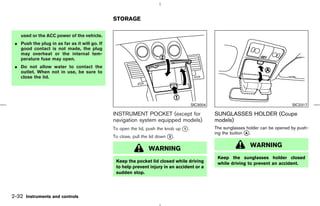
                                                                                                    Pre-driving checks and adjustments   3-23


                                                                                       ੬ 07.7.25/Z33-D/V5.0 ੭
¼ Use only an original equipment type          ¼ Never pour fuel into the throttle body       section.
   fuel-filler cap as a replacement. It has       to attempt to start your vehicle.
   a built-in safety valve needed for
   proper operation of the fuel system
   and emission control system. An in-                          CAUTION
   correct cap can result in a serious
   malfunction and possible injury. It          ¼ If fuel is spilled on the vehicle body,
   could also cause the malfunction in-           flush it away with water to avoid
   dicator light to come on.                      paint damage.
 ¼ Do not fill a portable fuel container in     ¼ Tighten until the fuel-filler cap clicks.
   the vehicle or trailer. Static electricity     Failure to tighten the fuel-filler cap
   can cause an explosion of flammable            properly may cause the              mal-
   liquid, vapor or gas in any vehicle or         function indicator light (MIL) to illu-
   trailer. To reduce the risk of serious         minate. If the        light illuminates
   injury or death when filling portable          because the fuel-filler cap is loose or
   fuel containers:                               missing, tighten or install the cap and
   — Always place the container on the            continue to drive the vehicle. The
       ground when filling.                             light should turn off after a few
   — Do not use electronic devices                driving trips. If the         light does
       when filling.                              not turn off after a few driving trips,
   — Keep the pump nozzle in contact              have the vehicle inspected by a
       with the container while you are           NISSAN dealer.
       filling it.
                                                ¼ For additional information, see the
   — Use only approved portable fuel
                                                  “Malfunction Indicator Light (MIL)” in
       containers for flammable liquid.
                                                  the “2. Instruments and controls”


3-24 Pre-driving checks and adjustments


                                                                                   ੬ 07.7.25/Z33-D/V5.0 ੭
STEERING WHEEL                                     SUN VISORS

                                                                          1. To block out glare from the front, swing down
                                                                             the main sun visor k .
                                                                                                  1

                                                                          2. To block glare from the side, remove the main
                                                                             sun visor from the center mount and swing it
                                                                             to the side k .
                                                                                          2

                                                                          3. To use the extension sun visor k (if so
                                                                                                                  3
                                                                             equipped), pull it out from the main sun visor
                                                                             as shown.

                                                                                             CAUTION
                                                                           Do not store the main sun visor before
                                       SPA2314                             storing the extension sun visor.

TILT OPERATION
Push the lock lever down and adjust the steering
wheel up or down to the desired position.
Push the lock lever up securely to lock the
steering wheel in place.

                  WARNING
 Do not adjust the steering wheel while
 driving. You could lose control of your
 vehicle and cause an accident.

                                                                SPA2176

                                                                            Pre-driving checks and adjustments       3-25


                                                                ੬ 07.7.25/Z33-D/V5.0 ੭
MIRRORS


                                    SPA1792                                           SPA2143                                             SPA2157

INSIDE MIRROR                                   The night position k will reduce glare from the
                                                                    1                             AUTOMATIC ANTI-GLARE INSIDE
                                                headlights of vehicles behind you at night.       MIRROR (if so equipped)
Adjust the height and the angle of the inside
mirror to the desired position.                 Use the day position k when driving in daylight
                                                                     2
                                                                                                  The inside mirror is designed so that it automati-
                                                hours.
                                                                                                  cally changes reflection according to the inten-
                                                                                                  sity of the headlight of the following vehicle.
                                                                 WARNING
                                                                                                  When the inside mirror is in the “I” (AUTO)
                                                                                                  position k , excessive glare from the headlights
                                                                                                           1
                                                 Use the night position only when neces-
                                                                                                  of the vehicle behind you will be reduced. The
                                                 sary, because it reduces rear view clar-
                                                                                                  AUTO indicator light k (green) will be on.
                                                                                                                          A
                                                 ity.                                             When the switch of the inside mirror is in the
                                                                                                  “k” (OFF) position k , the inside mirror will
                                                                                                                        2
                                                                                                  operate normally.
                                                                                                  For HomeLink     Universal Transceiver, see the
3-26 Pre-driving checks and adjustments


                                                                                     ੬ 07.7.25/Z33-D/V5.0 ੭
description in the “2. Instruments and controls”                                               The outside mirror will operate only when the
section.                                                                                       ignition switch is in the ACC or ON position.
                                                                                               Turn the control knob (located on the driver side
                                                                                               door armrest) to right or left to select the right or
                                                                                               left outside mirror, then adjust using the knob.


                                                                                     SPA1390

                                                   OUTSIDE MIRRORS

                                                                  WARNING
                                                   Objects viewed in the outside mirror on
                                                   the passenger side are closer than they
                                                   appear. Be careful when moving to the
                                                   right. Using only this mirror could cause
                                                   an accident. Use the inside mirror or
                                                   glance over your shoulder to properly
                                                   judge distances to other objects.


                                                                                                 Pre-driving checks and adjustments          3-27


                                                                                    ੬ 07.7.25/Z33-D/V5.0 ੭
IC0565

Foldable outside mirrors
Fold the outside mirror by pushing it toward the
rear of the vehicle.


3-28 Pre-driving checks and adjustments


                                                   ੬ 07.7.25/Z33-D/V5.0 ੭
4 Display screen, heater, air conditioner and
  audio systems

Safety note .............................................................................. 4-2       AM radio reception ......................................................             4-13
Control panel buttons — with navigation system.......... 4-2                                         Satellite (SAT) radio reception (if so equipped) ...                                  4-13
   Names of the components ............................................ 4-2                          Audio operation precautions .....................................                     4-14
   How to use joystick and “ENTER” button................. 4-3                                       FM-AM radio with compact disc (CD) player ......                                      4-19
   How to use “BACK” button .......................................... 4-3                           FM-AM-SAT radio with compact disc (CD)
   Setting up the start-up screen ..................................... 4-3                          changer ...........................................................................   4-23
   How to use “INFO” button ............................................ 4-3                         CD care and cleaning .................................................                4-29
   How to use “SETTING” button .................................... 4-5                              Steering wheel switch for audio control (if so
   How to use the “                     ” button.................................... 4-8             equipped).........................................................................    4-29
Ventilators ............................................................................... 4-8
                                                                                                     Antenna ...........................................................................   4-30
   Center ventilators ............................................................ 4-8
                                                                                                  Car phone or CB radio ....................................................               4-31
   Side ventilators ................................................................ 4-8
                                                                                                  Bluetooth Hands-Free Phone System with
Heater and air conditioner (Automatic) .......................... 4-9
                                                                                                  NISSAN voice recognition (if so equipped) ...............                                4-31
   Automatic operation .................................................... 4-10
   Manual operation .......................................................... 4-10                  Using the system ...........................................................          4-33
   Operating tips ............................................................... 4-11               Control buttons ..............................................................        4-35
Servicing air conditioner .................................................. 4-12                    Getting started ...............................................................       4-35
Audio system ....................................................................... 4-12            List of voice commands...............................................                 4-37
   Radio ............................................................................... 4-12        Speaker adaptation (SA) mode .................................                        4-42
   FM radio reception ...................................................... 4-13                    Troubleshooting guide..................................................               4-45


                                                                                                                  ੬ 07.7.25/Z33-D/V5.0 ੭
SAFETY NOTE                                    CONTROL PANEL BUTTONS —
                                               WITH NAVIGATION SYSTEM

                WARNING
 ¼ Do not disassemble or modify this
   system. If you do, it may result in
   accidents, fire, or electric shock.
 ¼ Do not use this system if you notice
   any abnormality, such as a frozen
   screen or lack of sound. Continued
   use of the system may result in acci-
   dent, fire or electric shock.
 ¼ In case you notice any foreign object
   in the system hardware, spill liquid                                                                                                  SAA1289
   on it, or notice smoke or smell com-        When you use this system, make sure the engine     NAMES OF THE COMPONENTS
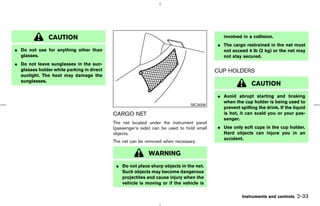
   ing from it, stop using the system          is running.
   immediately and contact a NISSAN                                                               1. JOYSTICK and “ENTER” button
                                               If you use the system with the engine not
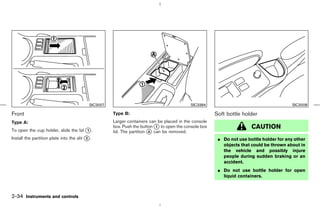
   dealer. Ignoring such conditions may                                                           2. “INFO” button
                                               running (ignition ON or ACC) for a long
   lead to accidents, fire, or electric        time, it will use up all the battery power,        3. “SETTING” button
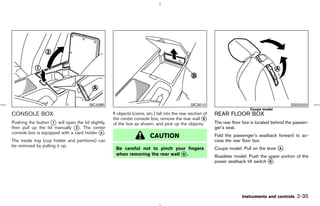
   shock.                                      and the engine will not start.
                                                                                                  4. “BACK” button
                                               Reference symbols:
                                                                                                  5. “     ” brightness control button
                                               “ENTER” button
                                                                                                  For Navigation System control buttons (other
                                               This is a button on the control panel.             than above), refer to the separate Navigation
                                               “Display” key                                      System Owner’s Manual.

                                               This is a select key on the screen. By selecting
                                               this key you can proceed to the next function.

4-2 Display screen, heater, air conditioner and audio systems


                                                                                        ੬ 07.7.25/Z33-D/V5.0 ੭
HOW TO USE JOYSTICK AND                               SETTING UP THE START-UP
“ENTER” BUTTON                                        SCREEN
Choose an item on the display using the joystick      When you turn the ignition key to the ACC
and push the ENTER button for operation.              position, the SYSTEM START-UP warning is
                                                      displayed on the screen. Read the warning and
HOW TO USE “BACK” BUTTON                              select the “OK” key then push the “ENTER”
This button has two functions.                        button.

To return to the previous screen:                     If you do not push the ENTER button, this
                                                      system will not proceed to the next step display.
When this button is pushed during setup, setup
will be canceled, and the screen will return to the   To proceed to the next step, refer to the separate
previous screen.                                      Navigation System Owner’s Manual.

To finish the set-up:                                                                                                                                SAA1290
When this button is pushed after setup is com-
pleted, the settings will be renewed as directed,                                                          HOW TO USE “INFO” BUTTON
and the screen will return to the map.                                                                     When the “INFO” button is pushed, the “Main-
INFO:                                                                                                      tenance” screen will be displayed.
When the “BACK” button must be pushed, (for                                                                Maintenance information
example, after the setup is finished) instructions
are given in the operation procedure of each                                                               To set the maintenance interval for the Engine
section in this manual. If the “BACK” button is                                                            Oil or Oil Filter, choose an item using the joystick
pushed when not finished with the setup, the                                                               and push the “ENTER” button.
setting will be canceled, and the screen will                                                              You can also set to display a message to remind
return to the previous screen.                                                                             you that the maintenance needs to be per-
                                                                                                           formed.
                                                                                                           The following example shows how to set the
                                                                                                           engine oil change interval. Use the same steps
                                                                                        Display screen, heater, air conditioner and audio systems         4-3


                                                                                             ੬ 07.7.25/Z33-D/V5.0 ੭
to set the other maintenance information.                                                         “Maintenance” display cannot be operated
                                                                                                  when the vehicle is moving. Stop the vehicle in a
                                                                                                  safe place to see the information.


                                                                                      SAA1291

                                               1. Reset the driving distance to the new main-
                                                  tenance schedule.
                                               2. Set the interval (mileage) of the maintenance
                                                  schedule. To determine the recommended
                                                  maintenance interval, refer to your “NISSAN
                                                  Service and Maintenance Guide”.
                                               3. To display the MAINTENANCE INFORMA-
                                                  TION automatically when the set trip distance
                                                  is reached, highlight the “Interval Re-
                                                  minder” key with the joystick and push the
                                                  “ENTER” button.
                                               4. To return the display to the “Maintenance”
                                                  screen, push the “BACK” button.

4-4 Display screen, heater, air conditioner and audio systems


                                                                                     ੬ 07.7.25/Z33-D/V5.0 ੭
SAA1332                                                  SAA1292                                         SAA1293
                                                              Engine Oil k /Oil Filter k
                                                                         1             2
Maintenance notice                                 The “Maintenance Notice” screen displays                 *: Refer to the separate Navigation System
                                                   each time the ignition switch is turned ON until         Owner’s Manual.
The “Maintenance Notice” screen (“ENGINE           one of the following conditions are met:
OIL” or “OIL FILTER”) will be automatically                                                                 HOW TO USE “SETTING” BUTTON
displayed as shown when both of the following      ¼ “Reset Distance” is selected.
                                                                                                            The “Settings” screen will appear when the
conditions are met:                                ¼ “Interval Reminder” is set OFF.                        “SETTING” button is pushed.
¼ the vehicle is driven the set distance and the   ¼ the maintenance interval is set again.
  ignition switch is turned OFF.
¼ the ignition switch is turned ON the next time
  the vehicle will be driven.
To return to the previous display after the
“Maintenance Notice” screen is displayed,
push the “BACK” button.

                                                                                           Display screen, heater, air conditioner and audio systems   4-5


                                                                                               ੬ 07.7.25/Z33-D/V5.0 ੭
and turn on the “ON” indicator.
                                                   Brightness/Contrast:
                                                   To adjust the brightness and contrast of the
                                                   screen, select the “Brightness” or “Contrast”
                                                   key and push the “ENTER” button. Then you can
                                                   adjust the brightness to darker or brighter and
                                                   the contrast to lower or higher using the joystick.


                                       SAA1540                                                                                                   SAA1091

Display settings                                                                                         Clock settings
The following menu will appear when pushing                                                              The following display will appear when pushing
the “SETTING” button, selecting “Display” key                                                            the “SETTING” button, selecting the “Clock”
and pushing the “ENTER” button.                                                                          key and pushing the “ENTER” button.
Display:                                                                                                 On-screen Clock:

To turn off the screen, select the “Display” key                                                         When this item is turned to ON, a clock is always
and push the “ENTER” button to turn off the                                                              displayed in the upper right corner of the screen.
“ON” indicator. When any mode button is                                                                  This clock will indicate the time almost exactly
pushed with the screen off, the screen turns on                                                          because it is always adjusted by the GPS
for further operation. The screen will turn off                                                          system.
automatically 5 seconds after the operation is
finished on the map display.
To turn on the screen, select the “Display” key
4-6 Display screen, heater, air conditioner and audio systems


                                                                                           ੬ 07.7.25/Z33-D/V5.0 ੭
Clock Format:
Choose either the 12-hour clock display or the
24-hour clock display.
Offset Adjust:
Adjust the time by increasing or decreasing per
minute.
Daylight Saving Time:
Turn this item to ON for daylight saving time
application.
Time Zone:
Choose the time zone from the following
                                                                                       SAA1295                                             SAA1296
¼ Pacific                                                                                                     Display of Select Language
                                                  Language/Units settings                          Select the “Select Language” or “Select
¼ Mountain                                                                                         Units” key and push the “ENTER” button.
                                                  The Language/Units settings screen will appear
¼ Central                                         when selecting the “Language/Units” key and      Language: “English” or “Français”
¼ Eastern                                         pushing the “ENTER” button.                      Unit: “US” — Mile, °F, MPG
¼ Atlantic                                                                                               “Metric” — km, °C, L/100 km

¼ Newfoundland                                                                                     Select the “ON” key of the desired language or
                                                                                                   units and push the “ENTER” button.


                                                                                 Display screen, heater, air conditioner and audio systems    4-7


                                                                                      ੬ 07.7.25/Z33-D/V5.0 ੭
VENTILATORS

HOW TO USE THE “                    ”
BUTTON
Push the “       ” (DAY/NIGHT) button to switch
the display brightness to the daytime or night-
time mode, and adjust the brightness by moving
the joystick right or left.
If no operation is done within 10 seconds, or if
the “BACK” button is pushed, the display will
return to the previous display.
Push the “       ” button for more than 2 sec-
onds to turn the display off. Push the button
again for more than 2 seconds to turn the display
on.                                                                                          SAA0600                                            SAA0601

                                                    CENTER VENTILATORS                                   SIDE VENTILATORS
                                                    Adjust the air flow direction of ventilators.        Adjust the air flow direction of ventilators by k
                                                                                                                                                         A
                                                                                                         opening, k closing or k rotating as illustrated.
                                                    Moving the lever up or down will open k or
                                                                                                                   B              C
                                                                                          A
                                                    close k the vents.
                                                          B

                                                    To change the air flow direction, turn the dial k.
                                                                                                    C


4-8 Display screen, heater, air conditioner and audio systems


                                                                                            ੬ 07.7.25/Z33-D/V5.0 ੭
HEATER AND AIR CONDITIONER
(Automatic)
                                                                                                the assistance of others in your ve-
                                                                                                hicle. Unattended pets should also
                                                                                                not be left alone.
                                                                                             ¼ Do not use the recirculation mode for
                                                                                               long periods as it may cause the
                                                                                               interior air to become stale and the
                                                                                               windows to fog up.


                                                                                            Start the engine and operate the controls to
                                                                                            activate the air conditioner.
                                                                                            NOTE:
                                                                                SAA1297
                                                                                            In your vehicle, the air conditioner system
1. Air flow control dial                                                                    is designed to automatically activate the
2. Temperature control dial*                                   WARNING                      cooling function when operating the air
                                                                                            flow control dial, the fan speed control dial
* The display of degrees:                                                                   or the air intake button. (The indicator light
                                                 ¼ The air conditioner cooling function     on the A/C button will illuminate.) Push the
  “60-75-90” is used for °F (US).
  “18-25-32” is used for °C (Canada).              operates only when the engine is         A/C button off when the cooling function is
                                                   running.                                 not necessary.
3. Fan speed control dial
                                                 ¼ On hot, sunny days, temperatures in
4. Rear window defroster button                    a closed vehicle could quickly be-
   (See the “2. Instruments and controls” sec-
                                                   come high enough to cause severe or
   tion.)
                                                   possibly fatal injuries to people or
5. Air intake button                               animals. Do not leave children or
   (Air recirculation and Fresh air)               adults who would normally require
6. A/C (air conditioner) button

                                                                           Display screen, heater, air conditioner and audio systems   4-9


                                                                                ੬ 07.7.25/Z33-D/V5.0 ੭
AUTOMATIC OPERATION                                  need to heat only, use this mode.                      windows, turn the fan speed control dial to
                                                                                                            the maximum position.
Cooling and/or dehumidified heating                  1. Turn the fan speed control dial and air flow
                                                        control dial to the AUTO position. (The air      ¼ As soon as possible after the windshield is
(AUTO)                                                  conditioner will turn on.)                         clean, turn the air flow control dial to the
This mode may be normally used all year round                                                              AUTO position to return to the auto mode.
                                                     2. Push the A/C button to turn off the air
as the system automatically works to keep a             conditioner. (The A/C button indicator light     ¼ When the air flow control dial is turned to the
constant temperature. Air flow distribution and         will turn off.)                                           or       position, the air conditioner
fan speed are also controlled automatically.                                                               will automatically be turned on at outside
                                                     3. Turn the temperature control dial to set the
1. Turn the fan speed control dial and air flow                                                            temperatures above 23°F (−5°C) to defog
                                                        desired temperature.
   control dial to the AUTO position. The air                                                              the windshield, and the air recirculation mode
   conditioner will automatically turn on. (The      ¼ The temperature of the passenger compart-           will automatically be turned off.
   A/C button indicator light illuminates.)            ment will be maintained automatically. Air
                                                       flow distribution and fan speed are also con-        Outside air is drawn into the passenger
2. Turn the temperature control dial to set the        trolled automatically.                               compartment to improve the defogging per-
   desired temperature.                                                                                     formance.
                                                     ¼ Do not set the temperature lower than the
¼ Adjust the temperature to about 75°F (24°C)          outside air temperature. Otherwise the sys-       MANUAL OPERATION
  for normal operation.                                tem may not work properly.
                                                                                                         Fan speed control
¼ The temperature of the passenger compart-          ¼ Not recommended if windows fog up.
                                                                                                         Turn the fan speed control dial        to manually
  ment will be maintained automatically. Air
  flow distribution and fan speed are also con-      Dehumidified defrosting or defogging                control the fan speed.
  trolled automatically.                             1. Turn the fan speed control dial to the desired   Turn the dial to the AUTO position to return to
                                                        position.                                        automatic control of the fan speed.
A visible mist may be seen coming from the
ventilators in hot, humid conditions as the air is   2. Turn the air flow control dial to the DEF        Air recirculation/Fresh air
cooled rapidly. This does not indicate a malfunc-            position.
tion.                                                                                                    Each time the air intake button is pushed, the
                                                     3. Turn the temperature control dial to set the     indicator light on the button will alternate
Heating (AUTO; A/C off)                                 desired temperature.                                   (Air recirculation) and     (Fresh air).
The air conditioner does not activate. When you      ¼ To quickly remove ice from the outside of the     When the         indicator light is on, the interior
4-10 Display screen, heater, air conditioner and audio systems


                                                                                            ੬ 07.7.25/Z33-D/V5.0 ੭
air is recirculated. (When the air recirculation      To turn the system off
mode is selected with the A/C indicator off while
the fan speed control dial is in the AUTO             Turn the fan speed control dial to the OFF
position, the air conditioner will turn on.)          position.
When the         indicator light is on, the outside   OPERATING TIPS
air is drawn into the passenger compartment.
                                                      When the engine coolant temperature and out-
¼ When the air intake button is pushed for            side air temperature are low, the air flow from the
  longer than 1.5 seconds, both indicator lights      foot outlets may not operate for a maximum of
  (       and          ) will flash twice, and then   150 seconds. However, this is not a malfunction.
  the intake air will be controlled automatically.    After the coolant temperature warms up, the air
  During this AUTO mode, the indicator light of       flow from the foot outlets will operate normally.
  the currently selected mode illuminates.
¼ When the air flow control dial is in the
                                                                                                                                                   SAA0603
      or       position, the air recirculation
  mode does not activate.                                                                                   Sensor k on the instrument panel helps main-
                                                                                                                     A

Air flow control                                                                                            tain a constant temperature; do not put anything
                                                                                                            on or around this sensor.
Turning the air flow control dial selects the air
outlet to:
      : Air flows from center and side ventila-
        tors.
      : Air flows from center and side ventila-
        tors and foot outlets.
      : Air flows mainly from foot outlets.
      : Air flows from defroster and foot out-
        lets.
      : Air flows mainly from defroster outlets.
                                                                                       Display screen, heater, air conditioner and audio systems      4-11


                                                                                              ੬ 07.7.25/Z33-D/V5.0 ੭
SERVICING AIR CONDITIONER                            AUDIO SYSTEM

The air conditioning system in your NISSAN           RADIO                                                   do not indicate any malfunction in your radio
vehicle is charged with a refrigerant designed                                                               system.
with the environment in mind. This refrigerant       Turn the ignition key to ACC or ON and press
                                                     the POWER, FM or AM button to turn on the               Remember that a moving vehicle is not the ideal
will not harm the earth’s ozone layer. How-                                                                  place to listen to a radio. Because of the move-
ever, special charging equipment and lubricant       radio. If you listen to the radio with the engine not
                                                     running, the key should be turned to the ACC            ment, reception conditions will constantly
are required when servicing your NISSAN air                                                                  change. Buildings, terrain, signal distance and
conditioner. Using improper refrigerants or lubri-   position.
                                                                                                             interference from other vehicles can work
cants will cause severe damage to your air           Radio reception is affected by station signal           against ideal reception. Described below are
conditioning system. See “Capacities and rec-        strength, distance from radio transmitter, build-       some of the factors that can affect your radio
ommended fuel/lubricants” in the “9. Technical       ings, bridges, mountains and other external in-         reception.
and consumer information” section for air con-       fluences. Intermittent changes in reception qual-       Some cellular phones or other devices may
ditioning system refrigerant and lubricant recom-    ity normally are caused by these external               cause interference or a buzzing noise to come
mendations.                                          influences.                                             from the audio system speakers. Storing the
A NISSAN dealer will be able to service your         Using a cellular phone in or near the ve-               device in a different location may reduce or
environmentally friendly air conditioning system.    hicle may influence radio reception quality.            eliminate the noise.

                  WARNING                            Radio reception
                                                     Your radio system is equipped with state-of-the-
 The air conditioner system contains re-             art electronic circuits to enhance radio recep-
 frigerant under high pressure. To avoid             tion. These circuits are designed to extend re-
 personal injury, any air conditioner ser-           ception range, and to enhance the quality of that
 vice should be done only by an experi-              reception.
 enced technician with proper equip-                 However there are some general characteristics
 ment.                                               of FM, AM and SAT (satellite — if so equipped)
                                                     radio signals that can affect radio reception
                                                     quality in a moving vehicle, even when the finest
                                                     equipment is used. These characteristics are
                                                     completely normal in a given reception area, and

4-12 Display screen, heater, air conditioner and audio systems


                                                                                               ੬ 07.7.25/Z33-D/V5.0 ੭
a station transmitter, the signals will tend to fade   SATELLITE (SAT) RADIO
                                                       and/or drift.                                          RECEPTION (if so equipped)
                                                       Static and flutter: During signal interference from    When the satellite radio is first installed or the
                                                       buildings, large hills or due to antenna position,     battery has been replaced, the satellite radio
                                                       usually in conjunction with increased distance         may not work properly. This is not a malfunction.
                                                       from the station transmitter, static or flutter can    Wait more than 10 minutes with the satellite
                                                       be heard. This can be reduced by lowering the          radio ON for the satellite radio to receive all of
                                                       treble setting to reduce treble response.              the necessary data.
                                                       Multipath reception: Because of the reflective         No satellite radio reception is available when the
                                                       characteristics of FM signals, direct and re-          SAT band option is selected unless optional
                                                       flected signals reach the receiver at the same         satellite receiver and antenna are installed, and
                                                       time. The signals may cancel each other, result-       an XM® satellite radio service subscription is
                                                       ing in momentary flutter or loss of sound.             active.
                                          SAA0306
                                                       AM RADIO RECEPTION                                     Satellite radio performance may be affected if
FM RADIO RECEPTION                                     AM signals, because of their low frequency, can        cargo carried on the roof blocks the satellite
                                                       bend around objects and skip along the ground.         radio signal.
Range: FM range is normally limited to 25 to 30
miles (40 to 48 km), with monaural (single             In addition, the signals can be bounced off the        If possible, do not put cargo over the satellite
channel) FM having slightly more range than            ionosphere and bent back to earth. Because of          antenna.
stereo FM. External influences may sometimes           these characteristics. AM signals are also sub-
                                                       ject to interference as they travel from transmitter   A buildup of ice on the satellite radio antenna
interfere with FM station reception even if the FM                                                            can affect satellite radio performance. Remove
                                                       to receiver.
station is within 25 miles (40 km). The strength                                                              the ice to restore satellite radio reception.
of the FM signal is directly related to the distance   Fading: Occurs while the vehicle is passing
between the transmitter and receiver. FM signals       through freeway underpasses or in areas with           Satellite radio is not available in Alaska and
                                                       many tall buildings. It can also occur for several     Hawaii.
follow a line-of-sight path, exhibiting many of the
same characteristics as light. For example they        seconds during ionospheric turbulence even in
will reflect off objects.                              areas where no obstacles exist.

Fade and drift: As your vehicle moves away from        Static: Caused by thunderstorms, electrical
                                                       power lines, electric signs and even traffic lights.
                                                                                         Display screen, heater, air conditioner and audio systems       4-13


                                                                                                ੬ 07.7.25/Z33-D/V5.0 ੭
AUDIO OPERATION PRECAUTIONS                                                                ¼ CDs that are of poor quality, dirty,
                                                                                             scratched, covered with fingerprints, or
Compact Disc (CD) player                                                                     that have pin holes may not work prop-
                                                                                             erly.
                 CAUTION                                                                   ¼ The following CDs may not work prop-
                                                                                             erly:
 ¼ Do not force a compact disc into the                                                      ¼ Copy control compact discs (CCCD)
   CD insert slot. This could damage the
   CD and/or CD changer/player.                                                              ¼ Recordable compact discs (CD-R)
                                                                                             ¼ Rewritable compact discs (CD-RW)
 ¼ Trying to load a CD with the CD door
   closed could damage the CD and/or                                                       ¼ Do not use the following CDs as they
   CD changer.                                                                               may cause the CD player to malfunction.
                                                                                             ¼ 3.1 in (8 cm) discs
¼ During cold weather or rainy days, the                                                     ¼ CDs that are not round
  player may malfunction due to the hu-
  midity. If this occurs, remove the CD and                                                  ¼ CDs with a paper label
  dehumidify or ventilate the player com-                                                    ¼ CDs that are warped, scratched, or
  pletely.                                                                                     have abnormal edges
¼ The player may skip while driving on
  rough roads.                                                                             ¼ This audio system can only play prere-
                                                                                             corded CDs. CDs with MP3 or WMA
¼ The CD player sometimes cannot func-                                          SAA0480      format cannot be written in this audio
  tion when the passenger compartment                                                        system.
  temperature is extremely high. De-          ¼ Only use high quality 4.7 in (12 cm)
  crease the temperature before use.            round discs that have the “COMPACT         ¼ If the CD cannot be played, one of the
                                                disc DIGITAL AUDIO” logo on the disc or      following messages will be displayed.
                                                packaging.
                                              ¼ Do not expose the CD to direct sunlight.

4-14 Display screen, heater, air conditioner and audio systems


                                                                               ੬ 07.7.25/Z33-D/V5.0 ੭
CHECK DISC:                                          normal audio files. MP3 conversion of an             session, and writing more than once is called
                                                        audio track from CD-ROM can reduce the file          a multisession.
   ¼ Confirm that the CD is inserted cor-
                                                        size by approximately 10:1 ratio (Sampling:       ¼ ID3/WMA Tag — The ID3/WMA tag is the
     rectly (the label side is facing up,
                                                        44.1 kHz, Bit rate: 128 kbps) with virtually no     part of the encoded MP3 or WMA file that
     etc.).
                                                        perceptible loss in quality. MP3 compression        contains information about the digital music
   ¼ Confirm that the CD is not bent or                 removes the redundant and irrelevant parts of       file such as song title, artist, album title,
     warped and it is free of scratches.                a sound signal that the human ear doesn’t           encoding bit rate, track time duration, etc.
   PUSH EJECT:                                          hear.                                               ID3 tag information is displayed on the
                                                     ¼ WMA — Windows Media Audio (WMA) is a                 Album/Artist/Track title line on the display.
   This is a malfunction due to excessive
   temperature inside the player. Remove               compressed audio format created by Mi-             * Windows and Windows Media are either
   the CD by pushing the EJECT button.                 crosoft as an alternative to MP3. The WMA            registered trademarks and trademarks of Mi-
   After a short time, reinsert the CD. The            codec offers greater file compression than           crosoft Corporation in the United States
   CD can be played when the temperature               the MP3 codec, enabling storage of more              and/or other countries.
   of the player returns to normal.                    digital audio tracks in the same amount of
                                                       space when compared to MP3s at the same
   UNPLAYABLE:
                                                       level of quality.
   The file is unplayable in this audio sys-
   tem (only MP3 or WMA CD in the audio              ¼ Bit rate — Bit rate denotes the number of bits
   system with a CD changer).                          per second used by a digital music file. The
                                                       size and quality of a compressed digital audio
Compact Disc (CD) with MP3 or                          file is determined by the bit rate used when
WMA (for the audio system with a                       encoding the file.
6CD changer)                                         ¼ Sampling frequency — Sampling frequency is
Explanation of terms:                                  the rate at which the samples of a signal are
                                                       converted from analog to digital (A/D conver-
¼ MP3 — MP3 is short for Moving Pictures               sion) per second.
  Experts Group Audio Layer 3. MP3 is the
  most well-known compressed digital audio           ¼ Multisession — Multisession is one of the
  file format. This format allows for near “CD         methods for writing data to media. Writing
  quality” sound, but at a fraction of the size of     data once to the media is called a single
                                                                                     Display screen, heater, air conditioner and audio systems      4-15


                                                                                            ੬ 07.7.25/Z33-D/V5.0 ੭
¼ If there is a file in the top level of the disc,
                                                   “ROOT” is displayed.
                                                 ¼ The playback order is the order in which the
                                                   files were written by the writing software.
                                                   Therefore, the files might not play in the
                                                   desired order.


                                     SAA1025

Playback order:
Playback order of the CD with compressed files
(MP3/WMA) is as illustrated above.
¼ The names of folders not containing
  MP3/WMA files are not shown in the display.

4-16 Display screen, heater, air conditioner and audio systems


                                                                                        ੬ 07.7.25/Z33-D/V5.0 ੭
Specification chart:
 Supported media                                         CD, CD-R, CD-RW

                                                         ISO9660 LEVEL1, ISO9660 LEVEL2, Romeo, Joliet
 Supported file systems                                  * ISO9660 Level 3 (packet writing) is not sup-
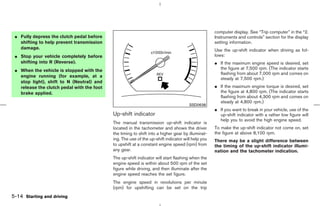
                                                         ported.

                                    Version              MPEG1, MPEG2, MPEG2.5
                       MP3          Sampling frequency   8 kHz - 48 kHz

 Supported ver-                     Bit rate             8 kbps - 320 kbps, VBR
 sions*1                            Version              WMA7, WMA8, WMA9

                       WMA          Sampling frequency   32 kHz - 48 kHz
                                    Bit rate             48 kbps - 192 kbps, VBR

                                                         ID3 tag VER1.0, VER1.1, VER2.2, VER2.3 (MP3
 Tag information (Song title and Artist name)
                                                         only)
                                                         Folder levels: 8, Folders: 255 (including root folder),
 Folder levels
                                                         Files: 512 (Max. 255 files for one folder)

 Text character number limitation                        128 characters
                                                         01: ASCII, 02: ISO-8859-1, 03: UNICODE
                                                         (UTF-16 BOM Big Endian), 04: UNICODE (UTF-16
 Displayable character codes*2
                                                         Non-BOM Big Endian), 05: UNICODE (UTF-8), 06:
                                                         UNICODE (Non-UTF-16 BOM Little Endian)

*1 Files created with a combination of 48 kHz sampling frequency and 64 kbps bit rate cannot be
   played.
*2 Available codes depend on what kind of media, versions and information are going to be displayed.
                                                                                              Display screen, heater, air conditioner and audio systems   4-17


                                                                                                      ੬ 07.7.25/Z33-D/V5.0 ੭
Troubleshooting guide:
               Symptom                                                                      Cause and Countermeasure
                                       Check if the disc was inserted correctly.
                                       Check if the disc is scratched or dirty.
                                       Check if there is condensation inside the player. If there is, wait until the condensation is gone (about 1 hour) before using the
                                       player.
                                       If there is a temperature increase error, the CD player will play correctly after it returns to the normal temperature.
                                       If there is a mixture of music CD files (CD-DA data) and MP3/WMA files on a CD, only the music CD files (CD-DA data) will be
 Cannot play                           played.
                                       Files with extensions other than “.MP3”, “.WMA”, “.mp3” or “.wma” cannot be played. In addition, the character codes and num-
                                       ber of characters for folder names and file names should be in compliance with the specifications.
                                       Check if the disc or the file is generated in an irregular format. This may occur depending on the variation or the setting of
                                       MP3/WMA writing applications or other text editing applications.
                                       Check if the finalization process, such as session close and disc close, is done for the disc.
                                       Check if the disc is protected by copyright.
                                       Check if the disc is scratched or dirty.
 Poor sound quality
                                       Bit rate may be too low.
 It takes a relatively long time be-   If there are many folder or file levels on the MP3/WMA disc, or if it is a multisession disc, some time may be required before the
 fore the music starts playing.        music starts playing.
                                       The writing software and hardware combination might not match, or the writing speed, writing depth, writing width, etc., might not
 Music cuts off or skips
                                       match the specifications. Try using the slowest writing speed.
 Skipping with high bit rate files     Skipping may occur with large quantities of data, such as for high bit rate data.
 Move immediately to the next song When a non-MP3/WMA file has been given an extension of “.MP3”, “.WMA”, “.mp3” or “.wma”, or when play is prohibited by
 when playing.                     copyright protection, there will be approximately 5 seconds of no sound and then the player will skip to the next song.
 The songs do not play back in the     The playback order is the order in which the files were written by the writing software. Therefore, the files might not play in the
 desired order.                        desired order.

4-18 Display screen, heater, air conditioner and audio systems


                                                                                                        ੬ 07.7.25/Z33-D/V5.0 ੭
8. RPT (Repeat) play button
                                                                               9. CD EJECT button
                                                                               10. TUNE/FF⋅REW button
                                                                               11. ON⋅OFF/VOL (Volume) control knob
                                                                               12. Audio/Clock display
                                                                               13. Station and preset select button
                                                                               14. AUDIO button
                                                                               Audio main operation
                                                                               For all operation precautions, see “Audio opera-
                                                                               tion precautions” earlier in this section.
                                                                               ON⋅OFF/Volume control:
                                                                               Turn the ignition key to ACC or ON, and then
                                                                               push the ON⋅OFF/VOL (Volume) control knob
                                                                               while the system is off to call up the mode (radio
                                                                               or CD) which was playing immediately before
                                                                               the system was turned off. When no CD is
                                                                               loaded, the radio will come on. While the system
                                                                               is on, pushing the ON⋅OFF/VOL control knob
                                                                               turns the system off.
                                                                    SAA1298
                                                                               Turn the ON⋅OFF/VOL control knob to adjust
FM-AM RADIO WITH COMPACT        3.   DISP (Display) CHANGE button              the volume.
DISC (CD) PLAYER                4.   SCAN tuning button
                                                                               AUDIO button (BASS, TREBLE, FADER,
                                5.   CD play button
1. MUTE button                                                                 BALANCE):
                                6.   RADIO (FM/AM) band select button
2. SEEK/APS REW, APS FF/TRACK                                                  Press the AUDIO button to change the selecting
   CHANGE button                7.   MIX play button
                                                                               mode as follows.
                                                             Display screen, heater, air conditioner and audio systems    4-19


                                                                   ੬ 07.7.25/Z33-D/V5.0 ੭
BASS → TREBLE → FADE → BALANCE                        played, the display will show the CD play time.                         SEEK tuning:
To adjust Bass, Treble, Fader and Balance, push       FM-AM radio operation                                 Push the SEEK button           or       to tune
the AUDIO button until the desired mode                                                                     from high to low or low to high frequencies and
(BASS, TREBLE, FADER or BALANCE) ap-                           RADIO (FM/AM) band select:                   stops at the next broadcasting station.
pears in the display. Push the TUNE                   Pushing the RADIO band select button will
                                                                                                                    SCAN tuning:
(       ,       ) or SEEK (      ,      ) button      change the band as follows:
to adjust Bass and Treble to the desired level.                                                             Push the SCAN tuning button to tune from low
                                                      AM → FM1 → FM2 → AM
Use the TUNE or SEEK button also to adjust                                                                  to high frequencies and stops at each broad-
Fader or Balance modes. Fader adjusts the             When RADIO band select button is pushed               casting station for 5 seconds. Pushing the but-
sound level between the front and rear speakers       while the ignition switch is in the ACC or ON, the    ton again during this 5 second period will stop
and Balance adjusts the sound between the             radio will come on at the station last played.        SCAN tuning and the radio will remain tuned to
right and left speakers.                              The last station played will also come on when        that station.
After 10 seconds, the radio or CD display             the power knob is turned to ON.                       If the SCAN tuning button is not pushed within 5
reappears. Once the sound quality is set to the       If a compact disc is playing when the RADIO           seconds, SCAN tuning moves to the next sta-
desired level, push the AUDIO button repeatedly       band select button is pushed, the compact disc        tion.
until the radio or CD display appears.                will automatically be turned off and the last radio
                                                                                                            Station memory operations:
                                                      station played will come on.
         MUTE button:
                                                                                                            Twelve stations can be set for the FM band (six
                                                      The FM stereo indicator ST will glow during FM
Push the MUTE button to mute the audio sound.                                                               for FM1, six for FM2) and six stations can be set
                                                      stereo reception. When the stereo broadcast
Push the MUTE button again to release the                                                                   for the AM band.
                                                      signal is weak, the radio will automatically
mute.
                                                      change from stereo to monaural reception.             1. Tune to the desired station using the SEEK,
 DISP DISPLAY CHANGE:                                                                                          SCAN or TUNE button.
                                                                         TUNE (Tuning) :
Push the DISP button for more than 1.5 seconds                                                              2. Select the desired station and keep pushing
                                                      Push the TUNE button        or     for manual
to adjust the digital clock display. See “Clock” in                                                            any of the desired station select buttons (1 to
                                                      tuning. To move quickly through the channels,
the “2. Instruments and controls” section for the                                                              6) until a beep sound is heard. (The radio
                                                      push and hold either side of the TUNE button
clock adjustment operation.
                                                      down for more than 0.5 second.                           mutes when the select button is pushed.)
When the DISP button is pushed for less than
                                                                                                            3. The channel indicator will then come on and
1.5 seconds while the compact disc is being
4-20 Display screen, heater, air conditioner and audio systems


                                                                                              ੬ 07.7.25/Z33-D/V5.0 ੭
the sound will resume. Memorizing is now            system will turn on and the compact disc will        (When the last program on the compact disc is
   complete.                                           start to play.                                       skipped through, the first program will be
                                                                                                            played.) When the       (APS REW) button is
4. Other buttons can be set in the same manner.        When the CD button is pushed with the com-
                                                                                                            pushed, the program being played returns to its
                                                       pact disc loaded but the radio playing, the radio
If the battery cable is disconnected, or if                                                                 beginning. Push several times to skip back
                                                       will automatically be turned off and the compact
the fuse blows, the radio memory will be                                                                    through programs. The compact disc will go
                                                       disc will start to play.
erased. In that case, reset the desired sta-                                                                back the number of times the button is pushed.
tions.                                                  DISP CD PLAY TIME:
                                                                                                                    SCAN tuning:
Compact disc (CD) player operation                     Push the DISP button for less than 1.5 seconds
                                                                                                            When the SCAN tuning button is pushed while
                                                       while the compact disc is being played to show
Turn the ignition key to the ACC or ON position                                                             the CD is being played, the beginning of all the
                                                       the play time on the display.
and insert the compact disc into the slot with the                                                          tracks of CD will be played for 10 seconds in
label side facing up. The compact disc will be                            FF (Fast Forward), REW            sequence.
guided automatically into the slot and start play-                        (Rewind):
                                                                                                            Pushing the button again during this 10 second
ing.                                                   When the         (fast forward) or      (rewind)     period will stop SCAN tuning. If the SCAN
After loading the disc, the number of tracks on        button is pushed while the compact disc is           tuning button is not pushed within 10 seconds,
the disc will appear on the display.                   being played, the compact disc will play while       SCAN tuning moves to the next CD program.
If the radio is already operating, it will automati-   fast forwarding or rewinding. When the button is
                                                                                                             MIX MIX play:
cally turn off and the compact disc will play.         released, the compact disc will return to normal
                                                       play speed.                                          When the MIX button is pushed while the com-
If the system has been turned off while the
                                                                                                            pact disc is being played, programs will be
compact disc was playing, pushing the                                      APS (Automatic Program
                                                                                                            played at random, not following the sequence on
ON⋅OFF/VOL control knob will start the com-                                Search) FF, APS REW/
                                                                                                            the compact disc. The same program may be
pact disc.                                                                 TRACK CHANGE:
                                                                                                            repeated twice. Push the MIX button again to
3.1 in (8 cm) diameter compact discs can also          When the          (APS FF) button is pushed          return to the normal play mode.
be used without an adapter.                            while the compact disc is being played, the
                                                                                                                    REPEAT (RPT) play:
                                                       program next to the present one will start to play
         CD PLAY:
                                                       from its beginning. Push several times to skip       When the RPT button is pushed while the
When the CD (CD play) button is pushed with            through programs. The compact disc will ad-          compact disc is being played, the play pattern
the system off and the compact disc loaded, the        vance the number of times the button is pushed.      can be changed as follows:
                                                                                       Display screen, heater, air conditioner and audio systems      4-21


                                                                                              ੬ 07.7.25/Z33-D/V5.0 ੭
¼ CD ERR F * — Eject the disc, and check
                                                                  whether it is a proper audio
                                                                  CD. (* shows a different
                                                                  number according to the au-
The display shows the following symbol; (no                       dio condition.)
mark): 1 CD RPT (Repeat)
                                                   CD IN indicator:
1: 1 TR (Track) RPT
                                                   CD IN indicator appears on the display when the
        CD EJECT:                                  CD is loaded.
When the CD EJECT button is pushed with the
compact disc loaded, the compact disc will be
ejected.
When this button is pushed while the compact
disc is being played, the compact disc will come
out and the system will turn off.
If the compact disc comes out and is not
removed, it will be pulled back into the slot
to protect it. (except for 3.1 in [8 cm] diam-
eter compact discs)
If the following message appears on the display,
push the EJECT button:
¼ CHECK DISC — Eject the disc, and check
               whether it is damaged or
               inserted upside-down.


4-22 Display screen, heater, air conditioner and audio systems


                                                                                        ੬ 07.7.25/Z33-D/V5.0 ੭
8. RPT (Repeat) play/CLOCK button
                                                                                  9. CD EJECT button
                                                                                  10. TUNE/FF⋅REW button
                                                                                  11. ON⋅OFF/VOL (Volume) control knob
                                                                                  12. Audio/Clock display
                                                                                  13. Station and preset (FM/AM/SAT*)/CD in-
                                                                                      sert or CD play select button
                                                                                  14. AUDIO button
                                                                                  * No satellite radio reception is available when
                                                                                    the SAT band option is selected unless op-
                                                                                    tional satellite receiver and antenna are in-
                                                                                    stalled, and an XM® satellite radio service
                                                                                    subscription is active.
                                                                                    It may take some time to receive the activation
                                                                                    signal after subscribing to the XM satellite
                                                                                    radio provider. After receiving the activation
                                                                                    signal, an available channel list will be auto-
                                                                                    matically updated in the radio. Turn the ignition
                                                                                    switch from the LOCK to ACC position to
                                                                                    update the channel list.
                                                                                  Satellite radio is not available in Alaska and
                                                                      SAA1299     Hawaii.

FM-AM-SAT RADIO WITH            3.   DISP (Display) CHANGE button                 Audio main operation
COMPACT DISC (CD) CHANGER       4.   SCAN tuning button
                                                                                  For all operation precautions, see “Audio opera-
                                5.   CD PLAY button                               tion precautions” earlier in this section.
1. CD LOAD button
                                6.   RADIO (FM/AM/SAT*) band select button
2. SEEK/APS REW, APS FF/TRACK                                                     Head unit:
                                7.   PTY (Program type), CAT (Category)* select
   CHANGE button
                                     button                                       The auto loudness circuit enhances the low
                                                               Display screen, heater, air conditioner and audio systems      4-23


                                                                     ੬ 07.7.25/Z33-D/V5.0 ੭
frequency range automatically in both radio re-      pears in the display. Push the TUNE                   FM-AM-SAT radio operation
ception and CD playback.                             (       ,       ) or SEEK (     ,       ) button
                                                     to adjust Bass and Treble to the desired level.                RADIO (FM/AM/SAT) band select:
This audio system has an active noise compen-        Use the TUNE or SEEK button also to adjust
sation feature called “Audio Pilot”. The Audio                                                             Pushing the RADIO band select button will
                                                     Fader or Balance modes. Fader adjusts the             change the band as follows:
Pilot uses a microphone to detect external road      sound level between the front and rear speakers
noise and automatically adjusts the amplifier to     and Balance adjusts the sound between the             (Without satellite radio)
compensate for any competing high, midrange,         right and left speakers.
or low frequency noise.                                                                                    AM → FM1 → FM2 → AM
                                                     To change the AUDIOP (Audio Pilot) mode to
ON⋅OFF/Volume control:                               OFF or ON, push the TUNE or SEEK button.              (With satellite radio)
Turn the ignition key to ACC or ON, and then         Once you have adjusted the sound quality to the       AM → FM1 → FM2 → SAT → AM
push the ON⋅OFF/VOL (Volume) control knob            desired level, push the AUDIO button repeatedly       No satellite operation is available during scrolling
while the system is off to call up the mode (radio   until the radio or CD display reappears. Other-       of modes, unless optional satellite receiver and
or CD) which was playing immediately before          wise, the radio or CD display will automatically      antenna are installed, and an XM satellite radio
the system was turned off. When no CD is             reappear after about 10 seconds.                      service subscription is active.
loaded, the radio will come on. While the system
is on, pushing the ON⋅OFF/VOL control knob                    CLOCK adjusting:                             When RADIO band select button is pushed
turns the system off.                                Push the RPT button for more than 1.5 seconds         while the ignition switch is in the ACC or ON, the
                                                     to adjust the digital clock display.                  radio will come on at the station last played.
Turn the ON⋅OFF/VOL control knob to adjust
the volume.                                          When the clock adjusting display is selected, the     The last station/channel played will also come on
                                                     time (hour or minute) will start flashing. See        when the ON⋅OFF/VOL control knob is pushed
AUDIO button:
                                                     “Clock” in the “2. Instruments and controls”          to ON.
Push the AUDIO button to change the selecting        section for the detailed clock adjustment opera-      If a compact disc is playing when the RADIO
mode as follows.                                     tion.                                                 band select button is turned to ON, the compact
BASS → TREBLE → FADE → BALANCE →                      DISP DISPLAY CHANGE:                                 disc will automatically be turned off and the last
AUDIOP                                                                                                     radio station/channel played will come on.
                                                     This button will work during satellite radio (if so
To adjust Bass, Treble, Fader and Balance, push      equipped) and CD operation. Find the detailed         The FM stereo indicator ST will glow during FM
the AUDIO button until the desired mode              function in the description of each item.             stereo reception. When the stereo broadcast
(BASS, TREBLE, FADER or BALANCE) ap-                                                                       signal is weak, the radio will automatically
4-24 Display screen, heater, air conditioner and audio systems


                                                                                             ੬ 07.7.25/Z33-D/V5.0 ੭
change from stereo to monaural reception.                If the SCAN tuning button is not pushed within 5      the sound will resume. Memorizing is now
                                                         seconds, SCAN tuning moves to the next sta-           complete.
If the satellite radio signal is lost due to interfer-
                                                         tion.                                              4. Other buttons can be set in the same manner.
ence while driving, in a parking structure or
tunnel for example, “NO SIGNAL” will be dis-              DISP SAT radio display change (if so              If the battery cable is disconnected, or if
played and no satellite radio station will be                  equipped):                                   the fuse blows, the radio memory will be
available.                                                                                                  erased. In that case, reset the desired sta-
                                                         ¼ Pushing the DISP button will display addi-
                    TUNE (Tuning):                         tional information (for example: Title, Artist   tions.
Push the TUNE button        or     for manual              name) about the satellite radio broadcast.       Radio data system (RDS):
tuning. To move quickly through the channels,            ¼ Pushing the DISP button for more than 1.5        RDS stands for Radio Data System, and is a
push and hold either side of the TUNE button               seconds will change the display mode as          data information service transmitted by some
down for more than 0.5 second.                             follows:                                         radio stations on the FM band (not AM band)
                    SEEK tuning:                                                                            and/or SAT encoded within a regular radio
                                                            Channel number → Channel name → Artist          broadcast. Currently, most RDS stations are in
(For FM and AM radio)                                       name → Song title → Channel number              large cities, but many stations are now consid-
Push the SEEK button           or       to tune          Station memory operations:                         ering broadcasting RDS data.
from high to low or low to high frequencies and                                                             RDS can display:
                                                         Twelve stations/channels can be set for the FM
stops at the next broadcasting station.
                                                         band (6 for FM1, 6 for FM2) and the SAT radio      ¼ Station call sign, such as “WHFR 98.3”.
(For satellite radio)                                    (6 for SAT1, 6 for SAT2), and 6 stations can be
                                                         set for the AM band.                               ¼ Station name, such as “The Groove”.
Push the SEEK button           or      to seek
channels of the next or previous category.               1. Tune to the desired station/channel using the   ¼ Music or programming type such as “Classi-
                                                            SEEK, SCAN or TUNE button.                        cal”, “Country”, or “Rock”.
         SCAN tuning:
                                                         2. Select the desired station/channel and keep     ¼ Traffic reports about delays or construction.
Push the SCAN tuning button to tune from low
                                                            pushing any of the desired station/channel      If the station broadcasts RDS information, the
to high frequencies and stops at each broad-
                                                            and preset buttons (1 to 6) until a beep        RDS icon is displayed.
casting station for 5 seconds. Pushing the but-
                                                            sound is heard. (The radio mutes when the
ton again during this 5 second period will stop
                                                            station and preset button is pushed.)
SCAN tuning and the radio will remain tuned to
that station.                                            3. The channel indicator will then come on and
                                                                                        Display screen, heater, air conditioner and audio systems    4-25


                                                                                               ੬ 07.7.25/Z33-D/V5.0 ੭
Program type (PTY)/Category                   pushing the preset buttons for more than 1.5   3. PTY (CAT) SCAN tuning mode
        (CAT) select:                                 seconds when the desired PTY (CAT) name
                                                      is in the display.                                Push the SCAN tuning button to tune the
When PTY button is pushed during FM mode,                                                               PTY (CAT) name station, and stop at each
the PTY (CAT) name of the current tuned station                                                         broadcasting station for 5 seconds. Pushing
is displayed. When the PTY (CAT) button is                                                              the button again during this 5 second period
pushed during satellite radio mode (if so                                                               will stop SCAN tuning and the radio will
equipped), the category name of the current                                                             remain tuned to that station. If the SCAN
channel is displayed. During this time if the PTY                                                       tuning button is not pushed within 5 seconds,
data code is zero, or the data is unreadable, the                                                       SCAN tuning moves to the next station.
display will show “NONE”.
                                                                                                     Compact disc (CD) changer
1. PTY (CAT) selection mode                                                                          operation
   PTY (CAT) name selection can be done by                                                           Turn the ignition key to the ACC or ON position,
   the up/down TUNE button       or     in                                                           push the LOAD button and insert the compact
   the PTY (CAT) selection mode.                                                                     disc into the slot with the label side facing up.
   It is possible to shift the PTY (CAT) name by                                                     The compact disc will be guided automatically
   one step, with one push of the up/down                                                            into the slot and start playing.
   TUNE button            or      .                                                                  After loading the disc, the number of tracks on
   After selecting a PTY (CAT) name, push the                                                        the disc will appear on the display.
   SEEK button or SCAN button within 10             2. PTY (CAT) SEEK tuning mode                    If the radio is already operating, it will automati-
   seconds. Tuning to the PTY (CAT) station will      After selecting a PTY (CAT) name, push the     cally turn off and the compact disc will play.
   start. If you do not push the TUNE button          SEEK button         or       within 10 sec-
   within the 10 second period, the PTY (CAT)         onds. Tuning to the PTY (CAT) station will
   mode will be cancelled.                            start. If you do not push the SEEK button
                                                                                                                         CAUTION
   PTY (CAT) name selection can also be               within the 10 second period, the PTY (CAT)
                                                      mode will be cancelled.                         Do not use 3.1 in (8 cm) discs.
   achieved by pushing the preset buttons.
   Initial PTY (CAT) names are stored in the                                                         If the system has been turned off while the
   preset buttons, but these can be changed by                                                       compact disc was playing, pushing the
4-26 Display screen, heater, air conditioner and audio systems


                                                                                        ੬ 07.7.25/Z33-D/V5.0 ੭
ON⋅OFF/VOL control knob will start the com-           1.5 seconds while the CD is being played, the        forwarding or rewinding. When the button is
pact disc.                                            disc information display will change.                released, the compact disc will return to the
                                                                                                           normal play speed.
         CD LOAD:                                     CD:
                                                                                                                             APS (Automatic Program
To insert a CD in the CD changer, push the                                                                                   Search) FF, APS REW:
LOAD button for less than 1.5 seconds. Select
the loading slot by pushing the CD insert select                                                           When the          (APS FF) button is pushed
button (1 to 6), then insert the CD.                  CD with MP3 or WMA:                                  while the compact disc is being played, the
                                                                                                           program next to the present one will start to play
To insert 6 CDs to the CD changer in succes-                                                               from its beginning. Push several times to skip
sion, push the LOAD button for more than 1.5                                                               through programs. The compact disc will ad-
seconds.                                                                                                   vance the number of times the button is pushed.
                                                                        FF (Fast Forward), REW             (When the last program on the compact disc is
The inserted slot numbers will illuminate on the
                                                                        (Rewind):                          skipped through, the first program will be
display.
                                                                                                           played.) When the        (APS REW) button is
                                                      CD:
         CD PLAY:                                                                                          pushed, the program being played returns to its
                                                      When the         (fast forward) or      (rewind)     beginning. Push several times to skip back
When the         (CD play) button is pushed with
                                                      button is pushed while the compact disc is           through programs. The compact disc will go
the system off and the compact disc loaded, the
                                                      being played, the compact disc will play while       back the number of times the button is pushed.
system will turn on and the compact disc will
                                                      fast forwarding or rewinding. When the button is
start to play.                                                                                             CD PLAY select button:
                                                      released, the compact disc will return to normal
When the         button is pushed with the com-       play speed.                                          To change CD, push the CD play select button
pact disc loaded but the tape or the radio                                                                 (1 to 6).
                                                      CD with MP3 or WMA:
playing, the tape or radio will automatically be
                                                                                                                    SCAN tuning:
turned off and the compact disc will start to play.   When the          or        button is pushed for
                                                      less than 1.5 seconds while the compact disc is      When the SCAN tuning button is pushed for
 DISP CD PLAY INFORMATION:
                                                      being played, the folders in the compact disc will   less than 1.5 seconds while the CD is being
When the DISP button is pushed for less than          change.                                              played, the beginning of all the tracks of CDs will
1.5 seconds while the compact disc is being                                                                be played for 10 seconds in sequence.
                                                      When the          or      button is pushed for
played, the play time will be displayed.
                                                      more than 1.5 seconds while the compact disc         When the SCAN tuning button is pushed for
When the DISP button is pushed for more than          is being played, the compact disc will play while    more than 1.5 seconds while the CD is being
                                                                                      Display screen, heater, air conditioner and audio systems        4-27


                                                                                             ੬ 07.7.25/Z33-D/V5.0 ੭
played, the first program in all the CDs will be      1 DISC MIX: 1 CD MIX                             ¼ CD ERR F * — Eject the disc, and check
played for 10 seconds.                                                                                                whether it is a proper audio
                                                      1 MIX: 1 FLDR MIX
                                                                                                                      CD. (* shows a different
Pushing the button again during this 10 second             CD EJECT:                                                  number according to the au-
period will stop SCAN tuning.                                                                                         dio condition.)
                                                   When the CD EJECT button is pushed with the
If the SCAN tuning button is not pushed within     compact disc loaded, the compact disc will be       CD IN indicator:
10 seconds, SCAN tuning moves to the next          ejected.
disc program.                                                                                          CD IN indicator (inserted slot number 1 - 6)
                                                   To eject the discs selected by the CD select        appears on the display when the CD is loaded.
        REPEAT (RPT):                              button, push the EJECT button for less than 1.5
When the RPT play button is pushed while the       seconds.
compact disc is played, the play pattern can be    To eject all the discs in succession, push the
changed.                                           EJECT button for more than 1.5 seconds.
CD:                                                When this button is pushed while the compact
                                                   disc is being played, the compact disc will come
                                                   out and the system will turn off.
                                                   If the compact disc comes out and is not
                                                   removed, it will be pulled back into the slot
CD with MP3 or WMA:
                                                   to protect it.
                                                   If either of the following messages appear on the
                                                   display, push the EJECT button:
                                                   ¼ PUSH EJECT — Eject the disc, and insert it
The display shows the following symbols.                          again.
   (no mark): ALL CD RPT (Repeat)                  ¼ CHECK DISC — Eject the disc, and check
   1 DISC: 1 CD RPT                                               whether it is damaged or
                                                                  inserted upside-down.
   1: 1 TR (Track) RPT or 1 FLDR (Folder) RPT
   MIX: ALL CD MIX
4-28 Display screen, heater, air conditioner and audio systems


                                                                                          ੬ 07.7.25/Z33-D/V5.0 ੭
1.   VOLUME control switch
                                                                            2.   MODE select switch
                                                                            3.   POWER on/off switch
                                                                            4.   Tuning switch
                                                                            5.   POWER on/MODE select switch
                                                                            STEERING WHEEL SWITCH FOR
                                                                            AUDIO CONTROL (if so equipped)
                                                                            The audio system can be operated using the
                                                                            controls on the steering wheel.
                                                                            POWER on/off switch (for Type A)
                                                                            With the ignition switch turned to the ACC or
                                     SAA0451                     SAA1300
                                                                            ON position, push the POWER on/off switch to
                                                 Type A                     turn the audio system on or off.
CD CARE AND CLEANING                                                        POWER on/MODE select switch
¼ Handle a CD by its edges. Never touch the                                 (for Type B)
  surface of the disc. Do not bend the disc.
                                                                            With the ignition switch turned to the ACC or
¼ Always place the discs in the storage case                                ON position, push the POWER on/MODE se-
  when they are not being used.                                             lect switch to turn the audio system on. Push the
¼ To clean a disc, wipe the surface from the                                switch to change the mode in the sequence of
  center to the outer edge using a clean, soft                              AM, FM1, FM2, SAT (if so equipped) and CD.
  cloth. Do not wipe the disc using a circular
  motion.                                                                   MODE select switch (for Type A)
  Do not use a conventional record cleaner or                               Push the MODE select switch to change the
  alcohol intended for industrial use.                                      mode.
¼ A new disc may be rough on its inner and
  outer edges. Remove the rough edges using
                                                                 SAA1698
  the side of a pen or pencil as illustrated.    Type B
                                                          Display screen, heater, air conditioner and audio systems    4-29


                                                                ੬ 07.7.25/Z33-D/V5.0 ੭
Without satellite radio:                           within one program or there is no interval be-
                                                   tween programs, the system may not stop in the
AM, FM1, FM2 and CD or CD changer                  desired or expected location.
With satellite radio:                              FOLDER change (CD changer/CD with
AM, FM1, FM2, SAT and CD changer                   MP3 or WMA):

VOLUME control switches                            Push up or down the tuning switch for more than
                                                   1.5 seconds to change the folders (if there are
Push up or down the VOLUME control switch to       any folders).
increase or decrease the volume.
                                                   DISC change (CD changer/CD without
                   Tuning switch                   MP3 or WMA):
Memory change (radio):                             Push up or down the tuning switch for more than
                                                   1.5 seconds to change the playing disc up or
Push up or down the tuning switch for less than    down.                                                                                     SAA0606
1.5 seconds to change the radio frequency.
SEEK tuning (radio):                                                                                 ANTENNA
                                                                                                     The antenna is located at the rear of the vehicle.
Push up or down the tuning switch for more than                                                      To remove the antenna, turn it counterclockwise.
1.5 seconds to seek the next or previous radio                                                       To reinstall it, screw it securely into the base.
station.
APS (Automatic Program Search) FF,                                                                                      CAUTION
APS REW (CD or CD changer):
Push up or down the tuning switch for less than                                                       Be sure to remove the antenna before
1.5 seconds to return to the beginning of the                                                         entering a low-roof garage or an auto-
present program or skip to the next program.                                                          matic car wash. Otherwise the antenna
Push several times to skip back or skip through                                                       may be damaged.
programs.
This system searches for the blank intervals
between selections. If there is a blank interval
4-30 Display screen, heater, air conditioner and audio systems


                                                                                        ੬ 07.7.25/Z33-D/V5.0 ੭
BLUETOOTH HANDS-FREE
CAR PHONE OR CB RADIO                                                                        PHONE SYSTEM WITH NISSAN
                                                                                             VOICE RECOGNITION (if so
When installing a CB, ham radio or car phone in                                              equipped)
your NISSAN vehicle, be sure to observe the                      CAUTION
following cautions, otherwise the new equip-
ment may adversely affect the Engine Control
                                                                                                              WARNING
                                                  ¼ Keep the antenna as far away as
system and other electronic parts.
                                                    possible from the electronic control       ¼ Use a phone after stopping your ve-
                                                    modules.                                     hicle in a safe location. If you have to
                 WARNING                                                                         use a phone while driving, exercise
                                                  ¼ Keep the antenna wire more than 8 in
                                                    (20 cm) away from the electronic con-        extreme caution at all times so full
 ¼ A cellular telephone should not be                                                            attention may be given to vehicle
   used while driving so full attention             trol system harnesses. Do not route
                                                    the antenna wire next to any harness.        operation.
   may be given to vehicle operation.
   Some jurisdictions prohibit the use            ¼ Adjust the antenna standing-wave           ¼ If you find yourself unable to devote
   of cellular telephones while driving.            ratio as recommended by the manu-            full attention to vehicle operation
                                                    facturer.                                    while talking on the phone, pull off
 ¼ If you must make a call while your                                                            the road to a safe location and stop
   vehicle is in motion, the hands free           ¼ Connect the ground wire from the CB          your vehicle before doing so.
   cellular phone operational mode (if              radio chassis to the body.
   so equipped) is highly recommended.
   Exercise extreme caution at all times          ¼ For details, consult a NISSAN dealer.
   so full attention may be given to                                                                           CAUTION
   vehicle operation.
                                                                                               To avoid draining the vehicle battery,
 ¼ If a conversation in a moving vehicle                                                       use a phone after starting the engine.
   requires you to take notes, pull off
   the road to a safe location and stop
   your vehicle before doing so.


                                                                           Display screen, heater, air conditioner and audio systems   4-31


                                                                                 ੬ 07.7.25/Z33-D/V5.0 ੭
cellular phone and the in-vehicle phone mod-
                                                                                                         ule before using the Bluetooth Hands-Free
                                                                                                         Phone System.
                                                                                                      ¼ Some Bluetooth enabled cellular phones
                                                                                                        may not be recognized by the in-vehicle
                                                                                                        phone      module.      Please       visit
                                                                                                        www.nissanusa.com/bluetooth for a recom-
                                                                                                        mended phone list.
                                                                                                      ¼ You will not be able to use a hands-free
                                                                                                        phone under the following conditions:
                                                                                                         — Your vehicle is outside of the telephone
                                                                                                           service area.
                                                                                          SAA1699        — Your vehicle is in an area where it is
                                                                                                           difficult to receive radio waves; such as in
1. Volume control switch −/+                       Once your cellular phone is paired to the in-
                                                                                                           a tunnel, in an underground parking ga-
                                                   vehicle phone module, no other phone connect-
2. PHONE SEND            button                                                                            rage, near a tall building or in a mountain-
                                                   ing procedure is required. Your phone is auto-
                                                                                                           ous area.
3. PHONE END           button                      matically connected with the in-vehicle phone
                                                   module when the ignition switch is turned to the      — Your cellular phone is locked to prevent it
4. Indicator light
                                                   ON position with the paired cellular phone              from being dialed.
5. Microphone                                      turned on and carried in the vehicle.
                                                                                                      When the radio wave condition is not ideal or
Your vehicle is equipped with the Bluetooth        You can register up to 5 different Bluetooth       ambient sound is too loud, it may be difficult to
Hands-Free Phone System. If you are an owner       cellular phones to the in-vehicle phone module.    hear the other person’s voice during a call.
of a Bluetooth enabled cellular phone, you can     However, you can talk on only one cellular phone
                                                                                                      Do not place the cellular phone in an area
set up the wireless connection between your        at a time.
                                                                                                      surrounded by metal or far away from the in-
cellular phone and the in-vehicle phone module.
                                                   Before using the Bluetooth Hands-Free Phone        vehicle phone module to prevent tone quality
With Bluetooth wireless technology, you can
                                                   System, refer to the following notes.              degradation and wireless connection disruption.
make or receive a hands-free telephone call with
your cellular phone in the vehicle.                ¼ Set up the wireless connection between a         While a cellular phone is connected through the
4-32 Display screen, heater, air conditioner and audio systems


                                                                                         ੬ 07.7.25/Z33-D/V5.0 ੭
Bluetooth wireless connection, the battery             cm) between the radiator and your body. This            possible. Close the windows to eliminate
power of the cellular phone may discharge              Transmitter must not be co-located or operating         surrounding noises (traffic noises, vibration
quicker than usual.                                    in conjunction with any other antenna or trans-         sounds, etc.), which may prevent the system
                                                       mitter.                                                 from recognizing voice commands correctly.
If the Bluetooth Hands-Free Phone System
seems to be malfunctioning, see “Troubleshoot-         USING THE SYSTEM                                     ¼ Wait until the tone sounds before speaking a
ing guide” later in this section. You can also visit                                                          command. Otherwise, the command will not be
www.nissanusa.com/bluetooth for troubleshoot-          The NISSAN Voice Recognition system allows             received properly.
ing help.                                              hands-free operation of the Bluetooth Hands-
                                                       Free Phone System.                                   ¼ Start speaking a command within 5 seconds
Some cellular phones or other devices may                                                                     after the tone sounds.
cause interference or a buzzing noise to come          If the vehicle is in motion, some commands may
from the audio system speakers. Storing the            not be available so full attention may be given to   ¼ Speak in a natural voice without pausing
device in a different location may reduce or           vehicle operation.                                     between words.
eliminate the noise.
                                                       Initialization                                       Giving voice commands
Refer to the cellular phone Owner’s Manual
regarding the telephone charges, cellular phone        When the ignition switch is turned to the ON         To operate NISSAN Voice Recognition, push
antenna and body, etc.                                 position, NISSAN Voice Recognition is initial-       and release the          button located on the
                                                       ized, which takes a few seconds. When com-           steering wheel. The light on the overhead con-
This device complies with Part 15 of the               pleted, the amber light on the overhead console      sole flashes to signal you have entered a voice
FCC Rules. Operation is subject to the                 illuminates and the system is ready to accept        recognition (VR) session. After the tone sounds,
following two conditions: (1) this device              voice commands. If the         button is pushed      speak a command.
may not cause harmful interference, and                before the initialization completes, the system
(2) this device must accept any interference           will announce “Hands-free phone system not           The command given is picked up by the micro-
received, including interference that may              ready” and will not react to voice commands.         phone, and voice feedback is given when the
cause undesired operation.                                                                                  command is accepted.
                                                       Operating tips
FCC Radiation Exposure Statement:                                                                           ¼ If you need to hear the available commands
                                                       To get the best performance out of the NISSAN          for the current menu again, say “Help” and
This equipment complies with FCC radiation
                                                       Voice Recognition system, observe the follow-          the system will repeat them.
exposure limits set forth for an uncontrolled
                                                       ing:
environment. This equipment should be installed                                                             ¼ If a command is not recognized, the system
and operated with minimum distance 8 in (20            ¼ Keep the interior of the vehicle as quiet as         announces, “Command not recognized.
                                                                                       Display screen, heater, air conditioner and audio systems      4-33


                                                                                              ੬ 07.7.25/Z33-D/V5.0 ੭
Please try again.” Repeat the command in a         — “One eight zero zero six six two six two oh     Example: 1-555-1212 *123
   clear voice.                                         oh”
                                                                                                        — “One five five five one two one two star
¼ If you want to go back to the previous           ¼ Words can be used for the first 4 digits             one two three”
  command, you can say “Go back” or “Cor-            places only.                                     NOTE:
  rection” anytime the system is waiting for a
                                                      Example: 1-800-662-6200                         For best results, say phone numbers as
  response.
                                                      — “One eight hundred six six two six two oh     single digits.
¼ You can cancel a command when the system
  is waiting for a response by saying, “Cancel”         oh”,
  or “Quit.” The system announces “Cancel”            — NOT “One eight hundred six six two sixty
  and ends the VR session. You can also push            two hundred, and
  the        button on the steering wheel at any
  time. Whenever the VR session is cancelled,         — NOT “One eight oh oh six six two sixty two
  a double beep is played to indicate you have          hundred.
  exited the system.                               ¼ Numbers can be spoken in small groups. The
¼ If you want to adjust the volume of the voice      system will prompt you to continuing entering
  feedback, push the volume control switch (+        digits, if desired.
  or −) on the steering wheel while being
                                                      Example: 1-800-662-6200
  provided with feedback. You can also use the
  radio volume control knob.                          — “One eight oh oh”
How to say numbers                                    The system repeats the numbers and
                                                      prompts you to enter more.
NISSAN Voice Recognition requires a certain
way to speak numbers in voice commands. Refer         — “six six two”
to the rules and examples below.
                                                      The system repeats the numbers and
¼ Either “zero” or “oh” can be used for “0”.          prompts you to enter more.
   Example: 1-800-662-6200                            — “six two oh oh”
   — “One eight oh oh six six two six two oh       ¼ You can say “Star” for * and “Pound” for # at
     oh”, or                                         anytime in any position of the phone number.
4-34 Display screen, heater, air conditioner and audio systems


                                                                                         ੬ 07.7.25/Z33-D/V5.0 ੭
MODE/PHONE END                                  “Speaker adaptation (SA) mode” later in this
                                                                                                        section.
                                                      Push the       button to cancel a VR session
                                                      or end a call.                                 4. The system announces the current language
                                                                                                        and gives you the option to change the
                                                   GETTING STARTED                                      language to Spanish (in Spanish) or French
                                                                                                        (in French). Use the following chart to select
                                                   The following procedures will help you get
                                                                                                        the language.
                                                   started using the Bluetooth Hands-Free Phone
                                                   System with NISSAN Voice Recognition. For         NOTE:
                                                   additional command options, refer to “List of     You must press the         button or the
                                                   voice commands” later in this section.                  button within 5 seconds to change
                                                   Choosing a language                               the language.
                                                                                                                        Press       Press
                                                   You can interact with the Bluetooth Hands-
                                      SAA1700                                                             Current     (TALK/PHONE (MODE/PHONE
                                                   Free Phone System using English, Spanish or
                                                                                                         language          SEND)        END)
CONTROL BUTTONS                                    French.
                                                                                                                          to select   to select
The control buttons for the Bluetooth Hands-       To change the language, perform the following.
                                                                                                          English        Spanish          French
Free Phone System are located on the steering      1. Press and hold the         button for more
                                                                                                         Spanish          English         French
wheel.                                                than 5 seconds.
                                                                                                          French          English        Spanish
     TALK/PHONE SEND                               2. The system announces: “Press the PHONE
  Push the       button to initiate a VR session      SEND (       ) button for the hands-free       5. If you decide not to change the language, do
  or answer an incoming call.                         phone system to enter the speaker adapta-         not press either button. After 5 seconds, the
                                                      tion mode or press the PHONE END                  VR session will end, and the language will not
  You can also use the          button to skip        (     ) button to select a different lan-         be changed.
  through system feedback and to enter com-           guage.”
  mands during a call. See “List of voice com-
  mands” and “During a call” later in this sec-    3. Press the       button.
  tion for more information.                          For information on speaker adaptation, see

                                                                                 Display screen, heater, air conditioner and audio systems      4-35


                                                                                        ੬ 07.7.25/Z33-D/V5.0 ੭
Pairing procedure                                   The code is always “1234” regardless of the          tion on selecting ringtones.
                                                    number of phones paired.
                                                                                                      Making a call by entering a phone
                                                    The pairing procedure of the cellular phone       number
                                                    varies according to each cellular phone. See
                                                    the cellular phone Owner’s Manual for de-
                                                    tails. You can also visit www.nissanusa.com/
                                                    bluetooth for instructions on pairing NISSAN
                                                    recommended cellular phones.
                                                 5. The system asks you to say a name for the
                                                    phone k.
                                                           E
                                                                                                      1. Push the         button on steering wheel. A
                                                    If the name is too long or too short, the
                                                                                                         tone will sound.
                                                    system tells you, then prompts you for a name
1. Push the     button on the steering wheel.       again.                                            2. Say: “Call” k . The system acknowledges
                                                                                                                      A
   The system announces the available com-
                                                    Also, if more than one phone is paired and           the command and announces the next set of
   mands.
                                                    the name sounds too much like a name                 available commands.
2. Say: “Setup” k . The system acknowledges
                                                                                                      3. Say the number you wish to call k . For
                 A                                  already used, the system tells you, then                                                B
   the command and announces the next set of        prompts you for a name again.                        example, 555-1212 can be said as “five five
   available commands.
                                                 6. The system asks you to assign a priority level       five one two one two.” See “How to say
3. Say: “Pair phone” k . The system acknowl-
                       B                            k. The priority level determines which phone
                                                     F                                                   numbers” earlier in this section for more
   edges the command and announces the next         is active when more than one paired                  information.
   set of available commands.                       Bluetooth phone is in the vehicle. Follow the
                                                                                                      4. When you have finished speaking the phone
                                                    instructions provided by the system or refer
4. Say: “New phone” k. The system acknowl-
                       C
                                                    to “Setup” later in this section for more
                                                                                                         number, the system repeats it back and
   edges the command and asks you to initiate                                                            announces the available commands.
                                                    information on changing priorities.
   pairing from the phone handset k .
                                  D
                                                                                                      5. Say: “Dial” k. The system acknowledges the
                                                                                                                     C
                                                 7. The system will ask if you would like to select
                                                                                                         command and makes the call.
  When you are asked to enter a PIN code for        a custom ring tone k . Follow the instruc-
                                                                            G
  pairing your Bluetooth cellular phone, oper-      tions provided by the system or refer to          For additional command options, see “List of
  ate it to enter the code “1234”.                  “Setup” later in this section for more informa-   voice commands” later in this section.
4-36 Display screen, heater, air conditioner and audio systems


                                                                                        ੬ 07.7.25/Z33-D/V5.0 ੭
Receiving a call                               You can say “Help” to hear the list of commands     “Call”
                                               currently available anytime the system is waiting
When you hear the ring tone, press the         for a response.
    button on the steering wheel.
                                               If you want to end an action without completing
Once the call has ended, press the    button   it, you can say “Cancel” or “Quit” at anytime the
on the steering wheel.                         system is waiting for a response. The system will
                                               end the VR session. Whenever the VR session is
NOTE:                                          cancelled, a double beep is played to indicate
If you do not wish to take the call when you   you have exited the system.
hear the ring tone, press the         button   If you want to go back to the previous command,
on the steering wheel to reject the call.      you can say “Go back” or “Correction” anytime       Name (speak name) k
                                                                                                                     A
For additional command options, see “List of   the system is waiting for a response.
                                                                                                   If you have stored entries in the Phone Book, you
voice commands” later in this section.         When you get used to the menus in the system,       can dial a number associated with a name and
LIST OF VOICE COMMANDS                         you can talk ahead by saying more than one          location.
                                               command at a time. For example, say, “Call five
                                               five five one two one two” or “Memo pad record.”    See “Phone book” later in this section to learn
                                                                                                   how to store entries.
                                               Also, when you get used to the system re-
                                               sponses, you can skip ahead to the tone by          When prompted by the system, say the name of
                                               pressing the       button on the steering wheel.    the phone book entry you wish to call. The
                                               However, if you press the       button when the     system acknowledges the name.
                                               system is waiting for a response from you it will
                                               end the VR session.                                 If there are multiple locations associated with the
When you push and release the     button on                                                        name, the system asks you to choose the loca-
the steering wheel, you can choose from the                                                        tion.
commands on the Main Menu. The following                                                           Once you have confirmed the name and loca-
pages describe these commands and the com-                                                         tion, the system begins the call.
mands in each sub-menu.
                                                                                                   Number (speak digits) k
                                                                                                                         B
Remember to wait for the tone before
speaking.                                                                                          When prompted by the system, say the number
                                                                               Display screen, heater, air conditioner and audio systems       4-37


                                                                                      ੬ 07.7.25/Z33-D/V5.0 ੭
you wish to call. Refer to “How to say numbers”     wheel to mute the receiving voice and enter         You can also issue the Transfer Call com-
and “Making a call by entering a phone number”      commands.                                           mand again to return to a hands-free call
earlier in this section for more details.                                                               through the vehicle.
                                                    ¼ “Help” — The system announces the avail-
“Redial” k
         C                                            able commands.                                 ¼ “Mute” — Use the Mute command to mute
                                                                                                       your voice so the other party cannot hear it.
Use the Redial command to call the last number      ¼ “Go back/Correction” — The system an-            Use the mute command again to unmute your
that was dialed within the vehicle.                   nounces “Go back,” ends the VR session and       voice.
                                                      returns to the call.
NOTE:                                                                                                NOTE:
                                                    ¼ “Cancel/Quit” — The system announces
The system will not redial the last number                                                           If the other party ends the call or the
                                                      “Cancel,” ends the VR session and returns to
dialed by the handset keypad.                                                                        cellular phone network connection is lost
                                                      the call.
                                                                                                     while the Mute feature is on, the Mute
The system acknowledges the command, re-
                                                    ¼ “Send/Enter/Call/Dial” — Use the Send com-     feature may need to be reset to “off.”
peats the number and begins dialing.
                                                      mand to enter numbers during a call. For
If a redial number does not exist, the system         example, if you were directed to dial an
                                                                                                     “Phone book”
announces, “There is no number to redial” and         extension by an automated system:
ends the VR session.
                                                       Say: “Send one two three four.”
“Call back” k
            D
                                                       The system acknowledges the command and
Use the Call Back command to dial the number           sends the tones associated with the num-
of the last incoming call within the vehicle.          bers. The system then ends the VR session
The system acknowledges the command, re-               and returns to the call.
peats the number and begins dialing. If a call      ¼ “Transfer call” — Use the Transfer Call com-
back number does not exist, the system an-            mand to transfer the call from the Bluetooth
nounces, “There is no number to call back” and                                                       The Phone Book stores up to 40 names for each
                                                      Hands-Free Phone System to the cellular        phone paired with the system. Each name can
ends the VR session.                                  phone when privacy is desired.                 have up to 4 locations/phone numbers associated
During a call                                                                                        with it.
                                                       The system announces, “Transfer call. Call
During a call there are several command options        transferred to privacy mode.” The system
available. Press the       button on the steering      then ends the VR session.
4-38 Display screen, heater, air conditioner and audio systems


                                                                                         ੬ 07.7.25/Z33-D/V5.0 ੭
NOTE:                                                 For example, say: “five five five one two one    book entry or to add a 2nd, 3rd or 4th phone
                                                      two.” See “How to say numbers” earlier in        number to an existing entry.
Each phone has its own separate phone
                                                      this section for more information.
book. You cannot access Phone A’s phone                                                                When prompted by the system, say the name of
book if you are currently connected with           To transfer a phone number stored in the cellular   the entry you wish to edit.
Phone B.                                           phone’s memory (if so equipped):
                                                                                                       The system acknowledges the name and asks
“New entry” k
            A                                         Say: “Transfer entry.”                           you for the location you would like to edit.
Use the New Entry command to store a new           The system acknowledges the command and             Say the name of the location. The system ac-
name in the system.                                asks you to initiate the transfer from the phone    knowledges the location. The system will ask you
                                                   handset. The new contact phone number will be       to say a phone number or to transfer a phone
When prompted by the system, say the name          transferred from the cellular phone via the         number stored in the cellular phone’s memory.
you would like to give the new entry.              Bluetooth communication link.
                                                                                                       To enter a phone number by voice command:
   For example, say: “Mary.”                       The transfer procedure varies according to each
                                                   cellular phone. See the cellular phone Owner’s         For example, say: “five five five one two one
If the name is too long or too short, the system
                                                   Manual for details. You can also visit                 two.” See “How to say numbers” earlier in
tells you, then prompts you for a name again.
                                                   www.nissanusa.com/bluetooth for instructions           this section for more information.
Also, if the name sounds too much like a name      on transferring phone numbers from NISSAN
                                                                                                       To transfer a phone number stored in the cellular
already stored, the system tells you, then         recommended cellular phones.
                                                                                                       phone’s memory (if so equipped):
prompts you for a name again.
                                                   The system repeats the number and prompts
                                                                                                          Say: “Transfer entry.”
Once the system accepts the name and you           you for the next command. When you have
confirm it is correct, the system asks for a       finished entering numbers, choose “Store.”          The system acknowledges the command and
location (Home, Office, Mobile or Other).                                                              asks you to initiate the transfer from the phone
                                                   The system confirms the name, location and
                                                                                                       handset. The new contact phone number will be
   For example, say: “Home.”                       number. The system then asks if you would like
                                                                                                       transferred from the cellular phone via the
                                                   to store another location for the same name. If
The system acknowledges the location. The                                                              Bluetooth communication link.
                                                   you do not wish to store another location, the
system will ask you to say a phone number or to
                                                   system ends the VR session.                         The transfer procedure varies according to each
transfer a phone number stored in the cellular
                                                                                                       cellular phone. See the cellular phone Owner’s
phone’s memory.                                    “Edit” k
                                                          B
                                                                                                       Manual for details. You can also visit
To enter a phone number by voice command:          Use the Edit command to alter an existing phone     www.nissanusa.com/bluetooth for instructions
                                                                                   Display screen, heater, air conditioner and audio systems      4-39


                                                                                          ੬ 07.7.25/Z33-D/V5.0 ੭
on transferring phone numbers from NISSAN            to delete, the system says so and ends the VR       If there are no memos recorded, the system
recommended cellular phones.                         session.                                            announces “No messages to play.” The system
                                                                                                         ends the VR session.
The system repeats the number and prompts            “List names” k
                                                                  D
you for the next command. When you have                                                                  “Record” k
                                                                                                                  B
                                                     Use the List Names command to hear all the
finished entering numbers, choose “Store.”           names and locations in the phone book.              The system announces “Recording” and a tone
The system confirms the name, location and                                                               sounds signaling you to begin.
                                                     The system recites the phone book entries but
number, then announces that the entry has been       does not include the actual phone numbers.          Speak the information you wish to record clearly.
stored. The system then ends the VR session.         When the playback of the list is complete, the      When you are done, press the                  or
“Delete” k
         C                                           system returns to the main menu.                         button on the steering wheel.
                                                     You can stop the playback of the list at any time   A tone sounds and the system announces
Use the Delete command to erase one entry
                                                     by pressing the        button on the steering       “Memo recorded.” Another tone sounds to end
from the phone book, all entries from the phone
                                                     wheel. The system ends the VR session.              the VR session.
book, the current redial number or the current
call back number.                                    “Memo pad”                                          If the memo pad is full, the system asks if you
                                                                                                         wish to record over the oldest memo.
To delete entries from the phone book, say a
name or “All entries” when prompted by the                                                               “Delete” k
                                                                                                                  C

system.                                                                                                  The Delete command erases all memos. The
The system acknowledges the command and                                                                  system asks you to confirm this action before
asks you to confirm the deletion.                                                                        deleting all memos.

To delete the current redial number or call back
number, say “redial number” or “call back num-
ber” when prompted by the system.                    The Memo Pad records a maximum of 6 voice
                                                     memos, each up to 20 seconds long.
If a redial number or a call back number exists,
the system deletes them without asking for           “Play” k
                                                            A

confirmation.                                        The system plays back all the memos in the
                                                     order of newest to oldest. The system ends the
If there is no number for the entry you are trying
                                                     VR session.
4-40 Display screen, heater, air conditioner and audio systems


                                                                                            ੬ 07.7.25/Z33-D/V5.0 ੭
“Setup”                                             must first delete one phone or replace an exist-    phone of lesser priority when two or more
                                                    ing phone.                                          phones paired with Bluetooth Hands-Free
                                                                                                        Phone System are in the vehicle at the same
                                                    If you try to pair a phone that has already been
                                                                                                        time.
                                                    paired to your vehicle’s system, the system
                                                    announces the name the phone is already using.      The system asks you to name the phone and
                                                    The pairing procedure will then be cancelled.       confirm the selection.
                                                    When prompted by the system, choose from the        Once the selection is confirmed, the selected
                                                    following commands:                                 phone remains active until the ignition switch is
                                                    ¼ “New phone” — Refer to “Pairing a phone”          turned OFF or you select a new phone.
                                                      earlier in this section.                          “Change priority” k
                                                                                                                          D

                                                    ¼ “Replace phone” — The system announces            Use the Change Priority command to change the
                                                      the names of the phones already paired and        priority level of the active phone.
Use the Setup command to change options               asks which you would like to replace.
associated with the Bluetooth Hands-Free                                                                The priority level determines which phone is
                                                       Once you say the name of the phone you
Phone System.                                                                                           active when more than one paired Bluetooth
                                                       wish to replace, the paring procedure will
                                                                                                        phone is in the vehicle.
                                                       begin. Refer to “Pairing procedure” earlier in
“Pair phone” k
             A
                                                       this section.                                    The system states the priority level of the active
Use the Pair Phone command to pair a phone to                                                           phone and asks for a new priority level (1, 2, 3,
the Bluetooth Hands-Free Phone System.              ¼ “List phones” — See the description below.
                                                                                                        4, 5).
When you are asked to enter a PIN code for          “List phones” k
                                                                  B
                                                                                                        If the new priority level is already being used for
pairing your Bluetooth cellular phone, operate it   Use the List Phones command to hear the             another phone, the two phones will swap priority
to enter the code “1234”.                           names of the phones currently paired. If no         levels.
The code is always “1234” regardless of the         phones are paired, the system announces, “No
                                                    paired phones to list.” The system then ends the    For example, if the current priority levels are:
number of phones paired.
                                                    VR session.                                            Priority Level 1 = Phone A
Up to 5 phones can be paired. If you try to pair
a sixth phone, the system announces that you        “Select phone” k
                                                                   C                                       Priority Level 2 = Phone B
                                                                                                           Priority Level 3 = Phone C
                                                    Use the Select Phone command to select a
                                                                                    Display screen, heater, air conditioner and audio systems       4-41


                                                                                           ੬ 07.7.25/Z33-D/V5.0 ੭
and you change the priority level of Phone C to        phone and asks you to choose from the follow-        own voice that is stored in the system. The system
Level 1, then:                                         ing commands:                                        is capable of storing a different speaker adapta-
                                                                                                            tion model for memory A and memory B.
   Priority Level 1 = Phone C                          ¼ “Ringtone” — The system plays a ringtone
   Priority Level 2 = Phone B                            and asks if you would like to select that tone.    If memory A is available, the system will use
   Priority Level 3 = Phone A                            If you say no, the system plays the next           memory A to store the model. If memory A is in
“Delete phone” k
               E                                         ringtone available and continues to cycle          use and memory B is available, the system will
                                                         through the ringtones until you select one or      use memory B to store the model. If both of the
Use the Delete Phone command to delete a                 quit.                                              memory locations are in use, the system will ask
specific phone or all phones from the Bluetooth                                                             the user to select which memory location should
  Hands-Free Phone System.                             ¼ “Silent” — The system asks you to confirm
                                                                                                            be overwritten.
                                                         your wish to disable the ringtone.
The system announces the names of the phones                                                                Training procedure
already paired with the system and their priority      “Bluetooth off” k
                                                                       G

level. The system then gives you the option to         Use the Bluetooth Off command to turn off the        The procedure for training a voice is as follows.
delete a specific phone, all phones or listen to the   Bluetooth Hands-Free Phone System.                   1. Position the vehicle in a reasonably quiet
list again.                                                                                                    outdoor location.
                                                       When Bluetooth Hands-Free Phone System is
Once you chose to delete a phone or all phones,        off, you will not be able to make or receive calls   2. Sit in the driver’s seat with the engine run-
the system asks you to confirm this action.            using NISSAN Voice Recognition. Also, you will
                                                                                                               ning, the parking brake on, and the transmis-
                                                       not have access to the Phone Book.
NOTE:                                                                                                          sion in Park.
                                                       You can still use the Memo Pad and access
When you delete a phone, the associated                Setup.                                               3. Press and hold the           button for more
phone book for that phone will also be                                                                         than 5 seconds.
deleted.                                               To turn on the system again, choose the Blue-
                                                       tooth On command from the Setup command.             4. The system announces: “Press the PHONE
“Select ringtone” k
                  F                                                                                            SEND (       ) button for the hands-free
                                                       SPEAKER ADAPTATION (SA) MODE                            phone system to enter the speaker adapta-
Use the Select Ringtone command to select the                                                                  tion mode or press the PHONE END
tone heard in the vehicle when an incoming call        Speaker Adaptation allows up to two out-of dia-
                                                                                                               (     ) button to select a different lan-
is received.                                           lect users to train the system to improve recogni-
                                                                                                               guage.”
                                                       tion accuracy. By repeating a number of com-
The system announces the name of the active            mands, the users can create a voice model of their   5. Press the        button.
4-42 Display screen, heater, air conditioner and audio systems


                                                                                              ੬ 07.7.25/Z33-D/V5.0 ੭
For information on selecting a different lan-     Training phrases                                   ¼ call three one nine oh two
   guage, see “Choosing a language” earlier in
                                                     During the SA mode, the system instructs you to    ¼ nine seven pause pause three oh eight
   this section.
                                                     say the following phrases.                         ¼ Cancel
6. Voice memory A or memory B is selected
   automatically. If both memory locations are       (The system will prompt you for each phrase.)      ¼ call back number
   already in use, the system will prompt you to     ¼ phone book new entry                             ¼ call star two zero nine five
   overwrite one. Follow the instructions pro-
   vided by the system.                              ¼ dial three oh four two nine                      ¼ delete phone
7. When preparation is complete and you are          ¼ delete call back number                          ¼ dial eight three zero five one
   ready to begin, press the    button.              ¼ setup pair phone                                 ¼ Home
8. The SA mode will be explained. Follow the         ¼ memo pad play                                    ¼ four three pause two nine pause zero
   instructions provided by the system.
                                                     ¼ eight pause nine three two pause seven           ¼ delete redial number
9. When training is finished, the system will tell
   you an adequate number of phrases have            ¼ delete all entries                               ¼ phone book list names
   been recorded.                                    ¼ call seven two four zero nine                    ¼ call eight oh five four one
10.The system will ask you to say your name.         ¼ phone book delete entry                          ¼ Correction
   Follow the instructions to register your name.
                                                     ¼ memo pad record                                  ¼ setup change ring tone
11.The system will announce that speaker adap-
   tation has been completed and the system is       ¼ dial star two one seven oh                       ¼ dial seven four oh one eight
   ready.
                                                     ¼ Yes                                              ¼ setup main menu
The SA mode will stop if:
                                                     ¼ No                                               ¼ Delete
¼ The       button is pressed for more than 5
                                                     ¼ select ring tone                                 ¼ dial nine seven two six six
  seconds in SA mode.
                                                     ¼ dial eight five six nine two                     ¼ memo pad delete
¼ The vehicle is driven during SA mode.
                                                     ¼ Bluetooth on                                     ¼ call seven six three oh one
¼ The ignition switch is turned to the OFF or
  LOCK position.                                     ¼ setup change priority                            ¼ go back
                                                                                      Display screen, heater, air conditioner and audio systems   4-43


                                                                                            ੬ 07.7.25/Z33-D/V5.0 ੭
¼ call five six two eight zero
¼ dial six six four three seven


4-44 Display screen, heater, air conditioner and audio systems


                                                                 ੬ 07.7.25/Z33-D/V5.0 ੭
TROUBLESHOOTING GUIDE
The system should respond correctly to all voice commands without difficulty. If problems are encountered, try the following solutions.
Where the solutions are listed by number, try each solution in turn, starting with number 1, until the problem is resolved.
 Symptom                                            Solution

                                                    1. Ensure that the command is valid. See “List of voice commands” earlier in this section.
                                                    2. Ensure that the command is spoken after the tone.

                                                    3. Speak clearly without pausing between words and at a level appropriate to the ambient noise level in the vehicle.

 System fails to interpret the command correctly.   4. Ensure that the ambient noise level is not excessive (for example, windows open or defroster on). NOTE: If it is
                                                    too noisy to use the phone, it is likely that the voice commands will not be recognized.

                                                    5. If more than one command was said at a time, try saying the commands separately.
                                                    6. If the system consistently fails to recognize commands, the voice training procedure should be carried out to im-
                                                    prove the recognition response for the speaker. See “Speaker adaptation (SA) mode” earlier in this section.
                                                 1. Ensure that the phone book entry name requested matches what was originally stored. This can be confirmed by
 The system consistently selects the wrong entry using the “List Names” command. See “Phone book” earlier in this section.
 from the phone book.
                                                 2. Replace one of the names being confused with a new name.


                                                                                              Display screen, heater, air conditioner and audio systems             4-45


                                                                                                     ੬ 07.7.25/Z33-D/V5.0 ੭
MEMO


4-46 Display screen, heater, air conditioner and audio systems


                                                                 ੬ 07.7.25/Z33-D/V5.0 ੭
5 Starting and driving


Precautions when starting and driving ............................ 5-2                        Break-in schedule ..............................................................            5-18
   Exhaust gas (Carbon monoxide) ................................. 5-2                        Increasing fuel economy ..................................................                  5-18
   Three-way catalyst .......................................................... 5-3          Parking/parking on hills ....................................................               5-19
   Tire pressure monitoring system (TPMS) ................. 5-3                               Power steering ....................................................................         5-20
   Avoiding collision and rollover ..................................... 5-5                  Brake system .......................................................................        5-21
   Drinking alcohol/drugs and driving ............................ 5-6                            Braking precautions .....................................................               5-21
Ignition switch ....................................................................... 5-6       Anti-lock Braking System (ABS) ...............................                          5-21
   Automatic transmission ................................................. 5-7               Traction Control System (TCS) (if so equipped) ......                                       5-23
   Manual transmission ....................................................... 5-7            Vehicle Dynamic Control (VDC) system
   Key positions ................................................................... 5-8
                                                                                              (if so equipped) ..................................................................         5-23
   NISSAN Vehicle Immobilizer System ........................ 5-8
                                                                                              Cold weather driving .........................................................              5-25
Before starting the engine ................................................. 5-9
                                                                                                  Freeing a frozen door lock .........................................                    5-25
Starting the engine ............................................................... 5-9
                                                                                                  Anti-freeze ......................................................................      5-25
Driving the vehicle ............................................................. 5-10
   Automatic transmission ............................................... 5-10                    Battery .............................................................................   5-25
   Manual transmission .................................................... 5-13                  Draining of coolant water ...........................................                   5-25
Parking brake ...................................................................... 5-15         Tire equipment ..............................................................           5-25
Cruise control (if so equipped) ...................................... 5-16                       Special winter equipment ..........................................                     5-25
   Precautions on cruise control ................................... 5-16                         Driving on snow or ice ................................................                 5-25
   Cruise control operations ........................................... 5-17                     Engine block heater (if so equipped).......................                             5-26


                                                                                                               ੬ 07.7.25/Z33-D/V5.0 ੭
PRECAUTIONS WHEN STARTING
AND DRIVING

                WARNING                          prevent children’s access to car keys.     senger compartment. If you must
                                                 (Roadster models)                          drive with the rear hatch/trunk lid
 ¼ Do not leave children or adults who                                                      open, follow these precautions:
   would normally require the support         EXHAUST GAS (Carbon monoxide)                 1. Open all the windows.
   of others alone in your vehicle. Pets
                                                                                            2. Set the air recirculation mode OFF
   should not be left alone either. They
   could accidentally injure themselves                      WARNING                           and the fan control at the maxi-
                                                                                               mum position to circulate the air.
   or others through inadvertent opera-
   tion of the vehicle. Also, on hot,          Do not breathe exhaust gases; they con-    ¼ If electrical wiring or other cable con-
   sunny days, temperatures in a closed        tain colorless and odorless carbon mon-      nections must pass to a trailer
   vehicle could quickly become high           oxide. Carbon monoxide is dangerous.         through the seal on the rear
   enough to cause severe or possibly          It can cause unconsciousness or death.       hatch/trunk lid or the body, follow
   fatal injuries to people or animals.        ¼ If you suspect that exhaust fumes are      the manufacturer’s recommendation
 ¼ Properly secure all cargo to help pre-        entering the vehicle, drive with all       to prevent carbon monoxide entry
   vent it from sliding or shifting. Do not      windows fully open, and have the           into the vehicle.
   place cargo higher than the seat-             vehicle inspected immediately.           ¼ If a special body, camper, or other
   backs. In a sudden stop or collision,       ¼ Do not run the engine in closed            equipment is added for recreational
   unsecured cargo could cause per-              spaces such as a garage.                   or other usage, follow the manufac-
   sonal injury. (Coupe models)                                                             turer’s recommendation to prevent
                                               ¼ Do not park the vehicle with the en-
 ¼ Closely supervise children when they                                                     carbon monoxide entry into the ve-
                                                 gine running for any extended length       hicle. Some recreational vehicle ap-
   are around cars to prevent them from
                                                 of time.                                   pliances such as stoves, refrigera-
   playing and becoming locked in the
   trunk where they could be seriously         ¼ Keep the rear hatch/trunk lid closed       tors, heaters, etc. may also generate
   injured. Keep the car locked with the         while driving, otherwise exhaust           carbon monoxide.
   trunk closed when not in use, and             gases could be drawn into the pas-


5-2 Starting and driving


                                                                               ੬ 07.7.25/Z33-D/V5.0 ੭
¼ The exhaust system and body should                mals or flammable materials away            ¼ Avoid driving with an extremely low
   be inspected by a qualified mechanic              from the exhaust system compo-                fuel level. Running out of fuel could
   whenever:                                         nents.                                        cause the engine to misfire, damag-
                                                                                                   ing the three-way catalyst.
    • The vehicle is raised for service.          ¼ Do not stop or park the vehicle over
                                                    flammable materials such as dry              ¼ Do not race the engine while warm-
    • You suspect that exhaust fumes                                                               ing it up.
                                                    grass, waste paper or rags. They may
      are entering into the passenger
                                                    ignite and cause a fire.                     ¼ Do not push or tow your vehicle to
      compartment.
                                                                                                   start the engine.
    • You notice a change in the sound
      of the exhaust system.                                      CAUTION                       TIRE PRESSURE MONITORING
    • You have had an accident involv-                                                          SYSTEM (TPMS)
      ing damage to the exhaust system,           ¼ Do not use leaded gasoline. Deposits
      underbody, or rear of the vehicle.            from leaded gasoline will seriously         Each tire, including the spare (if provided),
                                                    reduce the three-way catalyst’s abil-       should be checked monthly when cold and
                                                    ity to help reduce exhaust pollutants.      inflated to the inflation pressure recommended
THREE-WAY CATALYST                                ¼ Keep your engine tuned up. Malfunc-         by the vehicle manufacturer on the vehicle plac-
                                                                                                ard or tire inflation pressure label. (If your vehicle
The three-way catalyst is an emission control       tions in the ignition, fuel injection, or
                                                                                                has tires of a different size than the size indicated
device installed in the exhaust system. Exhaust     electrical systems can cause overrich       on the vehicle placard or tire inflation pressure
gases in the converter are burned at high tem-      fuel flow into the three-way catalyst,      label, you should determine the proper tire infla-
peratures to help reduce pollutants.                causing it to overheat. Do not keep         tion pressure for those tires.)
                                                    driving if the engine misfires, or if
                                                                                                As an added safety feature, your vehicle has
                                                    noticeable loss of performance or
                 WARNING                            other unusual operating conditions
                                                                                                been equipped with a Tire Pressure Monitoring
                                                                                                System (TPMS) that illuminates a low tire pres-
                                                    are detected. Have the vehicle in-          sure telltale when one or more of your tires is
 ¼ The exhaust gas and the exhaust sys-
                                                    spected promptly by a NISSAN                significantly under-inflated. Accordingly, when
   tem are very hot. Keep people, ani-
                                                    dealer.                                     the low tire pressure telltale illuminates, you
                                                                                                should stop and check your tires as soon as
                                                                                                                       Starting and driving      5-3


                                                                                     ੬ 07.7.25/Z33-D/V5.0 ੭
possible, and inflate them to the proper pres-         vehicle to ensure that the replacement or alter-       perature, check the tire pressure for all four
sure. Driving on a significantly under-inflated tire   nate tires and wheels allow the TPMS to con-           tires.
causes the tire to overheat and can lead to tire       tinue to function properly.
                                                                                                           For additional information, see “Low tire pres-
failure. Under-inflation also reduces fuel effi-
ciency and tire tread life, and may affect the         Additional information                              sure warning light” in the “2. Instruments and
                                                                                                           controls” section and “Tire pressure monitoring
vehicle’s handling and stopping ability.               ¼ The TPMS does not monitor the tire pressure       system (TPMS)” in the “6. In case of emergency”
Please note that the TPMS is not a substitute for        of the spare tire.                                section.
proper tire maintenance, and it is the driver’s        ¼ The TPMS will activate only when the vehicle
responsibility to maintain correct tire pressure,        is driven at speeds above 16 MPH (25 km/h).                         WARNING
even if under-inflation has not reached the level        Also, this system may not detect a sudden
to trigger illumination of the TPMS low tire             drop in tire pressure (for example a flat tire
pressure telltale.                                                                                          ¼ If the light illuminates while driving,
                                                         while driving).                                      avoid sudden steering maneuvers or
Your vehicle has also been equipped with a             ¼ The low tire pressure warning light does not         abrupt braking, reduce vehicle speed,
TPMS malfunction indicator to indicate when the                                                               pull off the road to a safe location
                                                         automatically turn off when the tire pressure
system is not operating properly. The TPMS                                                                    and stop the vehicle as soon as pos-
                                                         is adjusted. After the tire is inflated to the
malfunction indicator is combined with the low                                                                sible. Driving with under-inflated
tire pressure telltale. When the system detects a        recommended pressure, the vehicle must be
                                                         driven at speeds above 16 MPH (25 km/h) to           tires may permanently damage the
malfunction, the telltale will flash for approxi-                                                             tires and increase the likelihood of
mately one minute and then remain continuously           activate the TPMS and turn off the low tire
                                                         pressure warning light. Use a tire pressure          tire failure. Serious vehicle damage
illuminated. This sequence will continue upon
                                                         gauge to check the tire pressure.                    could occur and may lead to an acci-
subsequent vehicle start-ups as long as the
malfunction exists. When the malfunction indica-                                                              dent and could result in serious per-
                                                       ¼ Tire pressure rises and falls depending on the       sonal injury. Check the tire pressure
tor is illuminated, the system may not be able to        heat caused by the vehicle’s operation and
detect or signal low tire pressure as intended.                                                               for all four tires. Adjust the tire pres-
                                                         the outside temperature. Low outside tem-            sure to the recommended COLD tire
TPMS malfunctions may occur for a variety of
                                                         perature can lower the temperature of the air        pressure shown on the Tire and
reasons, including the installation of replacement
or alternate tires or wheels on the vehicle that         inside the tire which can cause a lower tire         Loading Information label to turn the
prevent the TPMS from functioning properly.              inflation pressure. This may cause the low tire      low tire pressure warning light OFF.
Always check the TPMS malfunction telltale after         pressure warning light to illuminate. If the         If you have a flat tire, replace it with a
replacing one or more tires or wheels on your            warning light illuminates in low ambient tem-
5-4 Starting and driving


                                                                                              ੬ 07.7.25/Z33-D/V5.0 ੭
FCC Notice:
  spare tire as soon as possible. (See                         CAUTION                          Changes or modifications not expressly
  “Flat tire” in the “6. In case of emer-
                                                                                                approved by the party responsible for com-
  gency” section for changing a flat          ¼ The TPMS may not function properly              pliance could void the user’s authority to
  tire.)                                        when the wheels are equipped with               operate the equipment.
¼ When a spare tire is mounted or a             tire chains or the wheels are buried in         This device complies with Part 15 of the
  wheel is replaced, the TPMS will not          snow.                                           FCC Rules and RSS-210 of Industry
  function and the low tire pressure                                                            Canada.
                                              ¼ Do not place metalized film or any
  warning light will flash for approxi-         metal parts (antenna, etc.) on the              Operation is subject to the following two
  mately 1 minute. The light will remain                                                        conditions: (1) This device may not cause
                                                windows. This may cause poor recep-             harmful interference, and (2) this device
  on after 1 minute. Contact your               tion of the signals from the tire pres-         must accept any interference received, in-
  NISSAN dealer as soon as possible             sure sensors, and the TPMS will not             cluding interference that may cause undes-
  for tire replacement and/or system            function properly.                              ired operation of the device.
  resetting.
                                                                                                AVOIDING COLLISION AND
¼ Replacing tires with those not origi-      Some devices and transmitters may temporarily      ROLLOVER
  nally specified by NISSAN could af-        interfere with the operation of the TPMS and
  fect the proper operation of the           cause the low tire pressure warning light to
  TPMS.                                      illuminate. Some examples are:                                       WARNING
¼ Do not inject any tire liquid or aerosol   ¼ Facilities or electric devices using similar
                                                                                                 Failure to operate this vehicle in a safe
  tire sealant into the tires, as this may     radio frequencies are near the vehicle.
                                                                                                 and prudent manner may result in loss
  cause a malfunction of the tire pres-      ¼ If a transmitter set to similar frequencies is    of control or an accident.
  sure sensors.                                being used in or near the vehicle.
                                             ¼ If a computer (or similar equipment) or a        Be alert and drive defensively at all times. Obey
                                               DC/AC converter is being used in or near the     all traffic regulations. Avoid excessive speed,
                                               vehicle.                                         high speed cornering, or sudden steering ma-
                                                                                                neuvers, because these driving practices could
                                                                                                cause you to lose control of your vehicle. As
                                                                                                                     Starting and driving   5-5


                                                                                   ੬ 07.7.25/Z33-D/V5.0 ੭
IGNITION SWITCH

with any vehicle, a loss of control could
result in a collision with other vehicles or         time and impairs judgement. Driving af-                             WARNING
objects, or cause the vehicle to rollover,           ter drinking alcohol increases the likeli-
particularly if the loss of control causes the       hood of being involved in an accident                Never remove or turn the key to the
vehicle to slide sideways. Be attentive at all       injuring yourself and others. Addition-              LOCK position while driving. The steer-
times, and avoid driving when tired. Never drive     ally, if you are injured in an accident,             ing wheel will lock. This may cause the
when under the influence of alcohol or drugs         alcohol can increase the severity of the             driver to lose control of the vehicle and
(including prescription or over-the-counter          injury.                                              could result in serious vehicle damage
drugs which may cause drowsiness). Always
                                                                                                          or personal injury.
wear your seat belt as outlined in the “1. Safety
— Seats, seat belts and supplemental restraint      NISSAN is committed to safe driving. You must
system” section and also instruct your passen-      not drive under the influence of alcohol. Every
gers to do so.                                      year thousands of people are injured or killed in
                                                    alcohol related accidents. Although the local
Seat belts help reduce the risk of injury in        laws vary on what is considered to be legally
collisions and rollovers. In a rollover crash, an   intoxicated, the fact is that alcohol affects all
unbelted or improperly belted person is             people differently and most people underesti-
significantly more likely to be injured or          mate the effects of alcohol.
killed than a person properly wearing a             Remember, drinking and driving don’t mix! And
seat belt.                                          that is true for drugs, too (over the counter,
DRINKING ALCOHOL/DRUGS AND                          prescription, and illegal drugs). Don’t drive if
                                                    your ability to operate your vehicle is impaired by
DRIVING                                             alcohol, drugs, or some other physical condition.

                  WARNING
 Never drive under the influence of alco-
 hol or drugs. Alcohol in the bloodstream
 reduces coordination, delays reaction

5-6 Starting and driving


                                                                                            ੬ 07.7.25/Z33-D/V5.0 ੭
1. Move the selector lever into the P (Park)
                                                           position.
                                                        2. Turn the ignition key slightly toward the ON
                                                           direction.
                                                        3. Turn the key to the LOCK position.
                                                        4. Remove the key.
                                                        If the key is removed from the ignition switch, the
                                                        selector lever cannot be moved from P (Park)
                                                        position. The selector lever can be moved if
                                                        the ignition switch is in the ON position
                                                        and the foot brake pedal is depressed.
                                                        There is an OFF position k in between the
                                                                                      1
                                           SSD0392                                                                                                  SSD0503
                                                        LOCK and ACC positions. The OFF position is
AUTOMATIC TRANSMISSION                                  indicated by a “1” on the key cylinder. When the      MANUAL TRANSMISSION
                                                        ignition switch is in the OFF position, the steer-
The ignition lock is designed so the key cannot         ing wheel is not locked.                              The ignition switch includes a device that helps
be turned to the LOCK position and removed                                                                    prevent accidental removal of the key while
                                                        In order for the steering wheel to be locked, it
until the selector lever is moved to the P (Park)       must be turned about 1/6 of a turn counterclock-      driving.
position.                                               wise from the straight up position.                   The key can only be removed when the ignition
When removing the key from the ignition switch,         To lock the steering wheel, turn the key to           switch is in the LOCK position.
make sure the selector lever is in the P (Park)         the LOCK position. Remove the key. To                 To turn the ignition switch to the LOCK position
position.                                               unlock the steering wheel, insert the key             from the ACC or ON position, turn the key to the
If the selector lever is not returned to the P (Park)   and turn it gently while rotating the steer-          OFF position, push the key in, then turn the key
position, the key cannot be moved to the LOCK           ing wheel slightly right and left.                    to the LOCK position.
position.
                                                                                                              There is an OFF position k in between the
                                                                                                                                          1
When the key cannot be turned to the LOCK                                                                     LOCK and ACC positions. The OFF position is
position, proceed as follows to remove the key:                                                               indicated by a “1” on the key cylinder.
                                                                                                                                   Starting and driving   5-7


                                                                                                ੬ 07.7.25/Z33-D/V5.0 ੭
In order for the steering wheel to be locked, it    ON (Normal operating position) (3)                    If this procedure allows the engine to start,
must be turned about 1/6 of a turn clockwise                                                              NISSAN recommends placing the registered key
from the straight up position.                      This position turns on the ignition system and the    on a separate key ring to avoid interference from
                                                    electrical accessories.                               other devices.
To lock the steering wheel, turn the key to
the LOCK position. Remove the key. To               START (4)
unlock the steering wheel, insert the key           This position activates the starter motor, starting
and turn it gently while rotating the steer-        the engine.
ing wheel slightly right and left.
                                                    NISSAN VEHICLE IMMOBILIZER
KEY POSITIONS
                                                    SYSTEM
The switch includes an anti-theft steering lock
device.                                             The NISSAN Vehicle Immobilizer System will not
                                                    allow the engine to start without the use of the
LOCK (Normal parking position) (0)                  registered key.
The ignition key can only be removed when the       If the engine fails to start using a registered key
switch is in this position.                         (for example, when interference is caused by
OFF (1)                                             another registered key, an automated toll road
                                                    device or automated payment device on the key
The engine can be turned off without locking the
                                                    ring), restart the engine using the following
steering wheel.
                                                    procedures:
The ignition lock is designed so that the key
                                                    1. Leave the ignition switch in the ON position
cannot be turned to LOCK and removed until the
                                                       for approximately 5 seconds.
selector lever is moved to the P (Park) position.
                                                    2. Turn the ignition switch to the OFF or LOCK
ACC (Accessories) (2)
                                                       position and wait approximately 10 seconds.
This position activates electrical accessories
                                                    3. Repeat steps 1 and 2.
such as the radio when the engine is not running.
                                                    4. Restart the engine while holding the device
                                                       (which may have caused the interference)
                                                       separate from the registered key.
5-8 Starting and driving


                                                                                            ੬ 07.7.25/Z33-D/V5.0 ੭
BEFORE STARTING THE ENGINE                          STARTING THE ENGINE

¼ Make sure the area around the vehicle is          1. Apply the parking brake.                              way to the floor and hold it. Crank the engine
  clear.                                                                                                     for 5 to 6 seconds. After cranking the engine,
                                                    2. Automatic transmission:                               release the accelerator pedal. Crank the en-
¼ Maintenance items should be checked peri-
                                                       Move the selector lever to P (Park) or N              gine with your foot off the accelerator
  odically, for example, each time you check
                                                       (Neutral). (P preferred.)                             pedal by turning the ignition key to START.
  engine oil.
                                                                                                             Release the key when the engine starts. If the
¼ Check that all windows and lights are clean.         The starter is designed not to operate if the         engine starts, but fails to run, repeat the
                                                       selector lever is in one of the driving posi-         above procedure.
¼ Visually inspect tires for their appearance and      tions.
  condition. Also check tires for proper infla-
  tion.                                                Manual transmission:                                                  CAUTION
¼ Lock all doors.                                      Move the shift lever to N (Neutral) position,
                                                       and depress the clutch pedal to the floor            Do not operate the starter for more than
¼ Position seat and adjust head restraints.                                                                 15 seconds at a time. If the engine does
                                                       while cranking the engine.
¼ Adjust inside and outside mirrors.                                                                        not start, turn the key off and wait 10
                                                       The starter is designed not to operate unless        seconds before cranking again, other-
¼ Fasten seat belts and ask all passengers to          the clutch pedal is fully depressed.                 wise the starter could be damaged.
  do likewise.
                                                    3. Crank the engine with your foot off the
¼ Check the operation of warning lights when           accelerator pedal by turning the ignition
  the ignition key is turned to the ON position.                                                           4. Warm-up
                                                       key to START. Release the key when the
  See “Warning/indicator lights and audible            engine starts. If the engine starts, but fails to     Allow the engine to idle for at least 30
  reminders” in the “2. Instruments and con-           run, repeat the above procedure.                      seconds after starting. Do not race the en-
  trols” section.                                                                                            gine while warming it up. Drive at moderate
                                                    ¼ If the engine is very hard to start in extremely
                                                                                                             speed for a short distance first, especially in
                                                      cold weather or when restarting, depress the
                                                                                                             cold weather.
                                                      accelerator pedal a little (approximately 1/3
                                                      to the floor) and hold it then crank the engine.       In cold weather, keep the engine running for
                                                      Release the key and the accelerator pedal              a minimum of 2 to 3 minutes before shutting
                                                      when the engine starts.                                it off. Starting and stopping the engine over a
                                                                                                             short period of time may make the vehicle
                                                    ¼ If the engine is very hard to start because it is
                                                                                                             more difficult to start.
                                                      flooded, depress the accelerator pedal all the
                                                                                                                                Starting and driving   5-9


                                                                                             ੬ 07.7.25/Z33-D/V5.0 ੭
DRIVING THE VEHICLE

AUTOMATIC TRANSMISSION                              1. Keep the foot brake pedal depressed and
                                                       push the selector lever button to shift into a     Never shift to P (Park) or D (Drive)
5-speed automatic transmission                         driving gear.                                      while vehicle is moving backward.
                                                                                                          These could cause an accident.
The automatic transmission in your vehicle is       2. Release the parking brake and foot brake,
electronically controlled by a transmission con-       then gradually start the vehicle in motion.
trol module to produce maximum power and
smooth operation.
                                                                      WARNING                                          CAUTION
Shown on the following pages are the recom-
mended operating procedures for this transmis-                                                          When stopping the vehicle on an uphill
                                                     ¼ Do not depress the accelerator pedal
sion. Follow these procedures for maximum ve-                                                           grade, do not hold the vehicle by de-
hicle performance and driving enjoyment.               while shifting from P (Park) or N
                                                                                                        pressing the accelerator pedal. The foot
                                                       (Neutral) to R (Reverse), D (Drive) or
Starting the vehicle                                                                                    brake should be used for this purpose.
                                                       manual shift mode. Always depress
After starting the engine, fully depress the foot      the brake pedal until shifting is com-
brake pedal and push the selector lever button         pleted. Failure to do so could cause
before shifting the selector lever to the R (Re-       you to lose control and have an acci-
verse), N (Neutral), D (Drive) or Manual shift         dent.
mode position. Be sure the vehicle is fully
stopped before shifting the selector lever.          ¼ Cold engine idle speed is high, so use
                                                       caution when shifting into a forward
This automatic transmission model is de-               or reverse gear before the engine has
signed so that the foot brake pedal must               warmed up.
be depressed before shifting from P (Park)
to any drive position while the ignition             ¼ On slippery roads, do not downshift.
switch is ON.                                          This may cause a loss of control.
The selector lever cannot be moved out of            ¼ Never shift to P (Park) or R (Reverse)
P (Park) position and into any of the other            while the vehicle is moving forward.
gear positions if the ignition key is turned
to the LOCK, OFF or ACC position or if the
key is removed from the ignition switch.
5-10 Starting and driving


                                                                                           ੬ 07.7.25/Z33-D/V5.0 ੭
the vehicle is completely stopped. The brake
                                                                         WARNING                             pedal must be depressed and the selector
                                                                                                             lever button pushed in to move the selec-
                                                                                                             tor lever from N (Neutral) or any drive
                                                       Apply the parking brake if the selector
                                                                                                             position to P (Park). Apply the parking brake.
                                                       lever is in any position while the engine             When parking on a hill, first depress the foot
                                                       is not running. Failure to do so could                brake pedal, apply the parking brake, then shift
                                                       cause the vehicle to move unexpectedly                into the P (Park) position.
                                                       or roll away and result in serious per-
                                                                                                             R (Reverse):
                                                       sonal injury or property damage.
                                                                                                             Use this position to back up. Always be sure the
                                                                                                             vehicle is completely stopped before selecting R
                                                      If the key is turned to OFF or ACC for any reason      (Reverse). The brake pedal must be de-
                                                      while the vehicle is in R (Reverse), N (Neutral), or   pressed and the selector lever button
                                         SSD0346      any D (Drive) position, the key cannot be turned       pushed in to move the selector lever from
                                                      to LOCK and be removed from the ignition               P (Park), N (Neutral) or any drive position
To move the selector lever,                           switch. Move the selector lever to the P (Park)        to R (Reverse).
    : Push the button while depressing the            position, then the key can be turned to LOCK.
                                                                                                             N (Neutral):
      brake pedal,
    : Push the button,                                                    CAUTION                            Neither forward nor reverse gear is engaged.
    : Just move the selector lever.                                                                          The engine can be started in this position. You
                                                                                                             may shift to N (Neutral) and restart a stalled
Shifting                                               To prevent automatic transmission                     engine while the vehicle is moving.
                                                       damage, use the P (Park) or R (Reverse)
After starting the engine, fully depress the brake     position only when the vehicle is com-                D (Drive):
pedal and shift the selector lever from P (Park) to    pletely stopped.                                      Use this position for all normal forward driving.
R (Reverse), N (Neutral), D (Drive), or Manual
shift mode position.                                                                                         Manual shift mode
                                                      P (Park):
Push the button to shift into P (Park) or R                                                                  When the selector lever is shifted from D to the
(Reverse). All other positions can be selected        Use this selector position when the vehicle is         manual shift gate with the vehicle stopped or
without pushing the button.                           parked or when starting the engine. Make sure          while driving, the transmission enters the manual
                                                                                                                                 Starting and driving   5-11


                                                                                               ੬ 07.7.25/Z33-D/V5.0 ੭
shift mode. Shift range can be selected manu-         ¼ When shifting up, move the selector lever to     transmission down into the lower gear, depend-
ally.                                                   the + (up) side. (Shifts to higher range.)       ing on the vehicle speed.
In the manual shift mode, the shift range is          ¼ When shifting down, move the selector lever      Fail-safe
displayed on the position indicator in the meter.       to the − (down) side. (Shifts to lower range.)
                                                                                                         When fail-safe operation occurs, the automatic
Shift ranges up or down one by one as follows:        ¼ Moving the selector lever to the same side       transmission will be locked in 4th gear.
        →         →            →         →              twice will shift the ranges in succession.
  1           2            3        4           5                                                        If the vehicle is driven under extreme con-
 M
        ←     M
                  ←     M
                               ←   M
                                         ←    M
                                                        However, if this motion is rapidly done, the     ditions, such as excessive wheel spinning
M5   (5th):                                             second shifting may not be completed prop-       and subsequent hard braking, the fail-safe
                                                        erly.                                            system may be activated. This will occur
Use this position for all normal forward driving at
highway speeds.                                       ¼ In the manual shift mode, the transmis-          even if all electrical circuits are functioning
                                                        sion automatically shifts down to 1st            properly. In this case, turn the ignition key
M4   (4th):                                             gear before the vehicle comes to a stop.         OFF and wait for 3 seconds. Then turn the
                                                        When accelerating again, it is necessary         key back to the ON position. The vehicle
Use this position when driving up long slopes, or                                                        should return to its normal operating con-
                                                        to shift up to the desired range.
for engine braking when driving down long                                                                dition. If it does not return to its normal
slopes.                                               ¼ When canceling the manual shift mode, re-        operating condition, have a NISSAN dealer
                                                        turn the selector lever to the D position. The   check the transmission and repair if neces-
M3   (3rd) and M2 (2nd):                                transmission returns to the normal driving       sary.
Use for hill climbing or engine braking on down-        mode.
hill grades.                                          ¼ In the manual shift mode, the transmis-
                                                        sion may not shift to the selected gear.
M1   (1st):
                                                        This helps maintain driving performance
Use this position when climbing steep hills             and reduces the chance of vehicle dam-
slowly or driving slowly through deep snow,             age or loss of control.
sand or mud, or for maximum engine braking on
steep downhill grades.                                Accelerator downshift
                                                      — In D position —
¼ Remember not to drive at high speeds for
  extended periods of time in lower than M4           For passing or hill climbing, fully depress the
  range. This reduces fuel economy.                   accelerator pedal to the floor. This shifts the
5-12 Starting and driving


                                                                                            ੬ 07.7.25/Z33-D/V5.0 ੭
Start the vehicle in 1st gear and shift to 2nd, 3rd,
                                                                                                            4th and 5th up to 6th gear in sequence accord-
                                                                                                            ing to the vehicle speed.
                                                                                                            To back up, depress the shift lever and then
                                                                                                            move it to the R (Reverse) position after stop-
                                                                                                            ping the vehicle completely.
                                                                                                            If it is difficult to move the shift lever into R
                                                                                                            (Reverse) or 1 (Low gear), shift to N (Neutral),
                                                                                                            then release the clutch pedal. Fully depress the
                                                                                                            clutch pedal again and shift into R or 1.

                                                                                                                               WARNING
                                        SSD0347                                                SSD0536
                                                                                                             ¼ Do not downshift abruptly on slip-
Shift lock release                                   MANUAL TRANSMISSION                                       pery roads. This may cause a loss of
                                                                                                               control.
If the battery charge is low or discharged, the      Shifting
select lever may not be moved from the P (Park)                                                              ¼ Do not over-rev the engine when
position even with the brake pedal depressed.        To change gears, or when upshifting or down-              shifting to a lower gear. This may
                                                     shifting, fully depress the clutch pedal, shift into      cause a loss of control or engine
To move the selector lever, depress the brake        the appropriate gear then slowly and smoothly
pedal, apply the parking brake, and push the                                                                   damage.
                                                     release the clutch.
shift lock release button by using a suitable tool
as shown. Push the selector lever button, then       This vehicle is equipped with a short throw
the selector lever can be moved to N (Neutral).      shifter manual transmission. To ensure smooth                              CAUTION
This allows the vehicle to be moved if the battery   gear changes, fully depress the clutch pedal
is discharged.                                       before operating the shift lever. If the clutch         ¼ Do not rest your foot on the clutch
If the lever cannot be moved out of P (Park), have   pedal is not fully depressed before the transmis-         pedal while driving. This may damage
a NISSAN dealer check the automatic transmis-        sion is shifted, a gear noise may be heard.               the clutch.
sion system as soon as possible.                     Transmission damage could occur.
                                                                                                                                 Starting and driving    5-13


                                                                                              ੬ 07.7.25/Z33-D/V5.0 ੭
computer display. See “Trip computer” in the “2.
 ¼ Fully depress the clutch pedal before                                                           Instruments and controls” section for the display
   shifting to help prevent transmission                                                           setting information.
   damage.                                                                                         Use the up-shift indicator when driving as fol-
 ¼ Stop your vehicle completely before                                                             lows:
   shifting into R (Reverse).                                                                      ¼ If the maximum engine speed is desired, set
 ¼ When the vehicle is stopped with the                                                              the figure at 7,500 rpm. (The indicator starts
                                                                                                     flashing from about 7,000 rpm and comes on
   engine running (for example, at a
                                                                                                     steady at 7,500 rpm.)
   stop light), shift to N (Neutral) and
   release the clutch pedal with the foot                                                          ¼ If the maximum engine torque is desired, set
   brake applied.                                                                                    the figure at 4,800 rpm. (The indicator starts
                                                                                                     flashing from about 4,300 rpm and comes on
                                                                                                     steady at 4,800 rpm.)
                                                                                      SSD0638
                                                                                                   ¼ If you want to break in your vehicle, use of the
                                            Up-shift indicator                                       up-shift indicator with a rather low figure will
                                                                                                     help you to avoid the high engine speed.
                                            The manual transmission up-shift indicator is
                                            located in the tachometer and shows the driver         To make the up-shift indicator not come on, set
                                            the timing to shift into a higher gear by illuminat-   the figure at above 8,100 rpm.
                                            ing. The use of the up-shift indicator will help you   There may be a slight difference between
                                            to upshift at a constant engine speed (rpm) from       the timing of the up-shift indicator illumi-
                                            any gear.                                              nation and the tachometer indication.
                                            The up-shift indicator will start flashing when the
                                            engine speed is within about 500 rpm of the set
                                            figure while driving, and then illuminate after the
                                            engine speed reaches the set figure.
                                            The engine speed in revolutions per minute
                                            (rpm) for upshifting can be set on the trip
5-14 Starting and driving


                                                                                     ੬ 07.7.25/Z33-D/V5.0 ੭
PARKING BRAKE

Suggested up-shift speeds                            Suggested maximum speed in each
Shown below are suggested vehicle speeds for         gear
shifting into a higher gear. These suggestions       Downshift to a lower gear if the engine is not
relate to fuel economy and vehicle performance.      running smoothly, or if you need to accelerate.
Actual up-shift speeds will vary according to
road conditions, the weather and individual driv-    Do not exceed the maximum suggested speed
ing habits.                                          (shown below) in any gear. For level road driving,
                                                     use the highest gear suggested for that speed.
For normal acceleration in low altitude areas        Always observe posted speed limits, and drive
[less than 4,000 ft (1,219 m)]:                      according to the road conditions, which will
     Gear change               MPH (km/h)            ensure safe operation. Do not over-rev the en-
                                                     gine when shifting to a lower gear as it may
      1st to 2nd                 8 (13)              cause engine damage or loss of vehicle control.
      2nd to 3rd                16 (26)
                                                           Gear                 MPH (km/h)                                                       SPA2110
      3rd to 4th                25 (40)
                                                           1st                    40 (65)
      4th to 5th                28 (45)
                                                           2nd                   66 (106)                 To apply: pull the parking brake lever up k .
                                                                                                                                                    1
      5th to 6th                33 (53)                    3rd                   95 (152)                 To release:
For quick acceleration in low altitude areas or in         4th                      —                     1. Firmly apply the foot brake.
high altitude areas [over 4,000 ft (1,219 m)]:             5th                      —
                                                           6th                      —                     2. Automatic transmission models:
  Gear change              MPH (km/h)
   1st to 2nd               15 (24)                                                                          Move the selector lever to the P (Park) posi-
                                                                                                             tion.
   2nd to 3rd               25 (40)
   3rd to 4th               40 (64)                                                                          Manual transmission models:
   4th to 5th               45 (72)                                                                          Place the shift lever in the N (Neutral) posi-
   5th to 6th               50 (80)                                                                          tion.
                                                                                                          3. While pulling up on the parking brake lever
                                                                                                             slightly, push the button k and lower the
                                                                                                                                       2
                                                                                                             lever completely k .
                                                                                                                               3
                                                                                                                             Starting and driving   5-15


                                                                                            ੬ 07.7.25/Z33-D/V5.0 ੭
CRUISE CONTROL (if so
                                               equipped)
4. Before driving, be sure the brake warning
   light goes out.                                             WARNING                         cause engine damage.

                WARNING                        Do not use the cruise control when driv-       PRECAUTIONS ON CRUISE
                                               ing under the following conditions:            CONTROL
 ¼ Be sure the parking brake is fully
                                               ¼ When it is not possible to keep the          ¼ If the cruise control system malfunctions, it
   released before driving. Failure to do
                                                 vehicle at a set speed.                        cancels automatically. The SET indicator light
   so can cause brake failure and lead
   to an accident.                             ¼ In heavy traffic or in traffic that varies     on the meter panel then blinks to warn the
                                                 in speed.                                      driver.
 ¼ Do not release the parking brake            ¼ On winding or hilly roads.                   ¼ If the engine coolant temperature becomes
   from outside the vehicle.                                                                    excessively high, the cruise control system
                                               ¼ On slippery roads (rain, snow, ice,
 ¼ Do not use the gear shift in place of                                                        will be canceled automatically.
                                                 etc.).
   the parking brake. When parking, be         ¼ In very windy areas.                         ¼ If the SET indicator light blinks, turn the
   sure the parking brake is fully en-                                                          cruise control MAIN (ON⋅OFF) switch off and
   gaged.                                      Doing so could cause a loss of vehicle           have the system checked by a NISSAN
                                               control and result in an accident.               dealer.
 ¼ Do not leave children unattended in a
   vehicle. They could release the park-                                                      ¼ The SET indicator light may blink when the
                                                                                                cruise control MAIN switch is turned on while
   ing brake and cause an accident.
                                                               CAUTION                          pushing the RES/ACCEL, COAST/SET, or
                                                                                                CANCEL switch. To properly set the cruise
                                                                                                control system, perform the preceding steps
                                               On manual transmission models, do not            in the order indicated.
                                               shift into N (Neutral) without depressing
                                               the clutch pedal when the cruise control
                                               is set. Should this occur, depress the
                                               clutch pedal and turn the main switch
                                               off immediately. Failure to do so may

5-16 Starting and driving


                                                                                   ੬ 07.7.25/Z33-D/V5.0 ੭
To set cruising speed, accelerate the vehicle           approximately 8 MPH (13 km/h) below the
                                               to the desired speed, push the COAST/SET                set speed.
                                               switch and release it. (The SET indicator light
                                               will come on.) Take your foot off the accelerator    ¼ If you depress the clutch pedal (manual trans-
                                               pedal. Your vehicle will maintain the set speed.       mission) or move the selector lever to N
                                                                                                      (Neutral) position (automatic transmission),
                                               ¼ To pass another vehicle, depress the ac-             the cruise control will be canceled.
                                                 celerator pedal. When you release the pedal,
                                                 the vehicle will return to the previously set      To reset at a faster cruising speed, use one
                                                 speed.                                             of the following three methods:

                                               ¼ The vehicle may not maintain the set speed         a) Depress the accelerator pedal. When the
                                                 when going up or down steep hills. If this            vehicle attains the desired speed, push and
                                                 happens, drive without the cruise control.            release the COAST/SET switch.

                                               To cancel the preset speed, use one of the           b) Push and hold the ACCEL/RES set switch.
                                   SSD0528
                                               following three methods:                                When the vehicle attains the speed you
1. ACCEL or RESUME switch                                                                              desire, release the switch.
                                               a) Push the CANCEL switch; The SET indicator
2. COAST or SET switch                            light will go out.                                c) Push, then quickly release the ACCEL/RES
                                                                                                       set switch. Each time you do this, the set
3. CANCEL switch                               b) Tap the brake pedal; The SET indicator light         speed will increase by about 1 MPH (1.6
4. MAIN (ON⋅OFF) switch                           will go out.                                         km/h).
                                               c) Turn the MAIN switch off. Both the CRUISE         To reset at a slower cruising speed, use one
CRUISE CONTROL OPERATIONS
                                                  indicator and SET indicator lights will go out.   of the following three methods:
The cruise control allows driving at a speed
                                               ¼ If you depress the brake pedal while pushing       a) Lightly tap the brake pedal. When the vehicle
between 25 to 89 MPH (40 to 144 km/h)
                                                 the ACCEL/RES set switch and reset at the             attains the desired speed, push the
without keeping your foot on the accelerator
pedal.                                           cruising speed, turn the MAIN switch off              COAST/SET switch and release it.
                                                 once and then turn it on again.
To turn on the cruise control, push the MAIN                                                        b) Push and hold the COAST/SET switch. Re-
switch on. The CRUISE indicator light on the   ¼ The cruise control will automatically be can-         lease the switch when the vehicle slows
meter panel will come on.                        celled if the vehicle slows down more than            down to the desired speed.
                                                                                                                       Starting and driving   5-17


                                                                                      ੬ 07.7.25/Z33-D/V5.0 ੭
BREAK-IN SCHEDULE                                   INCREASING FUEL ECONOMY

c) Push, then quickly release the COAST/                                                               ¼ Accelerate slowly and smoothly. Maintain
   SET switch. Each time you do this, the set                         CAUTION                            cruising speeds with a constant accelerator
   speed will decrease by about 1 MPH (1.6                                                               position.
   km/h).
                                                    During the first 1,200 miles (2,000 km),           ¼ Drive at moderate speeds on the highway.
To resume the preset speed, push and re-            follow these recommendations to ob-                  Driving at high speed will lower fuel economy.
lease the ACCEL/RES set switch. The vehicle         tain maximum engine performance and
will resume the last set cruising speed when the                                                       ¼ Avoid unnecessary stopping and braking.
                                                    ensure the future reliability and                    Maintain a safe distance behind other ve-
vehicle speed is over 25 MPH (40 km/h).             economy of your new vehicle. Failure to              hicles.
                                                    follow these recommendations may re-
                                                    sult in shortened engine life and re-              ¼ Use a proper gear range which suits road
                                                                                                         conditions. On level roads, shift into high gear
                                                    duced engine performance.
                                                                                                         as soon as possible.
                                                                                                       ¼ Avoid unnecessary engine idling.
                                                   ¼ Avoid driving for long periods at constant
                                                     speed, either fast or slow. Do not run the        ¼ Keep your engine tuned up.
                                                     engine over 4,000 rpm.                            ¼ Follow the recommended periodic mainte-
                                                   ¼ Do not accelerate at full throttle in any gear.     nance schedule.
                                                   ¼ Avoid quick starts.                               ¼ Keep the tires inflated to the correct pres-
                                                                                                         sure. Low tire pressure will increase tire wear
                                                   ¼ Avoid hard braking as much as possible.             and lower fuel economy.
                                                   ¼ Do not tow a trailer for the first 500 miles      ¼ Keep the front wheels in correct alignment.
                                                     (800 km).                                           Improper alignment will increase tire wear
                                                                                                         and lower fuel economy.
                                                                                                       ¼ Air conditioner operation lowers fuel
                                                                                                         economy. Use the air conditioner only when
                                                                                                         necessary.
                                                                                                       ¼ When cruising at highway speeds, it is more
                                                                                                         economical to use the air conditioner and
5-18 Starting and driving


                                                                                          ੬ 07.7.25/Z33-D/V5.0 ੭
PARKING/PARKING ON HILLS

   leave the windows closed to reduce drag.
¼ Use the recommended viscosity engine oil.
  See “Engine oil and oil filter recommenda-
  tion” in the “9. Technical and consumer infor-
  mation” section.


                                                                                                                                   MSD0002

                                                                                            1. Firmly apply the parking brake.
                                                                 WARNING                    2. Automatic transmission models:
                                                                                               Move the selector lever to the P (Park) posi-
                                                   ¼ Do not stop or park the vehicle over
                                                                                               tion.
                                                     flammable materials such as dry
                                                     grass, waste paper or rags. They may      Manual transmission models:
                                                     ignite and cause a fire.                  Place the shift lever in the R (Reverse) posi-
                                                   ¼ Never leave the engine running while      tion. When parking on an uphill grade, place
                                                                                               the shift lever in the 1 (Low gear) position.
                                                     the vehicle is unattended.
                                                   ¼ Do not leave children unattended in-
                                                     side the vehicle.


                                                                                                               Starting and driving   5-19


                                                                                  ੬ 07.7.25/Z33-D/V5.0 ੭
POWER STEERING

                                                   ¼ HEADED UPHILL WITH CURB: k
                                                                              2
                  WARNING                            Turn the wheels away from the curb and                            WARNING
                                                     move the vehicle back until the curb side
 ¼ Safe parking procedures require that              wheel gently touches the curb.                   If the engine is not running or is turned
   both the parking brake be set and the           ¼ HEADED UPHILL OR DOWNHILL, NO                    off while driving, the power assist for
   transmission placed into P (Park) for             CURB: k
                                                           3                                          the steering will not work. Steering will
   automatic transmission models or in                                                                be harder to operate.
   an appropriate gear for manual                    Turn the wheels toward the side of the road
                                                     so the vehicle will move away from the center
   transmission models. Failure to do
                                                     of the road if it moves.                        The power assisted steering uses a hydraulic
   so could cause the vehicle to move                                                                pump, driven by the engine, to assist steering.
   unexpectedly or roll away and result            4. Turn the ignition key to the LOCK position
   in an accident.                                    and remove the key.                            If the engine stops or drive belt breaks, you will
                                                                                                     still have control of the vehicle. However, much
 ¼ Make sure the automatic transmis-                                                                 greater steering effort is needed, especially in
   sion selector lever has been pushed                                                               sharp turns or at low speeds.
   as far forward as it can go and cannot
   be moved without depressing the
   button at the end of the lever.


3. To help prevent the vehicle from rolling into
   the street when parked on a sloping drive
   way, it is a good practice to turn the wheels
   as illustrated.
¼ HEADED DOWNHILL WITH CURB: k
                             1

   Turn the wheels into the curb and move the
   vehicle forward until the curb side wheel
   gently touches the curb.

5-20 Starting and driving


                                                                                        ੬ 07.7.25/Z33-D/V5.0 ੭
BRAKE SYSTEM

BRAKING PRECAUTIONS                                                                                         stopping effect of the parking brake is weakened
The brake system has two separate hydraulic
                                                                          WARNING                           or whenever the parking brake shoes and/or
                                                                                                            drums/rotors are replaced, in order to assure the
circuits. If one circuit malfunctions, you will still                                                       best braking performance.
have braking at two wheels.                              ¼ While driving on a slippery surface,
                                                           be careful when braking, accelerat-              This procedure is described in the vehicle ser-
Vacuum assisted brakes                                     ing or downshifting. Abrupt braking              vice manual and can be performed by a NISSAN
The brake booster aids braking by using engine             or accelerating could cause the                  dealer.
vacuum. If the engine stops, you can stop the              wheels to skid and result in an acci-
vehicle by depressing the brake pedal. However,            dent.
                                                                                                            ANTI-LOCK BRAKING SYSTEM
greater foot pressure on the brake pedal will be                                                            (ABS)
required to stop the vehicle and the stopping            ¼ If the engine is not running or is
distance will be longer.                                   turned off while driving, the power
                                                           assist for the brakes will not work.
                                                                                                                              WARNING
Using the brakes                                           Braking will be harder.
                                                                                                             ¼ The Anti-lock Braking System (ABS)
Avoid resting your foot on the brake pedal while
driving. This overheats the brakes, increases                                                                  is a sophisticated device, but it can-
wear on the brakes and pads, and reduces gas            Wet brakes                                             not prevent accidents resulting from
mileage.                                                                                                       careless or dangerous driving tech-
                                                        When the vehicle is washed or driven through
                                                        water, the brakes may get wet. As a result, your       niques. It can help maintain vehicle
To help save the brakes and to prevent the
                                                        braking distance will be longer and the vehicle        control during braking on slippery
brakes from overheating, reduce speed and
downshift to a lower gear before going down a           may pull to one side during braking.                   surfaces. Remember that stopping
slope or long grade. Overheated brakes may                                                                     distances on slippery surfaces will be
                                                        To dry brakes, drive the vehicle at a safe speed
reduce braking performance and could result in                                                                 longer than on normal surfaces even
                                                        while lightly pressing the brake pedal to heat-up
loss of vehicle control.                                the brakes. Do this until the brakes return to         with ABS. Stopping distances may
                                                        normal. Avoid driving the vehicle at high speeds       also be longer on rough, gravel or
                                                        until the brakes function correctly.                   snow covered roads, or if you are
                                                                                                               using tire chains. Always maintain a
                                                        Parking brake break-in                                 safe distance from the vehicle in
                                                        Break in the parking brake shoes whenever the
                                                                                                                                Starting and driving   5-21


                                                                                               ੬ 07.7.25/Z33-D/V5.0 ੭
helps the driver maintain steering control and        ABS warning light on the instrument panel. The
    front of you. Ultimately, the driver is        helps to minimize swerving and spinning on            brake system then operates normally, but with-
    responsible for safety.                        slippery surfaces.                                    out anti-lock assistance.
 ¼ Tire type and condition may also af-            Using the system                                      If the ABS warning light illuminates during the
   fect braking effectiveness.                                                                           self-test or while driving, have the vehicle
                                                   Depress the brake pedal and hold it down.             checked by a NISSAN dealer.
 — When replacing tires, install the               Depress the brake pedal with firm steady pres-
   specified size of tires on all four             sure, but do not pump the brakes. The ABS will        Normal operation
   wheels.                                         operate to prevent the wheels from locking up.        The ABS operates at speeds above 3 to 6 MPH
                                                   Steer the vehicle to avoid obstacles.                 (5 to 10 km/h). The speed varies according to
 — When installing a spare tire, make
                                                                                                         road conditions.
   sure that it is the proper size and type
   as specified on the Tire and Loading                               WARNING                            When the ABS senses that one or more wheels
   Information label. See “Tire and                                                                      are close to locking up, the actuator rapidly
   Loading Information label” in the “9.            Do not pump the brake pedal. Doing so                applies and releases hydraulic pressure. This
   Technical and consumer informa-                  may result in increased stopping dis-                action is similar to pumping the brakes very
                                                                                                         quickly. You may feel a pulsation in the brake
   tion” section of this manual.                    tances.
                                                                                                         pedal and hear a noise from under the hood or
 — For   detailed   information,    see                                                                  feel a vibration from the actuator when it is
   “Wheels and tires” in the “8. Mainte-           Self-test feature                                     operating. This is normal and indicates that the
   nance and do-it-yourself” section of                                                                  ABS is operating properly. However, the pulsa-
                                                   The ABS includes electronic sensors, electric         tion may indicate that road conditions are haz-
   this manual.
                                                   pumps, hydraulic solenoids and a computer. The        ardous and extra care is required while driving.
                                                   computer has a built-in diagnostic feature that
The Anti-lock Braking System (ABS) controls        tests the system each time you start the engine
the brakes so the wheels do not lock during hard   and move the vehicle at a low speed in forward
braking or when braking on slippery surfaces.      or reverse. When the self-test occurs, you may
The system detects the rotation speed at each      hear a “clunk” noise and/or feel a pulsation in the
wheel and varies the brake fluid pressure to       brake pedal. This is normal and does not indicate
prevent each wheel from locking and sliding. By    a malfunction. If the computer senses a malfunc-
preventing each wheel from locking, the system     tion, it switches the ABS off and illuminates the
5-22 Starting and driving


                                                                                           ੬ 07.7.25/Z33-D/V5.0 ੭
TRACTION CONTROL SYSTEM                                                                           VEHICLE DYNAMIC CONTROL
(TCS) (if so equipped)                                                                            (VDC) SYSTEM (if so equipped)
On slippery surfaces such as wet asphalt roads,                                                   When accelerating or driving on slippery sur-
vehicle wheels may spin when the vehicle is                          WARNING                      faces, the tires may spin or slide. With the
accelerated. This wheel spin reduces accelera-                                                    Vehicle Dynamic Control (VDC) system, sensors
tion, or causes the vehicle to swerve, thus           The traction control system is designed     detect these movements and control the braking
decreasing vehicle stability.                         to prevent the wheels from spinning.        and engine output to help improve vehicle sta-
                                                      However, it does not prevent vehicle        bility.
When the vehicle drive wheels begin to spin, the
Traction Control System (TCS) controls the            slipping or spinning due to abrupt steer-   ¼ When the VDC system is operating, the
engine torque using an electronic control sys-        ing operation at high speeds or by care-      “SLIP” indicator in the instrument panel
tem, and it also controls automatic control shift-    less or dangerous driving techniques.         blinks.
ing if necessary (for automatic transmission          Be especially careful when driving on       ¼ If the “SLIP” indicator blinks, the road condi-
models). This reduces spinning of the drive           slippery surfaces and always drive            tions are slippery. Be sure to adjust your
wheels, and result in improved vehicle accelera-
                                                      safely.                                       speed and driving to these conditions. Be
tion performance. It also improves the vehicle
                                                                                                    sure to drive carefully. See “Slip indicator
stability by swerving motion.
                                                                                                    light”, and “Vehicle Dynamic Control (VDC)
¼ When the TCS is operating, the “SLIP” indi-                                                       OFF indicator light” in the “2. Instruments and
  cator light in the meter panel blinks.                                                            controls” section.
¼ If the “SLIP” indicator light blinks, the vehicle                                               ¼ Indicator light
  is under slippery conditions. Be sure to drive                                                    If a malfunction occurs in the system, the
  carefully. See “Slip indicator light” and “Trac-                                                  “SLIP” and “VDC OFF” indicator lights illumi-
  tion Control System (TCS) off indicator light”                                                    nate in the instrument panel. As long as these
  in the “2. Instruments and controls” section.                                                     indicators are illuminated, the VDC system
                                                                                                    function is canceled.
¼ Indicator light
  If a malfunction occurs in the TCS, the “SLIP”                                                  The VDC system uses an Active Brake Limited
  and “TCS OFF” indicator lights come on in                                                       Slip (ABLS) system to improve vehicle traction.
  the instrument panel. As long as these indi-                                                    The ABLS system works when one of the driving
  cator lights are illuminated, the traction con-                                                 wheels is spinning on a slippery surface. The
  trol function (except the ABS) is canceled.                                                     ABLS system brakes the spinning wheel, which
  The vehicle will behaves like a model without                                                   distributes the driving power to the other driving
  the TCS.                                                                                        wheel. If the vehicle is operated with the VDC
                                                                                                                      Starting and driving   5-23


                                                                                       ੬ 07.7.25/Z33-D/V5.0 ੭
system turned off, all VDC system functions will
be turned off. The ABLS system and ABS will             techniques. Reduce vehicle speed            both indicator lights may illuminate.
still operate with the VDC system off. When the         and be especially careful when driv-
                                                                                                  ¼ When driving on extremely inclined
ABLS system is activated, the “SLIP” indicator          ing and cornering on slippery sur-
                                                                                                    surfaces such as higher banked cor-
light will blink and you may hear a clunk noise         faces and always drive carefully.
                                                                                                    ners, the VDC system may not oper-
and/or feel a pulsation in the brake pedal. This is
                                                      ¼ Do not modify the vehicle’s suspen-         ate properly and the “VDC OFF” indi-
normal and is not an indication of a malfunction.
                                                        sion. If suspension parts such as           cator or “SLIP” indicator or both
While the VDC system is operating, you may feel         shock absorbers, struts, springs, sta-      indicator lights may illuminate. Do
a pulsation in the brake pedal and hear a noise or      bilizer bars and bushings and wheels        not drive on these types of roads.
feel a vibration from under the hood. This is           are not NISSAN-approved or are ex-
normal and indicates that the VDC system is                                                       ¼ When driving on an unstable surface
                                                        tremely deteriorated the VDC system
working properly.                                                                                   such as a turntable, ferry, elevator or
                                                        may not operate properly. This could
                                                                                                    ramp, the “VDC OFF” indicator or
The VDC system computer has a built-in diag-            adversely affect vehicle handling per-
                                                                                                    “SLIP” indicator or both indicator
nostic feature that tests the system each time          formance, and the “VDC OFF” indica-
                                                                                                    lights may illuminate. This is not a
you start the engine and move the vehicle at a          tor or “SLIP” indicator or both indica-
                                                                                                    malfunction. Restart the engine after
low speed forward or backward. When the                 tor lights may illuminate.
                                                                                                    driving onto a stable surface.
self-test occurs, you may hear a clunk noise
                                                      ¼ If brake related parts such as brake
and/or feel a pulsation in the brake pedal. This is                                               ¼ If wheels or tires other than those
normal and is not an indication of a malfunction.       pads, rotors and calipers are not
                                                                                                    recommended are used, the VDC sys-
                                                        standard equipment or are extremely
                                                                                                    tem may not operate properly and the
                                                        deteriorated, the “VDC OFF” indica-
                   WARNING                              tor or “SLIP” indicator or both indica-
                                                                                                    “VDC OFF” indicator or “SLIP” indi-
                                                                                                    cator or both indicator lights may
                                                        tor lights may illuminate.
 ¼ The VDC system is designed to help                                                               illuminate.
                                                      ¼ If engine related parts such as a muf-
   improve driving stability but does not                                                         ¼ The VDC system is not a substitute
   prevent accidents due to abrupt                      fler are not standard equipment or
                                                                                                    for winter tires or tire chains on a
   steering operation at high speeds or                 are extremely deteriorated, the “VDC
                                                                                                    snow-covered road.
   due to careless or dangerous driving                 OFF” indicator or “SLIP” indicator or


5-24 Starting and driving


                                                                                       ੬ 07.7.25/Z33-D/V5.0 ੭
COLD WEATHER DRIVING

FREEING A FROZEN DOOR LOCK                              TIRE EQUIPMENT                                        SPECIAL WINTER EQUIPMENT
To prevent a door lock from freezing, apply             1. SUMMER tires are of a tread design to              It is recommended that the following items be
deicer or glycerin to it through the key hole. If the      provide superior performance on dry pave-          carried in the vehicle during winter:
lock becomes frozen, heat the key before insert-           ment. However, the performance of these
ing it into the key hole.                                  tires will be substantially reduced in snowy       ¼ a scraper and stiff-bristled brush to remove
                                                           and icy conditions. If you operate your vehicle      ice and snow from the windows and wiper
ANTI-FREEZE                                                on snowy or icy roads, NISSAN recommends             blades.
In the winter when it is anticipated that the              the use of MUD & SNOW or ALL SEASON                ¼ a sturdy, flat board to be placed under the
temperature will drop below 32°F (0°C), check              tires on all four wheels. Consult a NISSAN           jack to give it firm support.
anti-freeze to assure proper winter protection.            dealer for the tire type, size, speed rating and
For additional information, see “Engine Cooling            availability information.                          ¼ a shovel to dig the vehicle out of snow-drifts.
System” in the “8. Maintenance and do-it-               2. For additional traction on icy roads, studded      ¼ extra window washer fluid to refill the reser-
yourself” section.                                         tires may be used. However, some provinces           voir tank.
BATTERY                                                    and states prohibit their use. Check local,
                                                           state and provincial laws before installing        DRIVING ON SNOW OR ICE
If the battery is not fully charged during extremely       studded tires.
cold weather conditions, the battery fluid may                                                                                  WARNING
                                                           Skid and traction capabilities of stud-
freeze and damage the battery. To maintain
                                                           ded snow tires, on wet or dry surfaces,
maximum efficiency, the battery should be
checked regularly. For additional information,
                                                           may be poorer than that of non-studded              ¼ Wet ice (32°F, 0°C and freezing rain),
                                                           snow tires.                                           very cold snow or ice can be slick and
see “Battery” in the “8. Maintenance and do-it-
yourself” section.                                      3. Tire chains may be used. For details, see             very hard to drive on. The vehicle will
                                                           “Tire chains” in the “8. Maintenance and              have much less traction or “grip” un-
DRAINING OF COOLANT WATER                                  do-it-yourself” section of this manual.               der these conditions. Try to avoid
If the vehicle is to be left outside without anti-                                                               driving on wet ice until the road is
freeze, drain the cooling system by opening the                                                                  salted or sanded.
drain plug located under the radiator. Refill
before operating the vehicle. See “Engine cool-                                                                ¼ Whatever the condition, drive with
ing system” in the “8. Maintenance and do-it-                                                                    caution. Accelerate and slow down
yourself” section for changing engine coolant.
                                                                                                                                  Starting and driving   5-25


                                                                                                ੬ 07.7.25/Z33-D/V5.0 ੭
ENGINE BLOCK HEATER (if so
    with care. If accelerating or down-        equipped)                                                          WARNING
    shifting too fast, the drive wheels will
    lose even more traction.                   Engine block heaters are available through
                                               NISSAN dealers to assist in cold temperature        ¼ Do not use your engine block heater
 ¼ Allow more stopping distance under          starting. The engine block heater should be used      with an ungrounded electrical system
   these conditions. Braking should be         when the outside temperature is 20°F (−7°C) or        or a 2-pronged adapter. You can be
   started sooner than on dry pavement.        lower.                                                seriously injured by an electrical
                                                                                                     shock if you use an ungrounded con-
 ¼ Allow greater following distances on        To use the engine block heater:
                                                                                                     nection.
   slippery roads.                             1. Turn the engine off.
                                                                                                   ¼ Disconnect and properly store the
 ¼ Watch for slippery spots (glare ice).       2. Open the hood and unwrap the engine block          engine block heater cord before
   These may appear on an otherwise               heater cord.                                       starting the engine. Damage to the
   clear road in shaded areas. If a patch                                                            cord could result in an electrical
                                               3. Plug the engine block heater cord into a
   of ice is seen ahead, brake before             grounded 3-wire, 3-pronged extension cord.         shock and can cause serious injury.
   reaching it. Try not to brake while on
   the ice, and avoid any sudden steer-        4. Plug the extension cord into a Ground Fault      ¼ Use a heavy-duty 3-wire, 3-pronged
   ing maneuvers.                                 Interrupt (GFI) protected, grounded 110-volt       extension cord rated for at least 10 A.
                                                  AC (VAC) outlet.                                   Plug the extension cord into a
 ¼ Do not use cruise control on slippery                                                             Ground Fault Interrupt (GFI) pro-
                                               5. The engine block heater must be plugged in
   roads.                                         for at least 2 - 4 hours, depending on outside     tected, grounded 110-VAC outlet.
 ¼ Snow can trap dangerous exhaust                temperatures, to properly warm the engine          Failure to use the proper extension
   gases under your vehicle. Keep snow            coolant. Use an appropriate timer to turn the      cord or a grounded outlet can result
   clear of the exhaust pipe and from             engine block heater on.                            in a fire or electrical shock and cause
   around your vehicle.                        6. Before starting the engine, unplug and prop-       serious personal injury.
                                                  erly store the cord to keep it away from
                                                  moving parts.


5-26 Starting and driving


                                                                                      ੬ 07.7.25/Z33-D/V5.0 ੭
MEMO


                                Starting and driving   5-27


       ੬ 07.7.25/Z33-D/V5.0 ੭
MEMO


5-28 Starting and driving


                            ੬ 07.7.25/Z33-D/V5.0 ੭
6 In case of emergency


Flat tire ....................................................................................   6-2   If your vehicle overheats ..................................................... 6-9
   Tire pressure monitoring system (TPMS) .................                                      6-2   Towing your vehicle ........................................................... 6-10
   Changing a flat tire .........................................................                6-2       Towing recommended by NISSAN ......................... 6-11
Jump starting .........................................................................          6-7       Vehicle recovery (Freeing a stuck vehicle) ............ 6-12
Push starting ..........................................................................         6-9


                                                                                                                     ੬ 07.7.25/Z33-D/V5.0 ੭
FLAT TIRE

TIRE PRESSURE MONITORING
                                                        tires and increase the likelihood of          ¼ Do not inject any tire liquid or aerosol
SYSTEM (TPMS)
                                                        tire failure. Serious vehicle damage            tire sealant into the tires, as this may
This vehicle is equipped with the Tire Pressure         could occur and may lead to an acci-            cause a malfunction of the tire pres-
Monitoring System (TPMS). It monitors tire pres-        dent and could result in serious per-           sure sensors.
sure of all tires except the spare. When the low        sonal injury. Check the tire pressure
tire pressure warning light is lit, one or more of      for all four tires. Adjust the tire pres-
your tires is significantly under-inflated. If the      sure to the recommended COLD tire
                                                                                                     CHANGING A FLAT TIRE
vehicle is being driven with low tire pressure, the     pressure shown on the Tire and               If you have a flat tire, follow the instructions
TPMS will activate and warn you of it by the low        Loading Information label to turn the        below.
tire pressure warning light (in the meter panel).       low tire pressure warning light OFF.
This system will activate only when the vehicle is                                                   Stopping the vehicle
                                                        If you have a flat tire, replace it with a
driven at speeds above 16 MPH (25 km/h). For                                                         1. Safely move the vehicle off the road away
                                                        spare tire as soon as possible.
more details, refer to “Warning/indicator lights                                                        from traffic.
and audible reminders” in the “2. Instruments         ¼ When a spare tire is mounted or a            2. Turn on the hazard warning flashers.
and controls” section and “Tire pressure moni-          wheel is replaced, the TPMS will not         3. Park on a level surface and apply the parking
toring system (TPMS)” in the “5. Starting and           function and the low tire pressure              brake. Shift the manual transmission into R
driving” section.                                       warning light will flash for approxi-           (Reverse) position (automatic transmission in
                                                        mately 1 minute. The light will remain          P (Park) position).
                   WARNING                              on after 1 minute. Contact your              4. Turn off the engine.
                                                        NISSAN dealer as soon as possible            5. Raise the hood to warn other traffic, and to
 ¼ If the light illuminates while driving,              for tire replacement and/or system              signal professional road assistance person-
   avoid sudden steering maneuvers or                   resetting.                                      nel that you need assistance.
   abrupt braking, reduce vehicle speed,              ¼ Replacing tires with those not origi-        6. Have all passengers get out of the vehicle
   pull off the road to a safe location                                                                 and stand in a safe place, away from traffic
                                                        nally specified by NISSAN could af-             and clear of the vehicle.
   and stop the vehicle as soon as pos-                 fect the proper operation of the
   sible. Driving with under-inflated                   TPMS.
   tires may permanently damage the

6-2 In case of emergency


                                                                                         ੬ 07.7.25/Z33-D/V5.0 ੭
WARNING
¼ Make sure the parking brake is se-
  curely applied and the manual trans-
  mission is shifted into R (Reverse), or
  the automatic transmission into P
  (Park).
¼ Never change tires when the vehicle
  is on a slope, ice or slippery areas.
  This is hazardous.
¼ Never change tires if oncoming traffic
  is close to your vehicle. Wait for pro-                                          MCE0001A                                             SCE0409
                                                                                                                     Coupe models
  fessional road assistance.                Blocking wheels                                       Getting the spare tire and tools
                                            Place suitable blocks k at both the front and
                                                                     1                            Remove jacking tools and spare tire from the
                                            back of the wheel diagonally opposite the flat tire   storage area located in the luggage/trunk as
                                                   to prevent the vehicle from moving when it     illustrated.
                                            is jacked up.
                                                                                                  Coupe models:

                                                               WARNING                            1. Spare tire — Turn the retainer counterclock-
                                                                                                     wise to remove.
                                             Be sure to block the wheel as the ve-                2. Jack — Turn it counterclockwise to remove.
                                             hicle may move and result in personal                3. Jacking tools
                                             injury.


                                                                                                                      In case of emergency   6-3


                                                                                    ੬ 07.7.25/Z33-D/V5.0 ੭
Jacking up the vehicle and removing
                                                                                                    the vehicle to move. This is especially
                                                   the damaged tire
                                                                                                    true for vehicles with limited slip dif-
                                                                                                    ferentials.
                                                                   WARNING
                                                                                                 ¼ Do not allow passengers to stay in
                                                                                                   the vehicle while it is on the jack.
                                                    ¼ Never get under the vehicle while it is
                                                      supported only by the jack. If it is
                                                      necessary to work under the vehicle,      Carefully read the caution label attached to
                                                      support it with safety stands.            the jack body and the following instruc-
                                                                                                tions.
                                                    ¼ Use only the jack provided with your
                                                      vehicle to lift the vehicle. Do not use
                                                      the jack provided with your vehicle
                                       SCE0491
                Roadster models                       on other vehicles. The jack is de-
Roadster models:                                      signed for lifting only your vehicle
                                                      during a tire change.
1. Spare tire — Turn the retainer counterclock-
   wise to remove.                                  ¼ Use the correct jack up points. Never
2. Jack — Unfasten the belt and lift the jack up      use any other part of the vehicle for
   to remove.                                         jack support.
3. Jacking tools — They are in the tool bag.        ¼ Never jack up the vehicle more than
                                                      necessary.
                                                    ¼ Never use blocks on or under the
                                                      jack.
                                                    ¼ Do not start or run the engine while
                                                      vehicle is on the jack, as it may cause


6-4 In case of emergency


                                                                                     ੬ 07.7.25/Z33-D/V5.0 ੭
SCE0410A                                                                                        CE1092-A
                  Jack-up point
1. Place the jack directly under the jack-up point   The jack should be used on level firm
   as illustrated above so that top of the jack      ground.
   contacts the vehicle at the jack up point.
                                                     2. Loosen each wheel nut one or two turns by
   Align the jack head between the two notches
                                                        turning counterclockwise with the wheel nut
   in the front or the rear as shown. Also fit the
                                                        wrench. Do not remove the wheel nuts
   groove of the jack head between the notches
                                                        until the tire is off the ground.
   as shown.
                                                     3. Carefully raise the vehicle until the tire clears
                                                        the ground. To lift the vehicle, securely hold
                                                        the jack lever and rod with both hands as
                                                        shown above. Remove the wheel nuts, and
                                                        then remove the tire.


                                                                                                                       In case of emergency   6-5


                                                                                              ੬ 07.7.25/Z33-D/V5.0 ੭
nuts alternately and evenly in the sequence          Wheel nut tightening torque:
                                                         illustrated (k - k ) until they are tight.
                                                                      1    5
                                                                                                                 80 ft-lb (108 N⋅m)
                                                      4. Lower the vehicle slowly until the tire touches
                                                         the ground. Then, with the wheel nut wrench,      The wheel nuts must be kept tightened to
                                                         tighten the wheel nuts securely in the se-        specification at all times. It is recom-
                                                         quence as illustrated. Lower the vehicle com-     mended that wheel nuts be tightened to
                                                         pletely.                                          specification at each lubrication interval.
                                                                                                           Adjust tire pressure to the COLD pressure.
                                                                        WARNING                            COLD pressure:

                                                       ¼ Incorrect wheel nuts or improperly                After vehicle has been parked for three
                                                         tightened wheel nuts can cause the                hours or more or driven less than 1 mile
                                                         wheel to become loose or come off.                (1.6 km).
                                         SCE0039
                                                         This could cause an accident.                     COLD tire pressures are shown on the Tire
Installing the spare tire                                                                                  and Loading Information label affixed to
                                                       ¼ Do not use oil or grease on the wheel
                                                                                                           the driver’s side center pillar.
The spare tire is designed for emergency                 studs or nuts. This could cause the
use. See specific instructions under the                 nuts to become loose.                             Stowing the damaged tire and tools
heading “Wheels and tires” in the “8. Main-            ¼ Retighten the wheel nuts when the                 Securely store the spare tire and jacking equip-
tenance and do-it-yourself” section.                     vehicle has been driven for 600 miles             ment in the vehicle.
1. Clean any mud or dirt from the surface                (1,000 km) (also in cases of a flat tire,
   between the wheel and hub.                            etc.).                                                              WARNING
2. Carefully put the wheel on and tighten the
   wheel nuts finger tight. When replacing a          As soon as possible tighten the wheel nuts            ¼ Always make sure that the spare tire
   front tire, make sure the hole in the spare tire   to the specified torque with a torque                   and jacking equipment are properly
   wheel is aligned with the pin on the brake         wrench.                                                 secured after use. Such items can
   rotor.                                                                                                     become dangerous projectiles in an
3. With the wheel nut wrench, tighten wheel
6-6 In case of emergency


                                                                                             ੬ 07.7.25/Z33-D/V5.0 ੭
JUMP STARTING

                                         To start your engine with a booster battery, the
  accident or sudden stop.               instructions and precautions below must be           12 volts. Use of an improperly rated
                                         followed.                                            battery can damage your vehicle.
¼ The spare tire is designed for emer-
  gency use. See specific instructions                                                      ¼ Whenever working on or near a bat-
  under the heading “Wheels and tires”                     WARNING                            tery, always wear suitable eye protec-
  in the “8. Maintenance and do-it-                                                           tors (for example, goggles or indus-
  yourself” section of this manual.       ¼ If done incorrectly, jump starting can            trial safety spectacles) and remove
                                            lead to a battery explosion, resulting            rings, metal bands, or any other jew-
                                            in severe injury or death. It could also          elry. Do not lean over the battery
                                            damage your vehicle.                              when jump starting.
                                          ¼ Explosive hydrogen gas is always                ¼ Do not attempt to jump start a frozen
                                            present in the vicinity of the battery.           battery. It could explode and cause
                                            Keep all sparks and flames away                   serious injury.
                                            from the battery.
                                          ¼ Do not allow battery fluid to come
                                            into contact with eyes, skin, clothing
                                            or painted surfaces. Battery fluid is a
                                            corrosive sulfuric acid solution which
                                            can cause severe burns. If the fluid
                                            should come into contact with any-
                                            thing, immediately flush the con-
                                            tacted area with water.
                                          ¼ Keep battery out of the reach of chil-
                                            dren.
                                          ¼ The booster battery must be rated at


                                                                                                            In case of emergency   6-7


                                                                               ੬ 07.7.25/Z33-D/V5.0 ੭
CAUTION
                                                                                                        ¼ Always connect positive (+) to posi-
                                                                                                          tive (+) and negative (−) to body
                                                                                                          ground (for example, strut mounting
                                                                                                          bolt, etc. — not to the battery).
                                                                                                        ¼ Make sure that the jumper cables do
                                                                                                          not touch moving parts in the engine
                                                                                                          compartment and that the cable
                                                                                                          clamps do not contact any other
                                                                                                          metal.
                                                                                          SCE0664

                                                     to the P (Park) position (automatic transmis-     5. Start the engine of the other vehicle and let it
                  WARNING                            sion models) or move the shift lever to the N        run for a few minutes.
                                                     (Neutral) position (manual transmission mod-      6. Keep the engine speed of the other vehicle at
                                                     els). Switch off all unnecessary electrical          about 2,000 rpm, and start your engine in the
 Always follow the instructions below.
                                                     systems (light, heater, air conditioner, etc.).      normal manner.
 Failure to do so could result in damage
 to the charging system and cause per-             3. Remove vent caps on the battery (if so
 sonal injury.                                        equipped). Cover the battery with an old                             CAUTION
                                                      cloth to reduce explosion hazard.
                                                   4. Connect jumper cables in the sequence as          Do not keep the starter motor engaged
1. If the booster battery is in another vehicle,
                                                      illustrated. (k - k )
                                                                    1   4                               for more than 10 seconds. If the engine
   position the two vehicles to bring their bat-
   teries into close proximity to each other.                                                           does not start right away, turn the key
                                                                                                        off and wait 3 to 4 seconds before trying
   Do not allow the two vehicles to touch.                                                              again.
2. Apply parking brake. Move the selector lever
6-8 In case of emergency


                                                                                         ੬ 07.7.25/Z33-D/V5.0 ੭
PUSH STARTING                                    IF YOUR VEHICLE OVERHEATS

7. After starting your engine, carefully discon-    Do not attempt to start the engine by pushing.
   nect the negative cable and then the positive                                                                       WARNING
   cable.
                                                                      CAUTION
8. Replace the vent caps (if so equipped). Be                                                         ¼ Do not continue to drive if your ve-
   sure to dispose of the cloth used to cover the    ¼ Automatic transmission models can-               hicle overheats. Doing so could
   vent holes as it may be contaminated with           not be push started. Attempting to do            cause engine damage or a vehicle
   corrosive acid.                                                                                      fire.
                                                       so may cause transmission damage.
                                                     ¼ Three-way catalyst equipped models             ¼ To avoid the danger of being scalded,
                                                       should not be started by pushing                 never remove the radiator cap while
                                                       since the three-way catalyst may be              the engine is still hot. When the ra-
                                                       damaged.                                         diator cap is removed, pressurized
                                                                                                        hot water will spurt out, possibly
                                                     ¼ Never try to start the vehicle by tow-           causing serious injury.
                                                       ing it; when the engine starts, the
                                                       forward surge could cause the ve-              ¼ Do not open the hood if steam is
                                                       hicle to collide with the tow vehicle.           coming out.


                                                                                                     If your vehicle is overheating (indicated by an
                                                                                                     extremely high temperature gauge reading), or if
                                                                                                     you feel a lack of engine power, detect abnormal
                                                                                                     noise, etc., take the following steps:
                                                                                                     1. Move the vehicle safely off the road, apply the
                                                                                                        parking brake and move the shift lever to the
                                                                                                        N (Neutral) position (automatic transmission
                                                                                                        to the P (Park) position).
                                                                                                        Do not stop the engine.
                                                                                                     2. Turn off the air conditioner. Open all the
                                                                                                                         In case of emergency     6-9


                                                                                         ੬ 07.7.25/Z33-D/V5.0 ੭
TOWING YOUR VEHICLE

   windows, and move the temperature control                                                               When towing your vehicle, all State (Provincial in
   to maximum hot and the fan control to high                           WARNING                            Canada) and local regulations for towing must
   speed.                                                                                                  be followed. Incorrect towing equipment could
3. If engine overheating is caused by climbing a       ¼ Be careful not to allow your hands,               damage your vehicle. Towing instructions are
   long hill on a hot day, run the engine at a fast      hair, jewelry or clothing to come into            available from a NISSAN dealer. Local service
   idle (approximately 1,500 rpm) until the tem-                                                           operators are generally familiar with the appli-
                                                         contact with, or get caught in, engine
   perature gauge indication returns to normal.                                                            cable laws and procedures for towing. To assure
                                                         belts or the engine cooling fan.
                                                                                                           proper towing and to prevent accidental damage
4. Get out of the vehicle. Look and listen for         ¼ The engine cooling fan can start at               to your vehicle, NISSAN recommends having a
   steam or coolant escaping from the radiator                                                             service operator tow your vehicle. It is advisable
                                                         any time when the coolant tempera-
   before opening the hood. (If steam or coolant
                                                         ture is high.                                     to have the service operator carefully read the
   is escaping, turn off the engine.) Do not open
                                                                                                           following precautions.
   the hood further until no steam or coolant can
   be seen.                                           7. After the engine cools down, check the cool-
5. Open the engine hood.                                 ant level in the reservoir tank with the engine                     WARNING
                                                         running. Add coolant to the reservoir tank if
                                                         necessary. Have your vehicle repaired at a         ¼ Never ride in a vehicle that is being
                   WARNING                               NISSAN dealer.                                       towed.
 If steam or water is coming from the                                                                       ¼ Never get under your vehicle after it
 engine, stand clear to prevent getting                                                                       has been lifted by a tow truck.
 burned.


6. Visually check if the cooling fan is running.                                                                              CAUTION
   The radiator hoses and radiator should not
   leak water.                                                                                              ¼ When towing, make sure that the
   If coolant is leaking or the cooling fan does                                                              transmission, axles, steering system
   not run, stop the engine.                                                                                  and powertrain are in working condi-


6-10 In case of emergency


                                                                                             ੬ 07.7.25/Z33-D/V5.0 ੭
tion. If any unit is damaged, dollies
     must be used.
 ¼ Always attach safety chains before
   towing.


For information about towing your vehicle behind
a recreational vehicle (RV), refer to “Flat towing”
in the “9. Technical and consumer information”
section of this manual.


                                                                                              SCE0342                                     SCE0489

                                                      TOWING RECOMMENDED BY
                                                      NISSAN                                                            CAUTION
                                                      NISSAN recommends that your vehicle be
                                                      towed with the driving (rear) wheels off the         ¼ Never tow automatic transmission
                                                      ground or place the vehicle on a flat bed truck as     models with the rear wheels on the
                                                      illustrated.
                                                                                                                        In case of emergency   6-11


                                                                                             ੬ 07.7.25/Z33-D/V5.0 ੭
ground or four wheels on the ground                                                                         WARNING
   (forward or backward) as this may
   cause serious and expensive damage                                                            ¼ Stand clear of a stuck vehicle.
   to the transmission.
   If it is necessary to tow the vehicle                                                         ¼ Do not spin your tires at high speed.
   with the front wheels raised, always                                                            This could cause them to explode
   use towing dollies under the rear                                                               and result in serious injury. Parts of
   wheels.                                                                                         your vehicle could also overheat and
                                                                                                   be damaged.
 ¼ When towing rear wheel drive mod-
   els with the front wheels on the
   ground or on towing dollies:
                                                                                                                CAUTION
   Turn the ignition key to the OFF po-                                             SCE0605
   sition, and secure the steering wheel
                                           VEHICLE RECOVERY (Freeing a                           ¼ Tow chains or cables must be at-
   in a straight ahead position with a
                                           stuck vehicle)                                          tached only to the main structural
   rope or similar device. Never secure
                                                                                                   members of the vehicle or the recov-
   the steering wheel by turning the       Use the recovery hook by installing it in the front     ery hook. Otherwise, the vehicle body
   ignition key to the LOCK position.      of the vehicle. (The rear has no towing points.)        will be damaged.
   This may damage the steering lock
   mechanism.                              1. Remove the front license plate (if so              ¼ Do not use the vehicle tie down
                                              equipped).                                           hooks to free a vehicle stuck in sand,
                                           2. Remove the recovery hook cover k from the
                                                                             1                     snow, mud, etc. Never tow a vehicle
                                              bumper.                                              using the vehicle tie down hooks.
                                           3. Securely install the recovery hook k stored
                                                                                 2               ¼ Always pull the cable straight out
                                              with jacking tools.                                  from the front of the vehicle. Never
                                                                                                   pull on the vehicle at an angle.
                                           Make sure that the hook is properly secured in
                                           the stored place after use.
6-12 In case of emergency


                                                                                   ੬ 07.7.25/Z33-D/V5.0 ੭
¼ Release the accelerator pedal before shifting
 ¼ Pulling devices should be routed so                 between R and D (automatic transmission
   they do not touch any part of the                   models) or 1st and R (manual transmission
   suspension, steering, brake or cool-                models).
   ing systems.                                      ¼ Do not spin the tires above 35 MPH (55
 ¼ Pull devices such as ropes or canvas                km/h).
   straps are not recommended for use                5. If the vehicle cannot be freed after a few tries,
   in vehicle towing or recovery.                       contact a professional towing service to re-
                                                        move the vehicle.

If your vehicle is stuck in sand, snow, mud, etc.,
use the following procedure:
1. Turn off the Vehicle Dynamic Control (VDC)
   system or Traction Control System (TCS) (if
   so equipped).
2. Make sure the area in front and behind the
   vehicle is clear of obstructions.
3. Turn the steering wheel right and left to clear
   an area around the front tires.
4. Slowly rock the vehicle forward and back-
   ward.
¼ Shift back and forth between R (reverse) and
  D (drive) (automatic transmission models) or
  1st (low) and R (reverse) (manual transmis-
  sion models).
¼ Apply the accelerator as little as possible to
  maintain the rocking motion.
                                                                                                                   In case of emergency   6-13


                                                                                              ੬ 07.7.25/Z33-D/V5.0 ੭
MEMO


6-14 In case of emergency


                            ੬ 07.7.25/Z33-D/V5.0 ੭
7 Appearance and care


Cleaning exterior ...................................................................         7-2   Cleaning interior ....................................................................     7-5
   Washing ............................................................................       7-2      Floor mats .........................................................................    7-5
   Waxing ...............................................................................     7-3      Seat belts .........................................................................    7-6
   Removing spots ..............................................................              7-3   Corrosion protection ............................................................          7-6
   Underbody ........................................................................         7-3      Most common factors contributing to vehicle
   Glass ..................................................................................   7-3      corrosion ...........................................................................   7-6
   Aluminum alloy wheels ..................................................                   7-4      Environmental factors influence the rate of
   Chrome parts ...................................................................           7-4      corrosion ...........................................................................   7-6
   Tire dressing ....................................................................         7-4      To protect your vehicle from corrosion .....................                            7-6


                                                                                                                    ੬ 07.7.25/Z33-D/V5.0 ੭
CLEANING EXTERIOR

In order to maintain the appearance of your
vehicle, it is important to take proper care of it.                  CAUTION                      ¼ For Roadster models, observe the
                                                                                                    following:
In the following cases, please wash your vehicle
                                                      ¼ Do not use car washes that use acid         • Do not use an automatic car wash
as soon as possible to protect the paint surface.
                                                        in the detergent. Some car washes,            or a high pressure car wash. The
¼ After a rainfall to prevent possible damage           especially brushless ones, use some           soft top may be damaged.
  from acid rain
                                                        acid for cleaning. The acid may react       • Avoid applying direct water pres-
¼ After driving on coastal roads                        with some plastic vehicle compo-              sure, such as high pressured water
                                                        nents, causing them to crack. This            from household hoses, on the lin-
¼ When contaminants such as soot, bird drop-                                                          ing of the soft top and vehicle
  pings, tree sap, metal particles or bugs get on       could affect their appearance, and
                                                        also could cause them not to function         body. Avoid applying continuous
  the paint surface                                                                                   water on the parts around the soft
                                                        properly. Always check with your car
¼ When dust or mud builds up on the surface             wash to confirm that acid is not used.        top and the windows. These may
                                                                                                      cause water to leak into the inside
Whenever possible, store or park your vehicle         ¼ Do not use strong household soap,             of your vehicle.
inside a garage or in a covered area.                   strong chemical detergents, gasoline
When it is necessary to park outside, park in a         or solvents.
shady area or protect the vehicle with a body                                                    Rinse the vehicle again with plenty of clean
                                                      ¼ Do not wash the vehicle in direct        water.
cover.
                                                        sunlight or while the vehicle body is
Be careful not to scratch the paint surface             hot, as the surface may become           Inside flanges, seams and folds on the doors,
when putting on or removing the body                                                             hatches and hood are particularly vulnerable to
                                                        water-spotted.
cover.                                                                                           the effects of road salt. Therefore, these areas
                                                      ¼ Avoid using tight-napped or rough        must be regularly cleaned. Make sure that the
WASHING                                                 cloths, such as washing mitts. Care      drain holes in the lower edge of the door are
                                                        must be taken when removing              open. Spray water under the body and in the
Wash dirt off the vehicle with a wet sponge and
                                                        caked-on dirt or other foreign sub-      wheel wells to loosen the dirt and wash away
plenty of water. Clean the vehicle thoroughly
                                                        stances so the paint surface is not      road salt.
using a mild soap, a special vehicle soap or a
general purpose dish-washing liquid mixed with          scratched or damaged.                    Avoid leaving water spots on the paint surface
clean, lukewarm (never hot) water.                                                               by using a damp chamois to dry the vehicle.
7-2 Appearance and care


                                                                                      ੬ 07.7.25/Z33-D/V5.0 ੭
Soft top care and cleaning (Roadster                                                                       ing. Follow the instructions supplied with the
                                                         or solvents.                                      wax.
models)
                                                      ¼ If glass cleaner gets on the soft top,          ¼ Do not use a wax containing any abrasives,
Proper care and handling should be observed to
                                                        immediately wash it off with clean                cutting compounds or cleaners that may
maintain a good appearance of the soft top.
Improper care may cause the top cloth’s surface         water.                                            damage the vehicle finish.
to stiffen, stain, or mat. Follow the instructions    ¼ Do not apply direct water pressure,             Machine compounding or aggressive polishing
shown in this section.                                  such as high pressured water from               on a base coat/clear coat paint finish may dull
It is not necessary to wash the soft top every          household hoses, on the lining of the           the finish or leave swirl marks.
time you wash the vehicle body, but clean the           soft top and vehicle body, as this may          REMOVING SPOTS
top regularly before it becomes quite dirty. Leav-      cause water to leak into the inside of
ing the soft top dirty or soiled for a long period      your vehicle.                                   Remove tar and oil spots, industrial dust, insects,
will cause deterioration to the quality of the top                                                      and tree sap as quickly as possible from the
material.                                                                                               surface of the paint to avoid lasting damage or
                                                     After cleaning, always be sure the top and its     staining. Special cleaning products are available
Remove dust or dirt on the soft top with a soft      storage are completely dry before opening the      at a NISSAN dealer or any automotive accessory
brush or sponge, then rinse it with plenty of        top. Opening the top while it is wet or damp may   store.
clean water. When the top is quite dirty, wash       cause interior water damage, water stains or
using a mild detergent, such as a general            mildew on the top.                                 UNDERBODY
cleaner especially made for a cloth top or a
general purpose dish-washing liquid, mixed with      WAXING                                             In areas where road salt is used in winter, the
clean, lukewarm (never hot) water. Rinse the top                                                        underbody must be cleaned regularly. This will
again with plenty of clean water to remove all       Regular waxing protects the paint surface and      prevent dirt and salt from building up and caus-
traces of soap.                                      helps retain new vehicle appearance. Polishing     ing underbody and suspension corrosion. Be-
                                                     is recommended to remove built-up wax residue      fore the winter period and again in the spring, the
                                                     and to avoid a weathered appearance before         underseal must be checked and, if necessary,
                   CAUTION                           reapplying wax.                                    re-treated.

 ¼ Do not use strong household soap,                 A NISSAN dealer can assist you in choosing the     GLASS
   strong chemical detergents, gasoline              proper product.
                                                                                                        Use glass cleaner to remove smoke and dust film
                                                     ¼ Wax your vehicle only after a thorough wash-     from the glass surfaces. It is normal for glass to
                                                                                                                             Appearance and care      7-3


                                                                                           ੬ 07.7.25/Z33-D/V5.0 ੭
become coated with a film after the vehicle is                                                             If you choose to use a tire dressing, take the
parked in the hot sun. Glass cleaner and a soft    staining or discoloring the wheels:                     following precautions:
cloth will easily remove this film.                ¼ Do not use a cleaner that uses strong                 ¼ Use a water-based tire dressing. The coating
                                                     acid or alkali contents to clean the                    on the tire dissolves more easily with an
                  CAUTION                            wheels.                                                 oil-based tire dressing.

                                                   ¼ Do not apply wheel cleaners to the                    ¼ Apply a light coat of tire dressing to help
 ¼ When cleaning the inside of the win-                                                                      prevent it from entering the tire tread/grooves
                                                     wheels when they are hot. The wheel
   dows, do not use sharp-edged tools,                                                                       (where it would be difficult to remove).
                                                     temperature should be the same as
   abrasive cleaners or chlorine-based                                                                     ¼ Wipe off excess tire dressing using a dry
                                                     ambient temperature.
   disinfectant cleaners. They could                                                                         towel. Make sure the tire dressing is com-
   damage the electrical conductors or             ¼ Rinse the wheel to completely re-                       pletely removed from the tire tread/grooves.
   rear window defroster elements.                   move the cleaner within 15 minutes
                                                     after the cleaner is applied.                         ¼ Allow the tire dressing to dry as recom-
 ¼ If glass cleaner gets on the soft top,                                                                    mended by tire dressing manufacturer.
   immediately wash it off with clean
   water. (Roadster models)                       CHROME PARTS
                                                  Clean all chrome parts regularly with a non-
ALUMINUM ALLOY WHEELS                             abrasive chrome polish to maintain the finish.

Wash regularly with a sponge dampened in a        TIRE DRESSING
mild soap solution, especially during winter
                                                  NISSAN does not recommend the use of tire
months in areas where road salt is used. Salt
                                                  dressings. Tire manufacturers apply a coating to
could discolor the wheels if not removed.
                                                  the tires to help reduce discoloration of the
                                                  rubber. If a tire dressing is applied to the tires, it
                  CAUTION                         may react with the coating and form a com-
                                                  pound. This compound may come off the tire
 Follow the directions below to avoid             while driving and stain the vehicle paint.


7-4 Appearance and care


                                                                                             ੬ 07.7.25/Z33-D/V5.0 ੭
CLEANING INTERIOR

Occasionally remove loose dust from the interior
trim, plastic parts and seats using a vacuum             natural finish.
cleaner or soft bristled brush. Wipe the vinyl and    ¼ Never use fabric protectors unless
leather surfaces with a clean, soft cloth damp-
                                                        recommended by the manufacturer.
ened in mild soap solution, then wipe clean with
a dry soft cloth.                                     ¼ Do not use glass or plastic cleaner on
                                                        meter or gauge lens covers. It may
Regular care and cleaning is required in order to
maintain the appearance of the leather.                 damage the lens cover.

Before using any fabric protector, read the
manufacturer’s recommendations. Some fabric          FLOOR MATS
protectors contain chemicals that may stain or       The use of genuine NISSAN floor mats can
bleach the seat material.                            extend the life of your vehicle carpet and make it
                                                     easier to clean the interior. No matter what
Use a cloth dampened only with water, to clean                                                                                                   SAI0012
                                                     mats are used, be sure they are fitted for
the meter and gauge lens.
                                                     your vehicle and are properly positioned in          Floor mat positioning aid
                                                     the footwell to prevent interference with
                   CAUTION                           pedal operation. Mats should be maintained
                                                                                                          (driver’s side only)
                                                     with regular cleaning and replaced if they be-       This model includes a front floor mat bracket to
 ¼ Never use benzine, thinner or any                 come excessively worn.                               act as a floor mat positioning aid. NISSAN floor
   similar material.                                                                                      mats have been specially designed for your
                                                                                                          vehicle model. The driver’s side floor mat has a
 ¼ Small dirt particles can be abrasive                                                                   grommet hole incorporated in it. Simply position
   and damaging to leather surfaces                                                                       the mat by placing the floor mat bracket through
   and should be removed promptly. Do                                                                     the floor mat grommet hole while centering the
   not use saddle soap, car waxes, pol-                                                                   mat in the floorpan contour.
   ishes, oils, cleaning fluids, solvents,                                                                Periodically check to make certain that the mats
   detergents or ammonia-based clean-                                                                     are properly positioned.
   ers as they may damage the leather

                                                                                                                             Appearance and care     7-5


                                                                                            ੬ 07.7.25/Z33-D/V5.0 ੭
CORROSION PROTECTION

SEAT BELTS                                        MOST COMMON FACTORS                                 Temperature
The seat belts can be cleaned by wiping them      CONTRIBUTING TO VEHICLE                             A temperature increase will accelerate the rate
with a sponge dampened in a mild soap solution.   CORROSION                                           of corrosion to those parts which are not well
Allow the belts to dry completely before using    ¼ The accumulation of moisture-retaining dirt       ventilated.
them. See “Seat belt maintenance” in the “1.        and debris in body panel sections, cavities,
Safety — Seats, seat belts and supplemental                                                           Air pollution
                                                    and other areas.
restraint system” section.                                                                            Industrial pollution, the presence of salt in the air
                                                  ¼ Damage to paint and other protective coat-        in coastal areas, or heavy road salt use will
                                                    ings caused by gravel and stone chips or
                 WARNING                            minor traffic accidents.
                                                                                                      accelerate the corrosion process. Road salt will
                                                                                                      also accelerate the disintegration of paint sur-
                                                  ENVIRONMENTAL FACTORS                               faces.
 Do not allow wet seat belts to roll up in
 the retractor. NEVER use bleach, dye or          INFLUENCE THE RATE OF                               TO PROTECT YOUR VEHICLE
 chemical solvents to clean the seat              CORROSION                                           FROM CORROSION
 belts, since these may severely weaken
                                                  Moisture                                            ¼ Wash and wax your vehicle often to keep the
 the seat belt webbing.
                                                                                                        vehicle clean.
                                                  Accumulation of sand, dirt and water on the
                                                  vehicle body underside can accelerate corro-        ¼ Always check for minor damage to the paint
                                                  sion. Wet floor coverings will not dry completely     and repair it as soon as possible.
                                                  inside the vehicle, and should be removed for       ¼ Keep drain holes at the bottom of the doors
                                                  drying to avoid floor panel corrosion.                open to avoid water accumulation.
                                                  Relative humidity                                   ¼ Check the underbody for accumulation of
                                                  Corrosion will be accelerated in areas of high        sand, dirt or salt. If present, wash with water
                                                  relative humidity, especially those areas where       as soon as possible.
                                                  the temperatures stay above freezing and where
                                                  atmospheric pollution exists and road salt is
                                                  used.


7-6 Appearance and care


                                                                                         ੬ 07.7.25/Z33-D/V5.0 ੭
CAUTION
 ¼ Never remove dirt, sand or other de-
   bris from the passenger compart-
   ment by washing it out with a hose.
   Remove dirt with a vacuum cleaner or
   broom.
 ¼ Never allow water or other liquids to
   come in contact with electronic com-
   ponents inside the vehicle as this
   may damage them.


Chemicals used for road surface de-icing are
extremely corrosive. They accelerate corrosion
and deterioration of underbody components
such as the exhaust system, fuel and brake lines,
brake cables, floor pan and fenders.
In winter, the underbody must be cleaned
periodically.
For additional protection against rust and corro-
sion, which may be required in some areas,
consult a NISSAN dealer.


                                                                             Appearance and care   7-7


                                                    ੬ 07.7.25/Z33-D/V5.0 ੭
MEMO


7-8 Appearance and care


                          ੬ 07.7.25/Z33-D/V5.0 ੭
8 Maintenance and do-it-yourself


Maintenance requirements ................................................. 8-2                         Replacing spark plugs ................................................                     8-17
General maintenance ........................................................... 8-2                Air cleaners ..........................................................................        8-18
   Explanation of general maintenance items ............... 8-2                                    Windshield wiper blades .................................................                      8-19
Maintenance precautions ................................................... 8-5                        Cleaning .........................................................................         8-19
Engine compartment check locations ............................. 8-7                                   Replacing .......................................................................          8-20
Engine cooling system ........................................................ 8-8                 Brakes ...................................................................................     8-21
   Checking engine coolant level .................................... 8-8                              Self-adjusting brakes ..................................................                   8-21
   Changing engine coolant ............................................. 8-9                           Brake pad wear indicators .........................................                        8-21
Engine oil ................................................................................ 8-9    Fuses .....................................................................................    8-21
   Checking engine oil level .............................................. 8-9                        Engine compartment ...................................................                     8-22
   Changing engine oil and filter ................................... 8-10                             Passenger compartment ............................................                         8-23
Automatic transmission fluid ........................................... 8-12                      Keyfob battery replacement..............................................                       8-24
Power steering fluid .......................................................... 8-12               Lights .....................................................................................   8-26
Brake and clutch fluid ....................................................... 8-13                    Headlights ......................................................................          8-27
   Brake fluid ....................................................................... 8-13            Exterior and interior lights ..........................................                    8-28
   Clutch fluid ..................................................................... 8-14         Wheels and tires ................................................................              8-30
Window washer fluid ........................................................ 8-14                      Tire pressure .................................................................            8-30
Battery ................................................................................... 8-15       Tire labeling.....................................................................         8-34
   Jump starting ................................................................. 8-16                Types of tires .................................................................           8-36
Drive belts ............................................................................ 8-17          Tire chains ......................................................................         8-37
Spark plugs ......................................................................... 8-17             Changing wheels and tires ........................................                         8-37


                                                                                                                     ੬ 07.7.25/Z33-D/V5.0 ੭
MAINTENANCE REQUIREMENTS                                                                                     GENERAL MAINTENANCE

Your new NISSAN has been designed to have            Performing general maintenance checks re-               During the normal day-to-day operation of the
minimum maintenance requirements with long           quires minimal mechanical skill and only a few          vehicle, general maintenance should be per-
service intervals to save you both time and          general automotive tools.                               formed regularly as prescribed in this section. If
money. However, some day-to-day and regular          These checks or inspections can be done by              you detect any unusual sounds, vibrations or
maintenance is essential to maintain your            yourself, a qualified technician or, if you prefer, a   smells, be sure to check for the cause or have a
NISSAN’s good mechanical condition, as well          NISSAN dealer.                                          NISSAN dealer do it promptly. In addition, you
as its emission and engine performance.                                                                      should notify a NISSAN dealer if you think that
                                                     Where to go for service:                                repairs are required.
It is the owner’s responsibility to make sure that
scheduled maintenance, as well as general            If maintenance service is required or your vehicle      When performing any checks or maintenance
maintenance, is performed.                           appears to malfunction, have the systems                work, closely observe the “Maintenance precau-
                                                     checked and tuned by a NISSAN dealer.                   tions” later in this section.
As the vehicle owner, you are the only one who
can ensure that your vehicle receives the proper     NISSAN technicians are well-trained specialists         EXPLANATION OF GENERAL
maintenance care. You are a vital link in the        and are kept up to date with the latest service
                                                     information through technical bulletins, service
                                                                                                             MAINTENANCE ITEMS
maintenance chain.
                                                     tips, and in-dealership training programs. They         Additional information on the following
Scheduled maintenance:                               are completely qualified to work on NISSAN              items with “*” is found later in this section.
For your convenience, both required and op-          vehicles before they work on your vehicle,
                                                     rather than after they have worked on it.               Outside the vehicle
tional scheduled maintenance items are de-
scribed and listed in your “NISSAN Service and       You can be confident that a NISSAN dealer’s             The maintenance items listed here should be
Maintenance Guide”. You must refer to that           service department performs the best job to             performed from time to time, unless otherwise
guide to ensure that necessary maintenance is        meet the maintenance requirements of your ve-           specified.
performed on your NISSAN at regular intervals.       hicle — in a reliable and economic way.                 Doors and engine hood: Check that all doors
General maintenance:                                                                                         and the engine hood operate smoothly as well as
                                                                                                             the trunk lid or back hatch. Also make sure that
General maintenance includes those items
                                                                                                             all latches lock securely. Lubricate if necessary.
which should be checked during normal day-to-
                                                                                                             Make sure that the secondary latch keeps the
day operation. They are essential for proper
                                                                                                             hood from opening when the primary latch is
vehicle operation. It is your responsibility to
                                                                                                             released.
perform these procedures regularly as pre-
scribed.                                                                                                     When driving in areas using road salt or other
8-2 Maintenance and do-it-yourself


                                                                                               ੬ 07.7.25/Z33-D/V5.0 ੭
corrosive materials, check lubrication frequently.     highway speeds, wheel balancing may be                 Brake pedal: Check the pedal for smooth
                                                       needed.                                                operation. If the brake pedal suddenly goes
Lights*: Clean the headlights on a regular basis.
                                                                                                              down further than normal, the pedal feels spongy
Make sure that the headlights, stop lights, tail       For additional information regarding tires, refer to
                                                                                                              or the vehicle seems to take longer to stop, see
lights, turn signal lights, and other lights are all   “Important Tire Safety Information” (US) or “Tire
                                                                                                              a NISSAN dealer immediately. Keep the floor
operating properly and installed securely. Also        Safety Information” (Canada) in the Warranty
                                                                                                              mat away from the pedal.
check headlight aim.                                   Information Booklet.
                                                                                                              Brakes: Check that the brakes do not pull the
Road wheel nuts (lug nuts)*: When checking             Windshield: Clean the windshield on a regular
                                                                                                              vehicle to one side when applied. Check the
the tires, make sure no nuts are missing, and          basis. Check the windshield at least every six
                                                                                                              brake booster function. Be sure to keep floor mat
check for any loose nuts. Tighten if necessary.        months for cracks or other damage. Have a
                                                                                                              away from the pedal.
                                                       damaged windshield repaired by a qualified re-
Tire rotation*: Tires cannot be rotated in this
                                                       pair facility.                                         Parking brake: Check the parking brake op-
vehicle.
                                                                                                              eration regularly. The vehicle should be securely
                                                       Windshield wiper blades*: Check for cracks
Tires*: Check the pressure with a gauge often                                                                 held on a fairly steep hill with only the parking
                                                       or wear if they do not wipe properly.
and always prior to long distance trips. Adjust                                                               brake applied. If the parking brake needs to be
the pressure in all tires, including the spare, to     Inside the vehicle                                     adjusted, see a NISSAN dealer.
the pressure specified. Check carefully for dam-
                                                       The maintenance items listed here should be            Seats: Check seat position controls such as
age, cuts or excessive wear.
                                                       checked on a regular basis, such as when               seat adjusters, seatback recliner, etc. to ensure
Tire Pressure Monitoring System (TPMS)                 performing periodic maintenance, cleaning the          they operate smoothly and that all latches lock
transmitter components: Replace the TPMS               vehicle, etc.                                          securely in every position. Check that the head
transmitter grommet seal, valve core and cap                                                                  restraints move up and down smoothly and that
                                                       Automatic transmission P (Park) position
when the tires are replaced due to wear or age.                                                               the locks (if equipped) hold securely in all
                                                       mechanism: On a fairly steep hill check that the
                                                                                                              latched positions.
Wheel alignment and balance: If the vehicle            vehicle is held securely with the selector lever in
pulls to either side while driving on a straight and   the P (Park) position without applying any             Seat belts: Check that all parts of the seat belt
level road, or if you detect uneven or abnormal        brakes.                                                system (for example, buckles, anchors, adjusters
tire wear, there may be a need for wheel align-                                                               and retractors) operate properly and smoothly,
                                                       Accelerator pedal: Check the pedal for
                                                                                                              and are installed securely. Check the belt web-
ment.                                                  smooth operation and make sure the pedal does
                                                                                                              bing for cuts, fraying, wear or damage.
                                                       not catch or require uneven effort. Keep the floor
If the steering wheel or seat vibrates at normal
                                                       mat away from the pedal.                               Steering wheel: Check for changes in the
                                                                                                                       Maintenance and do-it-yourself     8-3


                                                                                                ੬ 07.7.25/Z33-D/V5.0 ੭
steering conditions, such as excessive free play,   Engine drive belts*: Make sure that no belt is          Underbody: The underbody is frequently ex-
hard steering or strange noises.                    frayed, worn, cracked or oily.                          posed to corrosive substances such as those
                                                                                                            used on icy roads or to control dust. It is very
Warning lights and chimes: Make sure that all       Engine oil level*: Check the level on the               important to remove these substances, other-
warning lights and chimes are operating prop-       dipstick after parking the vehicle on a level spot,     wise rust will form on the floor pan, frame, fuel
erly.                                               turning off the engine and waiting 10 minutes.          lines and around the exhaust system. At the end
Windshield wiper and washer*: Check that            Exhaust system: Make sure there are no loose            of winter, the underbody should be thoroughly
the wipers and washer operate properly and that     supports, cracks or holes. If the sound of the          flushed with plain water, being careful to clean
the wipers do not streak.                           exhaust seems unusual or there is a smell of            those areas where mud and dirt may accumu-
                                                                                                            late. For additional information, see “Cleaning
                                                    exhaust fumes, immediately locate the trouble
Windshield defroster: Check that the air                                                                    exterior” in the “7. Appearance and care” sec-
                                                    and correct it. (See “Precautions when starting
comes out of the defroster outlets properly and                                                             tion.
                                                    and driving” in the “5. Starting and driving”
in good quantity when operating the heater or air                                                           Window washer fluid*: Check that there is
                                                    section for exhaust gas (carbon monoxide).)
conditioner.                                                                                                adequate fluid in the tank.
                                                    Fluid leaks: Check under the vehicle for fuel,
Under the hood and the vehicle                      oil, water or other fluid leaks after the vehicle has
The maintenance items listed here should be         been parked for a while. Water dripping from the
checked periodically (for example, each time you    air conditioner after use is normal. If you should
check the engine oil or refuel).                    notice any leaks or if gasoline fumes are evident,
                                                    check for the cause and have it corrected imme-
Battery*: Check the fluid level in each cell. It    diately.
should be between the MAX and MIN lines.
Vehicles operated in high temperatures or under     Power steering fluid level* and lines: Check
severe conditions require frequent checks of the    the level in the reservoir tank with the engine off.
                                                    Check the lines for proper attachment, leaks,
battery fluid level.
                                                    cracks, etc.
Brake and clutch fluid levels*: Make sure that
                                                    Radiator and hoses: Check the front of the
the brake and clutch fluid levels are between the
                                                    radiator and clean off any dirt, insects, leaves,
MAX and MIN lines on the reservoir.
                                                    etc., that may have accumulated. Make sure the
Engine coolant level*: Check the coolant level      hoses have no cracks, deformation, deterioration
when the engine is cold.                            or loose connections.
8-4 Maintenance and do-it-yourself


                                                                                              ੬ 07.7.25/Z33-D/V5.0 ੭
MAINTENANCE PRECAUTIONS

When performing any inspection or maintenance
work on your vehicle, always take care to prevent      jewelry, such as rings, watches, etc.                        CAUTION
serious accidental injury to yourself or damage to     before working on your vehicle.
the vehicle. The following are general precau-                                                    ¼ Do not work under the hood while
                                                     ¼ Always wear eye protection when-
tions which should be closely observed.                                                             the engine is hot. Turn the engine off
                                                       ever you work on your vehicle.
                                                                                                    and wait until it cools down.
                  WARNING                            ¼ If you must run the engine in an
                                                       enclosed space such as a garage, be        ¼ Avoid contact with used engine oil
                                                       sure there is proper ventilation for         and coolant. Improperly disposed en-
 ¼ Park the vehicle on a level surface,
                                                       exhaust gases to escape.                     gine oil, engine coolant and/or other
   apply the parking brake securely and
                                                                                                    vehicle fluids can damage the envi-
   block the wheels to prevent the ve-               ¼ Never get under the vehicle while it is
                                                                                                    ronment. Always conform to local
   hicle from moving. For manual trans-                supported only by a jack. If it is nec-
                                                                                                    regulations for disposal of vehicle
   mission models, move the shift lever                essary to work under the vehicle,
                                                                                                    fluid.
   to N (Neutral) position. For automatic              support it with safety stands.
   transmission models, move the se-                                                              ¼ Never connect or disconnect the bat-
                                                     ¼ Keep smoking materials, flame and
   lector lever to P (Park).                                                                        tery or any transistorized component
                                                       sparks away from the fuel tank and
                                                                                                    while the ignition switch is in the ON
 ¼ Be sure the ignition key is in the OFF              battery.
                                                                                                    position.
   or LOCK position when performing
                                                     ¼ On gasoline engine models with the
   any parts replacement or repairs.                                                              ¼ Never leave the engine or automatic
                                                       multiport fuel injection (MFI) system,
                                                                                                    transmission related component har-
 ¼ If you must work with the engine                    the fuel filter or fuel lines should be
                                                                                                    nesses disconnected while the igni-
   running, keep your hands, clothing,                 serviced by a NISSAN dealer because
                                                                                                    tion switch is in the ON position.
   hair and tools away from moving                     the fuel lines are under high pressure
   fans, belts and any other moving                    even when the engine is off.
   parts.                                                                                        This “8. Maintenance and do-it-yourself” section
                                                                                                 gives instructions regarding only those items
 ¼ It is advisable to secure or remove
                                                                                                 which are relatively easy for an owner to perform.
   any loose clothing and remove any
                                                                                                 A genuine NISSAN Service Manual is also avail-
                                                                                                          Maintenance and do-it-yourself      8-5


                                                                                      ੬ 07.7.25/Z33-D/V5.0 ੭
able. See “Owner’s Manual/Service Manual or-
der information” in the “9. Technical and con-
sumer information” section.
You should be aware that incomplete or im-
proper servicing may result in operating difficul-
ties or excessive emissions, and could affect
your warranty coverage. If in doubt about any
servicing, have it done by a NISSAN dealer.


8-6 Maintenance and do-it-yourself


                                                     ੬ 07.7.25/Z33-D/V5.0 ੭
ENGINE COMPARTMENT CHECK
LOCATIONS
                                      1. Fuse/fusible link holder
                                      2. Battery
                                      3. Engine oil filler cap
                                      4. Brake fluid reservoir
                                      5. Clutch fluid reservoir (M/T models)
                                      6. Window washer fluid reservoir
                                      7. Power steering fluid reservoir
                                      8. Air cleaner
                                      9. Radiator filler cap
                                      10. Engine drive belts
                                      11. Engine coolant reservoir
                                      12. Engine oil dipstick
                                      Do not tamper with the strut tower bar
                                      adjustment k . The strut tower bar has
                                                    A
                                      been adjusted to the most suitable posi-
                                      tion at the factory.

                                                          CAUTION
                                       Tampering with the strut tower bar ad-
                                       justment may cause a noise while driv-
                                       ing or damage to the hood or engine.

                            SDI2050

                                               Maintenance and do-it-yourself   8-7


                           ੬ 07.7.25/Z33-D/V5.0 ੭
ENGINE COOLING SYSTEM

The engine cooling system is filled at the factory
                                                                                      Deminer-
with a high-quality, year-round, anti-freeze cool-     Outside temperature
                                                                                       alized
ant solution. The anti-freeze solution contains              down to          Anti-
                                                                                       water/
rust and corrosion inhibitors, therefore additional                          freeze
                                                                                      distilled
cooling system additives are not necessary.              °C          °F                water

                   WARNING                              −35         −30      50%        50%


 ¼ Never remove the radiator or coolant
   reservoir cap when the engine is hot.                               CAUTION
   Wait until the engine and radiator
   cool down. Serious burns could be                  When adding or replacing coolant, be
   caused by high pressure fluid escap-               sure to use only a Genuine NISSAN
   ing from the radiator. See precau-                 Long Life Antifreeze/Coolant (green) or                                                SDI2051
   tions in “If your vehicle overheats”               equivalent with the proper mixture ratio    CHECKING ENGINE COOLANT
   found in the “6. In case of emer-                  of 50% anti-freeze and 50% demineral-
   gency” section of this manual.                     ized water/distilled water. The use of
                                                                                                  LEVEL
 ¼ The radiator is equipped with a pres-              other types of coolant solutions may        Check the coolant level in the reservoir tank
   sure type radiator cap. To prevent                 damage your engine cooling system.          when the engine is cold. If the coolant level is
                                                                                                  below MIN k , add coolant up to the MAX k
                                                                                                                  1                                 2
   engine damage, use only a genuine
                                                                                                  level. If the reservoir tank is empty, check the
   NISSAN radiator cap.
                                                                                                  coolant level in the radiator when the engine is
                                                                                                  cold. If there is insufficient coolant in the radia-
                                                                                                  tor, fill the radiator with coolant up to the filler
                                                                                                  opening and also add it to the reservoir tank up
                                                                                                  to the MAX k level.
                                                                                                                   2

                                                                                                  Tighten the cap securely after adding engine
                                                                                                  coolant.

8-8 Maintenance and do-it-yourself


                                                                                      ੬ 07.7.25/Z33-D/V5.0 ੭
ENGINE OIL

If the engine cooling system frequently
requires coolant, have it checked by a           ¼ Keep coolant out of reach of children
NISSAN dealer.                                     and pets.

CHANGING ENGINE COOLANT
                                                Engine coolant must be disposed of properly.
Contact a NISSAN dealer if replacement is       Check your local regulations.
required.
¼ Major cooling system repairs should be per-
  formed by a NISSAN dealer. The service
  procedures can be found in the appropriate
  NISSAN Service Manual.
¼ Improper servicing can result in reduced
  heater performance and engine overheating.                                                                                              SDI2045

                 WARNING                                                                       CHECKING ENGINE OIL LEVEL
                                                                                               1. Park the vehicle on a level surface and apply
 ¼ To avoid being scalded, never change                                                           the parking brake.
   the coolant when the engine is hot.
                                                                                               2. Start the engine and let it idle until it reaches
 ¼ Never remove the radiator cap when                                                             the operating temperature.
   the engine is hot. Serious burns
                                                                                               3. Turn off the engine. Wait more than 10
   could be caused by high pressure                                                               minutes for the oil to drain back into the
   fluid escaping from the radiator.                                                              oil pan.
 ¼ Avoid direct skin contact with used                                                         4. Remove the dipstick and wipe it clean. Rein-
   coolant. If skin contact is made, wash                                                         sert it all the way.
   thoroughly with soap or hand cleaner
   as soon as possible.

                                                                                                        Maintenance and do-it-yourself        8-9


                                                                                   ੬ 07.7.25/Z33-D/V5.0 ੭
5. Remove the dipstick again and check the oil      Vehicle set-up
   level. It should be between the H and L marks
   k . If the oil level is below the L mark k ,
    1                                        2      1. Park the vehicle on a level surface and apply
   remove the oil filler cap and pour recom-           the parking brake.
   mended oil through the opening. Do not           2. Start the engine and let it idle until it reaches
   overfill k .3
                                                       the operating temperature.
6. Recheck oil level with the dipstick.
                                                    3. Turn the engine off and wait more than 10
It is normal to add some oil between oil               minutes.
maintenance intervals or during the
break-in period, depending on the severity          4. Raise and support the vehicle using a suit-
of operating conditions.                               able floor jack and safety jack stands.
                                                    ¼ Place the safety jack stands under the vehicle
                   CAUTION                            jack-up points.
                                                                                                                                                 SDI2052
                                                    ¼ A suitable adapter should be attached to the
 Oil level should be checked regularly.               jack stand saddle.                                   Engine oil and filter
 Operating the engine with an insuffi-              5. Remove the plastic engine undercover.
 cient amount of oil can damage the                                                                        1. Place a large drain pan under the drain plug
 engine, and such damage is not covered             a. Remove the small plastic clip at the center            k.
                                                                                                               1

 by warranty.                                          point of the undercover.                            2. Remove the oil filler cap.
                                                    b. Then remove the other bolts that hold the           3. Remove the drain plug with a wrench and
                                                       undercover in place.                                   completely drain the oil.
CHANGING ENGINE OIL AND
FILTER                                                                  CAUTION                                             WARNING
Change the engine oil and filter according to the
maintenance log shown in the “NISSAN Service         Make sure the correct lifting and sup-                 ¼ Prolonged and repeated contact with
and Maintenance Guide”.                              port points are used to avoid vehicle                    used engine oil may cause skin
                                                     damage.                                                  cancer.

8-10 Maintenance and do-it-yourself


                                                                                             ੬ 07.7.25/Z33-D/V5.0 ੭
¼ Try to avoid direct skin contact with                                  CAUTION                                               CAUTION
   used oil. If skin contact is made,
   wash thoroughly with soap or hand                   Be sure to remove any old gasket mate-                The dipstick must be inserted in place to
   cleaner as soon as possible.                        rial remaining on the mounting surface                prevent oil spillage from the dipstick
 ¼ Keep used engine oil out of reach of                of the engine. Failure to do so could                 hole while filling the engine with oil.
   children.                                           lead to engine damage.
                                                                                                               See “Capacities and recommended fuel/
                                                      6. Coat the gasket on the new filter with clean          lubricants” in the “9. Technical and consumer
                    CAUTION                              engine oil.                                           information” section for drain and refill capac-
                                                      7. Screw in the oil filter clockwise until a slight      ity. The drain and refill capacity depends on
 Be careful not to burn yourself, as the                 resistance is felt, then tighten additionally         the oil temperature and drain time. Use these
 engine oil is hot.                                      more than 2/3 turn.                                   specifications for reference only. Always use
                                                         Oil filter tightening torque:                         the dipstick to determine the proper amount
¼ Waste oil must be disposed of properly.                                                                      of oil in the engine.
                                                            11 to 15 ft-lb
¼ Check your local regulations.                             (14.7 to 20.5 N⋅m)                              10. Start the engine and check for leakage
                                                                                                                 around the drain plug and the oil filter.
Perform steps 4 to 7 when the engine oil filter       8. Clean and re-install the drain plug and a new           Correct as required.
change is needed.                                        washer. Securely tighten the drain plug with a
                                                         wrench.                                            11. Turn the engine off and wait more than 10
4. Loosen the oil filter with an oil filter wrench                                                               minutes. Check the oil level with the dip-
   k . Remove the oil filter by turning it by hand.
    2                                                    Drain plug tightening torque:                           stick. Add engine oil if necessary.
5. Wipe the engine oil filter mounting surface             22 to 29 ft-lb
                                                           (29 to 39 N⋅m)
                                                                                                            After the operation
   with a clean rag.
                                                                                                            1. Install the engine undercover into position as
                                                         Do not use excessive force.                           outlined in the following steps.
                                                      9. Refill engine with recommended oil and in-
                                                                                                            a. Pull the center of the small plastic clip out.
                                                         stall the cap securely.
                                                                                                            b. Hold the engine undercover into position.
                                                                                                            c. Insert the clip through the undercover into the
                                                                                                                   Maintenance and do-it-yourself       8-11


                                                                                              ੬ 07.7.25/Z33-D/V5.0 ੭
AUTOMATIC TRANSMISSION                         POWER STEERING FLUID
                                                    FLUID
   hole in the frame, then push the center of the   When checking or replacement is required, we
   clip in to lock the clip in place.               recommend a NISSAN dealer for servicing.
d. Install the other bolts that hold the under-
   cover in place. Be careful not to strip the                       CAUTION
   bolts or over-tighten them.
2. Lower the vehicle carefully to the ground.        ¼ Use only Genuine NISSAN Matic J
3. Dispose of waste oil and filter properly.           ATF. Do not mix with other fluids.
                                                     ¼ Using automatic transmission fluid
                                                       other than Genuine NISSAN Matic J
                                                       ATF will cause deterioration in drive-
                                                       ability and automatic transmission
                                                       durability, and may damage the auto-
                                                       matic transmission, which is not cov-                                                SDI1443
                                                       ered by the NISSAN new vehicle lim-
                                                       ited warranty.                              Check the fluid level in the reservoir tank.
                                                                                                   The fluid level should be checked using the HOT
                                                                                                   range at fluid temperatures of 122 - 176°F (50 -
                                                                                                   80°C) or using the COLD range at fluid tem-
                                                                                                   peratures of 32 - 86°F (0 - 30°C).
                                                                                                   If the fluid is below the MIN line, add Genuine
                                                                                                   NISSAN PSF fluid. Remove the cap and fill
                                                                                                   through the opening.


8-12 Maintenance and do-it-yourself


                                                                                       ੬ 07.7.25/Z33-D/V5.0 ੭
BRAKE AND CLUTCH FLUID

                                                  For additional brake and clutch fluid information,
                  CAUTION                         refer to “Capacities and recommended fuel/
                                                  lubricants” in the “9. Technical and consumer
 ¼ Do not overfill.                               information” section of this manual.

 ¼ Recommended fluid is Genuine
   NISSAN PSF or equivalent.
                                                                    WARNING
                                                   ¼ Use only new fluid from a sealed
For more information regarding suitable equiva-      container. Old, inferior or contami-
lents, see “Capacities and recommended               nated fluid may damage the brake
fuel/lubricants” in the “9. Technical and con-       system. The use of improper fluids
sumer information” section.
                                                     can damage the brake system and
                                                     affect the vehicle’s stopping ability.
                                                                                                                                                    SDI1923
                                                   ¼ Clean the filler cap before removing.
                                                                                                       BRAKE FLUID
                                                   ¼ Brake fluid is poisonous and should
                                                     be stored carefully in marked con-                Check the fluid level in the reservoir. If the fluid is
                                                                                                       below the MIN line k or the brake warning light
                                                                                                                            2
                                                     tainers out of the reach of children.
                                                                                                       comes on, add Genuine NISSAN Super Heavy
                                                                                                       Duty Brake Fluid or equivalent DOT 3 fluid up to
                                                                                                       the MAX line k . If fluid must be added fre-
                                                                                                                        1
                                                                     CAUTION                           quently, the system should be thoroughly
                                                                                                       checked by a NISSAN dealer.
                                                   Do not spill the fluid on any painted
                                                   surfaces. This will damage the paint. If
                                                   fluid is spilled, immediately wash the
                                                   surface with water.


                                                                                                               Maintenance and do-it-yourself          8-13


                                                                                         ੬ 07.7.25/Z33-D/V5.0 ੭
WINDOW WASHER FLUID


                                                                                                                          WARNING
                                                                                                           Anti-freeze is poisonous and should be
                                                                                                           stored carefully in marked containers
                                                                                                           out of the reach of children.


                                                                                                                           CAUTION
                                                                                                           ¼ Do not substitute engine anti-freeze
                                                                                                             coolant for window washer solution.
                                           SDI1906                                             SDI2053       This may result in damage to the
                                                                                                             paint.
CLUTCH FLUID                                           Add fluid when the low washer fluid warning light
                                                       comes on.                                           ¼ Do not fill the window washer reser-
Check the fluid level in the reservoir. If the fluid                                                         voir tank with washer fluid concen-
level is below the MIN line k , add Genuine
                                2                      Add a washer solvent to the washer fluid for
                                                                                                             trates at full strength. Some methyl
NISSAN Super Heavy Duty Brake Fluid or                 better cleaning. In the winter season, add a
                                                                                                             alcohol based washer fluid concen-
equivalent DOT 3 fluid up to the MAX line k .   1      windshield washer anti-freeze. Follow the manu-
                                                       facturer’s instructions for the mixture ratio.        trates may permanently stain the
If fluid is added frequently, the system should be                                                           grille if spilled while filling the win-
thoroughly checked by a NISSAN dealer.                 Recommended fluid is Genuine NISSAN Wind-             dow washer reservoir tank.
                                                       shield Washer Concentrate Cleaner & Anti-
                                                       freeze or equivalent.                               ¼ Pre-mix washer fluid concentrates
                                                                                                             with water to the manufacturer’s rec-
                                                                                                             ommended levels before pouring the
                                                                                                             fluid into the window washer reser-
                                                                                                             voir tank. Do not use the window

8-14 Maintenance and do-it-yourself


                                                                                              ੬ 07.7.25/Z33-D/V5.0 ੭
BATTERY

                                      ¼ Keep the battery surface clean and dry. Clean     3. Close and lock all the doors using the
washer reservoir tank to mix the        the battery with a solution of baking soda and       key or keyfob.
washer fluid concentrate and water.     water.
                                                                                          4. Disconnect the negative (−) battery ter-
                                      ¼ Make certain the terminal connections are            minal.
                                        clean and securely tightened.                     5. Securely close the hood.
                                      ¼ If the vehicle is not to be used for 30 days or   To connect the negative (−) battery termi-
                                        longer, disconnect the (−) negative battery       nal, perform the procedure in the following
                                        terminal to prevent discharging it.               order. Otherwise, the window and the side
                                                                                          roof panel/top side rail may contact and be
                                                         CAUTION                          damaged.
                                                                                          1. Unlock (using the key) and open the
                                       When the battery cable is removed from                driver side door. Do not close the door.
                                       the battery terminal, do not close either          2. Open the hood.
                                       of the front doors. The automatic win-
                                       dow adjusting function will not work,              3. Connect the negative (−) battery termi-
                                                                                             nal. Then close the hood.
                                       and the side roof panel/top side rail
                                       may be damaged by doing so.                        4. Fully open the driver side door window.
                                                                                          5. Close the driver side door and the win-
                                      To disconnect the negative (−) battery ter-            dow.
                                      minal, perform the procedure in the follow-
                                      ing order. Otherwise, the window and the                            WARNING
                                      side roof panel/top side rail may contact
                                      and be damaged.                                      ¼ Do not expose the battery to flames
                                      1. Close the windows.                                  or electrical sparks. Hydrogen gas,
                                                                                             generated by battery fluid, is explo-
                                      2. Open the hood.                                      sive. Do not allow battery fluid to

                                                                                                Maintenance and do-it-yourself   8-15


                                                                             ੬ 07.7.25/Z33-D/V5.0 ੭
contact your skin, eyes, fabrics, or
    painted surfaces. After touching a
    battery or battery cap, do not touch
    or rub your eyes. Thoroughly wash
    your hands. If the acid contacts your
    eyes, skin or clothing, immediately
    flush with water for at least 15 min-
    utes and seek medical attention.
 ¼ Do not operate the vehicle if the fluid
   in the battery is low. Low battery fluid
   can cause a higher load on the bat-
   tery which can generate heat, reduce
                                                                                      DI0137MA                                               SDI1480
   battery life, and in some cases lead
   to an explosion.                           Check the fluid level in each cell. It should be      JUMP STARTING
                                              between the UPPER LEVEL k and LOWER
                                                                             1
 ¼ When working on or near a battery,         LEVEL k lines.
                                                     2                                              If jump starting is necessary, see “Jump starting”
   always wear suitable eye protection                                                              in the “6. In case of emergency” section. If the
   and remove all jewelry.                    If it is necessary to add fluid, add only distilled   engine does not start by jump starting, the
                                              water to bring the level to the indicator in each     battery may have to be replaced. Contact a
 ¼ Battery posts, terminals and related       filler opening. Do not overfill.                      NISSAN dealer.
   accessories contain lead and lead
                                              Vehicles operated in high temperatures or under
   compounds. Wash hands after han-           severe conditions require frequent checks of the
   dling.                                     battery fluid level.
 ¼ Keep the battery out of the reach of       1. Remove the cell plugs k .
                                                                       A
   children.
                                              2. Add distilled water up to the UPPER LEVEL
                                                 line k.
                                                      1

                                              3. Tighten cell plugs.
8-16 Maintenance and do-it-yourself


                                                                                      ੬ 07.7.25/Z33-D/V5.0 ੭
DRIVE BELTS                                                                                       SPARK PLUGS

                                                                                                  REPLACING SPARK PLUGS
                                              unexpectedly.
                                                                                                  If replacement is required, see a NISSAN dealer
                                                                                                  for servicing.
                                             1. Visually inspect each belt for signs of unusual
                                                wear, cuts, fraying, oil adhesion or looseness.
                                                If the belt is in poor condition or loose, have                    WARNING
                                                it replaced or adjusted by a NISSAN dealer.
                                             2. Have the belts checked regularly for condi-        Be sure the engine and ignition switch
                                                tion.                                              are off and that the parking brake is
                                                                                                   engaged securely.


                                                                                                                    CAUTION
                                   SDI2061

1. Power steering fluid pump                                                                       Be sure to use the correct socket to
                                                                                                   remove the spark plugs. An incorrect
2. Alternator
                                                                                                   socket can damage the spark plugs.
3. Crankshaft pulley
4. Air conditioner compressor
5. Drive belt auto-tensioner

                  WARNING
 Be sure the ignition key is in the OFF or
 LOCK position before servicing drive
 belts. The engine could rotate


                                                                                                         Maintenance and do-it-yourself    8-17


                                                                                    ੬ 07.7.25/Z33-D/V5.0 ੭
AIR CLEANERS

                                                                                                           the inside of the air cleaner housing and the
                                                                                                           cover with a damp cloth.

                                                                                                                            WARNING
                                                                                                            ¼ Operating the engine with the air
                                                                                                              cleaner removed can cause you or
                                                                                                              others to be burned. The air cleaner
                                                                                                              not only cleans the air, it stops the
                                                                                                              flame if the engine backfires. If it is
                                                                                                              not there, and the engine backfires,
                                                                                                              you could be burned. Do not drive
                                                                                                              with the air cleaner removed, and be
                                         SDI2020
                                                                                                              careful when working on the engine
Iridium-tipped spark plugs                                                                                    with the air cleaner removed.

It is not necessary to replace the iridium-tipped                                                           ¼ Never pour fuel into the throttle body
spark plugs as frequently as the conventional                                                                 or attempt to start the engine with
type spark plugs since they will last much longer.                                                            the air cleaner removed. Doing so
Follow the maintenance log shown in the                                                                       could result in serious injury.
“NISSAN Service and Maintenance Guide”, but
do not service iridium-tipped spark plugs by
                                                                                               SDI2054
cleaning or regapping.
Always replace spark plugs with recom-               To remove the filter from the air cleaner, pull off
mended or equivalent ones.                           the retainers k and pull the unit upward k .
                                                                   1                              2

                                                     The filter element should not be cleaned and
                                                     reused. Replace it according to the maintenance
                                                     log shown in the “NISSAN Service and Mainte-
                                                     nance Guide”. When replacing the filter, wipe
8-18 Maintenance and do-it-yourself


                                                                                             ੬ 07.7.25/Z33-D/V5.0 ੭
WINDSHIELD WIPER BLADES

                                                    rinse the blade with clear water. If your wind-
                   CAUTION                          shield is still not clear after cleaning the blades
                                                    and using the wiper, replace the blades.
 ¼ After wiper blade replacement, return
   the wiper arm to its original position.
    Otherwise it may be damaged when
    the engine hood is opened.
 ¼ Make sure the wiper blades contact
   the glass; otherwise the arms may be
   damaged from wind pressure.
 ¼ Worn windshield wiper blades can
   damage the windshield and impair
   driver vision.


CLEANING
If your windshield is not clear after using the
windshield washer or if a wiper blade chatters
when running, wax or other material may be on
the blade or windshield.
Clean the outside of the windshield with a
washer solution or a mild detergent. Your wind-
shield is clean if beads do not form when rinsing
with clear water.
Clean the blade by wiping it with a cloth soaked
in a washer solution or a mild detergent. Then

                                                                                                          Maintenance and do-it-yourself   8-19


                                                                                            ੬ 07.7.25/Z33-D/V5.0 ੭
SDI1649

REPLACING
Replace the wiper blades if they are worn.
1. Pull the wiper arm.
2. Push the release tab k , then move the wiper
                        A
   blade down the wiper arm to remove k . 1

3. Insert the new wiper blade onto the wiper arm                                                  SDI1730A
   until a click sounds.
                                                              If necessary, clean the windshield washer
                                                              nozzle k with a needle or small pin k .
                                                                      A                            B

                                                              *1: Only for passenger’s side wiper arm
                                                              *2: Adjustable washer nozzles


8-20 Maintenance and do-it-yourself


                                                   ੬ 07.7.25/Z33-D/V5.0 ੭
BRAKES                                                                                                FUSES

If the brakes do not operate properly, have the    the function or performance of the brake system.
brakes checked by a NISSAN dealer.
                                                   Proper brake inspection intervals should
SELF-ADJUSTING BRAKES                              be followed. For additional information, see the
                                                   appropriate maintenance log shown in the
Your vehicle is equipped with self-adjusting       NISSAN Service and Maintenance Guide.
brakes.
The disc-type brakes self-adjust every time the
brake pedal is applied.

                  WARNING
 See a NISSAN dealer for a brake system
 check if the brake pedal height does not                                                                                                   SDI1751
 return to normal.
                                                                                                      Some vehicles are equipped with engine com-
                                                                                                      partment and passenger compartment fuse
BRAKE PAD WEAR INDICATORS                                                                             boxes that use only type k fuses. Other ve-
                                                                                                                                 A
                                                                                                      hicles are equipped with type k fuses in the
                                                                                                                                    A
The disc brake pads on your vehicle have au-                                                          engine compartment fuse box and type k fuses
                                                                                                                                           B
dible wear indicators. When a brake pad re-                                                           in the passenger compartment fuse box.
quires replacement, it will make a high pitched
                                                                                                      Type k fuses are provided as spare fuses. They
                                                                                                            A
scraping or screeching sound when the vehicle                                                         are stored in the passenger compartment fuse
is in motion whether or not the brake pedal is                                                        box.
depressed. Have the brakes checked as soon as
possible if the wear indicator sound is heard.                                                        Type k fuses can be installed in the engine
                                                                                                             A
                                                                                                      compartment and passenger compartment fuse
Under some driving or climate conditions, occa-                                                       boxes.
sional brake squeak, squeal or other noise may
be heard. Occasional brake noise during light to
moderate stops is normal and does not affect
                                                                                                             Maintenance and do-it-yourself   8-21


                                                                                         ੬ 07.7.25/Z33-D/V5.0 ੭
SDI1752                                         SDI1479B                                              SDI1753

If a type k fuse is used to replace a type k
           A                                     B     ENGINE COMPARTMENT                              2. Open the engine hood and remove the cover
fuse, the type k fuse will not be level with the
                 A                                                                                        on the battery and the fuse/fusible link holder.
fuse pocket as shown in the illustration. This will
not affect the performance of the fuse. Make                            CAUTION                        3. Remove the fuse/fusible link holder cover by
sure the fuse is installed in the fuse box securely.                                                      pushing the tabs k and lifting the cover k .
                                                                                                                           1                        2
                                                        Never use a fuse of a higher or lower
Type k fuses cannot be installed in the under-
      B                                                                                                4. Remove the fuse with the fuse puller. The
hood fuse boxes. Only use type k fuses in the
                               A                        amperage rating than that specified on            fuse puller is located in the passenger com-
underhood fuse boxes.                                   the fuse box cover. This could damage             partment fuse box.
                                                        the electrical system or cause a fire.
                                                                                                       5. If the fuse is open k , replace it with a new
                                                                                                                              A
                                                                                                          fuse k . Spare fuses are stored in the pas-
                                                                                                                 B
                                                       If any electrical equipment does not operate,      senger compartment fuse box.
                                                       check for an open fuse.
                                                                                                       6. If a new fuse also opens, have the electrical
                                                       1. Be sure the ignition switch and headlight       system checked and repaired by a NISSAN
                                                          switch are OFF.                                 dealer.
8-22 Maintenance and do-it-yourself


                                                                                          ੬ 07.7.25/Z33-D/V5.0 ੭
Fusible links
If any electrical equipment does not operate and
fuses are in good condition, check the fusible
links. If any of these fusible links are melted,
replace only with genuine NISSAN parts.


                                                                                                                                            SDI1962

                                                   PASSENGER COMPARTMENT                              2. Open the fuse box lid k .
                                                                                                                               1

                                                                                                      3. Pinch the fuse perpendicularly with the fuse
                                                                     CAUTION                             puller k and pull it out.
                                                                                                                2


                                                    Never use a fuse of a higher or lower
                                                    amperage rating than that specified on
                                                    the fuse box cover. This could damage
                                                    the electrical system or cause a fire.


                                                   If any electrical equipment does not operate,
                                                   check for an open fuse.
                                                   1. Be sure the ignition switch and the headlight
                                                      switch are OFF.
                                                                                                             Maintenance and do-it-yourself    8-23


                                                                                         ੬ 07.7.25/Z33-D/V5.0 ੭
KEYFOB BATTERY
                                                   REPLACEMENT

                                                                  CAUTION
                                                   Be careful not to allow children to swal-
                                                   low the battery and removed parts.


                                       SDI1754

4. If the fuse is open k , replace it with a new
                       A
   fuse k . Spare fuses k are stored in the
          B                 3
   fuse box.
5. If a new fuse also opens, have the electrical
   system checked and repaired by a NISSAN
   dealer.
                                                                                                                                        SDI1608

                                                                                               Replace the battery as follows:
                                                                                               1. Open the lid using a suitable tool.
                                                                                               2. Replace the battery with a new one.
                                                                                                  Recommended battery:
                                                                                                  CR2025 or equivalent
8-24 Maintenance and do-it-yourself


                                                                                    ੬ 07.7.25/Z33-D/V5.0 ੭
Make sure that the ⊕ side faces the             approved by the party responsible for com-
   bottom case.                                    pliance could void the user’s authority to
                                                   operate the equipment.
¼ Do not touch the internal circuit and electric
  terminals as doing so could cause a malfunc-     This device complies with Part 15 of the
  tion.                                            FCC Rules and RSS-210 of Industry
                                                   Canada.
3. Close the lid securely.
                                                   Operation is subject to the following two
4. Push the keyfob button two or three times to    conditions: (1) This device may not cause
   check its operation.                            harmful interference, and (2) this device
                                                   must accept any interference received, in-
See a NISSAN dealer if you need any assistance
                                                   cluding interference that may cause undes-
for replacement.
                                                   ired operation of the device.
If the battery is removed for any reason
other than replacement, perform step 4
above.
¼ Be careful not to touch the circuit board
  and the battery terminal.
¼ An improperly disposed battery can
  harm the environment. Always confirm
  local regulations for battery disposal.
¼ The keyfob is water-resistant; however,
  if it gets wet, immediately wipe it com-
  pletely dry.
¼ When changing batteries, do not let
  dust or oil get on the keyfob.
FCC Notice:
Changes or modifications not expressly
                                                                                                  Maintenance and do-it-yourself   8-25


                                                                                    ੬ 07.7.25/Z33-D/V5.0 ੭
LIGHTS

                                                 k Front view
                                                 1
                                                 1. Headlight (low-beam, high-beam)
                                                 2. Spot light
                                                 3. Front park light
                                                 4. Front turn signal light
                                                 5. Front side marker light
                                                 k Rear view (Coupe),
                                                 2
                                                 k Rear view (Roadster)
                                                 3
                                                 6. Luggage compartment light (Coupe) or Trunk
                                                    light (Roadster)
                                                 7. High-mounted stop light
                                                 8. Rear combination light
                                                    (Side marker, Stop/Tail)
                                                 9. License plate lights
                                                 10. Rear combination light
                                                     (Back-up, Turn signal)


                                       SDI2058

8-26 Maintenance and do-it-yourself


                                      ੬ 07.7.25/Z33-D/V5.0 ੭
HEADLIGHTS
                                                                       CAUTION
Replacing
If replacement is required, see a NISSAN dealer.    Use the same number and wattage as
Xenon headlight bulb:                               originally installed:
                                                    Bulb no. (Wattage)
                                                    D2S (35W) - Xenon low/high-beam
                  WARNING
                                                   Fog may temporarily form inside the lens of the
                 HIGH VOLTAGE
                                                   exterior lights in the rain or in a car wash. A
                                                   temperature difference between the inside and
 When xenon headlights are on, they                the outside of the lens causes the fog. This is not
 produce a high voltage. To prevent an             a malfunction. If large drops of water collect
 electric shock, never attempt to modify           inside the lens, contact a NISSAN dealer.
 or disassemble. Always have your xe-
 non headlights replaced at a NISSAN
 dealer. For additional information, see
 “Headlight and turn signal switch” in
 the “2. Instruments and controls” sec-
 tion.


                                                                                                         Maintenance and do-it-yourself   8-27


                                                                                           ੬ 07.7.25/Z33-D/V5.0 ੭
EXTERIOR AND INTERIOR LIGHTS
                       Item                       Wattage (W)                         Bulb No.
 Front turn signal light*                             28/8                            3457NA
 Front park light*                                      5                               T10
 Front side marker light*                             (LED)                              —
 Rear combination light (Upper)
       Stop/Tail*                                     (LED)                              —
       Side marker*                                   (LED)                              —
 Rear combination light (Lower)
       Back-up*                                        21                               T20
       Turn signal*                                    21                               T20
 License plate light (x 2)                              5                               T10
 High-mounted stop light*                             (LED)                              —
 Spot light                                             8                                —
 Luggage compartment light (Coupe)                      5                                —
 Trunk light (Roadster)*                               3.4                               —
 Vanity mirror light                                   1.8                               —                                                          MDI0006
 Cup holder light*                                     1.1                               —
                                                                                                          Replacement procedures
 Rear floor box light*                                 1.4                               —
                                                                                                          All other lights are either type A, B, C or D. When
*: See a NISSAN dealer for replacement.                                                                   replacing a bulb, first remove the lens and/or
NOTE: Always check with the Parts Department at a NISSAN dealer for the latest information about parts.   cover.


8-28 Maintenance and do-it-yourself


                                                                                                 ੬ 07.7.25/Z33-D/V5.0 ੭
SDI1779


                                                   SDI1572

           Interior light (Roadster)
           Be careful not to snap the nails k on the plastic
                                            A
           cover when removing it.


SDI1450A                                                                                     SDI1451

                                                                Maintenance and do-it-yourself   8-29


                                                  ੬ 07.7.25/Z33-D/V5.0 ੭
WHEELS AND TIRES

                                           TIRE PRESSURE                                        Tire inflation pressure
                                           Tire Pressure Monitoring System                      Check the tire pressures (including the
                                           (TPMS)                                               spare) often and always prior to long
                                           This vehicle is equipped with the Tire Pressure      distance trips. The recommended tire
                                           Monitoring System (TPMS). It monitors tire pres-     pressure specifications are shown on the
                                           sure of all tires except the spare. When the low     Tire and Loading Information label under
                                           tire pressure warning light is lit, one or more of   the “COLD TIRE PRESSURE” heading.
                                           your tires is significantly under-inflated.          The Tire and Loading Information label is
                                           The TPMS will activate only when the vehicle is      affixed to the driver side center pillar. Tire
                                           driven at speeds above 16 MPH (25 km/h). Also,       pressures should be checked regularly
                                           this system may not detect a sudden drop in tire
                                           pressure (for example a flat tire while driving).
                                                                                                because:
                                SDI1401A
                                           For more details, refer to “Low tire pressure        ¼ Most tires naturally lose air over time.
                                           warning light” in the “2. Instruments and con-
                                           trols” section, “Tire pressure monitoring system
                                                                                                ¼ Tires can lose air suddenly when
                                           (TPMS)” in the “5. Starting and driving” section,      driven over potholes or other objects
                                           and “Flat tire” in the “6. In case of emergency”       or if the vehicle strikes a curb while
                                           section.                                               parking.
                                                                                                The tire pressures should be checked
                                                                                                when the tires are cold. The tires are
                                                                                                considered COLD after the vehicle has
                                                                                                been parked for 3 or more hours, or
                                                                                                driven less than 1 mile (1.6 km) at mod-
                                                                                                erate speeds.


8-30 Maintenance and do-it-yourself


                                                                                  ੬ 07.7.25/Z33-D/V5.0 ੭
Incorrect tire pressure, including un-
der inflation, may adversely affect        capacity may also result in fail-
tire life and vehicle handling.            ure of other vehicle compo-
                                           nents.
              WARNING                    ¼ Before taking a long trip, or
                                           whenever you heavily load your
 ¼ Improperly inflated tires can fail      vehicle, use a tire pressure
   suddenly and cause an acci-             gauge to ensure that the tire
   dent.                                   pressures are at the specified
                                           level.
 ¼ The Gross Vehicle Weight Rat-
   ing (GVWR) is located on the          ¼ Do not drive your vehicle over
   F.M.V.S.S./C.M.V.S.S. certifica-        85 MPH (137 km/h) unless it is
   tion label. The vehicle weight          equipped with high speed rated
   capacity is indicated on the Tire       tires. Driving faster than 85
   and Loading Information label.          MPH (137 km/h) may result in
   Do not load your vehicle be-            tire failure, loss of control and
   yond this capacity. Overloading         possible injury.
   your vehicle may result in re-        ¼ For additional information re-
   duced tire life, unsafe operating       garding tires, refer to “Impor-
   conditions due to premature             tant Tire Safety Information”
   tire failure, or unfavorable han-       (US) or “Tire Safety Informa-
   dling characteristics and could         tion” (Canada) in the Warranty
   also lead to a serious accident.        Information Booklet.
   Loading beyond the specified

                                                                                   Maintenance and do-it-yourself   8-31


                                                                     ੬ 07.7.25/Z33-D/V5.0 ੭
originally installed on the vehicle at
                                                                                     the factory.
                                                                                 k Cold tire pressure: Inflate the tires to
                                                                                 4
                                                                                     this pressure when the tires are cold.
                                                                                     Tires are considered COLD after the
                                                                                     vehicle has been parked for 3 or
                                                                                     more hours, or driven less than 1
                                                                                     mile (1.6 km) at moderate speeds.
                                                                                     The recommended cold tire inflation
                                                                                     is set by the manufacturer to provide
                                                                                     the best balance of tire wear, vehicle
                                                                                     handling, driveability, tire noise, etc.,
                                                                                     up to the vehicle’s GVWR.
                                                                                 k Tire size — refer to “Tire labeling”
                                                                                 5
                                                                                     later in this section.
                                                                                 k Spare tire size or compact spare tire
                                                                                 6
                                                                                     size (if so equipped).
                                                                       SDI1948

Tire and Loading Information label    k Vehicle load limit: See loading infor-
                                      2

k Seating capacity: The maximum
1
                                          mation in the “Technical and con-
    number of occupants that can be       sumer information” section.
    seated in the vehicle.            k Original size: The size of the tires
                                      3


8-32 Maintenance and do-it-yourself


                                                                     ੬ 07.7.25/Z33-D/V5.0 ੭
3. Remove the gauge.
                                                                                                                          Cold Tire
                                                                                               Coupe
                                              4. Read the tire pressure on the gauge                         Size         Inflation
                                                                                               model
                                                 stem and compare it to the specifica-                                    Pressure
                                                 tion shown on the Tire and Loading           Front
                                                 Information label.                                      225/45R18        240 kPa
                                                                                              Original
                                                                                              Tire       245/40R18        (35 psi)
                                              5. Add air to the tire as needed. If too
                                                 much air is added, press the core of         Rear
                                                                                                         245/45R18        240 kPa
                                                 the valve stem briefly with the tip of the   Original   265/35R19        (35 psi)
                                                 gauge stem to release pressure. Re-          Tire
                                                 check the pressure and add or release        Spare                       420 kPa
                                                 air as needed.                                          T145/80D17
                                                                                              Tire                        (60 psi)
                                   SDI1949
                                              6. Install the valve stem cap.
Checking the tire pressure
                                              7. Check the pressure of all other tires,       Roadster                    Cold Tire
1. Remove the valve stem cap from the            including the spare.                                        Size         Inflation
                                                                                               model                      Pressure
   tire.
2. Press the pressure gauge squarely                                                          Front                       240 kPa
                                                                                              Original   225/45R18
   onto the valve stem. Do not press too                                                      Tire                        (35 psi)
   hard or force the valve stem sideways,
   or air will escape. If the hissing sound                                                   Rear
                                                                                              Original   245/45R18        240 kPa
   of air escaping from the tire is heard                                                                                 (35 psi)
                                                                                              Tire
   while checking the pressure, reposi-
   tion the gauge to eliminate this leak-                                                     Spare                       420 kPa
                                                                                              Tire       T145/80D17       (60 psi)
   age.

                                                                                                   Maintenance and do-it-yourself   8-33


                                                                                 ੬ 07.7.25/Z33-D/V5.0 ੭
tire’s ratio of height to width.
                                                                                               4. R: The “R” stands for radial.
                                                                                               5. Two-digit number (15): This number is
                                                                                                  the wheel or rim diameter in inches.
                                                                                               6. Two- or three-digit number (95): This
                                                                                                  number is the tire’s load index. It is a
                                                                                                  measurement of how much weight
                                                                                                  each tire can support. You may not
                                                                                                  find this information on all tires be-
                                                                                                  cause it is not required by law.
                                     SDI1575                                        SDI1951    7. Tire Speed Rating. You should not
                   Example                                        Example
TIRE LABELING                                   k Tire size (example: P215/65R15
                                                1                                                 drive the vehicle faster than the tire
                                                    95H)                                          speed rating.
Federal law requires tire manufacturers
to place standardized information on the        1. P: The “P” indicates the tire is de-
sidewall of all tires. This information iden-      signed for passenger vehicles. (Not all
tifies and describes the fundamental               tires have this information.)
characteristics of the tire and also pro-
vides the tire identification number (TIN)      2. Three-digit number (215): This num-
for safety standard certification. The TIN         ber gives the width in millimeters of the
can be used to identify the tire in case of        tire from sidewall edge to sidewall
a recall.                                          edge.
                                                3. Two-digit number (65): This number,
                                                   known as the aspect ratio, gives the
8-34 Maintenance and do-it-yourself


                                                                                   ੬ 07.7.25/Z33-D/V5.0 ੭
4. Three-digit code: Tire type code (Op-           load in kilograms and pounds that
                                                  tional)                                         can be carried by the tire. When
                                                                                                  replacing the tires on the vehicle,
                                               5. Three-digit code: Date of Manufacture
                                                                                                  always use a tire that has the same
                                               6. Four numbers represent the week and             load rating as the factory installed
                                                  year the tire was built. For example, the       tire.
                                                  numbers 3103 means the 31st week
                                                                                              k Term of “tubeless” or “tube type”
                                                                                              6
                                                  of 2003. If these numbers are missing,          Indicates whether the tire requires an
                                                  then look on the other sidewall of the          inner tube (“tube type”) or not
                                                  tire.                                           (“tubeless”).
                                               k Tire ply composition and material
                                               3                                              k The word “radial”
                                                                                              7
                                    SDI1607        The number of layers or plies of               The word “radial” is shown if the tire
                  Example
k TIN (Tire Identification Number) for a
2                                                  rubber-coated fabric in the tire. Tire         has radial structure.
                                                   manufacturers also must indicate the
    new tire (example: DOT XX XX XXX
                                                   materials in the tire, which include
                                                                                              k Manufacturer or brand name
                                                                                              8
    XXXX)                                                                                         Manufacturer or brand name is
                                                   steel, nylon, polyester, and others.           shown.
1. DOT: Abbreviation for the “Depart-
        ment of Transportation”. The           k Maximum permissible inflation pres-
                                               4
                                                                                              Other tire-related terminology:
        symbol can be placed above,                sure
                                                   This number is the greatest amount         In addition to the many terms that are
        below or to the left or right of the                                                  defined throughout this section, Intended
        Tire Identification Number.                of air pressure that should be put in
                                                                                              Outboard Sidewall is (1) the sidewall that
                                                   the tire. Do not exceed the maximum
2. Two-digit code: Manufacturer’s identi-                                                     contains a whitewall, bears white letter-
                                                   permissible inflation pressure.
   fication mark                                                                              ing or bears manufacturer, brand, and/or
                                               k Maximum load rating
                                               5                                              model name molding that is higher or
3. Two-digit code: Tire size                       This number indicates the maximum          deeper than the same molding on the
                                                                                                     Maintenance and do-it-yourself 8-35


                                                                                  ੬ 07.7.25/Z33-D/V5.0 ੭
other sidewall of the tire, or (2) the                                                               Snow tires
                                                    pressure monitoring system (TPMS).
outward facing sidewall of an asymmetri-                                                             If snow tires are needed, it is necessary to select
cal tire that has a particular side that must    ¼ For additional information regarding              tires equivalent in size and load rating to the
always face outward when mounted on a              tires, refer to “Important Tire Safety            original equipment tires. If you do not, it can
vehicle.                                           Information” (US) or “Tire Safety In-             adversely affect the safety and handling of your
                                                   formation” (Canada) in the Warranty               vehicle.
TYPES OF TIRES                                     Information Booklet.                              Generally, snow tires will have lower speed
                                                                                                     ratings than factory equipped tires and may not
                 WARNING                        All season tires                                     match the potential maximum vehicle speed.
                                                                                                     Never exceed the maximum speed rating of the
                                                NISSAN specifies all season tires on some            tire.
 ¼ When changing or replacing tires, be
   sure all four tires are of the same          models to provide good performance for use all       If you operate your vehicle in snowy or icy
                                                year round, including snowy and icy road condi-      conditions, NISSAN recommends the use of
   type (i.e., Summer, All Season or
                                                tions. All season tires are identified by ALL        snow or all season tires on all four wheels.
   Snow) and construction. A NISSAN
                                                SEASON and/or M&S on the tire sidewall. Snow
   dealer may be able to help you with                                                               For additional traction on icy roads, studded tires
                                                tires have better snow traction than all season
   information about tire type, size,           tires and may be more appropriate in some            may be used. However, some provinces and
   speed rating and availability.               areas.                                               states prohibit their use. Check local, state and
                                                                                                     provincial laws before installing studded tires.
 ¼ Replacement tires may have a lower           Summer tires                                         Skid and traction capabilities of studded snow
   speed rating than the factory                                                                     tires, on wet or dry surfaces, may be poorer than
   equipped tires, and may not match            NISSAN specifies summer tires on some models         that of non-studded snow tires.
   the potential maximum vehicle                to provide superior performance on dry roads.
   speed. Never exceed the maximum              Summer tire performance in snow and ice will be
   speed rating of the tire.                    substantially reduced. Summer tires do not have
                                                the tire traction rating M&S on the tire sidewall.
 ¼ Replacing tires with those not origi-
   nally specified by NISSAN could af-          If you operate your vehicle in snowy or icy
   fect the proper operation of the tire        conditions, NISSAN recommends the use of
                                                snow or all season tires on all four wheels.

8-36 Maintenance and do-it-yourself


                                                                                       ੬ 07.7.25/Z33-D/V5.0 ੭
TIRE CHAINS                                           mended by the tire chain manufacturer to ensure       CHANGING WHEELS AND TIRES
                                                      a tight fit. Loose end links of the tire chain must
                                                      be secured or removed to prevent the possibility      Tire rotation
                    CAUTION                           of whipping action damage to the fenders or
                                                      undercarriage. If possible, avoid fully loading       Tires cannot be rotated in this vehicle, as
 Tire chains/cables should not be in-                 your vehicle when using tire chains. In addition,     front tires are different size from rear tires
 stalled on 265/35R19 size tires. Installa-           drive at a reduced speed. Otherwise, your ve-         and the direction of wheel rotation is fixed
 tion of the tire chains/cables on                    hicle may be damaged and/or vehicle handling
                                                      and performance may be adversely affected.
                                                                                                            in each tire.
 265/35R19 size tires will cause damage
 to the vehicle. If you plan to use tire              ¼ Never install the tire chains on a T-type           A pin is on the front brake rotor to prevent
 chains/cables, you should install                      spare tire.                                         the rear wheels from being installed in
 245/45R18 size tires on your vehicle.                ¼ Do not use the tire chains on dry roads.            place of the front wheels. The spare tire
                                                      ¼ Tire chains must be installed only on the
                                                                                                            can be installed in place of the front and
Use of tire chains may be prohibited according          rear wheels and not on the front wheels.            rear wheels. When installing the spare
to location. Check the local laws before installing                                                         tire in the front wheel, the hole in the
tire chains. When installing tire chains, make                                                              spare tire wheel must be aligned with the
sure they are of proper size for the tires on your
vehicle and are installed according to the chain                                                            pin on the brake rotor.
manufacturer’s suggestions. Use only SAE
class “S” chains. Class “S” chains are used on                                                                               WARNING
vehicles with restricted tire to vehicle clearance.
Vehicles that can use Class “S” chains are
designed to meet the SAE standard minimum                                                                    ¼ Retighten the wheel nuts when the
clearances between the tire and the closest                                                                    vehicle has been driven for 600 miles
vehicle suspension or body component required                                                                  (1,000 km) (also in cases of a flat tire,
to accommodate the use of a winter traction                                                                    etc.).
device (tire chains or cables). The minimum
clearances are determined using the factory                                                                  ¼ For additional information regarding
equipped tire size. Other types may damage                                                                     tires, refer to “Important Tire Safety
your vehicle. Use chain tensioners when recom-
                                                                                                                   Maintenance and do-it-yourself   8-37


                                                                                              ੬ 07.7.25/Z33-D/V5.0 ੭
Information” (US) or “Tire Safety In-                                                  the tire(s) should be replaced.
    formation” (Canada) in the Warranty
                                                                                         ¼ The original tires have built-in
    Information Booklet.
                                                                                           tread wear indicators. When the
                                                                                           wear indicators are visible, the
                                                                                           tire(s) should be replaced.
                                                                                         ¼ Tires degrade with age and use.
                                                                                           Have tires, including the spare,
                                                                                           over 6 years old checked by a
                                                                                           qualified technician because
                                                                                           some tire damage may not be
                                                                               SDI1663     obvious. Replace the tires as
                                                                                           necessary to prevent tire failure
                                            1. Wear indicator                              and possible personal injury.
                                            2. Wear indicator location mark
                                                                                         ¼ Improper service of the spare
                                            Tire wear and damage                           tire may result in serious per-
                                                                                           sonal injury. If it is necessary to
                                                          WARNING                          repair the spare tire, contact a
                                                                                           NISSAN dealer.
                                             ¼ Tires should be periodically in-
                                                                                         ¼ For additional information re-
                                               spected for wear, cracking,
                                                                                           garding tires, refer to “Impor-
                                               bulging or objects caught in the
                                                                                           tant Tire Safety Information”
                                               tread. If excessive wear, cracks,
                                                                                           (US) or “Tire Safety Informa-
                                               bulging or deep cuts are found,

8-38 Maintenance and do-it-yourself


                                                                              ੬ 07.7.25/Z33-D/V5.0 ੭
tion” (Canada) in the Warranty                   reason, always replace with wheels             wheels or tires could have structural
    Information Booklet.                             which have the same off-set dimen-             damage and could fail without warn-
                                                     sion. Wheels of a different off-set            ing.
                                                     could cause premature tire wear,
Replacing wheels and tires                                                                      ¼ The use of retread tire is not recom-
                                                     possibly degraded vehicle handling
                                                                                                  mended.
When replacing a tire, use the same size, speed      characteristics and/or interference
rating and load carrying capacity as originally      with the brake discs/drums. Such in-       ¼ For additional information regarding
equipped. See “Specifications” in the “9. Tech-      terference can lead to decreased             tires, refer to “Important Tire Safety
nical and consumer information” section for rec-     braking efficiency and/or early brake        Information” (US) or “Tire Safety In-
ommended types and sizes of tires and wheels.        pad/shoe wear.                               formation” (Canada) in the Warranty
                                                                                                  Information Booklet.
                                                   ¼ When a spare tire is mounted or a
                  WARNING                            wheel is replaced, the TPMS will not
                                                     function and the low tire pressure        Wheel balance
 ¼ The use of tires other than those                 warning light will flash for approxi-
   recommended or the mixed use of                                                             Unbalanced wheels may affect vehicle handling
                                                     mately 1 minute. The light will remain    and tire life. Even with regular use, wheels can
   tires of different brands, construction           on after 1 minute. Contact your           get out of balance. Therefore, they should be
   (bias, bias-belted or radial), or tread           NISSAN dealer as soon as possible         balanced as required.
   patterns can adversely affect the ride,           for tire replacement and/or system
   braking, handling, ground clearance,                                                        Wheel balance service should be performed
                                                     resetting.                                with the wheels off the vehicle. Spin balancing
   body-to-tire clearance, tire chain
                                                   ¼ Replacing tires with those not origi-     the front wheels on the vehicle could lead to
   clearance, speedometer calibration,
                                                     nally specified by NISSAN could af-       transmission damage.
   headlight aim and bumper height.
   Some of these effects may lead to                 fect the proper operation of the          For additional information regarding tires, refer to
   accidents and could result in serious             TPMS.                                     “Important Tire Safety Information” (US) or “Tire
   personal injury.                                                                            Safety Information” (Canada) in the Warranty
                                                   ¼ Do not install a deformed wheel or        Information booklet.
 ¼ If the wheels are changed for any                 tire even if it has been repaired. Such


                                                                                                      Maintenance and do-it-yourself        8-39


                                                                                    ੬ 07.7.25/Z33-D/V5.0 ੭
Care of wheels
                                                   ¼ Drive carefully while the T-type spare       since it may get caught.
¼ Wash the wheels when washing the vehicle           tire is installed.
  to maintain their appearance.                                                                 ¼ Do not use the T-type spare tire on
                                                     Avoid sharp turns and abrupt braking
                                                                                                  other vehicles.
¼ Clean the inner side of the wheels when the        while driving.
  wheel is changed or the underside of the                                                      ¼ Do not use more than one T-type
                                                   ¼ Periodically check the T-type spare
  vehicle is washed.                                                                              spare tire at the same time.
                                                     tire inflation pressure, and always
¼ Do not use abrasive cleaners when washing          keep it at 60 psi (420 kPa, 4.2 bar).      ¼ Do not tow a trailer while the T-type
  the wheels.                                                                                     spare tire is installed.
                                                   ¼ Do not drive your vehicle at speeds
¼ Inspect wheel rims regularly for dents or          faster than 50 MPH (80 km/h).
  corrosion. Such damage may cause loss of
  pressure or poor seal at the tire bead.          ¼ Do not use tire chains on a T-type
                                                     spare tire. Tire chains will not fit
¼ NISSAN recommends that the road wheels
  be waxed to protect against road salt in areas     properly on the T-type spare tire and
  where it is used during winter.                    may cause damage to the vehicle.

Spare tire (T-type spare tire)                     ¼ Tire tread of the T-type spare tire will
                                                     wear at a faster rate than the stan-
Observe the following precautions if the T-type      dard tire. Replace the T-type spare
spare tire must be used, otherwise your vehicle      tire as soon as the tread wear indica-
could be damaged or involved in an accident.
                                                     tors appear.

                  CAUTION                          ¼ Because the T-type spare tire is
                                                     smaller than the original tire, ground
 ¼ The T-type spare tire should be used              clearance is reduced. To avoid dam-
   for emergency use only. It should be              age to the vehicle, do not drive over
   replaced by the standard tire at the              obstacles. Also, do not drive the ve-
   first opportunity.                                hicle through an automatic car wash


8-40 Maintenance and do-it-yourself


                                                                                     ੬ 07.7.25/Z33-D/V5.0 ੭
9 Technical and consumer information


Capacities and recommended fuel/lubricants .............. 9-2                                       Vehicle loading information .............................................                  9-13
   Fuel recommendation .................................................... 9-3                        Terms ...............................................................................   9-13
   Engine oil and oil filter recommendation .................. 9-5                                     Vehicle load capacity....................................................               9-14
   Air conditioner system refrigerant and lubricant                                                    Loading tips ....................................................................       9-16
   recommendations ........................................................... 9-6                     Measurement of weights .............................................                    9-16
Specifications ........................................................................ 9-7         Towing a trailer ...................................................................       9-17
   Engine ................................................................................. 9-7        Maximum load limits ....................................................                9-17
   Wheels and tires .............................................................. 9-8                 Towing safety ................................................................          9-18
   Dimensions and weights ............................................... 9-8                       Flat towing.............................................................................   9-21
When traveling or registering your vehicle in another
                                                                                                       Automatic transmission ................................................                 9-22
country ..................................................................................... 9-9
                                                                                                       Manual transmission .....................................................               9-22
Vehicle identification ............................................................ 9-9
                                                                                                    Uniform tire quality grading .............................................                 9-22
   Vehicle identification number (VIN) plate ................. 9-9
                                                                                                    Emission control system warranty .................................                         9-23
   Vehicle identification number (chassis number) ..... 9-9
   Engine serial number ................................................... 9-10                    Reporting safety defects (US only) ...............................                         9-23
   F.M.V.S.S./C.M.V.S.S. certification label ................ 9-10                                  Readiness for inspection/maintenance (I/M) test
   Emission control information label ........................... 9-10                              (US only) ..............................................................................   9-24
   Tire and loading information label ............................ 9-11                             Event data recorders .........................................................             9-25
   Air conditioner specification label ............................ 9-11                            Owner’s Manual/Service Manual order information ...                                        9-26
Installing front license plate ............................................. 9-12                      In the event of a collision ...........................................                 9-26


                                                                                                                     ੬ 07.7.25/Z33-D/V5.0 ੭
CAPACITIES AND
RECOMMENDED FUEL/
LUBRICANTS
The following are approximate capacities. The actual refill capacities may be a little different. When refilling, follow the procedure
instructed in the “8. Maintenance and do-it-yourself” section to determine the proper refill capacity.
                                                           Capacity (Approximate)
                                                                                                                                                   Recommended
                                             US                     Imp                                                                            specifications
                                                                                            Liter
                                           measure                measure
Fuel                                        20 gal              16-5/8 gal                   76           Unleaded premium gasoline with an octane rating of at least 91 AKI (RON 96)*1
Engine oil (Drain and refill)*2
    With oil filter change                 5-1/8 qt                4-3/8 qt                 4.9           ¼ Engine oil with API Certification Mark*3
    Without oil filter change              4-7/8 qt                  4 qt                   4.6           ¼ Viscosity SAE 5W-30
Cooling system
    With reservoir                         9-1/2 qt                7-7/8 qt                 9.0           50% Genuine NISSAN Long Life Antifreeze/Coolant or equivalent
    Reservoir                                7/8 qt                 3/4 qt                  0.8           50% Demineralized or distilled water
Automatic transmission fluid                   —                      —                     —             Genuine NISSAN Matic J ATF*4
                                                                                                          Genuine NISSAN Manual Transmission Fluid (MTF) HQ Multi 75W-85 or API GL-4, Viscosity
Manual transmission gear oil                   —                      —                      —
                                                                                                          SAE 75W-85 or 75W-90
                                                                                                          Genuine NISSAN Differential Oil Hypoid Super GL-5 80W-90 or API GL-5, Viscosity SAE
Differential gear oil                          —                      —                      —
                                                                                                          80W-90*5
Power steering fluid (PSF)            Refill to the proper fluid level according to the instructions in   Genuine NISSAN PSF or equivalent*6
Brake and clutch fluid                the “8. Maintenance and do-it-yourself” section.                    Genuine NISSAN Super Heavy Duty Brake Fluid*7 or equivalent DOT 3
Multi-purpose grease                           —                      —                      —            NLGI No. 2 (Lithium soap base)
Air conditioning system refrigerant            —                      —                      —            HFC-134a (R-134a)*8
Air conditioning system lubricants             —                      —                      —            NISSAN A/C System Oil Type S or exact equivalent
Windshield washer fluid                        —                      —                      —            Genuine NISSAN Windshield Washer Concentrate Cleaner & Anti-freeze or equivalent

*1:   For additional information, see “Fuel recommendation” later in this section.
*2:   For additional information, see “Engine oil” in the “8. Maintenance and do-it-yourself” section for changing engine oil.
*3:   For additional information, see “Engine oil and oil filter recommendation” later in this section.
*4:   Using automatic transmission fluid other than Genuine NISSAN Matic J ATF will cause deterioration in driveability and automatic transmission
      durability, and may damage the automatic transmission, which is not covered by the NISSAN new vehicle limited warranty.
*5:   For hot areas, viscosity SAE 90 is suitable for ambient temperatures above 32°F (0°C).
*6:   Canada NISSAN Automatic Transmission Fluid or DEXRONTM VI type ATF may also be used.
*7:   Available in mainland US through a NISSAN dealer.
*8:   For additional information, see “Vehicle identification” in this section for air conditioner specification label.


9-2 Technical and consumer information


                                                                                                                     ੬ 07.7.25/Z33-D/V5.0 ੭
FUEL RECOMMENDATION                                                                                     gests that you use reformulated gasoline when
                                                      ¼ Under no circumstances should a                 available.
Use unleaded premium gasoline with an octane            leaded gasoline be used, because
rating of at least 91 AKI (Anti-Knock Index)            this will damage the three-way cata-            Gasoline containing oxygenates
number (Research octane number 96).                     lyst.                                           Some fuel suppliers sell gasoline containing
If premium gasoline is not available, unleaded                                                          oxygenates such as ethanol, MTBE and metha-
                                                      ¼ Do not use E-85 fuel in your vehicle.
regular gasoline with an octane rating of 87 AKI                                                        nol with or without advertising their presence.
                                                        Your vehicle is not designed to run             NISSAN does not recommend the use of fuels of
number (Research octane number 91) may be
                                                        on E-85 fuel. Using E-85 fuel can               which the oxygenate content and the fuel com-
temporarily used, but only under the following
                                                        damage the fuel system components               patibility for your NISSAN cannot be readily
precautions:
                                                        and is not covered by the NISSAN                determined. If in doubt, ask your service station
¼ Have the fuel tank filled only partially with         vehicle limited warranty.                       manager.
  unleaded regular gasoline, and fill up with
                                                                                                        If you use oxygenate-blend gasoline, please take
  unleaded premium gasoline as soon as pos-
                                                     Gasoline specifications                            the following precautions as the usage of such
  sible.
                                                                                                        fuels may cause vehicle performance problems
¼ Avoid full throttle driving and abrupt accelera-   NISSAN recommends using gasoline that meets        and/or fuel system damage.
  tion.                                              the World-Wide Fuel Charter (WWFC) specifi-        ¼ The fuel should be unleaded and have
                                                     cations where it is available. Many of the auto-     an octane rating no lower than that
However, for maximum vehicle perfor-
                                                     mobile manufacturers developed this specifica-       recommended for unleaded gasoline.
mance, the use of unleaded premium gaso-
                                                     tion to improve emission control system and
line is recommended.
                                                     vehicle performance. Ask your service station      ¼ If an oxygenate-blend, excepting a
                                                     manager if the gasoline meets the WWFC               methanol blend, is used, it should con-
                   CAUTION                           specifications.                                      tain no more than 10% oxygenate.
                                                                                                          (MTBE may, however, be added up to
                                                     Reformulated gasoline                                15%.)
 ¼ Using a fuel other than that specified
   could adversely affect the emission               Some fuel suppliers are now producing reformu-     ¼ If a methanol blend is used, it should
   control system, and may also affect               lated gasolines. These gasolines are specially       contain no more than 5% methanol (me-
                                                     designed to reduce vehicle emissions. NISSAN         thyl alcohol, wood alcohol). It should
   the warranty coverage.
                                                     supports efforts towards cleaner air and sug-        also contain a suitable amount of ap-
                                                                                                          propriate cosolvents and corrosion in-
                                                                                                           Technical and consumer information       9-3


                                                                                           ੬ 07.7.25/Z33-D/V5.0 ੭
hibitors. If not properly formulated with        Aftermarket fuel additives                           NISSAN dealer or other competent service fa-
   appropriate cosolvents and corrosion                                                                  cility.
   inhibitors, such methanol blends may             NISSAN does not recommend the use of any
                                                    aftermarket fuel additives (for example, fuel in-    However, now and then you may notice
   cause fuel system damage and/or ve-
                                                    jector cleaner, octane booster, intake valve de-     light spark knock for a short time while
   hicle performance problems. At this
                                                    posit removers, etc.) which are sold commer-         accelerating or driving up hills. This is no
   time, sufficient data is not available to
                                                                                                         cause for concern, because you get the
   ensure that all methanol blends are              cially. Many of these additives intended for gum,
                                                                                                         greatest fuel benefit when there is light
   suitable for use in NISSAN vehicles.             varnish or deposit removal may contain active
                                                                                                         spark knock for a short time under heavy
If any undesirable driveability problems such as    solvents or similar ingredients that can be harm-    engine load.
engine stalling and hard hot starting are experi-   ful to the fuel system and engine.
enced after using oxygenate-blend fuels, imme-      Octane rating tips
diately change to a non-oxygenate fuel or a fuel
with a low blend of MTBE.                           Using unleaded gasoline with an octane
                                                    rating lower than recommended can cause
Take care not to spill gasoline during refu-
eling. Gasoline containing oxygenates can           persistent, heavy spark knock. (Spark
cause paint damage.                                 knock is a metallic rapping noise.) If se-
                                                    vere, this can lead to engine damage. If you
E-85 fuel                                           detect a persistent heavy spark knock even
                                                    when using gasoline of the above stated
E-85 fuel is a mixture of approximately 85% fuel
ethanol and 15% unleaded gasoline. E-85 can         octane rating, or if you hear steady spark
only be used in a Flexible Fuel Vehicle (FFV). Do   knock while holding a steady speed on
not use E-85 fuel in your vehicle. U.S. govern-     level roads, have your dealer correct the
ment regulations require fuel ethanol dispensing    condition. Failure to correct the condition
pumps to be identified by a small, square, or-      is misuse of the vehicle, for which NISSAN
ange and black label with the common abbre-         is not responsible.
viation or the appropriate percentage for that      Incorrect ignition timing will result in knocking,
region.                                             after-run or overheating. This in turn may cause
                                                    excessive fuel consumption or damage to the
                                                    engine. If any of the above symptoms are en-
                                                    countered, have your vehicle checked at a
9-4 Technical and consumer information


                                                                                           ੬ 07.7.25/Z33-D/V5.0 ੭
Oil which may contain foreign matter or has
                                                                                                          been previously used should not be used.
                                                                                                          Oil viscosity
                                                                                                          The engine oil viscosity or thickness changes
                                                                                                          with temperature. Because of this, it is important
                                                                                                          that the engine oil viscosity be selected based
                                                                                                          on the temperatures at which the vehicle will be
                                                                                                          operated before the next oil change. Choosing
                                                                                                          an oil viscosity other than that recommended
                                                                                                          could cause serious engine damage.
                                                                                                          Selecting the correct oil filter
                                                                                                          Your new NISSAN vehicle is equipped with a
                                                                                              STI0505
                                                                                                          high-quality genuine NISSAN oil filter. When
k API certification mark
 1                                                  Select only engine oils that meet the American        replacing, use a genuine NISSAN oil filter or its
k API service symbol
 2                                                  Petroleum Institute (API) certification or Interna-   equivalent for the reason described in “Change
                                                    tional Lubricant Standardization and Approval         intervals”.
ENGINE OIL AND OIL FILTER                           Committee (ILSAC) certification and SAE vis-
RECOMMENDATION                                                                                            Change intervals
                                                    cosity standard. These oils have the API certifi-
                                                    cation mark on the front of the container. Oils       The oil and oil filter change intervals for your
Selecting the correct oil                           which do not have the specified quality label         engine are based on the use of the specified
It is essential to choose the correct grade,        should not be used as they could cause engine         quality oils and filters. Oil and filter other than the
quality and viscosity engine oil to ensure satis-   damage.                                               specified quality, or oil and filter change intervals
                                                                                                          longer than recommended could reduce engine
factory engine life and performance. See “Ca-       Oil additives                                         life. Damage to engines caused by improper
pacities and recommended fuel/lubricants” ear-
                                                                                                          maintenance or use of incorrect oil and filter
lier in this section. NISSAN recommends the use     NISSAN does not recommend the use of oil
                                                                                                          quality and/or viscosity is not covered by the
of an energy conserving oil in order to improve     additives. The use of an oil additive is not
                                                                                                          new NISSAN vehicle limited warranties.
fuel economy.                                       necessary when the proper oil type is used and
                                                    maintenance intervals are followed.                   Your engine was filled with a high quality engine
                                                                                                             Technical and consumer information             9-5


                                                                                            ੬ 07.7.25/Z33-D/V5.0 ੭
oil when it was built. You do not have to change   AIR CONDITIONER SYSTEM                              Contact a NISSAN dealer when servicing your
the oil before the first recommended change        REFRIGERANT AND LUBRICANT                           air conditioner system.
interval. Oil and filter change intervals depend
upon how you use your vehicle.                     RECOMMENDATIONS
Operation under the following conditions may       The air conditioner system in your NISSAN
require more frequent oil and filter changes:      vehicle must be charged with the refriger-
                                                   ant HFC-134a (R-134a) and the lubricant,
¼ repeated short distance driving at cold out-     NISSAN A/C System Oil Type S or the
  side temperatures
                                                   exact equivalents.
¼ driving in dusty conditions
¼ extensive idling                                                    CAUTION
¼ towing a trailer
                                                    The use of any other refrigerant or lubri-
¼ stop and go commuting                             cant will cause severe damage to the air
Refer to the “NISSAN Service and Maintenance        conditioning system and will require the
Guide” for the maintenance schedule.                replacement of all air conditioner sys-
                                                    tem components.


                                                   The refrigerant HFC-134a (R-134a) in your
                                                   NISSAN vehicle will not harm the earth’s ozone
                                                   layer. Although this refrigerant does not affect
                                                   the earth’s atmosphere, certain governmental
                                                   regulations require the recovery and recycling of
                                                   any refrigerant during automotive air conditioner
                                                   system service. A NISSAN dealer has the trained
                                                   technicians and equipment needed to recover
                                                   and recycle your air conditioner system refriger-
                                                   ant.

9-6 Technical and consumer information


                                                                                          ੬ 07.7.25/Z33-D/V5.0 ੭
SPECIFICATIONS

ENGINE
                              Model                                 VQ35HR
Type                                                Gasoline, 4-cycle
Cylinder arrangement                                6-cylinder, V-slanted at 60°
Bore x Stroke                         in (mm)       3.760 x 3.205 (95.5 x 81.4)
Displacement                          cu in (cm3)   213.45 (3,498)
Firing order                                        1-2-3-4-5-6*1
Idle speed                            rpm
                                                    See the emission control label on the
Ignition timing (B.T.D.C.)            degree/rpm
                                                    underside of the hood.
CO percentage at idle speed           [No air] %
Spark plug                            Standard      FXE22HR-11
Spark plug gap (Normal)               in (mm)       0.043 (1.1)                                                               STI0425
                                                                                                        *1: Cylinder number
Camshaft operation                                  Timing chain

The spark ignition system of this vehicle meets all requirements of the Canadian
Interference-Causing Equipment Regulations.


                                                                                              Technical and consumer information   9-7


                                                                                   ੬ 07.7.25/Z33-D/V5.0 ੭
WHEELS AND TIRES                                                                      DIMENSIONS AND WEIGHTS
Road wheel                                                                                             Vehicle body                  Coupe              Roadster

Model              Type         Position        Size               Offset             Overall length                  in (mm)   169.8 (4,314)      169.8 (4,314)
                                                                            in (mm)
                                Front           18   x   8JJ       1.18   (30)        Overall width                   in (mm)   71.5 (1,815)       71.5 (1,815)
                                Rear            18   x   8-1/2JJ   1.30   (33)        Overall height                  in (mm)   52.1 (1,323)       52.5 (1,333)
Coupe              Aluminum
                                Front           18   x   9JJ*      1.18   (30)
                                Rear            19   x   10JJ*     1.18   (30)        Front tread                     in (mm)   60.5 (1,536)       60.5 (1,536)
                                Front           18   x   8JJ       1.18   (30)                                                  60.6 (1,540)*1
Roadster           Aluminum                                                           Rear tread                      in (mm)                      60.6 (1,540)
                                Rear            18   x   8-1/2JJ   1.30   (33)                                                  60.9 (1,546)*2
Tire                                                                                  Wheelbase                       in (mm)   104.3 (2,650)      104.3 (2,650)
Model       Type         Position       Size                  Pressure (COLD)
                                                                                      Gross vehicle weight rating
                         Front          225/45R18 91W         240 kPa (35 psi)                                        lb (kg)
                                                                                      (GVWR)
                         Rear           245/45R18 96W         240 kPa (35 psi)
            Conventional                                                              Gross axle weight rating                  See the F.M.V.S.S. or C.M.V.S.S. cer-
Coupe                    Front          245/40R18 93W*        240 kPa (35 psi)
                                                                                      (GAWR)                                    tification label on the driver’s side
                         Rear           265/35R19 94W*        240 kPa (35 psi)
                                                                                                                                lock pillar.
            Spare             —         T145/80D17 107M       420 kPa (60 psi)            Front                       lb (kg)
                         Front          225/45R18 91W         240 kPa (35 psi)
Road-       Conventional                                                                  Rear                        lb (kg)
                         Rear           245/45R18 96W         240 kPa (35 psi)
ster
            Spare             —         T145/80D17 107M       420 kPa (60 psi)        *1: For model with 245/45R 18 tires
*: For option                                                                         *2: For model with 265/35R 19 tires


9-8 Technical and consumer information


                                                                                                    ੬ 07.7.25/Z33-D/V5.0 ੭
WHEN TRAVELING OR
REGISTERING YOUR VEHICLE IN                           VEHICLE IDENTIFICATION
ANOTHER COUNTRY
When planning to travel in another country,
you should first find out if the fuel available is
suitable for your vehicle’s engine.
Using fuel with too low an octane rating may
cause engine damage. All gasoline vehicles
must be operated with unleaded engine gaso-
line. Therefore, avoid taking your vehicle to areas
where appropriate fuel is not available.
When transferring the registration of your
vehicle to another country, state, province
or district, it may be necessary to modify the
vehicle to meet local laws and regulations.
The laws and regulations for motor vehicle emis-
                                                                                              STI0320                                      STI0513
sion control and safety standards vary according
to the country, state, province or district; there-   VEHICLE IDENTIFICATION NUMBER                      VEHICLE IDENTIFICATION NUMBER
fore, vehicle specifications may differ.
                                                      (VIN) PLATE                                        (chassis number)
When any vehicle is to be taken into an-
other country, state, province or district            The vehicle identification number plate is at-     The number is stamped as shown.
and registered, its modifications, transpor-          tached as shown. This number is the identifica-
tation, and registration are the responsibil-         tion for your vehicle and is used in the vehicle
ity of the user. NISSAN is not responsible            registration.
for any inconvenience that may result.


                                                                                                            Technical and consumer information   9-9


                                                                                            ੬ 07.7.25/Z33-D/V5.0 ੭
STI0516                                            STI0322                                          STI0514

ENGINE SERIAL NUMBER                            F.M.V.S.S./C.M.V.S.S.                               EMISSION CONTROL
The number is stamped on the engine as shown.   CERTIFICATION LABEL                                 INFORMATION LABEL
                                                The Federal Motor Vehicle Safety Standards          The emission control information label is at-
                                                (F.M.V.S.S.) or Canadian Motor Vehicle Safety       tached as shown.
                                                Standards (C.M.V.S.S.) certification label is af-
                                                fixed as shown. This label contains valuable
                                                vehicle information, such as: Gross Vehicle
                                                Weight Ratings (GVWR), Gross Axle Weight
                                                Rating (GAWR), month and year of manufacture,
                                                Vehicle Identification Number (VIN), etc. Review
                                                it carefully.


9-10 Technical and consumer information


                                                                                       ੬ 07.7.25/Z33-D/V5.0 ੭
STI0366                                              STI0515

TIRE AND LOADING INFORMATION                        AIR CONDITIONER SPECIFICATION
LABEL                                               LABEL
The cold tire inflation pressure is shown on the    The air conditioner specification label is affixed
Tire and Loading Information label affixed to the   inside of the hood as shown.
driver side center pillar.


                                                                                                         Technical and consumer information   9-11


                                                                                           ੬ 07.7.25/Z33-D/V5.0 ੭
INSTALLING FRONT LICENSE
PLATE
                                                     Use the following steps to mount the license
                                                     plate:
                                                     Before mounting the license plate, confirm that
                                                     the following parts are enclosed in the vinyl bag.
                                                     ¼ License plate bracket
                                                     ¼ J-nut x 2
                                                     ¼ Screw x 2
                                                     ¼ Screw grommet x 2
                                                     1. Temporarily place the license plate bracket
                                                        while aligning points k of the front bumper
                                                                               A
                                                        fascia with holes k in the license plate
                                                                             B
                                                        bracket.
                                                     2. Remove the license plate bracket.
                                                     3. Carefully drill two shallow pilot holes k    A
                                                        using a 0.39 in (10 mm) drill bit at the marked
                                                        locations. (Be sure that the drill only goes
                                                        through the fascia, or damage to the nut
                                                        may occur.)
                                                     4. Insert grommets into the hole on the fascia.
                                                     5. Insert a flat-blade screwdriver into the grom-
                                                        met hole to add 90° turn onto the part k.  C

                                                     6. Insert a J-nut into the license plate bracket
                                                        before placing the license plate bracket on
                                                        the fascia.
                                           STI0446   7. Install the license plate bracket with screws.
9-12 Technical and consumer information


                                          ੬ 07.7.25/Z33-D/V5.0 ੭
VEHICLE LOADING
                                                      INFORMATION
8. Install the license plate with bolts that are no                                                    ids, emergency tools, and spare tire
   longer than 0.55 in (14 mm).                                       WARNING                          assembly. This weight does not in-
                                                                                                       clude passengers and cargo.
                                                       ¼ It is extremely dangerous to
                                                         ride in a cargo area inside a               ¼ GVW (Gross Vehicle Weight) - curb
                                                         vehicle. In a collision, people               weight plus the combined weight of
                                                         riding in these areas are more                passengers and cargo.
                                                         likely to be seriously injured or           ¼ GVWR (Gross Vehicle Weight Rat-
                                                         killed.                                       ing) - maximum total combined weight
                                                       ¼ Do not allow people to ride in                of the unloaded vehicle, passengers,
                                                         any area of your vehicle that is              luggage, hitch, trailer tongue load and
                                                         not equipped with seats and                   any other optional equipment. This in-
                                                         seat belts.                                   formation    is    located    on    the
                                                       ¼ Be sure everyone in your ve-                  F.M.V.S.S./C.M.V.S.S. label.
                                                         hicle is in a seat and using a              ¼ GAWR (Gross Axle Weight Rating) -
                                                         seat belt properly.                           maximum weight (load) limit specified
                                                                                                       for the front or rear axle. This informa-
                                                      TERMS                                            tion      is     located      on      the
                                                                                                       F.M.V.S.S./C.M.V.S.S. label.
                                                      It is important to familiarize yourself with
                                                      the following terms before loading your        ¼ GCWR (Gross Combined Weight
                                                      vehicle:                                         Rating) - maximum total weight rating
                                                                                                       of the vehicle, passengers, cargo and
                                                      ¼ Curb Weight (actual weight of your
                                                        vehicle) - vehicle weight including:           trailer.
                                                        standard and optional equipment, flu-        ¼ Vehicle Capacity Weight, Load limit,
                                                                                                      Technical and consumer information 9-13


                                                                                         ੬ 07.7.25/Z33-D/V5.0 ੭
Total load capacity - maximum total          VEHICLE LOAD CAPACITY
  weight limit specified of the load (pas-     Do not exceed the load limit of your
  sengers and cargo) for the vehicle.          vehicle shown as “The combined weight
  This is the maximum combined weight          of occupants and cargo” on the Tire and
  of occupants and cargo that can be           Loading Information label. Do not exceed
  loaded into the vehicle. If the vehicle is   the number of occupants shown as
  used to tow a trailer, the trailer tongue    “Seating Capacity” on the Tire and Load-
  weight must be included as part of the       ing Information label.
  cargo load. This information is located
  on the Tire and Loading Information          To get “the combined weight of occu-
  label.                                       pants and cargo”, add the weight of all
                                               occupants, then add the total luggage
¼ Cargo capacity - permissible weight of       weight. Examples are shown in the fol-
  cargo, the subtracted weight of occu-        lowing illustration.
  pants from the load limit.


9-14 Technical and consumer information


                                                                              ੬ 07.7.25/Z33-D/V5.0 ੭
3. Subtract the combined weight of the
                                                                                       driver and passengers from XXX kg or
                                                                                       XXX lbs.
                                                                                    4. The resulting figure equals the avail-
                                                                                       able amount of cargo and luggage
                                                                                       load capacity. For example, if the XXX
                                                                                       amount equals 1400 lbs. and there will
                                                                                       be five 150 lb. passengers in your
                                                                                       vehicle, the amount of available cargo
                                                                                       and luggage load capacity is 650 lbs.
                                                                                       (1400 − 750 (5 × 150) = 650 lbs) or
                                                                                       (640 − 340 (5 × 70) = 300 kg)
                                                                                    5. Determine the combined weight of
                                                                                       luggage and cargo being loaded on
                                                                                       the vehicle. That weight may not safely
                                                                                       exceed the available cargo and lug-
                                                                                       gage load capacity calculated in Step
                                                                          STI0447
                                                                                       4.

Steps for determining correct load          your vehicle’s placard.                 6. If your vehicle will be towing a trailer,
                                                                                       load from your trailer will be trans-
limit                                     2. Determine the combined weight of the      ferred to your vehicle. Consult this
1. Locate the statement “The combined        driver and passengers that will be        manual to determine how this reduces
   weight of occupants and cargo should      riding in your vehicle.                   the available cargo and luggage load
   never exceed XXX kg or XXX lbs” on                                                  capacity of your vehicle.
                                                                                     Technical and consumer information 9-15


                                                                         ੬ 07.7.25/Z33-D/V5.0 ੭
Before driving a loaded vehicle, confirm
that you do not exceed the Gross Vehicle        not place cargo higher than the         vehicle’s warranty.
Weight Rating (GVWR) or the Gross               seatbacks. In a sudden stop or
Axle Weight Rating (GAWR) for your              collision,  unsecured     cargo
                                                                                    MEASUREMENT OF WEIGHTS
vehicle. See “Measurement of Weights”           could cause personal injury.
                                                                                    Secure loose items to prevent weight
later in this section.                        ¼ Do not load your vehicle any
                                                                                    shifts that could affect the balance of
                                                heavier than the GVWR or the
Also check tires for proper inflation pres-                                         your vehicle. When the vehicle is loaded,
                                                maximum front and rear
sures. See the Tire and Loading Informa-                                            drive to a scale and weigh the front and
                                                GAWRs. If you do, parts of your
tion label.                                                                         the rear wheels separately to determine
                                                vehicle can break, tire damage
                                                                                    axle loads. Individual axle loads should
LOADING TIPS                                    could occur, or it can change
                                                                                    not exceed either of the gross axle weight
¼ The GVW must not exceed GVWR or               the way your vehicle handles.
                                                                                    ratings (GAWR). The total of the axle
  GAWR as specified on the                      This could result in loss of con-
                                                                                    loads should not exceed the gross ve-
  F.M.V.S.S./C.M.V.S.S. certification la-       trol and cause personal injury.
                                                                                    hicle weight rating (GVWR). These rat-
  bel.                                        ¼ Overloading not only could          ings are given on the vehicle certification
¼ Do not load the front and rear axle to        shorten the life of your vehicle    label. If weight ratings are exceeded,
  the GAWR. Doing so will exceed the            and the tire, but can also cause    move or remove items to bring all weights
  GVWR.                                         unsafe vehicle handling and         below the ratings.
                                                long braking distances. This
                                                may cause a premature tire fail-
                WARNING
                                                ure, which could result in a se-
                                                rious accident and personal in-
 ¼ Properly secure all cargo with
                                                jury. Failures caused by over
   ropes or straps to help prevent
                                                loading are not covered by the
   it from sliding or shifting. Do

9-16 Technical and consumer information


                                                                          ੬ 07.7.25/Z33-D/V5.0 ੭
TOWING A TRAILER

Roadster model:
                                                           Your engine, axle or other parts                                 CAUTION
Do not tow a trailer with your vehicle.                    could be damaged.
Coupe model:
                                                       ¼ For the first 500 miles (800 km) that                Vehicle damage resulting from im-
Your new vehicle was designed to be used                 you tow a trailer, do not drive over 50              proper towing procedures are not cov-
primarily to carry passengers and cargo. Re-             mph (80 km/h) and do not make                        ered by NISSAN warranties.
member that towing a trailer places additional           starts at full throttle. This helps the
loads on your vehicle’s engine, drive train, steer-      engine and other parts of your ve-
ing, braking and other systems.                          hicle wear in at the heavier loads.
A NISSAN Towing Guide (U.S. only) is available
on the website at www.nissanusa.com. This
                                                      MAXIMUM LOAD LIMITS
guide includes information on trailer towing ca-
pability and the special equipment required for       Maximum trailer loads
proper towing.
                                                      Never allow the total trailer load to exceed 1,000
                                                      lb (454 kg). The total trailer load equals trailer
                   WARNING                            weight plus its cargo weight. Towing loads
                                                      greater than 1,000 lb (454 kg) or using improper
 Overloading or improper loading of a                 towing equipment could adversely affect vehicle
 trailer and its cargo can adversely affect           handling, braking and performance.
 vehicle handling, braking and perfor-                The ability of a vehicle to tow a trailer is not only
 mance and may lead to accidents.                     related to the maximum trailer loads, but also the
                                                      places you plan to tow. Tow weights appropriate
                                                      for level highway driving may have to be reduced
                    CAUTION                           on very steep grades or in low traction situations
                                                      (for example, on slippery boat ramps).
 ¼ Do not tow a trailer or haul a heavy
   load for the first 500 miles (800 km).

                                                                                                              Technical and consumer information   9-17


                                                                                                ੬ 07.7.25/Z33-D/V5.0 ੭
TOWING LOAD/SPECIFICATION CHART
                                                                                                                                      Unit: lb (kg)

                                                                                                         MAXIMUM
                                                                                                                                        1,000 (454)
                                                                                                         TOWING LOAD
                                                                                                         MAXIMUM
                                                                                                                                        100 (45.4)
                                                                                                         TONGUE LOAD

                                                                                                        TOWING SAFETY
                                                                                                        Trailer hitch
                                                                                                        Choose a proper hitch for a vehicle and trailer.
                                                                                                        Make sure the trailer hitch is securely attached to
                                        TI1011M                                             TI1012M     the vehicle, to help avoid personal injury or
                                                                                                        property damage due to sway caused by cross-
Tongue load                                         Maximum gross vehicle weight/                       winds, rough road surfaces or passing trucks.
Keep the tongue load between 9 and 11% of the       maximum gross axle weight
total trailer load within the maximum tongue load
                                                                                                        Hitch ball
                                                    The gross vehicle weight of the towing vehicle
limits shown in the following Towing                must not exceed. GVWR shown on the                  Choose a hitch ball of the proper size and weight
Load/Specification chart. If the tongue load be-    F.M.V.S.S./C.M.V.S.S. certification label. The      rating for your trailer:
comes excessive, rearrange cargo to allow for       gross vehicle weight equals the combined
proper tongue load.                                 weight of the unloaded vehicle, passengers,         ¼ The required hitch ball size is stamped on
                                                    luggage, hitch, trailer tongue load and any other     most trailer couplers. Most hitch balls also
                                                    optional equipment. In addition, front or rear        have the size printed on top of the ball.
                                                    gross axle weight must not exceed GAWR              ¼ Choose the proper class hitch ball based on
                                                    shown on the F.M.V.S.S./C.M.V.S.S. certifica-         the trailer weight.
                                                    tion label.
                                                                                                        ¼ The diameter of the threaded shank of the
                                                                                                          hitch ball must be matched to the ball mount
                                                                                                          hole diameter. The hitch ball shank should be
9-18 Technical and consumer information


                                                                                           ੬ 07.7.25/Z33-D/V5.0 ੭
no more than 1/16″ smaller than the hole in                                                    Safety chains
   the ball mount.                                      trailer hitch.
                                                                                                  Always use a suitable chain between a vehicle
¼ The threaded shank of the hitch ball must be       ¼ To reduce the possibility of addi-         and the trailer. The safety chain should be
  long enough to be properly secured to the            tional damage if a vehicle is struck       crossed and should be attached to the hitch, not
  ball mount. There should be at least 2 threads       from the rear, where practical, re-        to the vehicle bumper or axle. Be sure to leave
  showing beyond the lock washer and nut.              move the hitch and/or receiver when        enough slack in the chain to permit turning
                                                       not in use.                                corners.
Class I hitch
                                                     ¼ After the hitch is removed, seal the       Trailer lights
Class I trailer hitch equipment (receiver, ball
                                                       bolt holes to prevent exhaust fumes,
mount and hitch ball) can be used to tow trailers
                                                       water or dust from entering the pas-
of a maximum weight of 2,000 lb (909 kg).
                                                       senger compartment.
                                                                                                                    CAUTION
You may add Class I trailer hitch equipment to
the vehicle that has a 2,000 lb (909 kg) maxi-       ¼ Regularly check that all trailer hitch      When splicing into the vehicle electrical
mum weight rating, but your vehicle is only            mounting bolts are securely mounted.        system, a commercially available
capable of towing the maximum trailer weights                                                      power-type module/converter must be
shown in the Towing Load/Specification Chart                                                       used to provide power for all trailer
earlier in this section.
                                                    Tire pressures
                                                                                                   lighting. This unit uses the vehicle bat-
                                                    ¼ When towing a trailer, inflate the ve-       tery as a direct power source for all
                   CAUTION                            hicle tires to the recommended cold          trailer lights while using the vehicle tail
                                                      tire pressure indicated on the Tire and      light, stoplight and turn signal circuits
 ¼ Do not use axle-mounted hitches.                   Loading Information label.                   as a signal source. The module/
                                                                                                   converter must draw no more than 15
 ¼ The hitch should not be attached to              ¼ Trailer tire condition, size, load rating    milliamps from the stop and tail lamp
   or affect the operation of the impact-             and proper inflation pressure should         circuits. Using a module/converter that
   absorbing bumper.                                  be in accordance with the trailer and        exceeds these power requirements may
 ¼ Do not modify the vehicle exhaust                  tire manufacturers’ specifications.          damage the vehicle’s electrical system.
   system, brake system, etc. to install a                                                         See a reputable trailer dealer to obtain


                                                                                                   Technical and consumer information       9-19


                                                                                      ੬ 07.7.25/Z33-D/V5.0 ੭
¼ Always secure items in the trailer to prevent            speed limits for vehicles that are towing
 the proper equipment and to have it                   load shifts while driving.                               trailers. Obey the local speed limits.
 installed.
                                                     ¼ Load the trailer so approximately 60% of the          ¼ When backing up, hold the bottom of the
                                                       trailer load is in the front half and 40% is in         steering wheel with one hand. Move your
Trailer lights should comply with federal and/or       the back half.                                          hand in the direction in which you want the
local regulations. When wiring the vehicle for                                                                 trailer to go. Make small corrections and back
                                                     ¼ Check your hitch, trailer tire pressure, vehicle
towing, connect the stop and tail light pickup                                                                 up slowly. If possible, have someone guide
                                                       tire pressure, trailer light operation, and trailer
into the vehicle electrical circuit at a point be-                                                             you when you are backing up.
tween the sensor and stop light or light switch.       wheel lug nuts every time you attach a trailer
                                                       to the vehicle.                                       ¼ Always block the wheels on both vehicle and
Trailer brakes                                       ¼ Be certain your rear view mirrors conform to
                                                                                                               trailer when parking. Parking on a slope is not
                                                                                                               recommended; however, if you must do so,
If your trailer is equipped with a braking system,     all federal, state and/or local regulations. If         and if a vehicle is equipped with automatic
make sure it conforms to federal and/or local          not, install any mirrors required for towing            transmission, first apply the parking brake
regulations and that it is properly installed.         before driving the vehicle.                             and block the wheels, and then move the
                                                     Trailer towing tips                                       transmission selector lever into the P (Park)
                  WARNING                                                                                      position. If you move the selector lever to the
                                                     In order to gain skill and an understanding of the        P (Park) position before blocking the wheels
                                                     vehicle’s behavior, you should practice turning,          and applying the parking brake, the transmis-
 Never connect a trailer brake system
                                                     stopping and backing up in an area which is free          sion may get damaged.
 directly to the vehicle brake system.               from traffic. Steering stability, and braking per-
                                                     formance will be somewhat different than under          ¼ When going down a hill, shift into a lower
                                                     normal driving conditions.                                gear and use the engine braking effect.
Pre-towing tips                                                                                                When going up a long grade, downshift the
                                                     ¼ Always secure items in the trailer to prevent           transmission to a lower gear and reduce
¼ Be certain a vehicle maintains a level position      load shift while driving.                               speed to reduce chances of engine overload-
  when a loaded and/or unloaded trailer is
                                                                                                               ing and/or overheating.
  hitched. Do not drive the vehicle if it has an     ¼ Avoid abrupt starts, acceleration or stops.
  unusual nose-up or nose-down condition;                                                                    ¼ If the engine coolant rises to an extremely
                                                     ¼ Avoid sharp turns or lane changes.
  check for improper tongue load, overload,                                                                    high temperature when the air conditioning
  worn suspension or other possible causes of        ¼ Always drive a vehicle at a moderate speed.             system is on, turn off the air conditioner.
  these conditions.                                    Some states or provinces have specific                  Coolant heat can be additionally vented by
9-20 Technical and consumer information


                                                                                               ੬ 07.7.25/Z33-D/V5.0 ੭
FLAT TOWING

   opening the windows, switching the fan con-         Remember the length of the trailer must also    Towing your vehicle with all four wheels on the
   trol to high and setting the temperature con-       pass the other vehicle before you can safely    ground is sometimes called flat towing. This
   trol to the HOT position.                           change lanes.                                   method is sometimes used when towing a ve-
                                                                                                       hicle behind a recreational vehicle, such as a
¼ Trailer towing consumes more fuel than nor-       ¼ To maintain engine braking efficiency and
                                                                                                       motor home.
  mal circumstances.                                  electrical charging performance, do not use
                                                      6th gear (manual transmission) or 5th posi-
¼ Avoid towing a trailer for the first 500 miles      tion (automatic transmission).                                     CAUTION
  (800 km).
                                                    ¼ Avoid holding the brake pedal down too long
¼ Have a vehicle serviced more often than at          or too frequently. This could cause the brakes    ¼ Failure to follow these guidelines
  intervals specified in the recommended main-        to overheat, resulting in reduced braking ef-       can result in severe transmission
  tenance schedule.                                   ficiency.                                           damage.
¼ When making a turn, your trailer wheels will      ¼ Increase your following distance to allow for     ¼ Whenever flat towing your vehicle,
  be closer to the inside of the turn than your       greater stopping distances while towing a           always tow forward, never backward.
  vehicle wheels. To compensate for this, make        trailer. Anticipate stops and brake gradually.
  a larger than normal turning radius during the                                                        ¼ DO NOT tow any automatic transmis-
  turn.                                             ¼ Do not use cruise control while towing a            sion vehicle with all four wheels on
                                                      trailer.
¼ Crosswinds and rough roads will adversely                                                               the ground (flat towing). Doing so
  affect vehicle/trailer handling, possibly caus-   ¼ Check your hitch, trailer wiring harness con-       WILL DAMAGE internal transmission
  ing vehicle sway. When being passed by              nections, and trailer wheel lug nuts after 50       parts due to lack of transmission lu-
  larger vehicles, be prepared for possible           miles (80 km) of travel and at every break.         brication.
  changes in crosswinds that could affect ve-       ¼ When stopped in traffic for long periods of       ¼ For emergency towing procedures,
  hicle handling. If swaying does occur, firmly       time in hot weather, put the vehicle in the P
  grip the steering wheel, steer straight ahead,                                                          refer to “Towing recommended by
                                                      (Park) position.
  and immediately (but gradually) reduce ve-                                                              NISSAN” in the “6. In case of emer-
  hicle speed. This combination will help stabi-    When towing a trailer, change transmis-               gency” section of this manual.
  lize the vehicle. Never increase speed.           sion oil more frequently. For additional
                                                    information, see the “8. Maintenance and
¼ Be careful when passing other vehicles.           do-it-yourself” section.
  Passing while towing a trailer requires con-
  siderably more distance than normal passing.
                                                                                                        Technical and consumer information      9-21


                                                                                          ੬ 07.7.25/Z33-D/V5.0 ੭
UNIFORM TIRE QUALITY
                                                  GRADING
AUTOMATIC TRANSMISSION                            DOT (Department Of Transportation) Quality          crete. A tire marked C may have poor traction
                                                  Grades: All passenger car tires must conform to     performance.
To tow a vehicle equipped with an automatic       federal safety requirements in addition to these
transmission, an appropriate vehicle dolly MUST   grades.
be placed under the towed vehicle’s drive                                                                                WARNING
wheels. Always follow the dolly manufacturer’s    Quality grades can be found where applicable
recommendations when using their product.         on the tire sidewall between tread shoulder and      The traction grade assigned to this tire
                                                  maximum section width. For example:                  is based on straight-ahead braking trac-
MANUAL TRANSMISSION
                                                  Treadwear 200 Traction AA Temperature A              tion tests, and does not include accel-
¼ Always tow with the manual transmission in                                                           eration, cornering, hydroplaning, or
  Neutral.                                        Treadwear                                            peak traction characteristics.
¼ After towing 500 miles, start and idle the      The treadwear grade is a comparative rating
  engine with the transmission in Neutral for     based on the wear rate of the tire when tested
  two minutes. Failure to idle the engine after                                                       Temperature A, B and C
                                                  under controlled conditions on a specified gov-
  every 500 miles of towing may cause damage      ernment test course. For example, a tire graded     The temperature grades are A (the highest), B,
  to internal transmission parts.                                                                     and C, representing the tire’s resistance to the
                                                  150 would wear one and one-half (1 1/2) times
                                                  as well on the government course as a tire          generation of heat and its ability to dissipate heat
                                                  graded 100. The relative performance of tires       when tested under controlled conditions on a
                                                                                                      specified indoor laboratory test wheel. Sus-
                                                  depends upon the actual conditions of their use,
                                                                                                      tained high temperature can cause the material
                                                  however, and may depart significantly from the
                                                                                                      of the tire to degenerate and reduce tire life, and
                                                  norm due to variations in driving habits, service
                                                                                                      excessive temperature can lead to sudden tire
                                                  practices and differences in road characteristics
                                                                                                      failure. The grade C corresponds to a level of
                                                  and climate.
                                                                                                      performance which all passenger car tires must
                                                  Traction AA, A, B and C                             meet under the Federal Motor Safety Standard
                                                                                                      No. 109. Grades B and A represent higher levels
                                                  The traction grades, from highest to lowest, are    of performance on the laboratory test wheel than
                                                  AA, A, B, and C. Those grades represent the         the minimum required by law.
                                                  tire’s ability to stop on wet pavement as mea-
                                                  sured under controlled conditions on specified
                                                  government test surfaces of asphalt and con-
9-22 Technical and consumer information


                                                                                         ੬ 07.7.25/Z33-D/V5.0 ੭
EMISSION CONTROL SYSTEM                             REPORTING SAFETY DEFECTS
                                          WARRANTY                                            (US only)
                                          Your NISSAN vehicle is covered by the following     If you believe that your vehicle has a
              WARNING                     emission warranties.                                defect which could cause a crash or
                                          For US:                                             could cause injury or death, you should
The temperature grade for this tire is                                                        immediately inform the National High-
                                          ¼ Emission Defects Warranty                         way Traffic Safety Administration
established for a tire that is properly
inflated and not overloaded. Excessive    ¼ Emissions Performance Warranty                    (NHTSA) in addition to notifying
speed, under-inflation, or excessive        (See Warranty Information Booklet for de-         NISSAN.
loading, either separately or in combi-     tails.)
                                                                                              If NHTSA receives similar complaints, it
nation, can cause heat build-up and       For Canada:                                         may open an investigation, and if it
possible tire failure.                                                                        finds that a safety defect exists in a
                                          ¼ Emission Control System Warranty
                                                                                              group of vehicles, it may order a recall
                                          Details of these warranties may be found with
                                          other vehicle warranties in your Warranty Infor-
                                                                                              and remedy campaign. However,
                                          mation Booklet that comes with your NISSAN          NHTSA cannot become involved in in-
                                          vehicle. If you did not receive a Warranty Infor-   dividual problems between you, your
                                          mation Booklet, or it has become lost, you may      dealer, or NISSAN.
                                          obtain a replacement by writing to:
                                                                                              To contact NHTSA, you may call the
                                          ¼ Nissan North America, Inc.                        Vehicle Safety Hotline toll-free at
                                            Consumer Affairs Department                       1-888-327-4236 (TTY: 1-800-424-
                                            P.O. Box 685003                                   9153); go to http://www.safercar.gov;
                                            Franklin, TN 37068-5003                           or write to: Administrator, NHTSA, 400
                                          ¼ Nissan Canada Inc.                                Seventh Street, SW., Washington, DC
                                            5290 Orbitor Drive                                20590. You can also obtain other in-
                                            Mississauga, Ontario, L4W 4Z5                     formation about motor vehicle safety
                                                                                              from http://www.safercar.gov.
                                                                                              You may notify NISSAN by contacting
                                                                                              our Consumer Affairs Department, toll-

                                                                                               Technical and consumer information   9-23


                                                                                 ੬ 07.7.25/Z33-D/V5.0 ੭
READINESS FOR INSPECTION/
                                          MAINTENANCE (I/M) TEST (US
                                          only)
free, at 1-800-NISSAN-1 (1-800-647-       Due to legal requirements in some states/
7261).                                    areas, your vehicle may be required to be in what                         WARNING
                                          is called the “ready condition” for an Inspection/
                                          Maintenance (I/M) test of the emission control
                                          system.                                                 Always drive the vehicle in a safe and
                                                                                                  prudent manner according to traffic
                                          The vehicle is set to the “ready condition” when        conditions and obey all traffic laws.
                                          it is driven through certain driving patterns.
                                          Usually, the “ready condition” can be obtained
                                          by ordinary usage of the vehicle.                      1. Start the engine. Allow the engine to idle until
                                          If a powertrain system component is repaired or           the engine coolant temperature gauge needle
                                          the battery is disconnected, the vehicle may be           points between the C and H (normal operat-
                                          reset to a not “ready condition”. Before taking           ing temperature).
                                          the I/M test, check the vehicle’s inspection/          2. Accelerate the vehicle to 55 MPH (88 km/h),
                                          maintenance test readiness condition. Turn the            then quickly release the accelerator pedal
                                          ignition switch ON without starting the engine. If        completely and keep it released for at least
                                          the Malfunction Indicator Light (MIL) comes on            10 seconds.
                                          steady for 20 seconds and then blinks for 10
                                          seconds, the I/M test condition is “not ready”. If     3. Quickly depress the accelerator pedal for a
                                          the MIL does not blink after 20 seconds, the I/M          moment, then drive the vehicle at a speed of
                                          test condition is “ready”.                                53 to 60 MPH (86 to 96 km/h) for at least 9
                                                                                                    minutes.
                                          If the MIL indicates the vehicle is in a “not ready”
                                          condition, drive the vehicle through the following     4. Stop the vehicle. Leave the engine running.
                                          pattern to set the vehicle to the ready condition.     5. Accelerate the vehicle to 35 MPH (55 km/h)
                                          If you cannot or do not want to perform the               and maintain the speed for 20 seconds.
                                          driving pattern, a NISSAN dealer can conduct it
                                          for you.                                               6. Repeat steps 4 and 5 at least 10 times.
                                                                                                 7. Accelerate the vehicle to 55 MPH (88 km/h)
                                                                                                    and maintain the speed for at least 3 minutes.
                                                                                                 8. Stop the vehicle. Place the automatic trans-
9-24 Technical and consumer information


                                                                                   ੬ 07.7.25/Z33-D/V5.0 ੭
EVENT DATA RECORDERS

   mission gear selector lever in the P (Park) or   This vehicle is equipped with an Event Data     under normal driving conditions and no
   N (Neutral) position or the manual transmis-     Recorder (EDR). The main purpose of an          personal data (e.g. name, gender, age and
   sion shift lever in the N position.              EDR is to record, in certain crash or near      crash location) are recorded. However,
                                                    crash-like situations, such as an air bag       other parties, such as law enforcement,
9. Turn the engine off.
                                                    deployment or hitting a road obstacle, data     could combine the EDR data with the type
10. Repeat steps 1 through 8 at least one more      that will assist in understanding how a         of personally identifying data routinely ac-
    time.                                           vehicle’s systems performed. The EDR is         quired during a crash investigation.
If step 1 through 7 is interrupted, repeat the      designed to record data related to vehicle      To read data recorded by an EDR, special
preceding step. Any safe driving mode is ac-        dynamics and safety systems for a short         equipment is required and access to the
ceptable between steps. Do not stop the engine      period of time, typically 30 seconds or less.   vehicle or the EDR is needed. In addition to
until step 7 is completed.                          The EDR in this vehicle is designed to          the vehicle manufacturer and NISSAN
                                                    record such data as:                            dealer, other parties, such as law enforce-
                                                                                                    ment, that have the special equipment, can
                                                    ¼ How various systems in your vehicle           read the information if they have access to
                                                      were operating;                               the vehicle or the EDR. The EDR data may
                                                    ¼ Whether or not the driver and passenger       be retrieved during routine vehicle servic-
                                                      safety belts were buckled/fastened;           ing or for special research. It might also be
                                                                                                    accessed with the consent of the vehicle
                                                    ¼ How far (if at all) the driver was depress-   owner or lessee, in response to a request
                                                      ing the accelerator and/or brake pedal;       by law enforcement, or as otherwise re-
                                                      and,                                          quired or permitted by law.
                                                    ¼ How fast the vehicle was traveling.
                                                    ¼ Sounds are not recorded.
                                                    These data can help provide a better un-
                                                    derstanding of the circumstances in which
                                                    crashes and injuries occur.
                                                    NOTE: EDR data are recorded by your ve-
                                                    hicle only if a nontrivial crash situation
                                                    occurs; no data are recorded by the EDR
                                                                                                     Technical and consumer information    9-25


                                                                                       ੬ 07.7.25/Z33-D/V5.0 ੭
OWNER’S MANUAL/SERVICE
MANUAL ORDER INFORMATION
A genuine NISSAN Service Manual is the best           For current pricing and availability of genuine       Insist on the use of Genuine NISSAN
source of service and repair information for your     NISSAN Owner’s Manuals for this model year            Collision Parts!
vehicle. Filled with wiring diagrams, illustrations   and prior, see a NISSAN dealer, or contact:
and step-by-step diagnostic and adjustment                                                                  If you want your vehicle to be restored using
                                                               Resolve Corporation
procedures, this manual is the same one used by                                                             parts made to NISSAN’s original exacting speci-
                                                               20770 Westwood Drive
the factory trained technicians working at                                                                  fications — if you want to help it to last and hold
                                                               Strongsville, OH 44149
NISSAN dealerships. Also available are genuine                                                              its resale value, the solution is simple. Tell your
                                                               1-800-247-5321
NISSAN Owner’s Manuals, and genuine                                                                         insurance agent and your repair shop to
NISSAN Service and Owner’s Manuals for older          For Canada:                                           only use Genuine NISSAN Collision Parts.
NISSAN models.                                                                                              NISSAN does not warrant non-NISSAN parts,
                                                      To purchase a copy of a genuine NISSAN
For USA:                                              Service Manual or Owner’s Manual, please con-         nor does NISSAN’s warranty apply to damage
                                                      tact a NISSAN dealer. For the phone number            caused by a non-genuine part.
For current pricing and availability of genuine
                                                      and location of a NISSAN dealer in your area call     Using Genuine NISSAN Parts can help protect
NISSAN Service Manuals for the 2000 model
                                                      the NISSAN Information Center at 1-800-387-           your personal safety, preserve your warranty
year and later, contact:
                                                      0122 and a bilingual NISSAN representative will       protection and maintain the resale value of your
         Tweddle Litho Company                        assist you.                                           vehicle. And if your vehicle was leased, using
         1-800-450-9491                                                                                     Genuine NISSAN Parts may prevent or limit
                                                      Also available are Genuine NISSAN Service and
         www.nissan-techinfo.com                                                                            unnecessary excess wear and tear expenses at
                                                      Owner’s Manuals for older NISSAN models.
For current pricing and availability of genuine                                                             the end of your lease.
NISSAN Service Manuals for the 1999 model             IN THE EVENT OF A COLLISION                           NISSAN designs its hoods with crumple zones
year and prior, see a NISSAN dealer, or contact:      Unfortunately, accidents do occur. In this unlikely   to minimize the risk that the hood will penetrate
         Resolve Corporation                          event, there is some important information you        the windshield of your vehicle in an accident.
         20770 Westwood Drive                         should know. Many insurance companies rou-            Non-genuine (imitation) parts may not provide
         Strongsville, OH 44149                       tinely authorize the use of non-genuine collision     such built-in safeguards. Also, non-genuine
         1-800-247-5321                               parts in order to cut costs, among other reasons.     parts often show premature wear, rust and cor-
                                                                                                            rosion.
                                                                                                            Why should you take a chance?
                                                                                                            In over 40 states, the law says you must be
                                                                                                            advised if non-genuine parts are used to repair
9-26 Technical and consumer information


                                                                                              ੬ 07.7.25/Z33-D/V5.0 ੭
your vehicle. And some states have enacted
laws that restrict insurance companies from
authorizing the use of non-genuine collision
parts during the new vehicle warranty. These
laws help protect you, so you can take action to
protect yourself.
It’s your right!
If you should need further information visit us at:
www.nissanusa.com (for U.S. customers) or
www.nissan.ca (for Canadian customers).


                                                                Technical and consumer information   9-27


                                                      ੬ 07.7.25/Z33-D/V5.0 ੭
MEMO


9-28 Technical and consumer information


                                          ੬ 07.7.25/Z33-D/V5.0 ੭
10 Index

                                                                                             Audio operation precautions .................................. 4-14                          Brake system .......................................................      5-21
                                           A
                                                                                             Audio system.............................................................. 4-12              Parking brake operation....................................               5-15
                                                                                                Steering wheel audio controls ........................ 4-29                               Warning light .......................................................     2-12
ABS (Anti-lock Braking System)........................... 5-21
                                                                                             Autochanger                                                                              Break-in schedule .....................................................       5-18
Advanced air bag system........................................ 1-35
                                                                                                Compact Disc (CD)........................................... 4-26                     Brightness control, Instrument panel ...................                      2-26
Air bag system
                                                                                             Automatic                                                                                Bulb check/instrument panel..................................                 2-11
    Advanced Air Bag System............................... 1-35
                                                                                                Anti-glare inside mirror...................................... 3-26                   Bulb replacement ......................................................       8-26
    Front passenger air bag and status light ..... 1-36
                                                                                                Automatic adjusting function (front
Air bag warning labels ............................................. 1-42
                                                                                                windows)............................................................... 2-40
Air bag warning light .................................... 1-43, 2-14                                                                                                                                                           C
                                                                                                Automatic passenger seatback tilt
Air cleaner .................................................................. 8-18             function......................................................... 1-5, 3-17
Air conditioner                                                                                                                                                                       Capacities and recommended fuel/lubricants...... 9-2
                                                                                                Automatic transmission fluid (ATF) ................ 8-12                              Car phone or CB radio............................................ 4-31
    Air conditioner operation..................................... 4-9                          Driving with automatic transmission ..... 5-7, 5-10
    Air conditioner service ............................. 4-9, 4-12                                                                                                                   Cargo (See vehicle loading information)............. 2-33
                                                                                             Avoiding collision and rollover.................................. 5-5                    Cargo net .................................................................... 2-33
    Air conditioner specification label .................. 9-11
    Air conditioning system refrigerant and                                                                                                                                           Catalytic converter, Three way catalyst ................. 5-3
    lubricant recommendations..................... 4-12, 9-6                                                                          B                                               CD care and cleaning.............................................. 4-29
    Heater and air conditioner (automatic)............ 4-9                                                                                                                            Child restraints........................................................... 1-17
Alarm, How to stop alarm (see vehicle security                                               Battery.......................................................................... 8-15      Booster seats ...................................................... 1-25
system)......................................................................... 2-19           Battery saver system ......................................... 2-25                      Installation on front passenger seat ............. 1-20
Alcohol, drugs and driving......................................... 5-6                         Keyfob.................................................................... 8-24          Precautions on child restraints........................ 1-17
Anchor point location, Top tether strap .............. 1-24                                  Before starting the engine......................................... 5-9                     Top tether strap .................................................. 1-24
Antenna........................................................................ 4-30         Belts (See drive belts) ............................................. 8-17                  Top tether strap anchor point location ......... 1-24
Anti-lock Braking System (ABS)........................... 5-21                               Booster seats ............................................................. 1-25         Child safety ................................................................. 1-12
Anti-lock Braking System (ABS) warning                                                       Bluetooth Hands-Free Phone System with                                                   Chimes, Audible reminders..................................... 2-17
light ............................................................................... 2-11   NISSAN Voice Recognition .................................. 4-31                         Circuit breaker, Fusible link .................................... 8-23
Appearance care                                                                              Brake                                                                                    Cleaning exterior and interior .......................... 7-2, 7-5
    Exterior appearance care .................................... 7-2                           Anti-lock Braking System (ABS) .................... 5-21                              Clock ............................................................................ 2-30
    Interior appearance care ..................................... 7-5                          Brake and clutch fluid ....................................... 8-13                   Clutch fluid.................................................................. 8-13
Audible reminders ..................................................... 2-17                    Brake fluid............................................................. 8-13         Coat hook .................................................................. 2-38


                                                                                                                                                                 ੬ 07.7.25/Z33-D/V5.0 ੭
Cold weather driving ................................................ 5-25                Door open warning light.......................................... 2-12                    Starting the engine ............................................... 5-9
Command (See Bluetooth Hands-Free                                                         Drive belts ................................................................... 8-17   Event data recorders................................................ 9-25
Phone System)........................................................... 4-37             Driving                                                                                Exhaust gas (Carbon monoxide).............................. 5-2
Compact Disc (CD) changer (See audio                                                          Cold weather driving ......................................... 5-25
system)......................................................................... 4-26         Driving with automatic transmission ..... 5-7, 5-10
Compact Disc (CD) player (See audio                                                           Driving with manual transmission .......... 5-7, 5-13                                                                         F
system)......................................................................... 4-21         Precautions when starting and driving ............ 5-2
Compact spare tire................................................... 8-40                                                                                                       F.M.V.S.S./C.M.V.S.S. certification label............. 9-10
Console box................................................................ 2-35                                                                                                 Filter, Changing engine oil and filter .................... 8-10
                                                                                                                                  E                                              Flashers (See hazard warning flasher switch)... 2-27
Control panel buttons (models with navigation
system) ........................................................................... 4-2                                                                                          Flat tire............................................................................ 6-2
                                                                                          Economy, Fuel............................................................ 5-18
Controls                                                                                                                                                                         Flat towing .................................................................. 9-21
                                                                                          Elapsed time............................................................... 2-10
   Control panel buttons (display with                                                                                                                                           Floor mat cleaning ....................................................... 7-5
                                                                                          Emission control information label ........................ 9-10
   navigation system) ................................................ 4-2                Emission control system warranty......................... 9-23                         Fluid
   Heater and air conditioner controls                                                    Engine                                                                                      Automatic transmission fluid (ATF) ................ 8-12
   (automatic) .............................................................. 4-9            Before starting the engine .................................. 5-9                        Brake and clutch fluid ....................................... 8-13
   Steering wheel audio controls ........................ 4-29                               Break-in schedule............................................... 5-18                    Brake fluid............................................................. 8-13
Coolant                                                                                      Capacities and recommended fuel/                                                         Capacities and recommended fuel/
   Capacities and recommended fuel/                                                          lubricants ................................................................. 9-2         lubricants ................................................................. 9-2
   lubricants ................................................................. 9-2          Changing engine coolant.................................... 8-9                          Engine coolant ....................................................... 8-8
   Changing engine coolant.................................... 8-9                           Changing engine oil and filter ......................... 8-10                            Engine oil................................................................. 8-9
   Checking engine coolant level........................... 8-8                              Checking engine coolant level........................... 8-8                             Power steering fluid ........................................... 8-12
Corrosion protection ................................................... 7-6                 Checking engine oil level .................................... 8-9                       Window washer fluid......................................... 8-14
Cruise control............................................................. 5-16             Coolant temperature gauge ............................... 2-5                       FM-AM radio with Compact Disc (CD)
Cup holders ................................................................ 2-33            Engine block heater ........................................... 5-26                player ............................................................................ 4-19
                                                                                             Engine compartment check locations.............. 8-7                                FM-AM-SAT radio with Compact Disc (CD)
                                          D                                                  Engine cooling system......................................... 8-8                  changer ........................................................................ 4-23
                                                                                             Engine oil................................................................. 8-9     Front manual seat adjustment ................................. 1-3
Daytime running light system ................................. 2-25                          Engine oil and oil filter recommendation......... 9-5                               Front power seat adjustment .................................. 1-3
Defroster switch, Rear window and outside                                                    Engine oil viscosity ............................................... 9-5            Front passenger air bag and status light............ 1-36
mirror defroster switch............................................. 2-23                    Engine serial number ......................................... 9-10                 Front power seat adjustment.................................... 1-4
Dimensions and weights............................................ 9-8                       Engine specifications ........................................... 9-7               Front seat active head restraints ......................... 1-10
Display controls (See control panel buttons),                                                If your vehicle overheats...................................... 6-9                 Fuel
With navigation system .............................................. 4-2                    Oil pressure gauge ............................................... 2-7                   Average fuel consumption .................................. 2-9
10-2


                                                                                                                                                             ੬ 07.7.25/Z33-D/V5.0 ੭
Capacities and recommended fuel/                                                       Head restraints ............................................................. 1-9
   lubricants ................................................................. 9-2                                                                                                                                             J
                                                                                          Headlights
   Distance to empty................................................. 2-9                    Bulb replacement ............................................... 8-27
                                                                                                                                                                                     Jump starting................................................................. 6-7
   Fuel economy ...................................................... 5-18                  Headlight switch ................................................. 2-24
   Fuel octane rating ................................................. 9-3                  Xenon headlights ................................................ 2-24
   Fuel recommendation........................................... 9-3                     Heated seats .............................................................. 2-28                                                      K
   Fuel-filler cap ....................................................... 3-23           Heater
   Fuel-filler door...................................................... 3-23               Engine block heater ........................................... 5-26                    Keyfob battery replacement.................................... 8-24
   Gauge ...................................................................... 2-6          Heater and air conditioner (automatic)............ 4-9                                  Keyless entry (See remote keyless entry
                                                                                          HomeLink Universal Transceiver......................... 2-43                               system) ........................................................................... 3-5
Fuses ............................................................................ 8-21
                                                                                          Hood release ................................................................ 3-8          Keys................................................................................. 3-2
Fusible links ................................................................ 8-23
                                                                                          Hook, Coat hook ....................................................... 2-38
                                                                                          Horn .............................................................................. 2-27                                              L
                                          G
                                                                                                                                     I                                               Labels
Garage door opener, HomeLink Universal                                                                                                                                                   Air bag warning labels ...................................... 1-42
Transceiver.................................................................. 2-43        Ignition switch............................................................... 5-6             Air conditioner specification label .................. 9-11
Gas cap ....................................................................... 3-23          Automatic transmission models ............. 5-7, 5-10                                      Emission control information label ................. 9-10
Gauge ............................................................................. 2-3       Key positions .......................................................... 5-8               Engine serial number ......................................... 9-10
   Engine coolant temperature gauge .................. 2-5                                    Manual transmission models .................. 5-7, 5-13                                    F.M.V.S.S./C.M.V.S.S. certification label ...... 9-10
   Engine oil pressure gauge.................................. 2-7                        Immobilizer system.................................................... 2-19                    Tire and Loading Information label..... 8-32, 9-11
   Fuel gauge .............................................................. 2-6          Indicator lights............................................................ 2-15              Vehicle identification number (VIN) .................. 9-9
   Odometer ................................................................ 2-4          Inside                                                                                     License plate, Installing front license plate......... 9-12
   Speedometer.......................................................... 2-4                  Automatic anti-glare mirror............................... 3-26                        Light
   Tachometer ............................................................. 2-5               Mirror...................................................................... 3-26          Air bag warning light ......................................... 1-43
   Trip computer......................................................... 2-8             Inspection/maintenance (I/M) test ........................ 9-24                                Bulb replacement ............................................... 8-26
   Volt meter................................................................ 2-8         Instrument brightness control ................................ 2-26                            Headlight switch ................................................. 2-24
General maintenance.................................................. 8-2                 Instrument panel........................................................... 2-2                Headlights bulb replacement........................... 8-27
Golf bag stowing....................................................... 2-37              Instrument pocket...................................................... 2-32                   Indicator lights ..................................................... 2-15
                                                                                          Interior light replacement......................................... 8-28                       Interior lights ........................................................ 2-41
                                          H                                               Interior lights ............................................................... 2-41           Luggage compartment light............................. 2-42
                                                                                          Interior trunk lid release ........................................... 3-11                    Map lights ............................................................. 2-41
Hatch, Rear hatch........................................................ 3-9                                                                                                            Replacement ........................................................ 8-26
Hazard warning flasher switch............................... 2-27                                                                                                                        Room light ............................................................ 2-41
                                                                                                                                                                                                                                                                     10-3


                                                                                                                                                                ੬ 07.7.25/Z33-D/V5.0 ੭
Trunk light ............................................................. 2-42    Meter, Trip computer .................................................. 2-8                   Owner’s Manual/Service Manual order
    Vanity mirror light................................................ 2-42          Meters and gauges ..................................................... 2-3                   information................................................................... 9-26
    Warning/indicator lights and audible                                              Meters and gauges, Instrument brightness
    reminders .............................................................. 2-11     control .......................................................................... 2-26
                                                                                      Mirror                                                                                                                                  P
    Xenon headlights ................................................ 2-24
Lights, Exterior and interior light replacement ... 8-28                                  Automatic anti-glare inside mirror .................. 3-26
                                                                                          Inside mirror ......................................................... 3-26              Parking
Loading information (See vehicle loading
                                                                                          Outside mirrors ................................................... 3-27                     Brake break-in ..................................................... 5-21
information) ................................................................. 9-13
                                                                                                                                                                                       Parking brake operation.................................... 5-15
Lock
    Door locks............................................................... 3-3                                                                                                      Parking on hills .................................................... 5-19
                                                                                                                                  N
    Power door lock .................................................... 3-3                                                                                                        Phone, Car phone or CB radio ............................. 4-31
    Rear floor box ...................................................... 2-35                                                                                                      Power
                                                                                      Net
    Rear hatch lock...................................................... 3-9             Cargo net.............................................................. 2-33                 Front seat adjustment .......................................... 1-4
    Top latch lever..................................................... 3-16             Ventilated net seats .............................................. 1-6                      Power door lock .................................................... 3-3
    Trunk lid................................................................. 3-10   New vehicle break-in................................................ 5-18                        Power outlet......................................................... 2-31
Low tire pressure warning light ............................. 2-13                    NISSAN Vehicle Immobilizer System................... 2-19                                        Power steering fluid ........................................... 8-12
Low tire pressure warning system (See tire                                            NISSAN Vehicle Immobilizer System, Engine                                                        Power steering system...................................... 5-20
pressure monitoring system (TPMS))..................... 5-3                           start.................................................................................. 5-8      Power windows................................................... 2-39
Luggage compartment light.................................... 2-42                                                                                                                  Precautions
                                                                                                                                 O                                                     Audio operation................................................... 4-14
                                       M                                                                                                                                               Braking precautions ........................................... 5-21
                                                                                      Odometer....................................................................... 2-4              Child restraints .................................................... 1-17
Maintenance                                                                           Oil                                                                                              Cruise control ...................................................... 5-16
   Battery ................................................................... 8-15       Capacities and recommended fuel/                                                             Maintenance ........................................................... 8-5
   General maintenance ........................................... 8-2                    lubricants ................................................................. 9-2             Seat belt usage................................................... 1-10
   Inside the vehicle................................................... 8-3              Changing engine oil and filter ......................... 8-10                                Supplemental restraint system ........................ 1-28
   Maintenance information (display) .................... 4-3                             Checking engine oil level .................................... 8-9                           When starting and driving .................................. 5-2
   Maintenance precautions .................................... 8-5                       Engine oil................................................................. 8-9           Push starting ................................................................. 6-9
   Maintenance requirements.................................. 8-2                         Engine oil pressure gauge.................................. 2-7
   Outside the vehicle............................................... 8-2                 Engine oil viscosity ............................................... 9-5
   Seat belt maintenance ...................................... 1-17                  Opening the soft top................................................ 3-13                                                               R
   Under the hood and vehicle............................... 8-4                      Outside air temperature display............................... 2-9
Malfunction indicator light (MIL)............................ 2-15                    Outside mirrors .......................................................... 3-27               Radio ............................................................................ 4-12
Map lights.................................................................... 2-41   Overheat, If your vehicle overheats......................... 6-9                                 Car phone or CB radio..................................... 4-31
10-4


                                                                                                                                                              ੬ 07.7.25/Z33-D/V5.0 ੭
FM-AM radio with Compact Disc (CD)                                                       Injured persons.................................................... 1-14             Soft top, Soft top operation ................................... 3-13
    changer ................................................................. 4-23           Larger children .................................................... 1-13            Spare tire ....................................................................... 9-8
    FM-AM radio with Compact Disc (CD)                                                       Precautions on seat belt usage ...................... 1-10                           Spark plugs................................................................. 8-17
    player ..................................................................... 4-19        Pregnant women................................................. 1-13                 Speed, Speed indicator ............................................. 2-9
    Steering wheel audio controls ........................ 4-29                              Seat belt cleaning ................................................. 7-6             Speedometer ................................................................ 2-4
Readiness for inspection/maintenance (I/M)                                                   Seat belt extenders ............................................ 1-16                Starting
test (US only) ............................................................. 9-24            Seat belt maintenance ...................................... 1-17                       Before starting the engine .................................. 5-9
Rear floor box............................................................. 2-35             Seat belt warning light ...................................... 2-14                     Jump starting .......................................................... 6-7
Rear hatch ..................................................................... 3-9         Seat belts ............................................................. 1-10           Precautions when starting and driving ............ 5-2
Rear hatch opener....................................................... 3-9                 Seat belts with pretensioners ........................ 1-41                             Push starting .......................................................... 6-9
Rear parcel box ......................................................... 2-37               Shoulder belt arm ............................................... 1-16                  Starting the engine ............................................... 5-9
Rear power point....................................................... 2-31                 Small children ...................................................... 1-13           Status light, Front passenger air bag .................. 1-36
Rear window and outside mirror defroster                                                     Three-point type with retractor ....................... 1-14                         Steering
switch ........................................................................... 2-23   Seat lever, Tilting passenger’s seat ........................ 1-7                          Power steering fluid ........................................... 8-12
Rear window wiper and washer switch .............. 2-22                                   Seat(s)                                                                                    Power steering system...................................... 5-20
Recorders, Event data ............................................. 9-25                     Heated seats........................................................ 2-28               Steering wheel switch for audio controls..... 4-29
Registering your vehicle in another country.......... 9-9                                    Seats ........................................................................ 1-2      Tilting steering wheel......................................... 3-25
Remote keyless entry system ................................... 3-5                          Ventilated net seats .............................................. 1-6              Stopwatch ................................................................... 2-10
Reporting safety defects (US only) ...................... 9-23                            Seatback tilt cancel switch ....................................... 1-8                 Storage ........................................................................ 2-32
Rollover........................................................................... 5-5   Secondary rear hatch release................................ 3-10                       Stowing golf bags..................................................... 2-37
Roof, Soft top............................................................. 3-13          Secondary trunk lid release.................................... 3-12                    Sun visors ................................................................... 3-25
Room light................................................................... 2-41        Security system (NISSAN Vehicle Immobilizer                                             Sunglasses holder .................................................... 2-32
                                                                                          System), Engine start ............................................... 2-19              Supplemental air bag warning labels................... 1-42
                                          S                                               Security system, Vehicle security system ........... 2-18                               Supplemental air bag warning light .......... 1-43, 2-14
                                                                                          Selector lever, Shift lock release .......................... 5-13                      Supplemental restraint system............................... 1-28
Safety                                                                                    Servicing air conditioner................................. 4-9, 4-12                       Precautions on supplemental restraint
   Child seat belts ................................................... 1-12              Shift lock release, Transmission ............................ 5-13                         system.................................................................... 1-28
   Reporting safety defects (US only)................ 9-23                                Shifting                                                                                Switch
   Towing safety....................................................... 9-18                 Automatic transmission ............................ 5-7, 5-10                           Audio control steering wheel switch ............. 4-29
Seat adjustment, Front power seat                                                            Manual transmission ................................. 5-7, 5-13                         Hazard warning flasher switch ........................ 2-27
adjustment ..................................................................... 1-4      Shoulder belt arm...................................................... 1-16               Headlight switch ................................................. 2-24
Seat belt(s)                                                                              Soft top, Care and cleaning ..................................... 7-3                      Ignition switch ........................................................ 5-6
   Child safety .......................................................... 1-12           Soft top, If the top does not open or close ....... 3-19                                   Ignition switch automatic transmission
   Infants .................................................................... 1-13      Soft top, Soft top indicator light................ 2-17, 3-17                              models.......................................................... 5-7, 5-10
                                                                                                                                                                                                                                                               10-5


                                                                                                                                                              ੬ 07.7.25/Z33-D/V5.0 ੭
Ignition switch manual transmission                                                         Types of tires ....................................................... 8-36            Turn signal switch ..................................................... 2-26
     models.......................................................... 5-7, 5-13                  Uniform tire quality grading.............................. 9-22
     Power door lock switch....................................... 3-4                           Wheel/tire size ....................................................... 9-8
                                                                                                                                                                                                                                 U
     Rear window and outside mirror defroster                                                    Wheels and tires ................................................ 8-30
     switch..................................................................... 2-23        Top tether strap child restraints ............................ 1-24                        Underbody cleaning .................................................... 7-3
     Traction control system (TCS) off switch .... 2-29                                      Top, Soft top .............................................................. 3-13          Uniform tire quality grading .................................... 9-22
     Turn signal switch .............................................. 2-26                  Towing                                                                                     Up-shift indicator (M/T models) ............................ 5-14
     Vehicle dynamic control (VDC) off switch ... 2-29                                           Flat towing............................................................ 9-21           Up-shift indicator setting (rpm) (M/T models)... 2-10
                                                                                                 Tow truck towing ................................................ 6-10
                                           T                                                     Towing a trailer.................................................... 9-17
                                                                                                 Towing load/specification chart...................... 9-17                                                                      V
Tachometer.................................................................... 2-5               Towing safety....................................................... 9-18
                                                                                             TPMS, Tire pressure monitoring system................ 5-3                                  Vanity mirror light ...................................................... 2-42
Temperature display.................................................... 2-9
                                                                                             TPMS, Tire pressure warning system..................... 6-2                                Vehicle
Temperature gauge, Engine coolant
                                                                                             Traction control system (TCS)............................... 5-23                              Dimensions and weights ..................................... 9-8
temperature gauge ...................................................... 2-5
                                                                                             Traction control system (TCS) off switch........... 2-29                                       Identification number (VIN) ................................. 9-9
Theft (NISSAN Vehicle Immobilizer System),
Engine start................................................................. 2-19           Trailer towing.............................................................. 9-17              Loading information............................................ 9-13
Three-way catalyst....................................................... 5-3                Transceiver, HomeLink Universal                                                                Recovery (freeing a stuck vehicle) ................. 6-12
Tilting passenger’s seat ............................................. 1-7                   Transceiver.................................................................. 2-43             Security system................................................... 2-18
Tilting steering wheel ............................................... 3-25                  Transmission                                                                                   Vehicle dynamic control (VDC) off switch ... 2-29
Tire pressure, Low tire pressure warning                                                         Automatic transmission fluid (ATF) ................ 8-12                                   Vehicle dynamic control (VDC) system ........ 5-23
light ............................................................................... 2-13       Driving with automatic transmission ..... 5-7, 5-10                                    Ventilated net seats..................................................... 1-6
Tires                                                                                            Driving with manual transmission .......... 5-7, 5-13                                  Ventilators ...................................................................... 4-8
     Flat tire ..................................................................... 6-2         Transmission selector lever lock release...... 5-13                                    Voice command (See Bluetooth Hands-Free
     Low tire pressure warning system.................... 5-3                                Transmitter (See remote keyless entry system)... 3-5                                       Phone System)........................................................... 4-37
     Spare tire .............................................................. 8-40          Traveling or registering your vehicle in another                                           Volt meter ...................................................................... 2-8
     Tire and Loading information label................. 8-32                                country ............................................................................ 9-9
     Tire and Loading Information label................. 9-11                                Trip computer ............................................................... 2-8                                                   W
     Tire chains ............................................................ 8-37           Trip odometer............................................................. 2-10
     Tire dressing........................................................... 7-4            Trunk                                                                                      Warning labels, Air bag warning labels .............. 1-42
     Tire pressure ........................................................ 8-30                 Interior trunk lid release .................................... 3-11                   Warning light
     Tire pressure monitoring system                                                             Light ....................................................................... 2-42       Air bag warning light.............................. 1-43, 2-14
     (TPMS)............................................................ 5-3, 6-2                 Secondary trunk lid release ............................. 3-12                           Anti-lock braking system (ABS) warning
     Tire rotation .......................................................... 8-37               Trunk lid................................................................. 3-10          light......................................................................... 2-11
10-6


                                                                                                                                                                   ੬ 07.7.25/Z33-D/V5.0 ੭
Brake warning light ............................................ 2-12
   Door open warning light ................................... 2-12
   Low tire pressure warning light ...................... 2-13
   Seat belt warning light ...................................... 2-14
Warning lights............................................................ 2-11
Warning, Hazard warning flasher switch ............ 2-27
Warning, Tire pressure monitoring system
(TPMS) .................................................................. 5-3, 6-2
Warning, Warning/indicator lights and audible
reminders..................................................................... 2-11
Warranty, Emission control system warranty ..... 9-23
Washer switch
   Rear window wiper and washer switch........ 2-22
   Windshield wiper and washer switch ........... 2-21
Washing ......................................................................... 7-2
Waxing............................................................................ 7-3
Weights (See dimensions and weights) ............... 9-8
Wheel/tire size.............................................................. 9-8
Wheels and tires ....................................................... 8-30
   Cleaning aluminum alloy wheels ....................... 7-4
Window washer fluid ............................................... 8-14
Window(s)
   Automatic adjusting function ........................... 2-40
   Cleaning................................................................... 7-3
   Power windows................................................... 2-39
Windshield wiper and washer switch.................. 2-21
Wiper
   Rear window wiper and washer switch........ 2-22
   Windshield wiper and washer switch ........... 2-21
   Wiper blades ....................................................... 8-19


                                         X

Xenon headlights....................................................... 2-24
                                                                                                                  10-7


                                                                                         ੬ 07.7.25/Z33-D/V5.0 ੭
MEMO


10-8


       ੬ 07.7.25/Z33-D/V5.0 ੭
GAS STATION INFORMATION

FUEL RECOMMENDATION:                                                                                      NEW VEHICLE BREAK-IN
                                                         leaded gasoline be used, because                 PROCEDURES
Use unleaded premium gasoline with an octane             this will damage the three-way cata-
rating of at least 91 AKI (Anti-Knock Index)                                                              RECOMMENDATION:
                                                         lyst.
number (Research octane number 96).                                                                       During the first 1,200 miles (2,000 km) of ve-
                                                      ¼ Do not use E-85 fuel in your vehicle.             hicle use, follow the recommendations outlined
If premium gasoline is not available, unleaded          Your vehicle is not designed to run
regular gasoline with an octane rating of 87 AKI                                                          in the “Break-in schedule” information found in
                                                        on E-85 fuel. Using E-85 fuel can                 the “5. Starting and driving” section of this
number (Research octane number 91) may be
                                                        damage the fuel system components                 Owner’s Manual. Follow these recommenda-
temporarily used, but only under the following
                                                        and is not covered by the NISSAN                  tions for the future reliability and economy of
precautions:
                                                        vehicle limited warranty.                         your new vehicle.
¼ Have the fuel tank filled only partially with
  unleaded regular gasoline, and fill up with
  unleaded premium gasoline as soon as pos-          For additional information, see “Capacities and
  sible.                                             recommended fuel/lubricants” in the “9. Techni-
                                                     cal and consumer information” section.
¼ Avoid full throttle driving and abrupt accelera-
  tion.                                              ENGINE OIL RECOMMENDATION:
However, for maximum vehicle perfor-                 ¼ Engine oil with API Certification Mark
mance, the use of unleaded premium gaso-             ¼ Viscosity SAE 5W-30
line is recommended.
                                                     See “Capacities and recommended fuel/
                                                     lubricants” in the “9. Technical and consumer
                   CAUTION                           information” section for engine oil and oil filter
                                                     recommendation.
 ¼ Using a fuel other than that specified
                                                     COLD TIRE INFLATION
   could adversely affect the emission
   control system, and may also affect
                                                     PRESSURES:
   the warranty coverage.                            The label is typically located on the driver side
                                                     center pillar or on the driver’s door. For addi-
 ¼ Under no circumstances should a                   tional information, see “Wheels and tires” in the
                                                     “8. Maintenance and do-it-yourself” section.


                                                                                            ੬ 07.7.25/Z33-D/V5.0 ੭
QUICK REFERENCE

                             1. Engine oil (P.8-9)
                             2. Brake fluid (P.8-13)
                             3. Meters and gauges (P.2-3)
                             4. Fuel-filler door release (P.3-23)
                             5. Hood release (P.3-8)
                             6. Seat belt (P.1-10)
                             7. Door lock/key (P.3-2)
                             8. Rear hatch release (Coupe) (P.3-9) or Trunk
                                lid release (Roadster) (P.3-10)
                             9. Engine coolant (P.8-8)
                             10. Window washer fluid (P.8-14)
                             11. Power steering fluid (P.8-12)
                             12. Battery (P.8-15)
                             13. Audio system (P.4-12)/
                                 Heater and air conditioner (P.4-9)
                             14. Soft top (Roadster models) (P.3-13)
                             15. Fuel (P.3-23, P.9-3)
                             16. Spare tire (P.6-3, P.8-38)


                   STI0364


                  ੬ 07.7.25/Z33-D/V5.0 ੭

2008 350-z OWNER'S MANUAL

  • 2.
    Foreword Welcome to thegrowing family of new NISSAN tures to all occupants of the vehicle. owners. This vehicle is delivered to you with WARNING confidence. It was produced using the latest ¼ ALWAYS review this Owner’s Manual techniques and strict quality control. for important safety information. IMPORTANT SAFETY INFORMA- This manual was prepared to help you under- TION stand the operation and maintenance of your vehicle so that you may enjoy many miles of REMINDERS FOR SAFETY! MODIFICATION OF YOUR VEHICLE driving pleasure. Please read through this Follow these important driving rules to manual before operating your vehicle. This vehicle should not be modified. Modi- help ensure a safe and comfortable trip fication could affect its performance, A separate Warranty Information Booklet for you and your passengers! safety or durability, and may even violate explains details about the warranties cov- ¼ NEVER drive under the influence of governmental regulations. In addition, ering your vehicle. The NISSAN Service damage or performance problems result- alcohol or drugs. and Maintenance Guide explains details ing from modification may not be covered about maintaining and servicing your ve- ¼ ALWAYS observe posted speed limits under NISSAN warranties. hicle. Additionally, a separate Customer and never drive too fast for condi- Care/Lemon Law Booklet (U.S. only) will tions. WHEN READING THE MANUAL explain how to resolve any concerns you may have with your vehicle, as well as ¼ ALWAYS give your full attention to This manual includes information for all clarify your rights under your state’s lemon driving and avoid using vehicle fea- options available on this model. There- law. tures or taking other actions that fore, you may find some information that Your NISSAN dealer knows your vehicle best. could distract you. does not apply to your vehicle. When you require any service or have any ¼ ALWAYS use your seat belts. Refer to All information, specifications and illustrations in questions, we will be glad to assist you with the “Child safety” and “Child restraints” this manual are those in effect at the time of extensive resources available to us. printing. NISSAN reserves the right to change in the “Safety — Seats, seat belts and READ FIRST — THEN DRIVE supplemental restraint system” sec- specifications or design at any time without notice. SAFELY tion for precautions regarding chil- Before driving your vehicle please read dren. your Owner’s Manual carefully. This will ¼ ALWAYS provide information about ensure familiarity with controls and main- the proper use of vehicle safety fea- tenance requirements, assisting you in the safe operation of your vehicle. ੬ 07.7.25/Z33-D/V5.0 ੭
  • 3.
    IMPORTANT INFORMATION ABOUT THISMANUAL You will see various symbols in this manual. They are used in the following ways: WARNING This is used to indicate the presence of a hazard that could cause death or serious personal injury. To avoid or reduce the risk, the procedures must be followed precisely. SIC0697 CAUTION If you see this symbol, it means “Do not do this” or “Do not let this happen”. This is used to indicate the presence of a hazard that could cause minor or moder- ate personal injury or damage to your If you see a symbol similar to these in an vehicle. To avoid or reduce the risk, the illustration, it means the arrow points to the front procedures must be followed carefully. of the vehicle. Arrows in an illustration that are similar to these indicate movement or action. Arrows in an illustration that are similar to these call attention to an item in the illustration. ੬ 07.7.25/Z33-D/V5.0 ੭
  • 4.
    CALIFORNIA PROPOSITION 65 WARNING WARNING Engine exhaust, some of its constituents, and certain vehicle components contain or emit chemicals known to the State of California to cause cancer and birth defects or other reproductive harm. In addition, certain fluids contained in ve- hicles and certain products of compo- nent wear contain or emit chemicals known to the State of California to cause cancer and birth defects or other repro- ductive harm. CALIFORNIA PERCHLORATE ADVISORY Some vehicle parts, such as lithium batter- ies, may contain perchlorate material. The following advisory is provided: “Perchlor- ate Material — special handling may apply, See www.dtsc.ca.gov/hazardouswaste/ perchlorate.” BLUETOOTH is a trademark owned by Bluetooth SIG, Inc., © 2007 NISSAN MOTOR CO., LTD. U.S.A. and licenced to Visteon TOKYO, JAPAN Corporation. All rights reserved. No part of this Owner’s Manual may be reproduced or stored in a retrieval system, or transmitted in any form, or by any means, electronic, mechanical, photocopying, recording or otherwise, without the prior written permission of Nissan Motor Co., Ltd. ੬ 07.7.25/Z33-D/V5.0 ੭
  • 5.
    NISSAN CUSTOMER CARE PROGRAM NISSANCARES ... Both NISSAN and your NISSAN dealer are dedicated to serving all your automotive needs. Your satisfaction with your vehicle and your NISSAN dealer are our primary concerns. Your NISSAN dealer is always available to assist you with all your automobile sales and service needs. However, if there is something that your The Consumer Affairs Department will ask for You can write to NISSAN with the information NISSAN dealer cannot assist you with or you the following information: on the left at: would like to provide NISSAN directly with — Your name, address, and telephone For U.S. customers comments or questions, please contact the number Nissan North America, Inc. NISSAN Consumer Affairs Department using — Vehicle identification number (attached to the Consumer Affairs Department our toll-free number: top of the instrument panel on the driver’s P.O. Box 685003 side) For U.S. customers — Date of purchase Franklin, TN 37068-5003 1-800-NISSAN-1 — Current odometer reading For Canadian customers (1-800-647-7261) — Your NISSAN dealer’s name Nissan Canada Inc. For Canadian customers — Your comments or questions 5290 Orbitor Drive 1-800-387-0122 OR Mississauga, Ontario L4W 4Z5 We appreciate your interest in NISSAN and thank you for buying a quality NISSAN vehicle. ੬ 07.7.25/Z33-D/V5.0 ੭
  • 6.
    Table of Illustrated table of contents Contents Safety — Seats, seat belts and supplemental restraint system Instruments and controls Pre-driving checks and adjustments Display screen, heater, air conditioner and audio systems Starting and driving In case of emergency Appearance and care Maintenance and do-it-yourself Technical and consumer information Index ੬ 07.7.25/Z33-D/V5.0 ੭
  • 7.
    0 Illustrated table of contents Air bags, seat belts and child restraints .......................... 0-2 Coupe models .................................................................. 0-6 Exterior front ........................................................................... 0-3 Roadster models .............................................................. 0-8 Exterior rear ............................................................................ 0-4 Instrument panel ................................................................. 0-10 Coupe models .................................................................. 0-4 Meters and gauges ........................................................... 0-11 Roadster models .............................................................. 0-5 Engine compartment ......................................................... 0-12 Passenger compartment ...................................................... 0-6 ੬ 07.7.25/Z33-D/V5.0 ੭
  • 8.
    AIR BAGS, SEATBELTS AND CHILD RESTRAINTS 1. Supplemental front-impact air bags (Page 1-28) 2. Roof-mounted curtain side-impact supple- mental air bags* (P.1-28) 3. Seat belts (P.1-10) 4. Seats (P.1-2) — Child restraints (P.1-17) 5. Head restraints (P.1-9) — Front-seat Active Head Restraints (P.1-10) 6. Child restraint anchor point* (for top tether strap child restraint) (P.1-24) 7. Occupant classification sensor (pattern sen- sor) — Advanced air bag system (P.1-35) 8. Front seat-mounted side-impact supplemen- tal air bags* (P.1-28) 9. Seat belt pretensioner (P.1-41) *: if so equipped SSI0255 0-2 Illustrated table of contents ੬ 07.7.25/Z33-D/V5.0 ੭
  • 9.
    EXTERIOR FRONT 1. Hood (P.3-8) 2. Windshield wiper and washer — Switch (P.2-21) — Wiper replacement (P.8-19) — Washer fluid (P.8-14) 3. Power windows (P.2-39) — Automatic adjusting function (P.2-40, P.8-15) 4. Recovery hook installation (P.6-12) License plate installation (P.9-12) 5. Headlight, park and turn signal lights — Switch (P.2-24) — Bulb (P.8-27) 6. Tires — Wheels and tires (P.8-30, P.9-8) — Flat tire (P.6-2) — Tire pressure monitoring system (TPMS) (P.2-13, P.5-3) 7. Outside mirrors (P.3-27) 8. Doors — Keys (P.3-2) — Door locks (P.3-3) — Keyfob (P.3-5) SSI0289 Illustrated table of contents 0-3 ੬ 07.7.25/Z33-D/V5.0 ੭
  • 10.
    EXTERIOR REAR COUPE MODELS 1. Antenna (P.4-30) 2. Rear hatch release switch (P.3-9) 3. Rear window defroster (P.2-23) 4. High-mounted stop light (Bulb) (P.8-28) 5. Satellite radio antenna* (P.4-13) 6. Rear window wiper and washer — Switch (P.2-22) — Washer fluid (P.8-14) 7. License plate lights (Bulb) (P.8-28) 8. Rear hatch release (secondary) (P.3-12) 9. Luggage compartment light (P.2-42, P.8-28) 10. Back-up, Turn signal light (Bulb) (P.8-28) 11. Side marker, Stop/Tail light (Bulb) (P.8-28) 12. Fuel — Fuel-filler door (P.3-23) — Fuel recommendation (P.9-3) *: if so equipped SSI0152 0-4 Illustrated table of contents ੬ 07.7.25/Z33-D/V5.0 ੭
  • 11.
    ROADSTER MODELS 1. Antenna (P.4-30) 2. Trunk lid release switch (P.3-10) 3. Trunk light (P.2-42, P.8-28) 4. High-mounted stop light (Bulb) (P.8-28) 5. Rear window defroster (P.2-23) 6. Soft top (P.3-13) 7. Interior trunk lid release (P.3-11) 8. License plate lights (Bulb) (P.8-28) 9. Back-up, Turn signal light (Bulb) (P.8-28) 10. Side marker, Stop/Tail light (Bulb) (P.8-28) 11. Fuel — Fuel-filler door (P.3-23) — Fuel recommendation (P.9-3) SSI0003 Illustrated table of contents 0-5 ੬ 07.7.25/Z33-D/V5.0 ੭
  • 12.
    PASSENGER COMPARTMENT COUPE MODELS 1. Coat hook (P.2-38) 2. Seat belts (P.1-10) 3. Seats — Manual seats adjustment (P.1-3) — Power seats adjustment (P.1-3) 4. Passenger seat — Tilt lever for passenger seat (seatback) (P.1-7) 5. Power window switch (P.2-39)/Power door lock switch (P.3-4) 6. Outside mirror remote control switch (P.3-27) 7. Sun visor (P.3-25) 8. Interior light (P.2-41) 9. Sunglasses holder (P.2-32) 10. Inside mirror (P.3-26) — Automatic anti-glare inside mirror* (P.3-26) — HomeLink universal transceiver* (P.2-43) 11. Front passenger air bag status light (P.1-36)/Microphone (Bluetooth Hands- Free Phone System*) (P.4-31) 12. Rear parcel box (P.2-37) 13. Rear parcel box or Navigation system*1 14. Rear floor box (P.2-35) 15. Power outlet (P.2-31) 16. Console box (P.2-35) 17. Parking brake SSI0256 — Operation (P.5-15) 0-6 Illustrated table of contents ੬ 07.7.25/Z33-D/V5.0 ੭
  • 13.
    — Parking/Parking onhills (P.5-19) — Checking (P.8-21) 18. Selector lever or shift lever — Automatic transmission (P.5-10) — Manual transmission (P.5-13) 19. Cargo net (P.2-33) *: if so equipped *1: Refer to the separate Navigation System Owner’s Manual. Illustrated table of contents 0-7 ੬ 07.7.25/Z33-D/V5.0 ੭
  • 14.
    ROADSTER MODELS 1. Seat belts (P.1-10) 2. Seats — Power seats adjustment (P.1-4) — Ventilated net seats* (P.1-6) 3. Passenger seat — Power seatback tilt switch (P.1-7) — Cancel switch (P.1-8) 4. Power window switch (P.2-39)/Power door lock switch (P.3-4) 5. Outside mirror remote control switch (P.3-27) 6. Soft top latch lever (P.3-16) 7. Safety switch for soft top latch lever (P.3-16) 8. Interior light (P.2-41) 9. Front passenger air bag status light (P.1-36) 10. Inside mirror (P.3-26) — Automatic anti-glare inside mirror* (P.3-26) — HomeLink universal transceiver* (P.2-43) 11. Rear parcel box (P.2-37) 12. Rear parcel box or Navigation system*1 13. Rear floor box (P.2-35) — Trunk lid cancel switch (P.3-11) — Secondary trunk lid release (P.3-12) 14. Power outlet (P.2-31) 15. Console box (P.2-35) 16. Parking brake — Operation (P.5-15) — Parking/Parking on hills (P.5-19) — Checking (P.8-21) SSI0257 0-8 Illustrated table of contents ੬ 07.7.25/Z33-D/V5.0 ੭
  • 15.
    17. Selector leveror shift lever — Automatic transmission (P.5-10) — Manual transmission (P.5-13) 18. Cargo net (P.2-33) *: if so equipped *1: Refer to the separate Navigation System Owner’s Manual. Illustrated table of contents 0-9 ੬ 07.7.25/Z33-D/V5.0 ੭
  • 16.
    INSTRUMENT PANEL 9. Center ventilator (P.4-8) 10. Passenger supplemental air bag (P.1-28) 11. Side ventilators (P.4-8) 12. Soft top operating switch (for Roadster models) (P.3-13) 13. VDC (Vehicle dynamic control) OFF switch* (P.2-29) or TCS (Traction control system) OFF switch* (P.2-29) 14. Fuel-filler door opener switch (P.3-23) 15. Hood lock release handle (P.3-8) 16. Fuse box (P.8-23) 17. Tilting steering wheel lock lever (P.3-25) 18. Ignition switch (P.5-6) 19. Navigation system display (P.4-2)*1 or In- strument pocket (P.2-32) 20. Audio system (P.4-12)/Clock (P.2-30) 21. Rear window and outside mirror defroster switch (P.2-23) 22. Hazard warning flasher switch (P.2-27) 23. Cup holder (P.2-33) 24. Heated seat switch* (P.2-28) 25. Heater/air conditioner control (P.4-9) SIC3266 26. Power outlet (P.2-31) *: if so equipped 1. Headlight/turn signal switch (P.2-24) 4. Driver supplemental air bag (P.1-28)/Horn 2. Instrument brightness control switch (P.2-27) *1: Refer to the separate Navigation System 5. Meters/gauges (P.2-3) Owner’s Manual. (P.2-26) 3. Steering wheel switch for audio control* 6. Cruise control main/set switch* (P.5-16) (P.4-29) or switch for Bluetooth Hands- 7. Trip computer mode/setting switch (P.2-8) Free Phone System* (P.4-31) 8. Wiper/washer switch (P.2-21) 0-10 Illustrated table of contents ੬ 07.7.25/Z33-D/V5.0 ੭
  • 17.
    METERS AND GAUGES SIC1948A Triple meter 8. Automatic transmission position indicator (P.2-15, P.5-10) or Manual transmission up- shift indicator (P.2-10, P.5-14) 9. Reset knob for trip odometer (P.2-4) 10. Odometer (Total/Twin trip) (P.2-4) 11. Trip computer setting switch (P.2-8) SIC3329 12. Trip computer mode switch (P.2-8) Combination meter 1. Warning/Indicator lights (P.2-11) 5. Instrument brightness control switch 13. Trip computer (P.2-8) 2. Turn signal/hazard indicator lights (P.2-26) (P.2-26) 14. Engine oil pressure gauge (P.2-7) 6. Fuel gauge (P.2-6) 15. Volt meter (P.2-8) 3. Tachometer (P.2-5) 7. Engine coolant temperature gauge (P.2-5) 4. Speedometer (P.2-4) Illustrated table of contents 0-11 ੬ 07.7.25/Z33-D/V5.0 ੭
  • 18.
    ENGINE COMPARTMENT 1. Fuse/fusible link holder (P.8-21) 2. Battery (P.8-15) 3. Engine oil filler cap (P.8-9) 4. Brake fluid reservoir (P.8-13) 5. Clutch fluid reservoir (M/T models) (P.8-13) 6. Window washer fluid reservoir (P.8-14) 7. Power steering fluid reservoir (P.8-12) 8. Air cleaner (P.8-18) 9. Radiator filler cap (P.8-8) 10. Engine drive belts (P.8-17) 11. Engine coolant reservoir (P.8-8) 12. Engine oil dipstick (P.8-9) Do not tamper with the strut tower bar adjustment k . The strut tower bar has A been adjusted to the most suitable posi- tion at the factory. SDI2050 0-12 Illustrated table of contents ੬ 07.7.25/Z33-D/V5.0 ੭
  • 19.
    1 Safety — Seats, seat belts and supple- mental restraint system Seats ........................................................................................ 1-2 Three-point type seat belt with retractor ............... 1-14 Front manual seat adjustment Seat belt extenders ...................................................... 1-16 (for Coupe models) ........................................................ 1-3 Seat belt maintenance ................................................ 1-17 Front power seat adjustment Child restraints ................................................................... 1-17 (for Coupe models — if so equipped) ...................... 1-3 Precautions on child restraints ................................. 1-17 Front power seat adjustment Child restraint installation on front passenger (for Roadster models) .................................................... 1-4 seat (Coupe models only) .......................................... 1-20 Seat lifter (for driver’s seat) ......................................... 1-6 Top tether strap child restraint Tilting and reclining passenger’s seat from driver’s (Coupe models only) ................................................... 1-24 seat ..................................................................................... 1-7 Booster seats ....................................................................... 1-25 Head restraint adjustment ............................................ 1-9 Precautions on booster seats .................................... 1-25 Front-seat Active Head Restraints (except for Booster seat installation on front passenger ventilated net seats)...................................................... 1-10 seat.................................................................................... 1-27 Seat belts ............................................................................. 1-10 Precautions on seat belt usage ................................ 1-10 Supplemental restraint system ....................................... 1-28 Child safety .................................................................... 1-12 Precautions on supplemental restraint system ..... 1-28 Pregnant women .......................................................... 1-13 Supplemental air bag warning labels ...................... 1-42 Injured persons ............................................................. 1-14 Supplemental air bag warning light ......................... 1-43 ੬ 07.7.25/Z33-D/V5.0 ੭
  • 20.
    SEATS side the vehicle. They could unknow- ingly activate switches or controls. Unattended children could become involved in serious accidents. ¼ Do not adjust the driver’s seat while driving so full attention may be given to vehicle operation. The seat may move suddenly and could cause loss of control of the vehicle. SSS0133 WARNING ¼ For the most effective protection when the vehicle is in motion, the ¼ Do not ride in a moving vehicle when seat should be upright. Always sit the seatback is reclined. This can be well back in the seat with both feet dangerous. The shoulder belt will not on the floor and adjust the seat prop- be against your body. In an accident, erly. See “Precautions on seat belt you could be thrown into it and re- usage” later in this section. ceive neck or other serious injuries. ¼ After adjustment, gently rock in the You could also slide under the lap seat to make sure it is securely belt and receive serious internal locked. injuries. ¼ Do not leave children unattended in- 1-2 Safety — Seats, seat belts and supplemental restraint system ੬ 07.7.25/Z33-D/V5.0 ੭
  • 21.
    FRONT POWER SEAT ADJUSTMENT (for Coupe models — if so equipped) Operating tips ¼ The seat motor has an auto-reset overload protection circuit. If the motor stops during operation, wait 30 seconds, then reactivate the switch. ¼ Do not operate the power support seat for a long period of time when the engine is off. This will discharge the battery. SSS0394 FRONT MANUAL SEAT k Reclining 2 ADJUSTMENT (for Coupe models) To recline the seatback, pull the lever up and k Forward and backward 1 lean back. To bring the seatback forward again, pull the lever and move your body forward. The Pull the lever up while you slide the seat forward seatback will move forward. or backward to the desired position. Release the lever to lock the seat in position. The reclining feature allows adjustment of the seatback for occupants of different sizes for When sliding the passenger’s seat backward, added comfort and to help obtain proper seat be careful not to crush items in the seatback belt fit. See “Precautions on seat belt usage” pocket against the rear floor box. later in this section. The seatback may also be reclined to allow occupants to rest when the vehicle is stopped and the transmission is in the P (Park) position or N (Neutral) position with the parking brake fully applied. Safety — Seats, seat belts and supplemental restraint system 1-3 ੬ 07.7.25/Z33-D/V5.0 ੭
  • 22.
    FRONT POWER SEAT ADJUSTMENT (for Roadster models) Operating tips ¼ The seat motor has an auto-reset overload protection circuit. If the motor stops during operation, wait 30 seconds, then reactivate the switch. ¼ Do not operate the power support seat for a long period of time when the engine is off. This will discharge the battery. SPA1793 k Forward and backward 1 k Reclining (for passenger’s seat) 2 Moving the sliding switch forward or backward The passenger’s seat is equipped with a manual will slide the seat forward or backward to the lever for reclining. See “Front manual seat ad- desired position. justment” earlier in this section. When sliding the passenger’s seat backward, The reclining feature allows adjustment of the be careful not to crush items in the seatback seatback for occupants of different sizes for pocket against the rear floor box. added comfort and to help obtain proper seat belt fit. See “Precautions on seat belt usage” k Reclining (for driver’s seat) 2 later in this section. The seatback may also be Move the reclining switch backward until the reclined to allow occupants to rest when the desired angle is obtained. To bring the seatback vehicle is stopped and the transmission is in the forward, move the switch forward and move your P (Park) or N (Neutral) position with the parking body forward. The seatback will move forward. brake fully applied. 1-4 Safety — Seats, seat belts and supplemental restraint system ੬ 07.7.25/Z33-D/V5.0 ੭
  • 23.
    function or whena child restraint is installed in the passenger’s seat, push the seatback tilt cancel switch to the CANCEL position. For more information about operation conditions, see “Soft top” in the “3. Pre-driving checks and adjustments” section. For the cancel switch, see “Tilting and reclining passenger’s seat from driv- er’s seat” later in this section. SSS0472 k Forward and backward 1 The reclining feature allows adjustment of the seatback for occupants of different sizes for Moving the sliding switch forward or backward added comfort and to help obtain proper seat will slide the seat forward or backward to the belt fit. See “Precautions on seat belt usage” desired position. later in this section. The seatback may also be When sliding the passenger’s seat backward, reclined to allow occupants to rest when the be careful not to crush items in the seatback vehicle is stopped and the transmission is in the pocket against the rear floor box. P (Park) or N (Neutral) position with the parking brake fully applied. k Reclining 2 Automatic passenger seatback tilt Move the reclining switch backward until the function desired angle is obtained. To bring the seatback forward, move the switch forward and move your The passenger seatback will automatically tilt forward and backward during the soft top body forward. The seatback will move forward. open/close operation. If you need to cancel this Safety — Seats, seat belts and supplemental restraint system 1-5 ੬ 07.7.25/Z33-D/V5.0 ੭
  • 24.
    ¼ When usingthese seats, avoid wear- ing clothing with soft fabrics (wool, etc.). Clothing may be damaged as it rubs against the netted material. SSS0272 SPA1715 Type A Ventilated net seats (if so equipped) SEAT LIFTER (for driver’s seat) The ventilated net seats are designed for good Type A (except for ventilated net seat) ventilation while driving. Net cloth is used on the surface of the seatback and the cushion as Turn either dial to adjust the angle and height of the seat cushion to the desired position. shown. CAUTION ¼ The seat is made of netted materials. Be careful not to snag your jewelry, such as a ring, bracelet or watch, on the seat. 1-6 Safety — Seats, seat belts and supplemental restraint system ੬ 07.7.25/Z33-D/V5.0 ੭
  • 25.
    SSS0202 SSS0203 SSS0273 Type B Coupe models Roadster models — Type A Type B (for ventilated net seat) TILTING AND RECLINING Roadster models (power type) Turn the dial and adjust the angle of the seat PASSENGER’S SEAT FROM The power seatback tilt switch k and the B cushion to the desired position. DRIVER’S SEAT seatback tilt cancel switch k are located on the C The passenger seatback can be adjusted from back side of the passenger seatback as shown. the driver’s seat to make it easier for the driver to Tilting/reclining operation: use the rear parcel box or rear floor box, or to help the passenger get in the vehicle. To tilt the passenger seatback forward, push the top ( side) of the power seatback tilt Coupe models (manual type) switch k for more than 0.5 second. The seat- B To tilt or recline the passenger seatback, pull up back will automatically tilt forward. To stop the the lever k located on the back side of it, and A movement, push the top or bottom of the switch. move the seatback forward or backward. To tilt or adjust the seatback backward, push and hold the bottom ( side) of the power Safety — Seats, seat belts and supplemental restraint system 1-7 ੬ 07.7.25/Z33-D/V5.0 ੭
  • 26.
    switch” later inthis section.) ¼ when the passenger seat belt is fastened. ¼ when the vehicle speed reaches 4 MPH (7 km/h) and more. The automatic tilting/reclining movement will be stopped: ¼ when any of the above 4 conditions occur. ¼ when the power seatback tilt switch (top or bottom) is pushed again. ¼ when the seatback is moved with the soft top open/close operation. SSS0274 SSS0275 Roadster models — Type B When this interruption occurs, you cannot move seatback tilt switch. While the switch is held the seatback backward from the stopped posi- Seatback tilt cancel switch: down, the seatback will move backward to the tion with the power seatback tilt switch. Use the reclining switch (on the seat cushion) to select When the seatback tilt cancel switch k is C original position that was last selected using the pushed to the CANCEL position, the reclining switch (located on the seat cushion). the seatback position. tilting/reclining operation using the power seat- Release the switch to stop the movement. back tilt switch k will be cancelled. Only the B Operation conditions: sliding/reclining switches (located on the seat cushion) are operational. Push the seatback tilt The power seatback tilt switch does not activate cancel switch to the AUTO position to reactivate under the following conditions. the power seatback tilt switch. ¼ when the passenger seat sliding/reclining This cancel switch is linked with the automatic switches on the seat cushion are being op- passenger seatback tilt function of the soft top erated. operation. See “Soft top” in the “3. Pre-driving checks and adjustments” section. ¼ when the seat tilt cancel switch is in the CANCEL position. (See “Seatback tilt cancel 1-8 Safety — Seats, seat belts and supplemental restraint system ੬ 07.7.25/Z33-D/V5.0 ੭
  • 27.
    CAUTION When a childrestraint is installed in the passenger seat, be sure to turn the seat- back tilt cancel switch to the CANCEL position. Otherwise, the child restraint may be damaged. SSS0204 SSS0178A HEAD RESTRAINT ADJUSTMENT Adjust the head restraints so the center is level with the center of your ears. To raise the head restraint, just pull it up. To lower, push the lock knob k and push the head A restraint down. WARNING The ventilated net seats (if so equipped for Head restraints should be adjusted Roadster models) have non-adjustable head restraints. properly as they may provide significant protection against injury in an accident. Do not remove them. Check the adjust- ment after someone else uses the seat. Safety — Seats, seat belts and supplemental restraint system 1-9 ੬ 07.7.25/Z33-D/V5.0 ੭
  • 28.
    SEAT BELTS PRECAUTIONS ON SEAT BELT to supplement other safety systems. USAGE Always wear seat belts. No system can prevent all injuries in any acci- If you are wearing your seat belt properly ad- dent. justed and you are sitting upright and well back in your seat with both feet on the floor, your ¼ Do not attach anything to the head chances of being injured or killed in an accident restraint stalks. Doing so could im- and/or the severity of injury may be greatly pair Active Head Restraint function. reduced. NISSAN strongly encourages you and all of your passengers to buckle up every time you drive, even if your seating position includes a The Active Head Restraint moves forward utiliz- supplemental air bag. ing the force that the seatback receives from the occupant in a rear-end collision. The movement Most U.S. states and Canadian provinces of the head restraint helps support the occu- or territories require that seat belts be SSS0508 worn at all times when a vehicle is being pant’s head by reducing its backward movement and helping absorb some of the forces that may driven. FRONT-SEAT ACTIVE HEAD lead to whiplash type injuries. RESTRAINTS (except for ventilated net seats) Active Head Restraints are effective for colli- sions at low to medium speeds in which it is said that whiplash injury occurs most. WARNING Active Head Restraints operate only in certain rear-end collisions. After the collision, the head ¼ Always adjust the head restraints restraints return to their original positions. properly as specified in the previous section. Failure to do so can reduce Properly adjust the Active Head Restraints as the effectiveness of the active head described in the previous section. restraint. ¼ Active Head Restraints are designed 1-10 Safety — Seats, seat belts and supplemental restraint system ੬ 07.7.25/Z33-D/V5.0 ੭
  • 29.
    ¼ Position thelap belt as low and snug as possible AROUND THE HIPS, NOT THE WAIST. A lap belt worn too high could increase the risk of internal injuries in an accident. ¼ Be sure the seat belt tongue is se- curely fastened to the proper buckle. ¼ Do not wear the seat belt inside out or twisted. Doing so may reduce its effectiveness. ¼ Do not allow more than one person SSS0136 to use the same seat belt. ¼ Never carry more people in the ve- WARNING an accident. Serious injury or death hicle than there are seat belts. This can occur if the seat belt is not worn vehicle has only two seating posi- ¼ Every person who drives or rides in properly. tions. Never allow anyone to ride in this vehicle should use a seat belt at ¼ Always route the shoulder belt over the luggage area. all times. your shoulder and across your chest. ¼ If the seat belt warning light glows ¼ The seat belt should be properly ad- Never put the belt behind your back, continuously while the ignition is justed to a snug fit. Failure to do so under your arm or across your neck. turned ON with all doors closed and may reduce the effectiveness of the The belt should be away from your all seat belts fastened, it may indi- entire restraint system and increase face and neck, but not falling off your cate a malfunction in the system. the chance or severity of injury in shoulder. Have the system checked by a NISSAN dealer. Safety — Seats, seat belts and supplemental restraint system 1-11 ੬ 07.7.25/Z33-D/V5.0 ੭
  • 30.
    CHILD SAFETY Children need adults to help protect them. They need to be properly restrained. In addition to the general information in this manual, child safety information is available from many other sources, including doctors, teachers, government traffic safety offices, and community organizations. Every child is different, so be sure to learn the best way to transport your child. There are three basic types of child restraint systems: ¼ Rear facing child restraint (should not be SSS0134 installed in this vehicle) ¼ Once a seat belt pretensioner has ¼ Front facing child restraint (should not be semblies in use during a collision be installed in the Roadster models) activated, it cannot be reused and replaced unless the collision was mi- must be replaced together with the nor and the belts show no damage ¼ Booster seat retractor. See a NISSAN dealer. and continue to operate properly. ¼ Removal and installation of the pre- Seat belt assemblies not in use dur- WARNING ing a collision should also be in- tensioner system components spected and replaced if either dam- should be done by a NISSAN dealer. age or improper operation is noted. ¼ Never let an infant who requires the ¼ All seat belt assemblies, including use of a rear facing child restraint retractors and attaching hardware, ride in this vehicle. Do not attempt to should be inspected after any colli- hold a child in your lap or arms. sion by a NISSAN dealer. NISSAN ¼ Roadster models do not have an an- recommends that all seat belt as- chor for a top tether strap required 1-12 Safety — Seats, seat belts and supplemental restraint system ੬ 07.7.25/Z33-D/V5.0 ੭
  • 31.
    transported in thisvehicle. Larger children for most front facing child restraints. All US states and provinces of Canada require Children who are too large for child restraint Never let children who require the the use of approved child restraints for infants systems should be seated and restrained by the use of a front facing child restraint and small children. (See “Child restraints” later in seat belts which are provided. The seat belt may ride in Roadster models. this section.) not fit properly if the child is less than 4 ft 9 in ¼ Children need special protection. The Also, there are other types of child restraints (142.5 cm) tall and weighs between 40 lbs (18 vehicle’s seat belts may not fit them available for larger children for additional protec- kg) and 80 lbs (36 kg). A booster seat should be properly. The shoulder belt may come tion. used to obtain proper seat belt fit. too close to the face or neck. The lap NISSAN recommends that a child be placed in a Infants commercially available booster seat if the shoul- belt may not fit over their small hip bones. In an accident, an improperly Infants up to at least 1 year old should be placed der belt in the child’s seating position fits close fitting seat belt could cause serious in a rear facing child restraint. Because a rear to the face or neck or if the lap portion of the seat or fatal injury. Always use appropri- facing child restraint is not suitable for use in this belt goes across the abdomen. The booster seat ate child restraints. vehicle, infants should not be transported in it. should raise the child so that the shoulder belt is properly positioned across the top, middle por- ¼ Never let a child stand or kneel on Small children tion of the shoulder and the lap belt is low on the any seat and do not allow a child in Children that are over 1 year old and weigh at hips. A booster seat can only be used in seating the cargo areas while the vehicle is least 20 lbs (9 kg) can be placed in a forward positions that have a three-point type seat belt. moving. The child could be seriously facing child restraint (except Roadster models). The booster seat should fit the vehicle seat and Refer to the manufacturer’s instructions for mini- have a label certifying that it complies with injured or killed in an accident or mum and maximum weight and height recom- Federal Motor Vehicle Safety Standards or Ca- sudden stop. nadian Motor Vehicle Safety Standards. Once mendations. NISSAN recommends that small children be placed in child restraints that comply the child has grown so the shoulder belt is no Your vehicle is equipped with a supplemental with Federal Motor Vehicle Safety Standards or longer on or near the face and neck, use the front impact air bag system for the front passen- Canadian Motor Vehicle Safety Standards. You shoulder belt without the booster seat. ger. See “Supplemental restraint system” later in should choose a child restraint that fits your PREGNANT WOMEN this section. The passenger seat is not suitable vehicle and always follow the manufacturer’s for use with a rear facing child restraint needed instructions for installation and use. NISSAN recommends that pregnant women use for infants. Therefore, infants should not be seat belts. The seat belt should be worn snug, and always position the lap belt as low as Safety — Seats, seat belts and supplemental restraint system 1-13 ੬ 07.7.25/Z33-D/V5.0 ੭
  • 32.
    possible around thehips, not the waist. Place the shoulder belt over your shoulder and across belt and receive serious internal inju- your chest. Never run the lap/shoulder belt over ries. your abdominal area. Contact your doctor for ¼ For the most effective protection specific recommendations. when the vehicle is in motion, the INJURED PERSONS seat should be upright. Always sit well back in the seat with both feet NISSAN recommends that injured persons use on the floor and adjust the seat belt seat belts, depending on the injury. Check with properly. your doctor for specific recommendations. THREE-POINT TYPE SEAT BELT WITH RETRACTOR SSS0292A WARNING Fastening the seat belts ¼ Every person who drives or rides in 1. Adjust the seat. See “Seats” earlier in this this vehicle should use a seat belt at section. all times. 2. Slowly pull the seat belt out of the retractor ¼ Do not ride in a moving vehicle when and insert the tongue into the buckle until it the seatback is reclined. This can be clicks. dangerous. The shoulder belt will not ¼ The retractor is designed to lock during be against your body. In an accident, a sudden stop or on impact. A slow you could be thrown into it and re- pulling motion will permit the belt to ceive neck or other serious injuries. move, and allow you some freedom of You could also slide under the lap movement in the seat. ¼ If the seat belt cannot be pulled from its fully retracted position, firmly pull the 1-14 Safety — Seats, seat belts and supplemental restraint system ੬ 07.7.25/Z33-D/V5.0 ੭
  • 33.
    The Emergency LockingRetractor (ELR) mode allows the seat belt to extend and retract to allow secured in the latched position. If they the driver and passenger some freedom of are not completely secured, passengers movement in the seat. The ELR locks the seat may be injured in an accident or sudden belt when the vehicle slows down rapidly or stop. during certain impacts. The Automatic Locking Retractor (ALR) mode (child restraint mode) locks the seat belt for child restraint installation. When the ALR mode is activated the seat belt cannot be extended again until the seat belt tongue is detached from the buckle and fully retracted. The seat belt returns to the ELR mode SSS0290A after the seat belt fully retracts. For additional belt and release it. Then smoothly pull information, see “Child restraints” later in this the belt out of the retractor. section. 3. Position the lap belt portion low and snug The ALR mode should be used only for on the hips as shown. child restraint installation. During normal seat belt use by a passenger, the ALR 4. Pull the shoulder belt portion toward the mode should not be activated. If it is acti- retractor to take up extra slack. Be sure the vated it may cause uncomfortable seat belt shoulder belt is routed over your shoulder tension. and across your chest. The front passenger seat belt has two modes of WARNING operation: ¼ Emergency Locking Retractor (ELR) When fastening the seat belts, be cer- tain that the seatbacks are completely ¼ Automatic Locking Retractor (ALR) Safety — Seats, seat belts and supplemental restraint system 1-15 ੬ 07.7.25/Z33-D/V5.0 ੭
  • 34.
    ward. The retractorshould lock and restrict further belt movement. If the retractor does not lock during this check or if you have any questions about belt operation, see a NISSAN dealer. SSS0326 SSS0588 Unfastening the seat belts Shoulder belt arm To unfasten the belt, push the button on the The shoulder belt arm should be adjusted to the buckle. The seat belt will automatically retract. position best for you. (See “Precautions on seat belt usage” earlier in this section.) Checking seat belt operation To adjust, pull the shoulder belt arm. Pulling the Your seat belt retractors are designed to lock arm forward will allow an easy access to the belt. belt movement using two separate methods: SEAT BELT EXTENDERS ¼ when the belt is pulled quickly from the retractor. If, because of body size or driving position, it is not possible to properly fit the lap-shoulder belt ¼ when the vehicle slows down rapidly. and fasten it, an extender is available. The ex- tender adds approximately 8 in (200 mm) of You can check their operation as follows: length and may be used for either the driver or ¼ grasp the shoulder belt and pull quickly for- passenger seating position. See a NISSAN 1-16 Safety — Seats, seat belts and supplemental restraint system ੬ 07.7.25/Z33-D/V5.0 ੭
  • 35.
    CHILD RESTRAINTS dealer forassistance if the extender is required. the seat belts to retract until they are com- pletely dry. WARNING ¼ If dirt builds up in the shoulder belt guide of the seat belt anchors, the seat belts may ¼ Only NISSAN seat belt extenders, retract slowly. Wipe the shoulder belt guide with a clean, dry cloth. made by the same company which made the original equipment seat ¼ Periodically check to see that the seat belts, should be used with NISSAN belt and the metal components such as seat belts. buckles, tongues, retractors, flexible wires and anchors work properly. If loose parts, ¼ Persons who can use the standard deterioration, cuts or other damage on the seat belt should not use an extender. webbing is found, the entire belt assembly Such unnecessary use could result in should be replaced. serious personal injury in the event SSS0099 of an accident. PRECAUTIONS ON CHILD ¼ Never use seat belt extenders to in- RESTRAINTS stall child restraints. If the child re- straint is not secured properly, the child could be seriously injured in a WARNING collision or a sudden stop. ¼ Children should always be placed in an appropriate child restraint while SEAT BELT MAINTENANCE riding in the vehicle. Failure to use a ¼ To clean the seat belt webbings, apply a child restraint can result in serious mild soap solution or any solution recom- injury or death. mended for cleaning upholstery or carpets. Then brush the webbing, wipe it with a cloth ¼ Children should never be carried on and allow it to dry in the shade. Do not allow your lap. It is not possible for even Safety — Seats, seat belts and supplemental restraint system 1-17 ੬ 07.7.25/Z33-D/V5.0 ੭
  • 36.
    the strongest adultto resist the Never let children who require the forces of a severe accident. The child use of a front facing child restraint could be crushed between the adult ride in Roadster models. and parts of the vehicle. Also, do not ¼ Improper use or improper installation put the same seat belt around both of a child restraint can increase the your child and yourself. risk or severity of injury for both the child and other occupants of the ve- hicle and can lead to serious injury or death in an accident. ¼ Follow all of the child restraint manu- facturer’s instructions for installation SSS0100 and use. When purchasing a child restraint, be sure to select one which ¼ Even with the NISSAN Advanced Air will fit your child and vehicle. It may Bag System, never install a rear- not be possible to properly install facing child restraint in the front seat. some types of child restraints in your An inflating supplemental air bag vehicle. could seriously injure or kill your child. ¼ If the child restraint is not anchored properly, the risk of a child being ¼ Never let an infant who requires the injured in a collision or a sudden stop use of a rear facing child restraint greatly increases. ride in this vehicle. ¼ Child restraint anchor point is de- ¼ Roadster models do not have an an- signed to withstand only those loads chor for a top tether strap required imposed by correctly fitted child re- for most front facing child restraints. straint. Under no circumstances is it 1-18 Safety — Seats, seat belts and supplemental restraint system ੬ 07.7.25/Z33-D/V5.0 ੭
  • 37.
    Safety Standard 213or Canadian Motor to be used for adult seat belts or harnesses. CAUTION Vehicle Safety Standard 213. ¼ Check the child restraint in your vehicle to be ¼ Adjustable seatbacks should be po- ¼ For Roadster models, when installing sure it is compatible with the vehicle’s seat sitioned to fit the child restraint, but a booster seat, be sure to turn off the and seat belt system. as upright as possible. automatic passenger seatback tilt ¼ If the child restraint is compatible with your ¼ After attaching the child restraint, function with the seatback tilt cancel vehicle, place your child in the child restraint test it before you place the child in it. switch (located on the back of the and check the various adjustments to be sure passenger seatback). Otherwise, the the child restraint is compatible with your Push it from side to side while hold- booster seat may be damaged. See child. Choose a child restraint that is de- ing the seat by the seat belt path. Try signed for your child’s height and weight. to tug it forward and check to see if “Tilting and reclining passenger’s seat from driver’s seat” earlier in this Always follow all recommended procedures. the belt holds the restraint in place. The child restraint should not move section for detailed information. The passenger seat is not suitable for use with a rear facing child restraint for infants. Therefore, more than 1 in (25 mm). If the re- ¼ Remember that a child restraint left infants should not be transported in this vehicle. straint is not secure, tighten the belt in a closed vehicle can become very as necessary, or put the restraint in hot. Check the seating surface and All U.S. states and Canadian provinces or another seating position and test it buckles before placing your child in territories require that infants and small again. You may need to try a different children be restrained in approved child the child restraint. restraint at all times while the vehicle is child restraint. Not all child restraints being operated. fit in all types of vehicles. In general, child restraints are designed to be ¼ When your child restraint is not in installed with the lap portion of a lap/shoulder use, keep it secured with a seat belt seat belt. to prevent it from being thrown Several manufacturers offer child restraints for around in case of a sudden stop or children of various sizes. When selecting any accident. child restraint, keep the following points in mind: ¼ Choose only a restraint with a label certifying that it complies with Federal Motor Vehicle Safety — Seats, seat belts and supplemental restraint system 1-19 ੬ 07.7.25/Z33-D/V5.0 ੭
  • 38.
    ¼ The three-pointseat belt in your ve- hicle is equipped with an Automatic Locking Retractor (ALR) which must be used when installing a child re- straint. ¼ Failure to use the ALR mode will result in the child restraint not being properly secured. The restraint could tip over or otherwise be unsecured and cause injury to the child in a sudden stop or collision. SSS0261 CHILD RESTRAINT INSTALLATION air bag in a crash and could seriously ON FRONT PASSENGER SEAT injure or kill your child. (Coupe models only) ¼ If you must install a forward facing child restraint in the front passenger WARNING seat, move the passenger seat to the rearmost position. Also, be sure the ¼ Even with the NISSAN Advanced Air front passenger air bag status light is Bag System, never install a rear- illuminated to indicate the passenger facing child restraint in the front pas- air bag is OFF. See “Front passenger senger seat. Front air bags inflate air bag and status light” in this sec- with great force. A rear-facing child tion for details. restraint could be struck by the front 1-20 Safety — Seats, seat belts and supplemental restraint system ੬ 07.7.25/Z33-D/V5.0 ੭
  • 39.
    “Head restraint adjustment”earlier in this section. If the head restraint is removed, store it in a secure place. Be sure to install the head restraint when the child restraint is removed. If the seating position does not have an adjustable head restraint and it is interfering with the proper child restraint fit, try a different child restraint. SSS0640 SSS0360B Front facing — step 1 Front facing — step 2 Front facing 2. Route the seat belt tongue through the child restraint and insert it into the buckle until you If you must install a child restraint in the front hear and feel the latch engage. Be sure to seat, follow these steps: follow the child restraint manufacturer’s in- 1. Position the child restraint on the front pas- structions for belt routing. senger seat. Move the seat to the rear- most position. Adjust the head restraint to its highest position (if so equipped). Always follow the restraint manufacturer’s instruc- tions. The back of the child restraint should be secured against the vehicle seatback. If nec- essary, adjust or remove the head restraint to obtain the correct child restraint fit. See Safety — Seats, seat belts and supplemental restraint system 1-21 ੬ 07.7.25/Z33-D/V5.0 ੭
  • 40.
    SSS0651 SSS0652 SSS0653 Front facing — step 3 Front facing — step 4 Front facing — step 5 3. Pull the shoulder belt until the belt is fully 4. Allow the seat belt to retract. Pull up on the 5. Remove any additional slack from the seat extended. At this time, the seat belt retractor shoulder belt to remove any slack in the belt. belt; press downward and rearward firmly in is in the Automatic Locking Retractor (ALR) the center of the child restraint with your knee mode (child restraint mode). It reverts to to compress the vehicle seat cushion and Emergency Locking Retractor (ELR) mode seatback while pulling up on the seat belt. when the seat belt is fully retracted. 6. If the child restraint is equipped with a top tether strap, route the top tether strap and secure the tether strap to the tether anchor point. See “Top tether strap child restraint” in this section. 1-22 Safety — Seats, seat belts and supplemental restraint system ੬ 07.7.25/Z33-D/V5.0 ੭
  • 41.
    webbing out ofthe retractor, the retractor is in the ALR mode. 9. Check to make sure the child restraint is properly secured prior to each use. If the seat belt is not locked, repeat steps 2 through 7. SSS0641 SSS0681 Front facing — step 7 Front facing — step 10 7. Before placing the child in the child restraint, 10. Turn the ignition switch to the ON position. hold the child restraint near the seat belt path The front passenger air bag status light and use force to push the child restraint from should illuminate. If this light is not side to side, and tug it forward to make sure illuminated, see “Front passenger air bag that it is securely held in place. It should not and status light” in this section. Try a differ- move more than 1 in (25 mm). If it does move ent child restraint. Have the system more than 1 in (25 mm), pull again on the checked by a NISSAN dealer. shoulder belt to further tighten the child After the child restraint is removed and the seat restraint. If you are unable to properly secure belt is fully retracted, the ALR mode (child the restraint, try a different child restraint. Not restraint mode) is canceled. all child restraints fit in all types of vehicles. 8. Check that the retractor is in the ALR mode by trying to pull more seat belt out of the retractor. If you cannot pull any more belt Safety — Seats, seat belts and supplemental restraint system 1-23 ੬ 07.7.25/Z33-D/V5.0 ੭
  • 42.
    WARNING ¼ Child restraint anchor point is de- signed to withstand only those loads imposed by correctly fitted child re- straints. Under no circumstance is it to be used for adult seat belts or harnesses. ¼ Do not allow cargo to contact the top tether strap when it is attached to the top tether anchor. Properly secure SSS0207 the cargo so it does not contact the SPA1644 top tether strap. Cargo that is not TOP TETHER STRAP CHILD properly secured or that contacts the Anchor point location RESTRAINT (Coupe models only) top tether strap may damage the top The anchor point k is located on the luggage A An anchor for a child restraint with a top tether is tether strap during a collision. Your area floor. provided in this vehicle. child could be seriously injured or A flap is provided in the carpet for easy access killed in a collision if the child re- If your child restraint has a top tether strap, it and is marked with the label shown. straint top tether strap is damaged. must be secured to the provided anchor point. If you have any questions when installing a Secure the child restraint with the seat belt. top tether strap child restraint on the pas- Guide the top tether strap under the head senger seat, consult a NISSAN dealer for restraint as illustrated, and secure it to the details. anchor bracket. Tighten the strap according to manufacturer instructions to remove any slack. 1-24 Safety — Seats, seat belts and supplemental restraint system ੬ 07.7.25/Z33-D/V5.0 ੭
  • 43.
    BOOSTER SEATS the strongest adult to resist the Booster seats are designed to prop- forces of a severe accident. The child erly route the lap and shoulder por- could be crushed between the adult tions of the seat belt over the stron- and parts of the vehicle. Also, do not gest portions of a child’s body to put the same seat belt around both provide the maximum protection dur- your child and yourself. ing a collision. ¼ A booster seat must only be installed ¼ Follow all of the booster seat manu- in a seating position that has a facturer’s instructions for installation lap/shoulder belt. Failure to use a and use. When purchasing a booster three-point type seat belt with a seat, be sure to select one which will booster seat can result in a serious fit your child and vehicle. It may not injury in sudden stop or collision. be possible to properly install some SSS0099 types of booster seats in your ve- ¼ Improper use or improper installation PRECAUTIONS ON BOOSTER hicle. of a booster seat can increase the SEATS risk or severity of injury for both the ¼ If the booster seat and seat belt are child and other occupants of the ve- not used properly, the risk of a child WARNING hicle and can lead to serious injury or being injured in a collision or a sud- death in an accident. den stop greatly increases. ¼ Children should always be placed in ¼ Do not use towels, books, pillows or ¼ Adjustable seatbacks should be po- an appropriate child restraint while other items in place of a booster sitioned to fit the booster seat, but as riding in the vehicle. Failure to use a seat. Items such as these may move upright as possible. child restraint or booster seat can during normal driving or a collision result in serious injury or death. ¼ After placing the child in the booster and result in serious injury or death. seat and fastening the seat belt, ¼ Children should never be carried on Booster seats are designed to be make sure the shoulder portion of your lap. It is not possible for even used with a lap/shoulder belt. Safety — Seats, seat belts and supplemental restraint system 1-25 ੬ 07.7.25/Z33-D/V5.0 ੭
  • 44.
    the belt isaway from the child’s face seat from driver’s seat” earlier in this and neck and the lap portion of the section for detailed information. belt does not cross the abdomen. ¼ Remember that a booster seat left in ¼ Do not put the shoulder belt behind a closed vehicle can become very hot. the child or under the child’s arm. If Check the seating surface and buck- you must install a booster seat in the les before placing your child in the front seat, see “Booster seat instal- booster seat. lation on front passenger seat” later in this section. ¼ When your booster seat is not in use, keep it secured with a seat belt to prevent it from being thrown around LRS0455 in case of a sudden stop or accident. Booster seats of various sizes are offered by several manufacturers. When selecting any booster seat, keep the following points in mind: CAUTION ¼ Choose only a booster seat with a label certifying that it complies with Federal Motor ¼ For Roadster models, when installing Vehicle Safety Standard 213 or Canadian a booster seat, be sure to turn off the Motor Vehicle Safety Standard 213. automatic passenger seatback tilt function with the seatback tilt cancel switch (located on the back of the passenger seatback). Otherwise, the booster seat may be damaged. See “Tilting and reclining passenger’s 1-26 Safety — Seats, seat belts and supplemental restraint system ੬ 07.7.25/Z33-D/V5.0 ੭
  • 45.
    BOOSTER SEAT INSTALLATION ON FRONT PASSENGER SEAT CAUTION Do not use the lap/shoulder belt Auto- matic Locking Retractor mode when us- ing a booster seat with the seat belts. Follow these steps to install a booster seat in the front passenger seat: SSS0363 LRS0454 If you must install a booster seat in the front passenger seat, move the passenger ¼ Check the booster seat in your vehicle to be ¼ If the booster seat is compatible with your seat to the rearmost position. sure it is compatible with the vehicle’s seat vehicle, place your child in the booster seat 1. Turn the seatback tilt cancel switch to the and seat belt system. and check the various adjustments to be sure CANCEL position. (Roadster models only) the booster seat is compatible with your ¼ Make sure the child’s head will be properly 2. Position the booster seat on the seat. Only child. Always follow all recommended proce- supported by the booster seat or vehicle place it in a front facing direction. Always dures. seat. The seatback must be at or above the follow the booster seat manufacturer’s in- center of the child’s ears. For example, if a All U.S. states and Canadian provinces or structions. low back booster seat k is chosen, the 1 territories require that infants and small vehicle seatback must be at or above the children be restrained in an approved child center of the child’s ears. If the seatback is restraint at all times while the vehicle is lower than the center of the child’s ears, a being operated. high back booster seat k should be used. 2 Safety — Seats, seat belts and supplemental restraint system 1-27 ੬ 07.7.25/Z33-D/V5.0 ੭
  • 46.
    SUPPLEMENTAL RESTRAINT SYSTEM structions for adjusting the belt routing. PRECAUTIONS ON 5. Pull the shoulder belt portion of the seat belt SUPPLEMENTAL RESTRAINT toward the retractor to take up extra slack. Be SYSTEM sure the shoulder belt is positioned across the top, middle portion of the child’s shoul- This Supplemental Restraint System (SRS) sec- der. Be sure to follow the booster seat manu- tion contains important information concerning facturer’s instructions for adjusting the belt the following systems: routing. ¼ Driver and passenger supplemental front- 6. Follow the warnings, cautions and instruc- impact air bag (NISSAN Advanced Air Bag tions for properly fastening a seat belt shown System) in the “Three-point type seat belt with retrac- tor” earlier in this section. ¼ Front seat-mounted side-impact supplemen- tal air bag (if so equipped) 7. If the booster seat is installed in the front LRS0454 passenger seat, turn the ignition switch to the ¼ Roof-mounted curtain side-impact supple- ON position. The front passenger air bag mental air bag (if so equipped for Coupe 3. The booster seat should be positioned on the status light may or may not illuminate models) vehicle seat so that it is stable. If necessary, adjust or remove the head restraint to obtain depending on the size of the child and the ¼ Seat belt pretensioner the correct booster seat fit. See “Head re- type of booster seat used. See “Front pas- senger air bag and status light” later in this Supplemental front-impact air bag system: straint adjustment” earlier in this section. If section. NISSAN Advanced Air Bag System can help the head restraint is removed, store it in a cushion the impact force to the head and chest secure place. Be sure to install the head of the driver and front passenger in certain restraint when the booster seat is removed. If frontal collisions. the seating position does not have an adjust- Front seat-mounted side-impact supple- able head restraint and it is interfering with mental air bag system (if so equipped): This the proper booster seat fit, try a different system can help cushion the impact force to the booster seat. chest area of the driver and front passenger in 4. Position the lap portion of the seat belt low certain side impact collisions. The side air bags and snug on the child’s hips. Be sure to are designed to inflate on the side where the follow the booster seat manufacturer’s in- vehicle is impacted. 1-28 Safety — Seats, seat belts and supplemental restraint system ੬ 07.7.25/Z33-D/V5.0 ੭
  • 47.
    Roof-mounted curtain side-impactsupple- mental air bag system (if so equipped for Coupe models): This system can help cushion the impact force to the head of occupants in certain side impact collisions. The curtain air bags are designed to inflate on the side where the vehicle is impacted. The supplemental restraint system is designed to supplement the crash protection provided by the driver and passenger seat belts and is not a substitute for them. Seat belts should always be correctly worn and the occupant seated a suitable distance away from the steer- ing wheel, instrument panel, door finishers and SSS0131 side roof rails. (See “Seat belts” earlier in this section for instructions and precautions on seat belt usage.) light is lit or if the front passenger WARNING The supplemental air bags operate only seat is unoccupied. See “Front pas- when the ignition switch is in the ON or ¼ The front air bags ordinarily will not senger air bag and status light” later START position. in this section. inflate in the event of a side impact, After turning the ignition key to the ON rear impact, rollover, or lower sever- ¼ The seat belts and the front air bags position, the supplemental air bag warning ity frontal collision. Always wear your are most effective when you are sit- light illuminates. The supplemental air bag seat belts to help reduce the risk or ting well back and upright in the seat warning light will turn off after about 7 severity of injury in various kinds of with both feet on the floor. The front seconds if the systems are operational. accidents. air bags inflate with great force. Even ¼ The front passenger air bag will not with the NISSAN Advanced Air Bag inflate if the passenger air bag status System, if you are unrestrained, lean- ing forward, sitting sideways or out Safety — Seats, seat belts and supplemental restraint system 1-29 ੬ 07.7.25/Z33-D/V5.0 ੭
  • 48.
    of position inany way, you are at erly seated and wearing the seat belt greater risk of injury or death in a can increase the risk or severity of crash. You may also receive serious injury in an accident. See “Front pas- or fatal injuries from the front air bag senger air bag and status light” later if you are up against it when it in- in this section. flates. Always sit back against the ¼ Keep hands on the outside of the seatback and as far away as practical steering wheel. Placing them inside from the steering wheel or instru- the steering wheel rim could increase ment panel. Always use the seat the risk that they are injured when belts. the front air bag inflates. ¼ The driver and front passenger seat belt buckles are equipped with sen- sors that detect if the seat belts are fastened. The Advanced Air Bag Sys- tem monitors the severity of a colli- sion and seat belt usage then inflates the air bags. Failure to properly wear seat belts can increase the risk or severity of injury in an accident. ¼ The front passenger seat is equipped with an occupant classification sen- sor (pattern sensor) that turns the front passenger air bag OFF under some conditions. This sensor is only used in this seat. Failure to be prop- 1-30 Safety — Seats, seat belts and supplemental restraint system ੬ 07.7.25/Z33-D/V5.0 ੭
  • 49.
    SSS0132 SSS0016 SSS0006 Safety — Seats, seat belts and supplemental restraint system 1-31 ੬ 07.7.25/Z33-D/V5.0 ੭
  • 50.
    SSS0007 SSS0009 SSS0100 WARNING ¼ Never let an infant who requires the use of a rear facing child restraint ride in this vehicle. Do not attempt to hold a child in your lap or arms. Some examples of dangerous riding posi- tions are shown in the previous illus- trations. ¼ Roadster models do not have an an- chor for a top tether strap required SSS0008 SSS0099 1-32 Safety — Seats, seat belts and supplemental restraint system ੬ 07.7.25/Z33-D/V5.0 ੭
  • 51.
    for most frontfacing child restraints. Never let children who require the use of a front facing child restraint ride in Roadster models. ¼ Children may be severely injured or killed when the front air bags, side air bags or curtain air bags inflate if they are not properly restrained. ¼ Even with the NISSAN Advanced Air Bag System, never install a rear- facing child restraint in the front seat. An inflating front air bag could seri- SSS0101 SSS0159 ously injure or kill your child. See “Child restraints” earlier in this sec- in various kinds of accidents. tion for details. WARNING ¼ The seat belts, side air bags and curtain air bags are most effective Front seat-mounted side-impact when you are sitting well back and supplemental air bags and roof- upright in the seat. The side air bags mounted curtain side-impact supple- and curtain air bags inflate with great mental air bags (if so equipped): force. Do not allow anyone to place ¼ The side air bags and curtain air bags their hand, leg or face near the side ordinarily will not inflate in the event air bag on the side of the seatback of of a frontal impact, rear impact, roll- the front seat or near the side roof over or lower severity side collision. rails. Do not allow anyone sitting in Always wear your seat belts to help the front seat to extend their hand reduce the risk or severity of injury out of the window or lean against the Safety — Seats, seat belts and supplemental restraint system 1-33 ੬ 07.7.25/Z33-D/V5.0 ੭
  • 52.
    SSS0162 door. Some examples of dangerous riding positions are shown in the pre- vious illustrations. ¼ Do not use seat covers on the front seatbacks. They may interfere with side air bag inflation. SSS0680 1. Crash zone sensor 4. Occupant classification sensor (pattern sen- 2. Supplemental front-impact air bag modules sor) 3. Roof-mounted curtain side-impact supple- 5. Occupant classification system control unit mental air bags (if so equipped for Coupe 6. Front seat-mounted side-impact supplemen- models) tal air bag modules (if so equipped) 1-34 Safety — Seats, seat belts and supplemental restraint system ੬ 07.7.25/Z33-D/V5.0 ੭
  • 53.
    7. Air bagControl Unit (ACU) sensor). Inflator operation is based on the sever- may cause irritation and choking. Those with a 8. Satellite sensors ity of a collision and seat belt usage for the history of a breathing condition should get fresh driver. For the front passenger, the occupant air promptly. 9. Seat belt pretensioners classification sensor is also monitored. Based on Front air bags, along with the use of seat belts, NISSAN Advanced Air Bag System information from the sensors, only one front air help to cushion the impact force on the head and bag may inflate in a crash, depending on the chest of the front occupants. They can help save This vehicle is equipped with the NISSAN Ad- crash severity and whether the front occupants lives and reduce serious injuries. However, an vanced Air Bag System for the driver and front passenger seats. This system is designed to are belted or unbelted. Additionally, the front inflating front air bag may cause facial abrasions meet certification requirements under U.S. regu- passenger air bag may be automatically turned or other injuries. Front air bags do not provide lations. It is also permitted in Canada. However, OFF under some conditions, depending on the restraint to the lower body. all of the information, cautions and warn- information provided by the occupant classifica- tion sensor. If the front passenger air bag is OFF, Even with NISSAN advanced air bags, seat belts ings in this manual still apply and must be should be correctly worn and the driver and followed. the passenger air bag status light will be illumi- nated (if the seat is unoccupied, the light will not passenger seated upright as far as practical The driver supplemental front-impact air bag is be illuminated, but the air bag will be off.). See away from the steering wheel or instrument located in the center of the steering wheel. The panel. The front air bags inflate quickly in order “Front passenger air bag and status light” later in passenger supplemental front-impact air bag is to help protect the front occupants. Because of this section for further details. One front air bag mounted in the instrument panel. The front air this, the force of the front air bag inflating can bags are designed to inflate in higher severity inflating does not indicate improper performance increase the risk of injury if the occupant is too frontal collisions, although they may inflate if the of the system. close to, or is against, the air bag module during forces in another type of collision are similar to If you have any questions about your air bag inflation. those of a higher severity frontal impact. They system, contact NISSAN or a NISSAN dealer. If may not inflate in certain frontal collisions. Ve- The air bag will deflate quickly after a collision. you are considering modifications of your vehicle hicle damage (or lack of it) is not always an due to a disability, you may also contact The front air bags operate only when the indication of proper air bag system operation. NISSAN. Contact information is contained in the ignition switch is in the ON or START po- The NISSAN Advanced Air Bag System has dual front of this Owner’s Manual. sition. stage air bag inflators. It also monitors informa- When a front air bag inflates, a fairly loud noise After turning the ignition key to the ON tion from the crash zone sensor, the Air bag may be heard, followed by release of smoke. position, the supplemental air bag warning Control Unit (ACU), seat belt buckle sensors This smoke is not harmful and does not indicate light illuminates. The supplemental air bag and the occupant classification sensor (pattern a fire. Care should be taken not to inhale it, as it warning light will turn off after about 7 Safety — Seats, seat belts and supplemental restraint system 1-35 ੬ 07.7.25/Z33-D/V5.0 ੭
  • 54.
    seconds if thesystem is operational. Failure to follow all instructions in this manual concerning the use of seats, seat belts and child restraints can in- crease the risk or severity of injury in an accident. Status light: The front passenger air bag status light is located on the overhead console. The light op- erates as follows: ¼ Unoccupied passenger seat: The light SSS0681 is OFF and the front passenger air bag is Front passenger air bag status light OFF and will not inflate in a crash. Front passenger air bag and status ¼ Passenger seat occupied by a small adult, light child or child restraint as outlined in this section: The light illuminates to indicate that the front passenger air bag is OFF and WARNING will not inflate in a crash. ¼ Occupied passenger seat and the passenger The front passenger air bag is designed meets the conditions outlined in this section: to automatically turn OFF under some The light is OFF to indicate that the conditions. Read this section carefully front passenger air bag is operational. to learn how it operates. Proper use of Front passenger air bag: the seat, seat belt and child restraints is necessary for most effective protection. The front passenger air bag is designed to automatically turn OFF when the vehicle is op- erated under some conditions as described 1-36 Safety — Seats, seat belts and supplemental restraint system ੬ 07.7.25/Z33-D/V5.0 ੭
  • 55.
    below in accordancewith U.S. regulations. If the be seated and wearing the seat belt properly for pied. The light will not illuminate when the front front passenger air bag is OFF, it will not inflate the most effective protection by the seat belt and passenger seat is unoccupied. in a crash. The driver air bag and other air bags supplemental air bag. If an adult occupant is in the seat but the in your vehicle are not part of this system. The occupant classification sensor is designed passenger air bag status light is illuminated The purpose of the regulation is to help reduce to operate as described above to turn the front (indicating that the air bag is OFF), it could be the risk of injury or death from an inflating air bag passenger air bag OFF for specified child re- that the person is a small adult, or is not sitting to certain front passenger seat occupants, such straints as required by the regulations. Failing to on the seat properly. as children, by requiring the air bag to be properly secure child restrains and to use the If a child restraint must be used in the front seat, automatically turned OFF. Automatic Locking Retractor (ALR) mode (child the passenger air bag status light may or may not restraint mode) may allow the restraint to tip or The occupant classification sensor (pattern sen- be illuminated, depending on the size of the child move in an accident or sudden stop. This can sor) is in the front passenger seat cushion and is and the type of child restraint being used. If the also result in the passenger air bag inflating in a designed to detect an occupant and objects on air bag status light is not illuminated (indicating crash instead of being OFF. See “Child re- the seat. For example, if a child is in the front that the air bag might inflate in a crash), it could straints” earlier in this section for proper use and passenger seat, the Advanced Air Bag System is be that the child restraint or seat belt is not being installation. designed to turn the passenger air bag OFF in used properly. Make sure that the child restraint accordance with the regulations. Also, if a child If the front passenger seat is not occupied, the is installed properly, the seat belt is used prop- restraint of the type specified in the regulations passenger air bag is designed not to inflate in a erly and the occupant is positioned properly. If is on the seat, the occupant classification sensor crash. However, heavy objects placed on the the air bag status light is still not illuminated, try can detect it and cause the air bag to turn OFF. seat could result in air bag inflation, because of a different child restraint. the object being detected by the occupant Front passenger seat adult occupants who are If the passenger air bag status light will not classification sensor. Other conditions could properly seated and using the seat belt as illuminate even though you believe that the child also result in air bag inflation, such as if a child is outlined in this manual should not cause the restraint, the seat belts and the occupant are standing on the seat, or if two children are on the passenger air bag to be automatically turned properly positioned, the system may be sensing seat, contrary to the instructions in this manual. OFF. For small adults it may be turned OFF, an unoccupied seat (in which case the air bag is Always be sure that you and all vehicle occu- however, if the occupant does not sit in the seat OFF). A NISSAN dealer can check that the pants are seated and restrained properly. properly (for example, by not sitting upright, by system is OFF by using a special tool. However, sitting on an edge of the seat, or by otherwise Using the passenger air bag status light, you can until you have confirmed with your dealer that being out of position), this could cause the monitor when the front passenger air bag is your air bag is working properly, do not transport sensor to turn the air bag OFF. Always be sure to automatically turned OFF with the seat occu- a child in this vehicle. Safety — Seats, seat belts and supplemental restraint system 1-37 ੬ 07.7.25/Z33-D/V5.0 ੭
  • 56.
    The air bagsystem and passenger air bag status light will take a few seconds to register a change heavy objects on the seat that will ¼ Do not make unauthorized changes in the passenger seat status. However, if the leave permanent impressions in the to your vehicle’s electrical system, seat becomes unoccupied, the air bag status seat. Such objects can damage the suspension system or front end light will remain off. seat or occupant classification sen- structure. This could affect proper sor (pattern sensor). This can affect operation of the front air bag system. If a malfunction occurs in the front passenger air bag system, the supplemental air bag warning the operation of the air bag system ¼ Tampering with the front air bag sys- light , located in the meter and gauges and result in serious personal injury. tem may result in serious personal area, will blink. Have the system checked by a ¼ Do not use water or acidic cleaners injury. Tampering includes changes NISSAN dealer. (hot steam cleaners) on the seat. This to the steering wheel and the instru- can damage the seat or occupant ment panel assembly by placing ma- Other supplemental front-impact air classification sensor. This can also terial over the steering wheel pad bag precautions and above the instrument panel or by affect the operation of the air bag system and result in serious personal installing additional trim material WARNING injury. around the air bag system. ¼ Immediately after inflation, several ¼ Modifying or tampering with the front ¼ Do not place any objects on the passenger seat may result in serious front air bag system components will steering wheel pad or on the instru- personal injury. For example, do not be hot. Do not touch them; you may ment panel. Also, do not place any change the front seats by placing severely burn yourself. objects between any occupant and material on the seat cushion or by the steering wheel or instrument ¼ No unauthorized changes should be installing additional trim material, panel. Such objects may become made to any components or wiring of such as seat covers, on the seat that dangerous projectiles and cause in- the supplemental air bag system. are not specifically designed to as- jury if the front air bag inflates. This is to prevent accidental inflation sure proper air bag operation. Addi- of the supplemental air bag or dam- ¼ Do not place objects with sharp tionally, do not stow any objects un- age to the supplemental air bag der the front passenger seat or the edges on the seat. Also, do not place system. 1-38 Safety — Seats, seat belts and supplemental restraint system ੬ 07.7.25/Z33-D/V5.0 ੭
  • 57.
    seat cushion andseatback. Such ob- supplemental air bag system. jects may interfere with the proper ¼ The SRS wiring harness connectors operation of the occupant classifica- are yellow and orange for easy iden- tion sensor. tification. ¼ No unauthorized changes should be made to any components or wiring of When selling your vehicle, we request that you inform the buyer about the front air bag system the seat belt system. This may affect and guide the buyer to the appropriate sections the front air bag system. Tampering in this Owner’s Manual. with the seat belt system may result in serious personal injury. ¼ Work on and around the front air bag system should be done by a NISSAN SSS0209A dealer. Installation of electrical equipment should also be done by a Front seat-mounted side-impact NISSAN dealer. The Supplemental supplemental air bag and Restraint System (SRS) wiring roof-mounted curtain side-impact should not be modified or discon- supplemental air bag systems (if so nected. Unauthorized electrical test equipped) equipment and probing devices should not be used on the air bag This section includes the information about both system. the side air bag system k and the curtain air A bag system k . Curtain air bags are not available B ¼ A cracked windshield should be re- on Roadster models. placed immediately by a qualified re- The side air bags are located in the outside of pair facility. A cracked windshield the seatback of the front seats. The curtain air could affect the function of the bags are located in the side roof rails. These systems are designed to meet voluntary guide- Safety — Seats, seat belts and supplemental restraint system 1-39 ੬ 07.7.25/Z33-D/V5.0 ੭
  • 58.
    lines to helpreduce the risk of injury to out-of- do not provide restraint to the lower body. position occupants. However, all of the infor- not place any objects (an umbrella, The seat belts should be correctly worn and the mation, cautions and warnings in this bag, etc.) between the front door fin- driver and passenger seated upright as far as manual still apply and must be followed. isher and the front seat. Such objects practical away from the side air bag, and seated The side air bags and curtain air bags are as far away as practical from the door finishers may become dangerous projectiles designed to inflate in higher severity side colli- and side roof rails. The side air bags and curtain and cause injury if a side air bag sions on the side that the vehicle is impacted, air bags inflate quickly in order to help protect inflates. although they may inflate if the forces in another the front occupants. Because of this, the force of type of collision are similar to those of a higher ¼ Right after inflation, several side air the side air bags and curtain air bags inflating severity side impact. They are designed to inflate bag and curtain air bag system com- can increase the risk of injury if the occupant is on the side where the vehicle is impacted. They ponents will be hot. Do not touch too close to, or is against these air bag modules may not inflate in certain side collisions. during inflation. The side air bags and curtain air them; you may severely burn your- Vehicle damage (or lack of it) is not always an bags will deflate quickly after the collision is self. indication of proper side air bag and curtain air over. ¼ No unauthorized changes should be bag operation. made to any components or wiring of The side air bags and curtain air bags When the side air bags and curtain air bags operate only when the ignition switch is in the side air bag and curtain air bag inflate, a fairly loud noise may be heard, followed the ON or START position. systems. This is to prevent accidental by release of smoke. This smoke is not harmful inflation of the side air bags and and does not indicate a fire. Care should be After turning the ignition key to the ON position, the supplemental air bag warning curtain air bags or damage to the taken not to inhale it, as it may cause irritation light illuminates. The air bag warning light side air bag and curtain air bag sys- and choking. Those with a history of a breathing condition should get fresh air promptly. will turn off after about 7 seconds if the tems. systems are operational. ¼ Do not make unauthorized changes Side air bags, along with the use of seat belts, help to cushion the impact force on the chest of to your vehicle’s electrical system, the front occupants. Curtain air bags help to WARNING suspension system or side panel. cushion the impact force to the head of occu- This could affect proper operation of pants. They can help save lives and reduce ¼ Do not place any objects near the the side air bag and curtain air bag serious injuries. However, an inflating side air seatback of the front seats. Also, do systems. bag and curtain air bag may cause abrasions or other injuries. Side air bags and curtain air bags 1-40 Safety — Seats, seat belts and supplemental restraint system ੬ 07.7.25/Z33-D/V5.0 ੭
  • 59.
    Seat belts withpretensioners ¼ Tampering with the side air bag sys- NISSAN dealer. Installation of elec- tem may result in serious personal trical equipment should also be done injury. For example, do not change WARNING by a NISSAN dealer. Unauthorized the front seats by placing material electrical test equipment and probing near the seatback or by installing ¼ The pretensioners cannot be reused devices should not be used on the additional trim material, such as seat after activation. They must be re- pretensioner system. covers, around the side air bag. placed together with the retractor and buckle as a unit. ¼ If you need to dispose of a pre- ¼ Work around and on the side air bag tensioner or scrap the vehicle, con- and curtain air bag systems should ¼ If the vehicle becomes involved in a tact a NISSAN dealer. Correct pre- be done by a NISSAN dealer. Instal- frontal collision but a pretensioner is tensioner disposal procedures are lation of electrical equipment should not activated, be sure to have the set forth in the appropriate NISSAN also be done by a NISSAN dealer. pretensioner system checked and, if Service Manual. Incorrect disposal The SRS wiring harnesses* should necessary, replaced by a NISSAN procedures could cause personal not be modified or disconnected. Un- dealer. injury. authorized electrical test equipment ¼ No unauthorized changes should be and probing devices should not be made to any components or wiring of The pretensioner system activates in conjunction used on the side air bag system. the pretensioner system. with the front air bag system. Working with the * The SRS wiring harness connectors seat belt retractor, it helps tighten the seat belt This is to prevent damage to or acci- when the vehicle becomes involved in certain are yellow and orange for easy iden- dental activation of the pretension- types of collisions, helping to restrain front seat tification. ers. Tampering with the pretensioner occupants. When selling your vehicle, we request that you system may result in serious per- The pretensioner is encased with the seat belt inform the buyer about the side air bag and sonal injury. retractor. These seat belts are used the same curtain air bag systems and guide the buyer to ¼ Work around and on the preten- way as conventional seat belts. the appropriate sections in this Owner’s Manual. sioner system should be done by a When a pretensioner activates, smoke is re- leased and a loud noise may be heard. The smoke is not harmful and does not indicate a fire. Safety — Seats, seat belts and supplemental restraint system 1-41 ੬ 07.7.25/Z33-D/V5.0 ੭
  • 60.
    Care should betaken not to inhale it as it may cause irritation and choking. Those with a history of a breathing condition should get fresh air promptly. If any abnormality occurs in the pretensioner system, the supplemental air bag warning light will not come on, will flash intermittently or will turn on for 7 seconds and remain on after the ignition key has been turned to the ON or START position. In this case, the pretensioner may not function properly. They must be checked and repaired. Take your vehicle to a NISSAN dealer. When selling your vehicle, we request that you SSS0206 inform the buyer about the pretensioner and guide the buyer to the appropriate sections in SUPPLEMENTAL AIR BAG this Owner’s Manual. WARNING LABELS Warning labels about the supplemental front- impact air bag and front seat-mounted side- impact supplemental air bag (if so equipped) systems are placed in the vehicle as shown in the illustration. 1-42 Safety — Seats, seat belts and supplemental restraint system ੬ 07.7.25/Z33-D/V5.0 ੭
  • 61.
    After turning theignition key to the ON position, the supplemental air bag warning light illumi- operate in an accident. To help avoid nates. The supplemental air bag warning light injury to yourself or others, have your will turn off after about 7 seconds if the system is vehicle checked by a NISSAN dealer as operational. soon as possible. If any of the following conditions occur, the front air bag, side air bag and curtain air bag, and Repair and replacement procedure pretensioner systems need servicing: The front air bags, side air bags (if so equipped), ¼ The supplemental air bag warning light re- curtain air bags (if so equipped for Coupe mains on after approximately 7 seconds. models) and pretensioners are designed to in- ¼ The supplemental air bag warning light flate on a one-time-only basis. As a reminder, flashes intermittently. unless it is damaged, the supplemental air bag SPA1097 warning light will remain illuminated after inflation ¼ The supplemental air bag warning light does has occurred. Repair and replacement of these SUPPLEMENTAL AIR BAG not come on at all. systems should be done only by a NISSAN WARNING LIGHT Under these conditions, the front air bag, side air dealer. bag, curtain air bag and/or pretensioner systems When maintenance work is required on the The supplemental air bag warning light, display- may not operate properly. They must be checked vehicle, the front air bags, side air bags, curtain ing in the instrument panel, monitors the and repaired. Take your vehicle to a NISSAN air bags, pretensioners and related parts should circuits of the supplemental front-impact air bag, dealer. be pointed out to the person conducting the front seat-mounted side-impact supplemental air maintenance. The ignition key should always be bag (if so equipped), roof-mounted curtain side- impact supplemental air bag (if so equipped for WARNING in the LOCK position when working under the hood or inside the vehicle. Coupe models) and seat belt pretensioner sys- tems. The monitored circuits include the Air bag If the supplemental air bag warning Control Unit (ACU), crash zone sensor, satellite light is on, it could mean that the front WARNING sensors, front air bag modules, side air bag air bag, side air bag, curtain air bag, modules, curtain air bag modules, pretensioners and/or pretensioner systems will not ¼ Once a front air bag, side air bag or and all related wiring. Safety — Seats, seat belts and supplemental restraint system 1-43 ੬ 07.7.25/Z33-D/V5.0 ੭
  • 62.
    curtain air baghas inflated, the air bag module will not function again and must be replaced. Additionally, if any of the front air bags inflate, the activated pretensioners must also be replaced. The air bag module and pretensioner system should be re- placed by a NISSAN dealer. The air bag module and pretensioner system cannot be repaired. ¼ The front air bag, side air bag, curtain air bag and pretensioner systems should be inspected by a NISSAN dealer if there is any damage to the front end or side portion of the ve- hicle. ¼ If you need to dispose of these supplemental systems or scrap the vehicle, contact a NISSAN dealer. Correct disposal procedures are set forth in the appropriate NISSAN Ser- vice Manual. Incorrect disposal pro- cedures could cause personal injury. 1-44 Safety — Seats, seat belts and supplemental restraint system ੬ 07.7.25/Z33-D/V5.0 ੭
  • 63.
    MEMO Safety — Seats, seat belts and supplemental restraint system 1-45 ੬ 07.7.25/Z33-D/V5.0 ੭
  • 64.
    2 Instruments andcontrols Instrument panel ................................................................... 2-2 Daytime running light system (Canada only) ........ 2-25 Meters and gauges .............................................................. 2-3 Turn signal switch ........................................................ 2-26 Speedometer and odometer ........................................ 2-4 Instrument brightness control ................................... 2-26 Tachometer ....................................................................... 2-5 Hazard warning flasher switch ....................................... 2-27 Engine coolant temperature gauge ............................ 2-5 Horn ....................................................................................... 2-27 Fuel gauge ........................................................................ 2-6 Heated seats (if so equipped) ........................................ 2-28 Engine oil pressure gauge ........................................... 2-7 Vehicle Dynamic Control (VDC) off switch Volt meter ......................................................................... 2-8 (if so equipped) .................................................................. 2-29 Trip computer .................................................................. 2-8 Traction Control System (TCS) off switch Warning/indicator lights and audible reminders ........ 2-11 (if so equipped) .................................................................. 2-29 Checking bulbs ............................................................. 2-11 Clock ..................................................................................... 2-30 Warning lights ............................................................... 2-11 Adjusting the time ........................................................ 2-30 Indicator lights ............................................................... 2-15 Power outlet ........................................................................ 2-31 Audible reminders ........................................................ 2-17 Storage ................................................................................. 2-32 Security systems ................................................................ 2-18 Instrument pocket (except for navigation system Vehicle security system .............................................. 2-18 equipped models) ........................................................ 2-32 NISSAN Vehicle Immobilizer System ...................... 2-19 Sunglasses holder (Coupe models) ........................ 2-32 Windshield wiper and washer switch ........................... 2-21 Cargo net......................................................................... 2-33 Rear window wiper and washer switch Cup holders ................................................................... 2-33 (Coupe models) .................................................................. 2-22 Console box .................................................................. 2-35 Rear window and outside mirror defroster switch .... 2-23 Rear floor box ................................................................ 2-35 Headlight and turn signal switch ................................... 2-24 Rear parcel box ............................................................ 2-37 Xenon headlights .......................................................... 2-24 Stowing golf bags ......................................................... 2-37 Headlight switch ........................................................... 2-24 Coat hook (Coupe models) ........................................ 2-38 ੬ 07.7.25/Z33-D/V5.0 ੭
  • 65.
    Windows .............................................................................. 2-39 HomeLink Universal Transceiver (if so equipped).... 2-43 Power windows ............................................................ 2-39 Programming HomeLink ........................................... 2-43 Automatic adjusting function ...................................... 2-40 Programming HomeLink for Canadian Interior lights ........................................................................ 2-41 customers ....................................................................... 2-45 Room light ...................................................................... 2-41 Operating the HomeLink Universal Transceiver ..................................................................... 2-45 Map lights ...................................................................... 2-41 Programming trouble-diagnosis ............................... 2-45 Vanity mirror light ............................................................... 2-42 Clearing the programmed information .................... 2-45 Luggage compartment light (Coupe models) ............. 2-42 Reprogramming a single HomeLink button ........ 2-45 Trunk light (Roadster models).......................................... 2-42 If your vehicle is stolen ............................................... 2-46 ੬ 07.7.25/Z33-D/V5.0 ੭
  • 66.
    INSTRUMENT PANEL 11. Side ventilator 12. Soft top operating switch (for Roadster models) 13. VDC (Vehicle dynamic control) OFF switch (if so equipped) or TCS (Traction control system) OFF switch (if so equipped) 14. Fuel-filler door opener switch 15. Hood lock release handle 16. Fuse box 17. Tilting steering wheel lock lever 18. Ignition switch/steering lock 19. Navigation system display* or Instrument pocket 20. Audio system/Clock 21. Rear window and outside mirror defroster switch 22. Hazard warning flasher switch 23. Cup holder 24. Heated seat switch (if so equipped) 25. Heater/air conditioner control 26. Power outlet *: Refer to the separate Navigation System SIC3266 Owner’s Manual. 1. Headlight/turn signal switch 6. Cruise control main/set switch 2. Instrument brightness control switch (if so equipped) 3. Steering wheel switch for audio control (if so 7. Trip computer mode/setting switch equipped) or switch for Bluetooth Hands- 8. Wiper/washer switch Free Phone System (if so equipped) 4. Driver supplemental air bag/Horn 9. Center ventilator 5. Meters/gauges 10. Passenger supplemental air bag 2-2 Instruments and controls ੬ 07.7.25/Z33-D/V5.0 ੭
  • 67.
    METERS AND GAUGES 8. Automatic transmission position indicator or Manual transmission shift up indicator (See “Driving the vehicle” in the “5. Starting and driving” section.) 9. Reset knob for trip odometer 10. Odometer (Total/Twin trip) 11. Trip computer setting switch (See “Trip computer” later in this section.) 12. Trip computer mode switch (See “Trip computer” later in this section.) SIC3329 Combination meter: 5. Instrument brightness control switch (See “Headlight and turn signal switch” later 1. Warning/Indicator lights in this section.) 2. Turn signal/hazard indicator lights 6. Fuel gauge 3. Tachometer 7. Engine coolant temperature gauge 4. Speedometer Instruments and controls 2-3 ੬ 07.7.25/Z33-D/V5.0 ੭
  • 68.
    The odometer recordsthe total distance the vehicle has been driven. The twin trip odometer records the distance of individual trips. SIC1948 SIC1949A Triple meter: k Speedometer 1 1. Trip computer k Odometer 2 k Twin trip odometer 3 2. Engine oil pressure gauge k Reset knob for trip odometer 4 3. Volt meter SPEEDOMETER AND ODOMETER Speedometer The speedometer indicates vehicle speed in miles per hour (MPH) and kilometers per hour (km/h). Odometer/Twin trip odometer The odometer/twin trip odometer are displayed when the ignition switch is in the ON position. 2-4 Instruments and controls ੬ 07.7.25/Z33-D/V5.0 ੭
  • 69.
    Changing the display: Pushingthe reset knob changes the display as follows: TRIP A → TRIP B → TRIP A Resetting the trip odometer: Pushing the reset knob for more than 1 second resets the trip odometer to zero. SIC3328 SIC2371A TACHOMETER ENGINE COOLANT TEMPERATURE The tachometer indicates engine speed in revo- GAUGE lutions per minute (rpm). Do not rev engine into The gauge indicates the engine coolant tem- the red zone k . A perature. The engine coolant temperature is within the CAUTION normal range k when the gauge needle points A within the zone shown in the illustration. When engine speed approaches the red The engine coolant temperature will vary with the zone, shift to a higher gear or reduce outside air temperature and driving conditions. engine speed. Operating the engine in the red zone may cause serious engine damage. Instruments and controls 2-5 ੬ 07.7.25/Z33-D/V5.0 ੭
  • 70.
    The low fuelwarning light comes on when CAUTION the fuel tank is getting low. Refuel as soon as it is convenient, preferably before the gauge reaches the E position. There will be If the gauge indicates a coolant tem- a small reserve of fuel in the tank when the perature near the hot (H) end of the fuel gauge needle reaches the E position. normal range, reduce vehicle speed to decrease the temperature. If the gauge The indicates that the fuel-filler door is is over the normal range, stop the ve- located on the passenger’s side of the vehicle. hicle as soon as safely possible. If the engine is overheated, continued opera- CAUTION tion of the vehicle may seriously dam- age the engine. See “If your vehicle ¼ If the vehicle runs out of fuel, the overheats” in the “6. In case of emer- malfunction indicator light SIC2556 gency” section for immediate action re- (MIL) may come on. Refuel as soon quired. FUEL GAUGE as possible. After a few driving trips, the light should turn off. If the The gauge indicates the approximate fuel level in light remains on after a few driving the tank. trips, have the vehicle inspected by a The gauge may move slightly during braking, NISSAN dealer. turning, acceleration, or going up or down hill. ¼ For additional information, see “Mal- The gauge needle is designed to move to the E function indicator light (MIL)” later in (Empty) position when the ignition key is turned this section. to the OFF position. Refill the fuel tank before the gauge regis- ters the E (Empty) position. 2-6 Instruments and controls ੬ 07.7.25/Z33-D/V5.0 ੭
  • 71.
    operation in sucha condition could cause serious damage to the engine. SIC1954A SIC1953A Type A Type B ENGINE OIL PRESSURE GAUGE The gauge indicates the engine lubrication sys- CAUTION tem oil pressure while the engine is running. When the engine speed is high, the engine oil ¼ This gauge is not designed to indi- pressure is also high. When it is low, the gauge cate low engine oil level. Use the indicates the low oil pressure. dipstick to check the oil level. (See “Engine oil” in the “8. Maintenance and do-it-yourself” section.) ¼ If the gauge needle does not move with the proper amount of engine oil, have the vehicle checked by a NISSAN dealer. Continued vehicle Instruments and controls 2-7 ੬ 07.7.25/Z33-D/V5.0 ੭
  • 72.
    SIC1955 SIC3357 SIC2997 VOLT METER TRIP COMPUTER Switches for the trip computer are located on the side of the combination meter panel. To When the ignition switch is turned to the ON The display of the trip computer is situated in the operate the trip computer, push the side of the position, the volt meter indicates the battery triple meter. When the ignition switch is turned switches as shown above. voltage; while the engine is running, it indicates to ON, the display scrolls all the modes of the the alternator voltage of 11 - 15 volts (normal trip computer and then shows the mode chosen k : Trip computer mode switch A range k ). However, while cranking the engine, A before the ignition switch is turned OFF. k : Trip computer setting switch B the volts drop below the normal range. When the ignition switch is turned to ON, modes If the needle is not in the normal range k while A of the trip computer can be selected by pushing the engine is running, it may indicate that the the trip computer mode switch k .A charging system is not functioning properly. Have the system checked by a NISSAN dealer. Each time the mode switch k is pushed, the A display will change as follows: Speed indicator → Outside air temperature (ICY) → Distance to empty (dte) → Average fuel 2-8 Instruments and controls ੬ 07.7.25/Z33-D/V5.0 ੭
  • 73.
    consumption and speed→ Elapsed time and by road or engine heat, wind directions and turned OFF may continue to be dis- trip odometer → Stopwatch → Up-shift indica- other driving conditions. The display may differ played. tor setting (for M/T models) → Speed indicator from the actual ambient temperature or the ¼ When driving uphill or rounding curves, temperature displayed on various signs or bill- Speed indicator (mph or km/h) boards. the fuel in the tank shifts, which may momentarily change the display. The vehicle speed is displayed in MPH or km/h while driving. Distance to empty (dte — mls or km) Average fuel consumption The speed indicator in the trip computer The distance to empty (dte) mode provides you (mpg or l (liter)/100 km) and speed indicates the reference speed. The actual with an estimation of the distance that can be (av. mph or av. km/h) speed indicated by the speedometer (com- driven before refueling. The dte is constantly bination meter) may differ from the one in being calculated, based on the amount of fuel in Fuel consumption: the trip computer. the fuel tank and the actual fuel consumption. The average fuel consumption mode shows the Outside air temperature The display is updated every 30 seconds. average fuel consumption since the last reset. Resetting is done by pushing the trip computer (ICY — °F or °C) The dte mode includes a low range warning setting switch k for more than approximately 1 B The outside air temperature is displayed in °F or feature: when the fuel level is low, the dte mode second. (The average speed is also reset at the °C in the range of −22 to 131°F (−30 to 55°C). is automatically selected and the digits blink in same time.) order to draw the driver’s attention. Press the The outside air temperature mode includes a low mode switch k if you wish to return to the mode A The display is updated every 30 seconds. At temperature warning feature: below 37°F (3°C), that was selected before the warning occurred. about the first 1/3 miles (500 m) after a reset, the outside air temperature mode is automati- The dte indicator will remain blinking until the the display shows (----). cally selected and the ICY indicator will illumi- vehicle is refueled. nate in order to draw the driver’s attention. Push Speed: the mode switch k if you wish to return to the A When the fuel level drops even lower, the dte The average speed mode shows the average mode that was selected before the warning display will change to (----). vehicle speed since the last reset. Resetting is occurred. The ICY indicator will continue blink- NOTE: done by pushing the setting switch k for more B ing as long as the temperature remains below than approximately 1 second. (The average fuel 39°F (4°C). ¼ If the amount of fuel added while the consumption is also reset at the same time.) The ambient temperature sensor is located in ignition switch is OFF is small, the dis- front of the radiator. The sensor may be affected play just before the ignition switch is The display is updated every 30 seconds. The Instruments and controls 2-9 ੬ 07.7.25/Z33-D/V5.0 ੭
  • 74.
    first 30 secondsafter a reset, the display shows Even if the display is switched to the other mode Display priority (----). while the time is starting, the stopwatch contin- ues to advance until you stop the time in the If a low outside air temperature warning, Elapsed time (h:m:s) and trip stopwatch mode. When the ignition switch is low dte (distance to empty) range warning odometer (mls or km) turned to the OFF position, the time is reset. and low tire pressure warning occur simul- taneously, other display modes switch au- Elapsed time: Up-shift indicator setting (rpm) (for tomatically to the outside air temperature The elapsed time mode shows the time since the manual transmission models) display. last reset. The displayed time can be reset by The up-shift indicator setting mode is used to When trip computer mode switch k is A pushing the trip computer setting switch k for B set the desired engine speed (rpm) for the pressed, the display switches to the mode more than approximately 1 second. (The trip up-shift indicator (situated in the tachometer) to chosen before the warning display, but the odometer is also reset at the same time.) illuminate. When the engine speed approaches ICY indicator will continue blinking. Trip odometer: or reaches the set figure, the up-shift indicator will flash or illuminate to show the driver the The trip odometer mode shows the total dis- timing for shifting into a higher gear. See “Driving tance the vehicle has been driven since the last the vehicle” in the “5. Starting and driving” reset. Resetting is done by pushing the setting section for the use of the up-shift indicator. switch k for more than approximately 1 second. B (The elapsed time is also reset at the same time.) When the up-shift indicator setting mode is selected, the rpm indicator blinks and the engine Stopwatch (h:m:s) speed currently set is displayed. (The initial factory setting is 7,500 rpm.) The figure can be You can use the trip computer as a stopwatch. changed between 2,000 and 9,000 rpm by Each time the trip computer setting switch k is B pushing trip computer setting switch k . Press- B pushed, the stopwatch will be operated as fol- ing the switch for less than approximately 1 lows: second will add the figure by 100 rpm. If pushing for more than approximately 1 second, the figure will increase by 500 rpm. If the battery cable is disconnected, the set After 100 hours, the time will start from the reset engine speed will be returned to the initial figure display again. (7,500 rpm). 2-10 Instruments and controls ੬ 07.7.25/Z33-D/V5.0 ੭
  • 75.
    WARNING/INDICATOR LIGHTS AND AUDIBLEREMINDERS or Anti-lock Braking System Low washer fluid warning light High beam indicator light (Blue) (ABS) warning light Automatic transmission check warning Seat belt warning light Malfunction Indicator Light (MIL) light (A/T models) or Brake warning light Supplemental air bag warning light Slip indicator light Automatic transmission position indicator Traction Control System (TCS) off indica- Charge warning light light (A/T models) tor light (if so equipped) Cruise main switch indicator light Vehicle Dynamic Control (VDC) off indi- Door open warning light (if so equipped) cator light (if so equipped) Cruise set switch indicator light Engine oil pressure warning light Soft top indicator light (Roadster models) (if so equipped) Low tire pressure warning light Front passenger air bag status light Turn signal/hazard indicator lights CHECKING BULBS trical system. Have the system repaired If the ABS warning light illuminates while the Apply the parking brake and turn the ignition key promptly. engine is running, or while driving, it may indicate to ON without starting the engine. The following the ABS is not functioning properly. Have the lights will come on: WARNING LIGHTS system checked by a NISSAN dealer. , or , , or Anti-lock Braking If an ABS malfunction occurs, the anti-lock The following lights come on briefly and then go System (ABS) function is turned off. The brake system then operates normally, but without anti-lock assis- off: warning light tance. See “Brake system” in the “5. Starting , or , , , , When the ignition switch is in the ON position, and driving” section. , the Anti-lock Braking System (ABS) warning If any light fails to come on, it may indicate a light illuminates and then turns off. This indicates burned-out bulb or an open circuit in the elec- the ABS is operational. Instruments and controls 2-11 ੬ 07.7.25/Z33-D/V5.0 ੭
  • 76.
    Automatic transmission check Anti-lock Braking System (ABS) warning warning light (A/T models) WARNING indicator: When the ignition switch is turned to the ON When the parking brake is released and the position, the automatic transmission check ¼ Your brake system may not be work- brake fluid level is sufficient, if both the brake warning light comes on and then turns off. This ing properly if the warning light is on. warning light and the ABS warning light illumi- indicates that the automatic transmission system Driving could be dangerous. If you nate, it may indicate the ABS is not functioning is operational. judge it to be safe, drive carefully to properly. Have the brake system checked by a If the light comes on while the engine is running the nearest service station for re- NISSAN dealer. See “Anti-lock Braking System or while driving, it may indicate that the auto- (ABS) warning light” earlier in this section. pairs. Otherwise, have your vehicle matic transmission system is not functioning towed because driving it could be properly. Have a NISSAN dealer check and Charge warning light repair the transmission. dangerous. ¼ Pressing the brake pedal with the If the light comes on while the engine is running, or Brake warning light it may indicate that the charging system is not engine stopped and/or a low brake This light functions for both the parking brake functioning properly. Turn the engine off and fluid level may increase your stop- and the foot brake systems. check the alternator belt. If the belt is loose, ping distance and braking will re- broken, missing or if the light remains on, see a Parking brake indicator: quire greater pedal effort as well as NISSAN dealer immediately. pedal travel. When the ignition switch is in the ON position, the light comes on when the parking brake is ¼ If the brake fluid level is below the CAUTION applied. MINIMUM or MIN mark on the brake fluid reservoir, do not drive until the Low brake fluid warning light: Do not continue driving if the belt is brake system has been checked at a The light warns of a low brake fluid level. If the loose, broken or missing. NISSAN dealer. light comes on while the engine is running with the parking brake not applied, stop the vehicle 2. If the brake fluid level is correct, have the Door open warning light and perform the following: warning system checked by a NISSAN dealer. This light comes on when any of the doors 1. Check the brake fluid level. Add brake fluid as necessary. See “Brake and clutch fluid” in the and/or rear hatch are not closed securely while “8. Maintenance and do-it-yourself” section. the ignition switch is in the ON position. 2-12 Instruments and controls ੬ 07.7.25/Z33-D/V5.0 ੭
  • 77.
    Engine oil pressurewarning tire pressure or indicates that the TPMS is not turned ON. The light will remain on after the 1 light functioning properly. minute. Have the system checked by a NISSAN This light warns of low engine oil pressure. If the dealer. After the ignition switch is turned ON, this light light flickers or comes on during normal driving, illuminates for about 1 second and turns off. For additional information, see “Tire pressure pull off the road in a safe area, stop the engine monitoring system (TPMS)” in the “5. Starting immediately and call a NISSAN dealer or other Low tire pressure warning: and driving” section. authorized repair shop. If the vehicle is being driven with low tire pres- sure, the warning light will illuminate. The engine oil pressure warning light is not WARNING designed to indicate a low oil level. Use the When the low tire pressure warning light illumi- dipstick to check the oil level. See “Engine nates, you should stop and adjust the tire pres- ¼ If the light does not illuminate with oil” in the “8. Maintenance and do-it-yourself” sure to the recommended COLD tire pressure the ignition switch turned ON, have section. shown on the Tire and Loading Information label. the vehicle checked by a NISSAN The low tire pressure warning light does not dealer as soon as possible. CAUTION automatically turn off when the tire pressure is adjusted. After the tire is inflated to the recom- ¼ If the light illuminates while driving, mended pressure, the vehicle must be driven at avoid sudden steering maneuvers or Running the engine with the engine oil speeds above 16 MPH (25 km/h) to activate the abrupt braking, reduce vehicle speed, pressure warning light on could cause TPMS and turn off the low tire pressure warning pull off the road to a safe location serious damage to the engine almost light. Use a tire pressure gauge to check the tire and stop the vehicle as soon as pos- immediately. Turn off the engine as pressure. sible. Driving with under-inflated soon as it is safe to do so. For additional information, see “Tire pressure tires may permanently damage the monitoring system (TPMS)” in the “5. Starting tires and increase the likelihood of Low tire pressure warning light and driving” section and in the “6. In case of tire failure. Serious vehicle damage emergency” section. could occur and may lead to an acci- Your vehicle is equipped with a Tire Pressure dent and could result in serious per- TPMS malfunction: Monitoring System (TPMS) that monitors the tire sonal injury. Check the tire pressure pressure of all tires except the spare. If the TPMS is not functioning properly, the low for all four tires. Adjust the tire pres- tire pressure warning light will flash for approxi- The low tire pressure warning light warns of low mately 1 minute when the ignition switch is Instruments and controls 2-13 ੬ 07.7.25/Z33-D/V5.0 ੭
  • 78.
    the front passenger’sseat belt is not fastened sure to the recommended COLD tire CAUTION when the front passenger’s seat is occupied. For pressure shown on the Tire and 5 seconds after the ignition switch is in the ON Loading Information label to turn the ¼ The TPMS is not a substitute for the position, the system does not activate the warn- low tire pressure warning light OFF. regular tire pressure check. Be sure ing light for the front passenger. If the light stays on after adjusting to check the tire pressure regularly. See “Seat belts” in the “1. Safety — Seats, seat the tire pressure and driving over 16 belts and supplemental restraint system” section MPH (25 km/h), have the system ¼ If the vehicle is being driven at for precautions on seat belt usage. checked by a NISSAN dealer. If you speeds of less than 16 MPH (25 have a flat tire, replace it with a spare km/h), the TPMS may not operate Supplemental air bag warning tire as soon as possible. correctly. light ¼ When a spare tire is mounted or a ¼ Be sure to install the specified size of After turning the ignition key to the ON position, wheel is replaced, the TPMS will not tires to the front and rear. the supplemental air bag warning light will illu- function and the low tire pressure minate. The supplemental air bag warning light warning light will flash for approxi- will turn off after about 7 seconds if the system is mately 1 minute. The light will remain Low washer fluid warning light operational. on after 1 minute. Contact your This light comes on when the washer fluid is at a If any of the following conditions occur, the front NISSAN dealer as soon as possible low level. Add washer fluid as necessary. See air bag, side air bag (if so equipped) and curtain for tire replacement and/or system “Window washer fluid” in the “8. Maintenance air bag (if so equipped), and pretensioner sys- resetting. and do-it-yourself” section. tems need servicing and your vehicle must be ¼ Replacing tires with those not origi- Seat belt warning light taken to a NISSAN dealer. nally specified by NISSAN could af- The seat belt warning light and chime remind you ¼ The supplemental air bag warning light re- fect the proper operation of the to fasten seat belts. The light illuminates when- mains on after approximately 7 seconds. TPMS. ever the ignition key is turned to ON, and will ¼ The supplemental air bag warning light remain illuminated until the driver’s seat belt is flashes intermittently. fastened. ¼ The supplemental air bag warning light does The seat belt warning light may also illuminate if not come on at all. 2-14 Instruments and controls ੬ 07.7.25/Z33-D/V5.0 ੭
  • 79.
    Unless checked andrepaired, the supplemental mission) in the “5. Starting and driving” section. High beam indicator light restraint system (air bag system) and/or the (Blue) pretensioners may not function properly. For Cruise main switch indicator additional information, see “Supplemental re- light (if so equipped) This light comes on when the headlight high straint system” in the “1. Safety — Seats, seat beam is on and goes out when the low beam is The light comes on when the cruise control main belts and supplemental restraint system” sec- selected. switch is pushed. The light goes out when the tion. main switch is pushed again. When the cruise Malfunction Indicator Light main switch indicator light comes on, the cruise (MIL) WARNING control system is operational. If the Malfunction Indicator Light (MIL) comes on Cruise set switch indicator steady or blinks while the engine is running, it If the supplemental air bag warning light is on, it could mean that the front light (if so equipped) may indicate a potential emission control mal- air bag, side air bag, curtain air bag function. The light comes on while the vehicle speed is and/or pretensioner systems will not controlled by the cruise control system. If the The malfunction indicator light may also come on operate in an accident. To help avoid light blinks while the engine is running, it may steady if the fuel-filler cap is loose or missing, or injury to yourself or others, have your indicate the cruise control system is not func- if the vehicle runs out of fuel. Check to make sure vehicle checked by a NISSAN dealer as tioning properly. Have the system checked by a the fuel-filler cap is installed and closed tightly, soon as possible. NISSAN dealer. and that the vehicle has at least 3 US gallons (14 liters) of fuel in the fuel tank. Front passenger air bag status light After a few driving trips, the light should INDICATOR LIGHTS turn off if no other potential emission control The front passenger air bag status light system malfunction exists. Automatic transmission ( ) will be lit and the passenger front air bag position indicator light (A/T If this indicator light comes on steady for 20 will be OFF depending on how the front passen- models) seconds and then blinks for 10 seconds when ger seat is being used. the engine is not running, it indicates that the When the ignition key is turned to the ON For front passenger air bag status light opera- vehicle is not ready for an emission control position, the indicator in the tachometer shows tion, see “NISSAN Advanced Air Bag System” in system inspection/maintenance test. See the automatic transmission selector lever posi- the “1. Safety — Seats, seat belts and supple- “Readiness for inspection/maintenance (I/M) tion. See “Driving the vehicle” (automatic trans- mental restraint system” section of this manual. test” in the “9. Technical and consumer informa- Instruments and controls 2-15 ੬ 07.7.25/Z33-D/V5.0 ੭
  • 80.
    tion” section ofthis manual. Have the vehicle inspected by a NISSAN Traction Control System (TCS) dealer. You do not need to have your vehicle off indicator light (if so Operation towed to the dealer. The malfunction indicator light will come on in equipped) one of two ways: CAUTION The light comes on when the Traction Control ¼ Malfunction indicator light on steady — An System (TCS) off switch is pushed to OFF. This emission control system malfunction has Continued vehicle operation without indicates the TCS is not operating. been detected. Check the fuel-filler cap. If the having the emission control system This light also comes on when the ignition switch fuel-filler cap is loose or missing, tighten or checked and repaired as necessary is turned to the ON position. The light will turn off install the cap and continue to drive the could lead to poor driveability, reduced if the TCS is operational. vehicle. The light should turn off after a fuel economy, and possible damage to few driving trips. If the light does not When the TCS off indicator light and slip indi- the emission control system. cator light come on with the TCS turned on, this turn off after a few driving trips, have the vehicle inspected by a NISSAN dealer. You light alerts the driver to the fact that the system’s do not need to have your vehicle towed to the Slip indicator light fail-safe mode is operating, that is the TCS may dealer. not be functioning properly. Have the system The light will blink when the Vehicle Dynamic checked by a NISSAN dealer. If a malfunction ¼ Malfunction indicator light blinking — An en- Control (VDC) system or the Traction Control occurs in the system, the traction control func- gine misfire has been detected which may System (TCS) is operating, thus alerting the tion will be canceled but the vehicle is still damage the emission control system. To re- driver to the fact that the road surface is slippery driveable. For additional information, see “Trac- duce or avoid emission control system dam- and the vehicle is nearing its traction limits. tion Control System (TCS)” in the “5. Starting age: and driving” section of this manual. This light also comes on when the ignition switch a) Do not drive at speeds above 45 MPH is turned to the ON position. The light will turn off (72 km/h). Vehicle Dynamic Control if the VDC or TCS is operational. b) Avoid hard acceleration or deceleration. (VDC) off indicator light (if so c) Avoid steep uphill grades. equipped) d) If possible, reduce the amount of cargo The light comes on when the Vehicle Dynamic being hauled or towed. Control (VDC) off switch is pushed to OFF. This The malfunction indicator light may stop indicates the VDC system and Traction Control blinking and come on steady. System (TCS) are not operating. 2-16 Instruments and controls ੬ 07.7.25/Z33-D/V5.0 ੭
  • 81.
    This light alsocomes on when the ignition switch Turn signal/hazard indicator is turned to the ON position. The light will turn off CAUTION lights if the VDC system is operational. The light flashes when the turn signal switch When the VDC off indicator light and slip indi- Operate the soft top with the engine cator light come on with the VDC system turned lever or hazard switch is turned on. running to prevent a discharged battery. on, this light alerts the driver to the fact that the AUDIBLE REMINDERS system’s fail-safe mode is operating, that is the VDC system may not be functioning properly. When the soft top is in motion, and any of the Key reminder chime Have the system checked by a NISSAN dealer. above conditions are discontinued or the pas- If a malfunction occurs in the system, the VDC senger power seat switches (on the cushion or The chime will sound if the driver’s side door is system function will be canceled but the vehicle the seatback) are operated, the top will stop opened while the key is left in the ignition switch is still driveable. For additional information, see moving. Remove your hand from the operating (ignition switch is turned off). Remove the key “Vehicle Dynamic Control (VDC) system” in the switch, and push it again under the above and take it with you when leaving the vehicle. “5. Starting and driving” section of this manual. conditions until the top is fully opened or closed. The soft top indicator light will turn off when the Light reminder chime Soft top indicator light top open operation is completely finished. When The chime will sound when the driver’s door is (Roadster models) closing the top, the light, which is illuminated, opened with the headlight switch on unless the will begin to flash when the top close operation This light illuminates when the soft top is being key is in the ignition switch. Make sure to turn the is completely finished. Securely engage the top operated or it is stopped before reaching a full to the vehicle by operating the top latch lever. light switch off when you leave the vehicle. open/close state. When the top is fully opened, The light will turn off. the light will turn off. When the top is fully closed, Seat belt warning chime the light will flash. If the soft top indicator light flashes with the The chime will sound for about 6 seconds unless ignition switch ON (whether the top is operated the driver’s seat belt is securely fastened. The soft top can be moved with the soft top or not, and when the top is engaged), it may operating switch only under all of the following indicate the electric soft top control unit is not Brake pad wear warning conditions: functioning properly. Have your vehicle checked The disc brake pads have audible wear warn- ¼ When the vehicle is stopped. by a NISSAN dealer as soon as possible. ings. When a brake pad requires replacement, it ¼ When the foot brake pedal is depressed. For more details about the electric soft top will make a high pitched scraping sound when operation, see “Soft top” in the “3. Pre-driving the vehicle is in motion whether or not the brake ¼ When the ignition switch is ON. checks and adjustments” section. pedal is depressed. Have the brakes checked as Instruments and controls 2-17 ੬ 07.7.25/Z33-D/V5.0 ੭
  • 82.
    SECURITY SYSTEMS soon aspossible if the warning sound is heard. moved or when a vibration occurs. The system helps deter vehicle theft but cannot prevent it, nor can it prevent the theft of interior or exterior vehicle components in all situations. Always secure your vehicle even if parking for a brief period. Never leave your keys in the vehicle, and always lock the vehicle when unattended. Be aware of your surroundings, and park in secure, well-lit areas whenever possible. Many devices offering additional protection, such as component locks, identification markers, and tracking systems, are available at auto sup- ply stores and specialty shops. A NISSAN dealer SIC2132 may also offer such equipment. Check with your insurance company to see if you may be eligible Your vehicle has two types of security systems, for discounts for various theft protection fea- as follows: tures. ¼ Vehicle Security System ¼ NISSAN Vehicle Immobilizer System The security condition will be shown by the security indicator light. VEHICLE SECURITY SYSTEM The vehicle security system provides visual and audible alarm signals if someone opens the doors or rear hatch/trunk lid when the system is armed. It is not, however, a motion detection type system that activates when a vehicle is 2-18 Instruments and controls ੬ 07.7.25/Z33-D/V5.0 ੭
  • 83.
    3. Close andlock all doors and rear hatch/trunk UNLOCK button on the keyfob. lid. The alarm is activated by: Lock all doors by using the key or the keyfob. ¼ Opening the door without using the key or When using the keyfob, the hazard indicators keyfob. flash twice to indicate all doors are locked. ¼ Opening the rear hatch or the trunk lid with- 4. Confirm that the security indicator light out using the keyfob. comes on. The security indicator light glows for about 30 seconds and then blinks. The How to stop an activated alarm system is now activated. If, during this 30 second time period, the door is unlocked by The alarm will stop only by unlocking a door with the key or the keyfob, or the ignition key is the key, or by pushing the UNLOCK but- turned to ACC or ON, the system will not ton on keyfob. The alarm will not stop if the activate. ignition key is turned to ACC or ON. SIC1699A Even when the driver and/or passengers If the system does not operate as de- Security indicator light are in the vehicle, the system will activate scribed above, have it checked by a with all doors and rear hatch/trunk lid NISSAN dealer. This light k blinks whenever the ignition switch A locked and ignition key off. Turn the igni- is in the LOCK, OFF or ACC position. This is tion key to ACC to turn the system off. NISSAN VEHICLE IMMOBILIZER normal. SYSTEM Vehicle security system activation How to arm the vehicle security The NISSAN Vehicle Immobilizer System will not system The security system will give the following alarm: allow the engine to start without the use of the 1. Close all windows. ¼ The headlights blink and the horn sounds registered key. intermittently. If the engine fails to start using the registered key The system can be activated even if the ¼ The alarm automatically turns off after ap- (for example, when interference is caused by windows are open. proximately 50 seconds. However, the alarm another registered key, an automated toll road 2. Remove the key from the ignition switch. reactivates if the vehicle is tampered with device or automated payment device on the key again. The alarm can be shut off by unlocking ring), restart the engine using the following a door with the key, or by pushing the procedures: Instruments and controls 2-19 ੬ 07.7.25/Z33-D/V5.0 ੭
  • 84.
    1. Leave theignition switch in the ON position SPONSIBLE FOR COMPLIANCE COULD for approximately 5 seconds. VOID THE USER’S AUTHORITY TO OPER- ATE THE EQUIPMENT. 2. Turn the ignition switch to the OFF or LOCK position and wait approximately 10 seconds. 3. Repeat steps 1 and 2. 4. Restart the engine while holding the device (which may have caused the interference) separate from the registered key. If this procedure allows the engine to start, NISSAN recommends placing the registered key on a separate key ring to avoid interfer- ence from other devices. SIC1699A Statement related to section 15 of FCC rules for NISSAN Vehicle Immobilizer Sys- Security indicator light tem (CONT ASSY-BCM, ANT ASSY- IMMOBILISER) This light k blinks whenever the ignition switch A is in the LOCK, OFF or ACC position. This This device complies with part 15 of the function indicates the security system equipped FCC Rules and RSS-210 of Industry on the vehicle is operational. Canada. Operation is subject to the follow- ing two conditions; If the NISSAN Vehicle Immobilizer System is malfunctioning, this light will remain on while the (1) This device may not cause harmful in- ignition switch is in the ON position. terference, and (2) this device must accept any interference received, including inter- If the light still remains on and/or the ference that may cause undesired opera- engine will not start, see a NISSAN dealer tion of the device. for NISSAN Vehicle Immobilizer System CHANGES OR MODIFICATIONS NOT EX- service as soon as possible. Bring all reg- PRESSLY APPROVED BY THE PARTY RE- istered keys that you have when visiting a 2-20 Instruments and controls ੬ 07.7.25/Z33-D/V5.0 ੭
  • 85.
    WINDSHIELD WIPER AND WASHER SWITCH NISSAN dealer for service. washer. Then the wiper will also operate several times. WARNING In freezing temperatures the washer so- lution may freeze on the windshield and obscure your vision which may lead to an accident. Warm the windshield with the defroster before you wash the wind- shield. SIC2998 CAUTION The windshield wiper and washer operates when the ignition switch is in the ON position. ¼ Do not operate the washer continu- Push the lever down to operate the wiper at the ously for more than 30 seconds. following speed: ¼ Do not operate the washer if the k Intermittent (INT) — intermittent operation 1 reservoir tank is empty. can be adjusted by turning the knob toward k (Slower) or k (Faster). A B ¼ Do not fill the window washer reser- voir tank with washer fluid concen- k Low (LO) — continuous low speed operation 2 trates at full strength. Some methyl k High (HI) — continuous high speed operation 3 alcohol based washer fluid concen- trates may permanently stain the Push the lever up k to have one sweep 4 grille if spilled while filling the win- operation (MIST) of the wiper. dow washer reservoir tank. Pull the lever toward you k to operate the 5 Instruments and controls 2-21 ੬ 07.7.25/Z33-D/V5.0 ੭
  • 86.
    REAR WINDOW WIPERAND WASHER SWITCH (Coupe models) ¼ Pre-mix washer fluid concentrates WARNING with water to the manufacturer’s rec- ommended levels before pouring the In freezing temperatures the washer so- fluid into the window washer reser- lution may freeze on the rear window voir tank. Do not use the window and obscure your vision. Warm the rear washer reservoir tank to mix the window with the defroster before you washer fluid concentrate and water. wash the rear window. CAUTION SIC3297 ¼ If the rear window wiper operation is interrupted by snow or ice, the wiper The rear window wiper and washer operate may stop moving to protect its motor. when the ignition switch is in the ON position. If this occurs, turn the wiper switch to Turn the switch clockwise from the OFF position OFF and remove the snow or ice on to operate the wiper. and around the wiper arms. After k Intermittent (INT) — intermittent operation 1 about 1 minute, turn the switch ON (not adjustable) again to operate the wiper. k Low (ON) — continuous low speed operation 2 ¼ Do not operate the washer continu- Push the switch forward k to operate the 3 ously for more than 30 seconds. washer. Then the wiper will also operate several ¼ Do not operate the washer if the times. reservoir tank is empty. ¼ Do not fill the window washer reser- 2-22 Instruments and controls ੬ 07.7.25/Z33-D/V5.0 ੭
  • 87.
    REAR WINDOW ANDOUTSIDE MIRROR DEFROSTER SWITCH voir tank with washer fluid concen- froster. trates at full strength. Some methyl ¼ Do not use the rear window defroster alcohol based washer fluid concen- switch while the soft top is being trates may permanently stain the operated or fully opened. The heat grille if spilled while filling the win- may damage the top material and/or dow washer reservoir tank. components. (for Roadster models) ¼ Pre-mix washer fluid concentrates with water to the manufacturer’s rec- ommended levels before pouring the fluid into the window washer reser- voir tank. Do not use the window washer reservoir tank to mix the SIC3000 washer fluid concentrate and water. To defog/defrost the rear window glass and outside mirrors, start the engine and push the switch on. The indicator light k will come on. A Push the switch again to turn the defroster off. It will automatically turn off in approximately 15 minutes. CAUTION ¼ When cleaning the inner side of the rear window, be careful not to scratch or damage the rear window de- Instruments and controls 2-23 ੬ 07.7.25/Z33-D/V5.0 ੭
  • 88.
    HEADLIGHT AND TURNSIGNAL SWITCH XENON HEADLIGHTS ¼ The life of xenon headlights will be shortened by frequent on-off operation. It is generally desirable not to turn off WARNING the headlights for short intervals (for example, when the vehicle stops at a HIGH VOLTAGE traffic signal). Even when the daytime running lights are active (Canada only), the xenon headlights do not turn on. ¼ When xenon headlights are on, they This way the life of the xenon headlights produce a high voltage. To prevent an is not reduced. electric shock, never attempt to ¼ If the xenon headlight bulb is close to modify or disassemble. Always have burning out, the brightness will drasti- your xenon headlights replaced at a cally decrease, the light will start blink- NISSAN dealer. ing, or the color of the light will become SIC3291 ¼ Xenon headlights provide consider- reddish. If one or more of the above signs appear, contact a NISSAN dealer. ably more light than conventional HEADLIGHT SWITCH headlights. If they are not correctly aimed, they might temporarily blind Lighting an oncoming driver or the driver k Turn the switch to the 1 position: ahead of you and cause a serious The front park, side marker, tail, license plate accident. If headlights are not aimed and instrument lights will come on. correctly, immediately take your ve- hicle to a NISSAN dealer and have k Turn the switch to the 2 position: the headlights adjusted correctly. Headlights will come on and all the other lights remain on. When the xenon headlight is initially turned on, its brightness or color varies slightly. However, the color and brightness will soon stabilize. 2-24 Instruments and controls ੬ 07.7.25/Z33-D/V5.0 ੭
  • 89.
    turn off 5minutes after the ignition switch has CAUTION been turned to the OFF position. ¼ After the headlights automatically turn off with Use the headlights with the engine run- the headlight switch in the or po- ning to avoid discharging the vehicle sition, the headlights will illuminate again for 5 battery. minutes if the headlight switch is turned to the OFF position and then turned to the or position. CAUTION Even though the battery saver feature SIC3315 automatically turns off the headlights after a period of time, you should turn Headlight beam select the headlight switch to the OFF position when the engine is not running to avoid k To select the high beam, push the lever 1 forward. The high beam lights come on and discharging the vehicle battery. the high beam indicator light illumi- nates. DAYTIME RUNNING LIGHT SYSTEM k Pull the lever back to select the low beam. 2 (Canada only) k Pulling the lever toward you will flash the 3 The headlights (low beam) automatically illumi- headlight high beam. nate when the engine is started with the parking brake released. The daytime running lights op- Battery saver system erate with the headlight switch in the OFF ¼ When the headlight switch is in the or position or in the position. position while the ignition switch is in If the parking brake is applied before the engine the ON position, the lights will automatically is started, the daytime running lights do not Instruments and controls 2-25 ੬ 07.7.25/Z33-D/V5.0 ੭
  • 90.
    illuminate. The daytimerunning lights illuminate once the parking brake is released. The daytime running lights will remain on until the ignition switch is turned off. SIC3316 SIC3001 TURN SIGNAL SWITCH INSTRUMENT BRIGHTNESS k Turn signal 1 CONTROL The instrument brightness control operates Move the lever up or down to signal the turning when the light switch is in the or direction. When the turn is completed, the turn position and the ignition switch is in the signals cancel automatically. ON position. k Lane change signal 2 To adjust the brightness of instrument panel To indicate a lane change, move the lever up or lights, press the control switches located on the down to the point where lights begin flashing. left side of the meter panel. Pressing the upper switch k will brighten the lights. The lower A switch k will dim the lights. Repeatedly press- B ing the lower switch will turn the lights off. 2-26 Instruments and controls ੬ 07.7.25/Z33-D/V5.0 ੭
  • 91.
    HAZARD WARNING FLASHER HORN SWITCH ¼ Do not use the hazard warning flash- ers while moving on the highway un- less unusual circumstances force you to drive so slowly that your vehicle might become a hazard to other traf- fic. ¼ Turn signals do not work when the hazard warning flasher lights are on. The flasher will operate with the ignition switch in any position. SIC2475 SIC2195 Push the switch (located on the front part of the To sound the horn, push the center pad area of center console) on to warn other drivers when the steering wheel. you must stop or park under emergency condi- tions. All turn signal lights will flash. WARNING Some state or provincial laws may prohibit the use of the hazard warning flasher Do not disassemble the horn. Doing so switch while driving. could affect proper operation of the supplemental front air bag system. Tam- WARNING pering with the supplemental front air bag system may result in serious per- ¼ If stopping for an emergency, be sure sonal injury. to move the vehicle well off the road. Instruments and controls 2-27 ੬ 07.7.25/Z33-D/V5.0 ੭
  • 92.
    HEATED SEATS (ifso equipped) The heater is controlled by a thermostat, automatically turning the heater on and off. on the seat or pierce it with a pin or The indicator light will remain on as long as similar object. This may result in the switch is on. damage to the heater. 3. When the vehicle’s interior is warmed, or ¼ Any liquid spilled on the heated seat before you leave the vehicle, be sure to turn should be removed immediately with the switch to the OFF position k . 3 a dry cloth. An optional ventilated net seat has this built-in ¼ When cleaning the seat, never use heater only in the seat cushion part, not in the gasoline, benzine, thinner, or any seatback. similar materials. ¼ If any abnormalities are found or the CAUTION heated seat does not operate, turn SIC3002 the switch off and have the system The seats are warmed by built-in heaters. The ¼ The battery could be discharged if checked by a NISSAN dealer. switches are located on the center console. the seat heater is operated while the engine is not running. 1. Start the engine. ¼ Do not use the seat heater for ex- 2. Select heat range. tended periods or when no one is k For high heat, push the 1 (High) side using the seat. of the switch. ¼ Do not put anything on the seat k For low heat, push the 2 (Low) side of which insulates heat, such as a blan- the switch. ket, cushion, seat cover, etc. Other- wise, the seat may become over- k For no heat, the switch has a center OFF 3 position between low and high. heated. The indicator light k in the switch will A ¼ Do not place anything hard or heavy illuminate when low or high is selected. 2-28 Instruments and controls ੬ 07.7.25/Z33-D/V5.0 ੭
  • 93.
    VEHICLE DYNAMIC CONTROL TRACTION CONTROL SYSTEM (VDC) OFF SWITCH (if so (TCS) OFF SWITCH (if so equipped) equipped) engine to turn on the system. See “Vehicle Dynamic Control (VDC) system” in the “5. Start- ing and driving” section. SIC1881 SIC1967 The vehicle should be driven with the Vehicle The vehicle should be driven with the Traction Dynamic Control (VDC) system on for most Control System (TCS) on for most driving con- driving conditions. ditions. If the vehicle is stuck in mud or snow, the VDC If the vehicle is stuck in mud or snow, the TCS system reduces the engine output to reduce reduces the engine output to reduce wheel spin. wheel spin. The engine speed will be reduced The engine speed will be reduced even if the even if the accelerator is depressed to the floor. accelerator is depressed to the floor. If maximum If maximum engine power is needed to free a engine power is needed to free a stuck vehicle, stuck vehicle, turn the VDC system off. turn the TCS off. To turn off the VDC system, push the VDC OFF To turn off the TCS, push the TCS OFF switch switch (located on the lower side of the instru- (located on the lower side of the instrument ment panel). The indicator light will come panel). The indicator light will come on. on. Push it again or restart the engine to turn the Push the VDC OFF switch again or restart the system back on. Instruments and controls 2-29 ੬ 07.7.25/Z33-D/V5.0 ੭
  • 94.
    CLOCK See “Traction ControlSystem (TCS)” in the “5. The digital clock (in the audio unit) displays time Starting and driving” section. when the ignition switch is in the ACC or ON position. If the battery cable is disconnected, the clock will reset its time and the correct time will not be indicated. Readjust the time. SIC3003 ADJUSTING THE TIME Adjust the time in the following steps: 1. Switch the display to the clock adjusting mode. Type A (audio with 1 CD player): Push and hold the DISP (Clock) button k A until the clock display starts to flash. Type B (audio with 6 CD changer): Push and hold the RPT button k until the B clock display starts to flash. 2. Push the SEEK/TRACK button k ( C , ) to adjust the hour. Push the TUNE button k ( D , ) to adjust the 2-30 Instruments and controls ੬ 07.7.25/Z33-D/V5.0 ੭
  • 95.
    POWER OUTLET minute. Pushing the or side will advance the time and the or side will turn back the time. 3. Push the DISP button k (Type A), or RPT A k button (Type B) to finish the adjustment. B Resetting Type A (audio with 1 CD player): Push the DISP k and TUNE k buttons. A D Type B (audio with 6 CD changer): Push the RPT k and TUNE k buttons. B D The time will be set to a time signal. For example, if these buttons are pushed while SIC2258 SIC1968 Front Rear the time is between 8:00 and 8:29, the display The power outlet is for powering electrical ac- will be reset to 8:00. If pushed while it is rear power outlets. Do not use cessories such as cellular telephones. between 8:30 and 8:59, the display will be reset double adapters or more than one to 9:00. At the same time the display will return accessory with a single power outlet. to the previous audio mode. CAUTION ¼ Use power outlet with the engine running to avoid discharging the ve- ¼ The outlet and plug may be hot dur- hicle battery. ing or immediately after use. ¼ Avoid using power outlets when the ¼ This power outlet is not designed for air conditioner, headlights or rear use with a cigarette lighter unit. window defroster is on. ¼ Do not use accessories that exceed a ¼ Before inserting or disconnecting a combined power draw of 12 volt, plug, be sure to turn off the power 120W (10A) for both the front and switch of electrical accessory being Instruments and controls 2-31 ੬ 07.7.25/Z33-D/V5.0 ੭
  • 96.
    STORAGE used or the ACC power of the vehicle. ¼ Push the plug in as far as it will go. If good contact is not made, the plug may overheat or the internal tem- perature fuse may open. ¼ Do not allow water to contact the outlet. When not in use, be sure to close the lid. SIC3004 SIC2317 INSTRUMENT POCKET (except for SUNGLASSES HOLDER (Coupe navigation system equipped models) models) To open the lid, push the knob up k . 1 The sunglasses holder can be opened by push- ing the button k . A To close, pull the lid down k . 2 WARNING WARNING Keep the sunglasses holder closed Keep the pocket lid closed while driving while driving to prevent an accident. to help prevent injury in an accident or a sudden stop. 2-32 Instruments and controls ੬ 07.7.25/Z33-D/V5.0 ੭
  • 97.
    CAUTION involved in a collision. ¼ The cargo restrained in the net must ¼ Do not use for anything other than not exceed 4 lb (2 kg) or the net may glasses. not stay secured. ¼ Do not leave sunglasses in the sun- glasses holder while parking in direct CUP HOLDERS sunlight. The heat may damage the sunglasses. CAUTION ¼ Avoid abrupt starting and braking when the cup holder is being used to SIC3006 prevent spilling the drink. If the liquid CARGO NET is hot, it can scald you or your pas- senger. The net located under the instrument panel (passenger’s side) can be used to hold small ¼ Use only soft cups in the cup holder. objects. Hard objects can injure you in an accident. The net can be removed when necessary. WARNING ¼ Do not place sharp objects in the net. Such objects may become dangerous projectiles and cause injury when the vehicle is moving or if the vehicle is Instruments and controls 2-33 ੬ 07.7.25/Z33-D/V5.0 ੭
  • 98.
    SIC3007 SIC3384 SIC3008 Front Type B: Soft bottle holder Type A: Larger containers can be placed in the console box. Push the button k to open the console box 1 CAUTION To open the cup holder, slide the lid k . 1 lid. The partition k can be removed. A Install the partition plate into the slit k . 2 ¼ Do not use bottle holder for any other objects that could be thrown about in the vehicle and possibly injure people during sudden braking or an accident. ¼ Do not use bottle holder for open liquid containers. 2-34 Instruments and controls ੬ 07.7.25/Z33-D/V5.0 ੭
  • 99.
    SIC3385 SIC3010 SSS0203 Coupe model CONSOLE BOX If objects (coins, etc.) fall into the rear section of REAR FLOOR BOX the center console box, remove the rear wall k B Pushing the button k will open the lid slightly, 1 of the box as shown, and pick up the objects. The rear floor box is located behind the passen- then pull up the lid manually k . The center 2 ger’s seat. console box is equipped with a card holder k . A CAUTION Fold the passenger’s seatback forward to ac- The inside tray (cup holder and partitions) can cess the rear floor box. be removed by pulling it up. Be careful not to pinch your fingers Coupe model: Pull on the lever k . A when removing the rear wall k . B Roadster model: Push the upper portion of the power seatback tilt switch k . B Instruments and controls 2-35 ੬ 07.7.25/Z33-D/V5.0 ੭
  • 100.
    SIC1975A SIC2377 The rear floor box may be opened by pulling the The rear floor box has additional space under the handle. The rear floor box light illuminates when bottom plate. the box lid is opened with the headlight switch ON. WARNING When locking k or unlocking k the rear floor 1 2 box, use the master key. Keep rear floor box lid closed while SIC3348 driving to help prevent injury in an acci- Roadster model dent or a sudden stop. Return the passenger’s seatback to a locked position after using the rear floor box. Coupe model: Pull up on the lever k and return A the seatback. Roadster model: Push the lower portion of the power seatback tilt switch k . B 2-36 Instruments and controls ੬ 07.7.25/Z33-D/V5.0 ੭
  • 101.
    STOWING GOLF BAGS Follow the instructions here to stow golf bags in the rear cargo space of your vehicle. Normally two bags can be stowed in the luggage area (Coupe models) or one bag in the trunk (Road- ster models). However, in some cases you may not be able to stow the above number of golf bags in your vehicle, depending on their sizes or types. SIC1977 REAR PARCEL BOX Push the upper part of the lid to open the rear parcel box. For models without the Navigation system, two boxes are available. WARNING SIC2196 Keep rear parcel box lid closed while driving to help prevent injury in an acci- Coupe models dent or a sudden stop. Normally, two standard golf bags can be stowed across the strut tower bar in the luggage area as illustrated (A and B). When stowing a golf bag A in the rear space, insert the top of the golf bag Instruments and controls 2-37 ੬ 07.7.25/Z33-D/V5.0 ੭
  • 102.
    into left sideof the luggage area k then put the 1 bag down k . 2 SIC2378 COAT HOOK (Coupe models) The hooks are locked above the side windows as shown in the illustration. CAUTION SIC2237 Do not apply a total load of more than 2 lb (1 kg) to a single hook. Roadster models Normally, one standard golf bag C can be stowed in the trunk. Insert the top of the golf bag into left side of the trunk k then put the bag 1 down k .2 2-38 Instruments and controls ੬ 07.7.25/Z33-D/V5.0 ੭
  • 103.
    WINDOWS POWER WINDOWS WARNING ¼ Make sure that all passengers have their hands, etc. inside the vehicle while it is in motion and before clos- ing the windows. Use the window lock switch to prevent unexpected use of the power windows. ¼ Do not leave children unattended in- side the vehicle. They could unknow- ingly activate switches or controls SIC3286 SIC3287 and become trapped in a window. Driver’s side power window switch Passenger side power window switch Unattended children could become involved in serious accidents. 1. Driver side window The passenger side switch will open or close 2. Passenger side window only the corresponding window. To open or 3. Window lock button close the window, hold the switch down or up. The power windows operate when the ignition key is in the ON position and for about 45 To open or close the window, push down k orA Locking passenger’s window seconds, after the ignition key is turned to the pull up k the switch and hold it. The main B switch (driver side switches) will open or close When the lock button k is pushed in, only the C OFF position. If the driver’s door or the front driver side window can be opened or closed. passenger’s door is opened during this period of all the windows. Push it in again to cancel. about 45 seconds, power to the windows is canceled. The power window switches will be deactivated during the soft top operation. (Roadster models) Instruments and controls 2-39 ੬ 07.7.25/Z33-D/V5.0 ੭
  • 104.
    45 seconds afterthe ignition key is turned to the AUTOMATIC ADJUSTING OFF position. FUNCTION Depending on the environment or driving conditions, the auto reverse function may CAUTION be activated if an impact or load similar to something being caught in the window occurs. When the battery cable is removed from the battery terminal, do not close either of the front doors. The automatic win- WARNING dow adjusting function will not work, and the side roof panel/top side rail There are some small distances imme- may be damaged. diately before the closed position which cannot be detected. Make sure that all SIC3288 The power window has an automatic adjusting passengers have their hands, etc., in- side the vehicle before closing the win- function. When the door is being opened, the Automatic operation window is automatically lowered slightly to avoid dow. To fully open or close the window, completely contact between the window and the side roof press or lift the switch and release it; it need not panel/top side rail. When the door is closed, the be held. The window will automatically open or Automatic window lowering (Roadster window is automatically raised slightly. close all the way. To stop the window, just press models) or lift the switch on the opposite side. When the soft top operating switch is pressed, Auto reverse function the power windows will automatically be low- If the control unit detects something caught in a ered completely. The windows do not rise auto- window as it moves up, the window will be matically after the soft top open/close operation immediately lowered. is completed. Use the power window switches to raise them. The auto reverse function can be activated when a window is closed by automatic operation when the ignition key is in the ON position or for about 2-40 Instruments and controls ੬ 07.7.25/Z33-D/V5.0 ੭
  • 105.
    INTERIOR LIGHTS ignition switch has been turned to the OFF position. To turn on the light again, turn the ignition switch to the ON position. The map and vanity mirror lights will automati- cally turn off 30 minutes after the latest operation of the following with the ignition switch in the ACC or OFF position: ¼ Opening or closing any door ¼ Locking or unlocking with the keyfob, a key or the power door lock switch ¼ Inserting or removing a key from the ignition switch SIC1980A SIC2238 These lights will turn on again when any of the Coupe models Roadster models ¼ The key is removed from the ignition switch above operations is performed after the lights ROOM LIGHT have turned off automatically. (The lights will turn while all doors are closed. The interior light has a two-position switch. (k : A off 30 minutes after the latest operation of the DOOR, k : OFF) B The interior light will turn off while the 30 second above as well.) timer is activated, when: When the switch is in the DOOR position, the light will illuminate when a door is opened. ¼ The driver’s door is locked either with the CAUTION keyfob, a key or the power door lock switch. The light will stay on for about 30 seconds when: ¼ Turn off the lights when you leave the ¼ The ignition switch is turned ON. ¼ The doors are unlocked by the keyfob, a key vehicle. or the power door lock switch while all doors MAP LIGHTS ¼ Do not use for extended periods of are closed. To turn on the light, push the plastic surface k C time with the engine stopped. This ¼ The driver’s door is opened and then closed of the light. Push it again to turn off the light. could result in a discharged battery. while the key is removed from the ignition When the map light stays on, it will auto- switch. matically turn off 30 minutes after the Instruments and controls 2-41 ੬ 07.7.25/Z33-D/V5.0 ੭
  • 106.
    VANITY MIRROR LIGHT LUGGAGE COMPARTMENT LIGHT TRUNK LIGHT (Roadster models) (Coupe models) The light illuminates when the rear hatch is The light illuminates when the trunk lid is opened. When the rear hatch is closed, the light opened. When the trunk lid is closed, the light will go off. will go off. SIC1859 The light on the vanity mirror will turn on when the cover on the vanity mirror is opened. When the vanity mirror light stays on, it will automatically turn off 30 minutes after the ignition switch has been turned to the OFF position. To turn on the light again, turn the ignition switch to the ON position. 2-42 Instruments and controls ੬ 07.7.25/Z33-D/V5.0 ੭
  • 107.
    HomeLink UNIVERSAL TRANSCEIVER (ifso equipped) The HomeLink Universal Transceiver provides a convenient way to consolidate the functions of WARNING ¼ Your vehicle’s engine should be up to three individual hand-held transmitters into turned off while programming the one built-in device. HomeLink Universal Transceiver. ¼ Do not use the HomeLink Universal HomeLink Universal Transceiver: Transceiver with any garage door ¼ Will operate most Radio Frequency (RF) opener that lacks safety stop and PROGRAMMING HomeLink devices such as garage doors, gates, home reverse features as required by fed- eral safety standards. (These stan- To program your HomeLink Transceiver to op- and office lighting, entry door locks and se- erate a garage door, gate, or entry door opener, curity systems. dards became effective for opener home or office lighting, you need to be at the ¼ Is powered by your vehicle’s battery. No models manufactured after April 1, same location as the device. Note: Garage door separate batteries are required. If the vehi- 1982). A garage door opener which openers (manufactured after 1996) have “rolling cle’s battery is discharged or is discon- cannot detect an object in the path of code protection”. To program a garage door nected, HomeLink will retain all program- a closing garage door and then auto- opener equipped with “rolling code protection”; ming. matically stop and reverse, does not you will need to use a ladder to get up to the meet current federal safety stan- garage door opener motor to be able to access Once the HomeLink Universal Transceiver dards. Using a garage door opener the training button. is programmed, retain the original trans- mitter for future programming procedures without these features increases the (for example, new vehicle purchases). risk of serious injury or death. Upon sale of the vehicle, the programmed HomeLink Universal Transceiver buttons ¼ During the programming procedure, should be erased for security purposes. your garage door or security gate will For additional information, refer to “Pro- open or close (if the transmitter is gramming HomeLink ” later in this sec- within range). Make sure that people tion. and objects are clear of the garage door, gate, etc. that you are programming. Instruments and controls 2-43 ੬ 07.7.25/Z33-D/V5.0 ੭
  • 108.
    when the devicebegins to activate. 5. If the indicator light on the HomeLink blinks rapidly for two seconds and then turns solid, HomeLink has picked up a “rolling code” garage door opener signal. You will need to proceed with the next steps to train the HomeLink to complete the programming which may require a ladder and another person for convenience. 6. Press and release the training button located on the garage door opener’s motor to acti- vate the “training mode”. This button is usu- ally located near the antenna wire that hangs SIC3012 SIC3011 down from the motor. If the wire originates 1. To begin, press and hold the 2 outer 3. Using both hands, simultaneously press and from under a light lens, you will need to HomeLink buttons (to clear the memory) hold both the HomeLink button you want to remove the lens to access the training button. until the indicator light k blinks (after 20 A program and the hand-held transmitter but- seconds). Release both buttons. NOTE: ton. 2. Position the end of the hand-held transmitter DO NOT release the buttons until step 4 has Once you have pressed and released the been completed. training button on the garage door open- 1 - 3 in (26 - 76 mm) away from the er’s motor and the “training light” is lit, you HomeLink surface. 4. Hold down both buttons until the indicator have 30 seconds in which to perform step light on the HomeLink flashes, changing 7. Use the help of a second person for from a “slow blink” to a “rapid blink”. When convenience to assist when performing the indicator light flashes rapidly, both but- this step. tons may be released. The rapidly flashing light indicates successful programming. To 7. Quickly within 30 seconds of pressing and activate the garage door or other pro- releasing the garage door opener program grammed device, press and hold the pro- button, firmly press and release the grammed HomeLink button - releasing HomeLink button you’ve just programmed. 2-44 Instruments and controls ੬ 07.7.25/Z33-D/V5.0 ੭
  • 109.
    Press and releasethe HomeLink button up NOTE: ¼ position the hand-held transmitter 2 to 5 in to three times to complete the training. (50 to 127 mm) away from the HomeLink When programming a garage door opener, surface. Hold the transmitter in that position 8. Your HomeLink button should now be pro- etc., it is advised to unplug the device for up to 15 seconds. If HomeLink is not grammed. during the “cycling” process to prevent programmed within that time, try holding the possible damage to the garage door transmitter in another position - keeping the To program the remaining HomeLink buttons opener components. indicator light in view at all times. for additional door or gate openers, follow steps 2-8 only. OPERATING THE HomeLink If you continue to have programming difficulties, NOTE: UNIVERSAL TRANSCEIVER please contact the NISSAN Consumer Affairs Department. The phone numbers are located in Do not repeat step 1 unless you want to The HomeLink Universal Transceiver (once the Foreword of this Owner’s Manual. “clear” all previously programmed programmed) may now be used to activate the HomeLink buttons. garage door, etc. To operate, simply press the CLEARING THE PROGRAMMED appropriate programmed HomeLink Universal INFORMATION If you have any questions or are having difficulty Transceiver button. The red indicator light will programming your HomeLink buttons, refer to illuminate while the signal is being transmitted. Individual buttons cannot be cleared, however to the HomeLink web site at: www.homelink.com clear all programming, press and hold the two or call 1-800-355-3515. PROGRAMMING outside buttons and release when the indicator TROUBLE-DIAGNOSIS light begins to flash (approximately 20 seconds). PROGRAMMING HomeLink FOR CANADIAN CUSTOMERS If the HomeLink does not quickly learn the REPROGRAMMING A SINGLE hand-held transmitter information: HomeLink BUTTON Prior to 1992, D.O.C. regulations required hand- held transmitters to stop transmitting after 2 ¼ replace the hand-held transmitter batteries To reprogram a HomeLink Universal Trans- seconds. To program your hand-held transmitter with new batteries. ceiver button, complete the following. to HomeLink , continue to press and hold the ¼ position the hand-held transmitter with its 1. Press and hold the desired HomeLink but- HomeLink button (note steps 2 through 4 battery area facing away from the HomeLink ton. Do not release the button until step 4 under “Programming HomeLink ”) while you surface. has been completed. press and re-press (“cycle”) your hand-held transmitter every 2 seconds until the indicator ¼ press and hold both the HomeLink and 2. When the indicator light begins to flash light flashes rapidly (indicating successful pro- hand-held transmitter buttons without inter- slowly (after 20 seconds), position the hand- gramming). ruption. held transmitter 2 to 5 in (50 to 127 mm) Instruments and controls 2-45 ੬ 07.7.25/Z33-D/V5.0 ੭
  • 110.
    away from theHomeLink surface. two conditions: (1) This device may not cause harmful interference and (2) This 3. Press and hold the hand-held transmitter device must accept any interference that button. may be received, including interference 4. The HomeLink indicator light will flash, first that may cause undesired operation. slowly and then rapidly. When the indicator The transmitter has been tested and com- light begins to flash rapidly, release both plies with FCC and DOC/MDC rules. buttons. Changes or modifications not expressly The HomeLink Universal Transceiver button approved by the party responsible for com- has now been reprogrammed. The new device pliance could void the user’s authority to can be activated by pushing the HomeLink operate the device. button that was just programmed. This proce- DOC: ISTC 1763K1313 dure will not affect any other programmed HomeLink buttons. FCC I.D.: CB2V67690 IF YOUR VEHICLE IS STOLEN If your vehicle is stolen, you should change the codes of any non-rolling code device that has been programmed into HomeLink . Consult the Owner’s Manual of each device or call the manufacturer or dealer of those devices for additional information. When your vehicle is recovered, you will need to reprogram the HomeLink Univer- sal Transceiver with your new transmitter information. FCC Notice: This device complies with FCC rules part 15. Operation is subject to the following 2-46 Instruments and controls ੬ 07.7.25/Z33-D/V5.0 ੭
  • 111.
    MEMO Instruments and controls 2-47 ੬ 07.7.25/Z33-D/V5.0 ੭
  • 112.
    MEMO 2-48 Instruments andcontrols ੬ 07.7.25/Z33-D/V5.0 ੭
  • 113.
    3 Pre-driving checksand adjustments Keys ......................................................................................... 3-2 Before operating the top ............................................. 3-13 NISSAN Vehicle Immobilizer System keys ................ 3-2 When operating the top .............................................. 3-15 Doors ....................................................................................... 3-3 Opening the top ............................................................ 3-18 Locking with key ............................................................. 3-3 Closing the top .............................................................. 3-19 Locking with inside lock knob ..................................... 3-4 If the top does not open or close electrically ........ 3-19 Locking with power door lock switch ....................... 3-4 Care of the soft top and the vehicle body.............. 3-22 Remote keyless entry system ............................................ 3-5 Fuel-filler door ..................................................................... 3-23 How to use remote keyless entry system ................ 3-5 Opener operation ......................................................... 3-23 Hood ........................................................................................ 3-8 Fuel-filler cap ................................................................. 3-23 Rear hatch (Coupe models) .............................................. 3-9 Steering wheel .................................................................... 3-25 Opener operation ........................................................... 3-9 Tilt operation .................................................................. 3-25 Secondary rear hatch release .................................... 3-10 Sun visors.............................................................................. 3-25 Trunk lid (Roadster models) ............................................ 3-10 Mirrors ................................................................................... 3-26 Opener operation ......................................................... 3-10 Inside mirror .................................................................... 3-26 Interior trunk lid release ............................................... 3-11 Automatic anti-glare inside mirror Secondary trunk lid release ........................................ 3-12 (if so equipped) ............................................................ 3-26 Soft top (Roadster models) .............................................. 3-13 Outside mirrors ............................................................. 3-27 ੬ 07.7.25/Z33-D/V5.0 ੭
  • 114.
    KEYS duplicated by a NISSAN dealer. not given to your dealer at the time of registration will no longer be able to start your vehicle. NISSAN VEHICLE IMMOBILIZER SYSTEM KEYS CAUTION You can only drive your vehicle using the master or valet keys which are registered to the NISSAN Do not allow the NISSAN Vehicle Immo- Vehicle Immobilizer System components in your bilizer System key, which contains an vehicle. These keys have a transponder chip in electrical transponder, to come in con- the key head. tact with salt water. This could cause the The master key can be used for all the locks. system to malfunction. The valet key cannot be used for the rear floor box lock. To protect belongings when you leave SPA1379D a key with someone, give them the valet key only. 1. Master keys* Never leave these keys in the vehicle. 2. Valet key* Additional or replacement keys: 3. Key number plate If you still have a key, the key number is not (* With built-in transponder chip) necessary when you need extra NISSAN Vehicle A key number plate is supplied with your keys. Immobilizer System keys. Your dealer can dupli- Record the key number and keep it in a safe cate your existing key. As many as 5 keys can be place (such as your wallet), not in the vehicle. If used with one vehicle. You should bring all the you lose your keys, see a NISSAN dealer for registered keys that you have to a NISSAN duplicates by using the key number. NISSAN dealer for registration. This is because the reg- does not record any key numbers so it is very istration process will erase the memory of all key important to keep track of your key number plate. codes previously registered into the NISSAN Vehicle Immobilizer System. After the registra- A key number is only necessary when you have tion process, these components will only recog- lost all keys and do not have one to duplicate nize keys coded into the NISSAN Vehicle Immo- from. If you still have a key, this key can be bilizer System during registration. Any key that is 3-2 Pre-driving checks and adjustments ੬ 07.7.25/Z33-D/V5.0 ੭
  • 115.
    DOORS will unlock the passenger’s door. WARNING Opening and closing windows ¼ Always have the doors locked while Turn the driver’s door key towards the front of driving. Along with the use of seat the vehicle (UNLOCK position) and hold for about 1 second, all door windows will begin to belts, this provides greater safety in lower. the event of an accident by helping to prevent persons from being thrown To close all door windows, turn the key to the from the vehicle. This also helps keep LOCK position and hold for about 1 second. children and others from uninten- To stop opening or closing, turn the key to the tionally opening the doors, and will neutral position. help keep out intruders. In the event of a hand in the way, or other ¼ Before opening any door, always SPA1503A obstruction, the auto reverse function will acti- look for and avoid oncoming traffic. vate. LOCKING WITH KEY ¼ Do not leave children unattended in- side the vehicle. They could unknow- The power door lock system allows you to lock ingly activate switches or controls. or unlock all doors including the rear hatch/trunk Unattended children could become lid simultaneously. involved in serious accidents. ¼ Turning the driver’s door key to the rear of the vehicle k will lock all doors including the 1 rear hatch/trunk lid. ¼ Turning the driver’s door key one time to the front of the vehicle k will unlock the driver’s 2 door and rear hatch/trunk lid. From that po- sition, returning the key to neutral (where the key can only be removed and inserted) and turning it to the front again within 5 seconds Pre-driving checks and adjustments 3-3 ੬ 07.7.25/Z33-D/V5.0 ੭
  • 116.
    passenger) is movedto the LOCK position k 1 with the key in the ignition and any door open, all doors will lock and unlock automatically. This helps to prevent the keys from being accidentally locked inside the vehicle. SPA2420 SPA2320 LOCKING WITH INSIDE LOCK LOCKING WITH POWER DOOR KNOB LOCK SWITCH Pushing the door inside lock knob to the LOCK All doors will be locked when the power door k or UNLOCK k position will lock or unlock 1 2 lock switch is pushed to the LOCK position k 1 the corresponding door. (The rear hatch/trunk lid with the driver’s or front passenger’s door open. lock is linked with the driver side door lock.) Then close the door and all doors will be locked. To individually lock the doors from the outside When locking the door this way, be certain (without a key), move the inside lock knob to the not to leave the key inside the vehicle. LOCK position. Then close the door. To unlock, push the power door lock switch to When locking the door without a key, be the UNLOCK position k . 2 sure not to leave the key inside the vehicle. Lockout protection When the power door lock switch (driver or front 3-4 Pre-driving checks and adjustments ੬ 07.7.25/Z33-D/V5.0 ੭
  • 117.
    REMOTE KEYLESS ENTRY SYSTEM Itis possible to lock/unlock all doors (including the rear hatch/trunk lid), release the rear ¼ Do not allow the keyfob to become hatch/trunk lid and activate the panic alarm by wet. using the keyfob from outside the vehicle. ¼ Do not drop the keyfob. Before locking the doors, make sure the key is not left in the vehicle. ¼ Do not strike the keyfob sharply The keyfob can operate at a distance of approxi- against another object. mately 33 ft (10 m) from the vehicle. (The effective distance depends upon the conditions ¼ Do not place the keyfob for an ex- around the vehicle.) tended period in an area where tem- As many as 5 keyfobs can be used with one peratures exceed 140°F (60°C). vehicle. For information concerning the purchase If a keyfob is lost or stolen, NISSAN and use of additional keyfobs, contact a NISSAN recommends erasing the ID code of that dealer. keyfob. This will prevent the keyfob SPA1918 The keyfob will not function when: from unauthorized use to unlock the vehicle. For information regarding the k LOCK button 1 ¼ the battery is discharged, erasing procedure, please contact a k UNLOCK button 2 ¼ the distance between the vehicle and the NISSAN dealer. keyfob is over 33 ft (10 m). k HATCH/TRUNK button 3 The panic alarm and the rear hatch/trunk k PANIC button 4 For information regarding the replacement of a lid release will not activate when the key is battery, see “Keyfob battery replacement” in the HOW TO USE REMOTE KEYLESS in the ignition switch. “8. Maintenance and do-it-yourself” section. ENTRY SYSTEM CAUTION Locking doors 1. Remove the ignition key.*1 *2 The following conditions or occurrences 2. Close all the doors.*3 will damage the keyfob. 3. Push the LOCK button on the keyfob. Pre-driving checks and adjustments 3-5 ੬ 07.7.25/Z33-D/V5.0 ੭
  • 118.
    4. All thedoors will lock. ¼ The driver’s door and rear hatch/trunk lid Opening the windows unlock. All of the doors will lock when the LOCK Push the UNLOCK button on the keyfob button on the keyfob is pushed even ¼ The hazard indicator flashes once if all doors and the driver’s door will unlock. though a door remains open and/or the are completely closed with the ignition switch ignition switch is in the ON position. in any position except the ON position. Continue to push the UNLOCK button for 3 seconds. All the door windows will start to be 5. The hazard indicator flashes twice and the ¼ The interior light turns on and the light timer lowered. Keep pushing the UNLOCK but- horn chirps once. activates for 30 seconds when the switch is ton until the windows are fully open. in the DOOR position with the ignition switch ¼ When the LOCK button is pushed with in any position except the ON position. To stop lowering the windows, release the UN- all doors locked, the hazard indicator flashes LOCK button. To start lowering the win- 2. Push the UNLOCK button on the key- twice and the horn chirps once as a reminder dows again, push the UNLOCK button fob again within 5 seconds. that the doors are already locked. again for 3 more seconds. ¼ Passenger’s door unlocks. Releasing the rear hatch/trunk lid *1: Doors lock with the keyfob while a key is in ¼ The hazard indicator flashes once if all doors the ignition switch. However, the panic are completely closed. 1. Push the HATCH/TRUNK button on alarm and the rear hatch/trunk lid release will All doors will be locked automatically unless one the keyfob for longer than 0.5 second with not activate when the key is in the ignition of the following operations is performed within 1 the key removed from the ignition switch. switch. minute of pushing the UNLOCK button. 2. The rear hatch (Coupe) or trunk lid (Road- *2: Doors lock with the keyfob while the ignition ster) opens. switch is in the ON position. However, the ¼ Any door or rear hatch/trunk lid is opened. hazard indicator and horn will not function. ¼ The ignition switch is turned to the ON Using the panic alarm *3: Doors lock with the keyfob while any door is position. open. However, the hazard indicator and If you are near your vehicle and feel threatened, The interior light can be turned off without you may activate the alarm to call attention by horn will not function. waiting for 30 seconds by turning the ignition pushing and holding the PANIC button on Unlocking doors switch to the ON position or by locking the the keyfob for longer than 0.5 second (with doors with the keyfob. the key removed from the ignition switch). 1. Push the UNLOCK button on the key- fob once. The theft warning alarm and headlights will stay on for 30 seconds. 3-6 Pre-driving checks and adjustments ੬ 07.7.25/Z33-D/V5.0 ੭
  • 119.
    The panic alarmstops when: ¼ It has run for 30 seconds, or ¼ The LOCK button or the UNLOCK button is pushed, or ¼ The PANIC button or the HATCH/TRUNK button is pushed on the keyfob for longer than 0.5 second. SPA1260 Setting hazard indicator and horn button is pushed, the hazard indicator mode flashes twice. When the UNLOCK button is pushed, neither the hazard indicator nor the This vehicle is set in hazard indicator and horn horn operates. mode when you first receive the vehicle. (Switching procedure) In hazard indicator and horn mode, when the LOCK button is pushed, the hazard indi- Push the LOCK and UNLOCK but- cator flashes twice and the horn chirps once. tons on the keyfob simultaneously for more than When the UNLOCK button is pushed, the 2 seconds to switch from one mode to the other. hazard indicator flashes once. When pushing the buttons to set hazard indica- If hazard indicator and horn mode is not neces- tor only mode, the hazard indicator flashes 3 sary, you can switch to hazard indicator only times. mode by following the switching procedure. When pushing the buttons to set hazard indica- In hazard indicator only mode, when the LOCK tor and horn mode, the hazard indicator flashes Pre-driving checks and adjustments 3-7 ੬ 07.7.25/Z33-D/V5.0 ੭
  • 120.
    HOOD once and thehorn chirps once. SPA2313 1. Pull the hood lock release handle k located 1 hot immediately after the engine has been below the instrument panel; the hood will stopped. then spring up slightly. 2. Raise the lever k at the front of the hood 2 WARNING with your fingertips and raise the hood. ¼ Make sure the hood is completely 3. Insert the assist bar into the slot k in the 3 closed and latched before driving. front edge of the hood. Failure to do so could cause the hood 4. When closing the hood, reset the assist bar to fly open and result in an accident. to its original position, then slowly close the hood and make sure it locks into place. ¼ If you see steam or smoke coming from the engine compartment, to Hold the coated part k when removing or A avoid injury do not open the hood. resetting the support rod. Avoid direct con- tact with the metal parts, as they may be 3-8 Pre-driving checks and adjustments ੬ 07.7.25/Z33-D/V5.0 ੭
  • 121.
    REAR HATCH (Coupemodels) ¼ Push the power door lock switch to the WARNING UNLOCK side. The rear hatch employs a spring component Do not drive with the rear hatch open. which enables you to lift up the hatch by one This could allow dangerous exhaust hand. Because of this, sometimes the rear hatch gases to be drawn into the vehicle. See may clatter when the lock is released, but it is not “Precautions when starting and driving” a malfunction. in the “5. Starting and driving” section To close, push the rear hatch down securely. for exhaust gas. The rear hatch release switch is linked with the driver side door lock. To open the rear hatch, unlock the driver side door. SPA1507 OPENER OPERATION The rear hatch release switch is located be- tween the license plate lights. To open the rear hatch, unlock it with one of the following operations then push the release switch: ¼ Push the UNLOCK button on the key- fob once. (Pushing the HATCH/TRUNK button on the keyfob can open the rear hatch at once without pushing the release switch.) ¼ Insert the key into the door key cylinder and turn the door key counterclockwise once. Pre-driving checks and adjustments 3-9 ੬ 07.7.25/Z33-D/V5.0 ੭
  • 122.
    TRUNK LID (Roadstermodels) WARNING ¼ Do not drive with the trunk lid open. This could allow dangerous exhaust gases to be drawn into the vehicle. See “Precautions when starting and driving” in the “5. Starting and driv- ing” section for exhaust gas. ¼ Closely supervise children when they are around cars to prevent them from playing and becoming locked in the SPA1556 trunk where they could be seriously SPA1685 injured. Keep the car locked, with the SECONDARY REAR HATCH trunk closed when not in use, and OPENER OPERATION RELEASE prevent children’s access to car keys. The trunk lid release switch is located between The secondary rear hatch release mechanism the license plate lights. allows opening the rear hatch in the event of To open the trunk lid, unlock it with one of the discharged battery or emergency. following operations then push the release The release (string) handle is located under the switch: strut tower bar inside the luggage compartment. ¼ Push the UNLOCK button on the key- To open the rear hatch from the inside, fob once. (Pushing the HATCH/TRUNK firmly pull the release handle to the direc- button on the keyfob can open the tion shown above until the lock releases. trunk lid at once without pushing the release switch.) ¼ Insert the key into the door key cylinder and turn it counterclockwise once. 3-10 Pre-driving checks and adjustments ੬ 07.7.25/Z33-D/V5.0 ੭
  • 123.
    ¼ Push thepower door lock switch to the UNLOCK side. (After locking the doors with a keyfob, this switch is not available due to the security system.) To close, push the trunk lid down securely. The trunk lid release switch is linked with the driver side door lock. To open the trunk lid, unlock the driver side door. SPA1686 SPA1687 Cancel switch INTERIOR TRUNK LID RELEASE When the cancel switch (located inside the rear floor box) is OFF, the trunk lid cannot be opened WARNING with the release switch. It can be opened only by pushing the HATCH/TRUNK button on Closely supervise children when they the keyfob. are around cars to prevent them from playing and becoming locked in the trunk where they could be seriously in- jured. Keep the car locked, with the trunk closed when not in use, and pre- vent children’s access to car keys. Pre-driving checks and adjustments 3-11 ੬ 07.7.25/Z33-D/V5.0 ੭
  • 124.
    The interior trunklid release mechanism pro- vides a means of escape for children and adults in the event they become locked inside the trunk. The handle k is located inside the trunk com- A partment as illustrated. To open the trunk lid from the inside, pull the release handle towards you until the lock releases and push up on the trunk lid. The release lever is made of a material that glows in the dark after a brief exposure to ambient light. SPA1688 SECONDARY TRUNK LID RELEASE The secondary trunk lid release mechanism al- lows opening the trunk lid in the event of dis- charged battery or emergency. Remove the cover k (located inside of the rear 1 floor box) using a suitable tool k as shown. 2 Access the release (string) handle k . 3 To open the trunk lid from the inside, firmly pull the release handle to the direction shown above until the lock releases. 3-12 Pre-driving checks and adjustments ੬ 07.7.25/Z33-D/V5.0 ੭
  • 125.
    SOFT TOP (Roadstermodels) CAUTION Always keep the engine running while operating the soft top. The top will also operate when the ignition switch is in the ON position, but run the engine to prevent a discharged battery. Be sure to follow the operating instructions, and all the warnings and cautions in this section. Improper operation of the top could cause a system malfunction, damage, or deterio- SPA2339 ration of the top material and related parts. Interior/exterior view 1. Soft top operating switch BEFORE OPERATING THE TOP WARNING 2. Soft top indicator light (on the combination The soft top of your 350Z Roadster is electrically meter) operated. You can fully open or close the top ¼ Park the vehicle in a safe and level only by pressing the operating switch (on the place and apply the parking brake. 3. Top side rail lower side of the instrument panel). 4. Top latch lever ¼ Make sure the area is clear of ob- The soft top operating switch must be operated under all of the following conditions: stacles and there is enough clear- 5. Soft top ance over the top (for example, in a 6. Top storage lid ¼ When the foot brake pedal is depressed. garage or a covered area). More than 7. Trunk lid ¼ When the vehicle is stopped. approximately 6.6 ft (2 m) from the ground is required to open or close 8. Rear window ¼ When the engine is running. the top safely. Otherwise, the top 9. Rear section of the top may damage any objects above it Pre-driving checks and adjustments 3-13 ੬ 07.7.25/Z33-D/V5.0 ੭
  • 126.
    while moving. Thetop operating sys- face of the top completely before tem could also be damaged. opening it. ¼ Do not operate the top in a strong ¼ Do not open the top when it is wet or wind. It could be blown by the wind, damp. This may cause interior water striking someone or damage the top. damage, stains or mildew on the top material. ¼ Do not allow anyone to stand up or extend any portion of their body out ¼ Be sure to turn off the rear window of the opening while the vehicle is in defroster switch. Never turn it on motion or while the top is being op- while the top is being operated or erated. fully opened. The heat may damage the top material. ¼ In an accident you could be thrown SPA1701 from the vehicle with an open top. Always use seat belts and proper child restraints. CAUTION ¼ Do not place any objects between the CAUTION top cloth and the structure. Doing so could interfere with top operation ¼ Do not operate the top when the and cause damage to the top operat- temperature is below 32°F (0°C). This ing system or the objects. may result in damage to the top ma- ¼ Do not place anything on the top and terial or operating system. the storage lid. Even small items may ¼ Remove water drops, snow, ice or interfere with the top operation and sand from the top, and dry the sur- could cause damage to the top or the 3-14 Pre-driving checks and adjustments ੬ 07.7.25/Z33-D/V5.0 ੭
  • 127.
    WHEN OPERATING THETOP NOTE: vehicle body. ¼ In case of low battery or low tempera- ¼ Do not place anything in the top stor- WARNING ture, the top may temporarily stop mov- age area. The top will not fit there ing during the operation. This functions properly, and this could damage the to protect the top control mechanism, Keep hands and other parts of the body top and/or the vehicle body. and it is not a malfunction. away from moving parts such as the top, ¼ Do not sit or place excessive weight storage lid and power windows. ¼ If the top is opened and closed repeat- edly in a short period of time, it may on the top and the storage lid, espe- stop moving to protect the top motor. cially when the top is being operated. Wait for a few minutes before operating The top may be damaged. CAUTION the top again. ¼ Do not drive the vehicle with the top partially opened. Always make sure Keep all parts of the top linkage clear of the top is either fully opened or obstructions, or the top latch may not be closed before driving. securely locked. ¼ Secure items so that they cannot be blown from the vehicle while driving with the top open. ¼ When a child restraint is installed in the passenger seat, be sure to turn the seatback tilt cancel switch (lo- cated on the passenger seatback) to the CANCEL position, or the child restraint may be damaged. Make sure the trunk lid is securely closed before operating the top. Pre-driving checks and adjustments 3-15 ੬ 07.7.25/Z33-D/V5.0 ੭
  • 128.
    Top latch lever k Rotate the lever forward until the front edge 3 of the top is completely joined to the vehicle The soft top has three locking points to engage body. the front edge of the top to the vehicle body. Operating the top latch lever enables you to lock k Rotate the lever toward you and push it up 4 or unlock all three locking points at the same into the stored position. Make sure the top is securely engaged to the vehicle body. time. The soft top indicator light will flash with the ignition switch ON when the top is not en- CAUTION gaged. See “Soft top indicator light” later in this section. Before opening the top, be sure to release the top latch. After closing, When releasing or engaging the top latch, you may hear the latch operating. This is securely engage the top to the vehicle normal and not a malfunction. body. To release the latch (before opening the top): k Push the safety switch k . 1 A k The latch lever k is lowered. 2 B k Swing the lever forward until the latch is 3 released. To engage the latch (after closing the top): Check that the top is in the fully closed position. k Push the safety switch k . 1 A SPA1690 k The latch lever k is lowered. 2 B 3-16 Pre-driving checks and adjustments ੬ 07.7.25/Z33-D/V5.0 ੭
  • 129.
    ¼ The footbrake pedal is released. top operation is completed. ¼ The passenger power seat switch (on the This automatic seatback movement will be cushion or the seatback) is operated. stopped: Remove your hand from the soft top operating ¼ When the passenger seat sliding or reclining switch, and push the switch again to move the switch (on the seat cushion) is operated. top to the fully opened or closed position. The ¼ When the power seatback tilt switch (on the soft top indicator light will turn off when the top seatback) is operated. open operation is completely finished. When closing the top, the light, which is illuminated, ¼ When the seatback tilt cancel switch is will begin to flash when the top close operation turned to the CANCEL position. is completely finished. Securely engage the top to the vehicle body by operating the top latch Remove your hand from the soft top operating lever. The light will turn off. switch, and push it again to resume operation. SPA1691 The passenger seatback will start tilting forward If the soft top indicator light flashes with the again from the present position, and the soft top Soft top indicator light ignition switch ON (whether the top is operated will start opening or closing. If the top movement or not, and when the top is engaged), it may is interrupted at this time, the next time you The soft top indicator light in the instrument indicate the top operating system is not func- panel shows the conditions of top operation. The resume top operation, the seatback will first tilt tioning properly. Have your vehicle checked by a forward from the present position, then the top light illuminates when the soft top is being NISSAN dealer as soon as possible. operated or if it is stopped before reaching the will start moving again. fully opened or closed position. When the top is Automatic passenger seatback tilt If you need to cancel this function or when a fully opened, the light will turn off. When the top function child restraint is installed in the passenger seat, is fully closed, the light will flash. push the seatback tilt cancel switch to the The passenger seatback will automatically tilt CANCEL position. For the seatback tilt cancel When the soft top is in motion, and any of the forward when the soft top is operated. This switch, see “Tilting and reclining passenger’s following conditions occur, the top will stop function is designed to draw your passenger’s seat from driver’s seat” in the “1. Safety — moving: attention to the rear section of the top, which will Seats, seat belts and supplemental restrain sys- come into the passenger compartment from ¼ The vehicle is moved. tem” section. behind during the top operation. The seatback ¼ The ignition switch is turned to OFF. will return to the original position when the entire If the seatback tilt cancel switch is in the CAN- Pre-driving checks and adjustments 3-17 ੬ 07.7.25/Z33-D/V5.0 ੭
  • 130.
    CEL position andthe passenger seat is occu- • The soft top indicator light will illuminate pied, ask the passenger to sit forward when the while the top is in motion. (In about 20 top is being opened or closed. seconds, the opening movement will finish and the indicator light turns off.) Automatic window lowering • Windows will automatically be fully When the soft top operating switch is pressed, opened. the power windows will automatically be low- ered completely. The windows do not rise auto- • The passenger seatback will automatically matically after the top operation is completed. move forward, unless the seatback tilt Use the power window switches to raise them. cancel switch is in the CANCEL position. It will return to the original position after the top operation. (See “Automatic pas- senger seatback tilt function” shown on the previous page of this section.) SPA1692 6. Release the switch when the top is fully OPENING THE TOP opened. (The indicator light turns off.) NOTE: 1. Apply the parking brake and move the selec- tor lever to the P (Park) position (for the If you release the switch and press it again automatic transmission model) or the shift while the top is being opened, the top will lever to the N (Neutral) position (for the slightly move to the closing direction, then manual transmission model). start moving to the opening direction again. The top is designed to move in this 2. Start the engine. way. It is not a malfunction. 3. Depress the foot brake pedal. 4. Release the front edge of the top from the vehicle body with the top latch lever. 5. Push OPEN on the soft top operating switch and hold it until the top is fully opened. 3-18 Pre-driving checks and adjustments ੬ 07.7.25/Z33-D/V5.0 ੭
  • 131.
    seconds, the closingmovement will fin- If the top still does not move under the above ish.) conditions or has any system malfunction, see a NISSAN dealer as soon as possible. When you • Windows will automatically be fully must close the top by yourself, in the event of opened. emergency or when an immediate dealer service • The passenger seatback will automatically is not available, close the top manually according move forward, unless the seatback tilt to the procedures shown in this section. cancel switch is in the CANCEL position. When closing the soft top manually: It will return to the original position after the top operation. (See “Automatic pas- ¼ Move the vehicle to a safe place, away from senger seatback tilt function” shown on traffic. the previous page of this section.) ¼ Two people should perform this procedure, 5. Release the switch when the top is fully as some of the top parts are extremely heavy. SPA1693 closed. (The indicator light, which is illumi- The top cannot be opened manually. nated, will begin to flash.) CLOSING THE TOP 6. Securely engage the front edge of the top to WARNING 1. Apply the parking brake and move the selec- the vehicle body with the top latch lever. (The indicator light turns off.) tor lever to the P (Park) position (for the ¼ Do not drive with the top partially automatic transmission model) or the shift IF THE TOP DOES NOT OPEN OR opened. lever to the N (Neutral) position (for the CLOSE ELECTRICALLY ¼ If the top cannot be operated prop- manual transmission model). If you cannot operate the soft top with the erly, see a NISSAN dealer as soon as 2. Start the engine. possible to have your vehicle operating switch, first check whether all the 3. Depress the foot brake pedal. following operating conditions are completed: checked. 4. Push CLOSE on the soft top operating ¼ foot brake pedal is depressed switch and hold it until the top is fully closed. ¼ vehicle is stopped • The soft top indicator light will illuminate ¼ ignition switch is ON (Run the engine when while the top is in motion. (In about 20 operating the top.) Pre-driving checks and adjustments 3-19 ੬ 07.7.25/Z33-D/V5.0 ੭
  • 132.
    CAUTION The storage lid is extremely heavy. Pull- ing it up should be done by two people. SPA1694 SPA1695 1. Open the trunk lid. In the event of discharged 2. Open the top storage lid battery, you need to open the trunk lid as a. Remove floorboard inside of the trunk. follows: b. Remove the harness connector k of the D a. Open the rear floor box behind the passenger storage lid motor installed on the back right seat. side of the trunk by pulling in a downward b. Remove the cap k using a suitable tool k . A B direction. c. Pull the string handle (secondary trunk lid c. Pull down the lock release cable (right and release) k until the trunk lid lock is released. C left) k. E d. Lift up the trunk lid. d. Listen for a clicking sound of the lock releas- ing. e. Pull up the storage lid from the left and right side of vehicle by hand. 3-20 Pre-driving checks and adjustments ੬ 07.7.25/Z33-D/V5.0 ੭
  • 133.
    SPA1734 SPA1708 SPA1697 Right side Left side 3. Close the soft top. b. A person on each side of the vehicle should 5. Lower the rear section of the top. slowly pull the top to the closed position. a. Remove the harness connectors of the top a. Remove the shock absorber k which sup- K motor, k (right side of the vehicle) and k F H c. Latch the front edge of the top to the vehicle ports the rear section of the top from the (left side). body with the top latch lever. vehicle body. (Both the left and right side 4. Push the storage lid down to the vehicle body must be removed — the figure above shows CAUTION panel and close it. (Listen for locking sounds the left side.) To remove the shock absorber, from both right and left sides of the lid.) remove the holder k on the terminal part L Two harness connectors are installed on using a flat-bladed screwdriver k . M the right side and three on the left side as shown. Only the harness connectors CAUTION k and k should be removed. (Do not F H remove the other harness connectors When the shock absorber is removed, k , k and k .) G I J the rear section of the top loses support Pre-driving checks and adjustments 3-21 ੬ 07.7.25/Z33-D/V5.0 ੭
  • 134.
    you need toobserve all the warnings and cau- ¼ The inner surface of the trunk and top storage and falls simultaneously. Support the tions shown in the previous pages. Also, to lids may show a fibrous, or marbled pattern. top by hand so it does not strike the maintain a good appearance of the soft top and This is the normal appearance of the material body. the vehicle body, you need to care for them by used in these parts. cleaning and/or washing properly. b. Lower the rear part of the top and push it onto the top storage lid. The top is locked to CAUTION the storage lid, but the bottom of the rear part is not closed tightly. ¼ Do not use an automatic car wash or a high-pressure car wash to clean your vehicle. The top may be dam- CAUTION aged and water may leak into the inside of the vehicle. ¼ After closing the top manually, have the system checked and/or repaired ¼ Store the vehicle with the top closed by a NISSAN dealer as soon as pos- if it is not to be used for long periods. sible. Keeping the top stowed for long pe- riods may cause wrinkles on the sur- ¼ Avoid leaving the vehicle outside for face of the top. long periods or driving at high speeds. The rear of the top is not locked completely, and this may al- See “Cleaning exterior” in the “7. Appearance low wind and rain to get into your and care” section for detailed instructions. vehicle. ¼ A protective clear tape is applied to the top storage lid painted surface where the soft top contacts the surface. When the top is fully CARE OF THE SOFT TOP AND THE closed, the tape may transmit some light, VEHICLE BODY visible from the inside of the vehicle. This does not affect the water and air tightness of To use your Roadster safely and comfortably, the seal. 3-22 Pre-driving checks and adjustments ੬ 07.7.25/Z33-D/V5.0 ੭
  • 135.
    FUEL-FILLER DOOR SPA1508 SPA2421 OPENER OPERATION FUEL-FILLER CAP highly explosive under certain condi- To open the fuel-filler door, push the opener k To remove the fuel-filler cap, turn it counter- 1 tions. You could be burned or seri- switch located below the instrument panel. To clockwise. ously injured if it is misused or mis- lock, close the fuel-filler door securely. k Hang 2 the string of the cap on the hook k as A handled. Always stop the engine and shown while refueling. do not smoke or allow open flames The fuel-filler cap is a ratcheting type. Tighten or sparks near the vehicle when refu- the cap clockwise until ratcheting clicks are eling. heard. ¼ Do not attempt to top off the fuel tank after the fuel pump nozzle shuts WARNING off automatically. Continued refuel- ing may cause fuel overflow, result- ¼ Gasoline is extremely flammable and ing in fuel spray and possibly a fire. Pre-driving checks and adjustments 3-23 ੬ 07.7.25/Z33-D/V5.0 ੭
  • 136.
    ¼ Use onlyan original equipment type ¼ Never pour fuel into the throttle body section. fuel-filler cap as a replacement. It has to attempt to start your vehicle. a built-in safety valve needed for proper operation of the fuel system and emission control system. An in- CAUTION correct cap can result in a serious malfunction and possible injury. It ¼ If fuel is spilled on the vehicle body, could also cause the malfunction in- flush it away with water to avoid dicator light to come on. paint damage. ¼ Do not fill a portable fuel container in ¼ Tighten until the fuel-filler cap clicks. the vehicle or trailer. Static electricity Failure to tighten the fuel-filler cap can cause an explosion of flammable properly may cause the mal- liquid, vapor or gas in any vehicle or function indicator light (MIL) to illu- trailer. To reduce the risk of serious minate. If the light illuminates injury or death when filling portable because the fuel-filler cap is loose or fuel containers: missing, tighten or install the cap and — Always place the container on the continue to drive the vehicle. The ground when filling. light should turn off after a few — Do not use electronic devices driving trips. If the light does when filling. not turn off after a few driving trips, — Keep the pump nozzle in contact have the vehicle inspected by a with the container while you are NISSAN dealer. filling it. ¼ For additional information, see the — Use only approved portable fuel “Malfunction Indicator Light (MIL)” in containers for flammable liquid. the “2. Instruments and controls” 3-24 Pre-driving checks and adjustments ੬ 07.7.25/Z33-D/V5.0 ੭
  • 137.
    STEERING WHEEL SUN VISORS 1. To block out glare from the front, swing down the main sun visor k . 1 2. To block glare from the side, remove the main sun visor from the center mount and swing it to the side k . 2 3. To use the extension sun visor k (if so 3 equipped), pull it out from the main sun visor as shown. CAUTION Do not store the main sun visor before SPA2314 storing the extension sun visor. TILT OPERATION Push the lock lever down and adjust the steering wheel up or down to the desired position. Push the lock lever up securely to lock the steering wheel in place. WARNING Do not adjust the steering wheel while driving. You could lose control of your vehicle and cause an accident. SPA2176 Pre-driving checks and adjustments 3-25 ੬ 07.7.25/Z33-D/V5.0 ੭
  • 138.
    MIRRORS SPA1792 SPA2143 SPA2157 INSIDE MIRROR The night position k will reduce glare from the 1 AUTOMATIC ANTI-GLARE INSIDE headlights of vehicles behind you at night. MIRROR (if so equipped) Adjust the height and the angle of the inside mirror to the desired position. Use the day position k when driving in daylight 2 The inside mirror is designed so that it automati- hours. cally changes reflection according to the inten- sity of the headlight of the following vehicle. WARNING When the inside mirror is in the “I” (AUTO) position k , excessive glare from the headlights 1 Use the night position only when neces- of the vehicle behind you will be reduced. The sary, because it reduces rear view clar- AUTO indicator light k (green) will be on. A ity. When the switch of the inside mirror is in the “k” (OFF) position k , the inside mirror will 2 operate normally. For HomeLink Universal Transceiver, see the 3-26 Pre-driving checks and adjustments ੬ 07.7.25/Z33-D/V5.0 ੭
  • 139.
    description in the“2. Instruments and controls” The outside mirror will operate only when the section. ignition switch is in the ACC or ON position. Turn the control knob (located on the driver side door armrest) to right or left to select the right or left outside mirror, then adjust using the knob. SPA1390 OUTSIDE MIRRORS WARNING Objects viewed in the outside mirror on the passenger side are closer than they appear. Be careful when moving to the right. Using only this mirror could cause an accident. Use the inside mirror or glance over your shoulder to properly judge distances to other objects. Pre-driving checks and adjustments 3-27 ੬ 07.7.25/Z33-D/V5.0 ੭
  • 140.
    IC0565 Foldable outside mirrors Foldthe outside mirror by pushing it toward the rear of the vehicle. 3-28 Pre-driving checks and adjustments ੬ 07.7.25/Z33-D/V5.0 ੭
  • 141.
    4 Display screen,heater, air conditioner and audio systems Safety note .............................................................................. 4-2 AM radio reception ...................................................... 4-13 Control panel buttons — with navigation system.......... 4-2 Satellite (SAT) radio reception (if so equipped) ... 4-13 Names of the components ............................................ 4-2 Audio operation precautions ..................................... 4-14 How to use joystick and “ENTER” button................. 4-3 FM-AM radio with compact disc (CD) player ...... 4-19 How to use “BACK” button .......................................... 4-3 FM-AM-SAT radio with compact disc (CD) Setting up the start-up screen ..................................... 4-3 changer ........................................................................... 4-23 How to use “INFO” button ............................................ 4-3 CD care and cleaning ................................................. 4-29 How to use “SETTING” button .................................... 4-5 Steering wheel switch for audio control (if so How to use the “ ” button.................................... 4-8 equipped)......................................................................... 4-29 Ventilators ............................................................................... 4-8 Antenna ........................................................................... 4-30 Center ventilators ............................................................ 4-8 Car phone or CB radio .................................................... 4-31 Side ventilators ................................................................ 4-8 Bluetooth Hands-Free Phone System with Heater and air conditioner (Automatic) .......................... 4-9 NISSAN voice recognition (if so equipped) ............... 4-31 Automatic operation .................................................... 4-10 Manual operation .......................................................... 4-10 Using the system ........................................................... 4-33 Operating tips ............................................................... 4-11 Control buttons .............................................................. 4-35 Servicing air conditioner .................................................. 4-12 Getting started ............................................................... 4-35 Audio system ....................................................................... 4-12 List of voice commands............................................... 4-37 Radio ............................................................................... 4-12 Speaker adaptation (SA) mode ................................. 4-42 FM radio reception ...................................................... 4-13 Troubleshooting guide.................................................. 4-45 ੬ 07.7.25/Z33-D/V5.0 ੭
  • 142.
    SAFETY NOTE CONTROL PANEL BUTTONS — WITH NAVIGATION SYSTEM WARNING ¼ Do not disassemble or modify this system. If you do, it may result in accidents, fire, or electric shock. ¼ Do not use this system if you notice any abnormality, such as a frozen screen or lack of sound. Continued use of the system may result in acci- dent, fire or electric shock. ¼ In case you notice any foreign object in the system hardware, spill liquid SAA1289 on it, or notice smoke or smell com- When you use this system, make sure the engine NAMES OF THE COMPONENTS ing from it, stop using the system is running. immediately and contact a NISSAN 1. JOYSTICK and “ENTER” button If you use the system with the engine not dealer. Ignoring such conditions may 2. “INFO” button running (ignition ON or ACC) for a long lead to accidents, fire, or electric time, it will use up all the battery power, 3. “SETTING” button shock. and the engine will not start. 4. “BACK” button Reference symbols: 5. “ ” brightness control button “ENTER” button For Navigation System control buttons (other This is a button on the control panel. than above), refer to the separate Navigation “Display” key System Owner’s Manual. This is a select key on the screen. By selecting this key you can proceed to the next function. 4-2 Display screen, heater, air conditioner and audio systems ੬ 07.7.25/Z33-D/V5.0 ੭
  • 143.
    HOW TO USEJOYSTICK AND SETTING UP THE START-UP “ENTER” BUTTON SCREEN Choose an item on the display using the joystick When you turn the ignition key to the ACC and push the ENTER button for operation. position, the SYSTEM START-UP warning is displayed on the screen. Read the warning and HOW TO USE “BACK” BUTTON select the “OK” key then push the “ENTER” This button has two functions. button. To return to the previous screen: If you do not push the ENTER button, this system will not proceed to the next step display. When this button is pushed during setup, setup will be canceled, and the screen will return to the To proceed to the next step, refer to the separate previous screen. Navigation System Owner’s Manual. To finish the set-up: SAA1290 When this button is pushed after setup is com- pleted, the settings will be renewed as directed, HOW TO USE “INFO” BUTTON and the screen will return to the map. When the “INFO” button is pushed, the “Main- INFO: tenance” screen will be displayed. When the “BACK” button must be pushed, (for Maintenance information example, after the setup is finished) instructions are given in the operation procedure of each To set the maintenance interval for the Engine section in this manual. If the “BACK” button is Oil or Oil Filter, choose an item using the joystick pushed when not finished with the setup, the and push the “ENTER” button. setting will be canceled, and the screen will You can also set to display a message to remind return to the previous screen. you that the maintenance needs to be per- formed. The following example shows how to set the engine oil change interval. Use the same steps Display screen, heater, air conditioner and audio systems 4-3 ੬ 07.7.25/Z33-D/V5.0 ੭
  • 144.
    to set theother maintenance information. “Maintenance” display cannot be operated when the vehicle is moving. Stop the vehicle in a safe place to see the information. SAA1291 1. Reset the driving distance to the new main- tenance schedule. 2. Set the interval (mileage) of the maintenance schedule. To determine the recommended maintenance interval, refer to your “NISSAN Service and Maintenance Guide”. 3. To display the MAINTENANCE INFORMA- TION automatically when the set trip distance is reached, highlight the “Interval Re- minder” key with the joystick and push the “ENTER” button. 4. To return the display to the “Maintenance” screen, push the “BACK” button. 4-4 Display screen, heater, air conditioner and audio systems ੬ 07.7.25/Z33-D/V5.0 ੭
  • 145.
    SAA1332 SAA1292 SAA1293 Engine Oil k /Oil Filter k 1 2 Maintenance notice The “Maintenance Notice” screen displays *: Refer to the separate Navigation System each time the ignition switch is turned ON until Owner’s Manual. The “Maintenance Notice” screen (“ENGINE one of the following conditions are met: OIL” or “OIL FILTER”) will be automatically HOW TO USE “SETTING” BUTTON displayed as shown when both of the following ¼ “Reset Distance” is selected. The “Settings” screen will appear when the conditions are met: ¼ “Interval Reminder” is set OFF. “SETTING” button is pushed. ¼ the vehicle is driven the set distance and the ¼ the maintenance interval is set again. ignition switch is turned OFF. ¼ the ignition switch is turned ON the next time the vehicle will be driven. To return to the previous display after the “Maintenance Notice” screen is displayed, push the “BACK” button. Display screen, heater, air conditioner and audio systems 4-5 ੬ 07.7.25/Z33-D/V5.0 ੭
  • 146.
    and turn onthe “ON” indicator. Brightness/Contrast: To adjust the brightness and contrast of the screen, select the “Brightness” or “Contrast” key and push the “ENTER” button. Then you can adjust the brightness to darker or brighter and the contrast to lower or higher using the joystick. SAA1540 SAA1091 Display settings Clock settings The following menu will appear when pushing The following display will appear when pushing the “SETTING” button, selecting “Display” key the “SETTING” button, selecting the “Clock” and pushing the “ENTER” button. key and pushing the “ENTER” button. Display: On-screen Clock: To turn off the screen, select the “Display” key When this item is turned to ON, a clock is always and push the “ENTER” button to turn off the displayed in the upper right corner of the screen. “ON” indicator. When any mode button is This clock will indicate the time almost exactly pushed with the screen off, the screen turns on because it is always adjusted by the GPS for further operation. The screen will turn off system. automatically 5 seconds after the operation is finished on the map display. To turn on the screen, select the “Display” key 4-6 Display screen, heater, air conditioner and audio systems ੬ 07.7.25/Z33-D/V5.0 ੭
  • 147.
    Clock Format: Choose eitherthe 12-hour clock display or the 24-hour clock display. Offset Adjust: Adjust the time by increasing or decreasing per minute. Daylight Saving Time: Turn this item to ON for daylight saving time application. Time Zone: Choose the time zone from the following SAA1295 SAA1296 ¼ Pacific Display of Select Language Language/Units settings Select the “Select Language” or “Select ¼ Mountain Units” key and push the “ENTER” button. The Language/Units settings screen will appear ¼ Central when selecting the “Language/Units” key and Language: “English” or “Français” ¼ Eastern pushing the “ENTER” button. Unit: “US” — Mile, °F, MPG ¼ Atlantic “Metric” — km, °C, L/100 km ¼ Newfoundland Select the “ON” key of the desired language or units and push the “ENTER” button. Display screen, heater, air conditioner and audio systems 4-7 ੬ 07.7.25/Z33-D/V5.0 ੭
  • 148.
    VENTILATORS HOW TO USETHE “ ” BUTTON Push the “ ” (DAY/NIGHT) button to switch the display brightness to the daytime or night- time mode, and adjust the brightness by moving the joystick right or left. If no operation is done within 10 seconds, or if the “BACK” button is pushed, the display will return to the previous display. Push the “ ” button for more than 2 sec- onds to turn the display off. Push the button again for more than 2 seconds to turn the display on. SAA0600 SAA0601 CENTER VENTILATORS SIDE VENTILATORS Adjust the air flow direction of ventilators. Adjust the air flow direction of ventilators by k A opening, k closing or k rotating as illustrated. Moving the lever up or down will open k or B C A close k the vents. B To change the air flow direction, turn the dial k. C 4-8 Display screen, heater, air conditioner and audio systems ੬ 07.7.25/Z33-D/V5.0 ੭
  • 149.
    HEATER AND AIRCONDITIONER (Automatic) the assistance of others in your ve- hicle. Unattended pets should also not be left alone. ¼ Do not use the recirculation mode for long periods as it may cause the interior air to become stale and the windows to fog up. Start the engine and operate the controls to activate the air conditioner. NOTE: SAA1297 In your vehicle, the air conditioner system 1. Air flow control dial is designed to automatically activate the 2. Temperature control dial* WARNING cooling function when operating the air flow control dial, the fan speed control dial * The display of degrees: or the air intake button. (The indicator light ¼ The air conditioner cooling function on the A/C button will illuminate.) Push the “60-75-90” is used for °F (US). “18-25-32” is used for °C (Canada). operates only when the engine is A/C button off when the cooling function is running. not necessary. 3. Fan speed control dial ¼ On hot, sunny days, temperatures in 4. Rear window defroster button a closed vehicle could quickly be- (See the “2. Instruments and controls” sec- come high enough to cause severe or tion.) possibly fatal injuries to people or 5. Air intake button animals. Do not leave children or (Air recirculation and Fresh air) adults who would normally require 6. A/C (air conditioner) button Display screen, heater, air conditioner and audio systems 4-9 ੬ 07.7.25/Z33-D/V5.0 ੭
  • 150.
    AUTOMATIC OPERATION need to heat only, use this mode. windows, turn the fan speed control dial to the maximum position. Cooling and/or dehumidified heating 1. Turn the fan speed control dial and air flow control dial to the AUTO position. (The air ¼ As soon as possible after the windshield is (AUTO) conditioner will turn on.) clean, turn the air flow control dial to the This mode may be normally used all year round AUTO position to return to the auto mode. 2. Push the A/C button to turn off the air as the system automatically works to keep a conditioner. (The A/C button indicator light ¼ When the air flow control dial is turned to the constant temperature. Air flow distribution and will turn off.) or position, the air conditioner fan speed are also controlled automatically. will automatically be turned on at outside 3. Turn the temperature control dial to set the 1. Turn the fan speed control dial and air flow temperatures above 23°F (−5°C) to defog desired temperature. control dial to the AUTO position. The air the windshield, and the air recirculation mode conditioner will automatically turn on. (The ¼ The temperature of the passenger compart- will automatically be turned off. A/C button indicator light illuminates.) ment will be maintained automatically. Air flow distribution and fan speed are also con- Outside air is drawn into the passenger 2. Turn the temperature control dial to set the trolled automatically. compartment to improve the defogging per- desired temperature. formance. ¼ Do not set the temperature lower than the ¼ Adjust the temperature to about 75°F (24°C) outside air temperature. Otherwise the sys- MANUAL OPERATION for normal operation. tem may not work properly. Fan speed control ¼ The temperature of the passenger compart- ¼ Not recommended if windows fog up. Turn the fan speed control dial to manually ment will be maintained automatically. Air flow distribution and fan speed are also con- Dehumidified defrosting or defogging control the fan speed. trolled automatically. 1. Turn the fan speed control dial to the desired Turn the dial to the AUTO position to return to position. automatic control of the fan speed. A visible mist may be seen coming from the ventilators in hot, humid conditions as the air is 2. Turn the air flow control dial to the DEF Air recirculation/Fresh air cooled rapidly. This does not indicate a malfunc- position. tion. Each time the air intake button is pushed, the 3. Turn the temperature control dial to set the indicator light on the button will alternate Heating (AUTO; A/C off) desired temperature. (Air recirculation) and (Fresh air). The air conditioner does not activate. When you ¼ To quickly remove ice from the outside of the When the indicator light is on, the interior 4-10 Display screen, heater, air conditioner and audio systems ੬ 07.7.25/Z33-D/V5.0 ੭
  • 151.
    air is recirculated.(When the air recirculation To turn the system off mode is selected with the A/C indicator off while the fan speed control dial is in the AUTO Turn the fan speed control dial to the OFF position, the air conditioner will turn on.) position. When the indicator light is on, the outside OPERATING TIPS air is drawn into the passenger compartment. When the engine coolant temperature and out- ¼ When the air intake button is pushed for side air temperature are low, the air flow from the longer than 1.5 seconds, both indicator lights foot outlets may not operate for a maximum of ( and ) will flash twice, and then 150 seconds. However, this is not a malfunction. the intake air will be controlled automatically. After the coolant temperature warms up, the air During this AUTO mode, the indicator light of flow from the foot outlets will operate normally. the currently selected mode illuminates. ¼ When the air flow control dial is in the SAA0603 or position, the air recirculation mode does not activate. Sensor k on the instrument panel helps main- A Air flow control tain a constant temperature; do not put anything on or around this sensor. Turning the air flow control dial selects the air outlet to: : Air flows from center and side ventila- tors. : Air flows from center and side ventila- tors and foot outlets. : Air flows mainly from foot outlets. : Air flows from defroster and foot out- lets. : Air flows mainly from defroster outlets. Display screen, heater, air conditioner and audio systems 4-11 ੬ 07.7.25/Z33-D/V5.0 ੭
  • 152.
    SERVICING AIR CONDITIONER AUDIO SYSTEM The air conditioning system in your NISSAN RADIO do not indicate any malfunction in your radio vehicle is charged with a refrigerant designed system. with the environment in mind. This refrigerant Turn the ignition key to ACC or ON and press the POWER, FM or AM button to turn on the Remember that a moving vehicle is not the ideal will not harm the earth’s ozone layer. How- place to listen to a radio. Because of the move- ever, special charging equipment and lubricant radio. If you listen to the radio with the engine not running, the key should be turned to the ACC ment, reception conditions will constantly are required when servicing your NISSAN air change. Buildings, terrain, signal distance and conditioner. Using improper refrigerants or lubri- position. interference from other vehicles can work cants will cause severe damage to your air Radio reception is affected by station signal against ideal reception. Described below are conditioning system. See “Capacities and rec- strength, distance from radio transmitter, build- some of the factors that can affect your radio ommended fuel/lubricants” in the “9. Technical ings, bridges, mountains and other external in- reception. and consumer information” section for air con- fluences. Intermittent changes in reception qual- Some cellular phones or other devices may ditioning system refrigerant and lubricant recom- ity normally are caused by these external cause interference or a buzzing noise to come mendations. influences. from the audio system speakers. Storing the A NISSAN dealer will be able to service your Using a cellular phone in or near the ve- device in a different location may reduce or environmentally friendly air conditioning system. hicle may influence radio reception quality. eliminate the noise. WARNING Radio reception Your radio system is equipped with state-of-the- The air conditioner system contains re- art electronic circuits to enhance radio recep- frigerant under high pressure. To avoid tion. These circuits are designed to extend re- personal injury, any air conditioner ser- ception range, and to enhance the quality of that vice should be done only by an experi- reception. enced technician with proper equip- However there are some general characteristics ment. of FM, AM and SAT (satellite — if so equipped) radio signals that can affect radio reception quality in a moving vehicle, even when the finest equipment is used. These characteristics are completely normal in a given reception area, and 4-12 Display screen, heater, air conditioner and audio systems ੬ 07.7.25/Z33-D/V5.0 ੭
  • 153.
    a station transmitter,the signals will tend to fade SATELLITE (SAT) RADIO and/or drift. RECEPTION (if so equipped) Static and flutter: During signal interference from When the satellite radio is first installed or the buildings, large hills or due to antenna position, battery has been replaced, the satellite radio usually in conjunction with increased distance may not work properly. This is not a malfunction. from the station transmitter, static or flutter can Wait more than 10 minutes with the satellite be heard. This can be reduced by lowering the radio ON for the satellite radio to receive all of treble setting to reduce treble response. the necessary data. Multipath reception: Because of the reflective No satellite radio reception is available when the characteristics of FM signals, direct and re- SAT band option is selected unless optional flected signals reach the receiver at the same satellite receiver and antenna are installed, and time. The signals may cancel each other, result- an XM® satellite radio service subscription is ing in momentary flutter or loss of sound. active. SAA0306 AM RADIO RECEPTION Satellite radio performance may be affected if FM RADIO RECEPTION AM signals, because of their low frequency, can cargo carried on the roof blocks the satellite bend around objects and skip along the ground. radio signal. Range: FM range is normally limited to 25 to 30 miles (40 to 48 km), with monaural (single In addition, the signals can be bounced off the If possible, do not put cargo over the satellite channel) FM having slightly more range than ionosphere and bent back to earth. Because of antenna. stereo FM. External influences may sometimes these characteristics. AM signals are also sub- ject to interference as they travel from transmitter A buildup of ice on the satellite radio antenna interfere with FM station reception even if the FM can affect satellite radio performance. Remove to receiver. station is within 25 miles (40 km). The strength the ice to restore satellite radio reception. of the FM signal is directly related to the distance Fading: Occurs while the vehicle is passing between the transmitter and receiver. FM signals through freeway underpasses or in areas with Satellite radio is not available in Alaska and many tall buildings. It can also occur for several Hawaii. follow a line-of-sight path, exhibiting many of the same characteristics as light. For example they seconds during ionospheric turbulence even in will reflect off objects. areas where no obstacles exist. Fade and drift: As your vehicle moves away from Static: Caused by thunderstorms, electrical power lines, electric signs and even traffic lights. Display screen, heater, air conditioner and audio systems 4-13 ੬ 07.7.25/Z33-D/V5.0 ੭
  • 154.
    AUDIO OPERATION PRECAUTIONS ¼ CDs that are of poor quality, dirty, scratched, covered with fingerprints, or Compact Disc (CD) player that have pin holes may not work prop- erly. CAUTION ¼ The following CDs may not work prop- erly: ¼ Do not force a compact disc into the ¼ Copy control compact discs (CCCD) CD insert slot. This could damage the CD and/or CD changer/player. ¼ Recordable compact discs (CD-R) ¼ Rewritable compact discs (CD-RW) ¼ Trying to load a CD with the CD door closed could damage the CD and/or ¼ Do not use the following CDs as they CD changer. may cause the CD player to malfunction. ¼ 3.1 in (8 cm) discs ¼ During cold weather or rainy days, the ¼ CDs that are not round player may malfunction due to the hu- midity. If this occurs, remove the CD and ¼ CDs with a paper label dehumidify or ventilate the player com- ¼ CDs that are warped, scratched, or pletely. have abnormal edges ¼ The player may skip while driving on rough roads. ¼ This audio system can only play prere- corded CDs. CDs with MP3 or WMA ¼ The CD player sometimes cannot func- SAA0480 format cannot be written in this audio tion when the passenger compartment system. temperature is extremely high. De- ¼ Only use high quality 4.7 in (12 cm) crease the temperature before use. round discs that have the “COMPACT ¼ If the CD cannot be played, one of the disc DIGITAL AUDIO” logo on the disc or following messages will be displayed. packaging. ¼ Do not expose the CD to direct sunlight. 4-14 Display screen, heater, air conditioner and audio systems ੬ 07.7.25/Z33-D/V5.0 ੭
  • 155.
    CHECK DISC: normal audio files. MP3 conversion of an session, and writing more than once is called audio track from CD-ROM can reduce the file a multisession. ¼ Confirm that the CD is inserted cor- size by approximately 10:1 ratio (Sampling: ¼ ID3/WMA Tag — The ID3/WMA tag is the rectly (the label side is facing up, 44.1 kHz, Bit rate: 128 kbps) with virtually no part of the encoded MP3 or WMA file that etc.). perceptible loss in quality. MP3 compression contains information about the digital music ¼ Confirm that the CD is not bent or removes the redundant and irrelevant parts of file such as song title, artist, album title, warped and it is free of scratches. a sound signal that the human ear doesn’t encoding bit rate, track time duration, etc. PUSH EJECT: hear. ID3 tag information is displayed on the ¼ WMA — Windows Media Audio (WMA) is a Album/Artist/Track title line on the display. This is a malfunction due to excessive temperature inside the player. Remove compressed audio format created by Mi- * Windows and Windows Media are either the CD by pushing the EJECT button. crosoft as an alternative to MP3. The WMA registered trademarks and trademarks of Mi- After a short time, reinsert the CD. The codec offers greater file compression than crosoft Corporation in the United States CD can be played when the temperature the MP3 codec, enabling storage of more and/or other countries. of the player returns to normal. digital audio tracks in the same amount of space when compared to MP3s at the same UNPLAYABLE: level of quality. The file is unplayable in this audio sys- tem (only MP3 or WMA CD in the audio ¼ Bit rate — Bit rate denotes the number of bits system with a CD changer). per second used by a digital music file. The size and quality of a compressed digital audio Compact Disc (CD) with MP3 or file is determined by the bit rate used when WMA (for the audio system with a encoding the file. 6CD changer) ¼ Sampling frequency — Sampling frequency is Explanation of terms: the rate at which the samples of a signal are converted from analog to digital (A/D conver- ¼ MP3 — MP3 is short for Moving Pictures sion) per second. Experts Group Audio Layer 3. MP3 is the most well-known compressed digital audio ¼ Multisession — Multisession is one of the file format. This format allows for near “CD methods for writing data to media. Writing quality” sound, but at a fraction of the size of data once to the media is called a single Display screen, heater, air conditioner and audio systems 4-15 ੬ 07.7.25/Z33-D/V5.0 ੭
  • 156.
    ¼ If thereis a file in the top level of the disc, “ROOT” is displayed. ¼ The playback order is the order in which the files were written by the writing software. Therefore, the files might not play in the desired order. SAA1025 Playback order: Playback order of the CD with compressed files (MP3/WMA) is as illustrated above. ¼ The names of folders not containing MP3/WMA files are not shown in the display. 4-16 Display screen, heater, air conditioner and audio systems ੬ 07.7.25/Z33-D/V5.0 ੭
  • 157.
    Specification chart: Supportedmedia CD, CD-R, CD-RW ISO9660 LEVEL1, ISO9660 LEVEL2, Romeo, Joliet Supported file systems * ISO9660 Level 3 (packet writing) is not sup- ported. Version MPEG1, MPEG2, MPEG2.5 MP3 Sampling frequency 8 kHz - 48 kHz Supported ver- Bit rate 8 kbps - 320 kbps, VBR sions*1 Version WMA7, WMA8, WMA9 WMA Sampling frequency 32 kHz - 48 kHz Bit rate 48 kbps - 192 kbps, VBR ID3 tag VER1.0, VER1.1, VER2.2, VER2.3 (MP3 Tag information (Song title and Artist name) only) Folder levels: 8, Folders: 255 (including root folder), Folder levels Files: 512 (Max. 255 files for one folder) Text character number limitation 128 characters 01: ASCII, 02: ISO-8859-1, 03: UNICODE (UTF-16 BOM Big Endian), 04: UNICODE (UTF-16 Displayable character codes*2 Non-BOM Big Endian), 05: UNICODE (UTF-8), 06: UNICODE (Non-UTF-16 BOM Little Endian) *1 Files created with a combination of 48 kHz sampling frequency and 64 kbps bit rate cannot be played. *2 Available codes depend on what kind of media, versions and information are going to be displayed. Display screen, heater, air conditioner and audio systems 4-17 ੬ 07.7.25/Z33-D/V5.0 ੭
  • 158.
    Troubleshooting guide: Symptom Cause and Countermeasure Check if the disc was inserted correctly. Check if the disc is scratched or dirty. Check if there is condensation inside the player. If there is, wait until the condensation is gone (about 1 hour) before using the player. If there is a temperature increase error, the CD player will play correctly after it returns to the normal temperature. If there is a mixture of music CD files (CD-DA data) and MP3/WMA files on a CD, only the music CD files (CD-DA data) will be Cannot play played. Files with extensions other than “.MP3”, “.WMA”, “.mp3” or “.wma” cannot be played. In addition, the character codes and num- ber of characters for folder names and file names should be in compliance with the specifications. Check if the disc or the file is generated in an irregular format. This may occur depending on the variation or the setting of MP3/WMA writing applications or other text editing applications. Check if the finalization process, such as session close and disc close, is done for the disc. Check if the disc is protected by copyright. Check if the disc is scratched or dirty. Poor sound quality Bit rate may be too low. It takes a relatively long time be- If there are many folder or file levels on the MP3/WMA disc, or if it is a multisession disc, some time may be required before the fore the music starts playing. music starts playing. The writing software and hardware combination might not match, or the writing speed, writing depth, writing width, etc., might not Music cuts off or skips match the specifications. Try using the slowest writing speed. Skipping with high bit rate files Skipping may occur with large quantities of data, such as for high bit rate data. Move immediately to the next song When a non-MP3/WMA file has been given an extension of “.MP3”, “.WMA”, “.mp3” or “.wma”, or when play is prohibited by when playing. copyright protection, there will be approximately 5 seconds of no sound and then the player will skip to the next song. The songs do not play back in the The playback order is the order in which the files were written by the writing software. Therefore, the files might not play in the desired order. desired order. 4-18 Display screen, heater, air conditioner and audio systems ੬ 07.7.25/Z33-D/V5.0 ੭
  • 159.
    8. RPT (Repeat)play button 9. CD EJECT button 10. TUNE/FF⋅REW button 11. ON⋅OFF/VOL (Volume) control knob 12. Audio/Clock display 13. Station and preset select button 14. AUDIO button Audio main operation For all operation precautions, see “Audio opera- tion precautions” earlier in this section. ON⋅OFF/Volume control: Turn the ignition key to ACC or ON, and then push the ON⋅OFF/VOL (Volume) control knob while the system is off to call up the mode (radio or CD) which was playing immediately before the system was turned off. When no CD is loaded, the radio will come on. While the system is on, pushing the ON⋅OFF/VOL control knob turns the system off. SAA1298 Turn the ON⋅OFF/VOL control knob to adjust FM-AM RADIO WITH COMPACT 3. DISP (Display) CHANGE button the volume. DISC (CD) PLAYER 4. SCAN tuning button AUDIO button (BASS, TREBLE, FADER, 5. CD play button 1. MUTE button BALANCE): 6. RADIO (FM/AM) band select button 2. SEEK/APS REW, APS FF/TRACK Press the AUDIO button to change the selecting CHANGE button 7. MIX play button mode as follows. Display screen, heater, air conditioner and audio systems 4-19 ੬ 07.7.25/Z33-D/V5.0 ੭
  • 160.
    BASS → TREBLE→ FADE → BALANCE played, the display will show the CD play time. SEEK tuning: To adjust Bass, Treble, Fader and Balance, push FM-AM radio operation Push the SEEK button or to tune the AUDIO button until the desired mode from high to low or low to high frequencies and (BASS, TREBLE, FADER or BALANCE) ap- RADIO (FM/AM) band select: stops at the next broadcasting station. pears in the display. Push the TUNE Pushing the RADIO band select button will SCAN tuning: ( , ) or SEEK ( , ) button change the band as follows: to adjust Bass and Treble to the desired level. Push the SCAN tuning button to tune from low AM → FM1 → FM2 → AM Use the TUNE or SEEK button also to adjust to high frequencies and stops at each broad- Fader or Balance modes. Fader adjusts the When RADIO band select button is pushed casting station for 5 seconds. Pushing the but- sound level between the front and rear speakers while the ignition switch is in the ACC or ON, the ton again during this 5 second period will stop and Balance adjusts the sound between the radio will come on at the station last played. SCAN tuning and the radio will remain tuned to right and left speakers. The last station played will also come on when that station. After 10 seconds, the radio or CD display the power knob is turned to ON. If the SCAN tuning button is not pushed within 5 reappears. Once the sound quality is set to the If a compact disc is playing when the RADIO seconds, SCAN tuning moves to the next sta- desired level, push the AUDIO button repeatedly band select button is pushed, the compact disc tion. until the radio or CD display appears. will automatically be turned off and the last radio Station memory operations: station played will come on. MUTE button: Twelve stations can be set for the FM band (six The FM stereo indicator ST will glow during FM Push the MUTE button to mute the audio sound. for FM1, six for FM2) and six stations can be set stereo reception. When the stereo broadcast Push the MUTE button again to release the for the AM band. signal is weak, the radio will automatically mute. change from stereo to monaural reception. 1. Tune to the desired station using the SEEK, DISP DISPLAY CHANGE: SCAN or TUNE button. TUNE (Tuning) : Push the DISP button for more than 1.5 seconds 2. Select the desired station and keep pushing Push the TUNE button or for manual to adjust the digital clock display. See “Clock” in any of the desired station select buttons (1 to tuning. To move quickly through the channels, the “2. Instruments and controls” section for the 6) until a beep sound is heard. (The radio push and hold either side of the TUNE button clock adjustment operation. down for more than 0.5 second. mutes when the select button is pushed.) When the DISP button is pushed for less than 3. The channel indicator will then come on and 1.5 seconds while the compact disc is being 4-20 Display screen, heater, air conditioner and audio systems ੬ 07.7.25/Z33-D/V5.0 ੭
  • 161.
    the sound willresume. Memorizing is now system will turn on and the compact disc will (When the last program on the compact disc is complete. start to play. skipped through, the first program will be played.) When the (APS REW) button is 4. Other buttons can be set in the same manner. When the CD button is pushed with the com- pushed, the program being played returns to its pact disc loaded but the radio playing, the radio If the battery cable is disconnected, or if beginning. Push several times to skip back will automatically be turned off and the compact the fuse blows, the radio memory will be through programs. The compact disc will go disc will start to play. erased. In that case, reset the desired sta- back the number of times the button is pushed. tions. DISP CD PLAY TIME: SCAN tuning: Compact disc (CD) player operation Push the DISP button for less than 1.5 seconds When the SCAN tuning button is pushed while while the compact disc is being played to show Turn the ignition key to the ACC or ON position the CD is being played, the beginning of all the the play time on the display. and insert the compact disc into the slot with the tracks of CD will be played for 10 seconds in label side facing up. The compact disc will be FF (Fast Forward), REW sequence. guided automatically into the slot and start play- (Rewind): Pushing the button again during this 10 second ing. When the (fast forward) or (rewind) period will stop SCAN tuning. If the SCAN After loading the disc, the number of tracks on button is pushed while the compact disc is tuning button is not pushed within 10 seconds, the disc will appear on the display. being played, the compact disc will play while SCAN tuning moves to the next CD program. If the radio is already operating, it will automati- fast forwarding or rewinding. When the button is MIX MIX play: cally turn off and the compact disc will play. released, the compact disc will return to normal play speed. When the MIX button is pushed while the com- If the system has been turned off while the pact disc is being played, programs will be compact disc was playing, pushing the APS (Automatic Program played at random, not following the sequence on ON⋅OFF/VOL control knob will start the com- Search) FF, APS REW/ the compact disc. The same program may be pact disc. TRACK CHANGE: repeated twice. Push the MIX button again to 3.1 in (8 cm) diameter compact discs can also When the (APS FF) button is pushed return to the normal play mode. be used without an adapter. while the compact disc is being played, the REPEAT (RPT) play: program next to the present one will start to play CD PLAY: from its beginning. Push several times to skip When the RPT button is pushed while the When the CD (CD play) button is pushed with through programs. The compact disc will ad- compact disc is being played, the play pattern the system off and the compact disc loaded, the vance the number of times the button is pushed. can be changed as follows: Display screen, heater, air conditioner and audio systems 4-21 ੬ 07.7.25/Z33-D/V5.0 ੭
  • 162.
    ¼ CD ERRF * — Eject the disc, and check whether it is a proper audio CD. (* shows a different number according to the au- The display shows the following symbol; (no dio condition.) mark): 1 CD RPT (Repeat) CD IN indicator: 1: 1 TR (Track) RPT CD IN indicator appears on the display when the CD EJECT: CD is loaded. When the CD EJECT button is pushed with the compact disc loaded, the compact disc will be ejected. When this button is pushed while the compact disc is being played, the compact disc will come out and the system will turn off. If the compact disc comes out and is not removed, it will be pulled back into the slot to protect it. (except for 3.1 in [8 cm] diam- eter compact discs) If the following message appears on the display, push the EJECT button: ¼ CHECK DISC — Eject the disc, and check whether it is damaged or inserted upside-down. 4-22 Display screen, heater, air conditioner and audio systems ੬ 07.7.25/Z33-D/V5.0 ੭
  • 163.
    8. RPT (Repeat)play/CLOCK button 9. CD EJECT button 10. TUNE/FF⋅REW button 11. ON⋅OFF/VOL (Volume) control knob 12. Audio/Clock display 13. Station and preset (FM/AM/SAT*)/CD in- sert or CD play select button 14. AUDIO button * No satellite radio reception is available when the SAT band option is selected unless op- tional satellite receiver and antenna are in- stalled, and an XM® satellite radio service subscription is active. It may take some time to receive the activation signal after subscribing to the XM satellite radio provider. After receiving the activation signal, an available channel list will be auto- matically updated in the radio. Turn the ignition switch from the LOCK to ACC position to update the channel list. Satellite radio is not available in Alaska and SAA1299 Hawaii. FM-AM-SAT RADIO WITH 3. DISP (Display) CHANGE button Audio main operation COMPACT DISC (CD) CHANGER 4. SCAN tuning button For all operation precautions, see “Audio opera- 5. CD PLAY button tion precautions” earlier in this section. 1. CD LOAD button 6. RADIO (FM/AM/SAT*) band select button 2. SEEK/APS REW, APS FF/TRACK Head unit: 7. PTY (Program type), CAT (Category)* select CHANGE button button The auto loudness circuit enhances the low Display screen, heater, air conditioner and audio systems 4-23 ੬ 07.7.25/Z33-D/V5.0 ੭
  • 164.
    frequency range automaticallyin both radio re- pears in the display. Push the TUNE FM-AM-SAT radio operation ception and CD playback. ( , ) or SEEK ( , ) button to adjust Bass and Treble to the desired level. RADIO (FM/AM/SAT) band select: This audio system has an active noise compen- Use the TUNE or SEEK button also to adjust sation feature called “Audio Pilot”. The Audio Pushing the RADIO band select button will Fader or Balance modes. Fader adjusts the change the band as follows: Pilot uses a microphone to detect external road sound level between the front and rear speakers noise and automatically adjusts the amplifier to and Balance adjusts the sound between the (Without satellite radio) compensate for any competing high, midrange, right and left speakers. or low frequency noise. AM → FM1 → FM2 → AM To change the AUDIOP (Audio Pilot) mode to ON⋅OFF/Volume control: OFF or ON, push the TUNE or SEEK button. (With satellite radio) Turn the ignition key to ACC or ON, and then Once you have adjusted the sound quality to the AM → FM1 → FM2 → SAT → AM push the ON⋅OFF/VOL (Volume) control knob desired level, push the AUDIO button repeatedly No satellite operation is available during scrolling while the system is off to call up the mode (radio until the radio or CD display reappears. Other- of modes, unless optional satellite receiver and or CD) which was playing immediately before wise, the radio or CD display will automatically antenna are installed, and an XM satellite radio the system was turned off. When no CD is reappear after about 10 seconds. service subscription is active. loaded, the radio will come on. While the system is on, pushing the ON⋅OFF/VOL control knob CLOCK adjusting: When RADIO band select button is pushed turns the system off. Push the RPT button for more than 1.5 seconds while the ignition switch is in the ACC or ON, the to adjust the digital clock display. radio will come on at the station last played. Turn the ON⋅OFF/VOL control knob to adjust the volume. When the clock adjusting display is selected, the The last station/channel played will also come on time (hour or minute) will start flashing. See when the ON⋅OFF/VOL control knob is pushed AUDIO button: “Clock” in the “2. Instruments and controls” to ON. Push the AUDIO button to change the selecting section for the detailed clock adjustment opera- If a compact disc is playing when the RADIO mode as follows. tion. band select button is turned to ON, the compact BASS → TREBLE → FADE → BALANCE → DISP DISPLAY CHANGE: disc will automatically be turned off and the last AUDIOP radio station/channel played will come on. This button will work during satellite radio (if so To adjust Bass, Treble, Fader and Balance, push equipped) and CD operation. Find the detailed The FM stereo indicator ST will glow during FM the AUDIO button until the desired mode function in the description of each item. stereo reception. When the stereo broadcast (BASS, TREBLE, FADER or BALANCE) ap- signal is weak, the radio will automatically 4-24 Display screen, heater, air conditioner and audio systems ੬ 07.7.25/Z33-D/V5.0 ੭
  • 165.
    change from stereoto monaural reception. If the SCAN tuning button is not pushed within 5 the sound will resume. Memorizing is now seconds, SCAN tuning moves to the next sta- complete. If the satellite radio signal is lost due to interfer- tion. 4. Other buttons can be set in the same manner. ence while driving, in a parking structure or tunnel for example, “NO SIGNAL” will be dis- DISP SAT radio display change (if so If the battery cable is disconnected, or if played and no satellite radio station will be equipped): the fuse blows, the radio memory will be available. erased. In that case, reset the desired sta- ¼ Pushing the DISP button will display addi- TUNE (Tuning): tional information (for example: Title, Artist tions. Push the TUNE button or for manual name) about the satellite radio broadcast. Radio data system (RDS): tuning. To move quickly through the channels, ¼ Pushing the DISP button for more than 1.5 RDS stands for Radio Data System, and is a push and hold either side of the TUNE button seconds will change the display mode as data information service transmitted by some down for more than 0.5 second. follows: radio stations on the FM band (not AM band) SEEK tuning: and/or SAT encoded within a regular radio Channel number → Channel name → Artist broadcast. Currently, most RDS stations are in (For FM and AM radio) name → Song title → Channel number large cities, but many stations are now consid- Push the SEEK button or to tune Station memory operations: ering broadcasting RDS data. from high to low or low to high frequencies and RDS can display: Twelve stations/channels can be set for the FM stops at the next broadcasting station. band (6 for FM1, 6 for FM2) and the SAT radio ¼ Station call sign, such as “WHFR 98.3”. (For satellite radio) (6 for SAT1, 6 for SAT2), and 6 stations can be set for the AM band. ¼ Station name, such as “The Groove”. Push the SEEK button or to seek channels of the next or previous category. 1. Tune to the desired station/channel using the ¼ Music or programming type such as “Classi- SEEK, SCAN or TUNE button. cal”, “Country”, or “Rock”. SCAN tuning: 2. Select the desired station/channel and keep ¼ Traffic reports about delays or construction. Push the SCAN tuning button to tune from low pushing any of the desired station/channel If the station broadcasts RDS information, the to high frequencies and stops at each broad- and preset buttons (1 to 6) until a beep RDS icon is displayed. casting station for 5 seconds. Pushing the but- sound is heard. (The radio mutes when the ton again during this 5 second period will stop station and preset button is pushed.) SCAN tuning and the radio will remain tuned to that station. 3. The channel indicator will then come on and Display screen, heater, air conditioner and audio systems 4-25 ੬ 07.7.25/Z33-D/V5.0 ੭
  • 166.
    Program type (PTY)/Category pushing the preset buttons for more than 1.5 3. PTY (CAT) SCAN tuning mode (CAT) select: seconds when the desired PTY (CAT) name is in the display. Push the SCAN tuning button to tune the When PTY button is pushed during FM mode, PTY (CAT) name station, and stop at each the PTY (CAT) name of the current tuned station broadcasting station for 5 seconds. Pushing is displayed. When the PTY (CAT) button is the button again during this 5 second period pushed during satellite radio mode (if so will stop SCAN tuning and the radio will equipped), the category name of the current remain tuned to that station. If the SCAN channel is displayed. During this time if the PTY tuning button is not pushed within 5 seconds, data code is zero, or the data is unreadable, the SCAN tuning moves to the next station. display will show “NONE”. Compact disc (CD) changer 1. PTY (CAT) selection mode operation PTY (CAT) name selection can be done by Turn the ignition key to the ACC or ON position, the up/down TUNE button or in push the LOAD button and insert the compact the PTY (CAT) selection mode. disc into the slot with the label side facing up. It is possible to shift the PTY (CAT) name by The compact disc will be guided automatically one step, with one push of the up/down into the slot and start playing. TUNE button or . After loading the disc, the number of tracks on After selecting a PTY (CAT) name, push the the disc will appear on the display. SEEK button or SCAN button within 10 2. PTY (CAT) SEEK tuning mode If the radio is already operating, it will automati- seconds. Tuning to the PTY (CAT) station will After selecting a PTY (CAT) name, push the cally turn off and the compact disc will play. start. If you do not push the TUNE button SEEK button or within 10 sec- within the 10 second period, the PTY (CAT) onds. Tuning to the PTY (CAT) station will mode will be cancelled. start. If you do not push the SEEK button CAUTION PTY (CAT) name selection can also be within the 10 second period, the PTY (CAT) mode will be cancelled. Do not use 3.1 in (8 cm) discs. achieved by pushing the preset buttons. Initial PTY (CAT) names are stored in the If the system has been turned off while the preset buttons, but these can be changed by compact disc was playing, pushing the 4-26 Display screen, heater, air conditioner and audio systems ੬ 07.7.25/Z33-D/V5.0 ੭
  • 167.
    ON⋅OFF/VOL control knobwill start the com- 1.5 seconds while the CD is being played, the forwarding or rewinding. When the button is pact disc. disc information display will change. released, the compact disc will return to the normal play speed. CD LOAD: CD: APS (Automatic Program To insert a CD in the CD changer, push the Search) FF, APS REW: LOAD button for less than 1.5 seconds. Select the loading slot by pushing the CD insert select When the (APS FF) button is pushed button (1 to 6), then insert the CD. CD with MP3 or WMA: while the compact disc is being played, the program next to the present one will start to play To insert 6 CDs to the CD changer in succes- from its beginning. Push several times to skip sion, push the LOAD button for more than 1.5 through programs. The compact disc will ad- seconds. vance the number of times the button is pushed. FF (Fast Forward), REW (When the last program on the compact disc is The inserted slot numbers will illuminate on the (Rewind): skipped through, the first program will be display. played.) When the (APS REW) button is CD: CD PLAY: pushed, the program being played returns to its When the (fast forward) or (rewind) beginning. Push several times to skip back When the (CD play) button is pushed with button is pushed while the compact disc is through programs. The compact disc will go the system off and the compact disc loaded, the being played, the compact disc will play while back the number of times the button is pushed. system will turn on and the compact disc will fast forwarding or rewinding. When the button is start to play. CD PLAY select button: released, the compact disc will return to normal When the button is pushed with the com- play speed. To change CD, push the CD play select button pact disc loaded but the tape or the radio (1 to 6). CD with MP3 or WMA: playing, the tape or radio will automatically be SCAN tuning: turned off and the compact disc will start to play. When the or button is pushed for less than 1.5 seconds while the compact disc is When the SCAN tuning button is pushed for DISP CD PLAY INFORMATION: being played, the folders in the compact disc will less than 1.5 seconds while the CD is being When the DISP button is pushed for less than change. played, the beginning of all the tracks of CDs will 1.5 seconds while the compact disc is being be played for 10 seconds in sequence. When the or button is pushed for played, the play time will be displayed. more than 1.5 seconds while the compact disc When the SCAN tuning button is pushed for When the DISP button is pushed for more than is being played, the compact disc will play while more than 1.5 seconds while the CD is being Display screen, heater, air conditioner and audio systems 4-27 ੬ 07.7.25/Z33-D/V5.0 ੭
  • 168.
    played, the firstprogram in all the CDs will be 1 DISC MIX: 1 CD MIX ¼ CD ERR F * — Eject the disc, and check played for 10 seconds. whether it is a proper audio 1 MIX: 1 FLDR MIX CD. (* shows a different Pushing the button again during this 10 second CD EJECT: number according to the au- period will stop SCAN tuning. dio condition.) When the CD EJECT button is pushed with the If the SCAN tuning button is not pushed within compact disc loaded, the compact disc will be CD IN indicator: 10 seconds, SCAN tuning moves to the next ejected. disc program. CD IN indicator (inserted slot number 1 - 6) To eject the discs selected by the CD select appears on the display when the CD is loaded. REPEAT (RPT): button, push the EJECT button for less than 1.5 When the RPT play button is pushed while the seconds. compact disc is played, the play pattern can be To eject all the discs in succession, push the changed. EJECT button for more than 1.5 seconds. CD: When this button is pushed while the compact disc is being played, the compact disc will come out and the system will turn off. If the compact disc comes out and is not removed, it will be pulled back into the slot CD with MP3 or WMA: to protect it. If either of the following messages appear on the display, push the EJECT button: ¼ PUSH EJECT — Eject the disc, and insert it The display shows the following symbols. again. (no mark): ALL CD RPT (Repeat) ¼ CHECK DISC — Eject the disc, and check 1 DISC: 1 CD RPT whether it is damaged or inserted upside-down. 1: 1 TR (Track) RPT or 1 FLDR (Folder) RPT MIX: ALL CD MIX 4-28 Display screen, heater, air conditioner and audio systems ੬ 07.7.25/Z33-D/V5.0 ੭
  • 169.
    1. VOLUME control switch 2. MODE select switch 3. POWER on/off switch 4. Tuning switch 5. POWER on/MODE select switch STEERING WHEEL SWITCH FOR AUDIO CONTROL (if so equipped) The audio system can be operated using the controls on the steering wheel. POWER on/off switch (for Type A) With the ignition switch turned to the ACC or SAA0451 SAA1300 ON position, push the POWER on/off switch to Type A turn the audio system on or off. CD CARE AND CLEANING POWER on/MODE select switch ¼ Handle a CD by its edges. Never touch the (for Type B) surface of the disc. Do not bend the disc. With the ignition switch turned to the ACC or ¼ Always place the discs in the storage case ON position, push the POWER on/MODE se- when they are not being used. lect switch to turn the audio system on. Push the ¼ To clean a disc, wipe the surface from the switch to change the mode in the sequence of center to the outer edge using a clean, soft AM, FM1, FM2, SAT (if so equipped) and CD. cloth. Do not wipe the disc using a circular motion. MODE select switch (for Type A) Do not use a conventional record cleaner or Push the MODE select switch to change the alcohol intended for industrial use. mode. ¼ A new disc may be rough on its inner and outer edges. Remove the rough edges using SAA1698 the side of a pen or pencil as illustrated. Type B Display screen, heater, air conditioner and audio systems 4-29 ੬ 07.7.25/Z33-D/V5.0 ੭
  • 170.
    Without satellite radio: within one program or there is no interval be- tween programs, the system may not stop in the AM, FM1, FM2 and CD or CD changer desired or expected location. With satellite radio: FOLDER change (CD changer/CD with AM, FM1, FM2, SAT and CD changer MP3 or WMA): VOLUME control switches Push up or down the tuning switch for more than 1.5 seconds to change the folders (if there are Push up or down the VOLUME control switch to any folders). increase or decrease the volume. DISC change (CD changer/CD without Tuning switch MP3 or WMA): Memory change (radio): Push up or down the tuning switch for more than 1.5 seconds to change the playing disc up or Push up or down the tuning switch for less than down. SAA0606 1.5 seconds to change the radio frequency. SEEK tuning (radio): ANTENNA The antenna is located at the rear of the vehicle. Push up or down the tuning switch for more than To remove the antenna, turn it counterclockwise. 1.5 seconds to seek the next or previous radio To reinstall it, screw it securely into the base. station. APS (Automatic Program Search) FF, CAUTION APS REW (CD or CD changer): Push up or down the tuning switch for less than Be sure to remove the antenna before 1.5 seconds to return to the beginning of the entering a low-roof garage or an auto- present program or skip to the next program. matic car wash. Otherwise the antenna Push several times to skip back or skip through may be damaged. programs. This system searches for the blank intervals between selections. If there is a blank interval 4-30 Display screen, heater, air conditioner and audio systems ੬ 07.7.25/Z33-D/V5.0 ੭
  • 171.
    BLUETOOTH HANDS-FREE CAR PHONEOR CB RADIO PHONE SYSTEM WITH NISSAN VOICE RECOGNITION (if so When installing a CB, ham radio or car phone in equipped) your NISSAN vehicle, be sure to observe the CAUTION following cautions, otherwise the new equip- ment may adversely affect the Engine Control WARNING ¼ Keep the antenna as far away as system and other electronic parts. possible from the electronic control ¼ Use a phone after stopping your ve- modules. hicle in a safe location. If you have to WARNING use a phone while driving, exercise ¼ Keep the antenna wire more than 8 in (20 cm) away from the electronic con- extreme caution at all times so full ¼ A cellular telephone should not be attention may be given to vehicle used while driving so full attention trol system harnesses. Do not route the antenna wire next to any harness. operation. may be given to vehicle operation. Some jurisdictions prohibit the use ¼ Adjust the antenna standing-wave ¼ If you find yourself unable to devote of cellular telephones while driving. ratio as recommended by the manu- full attention to vehicle operation facturer. while talking on the phone, pull off ¼ If you must make a call while your the road to a safe location and stop vehicle is in motion, the hands free ¼ Connect the ground wire from the CB your vehicle before doing so. cellular phone operational mode (if radio chassis to the body. so equipped) is highly recommended. Exercise extreme caution at all times ¼ For details, consult a NISSAN dealer. so full attention may be given to CAUTION vehicle operation. To avoid draining the vehicle battery, ¼ If a conversation in a moving vehicle use a phone after starting the engine. requires you to take notes, pull off the road to a safe location and stop your vehicle before doing so. Display screen, heater, air conditioner and audio systems 4-31 ੬ 07.7.25/Z33-D/V5.0 ੭
  • 172.
    cellular phone andthe in-vehicle phone mod- ule before using the Bluetooth Hands-Free Phone System. ¼ Some Bluetooth enabled cellular phones may not be recognized by the in-vehicle phone module. Please visit www.nissanusa.com/bluetooth for a recom- mended phone list. ¼ You will not be able to use a hands-free phone under the following conditions: — Your vehicle is outside of the telephone service area. SAA1699 — Your vehicle is in an area where it is difficult to receive radio waves; such as in 1. Volume control switch −/+ Once your cellular phone is paired to the in- a tunnel, in an underground parking ga- vehicle phone module, no other phone connect- 2. PHONE SEND button rage, near a tall building or in a mountain- ing procedure is required. Your phone is auto- ous area. 3. PHONE END button matically connected with the in-vehicle phone module when the ignition switch is turned to the — Your cellular phone is locked to prevent it 4. Indicator light ON position with the paired cellular phone from being dialed. 5. Microphone turned on and carried in the vehicle. When the radio wave condition is not ideal or Your vehicle is equipped with the Bluetooth You can register up to 5 different Bluetooth ambient sound is too loud, it may be difficult to Hands-Free Phone System. If you are an owner cellular phones to the in-vehicle phone module. hear the other person’s voice during a call. of a Bluetooth enabled cellular phone, you can However, you can talk on only one cellular phone Do not place the cellular phone in an area set up the wireless connection between your at a time. surrounded by metal or far away from the in- cellular phone and the in-vehicle phone module. Before using the Bluetooth Hands-Free Phone vehicle phone module to prevent tone quality With Bluetooth wireless technology, you can System, refer to the following notes. degradation and wireless connection disruption. make or receive a hands-free telephone call with your cellular phone in the vehicle. ¼ Set up the wireless connection between a While a cellular phone is connected through the 4-32 Display screen, heater, air conditioner and audio systems ੬ 07.7.25/Z33-D/V5.0 ੭
  • 173.
    Bluetooth wireless connection,the battery cm) between the radiator and your body. This possible. Close the windows to eliminate power of the cellular phone may discharge Transmitter must not be co-located or operating surrounding noises (traffic noises, vibration quicker than usual. in conjunction with any other antenna or trans- sounds, etc.), which may prevent the system mitter. from recognizing voice commands correctly. If the Bluetooth Hands-Free Phone System seems to be malfunctioning, see “Troubleshoot- USING THE SYSTEM ¼ Wait until the tone sounds before speaking a ing guide” later in this section. You can also visit command. Otherwise, the command will not be www.nissanusa.com/bluetooth for troubleshoot- The NISSAN Voice Recognition system allows received properly. ing help. hands-free operation of the Bluetooth Hands- Free Phone System. ¼ Start speaking a command within 5 seconds Some cellular phones or other devices may after the tone sounds. cause interference or a buzzing noise to come If the vehicle is in motion, some commands may from the audio system speakers. Storing the not be available so full attention may be given to ¼ Speak in a natural voice without pausing device in a different location may reduce or vehicle operation. between words. eliminate the noise. Initialization Giving voice commands Refer to the cellular phone Owner’s Manual regarding the telephone charges, cellular phone When the ignition switch is turned to the ON To operate NISSAN Voice Recognition, push antenna and body, etc. position, NISSAN Voice Recognition is initial- and release the button located on the ized, which takes a few seconds. When com- steering wheel. The light on the overhead con- This device complies with Part 15 of the pleted, the amber light on the overhead console sole flashes to signal you have entered a voice FCC Rules. Operation is subject to the illuminates and the system is ready to accept recognition (VR) session. After the tone sounds, following two conditions: (1) this device voice commands. If the button is pushed speak a command. may not cause harmful interference, and before the initialization completes, the system (2) this device must accept any interference will announce “Hands-free phone system not The command given is picked up by the micro- received, including interference that may ready” and will not react to voice commands. phone, and voice feedback is given when the cause undesired operation. command is accepted. Operating tips FCC Radiation Exposure Statement: ¼ If you need to hear the available commands To get the best performance out of the NISSAN for the current menu again, say “Help” and This equipment complies with FCC radiation Voice Recognition system, observe the follow- the system will repeat them. exposure limits set forth for an uncontrolled ing: environment. This equipment should be installed ¼ If a command is not recognized, the system and operated with minimum distance 8 in (20 ¼ Keep the interior of the vehicle as quiet as announces, “Command not recognized. Display screen, heater, air conditioner and audio systems 4-33 ੬ 07.7.25/Z33-D/V5.0 ੭
  • 174.
    Please try again.”Repeat the command in a — “One eight zero zero six six two six two oh Example: 1-555-1212 *123 clear voice. oh” — “One five five five one two one two star ¼ If you want to go back to the previous ¼ Words can be used for the first 4 digits one two three” command, you can say “Go back” or “Cor- places only. NOTE: rection” anytime the system is waiting for a Example: 1-800-662-6200 For best results, say phone numbers as response. — “One eight hundred six six two six two oh single digits. ¼ You can cancel a command when the system is waiting for a response by saying, “Cancel” oh”, or “Quit.” The system announces “Cancel” — NOT “One eight hundred six six two sixty and ends the VR session. You can also push two hundred, and the button on the steering wheel at any time. Whenever the VR session is cancelled, — NOT “One eight oh oh six six two sixty two a double beep is played to indicate you have hundred. exited the system. ¼ Numbers can be spoken in small groups. The ¼ If you want to adjust the volume of the voice system will prompt you to continuing entering feedback, push the volume control switch (+ digits, if desired. or −) on the steering wheel while being Example: 1-800-662-6200 provided with feedback. You can also use the radio volume control knob. — “One eight oh oh” How to say numbers The system repeats the numbers and prompts you to enter more. NISSAN Voice Recognition requires a certain way to speak numbers in voice commands. Refer — “six six two” to the rules and examples below. The system repeats the numbers and ¼ Either “zero” or “oh” can be used for “0”. prompts you to enter more. Example: 1-800-662-6200 — “six two oh oh” — “One eight oh oh six six two six two oh ¼ You can say “Star” for * and “Pound” for # at oh”, or anytime in any position of the phone number. 4-34 Display screen, heater, air conditioner and audio systems ੬ 07.7.25/Z33-D/V5.0 ੭
  • 175.
    MODE/PHONE END “Speaker adaptation (SA) mode” later in this section. Push the button to cancel a VR session or end a call. 4. The system announces the current language and gives you the option to change the GETTING STARTED language to Spanish (in Spanish) or French (in French). Use the following chart to select The following procedures will help you get the language. started using the Bluetooth Hands-Free Phone System with NISSAN Voice Recognition. For NOTE: additional command options, refer to “List of You must press the button or the voice commands” later in this section. button within 5 seconds to change Choosing a language the language. Press Press You can interact with the Bluetooth Hands- SAA1700 Current (TALK/PHONE (MODE/PHONE Free Phone System using English, Spanish or language SEND) END) CONTROL BUTTONS French. to select to select The control buttons for the Bluetooth Hands- To change the language, perform the following. English Spanish French Free Phone System are located on the steering 1. Press and hold the button for more Spanish English French wheel. than 5 seconds. French English Spanish TALK/PHONE SEND 2. The system announces: “Press the PHONE Push the button to initiate a VR session SEND ( ) button for the hands-free 5. If you decide not to change the language, do or answer an incoming call. phone system to enter the speaker adapta- not press either button. After 5 seconds, the tion mode or press the PHONE END VR session will end, and the language will not You can also use the button to skip ( ) button to select a different lan- be changed. through system feedback and to enter com- guage.” mands during a call. See “List of voice com- mands” and “During a call” later in this sec- 3. Press the button. tion for more information. For information on speaker adaptation, see Display screen, heater, air conditioner and audio systems 4-35 ੬ 07.7.25/Z33-D/V5.0 ੭
  • 176.
    Pairing procedure The code is always “1234” regardless of the tion on selecting ringtones. number of phones paired. Making a call by entering a phone The pairing procedure of the cellular phone number varies according to each cellular phone. See the cellular phone Owner’s Manual for de- tails. You can also visit www.nissanusa.com/ bluetooth for instructions on pairing NISSAN recommended cellular phones. 5. The system asks you to say a name for the phone k. E 1. Push the button on steering wheel. A If the name is too long or too short, the tone will sound. system tells you, then prompts you for a name 1. Push the button on the steering wheel. again. 2. Say: “Call” k . The system acknowledges A The system announces the available com- Also, if more than one phone is paired and the command and announces the next set of mands. the name sounds too much like a name available commands. 2. Say: “Setup” k . The system acknowledges 3. Say the number you wish to call k . For A already used, the system tells you, then B the command and announces the next set of prompts you for a name again. example, 555-1212 can be said as “five five available commands. 6. The system asks you to assign a priority level five one two one two.” See “How to say 3. Say: “Pair phone” k . The system acknowl- B k. The priority level determines which phone F numbers” earlier in this section for more edges the command and announces the next is active when more than one paired information. set of available commands. Bluetooth phone is in the vehicle. Follow the 4. When you have finished speaking the phone instructions provided by the system or refer 4. Say: “New phone” k. The system acknowl- C to “Setup” later in this section for more number, the system repeats it back and edges the command and asks you to initiate announces the available commands. information on changing priorities. pairing from the phone handset k . D 5. Say: “Dial” k. The system acknowledges the C 7. The system will ask if you would like to select command and makes the call. When you are asked to enter a PIN code for a custom ring tone k . Follow the instruc- G pairing your Bluetooth cellular phone, oper- tions provided by the system or refer to For additional command options, see “List of ate it to enter the code “1234”. “Setup” later in this section for more informa- voice commands” later in this section. 4-36 Display screen, heater, air conditioner and audio systems ੬ 07.7.25/Z33-D/V5.0 ੭
  • 177.
    Receiving a call You can say “Help” to hear the list of commands “Call” currently available anytime the system is waiting When you hear the ring tone, press the for a response. button on the steering wheel. If you want to end an action without completing Once the call has ended, press the button it, you can say “Cancel” or “Quit” at anytime the on the steering wheel. system is waiting for a response. The system will end the VR session. Whenever the VR session is NOTE: cancelled, a double beep is played to indicate If you do not wish to take the call when you you have exited the system. hear the ring tone, press the button If you want to go back to the previous command, on the steering wheel to reject the call. you can say “Go back” or “Correction” anytime Name (speak name) k A For additional command options, see “List of the system is waiting for a response. If you have stored entries in the Phone Book, you voice commands” later in this section. When you get used to the menus in the system, can dial a number associated with a name and LIST OF VOICE COMMANDS you can talk ahead by saying more than one location. command at a time. For example, say, “Call five five five one two one two” or “Memo pad record.” See “Phone book” later in this section to learn how to store entries. Also, when you get used to the system re- sponses, you can skip ahead to the tone by When prompted by the system, say the name of pressing the button on the steering wheel. the phone book entry you wish to call. The However, if you press the button when the system acknowledges the name. system is waiting for a response from you it will end the VR session. If there are multiple locations associated with the When you push and release the button on name, the system asks you to choose the loca- the steering wheel, you can choose from the tion. commands on the Main Menu. The following Once you have confirmed the name and loca- pages describe these commands and the com- tion, the system begins the call. mands in each sub-menu. Number (speak digits) k B Remember to wait for the tone before speaking. When prompted by the system, say the number Display screen, heater, air conditioner and audio systems 4-37 ੬ 07.7.25/Z33-D/V5.0 ੭
  • 178.
    you wish tocall. Refer to “How to say numbers” wheel to mute the receiving voice and enter You can also issue the Transfer Call com- and “Making a call by entering a phone number” commands. mand again to return to a hands-free call earlier in this section for more details. through the vehicle. ¼ “Help” — The system announces the avail- “Redial” k C able commands. ¼ “Mute” — Use the Mute command to mute your voice so the other party cannot hear it. Use the Redial command to call the last number ¼ “Go back/Correction” — The system an- Use the mute command again to unmute your that was dialed within the vehicle. nounces “Go back,” ends the VR session and voice. returns to the call. NOTE: NOTE: ¼ “Cancel/Quit” — The system announces The system will not redial the last number If the other party ends the call or the “Cancel,” ends the VR session and returns to dialed by the handset keypad. cellular phone network connection is lost the call. while the Mute feature is on, the Mute The system acknowledges the command, re- ¼ “Send/Enter/Call/Dial” — Use the Send com- feature may need to be reset to “off.” peats the number and begins dialing. mand to enter numbers during a call. For If a redial number does not exist, the system example, if you were directed to dial an “Phone book” announces, “There is no number to redial” and extension by an automated system: ends the VR session. Say: “Send one two three four.” “Call back” k D The system acknowledges the command and Use the Call Back command to dial the number sends the tones associated with the num- of the last incoming call within the vehicle. bers. The system then ends the VR session The system acknowledges the command, re- and returns to the call. peats the number and begins dialing. If a call ¼ “Transfer call” — Use the Transfer Call com- back number does not exist, the system an- mand to transfer the call from the Bluetooth nounces, “There is no number to call back” and The Phone Book stores up to 40 names for each Hands-Free Phone System to the cellular phone paired with the system. Each name can ends the VR session. phone when privacy is desired. have up to 4 locations/phone numbers associated During a call with it. The system announces, “Transfer call. Call During a call there are several command options transferred to privacy mode.” The system available. Press the button on the steering then ends the VR session. 4-38 Display screen, heater, air conditioner and audio systems ੬ 07.7.25/Z33-D/V5.0 ੭
  • 179.
    NOTE: For example, say: “five five five one two one book entry or to add a 2nd, 3rd or 4th phone two.” See “How to say numbers” earlier in number to an existing entry. Each phone has its own separate phone this section for more information. book. You cannot access Phone A’s phone When prompted by the system, say the name of book if you are currently connected with To transfer a phone number stored in the cellular the entry you wish to edit. Phone B. phone’s memory (if so equipped): The system acknowledges the name and asks “New entry” k A Say: “Transfer entry.” you for the location you would like to edit. Use the New Entry command to store a new The system acknowledges the command and Say the name of the location. The system ac- name in the system. asks you to initiate the transfer from the phone knowledges the location. The system will ask you handset. The new contact phone number will be to say a phone number or to transfer a phone When prompted by the system, say the name transferred from the cellular phone via the number stored in the cellular phone’s memory. you would like to give the new entry. Bluetooth communication link. To enter a phone number by voice command: For example, say: “Mary.” The transfer procedure varies according to each cellular phone. See the cellular phone Owner’s For example, say: “five five five one two one If the name is too long or too short, the system Manual for details. You can also visit two.” See “How to say numbers” earlier in tells you, then prompts you for a name again. www.nissanusa.com/bluetooth for instructions this section for more information. Also, if the name sounds too much like a name on transferring phone numbers from NISSAN To transfer a phone number stored in the cellular already stored, the system tells you, then recommended cellular phones. phone’s memory (if so equipped): prompts you for a name again. The system repeats the number and prompts Say: “Transfer entry.” Once the system accepts the name and you you for the next command. When you have confirm it is correct, the system asks for a finished entering numbers, choose “Store.” The system acknowledges the command and location (Home, Office, Mobile or Other). asks you to initiate the transfer from the phone The system confirms the name, location and handset. The new contact phone number will be For example, say: “Home.” number. The system then asks if you would like transferred from the cellular phone via the to store another location for the same name. If The system acknowledges the location. The Bluetooth communication link. you do not wish to store another location, the system will ask you to say a phone number or to system ends the VR session. The transfer procedure varies according to each transfer a phone number stored in the cellular cellular phone. See the cellular phone Owner’s phone’s memory. “Edit” k B Manual for details. You can also visit To enter a phone number by voice command: Use the Edit command to alter an existing phone www.nissanusa.com/bluetooth for instructions Display screen, heater, air conditioner and audio systems 4-39 ੬ 07.7.25/Z33-D/V5.0 ੭
  • 180.
    on transferring phonenumbers from NISSAN to delete, the system says so and ends the VR If there are no memos recorded, the system recommended cellular phones. session. announces “No messages to play.” The system ends the VR session. The system repeats the number and prompts “List names” k D you for the next command. When you have “Record” k B Use the List Names command to hear all the finished entering numbers, choose “Store.” names and locations in the phone book. The system announces “Recording” and a tone The system confirms the name, location and sounds signaling you to begin. The system recites the phone book entries but number, then announces that the entry has been does not include the actual phone numbers. Speak the information you wish to record clearly. stored. The system then ends the VR session. When the playback of the list is complete, the When you are done, press the or “Delete” k C system returns to the main menu. button on the steering wheel. You can stop the playback of the list at any time A tone sounds and the system announces Use the Delete command to erase one entry by pressing the button on the steering “Memo recorded.” Another tone sounds to end from the phone book, all entries from the phone wheel. The system ends the VR session. the VR session. book, the current redial number or the current call back number. “Memo pad” If the memo pad is full, the system asks if you wish to record over the oldest memo. To delete entries from the phone book, say a name or “All entries” when prompted by the “Delete” k C system. The Delete command erases all memos. The The system acknowledges the command and system asks you to confirm this action before asks you to confirm the deletion. deleting all memos. To delete the current redial number or call back number, say “redial number” or “call back num- ber” when prompted by the system. The Memo Pad records a maximum of 6 voice memos, each up to 20 seconds long. If a redial number or a call back number exists, the system deletes them without asking for “Play” k A confirmation. The system plays back all the memos in the order of newest to oldest. The system ends the If there is no number for the entry you are trying VR session. 4-40 Display screen, heater, air conditioner and audio systems ੬ 07.7.25/Z33-D/V5.0 ੭
  • 181.
    “Setup” must first delete one phone or replace an exist- phone of lesser priority when two or more ing phone. phones paired with Bluetooth Hands-Free Phone System are in the vehicle at the same If you try to pair a phone that has already been time. paired to your vehicle’s system, the system announces the name the phone is already using. The system asks you to name the phone and The pairing procedure will then be cancelled. confirm the selection. When prompted by the system, choose from the Once the selection is confirmed, the selected following commands: phone remains active until the ignition switch is ¼ “New phone” — Refer to “Pairing a phone” turned OFF or you select a new phone. earlier in this section. “Change priority” k D ¼ “Replace phone” — The system announces Use the Change Priority command to change the the names of the phones already paired and priority level of the active phone. Use the Setup command to change options asks which you would like to replace. associated with the Bluetooth Hands-Free The priority level determines which phone is Once you say the name of the phone you Phone System. active when more than one paired Bluetooth wish to replace, the paring procedure will phone is in the vehicle. begin. Refer to “Pairing procedure” earlier in “Pair phone” k A this section. The system states the priority level of the active Use the Pair Phone command to pair a phone to phone and asks for a new priority level (1, 2, 3, the Bluetooth Hands-Free Phone System. ¼ “List phones” — See the description below. 4, 5). When you are asked to enter a PIN code for “List phones” k B If the new priority level is already being used for pairing your Bluetooth cellular phone, operate it Use the List Phones command to hear the another phone, the two phones will swap priority to enter the code “1234”. names of the phones currently paired. If no levels. The code is always “1234” regardless of the phones are paired, the system announces, “No paired phones to list.” The system then ends the For example, if the current priority levels are: number of phones paired. VR session. Priority Level 1 = Phone A Up to 5 phones can be paired. If you try to pair a sixth phone, the system announces that you “Select phone” k C Priority Level 2 = Phone B Priority Level 3 = Phone C Use the Select Phone command to select a Display screen, heater, air conditioner and audio systems 4-41 ੬ 07.7.25/Z33-D/V5.0 ੭
  • 182.
    and you changethe priority level of Phone C to phone and asks you to choose from the follow- own voice that is stored in the system. The system Level 1, then: ing commands: is capable of storing a different speaker adapta- tion model for memory A and memory B. Priority Level 1 = Phone C ¼ “Ringtone” — The system plays a ringtone Priority Level 2 = Phone B and asks if you would like to select that tone. If memory A is available, the system will use Priority Level 3 = Phone A If you say no, the system plays the next memory A to store the model. If memory A is in “Delete phone” k E ringtone available and continues to cycle use and memory B is available, the system will through the ringtones until you select one or use memory B to store the model. If both of the Use the Delete Phone command to delete a quit. memory locations are in use, the system will ask specific phone or all phones from the Bluetooth the user to select which memory location should Hands-Free Phone System. ¼ “Silent” — The system asks you to confirm be overwritten. your wish to disable the ringtone. The system announces the names of the phones Training procedure already paired with the system and their priority “Bluetooth off” k G level. The system then gives you the option to Use the Bluetooth Off command to turn off the The procedure for training a voice is as follows. delete a specific phone, all phones or listen to the Bluetooth Hands-Free Phone System. 1. Position the vehicle in a reasonably quiet list again. outdoor location. When Bluetooth Hands-Free Phone System is Once you chose to delete a phone or all phones, off, you will not be able to make or receive calls 2. Sit in the driver’s seat with the engine run- the system asks you to confirm this action. using NISSAN Voice Recognition. Also, you will ning, the parking brake on, and the transmis- not have access to the Phone Book. NOTE: sion in Park. You can still use the Memo Pad and access When you delete a phone, the associated Setup. 3. Press and hold the button for more phone book for that phone will also be than 5 seconds. deleted. To turn on the system again, choose the Blue- tooth On command from the Setup command. 4. The system announces: “Press the PHONE “Select ringtone” k F SEND ( ) button for the hands-free SPEAKER ADAPTATION (SA) MODE phone system to enter the speaker adapta- Use the Select Ringtone command to select the tion mode or press the PHONE END tone heard in the vehicle when an incoming call Speaker Adaptation allows up to two out-of dia- ( ) button to select a different lan- is received. lect users to train the system to improve recogni- guage.” tion accuracy. By repeating a number of com- The system announces the name of the active mands, the users can create a voice model of their 5. Press the button. 4-42 Display screen, heater, air conditioner and audio systems ੬ 07.7.25/Z33-D/V5.0 ੭
  • 183.
    For information onselecting a different lan- Training phrases ¼ call three one nine oh two guage, see “Choosing a language” earlier in During the SA mode, the system instructs you to ¼ nine seven pause pause three oh eight this section. say the following phrases. ¼ Cancel 6. Voice memory A or memory B is selected automatically. If both memory locations are (The system will prompt you for each phrase.) ¼ call back number already in use, the system will prompt you to ¼ phone book new entry ¼ call star two zero nine five overwrite one. Follow the instructions pro- vided by the system. ¼ dial three oh four two nine ¼ delete phone 7. When preparation is complete and you are ¼ delete call back number ¼ dial eight three zero five one ready to begin, press the button. ¼ setup pair phone ¼ Home 8. The SA mode will be explained. Follow the ¼ memo pad play ¼ four three pause two nine pause zero instructions provided by the system. ¼ eight pause nine three two pause seven ¼ delete redial number 9. When training is finished, the system will tell you an adequate number of phrases have ¼ delete all entries ¼ phone book list names been recorded. ¼ call seven two four zero nine ¼ call eight oh five four one 10.The system will ask you to say your name. ¼ phone book delete entry ¼ Correction Follow the instructions to register your name. ¼ memo pad record ¼ setup change ring tone 11.The system will announce that speaker adap- tation has been completed and the system is ¼ dial star two one seven oh ¼ dial seven four oh one eight ready. ¼ Yes ¼ setup main menu The SA mode will stop if: ¼ No ¼ Delete ¼ The button is pressed for more than 5 ¼ select ring tone ¼ dial nine seven two six six seconds in SA mode. ¼ dial eight five six nine two ¼ memo pad delete ¼ The vehicle is driven during SA mode. ¼ Bluetooth on ¼ call seven six three oh one ¼ The ignition switch is turned to the OFF or LOCK position. ¼ setup change priority ¼ go back Display screen, heater, air conditioner and audio systems 4-43 ੬ 07.7.25/Z33-D/V5.0 ੭
  • 184.
    ¼ call fivesix two eight zero ¼ dial six six four three seven 4-44 Display screen, heater, air conditioner and audio systems ੬ 07.7.25/Z33-D/V5.0 ੭
  • 185.
    TROUBLESHOOTING GUIDE The systemshould respond correctly to all voice commands without difficulty. If problems are encountered, try the following solutions. Where the solutions are listed by number, try each solution in turn, starting with number 1, until the problem is resolved. Symptom Solution 1. Ensure that the command is valid. See “List of voice commands” earlier in this section. 2. Ensure that the command is spoken after the tone. 3. Speak clearly without pausing between words and at a level appropriate to the ambient noise level in the vehicle. System fails to interpret the command correctly. 4. Ensure that the ambient noise level is not excessive (for example, windows open or defroster on). NOTE: If it is too noisy to use the phone, it is likely that the voice commands will not be recognized. 5. If more than one command was said at a time, try saying the commands separately. 6. If the system consistently fails to recognize commands, the voice training procedure should be carried out to im- prove the recognition response for the speaker. See “Speaker adaptation (SA) mode” earlier in this section. 1. Ensure that the phone book entry name requested matches what was originally stored. This can be confirmed by The system consistently selects the wrong entry using the “List Names” command. See “Phone book” earlier in this section. from the phone book. 2. Replace one of the names being confused with a new name. Display screen, heater, air conditioner and audio systems 4-45 ੬ 07.7.25/Z33-D/V5.0 ੭
  • 186.
    MEMO 4-46 Display screen,heater, air conditioner and audio systems ੬ 07.7.25/Z33-D/V5.0 ੭
  • 187.
    5 Starting anddriving Precautions when starting and driving ............................ 5-2 Break-in schedule .............................................................. 5-18 Exhaust gas (Carbon monoxide) ................................. 5-2 Increasing fuel economy .................................................. 5-18 Three-way catalyst .......................................................... 5-3 Parking/parking on hills .................................................... 5-19 Tire pressure monitoring system (TPMS) ................. 5-3 Power steering .................................................................... 5-20 Avoiding collision and rollover ..................................... 5-5 Brake system ....................................................................... 5-21 Drinking alcohol/drugs and driving ............................ 5-6 Braking precautions ..................................................... 5-21 Ignition switch ....................................................................... 5-6 Anti-lock Braking System (ABS) ............................... 5-21 Automatic transmission ................................................. 5-7 Traction Control System (TCS) (if so equipped) ...... 5-23 Manual transmission ....................................................... 5-7 Vehicle Dynamic Control (VDC) system Key positions ................................................................... 5-8 (if so equipped) .................................................................. 5-23 NISSAN Vehicle Immobilizer System ........................ 5-8 Cold weather driving ......................................................... 5-25 Before starting the engine ................................................. 5-9 Freeing a frozen door lock ......................................... 5-25 Starting the engine ............................................................... 5-9 Anti-freeze ...................................................................... 5-25 Driving the vehicle ............................................................. 5-10 Automatic transmission ............................................... 5-10 Battery ............................................................................. 5-25 Manual transmission .................................................... 5-13 Draining of coolant water ........................................... 5-25 Parking brake ...................................................................... 5-15 Tire equipment .............................................................. 5-25 Cruise control (if so equipped) ...................................... 5-16 Special winter equipment .......................................... 5-25 Precautions on cruise control ................................... 5-16 Driving on snow or ice ................................................ 5-25 Cruise control operations ........................................... 5-17 Engine block heater (if so equipped)....................... 5-26 ੬ 07.7.25/Z33-D/V5.0 ੭
  • 188.
    PRECAUTIONS WHEN STARTING ANDDRIVING WARNING prevent children’s access to car keys. senger compartment. If you must (Roadster models) drive with the rear hatch/trunk lid ¼ Do not leave children or adults who open, follow these precautions: would normally require the support EXHAUST GAS (Carbon monoxide) 1. Open all the windows. of others alone in your vehicle. Pets 2. Set the air recirculation mode OFF should not be left alone either. They could accidentally injure themselves WARNING and the fan control at the maxi- mum position to circulate the air. or others through inadvertent opera- tion of the vehicle. Also, on hot, Do not breathe exhaust gases; they con- ¼ If electrical wiring or other cable con- sunny days, temperatures in a closed tain colorless and odorless carbon mon- nections must pass to a trailer vehicle could quickly become high oxide. Carbon monoxide is dangerous. through the seal on the rear enough to cause severe or possibly It can cause unconsciousness or death. hatch/trunk lid or the body, follow fatal injuries to people or animals. ¼ If you suspect that exhaust fumes are the manufacturer’s recommendation ¼ Properly secure all cargo to help pre- entering the vehicle, drive with all to prevent carbon monoxide entry vent it from sliding or shifting. Do not windows fully open, and have the into the vehicle. place cargo higher than the seat- vehicle inspected immediately. ¼ If a special body, camper, or other backs. In a sudden stop or collision, ¼ Do not run the engine in closed equipment is added for recreational unsecured cargo could cause per- spaces such as a garage. or other usage, follow the manufac- sonal injury. (Coupe models) turer’s recommendation to prevent ¼ Do not park the vehicle with the en- ¼ Closely supervise children when they carbon monoxide entry into the ve- gine running for any extended length hicle. Some recreational vehicle ap- are around cars to prevent them from of time. pliances such as stoves, refrigera- playing and becoming locked in the trunk where they could be seriously ¼ Keep the rear hatch/trunk lid closed tors, heaters, etc. may also generate injured. Keep the car locked with the while driving, otherwise exhaust carbon monoxide. trunk closed when not in use, and gases could be drawn into the pas- 5-2 Starting and driving ੬ 07.7.25/Z33-D/V5.0 ੭
  • 189.
    ¼ The exhaustsystem and body should mals or flammable materials away ¼ Avoid driving with an extremely low be inspected by a qualified mechanic from the exhaust system compo- fuel level. Running out of fuel could whenever: nents. cause the engine to misfire, damag- ing the three-way catalyst. • The vehicle is raised for service. ¼ Do not stop or park the vehicle over flammable materials such as dry ¼ Do not race the engine while warm- • You suspect that exhaust fumes ing it up. grass, waste paper or rags. They may are entering into the passenger ignite and cause a fire. ¼ Do not push or tow your vehicle to compartment. start the engine. • You notice a change in the sound of the exhaust system. CAUTION TIRE PRESSURE MONITORING • You have had an accident involv- SYSTEM (TPMS) ing damage to the exhaust system, ¼ Do not use leaded gasoline. Deposits underbody, or rear of the vehicle. from leaded gasoline will seriously Each tire, including the spare (if provided), reduce the three-way catalyst’s abil- should be checked monthly when cold and ity to help reduce exhaust pollutants. inflated to the inflation pressure recommended THREE-WAY CATALYST ¼ Keep your engine tuned up. Malfunc- by the vehicle manufacturer on the vehicle plac- ard or tire inflation pressure label. (If your vehicle The three-way catalyst is an emission control tions in the ignition, fuel injection, or has tires of a different size than the size indicated device installed in the exhaust system. Exhaust electrical systems can cause overrich on the vehicle placard or tire inflation pressure gases in the converter are burned at high tem- fuel flow into the three-way catalyst, label, you should determine the proper tire infla- peratures to help reduce pollutants. causing it to overheat. Do not keep tion pressure for those tires.) driving if the engine misfires, or if As an added safety feature, your vehicle has noticeable loss of performance or WARNING other unusual operating conditions been equipped with a Tire Pressure Monitoring System (TPMS) that illuminates a low tire pres- are detected. Have the vehicle in- sure telltale when one or more of your tires is ¼ The exhaust gas and the exhaust sys- spected promptly by a NISSAN significantly under-inflated. Accordingly, when tem are very hot. Keep people, ani- dealer. the low tire pressure telltale illuminates, you should stop and check your tires as soon as Starting and driving 5-3 ੬ 07.7.25/Z33-D/V5.0 ੭
  • 190.
    possible, and inflatethem to the proper pres- vehicle to ensure that the replacement or alter- perature, check the tire pressure for all four sure. Driving on a significantly under-inflated tire nate tires and wheels allow the TPMS to con- tires. causes the tire to overheat and can lead to tire tinue to function properly. For additional information, see “Low tire pres- failure. Under-inflation also reduces fuel effi- ciency and tire tread life, and may affect the Additional information sure warning light” in the “2. Instruments and controls” section and “Tire pressure monitoring vehicle’s handling and stopping ability. ¼ The TPMS does not monitor the tire pressure system (TPMS)” in the “6. In case of emergency” Please note that the TPMS is not a substitute for of the spare tire. section. proper tire maintenance, and it is the driver’s ¼ The TPMS will activate only when the vehicle responsibility to maintain correct tire pressure, is driven at speeds above 16 MPH (25 km/h). WARNING even if under-inflation has not reached the level Also, this system may not detect a sudden to trigger illumination of the TPMS low tire drop in tire pressure (for example a flat tire pressure telltale. ¼ If the light illuminates while driving, while driving). avoid sudden steering maneuvers or Your vehicle has also been equipped with a ¼ The low tire pressure warning light does not abrupt braking, reduce vehicle speed, TPMS malfunction indicator to indicate when the pull off the road to a safe location automatically turn off when the tire pressure system is not operating properly. The TPMS and stop the vehicle as soon as pos- is adjusted. After the tire is inflated to the malfunction indicator is combined with the low sible. Driving with under-inflated tire pressure telltale. When the system detects a recommended pressure, the vehicle must be driven at speeds above 16 MPH (25 km/h) to tires may permanently damage the malfunction, the telltale will flash for approxi- tires and increase the likelihood of mately one minute and then remain continuously activate the TPMS and turn off the low tire pressure warning light. Use a tire pressure tire failure. Serious vehicle damage illuminated. This sequence will continue upon gauge to check the tire pressure. could occur and may lead to an acci- subsequent vehicle start-ups as long as the malfunction exists. When the malfunction indica- dent and could result in serious per- ¼ Tire pressure rises and falls depending on the sonal injury. Check the tire pressure tor is illuminated, the system may not be able to heat caused by the vehicle’s operation and detect or signal low tire pressure as intended. for all four tires. Adjust the tire pres- the outside temperature. Low outside tem- sure to the recommended COLD tire TPMS malfunctions may occur for a variety of perature can lower the temperature of the air pressure shown on the Tire and reasons, including the installation of replacement or alternate tires or wheels on the vehicle that inside the tire which can cause a lower tire Loading Information label to turn the prevent the TPMS from functioning properly. inflation pressure. This may cause the low tire low tire pressure warning light OFF. Always check the TPMS malfunction telltale after pressure warning light to illuminate. If the If you have a flat tire, replace it with a replacing one or more tires or wheels on your warning light illuminates in low ambient tem- 5-4 Starting and driving ੬ 07.7.25/Z33-D/V5.0 ੭
  • 191.
    FCC Notice: spare tire as soon as possible. (See CAUTION Changes or modifications not expressly “Flat tire” in the “6. In case of emer- approved by the party responsible for com- gency” section for changing a flat ¼ The TPMS may not function properly pliance could void the user’s authority to tire.) when the wheels are equipped with operate the equipment. ¼ When a spare tire is mounted or a tire chains or the wheels are buried in This device complies with Part 15 of the wheel is replaced, the TPMS will not snow. FCC Rules and RSS-210 of Industry function and the low tire pressure Canada. ¼ Do not place metalized film or any warning light will flash for approxi- metal parts (antenna, etc.) on the Operation is subject to the following two mately 1 minute. The light will remain conditions: (1) This device may not cause windows. This may cause poor recep- harmful interference, and (2) this device on after 1 minute. Contact your tion of the signals from the tire pres- must accept any interference received, in- NISSAN dealer as soon as possible sure sensors, and the TPMS will not cluding interference that may cause undes- for tire replacement and/or system function properly. ired operation of the device. resetting. AVOIDING COLLISION AND ¼ Replacing tires with those not origi- Some devices and transmitters may temporarily ROLLOVER nally specified by NISSAN could af- interfere with the operation of the TPMS and fect the proper operation of the cause the low tire pressure warning light to TPMS. illuminate. Some examples are: WARNING ¼ Do not inject any tire liquid or aerosol ¼ Facilities or electric devices using similar Failure to operate this vehicle in a safe tire sealant into the tires, as this may radio frequencies are near the vehicle. and prudent manner may result in loss cause a malfunction of the tire pres- ¼ If a transmitter set to similar frequencies is of control or an accident. sure sensors. being used in or near the vehicle. ¼ If a computer (or similar equipment) or a Be alert and drive defensively at all times. Obey DC/AC converter is being used in or near the all traffic regulations. Avoid excessive speed, vehicle. high speed cornering, or sudden steering ma- neuvers, because these driving practices could cause you to lose control of your vehicle. As Starting and driving 5-5 ੬ 07.7.25/Z33-D/V5.0 ੭
  • 192.
    IGNITION SWITCH with anyvehicle, a loss of control could result in a collision with other vehicles or time and impairs judgement. Driving af- WARNING objects, or cause the vehicle to rollover, ter drinking alcohol increases the likeli- particularly if the loss of control causes the hood of being involved in an accident Never remove or turn the key to the vehicle to slide sideways. Be attentive at all injuring yourself and others. Addition- LOCK position while driving. The steer- times, and avoid driving when tired. Never drive ally, if you are injured in an accident, ing wheel will lock. This may cause the when under the influence of alcohol or drugs alcohol can increase the severity of the driver to lose control of the vehicle and (including prescription or over-the-counter injury. could result in serious vehicle damage drugs which may cause drowsiness). Always or personal injury. wear your seat belt as outlined in the “1. Safety — Seats, seat belts and supplemental restraint NISSAN is committed to safe driving. You must system” section and also instruct your passen- not drive under the influence of alcohol. Every gers to do so. year thousands of people are injured or killed in alcohol related accidents. Although the local Seat belts help reduce the risk of injury in laws vary on what is considered to be legally collisions and rollovers. In a rollover crash, an intoxicated, the fact is that alcohol affects all unbelted or improperly belted person is people differently and most people underesti- significantly more likely to be injured or mate the effects of alcohol. killed than a person properly wearing a Remember, drinking and driving don’t mix! And seat belt. that is true for drugs, too (over the counter, DRINKING ALCOHOL/DRUGS AND prescription, and illegal drugs). Don’t drive if your ability to operate your vehicle is impaired by DRIVING alcohol, drugs, or some other physical condition. WARNING Never drive under the influence of alco- hol or drugs. Alcohol in the bloodstream reduces coordination, delays reaction 5-6 Starting and driving ੬ 07.7.25/Z33-D/V5.0 ੭
  • 193.
    1. Move theselector lever into the P (Park) position. 2. Turn the ignition key slightly toward the ON direction. 3. Turn the key to the LOCK position. 4. Remove the key. If the key is removed from the ignition switch, the selector lever cannot be moved from P (Park) position. The selector lever can be moved if the ignition switch is in the ON position and the foot brake pedal is depressed. There is an OFF position k in between the 1 SSD0392 SSD0503 LOCK and ACC positions. The OFF position is AUTOMATIC TRANSMISSION indicated by a “1” on the key cylinder. When the MANUAL TRANSMISSION ignition switch is in the OFF position, the steer- The ignition lock is designed so the key cannot ing wheel is not locked. The ignition switch includes a device that helps be turned to the LOCK position and removed prevent accidental removal of the key while In order for the steering wheel to be locked, it until the selector lever is moved to the P (Park) must be turned about 1/6 of a turn counterclock- driving. position. wise from the straight up position. The key can only be removed when the ignition When removing the key from the ignition switch, To lock the steering wheel, turn the key to switch is in the LOCK position. make sure the selector lever is in the P (Park) the LOCK position. Remove the key. To To turn the ignition switch to the LOCK position position. unlock the steering wheel, insert the key from the ACC or ON position, turn the key to the If the selector lever is not returned to the P (Park) and turn it gently while rotating the steer- OFF position, push the key in, then turn the key position, the key cannot be moved to the LOCK ing wheel slightly right and left. to the LOCK position. position. There is an OFF position k in between the 1 When the key cannot be turned to the LOCK LOCK and ACC positions. The OFF position is position, proceed as follows to remove the key: indicated by a “1” on the key cylinder. Starting and driving 5-7 ੬ 07.7.25/Z33-D/V5.0 ੭
  • 194.
    In order forthe steering wheel to be locked, it ON (Normal operating position) (3) If this procedure allows the engine to start, must be turned about 1/6 of a turn clockwise NISSAN recommends placing the registered key from the straight up position. This position turns on the ignition system and the on a separate key ring to avoid interference from electrical accessories. other devices. To lock the steering wheel, turn the key to the LOCK position. Remove the key. To START (4) unlock the steering wheel, insert the key This position activates the starter motor, starting and turn it gently while rotating the steer- the engine. ing wheel slightly right and left. NISSAN VEHICLE IMMOBILIZER KEY POSITIONS SYSTEM The switch includes an anti-theft steering lock device. The NISSAN Vehicle Immobilizer System will not allow the engine to start without the use of the LOCK (Normal parking position) (0) registered key. The ignition key can only be removed when the If the engine fails to start using a registered key switch is in this position. (for example, when interference is caused by OFF (1) another registered key, an automated toll road device or automated payment device on the key The engine can be turned off without locking the ring), restart the engine using the following steering wheel. procedures: The ignition lock is designed so that the key 1. Leave the ignition switch in the ON position cannot be turned to LOCK and removed until the for approximately 5 seconds. selector lever is moved to the P (Park) position. 2. Turn the ignition switch to the OFF or LOCK ACC (Accessories) (2) position and wait approximately 10 seconds. This position activates electrical accessories 3. Repeat steps 1 and 2. such as the radio when the engine is not running. 4. Restart the engine while holding the device (which may have caused the interference) separate from the registered key. 5-8 Starting and driving ੬ 07.7.25/Z33-D/V5.0 ੭
  • 195.
    BEFORE STARTING THEENGINE STARTING THE ENGINE ¼ Make sure the area around the vehicle is 1. Apply the parking brake. way to the floor and hold it. Crank the engine clear. for 5 to 6 seconds. After cranking the engine, 2. Automatic transmission: release the accelerator pedal. Crank the en- ¼ Maintenance items should be checked peri- Move the selector lever to P (Park) or N gine with your foot off the accelerator odically, for example, each time you check (Neutral). (P preferred.) pedal by turning the ignition key to START. engine oil. Release the key when the engine starts. If the ¼ Check that all windows and lights are clean. The starter is designed not to operate if the engine starts, but fails to run, repeat the selector lever is in one of the driving posi- above procedure. ¼ Visually inspect tires for their appearance and tions. condition. Also check tires for proper infla- tion. Manual transmission: CAUTION ¼ Lock all doors. Move the shift lever to N (Neutral) position, and depress the clutch pedal to the floor Do not operate the starter for more than ¼ Position seat and adjust head restraints. 15 seconds at a time. If the engine does while cranking the engine. ¼ Adjust inside and outside mirrors. not start, turn the key off and wait 10 The starter is designed not to operate unless seconds before cranking again, other- ¼ Fasten seat belts and ask all passengers to the clutch pedal is fully depressed. wise the starter could be damaged. do likewise. 3. Crank the engine with your foot off the ¼ Check the operation of warning lights when accelerator pedal by turning the ignition the ignition key is turned to the ON position. 4. Warm-up key to START. Release the key when the See “Warning/indicator lights and audible engine starts. If the engine starts, but fails to Allow the engine to idle for at least 30 reminders” in the “2. Instruments and con- run, repeat the above procedure. seconds after starting. Do not race the en- trols” section. gine while warming it up. Drive at moderate ¼ If the engine is very hard to start in extremely speed for a short distance first, especially in cold weather or when restarting, depress the cold weather. accelerator pedal a little (approximately 1/3 to the floor) and hold it then crank the engine. In cold weather, keep the engine running for Release the key and the accelerator pedal a minimum of 2 to 3 minutes before shutting when the engine starts. it off. Starting and stopping the engine over a short period of time may make the vehicle ¼ If the engine is very hard to start because it is more difficult to start. flooded, depress the accelerator pedal all the Starting and driving 5-9 ੬ 07.7.25/Z33-D/V5.0 ੭
  • 196.
    DRIVING THE VEHICLE AUTOMATICTRANSMISSION 1. Keep the foot brake pedal depressed and push the selector lever button to shift into a Never shift to P (Park) or D (Drive) 5-speed automatic transmission driving gear. while vehicle is moving backward. These could cause an accident. The automatic transmission in your vehicle is 2. Release the parking brake and foot brake, electronically controlled by a transmission con- then gradually start the vehicle in motion. trol module to produce maximum power and smooth operation. WARNING CAUTION Shown on the following pages are the recom- mended operating procedures for this transmis- When stopping the vehicle on an uphill ¼ Do not depress the accelerator pedal sion. Follow these procedures for maximum ve- grade, do not hold the vehicle by de- hicle performance and driving enjoyment. while shifting from P (Park) or N pressing the accelerator pedal. The foot (Neutral) to R (Reverse), D (Drive) or Starting the vehicle brake should be used for this purpose. manual shift mode. Always depress After starting the engine, fully depress the foot the brake pedal until shifting is com- brake pedal and push the selector lever button pleted. Failure to do so could cause before shifting the selector lever to the R (Re- you to lose control and have an acci- verse), N (Neutral), D (Drive) or Manual shift dent. mode position. Be sure the vehicle is fully stopped before shifting the selector lever. ¼ Cold engine idle speed is high, so use caution when shifting into a forward This automatic transmission model is de- or reverse gear before the engine has signed so that the foot brake pedal must warmed up. be depressed before shifting from P (Park) to any drive position while the ignition ¼ On slippery roads, do not downshift. switch is ON. This may cause a loss of control. The selector lever cannot be moved out of ¼ Never shift to P (Park) or R (Reverse) P (Park) position and into any of the other while the vehicle is moving forward. gear positions if the ignition key is turned to the LOCK, OFF or ACC position or if the key is removed from the ignition switch. 5-10 Starting and driving ੬ 07.7.25/Z33-D/V5.0 ੭
  • 197.
    the vehicle iscompletely stopped. The brake WARNING pedal must be depressed and the selector lever button pushed in to move the selec- tor lever from N (Neutral) or any drive Apply the parking brake if the selector position to P (Park). Apply the parking brake. lever is in any position while the engine When parking on a hill, first depress the foot is not running. Failure to do so could brake pedal, apply the parking brake, then shift cause the vehicle to move unexpectedly into the P (Park) position. or roll away and result in serious per- R (Reverse): sonal injury or property damage. Use this position to back up. Always be sure the vehicle is completely stopped before selecting R If the key is turned to OFF or ACC for any reason (Reverse). The brake pedal must be de- while the vehicle is in R (Reverse), N (Neutral), or pressed and the selector lever button SSD0346 any D (Drive) position, the key cannot be turned pushed in to move the selector lever from to LOCK and be removed from the ignition P (Park), N (Neutral) or any drive position To move the selector lever, switch. Move the selector lever to the P (Park) to R (Reverse). : Push the button while depressing the position, then the key can be turned to LOCK. N (Neutral): brake pedal, : Push the button, CAUTION Neither forward nor reverse gear is engaged. : Just move the selector lever. The engine can be started in this position. You may shift to N (Neutral) and restart a stalled Shifting To prevent automatic transmission engine while the vehicle is moving. damage, use the P (Park) or R (Reverse) After starting the engine, fully depress the brake position only when the vehicle is com- D (Drive): pedal and shift the selector lever from P (Park) to pletely stopped. Use this position for all normal forward driving. R (Reverse), N (Neutral), D (Drive), or Manual shift mode position. Manual shift mode P (Park): Push the button to shift into P (Park) or R When the selector lever is shifted from D to the (Reverse). All other positions can be selected Use this selector position when the vehicle is manual shift gate with the vehicle stopped or without pushing the button. parked or when starting the engine. Make sure while driving, the transmission enters the manual Starting and driving 5-11 ੬ 07.7.25/Z33-D/V5.0 ੭
  • 198.
    shift mode. Shiftrange can be selected manu- ¼ When shifting up, move the selector lever to transmission down into the lower gear, depend- ally. the + (up) side. (Shifts to higher range.) ing on the vehicle speed. In the manual shift mode, the shift range is ¼ When shifting down, move the selector lever Fail-safe displayed on the position indicator in the meter. to the − (down) side. (Shifts to lower range.) When fail-safe operation occurs, the automatic Shift ranges up or down one by one as follows: ¼ Moving the selector lever to the same side transmission will be locked in 4th gear. → → → → twice will shift the ranges in succession. 1 2 3 4 5 If the vehicle is driven under extreme con- M ← M ← M ← M ← M However, if this motion is rapidly done, the ditions, such as excessive wheel spinning M5 (5th): second shifting may not be completed prop- and subsequent hard braking, the fail-safe erly. system may be activated. This will occur Use this position for all normal forward driving at highway speeds. ¼ In the manual shift mode, the transmis- even if all electrical circuits are functioning sion automatically shifts down to 1st properly. In this case, turn the ignition key M4 (4th): gear before the vehicle comes to a stop. OFF and wait for 3 seconds. Then turn the When accelerating again, it is necessary key back to the ON position. The vehicle Use this position when driving up long slopes, or should return to its normal operating con- to shift up to the desired range. for engine braking when driving down long dition. If it does not return to its normal slopes. ¼ When canceling the manual shift mode, re- operating condition, have a NISSAN dealer turn the selector lever to the D position. The check the transmission and repair if neces- M3 (3rd) and M2 (2nd): transmission returns to the normal driving sary. Use for hill climbing or engine braking on down- mode. hill grades. ¼ In the manual shift mode, the transmis- sion may not shift to the selected gear. M1 (1st): This helps maintain driving performance Use this position when climbing steep hills and reduces the chance of vehicle dam- slowly or driving slowly through deep snow, age or loss of control. sand or mud, or for maximum engine braking on steep downhill grades. Accelerator downshift — In D position — ¼ Remember not to drive at high speeds for extended periods of time in lower than M4 For passing or hill climbing, fully depress the range. This reduces fuel economy. accelerator pedal to the floor. This shifts the 5-12 Starting and driving ੬ 07.7.25/Z33-D/V5.0 ੭
  • 199.
    Start the vehiclein 1st gear and shift to 2nd, 3rd, 4th and 5th up to 6th gear in sequence accord- ing to the vehicle speed. To back up, depress the shift lever and then move it to the R (Reverse) position after stop- ping the vehicle completely. If it is difficult to move the shift lever into R (Reverse) or 1 (Low gear), shift to N (Neutral), then release the clutch pedal. Fully depress the clutch pedal again and shift into R or 1. WARNING SSD0347 SSD0536 ¼ Do not downshift abruptly on slip- Shift lock release MANUAL TRANSMISSION pery roads. This may cause a loss of control. If the battery charge is low or discharged, the Shifting select lever may not be moved from the P (Park) ¼ Do not over-rev the engine when position even with the brake pedal depressed. To change gears, or when upshifting or down- shifting to a lower gear. This may shifting, fully depress the clutch pedal, shift into cause a loss of control or engine To move the selector lever, depress the brake the appropriate gear then slowly and smoothly pedal, apply the parking brake, and push the damage. release the clutch. shift lock release button by using a suitable tool as shown. Push the selector lever button, then This vehicle is equipped with a short throw the selector lever can be moved to N (Neutral). shifter manual transmission. To ensure smooth CAUTION This allows the vehicle to be moved if the battery gear changes, fully depress the clutch pedal is discharged. before operating the shift lever. If the clutch ¼ Do not rest your foot on the clutch If the lever cannot be moved out of P (Park), have pedal is not fully depressed before the transmis- pedal while driving. This may damage a NISSAN dealer check the automatic transmis- sion is shifted, a gear noise may be heard. the clutch. sion system as soon as possible. Transmission damage could occur. Starting and driving 5-13 ੬ 07.7.25/Z33-D/V5.0 ੭
  • 200.
    computer display. See“Trip computer” in the “2. ¼ Fully depress the clutch pedal before Instruments and controls” section for the display shifting to help prevent transmission setting information. damage. Use the up-shift indicator when driving as fol- ¼ Stop your vehicle completely before lows: shifting into R (Reverse). ¼ If the maximum engine speed is desired, set ¼ When the vehicle is stopped with the the figure at 7,500 rpm. (The indicator starts flashing from about 7,000 rpm and comes on engine running (for example, at a steady at 7,500 rpm.) stop light), shift to N (Neutral) and release the clutch pedal with the foot ¼ If the maximum engine torque is desired, set brake applied. the figure at 4,800 rpm. (The indicator starts flashing from about 4,300 rpm and comes on steady at 4,800 rpm.) SSD0638 ¼ If you want to break in your vehicle, use of the Up-shift indicator up-shift indicator with a rather low figure will help you to avoid the high engine speed. The manual transmission up-shift indicator is located in the tachometer and shows the driver To make the up-shift indicator not come on, set the timing to shift into a higher gear by illuminat- the figure at above 8,100 rpm. ing. The use of the up-shift indicator will help you There may be a slight difference between to upshift at a constant engine speed (rpm) from the timing of the up-shift indicator illumi- any gear. nation and the tachometer indication. The up-shift indicator will start flashing when the engine speed is within about 500 rpm of the set figure while driving, and then illuminate after the engine speed reaches the set figure. The engine speed in revolutions per minute (rpm) for upshifting can be set on the trip 5-14 Starting and driving ੬ 07.7.25/Z33-D/V5.0 ੭
  • 201.
    PARKING BRAKE Suggested up-shiftspeeds Suggested maximum speed in each Shown below are suggested vehicle speeds for gear shifting into a higher gear. These suggestions Downshift to a lower gear if the engine is not relate to fuel economy and vehicle performance. running smoothly, or if you need to accelerate. Actual up-shift speeds will vary according to road conditions, the weather and individual driv- Do not exceed the maximum suggested speed ing habits. (shown below) in any gear. For level road driving, use the highest gear suggested for that speed. For normal acceleration in low altitude areas Always observe posted speed limits, and drive [less than 4,000 ft (1,219 m)]: according to the road conditions, which will Gear change MPH (km/h) ensure safe operation. Do not over-rev the en- gine when shifting to a lower gear as it may 1st to 2nd 8 (13) cause engine damage or loss of vehicle control. 2nd to 3rd 16 (26) Gear MPH (km/h) SPA2110 3rd to 4th 25 (40) 1st 40 (65) 4th to 5th 28 (45) 2nd 66 (106) To apply: pull the parking brake lever up k . 1 5th to 6th 33 (53) 3rd 95 (152) To release: For quick acceleration in low altitude areas or in 4th — 1. Firmly apply the foot brake. high altitude areas [over 4,000 ft (1,219 m)]: 5th — 6th — 2. Automatic transmission models: Gear change MPH (km/h) 1st to 2nd 15 (24) Move the selector lever to the P (Park) posi- tion. 2nd to 3rd 25 (40) 3rd to 4th 40 (64) Manual transmission models: 4th to 5th 45 (72) Place the shift lever in the N (Neutral) posi- 5th to 6th 50 (80) tion. 3. While pulling up on the parking brake lever slightly, push the button k and lower the 2 lever completely k . 3 Starting and driving 5-15 ੬ 07.7.25/Z33-D/V5.0 ੭
  • 202.
    CRUISE CONTROL (ifso equipped) 4. Before driving, be sure the brake warning light goes out. WARNING cause engine damage. WARNING Do not use the cruise control when driv- PRECAUTIONS ON CRUISE ing under the following conditions: CONTROL ¼ Be sure the parking brake is fully ¼ When it is not possible to keep the ¼ If the cruise control system malfunctions, it released before driving. Failure to do vehicle at a set speed. cancels automatically. The SET indicator light so can cause brake failure and lead to an accident. ¼ In heavy traffic or in traffic that varies on the meter panel then blinks to warn the in speed. driver. ¼ Do not release the parking brake ¼ On winding or hilly roads. ¼ If the engine coolant temperature becomes from outside the vehicle. excessively high, the cruise control system ¼ On slippery roads (rain, snow, ice, ¼ Do not use the gear shift in place of will be canceled automatically. etc.). the parking brake. When parking, be ¼ In very windy areas. ¼ If the SET indicator light blinks, turn the sure the parking brake is fully en- cruise control MAIN (ON⋅OFF) switch off and gaged. Doing so could cause a loss of vehicle have the system checked by a NISSAN control and result in an accident. dealer. ¼ Do not leave children unattended in a vehicle. They could release the park- ¼ The SET indicator light may blink when the cruise control MAIN switch is turned on while ing brake and cause an accident. CAUTION pushing the RES/ACCEL, COAST/SET, or CANCEL switch. To properly set the cruise control system, perform the preceding steps On manual transmission models, do not in the order indicated. shift into N (Neutral) without depressing the clutch pedal when the cruise control is set. Should this occur, depress the clutch pedal and turn the main switch off immediately. Failure to do so may 5-16 Starting and driving ੬ 07.7.25/Z33-D/V5.0 ੭
  • 203.
    To set cruisingspeed, accelerate the vehicle approximately 8 MPH (13 km/h) below the to the desired speed, push the COAST/SET set speed. switch and release it. (The SET indicator light will come on.) Take your foot off the accelerator ¼ If you depress the clutch pedal (manual trans- pedal. Your vehicle will maintain the set speed. mission) or move the selector lever to N (Neutral) position (automatic transmission), ¼ To pass another vehicle, depress the ac- the cruise control will be canceled. celerator pedal. When you release the pedal, the vehicle will return to the previously set To reset at a faster cruising speed, use one speed. of the following three methods: ¼ The vehicle may not maintain the set speed a) Depress the accelerator pedal. When the when going up or down steep hills. If this vehicle attains the desired speed, push and happens, drive without the cruise control. release the COAST/SET switch. To cancel the preset speed, use one of the b) Push and hold the ACCEL/RES set switch. SSD0528 following three methods: When the vehicle attains the speed you 1. ACCEL or RESUME switch desire, release the switch. a) Push the CANCEL switch; The SET indicator 2. COAST or SET switch light will go out. c) Push, then quickly release the ACCEL/RES set switch. Each time you do this, the set 3. CANCEL switch b) Tap the brake pedal; The SET indicator light speed will increase by about 1 MPH (1.6 4. MAIN (ON⋅OFF) switch will go out. km/h). c) Turn the MAIN switch off. Both the CRUISE To reset at a slower cruising speed, use one CRUISE CONTROL OPERATIONS indicator and SET indicator lights will go out. of the following three methods: The cruise control allows driving at a speed ¼ If you depress the brake pedal while pushing a) Lightly tap the brake pedal. When the vehicle between 25 to 89 MPH (40 to 144 km/h) the ACCEL/RES set switch and reset at the attains the desired speed, push the without keeping your foot on the accelerator pedal. cruising speed, turn the MAIN switch off COAST/SET switch and release it. once and then turn it on again. To turn on the cruise control, push the MAIN b) Push and hold the COAST/SET switch. Re- switch on. The CRUISE indicator light on the ¼ The cruise control will automatically be can- lease the switch when the vehicle slows meter panel will come on. celled if the vehicle slows down more than down to the desired speed. Starting and driving 5-17 ੬ 07.7.25/Z33-D/V5.0 ੭
  • 204.
    BREAK-IN SCHEDULE INCREASING FUEL ECONOMY c) Push, then quickly release the COAST/ ¼ Accelerate slowly and smoothly. Maintain SET switch. Each time you do this, the set CAUTION cruising speeds with a constant accelerator speed will decrease by about 1 MPH (1.6 position. km/h). During the first 1,200 miles (2,000 km), ¼ Drive at moderate speeds on the highway. To resume the preset speed, push and re- follow these recommendations to ob- Driving at high speed will lower fuel economy. lease the ACCEL/RES set switch. The vehicle tain maximum engine performance and will resume the last set cruising speed when the ¼ Avoid unnecessary stopping and braking. ensure the future reliability and Maintain a safe distance behind other ve- vehicle speed is over 25 MPH (40 km/h). economy of your new vehicle. Failure to hicles. follow these recommendations may re- sult in shortened engine life and re- ¼ Use a proper gear range which suits road conditions. On level roads, shift into high gear duced engine performance. as soon as possible. ¼ Avoid unnecessary engine idling. ¼ Avoid driving for long periods at constant speed, either fast or slow. Do not run the ¼ Keep your engine tuned up. engine over 4,000 rpm. ¼ Follow the recommended periodic mainte- ¼ Do not accelerate at full throttle in any gear. nance schedule. ¼ Avoid quick starts. ¼ Keep the tires inflated to the correct pres- sure. Low tire pressure will increase tire wear ¼ Avoid hard braking as much as possible. and lower fuel economy. ¼ Do not tow a trailer for the first 500 miles ¼ Keep the front wheels in correct alignment. (800 km). Improper alignment will increase tire wear and lower fuel economy. ¼ Air conditioner operation lowers fuel economy. Use the air conditioner only when necessary. ¼ When cruising at highway speeds, it is more economical to use the air conditioner and 5-18 Starting and driving ੬ 07.7.25/Z33-D/V5.0 ੭
  • 205.
    PARKING/PARKING ON HILLS leave the windows closed to reduce drag. ¼ Use the recommended viscosity engine oil. See “Engine oil and oil filter recommenda- tion” in the “9. Technical and consumer infor- mation” section. MSD0002 1. Firmly apply the parking brake. WARNING 2. Automatic transmission models: Move the selector lever to the P (Park) posi- ¼ Do not stop or park the vehicle over tion. flammable materials such as dry grass, waste paper or rags. They may Manual transmission models: ignite and cause a fire. Place the shift lever in the R (Reverse) posi- ¼ Never leave the engine running while tion. When parking on an uphill grade, place the shift lever in the 1 (Low gear) position. the vehicle is unattended. ¼ Do not leave children unattended in- side the vehicle. Starting and driving 5-19 ੬ 07.7.25/Z33-D/V5.0 ੭
  • 206.
    POWER STEERING ¼ HEADED UPHILL WITH CURB: k 2 WARNING Turn the wheels away from the curb and WARNING move the vehicle back until the curb side ¼ Safe parking procedures require that wheel gently touches the curb. If the engine is not running or is turned both the parking brake be set and the ¼ HEADED UPHILL OR DOWNHILL, NO off while driving, the power assist for transmission placed into P (Park) for CURB: k 3 the steering will not work. Steering will automatic transmission models or in be harder to operate. an appropriate gear for manual Turn the wheels toward the side of the road so the vehicle will move away from the center transmission models. Failure to do of the road if it moves. The power assisted steering uses a hydraulic so could cause the vehicle to move pump, driven by the engine, to assist steering. unexpectedly or roll away and result 4. Turn the ignition key to the LOCK position in an accident. and remove the key. If the engine stops or drive belt breaks, you will still have control of the vehicle. However, much ¼ Make sure the automatic transmis- greater steering effort is needed, especially in sion selector lever has been pushed sharp turns or at low speeds. as far forward as it can go and cannot be moved without depressing the button at the end of the lever. 3. To help prevent the vehicle from rolling into the street when parked on a sloping drive way, it is a good practice to turn the wheels as illustrated. ¼ HEADED DOWNHILL WITH CURB: k 1 Turn the wheels into the curb and move the vehicle forward until the curb side wheel gently touches the curb. 5-20 Starting and driving ੬ 07.7.25/Z33-D/V5.0 ੭
  • 207.
    BRAKE SYSTEM BRAKING PRECAUTIONS stopping effect of the parking brake is weakened The brake system has two separate hydraulic WARNING or whenever the parking brake shoes and/or drums/rotors are replaced, in order to assure the circuits. If one circuit malfunctions, you will still best braking performance. have braking at two wheels. ¼ While driving on a slippery surface, be careful when braking, accelerat- This procedure is described in the vehicle ser- Vacuum assisted brakes ing or downshifting. Abrupt braking vice manual and can be performed by a NISSAN The brake booster aids braking by using engine or accelerating could cause the dealer. vacuum. If the engine stops, you can stop the wheels to skid and result in an acci- vehicle by depressing the brake pedal. However, dent. ANTI-LOCK BRAKING SYSTEM greater foot pressure on the brake pedal will be (ABS) required to stop the vehicle and the stopping ¼ If the engine is not running or is distance will be longer. turned off while driving, the power assist for the brakes will not work. WARNING Using the brakes Braking will be harder. ¼ The Anti-lock Braking System (ABS) Avoid resting your foot on the brake pedal while driving. This overheats the brakes, increases is a sophisticated device, but it can- wear on the brakes and pads, and reduces gas Wet brakes not prevent accidents resulting from mileage. careless or dangerous driving tech- When the vehicle is washed or driven through water, the brakes may get wet. As a result, your niques. It can help maintain vehicle To help save the brakes and to prevent the braking distance will be longer and the vehicle control during braking on slippery brakes from overheating, reduce speed and downshift to a lower gear before going down a may pull to one side during braking. surfaces. Remember that stopping slope or long grade. Overheated brakes may distances on slippery surfaces will be To dry brakes, drive the vehicle at a safe speed reduce braking performance and could result in longer than on normal surfaces even while lightly pressing the brake pedal to heat-up loss of vehicle control. the brakes. Do this until the brakes return to with ABS. Stopping distances may normal. Avoid driving the vehicle at high speeds also be longer on rough, gravel or until the brakes function correctly. snow covered roads, or if you are using tire chains. Always maintain a Parking brake break-in safe distance from the vehicle in Break in the parking brake shoes whenever the Starting and driving 5-21 ੬ 07.7.25/Z33-D/V5.0 ੭
  • 208.
    helps the drivermaintain steering control and ABS warning light on the instrument panel. The front of you. Ultimately, the driver is helps to minimize swerving and spinning on brake system then operates normally, but with- responsible for safety. slippery surfaces. out anti-lock assistance. ¼ Tire type and condition may also af- Using the system If the ABS warning light illuminates during the fect braking effectiveness. self-test or while driving, have the vehicle Depress the brake pedal and hold it down. checked by a NISSAN dealer. — When replacing tires, install the Depress the brake pedal with firm steady pres- specified size of tires on all four sure, but do not pump the brakes. The ABS will Normal operation wheels. operate to prevent the wheels from locking up. The ABS operates at speeds above 3 to 6 MPH Steer the vehicle to avoid obstacles. (5 to 10 km/h). The speed varies according to — When installing a spare tire, make road conditions. sure that it is the proper size and type as specified on the Tire and Loading WARNING When the ABS senses that one or more wheels Information label. See “Tire and are close to locking up, the actuator rapidly Loading Information label” in the “9. Do not pump the brake pedal. Doing so applies and releases hydraulic pressure. This Technical and consumer informa- may result in increased stopping dis- action is similar to pumping the brakes very quickly. You may feel a pulsation in the brake tion” section of this manual. tances. pedal and hear a noise from under the hood or — For detailed information, see feel a vibration from the actuator when it is “Wheels and tires” in the “8. Mainte- Self-test feature operating. This is normal and indicates that the nance and do-it-yourself” section of ABS is operating properly. However, the pulsa- The ABS includes electronic sensors, electric tion may indicate that road conditions are haz- this manual. pumps, hydraulic solenoids and a computer. The ardous and extra care is required while driving. computer has a built-in diagnostic feature that The Anti-lock Braking System (ABS) controls tests the system each time you start the engine the brakes so the wheels do not lock during hard and move the vehicle at a low speed in forward braking or when braking on slippery surfaces. or reverse. When the self-test occurs, you may The system detects the rotation speed at each hear a “clunk” noise and/or feel a pulsation in the wheel and varies the brake fluid pressure to brake pedal. This is normal and does not indicate prevent each wheel from locking and sliding. By a malfunction. If the computer senses a malfunc- preventing each wheel from locking, the system tion, it switches the ABS off and illuminates the 5-22 Starting and driving ੬ 07.7.25/Z33-D/V5.0 ੭
  • 209.
    TRACTION CONTROL SYSTEM VEHICLE DYNAMIC CONTROL (TCS) (if so equipped) (VDC) SYSTEM (if so equipped) On slippery surfaces such as wet asphalt roads, When accelerating or driving on slippery sur- vehicle wheels may spin when the vehicle is WARNING faces, the tires may spin or slide. With the accelerated. This wheel spin reduces accelera- Vehicle Dynamic Control (VDC) system, sensors tion, or causes the vehicle to swerve, thus The traction control system is designed detect these movements and control the braking decreasing vehicle stability. to prevent the wheels from spinning. and engine output to help improve vehicle sta- However, it does not prevent vehicle bility. When the vehicle drive wheels begin to spin, the Traction Control System (TCS) controls the slipping or spinning due to abrupt steer- ¼ When the VDC system is operating, the engine torque using an electronic control sys- ing operation at high speeds or by care- “SLIP” indicator in the instrument panel tem, and it also controls automatic control shift- less or dangerous driving techniques. blinks. ing if necessary (for automatic transmission Be especially careful when driving on ¼ If the “SLIP” indicator blinks, the road condi- models). This reduces spinning of the drive slippery surfaces and always drive tions are slippery. Be sure to adjust your wheels, and result in improved vehicle accelera- safely. speed and driving to these conditions. Be tion performance. It also improves the vehicle sure to drive carefully. See “Slip indicator stability by swerving motion. light”, and “Vehicle Dynamic Control (VDC) ¼ When the TCS is operating, the “SLIP” indi- OFF indicator light” in the “2. Instruments and cator light in the meter panel blinks. controls” section. ¼ If the “SLIP” indicator light blinks, the vehicle ¼ Indicator light is under slippery conditions. Be sure to drive If a malfunction occurs in the system, the carefully. See “Slip indicator light” and “Trac- “SLIP” and “VDC OFF” indicator lights illumi- tion Control System (TCS) off indicator light” nate in the instrument panel. As long as these in the “2. Instruments and controls” section. indicators are illuminated, the VDC system function is canceled. ¼ Indicator light If a malfunction occurs in the TCS, the “SLIP” The VDC system uses an Active Brake Limited and “TCS OFF” indicator lights come on in Slip (ABLS) system to improve vehicle traction. the instrument panel. As long as these indi- The ABLS system works when one of the driving cator lights are illuminated, the traction con- wheels is spinning on a slippery surface. The trol function (except the ABS) is canceled. ABLS system brakes the spinning wheel, which The vehicle will behaves like a model without distributes the driving power to the other driving the TCS. wheel. If the vehicle is operated with the VDC Starting and driving 5-23 ੬ 07.7.25/Z33-D/V5.0 ੭
  • 210.
    system turned off,all VDC system functions will be turned off. The ABLS system and ABS will techniques. Reduce vehicle speed both indicator lights may illuminate. still operate with the VDC system off. When the and be especially careful when driv- ¼ When driving on extremely inclined ABLS system is activated, the “SLIP” indicator ing and cornering on slippery sur- surfaces such as higher banked cor- light will blink and you may hear a clunk noise faces and always drive carefully. ners, the VDC system may not oper- and/or feel a pulsation in the brake pedal. This is ¼ Do not modify the vehicle’s suspen- ate properly and the “VDC OFF” indi- normal and is not an indication of a malfunction. sion. If suspension parts such as cator or “SLIP” indicator or both While the VDC system is operating, you may feel shock absorbers, struts, springs, sta- indicator lights may illuminate. Do a pulsation in the brake pedal and hear a noise or bilizer bars and bushings and wheels not drive on these types of roads. feel a vibration from under the hood. This is are not NISSAN-approved or are ex- normal and indicates that the VDC system is ¼ When driving on an unstable surface tremely deteriorated the VDC system working properly. such as a turntable, ferry, elevator or may not operate properly. This could ramp, the “VDC OFF” indicator or The VDC system computer has a built-in diag- adversely affect vehicle handling per- “SLIP” indicator or both indicator nostic feature that tests the system each time formance, and the “VDC OFF” indica- lights may illuminate. This is not a you start the engine and move the vehicle at a tor or “SLIP” indicator or both indica- malfunction. Restart the engine after low speed forward or backward. When the tor lights may illuminate. driving onto a stable surface. self-test occurs, you may hear a clunk noise ¼ If brake related parts such as brake and/or feel a pulsation in the brake pedal. This is ¼ If wheels or tires other than those normal and is not an indication of a malfunction. pads, rotors and calipers are not recommended are used, the VDC sys- standard equipment or are extremely tem may not operate properly and the deteriorated, the “VDC OFF” indica- WARNING tor or “SLIP” indicator or both indica- “VDC OFF” indicator or “SLIP” indi- cator or both indicator lights may tor lights may illuminate. ¼ The VDC system is designed to help illuminate. ¼ If engine related parts such as a muf- improve driving stability but does not ¼ The VDC system is not a substitute prevent accidents due to abrupt fler are not standard equipment or for winter tires or tire chains on a steering operation at high speeds or are extremely deteriorated, the “VDC snow-covered road. due to careless or dangerous driving OFF” indicator or “SLIP” indicator or 5-24 Starting and driving ੬ 07.7.25/Z33-D/V5.0 ੭
  • 211.
    COLD WEATHER DRIVING FREEINGA FROZEN DOOR LOCK TIRE EQUIPMENT SPECIAL WINTER EQUIPMENT To prevent a door lock from freezing, apply 1. SUMMER tires are of a tread design to It is recommended that the following items be deicer or glycerin to it through the key hole. If the provide superior performance on dry pave- carried in the vehicle during winter: lock becomes frozen, heat the key before insert- ment. However, the performance of these ing it into the key hole. tires will be substantially reduced in snowy ¼ a scraper and stiff-bristled brush to remove and icy conditions. If you operate your vehicle ice and snow from the windows and wiper ANTI-FREEZE on snowy or icy roads, NISSAN recommends blades. In the winter when it is anticipated that the the use of MUD & SNOW or ALL SEASON ¼ a sturdy, flat board to be placed under the temperature will drop below 32°F (0°C), check tires on all four wheels. Consult a NISSAN jack to give it firm support. anti-freeze to assure proper winter protection. dealer for the tire type, size, speed rating and For additional information, see “Engine Cooling availability information. ¼ a shovel to dig the vehicle out of snow-drifts. System” in the “8. Maintenance and do-it- 2. For additional traction on icy roads, studded ¼ extra window washer fluid to refill the reser- yourself” section. tires may be used. However, some provinces voir tank. BATTERY and states prohibit their use. Check local, state and provincial laws before installing DRIVING ON SNOW OR ICE If the battery is not fully charged during extremely studded tires. cold weather conditions, the battery fluid may WARNING Skid and traction capabilities of stud- freeze and damage the battery. To maintain ded snow tires, on wet or dry surfaces, maximum efficiency, the battery should be checked regularly. For additional information, may be poorer than that of non-studded ¼ Wet ice (32°F, 0°C and freezing rain), snow tires. very cold snow or ice can be slick and see “Battery” in the “8. Maintenance and do-it- yourself” section. 3. Tire chains may be used. For details, see very hard to drive on. The vehicle will “Tire chains” in the “8. Maintenance and have much less traction or “grip” un- DRAINING OF COOLANT WATER do-it-yourself” section of this manual. der these conditions. Try to avoid If the vehicle is to be left outside without anti- driving on wet ice until the road is freeze, drain the cooling system by opening the salted or sanded. drain plug located under the radiator. Refill before operating the vehicle. See “Engine cool- ¼ Whatever the condition, drive with ing system” in the “8. Maintenance and do-it- caution. Accelerate and slow down yourself” section for changing engine coolant. Starting and driving 5-25 ੬ 07.7.25/Z33-D/V5.0 ੭
  • 212.
    ENGINE BLOCK HEATER(if so with care. If accelerating or down- equipped) WARNING shifting too fast, the drive wheels will lose even more traction. Engine block heaters are available through NISSAN dealers to assist in cold temperature ¼ Do not use your engine block heater ¼ Allow more stopping distance under starting. The engine block heater should be used with an ungrounded electrical system these conditions. Braking should be when the outside temperature is 20°F (−7°C) or or a 2-pronged adapter. You can be started sooner than on dry pavement. lower. seriously injured by an electrical shock if you use an ungrounded con- ¼ Allow greater following distances on To use the engine block heater: nection. slippery roads. 1. Turn the engine off. ¼ Disconnect and properly store the ¼ Watch for slippery spots (glare ice). 2. Open the hood and unwrap the engine block engine block heater cord before These may appear on an otherwise heater cord. starting the engine. Damage to the clear road in shaded areas. If a patch cord could result in an electrical 3. Plug the engine block heater cord into a of ice is seen ahead, brake before grounded 3-wire, 3-pronged extension cord. shock and can cause serious injury. reaching it. Try not to brake while on the ice, and avoid any sudden steer- 4. Plug the extension cord into a Ground Fault ¼ Use a heavy-duty 3-wire, 3-pronged ing maneuvers. Interrupt (GFI) protected, grounded 110-volt extension cord rated for at least 10 A. AC (VAC) outlet. Plug the extension cord into a ¼ Do not use cruise control on slippery Ground Fault Interrupt (GFI) pro- 5. The engine block heater must be plugged in roads. for at least 2 - 4 hours, depending on outside tected, grounded 110-VAC outlet. ¼ Snow can trap dangerous exhaust temperatures, to properly warm the engine Failure to use the proper extension gases under your vehicle. Keep snow coolant. Use an appropriate timer to turn the cord or a grounded outlet can result clear of the exhaust pipe and from engine block heater on. in a fire or electrical shock and cause around your vehicle. 6. Before starting the engine, unplug and prop- serious personal injury. erly store the cord to keep it away from moving parts. 5-26 Starting and driving ੬ 07.7.25/Z33-D/V5.0 ੭
  • 213.
    MEMO Starting and driving 5-27 ੬ 07.7.25/Z33-D/V5.0 ੭
  • 214.
    MEMO 5-28 Starting anddriving ੬ 07.7.25/Z33-D/V5.0 ੭
  • 215.
    6 In caseof emergency Flat tire .................................................................................... 6-2 If your vehicle overheats ..................................................... 6-9 Tire pressure monitoring system (TPMS) ................. 6-2 Towing your vehicle ........................................................... 6-10 Changing a flat tire ......................................................... 6-2 Towing recommended by NISSAN ......................... 6-11 Jump starting ......................................................................... 6-7 Vehicle recovery (Freeing a stuck vehicle) ............ 6-12 Push starting .......................................................................... 6-9 ੬ 07.7.25/Z33-D/V5.0 ੭
  • 216.
    FLAT TIRE TIRE PRESSUREMONITORING tires and increase the likelihood of ¼ Do not inject any tire liquid or aerosol SYSTEM (TPMS) tire failure. Serious vehicle damage tire sealant into the tires, as this may This vehicle is equipped with the Tire Pressure could occur and may lead to an acci- cause a malfunction of the tire pres- Monitoring System (TPMS). It monitors tire pres- dent and could result in serious per- sure sensors. sure of all tires except the spare. When the low sonal injury. Check the tire pressure tire pressure warning light is lit, one or more of for all four tires. Adjust the tire pres- your tires is significantly under-inflated. If the sure to the recommended COLD tire CHANGING A FLAT TIRE vehicle is being driven with low tire pressure, the pressure shown on the Tire and If you have a flat tire, follow the instructions TPMS will activate and warn you of it by the low Loading Information label to turn the below. tire pressure warning light (in the meter panel). low tire pressure warning light OFF. This system will activate only when the vehicle is Stopping the vehicle If you have a flat tire, replace it with a driven at speeds above 16 MPH (25 km/h). For 1. Safely move the vehicle off the road away spare tire as soon as possible. more details, refer to “Warning/indicator lights from traffic. and audible reminders” in the “2. Instruments ¼ When a spare tire is mounted or a 2. Turn on the hazard warning flashers. and controls” section and “Tire pressure moni- wheel is replaced, the TPMS will not 3. Park on a level surface and apply the parking toring system (TPMS)” in the “5. Starting and function and the low tire pressure brake. Shift the manual transmission into R driving” section. warning light will flash for approxi- (Reverse) position (automatic transmission in mately 1 minute. The light will remain P (Park) position). WARNING on after 1 minute. Contact your 4. Turn off the engine. NISSAN dealer as soon as possible 5. Raise the hood to warn other traffic, and to ¼ If the light illuminates while driving, for tire replacement and/or system signal professional road assistance person- avoid sudden steering maneuvers or resetting. nel that you need assistance. abrupt braking, reduce vehicle speed, ¼ Replacing tires with those not origi- 6. Have all passengers get out of the vehicle pull off the road to a safe location and stand in a safe place, away from traffic nally specified by NISSAN could af- and clear of the vehicle. and stop the vehicle as soon as pos- fect the proper operation of the sible. Driving with under-inflated TPMS. tires may permanently damage the 6-2 In case of emergency ੬ 07.7.25/Z33-D/V5.0 ੭
  • 217.
    WARNING ¼ Make surethe parking brake is se- curely applied and the manual trans- mission is shifted into R (Reverse), or the automatic transmission into P (Park). ¼ Never change tires when the vehicle is on a slope, ice or slippery areas. This is hazardous. ¼ Never change tires if oncoming traffic is close to your vehicle. Wait for pro- MCE0001A SCE0409 Coupe models fessional road assistance. Blocking wheels Getting the spare tire and tools Place suitable blocks k at both the front and 1 Remove jacking tools and spare tire from the back of the wheel diagonally opposite the flat tire storage area located in the luggage/trunk as to prevent the vehicle from moving when it illustrated. is jacked up. Coupe models: WARNING 1. Spare tire — Turn the retainer counterclock- wise to remove. Be sure to block the wheel as the ve- 2. Jack — Turn it counterclockwise to remove. hicle may move and result in personal 3. Jacking tools injury. In case of emergency 6-3 ੬ 07.7.25/Z33-D/V5.0 ੭
  • 218.
    Jacking up thevehicle and removing the vehicle to move. This is especially the damaged tire true for vehicles with limited slip dif- ferentials. WARNING ¼ Do not allow passengers to stay in the vehicle while it is on the jack. ¼ Never get under the vehicle while it is supported only by the jack. If it is necessary to work under the vehicle, Carefully read the caution label attached to support it with safety stands. the jack body and the following instruc- tions. ¼ Use only the jack provided with your vehicle to lift the vehicle. Do not use the jack provided with your vehicle SCE0491 Roadster models on other vehicles. The jack is de- Roadster models: signed for lifting only your vehicle during a tire change. 1. Spare tire — Turn the retainer counterclock- wise to remove. ¼ Use the correct jack up points. Never 2. Jack — Unfasten the belt and lift the jack up use any other part of the vehicle for to remove. jack support. 3. Jacking tools — They are in the tool bag. ¼ Never jack up the vehicle more than necessary. ¼ Never use blocks on or under the jack. ¼ Do not start or run the engine while vehicle is on the jack, as it may cause 6-4 In case of emergency ੬ 07.7.25/Z33-D/V5.0 ੭
  • 219.
    SCE0410A CE1092-A Jack-up point 1. Place the jack directly under the jack-up point The jack should be used on level firm as illustrated above so that top of the jack ground. contacts the vehicle at the jack up point. 2. Loosen each wheel nut one or two turns by Align the jack head between the two notches turning counterclockwise with the wheel nut in the front or the rear as shown. Also fit the wrench. Do not remove the wheel nuts groove of the jack head between the notches until the tire is off the ground. as shown. 3. Carefully raise the vehicle until the tire clears the ground. To lift the vehicle, securely hold the jack lever and rod with both hands as shown above. Remove the wheel nuts, and then remove the tire. In case of emergency 6-5 ੬ 07.7.25/Z33-D/V5.0 ੭
  • 220.
    nuts alternately andevenly in the sequence Wheel nut tightening torque: illustrated (k - k ) until they are tight. 1 5 80 ft-lb (108 N⋅m) 4. Lower the vehicle slowly until the tire touches the ground. Then, with the wheel nut wrench, The wheel nuts must be kept tightened to tighten the wheel nuts securely in the se- specification at all times. It is recom- quence as illustrated. Lower the vehicle com- mended that wheel nuts be tightened to pletely. specification at each lubrication interval. Adjust tire pressure to the COLD pressure. WARNING COLD pressure: ¼ Incorrect wheel nuts or improperly After vehicle has been parked for three tightened wheel nuts can cause the hours or more or driven less than 1 mile wheel to become loose or come off. (1.6 km). SCE0039 This could cause an accident. COLD tire pressures are shown on the Tire Installing the spare tire and Loading Information label affixed to ¼ Do not use oil or grease on the wheel the driver’s side center pillar. The spare tire is designed for emergency studs or nuts. This could cause the use. See specific instructions under the nuts to become loose. Stowing the damaged tire and tools heading “Wheels and tires” in the “8. Main- ¼ Retighten the wheel nuts when the Securely store the spare tire and jacking equip- tenance and do-it-yourself” section. vehicle has been driven for 600 miles ment in the vehicle. 1. Clean any mud or dirt from the surface (1,000 km) (also in cases of a flat tire, between the wheel and hub. etc.). WARNING 2. Carefully put the wheel on and tighten the wheel nuts finger tight. When replacing a As soon as possible tighten the wheel nuts ¼ Always make sure that the spare tire front tire, make sure the hole in the spare tire to the specified torque with a torque and jacking equipment are properly wheel is aligned with the pin on the brake wrench. secured after use. Such items can rotor. become dangerous projectiles in an 3. With the wheel nut wrench, tighten wheel 6-6 In case of emergency ੬ 07.7.25/Z33-D/V5.0 ੭
  • 221.
    JUMP STARTING To start your engine with a booster battery, the accident or sudden stop. instructions and precautions below must be 12 volts. Use of an improperly rated followed. battery can damage your vehicle. ¼ The spare tire is designed for emer- gency use. See specific instructions ¼ Whenever working on or near a bat- under the heading “Wheels and tires” WARNING tery, always wear suitable eye protec- in the “8. Maintenance and do-it- tors (for example, goggles or indus- yourself” section of this manual. ¼ If done incorrectly, jump starting can trial safety spectacles) and remove lead to a battery explosion, resulting rings, metal bands, or any other jew- in severe injury or death. It could also elry. Do not lean over the battery damage your vehicle. when jump starting. ¼ Explosive hydrogen gas is always ¼ Do not attempt to jump start a frozen present in the vicinity of the battery. battery. It could explode and cause Keep all sparks and flames away serious injury. from the battery. ¼ Do not allow battery fluid to come into contact with eyes, skin, clothing or painted surfaces. Battery fluid is a corrosive sulfuric acid solution which can cause severe burns. If the fluid should come into contact with any- thing, immediately flush the con- tacted area with water. ¼ Keep battery out of the reach of chil- dren. ¼ The booster battery must be rated at In case of emergency 6-7 ੬ 07.7.25/Z33-D/V5.0 ੭
  • 222.
    CAUTION ¼ Always connect positive (+) to posi- tive (+) and negative (−) to body ground (for example, strut mounting bolt, etc. — not to the battery). ¼ Make sure that the jumper cables do not touch moving parts in the engine compartment and that the cable clamps do not contact any other metal. SCE0664 to the P (Park) position (automatic transmis- 5. Start the engine of the other vehicle and let it WARNING sion models) or move the shift lever to the N run for a few minutes. (Neutral) position (manual transmission mod- 6. Keep the engine speed of the other vehicle at els). Switch off all unnecessary electrical about 2,000 rpm, and start your engine in the Always follow the instructions below. systems (light, heater, air conditioner, etc.). normal manner. Failure to do so could result in damage to the charging system and cause per- 3. Remove vent caps on the battery (if so sonal injury. equipped). Cover the battery with an old CAUTION cloth to reduce explosion hazard. 4. Connect jumper cables in the sequence as Do not keep the starter motor engaged 1. If the booster battery is in another vehicle, illustrated. (k - k ) 1 4 for more than 10 seconds. If the engine position the two vehicles to bring their bat- teries into close proximity to each other. does not start right away, turn the key off and wait 3 to 4 seconds before trying Do not allow the two vehicles to touch. again. 2. Apply parking brake. Move the selector lever 6-8 In case of emergency ੬ 07.7.25/Z33-D/V5.0 ੭
  • 223.
    PUSH STARTING IF YOUR VEHICLE OVERHEATS 7. After starting your engine, carefully discon- Do not attempt to start the engine by pushing. nect the negative cable and then the positive WARNING cable. CAUTION 8. Replace the vent caps (if so equipped). Be ¼ Do not continue to drive if your ve- sure to dispose of the cloth used to cover the ¼ Automatic transmission models can- hicle overheats. Doing so could vent holes as it may be contaminated with not be push started. Attempting to do cause engine damage or a vehicle corrosive acid. fire. so may cause transmission damage. ¼ Three-way catalyst equipped models ¼ To avoid the danger of being scalded, should not be started by pushing never remove the radiator cap while since the three-way catalyst may be the engine is still hot. When the ra- damaged. diator cap is removed, pressurized hot water will spurt out, possibly ¼ Never try to start the vehicle by tow- causing serious injury. ing it; when the engine starts, the forward surge could cause the ve- ¼ Do not open the hood if steam is hicle to collide with the tow vehicle. coming out. If your vehicle is overheating (indicated by an extremely high temperature gauge reading), or if you feel a lack of engine power, detect abnormal noise, etc., take the following steps: 1. Move the vehicle safely off the road, apply the parking brake and move the shift lever to the N (Neutral) position (automatic transmission to the P (Park) position). Do not stop the engine. 2. Turn off the air conditioner. Open all the In case of emergency 6-9 ੬ 07.7.25/Z33-D/V5.0 ੭
  • 224.
    TOWING YOUR VEHICLE windows, and move the temperature control When towing your vehicle, all State (Provincial in to maximum hot and the fan control to high WARNING Canada) and local regulations for towing must speed. be followed. Incorrect towing equipment could 3. If engine overheating is caused by climbing a ¼ Be careful not to allow your hands, damage your vehicle. Towing instructions are long hill on a hot day, run the engine at a fast hair, jewelry or clothing to come into available from a NISSAN dealer. Local service idle (approximately 1,500 rpm) until the tem- operators are generally familiar with the appli- contact with, or get caught in, engine perature gauge indication returns to normal. cable laws and procedures for towing. To assure belts or the engine cooling fan. proper towing and to prevent accidental damage 4. Get out of the vehicle. Look and listen for ¼ The engine cooling fan can start at to your vehicle, NISSAN recommends having a steam or coolant escaping from the radiator service operator tow your vehicle. It is advisable any time when the coolant tempera- before opening the hood. (If steam or coolant ture is high. to have the service operator carefully read the is escaping, turn off the engine.) Do not open following precautions. the hood further until no steam or coolant can be seen. 7. After the engine cools down, check the cool- 5. Open the engine hood. ant level in the reservoir tank with the engine WARNING running. Add coolant to the reservoir tank if necessary. Have your vehicle repaired at a ¼ Never ride in a vehicle that is being WARNING NISSAN dealer. towed. If steam or water is coming from the ¼ Never get under your vehicle after it engine, stand clear to prevent getting has been lifted by a tow truck. burned. 6. Visually check if the cooling fan is running. CAUTION The radiator hoses and radiator should not leak water. ¼ When towing, make sure that the If coolant is leaking or the cooling fan does transmission, axles, steering system not run, stop the engine. and powertrain are in working condi- 6-10 In case of emergency ੬ 07.7.25/Z33-D/V5.0 ੭
  • 225.
    tion. If anyunit is damaged, dollies must be used. ¼ Always attach safety chains before towing. For information about towing your vehicle behind a recreational vehicle (RV), refer to “Flat towing” in the “9. Technical and consumer information” section of this manual. SCE0342 SCE0489 TOWING RECOMMENDED BY NISSAN CAUTION NISSAN recommends that your vehicle be towed with the driving (rear) wheels off the ¼ Never tow automatic transmission ground or place the vehicle on a flat bed truck as models with the rear wheels on the illustrated. In case of emergency 6-11 ੬ 07.7.25/Z33-D/V5.0 ੭
  • 226.
    ground or fourwheels on the ground WARNING (forward or backward) as this may cause serious and expensive damage ¼ Stand clear of a stuck vehicle. to the transmission. If it is necessary to tow the vehicle ¼ Do not spin your tires at high speed. with the front wheels raised, always This could cause them to explode use towing dollies under the rear and result in serious injury. Parts of wheels. your vehicle could also overheat and be damaged. ¼ When towing rear wheel drive mod- els with the front wheels on the ground or on towing dollies: CAUTION Turn the ignition key to the OFF po- SCE0605 sition, and secure the steering wheel VEHICLE RECOVERY (Freeing a ¼ Tow chains or cables must be at- in a straight ahead position with a stuck vehicle) tached only to the main structural rope or similar device. Never secure members of the vehicle or the recov- the steering wheel by turning the Use the recovery hook by installing it in the front ery hook. Otherwise, the vehicle body ignition key to the LOCK position. of the vehicle. (The rear has no towing points.) will be damaged. This may damage the steering lock mechanism. 1. Remove the front license plate (if so ¼ Do not use the vehicle tie down equipped). hooks to free a vehicle stuck in sand, 2. Remove the recovery hook cover k from the 1 snow, mud, etc. Never tow a vehicle bumper. using the vehicle tie down hooks. 3. Securely install the recovery hook k stored 2 ¼ Always pull the cable straight out with jacking tools. from the front of the vehicle. Never pull on the vehicle at an angle. Make sure that the hook is properly secured in the stored place after use. 6-12 In case of emergency ੬ 07.7.25/Z33-D/V5.0 ੭
  • 227.
    ¼ Release theaccelerator pedal before shifting ¼ Pulling devices should be routed so between R and D (automatic transmission they do not touch any part of the models) or 1st and R (manual transmission suspension, steering, brake or cool- models). ing systems. ¼ Do not spin the tires above 35 MPH (55 ¼ Pull devices such as ropes or canvas km/h). straps are not recommended for use 5. If the vehicle cannot be freed after a few tries, in vehicle towing or recovery. contact a professional towing service to re- move the vehicle. If your vehicle is stuck in sand, snow, mud, etc., use the following procedure: 1. Turn off the Vehicle Dynamic Control (VDC) system or Traction Control System (TCS) (if so equipped). 2. Make sure the area in front and behind the vehicle is clear of obstructions. 3. Turn the steering wheel right and left to clear an area around the front tires. 4. Slowly rock the vehicle forward and back- ward. ¼ Shift back and forth between R (reverse) and D (drive) (automatic transmission models) or 1st (low) and R (reverse) (manual transmis- sion models). ¼ Apply the accelerator as little as possible to maintain the rocking motion. In case of emergency 6-13 ੬ 07.7.25/Z33-D/V5.0 ੭
  • 228.
    MEMO 6-14 In caseof emergency ੬ 07.7.25/Z33-D/V5.0 ੭
  • 229.
    7 Appearance andcare Cleaning exterior ................................................................... 7-2 Cleaning interior .................................................................... 7-5 Washing ............................................................................ 7-2 Floor mats ......................................................................... 7-5 Waxing ............................................................................... 7-3 Seat belts ......................................................................... 7-6 Removing spots .............................................................. 7-3 Corrosion protection ............................................................ 7-6 Underbody ........................................................................ 7-3 Most common factors contributing to vehicle Glass .................................................................................. 7-3 corrosion ........................................................................... 7-6 Aluminum alloy wheels .................................................. 7-4 Environmental factors influence the rate of Chrome parts ................................................................... 7-4 corrosion ........................................................................... 7-6 Tire dressing .................................................................... 7-4 To protect your vehicle from corrosion ..................... 7-6 ੬ 07.7.25/Z33-D/V5.0 ੭
  • 230.
    CLEANING EXTERIOR In orderto maintain the appearance of your vehicle, it is important to take proper care of it. CAUTION ¼ For Roadster models, observe the following: In the following cases, please wash your vehicle ¼ Do not use car washes that use acid • Do not use an automatic car wash as soon as possible to protect the paint surface. in the detergent. Some car washes, or a high pressure car wash. The ¼ After a rainfall to prevent possible damage especially brushless ones, use some soft top may be damaged. from acid rain acid for cleaning. The acid may react • Avoid applying direct water pres- ¼ After driving on coastal roads with some plastic vehicle compo- sure, such as high pressured water nents, causing them to crack. This from household hoses, on the lin- ¼ When contaminants such as soot, bird drop- ing of the soft top and vehicle pings, tree sap, metal particles or bugs get on could affect their appearance, and also could cause them not to function body. Avoid applying continuous the paint surface water on the parts around the soft properly. Always check with your car ¼ When dust or mud builds up on the surface wash to confirm that acid is not used. top and the windows. These may cause water to leak into the inside Whenever possible, store or park your vehicle ¼ Do not use strong household soap, of your vehicle. inside a garage or in a covered area. strong chemical detergents, gasoline When it is necessary to park outside, park in a or solvents. shady area or protect the vehicle with a body Rinse the vehicle again with plenty of clean ¼ Do not wash the vehicle in direct water. cover. sunlight or while the vehicle body is Be careful not to scratch the paint surface hot, as the surface may become Inside flanges, seams and folds on the doors, when putting on or removing the body hatches and hood are particularly vulnerable to water-spotted. cover. the effects of road salt. Therefore, these areas ¼ Avoid using tight-napped or rough must be regularly cleaned. Make sure that the WASHING cloths, such as washing mitts. Care drain holes in the lower edge of the door are must be taken when removing open. Spray water under the body and in the Wash dirt off the vehicle with a wet sponge and caked-on dirt or other foreign sub- wheel wells to loosen the dirt and wash away plenty of water. Clean the vehicle thoroughly stances so the paint surface is not road salt. using a mild soap, a special vehicle soap or a general purpose dish-washing liquid mixed with scratched or damaged. Avoid leaving water spots on the paint surface clean, lukewarm (never hot) water. by using a damp chamois to dry the vehicle. 7-2 Appearance and care ੬ 07.7.25/Z33-D/V5.0 ੭
  • 231.
    Soft top careand cleaning (Roadster ing. Follow the instructions supplied with the or solvents. wax. models) ¼ If glass cleaner gets on the soft top, ¼ Do not use a wax containing any abrasives, Proper care and handling should be observed to immediately wash it off with clean cutting compounds or cleaners that may maintain a good appearance of the soft top. Improper care may cause the top cloth’s surface water. damage the vehicle finish. to stiffen, stain, or mat. Follow the instructions ¼ Do not apply direct water pressure, Machine compounding or aggressive polishing shown in this section. such as high pressured water from on a base coat/clear coat paint finish may dull It is not necessary to wash the soft top every household hoses, on the lining of the the finish or leave swirl marks. time you wash the vehicle body, but clean the soft top and vehicle body, as this may REMOVING SPOTS top regularly before it becomes quite dirty. Leav- cause water to leak into the inside of ing the soft top dirty or soiled for a long period your vehicle. Remove tar and oil spots, industrial dust, insects, will cause deterioration to the quality of the top and tree sap as quickly as possible from the material. surface of the paint to avoid lasting damage or After cleaning, always be sure the top and its staining. Special cleaning products are available Remove dust or dirt on the soft top with a soft storage are completely dry before opening the at a NISSAN dealer or any automotive accessory brush or sponge, then rinse it with plenty of top. Opening the top while it is wet or damp may store. clean water. When the top is quite dirty, wash cause interior water damage, water stains or using a mild detergent, such as a general mildew on the top. UNDERBODY cleaner especially made for a cloth top or a general purpose dish-washing liquid, mixed with WAXING In areas where road salt is used in winter, the clean, lukewarm (never hot) water. Rinse the top underbody must be cleaned regularly. This will again with plenty of clean water to remove all Regular waxing protects the paint surface and prevent dirt and salt from building up and caus- traces of soap. helps retain new vehicle appearance. Polishing ing underbody and suspension corrosion. Be- is recommended to remove built-up wax residue fore the winter period and again in the spring, the and to avoid a weathered appearance before underseal must be checked and, if necessary, CAUTION reapplying wax. re-treated. ¼ Do not use strong household soap, A NISSAN dealer can assist you in choosing the GLASS strong chemical detergents, gasoline proper product. Use glass cleaner to remove smoke and dust film ¼ Wax your vehicle only after a thorough wash- from the glass surfaces. It is normal for glass to Appearance and care 7-3 ੬ 07.7.25/Z33-D/V5.0 ੭
  • 232.
    become coated witha film after the vehicle is If you choose to use a tire dressing, take the parked in the hot sun. Glass cleaner and a soft staining or discoloring the wheels: following precautions: cloth will easily remove this film. ¼ Do not use a cleaner that uses strong ¼ Use a water-based tire dressing. The coating acid or alkali contents to clean the on the tire dissolves more easily with an CAUTION wheels. oil-based tire dressing. ¼ Do not apply wheel cleaners to the ¼ Apply a light coat of tire dressing to help ¼ When cleaning the inside of the win- prevent it from entering the tire tread/grooves wheels when they are hot. The wheel dows, do not use sharp-edged tools, (where it would be difficult to remove). temperature should be the same as abrasive cleaners or chlorine-based ¼ Wipe off excess tire dressing using a dry ambient temperature. disinfectant cleaners. They could towel. Make sure the tire dressing is com- damage the electrical conductors or ¼ Rinse the wheel to completely re- pletely removed from the tire tread/grooves. rear window defroster elements. move the cleaner within 15 minutes after the cleaner is applied. ¼ Allow the tire dressing to dry as recom- ¼ If glass cleaner gets on the soft top, mended by tire dressing manufacturer. immediately wash it off with clean water. (Roadster models) CHROME PARTS Clean all chrome parts regularly with a non- ALUMINUM ALLOY WHEELS abrasive chrome polish to maintain the finish. Wash regularly with a sponge dampened in a TIRE DRESSING mild soap solution, especially during winter NISSAN does not recommend the use of tire months in areas where road salt is used. Salt dressings. Tire manufacturers apply a coating to could discolor the wheels if not removed. the tires to help reduce discoloration of the rubber. If a tire dressing is applied to the tires, it CAUTION may react with the coating and form a com- pound. This compound may come off the tire Follow the directions below to avoid while driving and stain the vehicle paint. 7-4 Appearance and care ੬ 07.7.25/Z33-D/V5.0 ੭
  • 233.
    CLEANING INTERIOR Occasionally removeloose dust from the interior trim, plastic parts and seats using a vacuum natural finish. cleaner or soft bristled brush. Wipe the vinyl and ¼ Never use fabric protectors unless leather surfaces with a clean, soft cloth damp- recommended by the manufacturer. ened in mild soap solution, then wipe clean with a dry soft cloth. ¼ Do not use glass or plastic cleaner on meter or gauge lens covers. It may Regular care and cleaning is required in order to maintain the appearance of the leather. damage the lens cover. Before using any fabric protector, read the manufacturer’s recommendations. Some fabric FLOOR MATS protectors contain chemicals that may stain or The use of genuine NISSAN floor mats can bleach the seat material. extend the life of your vehicle carpet and make it easier to clean the interior. No matter what Use a cloth dampened only with water, to clean SAI0012 mats are used, be sure they are fitted for the meter and gauge lens. your vehicle and are properly positioned in Floor mat positioning aid the footwell to prevent interference with CAUTION pedal operation. Mats should be maintained (driver’s side only) with regular cleaning and replaced if they be- This model includes a front floor mat bracket to ¼ Never use benzine, thinner or any come excessively worn. act as a floor mat positioning aid. NISSAN floor similar material. mats have been specially designed for your vehicle model. The driver’s side floor mat has a ¼ Small dirt particles can be abrasive grommet hole incorporated in it. Simply position and damaging to leather surfaces the mat by placing the floor mat bracket through and should be removed promptly. Do the floor mat grommet hole while centering the not use saddle soap, car waxes, pol- mat in the floorpan contour. ishes, oils, cleaning fluids, solvents, Periodically check to make certain that the mats detergents or ammonia-based clean- are properly positioned. ers as they may damage the leather Appearance and care 7-5 ੬ 07.7.25/Z33-D/V5.0 ੭
  • 234.
    CORROSION PROTECTION SEAT BELTS MOST COMMON FACTORS Temperature The seat belts can be cleaned by wiping them CONTRIBUTING TO VEHICLE A temperature increase will accelerate the rate with a sponge dampened in a mild soap solution. CORROSION of corrosion to those parts which are not well Allow the belts to dry completely before using ¼ The accumulation of moisture-retaining dirt ventilated. them. See “Seat belt maintenance” in the “1. and debris in body panel sections, cavities, Safety — Seats, seat belts and supplemental Air pollution and other areas. restraint system” section. Industrial pollution, the presence of salt in the air ¼ Damage to paint and other protective coat- in coastal areas, or heavy road salt use will ings caused by gravel and stone chips or WARNING minor traffic accidents. accelerate the corrosion process. Road salt will also accelerate the disintegration of paint sur- ENVIRONMENTAL FACTORS faces. Do not allow wet seat belts to roll up in the retractor. NEVER use bleach, dye or INFLUENCE THE RATE OF TO PROTECT YOUR VEHICLE chemical solvents to clean the seat CORROSION FROM CORROSION belts, since these may severely weaken Moisture ¼ Wash and wax your vehicle often to keep the the seat belt webbing. vehicle clean. Accumulation of sand, dirt and water on the vehicle body underside can accelerate corro- ¼ Always check for minor damage to the paint sion. Wet floor coverings will not dry completely and repair it as soon as possible. inside the vehicle, and should be removed for ¼ Keep drain holes at the bottom of the doors drying to avoid floor panel corrosion. open to avoid water accumulation. Relative humidity ¼ Check the underbody for accumulation of Corrosion will be accelerated in areas of high sand, dirt or salt. If present, wash with water relative humidity, especially those areas where as soon as possible. the temperatures stay above freezing and where atmospheric pollution exists and road salt is used. 7-6 Appearance and care ੬ 07.7.25/Z33-D/V5.0 ੭
  • 235.
    CAUTION ¼ Neverremove dirt, sand or other de- bris from the passenger compart- ment by washing it out with a hose. Remove dirt with a vacuum cleaner or broom. ¼ Never allow water or other liquids to come in contact with electronic com- ponents inside the vehicle as this may damage them. Chemicals used for road surface de-icing are extremely corrosive. They accelerate corrosion and deterioration of underbody components such as the exhaust system, fuel and brake lines, brake cables, floor pan and fenders. In winter, the underbody must be cleaned periodically. For additional protection against rust and corro- sion, which may be required in some areas, consult a NISSAN dealer. Appearance and care 7-7 ੬ 07.7.25/Z33-D/V5.0 ੭
  • 236.
    MEMO 7-8 Appearance andcare ੬ 07.7.25/Z33-D/V5.0 ੭
  • 237.
    8 Maintenance anddo-it-yourself Maintenance requirements ................................................. 8-2 Replacing spark plugs ................................................ 8-17 General maintenance ........................................................... 8-2 Air cleaners .......................................................................... 8-18 Explanation of general maintenance items ............... 8-2 Windshield wiper blades ................................................. 8-19 Maintenance precautions ................................................... 8-5 Cleaning ......................................................................... 8-19 Engine compartment check locations ............................. 8-7 Replacing ....................................................................... 8-20 Engine cooling system ........................................................ 8-8 Brakes ................................................................................... 8-21 Checking engine coolant level .................................... 8-8 Self-adjusting brakes .................................................. 8-21 Changing engine coolant ............................................. 8-9 Brake pad wear indicators ......................................... 8-21 Engine oil ................................................................................ 8-9 Fuses ..................................................................................... 8-21 Checking engine oil level .............................................. 8-9 Engine compartment ................................................... 8-22 Changing engine oil and filter ................................... 8-10 Passenger compartment ............................................ 8-23 Automatic transmission fluid ........................................... 8-12 Keyfob battery replacement.............................................. 8-24 Power steering fluid .......................................................... 8-12 Lights ..................................................................................... 8-26 Brake and clutch fluid ....................................................... 8-13 Headlights ...................................................................... 8-27 Brake fluid ....................................................................... 8-13 Exterior and interior lights .......................................... 8-28 Clutch fluid ..................................................................... 8-14 Wheels and tires ................................................................ 8-30 Window washer fluid ........................................................ 8-14 Tire pressure ................................................................. 8-30 Battery ................................................................................... 8-15 Tire labeling..................................................................... 8-34 Jump starting ................................................................. 8-16 Types of tires ................................................................. 8-36 Drive belts ............................................................................ 8-17 Tire chains ...................................................................... 8-37 Spark plugs ......................................................................... 8-17 Changing wheels and tires ........................................ 8-37 ੬ 07.7.25/Z33-D/V5.0 ੭
  • 238.
    MAINTENANCE REQUIREMENTS GENERAL MAINTENANCE Your new NISSAN has been designed to have Performing general maintenance checks re- During the normal day-to-day operation of the minimum maintenance requirements with long quires minimal mechanical skill and only a few vehicle, general maintenance should be per- service intervals to save you both time and general automotive tools. formed regularly as prescribed in this section. If money. However, some day-to-day and regular These checks or inspections can be done by you detect any unusual sounds, vibrations or maintenance is essential to maintain your yourself, a qualified technician or, if you prefer, a smells, be sure to check for the cause or have a NISSAN’s good mechanical condition, as well NISSAN dealer. NISSAN dealer do it promptly. In addition, you as its emission and engine performance. should notify a NISSAN dealer if you think that Where to go for service: repairs are required. It is the owner’s responsibility to make sure that scheduled maintenance, as well as general If maintenance service is required or your vehicle When performing any checks or maintenance maintenance, is performed. appears to malfunction, have the systems work, closely observe the “Maintenance precau- checked and tuned by a NISSAN dealer. tions” later in this section. As the vehicle owner, you are the only one who can ensure that your vehicle receives the proper NISSAN technicians are well-trained specialists EXPLANATION OF GENERAL maintenance care. You are a vital link in the and are kept up to date with the latest service information through technical bulletins, service MAINTENANCE ITEMS maintenance chain. tips, and in-dealership training programs. They Additional information on the following Scheduled maintenance: are completely qualified to work on NISSAN items with “*” is found later in this section. For your convenience, both required and op- vehicles before they work on your vehicle, rather than after they have worked on it. Outside the vehicle tional scheduled maintenance items are de- scribed and listed in your “NISSAN Service and You can be confident that a NISSAN dealer’s The maintenance items listed here should be Maintenance Guide”. You must refer to that service department performs the best job to performed from time to time, unless otherwise guide to ensure that necessary maintenance is meet the maintenance requirements of your ve- specified. performed on your NISSAN at regular intervals. hicle — in a reliable and economic way. Doors and engine hood: Check that all doors General maintenance: and the engine hood operate smoothly as well as the trunk lid or back hatch. Also make sure that General maintenance includes those items all latches lock securely. Lubricate if necessary. which should be checked during normal day-to- Make sure that the secondary latch keeps the day operation. They are essential for proper hood from opening when the primary latch is vehicle operation. It is your responsibility to released. perform these procedures regularly as pre- scribed. When driving in areas using road salt or other 8-2 Maintenance and do-it-yourself ੬ 07.7.25/Z33-D/V5.0 ੭
  • 239.
    corrosive materials, checklubrication frequently. highway speeds, wheel balancing may be Brake pedal: Check the pedal for smooth needed. operation. If the brake pedal suddenly goes Lights*: Clean the headlights on a regular basis. down further than normal, the pedal feels spongy Make sure that the headlights, stop lights, tail For additional information regarding tires, refer to or the vehicle seems to take longer to stop, see lights, turn signal lights, and other lights are all “Important Tire Safety Information” (US) or “Tire a NISSAN dealer immediately. Keep the floor operating properly and installed securely. Also Safety Information” (Canada) in the Warranty mat away from the pedal. check headlight aim. Information Booklet. Brakes: Check that the brakes do not pull the Road wheel nuts (lug nuts)*: When checking Windshield: Clean the windshield on a regular vehicle to one side when applied. Check the the tires, make sure no nuts are missing, and basis. Check the windshield at least every six brake booster function. Be sure to keep floor mat check for any loose nuts. Tighten if necessary. months for cracks or other damage. Have a away from the pedal. damaged windshield repaired by a qualified re- Tire rotation*: Tires cannot be rotated in this pair facility. Parking brake: Check the parking brake op- vehicle. eration regularly. The vehicle should be securely Windshield wiper blades*: Check for cracks Tires*: Check the pressure with a gauge often held on a fairly steep hill with only the parking or wear if they do not wipe properly. and always prior to long distance trips. Adjust brake applied. If the parking brake needs to be the pressure in all tires, including the spare, to Inside the vehicle adjusted, see a NISSAN dealer. the pressure specified. Check carefully for dam- The maintenance items listed here should be Seats: Check seat position controls such as age, cuts or excessive wear. checked on a regular basis, such as when seat adjusters, seatback recliner, etc. to ensure Tire Pressure Monitoring System (TPMS) performing periodic maintenance, cleaning the they operate smoothly and that all latches lock transmitter components: Replace the TPMS vehicle, etc. securely in every position. Check that the head transmitter grommet seal, valve core and cap restraints move up and down smoothly and that Automatic transmission P (Park) position when the tires are replaced due to wear or age. the locks (if equipped) hold securely in all mechanism: On a fairly steep hill check that the latched positions. Wheel alignment and balance: If the vehicle vehicle is held securely with the selector lever in pulls to either side while driving on a straight and the P (Park) position without applying any Seat belts: Check that all parts of the seat belt level road, or if you detect uneven or abnormal brakes. system (for example, buckles, anchors, adjusters tire wear, there may be a need for wheel align- and retractors) operate properly and smoothly, Accelerator pedal: Check the pedal for and are installed securely. Check the belt web- ment. smooth operation and make sure the pedal does bing for cuts, fraying, wear or damage. not catch or require uneven effort. Keep the floor If the steering wheel or seat vibrates at normal mat away from the pedal. Steering wheel: Check for changes in the Maintenance and do-it-yourself 8-3 ੬ 07.7.25/Z33-D/V5.0 ੭
  • 240.
    steering conditions, suchas excessive free play, Engine drive belts*: Make sure that no belt is Underbody: The underbody is frequently ex- hard steering or strange noises. frayed, worn, cracked or oily. posed to corrosive substances such as those used on icy roads or to control dust. It is very Warning lights and chimes: Make sure that all Engine oil level*: Check the level on the important to remove these substances, other- warning lights and chimes are operating prop- dipstick after parking the vehicle on a level spot, wise rust will form on the floor pan, frame, fuel erly. turning off the engine and waiting 10 minutes. lines and around the exhaust system. At the end Windshield wiper and washer*: Check that Exhaust system: Make sure there are no loose of winter, the underbody should be thoroughly the wipers and washer operate properly and that supports, cracks or holes. If the sound of the flushed with plain water, being careful to clean the wipers do not streak. exhaust seems unusual or there is a smell of those areas where mud and dirt may accumu- late. For additional information, see “Cleaning exhaust fumes, immediately locate the trouble Windshield defroster: Check that the air exterior” in the “7. Appearance and care” sec- and correct it. (See “Precautions when starting comes out of the defroster outlets properly and tion. and driving” in the “5. Starting and driving” in good quantity when operating the heater or air Window washer fluid*: Check that there is section for exhaust gas (carbon monoxide).) conditioner. adequate fluid in the tank. Fluid leaks: Check under the vehicle for fuel, Under the hood and the vehicle oil, water or other fluid leaks after the vehicle has The maintenance items listed here should be been parked for a while. Water dripping from the checked periodically (for example, each time you air conditioner after use is normal. If you should check the engine oil or refuel). notice any leaks or if gasoline fumes are evident, check for the cause and have it corrected imme- Battery*: Check the fluid level in each cell. It diately. should be between the MAX and MIN lines. Vehicles operated in high temperatures or under Power steering fluid level* and lines: Check severe conditions require frequent checks of the the level in the reservoir tank with the engine off. Check the lines for proper attachment, leaks, battery fluid level. cracks, etc. Brake and clutch fluid levels*: Make sure that Radiator and hoses: Check the front of the the brake and clutch fluid levels are between the radiator and clean off any dirt, insects, leaves, MAX and MIN lines on the reservoir. etc., that may have accumulated. Make sure the Engine coolant level*: Check the coolant level hoses have no cracks, deformation, deterioration when the engine is cold. or loose connections. 8-4 Maintenance and do-it-yourself ੬ 07.7.25/Z33-D/V5.0 ੭
  • 241.
    MAINTENANCE PRECAUTIONS When performingany inspection or maintenance work on your vehicle, always take care to prevent jewelry, such as rings, watches, etc. CAUTION serious accidental injury to yourself or damage to before working on your vehicle. the vehicle. The following are general precau- ¼ Do not work under the hood while ¼ Always wear eye protection when- tions which should be closely observed. the engine is hot. Turn the engine off ever you work on your vehicle. and wait until it cools down. WARNING ¼ If you must run the engine in an enclosed space such as a garage, be ¼ Avoid contact with used engine oil sure there is proper ventilation for and coolant. Improperly disposed en- ¼ Park the vehicle on a level surface, exhaust gases to escape. gine oil, engine coolant and/or other apply the parking brake securely and vehicle fluids can damage the envi- block the wheels to prevent the ve- ¼ Never get under the vehicle while it is ronment. Always conform to local hicle from moving. For manual trans- supported only by a jack. If it is nec- regulations for disposal of vehicle mission models, move the shift lever essary to work under the vehicle, fluid. to N (Neutral) position. For automatic support it with safety stands. transmission models, move the se- ¼ Never connect or disconnect the bat- ¼ Keep smoking materials, flame and lector lever to P (Park). tery or any transistorized component sparks away from the fuel tank and while the ignition switch is in the ON ¼ Be sure the ignition key is in the OFF battery. position. or LOCK position when performing ¼ On gasoline engine models with the any parts replacement or repairs. ¼ Never leave the engine or automatic multiport fuel injection (MFI) system, transmission related component har- ¼ If you must work with the engine the fuel filter or fuel lines should be nesses disconnected while the igni- running, keep your hands, clothing, serviced by a NISSAN dealer because tion switch is in the ON position. hair and tools away from moving the fuel lines are under high pressure fans, belts and any other moving even when the engine is off. parts. This “8. Maintenance and do-it-yourself” section gives instructions regarding only those items ¼ It is advisable to secure or remove which are relatively easy for an owner to perform. any loose clothing and remove any A genuine NISSAN Service Manual is also avail- Maintenance and do-it-yourself 8-5 ੬ 07.7.25/Z33-D/V5.0 ੭
  • 242.
    able. See “Owner’sManual/Service Manual or- der information” in the “9. Technical and con- sumer information” section. You should be aware that incomplete or im- proper servicing may result in operating difficul- ties or excessive emissions, and could affect your warranty coverage. If in doubt about any servicing, have it done by a NISSAN dealer. 8-6 Maintenance and do-it-yourself ੬ 07.7.25/Z33-D/V5.0 ੭
  • 243.
    ENGINE COMPARTMENT CHECK LOCATIONS 1. Fuse/fusible link holder 2. Battery 3. Engine oil filler cap 4. Brake fluid reservoir 5. Clutch fluid reservoir (M/T models) 6. Window washer fluid reservoir 7. Power steering fluid reservoir 8. Air cleaner 9. Radiator filler cap 10. Engine drive belts 11. Engine coolant reservoir 12. Engine oil dipstick Do not tamper with the strut tower bar adjustment k . The strut tower bar has A been adjusted to the most suitable posi- tion at the factory. CAUTION Tampering with the strut tower bar ad- justment may cause a noise while driv- ing or damage to the hood or engine. SDI2050 Maintenance and do-it-yourself 8-7 ੬ 07.7.25/Z33-D/V5.0 ੭
  • 244.
    ENGINE COOLING SYSTEM Theengine cooling system is filled at the factory Deminer- with a high-quality, year-round, anti-freeze cool- Outside temperature alized ant solution. The anti-freeze solution contains down to Anti- water/ rust and corrosion inhibitors, therefore additional freeze distilled cooling system additives are not necessary. °C °F water WARNING −35 −30 50% 50% ¼ Never remove the radiator or coolant reservoir cap when the engine is hot. CAUTION Wait until the engine and radiator cool down. Serious burns could be When adding or replacing coolant, be caused by high pressure fluid escap- sure to use only a Genuine NISSAN ing from the radiator. See precau- Long Life Antifreeze/Coolant (green) or SDI2051 tions in “If your vehicle overheats” equivalent with the proper mixture ratio CHECKING ENGINE COOLANT found in the “6. In case of emer- of 50% anti-freeze and 50% demineral- gency” section of this manual. ized water/distilled water. The use of LEVEL ¼ The radiator is equipped with a pres- other types of coolant solutions may Check the coolant level in the reservoir tank sure type radiator cap. To prevent damage your engine cooling system. when the engine is cold. If the coolant level is below MIN k , add coolant up to the MAX k 1 2 engine damage, use only a genuine level. If the reservoir tank is empty, check the NISSAN radiator cap. coolant level in the radiator when the engine is cold. If there is insufficient coolant in the radia- tor, fill the radiator with coolant up to the filler opening and also add it to the reservoir tank up to the MAX k level. 2 Tighten the cap securely after adding engine coolant. 8-8 Maintenance and do-it-yourself ੬ 07.7.25/Z33-D/V5.0 ੭
  • 245.
    ENGINE OIL If theengine cooling system frequently requires coolant, have it checked by a ¼ Keep coolant out of reach of children NISSAN dealer. and pets. CHANGING ENGINE COOLANT Engine coolant must be disposed of properly. Contact a NISSAN dealer if replacement is Check your local regulations. required. ¼ Major cooling system repairs should be per- formed by a NISSAN dealer. The service procedures can be found in the appropriate NISSAN Service Manual. ¼ Improper servicing can result in reduced heater performance and engine overheating. SDI2045 WARNING CHECKING ENGINE OIL LEVEL 1. Park the vehicle on a level surface and apply ¼ To avoid being scalded, never change the parking brake. the coolant when the engine is hot. 2. Start the engine and let it idle until it reaches ¼ Never remove the radiator cap when the operating temperature. the engine is hot. Serious burns 3. Turn off the engine. Wait more than 10 could be caused by high pressure minutes for the oil to drain back into the fluid escaping from the radiator. oil pan. ¼ Avoid direct skin contact with used 4. Remove the dipstick and wipe it clean. Rein- coolant. If skin contact is made, wash sert it all the way. thoroughly with soap or hand cleaner as soon as possible. Maintenance and do-it-yourself 8-9 ੬ 07.7.25/Z33-D/V5.0 ੭
  • 246.
    5. Remove thedipstick again and check the oil Vehicle set-up level. It should be between the H and L marks k . If the oil level is below the L mark k , 1 2 1. Park the vehicle on a level surface and apply remove the oil filler cap and pour recom- the parking brake. mended oil through the opening. Do not 2. Start the engine and let it idle until it reaches overfill k .3 the operating temperature. 6. Recheck oil level with the dipstick. 3. Turn the engine off and wait more than 10 It is normal to add some oil between oil minutes. maintenance intervals or during the break-in period, depending on the severity 4. Raise and support the vehicle using a suit- of operating conditions. able floor jack and safety jack stands. ¼ Place the safety jack stands under the vehicle CAUTION jack-up points. SDI2052 ¼ A suitable adapter should be attached to the Oil level should be checked regularly. jack stand saddle. Engine oil and filter Operating the engine with an insuffi- 5. Remove the plastic engine undercover. cient amount of oil can damage the 1. Place a large drain pan under the drain plug engine, and such damage is not covered a. Remove the small plastic clip at the center k. 1 by warranty. point of the undercover. 2. Remove the oil filler cap. b. Then remove the other bolts that hold the 3. Remove the drain plug with a wrench and undercover in place. completely drain the oil. CHANGING ENGINE OIL AND FILTER CAUTION WARNING Change the engine oil and filter according to the maintenance log shown in the “NISSAN Service Make sure the correct lifting and sup- ¼ Prolonged and repeated contact with and Maintenance Guide”. port points are used to avoid vehicle used engine oil may cause skin damage. cancer. 8-10 Maintenance and do-it-yourself ੬ 07.7.25/Z33-D/V5.0 ੭
  • 247.
    ¼ Try toavoid direct skin contact with CAUTION CAUTION used oil. If skin contact is made, wash thoroughly with soap or hand Be sure to remove any old gasket mate- The dipstick must be inserted in place to cleaner as soon as possible. rial remaining on the mounting surface prevent oil spillage from the dipstick ¼ Keep used engine oil out of reach of of the engine. Failure to do so could hole while filling the engine with oil. children. lead to engine damage. See “Capacities and recommended fuel/ 6. Coat the gasket on the new filter with clean lubricants” in the “9. Technical and consumer CAUTION engine oil. information” section for drain and refill capac- 7. Screw in the oil filter clockwise until a slight ity. The drain and refill capacity depends on Be careful not to burn yourself, as the resistance is felt, then tighten additionally the oil temperature and drain time. Use these engine oil is hot. more than 2/3 turn. specifications for reference only. Always use Oil filter tightening torque: the dipstick to determine the proper amount ¼ Waste oil must be disposed of properly. of oil in the engine. 11 to 15 ft-lb ¼ Check your local regulations. (14.7 to 20.5 N⋅m) 10. Start the engine and check for leakage around the drain plug and the oil filter. Perform steps 4 to 7 when the engine oil filter 8. Clean and re-install the drain plug and a new Correct as required. change is needed. washer. Securely tighten the drain plug with a wrench. 11. Turn the engine off and wait more than 10 4. Loosen the oil filter with an oil filter wrench minutes. Check the oil level with the dip- k . Remove the oil filter by turning it by hand. 2 Drain plug tightening torque: stick. Add engine oil if necessary. 5. Wipe the engine oil filter mounting surface 22 to 29 ft-lb (29 to 39 N⋅m) After the operation with a clean rag. 1. Install the engine undercover into position as Do not use excessive force. outlined in the following steps. 9. Refill engine with recommended oil and in- a. Pull the center of the small plastic clip out. stall the cap securely. b. Hold the engine undercover into position. c. Insert the clip through the undercover into the Maintenance and do-it-yourself 8-11 ੬ 07.7.25/Z33-D/V5.0 ੭
  • 248.
    AUTOMATIC TRANSMISSION POWER STEERING FLUID FLUID hole in the frame, then push the center of the When checking or replacement is required, we clip in to lock the clip in place. recommend a NISSAN dealer for servicing. d. Install the other bolts that hold the under- cover in place. Be careful not to strip the CAUTION bolts or over-tighten them. 2. Lower the vehicle carefully to the ground. ¼ Use only Genuine NISSAN Matic J 3. Dispose of waste oil and filter properly. ATF. Do not mix with other fluids. ¼ Using automatic transmission fluid other than Genuine NISSAN Matic J ATF will cause deterioration in drive- ability and automatic transmission durability, and may damage the auto- matic transmission, which is not cov- SDI1443 ered by the NISSAN new vehicle lim- ited warranty. Check the fluid level in the reservoir tank. The fluid level should be checked using the HOT range at fluid temperatures of 122 - 176°F (50 - 80°C) or using the COLD range at fluid tem- peratures of 32 - 86°F (0 - 30°C). If the fluid is below the MIN line, add Genuine NISSAN PSF fluid. Remove the cap and fill through the opening. 8-12 Maintenance and do-it-yourself ੬ 07.7.25/Z33-D/V5.0 ੭
  • 249.
    BRAKE AND CLUTCHFLUID For additional brake and clutch fluid information, CAUTION refer to “Capacities and recommended fuel/ lubricants” in the “9. Technical and consumer ¼ Do not overfill. information” section of this manual. ¼ Recommended fluid is Genuine NISSAN PSF or equivalent. WARNING ¼ Use only new fluid from a sealed For more information regarding suitable equiva- container. Old, inferior or contami- lents, see “Capacities and recommended nated fluid may damage the brake fuel/lubricants” in the “9. Technical and con- system. The use of improper fluids sumer information” section. can damage the brake system and affect the vehicle’s stopping ability. SDI1923 ¼ Clean the filler cap before removing. BRAKE FLUID ¼ Brake fluid is poisonous and should be stored carefully in marked con- Check the fluid level in the reservoir. If the fluid is below the MIN line k or the brake warning light 2 tainers out of the reach of children. comes on, add Genuine NISSAN Super Heavy Duty Brake Fluid or equivalent DOT 3 fluid up to the MAX line k . If fluid must be added fre- 1 CAUTION quently, the system should be thoroughly checked by a NISSAN dealer. Do not spill the fluid on any painted surfaces. This will damage the paint. If fluid is spilled, immediately wash the surface with water. Maintenance and do-it-yourself 8-13 ੬ 07.7.25/Z33-D/V5.0 ੭
  • 250.
    WINDOW WASHER FLUID WARNING Anti-freeze is poisonous and should be stored carefully in marked containers out of the reach of children. CAUTION ¼ Do not substitute engine anti-freeze coolant for window washer solution. SDI1906 SDI2053 This may result in damage to the paint. CLUTCH FLUID Add fluid when the low washer fluid warning light comes on. ¼ Do not fill the window washer reser- Check the fluid level in the reservoir. If the fluid voir tank with washer fluid concen- level is below the MIN line k , add Genuine 2 Add a washer solvent to the washer fluid for trates at full strength. Some methyl NISSAN Super Heavy Duty Brake Fluid or better cleaning. In the winter season, add a alcohol based washer fluid concen- equivalent DOT 3 fluid up to the MAX line k . 1 windshield washer anti-freeze. Follow the manu- facturer’s instructions for the mixture ratio. trates may permanently stain the If fluid is added frequently, the system should be grille if spilled while filling the win- thoroughly checked by a NISSAN dealer. Recommended fluid is Genuine NISSAN Wind- dow washer reservoir tank. shield Washer Concentrate Cleaner & Anti- freeze or equivalent. ¼ Pre-mix washer fluid concentrates with water to the manufacturer’s rec- ommended levels before pouring the fluid into the window washer reser- voir tank. Do not use the window 8-14 Maintenance and do-it-yourself ੬ 07.7.25/Z33-D/V5.0 ੭
  • 251.
    BATTERY ¼ Keep the battery surface clean and dry. Clean 3. Close and lock all the doors using the washer reservoir tank to mix the the battery with a solution of baking soda and key or keyfob. washer fluid concentrate and water. water. 4. Disconnect the negative (−) battery ter- ¼ Make certain the terminal connections are minal. clean and securely tightened. 5. Securely close the hood. ¼ If the vehicle is not to be used for 30 days or To connect the negative (−) battery termi- longer, disconnect the (−) negative battery nal, perform the procedure in the following terminal to prevent discharging it. order. Otherwise, the window and the side roof panel/top side rail may contact and be CAUTION damaged. 1. Unlock (using the key) and open the When the battery cable is removed from driver side door. Do not close the door. the battery terminal, do not close either 2. Open the hood. of the front doors. The automatic win- dow adjusting function will not work, 3. Connect the negative (−) battery termi- nal. Then close the hood. and the side roof panel/top side rail may be damaged by doing so. 4. Fully open the driver side door window. 5. Close the driver side door and the win- To disconnect the negative (−) battery ter- dow. minal, perform the procedure in the follow- ing order. Otherwise, the window and the WARNING side roof panel/top side rail may contact and be damaged. ¼ Do not expose the battery to flames 1. Close the windows. or electrical sparks. Hydrogen gas, generated by battery fluid, is explo- 2. Open the hood. sive. Do not allow battery fluid to Maintenance and do-it-yourself 8-15 ੬ 07.7.25/Z33-D/V5.0 ੭
  • 252.
    contact your skin,eyes, fabrics, or painted surfaces. After touching a battery or battery cap, do not touch or rub your eyes. Thoroughly wash your hands. If the acid contacts your eyes, skin or clothing, immediately flush with water for at least 15 min- utes and seek medical attention. ¼ Do not operate the vehicle if the fluid in the battery is low. Low battery fluid can cause a higher load on the bat- tery which can generate heat, reduce DI0137MA SDI1480 battery life, and in some cases lead to an explosion. Check the fluid level in each cell. It should be JUMP STARTING between the UPPER LEVEL k and LOWER 1 ¼ When working on or near a battery, LEVEL k lines. 2 If jump starting is necessary, see “Jump starting” always wear suitable eye protection in the “6. In case of emergency” section. If the and remove all jewelry. If it is necessary to add fluid, add only distilled engine does not start by jump starting, the water to bring the level to the indicator in each battery may have to be replaced. Contact a ¼ Battery posts, terminals and related filler opening. Do not overfill. NISSAN dealer. accessories contain lead and lead Vehicles operated in high temperatures or under compounds. Wash hands after han- severe conditions require frequent checks of the dling. battery fluid level. ¼ Keep the battery out of the reach of 1. Remove the cell plugs k . A children. 2. Add distilled water up to the UPPER LEVEL line k. 1 3. Tighten cell plugs. 8-16 Maintenance and do-it-yourself ੬ 07.7.25/Z33-D/V5.0 ੭
  • 253.
    DRIVE BELTS SPARK PLUGS REPLACING SPARK PLUGS unexpectedly. If replacement is required, see a NISSAN dealer for servicing. 1. Visually inspect each belt for signs of unusual wear, cuts, fraying, oil adhesion or looseness. If the belt is in poor condition or loose, have WARNING it replaced or adjusted by a NISSAN dealer. 2. Have the belts checked regularly for condi- Be sure the engine and ignition switch tion. are off and that the parking brake is engaged securely. CAUTION SDI2061 1. Power steering fluid pump Be sure to use the correct socket to remove the spark plugs. An incorrect 2. Alternator socket can damage the spark plugs. 3. Crankshaft pulley 4. Air conditioner compressor 5. Drive belt auto-tensioner WARNING Be sure the ignition key is in the OFF or LOCK position before servicing drive belts. The engine could rotate Maintenance and do-it-yourself 8-17 ੬ 07.7.25/Z33-D/V5.0 ੭
  • 254.
    AIR CLEANERS the inside of the air cleaner housing and the cover with a damp cloth. WARNING ¼ Operating the engine with the air cleaner removed can cause you or others to be burned. The air cleaner not only cleans the air, it stops the flame if the engine backfires. If it is not there, and the engine backfires, you could be burned. Do not drive with the air cleaner removed, and be SDI2020 careful when working on the engine Iridium-tipped spark plugs with the air cleaner removed. It is not necessary to replace the iridium-tipped ¼ Never pour fuel into the throttle body spark plugs as frequently as the conventional or attempt to start the engine with type spark plugs since they will last much longer. the air cleaner removed. Doing so Follow the maintenance log shown in the could result in serious injury. “NISSAN Service and Maintenance Guide”, but do not service iridium-tipped spark plugs by SDI2054 cleaning or regapping. Always replace spark plugs with recom- To remove the filter from the air cleaner, pull off mended or equivalent ones. the retainers k and pull the unit upward k . 1 2 The filter element should not be cleaned and reused. Replace it according to the maintenance log shown in the “NISSAN Service and Mainte- nance Guide”. When replacing the filter, wipe 8-18 Maintenance and do-it-yourself ੬ 07.7.25/Z33-D/V5.0 ੭
  • 255.
    WINDSHIELD WIPER BLADES rinse the blade with clear water. If your wind- CAUTION shield is still not clear after cleaning the blades and using the wiper, replace the blades. ¼ After wiper blade replacement, return the wiper arm to its original position. Otherwise it may be damaged when the engine hood is opened. ¼ Make sure the wiper blades contact the glass; otherwise the arms may be damaged from wind pressure. ¼ Worn windshield wiper blades can damage the windshield and impair driver vision. CLEANING If your windshield is not clear after using the windshield washer or if a wiper blade chatters when running, wax or other material may be on the blade or windshield. Clean the outside of the windshield with a washer solution or a mild detergent. Your wind- shield is clean if beads do not form when rinsing with clear water. Clean the blade by wiping it with a cloth soaked in a washer solution or a mild detergent. Then Maintenance and do-it-yourself 8-19 ੬ 07.7.25/Z33-D/V5.0 ੭
  • 256.
    SDI1649 REPLACING Replace the wiperblades if they are worn. 1. Pull the wiper arm. 2. Push the release tab k , then move the wiper A blade down the wiper arm to remove k . 1 3. Insert the new wiper blade onto the wiper arm SDI1730A until a click sounds. If necessary, clean the windshield washer nozzle k with a needle or small pin k . A B *1: Only for passenger’s side wiper arm *2: Adjustable washer nozzles 8-20 Maintenance and do-it-yourself ੬ 07.7.25/Z33-D/V5.0 ੭
  • 257.
    BRAKES FUSES If the brakes do not operate properly, have the the function or performance of the brake system. brakes checked by a NISSAN dealer. Proper brake inspection intervals should SELF-ADJUSTING BRAKES be followed. For additional information, see the appropriate maintenance log shown in the Your vehicle is equipped with self-adjusting NISSAN Service and Maintenance Guide. brakes. The disc-type brakes self-adjust every time the brake pedal is applied. WARNING See a NISSAN dealer for a brake system check if the brake pedal height does not SDI1751 return to normal. Some vehicles are equipped with engine com- partment and passenger compartment fuse BRAKE PAD WEAR INDICATORS boxes that use only type k fuses. Other ve- A hicles are equipped with type k fuses in the A The disc brake pads on your vehicle have au- engine compartment fuse box and type k fuses B dible wear indicators. When a brake pad re- in the passenger compartment fuse box. quires replacement, it will make a high pitched Type k fuses are provided as spare fuses. They A scraping or screeching sound when the vehicle are stored in the passenger compartment fuse is in motion whether or not the brake pedal is box. depressed. Have the brakes checked as soon as possible if the wear indicator sound is heard. Type k fuses can be installed in the engine A compartment and passenger compartment fuse Under some driving or climate conditions, occa- boxes. sional brake squeak, squeal or other noise may be heard. Occasional brake noise during light to moderate stops is normal and does not affect Maintenance and do-it-yourself 8-21 ੬ 07.7.25/Z33-D/V5.0 ੭
  • 258.
    SDI1752 SDI1479B SDI1753 If a type k fuse is used to replace a type k A B ENGINE COMPARTMENT 2. Open the engine hood and remove the cover fuse, the type k fuse will not be level with the A on the battery and the fuse/fusible link holder. fuse pocket as shown in the illustration. This will not affect the performance of the fuse. Make CAUTION 3. Remove the fuse/fusible link holder cover by sure the fuse is installed in the fuse box securely. pushing the tabs k and lifting the cover k . 1 2 Never use a fuse of a higher or lower Type k fuses cannot be installed in the under- B 4. Remove the fuse with the fuse puller. The hood fuse boxes. Only use type k fuses in the A amperage rating than that specified on fuse puller is located in the passenger com- underhood fuse boxes. the fuse box cover. This could damage partment fuse box. the electrical system or cause a fire. 5. If the fuse is open k , replace it with a new A fuse k . Spare fuses are stored in the pas- B If any electrical equipment does not operate, senger compartment fuse box. check for an open fuse. 6. If a new fuse also opens, have the electrical 1. Be sure the ignition switch and headlight system checked and repaired by a NISSAN switch are OFF. dealer. 8-22 Maintenance and do-it-yourself ੬ 07.7.25/Z33-D/V5.0 ੭
  • 259.
    Fusible links If anyelectrical equipment does not operate and fuses are in good condition, check the fusible links. If any of these fusible links are melted, replace only with genuine NISSAN parts. SDI1962 PASSENGER COMPARTMENT 2. Open the fuse box lid k . 1 3. Pinch the fuse perpendicularly with the fuse CAUTION puller k and pull it out. 2 Never use a fuse of a higher or lower amperage rating than that specified on the fuse box cover. This could damage the electrical system or cause a fire. If any electrical equipment does not operate, check for an open fuse. 1. Be sure the ignition switch and the headlight switch are OFF. Maintenance and do-it-yourself 8-23 ੬ 07.7.25/Z33-D/V5.0 ੭
  • 260.
    KEYFOB BATTERY REPLACEMENT CAUTION Be careful not to allow children to swal- low the battery and removed parts. SDI1754 4. If the fuse is open k , replace it with a new A fuse k . Spare fuses k are stored in the B 3 fuse box. 5. If a new fuse also opens, have the electrical system checked and repaired by a NISSAN dealer. SDI1608 Replace the battery as follows: 1. Open the lid using a suitable tool. 2. Replace the battery with a new one. Recommended battery: CR2025 or equivalent 8-24 Maintenance and do-it-yourself ੬ 07.7.25/Z33-D/V5.0 ੭
  • 261.
    Make sure thatthe ⊕ side faces the approved by the party responsible for com- bottom case. pliance could void the user’s authority to operate the equipment. ¼ Do not touch the internal circuit and electric terminals as doing so could cause a malfunc- This device complies with Part 15 of the tion. FCC Rules and RSS-210 of Industry Canada. 3. Close the lid securely. Operation is subject to the following two 4. Push the keyfob button two or three times to conditions: (1) This device may not cause check its operation. harmful interference, and (2) this device must accept any interference received, in- See a NISSAN dealer if you need any assistance cluding interference that may cause undes- for replacement. ired operation of the device. If the battery is removed for any reason other than replacement, perform step 4 above. ¼ Be careful not to touch the circuit board and the battery terminal. ¼ An improperly disposed battery can harm the environment. Always confirm local regulations for battery disposal. ¼ The keyfob is water-resistant; however, if it gets wet, immediately wipe it com- pletely dry. ¼ When changing batteries, do not let dust or oil get on the keyfob. FCC Notice: Changes or modifications not expressly Maintenance and do-it-yourself 8-25 ੬ 07.7.25/Z33-D/V5.0 ੭
  • 262.
    LIGHTS k Front view 1 1. Headlight (low-beam, high-beam) 2. Spot light 3. Front park light 4. Front turn signal light 5. Front side marker light k Rear view (Coupe), 2 k Rear view (Roadster) 3 6. Luggage compartment light (Coupe) or Trunk light (Roadster) 7. High-mounted stop light 8. Rear combination light (Side marker, Stop/Tail) 9. License plate lights 10. Rear combination light (Back-up, Turn signal) SDI2058 8-26 Maintenance and do-it-yourself ੬ 07.7.25/Z33-D/V5.0 ੭
  • 263.
    HEADLIGHTS CAUTION Replacing If replacement is required, see a NISSAN dealer. Use the same number and wattage as Xenon headlight bulb: originally installed: Bulb no. (Wattage) D2S (35W) - Xenon low/high-beam WARNING Fog may temporarily form inside the lens of the HIGH VOLTAGE exterior lights in the rain or in a car wash. A temperature difference between the inside and When xenon headlights are on, they the outside of the lens causes the fog. This is not produce a high voltage. To prevent an a malfunction. If large drops of water collect electric shock, never attempt to modify inside the lens, contact a NISSAN dealer. or disassemble. Always have your xe- non headlights replaced at a NISSAN dealer. For additional information, see “Headlight and turn signal switch” in the “2. Instruments and controls” sec- tion. Maintenance and do-it-yourself 8-27 ੬ 07.7.25/Z33-D/V5.0 ੭
  • 264.
    EXTERIOR AND INTERIORLIGHTS Item Wattage (W) Bulb No. Front turn signal light* 28/8 3457NA Front park light* 5 T10 Front side marker light* (LED) — Rear combination light (Upper) Stop/Tail* (LED) — Side marker* (LED) — Rear combination light (Lower) Back-up* 21 T20 Turn signal* 21 T20 License plate light (x 2) 5 T10 High-mounted stop light* (LED) — Spot light 8 — Luggage compartment light (Coupe) 5 — Trunk light (Roadster)* 3.4 — Vanity mirror light 1.8 — MDI0006 Cup holder light* 1.1 — Replacement procedures Rear floor box light* 1.4 — All other lights are either type A, B, C or D. When *: See a NISSAN dealer for replacement. replacing a bulb, first remove the lens and/or NOTE: Always check with the Parts Department at a NISSAN dealer for the latest information about parts. cover. 8-28 Maintenance and do-it-yourself ੬ 07.7.25/Z33-D/V5.0 ੭
  • 265.
    SDI1779 SDI1572 Interior light (Roadster) Be careful not to snap the nails k on the plastic A cover when removing it. SDI1450A SDI1451 Maintenance and do-it-yourself 8-29 ੬ 07.7.25/Z33-D/V5.0 ੭
  • 266.
    WHEELS AND TIRES TIRE PRESSURE Tire inflation pressure Tire Pressure Monitoring System Check the tire pressures (including the (TPMS) spare) often and always prior to long This vehicle is equipped with the Tire Pressure distance trips. The recommended tire Monitoring System (TPMS). It monitors tire pres- pressure specifications are shown on the sure of all tires except the spare. When the low Tire and Loading Information label under tire pressure warning light is lit, one or more of the “COLD TIRE PRESSURE” heading. your tires is significantly under-inflated. The Tire and Loading Information label is The TPMS will activate only when the vehicle is affixed to the driver side center pillar. Tire driven at speeds above 16 MPH (25 km/h). Also, pressures should be checked regularly this system may not detect a sudden drop in tire pressure (for example a flat tire while driving). because: SDI1401A For more details, refer to “Low tire pressure ¼ Most tires naturally lose air over time. warning light” in the “2. Instruments and con- trols” section, “Tire pressure monitoring system ¼ Tires can lose air suddenly when (TPMS)” in the “5. Starting and driving” section, driven over potholes or other objects and “Flat tire” in the “6. In case of emergency” or if the vehicle strikes a curb while section. parking. The tire pressures should be checked when the tires are cold. The tires are considered COLD after the vehicle has been parked for 3 or more hours, or driven less than 1 mile (1.6 km) at mod- erate speeds. 8-30 Maintenance and do-it-yourself ੬ 07.7.25/Z33-D/V5.0 ੭
  • 267.
    Incorrect tire pressure,including un- der inflation, may adversely affect capacity may also result in fail- tire life and vehicle handling. ure of other vehicle compo- nents. WARNING ¼ Before taking a long trip, or whenever you heavily load your ¼ Improperly inflated tires can fail vehicle, use a tire pressure suddenly and cause an acci- gauge to ensure that the tire dent. pressures are at the specified level. ¼ The Gross Vehicle Weight Rat- ing (GVWR) is located on the ¼ Do not drive your vehicle over F.M.V.S.S./C.M.V.S.S. certifica- 85 MPH (137 km/h) unless it is tion label. The vehicle weight equipped with high speed rated capacity is indicated on the Tire tires. Driving faster than 85 and Loading Information label. MPH (137 km/h) may result in Do not load your vehicle be- tire failure, loss of control and yond this capacity. Overloading possible injury. your vehicle may result in re- ¼ For additional information re- duced tire life, unsafe operating garding tires, refer to “Impor- conditions due to premature tant Tire Safety Information” tire failure, or unfavorable han- (US) or “Tire Safety Informa- dling characteristics and could tion” (Canada) in the Warranty also lead to a serious accident. Information Booklet. Loading beyond the specified Maintenance and do-it-yourself 8-31 ੬ 07.7.25/Z33-D/V5.0 ੭
  • 268.
    originally installed onthe vehicle at the factory. k Cold tire pressure: Inflate the tires to 4 this pressure when the tires are cold. Tires are considered COLD after the vehicle has been parked for 3 or more hours, or driven less than 1 mile (1.6 km) at moderate speeds. The recommended cold tire inflation is set by the manufacturer to provide the best balance of tire wear, vehicle handling, driveability, tire noise, etc., up to the vehicle’s GVWR. k Tire size — refer to “Tire labeling” 5 later in this section. k Spare tire size or compact spare tire 6 size (if so equipped). SDI1948 Tire and Loading Information label k Vehicle load limit: See loading infor- 2 k Seating capacity: The maximum 1 mation in the “Technical and con- number of occupants that can be sumer information” section. seated in the vehicle. k Original size: The size of the tires 3 8-32 Maintenance and do-it-yourself ੬ 07.7.25/Z33-D/V5.0 ੭
  • 269.
    3. Remove thegauge. Cold Tire Coupe 4. Read the tire pressure on the gauge Size Inflation model stem and compare it to the specifica- Pressure tion shown on the Tire and Loading Front Information label. 225/45R18 240 kPa Original Tire 245/40R18 (35 psi) 5. Add air to the tire as needed. If too much air is added, press the core of Rear 245/45R18 240 kPa the valve stem briefly with the tip of the Original 265/35R19 (35 psi) gauge stem to release pressure. Re- Tire check the pressure and add or release Spare 420 kPa air as needed. T145/80D17 Tire (60 psi) SDI1949 6. Install the valve stem cap. Checking the tire pressure 7. Check the pressure of all other tires, Roadster Cold Tire 1. Remove the valve stem cap from the including the spare. Size Inflation model Pressure tire. 2. Press the pressure gauge squarely Front 240 kPa Original 225/45R18 onto the valve stem. Do not press too Tire (35 psi) hard or force the valve stem sideways, or air will escape. If the hissing sound Rear Original 245/45R18 240 kPa of air escaping from the tire is heard (35 psi) Tire while checking the pressure, reposi- tion the gauge to eliminate this leak- Spare 420 kPa Tire T145/80D17 (60 psi) age. Maintenance and do-it-yourself 8-33 ੬ 07.7.25/Z33-D/V5.0 ੭
  • 270.
    tire’s ratio ofheight to width. 4. R: The “R” stands for radial. 5. Two-digit number (15): This number is the wheel or rim diameter in inches. 6. Two- or three-digit number (95): This number is the tire’s load index. It is a measurement of how much weight each tire can support. You may not find this information on all tires be- cause it is not required by law. SDI1575 SDI1951 7. Tire Speed Rating. You should not Example Example TIRE LABELING k Tire size (example: P215/65R15 1 drive the vehicle faster than the tire 95H) speed rating. Federal law requires tire manufacturers to place standardized information on the 1. P: The “P” indicates the tire is de- sidewall of all tires. This information iden- signed for passenger vehicles. (Not all tifies and describes the fundamental tires have this information.) characteristics of the tire and also pro- vides the tire identification number (TIN) 2. Three-digit number (215): This num- for safety standard certification. The TIN ber gives the width in millimeters of the can be used to identify the tire in case of tire from sidewall edge to sidewall a recall. edge. 3. Two-digit number (65): This number, known as the aspect ratio, gives the 8-34 Maintenance and do-it-yourself ੬ 07.7.25/Z33-D/V5.0 ੭
  • 271.
    4. Three-digit code:Tire type code (Op- load in kilograms and pounds that tional) can be carried by the tire. When replacing the tires on the vehicle, 5. Three-digit code: Date of Manufacture always use a tire that has the same 6. Four numbers represent the week and load rating as the factory installed year the tire was built. For example, the tire. numbers 3103 means the 31st week k Term of “tubeless” or “tube type” 6 of 2003. If these numbers are missing, Indicates whether the tire requires an then look on the other sidewall of the inner tube (“tube type”) or not tire. (“tubeless”). k Tire ply composition and material 3 k The word “radial” 7 SDI1607 The number of layers or plies of The word “radial” is shown if the tire Example k TIN (Tire Identification Number) for a 2 rubber-coated fabric in the tire. Tire has radial structure. manufacturers also must indicate the new tire (example: DOT XX XX XXX materials in the tire, which include k Manufacturer or brand name 8 XXXX) Manufacturer or brand name is steel, nylon, polyester, and others. shown. 1. DOT: Abbreviation for the “Depart- ment of Transportation”. The k Maximum permissible inflation pres- 4 Other tire-related terminology: symbol can be placed above, sure This number is the greatest amount In addition to the many terms that are below or to the left or right of the defined throughout this section, Intended Tire Identification Number. of air pressure that should be put in Outboard Sidewall is (1) the sidewall that the tire. Do not exceed the maximum 2. Two-digit code: Manufacturer’s identi- contains a whitewall, bears white letter- permissible inflation pressure. fication mark ing or bears manufacturer, brand, and/or k Maximum load rating 5 model name molding that is higher or 3. Two-digit code: Tire size This number indicates the maximum deeper than the same molding on the Maintenance and do-it-yourself 8-35 ੬ 07.7.25/Z33-D/V5.0 ੭
  • 272.
    other sidewall ofthe tire, or (2) the Snow tires pressure monitoring system (TPMS). outward facing sidewall of an asymmetri- If snow tires are needed, it is necessary to select cal tire that has a particular side that must ¼ For additional information regarding tires equivalent in size and load rating to the always face outward when mounted on a tires, refer to “Important Tire Safety original equipment tires. If you do not, it can vehicle. Information” (US) or “Tire Safety In- adversely affect the safety and handling of your formation” (Canada) in the Warranty vehicle. TYPES OF TIRES Information Booklet. Generally, snow tires will have lower speed ratings than factory equipped tires and may not WARNING All season tires match the potential maximum vehicle speed. Never exceed the maximum speed rating of the NISSAN specifies all season tires on some tire. ¼ When changing or replacing tires, be sure all four tires are of the same models to provide good performance for use all If you operate your vehicle in snowy or icy year round, including snowy and icy road condi- conditions, NISSAN recommends the use of type (i.e., Summer, All Season or tions. All season tires are identified by ALL snow or all season tires on all four wheels. Snow) and construction. A NISSAN SEASON and/or M&S on the tire sidewall. Snow dealer may be able to help you with For additional traction on icy roads, studded tires tires have better snow traction than all season information about tire type, size, tires and may be more appropriate in some may be used. However, some provinces and speed rating and availability. areas. states prohibit their use. Check local, state and provincial laws before installing studded tires. ¼ Replacement tires may have a lower Summer tires Skid and traction capabilities of studded snow speed rating than the factory tires, on wet or dry surfaces, may be poorer than equipped tires, and may not match NISSAN specifies summer tires on some models that of non-studded snow tires. the potential maximum vehicle to provide superior performance on dry roads. speed. Never exceed the maximum Summer tire performance in snow and ice will be speed rating of the tire. substantially reduced. Summer tires do not have the tire traction rating M&S on the tire sidewall. ¼ Replacing tires with those not origi- nally specified by NISSAN could af- If you operate your vehicle in snowy or icy fect the proper operation of the tire conditions, NISSAN recommends the use of snow or all season tires on all four wheels. 8-36 Maintenance and do-it-yourself ੬ 07.7.25/Z33-D/V5.0 ੭
  • 273.
    TIRE CHAINS mended by the tire chain manufacturer to ensure CHANGING WHEELS AND TIRES a tight fit. Loose end links of the tire chain must be secured or removed to prevent the possibility Tire rotation CAUTION of whipping action damage to the fenders or undercarriage. If possible, avoid fully loading Tires cannot be rotated in this vehicle, as Tire chains/cables should not be in- your vehicle when using tire chains. In addition, front tires are different size from rear tires stalled on 265/35R19 size tires. Installa- drive at a reduced speed. Otherwise, your ve- and the direction of wheel rotation is fixed tion of the tire chains/cables on hicle may be damaged and/or vehicle handling and performance may be adversely affected. in each tire. 265/35R19 size tires will cause damage to the vehicle. If you plan to use tire ¼ Never install the tire chains on a T-type A pin is on the front brake rotor to prevent chains/cables, you should install spare tire. the rear wheels from being installed in 245/45R18 size tires on your vehicle. ¼ Do not use the tire chains on dry roads. place of the front wheels. The spare tire ¼ Tire chains must be installed only on the can be installed in place of the front and Use of tire chains may be prohibited according rear wheels and not on the front wheels. rear wheels. When installing the spare to location. Check the local laws before installing tire in the front wheel, the hole in the tire chains. When installing tire chains, make spare tire wheel must be aligned with the sure they are of proper size for the tires on your vehicle and are installed according to the chain pin on the brake rotor. manufacturer’s suggestions. Use only SAE class “S” chains. Class “S” chains are used on WARNING vehicles with restricted tire to vehicle clearance. Vehicles that can use Class “S” chains are designed to meet the SAE standard minimum ¼ Retighten the wheel nuts when the clearances between the tire and the closest vehicle has been driven for 600 miles vehicle suspension or body component required (1,000 km) (also in cases of a flat tire, to accommodate the use of a winter traction etc.). device (tire chains or cables). The minimum clearances are determined using the factory ¼ For additional information regarding equipped tire size. Other types may damage tires, refer to “Important Tire Safety your vehicle. Use chain tensioners when recom- Maintenance and do-it-yourself 8-37 ੬ 07.7.25/Z33-D/V5.0 ੭
  • 274.
    Information” (US) or“Tire Safety In- the tire(s) should be replaced. formation” (Canada) in the Warranty ¼ The original tires have built-in Information Booklet. tread wear indicators. When the wear indicators are visible, the tire(s) should be replaced. ¼ Tires degrade with age and use. Have tires, including the spare, over 6 years old checked by a qualified technician because some tire damage may not be SDI1663 obvious. Replace the tires as necessary to prevent tire failure 1. Wear indicator and possible personal injury. 2. Wear indicator location mark ¼ Improper service of the spare Tire wear and damage tire may result in serious per- sonal injury. If it is necessary to WARNING repair the spare tire, contact a NISSAN dealer. ¼ Tires should be periodically in- ¼ For additional information re- spected for wear, cracking, garding tires, refer to “Impor- bulging or objects caught in the tant Tire Safety Information” tread. If excessive wear, cracks, (US) or “Tire Safety Informa- bulging or deep cuts are found, 8-38 Maintenance and do-it-yourself ੬ 07.7.25/Z33-D/V5.0 ੭
  • 275.
    tion” (Canada) inthe Warranty reason, always replace with wheels wheels or tires could have structural Information Booklet. which have the same off-set dimen- damage and could fail without warn- sion. Wheels of a different off-set ing. could cause premature tire wear, Replacing wheels and tires ¼ The use of retread tire is not recom- possibly degraded vehicle handling mended. When replacing a tire, use the same size, speed characteristics and/or interference rating and load carrying capacity as originally with the brake discs/drums. Such in- ¼ For additional information regarding equipped. See “Specifications” in the “9. Tech- terference can lead to decreased tires, refer to “Important Tire Safety nical and consumer information” section for rec- braking efficiency and/or early brake Information” (US) or “Tire Safety In- ommended types and sizes of tires and wheels. pad/shoe wear. formation” (Canada) in the Warranty Information Booklet. ¼ When a spare tire is mounted or a WARNING wheel is replaced, the TPMS will not function and the low tire pressure Wheel balance ¼ The use of tires other than those warning light will flash for approxi- recommended or the mixed use of Unbalanced wheels may affect vehicle handling mately 1 minute. The light will remain and tire life. Even with regular use, wheels can tires of different brands, construction on after 1 minute. Contact your get out of balance. Therefore, they should be (bias, bias-belted or radial), or tread NISSAN dealer as soon as possible balanced as required. patterns can adversely affect the ride, for tire replacement and/or system braking, handling, ground clearance, Wheel balance service should be performed resetting. with the wheels off the vehicle. Spin balancing body-to-tire clearance, tire chain ¼ Replacing tires with those not origi- the front wheels on the vehicle could lead to clearance, speedometer calibration, nally specified by NISSAN could af- transmission damage. headlight aim and bumper height. Some of these effects may lead to fect the proper operation of the For additional information regarding tires, refer to accidents and could result in serious TPMS. “Important Tire Safety Information” (US) or “Tire personal injury. Safety Information” (Canada) in the Warranty ¼ Do not install a deformed wheel or Information booklet. ¼ If the wheels are changed for any tire even if it has been repaired. Such Maintenance and do-it-yourself 8-39 ੬ 07.7.25/Z33-D/V5.0 ੭
  • 276.
    Care of wheels ¼ Drive carefully while the T-type spare since it may get caught. ¼ Wash the wheels when washing the vehicle tire is installed. to maintain their appearance. ¼ Do not use the T-type spare tire on Avoid sharp turns and abrupt braking other vehicles. ¼ Clean the inner side of the wheels when the while driving. wheel is changed or the underside of the ¼ Do not use more than one T-type ¼ Periodically check the T-type spare vehicle is washed. spare tire at the same time. tire inflation pressure, and always ¼ Do not use abrasive cleaners when washing keep it at 60 psi (420 kPa, 4.2 bar). ¼ Do not tow a trailer while the T-type the wheels. spare tire is installed. ¼ Do not drive your vehicle at speeds ¼ Inspect wheel rims regularly for dents or faster than 50 MPH (80 km/h). corrosion. Such damage may cause loss of pressure or poor seal at the tire bead. ¼ Do not use tire chains on a T-type spare tire. Tire chains will not fit ¼ NISSAN recommends that the road wheels be waxed to protect against road salt in areas properly on the T-type spare tire and where it is used during winter. may cause damage to the vehicle. Spare tire (T-type spare tire) ¼ Tire tread of the T-type spare tire will wear at a faster rate than the stan- Observe the following precautions if the T-type dard tire. Replace the T-type spare spare tire must be used, otherwise your vehicle tire as soon as the tread wear indica- could be damaged or involved in an accident. tors appear. CAUTION ¼ Because the T-type spare tire is smaller than the original tire, ground ¼ The T-type spare tire should be used clearance is reduced. To avoid dam- for emergency use only. It should be age to the vehicle, do not drive over replaced by the standard tire at the obstacles. Also, do not drive the ve- first opportunity. hicle through an automatic car wash 8-40 Maintenance and do-it-yourself ੬ 07.7.25/Z33-D/V5.0 ੭
  • 277.
    9 Technical andconsumer information Capacities and recommended fuel/lubricants .............. 9-2 Vehicle loading information ............................................. 9-13 Fuel recommendation .................................................... 9-3 Terms ............................................................................... 9-13 Engine oil and oil filter recommendation .................. 9-5 Vehicle load capacity.................................................... 9-14 Air conditioner system refrigerant and lubricant Loading tips .................................................................... 9-16 recommendations ........................................................... 9-6 Measurement of weights ............................................. 9-16 Specifications ........................................................................ 9-7 Towing a trailer ................................................................... 9-17 Engine ................................................................................. 9-7 Maximum load limits .................................................... 9-17 Wheels and tires .............................................................. 9-8 Towing safety ................................................................ 9-18 Dimensions and weights ............................................... 9-8 Flat towing............................................................................. 9-21 When traveling or registering your vehicle in another Automatic transmission ................................................ 9-22 country ..................................................................................... 9-9 Manual transmission ..................................................... 9-22 Vehicle identification ............................................................ 9-9 Uniform tire quality grading ............................................. 9-22 Vehicle identification number (VIN) plate ................. 9-9 Emission control system warranty ................................. 9-23 Vehicle identification number (chassis number) ..... 9-9 Engine serial number ................................................... 9-10 Reporting safety defects (US only) ............................... 9-23 F.M.V.S.S./C.M.V.S.S. certification label ................ 9-10 Readiness for inspection/maintenance (I/M) test Emission control information label ........................... 9-10 (US only) .............................................................................. 9-24 Tire and loading information label ............................ 9-11 Event data recorders ......................................................... 9-25 Air conditioner specification label ............................ 9-11 Owner’s Manual/Service Manual order information ... 9-26 Installing front license plate ............................................. 9-12 In the event of a collision ........................................... 9-26 ੬ 07.7.25/Z33-D/V5.0 ੭
  • 278.
    CAPACITIES AND RECOMMENDED FUEL/ LUBRICANTS Thefollowing are approximate capacities. The actual refill capacities may be a little different. When refilling, follow the procedure instructed in the “8. Maintenance and do-it-yourself” section to determine the proper refill capacity. Capacity (Approximate) Recommended US Imp specifications Liter measure measure Fuel 20 gal 16-5/8 gal 76 Unleaded premium gasoline with an octane rating of at least 91 AKI (RON 96)*1 Engine oil (Drain and refill)*2 With oil filter change 5-1/8 qt 4-3/8 qt 4.9 ¼ Engine oil with API Certification Mark*3 Without oil filter change 4-7/8 qt 4 qt 4.6 ¼ Viscosity SAE 5W-30 Cooling system With reservoir 9-1/2 qt 7-7/8 qt 9.0 50% Genuine NISSAN Long Life Antifreeze/Coolant or equivalent Reservoir 7/8 qt 3/4 qt 0.8 50% Demineralized or distilled water Automatic transmission fluid — — — Genuine NISSAN Matic J ATF*4 Genuine NISSAN Manual Transmission Fluid (MTF) HQ Multi 75W-85 or API GL-4, Viscosity Manual transmission gear oil — — — SAE 75W-85 or 75W-90 Genuine NISSAN Differential Oil Hypoid Super GL-5 80W-90 or API GL-5, Viscosity SAE Differential gear oil — — — 80W-90*5 Power steering fluid (PSF) Refill to the proper fluid level according to the instructions in Genuine NISSAN PSF or equivalent*6 Brake and clutch fluid the “8. Maintenance and do-it-yourself” section. Genuine NISSAN Super Heavy Duty Brake Fluid*7 or equivalent DOT 3 Multi-purpose grease — — — NLGI No. 2 (Lithium soap base) Air conditioning system refrigerant — — — HFC-134a (R-134a)*8 Air conditioning system lubricants — — — NISSAN A/C System Oil Type S or exact equivalent Windshield washer fluid — — — Genuine NISSAN Windshield Washer Concentrate Cleaner & Anti-freeze or equivalent *1: For additional information, see “Fuel recommendation” later in this section. *2: For additional information, see “Engine oil” in the “8. Maintenance and do-it-yourself” section for changing engine oil. *3: For additional information, see “Engine oil and oil filter recommendation” later in this section. *4: Using automatic transmission fluid other than Genuine NISSAN Matic J ATF will cause deterioration in driveability and automatic transmission durability, and may damage the automatic transmission, which is not covered by the NISSAN new vehicle limited warranty. *5: For hot areas, viscosity SAE 90 is suitable for ambient temperatures above 32°F (0°C). *6: Canada NISSAN Automatic Transmission Fluid or DEXRONTM VI type ATF may also be used. *7: Available in mainland US through a NISSAN dealer. *8: For additional information, see “Vehicle identification” in this section for air conditioner specification label. 9-2 Technical and consumer information ੬ 07.7.25/Z33-D/V5.0 ੭
  • 279.
    FUEL RECOMMENDATION gests that you use reformulated gasoline when ¼ Under no circumstances should a available. Use unleaded premium gasoline with an octane leaded gasoline be used, because rating of at least 91 AKI (Anti-Knock Index) this will damage the three-way cata- Gasoline containing oxygenates number (Research octane number 96). lyst. Some fuel suppliers sell gasoline containing If premium gasoline is not available, unleaded oxygenates such as ethanol, MTBE and metha- ¼ Do not use E-85 fuel in your vehicle. regular gasoline with an octane rating of 87 AKI nol with or without advertising their presence. Your vehicle is not designed to run NISSAN does not recommend the use of fuels of number (Research octane number 91) may be on E-85 fuel. Using E-85 fuel can which the oxygenate content and the fuel com- temporarily used, but only under the following damage the fuel system components patibility for your NISSAN cannot be readily precautions: and is not covered by the NISSAN determined. If in doubt, ask your service station ¼ Have the fuel tank filled only partially with vehicle limited warranty. manager. unleaded regular gasoline, and fill up with If you use oxygenate-blend gasoline, please take unleaded premium gasoline as soon as pos- Gasoline specifications the following precautions as the usage of such sible. fuels may cause vehicle performance problems ¼ Avoid full throttle driving and abrupt accelera- NISSAN recommends using gasoline that meets and/or fuel system damage. tion. the World-Wide Fuel Charter (WWFC) specifi- ¼ The fuel should be unleaded and have cations where it is available. Many of the auto- an octane rating no lower than that However, for maximum vehicle perfor- mobile manufacturers developed this specifica- recommended for unleaded gasoline. mance, the use of unleaded premium gaso- tion to improve emission control system and line is recommended. vehicle performance. Ask your service station ¼ If an oxygenate-blend, excepting a manager if the gasoline meets the WWFC methanol blend, is used, it should con- CAUTION specifications. tain no more than 10% oxygenate. (MTBE may, however, be added up to Reformulated gasoline 15%.) ¼ Using a fuel other than that specified could adversely affect the emission Some fuel suppliers are now producing reformu- ¼ If a methanol blend is used, it should control system, and may also affect lated gasolines. These gasolines are specially contain no more than 5% methanol (me- designed to reduce vehicle emissions. NISSAN thyl alcohol, wood alcohol). It should the warranty coverage. supports efforts towards cleaner air and sug- also contain a suitable amount of ap- propriate cosolvents and corrosion in- Technical and consumer information 9-3 ੬ 07.7.25/Z33-D/V5.0 ੭
  • 280.
    hibitors. If notproperly formulated with Aftermarket fuel additives NISSAN dealer or other competent service fa- appropriate cosolvents and corrosion cility. inhibitors, such methanol blends may NISSAN does not recommend the use of any aftermarket fuel additives (for example, fuel in- However, now and then you may notice cause fuel system damage and/or ve- jector cleaner, octane booster, intake valve de- light spark knock for a short time while hicle performance problems. At this posit removers, etc.) which are sold commer- accelerating or driving up hills. This is no time, sufficient data is not available to cause for concern, because you get the ensure that all methanol blends are cially. Many of these additives intended for gum, greatest fuel benefit when there is light suitable for use in NISSAN vehicles. varnish or deposit removal may contain active spark knock for a short time under heavy If any undesirable driveability problems such as solvents or similar ingredients that can be harm- engine load. engine stalling and hard hot starting are experi- ful to the fuel system and engine. enced after using oxygenate-blend fuels, imme- Octane rating tips diately change to a non-oxygenate fuel or a fuel with a low blend of MTBE. Using unleaded gasoline with an octane rating lower than recommended can cause Take care not to spill gasoline during refu- eling. Gasoline containing oxygenates can persistent, heavy spark knock. (Spark cause paint damage. knock is a metallic rapping noise.) If se- vere, this can lead to engine damage. If you E-85 fuel detect a persistent heavy spark knock even when using gasoline of the above stated E-85 fuel is a mixture of approximately 85% fuel ethanol and 15% unleaded gasoline. E-85 can octane rating, or if you hear steady spark only be used in a Flexible Fuel Vehicle (FFV). Do knock while holding a steady speed on not use E-85 fuel in your vehicle. U.S. govern- level roads, have your dealer correct the ment regulations require fuel ethanol dispensing condition. Failure to correct the condition pumps to be identified by a small, square, or- is misuse of the vehicle, for which NISSAN ange and black label with the common abbre- is not responsible. viation or the appropriate percentage for that Incorrect ignition timing will result in knocking, region. after-run or overheating. This in turn may cause excessive fuel consumption or damage to the engine. If any of the above symptoms are en- countered, have your vehicle checked at a 9-4 Technical and consumer information ੬ 07.7.25/Z33-D/V5.0 ੭
  • 281.
    Oil which maycontain foreign matter or has been previously used should not be used. Oil viscosity The engine oil viscosity or thickness changes with temperature. Because of this, it is important that the engine oil viscosity be selected based on the temperatures at which the vehicle will be operated before the next oil change. Choosing an oil viscosity other than that recommended could cause serious engine damage. Selecting the correct oil filter Your new NISSAN vehicle is equipped with a STI0505 high-quality genuine NISSAN oil filter. When k API certification mark 1 Select only engine oils that meet the American replacing, use a genuine NISSAN oil filter or its k API service symbol 2 Petroleum Institute (API) certification or Interna- equivalent for the reason described in “Change tional Lubricant Standardization and Approval intervals”. ENGINE OIL AND OIL FILTER Committee (ILSAC) certification and SAE vis- RECOMMENDATION Change intervals cosity standard. These oils have the API certifi- cation mark on the front of the container. Oils The oil and oil filter change intervals for your Selecting the correct oil which do not have the specified quality label engine are based on the use of the specified It is essential to choose the correct grade, should not be used as they could cause engine quality oils and filters. Oil and filter other than the quality and viscosity engine oil to ensure satis- damage. specified quality, or oil and filter change intervals longer than recommended could reduce engine factory engine life and performance. See “Ca- Oil additives life. Damage to engines caused by improper pacities and recommended fuel/lubricants” ear- maintenance or use of incorrect oil and filter lier in this section. NISSAN recommends the use NISSAN does not recommend the use of oil quality and/or viscosity is not covered by the of an energy conserving oil in order to improve additives. The use of an oil additive is not new NISSAN vehicle limited warranties. fuel economy. necessary when the proper oil type is used and maintenance intervals are followed. Your engine was filled with a high quality engine Technical and consumer information 9-5 ੬ 07.7.25/Z33-D/V5.0 ੭
  • 282.
    oil when itwas built. You do not have to change AIR CONDITIONER SYSTEM Contact a NISSAN dealer when servicing your the oil before the first recommended change REFRIGERANT AND LUBRICANT air conditioner system. interval. Oil and filter change intervals depend upon how you use your vehicle. RECOMMENDATIONS Operation under the following conditions may The air conditioner system in your NISSAN require more frequent oil and filter changes: vehicle must be charged with the refriger- ant HFC-134a (R-134a) and the lubricant, ¼ repeated short distance driving at cold out- NISSAN A/C System Oil Type S or the side temperatures exact equivalents. ¼ driving in dusty conditions ¼ extensive idling CAUTION ¼ towing a trailer The use of any other refrigerant or lubri- ¼ stop and go commuting cant will cause severe damage to the air Refer to the “NISSAN Service and Maintenance conditioning system and will require the Guide” for the maintenance schedule. replacement of all air conditioner sys- tem components. The refrigerant HFC-134a (R-134a) in your NISSAN vehicle will not harm the earth’s ozone layer. Although this refrigerant does not affect the earth’s atmosphere, certain governmental regulations require the recovery and recycling of any refrigerant during automotive air conditioner system service. A NISSAN dealer has the trained technicians and equipment needed to recover and recycle your air conditioner system refriger- ant. 9-6 Technical and consumer information ੬ 07.7.25/Z33-D/V5.0 ੭
  • 283.
    SPECIFICATIONS ENGINE Model VQ35HR Type Gasoline, 4-cycle Cylinder arrangement 6-cylinder, V-slanted at 60° Bore x Stroke in (mm) 3.760 x 3.205 (95.5 x 81.4) Displacement cu in (cm3) 213.45 (3,498) Firing order 1-2-3-4-5-6*1 Idle speed rpm See the emission control label on the Ignition timing (B.T.D.C.) degree/rpm underside of the hood. CO percentage at idle speed [No air] % Spark plug Standard FXE22HR-11 Spark plug gap (Normal) in (mm) 0.043 (1.1) STI0425 *1: Cylinder number Camshaft operation Timing chain The spark ignition system of this vehicle meets all requirements of the Canadian Interference-Causing Equipment Regulations. Technical and consumer information 9-7 ੬ 07.7.25/Z33-D/V5.0 ੭
  • 284.
    WHEELS AND TIRES DIMENSIONS AND WEIGHTS Road wheel Vehicle body Coupe Roadster Model Type Position Size Offset Overall length in (mm) 169.8 (4,314) 169.8 (4,314) in (mm) Front 18 x 8JJ 1.18 (30) Overall width in (mm) 71.5 (1,815) 71.5 (1,815) Rear 18 x 8-1/2JJ 1.30 (33) Overall height in (mm) 52.1 (1,323) 52.5 (1,333) Coupe Aluminum Front 18 x 9JJ* 1.18 (30) Rear 19 x 10JJ* 1.18 (30) Front tread in (mm) 60.5 (1,536) 60.5 (1,536) Front 18 x 8JJ 1.18 (30) 60.6 (1,540)*1 Roadster Aluminum Rear tread in (mm) 60.6 (1,540) Rear 18 x 8-1/2JJ 1.30 (33) 60.9 (1,546)*2 Tire Wheelbase in (mm) 104.3 (2,650) 104.3 (2,650) Model Type Position Size Pressure (COLD) Gross vehicle weight rating Front 225/45R18 91W 240 kPa (35 psi) lb (kg) (GVWR) Rear 245/45R18 96W 240 kPa (35 psi) Conventional Gross axle weight rating See the F.M.V.S.S. or C.M.V.S.S. cer- Coupe Front 245/40R18 93W* 240 kPa (35 psi) (GAWR) tification label on the driver’s side Rear 265/35R19 94W* 240 kPa (35 psi) lock pillar. Spare — T145/80D17 107M 420 kPa (60 psi) Front lb (kg) Front 225/45R18 91W 240 kPa (35 psi) Road- Conventional Rear lb (kg) Rear 245/45R18 96W 240 kPa (35 psi) ster Spare — T145/80D17 107M 420 kPa (60 psi) *1: For model with 245/45R 18 tires *: For option *2: For model with 265/35R 19 tires 9-8 Technical and consumer information ੬ 07.7.25/Z33-D/V5.0 ੭
  • 285.
    WHEN TRAVELING OR REGISTERINGYOUR VEHICLE IN VEHICLE IDENTIFICATION ANOTHER COUNTRY When planning to travel in another country, you should first find out if the fuel available is suitable for your vehicle’s engine. Using fuel with too low an octane rating may cause engine damage. All gasoline vehicles must be operated with unleaded engine gaso- line. Therefore, avoid taking your vehicle to areas where appropriate fuel is not available. When transferring the registration of your vehicle to another country, state, province or district, it may be necessary to modify the vehicle to meet local laws and regulations. The laws and regulations for motor vehicle emis- STI0320 STI0513 sion control and safety standards vary according to the country, state, province or district; there- VEHICLE IDENTIFICATION NUMBER VEHICLE IDENTIFICATION NUMBER fore, vehicle specifications may differ. (VIN) PLATE (chassis number) When any vehicle is to be taken into an- other country, state, province or district The vehicle identification number plate is at- The number is stamped as shown. and registered, its modifications, transpor- tached as shown. This number is the identifica- tation, and registration are the responsibil- tion for your vehicle and is used in the vehicle ity of the user. NISSAN is not responsible registration. for any inconvenience that may result. Technical and consumer information 9-9 ੬ 07.7.25/Z33-D/V5.0 ੭
  • 286.
    STI0516 STI0322 STI0514 ENGINE SERIAL NUMBER F.M.V.S.S./C.M.V.S.S. EMISSION CONTROL The number is stamped on the engine as shown. CERTIFICATION LABEL INFORMATION LABEL The Federal Motor Vehicle Safety Standards The emission control information label is at- (F.M.V.S.S.) or Canadian Motor Vehicle Safety tached as shown. Standards (C.M.V.S.S.) certification label is af- fixed as shown. This label contains valuable vehicle information, such as: Gross Vehicle Weight Ratings (GVWR), Gross Axle Weight Rating (GAWR), month and year of manufacture, Vehicle Identification Number (VIN), etc. Review it carefully. 9-10 Technical and consumer information ੬ 07.7.25/Z33-D/V5.0 ੭
  • 287.
    STI0366 STI0515 TIRE AND LOADING INFORMATION AIR CONDITIONER SPECIFICATION LABEL LABEL The cold tire inflation pressure is shown on the The air conditioner specification label is affixed Tire and Loading Information label affixed to the inside of the hood as shown. driver side center pillar. Technical and consumer information 9-11 ੬ 07.7.25/Z33-D/V5.0 ੭
  • 288.
    INSTALLING FRONT LICENSE PLATE Use the following steps to mount the license plate: Before mounting the license plate, confirm that the following parts are enclosed in the vinyl bag. ¼ License plate bracket ¼ J-nut x 2 ¼ Screw x 2 ¼ Screw grommet x 2 1. Temporarily place the license plate bracket while aligning points k of the front bumper A fascia with holes k in the license plate B bracket. 2. Remove the license plate bracket. 3. Carefully drill two shallow pilot holes k A using a 0.39 in (10 mm) drill bit at the marked locations. (Be sure that the drill only goes through the fascia, or damage to the nut may occur.) 4. Insert grommets into the hole on the fascia. 5. Insert a flat-blade screwdriver into the grom- met hole to add 90° turn onto the part k. C 6. Insert a J-nut into the license plate bracket before placing the license plate bracket on the fascia. STI0446 7. Install the license plate bracket with screws. 9-12 Technical and consumer information ੬ 07.7.25/Z33-D/V5.0 ੭
  • 289.
    VEHICLE LOADING INFORMATION 8. Install the license plate with bolts that are no ids, emergency tools, and spare tire longer than 0.55 in (14 mm). WARNING assembly. This weight does not in- clude passengers and cargo. ¼ It is extremely dangerous to ride in a cargo area inside a ¼ GVW (Gross Vehicle Weight) - curb vehicle. In a collision, people weight plus the combined weight of riding in these areas are more passengers and cargo. likely to be seriously injured or ¼ GVWR (Gross Vehicle Weight Rat- killed. ing) - maximum total combined weight ¼ Do not allow people to ride in of the unloaded vehicle, passengers, any area of your vehicle that is luggage, hitch, trailer tongue load and not equipped with seats and any other optional equipment. This in- seat belts. formation is located on the ¼ Be sure everyone in your ve- F.M.V.S.S./C.M.V.S.S. label. hicle is in a seat and using a ¼ GAWR (Gross Axle Weight Rating) - seat belt properly. maximum weight (load) limit specified for the front or rear axle. This informa- TERMS tion is located on the F.M.V.S.S./C.M.V.S.S. label. It is important to familiarize yourself with the following terms before loading your ¼ GCWR (Gross Combined Weight vehicle: Rating) - maximum total weight rating of the vehicle, passengers, cargo and ¼ Curb Weight (actual weight of your vehicle) - vehicle weight including: trailer. standard and optional equipment, flu- ¼ Vehicle Capacity Weight, Load limit, Technical and consumer information 9-13 ੬ 07.7.25/Z33-D/V5.0 ੭
  • 290.
    Total load capacity- maximum total VEHICLE LOAD CAPACITY weight limit specified of the load (pas- Do not exceed the load limit of your sengers and cargo) for the vehicle. vehicle shown as “The combined weight This is the maximum combined weight of occupants and cargo” on the Tire and of occupants and cargo that can be Loading Information label. Do not exceed loaded into the vehicle. If the vehicle is the number of occupants shown as used to tow a trailer, the trailer tongue “Seating Capacity” on the Tire and Load- weight must be included as part of the ing Information label. cargo load. This information is located on the Tire and Loading Information To get “the combined weight of occu- label. pants and cargo”, add the weight of all occupants, then add the total luggage ¼ Cargo capacity - permissible weight of weight. Examples are shown in the fol- cargo, the subtracted weight of occu- lowing illustration. pants from the load limit. 9-14 Technical and consumer information ੬ 07.7.25/Z33-D/V5.0 ੭
  • 291.
    3. Subtract thecombined weight of the driver and passengers from XXX kg or XXX lbs. 4. The resulting figure equals the avail- able amount of cargo and luggage load capacity. For example, if the XXX amount equals 1400 lbs. and there will be five 150 lb. passengers in your vehicle, the amount of available cargo and luggage load capacity is 650 lbs. (1400 − 750 (5 × 150) = 650 lbs) or (640 − 340 (5 × 70) = 300 kg) 5. Determine the combined weight of luggage and cargo being loaded on the vehicle. That weight may not safely exceed the available cargo and lug- gage load capacity calculated in Step STI0447 4. Steps for determining correct load your vehicle’s placard. 6. If your vehicle will be towing a trailer, load from your trailer will be trans- limit 2. Determine the combined weight of the ferred to your vehicle. Consult this 1. Locate the statement “The combined driver and passengers that will be manual to determine how this reduces weight of occupants and cargo should riding in your vehicle. the available cargo and luggage load never exceed XXX kg or XXX lbs” on capacity of your vehicle. Technical and consumer information 9-15 ੬ 07.7.25/Z33-D/V5.0 ੭
  • 292.
    Before driving aloaded vehicle, confirm that you do not exceed the Gross Vehicle not place cargo higher than the vehicle’s warranty. Weight Rating (GVWR) or the Gross seatbacks. In a sudden stop or Axle Weight Rating (GAWR) for your collision, unsecured cargo MEASUREMENT OF WEIGHTS vehicle. See “Measurement of Weights” could cause personal injury. Secure loose items to prevent weight later in this section. ¼ Do not load your vehicle any shifts that could affect the balance of heavier than the GVWR or the Also check tires for proper inflation pres- your vehicle. When the vehicle is loaded, maximum front and rear sures. See the Tire and Loading Informa- drive to a scale and weigh the front and GAWRs. If you do, parts of your tion label. the rear wheels separately to determine vehicle can break, tire damage axle loads. Individual axle loads should LOADING TIPS could occur, or it can change not exceed either of the gross axle weight ¼ The GVW must not exceed GVWR or the way your vehicle handles. ratings (GAWR). The total of the axle GAWR as specified on the This could result in loss of con- loads should not exceed the gross ve- F.M.V.S.S./C.M.V.S.S. certification la- trol and cause personal injury. hicle weight rating (GVWR). These rat- bel. ¼ Overloading not only could ings are given on the vehicle certification ¼ Do not load the front and rear axle to shorten the life of your vehicle label. If weight ratings are exceeded, the GAWR. Doing so will exceed the and the tire, but can also cause move or remove items to bring all weights GVWR. unsafe vehicle handling and below the ratings. long braking distances. This may cause a premature tire fail- WARNING ure, which could result in a se- rious accident and personal in- ¼ Properly secure all cargo with jury. Failures caused by over ropes or straps to help prevent loading are not covered by the it from sliding or shifting. Do 9-16 Technical and consumer information ੬ 07.7.25/Z33-D/V5.0 ੭
  • 293.
    TOWING A TRAILER Roadstermodel: Your engine, axle or other parts CAUTION Do not tow a trailer with your vehicle. could be damaged. Coupe model: ¼ For the first 500 miles (800 km) that Vehicle damage resulting from im- Your new vehicle was designed to be used you tow a trailer, do not drive over 50 proper towing procedures are not cov- primarily to carry passengers and cargo. Re- mph (80 km/h) and do not make ered by NISSAN warranties. member that towing a trailer places additional starts at full throttle. This helps the loads on your vehicle’s engine, drive train, steer- engine and other parts of your ve- ing, braking and other systems. hicle wear in at the heavier loads. A NISSAN Towing Guide (U.S. only) is available on the website at www.nissanusa.com. This MAXIMUM LOAD LIMITS guide includes information on trailer towing ca- pability and the special equipment required for Maximum trailer loads proper towing. Never allow the total trailer load to exceed 1,000 lb (454 kg). The total trailer load equals trailer WARNING weight plus its cargo weight. Towing loads greater than 1,000 lb (454 kg) or using improper Overloading or improper loading of a towing equipment could adversely affect vehicle trailer and its cargo can adversely affect handling, braking and performance. vehicle handling, braking and perfor- The ability of a vehicle to tow a trailer is not only mance and may lead to accidents. related to the maximum trailer loads, but also the places you plan to tow. Tow weights appropriate for level highway driving may have to be reduced CAUTION on very steep grades or in low traction situations (for example, on slippery boat ramps). ¼ Do not tow a trailer or haul a heavy load for the first 500 miles (800 km). Technical and consumer information 9-17 ੬ 07.7.25/Z33-D/V5.0 ੭
  • 294.
    TOWING LOAD/SPECIFICATION CHART Unit: lb (kg) MAXIMUM 1,000 (454) TOWING LOAD MAXIMUM 100 (45.4) TONGUE LOAD TOWING SAFETY Trailer hitch Choose a proper hitch for a vehicle and trailer. Make sure the trailer hitch is securely attached to TI1011M TI1012M the vehicle, to help avoid personal injury or property damage due to sway caused by cross- Tongue load Maximum gross vehicle weight/ winds, rough road surfaces or passing trucks. Keep the tongue load between 9 and 11% of the maximum gross axle weight total trailer load within the maximum tongue load Hitch ball The gross vehicle weight of the towing vehicle limits shown in the following Towing must not exceed. GVWR shown on the Choose a hitch ball of the proper size and weight Load/Specification chart. If the tongue load be- F.M.V.S.S./C.M.V.S.S. certification label. The rating for your trailer: comes excessive, rearrange cargo to allow for gross vehicle weight equals the combined proper tongue load. weight of the unloaded vehicle, passengers, ¼ The required hitch ball size is stamped on luggage, hitch, trailer tongue load and any other most trailer couplers. Most hitch balls also optional equipment. In addition, front or rear have the size printed on top of the ball. gross axle weight must not exceed GAWR ¼ Choose the proper class hitch ball based on shown on the F.M.V.S.S./C.M.V.S.S. certifica- the trailer weight. tion label. ¼ The diameter of the threaded shank of the hitch ball must be matched to the ball mount hole diameter. The hitch ball shank should be 9-18 Technical and consumer information ੬ 07.7.25/Z33-D/V5.0 ੭
  • 295.
    no more than1/16″ smaller than the hole in Safety chains the ball mount. trailer hitch. Always use a suitable chain between a vehicle ¼ The threaded shank of the hitch ball must be ¼ To reduce the possibility of addi- and the trailer. The safety chain should be long enough to be properly secured to the tional damage if a vehicle is struck crossed and should be attached to the hitch, not ball mount. There should be at least 2 threads from the rear, where practical, re- to the vehicle bumper or axle. Be sure to leave showing beyond the lock washer and nut. move the hitch and/or receiver when enough slack in the chain to permit turning not in use. corners. Class I hitch ¼ After the hitch is removed, seal the Trailer lights Class I trailer hitch equipment (receiver, ball bolt holes to prevent exhaust fumes, mount and hitch ball) can be used to tow trailers water or dust from entering the pas- of a maximum weight of 2,000 lb (909 kg). senger compartment. CAUTION You may add Class I trailer hitch equipment to the vehicle that has a 2,000 lb (909 kg) maxi- ¼ Regularly check that all trailer hitch When splicing into the vehicle electrical mum weight rating, but your vehicle is only mounting bolts are securely mounted. system, a commercially available capable of towing the maximum trailer weights power-type module/converter must be shown in the Towing Load/Specification Chart used to provide power for all trailer earlier in this section. Tire pressures lighting. This unit uses the vehicle bat- ¼ When towing a trailer, inflate the ve- tery as a direct power source for all CAUTION hicle tires to the recommended cold trailer lights while using the vehicle tail tire pressure indicated on the Tire and light, stoplight and turn signal circuits ¼ Do not use axle-mounted hitches. Loading Information label. as a signal source. The module/ converter must draw no more than 15 ¼ The hitch should not be attached to ¼ Trailer tire condition, size, load rating milliamps from the stop and tail lamp or affect the operation of the impact- and proper inflation pressure should circuits. Using a module/converter that absorbing bumper. be in accordance with the trailer and exceeds these power requirements may ¼ Do not modify the vehicle exhaust tire manufacturers’ specifications. damage the vehicle’s electrical system. system, brake system, etc. to install a See a reputable trailer dealer to obtain Technical and consumer information 9-19 ੬ 07.7.25/Z33-D/V5.0 ੭
  • 296.
    ¼ Always secureitems in the trailer to prevent speed limits for vehicles that are towing the proper equipment and to have it load shifts while driving. trailers. Obey the local speed limits. installed. ¼ Load the trailer so approximately 60% of the ¼ When backing up, hold the bottom of the trailer load is in the front half and 40% is in steering wheel with one hand. Move your Trailer lights should comply with federal and/or the back half. hand in the direction in which you want the local regulations. When wiring the vehicle for trailer to go. Make small corrections and back ¼ Check your hitch, trailer tire pressure, vehicle towing, connect the stop and tail light pickup up slowly. If possible, have someone guide tire pressure, trailer light operation, and trailer into the vehicle electrical circuit at a point be- you when you are backing up. tween the sensor and stop light or light switch. wheel lug nuts every time you attach a trailer to the vehicle. ¼ Always block the wheels on both vehicle and Trailer brakes ¼ Be certain your rear view mirrors conform to trailer when parking. Parking on a slope is not recommended; however, if you must do so, If your trailer is equipped with a braking system, all federal, state and/or local regulations. If and if a vehicle is equipped with automatic make sure it conforms to federal and/or local not, install any mirrors required for towing transmission, first apply the parking brake regulations and that it is properly installed. before driving the vehicle. and block the wheels, and then move the Trailer towing tips transmission selector lever into the P (Park) WARNING position. If you move the selector lever to the In order to gain skill and an understanding of the P (Park) position before blocking the wheels vehicle’s behavior, you should practice turning, and applying the parking brake, the transmis- Never connect a trailer brake system stopping and backing up in an area which is free sion may get damaged. directly to the vehicle brake system. from traffic. Steering stability, and braking per- formance will be somewhat different than under ¼ When going down a hill, shift into a lower normal driving conditions. gear and use the engine braking effect. Pre-towing tips When going up a long grade, downshift the ¼ Always secure items in the trailer to prevent transmission to a lower gear and reduce ¼ Be certain a vehicle maintains a level position load shift while driving. speed to reduce chances of engine overload- when a loaded and/or unloaded trailer is ing and/or overheating. hitched. Do not drive the vehicle if it has an ¼ Avoid abrupt starts, acceleration or stops. unusual nose-up or nose-down condition; ¼ If the engine coolant rises to an extremely ¼ Avoid sharp turns or lane changes. check for improper tongue load, overload, high temperature when the air conditioning worn suspension or other possible causes of ¼ Always drive a vehicle at a moderate speed. system is on, turn off the air conditioner. these conditions. Some states or provinces have specific Coolant heat can be additionally vented by 9-20 Technical and consumer information ੬ 07.7.25/Z33-D/V5.0 ੭
  • 297.
    FLAT TOWING opening the windows, switching the fan con- Remember the length of the trailer must also Towing your vehicle with all four wheels on the trol to high and setting the temperature con- pass the other vehicle before you can safely ground is sometimes called flat towing. This trol to the HOT position. change lanes. method is sometimes used when towing a ve- hicle behind a recreational vehicle, such as a ¼ Trailer towing consumes more fuel than nor- ¼ To maintain engine braking efficiency and motor home. mal circumstances. electrical charging performance, do not use 6th gear (manual transmission) or 5th posi- ¼ Avoid towing a trailer for the first 500 miles tion (automatic transmission). CAUTION (800 km). ¼ Avoid holding the brake pedal down too long ¼ Have a vehicle serviced more often than at or too frequently. This could cause the brakes ¼ Failure to follow these guidelines intervals specified in the recommended main- to overheat, resulting in reduced braking ef- can result in severe transmission tenance schedule. ficiency. damage. ¼ When making a turn, your trailer wheels will ¼ Increase your following distance to allow for ¼ Whenever flat towing your vehicle, be closer to the inside of the turn than your greater stopping distances while towing a always tow forward, never backward. vehicle wheels. To compensate for this, make trailer. Anticipate stops and brake gradually. a larger than normal turning radius during the ¼ DO NOT tow any automatic transmis- turn. ¼ Do not use cruise control while towing a sion vehicle with all four wheels on trailer. ¼ Crosswinds and rough roads will adversely the ground (flat towing). Doing so affect vehicle/trailer handling, possibly caus- ¼ Check your hitch, trailer wiring harness con- WILL DAMAGE internal transmission ing vehicle sway. When being passed by nections, and trailer wheel lug nuts after 50 parts due to lack of transmission lu- larger vehicles, be prepared for possible miles (80 km) of travel and at every break. brication. changes in crosswinds that could affect ve- ¼ When stopped in traffic for long periods of ¼ For emergency towing procedures, hicle handling. If swaying does occur, firmly time in hot weather, put the vehicle in the P grip the steering wheel, steer straight ahead, refer to “Towing recommended by (Park) position. and immediately (but gradually) reduce ve- NISSAN” in the “6. In case of emer- hicle speed. This combination will help stabi- When towing a trailer, change transmis- gency” section of this manual. lize the vehicle. Never increase speed. sion oil more frequently. For additional information, see the “8. Maintenance and ¼ Be careful when passing other vehicles. do-it-yourself” section. Passing while towing a trailer requires con- siderably more distance than normal passing. Technical and consumer information 9-21 ੬ 07.7.25/Z33-D/V5.0 ੭
  • 298.
    UNIFORM TIRE QUALITY GRADING AUTOMATIC TRANSMISSION DOT (Department Of Transportation) Quality crete. A tire marked C may have poor traction Grades: All passenger car tires must conform to performance. To tow a vehicle equipped with an automatic federal safety requirements in addition to these transmission, an appropriate vehicle dolly MUST grades. be placed under the towed vehicle’s drive WARNING wheels. Always follow the dolly manufacturer’s Quality grades can be found where applicable recommendations when using their product. on the tire sidewall between tread shoulder and The traction grade assigned to this tire maximum section width. For example: is based on straight-ahead braking trac- MANUAL TRANSMISSION Treadwear 200 Traction AA Temperature A tion tests, and does not include accel- ¼ Always tow with the manual transmission in eration, cornering, hydroplaning, or Neutral. Treadwear peak traction characteristics. ¼ After towing 500 miles, start and idle the The treadwear grade is a comparative rating engine with the transmission in Neutral for based on the wear rate of the tire when tested two minutes. Failure to idle the engine after Temperature A, B and C under controlled conditions on a specified gov- every 500 miles of towing may cause damage ernment test course. For example, a tire graded The temperature grades are A (the highest), B, to internal transmission parts. and C, representing the tire’s resistance to the 150 would wear one and one-half (1 1/2) times as well on the government course as a tire generation of heat and its ability to dissipate heat graded 100. The relative performance of tires when tested under controlled conditions on a specified indoor laboratory test wheel. Sus- depends upon the actual conditions of their use, tained high temperature can cause the material however, and may depart significantly from the of the tire to degenerate and reduce tire life, and norm due to variations in driving habits, service excessive temperature can lead to sudden tire practices and differences in road characteristics failure. The grade C corresponds to a level of and climate. performance which all passenger car tires must Traction AA, A, B and C meet under the Federal Motor Safety Standard No. 109. Grades B and A represent higher levels The traction grades, from highest to lowest, are of performance on the laboratory test wheel than AA, A, B, and C. Those grades represent the the minimum required by law. tire’s ability to stop on wet pavement as mea- sured under controlled conditions on specified government test surfaces of asphalt and con- 9-22 Technical and consumer information ੬ 07.7.25/Z33-D/V5.0 ੭
  • 299.
    EMISSION CONTROL SYSTEM REPORTING SAFETY DEFECTS WARRANTY (US only) Your NISSAN vehicle is covered by the following If you believe that your vehicle has a WARNING emission warranties. defect which could cause a crash or For US: could cause injury or death, you should The temperature grade for this tire is immediately inform the National High- ¼ Emission Defects Warranty way Traffic Safety Administration established for a tire that is properly inflated and not overloaded. Excessive ¼ Emissions Performance Warranty (NHTSA) in addition to notifying speed, under-inflation, or excessive (See Warranty Information Booklet for de- NISSAN. loading, either separately or in combi- tails.) If NHTSA receives similar complaints, it nation, can cause heat build-up and For Canada: may open an investigation, and if it possible tire failure. finds that a safety defect exists in a ¼ Emission Control System Warranty group of vehicles, it may order a recall Details of these warranties may be found with other vehicle warranties in your Warranty Infor- and remedy campaign. However, mation Booklet that comes with your NISSAN NHTSA cannot become involved in in- vehicle. If you did not receive a Warranty Infor- dividual problems between you, your mation Booklet, or it has become lost, you may dealer, or NISSAN. obtain a replacement by writing to: To contact NHTSA, you may call the ¼ Nissan North America, Inc. Vehicle Safety Hotline toll-free at Consumer Affairs Department 1-888-327-4236 (TTY: 1-800-424- P.O. Box 685003 9153); go to http://www.safercar.gov; Franklin, TN 37068-5003 or write to: Administrator, NHTSA, 400 ¼ Nissan Canada Inc. Seventh Street, SW., Washington, DC 5290 Orbitor Drive 20590. You can also obtain other in- Mississauga, Ontario, L4W 4Z5 formation about motor vehicle safety from http://www.safercar.gov. You may notify NISSAN by contacting our Consumer Affairs Department, toll- Technical and consumer information 9-23 ੬ 07.7.25/Z33-D/V5.0 ੭
  • 300.
    READINESS FOR INSPECTION/ MAINTENANCE (I/M) TEST (US only) free, at 1-800-NISSAN-1 (1-800-647- Due to legal requirements in some states/ 7261). areas, your vehicle may be required to be in what WARNING is called the “ready condition” for an Inspection/ Maintenance (I/M) test of the emission control system. Always drive the vehicle in a safe and prudent manner according to traffic The vehicle is set to the “ready condition” when conditions and obey all traffic laws. it is driven through certain driving patterns. Usually, the “ready condition” can be obtained by ordinary usage of the vehicle. 1. Start the engine. Allow the engine to idle until If a powertrain system component is repaired or the engine coolant temperature gauge needle the battery is disconnected, the vehicle may be points between the C and H (normal operat- reset to a not “ready condition”. Before taking ing temperature). the I/M test, check the vehicle’s inspection/ 2. Accelerate the vehicle to 55 MPH (88 km/h), maintenance test readiness condition. Turn the then quickly release the accelerator pedal ignition switch ON without starting the engine. If completely and keep it released for at least the Malfunction Indicator Light (MIL) comes on 10 seconds. steady for 20 seconds and then blinks for 10 seconds, the I/M test condition is “not ready”. If 3. Quickly depress the accelerator pedal for a the MIL does not blink after 20 seconds, the I/M moment, then drive the vehicle at a speed of test condition is “ready”. 53 to 60 MPH (86 to 96 km/h) for at least 9 minutes. If the MIL indicates the vehicle is in a “not ready” condition, drive the vehicle through the following 4. Stop the vehicle. Leave the engine running. pattern to set the vehicle to the ready condition. 5. Accelerate the vehicle to 35 MPH (55 km/h) If you cannot or do not want to perform the and maintain the speed for 20 seconds. driving pattern, a NISSAN dealer can conduct it for you. 6. Repeat steps 4 and 5 at least 10 times. 7. Accelerate the vehicle to 55 MPH (88 km/h) and maintain the speed for at least 3 minutes. 8. Stop the vehicle. Place the automatic trans- 9-24 Technical and consumer information ੬ 07.7.25/Z33-D/V5.0 ੭
  • 301.
    EVENT DATA RECORDERS mission gear selector lever in the P (Park) or This vehicle is equipped with an Event Data under normal driving conditions and no N (Neutral) position or the manual transmis- Recorder (EDR). The main purpose of an personal data (e.g. name, gender, age and sion shift lever in the N position. EDR is to record, in certain crash or near crash location) are recorded. However, crash-like situations, such as an air bag other parties, such as law enforcement, 9. Turn the engine off. deployment or hitting a road obstacle, data could combine the EDR data with the type 10. Repeat steps 1 through 8 at least one more that will assist in understanding how a of personally identifying data routinely ac- time. vehicle’s systems performed. The EDR is quired during a crash investigation. If step 1 through 7 is interrupted, repeat the designed to record data related to vehicle To read data recorded by an EDR, special preceding step. Any safe driving mode is ac- dynamics and safety systems for a short equipment is required and access to the ceptable between steps. Do not stop the engine period of time, typically 30 seconds or less. vehicle or the EDR is needed. In addition to until step 7 is completed. The EDR in this vehicle is designed to the vehicle manufacturer and NISSAN record such data as: dealer, other parties, such as law enforce- ment, that have the special equipment, can ¼ How various systems in your vehicle read the information if they have access to were operating; the vehicle or the EDR. The EDR data may ¼ Whether or not the driver and passenger be retrieved during routine vehicle servic- safety belts were buckled/fastened; ing or for special research. It might also be accessed with the consent of the vehicle ¼ How far (if at all) the driver was depress- owner or lessee, in response to a request ing the accelerator and/or brake pedal; by law enforcement, or as otherwise re- and, quired or permitted by law. ¼ How fast the vehicle was traveling. ¼ Sounds are not recorded. These data can help provide a better un- derstanding of the circumstances in which crashes and injuries occur. NOTE: EDR data are recorded by your ve- hicle only if a nontrivial crash situation occurs; no data are recorded by the EDR Technical and consumer information 9-25 ੬ 07.7.25/Z33-D/V5.0 ੭
  • 302.
    OWNER’S MANUAL/SERVICE MANUAL ORDERINFORMATION A genuine NISSAN Service Manual is the best For current pricing and availability of genuine Insist on the use of Genuine NISSAN source of service and repair information for your NISSAN Owner’s Manuals for this model year Collision Parts! vehicle. Filled with wiring diagrams, illustrations and prior, see a NISSAN dealer, or contact: and step-by-step diagnostic and adjustment If you want your vehicle to be restored using Resolve Corporation procedures, this manual is the same one used by parts made to NISSAN’s original exacting speci- 20770 Westwood Drive the factory trained technicians working at fications — if you want to help it to last and hold Strongsville, OH 44149 NISSAN dealerships. Also available are genuine its resale value, the solution is simple. Tell your 1-800-247-5321 NISSAN Owner’s Manuals, and genuine insurance agent and your repair shop to NISSAN Service and Owner’s Manuals for older For Canada: only use Genuine NISSAN Collision Parts. NISSAN models. NISSAN does not warrant non-NISSAN parts, To purchase a copy of a genuine NISSAN For USA: Service Manual or Owner’s Manual, please con- nor does NISSAN’s warranty apply to damage tact a NISSAN dealer. For the phone number caused by a non-genuine part. For current pricing and availability of genuine and location of a NISSAN dealer in your area call Using Genuine NISSAN Parts can help protect NISSAN Service Manuals for the 2000 model the NISSAN Information Center at 1-800-387- your personal safety, preserve your warranty year and later, contact: 0122 and a bilingual NISSAN representative will protection and maintain the resale value of your Tweddle Litho Company assist you. vehicle. And if your vehicle was leased, using 1-800-450-9491 Genuine NISSAN Parts may prevent or limit Also available are Genuine NISSAN Service and www.nissan-techinfo.com unnecessary excess wear and tear expenses at Owner’s Manuals for older NISSAN models. For current pricing and availability of genuine the end of your lease. NISSAN Service Manuals for the 1999 model IN THE EVENT OF A COLLISION NISSAN designs its hoods with crumple zones year and prior, see a NISSAN dealer, or contact: Unfortunately, accidents do occur. In this unlikely to minimize the risk that the hood will penetrate Resolve Corporation event, there is some important information you the windshield of your vehicle in an accident. 20770 Westwood Drive should know. Many insurance companies rou- Non-genuine (imitation) parts may not provide Strongsville, OH 44149 tinely authorize the use of non-genuine collision such built-in safeguards. Also, non-genuine 1-800-247-5321 parts in order to cut costs, among other reasons. parts often show premature wear, rust and cor- rosion. Why should you take a chance? In over 40 states, the law says you must be advised if non-genuine parts are used to repair 9-26 Technical and consumer information ੬ 07.7.25/Z33-D/V5.0 ੭
  • 303.
    your vehicle. Andsome states have enacted laws that restrict insurance companies from authorizing the use of non-genuine collision parts during the new vehicle warranty. These laws help protect you, so you can take action to protect yourself. It’s your right! If you should need further information visit us at: www.nissanusa.com (for U.S. customers) or www.nissan.ca (for Canadian customers). Technical and consumer information 9-27 ੬ 07.7.25/Z33-D/V5.0 ੭
  • 304.
    MEMO 9-28 Technical andconsumer information ੬ 07.7.25/Z33-D/V5.0 ੭
  • 305.
    10 Index Audio operation precautions .................................. 4-14 Brake system ....................................................... 5-21 A Audio system.............................................................. 4-12 Parking brake operation.................................... 5-15 Steering wheel audio controls ........................ 4-29 Warning light ....................................................... 2-12 ABS (Anti-lock Braking System)........................... 5-21 Autochanger Break-in schedule ..................................................... 5-18 Advanced air bag system........................................ 1-35 Compact Disc (CD)........................................... 4-26 Brightness control, Instrument panel ................... 2-26 Air bag system Automatic Bulb check/instrument panel.................................. 2-11 Advanced Air Bag System............................... 1-35 Anti-glare inside mirror...................................... 3-26 Bulb replacement ...................................................... 8-26 Front passenger air bag and status light ..... 1-36 Automatic adjusting function (front Air bag warning labels ............................................. 1-42 windows)............................................................... 2-40 Air bag warning light .................................... 1-43, 2-14 C Automatic passenger seatback tilt Air cleaner .................................................................. 8-18 function......................................................... 1-5, 3-17 Air conditioner Capacities and recommended fuel/lubricants...... 9-2 Automatic transmission fluid (ATF) ................ 8-12 Car phone or CB radio............................................ 4-31 Air conditioner operation..................................... 4-9 Driving with automatic transmission ..... 5-7, 5-10 Air conditioner service ............................. 4-9, 4-12 Cargo (See vehicle loading information)............. 2-33 Avoiding collision and rollover.................................. 5-5 Cargo net .................................................................... 2-33 Air conditioner specification label .................. 9-11 Air conditioning system refrigerant and Catalytic converter, Three way catalyst ................. 5-3 lubricant recommendations..................... 4-12, 9-6 B CD care and cleaning.............................................. 4-29 Heater and air conditioner (automatic)............ 4-9 Child restraints........................................................... 1-17 Alarm, How to stop alarm (see vehicle security Battery.......................................................................... 8-15 Booster seats ...................................................... 1-25 system)......................................................................... 2-19 Battery saver system ......................................... 2-25 Installation on front passenger seat ............. 1-20 Alcohol, drugs and driving......................................... 5-6 Keyfob.................................................................... 8-24 Precautions on child restraints........................ 1-17 Anchor point location, Top tether strap .............. 1-24 Before starting the engine......................................... 5-9 Top tether strap .................................................. 1-24 Antenna........................................................................ 4-30 Belts (See drive belts) ............................................. 8-17 Top tether strap anchor point location ......... 1-24 Anti-lock Braking System (ABS)........................... 5-21 Booster seats ............................................................. 1-25 Child safety ................................................................. 1-12 Anti-lock Braking System (ABS) warning Bluetooth Hands-Free Phone System with Chimes, Audible reminders..................................... 2-17 light ............................................................................... 2-11 NISSAN Voice Recognition .................................. 4-31 Circuit breaker, Fusible link .................................... 8-23 Appearance care Brake Cleaning exterior and interior .......................... 7-2, 7-5 Exterior appearance care .................................... 7-2 Anti-lock Braking System (ABS) .................... 5-21 Clock ............................................................................ 2-30 Interior appearance care ..................................... 7-5 Brake and clutch fluid ....................................... 8-13 Clutch fluid.................................................................. 8-13 Audible reminders ..................................................... 2-17 Brake fluid............................................................. 8-13 Coat hook .................................................................. 2-38 ੬ 07.7.25/Z33-D/V5.0 ੭
  • 306.
    Cold weather driving................................................ 5-25 Door open warning light.......................................... 2-12 Starting the engine ............................................... 5-9 Command (See Bluetooth Hands-Free Drive belts ................................................................... 8-17 Event data recorders................................................ 9-25 Phone System)........................................................... 4-37 Driving Exhaust gas (Carbon monoxide).............................. 5-2 Compact Disc (CD) changer (See audio Cold weather driving ......................................... 5-25 system)......................................................................... 4-26 Driving with automatic transmission ..... 5-7, 5-10 Compact Disc (CD) player (See audio Driving with manual transmission .......... 5-7, 5-13 F system)......................................................................... 4-21 Precautions when starting and driving ............ 5-2 Compact spare tire................................................... 8-40 F.M.V.S.S./C.M.V.S.S. certification label............. 9-10 Console box................................................................ 2-35 Filter, Changing engine oil and filter .................... 8-10 E Flashers (See hazard warning flasher switch)... 2-27 Control panel buttons (models with navigation system) ........................................................................... 4-2 Flat tire............................................................................ 6-2 Economy, Fuel............................................................ 5-18 Controls Flat towing .................................................................. 9-21 Elapsed time............................................................... 2-10 Control panel buttons (display with Floor mat cleaning ....................................................... 7-5 Emission control information label ........................ 9-10 navigation system) ................................................ 4-2 Emission control system warranty......................... 9-23 Fluid Heater and air conditioner controls Engine Automatic transmission fluid (ATF) ................ 8-12 (automatic) .............................................................. 4-9 Before starting the engine .................................. 5-9 Brake and clutch fluid ....................................... 8-13 Steering wheel audio controls ........................ 4-29 Break-in schedule............................................... 5-18 Brake fluid............................................................. 8-13 Coolant Capacities and recommended fuel/ Capacities and recommended fuel/ Capacities and recommended fuel/ lubricants ................................................................. 9-2 lubricants ................................................................. 9-2 lubricants ................................................................. 9-2 Changing engine coolant.................................... 8-9 Engine coolant ....................................................... 8-8 Changing engine coolant.................................... 8-9 Changing engine oil and filter ......................... 8-10 Engine oil................................................................. 8-9 Checking engine coolant level........................... 8-8 Checking engine coolant level........................... 8-8 Power steering fluid ........................................... 8-12 Corrosion protection ................................................... 7-6 Checking engine oil level .................................... 8-9 Window washer fluid......................................... 8-14 Cruise control............................................................. 5-16 Coolant temperature gauge ............................... 2-5 FM-AM radio with Compact Disc (CD) Cup holders ................................................................ 2-33 Engine block heater ........................................... 5-26 player ............................................................................ 4-19 Engine compartment check locations.............. 8-7 FM-AM-SAT radio with Compact Disc (CD) D Engine cooling system......................................... 8-8 changer ........................................................................ 4-23 Engine oil................................................................. 8-9 Front manual seat adjustment ................................. 1-3 Daytime running light system ................................. 2-25 Engine oil and oil filter recommendation......... 9-5 Front power seat adjustment .................................. 1-3 Defroster switch, Rear window and outside Engine oil viscosity ............................................... 9-5 Front passenger air bag and status light............ 1-36 mirror defroster switch............................................. 2-23 Engine serial number ......................................... 9-10 Front power seat adjustment.................................... 1-4 Dimensions and weights............................................ 9-8 Engine specifications ........................................... 9-7 Front seat active head restraints ......................... 1-10 Display controls (See control panel buttons), If your vehicle overheats...................................... 6-9 Fuel With navigation system .............................................. 4-2 Oil pressure gauge ............................................... 2-7 Average fuel consumption .................................. 2-9 10-2 ੬ 07.7.25/Z33-D/V5.0 ੭
  • 307.
    Capacities and recommendedfuel/ Head restraints ............................................................. 1-9 lubricants ................................................................. 9-2 J Headlights Distance to empty................................................. 2-9 Bulb replacement ............................................... 8-27 Jump starting................................................................. 6-7 Fuel economy ...................................................... 5-18 Headlight switch ................................................. 2-24 Fuel octane rating ................................................. 9-3 Xenon headlights ................................................ 2-24 Fuel recommendation........................................... 9-3 Heated seats .............................................................. 2-28 K Fuel-filler cap ....................................................... 3-23 Heater Fuel-filler door...................................................... 3-23 Engine block heater ........................................... 5-26 Keyfob battery replacement.................................... 8-24 Gauge ...................................................................... 2-6 Heater and air conditioner (automatic)............ 4-9 Keyless entry (See remote keyless entry HomeLink Universal Transceiver......................... 2-43 system) ........................................................................... 3-5 Fuses ............................................................................ 8-21 Hood release ................................................................ 3-8 Keys................................................................................. 3-2 Fusible links ................................................................ 8-23 Hook, Coat hook ....................................................... 2-38 Horn .............................................................................. 2-27 L G I Labels Garage door opener, HomeLink Universal Air bag warning labels ...................................... 1-42 Transceiver.................................................................. 2-43 Ignition switch............................................................... 5-6 Air conditioner specification label .................. 9-11 Gas cap ....................................................................... 3-23 Automatic transmission models ............. 5-7, 5-10 Emission control information label ................. 9-10 Gauge ............................................................................. 2-3 Key positions .......................................................... 5-8 Engine serial number ......................................... 9-10 Engine coolant temperature gauge .................. 2-5 Manual transmission models .................. 5-7, 5-13 F.M.V.S.S./C.M.V.S.S. certification label ...... 9-10 Engine oil pressure gauge.................................. 2-7 Immobilizer system.................................................... 2-19 Tire and Loading Information label..... 8-32, 9-11 Fuel gauge .............................................................. 2-6 Indicator lights............................................................ 2-15 Vehicle identification number (VIN) .................. 9-9 Odometer ................................................................ 2-4 Inside License plate, Installing front license plate......... 9-12 Speedometer.......................................................... 2-4 Automatic anti-glare mirror............................... 3-26 Light Tachometer ............................................................. 2-5 Mirror...................................................................... 3-26 Air bag warning light ......................................... 1-43 Trip computer......................................................... 2-8 Inspection/maintenance (I/M) test ........................ 9-24 Bulb replacement ............................................... 8-26 Volt meter................................................................ 2-8 Instrument brightness control ................................ 2-26 Headlight switch ................................................. 2-24 General maintenance.................................................. 8-2 Instrument panel........................................................... 2-2 Headlights bulb replacement........................... 8-27 Golf bag stowing....................................................... 2-37 Instrument pocket...................................................... 2-32 Indicator lights ..................................................... 2-15 Interior light replacement......................................... 8-28 Interior lights ........................................................ 2-41 H Interior lights ............................................................... 2-41 Luggage compartment light............................. 2-42 Interior trunk lid release ........................................... 3-11 Map lights ............................................................. 2-41 Hatch, Rear hatch........................................................ 3-9 Replacement ........................................................ 8-26 Hazard warning flasher switch............................... 2-27 Room light ............................................................ 2-41 10-3 ੬ 07.7.25/Z33-D/V5.0 ੭
  • 308.
    Trunk light .............................................................2-42 Meter, Trip computer .................................................. 2-8 Owner’s Manual/Service Manual order Vanity mirror light................................................ 2-42 Meters and gauges ..................................................... 2-3 information................................................................... 9-26 Warning/indicator lights and audible Meters and gauges, Instrument brightness reminders .............................................................. 2-11 control .......................................................................... 2-26 Mirror P Xenon headlights ................................................ 2-24 Lights, Exterior and interior light replacement ... 8-28 Automatic anti-glare inside mirror .................. 3-26 Inside mirror ......................................................... 3-26 Parking Loading information (See vehicle loading Outside mirrors ................................................... 3-27 Brake break-in ..................................................... 5-21 information) ................................................................. 9-13 Parking brake operation.................................... 5-15 Lock Door locks............................................................... 3-3 Parking on hills .................................................... 5-19 N Power door lock .................................................... 3-3 Phone, Car phone or CB radio ............................. 4-31 Rear floor box ...................................................... 2-35 Power Net Rear hatch lock...................................................... 3-9 Cargo net.............................................................. 2-33 Front seat adjustment .......................................... 1-4 Top latch lever..................................................... 3-16 Ventilated net seats .............................................. 1-6 Power door lock .................................................... 3-3 Trunk lid................................................................. 3-10 New vehicle break-in................................................ 5-18 Power outlet......................................................... 2-31 Low tire pressure warning light ............................. 2-13 NISSAN Vehicle Immobilizer System................... 2-19 Power steering fluid ........................................... 8-12 Low tire pressure warning system (See tire NISSAN Vehicle Immobilizer System, Engine Power steering system...................................... 5-20 pressure monitoring system (TPMS))..................... 5-3 start.................................................................................. 5-8 Power windows................................................... 2-39 Luggage compartment light.................................... 2-42 Precautions O Audio operation................................................... 4-14 M Braking precautions ........................................... 5-21 Odometer....................................................................... 2-4 Child restraints .................................................... 1-17 Maintenance Oil Cruise control ...................................................... 5-16 Battery ................................................................... 8-15 Capacities and recommended fuel/ Maintenance ........................................................... 8-5 General maintenance ........................................... 8-2 lubricants ................................................................. 9-2 Seat belt usage................................................... 1-10 Inside the vehicle................................................... 8-3 Changing engine oil and filter ......................... 8-10 Supplemental restraint system ........................ 1-28 Maintenance information (display) .................... 4-3 Checking engine oil level .................................... 8-9 When starting and driving .................................. 5-2 Maintenance precautions .................................... 8-5 Engine oil................................................................. 8-9 Push starting ................................................................. 6-9 Maintenance requirements.................................. 8-2 Engine oil pressure gauge.................................. 2-7 Outside the vehicle............................................... 8-2 Engine oil viscosity ............................................... 9-5 Seat belt maintenance ...................................... 1-17 Opening the soft top................................................ 3-13 R Under the hood and vehicle............................... 8-4 Outside air temperature display............................... 2-9 Malfunction indicator light (MIL)............................ 2-15 Outside mirrors .......................................................... 3-27 Radio ............................................................................ 4-12 Map lights.................................................................... 2-41 Overheat, If your vehicle overheats......................... 6-9 Car phone or CB radio..................................... 4-31 10-4 ੬ 07.7.25/Z33-D/V5.0 ੭
  • 309.
    FM-AM radio withCompact Disc (CD) Injured persons.................................................... 1-14 Soft top, Soft top operation ................................... 3-13 changer ................................................................. 4-23 Larger children .................................................... 1-13 Spare tire ....................................................................... 9-8 FM-AM radio with Compact Disc (CD) Precautions on seat belt usage ...................... 1-10 Spark plugs................................................................. 8-17 player ..................................................................... 4-19 Pregnant women................................................. 1-13 Speed, Speed indicator ............................................. 2-9 Steering wheel audio controls ........................ 4-29 Seat belt cleaning ................................................. 7-6 Speedometer ................................................................ 2-4 Readiness for inspection/maintenance (I/M) Seat belt extenders ............................................ 1-16 Starting test (US only) ............................................................. 9-24 Seat belt maintenance ...................................... 1-17 Before starting the engine .................................. 5-9 Rear floor box............................................................. 2-35 Seat belt warning light ...................................... 2-14 Jump starting .......................................................... 6-7 Rear hatch ..................................................................... 3-9 Seat belts ............................................................. 1-10 Precautions when starting and driving ............ 5-2 Rear hatch opener....................................................... 3-9 Seat belts with pretensioners ........................ 1-41 Push starting .......................................................... 6-9 Rear parcel box ......................................................... 2-37 Shoulder belt arm ............................................... 1-16 Starting the engine ............................................... 5-9 Rear power point....................................................... 2-31 Small children ...................................................... 1-13 Status light, Front passenger air bag .................. 1-36 Rear window and outside mirror defroster Three-point type with retractor ....................... 1-14 Steering switch ........................................................................... 2-23 Seat lever, Tilting passenger’s seat ........................ 1-7 Power steering fluid ........................................... 8-12 Rear window wiper and washer switch .............. 2-22 Seat(s) Power steering system...................................... 5-20 Recorders, Event data ............................................. 9-25 Heated seats........................................................ 2-28 Steering wheel switch for audio controls..... 4-29 Registering your vehicle in another country.......... 9-9 Seats ........................................................................ 1-2 Tilting steering wheel......................................... 3-25 Remote keyless entry system ................................... 3-5 Ventilated net seats .............................................. 1-6 Stopwatch ................................................................... 2-10 Reporting safety defects (US only) ...................... 9-23 Seatback tilt cancel switch ....................................... 1-8 Storage ........................................................................ 2-32 Rollover........................................................................... 5-5 Secondary rear hatch release................................ 3-10 Stowing golf bags..................................................... 2-37 Roof, Soft top............................................................. 3-13 Secondary trunk lid release.................................... 3-12 Sun visors ................................................................... 3-25 Room light................................................................... 2-41 Security system (NISSAN Vehicle Immobilizer Sunglasses holder .................................................... 2-32 System), Engine start ............................................... 2-19 Supplemental air bag warning labels................... 1-42 S Security system, Vehicle security system ........... 2-18 Supplemental air bag warning light .......... 1-43, 2-14 Selector lever, Shift lock release .......................... 5-13 Supplemental restraint system............................... 1-28 Safety Servicing air conditioner................................. 4-9, 4-12 Precautions on supplemental restraint Child seat belts ................................................... 1-12 Shift lock release, Transmission ............................ 5-13 system.................................................................... 1-28 Reporting safety defects (US only)................ 9-23 Shifting Switch Towing safety....................................................... 9-18 Automatic transmission ............................ 5-7, 5-10 Audio control steering wheel switch ............. 4-29 Seat adjustment, Front power seat Manual transmission ................................. 5-7, 5-13 Hazard warning flasher switch ........................ 2-27 adjustment ..................................................................... 1-4 Shoulder belt arm...................................................... 1-16 Headlight switch ................................................. 2-24 Seat belt(s) Soft top, Care and cleaning ..................................... 7-3 Ignition switch ........................................................ 5-6 Child safety .......................................................... 1-12 Soft top, If the top does not open or close ....... 3-19 Ignition switch automatic transmission Infants .................................................................... 1-13 Soft top, Soft top indicator light................ 2-17, 3-17 models.......................................................... 5-7, 5-10 10-5 ੬ 07.7.25/Z33-D/V5.0 ੭
  • 310.
    Ignition switch manualtransmission Types of tires ....................................................... 8-36 Turn signal switch ..................................................... 2-26 models.......................................................... 5-7, 5-13 Uniform tire quality grading.............................. 9-22 Power door lock switch....................................... 3-4 Wheel/tire size ....................................................... 9-8 U Rear window and outside mirror defroster Wheels and tires ................................................ 8-30 switch..................................................................... 2-23 Top tether strap child restraints ............................ 1-24 Underbody cleaning .................................................... 7-3 Traction control system (TCS) off switch .... 2-29 Top, Soft top .............................................................. 3-13 Uniform tire quality grading .................................... 9-22 Turn signal switch .............................................. 2-26 Towing Up-shift indicator (M/T models) ............................ 5-14 Vehicle dynamic control (VDC) off switch ... 2-29 Flat towing............................................................ 9-21 Up-shift indicator setting (rpm) (M/T models)... 2-10 Tow truck towing ................................................ 6-10 T Towing a trailer.................................................... 9-17 Towing load/specification chart...................... 9-17 V Tachometer.................................................................... 2-5 Towing safety....................................................... 9-18 TPMS, Tire pressure monitoring system................ 5-3 Vanity mirror light ...................................................... 2-42 Temperature display.................................................... 2-9 TPMS, Tire pressure warning system..................... 6-2 Vehicle Temperature gauge, Engine coolant Traction control system (TCS)............................... 5-23 Dimensions and weights ..................................... 9-8 temperature gauge ...................................................... 2-5 Traction control system (TCS) off switch........... 2-29 Identification number (VIN) ................................. 9-9 Theft (NISSAN Vehicle Immobilizer System), Engine start................................................................. 2-19 Trailer towing.............................................................. 9-17 Loading information............................................ 9-13 Three-way catalyst....................................................... 5-3 Transceiver, HomeLink Universal Recovery (freeing a stuck vehicle) ................. 6-12 Tilting passenger’s seat ............................................. 1-7 Transceiver.................................................................. 2-43 Security system................................................... 2-18 Tilting steering wheel ............................................... 3-25 Transmission Vehicle dynamic control (VDC) off switch ... 2-29 Tire pressure, Low tire pressure warning Automatic transmission fluid (ATF) ................ 8-12 Vehicle dynamic control (VDC) system ........ 5-23 light ............................................................................... 2-13 Driving with automatic transmission ..... 5-7, 5-10 Ventilated net seats..................................................... 1-6 Tires Driving with manual transmission .......... 5-7, 5-13 Ventilators ...................................................................... 4-8 Flat tire ..................................................................... 6-2 Transmission selector lever lock release...... 5-13 Voice command (See Bluetooth Hands-Free Low tire pressure warning system.................... 5-3 Transmitter (See remote keyless entry system)... 3-5 Phone System)........................................................... 4-37 Spare tire .............................................................. 8-40 Traveling or registering your vehicle in another Volt meter ...................................................................... 2-8 Tire and Loading information label................. 8-32 country ............................................................................ 9-9 Tire and Loading Information label................. 9-11 Trip computer ............................................................... 2-8 W Tire chains ............................................................ 8-37 Trip odometer............................................................. 2-10 Tire dressing........................................................... 7-4 Trunk Warning labels, Air bag warning labels .............. 1-42 Tire pressure ........................................................ 8-30 Interior trunk lid release .................................... 3-11 Warning light Tire pressure monitoring system Light ....................................................................... 2-42 Air bag warning light.............................. 1-43, 2-14 (TPMS)............................................................ 5-3, 6-2 Secondary trunk lid release ............................. 3-12 Anti-lock braking system (ABS) warning Tire rotation .......................................................... 8-37 Trunk lid................................................................. 3-10 light......................................................................... 2-11 10-6 ੬ 07.7.25/Z33-D/V5.0 ੭
  • 311.
    Brake warning light............................................ 2-12 Door open warning light ................................... 2-12 Low tire pressure warning light ...................... 2-13 Seat belt warning light ...................................... 2-14 Warning lights............................................................ 2-11 Warning, Hazard warning flasher switch ............ 2-27 Warning, Tire pressure monitoring system (TPMS) .................................................................. 5-3, 6-2 Warning, Warning/indicator lights and audible reminders..................................................................... 2-11 Warranty, Emission control system warranty ..... 9-23 Washer switch Rear window wiper and washer switch........ 2-22 Windshield wiper and washer switch ........... 2-21 Washing ......................................................................... 7-2 Waxing............................................................................ 7-3 Weights (See dimensions and weights) ............... 9-8 Wheel/tire size.............................................................. 9-8 Wheels and tires ....................................................... 8-30 Cleaning aluminum alloy wheels ....................... 7-4 Window washer fluid ............................................... 8-14 Window(s) Automatic adjusting function ........................... 2-40 Cleaning................................................................... 7-3 Power windows................................................... 2-39 Windshield wiper and washer switch.................. 2-21 Wiper Rear window wiper and washer switch........ 2-22 Windshield wiper and washer switch ........... 2-21 Wiper blades ....................................................... 8-19 X Xenon headlights....................................................... 2-24 10-7 ੬ 07.7.25/Z33-D/V5.0 ੭
  • 312.
    MEMO 10-8 ੬ 07.7.25/Z33-D/V5.0 ੭
  • 313.
    GAS STATION INFORMATION FUELRECOMMENDATION: NEW VEHICLE BREAK-IN leaded gasoline be used, because PROCEDURES Use unleaded premium gasoline with an octane this will damage the three-way cata- rating of at least 91 AKI (Anti-Knock Index) RECOMMENDATION: lyst. number (Research octane number 96). During the first 1,200 miles (2,000 km) of ve- ¼ Do not use E-85 fuel in your vehicle. hicle use, follow the recommendations outlined If premium gasoline is not available, unleaded Your vehicle is not designed to run regular gasoline with an octane rating of 87 AKI in the “Break-in schedule” information found in on E-85 fuel. Using E-85 fuel can the “5. Starting and driving” section of this number (Research octane number 91) may be damage the fuel system components Owner’s Manual. Follow these recommenda- temporarily used, but only under the following and is not covered by the NISSAN tions for the future reliability and economy of precautions: vehicle limited warranty. your new vehicle. ¼ Have the fuel tank filled only partially with unleaded regular gasoline, and fill up with unleaded premium gasoline as soon as pos- For additional information, see “Capacities and sible. recommended fuel/lubricants” in the “9. Techni- cal and consumer information” section. ¼ Avoid full throttle driving and abrupt accelera- tion. ENGINE OIL RECOMMENDATION: However, for maximum vehicle perfor- ¼ Engine oil with API Certification Mark mance, the use of unleaded premium gaso- ¼ Viscosity SAE 5W-30 line is recommended. See “Capacities and recommended fuel/ lubricants” in the “9. Technical and consumer CAUTION information” section for engine oil and oil filter recommendation. ¼ Using a fuel other than that specified COLD TIRE INFLATION could adversely affect the emission control system, and may also affect PRESSURES: the warranty coverage. The label is typically located on the driver side center pillar or on the driver’s door. For addi- ¼ Under no circumstances should a tional information, see “Wheels and tires” in the “8. Maintenance and do-it-yourself” section. ੬ 07.7.25/Z33-D/V5.0 ੭
  • 314.
    QUICK REFERENCE 1. Engine oil (P.8-9) 2. Brake fluid (P.8-13) 3. Meters and gauges (P.2-3) 4. Fuel-filler door release (P.3-23) 5. Hood release (P.3-8) 6. Seat belt (P.1-10) 7. Door lock/key (P.3-2) 8. Rear hatch release (Coupe) (P.3-9) or Trunk lid release (Roadster) (P.3-10) 9. Engine coolant (P.8-8) 10. Window washer fluid (P.8-14) 11. Power steering fluid (P.8-12) 12. Battery (P.8-15) 13. Audio system (P.4-12)/ Heater and air conditioner (P.4-9) 14. Soft top (Roadster models) (P.3-13) 15. Fuel (P.3-23, P.9-3) 16. Spare tire (P.6-3, P.8-38) STI0364 ੬ 07.7.25/Z33-D/V5.0 ੭