12/23/2015
SOA Architecture
Delivery Process
by
Dr. Robert Marcus
robert.marcus@sri.com
SRI International
1100 Wilson Boulevard
Arlington, VA 22209
Wednesday, December 23, 15
12/23/2015 2
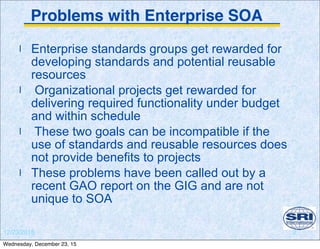
Problems with Enterprise SOA
l Enterprise standards groups get rewarded for
developing standards and potential reusable
resources
l Organizational projects get rewarded for
delivering required functionality under budget
and within schedule
l These two goals can be incompatible if the
use of standards and reusable resources does
not provide benefits to projects
l These problems have been called out by a
recent GAO report on the GIG and are not
unique to SOA
Wednesday, December 23, 15
12/23/2015 3
Proposed Solution
l Create a reusable architecture standards
delivery group and process
l This group should be compensated equally for
getting standards implemented and having
projects succeed
l The process will consist of injecting standards
and reusable components into the system life
cycle when appropriate
l Feedback from projects will be used to revise
and improve standards and create new
reusable components
l The following slides are based on experience
within the world’s largest corporation and the
world’s largest aerospace company.
Wednesday, December 23, 15
12/23/2015 4
Architecture Delivery Process
1.Concept
Refinement
2. Technology
Development
3.System Development
and Demonstration
4. Production and
Deployment
5. Operations
And Support
Projects
Architecture
Delivery
Group
Centralized
Resources
Standard
Reusable
CONOPS
Standard
Reusable
Technology
Components
And Services
Standard Models,
Existing Testbeds
And Simulations
Existing
Hosting
Centers and
Platforms
Reusable
System
Management
Tools and
Processes
Up arrows are delivered standards. Down arrows are improvements based on experience
Wednesday, December 23, 15
12/23/2015 5
Architecture Delivery Team’s Role
l 1. Concept Refinement <-> Reusable CONOPS
l 2. Technology Development <-> Reusable
standards, components and services
l 3. System Development and Demonstration <->
Standard models, existing testbeds, and
simulations
l 4. Production and Deployment <-> Existing
Hosting Centers and Platforms
l 5. Operations and Support <-> Reusable System
Management Tools and Processes
l Experience – These teams have been used to
deliver object, middleware and Web frameworks
to multiple projects within enterprises
Wednesday, December 23, 15
12/23/2015 6
1. Concept Refinement
l Whenever possible Concepts of Operations
should be reused or incrementally refined for
new systems to enable collaboration with
existing organizations and easy migration from
existing operational procedures.
l If radically improved Concepts of Operations
are required or enabled with new technology,
these new concepts should be incorporated in
future operational processes.
l Experience: Create reusable scenarios that
can be customized and used to drive
downstream tasks
Wednesday, December 23, 15
12/23/2015 7
2. Technology Development
l Reusable components and services should be
used whenever possible. Standards should be
followed if they do not negatively impact project
successful completion.
l Standards should be classified with respect to
maturity. Immature standards should not be
required. Feedback from projects should be used
to determine new standards and update the status
of existing standards
l Experience: Maintain a Web accessible site for
retrieving the current status and points of contacts
for reusable services and components
Wednesday, December 23, 15
12/23/2015 8
3. System Development/Demonstration
l Reusable standard models and simulations
should be used in the development and testing
of new systems. If possible, testbeds should be
maintained to help in the evaluation of new
systems
l When new system models and simulations are
needed, they should be incorporated into the
testbeds for use with future systems
l Experience: Establish a testing center where
new services and standards can be evaluated
in simulated production environments
Wednesday, December 23, 15
12/23/2015 9
4. Production and Deployment
l Whenever possible existing platforms and
hosting centers should be reused and
extended for the production and deployment of
new systems
l If new platforms and hosting centers are
required to deploy a system, then these
resources should be available for future new
systems.
l Experience: Use enterprise hosting centers for
the deployment and management of widely
shared services
Wednesday, December 23, 15
12/23/2015 10
5. System Operations and Support
l Reusable processes based on standard tools
should be the basis of system operations and
support
l Additional processes and tools that become
necessary to handle new systems should be
incorporated into future operations standards
l Experience: Enterprise-wide frameworks in key
infrastructure areas (e.g. information
assurance) should be established to reduce
the risks and costs of interoperability problems.
These frameworks should be created using
federation across diverse organizations rather
than a single top-down approach.
Wednesday, December 23, 15
12/23/2015 11
Reusable Resource Repository
Wednesday, December 23, 15
12/23/2015 12
Reusable Resource Repository
l Stores information about the functionality,
retrieval, and use of reusable resources
l Maintained by the Architecture Delivery Team
l Contains inputs from the Centralized Standards
Group and suggested additions from the Project
Teams
l Repository can be accessed through the Web
l Resources in the Repository are indexed by the
stages in the System Life Cycle
l Experience: Unless there is a group that can
support the retrieval and use of components in the
repository, it is very difficult to enforce reuse.
Wednesday, December 23, 15
12/23/2015 13
Reusable Resource Repository
Reusable
Resource
Repository
Project 1
Project 2
Project 3
Project 4
Centralized
Standards
and
Reuse
Organization
SOA
Architecture
Delivery
Team
Wednesday, December 23, 15
12/23/2015 14
Reference Publications
l “Great Global Grid: Emerging Technology
Strategies” Downloadable book at http://
www.great-global-grid.com
l “Transitioning Large Organizations to Object
Technology” chapter in CRC Handbook on
Object Technology http://www.arrakis.es/
~devis/handbook/
l “DoD Management Approach and Processes
Not Well-suited to Support the Development of
the Global Information Grid” http://
www.gao.gov/new.items/d06211.pdf
Wednesday, December 23, 15

2006 SOA Architecture Delivery Process

  • 1.
    12/23/2015 SOA Architecture Delivery Process by Dr.Robert Marcus robert.marcus@sri.com SRI International 1100 Wilson Boulevard Arlington, VA 22209 Wednesday, December 23, 15
  • 2.
    12/23/2015 2 Problems withEnterprise SOA l Enterprise standards groups get rewarded for developing standards and potential reusable resources l Organizational projects get rewarded for delivering required functionality under budget and within schedule l These two goals can be incompatible if the use of standards and reusable resources does not provide benefits to projects l These problems have been called out by a recent GAO report on the GIG and are not unique to SOA Wednesday, December 23, 15
  • 3.
    12/23/2015 3 Proposed Solution lCreate a reusable architecture standards delivery group and process l This group should be compensated equally for getting standards implemented and having projects succeed l The process will consist of injecting standards and reusable components into the system life cycle when appropriate l Feedback from projects will be used to revise and improve standards and create new reusable components l The following slides are based on experience within the world’s largest corporation and the world’s largest aerospace company. Wednesday, December 23, 15
  • 4.
    12/23/2015 4 Architecture DeliveryProcess 1.Concept Refinement 2. Technology Development 3.System Development and Demonstration 4. Production and Deployment 5. Operations And Support Projects Architecture Delivery Group Centralized Resources Standard Reusable CONOPS Standard Reusable Technology Components And Services Standard Models, Existing Testbeds And Simulations Existing Hosting Centers and Platforms Reusable System Management Tools and Processes Up arrows are delivered standards. Down arrows are improvements based on experience Wednesday, December 23, 15
  • 5.
    12/23/2015 5 Architecture DeliveryTeam’s Role l 1. Concept Refinement <-> Reusable CONOPS l 2. Technology Development <-> Reusable standards, components and services l 3. System Development and Demonstration <-> Standard models, existing testbeds, and simulations l 4. Production and Deployment <-> Existing Hosting Centers and Platforms l 5. Operations and Support <-> Reusable System Management Tools and Processes l Experience – These teams have been used to deliver object, middleware and Web frameworks to multiple projects within enterprises Wednesday, December 23, 15
  • 6.
    12/23/2015 6 1. ConceptRefinement l Whenever possible Concepts of Operations should be reused or incrementally refined for new systems to enable collaboration with existing organizations and easy migration from existing operational procedures. l If radically improved Concepts of Operations are required or enabled with new technology, these new concepts should be incorporated in future operational processes. l Experience: Create reusable scenarios that can be customized and used to drive downstream tasks Wednesday, December 23, 15
  • 7.
    12/23/2015 7 2. TechnologyDevelopment l Reusable components and services should be used whenever possible. Standards should be followed if they do not negatively impact project successful completion. l Standards should be classified with respect to maturity. Immature standards should not be required. Feedback from projects should be used to determine new standards and update the status of existing standards l Experience: Maintain a Web accessible site for retrieving the current status and points of contacts for reusable services and components Wednesday, December 23, 15
  • 8.
    12/23/2015 8 3. SystemDevelopment/Demonstration l Reusable standard models and simulations should be used in the development and testing of new systems. If possible, testbeds should be maintained to help in the evaluation of new systems l When new system models and simulations are needed, they should be incorporated into the testbeds for use with future systems l Experience: Establish a testing center where new services and standards can be evaluated in simulated production environments Wednesday, December 23, 15
  • 9.
    12/23/2015 9 4. Productionand Deployment l Whenever possible existing platforms and hosting centers should be reused and extended for the production and deployment of new systems l If new platforms and hosting centers are required to deploy a system, then these resources should be available for future new systems. l Experience: Use enterprise hosting centers for the deployment and management of widely shared services Wednesday, December 23, 15
  • 10.
    12/23/2015 10 5. SystemOperations and Support l Reusable processes based on standard tools should be the basis of system operations and support l Additional processes and tools that become necessary to handle new systems should be incorporated into future operations standards l Experience: Enterprise-wide frameworks in key infrastructure areas (e.g. information assurance) should be established to reduce the risks and costs of interoperability problems. These frameworks should be created using federation across diverse organizations rather than a single top-down approach. Wednesday, December 23, 15
  • 11.
    12/23/2015 11 Reusable ResourceRepository Wednesday, December 23, 15
  • 12.
    12/23/2015 12 Reusable ResourceRepository l Stores information about the functionality, retrieval, and use of reusable resources l Maintained by the Architecture Delivery Team l Contains inputs from the Centralized Standards Group and suggested additions from the Project Teams l Repository can be accessed through the Web l Resources in the Repository are indexed by the stages in the System Life Cycle l Experience: Unless there is a group that can support the retrieval and use of components in the repository, it is very difficult to enforce reuse. Wednesday, December 23, 15
  • 13.
    12/23/2015 13 Reusable ResourceRepository Reusable Resource Repository Project 1 Project 2 Project 3 Project 4 Centralized Standards and Reuse Organization SOA Architecture Delivery Team Wednesday, December 23, 15
  • 14.
    12/23/2015 14 Reference Publications l“Great Global Grid: Emerging Technology Strategies” Downloadable book at http:// www.great-global-grid.com l “Transitioning Large Organizations to Object Technology” chapter in CRC Handbook on Object Technology http://www.arrakis.es/ ~devis/handbook/ l “DoD Management Approach and Processes Not Well-suited to Support the Development of the Global Information Grid” http:// www.gao.gov/new.items/d06211.pdf Wednesday, December 23, 15