Corporate Control and
Governance
Ram Kumar Kakani
The views expressed herein
are personal
2003Ram Kumar Kakani, XLRI Jamshedpur 3
19th & 20th Century
Company legislation
Bottom line driven
Destroy communities
Create communities
FINANCIAL FOCUS
2003Ram Kumar Kakani, XLRI Jamshedpur 4
Power of Multinationals
Open world economy - W.T.O.
Only 25 Countries GDP > GM
Denmark 25th - 5.2m
GM supports 9 million people
Shell > 40% of Holland market cap
Wallenburg holds a major chunk of Sweden (> 64%)
Main source of tax revenue
Economic and political power
Source: www.corpgov.org (2001)
2003Ram Kumar Kakani, XLRI Jamshedpur 5
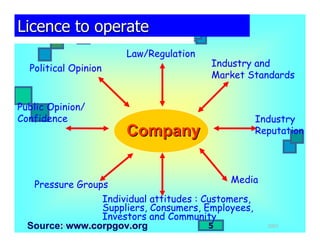
CompanyCompany
Law/Regulation
Industry and
Market Standards
Industry
Reputation
Media
Pressure Groups
Public Opinion/
Confidence
Political Opinion
Individual attitudes : Customers,
Suppliers, Consumers, Employees,
Investors and Community
LicenceLicence to operateto operate
Source: www.corpgov.org
2003Ram Kumar Kakani, XLRI Jamshedpur 6
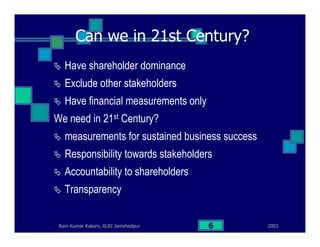
Can we in 21st Century?
Have shareholder dominance
Exclude other stakeholders
Have financial measurements only
We need in 21st Century?
measurements for sustained business success
Responsibility towards stakeholders
Accountability to shareholders
Transparency
2003Ram Kumar Kakani, XLRI Jamshedpur 7
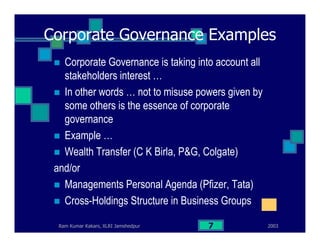
Corporate Governance Examples
Corporate Governance is taking into account all
stakeholders interest …
In other words … not to misuse powers given by
some others is the essence of corporate
governance
Example …
Wealth Transfer (C K Birla, P&G, Colgate)
and/or
Managements Personal Agenda (Pfizer, Tata)
Cross-Holdings Structure in Business Groups
2003Ram Kumar Kakani, XLRI Jamshedpur 8
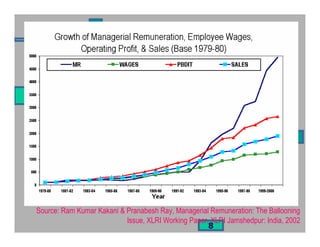
Source: Ram Kumar Kakani & Pranabesh Ray, Managerial Remuneration: The Ballooning
Issue, XLRI Working Paper, XLRI Jamshedpur: India, 2002
2003Ram Kumar Kakani, XLRI Jamshedpur 9
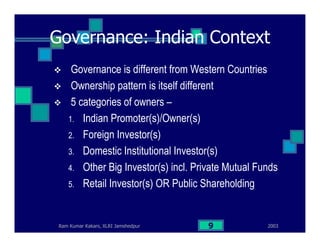
Governance: Indian Context
Governance is different from Western Countries
Ownership pattern is itself different
5 categories of owners –
1. Indian Promoter(s)/Owner(s)
2. Foreign Investor(s)
3. Domestic Institutional Investor(s)
4. Other Big Investor(s) incl. Private Mutual Funds
5. Retail Investor(s) OR Public Shareholding
2003Ram Kumar Kakani, XLRI Jamshedpur 10
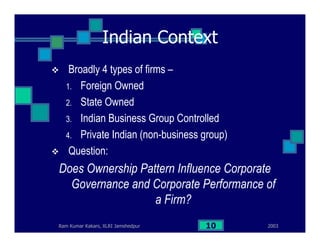
Indian Context
Broadly 4 types of firms –
1. Foreign Owned
2. State Owned
3. Indian Business Group Controlled
4. Private Indian (non-business group)
Question:
Does Ownership Pattern Influence Corporate
Governance and Corporate Performance of
a Firm?
2003Ram Kumar Kakani, XLRI Jamshedpur 11
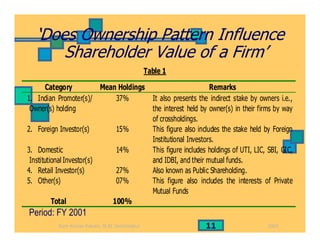
‘Does Ownership Pattern Influence
Shareholder Value of a Firm’
Table 1
Category Mean Holdings Remarks
1. Indian Promoter(s)/
Owner(s) holding
37% It also presents the indirect stake by owners i.e.,
the interest held by owner(s) in their firms by way
of crossholdings.
2. Foreign Investor(s) 15% This figure also includes the stake held by Foreign
Institutional Investors.
3. Domestic
Institutional Investor(s)
14% This figure includes holdings of UTI, LIC, SBI, GIC,
and IDBI, and their mutual funds.
4. Retail Investor(s) 27% Also known as Public Shareholding.
5. Other(s) 07% This figure also includes the interests of Private
Mutual Funds
Total 100%
Period: FY 2001
2003Ram Kumar Kakani, XLRI Jamshedpur 12
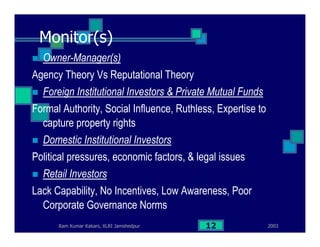
Monitor(s)
Owner-Manager(s)
Agency Theory Vs Reputational Theory
Foreign Institutional Investors & Private Mutual Funds
Formal Authority, Social Influence, Ruthless, Expertise to
capture property rights
Domestic Institutional Investors
Political pressures, economic factors, & legal issues
Retail Investors
Lack Capability, No Incentives, Low Awareness, Poor
Corporate Governance Norms
2003Ram Kumar Kakani, XLRI Jamshedpur 13
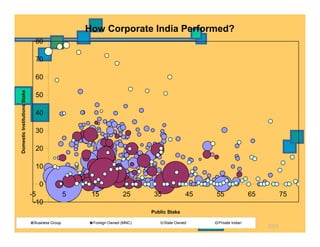
How Corporate India Performed?
-10
0
10
20
30
40
50
60
70
80
-5 5 15 25 35 45 55 65 75
Public Stake
DomesticInstitutionsStake
Business Group Foreign Owned (MNC) State Owned Private Indian
2003Ram Kumar Kakani, XLRI Jamshedpur 14
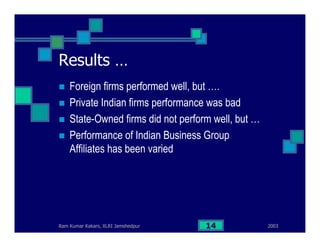
Results …
Foreign firms performed well, but ….
Private Indian firms performance was bad
State-Owned firms did not perform well, but …
Performance of Indian Business Group
Affiliates has been varied
2003Ram Kumar Kakani, XLRI Jamshedpur 15
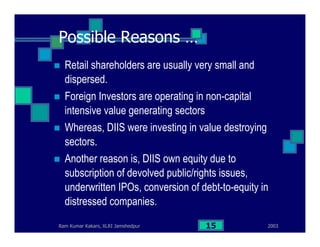
Possible Reasons …
Retail shareholders are usually very small and
dispersed.
Foreign Investors are operating in non-capital
intensive value generating sectors
Whereas, DIIS were investing in value destroying
sectors.
Another reason is, DIIS own equity due to
subscription of devolved public/rights issues,
underwritten IPOs, conversion of debt-to-equity in
distressed companies.
2003Ram Kumar Kakani, XLRI Jamshedpur 16
Corporate Governance
An AGM of Grasim Industries, was held in a remote
location. Of its 13 directors, just one showed up, while
only a handful of the company’s 300,000 minority
shareholders attended. And they were employees who
were unlikely to hold management accountable.
Rahul Bajaj epitomized the problem. He said at a
seminar on corporate governance in 1996 that:
“All of us know what boards and managements should
do, but are doing what we should not do. We have
done things that are questionable – legal but
questionable. Why should we need a committee to tell
us what to do?”
2003Ram Kumar Kakani, XLRI Jamshedpur 17
… Corporate Governance
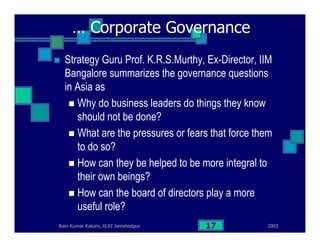
Strategy Guru Prof. K.R.S.Murthy, Ex-Director, IIM
Bangalore summarizes the governance questions
in Asia as
Why do business leaders do things they know
should not be done?
What are the pressures or fears that force them
to do so?
How can they be helped to be more integral to
their own beings?
How can the board of directors play a more
useful role?
2003Ram Kumar Kakani, XLRI Jamshedpur 18
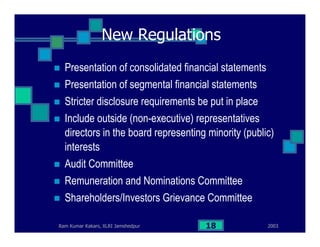
New Regulations
Presentation of consolidated financial statements
Presentation of segmental financial statements
Stricter disclosure requirements be put in place
Include outside (non-executive) representatives
directors in the board representing minority (public)
interests
Audit Committee
Remuneration and Nominations Committee
Shareholders/Investors Grievance Committee
2003Ram Kumar Kakani, XLRI Jamshedpur 19
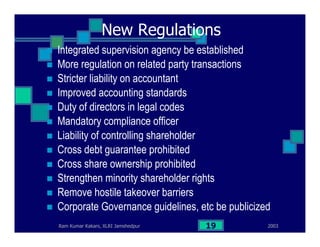
New Regulations
Integrated supervision agency be established
More regulation on related party transactions
Stricter liability on accountant
Improved accounting standards
Duty of directors in legal codes
Mandatory compliance officer
Liability of controlling shareholder
Cross debt guarantee prohibited
Cross share ownership prohibited
Strengthen minority shareholder rights
Remove hostile takeover barriers
Corporate Governance guidelines, etc be publicized
2003Ram Kumar Kakani, XLRI Jamshedpur 20
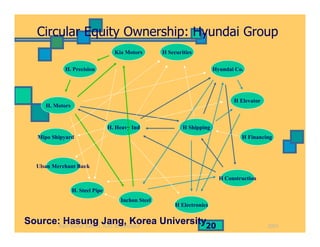
H. Heavy Ind H Shipping
Hyundai Co.
H Elevator
H Financing
H Construction
H Electronics
Inchon Steel
H. Steel Pipe
Ulsan Merchant Bank
Mipo Shipyard
H. Motors
H. Precision
Kia Motors H Securities
Circular Equity Ownership: Hyundai Group
Source: Hasung Jang, Korea University
2003Ram Kumar Kakani, XLRI Jamshedpur 21
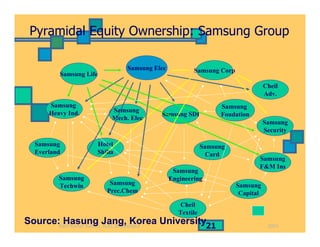
Pyramidal Equity Ownership: Samsung Group
Samsung Elec Samsung Corp
Samsung Life
Samsung
FoudationSamsung SDI
Samsung
Card
Samsung
Mech. Elec
Samsung
Heavy Ind.
Samsung
Capital
Cheil
Textile
Hotel
Shilla
Samsung
Everland
Cheil
Adv.
Samsung
Security
Samsung
Techwin
Samsung
F&M Ins
Samsung
Engineering
Samsung
Prec.Chem
Source: Hasung Jang, Korea University
2003Ram Kumar Kakani, XLRI Jamshedpur 22
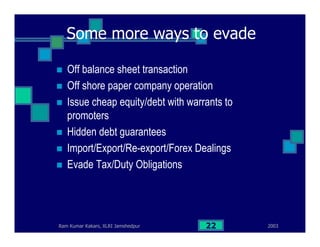
Some more ways to evade
Off balance sheet transaction
Off shore paper company operation
Issue cheap equity/debt with warrants to
promoters
Hidden debt guarantees
Import/Export/Re-export/Forex Dealings
Evade Tax/Duty Obligations

2003 corporate governance and control

  • 1.
  • 2.
    The views expressedherein are personal
  • 3.
    2003Ram Kumar Kakani,XLRI Jamshedpur 3 19th & 20th Century Company legislation Bottom line driven Destroy communities Create communities FINANCIAL FOCUS
  • 4.
    2003Ram Kumar Kakani,XLRI Jamshedpur 4 Power of Multinationals Open world economy - W.T.O. Only 25 Countries GDP > GM Denmark 25th - 5.2m GM supports 9 million people Shell > 40% of Holland market cap Wallenburg holds a major chunk of Sweden (> 64%) Main source of tax revenue Economic and political power Source: www.corpgov.org (2001)
  • 5.
    2003Ram Kumar Kakani,XLRI Jamshedpur 5 CompanyCompany Law/Regulation Industry and Market Standards Industry Reputation Media Pressure Groups Public Opinion/ Confidence Political Opinion Individual attitudes : Customers, Suppliers, Consumers, Employees, Investors and Community LicenceLicence to operateto operate Source: www.corpgov.org
  • 6.
    2003Ram Kumar Kakani,XLRI Jamshedpur 6 Can we in 21st Century? Have shareholder dominance Exclude other stakeholders Have financial measurements only We need in 21st Century? measurements for sustained business success Responsibility towards stakeholders Accountability to shareholders Transparency
  • 7.
    2003Ram Kumar Kakani,XLRI Jamshedpur 7 Corporate Governance Examples Corporate Governance is taking into account all stakeholders interest … In other words … not to misuse powers given by some others is the essence of corporate governance Example … Wealth Transfer (C K Birla, P&G, Colgate) and/or Managements Personal Agenda (Pfizer, Tata) Cross-Holdings Structure in Business Groups
  • 8.
    2003Ram Kumar Kakani,XLRI Jamshedpur 8 Source: Ram Kumar Kakani & Pranabesh Ray, Managerial Remuneration: The Ballooning Issue, XLRI Working Paper, XLRI Jamshedpur: India, 2002
  • 9.
    2003Ram Kumar Kakani,XLRI Jamshedpur 9 Governance: Indian Context Governance is different from Western Countries Ownership pattern is itself different 5 categories of owners – 1. Indian Promoter(s)/Owner(s) 2. Foreign Investor(s) 3. Domestic Institutional Investor(s) 4. Other Big Investor(s) incl. Private Mutual Funds 5. Retail Investor(s) OR Public Shareholding
  • 10.
    2003Ram Kumar Kakani,XLRI Jamshedpur 10 Indian Context Broadly 4 types of firms – 1. Foreign Owned 2. State Owned 3. Indian Business Group Controlled 4. Private Indian (non-business group) Question: Does Ownership Pattern Influence Corporate Governance and Corporate Performance of a Firm?
  • 11.
    2003Ram Kumar Kakani,XLRI Jamshedpur 11 ‘Does Ownership Pattern Influence Shareholder Value of a Firm’ Table 1 Category Mean Holdings Remarks 1. Indian Promoter(s)/ Owner(s) holding 37% It also presents the indirect stake by owners i.e., the interest held by owner(s) in their firms by way of crossholdings. 2. Foreign Investor(s) 15% This figure also includes the stake held by Foreign Institutional Investors. 3. Domestic Institutional Investor(s) 14% This figure includes holdings of UTI, LIC, SBI, GIC, and IDBI, and their mutual funds. 4. Retail Investor(s) 27% Also known as Public Shareholding. 5. Other(s) 07% This figure also includes the interests of Private Mutual Funds Total 100% Period: FY 2001
  • 12.
    2003Ram Kumar Kakani,XLRI Jamshedpur 12 Monitor(s) Owner-Manager(s) Agency Theory Vs Reputational Theory Foreign Institutional Investors & Private Mutual Funds Formal Authority, Social Influence, Ruthless, Expertise to capture property rights Domestic Institutional Investors Political pressures, economic factors, & legal issues Retail Investors Lack Capability, No Incentives, Low Awareness, Poor Corporate Governance Norms
  • 13.
    2003Ram Kumar Kakani,XLRI Jamshedpur 13 How Corporate India Performed? -10 0 10 20 30 40 50 60 70 80 -5 5 15 25 35 45 55 65 75 Public Stake DomesticInstitutionsStake Business Group Foreign Owned (MNC) State Owned Private Indian
  • 14.
    2003Ram Kumar Kakani,XLRI Jamshedpur 14 Results … Foreign firms performed well, but …. Private Indian firms performance was bad State-Owned firms did not perform well, but … Performance of Indian Business Group Affiliates has been varied
  • 15.
    2003Ram Kumar Kakani,XLRI Jamshedpur 15 Possible Reasons … Retail shareholders are usually very small and dispersed. Foreign Investors are operating in non-capital intensive value generating sectors Whereas, DIIS were investing in value destroying sectors. Another reason is, DIIS own equity due to subscription of devolved public/rights issues, underwritten IPOs, conversion of debt-to-equity in distressed companies.
  • 16.
    2003Ram Kumar Kakani,XLRI Jamshedpur 16 Corporate Governance An AGM of Grasim Industries, was held in a remote location. Of its 13 directors, just one showed up, while only a handful of the company’s 300,000 minority shareholders attended. And they were employees who were unlikely to hold management accountable. Rahul Bajaj epitomized the problem. He said at a seminar on corporate governance in 1996 that: “All of us know what boards and managements should do, but are doing what we should not do. We have done things that are questionable – legal but questionable. Why should we need a committee to tell us what to do?”
  • 17.
    2003Ram Kumar Kakani,XLRI Jamshedpur 17 … Corporate Governance Strategy Guru Prof. K.R.S.Murthy, Ex-Director, IIM Bangalore summarizes the governance questions in Asia as Why do business leaders do things they know should not be done? What are the pressures or fears that force them to do so? How can they be helped to be more integral to their own beings? How can the board of directors play a more useful role?
  • 18.
    2003Ram Kumar Kakani,XLRI Jamshedpur 18 New Regulations Presentation of consolidated financial statements Presentation of segmental financial statements Stricter disclosure requirements be put in place Include outside (non-executive) representatives directors in the board representing minority (public) interests Audit Committee Remuneration and Nominations Committee Shareholders/Investors Grievance Committee
  • 19.
    2003Ram Kumar Kakani,XLRI Jamshedpur 19 New Regulations Integrated supervision agency be established More regulation on related party transactions Stricter liability on accountant Improved accounting standards Duty of directors in legal codes Mandatory compliance officer Liability of controlling shareholder Cross debt guarantee prohibited Cross share ownership prohibited Strengthen minority shareholder rights Remove hostile takeover barriers Corporate Governance guidelines, etc be publicized
  • 20.
    2003Ram Kumar Kakani,XLRI Jamshedpur 20 H. Heavy Ind H Shipping Hyundai Co. H Elevator H Financing H Construction H Electronics Inchon Steel H. Steel Pipe Ulsan Merchant Bank Mipo Shipyard H. Motors H. Precision Kia Motors H Securities Circular Equity Ownership: Hyundai Group Source: Hasung Jang, Korea University
  • 21.
    2003Ram Kumar Kakani,XLRI Jamshedpur 21 Pyramidal Equity Ownership: Samsung Group Samsung Elec Samsung Corp Samsung Life Samsung FoudationSamsung SDI Samsung Card Samsung Mech. Elec Samsung Heavy Ind. Samsung Capital Cheil Textile Hotel Shilla Samsung Everland Cheil Adv. Samsung Security Samsung Techwin Samsung F&M Ins Samsung Engineering Samsung Prec.Chem Source: Hasung Jang, Korea University
  • 22.
    2003Ram Kumar Kakani,XLRI Jamshedpur 22 Some more ways to evade Off balance sheet transaction Off shore paper company operation Issue cheap equity/debt with warrants to promoters Hidden debt guarantees Import/Export/Re-export/Forex Dealings Evade Tax/Duty Obligations