Bellevue Transit Plan Update


 Washington State ITE 2001 Annual Meeting
               June 11, 2001
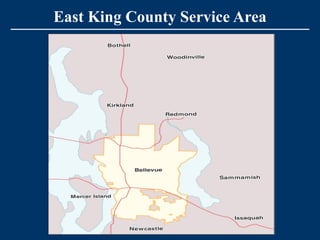
East King County Service Area
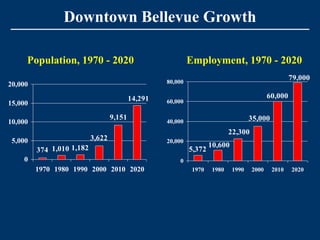
Downtown Bellevue Growth

     Population, 1970 - 2020                                 Employment, 1970 - 2020
                                                    80,000
                                                                                                      79,000
20,000
                                           14,291                                            60,000
15,000                                              60,000

                                   9,151                                             35,000
10,000                                              40,000
                                                                             22,300
 5,000                     3,622                    20,000
                                                                     10,600
         374 1,010 1,182                                     5,372
    0                                                   0
         1970 1980 1990 2000 2010 2020                        1970    1980    1990    2000    2010    2020
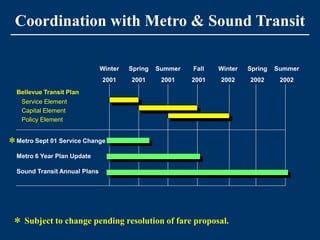
Coordination with Metro & Sound Transit

                               Winter   Spring   Summer   Fall   Winter   Spring   Summer
                               2001     2001      2001    2001   2002     2002      2002
  Bellevue Transit Plan
    Service Element
    Capital Element
    Policy Element


* Metro Sept 01 Service Change
  Metro 6 Year Plan Update

  Sound Transit Annual Plans


 * Subject to change pending resolution of fare proposal.
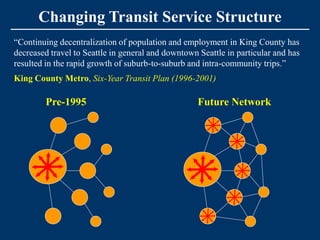
Changing Transit Service Structure
“Continuing decentralization of population and employment in King County has
decreased travel to Seattle in general and downtown Seattle in particular and has
resulted in the rapid growth of suburb-to-suburb and intra-community trips.”
King County Metro, Six-Year Transit Plan (1996-2001)

         Pre-1995                                   Future Network
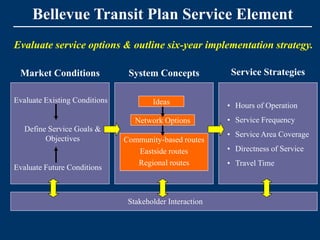
Bellevue Transit Plan Service Element
Evaluate service options & outline six-year implementation strategy.

 Market Conditions              System Concepts            Service Strategies

Evaluate Existing Conditions           Ideas              • Hours of Operation
                                  Network Options         • Service Frequency
   Define Service Goals &
                                                          • Service Area Coverage
         Objectives            Community-based routes
                                  Eastside routes         • Directness of Service
                                  Regional routes         • Travel Time
Evaluate Future Conditions


                                Stakeholder Interaction
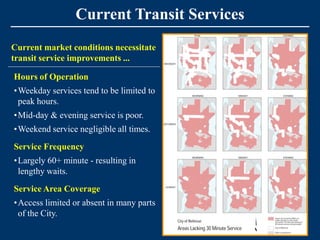
Current Transit Services
Current market conditions necessitate
transit service improvements ...

Hours of Operation
•Weekday services tend to be limited to
 peak hours.
•Mid-day & evening service is poor.
•Weekend service negligible all times.
Service Frequency
•Largely 60+ minute - resulting in
 lengthy waits.
Service Area Coverage
•Access limited or absent in many parts
 of the City.
Findings
    Despite past success, transit services need improvement

Hours of Operation
• Weekday services tend to be limited to peak hours; mid-day and
  evening service is poor.
• Bus schedules do not match school schedules (Bellevue schools out
  by 12:30 on Wednesdays).
• Weekend services are negligible at all times.
• All-day service needed on 116th for access to medical offices.

Service Frequency
• Eastside routes have over-loaded buses; people are turned away.
• More service is needed to ensure that missed transfer connections do
  not result in 60+ minute wait times.
Findings, continued

Service Area Coverage
• Access is limited or absent in many parts of the City.
• Bus stops in Bellevue are too far of a walk in many areas.

Directness of Service
Poor connections:
• Between neighborhoods
• Neighborhoods and Downtown Bellevue
• Other Eastside destinations

Travel Time
• Transfers require additional time and make transit less attractive.
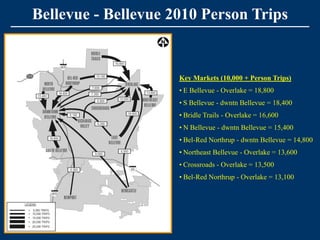
Bellevue - Bellevue 2010 Person Trips


                     Key Markets (10,000 + Person Trips)
                     • E Bellevue - Overlake = 18,800
                     • S Bellevue - dwntn Bellevue = 18,400
                     • Bridle Trails - Overlake = 16,600
                     • N Bellevue - dwntn Bellevue = 15,400
                     • Bel-Red Northrup - dwntn Bellevue = 14,800
                     • Northeast Bellevue - Overlake = 13,600
                     • Crossroads - Overlake = 13,500
                     • Bel-Red Northrup - Overlake = 13,100
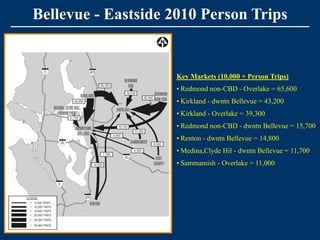
Bellevue - Eastside 2010 Person Trips


                    Key Markets (10,000 + Person Trips)
                    • Redmond non-CBD - Overlake = 65,600
                    • Kirkland - dwntn Bellevue = 43,200
                    • Kirkland - Overlake = 39,300
                    • Redmond non-CBD - dwntn Bellevue = 15,700
                    • Renton - dwntn Bellevue = 14,800
                    • Medina,Clyde Hil - dwntn Bellevue = 11,700
                    • Sammamish - Overlake = 11,000
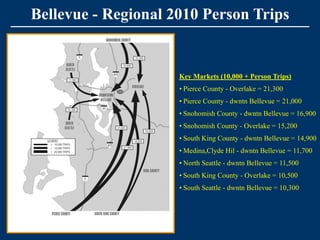
Bellevue - Regional 2010 Person Trips


                     Key Markets (10,000 + Person Trips)
                     • Pierce County - Overlake = 21,300
                     • Pierce County - dwntn Bellevue = 21,000
                     • Snohomish County - dwntn Bellevue = 16,900
                     • Snohomish County - Overlake = 15,200
                     • South King County - dwntn Bellevue = 14,900
                     • Medina,Clyde Hil - dwntn Bellevue = 11,700
                     • North Seattle - dwntn Bellevue = 11,500
                     • South King County - Overlake = 10,500
                     • South Seattle - dwntn Bellevue = 10,300
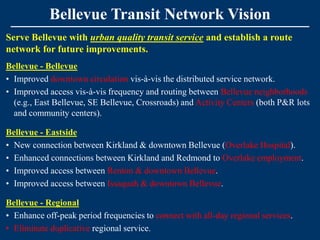
Bellevue Transit Network Vision
Serve Bellevue with urban quality transit service and establish a route
network for future improvements.
Bellevue - Bellevue
• Improved downtown circulation vis-à-vis the distributed service network.
• Improved access vis-à-vis frequency and routing between Bellevue neighborhoods
  (e.g., East Bellevue, SE Bellevue, Crossroads) and Activity Centers (both P&R lots
  and community centers).

Bellevue - Eastside
• New connection between Kirkland & downtown Bellevue (Overlake Hospital).
• Enhanced connections between Kirkland and Redmond to Overlake employment.
• Improved access between Renton & downtown Bellevue.
• Improved access between Issaquah & downtown Bellevue.

Bellevue - Regional
• Enhance off-peak period frequencies to connect with all-day regional services.
• Eliminate duplicative regional service.
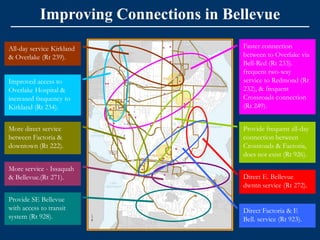
Improving Connections in Bellevue
All-day service Kirkland               Faster connection
& Overlake (Rt 239).                   between to Overlake via
                                       Bell-Red (Rt 233).
                                       frequent two-way
Improved access to                     service to Redmond (Rt
Overlake Hospital &                    232), & frequent
increased frequency to                 Crossroads connection
Kirkland (Rt 234).                     (Rt 249).


More direct service                    Provide frequent all-day
between Factoria &                     connection between
downtown (Rt 222).                     Crossroads & Factoria,
                                       does not exist (Rt 926).

More service - Issaquah
& Bellevue.(Rt 271).                   Direct E. Bellevue
                                       dwntn service (Rt 272).
Provide SE Bellevue
with access to transit                 Direct Factoria & E
system (Rt 928).                       Bell. service (Rt 923).
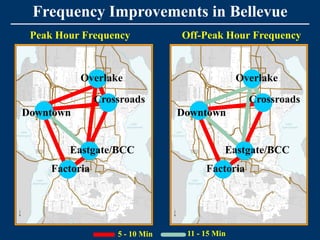
Frequency Improvements in Bellevue
 Peak Hour Frequency             Off-Peak Hour Frequency


           Overlake                             Overlake

                Crossroads                        Crossroads
Downtown                         Downtown


        Eastgate/BCC                        Eastgate/BCC
     Factoria                          Factoria


                    5 - 10 Min    11 - 15 Min
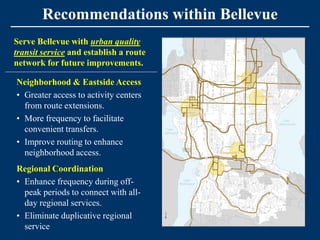
Recommendations within Bellevue
Serve Bellevue with urban quality
transit service and establish a route
network for future improvements.

Neighborhood & Eastside Access
• Greater access to activity centers
  from route extensions.
• More frequency to facilitate
  convenient transfers.
• Improve routing to enhance
  neighborhood access.
Regional Coordination
• Enhance frequency during off-
  peak periods to connect with all-
  day regional services.
• Eliminate duplicative regional
  service
Lessons Learned
Completed project successfully, on-time & below budget …
• Undertook early examination of data in-house - To expedite the
  process, the City had in-place an early understanding of the problems
  needing to be addressed by the consultant team.
• Clarified project direction before work began - Held pre-scoping
  design/build meetings prior to contract initiation to identify
  opportunities and challenges of scope and timeline of project.
• Created a collaborative planning process - Entranco, Perteet, Transpo
  Group, and Browne & Associates each assigned to specific work
  assignments & encouraged to collaborate in sharing of ideas.
• Developed realistic recommendations - List of solutions are
  financially constrained and technically defensible.
• Articulated transit vision - City’s goals & objectives are better
  represented in guiding KCM’s service planning process.
Bellevue Transit Plan Approach

Service plan
• Evaluate existing & future markets
• Evaluate existing services (span, frequency, coverage)
• Recommend approach for new investment

Capital plan
• Identify infrastructure improvements to improve transit travel
  time & reliability (signal priority, ped/bike connections)

Policy plan
• Consider policy directions to unify transit and growth decisions

2001 WA State ITE Conference

  • 1.
    Bellevue Transit PlanUpdate Washington State ITE 2001 Annual Meeting June 11, 2001
  • 2.
    East King CountyService Area
  • 3.
    Downtown Bellevue Growth Population, 1970 - 2020 Employment, 1970 - 2020 80,000 79,000 20,000 14,291 60,000 15,000 60,000 9,151 35,000 10,000 40,000 22,300 5,000 3,622 20,000 10,600 374 1,010 1,182 5,372 0 0 1970 1980 1990 2000 2010 2020 1970 1980 1990 2000 2010 2020
  • 4.
    Coordination with Metro& Sound Transit Winter Spring Summer Fall Winter Spring Summer 2001 2001 2001 2001 2002 2002 2002 Bellevue Transit Plan Service Element Capital Element Policy Element * Metro Sept 01 Service Change Metro 6 Year Plan Update Sound Transit Annual Plans * Subject to change pending resolution of fare proposal.
  • 5.
    Changing Transit ServiceStructure “Continuing decentralization of population and employment in King County has decreased travel to Seattle in general and downtown Seattle in particular and has resulted in the rapid growth of suburb-to-suburb and intra-community trips.” King County Metro, Six-Year Transit Plan (1996-2001) Pre-1995 Future Network
  • 6.
    Bellevue Transit PlanService Element Evaluate service options & outline six-year implementation strategy. Market Conditions System Concepts Service Strategies Evaluate Existing Conditions Ideas • Hours of Operation Network Options • Service Frequency Define Service Goals & • Service Area Coverage Objectives Community-based routes Eastside routes • Directness of Service Regional routes • Travel Time Evaluate Future Conditions Stakeholder Interaction
  • 7.
    Current Transit Services Currentmarket conditions necessitate transit service improvements ... Hours of Operation •Weekday services tend to be limited to peak hours. •Mid-day & evening service is poor. •Weekend service negligible all times. Service Frequency •Largely 60+ minute - resulting in lengthy waits. Service Area Coverage •Access limited or absent in many parts of the City.
  • 8.
    Findings Despite past success, transit services need improvement Hours of Operation • Weekday services tend to be limited to peak hours; mid-day and evening service is poor. • Bus schedules do not match school schedules (Bellevue schools out by 12:30 on Wednesdays). • Weekend services are negligible at all times. • All-day service needed on 116th for access to medical offices. Service Frequency • Eastside routes have over-loaded buses; people are turned away. • More service is needed to ensure that missed transfer connections do not result in 60+ minute wait times.
  • 9.
    Findings, continued Service AreaCoverage • Access is limited or absent in many parts of the City. • Bus stops in Bellevue are too far of a walk in many areas. Directness of Service Poor connections: • Between neighborhoods • Neighborhoods and Downtown Bellevue • Other Eastside destinations Travel Time • Transfers require additional time and make transit less attractive.
  • 10.
    Bellevue - Bellevue2010 Person Trips Key Markets (10,000 + Person Trips) • E Bellevue - Overlake = 18,800 • S Bellevue - dwntn Bellevue = 18,400 • Bridle Trails - Overlake = 16,600 • N Bellevue - dwntn Bellevue = 15,400 • Bel-Red Northrup - dwntn Bellevue = 14,800 • Northeast Bellevue - Overlake = 13,600 • Crossroads - Overlake = 13,500 • Bel-Red Northrup - Overlake = 13,100
  • 11.
    Bellevue - Eastside2010 Person Trips Key Markets (10,000 + Person Trips) • Redmond non-CBD - Overlake = 65,600 • Kirkland - dwntn Bellevue = 43,200 • Kirkland - Overlake = 39,300 • Redmond non-CBD - dwntn Bellevue = 15,700 • Renton - dwntn Bellevue = 14,800 • Medina,Clyde Hil - dwntn Bellevue = 11,700 • Sammamish - Overlake = 11,000
  • 12.
    Bellevue - Regional2010 Person Trips Key Markets (10,000 + Person Trips) • Pierce County - Overlake = 21,300 • Pierce County - dwntn Bellevue = 21,000 • Snohomish County - dwntn Bellevue = 16,900 • Snohomish County - Overlake = 15,200 • South King County - dwntn Bellevue = 14,900 • Medina,Clyde Hil - dwntn Bellevue = 11,700 • North Seattle - dwntn Bellevue = 11,500 • South King County - Overlake = 10,500 • South Seattle - dwntn Bellevue = 10,300
  • 13.
    Bellevue Transit NetworkVision Serve Bellevue with urban quality transit service and establish a route network for future improvements. Bellevue - Bellevue • Improved downtown circulation vis-à-vis the distributed service network. • Improved access vis-à-vis frequency and routing between Bellevue neighborhoods (e.g., East Bellevue, SE Bellevue, Crossroads) and Activity Centers (both P&R lots and community centers). Bellevue - Eastside • New connection between Kirkland & downtown Bellevue (Overlake Hospital). • Enhanced connections between Kirkland and Redmond to Overlake employment. • Improved access between Renton & downtown Bellevue. • Improved access between Issaquah & downtown Bellevue. Bellevue - Regional • Enhance off-peak period frequencies to connect with all-day regional services. • Eliminate duplicative regional service.
  • 14.
    Improving Connections inBellevue All-day service Kirkland Faster connection & Overlake (Rt 239). between to Overlake via Bell-Red (Rt 233). frequent two-way Improved access to service to Redmond (Rt Overlake Hospital & 232), & frequent increased frequency to Crossroads connection Kirkland (Rt 234). (Rt 249). More direct service Provide frequent all-day between Factoria & connection between downtown (Rt 222). Crossroads & Factoria, does not exist (Rt 926). More service - Issaquah & Bellevue.(Rt 271). Direct E. Bellevue dwntn service (Rt 272). Provide SE Bellevue with access to transit Direct Factoria & E system (Rt 928). Bell. service (Rt 923).
  • 15.
    Frequency Improvements inBellevue Peak Hour Frequency Off-Peak Hour Frequency Overlake Overlake Crossroads Crossroads Downtown Downtown Eastgate/BCC Eastgate/BCC Factoria Factoria 5 - 10 Min 11 - 15 Min
  • 16.
    Recommendations within Bellevue ServeBellevue with urban quality transit service and establish a route network for future improvements. Neighborhood & Eastside Access • Greater access to activity centers from route extensions. • More frequency to facilitate convenient transfers. • Improve routing to enhance neighborhood access. Regional Coordination • Enhance frequency during off- peak periods to connect with all- day regional services. • Eliminate duplicative regional service
  • 17.
    Lessons Learned Completed projectsuccessfully, on-time & below budget … • Undertook early examination of data in-house - To expedite the process, the City had in-place an early understanding of the problems needing to be addressed by the consultant team. • Clarified project direction before work began - Held pre-scoping design/build meetings prior to contract initiation to identify opportunities and challenges of scope and timeline of project. • Created a collaborative planning process - Entranco, Perteet, Transpo Group, and Browne & Associates each assigned to specific work assignments & encouraged to collaborate in sharing of ideas. • Developed realistic recommendations - List of solutions are financially constrained and technically defensible. • Articulated transit vision - City’s goals & objectives are better represented in guiding KCM’s service planning process.
  • 18.
    Bellevue Transit PlanApproach Service plan • Evaluate existing & future markets • Evaluate existing services (span, frequency, coverage) • Recommend approach for new investment Capital plan • Identify infrastructure improvements to improve transit travel time & reliability (signal priority, ped/bike connections) Policy plan • Consider policy directions to unify transit and growth decisions