See discussions, stats,and author profiles for this publication at: https://www.researchgate.net/publication/289849942
Grade control geological mapping in underground gold vein operations
Article in Applied Earth Science IMM Transactions section B · June 2012
DOI: 10.1179/1743275812Y.0000000019
CITATIONS
5
READS
11,564
2 authors, including:
Simon Dominy
University of Exeter
108 PUBLICATIONS 1,333 CITATIONS
SEE PROFILE
All content following this page was uploaded by Simon Dominy on 19 June 2017.
The user has requested enhancement of the downloaded file.
2.
TECHNICAL NOTE
Grade controlgeological mapping in
underground gold vein operations
S. C. Dominy*1,2,3
and I. M. Platten4
Grade control is a process of maximising value and reducing risk. It requires the delivery of
tonnes at an optimum grade to the mill, via the accurate definition of ore and waste. It essentially
comprises data collection, integration and interpretation, local resource estimation, stope design,
supervision of mining and stockpile management. The foundation of all grade control
programmes should be that of geological understanding led by clear and accurate mapping
and representative sampling to drive appropriate estimation strategies and mining. Gold veins
show features relating to erratic grade distribution (nugget effect), and variable geometry and
internal architecture. These features include variations in dip, strike and width, late-stage faulting/
shearing effects and vein continuity and type. Variations generally require close geological
understanding to ensure optimum grade, minimal dilution and maximum mining recovery. A well-
designed grade control programme will prove to management and stakeholders that by applying
geological knowledge, the mining process can be both efficient and cost effective.
Keywords: Underground gold vein operations, Grade control, Geological mapping, Mine sampling
Overview
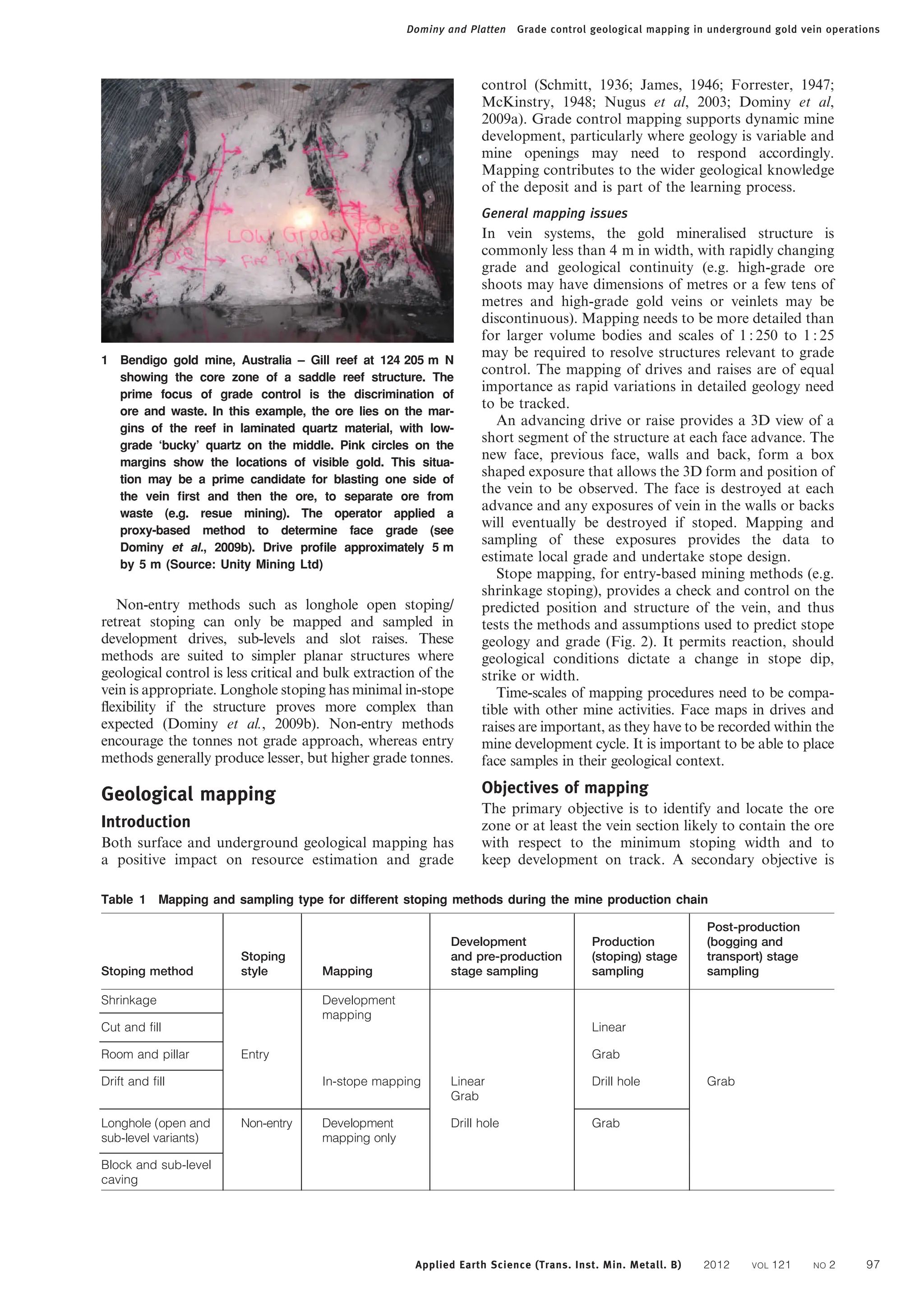
Ore and waste must be defined effectively to ensure an
economic mill feed (Fig. 1). Ore grade and physical
characteristics influence the mineral processing proce-
dure and the mine economics in the short- and medium-
terms. Grade control is essential for efficient mine
operation, with key performance indicators including:
N effective definition of ore and waste
N minimal dilution
N maximum ore recovery
N optimised mill feed grade.
The process of grade control broadly comprises:
N data collection, integration and interpretation
N local resource and reserve estimation
N stope design
N supervision of mining
N stockpile management.
Grade control practices have evolved over the past
15 years or so from the use of paper-based methods,
through to three-dimensional (3D) modelling and
geostatistical simulation. However, the underlying foun-
dation of all grade control programmes is still based on
geological understanding led by mapping and sampling,
and often supported by diamond and/or sludge drilling.
The principles of geological mapping and sampling to
support grade control are well-known and documented
over a number of years (Schmitt, 1936; James, 1946;
McKinstry, 1948; Peters, 1987; Marjoribanks, 2010).
Grade control strategy is intimately linked to mine size
and mining method.
Vein systems typically contain both barren and
productive segments with gold grade varying laterally,
vertically and across the body (Dominy et al., 2003;
Platten and Dominy, 2003). Vein formation generally has
a complex and extended history, related to the emplace-
ment of relatively barren and gold-rich vein elements at
different stages. Although it is a comparatively easy
matter to establish the geological continuity of the global
structure by drilling, the tracing of individual gold-rich
veins (e.g. local geological and grade continuity) and
determining their extent within the main structure is
difficult without underground exposure to allow geologi-
cal mapping. This is accentuated when the gold distribu-
tion in the vein shows a high nugget effect.
This contribution reviews the issues of grade control
in underground gold mines and focuses on integrated
mapping and sampling.
Mining method and grade control
Grade control strategy is related to mining method,
which can be either an entry or non-entry type (Table 1).
Stopes provide 3D exposure, with entry methods such as
shrinkage and cut-and-fill stopes offering opportunities
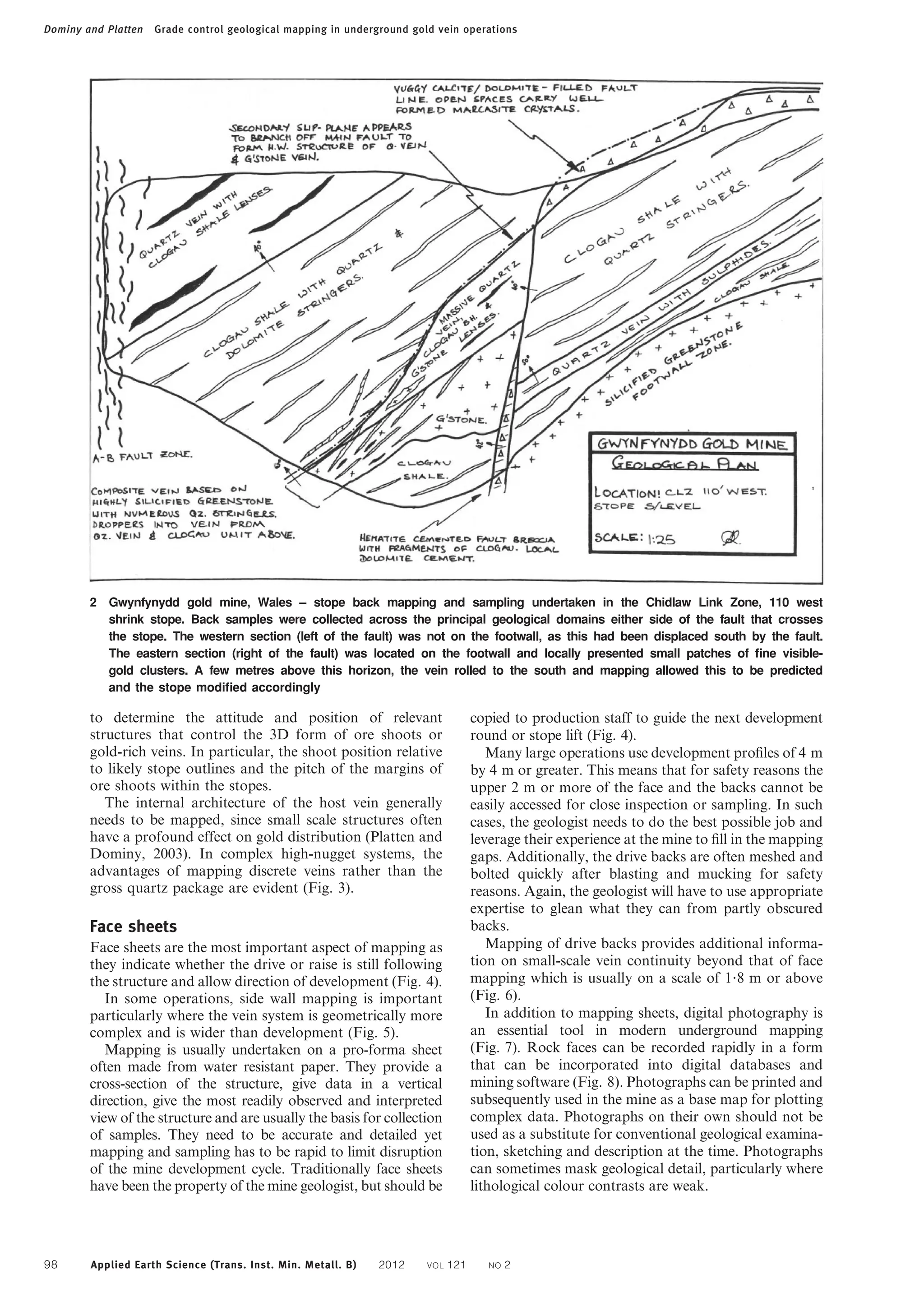
for on-going mapping and sampling (Fig. 2). These are
well-suited to complex systems that require strong
control, and some selectivity and flexibility.
1
Snowden Mining Industry Consultants Pty Ltd, PO Box 416W, Ballarat
West, VIC 3350, Australia
2
Western Australian School of Mines, Curtin University, GPO Box U1987,
Perth, WA 6845, Australia
3
School of Science, Information Technology and Engineering, University
of Ballarat, PO Box 663, Ballarat, VIC 3353, Australia
4
Snowden Mining Industry Consultants Ltd, Magdalen Centre, Robert
Robinson Avenue, Oxford Science Park, Oxford OX4 4GA, England
*Corresponding author, email sdominy@snowdengroup.com
96
ß 2012 Institute of Materials, Minerals and Mining and The AusIMM
Published by Maney on behalf of the Institute and The AusIMM
Received 17 October 2012; accepted 20 October 2012
DOI 10.1179/1743275812Y.0000000019 Applied Earth Science (Trans. Inst. Min. Metall. B) 2012 VOL 121 NO 2
3.
Non-entry methods suchas longhole open stoping/
retreat stoping can only be mapped and sampled in
development drives, sub-levels and slot raises. These
methods are suited to simpler planar structures where
geological control is less critical and bulk extraction of the
vein is appropriate. Longhole stoping has minimal in-stope
flexibility if the structure proves more complex than
expected (Dominy et al., 2009b). Non-entry methods
encourage the tonnes not grade approach, whereas entry
methods generally produce lesser, but higher grade tonnes.
Geological mapping
Introduction
Both surface and underground geological mapping has
a positive impact on resource estimation and grade
control (Schmitt, 1936; James, 1946; Forrester, 1947;
McKinstry, 1948; Nugus et al, 2003; Dominy et al,
2009a). Grade control mapping supports dynamic mine
development, particularly where geology is variable and
mine openings may need to respond accordingly.
Mapping contributes to the wider geological knowledge
of the deposit and is part of the learning process.
General mapping issues
In vein systems, the gold mineralised structure is
commonly less than 4 m in width, with rapidly changing
grade and geological continuity (e.g. high-grade ore
shoots may have dimensions of metres or a few tens of
metres and high-grade gold veins or veinlets may be
discontinuous). Mapping needs to be more detailed than
for larger volume bodies and scales of 1 : 250 to 1 : 25
may be required to resolve structures relevant to grade
control. The mapping of drives and raises are of equal
importance as rapid variations in detailed geology need
to be tracked.
An advancing drive or raise provides a 3D view of a
short segment of the structure at each face advance. The
new face, previous face, walls and back, form a box
shaped exposure that allows the 3D form and position of
the vein to be observed. The face is destroyed at each
advance and any exposures of vein in the walls or backs
will eventually be destroyed if stoped. Mapping and
sampling of these exposures provides the data to
estimate local grade and undertake stope design.
Stope mapping, for entry-based mining methods (e.g.
shrinkage stoping), provides a check and control on the
predicted position and structure of the vein, and thus
tests the methods and assumptions used to predict stope
geology and grade (Fig. 2). It permits reaction, should
geological conditions dictate a change in stope dip,
strike or width.
Time-scales of mapping procedures need to be compa-
tible with other mine activities. Face maps in drives and
raises are important, as they have to be recorded within the
mine development cycle. It is important to be able to place
face samples in their geological context.
Objectives of mapping
The primary objective is to identify and locate the ore
zone or at least the vein section likely to contain the ore
with respect to the minimum stoping width and to
keep development on track. A secondary objective is
1 Bendigo gold mine, Australia – Gill reef at 124 205 m N
showing the core zone of a saddle reef structure. The
prime focus of grade control is the discrimination of
ore and waste. In this example, the ore lies on the mar-
gins of the reef in laminated quartz material, with low-
grade ‘bucky’ quartz on the middle. Pink circles on the
margins show the locations of visible gold. This situa-
tion may be a prime candidate for blasting one side of
the vein first and then the ore, to separate ore from
waste (e.g. resue mining). The operator applied a
proxy-based method to determine face grade (see
Dominy et al., 2009b). Drive profile approximately 5 m
by 5 m (Source: Unity Mining Ltd)
Table 1 Mapping and sampling type for different stoping methods during the mine production chain
Stoping method
Stoping
style Mapping
Development
and pre-production
stage sampling
Production
(stoping) stage
sampling
Post-production
(bogging and
transport) stage
sampling
Shrinkage Development
mapping
Cut and fill Linear
Room and pillar Entry Grab
Drift and fill In-stope mapping Linear Drill hole Grab
Grab
Longhole (open and
sub-level variants)
Non-entry Development
mapping only
Drill hole Grab
Block and sub-level
caving
Dominy and Platten Grade control geological mapping in underground gold vein operations
Applied Earth Science (Trans. Inst. Min. Metall. B) 2012 VOL 121 NO 2 97
4.
to determine theattitude and position of relevant
structures that control the 3D form of ore shoots or
gold-rich veins. In particular, the shoot position relative
to likely stope outlines and the pitch of the margins of
ore shoots within the stopes.
The internal architecture of the host vein generally
needs to be mapped, since small scale structures often
have a profound effect on gold distribution (Platten and
Dominy, 2003). In complex high-nugget systems, the
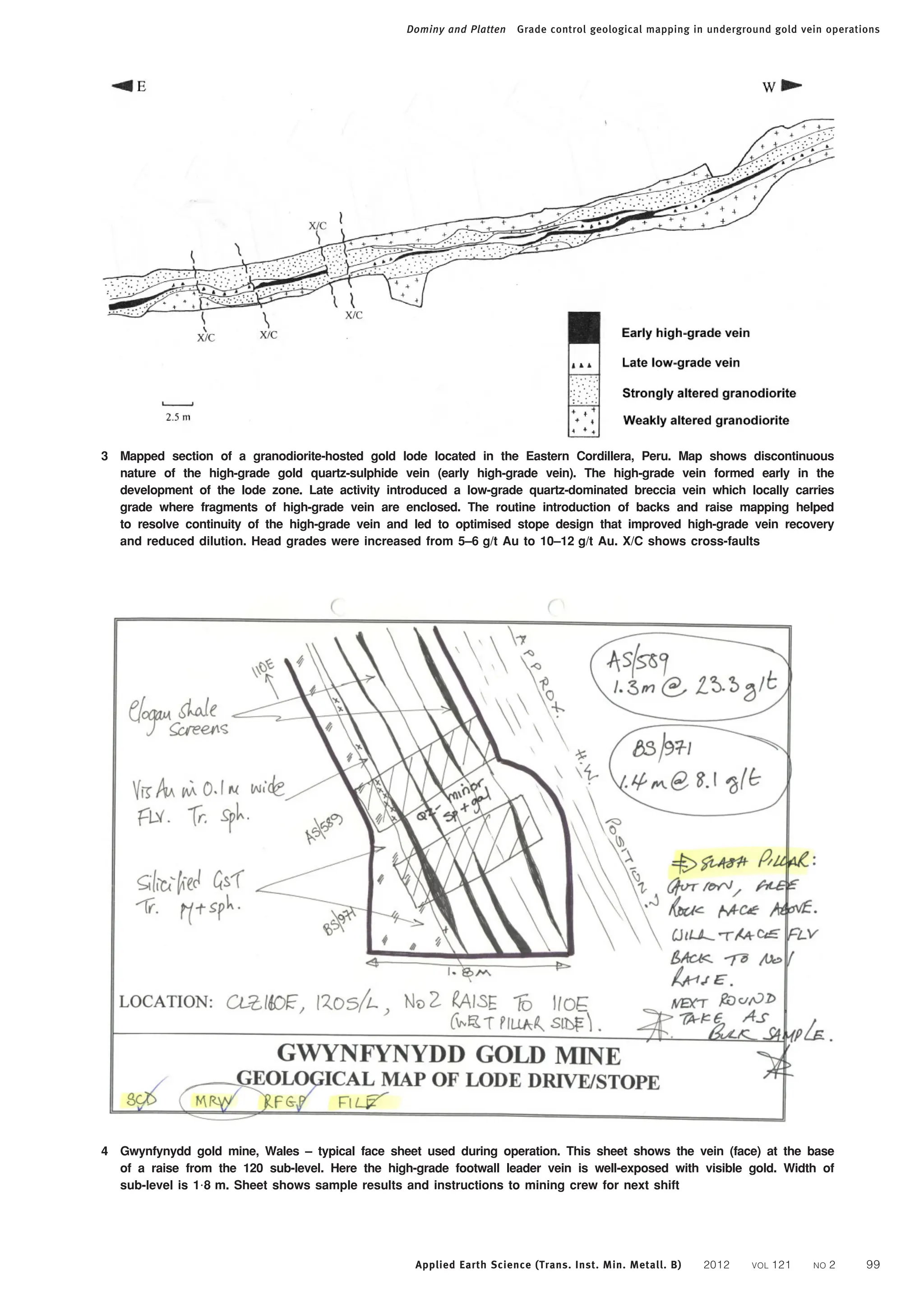
advantages of mapping discrete veins rather than the
gross quartz package are evident (Fig. 3).
Face sheets
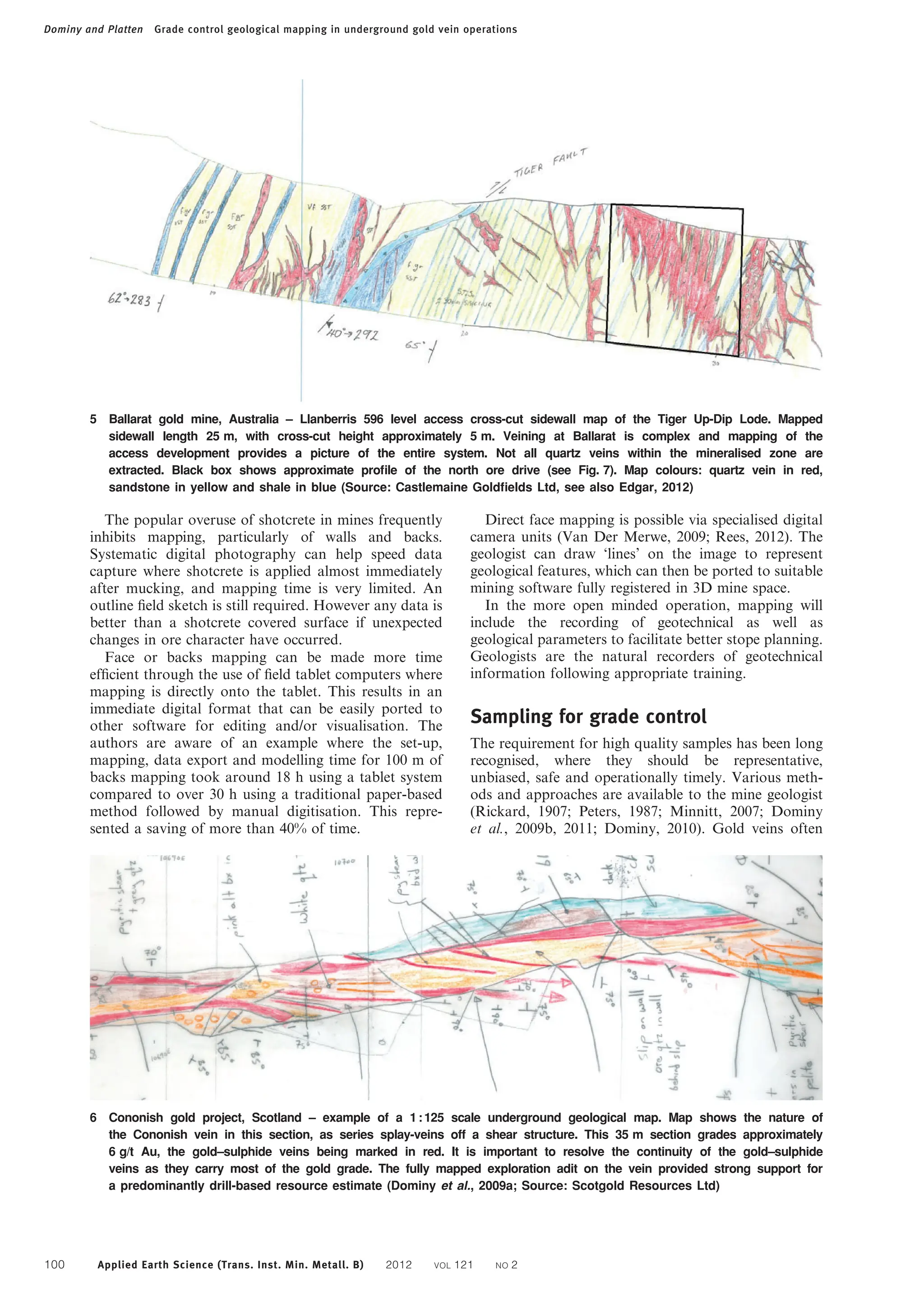
Face sheets are the most important aspect of mapping as
they indicate whether the drive or raise is still following
the structure and allow direction of development (Fig. 4).
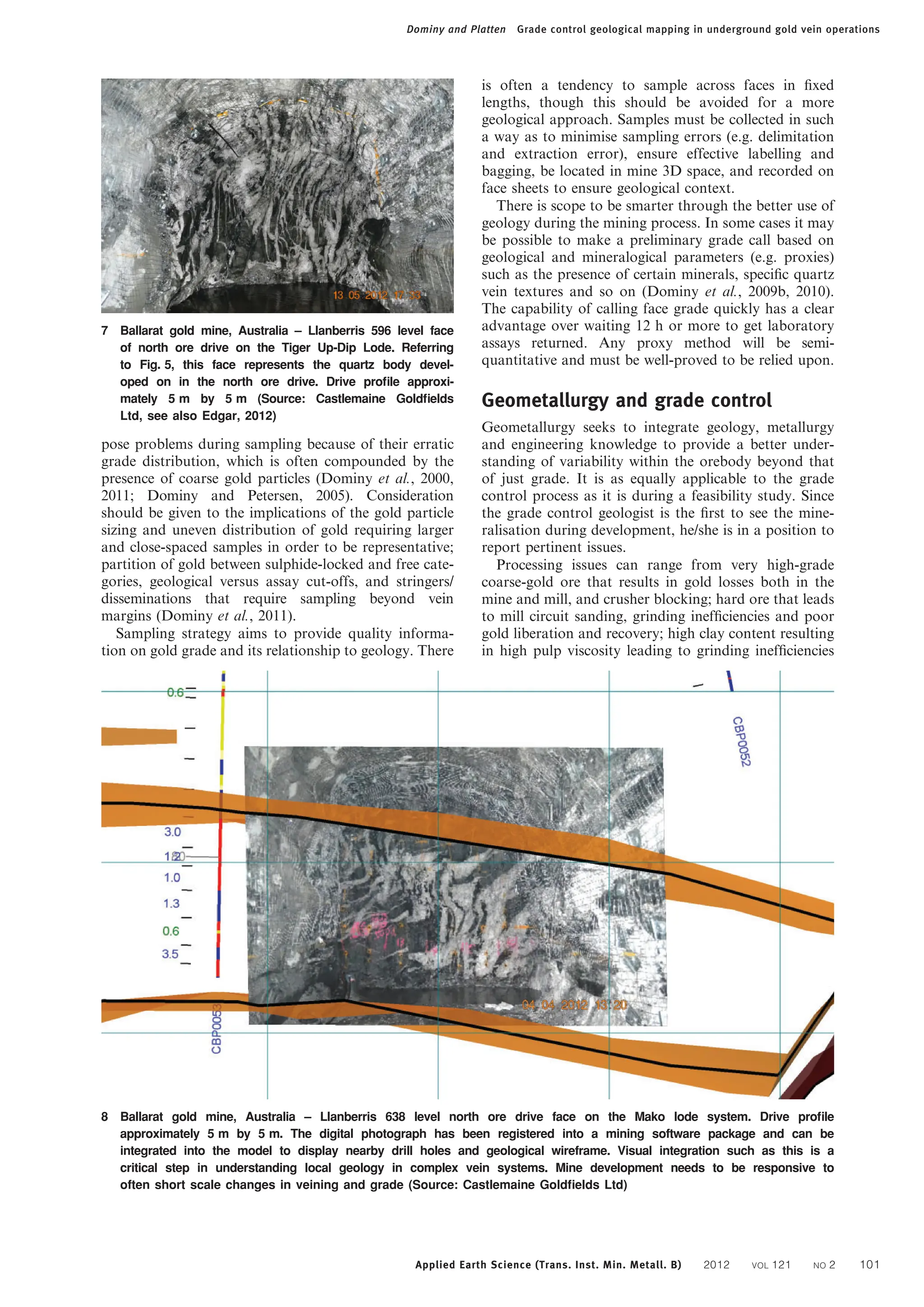
In some operations, side wall mapping is important
particularly where the vein system is geometrically more
complex and is wider than development (Fig. 5).
Mapping is usually undertaken on a pro-forma sheet
often made from water resistant paper. They provide a
cross-section of the structure, give data in a vertical
direction, give the most readily observed and interpreted
view of the structure and are usually the basis for collection
of samples. They need to be accurate and detailed yet
mapping and sampling has to be rapid to limit disruption
of the mine development cycle. Traditionally face sheets
have been the property of the mine geologist, but should be
copied to production staff to guide the next development
round or stope lift (Fig. 4).
Many large operations use development profiles of 4 m
by 4 m or greater. This means that for safety reasons the
upper 2 m or more of the face and the backs cannot be
easily accessed for close inspection or sampling. In such
cases, the geologist needs to do the best possible job and
leverage their experience at the mine to fill in the mapping
gaps. Additionally, the drive backs are often meshed and
bolted quickly after blasting and mucking for safety
reasons. Again, the geologist will have to use appropriate
expertise to glean what they can from partly obscured
backs.
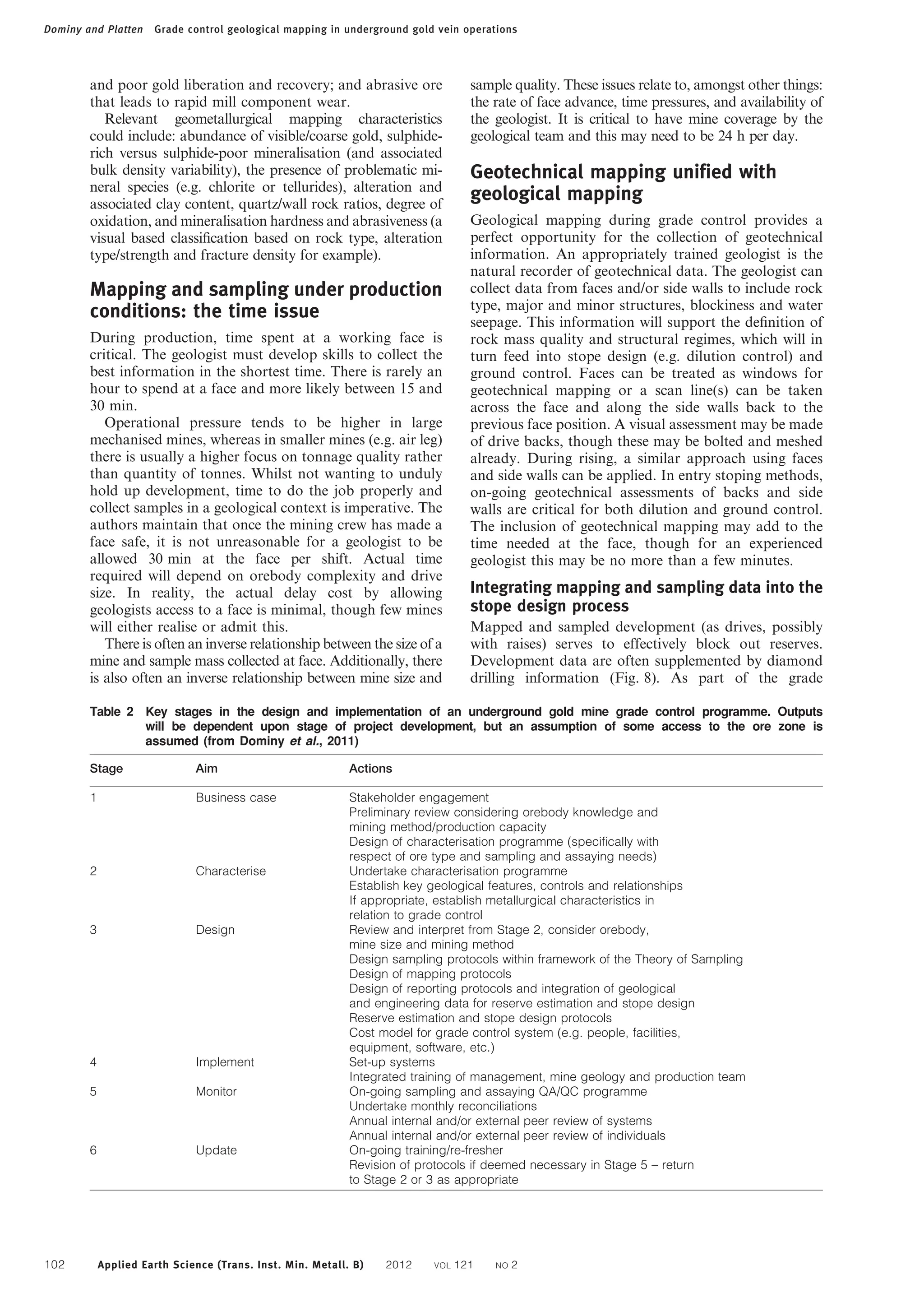
Mapping of drive backs provides additional informa-
tion on small-scale vein continuity beyond that of face
mapping which is usually on a scale of 1?8 m or above
(Fig. 6).
In addition to mapping sheets, digital photography is
an essential tool in modern underground mapping
(Fig. 7). Rock faces can be recorded rapidly in a form
that can be incorporated into digital databases and
mining software (Fig. 8). Photographs can be printed and
subsequently used in the mine as a base map for plotting
complex data. Photographs on their own should not be
used as a substitute for conventional geological examina-
tion, sketching and description at the time. Photographs
can sometimes mask geological detail, particularly where
lithological colour contrasts are weak.
2 Gwynfynydd gold mine, Wales – stope back mapping and sampling undertaken in the Chidlaw Link Zone, 110 west
shrink stope. Back samples were collected across the principal geological domains either side of the fault that crosses
the stope. The western section (left of the fault) was not on the footwall, as this had been displaced south by the fault.
The eastern section (right of the fault) was located on the footwall and locally presented small patches of fine visible-
gold clusters. A few metres above this horizon, the vein rolled to the south and mapping allowed this to be predicted
and the stope modified accordingly
Dominy and Platten Grade control geological mapping in underground gold vein operations
98 Applied Earth Science (Trans. Inst. Min. Metall. B) 2012 VOL 121 NO 2
5.
3 Mapped sectionof a granodiorite-hosted gold lode located in the Eastern Cordillera, Peru. Map shows discontinuous
nature of the high-grade gold quartz-sulphide vein (early high-grade vein). The high-grade vein formed early in the
development of the lode zone. Late activity introduced a low-grade quartz-dominated breccia vein which locally carries
grade where fragments of high-grade vein are enclosed. The routine introduction of backs and raise mapping helped
to resolve continuity of the high-grade vein and led to optimised stope design that improved high-grade vein recovery
and reduced dilution. Head grades were increased from 5–6 g/t Au to 10–12 g/t Au. X/C shows cross-faults
4 Gwynfynydd gold mine, Wales – typical face sheet used during operation. This sheet shows the vein (face) at the base
of a raise from the 120 sub-level. Here the high-grade footwall leader vein is well-exposed with visible gold. Width of
sub-level is 1?8 m. Sheet shows sample results and instructions to mining crew for next shift
Dominy and Platten Grade control geological mapping in underground gold vein operations
Applied Earth Science (Trans. Inst. Min. Metall. B) 2012 VOL 121 NO 2 99
6.
The popular overuseof shotcrete in mines frequently
inhibits mapping, particularly of walls and backs.
Systematic digital photography can help speed data
capture where shotcrete is applied almost immediately
after mucking, and mapping time is very limited. An
outline field sketch is still required. However any data is
better than a shotcrete covered surface if unexpected
changes in ore character have occurred.
Face or backs mapping can be made more time
efficient through the use of field tablet computers where
mapping is directly onto the tablet. This results in an
immediate digital format that can be easily ported to
other software for editing and/or visualisation. The
authors are aware of an example where the set-up,
mapping, data export and modelling time for 100 m of
backs mapping took around 18 h using a tablet system
compared to over 30 h using a traditional paper-based
method followed by manual digitisation. This repre-
sented a saving of more than 40% of time.
Direct face mapping is possible via specialised digital
camera units (Van Der Merwe, 2009; Rees, 2012). The
geologist can draw ‘lines’ on the image to represent
geological features, which can then be ported to suitable
mining software fully registered in 3D mine space.
In the more open minded operation, mapping will
include the recording of geotechnical as well as
geological parameters to facilitate better stope planning.
Geologists are the natural recorders of geotechnical
information following appropriate training.
Sampling for grade control
The requirement for high quality samples has been long
recognised, where they should be representative,
unbiased, safe and operationally timely. Various meth-
ods and approaches are available to the mine geologist
(Rickard, 1907; Peters, 1987; Minnitt, 2007; Dominy
et al., 2009b, 2011; Dominy, 2010). Gold veins often
5 Ballarat gold mine, Australia – Llanberris 596 level access cross-cut sidewall map of the Tiger Up-Dip Lode. Mapped
sidewall length 25 m, with cross-cut height approximately 5 m. Veining at Ballarat is complex and mapping of the
access development provides a picture of the entire system. Not all quartz veins within the mineralised zone are
extracted. Black box shows approximate profile of the north ore drive (see Fig. 7). Map colours: quartz vein in red,
sandstone in yellow and shale in blue (Source: Castlemaine Goldfields Ltd, see also Edgar, 2012)
6 Cononish gold project, Scotland – example of a 1:125 scale underground geological map. Map shows the nature of
the Cononish vein in this section, as series splay-veins off a shear structure. This 35 m section grades approximately
6 g/t Au, the gold–sulphide veins being marked in red. It is important to resolve the continuity of the gold–sulphide
veins as they carry most of the gold grade. The fully mapped exploration adit on the vein provided strong support for
a predominantly drill-based resource estimate (Dominy et al., 2009a; Source: Scotgold Resources Ltd)
Dominy and Platten Grade control geological mapping in underground gold vein operations
100 Applied Earth Science (Trans. Inst. Min. Metall. B) 2012 VOL 121 NO 2
7.
pose problems duringsampling because of their erratic
grade distribution, which is often compounded by the
presence of coarse gold particles (Dominy et al., 2000,
2011; Dominy and Petersen, 2005). Consideration
should be given to the implications of the gold particle
sizing and uneven distribution of gold requiring larger
and close-spaced samples in order to be representative;
partition of gold between sulphide-locked and free cate-
gories, geological versus assay cut-offs, and stringers/
disseminations that require sampling beyond vein
margins (Dominy et al., 2011).
Sampling strategy aims to provide quality informa-
tion on gold grade and its relationship to geology. There
is often a tendency to sample across faces in fixed
lengths, though this should be avoided for a more
geological approach. Samples must be collected in such
a way as to minimise sampling errors (e.g. delimitation
and extraction error), ensure effective labelling and
bagging, be located in mine 3D space, and recorded on
face sheets to ensure geological context.
There is scope to be smarter through the better use of
geology during the mining process. In some cases it may
be possible to make a preliminary grade call based on
geological and mineralogical parameters (e.g. proxies)
such as the presence of certain minerals, specific quartz
vein textures and so on (Dominy et al., 2009b, 2010).
The capability of calling face grade quickly has a clear
advantage over waiting 12 h or more to get laboratory
assays returned. Any proxy method will be semi-
quantitative and must be well-proved to be relied upon.
Geometallurgy and grade control
Geometallurgy seeks to integrate geology, metallurgy
and engineering knowledge to provide a better under-
standing of variability within the orebody beyond that
of just grade. It is as equally applicable to the grade
control process as it is during a feasibility study. Since
the grade control geologist is the first to see the mine-
ralisation during development, he/she is in a position to
report pertinent issues.
Processing issues can range from very high-grade
coarse-gold ore that results in gold losses both in the
mine and mill, and crusher blocking; hard ore that leads
to mill circuit sanding, grinding inefficiencies and poor
gold liberation and recovery; high clay content resulting
in high pulp viscosity leading to grinding inefficiencies
7 Ballarat gold mine, Australia – Llanberris 596 level face
of north ore drive on the Tiger Up-Dip Lode. Referring
to Fig. 5, this face represents the quartz body devel-
oped on in the north ore drive. Drive profile approxi-
mately 5 m by 5 m (Source: Castlemaine Goldfields
Ltd, see also Edgar, 2012)
8 Ballarat gold mine, Australia – Llanberris 638 level north ore drive face on the Mako lode system. Drive profile
approximately 5 m by 5 m. The digital photograph has been registered into a mining software package and can be
integrated into the model to display nearby drill holes and geological wireframe. Visual integration such as this is a
critical step in understanding local geology in complex vein systems. Mine development needs to be responsive to
often short scale changes in veining and grade (Source: Castlemaine Goldfields Ltd)
Dominy and Platten Grade control geological mapping in underground gold vein operations
Applied Earth Science (Trans. Inst. Min. Metall. B) 2012 VOL 121 NO 2 101
8.
and poor goldliberation and recovery; and abrasive ore
that leads to rapid mill component wear.
Relevant geometallurgical mapping characteristics
could include: abundance of visible/coarse gold, sulphide-
rich versus sulphide-poor mineralisation (and associated
bulk density variability), the presence of problematic mi-
neral species (e.g. chlorite or tellurides), alteration and
associated clay content, quartz/wall rock ratios, degree of
oxidation, and mineralisation hardness and abrasiveness (a
visual based classification based on rock type, alteration
type/strength and fracture density for example).
Mapping and sampling under production
conditions: the time issue
During production, time spent at a working face is
critical. The geologist must develop skills to collect the
best information in the shortest time. There is rarely an
hour to spend at a face and more likely between 15 and
30 min.
Operational pressure tends to be higher in large
mechanised mines, whereas in smaller mines (e.g. air leg)
there is usually a higher focus on tonnage quality rather
than quantity of tonnes. Whilst not wanting to unduly
hold up development, time to do the job properly and
collect samples in a geological context is imperative. The
authors maintain that once the mining crew has made a
face safe, it is not unreasonable for a geologist to be
allowed 30 min at the face per shift. Actual time
required will depend on orebody complexity and drive
size. In reality, the actual delay cost by allowing
geologists access to a face is minimal, though few mines
will either realise or admit this.
There is often an inverse relationship between the size of a
mine and sample mass collected at face. Additionally, there
is also often an inverse relationship between mine size and
sample quality. These issues relate to, amongst other things:
the rate of face advance, time pressures, and availability of
the geologist. It is critical to have mine coverage by the
geological team and this may need to be 24 h per day.
Geotechnical mapping unified with
geological mapping
Geological mapping during grade control provides a
perfect opportunity for the collection of geotechnical
information. An appropriately trained geologist is the
natural recorder of geotechnical data. The geologist can
collect data from faces and/or side walls to include rock
type, major and minor structures, blockiness and water
seepage. This information will support the definition of
rock mass quality and structural regimes, which will in
turn feed into stope design (e.g. dilution control) and
ground control. Faces can be treated as windows for
geotechnical mapping or a scan line(s) can be taken
across the face and along the side walls back to the
previous face position. A visual assessment may be made
of drive backs, though these may be bolted and meshed
already. During rising, a similar approach using faces
and side walls can be applied. In entry stoping methods,
on-going geotechnical assessments of backs and side
walls are critical for both dilution and ground control.
The inclusion of geotechnical mapping may add to the
time needed at the face, though for an experienced
geologist this may be no more than a few minutes.
Integrating mapping and sampling data into the
stope design process
Mapped and sampled development (as drives, possibly
with raises) serves to effectively block out reserves.
Development data are often supplemented by diamond
drilling information (Fig. 8). As part of the grade
Table 2 Key stages in the design and implementation of an underground gold mine grade control programme. Outputs
will be dependent upon stage of project development, but an assumption of some access to the ore zone is
assumed (from Dominy et al., 2011)
Stage Aim Actions
1 Business case Stakeholder engagement
Preliminary review considering orebody knowledge and
mining method/production capacity
Design of characterisation programme (specifically with
respect of ore type and sampling and assaying needs)
2 Characterise Undertake characterisation programme
Establish key geological features, controls and relationships
If appropriate, establish metallurgical characteristics in
relation to grade control
3 Design Review and interpret from Stage 2, consider orebody,
mine size and mining method
Design sampling protocols within framework of the Theory of Sampling
Design of mapping protocols
Design of reporting protocols and integration of geological
and engineering data for reserve estimation and stope design
Reserve estimation and stope design protocols
Cost model for grade control system (e.g. people, facilities,
equipment, software, etc.)
4 Implement Set-up systems
Integrated training of management, mine geology and production team
5 Monitor On-going sampling and assaying QA/QC programme
Undertake monthly reconciliations
Annual internal and/or external peer review of systems
Annual internal and/or external peer review of individuals
6 Update On-going training/re-fresher
Revision of protocols if deemed necessary in Stage 5 – return
to Stage 2 or 3 as appropriate
Dominy and Platten Grade control geological mapping in underground gold vein operations
102 Applied Earth Science (Trans. Inst. Min. Metall. B) 2012 VOL 121 NO 2
9.
control estimation process,a design file should be
established for each stope. This should contain all
relevant geological, grade and geotechnical data to
facilitate economic evaluation and design. The stope
file should include both digital and paper based
information, with a physical file established to document
all parameters and visuals of designs.
The success of the process will be constrained by the
level of collaboration between geologists and engineers.
In complex orebodies, the need for close collaboration is
very high. Planning meetings must be held to ensure that
all information is passed between the parties. Geologists
must use mapping data to constrain the estimation
process and build any complexities into the stope design
(Figs. 3, 4, 6 and 8). Final sign-off on stope economic
viability and design must be a bipartite activity.
Safety issues
There are many safety considerations to be had when
working underground. One of the greatest risks for the
geologist is working under unsupported ground. In many
operations, close access to the face is not permitted and
leads to the application of ‘remote’ mapping and grab
sampling during development. This tends to be in the
larger rather than small mines. Awareness of the risk and
proper training is critical. High risk also faces the
geologist when mapping and sampling within raises,
again training is required.
Conclusions
This contribution proposes that effective geological
mapping, together with sampling are critical to grade
control in underground gold vein operations. Grade
control is about adding value by delivering optimal
grade tonnes to the mill via the accurate definition of ore
and waste. It permits better selectivity to optimise grade
above the cut-off, minimise waste/low-grade rock dilu-
tion and maximise mining recovery.
A number of issues support a successful underground
grade control programme:
N clear and accurate geological mapping
N appropriate sampling and assaying protocols, which
take into account the nature of the orebody
N a dynamic working model for mineralisation controls
N effective stope design to optimise recovery and reduce
dilution based on strong geological and engineering
input and team collaboration
N geometallurgical inputs to assist in optimising mill
recovery and throughput where appropriate.
Key recommendations for the design and implementa-
tion of a grade control sampling programme are
summarised in Table 2.
A well-designed grade control programme will show
stakeholders that by applying geological knowledge, the
mining process can be more efficient and cost effective.
The authors believe that grade control is about
identifying uncertainty and risk to maximise value. It
is about setting expectations and ensuring no surprises
and where there is risk – manage it.
Acknowledgements
The authors acknowledge various companies for the
opportunity to input into grade control studies over a
number of years. Thanks are due to AES Editor, Professor
Neil Phillips for his helpful review of the manuscript. The
opinions expressed in this paper are those of the authors,
and not necessarily those of Snowden.
References
Dominy, S. C. 2010. Grade control sampling methods in underground
gold mine grade control, in Proceedings of the Sampling
Conference, 7–20, Melbourne, The Australasian Institute of
Mining and Metallurgy.
Dominy, S. C., Annels, A. E., Johansen, G. F. and Cuffley, B. W. 2000.
General considerations of sampling and assaying in a coarse gold
environment, Trans. Inst. Min. Metall., 109, B145–B167.
Dominy S. C. and Petersen J. S. 2005. Sampling coarse gold-bearing
mineralisation – developing effective protocols and a case study
from Southern Greenland, in Proceedings of the Second World
Conference on ‘Sampling and blending’, 151–165, Melbourne,
The Australasian Institute of Mining and Metallurgy.
Dominy, S. C., Platten, I. M. and Raine, M. D. 2003. Grade and
geological continuity in high nugget effect gold-quartz reefs:
implications for resource estimation and reporting, Trans. Inst.
Min. Metall., 112, B239–B259.
Dominy, S. C., Platten, I. M., Xie, Y. and Sangster, C. J. S. 2009a.
Analysis of geological mapping data at the Cononish gold-silver
mine, Perthshire, Scotland, in Proceedings of the Seventh
International Mining Geology Conference, (ed. S. C. Dominy),
187–196, Melbourne, The Australasian Institute of Mining and
Metallurgy.
Dominy, S. C., Platten, I. M., Fraser, R. M., Dahl, O. and Collier, J. B.
2009b. Grade control in underground gold vein operations: the
role of geological mapping and sampling, in Proceedings of the
Seventh International Mining Geology Conference, (ed. S. C.
Dominy), 291–307, Melbourne, The Australasian Institute of
Mining and Metallurgy.
Dominy, S. C., Platten, I. M. and Nugus, M. J. 2010. Application of
geology to alleviate sampling bias during the evaluation of high-
nugget gold systems, in Proceedings of the Sampling Conference,
75–85, Melbourne, The Australasian Institute of Mining and
Metallurgy.
Dominy, S. C., Platten, I. M., Xie, Y. and Minnitt, R. C. A. 2011.
Underground grade control protocol design: case study from the
Liphichi gold project, Larecaja, Bolivia, Trans. Inst. Min. Metall.,
119, B205–B219.
Edgar, W. B. 2012. Geological aspects from the redeveloped Ballarat
gold mine, AusIMM Bull., 4, 71–77.
Forrester, J. D. 1947. Principals of field and mining geology, New
York, John Wiley & Sons.
James, A. H. 1946. Profile technique useful in mapping stope geology,
Eng. Min. J., 147, 74–75.
Marjoribanks, R. W. 2010. Geological methods in mineral exploration
and mining, London, Chapman and Hall.
McKinstry, H. E. 1948. Mining geology, Englewood Cliffs, NJ,
Prentice-Hall.
Minnitt, R. C. A. 2007. Sampling: the impact on costs and decision
making, J. S. Afr. Inst. Min. Metall., 107, 451–462.
Nugus, M. J., Blenkinsop, T. G., Dominy, S. C. and Robson, S. 2003.
Enigmatic kinematics resolved in the Taurus shear zone, Golden
Pig mine, Southern Cross, Western Australia: resource implica-
tions, in Proceedings of the Fifth International Mining Geology
Conference, (ed. S. C. Dominy), 171–179, Melbourne, The
Australasian Institute of Mining and Metallurgy.
Peters, W. C. 1987. Exploration and mining geology, New York, John
Wiley & Sons.
Platten, I. M. and Dominy, S. C. 2003. The occurrence of high-grade
gold pockets in quartz reefs at the Gwynfynydd mine, Wales,
United Kingdom: a geological explanation of the nugget effect,
Explor. Min. Geol., 10, 249–272.
Rees, K. 2012. The benefits of using photogrammetry in the geological
interpretation of the Cosmos nickel mine, in Proceedings of
Narrow Vein Mining Conference, (ed. S. C. Dominy), 145–147,
Melbourne, The Australasian Institute of Mining and Metallurgy.
Rickard, T. A. 1907. The sampling and estimation of ore in a mine,
London, Hill Publishing Company.
Schmitt, H. 1936. On mapping underground geology, Eng. Min. J., 137,
557–561.
Van Der Merwe, H. C. 2009. SirovisionH: a proposed solution for the
implementation of a digital geological mapping system at the
Moab Khotsong mine, in Proceedings of the World Gold
Conference, 183–191, Johannesburg, The Southern African
Institute of Mining and Metallurgy.
Dominy and Platten Grade control geological mapping in underground gold vein operations
Applied Earth Science (Trans. Inst. Min. Metall. B) 2012 VOL 121 NO 2 103
View publication stats