© MIT-ADT University, Pune 2023
Tuesday, December 31, 2024
1
Lecture by Abhijeet G. Chavan
MIT School of Engineering, Pune
Course Code: 22MEVT432
Course: Noise, Vibration and Harshness (NVH) in Electric Vehicles
Name of the Faculty: Prof. Abhijeet G. Chavan
+ 9 1 7 5 8 8 5 8 8 5 2 7
a b h i j e e t . c h a v a n @ m i t u n i v e r s i t y. e d u . i n
© MIT-ADT University, Pune 2023
Tuesday, December 31, 2024
2
Lecture by Abhijeet G. Chavan
Unit No 1
Introduction to Vibration and Noise
Syllabus:
Natural vibrations, SDOF and MDOF concept and modeling,
Undamped, damped and forced vibrations, resonance,
transmissibility, modes of vibrations.
Basics of sound propagation, Sound levels and spectra,
Quantification of sound, Noise sources, generation and
radiation, Noise source identification and noise induced hearing
loss.
© MIT-ADT University, Pune 2023
Tuesday, December 31, 2024
3
Lecture by Abhijeet G. Chavan
Introduction to Vibration and Noise
Elements of a vibratory system:
• Mass (Inertia)
• Spring (Stiffness / Energy storage)
• Damper (Energy dissipation)
• External Excitation (Forcing functions)
Essential Elements for vibratory motion…!
What is a vibratory motion…??
© MIT-ADT University, Pune 2023
Tuesday, December 31, 2024
Lecture by Abhijeet G. Chavan
Natural vibrations (free Vibrations)
Degrees of Freedom
DOF: Number of independent parameters required to ‘completely’ describe the
motion/position of the body
Free Vibrations: Vibrations of a body because of its own physical properties when
there is no external excitation
Tuesday, December 31, 2024 Lecture by Abhijeet G.Chavan 5
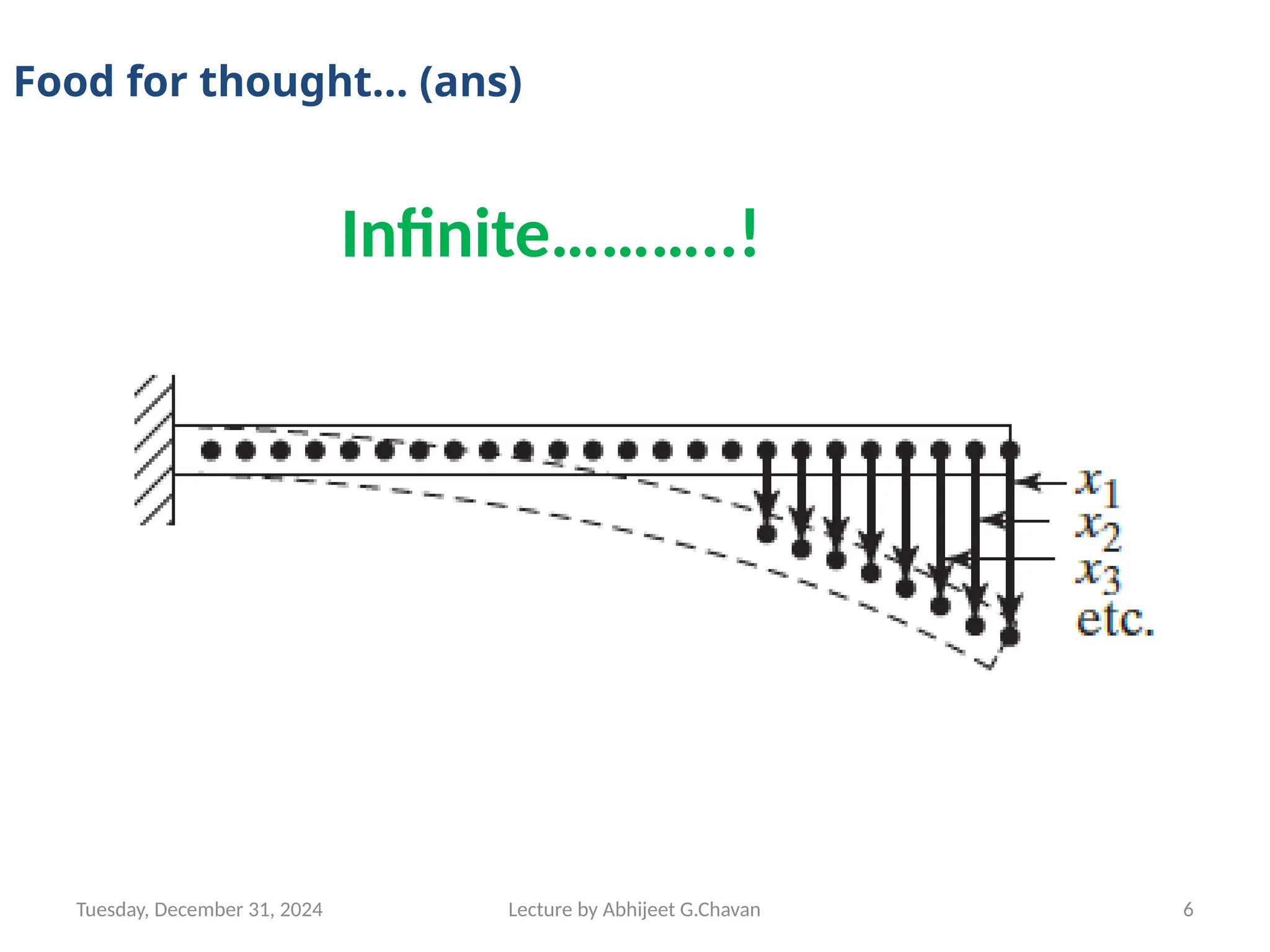
How many maximum degrees of freedom we can have…??
Food for thought…
Tuesday, December 31, 2024 Lecture by Abhijeet G.Chavan 6
Infinite………..!
Food for thought… (ans)
© MIT-ADT University, Pune 2023
Tuesday, December 31, 2024
7
Lecture by Abhijeet G. Chavan
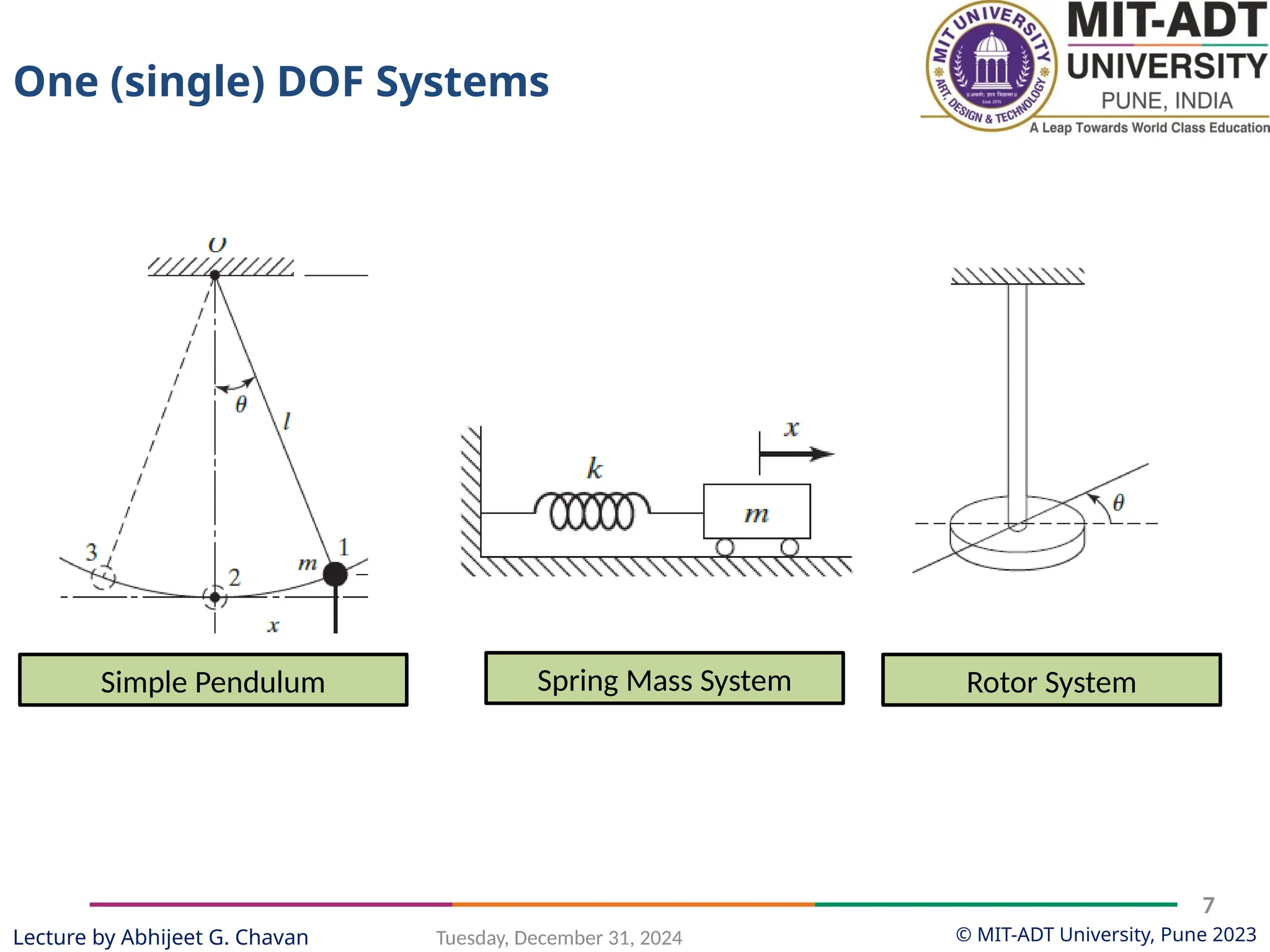
Simple Pendulum Spring Mass System Rotor System
One (single) DOF Systems
© MIT-ADT University, Pune 2023
Tuesday, December 31, 2024
8
Lecture by Abhijeet G. Chavan
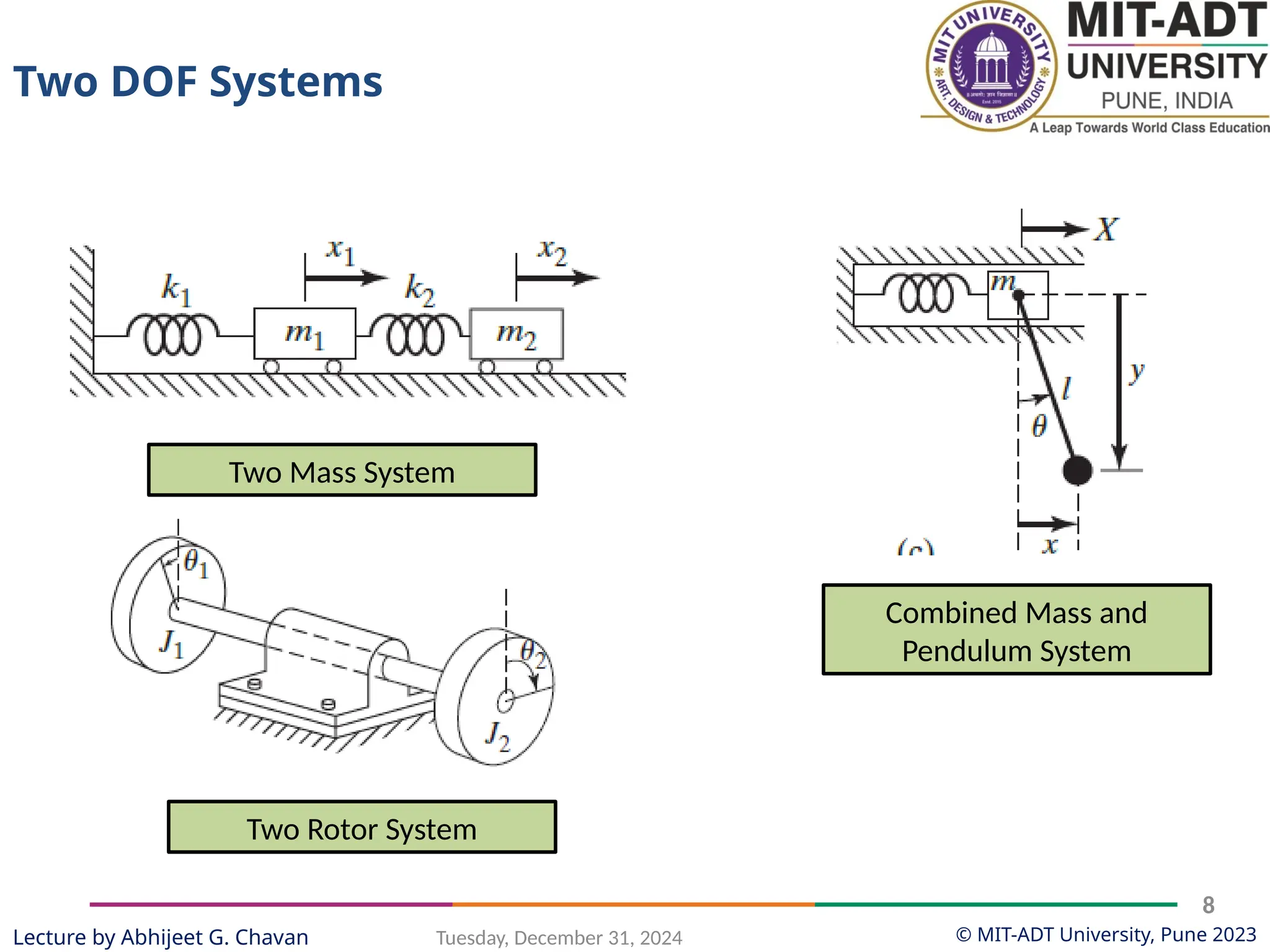
Two Mass System
Two Rotor System
Combined Mass and
Pendulum System
Two DOF Systems
© MIT-ADT University, Pune 2023
Tuesday, December 31, 2024
9
Lecture by Abhijeet G. Chavan
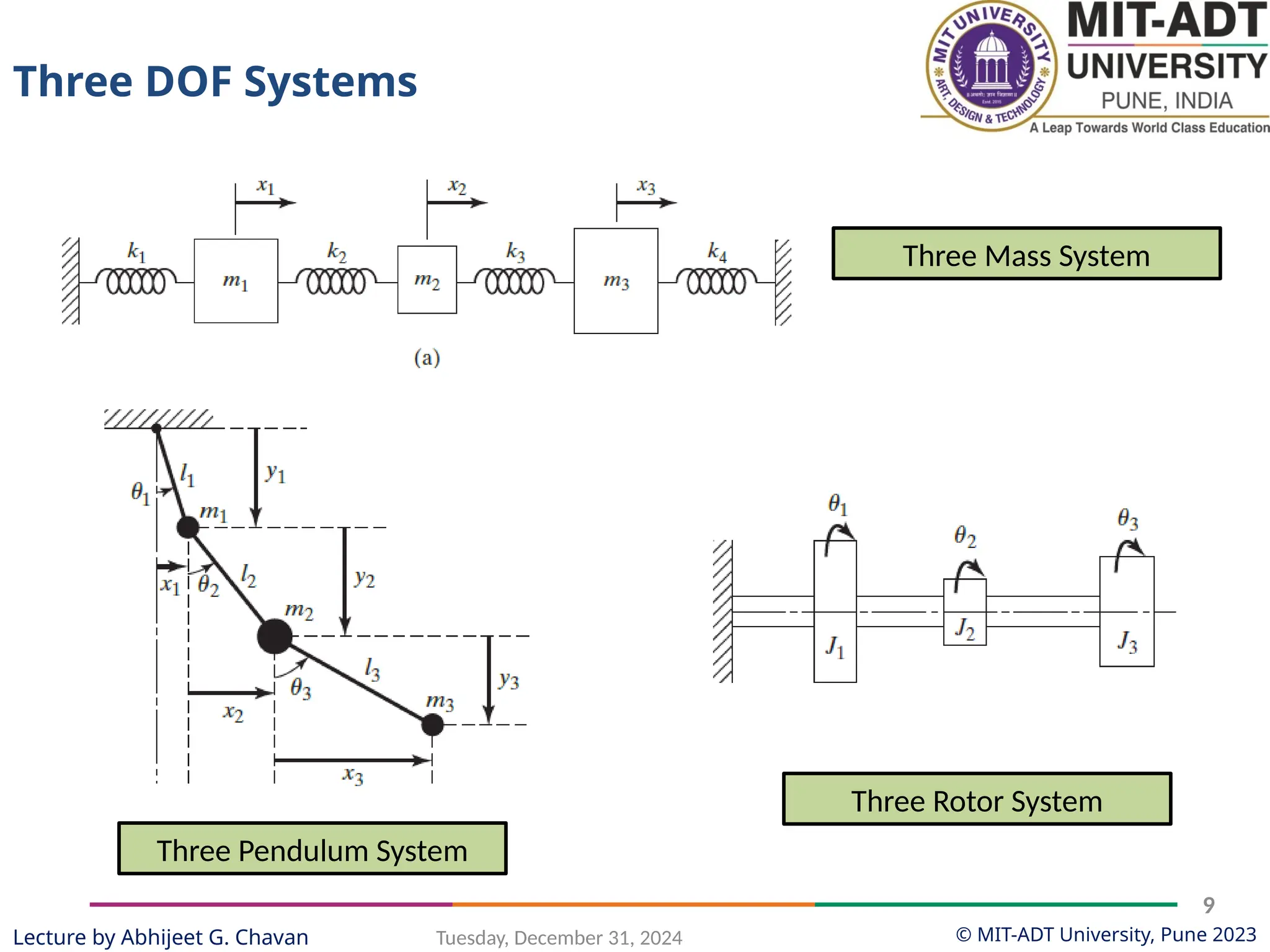
Three Mass System
Three Pendulum System
Three Rotor System
Three DOF Systems
© MIT-ADT University, Pune 2023
Tuesday, December 31, 2024
10
Lecture by Abhijeet G. Chavan
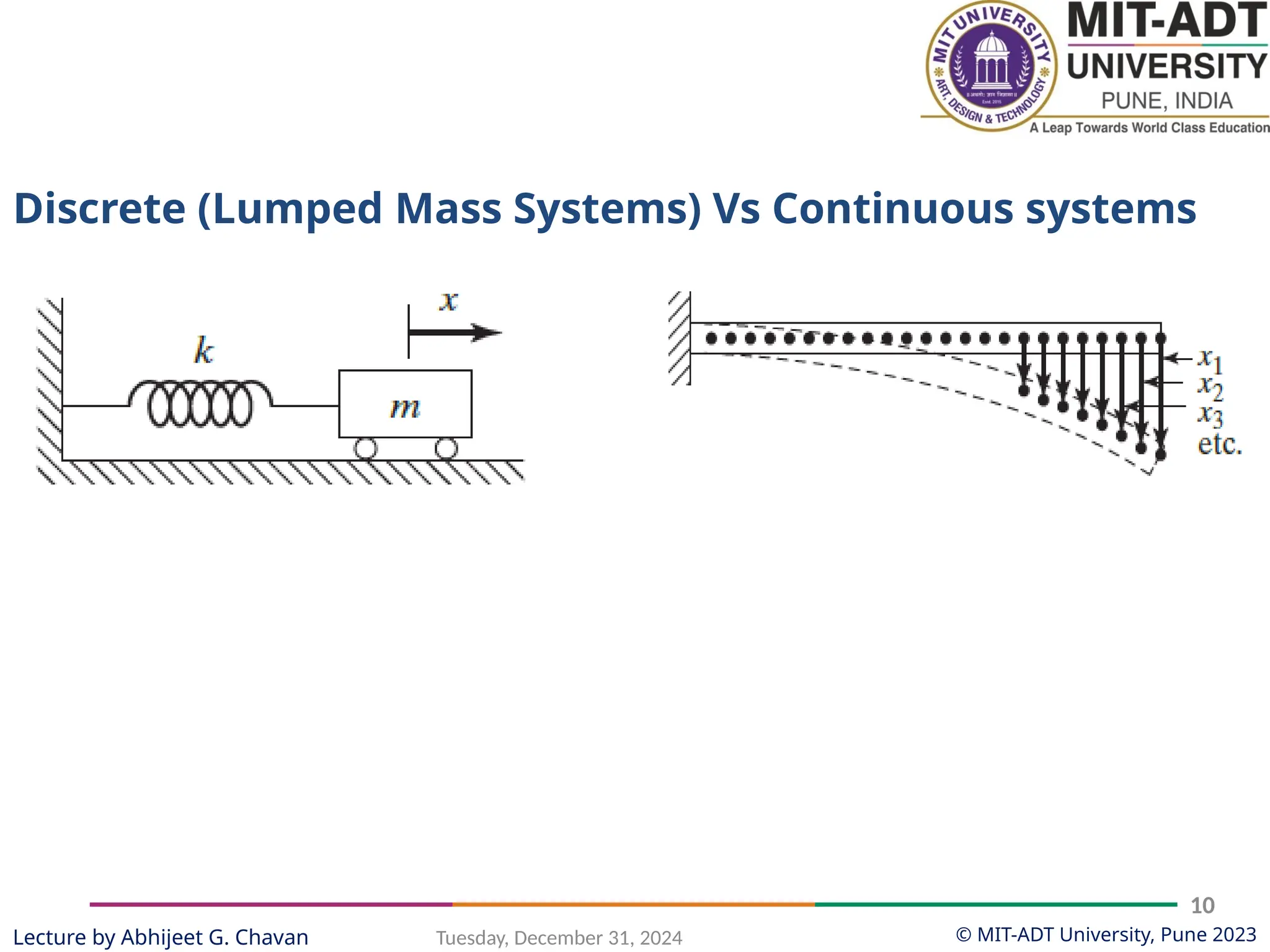
Discrete (Lumped Mass Systems) Vs Continuous systems
© MIT-ADT University, Pune 2023
Tuesday, December 31, 2024
11
Lecture by Abhijeet G. Chavan
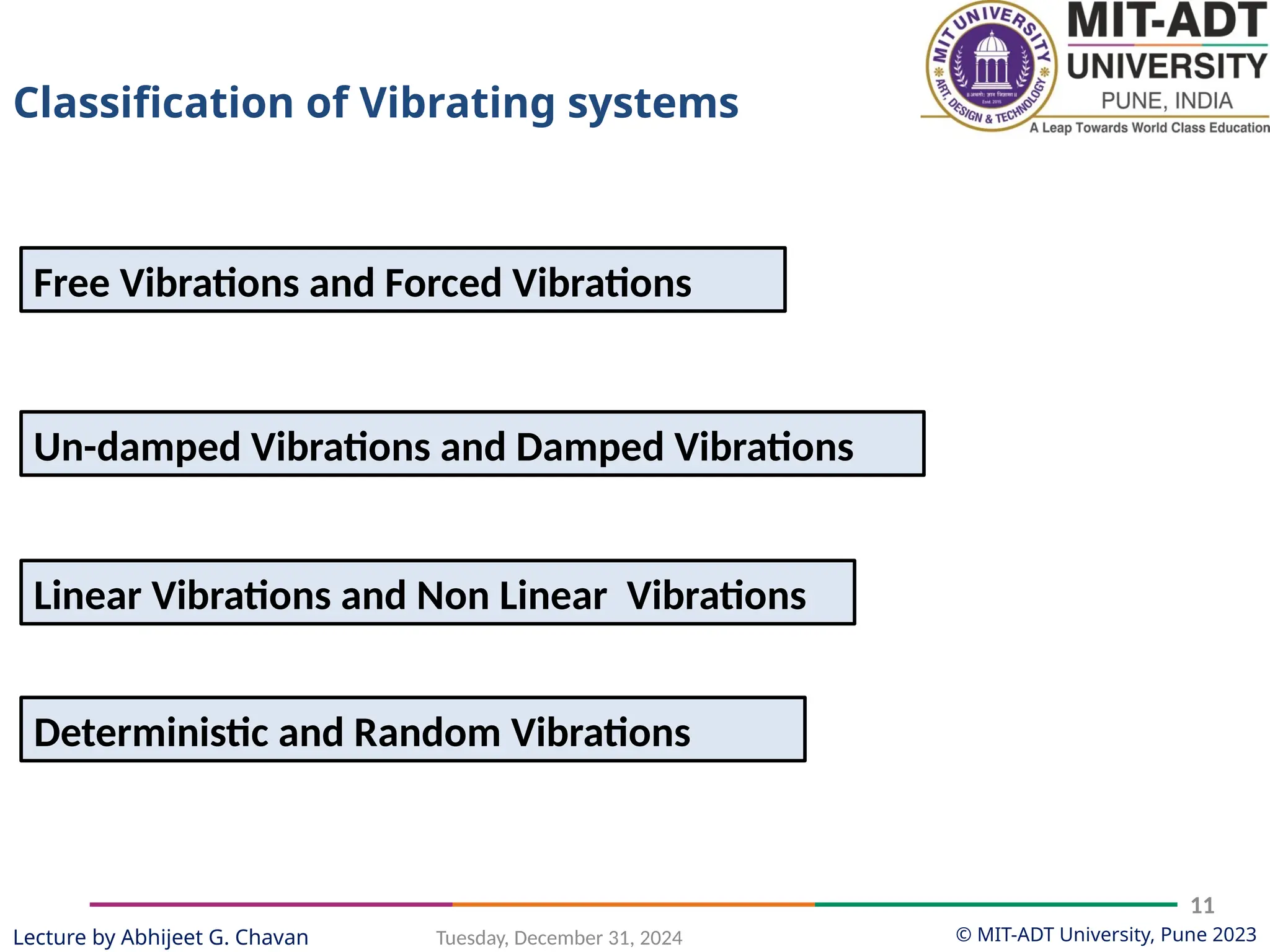
Free Vibrations and Forced Vibrations
Un-damped Vibrations and Damped Vibrations
Linear Vibrations and Non Linear Vibrations
Deterministic and Random Vibrations
Classification of Vibrating systems
© MIT-ADT University, Pune 2023
Tuesday, December 31, 2024
12
Lecture by Abhijeet G. Chavan
Classification of Vibrating systems
Longitudinal
Vibrations
Transverse
Vibrations
Torsional
Vibrations
© MIT-ADT University, Pune 2023
Tuesday, December 31, 2024
13
Lecture by Abhijeet G. Chavan
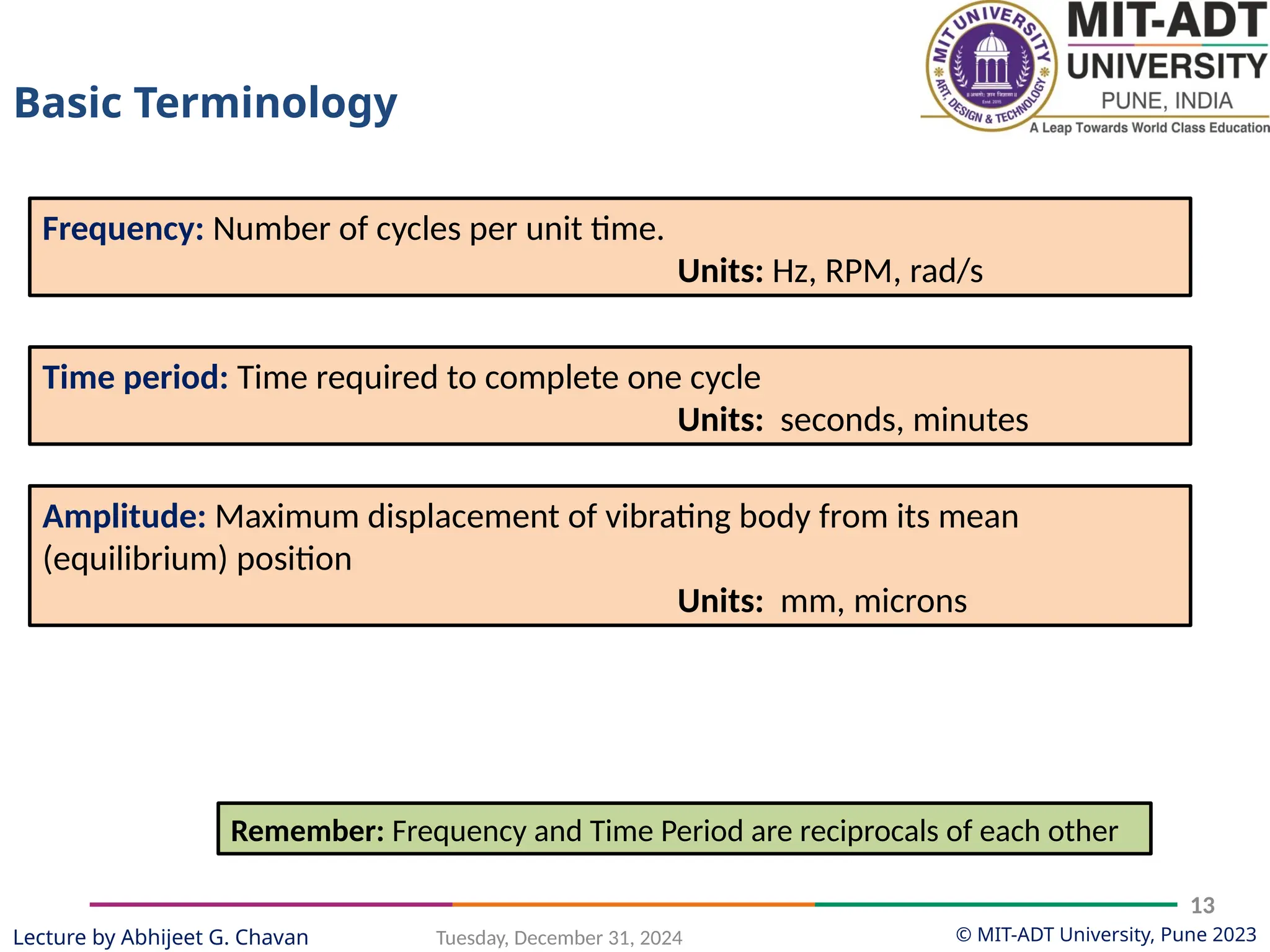
Frequency: Number of cycles per unit time.
Units: Hz, RPM, rad/s
Time period: Time required to complete one cycle
Units: seconds, minutes
Amplitude: Maximum displacement of vibrating body from its mean
(equilibrium) position
Units: mm, microns
Remember: Frequency and Time Period are reciprocals of each other
Basic Terminology
© MIT-ADT University, Pune 2023
Tuesday, December 31, 2024
14
Lecture by Abhijeet G. Chavan
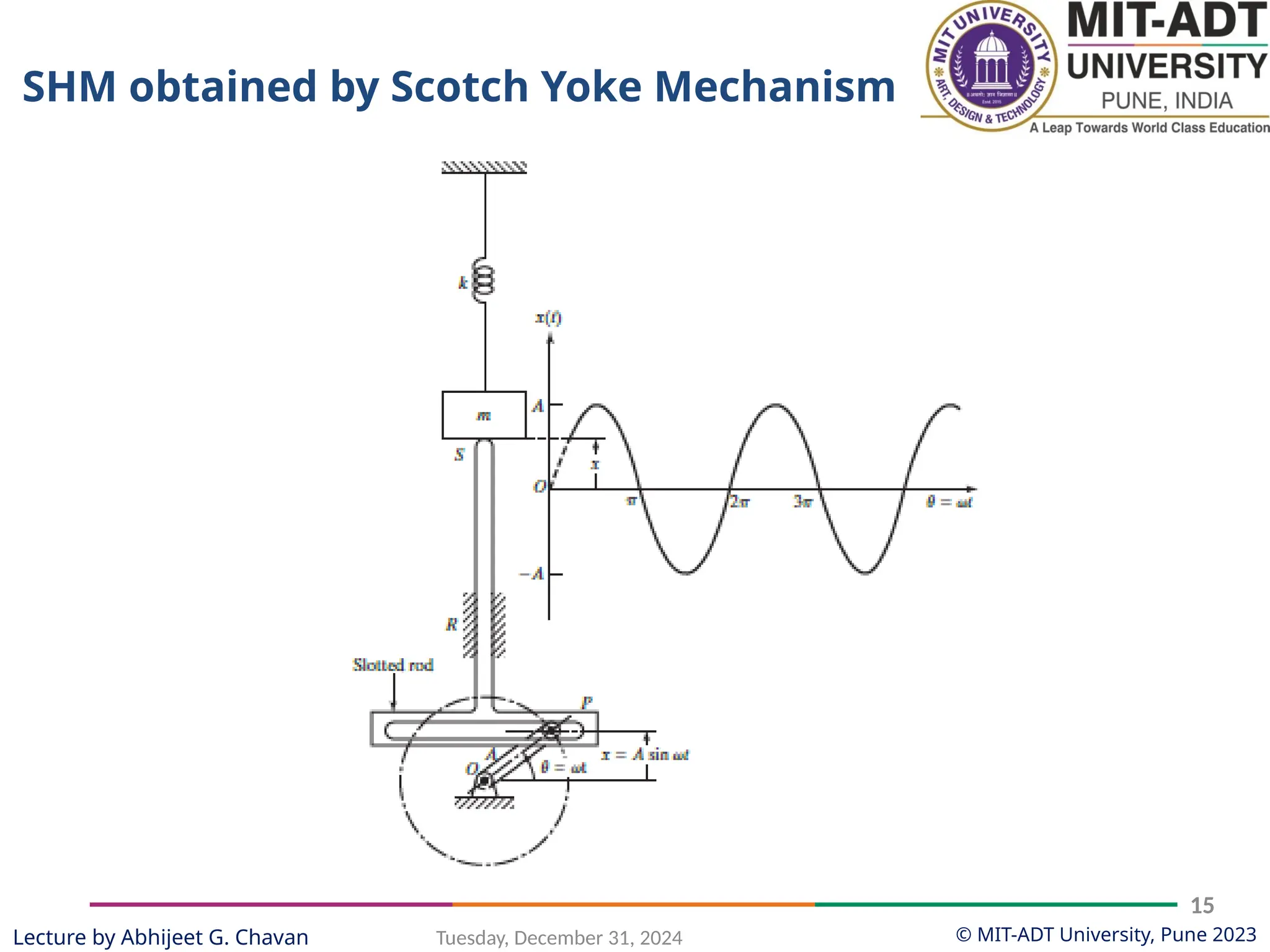
S.H.M.:- A “periodic” motion in which
• Acceleration is directly proportional to distance (displacement) from
mean position
•Acceleration is always directed towards mean position
•Examples: Motion imparted by Scotch Yoke Mechanism
Simple Harmonic Motion (S.H.M.)
© MIT-ADT University, Pune 2023
Tuesday, December 31, 2024
15
Lecture by Abhijeet G. Chavan
SHM obtained by Scotch Yoke Mechanism
© MIT-ADT University, Pune 2023
Tuesday, December 31, 2024
16
Lecture by Abhijeet G. Chavan
Harmonic motion can be represented
conveniently by means of a vector OP of
magnitude ‘A’ rotating at a constant
angular velocity v.
projection of tip
of the vector on
the vertical axis
projection of tip of
the vector on the
horizontal axis
Vector representation of SHM
© MIT-ADT University, Pune 2023
Tuesday, December 31, 2024
17
Lecture by Abhijeet G. Chavan
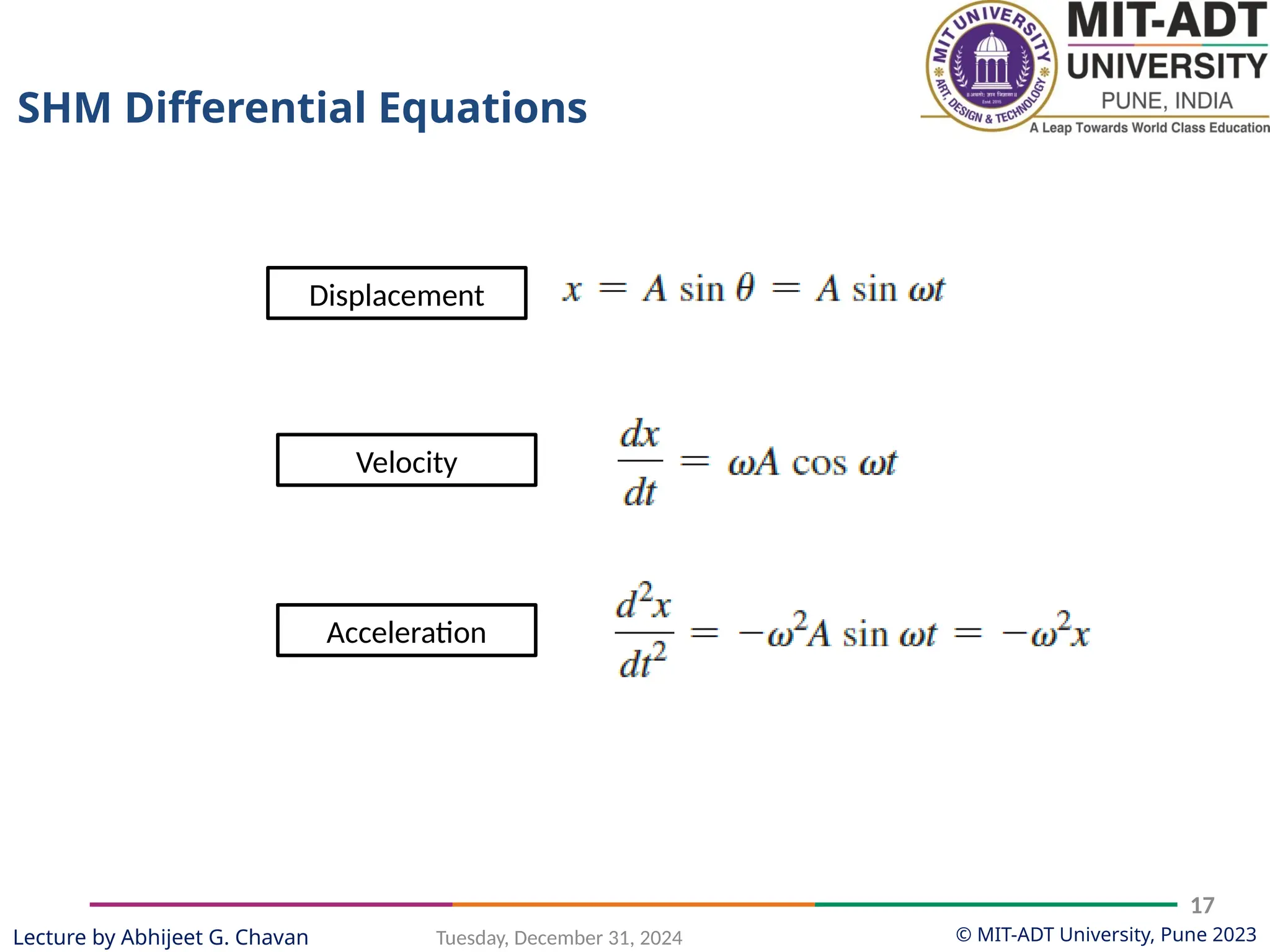
Displacement
Velocity
Acceleration
SHM Differential Equations
© MIT-ADT University, Pune 2023
Tuesday, December 31, 2024
18
Lecture by Abhijeet G. Chavan
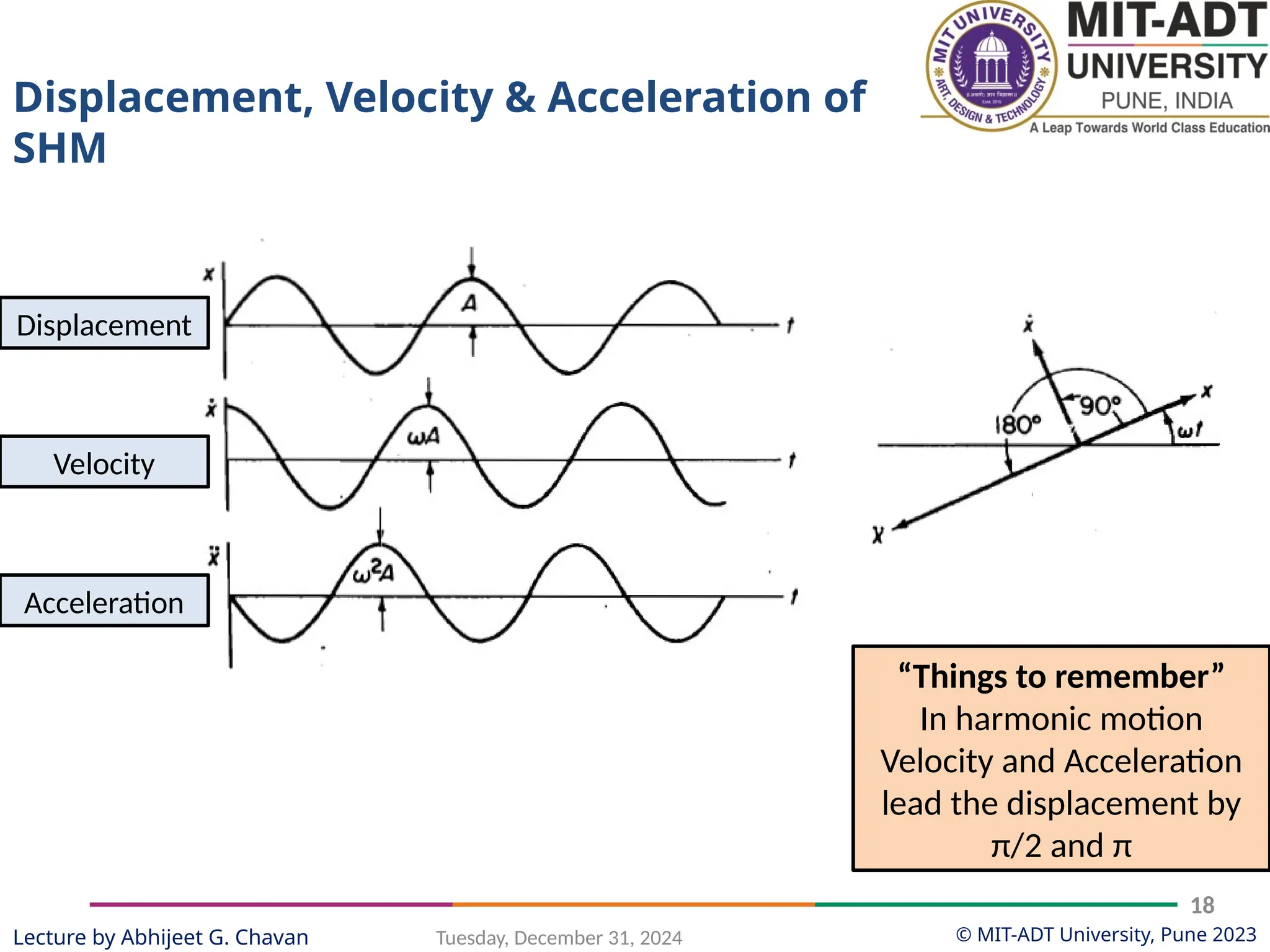
Displacement
Velocity
Acceleration
“Things to remember”
In harmonic motion
Velocity and Acceleration
lead the displacement by
π/2 and π
Displacement, Velocity & Acceleration of
SHM
© MIT-ADT University, Pune 2023
Tuesday, December 31, 2024
19
Lecture by Abhijeet G. Chavan
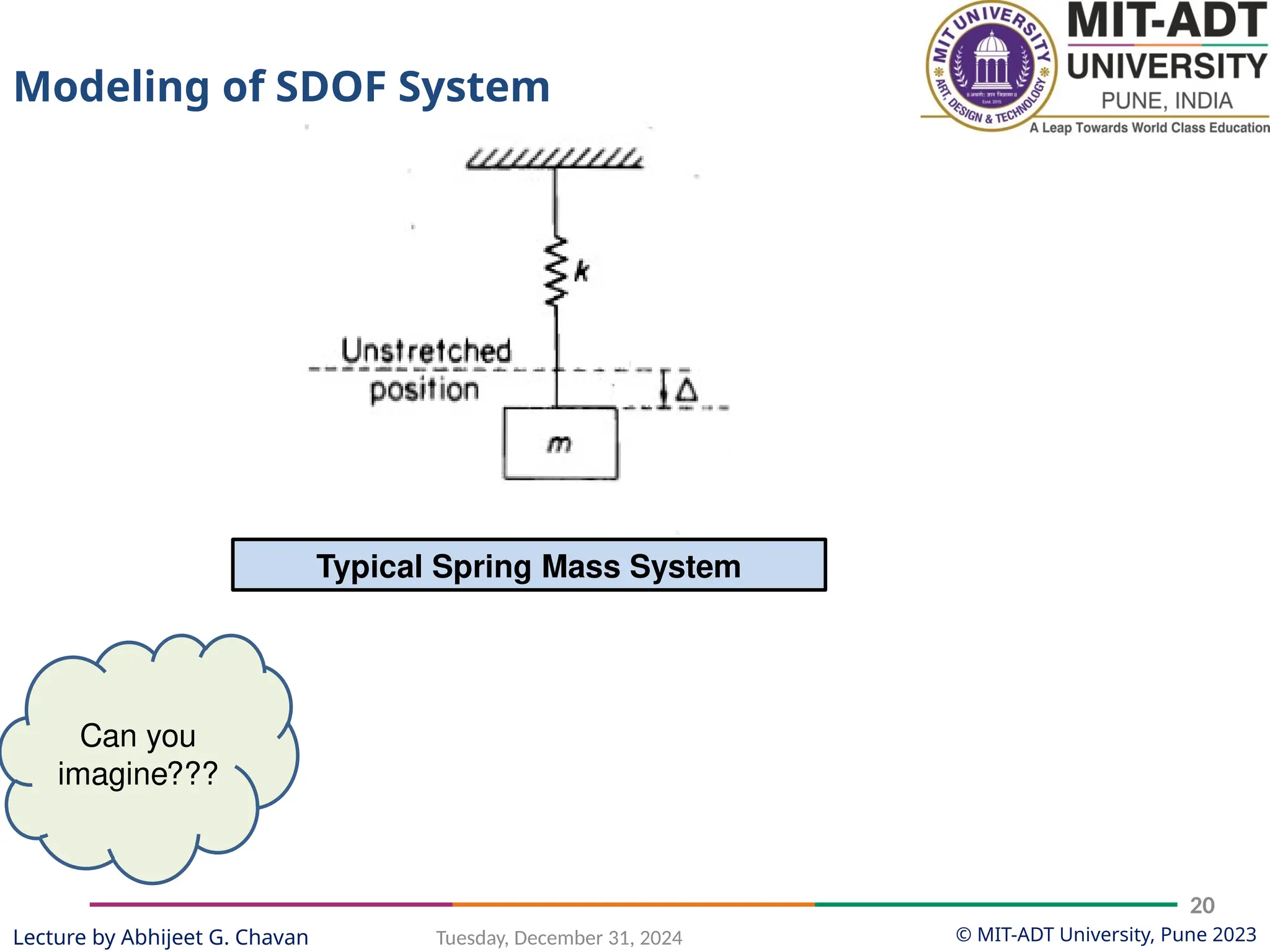
Modeling of SDOF System
m= mass of body (Kg)
k= stiffness of spring (N/mm)
x= displacement of body from
mean position (mm)
Typical Spring Mass System
Any assumptions
required…??
© MIT-ADT University, Pune 2023
Tuesday, December 31, 2024
20
Lecture by Abhijeet G. Chavan
Typical Spring Mass System
Can you
imagine???
Modeling of SDOF System
© MIT-ADT University, Pune 2023
Tuesday, December 31, 2024
21
Lecture by Abhijeet G. Chavan
Can you form
the equation by
applying
Newton’s 2nd
Law…???
This is how it actually looks…!
© MIT-ADT University, Pune 2023
Tuesday, December 31, 2024
22
Lecture by Abhijeet G. Chavan
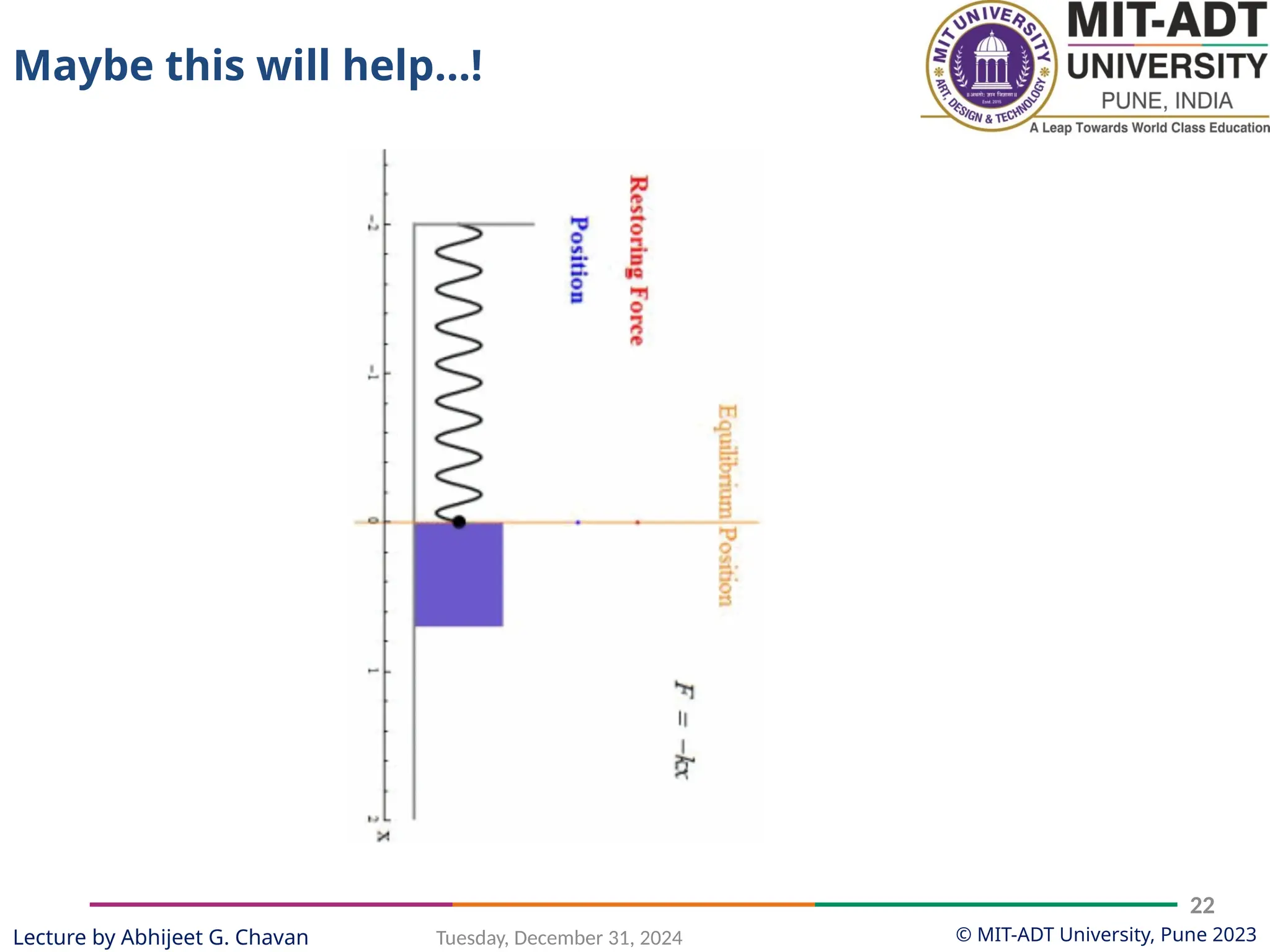
Maybe this will help…!
© MIT-ADT University, Pune 2023
Tuesday, December 31, 2024
23
Lecture by Abhijeet G. Chavan
Modeling of SDOF System
© MIT-ADT University, Pune 2023
Tuesday, December 31, 2024
24
Lecture by Abhijeet G. Chavan
… By applying Newton’s 2nd Law of motion
… Rearranging the terms we get differential equation of
motion for spring mass system
How to solve
this…???
Equation of motion for SDOF System
© MIT-ADT University, Pune 2023
Tuesday, December 31, 2024
25
Lecture by Abhijeet G. Chavan
… By rearranging the previous equation we get
… replacing k/m by omega^2
Are you familiar
with this
equation…???
Solution of Equation of motion for
SDOF System
© MIT-ADT University, Pune 2023
Tuesday, December 31, 2024
26
Lecture by Abhijeet G. Chavan
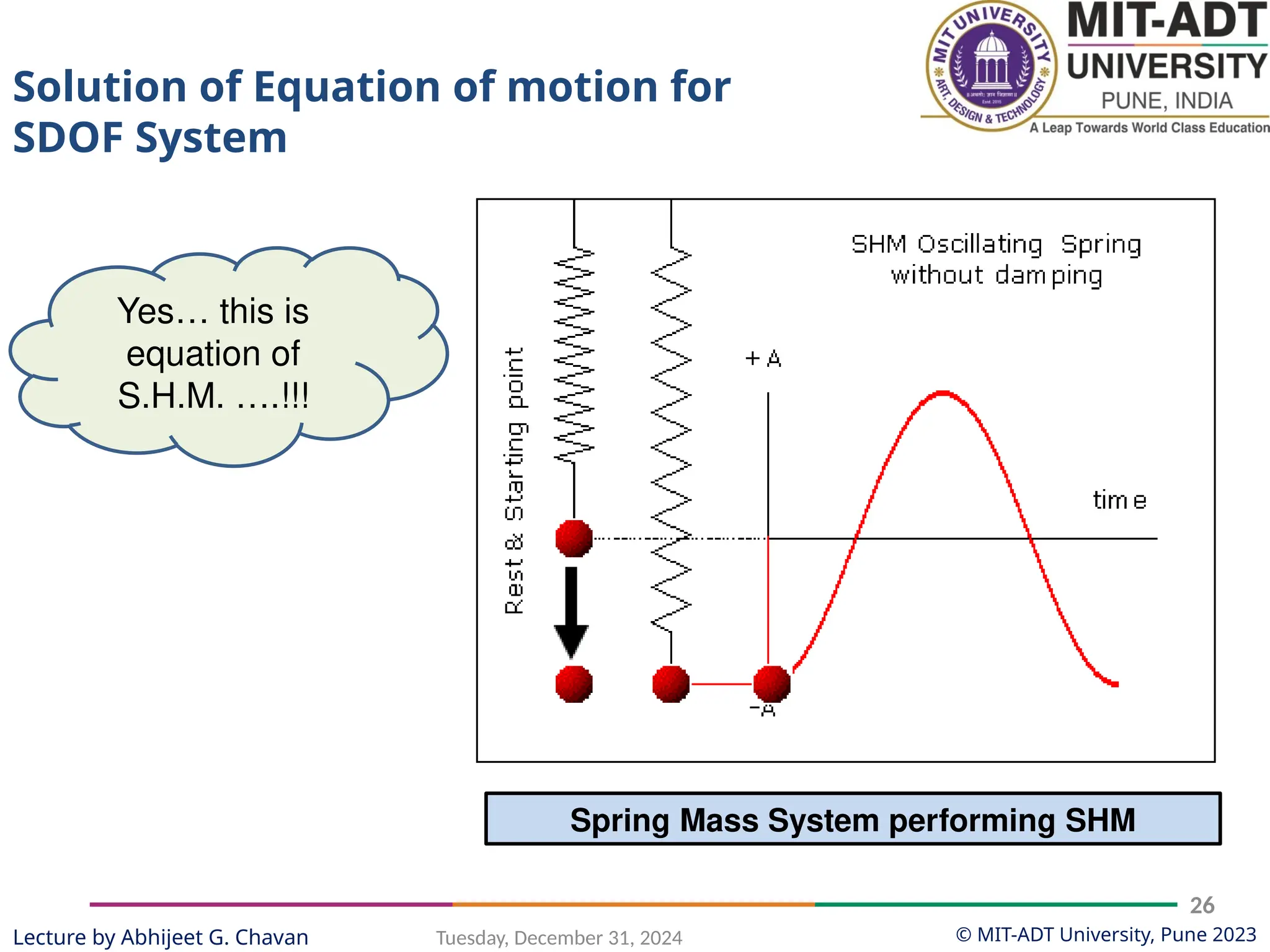
Spring Mass System performing SHM
Yes… this is
equation of
S.H.M. ….!!!
Solution of Equation of motion for
SDOF System
© MIT-ADT University, Pune 2023
Tuesday, December 31, 2024
27
Lecture by Abhijeet G. Chavan
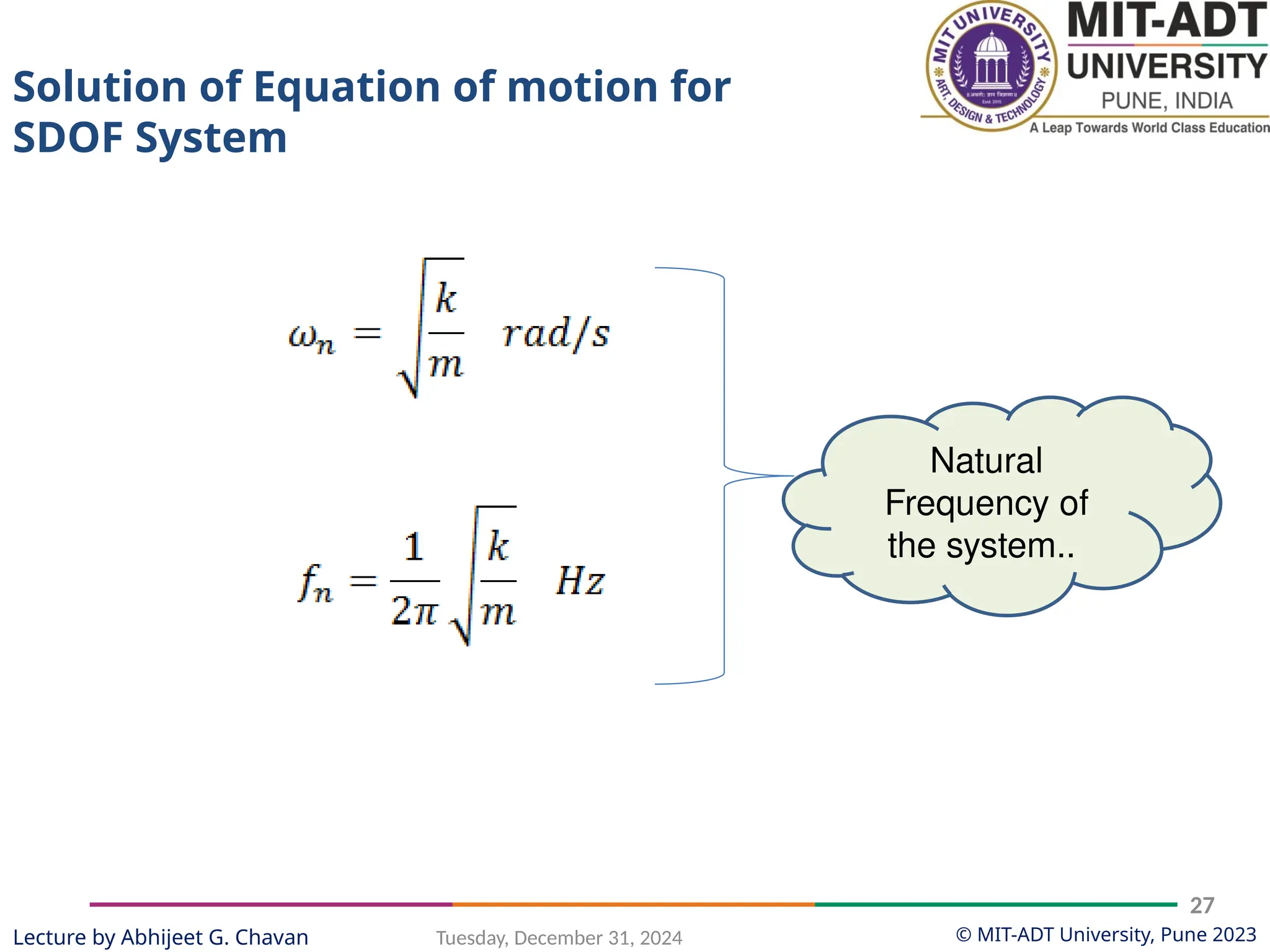
Natural
Frequency of
the system..
Solution of Equation of motion for
SDOF System
© MIT-ADT University, Pune 2023
Tuesday, December 31, 2024
28
Lecture by Abhijeet G. Chavan
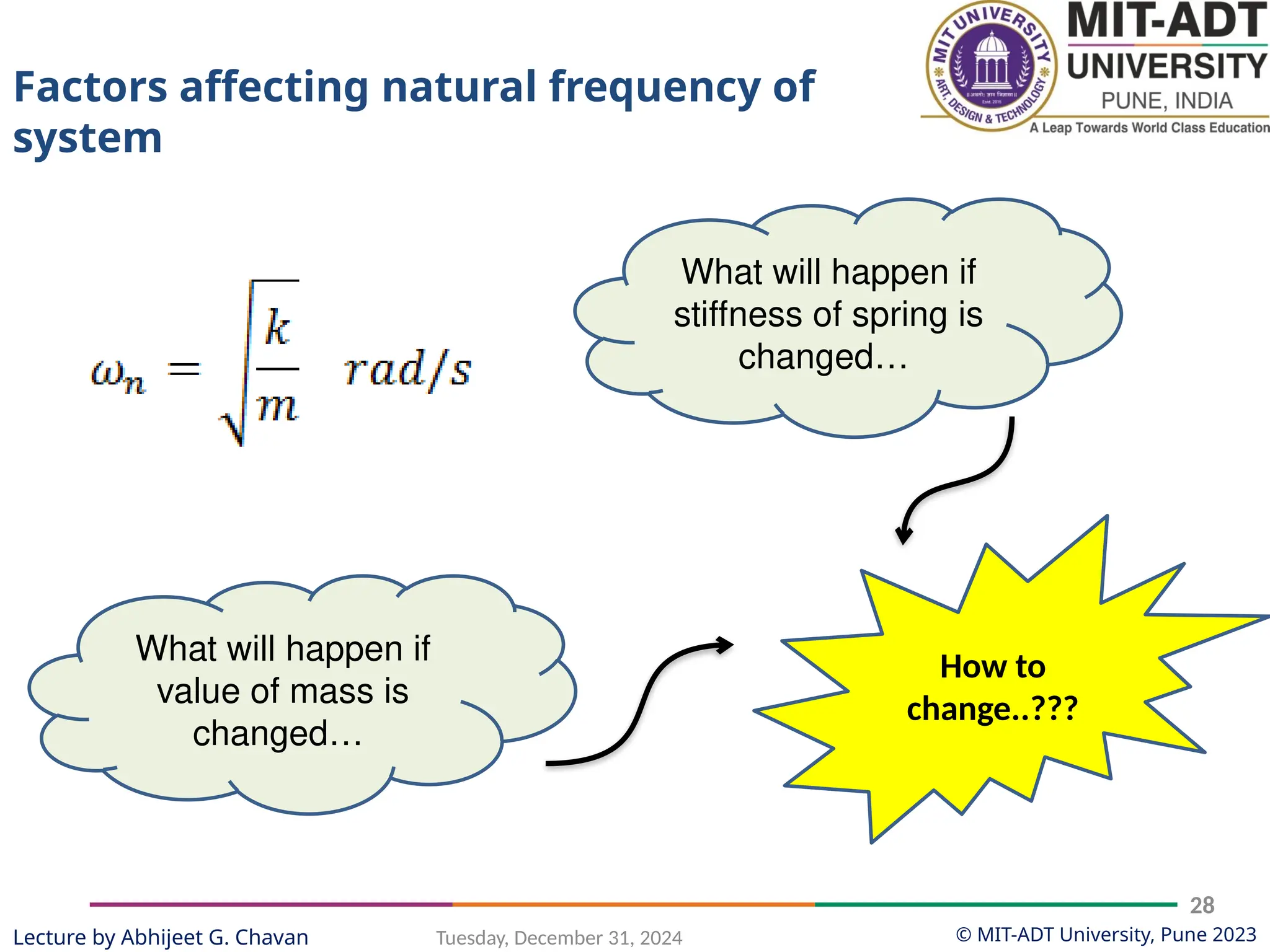
What will happen if
stiffness of spring is
changed…
What will happen if
value of mass is
changed…
How to
change..???
Factors affecting natural frequency of
system
© MIT-ADT University, Pune 2023
Tuesday, December 31, 2024
29
Lecture by Abhijeet G. Chavan
Damping is resistance offered by a body to motion of vibrating system
1. It may be fluid or solid, internal or external.
2. Generally this isn't inherent property of system.
3. Small amount of damping does not have significant effect on performance
of system but as the value of damping increases the effect is significant.
4. Damping is used in various mechanical systems to control the amplitude of
vibrations.
Damping..
© MIT-ADT University, Pune 2023
Tuesday, December 31, 2024
30
Lecture by Abhijeet G. Chavan
1. Viscous Damping: Occurs when system vibrates in viscous fluid. Viscosity of fluid is
offering resistance to motion. Amount of damping resistance will depend upon
velocity and damping coefficient.
2. Dry friction (Coulomb’s) damping: When two machine parts rub against each other in
dry or un-lubricated conditions. Damping resistance is constant and is independent of
rubbing velocity.
3. Solid (structural) damping: This is due to internal friction of molecules. Energy is
dissipated due to molecular friction in each cycle.
4. Slip (Interfacial) damping: Energy is dissipated due to microscopic slip on the
interfaces of machine parts. This is non linear damping.
5. Eddy current damping: This is achieved by inducing an eddy current in moving plate
thereby providing resistance to motion of plate. Damping obtained is similar to viscous
damping.
Types of Damping
© MIT-ADT University, Pune 2023
Tuesday, December 31, 2024
31
Lecture by Abhijeet G. Chavan
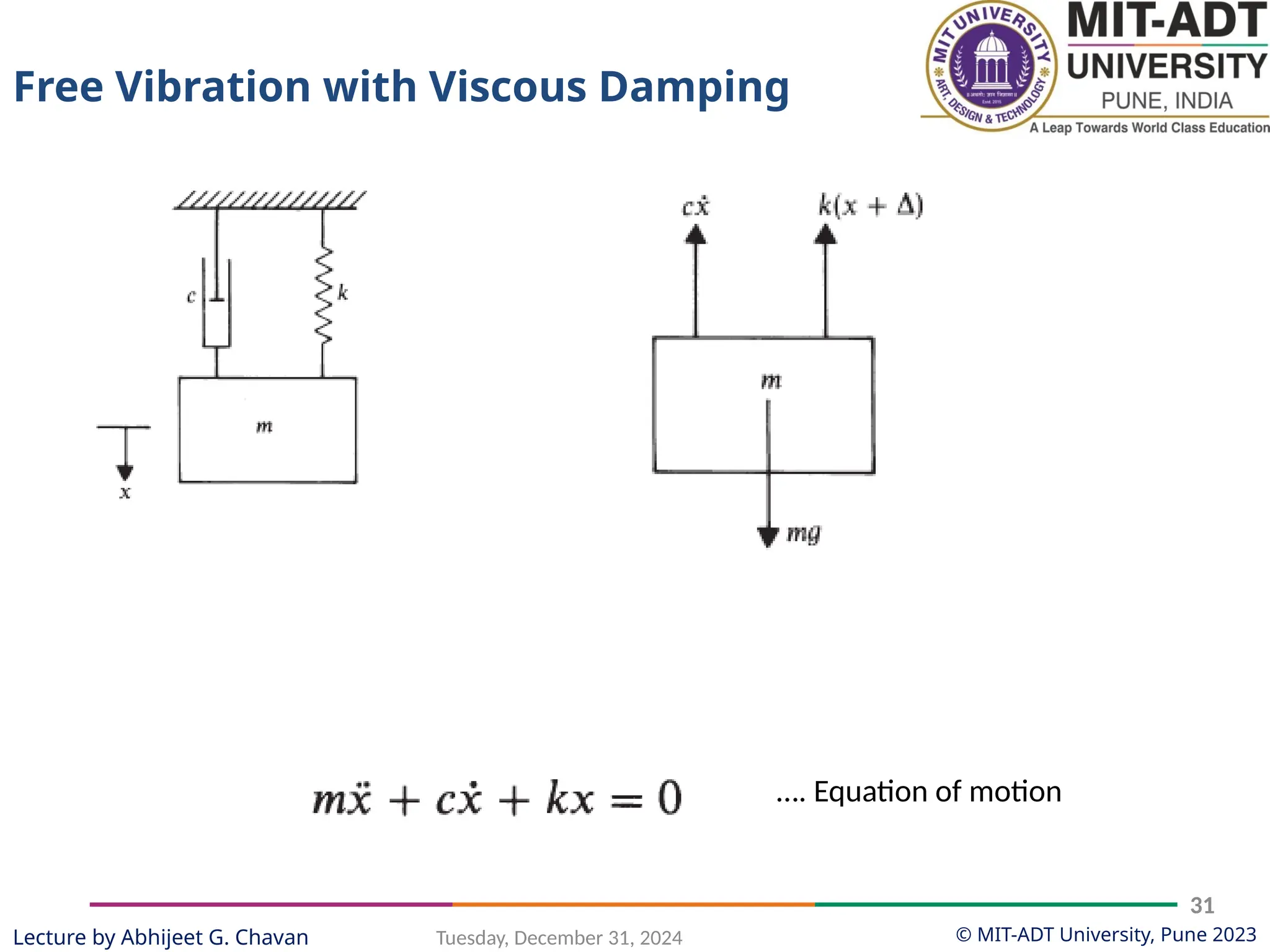
…. Equation of motion
Free Vibration with Viscous Damping
© MIT-ADT University, Pune 2023
Tuesday, December 31, 2024
32
Lecture by Abhijeet G. Chavan
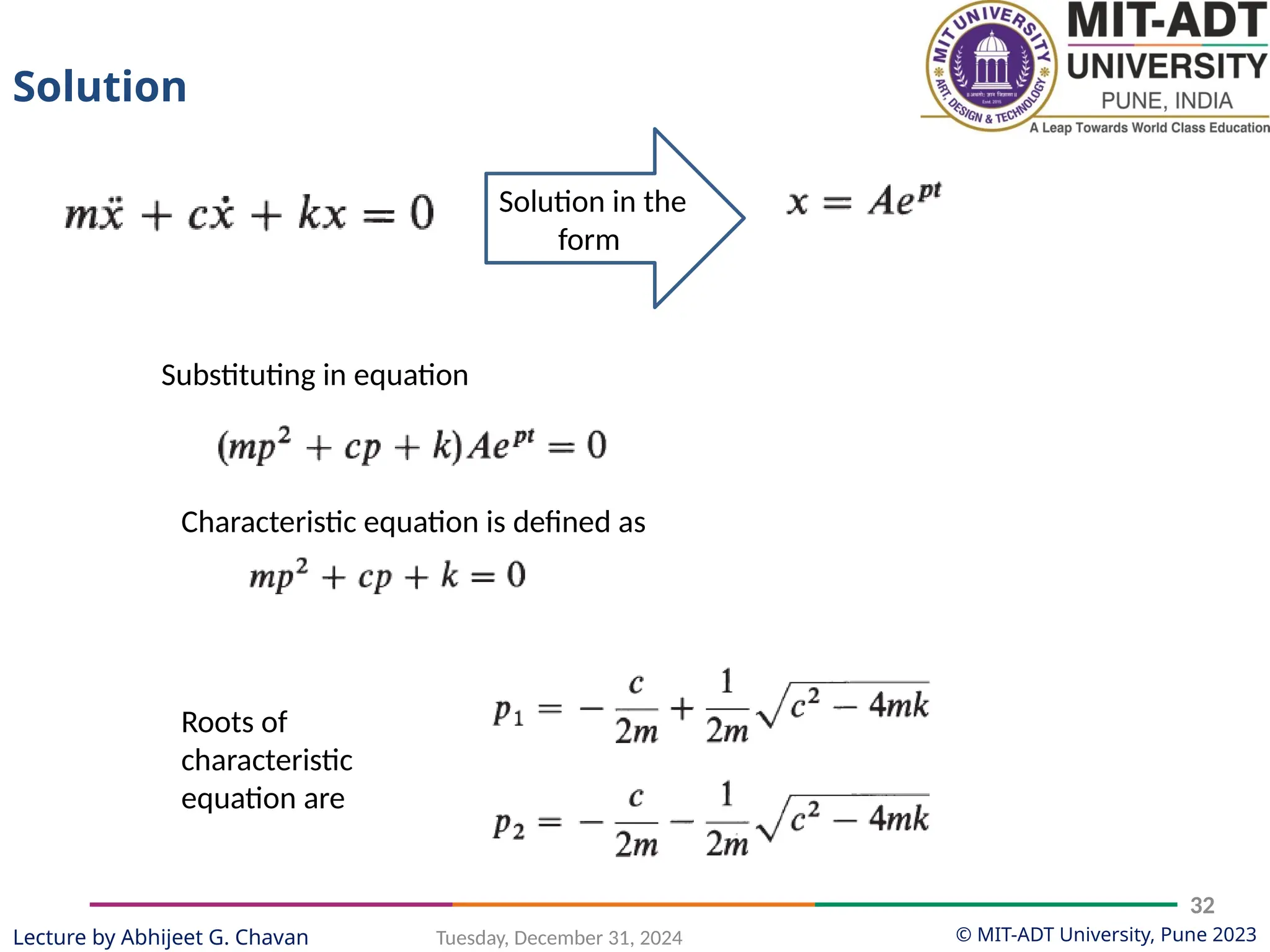
Solution in the
form
Substituting in equation
Characteristic equation is defined as
Roots of
characteristic
equation are
Solution
© MIT-ADT University, Pune 2023
Tuesday, December 31, 2024
33
Lecture by Abhijeet G. Chavan
1. If ξ is greater than one, the roots P1 and P2 are real and distinct. (Over damped)
2. If ξ is equal to one, the root P1 = P2 and both roots are real. (Critically damped)
3. If ξ is less than one, the roots P1 and P2 are complex conjugates. (Under damped)
Types of cases
© MIT-ADT University, Pune 2023
Tuesday, December 31, 2024
34
Lecture by Abhijeet G. Chavan
In the over damped case the roots P1 and P2 are real. The response of the single degree
of freedom system can be written as
A1 and A2 are arbitrary constants.
The solution is sum of two exponential functions
Motion of the system is non oscillatory
Overdamped case
© MIT-ADT University, Pune 2023
Tuesday, December 31, 2024
35
Lecture by Abhijeet G. Chavan
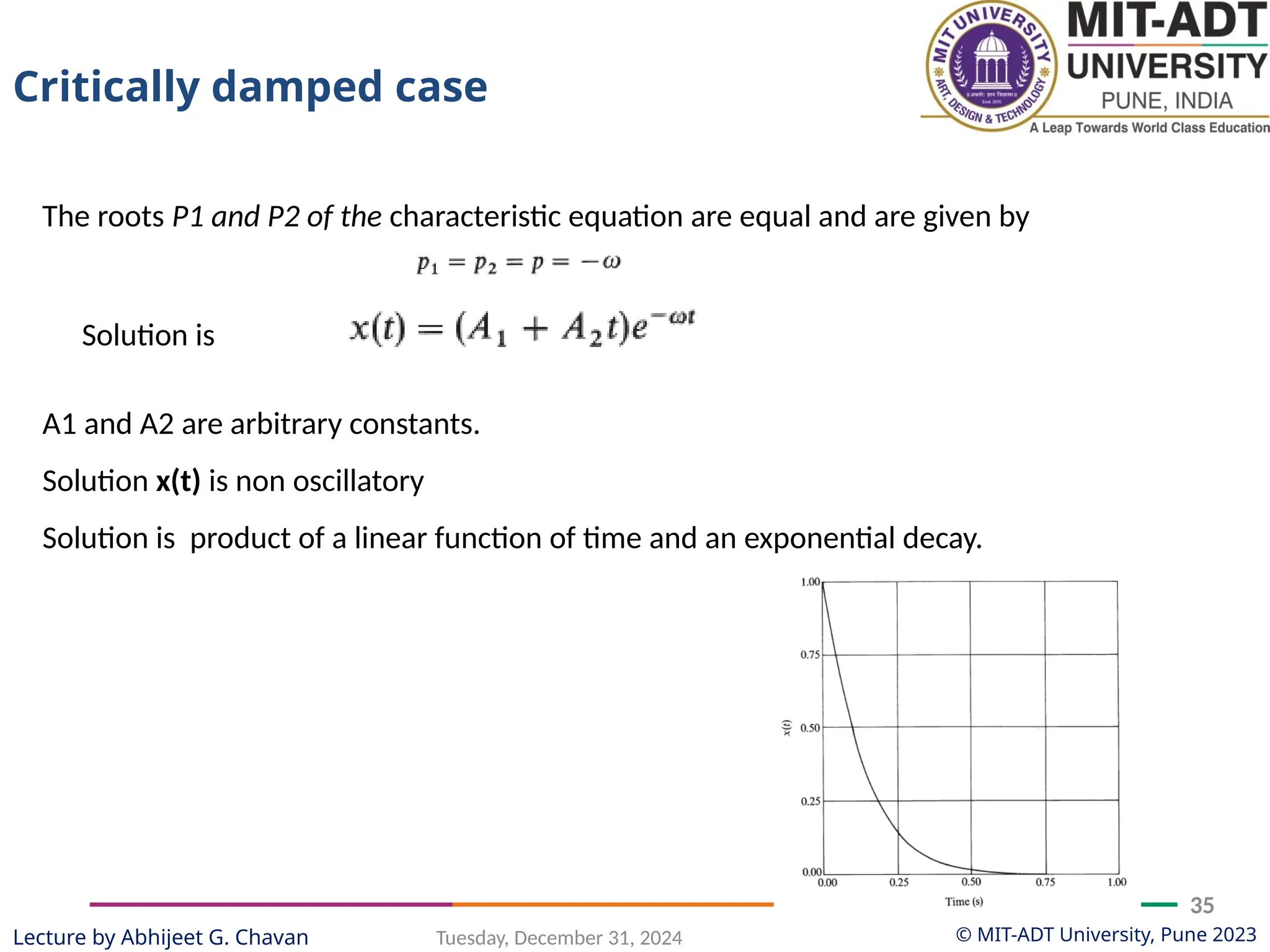
The roots P1 and P2 of the characteristic equation are equal and are given by
Solution is
A1 and A2 are arbitrary constants.
Solution x(t) is non oscillatory
Solution is product of a linear function of time and an exponential decay.
Critically damped case
© MIT-ADT University, Pune 2023
Tuesday, December 31, 2024
36
Lecture by Abhijeet G. Chavan
New term is defined “Damped natural frequency”
Solution
Roots of the characteristic equations P1 and P2 are complex conjugates.
Under damped case
© MIT-ADT University, Pune 2023
Tuesday, December 31, 2024
37
Lecture by Abhijeet G. Chavan
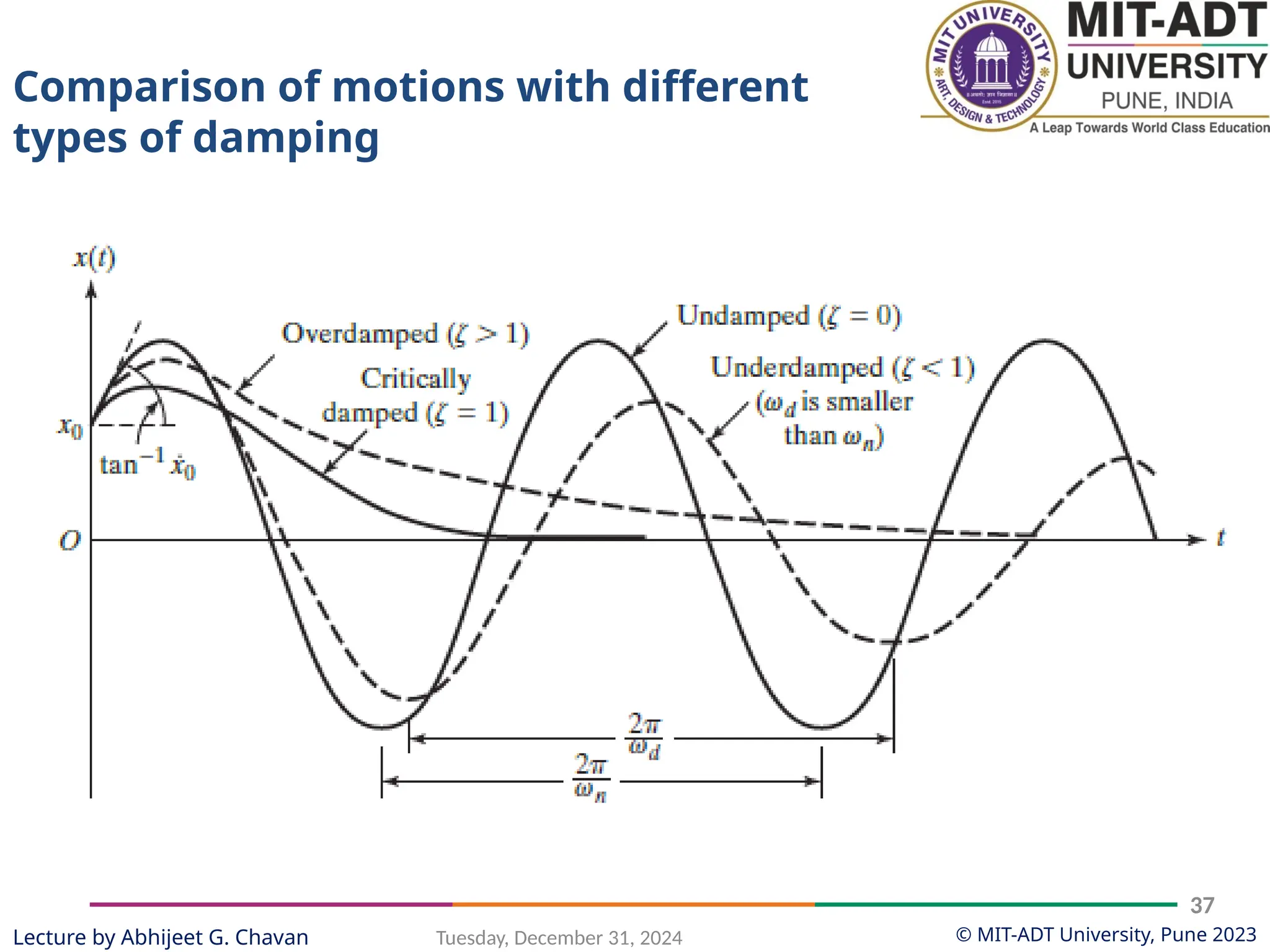
Comparison of motions with different
types of damping
© MIT-ADT University, Pune 2023
Tuesday, December 31, 2024
38
Lecture by Abhijeet G. Chavan
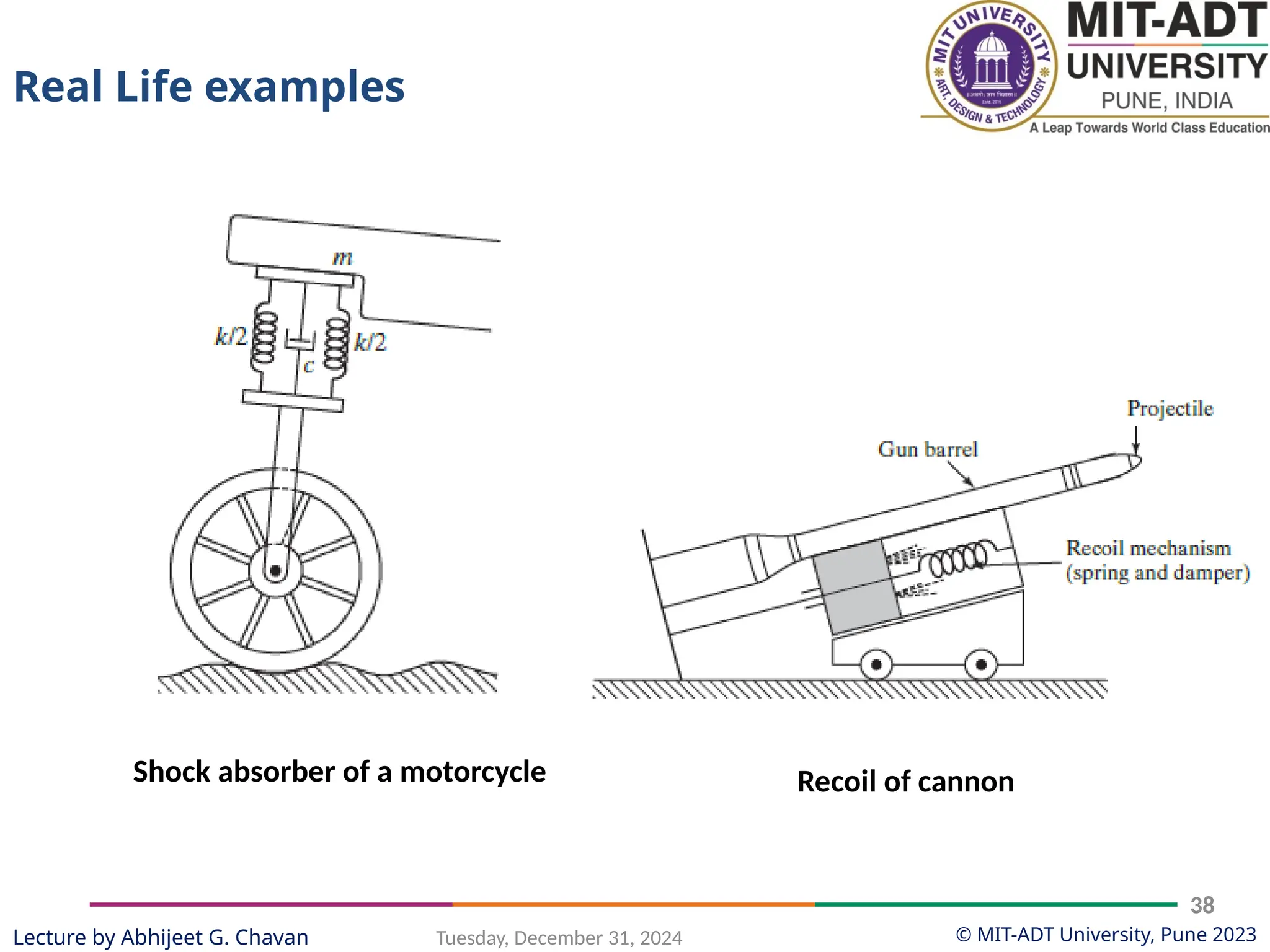
Shock absorber of a motorcycle Recoil of cannon
Real Life examples
© MIT-ADT University, Pune 2023
Tuesday, December 31, 2024
39
Lecture by Abhijeet G. Chavan
• The logarithmic decrement represents the rate at which the amplitude of a free-damped
vibration decreases.
• It is defined as the natural logarithm of the ratio of any two successive amplitudes.
Under damped
response
For non successive cycles
Logarithmic Decrement
© MIT-ADT University, Pune 2023
Tuesday, December 31, 2024
40
Lecture by Abhijeet G. Chavan
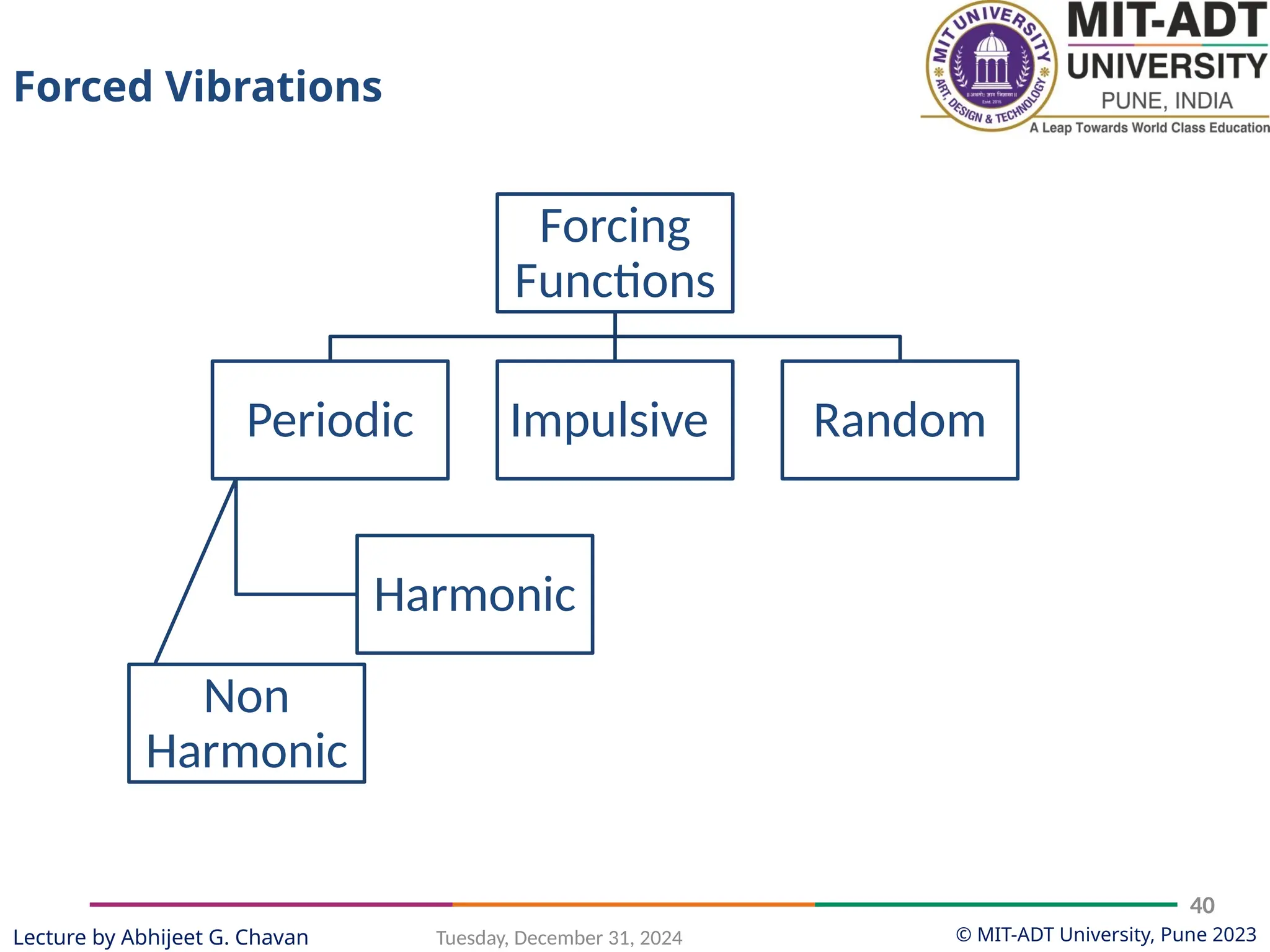
Forced Vibrations
Forcing
Functions
Periodic
Harmonic
Non
Harmonic
Impulsive Random
© MIT-ADT University, Pune 2023
Tuesday, December 31, 2024
41
Lecture by Abhijeet G. Chavan
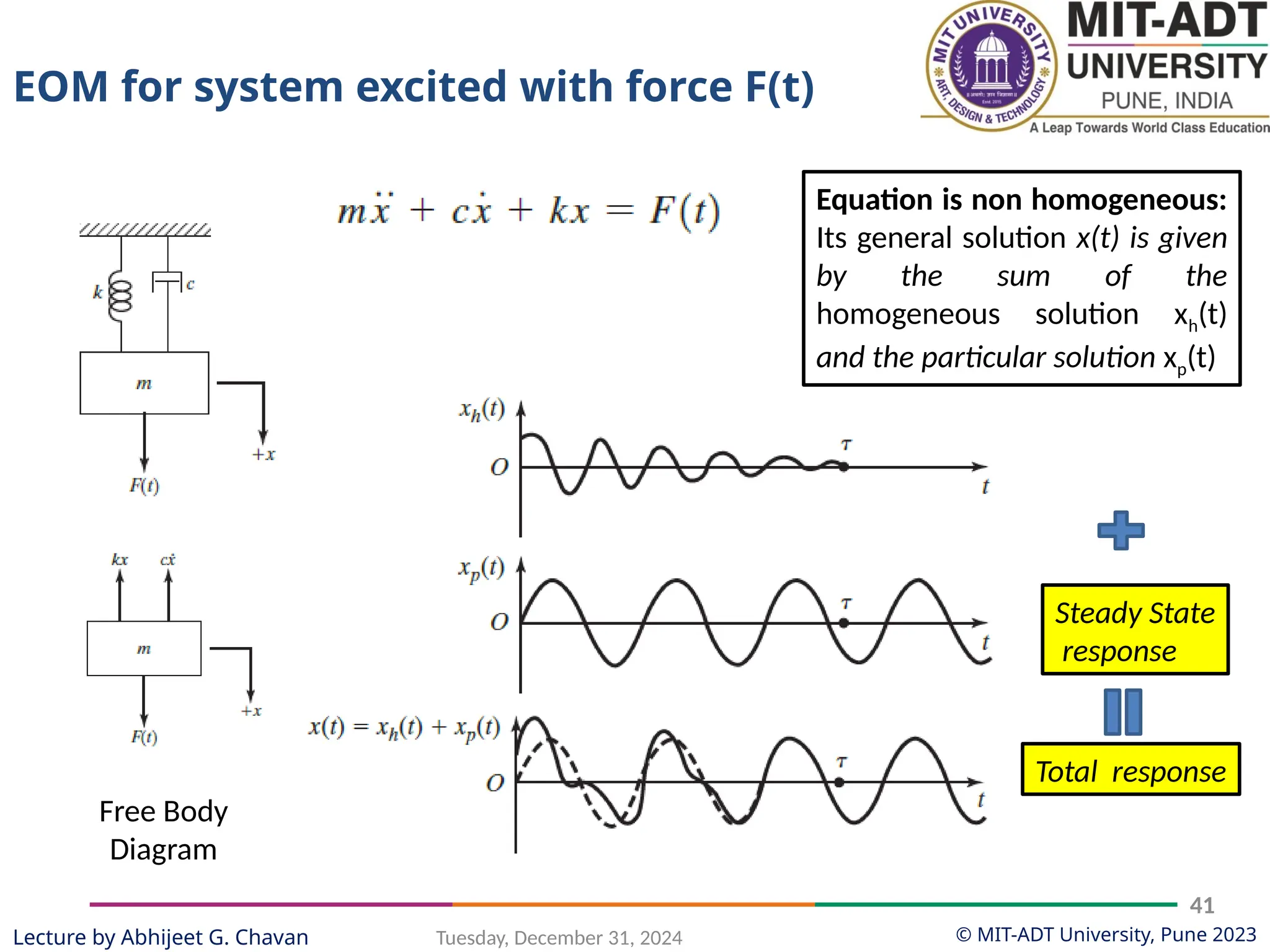
Free Body
Diagram
Steady State
response
Total response
Equation is non homogeneous:
Its general solution x(t) is given
by the sum of the
homogeneous solution xh(t)
and the particular solution xp(t)
EOM for system excited with force F(t)
© MIT-ADT University, Pune 2023
Tuesday, December 31, 2024
42
Lecture by Abhijeet G. Chavan
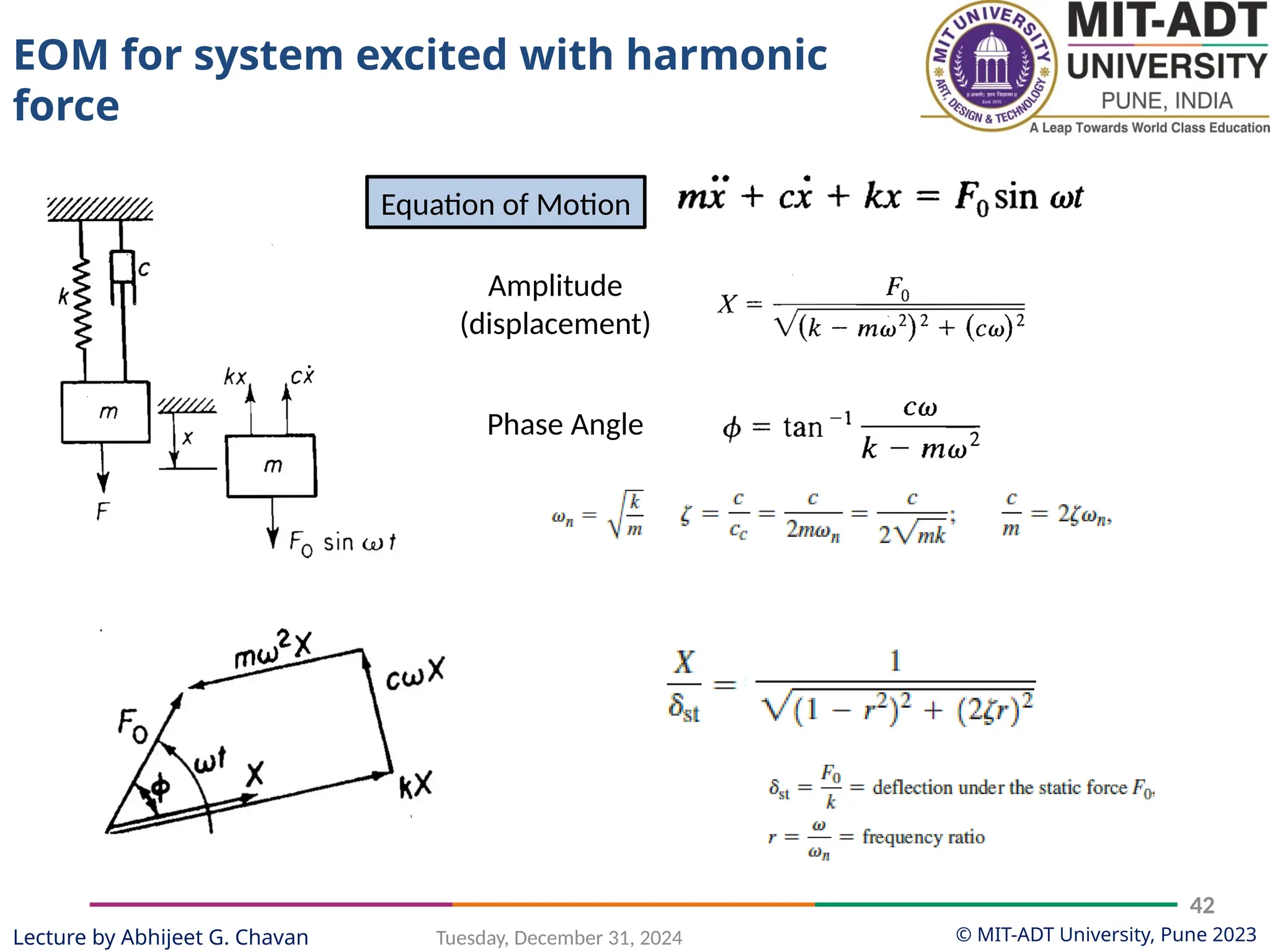
Amplitude
(displacement)
Phase Angle
Equation of Motion
EOM for system excited with harmonic
force
© MIT-ADT University, Pune 2023
Tuesday, December 31, 2024
43
Lecture by Abhijeet G. Chavan
1. For an undamped system M
approaches ∞ as r approaches 1.
2. Any amount of damping reduces
the magnification factor (M) for all
values of the forcing frequency.
3. For any specified value of r, a higher
value of damping reduces the value of
M.
4. In the degenerate case of a constant
force (when r = 0), the value of M = 1.
5. The reduction in M in the presence
of damping is very significant at or
near resonance.
6. The amplitude of forced vibration
becomes smaller with increasing
values of the forcing frequency
Graph of Amplitude ratio and
Frequency Ratio
© MIT-ADT University, Pune 2023
Tuesday, December 31, 2024
44
Lecture by Abhijeet G. Chavan
Graph of Phase angle and Frequency
Ratio
© MIT-ADT University, Pune 2023
Tuesday, December 31, 2024
45
Lecture by Abhijeet G. Chavan
Real life examples
Rotating Unbalance
Reciprocating Unbalance
Base Excitation
© MIT-ADT University, Pune 2023
Tuesday, December 31, 2024
46
Lecture by Abhijeet G. Chavan
The ratio of the amplitude of the response to that of the base motion y(t), X/Y,
is called the displacement transmissibility
Displacement Transmissibility
© MIT-ADT University, Pune 2023
Tuesday, December 31, 2024
47
Lecture by Abhijeet G. Chavan
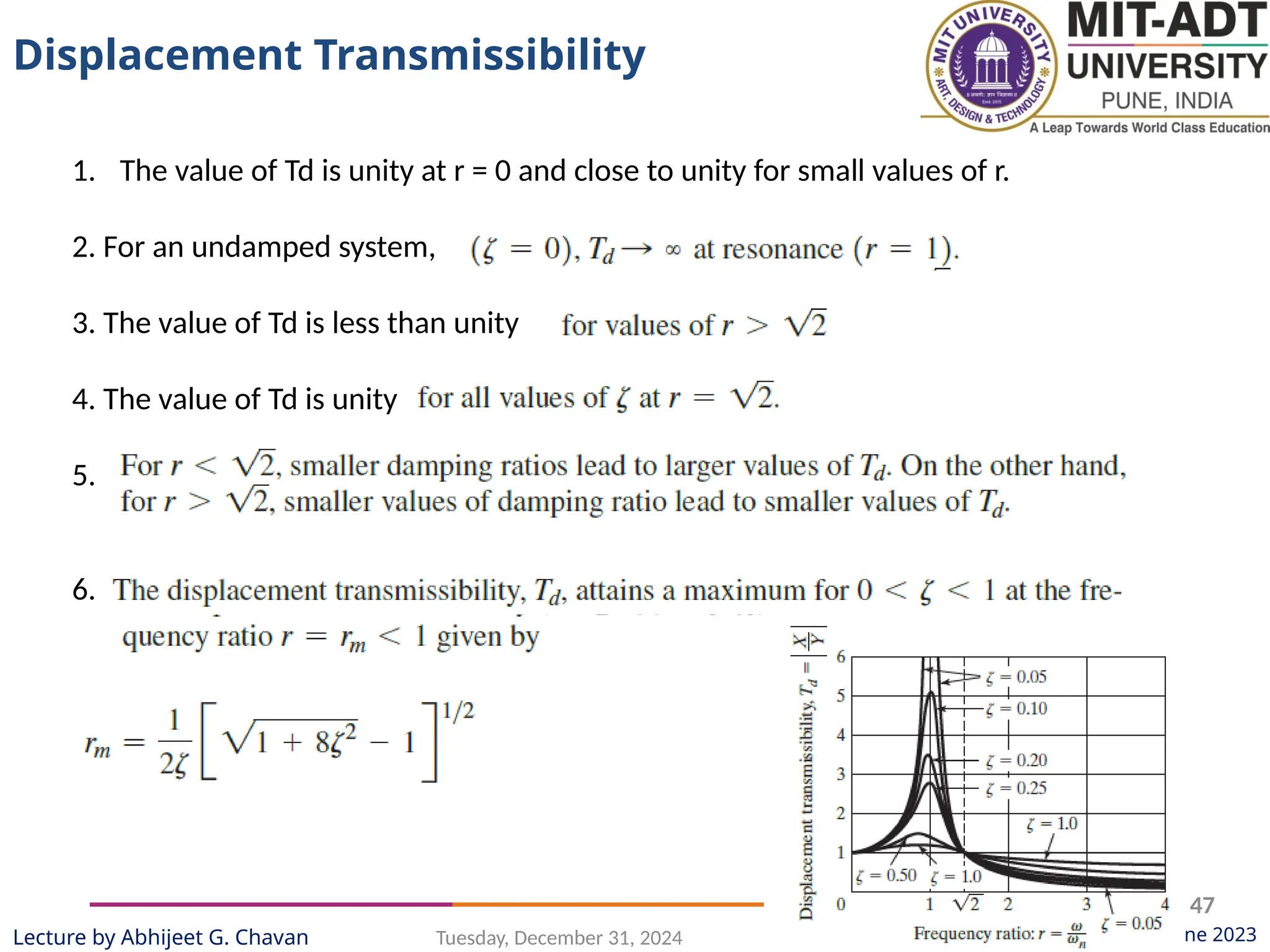
1. The value of Td is unity at r = 0 and close to unity for small values of r.
2. For an undamped system,
3. The value of Td is less than unity
4. The value of Td is unity
5.
6.
Displacement Transmissibility
© MIT-ADT University, Pune 2023
Tuesday, December 31, 2024
48
Lecture by Abhijeet G. Chavan
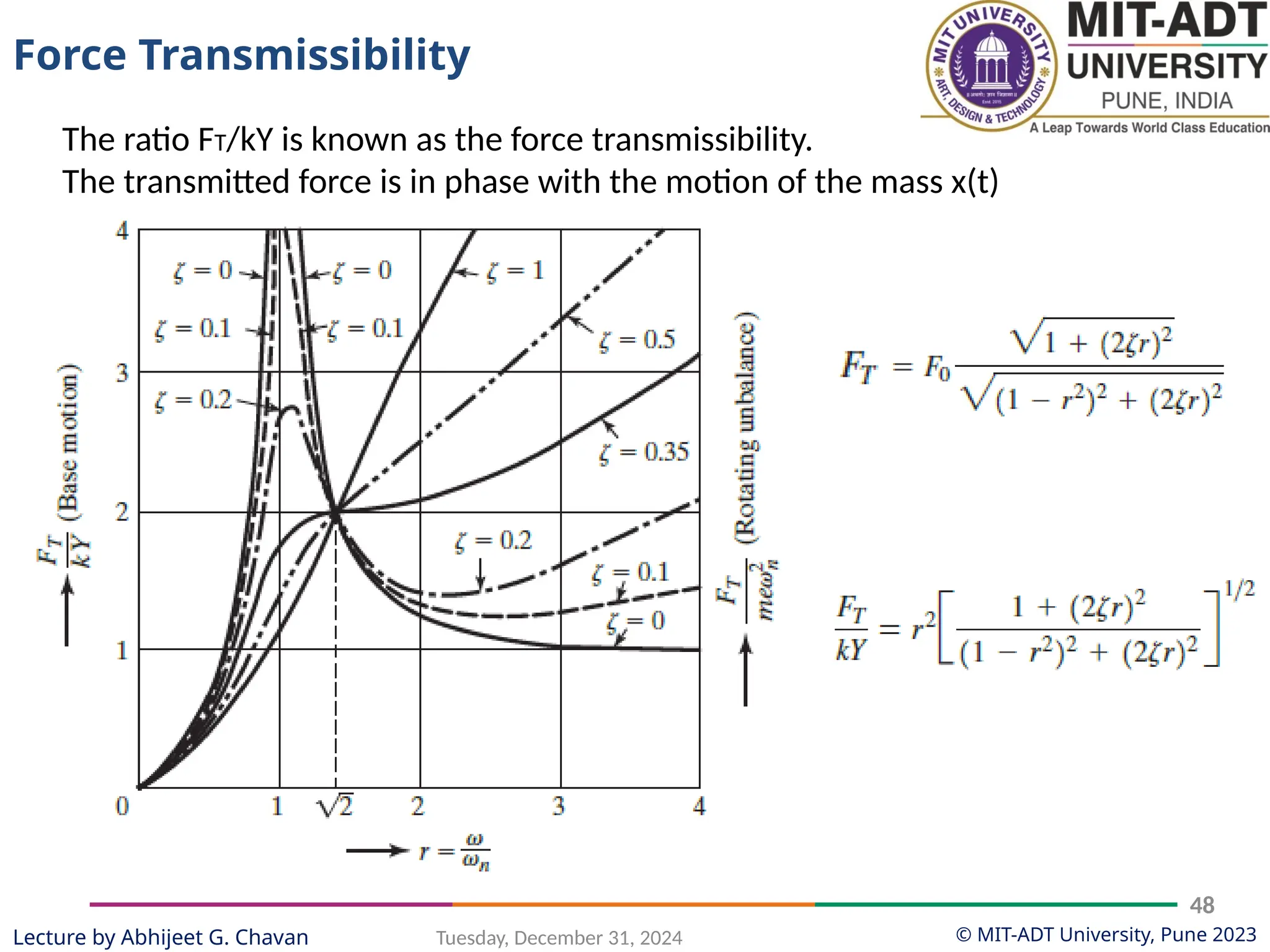
The ratio FT/kY is known as the force transmissibility.
The transmitted force is in phase with the motion of the mass x(t)
Force Transmissibility
© MIT-ADT University, Pune 2023
Tuesday, December 31, 2024
49
Lecture by Abhijeet G. Chavan
© MIT-ADT University, Pune 2023
Tuesday, December 31, 2024
50
Lecture by Abhijeet G. Chavan
© MIT-ADT University, Pune 2023
Tuesday, December 31, 2024
51
Lecture by Abhijeet G. Chavan
MCQ Test:
1.
https://docs.google.com/forms/d/e/1FAIpQLSdnh7tVMNfscuNKieV4CWM3z4uCdyMlYjQqS
U4iZaSIKJkMug/viewform?usp=sf_link
• Mechanical Vibrations By G K Grover
• Mechanical Vibrations By S S Rao
• Theory of Vibrations By William Thompson
• Mechanical Vibrations By V P Singh
Further readings and resources
© MIT-ADT University, Pune 2023
Tuesday, December 31, 2024
52
Lecture by Abhijeet G. Chavan

2. Unit 1_Vibrations for MTech students eng

  • 1.
    © MIT-ADT University,Pune 2023 Tuesday, December 31, 2024 1 Lecture by Abhijeet G. Chavan MIT School of Engineering, Pune Course Code: 22MEVT432 Course: Noise, Vibration and Harshness (NVH) in Electric Vehicles Name of the Faculty: Prof. Abhijeet G. Chavan + 9 1 7 5 8 8 5 8 8 5 2 7 a b h i j e e t . c h a v a n @ m i t u n i v e r s i t y. e d u . i n
  • 2.
    © MIT-ADT University,Pune 2023 Tuesday, December 31, 2024 2 Lecture by Abhijeet G. Chavan Unit No 1 Introduction to Vibration and Noise Syllabus: Natural vibrations, SDOF and MDOF concept and modeling, Undamped, damped and forced vibrations, resonance, transmissibility, modes of vibrations. Basics of sound propagation, Sound levels and spectra, Quantification of sound, Noise sources, generation and radiation, Noise source identification and noise induced hearing loss.
  • 3.
    © MIT-ADT University,Pune 2023 Tuesday, December 31, 2024 3 Lecture by Abhijeet G. Chavan Introduction to Vibration and Noise Elements of a vibratory system: • Mass (Inertia) • Spring (Stiffness / Energy storage) • Damper (Energy dissipation) • External Excitation (Forcing functions) Essential Elements for vibratory motion…! What is a vibratory motion…??
  • 4.
    © MIT-ADT University,Pune 2023 Tuesday, December 31, 2024 Lecture by Abhijeet G. Chavan Natural vibrations (free Vibrations) Degrees of Freedom DOF: Number of independent parameters required to ‘completely’ describe the motion/position of the body Free Vibrations: Vibrations of a body because of its own physical properties when there is no external excitation
  • 5.
    Tuesday, December 31,2024 Lecture by Abhijeet G.Chavan 5 How many maximum degrees of freedom we can have…?? Food for thought…
  • 6.
    Tuesday, December 31,2024 Lecture by Abhijeet G.Chavan 6 Infinite………..! Food for thought… (ans)
  • 7.
    © MIT-ADT University,Pune 2023 Tuesday, December 31, 2024 7 Lecture by Abhijeet G. Chavan Simple Pendulum Spring Mass System Rotor System One (single) DOF Systems
  • 8.
    © MIT-ADT University,Pune 2023 Tuesday, December 31, 2024 8 Lecture by Abhijeet G. Chavan Two Mass System Two Rotor System Combined Mass and Pendulum System Two DOF Systems
  • 9.
    © MIT-ADT University,Pune 2023 Tuesday, December 31, 2024 9 Lecture by Abhijeet G. Chavan Three Mass System Three Pendulum System Three Rotor System Three DOF Systems
  • 10.
    © MIT-ADT University,Pune 2023 Tuesday, December 31, 2024 10 Lecture by Abhijeet G. Chavan Discrete (Lumped Mass Systems) Vs Continuous systems
  • 11.
    © MIT-ADT University,Pune 2023 Tuesday, December 31, 2024 11 Lecture by Abhijeet G. Chavan Free Vibrations and Forced Vibrations Un-damped Vibrations and Damped Vibrations Linear Vibrations and Non Linear Vibrations Deterministic and Random Vibrations Classification of Vibrating systems
  • 12.
    © MIT-ADT University,Pune 2023 Tuesday, December 31, 2024 12 Lecture by Abhijeet G. Chavan Classification of Vibrating systems Longitudinal Vibrations Transverse Vibrations Torsional Vibrations
  • 13.
    © MIT-ADT University,Pune 2023 Tuesday, December 31, 2024 13 Lecture by Abhijeet G. Chavan Frequency: Number of cycles per unit time. Units: Hz, RPM, rad/s Time period: Time required to complete one cycle Units: seconds, minutes Amplitude: Maximum displacement of vibrating body from its mean (equilibrium) position Units: mm, microns Remember: Frequency and Time Period are reciprocals of each other Basic Terminology
  • 14.
    © MIT-ADT University,Pune 2023 Tuesday, December 31, 2024 14 Lecture by Abhijeet G. Chavan S.H.M.:- A “periodic” motion in which • Acceleration is directly proportional to distance (displacement) from mean position •Acceleration is always directed towards mean position •Examples: Motion imparted by Scotch Yoke Mechanism Simple Harmonic Motion (S.H.M.)
  • 15.
    © MIT-ADT University,Pune 2023 Tuesday, December 31, 2024 15 Lecture by Abhijeet G. Chavan SHM obtained by Scotch Yoke Mechanism
  • 16.
    © MIT-ADT University,Pune 2023 Tuesday, December 31, 2024 16 Lecture by Abhijeet G. Chavan Harmonic motion can be represented conveniently by means of a vector OP of magnitude ‘A’ rotating at a constant angular velocity v. projection of tip of the vector on the vertical axis projection of tip of the vector on the horizontal axis Vector representation of SHM
  • 17.
    © MIT-ADT University,Pune 2023 Tuesday, December 31, 2024 17 Lecture by Abhijeet G. Chavan Displacement Velocity Acceleration SHM Differential Equations
  • 18.
    © MIT-ADT University,Pune 2023 Tuesday, December 31, 2024 18 Lecture by Abhijeet G. Chavan Displacement Velocity Acceleration “Things to remember” In harmonic motion Velocity and Acceleration lead the displacement by π/2 and π Displacement, Velocity & Acceleration of SHM
  • 19.
    © MIT-ADT University,Pune 2023 Tuesday, December 31, 2024 19 Lecture by Abhijeet G. Chavan Modeling of SDOF System m= mass of body (Kg) k= stiffness of spring (N/mm) x= displacement of body from mean position (mm) Typical Spring Mass System Any assumptions required…??
  • 20.
    © MIT-ADT University,Pune 2023 Tuesday, December 31, 2024 20 Lecture by Abhijeet G. Chavan Typical Spring Mass System Can you imagine??? Modeling of SDOF System
  • 21.
    © MIT-ADT University,Pune 2023 Tuesday, December 31, 2024 21 Lecture by Abhijeet G. Chavan Can you form the equation by applying Newton’s 2nd Law…??? This is how it actually looks…!
  • 22.
    © MIT-ADT University,Pune 2023 Tuesday, December 31, 2024 22 Lecture by Abhijeet G. Chavan Maybe this will help…!
  • 23.
    © MIT-ADT University,Pune 2023 Tuesday, December 31, 2024 23 Lecture by Abhijeet G. Chavan Modeling of SDOF System
  • 24.
    © MIT-ADT University,Pune 2023 Tuesday, December 31, 2024 24 Lecture by Abhijeet G. Chavan … By applying Newton’s 2nd Law of motion … Rearranging the terms we get differential equation of motion for spring mass system How to solve this…??? Equation of motion for SDOF System
  • 25.
    © MIT-ADT University,Pune 2023 Tuesday, December 31, 2024 25 Lecture by Abhijeet G. Chavan … By rearranging the previous equation we get … replacing k/m by omega^2 Are you familiar with this equation…??? Solution of Equation of motion for SDOF System
  • 26.
    © MIT-ADT University,Pune 2023 Tuesday, December 31, 2024 26 Lecture by Abhijeet G. Chavan Spring Mass System performing SHM Yes… this is equation of S.H.M. ….!!! Solution of Equation of motion for SDOF System
  • 27.
    © MIT-ADT University,Pune 2023 Tuesday, December 31, 2024 27 Lecture by Abhijeet G. Chavan Natural Frequency of the system.. Solution of Equation of motion for SDOF System
  • 28.
    © MIT-ADT University,Pune 2023 Tuesday, December 31, 2024 28 Lecture by Abhijeet G. Chavan What will happen if stiffness of spring is changed… What will happen if value of mass is changed… How to change..??? Factors affecting natural frequency of system
  • 29.
    © MIT-ADT University,Pune 2023 Tuesday, December 31, 2024 29 Lecture by Abhijeet G. Chavan Damping is resistance offered by a body to motion of vibrating system 1. It may be fluid or solid, internal or external. 2. Generally this isn't inherent property of system. 3. Small amount of damping does not have significant effect on performance of system but as the value of damping increases the effect is significant. 4. Damping is used in various mechanical systems to control the amplitude of vibrations. Damping..
  • 30.
    © MIT-ADT University,Pune 2023 Tuesday, December 31, 2024 30 Lecture by Abhijeet G. Chavan 1. Viscous Damping: Occurs when system vibrates in viscous fluid. Viscosity of fluid is offering resistance to motion. Amount of damping resistance will depend upon velocity and damping coefficient. 2. Dry friction (Coulomb’s) damping: When two machine parts rub against each other in dry or un-lubricated conditions. Damping resistance is constant and is independent of rubbing velocity. 3. Solid (structural) damping: This is due to internal friction of molecules. Energy is dissipated due to molecular friction in each cycle. 4. Slip (Interfacial) damping: Energy is dissipated due to microscopic slip on the interfaces of machine parts. This is non linear damping. 5. Eddy current damping: This is achieved by inducing an eddy current in moving plate thereby providing resistance to motion of plate. Damping obtained is similar to viscous damping. Types of Damping
  • 31.
    © MIT-ADT University,Pune 2023 Tuesday, December 31, 2024 31 Lecture by Abhijeet G. Chavan …. Equation of motion Free Vibration with Viscous Damping
  • 32.
    © MIT-ADT University,Pune 2023 Tuesday, December 31, 2024 32 Lecture by Abhijeet G. Chavan Solution in the form Substituting in equation Characteristic equation is defined as Roots of characteristic equation are Solution
  • 33.
    © MIT-ADT University,Pune 2023 Tuesday, December 31, 2024 33 Lecture by Abhijeet G. Chavan 1. If ξ is greater than one, the roots P1 and P2 are real and distinct. (Over damped) 2. If ξ is equal to one, the root P1 = P2 and both roots are real. (Critically damped) 3. If ξ is less than one, the roots P1 and P2 are complex conjugates. (Under damped) Types of cases
  • 34.
    © MIT-ADT University,Pune 2023 Tuesday, December 31, 2024 34 Lecture by Abhijeet G. Chavan In the over damped case the roots P1 and P2 are real. The response of the single degree of freedom system can be written as A1 and A2 are arbitrary constants. The solution is sum of two exponential functions Motion of the system is non oscillatory Overdamped case
  • 35.
    © MIT-ADT University,Pune 2023 Tuesday, December 31, 2024 35 Lecture by Abhijeet G. Chavan The roots P1 and P2 of the characteristic equation are equal and are given by Solution is A1 and A2 are arbitrary constants. Solution x(t) is non oscillatory Solution is product of a linear function of time and an exponential decay. Critically damped case
  • 36.
    © MIT-ADT University,Pune 2023 Tuesday, December 31, 2024 36 Lecture by Abhijeet G. Chavan New term is defined “Damped natural frequency” Solution Roots of the characteristic equations P1 and P2 are complex conjugates. Under damped case
  • 37.
    © MIT-ADT University,Pune 2023 Tuesday, December 31, 2024 37 Lecture by Abhijeet G. Chavan Comparison of motions with different types of damping
  • 38.
    © MIT-ADT University,Pune 2023 Tuesday, December 31, 2024 38 Lecture by Abhijeet G. Chavan Shock absorber of a motorcycle Recoil of cannon Real Life examples
  • 39.
    © MIT-ADT University,Pune 2023 Tuesday, December 31, 2024 39 Lecture by Abhijeet G. Chavan • The logarithmic decrement represents the rate at which the amplitude of a free-damped vibration decreases. • It is defined as the natural logarithm of the ratio of any two successive amplitudes. Under damped response For non successive cycles Logarithmic Decrement
  • 40.
    © MIT-ADT University,Pune 2023 Tuesday, December 31, 2024 40 Lecture by Abhijeet G. Chavan Forced Vibrations Forcing Functions Periodic Harmonic Non Harmonic Impulsive Random
  • 41.
    © MIT-ADT University,Pune 2023 Tuesday, December 31, 2024 41 Lecture by Abhijeet G. Chavan Free Body Diagram Steady State response Total response Equation is non homogeneous: Its general solution x(t) is given by the sum of the homogeneous solution xh(t) and the particular solution xp(t) EOM for system excited with force F(t)
  • 42.
    © MIT-ADT University,Pune 2023 Tuesday, December 31, 2024 42 Lecture by Abhijeet G. Chavan Amplitude (displacement) Phase Angle Equation of Motion EOM for system excited with harmonic force
  • 43.
    © MIT-ADT University,Pune 2023 Tuesday, December 31, 2024 43 Lecture by Abhijeet G. Chavan 1. For an undamped system M approaches ∞ as r approaches 1. 2. Any amount of damping reduces the magnification factor (M) for all values of the forcing frequency. 3. For any specified value of r, a higher value of damping reduces the value of M. 4. In the degenerate case of a constant force (when r = 0), the value of M = 1. 5. The reduction in M in the presence of damping is very significant at or near resonance. 6. The amplitude of forced vibration becomes smaller with increasing values of the forcing frequency Graph of Amplitude ratio and Frequency Ratio
  • 44.
    © MIT-ADT University,Pune 2023 Tuesday, December 31, 2024 44 Lecture by Abhijeet G. Chavan Graph of Phase angle and Frequency Ratio
  • 45.
    © MIT-ADT University,Pune 2023 Tuesday, December 31, 2024 45 Lecture by Abhijeet G. Chavan Real life examples Rotating Unbalance Reciprocating Unbalance Base Excitation
  • 46.
    © MIT-ADT University,Pune 2023 Tuesday, December 31, 2024 46 Lecture by Abhijeet G. Chavan The ratio of the amplitude of the response to that of the base motion y(t), X/Y, is called the displacement transmissibility Displacement Transmissibility
  • 47.
    © MIT-ADT University,Pune 2023 Tuesday, December 31, 2024 47 Lecture by Abhijeet G. Chavan 1. The value of Td is unity at r = 0 and close to unity for small values of r. 2. For an undamped system, 3. The value of Td is less than unity 4. The value of Td is unity 5. 6. Displacement Transmissibility
  • 48.
    © MIT-ADT University,Pune 2023 Tuesday, December 31, 2024 48 Lecture by Abhijeet G. Chavan The ratio FT/kY is known as the force transmissibility. The transmitted force is in phase with the motion of the mass x(t) Force Transmissibility
  • 49.
    © MIT-ADT University,Pune 2023 Tuesday, December 31, 2024 49 Lecture by Abhijeet G. Chavan
  • 50.
    © MIT-ADT University,Pune 2023 Tuesday, December 31, 2024 50 Lecture by Abhijeet G. Chavan
  • 51.
    © MIT-ADT University,Pune 2023 Tuesday, December 31, 2024 51 Lecture by Abhijeet G. Chavan MCQ Test: 1. https://docs.google.com/forms/d/e/1FAIpQLSdnh7tVMNfscuNKieV4CWM3z4uCdyMlYjQqS U4iZaSIKJkMug/viewform?usp=sf_link • Mechanical Vibrations By G K Grover • Mechanical Vibrations By S S Rao • Theory of Vibrations By William Thompson • Mechanical Vibrations By V P Singh Further readings and resources
  • 52.
    © MIT-ADT University,Pune 2023 Tuesday, December 31, 2024 52 Lecture by Abhijeet G. Chavan