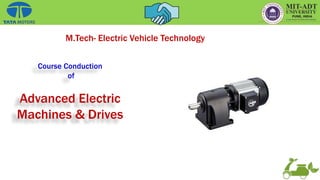
Course Conduction
of
Advanced Electric
Machines & Drives
M.Tech- Electric Vehicle Technology
UNIT I
Basic Principles of Electrical Machines
Contents:
• Magnetically coupled circuits
• Modelling linear and nonlinear magnetic circuits
• Electromechanical energy conversion : Principles of energy flow,
concept of field theory and co-energy
• Derivation of torque expression for various machines
• Inductance matrices
UNIT I
Basic Principles of Electrical Machines
Faraday’s Law of Electromagnetic Induction:
First Law
Second Law
UNIT I
Basic Principles of Electrical Machines
Faraday’s Law of Electromagnetic Induction:
•Statically Induced e.m.f.
•Dynamically induced e.m.f
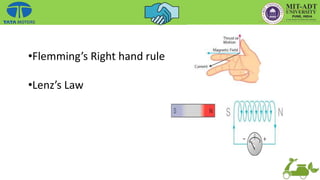
•Flemming’s Right hand rule
•Lenz’s Law
Statically Induced e.m.f.
•Self Induced e.m.f.
•Mutually Induced e.m.f.
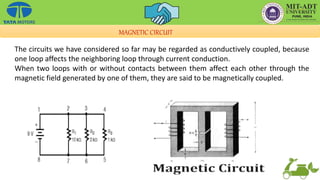
The circuits we have considered so far may be regarded as conductively coupled, because
one loop affects the neighboring loop through current conduction.
When two loops with or without contacts between them affect each other through the
magnetic field generated by one of them, they are said to be magnetically coupled.
MAGNETIC CIRCUIT
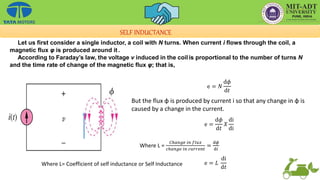
Let us first consider a single inductor, a coil with N turns. When current i flows through the coil, a
magnetic flux φ is produced around it.
According to Faraday’s law, the voltage v induced in the coilis proportional to the number of turns N
and the time rate of change of the magnetic flux φ; that is,
ⅇ = 𝑁
ⅆ𝜙
ⅆ𝑡
But the flux φ is produced by current i so that any change in φ is
caused by a change in the current.
ⅇ =
ⅆ𝜙
ⅆ𝑡
𝑋
ⅆⅈ
ⅆⅈ
Where L =
𝐶ℎ𝑎𝑛𝑔𝑒 𝑖𝑛 𝑓𝑙𝑢𝑥
𝑐ℎ𝑎𝑛𝑔𝑒 𝑖𝑛 𝑐𝑢𝑟𝑟𝑒𝑛𝑡
=
ⅆ𝜙
ⅆ𝑖
ⅇ = 𝐿
ⅆⅈ
ⅆ𝑡
Where L= Coefficient of self inductance or Self Inductance
SELF INDUCTANCE
MUTUAL INDUCTANCE
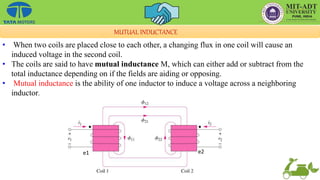
• When two coils are placed close to each other, a changing flux in one coil will cause an
induced voltage in the second coil.
• The coils are said to have mutual inductance M, which can either add or subtract from the
total inductance depending on if the fields are aiding or opposing.
• Mutual inductance is the ability of one inductor to induce a voltage across a neighboring
inductor.
e1 e2
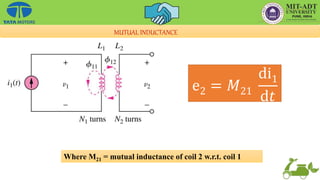
ⅇ2 = 𝑀21
ⅆⅈ1
ⅆ𝑡
Where M21 = mutual inductance of coil 2 w.r.t. coil 1
MUTUAL INDUCTANCE
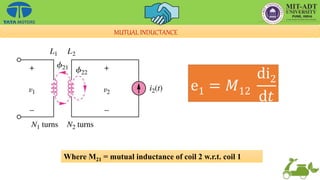
ⅇ1 = 𝑀12
ⅆⅈ2
ⅆ𝑡
Where M21 = mutual inductance of coil 2 w.r.t. coil 1
MUTUAL INDUCTANCE
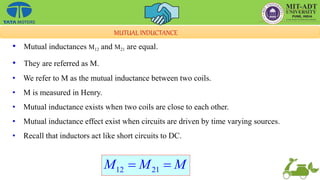
• Mutual inductances M12 and M21 are equal.
• They are referred as M.
• We refer to M as the mutual inductance between two coils.
• M is measured in Henry.
• Mutual inductance exists when two coils are close to each other.
• Mutual inductance effect exist when circuits are driven by time varying sources.
• Recall that inductors act like short circuits to DC.
MUTUAL INDUCTANCE
12 21
M M M
 
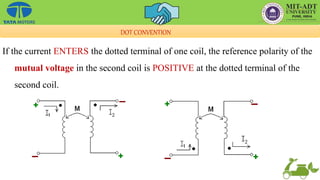
If the current ENTERS the dotted terminal of one coil, the reference polarity of the
mutual voltage in the second coil is POSITIVE at the dotted terminal of the
second coil.
DOT CONVENTION
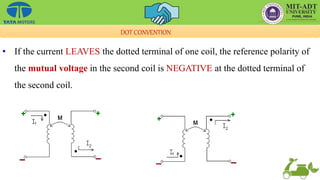
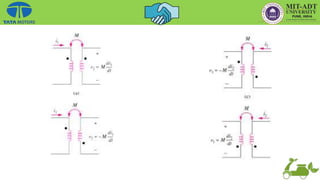
• If the current LEAVES the dotted terminal of one coil, the reference polarity of
the mutual voltage in the second coil is NEGATIVE at the dotted terminal of
the second coil.
DOT CONVENTION
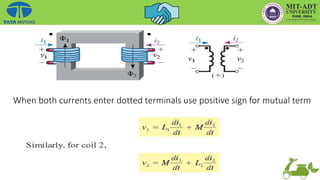
When both currents enter dotted terminals use positive sign for mutual term
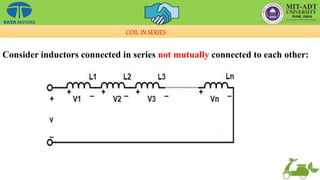
Consider inductors connected in series not mutually connected to each other:
COIL IN SERIES
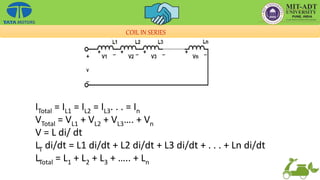
COIL IN SERIES
ITotal = IL1 = IL2 = IL3. . . = In
VTotal = VL1 + VL2 + VL3…. + Vn
V = L di/ dt
LT di/dt = L1 di/dt + L2 di/dt + L3 di/dt + . . . + Ln di/dt
LTotal = L1 + L2 + L3 + ….. + Ln
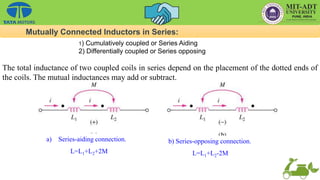
a) Series-aiding connection.
L=L1+L2+2M
b) Series-opposing connection.
L=L1+L2-2M
The total inductance of two coupled coils in series depend on the placement of the dotted ends of
the coils. The mutual inductances may add or subtract.
Mutually Connected Inductors in Series:
1) Cumulatively coupled or Series Aiding
2) Differentially coupled or Series opposing
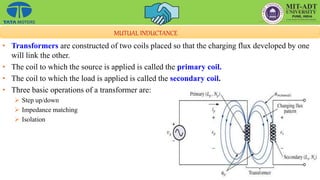
• Transformers are constructed of two coils placed so that the charging flux developed by one
will link the other.
• The coil to which the source is applied is called the primary coil.
• The coil to which the load is applied is called the secondary coil.
• Three basic operations of a transformer are:
 Step up/down
 Impedance matching
 Isolation
MUTUAL INDUCTANCE
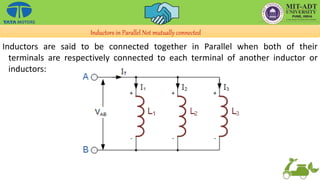
Inductors in Parallel Not mutually connected
Inductors are said to be connected together in Parallel when both of their
terminals are respectively connected to each terminal of another inductor or
inductors:
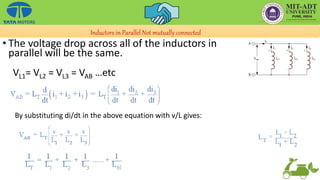
Inductors in Parallel Not mutually connected
• The voltage drop across all of the inductors in
parallel will be the same.
VL1= VL2 = VL3 = VAB …etc
By substituting di/dt in the above equation with v/L gives:
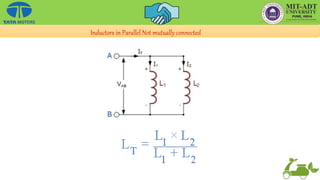
Inductors in Parallel Not mutually connected
Inductors in Parallel mutually connected
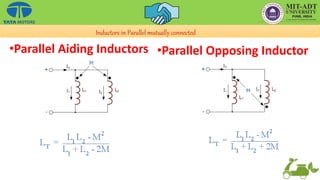
•Parallel Aiding Inductors
•Parallel Opposing Inductor
Inductors in Parallel mutually connected
•Parallel Aiding Inductors •Parallel Opposing Inductor
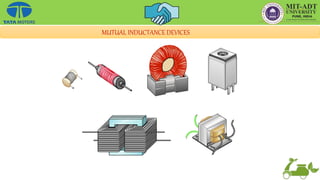
MUTUAL INDUCTANCE DEVICES
ELECTROMECHANICAL ENERGY CONVERSION
• The conversion of electrical energy into mechanical energy or vice versa is known as electromechanical energy .
• Energy can neither be created nor be destroyed. It is converted from one form of energy into another form.
Some form of energy is converted into desired form.
Some amount of energy is stored.
Some energy is dissipated.
Energy Balance equation for motor:
Total electrical i/p = [Total mechanical output ]+ [Total energy stored]+ [Total energy dispatched] _1
Wei = [Wmo ]+[Wes+Wms]+[I2R + Magenetic losses in core + F/w losses]
Wei – ohmic loss = [Wmo+ Wms + Mechanical loss]+ [Wes + loss in coupling
field]
Therefore,
Welect = Wmech + Wfld ____2
Where
Welect = Wei = Net input electrical energy to the coupling field.
Wfld = Energy stored in coupling field
Wmech = Total energy converted from electrical to mechanical
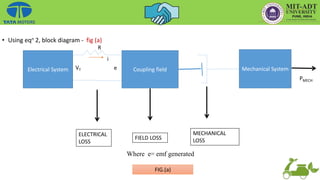
Using eqn 2, block diagram - fig (a)
• Using eqn 2, block diagram - fig (a)
PMECH
Electrical System Coupling field Mechanical System
ELECTRICAL
LOSS
FIELD LOSS
MECHANICAL
LOSS
VT e
R
i
Where e= emf generated
FIG.(a)
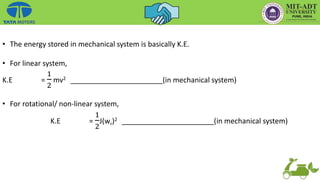
• The energy stored in mechanical system is basically K.E.
• For linear system,
K.E =
1
2
mv2 _______________________(in mechanical system)
• For rotational/ non-linear system,
K.E =
1
2
J(wr)2 _______________________(in mechanical system)
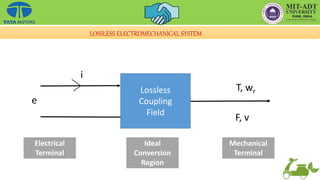
LOSSLESS ELECTROMECHANICAL SYSTEM
e
i
Lossless
Coupling
Field
T, wr
F, v
Electrical
Terminal
Ideal
Conversion
Region
Mechanical
Terminal
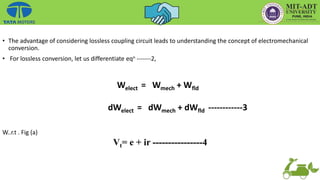
• The advantage of considering lossless coupling circuit leads to understanding the concept of electromechanical
conversion.
• For lossless conversion, let us differentiate eqn -------2,
W..r.t . Fig (a)
Welect = Wmech + Wfld
dWelect = dWmech + dWfld ------------3
Vt= e + ir ----------------4
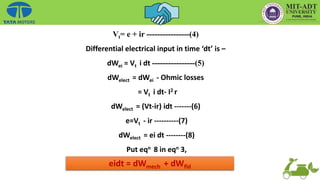
Vt= e + ir ----------------(4)
Differential electrical input in time ‘dt’ is –
dWei = Vt i dt ----------------(5)
dWelect = dWei - Ohmic losses
= Vt i dt- I2 r
dWelect = (Vt-ir) idt -------(6)
e=Vt - ir ----------(7)
dWelect = ei dt --------(8)
Put eqn 8 in eqn 3,
eidt = dWmech + dWfld
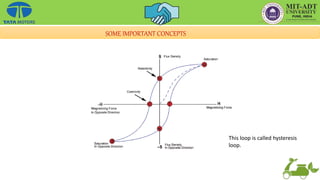
This loop is called hysteresis
loop.
SOME IMPORTANT CONCEPTS
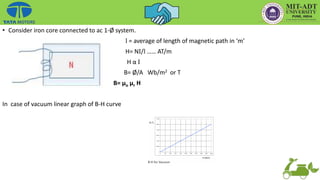
• Consider iron core connected to ac 1-Ø system.
l = average of length of magnetic path in ‘m’
H= NI/l …… AT/m
H α I
B= Ø/A Wb/m2 or T
B= µo µr H
In case of vacuum linear graph of B-H curve
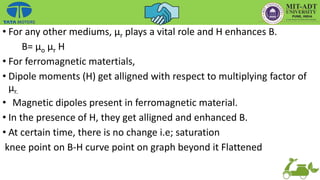
• For any other mediums, µr plays a vital role and H enhances B.
B= µo µr H
• For ferromagnetic matertials,
• Dipole moments (H) get alligned with respect to multiplying factor of
µr.
• Magnetic dipoles present in ferromagnetic material.
• In the presence of H, they get alligned and enhanced B.
• At certain time, there is no change i.e; saturation
knee point on B-H curve point on graph beyond it Flattened
• There is hysteresis effect in B-H curve.
• Due to partial alignment of dipoles of the increase in the value of H,
dipoles become more and more alinged and reaches to a certain point,
from that point current started reversing.
[Refer point ‘x’ on B-H curve].
ʃ B H d v
• As per faraday’s law ,
• Flux linkage , λ =N Ø
= LI
emf included, e= dλ/dt
= N dØ/dt = L di/d
Vt = e + ir
= ir + L 2di/dE
• As H ↑, B↑
Therefore , H= NI/l
B= µo µr H = µo µr (NI/l)
B= Ø/A
Ø=B.A
= µo µr (N x i x A/l)
= (µo µr A/l) N x I
But λ= NØ
=N [(µo µr A/l) Nx I]
λ= N2 (µo µr A/l) I
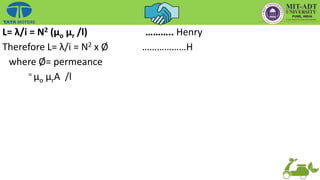
L= λ/i = N2 (µo µr /l) ……….. Henry
Therefore L= λ/i = N2 x Ø ………………H
where Ø= permeance
= µo µrA /l
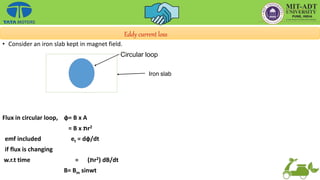
Eddy current loss
• Consider an iron slab kept in magnet field.
Circular loop
Flux in circular loop, ф= B x A
= B x ‫ת‬r2
emf included et = dф/dt
if flux is changing
w.r.t time = (‫ת‬r2) dB/dt
B= Bm sinwt
Iron slab
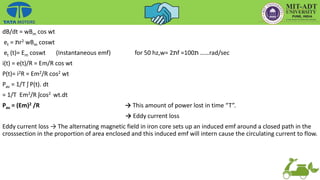
dB/dt = wBm cos wt
et = ‫ת‬r2 wBm coswt
et (t)= Em coswt (Instantaneous emf) for 50 hz,w= 2‫ת‬f =100‫ת‬ ……rad/sec
i(t) = e(t)/R = Em/R cos wt
P(t)= i2R = Em2/R cos2 wt
Pav = 1/T ʃ P(t). dt
= 1/T Em2/R ʃcos2 wt.dt
Pav = (Em)2 /R → This amount of power lost in time “T”.
→ Eddy current loss
Eddy current loss → The alternating magnetic field in iron core sets up an induced emf around a closed path in the
crosssection in the proportion of area enclosed and this induced emf will intern cause the circulating current to flow.
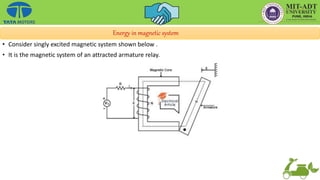
Energy in magnetic system
• Consider singly excited magnetic system shown below .
• It is the magnetic system of an attracted armature relay.
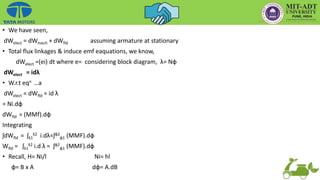
• We have seen,
dWelect = dWmech + dWfld assuming armature at stationary
• Total flux linkages & induce emf eaquations, we know,
dWelect =(ei) dt where e= considering block diagram, λ= Nф
dWelect = idλ
• W.r.t eqn …a
dWelect = dWfld = id λ
= Ni.dф
dWfld = (MMf).dф
Integrating
ʃdWfld = ʃλ1
λ2 i.dλ=ʃф2
ф1 (MMF).dф
Wfld = ʃλ1
λ2 i.d λ = ʃф2
ф1 (MMF).dф
• Recall, H= Ni/l Ni= hl
ф= B x A dф= A.dB
Wfld = Al ʃb
0 H x dB
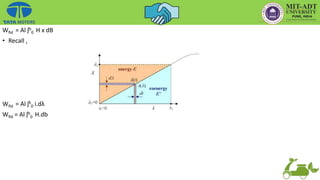
• Recall ,
Wfld = Al ʃλ
0 i.dλ
Wfld = Al ʃb
0 H.db
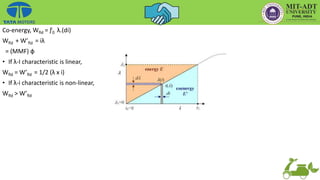
Co-energy, Wfld = ʃi
0 λ.(di)
Wfld + W’fld = iλ
= (MMF) ф
• If λ-I characteristic is linear,
Wfld = W’fld = 1/2 (λ x i)
• If λ-i characteristic is non-linear,
Wfld > W’fld
Derivation
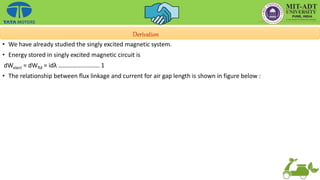
• We have already studied the singly excited magnetic system.
• Energy stored in singly excited magnetic circuit is
dWelect = dWfld = idλ ……………………… 1
• The relationship between flux linkage and current for air gap length is shown in figure below :
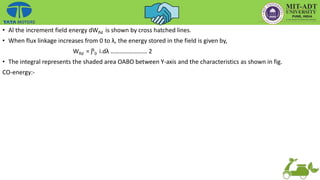
• Al the increment field energy dWfld is shown by cross hatched lines.
• When flux linkage increases from 0 to λ, the energy stored in the field is given by,
Wfld = ʃλ
0 i.dλ …………………… 2
• The integral represents the shaded area OABO between Y-axis and the characteristics as shown in fig.
CO-energy:-
• Consider OABO area shown energy stored in magnetic field.
• Now the area OACO → between curve & x-axis
→ known as co-energy
• W’fld ʃi
0 λ.di ………………3
• Co-energy does not have any physical existance/ significance but it is useful in calculating force and torque
development in electromechanical system
• From graph,
Wfld + W’fld =(λ-i) ………………………….4
• To derive equation of torque , considering the movement of mech. Part/ armature w.r.t. singly excited magnetic
system .
• If the singly excited magnetic circuit is assumed to be linear, then this mechanical source movement can be
expressed in terms of –
→force
→distance ‘x’
• But in order to derive the torque, we must consider rotational motion.
• So for rotational motion the mechanical source is giving the distance which is displaced at angular displacement.
• Energy balance equation for singly excited magnetic system,
dWelect = dWmech + dWfld …………………… revised equation 1
Where,
dWfld =

AEDC_Unit I.pptx

  • 2.
    Course Conduction of Advanced Electric Machines& Drives M.Tech- Electric Vehicle Technology
  • 3.
    UNIT I Basic Principlesof Electrical Machines Contents: • Magnetically coupled circuits • Modelling linear and nonlinear magnetic circuits • Electromechanical energy conversion : Principles of energy flow, concept of field theory and co-energy • Derivation of torque expression for various machines • Inductance matrices
  • 4.
    UNIT I Basic Principlesof Electrical Machines Faraday’s Law of Electromagnetic Induction: First Law Second Law
  • 5.
    UNIT I Basic Principlesof Electrical Machines Faraday’s Law of Electromagnetic Induction: •Statically Induced e.m.f. •Dynamically induced e.m.f
  • 6.
    •Flemming’s Right handrule •Lenz’s Law
  • 7.
    Statically Induced e.m.f. •SelfInduced e.m.f. •Mutually Induced e.m.f.
  • 8.
    The circuits wehave considered so far may be regarded as conductively coupled, because one loop affects the neighboring loop through current conduction. When two loops with or without contacts between them affect each other through the magnetic field generated by one of them, they are said to be magnetically coupled. MAGNETIC CIRCUIT
  • 9.
    Let us firstconsider a single inductor, a coil with N turns. When current i flows through the coil, a magnetic flux φ is produced around it. According to Faraday’s law, the voltage v induced in the coilis proportional to the number of turns N and the time rate of change of the magnetic flux φ; that is, ⅇ = 𝑁 ⅆ𝜙 ⅆ𝑡 But the flux φ is produced by current i so that any change in φ is caused by a change in the current. ⅇ = ⅆ𝜙 ⅆ𝑡 𝑋 ⅆⅈ ⅆⅈ Where L = 𝐶ℎ𝑎𝑛𝑔𝑒 𝑖𝑛 𝑓𝑙𝑢𝑥 𝑐ℎ𝑎𝑛𝑔𝑒 𝑖𝑛 𝑐𝑢𝑟𝑟𝑒𝑛𝑡 = ⅆ𝜙 ⅆ𝑖 ⅇ = 𝐿 ⅆⅈ ⅆ𝑡 Where L= Coefficient of self inductance or Self Inductance SELF INDUCTANCE
  • 10.
    MUTUAL INDUCTANCE • Whentwo coils are placed close to each other, a changing flux in one coil will cause an induced voltage in the second coil. • The coils are said to have mutual inductance M, which can either add or subtract from the total inductance depending on if the fields are aiding or opposing. • Mutual inductance is the ability of one inductor to induce a voltage across a neighboring inductor. e1 e2
  • 11.
    ⅇ2 = 𝑀21 ⅆⅈ1 ⅆ𝑡 WhereM21 = mutual inductance of coil 2 w.r.t. coil 1 MUTUAL INDUCTANCE
  • 12.
    ⅇ1 = 𝑀12 ⅆⅈ2 ⅆ𝑡 WhereM21 = mutual inductance of coil 2 w.r.t. coil 1 MUTUAL INDUCTANCE
  • 13.
    • Mutual inductancesM12 and M21 are equal. • They are referred as M. • We refer to M as the mutual inductance between two coils. • M is measured in Henry. • Mutual inductance exists when two coils are close to each other. • Mutual inductance effect exist when circuits are driven by time varying sources. • Recall that inductors act like short circuits to DC. MUTUAL INDUCTANCE 12 21 M M M  
  • 14.
    If the currentENTERS the dotted terminal of one coil, the reference polarity of the mutual voltage in the second coil is POSITIVE at the dotted terminal of the second coil. DOT CONVENTION
  • 15.
    • If thecurrent LEAVES the dotted terminal of one coil, the reference polarity of the mutual voltage in the second coil is NEGATIVE at the dotted terminal of the second coil. DOT CONVENTION
  • 17.
    When both currentsenter dotted terminals use positive sign for mutual term
  • 18.
    Consider inductors connectedin series not mutually connected to each other: COIL IN SERIES
  • 19.
    COIL IN SERIES ITotal= IL1 = IL2 = IL3. . . = In VTotal = VL1 + VL2 + VL3…. + Vn V = L di/ dt LT di/dt = L1 di/dt + L2 di/dt + L3 di/dt + . . . + Ln di/dt LTotal = L1 + L2 + L3 + ….. + Ln
  • 20.
    a) Series-aiding connection. L=L1+L2+2M b)Series-opposing connection. L=L1+L2-2M The total inductance of two coupled coils in series depend on the placement of the dotted ends of the coils. The mutual inductances may add or subtract. Mutually Connected Inductors in Series: 1) Cumulatively coupled or Series Aiding 2) Differentially coupled or Series opposing
  • 21.
    • Transformers areconstructed of two coils placed so that the charging flux developed by one will link the other. • The coil to which the source is applied is called the primary coil. • The coil to which the load is applied is called the secondary coil. • Three basic operations of a transformer are:  Step up/down  Impedance matching  Isolation MUTUAL INDUCTANCE
  • 22.
    Inductors in ParallelNot mutually connected Inductors are said to be connected together in Parallel when both of their terminals are respectively connected to each terminal of another inductor or inductors:
  • 23.
    Inductors in ParallelNot mutually connected • The voltage drop across all of the inductors in parallel will be the same. VL1= VL2 = VL3 = VAB …etc By substituting di/dt in the above equation with v/L gives:
  • 24.
    Inductors in ParallelNot mutually connected
  • 25.
    Inductors in Parallelmutually connected •Parallel Aiding Inductors •Parallel Opposing Inductor
  • 26.
    Inductors in Parallelmutually connected •Parallel Aiding Inductors •Parallel Opposing Inductor
  • 27.
  • 28.
    ELECTROMECHANICAL ENERGY CONVERSION •The conversion of electrical energy into mechanical energy or vice versa is known as electromechanical energy . • Energy can neither be created nor be destroyed. It is converted from one form of energy into another form. Some form of energy is converted into desired form. Some amount of energy is stored. Some energy is dissipated.
  • 29.
    Energy Balance equationfor motor: Total electrical i/p = [Total mechanical output ]+ [Total energy stored]+ [Total energy dispatched] _1 Wei = [Wmo ]+[Wes+Wms]+[I2R + Magenetic losses in core + F/w losses] Wei – ohmic loss = [Wmo+ Wms + Mechanical loss]+ [Wes + loss in coupling field] Therefore, Welect = Wmech + Wfld ____2 Where Welect = Wei = Net input electrical energy to the coupling field. Wfld = Energy stored in coupling field Wmech = Total energy converted from electrical to mechanical Using eqn 2, block diagram - fig (a)
  • 30.
    • Using eqn2, block diagram - fig (a) PMECH Electrical System Coupling field Mechanical System ELECTRICAL LOSS FIELD LOSS MECHANICAL LOSS VT e R i Where e= emf generated FIG.(a)
  • 31.
    • The energystored in mechanical system is basically K.E. • For linear system, K.E = 1 2 mv2 _______________________(in mechanical system) • For rotational/ non-linear system, K.E = 1 2 J(wr)2 _______________________(in mechanical system)
  • 32.
    LOSSLESS ELECTROMECHANICAL SYSTEM e i Lossless Coupling Field T,wr F, v Electrical Terminal Ideal Conversion Region Mechanical Terminal
  • 33.
    • The advantageof considering lossless coupling circuit leads to understanding the concept of electromechanical conversion. • For lossless conversion, let us differentiate eqn -------2, W..r.t . Fig (a) Welect = Wmech + Wfld dWelect = dWmech + dWfld ------------3 Vt= e + ir ----------------4
  • 34.
    Vt= e +ir ----------------(4) Differential electrical input in time ‘dt’ is – dWei = Vt i dt ----------------(5) dWelect = dWei - Ohmic losses = Vt i dt- I2 r dWelect = (Vt-ir) idt -------(6) e=Vt - ir ----------(7) dWelect = ei dt --------(8) Put eqn 8 in eqn 3, eidt = dWmech + dWfld
  • 35.
    This loop iscalled hysteresis loop. SOME IMPORTANT CONCEPTS
  • 36.
    • Consider ironcore connected to ac 1-Ø system. l = average of length of magnetic path in ‘m’ H= NI/l …… AT/m H α I B= Ø/A Wb/m2 or T B= µo µr H In case of vacuum linear graph of B-H curve
  • 37.
    • For anyother mediums, µr plays a vital role and H enhances B. B= µo µr H • For ferromagnetic matertials, • Dipole moments (H) get alligned with respect to multiplying factor of µr. • Magnetic dipoles present in ferromagnetic material. • In the presence of H, they get alligned and enhanced B. • At certain time, there is no change i.e; saturation knee point on B-H curve point on graph beyond it Flattened
  • 38.
    • There ishysteresis effect in B-H curve. • Due to partial alignment of dipoles of the increase in the value of H, dipoles become more and more alinged and reaches to a certain point, from that point current started reversing. [Refer point ‘x’ on B-H curve]. ʃ B H d v • As per faraday’s law , • Flux linkage , λ =N Ø = LI
  • 39.
    emf included, e=dλ/dt = N dØ/dt = L di/d Vt = e + ir = ir + L 2di/dE • As H ↑, B↑ Therefore , H= NI/l B= µo µr H = µo µr (NI/l) B= Ø/A Ø=B.A = µo µr (N x i x A/l) = (µo µr A/l) N x I But λ= NØ =N [(µo µr A/l) Nx I] λ= N2 (µo µr A/l) I
  • 40.
    L= λ/i =N2 (µo µr /l) ……….. Henry Therefore L= λ/i = N2 x Ø ………………H where Ø= permeance = µo µrA /l
  • 41.
    Eddy current loss •Consider an iron slab kept in magnet field. Circular loop Flux in circular loop, ф= B x A = B x ‫ת‬r2 emf included et = dф/dt if flux is changing w.r.t time = (‫ת‬r2) dB/dt B= Bm sinwt Iron slab
  • 42.
    dB/dt = wBmcos wt et = ‫ת‬r2 wBm coswt et (t)= Em coswt (Instantaneous emf) for 50 hz,w= 2‫ת‬f =100‫ת‬ ……rad/sec i(t) = e(t)/R = Em/R cos wt P(t)= i2R = Em2/R cos2 wt Pav = 1/T ʃ P(t). dt = 1/T Em2/R ʃcos2 wt.dt Pav = (Em)2 /R → This amount of power lost in time “T”. → Eddy current loss Eddy current loss → The alternating magnetic field in iron core sets up an induced emf around a closed path in the crosssection in the proportion of area enclosed and this induced emf will intern cause the circulating current to flow.
  • 43.
    Energy in magneticsystem • Consider singly excited magnetic system shown below . • It is the magnetic system of an attracted armature relay.
  • 44.
    • We haveseen, dWelect = dWmech + dWfld assuming armature at stationary • Total flux linkages & induce emf eaquations, we know, dWelect =(ei) dt where e= considering block diagram, λ= Nф dWelect = idλ • W.r.t eqn …a dWelect = dWfld = id λ = Ni.dф dWfld = (MMf).dф Integrating ʃdWfld = ʃλ1 λ2 i.dλ=ʃф2 ф1 (MMF).dф Wfld = ʃλ1 λ2 i.d λ = ʃф2 ф1 (MMF).dф • Recall, H= Ni/l Ni= hl ф= B x A dф= A.dB
  • 45.
    Wfld = Alʃb 0 H x dB • Recall , Wfld = Al ʃλ 0 i.dλ Wfld = Al ʃb 0 H.db
  • 46.
    Co-energy, Wfld =ʃi 0 λ.(di) Wfld + W’fld = iλ = (MMF) ф • If λ-I characteristic is linear, Wfld = W’fld = 1/2 (λ x i) • If λ-i characteristic is non-linear, Wfld > W’fld
  • 47.
    Derivation • We havealready studied the singly excited magnetic system. • Energy stored in singly excited magnetic circuit is dWelect = dWfld = idλ ……………………… 1 • The relationship between flux linkage and current for air gap length is shown in figure below :
  • 48.
    • Al theincrement field energy dWfld is shown by cross hatched lines. • When flux linkage increases from 0 to λ, the energy stored in the field is given by, Wfld = ʃλ 0 i.dλ …………………… 2 • The integral represents the shaded area OABO between Y-axis and the characteristics as shown in fig. CO-energy:-
  • 50.
    • Consider OABOarea shown energy stored in magnetic field. • Now the area OACO → between curve & x-axis → known as co-energy • W’fld ʃi 0 λ.di ………………3 • Co-energy does not have any physical existance/ significance but it is useful in calculating force and torque development in electromechanical system • From graph, Wfld + W’fld =(λ-i) ………………………….4 • To derive equation of torque , considering the movement of mech. Part/ armature w.r.t. singly excited magnetic system . • If the singly excited magnetic circuit is assumed to be linear, then this mechanical source movement can be expressed in terms of – →force →distance ‘x’
  • 51.
    • But inorder to derive the torque, we must consider rotational motion. • So for rotational motion the mechanical source is giving the distance which is displaced at angular displacement. • Energy balance equation for singly excited magnetic system, dWelect = dWmech + dWfld …………………… revised equation 1 Where, dWfld =