The US Welfare State
GROUP 5: VU THI BICH
LE THI HUYEN
TRAN THI NGOC
NGUYEN THI THOAN
PHAM THI HONG XUYEN
Contents
I. Introduction
II. The US Welfare’s services and
programs
III.Qualifications of receiving Welfare
IV.Achievements of the US Welfare
I. Introduction
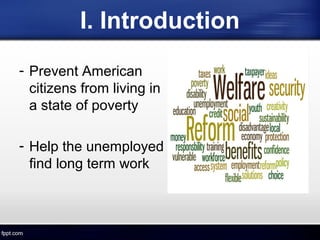
- Prevent American
citizens from living in
a state of poverty
- Help the unemployed
find long term work
II. The US Welfare’s services and
programs
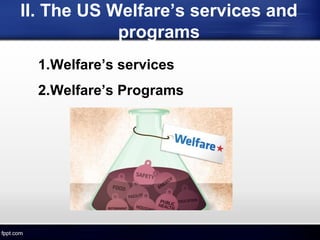
1.Welfare’s services
2.Welfare’s Programs
1.Welfare’s services
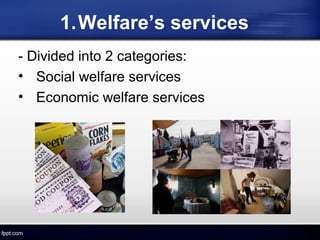
- Divided into 2 categories:
• Social welfare services
• Economic welfare services
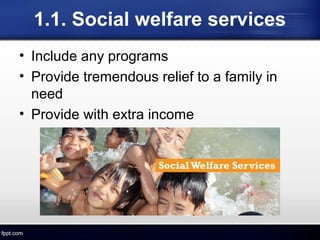
1.1. Social welfare services
• Include any programs
• Provide tremendous relief to a family in
need
• Provide with extra income
1.1. Social welfare services
• Some of the myriad options for financial
assistance are:
–Temporary Assistance for Needy Families
–Child Support
–Benefits for Immigrants
–The Child Nutrition Programs
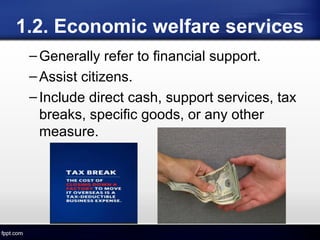
1.2. Economic welfare services
–Generally refer to financial support.
–Assist citizens.
–Include direct cash, support services, tax
breaks, specific goods, or any other
measure.
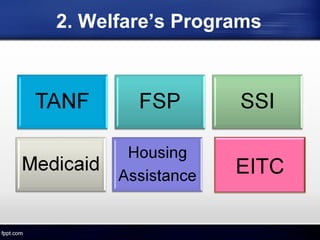
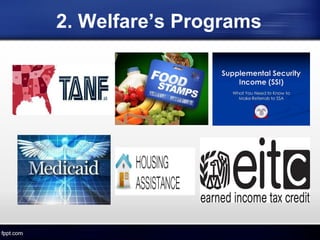
2. Welfare’s Programs
EITC
2. Welfare’s Programs
• Many smaller
government-assistance
programs
E.g.: Special
Supplemental Food
Program for Women,
Infants and Children
[WIC]; general
assistance [GA]…
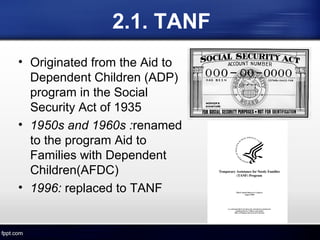
2.1. TANF
• Originated from the Aid to
Dependent Children (ADP)
program in the Social
Security Act of 1935
• 1950s and 1960s :renamed
to the program Aid to
Families with Dependent
Children(AFDC)
• 1996: replaced to TANF
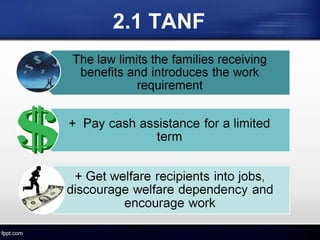
2.1 TANF
2.1 TANF
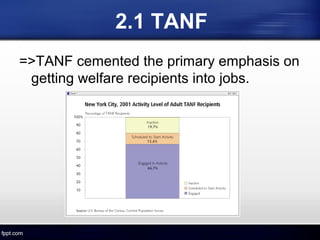
=>TANF cemented the primary emphasis on
getting welfare recipients into jobs.
III. Qualifications of receiving
Welfare
1. Requirements for residents
2. Requirements for families
3. Work requirements
1. Requirements for residents
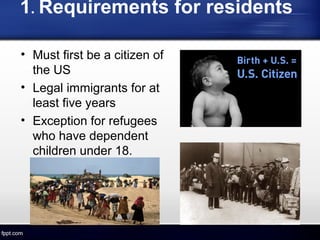
• Must first be a citizen of
the US
• Legal immigrants for at
least five years
• Exception for refugees
who have dependent
children under 18.
2. Requirements for families
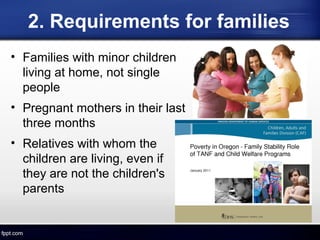
• Families with minor children
living at home, not single
people
• Pregnant mothers in their last
three months
• Relatives with whom the
children are living, even if
they are not the children's
parents
3. Work requirements
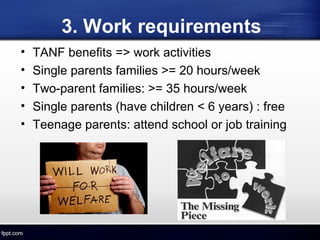
• TANF benefits => work activities
• Single parents families >= 20 hours/week
• Two-parent families: >= 35 hours/week
• Single parents (have children < 6 years) : free
• Teenage parents: attend school or job training
IV. Achievements of the US Welfare
1. Benefits of welfare to economy
2. Remarkable achievements to society
1.Benefits of welfare to economy
• Government-provided
benefits: completed by
occupational pension.
=> Total yearly per
capita disposable
income of retirees: not
differ much.
1.Benefits of welfare to economy
• Less substitution: public and private
provision (no government-operated
system)
1.Benefits of welfare to economy
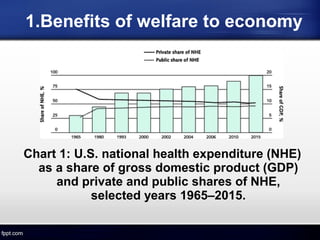
Chart 1: U.S. national health expenditure (NHE)
as a share of gross domestic product (GDP)
and private and public shares of NHE,
selected years 1965–2015.
1.Benefits of welfare to economy
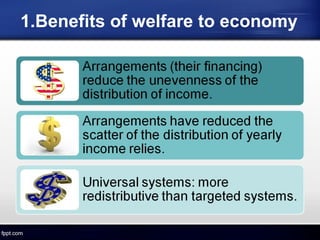
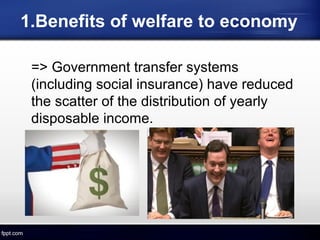
=> Government transfer systems
(including social insurance) have reduced
the scatter of the distribution of yearly
disposable income.
2. Remarkable Social Welfare
Achievements
The 1996 Social Welfare Reform
The 1996 Social Welfare reform
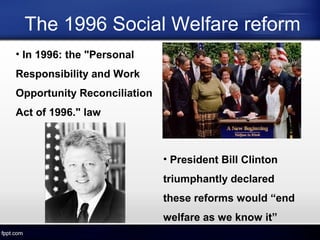
• In 1996: the "Personal
Responsibility and Work
Opportunity Reconciliation
Act of 1996." law
• President Bill Clinton
triumphantly declared
these reforms would “end
welfare as we know it”
The 1996 Social Welfare Reform
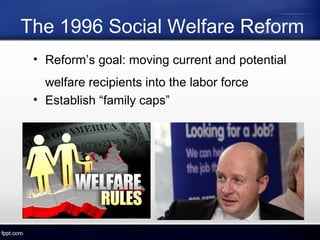
• Reform’s goal: moving current and potential
welfare recipients into the labor force
• Establish “family caps”
The 1996 Social Welfare Reform
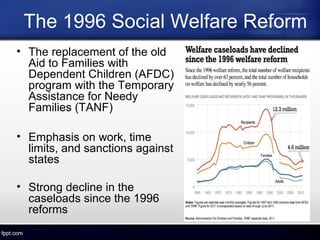
• The replacement of the old
Aid to Families with
Dependent Children (AFDC)
program with the Temporary
Assistance for Needy
Families (TANF)
• Emphasis on work, time
limits, and sanctions against
states
• Strong decline in the
caseloads since the 1996
reforms
The 1996 Social Welfare Reform
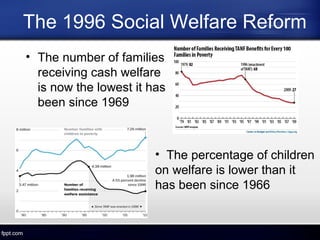
• The number of families
receiving cash welfare
is now the lowest it has
been since 1969
• The percentage of children
on welfare is lower than it
has been since 1966
The 1996 Social Welfare Reform
=>
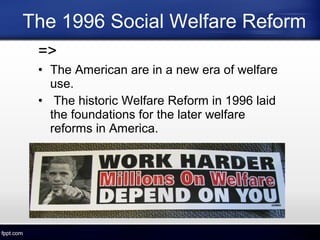
• The American are in a new era of welfare
use.
• The historic Welfare Reform in 1996 laid
the foundations for the later welfare
reforms in America.
Discussion Questions
1. Name the basic Welfare’s programs?
2. Which is the most remarkable
achievement of the Social Welfare?
2. the us welfare state presentation

2. the us welfare state presentation

  • 1.
  • 2.
    GROUP 5: VUTHI BICH LE THI HUYEN TRAN THI NGOC NGUYEN THI THOAN PHAM THI HONG XUYEN
  • 3.
    Contents I. Introduction II. TheUS Welfare’s services and programs III.Qualifications of receiving Welfare IV.Achievements of the US Welfare
  • 4.
    I. Introduction - PreventAmerican citizens from living in a state of poverty - Help the unemployed find long term work
  • 5.
    II. The USWelfare’s services and programs 1.Welfare’s services 2.Welfare’s Programs
  • 6.
    1.Welfare’s services - Dividedinto 2 categories: • Social welfare services • Economic welfare services
  • 7.
    1.1. Social welfareservices • Include any programs • Provide tremendous relief to a family in need • Provide with extra income
  • 8.
    1.1. Social welfareservices • Some of the myriad options for financial assistance are: –Temporary Assistance for Needy Families –Child Support –Benefits for Immigrants –The Child Nutrition Programs
  • 9.
    1.2. Economic welfareservices –Generally refer to financial support. –Assist citizens. –Include direct cash, support services, tax breaks, specific goods, or any other measure.
  • 10.
  • 11.
  • 12.
    2. Welfare’s Programs •Many smaller government-assistance programs E.g.: Special Supplemental Food Program for Women, Infants and Children [WIC]; general assistance [GA]…
  • 13.
    2.1. TANF • Originatedfrom the Aid to Dependent Children (ADP) program in the Social Security Act of 1935 • 1950s and 1960s :renamed to the program Aid to Families with Dependent Children(AFDC) • 1996: replaced to TANF
  • 14.
  • 15.
    2.1 TANF =>TANF cementedthe primary emphasis on getting welfare recipients into jobs.
  • 16.
    III. Qualifications ofreceiving Welfare 1. Requirements for residents 2. Requirements for families 3. Work requirements
  • 17.
    1. Requirements forresidents • Must first be a citizen of the US • Legal immigrants for at least five years • Exception for refugees who have dependent children under 18.
  • 18.
    2. Requirements forfamilies • Families with minor children living at home, not single people • Pregnant mothers in their last three months • Relatives with whom the children are living, even if they are not the children's parents
  • 19.
    3. Work requirements •TANF benefits => work activities • Single parents families >= 20 hours/week • Two-parent families: >= 35 hours/week • Single parents (have children < 6 years) : free • Teenage parents: attend school or job training
  • 20.
    IV. Achievements ofthe US Welfare 1. Benefits of welfare to economy 2. Remarkable achievements to society
  • 21.
    1.Benefits of welfareto economy • Government-provided benefits: completed by occupational pension. => Total yearly per capita disposable income of retirees: not differ much.
  • 22.
    1.Benefits of welfareto economy • Less substitution: public and private provision (no government-operated system)
  • 23.
    1.Benefits of welfareto economy Chart 1: U.S. national health expenditure (NHE) as a share of gross domestic product (GDP) and private and public shares of NHE, selected years 1965–2015.
  • 24.
  • 25.
    1.Benefits of welfareto economy => Government transfer systems (including social insurance) have reduced the scatter of the distribution of yearly disposable income.
  • 26.
    2. Remarkable SocialWelfare Achievements The 1996 Social Welfare Reform
  • 27.
    The 1996 SocialWelfare reform • In 1996: the "Personal Responsibility and Work Opportunity Reconciliation Act of 1996." law • President Bill Clinton triumphantly declared these reforms would “end welfare as we know it”
  • 28.
    The 1996 SocialWelfare Reform • Reform’s goal: moving current and potential welfare recipients into the labor force • Establish “family caps”
  • 29.
    The 1996 SocialWelfare Reform • The replacement of the old Aid to Families with Dependent Children (AFDC) program with the Temporary Assistance for Needy Families (TANF) • Emphasis on work, time limits, and sanctions against states • Strong decline in the caseloads since the 1996 reforms
  • 30.
    The 1996 SocialWelfare Reform • The number of families receiving cash welfare is now the lowest it has been since 1969 • The percentage of children on welfare is lower than it has been since 1966
  • 31.
    The 1996 SocialWelfare Reform => • The American are in a new era of welfare use. • The historic Welfare Reform in 1996 laid the foundations for the later welfare reforms in America.
  • 32.
    Discussion Questions 1. Namethe basic Welfare’s programs? 2. Which is the most remarkable achievement of the Social Welfare?