Strategic Information System
Unit 2
Management Information Systems
CSVTU, Bhilai, Chhattisgarh
(Naren Chintada)
Information System types
Some Information systems are built to resolve problems and the other information
systems are built to grab opportunities. While former is relatively easy, it is very
difficult to create opportunity.
Information systems that grab opportunities are called Strategic Information Systems.
Inwardly strategic or outwardly strategic
Strategic management is a technique that management adopts for long term planning
and the information system that support long term decision making in sense of
information and assistance.
Most strategies are created to achieve competitive advantage over rival companies
Key Features
● Decision support systems that enable to develop a strategic approach to align
Information Systems (IS) or Information Technologies (IT) with an
organization’s business strategies.
● Primarily Enterprise resource planning solutions that integrate/link the business
processes to meet the enterprise objectives for the optimization of the enterprise
resources.
● Database systems with the “data mining” capabilities to make the best use of
available corporate information for marketing, production, promotion and
innovation. The SIS systems also facilitate identification of the data collection
strategies to help optimize database marketing opportunities.
● The real-time information Systems that intend to maintain a rapid-response and
the quality
Importance of Strategic Information Systems
1. Cost Reduction (ex: Japanese automobile assembly, 24x7 ATM, Web banking
2. Barrier to Entry - as competition increases, price and profit margin decreases. So
companies create barriers by patents/trademarks or create systems that prevent
new entries cannot compete (economic feasibility)
3. Switching Cost: Make switching from other vendor difficult by charging money
make it more complex
4. Create Unique Product & Services: Provide more attractive features than other
products
5. Product Differentiation: Create a brand image through quality and better features
or service
6. Market enhancement and creating alliances
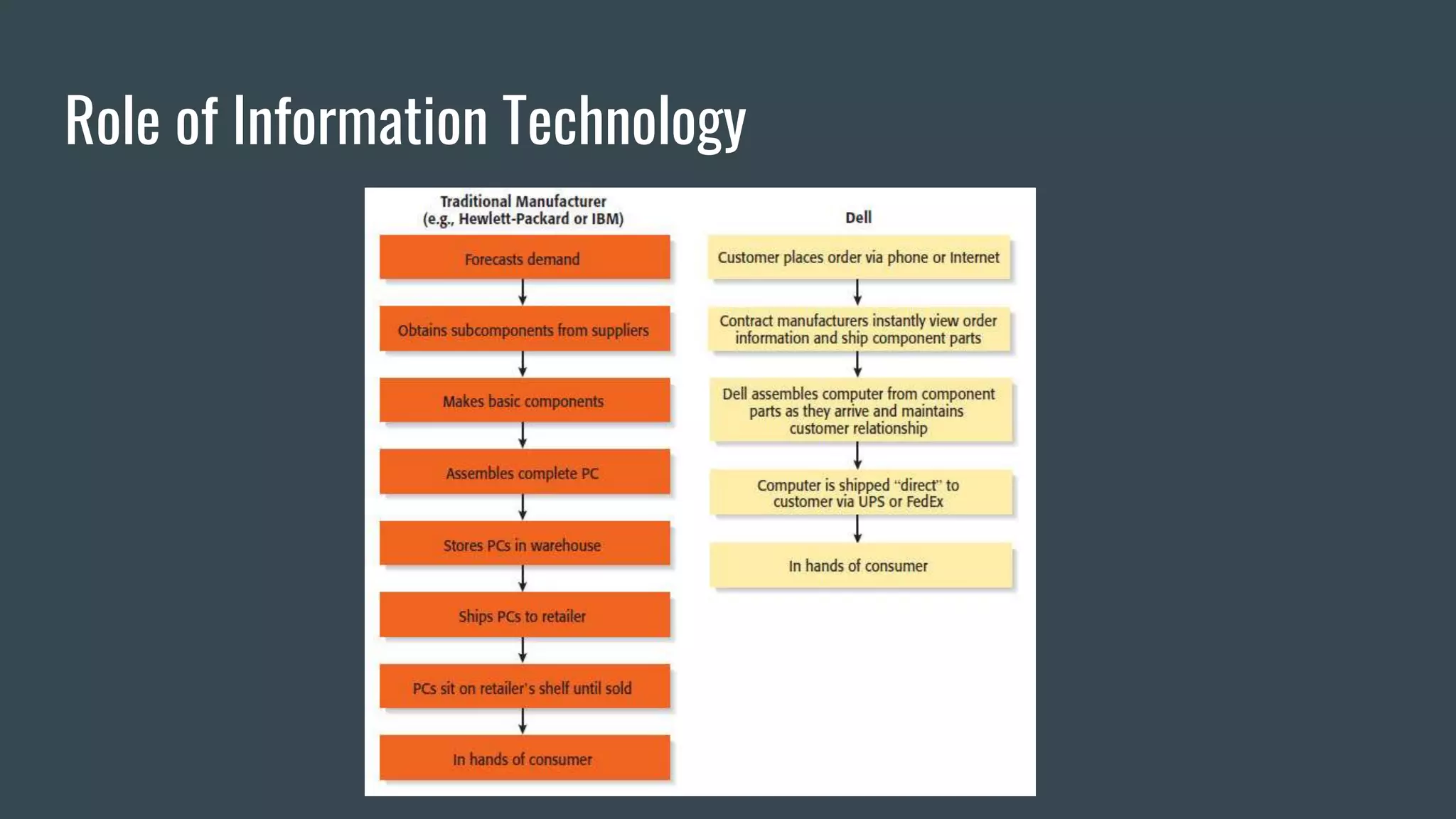
Role of Information Technology
Dell example
❏ Product Configuration Management: approximately one million parts related to
over two hundred product families per year. It also maintains over two million
materials bills per year
❏ E-Procurement: handles approximately two million purchases from
approximately five thousand suppliers worldwide. Dell uses automated handling
system to handle supplier communication.
❏ Cost: Calculate cost on periodic basis
❏ Inventory Management: equipped with inbound logistics and outbound logistics.
It handles three million assembly line inventory movements on daily basis.
❏ Credit Payment: handles fifteen thousand transactions per day
(supplier&vendors)
Business Level vs Firm Level
Business Level Strategies (Portfolio level strategies):
1. Improve Competitiveness by upgrading companies systems and controls and its
business processes
2. Assist in Business expansion through additional revenue/resources, physical
space, consolidation
3. Accelerate new business formation through using vacant space & buildings,
introduce new business forms and fill the need gaps
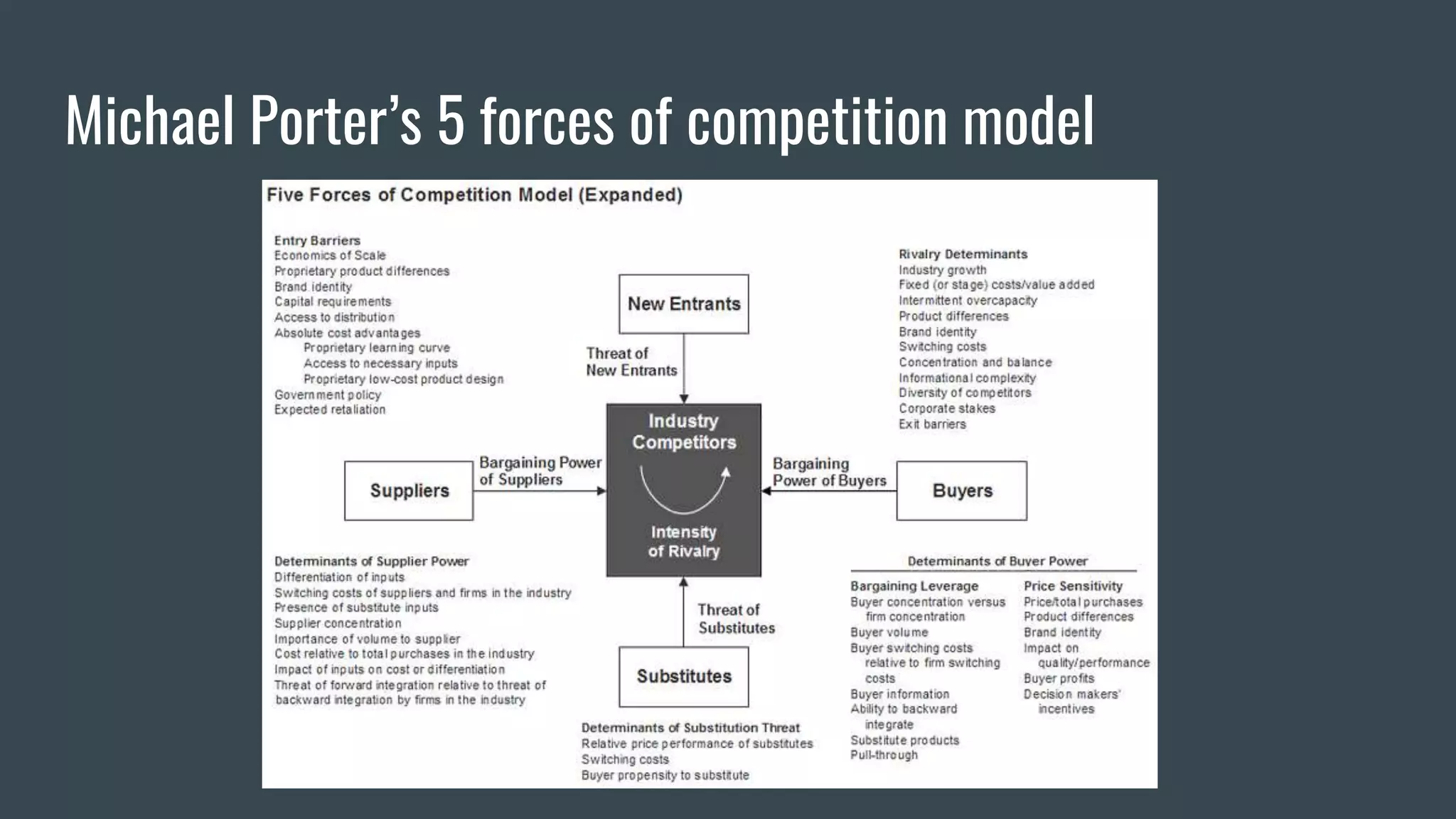
Michael Porter’s (Harvard Professor) Five-Forces and Value Chain models are widely
used frameworks to assess industry attractiveness and a firm's competitive capabilities.
Michael Porter’s 5 forces of competition model
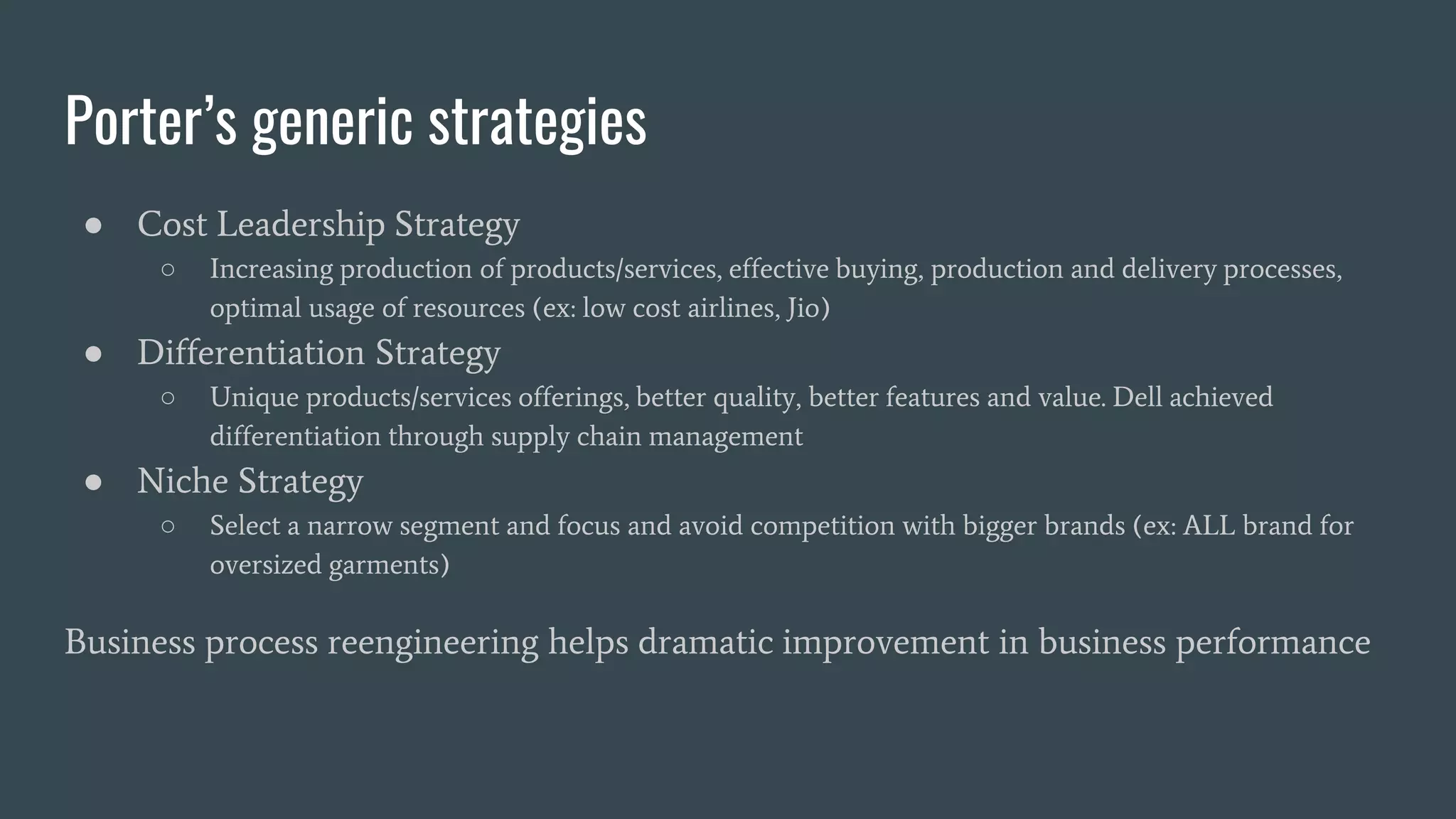
Porter’s generic strategies
● Cost Leadership Strategy
○ Increasing production of products/services, effective buying, production and delivery processes,
optimal usage of resources (ex: low cost airlines, Jio)
● Differentiation Strategy
○ Unique products/services offerings, better quality, better features and value. Dell achieved
differentiation through supply chain management
● Niche Strategy
○ Select a narrow segment and focus and avoid competition with bigger brands (ex: ALL brand for
oversized garments)
Business process reengineering helps dramatic improvement in business performance
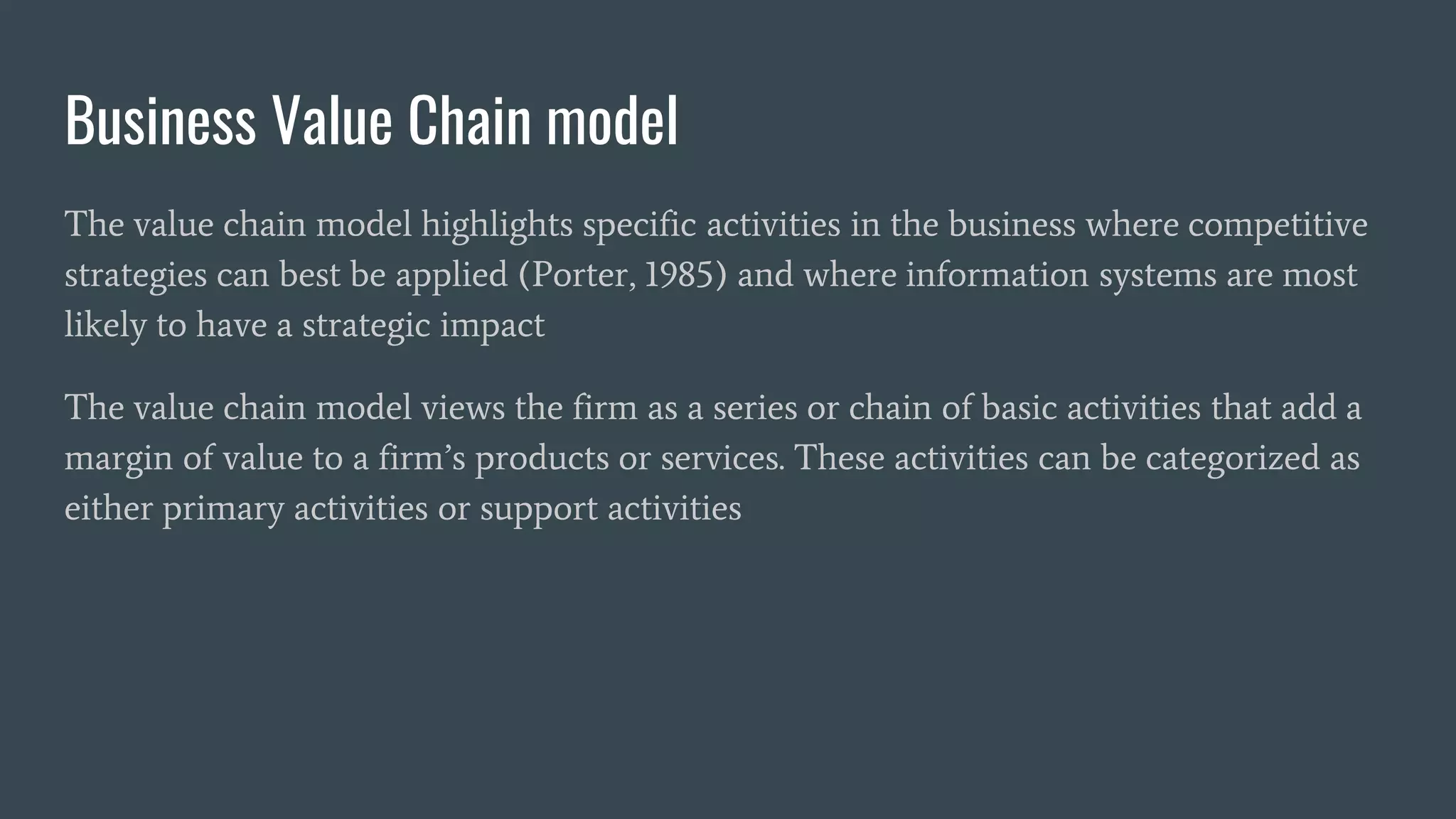
Business Value Chain model
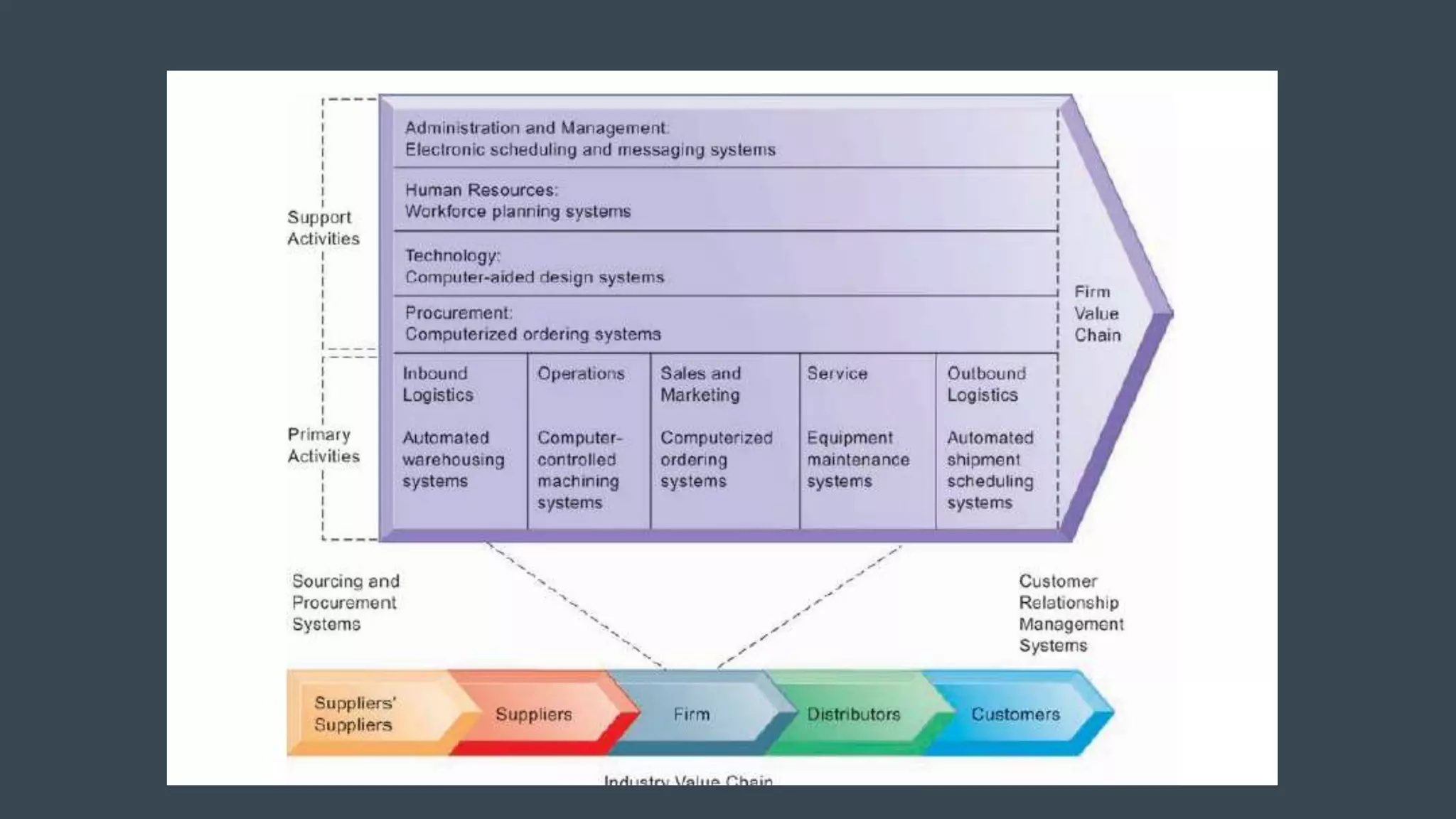
The value chain model highlights specific activities in the business where competitive
strategies can best be applied (Porter, 1985) and where information systems are most
likely to have a strategic impact
The value chain model views the firm as a series or chain of basic activities that add a
margin of value to a firm’s products or services. These activities can be categorized as
either primary activities or support activities
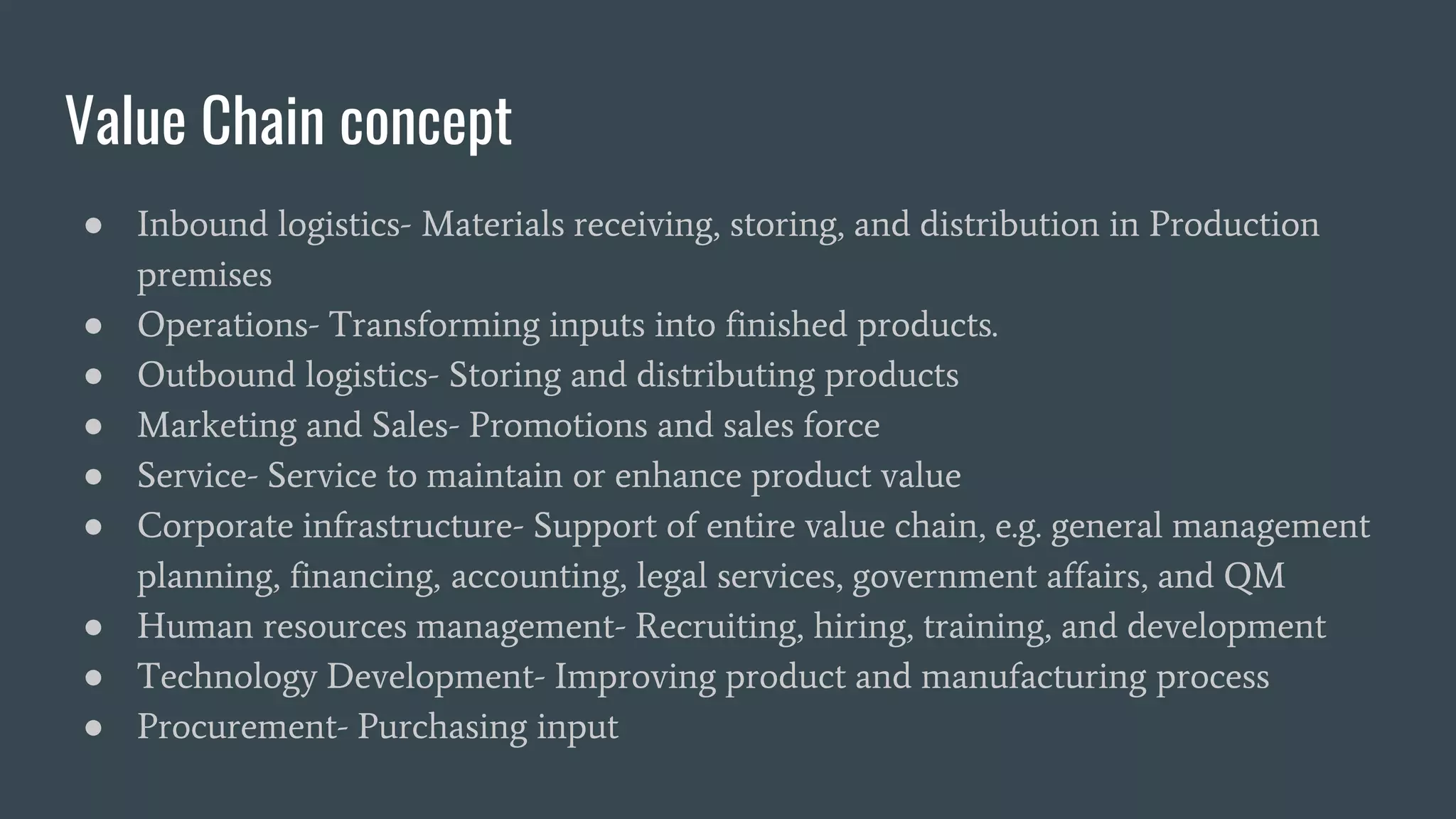
Value Chain concept
● Inbound logistics- Materials receiving, storing, and distribution in Production
premises
● Operations- Transforming inputs into finished products.
● Outbound logistics- Storing and distributing products
● Marketing and Sales- Promotions and sales force
● Service- Service to maintain or enhance product value
● Corporate infrastructure- Support of entire value chain, e.g. general management
planning, financing, accounting, legal services, government affairs, and QM
● Human resources management- Recruiting, hiring, training, and development
● Technology Development- Improving product and manufacturing process
● Procurement- Purchasing input
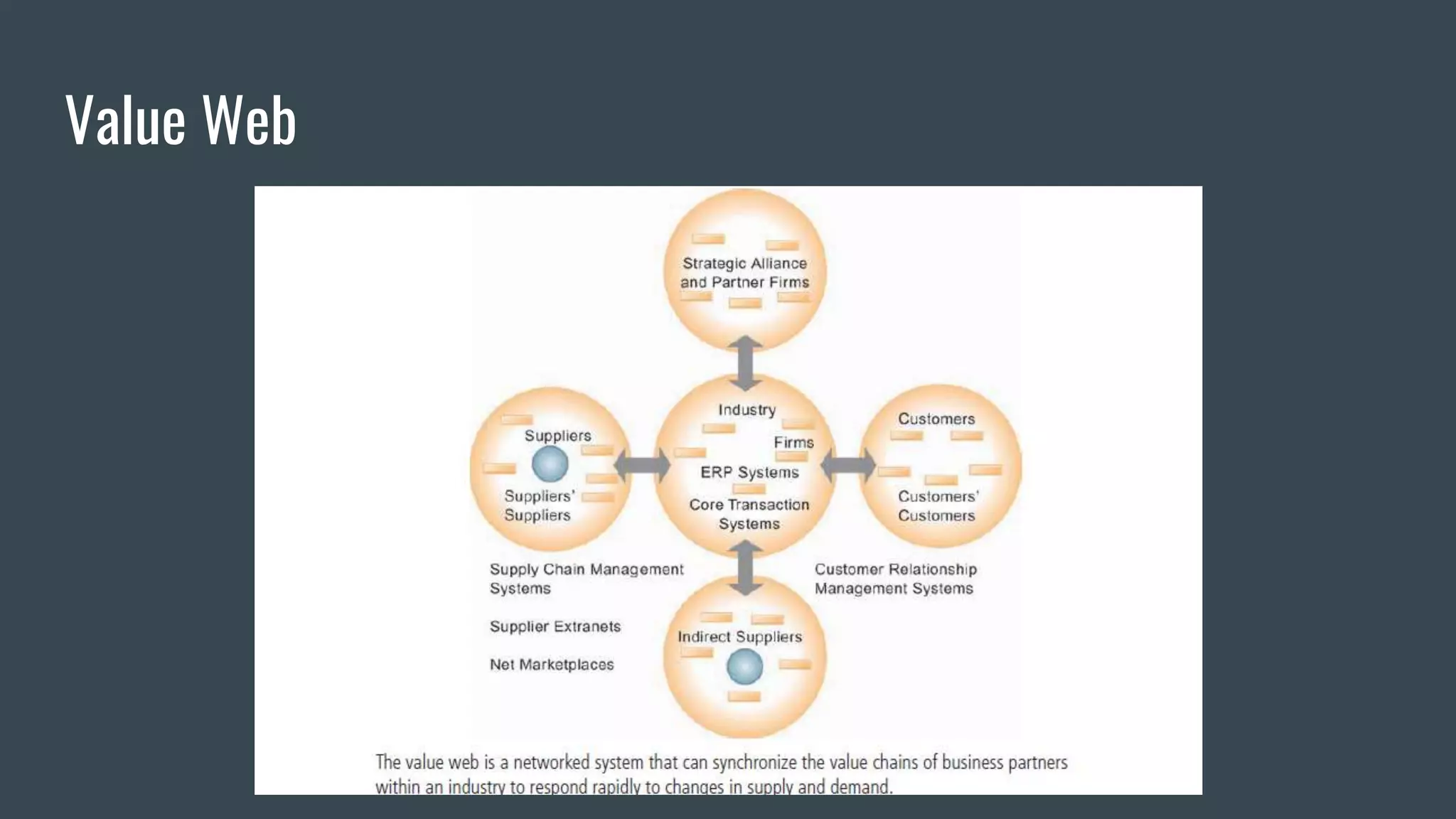
Value Web
Competitive Position
1. A cost leadership strategy requires a serious commitment to reducing expenses
that, in turn, lowers the price or the items sold in a relatively broad array of
market segments. Sometimes significant investment of capital may be necessary
to improve the production process to give these low unit costs
2. A differentiation strategy requires innovation and significant points of difference
in product offerings, higher quality, advanced technology, or superior service in a
relatively broad array of market segments
Ultimately competitive advantage grows out of the value created for customers
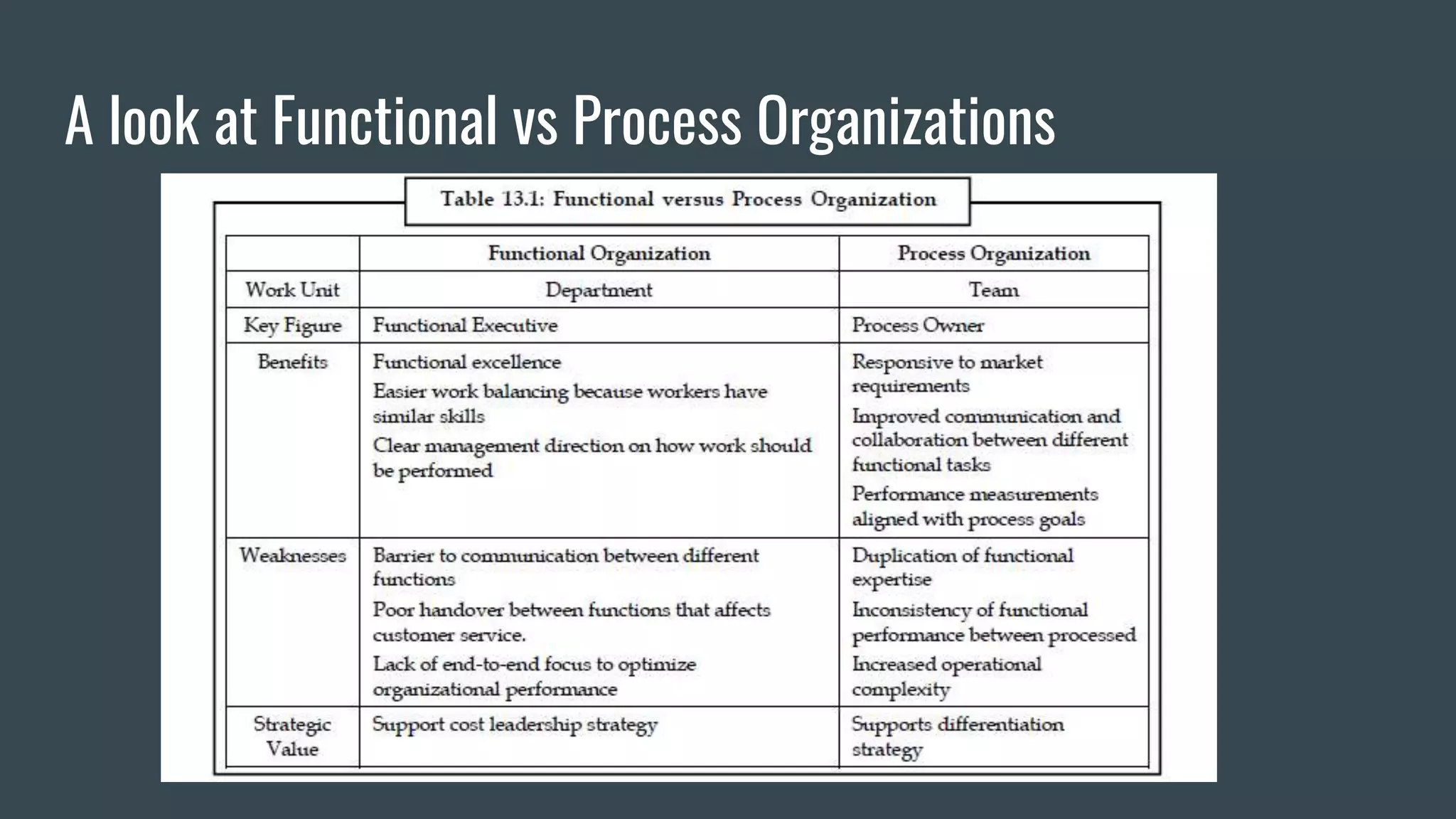
A look at Functional vs Process Organizations
Winning strategies are distinctive; they change the rules of the game in a
neighborhoods' or companies' favor. However, like competition itself, competitive
advantage is a constantly moving target.
Inward & Outward Strategies
Resource based model adopts an internal perspective: how firm’s unique internal
resources and capabilities serves as a basis for earning above average returns. The
collection of unique resources and capabilities are the basis for its strategy and is
primary source of returns. Over time, firm acquire different resources and develop
different capabilities. This works when core competencies of the firm are rare, valuable
and costly to imitate and are not substitutable. (till recently Intel) - Monopoly
Outward concerns with general environment, industry environment and competitive
environment.
Environment
General Environment :- Demographic, Economic, Sociocultural, Technological,
Political/Legal
Industry Environment: Porter’s Five Forces
Competitor Environment: What are their future objectives, current strategy,
assumptions and their capabilities

Strategic information system, csvtu bhilai

  • 1.
    Strategic Information System Unit2 Management Information Systems CSVTU, Bhilai, Chhattisgarh (Naren Chintada)
  • 2.
    Information System types SomeInformation systems are built to resolve problems and the other information systems are built to grab opportunities. While former is relatively easy, it is very difficult to create opportunity. Information systems that grab opportunities are called Strategic Information Systems. Inwardly strategic or outwardly strategic Strategic management is a technique that management adopts for long term planning and the information system that support long term decision making in sense of information and assistance. Most strategies are created to achieve competitive advantage over rival companies
  • 3.
    Key Features ● Decisionsupport systems that enable to develop a strategic approach to align Information Systems (IS) or Information Technologies (IT) with an organization’s business strategies. ● Primarily Enterprise resource planning solutions that integrate/link the business processes to meet the enterprise objectives for the optimization of the enterprise resources. ● Database systems with the “data mining” capabilities to make the best use of available corporate information for marketing, production, promotion and innovation. The SIS systems also facilitate identification of the data collection strategies to help optimize database marketing opportunities. ● The real-time information Systems that intend to maintain a rapid-response and the quality
  • 4.
    Importance of StrategicInformation Systems 1. Cost Reduction (ex: Japanese automobile assembly, 24x7 ATM, Web banking 2. Barrier to Entry - as competition increases, price and profit margin decreases. So companies create barriers by patents/trademarks or create systems that prevent new entries cannot compete (economic feasibility) 3. Switching Cost: Make switching from other vendor difficult by charging money make it more complex 4. Create Unique Product & Services: Provide more attractive features than other products 5. Product Differentiation: Create a brand image through quality and better features or service 6. Market enhancement and creating alliances
  • 5.
  • 6.
    Dell example ❏ ProductConfiguration Management: approximately one million parts related to over two hundred product families per year. It also maintains over two million materials bills per year ❏ E-Procurement: handles approximately two million purchases from approximately five thousand suppliers worldwide. Dell uses automated handling system to handle supplier communication. ❏ Cost: Calculate cost on periodic basis ❏ Inventory Management: equipped with inbound logistics and outbound logistics. It handles three million assembly line inventory movements on daily basis. ❏ Credit Payment: handles fifteen thousand transactions per day (supplier&vendors)
  • 7.
    Business Level vsFirm Level Business Level Strategies (Portfolio level strategies): 1. Improve Competitiveness by upgrading companies systems and controls and its business processes 2. Assist in Business expansion through additional revenue/resources, physical space, consolidation 3. Accelerate new business formation through using vacant space & buildings, introduce new business forms and fill the need gaps Michael Porter’s (Harvard Professor) Five-Forces and Value Chain models are widely used frameworks to assess industry attractiveness and a firm's competitive capabilities.
  • 8.
    Michael Porter’s 5forces of competition model
  • 9.
    Porter’s generic strategies ●Cost Leadership Strategy ○ Increasing production of products/services, effective buying, production and delivery processes, optimal usage of resources (ex: low cost airlines, Jio) ● Differentiation Strategy ○ Unique products/services offerings, better quality, better features and value. Dell achieved differentiation through supply chain management ● Niche Strategy ○ Select a narrow segment and focus and avoid competition with bigger brands (ex: ALL brand for oversized garments) Business process reengineering helps dramatic improvement in business performance
  • 10.
    Business Value Chainmodel The value chain model highlights specific activities in the business where competitive strategies can best be applied (Porter, 1985) and where information systems are most likely to have a strategic impact The value chain model views the firm as a series or chain of basic activities that add a margin of value to a firm’s products or services. These activities can be categorized as either primary activities or support activities
  • 11.
    Value Chain concept ●Inbound logistics- Materials receiving, storing, and distribution in Production premises ● Operations- Transforming inputs into finished products. ● Outbound logistics- Storing and distributing products ● Marketing and Sales- Promotions and sales force ● Service- Service to maintain or enhance product value ● Corporate infrastructure- Support of entire value chain, e.g. general management planning, financing, accounting, legal services, government affairs, and QM ● Human resources management- Recruiting, hiring, training, and development ● Technology Development- Improving product and manufacturing process ● Procurement- Purchasing input
  • 13.
  • 14.
    Competitive Position 1. Acost leadership strategy requires a serious commitment to reducing expenses that, in turn, lowers the price or the items sold in a relatively broad array of market segments. Sometimes significant investment of capital may be necessary to improve the production process to give these low unit costs 2. A differentiation strategy requires innovation and significant points of difference in product offerings, higher quality, advanced technology, or superior service in a relatively broad array of market segments Ultimately competitive advantage grows out of the value created for customers
  • 15.
    A look atFunctional vs Process Organizations
  • 16.
    Winning strategies aredistinctive; they change the rules of the game in a neighborhoods' or companies' favor. However, like competition itself, competitive advantage is a constantly moving target.
  • 17.
    Inward & OutwardStrategies Resource based model adopts an internal perspective: how firm’s unique internal resources and capabilities serves as a basis for earning above average returns. The collection of unique resources and capabilities are the basis for its strategy and is primary source of returns. Over time, firm acquire different resources and develop different capabilities. This works when core competencies of the firm are rare, valuable and costly to imitate and are not substitutable. (till recently Intel) - Monopoly Outward concerns with general environment, industry environment and competitive environment.
  • 18.
    Environment General Environment :-Demographic, Economic, Sociocultural, Technological, Political/Legal Industry Environment: Porter’s Five Forces Competitor Environment: What are their future objectives, current strategy, assumptions and their capabilities