Sustainable Development
(Pembangunan Mampan)
“Development that meets the needs of the
present without compromising the ability of
future generations to meet their own needs”
(Pembangunan yang memenuhi keperluan masa
kini tanpa menjejaskan keupayaan generasi akan
datang untuk memenuhi keperluan mereka sendiri)
What is an “Environment”?
3.2.1 Environment (As per ISO14001:2015)
surroundings in which an organization operates, including air,
water, land, natural resources, flora, fauna, humans and their
interrelationships.
Note 1 to entry: Surroundings can extend from within an
organization to the local, regional and global system.
Note 2 to entry: Surroundings can be described in terms of
biodiversity, ecosystems, climate or other characteristics.
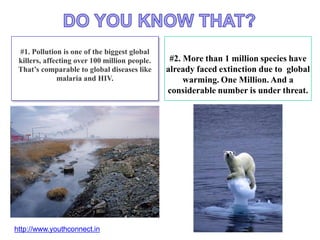
#1. Pollution is one of the biggest global
killers, affecting over 100 million people.
That’s comparable to global diseases like
malaria and HIV.
#2. More than 1 million species have
already faced extinction due to global
warming. One Million. And a
considerable number is under threat.
http://www.youthconnect.in
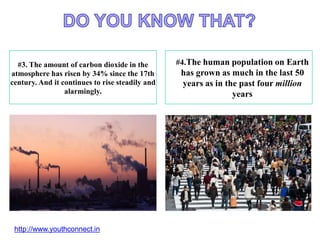
#3. The amount of carbon dioxide in the
atmosphere has risen by 34% since the 17th
century. And it continues to rise steadily and
alarmingly.
#4.The human population on Earth
has grown as much in the last 50
years as in the past four million
years
http://www.youthconnect.in
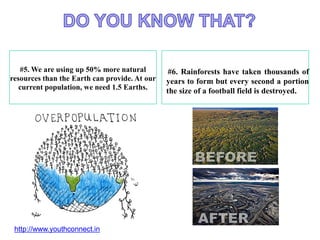
#5. We are using up 50% more natural
resources than the Earth can provide. At our
current population, we need 1.5 Earths.
#6. Rainforests have taken thousands of
years to form but every second a portion
the size of a football field is destroyed.
http://www.youthconnect.in
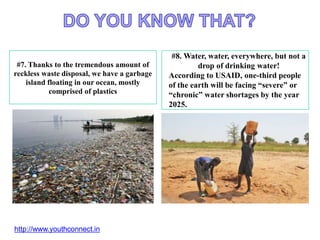
#7. Thanks to the tremendous amount of
reckless waste disposal, we have a garbage
island floating in our ocean, mostly
comprised of plastics
#8. Water, water, everywhere, but not a
drop of drinking water!
According to USAID, one-third people
of the earth will be facing “severe” or
“chronic” water shortages by the year
2025.
http://www.youthconnect.in
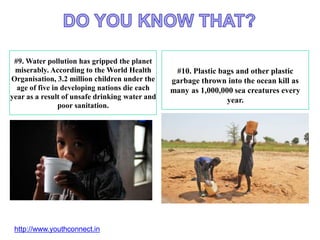
#9. Water pollution has gripped the planet
miserably. According to the World Health
Organisation, 3.2 million children under the
age of five in developing nations die each
year as a result of unsafe drinking water and
poor sanitation.
#10. Plastic bags and other plastic
garbage thrown into the ocean kill as
many as 1,000,000 sea creatures every
year.
http://www.youthconnect.in
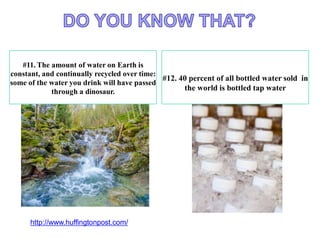
#11. The amount of water on Earth is
constant, and continually recycled over time:
some of the water you drink will have passed
through a dinosaur.
#12. 40 percent of all bottled water sold in
the world is bottled tap water
http://www.huffingtonpost.com/
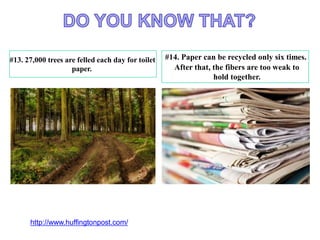
#13. 27,000 trees are felled each day for toilet
paper.
#14. Paper can be recycled only six times.
After that, the fibers are too weak to
hold together.
http://www.huffingtonpost.com/
Global Environmental
Issues
Isu alam sekitar global
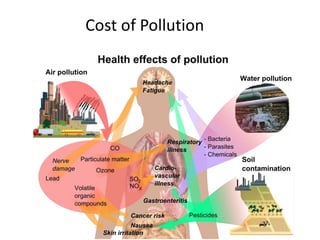
Cost of Pollution
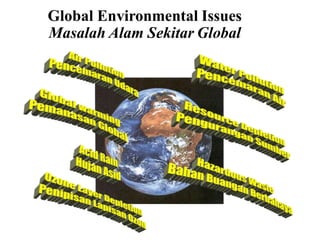
Global Environmental Issues
Masalah Alam Sekitar Global
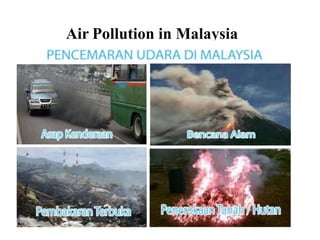
Air Pollution in Malaysia
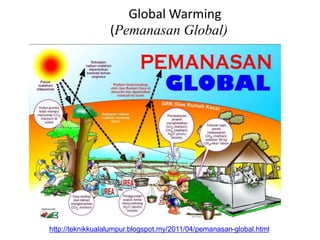
Global Warming
(Pemanasan Global)
http://teknikkualalumpur.blogspot.my/2011/04/pemanasan-global.html
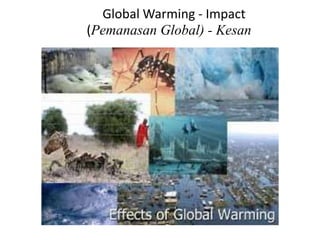
Global Warming - Impact
(Pemanasan Global) - Kesan
Global
Warming -
Cause
(Pemana
san
Global) -
Punca
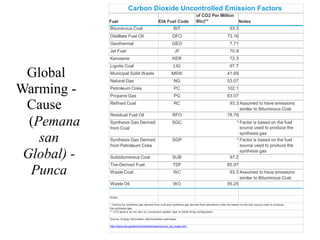
Carbon Dioxide Uncontrolled Emission Factors
Fuel EIA Fuel Code
of CO2 Per Million
Btu)** Notes
Bituminous Coal BIT 93.3
Distillate Fuel Oil DFO 73.16
Geothermal GEO 7.71
Jet Fuel JF 70.9
Kerosene KER 72.3
Lignite Coal LIG 97.7
Municipal Solid Waste MSW 41.69
Natural Gas NG 53.07
Petroleum Coke PC 102.1
Propane Gas PG 63.07
Refined Coal RC 93.3 Assumed to have emissions
similar to Bituminous Coal.
Residual Fuel Oil RFO 78.79
Synthesis Gas Derived
from Coal
SGC * Factor is based on the fuel
source used to produce the
synthesis gas
Synthesis Gas Derived
from Petroleum Coke
SGP * Factor is based on the fuel
source used to produce the
synthesis gas
Subbituminous Coal SUB 97.2
Tire-Derived Fuel TDF 85.97
Waste Coal WC 93.3 Assumed to have emissions
similar to Bituminous Coal.
Waste Oil WO 95.25
Notes:
* Factors for synthesis gas derived from coal and synthesis gas derived from petroleum coke are based on the fuel source used to produce
the synthesis gas.
** CO2 factors do not vary by combustion system type or boiler firing configuration.
Source: Energy Information Administration estimates:
http://www.eia.gov/environment/emissions/co2_vol_mass.cfm
24
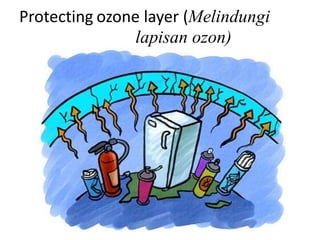
Protecting ozone layer (Melindungi
lapisan ozon)
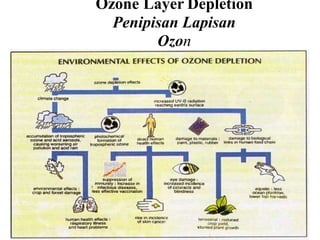
Ozone Layer Depletion
Penipisan Lapisan
Ozon
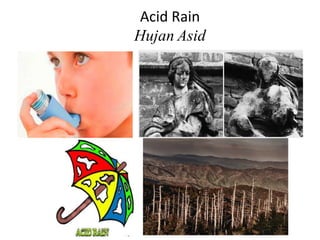
Acid Rain
Hujan Asid
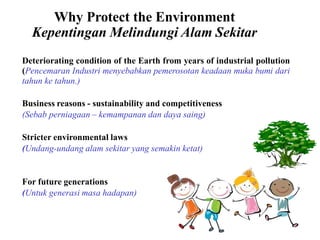
Why Protect the Environment
Kepentingan Melindungi Alam Sekitar
Deteriorating condition of the Earth from years of industrial pollution
(Pencemaran Industri menyebabkan pemerosotan keadaan muka bumi dari
tahun ke tahun.)
Business reasons - sustainability and competitiveness
(Sebab perniagaan – kemampanan dan daya saing)
Stricter environmental laws
(Undang-undang alam sekitar yang semakin ketat)
For future generations
(Untuk generasi masa hadapan)
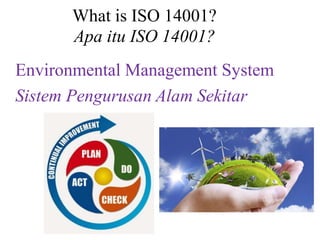
What is ISO 14001?
Apa itu ISO 14001?
Environmental Management System
Sistem Pengurusan Alam Sekitar
5
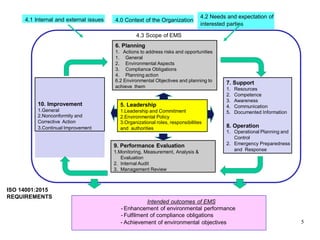
6. Planning
1. Actions to address risks and opportunities
1. General
2. Environmental Aspects
3. Compliance Obligations
4. Planning action
6.2 Environmental Objectives and planning to
achieve them
9. Performance Evaluation
1.Monitoring, Measurement, Analysis &
Evaluation
2. Internal Audit
3. Management Review
7. Support
1. Resources
2. Competence
3. Awareness
4. Communication
5. Documented Information
8. Operation
1. Operational Planning and
Control
2. Emergency Preparedness
and Response
10. Improvement
1.General
2.Nonconformity and
Corrective Action
3.Continual Improvement
5. Leadership
1.Leadership and Commitment
2.Environmental Policy
3.Organizational roles, responsibilities
and authorities
4.3 Scope of EMS
4.0 Context of the Organization
4.1 Internal and external issues
4.2 Needs and expectation of
interested parties
Intended outcomes of EMS
- Enhancement of environmental performance
- Fulfilment of compliance obligations
- Achievement of environmental objectives
ISO 14001:2015
REQUIREMENTS
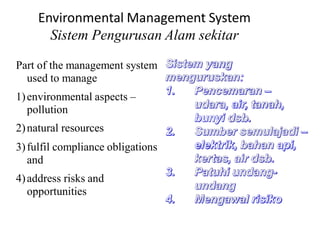
Environmental Management System
Sistem Pengurusan Alam sekitar
Part of the management system
used to manage
1)environmental aspects –
pollution
2)natural resources
3)fulfil compliance obligations
and
4)address risks and
opportunities
What is Environmental Aspect?
3.2.2 Environmental Aspect (as per ISO 14001:2015)
element of an organization’s activities or products or services
that interacts or can interact with the environment.
Note 1 to entry: An environmental aspect can cause (an)
environmental impact(s) A significant environmental aspect is
one that has or can have one or more significant
environmental impact(s).
Note 2 to entry: Significant environmental aspects are
determined by the organization applying one or more
criteria.
What is Environmental Impact?
3.2.4 Environmental impact (as per ISO 14001:2015)
change to the environment, whether adverse or beneficial,
wholly or partially resulting from an organization’s
environmental aspects.
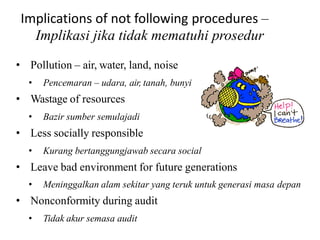
Implications of not following procedures –
Implikasi jika tidak mematuhi prosedur
• Pollution – air, water, land, noise
• Pencemaran – udara, air, tanah, bunyi
• Wastage of resources
• Bazir sumber semulajadi
• Less socially responsible
• Kurang bertanggungjawab secara social
• Leave bad environment for future generations
• Meninggalkan alam sekitar yang teruk untuk generasi masa depan
• Nonconformity during audit
• Tidak akur semasa audit
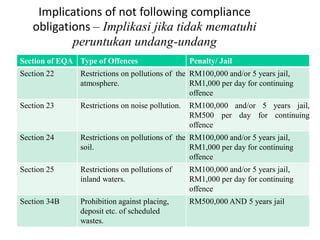
Section of EQA Type of Offences Penalty/ Jail
Section 22 Restrictions on pollutions of the
atmosphere.
RM100,000 and/or 5 years jail,
RM1,000 per day for continuing
offence
Section 23 Restrictions on noise pollution. RM100,000 and/or 5 years jail,
RM500 per day for continuing
offence
Section 24 Restrictions on pollutions of the
soil.
RM100,000 and/or 5 years jail,
RM1,000 per day for continuing
offence
Section 25 Restrictions on pollutions of
inland waters.
RM100,000 and/or 5 years jail,
RM1,000 per day for continuing
offence
Section 34B Prohibition against placing,
deposit etc. of scheduled
wastes.
RM500,000 AND 5 years jail
Implications of not following compliance
obligations – Implikasi jika tidak mematuhi
peruntukan undang-undang
Your Contributions???
Sumbangan Anda???
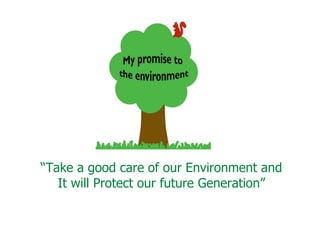
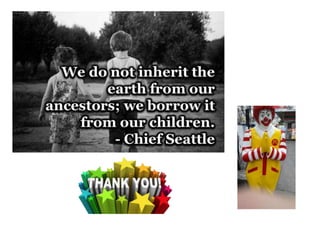
“Take a good care of our Environment and
It will Protect our future Generation”
Roles & Responsibilities
Peranan & Tanggungjawab
 Understand contents of Environmental Policy and how
to contribute to protection of environment
Fahami kandungan Polisi Alam Sekitar dan bagaimana
mematuhinya
 Follow company instructions/procedures/rules and
regulations
Ikut arahan kerja/ peraturan-peraturan yang berkaitan
 Prevent pollution and practise resource conservation
Cegah pencemaran dan amalkan pelestarian sumber
semulajadi
Slide 51
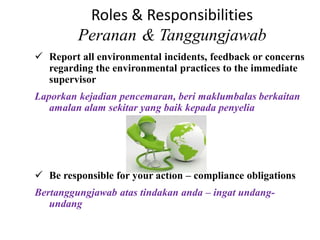
Roles & Responsibilities
Peranan & Tanggungjawab
 Report all environmental incidents, feedback or concerns
regarding the environmental practices to the immediate
supervisor
Laporkan kejadian pencemaran, beri maklumbalas berkaitan
amalan alam sekitar yang baik kepada penyelia
 Be responsible for your action – compliance obligations
Bertanggungjawab atas tindakan anda – ingat undang-
undang
Roles & Responsibilities
Peranan & Tanggungjawab
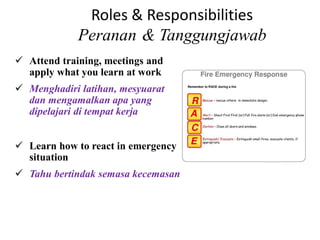
 Attend training, meetings and
apply what you learn at work
 Menghadiri latihan, mesyuarat
dan mengamalkan apa yang
dipelajari di tempat kerja
 Learn how to react in emergency
situation
 Tahu bertindak semasa kecemasan
Protecting environment
starts from who?
Melindungi alam
sekitar bermula dari
siapa?
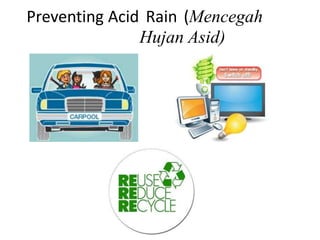
Preventing Acid Rain (Mencegah
Hujan Asid)
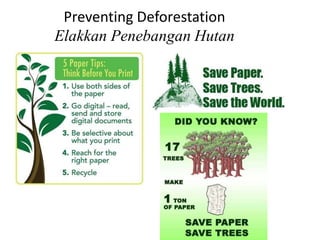
Preventing Deforestation
Elakkan Penebangan Hutan
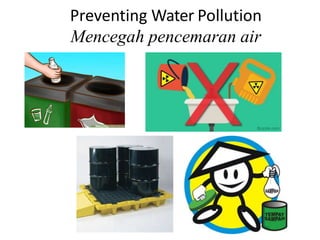
Preventing Water Pollution
Mencegah pencemaran air
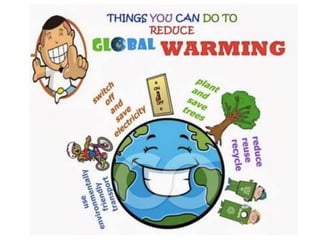
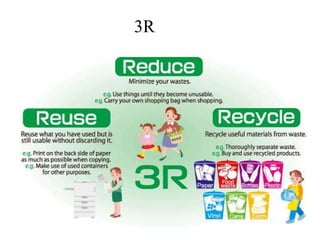
3R
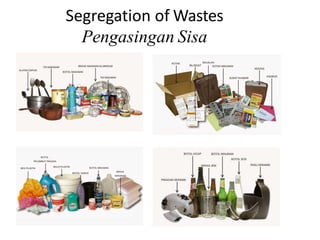
Segregation of Wastes
Pengasingan Sisa
2 EMS Science & Env Awareness (Module 1).pdf

2 EMS Science & Env Awareness (Module 1).pdf

  • 1.
    Sustainable Development (Pembangunan Mampan) “Developmentthat meets the needs of the present without compromising the ability of future generations to meet their own needs” (Pembangunan yang memenuhi keperluan masa kini tanpa menjejaskan keupayaan generasi akan datang untuk memenuhi keperluan mereka sendiri)
  • 2.
    What is an“Environment”? 3.2.1 Environment (As per ISO14001:2015) surroundings in which an organization operates, including air, water, land, natural resources, flora, fauna, humans and their interrelationships. Note 1 to entry: Surroundings can extend from within an organization to the local, regional and global system. Note 2 to entry: Surroundings can be described in terms of biodiversity, ecosystems, climate or other characteristics.
  • 3.
    #1. Pollution isone of the biggest global killers, affecting over 100 million people. That’s comparable to global diseases like malaria and HIV. #2. More than 1 million species have already faced extinction due to global warming. One Million. And a considerable number is under threat. http://www.youthconnect.in
  • 4.
    #3. The amountof carbon dioxide in the atmosphere has risen by 34% since the 17th century. And it continues to rise steadily and alarmingly. #4.The human population on Earth has grown as much in the last 50 years as in the past four million years http://www.youthconnect.in
  • 5.
    #5. We areusing up 50% more natural resources than the Earth can provide. At our current population, we need 1.5 Earths. #6. Rainforests have taken thousands of years to form but every second a portion the size of a football field is destroyed. http://www.youthconnect.in
  • 6.
    #7. Thanks tothe tremendous amount of reckless waste disposal, we have a garbage island floating in our ocean, mostly comprised of plastics #8. Water, water, everywhere, but not a drop of drinking water! According to USAID, one-third people of the earth will be facing “severe” or “chronic” water shortages by the year 2025. http://www.youthconnect.in
  • 7.
    #9. Water pollutionhas gripped the planet miserably. According to the World Health Organisation, 3.2 million children under the age of five in developing nations die each year as a result of unsafe drinking water and poor sanitation. #10. Plastic bags and other plastic garbage thrown into the ocean kill as many as 1,000,000 sea creatures every year. http://www.youthconnect.in
  • 8.
    #11. The amountof water on Earth is constant, and continually recycled over time: some of the water you drink will have passed through a dinosaur. #12. 40 percent of all bottled water sold in the world is bottled tap water http://www.huffingtonpost.com/
  • 9.
    #13. 27,000 treesare felled each day for toilet paper. #14. Paper can be recycled only six times. After that, the fibers are too weak to hold together. http://www.huffingtonpost.com/
  • 10.
  • 11.
  • 12.
  • 13.
  • 14.
  • 15.
    Global Warming -Impact (Pemanasan Global) - Kesan
  • 16.
    Global Warming - Cause (Pemana san Global) - Punca CarbonDioxide Uncontrolled Emission Factors Fuel EIA Fuel Code of CO2 Per Million Btu)** Notes Bituminous Coal BIT 93.3 Distillate Fuel Oil DFO 73.16 Geothermal GEO 7.71 Jet Fuel JF 70.9 Kerosene KER 72.3 Lignite Coal LIG 97.7 Municipal Solid Waste MSW 41.69 Natural Gas NG 53.07 Petroleum Coke PC 102.1 Propane Gas PG 63.07 Refined Coal RC 93.3 Assumed to have emissions similar to Bituminous Coal. Residual Fuel Oil RFO 78.79 Synthesis Gas Derived from Coal SGC * Factor is based on the fuel source used to produce the synthesis gas Synthesis Gas Derived from Petroleum Coke SGP * Factor is based on the fuel source used to produce the synthesis gas Subbituminous Coal SUB 97.2 Tire-Derived Fuel TDF 85.97 Waste Coal WC 93.3 Assumed to have emissions similar to Bituminous Coal. Waste Oil WO 95.25 Notes: * Factors for synthesis gas derived from coal and synthesis gas derived from petroleum coke are based on the fuel source used to produce the synthesis gas. ** CO2 factors do not vary by combustion system type or boiler firing configuration. Source: Energy Information Administration estimates: http://www.eia.gov/environment/emissions/co2_vol_mass.cfm
  • 17.
  • 18.
    Protecting ozone layer(Melindungi lapisan ozon)
  • 19.
  • 20.
  • 21.
    Why Protect theEnvironment Kepentingan Melindungi Alam Sekitar Deteriorating condition of the Earth from years of industrial pollution (Pencemaran Industri menyebabkan pemerosotan keadaan muka bumi dari tahun ke tahun.) Business reasons - sustainability and competitiveness (Sebab perniagaan – kemampanan dan daya saing) Stricter environmental laws (Undang-undang alam sekitar yang semakin ketat) For future generations (Untuk generasi masa hadapan)
  • 22.
    What is ISO14001? Apa itu ISO 14001? Environmental Management System Sistem Pengurusan Alam Sekitar
  • 23.
    5 6. Planning 1. Actionsto address risks and opportunities 1. General 2. Environmental Aspects 3. Compliance Obligations 4. Planning action 6.2 Environmental Objectives and planning to achieve them 9. Performance Evaluation 1.Monitoring, Measurement, Analysis & Evaluation 2. Internal Audit 3. Management Review 7. Support 1. Resources 2. Competence 3. Awareness 4. Communication 5. Documented Information 8. Operation 1. Operational Planning and Control 2. Emergency Preparedness and Response 10. Improvement 1.General 2.Nonconformity and Corrective Action 3.Continual Improvement 5. Leadership 1.Leadership and Commitment 2.Environmental Policy 3.Organizational roles, responsibilities and authorities 4.3 Scope of EMS 4.0 Context of the Organization 4.1 Internal and external issues 4.2 Needs and expectation of interested parties Intended outcomes of EMS - Enhancement of environmental performance - Fulfilment of compliance obligations - Achievement of environmental objectives ISO 14001:2015 REQUIREMENTS
  • 24.
    Environmental Management System SistemPengurusan Alam sekitar Part of the management system used to manage 1)environmental aspects – pollution 2)natural resources 3)fulfil compliance obligations and 4)address risks and opportunities
  • 25.
    What is EnvironmentalAspect? 3.2.2 Environmental Aspect (as per ISO 14001:2015) element of an organization’s activities or products or services that interacts or can interact with the environment. Note 1 to entry: An environmental aspect can cause (an) environmental impact(s) A significant environmental aspect is one that has or can have one or more significant environmental impact(s). Note 2 to entry: Significant environmental aspects are determined by the organization applying one or more criteria.
  • 26.
    What is EnvironmentalImpact? 3.2.4 Environmental impact (as per ISO 14001:2015) change to the environment, whether adverse or beneficial, wholly or partially resulting from an organization’s environmental aspects.
  • 27.
    Implications of notfollowing procedures – Implikasi jika tidak mematuhi prosedur • Pollution – air, water, land, noise • Pencemaran – udara, air, tanah, bunyi • Wastage of resources • Bazir sumber semulajadi • Less socially responsible • Kurang bertanggungjawab secara social • Leave bad environment for future generations • Meninggalkan alam sekitar yang teruk untuk generasi masa depan • Nonconformity during audit • Tidak akur semasa audit
  • 28.
    Section of EQAType of Offences Penalty/ Jail Section 22 Restrictions on pollutions of the atmosphere. RM100,000 and/or 5 years jail, RM1,000 per day for continuing offence Section 23 Restrictions on noise pollution. RM100,000 and/or 5 years jail, RM500 per day for continuing offence Section 24 Restrictions on pollutions of the soil. RM100,000 and/or 5 years jail, RM1,000 per day for continuing offence Section 25 Restrictions on pollutions of inland waters. RM100,000 and/or 5 years jail, RM1,000 per day for continuing offence Section 34B Prohibition against placing, deposit etc. of scheduled wastes. RM500,000 AND 5 years jail Implications of not following compliance obligations – Implikasi jika tidak mematuhi peruntukan undang-undang
  • 29.
  • 30.
    “Take a goodcare of our Environment and It will Protect our future Generation”
  • 31.
    Roles & Responsibilities Peranan& Tanggungjawab  Understand contents of Environmental Policy and how to contribute to protection of environment Fahami kandungan Polisi Alam Sekitar dan bagaimana mematuhinya  Follow company instructions/procedures/rules and regulations Ikut arahan kerja/ peraturan-peraturan yang berkaitan  Prevent pollution and practise resource conservation Cegah pencemaran dan amalkan pelestarian sumber semulajadi Slide 51
  • 32.
    Roles & Responsibilities Peranan& Tanggungjawab  Report all environmental incidents, feedback or concerns regarding the environmental practices to the immediate supervisor Laporkan kejadian pencemaran, beri maklumbalas berkaitan amalan alam sekitar yang baik kepada penyelia  Be responsible for your action – compliance obligations Bertanggungjawab atas tindakan anda – ingat undang- undang
  • 33.
    Roles & Responsibilities Peranan& Tanggungjawab  Attend training, meetings and apply what you learn at work  Menghadiri latihan, mesyuarat dan mengamalkan apa yang dipelajari di tempat kerja  Learn how to react in emergency situation  Tahu bertindak semasa kecemasan
  • 34.
    Protecting environment starts fromwho? Melindungi alam sekitar bermula dari siapa?
  • 37.
    Preventing Acid Rain(Mencegah Hujan Asid)
  • 38.
  • 39.
  • 40.
  • 41.