Module-II
COMPASS
SURVEYING
By- Prof. N. G. Patil
Principle
of
compass
surveying
Compass surveying is not recommended for areas where local
attraction is suspected due to the presence of magnetic
substances like steel structures, iron ore deposits, electric
cables , and so on.
Compass surveying is recommended when the area is large,
undulating and crowded with many details.
The magnetic bearing of the lines are measured by prismatic
compass.
The principle of compass surveying is traversing; which
involves a series of connected lines.
Traversin
g
•In traversing , the frame work
consist of connected lines.
•The length are measured by a
chain or a tape and the direction
measured by angle measuring
instruments.
•Hence in compass surveying
direction of survey lines are
determined with a compass and
the length of the lines are
measured with a tape or a chain.
This process is known as compass
traversing.
Compa
ss
A compass is a small instrument
essentially consisting of a
graduated circle, and a line of
sight.
The compass can not measures
angle between two lines directly
but can measure angle of a line
with reference to magnetic
meridian at the instrument
station point is called magnetic
bearing of a line.
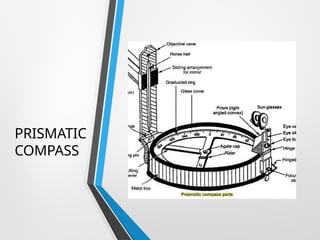
PRISMATIC
COMPASS
Elements of
Prismatic compass
Elements
of
prismatic
compass
• Cylindrical metal box: Cylindrical metal box is
having diameter of 8to 12 cm. It protects the
compass and forms entire casing or body of the
compass. It protect compass from dust, rain etc.
• Pivot: pivot is provided at the center of the compass
and supports freely suspended magnetic needle
over it.
• lifting pin and lifting lever: a lifting pin is provided
just below the sight vane. When the sight vane is folded,
it presses the lifting pin. The lifting pin with the help of
lifting lever then lifts the magnetic needle out of pivot
point to prevent damage to the pivot head.
• Magnetic needle: Magnetic needle is the heart of the
instrument. This needle measures angle of a line from
magnetic meridian as the needle always remains pointed
towards north south pole at two ends of the needle when
freely suspended on any support.
• Graduated circle or ring: This is an aluminum
graduated ring marked with 0ᴼ to 360ᴼ to measures all
possible bearings of lines, and attached with the
magnetic needle. The ring is graduated to half a degree.
• Prism : prism is used to read graduations on ring and
to take exact reading by compass. It is placed exactly
opposite to object vane. The prism hole is protected
by prism cap to protect it from dust and moisture.
Elements of Prismatic compass
• Object vane: object vane is diametrically opposite to the prism
and eye vane. The object vane is carrying a horse hair or black
thin wire to sight object in line with eye sight.
• Eye vane: Eye vane is a fine slit provided with the eye hole at
bottom to bisect the object from slit.
• Glass cover: its covers the instrument box from the top such
that needle and graduated ring is seen from the top.
• Sun glasses: These are used when some luminous objects are to
be bisected.
• Reflecting mirror: It is used to get image of an object located
above or below the instrument level while bisection. It is placed
on the object vane.
• Spring brake or brake pin: to damp the oscillation of the needle
before taking a reading and to bring it to rest quickly, the light
spring brake attached to the box is brought in contact with the
edge of the ring by gently pressing inward the brake pin
Designatio
n of
bearing
•The bearing are
designated in the
following two system:-
•1) Whole Circle Bearing
System.(W.C.B)
•2) Quadrantal Bearing
System.(Q.B)
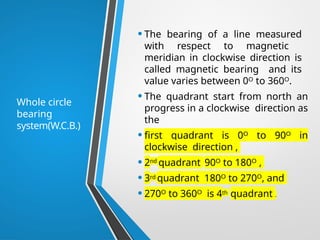
Whole circle
bearing
system(W.C.B.)
•The bearing of a line measured
with respect to magnetic
meridian in clockwise direction is
called magnetic bearing and its
value varies between 0ᴼ to 360ᴼ.
•The quadrant start from north an
progress in a clockwise direction as
the
•first quadrant is 0ᴼ to 90ᴼ in
clockwise direction ,
•2nd
quadrant 90ᴼ to 180ᴼ ,
•3rd quadrant 180ᴼ to 270ᴼ, and
•270ᴼ to 360ᴼ is 4th quadrant .
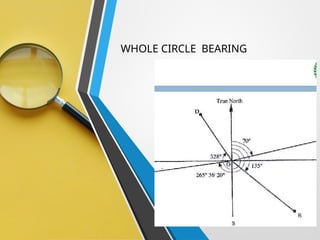
WHOLE CIRCLE BEARING
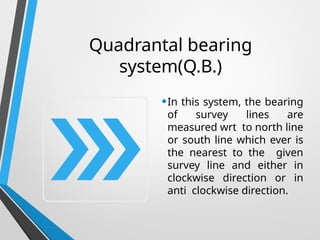
Quadrantal bearing
system(Q.B.)
•In this system, the bearing
of survey lines are
measured wrt to north line
or south line which ever is
the nearest to the given
survey line and either in
clockwise direction or in
anti clockwise direction.
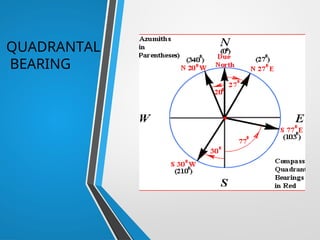
QUADRANTAL
BEARING
Reduced bearing (R.B)
• When the whole circle bearing is
converted into Quadrantal
bearing , it is termed as
“REDUCED BEARING”.
• Thus , the reduced bearing is
similar to the Quadrantal bearing.
• Its values lies between 0ᴼ to 90ᴼ,
but the quadrant should be
mentioned for proper
designation.
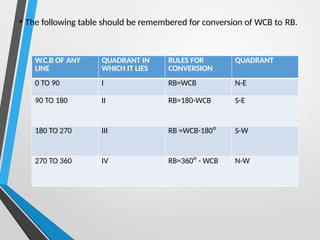
• The following table should be remembered for conversion of WCB to RB.
W.C.B OF ANY
LINE
QUADRANT IN
WHICH IT LIES
RULES FOR
CONVERSION
QUADRANT
0 TO 90 I RB=WCB N-E
90 TO 180 II RB=180-WCB S-E
180 TO 270 III RB =WCB-180ᴼ S-W
270 TO 360 IV RB=360ᴼ - WCB N-W
Fore bearing and Back bearing
•The bearing of a line measured in
the forward direction of the
survey lines is called the ‘fore
bearing’(F.B.) of that line.
•The bearing of a line measured
in direction backward to the
direction of the progress of
survey is called the ‘back
bearing’(B.B.) of the line.
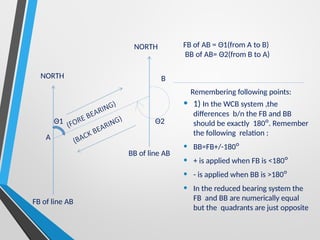
FB of line AB
BB of line AB
A
NORTH
NORTH
• 1) In the WCB system ,the
differences b/n the FB and BB
should be exactly 180ᴼ. Remember
the following relation :
• BB=FB+/-180ᴼ
• + is applied when FB is <180ᴼ
• - is applied when BB is >180ᴼ
• In the reduced bearing system the
FB and BB are numerically equal
but the quadrants are just opposite
Θ1 Θ2
B
Remembering following points:
FB of AB = Θ1(from A to B)
BB of AB= Θ2(from B to A)

2. COMPASS SURVEYING in Engineering_2.pptx

  • 1.
  • 2.
    Principle of compass surveying Compass surveying isnot recommended for areas where local attraction is suspected due to the presence of magnetic substances like steel structures, iron ore deposits, electric cables , and so on. Compass surveying is recommended when the area is large, undulating and crowded with many details. The magnetic bearing of the lines are measured by prismatic compass. The principle of compass surveying is traversing; which involves a series of connected lines.
  • 3.
    Traversin g •In traversing ,the frame work consist of connected lines. •The length are measured by a chain or a tape and the direction measured by angle measuring instruments. •Hence in compass surveying direction of survey lines are determined with a compass and the length of the lines are measured with a tape or a chain. This process is known as compass traversing.
  • 4.
    Compa ss A compass isa small instrument essentially consisting of a graduated circle, and a line of sight. The compass can not measures angle between two lines directly but can measure angle of a line with reference to magnetic meridian at the instrument station point is called magnetic bearing of a line.
  • 5.
  • 6.
  • 7.
    Elements of prismatic compass • Cylindrical metalbox: Cylindrical metal box is having diameter of 8to 12 cm. It protects the compass and forms entire casing or body of the compass. It protect compass from dust, rain etc. • Pivot: pivot is provided at the center of the compass and supports freely suspended magnetic needle over it. • lifting pin and lifting lever: a lifting pin is provided just below the sight vane. When the sight vane is folded, it presses the lifting pin. The lifting pin with the help of lifting lever then lifts the magnetic needle out of pivot point to prevent damage to the pivot head. • Magnetic needle: Magnetic needle is the heart of the instrument. This needle measures angle of a line from magnetic meridian as the needle always remains pointed towards north south pole at two ends of the needle when freely suspended on any support. • Graduated circle or ring: This is an aluminum graduated ring marked with 0ᴼ to 360ᴼ to measures all possible bearings of lines, and attached with the magnetic needle. The ring is graduated to half a degree. • Prism : prism is used to read graduations on ring and to take exact reading by compass. It is placed exactly opposite to object vane. The prism hole is protected by prism cap to protect it from dust and moisture.
  • 8.
    Elements of Prismaticcompass • Object vane: object vane is diametrically opposite to the prism and eye vane. The object vane is carrying a horse hair or black thin wire to sight object in line with eye sight. • Eye vane: Eye vane is a fine slit provided with the eye hole at bottom to bisect the object from slit. • Glass cover: its covers the instrument box from the top such that needle and graduated ring is seen from the top. • Sun glasses: These are used when some luminous objects are to be bisected. • Reflecting mirror: It is used to get image of an object located above or below the instrument level while bisection. It is placed on the object vane. • Spring brake or brake pin: to damp the oscillation of the needle before taking a reading and to bring it to rest quickly, the light spring brake attached to the box is brought in contact with the edge of the ring by gently pressing inward the brake pin
  • 9.
    Designatio n of bearing •The bearingare designated in the following two system:- •1) Whole Circle Bearing System.(W.C.B) •2) Quadrantal Bearing System.(Q.B)
  • 10.
    Whole circle bearing system(W.C.B.) •The bearingof a line measured with respect to magnetic meridian in clockwise direction is called magnetic bearing and its value varies between 0ᴼ to 360ᴼ. •The quadrant start from north an progress in a clockwise direction as the •first quadrant is 0ᴼ to 90ᴼ in clockwise direction , •2nd quadrant 90ᴼ to 180ᴼ , •3rd quadrant 180ᴼ to 270ᴼ, and •270ᴼ to 360ᴼ is 4th quadrant .
  • 11.
  • 12.
    Quadrantal bearing system(Q.B.) •In thissystem, the bearing of survey lines are measured wrt to north line or south line which ever is the nearest to the given survey line and either in clockwise direction or in anti clockwise direction.
  • 13.
  • 14.
    Reduced bearing (R.B) •When the whole circle bearing is converted into Quadrantal bearing , it is termed as “REDUCED BEARING”. • Thus , the reduced bearing is similar to the Quadrantal bearing. • Its values lies between 0ᴼ to 90ᴼ, but the quadrant should be mentioned for proper designation.
  • 15.
    • The followingtable should be remembered for conversion of WCB to RB. W.C.B OF ANY LINE QUADRANT IN WHICH IT LIES RULES FOR CONVERSION QUADRANT 0 TO 90 I RB=WCB N-E 90 TO 180 II RB=180-WCB S-E 180 TO 270 III RB =WCB-180ᴼ S-W 270 TO 360 IV RB=360ᴼ - WCB N-W
  • 16.
    Fore bearing andBack bearing •The bearing of a line measured in the forward direction of the survey lines is called the ‘fore bearing’(F.B.) of that line. •The bearing of a line measured in direction backward to the direction of the progress of survey is called the ‘back bearing’(B.B.) of the line.
  • 17.
    FB of lineAB BB of line AB A NORTH NORTH • 1) In the WCB system ,the differences b/n the FB and BB should be exactly 180ᴼ. Remember the following relation : • BB=FB+/-180ᴼ • + is applied when FB is <180ᴼ • - is applied when BB is >180ᴼ • In the reduced bearing system the FB and BB are numerically equal but the quadrants are just opposite Θ1 Θ2 B Remembering following points: FB of AB = Θ1(from A to B) BB of AB= Θ2(from B to A)