


TRENDS AND DEVELOPMENTS
IN SUSTAINABILITY AND
RENEWABLE ENERGY
  Jan Willem Dijk MSc
  Jan.willem.dijk@dconsult.nl
  NBI Expo, March 6th 2012
Jan Willem Dijk MSc.
   Owner and director DConsult
   Consultancy on sustainability and energy
   International business analyses
    EU27, China, Indonesia, etc.
   Project financing and feasibility studies
   Expert environment European Commission
   http://www.dconsult.nl
Table of Content
Opening speech:

   Renewable energy
   Sustainable buildings
   Sustainable mobility and transport
   Innovation, from research to new products and
    services
Table of Content
Opening speech:

   Renewable energy
   Sustainable buildings
   Sustainable mobility and transport
   Innovation, from research to new products and
    services
Renewable energy
   Wind power
   Hydropower
   Solar energy
   Biomass
   Biofuel
   Geothermal energy
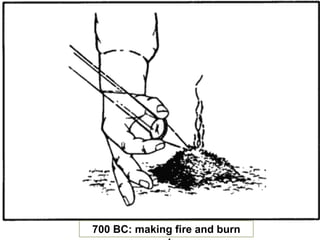
700 BC: making fire and burn
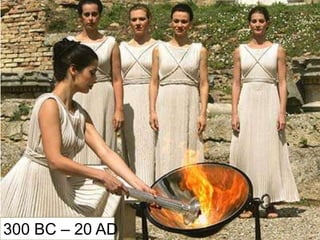
300 BC – 20 AD
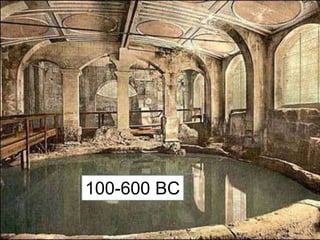
100-600 BC
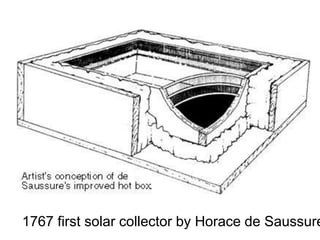
1767 first solar collector by Horace de Saussure
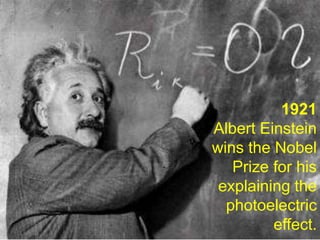
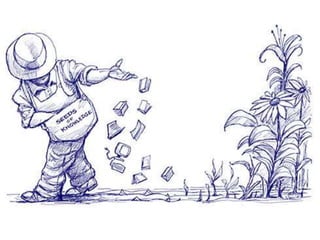
1921
Albert Einstein
wins the Nobel
   Prize for his
 explaining the
  photoelectric
         effect.
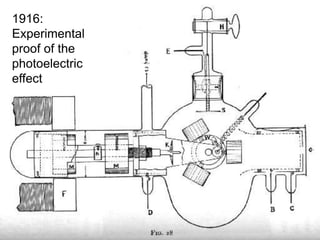
1916:
Experimental
proof of the
photoelectric
effect
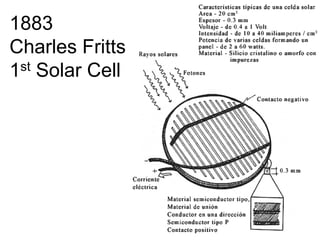
1883
Charles Fritts
1st Solar Cell
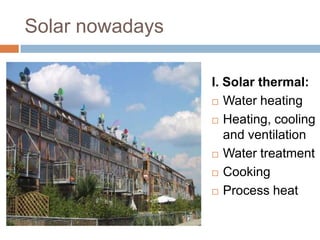
Solar nowadays

                 I. Solar thermal:
                  Water heating

                  Heating, cooling
                    and ventilation
                  Water treatment

                  Cooking

                  Process heat
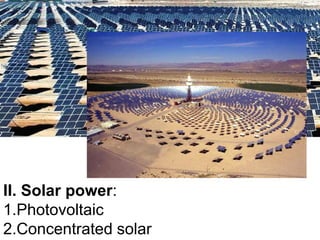
II. Solar power:
1.Photovoltaic
2.Concentrated solar
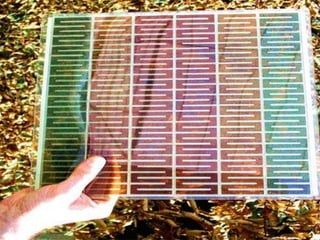
Improving solar efficiency
Table of Content
Opening speech:

   Renewable energy
   Sustainable buildings
   Sustainable mobility and transport
   Innovation, from research to new products and
    services
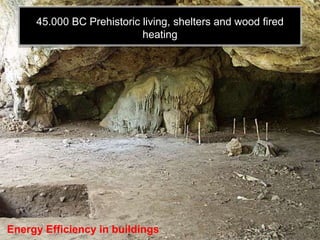
45.000 BC Prehistoric living, shelters and wood fired
                           heating


Energy Efficiency in buildings
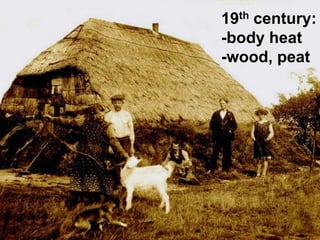
19th century:
-body heat
-wood, peat
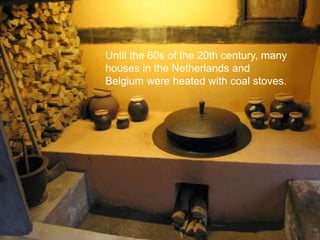
Until the 60s of the 20th century, many
houses in the Netherlands and
Belgium were heated with coal stoves.
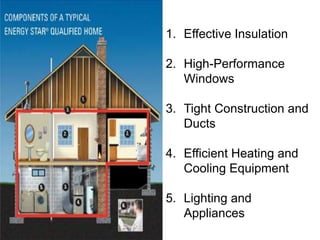
1. Effective Insulation

2. High-Performance
   Windows

3. Tight Construction and
   Ducts

4. Efficient Heating and
   Cooling Equipment

5. Lighting and
   Appliances
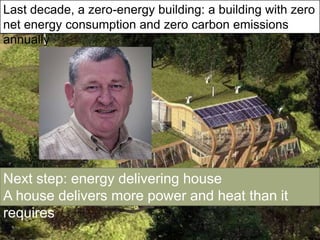
Last decade, a zero-energy building: a building with zero
net energy consumption and zero carbon emissions
annually


Next step: energy delivering house
A house delivers more power and heat than it
requires
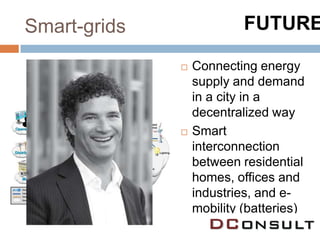
Smart-grids                FUTURE

                 Connecting energy
                  supply and demand
                  in a city in a
                  decentralized way
                 Smart
                  interconnection
                  between residential
                  homes, offices and
                  industries, and e-
                  mobility (batteries)
Table of Content
Opening speech:

   Renewable energy
   Sustainable buildings
   Sustainable mobility and transport
   Innovation, from research to new products and
    services
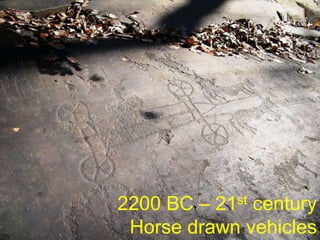
2200 BC – 21stcentury
 Horse drawn vehicles
1st
Industrial
revolution:
Coal
Train
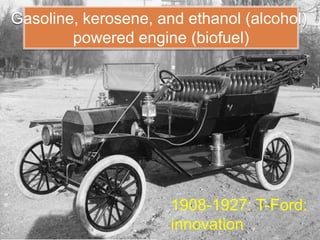
Gasoline, kerosene, and ethanol (alcohol)
        powered engine (biofuel)


                      1908-1927: T-Ford:
                      innovation
Innovation hampers
                  1908 the Model T
                   had fuel economy of
                   11 Liters per 100 km
                  2008 cars drive on
                   average on 8,3 Liters
                   per 100 km
                  100 years of
                   innovation resulted
                   in 13% fuel
                   reduction
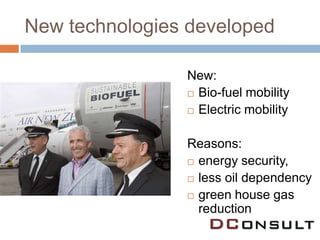
New technologies developed

                New:
                 Bio-fuel mobility

                 Electric mobility


                Reasons:
                 energy security,

                 less oil dependency

                 green house gas
                  reduction
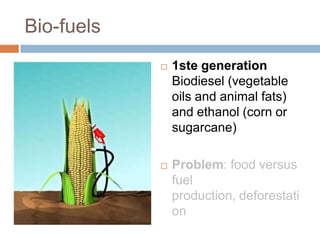
Bio-fuels
               1ste generation
                Biodiesel (vegetable
                oils and animal fats)
                and ethanol (corn or
                sugarcane)

               Problem: food versus
                fuel
                production, deforestati
                on
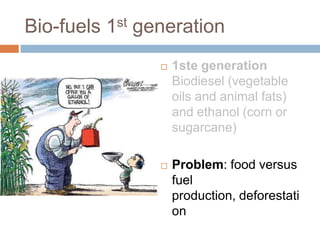
Bio-fuels 1st generation
                   1ste generation
                    Biodiesel (vegetable
                    oils and animal fats)
                    and ethanol (corn or
                    sugarcane)

                   Problem: food versus
                    fuel
                    production, deforestati
                    on
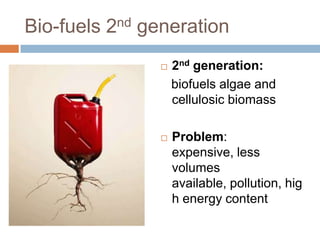
Bio-fuels 2nd generation
                  2nd generation:
                   biofuels algae and
                   cellulosic biomass

                  Problem:
                   expensive, less
                   volumes
                   available, pollution, hig
                   h energy content
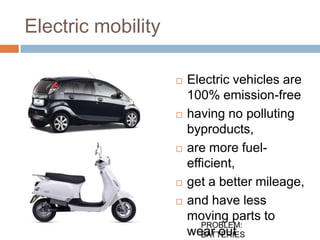
Electric mobility

                       Electric vehicles are
                        100% emission-free
                       having no polluting
                        byproducts,
                       are more fuel-
                        efficient,
                       get a better mileage,
                       and have less
                        moving parts to
                           PROBLEM:
                        wear out
                           BATTERIES
Are hydrogen and fuel cells a
solution for electrical vehicles?
Table of Content
Opening speech:

   Renewable energy
   Sustainable buildings
   Sustainable mobility and transport
   Innovation, from research to new products and
    services
Sustainability and
renewable energy
opportunities are based
on technology
For the development of this
technology a knowledge economy
    For the development
is required
  of sustainable
  technology a
  knowledge economy
  is required
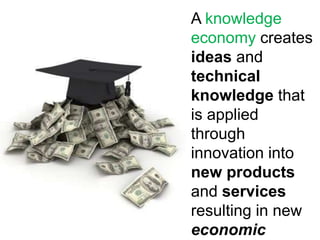
A knowledge
economy creates
ideas and
technical
knowledge that
is applied
through
innovation into
new products
and services
resulting in new
economic
One of main the main problems is:
Transferring research into innovation
into new products and/or services
Besides:
their is a gap
between
universities and
companies, and
entrepreneurshi
p is lacking
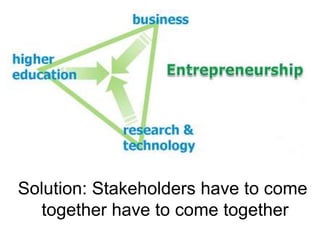
Solution: Stakeholders have to come
  together have to come together
To become innovative and
successful
   An economic and institutional regime to
    provide incentives for the efficient use of existing
    and new knowledge and the flourishing of
    entrepreneurship;
   An educated and skilled population to
    create, share, and use knowledge well;
   An efficient innovation system of
    firms, research centres, universities, consultants
    and other organizations to tap into the growing
    stock of global knowledge, assimilate and adapt it
    to local needs, and create new technology;
   Information and communication technology to
    facilitate the effective creation, dissemination, and
    processing of information
Trends and developments in sustainability and reneawable enrgy

Trends and developments in sustainability and reneawable enrgy

  • 1.
    TRENDS AND DEVELOPMENTS INSUSTAINABILITY AND RENEWABLE ENERGY Jan Willem Dijk MSc Jan.willem.dijk@dconsult.nl NBI Expo, March 6th 2012
  • 2.
    Jan Willem DijkMSc.  Owner and director DConsult  Consultancy on sustainability and energy  International business analyses EU27, China, Indonesia, etc.  Project financing and feasibility studies  Expert environment European Commission  http://www.dconsult.nl
  • 3.
    Table of Content Openingspeech:  Renewable energy  Sustainable buildings  Sustainable mobility and transport  Innovation, from research to new products and services
  • 4.
    Table of Content Openingspeech:  Renewable energy  Sustainable buildings  Sustainable mobility and transport  Innovation, from research to new products and services
  • 5.
    Renewable energy  Wind power  Hydropower  Solar energy  Biomass  Biofuel  Geothermal energy
  • 6.
    700 BC: makingfire and burn
  • 7.
  • 8.
  • 9.
    1767 first solarcollector by Horace de Saussure
  • 10.
    1921 Albert Einstein wins theNobel Prize for his explaining the photoelectric effect.
  • 11.
  • 12.
  • 13.
    Solar nowadays I. Solar thermal:  Water heating  Heating, cooling and ventilation  Water treatment  Cooking  Process heat
  • 14.
  • 15.
  • 17.
    Table of Content Openingspeech:  Renewable energy  Sustainable buildings  Sustainable mobility and transport  Innovation, from research to new products and services
  • 18.
    45.000 BC Prehistoricliving, shelters and wood fired heating Energy Efficiency in buildings
  • 19.
  • 20.
    Until the 60sof the 20th century, many houses in the Netherlands and Belgium were heated with coal stoves.
  • 21.
    1. Effective Insulation 2.High-Performance Windows 3. Tight Construction and Ducts 4. Efficient Heating and Cooling Equipment 5. Lighting and Appliances
  • 22.
    Last decade, azero-energy building: a building with zero net energy consumption and zero carbon emissions annually Next step: energy delivering house A house delivers more power and heat than it requires
  • 23.
    Smart-grids FUTURE  Connecting energy supply and demand in a city in a decentralized way  Smart interconnection between residential homes, offices and industries, and e- mobility (batteries)
  • 24.
    Table of Content Openingspeech:  Renewable energy  Sustainable buildings  Sustainable mobility and transport  Innovation, from research to new products and services
  • 25.
    2200 BC –21stcentury Horse drawn vehicles
  • 26.
  • 27.
    Gasoline, kerosene, andethanol (alcohol) powered engine (biofuel) 1908-1927: T-Ford: innovation
  • 29.
    Innovation hampers  1908 the Model T had fuel economy of 11 Liters per 100 km  2008 cars drive on average on 8,3 Liters per 100 km  100 years of innovation resulted in 13% fuel reduction
  • 31.
    New technologies developed New:  Bio-fuel mobility  Electric mobility Reasons:  energy security,  less oil dependency  green house gas reduction
  • 32.
    Bio-fuels  1ste generation Biodiesel (vegetable oils and animal fats) and ethanol (corn or sugarcane)  Problem: food versus fuel production, deforestati on
  • 33.
    Bio-fuels 1st generation  1ste generation Biodiesel (vegetable oils and animal fats) and ethanol (corn or sugarcane)  Problem: food versus fuel production, deforestati on
  • 34.
    Bio-fuels 2nd generation  2nd generation: biofuels algae and cellulosic biomass  Problem: expensive, less volumes available, pollution, hig h energy content
  • 35.
    Electric mobility  Electric vehicles are 100% emission-free  having no polluting byproducts,  are more fuel- efficient,  get a better mileage,  and have less moving parts to PROBLEM: wear out BATTERIES
  • 36.
    Are hydrogen andfuel cells a solution for electrical vehicles?
  • 37.
    Table of Content Openingspeech:  Renewable energy  Sustainable buildings  Sustainable mobility and transport  Innovation, from research to new products and services
  • 38.
  • 39.
    For the developmentof this technology a knowledge economy For the development is required of sustainable technology a knowledge economy is required
  • 40.
    A knowledge economy creates ideasand technical knowledge that is applied through innovation into new products and services resulting in new economic
  • 41.
    One of mainthe main problems is: Transferring research into innovation into new products and/or services
  • 42.
    Besides: their is agap between universities and companies, and entrepreneurshi p is lacking
  • 43.
    Solution: Stakeholders haveto come together have to come together
  • 44.
    To become innovativeand successful  An economic and institutional regime to provide incentives for the efficient use of existing and new knowledge and the flourishing of entrepreneurship;  An educated and skilled population to create, share, and use knowledge well;  An efficient innovation system of firms, research centres, universities, consultants and other organizations to tap into the growing stock of global knowledge, assimilate and adapt it to local needs, and create new technology;  Information and communication technology to facilitate the effective creation, dissemination, and processing of information