Angles in Circles
Central Angles
Central
Angle
(of a circle)
Central
Angle
(of a circle)
NOT A
Central
Angle
(of a circle)
• A central angle is an angle whose vertex is
the CENTER of the circle
CENTRAL ANGLES AND ARCS
The measure of a central angle is equal to
the measure of the intercepted arc.
CENTRAL ANGLES AND ARCS
The measure of a central angle is equal to
the measure of the intercepted arc.
Y
Z
O 110
1
1
0

Intercepted Arc
Central
Angle
EXAMPLE
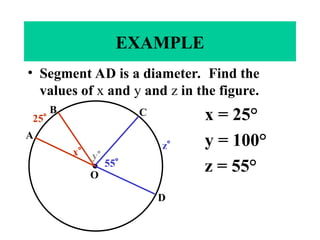
• Segment AD is a diameter. Find the
values of x and y and z in the figure.
x = 25°
y = 100°
z = 55°
A
B
O
C
D
55
x y
25
z
SUM OF CENTRAL ANGLES
The sum of the measures fo the central angles of a circle with
no interior points in common is 360º.
360º
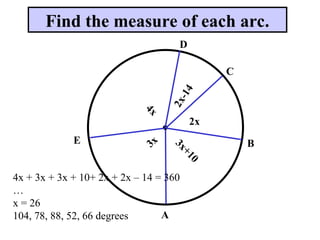
Find the measure of each arc.
A
E B
C
D
2x
2
x
-
1
4
4
x
3x
3
x
+
1
0
4x + 3x + 3x + 10+ 2x + 2x – 14 = 360
…
x = 26
104, 78, 88, 52, 66 degrees
An inscribed angle is an angle
whose vertex is on a circle and
whose sides contain chords.
Inscribed Angles
1 4
2
3
Is
NOT!
Is
NOT!
Is SO! Is SO!
Thrm 9-7. The measure of an inscribed angle is
equal to ½ the measure of the intercepted arc.
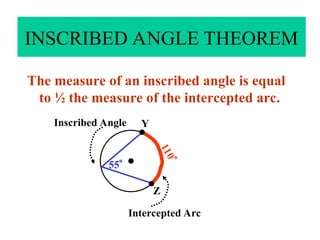
INSCRIBED ANGLE THEOREM
The measure of an inscribed angle is equal
to ½ the measure of the intercepted arc.
Thrm 9-7. The measure of an inscribed angle is
equal to ½ the measure of the intercepted arc.
INSCRIBED ANGLE THEOREM
The measure of an inscribed angle is equal
to ½ the measure of the intercepted arc.
1
2

Thrm 9-7. The measure of an inscribed angle is
equal to ½ the measure of the intercepted arc.
INSCRIBED ANGLE THEOREM
The measure of an inscribed angle is equal
to ½ the measure of the intercepted arc.
Y
Z
55
1
1
0

Inscribed Angle
Intercepted Arc
Thrm 9-7. The measure of an inscribed angle is
equal to ½ the measure of the intercepted arc.
x
y
Q
R
P
S
T
50
40
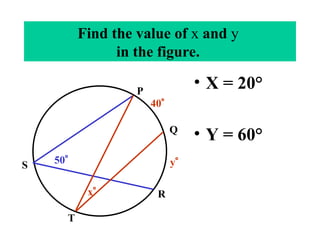
Find the value of x and y
in the figure.
• X = 20°
• Y = 60°
Corollary 1. If two inscribed angles intercept the
same arc, then the angles are congruent..
x R
Q
S
T
50
P
y
Find the value of x and y
in the figure.
• X = 50°
• Y = 50°
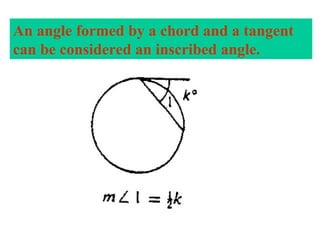
An angle formed by a chord and a tangent
can be considered an inscribed angle.
An angle formed by a chord and a tangent
can be considered an inscribed angle.
R
S
P
Q
mPRQ = ½ mPR
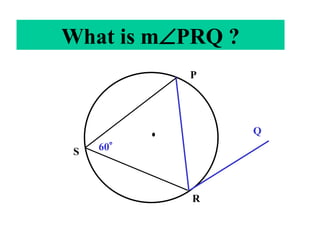
What is mPRQ ?
R
S
P
Q
60
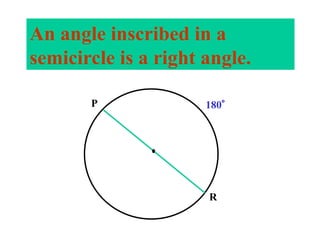
An angle inscribed in a
semicircle is a right angle.
R
P 180
An angle inscribed in a
semicircle is a right angle.
R
P 180
S
90
• Angles that are formed by two
intersecting chords. (Vertex IN the
circle)
Interior Angles
A
B
C
D
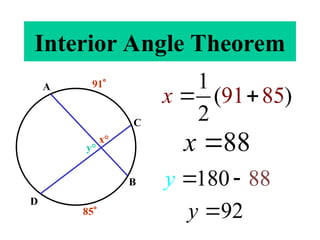
Interior Angle Theorem
The measure of the angle formed by the
two chords is equal to ½ the sum of the
measures of the intercepted arcs.
Interior Angle Theorem
The measure of the angle formed by the
two chords is equal to ½ the sum of the
measures of the intercepted arcs.
1
A
B
C
D 1
m 1 (mAC mBD)
2
  
A
B
C
D
x°
91
85
Interior Angle Theorem
91 5
(
2
8
1
)
x  
88

x
y°
88
180
 
y
92

y
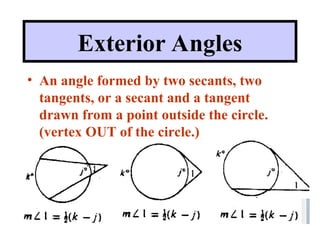
• An angle formed by two secants, two
tangents, or a secant and a tangent
drawn from a point outside the circle.
(vertex OUT of the circle.)
Exterior Angles
• An angle formed by two secants, two
tangents, or a secant and a tangent
drawn from a point outside the circle.
Exterior Angles
1
j
k 1
j
k
1
j
k
Exterior Angle Theorem
• The measure of the angle formed is equal
to ½ the difference of the intercepted
arcs.
1
j
k 3
j
k
1
j
k
1
m 1 (k j)
2
  
Find m ACB

• <C = ½(265-95)
• <C = ½(170)
• m<C = 85°
265
95
C
B
A
PUTTING IT TOGETHER!
• AF is a diameter.
• mAG=100
• mCE=30
• mEF=25
• Find the measure
of all numbered
angles.
Q
G
F
D
E
C
1
2
3
4
5
6
A
R
S
P
Q
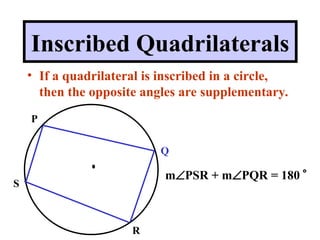
Inscribed Quadrilaterals
• If a quadrilateral is inscribed in a circle,
then the opposite angles are supplementary.
mPSR + mPQR = 180 

2.12 Angles in Circles.ppt................

  • 1.
  • 2.
    Central Angles Central Angle (of acircle) Central Angle (of a circle) NOT A Central Angle (of a circle) • A central angle is an angle whose vertex is the CENTER of the circle
  • 3.
    CENTRAL ANGLES ANDARCS The measure of a central angle is equal to the measure of the intercepted arc.
  • 4.
    CENTRAL ANGLES ANDARCS The measure of a central angle is equal to the measure of the intercepted arc. Y Z O 110 1 1 0  Intercepted Arc Central Angle
  • 5.
    EXAMPLE • Segment ADis a diameter. Find the values of x and y and z in the figure. x = 25° y = 100° z = 55° A B O C D 55 x y 25 z
  • 6.
    SUM OF CENTRALANGLES The sum of the measures fo the central angles of a circle with no interior points in common is 360º. 360º
  • 7.
    Find the measureof each arc. A E B C D 2x 2 x - 1 4 4 x 3x 3 x + 1 0 4x + 3x + 3x + 10+ 2x + 2x – 14 = 360 … x = 26 104, 78, 88, 52, 66 degrees
  • 8.
    An inscribed angleis an angle whose vertex is on a circle and whose sides contain chords. Inscribed Angles 1 4 2 3 Is NOT! Is NOT! Is SO! Is SO!
  • 9.
    Thrm 9-7. Themeasure of an inscribed angle is equal to ½ the measure of the intercepted arc. INSCRIBED ANGLE THEOREM The measure of an inscribed angle is equal to ½ the measure of the intercepted arc.
  • 10.
    Thrm 9-7. Themeasure of an inscribed angle is equal to ½ the measure of the intercepted arc. INSCRIBED ANGLE THEOREM The measure of an inscribed angle is equal to ½ the measure of the intercepted arc. 1 2 
  • 11.
    Thrm 9-7. Themeasure of an inscribed angle is equal to ½ the measure of the intercepted arc. INSCRIBED ANGLE THEOREM The measure of an inscribed angle is equal to ½ the measure of the intercepted arc. Y Z 55 1 1 0  Inscribed Angle Intercepted Arc
  • 12.
    Thrm 9-7. Themeasure of an inscribed angle is equal to ½ the measure of the intercepted arc. x y Q R P S T 50 40 Find the value of x and y in the figure. • X = 20° • Y = 60°
  • 13.
    Corollary 1. Iftwo inscribed angles intercept the same arc, then the angles are congruent.. x R Q S T 50 P y Find the value of x and y in the figure. • X = 50° • Y = 50°
  • 14.
    An angle formedby a chord and a tangent can be considered an inscribed angle.
  • 15.
    An angle formedby a chord and a tangent can be considered an inscribed angle. R S P Q mPRQ = ½ mPR
  • 16.
    What is mPRQ? R S P Q 60
  • 17.
    An angle inscribedin a semicircle is a right angle. R P 180
  • 18.
    An angle inscribedin a semicircle is a right angle. R P 180 S 90
  • 19.
    • Angles thatare formed by two intersecting chords. (Vertex IN the circle) Interior Angles A B C D
  • 20.
    Interior Angle Theorem Themeasure of the angle formed by the two chords is equal to ½ the sum of the measures of the intercepted arcs.
  • 21.
    Interior Angle Theorem Themeasure of the angle formed by the two chords is equal to ½ the sum of the measures of the intercepted arcs. 1 A B C D 1 m 1 (mAC mBD) 2   
  • 22.
    A B C D x° 91 85 Interior Angle Theorem 915 ( 2 8 1 ) x   88  x y° 88 180   y 92  y
  • 23.
    • An angleformed by two secants, two tangents, or a secant and a tangent drawn from a point outside the circle. (vertex OUT of the circle.) Exterior Angles
  • 24.
    • An angleformed by two secants, two tangents, or a secant and a tangent drawn from a point outside the circle. Exterior Angles 1 j k 1 j k 1 j k
  • 25.
    Exterior Angle Theorem •The measure of the angle formed is equal to ½ the difference of the intercepted arcs. 1 j k 3 j k 1 j k 1 m 1 (k j) 2   
  • 26.
    Find m ACB  •<C = ½(265-95) • <C = ½(170) • m<C = 85° 265 95 C B A
  • 27.
    PUTTING IT TOGETHER! •AF is a diameter. • mAG=100 • mCE=30 • mEF=25 • Find the measure of all numbered angles. Q G F D E C 1 2 3 4 5 6 A
  • 28.
    R S P Q Inscribed Quadrilaterals • Ifa quadrilateral is inscribed in a circle, then the opposite angles are supplementary. mPSR + mPQR = 180 