Lesson for Week 2
Systems of Units
Of Measure
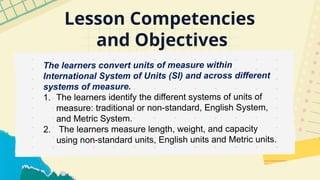
The learners convert units of measure within
International System of Units (SI) and across different
systems of measure.
1. The learners identify the different systems of units of
measure: traditional or non-standard, English System,
and Metric System.
2. The learners measure length, weight, and capacity
using non-standard units, English units and Metric units.
Lesson Competencies
and Objectives
DAY 1
Short Review
Option A: Class Discussion
Questioning:
• Have you ever measured an object before? What
was the measuring tool and unit of measure you
used?
• What role do you think measurement plays in our
everyday life? How do you use measurement in
your daily routine or activities?
Short Review
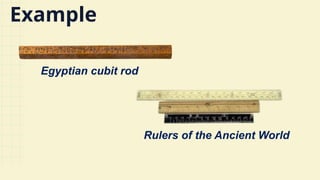
Option B: Measurement
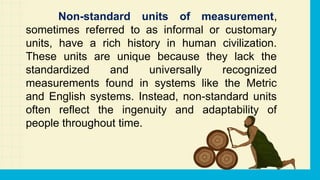
Scavenger Hunt Activity
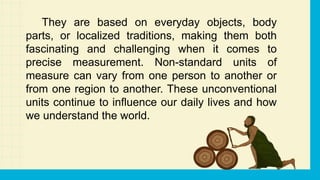
Instructions
•The class will be divided into 5 groups. Each team must
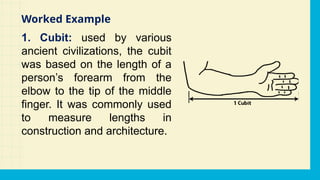
have ruler or tape measure, worksheet and pencil.
•Start the scavenger hunt and locate the specified objects
•Measure objects accurately and record measurements
along with units used
•Collaborate and discuss findings as you progress
Instructions
Scavenger Hunt Task
•Find and measure objects within the school or classroom
•Objects to measure:
o Door
o Window
o Textbook
o Pencil
o Other objects of varying size and shape (e.g., chair, desk,
table)
•Record measurements in worksheets with units used (e.g., inches
or centimeters)
Comprehension Questions
1. How did the scavenger hunt help you understand
the role of measurement in the real world?
2. Why is accurate measurement important in
various professions?
3. Can you think of situations where incorrect
measurements could lead to problems?
Lesson Purpose
Class Discussion
In today's world, measurement is a crucial aspect
of many professions, from science and engineering to
medicine and architecture. Accurate measurement is
essential to ensure the quality and reliability of
products, services, and research. It is also important
to understand the different units of measurement and
when to use them appropriately. In this reflection, we'll
explore the importance of measurement and how it
impacts our daily lives.
Comprehension Questions:
• Why it is important to
know the different units
of measurement and
when to use them
appropriately?
• Why accurate
measurement is
important in various
professions?
Measure and Build Project
Project Overview
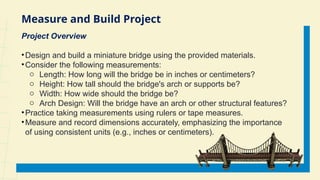
•Design and build a miniature bridge using the provided materials.
•Consider the following measurements:
o Length: How long will the bridge be in inches or centimeters?
o Height: How tall should the bridge's arch or supports be?
o Width: How wide should the bridge be?
o Arch Design: Will the bridge have an arch or other structural features?
•Practice taking measurements using rulers or tape measures.
•Measure and record dimensions accurately, emphasizing the importance
of using consistent units (e.g., inches or centimeters).
Measure and Build Project
Project Overview
•Distribute building materials to each group and instruct them to start
building their structures, following their design and using accurate
measurements.
•Encourage collaboration, problem-solving, and adjustments as needed.
Measure and Build Project
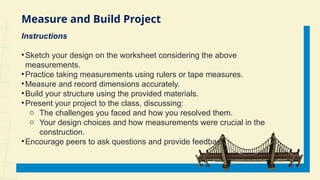
Instructions
•Sketch your design on the worksheet considering the above
measurements.
•Practice taking measurements using rulers or tape measures.
•Measure and record dimensions accurately.
•Build your structure using the provided materials.
•Present your project to the class, discussing:
o The challenges you faced and how you resolved them.
o Your design choices and how measurements were crucial in the
construction.
•Encourage peers to ask questions and provide feedback.
Measure and Build Project
Materials needed
•Rulers or tape measures
•Building materials (e.g., cardboard, paper, glue, scissors)
•Worksheet with measurement guidelines
•Optional: calculator, measuring tape, or other materials
for added complexity
Comprehension Questions:
• How did accurate
measurements impact
the success of your
project?
• What challenges did
you encounter during
the construction phase,
and how did you
overcome them?
Questions for Discussions:
• Why is precision
important in real-world
construction and
engineering projects?
•Measurement Accuracy (10 points)
•Design and Construction (10 points)
•Problem-Solving and Adaptability (10 points)
•Presentation and Communication (10 points)
•Collaboration and Teamwork (10 points)
TOTAL – 50 points
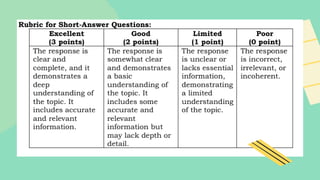
Rubric for grading
Unlocking
Vocabulary
• Non-standard Units of Measure are informal or
customary units that can vary from one person to
another or from one region to another.
• The basic units for length or distance measurements in
the English system are the inch, foot, yard, and mile.
Other units of length also include the rod, furlong, and
chain. survey foot definition. In the English system,
areas are typically given in square feet or square yards.
• The International System of Units, internationally
known by the abbreviation SI , is the modern form of
the metric system and the world's most widely
used system of measurement.
Sub-Topic 1
History of Measurement and Non-
Standard Units of Measure
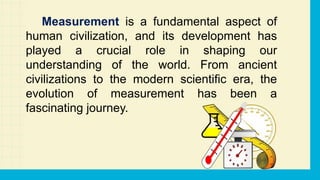
Measurement is a fundamental aspect of
human civilization, and its development has
played a crucial role in shaping our
understanding of the world. From ancient
civilizations to the modern scientific era, the
evolution of measurement has been a
fascinating journey.
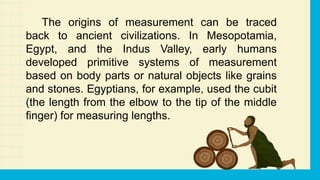
The origins of measurement can be traced
back to ancient civilizations. In Mesopotamia,
Egypt, and the Indus Valley, early humans
developed primitive systems of measurement
based on body parts or natural objects like grains
and stones. Egyptians, for example, used the cubit
(the length from the elbow to the tip of the middle
finger) for measuring lengths.
Non-standard units of measurement,
sometimes referred to as informal or customary
units, have a rich history in human civilization.
These units are unique because they lack the
standardized and universally recognized
measurements found in systems like the Metric
and English systems. Instead, non-standard units
often reflect the ingenuity and adaptability of
people throughout time.
They are based on everyday objects, body
parts, or localized traditions, making them both
fascinating and challenging when it comes to
precise measurement. Non-standard units of
measure can vary from one person to another or
from one region to another. These unconventional
units continue to influence our daily lives and how
we understand the world.
Example
Egyptian cubit rod
Rulers of the Ancient World
1. Cubit: used by various
ancient civilizations, the cubit
was based on the length of a
person’s forearm from the
elbow to the tip of the middle
finger. It was commonly used
to measure lengths in
construction and architecture.
Worked Example
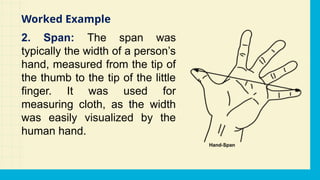
2. Span: The span was
typically the width of a person’s
hand, measured from the tip of
the thumb to the tip of the little
finger. It was used for
measuring cloth, as the width
was easily visualized by the
human hand.
Worked Example
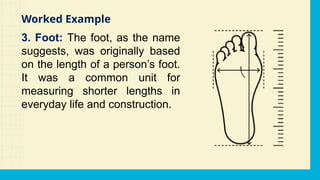
3. Foot: The foot, as the name
suggests, was originally based
on the length of a person’s foot.
It was a common unit for
measuring shorter lengths in
everyday life and construction.
Worked Example
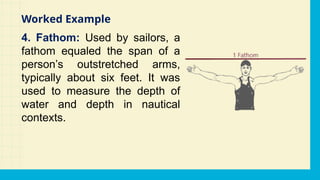
4. Fathom: Used by sailors, a
fathom equaled the span of a
person’s outstretched arms,
typically about six feet. It was
used to measure the depth of
water and depth in nautical
contexts.
Worked Example
In the Philippines, like many other parts of the
world, non-standard units of measure have been
used traditionally for various purposes. Here are a
few examples of non-standard units that were
historically used or are still occasionally referenced
informally:
1. Kaban or Cavan: The kaban is a traditional unit of
dry measure used for rice. It represents a traditional
volume of rice grain, often equivalent to 50 kilograms.
While it is not standardized and varies by region, it is a
common reference for rice trade.
Worked Example
2. Dipper or Tabo: In rural areas, people might use a
dipper as an informal unit of measuring liquids. It is
often used for transferring water or other liquids and is
not precisely standardized.
Worked Example
3. Tumpok: This refers to a stack or pile of items,
such as firewood, bananas, or coconuts. While not a
precise measurement, it is commonly used in daily life
for selling and trading goods.
Worked Example
4. Step: In some areas, people use the step as an
informal unit of length. For example, they might say
that a location is “two steps away” to give a rough idea
of distance.
Worked Example
Lesson Activity
Non-Standard Units of Measure
1.Introduction
• Start by asking students if they have ever heard of
using non-standard units of measurement, such as
inches or feet. Ask if they know how these units are
used in different parts of the world.
• Introduce the concept of traditional units of
measure used in different cultures worldwide.
Explain that these units are often based on local
customs, traditions, or historical practices.
Procedure
2. Examples from around the world
• Show examples of traditional units of measure from
different cultures, such as:
o Thai "sahm" (1/16th of a meter)
o Indian "padi" (1/16th of a meter)
o Mexican "cuerda" (a unit of length equal to 1.75
meters)
o Chinese "chi" (a unit of length equal to 1/3rd of a
meter)
Procedure
3. Local knowledge
• Ask students if they are aware of any local
traditional units of measure used in their community
or culture. Discuss any units they may know, and if
possible, invite community members to share their
knowledge.
• If traditional units are known, provide students with
the opportunity to learn and practice using them in
the classroom.
Procedure
4. Discussion
• Discuss the challenges and advantages of using
traditional units compared to standard units.
• Emphasize the cultural significance of these units
and how they reflect the unique history, customs,
and practices of each culture.
Procedure
5. Conclusion
• Summarize the importance of understanding
traditional units of measure and their significance in
different cultures.
• Encourage students to think about how these units
can be used in real-life scenarios and how they can
help bridge cultural gaps.
Procedure
Questions for Discussions:
• What traditional units were
used?
• Were there variations in
measurements within the
group? (This will lead to the
discussion about the
precision or traditional units
compared to standard
units).
Questions for Discussions:
• How do traditional units
reflect the history and
traditions of their community
or culture?
• Are there advantages to
using traditional units in
specific situations?
DAY 2
Sub-Topic 2
English System of Measurement:
Length, Weight, and Capacity
English System of Measurement, also known
as the Imperial System, is a historical and
culturally significant system of measurement that
has been used primarily in the United States and,
to a lesser extent, in the United Kingdom. This
system is characterized by its unique units for
measuring length, weight, and capacity, which can
be quite different from the standardized metric
system used in many other parts of the world.
Within the English System, we encounter units
like inches, feet, pounds, and gallons, each playing
a crucial role in various aspects of daily life, from
measuring a person's height to weighing groceries
or calculating the volume of liquid in a recipe.
Understanding this system is essential for practical
purposes, especially when navigating everyday
tasks in regions where it continues to be the
prevailing measurement system.
Worked Example
Key units in the English System for length,
weight, and capacity. The English System or U.S.
System of measurement uses the inch, foot, yard,
and mile to measure length. The most common
units of weight in the English measurement system
are the ounce, the pound, and the ton.
Worked Example
Units of capacity are generally used to measure
liquids. The number of gallons of gasoline needed
to fill a gas tank in a car, the number of cups of
water needed in a bread recipe, and the number of
quarts of milk sold each day at a supermarket are
all examples of using units of capacity
Worked Example
Lesson Activity
English System of Measurement
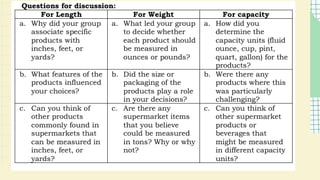
• Create a list of 15 common supermarket products
typically found in the Philippines. Include a variety of
items that locals are familiar with, such as bags of rice,
canned sardines, mangoes, and packs of instant
noodles.
• Discuss and decide whether each product is typically
measured in inches, feet, yards, ounces, pounds, fluid
ounces, pints, quarts, or gallons.
Task to do:
• You should write your chosen unit next to each product
on the list.
• Once your group completed the lists, share and
discuss your answer with the class.
Task to do:
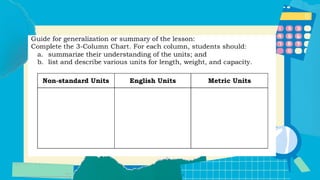
International System of Units or Metric System
The world thrives on measurement. Whether
we're calculating the distance to a destination, the
weight of an object, or the volume of a liquid,
measurement is an integral part of our daily lives.
To ensure that measurements are consistent and
universally understood, the scientific community
and global industries have adopted a standardized
system known as the International System of
Units, or SI for short.
International System of Units or Metric System
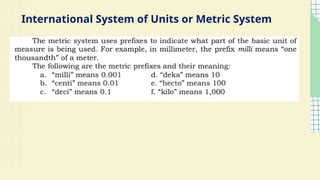
The SI system, often referred to as the metric
system, is a rational and comprehensive system of
measurement that simplifies the complexities of
measuring various physical quantities. It is the
most widely used system of measurement
worldwide, utilized not only in science but also in
everyday contexts. Understanding the SI units and
the principles behind them is essential for effective
communication and cooperation in today's
interconnected world.
International System of Units or Metric System
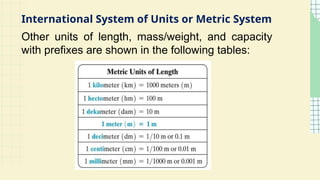
SI units or metric units for length, weight, and
capacity: The basic unit of length in the metric
system is the meter. A meter is slightly longer than
a yard. It is approximately 39.37 inches long.
International System of Units or Metric System
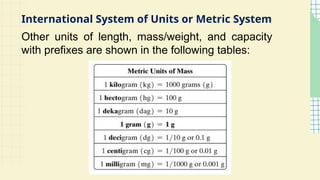
In scientific and technical areas, a careful
distinction is made between weight and mass.
Weight is really a measure of the pull of gravity.
The farther from Earth an object gets, the less it
weighs. However, mass is a measure of the
amount of substance in the object and does not
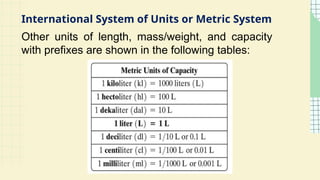
change. The basic unit of mass/weight in the
metric system is the gram. The basic unit of
capacity is liter. A liter is the capacity or volume of
a cube measuring 10 centimeters on each side.
International System of Units or Metric System
Other units of length, mass/weight, and capacity
with prefixes are shown in the following tables:
International System of Units or Metric System
Other units of length, mass/weight, and capacity
with prefixes are shown in the following tables:
International System of Units or Metric System
Other units of length, mass/weight, and capacity
with prefixes are shown in the following tables:
DAY 3
Sub-Topic 3
SI System or Metric System
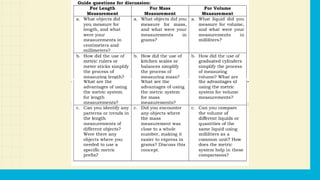
Questions for Discussions:
• How did you decide
which column the
given number should
be placed in?
• Were all your answers
correct? If not, why do
you think some of
your answers were
not correct? What will
you do to avoid this
error next time?
Questions for Discussions:
• How did you compute
the cube roots of the
perfect cube
numbers?
DAY 3
Sub-Topic 3
Irrational Numbers
Lesson Activity
Measurement Stations within the
Classroom
Measurement Stations:
• A station with metric rulers or meter sticks for
measuring length.
• A station with kitchen scales or balances for
measuring mass/weight.
• A station with graduated cylinders for measuring
capacity.
Instructions:
• Measure the length of an object using the metric
ruler or meterstick. Record the measurement in
centimeters and millimeters.
• Measure the mass of an object using the kitchen
scale or balance. Record the measurement in
grams.
• Measure the volume of a liquid (e.g., water)
using the graduated cylinder. Record the
measurement in milliliters.
Instructions:
• After the activity, gather the class together to
discuss the findings. Ask each group to share
their measurements and the objects they
measured.
Learner’s
Takeaways
Reflection
on Learning
DAY 4
Assessment
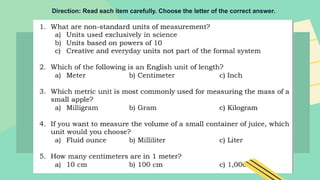
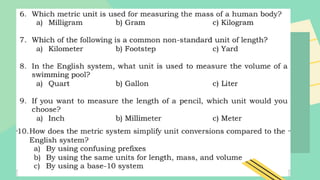
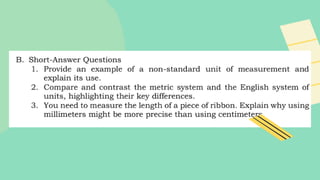
Direction: Read each item carefully. Choose the letter of the correct answer.
Learning Resource Portal. (2022, July 5). Self-Learning Module- Quarter 2-
Mathematics: Grade 7, Module 1: Approximating Measurement.
https://lrmds.deped.gov.ph/detail/21723
Learning Resource Portal. (2022, July 5). Self-Learning Module- Quarter
2-Mathematics: Grade 7, Module 2: Solving Problems Involving
Conversion of Units. https://lrmds.deped.gov.ph/detail/21723
References

Q2_PPT_Mathematics 7_Lesson 2_Week 2.pptx

  • 1.
    Lesson for Week2 Systems of Units Of Measure
  • 2.
    The learners convertunits of measure within International System of Units (SI) and across different systems of measure. 1. The learners identify the different systems of units of measure: traditional or non-standard, English System, and Metric System. 2. The learners measure length, weight, and capacity using non-standard units, English units and Metric units. Lesson Competencies and Objectives
  • 3.
  • 4.
    Short Review Option A:Class Discussion
  • 5.
    Questioning: • Have youever measured an object before? What was the measuring tool and unit of measure you used? • What role do you think measurement plays in our everyday life? How do you use measurement in your daily routine or activities?
  • 6.
    Short Review Option B:Measurement Scavenger Hunt Activity
  • 7.
    Instructions •The class willbe divided into 5 groups. Each team must have ruler or tape measure, worksheet and pencil. •Start the scavenger hunt and locate the specified objects •Measure objects accurately and record measurements along with units used •Collaborate and discuss findings as you progress
  • 8.
    Instructions Scavenger Hunt Task •Findand measure objects within the school or classroom •Objects to measure: o Door o Window o Textbook o Pencil o Other objects of varying size and shape (e.g., chair, desk, table) •Record measurements in worksheets with units used (e.g., inches or centimeters)
  • 9.
    Comprehension Questions 1. Howdid the scavenger hunt help you understand the role of measurement in the real world? 2. Why is accurate measurement important in various professions? 3. Can you think of situations where incorrect measurements could lead to problems?
  • 10.
  • 11.
    In today's world,measurement is a crucial aspect of many professions, from science and engineering to medicine and architecture. Accurate measurement is essential to ensure the quality and reliability of products, services, and research. It is also important to understand the different units of measurement and when to use them appropriately. In this reflection, we'll explore the importance of measurement and how it impacts our daily lives.
  • 12.
    Comprehension Questions: • Whyit is important to know the different units of measurement and when to use them appropriately? • Why accurate measurement is important in various professions?
  • 13.
    Measure and BuildProject Project Overview •Design and build a miniature bridge using the provided materials. •Consider the following measurements: o Length: How long will the bridge be in inches or centimeters? o Height: How tall should the bridge's arch or supports be? o Width: How wide should the bridge be? o Arch Design: Will the bridge have an arch or other structural features? •Practice taking measurements using rulers or tape measures. •Measure and record dimensions accurately, emphasizing the importance of using consistent units (e.g., inches or centimeters).
  • 14.
    Measure and BuildProject Project Overview •Distribute building materials to each group and instruct them to start building their structures, following their design and using accurate measurements. •Encourage collaboration, problem-solving, and adjustments as needed.
  • 15.
    Measure and BuildProject Instructions •Sketch your design on the worksheet considering the above measurements. •Practice taking measurements using rulers or tape measures. •Measure and record dimensions accurately. •Build your structure using the provided materials. •Present your project to the class, discussing: o The challenges you faced and how you resolved them. o Your design choices and how measurements were crucial in the construction. •Encourage peers to ask questions and provide feedback.
  • 16.
    Measure and BuildProject Materials needed •Rulers or tape measures •Building materials (e.g., cardboard, paper, glue, scissors) •Worksheet with measurement guidelines •Optional: calculator, measuring tape, or other materials for added complexity
  • 17.
    Comprehension Questions: • Howdid accurate measurements impact the success of your project? • What challenges did you encounter during the construction phase, and how did you overcome them?
  • 18.
    Questions for Discussions: •Why is precision important in real-world construction and engineering projects?
  • 19.
    •Measurement Accuracy (10points) •Design and Construction (10 points) •Problem-Solving and Adaptability (10 points) •Presentation and Communication (10 points) •Collaboration and Teamwork (10 points) TOTAL – 50 points Rubric for grading
  • 20.
  • 21.
    • Non-standard Unitsof Measure are informal or customary units that can vary from one person to another or from one region to another. • The basic units for length or distance measurements in the English system are the inch, foot, yard, and mile. Other units of length also include the rod, furlong, and chain. survey foot definition. In the English system, areas are typically given in square feet or square yards. • The International System of Units, internationally known by the abbreviation SI , is the modern form of the metric system and the world's most widely used system of measurement.
  • 22.
    Sub-Topic 1 History ofMeasurement and Non- Standard Units of Measure
  • 23.
    Measurement is afundamental aspect of human civilization, and its development has played a crucial role in shaping our understanding of the world. From ancient civilizations to the modern scientific era, the evolution of measurement has been a fascinating journey.
  • 24.
    The origins ofmeasurement can be traced back to ancient civilizations. In Mesopotamia, Egypt, and the Indus Valley, early humans developed primitive systems of measurement based on body parts or natural objects like grains and stones. Egyptians, for example, used the cubit (the length from the elbow to the tip of the middle finger) for measuring lengths.
  • 25.
    Non-standard units ofmeasurement, sometimes referred to as informal or customary units, have a rich history in human civilization. These units are unique because they lack the standardized and universally recognized measurements found in systems like the Metric and English systems. Instead, non-standard units often reflect the ingenuity and adaptability of people throughout time.
  • 26.
    They are basedon everyday objects, body parts, or localized traditions, making them both fascinating and challenging when it comes to precise measurement. Non-standard units of measure can vary from one person to another or from one region to another. These unconventional units continue to influence our daily lives and how we understand the world.
  • 27.
  • 28.
    1. Cubit: usedby various ancient civilizations, the cubit was based on the length of a person’s forearm from the elbow to the tip of the middle finger. It was commonly used to measure lengths in construction and architecture. Worked Example
  • 29.
    2. Span: Thespan was typically the width of a person’s hand, measured from the tip of the thumb to the tip of the little finger. It was used for measuring cloth, as the width was easily visualized by the human hand. Worked Example
  • 30.
    3. Foot: Thefoot, as the name suggests, was originally based on the length of a person’s foot. It was a common unit for measuring shorter lengths in everyday life and construction. Worked Example
  • 31.
    4. Fathom: Usedby sailors, a fathom equaled the span of a person’s outstretched arms, typically about six feet. It was used to measure the depth of water and depth in nautical contexts. Worked Example
  • 32.
    In the Philippines,like many other parts of the world, non-standard units of measure have been used traditionally for various purposes. Here are a few examples of non-standard units that were historically used or are still occasionally referenced informally:
  • 33.
    1. Kaban orCavan: The kaban is a traditional unit of dry measure used for rice. It represents a traditional volume of rice grain, often equivalent to 50 kilograms. While it is not standardized and varies by region, it is a common reference for rice trade. Worked Example
  • 34.
    2. Dipper orTabo: In rural areas, people might use a dipper as an informal unit of measuring liquids. It is often used for transferring water or other liquids and is not precisely standardized. Worked Example
  • 35.
    3. Tumpok: Thisrefers to a stack or pile of items, such as firewood, bananas, or coconuts. While not a precise measurement, it is commonly used in daily life for selling and trading goods. Worked Example
  • 36.
    4. Step: Insome areas, people use the step as an informal unit of length. For example, they might say that a location is “two steps away” to give a rough idea of distance. Worked Example
  • 37.
  • 38.
    1.Introduction • Start byasking students if they have ever heard of using non-standard units of measurement, such as inches or feet. Ask if they know how these units are used in different parts of the world. • Introduce the concept of traditional units of measure used in different cultures worldwide. Explain that these units are often based on local customs, traditions, or historical practices. Procedure
  • 39.
    2. Examples fromaround the world • Show examples of traditional units of measure from different cultures, such as: o Thai "sahm" (1/16th of a meter) o Indian "padi" (1/16th of a meter) o Mexican "cuerda" (a unit of length equal to 1.75 meters) o Chinese "chi" (a unit of length equal to 1/3rd of a meter) Procedure
  • 40.
    3. Local knowledge •Ask students if they are aware of any local traditional units of measure used in their community or culture. Discuss any units they may know, and if possible, invite community members to share their knowledge. • If traditional units are known, provide students with the opportunity to learn and practice using them in the classroom. Procedure
  • 41.
    4. Discussion • Discussthe challenges and advantages of using traditional units compared to standard units. • Emphasize the cultural significance of these units and how they reflect the unique history, customs, and practices of each culture. Procedure
  • 42.
    5. Conclusion • Summarizethe importance of understanding traditional units of measure and their significance in different cultures. • Encourage students to think about how these units can be used in real-life scenarios and how they can help bridge cultural gaps. Procedure
  • 43.
    Questions for Discussions: •What traditional units were used? • Were there variations in measurements within the group? (This will lead to the discussion about the precision or traditional units compared to standard units).
  • 44.
    Questions for Discussions: •How do traditional units reflect the history and traditions of their community or culture? • Are there advantages to using traditional units in specific situations?
  • 45.
  • 46.
    Sub-Topic 2 English Systemof Measurement: Length, Weight, and Capacity
  • 47.
    English System ofMeasurement, also known as the Imperial System, is a historical and culturally significant system of measurement that has been used primarily in the United States and, to a lesser extent, in the United Kingdom. This system is characterized by its unique units for measuring length, weight, and capacity, which can be quite different from the standardized metric system used in many other parts of the world.
  • 48.
    Within the EnglishSystem, we encounter units like inches, feet, pounds, and gallons, each playing a crucial role in various aspects of daily life, from measuring a person's height to weighing groceries or calculating the volume of liquid in a recipe. Understanding this system is essential for practical purposes, especially when navigating everyday tasks in regions where it continues to be the prevailing measurement system. Worked Example
  • 49.
    Key units inthe English System for length, weight, and capacity. The English System or U.S. System of measurement uses the inch, foot, yard, and mile to measure length. The most common units of weight in the English measurement system are the ounce, the pound, and the ton. Worked Example
  • 50.
    Units of capacityare generally used to measure liquids. The number of gallons of gasoline needed to fill a gas tank in a car, the number of cups of water needed in a bread recipe, and the number of quarts of milk sold each day at a supermarket are all examples of using units of capacity Worked Example
  • 51.
  • 52.
    • Create alist of 15 common supermarket products typically found in the Philippines. Include a variety of items that locals are familiar with, such as bags of rice, canned sardines, mangoes, and packs of instant noodles. • Discuss and decide whether each product is typically measured in inches, feet, yards, ounces, pounds, fluid ounces, pints, quarts, or gallons. Task to do:
  • 53.
    • You shouldwrite your chosen unit next to each product on the list. • Once your group completed the lists, share and discuss your answer with the class. Task to do:
  • 55.
    International System ofUnits or Metric System The world thrives on measurement. Whether we're calculating the distance to a destination, the weight of an object, or the volume of a liquid, measurement is an integral part of our daily lives. To ensure that measurements are consistent and universally understood, the scientific community and global industries have adopted a standardized system known as the International System of Units, or SI for short.
  • 56.
    International System ofUnits or Metric System The SI system, often referred to as the metric system, is a rational and comprehensive system of measurement that simplifies the complexities of measuring various physical quantities. It is the most widely used system of measurement worldwide, utilized not only in science but also in everyday contexts. Understanding the SI units and the principles behind them is essential for effective communication and cooperation in today's interconnected world.
  • 57.
    International System ofUnits or Metric System SI units or metric units for length, weight, and capacity: The basic unit of length in the metric system is the meter. A meter is slightly longer than a yard. It is approximately 39.37 inches long.
  • 58.
    International System ofUnits or Metric System In scientific and technical areas, a careful distinction is made between weight and mass. Weight is really a measure of the pull of gravity. The farther from Earth an object gets, the less it weighs. However, mass is a measure of the amount of substance in the object and does not change. The basic unit of mass/weight in the metric system is the gram. The basic unit of capacity is liter. A liter is the capacity or volume of a cube measuring 10 centimeters on each side.
  • 59.
    International System ofUnits or Metric System
  • 60.
    International System ofUnits or Metric System Other units of length, mass/weight, and capacity with prefixes are shown in the following tables:
  • 61.
    International System ofUnits or Metric System Other units of length, mass/weight, and capacity with prefixes are shown in the following tables:
  • 62.
    International System ofUnits or Metric System Other units of length, mass/weight, and capacity with prefixes are shown in the following tables:
  • 63.
  • 64.
    Sub-Topic 3 SI Systemor Metric System
  • 65.
    Questions for Discussions: •How did you decide which column the given number should be placed in? • Were all your answers correct? If not, why do you think some of your answers were not correct? What will you do to avoid this error next time?
  • 66.
    Questions for Discussions: •How did you compute the cube roots of the perfect cube numbers?
  • 67.
  • 68.
  • 69.
  • 70.
    Measurement Stations: • Astation with metric rulers or meter sticks for measuring length. • A station with kitchen scales or balances for measuring mass/weight. • A station with graduated cylinders for measuring capacity.
  • 71.
    Instructions: • Measure thelength of an object using the metric ruler or meterstick. Record the measurement in centimeters and millimeters. • Measure the mass of an object using the kitchen scale or balance. Record the measurement in grams. • Measure the volume of a liquid (e.g., water) using the graduated cylinder. Record the measurement in milliliters.
  • 72.
    Instructions: • After theactivity, gather the class together to discuss the findings. Ask each group to share their measurements and the objects they measured.
  • 74.
  • 76.
  • 78.
  • 79.
  • 80.
    Direction: Read eachitem carefully. Choose the letter of the correct answer.
  • 84.
    Learning Resource Portal.(2022, July 5). Self-Learning Module- Quarter 2- Mathematics: Grade 7, Module 1: Approximating Measurement. https://lrmds.deped.gov.ph/detail/21723 Learning Resource Portal. (2022, July 5). Self-Learning Module- Quarter 2-Mathematics: Grade 7, Module 2: Solving Problems Involving Conversion of Units. https://lrmds.deped.gov.ph/detail/21723 References