AT STAKE

LUANDA
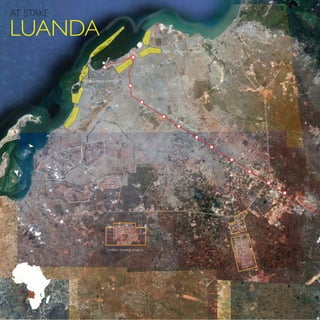
                                                    Areas of forced migration


           LUANDA CENTRE


                                               RE
                                                 CO
                                                     NS
                                                        TR
                                                          UC
                                                             TE
                                                               D
                                                                   RA
                                                                     ILW
                                                                        AY


                                                                                       n
                                                                                      tio
                                                                                  Sta
                                                                                 na
                                                                                Via


                  1 million housing projects


  LUANDA
AT STAKE: LUANDA
   INTERPRETATIONS & REACTIONS
LUANDA: A CITY IN TRANSITION
Africa will experience the strongest growth among all regions of the world until 2050 (UN-HABITAT). From 2000
to 2030, Africa’s urban population will grow from 294 million to 742 million people, an increase of 152%. In the
forecasts, Luanda will be among the four most rapidly growing cities on the African continent. The Economist

The rapid growth of Luanda will both imply major problems and create outstanding opportunities. The challenges
are obvious. They range from infrastructure gaps and missing capacities for power, water, and food supply to loss of
agricultural land and chaotic traffic situations, not to mention the huge health problems originating from air pollution,
lack of sanitation, and huge piles of garbage.                                                                                                                                                                                                                                                                                          FORMAL


In this challenging urban haze, we need to understand problems are also                                                                                                                                                                                                                                                                             INFORMAL
opportunities. Clever city planning methods, innovative waste management
procedures, and cost efficient water treatment technologies, belong to this
category of opportunities.


                                           “The key globalization issue for Luanda
                                           how more people can be productively
                                           engaged in the development process”.
                                           Allan Cain. Architect, and founder and head of Development Workshop, Luanda.


                                                                                                          Before the war, most people supprted themselves by
               Angola has been a Portugese                                                                small-scale farming.
                                                                                                                                                                                                                                                                                                              1975                                                     2002
               colony since the 15th century                                                                                                                                                                                                                                                                  Independence                                             Peace declarance
        1500


                                                                                                                                                                                                                  PORTUGESE COLONY                                                                                                        CIVIL WAR


                                          1900                                                              1910                             1920                                                              1930                                            1940   1950   1960   1970                                         1980             1990         2000                2010
                                                                                                              09                                                                                                                                                                                      75                                     87                   02     04 05       09
                                                                              massive building activity
                                                                              New highrise seafront,


                                                                                                                                                               Typical colonial city residential blocks from


                                                                                                                                                                                                                      Wealthier resitential area, townhouses
                                                                                                                                                               the mid 20th century (5-8 floors)


                                                                                                                                                                                                                                                                                           Informal housing, usually one-story
                                                                                                                                                                                                                                                                                           Ca 80% of Luandas population
                                                 Original colonial seafront


                                                                                                                                                                                                                      and villas with high fences
                          New promenede


                                                                                                                                                                                                                                                                                           Mucceque areas


                                                                                                                         FORMAL                                                                                                                                                                                                         INFORMAL
RAPID URBANIZATION
THE URBAN ADVANTAGE & OVERCROWDING
The urban advantage implicates the abundance
and variety of goods, services, amenities and                                                                   “This is where the possibilities are,
                                                                                                                                                                                                              8000000
opportunities, as well as social connections or                                                                 possibilities for creating a life and
                                                                                                                arranging employment”.
‘’human capital’’. In the cities there is also a high                                                           Pedro Sapista. Police / Micro Finance.

concentration and availability of social, cultural
and health facilities. Other benefits are the access
to water and sanitation, and transportation
networks.
                                                                                                                                                                                                              7000000

                                                                                                                                                            Cabinda


RAPID URBANIZATION
During the civil war people migrated to Luanda as it was considered                                    Luanda                                                      Luanda
                                                                                                                                                                             Malanje

the safest city to live in. The war left the country devastated by mines,
and the degradation of the soil left large rural areas useless for farming.
People were forced to leave the periferi and migrate to the city for better                                                                                                 Huambo
                                                                                                                                                                                                              6000000
                                                                                                                                                           Benguela

opportunities.
                                                                                                                                                         Lubango


Luanda experienced an immense growth, and the migration to the city
has only accelerated with the post war economic boom which has
strengthened the hope in the urban advantage.


                                                                                                                                                                                                              5000000
COUNTRY-ESCAPE
Angola is one of the world most land mine affected countries. It was
estimated a spread of two land mines for each inhabitant during the war.

Luanda was build originally by the portuguese to house 400 000 people.           1 man = 2 landmines                                                                                            LUANDAS EXPLOSIVE
Today the population exceeds 6 million, which means a ten-doubling of                                                                                                                         GROWTH IN POPULATION
the population in only ten years. This immense urbanization, today at a
rate of 55.8 per cent, is a hard pressure on the city, and the Government                                                                                                                                     4000000
is struggling to meet the challenges of overpopulation and poverty.

80 % of the population in Luanda live in informal settlements. With the
immense growth comes fewer access to facilities that make urban living
possible, such as water and electricity, and the rapid growth coming out
of a 25-year civil war has caused a huge bottleneck in infrastructure, most
notably transportation, housing, public utilities and fixed communications.

                                                                                                                                                                                                              3000000


CITY EXPANSION: A LARGE DIVISION IN FORMAL AND INFORMAL SETTLEMENTS


                                                                                                                                                                                                              2000000


   FORMAL SETTLEMENTS

   INFORMAL SETTLEMENTS
                                                                                                                                                                                                              1000000
Luanda 1964                                  Luanda 1986                      Luanda 2001                        Luanda 2010


                                          1700                                1850                                      1900                                                           1950                          2000
GROWTH VS DEVELOPMENT
OIL AND THE ECONOMIC BOOM
Angola is Africa’s top oil producer and among the fastest growing economies on
the continent with a growth rate of 10 % per year since the end of the civil war
in 2002. Oil accounts for almost 90 % of the country’s exports, and 83 % of its                             Human                                    GDP per capita
                                                                                                       Development Index                               PPP US $
national income. The majority of it’s revenues come from oil and diamond exports.
                                                                                                       0.60                                                              5500                                                                         2010
The oil-rich country is a magnet for foreign workers who push up already high prices
inflated by a reliance on imports.                                                                     0.58                                                              5000

                                                                                                       0.56                                                              4500                                                                        2 100 000 b
Despite the abundant natural resources, output per capita is among the world’s             Madagascar 0.54                                                               4000

lowest. Subsistence agriculture provides the main livelihood for 85% of the population.                0.52                                                              3500                                                   1991


The growth in population is outstripping the rapid economic growth, and together                       0.50                                                              3000                                                    1991
with the damages from the 25-year civil war it has put a strain on the country. In                     0.48                                                              2500

Luanda, large-scale slums, known locally as musseques, are suffering from poor access                  0.46                                                              2000

to water, electricity, and proper sanitation.                                                          0.44                                                              1500

                                                                                                       0.42                                                              1000
Today several Chinese companies have been contracted to large-scale projects of               Angola   0.40                                                              500
                                                                                                                                                                                                                                2000

construction and infrastructure to repair the country. All in exchange for Angola’s oil,                      HDI and GDP data refers to 2010 as reported in the HDR 2010.
                                                                                                                                                                                                                                750 000 bb/d

and a deal that 70% of tenders for public works must go to Chinese firms.                                                                                                                                                        2000
                                                                                                                                                                                                                                 750 000 bb/d


                                                                                                                                                                                                                                   2010

                                                                                                                                                                                                                                  2 100 000 bb/d
                                                                                                                                                                                                                                                   2015 (estimat
                                                                                                                                                                                                                                 2010
                                                                                                                                                                                                                                 2 100 000 bb/d
                                                                                                                                                                                                                                                   3 000 000 bb/


                                                                                                                                                                                                                                2015 (estimated)

                                                                                                                                                                                                                                3 000 000 bb/d

                                                                                                                                                                                                                                 2015
                                                                                                                                                                                                                                 3 000 000 bb/d


                                                                                                                                                                                  =100 000 bb/d Oil Exported
                                                                                                                                                                                  =100 000 bb/d Oil Used Internally in Angola

                                                                                                                                                                                OIL BOOM


BUILDING BOOM
Five years ago there were only two high-rise buildings in this skyline.


0
TOP-DOWN APPROACH & THE FOREIGN IDEAL
The horizon of Luanda is in constant transformation, with numerous prestigious high-rise building-
projects about to shape its skyline. It reveals a desire to exhibit an image of a world-class city. In
contradiction, slum dwellers constitute the majority of the urban population.

Most building materials in new constructions in Angola are imported, along with the construction
workers, and the design repeatingly take on a foreign look with large glass-facades and extensive
use of steel.

The importation of foreign ideals and techniques is not necessarily the best solution to address
the local climate conditions or the Angolan urban lifestyle. In addition it should be argued that
an emphasis on local materials and techniques could boost local production and create job                                                                                    There are widespread construction projects in Luanda, many of them housing projects
opportunities for the Angolan people.                                                                                                                                        contracted to Chinese companies. Most of the rebuilding is sponsored by Angola’s
                                                                                                                                                                             government.


                                                                                                                                                                             Chinese large-scale planned city being build 30 km outside of Luanda city.
                                                                                                                                                                             Mainly planned a residencial hub for the lower-income class.


                                                                                                                                                                             Monolithic blocks and striking uniformity, looking more like China than Southern Africa.


                                                                                                                            China came and proposed a “China
                                                                                                                            house”. The Brasilians did the same. The
                                                                                                                            buildings are not adapted for Angolan life.
                                                                                                                            And the quality is not good.”
                                                                                                                            Mauricio. Architect and Professor at ULA


                                                                                                                       “Luanda Sul is the opposite of                        Luanda calls itself the “New Dubai”. The similarities are evident, with several show-off
                                                                                                                       development. Sure, it’s creating                      projects aimed to give a portrait of wealth and high-class.
     We teach the architectural history of                               There are more than 100 Chinese               something, but development is creating
     europe and try to bring what we learn                               construction companies in Luanda, and these   works for people, like jobs and houses.
     from European and the Portuguese                                    are responsible for about 90% of all new      This is nothing. It’s only for rich people
     development to Angola                                               construction work. They are working on oil    who have houses.”
     Maria Joao. Teacher in Architecture, Lusiada University in Luanda   credit.                                       Justine Pinto de Andrade, director of the economics
                                                                         Hermenegildo Nunda, BI                        department at Catholic University in Luanda.
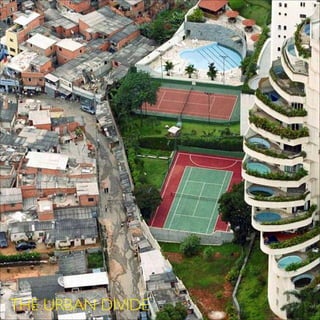
THE URBAN DIVIDE
THE URBAN DIVIDE
“In Luanda you will find all the indexes you are looking for.
You name it, you will find it.”
                        You want to find the richest of the richest, with five
                        swimmingpools, with excess water spilling over; you will                                                                                   THE MOST EXPENSIVE CITY IN THE WORLD
                                                                                                                                                                   Ratings of july 2011 puts Luanda on top of the most expensive cities in
                        find it. You want to find the poorest who do not even                                                                                      the world. This rating do obviously not include the informal city in their
                        have access to one cup of water; you will find it.                                                                                         measures. A standard flat in the centre of Luanda costs $10,000-$15,000
                        Joao Handanga Gil Administration Manager, Dof Subsea Angola
                                                                                                                                                                   a month to rent or at least $1million to buy. Many urban dwellers are
                                                                                                                                                                   pushed to the outskirts of the city because of the high cost of housing.


                                                                                                                                               20%
                                                                                                                                               FORMAL SETTLEMENT


The rapid urbanization in Luanda has brought
an even larger share of urban residence into
total poverty, making out a huge challenge for
Angola in the coming decades. Along with the
increase in urban poor, the informal sector is
growing largely. The development taking place
seem to further a polarization of groups, with


                                                                                                      80%
social housing projects being built far isolated
from the city.

The transformation of the city should call for
a more nuanced apprehension of the slums,                                                         INFORMAL SETTLEMENT
which, apart from its negative implications, also
demonstrates substantial economic potential
and productivity. A sustainable growth
of the city should acknowledge the
dynamics of all layers within the urban
fabric, encourage integration and foster
diversity.


                                                                                      “I would say there are three key issues that are important, not
                                                                                                                                                                          “The state do not acknowledge the
                                                                                      only for the city itself but for the whole of mankind. One is the
                                                                                      problem of mobility. Another is the problem of sustainability.                      qualities and productivity that exist within
                                                                                      The other is social diversity and co-existence”.                                    the informal structures in Luanda.”
                                                                                                                                                                          Mauricio. Architect and Professor at ULA
                                                                                      Jaime Lerner. Architect and Mayor of Curitiba, Brasil.
AT STAKE
1 MILLION HOUSES 30 KM OUTSIDE LUANDA
RE-ALLOCATION; A SUSTAINABLE DEVELOPMENT?


                          Massive seafront highrise development


                                                                                       FORCED MIGRATION                                                     ...OUTSIDE THE CITY


                                                                                                                               GOVERNMENT OFFERS AN
                                                                                                                               APPARTMENT IN ONE OF THE 1
                                                                                                                               MILLION HOUSING PROJECTS


              “Re-settlement is the term the Government is using
              for the forced movement of dwellers from high
              value areas in the city centre to periferic locations.
              The urban slum-areas will be replaced it with high-
              class, multi-storey buildings.”
              Allan Cain. Architect, and founder and head of Development Workshop, Luanda.


1. THE GOVERNMENT PLAN                                                              2. THE INFORMAL DWELLERS                                                                      3. THE NEW SOCIAL HOUSING CITY
The urban sea-front is high value land with its pictur-                             Today, the sea-front surrounding the city is inhabited by informal                            Addressing the need for social housing, large-scale projects are being
esque view and closeness to the beach. A develop-                                   dwellers who depend on the cities opportunities and networks.                                 built 30 km outside the city, where the informal dwellers are offered
ment of high-class prestiguos projects including casinos,                           The informal settlements remind you that Luanda, with its immense                             apartments. The large distances to work and urban amenities does
hotels, luxury apartments and commerce, are planned                                 economic boom, still faces many challenges. The Government see                                however cause a worsened poverty trap. It also require huge investment
for the area.                                                                       the informality as an unwanted portrait of poverty.                                           in connecting the new with the old if congestion is to be avoided.
“The flats are not prepared for the Angolan people and it
                   will become difficult for them to adapt to this new imposed
                   lifestyle. In the high-rise city you take the responsibility and
                   the engagement away from the people.”


                   You can critizice the projects happening in Luanda, like the
                   sea-front development, if they are good or not good, but
                   that is not important. The problem is how the people are
                   treated. They are treated like rubbish, moved far out of
                   the city centre.
                   Mauricio. Architect and Teacher in Architecture, Lusiada University in Luanda.
THE GREAT NUMBER


                                                       8 appartments á 8 stories = 68 appartments,
                                                       housing about 200 inhabitants
                                                       (3,1 person per unit)

                                                       1 000 000 / 200 =             5000 blocks

2

  • 1.
    AT STAKE LUANDA Areas of forced migration LUANDA CENTRE RE CO NS TR UC TE D RA ILW AY n tio Sta na Via 1 million housing projects LUANDA
  • 2.
    AT STAKE: LUANDA INTERPRETATIONS & REACTIONS
  • 3.
    LUANDA: A CITYIN TRANSITION Africa will experience the strongest growth among all regions of the world until 2050 (UN-HABITAT). From 2000 to 2030, Africa’s urban population will grow from 294 million to 742 million people, an increase of 152%. In the forecasts, Luanda will be among the four most rapidly growing cities on the African continent. The Economist The rapid growth of Luanda will both imply major problems and create outstanding opportunities. The challenges are obvious. They range from infrastructure gaps and missing capacities for power, water, and food supply to loss of agricultural land and chaotic traffic situations, not to mention the huge health problems originating from air pollution, lack of sanitation, and huge piles of garbage. FORMAL In this challenging urban haze, we need to understand problems are also INFORMAL opportunities. Clever city planning methods, innovative waste management procedures, and cost efficient water treatment technologies, belong to this category of opportunities. “The key globalization issue for Luanda how more people can be productively engaged in the development process”. Allan Cain. Architect, and founder and head of Development Workshop, Luanda. Before the war, most people supprted themselves by Angola has been a Portugese small-scale farming. 1975 2002 colony since the 15th century Independence Peace declarance 1500 PORTUGESE COLONY CIVIL WAR 1900 1910 1920 1930 1940 1950 1960 1970 1980 1990 2000 2010 09 75 87 02 04 05 09 massive building activity New highrise seafront, Typical colonial city residential blocks from Wealthier resitential area, townhouses the mid 20th century (5-8 floors) Informal housing, usually one-story Ca 80% of Luandas population Original colonial seafront and villas with high fences New promenede Mucceque areas FORMAL INFORMAL
  • 4.
  • 5.
    THE URBAN ADVANTAGE& OVERCROWDING The urban advantage implicates the abundance and variety of goods, services, amenities and “This is where the possibilities are, 8000000 opportunities, as well as social connections or possibilities for creating a life and arranging employment”. ‘’human capital’’. In the cities there is also a high Pedro Sapista. Police / Micro Finance. concentration and availability of social, cultural and health facilities. Other benefits are the access to water and sanitation, and transportation networks. 7000000 Cabinda RAPID URBANIZATION During the civil war people migrated to Luanda as it was considered Luanda Luanda Malanje the safest city to live in. The war left the country devastated by mines, and the degradation of the soil left large rural areas useless for farming. People were forced to leave the periferi and migrate to the city for better Huambo 6000000 Benguela opportunities. Lubango Luanda experienced an immense growth, and the migration to the city has only accelerated with the post war economic boom which has strengthened the hope in the urban advantage. 5000000 COUNTRY-ESCAPE Angola is one of the world most land mine affected countries. It was estimated a spread of two land mines for each inhabitant during the war. Luanda was build originally by the portuguese to house 400 000 people. 1 man = 2 landmines LUANDAS EXPLOSIVE Today the population exceeds 6 million, which means a ten-doubling of GROWTH IN POPULATION the population in only ten years. This immense urbanization, today at a rate of 55.8 per cent, is a hard pressure on the city, and the Government 4000000 is struggling to meet the challenges of overpopulation and poverty. 80 % of the population in Luanda live in informal settlements. With the immense growth comes fewer access to facilities that make urban living possible, such as water and electricity, and the rapid growth coming out of a 25-year civil war has caused a huge bottleneck in infrastructure, most notably transportation, housing, public utilities and fixed communications. 3000000 CITY EXPANSION: A LARGE DIVISION IN FORMAL AND INFORMAL SETTLEMENTS 2000000 FORMAL SETTLEMENTS INFORMAL SETTLEMENTS 1000000 Luanda 1964 Luanda 1986 Luanda 2001 Luanda 2010 1700 1850 1900 1950 2000
  • 6.
    GROWTH VS DEVELOPMENT OILAND THE ECONOMIC BOOM Angola is Africa’s top oil producer and among the fastest growing economies on the continent with a growth rate of 10 % per year since the end of the civil war in 2002. Oil accounts for almost 90 % of the country’s exports, and 83 % of its Human GDP per capita Development Index PPP US $ national income. The majority of it’s revenues come from oil and diamond exports. 0.60 5500 2010 The oil-rich country is a magnet for foreign workers who push up already high prices inflated by a reliance on imports. 0.58 5000 0.56 4500 2 100 000 b Despite the abundant natural resources, output per capita is among the world’s Madagascar 0.54 4000 lowest. Subsistence agriculture provides the main livelihood for 85% of the population. 0.52 3500 1991 The growth in population is outstripping the rapid economic growth, and together 0.50 3000 1991 with the damages from the 25-year civil war it has put a strain on the country. In 0.48 2500 Luanda, large-scale slums, known locally as musseques, are suffering from poor access 0.46 2000 to water, electricity, and proper sanitation. 0.44 1500 0.42 1000 Today several Chinese companies have been contracted to large-scale projects of Angola 0.40 500 2000 construction and infrastructure to repair the country. All in exchange for Angola’s oil, HDI and GDP data refers to 2010 as reported in the HDR 2010. 750 000 bb/d and a deal that 70% of tenders for public works must go to Chinese firms. 2000 750 000 bb/d 2010 2 100 000 bb/d 2015 (estimat 2010 2 100 000 bb/d 3 000 000 bb/ 2015 (estimated) 3 000 000 bb/d 2015 3 000 000 bb/d =100 000 bb/d Oil Exported =100 000 bb/d Oil Used Internally in Angola OIL BOOM BUILDING BOOM Five years ago there were only two high-rise buildings in this skyline. 0
  • 7.
    TOP-DOWN APPROACH &THE FOREIGN IDEAL The horizon of Luanda is in constant transformation, with numerous prestigious high-rise building- projects about to shape its skyline. It reveals a desire to exhibit an image of a world-class city. In contradiction, slum dwellers constitute the majority of the urban population. Most building materials in new constructions in Angola are imported, along with the construction workers, and the design repeatingly take on a foreign look with large glass-facades and extensive use of steel. The importation of foreign ideals and techniques is not necessarily the best solution to address the local climate conditions or the Angolan urban lifestyle. In addition it should be argued that an emphasis on local materials and techniques could boost local production and create job There are widespread construction projects in Luanda, many of them housing projects opportunities for the Angolan people. contracted to Chinese companies. Most of the rebuilding is sponsored by Angola’s government. Chinese large-scale planned city being build 30 km outside of Luanda city. Mainly planned a residencial hub for the lower-income class. Monolithic blocks and striking uniformity, looking more like China than Southern Africa. China came and proposed a “China house”. The Brasilians did the same. The buildings are not adapted for Angolan life. And the quality is not good.” Mauricio. Architect and Professor at ULA “Luanda Sul is the opposite of Luanda calls itself the “New Dubai”. The similarities are evident, with several show-off development. Sure, it’s creating projects aimed to give a portrait of wealth and high-class. We teach the architectural history of There are more than 100 Chinese something, but development is creating europe and try to bring what we learn construction companies in Luanda, and these works for people, like jobs and houses. from European and the Portuguese are responsible for about 90% of all new This is nothing. It’s only for rich people development to Angola construction work. They are working on oil who have houses.” Maria Joao. Teacher in Architecture, Lusiada University in Luanda credit. Justine Pinto de Andrade, director of the economics Hermenegildo Nunda, BI department at Catholic University in Luanda.
  • 8.
  • 9.
    THE URBAN DIVIDE “InLuanda you will find all the indexes you are looking for. You name it, you will find it.” You want to find the richest of the richest, with five swimmingpools, with excess water spilling over; you will THE MOST EXPENSIVE CITY IN THE WORLD Ratings of july 2011 puts Luanda on top of the most expensive cities in find it. You want to find the poorest who do not even the world. This rating do obviously not include the informal city in their have access to one cup of water; you will find it. measures. A standard flat in the centre of Luanda costs $10,000-$15,000 Joao Handanga Gil Administration Manager, Dof Subsea Angola a month to rent or at least $1million to buy. Many urban dwellers are pushed to the outskirts of the city because of the high cost of housing. 20% FORMAL SETTLEMENT The rapid urbanization in Luanda has brought an even larger share of urban residence into total poverty, making out a huge challenge for Angola in the coming decades. Along with the increase in urban poor, the informal sector is growing largely. The development taking place seem to further a polarization of groups, with 80% social housing projects being built far isolated from the city. The transformation of the city should call for a more nuanced apprehension of the slums, INFORMAL SETTLEMENT which, apart from its negative implications, also demonstrates substantial economic potential and productivity. A sustainable growth of the city should acknowledge the dynamics of all layers within the urban fabric, encourage integration and foster diversity. “I would say there are three key issues that are important, not “The state do not acknowledge the only for the city itself but for the whole of mankind. One is the problem of mobility. Another is the problem of sustainability. qualities and productivity that exist within The other is social diversity and co-existence”. the informal structures in Luanda.” Mauricio. Architect and Professor at ULA Jaime Lerner. Architect and Mayor of Curitiba, Brasil.
  • 10.
    AT STAKE 1 MILLIONHOUSES 30 KM OUTSIDE LUANDA
  • 11.
    RE-ALLOCATION; A SUSTAINABLEDEVELOPMENT? Massive seafront highrise development FORCED MIGRATION ...OUTSIDE THE CITY GOVERNMENT OFFERS AN APPARTMENT IN ONE OF THE 1 MILLION HOUSING PROJECTS “Re-settlement is the term the Government is using for the forced movement of dwellers from high value areas in the city centre to periferic locations. The urban slum-areas will be replaced it with high- class, multi-storey buildings.” Allan Cain. Architect, and founder and head of Development Workshop, Luanda. 1. THE GOVERNMENT PLAN 2. THE INFORMAL DWELLERS 3. THE NEW SOCIAL HOUSING CITY The urban sea-front is high value land with its pictur- Today, the sea-front surrounding the city is inhabited by informal Addressing the need for social housing, large-scale projects are being esque view and closeness to the beach. A develop- dwellers who depend on the cities opportunities and networks. built 30 km outside the city, where the informal dwellers are offered ment of high-class prestiguos projects including casinos, The informal settlements remind you that Luanda, with its immense apartments. The large distances to work and urban amenities does hotels, luxury apartments and commerce, are planned economic boom, still faces many challenges. The Government see however cause a worsened poverty trap. It also require huge investment for the area. the informality as an unwanted portrait of poverty. in connecting the new with the old if congestion is to be avoided.
  • 12.
    “The flats arenot prepared for the Angolan people and it will become difficult for them to adapt to this new imposed lifestyle. In the high-rise city you take the responsibility and the engagement away from the people.” You can critizice the projects happening in Luanda, like the sea-front development, if they are good or not good, but that is not important. The problem is how the people are treated. They are treated like rubbish, moved far out of the city centre. Mauricio. Architect and Teacher in Architecture, Lusiada University in Luanda. THE GREAT NUMBER 8 appartments á 8 stories = 68 appartments, housing about 200 inhabitants (3,1 person per unit) 1 000 000 / 200 = 5000 blocks