Structure of Academic Texts
2
To determine the structure of a specific
academic text
Learning Objective
3
Knowledge on the structure of a specific
academic text
Key Understanding
 What is the structure of an academic text?
Key Questions
4
5
Also referred to as story grammar, which
addresses the structural elements of the
story, setting, characters, goals etc.
Recognizing Story Patterns
Narrative and Informative
Narrative texts help students learn about
character, fictional and nonfictional, and
his/her experiences. Informative text refers
to the organizational format that is found in
textbooks.
7
1. Cause-effect or Problem Solving
2. Compare/Contrast
3. Description or Explanation
4. Connecting
5. Sequencing or Time-order
Recognizing Informational Text
Structure
8
Cause-Effect
Authors use this type of text structure
to show relationships, organize
correlated factors, or show changes
in results.
9
Compare/Contrast
Provides a process of identifying how
things are alike and different
10
Describes the main idea
Describes supporting concepts
Describes key process
Describes important details
Description
11
Connecting text to self helps students
explore thinking
Connecting text to text helps students
extend understanding
Connecting text to words helps students
expand meaning
Connecting
12
 Refers to putting actions or events in a
chronological order
Sequencing
13
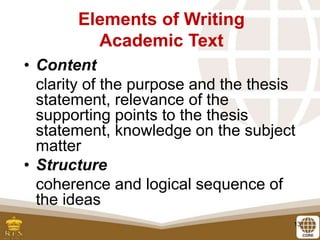
• Content
clarity of the purpose and the thesis
statement, relevance of the
supporting points to the thesis
statement, knowledge on the subject
matter
• Structure
coherence and logical sequence of
the ideas
Elements of Writing
Academic Text
14
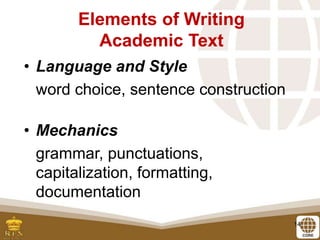
• Language and Style
word choice, sentence construction
• Mechanics
grammar, punctuations,
capitalization, formatting,
documentation
Elements of Writing
Academic Text
15
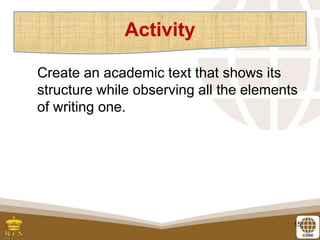
Create an academic text that shows its
structure while observing all the elements
of writing one.
Activity

1_Structure_of_Academic_Texts.ppt

  • 1.
  • 2.
    2 To determine thestructure of a specific academic text Learning Objective
  • 3.
    3 Knowledge on thestructure of a specific academic text Key Understanding  What is the structure of an academic text? Key Questions
  • 4.
  • 5.
    5 Also referred toas story grammar, which addresses the structural elements of the story, setting, characters, goals etc. Recognizing Story Patterns
  • 6.
    Narrative and Informative Narrativetexts help students learn about character, fictional and nonfictional, and his/her experiences. Informative text refers to the organizational format that is found in textbooks.
  • 7.
    7 1. Cause-effect orProblem Solving 2. Compare/Contrast 3. Description or Explanation 4. Connecting 5. Sequencing or Time-order Recognizing Informational Text Structure
  • 8.
    8 Cause-Effect Authors use thistype of text structure to show relationships, organize correlated factors, or show changes in results.
  • 9.
    9 Compare/Contrast Provides a processof identifying how things are alike and different
  • 10.
    10 Describes the mainidea Describes supporting concepts Describes key process Describes important details Description
  • 11.
    11 Connecting text toself helps students explore thinking Connecting text to text helps students extend understanding Connecting text to words helps students expand meaning Connecting
  • 12.
    12  Refers toputting actions or events in a chronological order Sequencing
  • 13.
    13 • Content clarity ofthe purpose and the thesis statement, relevance of the supporting points to the thesis statement, knowledge on the subject matter • Structure coherence and logical sequence of the ideas Elements of Writing Academic Text
  • 14.
    14 • Language andStyle word choice, sentence construction • Mechanics grammar, punctuations, capitalization, formatting, documentation Elements of Writing Academic Text
  • 15.
    15 Create an academictext that shows its structure while observing all the elements of writing one. Activity

Editor's Notes

  • #3 Discuss the learning objective.
  • #4 Tell students that, at the end of the lesson, they need to be able to understand the structure of academic text. Moreover, at the end of the lesson, they should be able to answer the Key Questions. You will go back to the Key Understanding and Key Questions before the lesson ends.
  • #16 Go back to the Key Understanding and Key Questions to measure the student’s knowledge of the lesson. Give this as an activity (or assignment) for the students.