Sinusoidal current 2
DR RIAZ AHMED PT
Definition
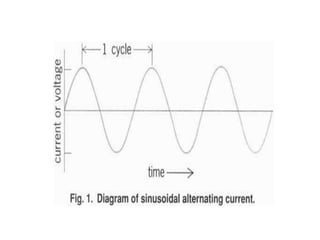
• sinusoidal currents are evenly sine wave
alternating currents with a frequency of
50 Hz.
• The sine wave or sinusoid is a mathematical
curve that describes a smooth repetitive
oscillations.
• It is produced from the mains by reducing the
voltage to 60 to 80 volts with a step down
transformer.
• This gives 100 pulses or phases in each
second, 50 in one direction and 50 in other.
• It is usually surged to cause rhythmical muscle
contractions.
• It relieves pain and reduces edema.
• Because of its marked sensory stimulation
this current is often used over large areas and
rarely used for local muscle stimulation.
Sinusoidal current
• Similar to faradic current
• Alternating current that produces
mechanical contractions that tone the
muscles
• Produce impulses on muscles & force
them to contract;
Advantages
•Supplies greater stimulation,
deeper penetration, & is less
irritating than faradic current
•Soothes the nerves &
penetrates into deeper muscle
tissue
•Is best suited for the nervous
client
EFFECTS OF SINUSOIDAL CURRENT
• STIMULATION:-When it is applied continuously, it
causes a tetanic muscle contraction and tingling
sensation due to stimulation of motor and
sensory nerves.
• It is usually surged to cause a rhythmical muscle
contraction.
• The sensory stimulation help for pain relief by
the mechanism, same as that of TENS and the
rhythmic muscle contraction help in relief of
edema.
EFFECTS OF SINUSOIDAL CURRENT
• Metabolism:-It also helps for enhancing blood
flow and intramuscular metabolism.
• Reduction of edema: The unsurged sinusoidal
current also helps for reduction of edema
inflammatory exudates.
APPLICATION:
• Sinusoidal currents can be applied in the same
way as other low frequency currents by means
of Electrodes and pads.
• This current is applied to large areas due to
marked sensory stimulation.
• It is rarely used for local muscle stimulation.
Indications
• Pain:-For pain control continuous sinusoidal
current is applied at intensity close to patient
tolerance and applied for approx.. 5 min and
repeat if there is insufficient immediate side
effects.
• Edema:-For reduction of edema and to
increase the limb circulation surged sinusoidal
current is suggested; causing rhythmical
muscle pumping action.
Indications
• Used during scalp & facial
manipulations
• Sinusoidal current is rarely used in
modern Physiotherapy.
Contraindications:
• Skin lesions
• Unstable fracture.
• Impaired cognitive ability
• Pregnancy
• Over Carotid sinus
• Cancer.
• Cardiac pacemakers.
• Superficial metals

1st lecture.pdf

  • 1.
  • 2.
    Definition • sinusoidal currentsare evenly sine wave alternating currents with a frequency of 50 Hz. • The sine wave or sinusoid is a mathematical curve that describes a smooth repetitive oscillations.
  • 4.
    • It isproduced from the mains by reducing the voltage to 60 to 80 volts with a step down transformer. • This gives 100 pulses or phases in each second, 50 in one direction and 50 in other. • It is usually surged to cause rhythmical muscle contractions. • It relieves pain and reduces edema. • Because of its marked sensory stimulation this current is often used over large areas and rarely used for local muscle stimulation.
  • 5.
    Sinusoidal current • Similarto faradic current • Alternating current that produces mechanical contractions that tone the muscles • Produce impulses on muscles & force them to contract;
  • 6.
    Advantages •Supplies greater stimulation, deeperpenetration, & is less irritating than faradic current •Soothes the nerves & penetrates into deeper muscle tissue •Is best suited for the nervous client
  • 7.
    EFFECTS OF SINUSOIDALCURRENT • STIMULATION:-When it is applied continuously, it causes a tetanic muscle contraction and tingling sensation due to stimulation of motor and sensory nerves. • It is usually surged to cause a rhythmical muscle contraction. • The sensory stimulation help for pain relief by the mechanism, same as that of TENS and the rhythmic muscle contraction help in relief of edema.
  • 8.
    EFFECTS OF SINUSOIDALCURRENT • Metabolism:-It also helps for enhancing blood flow and intramuscular metabolism. • Reduction of edema: The unsurged sinusoidal current also helps for reduction of edema inflammatory exudates.
  • 9.
    APPLICATION: • Sinusoidal currentscan be applied in the same way as other low frequency currents by means of Electrodes and pads. • This current is applied to large areas due to marked sensory stimulation. • It is rarely used for local muscle stimulation.
  • 10.
    Indications • Pain:-For paincontrol continuous sinusoidal current is applied at intensity close to patient tolerance and applied for approx.. 5 min and repeat if there is insufficient immediate side effects. • Edema:-For reduction of edema and to increase the limb circulation surged sinusoidal current is suggested; causing rhythmical muscle pumping action.
  • 11.
    Indications • Used duringscalp & facial manipulations • Sinusoidal current is rarely used in modern Physiotherapy.
  • 12.
    Contraindications: • Skin lesions •Unstable fracture. • Impaired cognitive ability • Pregnancy • Over Carotid sinus • Cancer. • Cardiac pacemakers. • Superficial metals