TRIGONOMETRY AND
INTRODUCTION TO
STATISTICS
Professor: Ing. Edgar Arturo Orozco Díaz
January – May 2018
eorozco@itesm.mx
Welcome!!
Course Introduction / Policies
• Personal Presentation
• Educational Objectives
• Bibliography
• Grading policies
• Class / disciplinary rules
• Projects / Exams, activities, etc.
Personal Presentation
• Who am I?
– I consider myself a respectful and honest
person, serious in my work but considerate to
those who I care about.
• Date of birth:
– April 17th, 1982
• Hobbies:
– Travelling, swimming, being with my family
and friends, videogames.
Personal Presentation
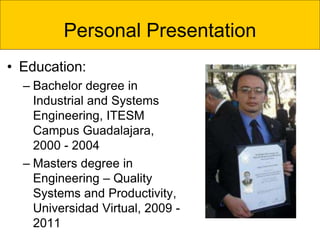
• Education:
– Bachelor degree in
Industrial and Systems
Engineering, ITESM
Campus Guadalajara,
2000 - 2004
– Masters degree in
Engineering – Quality
Systems and Productivity,
Universidad Virtual, 2009 -
2011
• Tutoring time:
– Tuesday - Thursday 2:30 – 3:30 PM
– Place: 3rd floor, building 5.
– Bring class notes.
– NOT a personal class.
– There will be no tutoring one day prior to a
mid-partial or a partial exam.
Educational Objectives
(summary)
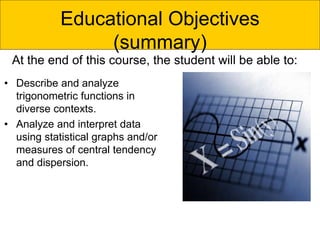
• Describe and analyze
trigonometric functions in
diverse contexts.
• Analyze and interpret data
using statistical graphs and/or
measures of central tendency
and dispersion.
At the end of this course, the student will be able to:
Educational Objectives
• For that:
– Notation and
Mathematical language
– Algebra and Arithmetics
– Analysis and critical
thinking
– Mathematical concepts
Bibliography:
• Textbook:
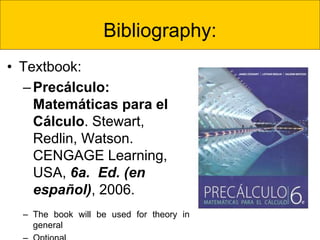
–Precálculo:
Matemáticas para el
Cálculo. Stewart,
Redlin, Watson.
CENGAGE Learning,
USA, 6a. Ed. (en
español), 2006.
– The book will be used for theory in
general
Class material:
• Notebook (exclusively for Math, squared
sheets), for notes and activities.
• Class Workbook (Activities manual)
• Blackboard (http://miscursos.tec.mx)
• Block of millimetric paper, ruler, geometry
set, protractor, compass, scientific
calculator.
Software:
• Geogebra
http://www.geogebra.org
• Desmos:
http://www.desmos.com/calculator
• Excel from MS Office (1st partial)
Support material:
• Dugopolski, M. (2004). Precalculus. Functions and graphs. 2nd
Edition. Addison Wesley. Upper Saddle River, NJ. EU.
• Swokowski, E. and Cole, Jeffery. (2011) Álgebra y
Trigonometría con Geometría Analítica. 13ª edición (en
español). CENGAGE Learning. EUA / México
Internet links:
• Hippocampus: http://www.hippocampus.org
• Wolfram: http://mathworld.wolfram.com
• Khan Academy: http://www.khanacademy.org
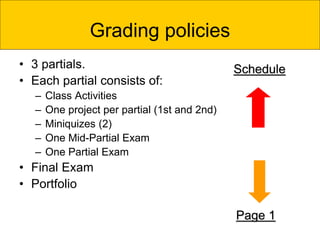
Grading policies
• 3 partials.
• Each partial consists of:
– Class Activities
– One project per partial (1st and 2nd)
– Miniquizes (2)
– One Mid-Partial Exam
– One Partial Exam
• Final Exam
• Portfolio
Schedule
Page 1
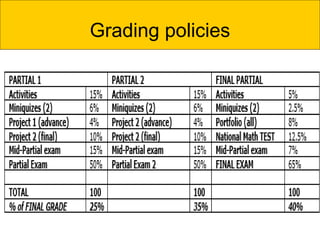
Grading policies
• How will I know if I’m doing
OK?:
– Each activity and exam
counts towards the final
grade.
– Each week the teacher will
update the SIT (mitec) with
the grades.
CLASS RULES (*all rules are in Page 1)
Be careful on the issues:
• Punctuality
• Food / drinks -> Trash / classroom should be clean
• Cellphones / other electronic devices: Not
permitted!
• Talking in class / Attitude in general
• Class material
• Clothing (no caps, sandals, or piercings)
*Discipline through the SEDIS
system
CLASS RULES (*all rules are in Page 1)
What you CAN / MUST DO:
• Bring all material: notebook, class workbook,
scientific calculator (when asked).
• Pay attention to your teacher and / or classmates.
• Ask questions when you do not understand
something.
• Express your opinion on how the course is going.
• Ask for assistance from your teacher.
Class Attitude
The class follows two
fundamental values:
• Respect
• Responsibility
• And following the
CODE OF HONOR of
the Prepa TEC
• All class activities are contained in the Class
Workbook, which you must buy immediately.
• You must bring the Workbook to each class.
• If an activity is not finished in class, you must
finish it on your own.
• Activities will be evaluated when the teacher
specifies.
• Cheating any activity is unacceptable and
cancels the grade.
Class Activities
Partial Project
• Every partial there is a project, done in
teams of 4.
– 1st Partial: Advance (4%) and final (10%)
– 2nd Partial: Advance (4%) and final (10%).
• The projects consist in the investigation
and solution of applications from the topics
seen in the partial.
• A coevaluation will be done among the
team members.
Portfolio
• Every partial, you must upload to Blackboard
some of the assesable activities of the
partial.
• It will include: Projects, miniquizes and
exams.
• You must scan all documents after they are
graded, and make a single PDF with all
documents.
*Any notation and / or simbology mistakes will make you
lose 5% of the grade of the exercise.
If you write only the answer – 0 % of the
evaluation
If you USE the correct procedure – 25% or
50% of the evaluation
If you write a wrong answer with correct
procedures – 75% of the evaluation
To have 100% of the evaluation, you have to
use correct answers with correct procedure.
Evaluation policies
Assistance:
• Every student has the right to two weeks of
absences. One more week is allowed if by the third
partial your average grade is greater than 83.
• There are not justified absences.
Late arrival:
• Not allowed. The teacher will close the door when
the bell rings.
Bathroom breaks:
• Only one at a time, and the student must ask.
Other policies
EXAMS
• Exams are applied on the indicated days.
Miniquizes are based on the activities and
class examples.
• Formularies are not permitted.
• If you miss the day:
– The absence must be justified. If it’s valid, the
grade will be over 100%; if not, over 70%.
• Cellphones are not allowed.
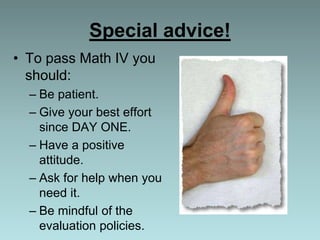
Special advice!
• To pass Math IV you
should:
– Be patient.
– Give your best effort
since DAY ONE.
– Have a positive
attitude.
– Ask for help when you
need it.
– Be mindful of the
evaluation policies.
Next class:
• Bring Class Workbook (Activity 1).
• Start forming teams of 4 members for the
1st Project.
• On Wednesday, the instructions of the 1st
project will be given.

1st daypresem2018

  • 1.
    TRIGONOMETRY AND INTRODUCTION TO STATISTICS Professor:Ing. Edgar Arturo Orozco Díaz January – May 2018 eorozco@itesm.mx Welcome!!
  • 2.
    Course Introduction /Policies • Personal Presentation • Educational Objectives • Bibliography • Grading policies • Class / disciplinary rules • Projects / Exams, activities, etc.
  • 3.
    Personal Presentation • Whoam I? – I consider myself a respectful and honest person, serious in my work but considerate to those who I care about. • Date of birth: – April 17th, 1982 • Hobbies: – Travelling, swimming, being with my family and friends, videogames.
  • 4.
    Personal Presentation • Education: –Bachelor degree in Industrial and Systems Engineering, ITESM Campus Guadalajara, 2000 - 2004 – Masters degree in Engineering – Quality Systems and Productivity, Universidad Virtual, 2009 - 2011
  • 5.
    • Tutoring time: –Tuesday - Thursday 2:30 – 3:30 PM – Place: 3rd floor, building 5. – Bring class notes. – NOT a personal class. – There will be no tutoring one day prior to a mid-partial or a partial exam.
  • 6.
    Educational Objectives (summary) • Describeand analyze trigonometric functions in diverse contexts. • Analyze and interpret data using statistical graphs and/or measures of central tendency and dispersion. At the end of this course, the student will be able to:
  • 7.
    Educational Objectives • Forthat: – Notation and Mathematical language – Algebra and Arithmetics – Analysis and critical thinking – Mathematical concepts
  • 8.
    Bibliography: • Textbook: –Precálculo: Matemáticas parael Cálculo. Stewart, Redlin, Watson. CENGAGE Learning, USA, 6a. Ed. (en español), 2006. – The book will be used for theory in general
  • 9.
    Class material: • Notebook(exclusively for Math, squared sheets), for notes and activities. • Class Workbook (Activities manual) • Blackboard (http://miscursos.tec.mx) • Block of millimetric paper, ruler, geometry set, protractor, compass, scientific calculator.
  • 10.
  • 11.
    Support material: • Dugopolski,M. (2004). Precalculus. Functions and graphs. 2nd Edition. Addison Wesley. Upper Saddle River, NJ. EU. • Swokowski, E. and Cole, Jeffery. (2011) Álgebra y Trigonometría con Geometría Analítica. 13ª edición (en español). CENGAGE Learning. EUA / México Internet links: • Hippocampus: http://www.hippocampus.org • Wolfram: http://mathworld.wolfram.com • Khan Academy: http://www.khanacademy.org
  • 12.
    Grading policies • 3partials. • Each partial consists of: – Class Activities – One project per partial (1st and 2nd) – Miniquizes (2) – One Mid-Partial Exam – One Partial Exam • Final Exam • Portfolio Schedule Page 1
  • 13.
  • 14.
    • How willI know if I’m doing OK?: – Each activity and exam counts towards the final grade. – Each week the teacher will update the SIT (mitec) with the grades.
  • 15.
    CLASS RULES (*allrules are in Page 1) Be careful on the issues: • Punctuality • Food / drinks -> Trash / classroom should be clean • Cellphones / other electronic devices: Not permitted! • Talking in class / Attitude in general • Class material • Clothing (no caps, sandals, or piercings) *Discipline through the SEDIS system
  • 16.
    CLASS RULES (*allrules are in Page 1) What you CAN / MUST DO: • Bring all material: notebook, class workbook, scientific calculator (when asked). • Pay attention to your teacher and / or classmates. • Ask questions when you do not understand something. • Express your opinion on how the course is going. • Ask for assistance from your teacher.
  • 17.
    Class Attitude The classfollows two fundamental values: • Respect • Responsibility • And following the CODE OF HONOR of the Prepa TEC
  • 18.
    • All classactivities are contained in the Class Workbook, which you must buy immediately. • You must bring the Workbook to each class. • If an activity is not finished in class, you must finish it on your own. • Activities will be evaluated when the teacher specifies. • Cheating any activity is unacceptable and cancels the grade. Class Activities
  • 19.
    Partial Project • Everypartial there is a project, done in teams of 4. – 1st Partial: Advance (4%) and final (10%) – 2nd Partial: Advance (4%) and final (10%). • The projects consist in the investigation and solution of applications from the topics seen in the partial. • A coevaluation will be done among the team members.
  • 20.
    Portfolio • Every partial,you must upload to Blackboard some of the assesable activities of the partial. • It will include: Projects, miniquizes and exams. • You must scan all documents after they are graded, and make a single PDF with all documents.
  • 21.
    *Any notation and/ or simbology mistakes will make you lose 5% of the grade of the exercise. If you write only the answer – 0 % of the evaluation If you USE the correct procedure – 25% or 50% of the evaluation If you write a wrong answer with correct procedures – 75% of the evaluation To have 100% of the evaluation, you have to use correct answers with correct procedure. Evaluation policies
  • 22.
    Assistance: • Every studenthas the right to two weeks of absences. One more week is allowed if by the third partial your average grade is greater than 83. • There are not justified absences. Late arrival: • Not allowed. The teacher will close the door when the bell rings. Bathroom breaks: • Only one at a time, and the student must ask. Other policies
  • 23.
    EXAMS • Exams areapplied on the indicated days. Miniquizes are based on the activities and class examples. • Formularies are not permitted. • If you miss the day: – The absence must be justified. If it’s valid, the grade will be over 100%; if not, over 70%. • Cellphones are not allowed.
  • 24.
    Special advice! • Topass Math IV you should: – Be patient. – Give your best effort since DAY ONE. – Have a positive attitude. – Ask for help when you need it. – Be mindful of the evaluation policies.
  • 25.
    Next class: • BringClass Workbook (Activity 1). • Start forming teams of 4 members for the 1st Project. • On Wednesday, the instructions of the 1st project will be given.

Editor's Notes