1
National School Building Inventory 2016
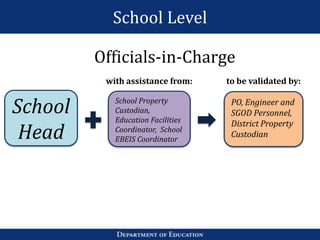
School
Head
Officials-in-Charge
School Property
Custodian,
Education Facilities
Coordinator, School
EBEIS Coordinator
PO, Engineer and
SGOD Personnel,
District Property
Custodian
with assistance from: to be validated by:
School Level
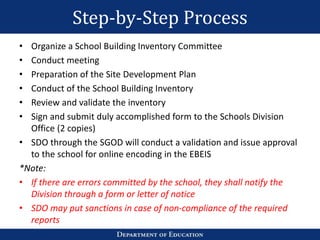
Step-by-Step Process
• Organize a School Building Inventory Committee
• Conduct meeting
• Preparation of the Site Development Plan
• Conduct of the School Building Inventory
• Review and validate the inventory
• Sign and submit duly accomplished form to the Schools Division
Office (2 copies)
• SDO through the SGOD will conduct a validation and issue approval
to the school for online encoding in the EBEIS
*Note:
• If there are errors committed by the school, they shall notify the
Division through a form or letter of notice
• SDO may put sanctions in case of non-compliance of the required
reports
FORMS OVERVIEW
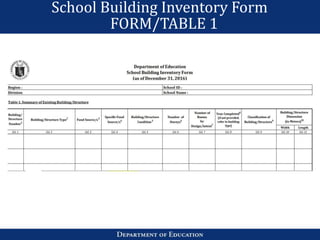
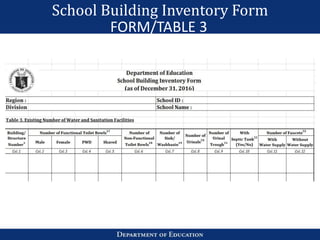
School Building Inventory Form
FORM/TABLE 1
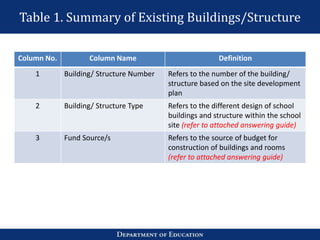
Table 1. Summary of Existing Buildings/Structure
Column No. Column Name Definition
1 Building/ Structure Number Refers to the number of the building/
structure based on the site development
plan
2 Building/ Structure Type Refers to the different design of school
buildings and structure within the school
site (refer to attached answering guide)
3 Fund Source/s Refers to the source of budget for
construction of buildings and rooms
(refer to attached answering guide)
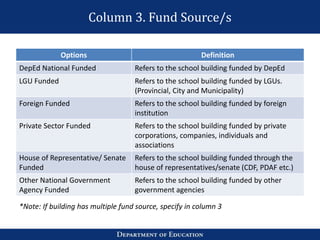
Column 3. Fund Source/s
Options Definition
DepEd National Funded Refers to the school building funded by DepEd
LGU Funded Refers to the school building funded by LGUs.
(Provincial, City and Municipality)
Foreign Funded Refers to the school building funded by foreign
institution
Private Sector Funded Refers to the school building funded by private
corporations, companies, individuals and
associations
House of Representative/ Senate
Funded
Refers to the school building funded through the
house of representatives/senate (CDF, PDAF etc.)
Other National Government
Agency Funded
Refers to the school building funded by other
government agencies
*Note: If building has multiple fund source, specify in column 3
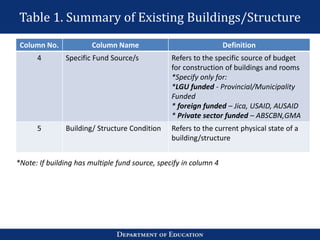
Table 1. Summary of Existing Buildings/Structure
Column No. Column Name Definition
4 Specific Fund Source/s Refers to the specific source of budget
for construction of buildings and rooms
*Specify only for:
*LGU funded - Provincial/Municipality
Funded
* foreign funded – Jica, USAID, AUSAID
* Private sector funded – ABSCBN,GMA
5 Building/ Structure Condition Refers to the current physical state of a
building/structure
*Note: If building has multiple fund source, specify in column 4
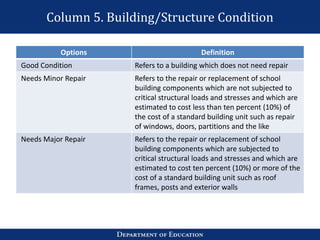
Column 5. Building/Structure Condition
Options Definition
Good Condition Refers to a building which does not need repair
Needs Minor Repair Refers to the repair or replacement of school
building components which are not subjected to
critical structural loads and stresses and which are
estimated to cost less than ten percent (10%) of
the cost of a standard building unit such as repair
of windows, doors, partitions and the like
Needs Major Repair Refers to the repair or replacement of school
building components which are subjected to
critical structural loads and stresses and which are
estimated to cost ten percent (10%) or more of the
cost of a standard building unit such as roof
frames, posts and exterior walls
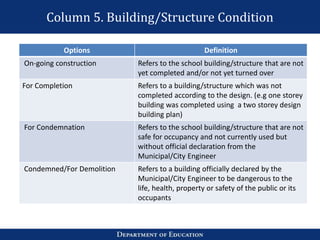
Column 5. Building/Structure Condition
Options Definition
On-going construction Refers to the school building/structure that are not
yet completed and/or not yet turned over
For Completion Refers to a building/structure which was not
completed according to the design. (e.g one storey
building was completed using a two storey design
building plan)
For Condemnation Refers to the school building/structure that are not
safe for occupancy and not currently used but
without official declaration from the
Municipal/City Engineer
Condemned/For Demolition Refers to a building officially declared by the
Municipal/City Engineer to be dangerous to the
life, health, property or safety of the public or its
occupants
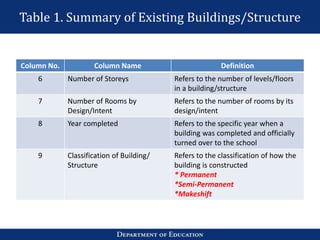
Table 1. Summary of Existing Buildings/Structure
Column No. Column Name Definition
6 Number of Storeys Refers to the number of levels/floors
in a building/structure
7 Number of Rooms by
Design/Intent
Refers to the number of rooms by its
design/intent
8 Year completed Refers to the specific year when a
building was completed and officially
turned over to the school
9 Classification of Building/
Structure
Refers to the classification of how the
building is constructed
* Permanent
*Semi-Permanent
*Makeshift
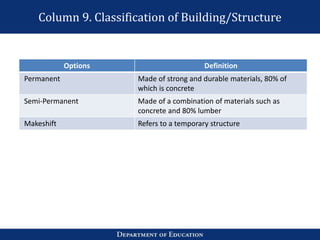
Column 9. Classification of Building/Structure
Options Definition
Permanent Made of strong and durable materials, 80% of
which is concrete
Semi-Permanent Made of a combination of materials such as
concrete and 80% lumber
Makeshift Refers to a temporary structure
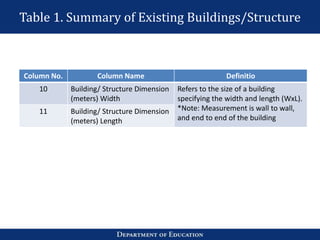
Table 1. Summary of Existing Buildings/Structure
Column No. Column Name Definitio
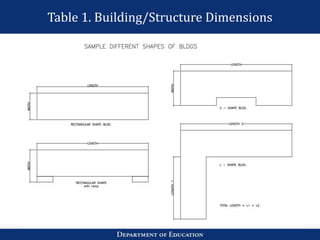
10 Building/ Structure Dimension
(meters) Width
Refers to the size of a building
specifying the width and length (WxL).
*Note: Measurement is wall to wall,
and end to end of the building
11 Building/ Structure Dimension
(meters) Length
Table 1. Building/Structure Dimensions
School Building Inventory Form
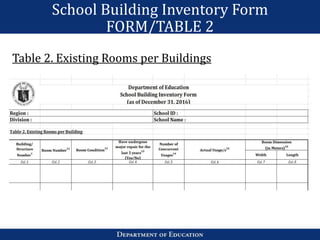
Table 2. Existing Rooms per Buildings
FORM/TABLE 2
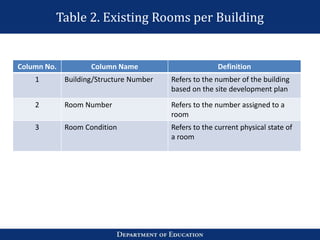
Table 2. Existing Rooms per Building
Column No. Column Name Definition
1 Building/Structure Number Refers to the number of the building
based on the site development plan
2 Room Number Refers to the number assigned to a
room
3 Room Condition Refers to the current physical state of
a room
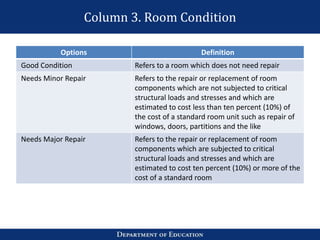
Column 3. Room Condition
Options Definition
Good Condition Refers to a room which does not need repair
Needs Minor Repair Refers to the repair or replacement of room
components which are not subjected to critical
structural loads and stresses and which are
estimated to cost less than ten percent (10%) of
the cost of a standard room unit such as repair of
windows, doors, partitions and the like
Needs Major Repair Refers to the repair or replacement of room
components which are subjected to critical
structural loads and stresses and which are
estimated to cost ten percent (10%) or more of the
cost of a standard room
Table 2. Existing Rooms per Building
Column No. Column Name Definition
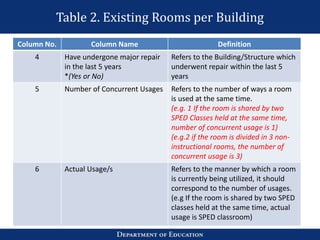
4 Have undergone major repair
in the last 5 years
*(Yes or No)
Refers to the Building/Structure which
underwent repair within the last 5
years
5 Number of Concurrent Usages Refers to the number of ways a room
is used at the same time.
(e.g. 1 If the room is shared by two
SPED Classes held at the same time,
number of concurrent usage is 1)
(e.g.2 if the room is divided in 3 non-
instructional rooms, the number of
concurrent usage is 3)
6 Actual Usage/s Refers to the manner by which a room
is currently being utilized, it should
correspond to the number of usages.
(e.g If the room is shared by two SPED
classes held at the same time, actual
usage is SPED classroom)
Column 6. Actual Usage/s
Options Definition
Good Condition Refers to a room which does not need repair
Needs Minor Repair Refers to the repair or replacement of room
components which are not subjected to critical
structural loads and stresses and which are
estimated to cost less than ten percent (10%) of
the cost of a standard room unit such as repair of
windows, doors, partitions and the like
Needs Major Repair Refers to the repair or replacement of room
components which are subjected to critical
structural loads and stresses and which are
estimated to cost ten percent (10%) or more of the
cost of a standard room
Table 2. Existing Rooms per Building
Column No. Column Name Definition
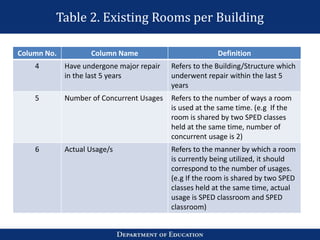
4 Have undergone major repair
in the last 5 years
Refers to the Building/Structure which
underwent repair within the last 5
years
5 Number of Concurrent Usages Refers to the number of ways a room
is used at the same time. (e.g If the
room is shared by two SPED classes
held at the same time, number of
concurrent usage is 2)
6 Actual Usage/s Refers to the manner by which a room
is currently being utilized, it should
correspond to the number of usages.
(e.g If the room is shared by two SPED
classes held at the same time, actual
usage is SPED classroom and SPED
classroom)
Column 6. Actual Usage/s
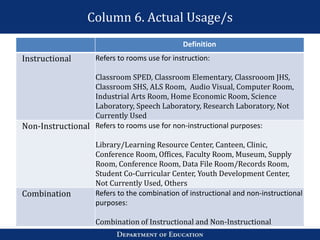
Definition
Instructional Refers to rooms use for instruction:
Classroom SPED, Classroom Elementary, Classrooom JHS,
Classroom SHS, ALS Room, Audio Visual, Computer Room,
Industrial Arts Room, Home Economic Room, Science
Laboratory, Speech Laboratory, Research Laboratory, Not
Currently Used
Non-Instructional Refers to rooms use for non-instructional purposes:
Library/Learning Resource Center, Canteen, Clinic,
Conference Room, Offices, Faculty Room, Museum, Supply
Room, Conference Room, Data File Room/Records Room,
Student Co-Curricular Center, Youth Development Center,
Not Currently Used, Others
Combination Refers to the combination of instructional and non-instructional
purposes:
Combination of Instructional and Non-Instructional
Table 2. Existing Rooms per Building
Column No. Column Name Definition
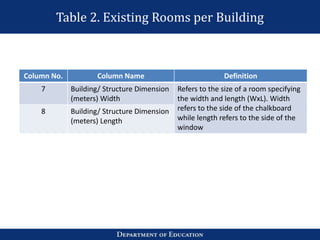
7 Building/ Structure Dimension
(meters) Width
Refers to the size of a room specifying
the width and length (WxL). Width
refers to the side of the chalkboard
while length refers to the side of the
window
8 Building/ Structure Dimension
(meters) Length
School Building Inventory Form
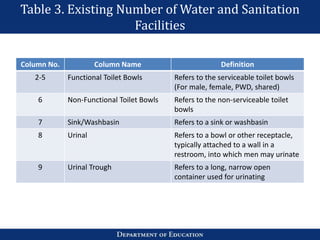
FORM/TABLE 3
Table 3. Existing Number of Water and Sanitation
Facilities
Column No. Column Name Definition
2-5 Functional Toilet Bowls Refers to the serviceable toilet bowls
(For male, female, PWD, shared)
6 Non-Functional Toilet Bowls Refers to the non-serviceable toilet
bowls
7 Sink/Washbasin Refers to a sink or washbasin
8 Urinal Refers to a bowl or other receptacle,
typically attached to a wall in a
restroom, into which men may urinate
9 Urinal Trough Refers to a long, narrow open
container used for urinating
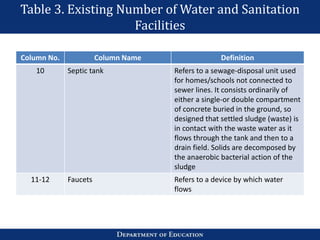
Table 3. Existing Number of Water and Sanitation
Facilities
Column No. Column Name Definition
10 Septic tank Refers to a sewage-disposal unit used
for homes/schools not connected to
sewer lines. It consists ordinarily of
either a single-or double compartment
of concrete buried in the ground, so
designed that settled sludge (waste) is
in contact with the waste water as it
flows through the tank and then to a
drain field. Solids are decomposed by
the anaerobic bacterial action of the
sludge
11-12 Faucets Refers to a device by which water
flows
School Building Inventory Form
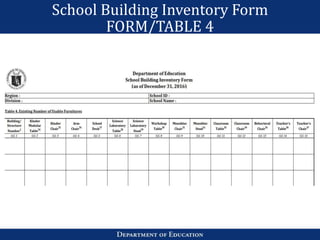
FORM/TABLE 4
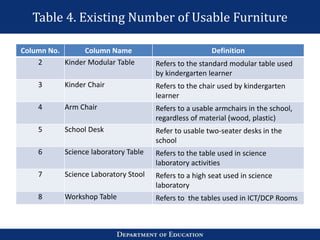
Table 4. Existing Number of Usable Furniture
Column No. Column Name Definition
2 Kinder Modular Table Refers to the standard modular table used
by kindergarten learner
3 Kinder Chair Refers to the chair used by kindergarten
learner
4 Arm Chair Refers to a usable armchairs in the school,
regardless of material (wood, plastic)
5 School Desk Refer to usable two-seater desks in the
school
6 Science laboratory Table Refers to the table used in science
laboratory activities
7 Science Laboratory Stool Refers to a high seat used in science
laboratory
8 Workshop Table Refers to the tables used in ICT/DCP Rooms
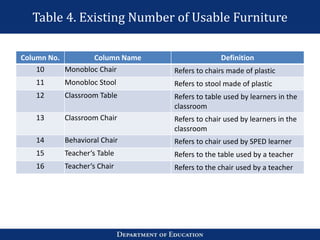
Table 4. Existing Number of Usable Furniture
Column No. Column Name Definition
10 Monobloc Chair Refers to chairs made of plastic
11 Monobloc Stool Refers to stool made of plastic
12 Classroom Table Refers to table used by learners in the
classroom
13 Classroom Chair Refers to chair used by learners in the
classroom
14 Behavioral Chair Refers to chair used by SPED learner
15 Teacher‘s Table Refers to the table used by a teacher
16 Teacher‘s Chair Refers to the chair used by a teacher
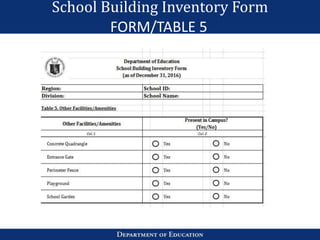
School Building Inventory Form
FORM/TABLE 5
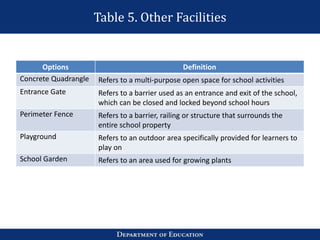
Table 5. Other Facilities
Options Definition
Concrete Quadrangle Refers to a multi-purpose open space for school activities
Entrance Gate Refers to a barrier used as an entrance and exit of the school,
which can be closed and locked beyond school hours
Perimeter Fence Refers to a barrier, railing or structure that surrounds the
entire school property
Playground Refers to an outdoor area specifically provided for learners to
play on
School Garden Refers to an area used for growing plants
Signatories
• Prepared by:
School Property Custodian/School Engineering
Facilities Coordinator
• Certified True and Correct by:
School Head
• Validated by:
Schools Division Office
THANK YOU!

1-NSBI-ELEMENTARPRESENTATION-Jan.24.pptx

  • 1.
  • 2.
    School Head Officials-in-Charge School Property Custodian, Education Facilities Coordinator,School EBEIS Coordinator PO, Engineer and SGOD Personnel, District Property Custodian with assistance from: to be validated by: School Level
  • 3.
    Step-by-Step Process • Organizea School Building Inventory Committee • Conduct meeting • Preparation of the Site Development Plan • Conduct of the School Building Inventory • Review and validate the inventory • Sign and submit duly accomplished form to the Schools Division Office (2 copies) • SDO through the SGOD will conduct a validation and issue approval to the school for online encoding in the EBEIS *Note: • If there are errors committed by the school, they shall notify the Division through a form or letter of notice • SDO may put sanctions in case of non-compliance of the required reports
  • 4.
  • 5.
    School Building InventoryForm FORM/TABLE 1
  • 6.
    Table 1. Summaryof Existing Buildings/Structure Column No. Column Name Definition 1 Building/ Structure Number Refers to the number of the building/ structure based on the site development plan 2 Building/ Structure Type Refers to the different design of school buildings and structure within the school site (refer to attached answering guide) 3 Fund Source/s Refers to the source of budget for construction of buildings and rooms (refer to attached answering guide)
  • 7.
    Column 3. FundSource/s Options Definition DepEd National Funded Refers to the school building funded by DepEd LGU Funded Refers to the school building funded by LGUs. (Provincial, City and Municipality) Foreign Funded Refers to the school building funded by foreign institution Private Sector Funded Refers to the school building funded by private corporations, companies, individuals and associations House of Representative/ Senate Funded Refers to the school building funded through the house of representatives/senate (CDF, PDAF etc.) Other National Government Agency Funded Refers to the school building funded by other government agencies *Note: If building has multiple fund source, specify in column 3
  • 8.
    Table 1. Summaryof Existing Buildings/Structure Column No. Column Name Definition 4 Specific Fund Source/s Refers to the specific source of budget for construction of buildings and rooms *Specify only for: *LGU funded - Provincial/Municipality Funded * foreign funded – Jica, USAID, AUSAID * Private sector funded – ABSCBN,GMA 5 Building/ Structure Condition Refers to the current physical state of a building/structure *Note: If building has multiple fund source, specify in column 4
  • 9.
    Column 5. Building/StructureCondition Options Definition Good Condition Refers to a building which does not need repair Needs Minor Repair Refers to the repair or replacement of school building components which are not subjected to critical structural loads and stresses and which are estimated to cost less than ten percent (10%) of the cost of a standard building unit such as repair of windows, doors, partitions and the like Needs Major Repair Refers to the repair or replacement of school building components which are subjected to critical structural loads and stresses and which are estimated to cost ten percent (10%) or more of the cost of a standard building unit such as roof frames, posts and exterior walls
  • 10.
    Column 5. Building/StructureCondition Options Definition On-going construction Refers to the school building/structure that are not yet completed and/or not yet turned over For Completion Refers to a building/structure which was not completed according to the design. (e.g one storey building was completed using a two storey design building plan) For Condemnation Refers to the school building/structure that are not safe for occupancy and not currently used but without official declaration from the Municipal/City Engineer Condemned/For Demolition Refers to a building officially declared by the Municipal/City Engineer to be dangerous to the life, health, property or safety of the public or its occupants
  • 11.
    Table 1. Summaryof Existing Buildings/Structure Column No. Column Name Definition 6 Number of Storeys Refers to the number of levels/floors in a building/structure 7 Number of Rooms by Design/Intent Refers to the number of rooms by its design/intent 8 Year completed Refers to the specific year when a building was completed and officially turned over to the school 9 Classification of Building/ Structure Refers to the classification of how the building is constructed * Permanent *Semi-Permanent *Makeshift
  • 12.
    Column 9. Classificationof Building/Structure Options Definition Permanent Made of strong and durable materials, 80% of which is concrete Semi-Permanent Made of a combination of materials such as concrete and 80% lumber Makeshift Refers to a temporary structure
  • 13.
    Table 1. Summaryof Existing Buildings/Structure Column No. Column Name Definitio 10 Building/ Structure Dimension (meters) Width Refers to the size of a building specifying the width and length (WxL). *Note: Measurement is wall to wall, and end to end of the building 11 Building/ Structure Dimension (meters) Length
  • 14.
  • 15.
    School Building InventoryForm Table 2. Existing Rooms per Buildings FORM/TABLE 2
  • 16.
    Table 2. ExistingRooms per Building Column No. Column Name Definition 1 Building/Structure Number Refers to the number of the building based on the site development plan 2 Room Number Refers to the number assigned to a room 3 Room Condition Refers to the current physical state of a room
  • 17.
    Column 3. RoomCondition Options Definition Good Condition Refers to a room which does not need repair Needs Minor Repair Refers to the repair or replacement of room components which are not subjected to critical structural loads and stresses and which are estimated to cost less than ten percent (10%) of the cost of a standard room unit such as repair of windows, doors, partitions and the like Needs Major Repair Refers to the repair or replacement of room components which are subjected to critical structural loads and stresses and which are estimated to cost ten percent (10%) or more of the cost of a standard room
  • 18.
    Table 2. ExistingRooms per Building Column No. Column Name Definition 4 Have undergone major repair in the last 5 years *(Yes or No) Refers to the Building/Structure which underwent repair within the last 5 years 5 Number of Concurrent Usages Refers to the number of ways a room is used at the same time. (e.g. 1 If the room is shared by two SPED Classes held at the same time, number of concurrent usage is 1) (e.g.2 if the room is divided in 3 non- instructional rooms, the number of concurrent usage is 3) 6 Actual Usage/s Refers to the manner by which a room is currently being utilized, it should correspond to the number of usages. (e.g If the room is shared by two SPED classes held at the same time, actual usage is SPED classroom)
  • 19.
    Column 6. ActualUsage/s Options Definition Good Condition Refers to a room which does not need repair Needs Minor Repair Refers to the repair or replacement of room components which are not subjected to critical structural loads and stresses and which are estimated to cost less than ten percent (10%) of the cost of a standard room unit such as repair of windows, doors, partitions and the like Needs Major Repair Refers to the repair or replacement of room components which are subjected to critical structural loads and stresses and which are estimated to cost ten percent (10%) or more of the cost of a standard room
  • 20.
    Table 2. ExistingRooms per Building Column No. Column Name Definition 4 Have undergone major repair in the last 5 years Refers to the Building/Structure which underwent repair within the last 5 years 5 Number of Concurrent Usages Refers to the number of ways a room is used at the same time. (e.g If the room is shared by two SPED classes held at the same time, number of concurrent usage is 2) 6 Actual Usage/s Refers to the manner by which a room is currently being utilized, it should correspond to the number of usages. (e.g If the room is shared by two SPED classes held at the same time, actual usage is SPED classroom and SPED classroom)
  • 21.
    Column 6. ActualUsage/s Definition Instructional Refers to rooms use for instruction: Classroom SPED, Classroom Elementary, Classrooom JHS, Classroom SHS, ALS Room, Audio Visual, Computer Room, Industrial Arts Room, Home Economic Room, Science Laboratory, Speech Laboratory, Research Laboratory, Not Currently Used Non-Instructional Refers to rooms use for non-instructional purposes: Library/Learning Resource Center, Canteen, Clinic, Conference Room, Offices, Faculty Room, Museum, Supply Room, Conference Room, Data File Room/Records Room, Student Co-Curricular Center, Youth Development Center, Not Currently Used, Others Combination Refers to the combination of instructional and non-instructional purposes: Combination of Instructional and Non-Instructional
  • 22.
    Table 2. ExistingRooms per Building Column No. Column Name Definition 7 Building/ Structure Dimension (meters) Width Refers to the size of a room specifying the width and length (WxL). Width refers to the side of the chalkboard while length refers to the side of the window 8 Building/ Structure Dimension (meters) Length
  • 23.
    School Building InventoryForm FORM/TABLE 3
  • 24.
    Table 3. ExistingNumber of Water and Sanitation Facilities Column No. Column Name Definition 2-5 Functional Toilet Bowls Refers to the serviceable toilet bowls (For male, female, PWD, shared) 6 Non-Functional Toilet Bowls Refers to the non-serviceable toilet bowls 7 Sink/Washbasin Refers to a sink or washbasin 8 Urinal Refers to a bowl or other receptacle, typically attached to a wall in a restroom, into which men may urinate 9 Urinal Trough Refers to a long, narrow open container used for urinating
  • 25.
    Table 3. ExistingNumber of Water and Sanitation Facilities Column No. Column Name Definition 10 Septic tank Refers to a sewage-disposal unit used for homes/schools not connected to sewer lines. It consists ordinarily of either a single-or double compartment of concrete buried in the ground, so designed that settled sludge (waste) is in contact with the waste water as it flows through the tank and then to a drain field. Solids are decomposed by the anaerobic bacterial action of the sludge 11-12 Faucets Refers to a device by which water flows
  • 26.
    School Building InventoryForm FORM/TABLE 4
  • 27.
    Table 4. ExistingNumber of Usable Furniture Column No. Column Name Definition 2 Kinder Modular Table Refers to the standard modular table used by kindergarten learner 3 Kinder Chair Refers to the chair used by kindergarten learner 4 Arm Chair Refers to a usable armchairs in the school, regardless of material (wood, plastic) 5 School Desk Refer to usable two-seater desks in the school 6 Science laboratory Table Refers to the table used in science laboratory activities 7 Science Laboratory Stool Refers to a high seat used in science laboratory 8 Workshop Table Refers to the tables used in ICT/DCP Rooms
  • 28.
    Table 4. ExistingNumber of Usable Furniture Column No. Column Name Definition 10 Monobloc Chair Refers to chairs made of plastic 11 Monobloc Stool Refers to stool made of plastic 12 Classroom Table Refers to table used by learners in the classroom 13 Classroom Chair Refers to chair used by learners in the classroom 14 Behavioral Chair Refers to chair used by SPED learner 15 Teacher‘s Table Refers to the table used by a teacher 16 Teacher‘s Chair Refers to the chair used by a teacher
  • 29.
    School Building InventoryForm FORM/TABLE 5
  • 30.
    Table 5. OtherFacilities Options Definition Concrete Quadrangle Refers to a multi-purpose open space for school activities Entrance Gate Refers to a barrier used as an entrance and exit of the school, which can be closed and locked beyond school hours Perimeter Fence Refers to a barrier, railing or structure that surrounds the entire school property Playground Refers to an outdoor area specifically provided for learners to play on School Garden Refers to an area used for growing plants
  • 31.
    Signatories • Prepared by: SchoolProperty Custodian/School Engineering Facilities Coordinator • Certified True and Correct by: School Head • Validated by: Schools Division Office
  • 32.

Editor's Notes

  • #16 Building Number refers to a number specifically tagged to a specific building in a school Building Type refers to the design of a school building (e.g. Gabaldon, Marcos Pre-Fab, ESF, TEEP, SEDIP, etc.) Room Dimension refers to the size of a room specifying the width and length (WxL). Width refers to the side of the chalkboard while length refers to the side of the window. Though there are standard room sizes for each school building type, there may have been modifications during construction. The actual constructed room size should be specified. If there are multiple room sizes in one building, indicate the size that occurs in the most number of rooms. Building Condition refers to the current physical state of a building or room. Choices include Good, Needs Minor Repair, Needs Major Repair and Condemned. Number of rooms per floor per school building refers to the total number of rooms located for each floor of a specific building Numbering will start from left to right for all buildings. Funding Source - refers to the source of budget for construction of buildings and rooms
  • #24 Building Number refers to a number specifically tagged to a specific building in a school Building Type refers to the design of a school building (e.g. Gabaldon, Marcos Pre-Fab, ESF, TEEP, SEDIP, etc.) Room Dimension refers to the size of a room specifying the width and length (WxL). Width refers to the side of the chalkboard while length refers to the side of the window. Though there are standard room sizes for each school building type, there may have been modifications during construction. The actual constructed room size should be specified. If there are multiple room sizes in one building, indicate the size that occurs in the most number of rooms. Building Condition refers to the current physical state of a building or room. Choices include Good, Needs Minor Repair, Needs Major Repair and Condemned. Number of rooms per floor per school building refers to the total number of rooms located for each floor of a specific building Numbering will start from left to right for all buildings. Funding Source - refers to the source of budget for construction of buildings and rooms
  • #27 Building Number refers to a number specifically tagged to a specific building in a school Building Type refers to the design of a school building (e.g. Gabaldon, Marcos Pre-Fab, ESF, TEEP, SEDIP, etc.) Room Dimension refers to the size of a room specifying the width and length (WxL). Width refers to the side of the chalkboard while length refers to the side of the window. Though there are standard room sizes for each school building type, there may have been modifications during construction. The actual constructed room size should be specified. If there are multiple room sizes in one building, indicate the size that occurs in the most number of rooms. Building Condition refers to the current physical state of a building or room. Choices include Good, Needs Minor Repair, Needs Major Repair and Condemned. Number of rooms per floor per school building refers to the total number of rooms located for each floor of a specific building Numbering will start from left to right for all buildings. Funding Source - refers to the source of budget for construction of buildings and rooms
  • #30 Building Number refers to a number specifically tagged to a specific building in a school Room Number refers to a number specifically tagged to a specific room in a specific building Different from total number of rooms per floor in Table 1. The room numbers must always start with 1 in each building and the count continues up to the last room in the last floor of the same building. Actual usage refers to the manner by which a room is currently being utilized One room may have multiple usage (choose all applicable uses)