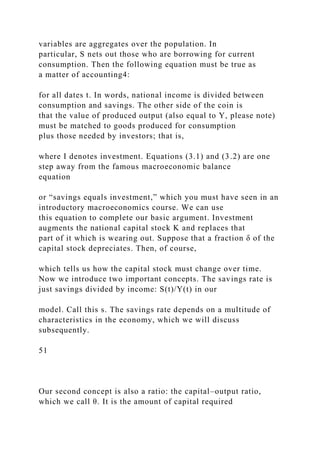
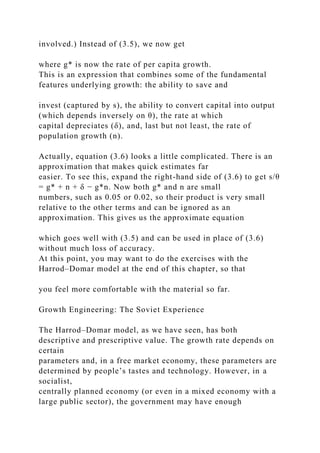
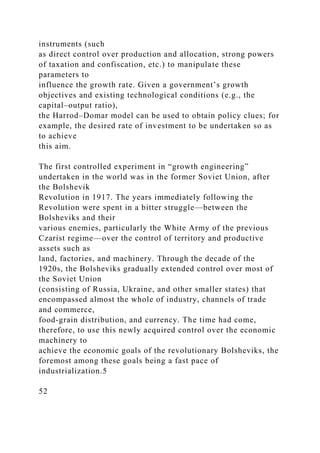
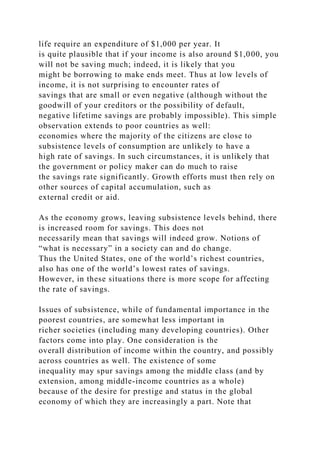
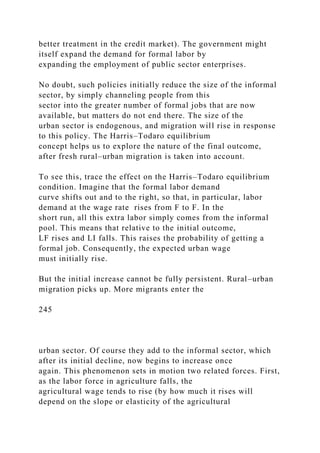
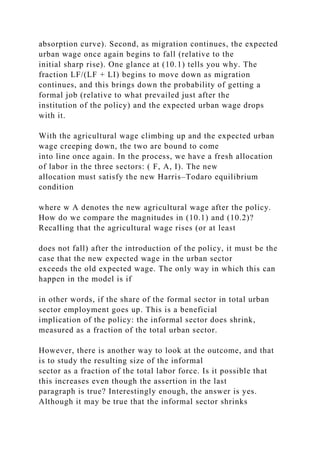
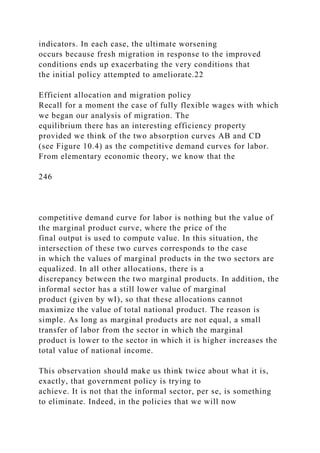
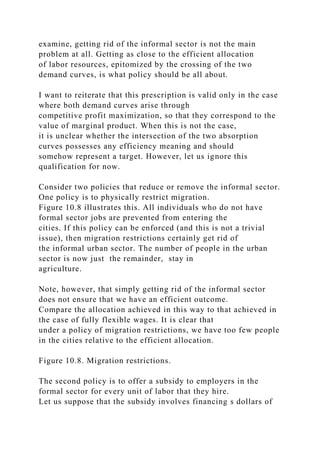
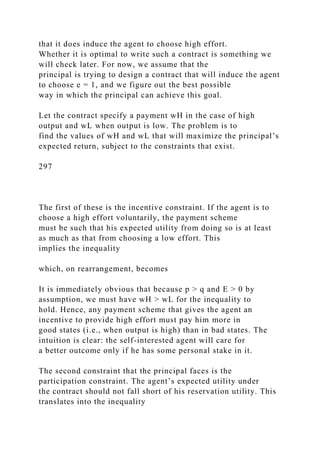
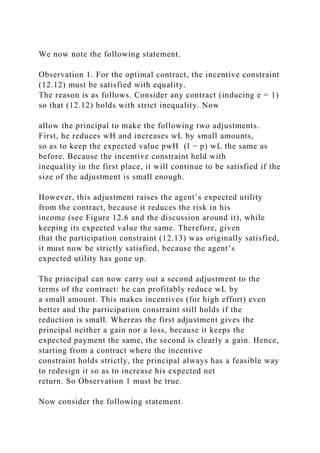
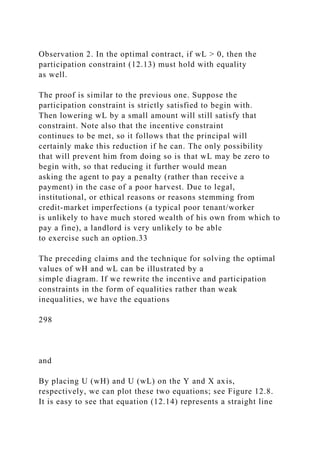
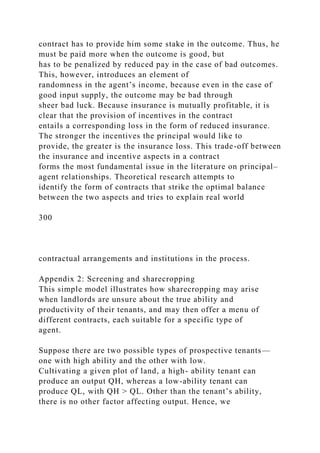
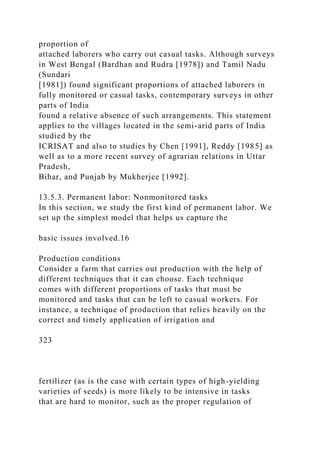
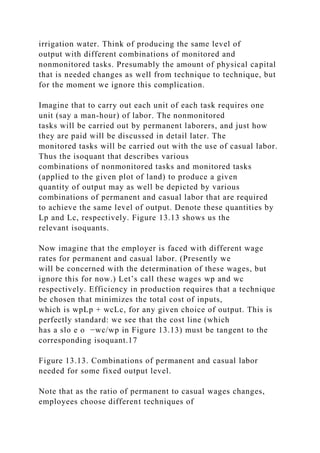
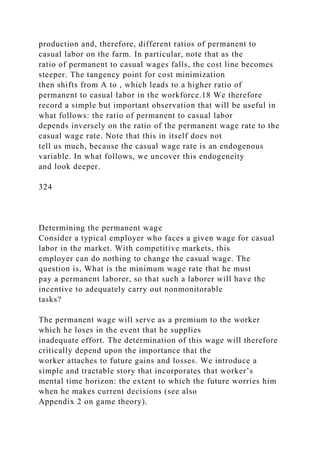
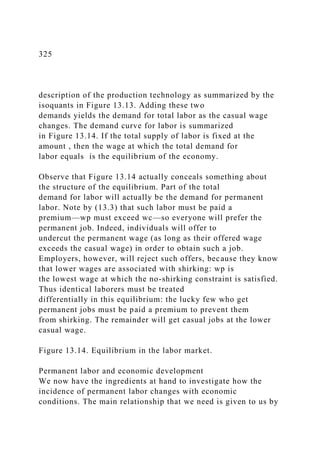
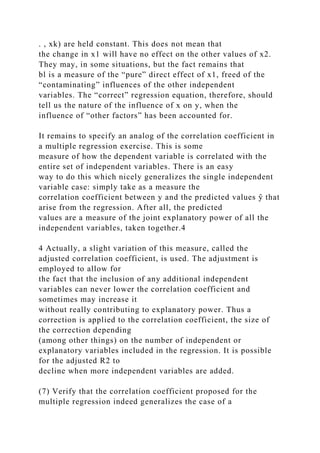
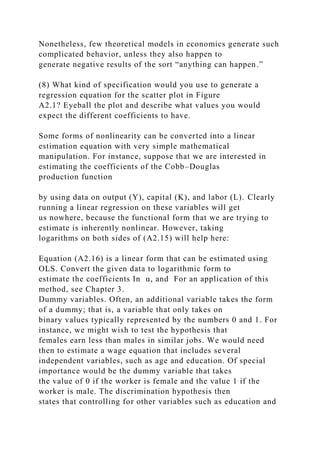
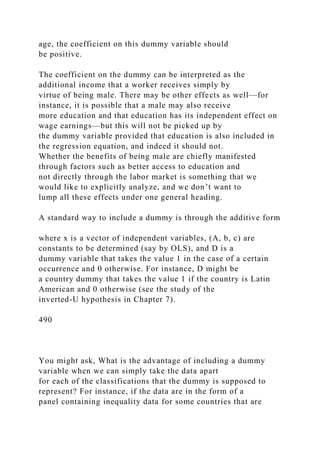
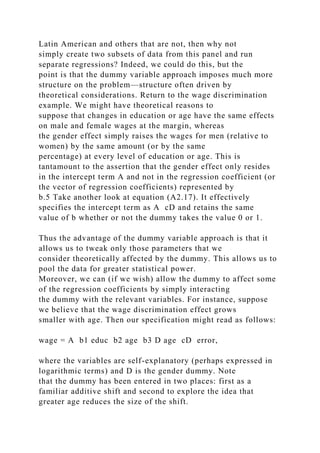
1
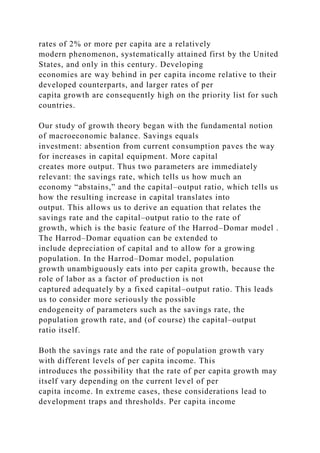
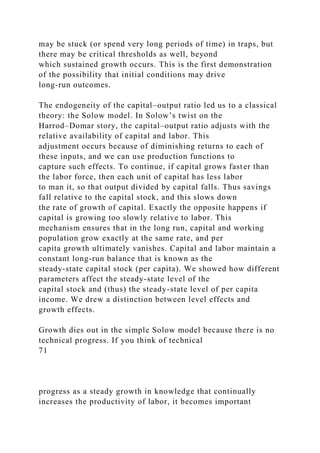
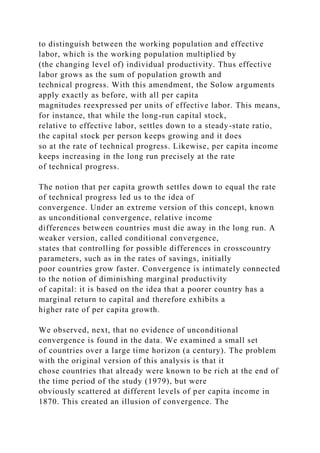
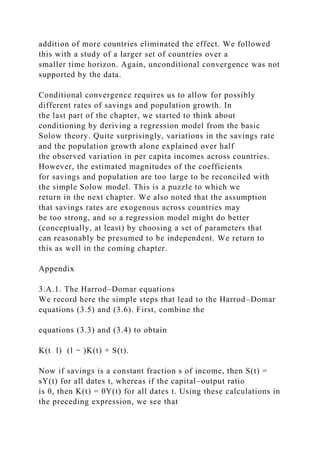
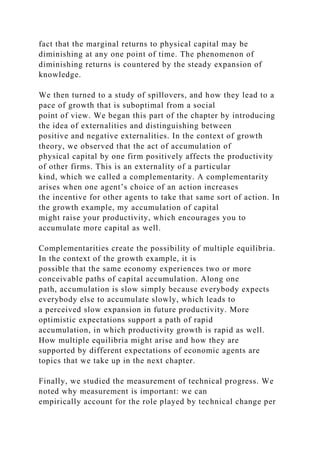
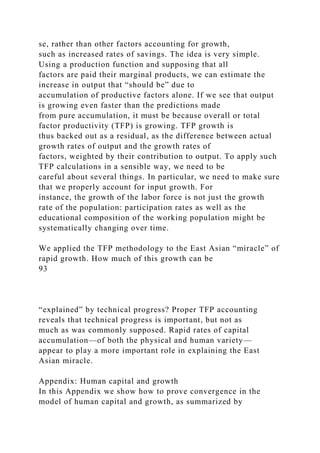
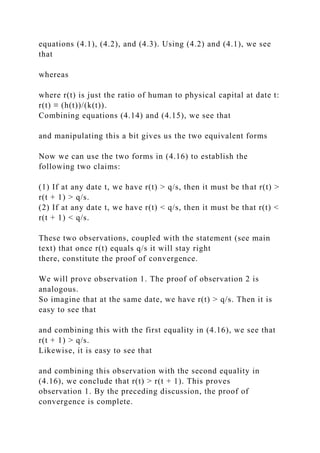
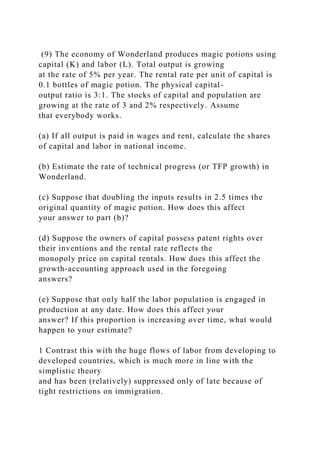
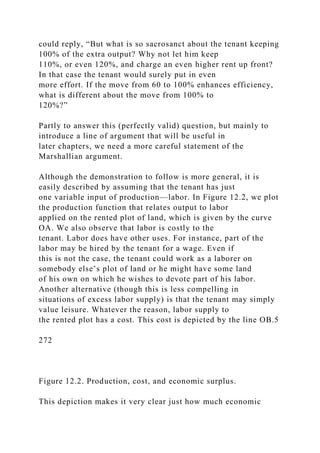
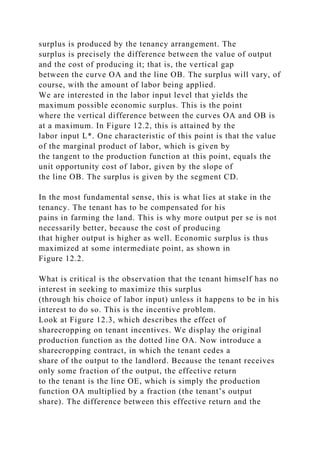
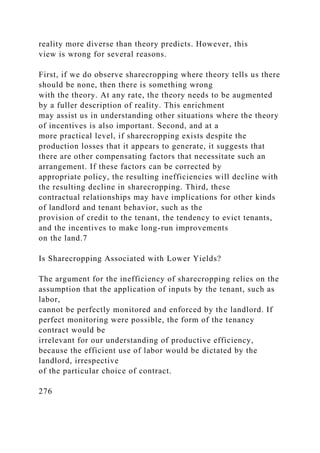
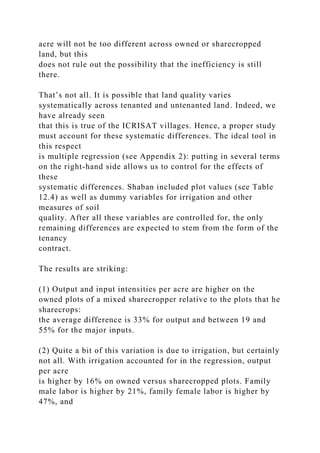
D
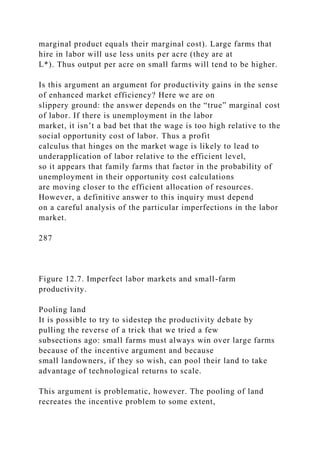
ev
el
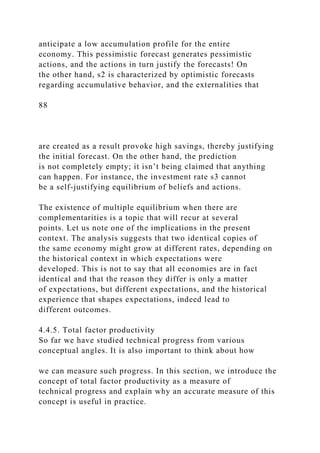
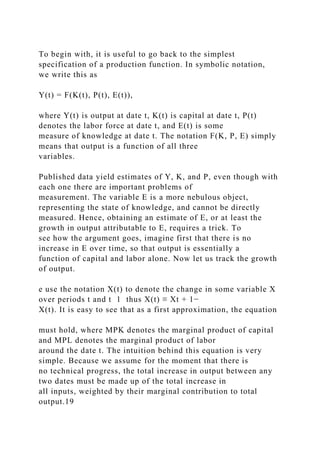
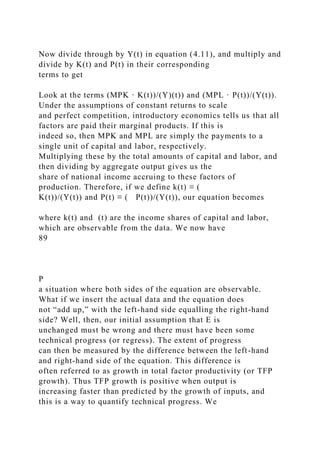
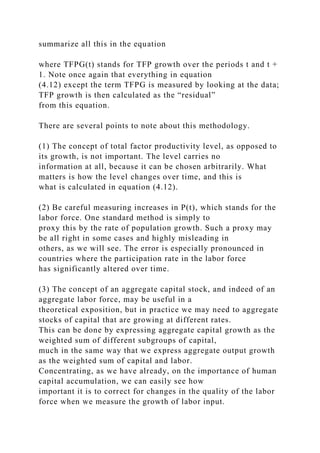
op
m
en
t E
co
no
m
ic
s
2
Development Economics
Debraj Ray
3
Copyright © 1998 by Princeton University Press
Published by Princeton University Press, 41 William Street,
Princeton, New Jersey 08540
In the United Kingdom: Princeton University Press, Chichester,
West Sussex
All rights reserved
Library of Congress Cataloging-in-Publication Data
Ray, Debraj.
Development economics / Debraj Ray.
p. cm.
Includes bibliographical references and index.
ISBN 0-691-01706-9 (cl : alk. paper)
1. Development economics. I. Title.

HD75.R39 1998
338.9--dc21 97-33459
This book has been composed in Palatino
Princeton University Press books are printed on acid-free paper
and meet the guidelines for permanence and durability of the
Committee on
Production Guidelines for Book Longevity of the Council on
Library Resources
http://pup.princeton.edu
Printed in the United States of America
10 9 8 7
ISBN-13: 978-0-691-01706-8 (cloth)
4
http://pup.princeton.edu/
For my parents, Radha and Kalyan
5
Contents
Preface
Chapter 1: Introduction
Chapter 2: Economic Development: Overview
2.1. Introduction
2.2. Income and growth
2.2.1. Measurement issues
2.2.2. Historical experience
2.3. Income distribution in developing countries
2.4. The many faces of underdevelopment
2.4.1. Human development
2.4.2. An index of human development
2.4.3. Per capita income and human development
2.5. Some structural features
2.5.1. Demographic characteristics
2.5.2. Occupational and production structure
2.5.3. Rapid rural–urban migration
2.5.4. International trade
2.6. Summary
Exercises
Chapter 3: Economic Growth
3.1. Introduction
3.2. Modern economic growth: Basic features
3.3. Theories of economic growth
3.3.1. The Harrod–Domar model
3.3.2. Beyond Harrod–Domar: Other considerations
3.3.3. The Solow model
3.4. Technical progress
3.5. Convergence?
3.5.1. Introduction
3.5.2. Unconditional convergence
3.5.3. Unconditional convergence: Evidence or lack thereof
3.5.4. Unconditional convergence: A summary
3.5.5. Conditional convergence
6
3.5.6. Reexamining the data
3.6. Summary
Appendix
3.A.1. The Harrod–Domar equations
3.A.2. Production functions and per capita magnitudes
Exercises
Chapter 4: The New Growth Theories
4.1. Introduction
4.2. Human capital and growth
4.3. Another look at conditional convergence
4.4. Technical progress again
4.4.1. Introduction
4.4.2. Technological progress and human decisions
4.4.3. A model of deliberate technical progress
4.4.4. Externalities, technical progress, and growth
4.4.5. Total factor productivity
4.5. Total factor productivity and the East Asian miracle
4.6. Summary
Appendix: Human capital and growth
Exercises
Chapter 5: History, Expectations, and Development
5.1. Introduction
5.2. Complementarities
5.2.1. Introduction: QWERTY
5.2.2. Coordination failure
5.2.3. Linkages and policy
5.2.4. History versus expectations
5.3. Increasing returns
5.3.1. Introduction
5.3.2. Increasing returns and entry into markets
5.3.3. Increasing returns and market size: Interaction
5.4. Competition, multiplicity, and international trade
5.5. Other roles for history
5.5.1. Social norms
5.5.2. The status quo
5.6. Summary
Exercises
Chapter 6: Economic Inequality
6.1. Introduction
6.2. What is economic inequality?
6.2.1. The context
7
6.2.2. Economic inequality: Preliminary observations
6.3. Measuring economic inequality
6.3.1. Introduction
6.3.2. Four criteria for inequality measurement
6.3.3. The Lorenz curve
6.3.4. Complete measures of inequality
6.4. Summary
Exercises
Chapter 7: Inequality and Development: Interconnections
7.1. Introduction
7.2. Inequality, income, and growth
7.2.1. The inverted-U hypothesis
7.2.2. Testing the inverted-U hypothesis
7.2.3. Income and inequality: Uneven and compensatory
changes
7.2.4. Inequality, savings, income, and growth
7.2.5. Inequality, political redistribution, and growth
7.2.6. Inequality and growth: Evidence
7.2.7. Inequality and demand composition
7.2.8. Inequality, capital markets, and development
7.2.9. Inequality and development: Human capital
7.3. Summary
Appendix: Multiple steady states with imperfect capital markets
Exercises
Chapter 8: Poverty and Undernutrition
8.1. Introduction
8.2. Poverty: First principles
8.2.1. Conceptual issues
8.2.2. Poverty measures
8.3. Poverty: Empirical observations
8.3.1. Demographic features
8.3.2. Rural and urban poverty
8.3.3. Assets
8.3.4. Nutrition
8.4. The functional impact of poverty
8.4.1. Poverty, credit, and insurance
8.4.2. Poverty, nutrition, and labor markets
8.4.3. Poverty and the household
8.5. Summary
Appendix: More on poverty measures
Exercises
Chapter 9: Population Growth and Economic Development
9.1. Introduction
8
9.2. Population: Some basic concepts
9.2.1. Birth and death rates
9.2.2. Age distributions
9.3. From economic development to population growth
9.3.1. The demographic transition
9.3.2. Historical trends in developed and developing countries
9.3.3. The adjustment of birth rates
9.3.4. Is fertility too high?
9.4. From population growth to economic development
9.4.1. Some negative effects
9.4.2. Some positive effects
9.5. Summary
Exercises
Chapter 10: Rural and Urban
10.1. Overview
10.1.1. The structural viewpoint
10.1.2. Formal and informal urban sectors
10.1.3. Agriculture
10.1.4. The ICRISAT villages
10.2. Rural–urban interaction
10.2.1. Two fundamental resource flows
10.2.2. The Lewis model
10.3. Rural–urban migration
10.3.1. Introduction
10.3.2. The basic model
10.3.3. Floors on formal wages and the Harris–Todaro
equilibrium
10.3.4. Government policy
10.3.5. Comments and extensions
10.4. Summary
Exercises
Chapter 11: Markets in Agriculture: An Introduction
11.1. Introduction
11.2. Some examples
11.3. Land, labor, capital, and credit
11.3.1. Land and labor
11.3.2. Capital and credit
Chapter 12: Land
12.1. Introduction
12.2. Ownership and tenancy
12.3. Land rental contracts
12.3.1. Contractual forms
9
12.3.2. Contracts and incentives
12.3.3. Risk, tenancy, and sharecropping
12.3.4. Forms of tenancy: Other considerations
12.3.5. Land contracts, eviction, and use rights
12.4. Land ownership
12.4.1. A brief history of land inequality
12.4.2. Land size and productivity: Concepts
12.4.3. Land size and productivity: Empirical evidence
12.4.4. Land sales
12.4.5. Land reform
12.5. Summary
Appendix 1: Principal–agent theory and applications
12.A.1. Risk, moral hazard, and the agency problem
12.A.2. Tenancy contracts revisited
Appendix 2: Screening and sharecropping
Exercises
Chapter 13: Labor
13.1. Introduction
13.2. Labor categories
13.3. A familiar model
13.4. Poverty nutrition, and labor markets
13.4.1. The basic model
13.4.2. Nutrition, time, and casual labor markets
13.4.3. A model of nutritional status
13.5. Permanent labor markets
13.5.1. Types of permanent labor
13.5.2. Why study permanent labor?
13.5.3. Permanent labor: Nonmonitored tasks
13.5.4. Permanent labor: Casual tasks
13.6. Summary
Exercises
Chapter 14: Credit
14.1. Introduction
14.1.1. The limits to credit and insurance
14.1.2. Sources of demand for credit
14.2. Rural credit markets
14.2.1. Who provides rural credit?
14.2.2. Some characteristics of rural credit markets
14.3. Theories of informal credit markets
14.3.1. Lender’s monopoly
14.3.2. The lender’s risk hypothesis
14.3.3. Default and fixed-capital loans
14.3.4. Default and collateral
10
14.3.5. Default and credit rationing
14.3.6. Informational asymmetries and credit rationing
14.3.7. Default and enforcement
14.4. Interlinked transactions
14.4.1. Hidden interest
14.4.2. Interlinkages and information
14.4.3. Interlinkages and enforcement
14.4.4. Interlinkages and creation of efficient surplus
14.5. Alternative credit policies
14.5.1. Vertical formal–informal links
14.5.2. Microfinance
14.6. Summary
Exercises
Chapter 15: Insurance
15.1. Basic concepts
15.2. The perfect insurance model
15.2.1. Theory
15.2.2. Testing the theory
15.3. Limits to insurance: Information
15.3.1. Limited information about the final outcome
15.3.2. Limited information about what led to the outcome
15.4. Limits to insurance: Enforcement
15.4.1. Enforcement-based limits to perfect insurance
15.4.2. Enforcement and imperfect insurance
15.5. Summary
Exercises
Chapter 16: International Trade
16.1. World trading patterns
16.2. Comparative advantage
16.3. Sources of comparative advantage
16.3.1. Technology
16.3.2. Factor endowments
16.3.3. Preferences
16.3.4. Economies of scale
16.4. Summary
Exercises
Chapter 17: Trade Policy
17.1. Gains from trade?
17.1.1. Overall gains and distributive effects
17.1.2. Overall losses from trade?
17.2. Trade policy: Import substitution
11
17.2.1. Basic concepts
17.2.2. More detail
17.3. Export promotion
17.3.1. Basic concepts
17.3.2. Effect on the exchange rate
17.3.3. The instruments of export promotion: More detail
17.4. The move away from import substitution
17.4.1. Introduction
17.4.2. The eighties crisis
17.4.3. Structural adjustment
17.5. Summary
Appendix: The International Monetary Fund and the World
Bank
Exercises
Chapter 18: Multilateral Approaches to Trade Policy
18.1. Introduction
18.2. Restricted trade
18.2.1. Second-best arguments for protection
18.2.2. Protectionist tendencies
18.2.3. Explaining protectionist tendencies
18.3. Issues in trade liberalization
18.3.1. Introduction
18.3.2. Regional agreements: Basic theory
18.3.3. Regional agreements among dissimilar countries
18.3.4. Regional agreements among similar countries
18.3.5. Multilateralism and regionalism
18.4. Summary
Exercises
Appendix 1: Elementary Game Theory
A1.1. Introduction
A1.2. Basic concepts
A1.3. Nash equilibrium
A1.4. Games over time
Appendix 2: Elementary Statistical Methods
A2.1. Introduction
A2.2. Summary statistics
A2.3. Regression
References
Author Index
12
Subject Index
13
Preface
This book provides an introduction to development economics,
a subject that studies the economic transformation of
developing countries. My objective is to make a large literature
accessible, in a unified way, to a student or
interested individual who has some training in basic economic
theory. It is only fair to say that I am not fully
satisfied with the final product: in attempting to provide a well-
structured treatment of the subject, I have had to
sacrifice comprehensiveness. Nevertheless, I do believe that the
book goes quite far in attaining the original
objective, within the limitations created by an enormous and
unwieldy literature and the constraints imposed by my
own knowledge and understanding.
The primary target for this book is the senior undergraduate or
masters level student with training in
introductory or intermediate economic theory. I also recommend
this book as background or supplementary reading
for a doctoral course in development economics, along with the
original articles on the subject.
Mathematical requirements are kept to a minimum, although
some degree of mathematical maturity will assist
understanding of the material. In particular, I have eschewed the
use of calculus altogether and have attempted to
present theoretical material through verbal argument, diagrams,
and occasionally elementary algebra. Because the
book makes some use of game-theoretic and statistical concepts,
I have included two introductory appendixes on
these subjects. With these appendixes in place, the book is self-
contained except for occasional demands on the
reader’s knowledge of introductory economic theory.
I begin with an overview of developing countries (Chapter 2). I
discuss major trends in per capita income,
inequality, poverty, and population, and take a first look at the
important structural characteristics of development.
Chapters 3–5 take up the study of economic growth from several
aspects.
Chapters 6–8 shift the focus to an analysis of unevenness in
develepment: the possibility that the benefits of
growth may not accrue equally to all. In turn, these inequalities
may influence aggregate trends. This interaction is
studied from many angles. Chapter 9 extends this discussion to
population growth, where the relationship between
demography and economics is explored in some detail.
Chapter 10 studies unevenness from the viewpoint of structural
transformation: the fact that development
typically involves the ongoing transfer of resources from one
sector (typically agriculture) to another (typically
industry and services). This chapter motivates a careful study of
the agricultural sector, where a significant fraction
of the citizens of developing countries, particularly the poor,
live and work.
Chapters 11–15 study informal markets in detail, with particular
emphasis on the rural sector. We analyze the
land, labor, credit and insurance markets.
Chapter 16 introduces the study of trade and development.
Chapter 17 motivates and studies the instruments of
trade policy from the point of view of a single country. Finally,
Chapter 18 studies multilateral and regional policies
in trade.
For programs that offer a single semester course in economic
development, two options are available: (1) if
international economic issues can be relegated to a separate
course, cover all the material up to the end of Chapter
15 (this will require some skimming of chapters, such as
Chapters 4–6 and 11–15); (2) if it is desirable to cover
international issues in the same course, omit much or most of
the material in Chapters 11–15. A year-long course
should be able to adequately cover the book, but some
supplementary material may be required for international
economics, as well as financial issues in development, such as
inflation and monetary policy.
This book could not have been written without my students and
the many classes I have taught in development
economics over the years: I thank students at Boston University,
at the Indian Statistical Institute, at the People’s
University of China in Beijing, at Stanford, and at Harvard. I
would also like to thank the many people who have
read and commented on earlier drafts of this book and have used
them in courses they have taught, among them
Jean-Marie Baland, Abhijit Banerjee, V. Bhaskar, Gautam Bose,
Ira Gang, James Foster, Patrick Francois, Gabriel
Fuentes, Bishnupriya Gupta, Ashok Kotwal, Dilip Mookherjee,
Jonathan Morduch, James Robinson, Ann
Velenchik, Bruce Wydick, and Frederic Zimmerman.
14
Several people have made contributions to this text. Chief
among them is Parikshit Ghosh, my intrepid and
thoroughly uncontrollable research assistant, whose
contributions to this book are too numerous to mention. I would
also like to thank Eli Berman, Gary Fields, Hsueh-Ling Huynh,
Chiente Hsu, Luis-Felipe López-Calva, Anandi
Mani, Ghazala Mansuri, Jonathan Morduch, and Hiranya
Mukhopadhyay for input at various stages.
Much of this book was written while I was Director of the
Institute for Economic Development at Boston
University. I thank Margaret Chapman, Administrative Assistant
to the Institute, for covering for my many
administrative lapses during this period. I thank the Instituto de
Análisis Económico (CSIC) in Barcelona, where
this book was completed, and the Ministerio de Educación,
Government of Spain for financial support during my
stay. I am very grateful to Peter Dougherty, my publisher at
Princeton University Press, for his help and
encouragement.
I would like to record my deep appreciation to a (smaller) set of
people who have shaped the way I think about
economics: Kenneth Arrow, Doug Bernheim, Bhaskar Dutta,
Joan Esteban, Mukul Majumdar, Tapan Mitra, Dilip
Mookherjee, Kunal Sengupta, Amartya Sen, and Rajiv Vohra.
I thank Monica Das Gupta for innumerable discussions, and
words of advice and encouragement.
Finally, I owe gratitude to Angela Bhaya Soares who always
wanted me to write a magnum opus but will have
to be content with what she gets, to Bissera Antikarova and
Farahanaaz Dastur for seeing me safely through bad
times, to Nilita Vachani for creating unforeseen but happy
delays, and to Jackie Bhaya for getting me started on it
all.
Debraj Ray
Boston University
September 1997
15
Development Economics
16
Chapter 1
Introduction
I invite you to study what is surely the most important and
perhaps the most complex of all economic issues: the
economic transformation of those countries known as the
developing world. A definition of “developing countries”
is problematic and, after a point, irrelevant.1 The World
Development Report (World Bank [1996]) employs a
threshold of $9,000 per capita to distinguish between what it
calls high-income countries and low- and middle-
income countries: according to this classification, well over 4.5
billion of the 5.6 billion people in the world today
live in the developing world of “low- and middle-income
countries.” They earn, on average, around $1,000 per
capita, a figure that is worth contrasting with the yearly
earnings of the average North American or Japanese
resident, which are well above $25,000. Despite the many
caveats and qualifications that we later add to these
numbers, the ubiquitous fact of these astonishing disparities
remains.
There is economic inequality throughout the world, but much of
that is, we hope, changing. This book puts
together a way of thinking about both the disparities and the
changes.
There are two strands of thought that run through this text.
First, I move away from (although do not entirely
abandon) a long-held view that the problems of all developing
countries can be understood best with reference to
the international environment of which they are a part.2
According to this view, the problems of underdevelopment
must first and foremost be seen in a global context. There is
much that is valid in this viewpoint, but I wish to
emphasize equally fundamental issues that are internal to the
structure of developing countries. Although a sizeable
section of this book addresses international aspects of
development, the teacher or reader who wishes to concentrate
exclusively on these aspects will not find a comprehensive
treatment here.
The second strand is methodological: as far as possible, I take a
unified approach to the problems of
development and emphasize a recent and growing literature that
takes a level-headed approach to market failure
and the potential for government intervention. It is not that
markets are intrinsically bad or intrinsically good: the
point is to understand the conditions under which they fail or
function at an inefficient level and to determine if
appropriate policies grounded in an understanding of these
conditions can fix such inefficiencies. These conditions,
I argue, can be understood best by a serious appreciation of
subjects that are at the forefront of economic theory but
need to permeate more thoroughly into introductory textbooks:
theories of incomplete information, of incentives,
and of strategic behavior. Few people would disagree that these
considerations lie at the heart of many observed
phenomena. However, my goal is to promote a student’s
understanding of such issues as a commonplace model, not
as a set of exceptions to the usual textbook paradigm of perfect
competition and full information.
Because I take these two strands to heart, my book differs from
other textbooks on development in a number of
respects. Most of these differences stem from my approach to
exposition and choice of subject matter. Although I
do not neglect the historical development of a line of research
or inquiry, I bring to bear a completely modern
analytical perspective on the subject. Here are some instances
of what I mean.
(1) The story of economic underdevelopment is, in many ways,
a story of how informal, imaginative institutions
replace the formal constructs we are accustomed to in
industrialized economies. The landlord lends to his tenant
farmer, accepting labor as collateral, but a formal credit market
is missing. Villagers insure each other against
idiosyncratic shocks using their greater information and their
ability to impose social sanctions, but a formal
insurance market is missing. Institutions as diverse as tied
labor, credit cooperatives, and extended families can be
seen as responses to market failure of some sort, precipitated in
most cases by missing information or by the
inability of the legal system to swiftly and efficiently enforce
contracts. This common thread in our understanding is
emphasized and reemphasized throughout the book.
(2) The absence or underfunctioning of markets gives rise to
two other features. One is the creation of
widespread externalities. Proper classification of these
externalities provides much insight into a variety of
economic phenomena, which appear unconnected at first, but
which (in this sense) are just the common expression
of a small variety of external effects. So it is that simple
concepts from game theory, such as the Prisoners’
Dilemma or the coordination game, yield insights into a diverse
class of development-related problems. Again, the
common features of the various problems yield a mental
classification system—a way of seeing that different
17
phenomena stem from a unified source.
(3) A fundamental implication of missing markets is that
inequality in the distribution of income or wealth plays
a central role in many development problems. It isn’t that
inequality has not received attention in treatises on
development; it certainly has. However, what has recently
begun to receive systematic analytical treatment is the
functional role of inequality: the possibility that inequality,
quite apart from being of interest in its own right, has
implications for other yardsticks of economic performance such
as the level of per capita income and its rate of
growth. The emphasis on the functional role of inequality runs
through the book.
(4) It is necessary to try to integrate, in an intuitive and not
very abstract way, recent theoretical and empirical
literature with the more standard material. This isn’t done to be
fashionable. I do this because I believe that much of
this new work has new things to teach us. Some important
models of economic growth, of income distribution and
development, of coordination failures, or of incomplete
information are theories that have been developed over the
last decade. Work on these models continues apace. Although
some of the techniques are inaccessible to a student
with little formal training, I do believe that all the ideas in this
literature that are worth teaching (and there are
many) can be taught in an elementary way. In this sense this
book coincides with existing texts on the subject: the
use of mathematics is kept to a minimum (there is no calculus
except in an occasional footnote).
Partly because other development texts have been around for a
good while, and perhaps in part because of a
different approach, this text departs significantly from existing
development texts in the points cited in the
preceding text and indeed in its overall methodological
approach.
Combining the complementary notions of incomplete
information, a weak legal structure (so far as
implementation goes), and the resulting strategic and economic
considerations that emerge, we begin to have some
idea of what it is that makes developing countries somehow
“different.” Economic theorists never tire of needling
their friends with questions in this regard. Why is the study of
developing countries a separate subject? Why can’t
we just break it up into separate special cases of labor
economics, international trade, money, and finance, and so
on? Certainly, they have a point, but that’s only one way to cut
the cake. Another way to do so is to recognize that
developing countries, in their different spheres of activity,
display again and again these common failures of
information and legal structures, and therefore generate
common incentive and strategic issues that might benefit
from separate, concentrated scrutiny.
This approach also serves, I feel, as an answer to a different
kind of objection: that developing countries are all
unique and very different, and generalizations of any kind are
misleading or, at best, dangerous. Although this sort
of viewpoint can be applied recursively as well within
countries, regions, districts and villages until it becomes
absurd, there is some truth to it. At the same time, while
differences may be of great interest to the specialized
researcher, emphasizing what’s common may be the best way to
get the material across to a student. Therefore I
choose to highlight what’s common, while trying not to lose
sight of idiosyncrasies, of which there are many.
A final bias is that, in some basic sense, the book is on the
theory of economic development. However, there is
no theory without data, and the book is full of empirical studies.
At the same time, I am uninterested in filling up
page after page with tables of numbers unless these tables speak
to the student in some informative way. So it is
with case studies, of which there will be a number in the text.3 I
try to choose empirical illustrations and case
studies throughout to illustrate a viewpoint on the development
process, and not necessarily for their own sake.
I started off writing a textbook for undergraduates, for the
course that I have loved the most in my fourteen years
of teaching. I see that what emerged is a textbook, no doubt, but
in the process something of myself seems to have
entered into it. I see now that the true originality of this book is
not so much the construction of new theory or a
contribution to our empirical knowledge, but a way of thinking
about development and a way of communicating
those thoughts to those who are young, intelligent, caring, and
impressionable. If a more hard-bitten scholar learns
something as a by-product, that would be very welcome indeed.
My commitment as the author is the following: armed with some
minimal background in economic theory and
statistics, and a healthy dose of curiosity, sympathy, and
interest, if you study this book carefully, you will come
away with a provocative and interesting introduction to
development economics as it is practiced today Put another
way, although this book offers (as all honest books in the social
sciences do) few unambiguous answers, it will
teach you how to ask the right questions.
1 The Third World, a group of low-income countries united by
common economic characteristics and often a common history
of
colonialism, is just as much a political as an economic concept.
Narrower economic classifications are employed by several
international
organizations such as the World Bank. A composite index that
goes beyond per capita income is described in Human
Development Report
(United Nations Development Programme [1995]). There is
substantial agreement across all these classifications.
2 This view includes not only the notion that developing
countries are somehow hindered by their exposure to the
developed world,
18
epitomized in the teachings of dependencia theorists, but also
more mainstream concerns regarding the central role of
international
organizations and foreign assistance.
3 Case studies, which are referred to as boxes, will be set off
from the text by horizontal rules.
19
Chapter 2
Economic Development: Overview
By the problem of economic development I mean simply the
problem of accounting for the observed pattern, across countries
and
across time, in levels and rates of growth of per capita income.
This may seem too narrow a definition, and perhaps it is, but
thinking about income patterns will necessarily involve us in
thinking about many other aspects of societies too, so I would
suggest
that we withhold judgement on the scope of this definition until
we have a clearer idea of where it leads us.
—R. E. Lucas [1988]
[W]e should never lose sight of the ultimate purpose of the
exercise, to treat men and women as ends, to improve the human
condition, to enlarge people’s choices. . . . [A] unity of interests
would exist if there were rigid links between economic
production
(as measured by income per head) and human development
(reflected by human indicators such as life expectancy or
literacy, or
achievements such as self-respect, not easily measured). But
these two sets of indicators are not very closely related.
—P. P. Streeten [1994]
2.1. Introduction
Economic development is the primary objective of the majority
of the world’s nations. This truth is accepted almost
without controversy To raise the income, well-being, and
economic capabilities of peoples everywhere is easily the
most crucial social task facing us today. Every year, aid is
disbursed, investments are undertaken, policies are
framed, and elaborate plans are hatched so as to achieve this
goal, or at least to step closer to it. How do we identify
and keep track of the results of these efforts? What
characteristics do we use to evaluate the degree of
“development” a country has undergone or how “developed” or
“underdeveloped” a country is at any point in time?
In short, how do we measure development?
The issue is not easy to resolve. We all have intuitive notions of
“development.” When we speak of a developed
society, we picture in our minds a society in which people are
well fed and well clothed, possess access to a variety
of commodities, have the luxury of some leisure and
entertainment, and live in a healthy environment. We think of
a society free of violent discrimination, with tolerable levels of
equality, where the sick receive proper medical care
and people do not have to sleep on the sidewalks. In short, most
of us would insist that a minimal requirement for a
“developed” nation is that the physical quality of life be high,
and be so uniformly, rather than being restricted to an
incongruously affluent minority.
Of course, the notion of a good society goes further. We might
stress political rights and freedoms, intellectual
and cultural development, stability of the family, a low crime
rate, and so on. However, a high and equally
accessible level of material well-being is probably a
prerequisite for most other kinds of advancement, quite apart
from being a worthy goal in itself.1 Economists and policy
makers therefore do well (and have enough to do!) by
concentrating on this aspect alone.
It is, of course, tempting to suggest that the state of material
well-being of a nation is captured quite accurately
in its per capita gross national product (GNP): the per-head
value of final goods and services produced by the
people of a country over a given year. Indeed, since economic
development at the national level was adopted as a
conscious goal,2 there have been long phases during which
development performance was judged exclusively by the
yardstick of per capita gross domestic product (GDP) growth. In
the last few decades, this practice increasingly has
come under fire from various quarters. The debate goes on, as
the quotations at the beginning of this chapter
suggest.
We must be careful here. No one in their right mind would ever
suggest that economic development be
identified, in a definitional sense, with the level or growth of
per capita income. It is perhaps universally accepted
that development is not just about income, although income
(economic wealth, more generally) has a great deal to
do with it. For instance, we noted previously that economic
advancement should not be restricted to a small
minority. This means, in particular, that development is also the
removal of poverty and undernutrition: it is an
increase in life expectancy; it is access to sanitation, clean
drinking water, and health services; it is the reduction of
infant mortality; it is increased access to knowledge and
schooling, and literacy in particular. There is an entire
20
multitude of yardsticks. Paul Streeten’s thoughts, summarized
in the quotation at the beginning of this chapter,
capture this “multidimensionality” very well.
Far more intriguing is the sharp focus of Robert Lucas’ words
(see quotation). At first they appear narrow,
perhaps even missing the point, whereas the more holistic
scenario sketched in the foregoing paragraphs seems
pretty much the way to go. In thinking this we would be wrong.
Neither Lucas nor any intelligent person believes
that per capita income is development. What’s hidden in these
words is actually an approach, not a definition. It is
really a belief about the world, which is that the universal
features of economic development—health, life
expectancy, literacy, and so on—follow in some natural way
from the growth of per capita GNP, perhaps with the
passage of time. Implicit here is a belief in the power of
aggregate economic forces to positively affect every other
socioeconomic outcome that we want to associate with
“development.” This outlook may be contrasted with the
view that a correlation between GNP and other desired features
is not automatic, and that in many cases such
connections may not be present at all. According to this view,
per capita GNP fails as an adequate overall measure
and must be supplemented by other indicators directly.
The debate implicit in the two quotations is not about what
development means, on which there is possibly
widespread agreement. It is really about a view of the world—
about the possibility of finding a smaller set of
variables that correlates well with the multifaceted process of
development. Note well that, in a way, saying too
much is saying too little. It may be that per capita income does
not capture all aspects of development, but a
weighty assertion that no small set of variables ever captures
the complex nature of the development process and
that there are always other considerations is not very helpful. In
this sense, the view that economic development is
ultimately fueled by per capita income may be taking things too
far, but at least it has the virtue of attempting to
reduce a larger set of issues to a smaller set, through the use of
economic theory.
This book implicitly contains a reduction as well, although not
all the way to per capita income alone. In part,
sheer considerations of space demand such a reduction.
Moreover, we have to begin somewhere, so we concentrate
implicitly on understanding two sets of connections throughout
this book. One is how average levels of economic
attainment influence development. To be sure, this must include
an analysis of the forces that, in turn, cause
average levels (such as per capita GNP) to grow. The other
connection is how the distribution of economic
attainment, across the citizens of a nation or a region and across
the nations of the world, influences development.
The task of understanding these two broad interrelationships
takes us on a long journey. In some chapters the
relationships may be hidden in the details, but they are always
there: levels and distribution as twin beacons to
guide our inquiry.3
This is not to say that the basic features of development will be
ignored. Studying them is our primary goal, but
our approach to them lies through the two routes described in
the previous paragraph.
We begin, then, with a summary of the historical experience of
developing countries over the past few decades.
We pay attention to per capita income, then to income
distribution, and then consider other indicators of
development. We then try to understand how these manifold
characteristics of development correlate with the
smaller set of features: income levels and distribution. This
chapter ends with an overview of the structural
characteristics of developing countries. We describe the
occupational distribution of the population, the share of
different sectors (such as agriculture and services) in national
income, the composition of imports and exports, and
so on.
2.2. Income and growth
2.2.1. Measurement issues
Low per capita incomes are an important feature of economic
underdevelopment—perhaps the most important
feature—and there is little doubt that the distribution of income
across the world’s nations is extraordinarily skewed.
Per capita incomes are, of course, expressed in takas, reales,
yuan, and in the many other world currencies. To
facilitate comparison, each country’s income (in local currency)
is converted into a common currency (typically
U.S. dollars) and divided by that country’s population to arrive
at a measure of per capita income. This conversion
scheme is called the exchange rate method, because it uses the
rates of exchange between the local and the common
currencies to express incomes in a common unit. The World
Development Report (see, e.g., World Bank [1996])
contains such estimates of GNP per capita by country. By this
yardstick, the world produced $24 trillion of output
in 1993. About 20% of this came from low- and middle-income
developing countries—a pittance when we see that
these countries housed 85% of the world’s population at that
time. Switzerland, the world’s richest country under
this system of measurement, enjoyed a per capita income close
to 400 times that of Tanzania, the world’s poorest.
21
Figure 2.1. Per capita income and population for selected
countries.
Figure 2.1 displays per capita income figures for selected
countries. The figure contrasts per capita incomes in
different countries with the populations of these countries. No
comment is necessary.
The disparities are enormous, and no amount of fine-tuning in
measurement methods can get rid of the stark
inequalities that we live with. Nevertheless, both for a better
understanding of the degree of international variation
that we are talking about and for the sake of more reliable
analysis of these figures, it is best to recognize at the
outset that these measures provide biased estimates of what is
actually out there.
(1) For one thing, underreporting of income is not uncommon in
developing countries. Because tax collection
systems are not as efficient as those prevailing in the
industrialized market economies, there is a greater incentive to
underreport income or output for tax purposes. The national
accounts may not be comprehensive as well.4
In addition, the proportion of income that is actually generated
for self-consumption is relatively high in
developing countries. As we shall soon see, the proportion of
the population living in the rural sector in developing
countries is large. Many of these individuals are subsistence
farmers who grow crops that they themselves consume.
Such outputs may not be reported adequately.
Although we can make educated guesses about the degree of
underestimation involved, there is really very little
that we can do about correcting for this problem.
(2) A far more serious issue comes from the fact that prices for
many goods in all countries are not appropriately
reflected in exchange rates. This is only natural for goods and
services that are not internationally traded. Exchange
rates are just prices, and the levels of these prices depends only
on commodities (including capital) that cross
international borders. The prices of nontraded goods, such as
infrastructure and many services, do not affect
exchange rates. What is interesting is that there is a systematic
way in which these nontraded prices are related to
the level of development. Because poor countries are poor, you
would expect them to have relatively low prices for
nontraded goods: their lower real incomes do not suffice to pull
these prices up to international levels. However, this
same logic suggests that a conversion of all incomes to U.S.
dollars using exchange rates underestimates the real
incomes of poorer countries. This can be corrected to some
extent, and indeed in some data sets it has been. The
most widely used of these is the Heston-Summers data set (see
box). Recently, the World Bank started to publish
income data in this revised format.
Purchasing Power Parity Measurement of Income:
The International Comparison Program
According to GDP estimates calculated on an exchange-rate
basis, Asia’s weight in world output fell from 7.9% in 1985 to
7.2% in
1990—and yet Asia was by far the fastest growing region during
this period5. This same period also witnessed a sharp decline in
some
Asian countries’ exchange rates against the dollar. Now does
that tell us something about the shortcomings of GDP exchange-
rate
22
estimates? In an attempt to correct for such anomalies, two
economists at the University of Pennsylvania, Alan Heston and
Robert
Summers, created a new data set called the Penn World Tables
(PWT; also called the Heston-Summers data set). It consists of a
set of
national accounts for a very large set of countries dating from
1950 and its unique feature is that its entries are denominated in
a set of
“international” prices in a common currency. Hence,
international comparisons of GDP can be made both between
countries and over
time.
Actually, the trouble with market exchange rates for GDP
calculations is not so much that they fluctuate, but that they do
not fluctuate
around the “right” average price, if “right” is to be measured by
purchasing power. Even if exchange rates equalize the prices of
internationally traded goods over time, substantial differences
remain in the prices of nontraded goods and services such as
housing and
domestic transportation. These prices need to be corrected for
as well. The most ambitious effort, to date, toward estimating
the “correct”
international prices is the United Nations International
Comparison Program (ICP), which carried out detailed price
comparisons for a set
of benchmark countries every fifth year between 1970 and 1985.
Apart from domestic price data, the procedure also involves the
use of
national accounts expenditure data. The PWT were constructed
using the ICP data.
As a first step, the ICP gathers detailed data on prices of 400–
700 items in each of a set of benchmark countries. The price of
each item
is then divided by its corresponding price in the United States,
thus yielding a relative price. These items are then classified
into one of
150 expenditure categories (110 consumption, 35 investment,
and 5 government expenditure categories). By an averaging
procedure, the
average relative price for each category is obtained, which
makes 150 relative prices (or “price parities”) available for each
country.
Next, national currency expenditure pijqij (i.e., price times
quantity for each item i in each benchmark country j) on each of
the 150
categories is obtained from each country. This is used to
estimate the quantities involved in national output. How is this
done? Dividing
the expenditure for each category by its relative price, that is,
(Pijqij)/(Pij/PUs) yields an estimate of the quantity in the
category, valued at
its corresponding U.S. price, qijpUs. Note that it is possible to
make international comparisons of output by simply using these
quantities
valued at U.S. prices. However, U.S. prices alone do not reflect
the tastes of all countries, so we still have to construct
international prices
to evaluate these quantities.
For this, recall that we have 150 categorywise relative prices for
each country. For each category, the international relative price
is
obtained by aggregating the relative price for this category over
all benchmark countries, based on a method suggested by
statistician R. C.
Geary. The method is such that the international relative price
obtained for any item is a specialized weighted average of the
relative price
of that item in all the countries in the set. Thus the international
price for any item may differ from a country’s domestic price.
For
instance, because food is cheaper in a rich country than in a
poor country, the international price of food tends to be higher
than its
domestic price in a rich country. At the same time, the
international price of investment is lower than in a rich country.
The quantities
obtained earlier from expenditure data are now valued at the
international prices, which yields the value of national output at
these prices.
The purchasing power parity (PPP) for any country is the ratio
of its domestic currency expenditures to the international price
value of its
output.
From the set of benchmark countries, PPPs for other countries
are extrapolated using capital city price surveys conducted by
other
agencies. Once a complete set of PPPs is available,
extrapolations are made for the value of GDP of the entire set of
countries for other
years between 1950 and 1988. For instance, RGDP (i.e., real
GDP for other years, using 1985 international prices as the base
year prices)
is extrapolated on the basis of growth rates of different
economies, and CGDP (calculated nominal GDP for other years
at international
prices in those years) is calculated using price indexes and
current price national accounts data for those years.
Apart from GDP data, the PWT also offers data on selected
countries’ capital stocks and demographic statistics. In the
revised GDP
calculations based on PPP, Asia’s share in world output in 1990
jumped from 7 to 18%. China emerges as the world’s third
largest
economy and India comes in at fifth place. The United States
remains the world’s largest economy.
23
Figure 2.2. The world’s eight largest economies: exchange rate
and PPP calculations. Source: World Development Report
(World Bank
[1995]).
Figure 2.2 shows how the eight largest economies change when
we move from exchange rates to PPP calculations.
Although the Summers-Heston data are useful for real
comparisons, remember that exchange rate-based data are the
appropriate ones
to use for international financial transactions and capital flows.
Briefly (see box for more details), international prices are
constructed for an enormous basket of goods and
services by averaging the prices (expressed, say, in dollars) for
each such good and service over all different
countries. National income for a country is then estimated by
valuing its outputs at these international prices. In this
way, what is maintained, in some average sense, is parity in the
purchasing power among different countries. Thus
we call such estimates PPP estimates, where PPP stands for
“purchasing power parity.”
PPP estimates of per capita income go some way toward
reducing the astonishing disparities in the world
distribution of income, but certainly not all the way. For an
account of how the PPP estimates alter the distribution
of world income, consult Figure 2.3.
The direction of change is quite clear and, from the foregoing
discussion, only to be expected. Measured in PPP
dollars, developing countries do better relative to U.S. per
capita GNP, although the fractions are still small, to be
sure. This situation reflects the fact that domestic prices are not
captured adequately by using exchange-rate
conversions, which apply correctly only to a limited set of
traded goods.
(3) There are other subtle problems of measurement. GNP
measurement, even when it accounts for the
exchange-rate problem, uses market prices to compare apples
and oranges; that is, to convert highly disparate goods
into a common currency. The theoretical justification for this is
that market prices reflect people’s preferences as
well as relative scarcities. Therefore such prices represent the
appropriate conversion scale to use. There may be
several objections to this argument. Not all markets are
perfectly competitive; neither are all prices fully flexible.
24
We have monopolies, oligopolistic competition, and public
sector companies6 that sell at dictated prices. There is
expenditure by the government on bureaucracy, on the military,
or on space research, whose monetary value may
not reflect the true value of these services to the citizens.
Moreover, conventional measures of GNP ignore costs that
arise from externalities—the cost of associated pollution,
environmental damage, resource depletion, human
suffering due to displacement caused by “development projects”
such as dams and railways, and so forth. In all of
these cases, prevalent prices do not capture the true marginal
social value or cost of a good or a service.
Figure 2.3. PPP versus exchange rate measures of GDP for
ninety-four countries, 1993. Source: World Development Report
(World Bank
[1995]).
All these problems can be mended, in principle, and
sophisticated measures of GDP do so to a large extent.
Distortions in prices can be corrected for by imputing and using
appropriate “shadow prices” that capture true
marginal values and costs. There is a vast literature, both
theoretical and empirical, that deals with the concepts and
techniques needed to calculate shadow prices for commodities.
An estimated “cost of pollution” is often deducted in
some of the measures of net GDP, at least in industrialized
economies. Nevertheless, it is important to be aware of
these additional problems.
With this said, let us turn to a brief account of recent historical
experience.
2.2.2. Historical experience
Over the period 1960–85, the richest 5% of the world’s nations
averaged a per capita income that was about
twenty-nine times the corresponding figure for the poorest 5%.
As Parente and Prescott [1993] quite correctly
observed, interstate disparities within the United States do not
even come close to these international figures. In
1985, the richest state in the United States was Connecticut and
the poorest was Mississippi, and the ratio of per
capita incomes worked out at around 2!
Of course, the fact that the richest 5% of countries bear
approximately the same ratio of incomes (relative to the
poorest 5%) over this twenty-five year period suggests that the
entire distribution has remained stationary. Of
greatest interest, and continuing well into the nineties, is the
meteoric rise of the East Asian economies: Japan,
Korea, Taiwan, Singapore, Hong Kong, Thailand, Malaysia,
Indonesia, and, more recently, China. Over the period
1965–90, the per capita incomes of the aforementioned eight
East Asian economies (excluding China) increased at
an annual rate of 5.5%. Between 1980 and 1993, China’s per
capita income grew at an annual rate of 8.2%, which
is truly phenomenal. For the entire data set of 102 countries
studied by Parente and Prescott, per capita growth
averaged 1.9% per year over the period 1960–85.
In contrast, much of Latin America and sub-Saharan Africa
languished during the 1980s. After relatively high
25
rates of economic expansion in the two preceding decades,
growth slowed to a crawl, and in many cases there was
no growth at all. Morley’s [1995] study observed that in Latin
America, per capita income fell by 11% during the
1980s, and only Chile and Colombia had a higher per capita
income in 1990 than they did in 1980. It is certainly
true that such figures should be treated cautiously, given the
extreme problems of accurate GNP measurement in
high-inflation countries, but they illustrate the situation well
enough.
Similarly, much of Africa stagnated or declined during the
1980s. Countries such as Nigeria and Tanzania
experienced substantial declines of per capita income, whereas
countries such as Kenya and Uganda barely grew in
per capita terms.
Diverse growth experiences such as these can change the face of
the world in a couple of decades. One easy
way to see this is to study the “doubling time” implicit in a
given rate of growth; that is, the number of years it takes
for income to double if it is growing at some given rate. The
calculation in the footnote7 reveals that a good
approximation to the doubling time is seventy divided by the
annual rate of growth expressed in percentage terms.
Thus an East Asian country growing at 5% per year will double
its per capita income every fourteen years! In
contrast, a country growing at 1% per year will require seventy
years. Percentage growth figures look like small
numbers, but over time, they add up very fast indeed.
The diverse experiences of countries demand an explanation,
but this demand is ambitious. Probably no single
explanation can account for the variety of historical experience.
We know that in Latin America, the so-called debt
crisis (discussed more in Chapter 17) triggered enormous
economic hardship. In sub-Saharan Africa, low per capita
growth rates may be due, in large measure, to unstable
government and consequent infrastructural breakdown, as
well as to recent high rates of population increase (on this, see
Chapters 3 and 9). The heady successes of East Asia
are not fully understood, but a conjunction of farsighted
government intervention (Chapters 17), a relatively equal
domestic income distribution (Chapters 6 and 7), and a vigorous
entry into international markets played an
important role. As you may have noted from the occasional
parentheses in this paragraph, we will take up these
topics, and many others, in the chapters to come.
Thus it is quite possible for the world distribution of income to
stay fairly constant in relative terms, while at the
same time there is plenty of action within that distribution as
countries climb and descend the ladder of relative
economic achievement. Indeed, the few countries that we have
cited as examples are no exceptions. Figure 2.4
contains the same exercise as Chart 10 in Parente and Prescott
[1993]. It shows the number of countries that
experienced changes in income (relative to that of the United
States) of different magnitudes over the years 1960–
85.
Figure 2.4 indicates two things. First, a significant fraction
(well over half) of countries changed their position
relative to the United States by an average of one percentage
point or more per year, over the period 1960–85.
Second, the figure also indicates that there is a rough kind of
symmetry between changes upward and changes
downward, which partly accounts for the fact that you don’t see
much movement in the world distribution taken as a
whole. This observation is cause for much hope and some
trepidation: the former, because it tells us that there are
probably no traps to ultimate economic success, and the latter,
because it seems all too easy to slip and fall in the
process. Economic development is probably more like a
treacherous road, than a divided highway where only the
privileged minority is destined to ever drive the fast lane.
26
Figure 2.4. Annual percentage change in PPP income of
different countries relative to U.S. levels, 1960–85. Source:
Penn World Tables .
This last statement must be taken with some caution. Although
there appears to be no evidence that very poor
countries are doomed to eternal poverty, there is some
indication that low incomes are very sticky. Even though we
will have much more to say about the hypothesis of ultimate
convergence of all countries to a common standard of
living (see Chapters 3–5), an illustration may be useful at this
stage. Quah [1993] used per capita income data to
construct “mobility matrices” for countries. To understand how
these matrices work, let’s start by converting all per
capita incomes to fractions of the world’s per capita income.
Thus, if country X has a per capita income of $1,000
and the world average is $2,000, we give country X an index of
1/2. Now let’s create categories that we will put
each country into. Quah used the following categories (you can
certainly use others if you like): 1/4, 1/2, 1, 2, and
∞. For instance, a category with the label 2 contains all
countries with indexes between 1 and 2; the category 1/4
contains all countries with indexes less than 1/4; the category
oo contains all countries with indexes exceeding 2,
and so on.
Now imagine doing this exercise for two points in time, with a
view to finding out if a country transited from
one category to another during this period. You will generate
what we might call a mobility matrix. The diagram in
Figure 2.5 illustrates this matrix for the twenty-three year
period 1962–84, using the Summers–Heston data set. The
rows and columns of the matrix are exactly the categories that
we just described. Thus a cell of this matrix defines
a pair of categories. What you see is a number in each of these
cells. Look, for instance, at the entry 26 in the cell
defined by the categories 1 (row) and 2 (column). This entry
tells us the percentage of countries that made the
transition from one category to the other over the twenty-three
year period. In this example, therefore, 26% of the
countries who were between half the world average and the
world average in 1962 transited to being between the
world average and twice the world average. A matrix
constructed in this way gives you a fairly good sense of how
much mobility there is in relative per capita GNP across
nations. A matrix with very high numbers on the main
diagonal, consisting of those special cells with the same row
and column categories, indicates low mobility.
According to such a matrix, countries that start off in a
particular category have a high probability of staying right
there. Conversely, a matrix that has the same numbers in every
entry (which must be 20 in our 5 × 5 case, given that
the numbers must sum to 100 along each row) shows an
extraordinarily high rate of mobility. Regardless of the
starting point in 1962, such a matrix will give you equal odds of
being in any of the categories in 1984.
27
Figure 2.5. The income mobility of countries, 1962–84. Source:
Quah [1993] .
With these observations in mind, continue to stare at Figure 2.5.
Notice that middle-income countries have far
greater mobility than either the poorest or the richest countries.
For instance, countries in category 1 (between half
the world average and the world average) in 1962 moved away
to “right” and “left”: less than half of them remained
where they were in 1962. In stark contrast to this, over three-
quarters of the poorest countries (category 1/4) in
1962 remained where they were, and none of them went above
the world average by 1984. Likewise, fully 95% of
the richest countries in 1962 stayed right where they were in
1984.8 This is interesting because it suggests that
although everything is possible (in principle), a history of
underdevelopment or extreme poverty puts countries at a
tremendous disadvantage.
This finding may seem trite. Poverty should feed on itself and
so should wealth, but on reflection you will see
that this is really not so. There are certainly many reasons to
think that historically low levels of income may be
advantageous to rapid growth. New technologies are available
from the more developed countries. The capital stock
is low relative to labor in poor countries, so the marginal
product of capital could well be high. One has, to some
extent, the benefit of hindsight: it is possible to study the
success stories and avoid policies that led to failures in the
past. This account is not meant to suggest that the preceding
empirical finding is inexplicable: it’s just to say that an
a priori guess does not yield straightforward answers. We will
have much more to say on this topic throughout the
book.
There is actually a bit more to Figure 2.5 than lack of mobility
at the extremes. Look at the next-to-poorest
category (those with incomes between one-quarter and one-half
of the world average in 1962). Note that 7% of
these countries transited to incomes above the world average by
1984. However, over half of them dropped to an
even lower category. Thus it is not only the lowest-income
countries that might be caught in a very difficult
situation. In general, at low levels of income, the overall
tendency seems to be movement in the downward
direction.
To summarize, then, we have the following observations.
(1) Over the period 1960–1985, the relative distribution of
world income appears to have been quite stable. The
richest 5% of the world’s nations averaged a level of per capita
income that was about 29 times the corresponding
figure for the poorest 5%. By any standards, this disparity is
staggering, and especially so when we remember that
we are talking about incomes that have been corrected for
purchasing power parity.
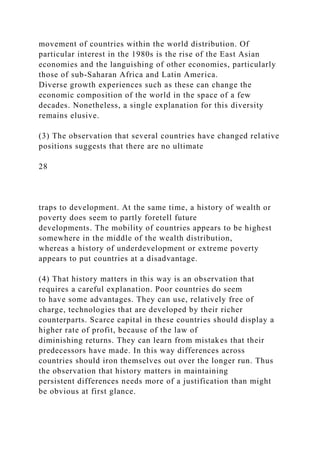
(2) The fact that the overall distribution has remained stationary
does not mean that there has been little
movement of countries within the world distribution. Of
particular interest in the 1980s is the rise of the East Asian
economies and the languishing of other economies, particularly
those of sub-Saharan Africa and Latin America.
Diverse growth experiences such as these can change the
economic composition of the world in the space of a few
decades. Nonetheless, a single explanation for this diversity
remains elusive.
(3) The observation that several countries have changed relative
positions suggests that there are no ultimate
28
traps to development. At the same time, a history of wealth or
poverty does seem to partly foretell future
developments. The mobility of countries appears to be highest
somewhere in the middle of the wealth distribution,
whereas a history of underdevelopment or extreme poverty
appears to put countries at a disadvantage.
(4) That history matters in this way is an observation that
requires a careful explanation. Poor countries do seem
to have some advantages. They can use, relatively free of
charge, technologies that are developed by their richer
counterparts. Scarce capital in these countries should display a
higher rate of profit, because of the law of
diminishing returns. They can learn from mistakes that their
predecessors have made. In this way differences across
countries should iron themselves out over the longer run. Thus
the observation that history matters in maintaining
persistent differences needs more of a justification than might
be obvious at first glance.
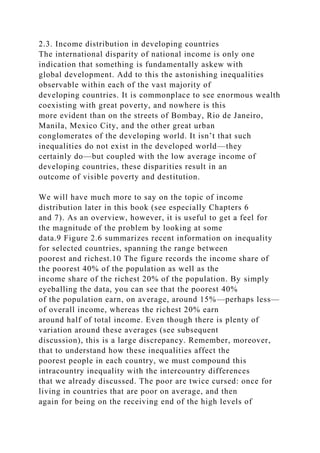
2.3. Income distribution in developing countries
The international disparity of national income is only one
indication that something is fundamentally askew with
global development. Add to this the astonishing inequalities
observable within each of the vast majority of
developing countries. It is commonplace to see enormous wealth
coexisting with great poverty, and nowhere is this
more evident than on the streets of Bombay, Rio de Janeiro,
Manila, Mexico City, and the other great urban
conglomerates of the developing world. It isn’t that such
inequalities do not exist in the developed world—they
certainly do—but coupled with the low average income of
developing countries, these disparities result in an
outcome of visible poverty and destitution.
We will have much more to say on the topic of income
distribution later in this book (see especially Chapters 6
and 7). As an overview, however, it is useful to get a feel for
the magnitude of the problem by looking at some
data.9 Figure 2.6 summarizes recent information on inequality
for selected countries, spanning the range between
poorest and richest.10 The figure records the income share of
the poorest 40% of the population as well as the
income share of the richest 20% of the population. By simply
eyeballing the data, you can see that the poorest 40%
of the population earn, on average, around 15%—perhaps less—
of overall income, whereas the richest 20% earn
around half of total income. Even though there is plenty of
variation around these averages (see subsequent
discussion), this is a large discrepancy. Remember, moreover,
that to understand how these inequalities affect the
poorest people in each country, we must compound this
intracountry inequality with the intercountry differences
that we already discussed. The poor are twice cursed: once for
living in countries that are poor on average, and then
again for being on the receiving end of the high levels of
inequality in those countries.
Figure 2.6 also plots tentative trends in these shares as we move
from poor to rich countries. There appears to be
a tendency for the share of the richest 20% to fall, rather
steeply in fact, as we cross the $8,000 per capita income
threshold (1993 PPP). However, there is also a distinct tendency
for this share to rise early on in the income scale
(mentally shut out the patch after $8,000 and look at the
diagram again). The overall tendency, then, is for the share
of the richest 20% to rise and then fall over the cross section of
incomes represented in the diagram. The share of
the poorest 40% displays the opposite relationship, although it
is somewhat less pronounced. At both extremes of
the income scale, the share is relatively high, and falls to a
minimum around the middle (in the cluster represented
by $4,000–9,000 of per capita income).
29
Figure 2.6. Income shares of poorest 40% and richest 20% for
fifty-seven countries arranged in order of increasing per capita
income (PPP).
Source: World Development Report (World Bank [1995]) and
Deininger and Squire [1996a].
The two trends together suggest, very tentatively indeed, that
inequality might rise and then fall as we move
from lower to higher incomes. This is the essence of a famous
hypothesis owing to Kuznets [1955] that is known as
the inverted U (referring to the shape traced by rising and then
falling inequality). We will take a closer look at this
relationship in Chapter 7. For now, nothing is really being said
about how inequality in a single country changes
over time: what we have here is a snapshot running over
different countries.
South Asian countries, such as India, Bangladesh, and Sri
Lanka, many African countries, such as Tanzania,
Uganda, Kenya, Senegal, Nigeria, and Ghana, and a few of the
poorer Latin American countries, such as El
Salvador, Nicaragua, and Bolivia, populate the first stretch in
this diagram. Then come the middle-income
countries, with a large concentration of Latin American
nations—Guatemala, Peru, Brazil, Colombia, Costa Rica,
Mexico, Chile, Panama—as well as fast-growing Asian
countries such as Thailand and Malaysia. At the $9,000
mark we hit countries such as Korea, Puerto Rico, Portugal, and
Mauritius, and this is the approximate region in
which we see a drop in the income share of the richest 20%. We
then move into the rich countries, mainly
European and North American, with a sprinkling of East Asian
nations—Singapore, Japan, and Hong Kong—
among them. Specific data on income and inequality are
provided for a subsample of countries in Table 2.1.
The data presented here suggest that economic development is
an inherently uneven process. At very low levels
of income, average levels of living are very low, and so it is
very difficult to squeeze the income share of the
poorest 40% below a certain minimum. For such countries the
income share of the rich, although high, is nowhere
close to the extraordinarily high ratios observed in middle-
income countries. This indicates the possibility that as
economic growth proceeds, it initially benefits the richest
groups in society more than proportionately. This
situation is reflected in a rise in the income share of the upper
quintile of the population. The share of the poorest
groups tends to fall at the same time, although this does not
mean that their income goes down in absolute terms. At
higher levels of per capita income, economic gains tend to be
distributed more equally—the poorest quintiles now
gain in income share.
Table 2.1. Shares of poorest 40% and richest 20% for selected
countries.
30
Source: World Development Report (World Bank [1995]) and
Deininger and Squire [1996a].
It is worth noting (and we will say this again in Chapter 7) that
there is no inevitability about this process.
Countries that pursue policies of broad-based access to
infrastructure and resources, such as health services and
education, will in all likelihood find that economic growth is
distributed relatively equally among the various groups
in society. Countries that neglect these features will show a
greater tendency toward inequality. Indeed, matters are
actually more complicated than this. These policies may in turn
affect the overall rate of growth that a country can
sustain. Although many of us might want to believe that equity
and growth go hand in hand, this may well turn out
to be not true, at least in some situations. The need to discuss
this crucial interaction cannot be overemphasized.
The combination of low per capita incomes and the unequal
distribution of them means that in large parts of the
developing world, people might lack access to many basic
services: health, sanitation, education, and so on. The
collection of basic indicators that makes up the nebulous
concept of progress has been termed human development,
and this is what we turn to next.
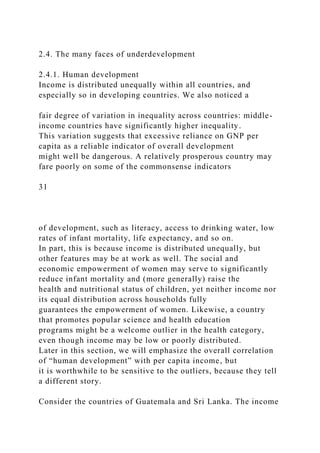
2.4. The many faces of underdevelopment
2.4.1. Human development
Income is distributed unequally within all countries, and
especially so in developing countries. We also noticed a
fair degree of variation in inequality across countries: middle-
income countries have significantly higher inequality.
This variation suggests that excessive reliance on GNP per
capita as a reliable indicator of overall development
might well be dangerous. A relatively prosperous country may
fare poorly on some of the commonsense indicators
31
of development, such as literacy, access to drinking water, low
rates of infant mortality, life expectancy, and so on.
In part, this is because income is distributed unequally, but
other features may be at work as well. The social and
economic empowerment of women may serve to significantly
reduce infant mortality and (more generally) raise the
health and nutritional status of children, yet neither income nor
its equal distribution across households fully
guarantees the empowerment of women. Likewise, a country
that promotes popular science and health education
programs might be a welcome outlier in the health category,
even though income may be low or poorly distributed.
Later in this section, we will emphasize the overall correlation
of “human development” with per capita income, but
it is worthwhile to be sensitive to the outliers, because they tell
a different story.
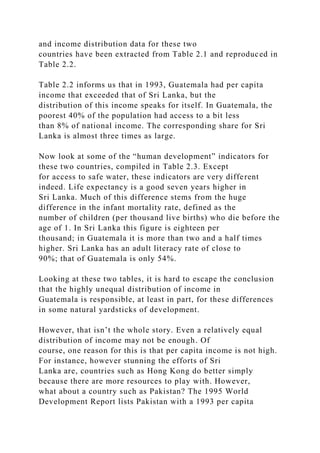
Consider the countries of Guatemala and Sri Lanka. The income
and income distribution data for these two
countries have been extracted from Table 2.1 and reproduced in
Table 2.2.
Table 2.2 informs us that in 1993, Guatemala had per capita
income that exceeded that of Sri Lanka, but the
distribution of this income speaks for itself. In Guatemala, the
poorest 40% of the population had access to a bit less
than 8% of national income. The corresponding share for Sri
Lanka is almost three times as large.
Now look at some of the “human development” indicators for
these two countries, compiled in Table 2.3. Except
for access to safe water, these indicators are very different
indeed. Life expectancy is a good seven years higher in
Sri Lanka. Much of this difference stems from the huge
difference in the infant mortality rate, defined as the
number of children (per thousand live births) who die before the
age of 1. In Sri Lanka this figure is eighteen per
thousand; in Guatemala it is more than two and a half times
higher. Sri Lanka has an adult literacy rate of close to
90%; that of Guatemala is only 54%.
Looking at these two tables, it is hard to escape the conclusion
that the highly unequal distribution of income in
Guatemala is responsible, at least in part, for these differences
in some natural yardsticks of development.
However, that isn’t the whole story. Even a relatively equal
distribution of income may not be enough. Of
course, one reason for this is that per capita income is not high.
For instance, however stunning the efforts of Sri
Lanka are, countries such as Hong Kong do better simply
because there are more resources to play with. However,
what about a country such as Pakistan? The 1995 World
Development Report lists Pakistan with a 1993 per capita
GDP of $2,170. The poorest 40% of the population earn 21% of
the total income. These overall figures are similar
to those of Sri Lanka, but Pakistan has a life expectancy of only
62 and an infant mortality rate of ninety-one per
thousand, five times that of Sri Lanka. The literacy rate for
Pakistan was only 36% in 1992—significantly less than
half that of Sri Lanka. Clearly, government policies, such as
those concerning education and health, and the public
demand for such policies, play significant roles.
Table 2.2. Shares of poorest 40% and richest 20% for Sri Lanka
and Guatemala.
Source: World Development Report (World Bank [1995]) and
Deininger and Squire [1996].
Table 2.3. Indicators of “human development” for Sri Lanka and
Guatemala.
Source: Human Development Report (United Nations
Development Programme [1995]).
Note: All data are for 1992, except for access to safe water,
which is the 1988–93 average.
2.4.2. An index of human development
32
Many of the direct physical symptoms of underdevelopment are
easily observable and independently
measurable. Undernutrition, disease, illiteracy—these are
among the stark and fundamental ills that a nation would
like to remove through its development efforts. For quite some
time now, international agencies (like the World
Bank and the United Nations) and national statistical surveys
have been collecting data on the incidence of
malnutrition, life expectancy at birth, infant mortality rates,
literacy rates among men and women, and various other
direct indicators of the health, educational, and nutritional
status of different populations.
As we have seen, a country’s performance in terms of income
per capita might be significantly different from
the story told by these basic indicators. Some countries,
comfortably placed in the “middle-income” bracket,
nevertheless display literacy rates that barely exceed 50%,
infant mortality rates close to or exceeding one hundred
deaths per thousand, and undernourishment among a significant
proportion of the population. On the other hand,
there are instances of countries with low and modestly growing
incomes, that have shown dramatic improvements in
these basic indicators. In some categories, levels comparable to
those in the industrialized nations have been
reached.
The United Nations Development Programme (UNDP) has
published the Human Development Report since
1990. One objective of this Report is to coalesce some of the
indicators that we have been discussing into a single
index, which is known as the human development index (HDI).
This is not the first index that has tried to put
various socioeconomic indicators together. A forerunner is
Morris’ “physical quality of life index” (Morris [1979]),
which created a composite index from three indicators of
development: infant mortality, literacy, and life
expectancy conditional on reaching the age of 1.
The HDI has three components as well. The first is life
expectancy at birth (this will indirectly reflect infant and
child mortality).11 The second is a measure of educational
attainment of the society. This measure is itself a
composite: it takes a weighted average of adult literacy (with
weight 2/3) and a combination of enrollment rates in
primary, secondary and tertiary education (with weight 1/3).
The last component is per capita income, which is
adjusted somewhat after a threshold (around $5,000 in PPP
dollars, 1992) is crossed. Less weight is given to higher
incomes after this point, on the grounds that there is
diminishing marginal utility to higher incomes. The HDI is
calculated by defining some notion of a country’s achievements
in each of these three components, and then taking
a simple average of the three indicators.
The creation of composites from such fundamentally different
indicators as life expectancy and literacy is a bit
like adding apples and oranges. It is arguable that rather than
create composites, the reader should view the different
indicators (as we will do presently) and then judge the overall
situation for herself. The advantage of a composite
index is its simplicity and, of course, its political power: in this
era of sound bites, it is far easier and appears to be
more “scientific” to say that country X has an “index” of 8 out
of 10, rather than laboriously to detail that country’s
achievements (or lack of them) in five different spheres of
development.12 The HDI might look scientific and the
formulae used to create the final average might look complex,
but that is no reason to accept the implicit weighting
scheme that it uses, because it is just as ad hoc as any other. It
cannot be otherwise. Nevertheless, the HDI is one
way to combine important development indicators, and for this
reason it merits our attention.
The HDI creates, for each country, a final number that takes a
value somewhere between 0 and 1. The number is
to be (tentatively) interpreted as the “fraction of ultimate
development” that has been achieved by the country in
question. Because these notions of “ultimate bliss” are
embodied in the HDI, it is not surprising that the indicator is
relatively varied among the poorer countries, but then flattens
out sharply as we move into richer countries.13 Thus
statements made in the Report, such as “the HDI of industrial
countries (0.916) is only 1.6 times higher than that of
developing countries (0.570), even though their real GDP per
capita (PPP$) is 6 times higher,” are meaningless.14
Although such comparisons of ratios simply do not make sense,
the rankings generated by the HDI are of some
interest because they illustrate how it is possible for a relatively
high-income country to fare so badly in meeting
basic socioeconomic goals that its HDI index falls behind that
of a relatively poor country. One way to show how
this happens is to present the HDI ranking for different
countries as well as the rankings induced by per capita
GDP. It is then possible to study the difference in the two
rankings induced by these two measures. A positive
difference means that the country has done better in “human
development” relative to its position in the GDP
rankings; a negative ranking means the opposite. What about the
examples of our previous section: Sri Lanka,
Guatemala, and Pakistan? The ranking approach justifies what
we already saw on the basis of specific indicators.
Sri Lanka has a positive rank differential of +5. Guatemala and
Pakistan have negative rank differentials of -20 and
-28, respectively.
2.4.3. Per capita income and human development
33
There is little doubt, then, that per capita income, or even the
equality of its distribution, does not serve as a
unilateral guarantee of success in “human development.” This
sentiment is captured very well in one of the views
of development with which we started this chapter.
At the same time, the apparently narrow perspective of
mainstream economists, with its hard-nosed focus on per
capita income as a summary statistic of development, may not
be too out of line. It is arguable that although taking
a wider and multidimensional view of development is
conceptually correct, per capita GDP still acts as a fairly
good proxy for most aspects of development.15 For instance, it
can be argued that rising income levels ultimately
and inevitably translate into better health, nutritional, and
educational standards in a population. It is, therefore, a
useful exercise to see from cross-country data, how much
“explanatory power” per capita GDP has over other basic
indicators.
One way to go about this exercise is to collect data on per
capita income as well as on some other facet of
development that we might be interested in, and then connect
the two by means of a scatter diagram (see Appendix
2). In brief, a scatter diagram allows us to eyeball possible
relationships between a dependent variable whose
variation we are seeking to explain (such as infant mortality or
life expectancy) and one or more independent
variables whose variation presumably “explains” the changes of
the dependent variable. In the present situation, our
independent variable is per capita income.
In this section, we chose three indicators of development that
are of interest: life expectancy at birth, the infant
mortality rate, and the adult literacy rate. To be sure, these
indicators are not entirely independent of each other. For
instance, life expectancy includes the possibility of dying
before the age of 1, which is infant mortality.
Nevertheless, these are common indicators that enter into
indexes of development, such as the HDI or the physical
quality of life index.
Figures 2.7–2.9 simply plot the relationship between these
variables and per capita income, by looking at a cross
section of countries. It is only to be expected that as we move
into the range of countries with very high per capita
income, these indicators will be at high levels as well, and they
are. So as not to dwarf the entire exercise by these
extremes, we leave out all countries with per capita income
exceeding $9,000 PPP (1993). In principle, this makes
the case against per capita income stronger. Variation in income
here is somewhat smaller, and there is therefore
much room for other policies or characteristics to affect the
outcome.
Each of these diagrams has a cross-bar that is drawn at the
average values of the data in that sample. For
instance, the cross-bar in Figure 2.8 is located at an average per
capita income of $3,500 and a literacy rate of
around 72% (which are the averages for the sample). The
scattered dots are the observations, of course. The idea of
the diagram is to check the correlation between the two
variables concerned (see Appendix 2). If the correlation is
expected to be positive, for instance, we would expect most of
the dots to lie in the northeast and southwest
quadrants of the cross-bar. This is our expectation for literacy
and life expectancy. For infant mortality, we expect
the relationship to be negative, so the observations should lie in
the northwest and southeast quadrants of the cross-
bar.
By and large, the relationship between per capita income alone
and each of these variables is strikingly strong.
In each of the three cases, the great majority of the observations
lie within the expected quadrants. The figures speak
for themselves to express the idea that per capita income is a
powerful correlate of development, no matter how
broadly we conceive of it. Thus we must begin, and we do so,
with a study of how per capita incomes evolve in
countries. This is the subject of the theory of economic
growth—a topic that we take up in detail in the chapters to
come.
34
Figure 2.7. Per capita income and life expectancy for
developing countries. Source: World Development Report
(World Bank [1995]) and
Human Development Report (United Nations Development
Programme [1995]).
A further point needs to be stressed. By looking at the actual
levels of achievement in each of these indicators,
rather than just the ranking across countries that they induce, I
have actually made life more difficult for the
argument in favor of per capita income. In an influential book,
Dasgupta [1993] showed that per capita income is
correlated even more highly with other indicators of
development if we consider ranks rather than cardinal
measures. In other words, if we rank countries according to
their per capita GDP levels and then compute similar
ranks based on some other index (such as adult literacy, child
mortality, etc.), then we find a high degree of
statistical correspondence between the two sets of ranks if the
set of countries is sufficiently large and wide ranging.
Because I have already carried out cardinal comparisons, I will
skip a detailed discussion of these matters and
simply refer you to Dasgupta’s study for a more thorough
reading.16
35
Figure 2.8. Per capita income and adult literacy rates for
developing countries. Source: World Development Report
(World Bank [1995]) and
Human Development Report (United Nations Development
Programme [1995]).
The point of this section is not to discredit human development,
but only to show that we must not necessarily
swing our opinions to the other extreme and disregard per capita
income altogether. To be more emphatic, we must
take per capita income very seriously, and it is in this spirit that
we can appreciate the seemingly narrow quotation
from Robert Lucas at the beginning of this chapter.
To complete this delicate balancing act, note finally that the
relationship between per capita income and the
other indicators is strong but far from perfect (otherwise the
data would all lie on some smooth curve linking the
two sets of variables). The imperfect nature of the relationship
is just a macroreflection of what we saw earlier with
countries such as Sri Lanka, Pakistan, and Guatemala. Inclusion
of the distribution of per capita income would add
to this fit, but even then matters would remain undecided: social
and cultural attitudes, government policy, and the
public demands for such policies, all would continue to play
their role in shaping the complex shell of economic
development. Thus it is only natural that we concentrate on
economic growth and then move on to other pressing
matters, such as the study of income distribution and the
operation of various markets and institutions.
36
Figure 2.9. Per capita income and infant mortality rates for
developing countries. Source: World Development Report
(World Bank [1995])
and Human Development Report (United Nations Development
Programme [1995]).
2.5. Some structural features
Our final objective in this chapter is to provide a quick idea of
the structural characteristics of developing countries.
We will examine these characteristics in detail later in the book.
2.5.1. Demographic characteristics
Very poor countries are characterized by both high birth rates
and high death rates. As development proceeds,
death rates plummet downward. Often, birth rates remain high,
before they finally follow the death rates on their
downward course. In the process, a gap opens up (albeit
temporarily) between the birth and death rates. This leads
to high population growth in developing countries. Chapter 9
discusses these issues in detail.
High population growth has two effects. It means that overall
income must grow faster to keep per capita growth
at reasonable levels. To be sure, the fact that population is
growing helps income to grow, because there is a greater
supply of productive labor. However, it is not clear who wins
this seesaw contest: the larger amount of production
or the larger population that makes it necessary to divide that
production among more people. The negative
population effect may well end up dominant, especially if the
economy in question is not endowed with large
quantities of capital (physical or human).
A second effect of high population growth (or high birth rates,
to be precise) is that the overall population is
quite young. It is easy to get an intuition for this: high birth
rates mean that a proportionately larger number of
children are always entering the population at any given point
of time. This means that the population is heavily
weighted in favor of children. This may be quite delightful, as
any of us who has grown up with several brothers,
sisters, and cousins knows, but it does not change the grim
reality of utter economic dependence, especially for
those in poverty. There are many untoward consequences of an
abnormally young population, and these include
poverty, child labor, and low education.
Figure 2.10 shows us how population growth rates vary with per
capita income. The thin line plots annual
growth rates of population for 1970–80; the thick line does the
same for 1980–93. In both cases the horizontal axis
records 1993 percapita income (PPP). The variation is
substantial (remember: per capita income isn’t everything!),
but there is a clear downward trend in the growth rate, both with
per capita income and over time (for the same
37
country).
2.5.2. Occupational and production structure
Agriculture accounts for a significant fraction of production in
developing countries. Indeed, given that
substantial agricultural output is produced for self-consumption
and so may not be picked up in the data, the
proportion is probably higher than that revealed by the
published numbers. For the poorest forty-five countries for
which the World Bank publishes data, called the low-income
countries, the average proportion of output from
agriculture is close to 30%. Remember that the poorest forty-
five countries include India and China and therefore a
large fraction of the world’s population. Data for the so-called
middle-income countries, which are the next poorest
sixty-three countries and include most Latin American
economies, is somewhat sketchier, but the percentage
probably averages around 20%. This stands in sharp contrast to
the corresponding income shares accruing to
agriculture in the economically developed countries: around 1–
7%.
Figure 2.10. Population growth rates and per capita income.
Source: World Development Report (World Bank [1995, 1996]).
Even more striking are the shares of the labor force living in
rural sectors. For the aforementioned low-income
category, the share averaged 72% in 1993 and was as high as
60% for many middle-income countries. The contrast
with developed countries is again apparent, where close to 80%
of the labor force is urbanized. Even then, a large
fraction of this nonurban population is so classified because of
the “commuter effect”: they are really engaged in
nonagricultural activity although they live in areas classified as
rural. Although a similar effect is not absent for
developing countries, the percentage is probably significantly
lower.
Figure 2.11 displays the share of the labor force in agriculture
as we move over different countries indexed by
per capita income. The downward trend is unmistakable, but so
are the huge shares in agriculture for both low- and
middle-income countries.
38
Figure 2.11. Fractions of the labor force in agriculture. Source:
World Development Report (World Bank [1996]).
Clearly, agricultural activity forms a significant part of the lives
of people living in developing countries. We
therefore devote a good part of this book to agricultural
arrangements: the hiring of labor, the leasing of land, and
the operation of credit markets. The overall numbers for
production and occupational structure suggest that
agriculture often has lower productivity than other economic
activities. This is not surprising. In many developing
countries, capital intensity in agriculture is at a bare minimum,
and there is often intense pressure on the land. Add
to this the fact that agriculture, especially when not protected
by assured irrigation and ready availability of fertilizer
and pesticides, can be a singularly risky venture. Many farmers
bear enormous risks. These risks may not look very
high if you count them in U.S. dollars, but they often make the
difference between bare-bones subsistence (or
worse) and some modicum of comfort.
2.5.3. Rapid rural–urban migration
With the above-mentioned features, it is hardly surprising that
an enormous amount of labor moves from rural to
urban areas. Such enormous migrations deserve careful study.
They are an outcome of both the “push” from
agriculture, because of extreme poverty and growing
landlessness, and the perceived “pull” of the urban sector. The
pulls are reinforced by a variety of factors, ranging from the
comparatively high wages and worker protections
offered in the organized urban sectors to the effect of the media
in promoting the urban lifestyle as a desirable end
in itself. The media is often misleading and so are the benefits
of the organized sector, which are often accessible
only to a lucky minority of workers.
Consider the rates of growth of the urban sector in developing
countries. For the forty-five low-income
countries covered by the World Bank, the average rate of urban
population growth over the period 1980–93 was
3.9% per year. Compare this with an average rate of population
growth of 2% per year for the same countries over
the same period of time. Urban growth was simply double that
of overall population growth for these countries.
Imagine, then, the pressure on the cities of these countries. For
the sixty-three countries classified as middle-income
by the Bank, the urban growth rate was 2.8% per annum over
the period 1980–93, to be compared with a population
growth rate of 1.7% per year. Once again, we see evidence of a
pressure on the urban sector that is just not captured
by the overall population growth figures. On the other hand, the
high-income developed countries exhibit near
balance: urban populations grew at 0.8% per year, while overall
population grew at 0.6% per year.
This is not to say that such migrations are somehow
undesirable. Indeed, how did developed countries get to the
point that they are now at? The fact of the matter, however, is
that all these processes are accelerated in modern-day
developing countries, and the speed-up imposes enormous
strains.
One piece of evidence that reveals these strains is the fact that
an unusually large fraction of the population in
developing countries is classified as being in the tertiary or
“services” sector. Before we take a look at the data, it is
useful to conceptualize matters a bit. Think of what we consume
as our income increases. Our first needs are for
food and clothing. As we have more income to spare we switch
to industrial products: radio, television, bicycles,
39
automobiles, and the like. At a still higher level of income we
begin to register a high demand for services: banking,
tourism, restaurants, and travel. It is not surprising, then, that
the developed countries allocate a large fraction of
their nonagricultural labor force to the services sector.
Countries such as Australia, the United States, the United
Kingdom, Norway, and Sweden have about 70% of the total
labor force in the services sector; the corresponding
figures for some other developed countries such as Japan are
somewhat lower. That isn’t odd at all. What is odd is
that many developing countries exhibit large fractions of the
labor force in “services” as well!
Figure 2.12 illustrates the general point and Table 2.4 provides
data for particular countries. Expressed as a
fraction of the nonagricultural labor force, the proportion in the
services sector is not at all different from what we
see in developed countries. At the same time, the proportion of
people in agriculture does vary a great deal, as we
have already seen. What we are seeing, then, for developing
countries, is a classification of a large part of the labor
force into “services” simply because such services are waiting
positions or fallback options for laborers lacking an
industrial job. That is, the enormous services sector in
developing countries is symptomatic of the development of
the unorganized or informal sector, on which we will have more
to say in Chapter 10. This sector is the home of
last resort—the shelter for the millions of migrants who have
made their way to the cities from the rural sector.
People who shine shoes, petty retailers, and middlemen: they all
get lumped under the broad rubric of services
because there is no other appropriate category. It is fitting that
the World Bank Tables refer to this sector as
“Services, etc.” The large size of this sector in developing
countries is, in the main, a reflection of the inability of
industry in these countries to keep up with the extraordinary
pace of rural–urban migration.
Figure 2.12. Nonagricultural labor in services. Source: World
Development Report (World Bank [1996]).
2.5.4. International trade
By and large, all countries, rich and poor, are significantly
involved in international trade. A quick plot of the
ratio of exports and imports to GNP against per capita income,
does not reveal a significant trend. There are large
countries, such as India, the United States, and Mexico for
which these ratios are not very high—perhaps around
10% on average. Then again, there are countries such as
Singapore and Hong Kong for which these ratios attain
astronomical heights—well over 100%. The modal ratios of
exports and imports to GNP are probably around 20%.
Trade is an important component of the world economy.
Table 2.4. Percentage of the non-agricultural labor force in
services for selected countries.
40
Source: World Development Report (World Bank [1996]).
The differences between developing and developed countries
are more pronounced when we look at the
composition of trade. Developing countries are often exporters
of primary products. Raw materials, cash crops, and
sometimes food are major export items. Textiles and light
manufactured items also figure on the list. In contrast, the
bulk of exports from developed countries is in the category of
manufactured goods, ranging from capital goods to
consumer durables. Of course, there are many exceptions to
these broad generalizations, but the overall picture is
broadly accurate, as Figure 2.13 shows. This figure plots the
share of exports that comprise primary products
against per capita income. We have followed the now-familar
method of using cross-bars at the mean levels of per
capita income and primary share (unweighted by population) to
eyeball the degree of correlation. It is clear that, on
the whole, developing countries do rely on primary product
exports, whereas the opposite is true for the developed
countries.
Figure 2.13. Share of primary exports in total exports. Source:
World Development Report (World Bank [1995]).
41
Notice that there are some developing countries that have a low
ratio of primary exports. Countries such as
China, India, the Philippines, and Sri Lanka are among them.
These countries and many of their compatriots are
attempting to diversify their exports away from primary
products, for reasons that we indicate subsequently and
discuss at greater length later in the book. At the same time,
there are developed countries that export primaries to a
great degree. Australia, New Zealand, and Norway are among
them.
The traditional explanation for the structure of international
trade comes from the theory of comparative
advantage, which states that countries specialize in the export
of commodities in which they have a relative cost
advantage in production. These cost advantages might stem
from differences in technology, domestic consumption
profiles, or the endowment of inputs that are particularly
conducive to the production of certain commodities. We
review this theory in Chapter 16. Because developing countries
have a relative abundance of labor and a relative
abundance of unskilled labor within the labor category, the
theory indeed predicts that such countries will export
commodities that intensively use unskilled labor in production.
To a large extent, we can understand the
aforementioned trade patterns using this theory.
At the same time, the emphasis on primary exports may be
detrimental to the development of these countries for
a variety of reasons. It appears that primary products are
particularly subject to large fluctuations in world prices,
and this creates instability in export earnings. Over the longer
run, as primary products become less important in the
consumption basket of people the world over, a declining price
trend might be evident for such products as well.
Figure 2.14. Changes in the terms of trade, 1980–93. Source:
World Development Report (World Bank [1995] ).
The definite existence of such a trend is open to debate. At the
same time, we can see some broad indication of it
by studying how the terms of trade for different countries have
changed over recent decades. The terms of trade for
a country represent a measure of the ratio of the price of its
exports to that of its imports. Thus an increase in the
terms of trade augers well for the trading prospects of that
country, whereas a decline suggests the opposite. Figure
2.14 plots changes in the terms of trade over the period 1980–93
against per capita income. There is some indication
that the relationship is positive, which suggests that poor
countries are more likely than richer ones to face a decline
in their terms of trade. Primary exports may underlie such a
phenomenon.
In general, then, activities that have comparative advantage
today might not be well suited for export earnings
tomorrow. The adjustment to a different mix of exports then
becomes a major concern. Finally, technology often is
assimilated through the act of production. If production and
exports are largely limited to primary products, the
flow of technology to developing countries may be affected. We
discuss these issues in Chapter 17.
42
Figure 2.15. Share of primary imports in total imports. Source:
World Development Report (World Bank [1995]).
The import mix of developing countries is more similar to that
of developed countries. Exporters of primary
products often need to import primary products as well: thus
India might be a major importer of oil and Mexico a
major importer of cereals. Primary exports for each country are
often concentrated in a handful of products, and
there is no contradiction in the fact that primaries are both
exported and imported. A similar argument establishes
that although developed countries might export manufactured
items, there is always a need for other manufactures
that are in relatively short supply. Trade patterns in this
aggregated form are therefore quite similar over countries,
as Figure 2.15 reveals.
We summarize: developing countries are likely to have a high
ratio of primary goods in their total exports, but
as far as imports are concerned, there is significantly less
variation.
2.6. Summary
We began with a discussion of what the term economic
development might mean. It is a multifaceted concept,
embodying not just income and its growth, but also
achievements on other fronts: reductions in infant mortality,
higher life expectancy, advances in literacy rates, widespread
access to medical and health services, and so on. Per
capita income is sometimes used as an (incomplete) indicator
for overall economic development, but should not be
identified conceptually with development in the broader sense.
We turned next to per capita income data for countries. Using
exchange rates to convert local currencies into
dollars, we obtained per capita income evaluated according to
the exchange rate method. The disparities across
countries is enormous. Some of this disparity is due to
underreporting of income, but a far more serious problem
arises from the fact that price levels are systematically different
across countries: dollar prices for nontraded goods
and services tend to be lower in developing countries. The
purchasing power parity method attempts to correct for
this by constructing international prices that are used to
estimate national incomes. Cross-country disparities in per
capita income are then smaller, but still large: the richest 5% of
the world’s nations averaged a per capita income
that was about twenty-nine times the corresponding figure for
the poorest 5%, over the period 1960–85.
There have been substantial changes in incomes for many
countries. The meteoric rise of East Asia is a case to
be noted. This case is contrasted with the fact that much of
Latin America and sub-Saharan Africa languished
during the 1980s. Thus, although the world distribution of
income remained fairly unchanged in relative terms, there
was plenty of movement within that distribution. However,
there is evidence that a history of underdevelopment or
extreme poverty feeds on itself. Using mobility matrices, we
noted that middle-income countries have significantly
higher mobility than either the poorest or the richest countries.
Next, we studied income distribution within countries. By and
large, income is more unequally distributed in
developing countries than in their developed counterparts,
which suggests that the poor in developing countries are
43
twice hit: once at the level of distribution across countries and
then at the level of distribution within countries.
Income distribution is particularly bad for middle-income
countries, and most of this extreme inequality appears to
be located in Latin America.
With income and income distribution out of the way, we then
returned to the broader notion of development.
The Human Development Index is the name given to a set of
indicators developed by the United Nations
Development Programme. It combines three indicators—life
expectancy at birth, educational attainment, and per
capita income—with weights to arrive at a combined index. We
noted that just because an overall index is provided
does not mean it should be necessarily taken seriously: the
weights are, of course, quite arbitrary. Nevertheless, the
overall idea of human development is a laudable attempt to
conceptually go beyond per capita income as an
operational measure of development.
Nevertheless, per capita income isn’t a bad predictor of human
development. We showed that the correlations
between per capita income and other variables that describe
“human development” are high, even if attention is
restricted only to the subsample of developing countries.
Finally, we described some structural characteristics of
developing countries. We looked at demographic
characteristics and showed that there is a general tendency for
population growth rates to decline with increased per
capita income. We discussed very briefly some of the effects of
population growth on per capita income. We then
studied occupational and production structure: agricultural
activity accounts for a significant fraction of
occupations in developing countries. At the same time, the rates
of rural–urban migration are very high indeed. In
part, this is reflected in the observation that a large fraction of
the nonrural labor force is engaged in a nebulous
activity called “services.” This category includes all sorts of
informal activities with low setup costs, and in
developing countries is a good indicator of urban overcrowding.
At the end, we discussed patterns of international
trade. Developing countries are largely exporters of primary
products, although this pattern shows change for
middle-income countries. Primary product exports can be
explained using the theory of comparative advantage,
although we note that primary product exports have intrinsic
problems, such as a strong tendency for their
international prices to fluctuate, which creates instability in
export revenues. The import mix of developing
countries is, however, more similar to that of developed
countries.
Exercises
(1) Per capita income is a measure of purchasing power. People
who live and work in developing countries often
find that their incomes are meager when buying an international
airline ticket, making an international phone call,
sending an airmail letter to a friend who lives abroad, buying a
book published by an international publisher, or
importing consumer goods. They don’t feel that poor when they
buy vegetables at the local store, get a haircut,
travel domestically by train, bus, or even by taxi, or buy a local
textbook. Use these intuitive comments to
understand what a traded good is and what a nontraded good is.
Note that a potentially tradable good may become
effectively nontraded because of import or export restrictions.
Why are nontraded goods generally cheaper in poor
countries? In addition, if they are cheaper, would their incomes
look better (relative to the United States, say) when
measured by the exchange-rate method or by the PPP method?
(2) McDonald’s operates in various countries. It has been found
that the relative price of a Big Mac is a better
guide to the overall cost of living than estimates using the
exchange rate. Why do you think this might be the case?
(3) Why do you think that European or Japanese television
transmits at resolutions that are superior to those in the
United States? After looking into this question, formulate a
hypothesis that suggests why countries that have poor
infrastructure might be more likely to leapfrog over countries
with better infrastructure insofar as the installation of
new infrastructure is concerned. Use telephone networks as an
example.
(4) Make sure you understand the power of exponential growth
(and of rapid exponential inflation) by doing the
following exercises:
(a) How quickly will a country growing at 10% a year double its
income? Quadruple its income? What about a
country growing at 5% per year?
(b) Suppose a country’s per capita income is currently growing
at 5% per year. Then it shaves an additional
percentage point off its population growth rate for the next
twenty years, but overall income continues to grow at
the same rate. How much richer would the country be at the end
of twenty years (per capita)?
(c) Suppose that Brazil experiences inflation at 30% per month.
How much is this per year? Do your calculations
44
first without compounding (the answer then is obviously 360%).
Now do it properly by compounding the inflation
rate.
(5) Construct an imaginary mobility matrix from a sample of
countries that shows no mobility at all. What would
it look like? What would a mobility matrix with “perfect
mobility” look like? What would a mobility matrix look
like if poor countries grow, on average, faster than rich
countries?
(6) Use Table 2.1 to construct what is known as a Kuznets ratio
(named after the economist and historian Simon
Kuznets): the ratio of incomes earned by the richest 20% of the
population to the those earned by the poorest 40%
of the population. If incomes were distributed almost equally,
what value would you expect this ratio to assume?
What values do you see? In the sample represented by Table
2.1, do you see a trend as we move from poor to rich
countries?
(7) Think of various indicators of development that you would
like to see in your concept of “economic
development.” Think about why per capita income, as measured,
may or may not be a good proxy for these
indicators. Find a copy of the Human Development Report and
look at it to see how different indicators are
combined to get the HDI. Do you think that the method of
combination is reasonable? Can you suggest a better
combination? What do you think of the idea of presenting data
on each of the indicators separately, instead of
combining them? Think of the advantages and disadvantages of
such an approach.
(8) A cogent example in which per capita magnitudes may be
misleading if we do not have a good idea of
distribution comes from the study of modern famine. Why do
famines simply not make sense if we look at them
from the viewpoint of worldwide per capita availability of food
grain? Do they make better sense if we look at just
food-grain availability per capita in that country? After mulling
this over for a while, read the insightful book by
Sen [1981].
(9) (a) Why do you think population growth rates fall with
development? If people consume more goods, in
general, as they get richer and children are just another
consumption good (a source of pleasure to their parents),
then why don’t people in richer countries “consume” more
children?
(b) Why are countries with higher population growth rates
likely to have a greater proportion of individuals below
the age of 15?
(c) Are poorer countries more likely to be rural or is it that rural
countries are more likely to be poor? Which way
does the causality run, or does it run both ways?
(d) Why do you think the international price of sugar might
fluctuate more than, say, that of automobiles?
1 This is not to suggest at all that it is sufficient for every kind
of social advancement.
2 For most poor countries, this starting point was the period
immediately following World War II, when many such
countries, previously
under colonial rule, gained independence and formed national
governments.
3 Even the double emphasis on levels and distribution might not
be enough. For instance, the Human Development Report
(United Nations
Development Programme [1995]) informs us that “the purpose
of development is to enlarge all human choices, not just income.
The concept of
human development is much broader than the conventional
theories of economic development.” More specifically, Sen
[1983] writes:
“Supplementing data on GNP per capita by income
distributional information is quite inadequate to meet the
challenge of development
analysis.” There is much truth in these warnings, which are to
be put side by side with Streeten and certainly contrasted with
Lucas, but I hope
to convince you that an understanding of our “narrower” issues
will take us quite far.
4 For instance, in the case of India, Acharya et al. [1985]
estimated that 18–21% of total income in 1980–81 went
unrecorded in the national
accounts (see also Gupta and Mehta [1981]). For related work
on the “black” or “parallel” economy, see Chopra [1982] and
Gupta and Gupta
[1982].
5 See The Economist, May 15, 1993.
6 In many countries all over the Third World, sectors that are
important or require bulk investment, such as iron and steel,
cement, railways,
and petroleum, are often in the hands of public sector
enterprises.
7 A dollar invested at r% per year will grow to two dollars in T
years, where T solves the equation [l + (r/100)]T = 2. This
means that T
lne[l + (r/100)] = Ine 2. However, Ine 2 is approximately 0.7,
whereas for small values of x, lne(l + x) is approximately x.
Using this in the
equation gets you the result.
8 Of course, our categories are quite coarse and this is not
meant to suggest that there were no relative changes at all
among these countries.
The immobility being described is of a very broad kind, to be
sure.
9 One can imagine that the statistical problems here are even
more severe than those involved in measuring per capita
income. The goal is
45
to measure the incomes earned by different groups in the same
country and compare them, so all the measurement difficulties
are compounded
(except for the problem of international price comparability),
because no system of overall, national accounts can be used to
estimate the
incomes of any one subgroup of the population.
10 In particular, we omit data on Eastern Europe and the former
Soviet Union, where levels of economic inequality are
traditionally lower,
which complicates the overall pattern.
11 The goal for life expectancy is taken to be 85 years, and
achievement with respect to this component is measured by the
narrowing of the
discrepancy from this goal.
12 Note that the use of per capita income is not immune from
this criticism. After all, per capita income is also a composite
index of human
“welfare” and is not to be equated with it.
13 The goal for life expectancy is taken to be 85 years, and
achievement with respect to this component is measured by the
narrowing of the
discrepancy from this goal. Thus the life expectancy index is
given by L ≡ (l − 25)/(85 − 25), where l is the life expectancy in
years of the
country in question. The educational attainment index is E ≡
e/100, where e is the combined educational enrollment rate,
expressed as a
percentage. The adult literacy index is A ≡ a/100, where a is the
adult literacy rate, expressed as a percentage. Finally, the
income index is Y ≡
(y − 100)/(5,448 − 100), where y is “adjusted income” and
5,448 is the maximum level to which adjusted income is
permitted to climb [see the
Human Development Report (United Nations Development
Programme [1995, p. 134])]. Countries with per capita incomes
of $40,000 (1992
PPP) would be given an adjusted income of this maximum.
14 The emphasis in the quoted sentence (from p. 19 of the
Report) is mine. An earthquake of 8 on the Richter scale is not
“only” 14% more
powerful than one that measures 7 on the Richter scale.
15 For additional information on this debate and related
matters, see the contributions of Anand and Harris [1994],
Aturupane, Glewwe and
Isenman [1994], Desai [1991], Naqvi [1995], Srinivasan [1994],
and Streeten [1994].
16 There are several authors who have argued that higher per-
capita income is correlated with indicators of the quality of life;
see, for
example, Mauro [1993], Pritchett and Summers [1995], Boone
[1996] and Barro [1996]. However, with country fixed effects
properly
accounted for in panel data, the evidence is somewhat mixed:
see Easterly [1997]. Indeed, we do not claim that simple cross-
country studies
can settle the issue conclusively, and we certainly do not
propose that income is a complete determinant for all other
facets of development.
46
Chapter 3
Economic Growth
3.1. Introduction
Of all the issues facing development economists, none is quite
so compelling as the question of economic growth.
In Chapter 2, we examined the historical growth of nations and
found a variety of annual growth rates. It is true that
all of these numbers, with very few exceptions, were in the
single digits, but we also took pains to appreciate the
power of exponential growth. A percentage point added to the
growth rate can make the difference between
stagnation and prosperity over the period of a generation. Small
wonder, then, that the search for key variables in
the growth process can be tempting. Indeed, until recently, and
for precisely this reason, no economic analysis has
fired the ambitions and hopes of more policy makers in
developing countries than the theory and empirics of
economic growth.
Robert Lucas, in his Marshall Lectures at the University of
Cambridge, stated:
Rates of growth of real per-capita income are . . . diverse, even
over sustained periods . . . . Indian incomes will double every
50
years; Korean every 10. An Indian will, on average, be twice as
well off as his grandfather; a Korean 32 times. . . .
I do not see how one can look at figures like these without
seeing them as representing possibilities. Is there some action a
government
of India could take that would lead the Indian economy to grow
like Indonesia’s or Egypt’s? If so, what, exactly? If not, what is
it
about the “nature of India” that makes it so? The consequences
for human welfare involved in questions like these are simply
staggering: Once one starts to think about them, it is hard to
think about anything else.
I quote Lucas at length, because he captures, more keenly than
any other writer, the passion that drives the study
of economic growth. We sense here the big payoff, the
possibility of change with extraordinarily beneficial
consequences, if one only knew the exact combination of
circumstances that drives economic growth.
If only one knew . . . , but to expect that from a single theory
(or even a set of theories) about an incredibly
complicated economic universe would be unwise. As it turns
out, though, theories of economic growth take us quite
far in understanding the development process, at least at some
aggregate level. This is especially so if we
supplement the theories with what we know empirically. At the
very least, it teaches us to ask the right questions in
the more detailed investigations later in this book.
3.2. Modern economic growth: Basic features
Economic growth, as the title of Kuznets’ [1966] pioneering
book on the subject suggests, is a relatively “modern”
phenomenon. Today, we greet 2% annual rates of per capita
growth with approval but no great surprise. Remember,
however, that throughout most of human history, appreciable
growth in per capita gross domestic product (GDP)
was the exception rather than the rule. In fact it is not far from
the truth to say that modern economic growth was
born after the Industrial Revolution in Britain.
Consider the growth rates of the world’s leaders over the past
four centuries. During the period 1580–1820 the
Netherlands was the leading industrial nation; it experienced an
average annual growth in real GDP per worker
hour1 of roughly 0.2%. The United Kingdom, leader during the
approximate period 1820–90, experienced an annual
growth of 1.2%. Since 1890, the United States is considered to
have usurped the leader’s seat, and its average
growth rate during the period 1890–1989 was a (relatively)
dramatic 2.2% a year. Thus GDP per worker has grown
at an accelerated pace, especially since 1820. Clearly, by
today’s standards, even the fastest growing economy two
centuries ago would be considered practically stagnant.
Note once again that although an annual growth rate of 2% in
per capita GDP does not appear very impressive,
a moment’s reflection (and calculation) reveals the enormous
potential that such growth carries if it is sustained.
Simple calculation shows that at the 2% rate, a nation’s per
capita GDP doubles in 35 years—a length of time
comfortably shorter than the lifespan of an individual. This
means that modern economic growth enables people to
enjoy vastly improved living standards compared to not only
their fathers but also perhaps their older cousins!
47
A glance at Table 3.1 shows how economic growth has
transformed the now-developed world within the space
of a century. This table displays per capita real GDP (valued in
1970 U.S. dollars) for selected OECD2 countries in
the years 1870, 1913, and 1978. The 1913 and 1978 columns
include, in parentheses, the ratio of per capita GDP in
those years to the corresponding baseline (1870) figure. The
numbers are stunning. On average (see the last row of
the table), GDP per capita in 1913 was 1.8 times the figure for
1870; by 1978, this ratio climbed to 6.7! A nearly
sevenfold increase in real per capita GDP in the space of a
century cannot but transform societies completely. The
developing world, which is currently going through its own
transformation, will be no exception.
Table 3.1. Per capita GDP in selected OECD countries, 1870–
1978.
Source: Maddison [1979].
Indeed, in the broader sweep of historical time, the development
story has only just begun. The sustained growth
in the last century was not experienced the world over. In the
nineteenth and twentieth centuries, only a handful of
countries, mostly in Western Europe and North America, and
largely represented by the list in Table 3.1, could
manage the “takeoff into sustained growth,’ to use a well-known
term coined by the economic historian W. W.
Rostow. Throughout most of what is commonly known as the
Third World, the growth experience only began well
into this century; for many of them, probably not until the post-
World War II era, when colonialism ended.
Although detailed and reliable national income statistics for
most of these countries were not available until only a
few decades ago, the economically backward and stagnant
nature of these countries is amply revealed in less
quantitative historical accounts, and also by the fact that they
are way behind the industrialized nations of the world
today in per capita GDP levels. To see this, refer to Table 3.2.
What this table does is record the per capita incomes
of several developing countries relative to that of the United
States, for 1987–94. It also records the movements of
per capita income in these countries relative to the United
States over the same period.
Table 3.2. Per capita GDP in Selected Developing Countries
Relative to that of the United States, 1987–94.
48
Source: World Bank Development Report [1996].
There is, then, plenty of catching-up to do. Moreover, there is a
twist in the story that wasn’t present a century
ago. Then, the now-developed countries grew (although
certainly not in perfect unison) in an environment
uninhabited by nations of far greater economic strength. Today,
the story is completely different. The developing
nations not only need to grow, they must grow at rates that far
exceed historical experience. The developed world
already exists, and their access to economic resources is not
only far higher than that of the developing countries,
but the power afforded by this access is on display. The urgency
of the situation is further heightened by the
extraordinary flow of information in the world today. People are
increasingly and more quickly aware of new
products elsewhere and of changes and disparities in standards
of living the world over. Exponential growth at rates
of 2% may well have significant long-run effects, but they
cannot match the parallel growth of human aspirations,
and the increased perception of global inequalities. Perhaps no
one country, or group of countries, can be blamed
for the emergence of these inequalities, but they do exist, and
the need for sustained growth is all the more urgent as
a result.
3.3. Theories of economic growth
3.3.1. The Harrod–Domar model
In its simplest terms, economic growth is the result of
abstention from current consumption. An economy
produces a variety of commodities. The act of production
generates income. The very same income is used to buy
these commodities. Exactly which commodities are produced
depends on individual preferences and the distribution
of income, but as a broad first pass, the following statement is
true: commodity production creates income, which
creates the demand for those very same commodities.
Let’s go a step further and broadly classify commodities into
two groups. We may think of the first group as
consumption goods, which are produced for the express purpose
of satisfying human wants and preferences. The
49
mangos you buy at the market, or a fountain pen, or a pair of
trousers all come under this category. The second
group of commodities consists of what we might call capital
goods, which we may think of as commodities that are
produced for the purpose of producing other commodities. A
blast furnace, a conveyor belt, or a screwdriver might
come under the second category.3
Looking around us, it is obvious that the income generated from
the production of all goods is spent on both
consumer goods and capital goods. Typically, households buy
consumer goods, whereas firms buy capital goods to
expand their production or to replace worn-out machinery. This
generalization immediately raises a question: if all
income is paid out to households, and if households spend their
income on consumption goods, where does the
market for capital goods come from? How does it all add up?
The answer to this question is simple, although in many senses
that we ignore for now, deceptively so:
households save. No doubt some borrow too, to finance current
consumption, but on the whole, national savings is
generally positive. All income is not spent on current
consumption. By abstaining from consumption, households
make available a pool of funds that firms use to buy capital
goods. This is the act of investment. Buying power is
channeled from savers to investors through banks, individual
loans, governments, and stock markets. How these
transfers are actually carried out is a story in itself. Later
chapters will tell some of this story.
By entering a new business, by expanding a current business, or
by replacing worn-out capital, investment
creates a market demand for capital goods. These goods add to
the stock of capital in the economy and endow it, in
the future, with an even larger capacity for production, and so
an economy grows. Note, however, that without the
initial availability of savings, it would not be possible to invest
and there would be no expansion. This is the simple
starting point of all of the theory of economic growth.
Implicit in this story is the idea of macroeconomic balance. If
you think of a circuit diagram with income
flowing “out” of firms as they produce and income flowing back
“into” firms as they sell, you can visualize savings
as a leakage from the system: the demand for consumption
goods alone falls short of the income that created this
demand. Investors fill this gap by stepping in with their demand
for capital goods. Macroeconomic balance is
achieved when this investment demand is at a level that exactly
counterbalances the savings leakage. This concept
is summarized in Figure 3.1.
Figure 3.1. Production, consumption, savings, and investment.
Saving and Investment
The cycle of production, consumption, saving, and investment
that constantly regenerates itself is as old as human civilization.
In some
cases, savers and investors are exactly the same individuals,
using their own funds; in other cases, they are not.
Primitive man was both a saver and an investor. Time being his
only resource, he “saved” time from activities related to current
consumption, such as hunting, and “invested” it in making stone
implements. These tools served as capital that enhanced his
future
production potential in hunting.
In traditional agricultural economies, the farmer is, to some
extent, both a saver and an investor. For instance, she might
save some
grain from current output and invest it as seed for the future
grain production. Alternatively, she might channel part of the
proceeds from
50
the sale of a crop into the purchase of a tractor or a pair of
bullocks. In these cases, the act of saving and the act of
investment are
intimately connected.
In centrally planned economies, such as the former Soviet
Union, and in mixed economies as well (which includes
countries such as the
United States, Japan, India, and South Korea), a significant part
of investment is carried out by the government. Typically, the
government
earns revenue through taxation. Taxes are then spent by the
government on various activities, which include both current
consumption
(such as maintaining a bureaucracy) and investment (such as
building new highways).
However, in modern capitalist societies, the bulk of saving and
investment generally is carried out by two distinct groups—
households
save and firms invest. Households save by spending less on
current consumption than their current income permits. Firms
invest by
acquiring new technology, plants, and equipment that increase
their future production capacity. Observe that the fact that
households hold
their savings in the form of a bank balance, shares, or bonds
does not automatically increase the level of investment in the
economy. By
curtailing current consumption (i.e., saving) in this manner,
they only make resources available for investment, which is the
act of actually
applying these current resources to the purchase of fresh
capital.
Recent literature in economics has emphasized the fact that
investment in education and training that raises the skills
embodied in labor
is no less an investment. Skills may not be tangible objects like
machinery, but they contribute to increased production just as
any piece of
machinery does. The act of training and education may be aptly
termed investment in human capital. It is important to note,
however, that
despite its enormous significance as a factor in production,
investment in human capital is not normally included in the data
for savings
and investment. Separate estimates of such investments must be
made, and in this chapter and elsewhere we will see why this is
necessary.
If you understand the basic concept of macroeconomic balance,
you understand the foundations of all models of
economic growth. Economic growth is positive when investment
exceeds the amount necessary to replace
depreciated capital, thereby allowing the next period’s cycle to
recur on a larger scale. The economy expands in this
case; otherwise it is stagnant or even shrinks. This is why the
volume of savings and investment is an important
determinant of the growth rate of an economy.
It is easy to see that our simplified concepts hide important
elements of reality. For instance, we have neglected,
for now, the deeper question of which factors govern the
amount of savings and investment. Nevertheless, the story
so far does illuminate some aspects of reality in a stark way,
and therein lies its value. For now, let us see where it
takes us, and then we will expand the analysis once we feel
comfortable with the basics.
A little algebra at this stage will make our lives simpler. It will
also enable us to include some more features
with a minimum of fuss. Divide time into periods t = 0, 1, 2, 3, .
. . . We will keep track of dates by tagging the
appropriate variable with the date. Here is standard economic
notation: Y denotes total output, C denotes total
consumption, and S denotes total savings. Remember that these
variables are aggregates over the population. In
particular, S nets out those who are borrowing for current
consumption. Then the following equation must be true as
a matter of accounting4:
for all dates t. In words, national income is divided between
consumption and savings. The other side of the coin is
that the value of produced output (also equal to Y, please note)
must be matched to goods produced for consumption
plus those needed by investors; that is,
where I denotes investment. Equations (3.1) and (3.2) are one
step away from the famous macroeconomic balance
equation
or “savings equals investment,” which you must have seen in an
introductory macroeconomics course. We can use
this equation to complete our basic argument. Investment
augments the national capital stock K and replaces that
part of it which is wearing out. Suppose that a fraction δ of the
capital stock depreciates. Then, of course,
which tells us how the capital stock must change over time.
Now we introduce two important concepts. The savings rate is
just savings divided by income: S(t)/Y(t) in our
model. Call this s. The savings rate depends on a multitude of
characteristics in the economy, which we will discuss
subsequently.
51
Our second concept is also a ratio: the capital–output ratio,
which we call θ. It is the amount of capital required
to produce a single unit of output in the economy, and it is
represented by the ratio K(t)/Y(t).
Combining (3.3) and (3.4), using these new concepts, and
moving terms around a bit (see the Appendix to this
chapter for the easy details), we arrive at a very influential
equation indeed:
where g is the overall rate of growth that is defined by the value
[Y(t 1) − Y(t)]/Y(t). This is the Harrod–Domar
equation, named after Roy Harrod and Evsey Domar, who wrote
well-known papers on the subject in 1939 and
1946, respectively.
It isn’t difficult to see why the Harrod–Domar equation was
influential. It has the air of a recipe. It firmly links
the growth rate of the economy to two fundamental variables:
the ability of the economy to save and the capital–
output ratio. By pushing up the rate of savings, it would be
possible to accelerate the rate of growth. Likewise, by
increasing the rate at which capital produces output (a lower θ),
growth would be enhanced. Central planning in
countries such as India and the erstwhile Soviet Union was
deeply influenced by the Harrod–Domar equation (see
boxes).
A small amendment to the Harrod–Domar model allows us to
incorporate the effects of population growth. It
should be clear that as the equation currently stands, it is a
statement regarding the rate of growth of total gross
national product (GNP), not GNP per capita. To talk about per
capita growth, we must net out the effects of
population growth. This is easy enough to do. If population (P)
grows at rate n, so that P(t + 1) = P(t)(1 + n) for all
t, we can convert our equations into per capita magnitudes. (The
chapter appendix records the simple algebra
involved.) Instead of (3.5), we now get
where g* is now the rate of per capita growth.
This is an expression that combines some of the fundamental
features underlying growth: the ability to save and
invest (captured by s), the ability to convert capital into output
(which depends inversely on θ), the rate at which
capital depreciates (δ), and, last but not least, the rate of
population growth (n).
Actually, equation (3.6) looks a little complicated. There is an
approximation that makes quick estimates far
easier. To see this, expand the right-hand side of (3.6) to get s/θ
= g* + n + δ − g*n. Now both g* and n are small
numbers, such as 0.05 or 0.02, so their product is very small
relative to the other terms and can be ignored as an
approximation. This gives us the approximate equation
which goes well with (3.5) and can be used in place of (3.6)
without much loss of accuracy.
At this point, you may want to do the exercises with the
Harrod–Domar model at the end of this chapter, so that
you feel more comfortable with the material so far.
Growth Engineering: The Soviet Experience
The Harrod–Domar model, as we have seen, has both
descriptive and prescriptive value. The growth rate depends on
certain
parameters and, in a free market economy, these parameters are
determined by people’s tastes and technology. However, in a
socialist,
centrally planned economy (or even in a mixed economy with a
large public sector), the government may have enough
instruments (such
as direct control over production and allocation, strong powers
of taxation and confiscation, etc.) to manipulate these
parameters to
influence the growth rate. Given a government’s growth
objectives and existing technological conditions (e.g., the
capital–output ratio),
the Harrod–Domar model can be used to obtain policy clues; for
example, the desired rate of investment to be undertaken so as
to achieve
this aim.
The first controlled experiment in “growth engineering”
undertaken in the world was in the former Soviet Union, after
the Bolshevik
Revolution in 1917. The years immediately following the
Revolution were spent in a bitter struggle—between the
Bolsheviks and their
various enemies, particularly the White Army of the previous
Czarist regime—over the control of territory and productive
assets such as
land, factories, and machinery. Through the decade of the
1920s, the Bolsheviks gradually extended control over most of
the Soviet Union
(consisting of Russia, Ukraine, and other smaller states) that
encompassed almost the whole of industry, channels of trade
and commerce,
food-grain distribution, and currency. The time had come,
therefore, to use this newly acquired control over the economic
machinery to
achieve the economic goals of the revolutionary Bolsheviks, the
foremost among these goals being a fast pace of
industrialization.5
52
Table 3.3. Targets and achievements of the first Soviet five
Year Plan (1928–29 to 1932–33).a
Source: Dobb [1966].
aAll figures are in 100 million 1926–27 rubles.
Toward the end of the 1920s, the need for a coordinated
approach to tackle the problem of industrialization on all fronts
was strongly
felt. Under the auspices of the State Economic Planning
Commission (called the Gosplan), a series of draft plans was
drawn up which
culminated in the first Soviet Five Year Plan (a predecessor to
many more), which covered the period from 1929 to 1933. At
the level of
objectives, the plan placed a strong emphasis on industrial
growth. The resulting need to step up the rate of investment was
reflected in the
plan target of increasing it from the existing level of 19.9% of
national income in 1927–28 to 33.6% by 1932–33. (Dobb [1966,
p. 236]).
How did the Soviet economy perform under the first Five Year
Plan? Table 3.3 shows some of the plan targets and actual
achievements, and what emerges is quite impressive. Within a
space of five years, real national income nearly doubled,
although it stayed
slightly below the plan target. Progress on the industrial front
was truly spectacular: gross industrial production increased
almost 2.5 times.
This was mainly due to rapid expansion in the machine
producing sector (where the increment was a factor of nearly 4,
far in excess of
even plan targets), which is understandable, given the enormous
emphasis on heavy industry in order to expand Russia’s meager
industrial
base. Note that the production of consumer goods fell way
below plan targets.
An equally spectacular failure shows up in the agricultural
sector, in which actual production in 1932 was barely two-thirds
of the plan
target and only slightly more than the 1927–28 level. The
reason was probably that the Bolsheviks’ control over
agriculture was never as
complete as that over industry: continuing strife with the kulak
farmers (large landowners from the Czarist era) took its toll on
crop
production.
3.3.2. Beyond Harrod–Domar: Other considerations
The story of the Soviet experiment with growth (see box) brings
home the message that investment and savings
are not just aggregate objects, but themselves have important
components that may need to be controlled separately.
Some key sectors may need more investment than others, and
these may well spark a growth spurt in other sectors.
Of special importance is the balance between urban and rural
sectors, or more narrowly, between agriculture and
industry. The question of sectoral balance is complicated
enough to merit separate inquiry, and we will return to
this issue in later chapters.
Even at the level of the aggregative simplicity of the Harrod–
Domar model, there remains much to understand.
Take another look at the basic Harrod–Domar model, captured
by equation (3.6). It tells us that if savings rates,
capital–output ratios, population growth rates, and depreciation
rates are such and such, then the resulting growth
rate is so many percentage points. We are, of course, entitled to
make such “if–then” statements and in many cases,
they make good sense, but in many cases they do not. The
reason they may not always be useful is that the very
parameters (savings rates, capital–output ratios) that are used to
predict growth rates may themselves be affected by
the growth process. Put another way, such variables may not be
exogenous to economic growth, but may be
themselves be endogenously determined.
What we are going to do in the following sections is study, one
by one, the different sources of endogeneity that
may affect the workings of the simple model. Of course, the end
result of putting all these forces together into one
framework may be very complicated. This is why we will attain
a better understanding of the various features by
studying them one at a time.
The endogeneity of savings
Perhaps the most important parameter in the Harrod–Domar
model is the rate of savings. Can it be treated as a
parameter that can be manipulated easily by policy? That
depends on how much control the policy maker has over
the economy. In fact, there are several reasons to believe that
the rate of savings may itself be influenced by the
53
overall level of per capita income in the society, not to mention
the distribution of that income among the
population. We will return to this issue in more detail in
Chapter 6, but let us take a first look at it now.
Imagine that you live in a society where the bare necessities of
life require an expenditure of $1,000 per year. It
is quite plausible that if your income is also around $1,000, you
will not be saving much; indeed, it is likely that you
might be borrowing to make ends meet. Thus at low levels of
income, it is not surprising to encounter rates of
savings that are small or even negative (although without the
goodwill of your creditors or the possibility of default,
negative lifetime savings are probably impossible). This simple
observation extends to poor countries as well:
economies where the majority of the citizens are close to
subsistence levels of consumption are unlikely to have a
high rate of savings. In such circumstances, it is unlikely that
the government or policy maker can do much to raise
the savings rate significantly. Growth efforts must then rely on
other sources of capital accumulation, such as
external credit or aid.
As the economy grows, leaving subsistence levels behind, there
is increased room for savings. This does not
necessarily mean that savings will indeed grow. Notions of
“what is necessary” in a society can and do change.
Thus the United States, one of the world’s richest countries,
also has one of the world’s lowest rates of savings.
However, in these situations there is more scope for affecting
the rate of savings.
Issues of subsistence, while of fundamental importance in the
poorest countries, are somewhat less important in
richer societies (including many developing countries). Other
factors come into play. One consideration is the
overall distribution of income within the country, and possibly
across countries as well. The existence of some
inequality may spur savings among the middle class (and by
extension, among middle-income countries as a whole)
because of the desire for prestige and status in the global
economy of which they are increasingly a part. Note that
although such aspirations may be held by both the middle class
and the poor, it is the middle class that is in a better
position to pander to these ambitions (or attain them for their
children) by saving high fractions of their income. As
already discussed, the poor (including poor countries) cannot do
so, even if they want to.
The foregoing analysis suggests that there should be some
tendency for the savings rate to significantly rise as
we move from very poor to middle-income levels, both within a
country and across countries. What happens at
even higher levels of income is possibly more ambiguous. On
the one hand, the rich are even more capable of high
savings, so that the overall rate of savings should be no lower
than that of their middle-class counterparts (absolute
levels of savings will be higher, of course, but we are interested
in the ratio). Extending the argument in the
previous paragraph it is possible to argue that there might be a
tendency for the rate of savings to decline. Although
the rich (and rich countries) can afford to save, the fact that
they are ahead of many other individuals (or other
countries) blunts their need to accumulate wealth for this
purpose. Current consumption may become relatively
attractive.
All these concepts necessitate an adjustment in the Harrod–
Domar theory, although not a drastic one: as incomes
change, the savings rate that enters into the Harrod–Domar
formula (3.6) will change. This creates a tendency over
time for the growth rate of a country to alter in a way that
mirrors the movement of the savings rate with income.
For instance, if we were to take the foregoing argument
literally, the prediction is that both low- and high-income
countries have lower growth rates than middle-income
countries.
This example illustrates another feature as well. In a sense, the
simple Harrod–Domar model is a neutral theory
of economic growth. It provides no reason why growth rates
systematically differ at different levels of income.
There is no “feedback” from the level of per capita income to
the many parameters affecting the growth process.
With the amendment in this example, neutrality is lost: a pattern
linking per capita income to growth rates is
created. This is a feature that will reappear in this chapter.
The endogeneity of population growth
Just as the savings rate might vary with the level of per capita
income, population growth rates vary too. Indeed, as
Chapter 9 discusses in detail, there is an enormous body of
evidence that suggests that population growth rates
systematically change with the overall level of development of a
society. If that is indeed so, we have another
reason for the variation of per capita growth rates that is quite
independent of any systematic variation in the rate of
savings.
The fundamental variation of population growth rates with the
level of development is known to social scientists
as the demographic transition. This phenomenon is so important
to our understanding of economic development
that we have devoted Chapter 9 to its study and to discussion of
closely related issues. Nevertheless, let us go
through a quick version of the story for an application in the
context of economic growth.
The idea is very simple. In poor countries, death rates,
especially among children, are very high. The greater
54
incidence of famine, undernutrition, and disease, as well as
difficult conditions of sanitation and hygiene, all
contribute to this outcome. It is not surprising, then, that birth
rates are high as well. Faced with the possibility of
death, families must procreate at a greater rate to reach some
target number of surviving offspring. The combination
of a high birth rate and a high death rate actually serves to keep
the net population growth rate, which is the
difference between birth and death rate, at a low level. With an
increase in living standards, death rates start to fall.
For various reasons that we shall discuss in Chapter 9, birth
rates adjust relatively slowly to this transformation in
death rates. This causes the population growth rate to initially
shoot up. The increase is all the more dramatic if the
decline in death rates is rapid. In the longer run, and with
further development, birth rates begin their downward
adjustment and the population growth rate falls to a low level
once again. This “inverse-U” shaped behavior of the
population growth rate has been noted in many different
countries and is referred to as the demographic transition.
If this compressed description has raised several questions in
your mind, don’t worry; it should. As promised, we
will return to these issues later in the book.
Figure 3.2. Endogenous population growth and economic
growth.
For now, concentrate on the implications of the demographic
transition for per capita economic growth. Figure
3.2 exhibits two lines on the same graph, where the horizontal
axis depicts per capita income and the vertical axis
shows growth rates of various kinds. The first line is flat: it
displays the overall growth rate (not per capita, but net
of depreciation) in the Harrod–Domar model, as given by (3.5).
The line is flat because we are simplifying the
analysis by assuming that all parameters other than the
population growth rate (including the savings rate) are
unaffected by per capita income.6
A second curve, also marked in the diagram, shows how the rate
of growth of population might vary with per
capita income. In line with the demographic transition, we may
think of such a curve as initially rising with per
capita income and later falling. To be sure, we are simplifying a
complicated story with this easy-to-digest diagram.
In particular, there are several factors other than per capita
income that make for “development” (as we have
already discussed) and the rate of population growth depends on
these factors as well. However, the current
formulation is chosen to make a specific point, to which we now
turn.
Remember from our approximate version of the Harrod–Domar
equation (3.7) that the growth rate of per capita
income is just the growth rate of overall income (net of
depreciation) minus the rate of population growth. This is
shown in Figure 3.2 as the vertical distance between the two
curves at every level of per capita income. Note that
55
under this reformulation of the Harrod–Domar model, the rate
of growth of per capita income turns out to depend
on the current income level. For instance, in our diagram, the
rate is initially positive (up to the level of per capita
income marked “Trap”), then negative (up to the level of per
capita income marked “Threshold”), and then finally
positive again.
If you understand this, then it is easy to see the implications for
per capita economic growth. Start from a very
low level of per capita income, to the left of “Trap.” Then it is
clear from the diagram that because the rate of
growth of per capita income is positive, per capita income will
rise over time; it is as if the economy moves along
the horizontal axis toward the point marked “Trap.” Now the
meaning of the trap should become clear in this
context, for if we start just above this critical level of per capita
income, population growth will outstrip overall
growth of income, and the economy will actually become poorer
in per capita terms. The little arrows along the
horizontal axis indicate the directions of movement.
Now consider the second critical level of per capita income,
marked “Threshold.” By the same arguments, it is
easy to convince yourself that if the economy is fortunate
enough to be to the right of the threshold, per capita
income will increase over time, and the economy will be in a
phase of sustained growth. To summarize, in the
absence of some policy that pushes the economy to the right of
the threshold, the economy will tend to be caught in
the trap.
The little model summarized by this diagram is a caricature of
reality,7 but perhaps it is not too much of a
caricature. As we saw in Chapter 2, there are several countries
that have been unable to enjoy per capita growth
because all the growth in overall income has been eaten up by
the rapid rate of population growth. More generally,
the diagram suggests that there are situations in which a
temporary boost to certain economic parameters, perhaps
through government policy, may have sustained long-run
effects. This is easy enough to see with the present model,
so let us talk ourselves through one such example. Imagine that
the economy is just to the left of the threshold, so
that it is sliding back toward the trap (because population
growth exceeds income growth). In this situation, a jump
in the savings rate can shift the rate of overall income growth to
a level that outstrips the population growth rate,
and therefore pulls the threshold down. You easily can see this
diagrammatically by mentally pushing up the flat
line in the diagram and seeing that the threshold moves to the
left. In this case, the economy can grow. Note,
moreover, that the policy that boosts savings does not have to
be a permanent one. Once the economy crosses a
certain level of per capita income, the old savings rate will
suffice to keep it from sliding back, because population
growth rates fall of their own accord in response to the higher
standard of living.
Likewise, a strong family planning drive or the provision of
incentives to have less children can pull down the
population curve, again converting a seemingly hopeless
situation into one that can permit long-run growth. Again,
as the economy becomes rich of its own accord, population
growth rates will be endogenously induced to fall, so
that the once necessary policy now becomes superfluous.
The idea that temporary changes in policy can have lasting
long-run effects is important. We will return to this
again at several points and we will see that there are common
strands shared by seemingly very different situations
that permit the use of such temporary policies.
The foregoing discussion, especially the examples, illustrates a
point about which we must be very aware.
Factors that we treat as exogenous (e.g., savings) may well be
influenced by the outcomes that they supposedly
“cause” (e.g., income or its rate of growth). This is not to say
that there is no causal relationship at all between
savings and growth rates, but if the feedback from growth to
savings is also significant, we may need to incorporate
this in the theory. We told a similar story with population
growth rates, which are just as capable of being
endogenous.
More important than the mere recognition of endogeneity is the
understanding that such features may
fundamentally alter the way we think about the economy and
about policy. We saw how this might happen in the
case of endogenous population growth, but the most startling
and influential example of all is the model that we
turn to now. Developed by Solow [1956], this model has had a
major impact on the way economists think about
economic growth. It relies on the possible endogeneity of yet
another parameter in the Harrod–Domar model: the
capital–output ratio.
3.3.3. The Solow model
Introduction
Solow’s twist on the Harrod–Domar story is based on the law of
diminishing returns to individual factors of
production. Capital and labor work together to produce output.
If there is plenty of labor relative to capital, a little
56
bit of capital will go a long way. Conversely, if there is a
shortage of labor, capital-intensive methods are used at
the margin and the incremental capital–output ratio rises. This
is exactly in line with our previous discussion:
according to the Solow thesis, the capital–output ratio θ is
endogenous. In particular, θ might depend on the
economywide relative endowments of capital and labor.8
The Solow equations
To understand the implications of this modification, it will help
to go through a set of derivations very similar to
those we used for the Harrod–Domar model. We may retain
equations (3.3) (savings equal investment) and (3.4)
(capital accumulation) without any difficulty. Retaining, too,
the assumption that total savings S(t) is a constant
fraction s of total income Y(t), we may combine (3.3) and (3.4)
to get
If we divide through by population (Pt) and assume that
population grows at a constant rate, so that P(t + 1) = (1 +
n)Pt, (3.8) changes to
where the lowercase ks and ys represent per capita magnitudes
(K/P and Y/P, respectively).
Before going on, make sure you understand the economic
intuition underlying the algebra of (3.9). It is really
ery si le. he right hand side has two arts, de reciated er ca ita ca
ital which is (1 − δ)k(t)] and current per
capita savings [which is sy(t)]. Added together, this should give
us the new per capita capital stock k(t + 1), except
for one complication: population is growing, which exerts a
downward drag on per capita capital stocks. This is
why the left-hand side of (3.9) has the rate of growth of
population (n) in it. Note that the larger the rate of
population growth, the lower is per capita capital stock in the
next period.
To complete our understanding of the Solow model, we must
relate per capita output at each date to the per
capita capital stock, using the production function. The
production function, as you know, represents the technical
knowledge of the economy. In this model, capital and labor
work together to produce total output. With constant
returns to scale, we may use the production function to relate
per capita output to per capita input. (The Appendix
to this chapter brings you up to date on these matters if you’re
feeling rusty.)
Figure 3.3 shows a typical production function with diminishing
returns to per capita capital. Notice that as per
capita capital increases, the output–capital ratio falls because of
a relative shortage of labor. Note that output per
person continues to rise, of course. It is just that with a relative
shortage of labor, the ratio of output to capital used
in production falls. In Figure 3.4, we use this production
function to determine what the per capita capital stock
must be at date t + 1 if the current per capita stock is k. Simply
translate equation (3.9) into the diagram. To do so,
multiply the output from any given capital stock by s, which
gives us fresh investment, and add the result to the
depreciated capital stock. The end product is the curved line in
Figure 3.4, which looks very much like the
production function itself (and indeed, is closely related), but
has been transformed in the way we just described.
Figure 3.4 also plots the left-hand side of (3.9), the straight line
(1 + n)k as k changes. Observe that because of
diminishing returns, the curved line initially lies above this
straight line and then falls below.9
57
Figure 3.3. How capital per capita produces output per capita.
Figure 3.4. The dynamics of the Solow model.
The steady state
Armed with this diagram, we can make some very strong
predictions about growth rates. Figure 3.4 shows us two
initial historical levels of the per capita capital stock—one
“low” (Figure 3.4a) and one “high” (Figure 3.4b)—
starting in the year 1996. With the low stock, the output–capital
ratio is very high and so the per capita capital stock
can expand quite rapidly. How do we see this in Figure 3.4?
Well, we know from (3.9) that the supply of per capita
capital is read off by traveling up to the point on the curved line
corresponding to the initial stock k(1996).
However, some of this supply is eroded by population growth.
To find k(1997), we simply travel horizontally until
the line (1 + n)k is touched; the capital stock corresponding to
this point is 1997’s per capita capital stock. Now just
repeat the process. We obtain the zigzag path in Figure 3.4a.
Note that the growth of per capita capital slows down
and that per capita capital finally settles close to k*, which is a
distinguished capital stock level where the curved
and straight lines meet.
Likewise, you may trace the argument for a high initial capital
stock, as in Figure 3.4b. Here, there is an erosion
of the per capita stock as time passes, with convergence
occurring over time to the same per capita stock, k*, as in
Figure 3.4a. The idea here is exactly the opposite of that in the
previous paragraph: the output-capital ratio is low,
so the rate of expansion of aggregate capital is low. Therefore,
population growth outstrips the rate of growth of
capital, thus eroding the per capita capital stock.
58
We can think of k* as a steady-state level of the per capita
capital stock, to which the per capita capital stock,
starting from any initial level, must converge.
In other words, growth in the Solow model loses its momentum
if capital is growing too fast relative to labor,
which is precisely what happens to the left of k* in Figure 3.4a.
The reason is diminishing returns to capital, which
creates a downward movement in the capital–output ratio as
capital is accumulated faster than labor. The lower
output–capital ratio then brings down the growth of capital in
line with the growth of labor. This means that the
long-run capital–labor ratio must be constant (and this is
captured by the ratio k*).
However, if the per capita capital stock settles down to some
“steady-state” level, then so must per capita
income! Thus in this version of the Solow model, there is no
long-run growth of per capita output, and total output
grows precisely at the rate of growth of the population. In
particular, the savings rate has no long-run effect on the
rate of growth, in sharp contrast to the prediction of the
Harrod–Domar model.
Matters seem confusing at this point. We just studied the
Harrod–Domar model, where the rate of savings most
certainly affected the growth rate, and now the Solow model
tells us that there is no such effect, at least in the long
run. Yet these confusing discrepancies melt away once we recall
that the Solow model brings in a feature that the
Harrod–Domar model did not possess: diminishing returns to
capital, which create endogenous changes in the
capital–output ratio. This is the feature that chokes off growth
in the Solow model. Look again at Figure 3.4 and
observe that the smaller the degree of diminishing returns, the
closer is the curve in that diagram to a straight line
and the longer it will take for the per capita stock of capital to
settle down—k* becomes larger. The Harrod–Domar
model studies the limiting case of this process where there is no
diminishing returns at all and consequently no such
steady state k*: in that case, the per capita capital stock can
grow indefinitely. Therefore, whether the Solow model
or the Harrod–Domar model is more relevant is ultimately an
empirical question and, as we shall soon see, the jury
is still out on the issue. In any case, as long as we appreciate
that the different predictions are driven by different
assumptions (in this case, with regard to the nature of
technology), there is absolutely no reason to be confused.
How parameters affect the steady state
The rate of savings in the Solow model does not affect the long-
run growth rate of per capita income (which is zero
so far), but it certainly affects the long-run level of income. So
does the rate of depreciation and the growth rate of
population. All these effects work through changes in the
steady-state level of capital per capita, which in turn
affects the steady-state level of per capita output, which is the
same as per capita income in the long run.
To see this a bit more formally, note from Figure 3.4 and our
discussion so far that were the economy to start
from the steady-state level of k*, it would stay at k* in every
period (after all, that is what the term “steady state”
means). This means that in equation (3.9), we can put k(t) = k(t
+ 1)= k*. If we use the notation y* to denote the
per capita output producible from k*, and move terms around in
(3.9) a bit, we obtain the equation that describes
the steady state:
The effects of changes in various parameters can now be easily
seen. An increase in s, the rate of savings, raises the
right-hand side of the equation, necessitating an increase in the
left-hand side to restore equality. This means that
the new steady-state capital–output ratio must be higher. With
diminishing returns, this can only happen if the new
steady-state level of k* (and y*) is higher as well. We thus see
that an increase in the savings rate raises the long-
run level of per capita income. By exactly the same logic, check
that an increase in the population growth rate or
the rate of depreciation will lower the long-run level of per
capita income.
To complete your understanding, make sure you understand the
economics behind the algebra as well. For
instance, a higher rate of depreciation means that more of
national savings must go into the replacement of worn-out
capital. This means that, all other things being equal, the
economy accumulates a smaller net amount of per capita
capital, and this lowers the steady-state level. You should
similarly run through the effects of changes in the savings
rate and the population growth rate.
Level effects and growth effects
The population growth rate is a parameter with an interesting
double effect. As we have just seen, higher population
59
growth lowers the steady-state level of per capita income, but
note that total income must grow faster as well as a
result! This must be the case because we know that the economy
converges to a steady-state level of per capita
income, which is impossible unless the long-run growth of total
income equals the rate of growth of the population.
This double effect of population growth arises from a
fundamental characteristic of labor that makes it different
from any other commodity. Labor is both an input in production
and a consumer of final goods. The former effect
tends to raise total output; the latter effect tends to lower
savings and investment. The first effect drives the higher
rate of growth of total income; the second brings down the
steady-state level of per capita income.
Figure 3.5. Level effects and growth effects.
Therefore, apart from its intrinsic interest, population growth is
noteworthy as an example of a parameter that
has both a level effect and a growth effect on income. We will
discuss this feature of population growth in more
detail in Chapter 9.
A growth effect is an effect that changes the rate of growth of a
variable, typically income or per capita income.
A level effect, in contrast, leaves the rate of growth unchanged,
while shifting up (or down) the entire path traced
out by the variable over time. Figure 3.5 illustrates the
difference between the two effects. This diagram draws
growth paths of the logarithm of income over time, such as
those marked by AB, CD, or EF. Note that with a
constant rate of growth, the path of log income appears as
straight lines on this diagram.10 A path such as CD is
distinguished from a path such as AB only by a change in the
overall level; growth rates are the same along the two
paths. On the other hand, a path such as EF exhibits a higher
growth rate than AB or CD. Parameters that only
cause “parallel” shifts, such as the move from AB to CD, are
deemed to have level effects. Parameters that twist the
growth path to EF are those with growth effects. Combinations
of the two are possible as well, as we have already
seen in the case of population growth and total income.
As an example, let us see why savings rates only have level
effects in the Solow model. Consider an increase in
the savings rate. Of course, output will go up and it will stay
higher. This also means that the per capita capital stock
will be higher in every period after the rise in savings rates. Use
Figure 3.4 to check that the steady-state capital
stock per capita must go up, so that the net effect of an increase
in the savings rate is to push capital and output (per
head) to a higher level—a higher long-run level. Note that the
long-run effect on income growth is nil: income will
simply grow at the rate of population, just as it did before.
You may ask how it is that we move to a higher level of per
capita income if the rate of growth is unaffected.
The answer is that it is the long-run growth rate that is
unaffected: in the short and the medium run the increase in
the savings rate pushes the economy to a higher trajectory, but
the effect is ultimately killed off by diminishing
returns. The savings rate has a level effect only in the Solow
model.
This discussion suggests that level versus growth effects is
highly model-specific. For instance, in a world with
constant returns to scale, the savings rate does have growth
effects: a look at the Harrod–Domar equation confirms
this.
The exercises at the end of this chapter contain further
discussion of level and growth effects.
60
Summary so far
The Solow model studies a situation where the capital–output
ratio changes with the per capita availability of
capital in the economy. The change is driven by the postulate of
diminishing returns, so that a higher per capita
stock raises the capital–output ratio. This contrasts with the
Harrod–Domar model, where the assumption of a
constant capital–output ratio essentially rules out diminishing
returns.
The relative validity of these two models is open to empirical
scrutiny and the theoretical predictions are very
different. In particular, the Solow model tells us that parameters
such as the savings rate have only level effects, in
contrast to the growth effects of savings in the Harrod–Domar
model. Indeed, in the simple version of the Solow
model studied so far (but soon to be extended), there is a
steady-state level of per capita income to which the
economy must converge, irrespective of its historical starting
point. More dramatically, the Solow model infers that
regardless of the initial per capita capital stock, two countries
with similar savings rates, depreciation rates, and
population growth rates will converge to similar standards of
living “in the long run”! This is the hypothesis of
international convergence, and it has led to a large literature,
which we will come to in due course.
What are we to make of all this? Does the Solow model predict
that there is, finally, no per capita growth? How
do we ever reconcile this with the evidence of the data, which
suggests ongoing growth as well as persistent
disparities between rich and poor? What does the “long run”
mean, anyway? In addition, why should we buy these
odd implications of the Solow model, when the Harrod–Domar
story is much simpler, and permits continuing rates
of per capita growth? In any case, no two countries have the
same savings and population growth rates, so why
should we care about a claim of convergence that relies on such
absurd assumptions?
These are all good questions, but the proper answers require a
far more agnostic approach—one that does not
take model building literally, but only as a pointer to
interesting, often hidden aspects of economic reality.
3.4. Technical progress
Our first task in an overall assessment is to introduce technical
progress into the Solow model.
Recall that the Solow model makes a strong claim. In the
absence of technical progress, a country cannot sustain
per capita income growth indefinitely. For this to happen,
capital must grow faster than population, but in such a
case, the hypothesis of diminishing returns implies that the
marginal contribution of capital to output must decline,
which eventually forces a decline in the growth rate of output
and, therefore, of capital. This is the substance of the
previous section.
The foregoing argument loses its force if there is continuing
technical progress; that is, if the production function
shifts upward over time as new knowledge is gained and
applied. As long as the optimistic force of this shift
outweighs the doom of diminishing returns, there is no reason
why per capita growth cannot be sustained
indefinitely.
Is this a reason to abandon the Solow model? Most certainly
not, and for two reasons. First, think of the model
as a way to organize ideas. Think of two broad sources of
growth: one is through better and more advanced
methods of production (technical progress) and the second is via
the continued buildup of plant, machinery, and
other inputs that bring increased productive power.11 The
model claims that in the absence of the first source, the
second is not enough for sustained per capita growth. It does
not state that growth is impossible, period. Viewed in
this way, the Solow model is a pointer to studying the
economics of technological progress, arguing that it is there
that one must look for the ultimate sources of growth. This is
not to say that such a claim is necessarily true, but it
is certainly provocative and very far from being obviously
wrong.
Second, the method of reasoning used in the basic Solow model
can be adapted easily to include technical
progress of this kind. Let’s take a few moments to go through
the adaptation, because the arguments are important
to our understanding of the theory of growth.
A simple way to understand technical progress is to envision
that such progress contributes to the efficiency, or
economic productivity, of labor. Indeed, as we will see later, it
is not only increased technical know-how, but other
advances (such as increased and better education) that
contribute to enhanced labor productivity. Thus although we
concentrate here on technical progress, our approach applies
equally to the increased productivity brought about by
higher education, and not necessarily newer technology.
Let’s begin by returning to equation (3.8), which describes the
accumulation of capital and remains perfectly
valid with or without technical progress. Now let’s make a
distinction between the working population P(t) and the
amount of labor in “efficiency units” [call it L(t)] used in
production—the effective population, if you like. This
61
distinction is necessary because in the extension of the model
that we now consider, the productivity of the working
population is constantly increasing. The simplest way to capture
this increase in productivity is to postulate that
where we can think of E(t) as the efficiency or productivity of
an individual at time t. Not only does population
grow over time (at the rate of n, just as before), but we now
take it that efficiency grows too at the rate of π. Thus
E(t + 1) = (1 + π)E(t). We equate this increase in productivity to
technical progress, so we will refer to π as the
rate of technical progress.
One more step and our adapted model is complete. Recall how
we passed to (3.9) from (3.8) after dividing
through by the working population to obtain per capita
magnitudes. We do the same here, but with a twist: we
divide by the effective population E(t)P(t) to arrive at what
looks like per capita capital and income, but with a
difference. These are magnitudes per efficiency unit of labor.
Let’s call them and ŷ to distinguish them from the
earlier per capita values k and y. Performing the required
division, we get something that looks very much like our
old equation (3.9):
Now we simply apply the old ideas regarding production
functions, just as we did before. Capital per efficiency unit
of labor ( ) produces output per efficiency unit of labor (ŷ). As
in the basic Solow model, if there is too much
capital per efficiency unit, we have a shortage of (effective)
labor and the output–capital ratio tends to fall:
diminishing returns to an input still applies, but this time to
efficiency units of labor. Thus Figure 3.6 repeats, in
spirit, the analysis done for equation (3.9) in Figure 3.4.
Exactly the same logic applies to equation (3.12).
Figure 3.6. The Solow model with technical change.
Over time, the amount of capital per effective labor may rise or
fall. Observe that if it is rising, this simply
means that physical capital is growing faster than the rate of
population growth and technical progress combined.
However, then diminishing returns sets in and output per
efficiency unit rises, but not in the same proportion. By
examining (3.12), it is clear that the fresh savings generated
therefore also fail to rise proportionately, and this tones
down the growth rate of capital per efficiency unit. In Figure
3.6, this discussion corresponds to the region lying left
of the intersection point *. In this region, the growth rate of
total capital falls over time as capital per efficiency
unit rises. Likewise, to the right of the intersection, capital per
efficiency unit falls over time.
All roads lead, then, to the steady-state level *. So far the
analysis runs parallel to the case of no technical
progress. The novelty lies in the interpretation. Note that even
though capital per efficiency unit converges to a
stationary steady state, the amount of capital per member of the
working population continues to increase. Indeed,
the long-run increase in per capita income takes place precisely
at the rate of technical progress!
With long-run growth introduced into the model, it is now time
to take a closer look at the important notion of
convergence and to distinguish between several shades of the
definition.
62
3.5. Convergence?
3.5.1. Introduction
The preceding section showed us how to modify the Solow
model to include technical change. This, together
with the Harrod–Domar model, concludes our first look at the
theory of economic growth. We are now in a position
to evaluate some fundamental implications of this framework
and to apply these implications to the data.
3.5.2. Unconditional convergence
At the heart of the Solow model is the prediction of
convergence, but the notion of convergence comes in several
flavors. The strongest prediction, and therefore the one that is
potentially the easiest to refute, is called
unconditional convergence. Suppose we postulate that countries,
in the long run, have no tendency to display
differences in the rates of technical progress, savings,
population growth, and capital depreciation. In such a case,
the Solow model predicts that in all countries, capital per
efficiency unit of labor converges to the common value *,
described in the preceding section, and this will happen
irrespective of the initial state of each of these economies,
as measured by their starting levels of per capita income (or
equivalently, their per capita capital stock).
Does this sound trivial? After all, we are assuming that all long-
run parameters are similar. Under such an
assumption, how could we expect anything other than
convergence? In fact, the assertion is far from obvious. What
are assumed to be the same are exogenous parameters of the
model, but not the initial level of the capital stock or
per capita income. The claim of convergence is then based on
the analysis that we conducted for the Solow model:
its content is that in the face of similar parameters governing
the evolution of the economy, history in the sense of
different initial conditions does not matter.
Empirically, the assertion of unconditional convergence is even
stronger. At the back of our minds we base such
convergence on certain assumptions regarding the similarity of
parameters across countries. However, there is no
guarantee that these assumptions hold in reality, so if we were
to find convergence, it would be a striking finding,
not a trivial one.
Figure 3.7 illustrates (unconditional) convergence. As in Figure
3.5, we plot the logarithm of income against
time, so that a constant rate of growth (such as that experienced
in the steady state) appears as a straight line. The
line AB plots the time path of (log) per capita income at the
steady state, where income per efficiency unit of labor
is precisely at the level generated by *. The path CD represents
a country that starts below the steady-state level
per efficiency unit. According to the Solow model, this country
will initially display a rate of growth that exceeds
the steady-state level, and its time path of (log) per capita
income will move asymptotically toward the AB line as
shown. Over time, its growth rate will decelerate to the steady-
state level. Likewise, a country that starts off above
the steady state, say at E, will experience a lower rate of
growth, because its time path EF of (log) income flattens
out to converge to the line AB from above. At least, that is what
the hypothesis has to say.
63
Figure 3.7. Illustration of unconditional convergence.
Convergence, then, is indicated by a strong negative
relationship between growth rates of per capita income and
the initial value of per capita income.
It is quite clear from our discussion that the hypothesis of
unconditional convergence takes us out on a limb. Not
only does it require the convergence of countries to their own
steady states, but it asserts that these steady states are
all the same! Let us see what the data have to say on this matter.
3.5.3. Unconditional convergence: Evidence or lack thereof
The first problem that arises when testing a hypothesis of this
sort is the issue of time horizons. The systematic
collection of data in the developing economies started only
recently, and it is hard to find examples of reliable data
that stretch back a century or more. There are, then, two
choices: cover a small number of countries over a large
period of time or cover a large number of countries over a short
period of time. We will look at examples of both
approaches.
A small set of countries over a long time horizon
Baumol [1986] examined the growth rates of sixteen countries
that are among the richest in the world today.
Thanks to the work of Maddison [1982, 1991], data on per
capita income are available for these countries for the
year 1870. Baumol’s idea was simple but powerful: plot 1870
per capita income for these sixteen countries on the
horizontal axis and plot the growth rate of per capita income
over the period 1870–1979 (measured by the difference
in the logs of per capita income over this time period) on the
vertical axis. Now examine whether the relationship
between the various observations fits the level convergence
hypothesis. As we discussed in the previous section, if
the hypothesis is correct, the observations should approximately
lie on a downward-sloping line.
Indeed, the exercise seems to pay off very well. Although the
countries in Maddison’s data set had comparable
per capita incomes in 1979, they had widely different levels of
per capita income in 1870. It appears, then, that
Baumol’s finding supports the unconditional convergence
hypothesis quite strongly.12 Figure 3.8, which is taken
from De Long [1988], carries out this exercise by plotting the
countries with the log of 1870 income on one axis
and their subsequent growth on the other. The countries, read
from poorest to richest in 1870, are Japan, Finland,
Sweden, Norway, Germany, Italy, Austria, France, Canada,
Denmark, the United States, the Netherlands,
Switzerland, Belgium, the United Kingdom, and Australia. The
figure shows the strong negative relationship in
Baumol’s study that is characteristic of unconditional
convergence.
Unfortunately, Baumol’s study provides a classic case of a
statistical pitfall. He only considered countries that
are rich ex post; that is, they had similar per capita GDP levels
in 1979. In 1870, with no knowledge of the future,
what criteria would tell us to choose these countries ex ante to
test convergence down the road? A good illustration
of the statistical error is the inclusion of Japan in the sample. It
is there precisely because of hindsight: Japan is rich
today, but in 1870, it was probably midway in the world’s
hierarchy of nations arranged by per capita income. If
Japan, why not Argentina or Chile or Portugal?13
Thus, it may be alleged that the “convergence” that Baumol
found is a result only of a statistical regularity
rather than any underlying tendency of convergence.14 A true
test of convergence would have to look at a set of
countries that, ex ante, seemed likely to converge to the high
per capita GDP levels that came to characterize the
richest nations several decades later.15 It would not be fair to
claim that the poor nations of Asia or Africa displayed
such potential then, but a whole host of countries (many in
Europe, and some in Latin America)—all of which are
left out of Baumol’s study—were very much in the same
position as many of the countries included in Maddison’s
set of sixteen, in terms of income levels and economic promise
(as perceived then). Thus Baumol’s data have a
“selection bias.” Only those countries that are success stories
were selected to study convergence. This is using
wisdom after the event. Does the evidence on convergence hold
up in a rigorous statistical test if we broaden the set
of countries in the manner suggested in the foregoing text?
64
Figure 3.8. Growth and per capita income for the sixteen
countries studied by Maddison.
De Long (1988) addressed this question by adding, to
Maddison’s sixteen, seven other countries, which in 1870
had as much claim to membership in the “convergence club” as
many included in Baumol’s original set. These
additional countries are Argentina, Chile, East Germany,
Ireland, New Zealand, Portugal, and Spain. Three of these
countries (New Zealand, Argentina, and Chile) figure in the list
of top ten recipients of British and French overseas
investment (in per capita terms) as late as 1913. Investors’ faith
in these economies reflects a very favorable
perception regarding their growth prospects at that point in
time. All the new countries included had per capita GDP
levels in 1870 higher than Finland, which was the second lowest
in Baumol’s sample.16
Figure 3.9. Growth and per capita income for the twenty-two
countries studied by De Long. New countries are shown as
squares; original
countries as diamonds. Source: De Long [1988].
Figure 3.9 shows the modified pictures after De Long’s
countries are added and Japan is dropped from the initial
sixteen. The earlier observations from Figure 3.8 appear as
unlabeled dots. Now matters don’t look so good for
convergence, and indeed, De Long’s statistical analysis
confirms this gloomier story. Baumol’s original regression
can now be repeated on this new data set: regress the log
difference in per capita income between 1870 and 1979 on
the logarithm of 1870 per capita income and a constant.17 The
slope coefficient of the regression is still appreciably
65
negative, but the “goodness-of-fit” is very bad, as indicated by
the fact that the residual disturbance term is very
large.
De Long also argued, and correctly so, that the 1870 data are
likely to contain large measurement errors (relative
to those in 1979), which make the various observations more
scattered than they actually should be and makes any
measurement of convergence more inflated than the case
actually merits.18 De Long repeated his regression
exercise, assuming a stipulated degree of measurement error in
the 1870 data and making necessary amendments to
his estimation technique to allow for this, and found that the
slope coefficient comes out to be very close to zero—
indicating that there is very little systematic relationship
between a country’s growth rate and its per capita GDP, at
least in the cross section of the twenty-two countries studied.
A large set of countries over a short time horizon
The second option is to include a very large set of countries to
test for unconditional convergence. This approach
has the advantage of “smoothing out” possible statistical
irregularities in looking at a small sample. The
disadvantage is that the time span of analysis must be shortened
to a few decades, which is the span over which
reliable data are available for a larger group of countries.
In Chapter 2, we used the Summers–Heston data set to say
something about the world distribution of income
over the period 1965–85. If you turn back to that chapter and
reread the discussion there, it should be clear that
unconditional convergence sounds like a pretty long shot. At the
very least, the gap between the richest and the
poorest countries does not seem to have appreciably narrowed.
With per capita GDP expressed as a fraction of the
U.S. level in the same year, a plot of the average for the five
richest and the five poorest nations over a twenty-six
year period (1960–85) displays a more or less constant relative
gap between them. This is not to say that the poorest
countries have not moved up in absolute terms: the average per
capita income of the poor countries [expressed as a
fraction of a fixed level (1985) of U.S. per capita GDP, as
opposed to contemporaneous U.S. levels] shows a clear
upward trend over the period. Nevertheless, the disparity in
relative incomes (let alone that in absolute incomes) has
stayed the same, because the poorest countries have grown at
more or less the same rate as the richest.
An objection at this point is that a good sample should be broad
based; that is, focused not merely on the richest
and the poorest in the sample. Indeed, we were careful to do
this in Chapter 2 as well, where we noted how diverse
the experiences of different countries have been over this
period. We noted, moreover, that if we group countries
into different clusters and then construct a mobility matrix to
track their movements from one cluster to another,
there is little tendency for countries to move toward a common
cluster.
A similar tendency is noted from a different kind of statistical
analysis. Parente and Prescott [1993] studied 102
countries over the period 1960–85. In this study, each country’s
per capita real GDP is expressed in relative terms:
as a fraction of U.S. per capita GDP for the same year. The
authors then calculated the standard deviation19 of these
values separately for each year. Whereas the convergence
hypothesis says that countries move closer to each other
in income levels, we expect the standard deviation of their
relative incomes to fall over time. In Parente and
Prescott’s study, however, it actually increased by 18.5% over
the twenty-six year period, and the increase was
fairly uniform from year to year. However, there is some
variation here if we look at geographical subgroupings.
The standard deviation in relative incomes for Western
European countries shows a clear decline. In fact this
decline persists through the period 1913–85. On the other hand,
the same measure applied to Asian countries
displays a significant and pronounced increase, and the
divergence in this region is consistent with data going all
the way back to 1900.
To put the data together in yet another way, suppose that we
regress average per capita growth between 1960
and 1985 on per capita GDP in 1960. Just as in the Baumol
study, the tendency toward level convergence would
show up in a negative relationship between these two
variables,20 but, in line with the discussion in the rest of this
section, there is no clear tendency at all. Barro [1991] observed
that the correlation between these two variables is
only 0.09, which amounts to saying that there is no correlation
at all.21 Figure 3.10 uses the Heston–Summers data
to plot per capita income in 1960 against the average annual
growth rate between 1960 and 1985. The lack of a
pattern in the data needs no comment.
3.5.4. Unconditional convergence: A summary
Our understanding so far has been negative, but it is useful all
the same. Recall that the Harrod–Domar model, in
its simplest form, predicts the “neutrality” of growth rates with
respect to per capita income. Because of the
66
assumption that returns to capital are constant, parameters such
as the savings rate have growth-rate effects,
whereas per capita income plays no role to speed up or slow
down the pace of growth. The Solow model, on the
other hand, demotes the savings rate to a parameter that only
has level effects. A too-rapid rise in per capita capital
(and therefore in per capita output) is predicted to contain the
seeds of its own deceleration, because the economy
runs into diminishing returns to capital. Thus, provided that all
the parameters of the Solow model are constant
across countries, convergence across countries is an implication
of that model.
Figure 3.10. Per capita GDP (1960) against average annual
growth rate, 1960–85. Source: Penn World Tables Mark II .
This prediction of the Solow model in its simplest, strongest
form appears to be clearly rejected by the data. It
follows that the simple version of the Solow model is not valid,
but we have learned something, because the Solow
model can be treated as a benchmark from which we can explore
different routes. Our task, then, is to examine
several directions of reconciliation between the theory and the
data, and, in so doing, to learn new ways to look at
the data.
In closing this section, let us dispose of a simple objection first.
We could say that the simple Harrod–Domar
model was right after all. It predicts the neutrality of growth
rates with respect to per capita income. By and large,
that is what we seem to get, so why study the Solow model? The
main rejoinder to this point of view is that the
assumption of constant returns to physical capital alone is
simplistic in a way that does not seem to fit the facts.
Physical capital does need labor to operate: we are far from a
world of pure automation. There is little doubt that in
the absence of other inputs, or technical progress, a
straightforward accumulation of machines would fail to lead to
corresponding increases in output. Capital and labor do go hand
in hand. Thus we may think of the Solow model as
being absolutely correct in postulating diminishing returns to
each input separately, but at the same time lacking in
some important dimension that enriches the story and does not
predict convergence.
3.5.5. Conditional convergence
Consider the obvious weak link in the prediction of
unconditional convergence: the assumption that across all
countries, the level of technical knowledge (and its change), the
rate of savings, the rate of population growth, and
the rate of depreciation are all the same. This notion certainly
flies in the face of the facts: countries differ in many,
if not all, these features. Although this has no effect on the
Solow prediction that countries must converge to their
steady states, the steady states can now be different from
country to country, so that there is no need for two
countries to converge to each other. This weaker hypothesis
leads to the notion of conditional convergence.
To discuss this concept, we retain the assumption that
knowledge flows freely across countries, so that
technological know-how is the same for all countries,22 but we
allow other parameters, such as savings rates and
67
population growth rates, to differ.
We already know that in the Solow model, these parameters
only have level effects on per capita income. The
growth rate of per capita income in the long run is determined
entirely by the rate of technical progress, which
we’ve assumed to be the same for all countries. This leads to
the prediction of convergence in growth rates:
although long-run per capita incomes vary from country to
country, the long-run per capita growth rates of all
countries are (predicted to be) the same.
Figure 3.11 illustrates convergence in growth rates. Now there
is no single line that depicts the steady-state time
path of (log) per capita income for all countries. Instead,
different countries have their own steady-state paths, as
illustrated by the lines AB and A B . e e assu ed, howe er, that
these paths are all parallel to one another,
given that the hypothesis maintains the same rate of technical
progress (and therefore the same rates of steady-state
growth) across all countries.
Figure 3.11. Convergence in growth rates.
Now imagine that the country with steady-state path AB starts
at a point C above the steady-state path. The
Solow model predicts that over time, this country will exhibit a
slower rate of growth than the steady-state path as it
slopes in to its steady-state path AB. This path is given by the
curve CD. Likewise, a country that starts at point E
below its steady-state path A B will exhibit a rate o growth
higher than that o the steady state, with the resulting
path EF converging upward to its steady-state path.
This illustrates convergence in growth rates, but at the same
time raises a troubling question. In terms of a
practical test that we can apply to data, what exactly is implied
by this form of convergence? Recall how
unconditional convergence asserted that the change in income of
a country must be negatively related to its starting
level of per capita income. Does growth convergence assert
something similar—that poorer countries have a
tendency to grow faster? The answer is no, and Figure 3.11
shows us why. The country that starts at point C is
actually poorer than the country that starts at point E, but the
former country actually grows slower than the latter.
Growth rate convergence implies that a country that is below its
own steady state grows faster than its steady-state
growth rate, but to test this we have to also use the data to
identify where these steady states are. For this reason,
unconditional convergence is really an unconditional
hypothesis: asserting that all the steady states are in the same
place obviates the need to condition for the positions of
different steady states. On the other hand, the weaker
hypothesis of growth rate convergence needs to be appropriately
“conditioned” on the position of steady states.
The idea of controlling for the position of steady states amounts
to factoring out the effects of parameters that
might differ across countries and then examining whether
convergence occurs. Such a concept is called conditional
convergence, because we are “conditioning” on possible
intercountry differences before we examine the possibility
68
of convergence.
The next section tells us how to begin to think about controlling
for various parameters.
3.5.6. Reexamining the data
To apply notions of conditioning properly to the data, it is
important to see, in some more detail, what the theory
is trying to tell us.23 To do this, we begin by solving for the
steady state * in the Solow model with technical
progress. What follows looks a little complicated. To make it
easier, I’ll tell you where we are heading: we are
going to find a relationship between per capita income and the
various parameters (such as savings rates and
population growth rates) that we can estimate with the data.
To solve for the steady state, use the familiar method of putting
(t) = (t + 1) = * in (3.12), which tells us that
(1 + n)(l + π) (1 − δ) s .
Rearranging this equation, we see that
and using the same approximation that we used to derive (3.7)
from (3.6), we see that
To go further, we must relate output to capital input more
precisely. In other words, we need to specify a production
function. The most common specification is a Cobb–Douglas
production function (see the Appendix to this chapter
for more detail). If Y denotes total output, K denotes total
capital, and L denotes effective labor, then
Y = KαLl−α
for some parameter α between 0 and 1, which (as we will soon
see) measures the relative importance of capital in
production. Dividing through by L, we can write the production
function in “per effective labor” form,
ŷ = ,
and by moving the variables around a bit, we can write this
equation in the equivalent form
Substitute this formula, evaluated at the steady state, into (3.13)
to obtain
Now express this in logarithmic form to see that
Finally, we rewrite ŷ* in per capita form, which is something
that we can observe directly from the data. At the
moment it is in terms of effective units of labor. Recall that L(t)
= E(t)P(t), where P(t) is population and E(t) is the
productivity of an individual at time t, which grows at the rate
of technical progress π. Thus E(t + 1) = (1 + π)E(t),
69
and we see that
where y(t) is per capita income at date t, E(0) is technical
knowledge at some baseline date (say 1965 or 1985), and
t is counted in terms of years elapsed from the baseline date.
Taking logarithms of both sides of this equation, we
see that
ln ŷ* = ln y(t) − ln E( ) − t ln(l + π).
Substituting this expression into (3.14) and moving terms
around, we obtain
where A is just the collection of terms In E(0) + t ln(l + π).
The plan now is to actually look at the data, which gives us
information on the variables y(t), s, and n, and then
regress y(t) on the parameters exactly along the lines suggested
by (3.15). Observe that the intercept term A is an
“unknown” from the point of view of the regression exercise; it
will be estimated after the best possible fit is found
to the data.
Likewise, as far as the empirical exercise goes, the coefficients
on In s as well as on ln(n + π ) are un nowns
and will be estimated by the best fit to the data. However—and
this is the power of a theoretical prediction—the
theory suggests that after we are done estimating the equation,
the coefficients will be close in value to each other
[they are both su osed to e ual /(1 − ) , but o o osite sign.
In fact, more can be said. Recall that α is the coefficient on
capital in the production function and it mirrors the
importance of capital in the production process. A rough
estimate for α can found by looking at the share of capital
in national income24; it turns out to be around one third. here
ore, /(1 − ) should be around 0.5.
Therefore we enter the empirical study with the following
expectations:
(1) The coefficients on the term Ins are positive and the
coefficient on the term ln(n + π ) is negati e. his
captures the Solow prediction that savings has a positive (level)
effect on per capita income and population growth
has a negative (level) effect on per capita income.
(2) The estimated coefficients have the same approximate
magnitude, and this magnitude is around 0.5.
Mankiw, Romer, and Weil [1992] tested these predictions using
the Heston–Summers data set. They took π
to be approximately 0.05, or around 5% per year, and used the
average of investment–GDP ratios over the period
1965–85 to form an estimate of the savings rate. The variable y
is given by per capita GDP in the year 1985. The
resulting regression shows the following features:
(1) More than half the worldwide variation in per capita GDP in
1985 can be explained by the two variables s
and n. The correlation coefficient of the regression is 0.59. This
is a powerful finding indeed.
(2) As predicted by the Solow model, the coefficient of In s is
significant and positive, whereas that of ln(n + π
) is signi icant and negati e. n ualitati e ter s, as long as we do
not stic to the absurd assu tion o e ual
savings and population growth rates (and therefore the
prediction of unconditional convergence), the Solow model
predicts broad relationships that do show up in worldwide data.
However, there is a bug:
(3) The coefficients are too large to be anywhere close to 0.5:
the coefficient on savings is 1.42 and that on
o ulation is −1. . oreo er, the coefficients are far from being of
similar magnitude. Population growth rates
seem to have a larger depressive effect on per capita incomes
than the upward kick from savings rates.
The large coefficients observed in the data have a very
important implication. Although variations in savings and
population growth rates seem to yield the predicted direction of
variations in per capita income, the discrepancies in
per capita income that are actually observed across countries are
too large relative to those predicted by the theory.
Once again, we see the tension between two different strands of
reasoning. The large observed differences in per
capita incomes suggest that there is little or no diminishing
returns to capital. The Harrod–Domar model seems to
be a better choice in this sense. At the same time, we cannot
buy the fact that there are constant returns to scale in
physical capital alone. The new theories of growth that we will
discuss subsequently provide a possible way to ease
this tension.
70
To go on, then, what we have shown so far is that once we drop
the assumption that all parameters are the same
across countries, the Solow model does make some sense of the
data. However, this leads to a different sort of
problem. Even though the foregoing exercise may be perfectly
satisfactory, don’t we owe it to ourselves to
understand just why savings rates and population growth rates
remain systematically different across countries? Just
assuming that this is true is not a very satisfactory explanation
of what we observe. If we believe that human beings
the world over are driven by a common set of economic
motivations and that there is no fundamental difference in
their genetic desires to save or procreate, then the differences
that we do observe may be driven by their particular
economic experiences, rather than result from some
irreconcilable cultural or social differences. This brings us back
to the question of endogeneity of these variables. A fuller
theory must account for why savings propensities, as well
as population growth rates, are different across countries.
A similar criticism applies to the assumed exogeneity of
technical progress. If so much of the action occurs
because of this parameter (and indeed, the Solow model asserts
that all long-run growth comes from technical
progress), then the question of which forces drive technical
progress becomes highly relevant as well. In turn, this
raises the question of whether technical progress costlessly
diffuses to other countries, because the same economic
forces that create new knowledge may have an incentive to
restrain its costless dissipation. Once again, the newer
theories of growth that we discuss in Chapter 4 bear on some of
these issues.
So the data answers some questions, but raises new and
intriguing ones as well. Nevertheless, there is no doubt
that the exercise of conditioning takes us much further than the
naive hypothesis of unconditional convergence. At
the very least, it points the way to further questions, some of
which we will take up later.
3.6. Summary
This chapter began our study of the theory and empirics of
economic growth, which is defined as annual rates of
change in income (total or per capita). We observed that growth
rates of 2% or more per capita are a relatively
modern phenomenon, systematically attained first by the United
States, and only in this century. Developing
economies are way behind in per capita income relative to their
developed counterparts, and larger rates of per
capita growth are consequently high on the priority list for such
countries.
Our study of growth theory began with the fundamental notion
of macroeconomic balance. Savings equals
investment: absention from current consumption paves the way
for increases in capital equipment. More capital
creates more output. Thus two parameters are immediately
relevant: the savings rate, which tells us how much an
economy “abstains,” and the capital–output ratio, which tells us
how the resulting increase in capital translates into
output. This allows us to derive an equation that relates the
savings rate and the capital–output ratio to the rate of
growth, which is the basic feature of the Harrod–Domar model .
The Harrod–Domar equation can be extended to
include depreciation of capital and to allow for a growing
population. In the Harrod–Domar model, population
growth unambiguously eats into per capita growth, because the
role of labor as a factor of production is not
captured adequately by a fixed capital–output ratio. This leads
us to consider more seriously the possible
endogeneity of parameters such as the savings rate, the
population growth rate, and (of course) the capital–output
ratio itself.
Both the savings rate and the rate of population growth vary
with different levels of per capita income. This
introduces the possibility that the rate of per capita growth may
itself vary depending on the current level of per
capita income. In extreme cases, these considerations lead to
development traps and thresholds. Per capita income
may be stuck (or spend very long periods of time) in traps, but
there may be critical thresholds as well, beyond
which sustained growth occurs. This is the first demonstration
of the possibility that initial conditions may drive
long-run outcomes.
The endogeneity of the capital–output ratio led us to a classical
theory: the Solow model. In Solow’s twist on the
Harrod–Domar story, the capital–output ratio adjusts with the
relative availability of capital and labor. This
adjustment occurs because of diminishing returns to each of
these inputs, and we can use production functions to
capture such effects. To continue, if capital grows faster than
the labor force, then each unit of capital has less labor
to man it, so that output divided by capital falls. Thus savings
fall relative to the capital stock, and this slows down
the rate of growth of capital. Exactly the opposite happens if
capital is growing too slowly relative to labor. This
mechanism ensures that in the long run, capital and working
population grow exactly at the same rate, and per
capita growth ultimately vanishes. Capital and labor maintain a
constant long-run balance that is known as the
steady-state capital stock (per capita). We showed how different
parameters affect the steady-state level of the
capital stock and (thus) the steady-state level of per capita
income. We drew a distinction between level effects and
growth effects.
Growth dies out in the simple Solow model because there is no
technical progress. If you think of technical
71
progress as a steady growth in knowledge that continually
increases the productivity of labor, it becomes important
to distinguish between the working population and effective
labor, which is the working population multiplied by
(the changing level of) individual productivity. Thus effective
labor grows as the sum of population growth and
technical progress. With this amendment, the Solow arguments
apply exactly as before, with all per capita
magnitudes reexpressed per units of effective labor. This means,
for instance, that while the long-run capital stock,
relative to effective labor, settles down to a steady-state ratio,
the capital stock per person keeps growing and it does
so at the rate of technical progress. Likewise, per capita income
keeps increasing in the long run precisely at the rate
of technical progress.
The notion that per capita growth settles down to equal the rate
of technical progress led us to the idea of
convergence. Under an extreme version of this concept, known
as unconditional convergence, relative income
differences between countries must die away in the long run. A
weaker version, called conditional convergence,
states that controlling for possible differences in crosscountry
parameters, such as in the rates of savings, initially
poor countries grow faster. Convergence is intimately connected
to the notion of diminishing marginal productivity
of capital: it is based on the idea that a poorer country has a
marginal return to capital and therefore exhibits a
higher rate of per capita growth.
We observed, next, that no evidence of unconditional
convergence is found in the data. We examined a small set
of countries over a large time horizon (a century). The problem
with the original version of this analysis is that it
chose countries that already were known to be rich at the end of
the time period of the study (1979), but were
obviously scattered at different levels of per capita income in
1870. This created an illusion of convergence. The
addition of more countries eliminated the effect. We followed
this with a study of a larger set of countries over a
smaller time horizon. Again, unconditional convergence was not
supported by the data.
Conditional convergence requires us to allow for possibly
different rates of savings and population growth. In
the last part of the chapter, we started to think about
conditioning by deriving a regression model from the basic
Solow theory. Quite surprisingly, variations in the savings rate
and the population growth alone explained over half
the observed variation in per capita incomes across countries.
However, the estimated magnitudes of the coefficients
for savings and population are too large to be reconciled with
the simple Solow model. This is a puzzle to which we
return in the next chapter. We also noted that the assumption
that savings rates are exogenous across countries may
be too strong, and so a regression model might do better
(conceptually, at least) by choosing a set of parameters that
can reasonably be presumed to be independent. We return to
this as well in the coming chapter.
Appendix
3.A.1. The Harrod–Domar equations
We record here the simple steps that lead to the Harrod–Domar
equations (3.5) and (3.6). First, combine the
equations (3.3) and (3.4) to obtain
K(t l) (l − )K(t) + S(t).
Now if savings is a constant fraction s of income, then S(t) =
sY(t) for all dates t, whereas if the capital–output ratio
is θ, then K(t) = θY(t) for all dates t. Using these calculations in
the preceding expression, we see that
so that
The left-hand side of this equation is just the rate of growth g,
and so our derivation is complete.
What if the population is growing as well? In this case we must
massage (3.16) a little bit to get it into per
capita terms. Let y(t) ≡ (Y(t))/(P(t)) denote per capita income.
Then simply by dividing both sides of (3.16) by P(t),
we see that
72
Now dividing through by y(t)θ, we see that
We are almost there. Simply note that (y(t + l))/(y(t) = 1 + g*,
where g* is the rate of per capita growth, and that
(P(t + l))/(P(t)) = 1 + n, where n is the rate of population
growth. Substituting these expressions into the preceding
equation, we get (3.6).
3.A.2. Production functions and per capita magnitudes
Production functions
A production function is just a simple mathematical description
of how various inputs (such as capital, land, labor,
and various raw materials) are combined to produce an output.
The function is not meant to capture the production
process in its entirety, but to imply a convenient expression of
it.
Suppose that capital and labor are the only two inputs.25 Then a
mathematically abstract but useful way of
writing a production function is to state that
where K stands for capital and P stands for the working
population in that production activity.
Cobb–Douglas production functions
What is F? It is just an abstract statement about the functional
form (and even this sort of abstraction is useful in
theory), but in many contexts, particularly for empirical studies,
it needs to be given a more specific form. One
form that is especially popular is the Cobb–Douglas production
function
where 0 < α < 1 and A is a positive constant.
What does the Cobb–Douglas production function capture? First
of all, the parameter A is a measure of the
degree of technological knowledge in the economy. The larger
is A, the larger is the magnitude of output for any
fixed combination of K and L.
With the Cobb–Douglas function, A can also be interpreted as a
measure of the productivity of labor.26 To see
this, note that (3.18) can be rewritten as
where E is just A1/(1 − ) Then EP is just the amount of
effective units of labor used in production.
Finally, note that if factors are paid their marginal products
(which will be the case if all markets are perfectly
co etiti e), then can be inter reted as the share o ca ital inco e
in total national inco e, and 1 − α can be
interpreted as the corresponding share of labor income. A little
calculus makes this point quickly. The marginal
product of capital is given by
73
so that the share of capital income is just
Constant returns to scale
Take another look at the Cobb–Douglas productionfunction
(3.18). Suppose that we scale up both the units of
capital and the units of labor in production by the same
proportion; for instance, double the scale. Then K becomes
2K and L becomes 2L. Using (3.18), it is easy to see that output
increases by a factor of 2 21 − = 2. Output doubles
as well. This property of production functions (which all
production functions need not necessarily possess) is
called constant returns to scale.
More generally, constant returns to scale is characterized by the
following feature: if all inputs are increased by a
actor 0, out ut will increase by the same ro ortion . ou can
easily chec that this ore general ro erty is
true of the Cobb–Douglas production function.
There is an easy way to describe constant returns to scale for
any abstract production function F. For all 0, it
must be the case that
Per capita magnitudes
Production functions with constant returns to scale have a nice
property. They allow us to relate per capita input to
per capita out ut. o see this, choose to be e ual to 1/P in
equation (3.20). Putting in this value, (3.20) tells us
that
Using (3.17) on the left-hand side of this equation, we may
conclude that
Notice that the function on the right-hand side in (3.22) is a
function of the K/P ratio alone, and not of each of the
inputs separately. Denote per capita levels of output and capital
by y and k, respectively; in other words, y = Y/P
and k = K/P. Further, rewrite the function F(K/P, 1) in more
compact form as f(k). Then equation (3.22) becomes
Notice that the preceding form represents production
relationships between per capita levels only; that is,
between per capita capital and per capita output.
The following facts about f(k) can be proved:
(1) If F(K, P) is increasing in both its arguments, then f(k) is
increasing in k.
(2) If F(K, P) exhibits diminishing returns to each of its inputs,
then f(k) exhibits diminishing returns in k.
The second point is worth noting carefully. It says that if there
are diminishing returns to both factors in the
74
production function, then the per capita production function
displays diminishing returns in per capita capital used
in production. In the main text, we implicitly used constant
returns to scale to arrive at the per capita description of
a production function, and then used diminishing returns to each
input separately to assert that per capita output
exhibits diminishing returns with respect to per capita capital.
This particular shape lay at the heart of the
predictions of the Solow model.
Finally, let’s see what the per capita production function looks
like in the Cobb–Douglas case. Dividing both
sides of (3.18) by P and denoting by lowercase letters the per
capita values, you can easily check that the Cobb–
Douglas function translates into the per capita form
Check for yourself that the preceding two claims are true in this
particular example.
Exercises
(1) A firm is set up to produce and sell cotton shirts. It buys
plant and machinery for $2 million and land for $1
million, and constructs a warehouse for another $1 million.
Each year, it hires 100 workers and pays each of them
$2,000 per year. It buys $600,000 worth of cotton fabric to be
used in making the shirts. The firm sells 100,000
shirts a year, which it prices at $10 per shirt.
(a) How much profit does the firm make on a yearly basis, if
you do not count its setup investment?
(b) How much income does the firm generate every year?
(c) What is the capital–output ratio of the firm? Explain, using
this example, why a capital–output ratio that exceeds
1 is perfectly compatible with profit making.
(2) The best way to think about the Harrod–Domar equations is
to attach some numbers to them. First, let us work
with the simple Harrod–Domar equation (3.5). Imagine that a
country has a national savings rate of 20% and that
the capital–output ratio is 4. This latter statement means that $4
of capital equipment is used, on average, to produce
1 o out ut. Finally, su ose that ca ital li es ore er, so that 0.
(a) Let’s calculate the rate of growth of overall GDP. The
savings rate is 20%, so that applying (3.5), we obtain an
annual growth rate of 0.05, which translates into 5% per year.
Now figure out (i) what the savings rate should be to
get growth rates up to 8 and 10% per year and (ii) what the
capital–output ratio should be (at a savings rate of 20%)
to get the growth rates up to the same 8 and 10% per year. Take
a good look at these numbers. Why does the
savings rate need to rise to raise the growth rate? Why does the
capital–output ratio need to fall? What does a fall
in the capital–output ratio mean in economic terms?
(b) A growth rate of 5% a year looks pretty good, but not once
we start accounting for depreciation and population
growth. What happens to the growth rate if the depreciation rate
rises to 1% per year and then rises to 2%? Does
this make sense? What rate of savings is needed (at a capital–
output ratio of 4) to keep a growth rate of 5%, if the
depreciation rate is 3%?
(c) Now introduce population growth and turn your attention to
the more refined version of the Harrod–Domar
equation, given by (3.6). Suppose that the savings rate is 20%,
the capital–output ratio is 4, the depreciation rate is
1%, and the rate of growth of population is 2% per year. What
is the rate of per capita income growth? Play with
different rates of population growth. What rate of population
growth would drive the per capita growth rate to zero?
Does it make sense that higher rates of population growth, other
things being equal, tend to bring down the rate of
per capita income growth?
(d) Appreciate the usefulness of an equation that allows you to
take a first pass at the relationship between
economic variables of crucial importance. No (good) economist
would suggest that these relationships are exact, but
they do help you form some crude estimates as a policy maker.
For instance, if you know the rates of depreciation,
the capital–output ratio, and the population growth rates, you
can form an estimate of how much savings is needed
to push per capita income growth to some given target.
(3) Suppose that the country of Xanadu saves 20% of its
income and has a capital–output ratio of 4.
75
(a) Using the Harrod–Domar model, calculate the rate of growth
of total GNP in Xanadu.
(b) If population growth were 3% per year and Xanadu wanted
to achieve a growth rate per capita of 4% per year,
what would its savings rate have to be to get to this growth
rate?
(c) Now go back to the case where the savings rate is 20% and
the capital–output ratio is 4. Imagine, now, that the
economy of Xanadu suffers violent labor strikes every year, so
that whatever the capital stock is in any given year, a
quarter of it goes unused because of these labor disputes. If
population growth is 2% per year, calculate the rate of
per capita income growth in Xanadu under this new scenario.
(d) If you were a planner in Xanadu and could costlessly choose
the savings rate for that country, how would you go
about making your decision? Think about the pros and cons of
changing the savings rate and record your opinions
here.
(4) (a) Suppose that as a professor in India my salary is rupees
(Rs) 100,000 per year and that I get a raise of Rs
1,000 per year. Suppose that a school teacher who earns Rs
50,000 per year also gets the same raise of Rs 1,000.
Convince yourself that the growth rates of our incomes are
indeed different. Thus two countries growing at the
same rate may well have a widening absolute income gap over
time.
(b) We saw that even growth rates of per capita incomes that
sound low, such as 1.5% per year, are a relatively
modern phenomenon that has occurred, by and large, in the last
century or so. There is an interesting way to see this
that also teaches us about the power of exponential growth.
Suppose that the average income of a person in a
developed country is $20,000 per year (this is a bit on the high
side, but no matter). Now go back in time by scaling
this number down by 1.5% per year. What would the average
income have been 200 years ago?
(5) This is an exercise to understand the Solow model, (a) The
economy of Ping Pong produces its GNP using
capital and labor. The labor force is growing at 2% per year. At
the same time, there is “labor-augmenting”
technical progress at the rate of 3% per year, so that each unit
of labor is becoming more productive. How fast is
the effective labor force growing?
(b) Now let’s look at the production possibilities in Ping Pong.
We are going to plot a graph with capital per unit of
effective labor (k) on the horizontal axis and output per
effective unit of labor (y) on the vertical axis. Here is a
description of the “production function” that relates y to k. As
long as k is between 0 and 3, output (y) is given by y
= (l/2)x. After k crosses the level 3, an additional unit of k only
yields one-seventh additional units of y. This
happens until k reaches 10. After that, each additional unit of k
produces only one-tenth additional units of y. (To
draw this graph, you may want to measure the y axis in larger
units than the k axis; otherwise, the graph is going to
look way too flat.) On a graph, plot this production function.
What are the capital–output ratios at k = 2, 6, and 12?
Note that the answers you get in the case k = 6 and 12 are
different from what happens at the margin (when you
increase capital by one unit). Think about why this is
happening.
(c) Now let us suppose that Ping Pong saves 20% of its output
and that the capital stock is perfectly durable and
does not depreciate from year to year. If you are told what k(t)
is, describe precisely how you would calculate k(t +
1). In your formula, note two things: (i) convert all percentages
to fractions (e.g., 3% = 0.03) before inserting them
into the formula and (ii) remember that the capital–output ratio
depends on what the going value k(t) is, so that you
may want to use a symbol like θ for the capital–output ratio, to
be replaced by the appropriate number once you
know the value of k(t) (as in the next question).
(d) Now, using a calculator if you need to and starting from the
point k(t) = 3 at time t, calculate the value of k(t +
1). Likewise do so if k(t) = 10. From these answers, can you
guess in what range the long-run value of k in Ping
Pong must lie?
(e) Calculate the long-run value of k in Ping Pong. (Hint: You
can do this by playing with different values or, more
quickly, by setting up an equation that tells you how to find this
value.)
(6) Consider the Solow model with a production function Y(t)
= A · k(t) L(t)1 − , where A is a fixed
technological parameter. Explicitly solve for the steady-state
value of the per capita capital stock and per capita
income. How do these values change in response to a rise in (a)
the technological parameter A, (b) the rate of saving
s, (c) α, (d) δ, the depreciation rate, and (e) the population
growth rate n?
(7) (a) Consider the Solow model. Show that savings rates and
depreciation rates have only level effects on both
per capita income and total income. What about the effect of
population growth on per capita income?
76
(b) Recall the Harrod–Domar model. What kind of effect do the
same parameters have on income in that model?
(8) Discuss whether the following statements are true or false.
(a) The Harrod–Domar model states that a country’s per capita
growth rate depends on its rate of savings, whereas
the Solow model states that it does not.
(b) According to the Harrod–Domar model, if the capital–output
ratio in a country is high, that country will grow
faster.
(c) To understand if there is convergence in the world economy,
we must study countries that are currently rich.
(d) Middle-income countries are more likely to change their
relative position in world rankings of GNP than poor
or rich countries.
(e) In the Solow model, a change in the population growth rate
has no effect on the long-run rate of per capita
growth.
(f) In the Solow model, output per head goes down as capital
per head increases, because of diminishing returns.
(9) Consider the model of endogenous population growth that
we summarized in Figure 3.2. Suppose that the
curve describing population growth rates always lies below the
line describing growth of total incomes. Explain this
situation in words and describe what per capita growth rates
will look like (over time) for an economy that starts
from a low initial per capita income.
(10) Think of two reasons why a country with a lower ratio of
capital to labor might grow faster than a country
with a higher ratio, and two reasons why it might grow slower.
1 Notice that we are referring here not to growth in per capita
GDP as such, but growth in GDP per worker hour, or labor
productivity.
However, data on growth strongly suggest that the former is
largely driven by the latter.
2 OECD stands for the Organization for Economic Cooperation
and Development, a group of developed North American and
European
nations.
3 It should be clear from our examples that there is an intrinsic
ambiguity regarding this classification. Although a mango or a
blast furnace
may be easily classified into its respective category, the same is
not true of screwdrivers or even a fountain pen. The correct
distinction is
between the flows of current and future consumption, and many
goods embody a little of each.
4 We assume that the economy is closed—that there are no net
flows of resources from or to the outside world. Moreover, we
ignore
government taxation and expenditures. All of these extensions
are easy enough to incorporate.
5 On the eve of the Revolution, Russia took a back seat among
European nations in extent of industrialization, despite a rich
endowment of
natural resources. According to the calculations of P. Bairoch,
based on the per capita consumption of essential industrial
inputs, namely, raw
cotton, pig iron, railway services, coal, and steam power, Russia
ranked last among nine major European nations in 1910, behind
even Spain
and Italy. See Nove [1969].
6 Of course, we argued in the previous section that this may not
be the case, but (and I have said this before) this is a way to
understand the
effects of different factors one by one.
7 There are several reasons why any model is simplistic, and we
should note them if we want to use models wisely. For instance,
there is no
reason why the population curve should ever cut the flat line
that depicts overall income growth. It is quite possible that
overall income growth
is good enough even for high rates of population growth. It is
easy to see that in such a case, our traps and thresholds would
disappear.
Nevertheless, as population growth peaks, the economy will
pass through a prolonged period of slow growth (instead of
slowing to a complete
halt), and the ideas that we discussed in this section remain just
as valid, although not in equally stark form. There are other
points as well. Our
population growth curve neglects the notion of demographic
transition as a process in time. For instance, as per capita
income declines, is it
true that population growth reverts to the levels that it had seen
earlier? Our diagram assumes that the answer is literally “yes,”
and this is
certainly an exaggeration. Modeling these time irreversibilities
appropriately is certainly important but they will not detract
from the main
points of what we have to say, and this is what makes a model
capable of being relevant, even though it may be unrealistic.
8 This is not to deny that θ may be driven by other factors, such
as the pace of technological progress. We will have much to say
about this
presently, but as usual, one step at a time!
9 If you’ve been following the argument particularly closely,
you will see that this last statement is exactly true if we make
the additional
assumption that the marginal product of capital is very high
when there is very little capital and diminishes to zero as the
per capita capital
stock becomes very high.
10 Suppose that the growth rate of income is g, and Y(0) is the
starting level of income. Then Y(t) = Y(0)(1 + g)t for all dates
t. Taking
logarithms, we see that lnY(t) = lnY(0) + t ln(1 + g). This
simple calculation shows us that in Figure 3.5, the intercept of a
growth path on the
vertical axis gives us a measure of the level, whereas the slope
is a measure of the rate of growth.
77
11 This is not to deny that these two sources are often
intimately linked: technical progress may be embodied in the
new accumulation of
capital inputs.
12 Baumol regressed the log difference in per capita income
between 1870 and 1979 on the logarithm of 1870 per capita
income and a
constant. slo e coe icient o −0. 5 and an R2 o 0.88 was
obtained. slo e close to −1 eans that by 1 , al ost all the initial
ga s in
per capita income had been erased.
13 Suppose you were to look at today’s successful basketball
stars. They would come from a variety of backgrounds; some
poor and some
rich. You could say that they “converged” to success, and in
fact the rags-to-riches stories that we see often in the media
bolsters such
unwarranted perceptions. However, from this you cannot predict
that a randomly chosen sample of kids who aspire to be
basketball players
will all “converge”! Hindsight is no substitute for prediction.
14 Note that although we use this study as an illustrative
warning, Baumol himself did see the problem immediately after
a number of
scholars pointed out the error. Our exposition relies heavily on
the critique and extension of Baumol’s study carried out by De
Long [1988].
15 This likelihood may be determined on the basis of the extent
of their existing integration into the world economy as well as
their per
capita income levels then.
16 The lowest is that of Japan and it is significantly below the
rest. De Long dropped the data on Japan in his analysis, because
its inclusion
would necessitate the inclusion of several other countries at
comparable income levels in 1870. But accurate 1870 data for
such countries do not
exist.
17 For a discussion of regression and associated concepts, see
Appendix 2.
18 Imagine that a set of families all have the same incomes in
1960 as well as in 1990. They are surveyed in both these years.
However, the
survey in 1960 is inaccurate, so there are errors of
measurement, whereas the survey in 1990 is accurate, showing
that they all have the same
income. Then these families will (statistically) appear to have
“converged” to the same income from different starting levels.
19 The standard deviation of a set of observations is a statistical
measure that indicates how closely bunched or how spread out
in value the
set of observations is. A higher measure of the standard
deviation means a higher “spread” or dispersion around the
average. See Chapter 6 and
Appendix 2 for more detail.
20 Note that in considering the entire data set, we avoid the ex
post bias discussed earlier.
21 For a definition of correlation, see Appendix 2.
22 Of course, this assumption (like every other assumption) can
be questioned as well, but not as easily as one might think. For
instance, we
could say that very different techniques are used in dairy
farming in India and in the United States, so it must be the case
that the technology is
different. This argument is wrong. The assumption that
technology is the same does not imply that the actual production
technique is the same
in two countries. The different techniques in dairy farming more
likely are due to the different relative availabilities of labor and
capital. In
India, where labor is plentiful and capital is scarce, it would be
absurd to adopt the capital-intensive methods of dairy farming
used in the
United States. This does not mean that Indians are unaware of
U.S. farming methods (or vice versa). The assumptions of an
identical
technology and an identical technique are distinct. For a
detailed analysis of technological diffusion across countries that
relies on patent data,
see Eaton and Kortum [1997].
23 The material in this section draws on the study by Mankiw,
Romer, and Weil [1992] and Mankiw [1995].
24 The Appendix to this chapter points out precisely the
assumptions required to apply this proxy.
25 The labor input in the production function can have different
meanings, depending on the context. Sometimes, labor merely
means
physical man-hours supplied, or if man-hours per worker is
understood to be fixed, merely the number of workers. In other
contexts, when
labor productivity is growing over time, the labor input in the
production function usually signifies the number of effective
labor hours supplied.
26 Indeed, the Cobb–Douglas function does not make a useful
distinction between the productivity of labor and the
productivity of capital.
The interpretation in the text can be applied just as easily to
capital as well as to labor.
78
Chapter 4
The New Growth Theories
4.1. Introduction
The last chapter left us with several questions. Even though the
answers to many of them are still not properly
understood by economists, it is worth listing, in summary form,
some of the main concerns:
(1) While the Solow model gets some of the predicted
correlations correct, how do we reconcile the huge
observed differences in per capita income with the more modest
predictions of the model? We can exaggerate the
theoretical predictions only at the cost of ascribing a constancy
of economic returns to physical capital that physical
capital simply does not possess.
(2) Can we be satisfied with a theory that only assumes
differences in key parameters without explaining these
differences? In particular, the endogeneity of these variables
with respect to the very features that they seek to
“explain” may be of crucial importance.
(3) Long-run per capita growth may well be driven by technical
progress alone, but this does not mean that
technical progress falls on societies like manna from heaven.
Human beings, through their conscious actions (and
some luck), determine the rate of technical progress, and if this
is so, such actions should be part of an explanatory
theory, and not simply black-boxed. Moreover, is it reasonable
to assume that new technology, once discovered,
flows easily from country to country? What are the
consequences of dropping this assumption?
(4) Finally, do capital and labor, along with the smooth
unimpeded flow of technical knowledge, tell the whole
story of economic production? After all, if this were the case,
we would observe enormous differences in the rate of
return to capital between rich and poor countries (with poor
countries having by far the higher return), and if we do
not observe this disparity, it should be only because of an
enormous flow of capital out of developed countries to
developing countries. However, we observe neither massive
differentials nor massive flow of capital from
developing to developed countries.1 Are there different grades
of labor that enter the production function differently
and affect, in turn, the rates of return to physical capital? This
brings us to the study of human capital.
In this chapter, we take a look at several recent theories that try
to make sense of some of these issues. Do not
look for answers to all the questions that we have raised,
because you will not find them. You will, however, see
how economists go about this business and you will also learn
to appreciate how simple models like the Solow
model serve as fundamental building blocks for more
sophisticated theories.
One general theme of the theories that we will now study is that
the whole notion of convergence has been
overemphasized. Factors that make for both convergence and
divergence are likely to coexist. Moreover, although
this gives rise to a final picture that might look “neutral,” there
is no reason to believe that a simplistic neutral
theory like the Harrod–Domar model is correct. More complex
combinations of different factors may be at work.
4.2. Human capital and growth
So far we have considered labor to be a single input of
production, augmented, perhaps, by the pace of technical
progress. A number of recent theories go beyond this simple
postulate. Rich countries not only have access to a
large stock of physical capital, but by investing time and money
in education, it is also possible for these countries
to produce a large stock of human capital: labor that is skilled
in production, labor that can operate sophisticated
machinery, labor that can create new ideas and new methods in
economic activity. It is important to contrast this
form of labor with unskilled labor. Developing countries are
likely to have a shortage of the former and a surplus of
the latter. The implications for the rate of return to physical
capital may be more in line with the data, as we will
see. Likewise, observed income differences across countries
may become more explicable.
The basic idea is simple.2 Augment the Solow model by
permitting individuals to “save” in two distinct forms.
So far all savings were translated into holdings of physical
capital (or rights to the proceeds from such capital), but
households can also “save” by investing in education, which
raises the market value of labor that they supply in the
79
future. Such savings may benefit the individual or household
directly or we can adopt a more dynastic view in
which altruistic parents invest in the education of their children.
Although there are important differences in the
various theories, we can neglect them for the purpose of the
current exposition.
In the starkest version of this theory, we consider just two
inputs of production: physical capital and human
capital.3 However, this is not the same as the capital-labor
model. The difference is that human capital is
deliberately accumulated and is not just the outcome of
population growth or exoge- nously specified technical
progress. Thus suppose that
where h this time stands for human capital and unskilled labor
has been omitted for now. Moreover, you can think
of y, k, and h as aggregate or per capita magnitudes, because I
am going to simplify my exposition (without losing
anything of importance) by assuming that the overall population
is constant. Finally, we will neglect depreciation.
All of this is icing on our conceptual cake; the omissions can be
put back later without changing our understanding
in any fundamental way.
Now part of the output is consumed, just as before, but the
remaining part of the output can be used in two ways.
First, a fraction s of it is saved, permitting the accumulation of
capital:
Another fraction q is saved in a different way: it is used to
augment the quality of human capital,4 so that
It can be shown (see the Appendix to this chapter for a
demonstration) that starting from any initial configuration at
date 0, call it {h(0), k(0)}, the equations (4.1), (4.2), and (4.3)
cause the economy to ultimately have all its variables
—y, k, and h—growing at some common rate, and this rate is
determined by the savings rate s as well as the
propensity to invest in human capital, as measured by q.
It is very easy to figure out what this rate is. Let r denote the
ratio of human to physical capital in the long run.
Divide both sides of (4.2) by k(t) and use (4.1) to note that
which gives us the growth rate of physical capital. Likewise,
divide both sides of (4.3) by h(t) and use (4.1) once
again to see that
which gives us the growth rate of human capital. Because these
two growth rates are the same in the long run (so
that the ratio of human to physical capital also stays constant),
we must have sr1−α = qr−α, or simply
This equation makes perfect sense. The larger is the ratio of
saving in human capital relative to that of physical
capital, the larger is the long-run ratio of the former to the
latter. We can now use this value of r to compute the
long-run growth rate. Use any of the preceding growth-rate
equations to do this, because all variables must grow at
the same rate in the long run. For instance, the growth-rate
equation for k tells us that
80
so that the long-run growth rate of all the variables, including
per capita income, is given by the expression sαq1−α.
This simple model has several implications.
(1) First, it is perfectly possible for there to be diminishing
returns to physical capital and yet for there to be no
convergence in per capita income. If countries have similar
savings and technological parameters, they do grow at
the same rate in the long run, but there is no tendency for their
per capita incomes to come together: initial relative
differences will, by and large, be maintained. This concept
relates to the seemingly paradoxical finding that the
world seems to behave in a way that is roughly consistent with
the Harrod–Domar model, even though the Harrod–
Domar model, with its assumed constancy of returns to physical
capital, is just not realistic. Note that physical
capital, as measured, does not include improvements (through
an equally important form of investment) in the
quality of labor. However, it is quite conceivable that although
there are strong diminishing returns to physical
capital alone, there may be broadly constant returns to physical
and human capital combined. This observation
might go some way toward reconciling a paradox that we noted
earlier: the world behaves as if output were constant
returns to scale in capital, but direct observation of production
processes and the share of physical capital contradict
this. The mists clear if we realize that we may be talking about
two different forms of capital: in the former case,
“capital” refers to a broader notion that embodies both physical
and human components.
(2) There is another implication of the overall constancy of
returns. Both the rate of savings and the rate of
investment in human capital now have growth-rate effects once
again, and not just level effects as in the Solow
model. Because these decisions affect the growth rate (unlike in
the Solow model), models of this kind are called
endogenous growth theories, because the pace of growth is
determined from within the model and is not simply
attributed to exogenous technical progress. Of course, in this
sense, the Harrod–Domar model is the first example of
endogenous growth theory!5
(3) Note, however, that the growth effects in item 2 are related
to the constancy of returns to physical and
human capital combined. If we drop this assumption by
introducing a third factor of production (say unskilled
labor) that grows exogenously, this effect would go away and
the resulting model would look much more similar to
the Solow model. That is, physical and human capital together
would still exhibit diminishing returns (because of
the presence of a third input). Even then, there is a twist to the
present story that could explain the overly large
coefficients in the Mankiw-Romer- Weil analysis of the last
section. Let us pause for a while to consider the
implications.
Once human capital is introduced, it is expected that the
coefficients on savings rates and population growth
rates will be significantly larger than those predicted by the
simple Solow model. This is because an increase in
savings raises national income, and in so doing provokes a
greater accumulation of both physical and human
capital, so the net predicted effect on the future is now much
larger than that predicted by the accumulation of
physical capital alone. Moreover, there is now a reason why the
regression coefficient on population growth rates is
likely to be significantly higher than the corresponding
coefficient on savings rates. The reason is that savings in
physical capital (which is what is counted in the data as
“savings”) does not account for current savings in terms of
human capital (at the rate q in the model). On the other hand, an
increase in the growth rate of population lowers
per capita income and thereby cuts into both forms of savings.
Thus an increase in physical savings is only an
increase in one of two ways of saving, whereas an increase in
the population growth rate diminishes both kinds of
savings. One can therefore predict that the coefficient on
population growth is likely to exceed the coefficient on
physical savings, and indeed, as we have already seen, it does.
Mankiw, Romer, and Weil [1992] provided a lucid
description of this effect, and you can consult their paper for
more details.
81
Figure 4.1. The opposing effects of skilled and unskilled labor
on the return to physical capital in the endogenous growth
model.
(4) The introduction of human capital also helps to explain why
rates of return to physical capital may not be as
high in poor countries as the simple Solow model predicts. The
fact that there is a shortage of unskilled labor in rich
countries tends to lower the rate of return to physical capital.
However, there is also a relative abundance of skilled
labor (or human capital), and this effect works in the opposite
direction, driving up the rate of return. The net effect
is one in which we do not expect large differences in the rate of
return to physical capital. Figure 4.1 provides a
diagrammatic exposition of this argument.
Moreover, the differences in the wages of unskilled labor
continue to be high. This might explain the great
pressures for immigration, while accounting at the same time
for the less energetic movements of capital from
developed to developing countries.6 The same argument
translates into the ambiguity of growth rates. Recall that in
the Solow model, the per capita growth of GDP in a rich
country tends to slow down because of diminishing
marginal returns to physical capital. However, under the
endogenous growth approach, the rate of return on physical
capital is buffered by an expanding stock of human capital, thus
making perpetual growth possible. Indeed, there is
even the possibility that rich countries grow faster than poor
ones. Note that the overall growth rate in the model
just discussed is given by sαq1−α. Physical savings rates on
their own do not entirely determine the overall rate of
growth.
(5) Sharpening the argument in item 4, we see that the model
predicts no tendency toward unconditional
convergence even if all parameters are exactly the same across
all countries. In this case, the theory is neutral
toward growth, just as the Harrod–Domar model, but there is an
important difference. Unlike the Harrod–Domar
model, the present theory still maintains the hypothesis of
diminishing marginal returns to each input separately.
Note that in the long run, the ratio of human to physical capital
is a certain determinate fraction (q/s in the language
of the model). This means that if a country has too low a current
output relative to its endowment of human capital
(perhaps because of the destruction of part of its physical
capital or some historically high endowment of skilled
labor), it tends to grow faster in per capita terms. Put another
way, the model generates the following two
predictions:
(5a) Conditional convergence after controlling for human
capital. By conditioning on the level of human capital,
poor countries have a tendency to grow faster.
(5b) Conditional divergence after controlling for the initial
level of per capita income. By conditioning on the
level of per capita income, countries with more human capital
grow faster.
It is because countries that are rich have, on average, more
human capital that, on the whole, the model predicts
neutrality in the growth rates with respect to per capita income.
Effects (5a) and (5b) tend to nullify each other. Can
this be seen in the data? To some extent, it can.
82
4.3. Another look at conditional convergence
Recall from the study of Barro [1991] (discussed earlier) that a
plot of growth rates against per capita income from
the Summers–Heston data yields no evidence of unconditional
convergence.7 Barro then went on to see if this effect
persisted when conditioned for the different levels of human
capital in different countries. We summarize his
findings here.
As you might imagine, it is difficult to get a reliable and
accurate measure of human capital. Literacy rates,
primary and secondary school enrollments, the extent of
vocational training, and the presence of research
universities all count in one way or another, and it is impossible
to capture all these terms in a single analysis.
Using data from the United Nations, it is possible to obtain
measures of school enrollment at the primary and
secondary levels, and Barro used these as rough proxies for the
total stock of human capital.
Now run the following regression. As the dependent variable,
take the average growth in per capita real GDP
over the period 1965–1985. As independent variables, include
(among others) baseline per capita GDP in 1960 and
the school enrollment data that we just described.8 Recall that if
we try to test unconditional convergence, all that
will appear on the right-hand side of this regression is baseline
per capita GDP. Because we are attempting to
condition for other factors, a regression with several
independent variables, not just one, is in order.9
The results are interesting and suggest that the model of the
previous section is not completely misguided.
Conditioning for human capital in the way just described, the
coefficient on per capita GDP is negative and
significant, as the Solow model and the preceding human capital
model predict. Likewise, with baseline per capita
GDP included, the coefficients on both the secondary and
primary education variables are positive and significant.
Thus, the correlations that we obtain are compatible with
predictions (5a) and (5b) of the model in the previous
section. The results suggest, therefore, that the unconditioned
plot of growth rates on per capita GDP picks up the
net effect of two factors. First, a high per capita GDP in itself
does tend to slow down future growth rates. At the
same time, higher endowments of human capital tend to speed
them up. Because countries that have a high per
capita GDP also tend to have high stocks of human capital,
these two effects tend to cancel out when lumped
together.
Of course, if high-income countries invariably had high stocks
of human capital, it would be impossible to
attribute per capita growth separately to these factors, and the
regression would have no power. The same
observation suggests that it may be worth looking at countries
where there are “abnormal” imbalances between
human and physical capital. One such example is Japan in 1960,
which had a low stock of physical capital, but a
relatively high stock of human capital. Its phenomenal growth
in the post-World War II period is consistent with the
implications of the endogenous growth theory. To a lesser
extent, the same is true of Korea and Taiwan, although
the inclusion of human capital still fails to account
satisfactorily for the magnitudes of growth displayed by these
countries.
At the other end of the spectrum are sub-Saharan African
countries, where school enrollmentrates in 1960 were
typically low relative to their 1960 per capita GDP. These
countries have also grown slower. Indeed, the expanded
regression with human capital included does a better job of
predicting their performance.
We may conclude, then, that a reasonable description of the
growth process probably includes endogenous
components such as the accumulation of human capital. At the
very least, these extended models do a better job of
fitting the data than the more simplistic specifications of
Harrod–Domar and Solow.
4.4. Technical progress again
4.4.1. Introduction
It is time to return to technical progress—an important concept
that we have placed so far in a black box. Recall
that in the Solow model, all long- run per capita growth is
driven by technical progress—the rate at which the
productivity of factors of production increases. In the
endogenous growth model with human capital, or indeed in
the Harrod–Domar model, there are other sources of growth as
well, such as savings and human capital
accumulation.
Note, however, that as soon as we postulate the existence of
some fixed factor of production, such as unskilled
labor or land, and if we postulate that production is constant
returns to scale in all factors taken together, sustained
growth becomes difficult to explain without the existence of
continued increases in the body of knowledge; that is,
in the way of putting together inputs to make outputs. This
observation is actually more subtle than it appears at
first glance, so let us dwell on it some more.
83
Recall that in both models that permit endogenous growth (the
Harrod–Domar and the human capital theories),
we assumed that production exhibits constant returns in all
inputs that can be deliberately accumulated per
capita.10 Without this assumption, growth ultimately dies out.
The reason is simple. In the presence of a fixed factor
(say population as a source of unskilled labor), diminishing
returns set in if the per capita magnitude of the
accumulated factors becomes too high relative to the fixed
factor. A special case of this is the Solow model, where
capital is the only accumulable factor, but the ideas apply more
generally.
Thus constant returns permit “endogenous” growth, whereas
theories that postulate diminishing returns (because
of some nonaccumulable factor of production) must ultimately
rely on technical progress to generate growth.11
4.4.2. Technological progress and human decisions
Technical progress does not occur in a vacuum. Many years ago,
such advances were the result of spontaneous
insight or the lonely work of individuals. It is a characteristic of
recent history that research and development is
carried out by firms, who deliberately divert resources from
current profits in the hope of future profits. Now R&D
(research and development) is a household word, and we see
that large numbers of scientists and researchers are
hired by companies with the express purpose of increasing
economic productivity via the creation of new
production methods. More often than not, the successes are
patented, thereby slowing down (though never entirely
stopping) the drift of knowledge from the original innovator to
competitors. In many countries, the public sector
encourages research. Technical progress also occurs on the job,
in the form of learning by doing. Advances in
technology in some sector of the economy can trigger off
advances in others or lay the groundwork for new
findings elsewhere.
We can classify technical progress roughly into two categories.
(1) First, there are those gains in knowledge that are created by
the deliberate diversion of resources from
current productive activity, in the hope that they will result in
profitable production in the future. These innovations
may take the form of the introduction of new products for
production or consumption (product innovation) or the
introduction of new methods to carry out the production or
distribution of an existing product (process innovation).
(2) Second, there is the transfer of technical knowledge that
occurs from the innovating firm, or a core of
innovating firms, to the rest of the world. This diffusion, in
turn, can be of two types. The new technology can
become known to “outsiders,” who can then profit from it
directly, or the new technology may lay the groundwork
for other innovative activity, not necessarily by the individual
or organization that carried out the original
innovation.
These two notions of technological advancement have very
different implications for behavior. We can think of
the first notion as capturing those aspects of technical progress
that can be internalized by the innovator for profit.
Without this component, we might still have our Edisons and
Einsteins, but innovation, in the sense of applying
scientific knowledge to the creation of more productive
technologies for the sake of economic profit, would largely
disappear from the face of the earth.
The second notion, that of diffusion, has more complicated
implications for technical progress. Its immediate
effect, of course, is to make a new innovation widely available,
thereby suggesting that a faster rate of diffusion is
conducive to technical progress. A second look suggests that the
story is more complicated. Such transfers, or
externalities, might slow down the rate of “deliberate” technical
progress. Certainly, firms that lobby for the
protection of intellectual property rights and the enforcement of
patent laws act as if they believe that this negative
effect is a necessary outcome of diffusion. Finally, there is a
third, more subtle component. The process of diffusion
(of knowledge) might itself spur more innovation, as
technological leaders struggle to stay abreast of the
competition from rivals who pick up slightly older technology.
4.4.3. A model of deliberate technical progress
Here is a first pass at constructing a simple model of deliberate
technological progress, along the lines of Romer
[1990].12 We assume that an economy has a given stock of
human capital, which we denote by H. Human capital
may be devoted to production (of final goods) or may be
employed in a research sector, which produces
“knowledge.”
Let us try to get at a tangible interpretation of “knowledge.” To
this end, suppose that production is carried out
by machines and labor (including skilled labor in the form of
human capital). At this stage, we could simply write
down a production function as we have done so far, but instead
of that it is more useful to look closely at the
84
“machine sector.”
We use what might be called a “Platonic construction.” Imagine
that all the machines in the world, including
those that have not yet come into being, are arrayed in a line.
Some of the machines already exist—we have
blueprints for them. Research may be thought of as moving
rightward across this line to bring more machines from
the shadowy Platonic universe into existence, as the blueprints
for their construction are invented (“discovered” is
probably more apt in this conceptualization). Figure 4.2
illustrates this concept. All machines named from 0 up to
the index E(t) may be thought of as existing at date t. R&D
consists of moving the boundary E(t) to the right,
resulting in more and more advanced states of knowledge: E(t +
1), E(t + 2), and so on.
What do these machines do? There are two ways to think about
how R&D contributes to production as the E
frontier is progressively shifted. One interpretation is that new
blueprints displace older blueprints, so that more
production is carried out, and more productively, with newer
machine forms. Alternatively, maybe the greater
variety of machines available adds to productivity. In this
second view, no machine is more productive than any
other, but the ability to disperse production among different
varieties is itself conducive to production.13 The
particular interpretation is unimportant here, although, in
general, there are some differences.14
Figure 4.2. Knowledge and machine variety.
Imagine that once these blueprints come into being, it is easy
enough to produce one unit of each existing
machine by using one unit of “capital”, or foregone output. This
simplified description allows us to think of the
quantity of capital as the total stock of these machines, whereas
the state of technical knowledge is given by the
joint productivity of all existing blueprints. With this
interpretation in mind, it is possible to write down what is
called a “reduced-form” production function:
where E(t) denotes the amount of technical know-how at date t,
K(t) is the capital stock at date t, and u is the
fraction of human capital devoted to the production of final
goods. Note that there is really no such thing as a
homogeneous stock of capital. The term E(t) K(t)α represents
the joint effect of the total stock of machines (K) as
well as their productivity (proxied by E). See the problem set at
the end of this chapter for an example.
In the knowledge sector, the existing state of knowledge, as
well as the amount of human capital put to work in
R&D, combine to produce new knowledge. We describe the rate
of growth of knowledge by the simple equation
where 1 − u is (by definition) the fraction of H devoted to the
production of knowledge and a is some positive
constant.
Finally, capital grows using the familiar equation
where s is the rate of savings.
This structure is very similar, at first glance, to the Solow
model. Technical progress occurs at some rate given
by (4.6), but the point is that the right-hand side of the equation
is not exogenous. Both the stock of human capital
in the economy, proxied by H, and its degree of utilization in
R&D affect the rate of technical progress. Thus the
stock of human capital is capable of exhibiting growth effects in
some situations.15
In the present model, human capital has direct use in productive
activity, so there is a trade-off between
production “today” and a better technology “tomorrow.” The
allocation of human capital between the two sectors is
captured by the variable u. How u is actually chosen by a
society depends on a complex set of factors. A benevolent
government might choose u to maximize some notion of social
welfare, in an attempt to trade off the present
benefits of higher production with the potential benefits of
future production. However, in most economies, the
85
choice of u is a decision made jointly by private economic
actors, who seek economic gain. In such a case, our
earlier discussion is relevant. The degree of appropriability of
the technology through patent protection and the rate
of diffusion of knowledge to outsiders become important
factors. The point remains, however, that innovators must
retain some rights over the expanded profits of their innovation,
not as a moral prerogative, but as a practical one.
It follows that the simplest theory of technological progress
must depart from the world of perfect competition,
because a blueprint, once acquired, costs next to nothing to
replicate. Thus perfect competition implies that freely
available new knowledge is costlessly disseminated, but then
new knowledge for economic profit would not be
produced. It follows that theories that rely on a deliberate
allocation of resources to R&D must allow some
monopolistic power, however temporary.16
4.4.4. Externalities, technical progress, and growth
Positive and negative externalities
The second model of technical progress concentrates on the
“externalities” that are generated through actions of
individual capital accumulation or R&D. This is our first look at
externalities in this book, but it won’t by any
means be the last, so let us pause to understand what the term
means. Suppose that an industrialist invests an
enormous amount of money in building a railway line from a
mining center to a large port city. The line is built to
transport ore from the mines (which are presumably owned by
the industrialist). There is a sleepy town near these
mines, and the railway line passes through the town. Consider
the following scenario.
Given that the line is present, the town is now galvanized to
life, because transport to the city becomes easier,
and soon the line is used to transport people and other forms of
business as well as iron ore. Under some situations
the industrialist could siphon off all the benefits by charging an
appropriate price for travel on the line, but there are
situations where this might be impossible (e.g., the government
steps in and decrees that the line should be used for
travel at a regulated price). In the latter case, the investment by
the industrialist has generated positive externalities
for other individuals and businesses. The term “externalities” is
used to emphasize the fact that these benefits cannot
be fully “internalized” by the industrialist as extra profits.
There are direct externalities, then, for those who can profitably
use the railway line for their own travel and
business, but there are externalities for others as well. The town
now becomes a viable residential area for those
who do not wish to live in the big city. People wish to commute,
so they move to the town. Real estate values go
up. The owners of such real estate also benefit, even though
they might never use the railway. These are positive
externalities as well.
Now consider another sleepy town that also lies on the line, but
has no railway station so the trains thunder right
by. Far from being able to enjoy the better transportation
facilities, the residents of this town suffer from increased
noise and air pollution because of the presence of the railway.
These are negative externalities. Again, they are
externalities because there is no market through which the
industrialist (or other enthusiastic travelers) can
compensate these unhappy residents for their pain.
Externalities, as we will see again and again in this book, are a
pervasive feature of economic life. Later, we will
see how externalities severely distort decision making away
from desirable outcomes. At present, I’d just like you to
observe that the acts of both R&D and capital accumulation
(both physical and human) have varied and significant
effects on other economic agents. At an individual level, the
externalities may be negative. For instance, a new
technological discovery can wipe out the economic power of an
existing patent and inflict losses on the patent
holder. Even at a worldwide level, there are horrendous
possibilities (think of nuclear physics and some of its
implications), but only an extremely pessimistic individual
would argue that, on average, the externalities of capital
accumulation, as well as technological progress, have not been
overwhelmingly positive.
To capture this notion in a model, consider a very simple
framework in which production takes place with
physical capital and labor (a specification just as in the Solow
model).17 However, it is necessary to go a little bit
beyond an aggregative model. Imagine, then, that the economy
is populated with several firms and each firm is
equipped with a production function to produce output
where Y(t) is output, K(t) is capital, and P(t) is labor employed,
all at date t. The term E(f), just as before, stands
for some measure of overall productivity, and it is a
macroeconomic parameter common to all firms in the
economy.
86
This is a standard growth model, but here is the twist that we
focus on. We want to study the case where the
productivity parameter E(t) is neither exogenously specified (as
in the Solow model) nor determined by deliberate
R&D decisions (as in the model of the preceding section), but is
a positive externality generated by the joint capital
accumulation of all firms in the economy.18 In this way, we
capture the fact that capital accumulation by each firm
might be on a selfish basis. Nevertheless, the process of
accumulation might have a positive impact on all other
firms in the economy, which we capture by its salutary effect on
the parameter E(t). Let us use the notation K*(t) to
denote the average capital stock in the economy and suppose
that the external productivity term is related to the
average stock by the equation
where a and are positive constants. Substituting this expression
into (4.8), we see that
We are now in a position to understand how the externality
affects accumulation decisions. Suppose, first, that all
the firms in the economy are owned by a benevolent planner.
The planner then has effectively internalized the
externality, because she values the capital investment of any
one of her firms on the overall productivity of her
other firms. Compare this scenario to the case where the firms
are all separately owned. In this situation no firm
values the positive externalities that it has on other firms,
because there is no way to extract these benefits in the
form of larger profits.
The foregoing comparison yields the following observation: in
the presence of positive externalities (or more
precisely, complementarities; see subsequent text), firms tend to
underinvest in capital accumulation relative to what
is considered optimal by a benevolent planner. This is simply
because the private marginal benefits from investing
are less than the social marginal benefits, which is just another
way of saying that there are positive externalities at
the margin. This is a point that recurs in various guises
throughout the book.
There is a second implication of positive externalities that is
related fundamentally to the growth model: the
observation that constant (or even decreasing) returns at the
level of the firm can coexist with increasing returns at
the level of society. Note that each individual production
function is assumed to be constant returns to scale in
capital and labor. On the other hand, the externalities created by
accumulation of capital yield a macroeconomic
production function that may exhibit increasing returns. The
easiest way to see this is to reconsider the production
function from the point of view of a benevolent planner. For
simplicity, assume that all firms are identical. Then
K(t) = K*(t) in (4.10) and the “social” production function is
Y = aKα+ P1−α,
which exhibits increasing returns to scale.
Why is the presence of increasing returns important? One
answer is that under such conditions, per capita
economic growth is not just positive, but tends to accelerate
over the long run. Romer [1986] is a proponent of this
point of view.
Complementarities
A particular type of externality, which can coexist with both
positive and negative effects, relates not to the level of
utility, or monetary reward, that others experience when an
action is taken, but to the ranking of the alternatives that
they have. This is the notion of complementarity, which is also
well illustrated by the growth model we have been
discussing. Indeed, let us use this model to introduce the
concept.
Imagine that an individual firm is making its decisions
regarding capital accumulation. To do this, it must
forecast its future productivity. Given equation (4.10), this
productivity depends on the future path of average
capital accumulation by all firms in the economy. If this path is
predicted by a firm to be swiftly climbing, the firm
will believe that its future productivity also will rise at a
correspondingly high pace, because of the externality.
Under such expectations about the future, each firm will be
more willing to trade off current consumption (or
profits) for future profits, and will therefore accumulate more
capital.
Put another way, and more generally, the fact that a single
individual takes some action increases the incentives
for others to take the same (or similar) action. Thus my decision
and your decision to accumulate more capital are
87
complementary in the sense that a greater accumulation of
capital on my part raises your incentive to do so as well.
Note well that in the present example, this looks very much like
a case of positive externalities, but it is really a
different aspect of externalities that is not captured by whether
they are positive or negative to begin with. For
instance, one individual inflicts positive externalities on all
others by driving safely, but this does not necessarily
mean that others will drive more safely as well. Alternatively,
in the case of the railway line, the owners of real
estate who benefit are not necessarily induced to participate in
any complementary activity (such as building
railway lines themselves). Thus positive or negative
externalities refer to the level of satisfaction (or reward or
punishment) experienced by others as the result of your actions,
whereas complementarity refers to an increased
relative preference that others experience for choosing similar
actions because you acted in a particular way. To be
sure, complementarities do belong to the general class of
externalities (just as positive and negative externalities
do).
Let us now return to the growth model under discussion and
apply this idea (there will be many more
applications to come). In the language of the Solow model,
think of each firm as choosing its savings “rate” s,
which is the same as the rate of investment in this context.
Translated appropriately, what we have just shown is
that if the firm believes that the average s in the economy is
high, then, using (4.9) and (4.10), so will be the
projected path of its own productivity and it will choose a
larger s. Figure 4.3 shows how individual firms choose s
by reacting to the projected average choice of s, denoted by sa,
of all other firms.
Now we need to complete the story by recognizing that the
average rate of investment sa is not something that’s
exogenous, but is itself the average outcome of all individual
investment choices. For instance, in the special case
where all firms are identical, the equilibrium average must be
one in which sa equals s, the optimal choice of a
representative firm. In the language of Figure 4.3, we see that
an equilibriuminvestment rate for the economy as a
whole consists of the intersections of the function that describes
the choice of s with the 45° line, because these
intersections represent precisely the points where expectations
match actual outcomes generated by those very same
expectations!
Figure 4.3. Individual investment rates (s) as a function of
projected average economywide rates (sa).
Look at two such intersections, marked s1 and s2. How is it that
exactly the same economy can possess two
different modes of equilibrium behavior? The answer is that an
equilibrium is not just an equilibrium of actions; it
is also an equilibrium of beliefs. Under s1, all individual firms
anticipate a low accumulation profile for the entire
economy. This pessimistic forecast generates pessimistic
actions, and the actions in turn justify the forecasts! On
the other hand, s2 is characterized by optimistic forecasts
regarding accumulative behavior, and the externalities that
88
are created as a result provoke high savings, thereby justifying
the initial forecast. On the other hand, the prediction
is not completely empty; it isn’t being claimed that anything
can happen. For instance, the investment rate s3 cannot
be a self-justifying equilibrium of beliefs and actions.
The existence of multiple equilibrium when there are
complementarities is a topic that will recur at several
points. Let us note one of the implications in the present
context. The analysis suggests that two identical copies of
the same economy might grow at different rates, depending on
the historical context in which expectations were
developed. This is not to say that all economies are in fact
identical and that the reason they differ is only a matter
of expectations, but different expectations, and the historical
experience that shapes expectations, indeed lead to
different outcomes.
4.4.5. Total factor productivity
So far we have studied technical progress from various
conceptual angles. It is also important to think about how
we can measure such progress. In this section, we introduce the
concept of total factor productivity as a measure of
technical progress and explain why an accurate measure of this
concept is useful in practice.
To begin with, it is useful to go back to the simplest
specification of a production function. In symbolic notation,
we write this as
Y(t) = F(K(t), P(t), E(t)),
where Y(t) is output at date t, K(t) is capital at date t, P(t)
denotes the labor force at date t, and E(t) is some
measure of knowledge at date t. The notation F(K, P, E) simply
means that output is a function of all three
variables.
Published data yield estimates of Y, K, and P, even though with
each one there are important problems of
measurement. The variable E is a more nebulous object,
representing the state of knowledge, and cannot be directly
measured. Hence, obtaining an estimate of E, or at least the
growth in output attributable to E, requires a trick. To
see how the argument goes, imagine first that there is no
increase in E over time, so that output is essentially a
function of capital and labor alone. Now let us track the growth
of output.
e use the notation X(t) to denote the change in some variable X
over periods t and t 1 thus X(t) ≡ Xt + 1−
X(t). It is easy to see that as a first approximation, the equation
must hold, where MPK denotes the marginal product of capital
and MPL denotes the marginal product of labor
around the date t. The intuition behind this equation is very
simple. Because we assume for the moment that there is
no technical progress, the total increase in output between any
two dates must be made up of the total increase in
all inputs, weighted by their marginal contribution to total
output.19
Now divide through by Y(t) in equation (4.11), and multiply and
divide by K(t) and P(t) in their corresponding
terms to get
Look at the terms (MPK · K(t))/(Y)(t)) and (MPL · P(t))/(Y(t)).
Under the assumptions of constant returns to scale
and perfect competition, introductory economics tells us that all
factors are paid their marginal products. If this is
indeed so, then MPK and MPL are simply the payments to a
single unit of capital and labor, respectively.
Multiplying these by the total amounts of capital and labor, and
then dividing by aggregate output gives us the
share of national income accruing to these factors of
production. Therefore, if we define k(t) ≡ (
K(t))/(Y(t)) and P(t) ≡ ( P(t))/(Y(t)), our equation becomes
where k(t) and (t) are the income shares of capital and labor,
which are observable from the data. We now have
89
P
a situation where both sides of the equation are observable.
What if we insert the actual data and the equation does
not “add up,” with the left-hand side equalling the right-hand
side? Well, then, our initial assumption that E is
unchanged must be wrong and there must have been some
technical progress (or regress). The extent of progress
can then be measured by the difference between the left-hand
and right-hand side of the equation. This difference is
often referred to as growth in total factor productivity (or TFP
growth). Thus TFP growth is positive when output is
increasing faster than predicted by the growth of inputs, and
this is a way to quantify technical progress. We
summarize all this in the equation
where TFPG(t) stands for TFP growth over the periods t and t +
1. Note once again that everything in equation
(4.12) except the term TFPG is measured by looking at the data;
TFP growth is then calculated as the “residual”
from this equation.
There are several points to note about this methodology.
(1) The concept of total factor productivity level, as opposed to
its growth, is not important. The level carries no
information at all, because it can be chosen arbitrarily. What
matters is how the level changes over time, and this is
what is calculated in equation (4.12).
(2) Be careful measuring increases in P(t), which stands for the
labor force. One standard method is simply to
proxy this by the rate of population growth. Such a proxy may
be all right in some cases and highly misleading in
others, as we will see. The error is especially pronounced in
countries where the participation rate in the labor force
has significantly altered over time.
(3) The concept of an aggregate capital stock, and indeed of an
aggregate labor force, may be useful in a
theoretical exposition, but in practice we may need to aggregate
stocks of capital that are growing at different rates.
This can be done by expressing aggregate capital growth as the
weighted sum of different subgroups of capital,
much in the same way that we express aggregate output growth
as the weighted sum of capital and labor.
Concentrating, as we have already, on the importance of human
capital accumulation, we can easily see how
important it is to correct for changes in the quality of the labor
force when we measure the growth of labor input.
Correction can be done if we have some idea of the proportions
of the population at various stages of education.20
(4) Finally, the methodology runs into problems if either factors
of production are not paid their marginal
product or if the production function is not constant returns to
scale. In either of these cases, we cannot use the
observed shares of a factor (such as labor) in national income to
proxy for the variables P or K. We lose the
ability to measure these variables, and once this happens, we
can no longer get a handle on TFP growth.21
4.5. Total factor productivity and the East Asian miracle
We already mentioned the spectacular rates of economic growth
enjoyed by East Asia since 1965. Over the period
1965-90, the region grew faster than any other region in the
history of the world. Most of this growth was due to
stellar performances by eight economies: Japan, Hong Kong,
Korea, Taiwan, and Singapore in the East, and three
Southeast Asian countries, Indonesia, Thailand, and Malaysia.
Economists have turned to these countries for clues
that might explain their success—clues that perhaps can be
transplanted elsewhere with a similar effect.
One issue is understanding the sources of growth in these
countries. Based on the many theories that we have
studied, we can trace high growth to one or more of several
contributing factors: among these, the most important
are capital accumulation, both physical and human, and the pace
of technical progress.
These eight economies have taken huge strides in the
accumulation of physical and human capital. Rates of
savings in these countries (excluding Japan) were lower than
those in Latin America in 1965, but in 1990 the excess
over Latin America was nearly 20 percentage points. Investment
rates are higher than average in the world economy
but not remarkably so, although private investment is
significantly higher. These countries are net exporters of
capital, in contrast to most other developing economies. Human
capital levels, by all indications, are very high
relative to per capita income levels. By 1965, Hong Kong,
Korea, and Singapore had already achieved universal
primary education, and soon secondary enrollment rates began
to climb. In 1987, Korea had a secondary education
enrollment rate of 88% (up from 35% in 1965), and that of
Indonesia was 46%, well above the average for
countries at that level of per capita income. (Thailand was
below the predicted average, however.) Real
90
expenditures per pupil have risen significantly as well.22
How about growth in TFP? Did this account for a significant
fraction of the phenomenal growth rates that we
observe? The East Asian Miracle, published by the World Bank,
argues that it did indeed. In fact, the study coined
the phrase “productivity-based catching up” for this rapid TFP
growth and pushed the notion that such growth was
largely the outcome of openness: specifically, openness to
international trade allowed the world’s technological
frontier to be rapidly absorbed by the East Asian economies.
Thus the prescription (see World Bank [1993]):
“Most explanations of the link between TFP growth and exports
emphasize such static factors as economies of scale and
capacity
utilization. While these may account for an initial surge of
productivity soon after the start of an export push, they are
insufficient to
explain continuing high TFP growth rates. Rather, the
relationship between exports and productivity growth may arise
from exports’
role in helping economies adopt and master international best-
practice technologies. High levels of labor force cognitive skills
permit
better firm-level adoption, adaptation, and mastery of
technology. Thus, exports and human capital interact to provide
a particularly
rapid phase of productivity-based catching up.
Now, it is important for practical policy makers to know just
what lies at the heart of the East Asian miracle. If
the bulk of growth came from the accumulation of physical and
human capital, then we are led to one sort of
conclusion: that policies aimed at these variables can have
enormous effects on growth. On the other hand, if TFP
growth lies at the core of the overall growth spurt, then we are
led to a set of policies that favor sectors conducive to
technology assimilation. If the foregoing quotation is taken
seriously, the trade sector is surely in this class. If this is
the case, then countries can benefit most from having economies
that are open to trade, and a trade policy aimed at
openness becomes of critical significance. Of course, no one is
arguing that it’s one or the other. Like most things
that we have studied so far, it’s probably a bit of everything.
Nevertheless, some idea of the quantitative magnitudes
certainly helps.
This is precisely why TFP accounting, as developed in the
previous section, can be of immense use. By
decomposing overall growth into several components, it helps
us understand what drives growth and therefore
pushes policy in the right direction.
According to the World Bank study that we have mentioned,
approximately two-thirds of the observed growth in
these economies can be attributed to the accumulation of
physical and human capital, and primary education is the
single largest contributor among these factors. The remaining
growth comes from TFP growth. This is particularly
held to be the case for Japan, Korea, Hong Kong, Thailand, and
Taiwan. Make no mistake: the study does not argue
that TFP growth is the dominant factor in growth, but relative to
other developing economies, the contribution of
productivity change appears to be very high indeed. Because of
this seeming anomaly, the World Bank study
devotes much thought to the sources of TFP growth. One of the
main conclusions is summarized in the foregoing
quotation.
Now, careful TFP accounting is needed to conclusively
establish that productivity growth has indeed been high
in these countries, so that we can then go on to evaluate the
export argument as a basis for technological catching-
up. Young [1995] does just this. His study is exemplary in that
it really makes an effort to control properly for all
changes in inputs of production. Recall the warnings of the
previous section: it is important to properly measure
input growth. This means that one has to account properly for
rising participation rates, transfers of labor between
agriculture and industry (if one is looking only at the
nonagricultural sector of the economy, where TFP growth was
supposedly concentrated), and certainly the changes in
education levels as well as the rapid pace of capital
accumulation. Remember that TFP growth is the residual after
these inputs have taken their crack at explaining
overall growth. Young’s careful study shows that “all of the
influences noted above. . . serve to chip away at the
productivity performance of [Hong Kong, Singapore, South
Korea, and Taiwan], drawing them from the top of
Mount Olympus down to the plains of Thessaly.” For the period
1966–90, it turns out that in manufacturing,
productivity growth varied from a low of negative 1.0% in
Singapore to a respectable, but not astronomically high,
3.0% in South Korea. Singapore was a particularly bad
performer (as far as TFP growth goes), and the other three
countries were respectable, but not strikingly above average.
Tables 4.1 and 4.2 detail Young’s findings and list
TFP growth in several other countries for the sake of
comparison.
Table 4.1. Average TFP growth, 1966-90.a
91
Source: Young [1995]. aNA denotes not available. bYears are
1970–90 for Singapore. cAgriculture excluded in the case of
Korea and
Taiwan.
Table 4.2. Comparative TFP growth in selected countries.
Source: Young [1995]. aManufacturing alone.
This sort of study is very useful indeed, because it tells us what
to focus on. It appears that the East Asian
countries have grown rapidly, but they have grown the old-
fashioned way, through an extraordinary process of
improvement of the labor force, as well as sustained capital
accumulation. In no way does this detract from their
success, but it does tell us that technological improvement may
not be the most important factor. It is not that the
World Bank single-mindedly focused on this issue, it is simply
a question of emphasis. In the rest of this section, let
us see how different factors can, and did, affect TFP growth
computations in this study.
Because technical progress is the residual term in all TFP
accounting, it is imperative to properly measure the
inputs of production and to keep accurate track of how quickly
they have grown. Recall the TFP equation from the
previous section:
The first question is, What is a good measure of P(t)? Certainly
not population, because the labor force grew much
faster than the population in the four countries that Young
studied. This growth resulted from increased labor force
participation. Over the period 1966-90, participation rates
climbed from 38 to 49% (Hong Kong), 27 to 50%
(Singapore), 27 to 36% (South Korea), and 28 to 37% (Taiwan)
(Young [1995, Table I]). If we use population
rather than the true labor force in (4.13), it is obvious that P(t)
will grow more slowly than the labor force really did.
This fact tends to artificially raise the estimate of TFP growth.
Correcting for this overestimation takes away a
significant amount of TFP growth: 1% per year from Hong
Kong, 1.2 and 1.3% per year from Korea and Taiwan,
and all of 2.6% per year from Singapore. (Young [1995, p.
644]).
Next, if one is interested in TFP growth in the nonagricultural
sector, and particularly in manufacturing, it is not
enough to simply take into account increased participation rates
in the economy as a whole. We have to account for
rural-urban migration, because this means that the rate of
growth of the nonagricultural labor force exceeded that of
the overall labor force. Making this correction lowers TFP
growth even further. These effects are particularly strong
for South Korea and Taiwan, where agricultural employment
declined rapidly as a fraction of total employment.
Finally—and this is something that we have already noted—we
must include changes in physical and human
capital. Physical capital is already in equation (4.13) and it
should be taken care of with careful measurement.
Investment to GDP ratios have climbed steeply in the East
Asian countries studied by Young (with the exception of
Hong Kong). This means that rates of growth in K(t) exceed
rates of growth of Y(t) in (4.13), thereby depressing the
growth in the residual (which is TFP). The educational
correction enters into P(t). Labor input must be weighted by
educational characteristics. More educated labor is equivalent to
more labor, and Young finds that this correction
92
contributes about 1% per year to the growth of the labor force.
The lesson in this section is that factors such as those discussed
must be taken into account very carefully before
we pass judgment on the importance of technical progress in
growth. Otherwise policy prescriptions may be
substantially distorted.
4.6. Summary
We studied some of the newer theories of economic growth. We
began with human capital, a notion of skilled
labor that can be created or augmented through education or
training. Thus human capital can be accumulated along
with physical capital, and all labor cannot naively be regarded
as a single input. With this extension in place, we see
that predictions of convergence are considerably weakened:
poor countries tend to have a higher marginal rate of
return to physical capital because of its shortage relative to
unskilled labor, but the very same countries also have a
shortage of human capital, and this drags down the rate of
return to physical capital. The net effect is ambiguous
and might serve to explain why growth rates do not appear to
systematically vary with per capita income.
Nevertheless, we did note that this extended model continues to
predict conditional convergence: controlling for
the level of human capital, poorer countries should tend to grow
faster. Some support for this view is found in
cross-country regressions that have growth rates as dependent
variables, and (initial) per capita income as well as
measures of human capital as independent variables. The
estimated coefficient on per capita income is negative,
whereas that on human capital is positive.
The second class of growth theories that we studied dealt with
technical progress in more detail. Instead of
treating technical progress as an exogenous black box, we
thought of progress as stemming from two sources:
deliberate innovation, fostered by the allocation of resources
(such as physical and human capital) to R&D activity,
and diffusion or spillovers from one firm or industry to know-
how in other firms or industries. We observed,
however, that some degree of patent protection is, in general,
necessary for the first source of technical progress to
persist. We then constructed a model of technical progress in
which new blueprints come into being through
deliberate acts of R&D: these innovations consume resources,
but have long-run payoffs. We can think of the
production function as forever shifting due to these changes in
knowledge, and countries with larger stocks of
human and physical capital might be able to achieve faster and
more frequent shifts (because they have more
resources to allocate to research). This is an alternative model
that weakens convergence and does so despite the
fact that the marginal returns to physical capital may be
diminishing at any one point of time. The phenomenon of
diminishing returns is countered by the steady expansion of
knowledge.
We then turned to a study of spillovers, and how they lead to a
pace of growth that is suboptimal from a social
point of view. We began this part of the chapter by introducing
the idea of externalities and distinguishing between
positive and negative externalities. In the context of growth
theory, we observed that the act of accumulation of
physical capital by one firm positively affects the productivity
of other firms. This is an externality of a particular
kind, which we called a complementarity. A complementarity
arises when one agent’s choice of an action increases
the incentive for other agents to take that same sort of action. In
the growth example, my accumulation of capital
might raise your productivity, which encourages you to
accumulate more capital as well.
Complementarities create the possibility of multiple equilibria.
In the context of the growth example, it is
possible that the same economy experiences two or more
conceivable paths of capital accumulation. Along one
path, accumulation is slow simply because everybody expects
everybody else to accumulate slowly, which leads to
a perceived slow expansion in future productivity. More
optimistic expectations support a path of rapid
accumulation, in which productivity growth is rapid as well.
How multiple equilibria might arise and how they are
supported by different expectations of economic agents are
topics that we take up in the next chapter.
Finally, we studied the measurement of technical progress. We
noted why measurement is important: we can
empirically account for the role played by technical change per
se, rather than other factors accounting for growth,
such as increased rates of savings. The idea is very simple.
Using a production function and supposing that all
factors are paid their marginal products, we can estimate the
increase in output that “should be” due to
accumulation of productive factors alone. If we see that output
is growing even faster than the predictions made
from pure accumulation, it must be because overall or total
factor productivity (TFP) is growing. TFP growth is
thus backed out as a residual, as the difference between actual
growth rates of output and the growth rates of
factors, weighted by their contribution to output. To apply such
TFP calculations in a sensible way, we need to be
careful about several things. In particular, we need to make sure
that we properly account for input growth. For
instance, the growth of the labor force is not just the growth
rate of the population: participation rates as well as the
educational composition of the working population might be
systematically changing over time.
We applied the TFP methodology to the East Asian “miracle” of
rapid growth. How much of this growth can be
93
“explained” by technical progress? Proper TFP accounting
reveals that technical progress is important, but not as
much as was commonly supposed. Rapid rates of capital
accumulation—of both the physical and human variety—
appear to play a more important role in explaining the East
Asian miracle.
Appendix: Human capital and growth
In this Appendix we show how to prove convergence in the
model of human capital and growth, as summarized by
equations (4.1), (4.2), and (4.3). Using (4.2) and (4.1), we see
that
whereas
where r(t) is just the ratio of human to physical capital at date t:
r(t) ≡ (h(t))/(k(t)).
Combining equations (4.14) and (4.15), we see that
and manipulating this a bit gives us the two equivalent forms
Now we can use the two forms in (4.16) to establish the
following two claims:
(1) If at any date t, we have r(t) > q/s, then it must be that r(t) >
r(t + 1) > q/s.
(2) If at any date t, we have r(t) < q/s, then it must be that r(t) <
r(t + 1) < q/s.
These two observations, coupled with the statement (see main
text) that once r(t) equals q/s it will stay right
there, constitute the proof of convergence.
We will prove observation 1. The proof of observation 2 is
analogous.
So imagine that at the same date, we have r(t) > q/s. Then it is
easy to see that
and combining this with the first equality in (4.16), we see that
r(t + 1) > q/s.
Likewise, it is easy to see that
and combining this observation with the second equality in
(4.16), we conclude that r(t) > r(t + 1). This proves
observation 1. By the preceding discussion, the proof of
convergence is complete.
94
Exercises
(1) Consider two sources of human capital accumulation—
education and on-the-job training—and think about
what factors might be conducive to each. In the education
sphere, keep in mind the distinction between primary and
higher education. Discuss what you might expect in the
following societies.
(a) Societies in which individuals typically look after their
ageing parents, compared to societies in which parents
do not expect economic benefits from their children.
(b) Societies in which education is supplied by the free market,
compared to societies in which the state is
responsible for the provision of education.
(c) Societies in which a large proportion of the population is
rural, and farming is typically carried out with the use
of household labor.
(d) Societies in which employers cannot write long-run
contracts with their employees.
(e) Societies in which individuals with high education can
easily emigrate, and in which loans are often required for
education.
(2) Think about the model of human capital and growth
introduced in this chapter. One useful feature of this
model is that it simultaneously explains how rates of return to
physical capital as well as the wage rate for unskilled
labor might be low for developing countries (see Figure 4.1 for
a summary). But there is a problem with this
argument.
(a) Using a Cobb-Douglas production function with three inputs
instead of two, show that such a model predicts
that the rate of payment to human capital must be higher in
developing countries. Explain why this is a problem by
comparing the wages of administrators, doctors, lawyers,
educators etc., across developed and developing countries.
(b) Adapt the Cobb-Douglas specification in part (a) to allow
for differences in technology across developed and
developing countries. Now it is possible to generate situations
in which the return to every input is lower in
developing countries. Which input is likely to have the lowest
return (in a relative sense)?
(c) Provide some arguments for systematic technological
differences across developed versus developing countries.
If technology blueprints are known, why can they not be
instantly imitated?
(3) Capital might flow from rich to poor countries in one of
two ways. Entrepreneurs or corporations in developed
countries might set up plants and factories in developing
countries: we can think of this as direct foreign
investment. Or capital might flow in the form of loans to or
holdings of stock in developing countries: this is
indirect investment. Think about the various factors that might
affect each of these types of investment.
(4) Suppose that production depends on three inputs: land,
capital, and labor. Assume that total land is given and
cannot be changed. Suppose that two countries are believed to
have the same production function, population
growth and savings rates, but different levels of land. Explain
how you would test for conditional convergence.
(5) Distinguish between two forms of technical progress. One
is embodied in the introduction of new goods or
machinery. The other is disembodied: with exactly the same
inputs, there is an improvement in methods of
production. Discuss examples of each. What forces govern the
diffusion of such progress (along each of these two
dimensions) to developing countries?
(6) Suppose that new technical knowledge arrives in the
developed world and later diffuses to the developing
world. Countries which lag behind more in the world income
hierarchy would then have access to a greater pool of
new (yet unadopted) ideas. Would this allow such countries to
grow faster than their more developed counterparts
(who, after all, have to invest resources in creating the new
knowledge)? Is this a route to convergence? Discuss.
(7) Patent protection yields temporary monopoly power to
inventors, allowing them to earn rewards from their
patenting. But patent protection also slows down the speed of
technological diffusion to competitors, reducing the
competitive incentive to innovate. Contrast these two effects
and discuss their relative strengths as the intensity of
patent protection is exogenously increased.
(8) Here is a way of seeing why greater input variety in
production is akin to technical progress (see also Chapter
5, where this topic is taken up in more detail). Suppose that an
output Y is produced by n different kinds of
95
machines, X1, X2, . . . , Xn. No machine is necessary in
production, and there are diminishing returns to each
machine, but the whole process exhibits constant returns to
scale. One way of capturing this is to use the production
function:
where α lies between zero and 1.
(a) how that i all achine in uts are increased by so e actor , then
out ut also increases by the sa e actor.
This means that there is constant returns to scale in production.
(b) Show that if there are at least two different kinds of machine
inputs, then there is diminishing returns to each
input.
(c) Now suppose that each machine has a new blueprint for its
manufacture, but once the blueprint is known, B
units of any of these machines can be produced by using one
unit of “capital” (which is measured in the same units
as final output). Show that if a given amount of capital K is
available, it should be used to make the same quantity
of each machine so as to maximize the final output from
production.
(d) Show that for a given variety of machines (i.e., given n), the
production function can be rewritten as a function
of aggregate “capital” K in the form
(e) Now using this expression, show that both an increase in the
productivity of machine-production and the variety
of available machines is akin to technical progress. Provide
intuition for why an increase in machine variety is akin
to an increase in overall productivity.
(9) The economy of Wonderland produces magic potions using
capital (K) and labor (L). Total output is growing
at the rate of 5% per year. The rental rate per unit of capital is
0.1 bottles of magic potion. The physical capital-
output ratio is 3:1. The stocks of capital and population are
growing at the rate of 3 and 2% respectively. Assume
that everybody works.
(a) If all output is paid in wages and rent, calculate the shares
of capital and labor in national income.
(b) Estimate the rate of technical progress (or TFP growth) in
Wonderland.
(c) Suppose that doubling the inputs results in 2.5 times the
original quantity of magic potion. How does this affect
your answer to part (b)?
(d) Suppose the owners of capital possess patent rights over
their inventions and the rental rate reflects the
monopoly price on capital rentals. How does this affect the
growth-accounting approach used in the foregoing
answers?
(e) Suppose that only half the labor population is engaged in
production at any date. How does this affect your
answer? If this proportion is increasing over time, what would
happen to your estimate?
1 Contrast this with the huge flows of labor from developing to
developed countries, which is much more in line with the
simplistic theory
and has been (relatively) suppressed only of late because of
tight restrictions on immigration.
2 For contributions to this literature, see, for example, Uzawa
[1965], Lucas [1988], Barro [1991], and Mankiw, Romer, and
Weil [1992].
3 The omission of unskilled labor is not an unimportant
simplifying assumption. It has consequences that we note
subsequently.
4 For instance, one can think of qy(t) as the quantity of physical
resources spent on education and training.
5 See also von Neumann [1945–1946].
6 At the same time, this cannot count as a fully satisfactory
explanation of the small-scale migration of physical capital
from developed to
developing countries, because this model then also would
predict that rates of return to human capital must be higher in
the developing
countries—an observation which is probably not borne out by
the facts. Thus a complete explanation of the low observed
flows must ultimately
rest on other factors, such as the fear of political instability or
capital confiscation in developing countries, or ignorance of
local conditions. This
issue ties in at a broader level with the observations of
Feldstein and Horioka [1980], who suggested that capital is
quite immobile
96
internationally (even across developed countries). See, for
instance, Gordon and Bovenberg [1996] and the references
therein.
7 See also the book by Barro and Sala-i-Martin [1995], which
takes up these issues in greater detail.
8 For details as well as a list of the other variables, see Barro
[1991].
9 Appendix 2 to this book contains a more detailed description
of how a multivariate regression achieves this goal.
10 To be more precise, the production function must exhibit
nondecreasing returns in all accumulable factors, at least
asymptotically as the
factors of production become large in quantity.
11 To some extent, the exact distinction is not worth taking
seriously. Even with diminishing returns, accumulable factors
can drive growth
rates for long periods of time, and the closer the model is to
constant returns, the more persistent is the role of accumulable
factors such as
physical and human capital. In this sense, the model of constant
returns is like a limiting case of the model with diminishing
returns. At one
level, it appears that there is a sharp discontinuity between the
two theories, if we look at the very long run. This discontinuity
disappears,
however, once we realize that the smaller is the impact of
diminishing returns, the more persistent is the effect of factors
that are accumulated.
12 Shell [1967] presented one of the earliest models of this
type.
13 This second interpretation, adopted by writers such as Romer
[1990], Grossman and Helpman [1991], and Ciccone and
Matsuyama
[1996], stems originally from the consideration of product
variety in consumer demand (see Dixit and Stiglitz [1977]). If
machines are
reinterpreted as commodities for final consumption and each
blueprint is interpreted as a different means of satisfying the
same basic want (so
that the postal service, the telephone, the fax machine, and
email all satisfy our need for communication), then this is
technical progress as well.
In Chapter 5 we return to this class of models.
14 One important implication is for the rate of depreciation.
With faster R&D under the first interpretation, we expect that
existing capital
goods will be discarded faster by firms.
15 This particular “growth effect” is sometimes
overemphasized, but should not be taken all that literally. It all
depends on the precise
specification of knowledge creation, and can vary from model to
model. The fact remains that there is an interaction between
human capital
and the pace of technical advance that is worth investigating.
16 See, for example, Romer [1990] or Grossman and Helpman
[1991]. The alternative is to assume that knowledge is publicly
provided by a
planner or a benevolent planner, which is the appropriate
interpretation of Shell [1967], cited earlier.
17 The model in this section is based on Romer [1986].
18 As usual, we neglect numerous other features for the sake of
expositional simplicity. Among these is the suppression of any
deliberate
investments in R&D, as in the model of the last section. This
allows us to see the externality issue with more clarity. In
addition, we can
interpret K as privately accumulated R&D, which has positive
benefits to other firms. This is the interpretation favored by
Romer [1986]. For a
similar externality in the context of human capital, see Lucas
[1988].
19 If you are wondering why this equation is only an
approximation, simply observe that, in general, the marginal
products of the capital
and labor inputs “continuously” vary as the economy grows.
Instead of tracking this total variation, we are simply using an
average of these
marginal products—hence our terminology in the text: marginal
product “around the date f”.
20 We might be tempted to include changes in the quality of the
labor force, brought about through education, in the overall
concept of
technical progress. This is, however, conceptually wrong. With
a different mix of educated labor, we are simply moving along
the same
production function. Of course, if the productivity of a person
at the same level of education happens to change, this ought to
be picked up in
the TFP calculations.
21 This is not to say that all is lost. Sometimes, adjustments are
possible in the accounting, to get upper and lower bounds in the
calculated
rate of technical progress. For instance, if there is increasing
returns to scale, we can tell the direction of the bias. With
increasing returns to
scale, observed factor shares underestimate the true productivity
of factors. We therefore end up attributing too much to the
residual terms,
which is another way of saying that we overestimate the rate of
technical progress.
22 This very brief account is taken from the World Bank study
on East Asia (World Bank [1993]).
97
Chapter 5
History, Expectations, and Development
5.1. Introduction
In the last chapter, we studied some of the classic theories of
economic growth and their implications. Some of
these implications, such as the predicted positive link between
investment rates and growth rates, are certainly
borne out by the data. Others do not appear to be. One of the
most important implications of the Solow model that
is not supported by the data is the prediction of convergence in
living standards across countries. To be sure, such
unconditional convergence is not predicted by any of these
models, which really embody if-then statements. Thus,
for instance, the Solow model states that if savings rates and if
population growth rates are the same for two
countries, and if the rate of technical progress flows in an
unimpeded way across the countries, then the two
countries will come together, over time, in terms of per capita
incomes. Such predictions were called conditional
convergence in the previous chapter.
Now, statements regarding conditional convergence are often
predicated on the similarity of parameters (such as
savings rates) that we provisionally consider to be exogenous,
and not on some deeper underlying characteristic,
which would presumably determine investment rates, or the
rates of technical progress, or even population growth
rates in a wider framework. What if such characteristics (such
as social attitudes or the expression of individual
preferences) are dependent on the history of a country’s
development, or perhaps on what its citizens expect of their
own future? This is not to say that the earlier models are wrong,
but that they explain matters at one level, and that
to understand more we must go deeper, by not necessarily
regarding as exogenous what these models regard as
exogenous.
What we seek, then (in the context of economic growth), is an
explanation of just why investment rates are
persistently different or why a given rate of savings translates
into different growth rates under different
circumstances. More broadly, we are interested in seeing how
historical forces and expectations shape the overall
economic pattern displayed by a country or region. You may not
have attended numerous conferences on economic
development at the time of reading this book, but I have (and
you soon will). Many are the occasions when such
questions are raised, and equally numerous are the occasions
when the panelist or speaker weightily invokes the
complex, deep role played by culture, society, and “historical
forces.” Indeed, the thorny issues of development are
difficult, and to understand them we must understand all the
complexities of society, in its many forms. On the
other hand, simply asserting how complicated matters are does
not take anybody very far (although I have often
been surprised by the frequency with which such
pronouncements are described as “insightful,” as “going beyond
the narrow boundaries of our discipline,” and so on).
The fact of the matter is that people the world over are
intrinsically the same: they are all human beings, with the
same hopes and desires. Why do cultures and economies, born
from the same intrinsic material, perform so
differently? If there is a single recipe for economic success,
why do all nations not converge on that recipe? This
question demands an answer.
The purpose of this chapter is to discuss some issues that are
important in understanding this question. We
concentrate on two features that have already come up in earlier
chapters: the role of history and the role of
expectations.
Both our history and our expectations change the way we
behave today and in the future. There are two key
ideas that we shall explore to understand why this is so. Once
you see how these ideas work, you will see their
presence in a variety of situations and will be able to use them
to understand and classify many different economic
phenomena.
History and expectations interact and work through two main
channels: complementarities and increasing
returns. The two main sections of this chapter are divided along
these channels.
5.2. Complementarities
98
5.2.1. Introduction: QWERTY
Look at the arrangement of keys on your computer or
typewriter. The top left row begins with the familiar
sequence q, w, e, r, t, y . . . . Have you ever wondered just how
this particular sequence came into being? David
[1985] offers a fascinating account of typewriter history,
observing that the QWERTY arrangement sprang largely
from a need to avoid typebar tangles. Have you ever seen one of
the original typewriters? They were mechanical, of
course. You hit the desired key and a long lever bearing the
imprint of this key would rise up and hit the typewriter
ribbon. If you hit two keys at once or two keys in very quick
succession, the two levers would jam. The QWERTY
key layout emerged, in part, to reduce the frequency of such
jams. In no way was it the best keyboard for a more
idealized object, such as an electronic typewriter or a computer
keyboard. Indeed, the Dvorak system, introduced in
1932, presented an alternative that repeatedly won speed-typing
contests. Alternative keyboards are standard on
many computers today. Why, then, despite its obvious
inefficiency today, does QWERTY still rule the roost?
To understand this, it is important to realize that typing skills
(until very recently) were part of the intricate
network of business and industry. Typists came from typing
schools and were almost exclusively hired by firms.1
Given that all firms were hiring QWERTY-trained typists, it
made little sense for any one of these firms to invest
in, say, Dvorak-style keyboards, and train their typists
accordingly; the costs involved in retraining were simply too
high. This statement is perfectly compatible with the fact that if
all firms and typing schools (by an incredible act of
coordination) had adopted a different system, the efficiency
gains would have been significant. We have, then, a
self-fulfilling situation that is difficult for any individual to get
out of, because the return to each person depends on
what everybody else is doing. You simply cannot ask the
question, “QWERTY or Dvorak for you?” in a vacuum.
Your answer depends on how others have answered the
question.
This divergence between individual cost and social gain occurs
whenever a system of production, or
organizational form, exhibits externalities, so that the cost or
benefit of adopting that system by an individual
depends on how many other individuals have adopted that
system. (Externalities were already introduced in Chapter
4.) What we have here is the by now familiar special case of
complementarities.
Specifically, the adoption costs of a system may be reduced by
the number of existing adopters. In the case of
QWERTY, the creation of typing schools and a pool of typists
trained in a particular way lowered the cost of new
individuals adopting that same system. However, it is perfectly
possible that QWERTY has a higher cost curve.
Look at Figure 5.1, which plots the cost of adoption of a
technology by an individual against the number of
people in the economy who have already adopted that
technology. The higher, inefficient cost curve belongs to
QWERTY. True, the cost of adoption falls as the number of
people adopting QWERTY increases. That’s what
complementarities are all about. However, imagine that there is
another system out there (Dvorak) with a lower cost
curve. That is, at every population size of existing users,
Dvorak has a lower cost of adoption. Thus Dvorak’s lower
cost curve represents a competing, more efficient system.
Now here comes the role of history. Dvorak may have a better
cost curve, but QWERTY is already there by the
advantage of historical precedence, and so commands a market
size of N. The new technology currently has no
market share, so the comparison of cost levels is really between
a point such as A for QWERTY and B for the
competing system. Faced with these cost levels, a new user will
adopt QWERTY and not Dvorak, and this
perpetuates QWERTY’s market size.
99
Figure 5.1. Cost curves with complementarities in adoption.
Examples of the QWERTY lock-in effect abound. At the time of
writing of this book, the personal computer
industry in the United States was characterized by domination
of Intel, the leading chip manufacturer, together with
the Microsoft operating system. Competing chips exist: an
example is the RISC line of chips. Adopted by Apple in
its PowerPC line or used by DEC in the Alpha chips, these chips
often run at clock speeds that greatly exceed that
of Intel chips. Hence it has been argued that RISC chips have a
greater potential than Intel chips, but to bring this
potential to life, companies must write operating systems that
exploit the particular qualities of the chip. Who will
write such an operating system if other companies are wary of
writing software for such a system, and who will
write the software for an entirely new system, if many
customers are already locked in? This is another example of
how history creates a lock-in effect that is difficult to get out
of.2
Recall another example of complementarities: the endogenous
growth model studied in Chapter 4, based on
technological diffusion. In that model, a higher rate of capital
accumulation by the economy as a whole raised
productivity for all individual firms, thus raising the rate of
return at the individual level. This increases the payoff
from investment, so that investment by one agent has a positive
effect on investment by another. We also noted the
possibility of multiple equilibria in that model. Depending on
historical experience, the economy may settle at any
one of these equilibria. I want you to note here that the
structure of the problem is the same as that of QWERTY or
the Intel–RISC example. Extract the common elements for your
understanding. We will have occasion to use them
later.
The fact that externalities take the particular form of a
complementarity plays a crucial role in this sort of
argument. When externalities are such that the cost of an action
increases with the number of adopters, they cannot
be responsible for multiple equilibria or historical lock-in. To
see this, consider an alternative scenario in which
there are “congestion effects.” There are two alternative traffic
routes, A and B, between two cities. The cost to a
commuter depends on congestion on the route she is using: the
more the traffic (or number of “adopters” of that
route), the higher the adoption cost for her. This is exactly the
opposite of the QWERTY example. It is easy to see
that here both routes will be used by commuters.
Because this example is so simple, I offer a diagram to contrast
it sharply with the QWERTY story. Figure 5.2
displays the total number of commuters as the line XY on the
horizontal axis. We count the number of people
traveling on route A from left to right and the number on route
B from right to left. The cost curve of adopting route
A is drawn in the usual fashion; that for route B is drawn in
mirror-image form, because we are counting from right
to left for that route. Note that these curves are upward sloping,
in contrast to the QWERTY example, because an
increase in the number of users of a particular route inflicts
negative externalities on a user by raising her cost of
transportation.
100
Figure 5.2. Traffic: A case of “anticomplementarities”.
Now observe that history can have no effect on the equilibrium
dispersion of traffic on these routes. For
instance, suppose initially that route A existed and then route B
was set up. Initially no one used route B, so the cost
of travel on this route is only YM (see diagram). Route A has a
cost of YN, which is larger. Hence, traffic will begin
to switch to the new route, which drives up its cost and brings
down the cost of the old route. Ultimately, XZ
commuters will use A and the rest, ZY, will use B, and
transportation costs will be equalized across routes. This
solution ultimately occurs regardless of whether A or B was
created first.
What do we learn from this discussion? Three things: first, it is
possible that, because of complementarities,
there may be “multiple equilibria” in a system. After all,
everybody using Dvorak would also be a stable state of
affairs (provided we could somehow get there). Thus in this
example, universal adoption of the QWERTY system
and universal adoption of the Dvorak system represent two
equilibria, which no individual can affect by some
unilateral action. Second, the particular equilibrium in which
society might find itself depends on the history of that
society. For instance, QWERTY was initially popular and
appropriate because of the jamming typewriters. The
jamming typewriters went away, but QWERTY didn’t. History
and externalities combined to lock QWERTY in.
Finally, we saw that externalities create possible multiple
equilibria, and historical lock-in occurs only when
externalities take the form of complementarities.3
5.2.2. Coordination failure
Pervasive complementarities might therefore lead to a situation
where an economy is stuck in a “low-level
equilibrium trap,” while at the same time there is another, better
equilibrium, if only all agents could appropriately
coordinate their actions to reach it. This view of
underdevelopment has gained some popularity.4 Its genesis lies
in
a classic paper by Rosenstein-Rodan [1943], which went
unnoticed by mainstream economists for many decades.
According to this view, economic underdevelopment is the
outcome of a massive coordination failure, in which
several investments do not occur simply because other
complementary investments are not made, and these latter
investments are not forthcoming simply because the former are
missing! The argument sounds circular. It is and it
isn’t, as we will soon see. For now, observe that this concept
provides a potential explanation of why similar
economies behave very differently, depending on what has
happened in their history.
From Rosenstein-Rodan comes the parable of the shoe factory.
Imagine a region where there is potential for
investment in a number of different enterprises. Suppose,
moreover, that all the output of the enterprises must be
sold within the region.5 Now suppose that a giant shoe factory
is set up, which produces a million dollars worth of
shoes and thus creates a million dollars of income in wages,
rents, and profits. Can the enterprise survive? It can
only if all the income is spent on shoes, which is absurd. The
recipients of the new income will want to spend their
money on a variety of objects, which includes but is certainly
not limited to footwear! Thus the shoe factory on its
own cannot be viable.
Now consider a different thought experiment. Imagine that
enterprises are set up in the correct ratios in which
people spend their money on different commodities. For
instance, suppose that people spend 50% of their income
on food, 30% of their income on clothing, and 20% of their
income on shoes. In that case, setting up three
enterprises in the ratio 50:30:20 would actually generate income
that would come right back to these enterprises.
101
The conjunction of the three enterprises would be jointly viable,
in a way that each individual enterprise was not.6
Now here is where the issue of coordination makes an
appearance. Suppose that no entrepreneur is large enough
to invest in more than one enterprise. Then notice that each
entrepreneur would invest if he were to believe that the
others would invest as well, but in the absence of such
optimistic beliefs, he would not do so, for the same reason
that the shoe factory in isolation would not be set up. Thus we
have two equilibria: one in which the region is
devoid of any investment at all and another in which there is
investment by all three entrepreneurs in the appropriate
proportion.
Whether or not such a coordinated equilibrium would arise
depends on the expectations that each entrepreneur
holds about the others. To the extent that the formation of
expectations is driven by past history, it may well be that
a region that is historically stagnant continues to be so, whereas
another region that has been historically active may
continue to flourish. At the same time, there may be nothing
that is intrinsically different between the two regions.7
Is this situation the same as the QWERTY example? It is. Think
of “investing” and “not investing” as the two
options analogous to adopting QWERTY or Dvorak. Note that
the gain to investing depends positively on
investments made by others. Therefore, we are in the standard
framework of complementarities, and viewed from
this angle, the possibility of multiple equilibrium outcomes
should not be at all surprising.
Coordination failure emerges from complementarities, and the
situation that generates it is often known as a
coordination game.8 The “failure” manifests itself in the
inability of a group of economic agents, whose actions are
“complementary” in the sense described earlier, to achieve a
“desirable” equilibrium, because of the presence of
another “undesirable” equilibrium in which they are trapped.
This notion of coordination is closely linked with the
concept of linkages, to which we turn next.
5.2.3. Linkages and policy
The parable of the shoe factory is particularly compelling if
many different industries are involved in
coordination to a “desirable” equilibrium. Figure 5.3 provides
an example of the interaction between various
industries. Only a small number of industries are involved in
this diagram, but you can see the point. The idea of the
arrows is to suggest that one industry might facilitate the
development of another by easing conditions of production
in the latter industry.
Note that it is quite possible for these links to be
simultaneously in two states: one in which all activity is
depressed and another in which the links are active. The
problem is that if all industries are simultaneously in a
depressed state, it may be hard to “lift” the entire network of
linkages to a more active state.
Of particular interest is the structure of the various linkages that
connect different industries. Hirschman [1958]
distinguished between backward and forward linkages. Thus, in
Figure 5.3, the steel industry facilitates the
development of other industries, such as railways, by increasing
the availability of steel and/or lowering its price.
This is an example of a forward linkage—one that works by
affecting the ease of supply of another product. A
forward linkage is captured in this diagram by the direction of
the arrows. On the other hand, the steel industry
possesses a backward linkage to the coal industry: the
expansion of the former raises the demand for the latter.
Likewise, the shipping industry links forward to exports and
backward to railways: the former because it facilitates
the transportation of exports; the latter because it creates a
demand for freighting of products from the interior to the
ports. Typically, a backward linkage is created by reversing the
direction of the arrows in Figure 5.3. If industry A
facilitates production in industry B, then an expansion of
industry B (for some other reason) will generally create an
increase in demand for the product of industry A. Thus
backward linkages are like “pulls” and forward linkages are
like “pushes.”
102
Figure 5.3. Linkages and coordination.
The concept of linkages is important because linkages have a
bearing on policy. Suppose that an economy is in a
depressed equilibrium; how would a policy be framed so as to
take the economy to a better equilibrium?
Rosenstein-Rodan introduced the idea of a big push, a policy
that simultaneously creates a coordinated investment
in many different sectors of the economy. Such a policy has two
important features. First, it requires a massive
(presumably public) investment in many different sectors of the
economy at once. Second, an idea of the
quantitative allocation of the investment across different sectors
of the economy is necessary. To go back to the
example of the previous section, it would be incumbent on the
government or the policy maker to know the
proportions of their income that consumers spend on different
commodities. In the example illustrated by Figure
5.3, it would be necessary to know the correct mix of
investments, otherwise there would be, say, too much
investment in shipping and too little in coal.
This is a tall order on both counts. The investment is
presumably immense. For most developing countries, this
would require an infusion of foreign aid that is probably way
too large. In post-war Europe, the Marshall Plan did
provide a huge infusion of funds, and it was in the context of
such possibilities, reparations in particular, that
Rosenstein-Rodan made his original argument. Significantly
more problematic than the size of the required
investment are the informational requirements of such an
exercise. It is simply not practical for the government to
have the information to parcel out the investment to different
sectors or for the government to have the information
to run each such sector.
There is another objection to this policy that is more
fundamental than either of the considerations described in
the preceding text. It is that the policy does not exploit the fact
that the desirable outcome is also an equilibrium. Put
another way, if incentives are provided carefully and
selectively, we can partly (though not wholely!) rely on the
market to correct this coordination failure. This is where the
concept of linkages acquires its importance.
Hirschman’s idea was simple yet profound: instead of following
the big push, which is akin to a policy of
“balanced growth,” follow a deliberate policy of unbalanced
growth. That is, selectively promote the development
of certain key sectors in the economy, and as the linkages
generated by these key sectors make their presence felt,
the market will respond to the unbalanced situation by making
the other investments spontaneously.
How would such key or leading sectors be chosen? Several
considerations arise. Remember the obvious: all
these considerations are predicated on the fact that the available
resources of the policy maker are limited. If this
were not the case, then investments could be made in all sectors
without heed to opportunity cost.
(1) The number of linkages that a given sector possesses is
certainly an important factor. Government support of
music and the arts is a noble and desirable ideal indeed, but it is
not the appropriate sector to push in the interests of
solving an economywide coordination failure. However, even
after the obvious nonstarters are removed, there
remain many serious contenders. Coal or steel? Railways or
highways? Heavy industry or labor-intensive
enterprises? Each is a nontrivial choice, and the answers must
depend on the particular configuration of the
economy. In all these cases, we look for the maximum punch
per buck; that is, the largest number of other sectors
that will be affected as a result of the development of the
chosen sector.
103
(2) The number of linkages is not the only concern. The
strength of each linkage matters as well. In this regard,
the character of the link, whether it is forward or backward,
assumes some importance. Forward linkages are
essentially facilitatory: they increase the viability of some other
sector from the point of view of production, from
the supply side as it were. Backward linkages increase the
demand for the product of another sector. At first sight,
these factors appear to be equivalent: why does it matter
whether a sector is stimulated by lowering its costs or
increasing its prices, as long as there are profits to be made? In
general, it does matter: from the point of view of
the sector that benefits from the linkage, a backward linkage
directly raises the price of its output, stimulating
higher production or supply. A forward linkage reduces the
price of one of its inputs of production, but in general
there are many inputs. The overall effect is far more diffuse. At
the same time, the falling price of the input might
affect more than one sector in which the input is used as a
factor of production. The point is that the effect is
relatively small for each sector and is, therefore, less likely to
tip it over the threshold into a high-investment
regime. The diffuse nature of a forward linkage has
informational implications as well. For sectors that do not
expand by the growth of existing firms, but by the entry of new
firms, backward linkages carry a sharper flow of
information. If the price of leather rises as a result of expansion
of the shoe industry, it is pretty clear that leather is
now a more profitable venture. However, if the price of coal
falls because of an expansion in its supply, there is
now a whole range of possibilities, and the flow of information
is accordingly more noisy and more complex.
(3) Finally, it is important to look at the “intrinsic profitability”
of each sector. To be sure, this term is vague.
After all, we have just argued that the profitability of a
particular sector depends on investments in other sectors. It
is a useful criterion, nevertheless. Suppose we find that the
export sector has far more linkages than the
development of highways, peso for peso. It is also rich in
backward linkages, and although highway development
might raise the demand for inputs that go into road making, it
should be quite obvious that the main effects are in
the nature of forward linkages. Is this an argument for the
government to make a large-scale investment in the
export sector at the expense of highways? Not necessarily, and
the reason for this is that exports are more likely to
be taken up by the private sector, because there are profits to be
made. It is difficult (though not impossible) to turn
highway construction and maintenance into a profitable venture,
especially in poor countries where charging profit-
making tolls might be politically or economically infeasible. In
this case, the government maximizes the chances of
overcoming coordination failure by investing in the least
profitable activity, provided of course that such activities
have linkages as well. Thus a leading sector need not be
intrinsically profitable, but it must spur other sectors that
are. This simple observation also suggests that the role of
government is often to take up intrinsically unprofitable
activities and cautions us to not make blanket statements such
as “governments are incapable of covering their
costs” without studying the sectors involved.
These considerations suggest several examples of leading
sectors. Among them are heavy industry, exports,
tourism, transportation, and agriculture. At various points in
this book we will examine some of these sectors: for
instance, the role of agriculture in Chapter 10 and the role of
exports in Chapters 17 and 18. The box in this chapter
shows how heavy industry has been deliberately fostered by at
least one government as a leading sector.
Heavy Industry as a Leading Sector: Early Planning in India
The Indian economy is best described as “mixed.” Although
most consumption goods and practically all agriculture lie in the
hands of
private enterprise, many capital goods and infrastructural
services (e.g., heavy engineering, iron and steel, fertilizers, the
railways, etc.) are
produced in the public sector. Largely influenced by the Soviet
experiment with planning (see the box in Chapter 3), Indian
policy makers
believed that heavy industry was the leading sector to
encourage: its growth would pull up the remainder of the
economy.
Until very recently, the Indian government was empowered with
powerful instruments (such as the Industrial Licensing Policy9)
that
controlled the size and allocation of investment to even those
sectors that were largely in private hands. The acquisition of
such powers by
the Indian government from the moment of birth of the Republic
(in 1947) showed an unwillingness to rely purely on the market
mechanism. In other words, the Indian government wanted to
push certain sectors that the market, left to its own devices,
might not
promote.
The Planning Commission was established on 15 March 1950,
under the chairmanship of the first Prime Minister of India,
Jawaharlal
Nehru. The first Five Year Plan covered the period 1951–52 to
1955–56. As in the Harrod–Domar theory, there was an
emphasis on
raising overall rates of investment. The second Five Year Plan
(1955–56 to 1960–61) went a step further. One of the main
architects of the
plan was Professor P. C. Mahalanobis, an eminent statistician
and advisor to Prime Minister Nehru.
The Mahalanobis model, which served as the foundation of the
second plan, bore a close resemblance to a framework
enunciated by the
Soviet economist Feldman in 1928, on which Soviet planning in
the 1930s was largely based. Both models argued that to achieve
rapid
growth, careful attention was to be given not only to the size of
investment, but also to its composition. In particular, these
models stressed
the need to make substantial investments in the capital goods
sector so as to expand the industrial base and remove possible
future
bottlenecks in machine-producing capacity. One implication of
following this policy is that growth in consumer goods is
initially low, but
accelerates once the industrial base is sufficiently enlarged.
This emphasis on heavy industry in India’s second Five Year
Plan is
illustrated by the fact that 34.4% of planned investment was in
the investment goods sector, compared to only 18.2% in
consumer goods
104
and 17.2% in agriculture (Hanson [1966, p. 126]).
During the plan period, we note that national income grew by
4% per annum on average. Given the almost stagnant nature of
the Indian
economy in the preceding half century or even more, this was
pretty dramatic. Raj [1965] observed that “the percentage
increase in
national income in the last thirteen years has been higher than
the percentage increase realized in India over the entire
preceding half a
century.”10
Industry, given the greater share of investment it received, did
much better than the nationwide average. Overall industrial
production
grew at an average rate of 7% per annum over the period of the
first two plans. For the second plan period alone, the general
index of
industrial production grew by roughly 35% between 1955–56
and 1960–61, and that of machine production soared to 250% of
its starting
level in the meager space of five years (Hanson [1966. p. 169]).
However, there were some serious shortfalls in the
infrastructural sector:
power production missed its target of 6.9 million kilowatts by
1.2 million, and underinvestment in railways gave rise to
bottlenecks and
strain toward the end of the period (Hanson [1966]).
In conclusion, although the first two Five Year Plans set India
on a path of aggregative growth unprecedented in her history,
the
abysmally poor living conditions for the majority of the
populace at the outset of the plan programs coupled with the
increasing population
pressure over the period hardly left any room for complacence
at the beginning of the Third Plan period.
5.2.4. History versus expectations
So far we have discussed the idea of complementarities and
have seen how such externalities may precipitate a
coordination failure. The case of several sectors simultaneously
functioning at a suboptimal level requires a policy
that assists the economy to move from a suboptimal outcome to
one that is more efficient. In the previous section,
we considered such policies.
All of this analysis is based on the presumption that, somehow,
history pins down the equilibrium, and makes it
difficult for firms, individuals, or sectors to free themselves in a
coordinated way from the low-level equilibrium
trap. Yet we also asserted that if somehow the expectations of
the economic agents involved could be changed,
movement would occur, magically as it were, from one
equilibrium to the other. What prevents expectations from
changing? After all, we do observe large swings of expectations
in other situations. For instance, a large component
of fashion rests on the expectations of the majority that
something (trousers with large holes in them, pet rocks,
Amitabh Bachhan films, or certain unnameable contemporary
musicians) is currently “cool,” and therefore should
be “experienced” so as not to be left out. This “something” does
change, and it changes often. Why do we not
observe a similar ease of movement out of bad equilibria into
good? Why must we fall back on Hirschman and
Rosenstein-Rodan?
This is a good question, and it will come back to haunt us at
different points in the book (see, for instance,
Chapter 9). Let us take a first pass at addressing this question;
there will be other occasions as well.
You might want to keep the following example in mind.
Consider the development of an export sector,
specialized in electronic components. It may be that such a
sector is dependent on a steady and reliable supply of
skilled engineers. There may, indeed, be good engineering
schools in the country or, at the very least, opportunities
to acquire such skills abroad. If such a sector were to come up,
engineers would earn a very high rate of return on
their training, as firms invested to take advantage of the skilled
labor. The problem is how would this sector develop
on its own? The externalities imposed by the current absence of
personnel and know-how may make the costs of
investing in the nascent export promotion sector very high.
Thus initially the demand for skilled personnel is quite
low, and the consequent rates of return to acquiring such skills
might, as a result, be too limited to encourage their
acquisition. Yet the same combination might well thrive if both
were somehow simultaneously forthcoming. We
have here another example of a familiar coordination failure.
This argument is conveniently summarized by using a simple
model.11 Figure 5.4 shows us two sectors, Old and
New. In both panels Old and New, we suppose that externalities
are present: the return to any one individual for
participating in a sector depends positively on the number of
individuals already active in that sector. These
observations are captured by drawing rates-of-return lines in
both panels that slope upward with the number of
individuals in that sector. To complete the description, we
locate the initial allocation of individuals across the two
sectors (given by history). This is given by OA people in Old
and OB people in New. You could think of the line
segment AB as the total number of people in the economy: as
the allocation of people changes, the only thing that is
altered is the position of AB, but not its length.
Figure 5.4 is drawn to deliberately illustrate two points. First,
the rate-of-return line in New is “better” than in
Old: if they were to be superimposed on the same panel, the
New line would lie above the Old line. Second, and in
contrast to the first point, at the starting location, the actual rate
of return in Old, r0, exceeds the actual rate of return
in New, rN.
105
Note that all the examples discussed so far fit quite neatly into
this framework. For instance, the return in New
can be interpreted as the wages paid to people who decided to
acquire engineering skills, as a function of the
number of individuals who already had acquired such skills. In
this interpretation, if you think of the alternative
occupation as conferring no externalities, you can imagine that
the rate-of-return line in Old is nearly flat, whereas
the one in New slopes upward. Alternatively, think of New as
typewriters with the Dvorak system or, for that
matter, as alternative chip designs, whereas Old contains the
QWERTY typewriters or Intel chips. The rate of return
is then interpreted as the total amount of satisfaction accruing
to a consumer or user, net of the cost of purchase or
usage. In all these examples, it is useful to think of OA as a
large segment, whereas OB is very small, perhaps zero.
Figure 5.4. Externalities and history.
Now we are ready to make this model run. Imagine that, as
indicated in Figure 5.4, the rate of return in Old
exceeds the corresponding rate in New. Then, as time passes,
individuals will gravitate from New to Old. This
describes the failure of an exciting new sector when there is not
enough critical mass to keep the momentum going.
Matters end with everybody in Old and nobody in New. Private
markets fail to incorporate the social externality,
leading to an inefficient outcome. This is precisely the
substance of the foregoing examples.
Figure 5.4 also reveals that had there been sufficient critical
mass, matters would have been entirely different.
For instance, suppose that history initially put us at the
allocation OA’ and OB’, where the rates of return in the two
sectors are exactly equal. Then the slightest additional tilt
toward New can spark an accelerating tempo of beneficial
change, as people switch over to the new technology (or the new
product or a new way of life).
Now here is a different story that works entirely on the basis of
expectations. Begin again in the situation where
OA individuals are in Old and the rest, OB, are in New. Now
imagine that for some reason everybody believes that
everybody else will be in New tomorrow. Never mind where
this belief came from. Simply note that if this belief is
genuinely held by someone, he must also believe that New is the
sector to be in because the return there is higher.
Consequently, he will gravitate to New tomorrow. However, if
everybody thinks the same way, everybody will be
in New, and the seemingly absurd belief is completely justified!
Thus, it seems from this argument that history
plays no role at all. Irrespective of initial conditions, there are
only two self-justifying outcomes that are possible—
everyone in Old or everyone in New—and that both outcomes
are always possible, depending only on
expectations.12
How do we square this story with the one that we described
earlier?
To address this question, it is important to recognize a serious
problem with the analysis of the previous
paragraph. It ignores the fact that these sectoral shifts take time.
It is possible that a swarm of people gravitate from
Old to New, but it does not follow that the rates of return to
being in that sector instantaneously adjust to the new
level as displayed by the diagram. Recall the example that
motivated this model. A supply of skilled engineers
provokes the development of the export sector, thereby raising
the returns to these skills over time. Thus, although
we believe that the diagram is accurate as a long- or even a
medium-run description of returns, it cannot be a good
description of what happens immediately.
Once we recognize this time factor, the argument begins to
unravel.13 It is no longer the case that even with the
expectation that everybody else will be in New, our individual
will move there just yet. He will wait until the rate of
return in that sector climbs above the rate of return that he is
currently getting in Old, and this will continue to be
higher in the short run. If our man thinks this way, others will
as well, so people will postpone the move, and this
106
destroys the self-justifying nature of the expectation that
everyone else will indeed move there tomorrow. It is
possible to show quite easily that history makes a triumphant
reentry: now expectations play no role and initial
conditions once again must determine the entire outcome.
The essential point of the foregoing argument is that people will
delay their decisions beyond what they expect
others to do, so as to avoid the time lag that occurs in the build-
up of returns. This tendency to delay a potentially
costly move can trap the economy. This is precisely what
occurred in the situations described by Rosenstein-Rodan
and Hirschman: everybody wants everybody else to go first.
There is no solution to the problem.
The delay problem also tells us why it is easier to generate a
new fashion than to pull an economy out of a
coordination failure. One characteristic of fashion is that the
initial users might be thought of as “innovators”: they
don’t care that they are different; indeed, they probably like the
idea of being different. Hence, there is no cost and
probably a gain to “going first.” Once this happens, the
followers can follow in due course. In the case of an
economic coordination failure, going first means taking
economic losses. Unless there are entrepreneurs who
deliberately run against the economic tide, either because of
overoptimism or simple arrogance, we cannot break a
coordination failure in the same way as old fashions are broken.
Sometimes there are such entrepreneurs.14
This argument also teaches us that expectations play a role
when there is some advantage to going first. One
such advantage comes from the costs of entry into a new sector.
It may be that earlier entrants get the better jobs,
for instance, because of more years of experience.
Alternatively, if we take these sectors literally as two
geographical regions, then it may be that congestion increases
the costs of moving later, perhaps because of
difficulties in finding suitable housing. In such cases, it is
possible that economic agents trade off the lower current
returns from moving now with the higher costs of moving in the
future. This might spark a process of “migration”
from Old to New even though Old is currently more profitable.
Sustaining this migration requires the belief that
others will migrate as well. In this sense, expectations might
overcome history to some extent.15
5.3. Increasing returns
5.3.1. Introduction
A production activity displays increasing returns to scale if an
expansion in the scale lowers the unit costs of
operation. Equivalently, a proportionate increase in the variable
inputs of production leads to a greater-than-
proportionate increase in the output from the activity.
In theories of growth such as the Harrod–Domar or Solow
models, increasing returns did not play a traditionally
important role (but recall the endogenous growth models of
Chapter 4). One important exception stands out in the
early literature: the classic paper by Young [1928], which
emphasized the role of increasing returns in development.
The idea is simple, but very powerful. It has two parts to it.
First, the ability to realize the gains from increasing
returns depends on the size of the available market for the
product. If the market is small, a profitable product may
never make it into the market. Second, and more subtly, the size
of the market may itself depend on the ability to
exploit increasing returns, expand production, and pay out
income to employees. Consequently, it is possible for an
economy to be caught in a low-level trap, much like the one
described in the previous section, but arising from a
different source.16
5.3.2. Increasing returns and entry into markets
Consider an example. Suppose that a developing country has a
small domestic market for automobiles that is
currently serviced by imports from well-known international
auto manufacturers. Now imagine that a local
manufacturer designs a car that is particularly suitable for
domestic conditions. For instance, the design may be a
highly fuel-efficient car that has a low maximum speed. The
low speed might make this car unsuitable for the
German autobahn, but it is perfectly adequate for the capital
city of this developing country, where traffic of all
kinds is particularly dense and road conditions are not very
good. Moreover, the enhanced fuel efficiency is
welcome, given current balance-of-payments conditions. Let us
conclude, then, that although this new model may
not be the best under ideal road conditions, it is nevertheless
well suited to the conditions prevailing in the country.
The manufacturer is eager to start production of this new
design, but soon runs into a difficulty. She realizes that
the market is presently saturated with automobiles and that her
only hope of expansion is to take this market away
for herself. This is a challenge she is quite willing to assume,
but there are other difficulties. Like many mass-
production technologies, the production of automobiles involves
increasing returns to scale, and she will have to
sell a large quantity of cars in order to reduce production costs
to profitable levels.
107
The situation is illustrated in Figure 5.5. On the vertical axis is
unit cost of production and on the horizontal axis
is the production of automobiles, with quantity adjusted for
quality. Thus, because her fuel-efficient design is
locally efficient by assumption, our producer has an average
cost curve of production that is uniformly lower than
the prevailing average cost of production of established
manufacturers. Because of increasing returns, both these
average cost curves are downward sloping in quantity sold. The
problem is that the going market is currently at a
point like Q, with an average cost of a. Although our producer
has a lower cost curve, she is initially at a higher
point on that cost curve, with a current production level of
(near) zero and a unit cost of b, which exceeds a.
Figure 5.5. Increasing returns and history.
Now, none of this would ever be a problem if consumers
instantly switched loyalties upon the introduction of
the new technology. Our producer could sell quantity Q from
day one, beating whatever market price happened to
be prevailing, but is this reasonable? Perhaps not. More likely
the new technology will have to filter its way into the
market, with more and more people switching to the new car as
they realize its merits under local conditions. Rome
wasn’t built in a day and neither are new products or industries.
This gradual transition leads to the following
dilemma: during the transitional period where customers are
progressively switching to the new product, our
producer must function at a loss. This is easy enough to see
from Figure 5.5. If the going price of the rest of the
industry is at p, our producer must undercut this price from day
one if the transitional process is ever to get under
way. Then, at least until production levels reach the point Q*,
the producer will have to contend with losses.
Losses would not be a problem if capital markets were perfect.
Our producer could get a loan to cover the
interim losses. However, if capital markets are imperfect or
missing, she cannot gain access to such credit and the
whole (socially worthwhile) project may be scuttled.17
What caused this problem? Three things: (1) there are
increasing returns to scale in production, (2) credit
markets are missing or incomplete, and (3) customers switch
slowly, so that it takes time to build a new market.
Note that in the absence of increasing returns to scale, the other
features pose no problem at all. If average costs do
not decrease in the level of production, then a socially efficient
replacement of an older technology can always
invade the market, starting if need be at small levels and
building up quantities of output over time. To see this,
grab a pencil and sketch the story of Figure 5.5 with the slopes
of both cost curves reversed, but their relative levels
maintained (i.e., keep the new technology more efficient). It is
easy to see that no threshold level like Q* is needed
for the producer to break even and make a profit. Even small
quantities can be sold at a profit, which increases
steadily as more and more customers adopt the new product.
If we combine the notion of positive externalities at the level of
society and increasing returns to scale at the
level of the individual, it is possible to take the argument one
step further. If it is known, or somehow perceived, that
new technologies cannot invade existing markets for one or
more of these reasons, and if such technologies can be
developed only at a cost, the incentives to develop them are
seriously crippled. This has far-reaching implications. It
is reasonable (although the point can be argued) that
technologies created in developed countries are appropriate for
the conditions of those economies. However, if these
technologies are already in place in developing countries,
newer technologies that take advantage of the particular
conditions of developing countries may be extremely
difficult to engineer. The private sector alone may not do it.
108
5.3.3. Increasing returns and market size: Interaction
In the last section, we studied a situation where an existing
market is already supplied by a rival firm. We
argued that in the presence of capital market imperfections and
slowly changing customer loyalties, a new firm
would find it difficult to penetrate that market. The argument
rested fundamentally on the presence of increasing
returns. Thus, even a more efficient firm must incur losses at
low levels of production and may not have the funds
to withstand these losses. Hence, historical conditions dictate
the course of new developments.
In making this argument, we assumed that the market was of
given size. This study is what might be called a
partial equilibrium analysis, where we saw how the market
restricts entry and production, but did not worry about
how the lack of production might feed back on market size. This
approach is certainly the correct way to think
about things if we are looking at the fortunes of a single firm,
such as our innovative car producer. After all, a
single firm contributes a negligible quantity to national income
and to the market demand for final products.
On the other hand, this sort of analysis neglects a larger picture.
If many activities are restricted in this fashion,
the demand for these activities will be affected through a
feedback mechanism. This sounds vague, so let us go
immediately to a concrete economic example.18
The example that we consider has to do with the provision of
intermediate inputs that are required in the
production of final output in the economy. One feature of
economic development is the creation and use of
increasingly sophisticated methods of production, often
characterized by their “roundaboutness.” Almost any
productive activity can serve as an example. Let’s take
construction. In developing countries, construction is a
pretty labor-intensive activity. The area is cleared by hand,
rubble is removed in small baskets carried by hand,
cement is often mixed at the site and carried by hand, and walls
are put up brick by brick. In industrialized
economies, each of these tasks has been automated: cranes are
used for clearing and prefabricated walls are erected
at the site. Each automated instrument, in turn, is produced
through a complicated activity: think about how cranes
and prefabricated walls are themselves produced. Thus the final
production of a house is reduced to a large series of
automated steps, each of a high degree of sophistication and
requiring the provision of many intermediate inputs.
These sophisticated inputs can be extremely costly to produce if
they going to be sold in tiny markets. The
manufacture and sale of cranes requires that there be a fairly
large demand for cranes in construction, and so it is
with prefabricated walls. Otherwise it is simply not worth
setting up separate plants to manufacture these items. In
other words, intermediate inputs are often produced under
conditions of increasing returns to scale.
At the same time, the provision of intermediate inputs, and the
consequent roundaboutness of production, can
have very productive consequences, because production not
only benefits from scale, it also benefits from the
variety of inputs that are employed. To see this in concrete
terms, suppose that output is produced using a constant
returns to scale technology that includes as inputs intermediate
goods as well as labor. If the quantity of labor as
well as of all existing varieties of intermediate inputs is
doubled, then output doubles: this is just a feature of
constant returns to scale. This notion suggests that if the
production budget is doubled, output doubles too. Not so,
simply because a doubling of all inputs is only one option under
a doubling of the budget. It is also possible to
expand the variety of intermediate inputs that are used in
production. The option to expand variety leads to a
situation where output more than doubles: with input variety,
increasing returns to scale is built in provided that the
underlying production function exhibits constant returns. It
follows that the productivity of the economy depends on
the scale and richness of operations of the intermediate goods
sector. In this context, see also Chapter 4 and the
problem set for that chapter.
We are now in a position to see how this leads to multiple
equilibria. Suppose that the economy is “poor” and
exhibits a low demand for the final product. This situation
means that intermediate production cannot occur at an
economically viable scale, which means that the prices of
intermediate goods are high. Consequently, firms
substitute away from intermediate goods to the use of raw labor.
This lowers productivity because of the argument
in the previous paragraph and generates low income in the
economy. Low income in turn generates a low demand
for the final good, and the vicious cycle is complete. The other
side of the coin is a virtuous circle. High demand for
the final consumption good increases the demand for
intermediates, and because these intermediates are produced
under conditions of increasing returns to scale, prices of
intermediates fall. Falling prices encourage a further
substitution away from labor to intermediates, which raises the
productivity of the economy. Incomes rise as a
consequence and so does demand, completing the virtuous
circle.
Increasing returns is crucial for this sort of argument. It is the
presence of increasing returns that permits an
industry to thrive when demand (or the size of the market) is
high, bringing down the prices of that industry. This
has the cumulative effect of expanding production even further,
which reinforces the initial effect. On the other
hand, diminishing returns is essentially ahistorical. A large
scale of production cannot lead to a higher level of
109
productivity, so no chain of cumulative causation is possible.
This rules out the possibility of multiple equilibria,
some of which are unambiguously better than others.
In conclusion, note the parallel between increasing returns and
complementarities. Increasing returns means that
a larger scale of operations has a salubrious effect on the unit
costs of that very organization. Positive externalities
that take the form of a complementarity pass on that beneficial
effect to other economic agents. In this sense,
complementarities can be viewed as a kind of increasing returns
at the level of society. Little wonder that the two
have similar effects.
5.4. Competition, multiplicity, and international trade
There is an interesting alternative way to think about
externalities. All externalities can be viewed as the absence of,
or imperfection in, some appropriate set of markets. The
entrepreneur who builds a mass transportation system in a
city raises the real estate prices of locations near to the
transportation system and thereby creates an externality.
Here is another way of thinking about this: there is no
“competitive market” in which potential real estate
beneficiaries can compensate the entrepreneur for building the
system. If there were such a market, the externality
would be completely internalized and the system would be built
if and only if it were socially beneficial.
Sometimes this way of thinking is not very useful. Think of
traffic congestion on a busy street. People caught in
the traffic are affected to different degrees. Imagine a
competitive market system with market-determined
compensation rates to be paid from one driver to another for all
imaginable contingencies (one if you are on your
way to a hospital to have a baby, one if you are late for a
meeting, one if you are out for a relaxed drive, and so
on). If such markets existed and all contingencies were
immediately verifiable, then indeed all externalities would
be internalized and (for instance) the streets of Calcutta would
hum efficiently. However, this is the vision of
markets taken to the point of absurdity.19 The QWERTY
example of externalities falls into this category, as does
the Romer model of knowledge spillovers that we discussed in
Chapter 4.
On the other hand, this view sometimes leads to useful insights.
This is especially so when we consider the
theories of coordination failure and linkages owing to
Rosenstein-Rodan, Hirschman, and their followers. Recall
Figure 5.3. Where, precisely, is the externality? The figure
suggests, for instance, that the steel industry cannot
expand because there is a limited market for products that use
steel. These limited markets go from product to
product, finally feeding back on the steel industry (see the
figure for some of these feedback loops). The question is:
How does this notion of a “limited market” transmit itself to a
producer?
There is only one answer to this question. It is that the producer
fears that an expansion of output will lead to a
fall in the price of the commodity. This argument includes the
inability to find a buyer, which is just another way of
saying that extra quantities cannot be sold at any positive price.
The lowered price is, of course, a positive
externality for the buyer of the product, but the producer is not
interested in the fortunes of the buyer.
Consider similarly a backward linkage. If a producer feels that
he cannot expand production easily because the
price of his inputs will go up, he may not carry out the
expansion even though socially it may be good (the higher
price conferring an externality on the supplier of the input).20
It is very important to understand that such answers make sense
only if the market system is not competitive in
the usual textbook sense: that there is a price at which one can
buy or sell unlimited quantities of a commodity. If a
producer (or a buyer) is negligible compared to the overall size
of the market, her actions cannot significantly affect
the price nor can her output go unsold at the prevailing market
price. Thus the externalities arising from backward
and forward linkages are fully internalized by the fixed price,
and our previous arguments do not apply.
Thus competitive markets cannot be associated with
coordination failures or with the inability to internalize
backward and forward linkages. This observation continues to
be true for the previous section as well. With
competitive markets and price-taking behavior, the notion that
the size of the market imposes a limit to efficient
production simply does not hold.
We must, therefore, examine whether or not it is reasonable to
drop the competitive markets hypothesis in some
situations. Does it make sense to assume that a seller can sell
“unlimited” quantities of some good at any given
price? Perhaps it does (at least as an approximation) when the
economic agents involved are small relative to the
overall size of the sector. With frictionless international trade,
the competitive markets hypothesis may be
compelling: entrepreneurs in any one country may be “small”
relative to the scale of the world economy. In that
case it is impossible to sustain a coordination failure, because
output always can be exported or inputs imported.21
We will consider international trade in detail in later chapters.
For now, it is important to appreciate that the
models of this section rely on limited trade in the commodities
concerned. For example, if one of the sectors in
Section 5.2 is infrastructure, then it is reasonable that that
sector is nontraded or, at least, that the output of that
110
sector is domestically produced or installed. In that case, the
possibility of a limited market becomes real.22
Likewise, many intermediate goods are nontraded. The entire
package that comes with using an intermediate input
includes producer services in training, installation, and
maintenance. These are typically produced and provided
domestically. The point, then, is not that the goods themselves
cannot be traded—they can—but that they have to be
largely produced and marketed domestically for the
considerations in this chapter to be important.23
5.5. Other roles for history
There are several ways in which history plays an important role
in the determination of development paths. We
have concentrated on two of them in this chapter. At least two
other pathways are worth mentioning. We will see
them later in this book as well.
5.5.1. Social norms
We carry the belief through this book that society is composed
of rational individuals who seek out
improvements wherever they are available. At the same time,
what individuals can do is tempered by what society
thinks is acceptable. Is it acceptable to make profits in a
business? Is it acceptable to forsake long-standing ties with
an extended family and migrate? Is it acceptable to use
contraceptives? Is it acceptable for women to work? Is it
acceptable to charge interest on a loan? Is it acceptable not to
wait one’s turn at a queue? The list goes on and on.
What is fascinating is that every society has its norms, some of
which are upheld by law. At the same time, it is
far from clear that only the “best” norms survive. Norms that
are best in one setting, in one history, may be inimical
to development in another setting. This does not mean, however,
that norms will be eroded overnight. The desire for
human beings to conform is immense, and as long as conformity
is fundamental, norms will take their own time to
change.
The way I have put these ideas forward might suggest that
norms are always a hindrance and that conformity
can only slow down the pace of development. Nothing could be
further from the truth. Without norms of decency
and appropriate social conduct, economic life would simply fall
apart. We would need to police every passenger
who disembarked from a taxi, lest he run off without paying the
fare. There are more subtle norms as well. What
about insider trading, which is forbidden by law in the United
States and frowned upon in corporate society, but
which is perfectly legal in Switzerland? What about the norm
that requires someone in Bangladesh to care for her
extended family?
Nevertheless, there are certainly situations that call for an
alteration of norms, simply because the underlying
environment has changed. In Chapter 9, we study how fertility
reductions are slowed down by group norms that
value a large number of children. Such values may have been
socially useful in a society where rates of mortality
were high, but they are less relevant in a society in which
mortality has declined. Still, the desire for conformity
permits such norms to live on.
Suppose that a region has traditionally viewed rice farming as a
way of life—as a noble activity that provides
the means of survival. Not only might this concept be enshrined
in individual attitudes as the “correct” way to farm
one’s land, but it might enter into the folklore, social and
cultural rituals, festivals of celebration, and, indeed,
notions of how the year is divided between work and leisure.
Now if there are other regions, perhaps other
countries, that grow rice more efficiently and there are
improved modes of transportation to bring rice to the first
region, it may be that the first region is better off switching to a
cash crop such as sugar or cotton. How might this
change come about? Not easily, as you might imagine. The first
innovator might be frowned upon by society as
someone who has sold out—as someone who has taken away his
land from its natural (and perhaps sacred) use. It
might even be the case that he is sanctioned by the village
elders. If the urge to conform is strong enough, he may
not break away. Thus it is the particular history of this village
that makes it slow to change. There is nothing in the
genetic makeup of the particular residents in this village that
makes it so; it is simply reverence for a norm that has
outlived its time.24
It is important to understand that in a conceptual sense, the role
played by group norms fits perfectly into the
externality-based models of multiple equilibria that we studied
earlier in this chapter. Adhering to the norm is often
like the bad equilibrium, as in the previous story. The
externality is created by the fact that as more individuals
depart from the norm, it becomes easier for other individuals to
depart from the norm as well. When people do
diverse things, the desire to conform has less of a stranglehold.
111
5.5.2. The status quo
Finally, history plays a role because it establishes a status quo,
and the status quo often determines whether a
new policy can be undertaken. The argument that we shall now
discuss has two principal features: (i) most new
policies have winners and losers, even though the policies may
be desirable in some overall sense, and (ii) the
promise to pay compensation to the losers may not be credible
or implementable. We will see in Chapter 17 how
this issue creates substantial barriers to free trade.
Suppose that a policy is introduced to build a new dam that will
provide controlled irrigation to an large
agricultural area and provide electric power generation as well.
To carry out the construction of the dam, some
existing villages will have to be badly damaged or even
destroyed, and several thousand people will have to be
resettled. There will also be destruction of some existing
cultivable land. In a nutshell, the policy will bring gains to
some and losses to others, and the historical allocation of land
will determine who the gainers and the losers are.
When groups of people form, as they invariably will, to lobby
for or against this proposal, they will align
themselves with the possible losers and gainers.
This example is not drawn at random. Consider, for instance,
the intense controversy over the construction of the
Sardar Sarover Dam on the Narmada River in India. Building
the dam (and the irrigation canals connected to it) will
displace hundreds of thousands of people. Apart from the
environmental issues that surround the building of the
dam, the major concern is resettlement of the affected villagers
and payment of adequate compensation. The major
benefits involve vastly expanded provision for flood control,
irrigation, and electricity. The resulting conflict over
the dam has been explosive. Members of a dedicated
movement—the Narmada Bachao Andolan25—have protested
the construction by threatening to drown themselves in the
waters of the river. Proponents of the dam include state
governments in India and the World Bank, which originally
provided funding.
Now look at this example from a different perspective: often it
is possible simply to add up all the gains and
losses involved from a certain policy. For instance, it should
surely be possible to estimate the loss of land and crop
output from the dam and the losses to displaced villagers, as
well as the potential gains from surrounding areas to
be serviced by the dam. If the gains outweigh the losses, as they
certainly ought to if the dam is ever built, it should
surely be possible for the gainers to compensate the losers.
However, there are at least three problems with the
payment of appropriate compensation.
(1) Valuations. It is often extremely difficult to place valuations
on the various implications of a project. How
does one evaluate compensation to a villager who is forced to
leave his ancestral home? A particularly cynical
answer might be to use the market price of his land as
compensation, but this is inadequate apart from being
cynical. A current market price for land that threatens to be
underwater pretty soon may not be well defined, and
how does one estimate the income losses to a landless laborer in
that village? Likewise, it may be difficult to
estimate benefits, and if one accounts for positive externalities,
there is often just as much likelihood that costs as
well as the benefits will be underestimated. The issue of proper
valuation is compounded by strategic
considerations. Opponents will claim that the benefits, however
they are measured, are exaggerated and the costs
are underplayed. Proponents will claim immense benefits. Cost–
benefit analysis is a dangerous “science.”
(2) Gainers and Losers. The Narmada dam is a good example of
a project that has fairly well-defined sets of
gainers and losers, but for many projects, this may be a difficult
proposition. Consider a move to unequivocal free
trade. Will engineers in a country benefit? Will textile workers
or agricultural laborers benefit? The answers to such
questions are difficult and complex: they depend on how the
economy does postreform, on the sectors that will
succeed in the international market, and the sectors that die out.
Sometimes it is possible to form fairly precise
estimates of the consequences, but frequently this is very
difficult. Fernandez and Rodrik [1991] argued that in the
presence of such uncertainties, a reform policy that is
commonly known and agreed to be beneficial ex post may be
vetoed ex ante. Imagine submitting such a policy to a public
referendum. An individual voter may know that the
policy will benefit 60% of the population by $100 and hurt the
remaining 40% by $100, but is he, the voter, part of
the 60% or part of the 40%? He may not know the answer to
that particular question, and if he fears the risks, may
well vote against the policy.26
(3) Consistency. Points 1 and 2 are closely connected to,
although conceptually distinct from, the issue of
consistency. Many policies might be easier to implement if the
gainers somehow committed to pay adequate
compensation to the losers, but the problem is that even if
gainers and losers can be identified, compensation may
not be forthcoming after the fact. For instance, it may be
impossible to tax all the potential beneficiaries of a project
until after the project has been carried out, but once the project
has been completed, we are politically (although not
morally and perhaps not legally) in a new status quo, where the
situation is that the project is in place. At that point,
compensation may never be forthcoming. The promise of
compensation may not be consistent over time.
112
To be sure, this issue is exacerbated by the possibility that there
has been no proper accounting of gains and
losses. The amount of compensation may be perennially in
dispute, and so might never be paid or be paid
inadequately. Likewise, the possibility that gainers and losers
may be difficult to identify also weakens the
implementability of a compensation scheme. (Think about the
queue of potential applicants after you create a free-
trade regime. Who are you going to single out for
compensation?)
If compensation is perceived to be not forthcoming, inadequate,
or somehow an empty promise, then the
viability of a project assessed by the method of adding up all
gains and losses simply loses relevance. Viability will
depend on how hard the losers lobby against the project and
how hard the gainers lobby to preserve the project, and
simple addition of gains and losses may not account for the
final outcome. In certain situations where the gainers
are spatially concentrated or are more effective in lobbying for
one of several reasons, certain policies may be
enacted even when losses outweigh the gains. An example is the
selective placement of a prohibitive tariff that
helps business in a certain industry, but hurts all consumers in a
very diffuse way. Losses might outweigh the gains,
but the industry may be more successful in its lobbying efforts
because the gains are so much more concentrated.
5.6. Summary
This chapter began with a question that was, in turn, generated
by our previous studies. In what sense do initial
conditions matter for development? Might two countries with
the same potential for development be locked into two
different equilibria—one “good” and one “bad”? We focused on
two features: history and expectations, and argued
that the two are intertwined in many ways.
We first studied complementarities, which are a form of
externalities that “reinforce” some common action, such
as the decision to adopt a new method of production or to
export a particular product. We looked at typewriter keys
as an example. The QWERTY arrangement was initially
developed to slow down the speed of typing on mechanical
typewriters, but persists to this day because of a lock-in effect.
If everybody uses QWERTY, then it pays for me to
learn QWERTY as well. This approach is perfectly compatible
with the notion that there may a typing technology
out there that is better for all concerned. Likewise, it is possible
for a region to be in a depressed state: nobody
invests there because no one else does, but there could just as
easily be an alternative scenario in which investments
are made by all. Sometimes a history of no investment, coupled
with the expectation that the no-investment scenario
will continue, is self-perpetuating.
The possibility that an economy, or more generally, a group of
economic agents, might be caught in a “bad”
equilibrium, when there is another “good” equilibrium in sight,
is called a coordination failure. If the actions of all
concerned could somehow be coordinated, the economy might
be able to move to the “good” equilibrium.
However, individuals act independently and may not be able to
effect the switch in a coordinated way: hence the
term “coordination failure.” To break such coordination
failures, the concept of linkages is important. One activity
might foster appropriate conditions for another: then there is a
link between the two activities. This isn’t any
different from a complementarity, but we pursue the idea in
more detail. In the sphere of production, we think of
forward and backward linkages. A forward linkage lowers the
cost of production for another activity; for example,
greater production of steel lowers the cost of shipbuilding. A
backward linkage raises the demand for another
activity; for example, increased steel production might raise the
demand for coal. We used the notion of linkages,
both forward and backward, to discuss appropriate policies to
break a coordination failure.
Why does a history of coordination failure exert such a
stranglehold over future developments? People seem to
coordinate easily to changing fashions, so why are technologies
or investments any different? Why can’t
expectations change overnight, if they are indeed self-fulfilling?
To address this question we studied, in more detail,
the question of how history and expectations interact. We
showed how many coordination problems can be
expressed as a migration problem. We considered two sectors:
Old and New. The rate of return (or the wage) to
living in Old is constant, but the rate of return in New varies
positively with the number of people settled there. In a
bad equilibrium, everybody lives in Old. There is another
equilibrium in which everybody lives in New. The
problem is that a move from one equilibrium to another requires
a coordinated act of migration. We showed that if
externalities manifest themselves with a lag, then the move may
become increasingly difficult, if not impossible.
Mavericks—individuals who are comfortable taking losses—are
needed to move the economy from one situation to
the other. Mavericks are easy enough to find in fashion, but
when economic loss is involved, mavericks are harder
to find. This is why historically determined equilibria may be
very sticky.
We then turned to the role of increasing returns in generating
multiple equilibrium outcomes. The basic idea is
very simple: suppose that there are fixed costs to serving a
particular market, so that average costs decline with
production volume. Then if one firm is already present in the
market by virtue of historical precedence, it may be
difficult for a new firm to break into that market, even if it has
access to a superior technology. The problem is that
113
to exploit the superior technology, the new firm must produce in
large volume. If customers do not switch instantly
the firm will have to bear losses in the short or medium run,
which, if capital markets are imperfect, may be
impossible. Thus with increasing returns, the chronological
order of arrival to a market plays a role.
We then studied how increasing returns affects the size of the
market. Again, the basic idea is very simple. If
increasing returns technologies cannot be used fully in an
economy because of small market size, production
generally will be at inefficient levels and income payments will
be lower. These incomes complete a vicious circle:
because incomes are low, the market size is small. We
illustrated this phenomenon by studying production
roundaboutness as a potential source of increasing returns.
We then went on to note the role of limited competition, and
limited international trade in particular, in
generating these sorts of outcomes. If all production can be sold
in unlimited quantities at some going prices and
there are no constraints on volume, then these coordination
failures cannot occur. The possibility of international
trade is a bit like perfect competition: the chances of any
producer being limited by quantity considerations on the
world market are that much smaller. Thus the models of this
chapter rely on some degree of limited international
trade.
We ended this chapter with a description of two other routes
through which historical developments can
influence future outcomes. The first of these is social norms.
Norms are built around traditional activities, and in
many ways they permit the smooth functioning of those
activities. At the same time, social norms can hinder
productive change. We began this theme here, but it will
reappear in later chapters. Second, we considered the role
of the status quo in determining the success of new policies.
Suppose that a project raises total national income, but
that there are gainers and losers relative to the status quo
(prevailing at the time of debating the project). If total
profits or incomes are higher, though, this shouldn’t pose a
problem: the gainers can simply compensate the losers.
The payment of compensation is a tricky issue that is plagued
with problems of incentives, information, and
implementation. We discussed how and why these problems
come about. We then concluded that if compensation
cannot be paid, the status quo places a much greater drag on the
implementation of policies that might be socially
beneficial in the sense of raising overall incomes. Raising
overall incomes is not enough if compensation cannot be
paid: the incomes of each group must be enhanced by the
policy. Unfortunately, few policies have such pleasing
properties, and in this way, the status quo can block many
routes to development.
Exercises
(1) Suppose that fax machines are made newly available in
NeverNeverLand. Companies are deciding whether or
not to install a machine. This decision partly depends on how
many other companies are expected to install fax
machines. Think of a graph that describes how many companies
will install fax machines as a function of how
many companies are expected to install fax machines.
(a) If there are complementarities in the adoption of fax
machines, describe the shape of this graph.
(b) Now suppose that even if no companies in NeverNeverLand
are expected to install fax machines, A companies
will indeed do so (because of communication to the outside
world). If x companies are expected to install, then an
additional (x2)/1000 companies (over and above the number A)
will install machines. This occurs up to a maximum
of one million companies (which is the total number of
companies in NeverNeverLand). Plot this relationship as a
graph.
(c) Think of A as the strength of contact with the outside world.
Analyze the equilibrium adoption of fax machines
in NeverNeverLand as A varies. Pay attention to the possibility
of multiple equilibria. For which values of A does a
unique equilibrium exist? Provide some intuition for your
answer.
(2) Complementarities arise in all sorts of situations. Here is a
tax evasion problem. Suppose that each of N
citizens in a country needs to pay a tax of T every year to the
government. Each citizen may decide to pay or to
evade the tax. If an evader is nabbed, the law of the country
stipulates payment of a fine of amount F, where F > T.
However, the government’s vigilance is not perfect, because it
has limited resources to detect evaders. Assume that
out of all the people who evade taxes, the government has the
capacity to catch only one, and this person is chosen
randomly. Thus, if n people have decided to evade taxes, each
has probability 1/n of being caught. In what follows,
we assume that people simply calculate the expected losses
from each strategy and choose the strategy with the
lower expected loss.
(a) If the number of evaders is m, show that the average
(expected) loss to an evader is F/m. This is to be compared
114
with the sure loss faced by someone who complies, which is T.
(b) Why is this situation like a coordination game? Describe the
complementarity created by one citizen’s actions.
(c) Show that it is always an equilibrium for nobody in society
to evade taxes. Is there another equilibrium as well?
Find it and describe when it will exist.
(3) Consider a hypothetical economy in which each worker has
to decide whether to acquire education and
become a high-skilled worker or remain low-skilled. Education
carries a cost of C. Assume that interest-free
education loans are available to everybody. Let IH and IL
denote the incomes earned by a high- and low-skilled
worker respectively. These incomes are defined as IH = (1 +
θ)H and IL = (1 + θ)L, where H and L are constants
(H > L) and θ is the fraction of the population that decides to
become high skilled. This formulation captures the
idea that a person’s productivity is positively linked not only to
his own skills, but also to that of his fellow workers.
Assume that all individuals simultaneously choose whether or
not to become skilled.
(a) Explain why this is like a coordination problem. What is the
complementarity?
(b) Show that if H − L < C < 2(H − L), there are three possible
equilibria: one in which everybody acquires skills,
one in which nobody does, and a third in which only a fraction
of the population becomes high-skilled. Give an
algebraic expression for this fraction in the last case, and argue
intuitively that this equilibrium is “unstable” and is
likely to give way to one of the two extreme cases.
(c) Change the preceding example slightly. Suppose the return
to low-skilled occupations is now given by IL = (1 +
θ)L, where is some constant. The return to high-skilled jobs is
the same as before. Show that if the value of A is
sufficiently high, there is only one possible equilibrium.
(d) Explain why multiple equilibria arise in the first case but
not in the second.
(e) Consider another variation. Incomes from different
occupations are independent of the number of high-skilled
people in the economy. Specifically IH = H and IL = L.
However, the cost of education is variable, and is given by
C( ) (1 − θ)/θ (the idea here is that it is easier to learn if there
are more educated people around). Show that once
again, there are three possible equilibria. Describe them.
(4) Here are other examples of coordination problems. Discuss
them and think of other situations which can be
modeled in this way.
(a) International debt: Suppose that a country considers default
on its international debt to a creditor country. In
case of default, the creditor country can stop trade with the
defaulter, even though this action may be costly for the
creditor country to do. Hence, the more potential defaulting
countries there are, the more difficult it becomes for the
creditor country to “punish” a defaulter. Show that this situation
gives rise to a coordination problem among the
defaulters, and describe precisely the complementarity among
borrower countries.
(b) Investing in the stock market: Suppose that a stock yields
returns that exceed the average market rate if no one
sells the stock in panic. Now imagine that for every person who
panics and sells the stock, the rate of return on the
stock decreases. Show why this is a coordination problem and
describe the possible equilibria.
(c) Cities: Think of the emergence of cities as an outcome of
coordination games. What would we mean by multiple
equilibria in this context? Discuss this answer with respect to
the concentration of certain types of industries in
certain locations: for example, computer companies in Silicon
Valley.
(5) You are the minister of planning in a developing country
with a poorly developed industrial sector. You would
like to create a climate in which industrialists will invest and
create economic growth. After much investigation,
you realize that you are faced with the following basic problem.
I’ll state it with a series of examples.
Nobody wants to invest in the coal industry because there is no
developed railway to demand coal nor any
factory furnaces that use coal. Nobody wants to invest in
railways because they are scared that nobody will want to
transport products on them (there are few products to transport
at present). They are also scared that there won’t be
any coal to run the railway. Nobody wants to develop new
products whose sale requires transportation because there
isn’t a railway system. There is a problem similar to coal in the
extraction of iron ore. There isn’t a steel industry,
so who would want to extract large quantities of iron? Besides,
there isn’t a firm that makes good extraction
equipment. Talking to investors, you find that this is so because
such equipment needs an extraction industry to
demand their products and no such industry yet exists! Of
course, potential investors in steel tell you that they can’t
115
find firms to sell them iron, and so on.
You realize that you are facing two kinds of issues. One is like
a “chicken-and-egg” problem: industry A needs
industry B and vice versa. Neither wants to get in there until the
other does. The other is a problem of “linkages”:
there is a chain of industries, with each having “forward”
linkages to the sectors that demand its output, and
“backward” linkages to the sectors that produce the outputs it
demands.
(a) By drawing on my examples and expanding them with
others, draw charts that show these different issues.
(b) You are going to recommend that the government take on
the task of operating some of these industries (there
are limited funds, so the government can’t do everything). What
kind of industries in your chart should the
government get into?
(c) “A leading sector is a particular sector of the economy that
can stimulate the development of many other
sectors.” Using what you have learned from this problem, try to
explain the characteristics of a powerful leading
sector.
(6) Why might the presence of “overoptimistic
entrepreneurs”—those who systematically overestimate the
profits
from pursuing new activities—help in getting rid of
coordination failures? Relate this observation to relative
frequent swings of coordination equilibria in the fashion
industry.
(7) Compare the backward and forward linkages generated by
(a) software exports, (b) domestic food production,
(c) transportation, (d) textile exports, and (e) heavy industry.
(8) Consider a society where people throw garbage on the
streets. A person who does so inflicts negative
externalities on others: suppose that the (psychic) dollar cost to
any one person is an, where a > 0 is a positive
constant and n is the number of (other) people who throw
garbage on the streets. Assume that your own act of
throwing garbage on the street gives you a (psychic) dollar
“convenience gain” of G (because you don’t have to
wait for the next trash can) and a (psychic) dollar “shame loss”
of c/n, where c > 0 and n, again, is the number of
other garbage throwers (the idea is that the shame is smaller the
more the number of other garbage throwers).
(a) Show that nobody throwing garbage on the streets is always
an equilibrium in this example.
(b) Show that there is a threshold population size such that if
population exceeds this threshold, everybody throwing
garbage on the streets is also an equilibrium. Why is the
threshold dependent on the parameters G and c, but
independent of a? Explain intuitively.
(c) Starting from a situation where everybody is throwing
garbage on the streets, assess the chances of moving to
the good equilibrium of part (a) overnight. Why do you consider
such a move unlikely? Discuss this with reference
to the arguments in the text.
(d) Consider a policy that imposes a fine F > 0 on every garbage
thrower. Show that the threshold population
required to support the bad equilibrium must rise with the fine.
(e) Suppose that the fine is such that the actual population falls
below the threshold. In this case, discuss why the
fine policy may be removed after a few years with a permanent
change implemented in social norms.
(9) You are introducing a new vacuum cleaner design in a
tropical society which works well under humid
conditions. The vacuum cleaner is produced under increasing
returns, so that the unit cost of production declines
with the price. Discuss how the following factors affect your
likelihood of success: (a) the proportion of the
population who already use vacuum cleaners, (b) the per capita
income of the society, (c) the market for loans, and
(d) the flow of information. If vacuum cleaners are produced
under decreasing returns to scale, which of these
factors continue to be important?
(10) A country is considering the adoption of two different
telephone networks. Network A is an older network. It
involves initial capital expenditures of $2 million, but will pay
off $120,000 per year for a lifetime of fifty years.
The newer network B involves a capital expenditure of $5
million, but will pay off at the rate of $200,000 per year
over a lifetime of fifty years. Assume there is no discounting of
the future so that to make comparisons, the
government simply adds up all costs and revenues and looks at
net worth, choosing the project with the higher net
worth.
(a) Which network will a government with no installed
telephone network choose?
116
(b) Suppose that a government had just installed network A
(before the new technology B came along). Would it
now shift to network B?
(c) Explain why this example helps you understand why
“leapfrogging” in infrastructure might occur.
(11) Suppose that diamonds can be extracted for the cost of
$100 per diamond. Consumers value diamonds
according to the following formula, expressed in dollar
equivalent units:
where x is the number of diamonds extracted.
(a) Plot the total cost and value of extracting diamonds on a
graph, with x, the quantity of diamonds, on one axis
and total costs and values on the other.
(b) What is the socially optimal extraction level of diamonds,
assuming that consumer valuations and extraction
costs are given exactly the same weight? Calculate this amount
and indicate the economic reasoning that leads you
to this conclusion. Also show the socially optimal extraction
level on the same graph that you used for part (a).
(c) Show that a monopolist producer of diamonds would
produce exactly the socially optimal level of diamonds
provided that he had the power to charge different prices for
each diamond sold. How is the total surplus divided
among the consumers and the producer?
(d) Now assume that diamonds are produced by many small
producers who take the price of diamonds as given in
making their extraction decisions. Assume that each producer
has a very small production capacity (up to which he
can extract at $100 per diamond), but that an unlimited number
of producers can enter. Show that the socially
optimal level will be produced once again. How is the total
surplus divided among the consumers and the
producers?
(e) Now return to part (c) and assume that the monopolists is
not permitted to charge different prices for each
diamond he sells, but must charge the same price for all
diamonds. Now show that production will fall below the
socially optimal level. This discrepancy can be understood by
observing that the producer fails to fully internalize
the marginal social gain from an additional diamond produced.
Carefully verify that you indeed understand this.
(f) Show that these ideas can be used to extend and understand
the discussion in the text regarding externalities and
international trade.
(12) Suppose that people’s attitudes can take three possible
positions: L, M, and R, where you can think of L as
leftist, R as rightist, and M as middle-of-the-road. Consider a
society in which it is known that a fraction α are M
ty es, and the re aining raction 1 − α are divided equally
between L and R, but no individual is known to be L, M,
or R at first sight. Suppose that each individual gets satisfaction
S from expressing his or her own true views, but
feels a loss (“social disapproval”) in not conforming to a
middle-of-the- road position. The amount of the loss
depends on the fraction α of M types: suppose that it equals the
amount α/(1 − α).
(a) Show that there is a threshold value of α such that
everybody in society will express their own view if α is less
than the threshold, but will all express M-views if θ exceeds the
threshold.
(b) What happens if we change the specification somewhat to
say that the “social disapproval loss” equals /(l − ),
where is the expected fraction of people who choose to express
M views (and not necessarily the true fraction of
M types)?
(c) Indicate how you would extend the analysis to a case in
which there are potential conformist urges attached to
each of the views L, M, and R, and not just M.
1 We are considaring times that precede the growth of the
market for personal typewriters
2 Microsoft does support the Alpha with a native version of
Windows NT, but companies are wary of writing other software
on this platform
unless there are a large number of (home) buyers using the
Alpha. Conversely, the Alpha will not sell unless software is
written for it. At the
time of writing, it is unclear how this failure of coordination
will resolve itself.
3 This statement is a bit too strong. What one can show is that
multiple Pareto-comparable equilibria can only occur when
there are
complementarities. Moreover, we do not assert that historical
dependence and multiple equilibria must necessarily occur in all
cases where
there are complementarities.
117
4 See, for example, Murphy, Shleifer, and Vishny [1989a],
Matsuyama [1991], Krugman [1991a], Rodríguez-Clare [1996],
Ciccone and
Matsuyama [1996], and Baland and Francois [1996].
5 This is the important assumption of no trade, which we
discuss later.
6 Of course, the more varied and diverse is the range of
commodities on which people spend their income, the more
varied and diverse the
enterprises that are set up would need to be. The point should be
clear from the example.
7 This argument thus steps away from historical determinism, in
the sense that it allows for initial accidental occurrences to have
long-term
effects that are completely different, and yet allows for sudden
swings that are driven entirely by coordinated changes. We
return later to the
question of history versus expectations.
8 For a description of coordination games, see Appendix 1.
9 Investments in industry above a certain size required
procurement of licenses from the Indian government. By
controlling the number of
licenses issued, the government aimed to control the size of
various industries in accordance with its plans and policies.
10 However, population growth during the period exceeded
expectations and, more alarmingly, showed a rising trend,
mainly due to a fall in
the death rate caused by improvements in medical care.
Consequently, per capita national income grew by only 1.8%
per year, which, though
still creditable, is considerably less cheerful.
11 For detailed analysis of similar models, see, for example,
Krugman [1991a] and Matsuyama [1991].
12 There is also a third outcome in which the rates of return in
the two sectors are exactly equalized, but it is possible to rule
this out on the
grounds of “stability.”
13 See Adserà and Ray [1997] and, in a distinct but related
context, Chamley and Gale [1994].
14 On fashion cycles, see, for example, Pesendorfer [1995]. On
overoptimistic entrepreneurs, see Manove [1997].
15 On these matters, see Matsuyama [1991] and Krugman
[1991a].
16 Actually, the difference is not as great as it appears at first
glance. Complementarities are like a form of increasing returns
to scale, taking
place at the level of society rather than at the level of the
individual producer or consumer. What we are going to argue is
that history also
matters if increasing returns to scale do not manifest themselves
in the form of externalities, but are “internal” to the individual,
firm, or
organization.
17 Why capital markets might be missing is a subject of
discussion elsewhere (see, for instance, Chapters 7 and 14).
18 Our discussion is based on Ciccone and Matsuyama [1996].
But the general formulation has been used by many others: see,
for example,
Dixit and Stiglitz [1977], Grossman and Helpman [1991],
Romer [1990], and Rodríguez-Clare [1996].
19 One reason why it is absurd is that contingencies are not
verifiable, so that the required system of payments cannot
generally be
implemented.
20 These externalities are referred to as pecuniary or monetary
externalities, as opposed to the “nonpecuniary” or technological
externalities
of congestion, QWERTY, and the like. See Scitovsky [1954] for
a treatment. I am not going to emphasize this distinction too
strongly, because
there are conceptual difficulties in doing so.
21 One should interpret this statement with some caution. It is
possible that there are multiple equilibria even with competitive
markets. The
point is that these equilibria don’t have unambiguous welfare
comparisons with one another. Some individuals will be worse
off in one of the
equilibria, while others must be better off. In contrast the
multiple equilibria of a coordination failure have a stronger
property: typically, all
individuals are better off in one of the equilibria compared to
another. In other words, the equilibria can be ranked by the
Pareto criterion.
22 Thus Murphy, Shleifer and Vishny [1989] considered the
example of a coordination failure generated by the provision (or
lack thereof)
of a railroad system. Without the railroad, industry may not be
created in the interior of a country. Without the industry, there
is no financial
incentive to build the railroad. If railroad services could
somehow be imported (which is absurd), the failure of
coordination would not occur
and multiple Pareto-ranked equilibria would disappear.
23 Rodríguez-Clare [1996] provided a useful discussion of the
nontradability of intermediate inputs and the role of
nontradability in
sustaining multiple equilibria.
24 Agricultural conservatism is not only peculiar to developing
countries, although this story with its harvest festivals and
village elders
might suggest so. In Europe, North America, and in countries
such as Japan, few sectors are protected and subsidized as much
as agriculture.
There are complex reasons for this, but there is little doubt that
the notion of the farm as a way of life to be protected, both in
the interests of
tradition and self-sufficiency, has played its part in sustaining
such protectionist tendencies.
25 A literal translation is Movement to Save the Narmada.
26 The Fernandez–Rodrik argument is actually more subtle than
this. We return to it later in the text (see, for instance, the
problem set for
Chapter 18).
118
Chapter 6
Economic Inequality
6.1. Introduction
So far we have studied countries in their entirety. Economic
growth is about changes in aggregate or average
incomes. This is a good measure of a country’s development,
but it is far from being the only one. In this chapter,
we begin to study a theme that recurs throughout the book: the
analysis of the distribution of income, or wealth,
among different groups in society. Economic growth that
spreads its benefits equitably among the population is
always welcome; growth that is distributed unequally needs to
be evaluated not simply on the basis of overall
change, but on the grounds of equity.
There are two reasons to be interested in the inequality of
income and wealth distribution. First, there are
philosophical and ethical grounds for aversion to inequality per
se. There is no reason why individuals should be
treated differently in terms of their access to lifetime economic
resources.1 It is, of course, possible to argue that
people make choices—good and bad decisions—over the course
of their lifetime for which only they are
responsible. They are poor because “they had it coming to
them.” In some cases this may indeed be true, but in
most cases the unequal treatment begins from day one. Parental
wealth and parental access to resources can start
two children off on an unequal footing, and for this fact there is
little ethical defense. To hold descendants
responsible for the sins of their ancestors is perhaps excessive.
At the same time, we run into a separate ethical
dilemma. To counteract the unequal treatment of individuals
from the first day of their lives, we must deprive
parents of the right to bequeath their wealth to their children.
There may be no way to resolve this dilemma at a
philosophical level.
Nevertheless, we can work toward a society with tolerable
levels of inequality in everyday life. This goal
reduces the dilemma in the preceding paragraph, because it
reduces the scope for drastically unequal levels of
accumulation (though of course it cannot entirely eliminate the
problem). We cannot speak of development without
a serious consideration of the problem of inequality.
Second, even if we are uninterested in the problem of inequality
at an intrinsic level, there is still good reason to
worry about it. Suppose you simply care about overall growth,
but find that inequality in income and wealth
somehow reduce the possibilities of overall growth (or increase
it; at this stage the direction of change is
unimportant). Then you will care about inequality at what might
be called a functional level; to you, inequality will
be important not for its own sake, but because it has an impact
on other economic features that you do care about.
In this book, we will pay attention to both the intrinsic and the
functional features of inequality. To do this, we
must first learn how to think about inequality at a conceptual
level. This is the issue of measurement, which is the
subject of this chapter. In Chapter 7, we will examine, both at
an empirical and theoretical level, how inequality
interacts with other economic variables, such as aggregate
income and the growth of aggregate income.
6.2. What is economic inequality?
6.2.1. The context
At the level of philosophy, the notion of inequality can dissolve
into an endless sequence of semantic issues.
Ultimately, economic inequality is the fundamental disparity
that permits one individual certain material choices,
while denying another individual those very same choices. From
this basic starting point begins a tree with many
branches. João and José might both earn the same amount of
money, but João may be physically handicapped while
José isn’t. John is richer than James, but John lives in a country
that denies him many freedoms, such as the right to
vote or travel freely. Shyamali earned more than Sheila did until
they were both forty; thereafter Sheila did. These
simple examples suggest the obvious: economic inequality is a
slippery concept and is intimately linked to concepts
such as lifetimes, personal capabilities, and political freedoms.2
Nevertheless, this is no reason to throw up our hands and say
that no meaningful comparisons are possible.
119
Disparities in personal income and wealth at any point of time,
narrow though they may be in relation to the
broader issues of freedom and capabilities, mean something.
This statement is even more true when studying
economic disparities within a country, because some of the
broader issues can be regarded (at least approximately
so) as affecting everyone in the same way. It is in this spirit that
we study income and wealth inequalities: not
because they stand for all differences, but because they
represent an important component of those differences.
6.2.2. Economic inequality: Preliminary observations
With the preceding qualifications in mind, let us turn to
economic inequality: disparities in wealth or income. In
this special case, some caveats need to be mentioned, even
though we may not take them fully into account in what
follows.
(1) Depending on the particular context, we may be interested in
the distribution of current expenditure or
income flows, the distribution of wealth (or asset stocks), or
even the distribution of lifetime income. You can see
right away that our preoccupation with these three possibilities
leads us progressively from short-term to long-term
considerations. Current income tells us about inequality at any
one point of time, but such inequalities may be
relatively harmless, both from an ethical point of view and from
the point of view of their effects on the economic
system, provided the inequality is temporary. To make this
point clearly, consider the following example. Imagine
two societies. In the first, there are two levels of income:
$2,000 per month and $3,000 per month. In the second
society, there are also two levels of income, but they are more
dispersed: $1,000 per month and $4,000 per month.
Let us suppose that the first society is completely mobile:
people enter their working life at one of the two levels of
income but stay there forever. In the second society, people
exchange jobs every month, switching between the low-
paid job and the high-paid job. These societies are obviously
unrealistic caricatures, but they suffice to make the
point. The first society shows up as more equal if income is
measured at any one point in time, yet in terms of
average yearly income, everyone earns the same in the second
society.
Thus our notions of cross-sectional inequality at any one point
in time must be tempered by a consideration of
mobility. Whether each job category is “sticky” or “fluid” has
implications for the true distribution of income. Often
we are unable to make these observations as carefully as we
would like, because of the lack of data, but that does
not mean that we should be unaware of them.
(2) It may also be of interest to know (and we will get into this
later in the book) not only how much people
earn, but how it is earned. This is the distinction between
functional and personal income distribution. Functional
distribution tells us about the returns to different factors of
production, such as labor (of different skills), capital
equipment of various kinds, land, and so on. As you can
imagine, this is only half the story. The next step is to
describe how these different factors of production are owned by
the individuals in society.
Figure 6.1 illustrates this process. Reading from left to right,
the first set of arrows describes how income is
generated from the production process. It is generated in varied
forms. Production involves labor, for which wages
are paid. It involves the use of land or capital equipment, for
which rents are paid. It generates profits, which are
paid out as well. Production also involves payments for various
nonlabor inputs of production. These other inputs
are in turn produced, so that in the ultimate analysis, all
incomes that are generated can be classified under
payments to labor of different skills, rents, and profits. The
distribution of income under these various categories is
the functional distribution of income.
120
Figure 6.1. Functional and personal distribution of income.
The second set of arrows tells us how different categories of
income are funneled to households. The direction
and magnitude of these flows depend on who owns which
factors of production (and how much of these factors).
Households with only labor to offer (household 3 in the
diagram, for instance) receive only wage income. In
contrast, households that own shares in business, possess land
to rent, and labor to supply (such as household 2)
receive payments from all three sources. By combining the
functional distribution of income with the distribution of
factor ownership, we arrive at the personal distribution of
income—a description of income flows to individuals or
households, not factors of production.
You might well ask: why should we care about this two-step
process? Isn’t a direct knowledge of the personal
distribution good enough for our analysis? The answer is that it
isn’t, and there are at least two good reasons for
this. First, the understanding of income sources may well
influence how we judge the outcome. Money that is
received from charity or the welfare state may be viewed
differently from the same amount received as income for
work. Amartya Sen, in a closely related context, refers to this as
the problem of “recognition” or self-esteem (see
Sen [1975]):
“Employment can be a factor in self-esteem and indeed in
esteem by others. . . . If a person is forced by unemployment to
take a job
that he thinks is not appropriate for him, or not commensurate
with his training, he may continue to feel unfulfilled and indeed
may
not even regard himself as employed.”
Although there may not be much that we can do about this (so
far as a theory of measurement goes), we should
keep it in the back of our minds while we proceed to a final
judgment about inequality.3
Second, and possibly more important, functional distribution
tells us much about the relationship between
inequality and other features of development, such as growth.
Our understanding of how economic inequalities are
created in a society necessitates that we understand both how
factors are paid and how factors are owned.
The preceding discussion lays down a road map for our study of
inequality. We look at economic inequalities
from two angles. In this chapter, we put all sources of income
into a black box and concentrate on the evaluation of
income (or wealth or lifetime income) distributions. This part of
the story is normative. All of us might like to see
(other things being the same) an egalitarian society, but
“egalitarian” is only a word: what does it mean when we
are confronted with several alternative income distributions,
which we must evaluate? How do we rank or order
these distributions? This part of the chapter discusses how we
measure inequality, or equivalently, how we rank
alternative distributions with respect to how much inequality
they embody.
With measurement issues out of the way, we proceed in Chapter
7 to a study of the economics of income
distributions: how inequality evolves in society, the effects that
it has on other features of economic development,
such as output, employment and growth rates, and how these
other features feed back in turn on income and wealth
distributions. This part of the story is positive. Whether or not
we like the notion of egalitarianism per se, inequality
affects other features of development.
121
6.3. Measuring economic inequality
6.3.1. Introduction
If there is a great deal of disparity in the incomes of people in a
society, the signs of such economic inequality
are often quite visible. We probably know a society is very
unequal when we see it. If two people are supposed to
share a cake and one person has all of it, that’s unequal. If they
split 50–50, that’s equal. We can even evaluate
intermediate divisions (such as 30–70 and 40–60) with a fair
amount of precision.
All that goes away, however, once we have more than two
individuals and we try to rank intermediate divisions
of the cake. Is it obvious how to compare a 20–30–50 division
among three people with a 22–22–56 division? In
such cases, and in even more complicated ones as well, it might
be useful to try and “measure” inequality. This
means that we develop or examine inequality indices that permit
the ranking of income or wealth distributions in
two different situations (countries, regions, points of time, and
so on).
The question naturally arises: what are the properties that a
“desirable” inequality index should satisfy? It is
difficult to have complete unanimity on the subject, and there is
none. If, to avoid controversy, we lay down only
very weak criteria, then many inequality indices can be
suggested, each consistent with the criteria, but probably
giving very different results when used in actual inequality
comparisons. If, on the other hand, we impose stricter
criteria, then we sharply reduce the number of admissible
indices, but the criteria loses wide approval.
As we will see, this problem is endemic, which is all the more
reason to have a clear idea of what criteria lie
behind a particular measure. Remember that by “believing”
what a measure of inequality reports, you are
identifying your intuitive notions of inequality with that
particular measure. If you are a policy maker or an advisor,
this form of identification can be useful or dangerous,
depending on how well you understand the underlying
criteria of measurement.
6.3.2. Four criteria for inequality measurement
Suppose that society is composed of n individuals.4 We use the
index i to stand for a generic individual; thus, i
= 1, 2, . . . , n. An income distribution is a description of how
much income yi is received by each individual i: (y1,
y2, . . . , yn).
We are interested in comparing the relative “inequality” of two
income distributions. To this end, we need to
capture some of our intuitive notions about inequality in the
form of applicable criteria.
(1) Anonymity principle. From an ethical point of view, it does
not matter who is earning the income. A situation
where Debraj earns x and Rajiv earns y should be viewed as
identical (from the point of view of inequality) to one
in which Debraj earns y and Rajiv earns x. Debraj may well be
disgusted with this sort of change (if x happens to
be larger than y), but it will be very difficult for him to
persuade other people that the overall degree of inequality in
his society has deteriorated because of this. Thus permutations
of incomes among people should not matter for
inequality judgments: this is the principle of anonymity.
Formally, this means that we can always arrange our
income distribution so that
y1 y2 . . . yn,
which is the equivalent of arranging individuals so that they are
ranked from poorest to richest.
(2) Population principle. Cloning the entire population (and
their incomes) should not alter inequality. More
formally, if we compare an income distribution over n people
and another population of 2n people with the same
income pattern repeated twice, there should be no difference in
inequality among the two income distributions.5 The
population principle is a way of saying that population size does
not matter: all that matters are the proportions of
the population that earn different levels of income.
Criteria 1 and 2 permit us to view income distributions in a
slightly different way. Typically, no data set is rich
enough to tell us the incomes of every single individual in the
country. Thus the data are often presented in the
following way. There is a set of income classes, where each
class typically is presented as a range of incomes; for
example, “$100 per month or less,” “$300–400,” and so on.
Figure 6.2 illustrates this procedure using a hypothetical
example. A population of people earn an income
somewhere between zero and $1,000 in this example. The raw
data are shown in the left panel of the figure. (You
will almost never see data expressed like this for an actual
population.) The anonymity principle tells us that we can
number people in order of increasing income and no useful
information is lost. The population principle tells us that
122
it does not matter how many people there are; we may
normalize everything to percentages. The right-hand panel
gives us a common way to put together this information. Income
classes are on the horizontal axis and the
percentage of the population that falls into each income class is
on the vertical axis. Neither the names of people nor
the actual numbers in each income class matter.
Figure 6.2. Income distribution arranged by income classes.
(3) Relative income principle. Just as population shares matter
and the absolute values of the population itself do
not, it is possible to argue that only relative incomes should
matter and the absolute levels of these incomes should
not. If one income distribution is obtained from another by
scaling everybody’s income up or down by the same
percentage, then inequality should be no different across the
two distributions. For instance, an income distribution
over two people of ($1,000, $2,000) has the same inequality as
($2,000, $4,000), and this continues to be true if
dollars are replaced by cruzeiros or yen. This is the relative
income principle: it is tantamount to the assertion that
income levels, in and of themselves, have no meaning as far as
inequality measurement is concerned. Certainly,
absolute incomes are important in our overall assessment of
development, although the distinction between
“absolute” and “relative” in the context of inequality
measurement may not be that easy to draw.6
With the relative income principle in place, it is now possible to
present data in a form that is even more stripped
down. Both population and incomes can be expressed as shares
of the total. The major advantage of this approach
is that it enables us to compare income distributions for two
countries that have different average income levels.
Figure 6.3 shows how this is done with the very same
hypothetical data that we used to generate Figure 6.2. In
Figure 6.3 we have divided the population into different equal-
sized groups in order of poorest to richest. Because
population size is unimportant in the measurement of inequality
(by the population principle), using percentages is
enough. We use quintiles (one could use deciles as well
depending on the richness of the original data). For each
quintile, we record the income share earned by that quintile of
the population. Because people have been arrayed
from poorest to richest, these income shares increase as we
move from the first to the fifth quintile. The relative
income principle tells us that income shares are all we need in
the measurement of inequality.
123
Figure 6.3. Income distribution by population and income
shares.
(4) The Dalton principle. We are now in a position to state our
final criterion for evaluating inequality.
Formulated by Dalton [1920],7 the criterion is fundamental to
the construction of measures of inequality. Let (y1,
y2, . . . , yn) be an income distribution and consider two
incomes yi and yj with yi yj. A transfer of income from
the “not richer” individual to the “not poorer” individual will be
called a regressive transfer. The Dalton principle
states that if one income distribution can be achieved from
another by constructing a sequence of regressive
transfers, then the former distribution must be deemed more
unequal than the latter.
How far do these four criteria take us? Understanding this is the
task of the next section. Before we do this, let
us formally define an inequality measure. It is a rule that
assigns a degree of inequality to each possible distribution
of the national cake. In other words, it takes each income
distribution and assigns a value to it that can be thought
of as the inequality of that distribution. A higher value of the
measure signifies the presence of greater inequality.
Thus an inequality index can be interpreted as a function of the
form
I = I(y1, y2, . . . , yn)
defined over all conceivable distributions of income (y1, y2, . .
. , yn).
The requirement that the inequality measure satisfy the
anonymity principle can be stated formally as follows:
the function I is completely insensitive to all permutations of
the income distribution (y1, y2, . . . , yn) among the
individuals {1, 2, . . . , n}. Similarly, the requirement of the
population principle can be translated as saying that for
every distribution (y1, y2, . . . , yn),
I(y1, y2, . . . , yn) = I(y1, y2, . . . , yn; y1, y2, . . . , yn),
so that cloning all members of the population and incomes has
no effect. Thus by taking the lowest common
multiple of the populations of any collection of income
distributions, we can always regard each distribution as
effectively having the same population size. The relative
income principle can be incorporated by requiring that for
every positive number ,
I(y1, y2, . . . , yn) = I( 1, 2, . . . , n).
Finally, I satisfies the Dalton transfer principle if, for every
income distribution (y1, y2, . . . , yn) and every transfer δ
> 0,
I(y1, . . . , yi, . . . , yj, . . . , yn) < I(y1, . . . , yi − δ i + δ, . .
. , yn)
whenever yi yj.
124
6.3.3. The Lorenz curve
There is a useful way to see what the four criteria of the
previous section give us. Pictures often speak more
than words, and in the context of inequality measurement, there
is a nice diagrammatic way to depict the
distribution of income in any society. The resulting graph is
called the Lorenz curve, which is very often used in
economic research and discussion; therefore, it is worthwhile to
invest a little time in order to understand it.
Suppose we sort people in a population in increasing order of
incomes. Figure 6.4 shows a typical Lorenz curve.
On the horizontal axis, we depict cumulative percentages of the
population arranged in increasing order of income.
Thus points on that axis refer to the poorest 20% of the
population, the poorest half of the population, and so on. On
the vertical axis, we measure the percentage of national income
accruing to any particular fraction of the population
thus arranged. The point A, for example, corresponds to a value
of 20% on the population axis and 10% on the
income axis. The interpretation of this is that the poorest 20%
of the population earns only 10% of overall income.
Point B, on the other hand, corresponds to 80% on the
population axis and 70% on the income axis. This point,
therefore contains the information that the “poorest” 80% enjoy
70% of the national income. An equivalent way to
describe this is from “above”: the richest 20% have 30% of
gross income for themselves. The graph that connects
all these points is called the Lorenz curve.
Figure 6.4. The Lorenz curve of an income distribution.
Notice that the Lorenz curve begins and ends on the 45° line:
the poorest 0% earn 0% of national income by
definition and the poorest 100% is just the whole population,
and so must earn 100% of the income. How would
the Lorenz curve look like if everybody had the same income?
Well, it would then coincide everywhere with the
45° line, that is, with the diagonal of the box. The poorest 10%
(however selected) would then have exactly 10% of
national income, whereas the richest 10% will also have the
same 10%. In other words, any cumulative fraction of
the population would share exactly that fraction of national
wealth. Because the 45° line expresses the relationship Y
= X, it is our Lorenz curve in this case. With increasing
inequality, the Lorenz curve starts to fall below the diagonal
in a loop that is always bowed out to the right of the diagram; it
cannot curve the other way The slope of the curve
at any point is simply the contribution of the person at that
point to the cumulative share of national income.
Because we have ordered individuals from poorest to richest,
this “marginal contribution” cannot ever fall. This is
the same as saying that the Lorenz curve can never get flatter as
we move from left to right.
Thus in Figure 6.4, the “overall distance” between the 45° line
and the Lorenz curve is indicative of the amount
of inequality present in the society that it represents. The
greater the extent of inequality, the further the Lorenz
curve will be from the 45° line. Hence, even without writing
down any formula for the measurement of inequality,
we can obtain an intuitive idea of how much inequality there is
by simply studying the Lorenz curve.
125
Some of the conceptual problems encountered in the
measurement of inequality can also be brought out with the
aid of this diagram. In Figure 6.5, the Lorenz curves of two
different income distributions, marked L(1) and L(2),
are represented. Because the second curve L(2) lies entirely
below the first one, it is natural to expect a good index
to indicate greater inequality in the second case. Let’s try to
understand why this is so. The fact that L(l) lies above
L(2) has the following easy interpretation: if we choose a
poorest x% of the population (it does not matter what x
you have in mind), then L(1) always has this poorest x% earning
at least as much as they do under L(2). Thus
regardless of which precise value of x you pick, the curve L(1)
is always “biased” toward the poorest x% of the
population, relative to L(2). It stands to reason that L(1) should
be judged more equal than L(2).
Figure 6.5. Using the Lorenz curve to make judgments.
This criterion for inequality comparisons is known as the
Lorenz criterion. It says that if the Lorenz curve of a
distribution lies at every point to the right of the Lorenz curve
of some other distribution, the former should be
judged to be more unequal than the latter. Just as we required an
inequality measure to be consistent with the
criteria of the previous section, we require it to be consistent
with this particular criterion. Thus an inequality
measure I is Lorenz-consistent if, for every pair of income
distributions (y1, y2, . . . , yn) and (z1, z2, . . . , zm),
I(y1, y2, . . . , yn) I(z1, z2, . . . , zm)
whenever the Lorenz curve of (y1, y2, . . . , yn) lies everywhere
to the right of (z1, z2, . . . , zm).
This is all very nice, but now confusion starts to set in. We just
spent an entire section discussing four
reasonable criteria for inequality comparisons and now we have
introduced a fifth! Are these all independent
restrictions that we have to observe? Fortunately, there is a neat
connection between the four criteria of the previous
section and the Lorenz criterion that we just introduced: an
inequality measure is consistent with the Lorenz
r er on n onl s s l neo sl ons s en w e non o l on rel e n o
e n l on
principles.
This observation is very useful.8 First, it shuts down our
apparent expansion of criteria by stating that the earlier
four are together exactly equivalent to the Lorenz criterion.
Second, and more important, it captures our four criteria
in one clean picture that gives us exactly their joint content. In
this way we can summarize our verbal ethical
criteria in simple graphical form.
The preceding observation is so central to our understanding of
inequality that it is worth taking a minute to see
why it is true. First, observe that the Lorenz curve automatically
incorporates the principles of anonymity,
population, and relative income, because the curve drops all
information on income or population magnitudes and
retains only information about income and population shares.
What we need to understand is how the Dalton
principle fits in. To see this, carry out a thought experiment.
Pick any income distribution and transfer some
resources from people, say from the fortieth population
percentile, to people around the eightieth population
126
percentile. This is a regressive transfer, and the Dalton
principle says that inequality goes up as a result.
Figure 6.6 tells us what happens to the Lorenz curve. The
thicker curve marks the original Lorenz curve and the
thinner curve shows us the Lorenz curve after the transfer of
resources. What about the new curve? Well, nothing
was disturbed until we get close to the fortieth percentile, and
then, because resources were transferred away, the
share of this percentile falls. The new Lorenz curve therefore
dips below and to the right of the old Lorenz curve at
this point. What is more, it stays below for a while. Look at a
point around the sixtieth population percentile. The
income shares here are reduced as well, even though the
incomes of people around this point were not tampered
with. The reason for the reduction is that Lorenz curves plot
cumulative population shares on the horizontal axis and
their cumulative income share on the vertical axis. Because
people from the fortieth percentile were “taxed” for the
benefit of the eightieth percentile, the new share at the sixtieth
percentile population mark (and indeed, at all
percentiles between forty and eighty) must also be lower than
the older share. This state of affairs persists until the
eightieth percentile comes along, at which point the overall
effect of the transfer vanishes. At this stage the
cumulative shares return to exactly the level at which they were
before. In other words, the Lorenz curves again
coincide after this point. In summary, the new Lorenz curve is
bowed to the right of the old (at least over an
interval), which means that the Lorenz criterion mirrors the
Dalton principle; that is, they agree.
Figure 6.6. The Dalton principle and the Lorenz criterion.
The converse comparison is true as well: if two Lorenz curves
are comparable according to the Lorenz criterion,
as in the case of L(1) and L(2) in Figure 6.5, then it must be
possible to construct a set of disequalizing transfers
leading from L(1) to L(2). We leave the details to an exercise at
the end of this chapter.
127
Figure 6.7. Ambiguous comparisons: A Lorenz crossing.
At this point, it looks like we are all set. We have a set of
criteria that has a clear diagrammatic reformulation. It
appears we can compare Lorenz curves using these criteria, so
there is apparently no more need to make a fuss
about inequality measurement. Unfortunately, matters are a bit
more complicated. Two Lorenz curves can cross.
Figure 6.7 illustrates a Lorenz crossing. There are two income
distributions that are represented by the Lorenz
curves L(1) and L(2) in the diagram. Observe that neither
Lorenz curve is uniformly to the right of the other. For
two income distributions that relate to each other in this
fashion, the Lorenz criterion does not apply. By the
equivalence result discussed previously, it follows that our four
principles cannot apply either, but what does it
mean for these criteria “not to apply”? It means that we cannot
go from one distribution to the other by a sequence
of Dalton regressive transfers. Put another way, there must be
both “progressive” and “regressive” transfers in
going from one distribution to the other. The following example
illustrates this point.
Example. Suppose that society consists of four individuals who
earn incomes of 75, 125, 200, and 600. Now
consider a second income distribution, given by (25, 175, 400,
400). Compare the two. We can “travel” from the
first distribution to the second in the following manner. First
transfer 50 from the first person to the second: this is a
regressive transfer. Next transfer 200 from the fourth person to
the third: this is a progressive transfer. We have
arrived at the second distribution. Of course, these transfers are
just a “construction” and not something that need
have occurred (e.g., the two distributions may be for two
different four-person societies). Try another construction.
Transfer 50 from the first person to the third: This is regressive.
Transfer now 150 from the fourth to the third: this
is progressive. Finally, transfer 50 from the fourth to the
second: this is progressive as well. Again, we arrive at the
second distribution.
Hence, there are many imaginary ways to travel from the first to
the second distribution, but the point is that they
all necessarily involve at least one regressive and at least one
progressive transfer. (Try it.) In other words, the four
principles of the previous section are just not enough to permit
a comparison. In this case we have to somehow
weigh in our minds the “cost” of the regressive transfer(s)
against the “benefit” of the progressive transfer(s). These
trade-offs are almost impossible to quantify in a way so that
everybody will approve.9
What about the Lorenz curves in the example? Sure enough,
they mirror the complications of the comparison.
The poorest 25% of the population earn 7.5% of the income in
the first distribution and only 2.5% of the income in
the second. The opposite comparison holds when we get to the
poorest 75% of the population, who enjoy only 40%
128
of the total income under the first distribution, but 60% of the
income under the second distribution.
Now go back and look at Figure 6.7 once again. You can see
that L(1) and L(2) are precisely the Lorenz curves
for the two distributions in this example.
Despite these ambiguities, Lorenz curves provide a clean, visual
image of the overall distribution of income in a
country. Figure 6.8 provides several examples of Lorenz curves
for different countries. By looking at these figures,
you can get a sense of income inequalities in different parts of
the world, and with a little mental superimposition
of any two diagrams you can compare inequalities across two
countries.
6.3.4. Complete measures of inequality
Lorenz curves provide a pictorial representation of the degree of
inequality in a society There are two problems
with such a representation. First, policy makers and researchers
are often interested in summarizing inequality by a
number, something that is more concrete and quantifiable than a
picture. Second, when Lorenz curves cross, they
cannot provide useful inequality rankings. Thus an inequality
measure that spits out a number for every conceivable
income distribution can be thought of as a complete ranking of
income distributions. As we will see, this
completeness does not come free of charge: it means that in
some situations, inequality measures tend to disagree
with one another.
129
Figure 6.8. Lorenz curves for different countries. Source:
Deininger–Squire data base; see Deininger and Squire [1996a].
We now survey some commonly used inequality measures.10
We use the following notation. There are m
distinct incomes, and in each income class j, the number of
individuals earning that income is denoted by nj. Thus
the total number of people n is simply equal to , where the
symbol henceforth denotes the sum
over the income classes 1 through m. The e n of any income
distribution is simply average income, or total
income divided by the total number of people. Thus
The following (complete) measures of inequality are often used.
(1) The range. This value is given by the difference in the
incomes of the richest and the poorest individuals,
divided by the mean to express it independently of the units in
which income is measured. Thus the range R is given
by
Quite obviously, this is a rather crude measure. It pays no
attention, whatsoever, to people between the richest and
the poorest on the income scale. In particular, it fails to satisfy
the Dalton principle, because, for example, a small
transfer from the second poorest to the second most rich
individual will keep the measure unchanged. However, the
range is often used as a crude, though useful, measure when
detailed information on income distribution is missing.
(2) The Kuznets ratios. Simon Kuznets introduced these ratios
in his pioneering study of income distributions in
developed and developing countries. These ratios refer to the
share of income owned by the poorest 20 or 40% of
the population, or by the richest 10%, or more commonly to the
ratio of the shares of income of the richest x% to
the poorest y%, where x and y stand for numbers such as 10, 20,
or 40. The ratios are essentially “pieces” of the
Lorenz curve and, like the range, serve as a useful shorthand in
situations where detailed income distribution data
are missing.
(3) The mean absolute deviation. This is our first measure that
takes advantage of the entire income distribution.
The idea is simple: inequality is proportional to distance from
the mean income. Therefore, simply take all income
distances from the average income, add them up, and divide by
total income to express the average deviation as a
fraction of total income. This means that the mean absolute
deviation M is defined as
130
where the notation | · | stands for the absolute value (neglecting
negative signs). Although M looks promising as a
measure of inequality that takes into account the overall income
distribution, it has one serious drawback: it is often
insensitive to the Dalton principle. Suppose that there are two
people with incomes yj and yk, such that yj is below
the mean income of the population and yk is above the mean
income of the population. Then a regressive income
transfer from yj to yk certainly raises inequality as measured by
M. This is obvious from the formula, because the
distance of both yj and yk goes up and no other distance is
altered, so M unambiguously rises. However, the Dalton
principle is meant to apply to all regressive transfers, not just
those from incomes below the mean to incomes above
the mean. For example, take any two incomes yj and yk that are
both above the mean, and make a transfer from the
lower of the two, say yj, to the other (higher) one. Clearly, if
the transfer is small enough so that both incomes stay
above the mean after the transfer, there will be no difference in
the sum of the absolute difference from mean
income. The mean absolute deviation will register no change in
such a case, and so fails the Dalton principle. We
must conclude that using as it does the entire income
distribution, the mean absolute deviation has no compensatory
features as a quick estimate and is therefore a bad measure of
inequality.
(4) The coefficient of variation. One way to avoid the
insensitivity of the mean absolute deviation is by giving
more weight to larger deviations from the mean. A familiar
statistical measure that does just this is the standard
deviation (see Appendix 2), which squares all deviations from
the mean. Because the square of a number rises more
than proportionately to the number itself, this is effectively the
same as attaching greater weight to larger deviations
from the mean. The coefficient of variation (C) is just the
standard deviation divided by the mean, so that only
relative incomes matter. Thus
The measure C, it turns out, has satisfactory properties. It
satisfies all four principles and so it is Lorenz-consistent.
In particular, it always satisfies the Dalton transfer principle.
Consider a transfer from j to k, where yj yk. This
implies a transfer from a smaller number [i.e., (yj − )] to a
larger one [i.e., (yk − )], which increases the square of
the larger number by more than it decreases the square of the
smaller number. The net effect is that C invariably
registers an increase when such a regressive transfer is made.
You should check by trying out various examples that
this is always the case.
(5) The Gini coefficient. We now come to a measure that is
widely used in empirical work: the Gini coefficient.
The Gini approach starts from a base that is fundamentally
different from measures such as M and C. Instead of
taking deviations from the mean income, it takes the difference
between all pairs of incomes and simply totals the
(absolute) differences. It is as if inequality is the sum of all
pairwise comparisons of “two-person inequalities” that
can conceivably be made. The Gini coefficient is normalized by
dividing by population squared (because all pairs
are added and there are n2 such pairs) as well as mean income.
In symbols, the Gini coefficient G is given by
The double summation sign signifies that we first sum over all
ks, holding each j constant, and then sum over all the
js. This is like summing all pairs of income differences
(weighted by the number of such pairs, njnk). Notice that
because each |yj − yk| is counted twice (again as |yk − yj|), the
whole expression is finally divided by 2 as well as by
the population and income normalizers.
131
Figure 6.9. The Lorenz consistency of the Gini coefficient.
The Gini coefficient has pleasing properties. It satisfies all four
principles and is therefore Lorenz-consistent,
just like the coefficient of variation. Figure 6.9 shows us why
the Gini coefficient is consistent with the Lorenz
criterion. In this figure, we arrange everybody’s incomes from
lowest to highest. Now take two incomes, say yj and
yk, with yj yk, and transfer some small amount11 δ from yj to
yk. Figure 6.9 shows us how these two incomes
change. Now let us see how the Gini coefficient has altered as a
result of this regressive transfer. All we have to do
is see the change in those pairs in which j or k figure. Consider
incomes to the left of yj. Because yj has come
down, the difference between these incomes and yj has
narrowed by δ. This narrowing is exactly counterbalanced
by the fact that yk has gone up by the same amount, so the
distance between yk and incomes to the left of yj has
gone up by an equal amount. The same argument holds for
incomes to the right of yk: the distance between them
and yk narrows, but the distance to yj goes up by the same
amount, so all these effects cancel. This leaves us with
incomes between yj and yk. However, the pairwise distance
between these incomes and both yj and yk has gone up.
So has the distance between yj and yk. Thus the overall effect is
an increase in the Gini coefficient. This shows why
the Gini coefficient is Lorenz-consistent.
There is another interesting property of the Gini coefficient that
ties it very closely indeed to the Lorenz curve.
Recall that the more “bowed out” the Lorenz curve, the higher
is our intuitive perception of inequality. It turns out
that the Gini coefficient is precisely the ratio of the area
between the Lorenz curve and the 45° line of perfect
equality, to the area of the triangle below the 45° line.
We have thus surveyed five indexes. Of these, the first two are
very crude but nevertheless useful indicators of
inequality when detailed data are unavailable. The third should
not be used. Finally, both the coefficient of variation
(C) and the Gini coefficient (G) appear to be perfectly
satisfactory indexes, going by our four principles (or what is
equivalent, Lorenz consistency),12 but this gives rise to a
puzzle. If both C and G are satisfactory in this sense, why
use both measures? Why not just one?
This brings us back full circle to Lorenz crossings. We have just
seen that both C and G are Lorenz-consistent.
This means that when Lorenz curves can be compared, both C
and G give us exactly the same ranking, because
they both agree with the Lorenz criterion. The problem arises
when two Lorenz curves cross. In that case, it is
possible for the Gini coefficient and the coefficient of variation
to give contradictory rankings. This is nothing but a
reflection of the fact that our intuitive sense of inequality is
essentially incomplete. In such situations, we should
probably not rely entirely on one particular measure of
inequality, but rely on a whole set of measures. It may be a
good idea to simply study the two Lorenz curves as well.
As a hypothetical example, consider two societies, each
consisting of only three persons. Let the distribution of
income in the two societies be (3, 12, 12) and (4, 9, 14),
respectively. You can easily check that for the first of our
hypothetical societies, the coefficient of variation is 0.27,
whereas it is 0.26 for the second. Using C as an index,
therefore, we reach the conclusion that the first society is more
unequal than the second. However, if we calculate
the Gini coefficient, the values come out to be 0.22 and 0.25,
respectively. On the basis of the latter measure,
therefore, inequality seems to be higher in the second society
compared to the first.13
To be sure, this isn’t just a hypothetical possibility. Such
contradictory movements of inequality indexes occur
in real life as well. Consider, for instance, the study by
Weisskoff [1970] on inequality variations in Puerto Rico,
Argentina, and Mexico during the 1950s. Table 6.1, put together
from Weisskoff’s study by Fields [1980],
illustrates the ambiguities that arise.
The table is remarkable in its varied movements of inequality
measures. In each of the three countries, there is
some ambiguity. In Puerto Rico, for instance, both the poorest
40% and the richest 5% of the population lost
income share, a clear sign that the Lorenz curve has crossed.
This doesn’t necessarily mean that the Gini coefficient
and the coefficient of variation disagree, but they do in fact. In
the case of Argentina, there is no evidence from the
income shares of the richest and poorest that the Lorenz curves
have crossed, but they must have, at least over the
period 1953–61. Do you see why? Finally, look at Mexico for
the period 1957–63. In this case, both the Gini
coefficient and the coefficient of variation agree, but it’s also
clear from the movement of income shares that the
Lorenz curves have crossed (check this). It should be
abundantly clear, therefore, that unless we have a clear case
where a Lorenz comparison can be made, we should consult a
variety of inequality measures before making a
judgment.
le nges n ne l n er o o rgen n n e o.
132
Source: Fields [1980]. Note: First arrow indicates a change in
inequality from the previous observation; the second arrow
indicates the
change in inequality from two observations ago.
Clearly we have a dilemma here: the result of our comparison is
sensitive to the choice of the index, but we have
no clear intuitive reason to prefer one over the other. There are
two ways out of this dilemma. The first, as we said
before, is to examine our notion of inequality more closely and
to come up with stricter criteria after such
introspection. The result, as was pointed out, will inevitably be
subjective and controversial. The second escape is to
realize that human thought and ideas abound with incomplete
orderings: everyone agrees that Shakespeare is a
greater writer than the Saturday columnist in the local
newspaper; however, you and I might disagree whether he is
greater than Tagore or Tolstoy, and even I may not be very sure
myself. Relative inequality, like relative literary
strength, may be perfectly discernible some of the time and
difficult to judge in other cases. We can learn to live
with that. If a society manages to significantly increase
economic fairness and humane distribution among its
members, then this fact will be captured in every reasonable
inequality index, and we will not have to quibble over
technicalities! It pays, however, to be aware of the difficulties
of measurement.
In the next chapter, we go back to economics instead of plain
measurement. Our goal will be to relate inequality
to other features of the development process.
6.4. Summary
In this chapter, we studied the measurement of inequality in the
distribution of wealth or incomes. We argued that
there are two reasons to be interested in inequality: the
intrinsic, in which we value equality for its own sake and
therefore regard inequality reduction as an objective in itself,
and the functional, in which we study inequality to
understand its impact on other features of the development
process.
As a prelude to the study of measurement, we recognized that
there were several conceptual issues. For instance,
inequality in incomes may be compatible with overall equality
simply because a society might display a high
degree of mobility: movement of people from one income class
to another. We also paid attention to the functional
distribution of income as opposed to the personal distribution of
income: how income is earned may have just as
much social value as how much is earned.
With these caveats in mind, we then introduced four criteria for
inequality measurement: (1) the anonymity
principle (names do not matter), (2) the population principle
(population size does not matter as long as the
composition of different income classes stay the same in
percentage terms), (3) the relative income principle (only
relative incomes matter for the measurement of inequality, and
not the absolute amounts involved), and (4) the
Dalton transfer principle (if a transfer of income is made from a
relatively poor to a relatively rich person, then
inequality, however measured, registers an increase). It turns
out that these four principles create a ranking of
income distribution identical to that implied by the Lorenz
curve, which displays how cumulative shares of income
are earned by cumulatively increasing fractions of the
population, arranged from poorest to richest.
However, the ranking is not complete. Sometimes two Lorenz
curves cross. In such situations the four principles
133
are not enough to make an unequivocal judgment about
inequality. We argued that in this sense, our notions of
inequality are fundamentally incomplete, but that forcing an
additional degree of completeness by introducing more
axioms may not necessarily be a good idea.
Complete measures of inequality do exist. These are measures
that assign a degree of inequality (a number) to
every conceivable income distribution, so they generate
complete rankings. We studied examples of such measures
that are popularly used in the literature: the range, the Kuznets
ratios, the mean absolute deviation, the coefficient of
variation, and the Gini coefficient. Of these measures, the last
two are of special interest in that they agree fully
with our four principles (and so agree with the Lorenz ranking).
That is, whenever the Lorenz ranking states that
inequality has gone up, these two measures do not disagree.
However, it is possible for these measures (and others)
to disagree when Lorenz curves do cross: we provided a
numerical example of this, as well as real-life instances
drawing on studies of Latin American inequality.
Thus the theory of inequality measurement serves a double role.
It tells us the ethical principles that are widely
accepted and that we can use to rank different distributions of
income or wealth, but it also warns us that such
principles are incomplete, so we should not treat the behavior of
any one complete measure at face value. We may
not have direct information regarding the underlying Lorenz
curves, but it is a good idea to look at the behavior of
more than one measure before making a provisional judgment
about the direction of change in inequality (if any
such judgment can be made at all).
Exercises
(1) Connect and contrast the following concepts: (a) inequality
of current income versus inequality of lifetime
income, (b) functional versus personal income distribution, (c)
efficiency versus equity, (d) inequality of income
versus inequality of opportunities, and (e) wage inequality
versus income inequality In each case, make sure you
understand each of the concepts and how they are related to
each other.
(2) The economy of ShortLife has two kinds of jobs, which are
the only sources of income for the people. One
kind of job pays $200, the other pays $100. Individuals in this
economy live for two years. In each year, only half
the population can manage to get the high-paying job. The other
half has to be content with the low-paying one. At
the end of each year, everybody is fired from existing positions,
and those people assigned to the high-paying job
next year are chosen randomly. This means that at any date,
each person, irrespective of past earnings, has
probability 1/2 of being selected for the high-paying job.
(a) Calculate the Gini coefficient based on people’s incomes in
any one particular period and show that it suggests a
good deal of inequality Now calculate each person’s average per
period lifetime income and compute the Gini
coefficient based on these incomes. Does the latter measure
suggest more or less inequality? Explain why.
(b) Now change the scenario somewhat. Suppose that a person
holding a job of one type has probability 3/4 of
having the same kind of job next year. Calculate the expected
lifetime income (per year average) of a person who
currently has a high-paying job, and do the same for a person
with a low-paying job. Compute the Gini coefficient
based on these expected per period incomes and compare it with
the measure obtained in case (a). Explain the
difference you observe.
(c) Generalize this idea by assuming that with probability p you
hold your current ob, and with robability 1 − p
you change it. Find a formula for inequality as measured by the
Gini coefficient for each p, examine how it changes
with p, and explain your answer intuitively.
(3) Draw Lorenz curves and calculate the Gini coefficient and
the coefficient of variation for the income
distributions (a)–(f). In each situation, the first set of numbers
represents the various incomes, whereas the second
set of numbers represents the number of people earning each of
these incomes:
(a) (100, 200, 300, 400); (50, 25, 75, 25)
(b) (200, 400, 600, 800); (50, 25, 75, 25)
(c) (200, 400, 600, 800); (100, 50,150, 50)
(d) (200, 400, 600, 800); (125, 25,125, 50)
(e) (100, 200, 300, 400); (50,15, 95,15)
134
(f) (100, 200, 300, 400), (50, 35, 55, 35).
[Try to understand the implicit transfers that move you from
one income distribution to the other (except for the
first three, which should turn out to have the same inequality —
why?).]
(4) What are the ethical principles that we used in our
measurement of inequality? Show that these principles are
exactly summarized in the concept of the Lorenz curve. Argue
that if there are two income distributions for which
the Lorenz curves do not cross, then the Gini coefficient and the
coefficient of variation cannot disagree with each
other when measuring the inequality of these two distributions.
(5) In a world in which there are fixed minimum needs for
survival, show that an application of the relative
income principle runs into problems. How would you try and
modify the principle to circumvent this problem?
(6) Suppose that there are n people in society, arranged
(without loss of generality) in increasing order of income
earned. Let x = (x1, . . . , xn) and y = (y1, . . . , yn) be two
income distributions (with total incomes the same in the
two cases).
(a) Show that the Lorenz curve for x must lie inside the Lorenz
curve for y if (and only if)
for all k, with strict inequality for some k.
(b) (Extra credit.) Now suppose that the condition in part (a)
does hold. Show that y can be attained from x by a
sequence of regressive transfers. For details, see Fields and Fei
[1978].
(7) The Dalton transfer principle may not be a good way to
judge increases in polarization (for a definition, see
Esteban and Ray [1994] and Wolfson [1994]). To see this, begin
with a society in which incomes take all values in
$100 increments between $100 and $1000, and in which an
equal proportion of the population (1/10) occupies each
of these classes. Show this income distribution in a diagram
with incomes on the horizontal axis and population
proportions on the vertical axis. Now draw another diagram
with half the population at the income level $250, and
another half at income level $750. Intuitively rank these two
income distributions: which one has more scope for
social unrest, which one might display a greater awareness of
inequality, and so on.
Now show that the second distribution can be obtained by a
sequence of progressive Dalton transfers from the
first. Do you feel that your intuition is in line with the transfer
principle, in this example?
(8) The economy of Nintendo has ten people. Three of them
live in the modern sector of Nintendo and earn $2000
per month. The rest live in the traditional sector and earn only
$1000 per month. One day, two new modern sector
jobs open up and two people from the traditional sector move to
the modern sector.
(a) Show that the Lorenz curves of the income distributions
before and after must cross. Do this in two ways: (i) by
graphing the Lorenz curves and (ii) by first expressing both
income distributions as divisions of a cake of size 1,
and then showing that the two distributions are linked by
“opposing” Dalton transfers.
(b) Calculate the Gini coefficients and the coefficients of
variation of the two distributions.
(9) Are the following statements true, false, or uncertain? In
each case, back up your answer with a brief, but
precise explanation.
(a) The Kuznets ratios satisfy the Dalton transfer principle.
(b) If the Lorenz curve of two situations do not cross, the Gini
coefficient and the coefficient of variation cannot
disagree.
(c) If a relatively poor person loses income to a relatively rich
person, the mean absolute deviation must rise.
(d) The Lorenz curve must necessarily lie in the lower triangle
of the diagram, bounded by the 45° line at the top
and the axes at the bottom.
(e) The ethical principles of inequality measurement —
anonymity, population, relative income, and transfers — are
enough to compare any two income distributions in terms of
relative inequality.
135
(f) If everybody’s income increases by a constant dollar
amount, inequality must fall.
1 I make this statement assuming that there is no fundamental
difference, such as the presence of a handicap or ailment, in the
need for two
people to have access to economic resources.
2 On these and related matters, read the insightful discussions
in Sen [1985].
3 Often, ingenious theories of measurement can go some way to
resolve difficulties of this sort. For instance, it might matter for
our
measurement of literacy rate whether an literate person has
access to other literate persons. On these matters, see Basu and
Foster [1997].
4 In this section, we refer to “income” as the crucial variable
whose inequality we wish to measure. You could replace this
with wealth,
lifetime income, and so on. Likewise, the recipient unit is called
an individual. You could replace this by “household” or any
other grouping
that you might be interested in.
5 Warning: Cloning only one segment of the population while
keeping the remainder unaltered may well affect our notions of
inequality.
Suppose that there are two incomes, $100 and $1,000. The
population principle says that all income distributions are
equally unequal provided
the same percentage of people earn $100. If the proportion of
people earning the low income changes, then inequality will, in
general, be
affected.
6 Is it as easy to buy the relative income principle as the
population principle? Not really What we are after, in some
sense, is the inequality
of “happiness” or utility, however that may be measured. As
matters stand, our presumption that inequality can be quantified
at all forces us to
make the assertion that the utilities of different individuals can
be compared. (On the analytical framework of interpersonal
comparability that
is required to make systematic egalitarian judgments, see, for
example, Sen [1970] and Roberts [1980].) However, the relative
income principle
needs more than that. It asserts that utilities are proportional to
incomes. This is a strong assumption. We make it nevertheless
because Chapter
8 will partially make amends by studying the effects of absolute
income shortfalls below some poverty line.
7 See also Pigou [1912], after whom the principle is also called
the Pigou–Dalton principle.
8 For a useful discussion of the history of this result, see the
survey by Foster [1985].
9 Shorrocks and Foster [1987] argued for a fifth principle,
which they call transfer sensitivity. This principle tries to
compare progressive
transfers at the lower end of the income distribution with
regressive transfers at the upper end, arguing that if both
involve the same size
transfer, then the former should be “ethically allowed” to
outweigh the latter: inequality should come down under the
composite transfer. This
principle further broadens the scope of comparison, but is still
not enough to rule out ambiguities.
10 See Sen [1997] for a discussion of these and other measures,
and for a comprehensive overall treatment of the subject of
economic
inequality.
11 We take δ small so as to preserve the ranking of individuals
in ascending order of income. The argument for larger values of
δ follows
by breaking up the transfer into smaller pieces and applying the
logic in the text.
12 Of course, other measures are in use as well. There is the use
of log variance as an inequality measure, which is just the
standard
deviation of the logarithm of incomes. Although it is easy to
compute and use, the log variance unfortunately disagrees with
the Dalton
principle in some cases. Another measure, introduced to
inequality evaluation by Henri Theil and known as the Theil
index, is derived from
entropy theory. Although it looks bizarre at first, it turns out to
be the only measure that satisfies the four principles and a
convenient
decomposability principle that permits us to separate overall
inequality into between-group and within-group components
(Foster [1983]). This
makes the Theil index uniquely useful in situations where we
want to decompose inequality into various categories, for
example, inequality
within and across ethnic, religious, caste, occupational, or
geographical lines.
13 Warning: There is no connection between a value of, say,
0.25 achieved by the Gini coefficient compared to the same
number achieved
by C. That’s like comparing apples and oranges. All this
example is doing is contrasting different trends in the
movements of these indexes as
the distribution of income changes.
136
Chapter 7
Inequality and Development:
Interconnections
7.1. Introduction
In the introduction to Chapter 6, we argued that our interest in
inequality can arise from two broad sources. Equality
per se may be of interest to many of us, simply as a goal in
itself, but even if we are not interested in the reduction
or elimination of inequality as a worthy objective in itself,
inequality may still be of interest for other, functional
reasons. The presence of inequality affects the way in which an
economy works and prevents (or perhaps
promotes!) some other goal that we are interested in. Our
objective in this chapter is to examine the
interconnections between inequality and other features of
economic development.
There is good reason to believe that the functional aspects of
inequality are far more acute for developing
countries than for their economically developed counterparts.
As we have already seen, the majority of the world’s
population has access to very limited resources, even if we just
go by average income. With low incomes distributed
unequally, the consequences for poverty, undernutrition, and
sheer waste of human life are simply unthinkable. The
effects of inequality on aggregate economic performance are
correspondingly stronger. Savings rates are severely
affected at low levels of income; so is the capacity to do useful
work. The ability to provide economic incentives is
affected in more ways than one. Access to credit and finance is
constrained, which reduces the efficiency of these
and other markets. We will take up these topics in this chapter.
The foregoing paragraphs suggest that the connections between
inequality and other aspects of development run
in both causal directions. This shouldn’t come as a surprise,
particularly in light of our detailed discussions of
endogeneity in the growth process (see Chapters 3 and 4). As
long as we keep close track of the direction in which
the causal story runs (and much of the time this will not be too
difficult), we will be all right.
It is useful to picture in our heads the following sequence. Start
with the simple story of market production and
exchange that we have all been taught in our introductory
economics classes. We can recapitulate this in one
paragraph. Individuals hold endowments of different goods,
including potential inputs, and shares in firms.
Individuals can buy and sell goods and inputs, and perhaps
transform inputs to outputs through the act of
production. Goods are bought and sold at market prices, and
these prices serve to equate the supply of and demand
for every commodity. In the end, each individual can attain for
herself a pattern of consumption, provided that she
stays within her budget and production possibilities. Some
individuals might save; others borrow.
We began this story with the assertion that individuals hold
endowments of different goods, including potential
inputs. Where do these endowments come from and what
determines their distribution among persons at each point
in time? This question is both meaningful and useless. It is
meaningful in the sense that given today’s distribution of
endowments and today’s economic interaction in the
marketplace (of which we speak more presently), we generate
a new distribution of endowments for tomorrow. For instance,
savers add to their past stock of endowments and
borrowers draw down these stocks. Young women and men
acquire education and in this way, freshen or augment
the endowment of human capital. Shareholders make profits or
losses. Therefore, we can say something useful
about inequality (or the holdings of endowments) provided we
know (a) how endowments were distributed and (b)
what kind of economic interaction occurred in the “previous
period.” In this sense today’s distribution of wealth
spawns, via economic interaction, tomorrow’s distribution of
wealth, and the process repeats itself endlessly over
time and over generations. Thus economic growth and economic
inequality intertwine and evolve together.
At another level, though, the question of what determines
endowments is useless. We must fall back on the
endowment distribution at a past date, just as we did in the
previous paragraph. We simply do not have enough
recorded history to go back to the beginning of time. Thus the
goal is not to explain the past; it is to see how a
given past influences the future, through the recursive pattern
described previously. In particular, then, one question
acquires special importance, and this is a question that we have
already asked ourselves at the level of entire
countries. Does history matter? For instance, does the operation
of “free” markets ensure that over time, historical
inequalities melt away, which permits individuals or dynasties
to “converge” to some common, unchanging level of
137
inequality? If this is indeed the case, what is the process that
serves to eliminate historical advantages and
disadvantages? If this is not the case, how might inequalities
persist and, in doing so, what effects do they have on
the economic development of a country?
This sets the stage for the theories and empirical findings that
we will now discuss. These analyses take as
historically given an initial distribution of assets, but then ask
the question, Do these inequalities worsen over time
or narrow? How are aggregates, such as income, employment,
wealth, and growth rates affected by inequality? In
turn, how do these variables affect the evolution of inequality?
7.2. Inequality, income, and growth
7.2.1. The inverted-U hypothesis
Consider, first, the empirically observed patterns that connect
inequality to per capita income. We begin with the
pathbreaking work of Kuznets [1955], which is the earliest
attempt to correlate the presence of economic inequality
with other variables such as income. Because of data
limitations, Kuznets used the ratio of the income share of the
richest 20% of the population to that of the poorest 60% of the
population as a measure of inequality. The
comparison was carried out between a small set of developing
countries—India, Sri Lanka and Puerto Rico—and a
small set of developed countries—the United States and the
United Kingdom.
The ratios turned out to be 1.96 (India), 1.67 (Sri Lanka), and
2.33 (Puerto Rico), as opposed to the values of
1.29 (United States) and 1.25 (United Kingdom). These values
are indicative of the possibility that developing
countries, in general, tend to possess higher degrees of
inequality than their developed counterparts. A later study by
Kuznets [1963] provided further support for this possibility. In
this study, data were obtained from eighteen
countries; again, the sample had a mixture of developed and
developing countries. The study made very clear the
finding that the income shares of upper income groups in
developed countries were significantly lower than their
developing counterparts. The opposite comparison appeared to
be valid for the income shares of lower income
groups, although in this case the results were much less clear-
cut. These findings, though sketchy, were suggestive.
Even from these narrow and somewhat impressionistic
observations, it seems to be the case that economic
development is fundamentally a sequential and uneven process.
Instead of everybody benefiting at the same time,
the process appears to pull up certain groups first and leave the
other groups to catch up later. In the initial phase,
inequality widens. Later, as everybody else catches up,
inequality falls. This sort of reasoning (which we discuss
more later) drove Oshima [1962] and Kuznets [1955, 1963] to
suggest a broad hypothesis of development: that
economic progress, measured by per capita income, is initially
accompanied by rising inequality, but that these
disparities ultimately go away as the benefits of development
permeate more widely. Thus if you plot per capita
income on one axis and some measure of inequality on the
other, the hypothesis suggests a plot that looks like an
upside-down “U”: hence the name inverted-U hypothesis. The
inverted-U hypothesis spawned a great deal of
innovative and not-so-innovative thinking about the
development process. An example of the former kind is
described in the box on the Tunnel Effect.
The Tunnel Effect
You are driving through a two-lane tunnel, where both lanes are
in the same direction and, guess what, you get caught in a
serious
traffic jam. No car is moving in either lane as far as you can
see. You are in the left lane and your spirits are not exactly
high. After a
while, however, the cars in the right lane begin to move. Do you
feel better or worse? It depends on how long the right lane has
been
moving. At first, you know that the jam has cleared further
ahead and that your turn to move will come soon. Given this
imminent prospect
of movement, your spirits do lift considerably, even though you
haven’t yet moved. However, if the right lane keeps moving for
long
enough with no sign of things clearing up on the left lane, you
soon end up frustrated and maybe just gate crash into the right
lane yourself.
Of course, if there are many people gate-crashing, everything
will probably come to a halt anyway.
Hirschman and Rothschild [1973] used this example to discuss
an apparently very different issue: the tolerance for inequality
in
income distribution along the path toward economic
development.
It has been the experience of several developing economies that
the level of inequality in the distribution of income increases
over the
initial phases of development. The responses to such a rise in
inequality have been varied, both across economies as well as
within the
same economy at different points in time, and they have ranged
from an enthusiastic acceptance of the growth process that
accompanied
the rise in inequality to violent protests against it in the form of
social and political upheaval. Such differences in the tolerance
for
inequality may be explained with the help of the tunnel analogy.
Suppose that an individual’s welfare at any point of time
depends on both his present as well as expected future level of
contentment
(or, as a proxy, income). Although the individual generally has
good information about present income, his information about
future
income may be far more limited.
Now consider an improvement in the economic or social
position of some others around him. The individual’s response
to such an
138
improvement will depend on his beliefs as to what it implies for
his own prospects. If he believes such a rise in others’ fortunes
is
indicative of brighter prospects for himself in the foreseeable
future, then the improvement in their relative incomes would
not make him
worse off; in fact, he may be better off despite this decline in
his relative income, given higher expectations about his future
income.
Hirschman and Rothschild described such an increase in an
individual’s utility (and hence a tolerance of greater inequality)
resulting from
an improvement in others’ economic status as the tunnel effect.
Of course, if such an improvement in the welfare of others were
to persist for a sustained period of time, without any
improvement in
one’s own welfare, initial acceptance of the improved condition
of others would soon give way to anger and frustration, as in the
tunnel
example. Moreover, increased inequality may not be tolerated at
all if the perceived link between the growing fortunes of others
and the
individual’s own welfare is weak or nonexistent. The greater the
extent of segregation in society to begin with, the higher the
possibility of
this outcome. Thus sharp existing differences along racial,
cultural, social, and economic lines might cause an individual to
view his
circumstances as fundamentally different from those of others
who have attained success.
Such variations in the responses of individuals to a rise in the
fortunes of others explain the differences in the tolerance of
inequality,
both across societies and over time. In societies with greater
heterogeneity, groups of people may perceive their fortunes as
being delinked,
or worse, negatively correlated with those of other groups. For
instance, countries such as India or Pakistan might tend to have
a much
lower tolerance level for inequality compared to (relatively)
more homogeneous societies such as Mexico. However, even
within Mexico
itself, the tolerance level for inequality was much higher in the
initial phases of the development process. Sustained
improvement in the
lives of a few at the cost of the masses led to a weakening of the
tunnel effect, resulting in outbursts such as the Tlatelolco
massacre in
1968, which vented the frustration of those in the “left lane.”
Hirschman’s tunnel effect hypothesis conveys an important
lesson. If growth and equity in income distribution are
considered to be the
two principal objectives of the process of economic
development, the development strategy has to be devised by
keeping in mind the
social and political context. If, given the social structure, the
tunnel effect is weak (i.e., tolerance for inequality is low), a
strategy of “grow
first, distribute later” is unlikely to meet with success. Even
with strong initial tunnel effects, the development process may
be thwarted if
ruling groups and policy makers are insensitive to the erosion of
these effects over time.
7.2.2. Testing the inverted-U hypothesis
An inverted-U in the cross section?
A number of studies have attempted to test this hypothesis.
There are two ways to do this. Ideally, we would like to
track an individual country over time and note the resulting
changes in inequality that occur. However, you can
probably count on the fingers of one hand all the countries for
which this exercise is possible, because reliable data
estimates are a modern phenomenon (and are probably more
doubtful than reliable even today for all but a tiny
handful of countries). As a result, countries that have
supposedly completed their “inverted-U” path generally lack
the data on inequality to go back centuries into the past.
Given the scarcity of data for most countries and the additional
feature that some kind of averaging across
countries might help, a second route is to carry out what is
called a cross-section study: examine variations in
inequality across countries that are at different stages in the
development process. Such studies have their own
intrinsic limitations: countries differ widely and unless there is
a systematic way to control for intercountry
variation, the results must always be interpreted cautiously. At
the same time, cross-sectional studies of variations in
inequality have the great advantage that they mimic precisely
what is difficult to do for a single country; that is, data
can be obtained for (different countries at) widely different
stages of development. Unless we take the view that
absolutely nothing can be learned about one country from
studying another country, there is perhaps something to
be obtained from such an analysis.
Table 7.1. An inverted-U in the cross section?
Source: Paukert [1973].
139
One of the earliest examples of a cross-section analysis is that
of Paukert [1973]. Fifty-six countries were
classified into different income categories according to their per
capita GDP in 1965, in U.S. dollars. Inequality was
measured by the Gini coefficient. Table 7.1 presents some of
the Paukert findings: The table reveals two things.
First, there appears to be a relationship between inequality and
GDP of the kind predicted by Oshima and Kuznets.
At least, this is certainly the case once the data are aggregated
by income category, as we have done in the second
column of Table 7.1. This relationship suggests that the broad
tendencies described earlier in this section do work,
on average, across countries and over time in the development
of each country. However—and this is the second
feature—the variation within a particular category is certainly
far from negligible. The third column in Table 7.1
presents the highs and lows for the Gini coefficient among
countries in each category. A quick glance at this table
certainly dispels the notion that the inverted-U is inevitable in
the history of each country’s development.1
Figure 7.1. The inverted-U hypothesis seen in the data. Source:
Deininger and Squire [1996a].
The use of a larger data set corroborates the Paukert
observations. Consider, for instance, Figure 7.1 (which
reproduces Figure 2.6 in Chapter 2). This diagram uses cross-
sectional data2 to show the possibility of an inverted-
U. I have made no attempt to control for countries or even years
for which the data are available (which we discuss
more in the following text). This is a simple plot of the latest
years for which country-level data on inequality are
available. Note how the share of the richest 20% of the
population rises and then falls as we move over countries
with different per capita incomes. Exactly the opposite happens
with the income share of the poorest 40% of the
population. Thus at some very crude cross-sectional level, the
inverted-U hypothesis has some foundation.
Cross-sectional regressions appear to support the same pattern.
Consider, for instance, the study by Ahluwalia
[1976], which analyzed a sample of sixty countries: forty
developing, fourteen developed, and six socialist, with
GNP figures measured in U.S. dollars at 1970 prices. Quite
aware that summary measures of inequality might play
nasty tricks (such as those discussed at the end of Chapter 6),
Ahluwalia divided the population of each country in
the sample into five quintiles, running from the 20% of the
population with the lowest income share to the quintile
with the highest income share. This way it was possible to keep
track of the entire income distribution. For each
quintile, Ahluwalia ran the regression
Table 7.2. Test of the Kuznets inverted-U hypothesis.
140
Source: Ahluwalia [1976].
Note: Figures in parentheses denote t values.
where si is the income share of the ith quintile, y is the
logarithm of per capita GNP, D is a dummy variable that
takes the value 1 if the country in question is socialist, and 0
otherwise,3 and A, b, and c are coefficients to be
estimated from the regression.
Why do both y and y2 enter into the regression? The reason is
simple: by restricting the regression to include
only y as an explanatory variable, it is not possible to test for
the presence of a U shape, inverted or otherwise. A
linear regression is incapable of allowing for directional
changes. In contrast, the inclusion of the squared term
permits a fit that changes direction (e.g., permits inequality to
first rise and then fall as income increases). By
drawing several graphs, you can convince yourself that a U
shape can only occur if b and c are of different signs.
For instance, if b > 0 and c < 0, then the shape that results is
precisely a inverted-U. On the other hand, if b < 0 and
c > 0, the graph must take the form of an “upright-U.”
This tells us what to look for. Recall that the income share of
the lowest quintile is negatively related to
inequality. It follows, that if the Oshima-Kuznets hypothesis is
correct, the regressed curve for the lowest quintiles
should take the form of an upright-U; that is, the estimated b
should be negative and the estimated c should be
positive. On the other hand, exactly the opposite signs should
hold for the coefficients pertaining to the highest
quintile. Table 7.2 summarizes the findings.
Ahluwalia’s regressions get the expected results, as the
summary in Table 7.2 reveals. For all quintiles but the
highest, income share tends to fall initially with a rise in per
capita GNP and then rises beyond a certain point. This
statement is deduced from the fact that the estimated value of b
is negative in all these cases, whereas that of c is
positive. For the topmost quintile, the pattern is just the
opposite: with rising per capita income, income share first
rises and then starts to fall. In all cases, the regression
coefficients turn out to be statistically significant (see
Appendix 2 for a discussion of this concept).4 There seems to
be an inverted-U hidden in the cross section, or is
there?
Words of caution
The literature on the inverted-U hypothesis resembles, to some
extent, the search for the Holy Grail; that is, the
search for some evidence that supports an implacable law of
development.5 There is some evidence that an
inverted-U relationship is present in the cross section of the
world income distribution, but there are reasons to be
skeptical of these positive findings.
For one thing, the data exhibit too much variation to support
some ironclad law of economic change. We already
noted this in our discussion of Paukert’s [1973] study. Similar
variation can be seen by simply eyeballing the data
points arrayed in Figure 7.1. Per capita income alone can
“explain” some, but not all and not even half, the overall
observed variations in inequality from country to country. Of
course, this still does not rule out the possibility that,
left to itself, a country might follow the inverted-U, but there
are many other differences, such as those in
government policy, that get in the way. Hence, this sort of
criticism rules out the inevitability of the inverted-U, but
allows for the possibility of a bias in that direction.
Second, the inverted-U is, to some extent, an artifact of the
statistical methodology that is used in inequality
measurement. To see this, consider the following example
adapted from Fields [1980]. Suppose that a society is
composed of five individuals, who are divided between an
agricultural sector and an industrial sector. Income in the
agricultural sector is 100 and in the industrial sector it is 200.
Initially suppose that everybody is in the agricultural
sector, so that the income distribution is (100,100,100,100,100).
Now suppose that development proceeds by a
transfer of individuals from agriculture to industry. The income
distribution will progressively see the appearance of
141
more 200s [e.g., (100,100,100,200,200)], until everybody is in
the industrial sector.
This is a caricature of development, but not a bad one. As we
will see in Chapter 10, much of the growth of
developing countries can indeed be captured by shifts from low-
income sectors such as agriculture to relatively
high-income sectors such as industry. Now, if you did the
problems at the end of Chapter 6, you know that the
Lorenz curves cross all the way through this sectoral shift
(except right at the beginning and at the end, when there
is perfect equality), so we cannot say unambiguously that
inequality has gone up or down in the intermediate stages.
However, calculate the Gini coefficient of the various income
distributions or the coefficient of variation and you
will see that it rises and then falls. Yet for “most” of this
process we have Lorenz crossings.
Studies that rely on aggregate measures of inequality may
simply pick up these statistical effects; as far as “real
inequality” is concerned, whatever that might mean, there may
be very little to say. This reasoning is why a study
such as Ahluwalia’s, which distinguishes between the income
shares accruing to different groups, is very useful and
is not subject to this particular criticism (as the Paukert study
might be).
Third, a regression of the form described in equation (7.1) is
not the only functional form that can admit an
inverted-U shape. For instance, what about the alternative
specification
as adopted by Anand and Kanbur [1993a] or Deininger and
Squire [1996b]? This is where economic theory should
play an important role: by postulating a specific model that
links income to inequality, we should be able to derive a
regression equation from the model itself. Unfortunately, as we
will see subsequently, there are plenty of theoretical
reasons to expect connections between income and inequality,
and each reason precipitates a different sort of
relationship. Sorting out a functional form such as (7.1) from
the form in (7.2) may require a model that is far too
detailed and specific to be intuitively appealing or credible, yet
the choice of functional form can matter, as Anand
and Kanbur [1993a, b] correctly argued.
Time series
A deeper problem with cross-sectional studies is one we have
already noted: by pooling different countries and
running a regression, the implicit assumption is made that all
countries have the same inequality-income
relationship. That is, not only are they believed to follow the
same qualitative pattern (such as an inverted-U), but
the same quantitative pattern as well: the income-inequality
curve is the same curve for all.
This notion is hard to swallow. Countries do differ in their
structural parameters and some account should be
taken of this. At the same time it is unclear how much one can
do. The opposite extreme is to say that every country
is (a priori) completely different: one country might have one
sort of curve and the other might have another, and
there is no relationship between the two. This amounts to saying
that all countries should be studied separately and
nothing is gained by pooling the data. This is a good idea if we
have huge quantities of data for each country, but
we do not. Income distribution data are hard to get, and if we
try to go back a century or so as well, that leaves us
with very few countries indeed. For instance, Lin-dert and
Williamson [1985] put together some of what we know
regarding intertemporal inequality movements in countries over
fairly long horizons. They tracked inequality
movements in some European countries and in the United States
using data going back into the last century and
earlier. For England the upward surge in inequality during the
industrial revolution is clearly visible. Other countries
were picked up at a later stage (for lack of earlier data) and
show steadily declining inequality. The overall
availability of data is quite sparse, though.
There is middle ground here. We might agree that countries are
different, but that there is still some connection
between their inequality-income curves. For instance, amend
equation (7.2) to read
where i now stands for country and t stands for time. Now if we
allow Ai, bi, and ci to all vary across countries, we
essentially give up the notion of any connection at all across
countries (except for the hypothesis that the
relationships all have the same general functional form).
142
However, there are other ways to approach this. We might
suppose, for instance, that incremental income affects
inequality in the same way across countries, so that bi and ci are
all the same as we vary i, but that some countries
have some separate structural reason for higher or lower
inequality. This is the same as saying that the curves (by
country) are all parallel to one another, shifted this way and that
by country-specific dummy variables that move the
intercept term of the estimated curves.
By way of illustration and motivation, consider what might be
termed the Latin effect. Most of the high-
inequality middle-income countries are Latin American! They
are richer than countries such as India, Sri Lanka, or
Bangladesh, but they are poorer than Korea or Taiwan. Both
sets of Asian countries have lower inequalities than
their Latin American counterparts. It may be that the inverted-U
is just an artificial consequence of the Latin
American countries sitting in the middle: hence the “Latin
effect.”
Put another way, is the inverted-U that we see in the cross
section driven by the observation that middle-income
countries have high inequality or that middle-income countries
are largely Latin American and that Latin American
countries have higher inequality for other, structural reasons?
There might be traditional inequities in the holdings
of land, little or no implementation of minimum wage laws
(often due to high inflation), and government policy that
is insensitive to considerations of inequality. With large
numbers, we might expect these effects to go away, but the
world is not that big a sample when each country counts as one
unit.
One sensible way to check whether this assertion makes sense is
to put in a dummy variable for Latin American
countries in the regression. The estimated coefficient on the
dummy can then be interpreted as the “importance” (as
far as inequality is concerned) of being Latin American per se.
Ahluwalia checked this in his 1976 study. However,
once we open the door to the inclusion of a Latin dummy, we
might as well try out dummies for each different
country in the sample.
This method gives us some flexibility to allow for structural
differences across countries. At the same time, it
allows us to make use of a combined data set or “panel” (which
can be used to estimate the common coefficients b
and c more precisely). To be sure, all this posturing is of little
use unless we have data for several countries over
several points of time. The data set compiled by Deininger and
Squire [1996a], which we’ve already used in part,
does have this property, as well as several others that make it
attractive.6 The data set contains an average of more
than six observations per country (at different points in time).
Indeed, it contains fifty-eight countries with four or
more observations each.
What happens if country-specific dummies are used for the
intercept terms Ai? Deininger and Squire [1996b]
found that the Kuznets inverted-U hypothesis largely vanishes.
The coefficients b and c in that regression are now
the wrong signs for an inverted-U, and indeed, the coefficients
are not significant. This suggests that structural
differences across countries or regions may create the illusion
of an inverted-U, when indeed there is no such
relationship in reality.
When countries are examined separately, there is some evidence
of a direct U-shaped relationship among
countries with a long series of data; this is true of the United
States, the United Kingdom, and India.7 For those nine
countries for which an inverted-U can be found, the findings
appear to be extremely sensitive to the use of outlier
data or recent structural changes: the authors observe that
Mexico, Trinidad, and the Philippines are probably the
only three countries that survive the inverted-U specification. In
80% of the sample, there is no significant
relationship between inequality and income levels, at least at
the 5% level (see Appendix 2).
Fields and Jakubson [1994] were the first to analyze the sort of
question that Deininger and Squire take up, but
their data set is somewhat more limited: there are only 35
countries, but many have several years of inequality data.
With country-specific dummies for the intercept term (country
fixed effects), they examined the data allowing for
parallel shifts across countries in the inequality-income
relationship. Their findings are very similar to those of
Deininger and Squire, and cast further doubt on the existence of
an inverted-U shape. In their view, if any average
conclusion can be drawn, it is that inequality falls over the
course of development, at least over the course of
twentieth-century development (Fields [1994]).
7.2.3. Income and inequality: Uneven and compensatory
changes
Types of income growth
It should be quite clear from the preceding discussion that
income and inequality do not bear a simple relationship
to each other. When a country experiences an increase in per
capita income, the change might stem roughly from
three sources. The first—and the most placid—consists of those
changes that occur on an everyday basis: people
accumulate wealth, acquire skills, exhibit steady gains in work
productivity, and so on. Think of this as some steady
143
sequence of 2 or 3% annual raises that you might receive at
work, as well as gradual increases in your capital
income stemming from the accumulation of wealth.
The second source of change is inherently uneven: some sector
(such as engineering, software design, or
accounting) takes off, and there is a frenetic increase in demand
for individuals with these skills. The economy as a
whole registers growth, of course, but this growth is highly
concentrated in a relatively small number of sectors.
Think of these growth spurts as the initial movements in a
single lane of Hirschman’s tunnel: these spurts are
intrinsically inequality creating.
Finally, there are those changes that are “compensatory” to the
second: as the growth spurt manifests itself in
high incomes in some sectors, the incomes spread through the
economy as demands for all sorts of other goods and
services rise. Engineers buy houses, software engineers buy
cars, and even accountants go on vacations.
Alternatively, it may be that more and more people acquire the
skills that are currently in demand, tempering the
rates of return to such skills and at the same time spreading the
income gains more evenly through society.
First uneven, then compensatory?
At any point in time, it is likely that some combination of all
three phenomena is at work. The inverted-U would be
a theoretical possibility if it is more likely that uneven changes
occur at low levels of income, whereas
compensatory changes occur at higher levels of income.
Consider the following arguments in favor of this point of
view:
(1) A basic feature of economic development is that it involves
large transfers of people from relatively poor to
relatively advanced sectors of the economy. In Chapter 10, we
will have more to say about the “dual economy,”
where economically backward and progressive sectors coexist
and development proceeds by the advanced sector
feeding on the backward sector for resources to propel its own
growth. However, it should be quite clear that
economic development, viewed in this way, cannot be evenly
spread across the entire population at any one point in
time. Initially only a few people get access to the progressive or
modern sector. This view also suggests that
developed countries that have completed this transition from
“old” to “new” sectors should exhibit less inequality
than the developing countries that are in the middle of the
transition process, where individuals are in both sectors.
This argument suggests that change is first uneven and then
compensatory.
(2) Technical progress initially benefits the (relatively) small
industrial sector. Modern, labor-saving methods of
farming in the developed countries, in contrast, are less
applicable to agricultural economies that have a large
number of people in the rural sector. It follows that developing
countries should have higher inequality, with
technical progress benefiting only a fraction of the economy:
those people in the industrial sector. Again, to the
extent that low incomes are connected, on average, to a smaller
number of individuals in the industrial sector,
technical progress is likely to have a more uneven character at
low levels of income.
(3) There are other ways in which technical progress can be
inequality enhancing in developing countries. It is
possible to argue that technical progress is initially biased
against unskilled labor and tends to drive down these
wages. These skill differentials are ultimately compensated for
by the growing educational status of the labor force,
but this is a slower process. When it does occur, though,
inequality tends to decline.
(4) Even without the biases of technical progress,
industrialization itself brings enormous profits to a minority
that possess the financial endowments and entrepreneurial drive
to take advantage of the new opportunities that
open up. It is natural to imagine that these gains ultimately find
their way to everybody, as the increased demand for
labor drives up wage rates. However, the emphasis is on the
word “ultimately”: for many developing countries,
labor is in surplus, so that wages do not rise right away, and
laws that protect labor are either absent or difficult to
implement.
Such changes may well create a situation in which inequality
first rises and then falls in the course of
development. Moreover, the particular sources of unevenness
that are identified are very basic indeed. Agriculture
and industry, unskilled and skilled: these dichotomous
categories are likely to be affected very differently by the
growth process. Thus it is not unlikely that some subset or
combination of the above-mentioned factors might
explain inequality differences across developing and developed
countries, but to go from this observation to one
that states that each country must travel through an inverted-U
path is a leap of faith. After all, uneven (and
compensatory) changes might occur not only under these
situations, but in others as well. Thus it is possible for all
countries to go through alternating cycles of increasing and
decreasing inequality, depending on the character of its
growth path at different levels of income. The complexity of,
and variation in these paths (witness the recent
upsurge in inequality in the United States) can leave simplistic
theories such as the inverted-U hypothesis without
much explanatory power at all.
144
7.2.4. Inequality, savings, income, and growth
Introduction
A good instance of the difficulty in making a connection
between inequality and income is given by the relationship
between inequality and the overall rate of savings. If you’ve
read Chapter 3 carefully, you will see right away that
this is an important question. The rate of savings affects the
long-run level of per capita income and, in many cases,
the rate of growth of the economy. Thus the relationship
between inequality and savings creates an additional
channel through which inequality interacts with income and
growth in income.
The political force of the arguments presented here are also not
to be taken lightly. The view that moderate or
high inequalities in income distribution concentrate money in
the hands of those who are willing to save,
accumulate, and invest, thereby boosting the growth rate, has
been used more than once to justify (or lobby for) a
hands-off approach by government in matters pertaining to
redistributive taxation. However, there are opposing
views as well, arguing that a certain degree of redistribution can
actually enhance savings and push up growth rates.
To focus our study, use the following example. Suppose that we
randomly select two people from a society
where assets are distributed unequally. Consider two profiles:
Rohini works as a high-ranking executive in a major
firm and is paid well by the standards of a developing country.
Suppose that her income is $55,000 per year. Paulo,
in the same country, works as a manual laborer in a construction
company. His income might still be high
compared to the average income in that country, but it is lower
than that of Rohini: say $5,000 per year. Now carry
out the following thought experiment. Invent two identical
Associate Professors at the local university of the city
where Rohini and Paulo live—call them Thompson and
Thompson—and provide them with an income of $30,000
each. With a click of your fingers, bring Thompson and
Thompson into existence and remove Rohini and Paulo
from the face of the universe. What are the effects of this
change on overall savings rates?
Of course Rohini and Paulo consume and save different
amounts, and these in turn are different from the
amounts consumed and saved by the Thompsons. With all the
different incomes involved, how could we have
expected otherwise? However, what about overall consumption
and savings in the Rohini-Paulo world, as
compared with the world of the Thompsons? [Of course, the fact
that Rohini and Paulo (and the Thompsons) get to
consume different amounts may be of normative interest in
itself, but we have discussed that already and this is not
what we are after in this section.] Observe that once the
Thompsons come into existence, they may be consuming
exactly the average of what Rohini and Paulo did, or more, or
less. What criteria should we use to predict the final
change?
Marginal savings rates
This discussion forces us to look a little deeper. We must study,
not the total savings generated by various
individuals, but their marginal savings behavior. Figure 7.2
illustrates this. The basic argument is no different from
the many different examples of reasoning you have already
encountered in economics courses, and there are more
to come in this book. Suppose that as income increases, the
marginal savings rate increases (consult Figure 7.2a). In
that case, if we were to transfer a dollar of income from a poor
person to a rich person, more of that dollar would
now be saved as a result of the transfer. Exactly the opposite
conclusion would obtain if less money is saved out of
the marginal dollar as income increases (Figure 7.2b). Just to
make sure we see this, let us apply the case of Figure
7.2b to Rohini, Paulo, and the Thompsons.
145
Figure 7.2. The savings function and marginal savings behavior.
Note that the average savings generated by Rohini and Paulo
may be found by connecting the points on the
graph that represent their individual savings-income
configuration, and then looking at the savings represented by
the halfway point on this line. Now, the income represented by
this halfway point is exactly $30,000, the income of
each of the Thompsons. What does a Thompson save? The
answer is found by reading up to the savings graph from
this income point. You can see very clearly that the savings of
one of the two identical Thompsons is higher than
the average generated by Rohini and Paulo. The answer then is
that if the income–savings relationship looks like
that in Figure 7.2b, a reduction in inequality will increase the
volume of savings in the economy. Convince yourself
that this graphical technique is no different from the “marginal
dollar” argument used in the previous paragraph.
Likewise, if the savings function has the shape of Figure 7.2a, a
reduction in inequality depresses the savings
rate in the economy. Finally, if marginal savings rates are
unaffected by income, so that the savings function is a
straight line, then a change in inequality has no effect on
economywide savings at all.
The preceding arguments, by the way, constitute a good
example of what economic theory has to teach us. Note
that so far, we have not arrived at any simple answer regarding
inequality and savings. In this sense we have
learned nothing, yet we have a better idea of what to look for as
a guidepost to the answer: the behavior of
individual savings as income changes. By shifting the context of
the search in this manner, we know exactly the
kind of question we must ask next or (for empirical work) the
sort of data that we must search for as a clue to the
final answer. In this sense we have learned something.
We must ask, therefore, How does savings change with income?
If we graph savings as a function of individual
income, are we likely to get the shape of Figure 7.2a or that of
Figure 7.2b? Alternatively, is the true picture more
complicated than either of these?
There are several factors to be considered before we can come
to a final judgment. Consider, for instance:
Subsistence needs: At the foundation of our economic lives is
our need for food, clothing, and shelter. For the
fortunate minority of the industrialized world, these foundations
are not often a concern. For millions of individuals
in developing countries, however, such considerations
overwhelmingly dictate current expenditure. Although
everyone would like to save for the future, for many the needs
of the present prevent them from doing so. The poor
may not be able to afford savings, on the average or at the
margin.
Conspicuous consumption: At the other end of the spectrum are
the ultra-rich in developing countries. Eager to
attain the consumption levels of the rich the world over, their
own consumptions are pushed to high levels. This is
not to say that the ultra-rich do not themselves save, and in
larger quantities than their less well-off counterparts.
The point is that their average rate of savings may well be low
and so is their propensity to save out of a marginal
increase in income.
Aspirations and savings: The desire to imitate and attain the
high consumption levels of the industrially
developed world has often been criticized as an insult to one’s
“traditional” ways of life and as aping the customs of
the “Western World.” There is, however, nothing that is
intrinsically antitraditional or Western about economic
well-being, and striving for economic self-betterment is a large
part of what we are all about. Note, moreover, that
such economic yardsticks spring equally from invidious
comparisons with one’s own fellow citizens as with the
standards set by industrialized economies.
For no group of people is this more true than those who are out
of poverty, yet a substantial distance away from
the economic comforts enjoyed by the very rich. This group
includes not only our common conception of the
“middle class,” but perhaps people poorer than that—
individuals and families whose behaviors are molded by their
146
aspirations to a better economic life. More often than not, these
aspirations are unselfishly long term: the people in
this group are building the lives of their children and
grandchildren. Such individuals typically save large fractions
of their income, both on average and at the margin.
What emerges from this discussion, then, is not a clean picture,
but nevertheless a provocative one for our
purposes. Figure 7.3 attempts to summarize these factors in the
form of a single diagram relating savings to income.
It is more complicated than Figure 7.2. As individual income
increases, total savings are initially zero or even
negative. At some break-even point, savings turn positive and
rise thereafter. In this region, the picture might
locally have the shape of Figure 7.2a, because each marginal
dollar of income earned is plowed to a larger and
larger extent into savings. This is the income zone where
economic aspirations not only matter (they surely matter
for everyone), but can be pursued. Finally, as we enter regions
of high income, even though total savings continues
to rise, the marginal savings rate starts to decline, because the
aspiration effect wears thin on the already rich. This
section of the diagram looks locally like Figure 7.2b.
Figure 7.3. Savings and income: a more detailed view.
We may draw two implications of great importance from these
observations.
Effect of inequality on savings and growth
The effect of a reduction in income inequality on the rate of
savings, and therefore on the rate of growth, is likely to
be complex. In an extremely poor country, redistributive
policies may bring down the rate of savings and therefore
the rate of growth in the medium or even long run. To see this,
refer again to the initial shape of Figure 7.3 (or to
Figure 7.2a). A redistribution in this region brings down the
national savings rate. Without redistribution, there is a
fraction of the population (however small) who possess the
desire and the means to accumulate wealth. With
redistribution, no person saves anything of any significance.
One is caught here in a devastating double bind. The
deprivation and inequality of poor societies quite
understandably provokes egalitarian policies. These very
policies, however, might bring down the rate of savings
and consequently the rate of growth.
What are we to make of this observation from a normative point
of view? In the interests of growth, can we
recommend inegalitarian policies? The choice is difficult, but it
is all the more reason to study the alternatives more
clearly! Indeed, as you work your way through this book, you
will come across many other aspects of the interaction
between inequality and development in poor societies, some of
which necessitate hard policy choices.
For medium-income countries, the story may well be
dramatically different. Redistributive policies may
generate a surge of savings at the national level, because they
create a large and ambitious middle class with
147
international aspirations. This situation is captured by the later
section of Figure 7.3 (or by Figure 7.2b). A
redistribution in this section raises the average savings rate,
because the relatively low savings rates of the poor
(who can’t afford to save) and the rich (who don’t need to save)
are transformed into the high savings of those with
aspirations.
From income and savings to the evolution of inequality
Next, consider the effect of savings behavior on the evolution of
economic inequality. Think of one isolated society
and the evolution of inequality within that society or, if you
like, adopt the interpretation that we are studying world
inequality as a whole. As discussed previously, individuals in
this society all aspire to the standards set by society
in general, but these standards, too, are evolving. Observe, now,
that depending on the initial historical conditions
of economic inequality, society is perfectly capable of evolving
into two very different long-run patterns. If
inequality is low to begin with, these low levels of inequality
may be sustainable over time. When neither the
standards of living nor the underlying incomes (or wealths) are
too heterogeneous, we expect a commonality of
savings behavior which has the effect of keeping different
economic groups in the society close together over time.8
On the other hand, if initial inequalities are high, they may be
preserved or widened over time. The key to
understanding the process is to see that for many groups in
society, there is now a substantial difference between
their notions of a desired standard of living and their actual
standard of living. As discussed already, this has an
effect on savings behavior. Imagine for simplicity that the
desired standard is set by the richest groups in the
society.9 Figure 7.4 describes how savings behavior might be
affected as individual income drops below the income
deemed necessary to achieve the desired standard of living. The
horizontal axis measures the shortfall of income
from the desired standard; the richest, by definition, are at zero.
As the shortfall increases, aspirations are created,
which initially raises the rate of savings for such income
groups, but this effect cannot last forever. As the shortfall
continues to increase, poorer groups find that a high savings
rate is simply too costly in terms of the deleterious
effects on their much-needed current consumption, and the
savings rate starts to fall again, declining in all
likelihood to a level below that of the very rich.
Figure 7.4. Desired standards of living, income, and savings
rates.
In contrast to the standard models of economic growth
described in Chapter 3, savings behavior is not only
determined by income but by income and aspirations, and the
latter depend on existing inequalities of income and
wealth. Thus the relatively poor might find themselves in a self-
sustaining low-income trap, whereas the middle
class grows more rapidly than either rich or poor. Thus we
might observe high mobility between rich and middle-
income groups, while an insurmountable wall builds up between
these groups and the poor.
This story is simplified to a large extent, but it teaches us a
remarkable truth. The very same society may behave
in completely different ways, depending on initial historical
developments. Of course, this is true if history changes
148
technology or preferences, but in this case neither has
happened. In both cases we are dealing with exactly the same
groups of people, whose overall preference structure is no
different in the two scenarios, and nowhere in our
analysis did we rely on technological differences.
The idea that historical circumstances shape the structure and
course of a country’s development, without
recourse to explanations based on intrinsic differences (based
on technology or preferences), is one that we have
seen before. We will see it again, at various points in this book.
7.2.5. Inequality, political redistribution, and growth
In the previous section, we studied how inequality can affect
growth via changes in aggregate savings. We noted
that high inequalities can be harmful for growth if the middle
class has a higher marginal savings rate than the either
the rich or the poor.
A second connection between inequality and growth was
highlighted in the work of Alesina and Rodrik [1994],
Persson and Tabellini [1994], and others.10 High economic
inequality might retard economic growth by setting up
political demands for redistribution. Now redistributions might
take one of two broad forms. First, a policy might
aim to redistribute existing wealth among the broader
population. A good example of this is land reform. If land is
held very unequally, the government may have the option to
simply confiscate land from large landowners and
redistribute the confiscated land among smaller peasants or
landless laborers. Likewise, it is possible to have
confiscatory taxes that transfer large quantities of nonland
wealth to the government, which are then redistributed to
the poor.
It goes without saying that the creation and implementation of
such policies require extraordinary political will,
as well as the availability of data on which to base such
policies. Elected government officials with large land
holdings are not uncommon, and even if they were uncommon,
large landowners often act as vote banks, which
swing the votes of an entire village or even a group of villages.
In such situations, the enactment of a
comprehensive land reform that would alleviate inequality
becomes a very difficult proposition indeed.
Even if the political will did exist, there are the almost
insuperable difficulties of implementation. To redistribute
large quantities of wealth, for instance, it is necessary to know
who has the wealth. There exist enormous quantities
of wealth that are not even subject to taxes, simply because the
information base required to implement such taxes
is nonexistent. Even when wealth takes the form of land, which
is arguably highly observable, it is difficult to
implement ownership ceilings. As a large and powerful
landowner, I could parcel out my holdings in the names of
various members of my family, so that each parcel fell below
the legally imposed ceiling.
Faced with these difficulties, most governments resort to
redistributive policies that take an entirely different
route: they tax increments to the stock of wealth, rather than the
existing wealth base. Thus marginal rates of tax on
high income tend to be on the high side, there are excise duties
and sales taxes on the purchase of various products,
and business profits are taxed as well. These taxes, imposed as
they are on the margin, tend to bring down the rate
of investment and therefore the rate of economic growth.
149
Figure 7.5. Lump-sum taxes versus taxes on investment returns.
Understanding why investment might be depressed with “taxes
on the margin” (rather than with lump-sum taxes
to redistribute existing wealth) is an exercise in elementary
economic theory. Figure 7.5 depicts an individual who
would like to allocate his existing wealth to consumption in two
periods. Consumption “tomorrow” is achieved by
(partially) desisting from consuming today and investing the
released funds at a given rate of return.
Point A in Figure 7.5 depicts our person at the pre-tax level of
utility (this is given by the indifference curve U0).
Now suppose that the government wishes to redistribute some of
the purchasing power of this individual to other
members of the society. To do this, suppose that a tax is
imposed on the return to investment. This has the effect of
swiveling the rate-of-return line downward, as shown in the
diagram, so that our person is now at point B on
indifference curve U1.
Now consider a lump-sum tax on this individual that pulls her
down to exactly the same indifference curve U1.
Of course, this means (by definition) that she will be indifferent
between the two systems of taxation. However,
observe that in this case, she cuts back more strongly on current
consumption (compare point C to point B). Put
another way, the tax on the rate of return reduces savings
relative to the lump-sum tax. The reason is simple. Both
lump-sum taxes and (investment) income taxes have income
effects that tend to reduce consumption. However, the
(investment) income tax has an additional “price effect” that
tends to lower the rate of saving and investment.
In this way, high levels of inequality may retard economic
growth, because such inequalities create a political
demand for redistribution that can only be met by imposing
taxes on increments to wealth, and not existing wealth.
Such taxes may reduce the incentive to accumulate wealth, and
therefore the rate of economic growth.
7.2.6. Inequality and growth: Evidence
Does initial inequality retard growth? Empirical evidence on
this matter is relatively hard to come by. The
villain, once again, is lack of adequate data. The use of
contemporaneous data on inequality and growth is not very
meaningful because we run into severe problems of
endogeneity. After all, in the theoretical discussions so far (and
in the discussions to follow), we have been careful to note that
the connections, if any, can be two-way in nature.
Thus we need data on inequality at the start of a relatively long
time period, followed by growth figures for the
subsequent period.
Then again, what is a good proxy for initial inequality? We
would like to get a handle on inequalities in wealth
or assets at the beginning of the time period, but data on these
are notoriously hard to come by. One proxy for
wealth inequality is the inequality of income at that time, but
we must recognize that this is an imperfect proxy.
Wealth inequalities at some date are, in a sense, the sum total of
all income inequalities up to that date, and there is
no reason why the last of these inequalities should adequately
mirror the history of all its predecessors.
Another proxy for wealth inequality is the inequality in some
(relatively) easy-to-observe asset, such as land.
Data on land inequality are easier to come by, although they are
plagued with problems of their own. Of these
problems, the most serious is the distortion created in countries
that are subject to a land reform measure through
the imposition of land ceilings. In such countries land belonging
to a single individual or household may be held
under a variety of names, thus creating the illusion of lower
inequality than there actually is. Aside from this
problem, land inequality can only be a good proxy for overall
inequality in wealth if agriculture is either
significantly important in the economy (for the beginning of the
time period under consideration), or at the very
least, has been of significant importance in the recent past.
Fortunately for our purposes, this is a condition that is
adequately satisfied by developing countries.
Alesina and Rodrik [1994] regressed per capita income growth
over the period 1960–85 on a variety of
independent variables, such as initial per capita income and a
measure of initial human capital. (We already
encountered this sort of exercise in Chapter 4, where we
discussed Barro’s [1991] study). Indeed, as far as these
variables are considered, Alesina and Rodrik used the same data
as Barro. In addition, they included data on initial
inequality of income and initial inequality of land.11
Table 7.3. Initial inequality and subsequent growth.
150
Source: Alesina and Rodrik [1994].
Note: Figures in parentheses denote t values.
Their regression results indicated a substantial negative
relationship between initial inequality and subsequent
growth. Particularly strong was the influence of the Gini
coefficient that represents the initial inequality in land
holdings. Their results suggested that an increase in the land
Gini coefficient by 1 standard deviation (which is only
an increase of 0.16 in this case) would decrease subsequent
economic growth by as much as 0.8 percentage points
per year. Table 7.3 summarizes the results of some of the
regressions using Gini coefficients for initial land
distributions.
The independent variables are per capita income in 1960
(GDP60), primary enrollment rates in 1960 (Prim60),
the Gini coefficient on income in 1960,12 the initial Gini
coefficient for land distribution (LandGini), and a dummy
variable for democracy (Dem).
The first regression pools all countries for which data are
available without regard to their political system. Note
that the Gini coefficient for land is especially significant and
negative (the Gini coefficient on initial income is less
so; it is only significant at the 10% level). It is also of interest
to note, in passing, that the original Barro findings
continue to be upheld: initial per capita income enters
negatively, whereas the human capital measure is positive.
These results are unaltered once we allow for structural
differences across democratic and nondemocratic
political systems. What is more, the democracy dummy is
insignificant both by itself (version 3) and when
interacted with the Gini coefficient on land (version 2). It does
appear that political systems play little role in this
relationship.
The Alesina–Rodrik findings are confirmed with the use of a
more comprehensive data set in Deininger and
Squire [1996b]. Initial land inequality is more significant than
initial income inequality and stays that way even
under several variations on the basic regression exercise (such
as the use of regional dummies, which you recall,
wrecked the Kuznets inverted-U hypothesis).13 The
insignificance of the political system also holds up under the
Deininger–Squire investigation.
Viewed in this light, it is perhaps no surprise that East Asian
countries such as Korea and Taiwan have some of
the highest rates of investment in the world. Early land reforms
in these countries placed them among the lowest in
land inequalities, and surely must have promoted economic
inequality overall, given the importance of agriculture
in all developing countries around 1960. The Gini coefficients
for land distribution in Korea and Taiwan were 0.34
and 0.31 in 1960, and these numbers are very low even by
relatively moderate Asian standards. For instance, for
India and the Philippines, the corresponding numbers are well
over 0.5, and for Latin America, the Gini coefficient
skyrockets to well above 0.8 for countries such as Brazil and
Argentina.
There seems to be little doubt, then, that there is a strong and
negative relationship between initial wealth
inequality (as proxied by the distribution of land, anyway) and
subsequent economic growth. The question is, What
drives this relationship? Might it be that lower inequality
encourages savings and investment, leading to higher rates
of growth along the lines discussed in Section 7.2.4, or is it that
the political redistribution effect is at work?
It is hard to answer these questions at the level of existing data.
For instance, we might argue, as Deininger and
Squire [1996b] did, that the redistribution explanation is
unsupported by the regression because the democracy
dummy is insignificant. After all, the political demands for
redistribution should matter more in a democracy, but it
is unclear whether this is necessarily the case: dictators like to
remain in power just as much as democratic
governments do, and they might react to high inequality with
high taxes at the margin, just as a democratic
government might.
Thus we must be content (for now) with the intriguing
possibility that there might be a robust and negative
empirical relationship between inequality and subsequent
growth.14 What drives this relationship is still very much
151
an open question, but hopefully this whets our appetite to learn
some more about possible connections between
inequality and development. We turn now to some other aspects
of this relationship.15
7.2.7. Inequality and demand composition
It is a simple truth that income determines not only the level of
consumption, but also its pattern or composition.
Perhaps the most important example of this shifting composition
is the falling share of food items in consumption
as income rises. The needs for food, clothing, and shelter are
fundamental and, therefore, absolutely dominant at
low levels of income. As income changes, a host of new
consumption possibilities open up and the budget share of
these new commodities begins to rise.
At the same time, the overall pattern of expenditure in a society
has implications for the distribution of income.
The different products that are demanded by consumers must be
produced and supplied. In general, these products
set up derived demands for factors of production, and so
influence the division of payments into wages (for
unskilled and different grades of skilled labor), returns on
capital equipment, rents on properties, and so on. In this
way, the composition of product demand influences the
functional distribution of income and (via the ownership of
these factors of production) the personal distribution of income.
Figure 7.6 summarizes this feedback.16
This feedback phenomenon leads naturally to the question of
whether historical inequalities perpetuate
themselves in the longer run. The answer to this question is
complex, but a few suggestions emerge from the
preceding discussion. As an example, imagine that there are
only two inputs of production—capital and labor—and
two goods that are produced—a mass consumption good and a
luxury good. Suppose everyone owns the same
amount of labor, but different amounts of capital. This means
that some individuals (those with more capital) enjoy
a larger income; the excess comes from returns to capital. Will
these historically given inequalities die down over
time, magnify themselves, or stay as they are?
In our example, the answer depends on demand patterns and on
how these patterns translate into input demands.
With a high degree of inequality to start with, the economy
registers a proportionately larger demand for the luxury
good. How does this translate into a derived demand for capital
and labor? The answer depends on whether
production of the luxury good is capital-intensive or labor-
intensive (relative to the mass consumption good). If the
former, then inequality begets inequality: the greater demand
for the luxury good translates into relatively greater
demand for capital, which raises the returns to capital and
thereby maintains or magnifies the inequality that we
started with. If the latter, then historical inequalities are self-
correcting: inequality raises the demand for labor
relative to capital, which leads to a reduction of inequality in
the future.
152
Figure 7.6. From distribution to distribution via product
demand.
As you can imagine, with many different commodities being
produced and consumed, and with many different
factors of production, our observations are nowhere near as
clear-cut. However, a method suggests itself: study the
commodity bundles consumed by different income groups and
then see if the implied demands for factors lead to
greater equality or not.
Here, as in the previous section, we see that historical
differences yield the possibilities of different development
experiences, not because of intrinsically different
characteristics of a country’s citizens, but because they react
differently to different economic contexts. Indeed, the outcomes
are not just found in persistently different
economic inequalities: plenty of other things change. Each
country will exhibit a marked difference in what it
produces and consumes. To the extent that different
commodities use capital to varying extents, there might be
pronounced variations in the levels of per capita income and
rates of growth as well. In particular, there is no
reason to expect intercountry convergence when the dynamics
of income distribution are taken into account.
Example 1. England and the United States presented an
interesting contrast during the nineteenth century.
Manufacturers in the United States were adept at mass
production of many goods and turned out fairly sturdy
versions of what, in England, was produced in high quality by
skilled artisans. In the United States, the demand for
such products was generated by a large middle class, which
lacked the economic resources (and perhaps, also, the
inclination) to generate demands for the skill-intensive, high
quality, and certainly more expensive versions
produced in England. The twist in the tale is that mass
production also possibly ensured the existence of a large
group of individuals—not so rich, not so poor—whose demands
sustained mass production. In England, on the
other hand, the production of skill-intensive artisan products
certainly did not generate a middle class, thereby
closing the circle.17
153
Example 2. As a leading example of how the internal dynamics
of our process can be affected, consider the role of
government. In the United States, government spending
increased significantly during the two world wars and the
Great Depression. Lindert and Williamson [1985] studied how
the increase in government spending affected the
demands for skilled vers usun-skilled labor in the economy.
They found that government services were significantly
intensive in unskilled labor, whereas the composition of
government purchases was not that different from the rest
of the economy in its effects on the demand for labor skills.
Indeed, an increase in the share of government
employees in the labor force during this period is associated
with a significant increase in equality in the United
States over the same period.
These examples are related to the hypothesis of “trickle down,”
a phrase that has been bandied about not only in
policy circles in developing countries, but in industrialized
market economies such as the United States as well. The
idea is simple: with enough growth and little intervention to
correct income inequality, the fruits of economic
development will eventually filter or trickle down to the poor,
as the demands for what they (generally unskilled
labor) can offer are magnified. Needless to say, this is a
proposition that is far from established. As we have
discussed, it is quite possible that better-off individuals in an
unequal society perpetuate their own existence and
relative standing. Not that this is achieved by deliberate
unilateral action—individuals are generally way too small
to affect the workings of the entire economy—rather, the rich
might create demands for products, and therefore
inputs, that only the rich can supply.
7.2.8. Inequality, capital markets, and development
The problem of collateral
We often take markets for granted. When we do our shopping at
the grocery store, it is rarely the case (though it
happens) that we, as consumers, take what we need and do not
pay for it or that the shopkeeper takes our money
and then refuses to give us what we bought. The grocery store
functions because such situations are the exception
rather than the rule. What makes them exceptions? One possible
answer is that people are generally honest and will
not cheat each other. To a large extent, this argument is correct,
but it does not tell the whole story. Hidden in the
background is an enormous amount of social conditioning that
permits such simultaneous exchange, as well as a
legal mechanism that encourages conformity to the social norm
of exchange.
Social mechanisms (such as on-the-spot public disgrace) are far
weaker when the acts of “buying” and “paying
up” are separated in time. The perfect example of this is a loan,
where money is advanced and must be repaid later.
Everyday experience tells us that a potential borrower is
screened much more thoroughly than a potential buyer. A
borrower is typically screened for his or her ability to repay, as
well as for past dealings, which signal not only
ability but willingness to repay. We also know that defaults are
often met by sanctions of various kinds.
Nevertheless, if individuals can default on credit arrangements
under the existing social and legal rules, then they
well might.
This brings us to a statement of the obvious: markets cannot
function unless there is a clear statement of the
underlying social contract involved, and a clear and well-
defined mechanism for punishing deviations from the
norm. If I default on my credit card bill, I will be blacklisted on
the computer of every credit rating organization
and will not be able to use my credit card for a long time,
longer than I might ever feel comfortable with. Hence I
make every effort to avoid default. Likewise, a small farmer
who seeks loans from a village moneylender worries
about repayment because default may mean a closed door in the
future. If the farmer has assets that the
moneylender can make use of, there may even be collateral put
up for the loan, which will be lost in the event of a
default. In the same way, entire countries are “encouraged” to
go on servicing past debts by the threat of sanctions
on future loans or on trade relationships.
In Chapter 14, we will study such credit markets in detail. For
now, the moral is very simple indeed: what you
have as collateral and the perceived extent to which you value
the future relative to the present determine the
degree to which you have access to the credit market.
This moral has a striking corollary. In unequal societies, the
poor may lack access to credit markets for precisely
the reason that they lack collateral. To the extent that credit is
necessary to (a) start a small business, (b) educate
oneself or one’s children, (c) buy inputs so that you can rent
land and farm it, (d) smooth out consumption
expenditures in a fluctuating environment, and a whole host of
other things besides, the poor are shut out from (a),
(b), (c), (d), and everything else that credit can nourish. (We are
talking here of everyday activity, not the infrequent
large loan to go to law school, or a mortgage on a house.) Note
well that this shutout has nothing to do with the
intrinsic characteristics of these individuals. They may be (and
indeed are) just as honest as anyone else, but no
154
bank or moneylender will bet money on it.
A missing or imperfect credit market for the poor is a
fundamental characteristic of unequal societies. The
macroeconomic implications can be quite severe, as the
following simple model illustrates.18
An example
Imagine that I wish to become an entrepreneur and start a
business. Suppose that I have personal assets worth
$100,000. Unfortunately, the investment required to start up the
business is $200,000. I must therefore obtain a loan.
I can pledge these assets as collateral for the loan.
Table 7.4. Economic considerations underlying default.
Here is a description of the business. It entails setting up a
small factory, which will hire fifty workers, who will
be paid $5,000 each, and produce and sell widgets for a total
revenue of $500,000. Imagine for simplicity that the
lifetime of the business is one year. After this the loan must be
repaid.
Here is a description of how the banks function. I already stated
that I must put up my assets as collateral. The
interest rate on the loan is 10%. If I do not repay my loan, then
my assets will be seized by the bank. There is also a
50–50 chance that I will be caught, in which case I will go to
jail. The expected monetary equivalent of this
punishment is $50,000. In addition, my business profits for that
year will be confiscated. My expected loss if this
occurs is (1/2) × profits (where the 1/2 reflects the 50–50
chance of getting caught), which comes to $125,000. Of
course, if I do not repay, I pocket the outstanding loan plus
interest.
Faced with these pros and cons, I must decide whether or not to
repay. Let us calculate the costs and benefits of
repayment. Table 7.4 does this. It is easy to see that the costs of
default outweigh the benefits in this example, so I
will repay the loan.
What if I had only $20,000 to put up as collateral? In that case,
by going through the same balance sheet as in
Table 7.4, it is easy to see that the costs of default are now
$197,000. This is smaller than the cost of repayment, so
I will default.
This is, of course, a cartoon description of real-world
calculations, but it is not a bad cartoon. For instance, we
might argue that there are other costs of default, including a
loss of future reputation, but there is nothing to prevent
us from monetizing these costs as well and including them in
the preceding calculations. Perhaps it will then be
harder to default, but the qualitative message of the example is
unaltered.19
The basic point of the example is that credit markets might be
shut down for individuals who have relatively
small amounts of collateral. This is true because these
individuals cannot credibly convince their creditors that they
will not default on their debt obligations.
Occupational choice and the credit constraint
The preceding illustration is meant to capture one way in which
a missing market might influence economic
outcomes; that is, by affecting the ability to freely choose
occupations or investments, and thereby the evolution of
inequality and output. To see how the example ties in with the
broader picture, consider a very simple economy,
with just three occupations: subsistence producer, industrial
worker, and entrepreneur. We’ll assume that neither
subsistence producers nor industrial workers need any setup
capital. Subsistence producers can produce some fixed
amount z with their labor. An industrial worker can earn a wage
w (the endogenous determination of w is a central
concern in the model). An entrepreneur runs the sort of business
that hires industrial workers, but the business
requires startup capital, and this is where the credit market
comes in.
155
In general, to be an entrepreneur, you have to qualify for a loan.
Whether or not the loan is forthcoming depends
on considerations exactly like those described in the preceding
example. How much wealth is available for
collateral? How profitable will the business be? What kind of
punishments are available in the event of default?
The maximum size of the loan will be limited by these factors.
Suppose that the startup cost of the business (e.g., the buying of
plant and equipment) is given by the amount I.
The business itself consists of hiring m industrial workers to
produce an output q. The entrepreneur pays them a
wage of w each. So profit is equal to q − wm. If the loan is
repaid at interest rate r, then it is easy enough to figure
out net profit: it is just (q − wm) − (1 r)I.20
With this information in hand, we can easily figure out whether
a person with some given starting wealth W will
be granted a loan adequate enough for entrepreneurship.
Suppose that you put your wealth W up as collateral. You
then set up your factory and make profits. Now the time comes
for you to repay I(1 r). You could try defaulting
on the loan. Of course, you lose your collateral, an amount now
worth W(1 r). You also face capture and
punishment, but this is uncertain in a developing country (and
often in developed countries too!). Let us summarize
a long list of possibilities by saying that the expected cost of
default is some fine (imprisonment, perhaps), denoted
by F, and a fraction A of the profits from your business. The
fact that is only a fraction captures the fact that you
may not be caught for sure, and even if you are, it may not be
possible for the lending authority to seize all your
profits. Therefore, you will honor the loan if
I(1 r) W(1 r) F {q − mw(t)},
and rearranging this, we obtain the requirement
The inequality (7.4) is fundamental to our understanding of the
model. It tells us that banks or moneylenders will
only advance loans to an individual whose initial wealth is
“high enough,” in the sense captured by (7.4). If initial
wealth is lower, you cannot credibly convince the bank that you
will repay your loan. Individuals who start out with
wealth lower than this critical level are, therefore, unable to be
entrepreneurs whether they want to be or not.
Note that the smaller are the values of F (the expected cost of
imprisonment) and (the fraction of your business
profits that the bank can appropriate21), the more stringent is
the requirement of initial wealth. This makes sense. If
it is very difficult to catch an offender, all that the bank has left
to go on is the collateral that was put up in the first
place. In the extreme case where both F and are zero, the credit
market breaks down completely: all businesses
will have to be financed from initial wealth. In terms of (7.4),
the constraint reduces to W I, but if you have that
kind of wealth, you can finance your own investment.
Market conditions such as the going wage rate also determine
access to the credit market. If wages are relatively
low, the profits from entrepreneurship are high, and you would
expect it to be easier to get a loan to go into
business. Therefore, the minimum wealth threshold required to
obtain a loan should decline.
This completes the description of the credit market, which is
just a direct extension of our earlier example (with
algebra instead of numbers).
Wealth distributions and equilibrium
Now we introduce the idea that at any date, wealth typically is
unequally distributed in the economy Think. of
wealth as bequests received from parents (or total assets carried
over from the previous period). This distribution
determines the fraction of people who have access to
entrepreneurship; the remainder join the subsistence sector or
become workers. These joint decisions then determine the wage
rate in the economy at that date. Finally, new
wealth is created from this process, we move to the next date,
and the entire process repeats itself.
In summary, we start with a given distribution of wealth in the
economy, at time t. By figuring out how the
endogenous variables in the economy (the wage rate in this
case) are determined at time t, our model will track the
economy into a new distribution of wealth at time t 1. hus we
get an outco e ery uch li e Figure 7.6, but
through an entirely different channel of effects.
The starting distribution of wealth gives us the following
important piece of information: for each conceivable
value of the market wage rate w, it tells us the fraction of the
population that is shut out of entrepreneurship. How
do we get this? For each wage w, (7.4) tells us the minimum
wealth level that is required to have access to credit.
156
Using the starting distribution of wealth, we obtain the fraction
of the population starting out at wealth levels lower
than this required minimum. This two-step process is easily
illustrated by combining the wealth distribution with the
fact that minimum wealth thresholds are increasing in the wage
rate; see Figure 7.7.
Note that the higher the wage rate, the higher is the fraction of
the population that is shut out of
entrepreneurship. This is because the minimum wealth required
for access to credit goes up—something that we
have already observed. These individuals must then choose
between subsistence and market labor, and the choice
depends on the wage rate, of course. Wages less than z, the
subsistence income, will cause zero participation in the
labor market. Everybody who doesn’t want to be an
entrepreneur will opt for subsistence production. At w = z,
there is a jump in labor supply, because all the subsistence
choices now get revised in favor of the labor market. For
higher wages, the labor supply steadily increases, as more and
more people get shut out of entrepreneurship and
must now switch their occupational choice to labor. This
process continues until we reach a high enough wage, call
it w, such that the profit from running a business becomes
exactly the same as labor income.22 After this point, it
should be clear that everyone, whether they can be
entrepreneurs or not, will jump into the labor market. If wages
exceed , labor income exceeds profit income, so no one will
want to be an entrepreneur.
Figure 7.7. Wage rates and fractions of people lacking access to
credit.
Figure 7.8. The supply curve of labor. Note the jumps at z and
at .
What emerges from this discussion, then, is a supply curve of
labor—a description of the number of individuals
who enter the labor market as the wage rate changes. Figure 7.8
summarizes the properties of this curve. It is a
supply curve all right, but derived in a rather nonstandard way.
Its slope, for instance, is determined by the going
distribution of wealth and the way in which credit markets
work! (In standard models, the slope typically mirrors
157
labor-leisure preferences among the population.)
We now turn to the demand for labor. Start with a high wage
that exceeds . Obviously, at such wages there is
no demand for labor at all, because no one wants to be an
entrepreneur. Moving down to , we see a sudden jump
in the demand for labor as people now enter entrepreneurship.
(This jump mirrors exactly the jump in the supply
curve of labor at .) Thereafter, as the wage falls, the demand for
labor steadily rises, capturing the fact that more
individuals have access to the credit market with lower wages.
Figure 7.9 summarizes labor demand.
We now put the two curves (Figures 7.8 and 7.9) together to
determine equilibrium wages. The supply and
demand curves for labor determine the wage level at date t.
Note well just how the prevailing distribution of wealth
feeds into the choice of occupations and therefore determines
the shape of these supply and demand curves, and
consequently the wage rate. The three possible outcomes are
described in the three panels of Figure 7.10.
Figure 7.9. The demand curve for labor. Note the jump at .
The first panel, Figure 7.10a, shows what happens if the
distribution of income is highly unequal (or if the
economy is extremely poor), so that there are a large number of
individuals with very low wealth. This situation has
the effect of creating a sizable supply of labor at any wage
exceeding subsistence levels, simply because there are a
greater number of individuals barred from entrepreneurship. For
exactly the same reason, the demand curve for
labor is low, at any wage rate. The result is an intersection of
the two curves at the minimum subsistence wage z.
For the lucky few who are entrepreneurs, however, profits (and
so income and wealth) are high.
On the other hand, if there is a great deal of equality (or if the
economy is very rich), relatively few people are
barred from entrepreneurship. In general, therefore, individuals
will only enter the labor market when wages are
high enough to provide an attractive alternative to
entrepreneurship. Consequently, the supply curve of labor shifts
inward, and the demand curve shifts outward, leading to an
equilibrium wage of . Note that in such a situation,
everybody’s current incomes are equalized; see Figure 7.10b.
Figure 7.10. Determination of the equilibrium wage rate.
158
Finally, Figure 7.10c displays an intermediate situation of
moderate inequality or average wealth, where sizable
numbers of people are shut out of credit markets, while another
sizable fraction are not. Demand and supply curves
intersect at some wage rate that lies between subsistence z and
the high wage .
The inefficiency of inequality
Two features of this model are worth noticing. First, return to
the high inequality case in which industrial wages are
reduced to the subsistence alternative. In this situation there are
some individuals in the subsistence sector. What if
a fraction of these individuals could have become
entrepreneurs? They would then have generated profits for
themselves, which exceed the subsistence level of income to be
sure, and then would have pulled more workers into
the industrial sector. This scenario creates an efficiency
improvement (indeed, a Pareto improvement): some section
of the population can be made better off while no one else is
made worse off. This is just another way to state that
the market equilibrium under high inequality is inefficient:
alternatives exist that can improve the lot of some
individuals by hurting no one else.
Why doesn’t the market permit these improvements to arise of
their own accord? The reason is that the
improvements require additional access to credit, and such
access is barred because of the inequality in wealth. Thus
we see here another functional implication of inequality: by
hindering access to credit markets, it creates
inefficiency in the economy as a whole. Even if we do not care
about the inequality per se, the inefficiency might
still matter to us.
This inefficiency is not restricted to high inequality regimes
alone, although with sufficient equality it will go
away. For instance, consider Figure 7.10b, in which
entrepreneurial access is so easy that industrial wages rise to
their maximum level. In this case, further easing of the credit
market serves no function at all: the outcome is
efficient to begin with. In the moderate inequality regime
depicted by Figure 7.10c, inefficiency continues to persist.
If some additional workers could become entrepreneurs, their
incomes would rise23 and the incomes of the
remaining workers would rise as well, because of the resulting
upward pressure on wages (demand rises, supply
falls). Again, these efficiency improvements are barred by the
failure in credit markets.
If you have been following this argument closely, you might
raise a natural objection at this point. Look, you
might say, all these problems occur only in the here and now.
Over time, people will save and their wealth will
increase. Sooner or later everybody will be free of the credit
constraint, because they will all have sufficient
collateral to be entrepreneurs if they so wish. Thus after some
time, everything should look like Figure 7.10b. The
inefficiency you speak of is only temporary, so what is all the
fuss about?
This is a good question.24 The way to seriously address it is to
think about just what constitutes the startup cost
that we’ve so blithely blackboxed with the label I. Presumably,
the startup cost of a business includes the purchase
of plant and equipment—physical capital, in other words. If we
go beyond the very simple model of this section, we
also see a role for startup human capital: skilled technicians,
researchers, scientists, trained managers, and so on. All
of this goes into I. If we begin to think about the economy as it
runs over time, surely these startup costs will
change as overall wealth changes. For instance, we would
expect the costs that are denominated in terms of human
capital to rise along with national wealth: the wages of
scientists and engineers will rise. It is even possible that the
costs of physical capital will rise as well. Thus startup costs are
endogenous in an extended view of this model and
will presumably increase as wealth is accumulated. The whole
question then turns on how the ratio of startup costs
to wealth changes over time. For instance, if wealth is
accumulated faster than startup costs increase, your objection
would indeed be correct: the inefficiency is only an ephemeral
one. If this is not the case—if startups keep pace
with wealth accumulation—then these inefficiencies can persist
into the indefinite future and inequality has
sustained (and negative) effects on aggregate performance.25
Inequality begets inequality
The second feature of this model is that it captures an intrinsic
tendency for inequality to beget itself. Look again at
Figure 7.10a. Its outcome is generated by the fact that the
majority of individuals are shut out from access to credit,
so that the labor market is flooded from the supply side and is
pretty tightfisted on the demand side. This market
reaction goes precisely toward reinforcing the inequalities that
we started with. People earning subsistence wages
are unable to acquire wealth, while wealthy entrepreneurs make
high profits off the fact that labor is cheap. The next
period’s wealth distribution therefore tends to replicate the
wealth distribution that led to this state of affairs in the
first place.
159
Thus high inequality not only gives rise to inefficient outcomes,
it tends to replicate itself, which prolongs the
inefficiency. The lack of convergence (among economic agents)
stems from the fact that the poor are shut out of
projects (such as entrepreneurship) that yield high rates of
return. Consequently, wealth disparities do not go away
with time.
It is of interest to note that low inequality may also be self-
perpetuating. Consider, for instance, the situation
depicted in Figure 7.10b. In this case all economic agents earn
the same, and as time passes, there is no reason for
this state of affairs to change (unless rates of savings are
different across individuals, but that is another matter).
The Appendix to this chapter contains a very simple algebraic
description of these “multiple steady states.”
Pulling together the discussion in the last two paragraphs, we
see here another example of possible history
dependence. The model tells us nothing about how a history of
high inequality comes about in the first place, but
does suggest that a history of high inequality may persist into
the indefinite future, carrying with it inefficiencies in
production. The very same economy may exhibit different levels
of output and investment if its history were to
change to one of low initial inequality.
This history-dependent multiplicity of development paths
suggests that the market system may lack a self-
correcting device for large initial inequalities, especially if the
credit market is constrained by the need for adequate
collateral. One-time redistributive policies (such as a land
reform) may well spur an economy onto a different (and
faster paced) growth path. This sort of theory goes well with the
empirical observations discussed earlier.
Summary
We summarize by listing the three main lessons to be learned
from this model.
(1) If capital markets were perfect, an individual’s wealth
would not matter in deciding the amount of credit that
she can obtain for consumption or investment, as long as the
amount is one that she can feasibly pay back. In
contrast, once default becomes a possibility, then what can be
feasibly repaid may not correspond to what is
actually repaid. In such situations the incentive to repay
becomes important in determining credit allocations. To the
extent that wealth matters in the ability to put up collateral, it
matters in communicating the credibility of repayment
and therefore in determining access to the credit market.
(2) Inequality has an effect on aggregate output. In this model,
the greater the equality in wealth distribution, the
greater the degree of economic efficiency as the constraints that
hinder the capital market are loosened.
(3) Finally, there is no innate tendency for inequality to
disappear over the long run. A historically unequal
situation perpetuates itself unless changed by government
policy such as asset redistribution. This means, in
particular, that two countries with exactly the same parameters
of production and preferences may nevertheless not
converge with each other as far as wealth distribution and
output levels are concerned.
7.2.9. Inequality and development: Human capital
What we have discussed so far is just a fascinating sample of
the many and diverse links between inequality and
development. It is difficult to include a comprehensive
treatment of all these connections, so we will not try. Here
are a few general comments.
The previous section is of great importance because it illustrates
a general principle that is of widespread
applicability. Inequality has a built-in tendency to beget
inefficiency, because it does not permit people at the lower
end of the wealth or income scale to fully exploit their
capabilities. In the previous section we illustrated this by the
inability of a section of the population to become entrepreneurs,
even though this choice would have promoted
economic efficiency. However, this is only one example. For
instance, in Chapter 13, we explore the theme that
inequality prevents the buildup of adequate nutrition, which is
certainly bad in itself, but in addition contributes to
inefficiencies in work productivity. Replace nutrition by human
capital, a more general concept which includes
nutritional capital as well as skills and education, and you can
begin to see a more general point.
Low levels of wealth hinder or entirely bar productive
educational choices, because of the failure of the credit
market. Educational loans may be difficult to obtain for reasons
such as those described in Section 7.2.8. Actually,
in the case of education, matters are possibly worse, because
human capital cannot be seized and transferred to a
creditor in the event of default. Thus human capital cannot be
put up as collateral, whereas a house or business can
be pledged, at least to some extent, as collateral in the event of
failure to repay. It follows that the constraints on
human capital loans are even more severe, dollar for dollar.
Thus the poor have to fund educational choices out of retained
earnings, wealth, or abstention from currently
160
productive work. Because they are poor, the marginal cost of
doing so may be prohibitively high. (It is also true that
the marginal returns from such investments are high, but after a
point the marginal cost effect dominates.) If a
wealthier person were to loan a poor person money for
educational purposes, an economywide improvement in
efficiency would be created. By investing money in the
acquisition of human capital, the poor person can possibly
earn a higher return on this money than the rich person (who
has already made use of his educational opportunities
to the fullest) and can therefore compensate the rich person for
the opportunity cost of investment. However, this
credit market is missing, because loan repayment may be
difficult or impossible to enforce.
Thus high-inequality societies may be characterized by
advanced institutes of education and research that rank
among the best in the world. At the same time, the resources
devoted to primary education may be pathetically low.
There is no paradox in this, as long as we recognize the credit
market failure that is at the heart of this phenomenon.
To be sure, inequalities in education feed back and reinforce the
initial differences in inequality. This part of the
story is also analogous to the model of the previous section.
Multiple development paths can result: one
characterized by high inequality, low levels of primary
education, and inefficient market outcomes; the other
characterized by low inequality, widespread primary education,
and equalization of the rates of return to education
across various groups in society, which enhances efficiency. As
Loury [1981] puts it,
. . . Early childhood investments in nutrition or preschool
education are fundamentally income constrained. Nor should we
expect a
competitive loan market to completely eliminate the dispersion
in expected rates of return to training across families. . . .
Legally,
poor parents will not be able to constrain their children to honor
debts incurred on their behalf. Nor will the newly-matured
children of
wealthy families be able to attach the (human) assets of their
less well-off counterparts, should the latter decide for whatever
reasons
not to repay their loans. (Default has been a pervasive problem
with government guaranteed educational loan programs, which
would
not exist absent public underwriting.) . . . The absence of inter-
family loans in this model reflects an important feature of
reality, the
allocative implications of which deserve study.
Loury was writing about the U.S. economy, and so was Okun
[1975] when he judged the constrained accumulation
of human capital to be “one of the most serious inefficiencies of
the American economy today.” Consider the same
phenomenon magnified severalfold for developing countries.
7.3. Summary
In this chapter, we studied the functional aspects of inequality:
its connections with other features of development,
such as per capita income and rates of income growth.
We began with an empirical investigation of the inverted-U
hypothesis, due to Simon Kuznets, which states that
inequality rises at low levels of per capita income and then
falls. Early evidence suggests that developing countries
appear to have higher inequality, on average, than their
developed counterparts. More detailed investigation runs
into data problems. There are no sufficient data to
comprehensively investigate inequality in a single country over
time, so the majority of studies rely on analysis of inequality
over a cross section of countries.
The first cross-section study with evidence for the inverted-U
was that of Paukert. Even though his data set of
fifty-six countries displayed wide variation in inequality, there
appeared, on the whole, to be an inverted-U
relationship over the cross section. More recent (and more
comprehensive) data sets support this observation, and so
(at first glance) do more formal statistical methods such as
regression analysis. We discussed in this context the
study of Ahluwalia, whose regressions delivered additional
support for the inverted-U over a larger sample of
countries than studied by Paukert.
These studies are qualified by various caveats. Cross-country
variation in inequality is too much to be predicted
by per capita income alone. Some measures generate inverted-U
behavior even when there is ambiguity in the
comparisons of underlying Lorenz curves. Finally, the exact
specification of the functional form in a regression
might matter.
There is a more serious objection than any of the foregoing; it
stems from what we termed the Latin effect. What
if the middle-income countries (in which inequality is highest)
are mainly Latin American (which they are) and
these countries exhibit high inequality simply because of
structural features that are common to Latin America, but
have nothing to do with their per capita income? Put another
way, do different countries have their own Kuznets
curves? The way to examine this is to put regional or country
dummies into the regression—an approach taken by
Fields and Jakubson as well as by Deininger and Squire. Of
course, this approach requires several years of data for
each country in the sample, a condition that is fortunately
satisfied by recent data sets. When these fixed effects are
allowed for, the Kuznets hypothesis fails to hold up.
The failure of the inverted-U hypothesis over the cross section
(once country fixed effects are accounted for)
provokes a way of thinking about income changes. We
identified two sorts of changes. Uneven changes in income
161
bolster the fortunes of some subgroup of people or some sector
of the economy. Such changes are by their very
nature inequality enhancing. In contrast, compensatory changes
in income occur as the benefits of an initially
uneven change percolate more widely through the society; such
changes reduce inequality. Recasting the inverted-U
hypothesis in this language is roughly equivalent to the
assertion that development is like one giant uneven change
followed by one giant compensatory change. That would create
first a rise and then a fall in inequality. Although
there is some support for this point of view, there is no reason
for it to be an ironclad law.
We then studied several connections between inequality and
income (and its growth). One is through savings.
We showed that if marginal savings increase with income, then
an increase in inequality raises savings. On the
other hand, if marginal savings decreases with income, then an
increase in inequality lowers national savings. We
went on to discuss the possible behavior of marginal savings as
a function of income. Subsistence needs,
conspicuous consumption, and aspirations are all concepts that
are useful in this context. We discussed the effect of
inequality on savings and, consequently, growth. Conversely,
we discussed the effect of savings and growth upon
inequality.
We turned next to another connection between inequality and
growth. High inequality might create a political
demand for redistribution. The government might respond with
a once-and-for-all redistribution of assets, but this
takes political will and information regarding asset owners, so
more typically the government reacts with taxes on
incremental earnings. However, such taxes are distortionary:
they reduce the incentive to accumulate wealth and
therefore lower growth.
Is there evidence that inequality lowers subsequent growth, as
these models suggest? This was the subject of our
next inquiry. We discussed papers by Alesina and Rodrik and
others that suggest that there is indeed such an
empirical relationship, but its sources are unclear. Specifically,
it is hard to tell from the available empirical
evidence whether the effect of inequality on growth works
through savings and investment, through the demands for
public redistribution, or through some entirely different
channel.
Encouraged by this evidence (blackboxed though it may
appear), we went on to study other connections between
inequality and development. We studied the relationship
between inequality and the composition of product
demand. People consume different goods (perhaps of varying
technical sophistication) at different levels of income,
so it must be the case that at any one point in time, the overall
inequality in income distribution influences the mix
of commodities that are produced and consumed in a society.
The production mix, in turn, affects the demand for
inputs of production, in general, and various human skills, in
particular. For instance, if the rich consume highly
skill-intensive goods, the existence of inequality sets up a
demand for skills that reinforce such inequalities over
time.
Self-perpetuating inequality can only happen if certain skills are
out of bounds for the poorer people in the
society. Why might this happen? After all, if credit markets are
perfect, individuals should be able to borrow
enough to invest in any skill they like. This paradox motivated
us to study the nature of credit markets in
developing societies (much more of this in Chapter 14). We saw
that in the presence of potential default, loans are
offered only to those people with adequate collateral, so that
inequality has an effect in the sense that certain
segments of the population are locked out of the credit market
(because they have insufficient collateral). We
showed that this creates an inefficiency, in the sense that
certain Pareto improvements are foregone by the market.
Thus inequality has a negative effect on aggregate economic
performance. The greater the equality in wealth
distribution, the greater the degree of economic efficiency as
the constraints that hinder the capital market are
loosened.
We also observed that there is no innate tendency for inequality
to disappear over the long run. A historically
unequal situation might perpetuate itself unless changed by
government policy such as asset redistribution. This
means, in particular, that two countries with exactly the same
parameters of production and preferences may
nevertheless not converge with each other as far as wealth
distribution and output levels are concerned.
Appendix: Multiple steady states with imperfect
capital markets
We complement the study of imperfect credit markets in Section
7.2.8 with a simple algebraic description of wealth
accumulation. This account is only meant to be illustrative:
many realistic extensions, such as the growth story
sketched in the text, are possible.
Just as in the growth models of Chapter 3, we are going to track
variables over time, so values like t and t 1 in
parentheses denote dates. Thus W(t) denotes a person’s wealth
at date t, w(t) denotes the wage rate at time t, and so
on.
162
Consider a person with initial wealth W(t), who faces the choice
between the three occupations described in the
text. Whatever income is received from these occupations is
added to her wealth (plus interest at fixed rate r), and a
fixed fraction is consumed from the total. The remaining
fraction becomes the new wealth level Wt 1 at date t 1.
you like, you can just as easily think of this as being the new
wealth level of the descendant of this individual, so
that each period or date corresponds to the entire “life history”
of a particular generation.
If subsistence production is chosen, then the individual
produces for herself an income of z. Total assets
a ailable are then (1 r)W(t) z, where, if you remember, r stands
for the interest rate. If a given fraction s of this
is passed on to the next date (or to the next generation), then
is the equation that describes future starting wealth.
Alternatively, she might choose employment in the labor market
for wage income, the going value of which is
w(t) (remember this is endogenous). What happens in this case
looks just like the subsistence option, with w(t)
taking the place of z. Future wealth is now given by
Finally, she might choose to be an entrepreneur. Recall that
profits in this case are given by ( − w ) − (1 r)I.
Add this to her starting wealth. As before, a fraction s is passed
on to the next generation, so the corresponding
equation that describes the evolution of wealth for an
entrepreneur is
Assumption 1. Repeated subsistence cannot make someone
indefinitely rich over time: s(1 r) < 1.
Assumption 2. Being an entrepreneur when wages are at
subsistence levels is better than being a worker: (q − mz)
− (1 r)I > z.
Assumption 1 states that repeated subsistence cannot cause an
indefinite rise in wealth. Look at equation (7.5) to
understand just why this requires the algebraic inequality at the
end of that assumption. [Hint: Reverse the
inequality and see what happens to wealth over time as you
repeatedly apply (7.5).]
This assumption gets us away from complicated issues that
pertain to growth (recall our discussion in the text
about changing startup costs.) Don’t take the assumption
seriously, but think of it as a tractable way to study a long-
run wealth distribution (see the following text).
Assumption 2 already is implicit in the exposition of the text.
We want to study the steady-state distributions of wealth in this
model; that is, a distribution that precisely
replicates itself. Ask yourself, What is the long-run wealth of an
individual (or a sequence of generations,
depending on your interpretation) who earns the subsistence
wage z year after year? The long-run level of
“subsistence wealth” Ws will replicate itself: if W(t) = Ws, then
W(t 1) Ws as well. Using this information in
(7.5) [or (7.6), which is the same here because wages are at
subsistence], we see that
Ws = s(1 r)Ws sz,
and using this to solve for Ws tells us that
Now, to arrive at this wealth level, we presumed two things.
First, we assumed that such individuals had no
access to the credit market. In the language of our model, this
means that Ws cannot satisfy the minimum wealth
requirement (7.4), with z substituted for w. Second, we
presumed that the wages were driven down to subsistence,
so that the crossing of demand and supply curves was as
depicted in Figure 7.10a. This means that a sufficiently
large fraction of the population must be at this subsistence
level.26
What about the entrepreneurs? Well, they are earning profits in
each period to the tune of (q − zm) − (1 r)I,
163
and we can use this to calculate their long-run wealth WR. The
procedure is exactly the same as that involved in
calculating WS, except that we use equation (7.7) this time. The
calculations show that
To make sure that this wealth level is compatible with
entrepreneurship, it must be the case that, in contrast to
Ws, WR does satisfy the minimum wealth requirement (7.4)
(with z substituted for w). By gazing at (7.4), (7.8), and
(7.9), you can easily see that there is no inconsistency between
the statement that Ws fails (7.4) and WR satisfies it.
If all these conditions are met, we have generated a steady-state
distribution of wealth. A fraction of the
population has long-run wealth equal to Ws; the remaining
fraction has long-run wealth equal to WR. The wealth
level Ws does not permit access to the credit market, whereas
the wealth level WR does. This is a high-inequality,
inefficient steady state that perpetuates itself.
The same model is capable of generating an equal distribution
of wealth, which is a persistent outcome as well.
We now examine this possibility. To this end, imagine that
wages are at level , the high level depicted in Figure
7.10b. If all workers earn these wages and all entrepreneurs pay
such wages, what would long-run wealth look like?
Note that in such a scenario, there can be no long-run
inequality, because we already noted that a wage level of
leads to the same income for both workers and entrepreneurs.
By exactly the same calculations that we used to
derive (7.8) and (7.9), we see that long-run wealth for
everybody is given by
Can this be a possible scenario? The answer is yes, provided
that this wealth level does not prevent access to
entrepreneurship. In other words, WE must satisfy (7.4) (with
substituting for w). This yields an efficient steady-
state distribution with perfect equality. Depending on initial
conditions, an economy might gravitate to one steady
state or the other.
Exercises
(1) Consider an economy of 10 people and two sectors (modern
and traditional) with yearly incomes equal to
$1,000 and $2,000. Suppose that all growth proceeds by moving
people from the traditional to the modern sector.
(a) Plot values of the Gini coefficient and the coefficient of
variation as individuals move from the traditional to the
modern sector.
(b) Can you invent a Lorenz-consistent inequality measure
which does not display the inverted-U property in this
case?
(2) Describe what is known empirically about the relationship
between the level of per capita GNP of a country
and its degree of inequality. Provide at least two possible
reasons why we might empirically observe such a
relationship.
(3) If you had a panel data set with several year-wise
observations on each country, explain how you would go
about testing the inverted-U hypothesis. How would your test
change (for pragmatic reasons) as the number of data
points per country changed?
(4) Think of some sources of rapid growth that we have
encountered in world history that are uneven (in that they
have benefited some sectors or subpopulations, perhaps at the
expense of others), and some other sources which
have been even, in the sense that they are spread equally over
the entire population. In this context, skip ahead in
this book and read the box on Recent Changes in OECD Wages
and Unemployment in Chapter 17.
(5) Use very short arguments to describe the following
possibilities. You may put in a diagram and/or a simple
example to illustrate your argument.
164
(a) Over the course of economic development, the pay ratios of
skilled to unskilled labor rise and then fall.
(b) Studies of different countries over the cross section show an
inverted-U relationship in inequality.
(c) An increase in inequality may lower growth rates.
(d) In economies where people have restricted access to capital
markets, an increase in inequality is likely to lower
equilibrium wage rates.
(6) Suppose that there are three individuals with three wealth
levels in the economy. Denote the wealth levels by
A, B, and C, and suppose that A < B < C.
(a) Suppose that the person with wealth level A earns an annual
income of wA, and saves a fraction sA of it. If the
rate of interest on asset holdings is r, write down a formula for
this person’s wealth next year.
(b) Show that if income earnings of each individual is
proportional to wealth (that is, wB/wA = B/A and wC/wB =
C/B), and if the savings rate is the same across individuals,
inequality of wealth next year must be the same as
inequality this year, as measured by the Lorenz curve.
(c) Retain the same assumptions on income and wealth as in
part (b) but now suppose that the savings rates satisfy
sA < sB < sC. Now how does the Lorenz curve for wealth next
year compare with its counterpart for the current
year?
(d) Carry out the same exercise as in part (c), but now assume
that all wages are equal and so are savings rates.
(e) Try and understand these results intuitively as forces that
change inequality over time. What features (other than
the ones studied in this question) might also affect inequality in
the context of this example?
(7) This problem tests your understanding of the effect of the
income distribution on savings rates.
The economy of Sonrisa has people in three income categories:
poor, middle class, and rich. The poor earn $500
per year and have to spend it all to meet their consumption
needs. The middle class earn $2,000 per year, of which
$1,500 is spent and the rest saved. The rich earn $10,000 per
year, and consume 80% of it, saving the rest.
(a) Calculate the overall savings rate in Sonrisa if 20% of the
people are poor and 50% are in the middle class.
(b) Suppose that all growth occurs by moving people from the
poor category to the middle-class category. Will the
savings rate rise over time or fall? Using the Harrod–Domar
model and assuming that population growth is zero
and all other variables are exogenous, predict whether the
resulting growth rate will rise or fall over time.
(c) Outline another growth scenario where the rate of growth
changes over time in a way opposite to that of (b).
(d) Understand well that this question asks you about how
growth rates are changing. In the simple Harrod–Domar
model, the growth rate is constant over time because the savings
rate is presumed to be unchanging with the level of
income. Do you understand why matters are different here?
(8) Explain why a one-time redistribution of land is likely to
have less of a negative effect on investment rather
than a redistribution of income period after period (but with a
similar distribution of present values of assets as the
land redistribution).
(9) Pooh is a country with only two occupations. You can work
as a laborer or you can become an entrepreneur,
who hires labor and makes profits. To become an entrepreneur,
you need a loan of 20,000 pahs (a pah is the unit of
currency in Pooh). With 20,000 pahs you can set up a factory
that hires ten workers, each of whom you must pay an
income of w pahs over the year. Together, the workers produce
for you an output of 30,000 pahs. At the end of the
year, you must sell your factory (for 20,000 pahs) and repay the
loan. The rate of interest in Pooh is 10% per year.
(a) Suppose you were to contemplate running away instead.
Imagine you would be caught, fined 5000 pah, and 20%
of your business profits would be seized. You would also lose
whatever collateral you put up with the bank (plus
interest), but you would get to keep the 20,000 pah (plus
interest that you also owe). Find a formula that describes
how much collateral the bank should ask for (in pah units)
before it would advance you a loan. Examine this
required collateral for different levels of the wage income: w =
1000, 2000, and 2, 500. Does the required collateral
go up or down with the wage? Explain your answer.
(b) Let’s suppose that the minimum wage in Pooh is fixed by
law at 500 pah. Find the collateral required to get a
165
loan if w is at the minimum wage. Consider the following
statement: “If more than x% of Pooh inhabitants are
unable to put up this collateral, then some people are unable to
get employment, whether as laborers or
entrepreneurs.” Calculate x.
(10) There are two ways in which an imperfect credit market
manifests itself. One is in the form of a higher
interest rate; the other is in the form of a ceiling on loans.
Discuss how these two phenomena may come about. In
particular, why is it that a higher interest rate cannot always
compensate for the possibility of default and that a
credit limit needs to be set? [See Chapter 14 for more on these
matters.]
(11) Explain carefully why greater inequality in wealth
distribution tends to shift the supply curve of labor to the
right and the demand curve to the left when there are imperfect
capital markets. In the process of doing this, explain
how the supply and demand curves for labor depend on the
wage rate, and take care to explain why the positions of
these curves depend on the overall distribution of wealth.
(12) Using the model studied in Section 7.2.8, explain why
better information regarding borrowers and their credit
histories is likely to reduce the adverse effects of inequality on
output.
1 The third column does not, of course, provide a precise sense
of the variation within income categories. However, a more
careful analysis
only strengthens our conclusions. For instance, Fields [1980, p.
69] regressed the Gini coefficient on per capita GDP (with
exactly the same
data set), with a squared entry on GDP as well, to capture the
nonlinearities of the inverted-U. In turns out that these entries
only “explain” 22%
of the total variation in the Gini coefficient.
2 For a description of this dataset, see Deininger and Squire
[1996a].
3 The use of a dummy variable for socialism is based on the
possibility that there might be systematic structural differences
between
socialist and nonsocialist countries, so inequality data from
these two sets of countries should not be unconditionally
pooled.
4 Although each of these regressions yields its own support for
the inverted-U, the “turning point” at which inequality reaches a
peak and
then declines varies from quintile to quintile. The richest group
appears to lose income share at relatively low levels of income.
On the other
hand, the poorest quintile does not start to gain until a high
level of per capita income is reached.
5 Other cross-section studies include Adelman and Morris
[1973], Ahluwalia, Carter, and Chenery [1979], Bacha [1979],
Papanek and Kyn
[1986], Bourguignon and Morrisson [1989, 1990], and Anand
and Kanbur [1993a, b].
6 The authors adopted three sets of requirements to admit
different surveys into their data set: observations must be based
on household
surveys (rather than national accounts), on comprehensive
coverage of the population, and on comprehensive coverage of
income sources. See
Deininger and Squire [1996a] for more details.
7 The observation that the United Kingdom shows a “positive
U” rather than an inverted one does not contradict the findings
of Lindert and
Williamson [1985], cited earlier. The data used in the
Deininger-Squire study are all “modern”: they began in the
1960s. The recent upsurge in
inequality in the United States and the United Kingdom is an
issue to which we briefly return when we discuss international
trade policy; see
Chapter 17.
8 Remember, though, that we are dealing with only one aspect
of an incredibly complicated scenario. There are many other
factors that
affect the evolution of economic inequality, and we will learn
more about them as we progress through this book. The
foregoing description is
not to be taken literally, but taken only as a way to capture the
effects of one (very important) set of factors.
9 Desired standards may well be different depending on existing
levels of income, but we avoid these complications here.
10 See, for example, Bertola [1993], Perotti [1992], and
Somanathan [1995].
11 The income inequality data are taken from Jain [1975] and
Fields [1989]. The land distribution data are drawn from Taylor
and Hudson
[1972].
12 The income inequality data present some problems, because
the earliest available data are for well after 1960, which creates
endogeneity
problems. Alesina and Rodrik corrected for this by
instrumenting for initial income inequality and by running
regressions for the shorter period
1970–85.
13 The problem with the Deininger–Squire regressions is that it
includes investment rates as an independent variable, which has
endogeneity problems. On the other hand, the Alesina–Rodrik
regressions do not have regional dummies.
14 Note that even this assertion requires more careful
investigation; for instance, by using regional dummies and
dropping investment from
the right-hand side of the Deininger–Squire regressions.
15 See also Chapter 13, where additional connections are
explored in the specific context of poor economies.
16 For a sample of the literature that studies inequality and
product composition, see de Janvry and Sadoulet [1983],
Murphy, Shleifer and
Vishny [1989b], Baland and Ray [1991], and Mani [1997].
17 Whether this circle was vicious or virtuous, I leave you to
judge! For a discussion of product composition in England and
the United
States, see Rosenberg [1972] and Murphy, Shleifer, and Vishny
[1989b].
18 The discussion that follows draws on ideas in Banerjee and
Newman [1993] and Galor and Zeira [1993].
166
19 Likewise, there are adjustments that can be made for innate
honesty, in case you find this example alarmingly cynical. As
described, I
have not allowed for any qualms of conscience on the
borrower’s part, but as long as individuals are moved to some
extent by the economic
considerations described here, a variant of this example can
easily be constructed to incorporate (a certain degree of)
honesty.
20 This calculation presumes for simplicity that all individual
economic occupations last only for one period. It is easy enough
to extend
this story by putting in many periods, but to make our main
points there is no need to do so.
21 This includes, of course, the probability of being caught at
all.
22 This critical wage is the solution to the equation (q − m ) −
(1 r)I = . Of course, we are assuming that the subsistence level
z is
less than ; otherwise there would be no industrial sector in the
model.
23 This follows from the fact that in the intermediate regime, w
< . Therefore, (q − mw) − (1 r)I > w.
24 Existing literature does not provide a satisfactory resolution
of this problem, though it is possible to build extended models
along the lines
to be suggested in the text. Banerjee and Newman [1993] and
Galor and Zeira [1993] both assumed that indefinite
accumulation of wealth was
not possible, so that the “credit trap” can persist over the long
run.
25 Thus further research on this topic will have to study the
composition of startup costs and how various components are
affected by the
development process.
26 If you are inquisitive about exactly how large this fraction
must be, look at this derivation: At the subsistence wage, the
demand for labor
is mn, where n is the number of people who are entrepreneurs,
and the supply is − n, where N is the total population. For
Figure 7.10a to be
applicable, the supply must exceed the demand at wage z, so
that − n > mn. This means that n N/(m 1).
167
Chapter 8
Poverty and Undernutrition
8.1. Introduction
There is no more visible characteristic of economic
underdevelopment than poverty. It is also the most shocking
characteristic—the outgrowth of layer upon layer of inequality.
There is, first, the inequality of world income
distribution. As if this were not enough, there is the inequality
of income distribution within a country. The
outcome, for many millions of people, is destitution, squalor,
and lack of hope.
It is all too easy to provide “illustrative” examples of the
development process: there are many in this book and
in every textbook on economic development, but it is not easy
to describe, head on, the horrors of poverty and its
attendant correlates: illiteracy, undernutrition, ill health, and
the utter bleakness of the future. Poverty strikes not
only at the core of ongoing existence. By effectively taking
away the rights of a human being to live in good health,
to obtain an education, and to enjoy adequate nutrition, poverty
destroys the aspirations, hopes, and enjoyment of
the future as well. Poverty was a medieval scourge for a good
reason: the world was generally poor then. There is
little excuse for living with poverty today.
Considering that the world has generated significant growth in
per capita income, its track record on poverty is
pretty dismal. Over the period 1965–75, consumption per capita
in developing countries grew by 32%, and then by
another 26% over the period 1975–85.1 However, by fairly
conservative estimates that we will discuss subsequently,
the number of poor people in the world in 1990 was over a
billion (in a total of well under six billion). The figure
alone is staggering.
Just as in the case of inequality, poverty is both of intrinsic and
functional significance. Most people would say
that the removal of poverty is a fundamental goal of economic
development. Hence, the characteristics of the poor
and the appropriate measure of poverty are important
considerations in policies that must be sharply targeted toward
the poor. However, poverty is not only of intrinsic interest: it
has enormous implications for the way in which entire
economies function. Some of these functional implications were
tied up in our discussion of inequality, but there are
others that are specific to poverty itself.
This chapter is divided into four parts. First, we discuss the
concept of poverty, and—something that’s obviously
related—how to go about measuring it. Next, we apply some of
these measures to obtain a sense of the extent of
poverty in the world today. In addition to these quantitative
estimates, we also describe the correlates of poverty:
characteristics that are widely shared by poor individuals. Not
only does an understanding of these characteristics
help to identify the poor, but it may also serve as a focal point
for policies that are geared toward ending poverty.
Third, we analyze the functional impact of poverty. At many
stages this issue links up with material in other
chapters of this text, and we will point at this material to avoid
repetition. Finally, we discuss policies for poverty
alleviation.
8.2. Poverty: First principles
8.2.1. Conceptual issues
At the heart of all discourses on poverty is the notion of a
poverty line: a critical threshold of income,
consumption, or, more generally, access to goods and services
below which individuals are declared to be poor.
The poverty line, then, represents a minimum level of
“acceptable” economic participation in a given society at a
given point in time. For instance, we could collect data on
minimum nutrient levels that make up an adequate diet,
on the prices of foodstuffs that contain such nutrients, and on
the costs of shelter and clothing, and then add up the
consumption expenditures needed to obtain these basic
requirements to obtain an estimate of the poverty line for a
particular society. We could use the prevailing legally decreed
minimum wage in a country as an estimate for the
poverty line of that country. Alternatively, we could fix some
other norm, say, 60% of the mean income of a
country, to arrive at an estimate of its poverty line.
168
Nutrition-based poverty lines are not uncommon. The poverty
line used in the United States is based on
Orshansky’s [1963, 1965] estimates, which scale by three a
minimum-budget estimate for food requirements (the
scaling proxies for other requirements such as rent and
clothing). Indian poverty lines have traditionally been drawn
by using estimates of expenditure necessary to guarantee a
minimum consumption of calories. Of course, such
poverty lines (and probably all poverty lines) should be
approached with some caution and scepticism: the poorer
the country, the better the nutrition- based approximation.
Issues of scaling become more problematic as the
average standard of living rises.
The following subsections explain some of the fundamental
concerns that surround poverty measurement.
Overall expenditure or item-by-item consumption?
Should we declare a person to be poor when her actual,
observed consumption basket falls below certain
prespecified thresholds or when her expenditure (or overall
income) falls below the minimum required to obtain
these consumption standards? Certainly, we could conjure up
examples where the two approaches yield different
results; for instance, what are we to make of the wealthy ascetic
who starves himself on an ongoing basis? At a
more serious level, nutrition levels may not unambiguously rise
with income.2 For instance, canned foods may
become quite popular at certain levels of income, even though
their nutritive value is questionable. Thus, even
through elasticities may be high with respect to changes in
income, nutrient elasticities may not be correspondingly
high. Income represents the capacity to consume, not
consumption itself. Nevertheless, income- or (aggregate)
expenditure-based poverty lines are far easier to use, given the
scarcity of available data.
Absolute or relative?
Clearly, there is something absolute about the notion of poverty.
Regardless of the society we live in, people need
adequate levels of food, clothing, and shelter. Whereas it is
certainly the case that there are variations in what might
be considered “adequate” (shelter, in particular, might be
subject to varying society-specific interpretations),
nobody would deny the biological imperative of nutrition, for
instance, or the near-universal norms of adequate
clothing. At the same time, it is unclear that the phrase
“acceptable levels of participation in society” can be given
absolute meaning, independent of the contours of the society
under consideration. In some societies, the ownership
of a television may be deemed socially necessary for living a
“full” life; in others it is not. Likewise, minimal
standards of leisure, access to scientific education, ownership of
private means of transportation, and so on, are all
concerns that must be evaluated relative to the prevailing
socioeconomic standards. These considerations quite
naturally give rise to the need for poverty lines that share
certain common components, but vary (perhaps widely)
from country to country.
Note carefully that although poverty lines should (and do)
incorporate relative notions of what constitutes
“necessity” or “basic needs,” we must still think of them as
fulfilling some absolute notion of the ability to function
in a society. The previous paragraph chooses our examples
carefully to make this point.3 For instance, it would be
foolish to define poverty by, say, the percentage of the
population earning less than half the average income of
society. Such a measure confuses poverty with inequality. For
instance, the measure would remain completely
unchanged if all incomes were scaled down by the same
proportion, plunging half the population into famine!
Temporary or chronic?
As we will see, people who live in (or close to) a state of
poverty, however that state is measured, often experience
significant fluctuations in their income and consumption. This
is especially true for the poor or near-poor in
developing countries, where a large fraction of the population
may depend on a quirky, weather-dependent
agriculture. Expressed as fractions of their average earned
income, these fluctuations are large. As Morduch [1994]
pointed out, notions of “structural” or chronic poverty must
therefore be complemented by a study of “temporary
poverty.” The latter occurs when, because of bad economic
shocks (such as poor rainfall or low prices for one’s
production), individuals temporarily enter a poverty sample.
The distinction is not just for the sake of a distinction:
the policies required to combat temporary as opposed to chronic
poverty may be very different.
The temporary versus chronic distinction is closely related to
Friedman’s [1957] famous distinction between
temporary and permanent income. Income in a given year may
be far from capturing the smoothed or “permanent”
stream of consumption that an individual or household enjoys
over time. For this reason, household or individual
169
expenditures are often thought of as a more reliable way to
assess chronic poverty.
Households or individuals?
Often household-level data on expenditure and income are all
that is available. It is tempting, then, to simply
express household consumption as individual averages (so that
household size can be accounted for), and then apply
one’s favorite measure of poverty. However, this neglects an
exceedingly important issue: that the allocation of
expenditures within the house-hold are often significantly
skewed. Among the potential victims are females and the
elderly. There is some evidence that such discrimination grows
sharper with the overall level of destitution of the
household. Macroestimates of poverty should therefore be
complemented by “microstudies” that study
intrahousehold allocation. We will study some examples in the
subsequent text.
Neglecting altogether the problems of distribution, a second set
of concerns arises from the fact that larger
households typically have more children. Some correction for
the presence of children is desirable, because they
consume somewhat less than adults. The construction of adult
equivalence scales—conversion factors that express
the consumption of children as a fraction of a representative
adult—would get around this problem.4
Finally, there are fixed costs in setting up and running a
household. Smaller households cannot spread these fixed
costs over several household members. They are therefore at a
disadvantage. We return to this and related issues
later.
Why a poverty line, anyway?
It is possible to argue that a fixed notion of the poverty line is
untenable. In part this is because of some issues
raised earlier; for example, the relativity of poverty or its
fluctuating nature. Even if we stick to chronic, nutrition-
based measures of poverty, we still are unable to find some
magic level of nutrition below which people abruptly
go up in little puffs of smoke (in which case there would
probably be no poverty to speak of, anyway). As we shall
see later in this chapter, undernutrition is not the same as
immediate and obvious disaster, and therefore it is more
insidious. The world can indefinitely carry a stock of
undernourished people, living and breeding under impaired
circumstances. Although more will be said presently on such
issues, it is important to realize that poverty lines are
always approximations to a threshold that is truly fuzzy, more
because the effects of sustained deprivation are often
felt at a later point in time. There is really little to be done
about this criticism except to realize that quantitative
estimates of poverty lines are not to be memorized all the way
down to the third decimal place and that they are
basically (important) pointers to a deeper and less quantifiable
concept.
8.2.2. Poverty measures
With the preceding qualifications in mind, then, we will
consider a poverty line to be an expenditure threshold
that is regarded as minimally necessary for “adequate”
participation in economic life. People below this threshold
will be said to be poor.
A little notation will be useful. As in Chapter 6, y denotes
income (or expenditure) and subscripts i, j, . . . , refer
to individuals. Let’s denote by p the poverty line5 and by m the
mean income of the economy.
One natural measure that comes to mind is simply to count the
number of people below the poverty line. We
might be interested in the numbers per se or in the relative
incidence of the poor. In the latter case, divide by the
total population of the country or region under consideration.
The first measure is known as the head count, and the
latter as the head-count ratio, which is just head count as a
fraction of population. In part because they don’t place
great strains on available data, these measures are widely used.
In our notation, the head count (HC) is given by the
number of individuals i such that yi < p, whereas the head-count
ratio (HCR) is just
where n is the total population.
An obvious problem with the head-count ratio is that it fails to
capture the extent to which individual income (or
expenditure) falls below the poverty line. This is related, of
course, to observation 5 (Why a poverty line, anyway?)
170
in the previous section that poverty is not a “zero–one” concept.
People further below the poverty line are “poorer”
than people closer to it, and the head count is insensitive to this
observation. However, matters are worse than plain
insensitivity: use of the head count can lead to problematic
policy decisions, as the following example suggests.
Example 1: You are a planner in Ping, a poor land, where the
poverty line is set at 1000 pah a year. It turns out that
in Ping there are two equal-sized groups below the poverty line.
One group consists of 100 individuals: they have
equal earnings of 500 pah a year each. The second group also
has 100 people: they earn 900 pah a year each. Of
course, there are also people who are above the poverty line.
You have been allocated a budget of 20,000 pah a
year. You must allocate this budget among the 200 poor people.
(i) Suppose you were to forget about the poverty line. Who
would you give the money to?
(ii) Now suppose that you are firmly told by the President of
Ping to use this money to minimize, as far as
possible, the head count. Who would you give the money to?
The point of the example is very simple. The use of the head
count as a measure of poverty systematically
biases policy in favor of individuals who are very close to the
poverty line. Statistically, these people offer the
biggest bang for the buck, because they are most easily taken
above the poverty line. Yet of all the poor, they are
relatively in the least need of help. A benevolent government
that is perfectly secure and without fear of losing the
next elections may ignore the problem and act in the best
interests of the people, but most governments, like most
people, are more interested in maximizing the observable and
seemingly objective measures of their success.
One way to partially offset this bias, and more fundamentally
take account of the extent of poverty, is to use a
measure of the average income shortfall from the poverty line.
An example is the poverty gap ratio, defined as the
ratio of the average of income (or extra consumption) needed to
get all poor people to the poverty line, divided by
the mean income (or consumption) of the society. The reason
for dividing by the average for society as a whole is
that this gives us an idea of how large the gap is relative to
resources that potentially may be used to close the gap.
In this sense, the poverty gap ratio is not really a measure of
poverty itself, but a measure of resources required to
eradicate it.
In terms of our notation, the poverty gap ratio (PGR) is given
by
where m, you will recall, is mean income.
Dividing by average economywide income might give a
misleading impression of poverty in highly unequal (but
overall wealthy) societies with a large number of poor people.
The poverty gap ratio in such societies may look
pretty small, even though the plight of the poor is made no less
acute by this maneuver. Therefore, a close relative
of this measure, called the income gap ratio, is often used. This
is exactly the same measure of total shortfall of the
poor from the poverty line, except that we divide the shortfall
by the total income required to bring all the poor
people to the poverty line. This places a slightly different
perspective on things. It captures more directly the
acuteness of poverty, because it measures it relative to the total
income needed to make that poverty go away.6 Thus
the income gap ratio (IGR) is given by the formula
where we recall that HC is just the number (head count) of the
poor.
The PGR or the IGR is not susceptible to the same kind of
policy distortion as the head count, as the following
example shows.
Example 2: Return to the problem of Example 1. Now imagine
that you are told to minimize (as far as possible) the
PGR or the IGR. Does the way you now spend your money
necessarily contrast with the intuitive reactions you
noted in part (i) of Example 1?
It should be clear from the discussion that the PGR or IGR
avoids the “bang for the buck” problem by
deliberately neglecting numbers or fractions of people that are
below the poverty line. In a sense, PGR and IGR
only capture the “per capita intensity” of poverty. The head
count (or HCR), whatever its other failings, does not
171
suffer from this problem. For this reason, it is a good idea to
use measures of each type jointly, where possible, to
evaluate the extent of poverty.
Finally, we note that both the head count and the poverty gap
class of measures share an additional drawback
relating to the fact that both these measures ignore the
important issue of relative deprivation among the poor.7
Relative deprivation is just another phrase for inequality among
the poor. The new phrase is used to capture the fact
that we are concerned only with the inequality among the
deprived, or poor. The main concern is captured by the
following example.
Example 3: Return to Example 1, where, as you will recall,
there are 200 people below the poverty line; half of
them have an income of 500 pah and the rest have an income of
900 pah.
(i) Suppose that each person who earns 500 pah gave 50 pah to
each person who earns 900 pah. The new
income levels are then 450 and 950 pah. What do you think
would happen to the intensity of poverty in this new
situation relative to the old? Now compute the HCR and PGR
(or IGR) in both situations. Compare what the
measures say with what you feel intuitively.
(ii) To make the point even more starkly, transfer 110 pah each
(instead of 50 pah) between the same groups and
redo the exercise.
Even if we were to take the head count and the gap-ratio
measures together, there are other aspects of poverty
that may be left out. This observation leads to more
sophisticated measures of poverty that have been proposed by
economists such as Sen [1976] and Foster, Greer, and
Thorbecke [1984]. With better data, these more demanding
measures can be easily applied. The Appendix to this chapter
contains a discussion of the Foster–Greer–Thorbecke
index.
8.3. Poverty: Empirical observations
We now turn to the data to get a sense of the extent of poverty
and the characteristics of the poor. We begin with a
universal poverty line to facilitate cross-country comparison. Be
aware that this is a tricky business. We already
discussed the fact that poverty has relative as well as absolute
components. The choice of some “universal” poverty
line creates overly high “real poverty” in some countries and
too little poverty in others. To partly circumvent this
problem, the World Development Report (World Bank [1990]),
which represents a landmark study on poverty in
developing countries, experimented with a choice of two
poverty lines: $275 and $370 per person per year,
expressed in 1985 PPP prices. The range was chosen to reflect
that fact that the poverty lines of some of the poorest
nations fall between these two limits.8
Table 8.1. Poverty in developing countries, 1985 and 1990,
using “universal” poverty lines.
Source: World Development Report (World Bank [1990, 1992]).
Note: Poverty lines are at 1985 PPP prices. The 1992 report
updates and changes head-count information for 1985 and
provides 1990 data.
The PGRs for 1985 are unaltered from the 1990 report.
Table 8.1 puts together poverty data from two World
Development Reports. Keeping in mind that these poverty
lines were chosen quite conservatively, the results are
staggering, to say the least. In 1990, well over one billion
individuals were estimated to earn less than $370 per year (or
$420 per year at 1990 PPP prices). The time trend
172
does not look very hopeful either. Except for East Asia, which
experienced very high rates of growth, the absolute
numbers of the poor rose significantly between 1985 and 1990.
The overall percentage of people in poverty (at the
$370 line) was roughly constant over this period at 30% of the
population of all developing countries.
Even if we were to use the extra-conservative poverty line of
$275 per year per person, we would see that in
1985, over 600 million people were poor even by these
unexacting standards. The overall figures for poverty would
be significantly higher were we to use country-specific poverty
lines.
We now turn to the characteristics of the poor.
8.3.1. Demographic features
It is not surprising that those households whose members fall
below the poverty line also tend to be large relative
to the average family. For Brazil, Fishlow [1972] reported that
29% of all families had a size of six or more
individuals, and over half of such families fell below the
poverty line. Similarly, for Malaysia, Anand [1977] noted
that the incidence of poverty rises with family size, ranging
from 24% in a household of one to 46% in households
with ten or more people. The World Development Report
(World Bank [1990]) observed that in Pakistan in 1984,
the poorest 10% of households had an average of 7.7 members;
the corresponding national average was 6.1.
Not surprisingly, these larger, poor families often have a high
ratio of dependent members, often children. In all
the examples cited, the number of children per family was
significantly correlated with their poverty. This is of
great concern, because it suggests that the burden of poverty
often falls disproportionately on the young. Given the
immensely important role that childhood nutrition and education
play, this is a double tragedy that overall head
counts and poverty gap ratios cannot fully capture.
Clearly family size may be both a cause of poverty as well as an
effect. Larger families, especially those with
larger numbers of children, are likely to have lower per capita
income simply because of the higher dependency
ratio. To be sure, some of this dependency is eroded by
institutions such as child labor, but children are not paid
much. More significantly, poverty may actually feed on itself by
creating the incentive to have a large number of
children. Why this might be the case is a topic for Chapter 9.
Suffice it to say that we speak of a correlation here,
but as always, we cannot establish causality without more
careful study.
There are two reasons, however, to doubt the high degree of
observed correlation between household size and
poverty. First, there is the problem of using per capita
expenditure (or income) of the household as the relevant
indicator, as most studies do. Larger households have a greater
fraction of children, as we’ve already noted, and to
the extent that children consume less than adults, the use of per
capita expenditure overstates the amount of poverty.
Second, some allowance should be made for the fact that larger
households enjoy significant economies of scale.
Once again, per capita measures generally overstate the extent
of their poverty.
Correcting for these factors in a way that is conceptually
satisfactory is not an easy task, but some allowance for
adult equivalence is better than none. For instance, one could
use a weight of 0.5 for children (although some
variation here is also desirable, depending on age and sex). This
weighting will certainly lower the estimates of
poverty for large households. Correcting for increasing returns
to scale—the fixed costs of setting up and running a
household—has its own share of conceptual problems as well.
One way out of this is to try different parametric
values for returns to scale and see if “reasonable” values
overturn the observed correlation between poverty and
household size.9
It should also be noted that women are disproportionately
represented as heads of poor households. The Fishlow
study on Brazil cited earlier noted that there are twice as many
female-headed households among the poor as among
the nonpoor. This trend is widespread, being reflected in Africa,
other parts of Latin America, and South and East
Asia.10 The absence of a principal male earner appears to be
closely related to poverty.
For more discussion on the connections between gender bias
and poverty, see the concluding section of this
chapter.
8.3.2. Rural and urban poverty
Even if we take into account the differences in rural and urban
cost of living, poverty in rural areas is
significantly higher. Even countries with substantial advances
in creating an equitable agriculture display higher
rural poverty than their national averages. Table 8.2 summarizes
rural–urban disparities in poverty, as well as in two
major indicators of well-being, for selected countries.
173
8.3.3. Assets
A natural characteristic of poverty is that it is correlated with
the lack of ownership of productive assets. As
usual, we must be careful not to establish a one-way causal
relationship between the lack of ownership of assets
and poverty. Just as the paucity of assets leads to poverty, a
condition of poverty leads to the sale of assets. In a
word, the scarcity of assets and poverty must be viewed as
closely related phenomena.
Given that poverty is so closely related with location in rural
areas, it is not surprising that the bulk of the poor
are found among the landless or near landless. Poverty and
small-scale agriculture are especially strongly correlated
in Africa: most of the poor in countries such as Botswana,
Ghana, Kenya, and Nigeria are small farmers or
pastoralists (World Development Report, World Bank [1990]).
Apart from southern Africa, where the rural poor hire
out their labor, the poor are largely self-employed. In contrast,
in South Asia, landless labor is more widely
represented among the poor. India, Pakistan, and Bangladesh all
display a mix of poverty that is borne as much by
landless labor as by small holders. Note, however, that after a
point, the distinction between small landowners and
landless laborers is blurred or meaningless: we are talking about
pitifully low quantities of land in any case.
Table 8.2. Rural and urban poverty in the 1980s.
Source: World Development Report (World Bank [1990]).
Nevertheless, it is true that there is a significant difference in
poverty once we move from negligible or near-
negligible holdings of land to more moderate holdings. Table
8.3 illustrates this difference.
Latin America shows the same concentration of poverty among
the landless or the near landless. In Costa Rica,
wage labor counts heavily among the poor, whereas Peru’s poor
are accounted for by small holders and herders.
The poor also participate in rural nonfarm employment, largely
cottage and traditional industries, the products of
which are destined for home consumption or local markets.
Table 8.3. Poverty and landholding in rural Bangladesh, 1978–
79.
174
Source: World Development Report (World Bank [1990]).
Urban poverty shows the same mix of self-employment and
wage labor. Most of the poor reside in the “informal
sector,” which we will study in more detail in Chapter 10. Self-
employment is common: as vendors, petty traders,
tea-stall owners, beggars, shoe-shine boys, garbage sifters, load
carriers, rickshaw pullers, roadside hawkers, and so
on. Wage employment is often on a casual basis and not subject
to minimum wage laws. Because of the chronic
lack of assets, the vulnerability of the poor, quite apart from the
low average levels of living, can be frightening.
Side by side with the scarcity of physical assets are the low
levels of human capital. The most important
determinant of the access to human capital is the ability to
temporarily remove oneself from the labor force and use
this period to acquire skills. This removal must be covered
financially, through either loans or the support of close
family and relatives. This kind of financial cover is the last
thing one can associate with the poor and, consequently,
it is far from surprising that the majority of poor have little or
no human capital. Illiteracy rates are very high
indeed, and among those who are not illiterate, there is little
evidence of schooling beyond primary levels.
8.3.4. Nutrition
There is an intimate connection between poverty and
undernutrition, especially in low-income countries. With
low income, it is difficult for individuals to acquire adequate
levels of food and nutrient consumption for
themselves and their families. “Adequacy,” as we shall see, is a
loaded word, because the notion depends
fundamentally on the kinds of activities in which an individual
is engaged, as well as the nutritional history of that
person. Nevertheless, it is not difficult to see the effects of
undernutrition. In children they are particularly severe:
muscle wastage, stunting, and increased susceptibility to illness
and infection. Undernutrition can also affect
cognitive skills. In adults, chronic undernutrition diminishes
muscular strength, immunity to disease, and the
capacity to do productive work. In the next section, we will see
how low nutrition can feed back on a person’s
capacity to do work, thus perpetuating the state of poverty in
which they find themselves.
In many countries, poverty and undernutrition are closely
related with each other, because the definition of the
poverty line often relies on the expenditure necessary to obtain
a certain minimum food or nutrient basket (plus
some margin for nonfood items). Examples include Malaysia
and India. Authors such as Lipton [1983] have argued
that using a calorie-based poverty line, or a food adequacy
standard, is an appropriate way to measure moderate or
extreme levels of poverty in developing countries.11 In such
examples it is not surprising that poverty and
undernutrition are highly correlated. Countries such as Brazil
have used measures that are not obviously nutrition-
based, but nevertheless a correlation persists between the
subregions or subpopulations of these countries that
display the greatest degree of poverty and the greatest degree of
undernutrition. It must be mentioned, however, that
as average income rises, poverty, as measured by household or
per capita consumption (adjusted for the proportion
of children in the household), exhibits less of a correlation with
direct anthropometric measures of undernutrition,
such as measures of stunting or abnormally low weight in
children.12
Although the incidence of poverty and the incidence of
undernutrition may be ordinally related, in the sense that
a poor person is more likely to be undernourished than her
richer counterpart, the relationship between increases in
175
income (or expenditure) and increases in nutrition may or may
not be strong. Imagine that you draw a variety of
different graphs to illustrate hypothetical relationships between
income earned and calories consumed. All of these
graphs may be increasing in the sense that greater income
translates into more calories consumed. Thus poorer
people are more likely to be undernourished, but the flatter
curves in that set of graphs suggest that increases in
income may translate (at least over some range) into a small
increase in calorie consumption, whereas the steeper
curves suggest a stronger sensitivity of calorie intake to income.
Thus depending on empirical findings, it is
perfectly possible for the poor to be undernourished, while at
the same time direct nutrition supplements may have a
far greater impact on undernutrition than an increase in income.
There are two effects that might bear on this phenomenon, and
they run in different directions. First, individuals
attach significance to higher nutrition. A state of good
nourishment is itself desirable, because it means greater
stamina, physical and mental health, and higher resistance to
illness. However, nutrition is also useful in a
functional sense, as we shall soon see: it raises work capacity
and, therefore, earnings ability. For both these
reasons, an increase in purchasing power tends to raise
nutritional status, especially if nutritional levels are low to
begin with.
The second effect has to do with individual preferences for
foods that taste good, or, more insidiously, foods that
are well advertised and well packaged, or even worse, foods
that are recognized as indicators of social and
economic attainment.13 It is easy enough in economically
developed societies to downplay the strength of this
effect, but in societies where food is of extreme importance in
the budget, great value is assigned to the
consumption of different food items, and nutrition may not be at
the root of all these decisions. For example, the
consumption of meat, or expensive varieties of rice, or even
canned food, may be given far more social importance
(as an indicator of status or wealth) than considerations of pure
nutritive value warrant.14 The desire to increase
nutrition and the desire to increase food consumption for
culinary pleasure or to signal social standing generally
combine to create an intermediate reaction of nutrition to
income.
Evidence on this issue is mixed and varies between strong and
weak nutrition responses to budget changes.
Overall, an increase in income has a significant effect on
nutrition if nutrition is measured by the consumption of
calories. However, the effect is not as strong as we might expect
from a pure nutritional viewpoint.
What might we expect from such a viewpoint? The answer is
best stated in terms of elasticities: what is the
percentage change in the consumption of calories15 when
household budgets change by one percentage point? An
answer of 1 means that there is an equivalent percentage change
in nutrition when budgets change. Because there
are subsistence minima to nutrition levels below which it is
difficult to go, this a priori notion is possibly too high.
In other words, if income falls below a certain minimum,
individuals may obtain their nutrition from other sources
(support from relatives, for instance). As income increases,
individuals presumably substitute away from these
sources. Thus (and simply as a reasonable guess, no more),
elasticities between 0.6 and 0.8 may be good evidence
that individuals strongly adjust nutrition to income.
Is this what we observe? The answer seems to be in the
negative. Estimates range between elasticities that are
close to zero and those that are in the region of our a priori
expectations.16 Table 8.4 summarizes the estimates
obtained in various studies; calorie elasticities are arranged in
increasing order of magnitude. Of course, the idea
isn’t to take an average of all these findings, because the
methodology and the data sets differ widely, but we can
get a sense of what kind of numbers are available.
Overall, we do obtain some evidence that pure nutritional
concerns do not entirely drive household decision
making. However, these overall findings need to be tempered by
two observations. First, there is some evidence that
poorer households indeed react more strongly to changes in
their budgets by purchasing more nutrients. Second, the
pooling of data across the peak and lean seasons may confound
the elasticity estimates. Because food supply in the
peak or harvest season is more abundant, a change in the budget
does not translate into significantly higher nutrient
consumption. On the other hand, if food availability is low, as
in the slack season, and credit markets are imperfect
so that consumption cannot be fully smoothed over time (see
Chapter 14), an increase in household income in the
slack season is more adequately reflected in the demand for
nutrition. Both these points were made by Behrman,
Foster, and Rosenzweig [1994] (and by other authors as well).
Behrman, Foster, and Rosenzweig use a data set
from rural Pakistan, and found that a careful distinction
between slack and peak seasons pays dividends. Estimated
elasticities are high and significant in the slack. Moreover, they
are especially high for people who are landless or
near landless.
Later in this chapter, we turn to a converse relationship. What is
the relationship between nutrition and the
ability to generate income, or more broadly, on the ability to
perform economically productive work?
Nutrition and Income: A Case Study from South India
176
How do we go about estimating a relationship between nutrition
and income? Consider the demand for a basket of food items
consumed by households. The statistician’s choice of the basket
depends on the availability of data. Average estimates of the
nutrient
content of each food item (its calorie, protein, calcium, and
other contents) are available from nutrition data that record
such information.
Now suppose that household expenditure rises. Then the
demand for each of these food items will change, and we can
measure these
changes. If we multiply all these changes by the average
nutrient content (say, calories per gram or protein per liter) for
each food item and
add up, we obtain a measure of the change in nutrient
consumption as expenditure changes.
Table 8.4. Elasticities of calorie demand with respect to
household budget, arranged in ascending order.
Source: Behrman, Foster, and Rosenzweig [1994, Table 1].
aCalorie elasticity is estimated at the sample means.
bBudget was measured by household income.
cBudget was measured by household expenditure.
dThe first entry pertains to the lean season, the second to the
peak season when food is more abundant.
This method does take into account the change in the
composition of the food basket as expenditure rises, so that a
shift from more to
less nutritious foods can be captured as we move up the
expenditure scale. The problem is that the extent to which such
effects can be
captured depends on the richness of the data describing food
groupings. Often, this is inadequate. For instance, even if we
had data on
“rice” rather than “grain,” there are substitutions between short-
and long-grained varieties that cannot be picked up. With the
advent of
canned, processed, and packaged foods, the possibilities of
substitution are endless. Another way of stating the point is that
we cannot
assume that nutrient content stays constant within the food item
as we move from lower to higher levels of expenditure.
Typically and
unfortunately, the nutrient component seems to fall.
A study by Behrman and Deolalikar [1987] dramatically
displays this possibility. They used the foregoing method to
study six villages
in two states in the semi-arid region of India, known as the
ICRISAT villages.17 For the years 1976–77 and 1977–78,
special nutrition
surveys were carried out and nutrient intakes were recorded for
households. The nutrition surveys provided information on nine
nutrients:
177
calories, protein, calcium, iron, carotene, thiamine, riboflavin,
niacin, and ascorbic acid. This suggests a direct approach to the
problem:
simply relate consumption of these nutrients to the expenditure
by household.18 Contrast this with the food basket approach,
which the
authors discussed as well: they considered consumption changes
in six basic foods: sugar, pulses, vegetables, milk, meat, and
grains. Table
8.5 summarizes some of their results. Reported in this table are
the elasticities of expenditure on various items with respect to a
change in
the household budget. This is done first for the commodity
groups and then on the nutrients.19 Thus an entry of 0.57 for
sugar means that
if household expenditures were altered by 10%, the expenditure
on sugar would increase by 5.7%. An elasticity of 1 means that
expenditure on that item grows at the same rate as total
expenditure.
We see from Table 8.5 that elasticities for food items are large
and significant (the weighted average over food groups is 1.18),
whereas, apart from carotene, there is no strong nutrient effect
to speak of (all the estimated coefficients are insignificant at
the 5% level).
This raises a puzzle of some significance: Why don’t poor
individuals who are generally below the food adequacy standard
(and the
individuals in this sample were below the standard, on average)
significantly respond to budget increases by increasing their
nutritional
intake?
We have discussed this study in some detail because it presents
a counterintuitive position in a provocative way. Do not take
this to
mean that all subsequent studies find the same low relationship
between income (or expenditure) and nutrient intake. There are
significant
variations over countries, as well as over studies done at
different points in time on the same country, as the main text
illustrates.
Table 8.5. Elasticities of demand for food and nutrient groups.
Source: Behrman and Deolalikar [1987, Table 2].
Notes: An asterisk denotes that the variable was significantly
affected by household expenditure (see Appendix 2 for a
discussion of
“significance”). The elasticities were evaluated at the sample
means.
8.4. The functional impact of poverty
There is very little one can say to captures adequately the
degradation, the indignity, and the dehumanization of
utter economic deprivation, so I will not try. We hear often of
the joys of a simple, poor life, unencumbered by
materialist ambitions, rich in many ways. There is little doubt
that poverty can bring out the best in human beings,
in an environment where the common sharing of transient gains
and losses has such immense value. On the other
hand, that is no excuse for poverty, and people singing the
praises of the simple, honest, loyal, trusting poor are well
advised to experience a dose of poverty themselves. Economic
poverty is the worst curse there is.
We move on, therefore, to arguments that link the incidence of
poverty to mechanisms that drive its creation. It
is also important to understand the informal mechanisms that
spontaneously arise to cope with poverty. These
mechanisms tell us something about what causes poverty, as
well as the wider effects that poverty has on the
economic system, and they are fundamental to the creation of
appropriate policies.
The fundamental feature of poverty is that it affects the access
of the poor to markets, and this change in access
has repercussions for the entire economy. Practically all
markets are affected: the ability to obtain credit, to sell
labor, to rent land for cultivation. What we are going to discuss
next are some of these effects. Of course, in a
natural way, they all tie in with chapters that are devoted to a
study of such markets, such as Chapters 13 and 14, so
we will be brief in these matters and refer you to additional
material that can be found elsewhere in this book.
178
8.4.1. Poverty, credit, and insurance
Credit
The market for credit naturally fails for the poor. The poor are
unable to obtain loans that can be used to better their
lives by allowing them to invest in a productive activity. The
failure occurs for a variety of reasons.
First, the poor lack collateral that can be put up for loan
repayment. Collateral is charged for two reasons. One is
that the project to which the loan is being applied may
genuinely be unsuccessful, so that the borrower is unable to
repay the loan. Collateral is insurance against this possibility.
However, this is not the principal reason by far. If
projects are, on average, successful, then enterprising lenders
realize that there are gains to be made (in an expected
sense) and they fill such gaps with loans. Collateral is, more
fundamentally, a means to of prevent intentional
default on the part of the borrower.20 The possibility of lost
collateral reduces the incentive to walk away without
repaying the loan. The poor lack the wherewithal to put up
adequate collateral and therefore are denied loans.21. In
Chapter 7, we discussed a model in detail that incorporates this
point.
As we will see in more detail in Chapter 14, the inability of the
poor to provide appropriate collateral effectively
shuts them out from the formal credit market. Sometimes
informal credit sources can step in to fill this gap, because
they can accept collateral in forms that the formal sector cannot.
The most important of these forms is labor. In
increasingly mobile societies, this form of collateral is
becoming rarer, because although labor services serve the
first function of collateral (which is to provide a backup to the
lender in the even of involuntary default), they are
only of limited use in the prevention of intentional default.
Second, it can be argued that the incentives to repay for the
poor are limited, independent of (and in addition to)
their inability to put up collateral. To understand this, it
suffices to note that each additional unit of money in hand
means far more to a poor individual than to a rich individual:
this is just the familiar principle of diminishing
marginal utility. Thus when the time to repay loans comes
around, the calculus of whether or not to default on the
loan is naturally twisted in favor of default. Figure 8.1 shows
how this works.
In Figure 8.1, we look at two incomes, Yp (for poor) and YR
(for rich). Compare the two cases in a situation
where the same loan L has to be repaid. Because the utility
function exhibits diminishing marginal utility, it is clear
that utility loss to the poor from repayment (given by the
segment of length A in the diagram) exceeds the
corresponding utility loss to the rich (given by the segment of
length B).
Of course, it can be argued, in response to this observation, that
the assumption of similar loan size is not
sensible. Typically, the poor receive smaller loans, which
destroys the easy comparability of Figure 8.1. In addition,
it can be argued that we are not taking the costs of default into
account (as we explicitly did in Chapter 5). Perhaps
the stakes are higher for the poor: they have more to lose from
nonrepayment, particularly in lack of future access to
credit.
You could make both these points, and you would be absolutely
correct in making them. The poor do get smaller
loans, on average, and for precisely this reason. It is also
possible that the poor have much more to lose from
default, but this only reinforces our argument that initial
poverty reduces access to the credit market. Indeed it is
always in the interest of the lender to assure that loans do not
permanently change the economic conditions of his
borrower, so that the threat of cutting off future credit always
has bite.
179
Figure 8.1. Incentives to repay for the poor and rich: a
comparison.
We already saw in Chapter 7 that this lack of access implies a
loss in national output, because productive
opportunities are not being utilized by a properly functioning
credit market. To the extent that lenders are unable to
capture a share of the returns from these activities (because of
the fear of default), they will not lend to allow
individuals to exploit these opportunities.
The lack of access to credit market also affects the access of the
poor to land tenancy markets. For more on this,
see Chapter 12.
Insurance
On the other hand, mutual opportunities of insurance among the
poor are perhaps easier to exploit. To see why this
informal safety net actually works better under conditions of
poverty, it is important to take a quick look at the
factors that limit insurance. We take this up in much more detail
in Chapter 15, on insurance.
Briefly, then, why do people insure? The reasons are fairly
obvious. The future holds risks that we are unwilling
to take. Our house may burn down, we may fall sick or be
disabled, we may be laid off, we may run over someone
in our car, and so on. To insure against such contingencies, we
typically pay a sum of money, say every year, to an
insurance company. The insurance company collects this money,
and typically plays no role in your life (apart from
trying to persuade you to get other things insured) until one of
these bad incidents occurs, say your house burns
down. In that case, the insurance company must pay the amount
for which you insured your house.
Now consider what is needed for successful insurance. The first
feature of all insurance is that the incident
against which you are insuring must be verifiable, at least to
some extent. You will be unable to buy insurance
against the possibility that you might be in a bad mood
tomorrow. It’s not that it’s a weird thing to insure against—
people have been known to insure far stranger things—but the
point is that such outcomes are not verifiable, least
of all to the insurance company.
The second feature of successful insurance is that whatever you
are insuring against is not subject to moral
hazard. Moral hazard is an important economic concept that will
be studied in detail in Chapters 12–14, but it is
easy to convey the main idea. Suppose that I own a personal
computer and insure it against damage. Now that I am
insured, the degree of care that I take to make sure that I do not
spill coffee on the keyboard may decrease, because
the cost of the damage to me has been reduced by insurance.
The point is that there are incidents that you might
want to insure against, where the probability of occurrence is
influenced by your actions. This creates a dilemma.
Perfect insurance is a good idea in principle, but if it blunts the
feeling of responsibility that people have for their
180
own actions, it might make life very costly for the insurance
company, or at any rate for somebody.22
To avoid moral hazard, then, companies typically retreat from
the provision of complete insurance. There are
deductibles if you buy a prescription drug or if you spill coffee
on the computer keyboard. You typically incur some
of the costs if your house is burgled, and if you buy life
insurance, companies will not pay in the event of suicide, at
least in the first few years of the insurance. The list of
restrictions is long and varied.
In developing countries, formal insurance schemes are
relatively rare. Indeed, on both the above-mentioned
counts, there are typically severe problems. With the formal
legal system at slow and fairly minimal levels, and with
limited powers of verifiability, it is difficult, if not impossible,
to obtain formally verifiable accounts of incidents,
such as the exact degree of crop failure on someone’s land
holding. The same lack of information exacerbates issues
of moral hazard: it is true that the crop on your land is
determined by the vagaries of the weather (which is why you
want insurance in the first place), but it is also the case that it
can be influenced by how hard you work the land,
which is very difficult for an insurance company to control.
Moreover, in many cases, what is needed is
nonmonetary methods of insurance. Illness in a family might
necessitate the provision of care by another resident in
the same village or it might require extra labor at the time of
harvest. Because of these formidable problems, formal
insurance is almost always missing.
We will see in Chapter 14 how these formal schemes are
typically replaced by informal schemes at the level of
the village community. Village members have access to far
better information, and therefore can self-insure as a
group in a way that no formal company can replicate.
Of course, the issues of moral hazard still remain. Perfect
insurance of idiosyncratic movements in crop output
may lead to the underprovision of effort by the family farm. The
point is, however, that these moral hazard
problems are likely to be smaller for the poor.
It is easy to see why. Almost by definition, the opportunity cost
of labor for the poor is lower than that of richer
people. The poor are more likely to be unemployed or
underemployed. Even if this were not true, they are likely to
earn lower wages when they are employed and, in general, the
cost of their time is lower. This feature, in turn,
permits them to credibly supply more effort to the task at hand
(such as farming) without necessitating a large
cutback (or “deductible”) in the degree of insurance that they
receive. This low opportunity cost of effort is helped
along by the fact that their marginal utility of consumption is
very high (see the discussion in the previous
subsection). Therefore, even if they are participating in schemes
that insure them to a high degree, they will rarely
freeload on such schemes. Therefore, when the people involved
are poor rather than rich, it is far easier to have
informal schemes that involve a large amount of shared labor
and effort, as well as transfers of money or grain, to
tide over bad times.
We will see more of this kind of analysis—and some caveats as
well—in Chapter 15.
8.4.2. Poverty, nutrition, and labor markets
Introduction
We already observed that, even by very conservative estimates,
over a billion people worldwide were classified as
poor in 1990. We also observed that a large proportion of these
individuals are also significantly below adequate
standards of nutrition.
The effects of undernutrition vary widely. We have already
mentioned outcomes such as muscle wastage,
retardation of growth, increased illness, vulnerability to
infection, and the diminution of work capacity. In addition,
undernourished persons are easily fatigued and exhibit marked
psychological changes, manifested in mental apathy,
depression, introversion, lower intellectual capacity, and lack of
motivation. Life expectancy among the
undernourished is low, but the undernourished do not die
immediately.
In this section, we study the relationship that exists between a
person’s nutritional status and his capacity to do
sustained work, and we study in Chapter 13 how this
relationship creates a vicious cycle in the labor market:
poverty leading to undernutrition, hence the inability to work,
which feeds back on the incidence of poverty. Thus
undernutrition plays a functional role apart from being of
intrinsic interest. Because undernutrition affects the
capacity to work, it affects the functioning of labor markets in a
central way.
Energy balance
To start thinking seriously about this problem, it is useful to
examine the simplest story of energy balance within the
23
181
human body. It has four main components.
1. Energy input. The periodic consumption of food is the main
source of energy input to the human body. It is
also the obvious point where nutrition meets economics. Access
to food, in most situations, is the same as access to
income. In the case of the poor, income chiefly represents
returns to labor supply and (to a lesser extent) to
nonlabor assets such as small quantities of land.
2. Resting metabolism. This is a significant proportion of the
body’s requirements. It represents the energy
required to maintain body temperature, sustain heart and
respiratory action, supply the minimum energy
requirements of resting tissues, and support ionic gradients
across cell membranes. For the “reference man” of the
Food and Agricultural Organization (FAO), who is a European
male and weighs 65 kg, this figure is around 1,700
kcal per day. Of course, the exact number varies significantly
with the characteristics of the individual and the
ambient environment in which he lives. An important
determinant, for instance, is body mass: a higher body mass
raises resting metabolism.
3. Energy required for work. The second significant component
is energy required to carry out physical labor.
The FAO’s 1973 estimate, applied to their reference man,
prescribed 400 kcal per day for “moderate activity.”
Unfortunately, as Clark and Haswell [1970, p. 11] pointed out,
the FAO reference man “appears to be a European
weighing 65 kg, and who spends most of his day in a manner
rather ambiguously defined, but apparently not
working very hard.” For the poor in less developed countries,
who are subject to hard labor of the most strenuous
kind, this may be a somewhat conservative estimate. Although
precise estimates are impossible without knowing
the kind of work the individual has to perform, it is probably
safe to say that the figure is significantly higher than
400 kcal per day.
Clark and Haswell’s interesting book contains information on
the energy requirements for various types of
physical activity, culled from the work of different authors.
Thus, in studies of West African agriculture, estimates
of calorie consumption vary from 213 kcal per hour for carrying
a log of 20 kg, to 274 kcal per hour for hoeing, to
372 kcal per hour for bush clearing, and up to 502 kcal per hour
for tree felling. Of course, these are activities that
are not (and cannot) be performed continuously over large
stretches of time, but the European reference man with
his allotment of calories for physical activity might be hard
pressed to carry out any of these at minimal levels. The
point, then, is clear enough. The labor of the poor is often
physical labor, and physical labor requires significant
amounts of energy.
4. Storage and borrowing. It should be quite obvious by now
that, over a period of time at least, we can expects
to see some form of balance between item 1, energy input, and
the sum of the components in items 2 and 3. In the
short or medium run, however, excesses or deficits can be
cushioned (to some extent) by the human body. An
energy deficit is met by running down stores from the body. An
energy surplus is partly dissipated, partly stored.
Well-fed people in developed countries worry about the second
problem (especially the possibility that energy
surpluses may be stored and not dissipated). For the hundreds of
millions of people that suffer undernutrition, the
real problem is the first: coping with the threat of an energy
deficit. A sustained deficit leads to undernutrition, and
—ultimately—the breakdown of the body via illness,
incapacitating debility, or death.
The point that we need to be aware of—and it is a point that we
shall develop in detail in Chapter 13—is that
not only do labor markets generate income and therefore create
the principal potential source of nutrition and good
health, but good nutrition in turn affects the capacity of the
body to perform tasks that generate income. There is a
cycle here, and this cycle alerts us to the possibility that in
developing countries, a significant fraction of the
population may be caught in a poverty trap.
To fix our ideas, ignore for the moment the possibility of
borrowing or storage. Figure 8.2 shows the relationship
between nutrition and the capacity to perform productive work,
which we refer to as the capacity curve.
Observe closely the labeling of the axes in Figure 8.2. In
particular, the x axis, which really should be
“nutrition,” has been labeled “income.” The implicit assumption
here is that all income is spent on nutrition.
Nothing of substance is lost by amending this to a more realistic
situation where, say, 70% of income is spent on
nutrition, but as you’ll see, the exposition is just easier this
way. The y axis is labeled with the vague-sounding
phrase “work capacity.” How can we conceptually think about
this? The idea is to think of work capacity as a
measure of the total number of tasks an individual can perform
during the period under review, say, the number of
bushels of wheat that he can harvest during a day. The capacity
curve is found by linking different nutrition (or
income) points to the corresponding levels of work capacity that
are generated by the individual.
182
Figure 8.2. The capacity curve.
To understand the shape of the capacity curve, ask yourself
what happens as we move from left to right along
the x axis; that is, as we increase the amount of income
(nutrition) available to the individual. Initially, most of this
nutrition goes into maintaining resting metabolism, and so
sustaining the basic frame of the body. In this stretch
very little extra energy is left over for work (remember again
that for the moment, we are ruling out the depletion of
body stores of energy). So work capacity in this region is low
(close to zero, if you like) and does not increase too
quickly as nutrition levels change. Once resting metabolism is
taken care of, however, there is a marked increase in
work capacity, as the lion’s share of additional energy input can
now be funneled to work. This phase is followed by
a phase of diminishing returns, as the natural limits imposed by
the body’s frame restrict the conversion of
increasing nutrition into ever-increasing work capacity. (The
curve probably even turns downward after a point,
reflecting the usual concerns of the developed world, but we
ignore that here.)
Nutrition and work capacity
The whole point of developing the biological relationship
between nutrition and work capacity is to alert us to a line
of thought that we will pursue in detail in Chapter 13. Although
low incomes create low nutrition, low nutrition is
capable of creating low incomes. This is the functional aspect of
undernutrition: apart from being of social and
ethical concern in its own right, it has an impact on the ability
to earn. Thus it is not difficult to imagine a vicious
circle of poverty in many low-income countries, in which low
incomes are responsible for undernutrition, which in
turn perpetuates those low incomes.
In Chapter 13, we take up this theme in some detail, but at this
stage, it is worth thinking about how the
argument may run. Several considerations come to mind.
(1) If a low-income-undernutrition-low-income circle is
possible in poor countries, why is it not possible for
some groups of people in rich countries?
This question pushes us to think about whether the vicious
circle that we’ve described can exist in isolation,
independently of whether the economy is rich or poor. The
answer is that, in general, it cannot, and the reason has
to do with the overall supply of labor.
A labor market is tight if the alternatives to working with any
particular employer are relatively plentiful and
attractive. Standard supply and demand theory tells us that for a
labor market to be tight, there must be either a low
supply relative to demand in that market itself or attractive
opportunities in other labor markets.
Now, if the labor market is tight, in the sense that we have just
described, the returns to work are high even
though a person may have low work capacity to start with. The
circle cannot be completed. These high returns, in
183
general, permit the individual to consume adequate nutrition
and hence raise his work capacity over time. The limits
to which a worker’s income can be pushed depend not on
biological considerations, but on the opportunities
available to that worker elsewhere in the labor market. If these
latter considerations are salient, then a vicious circle
theory based on undernutrition ceases to be valid.
The tightness of particular labor markets in particular countries
is an issue that can be settled only by detailed
and careful empirical work.24
(2) Can’t people simply borrow their way out of the vicious
circle?
This is a subtle issue that we cannot address satisfactorily until
we study Chapters 13 and 14, but it is possible to
provide some tentative answers. First, the credit market may
simply be closed to poor individuals, for reasons that
we have outlined in the preceding sections. This is especially
true of consumption credit. Moneylenders are often
interested in funding tangible production projects or providing
working capital for such projects, and consumption
loans are difficult to obtain at reasonable terms.
There is a second, more delicate answer. An economy with
undernutrition traps of the kind that we are
envisaging here may well be Pareto optimal! That is, there may
be no way (in the short run) to make the
undernourished poor better off without some amount of
redistribution from the portion of the population with
greater access to income and assets.25 Recall from your
introductory economics analysis what Pareto optimality
means. It means that there is no way to rearrange endowments,
production, and consumption so that all economic
agents are simultaneously better off. Pareto optimality sounds
very nice, and at some level it is, but it is perfectly
compatible with the idea that some people are getting very few
of the economic goodies. The best way to
understand this is to think of dividing a cake between two
people. As long as you aren’t throwing any of the cake
away, any division is Pareto optimal, including the one in which
one person eats all of it.
Pareto optimality has its implications. If an economy is
functioning so that its allocation of goods and services is
Pareto optimal, then introducing a credit market in which
people can borrow to stock up on work capacity cannot
have any effect at all! The reason is that for people to lend to
such a market, they must register a gain. The people
who borrow presumably gain as well. People who do not
participate are unaffected.26 Then the new allocation
achieved by the credit market must make some people better off
and nobody worse off. This contradicts the
postulate that the earlier allocation was Pareto optimal.
This argument relies on the presumption that the initial outcome
is Pareto optimal. We will see more of this
model in Chapter 13.
(3) If work capacity affects future work output, won’t
employers wish to offer long-run contracts that take
advantage of this?
It is unclear that such contracts can be enforced unless there is
some separate reason why workers want to stay
in such contracts (there may well be, as we will see later in the
book). It is unlikely that an employer will make a
long-run contract with his employee just to extract future gains
from enhanced work capacity. There is no guarantee
that the employee will be around tomorrow: he may work for a
different employer, perhaps in a different village; he
might migrate. Under these circumstances, the employer might
be extremely reluctant to engage in a nutrition-
enhancing investment. Second, if a person in good health can be
identified by other employers, the market will bid
up the wage rate for such an employee. This means essentially
that the employee will reap the entire benefit of the
employer-financed investment in the form of a higher wage. If
this is the case, then why undertake the investment
in the first place?
The problem can be overcome if the employee binds himself to
a contract that forbids him from working
elsewhere in the future even though the terms elsewhere are
better, but this has ethical connotations that make it
unenforceable by a court of law, and rightly so, from a moral
point of view.
(4) By the way, if such long-run relationships were somehow in
place for other reasons, would this have an
effect on nutritional status?
It might, but in a relationship where nutrition is used positively
by the employer to build up work capacity on
the part of her employee, there must be a separate factor, or set
of factors, that makes the relationship inflexible in
the sense that the employee is costly to replace. Consider three
quick examples.
The slave economy: Slavery is perhaps the most appropriate
example. Slaves were bought, and therefore each act of
replacement brought with it a large outlay, apart from the daily
costs involved in keeping slaves. Indeed, in the
American South, slave prices rose steeply in the decades before
the Civil War (Fogel and Engerman [1974, pp. 94–
102]). Thus an existing slave had great value to the
employer/owner. It turns out that slave diets were plentiful and
27
184
varied. The diet actually exceeded U.S. 1964 levels of
recommended daily allowances for all the chief nutrients.
Perhaps more to the point, the calorific value of the average
slave diet exceeded that of all “free men” in 1879 by
more than 10% (Fogel and Engerman [1974, p. 113]). In
addition, the maintenance of the health of slaves was
repeatedly emphasized in overseer manuals as a central
objective (Fogel and Engerman [1974, p. 117]).
Industry: The effect of adequate nutrition on the productivity of
workers has been emphasized repeatedly in
manuals. The monograph by Keyter [1962] on South Africa, for
example, contains many such references and a
closing section with fifty-four recipes. This book focuses on
industrial feeding, and in so doing squarely addresses
the obvious reasons for feeding in the workplace: by changing
the composition of wages in this manner, it forces the
worker to consume a greater proportion of his wage as food.28
Domestic servants: This is another good example of a labor
market that is likely to be inflexible. Servants are
associated with characteristics acquired on the job that make
them hard to replace. Not only is the loss of a servant
important, but the acquisition of a new servant with minimally
acceptable characteristics often results in an arduous
training process. We are interested in seeing studies of this
market in the Indian context; casual empiricism tells me
that such studies would prove quite supportive to our thesis.29
We refer the reader, instead, to an excellent
monograph on the subject by McBride [1976], which cites
various housekeeping manuals written for English and
French housewives in the nineteenth century. Although McBride
found the diet of servants to be generally
parsimonious (relative to that of master and mistress), more
than one manual explicitly suggests means to assure
servants a high level of energy. For instance, a popular French
manual of the early nineteenth century recommended
that servants be made to abandon the traditional Parisian
practice of café au lait in the morning and substitute a
breakfast of soup made from the meat left over from the
previous night, so that the servant would have enough
energy to work until 5 p.m. without stopping. Booth’s study of
life among London laborers concluded that “the
quality of food given to domestic servants . . . is usually very
good, and in all but very rare cases greatly superior to
that obtainable by members of the working-class families from
which servants are drawn” (Booth [1903, Vol. 8]).
8.4.3. Poverty and the household
The unequal sharing of poverty
One of the great tragedies of poverty is that the poor may not
afford to share their poverty equally. Unequal sharing
arises fundamentally from the fact that certain minimum
amounts of nutrition, care, and economic resources have to
be devoted to each person (including each child) in order for
that person’s life to be productive and healthy. In
situations of extreme poverty, equal division of household
resources might help no one, because the average
amounts are far too small. The potential merit of unequal
division is that it helps some individuals in the household
to be minimally productive under extreme circumstances. This
takes us right into the well-known problems of the
“lifeboat ethic”: a lifeboat can hold only two people and there
are three individuals to save. One person must die.
The capacity curve gives us a clear idea of how the nutritional
problem serves to promote unequal allocations.
Figure 8.3 displays the capacity curve, marked OAEB. The
straight line OAB is drawn from the origin so that the
line segment OA equals the line segment AB. The income level
corresponding to capacity B is denoted by Y*. By
construction, the income level corresponding to capacity A must
be Y*/2.
Now consider a household of just two persons, and suppose that
their capacity curves are identical and given by
the curve in Figure 8.3. Suppose that total household income
happens to be given by Y*. Think of two options: the
household shares this income equally or one person consumes
the entire income.30 Notice that by the construction
of Y*, these two options yield exactly the same total work
capacity for the household: by similar triangles, the
height of B must be exactly twice that of A.
Suppose, now, that the household has an income lower than Y*,
say Y (see diagram). Equal division means that
each member gets Y/2 and each person therefore has work
capacity equal to the height of C. Total household
capacity is therefore given by twice this height, which is just
the height of the point D. Compare this to total
household capacity if one person is allocated the entire income
for consumption: it is the height of the point E,
which is greater. It follows that at incomes below the critical
threshold Y*, unequal consumption allocations create
greater household work capacity than equal allocations. To the
extent that increased household capacity is good for
future income-earning potential, we have a dilemma here.
185
Figure 8.3. The capacity curve and unequal allocation.
In contrast, at household incomes above the threshold Y*, equal
division does better than unequal division. The
dotted curve ODB was constructed from the capacity curve: it
tells us what household capacity is when household
income is divided equally. It lies below the individual capacity
curve until the point B and then rises above it.
This argument suggests why poverty is correlated with unequal
allocation. Note well the culprit: it is the
“convex” section of the capacity curve, which captures the fact
that certain minimal amounts are required as
nutritional input before productivity gains kick in. Without this
section, equal allocations would always be
preferable.31
One reaction to this argument is that it is unrealistic: it is
absurd to imagine that in the interests of maximizing
household capacity, one person will be left to starve. This is
certainly not the lesson that I want you to take away:
the extremity of the result arises from the simplicity of the
model. There are several reasons why the extreme
unequal outcome may not come about, not the least among them
being that each family member is loved and
cherished. However, the situation creates a tendency toward
unequal treatment to the extent that the income-earning
potential of the household is an issue of some concern.
One common solution to the lifeboat problem is to draw lots:
this has at least the virtue of being egalitarian ex
ante. Drawing lots is not an entirely absurd proposition:
providers of emergency care in a major disaster effectively
do it all the time. However, we are talking here not about a
sudden disaster, but about an ongoing process of
nutritional development (so that drawing and redrawing lots on
a daily or weekly basis has the same effect as equal
consumption). Thus the targets of discrimination are established
once and for all: certain individuals may be
systematically denied nourishment and medical care, so that
scarce resources can be better focused on some
remaining subset of family members.
The receiving end
Who are the individuals who are so denied? They are typically
females, both adults and children, and—the
presumed harmonies of the extended family notwithstanding—
the old and the infirm. Why the old should be so
treated is perhaps relatively easy to understand, especially in
the light of the preceding model: nutrition and medical
care serve a functional role apart from being ends in
themselves. They provide the foundation for income-earning
capabilities in the future. The old are in less of a position to
provide these capabilities. To the extent that income-
earning objectives are internalized in the social dynamics of the
family, the elderly will be discriminated against.
That is, no one individual needs to make these hard decisions,
but the discrimination will nevertheless manifest
186
itself in the actions of every family member—perhaps even the
elderly themselves.
Consider widows. Rahman, Foster, and Mencken [1992] studied
mortality rates for widows in rural Bangladesh,
and Chen and Drèze [1992] carried out a related study for
several villages in northern India. The loss of a husband
can be devastating in economic terms unless the widow owns
assets such as land, although here too matters are
complicated, because the possibility of land loss can in turn
depend on widowhood (Cain [1981]). As Chen and
Drèze [1992] observed, “the basic problem is not only that a
widow often depends on other household members to
survive, but also that these other household members typically
do not depend on her for anything essential” (Italics
added for emphasis).
Table 8.6. Age-specific death rates for widows in rural
Bangladesh.
Source: Rahman, Foster and Mencken [1992] and Chen and
Dreze [1992].
Table 8.6 shows how age-specific death rates vary with
widowhood in rural Bangladesh. The results are striking.
Overall death rates jump by a factor of close to 3 if a woman is
a widow, rather than currently married. In this
group, widows who are heads of households do relatively better
than the average for all widows. Widows living in
households that are not headed by themselves or by one of their
sons do particularly badly,32 and the explanation for
this cannot rest on the hypothesis that such households are, for
some reason, intrinsically poorer than other
households: there is no evidence that households with a widow
have lower per capita expenditures than households
without one (Drèze [1990]).
Observations such as these are not restricted to widows alone.
In the context of medical care, Kochar’s [1996]
study of extended families in South Asia found that medical
expenditures on the elderly vary systematically (and
inversely) with measures of their earnings ability, which implies
that the role of the household as a production unit
looms large when nutritional or health expenditure allocations
are made. This bias is reflected not only in smaller
allocations of medical expenditures to elders relative to the
expected incidence of illness in higher age groups, but
sometimes in absolute terms as well.33
Once we accept the argument that intrahousehold allocation has
functional as well as intrinsic motives, the
phenomenon of discrimination against the elderly is easy to
understand. It is somewhat more difficult to appreciate
how a similar burden falls on females, both adults and children.
Unless we believe that men are more fit than
women for tasks of various sorts, we cannot make the case for
discrimination against women on the basis of the
lifeboat argument alone. Intrahousehold discrimination against
females reflects the larger context of gender bias.
Suppose, for instance, that women provide household tasks
while men earn income. If household tasks are not
properly monetized in the psychology of household resource
allocation, then the lifeboat argument applies and we
would expect to see discrimination in resource allocation
against women. Likewise, even if women and men are
both engaged in monetary employment, but wages to women for
comparable work are lower, this will bias
resources away from women.
Table 8.7. Calorie intakes and requirements by sex in rural
Bangladesh (1975–76).
187
Source: Sen [1984, Table 15.3].
The issue is made more complex by the question of how to
measure nutritional deprivation. It may not be
enough to simply observe that women receive less nutrition than
men: the question is whether they receive less
nutrition relative to their requirements. The evidence on this
matter is not as clear-cut as you might expect. For
instance, the Institute of Nutrition and Food Science (INFS)
conducted a sample survey of nutritional intake by
household in rural Bangladesh.34 They also used notions of
“requirement,” namely, the age- and sex-specific
recommendations of the FAO/WHO Expert Committee (1973).
Table 8.7 summarizes some of the INFS
observations on calorie intake.
The table is interesting on two counts. First, the second and
fourth columns tell us that females receive
systematically lower nutrition in all the age groups surveyed
(and the age classification is pretty fine). The intake
shortfall varies from a minimum of 11% (in the youngest age
group) and rises to a high of 44% in the 70+ category
(in line with the observations on widows made earlier).
Second, and in contrast to the first observation, if the shortfall
is measured relative to stated requirements, this
discrepancy goes away. A deficit remains relative to
requirements at the two youngest age groups, but there is a
deficit for males as well. This raises the question of just what
requirements are and how they are measured. Apart
from considerations of body mass, do they presume different
sets of tasks performed by men and women? In
addition, how is it that the energy use of these tasks is
accurately estimated without pinning down a set of tasks
completely? As Sen [1984, p. 351] observed, “. . . there are
good reasons to dispute the assumptions about the
energy use of activities performed by women, which are not as
‘sedentary’ as calorie calculations tend to assume.
Also the extra nutrition requirements of the pregnant women
and lactating mothers require fuller
acknowledgement.” Measuring shortfalls relative to some
arbitrary notion of “requirement” can be dangerously
misleading.
Thus gender bias may or may not be directly manifested in
consumption-requirement ratios, as far as nutrition is
concerned. We may have to probe deeper. Very different sorts
of allocation decisions may be at work, even those
that do not have any direct opportunity costs. A female child
may not be taken to a clinic when she is ill even if
medical services are free. The cost of taking the child is not the
cost of medical care, but possibly the implied cost
of dowry if the child survives to maturity. A female child may
not be given education or her education may be
neglected simply because education of female children is not
expected to pay off in larger incomes for that
household (and it may not lower the cost of a dowry either). The
box on sibling rivalry in Ghana is an example of
research that looks for direct indicators such as these. Finally,
sex-based differences in infant mortality may take
care of a large amount of discrimination: the survivors may be
treated relatively equally, but in looking for this we
fail to count the dead.
These problems are magnified when we lack direct data on
intrahousehold allocation and have to make do with
indirect evidence. Deaton [1994] discussed one such method: to
look at household consumption of certain “adult
goods” (such as tobacco) and relate this to the proportion of
girls in the household (controlling for total number of
children). If there is consumption discrimination against girls,
this should be reflected in an overall increase in adult
consumption as the composition of children shifts in favor of
females. Deaton [1989], Subramanian and Deaton
[1991], Ahmad and Morduch [1993], and Rudd [1993], among
others, took this interesting methodology to the data.
No clear-cut findings were made, even in areas where other
indicators of discrimination (such as sex ratios) were
positive. Deaton [1994] observed that “it is certainly something
of a puzzle that the analysis of expenditure patterns
188
so consistently fails to show strong gender effects even when
they are known to exist.”
Sibling Rivalry: Evidence from Ghana
As in many other low-income economies, parents in Ghana
often invest less in the human capital of their daughters than
their sons.
Primary school enrollments are fairly even, but by secondary
school only 28% of females between age 16 and 23 attend
school, whereas
42% of boys are enrolled.
A study by Garg and Morduch [1997] explored how economic
constraints exacerbate gender differences in Ghana. The starting
point
for this study is that even if parents desire to invest a given
amount in their children’s human capital, they may lack the
personal resources
to do so, and even if expected returns are high, parents may find
it difficult to borrow for such long-term investments. Children
must then
compete with their siblings for the resources currently available
to parents. Boys have an advantage in this competition if
parents perceive
higher returns to this investment. If the total number of their
siblings is held constant, children with fewer brothers also may
get more
resources than they would otherwise.
The Garg–Morduch study supports this hypothesis in the case of
Ghana. For instance, the study shows that children aged 12–23
with
three siblings are over 50% more likely to attend middle or
secondary school when all three of their siblings are sisters than
when the three
are brothers. The effects are similar for boys and girls and for
other sibling groups. Similar results hold for health outcomes as
well. The
study is consistent with the idea of “sibling rivalry” caused by
parents’ difficulty in borrowing to make human capital
investments in their
children. The study illustrates the importance of considering
issues of gender within the context of markets and institutions
available to
households. The results suggest that improving financial
systems can have important indirect benefits for the health and
education of
children in Ghana.
What we have learned so far is that there are dimensions along
which females are discriminated against, but the
obvious indicator of discrimination—nutrition—does not hold
up well unless we have a precise notion of
requirements. There is the additional problem that direct
intrahousehold data are hard to obtain. Where they do exist
—as in the Ghana study described in the box—and where data
are collected on outcomes other than nutrition, such
as medical care and education, there is clear evidence of
discrimination against girls (see also Subramanian [1994]).
We must, therefore, seek to supplement this sort of research
with indicators of differential educational
attainment, direct anthropometric indicators of differential
nourishment, or indicators of differential mortality and
morbidity. These indicators are not without problems either,35
but they serve as another route to understanding the
relationship between poverty and intrahousehold allocation.
Consider educational attainment. The World Development
Report (World Bank [1996]) noted that for low-
income countries as a whole, there were almost twice as many
female illiterates as there were males in 1995 (the
illiteracy rates were 45% for females and 24% for males). This
disparity is echoed by enrollment figures: in low-
income countries taken together, male enrollment in primary
schools exceeded female enrollment by over 12%, and
the difference exceeded 30% for secondary schools.36 Note
well that these are averages for the countries as a whole.
To the extent that the relatively rich in these countries are free
of the resource constraints that lead to discrimination,
the corresponding figures for the poor in these countries must
be more dramatic still.37
Consider sex ratios: estimates of female-to-male population in
the developing world. In North America and
Europe, the life expectancy of women is somewhat longer than
for men. The roots of this difference are unclear:
they may be biological, but there are also possible social and
occupational factors at work. The average ratio of
female-to-male population in these countries is around 1.05;
that is, there are approximately 105 females for every
100 males. Figure 8.4 displays the corresponding sex ratios for
many developing countries. The first panel shows
the African data, the second shows the data for Asia, and the
last panel shows the data for Latin America. It is
evident that the problem of low female-to-male ratios is
predominantly an Asian problem. The figure for Asia is
peppered with data points in the range of the mid-90s, and there
are several instances that are lower still.
These differences imply enormous absolute discrepancies. If the
ratio of females to males is 93 (for every 100
males) in India, and India has approximately 440 million males
(United Nations [1993]), then about 30 million
women are unaccounted for in India alone.38 Thus sex ratios
around 95 or so represent prima facie evidence of
substantial discrimination, which might include neglect in
infancy or childhood (leading to death) or practices such
as sex-selective abortion.
189
Figure 8.4. Sex ratios (females per 100 males) in the developing
world. Source: United Nations Secretariat [1996].
The relative absence of skewed sex ratios in Africa makes an
interesting point. As we’ve noted before, poverty
alone cannot be responsible for the gender biases that we do see
in Asia, although poverty serves to reinforce these
biases. The overall social context of discrimination also plays a
role. Take, for instance, the institution of dowry.
Families might react to dowry by resorting to sex-selective
abortion, female infanticide, or discriminatory neglect
during the infancy of a girl (which amounts to infanticide).
Boys are preferred because they are a source of income
and support; girls are not because they impose costs.
Nevertheless, once a girl survives there may be less evidence
of discrimination in matters of nutrition and medical care. After
all, the costs, say, in terms of the potential for
marriage, are only enhanced in the absence of this care. Testing
for gender discrimination is therefore a complicated
issue, and it may be unevenly manifested through various
potential channels. There is no reason to expect that all
ways and forms of discrimination will be equally in evidence.
8.5. Summary
Poverty, just like inequality, has intrinsic as well as functional
aspects. We are interested in poverty in its own right,
as an outcome that needs to be removed through policy, but
poverty also affects other forms of economic and social
functioning. It creates inefficiencies of various kinds and can
exacerbate existing forms of discrimination, such as
those against women.
We first studied issues of poverty measurement. The
measurement of poverty is based on the notion of a poverty
line, which is constructed from monetary estimates of minimum
needs. We noted several problems with the concept
even at this fundamental level: should income or item-by-item
expenditure be used to identify the poor, are notions
of the poverty line “absolute” or “relative,” is poverty
temporary or chronic, should we study households or
190
individuals as the basic unit, and so on.
We then turned to well-known poverty measures: among these
are the head-count ratio, which simply measures
the fraction of the population below the poverty line. The head-
count ratio is a popular measure, but it fails to
adequately account for the intensity of poverty. In particular, a
planner who uses the head-count ratio as a political
yardstick for poverty reduction will be tempted to target the
segment among the poor who are very close to the
poverty line (and who are arguably not in the greatest need of
help). To remedy this shortcoming, we can use
measures such as the poverty gap ratio or the income gap ratio,
which look at the total shortfall of poor incomes
from the poverty line and express this shortfall as a fraction of
national income (as in the poverty gap) or as a
fraction of the total income required to bring all the poor to the
poverty line (as in the income gap ratio). These
measures add to the information contained in the head count,
but have their own drawbacks: in particular, they are
indifferent to the relative deprivation of the poor (see the
Appendix to this chapter for more).
We then described some of the characteristics of the poor. Even
going by conservative estimates, such as India’s
poverty line applied to the world as a whole, we see that in
1990, over 600 million people were poor. Poor
households tend to be large (though there are some
qualifications attached to this statement) and they are
overrepresented by female heads of households. Rural areas
tend to display more poverty. Poverty is highly
correlated with the absence of productive asset holdings, such
as holdings of land. Poverty is correlated with lack of
education, and there is an intimate connection between nutrition
and poverty, although nutrition levels do not seem
to rise as quickly with household income as we might suppose a
priori.
The fundamental implication of poverty is that the poor lack
access to markets, most notably the markets for
credit, insurance, land, and labor. We discussed how the
absence of collateral restricts access to credit markets and
how problems of moral hazard and incomplete information
restrict access to insurance. We then began a study of
imperfect access to the labor market (the threads of this story
will be taken up again in Chapter 13). The basic idea
is that poverty and undernutrition affect work capacity. The
relationship between nutrition and work capacity can be
expressed through the use of a capacity curve. The capacity
curve creates the possibility of a low-income
undernutrition trap. Just as low incomes are responsible for low
levels of nutrition, low levels of nutrition work
through the capacity curve to diminish earnings. We argued that
the existence of such a trap is far more likely in
countries that have low per capita incomes overall (because of
labor supply effects), that it is difficult to borrow
one’s way out of an undernutrition trap (lack of access to credit
is again relevant here, though not necessary), and
that long-run contracts may not spontaneously come into play to
overcome the undernutrition trap, although
examples of long-run relationships that have an effect on the
trap do exist.
Finally, we turned to the relationship between poverty and
resource allocation within the household. We argued
that extreme poverty promotes unequal treatment within the
household, because of a “lifeboat problem”: certain
minima are needed for people to lead a productive life, and
equal treatment may simultaneously deny everyone
those minima. We showed how inflexible minima are
unnecessary to derive this result by using the capacity curve
to analyze an intrahousehold allocation problem. We then asked
the question, Which subgroups are on the receiving
end of such unequal treatment (when it occurs)? The elderly
(notably widows) are among such groups. Females are
generally on the receiving end as well, although this
phenomenon requires more careful exploration. In particular,
observations of actual nutritional treatment of surviving females
do not reveal the same sorts of disparities as those
implicit in skewed sex ratios, suggesting that much of the
discrimination occurs through active neglect leading to
death in infancy or perhaps practices such as sex-selective
abortion. However, some other indicators of unequal
treatment, such as access to education, certainly reveal more
pronounced evidence of gender bias even among
surviving children.
Appendix: More on poverty measures
Poverty lines suggest that there is some sort of magic threshold
to poverty: people below the line are poor, whereas
people above the line are not. Quite apart from the serious
conceptual difficulties associated with this, there are
operational problems as well. Policy makers who have an
incentive to reduce poverty as measured by the head
count may not cater to the poorest, but rather only to those who
are easily nudged above the line. The poverty gap
measure gets around this to some extent, but problems remain.
Consider a natural application of the Pigou–Dalton
transfer principle to the measurement of poverty:39
Weak Transfers Principle. A transfer of income from any person
below the poverty line to anyone less poor, while
keeping the set of poor unchanged, must raise poverty.40
This sounds innocuous, but as we have seen in the text, both the
head-count ratio and the poverty gap (or the
income gap) fail to satisfy this criterion. Is this just nitpicking
or are there real-world phenomena that correspond to
191
these conceptual problems? The World Development Report
(World Bank [1990, Box 2.2]) discussed the effect of
an increase in rice prices on poverty in Java, Indonesia, in 1981.
Many poor households are farmers: they are net
producers of rice, so the price hike presumably helped them,
and indeed, the head-count index of poverty fell.
However, this masks another phenomenon: many of the poorest
people are not rice producers but landless laborers
or farmers with other sources of income. They are net
consumers of rice and they are adversely hit. Measures of
poverty that are “transfer sensitive” could pick up this change,
whereas traditional measures register a decline in
poverty.
The best known measures that address the distributional
underpinnings of poverty is the class proposed by
Foster, Greer, and Thorbecke [1984]. The idea is very simple.
Look at a variant of the poverty gap ratio in equation
(8.2), given by
which is just the sum of all individual poverty gaps, expressed
as a fraction of the poverty line, and then divided by
the total number of people in the society. Distributional
sensitivity is achieved by raising the poverty gaps to a
power, much as we did in our discussion of the coefficient of
variation as a measure of inequality. For any power α,
define a class of poverty measures, called the Foster–Greer–
Thorbecke (FGT) class, by
As we vary α over different values, we obtain interesting
implications. First note that for α = 0, the measure P0 is
just the head-count ratio. For α = 1, the measure P1 is the
poverty gap ratio in (8.4). As α rises beyond 1, larger
poverty gaps begin to acquire greater weight and the measure
becomes increasingly sensitive to these gaps and,
therefore, to questions of distribution, such as those raised by
the Java price hike.
The case α = 2 is of separate interest. With some manipulation,
we can show that
where HCR is the head-count ratio, IGR is the income gap ratio,
and Cp is just the coefficient of variation among
the set of poor people (see Chapter 6 for a definition). This is a
very useful way to see the FGT index for α = 2. It
tells us that when there is no inequality among the poor, poverty
can be captured by some simple function of the
head-count ratio and the income gap ratio alone, but the
presence of inequality raises poverty. To see this, imagine
that the Lorenz curve of incomes among the poor worsens,
while both the head-count ratio and the income gap
ratio are kept unchanged. Then, because the coefficient of
variation is Lorenz-consistent, Cp will rise and the FGT
index will rise as well.
There is another reason why the case α = 2 is of interest. It
marks the boundary between poverty measures that
not only satisfy the transfer principle, but satisfy what one
might call transfer sensitivity:
Principle of Transfer Sensitivity. A given regressive transfer
between two poor people must matter more if both
(starting) incomes of the persons involved are reduced equally.
It can be checked that the transfer-sensitivity principle is
satisfied if and only if α > 2. At α = 2 the FGT index is
just about insensitive to the principle.
The FGT family of poverty measures also satisfies a convenient
decomposability property. Suppose we are
interested in how much overall poverty in a country is
contributed by various subgroups: for instance, we may be
interested in looking at poverty across women and men or
across various ethnic groups.41 It would be useful if these
“subgroup poverty measures,” appropriately weighted by the
numerical strengths of the groups, summed to the total
poverty as measured by the same index. The FGT indices have
this property (see Foster, Greer and Thorbecke
[1984] for a more extended discussion).
Exercises
192
(1) Is poverty an absolute concept or a relative concept? There
are clearly some components (such as access to
food, clothing, and shelter) that we would consider necessary in
any society, but there are other components that are
clearly society–specific.
(a) Identify some components of “minimum needs” that you feel
are specific to one society but not another.
(b) Do you think these relative components are purely social (or
cultural) or are they apt to change with the per
capita income of a country?
(c) Because poverty has these relative components, consider the
following poverty measure: anybody who has less
than half (or some predetermined fraction) of the per capita
income of a society is poor. Why is this a bad approach
to poverty measurement?
(d) Try and identify some basic “capabilities” that you might
want any human being to have: for example, every
person should be capable of obtaining adequate nutrition, every
person should be capable of obtaining “adequate”
housing, means of transportation, and so on. Treat the right to
such capabilities as absolute. Now can you reconcile
the relative and absolute notions of poverty using these absolute
capabilities as a starting point? On these and
related matters, read Sen [1985].
(2) Read the 1990 World Bank Development Report to see how
international poverty calculations are carried out.
In the light of question (1), how would you evaluate such
calculations? Study the Report for a clear account of the
characteristics of the poor and for additional material on
poverty not contained in this text.
(3) Evaluate the following statements by providing a brief
explanation or analysis.
(a) The income gap ratio and the head count, as measures of
poverty, may lead to very different uses of antipoverty
resources by policy makers.
(b) World poverty shows a steadily diminishing trend all
through the 1970s and 1980s.
(c) The poverty gap ratio and the income gap ratio focus
attention on different aspects of the poverty problem.
(d) Both the poverty gap ratio and income gap ratio are
insensitive to the inequality among the poor.
(e) The FGT indices (see Appendix) are increasingly sensitive
to the income distribution among the poor, the
greater is the value of α.
(4) Suppose that you are comparing two economies, A and B.
The FGT indices (with α = 2) for the two countries
are the same. However, the head-count and the income gap ratio
are both higher for economy A than for B. What
can you say about the coefficient of variation of income
distribution among the poor in these two economies? What
about the inequality of the entire income distributions in these
two economies?
(5) Explain why a moneylender who relies on future credit
cutoffs to enforce loan repayment today will be less
willing to advance loans to a poor individual for projects that
guarantee future income security. Discuss the role of
collateral in obtaining such loans.
(6) Discuss the capacity curve and explain why the curve has
an initial segment in which work capacity exhibits
increasing returns with respect to nutritional input. In Chapter
13, we will discuss the implications of this in more
detail, but the following exercise will provide you with some
advance intuition.
Suppose that you need 8,000 units of work (in capacity units) to
be performed, and you can hire all the laborers
that you want. Assume that all income earned by the laborers is
paid to them by you, and that all income is spent on
nutrition. The capacity curve for each laborer is described as
follows: for all payments up to $100, capacity is zero
and then begins to rise by 2 units for every additional dollar
paid. This happens until an income of $500 is paid out.
Thereafter, an additional dollar paid out increases capacity by
only 1.1 units, until total income paid is $1,000. At
this point additional payments have no effect on work capacity.
(a) Assume that you would like to get your work done at
minimum cost. Describe how many laborers you would
hire to get your work done and how much you would pay each
of them.
(b) Redo the exercise assuming that capacity is zero for all
payments up to $275, then follows exactly the same rules
for additional dollars paid as in the original problem. Interpret
your answer.
(7) Consider the same capacity curve as in problem (6a).
Suppose that a family of five members each have this
193
capacity curve. Assume that this family has access to a source
of nonlabor income, valued at $400. Assume
furthermore that each unit of capacity can fetch an income of 50
cents, and that all income is spent on nutrition. We
are going to examine the division of income among the family
members.
(a) Show that if all nonlabor income is divided equally among
the family members, then no one will be able to
sustain any work capacity so that labor income will be zero.
(b) Find allocations of the nonlabor income that give rise to
positive wage income. Compare and contrast these
allocations with the equal division allocation, using various
criteria (including Pareto-optimality).
1 See the World Development Report (World Bank [1990, Table
3.1]). The figures pertain to consumption in 1985 PPP prices.
2 On this, see, for example, Behrman and Deolalikar [1987] and
the box on nutrition and income in South India later in this
chapter.
3 For a detailed discussion of these matters, see Sen [1983].
4 There are conceptual questions regarding the construction of
such scales, although the existing practice of using per capita
expenditure (or
income) for a household can certainly be improved. For further
discussion, see Deaton [1997, Section 4.3].
5 This is taken to be denominated in the same units of currency
as income or expenditure. Thus, for instance, if the poverty line
is calorie-
based, p represents the amount of money that is required to
attain the acceptable calorie threshold.
6 Of course, this measure has the opposite problem: by ignoring
the overall wealth of the society, it tells us little about how
easily the
problem can be tackled, at least domestically.
7 For a more detailed treatment of this issue, see Sen [1976].
8 These are Bangladesh, Egypt, India, Indonesia, Kenya,
Morocco, and Tanzania. The lower limit, $275, coincides with a
poverty line used
for India.
9 Anand and Morduch [1996] used the Bangladesh Household
Expenditure Survey, 1988–89, to do this. Let x be aggregate
household
expenditure and m be household size. Then x/m is per capita
household expenditure. Now introduce a scaling factor α
between 0 and 1, and
think of mα as effective household size. Because 0 < α < 1, mα
rises slower than α, and this is a way of capturing returns to
scale. The smaller
the value of α, the higher the returns to scale. This procedure
captures some of the adult equivalence issues as well, because it
implies that the
larger the household, the greater the proportion of children, and
so effective household size (in adult equivalents) rises more
slowly Values of α
around 0.8 or lower are sufficient to overturn the observed
positive correlation between household size and poverty in the
Bangladesh data.
Whether this value of α represents “high” or “moderate” returns
to scale requires more careful investigation, however.
10 As Meesook [1975] and Fields [1980] observed, Thailand
appears to be an exception to this rule. Social custom there
provides greater
assistance to women who are without a principal male earner in
the household.
11 This is not to say that poverty should be identified with
undernutrition. For one thing, persons counted below the
poverty line in any one
year might be “temporarily poor” (recall our previous
discussion). For another, nutritional requirements vary from
person to person, whereas
the food adequacy standard used to measure poverty is an
overall average.
12 See, for example, the exercise conducted by Glewwe and van
der Gaag [1990] for Côte d’Ivoire, using data from the 1985
Côte d’Ivoire
Living Standards Survey. Côte d’Ivoire, however, did not
visibly suffer from an overall inadequacy of food supply in
1985. Children were
relatively well nourished even among the poor. This is not true
of countries where the overall nutritional base is much lower.
13 A classic application of linear programming is to the so-
called diet problem: find the lowest-cost bundle of foods that
will give you at
least so many calories, so much protein, certain minima of
various vitamins, and so on. The typical solutions to the diet
problem offer a very
low cost of attaining the required minima, but the foods will not
look very appetizing.
14 Pure wastage of food also may be an indicator of social
standing. It is unfortunate that very often the deliberate wastage
of a scarce
resource is a powerful way of signaling one’s social rank.
Viewed from this angle, the wastage of food is no more horrific
than the excessive
consumption of power, wood, paper, geographical space, and
many other resources in developed countries.
15 Other nutrients are of importance as well: see the case study
box on nutrition and income in South India.
16 The survey by Behrman [1993] discusses some of these
estimates.
17 For an introduction to the ICRISAT villages, see Chapter 10.
18 Of course, the nutrient intakes are themselves calculated
with respect to a basket of food items and are therefore
logically subject to the
same problem. However, direct observations on 120 foods were
made, and this is a very rich sample indeed, so it reduces, to a
large extent, the
compositional errors that we have discussed.
19 The figures that we report are estimates that control for
village and household fixed effects by the use of differencing.
The overall results
are similar without these controls, although the elasticity
estimates for particular items, noticeably milk, do change pretty
significantly. For
details, see Behrman and Deolalikar [1987].
20 Thus if the local pawnbroker accepts your
greatgrandmother’s watch, left to you as a family heirloom, as
collateral for a loan, it is not so
much that the watch will fetch a good price if you default on the
loan. The point is that the watch is valuable to you, so that if
you are
contemplating a default in a situation where you can afford to
pay, you will think twice about it.
21 For a more complete discussion of this issue, see Banerjee
and Newman [1994]
194
22 A classic example of moral hazard comes from health
insurance. The United States is a leading instance of the
problem. High levels of
insurance create an overuse of the medical system, because
patients run to their doctors on the slightest provocation and
receive treatments on a
scale unparalleled elsewhere in the world. Is this all for free?
Of course not. Over time, insurance premiums climb to
staggering heights, which
creates a situation that is very costly both at the personal and
the social level.
23 The material in this subsection draws on Dasgupta and Ray
[1986, 1987, 1990], Ray and Streufert [1993], and Ray [1993].
24 Take the case of the rural labor market in India, in which the
majority of India’s labor force participates. There seems to be
little doubt
that such markets are characterized by large and persistent
levels of unemployment, at least for significant fractions of the
year. The evidence
comes from a number of sources. For example, Krishnamurty
[1988] observed from National Sample Survey data that rural
unemployment
rates were high and increasing in the 1970s, although there was
significant interstate variation. Visaria [1981] and Sundaram
and Tendulkar
[1988] observed, moreover, that for agricultural households that
were primarily engaged in the rural labor market, these rates
were very high
indeed. Mukherjee’s thesis [1991] contains a careful review of
the relevant literature and, in addition, carries out a detailed
study of Palanpur
village, which reinforces the foregoing findings. High
unemployment is such an accepted feature for researchers
studying the Indian case that
theoretical analysis of labor markets is often driven by the
objective of explaining and understanding this one crucial
feature. The excellent
survey by Drèze and Mukherjee [1991] of theories of rural labor
markets illustrates this point well.
25 This is the argument made in Dasgupta and Ray [1986].
26 The cautious reader will notice that the argument is a bit
slippery here. There may be effects on relative prices that do
change
consumption allocations for the nonparticipants, but in the
simple one-commodity model that we consider in Chapter 13,
these claims are true.
27 Fogel and Engerman [1974, p. 111] pointed out that among
the “plantation products that slaves consumed were beef,
mutton, chickens,
milk, turnips, peas, squashes, sweet potatoes, apples, plums,
oranges, pumpkins and peaches,” in addition to corn and pork.
28 In this context, see also Rodgers’ [1975] study of some Bihar
villages, though in this study the reasons for on-the-job feeding
are
considerably more ambiguous.
29 Middle- and upper-class Indian households display an
extremely high degree of paternalistic concern regarding the
nutrition and medical
care available to their servants. Such concern seems particularly
out of line with the monetary wages paid to servants. Even
though this
paternalistic care has been molded by social custom to appear as
genuine caring, there is little doubt regarding the fundamental
motives behind
such behavior.
30 Of course these two extreme options represent an
exaggeration. Other intermediate divisions are obviously
possible, but we neglect them
for simplicity.
31 For more detailed analysis these lines, see Mirrless [1976]
and Stiglitz [1976].
32 To be sure, the fear of being without a son for support may
in turn impact on fertility decisions earlier on, and this may
account in part
for high fertility among groups known to discriminate against
widows (see Chapter 9 for more on this).
33 The problem is exacerbated in the presence of women and
children, who accentuate the trend in allocation away from the
elderly. The
analysis is complicated, however, by the puzzling observation
that savings are more likely to be run down for the treatment of
the elderly than
for young males, after controlling for the severity of the illness.
Kochar’s paper contains an insightful discussion of the possible
causes of this
seeming anomaly.
34 This discussion is drawn from Sen [1984, Chap. 15].
35 Kumar [1991], in his insightful study of Kerala, noted that
the incidence of illness in that state of India far exceeds the
national average.
This is especially true of diseases such as tuberculosis. Does
this prove that Kerala is the sickest state in India? It does not.
Data on morbidity,
or the incidence of illness, combine two features: the actual
incidence of illness, which is not observed by the researcher,
and its perception
(which includes reporting the illness). Kerala, with its higher
rates of education and literacy, may do very well on the latter,
thus raising
observed morbidity. The same ideas can be applied to the use of
morbidity as a test for discrimination between boys and girls. If
girls fall ill
more often but the illness goes unreported, morbidity rates
might look much lower for girls.
36 These figures are for 1993.
37 For middle-income countries these discrepancies begin to
fade, at least in the aggregate terms of measurement used by the
World Bank.
Nevertheless, male rates of illiteracy are consistently lower than
their female counterparts.
38 This is the case if we adopt the counterfactual scenario that
there “should be” 440 million males as well. There are two
reasons why the
number 30 million is probably an underestimate. First, there are
also males who died in infancy or childhood because of high
rates of child
mortality (of course, the additional female count so implied
would not all be attributable to discrimination). Second, the
counterfact assumes a
1:1 parity: if the European or North American figures are taken
as a benchmark, then the number of missing females would be
higher still. On
these and related matters, see, for example, Coale [1991], Coale
and Banister [1994], Klasen [1994], and Sen [1992].
39 This is the approach to poverty pioneered by Sen [1976]. A
discussion of the poverty index developed by him can be found
in Foster
[1984].
40 This is called the weak transfers principle because it restricts
consideration of transfers to those occurring between poor
people. For more
discussion on this matter, consult Foster [1984].
41 See, for example, Anand [1977].
195
Chapter 9
Population Growth and
Economic Development
9.1. Introduction
The world is populated today as it has never been before.
Although rates of population growth have fallen and will
continue to fall, we currently add about a million people every
four days to the world population, net of deaths.
According to projections carried out by the United Nations,
annual additions to the population are likely to remain
close to the ninety million mark until the year 2015.
It took 123 years for world population to increase from one
billion (1804) to two billion (1927). The next billion
took 33 years. The following two billions took 14 years and 13
years, respectively. The next billion is expected to
take only 11 years and will be achieved by 1998, at which time
we will arrive at the staggering figure of six billion.
Such is the power of exponential growth.
However, more than just exponential growth is hidden in this
story. Population growth through the millennia has
not proceeded at an even exponential pace. The growth rate of
population has itself increased, and the trend has
reversed only in the last few years. Part of our purpose in this
chapter is to tell this complex and interesting story.
Yet a description of trends is not our only purpose, because this
is a book about economics, not demographic
statistics. We are interested primarily in how the process of
development has spurred (or retarded) population
growth and, more important, we want to know how population
growth in turn affects economic development. As
with the evolution of now-familiar variables such as per capita
income and economic inequality, population and
development are intertwined, and we seek to understand both
strands of the relationship.
The question of how population growth affects development
runs into an immediate difficulty. How do we value
the lives of the people yet unborn? Is a small population living
in luxury better off than a large population living
under moderate circumstances? How do we compare the fact
that a larger number of people are around to enjoy the
“moderate circumstances” with the alternative in which luxuries
are available to a smaller number, simply because
the births of the rest were somehow prevented?
This is a difficult question and we do not pretend to provide an
easy answer. Indeed, we simply sidestep this
issue by using per capita welfare (and its distribution) as our
yardstick. The implicit ethical judgment, then, is that
we are “neutral” toward population: once someone is born, we
include that someone as worthy of all the rights and
privileges of existing humanity. At the same time, our focus on
per capita welfare means that we are indifferent to
the unborn and are even biased toward keeping population
growth down if it affects per capita welfare adversely.
This ethical judgment is implicit in the dire warnings that we
see all around us, especially in developed countries
where population growth in the “Third World” appears most
frightening. Population growth cannot be good. It eats
into resources and into production. There is less per head to go
around.
That is fair enough. We adopt the per capita perspective as well.
However, this does not imply that we need be
averse to population growth from a functional viewpoint. The
existence of a population of nontrivial size may have
been essential to many important advances to the world. It is
unclear how much Robinson Crusoe would have
accomplished on his own, even with the help of his man Friday.
For one thing, there are limits to what one or two
brains can think up. For another, necessity is the mother of
invention, and without the pressure of population on
resources, there may be no necessity and consequently no
invention. Just how large population needs to be for the
full realization of these salubrious effects is open to debate, but
the point remains that the total quantity of available
resources may itself be positively affected through population
growth.
The doomsday predictions associated with population growth
also have a particular slant to them. On the heels
of the (perhaps defensible) feeling that population growth is
unambiguously bad for humanity, there is also the
observation, sometimes made with a great deal of
sophistication, that unless we do something about population
growth in developing countries, the world will somehow be
unbalanced in favor of the peoples of these countries.
That would be “unfair.”
196
Both of these misconceptions are, to some extent, unfounded.
Moreover, taken to extremes, they can be
dangerous. However, clearing up misconceptions is not our
main goal. These statements are corollaries of more
serious questions regarding the interaction of population growth
and economic development that we shall address in
this chapter.
(1) What are the observed patterns of population growth across
different countries and how do these patterns
correlate with other features of development in these countries?
Specifically, is there a close relationship between
what the now-developed countries have demographically
experienced in the past and what is currently being
experienced by developing countries? This will take us into a
discussion of the demographic transition, a
phenomenon you were introduced to briefly in Chapter 3.
(2) What connects these societywide patterns in population
growth to the decisions made by individual
households regarding fertility? What features of the social and
economic environment affect these household-level
decisions? In particular, how does economic development affect
fertility choices?
(3) Can observed household decisions regarding the number of
children be “rationalized” by the environment in
which they find themselves? Alternatively, do households have
more children than is good for them? This is a
difficult question that we must address at two levels. The first
level is what might be called the “internal level”:
given some economically rational level of fertility at the level
of the couple, do couples systematically depart from
this level, either because of miscalculation or because of the
absence of effective contraception? The second level is
“external” and comes from pondering the meaning of the
italicized phrase in the previous sentence. Are there
reasons to believe that a couple’s decisions regarding family
size have a social impact that is not fully internalized
by them?
(4) Finally, reversing the causality from economics to
demography, is it unambiguously true that population
growth is harmful to the economic development of a country?
What explains the interesting dichotomy between the
belief that world population growth is “bad” and the belief, so
widespread in developed countries, that population
growth will make “them” powerful at “our” expense?
We do not pretend to have comprehensive answers to all these
questions, but you will certainly find some of the
issues that we discuss very provocative and worthy of further
study. However, before we begin a serious discussion,
it will be useful to review some basic concepts and terminology
that are used by demographers. This is the task of
the next section.
9.2. Population: Some basic concepts
9.2.1. Birth and death rates
To conduct a useful analysis of population and its interaction
with economic development, it is necessary to
understand a few basic concepts and terms. Most of what we
study in this section are just definitions, and with a
little patience, they are very easy to understand. These
definitions set down the language in which we discuss
demographic issues.
Fundamental to the study of population is the notion of birth
rates and death rates. These are normally
expressed as numbers per thousand of the population. Thus, if
we say that the birth rate of Sri Lanka is 20 per
1,000, this means that in each year, Sri Lanka adds 20 newborn
babies for every thousand members of the
population. Likewise, a death rate of 14 per 1,000 means that in
each year, an average of 14 people die for every
1,000 members of the population.
The population growth rate is the birth rate minus the death
rate. Even though this works out as a number per
1,000 (6 in our example above), it is customary to express
population growth rates in percentages. Thus, the
population growth rate is 0.6% per annum in our example.
Table 9.1 provides us with data on birth rates, death rates, and
population growth rates for selected low-income,
middle-income, and high-income countries. There is a cross-
sectional pattern here that we will take up in more
detail when we study the demographic transition, but certain
features come to mind.
First, very poor countries such as Malawi and Guinea-Bissau
appear to have both high birth rates and high death
rates, ranging around 50 per 1,000 for births and 20 per 1,000
for deaths. This is Group I in the table. Countries in
Group II are not as poor: their death rates are much lower
relative to the Group I countries, but their birth rates are
still high. This isn’t uniformly true of all poor countries though:
some, such as India and Bangladesh (Group III),
seem to have begun a fall in birth rates that is gathering
momentum. Other relatively poor countries, such as China
and Sri Lanka (Group IV) have already taken significant strides
in this direction: both birth and death rates are low
197
and getting lower. Group V lists some Latin American
countries, where the experience is mixed: countries such as
Guatemala and Nicaragua have (like the Group II countries)
benefited from the drop in death rates, but the
accompanying fall in birth rates has not yet occurred. Countries
such as Brazil and Colombia are well into the
process, as are East and much of Southeast Asia (Group VI):
countries such as Korea and Thailand have very low
birth and death rates (others, such as Malaysia, have not
completed this process).
Table 9.1 is constructed very roughly in ascending order of per
capita income. The following broad trend
appears: at very low levels of per capita income, both birth and
death rates are high. Indeed, this is probably an
understatement: age-specific death rates are probably higher
still (see following text). Then death rates fall. This is
finally followed by a fall in the birth rates. We will see this
much more clearly when we track a single country over
its history.
Now for a different concept. It is worth understanding that
aggregative figures such as birth rates and death
rates, and especially population growth rates, hide significant
information about the underlying “demographic
structure” of the country.
Table 9.1. Birth and death rates (1992) and population growth
rates for selected countries.
Source: World Development Report (World Bank [1995]) and
Human Development Report (United Nations Development
Programme
[1995]).
For instance, two countries with the same population growth
rates may have dramatically different age
structures. This is because one of the two countries (call it A)
may have a significantly higher birth rate and a
significantly higher death rate than the other country (B) (so
that the two cancel out in the comparison of net
population growth rates). At the same time, it is true that
country A is adding more young people to its population
than country B. Unless the higher death rates in country A are
entirely concentrated among the young, which is
198
unlikely, there will be more young people in A than in B. We
might then say that country A has a “younger age
distribution” than country B. As we will soon see, age
distribution plays an important role in determining overall
birth and death rates.
9.2.2. Age distributions
The age distribution of a population is given by a list of
proportions of that population in different age groups.
Table 9.2 gives us the age distribution of populations in
different parts of the world, as of 1995. It is apparent from
the table that the age distribution of developing countries is
significantly younger than in their developed
counterparts. I have never met a person who failed to be amazed
by these figures when seeing them for the first
time, and you will be too. The developing world is very young.
Just as birth rates and death rates affect age distributions, these
rates are in turn affected by the age distribution
prevailing at any particular moment in time. An aggregate birth
rate is the outcome of the age distribution in a
country, the age-specific fertility rates of women in that
country, and the fraction of the population in different age
groups. Similarly, the aggregate death rate is a composite that
comes from age-specific death rates in a particular
country, as well as the overall age distribution in that country.
These observations have important implications, as we will see.
At the moment, let’s pursue the more
disaggregated view a bit further. An age-specific fertility rate is
the average number of children per year born to
women in a particular age group. The total fertility rate is found
by adding up all the age-specific fertility rates over
different age groups: it is the total number of children a woman
is expected to have over her lifetime. In developing
countries, this number can be as high as 7 or 8, and often
higher. In the typical developed country, this number is 2,
perhaps lower.
Of course, high total fertility rates contribute to a high birth
rate, but from our discussion, it should be clear that
the total fertility rate is not the only factor that determines the
overall birth rate. In a country with a young age
distribution, the birth rate can be significantly high, even if the
total fertility rate is not. This is simply because the
younger country has a larger percentage of the population in
their reproductive years.
A parallel observation holds for death rates. Young populations
are biased toward low death rates, and this is
true even if age-specific death rates are high. It is worth
noticing that even though most developing countries have
higher death rates in each age group relative to their developed
counterparts, these differences are not adequately
reflected in the overall death rates, which lie far closer together.
Indeed, it is perfectly possible for country A to have
higher age-specific death rates at every age group than country
B, and yet have a lower death rate overall. This is
the effect of a young age distribution at work.
Table 9.2. Age distribution of the world population.
199
Source: Demographic Yearbook (United Nations [1995]).
Note: Individual figures may not add to total because of
rounding error.
Thus high rates of population growth lead to a younger
population, and then on to high birth rates and low death
rates. This creates an “echo effect” that keeps population
growth high.
One important consequence of this observation is that
population growth possesses an enormous degree of
inertia. Imagine that a country that has had high population
growth rates implements a policy to bring down total
fertility rates. The point is that even if this policy were to be
successful, population size would probably overshoot
the desired limits before settling down at an acceptable level.
The reason is simple. High population growth rates in
the past lead to a young age distribution. A relatively large
fraction of the population continues to be at the age
where they are just about to marry and have families. Even if
the total fertility rates were reduced the sheer
numbers of young people would lead to a large number of
births, viewed as a fraction of the entire population. This
is the grim inertia of population growth, and more than one
country has found, to their dismay, that even with the
best intentions and implementation, bringing population growth
to a halt is a bit like bringing an express train to an
emergency stop.
9.3. From economic development to population growth
9.3.1. The demographic transition
Like economic growth, population growth is a modern
phenomenon. Indeed, even if we were to know very little
about the world, we could deduce this very quickly by
regression in time. The world population today stands at
200
around six billion. Let’s go backward and decrease this number
by 2% per year. This exercise would yield a
population of 250,000 around 500 years ago, or a population of
10 around 1,000 years ago! This is obviously
ludicrous, as the data at the beginning of this chapter indicate.
This proves that population growth at around 2% per
year is a phenomenon of recent vintage.
The first point to note is that the “carrying capacity” of the
world was enormously different in the Stone Age
than in the era of agriculture, and considerably lower than it is
now. With shallow digging implements and
imperfect acumen in the art of agriculture, people were confined
to river basins. Starvation was common, as was
early death due to a myriad of causes. The advent of agriculture
changed all that, or much of that at any rate. With
an increase in the carrying capacity of Mother Earth came an
increase in population, but net growth was still
minimal, because death rates were high and persistent. Famine
continued to be commonplace, as were episodes of
plague, pestilence, and war. As late as in the eighteenth century
Malthus [1798] wrote of God’s checks and balances
to the sexual energies of women and men. A spontaneously high
rate of reproduction was countered with all manner
of disasters, such as regular outbreaks of plague, pestilence, and
famine. So although birth rates were high, death
rates were sufficiently high to keep growth rates down to a
crawl. We may think of this as the first phase of
demographic history.
A major change, however, was taking place, possibly even as
Malthus was recording the grim retributions of
Nature. With the advent of sanitation methods and increases in
agricultural productivity, death rates began to fall
around 1700, and the rise in industrial productivity sent Europe
into a veritable population explosion. Table 9.3
gives you some idea of this.
The population explosion would not have taken place, of course,
had birth rates simply followed death rates on
their downward course without any time lag. However, this did
not happen, and for two reasons. First, the very
forces that caused death rates to decline also caused economic
productivity to increase. For instance, the rise in
agricultural productivity meant not only that there was a lower
incidence of famine (thus bringing down death
rates), but also that the overall carrying capacity of the
economy in normal times increased. With room for a larger
population, the Malthusian restraints were loosened and the
urgency to bring down the birth rate therefore
dissipated. Second, even if the forgoing scenario had not been
the case, birth rates would probably still have been
high because of the inertia that characterizes fertility choices
made by households. This inertia is so important in our
understanding of population trends that we will devote a fair
amount of space to it in the next section. For now, we
merely note that birth rates remained high even as death rates
fell. This meant that population growth rates rose in
this epoch, which we dub the second phase of demographic
history.
Finally, birth rates fell as time overcame inertia, and as the
population of the world rose to fill newly created
carrying capacity. Population growth rates declined, until they
fell to their present level in the developed world,
which is around 0.7% per year. This is the third and final phase
of demographic history.
These three phases jointly make up what is known as the
demographic transition. Together, they paint a picture
that almost all European and North American regions have seen:
an increase and then a decline in the rate of
population growth, changing the regime from one of high birth
and death rates to one of low birth and death rates.
Developing countries are going through the very same three
phases, and doing so at an accelerated pace, as we will
see. Almost all the countries of the world can be described as
currently either in the second or the third phase of the
transition.
9.3.2. Historical trends in developed and developing countries
It is of the utmost importance to understand that starting from
around 1700 until well into this century, the
populations of Europe and North America (most of the modern
developed world) grew not only in absolute terms,
but also relative to the peoples of those regions we know today
as the developing world. To see this shift in
population, it is useful to take a long-term view. Table 9.3 is
taken from a revised estimate of the world population
over the last few centuries (Carr-Saunders [1936]). We append
to this table the 1995 estimates from the United
Nations Demographic Yearbook. The results are very
interesting.
Table 9.3. Geographical distribution of the world population.
201
Source: Carr-Saunders [1936, Fig. 8] and Demographic
Yearbook (United Nations [1995]).
The table is constructed to emphasize the earlier centuries.
Neglect the last column for the moment. What we
have then is an array of population percentages running all the
way from 1650 to 1933. Note the decline of Africa,
in significant part due to outmigration, and the rise of North
America, in large part due to immigration. At the same
time, despite outmigration from Europe, her share of the
world’s population rose steadily over this period. Focus on
the first column and the second to last column (both in boldface
type) to see how the situation altered over the
period 1650–1933. What we see here is the period when Europe
began its demographic transition, while large parts
of the present developing world still lay dormant in the first
phase of demographic history.1 In 1650, the population
of Europe was about 100 million. In 1933, even allowing for
emigration (which was large), it had swelled to over
500 million.
Now look at the last column of Table 9.3, which pertains to
1995. It is clear that we are in the throes of a
reverse swing. Asia, which lost around six percentage points
over the period 1650–1933, has returned to almost
exactly the 1650 share. Africa has come back as well, but is still
significantly below the 1650 share. The two
gainers have been North America and Latin America. It is also
instructive to add up what approximately accounts
for the developing world. The population share of Asia, Africa,
and Latin America combined was 81.1 in 1650. In
1933 it had dropped to 67.6. The share was 81.7 in 1995. We
have come full circle.
Without this historical perspective it is easy enough to be
alarmist about population expansion in developing
countries. No one doubts that such expansions may be harmful,
but it is certainly not the case that these countries
have grown more than their “fair share.” What alarms many
governments in the developed world is not population
growth, but relative population growth. A large population
means greater poverty and smaller per capita access to
resources, but on the international scene, it stands for greater
political and economic power. The very same
governments that stand for population control in the developing
world are perfectly capable of pursuing pronatalist
policies at home.2
Attitudes to Population3
Most individuals and governments, if polled, would agree that
world population trends pose a problem. When it comes to
judging
trends in one’s own country, however, matters are often quite
different. We may deplore an action as being harmful to the
interests of
society, yet be tied into taking that very same action, simply
because others are. Recent changes in attitudes to population,
however, show
a welcome transition.
At the International Conference on Population and
Development, held in Cairo in September 1994, many
governments clarified their
stand on the population question. It was clear that many
governments were actively pursuing demographic policies to
limit population
trends, and indeed, population growth in many developing
countries has significantly declined. These outcomes are
correlated with some
changes in government perceptions of population growth.
Although the percentage of countries that consider their rates of
population
growth to be too low has steadily declined, the number of
governments that view population growth as too high has
declined somewhat as
well. Developing countries take the lead in this change of
attitude. Among the developed countries, there has been little
change. Indeed, an
increasing number of such countries consider their rate of
population growth to be too low and are concerned about
declining fertility and
population aging.
In Africa, we see an increasing number of countries joining the
war against population: Namibia, the Sudan, and Tanzania
officially
inaugurated policies to reduce population growth. The Tunisian
government now declares itself satisfied with the declining
trend of its rate
of population growth. Likewise, in Asia, more governments
have declared themselves satisfied with demographic trends,
although many
still consider their population growth rates to be too high. China
and Korea both view their current situations as satisfactory.
In contrast, in Europe, more countries are concerned with aging
and population decline. Portugal and Romania now consider
their
population growth rates to be too low, and Croatia inaugurated a
policy to promote fertility rates.
In Latin America, as in Asia, an increasing number of countries
consider their population growth rates to be satisfactory The
202
exceptions lie in the densely populated areas of the Caribbean,
and in Central America.
Little change occurred elsewhere. In North America, the United
States and Canada remain satisfied with their population growth
rates,
as do Australia and New Zealand in Oceania. The majority of
developing countries in Oceania consider their rates of
population growth to
be too high (Tonga is an exception because of high rates of
emigration). In Eastern Europe, four countries (Belarus,
Bulgaria, Hungary,
and Ukraine) consider their population growth rates to be too
low. In the former Soviet Union, a majority of the governments
appear to be
satisfied with their current demographic regime.
At the same time, we cannot help being concerned about future
trends. Look again at Table 9.3. It took Europe
and North America a good 300 years to realize their population
gains; it took around 50 years to lose them. If we
extrapolate these trends, are we not in danger of an enormous
population explosion, with a rising majority in the
developing countries?
In examining this important question, we take note of a radical
difference between the demographic transitions
of the developed and developing worlds. The latter is being
played out at a pace that is many times faster than that
of the former. The second phase of demographic history in
developing countries displays an intensity that is
unmatched by the experiences of the now-developed world.
In developed countries, the fall in the death rate was relatively
gradual, limited by the trial and error of
innovation. The improved production of food, the institution of
sanitation methods, and the greater understanding
and control over disease yielded by medical advances all had to
be discovered or invented, rather than transplanted
from a pre-existing stock of knowledge.
For several reasons, including norms of late marriage in many
European societies, birth rates never attained the
same heights that we see in developing countries today. At the
same time, birth rates fell slowly, in part due to a
greater carrying capacity made possible by technical progress.
Thus the second phase of demographic history was
protracted, and the time span (centuries) more than compensated
for the (relatively) low net growth rate. Population
growth in these countries was more of a slow burn than a
violent explosion, and its enormous impact was felt over
centuries.
Contrast this picture with what has happened to developing
countries. The decline of mortality was widespread
and sudden. Antibiotics were available for a variety of illnesses;
they did not have to be reinvented. The use of
insecticides such as DDT provided a cheap way to bring down
malaria to manageable proportions. Public health
organizations began to pop up all over the developing
landscape, some of them funded by international institutions
such as the World Health Organization. Last, but not the least,
there was widespread application of elementary
methods of sanitation and hygiene. These are all blessings,
because they brought to people a longer, healthier life.
The fact remains, however, that the easy and universal
application of these new techniques led to a precipitous
decline in death rates. The speed of decline surpassed anything
experienced by Northern and Western Europeans.
Everything, then, hangs on the birth rate. How quickly does it
follow the death rate on its downward course? On
this question hangs the future of the world’s population, and
certainly the economic future of many developing
countries.
9.3.3. The adjustment of birth rates
Macro- and micro-inertia
The preceding story of the demographic transition relies on an
enormously important feature—the well-documented
failure of the birth rate to instantly chase the death rate
downward. Recall from the previous section that the main
impetus to the rise in population growth rates comes from the
fact that death rates decline rapidly, while at the same
time, birth rates hold firm. There are several reasons for this.
It is certainly true that over the past centuries, the factors that
precipitated the fall in death rates were also linked
with an increase in the carrying capacity of the earth. The
leading example of this was a rise in agricultural
productivity. This is one explanation for why birth rates did not
fall (in those times). Unfortunately, this argument
cannot be applied today. Many of the factors bringing down
death rates in developing countries today are sanitation
and health related: they do not go toward increasing carrying
capacity.
We study in this section the various factors that keep the birth
rate high. At the outset, it will be useful to
distinguish between two forms of inertia in the birth rates: one
at the level of the overall population (macro-inertia)
and one at the level of the family (micro-inertia).
As discussed already, the distribution of the population by age
plays an important role. The fact that both birth
203
and death rates are initially high in a poor country makes the
net population growth rate low, just as in rich
countries, but there is a second implication that is quite
different: the populations of the former type of countries
will be very young, on average. This feature tends to keep
overall birth rates high even if fertility rates are reduced
at different age groups. The sheer inertia of the age distribution
guarantees that young people of reproductive age
continue to enter the population. One might think of this as
macro-inertia—inertia at the aggregate level.
Macro-inertia is not the only form of inertia keeping birth rates
high. There is also what we might call micro-
inertia—inertia at the household level, perhaps in conjunction
with the operation of societal norms regarding
children and other socioeconomic factors. This will be our focus
of attention for the rest of this section.
Fertility choice and missing markets
The angle that we explore in this section is that offspring are
generally a substitute for various missing institutions
and markets, notably the institution of social security in old
age. This absence often compels a couple to make
fertility choices based on the recognition that some of their
children will die. These potential deaths must be
compensated for by a larger number of births.
Of course, children bring enjoyment to their parents, as they
undoubtedly do in all societies, but this is not the
only reason why they are produced. On top of this
“consumption-good” aspect of children is their role as an
“investment good”; that is, as a source of support to the family
in old age, and more generally as a form of
insurance. If it were possible to obtain insurance or old-age
security from a more efficient source, these effects
would go away. As we have seen already and will see on several
occasions again, the fact that there is a missing
market somewhere spills over into other seemingly disparate
aspects of economic life.
To begin, then, let us get a sense of what markets are missing in
this context. If you live and work in a
developed country, you pay a good fraction of your earned
income into a government fund that often goes under the
name of a social security fund. When you retire, this fund pays
you a retirement pension. It is necessary to
contribute to this fund to receive benefits from it, although in
many countries the pension is progressive (larger
contributors do not get back all their payments). A second
source of old-age funds is an employer-subsidized
retirement plan (where both you and your employer makes
contributions). Finally, you can save for your own
retirement, not necessarily under the umbrella of any retirement
plan.
Next, there are various forms of insurance that are available to
you, both in your working life and in your old
age. Perhaps the most important of these is medical care, but
there are also other forms of insurance. Life insurance
is among the most important of these. If you die, your spouse
receives a payout from the insurance company that
helps to support him or her. There is also insurance that you can
buy to protect you from sudden loss of
employment, or from disability, or from natural disasters, or
from theft. This is not the case that in developing
countries: these markets are completely missing. By and large,
these institutions are only available to people who
work in the formal sector. In the informal sector, where
employment is largely casual and wages are abysmally low,
there is little or no incentive to set up a retirement scheme
between employer and employee, and even if the law
says that this should happen, it is impossible to implement.
Likewise, appropriate contributions to a government-run
social security system are difficult, if not impossible, to assess.
Large sections of the population live in rural areas
or work in informal urban areas. For the same reasons of limited
information, it is very difficult for an insurance
company to assess the validity of claims, such as a crop failure
or a sudden drop in the income of a streetside
hawker. Agriculture is particularly hampered by the fact that
income shocks may be highly correlated across policy
holders, which necessitates large payouts for insurance
companies. Of course, these correlations can be avoided by
companies that operate at a national level, but such companies
may lack the local expertise to collect adequate
information. Therefore, insurance markets in the agricultural
and urban formal sectors are often missing.
What about life insurance or personal savings? Both these
avenues are somewhat more viable. With reasonable
banking systems, individuals can save for their own retirement.
It may be impossible to verify a crop failure, but it
is certainly easier to verify death. Thus these routes to old-age
support are often available.
At the same time, people often do not avail themselves of these
routes. The reason why this is so has to do with
low incomes. Consumption needs today are often so pressing
that there is little left over to save. People therefore
often hold on to assets that they might have inherited, such as
land or jewelry, and sell these assets only under
conditions of extreme duress. These assets form their security in
old age.
Note that the more difficult it is to sell an asset for current
consumption, the easier it is to save using that asset.
You might respond that if it is difficult to sell that asset now,
why should it be easier to sell when funds are truly
needed? The answer has to do with the nature of the difficulty.
Society sprouts norms around the sale of assets such
as land and jewelry. It is all right to sell them under severe
duress, but the sale of these assets in “normal times”
204
might be frowned upon or regarded as a signal that the family is
completely indigent. Thus the difficulty of
marketing these assets is created by the emergence of social
norms that protect savings in some form.
In this context, take a fresh look at children. Children are assets
par excellence. They do not need to be bought,
although there are costs to child rearing (see subsequent text)
and they embody income-earning possibilities, both
now and in the future. Because slavery is banned (and socially
unacceptable anyway), it is generally not possible
(though unfortunately, not impossible) to market them for cash.
At the same time, when children grow up they can
convert their labor power into income, both for themselves and
their parents. Little wonder, then, that individuals
who lack insurance and old-age security, choose to invest in the
future in the form of children. This is the
background against which we investigate theories of fertility
choice.
Mortality and fertility
Consider the probability that a child will grow up to look after
its parents. This probability is given by several
factors. The child may die young; infancy is the biggest hurdle.
As we know from Chapter 2, infant mortality may
be close to 150 or 200 per 1,000 in several developing
countries, which translates into a 15% probability of death
by the end of the first year of existence. After this barrier, there
are still the diseases of childhood, which are still a
significant killer in many developing countries up to the age of
five or so.
Third, there is the possibility that the child may not be an
adequate income earner. The poorer the economy, the
greater this fear.
Fourth, a child may not look after its parents in their old age.
This is an interesting social factor that may cut in
either direction. In societies where the norm of looking after
one’s parents has practically vanished or is relatively
nonexistent to start with, the mental calculations that we are
going to talk about may have no relevance at all for
fertility decisions. For instance, economic historians such as
Williamson [1985] have argued that fertility reductions
in nineteenth century United Kingdom can be explained by the
increasing emigration rates of adult children. If
emigrees send limited remittances, this reduces the present
value of children (as investment goods) considerably.
At the same time, in societies where it is accepted practice to
care for one’s parents, the limited possibility that
some child might not do so may have the opposite effect on
fertility: instead of lowering it, it may increase it as
parents attempt to compensate for this contingency.
Finally, there is the possibility that the parents themselves
might not anticipate being around in their old age.
This is certainly a possibility in very high-mortality societies,
but in general it is of second-order importance. At the
stage in their lives when individuals are making their fertility
decisions, they have already lived through the bulk of
the (non-old-age) high-mortality phase.
Summarize the overall probability of having a given child grow
up to look after you by p. This includes, then,
infant and child mortality, the eventuality that the child
survives but is not an adequate income earner, and the
possibility that the child earns adequate income but nevertheless
does not look after you. What value might p take?
It is hard to tell without detailed data on each of these
possibilities, but child mortality by itself might be responsible
for raising p to well above 1/5. With the other factors accounted
for, p may well be higher than 1/3, and the
possibility that parents regard p as a one-half (or close to it) is
certainly not unreasonable.
Now contrast this with the probability—call it q—that a couple
finds acceptable as a threshold probability of
receiving support from at least one child. This is a matter of
attitudes toward risk and varies greatly from couple to
couple. Try introspection: what probability would you find
acceptable to be without any form of old-age support? If
you could honestly tolerate a probability that is significantly
greater than 1/10, you are an unusual person. We may
therefore think of q as having values above 9/10—perhaps even
as high as 95/100—certainly greater than p. The
rest is a matter of simple arithmetic: how many children do you
need to have—each child looking after you with
probability p—so that the overall probability of having at least
one child look after you is at least q?
This is easy to calculate (or it should be!). Suppose you have n
children. Then the probability that none of them
will loo a ter you is (1 − p)n. Consequently, your rule would be
to choose n—the number of your offspring—just
large enough so that
Let us check this out with some numbers. Say that p = 1/2 and q
= 9/10. Then it is easy enough to see, using (9.1),
that n must be at least 4! If you are more risk-averse than that,
so that your acceptable q is 95/100, then you will
need five children, and that, too, brings you barely to your
acceptable threshold, as you can check by direct
calculation.
205
Gender bias
In this context, gender bias can be immensely costly. Suppose
that for some reason, a couple wishes to receive
support from a son. Households will then see n as their desired
number of male offspring. Quite simply and
devastatingly, it doubles the expected number of children that
the household will have.
For instance, if p = 1/2, if q = 9/10, and if the couple desire
support from a male child in their offspring, then
that couple will have, on average, eight children, all for the
sake of ensuring just one son!
In many societies, the provision of old-age support is thought to
be exclusively the task of male offspring.
Although support (especially in nonmonetary form) from female
children is just as valuable, there may be a stigma
associated with receiving support from daughters as opposed to
sons. This bias is, of course, a source of
discrimination in favor of male children.
To be sure, this argument does not explain the rationale behind
such a bias, and there may be many reasons. For
instance, Cain’s [1981, 1983] study of Bangladesh illustrates
the importance of sons as support for widows: the
ability of widows to hold on to land depends on whether they
have able-bodied sons. This will be especially true in
situations where property rights are either not well-defined or
difficult to enforce by the law.
Information, income, and fertility
Let us summarize the discussion so far. Individuals choose the
number of their offspring with the intention of
receiving support in their old age. This support may not be
forthcoming from a child for several reasons: (1) the
child may die, as an infant or later in life, (2) the child may not
earn enough income to support the parents, and (3)
the child may break parental ties and deliberately not support its
parents, even though it has the economic capability
to do so. The probability of these uncertain events taken
together we denoted by p.
The uncertainty described in the preceding paragraph has to be
compared with the tolerance threshold of the
parents, which is the minimum probability that they need old-
age support, and this threshold changes with the
degree of risk aversion of the parents. The degree of risk
aversion, in turn, depends in part on the economic security
of the parents. A higher level of security generally implies a
lower degree of aversion to risk.
These factors help us to uncover, to some extent, the reasons
behind a sticky fertility rate in the face of rapidly
falling death rates. The first element is information. How is the
social phenomenon of a falling death rate translated
to the level of individual decision making? We have already
commented on the rapidity of the decline in death rates
in developing countries. For twenty-one developing countries
during the period from just before World War II until
1950, the death rate dropped on average by seven per thousand
population every ten years (Coale and Hoover [1958,
p. 14]). For a historical demographer and indeed for any social
scientist, this is a remarkable change indeed and is
unparalleled in history for its rapidity. As Coale and Hoover
[1958, p. 14] observed, “this rate of improvement
surpasses anything from the records of areas inhabited by
northern and western Europeans.” Yet it would be
wondrous indeed if these changes made the newspapers at the
time! The fact of the matter is that individuals must
often go by their own experience, by which I mean their vision
of the experiences of their parents and the siblings
and friends of their parents. It is the preceding generation that
provides the only direct experience that is relevant in
this context.
Thus the fall of death rates may not instantly translate into a
revised estimate of mortality (see box, Three
Generations).
Three Generations4
The village of Rampur in India was surveyed by Lewis [1952]
and then resurveyed by Das Gupta [1994]. The story of Umed
Singh
comes from them. Umed Singh’s father was Siri Chand, who
was born around 1900. Epidemics of plague and cholera
decimated his
family including his father and mother. Siri Chand was brought
up by his uncle. As a farmer, he faced the kind of uncertainty
that is
difficult for us to even contemplate: consecutive crop failures,
famine, the occasional bumper crop, the loss of six out of nine
live births:
two girls and one boy survived to adulthood. The life of the
boy, Umed Singh (who was born around 1935), stands in sharp
contrast to
that of his father.
Umed Singh completed secondary school and became a
policeman. He earned a regular salary and also received income
from his land
(left to him by his father). However, the uncertainties of his
father’s life never ceased to haunt him. He was the sole
surviving son in a
family that had given birth to nine children. With no objective
reasoning to back his insecurity, Umed Singh worried and then
worried
some more. His first two children were girls. Because he wanted
a boy, he insisted on having more children. He had three more
children,
206
and two of them were boys, but he continued to worry that his
children would die, and this fear did not leave him until his
third son was
born. All his children survived.
As Umed Singh relived the anxieties of his father, people
around him were already changing. His wife, when interviewed,
felt that
they should have stopped having children much earlier. So did
Umed Singh’s cousins and his colleagues in the police force.
Das Gupta ends the story thus: “The second generation of
people who lead a secure, ordered life do not experience the
anxieties left
over from past insecurities. Umed Singh’s oldest daughter has
completed a course in teacher training and will be married
shortly. She says
she has no intention of childbearing in the way her mother had;
three children were the maximum she would have. She is a
relaxed,
confident woman, who is inclined to be a little amused by her
father’s anxieties on behalf of his family.”
Although falling death rates are central to the fertility decline,
there are other factors in the construction of p that
have little to do with the fall of death rates. These are the
previously mentioned items (2) and (3), which may well
go the other way even as death rates fall. These depend on the
economic conditions of the region. The poorer the
region, the greater the anticipated probability that a single child
will not earn enough in adulthood to support
parents; hence, the greater the incentive to have more children
to compensate for this possibility. Likewise, falling
death rates cannot in any way affect the social possibilities of
fulfilling parental obligations. These are independent
phenomena that continue to leave their mark even as death rates
fall, and they might keep birth rates high.
Finally, there are the additional complications introduced by
gender bias. Again, there is no guarantee that a fall
in the death rates will have any impact on the degree of bias. In
making this statement, we actually distinguish
between two types of bias. One is what might be called
observable bias; that is, measurable indicators of differential
treatment of boys and girls. With development, such bias indeed
lessens as resource constraints loosen. A second
sort of bias has to do with the intrinsic valuation of women in
society and it feeds into the perception of women as
sources of old-age support. This bias actually increases with
economic progress, at least to a certain extent. One
important reason for the potential increase is that economic
progress is associated with a decline in the importance
of agriculture. To the extent that women play an important role
in agriculture, they may now be perceived as
relatively less capable of providing old-age support on their
own. We have already seen that such biases, apart from
their obvious intrinsic shamefulness, can brutally affect fertility
decisions.
Hoarding versus targeting
Our discussion so far contains an implicit assumption: that
parents must make their fertility decisions about later
children without being able to use information about the fate of
their earlier children. Is this reasonable? Again, the
answer depends on just which components of p are dominant in
parental psychology. For instance, if an individual
worries that the child may not earn enough in adulthood to
support his aging parent, this is not an outcome that
lends itself to a wait-and-see strategy. By that time, it will not
be possible to have a new child! If the source of the
uncertainty resides in such features, all the tickets will have to
be bought in advance, as it were. We may refer to
this phenomenon as one of hoarding: children have to be
stockpiled in advance, before we know which (if any)
among them will provide the requisite support.
Contrast this with a situation where infant mortality (death
before the age of one) is the dominant form of
uncertainty. In such a situation a wait- and-see strategy acquires
greater feasibility. A couple can have a child and
condition its next fertility decision on the survival of this child.
The desired number of children can be attained
sequentially; this strategy is called targeting. Obviously
targeting generally is associated with lower fertility rates,
because the total number of children do not have to be created
“in advance.”
A change in the demographic regime from hoarding to targeting
can lead to a drastic lowering of the fertility
rate. Again, the rate at which this switch of regime occurs
depends critically on the kinds of uncertainties that the
couple is most concerned about. It is true, however, that a fall
in the death rate can only assist in bringing about this
change of regime.
The costs of children
So far we have neglected the costs of child rearing. These costs
take two forms. First, there are what might be called
the direct costs of children: they need to be fed, clothed, kept in
good health, looked after, and schooled. Second,
there are the indirect or opportunity costs of children that are
measured by the amount of income foregone in the
process of bringing up the child. Time spent at home with the
child is time not spent earning income, so the
opportunity cost of children is roughly proportional to the going
wage rate multiplied by the number of hours spent
in parenting.
207
In societies where this opportunity cost is low, fertility rates
tend to be high. Gender bias plays a role in this as
well. In many societies (including many developed countries), it
is presumed that women must allocate the bulk of
their time to the upbringing of children. In such societies wages
for women’s work are low as well. This brings
down the opportunity cost of having children and keeps birth
rates high.
Similarly, if there are high rates of unemployment, the
opportunity costs of children comes down. Again, this
can push fertility upward.
This cost–benefit approach to fertility choice is natural to
economists. Becker [1960] introduced this approach to
other social scientists. Often, the methodology is not very
useful: simply stating that parents have children up to the
point where marginal benefit equals marginal cost may be an
impressive piece of jargon, but does not convey much
information. To make the cost–benefit approach useful, we must
either discuss benefits, or costs, or both in a way
that is relevant to the situation at hand. This is what we have
done so far with the notion of benefits. Instead of
stating that parents derive “utility” out of children, we describe
it specifically as old-age support, and this
description allows us to draw the specific conclusions that we
have arrived at so far. So it is with costs. We need to
understand how different kinds of costs have different sorts of
demographic implications. In the discussion that
follows, we illustrate this point by considering a specific case:
the effect of income improvements on fertility.
Figure 9.1 considers the preferences of a couple over the
number of children it wishes to have and “other
goods,” denominated in terms of money. Children are on the
horizontal axis; other goods are on the vertical axis. In
what follows, we do not pay much attention to the exact form of
preferences, which are represented by indifference
curves in Figure 9.1. For instance, these preferences may be a
reduced form of the desire for old-age support or
may simply arise from the intrinsic pleasure of having children.
Our focus is on the costs.
Figure 9.1. Income improvements and fertility.
Consider, first, the total potential income of the couple if they
were to have no children at all. Income may be
wage labor or some other form of income, such as land rent. If
it is the former, potential income includes all income
earned by each spouse, under the scenario that they have no
children to look after. This amount is represented by the
height of the point A in Figure 9.1.
Now it should be clear that as the number of children begins to
rise, the income left for “other goods” will begin
to fall. It will fall for two reasons. First, there are the direct
expenses of the children. Next, earned income falls as
well, because one or both parents spend some time at home to
look after the child. This trade-off traces out the
“budget line” AB. With very large numbers of children, residual
income available to the parents may drop to zero:
this is the point B at which the budget line cuts the horizontal
axis. Panel (a) of the figure incorporates this
description.
The slope of the budget line (see the indicated angle in Figure
9.1) is a measure of the unit cost of having
children. If income is earned, it will be the wage rate multiplied
by hours foregone per child. In addition, there are
the direct costs per child.
The exercise that we now conduct has to do with an increase in
family income. To fix ideas, suppose first that
the source of income increase is not wage income. For instance,
the individual in question may be a landowner who
receives all income from leasing land to tenants. Rents have
gone up. In this case, the budget line will undergo a
parallel shift, moving to the position CD [see panel (a)]. What
effect does this have on fertility? Well, if children
are “normal goods,” the income effect must raise the demand
for children, so that fertility rates go up as a result of
208
the income increase.
Contrast this change with a change in wage income. In this case,
the budget line will not only shift outward, it
will swivel as well. This is because the opportunity cost of
children has gone up. In Figure 9.1(b), we show this by
shifting the budget line out and rotating around the point B at
the same time, so that we have the new budget line
EB. Potential income has gone up, but at the same time the
opportunity cost of children has gone up as well. This
creates a substitution effect away from children as well as an
income effect. The substitution effect lowers fertility;
the income effect raises it. The net effect is ambiguous.
Despite the ambiguity, one thing is clear from Figure 9.1:
fertility certainly does not rise by as much as in the
case where the income increase can be traced to “nonearned”
sources. The intuition is straightforward. Wage
income imposes an opportunity cost of having an extra child,
whereas rental income does not. Thus wage income
increases have a stronger impact on fertility reductions than
rental income. This illustrates the usefulness of the
cost–benefit approach, at least up to a certain point.
We can easily extend this argument to the case of gender bias.
Suppose that only women look after children.
Then an increase in rental income has the same effect as an
increase in male wages: both lead to a parallel shift of
the budget line, as in the move from AB to CD. Male wages
impose no opportunity cost on childbearing if men play
no part in raising children. In contrast, the swiveling of the
budget line is characteristic of an increase in female
wages. The opportunity cost of having children will go up. It
follows that a society with gender bias is more likely
to exhibit a reduction in fertility when female wages go up, as
opposed to the case in which male wages rise. This
argument was examined in a paper by Galor and Weil [1996]
and by many others (see also the following box).
Women’s Wages and Fertility Decline: A Study of Sweden
Over the last century or more, there has been an increase in the
wages of women relative to men. This is certainly the case in
currently
developed countries. Along with this increase, we see a
concurrent reduction of fertility. Is this clear evidence of a
causal relationship
between women’s wages and fertility? It may not be. It is
conceivable, for instance, that a reduction in fertility occurred
for some other
reason, and this reduction was associated with larger
investments by women in education, which raised their wages.
In this hypothetical
situation, fertility and female wages are correlated, but no
evidence of causality is established. What we need is separate
evidence, quite
apart from actions that may have been taken by women
themselves “on the supply side,” that female employment is
more in demand. Then
we can relate this piece of evidence to the fertility decline.
Schultz [1985] raised precisely this question and addressed it in
an interesting way using Sweden as an example. In the second
half of
the nineteenth century, the world grain market went through a
declining phase of major proportions. The exports of Swedish
grain
collapsed. Faced with this decline in grain demand, there was a
substantial reallocation of resources in agriculture. Animal
husbandry was
the benefactor. Swedish exports of butter soared.
Now, dairying and the processing of milk employed a larger
fraction of women than did grain farming. As a result of this
reallocation,
the demand for female labor went up significantly and so did
the wages paid to women.
The usefulness of focusing on the butter boom is that it
effectively captures a pure demand effect on female wages,
rather than an
effect that could have been created by supply decisions. Did
fertility drop in response to the butter boom?
It did. Schultz shows that in regions where the price of butter
relative to rye (the basic food grain in Sweden) is high, the ratio
of female
to male wages was high as well and fertility rates were lower.
Indeed, following up on the link between butter prices and
female wages,
Schultz estimated that about a quarter of the decline in the
Swedish total fertility rate from 1860 to 1910 can be explained
by the rise in
relative female wages. The conclusion is that “the appreciating
value of women’s time relative to men’s played an important
role in the
Swedish fertility transition.”
9.3.4. Is fertility too high?
So far we have tried to provide an account of why fertility rates
may be high in the face of falling death rates,
but “high” does not necessarily mean “suboptimal”: if a family
chooses to have a large number of children, then
why should social considerations dictate anything different?
There are three answers to this question.5
Information and uncertainty
The first answer relies on the incompleteness of information,
which is an issue that we have already discussed.
People simply may not internalize the general observation that
death rates have undergone a decline, as in the
example of the Rampur policeman Umed Singh (see box). In
such a case, the number of children that couples have
may not be socially optimal. Faced with fresh information
regarding the environment that influences their fertility
choices, the couple would typically revise their fertility
decisions.
209
The second answer relies on the distinction between decisions
that are made ex ante and their ex post
consequences. Consider the family that wants one child, but has
five, in the hope of increasing the chances of old-
age support. As we have already seen, such decisions are based
both on the probability of a child dying and on the
degree of aversion to risk of the family. Thus it is not unlikely
(and this will be true especially for poor families that
are highly risk-averse) that, in fact, a large percentage of the
children do survive ex post. Such families will have
too many children and they will suffer because these children
will have to be looked after and fed. The evaluation
of optimality becomes problematic in this case. If a family with
a large number of children is asked if they are
happy with this situation, they may reply that they are not, but
if asked whether they would have made exactly those
fertility choices all over again (in the face of the uncertainty
that shrouded survival), they may well say that they
would have. There is no contradiction between these seemingly
contradictory answers.6
Externalities
The third and most important answer is based on the existence
of externalities. That is, the fertility decisions made
by an individual or a couple may have implications for other
members of a family or indeed for other families. To
the extent that such effects are not internalized by the decision
maker(s), fertility choices that are privately optimal
may not be socially optimal.
As the following cases suggest, fertility-related externalities are
typically negative (though this need not always
be the case). Thus private fertility choices generally lead to
overly large numbers of children.
Let us begin by studying some effects across families. These
externalities are particularly pervasive in situations
where infrastructure is provided by the government at little or
no cost to users. In such cases, it is not possible for
individual families to value these resources at their true social
cost, because that is not the cost they (or their
children) pay. This is not to say that such services should
always be provided at market prices (often they represent
the only way to redistribute income in an unequal society), but
they do enlarge the number of situations in which an
externality may be present.
Consider, for instance, the provision of free public education in
an urban area. If a benevolent social planner
could dictate the number of children that all families should
have in that area, she would take the marginal social
cost of providing educational resources into account. However,
if education is provided free of charge, the private
cost to the family typically is lower than the social cost, which
therefore will not be properly internalized. It follows
that the number of children that people choose to have will
exceed the social optimum.
The same is true of other publicly provided services that are not
valued at their true marginal cost, such as
subsidized housing or health services. As I have already
mentioned, these may often be the only feasible way to
target the poor in a society where direct information on
economic characteristics is hard to get hold of. These
services have the same effect as the provision of education: they
reduce private marginal costs below the social
marginal costs and push fertility beyond the social optimum.
A similar set of observations applies to resources that are not
properly priced, such as the environment. Such
resources can be depleted even if they are renewable: they
include fisheries, groundwater, forests, soil quality, and
of course the ozone layer. The main characteristic of such
resources is that they are generally underpriced, so that
financial incentives bias their use in the direction of
overexploitation. To the extent that such underpricing reduces
the cost of child rearing, fertility is biased upward.
All of these effects can be summarized in one very general
framework. In Figure 9.2, we show the costs and
benefits of having children (say, for a single family). For
simplicity, we take the cost curve to be a straight line (so
that each new child costs the same additional amount), even
though there are diminishing returns to having more
children. This means that the benefit function has the familiar
concave shape.
Focus now on the costs. The thick straight line shows the
private costs of an additional child and the thinner line
shows the social costs of an additional child. The preceding
discussion indicated that in many situations, the private
costs may be less than the social costs. Diagrammatically, this
is captured by the fact that the “social cost” line is
steeper than the “private cost” line. The socially optimum
number of children is found by maximizing the vertical
distance between the benefit line and the social cost line. This
point is found by setting marginal benefit equal to
marginal social cost, which occurs at the point A and yields a
number of children n*. In contrast, the privately
optimal number of children is found by maximizing the vertical
distance between the benefit line and the private
cost line. This occurs at the point B with associated number
n**. Note that n** > n*.
210
Figure 9.2. Private and social costs and fertility decisions.
This sort of analysis summarizes all the various situations listed
previously and tells us how to think about
others. Here are two examples that serve as extensions of the
analysis.
First, all situations may not involve a divergence between social
and private costs. There may be a divergence
between social and private benefits as well. Suppose that prized
jobs are available for a high pay, say, $1,000 per
month, but that there is a queue for such jobs. Imagine that each
family sends its grown-up children to look for such
jobs and that, for each child, the probability of getting the job is
simply the total number of such jobs available
divided by the total number of job seekers. Now having an
additional child is just like buying an additional lottery
ticket—like having a second shot at the prize. To the family, the
probability of getting at least one job offer
doubles. However, we must be careful here: the number of job
seekers goes up too. This effect is minuscule at the
level of the family in question, but the combined effect of many
families buying their two lottery tickets each on
other families is significant and negative. In the end, each
family has, say, two tickets each and nobody’s chances
of getting the job are really increased. Worse still, that second
ticket is costly: it is a child who has to be clothed
and fed.
This kind of situation is easy enough to analyze in the general
framework that we have set out. You can easily
check that in this example there is no divergence between
private and social costs, but there is a divergence between
private and social benefits. The social benefit of an additional
child is the private expected gain plus the losses
inflicted on all other families by swelling the ranks of the job
seekers by one. This is an externality.
Our second example is designed to show that externalities can
occur within the family as well. This is especially
true if there are family members in the household other than the
couple making fertility decisions. Consider, for
instance, a joint family: typically one in which two or more
brothers pool resources to live under a common roof. I
do not know if you have ever experienced the wonders of a joint
family; I have friends who have. At first glance it
is impossible to tell parent from aunt or uncle, because aunt and
uncle participate significantly in the upbringing of
children. The effect is two-way, of course: my cousins will
likewise be looked after by my parents. Now this looks
like a happy state of affairs (and often it is and often it isn’t),
but the point I wish to focus on is the observation that
joint families naturally create an intrafamily externality.
Knowing that one’s brother and sister-in-law will bear part
of the costs of child rearing lowers the private costs of having
children and raises fertility!
Now something looks suspicious in this argument. There must
be a “law of conservation of costs.” Everybody’s
costs cannot be simultaneously lowered. For instance, the
brother and sister-in-law are surely passing on some of
the costs of child rearing to my parents, so why does it all not
cancel out, leaving fertility decisions unaltered
relative to those which would have been made in a nuclear
family? The answer is simple. It is true that my parents
are bearing part of the costs of rearing their nephews and
nieces, but this is a cost that they cannot control, because
the fertility decisions regarding nieces and nephews are being
made by someone else. Thus these costs are fixed
costs as far as my parents are concerned, whereas the costs of
their own children that they in turn pass on are
variable, because they make the decisions regarding their own
offspring, and only the variable costs count in the
fertility decision. This is what Figure 9.2 implicitly teaches us.
The slopes of the private and social costs, and not
211
their levels, are the key determinants of fertility. This is not
easily seen in that figure, so Figure 9.3 provides an
appropriate variant. The thin line in Figure 9.3 represents the
cost of one couple’s children to the entire (joint)
family. Because part of this cost is passed on to the hapless
brother and sister-in-law, the variable cost to the couple
is given by the flatter thick line passing through the origin of
the diagram. Now, as we said, the same kind of cost
transfer is faced by the couple in question, which raises their
total costs, but only shifts their cost line in a parallel
way (see Figure 9.3). This shift of levels does nothing to affect
their fertility choice, which is n**, above the level
that is optimal for the joint family as a whole (or for the couple
had they been nuclear), which is n*.
The same kind of argument holds if there are grandparents to
look after children. If the grandparents’ costs are
not fully internalized by the couple, they may have too many
children relative to what is optimal for their family,
leave alone society as a whole.
Figure 9.3. Fertility choices in joint families.
Thus family structure is very important in creating externalities
that lead to excessive fertility. As such structure
changes from joint or extended families to nuclear families, the
costs of children are more directly borne by the
couple, which leads to a decline in fertility.7
In all the preceding cases there are negative external effects of
fertility decision, so that fertility choices are
typically high relative to the social optimum. There are
situations in which there might be positive externalities as
well, especially if the optimum for that society includes the
pursuit of pronatalist policies to gain economic or
military power. Such concerns may also be felt in societies in
which a long history of low population growth has
shifted the age distribution uncomfortably in the direction of
high age groups, which places immense burdens on
social security systems. To the extent that an individual family
does not internalize these goals, the state may
actually reward child bearing in an attempt to provide
appropriate incentives. As we have already seen, such
pronatalist policies are the exception rather than the rule,
although they do exist.8
Social norms
Often, people do what other people do. The glue of conformism
is what holds social relationships and societies
together. Conformism assures stability and limits the need for
law enforcement, and indeed it is the expression of a
shared conformism that we know as culture. We have already
seen a discussion of social norms in Chapter 5.
The very strength of such norms becomes a weakness when the
environment of the society begins to change.
Accepted, appropriate practice over many centuries may now
become inappropriate, but once this happens, social
practice is often slow to alter. It becomes necessary to
coordinate on some new norm, but such coordination requires
many people to move in unison. In Chapter 5, we saw how
difficult this is when there are multiple equilibria
212
involving large numbers of people, such as in technology
adoption. Here read “norm” for “technology.”
Norms do ultimately change and chase what is appropriate, but
it may be a long time coming. Consider a poor
society with high rates of infant mortality and intensive use of
child labor in farming, as well as for old-age support.
It is not surprising to find such a society celebrating the birth of
many children (especially sons). Such societies
develop certain attitudes toward the “appropriate” age of
marriage, the role of women, the importance of
contraception, the desirability of primary education, ancestor
worship, and even practices such as breast-feeding.
Now imagine that advances in sanitation and medicine
dramatically bring down infant mortality rates. Suppose that
dependence on agriculture is on the wane (or mechanization is
increasing, so that child labor is less important).
Suppose that institutional forms of old-age security are
becoming available. Will fertility change overnight?
We have already seen that it will not, but an additional reason
for this is that people still want to conform to the
old practices of having and celebrating children, to early age at
marriage, and so on, simply because everyone
around them is doing the same.9
These conformist tendencies may be bolstered by social and
religious practices such as ancestor worship, that
require the continuation of every lineage, often through males.
Polygyny might also keep fertility rates high, as
might the social importance of community over family (which
brings down the private costs of child bearing in a
way that we have already described). Even property rights might
play a role. For instance, if land is held
communally, it might be difficult to internalize the consequent
costs of fertility in terms of the fragmentation of land
holdings.
Jolting such a society into a “new equilibrium” is not easy. It
requires coordinated change. An example of such
a change is one in which ancestor worship is permitted through
adopted children. If everybody thinks this is
acceptable, then it’s acceptable. It is in this sense that programs
such as family-planning programs play a very
important role. Quite apart from spreading important
information regarding the cost, availability and effectiveness
of different methods of contraception, these programs serve as a
form of social legitimization. Consider the family-
planning experiment known as the Matlab project in
Bangladesh, in which seventy “treatment villages” were served
by a birth control/family-planning program in 1977, while
another seventy-nine “control villages” offered no such
service. Contraceptive use in the treatment villages jumped
from 7 to 33% in eighteen months. By 1980, the fertility
rate in the treatment villages had declined to two-thirds that of
the control villages.
What does the Matlab experiment teach us? One answer is that
contraception was an unknown concept. People
wanted to have two-thirds the number of children they were
having, but could not do so. Perhaps, but at face value,
this is unlikely. It is far more likely that the programs sent a
strong signal that a lower desired fertility rate is
actually a good thing: it is tolerated and indeed encouraged by
society at large. People responded to this by adopting
contraceptive devices to lower fertility. Thus it is possible that
the program served two functions simultaneously:
first, contraceptives were made widely available; second, and
perhaps more important, the program signaled the
advent of a new social norm in which lower fertility is actually
a “good thing.” Thus Phillips et al. [1988] wrote of
the Matlab experiment, “An intensive service program can
compensate for weak or ambivalent reproductive motives
and create demand for services, leading to contraceptive
adoption where it might otherwise not occur.”
Social norms can be altered in other ways as well. The media is
immensely powerful in this regard and can
“transmit” norms from one community to another. The use of
television and film to suggest that small families are
successful can be of great value.
Social Norms and a New Fertility Decline10
According to the 1994 revision of the official United Nations
world population estimates and projections, a fertility transition
is
underway in several sub-Saharan African and South-Central
Asian countries. Fertility levels have traditionally been very
high in these
countries.
Total fertility rates have declined in Madagascar (from 6.6 in
1980–85 to 6.1 in 1994), Rwanda (from 8.1 to 6.5), United
Republic of
Tanzania (from 6.7 to 5.9), Namibia (from 5.8 to 5.3), South
Africa (from 4.8 to 4.1), and Mauritania (from 6.1 to 5.4).
Fertility declines
are also evident in Zambia, Zimbabwe, and Gambia. If we add
to this list Kenya and Botswana, where evidence of a fertility
decline
already exists, we see the beginnings of an overall fertility
decline in sub-Saharan Africa.
South-Central Asia shows continued fertility decline: fertility
has fallen in Iran (6.8 to 5.0) and continues its downward course
in
Bangladesh (6.2 to 4.4), India (from 4.5 to 3.7), and Nepal
(from 6.3 to 5.4).
As discussed in the text, a widespread change in social norms
may be playing a central role. Fertility declines everywhere
appear to be
accompanied by a significant increase in contraceptive use. We
must be careful here to not infer any sort of causal link, but the
increased
recourse to contraception is indicative of an accompanying
social transformation. Huge jumps in contraceptive use have
been seen in
Kenya (up from 7% of couples in 1977–78 to 33% in 1993),
Rwanda (from 10% in 1983 to 21% in 1992), Bangladesh (from
19% in 1981
to 40% in 1991), and Iran (from 36% in 1977 to 65% in 1992).
213
Norms regarding the age of marriage must play a role as well.
In Tanzania, for example, the incidence of contraception is low
(10% in
1991–92), but the average age of a woman at marriage has gone
up from 19 years in 1978 to 21 years in 1988. This is also the
case in
countries where contraception has significantly increased.
To be sure, fertility declines are not universal in this region and
do remain high in the large countries of Nigeria, Zaire,
Ethiopia, and
Pakistan, but going by the broader picture, change is on the
way.
9.4. From population growth to economic development
Just as economic development has implications for the pace of
population growth, so the latter has implications for
the rate of economic development. In large part, this
relationship is thought to be negative. A large population
means that there is less to go around per person, so that per
capita income is depressed. However, this argument is
somewhat more subtle than might appear at first glance. More
people not only consume more, they produce more as
well. The net effect must depend on whether the gain in
production is outweighed by the increase in consumption.
In the next two subsections, we clarify how the negative
argument works and then follow this argument with some
qualifications that suggest possible gains from population
growth.
9.4.1. Some negative effects
The Malthusian view
Beginning with Thomas Malthus, a standard view on population
growth is that its effects on per capita welfare are
negative. Malthus was particularly gloomy on this score.
According to him, whenever wages rise above subsistence,
they are eaten away in an orgy of procreation: people marry
earlier and have more children, which depresses the
wage to its biological minimum. Thus in the long run, the
endogeneity of population keeps per capita income at
some stagnant subsistence level.
This is not a completely bizarre view of human progress. It
probably fit the fourteenth to the eighteenth
centuries pretty well. Blips in productivity, such as those in
agriculture, increased the carrying capacity of the
planet, but population did rise to fill the gap. It is difficult to
evaluate this scenario from a normative standpoint.
Over time, it was possible to sustain human life on a larger
scale, even though on a per capita scale, the Malthusian
view predicted unchanged minimum subsistence. Evaluation of
this prediction depends on how we compare the
prospect of not being born to the prospect of living at minimum
subsistence. As I already stated, we sidestep this
issue to some extent and concentrate on per capita welfare
alone. By this yardstick, the Malthusian view is neutral
in its long-run view of population growth.
A central ingredient of the Malthusian argument deserves
critical scrutiny. Do human beings react to economic
progress by spontaneously having more children? Modern
experience suggests just the opposite. Individuals do
understand that having children is costly, and it is perhaps true
that the costs increase with economic development,
while the (economic) benefits decline. For instance, we argued
in previous sections that economic development is
associated with greater provision of organized old-age social
security. We have seen that such institutions probably
are more effective than any other in bringing down rates of
fertility in developing countries. People have children
for a reason, not just because it is feasible to have them.
Likewise, economic progress may shift societies from an
extended family system to a nuclear family system. As
labor force participation increases, it becomes progressively
more unlikely that individuals in an extended family all
find jobs in the same locality. At the same time, the insurance
motives that underlie the joint family setup probably
decline. With nuclear families, the costs of child rearing are
internalized to a greater degree, which brings down
fertility.
There are other aspects that we have discussed as well, such as
an increase in female wages or reductions in
infant mortality with development. All these have a moderating
impact on fertility. Thus it is absurd to entertain the
notion that people react to any surplus in their incomes by
automatically having more children. It is true that the
Malthusian theory doesn’t do a bad job for fourteenth century
Europe, but in poor societies it is very difficult to
separate the various determinants of fertility: fertility may have
been high enough (for other reasons) relative to per
capita income so that the Malthusian checks and balances
applied better.
So as a first pass, it may not be a bad idea to think of
population growth as an exogenous variable that is driven
by features other than per capita income. At any rate, in
societies that are not overwhelmingly poor, it is probably
the case that if population growth is endogenous, it is a
decreasing function of per capita income,11 and not
increasing as Malthus suggested. Data such as those presented
in Table 9.1 certainly support this hypothesis better
214
than the alternative.
Using growth models
The growth models of Chapter 3 represent a good starting point
in this respect. Recall the ingredients of the
standard growth model: people make consumption and savings
decisions. Savings are translated into investment,
and the capital stock of the economy grows over time.
Meanwhile, the population of the economy is growing too.
We know already how to figure out the net effect of all this.
The rate of savings determines, via investment, the
growth rate of the capital stock. The latter determines, via the
capital-output ratio, the growth rate of national
income. Does all this growth translate into an increase per
person? Not necessarily. Population is growing too, and
this increase surely eats away (so far as per capita growth is
concerned) at some of the increase in national output.
In Chapter 3, we did the simple algebra that puts these features
together. Our first pass at this brought us to equation
(3.6), which is reproduced here:
where s is the rate of savings, n is the rate o o ulation growth,
is the rate o de reciation o the ca ital stoc ,
and g* is the rate of growth of per capita income. This is the
Harrod–Domar model, and the implications are crystal
clear. According to this model, population growth has an
unambiguously negative effect on the rate of growth. To
see this, simply stare at (9.2) and note that if all parameters
remain constant while the rate of population growth n
increases, the per capita growth rate g* must fall.
Nonetheless, we can criticize this prediction. The Harrod-
Domar model, on which (9.2) is based, treats the
capital–output ratio as exogenous, and therefore makes no
allowance for the fact that an increased population raises
output. After all, if the capital-output ratio is assumed to be
constant, this is tantamount to assuming that an
increased population has no effect on output at all. Would it not
be the case that a higher rate of population growth
would bring down the amount of capital needed to produce each
unit of output, now that there is more labor as an
input in production?
We have walked this road before; it leads us to the Solow
model. In Solow’s world, a production function
relates capital and labor to the production of output. In addition,
there is technical change at some constant rate. We
obtained the remarkable answer in that model that once the
change in the capital-output ratio is taken into account,
the steady-state rate of growth is independent of the rate of
savings and the rate of population growth (see our
analysis in Chapter 3). All that matters for long-run growth is
the rate of technological progress!
This is odd, because the Solow model now seems to tilt us to
the other extreme. It suggests that population
growth has no effect at all! However, this is not true: what we
have shown so far is that population growth has no
effect on the long-run rate of per capita income growth. There is
a level effect, however. We briefly recall the
discussion from Chapter 3.
Recall why population growth rates have no growth effect. In
the Harrod-Domar model, there is an implicit
assumption that labor and capital are not substitutable in
production. Thus added population growth exerts a drag on
per capita growth, while contributing nothing of substance via
the production process. In the Solow model, on the
other hand, population growth, while continuing to have the
first effect, contributes to productive potential as the
extra labor force is absorbed into productive activity through a
change in the capital–labor ratio. Indeed, implicit in
the Solow model is the assumption that capital and labor can be
substituted for each other indefinitely, although the
process of substitution may become more and more costly.12
Because of this, population growth has no ultimate
effect on the rate of growth in the Solow model.
215
Figure 9.4. The steady state in the Solow model.
This does not mean that an increase in the rate of population
growth has no effect at all in the Solow model. It
lowers the steady-state level of the per capita capital stock,
expressed in units of capital per effective unit of labor,
and in this way affects the level of per capita income, expressed
again in units of effective labor. The easiest way to
see this is to recall Figure 3.4, which we reproduce here as
Figure 9.4.
Recall that the steady state k*, expressed in terms of effective
units of labor, is found as the intersection of two
graphs. These are, respectively, the left- and right-hand sides of
the equation that describes the evolution of capital
stocks in the Solow model with technical progress:
It’s now easy to see that if n goes up, this “swivels” the left-
hand side of (9.3) upward and brings down the
steady-state level of the capital stock, expressed as a ratio of
effective labor. This means that although the long-run
rate of growth is unaffected by a change in the rate of
population growth, the entire trajectory of growth is shifted
downward. See Figure 9.5 for a depiction of this scenario.
Figure 9.5. Growth rates are unaffected, but the levels shift
down.
Thus increased population growth has negative level effects in
the standard growth models of Chapter 3. These
effects are perfectly intuitive, although as we have seen, they
may manifest themselves differently in different
models. Population growth means that a given level of output
must be divided among an increasing number of
people, so that an increase in population growth rates brings
down the size of the per capita cake. In the Harrod-
Domar model, the effect is resoundingly negative, because
population growth has no redeeming features, such as
increasing the productivity of capital when more labor is
available. In the Solow model, this redeeming feature is
partially present. An increase in the population growth rate both
increases the demands on the national cake and
expands the ability of capital to produce the national cake. The
net effect on long-run per capita growth rates is
zero. Nevertheless, the level of per capita income at any given
point in time is lowered.13 This comes from the
assumption in the Solow model that there are diminishing
returns to every input, so that an increase in the labor
216
intensity of production (necessitated by increased population
growth) reduces the long-run per capita level of output
relative to efficiency units of labor.
The growth models teach us that once the Malthusian
assumption of unrestrained procreation is dropped,
population growth certainly does not condemn society to
everlasting subsistence. Growth in per capita income is
still possible. At the same time, increased population growth
does adversely affect this growth rate (as in the
Harrod-Domar model), and even if it keeps the long-run growth
rate unchanged, it affects the level of the trajectory
(as in the Solow model).
Population and savings
There is yet another negative effect of population growth that is
not considered in the growth models already
presented, but is easy enough to incorporate. Faster population
growth lowers the aggregate rate of savings. This
happens simply because population growth eats into aggregate
income. If it is true that the rich save a higher
fraction of their income, savings rates may be adversely
affected. More importantly, faster population growth shifts
the age structure of the population toward the very young and in
so doing increases the dependency ratio in
families. Because children consume more than they produce,
this tends to lower savings rates as well. This is one of
the effects emphasized by demographers Coale and Hoover
[1958] in their classic work on the subject.
The savings effect works in very much the same way as the
direct population growth rate effects. In the Harrod-
Domar model, it exacerbates the reduction in growth rates
[allow s to fall as well in equation (9.2)]. In the Solow
model, there continue to be no growth effects, but the long-run
time trajectory of per capita income is shifted down.
Population, inequality, and poverty
A high rate of population growth will exacerbate the poverty
problem, if the arguments in the previous section are
valid. It will also worsen inequality if population growth among
the poor is disproportionately larger.
Do the poor have more children? From the discussion in the
previous sections of this chapter, that would appear
to be the case, although the connections are not unambiguous by
any means. It is more likely that the poor need
children for old-age support. It is more likely that infant
mortality rates are higher for the poor, so having a larger
number of children to compensate is more likely to occur for the
poor. We already know that this will translate into
a higher expected number of surviving children (because risk-
averse couples generally overcompensate for these
risks).
It is somewhat harder to compare the relative costs of child
bearing. Poor families are likely to have a higher
degree of labor force participation by females, simply because
additional income is of greater importance. This
raises the opportunity costs of having children. However, it is
also true that growth in income creates a quantity–
quality trade-off in children. Richer households may want to
invest proportionately greater sums in the education of
their children. Consequently, the costs of an additional child
(given the quality considerations) are proportionately
much higher, which brings down the total number of children
desired.
These considerations suggest that the poor may have higher
fertility rates than the rich. To the extent that this is
true, a high overall rate of population growth will have a
disproportionately heavy impact on those who are already
poor, or on the threshold of poverty.
Population growth and the environment
Recall the discussion on whether fertility is too high. In that
discussion, one of the most important features is the
underpricing of infrastructural resources. Government-provided
education, health, and public transportation may all
be subsidized. We also discussed why they are subsidized: it
may be a second-best way to transfer resources to the
poor. (Direct transfers may be infeasible because it may be
impossible to credibly identify the poor.)
This observation has two corollaries. First, these resources must
be consumed largely by the poor. Second, the
inability of individuals to internalize the costs of these
resources leads to higher fertility and consequent increased
pressure on those very resources.
Under pricing arguments are not restricted to infrastructure
alone. They apply to resources such as the commons
(grazing land, fish stocks, ground-water) and the environment
(forest cover, pollution, the ozone layer). Population
growth places additional pressure on these scarce resources.
Moreover, growth theory cannot be profitably applied
to many of these resources: having more people around does not
“produce” more forests, fish, water, or ozone. The
217
effects are therefore stronger and more immediate.
9.4.2. Some positive effects
In the previous section, we began with the naive argument that
all that population growth does is eat into
available production. This is implicit in the Harrod-Domar
model, for instance, but we know that population growth
means a larger labor force, which contributes to additional
production. Thus, at the very least, we have a tussle
between the productive capabilities of a growing population and
its consumption demands. The Solow model
captured this well. Long-run growth of per capita income is
unchanged in the Solow model because these two
forces balance each other. We did note the existence of a level
effect: there is more labor relative to capital on the
long-run growth path. This brings down the level of income
measured per unit of (effective) labor. This is an
example of diminishing returns to labor at work. A higher ratio
of labor to capital reduces its average product.
However, is that all labor is good for: production? In some
broad sense, the answer is yes, but it is useful to
return to a distinction between two notions of production:
production using the same set of techniques, as embodied
by the production function or technical know-how at any one
point of time, and the production, invention, or
application of new methods; in short, technical progress. Put
another way, the pace of technical progress may be
endogenous in the sense that it is affected by population size.
Although we have discussed the endogeneity of
technical progress before (see Chapter 4), the demographic
effect on population growth merits additional attention.
The effect of population growth on technical progress can in
turn be divided into two parts. First, population
growth may spur technical progress out of the pressures created
by high population density. This is the “demand-
driven” view explored by Boserup [1981]. Second, population
growth creates a larger pool of potential innovators
and therefore a larger stock of ideas and innovations that can be
put to economic use. This is the “supply-driven”
view taken by Simon [1977] and Kuznets [I960].14
Population, necessity, and innovation
Necessity is the mother of invention, and population pressure
has historically created necessity. Nowhere is this
more true than in agriculture, where increasing populations have
historically placed tremendous pressure on the
supply of food. It is certainly the case that such pressure was
often relieved by the Malthusian weapons of famine
and disease that wiped out large sections of the population.
However, it is also true that scarcity drove man to
innovate, to create, or to apply methods of production that
accommodated the increased population by a quantum
jump in food output.
Several indicators permit us to see evidence of this even in
today’s world. Boserup [1981] classified countries
into different grades by population density: very sparse,
between 0 and 4 people per square kilometer; sparse,
between 4 and 16 people per square kilometer; medium,
between 16 and 64 persons per square kilometer; dense,
between 64 and 256 persons per square kilometer; and very
dense, 256 persons per square kilometer and upwards.15
Now consider an indicator such as irrigation. Which countries
have more of it? Not surprisingly, the high-
density countries do: in 1970, all the countries in Boserup’s
sample (of fifty-six) with more than 40% of the arable
land under irrigation were dense or very dense countries, in the
sense defined in the previous paragraph.
Alternatively, consider the use of chemical fertilizer: it
increases systematically with population density. In addition,
study multi-cropping: four out of five very dense countries (in a
sample of twenty-four) had more than 50% of the
land devoted to multiple cropping; no other country in the
sample exhibited this sort of ratio. More generally,
Boserup suggested the pairing of population densities and food
supply systems shown in Table 9.4 as a summary of
her overall observations.
The point to be made is simple, perhaps obvious. At least in
agriculture, high population densities go hand in
hand with technologically more intensive forms of farming.
This by itself isn’t proof that such techniques were
actually invented in high-density societies, although they almost
surely were, but it does suggest that these methods,
even if they were universally known, were applied more
frequently in high-density societies.16
Table 9.4. Population densities and food supply systems.
Very sparse unting and gathering, astoralis , and orest allow
(one ortwo cro s ollowed by a allow eriod oaround two decades)
Sparse and medium ush allow (one or two cro s ollowed by a
allow eriod o around one decade)
Medium hort allow (one or two cro s ollowed by one or two
years o allow) with do estic ani als
218
Dense nnual cro ing with intensi e ani al husbandry.
Very dense ulticro ing
Agriculture is a leading example of how population growth stirs
up technical progress, but it is not the only
example. Here is Boserup again [1981, p. 102]:
The increasing population density in Europe facilitated
development of specialized crafts and manufactured goods. In
areas of dense
population, a large number of customers lived within a
relatively small territory. Direct contact with customers was
possible and
transport costs for products could be kept at a minimum.
Manufacturing industries. . . required skilled workers and
traders as well as
the financial services and administrative skills which were
concentrated in urbanized areas. Therefore, the areas in Europe
which first
developed manufacturing industries were those with the highest
population densities—Tuscany and the Low Countries. . . . Such
concentration occurred only later in France and England.
The argument thus far is quite clear, but what is unclear is how
we evaluate it. The first major problem is that
much of what is attributed to population growth can also be
attributed to increased per capita income. Income
creates demand just as population might, and it is a combination
of the two that is likely to drive innovation, or at
least the sort of innovation that is motivated by the desire to
make economic profit. Put another way, an increased
population might correspond to a greater social need, but that
need must be manifested in economic demand
through the marketplace for innovators to respond. The income
aspect of the phenomenon possibly acquires greater
relative importance as basic needs (such as food) cease to pose
a threat: it is hard to imagine how a larger
population per se could spur innovations pertaining to more
sophisticated products unless there is additional income
to spend on such products.
The second problem with the demand-driven story is that it
predicts some degree of cyclicity in per capita
incomes: innovations raise per capita income as production
levels kick up following the innovation, but a long
hiatus should follow as population swells to bridge the newly
created gap, with per capita incomes falling once
again until the pressure of resources triggers another bout of
innovation. As we shall see in the next section, this is
not the sort of long-run pattern that we observe.
Both these points are connected to the observation that
population alone is unlikely to be a major force on the
side of demand for innovation unless we are in a world in which
the innovator is himself directly affected by the
population pressure. Early agriculture, in which the farmer and
the innovator were often the same person, is
probably the only persuasive example of such a phenomenon.
Once the innovator is separated or relatively insulated
from the overall pressures of population, it takes market forces
to trigger innovative activity, and population growth
by itself is not enough.
Population, diversity, and innovation
A large population is a diverse population, and the chances are
higher that someone will be lucky enough or smart
enough to come up with an idea that benefits everybody else.17
This is the gist of the supply-driven argument. The
easiest way to appreciate this line of reasoning is to imagine
that everybody has an independent chance of coming
up with a idea that will benefit the rest of the human race. It is
immediate how things progress in this situation: the
larger the population, the larger would be the number of people
that have useful ideas, and so the higher is the rate
of technical change. There are several senses in which we might
want to qualify this statement, and we will, but let
us stick with it for now.
We combine this statement, which is about how technical
progress reacts to population, with a statement about
how population might respond to technical progress.
Specifically, let us suppose that population growth increases
with per capita income up to a point and then falls. This is a
crude version of the demographic transition that we
have already used in a different context (see Chapter 3). The
left-hand panel of Figure 9.6 depicts a typical curve
that might relate per capita income to population growth.
Now let us begin the analysis by considering an initial level of
per capita income that is so low that population
growth increases with per capita income. This means that we are
currently on the upward-sloping segment of the
curve in the left-hand panel of Figure 9.6. Population is
growing, and it follows from our first postulate that the
pace of technical progress must accelerate. Observe that per
capita income cannot be stagnant during this phase. To
prove this, suppose by way of contradiction that per capita
income is unchanging. Then, after some time passes,
population is higher, so that technical progress is higher.
Consequently, the population growth rate now required to
keep per capita income stagnant must be even higher. However,
the only way to accomplish this is to increase per
capita income,18 which contradicts our supposition that per
capita income was stagnant all this time.19
219
Figure 9.6. Population growth, per capita income, and
population levels.
Thus as long as we are on the upward-sloping part of the curve,
per capita income must rise and so must the
rate of population growth. Thus during this phase we obtain the
prediction that the population growth rate is
increasing with the size of the population. This state of affairs
continues until we reach the point at which
population growth rates begin to decline in income. As long as
growth rates are positive, however, the population
will still grow, so that technical progress will continue to
accelerate. Coupled with a diminishing pace of population
growth, this implies an acceleration in the long-run rate of
growth of per capita income. Thus population growth
rates decline even faster. This period is therefore associated
with a leveling-off and consequent decline in the rate of
growth of the population. No longer will population growth
rates increase with population: they should decline.
To summarize, then, if technical progress is “supply-driven” by
the population, then population growth should
initially be an increasing function of population itself, but this
trend should reverse itself after some stage. The
right-hand panel of Figure 9.6 puts these observations together
diagrammatically: P* is the threshold level of
population that permits technical progress at a rate such that the
threshold per capita income of y* (see the left-hand
panel) is just reached: after this point population growth rates
turn down as per capita income climbs even further.
Is there any empirical truth to this assertion? Figure 9.7, which
is taken from Kremer [1993], puts together
various estimates of world population and the implied annual
growth rates from 1 million B.C. to 1990. Observed
population growth rates are plotted against the baseline values
of population. Clearly for much of recorded history,
population growth rates appear to be increasing with population
size. The trend reversed itself only after population
passed the three billion mark, which is circa 1960.
Thus the simple model of “supply-driven” innovation works
surprisingly well. It does predict the same
qualitative shape that we observe in the data, but we need to be
careful about taking this model too literally. For
instance, as set out now it also predicts that countries with large
populations should exhibit a high rate of technical
progress. That is, the time-series prediction passes over into a
cross-section prediction, which is far more dubious,
to put it mildly However, a simple extension of the model can
be used to account for this seeming discrepancy:
simply allow technical progress to be a function not just of
population size, but also of the per capita income of the
society. After all, it takes brains coupled with economic
resources to carry out useful scientific research. With this
modification in place it is evident that the strong (but wrong)
cross-section prediction disappears, but the time-series
prediction survives unscathed. After all, if per capita income
increases over time (as we argued that it will in this
model), then this extension cannot overturn the qualitative
features discussed earlier.
220
Figure 9.7. Population growth in world history. Source: Kremer
[1993, Table 1 and Fig. 1].
9.5. Summary
In this chapter, we studied population growth and its interaction
with economic development. Our goals were as
follows:
1. To describe and understand the observed patterns of
population growth in different countries; in particular,
the phenomenon of the demographic transition;
2. To analyze the social and economic factors that affect
fertility decisions at the level of the household;
3. To take note of possible features that create a systematic bias
between levels of fertility that are privately
optimal for the household, as opposed to those levels that are
socially optimal; and
4. To understand the impact of population growth on economic
development.
We began with terminology—the concepts of birth rates and
death rates—and took a look at data on these rates
for various countries. In the poorest of countries, both birth and
death rates appear to be relatively high. Then death
rates fall, while birth rates still remain high. Finally, countries
that have higher per capita income or have made
systematic efforts to control population growth exhibit birth
rates that are also low. Thus population growth rates,
which are just the difference between birth rates and death
rates, seem to rise and then fall over the course of
development.
We observed that the concept of an age distribution is important
in this regard. Fast growing societies are also
young societies, and this feature both reinforces a high birth
rate (relatively large numbers of people are entering
reproductive age) and keeps death rates somewhat lower than
they really are in age-specific terms (because most
people are young). Thus a policy that brings down the total
fertility rate may still cause population to overshoot a
desired target because of inertia.
From these various observations comes the central concept of
the demographic transition, which is a description
of three phases. In phase 1, both birth and death rates are high.
In phase 2, death rates fall because of improvements
in hygiene, sanitation, and medicine, but birth rates remain
high. In phase 3, birth rates follow the death rate on its
downward course.
The observation that birth rates remain high even as death rates
fall is central to understanding the population
explosion, not only in today’s developing world, but historically
as it has happened in Europe. Why don’t birth
rates decline with death rates? One answer is the macro-inertia
of birth rates in a population that is young. In
addition, there is inertia at the micro level as well. If the flow
of current demographic information is limited,
couples might instinctively use the experience of generations
before them to make their decisions regarding fertility.
But limited information is not the only factor that causes a slow
reduction in fertility. It turns out that missing
markets, notably, the missing market for old-age security, are
also central to our understanding of this phenomenon.
We studied the connection between the desire for old-age
security, mortality, and fertility choices. Gender bias
plays an important role here: to the extent that a family desires
sons, this can greatly increase fertility rates. In
221
general, these are factors that collectively shed some light on
the stickiness of birth rates.
We then turned to factors that cause a systematic deviation
between decisions that are privately optimal (from
the point of view of the family) and decisions that are optimal
from the point of view of society. Lack of
information and uncertainty play a major role here, as does the
presence of externalities, both within the household
and across households. Externalities arise because there is a
divergence between the social and private costs (or
benefits) of having children. In this context, the role played by
joint families or by externalities that are
environmental or employment related are of great importance.
Social norms that create a high degree of conformism
to exaggerated rates of fertility are relevant as well.
Finally, we turned to an analysis of the effects of population
growth on economic development. Both negative
and positive effects coexist. The simplest negative effect comes
from the observation that population growth eats
away at a given level of resources or income, leaving less per
head to go around. This sort of prediction naturally
emerges from the Harrod-Domar model of economic growth, in
which labor is not regarded as an essential input of
production (recall that the capital-output ratio is fixed in that
model). However, this observation is unduly naive, for
the simple reason that an increased population means more
labor input, which expands production. In the Solow
model, these two effects cancel exactly as far as long-run
growth rates are concerned: these rates are unaffected by
the pace of population growth. However, there is a level effect:
a higher rate of population growth pushes the
economy onto a lower trajectory of per capita income (with the
same growth rate as before). This summarizes the
consensus argument that population growth is unambiguously
bad for economic development.
However, there are positive arguments as well—two of them—
and it is with these that we finish the chapter.
One view is that population growth creates economic necessity,
which forces the adoption or creation of new ideas
that expand carrying capacity. This is a demand-side argument:
population growth fosters spurts of development
because the pressures that it creates necessitate bouts of
innovation. The second view is a supply-driven argument:
population growth fosters development simply because many
heads are better than one. If we think of each human
being as a repository of ideas then more human beings means
more ideas that can be put to use for the economic
benefit of mankind. Thus the rate of technical progress should
increase with population size. We examine these
arguments in some detail at the end of the chapter.
Exercises
(1) Review the concepts of birth rates, death rates, and age
distributions, and the way in which these notions
interact with one another. Construct an example of countries A
and B, where A has higher death rates than B in
every age category, yet has an overall lower death rate.
(2) Why does a young age distribution make it more difficult
for a country to slow its rate of population growth?
If a country suddenly drops its total fertility rate to two (which
makes for a stationary long-run population), describe
the path that population will take before settling at this long-run
level.
(3) Discuss factors that have altered the carrying capacity of
the planet. Explain how such increases in carrying
capacity might ultimately affect fertility decisions at the level
of the household.
(4) Explain why each country might want to take a pro-natalist
stand for military or political reasons, but the
combination of all countries taking the same pro-natalist stance
may make all countries worse off relative to a
neutral stance on population.
(5) In this chapter, we studied a model where a family wants
one surviving child to provide old-age security. Let
us say that the probability of any one child living to look after
its parents in old age is 1/2 (i.e., 50–50). However,
the family wants this security level to be higher, say a
probability of q > 1/2.
(a) Describe the family’s fertility choices for different values of
q, by first writing down a model that captures this
story, and then examining the results for different values of q.
(b) Calculate the expected number of surviving children for this
family, under various values of q. (For a definition
of “expectation” see Appendix 1.)
(6) Review the concepts of targeting and hoarding. Discuss the
various components of the “survival probability”
p (see exercise 5 as well as the discussion in the text) that will
affect the relative prevalence of these two forms of
reproductive behavior.
(7) In a world in which families use the experience of their
parents in determining their own fertility behavior,
222
discuss the role of the media (such as television) in affecting
fertility.
(8) Why is a well-implemented ban on child labor likely to
reduce fertility rates?
(9) Organized social security, health care, etc., will lead to a
fall in fertility rates but will lead to a fall in savings
rates as well. The net effect on per capita income growth rates
is ambiguous. Comment.
(10) In the land of Oz, there are three inputs to production:
capital, physical labor, and mental labor. Men in Oz
have more physical labor power than women, but both men and
women have the same amount of mental labor
power.
(a) Who earns more in Oz, men or women? What do these
differences depend upon?
(b) Now imagine that the technology is such that more capital
raises the marginal product of mental labor faster than
it raises physical labor. As the economy of Oz grows over time,
its stock of physical capital is steadily increasing.
How would you expect the relative wage of men to women to
change over time? Explain.
(c) Women have one unit of labor time that they can allocate
between raising children and being part of the
workforce. How would this allocation be affected by the
changes over time that you found in your answer to (b)?
Discuss the implications for fertility levels in the population.
(11) Studies for many countries have shown that labor force
participation by women tends to have a U-shaped
pattern with respect to growth in per capita income. Explain
why this contrasts with your findings in exercise 10
above. Discuss reasons why such a U-shaped curve of female
labor force participation may occur. The use of
income and substitution effects will help you to formulate your
answer.
(12) Evaluate the validity of the following statements.
(a) A developing country is likely to have an overall death rate
that is lower than that of a developed country.
(b) The populations of Europe and North America grew at a
combined rate between 1750 and 1900 that
significantly exceeded the population growth rates of
developing countries at that time.
(c) If country A has a population growth rate that is lower than
country B, then the average woman in country A has
less children than her counterpart in country B.
(d) Birth rates may be high even when death rates may be
falling.
(e) If total mortality among children remained constant, but the
incidence of that mortality shifted from late
childhood to early childhood, fertility rates should decline.
(13) Review the data on the demographic transitions for one
developed and one less developed country. For
instance, you could study the demographic transitions of
England and Sri Lanka (see Gillis, Perkins, Roemer, and
Snodgrass [1997, Chapter 7]) and make sure that you understand
the main trends in birth rates, death rates, and net
population growth rates. Think about and explain the reasons
why the picture for Sri Lanka looks more
“compressed” in time than the corresponding picture for
England.
(14) You are gathering demographic data in a village. You
suspect that families have a gender bias; that is, they
have children until a certain target number of sons are born, but
you don’t have direct evidence of this. All you
have is information on the sex and birth order of each child
born to each family in the village. How would you use
the data to test your hypothesis that there is gender bias?
(15) Here is more on gender bias. In many Southern Asian
countries, there is evidence that the ratio of boys to
girls is too high (see also Chapter 8). A ratio of 110 boys to 100
girls is not uncommon. One obvious hypothesis
that springs to mind is that girls are treated badly relative to
boys (or are perhaps even selectively aborted or killed),
so that their mortality rates are higher. There could be much
truth in these assertions. Nonetheless, it is worthwhile
to investigate alternative possibilities.
(a) Begin by looking at the target rule discussed in exercise 14.
Simplify the target rule using the following
assumption: families have children until they have just one boy,
and then they stop. Then show that on average,
larger families will have more daughters.
(b) Now use the insight of part (a) to argue that in poor
societies, girls might have a higher death rate than boys
223
even if there is no discrimination.
(16) This is a question on joint families, externalities, and
fertility choice. Suppose that Ram and Rani are the
heads of a nuclear family, making their fertility decisions. For
simplicity, assume away gender bias and issues of
child survival. The following table details the costs and benefits
(in dollars, say) of different numbers of children.
(a) Based on the information in the table, how many children
would Ram and Rani have in order to maximize their
net benefit?
(b) Now consider two identical nuclear families: Ram and Rani
(as above), and Mohan and Mona. Ram and Mohan
are brothers and the two couples form a joint family. Both
couples have exactly the same costs and benefits of
having children as in the table. Now suppose that 50% of the
upbringing costs of each child (e.g., child care) can be
passed on to the other family. Each couple makes independent
decisions, taking only its own welfare into account.
Now how many children will each couple have?
(c) Explain the reason for this seemingly paradoxical result,
using the concept of externalities, and try and
understand why larger families (either integrated across
generations or between siblings in the same generation),
will tend to have a larger number of children per couple.
(17) Discuss the impact of population growth on per capita
income and its growth.
1 This description is a bit simplistic. The populations of Japan
and China were also in a state of significant increase over the
last half of the
seventeenth century. China’s expansion continued through the
eighteenth century. The demographic rise of Europe is even
more impressive
against this moving background.
2 On these and related matters, see Teitelbaum and Winter
[1985].
3 The account here relies heavily on a report of the Secretary
General of the United Nations, presented to the 28th session of
the Population
Commission, 1995.
4 This box is based on Das Gupta [1994].
5 There is a fourth as well, which is that families (especially
illiterate and poor families) do not know what is best for them.
In particular,
they procreate without thinking or being aware of effective
contraceptive methods. According to this view, an expansion in
the supply of
contraceptive devices and a good lecture will take care of the
problem. I do not discuss this viewpoint here, but see the
subsection on social
norms at the end of Section 9.3.
6 Even the ex ante choices may be suboptimal, because there are
missing markets. Specifically, in the absence of a missing
market for
insurance, in general, and old-age security, in particular,
families tend to overinvest in children. If these options were
provided, the number of
children per poor family would surely decline. The point is,
however, that the choices are ex ante optimal given that the
markets are missing.
7 It is even possible to extend this sort of argument to
externalities created at the level of the couple. To the extent
that men and women are
disproportionately engaged in child rearing, one of the parties
(typically the man) may ignore these costs and not take
adequate steps to reduce
fertility or the risks of pregnancy.
8 As an interesting twist on this argument, note that pronatalist
policies may themselves be self-defeating at the world level, to
the extent
that they inflict negative externalities on other countries. The
analysis of this second layer of externalities can proceed exactly
in the same way
as the negative externalities discussed in the text.
9 The desire for this sort of conformity can have surprising
consequences. At first glance, we might think that at the margin
there will be
some movement away from accepted practice, as people trade
off their desire to conform with the desire to do what is best for
them, but even
such marginal movements may be blocked in conformist
equilibria (on this point, see Bernheim [1994]).
10 This account summarizes material made available by the
United Nations Population Division, Department for Economic
and Social
224
Information and Policy Analysis, at
http://www.undp.org/popin/.
11 To be more precise, this is true if per capita income is a good
proxy for other features of development. On these matters, see
the
discussion in Chapter 2.
12 The cost, of course, is expressed by the marginal rate of
substitution between the two inputs of production and is
captured by the degree
of curvature of the production isoquants.
13 These last two statements are perfectly consistent, as Figure
9.5 shows.
14 The demand-driven story was studied in the context of a
formal model by Lee [1988]. The supply-driven story was
similarly explored by
Kremer [1993].
15 This scale, which is actually a coarsening of a finer division
used by Boserup, is logarithmic, like the Richter scale for
earthquake
intensities. Each higher category used by Boserup has twice the
density of the category immediately preceding it.
16 More detailed and careful analysis of this theme must correct
for the simultaneity of population and technique observations: it
is possible,
though unlikely that some other set of forces (such as
exogenous invention) first drove the adoption of certain
methods of farming, which then
increased the carrying capacity of that society. This alternative
cannot be logically ruled out in the way in which Boserup
presents the data.
17 The discussion here follows Kremer [1993].
18 This is because we are on the upward part of the curve in
Figure 9.6.
19 This does not rule out the possibility that there might be an
initial phase in which per capita income can actually fall, but
this phase must
be temporary: see Kremer [1993] for a rigorous analysis.
225
http://www.undp.org/popin/
Chapter 10
Rural and Urban
10.1. Overview
10.1.1. The structural viewpoint
The literature on economic growth, a good part of which we
studied in Chapters 3 and 4, might tempt you to
view economic development (or economic growth anyway) as a
process that transforms all incomes and all sectors
of the economy in some harmonious and even fashion. But our
study of inequality, poverty, and population growth
in later chapters does alert us to the possibility of uneven
growth—growth that first proceeds by benefiting some
groups in society. The same is often true of various sectors of
the economy. More often than not, economic
development entails the rapid growth of some parts of the
economy, while other parts are left behind to stagnate or
even shrink. The structural transformation that inevitably
accompanies change is an integral part of the development
process, and to study it we must look at economies in more
disaggregated form.
By far the most important structural feature of developing
countries is the distinction between the rural and the
urban sector. As we saw in Chapter 2, a significant fraction of
the population of a typical developing country lives
in the rural areas. Of this fraction, a sizable majority is
connected to agriculture as a way of life. Not surprisingly,
agriculture often accounts for a large share of national output as
well (although the proportions are usually lower
than the corresponding share of people) and almost always
accounts for more than its fair share of total poverty.
Quite apart from these features intrinsic to agriculture, there is
another worth emphasizing: the interconnection
between agriculture and the rest of the economy, notably the
industrial sector. As economic development proceeds,
individuals move from rural to urban areas: agriculture acts as a
supplier of labor to industry.
At the same time, labor supply isn’t all that is at stake. If
international trade in food grain is not an option (and it
often isn’t, because governments fear lack of self-sufficiency in
food production), then a nonagricultural sector can
come about only if agriculture produces more food than its
producers need for their own consumption. That is,
agriculture must be capable of producing a surplus that can be
used to feed those who are engaged in non-
agricultural pursuits. Thus agriculture is also a supplier of food
to industry. These twin resources—food and labor—
need to move in tandem if development is to proceed. We take
up this point in more detail later. Before we do so,
here is an overview of the nonagricultural and agricultural
sectors.
10.1.2. Formal and informal urban sectors
Begin with the nonagricultural sector; that is, economic activity
in urban or semi-urban areas. People who live in
these areas are involved in industrial enterprises, both at the
production and managerial level, and in various service
sectors, such as retailing, trade, or tourism. Once we start to
disaggregate our economy, it is useful to take the
process a bit further, and a further division naturally suggests
itself. In all developing countries, two forms of urban
economic activity are apparent (although the line between them
is not very finely drawn). There are firms that
operate under the umbrella of accepted rules and regulations
imposed by government. Often, the workers of these
firms belong to a union, and collective bargaining between
firms and workers is not uncommon. These firms are
required to pay minimum wages and must conform to certain
standards of safety, rules of compensation for
workers, pension schemes, and the like. Such firms pay taxes,
may receive in- frastructural facilities, such as access
to subsidized electricity, and may have access to foreign
exchange quotas or the right to import certain inputs.
Although these norms and regulations vary from country to
country, the point is that such firms adhere by and large
to such regulations and receive, in turn, the benefits of state
economic support.
Think of these firms as the formal sector of the economy. The
formal sector bears a close resemblance to
economic activity in developed countries. Because this sector is
set up in a way that permits the creation and
maintenance of records, firms in the formal sector are relatively
tangible entities: they can issue shares and pay out
dividends, they can be audited, and they are protected by
bankruptcy laws and implicit or explicit forms of
226
insurance. To be sure, entry into the formal sector is typically
costly. Perhaps only a certain minimum size of
economic activity warrants the setup costs: a license may be
required for operation, tax records need to be kept,
pension schemes need to be set up for employees, and so on.
In contrast, the urban informal sector is a loose amalgam of
(usually small-scale) organizations that escape the
cover of many of these regulations and do not receive access to
privileged facilities. The informal sector usually
does not adhere to norms of minimum wages, retirement plans,
or unemployment compensation. They do not pay
taxes and they receive little government support. These firms or
businesses are not illegal in the strict sense, but
there is a shadowy penumbra within which they live, and it is
often convenient for the government to look the other
way. It is difficult to implement the rule that a peanut vendor
pay his taxes, in part because it is impossible to
ascertain how much he earns. The same goes for the hawker, the
teenager who shines shoes, domestic servants,
professional beggars, owners of tea stalls, rickshaw pullers, and
the young boy who assists in selling bus tickets or
carrying your shopping bags.
As we have seen already, an enormous fraction of the labor
force comes under this classification. Setup costs are
relatively low: the business or trade is usually small scale, and
license fees and advance tax payments are
unnecessary (although the occasional bribe may be needed).
Bolivia’s Formal and Informal Sectors1
In 1986, Bolivia’s official labor force numbered 1.6 million,
which was about half of the economically active population or a
quarter of
the total population. The informal sector was large and the lack
of proper accounting here suggests that the figure of 1.6 million
is
probably a significant underestimate.
In the late 1980s, nearly half of all workers were in agriculture.
Industry accounted for another 20% and the rest went to
services. As
we noted in Chapter 2, the rapid growth of the services sector in
developing countries is often an indicator that the agricultural
sector is
releasing labor faster than the industrial sector can soak it up.
Bolivia is no exception. The services sector has grown steadily
(and mainly
at the expense of agriculture) since 1950. Urban workers were
clustered in the cities of La Paz (40%), Santa Cruz (20%), and
Cochabamba
(20%). Urban incomes significantly exceeded rural incomes; the
lowest incomes were in the southern highlands. Bolivia has a
significant
history of strong organized labor: labor unions were powerful
and strong, and strikes or demonstrations are not infrequent.
Of course, most nonunionized labor was in the informal sector.
This sector included nonprofessional, self-employed, unpaid
family
workers, domestic servants, and businesses with five or fewer
employees. La Paz was the center of the informal sector, but
there was also
an illegal component linked to the coca industry.
The informal sector was characterized by ease of entry, the use
of credit from noninstitutional sources, and nonadherence to
government regulations, especially regarding the sale of
smuggled goods. We can imagine, then, that the variation in
informal incomes
was quite high. Owners of small businesses might average an
income as much as twelve times the minimum wage. In contrast,
salaried
workers and domestic servants made much less: typically
around half the minimum wage.
Informal activities included transportation (usually unregistered
buses or taxis), laundry, electrical services, black market
currency
transactions, money lending, family grocery stores, and the sale
of food, clothing, and smuggled consumer items. Industrial
workers in the
informal sector included seamstresses, weavers, carpenters, and
butchers.
10.1.3. Agriculture
What about agriculture? In most cases agriculture is a giant
informal sector in itself if we go by the preceding
definition. Tax authorities have no way to observe how much
output a farmer produces, and even if they do, they
cannot prove it in a court of law, so agriculture often goes
untaxed. Likewise, it is very difficult, if not impossible,
to implement minimum wages for rural labor. Pension plans,
unemployment insurance, and organized old- age
security don’t exist, by and large. Nonetheless, a collection of
informal institutions creates substitutes for these
missing sources of support, as we shall see in the chapters to
come. These substitutes are necessary: people in
agriculture are often very poor and they face high levels of risk.
Without these informal substitutes, no city in a
developing country could withstand the consequent flow of
rural–urban migration that might result.
The primary occupation in agriculture is, of course, farming.
The great staples, such as wheat and rice, are
farmed both for self-consumption and market sales. A variety of
other crops are produced, and the degree of self-
consumption varies with the nature of the crop. Cash crops,
such as cotton, sugar, and luxury varieties of rice, are
the most market oriented and are produced largely for market
sale.
Production is organized in many ways. There are family farms
that farm their own land, often largely for self-
consumption. There are large owner–cultivators or capitalist
farms that produce crops using modern techniques and
large quantities of hired labor. There are tenant farmers who
lease land from other nonfarming (or partially farming)
landowners and pay rents to these landowners. Finally, there are
laborers who work for wages or a commission on
227
the land of others. Laborers may be casual employees (e.g.,
hired just for the duration of the current harvest) or
long-term permanent employees.
As we will see, the notion of risk and uncertainty is central to
the concept of agricultural organization in
developing countries. In more than one developing country, the
state of the weather affects macroeconomic
stability, the balance of payments, and even political fortunes,
all because it affects the harvest. To farmers, a good
harvest means a high income in a given year, but the next year
could be totally different. The weather also affects
the incomes of agricultural laborers, even if they do not farm
their own land, because the scale of agricultural
employment, is weather-dependent. Thus agricultural
uncertainty is a fundamental fact of life that plays a key role
in the development process.
To give you a better idea of agricultural activity in developing
countries, I am going to introduce the ICRISAT
sample: a well-studied set of villages in India.
10.1.4. The ICRISAT villages
Much of agriculture in the Third World is carried out in regions
known as the semi-arid tropics, which are
characterized by rainfall dependence (although precipitation is
scanty and uncertain both in timing and volume),
primitive technology and labor-intensive cultivation, poor
infrastructure, and often extreme population pressure on
the land. Systematic and reliable data on such regions are not
widely available; most of the data collected so far
(which aren’t much) are erratic and often unreliable. The
International Crop Research Institute for the Semi-Arid
Tropics (ICRISAT) in Hyderabad, India, is a welcome exception
to this rule. Since 1975, ICRISAT has put together
detailed data that track the behavior and fortunes of certain
representative sample households from eight villages in
the Indian semi-arid tropics.2 The volume of data now available
from ICRISAT provide rich insight into the
functioning of typical rural economies.3
Soil fertility
There are considerable differences in soil texture and quality,
and hence productivity, both within and across the
study villages. In Aurepalle, for example, farmers divide all
village soils into five broad groups, and at the finest
level of classification, they recognize twenty-one different soil
categories. In contrast, consider Shirapur and
Kalman, both villages in the Sholapur district of Maharashtra.
Shirapur has a rich endowment of deep black soil,
whereas Kalman has more upland area with shallower soils that
do not retain enough moisture for good cropping in
the postmonsoon season (although in this regard it does better
than some other villages). The difference in land
fertility across the two villages is borne out by the fact that
owner–cultivated plots in Shirapur had an average plot
value of Rs 29.68 per acre, whereas the corresponding figure for
Kalman was Rs 17.55 (Shaban [1987]).
Rainfall and cropping patterns
Although the villages are in reasonably close proximity, rainfall
patterns differ widely across them, and this is also
true of a single village across years. Farmers react sharply to
these differences: they can adopt very different
cropping strategies across villages and also respond to changing
climatic conditions. For example, in the villages in
Mahbubnagar and Akola districts, more than 90% of the area
cultivated is planted during the kharif or rainy season
because these villages receive more copious and less variable
rainfall, and are marked by shallower soils, with less
moisture retention capacity.
The Sholapur villages, on the other hand, have (relatively) deep
and rich soils that can hold moisture for longer
periods. Rainfall is relatively low and far more erratic in terms
of arrival time. Farmers in these villages, therefore,
wait until the end of the monsoon and rely more heavily on rabi
or post-monsoon season planting. Planting on dry
soil at the onset of the monsoon surely would have increased the
risk of crop failure in these villages, because of the
uncertain arrival time of the rains.
At the same time, in Sholapur, the relative importance of
monsoon and postmonsoon season cropping can vary
considerably from year to year. During “normal” years of
rainfall, rainy season crops account for about 40% of
gross cropped area, whereas during an unusually dry season
(e.g., in 1977–78), this share may drop below 10%.
Sometimes, farmers also react to adverse weather conditions by
altering the crop planted. An instance of this
occurred in Aurepalle in 1976–77, when the southeast monsoon
arrived late, and most farmers planted castor, a
hardy cash crop, instead of the traditional sorghum,4 which runs
a greater risk of pest damage in case of initially
228
scanty rainfall.
Irrigation
The uncertainty introduced by the erratic pattern of rainfall can,
of course, be reduced by irrigation. However,
because the farmers are poor and capital is in short supply,
irrigation is not very widespread. In the late 1970s, the
proportion of gross cropped area that was irrigated varied from
a high of 32% in Dokur to less than 1% in
Kinkheda. (The average across six villages, excluding Boriya
and Rampura, was around 12% in 1975–76.)
However, thanks to increased investment by the government in
agricultural infrastructure, irrigation is on the
rise. In 1983–84, 20% of the land was irrigated on average in
the six villages. The technology of irrigation is also
changing: groundwater irrigation is becoming more popular,
replacing surface irrigation from small catchment
reservoirs. Furthermore, in response to rapid rural
electrification, cheaper institutional credit, and technological
advances in groundwater pumping, electric pump sets have
rapidly replaced traditional animal-drawn and diesel-
powered lifting devices. For example, in Aurepalle, agricultural
wells increased by 25% from 1974 to 1984; the
number was around 190 in 1984. During the same time period,
electric pump sets grew in number from 75 to 136.
Except in the Akola villages, joint ownership of wells is fairly
common. Among the sample households, the average
number of owners per well in Shirapur, Aurepalle and Kanzara
were 4.8, 2.4 and 1.0 respectively.
The ownership of wells is to be contrasted with the ownership
of land, which is privately owned and very
intensively cultivated (for more on land ownership and
operations, see Chapter 12). Public and fallow land is rare.
The quantity and quality of the “village commons”—jointly
owned open-access land used for animal grazing—has
declined over the years, from around 20% of the total area in
the study villages in the early 1950s to about 10%
today.
Fertilizer use
The successful application of fertilizers requires plentiful
drainage. It is not surprising, therefore, that the use of
fertilizers and the availability of irrigation facilities go hand in
hand. Where irrigation facilities enjoy a limited
spread, the use of fertilizers is also thin. In the Mahbubnagar
villages, 40% of the land is irrigated and 98% of the
total volume of fertilizers used was applied to such land.
Likewise in Akola, only 5% of gross cropped area had
access to irrigation, but these accounted for 37% of the
fertilizer usage. On the whole, the mean nutrient
consumption (i.e., fertilizer use) in kilograms per hectare of
gross cropped area has varied from a meager 2 in the
drought-prone Sholapur villages to a somewhat healthy 25 in
the better irrigated Mahbubnagar villages.
Draft power
Many important agricultural operations, such as plowing,
harrowing, and tilling, require draft power. In all villages,
most farmers rely on traditional animal draft power, mainly
bullocks. Mechanized draft power such as that provided
by tractors and harvesting machines is still out of reach for the
majority of farmers, due to the large capital expenses
involved. Indeed, there is an acute scarcity of draft power, even
of bullocks. As in the rest of India, many
households that own small amounts of land do not own
bullocks. The scarcity is most pronounced in the Sholapur
villages, where less than one landowning household in three
owns a bullock. Sharply fluctuating fodder prices make
the bullock not only an expensive but also a risky asset.
The problem of scarcity of draft animals, is somewhat mitigated
if there is a well functioning market for hiring
bullocks, but this is not the case for two reasons. First, most
cropping activities must be executed within a very
narrow time frame, so that all farmers across the village feel the
need for bullock power more or less
simultaneously: their use cannot be phased across farmers.
Second, there is a fundamental incentive problem in
hiring bullock power: the leasing party usually drives the
animal too hard, which extracts better service, but at the
cost of depleting its health and stock value (which the lessee
does not internalize). The scarcity of bullocks and the
incomplete market for hired bullock power drives some of the
widely observed features of traditional agriculture,
for example, the pattern of land-lease contracts (see Chapter
12).
Technical change
229
Technical change in the study villages has been most
pronounced, not in the development of infrastructure or
greater capital intensity of cultivation, but in the adoption of
new and improved inputs, particularly seeds. High-
yielding varieties (HYV) of seeds for many popular crops were
introduced in India in the mid-1960s. Some of these
improved varieties were adopted on a wide scale and at a
remarkably fast rate in many villages, whereas others
were just as quickly rejected. Among the HYVs that have
enjoyed successful adoption are hybrid pearl millet5 and
modern castor varieties in Aurepalle, improved paddy varieties
in Aurepalle and Dokur, and sorghum hybrids and
improved upland cotton cultivars in Kanzara and Kinkheda. For
these varieties, the adoption rates (proportion of
farmers cultivating that crop who are using the HYV) stood at
more than 70%, sometimes close to 100%.
To be sure, technical and economic problems with some of the
HYVs do occur. For example, sorghum hybrids
do not perform well in the red-soil Mahbubnagar villages,
because they are afflicted with numerous diseases and
pests. Cotton hybrids, though promising in terms of yield,
require intensive plant protection, high soil fertility, and a
copious supply of water for success: their adoption in the dry
upland Akola villages has therefore been limited.
These examples illustrate the need to mold the development and
introduction of seeds to suit local conditions, as
well as the need to provide complementary inputs and economic
services such as irrigation and credit.
The ICRISAT villages will reappear more than once in the
chapters to follow, as we study the structure of the
rural sector in some detail. Not only will we look at how
productive activity is carried out, we will also study the
background lubricants of that activity, such as credit markets,
land rental arrangements, insurance schemes, and
labor contracts.
Before we do that, however, it is useful to study the overall
interaction between the rural and urban sectors. That
is what this chapter is all about.
10.2. Rural–urban interaction
10.2.1. Two fundamental resource flows
The most important of many rural–urban interactions is the
synergistic role that agriculture plays in the
development of the nonagricultural sector. From agriculture
comes the supply of labor to industry and the surplus of
food that allows a nonagricultural labor force to survive. These
are the two fundamental resource flows from
agriculture, and they lie at the heart of the structural
transformation that occurs in most developing countries.
There are other connections as well. Industry supplies inputs to
agriculture: tractors, pump sets, chemicals of
various kinds, and so on. With a large population in the rural
sector, agriculture is often a major source of demand
for the products of industry, which include not just durables,
but final consumption goods as well. Agrarian exports
can serve as the source of vital foreign exchange, which permits
the import of inputs to industrial production. While
these links are important, the flow of labor from agriculture to
industry and the parallel flow of agricultural surplus
to nurture workers in industry are often basic to the
development process.6
10.2.2. The Lewis model
The dual economy
Lewis [1954] outlined a view of development that was based on
the foregoing fundamental resource flows. This
approach, which views economic development as the
progressive transformation of a “traditional” sector into a
“modern” sector, goes beyond the narrower picture of
agriculture-to-industry transformation, but essentially builds
on it. The starting point of the Lewis model is the idea of a dual
economy.7 In a sentence, dualism is the coexistence
of “traditional” and “modern,” where the words in quotes can
have several shades of meaning. The traditional
sector is often equated to the agricultural sector, which after all
produces the traditional output of all societies. In
contrast, the modern sector is the industrial sector, which
produces manufactured commodities. At the same time,
“traditional” can mean the use of older techniques of production
that are labor-intensive and employ simple
instruments. In contrast, “modern” might refer to the use of new
technology, which is intensive in the use of capital.
Finally, and perhaps most important at a conceptual level,
“traditional” refers to traditional forms of economic
organization, based on family as opposed to wage labor, with
overall output distributed not in the form of wages
and profits, but in the form of shares that accrue to each family
member.8 In contrast, “modern” describes
production organized on capitalist principles, which relies on
the use of wage labor and is carried out for economic
profit.
At one level, these distinctions are all a bit vague. Agricultural
activity can be commercial, highly capital-
230
intensive, and employ wage labor, just like any other “modern”
economic organization. The terms labor-intensive
versus capital-intensive are certainly not related one for one
with traditional versus modern. Similarly, it is unclear
what “traditional” modes of organization mean: the form of
organization may simply depend on the particular
environment (the presence of uncertainty, the lack of a capital
market, or limited resources). At the same time, even
if we cannot furnish a perfectly logical distinction between the
two concepts, they have general usefulness and help
us to organize our thoughts.
Essentially, the dual economy consists of two sectors that can
be characterized in a number of ways; each way
has suggestive advantages, but each carries with it the
possibilities of error as well. We label the two sectors
“agriculture” and “industry,” but recognize that these are
provisional labels and subject to change when the
particular issue under discussion needs a more precise
description. For instance, it may be useful in some cases to
view the urban informal sector as part of the “traditional”
sector.
Surplus labor
Arthur Lewis proposed a framework of economic development
that put the movement of labor from traditional to
modern sectors on the center stage. The traditional sector, in
this theory, is viewed as a supplier of labor, whereas
the role of the modern sector is to soak up this supply. Why
isn’t all the supply immediately absorbed? The answer
is that the scale of the modern sector is limited by the supply of
capital. Thus capital accumulation in the modern
sector becomes the engine of development. The fundamental
assumption, then, is that labor is virtually unlimited in
supply, being drawn from a vast traditional sector, whereas the
rate of savings and investment limits the pace of
development. In this latter sense Lewis is in agreement with the
Harrod–Domar view of economic growth (see
Lewis [1954]):
The central problem in the theory of economic development is
to understand the process by which a community which was
previously
investing and saving 4 or 5 per cent of its national income or
less, converts itself into an economy where voluntary saving is
running at
about 12 to 15 per cent of national income or more.”
We have seen the Harrod–Domar theory and its many extensions
in Chapters 3 and 4, and in the description of
modern sector expansion due to Arthur Lewis and many other
writers on the dual economy, there is very little that
adds to what we have already studied. We concentrate instead
on the assumption that the supply of labor is
“unlimited” and on the associated problem of an adequate
agricultural surplus. To understand these features, we
focus on the traditional sector of the economy.
The main idea of the Lewis model is that there is a large surplus
of labor in the traditional sector of the
economy, that can be removed at little or no potential cost. By
cost, we refer to opportunity cost: the loss of
traditional sector output as labor supply is reduced. Figure 10.1
explains this concept in one particular context.
Figure 10.1 plots the production function on a family farm.
Quantities of labor are on the horizontal axis and
output is on the vertical axis. In the background is a fixed plot
of land, on which this labor is applied. Because land
is fixed, there are diminishing returns to the labor input. In
keeping with our view that the family farm uses
“traditional” techniques of production, we neglect the use of
capital inputs.
231
Figure 10.1. Surplus labor on the family farm.
The production function is drawn so that after a certain level of
labor input, there is no significant effect on
output. After all, there is only so much intensity at which a
given plot of land can be cultivated, and after a point
additional inputs of labor may have no effect at all. Thus the
marginal product of labor at points such as A is zero or
close to zero.
Now consider a reduction in the amount of labor from A to B.
Because the marginal product of labor is assumed
to be close to zero, total output practically stays constant when
the reduction occurs. Because the family farm has so
much labor relative to land, labor is in surplus.
When might such a situation occur? First, it might occur in
economies where there is high population pressure,
so that there are large numbers of people per acre of arable
land. According to Lewis [1954]:
“[This state of affairs] is obviously not true of the United
Kingdom, or of Northwest Europe. It is not true either of some
of the
countries usually lumped together as underdeveloped; for
example there is an acute shortage of male labour in some parts
of Africa
and of Latin America. On the other hand it is obviously the
relevant assumption for the economies of Egypt, of India, or of
Jamaica . . . an unlimited supply of labour may be said to exist
in those countries where population is so large relatively to
capital and
natural resources, that there are large sectors of the economy
where the marginal productivity of labour is negligible, zero, or
even
negative.”
But the phenomenon is not just limited to agriculture. Again,
Lewis [1954] puts it best:
“Another large sector to which it applies is the whole range of
casual jobs—the workers on the docks, the young men who rush
forward asking to carry your bag as you appear, the jobbing
gardener, and the like. These occupations usually have a
multiple of the
number they need, each of them earning very small sums from
occasional employment; frequently their number could be
halved
without reducing output in this sector. Petty retail trading is
also exactly of this type; it is enormously expanded in
overpopulated
economies . . .”
If you remember our statistical description of the proportion of
the labor force in “services” (see Chapter 2), this
account will strike a responsive chord.
Third, a simplistic aggregate view of population density might
miss the point in many instances. Latin America
has a relatively large per capita endowment of land, but at the
same time land is very unequally distributed, so there
are a large number of family farms in the state described by
Figure 10.1. In such a case we might ask why the extra
labor is not hired out to those with a surfeit of land. This is
indeed possible and it does happen, but at the same time
it might also be the case that the large haciendas use capital-
intensive methods of production and do not hire labor
in proportion to their size. In a word, agriculture itself may be
dualistic. We will have more to say on this and
related phenomena in Chapter 12.
Income sharing and surplus labor
232
At this stage, a natural question arises: if the marginal product
of labor is close to zero, how is it that such labor is
hired, unless wages themselves are close to zero as well? We all
know from introductory microeconomics that an
entrepreneur hires labor only to the point where marginal
product equals the wage. With more labor than this, gains
can be realized by cutting back on employed labor and saving
on the wage bill. In other words, how can we
reconcile the observation that the wage is positive (and provides
for minimum subsistence at least) with the parallel
observation that the marginal product is close to zero?
This brings to the forefront a second asymmetry between
traditional and modern sectors. One asymmetry
already was used in production methods. We conceived of the
traditional sector as an activity intensive in labor
(and in land, in the case of agriculture), but not requiring
significant quantities of capital. The second asymmetry is
in organization. A profit-maximizing firm regards wage
payments to employees as a cost of production, that is
subtracted from revenues in order to arrive at final profits. In
contrast, a family farm values the incomes received by
each of its members. For instance, the output of the farm may
be shared equally among its members.9 Thus a family
farm might employ labor beyond the point where the marginal
product equals the “wage”, because the wage in this
case is not really a wage at all, but the average output of the
farm (which is what each member receives as
compensation). In Figure 10.1, if the total labor input is A and
the total output is AQ, then the average income is
simply the output AQ divided by input A, which is represented
by the angle marked as . Contrast this with the
marginal product, which is the slope of the (almost) flat tangent
to the production function at the point Q. Sharing
rules of this kind shelter family members from the difficulties
of finding employment elsewhere.
Income sharing is not just an agricultural phenomenon and
occurs not just among families. It is not uncommon
to see this in the urban informal sector as well. Thus the
neighborhood store may be run by a joint family, with
revenues divided among siblings. A cab driver might share his
driving with a friend. The bus conductor of a
crowded bus might sublease part of his ticket-collecting duties
to a teen aged nephew. There are aspects of mutual
insurance in these relationships that also have value. To these
Lewis adds social prestige and charity:
Social prestige requires people to have servants, and the grand
seigneur may have to keep a whole army of retainers who are
really
little more than a burden upon his purse. This is found not only
in domestic service, but in every sector of employment. Most
businesses in underdeveloped countries employ a large number
of “messengers,” whose contribution is almost negligible; you
see them
sitting outside office doors, or hanging around in the courtyard.
And even in the severest slump the agricultural or commercial
employer is expected to keep his labour force somehow or
other—it would be immoral to turn them out, for how would
they eat, in
countries where the only form of unemployment assistance is
the charity of relatives? So it comes about that even in the
sectors where
people are working for wages, and above all the domestic
sector, marginal productivity may be negligible or even zero.
Lewis was not alone in asserting the existence of surplus labor.
Already in the 1940s there were claims that large
numbers of able-bodied people were in surplus in the
agricultural sectors of eastern and southeastern Europe and in
the Soviet Union. Rosenstein-Rodan [1943] and Nurkse [1953]
were among those who held this view.10 These
writers realized that the presence of redundant labor in the
agricultural sector meant that the population surplus
could be transferred out of the agricultural sector with no loss
in agricultural output. Surplus labor is, therefore, a
supply of labor that, given the preponderance of the agricultural
sector in less developed economies, is likely to be
of major quantitative importance in the development process of
less developed economies. This is the classical
tradition that Lewis inherited.
Surplus Labor: A Natural Experiment
Economic development with unlimited supplies of labora–
Arthur Lewis’s phrase was provocative enough to instigate a
flood of
research on the existence of disguised unemployment in
agriculture. We have seen that disguised unemployment refers
to a situation where
marginal product is less than the going wage. However, Lewis
had something stronger in mind: the possibility that “there are
large sectors
of the economy where the marginal productivity of labour is
negligible, zero, or even negative.” Although this assertion is
not strictly
necessary for the Lewis framework, it suggests the existence of
a free resource in agriculture: labor.
One of the most interesting early studies on surplus labor was
that of Schultz [1964], who studied the effect of the influenza
pandemic
in India (1918–19). The epidemic was sudden; the death rate
reached a peak within weeks and then diminished rapidly There
were a large
number of deaths. Schultz chose two years, one before 1916–17
and one after 1919–20, when weather conditions were
approximately
equal. He then estimated the existence of surplus labor by
comparing the reduction in acreage sown with the reduction in
the labor force.
His findings were that, as a result of the epidemic, the
agricultural population fell by 8.3% over these two years. He
made the following
observation [1964, p. 67]:
The area sown in 1919–20 was, however, 10 million acres
below, or 3.8% less than that of the base year 1916–17. In
general, the
provinces of India that had the highest death rates attributed to
the epidemic also had the largest percentage decline in acreage
sown
to crops. It would be hard to find any support in these data for
the doctrine that a part of the labor force in agriculture in India
at the
233
time of the epidemic had a marginal product of zero.
According to Schultz, therefore, surplus labor did not exist in
India at the time of the epidemic.
This study is interesting in its use of a “natural experiment” to
address an economic question. However, was the experiment
“natural”
enough? Consider the pattern of population decrease. Influenza
epidemics attack entire households and the epidemic of 1918–19
was no
exception. Thus entire plots of land were left uncultivated
during this period of time. As Sen [1967] pointed out in his
comment on the
Schultz study, if land is not redistributed following the labor
removal, it is not surprising that the sown acreage decreases. In
this short span
of time, this redistribution could not have taken place. Contrast
this with the view implicit in the theories of Lewis and others:
that is, in
each family unit there is a surplus of labor. The pattern of labor
removal from agriculture critically affects the fate of agrarian
output.
Two extensions of the surplus labor concept.
Two extensions of the surplus labor concept are of some
interest. First, note that surplus labor as defined in the
previous section is purely a technological concept: there is
simply too much labor relative to land, or more
generally, too many people relative to other inputs of
production, so that individuals are in surplus relative to
production possibilities: remove them to other activities and
output will not change because the additional labor
power is of no use at all: the marginal product of labor is
literally zero.
The inability of labor to add anything to output was criticized
by several economists as an unrealistic
phenomenon (see, for example, the box on the influenza
epidemic in India). For instance, Viner [1957] writes:
I find it impossible to conceive a farm of any kind on which,
other factors of production being held constant in quantity, and
even in
form as well, it would not be possible, by known methods, to
obtain some addition to the crop by using additional labor in
more
careful selection and planting of the seed, more intensive
weeding, cultivation, thinning, and mulching, more painstaking
harvesting,
gleaning and cleaning of the crop.
Thus, the narrow technological concept of surplus labor may be
inapplicable except in special situations. Is there a
broader yet still useful specification? This raises the question of
just why we are interested in the concept of surplus
labor. This question can be answered from two viewpoints, each
of which leads to a useful extension of the
concept.
(1) Disguised unemployment. First of all, there is the question
of efficient allocation. If marginal product is zero
in some activity and positive in some other activity, there are
efficiency gains to be had in switching resources away
from the former activity to the latter. Why doesn’t the market,
left to its own devices, spontaneously accomplish
this switch? The reason is that the zero marginal-product
activity is usually characterized by a payment system that
is not based (and cannot be based) on marginal product. As we
saw in the previous section, it is often based on
income sharing, which means that people in such activities
receive the average product, which is surely positive
(see Figure 10.1 to verify this). As long as average product in
this activity is equal to marginal product in activities
elsewhere, no individual would be interested in making the
switch (although see the problem on family-based
migration at the end of this chapter).
This line of reasoning indicates that if efficient allocation of
resources is the underlying objective that motivates
the concept of surplus labor, the concept is surely way too
strong. It isn’t necessary that the marginal product in the
traditional activity be exactly zero. As long as the marginal
product is lower than in activities elsewhere, there are
gains to be had from a reallocation of (labor) resources. If we
suppose that there is a capitalist sector elsewhere that
does pay according to marginal product, then the economy will
exhibit a wage rate (for unskilled labor) that is a true
measure of the marginal product elsewhere, and there will be
efficiency gains available as long as the marginal
product on the traditional activity is less than the wage, whether
it is zero or not. This extended concept is known as
disguised unemployment. The amount of disguised
unemployment may be measured roughly by the difference
between the existing labor input in the traditional activity and
the labor input that sets marginal product equal to the
wage.11
Now surplus labor may be viewed as a special case of disguised
unemployment, but the generalization greatly
increases the value of the narrower concept.
(2) Surplus labor versus surplus laborers. Our next extension
takes us back to the narrower concept of surplus
labor and again starts from the Viner criticism. This extension
is motivated by a second possible answer to the
question, Why are we interested in surplus labor? The answer is
that once labor is removed from agricultural
pursuits, the issue of maintaining an adequate surplus of food in
the economy becomes very important. Recall that
in economies with limited international trade in food, an
internally produced agricultural surplus is necessary if an
industrial sector is to be supported.12 After all, workers in the
industrial sector demand food in the marketplace, and
13
234
if such food isn’t forthcoming, the resulting inflationary spiral
can destroy the prospects of industrialization.
So in this view, the question of maintaining agricultural output
(or at least not letting it fall by too much) is of
independent interest, quite apart from the efficiency calculus
that underlies marginal product comparisons.14
This raises a new point. We remove laborers, not labor. The
meaning of this cryptic sentence is that the
remaining laborers in the traditional activity typically adjust
their labor input once some laborers are removed (say,
through rural–urban migration). If there is an increase in work
effort on the part of the remaining laborers, total
output may not fall even though the marginal product of labor is
zero. This argument was originally made by Sen
[1966] (see also Takagi [1978]).
Why would the members of a family farm raise their work hours
to compensate for the departure of some of
their compatriots? The answer depends on the alternative uses
of labor applied to the farm. Such uses may involve
leisure or working elsewhere part time. If the marginal product
of such alternatives (which is exactly the marginal
cost of working on the farm) rises as more and more labor is
drawn away, then indeed there will not be full
compensation for the lost workers, but there will be some. In
the extreme case where the marginal cost of labor is
constant, there will be full compensation for the lost workers.
Even though the marginal product of labor is not zero,
the farm will exhibit a surplus of laborers, in the sense that as
laborers are removed from the farm, output will not
fall.15
The reason for all this is very simple. Efficient resource
allocation on the family farm requires that the value of
marginal product of effort be equal to marginal cost. The first
panel of Figure 10.2 shows how this familiar
calculation yields a total labor input for the family. Now the
point is just this: if the marginal cost of family labor is
constant, then the total cost is just a straight line as shown in
the figure, and total family input is determined
independently of family size! This is just another way of saying
that the removal of some members has no effect on
total output (but note that the marginal product of labor is
positive). The insight is that the removal of family labor
has no effect on marginal cost if the marginal cost of labor for
each family member is constant (and identical across
members).
Figure 10.2. Surplus labor and surplus laborers.
Of course this state of affairs is altered if marginal cost
increases with effort. The second panel of Figure 10.2
shows this scenario. Then the total cost curve of the family is
shifted upward as laborers are removed (provision of
the same level of family effort as before now involves a higher
marginal cost). Output will fall, but even so, the
distinction between labor effort and the number of laborers is a
point that is worth appreciating.
Economic development and the agricultural surplus
Armed with these forgoing concepts, we can describe the
interplay between rural and urban sectors as envisaged by
Lewis and later extended by Ranis and Fei [1961].
In the traditional agricultural sector there is disguised
unemployment, perhaps even a core of surplus labor, and
the wage rate is given by income sharing. The industrial sector
is capitalistic. Economic development proceeds by
the transfer of labor from agriculture to industry and the
simultaneous transfer of surplus food-grain production,
which sustains that part of the labor force engaged in
nonagricultural activity.
Figure 10.3, which is based on Ranis and Fei [1961], provides a
schematic description of how the labor force
and the corresponding agricultural surplus is transferred in the
process of development. In each panel of the
235
diagram, the industrial labor force is read from left to right,
whereas the agricultural labor force is read from right to
left. Assume for simplicity that the total labor force is divided
between agriculture and industry. Then the width of
the panels corresponds to the entire labor force in the economy.
Figure 10.3. The Lewis–Ranis–Fei model .
It is best to read this figure from the bottom up. In the lowest
panel, we have drawn a typical agricultural
production function, except that it is drawn from right to left to
reflect the way we read agricultural labor on the
panels. The production function levels off just as in Figure
10.1, and there is a phase of surplus labor provided that
the entire labor force is in agriculture. This is shown by the
segment AB on the diagram. Moreover, if “wages” in
this sector are decided by income sharing, then the average
wage is just , which is proportional to the angle shown
in this panel. This turns out to be the wage in the nascent
industrial sector, as we will presently see. Thus the
segment BC has no surplus labor, but does exhibit disguised
unemployment, because the marginal product of labor
in agriculture is less than the wage for labor inputs in this
segment. To the right of C, the phase of disguised
unemployment ends.
What we will do in the next few paragraphs is carry out a
thought experiment. Starting with a situation where
the entire labor force is in agriculture, we will trace the
consequences of transferring labor to the industrial sector. In
particular, we will describe the minimum cost of hiring
transferred labor in industry. This will give us something
like a “supply curve” of labor to industry.16 The topmost panel
of Figure 10.3 shows this supply curve.
Begin with the entire labor force in agriculture. Suppose we
decrease this by a small amount, so that we are still
in the surplus labor phase. Then the total wage bill in
agriculture falls along the diagonal straight line in the lowest
panel, provided that the wage in agriculture does not rise. At the
same time output does not fall, because we are in
236
the surplus labor phase. An agricultural surplus therefore opens
up; this is given by the vertical gap between the
production function and the wage bill line. If we divide this
surplus by the number of transferred workers, then we
obtain the average agricultural surplus, where we are taking the
average or per capita surplus amount relative to the
transferred workers. It is easy to see that the average
agricultural surplus in the surplus labor phase must be exactly
. In the imagery of Nurkse [1953], it is as if each laborer simply
moved out of agriculture with his food parcel on
his back.
The average surplus is depicted in the middle panel of Figure
10.3. As discussed in the previous paragraph, the
average surplus is unchanging in the surplus labor phase and is
equal to . This is depicted as a horizontal line of
height .
Now, observe that each transferred laborer in industry must be
able to buy back his food parcel, because he is no
longer employed in the agricultural sector but in industry. The
minimum industrial wage required to do this is
depicted in the topmost panel. Because the industrial wage is
described in units of industrial goods, we must
multiply by the relative price, or the terms of trade, between
agriculture and industry to arrive at the required
minimum industrial wage. This is shown by the value w* in the
topmost panel. In the surplus labor phase, the
minimum industrial wage required for compensation does not
change, because the average agricultural surplus is
not changing.
This creates a perfectly elastic supply of labor in the surplus
labor phase, which is depicted as a horizontal line
emanating from the point w* in the topmost panel. This is the
zone where it is possible to have economic
development with “unlimited supplies” of labor: an expansion in
the industrial sector does not drive up the wage
rate.
As we now move into the phase of disguised unemployment, the
average agricultural surplus begins to decline.
This is because total output in the agricultural sector begins to
fall, while those who are still there continue to
consume the same amount per capita. This is shown by the
decreasing line in the zone B C o the iddle anel.
Now what is the minimum wage in industry? Well, if the wage
is still w* as before, transferred workers will not
be able to compensate themselves for the move, because it is
physically not possible for each of them to buy units
of food. This is because the average agricultural surplus has
fallen below . The immediate effect of this is that
food prices start to rise: the terms of trade between rural and
urban sectors begin to move against industry. To
compensate for this price effect, the industrial wage must rise.
However, rising wages that cannot solve the problem. No matter
how much the industrial wage rises, it is not
possible for workers to buy their old food parcel back, because
there simply is not enough to go around. The only
way that compensation can be achieved, then, is for industrial
workers to consume a mix of agricultural and
industrial products, the latter compensating them for the loss of
the former.
Is such compensation possible? It depends on how close the
traditional wage is to minimum subsistence. The
closer is to the minimum subsistence level, the larger is the
compensation required and the steeper is the increase
in the required industrial wage. Conversely, the easier it is to
substitute industrial consumption for agricultural
consumption, the softer is the necessary increase in the
compensatory industrial wage.
Ranis and Fei [1961] referred to this phase, where the supply
wage of labor tilts upward, as the “first turning
point.”
Continue the transfer of labor until we reach the point C, where
the disguised unemployment phase comes to an
end. At this point, the marginal product of labor begins to
exceed the traditionally given wage rate. It then becomes
profitable to actively bid for labor, because the additional
contribution of labor in agricultural production exceeds
the cost of hiring labor. This situation means that the wage in
agriculture rises. One implication is that the wage bill
falls more slowly than it did before along the diagonal line of
the lowest panel. It now traces the curve after C,
because wages rise as the agricultural labor force decreases.
This phenomenon, which we may think of as the
commercialization of agriculture, is associated with an even
sharper decrease in the average agricultural surplus. In terms of
the topmost panel, this phenomenon induces a
second turning point in the industrial wage. Not only must the
wage compensate for a declining agricultural surplus
and a movement of the terms of trade against industry, it must
now compensate workers for a higher income
foregone in the agricultural sector, and this creates a still
sharper upward movement in the industrial wage rate. This
completes the construction of the supply curve.
We are now ready to see how the model works. The industrial
sector demands labor for production. The topmost
panel of Figure 10.3 shows a family of such demand curves;
begin with the lowest one. This demand for labor
induces a situation where the amount of industrial labor is x,
hired at a wage of w*. With industrial production,
profits are realized, parts of which are plowed back as extra
capital in the industrial sector. This part of the story is
very similar to the Harrod–Domar and Solow paradigms. The
expansion of capital means that the demand for labor
rises (shift to the second demand curve in the topmost panel).
Because the economy is in the surplus labor phase,
237
this labor is forthcoming from the traditional sector with no
increase in the wage, as we already discussed.
Industrial employment is now at point y. However, with further
investment, the demand curve for labor shifts to a
point where the compensatory wage must rise. Employment
rises to z. However, it would have risen even further (to
point z ) had the turning oint not occurred. he all in the
agricultural sur lus cho es o industrial e loy ent to
some extent, because it raises the costs of hiring industrial
labor.
Our account is now complete. Capital accumulation in the
industrial sector is the engine of growth. More capital
means a greater demand for labor, which in turn induces greater
rural–urban migration. As development proceeds,
the terms of trade gradually turn against industry: food prices
rise because a smaller number of farmers must
support a greater number of nonagricultural workers. The rise in
the price of food causes an increase in the
industrial wage rate. The pace of development is driven by the
accumulation of capital, but is limited by the ability
of the economy to produce a surplus of food.
Despite all the qualifications and imperfections that we
subsequently note, this is the heart of the Lewis–Ranis–
Fei story: development proceeds via the joint transfer of labor
and agricultural surplus from the “traditional”
agricultural sector to the “modern” industrial sector. The ability
to expand the industrial sector is determined in part
by production conditions in agriculture. In particular, without
the existence of a surplus in the latter sector, it is
difficult to create growth in the former sector.
Policy issues
As we will see in this section, the Lewis model of economic
development needs several qualifications: the details of
the framework should not be taken literally, but the model helps
us organize our thoughts along certain lines and
throws light on different policies that can be adopted in the
course of development.
(1) Agricultural taxation. The assumption that the wage rate in
agriculture is fixed until the phase of
commercialization is reached is strong. Take another look at
Figure 10.3. As labor is progressively withdrawn from
the agricultural sector, there is more income left for the
remaining workers to share. Why don’t they share it and
raise the wage upward from ? If they do, then there are two
effects: (i) the agricultural surplus available to
industry is reduced and (ii) the compensating wage paid to
transferred workers must rise even in the phase of
surplus labor. Even if farmers willingly market the freed surplus
(if the price is right), effect (ii) remains, and the
supply curve of labor to industry fails to be perfectly elastic.
This observation uncovers a problematic issue in the Lewis–
Ranis–Fei theory: industry has a vested interest in
taxing agriculture, because it is only through taxation that the
incomes of family farmers stay low as labor is
withdrawn (as shown in Figure 10.3). Indeed, the model
implicitly assumes that family farms are being taxed as
labor is withdrawn, thus keeping per capita income constant in
agriculture and allowing the supply curve of labor to
industry to remain perfectly elastic. In contrast, if taxes are not
imposed, agricultural incomes will rise—surplus
labor or not—and industrial wages must rise to keep migration
incentives alive. The rise in industrial wages chokes
off industrial profit, and this is the source of the tension
between agriculture and industry.
Who would support agricultural taxation? Industrialists would:
such taxation keeps agricultural incomes down
and this reduces industrial wages. Industrial workers would not
support such taxes, not necessarily out of solidarity
for farmers, but because it would raise migration and increase
the competition for jobs. Small farmers certainly
oppose the policy: they are the ones who are taxed! As for large
landowners, the situation is more complicated.
Their response depends on the intensity of the taxation and the
ease with which some of it can be evaded. Certainly
they prefer no taxation to taxation, but taxation also has the
effect of driving down rural wages. To the extent that
large landowners are significant employers of labor, this effect
may be beneficial.
Thus we see that a policy of agrarian taxation may run into
severe political problems, even though it may have a
beneficial effect on industrial growth. This is especially true of
countries with a large fraction of the population in
agriculture: the governments of such countries often draw on
farmers for political support.
There is a postscript to all this. We’ve assumed in the preceding
discussion that agricultural taxation does assist
in industrial development, but this may be a shortsighted view.
There are longer-term considerations. If farmers
believe that greater output will be systematically taxed away,
then they will lose all incentives to create, improve, or
maintain productive inputs such as irrigation facilities or soil
quality. There will be underinvestment in agriculture,
and this underinvestment will have repercussions for the
availability of future surplus.
The tension between a static or short-term view of agriculture
as a sector to be squeezed for current surplus and
a dynamic or long-term view of agriculture as a sector to be
invested in and encouraged for the generation of future
surplus, represents an economic issue of great importance.
Walking this tightrope is no easy task and can have
enormous political connotations.
238
Agriculture versus Industry in the New Soviet Union
Of the newly created Soviet Union of the 1920s, Dobb [1966, p.
208] wrote: “The rate at which agricultural production could
expand
and afford a growing supply of raw materials for industry and
foodstuffs for industrial workers appeared as the crucial
question in
economic discussion in the second half of the decade: an issue
upon which all other hopes and possibilities rested” (Italics
added for
emphasis). It wasn’t that agricultural investment was
nonexistent: large imports of tractors occurred in the 1920s, the
majority of these
going to the collective or state farms. However, the marketed
surplus of food grain continued to be abysmally low: in 1925–
26, while the
total agricultural land area under cultivation was close to that of
pre-war sown acreage, the surplus on the market was only
around 70% of
the pre-war amount. With the land reform of 1917, land was
now more equally distributed and it was clear that the newly
endowed
peasantry were eating more and selling less.
There was no end of fretting and fuming about the problem of
agriculture. Oddly enough, some intellectual hardliners centered
around
Trotsky in the mid-1920s continued to view “further
development as only possible in the existing situation in Russia
if industry were to
expand at the expense of the peasantry” (Dobb [1966, p. 183]).
This view contrasted with the relatively moderate earlier views
of Lenin,
who regarded agriculture as a sector to be (at least
provisionally) treated as complementary to the development
process, creating and
retaining a smytchka, or bond, between the peasant and the
industrial worker. In the mid-1920s the government embarked
on a program of
food price stabilization that limited competition among
purchasers of grain and required all private traders to register
with the government.
State collecting organizations, which set price limits on
purchases, came to occupy a larger share of the grain trade. The
policy of price
stabilization was successful: food prices rose only by 2%
between October 1926 and March 1927, but grain purchases
collapsed. Thus
grain to the towns was sharply limited, as were grain exports in
exchange for needed imports of industrial inputs.
In 1928, Stalin described the situation thus17:
On January 1st of this year there was a deficit of 128 million
poods of grain as compared with last year . . . . What was to be
done
to make up the lost ground? It was necessary first of all to
strike hard at the kulaks (rich peasants) and the
speculators . . . . Secondly, it was necessary to pour the
maximum amount of goods into the grain regions . . . the
measures taken
were effective, and by the end of March we had collected 275
million poods of grain . . . . [But] from April to June we were
unable
to collect even 100 million poods . . . . Hence the second
relapse into emergency measures, administrative arbitrariness,
violation
of revolutionary laws, raids on peasant houses, illegal searches,
and so forth, which affected the political conditions of the
country
and created a menace to the smytchka between the workers and
the peasants.
This was a two-edged sword: grain was wanted, but despite the
intended pouring of the “maximum amount of goods into the
grain
regions,” incentives to farmers were absolutely minimal. Short-
run gains in food collection were met only with longer-run
resistance.
Finally, the historic decision was taken to embark on a massive
state collectivization of agriculture, a story in itself. Other
governments,
for whom large-scale collectivization is not a desirable option,
will have to solve this problem differently, but the problem is
there all the
same.
(2) Agricultural pricing policy. Agricultural taxation is not the
only way to extract a food surplus. As we have
seen, this policy has several problems: informational (can the
government verify how much is produced or, indeed,
how much land a farmer owns?), political (farmers are a
powerful voting bloc), and economic (taxation creates
long-run disincentives to invest in agriculture, which lowers
future surplus). Food can be coaxed instead of coerced
into the market by lucrative prices for output or subsidies to
agricultural inputs. To be sure, a higher output price is
a more costly route as far as industrial capitalists are concerned:
to them, every concession to agriculture has
repercussions for the industrial wage, either directly (as
agrarian incomes rise) or indirectly (via a higher relative
price of food).
The typical price support program consists in offering
guaranteed procurement prices at which the government
stands ready to buy food grain. The idea, of course, is to
increase the marketed surplus of grain. At the same time,
governments often are unwilling to pass on these prices to urban
consumers, partly because these consumers are
typically incensed by higher prices (never mind if their salaries
are adjusted as a result) and partly because of the
effect on the industrial wage. Thus price support programs are
usually accompanied by a subsidy to urban
consumers: the procured food is sold at or below market prices
by the government. Of course, someone has to pay
for this subsidy, and it usually comes out of the government
budget.
An alternative to high procurement prices is the policy of
keeping input prices low. Water, electricity, and
fertilizer may be supplied free or at reduced prices. In India, the
fertilizer subsidy alone accounted for an enormous
chunk of the government budget: in the late 1980s, the size of
the subsidy exceeded total revenues from
noncorporate income taxes!
Yet another option, which has the dubious advantage of being
less transparent, is to maintain an overvalued
exchange rate (see Chapter 17 for much more on this). The
overvaluation is kept in place by tariff or quota-based
restrictions on imports. To be sure, an overvalued exchange rate
serves many purposes, and this is not the place to
discuss them, but one implication is that the prices of exports
are kept artificially low (in terms of the domestic
239
currency). If the country is a food exporter, this policy has the
effect of discouraging food exports and shifting food
sales into the domestic market. The policy has sufficient opacity
about it—farmers may not be aware that the
exchange rate is overvalued and reduces their export earnings—
and it has the desired impact of making food
available to urban consumers without a price rise.
But it is important to note that policies such as export
restrictions, opaque though they may well be, do involve
serious efficiency losses and can run the country into severe
balance of payments problems. Moreover, if there is a
sudden liberalization of the exchange rate, the opacity of the
policy may just as quickly disappear and be replaced
with a (now more transparent) policy of an outright ban on food
exports. The Indian government has faced this
dilemma in the 1990s.
Perhaps there is no way out but to endure the short-run rise in
food prices, and the inherent shift in national
income in favor of agriculture, with the understanding that this
will be good for the entire economy in the longer
run. Certainly in countries where (to begin with) there were
artificial controls to selling on the market, the simple
policy of allowing market-determined sales had significant
effects. Contrast Russian and Chinese reforms. Russian
agriculture never really recovered from the collectivization
programs of the 1930s: it is a sector that neither
Gorbachev nor Yeltsin seriously touched in any way.
Bureaucratic collectives meant low productivity and low
output, and Russians have had to import food, particularly from
the rest of the Soviet bloc (in exchange for
armaments and other heavy-industry products). The collapse of
the Soviet bloc, the lowered demand for armaments,
and the need to now pay in hard currency all led to a food
shortage and high inflation.
China stands in sharp contrast. They began post-1978 reforms
with agriculture. Land was given to farmers (on
long leases) under the new “household responsibility system”
and collective farms were disbanded. Farmers were
allowed to sell on the market and market prices were
unregulated. This plan actually implied two conceptual
departures from earlier policy: the introduction of price
incentives and the abandonment of a regional self-
sufficiency-in-grain program, which had been in place since the
Great Leap Forward in 1958. This policy actually
required that each region plant crops for self-sufficiency,
regardless of whether or not they were suited to grow
those crops.
The resulting gain in agricultural productivity (and output) was
impressive. In the 1970s, TFP in agriculture was
20–30% lower than in 1952, the year before collectivization.
Just a few years after the reforms, TFP was back to the
1952 level and continued to grow steadily through the 1980s
(Wen [1993]). Agricultural output expanded by over
40% between 1978 and 1984 (see McMillan, Whalley, and Zhu
[1989]).
How much of the productivity growth can be traced to the new
surge in price incentives and how much to the
abandonment of the self-sufficiency policy? It appears that the
former accounts for almost all of the productivity
gains according to a decomposition analysis carried out by Lin
and Wen [1995]. The self-sufficiency policy,
macabre though it was, apparently was not the main culprit in
the earlier productivity stagnation.
Thus the initial price increase promoted much of the output
gains. In the longer run, this meant that China was
able to avoid the problem of continuously rising food prices or
food shortages, which in turn kept industrial wages
competitive and fuelled industrial growth.
The question is whether the initial rise in food prices that comes
from a pro-farmer pricing policy can be
politically tolerated. In the case of China led by Deng Xiao
Ping, the base of the Chinese Communist party was
formed by the farmers (who supported the party through the
Tiananmen episode).
However, there are limits to where price policy can take us
unless we start from an unusually repressed base.
Although Lipton’s [1968] point that there is often “urban bias in
rural planning” is certainly well taken, over-
inflated food prices can only retard industrial development.
There are other gaps to fill: as we shall see in the
chapters to come, agricultural growth is often limited by access
barriers to capital and credit, as well as intrinsic
disincentives that arise from agrarian contracts (which occur
primarily because such contracts need to play the
double role of assuring some incentives and some insurance).
Land reform, credit expansion, and infrastructural
investment all go a long way to assuring agricultural and
industrial growth. There would be no need to do this if the
markets to ensure such developments functioned smoothly, but
as we will see, they do not. A fuller consideration of
these issues is postponed to Chapters 12–15.
10.3. Rural–urban migration
10.3.1. Introduction
The Lewis model tells us that agricultural surpluses and labor
must be transferred in tandem for industrial
development to begin. But as we have already noted, labor
moves from one sector to another in obedience to its
240
own wishes and objectives. To the extent that these objectives
may be out of line with social goals or policies, we
might have over- or undermigration to the cities. The purpose of
this section is to discuss patterns of rural–urban
migration.
The classic theory of rural–urban migration is based on Harris
and Todaro [1970]. We start by talking about the
basic theory, and then extend the framework in a number of
different directions.
The main idea of the Harris–Todaro model is that the formal
urban sector pays a high wage to workers and it is
this high wage that creates urban unemployment (the mechanism
will be examined in what follows). Many reasons
might be provided for the phenomenon of an overly high urban
wage. The sector may be unionized and subject to
collective bargaining over wages, whereas other sectors of the
economy are not remotely as organized, so that
wages are more flexible in those sectors. In addition, the urban
formal sector is often treated as the showcase of
government policy, so that minimum wage laws, pension
schemes, unemployment benefits, day care, and other
facilities may be required by law. These provisions may not
raise the wage directly, but amounts to the same thing,
because such forms of compensation raise worker utility.
Finally, it may well be the case that firms in the urban formal
sector deliberately pay wages that exceed levels
found elsewhere so they can hire workers of the best quality and
fire inferior workers after their quality is revealed.
Even if there are no quality differences across workers,
“supermarket” wages may still be paid if firms wish to elicit
effort from their workers. The idea is that if such effort is not
forthcoming, then workers are fired and returned to
the informal or rural labor market. The threat of being fired
induces higher effort. Of course, being fired can carry
no threat if the wage package is no different from what the
worker can get elsewhere; in other words, to make being
fired a serious punishment, the firm must “buy the threat” by
paying a higher-than-normal wage. We will see more
of this sort of contract in Chapter 13.
In contrast to the high wages paid in the formal urban sector,
the informal urban sector and the rural sector have
low wages that fluctuate according to supply and demand
considerations. There is no unionization here and
government policy is difficult to implement. Moreover, if the
bulk of labor is family labor (as it is in much of the
urban informal businesses, as well as in rural family farms) or if
the bulk of labor effort is readily monitorable (as
in harvest labor), then there will be little incentive for
employers in these sectors to pay higher wages as a potential
threat. Even if there were such an incentive, the net effect is
unlikely to dominate the huge premiums that are paid
in the urban formal sector.
Migration in the Harris–Todaro model is then viewed as a
response to the significant wage gap that prevails
between the two sectors. Of course, not everyone can be
absorbed into the formal sector at these high wages: some
people are unlucky and fail to find a job, in which case they
turn to the urban informal sector for some meager
sustenance. Thus the migration decision is akin to leaving
behind a relatively sure thing (employment as an
agricultural labor or on the family farm) for the great
uncertainty of employment as a formal laborer. Those who fail
in this quest join the queue of the unemployed, perhaps in
disguised form in the informal sector. Thus the urban
informal sector (in the Harris–Todaro view) contains the failed
aspirants to the formal sector dream—the lottery
tickets that didn’t win.
10.3.2. The basic model
We begin by assuming that there are only two sectors in the
economy: a rural sector and a formal urban sector.
Solely for the purpose of setting a benchmark, we assume that
wages in both sectors are fully flexible. Later, we
introduce rigidity in the urban formal wage.
Figure 10.4 captures the basic story. The width of the horizontal
axis is the entire labor force in the economy.
The labor force is divided between the agricultural sector,
which we denote by A, and the formal urban sector,
which we denote by F. The left axis of the figure records
various formal wages in the urban sector, whereas the
right axis records agricultural wages. The curve AB may be
thought of as a demand curve for labor in the urban
formal sector: like most demand curves, it is downward sloping,
so that more labor can be absorbed in the sector
only at a lower wage. Likewise, the curve CD captures the
absorption of labor in agriculture (you can think of it as
a demand curve as well, but there are other interpretations that
we will discuss presently). Just as in the urban
sector, more agricultural labor typically can be absorbed only at
a lower wage.
241
Figure 10.4. Market equilibrium with flexible wages.
It is now easy enough to combine these two “absorption curves”
to analyze the equilibrium of this simple
economy. To alleviate persistent migration between one sector
and the other, the wages in the two sectors must be
equalized.18 This equalization occurs at the intersection of the
curves AB and CD, and we can read the equilibrium
wage rate and intersectoral allocation of labor from this
intersection. Figure 10.4 records the equilibrium wage rate
in this case as w*, with L*A individuals in the agrarian sector
and L*F individuals in the urban sector.
10.3.3. Floors on formal wages and the Harris–Todaro
equilibrium
What is wrong with the preceding argument? Not much, it
would appear: what we have in Figure 10.4 and the
accompanying discussion is a textbook case of competitive
equilibrium. The problem is that it assumes that the
urban wage rate is perfectly flexible. We have already seen that
this is not the case. Indeed, it is not at all
unreasonable to argue that the formal urban wage is too high for
market clearing to occur as described by Figure
10.4. We have provided several reasons for this. Now let us see
what the implications are. In terms of our simple
model, then, imagine that the wage rate in the formal sector is
fixed at too high a level for market equilibrium w* to
occur. Figure 10.5 captures this situation by drawing the
minimum formal wage, , at a level that lies above the
intersection of the two absorption curves. It follows that
private-sector formal firms will hire no more than the
amount F of labor at this wage. Where do the remainder go?
242
Figure 10.5. A floor on the formal wage.
One possibility is that all the remaining individuals are
employed in the agricultural sector. In that case, Figure
10.5 tells us that the wage in the agricultural sector must drop
to . Now step back and look at the final outcome.
In both sectors we have full employment, so that no individual
job seeker needs to fear unemployment if she looks
for a job in either sector. Nonetheless, the wages, and , are
different. This cannot be an equilibrium state for the
economy, because with full employment in both sectors,
workers will wish to migrate to the sector with the higher
wage.
On the other hand, simply imposing the equality of wages
across the two sectors is problematic as well. Try it.
Figure 10.5 then reveals that only an amount A can be soaked
up in the agricultural sector. If the formal and the
agricultural sectors are the only two sectors in the economy, we
must have a pool of unemployed people. (In the
figure, U denotes the size of the resulting unemployed pool.)
This cannot be an equilibrium state either. Given that
agriculture has flexible wages, the unemployed workers cannot
be physically located in agriculture. If they were,
they would simply pour into that labor market and consequently
drive the wages down. Therefore, they must be
located in the urban sector. Now we have a situation in which
these workers rationally migrate to the urban formal
sector, even though the wages there are the same as those in
agriculture and there is significant risk of
unemployment. Under no stretch of the imagination can such a
state of affairs be described as an equilibrium, even
from an ex ante point of view.
Figure 10.6. Options open to a potential migrant.
Although these alternatives do not work as descriptions of the
final outcome, they are suggestive of what the
equilibrium might look like. The main idea is that potential
migrants choose between a relatively safe (though
possibly unpleasant) option, which is to stay in the agricultural
sector, and the gamble of moving to the urban
sector, where a high-paying formal job may or may not be
attainable. In turn, the probability of getting such a job
is determined by the ratio of formal job seekers to available
formal jobs. Those who do not get a job might be
referred to as the unemployed, but this description is not
entirely accurate (and here is where the informal sector
comes in). Frustrated formal job seekers may enter the informal
sector, where jobs or businesses are easy enough to
find but pay (relatively speaking) a pittance. Figure 10.6
schematically captures the gamble that is involved.
In this diagram, there are two sets of boxes. The left set is a
single box: agriculture, with its wage wA.19 The
right set describes the various options open in the urban sector,
together with the probabilities of access. First, there
is the formal sector at some high wage . The probability of
obtaining such a job depends on the ratio of vacancies
to job seekers. Denote this by p. Next, there is the informal
urban sector, in which our migrant can get absorbed in
the event that no formal job is forthcoming. Denote the wage
rate in the informal sector by wI and assume that it is
fixed regardless of the number of people in that sector.
243
What is needed is a calculation of the expected value of these
two risky options. The expected value is calculated
in the usual way: weigh each outcome by its probability of
occurrence and add up over all outcomes. Thus the
expected wage in the urban sector is neither nor wI, but the
combination p (1 − p) wI. It is this expected wage
that is compared to the wage in the agricultural sector.
In the preceding calculation, we implicitly assumed that there
are only two options in the urban sector: formal or
informal employment. However, once we understand how the
calculation is carried out, it is easy enough to expand
the urban sector to include more possibilities. For instance, it is
reasonable to suppose that not everyone is
guaranteed to receive even the lower income wI in the informal
sector. It may be that some individuals do not get
any employment at all, so that they are “openly” unemployed.
This additional option is displayed by the dotted box
in Figure 10.6, with associated wages equal to zero.
How can we now compute expected values? We need to know
the probability of getting an informal sector job,
conditional on having been turned away from the formal sector:
denote this by q. Thus after being turned away from
the formal sector, the migrant manages to join the informal
sector with probability q and remains openly
une loyed with robability 1 − q. The expected value of this
latter set of possibilities is qwI (1 − q)0 = qwI.
Thus the overall expected wage is now p (1 − p) qwI.
With this small digression completed, let us return to the
simpler case of just two urban outcomes: employment
in the formal sector or employment in the informal sector.
Suppose that we use LI to denote informal employment.
Then we can see that the ratio
captures the probability of getting a job in the formal sector.
The number of employed people LF tells us how many
jobs there are, whereas the number LF + LI is the measure of
the total number of potential job seekers. The ratio of
the two thus gives us the chances that an urban dweller will get
a job in the formal or informal sector.20
Now we can work toward the important equilibrium concept
first introduced by Harris and Todaro [1970].
Migration from the rural sector may be thought of as an
irreversible decision, at least for the proximate future.
Because the fate of a potential migrant is not known, we must
consider the expected income from migration and
compare it with the actual income received in agriculture. Thus
we may conclude that if
we are at an equilibrium where no person wishes to migrate
from one sector to the other. This is the Harris–Todaro
equilibrium condition.
Some remarks are in order. First, the equilibrium condition
represents a situation where ex ante people are
indifferent between migrating and not migrating; ex post, they
will not be indifferent. The lucky subgroup who land
a job in the formal sector will be very pleased that they did
migrate, whereas those who seek solace in the informal
sector will regret that they made the move.
Second, observe that the equilibrium concept implies a
particular allocation of labor between the three sectors of
the economy. This is because it is the allocation of labor that
affects the perceived probabilities of getting a job. If it
is known, for instance, that the formal sector accounts for a
smaller proportion of total urban employment,
individuals will think harder before they hope for a job in the
formal sector. Their expected wage calculation will
yield a lower wage. This prospect will lower the size of the
urban labor force, but increase the size of the formal
sector as a proportion of total urban employment, which in turn,
feeds back on the probability of getting the formal
job.
Third, the equilibrium concept in no way requires that we stick
to merely two subsectors of the urban sector
(formal and informal) or that we have only one sector in
agriculture. The fundamental requirement is that expected
wages are equalized over the two sectors for a migration
equilibrium to be obtained, but these expectations may be
the outcome of wages in three or more urban sectors (e.g., open
unemployment may be thought of simply as another
sector in which wages happen to be zero) or in several sectors
in agriculture.
The Harris–Todaro equilibrium may be depicted on the sort of
the diagram we have been using so far, but not
with the greatest degree of clarity.21 Recall Figure 10.5 and
note that the agricultural wage of was too high to be
an equilibrium and that was too low. It stands to reason that the
equilibrium agricultural wage is somewhere
244
between these two extremes. Note that there is no necessary
relationship between this equilibrium wage and the
wage rate w* that arose in the flexible market case. Figure 10.7
denotes a typical Harris–Todaro equilibrium
condition.
Figure 10.7. Harris–Todaro equilibrium .
In this figure, the equilibrium agricultural wage is given by wA.
LA people are employed in agriculture, F
people are in the formal urban sector, and the remainder, LI,
take refuge in the informal sector where they obtain an
income of wI. The allocation is such that (10.1) holds.
10.3.4. Government policy
The paradox of urban job creation
In this view, then, the informal sector is an outgrowth of the
fact that the formal sector has wages that are too high,
so that not everyone is capable of obtaining employment in this
sector. At the same time, not everyone else can stay
in agriculture as well, for that would make the formal sector
look too attractive and induce a great deal of migration.
The informal sector is a result of this migration. In the Harris–
Todaro view, the informal sector acts as a necessary
counterweight to the attractiveness of the formal sector and
slows the pace of rural–urban migration.
To the urban observer and to the government official, however,
the informal sector is an eyesore with not very
pleasing properties. Unregulated economic activity in this
sector is often responsible for congestion, pollution, and a
high crime rate. There are several ways in we can deal with this
problem, and in the rest of this section we will
study some of them.
The most obvious policy that comes to mind is to somehow
accelerate the rate of absorption of labor in the
formal sector. Even though wages are fixed at , it is possible to
generate additional demand for formal labor by
offering urban businesses various setup incentives (such as tax
holidays) or ongoing investment incentives (such as
better treatment in the credit market). The government might
itself expand the demand for formal labor by
expanding the employment of public sector enterprises.
No doubt, such policies initially reduce the size of the informal
sector, by simply channeling people from this
sector into the greater number of formal jobs that are now
available, but matters do not end there. The size of the
urban sector is endogenous, and migration will rise in response
to this policy. The Harris–Todaro equilibrium
concept helps us to explore the nature of the final outcome,
after fresh rural–urban migration is taken into account.
To see this, trace the effect on the Harris–Todaro equilibrium
condition. Imagine that the formal labor demand
curve shifts out and to the right, so that, in particular, labor
demand at the wage rate rises from F to F. In the
short run, all this extra labor simply comes from the informal
pool. This means that relative to the initial outcome,
LF rises and LI falls. This raises the probability of getting a
formal job. Consequently, the expected urban wage
must initially rise.
But the initial increase cannot be fully persistent. Rural–urban
migration picks up. More migrants enter the
245
urban sector. Of course they add to the informal sector, which
after its initial decline, now begins to increase once
again. This phenomenon sets in motion two related forces. First,
as the labor force in agriculture falls, the
agricultural wage tends to rise (by how much it rises will
depend on the slope or elasticity of the agricultural
absorption curve). Second, as migration continues, the expected
urban wage once again begins to fall (relative to the
initial sharp rise). One glance at (10.1) tells you why. The
fraction LF/(LF + LI) begins to move down as migration
continues, and this brings down the probability of getting a
formal job (relative to what prevailed just after the
institution of the policy) and the expected urban wage drops
with it.
With the agricultural wage climbing up and the expected urban
wage creeping down, the two are bound to come
into line once again. In the process, we have a fresh allocation
of labor in the three sectors: ( F, A, I). The new
allocation must satisfy the new Harris–Todaro equilibrium
condition
where w A denotes the new agricultural wage after the policy.
How do we compare the magnitudes in (10.1) and (10.2)?
Recalling that the agricultural wage rises (or at least
does not fall) after the introduction of the policy, it must be the
case that the new expected wage in the urban sector
exceeds the old expected wage. The only way in which this can
happen in the model is if
in other words, if the share of the formal sector in total urban
sector employment goes up. This is a beneficial
implication of the policy: the informal sector does shrink,
measured as a fraction of the total urban sector.
However, there is another way to look at the outcome, and that
is to study the resulting size of the informal
sector as a fraction of the total labor force. Is it possible that
this increases even though the assertion in the last
paragraph is true? Interestingly enough, the answer is yes.
Although it may be true that the informal sector shrinks
as a fraction of the urban labor force, it is also true that the size
of the urban labor force has expanded. If the latter
effect dominates the former, the informal sector may well
expand—an implication of a policy that was directly
aimed at reducing the size of that sector!
To see this, imagine that the agricultural sector is in the
surplus-labor phase of Lewis, so that the wage in the
agricultural sector adjusts very little or not at all as fresh
migrants move out of agriculture. In that case, the share of
the informal sector in the total urban sector is practically
unaltered [simply look at (10.1) and (10.2), and use the
fact that w A is very close to wA], At the same time, it is
certainly the case that the entire urban sector has grown
from the first equilibrium to the second. This must mean that
the informal sector has expanded as well.
What accounts for this seeming paradox? How is it that a policy
designed to absorb people from the informal
sector ends up enlarging its size? As a matter of fact, there is no
paradox at all, but an observation that we see
repeated in one developing country after another. Attempts to
increase the demand for labor in the formal sector
may enlarge the size of the informal sector, as migrants respond
to the better job conditions that are available. The
migration effect may dominate the initial “soak-up effect.”
This observation is not limited to cases in which the demand for
formal- sector labor is increased. A similar
application can be carried out with regard to urban congestion,
pollution, or the provision of health facilities. In
each of these cases, policies aimed at directly reducing urban
congestion (say, by building more roads), reducing
pollution (say, by building a subway), or increasing the
provision of health (say, by building new public hospitals)
might all have the paradoxical effect of finally worsening these
indicators. In each case, the ultimate worsening
occurs because fresh migration in response to the improved
conditions ends up exacerbating the very conditions that
the initial policy attempted to ameliorate.22
Efficient allocation and migration policy
Recall for a moment the case of fully flexible wages with which
we began our analysis of migration. The
equilibrium there has an interesting efficiency property
provided we think of the two absorption curves AB and CD
(see Figure 10.4) as the competitive demand curves for labor.
From elementary economic theory, we know that the
246
competitive demand curve for labor is nothing but the value of
the marginal product curve, where the price of the
final output is used to compute value. In this situation, the
intersection of these two curves corresponds to the case
in which the values of marginal products in the two sectors are
equalized. In all other allocations, there is a
discrepancy between the two marginal products. In addition, the
informal sector has a still lower value of marginal
product (given by wI), so that these allocations cannot
maximize the value of total national product. The reason is
simple. As long as marginal products are not equal, a small
transfer of labor from the sector in which the marginal
product is lower to the sector in which it is higher increases the
total value of national income.
This observation should make us think twice about what it is,
exactly, that government policy is trying to
achieve. It is not that the informal sector, per se, is something
to eliminate. Indeed, in the policies that we will now
examine, getting rid of the informal sector is not the main
problem at all. Getting as close to the efficient allocation
of labor resources, epitomized by the crossing of the two
demand curves, is what policy should be all about.
I want to reiterate that this prescription is valid only in the case
where both demand curves arise through
competitive profit maximization, so that they correspond to the
value of marginal product. When this is not the case,
it is unclear whether the intersection of the two absorption
curves possesses any efficiency meaning and should
somehow represent a target. However, let us ignore this
qualification for now.
Consider two policies that reduce or remove the informal sector.
One policy is to physically restrict migration.
Figure 10.8 illustrates this. All individuals who do not have
formal sector jobs are prevented from entering the
cities. If this policy can be enforced (and this is not a trivial
issue), then migration restrictions certainly get rid of
the informal urban sector. The number of people in the urban
sector is now just the remainder, stay in
agriculture.
Note, however, that simply getting rid of the informal sector
does not ensure that we have an efficient outcome.
Compare the allocation achieved in this way to that achieved in
the case of fully flexible wages. It is clear that
under a policy of migration restrictions, we have too few people
in the cities relative to the efficient allocation.
Figure 10.8. Migration restrictions.
The second policy is to offer a subsidy to employers in the
formal sector for every unit of labor that they hire.
Let us suppose that the subsidy involves financing s dollars of
the formal wage for every extra labor hour that is
hired by a formal-sector employer. In this case the wage that is
paid by the employer is effectively – s, but the
worker receives the full wage . Thus the effect is to push out the
demand for labor at the formal wage , as Figure
10.9 illustrates.
Note that as the subsidy increases, formal labor demand
increases. There comes a point when the formal-sector
labor demand increases so much that agricultural wages are
pushed up to equal , the formal-sector wage. At this
247
point there is no urban informal sector and no incentive for
anyone to migrate. This situation is illustrated in Figure
10.9, where formal employment is now at the level and
agricultural employment is at the level under the
subsidy
I am going to return later to the issue of how the subsidy is
financed and whether the subsidy can be enforced.
Leaving these questions aside, we see that although the urban
informal sector has been removed, there is now too
much labor in the urban sector relative to the efficient
allocation. Thus in a way, wage subsidies achieve exactly the
opposite of migration restrictions, even though both serve to
eliminate the urban informal sector.
Figure 10.9. A formal-sector wage subsidy.
It is in this sense that we entertain a mixed policy that combines
migration restrictions with wage subsidies in the
formal sector. Figure 10.10 illustrates this. The subsidy is
carefully chosen so that formal labor demand is hiked up
to precisely the flexible equilibrium level, which is . Note that
workers still receive wage in the formal sector,
so that the flexible agricultural wage in this situation is still
smaller than the formal wage if all remaining laborers
stay in agriculture. Thus migration restrictions are still needed
under this policy to make sure that the remaining
labor stays in the agricultural sector.
Are there policies that can make do without migration
restrictions? The answer is that there are and, oddly
enough, they involve the subsidization of employment in
agriculture even though agriculture has perfectly flexible
wages to begin with! Consider a uniform subsidy of s dollars
per worker-hour to both agriculture and industry.23
The first panel of Figure 10.11 shows how such a policy works,
starting from a Harris–Todaro equilibrium. The
demand for labor in both agriculture and the formal sector
increases because the wage payouts in these sectors, from
the viewpoint of the employer, are — s and wA — s (instead of
and wA). The worker, on the other hand,
continues to compare the wages and wA. Because the informal
sector must have shrunk, the urban wage must
have gone up (even though none of the separate wages has
changed). To restore equilibrium, the agricultural wage
must rise.
248
Figure 10.10. A combination policy of migration restrictions
and wage subsidies.
Figure 10.11. A uniform wage subsidy.
This process continues until the uniform subsidy reaches the
level – w*, where w* is the old flexible-wage
equilibrium. At this point, the agricultural wage must have risen
to precisely as well! This is shown in the second
panel of Figure 10.11. Now there is full employment in both
agriculture and the formal urban sector, there is no
informal sector, and there is no need for migration restrictions,
because the wages in the two sectors are perfectly
equalized!
10.3.5. Comments and extensions
Some remarks on policy
Is there, then, a magical government policy that solves the
migration problem and restores the efficient outcome
without coercive restrictions on labor movement? To answer
this question necessitates that we step outside the rigid
confines of this simple model and examine the robustness of its
predictions. Several objections may be raised. We
consider them one at a time.
First, it can be argued that getting the subsidy exactly right
might require too precise a knowledge of the
parameters of the economy; specifically, the position and shape
of the two absorption curves. Note that in Figure
10.11, the subsidy is chosen to be equal to – w*. This requires
that the government or planner know what the
249
flexible equilibrium wage should be. This may be a tall order.
Fortunately, this criticism can be countered quite easily.24 To
see this, suppose that the subsidy was not chosen
at the “correct” level s* in the second panel of Figure 10.11, but
at some point exceeding it. Then it can be seen
easily that the only effect is to push up the wages gross of the
subsidy in a uniform way, so that the net wage (paid
by employers) still settles at w* automatically. Figure 10.12
illustrates this. In this diagram, the subsidy was chosen
so that it is larger than s*. This has the effect of pushing the
formal sector wage that is actually paid to workers
above the institutional minimum . The very same thing happens
in agriculture as well. It is exactly as if the greater
subsidy is outweighed, dollar for dollar, by an increase in gross
wage costs, so that the net effect is zero.
What this implies, then, is that the uniform subsidy does not
require a precise knowledge of the parametric
structure of the model. Mistakes in the size of the subsidy, as
long as they do not involve too small a subsidy, tend
to be washed out.
The second criticism is that the subsidy is not free. It has to be
financed from some source. Shouldn’t the costs
of financing be taken into account in determining the efficiency
of the overall outcome? The answer is that it
certainly should, but, in principle, there is a way to make the
entire policy self-financing: simply impose a profits
tax on firms and return the proceeds as a wage subsidy. The
profit tax will form the revenue to implement the
subsidy.
Figure 10.12. An overly generous uniform wage subsidy.
At first sight, this appears absurd. Note that in the end, firms
would receive a net subsidy or pay a net tax. How
is it that a financial policy that has no net effect on the balance
sheets of firms nevertheless affects firm behavior?
The answer is simple. The tax and the subsidy are conditioned
on two different indicators of firm performance:
profits and employment. If the firm does well on profits, but
does not expand employment, it would pay a net tax.
But the point is that it will want to expand employment to take
advantage of the subsidy. Thus even though the two
indicators cancel out when all is said and done, firm behavior
can be altered substantially.
The third criticism is damaging and probably represents the
single most important reason why a policy of wage
subsidies is difficult, if not impossible, to implement. It is that
employment figures are often very difficult to verify.
Without adequate verification, it is not possible to pay a
subsidy based on employment. Of course, in principle, it is
perhaps possible to adequately verify that each employer is
telling the truth about the number of laborers in his
employ, but this would cost an immense amount of resources,
which then need to be factored into an assessment of
the overall efficiency of the migration policy.
Verification is a particularly serious problem in agriculture,
which is an “informal sector” par excellance.
Perhaps we could devise a scheme in which employee tax
returns, for instance, are matched against their place of
work, so that no fictitious employees can be invented,25 but to
do this we need a sector where tax returns are filed
250
by all eligible employees. Such is generally not the case with
agriculture, so the usual expedient of relying on
alternative, complementary sources of information is not
available.
We now turn to some extensions of the basic migration model.
A digression on risk and risk aversion
In this subsection, we introduce the concept of risk aversion.
We give it plenty of importance because the concept
plays a role not just here, but in the chapters that follow.
Many economic ventures and production processes are marked
by substantial uncertainty regarding the final
outcome. At the same time, investment decisions may need to be
made well in advance of the resolution of this
uncertainty. In the context of agricultural production, a farmer
may have to decide how much fertilizer to use or
how intensively to cultivate his land before knowing whether
the weather will be favorable or adverse for a good
harvest. He might even opt for the production of an entirely new
crop without being sure of the return that it will
bring. Similarly, in manufacturing, a firm may need to make its
production decisions without knowing exactly what
market conditions are going to be. For instance, when Coca
Cola decided to open plants and marketing divisions in
China, they made an investment commitment while being less
than certain about their business prospects there.
Almost all economic endeavors are marked by risk regarding the
exact returns. In turn, such risk fundamentally
affects the way in which people contract with one another. The
migration decision is no exception, as we have
already seen.
Consider a simple example to illustrate some of the issues.
Suppose you are Nazim, a Turkish entrepreneur
about to participate in an investment project to produce silk
hats. This project is going to produce one of two
possible sums of money. If your silk hats are a hit with the
Turkish bourgeoisie, you are going to make a tidy profit
of $10,000. If your hat factory is sabotaged, however, you will
make a profit of only $2,000. Because you are a bit
of a worrier, you think that there is a 50–50 chance of sabotage.
Now put yourself wholeheartedly into this situation
and ask yourself the following question: if the money is all that
you care about, what is the minimum compensation
for which you would be willing to surrender the rights to the
proceeds of this venture? After a little bit of
introspection, you may want to write down a figure on a piece
of paper and then think about the significance of
your choice after the following discussion.
We begin by reviewing a term very popular with statisticians,
called the mathematical expectation. It’s
something that we have already used implicitly to calculate the
expected wage in the urban sector. In the preceding
example, the mathematical expectation (expectation for short)
of the returns to the project (before the actual
outcome is known) is $10,000 + $2,000 = $6,000—simply a
weighted average of the various possible outcomes,
where the weight on each outcome is the probability of its
occurrence. More formally, if a project has n possible
outcomes indexed by i (i.e., i = 1, 2, . . . , n) and the ith
outcome has a monetary value of xi with a probability of
occurrence pi, then the expectation of the project is given by
Going back to the previous example, check whether the
minimum acceptable compensation you wrote down is more
or less than the expected value of the project, namely, $6,000. If
you have given it a little thought and if you are
psychologically similar to most people, then the amount you
wrote should be less than the expected value $6,000.
This is because people usually dislike risk; they prefer to have
the expected value of a project for sure rather than
go into the uncertain prospect where the return can be either
more or less than that expected value with fairly even
chance. Thus people will generally be willing to receive
somewhat less than the expected return in guaranteed
compensation, in order to give up their claim to the proceeds.
This attitude is known as risk aversion. Of course, the
more risk averse a person is, the lower will be the minimum
compensation he will need to be paid. In contrast, a
person who is indifferent between enjoying the uncertain
returns to a project and its expected value as guaranteed
compensation is said to be risk-neutral.
One way to capture the attitudes of individuals toward risk is to
think of them as having a utility function of
money.26 The idea is that individuals act as if they are
maximizing the expected value of this utility under various
uncertain circumstances.
What would be the utility function of a risk-neutral person?
Recall that such a person acts to maximize the
251
expected value of her monetary return. This is the same as
postulating that her utility function coincides with the
amount of money that she makes; in other words, that her utility
function of money can be represented by a straight
line. Put another way, the marginal utility of money for such a
person is independent of the amount of money in her
possession. From this angle, it turns out that risk aversion can
be equated with the notion of a diminishing marginal
utility of money. Figure 10.13 shows us the connection. In this
diagram, the utility function is drawn so that it
displays diminishing marginal utility: it is strictly concave.
Suppose that this utility function represents Nazim’s
preferences. The point A shows Nazim’s utility when his
profit is $2,000 and point B shows the utility of a profit of
$10,000. How do we calculate Nazim’s expected utility
under these circumstances, assuming that the probability of each
occurrence is 1/2? This is not a deep question: we
calculate the expected value of utility just as we calculate the
expected value of a monetary gamble or the expected
number of eggs a hen might lay on any given day. We take the
value A, multiply it by 1/2 and add it to the value B
multiplied by 1/2 as well. There is an easy way to do this on the
diagram. Simply connect the points A and B by a
line and find the point C between the two that lies at distances
proportional to the probabilities of occurrence, in this
case halfway between A and B. The (height of the) point C
represents the expected utility of the gamble that Nazim
is contemplating.
Figure 10.13. Risk aversion.
Note that if the utility function is curved in the way shown in
Figure 10.13, then the point C must actually lie
below the utility function. The meaning of this graphical
observation is that the expected utility of the gamble is
lower than the utility of the expected value of the gamble. This
is just a way of saying that Nazim is risk-averse; he
likes the gamble less than he likes receiving the expected value
of the gamble for sure. This means that an amount
of money smaller than the expected value will be enough to
compensate him for foregoing the risky venture. To
find this amount on the graph, we only need to find the sum of
money whose utility equals the expected utility of
the gamble. This is easy to do: simply draw a horizontal
segment leftward from C until it meets the utility function
(at E). The sum of money corresponding to this utility is the
required amount. As we have already noted, if the
utility function is shaped the way it is in Figure 10.13, this
amount, marked x on the diagram, will fall short of the
expected value. Thus this shape captures the idea of risk
aversion.
With diminishing marginal utility, a dollar lost is always dearer
than a dollar gained. That is why a risk-averse
person faced with the prospect of gain or loss of a dollar (or any
higher amount) with equal probability will be
willing to pay a premium (say to an insurance agent) to avoid
that risk. A risk-neutral person’s utility function of
money, on the other hand, can be represented by a straight line.
Such a person will in fact be perfectly willing to
252
assume the risk upon himself (if a small fee is paid to him). In a
risky economy, therefore, optimal arrangements are
those in which risk-neutral agents bear all the risk, while risk-
averse persons settle for stable income levels,
implicitly or explicitly paying the risk-averse agents premiums
for bearing risk. Insurance is a straightforward
example of such arrangements: an insurance company promises
to cover the risk of accidental damage and loss on
behalf of their clients and charges a premium in return during
normal times. Many other contractual arrangements
(e.g., that between firms and employees, landlords and tenants)
also have a dimension of insurance to them, as we
shall see in the chapters to follow.
Finally, what determines an agent’s attitude toward risk? Partly,
it is a matter of individual taste: some people
simply tend to be more cautious than others. To a large extent,
however, it is also shaped by the economic
circumstances of a person. In particular, two features of the
economic environment play an important role: wealth
and diversification.
It is plausible to argue that wealthier people have a better
ability and willingness to bear a given (absolute)
amount of risk compared with relatively poor people. A given
loss can be ruinous for someone living off a modest
saving, whereas a millionaire would be able to shrug it off by
saying you can’t win ’em all. Think of Nazim’s silk
hats and picture Nazim as an enormously rich billionaire. In that
case, it would be reasonable to expect that Nazim
would evaluate this business venture at its expected value; no
“risk premium” would be involved. On the other
hand, if we look at this venture against a background in which
Nazim’s own wealth is a few thousand dollars as
well, the riskiness of the venture assumes its old significance.27
A second crucial question is how diversified an agent’s source
of income is. A person who earns his income
from many different sources, each subject to independent risks
(e.g., income from a diversified portfolio of stocks)
will be less sensitive to the risks at each source, because on the
whole, their effects tend to cancel out. It is highly
unlikely that all sources will suffer bad outcomes at once. This
explains why large insurance companies can
comfortably bear the risks of their clients and act as if they are
risk-neutral—at any time, only a small fraction of
the clientele is likely to have accidents. On the other hand,
people with only one or two major sources of income
(e.g., those who rely exclusively on a wage income or self-
employed individuals with a single occupation or crop)
are likely to be much more sensitive to the associated risks.
Hence, wealth and diversification are two key factors
that positively affect the ability and willingness to bear risk.
Risk aversion and migration
It is easy enough to apply the theory of risk aversion to
migration decisions. Recall that the original Harris–Todaro
equilibrium condition [see equation (10.1)] equated the
expected wage in the urban sector to the wage in agriculture.
Thus we implicitly assumed that all individuals were risk-
neutral. The fact that their expected income might be
coming from an intrinsically uncertain lottery was of no
consequence to them. Expected income from a lottery is the
same as a guaranteed income, as long as the two have the same
value. We now see that if individuals are risk-
averse, this equivalence fails to hold.
Let us try to understand what a risk-averse potential migrant
would feel if the Harris–Todaro equilibrium
condition (10.1) were to hold economy wide. If you have read
and absorbed the discussion in the previous
subsection, the answer should be very easy. The potential
migrant will not migrate. The reason is that he is
comparing a certain wage in agriculture to an uncertain prospect
in the urban sector, both of which have the same
expected value. However, expected value alone is not good
enough for the risk-averse person. He craves insurance
as well. Because the urban sector is risky, he will need an
expected wage that is strictly higher than the wage he
receives in agriculture in order to be induced to migrate.
Consider Figure 10.13 once again. Note that the risky
prospect has the same expected value as the safe prospect, but
the expected utility of the risky prospect is lower.
Now let us see what effect this has on the allocation of
employment across the sectors. Clearly, an economy of
risk-averse individuals will exhibit less migration than an
economy of risk-neutral agents, so in such an economy,
the urban informal sector will be somewhat smaller and the
agricultural sector will be somewhat larger than that
predicted by the Harris–Todaro model. In this equilibrium, the
expected wage in the urban sector will exceed that in
the informal sector, and the extent of the difference will mirror
the degree of risk aversion in the economy.
Social capital and migration
The wage in the agricultural sector is often not a full measure of
the payoff to being in agriculture. The rural sector
may be relatively attractive in its ability to provide forms of
social support, insurance, emergency credit, and use of
28
253
common property that the anonymity of the urban sector might
fail to deliver. The majority of these forms of
support rely on two features that a traditional sector might
possess in relative abundance: information and low
mobility In the chapters to follow, we will see how these two
characteristics assist in the provision of various forms
of support, but a quick overview is not out of place here.
Consider insurance: the provision of help in cash, kind, or
services if a fellow farmer or laborer is in economic
difficulties. Such difficulties may arise, for instance, if a
farmer’s harvest fails for some “localized” or idiosyncratic
reason connected to that farmer, such as pest damage. (A
generalized harvest failure means that everyone is in
trouble, so the question of insuring one farmer by his
compatriots is not relevant.) Now, the damage may have
occurred because the farmer was willfully negligent in his
application of pesticides or it may have happened
because of simple carelessness or events beyond the farmer’s
control. This is where the role of information comes
in. If people know a lot about the daily lives of their neighbors,
there is a greater chance that individuals will know
just why the damage occurred. It is very important that they
know this and that the farmer knows that they know
this, because it is only in this case that genuine insurance is
possible. If bad luck cannot be separated from
deliberate behavior, insurance will only create incentives for the
farmer to cut back on his effort and other inputs,
and the system will break down. Thus information plays a role
in the provision of social support.
Low mobility plays a different but equally important role. Much
of the social support that we observe is
predicated on some notion of reciprocity. I help you out today
(with a loan, for instance) because I know that you
will be around tomorrow to pay back the loan and perhaps help
me out if I am in trouble. If this link between
present and future is missing, it is very unlikely that my loan or
assistance will be forthcoming in the first place.
Thus low mobility justifies the expectation that true reciprocity
is possible.
Low mobility serves a related function. It enables the
imposition of social sanctions on a deviant. Again,
consider insurance. If I have been informally participating in an
insurance arrangement with my fellow farmers
(where we help one another in times of trouble) and I suddenly
decide not to offer any help, I can be punished by
being denied insurance in the future. On the other hand, if I can
just as easily migrate to another village without
great personal loss, the threat of this sanction carries little
punitive value, and insurance schemes will fall apart.
You can think of low mobility and high information as forms of
social capital: they permit productivity-
enhancing arrangements that would not be possible otherwise.
To the extent that the urban sector lacks this social
capital, the pace of rural–urban migration will be reduced,
because a potential migrant will now factor in the cost of
this loss. At the same time, social capital is itself eroded by the
act of migration (which serves to increase mobility
and lower information). Thus an initial spurt of migration from
a region may balloon as social capital is thereby
eroded, making it now profitable for others (and still others) to
join the exodus.
Migration and family structure
Just as risk aversion, or the existence of social capital in
agriculture, reduces the amount of migration compared to
the benchmark Harris–Todaro model, there are other variants
that predict increased migration. One particularly
interesting example requires us to think about the labor
absorption curve in agriculture. In the policy options
discussed in the preceding text, we thought of this curve as the
competitive demand curve for labor in agriculture
that was induced by profit maximization, but we already know
of situations where this is not the case. If agriculture
is largely composed of family farms that share their income,
then this curve may be regarded as the average product
curve. To be sure, it is still downward sloping as long as there
is diminishing returns to labor in agriculture.
In this case, the intersection of the two labor absorption curves
has a different interpretation. If the industrial
sector is capitalistic, then the labor demand curve is the
marginal product curve. However, the labor absorption
curve in agriculture is the average product curve, as we’ve
already observed, and so the intersection of the two
curves does not correspond to the point of efficient resource
allocation (which is the allocation for which marginal
products are equalized). The policy analysis then has to be
redone with this change in mind (we omit the extension
here).
I mention in passing that the same outcome is also true in cases
where there is uncertainty and individuals are
risk-averse, or when we take into account the presence of social
capital in agriculture (as in the previous section). In
each of these cases, the location of the efficient allocation must
take these additional features into account.
It is interesting, however, to emphasize a somewhat different
aspect of the family farm model. Suppose that
potential migrants make their migration decisions in order to
maximize family income, as opposed to individual
income. Let us walk ourselves through the steps of the
argument. If all family income is shared, whether earned in
the rural or the urban sector, then a potential migrant who seeks
to maximize family income will see the expected
income in the urban sector as the gain from migration, just as
before. However, the loss from migration is different.
254
This individual’s contribution to the farm, his marginal product,
is not measured by his stated income on the farm,
which as we’ve seen is equal to the average product. Because
average product exceeds marginal product (consult
Figure 10.1 once again), a family-income maximizer will
migrate even if expected urban income is less than the
agricultural income per person, as long as the former exceeds
the marginal product on the farm. This will yield
excessive migration relative to the prediction of the Harris–
Todaro equation (see the problem on this subject at the
end of the chapter).
10.4. Summary
This chapter contains a detailed study of intersectoral
interaction in the development process, notably between the
agricultural and industrial sectors. The basis for this study is
the view that development is rarely distributed evenly
across sectors; rather, it typically manifests itself in structural
transformation—resources move out of one sector to
fuel the growth of another.
By far the most important structural transformation that a
developing economy goes through is the change from
a predominantly rural economy to an industrial economy. This
intersectoral movement is typically accompanied by
a move from traditional forms to modern forms of organization:
an economy in which such forms coexist is often
referred to as a dual economy.
We began with a description of the urban sector and introduced
the notions of formal sector and informal
sector. We then described the basic features of the agricultural
sector, and supplemented this with an introduction to
the ICRISAT villages, which will reappear at several points in
the book. We noted that the transformation from
rural to urban is marked by two massive resource flows: the
move of labor, and a parallel move of food, to support
the basic needs of those individuals no longer engaged in
farming. The study of balance in these resource flows is
often critical to our understanding of economic development.
A theoretical framework that studies structural transformation is
the Lewis model, which we turned to next.
Development is characterized by an ongoing move of labor and
resources from a “traditional sector” to a “modern
sector.” Ongoing capital accumulation in the modern sector
provides the fuel for sustained transfers. Lewis argued
that the traditional sector is characterized by surplus labor (a
situation in which labor can be removed without loss
in output). In principle, this permits, industrial development
with unlimited supplies of labor, at least until the
surplus-labor phase comes to an end.
The part of Lewis’s model that deals with industrial
accumulation is pretty standard, so we focused on the
traditional sector. We studied, first, what surplus labor means
and what forms of economic organization permit it to
exist. A narrow definition of a surplus labor situation is simply
one in which the physical marginal product of labor
is equal to zero. However, this state of affairs cannot persist
under a capitalist organization that pays a positive
wage, so the concept of surplus labor naturally led to a
discussion of economic organization in the traditional sector.
Typically, traditional forms of organization are characterized by
income sharing (or payment according to average
product), and this allows family farms to pay positive “wages”
even when the marginal product of labor is close to
zero. This form of organization is of interest in itself, with or
without surplus labor.
We then returned to surplus labor per se and introduced two
extensions, one of which is disguised
unemployment, a situation in which the marginal product of
labor is positive but smaller than the going wage. We
argued that this is just as relevant a concept as surplus labor
(and a generalization of it): both concepts signal
inefficiency in the intersectoral allocation of labor resources.
The second extension carefully distinguished between
the notions of surplus laborers and surplus labor.
We then integrated the traditional and the modern sectors into
one interactive model. It turned out that the supply
of labor to industry was perfectly elastic in the surplus-labor
phase, but began to rise thereafter as the available food
surplus per capita began to shrink and the terms of trade
between agriculture and industry turned against industry.
The model brings out a fundamental tension between
agricultural and industrial development: industrialists like to
keep agricultural prices low, because that ensures a low wage
bill. On the other hand, a policy that keeps
agricultural prices low has disincentive effects on agriculture
and can strangle industrial development in the longer
run.
This discussion led to the theme of agricultural taxation: how
should a government that is interested in
promoting industry deal with agriculture? Should it tax
agriculture as much as possible, thus ensuring a large food
surplus in the short to medium run, or should it invest in
agriculture and look to possible long-run gains? The great
debate on this subject that took place in the Soviet Union in the
1920s is still relevant today, and we discussed this
briefly.
Related to agricultural taxation is the question of agricultural
pricing policy: price support programs, subsidies to
255
inputs such as water, electricity, and fertilizer, and
(international) exchange rate policy. There is evidence from
China and other countries that agricultural output reacts
strongly to price incentives, and this suggests that a more
liberal attitude to food prices in the short run may pay off in the
longer run.
To be sure, all of these arguments rely on the premise that for
economic or political reasons, free trade in food
grains is problematic. Food is a special commodity:
governments often desire self-sufficiency in food grains for
political reasons. To the extent that an economy seeks to
produce its own food supply, the considerations here are of
great relevance. As economists we might wish that countries did
not behave in this way, but pragmatic
considerations of reality force us to treat the question of
internal food supply as an issue of great importance.
Finally, we turned to an explicit consideration of the other
resource flow involved in structural transformation:
the movement of labor. We studied rural–urban migration in the
framework of the Harris–Todaro model—a
theoretical framework in which formal-sector wages have lower
bounds or floors, whereas informal and agricultural
wages are flexible. This thesis leads to a view of migration
equilibrium in which the formal sector is characterized
by an excess supply of labor, with the excess spilling over into
the informal urban sector or manifesting itself in the
form of open unemployment. Thus it is not wages that are
equalized across sectors, but the expectation of wages: in
the Harris–Todaro equilibrium, the average of various urban
wages weighted by the probability of employment in
formal and informal sectors is equal to the agricultural wage.
This model endogenously delivers a prediction for the
size of the urban informal sector and allows us to examine how
different policies affect this sector. Of special
interest is the so-called Todaro paradox, in which an expansion
of formal employment leads to an enlargement of
the informal sector as fresh migrants from the rural sector
swarm into the urban sector response to the policy.
Policies that move the economy toward an efficient labor
allocation were also considered: among them are
migration restrictions and wage subsidies. Finally, we studied
various extensions of the Harris–Todaro model. The
extensions include a treatment of risk aversion (indeed, this
chapter introduces this important concept which we
will use later), a discussion of social capital in the traditional
sector, and finally, the role of family structure in
rural–urban migration.
Exercises
(1) Review the concepts of formal and informal sectors.
Explain why labor might receive better treatment (in pay
or conditions of work) in the formal sector. How do you think
such differentials persist? Why can’t informal sector
workers simply enter the formal sector by offering to work on
terms that undercut existing formal-sector workers?
(2) Describe the two fundamental resource flows that link the
agricultural sector with the industrial sector. Discuss
the market forces that are relevant to the magnitudes of these
flows.
(3) Review the Lewis model of economic development. In
particular, discuss the following concepts: agricultural
surplus, average agricultural surplus, surplus labor, disguised
unemployment, family farming, capitalist farming, and
the three phases of development in the Lewis model.
(4) (a) Consider a family farm that is in the surplus labor
phase. Now suppose that some members migrate to work
elsewhere. Describe what happens to the average income of the
family farm.
(b) Reconcile your observation with the assertion that the
supply curve is perfectly elastic (or flat) in the surplus
labor phase of development. In other words, describe when the
observation in (a) is consistent with the observation
in this paragraph.
(5) Present arguments why, all other things being the same, the
industrial supply curve of labor is steeper, when
the economy is closer to minimum subsistence to begin with. If
food can be freely traded on the world market, do
you anticipate that the supply curve will be flatter or steeper?
Justify your answer.
(6) Taxes on industrial profits will leave less room for capital
accumulation and slow down the rate of growth. Do
workers already employed in the industrial sector have an
incentive to lobby for such taxes, the proceeds of which
are transferred to them in the form of additional benefits? Show
that the answer to this question depends, among
other things, on the slope of the labor supply curve to industry.
Argue, in particular, that if the supply curve is
horizontal (as in phase 1 of the Lewis model), the tendency for
already-employed workers to vote for industrial
taxation will be higher.
(7) Consider a labor surplus economy producing a single
output, which can be consumed (as food) or invested (as
capital). Labor, once employed, must be paid a fixed wage of w
which is fully consumed. All surpluses from
256
production are reinvested.
(a) Draw a diagram showing how output is distributed between
consumption and reinvestment, for some chosen
level of employment. Show the profit-maximizing employment
level: call it L*.
(b) Reinvested surplus raises consumption tomorrow. Suppose
that a social planner cares about consumption today
and consumption tomorrow. Show that she will always wish to
choose an employment level not less than L*.
(c) Suppose that the planner wishes to employ units of labor,
where > L*. Carefully describe a subsidy scheme
to profit maximizing employers that will make them choose this
level of employment.
(8) Pim and her three sisters own a small farm in the
agricultural sector of the land of Grim. They work equally
hard, and the value of their output measured in the local
currency, nice, is 4,000 nice, which they divide equally.
The urban sector of Grim has two kinds of jobs. There are
informal jobs which anybody can get, which pay 500
nice, and there are formal jobs which pay 1,200 nice. The
probability of getting these jobs depends on the
proportion of such jobs to the urban labor force, exactly as in
the Harris–Todaro model.
(a) Assume that Pim compares her own expected returns in the
two sectors and there are no costs of migration.
Calculate the threshold proportion of formal jobs to urban labor
force that will just deter Pim from migrating.
(b) The full production function on Pirn’s farm is given in the
following table.
Number working on farm Output (in nice)
One sister 1,500
Two sisters 2,500
Three sisters 3,300
Four sisters 4,000
Suppose that Pim and her sisters seek to maximize their total
family income, instead of Pim simply acting to
maximize her own. Assume that the threshold proportion that
you derived in (a) actually does prevails in the urban
sector. Now prove that Pim will migrate.
(c) Will any of Pirn’s sisters also wish to migrate?
(d) Provide a brief description that uses your economic intuition
to contrast cases (a) and (b).
(9) A farm household in rural Mexico consists of five adult
brothers and no other dependents. Total annual income
depends on the number of brothers working on the farm through
the year and is given by the following schedule:
Each brother, at the beginning of the year, can decide to migrate
to Mexico City, where a typical job,
commensurate with his skills, pays $1,300 per annum, but the
unemployment rate is as high as 50%. A person who
migrates to the city cannot come back and work on the farm that
year. Furthermore, all city jobs are temporary one-
year appointments. Also assume, for all questions that follow,
that the brothers are risk-neutral and there is no
difference in the cost of living between the city and the
countryside. Now consider three different scenarios.
(a) Suppose the family is completely individualistic: those
brothers who work on the farm share the farm income
equally among themselves. There are no remittances to or from
any family member who goes to the city. Find the
number of brothers who will migrate.
(b) Now suppose the family is completely altruistic: the total
family income, whether from a city job or from the
farm, is pooled and shared equally. How many brothers will this
family send off to Mexico City to look for jobs?
(c) Here is a third possibility. Those brothers who migrate to
the city become selfish and never send home any
remittances, even if they are employed (maybe those in the
countryside have no way to verify whether their brothers
in the city have a job). However, the family sits down and
makes the following arrangement: those brothers who try
out their luck in the city will each be sent $200 a year from the
farm income, to insure against possible joblessness
257
(assume that this contract is always honored). Find how many
brothers will decide to migrate. (Assume that if a
brother is indifferent between migrating and not migrating, he
does migrate.)
(d) Compare the numbers in parts (a)–(c). In light of the
comparison, discuss the following assertion. “The extent of
rural urban migration depends, ceteris paribus, on the nature
and degree of altruistic links within families.”
(10) Are the following statements true, false or uncertain?
Provide a brief explanation to back up your answer.
(a) In the dual economy model, the phase of disguised
unemployment must be associated with a horizontal supply
curve of industrial labor.
(b) A low or moderate inequality of land holdings should slow
down the pace of rural–urban migration.
(c) Migration restrictions alone lead to too many people in the
informal sector.
(d) In the Harris–Todaro model, an increase in the formal sector
labor demand at a fixed wage rate must lower the
percentage of people in the informal sector, as a fraction of the
urban labor force.
(e) If governments cannot tax agriculture, the supply curve of
labor to industry in the Lewis model is always upward
sloping.
(11) In the 1950s, facing massive unemployment in the cities
(much of it disguised in the informal sector), the
Kenyan government embarked on a “Keynesian” policy of
creating new urban jobs through public investment. By
many accounts, the size of the informal sector in Kenya went up
instead of dropping in the months that followed.
Give an economic explanation of this phenomenon, using the
Harris–Todaro model.
(12) Carefully review the different migration policies studied
in this chapter. Explain under what circumstances
the flexible equilibrium allocation is the efficient allocation and
how different policies situate themselves relative to
the efficient allocation.
(13) (a) Calculate the expected values of the following
lotteries: (i) 100 with probability 0.4 and 200 with
probability 0.5; (ii) 100 with probability p and 200 with
robability 1 − p (evaluate the amount as p varies between
0 and 1: does this make sense?); (iii) 100 with probability p and
if this does not happen (which is the case with
robability 1 − p), then another lottery where you get 50 with
probability q and 200 with robability 1 − q; (iv) 100
with probability p, 200 with probability q, 300 with probability
r, and nothing with robability 1 − p − q − r.
(b) Suppose that you are asked to participate in a lottery where
you get 1,000 with probability 0.1 and 200
otherwise. If you are risk-neutral, what is the maximum you
would pay to enter the lottery? Would you be willing
to pay more if you were risk-averse? Now suppose that the
probability of winning is unknown. If you are risk-
averse and willing to pay 600 to enter the lottery, what must be
the minimum probability of winning 1,000?
(14) Suppose that two individuals A and B meet and undertake
a joint project in which the returns are 1,000 with
probability 0.5, and 2,000 otherwise. They are negotiating an
agreement regarding the division of the returns. That
is they decide on a division rule before the project comes to
fruition and they know what the outcome is. An
example is: if the outcome is 1,000, then A pays 20 to B, and B
gets 1,200. If it is 2,000, then they split it 1,000–
1,000.
Prove that if A is risk-averse and B is risk-neutral, then any
efficient division rule will give the same amount to A
irrespective of project outcome and B will bear all the risk.
(Note: The division rule is efficient in the sense that no
other rule exists in which both parties enjoy higher ex ante
expected utility.)
1 These observations are drawn from material prepared by the
Federal Research Division of the United States Library of
Congress under the
Country Studies/Area Handbook Program sponsored by the
Department of the Army.
2 The villages are Aurepalle, Dokur (in the Mahbubnagar
district of Maharashtra state), Shirapur, line Kalman (in the
Sholapur district of
Maharashtra), Kanzara, Kinkheda (in the Akola district of
Andhra Pradesh), Boriya, and Rampura.
3 This material is largely based on Walker and Ryan [1990].
4 Sorghum is used as both food and fodder and is cultivated
throughout the semi-arid tropics. Sorghum originated in the
northeastern
quadrant of Africa and was distributed along trade and shipping
routes throughout Africa, and through the Middle East to India
at least 3,000
years ago. Sorghum is now widely found in the drier areas of
Africa, Asia, the Americas, and Australia. The ICRISAT home
page at
http://www.cgiar.org/icrisat/, from which this account is drawn,
contains more on sorghum.
5 Probably the world’s hardiest crop, pearl millet is a food
staple in the semi-arid tropics. Pearl millet has been used as a
cereal for
258
http://www.cgiar.org/icrisat/
thousands of years in Africa and parts of the Near East, and is
cultivated for both forage and grain. It is grown today in many
African countries
and in some Asian countries, particularly India. See ICRISAT’s
home page at http://www.cgiar.org/icrisat/ for more
information.
6 There are exceptions to every rule, of course. In some
countries, the creation of an agricultural surplus was not
fundamental to economic
development. These countries relied on the export of
manufactures to fund their import of food items. With
international trade in food grain, it
is possible in principle to have nobody in the agricultural
sector. A country can rely entirely on imported food. Such
countries do not follow the
general rule that we have outlined, but why are such situations
the exception rather than the rule? The answer to this question
must ultimately
lie with the notion of self-sufficiency in food: food is so basic
and so much the foundation of all activity that most
governments cannot bear to
think of a contingency in which their nations must depend on
others for this most basic of wants. Such attitudes go some way
in explaining why
agriculture enjoys extraordinary protection in many developed
countries, such as the United States, Japan, or in the European
Union.
7 See also Nurkse [1953], Jorgenson [1961], Ranis and Fei
[1961], Sen [1966], Dixit [1970], Amano [1980], and Rakshit
[1982].
8 On the so-called peasant mode of production, based on the
notion of traditionally organized family farms, see Georgescu-
Roegen [1960]
and Chayanov [1991].
9 Equal sharing is only a simplifying assumption and may not
hold in all situations. For instance, in Chapter 8 we studied the
possibility of
unequal division of output among family members in very poor
family farms, because of nutritional considerations.
10 See the survey by Kao, Anschel, and Eicher [1964].
11 This is actually an overestimate. As labor is released from
traditional activities and put to work elsewhere, the marginal
product in these
other activities typically falls. But as a micro estimate for one
particular farm, this measure isn’t a bad one.
12 I reiterate that the assumption of limited food-grain trade,
although realistic, is crucial to the argument. Without it only
the efficiency
argument that we just examined makes any sense.
13 For theories of development traps and inflationary spirals
based on a limited surplus, see Rao [1952], Kalecki [1976], and
Rakshit [1982].
14 Of course, simply maintaining output isn’t enough. The
excess also must be released to the market for consumption by
nonagricultural
workers. We return to this issue after a discussion of the Lewis–
Ranis–Fei model.
15 To be sure, this cannot happen if many family members are
removed, because the few that are left will have to put in
immense effort to
compensate and the marginal cost of such effort will surely be
higher than before.
16 It is not exactly a supply curve in the traditional sense
because in its construction we account for movements in the
relative price of
agricultural to industrial output, as well as for changes in the
agricultural wage rate induced by the transfer. See the
description that follows for
details.
17 Stalin’s speech was made to the Leningrad organization of
the Party and is quoted in Dobb [1966].
18 We neglect here the costs of migration, which can easily be
incorporated into the model.
19 To be sure, this is a simplification. Agriculture may have its
own variability of wages, depending the form of the contract
and the nature
of employment, but for simplicity, we ignore this variability
here.
20 The careful reader will see that this statement is only correct
if there is a rapid enough rate of turnover in the formal sector,
so that the
current level of employment can roughly be equated to the
number of available vacancies. With a smaller rate of turnover,
the number of
vacancies is not LF, but some number less than that, and
likewise, the number of job seekers is smaller than LF + LI. The
mode of analysis is
very similar.
21 The main problem is that the informal sector cannot be
depicted explicitly on this diagram.
22 This phenomenon is often referred to as the Todaro paradox.
23 Bhagwati and srinisavan [1974] discussed the uniform
subsidy that we study in this text.
24 On this point and its resolution, see Basu [1980].
25 This is not to say that such a scheme is entirely foolproof.
26 Alough the expositon here is unashamedly biased toward
simplicity, it must be noted that the postulate of a utility
function for money is
a bit misleading. What the literature does is begin with
preferences of individuals over various risky gambles, which is
just an extension of the
usual preferences in consumer theory over goods and services.
The well-developed theory of decision making under
uncertainty then shows
that these preferences can be represented (under some
conditions) by a utility function for money and the behavioral
postulate that an individual
acts to maximize the expected value of this utility. See Arrow
[1971] for an exposition of this theory.
27 This is often captured by assuming that individuals have
decreasing absolute risk aversion, where the qualifier
“absolute” refers to the
fact that we are talking about the same gamble against the
background of alternative incomes or wealth. However, matters
are more complicated
when we refer to a gamble whose amounts bear some given
proportion to wealth or income. For instance, we could consider
a variation on
Nazim’s story: he stands to gain an amount that equals his
wealth if he “wins” and amount equal to that of one-fifth of his
wealth if he “loses.”
Now we are not talking about the same gamble (as wealth
changes), but about the same relative amount of risk. Whether
relative risk aversion
increases or decreases in wealth is a subtle issue. An
assumption of constant relative risk aversion is certainly not out
of place.
28 On these matters, see Das Gupta [1987]. For a model of
rural–urban migration that includes these features, see Banerjee
and Newman
[1997].
259
http://www.cgiar.org/icrisat/
Chapter 11
Markets in Agriculture: An Introduction
11.1. Introduction
The previous chapter described how rural and urban sectors
interact in the process of development. The goal of the
next few chapters is to look closely at the markets and
institutions that form the rural sector and deeply influence
the lives of individuals who live in developing countries. In
particular, we will study the markets for land, labor,
credit, and insurance. Although we emphasize rural markets, at
several points the discussion will apply equally well
to informal markets in the urban sector.
The study of rural organization is interesting from another
perspective. Throughout this book, we stress the
importance of information, incentives, and the existence of
limits to contracts. These three features acquire
importance in the context of missing or imperfect markets—the
essential ingredient that complicates real
economies. If all markets were perfect, we would only have to
study supply and demand carefully, and be done
with it.
An essential property of imperfect markets is that they are
contagious: a market failure in some sector can lead
to problems in other markets. The markets that we study in the
chapters to follow are particularly interrelated, and
often we discuss the lack of efficiency in one of these areas by
invoking imperfections in another. This sort of
reasoning will be new to some of you, because we have been
brought up on a steady diet of perfect competition,
and only recently has this focus started to change, at least in
textbooks. (To be sure, competitive paradigm is still
very useful, because it helps us to identify imperfections as
departures from that paradigm.)
This short chapter serves as an introduction to the sort of world
we are going to enter by providing an overview
and by putting forward several examples that will fix
perspectives. From the viewpoint of development economics,
missing or imperfect markets represent a crucial step in our
understanding of the economic problems of developing
countries. They also lie at the heart of informal institutions,
which are reactions to the market loopholes that cannot
be filled because of legal, informational, or incentive
constraints.
11.2. Some examples
The basic ideas that drive our analysis are very simple. Lack of
information, the need to provide appropriate
incentives, and limits to contractual enforcement create
efficiency failures. Often, an unequal distribution of income
or wealth exacerbates these failures. We study these in concrete
situations. Consider several examples.
Information: Unobserved actions
Suppose that you are a landlord who is leasing out land to a
tenant. You expect your tenant to put some minimal
effort into the land. Ideally, you write this into a contract: “our
agreement requires that you work ten hours a day,
with a break for meals.” However, such clauses are useless if,
say, you are an absentee landlord who lives in the
city and you cannot observe what the tenant is up to. However,
you could respond, “I don’t need to see how hard
the tenant is working. I can tell just by looking at what he
produces.” Can you? Many factors determine output: the
hardworking or lazy tenant, the rains, crop damage caused by
pests, and so on. How can you be sure that low output
is due to laziness rather than bad luck? Thus your contracts
must be suitably limited: the incomplete market here
stems from lack of observability. As we will see, this has deep
implications for the efficiency of landlord–tenant
relationships. The problems of unobserved action lead to what
is known as moral hazard—the danger that an agent
will take actions in his interest and not in yours—and are
fundamental to the study of contracts.1
Information: Unobserved types
260
A nongovernment organization (NGO) is lending to poor
farmers. Although the NGO is not necessarily driven by
profits, it would like to cover its costs of lending. The problem
is that some borrowers are intrinsically bad risks, but
the NGO cannot spot this by looking at a borrower’s face and,
moreover, past records are misleading or
nonexistent. What can the NGO do? Two possibilities are to
charge an interest-rate premium on the loan or to
require suitable collateral. However, high interest rates will
discourage good borrowers, whom the NGO would like
to reach, and will not prevent bad borrowers from defaulting
(indeed, it will further encourage them to do so).
Because farmers are poor, they may not be able to put up
collateral. An innovative solution is to lend to groups of
four or five borrowers, and cut off loans if any one member of
the group defaults. If farmers know more than the
NGO does regarding the characteristics of their fellow farmers,
they will self-select into “safe groups.” Thus group
lending is a response to incomplete information.
Incentives: Conflict with insurance
The moral hazard problem outlined in the first example stems
from limited information. Thus contracts have to be
designed to provide appropriate incentives. For instance, if a
large employer hires labor and is unable to monitor the
laborer’s activities, he might offer a contract that stipulates the
payment of an attractive wage unless (direct or
indirect) evidence accumulates regarding shirking; then the
laborer will be fired. Note that “evidence” may be
indirect and sometimes inaccurate; for example, the crop may be
poor because of insufficient rain, not the laborer’s
failure to apply adequate fertilizer. It follows that contracts
based on indirect evidence create uncertainty for
economic agents who dislike uncertainty, and this lack of
insurance constitutes an inefficiency. However, it is an
inefficiency that the employer can do little about: to provide
appropriate incentives he must pay different amounts
for success and failure, even though these concepts may be
loosely linked to the efforts of the laborer.
Incentives: Short-term contracts
The abhorrent tradition of slavery had a perversely beneficial
by-product. Because employers could own slaves,
they treated slaves as a capital good and invested in them,
particularly in the spheres of nutrition and health (see
Chapter 8). Contrast this with a more enlightened world in
which no employer has unlimited rights over his
employees: an employee can legally break a contract at any
time. In consequence, employers may have little
incentive to invest in their employees in the form of adequate
nutrition or on-the-job training. In poor societies, this
can lead to a state of affairs in which an entire population of
workers is undernourished because of low wages, and
this in turn feeds back on overall economic efficiency. In the
end, both employers and employees may be worse off
(though to be sure, this is not a call to reinstitute slavery!).
Enforcement: Limited liability
Suppose that you are a moneylender advancing a loan. You
know that the loan will be used in an investment project
that is risky. If it pays off, you will get your money back with
interest, but if it does not, you will get nothing. Why
nothing? Well, one reason may be that the borrower is poor and
cannot pay out of past wealth because he has little
or none. This very natural limited liability constraint can have
sharp implications: borrowers who are thus insulated
may want to overinvest in risky projects, because in effect, you
bear the downside risk, not them. One outcome may
be credit rationing, in which the standard competitive
assumption that borrowers can get all the loans they want at
the going rate of interest is violated. You do not raise loan
levels because you are afraid of losing more if the
project collapses, yet you are afraid to raise interest rates,
because in this way you attract the more risky borrowers.
Enforcement: Breaking agreements
A group of poor farmers may seek to insure one another against
fluctuations in their own output. Farmer A may
transfer money to farmer B when A has a good harvest and B
does not. If both A and B honor this scheme, then both
could be better off, but how is this mutual insurance scheme to
be enforced when it comes B’s turn to pay (after
having enjoyed, say, a couple of years of transfers) and he does
not? Courts of law to enforce such agreements may
be nonexistent (or incapable of suitable verification). Informal
insurance must then rest on an implicit nexus of
social agreement, coupled with the sanction and disciplining of
deviators from the agreement. Central to such a
nexus is the flow of information. It must be possible to make
others reliably aware of one person’s “misbehavior.”
261
Much of what we see in these settings becomes entirely
explicable once we understand that informal institutions
are spontaneous creatures of the need to account for
informational failures, or the need to provide adequate
incentives to economic agents, or the need to make sure that
contracts that cannot be enforced by law are somehow
enforced by substitute arrangements. The study of informal
institutions will help us resolve or at least understand
some apparently puzzling observations. For instance:
Why do landlords often ask for a share of their tenant’s crop
instead of a fixed payment, which would save them the
task of verifying and measuring output?
Why might an indebted tenant not be forced to give up his land
to a landlord to whom he owes money?
Why do some moneylenders advance loans at low, even zero
rates of interest?
Why are similar laborers given different contractual packages
with different values?
To whet your appetite a bit more, here is an interesting example
of an informal institution from West Africa.
Labor Teams and Tournaments in Rural West Africa
Incentives are fundamental to the institution of hired labor.
They cut across diverse settings and echelons—from factories to
farms,
from the topmost managerial levels to the lower rungs of the
workshop or the assembly line. Put simply, the problem is this:
when
ownership and labor are separated, the incentive to work hard is
subdued; work tends to become lax and careless rather than
energetic and
creative. A multitude of labor market institutions and practices
can be understood as attempts to overcome this fundamental
problem of
incentive and motivation of workers.
In labor-intensive agriculture, the problem is pronounced.
Negligence in crucial tasks, such as tilling and planting, can
cause
considerable damage and slowdown, and consequently lower
productivity. Underdeveloped agriculture has traditionally dealt
with this
problem in a number of different ways.
In rural West Africa, a unique arrangement has developed—an
arrangement whose parallel can be found elsewhere only in the
upper
levels of corporate management, rather than in the organization
of farm labor.2 This arrangement consists of two features: the
organization
of laborers into teams, where payments depend on team
performance, and the system of distributing remuneration within
the team in
accordance with relative performance. It is as if team members
compete with each other in a tournament to take home prizes
that depend
on their rank in that tournament in terms of job performance.
Workers who produce more at the end of the day rank higher
and get better
prizes.
Labor teams and work cooperatives, in fact, have a long
historical tradition in West Africa. They are more than a century
old in Central
Benin, where they are referred to as adjolou or donkpe. A
donkpe usually consists of all young men in a village, organized
under a special
chief (known as the donkpegan), working as a team in such
tasks as preparing fields or building houses. Services of the
group are rendered
to the members’ families in turn and can also be hired by
outsiders for a fee. The donkpe also provides invaluable
services in the provision
of public utilities, such as the construction of roads.
Groupings of workers are not a uniquely African product, to be
sure. Large armies of slaves were organized into similar “work
gangs”
on the farms of the southern United States before the Civil War.
Members of a gang were divided into subgroups, and to each
subgroup
was assigned a specific task, for example, plowing, harrowing,
or raking. These tasks followed a natural sequence, and thus the
job done
by one group built up a momentum and created a pressure on the
next, leading to an intense rhythmic pace of work similar to that
induced
by the modern assembly line. A worker or group that performed
relatively slowly would soon disrupt a chain process and would
be
detected, rebuked, and punished. Such specialization and
interdependence possible in large work groups made the larger
plantations,
working with slave armies, much more productive than the
smaller ones, which relied on independent, isolated workers.
Fogel and
Engerman, [1974] described the process as follows:
The intensity of the pace of these gangs was maintained in three
ways:
First, by choosing as the ploughmen and harrowers who led off
the planting operation the strongest and ablest hands.
Second, by the interdependence of each type of hand on the
other . . . this interdependence generated a pressure on all those
who
worked in the gang to keep up with the pace of the leaders.
Third, by assigning drivers or foremen who exhorted the
leaders, threatened the laggards, and did whatever was
necessary to
maintain the quality and pace of each gang’s labor.
Fogel and Engerman estimated that for application of the same
amount of labor, land, and capital, the average southern farm
could produce
35% more output than the average northern farm, and much of
the excess was attributed to the particular form of organizing
labor in the
South. Even among southern farms, those that relied on slave
labor (the plantations which operated on a large scale and relied
on worker
armies were almost invariably slave farms) were 28% more
productive than those that hired free labor. The utter outrage of
slavery aside,
this account contains important insights into the possible
superiority of labor teams over more individualistic
organizations, for reasons
primarily related to the physical and sequential nature of the act
of cultivation.
Productivity can also be enhanced through teams by means of
monetary incentives. In modern day West Africa, contracts
often
stipulate a basic wage for team members and an output or job
target. Failure to attain the target within the stipulated time
frame leads to a
penalty imposed on the team. The specification of a team target
introduces an element of peer monitoring within the team:
members have
an incentive to prevent shirking of fellow members to avoid
incurring the penalty. In this aspect, team work is similar to
group lending (see
262
the second example earlier in this chapter and our analysis of
the Bangladesh Grameen Bank in Chapter 14). Sanctions within
teams are
illustrated by the stiff fines that most teams impose on members
for absenteeism: in the ethnic group of Kpelle in Liberia, fines
are $5 for
each day of absenteeism and $2 for being late to work, whereas
the daily wage rate is between 50¢ and $1.
The productivity of teams is further e nhanced through
tournaments, which induce team members to compete
vigorously in an attempt
to outperform others and pocket the bonus. Payment of bonuses
to induce greater work effort is, of course, not uncommon.
However, the
tournament aspect makes the foregoing scheme special, because
the bonus depends not on absolute but on relative performance.
The
advantage of the system is that the bonus has to be paid only to
one member, but the incentive that it provides to every worker
can be quite
strong.
The details of tournaments differ from one ethnic group to
another. In the Liberian ethnic group Kpelle, the farm is divided
into plots
and the team is divided into groups of two. Each group is then
assigned to a plot, and work on various plots starts
simultaneously. The
group to finish first wins the tournament. In Central Benin, on
the other hand, the team works collectively and rhythmically for
a major
initial part of the work day, sustaining a fast pace of work
through the kind of interdependence that was exploited in slave-
operated farms
in the antebellum South. The tournament is announced two
hours before the working day ends, leading to a flurry of
activity, in which the
winner is decided on the basis of the number of rows cleared,
cleaned, or plowed. Irrespective of specific forms, a common
theme emerges:
competition between members can vastly enhance overall team
productivity and increase its value to employers.
11.3. Land, labor, capital, and credit
11.3.1. Land and labor
Imagine an agricultural society with several individuals who
make their living in it. To put matters in the
starkest way possible, suppose that agricultural production is
carried out by means of only two inputs: land and
labor. Very soon we will extend the story to include more inputs
of production, as well as a credit market.
Now, land and labor are important assets in the economy, and
different people presumably own different
amounts of these assets. Just as we conceived of an income
distribution (see Chapter 6), we may think of a land
distribution, where we replace pesos of income with acres of
land. Typically, the distribution of land is unequal:
large plots of land are often concentrated in the hands of a few,
whereas a majority of individuals have little or no
land at all. Landowners with small plots are often called small
holders or small farmers, whereas people with no
land at all are the landless.
Similarly, there is a distribution of labor endowments. A little
introspection reveals that the distribution of land
holdings is likely to be far more unequal than the distribution of
labor endowments. Hence, we may expect that in
the absence of any sort of input market, families are left to
cultivate their land with very different labor–land ratios:
small holders have excessive family labor, whereas owners of
huge tracts of land have to leave most of their
holdings uncultivated for want of labor.
You will therefore not be surprised to learn that a market for
inputs is likely to emerge under these
circumstances. Either individuals with excess labor will seek
employment with large landowners, or land will be
leased (or sold) to small holders, or both.
The labor market will typically function with large farmers who
hire the labor of those with little or no land for a
wage. Under this scenario, the agricultural market clears by
allocating labor from those who have little land to those
who have a lot. The end result looks like a setting in which
large plantations hire large amounts of labor and this
labor is monitored by hired supervisors or the owner(s) of the
farm.
The land (rental) market typically works with tracts of land
leased from landlords to tenants in exchange for rent
or perhaps a share of the crop. Under this scenario, the end
result is a relatively equal operational distribution of
land, with many tenants.
It won’t be a surprise to learn that the real world displays a bit
of both scenarios. In almost all agrarian societies,
we can observe a fair amount of land rentals and activity in the
labor market as well. However, if we’ve been
brought up, on the competitive markets diet, this might be a bit
puzzling. Why do we need both markets to function
when it seems that one is a perfect substitute for the other? Is it
not the case that labor “moving” to join land for a
wage is the same as land “moving” to join labor for a rent?
Indeed, you would be perfectly justified in raising this question
if markets were perfectly competitive, if
production exhibited constant returns to scale, and there were
no uncertainty. For instance, a labor market would
generate equilibrium wages to labor. What’s left would be rent
to the landlord. By constant returns to scale, all rents
per acre must be identical across landlords.3 Now a tenancy
contract for the same level of rent must yield, as a
residual, the same income as the equilibrium wage to a laborer.
Matters are different if the foregoing conditions do not hold.
For instance, if there is some increasing returns to
scale (over a range at least), land will be rented in large chunks
and the labor market will also be needed to allocate
263
labor to the farmers of these large tracts of land. Similarly, in
the presence of uncertainty, the operation of a single
market may not be able to distribute the realization of random
shocks in some efficient way over the population of
landowners and laborers. Consider the following example.
An insurance problem in land rentals
Suppose that you are leasing out your land to a poor tenant. He
will cultivate the land and pay you a fixed rent for
its use every year. Now, if the output from the land were
perfectly certain, you could raise the rent until the money
value of what the tenant was receiving from you (output value
minus rent) was equal to whatever the tenant could
get in his next best alternative. As we will see in Chapter 12,
this sort of fixed rent arrangement would be efficient
under these circumstances, and although there is a cost to you
(in the sense that you have to compensate the tenant
for his opportunity cost), there isn’t any “transaction cost” over
and above this amount.
On the other hand, consider the more realistic situation where
the output from the land is uncertain. If the tenant
is poor and risk-averse, this uncertainty has a cost in addition to
the opportunity cost of the tenant.4 You will have
to compensate the tenant for this cost. This can be done in many
ways. For this example, it is enough to think that
you will have to lower the rent that you can charge the tenant.
This extra reduction, to compensate for the tenant’s
risk aversion, typifies a transaction cost in the rental market for
land.
Possibly more important than these arguments, and a fact that
will be central to our discussions, is that both land
and labor markets have intrinsic incentive problems, and it is
difficult to rely exclusively on any one of them. As we
will see in Chapter 12, there are limitations to what can be
achieved by tenancy contracts in the presence of
incentive constraints. Similarly, the hiring of labor poses an
incentive problem, as the following example shows.
An incentive problem in the labor market
Instead of leasing out your excess land, you decide to cultivate
it yourself with the help of hired labor. Labor is
available at its opportunity cost, which is just the going wage
rate in the village or region. Now, if labor can be
costlessly supervised, then there are no additional transaction
costs and the labor contract is efficient. However,
what if supervision is costly? In that case you must hire
supervisors to adequately monitor labor or you must
somehow provide laborers with an incentive to work. In the
former case, the wages paid to supervisors (and perhaps
the cost of supervising them as well!) are a measure of the
transaction costs. In the latter case, the extra income
premium paid to workers as an incentive would be the
appropriate measure; more on this later.
The point of the two examples should be clear. As soon as we
move away from the introductory textbook story
of perfect markets, we run into transaction costs in several
different markets. Whether a society exhibits a
preponderance of land transactions or labor transactions
therefore depends crucially on the relative magnitude of
these costs.
Let us see if we can use these simple ideas to say something
about the incidence of tenancy in economies with
varying degrees of inequality in land holdings. Begin with the
case where land is perfectly equally distributed. In
such a case there should be relatively little mismatch between
endowments of land and endowments of labor. Of
course, different families may still have different family sizes,
and this will serve as an impetus for transactions in
land and labor, but on the whole, we would certainly expect the
incidence of tenancy, as well as labor market
activity, to be low.
This is the state of affairs in many African economies, as well
as in societies where successful land reforms have
occurred. Leading examples of the latter are Taiwan and Korea.
Now suppose that we conceive of greater and greater
inequalities in land holdings. Picture in your mind a
progressive “bowing out” of the Lorenz curve for land
distribution. Now systematic discrepancies between labor
endowments and land endowments will arise. These
discrepancies must be resolved by an increase in labor and/or
land rental market activity. Farmers with more land relative to
their endowment of family labor might consider
farming the extra land with the use of hired labor. Alternatively,
they might want to lease out the extra land to a
tenant. The chosen alternative will depend on relative
transaction costs in the two markets. In many situations, it
will not be worthwhile to introduce a monitoring scheme for
labor (such as the hiring of supervisors) unless a large
number of laborers are to be hired. It may be better to simply
incur the transaction costs associated with land
leasing, which do not have this element of lumpiness of fixed
costs to them. Thus tenancy may rise as the inequality
in land holdings becomes moderately unequal. This situation is
found in the developing countries of South and
264
Southeast Asia, as well as in some parts of Latin America.
This description is to be contrasted with situations of high
inequality in land holdings, in which some farmers
may hire so much labor that it pays to bear the fixed supervision
costs. In such situations tenancy may be minimal
or it may be reversed, with small landowners renting out to big
landowners who are in a better position to bear the
fixed costs of supervision. At any rate, very large farmers are
likely to be large employers who farm their own land
with the use of hired labor. There may still be a minimal amount
of land under tenancy, but this is more likely to
come from relatively smaller farmers. Agriculture in many Latin
American countries reflects this kind of situation.
The use of land and labor markets therefore depends on the
costs of market operation for each of these inputs. In
the chapters that follow, we shall study these costs in greater
detail.
11.3.2. Capital and credit
The argument so far has general features that both illuminate
and qualify the foregoing discussion. The general
idea is that markets for certain inputs spring up when there is
some imbalance in the ownership holdings of those
inputs. Thus if land is very unequally held while endowments of
labor are relatively equal, we would expect
institutions to emerge that equalize the actual use of these
endowments. These are the land and labor markets that
we will discuss in the chapters to come.
Now, our view of the rural economy as characterized by
agricultural use of labor and land is overly simplistic in
a number of ways. The most of important of these can be
lumped under a single heading: the existence of other
agricultural inputs that might determine the functioning of the
market for land and labor. For instance, a critical
input is animal power. Then the ownership of bullocks becomes
relevant. With this mental extension, we now have
three sets of inputs: land, labor, and bullock power. Typically,
the ownership of these three inputs will be distributed
differently among the population. The use of input markets
brings the ratios of these inputs into balance with one
another, so that they can be used in an efficient way for
cultivation. If one of these markets fails quite dramatically,
the other two will have to compensate somehow. The rental
market for animal power, which functions badly if it
functions at all, is particularly vulnerable. There are two main
reasons for this market failure: (1) rented animals
may be overworked or otherwise mistreated, because the renter
has no stake in these animals as a capital good and
will therefore try to maximize current services and (2) animals
are often used in time-bound operations, so that
everybody in a village needs bullock power at the same time.
Now if the bullock market fails, the other two inputs
must kick in, and so it is not surprising to find that the
operational distribution of land often follows the ownership
distribution of bullocks. We can use this observation to qualify
the analysis of the previous section. Instead of land
being leased from land-rich families to land-poor families, the
opposite might happen. Families with sizable bullock
holdings will be in a position to lease land and hire labor.
At this point yet another market must make an appearance. This
is the market for credit or capital. Notice that if
this market is functioning smoothly, much of the earlier
discussion becomes irrelevant. Bullocks, other inputs, and
indeed land should all be possible to acquire, provided that their
acquisition is profitable. A perfect credit market
will make the necessary funds available, and our story of
markets working to bring endowments into operational
line can be largely dispensed with. However, if the credit
market fails, the other markets will have to adjust
accordingly. For instance, without access to working capital
(which entails the purchase of other inputs such as
fertilizer or pesticides), a farmer may be constrained to lease
out part or even all of his land and his labor as well.
In other words, the lack of a capital market might create a
situation in which land and labor flow from those who
have no access to capital to those who do.
In this increasing complexity it is best to keep a single rule of
thumb in mind: the more flexible markets will
attempt to adjust for the failings of the less flexible markets,
bringing the “flexible” inputs into line with the
“inflexible” ones. So, for instance, in a situation of restricted
credit, land and labor markets are both likely to funnel
inputs in the direction of those who have access to capital
equipment or bullocks. Alternatively, if some of the
capital equipment (say threshers) can be easily rented, then the
“equipment rental” market will be relatively active.
We see then that our simplistic story with just land and labor as
inputs must be greatly qualified by the functioning
of the credit market.
With this overview in mind, we now turn to a study of various
factor markets.
1 Let’s continue with the landlord–tenant example. Suppose that
you can indeed observe the tenant’s effort perfectly. Can you
now specify
effort levels in a contract? The answer is: not always. For the
contract to be enforced, a third party such as a court must be
able to verify that a
claim of low effort is indeed true, and such verifiability may be
impossible. This sort of imperfection limits contracts as well,
and may have odd
implications. One of them is that you may now want to build up
long-term relationships with the tenant, using your information
about past
effort to design a new contract in the future with implicit
rewards and punishments attached to observed performance. In
contrast, the pure
265
theory of competitive markets would be insensitive to these
factors: whether you continue with a new tenant or with the old
one is of no
consequence in that theory.
2 See Houantchekon [1994], from which much of the material
for this box is drawn.
3 With constant returns to scale, we can use per-acre production
functions. Once the wage rate is known, the marginal product of
labor is
determined and so is the marginal product of land, which must
be the (shadow) rental rate.
4 This is an inefficiency that could have been avoided if
insurance markets were perfect, so that the uncertainty, in
effect, is taken away.
The imperfection of insurance markets is central to this story.
266
Chapter 12
Land
12.1. Introduction
As explained in Chapter 11, an economy can react to an unequal
distribution of land in a variety of ways. The land
market can open up, with plots rented out or sold from
landowners to those with a relative abundance of labor or
other inputs of production (including access to credit markets).
Alternatively, the labor market can become active,
with hired labor working on the larger plots of land. We have
already discussed how different considerations dictate
the relative levels of activity in these two markets. In this
chapter, we concentrate on the market for land.
A proper functioning of the land market is very important for
the overall development of the economy. If land is
held unequally and many individuals fail to obtain access to it,
they are likely to leave agriculture in search of a less
precarious source of living. As discussed in Chapter 10, this can
lead to a situation in which large numbers of
migrants crowd the cities—a situation that can be politically,
environmentally, and economically unpalatable.
Quite apart from political acceptability, there is the narrower
question of economic efficiency in agriculture.
Input markets such as the land market exist to bring the ratios
of various inputs into line for efficient production. Do
land markets serve this purpose or are they limited in their
operation?
This chapter asks the following questions:
(1) How does the land rental market deal with substantial
inequalities in the ownership of land? What are the
main types of tenancy and how does the economic environment
determine the form of the land rental contract?
(2) Are land rentals efficient? If not, which sorts of economic
environments are more likely to create
inefficiency?
(3) At a broader level, is inequality of ownership inefficient?
Are small farms more productive than large farms?
(4) If the answer to question 3 is indeed yes, why don’t we see
frequent sales of land from rich to poor? What is
the role of land reform?
12.2. Ownership and tenancy
Table 12.1 shows how unequal the distributions of land are in
the countries of Asia and Latin America. A huge
percentage of the rural population is either landless or owns
very small plots of land, in contrast with a small
fraction of the population who own very large quantities of
land. Look at the Gini coefficients of land distribution,
for example. They are very high compared to corresponding
estimates of the inequality in income distributions (see
Chapter 6).
Although there is substantial inequality in Asia, land
inequalities in Latin America are higher by an order of
magnitude. But it is also true that average landholdings are
smaller in Asia and the rural population density is very
much higher, which perhaps explains, to some extent, why there
are limits to inequality. After all, there is some
lower bound to the smallest farm size that can be profitably
used in cultivation. Latin American levels of inequality
in Asia would surely drive the smallest plots to sizes that are
just not feasible to cultivate. In this sense, a high
population density places limits on inequality.
Using somewhat more recent data, Figure 12.1 plots Lorenz
curves for land inequality in two Asian countries
(India and Thailand) and two Latin American countries
(Honduras and Colombia). The differences in the two sets
of Lorenz curves are fairly evident.
Table 12.1. Ownership distribution of farms and farmland in
Asia and Latin America in the early 1970s.
267
Source: Otsuka, Chuma, and Hayami [1992, Table 2].
Figure 12.1. Lorenz curves for land holdings in two Asian and
two Latin American countries. Source: Agricultural Censuses of
Colombia
[1988], Honduras [1993], India [1986], and Thailand [1988].
The low per capita holdings of land in Asia and the high
inequality of landholdings in Latin America have a
similar effect: a significant fraction of the farms are owner
operated and cultivated. In Asia this fraction is
particularly high, standing at around 86% (see Otsuka, Chuma,
and Hayami [1992]). The Latin American fraction is
lower and also includes a significant fraction of very large
farms that are cultivated with the use of hired labor.
Table 12.2 shows the percentage of owner-cultivated farms in
different parts of the world.
The African countries are somewhat of an outlier in this respect.
Much of the land is held under forms of group
or communal tenure, and individual claims on such plots are
weak. Thus we see that a small proportion of land is
under owner cultivation simply because property rights are not
well defined. The reported data are probably an
understatement for all practical purposes, which reflects the
ambiguity of property rights (use rights from plot to
plot are better defined).
Table 12.2. Distribution of farms and farmland by land tenure
status in the 1970 World Census of Agriculture.
268
Source: Otsuka, Chuma, and Hayami [1992, Table 1].
Also note that several countries provide for ownership or use
rights to tenants who have worked the land for
some prespecified number of years. This legal stipulation often
lowers the amount of tenancy, and in the case of
Asia there may be a substantial amount of informal tenancy that
goes unrecorded in the data. Several countries in
Latin America also uphold as a basic principle that the land
belongs to those who farm it and have legalized this
principle by regarding tenancy as a basis for granting use rights
or ownership. This is true, for instance, in countries
such as Mexico or Brazil. Such legislation has not always had a
potent effect in turning land over to the tiller.
Often, the reaction in Latin America has been in the direction of
tenant eviction, followed by large-scale
mechanized farming.
In India, for instance, the percentage of pure owner-cultivated
land is almost certainly smaller than the data
suggest. See the box on tenancy in the ICRISAT villages, where
a higher prevalence of tenancy than that recorded
in the national data is suggested. In the words of Jodha [1981]:
. . . in India, prior to independence, tenancy was largely viewed
as an instrument of exploitation of the weak. Regulation of
tenancy,
therefore, became a key feature of post-independence India . . .
[Thus] efforts directed to study tenancy per se usually have not
succeeded. Because of the great capacity of farmers to hide it,
agricultural tenancy simply disappears once one starts
investigating it
through the usual one or two round surveys.
At the same time, the preponderance of owner–cultivators in
Asian countries such as Korea and Taiwan is not
surprising at all. These countries exhibit a relatively low degree
of inequality in landholdings, so there is less need
to bring land into alignment with labor.
Whereas tenancy exists all over the world, there are variations
in the form of the tenancy arrangement. Latin
American tenancy is largely of the fixed-rent variety: the tenant
pays a fixed sum of money to the landlord in return
for the right to cultivate the land. In contrast, Asian tenancy is
characterized by a high incidence of sharecropping,
in which the tenant yields to the landlord an agreed-upon share
of the crop. Asian fractions of tenanted land under
share tenancy range from around 30% (Thailand), through 50%
(India) or 60% (Indonesia), all the way up to 90%
in Bangladesh. In contrast, the corresponding percentages in
Latin America are much lower (under 10% in countries
such as Costa Rica or Uruguay and negligible in Peru, although
relatively high at 50% in Colombia) (see Otsuka,
Chuma, and Hayami [1992]).
Why is the form of the tenancy contract of any interest? The
answer to this question must be postponed until we
have examined these alternative tenancy forms in greater detail,
but a preliminary observation or two is not out of
line at this stage. Typically, richer tenants engage in fixed-rent
tenancy, because the landlord is relieved of all risk:
the rent is the same whether the crop does well or not. Thus in
this sense, fixed-rent tenancy requires that the tenant
be willing and able to bear the risks of agricultural production.
This is generally so if the tenant has substantial
wealth of his own. This is (admittedly indirect) evidence for the
assertion that Latin American tenancies are held by
large farmers, and perhaps even evidence for the conjecture that
many tenancies flow from relatively poor farmers
to relatively rich farmers.
This concept is consistent with our discussion in the previous
chapter. In a country with large landholdings,
269
agriculture may take on a highly mechanized and capitalistic
form, using wage labor where labor is required. In
such a regime, it may be better for smaller landowners to give
up their land to large owners in exchange for a rent.
Contrast this with Asia, in which the bulk of tenancy is in the
form of sharecropping. As we will see in the
sections that follow, sharecropping is an arrangement that has
particular value when the tenant is small and averse to
risk: if a given fraction of output is paid as rent, then the tenant
is, to some extent, insulated against output
fluctuations, because he can share some of these fluctuations
with his landlord. This suggests that Asian tenancy
probably reflects, on the whole, land leases from relatively
large landowners to relatively small landowners.
However, be careful not to treat this as a general rule, even in
Asia.
We will begin our study of land markets by describing tenancy
contracts.
12.3. Land rental contracts
12.3.1. Contractual forms
Suppose that a landowner wishes to rent out his land to a
potential tenant. Several contractual forms are
available. The simplest form of tenancy contract is what is
called a fixed-rent contract, one in which the landlord
charges a sum of money (per year or per season) for the rental
of the land and, in turn, allows the tenant to carry out
production. This sort of contract is found wherever land rentals
are observed, but by no means is it the only form of
contract that we observe, or even (depending on the region of
observation) the dominant form. A second type of
contract is commonly referred to as sharecropping.
Sharecropping comes in many flavors, but all of them involve
the sharing of the tenant’s output in some preassigned
proportion between the landlord and the tenant. The
proportions vary from country to country and across regions
within a country, although a 50–50 division is
commonly observed. Variations on the sharecropping contract
include different proportions of division of the output
depending on whether input costs are also shared between the
landlord and the tenant, and tied credit arrangements.
The latter normally involve the advance of money by the
landlord for the tenant’s purchase of output (in addition to
or in lieu of cost sharing): these “interlinked” contracts will be
discussed in Chapter 14.
There is a simple but useful way to write down a class of rental
contracts that contains fixed rent and
sharecropping contracts as special cases.1 If Y denotes
agricultural output on the rented land, then write the total rent
as
If α = 0 and F > 0, this is a fixed-rent contract with rent F. If F
= 0 and α lies between 0 and 1, then this is a
sharecropping contract, where the share to the landlord is α and
the share to the tenant is 1 − α. Finally, if α = 0 and
F < 0, this can be interpreted as a “pure wage contract,” where
the wage is simply w − F: the tenant is not a
tenant at all, but a laborer on the landlord’s land. Labor
contracts will be considered in Chapter 13.
Tenancy in the ICRISAT Villages
We introduced the ICRISAT study area in Chapter 10. We
continue our study here by studying land tenancy in these
villages.
Landholding distributions were (and continue to be) quite
skewed in all the study villages, but in most of them there is a
pronounced
trend toward greater equality. Households with large
landholdings seem to have shed some land over the decades,
whereas many formerly
landless families have gained some land. In the sample, 20% of
the village population consists of people who were landless in
1950, but
owned plots of their own in 1982. The proportion of formerly
landed families who had lost all their land by 1982 is only 4%.
In sum,
whereas only 62% of the population owned land in 1950, that
fraction grew to 82% in 1982. It appears that such (nontenancy)
land
transfers mostly took place through sales rather than through
land reform measures that empower long-standing tenants with
ownership
rights. Over the three decades, the amount of land bought and
sold annually, expressed as a percentage of total land
endowment for the
sample households, varied between 1% for Kalman to 4% for
Dokur. These are not negligible figures.
We have to be very careful in the interpretation of such data.
Faced with land ceiling acts that restrict the maximum amount
of land a
landlord can hold, it is possible (although unlikely) that land
transfers through tenancy are declared to be transfers of
ownership, wherein a
tenant is required to report that he owns excess-of-ceiling land
when he in fact does not.2 This suspicion received some support
from an
earlier study of Jodha [1981], which was based on the same
survey area but on older data collected over a two year period
beginning May
1975. In line with his view that tenancy is largely concealed,
two years of field work were used to ascertain whether land was
under
tenancy or not, and “the initial concealment of tenanted plots
disappeared over time.” In Jodha’s view, land transfers were
also common
during this period, but the bulk of such transfers (between 77
and 97%) were due to tenancy transactions alone.
Therefore, it is likely that the following data (although certainly
vastly more indicative of widespread tenancy relative to the
Indian
National Census of Agriculture) still underrepresent the
incidence of tenancy, or at least those forms of tenancy that
involve land transfers
270
from relatively large landowners to landless or small
landowners. More circumstantial evidence indirectly supports
this position, as we
will see subsequently.
Agricultural tenancy is common (although not predominant
relative to owner cultivation) in the ICRISAT villages. About
20% of all
households sharecrop, and far less (below 5%) are fixed-rent
tenants. Table 12.3 provides more detailed estimates ranging
over the period
1975–82.3
The table lumps together all households who rent land. Some of
them are “pure” tenants, but most tenants also own land of their
own.
For instance, “fixed-rent tenants” in the table refers to
households who have some land under fixed-rent tenancy. It is
interesting to note
that 80% of all tenants cultivate some land that they own
(Shaban [1987]).
Table 12.3. Tenancy in ICRISAT villages by household.
Source: Shaban [1987, Table 1 (adapted)].
Clearly, the land-lease market is fairly active (even if we
neglect possible underreporting). It is also of interest to see
that, overall,
sharecropping is dominant as a mode of tenancy. This will yield
a puzzle once we consider the Marshallian argument for the
inefficiency
of sharecropping (see the next section). Fifteen percent of all
plots are sharecropped, whereas under two percent are in the
form of fixed-
rent tenancy. But there is variation across the villages. Fixed-
rent tenancy is dominant in the village of Aurapalle, for
instance.
Table 12.4 provides estimates of tenancy by area. The
percentages of land that come under different forms of tenancy
are quite similar
to the corresponding percentages by household. The table brings
out additional features of some interest that have to do with plot
sizes and
values. 4 Note that plot values are higher for owner- occupied
plots than for tenanted plots. It is not surprising that the best
quality plots
are retained for owner cultivation.
Table 12.4. Tenancy in ICRISAT villages by plots.
Source: Shaban [1987, Table 2].
Now look at plot area in Table 12.4. In several cases, area is
significantly higher on tenanted land than on owned land. This
suggests
that although tenants lease land from those who are more
endowed than they are, they are certainly getting fairly sizable
chunks of it.
Indeed, this observation also indicates that “reverse leasing”—
the leasing of land from relatively small to relatively large
farmers—may be
present in the data.
Reverse tenancy—the apparently perverse phenomenon of small
landowners leasing out their land to larger ones—has been
observed
in many places and has attracted some (but not sufficient)
research attention. It is certainly not rare in the ICRISAT data.
On average, in
tenancy relationships, 47% of the partners came from the same
farm size group, 32% of leasings were reverse (small to large
farmers), and
22% of the land was leased by large farmers to smaller ones.
However, in Dokur, as many as 55% of the leases were reverse.
Jodha [1981]
271
and Shaban [1991] discussed this in more detail. In any event,
we should treat the high incidence of reverse leasing with some
caution: as
previously discussed, leases from large to small farmers may be
severely underreported.
Most leases covered in the study had a brief duration—
frequently not exceeding one year. About 60% of the contracts
were for one
cropping season only. Landlords frequently shuffle and rotate
their tenants; there has been an almost total demise of
traditional long-term
tenancy arrangements, such as the rehan system in Aurepalle.
This demise can be ascribed largely to land reform legislation
that makes it
easy for long-standing tenants to acquire ownership of the plots.
Some negative effects of this development are immediately
apparent:
with limited tenure, the tenant loses the incentive to apply in
proper amounts such inputs as manure, which is known to have
residual and
lasting effects (stretching beyond a year) on crop yields.
The terms of tenancy arrangements showed some variability and
flexibility across the villages. In Dokur, where the use of
purchased
inputs is fairly high, more than 90% of the contracts stipulate
50–50 output as well as input cost sharing. In contrast, in
Shirapur, where
use of purchased inputs is much less intensive, the tenant is
responsible for supplying all inputs and receives a share of 50–
75% of the
output. In many cases, a landlord’s failure to supply his proper
input share or higher cultivation costs being borne by the tenant
for within-
season production adjustments led to renegotiation and
readjustment of the output shares. In those cases where the
landlord shared in the
cost of inputs, the landlord had a much greater say in the choice
of the crop to be grown.
12.3.2. Contracts and incentives
There is a long tradition in economics that argues that
sharecropping is essentially an inferior system to that of
fixed-rent tenancy. The argument is not new and can be traced
all the way back to Adam Smith. A clear statement
can be found in Alfred Marshall’s Principles. It is perhaps no
coincidence that the early arguments came
predominantly from English economists. At the time, fixed-rent
tenancy was prevalent in England, whereas
sharecropping (or metayage, as it was called, following the
customary practice of 50–50 division) was dominant
among the French.
Because Marshall is closely connected with the assertion that
sharecropping is an inferior contractual system,
this argument is often referred to as Marshallian inefficiency. It
is based fundamentally on the appropriate provision
of incentives.
The idea is very simple. A fixed-rent contract has the property
that the tenant pays
1Development Economics.docx

1Development Economics.docx

  • 1.
  • 2.
    Copyright © 1998by Princeton University Press Published by Princeton University Press, 41 William Street, Princeton, New Jersey 08540 In the United Kingdom: Princeton University Press, Chichester, West Sussex All rights reserved Library of Congress Cataloging-in-Publication Data Ray, Debraj. Development economics / Debraj Ray. p. cm. Includes bibliographical references and index. ISBN 0-691-01706-9 (cl : alk. paper) 1. Development economics. I. Title. HD75.R39 1998 338.9--dc21 97-33459 This book has been composed in Palatino Princeton University Press books are printed on acid-free paper and meet the guidelines for permanence and durability of the Committee on Production Guidelines for Book Longevity of the Council on Library Resources http://pup.princeton.edu Printed in the United States of America 10 9 8 7

  • 3.
    ISBN-13: 978-0-691-01706-8 (cloth) 4 http://pup.princeton.edu/ Formy parents, Radha and Kalyan 5 Contents Preface Chapter 1: Introduction Chapter 2: Economic Development: Overview 2.1. Introduction 2.2. Income and growth 2.2.1. Measurement issues 2.2.2. Historical experience 2.3. Income distribution in developing countries 2.4. The many faces of underdevelopment 2.4.1. Human development 2.4.2. An index of human development 2.4.3. Per capita income and human development 2.5. Some structural features
  • 4.
    2.5.1. Demographic characteristics 2.5.2.Occupational and production structure 2.5.3. Rapid rural–urban migration 2.5.4. International trade 2.6. Summary Exercises Chapter 3: Economic Growth 3.1. Introduction 3.2. Modern economic growth: Basic features 3.3. Theories of economic growth 3.3.1. The Harrod–Domar model 3.3.2. Beyond Harrod–Domar: Other considerations 3.3.3. The Solow model 3.4. Technical progress 3.5. Convergence? 3.5.1. Introduction 3.5.2. Unconditional convergence 3.5.3. Unconditional convergence: Evidence or lack thereof 3.5.4. Unconditional convergence: A summary 3.5.5. Conditional convergence 6
  • 5.
    3.5.6. Reexamining thedata 3.6. Summary Appendix 3.A.1. The Harrod–Domar equations 3.A.2. Production functions and per capita magnitudes Exercises Chapter 4: The New Growth Theories 4.1. Introduction 4.2. Human capital and growth 4.3. Another look at conditional convergence 4.4. Technical progress again 4.4.1. Introduction 4.4.2. Technological progress and human decisions 4.4.3. A model of deliberate technical progress 4.4.4. Externalities, technical progress, and growth 4.4.5. Total factor productivity 4.5. Total factor productivity and the East Asian miracle 4.6. Summary Appendix: Human capital and growth Exercises Chapter 5: History, Expectations, and Development 5.1. Introduction 5.2. Complementarities 5.2.1. Introduction: QWERTY
  • 6.
    5.2.2. Coordination failure 5.2.3.Linkages and policy 5.2.4. History versus expectations 5.3. Increasing returns 5.3.1. Introduction 5.3.2. Increasing returns and entry into markets 5.3.3. Increasing returns and market size: Interaction 5.4. Competition, multiplicity, and international trade 5.5. Other roles for history 5.5.1. Social norms 5.5.2. The status quo 5.6. Summary Exercises Chapter 6: Economic Inequality 6.1. Introduction 6.2. What is economic inequality? 6.2.1. The context 7 6.2.2. Economic inequality: Preliminary observations 6.3. Measuring economic inequality 6.3.1. Introduction
  • 7.
    6.3.2. Four criteriafor inequality measurement 6.3.3. The Lorenz curve 6.3.4. Complete measures of inequality 6.4. Summary Exercises Chapter 7: Inequality and Development: Interconnections 7.1. Introduction 7.2. Inequality, income, and growth 7.2.1. The inverted-U hypothesis 7.2.2. Testing the inverted-U hypothesis 7.2.3. Income and inequality: Uneven and compensatory changes 7.2.4. Inequality, savings, income, and growth 7.2.5. Inequality, political redistribution, and growth 7.2.6. Inequality and growth: Evidence 7.2.7. Inequality and demand composition 7.2.8. Inequality, capital markets, and development 7.2.9. Inequality and development: Human capital 7.3. Summary Appendix: Multiple steady states with imperfect capital markets Exercises Chapter 8: Poverty and Undernutrition
  • 8.
    8.1. Introduction 8.2. Poverty:First principles 8.2.1. Conceptual issues 8.2.2. Poverty measures 8.3. Poverty: Empirical observations 8.3.1. Demographic features 8.3.2. Rural and urban poverty 8.3.3. Assets 8.3.4. Nutrition 8.4. The functional impact of poverty 8.4.1. Poverty, credit, and insurance 8.4.2. Poverty, nutrition, and labor markets 8.4.3. Poverty and the household 8.5. Summary Appendix: More on poverty measures Exercises Chapter 9: Population Growth and Economic Development 9.1. Introduction 8 9.2. Population: Some basic concepts 9.2.1. Birth and death rates
  • 9.
    9.2.2. Age distributions 9.3.From economic development to population growth 9.3.1. The demographic transition 9.3.2. Historical trends in developed and developing countries 9.3.3. The adjustment of birth rates 9.3.4. Is fertility too high? 9.4. From population growth to economic development 9.4.1. Some negative effects 9.4.2. Some positive effects 9.5. Summary Exercises Chapter 10: Rural and Urban 10.1. Overview 10.1.1. The structural viewpoint 10.1.2. Formal and informal urban sectors 10.1.3. Agriculture 10.1.4. The ICRISAT villages 10.2. Rural–urban interaction 10.2.1. Two fundamental resource flows 10.2.2. The Lewis model 10.3. Rural–urban migration 10.3.1. Introduction
  • 10.
    10.3.2. The basicmodel 10.3.3. Floors on formal wages and the Harris–Todaro equilibrium 10.3.4. Government policy 10.3.5. Comments and extensions 10.4. Summary Exercises Chapter 11: Markets in Agriculture: An Introduction 11.1. Introduction 11.2. Some examples 11.3. Land, labor, capital, and credit 11.3.1. Land and labor 11.3.2. Capital and credit Chapter 12: Land 12.1. Introduction 12.2. Ownership and tenancy 12.3. Land rental contracts 12.3.1. Contractual forms 9 12.3.2. Contracts and incentives 12.3.3. Risk, tenancy, and sharecropping 12.3.4. Forms of tenancy: Other considerations
  • 11.
    12.3.5. Land contracts,eviction, and use rights 12.4. Land ownership 12.4.1. A brief history of land inequality 12.4.2. Land size and productivity: Concepts 12.4.3. Land size and productivity: Empirical evidence 12.4.4. Land sales 12.4.5. Land reform 12.5. Summary Appendix 1: Principal–agent theory and applications 12.A.1. Risk, moral hazard, and the agency problem 12.A.2. Tenancy contracts revisited Appendix 2: Screening and sharecropping Exercises Chapter 13: Labor 13.1. Introduction 13.2. Labor categories 13.3. A familiar model 13.4. Poverty nutrition, and labor markets 13.4.1. The basic model 13.4.2. Nutrition, time, and casual labor markets 13.4.3. A model of nutritional status 13.5. Permanent labor markets 13.5.1. Types of permanent labor
  • 12.
    13.5.2. Why studypermanent labor? 13.5.3. Permanent labor: Nonmonitored tasks 13.5.4. Permanent labor: Casual tasks 13.6. Summary Exercises Chapter 14: Credit 14.1. Introduction 14.1.1. The limits to credit and insurance 14.1.2. Sources of demand for credit 14.2. Rural credit markets 14.2.1. Who provides rural credit? 14.2.2. Some characteristics of rural credit markets 14.3. Theories of informal credit markets 14.3.1. Lender’s monopoly 14.3.2. The lender’s risk hypothesis 14.3.3. Default and fixed-capital loans 14.3.4. Default and collateral 10 14.3.5. Default and credit rationing
  • 13.
    14.3.6. Informational asymmetriesand credit rationing 14.3.7. Default and enforcement 14.4. Interlinked transactions 14.4.1. Hidden interest 14.4.2. Interlinkages and information 14.4.3. Interlinkages and enforcement 14.4.4. Interlinkages and creation of efficient surplus 14.5. Alternative credit policies 14.5.1. Vertical formal–informal links 14.5.2. Microfinance 14.6. Summary Exercises Chapter 15: Insurance 15.1. Basic concepts 15.2. The perfect insurance model 15.2.1. Theory 15.2.2. Testing the theory 15.3. Limits to insurance: Information 15.3.1. Limited information about the final outcome 15.3.2. Limited information about what led to the outcome 15.4. Limits to insurance: Enforcement 15.4.1. Enforcement-based limits to perfect insurance
  • 14.
    15.4.2. Enforcement andimperfect insurance 15.5. Summary Exercises Chapter 16: International Trade 16.1. World trading patterns 16.2. Comparative advantage 16.3. Sources of comparative advantage 16.3.1. Technology 16.3.2. Factor endowments 16.3.3. Preferences 16.3.4. Economies of scale 16.4. Summary Exercises Chapter 17: Trade Policy 17.1. Gains from trade? 17.1.1. Overall gains and distributive effects 17.1.2. Overall losses from trade? 17.2. Trade policy: Import substitution 11 17.2.1. Basic concepts 17.2.2. More detail
  • 15.
    17.3. Export promotion 17.3.1.Basic concepts 17.3.2. Effect on the exchange rate 17.3.3. The instruments of export promotion: More detail 17.4. The move away from import substitution 17.4.1. Introduction 17.4.2. The eighties crisis 17.4.3. Structural adjustment 17.5. Summary Appendix: The International Monetary Fund and the World Bank Exercises Chapter 18: Multilateral Approaches to Trade Policy 18.1. Introduction 18.2. Restricted trade 18.2.1. Second-best arguments for protection 18.2.2. Protectionist tendencies 18.2.3. Explaining protectionist tendencies 18.3. Issues in trade liberalization 18.3.1. Introduction 18.3.2. Regional agreements: Basic theory 18.3.3. Regional agreements among dissimilar countries 18.3.4. Regional agreements among similar countries
  • 16.
    18.3.5. Multilateralism andregionalism 18.4. Summary Exercises Appendix 1: Elementary Game Theory A1.1. Introduction A1.2. Basic concepts A1.3. Nash equilibrium A1.4. Games over time Appendix 2: Elementary Statistical Methods A2.1. Introduction A2.2. Summary statistics A2.3. Regression References Author Index 12 Subject Index 13 Preface This book provides an introduction to development economics, a subject that studies the economic transformation of developing countries. My objective is to make a large literature
  • 17.
    accessible, in aunified way, to a student or interested individual who has some training in basic economic theory. It is only fair to say that I am not fully satisfied with the final product: in attempting to provide a well- structured treatment of the subject, I have had to sacrifice comprehensiveness. Nevertheless, I do believe that the book goes quite far in attaining the original objective, within the limitations created by an enormous and unwieldy literature and the constraints imposed by my own knowledge and understanding. The primary target for this book is the senior undergraduate or masters level student with training in introductory or intermediate economic theory. I also recommend this book as background or supplementary reading for a doctoral course in development economics, along with the original articles on the subject. Mathematical requirements are kept to a minimum, although some degree of mathematical maturity will assist understanding of the material. In particular, I have eschewed the use of calculus altogether and have attempted to present theoretical material through verbal argument, diagrams, and occasionally elementary algebra. Because the book makes some use of game-theoretic and statistical concepts, I have included two introductory appendixes on these subjects. With these appendixes in place, the book is self- contained except for occasional demands on the reader’s knowledge of introductory economic theory. I begin with an overview of developing countries (Chapter 2). I discuss major trends in per capita income, inequality, poverty, and population, and take a first look at the important structural characteristics of development. Chapters 3–5 take up the study of economic growth from several aspects.
  • 18.
    Chapters 6–8 shiftthe focus to an analysis of unevenness in develepment: the possibility that the benefits of growth may not accrue equally to all. In turn, these inequalities may influence aggregate trends. This interaction is studied from many angles. Chapter 9 extends this discussion to population growth, where the relationship between demography and economics is explored in some detail. Chapter 10 studies unevenness from the viewpoint of structural transformation: the fact that development typically involves the ongoing transfer of resources from one sector (typically agriculture) to another (typically industry and services). This chapter motivates a careful study of the agricultural sector, where a significant fraction of the citizens of developing countries, particularly the poor, live and work. Chapters 11–15 study informal markets in detail, with particular emphasis on the rural sector. We analyze the land, labor, credit and insurance markets. Chapter 16 introduces the study of trade and development. Chapter 17 motivates and studies the instruments of trade policy from the point of view of a single country. Finally, Chapter 18 studies multilateral and regional policies in trade. For programs that offer a single semester course in economic development, two options are available: (1) if international economic issues can be relegated to a separate course, cover all the material up to the end of Chapter 15 (this will require some skimming of chapters, such as Chapters 4–6 and 11–15); (2) if it is desirable to cover international issues in the same course, omit much or most of the material in Chapters 11–15. A year-long course
  • 19.
    should be ableto adequately cover the book, but some supplementary material may be required for international economics, as well as financial issues in development, such as inflation and monetary policy. This book could not have been written without my students and the many classes I have taught in development economics over the years: I thank students at Boston University, at the Indian Statistical Institute, at the People’s University of China in Beijing, at Stanford, and at Harvard. I would also like to thank the many people who have read and commented on earlier drafts of this book and have used them in courses they have taught, among them Jean-Marie Baland, Abhijit Banerjee, V. Bhaskar, Gautam Bose, Ira Gang, James Foster, Patrick Francois, Gabriel Fuentes, Bishnupriya Gupta, Ashok Kotwal, Dilip Mookherjee, Jonathan Morduch, James Robinson, Ann Velenchik, Bruce Wydick, and Frederic Zimmerman. 14 Several people have made contributions to this text. Chief among them is Parikshit Ghosh, my intrepid and thoroughly uncontrollable research assistant, whose contributions to this book are too numerous to mention. I would also like to thank Eli Berman, Gary Fields, Hsueh-Ling Huynh, Chiente Hsu, Luis-Felipe López-Calva, Anandi Mani, Ghazala Mansuri, Jonathan Morduch, and Hiranya Mukhopadhyay for input at various stages. Much of this book was written while I was Director of the Institute for Economic Development at Boston University. I thank Margaret Chapman, Administrative Assistant to the Institute, for covering for my many
  • 20.
    administrative lapses duringthis period. I thank the Instituto de Análisis Económico (CSIC) in Barcelona, where this book was completed, and the Ministerio de Educación, Government of Spain for financial support during my stay. I am very grateful to Peter Dougherty, my publisher at Princeton University Press, for his help and encouragement. I would like to record my deep appreciation to a (smaller) set of people who have shaped the way I think about economics: Kenneth Arrow, Doug Bernheim, Bhaskar Dutta, Joan Esteban, Mukul Majumdar, Tapan Mitra, Dilip Mookherjee, Kunal Sengupta, Amartya Sen, and Rajiv Vohra. I thank Monica Das Gupta for innumerable discussions, and words of advice and encouragement. Finally, I owe gratitude to Angela Bhaya Soares who always wanted me to write a magnum opus but will have to be content with what she gets, to Bissera Antikarova and Farahanaaz Dastur for seeing me safely through bad times, to Nilita Vachani for creating unforeseen but happy delays, and to Jackie Bhaya for getting me started on it all. Debraj Ray Boston University September 1997 15 Development Economics 16
  • 21.
    Chapter 1 Introduction I inviteyou to study what is surely the most important and perhaps the most complex of all economic issues: the economic transformation of those countries known as the developing world. A definition of “developing countries” is problematic and, after a point, irrelevant.1 The World Development Report (World Bank [1996]) employs a threshold of $9,000 per capita to distinguish between what it calls high-income countries and low- and middle- income countries: according to this classification, well over 4.5 billion of the 5.6 billion people in the world today live in the developing world of “low- and middle-income countries.” They earn, on average, around $1,000 per capita, a figure that is worth contrasting with the yearly earnings of the average North American or Japanese resident, which are well above $25,000. Despite the many caveats and qualifications that we later add to these numbers, the ubiquitous fact of these astonishing disparities remains. There is economic inequality throughout the world, but much of that is, we hope, changing. This book puts together a way of thinking about both the disparities and the changes. There are two strands of thought that run through this text. First, I move away from (although do not entirely abandon) a long-held view that the problems of all developing countries can be understood best with reference to the international environment of which they are a part.2 According to this view, the problems of underdevelopment
  • 22.
    must first andforemost be seen in a global context. There is much that is valid in this viewpoint, but I wish to emphasize equally fundamental issues that are internal to the structure of developing countries. Although a sizeable section of this book addresses international aspects of development, the teacher or reader who wishes to concentrate exclusively on these aspects will not find a comprehensive treatment here. The second strand is methodological: as far as possible, I take a unified approach to the problems of development and emphasize a recent and growing literature that takes a level-headed approach to market failure and the potential for government intervention. It is not that markets are intrinsically bad or intrinsically good: the point is to understand the conditions under which they fail or function at an inefficient level and to determine if appropriate policies grounded in an understanding of these conditions can fix such inefficiencies. These conditions, I argue, can be understood best by a serious appreciation of subjects that are at the forefront of economic theory but need to permeate more thoroughly into introductory textbooks: theories of incomplete information, of incentives, and of strategic behavior. Few people would disagree that these considerations lie at the heart of many observed phenomena. However, my goal is to promote a student’s understanding of such issues as a commonplace model, not as a set of exceptions to the usual textbook paradigm of perfect competition and full information. Because I take these two strands to heart, my book differs from other textbooks on development in a number of respects. Most of these differences stem from my approach to exposition and choice of subject matter. Although I do not neglect the historical development of a line of research or inquiry, I bring to bear a completely modern
  • 23.
    analytical perspective onthe subject. Here are some instances of what I mean. (1) The story of economic underdevelopment is, in many ways, a story of how informal, imaginative institutions replace the formal constructs we are accustomed to in industrialized economies. The landlord lends to his tenant farmer, accepting labor as collateral, but a formal credit market is missing. Villagers insure each other against idiosyncratic shocks using their greater information and their ability to impose social sanctions, but a formal insurance market is missing. Institutions as diverse as tied labor, credit cooperatives, and extended families can be seen as responses to market failure of some sort, precipitated in most cases by missing information or by the inability of the legal system to swiftly and efficiently enforce contracts. This common thread in our understanding is emphasized and reemphasized throughout the book. (2) The absence or underfunctioning of markets gives rise to two other features. One is the creation of widespread externalities. Proper classification of these externalities provides much insight into a variety of economic phenomena, which appear unconnected at first, but which (in this sense) are just the common expression of a small variety of external effects. So it is that simple concepts from game theory, such as the Prisoners’ Dilemma or the coordination game, yield insights into a diverse class of development-related problems. Again, the common features of the various problems yield a mental classification system—a way of seeing that different 17
  • 24.
    phenomena stem froma unified source. (3) A fundamental implication of missing markets is that inequality in the distribution of income or wealth plays a central role in many development problems. It isn’t that inequality has not received attention in treatises on development; it certainly has. However, what has recently begun to receive systematic analytical treatment is the functional role of inequality: the possibility that inequality, quite apart from being of interest in its own right, has implications for other yardsticks of economic performance such as the level of per capita income and its rate of growth. The emphasis on the functional role of inequality runs through the book. (4) It is necessary to try to integrate, in an intuitive and not very abstract way, recent theoretical and empirical literature with the more standard material. This isn’t done to be fashionable. I do this because I believe that much of this new work has new things to teach us. Some important models of economic growth, of income distribution and development, of coordination failures, or of incomplete information are theories that have been developed over the last decade. Work on these models continues apace. Although some of the techniques are inaccessible to a student with little formal training, I do believe that all the ideas in this literature that are worth teaching (and there are many) can be taught in an elementary way. In this sense this book coincides with existing texts on the subject: the use of mathematics is kept to a minimum (there is no calculus except in an occasional footnote). Partly because other development texts have been around for a good while, and perhaps in part because of a different approach, this text departs significantly from existing development texts in the points cited in the
  • 25.
    preceding text andindeed in its overall methodological approach. Combining the complementary notions of incomplete information, a weak legal structure (so far as implementation goes), and the resulting strategic and economic considerations that emerge, we begin to have some idea of what it is that makes developing countries somehow “different.” Economic theorists never tire of needling their friends with questions in this regard. Why is the study of developing countries a separate subject? Why can’t we just break it up into separate special cases of labor economics, international trade, money, and finance, and so on? Certainly, they have a point, but that’s only one way to cut the cake. Another way to do so is to recognize that developing countries, in their different spheres of activity, display again and again these common failures of information and legal structures, and therefore generate common incentive and strategic issues that might benefit from separate, concentrated scrutiny. This approach also serves, I feel, as an answer to a different kind of objection: that developing countries are all unique and very different, and generalizations of any kind are misleading or, at best, dangerous. Although this sort of viewpoint can be applied recursively as well within countries, regions, districts and villages until it becomes absurd, there is some truth to it. At the same time, while differences may be of great interest to the specialized researcher, emphasizing what’s common may be the best way to get the material across to a student. Therefore I choose to highlight what’s common, while trying not to lose sight of idiosyncrasies, of which there are many. A final bias is that, in some basic sense, the book is on the theory of economic development. However, there is
  • 26.
    no theory withoutdata, and the book is full of empirical studies. At the same time, I am uninterested in filling up page after page with tables of numbers unless these tables speak to the student in some informative way. So it is with case studies, of which there will be a number in the text.3 I try to choose empirical illustrations and case studies throughout to illustrate a viewpoint on the development process, and not necessarily for their own sake. I started off writing a textbook for undergraduates, for the course that I have loved the most in my fourteen years of teaching. I see that what emerged is a textbook, no doubt, but in the process something of myself seems to have entered into it. I see now that the true originality of this book is not so much the construction of new theory or a contribution to our empirical knowledge, but a way of thinking about development and a way of communicating those thoughts to those who are young, intelligent, caring, and impressionable. If a more hard-bitten scholar learns something as a by-product, that would be very welcome indeed. My commitment as the author is the following: armed with some minimal background in economic theory and statistics, and a healthy dose of curiosity, sympathy, and interest, if you study this book carefully, you will come away with a provocative and interesting introduction to development economics as it is practiced today Put another way, although this book offers (as all honest books in the social sciences do) few unambiguous answers, it will teach you how to ask the right questions. 1 The Third World, a group of low-income countries united by common economic characteristics and often a common history of colonialism, is just as much a political as an economic concept. Narrower economic classifications are employed by several
  • 27.
    international organizations such asthe World Bank. A composite index that goes beyond per capita income is described in Human Development Report (United Nations Development Programme [1995]). There is substantial agreement across all these classifications. 2 This view includes not only the notion that developing countries are somehow hindered by their exposure to the developed world, 18 epitomized in the teachings of dependencia theorists, but also more mainstream concerns regarding the central role of international organizations and foreign assistance. 3 Case studies, which are referred to as boxes, will be set off from the text by horizontal rules. 19 Chapter 2 Economic Development: Overview By the problem of economic development I mean simply the problem of accounting for the observed pattern, across countries and across time, in levels and rates of growth of per capita income. This may seem too narrow a definition, and perhaps it is, but thinking about income patterns will necessarily involve us in
  • 28.
    thinking about manyother aspects of societies too, so I would suggest that we withhold judgement on the scope of this definition until we have a clearer idea of where it leads us. —R. E. Lucas [1988] [W]e should never lose sight of the ultimate purpose of the exercise, to treat men and women as ends, to improve the human condition, to enlarge people’s choices. . . . [A] unity of interests would exist if there were rigid links between economic production (as measured by income per head) and human development (reflected by human indicators such as life expectancy or literacy, or achievements such as self-respect, not easily measured). But these two sets of indicators are not very closely related. —P. P. Streeten [1994] 2.1. Introduction Economic development is the primary objective of the majority of the world’s nations. This truth is accepted almost without controversy To raise the income, well-being, and economic capabilities of peoples everywhere is easily the most crucial social task facing us today. Every year, aid is disbursed, investments are undertaken, policies are framed, and elaborate plans are hatched so as to achieve this goal, or at least to step closer to it. How do we identify and keep track of the results of these efforts? What characteristics do we use to evaluate the degree of “development” a country has undergone or how “developed” or “underdeveloped” a country is at any point in time? In short, how do we measure development? The issue is not easy to resolve. We all have intuitive notions of
  • 29.
    “development.” When wespeak of a developed society, we picture in our minds a society in which people are well fed and well clothed, possess access to a variety of commodities, have the luxury of some leisure and entertainment, and live in a healthy environment. We think of a society free of violent discrimination, with tolerable levels of equality, where the sick receive proper medical care and people do not have to sleep on the sidewalks. In short, most of us would insist that a minimal requirement for a “developed” nation is that the physical quality of life be high, and be so uniformly, rather than being restricted to an incongruously affluent minority. Of course, the notion of a good society goes further. We might stress political rights and freedoms, intellectual and cultural development, stability of the family, a low crime rate, and so on. However, a high and equally accessible level of material well-being is probably a prerequisite for most other kinds of advancement, quite apart from being a worthy goal in itself.1 Economists and policy makers therefore do well (and have enough to do!) by concentrating on this aspect alone. It is, of course, tempting to suggest that the state of material well-being of a nation is captured quite accurately in its per capita gross national product (GNP): the per-head value of final goods and services produced by the people of a country over a given year. Indeed, since economic development at the national level was adopted as a conscious goal,2 there have been long phases during which development performance was judged exclusively by the yardstick of per capita gross domestic product (GDP) growth. In the last few decades, this practice increasingly has come under fire from various quarters. The debate goes on, as the quotations at the beginning of this chapter suggest.
  • 30.
    We must becareful here. No one in their right mind would ever suggest that economic development be identified, in a definitional sense, with the level or growth of per capita income. It is perhaps universally accepted that development is not just about income, although income (economic wealth, more generally) has a great deal to do with it. For instance, we noted previously that economic advancement should not be restricted to a small minority. This means, in particular, that development is also the removal of poverty and undernutrition: it is an increase in life expectancy; it is access to sanitation, clean drinking water, and health services; it is the reduction of infant mortality; it is increased access to knowledge and schooling, and literacy in particular. There is an entire 20 multitude of yardsticks. Paul Streeten’s thoughts, summarized in the quotation at the beginning of this chapter, capture this “multidimensionality” very well. Far more intriguing is the sharp focus of Robert Lucas’ words (see quotation). At first they appear narrow, perhaps even missing the point, whereas the more holistic scenario sketched in the foregoing paragraphs seems pretty much the way to go. In thinking this we would be wrong. Neither Lucas nor any intelligent person believes that per capita income is development. What’s hidden in these words is actually an approach, not a definition. It is really a belief about the world, which is that the universal features of economic development—health, life expectancy, literacy, and so on—follow in some natural way from the growth of per capita GNP, perhaps with the
  • 31.
    passage of time.Implicit here is a belief in the power of aggregate economic forces to positively affect every other socioeconomic outcome that we want to associate with “development.” This outlook may be contrasted with the view that a correlation between GNP and other desired features is not automatic, and that in many cases such connections may not be present at all. According to this view, per capita GNP fails as an adequate overall measure and must be supplemented by other indicators directly. The debate implicit in the two quotations is not about what development means, on which there is possibly widespread agreement. It is really about a view of the world— about the possibility of finding a smaller set of variables that correlates well with the multifaceted process of development. Note well that, in a way, saying too much is saying too little. It may be that per capita income does not capture all aspects of development, but a weighty assertion that no small set of variables ever captures the complex nature of the development process and that there are always other considerations is not very helpful. In this sense, the view that economic development is ultimately fueled by per capita income may be taking things too far, but at least it has the virtue of attempting to reduce a larger set of issues to a smaller set, through the use of economic theory. This book implicitly contains a reduction as well, although not all the way to per capita income alone. In part, sheer considerations of space demand such a reduction. Moreover, we have to begin somewhere, so we concentrate implicitly on understanding two sets of connections throughout this book. One is how average levels of economic attainment influence development. To be sure, this must include an analysis of the forces that, in turn, cause average levels (such as per capita GNP) to grow. The other
  • 32.
    connection is howthe distribution of economic attainment, across the citizens of a nation or a region and across the nations of the world, influences development. The task of understanding these two broad interrelationships takes us on a long journey. In some chapters the relationships may be hidden in the details, but they are always there: levels and distribution as twin beacons to guide our inquiry.3 This is not to say that the basic features of development will be ignored. Studying them is our primary goal, but our approach to them lies through the two routes described in the previous paragraph. We begin, then, with a summary of the historical experience of developing countries over the past few decades. We pay attention to per capita income, then to income distribution, and then consider other indicators of development. We then try to understand how these manifold characteristics of development correlate with the smaller set of features: income levels and distribution. This chapter ends with an overview of the structural characteristics of developing countries. We describe the occupational distribution of the population, the share of different sectors (such as agriculture and services) in national income, the composition of imports and exports, and so on. 2.2. Income and growth 2.2.1. Measurement issues Low per capita incomes are an important feature of economic underdevelopment—perhaps the most important feature—and there is little doubt that the distribution of income across the world’s nations is extraordinarily skewed.
  • 33.
    Per capita incomesare, of course, expressed in takas, reales, yuan, and in the many other world currencies. To facilitate comparison, each country’s income (in local currency) is converted into a common currency (typically U.S. dollars) and divided by that country’s population to arrive at a measure of per capita income. This conversion scheme is called the exchange rate method, because it uses the rates of exchange between the local and the common currencies to express incomes in a common unit. The World Development Report (see, e.g., World Bank [1996]) contains such estimates of GNP per capita by country. By this yardstick, the world produced $24 trillion of output in 1993. About 20% of this came from low- and middle-income developing countries—a pittance when we see that these countries housed 85% of the world’s population at that time. Switzerland, the world’s richest country under this system of measurement, enjoyed a per capita income close to 400 times that of Tanzania, the world’s poorest. 21 Figure 2.1. Per capita income and population for selected countries. Figure 2.1 displays per capita income figures for selected countries. The figure contrasts per capita incomes in different countries with the populations of these countries. No comment is necessary. The disparities are enormous, and no amount of fine-tuning in measurement methods can get rid of the stark inequalities that we live with. Nevertheless, both for a better understanding of the degree of international variation that we are talking about and for the sake of more reliable
  • 34.
    analysis of thesefigures, it is best to recognize at the outset that these measures provide biased estimates of what is actually out there. (1) For one thing, underreporting of income is not uncommon in developing countries. Because tax collection systems are not as efficient as those prevailing in the industrialized market economies, there is a greater incentive to underreport income or output for tax purposes. The national accounts may not be comprehensive as well.4 In addition, the proportion of income that is actually generated for self-consumption is relatively high in developing countries. As we shall soon see, the proportion of the population living in the rural sector in developing countries is large. Many of these individuals are subsistence farmers who grow crops that they themselves consume. Such outputs may not be reported adequately. Although we can make educated guesses about the degree of underestimation involved, there is really very little that we can do about correcting for this problem. (2) A far more serious issue comes from the fact that prices for many goods in all countries are not appropriately reflected in exchange rates. This is only natural for goods and services that are not internationally traded. Exchange rates are just prices, and the levels of these prices depends only on commodities (including capital) that cross international borders. The prices of nontraded goods, such as infrastructure and many services, do not affect exchange rates. What is interesting is that there is a systematic way in which these nontraded prices are related to the level of development. Because poor countries are poor, you would expect them to have relatively low prices for nontraded goods: their lower real incomes do not suffice to pull
  • 35.
    these prices upto international levels. However, this same logic suggests that a conversion of all incomes to U.S. dollars using exchange rates underestimates the real incomes of poorer countries. This can be corrected to some extent, and indeed in some data sets it has been. The most widely used of these is the Heston-Summers data set (see box). Recently, the World Bank started to publish income data in this revised format. Purchasing Power Parity Measurement of Income: The International Comparison Program According to GDP estimates calculated on an exchange-rate basis, Asia’s weight in world output fell from 7.9% in 1985 to 7.2% in 1990—and yet Asia was by far the fastest growing region during this period5. This same period also witnessed a sharp decline in some Asian countries’ exchange rates against the dollar. Now does that tell us something about the shortcomings of GDP exchange- rate 22 estimates? In an attempt to correct for such anomalies, two economists at the University of Pennsylvania, Alan Heston and Robert Summers, created a new data set called the Penn World Tables (PWT; also called the Heston-Summers data set). It consists of a set of national accounts for a very large set of countries dating from 1950 and its unique feature is that its entries are denominated in a set of “international” prices in a common currency. Hence,
  • 36.
    international comparisons ofGDP can be made both between countries and over time. Actually, the trouble with market exchange rates for GDP calculations is not so much that they fluctuate, but that they do not fluctuate around the “right” average price, if “right” is to be measured by purchasing power. Even if exchange rates equalize the prices of internationally traded goods over time, substantial differences remain in the prices of nontraded goods and services such as housing and domestic transportation. These prices need to be corrected for as well. The most ambitious effort, to date, toward estimating the “correct” international prices is the United Nations International Comparison Program (ICP), which carried out detailed price comparisons for a set of benchmark countries every fifth year between 1970 and 1985. Apart from domestic price data, the procedure also involves the use of national accounts expenditure data. The PWT were constructed using the ICP data. As a first step, the ICP gathers detailed data on prices of 400– 700 items in each of a set of benchmark countries. The price of each item is then divided by its corresponding price in the United States, thus yielding a relative price. These items are then classified into one of 150 expenditure categories (110 consumption, 35 investment, and 5 government expenditure categories). By an averaging procedure, the average relative price for each category is obtained, which makes 150 relative prices (or “price parities”) available for each country.
  • 37.
    Next, national currencyexpenditure pijqij (i.e., price times quantity for each item i in each benchmark country j) on each of the 150 categories is obtained from each country. This is used to estimate the quantities involved in national output. How is this done? Dividing the expenditure for each category by its relative price, that is, (Pijqij)/(Pij/PUs) yields an estimate of the quantity in the category, valued at its corresponding U.S. price, qijpUs. Note that it is possible to make international comparisons of output by simply using these quantities valued at U.S. prices. However, U.S. prices alone do not reflect the tastes of all countries, so we still have to construct international prices to evaluate these quantities. For this, recall that we have 150 categorywise relative prices for each country. For each category, the international relative price is obtained by aggregating the relative price for this category over all benchmark countries, based on a method suggested by statistician R. C. Geary. The method is such that the international relative price obtained for any item is a specialized weighted average of the relative price of that item in all the countries in the set. Thus the international price for any item may differ from a country’s domestic price. For instance, because food is cheaper in a rich country than in a poor country, the international price of food tends to be higher than its domestic price in a rich country. At the same time, the international price of investment is lower than in a rich country. The quantities
  • 38.
    obtained earlier fromexpenditure data are now valued at the international prices, which yields the value of national output at these prices. The purchasing power parity (PPP) for any country is the ratio of its domestic currency expenditures to the international price value of its output. From the set of benchmark countries, PPPs for other countries are extrapolated using capital city price surveys conducted by other agencies. Once a complete set of PPPs is available, extrapolations are made for the value of GDP of the entire set of countries for other years between 1950 and 1988. For instance, RGDP (i.e., real GDP for other years, using 1985 international prices as the base year prices) is extrapolated on the basis of growth rates of different economies, and CGDP (calculated nominal GDP for other years at international prices in those years) is calculated using price indexes and current price national accounts data for those years. Apart from GDP data, the PWT also offers data on selected countries’ capital stocks and demographic statistics. In the revised GDP calculations based on PPP, Asia’s share in world output in 1990 jumped from 7 to 18%. China emerges as the world’s third largest economy and India comes in at fifth place. The United States remains the world’s largest economy. 23
  • 39.
    Figure 2.2. Theworld’s eight largest economies: exchange rate and PPP calculations. Source: World Development Report (World Bank [1995]). Figure 2.2 shows how the eight largest economies change when we move from exchange rates to PPP calculations. Although the Summers-Heston data are useful for real comparisons, remember that exchange rate-based data are the appropriate ones to use for international financial transactions and capital flows. Briefly (see box for more details), international prices are constructed for an enormous basket of goods and services by averaging the prices (expressed, say, in dollars) for each such good and service over all different countries. National income for a country is then estimated by valuing its outputs at these international prices. In this way, what is maintained, in some average sense, is parity in the purchasing power among different countries. Thus we call such estimates PPP estimates, where PPP stands for “purchasing power parity.” PPP estimates of per capita income go some way toward reducing the astonishing disparities in the world distribution of income, but certainly not all the way. For an account of how the PPP estimates alter the distribution of world income, consult Figure 2.3. The direction of change is quite clear and, from the foregoing discussion, only to be expected. Measured in PPP dollars, developing countries do better relative to U.S. per capita GNP, although the fractions are still small, to be sure. This situation reflects the fact that domestic prices are not captured adequately by using exchange-rate
  • 40.
    conversions, which applycorrectly only to a limited set of traded goods. (3) There are other subtle problems of measurement. GNP measurement, even when it accounts for the exchange-rate problem, uses market prices to compare apples and oranges; that is, to convert highly disparate goods into a common currency. The theoretical justification for this is that market prices reflect people’s preferences as well as relative scarcities. Therefore such prices represent the appropriate conversion scale to use. There may be several objections to this argument. Not all markets are perfectly competitive; neither are all prices fully flexible. 24 We have monopolies, oligopolistic competition, and public sector companies6 that sell at dictated prices. There is expenditure by the government on bureaucracy, on the military, or on space research, whose monetary value may not reflect the true value of these services to the citizens. Moreover, conventional measures of GNP ignore costs that arise from externalities—the cost of associated pollution, environmental damage, resource depletion, human suffering due to displacement caused by “development projects” such as dams and railways, and so forth. In all of these cases, prevalent prices do not capture the true marginal social value or cost of a good or a service. Figure 2.3. PPP versus exchange rate measures of GDP for ninety-four countries, 1993. Source: World Development Report (World Bank [1995]).
  • 41.
    All these problemscan be mended, in principle, and sophisticated measures of GDP do so to a large extent. Distortions in prices can be corrected for by imputing and using appropriate “shadow prices” that capture true marginal values and costs. There is a vast literature, both theoretical and empirical, that deals with the concepts and techniques needed to calculate shadow prices for commodities. An estimated “cost of pollution” is often deducted in some of the measures of net GDP, at least in industrialized economies. Nevertheless, it is important to be aware of these additional problems. With this said, let us turn to a brief account of recent historical experience. 2.2.2. Historical experience Over the period 1960–85, the richest 5% of the world’s nations averaged a per capita income that was about twenty-nine times the corresponding figure for the poorest 5%. As Parente and Prescott [1993] quite correctly observed, interstate disparities within the United States do not even come close to these international figures. In 1985, the richest state in the United States was Connecticut and the poorest was Mississippi, and the ratio of per capita incomes worked out at around 2! Of course, the fact that the richest 5% of countries bear approximately the same ratio of incomes (relative to the poorest 5%) over this twenty-five year period suggests that the entire distribution has remained stationary. Of greatest interest, and continuing well into the nineties, is the meteoric rise of the East Asian economies: Japan, Korea, Taiwan, Singapore, Hong Kong, Thailand, Malaysia, Indonesia, and, more recently, China. Over the period 1965–90, the per capita incomes of the aforementioned eight
  • 42.
    East Asian economies(excluding China) increased at an annual rate of 5.5%. Between 1980 and 1993, China’s per capita income grew at an annual rate of 8.2%, which is truly phenomenal. For the entire data set of 102 countries studied by Parente and Prescott, per capita growth averaged 1.9% per year over the period 1960–85. In contrast, much of Latin America and sub-Saharan Africa languished during the 1980s. After relatively high 25 rates of economic expansion in the two preceding decades, growth slowed to a crawl, and in many cases there was no growth at all. Morley’s [1995] study observed that in Latin America, per capita income fell by 11% during the 1980s, and only Chile and Colombia had a higher per capita income in 1990 than they did in 1980. It is certainly true that such figures should be treated cautiously, given the extreme problems of accurate GNP measurement in high-inflation countries, but they illustrate the situation well enough. Similarly, much of Africa stagnated or declined during the 1980s. Countries such as Nigeria and Tanzania experienced substantial declines of per capita income, whereas countries such as Kenya and Uganda barely grew in per capita terms. Diverse growth experiences such as these can change the face of the world in a couple of decades. One easy way to see this is to study the “doubling time” implicit in a given rate of growth; that is, the number of years it takes for income to double if it is growing at some given rate. The
  • 43.
    calculation in thefootnote7 reveals that a good approximation to the doubling time is seventy divided by the annual rate of growth expressed in percentage terms. Thus an East Asian country growing at 5% per year will double its per capita income every fourteen years! In contrast, a country growing at 1% per year will require seventy years. Percentage growth figures look like small numbers, but over time, they add up very fast indeed. The diverse experiences of countries demand an explanation, but this demand is ambitious. Probably no single explanation can account for the variety of historical experience. We know that in Latin America, the so-called debt crisis (discussed more in Chapter 17) triggered enormous economic hardship. In sub-Saharan Africa, low per capita growth rates may be due, in large measure, to unstable government and consequent infrastructural breakdown, as well as to recent high rates of population increase (on this, see Chapters 3 and 9). The heady successes of East Asia are not fully understood, but a conjunction of farsighted government intervention (Chapters 17), a relatively equal domestic income distribution (Chapters 6 and 7), and a vigorous entry into international markets played an important role. As you may have noted from the occasional parentheses in this paragraph, we will take up these topics, and many others, in the chapters to come. Thus it is quite possible for the world distribution of income to stay fairly constant in relative terms, while at the same time there is plenty of action within that distribution as countries climb and descend the ladder of relative economic achievement. Indeed, the few countries that we have cited as examples are no exceptions. Figure 2.4 contains the same exercise as Chart 10 in Parente and Prescott [1993]. It shows the number of countries that experienced changes in income (relative to that of the United
  • 44.
    States) of differentmagnitudes over the years 1960– 85. Figure 2.4 indicates two things. First, a significant fraction (well over half) of countries changed their position relative to the United States by an average of one percentage point or more per year, over the period 1960–85. Second, the figure also indicates that there is a rough kind of symmetry between changes upward and changes downward, which partly accounts for the fact that you don’t see much movement in the world distribution taken as a whole. This observation is cause for much hope and some trepidation: the former, because it tells us that there are probably no traps to ultimate economic success, and the latter, because it seems all too easy to slip and fall in the process. Economic development is probably more like a treacherous road, than a divided highway where only the privileged minority is destined to ever drive the fast lane. 26 Figure 2.4. Annual percentage change in PPP income of different countries relative to U.S. levels, 1960–85. Source: Penn World Tables . This last statement must be taken with some caution. Although there appears to be no evidence that very poor countries are doomed to eternal poverty, there is some indication that low incomes are very sticky. Even though we will have much more to say about the hypothesis of ultimate convergence of all countries to a common standard of living (see Chapters 3–5), an illustration may be useful at this stage. Quah [1993] used per capita income data to construct “mobility matrices” for countries. To understand how
  • 45.
    these matrices work,let’s start by converting all per capita incomes to fractions of the world’s per capita income. Thus, if country X has a per capita income of $1,000 and the world average is $2,000, we give country X an index of 1/2. Now let’s create categories that we will put each country into. Quah used the following categories (you can certainly use others if you like): 1/4, 1/2, 1, 2, and ∞. For instance, a category with the label 2 contains all countries with indexes between 1 and 2; the category 1/4 contains all countries with indexes less than 1/4; the category oo contains all countries with indexes exceeding 2, and so on. Now imagine doing this exercise for two points in time, with a view to finding out if a country transited from one category to another during this period. You will generate what we might call a mobility matrix. The diagram in Figure 2.5 illustrates this matrix for the twenty-three year period 1962–84, using the Summers–Heston data set. The rows and columns of the matrix are exactly the categories that we just described. Thus a cell of this matrix defines a pair of categories. What you see is a number in each of these cells. Look, for instance, at the entry 26 in the cell defined by the categories 1 (row) and 2 (column). This entry tells us the percentage of countries that made the transition from one category to the other over the twenty-three year period. In this example, therefore, 26% of the countries who were between half the world average and the world average in 1962 transited to being between the world average and twice the world average. A matrix constructed in this way gives you a fairly good sense of how much mobility there is in relative per capita GNP across nations. A matrix with very high numbers on the main diagonal, consisting of those special cells with the same row and column categories, indicates low mobility. According to such a matrix, countries that start off in a
  • 46.
    particular category havea high probability of staying right there. Conversely, a matrix that has the same numbers in every entry (which must be 20 in our 5 × 5 case, given that the numbers must sum to 100 along each row) shows an extraordinarily high rate of mobility. Regardless of the starting point in 1962, such a matrix will give you equal odds of being in any of the categories in 1984. 27 Figure 2.5. The income mobility of countries, 1962–84. Source: Quah [1993] . With these observations in mind, continue to stare at Figure 2.5. Notice that middle-income countries have far greater mobility than either the poorest or the richest countries. For instance, countries in category 1 (between half the world average and the world average) in 1962 moved away to “right” and “left”: less than half of them remained where they were in 1962. In stark contrast to this, over three- quarters of the poorest countries (category 1/4) in 1962 remained where they were, and none of them went above the world average by 1984. Likewise, fully 95% of the richest countries in 1962 stayed right where they were in 1984.8 This is interesting because it suggests that although everything is possible (in principle), a history of underdevelopment or extreme poverty puts countries at a tremendous disadvantage. This finding may seem trite. Poverty should feed on itself and so should wealth, but on reflection you will see that this is really not so. There are certainly many reasons to think that historically low levels of income may be advantageous to rapid growth. New technologies are available
  • 47.
    from the moredeveloped countries. The capital stock is low relative to labor in poor countries, so the marginal product of capital could well be high. One has, to some extent, the benefit of hindsight: it is possible to study the success stories and avoid policies that led to failures in the past. This account is not meant to suggest that the preceding empirical finding is inexplicable: it’s just to say that an a priori guess does not yield straightforward answers. We will have much more to say on this topic throughout the book. There is actually a bit more to Figure 2.5 than lack of mobility at the extremes. Look at the next-to-poorest category (those with incomes between one-quarter and one-half of the world average in 1962). Note that 7% of these countries transited to incomes above the world average by 1984. However, over half of them dropped to an even lower category. Thus it is not only the lowest-income countries that might be caught in a very difficult situation. In general, at low levels of income, the overall tendency seems to be movement in the downward direction. To summarize, then, we have the following observations. (1) Over the period 1960–1985, the relative distribution of world income appears to have been quite stable. The richest 5% of the world’s nations averaged a level of per capita income that was about 29 times the corresponding figure for the poorest 5%. By any standards, this disparity is staggering, and especially so when we remember that we are talking about incomes that have been corrected for purchasing power parity. (2) The fact that the overall distribution has remained stationary does not mean that there has been little
  • 48.
    movement of countrieswithin the world distribution. Of particular interest in the 1980s is the rise of the East Asian economies and the languishing of other economies, particularly those of sub-Saharan Africa and Latin America. Diverse growth experiences such as these can change the economic composition of the world in the space of a few decades. Nonetheless, a single explanation for this diversity remains elusive. (3) The observation that several countries have changed relative positions suggests that there are no ultimate 28 traps to development. At the same time, a history of wealth or poverty does seem to partly foretell future developments. The mobility of countries appears to be highest somewhere in the middle of the wealth distribution, whereas a history of underdevelopment or extreme poverty appears to put countries at a disadvantage. (4) That history matters in this way is an observation that requires a careful explanation. Poor countries do seem to have some advantages. They can use, relatively free of charge, technologies that are developed by their richer counterparts. Scarce capital in these countries should display a higher rate of profit, because of the law of diminishing returns. They can learn from mistakes that their predecessors have made. In this way differences across countries should iron themselves out over the longer run. Thus the observation that history matters in maintaining persistent differences needs more of a justification than might be obvious at first glance.
  • 49.
    2.3. Income distributionin developing countries The international disparity of national income is only one indication that something is fundamentally askew with global development. Add to this the astonishing inequalities observable within each of the vast majority of developing countries. It is commonplace to see enormous wealth coexisting with great poverty, and nowhere is this more evident than on the streets of Bombay, Rio de Janeiro, Manila, Mexico City, and the other great urban conglomerates of the developing world. It isn’t that such inequalities do not exist in the developed world—they certainly do—but coupled with the low average income of developing countries, these disparities result in an outcome of visible poverty and destitution. We will have much more to say on the topic of income distribution later in this book (see especially Chapters 6 and 7). As an overview, however, it is useful to get a feel for the magnitude of the problem by looking at some data.9 Figure 2.6 summarizes recent information on inequality for selected countries, spanning the range between poorest and richest.10 The figure records the income share of the poorest 40% of the population as well as the income share of the richest 20% of the population. By simply eyeballing the data, you can see that the poorest 40% of the population earn, on average, around 15%—perhaps less— of overall income, whereas the richest 20% earn around half of total income. Even though there is plenty of variation around these averages (see subsequent discussion), this is a large discrepancy. Remember, moreover, that to understand how these inequalities affect the poorest people in each country, we must compound this intracountry inequality with the intercountry differences that we already discussed. The poor are twice cursed: once for living in countries that are poor on average, and then again for being on the receiving end of the high levels of
  • 50.
    inequality in thosecountries. Figure 2.6 also plots tentative trends in these shares as we move from poor to rich countries. There appears to be a tendency for the share of the richest 20% to fall, rather steeply in fact, as we cross the $8,000 per capita income threshold (1993 PPP). However, there is also a distinct tendency for this share to rise early on in the income scale (mentally shut out the patch after $8,000 and look at the diagram again). The overall tendency, then, is for the share of the richest 20% to rise and then fall over the cross section of incomes represented in the diagram. The share of the poorest 40% displays the opposite relationship, although it is somewhat less pronounced. At both extremes of the income scale, the share is relatively high, and falls to a minimum around the middle (in the cluster represented by $4,000–9,000 of per capita income). 29 Figure 2.6. Income shares of poorest 40% and richest 20% for fifty-seven countries arranged in order of increasing per capita income (PPP). Source: World Development Report (World Bank [1995]) and Deininger and Squire [1996a]. The two trends together suggest, very tentatively indeed, that inequality might rise and then fall as we move from lower to higher incomes. This is the essence of a famous hypothesis owing to Kuznets [1955] that is known as the inverted U (referring to the shape traced by rising and then falling inequality). We will take a closer look at this relationship in Chapter 7. For now, nothing is really being said about how inequality in a single country changes
  • 51.
    over time: whatwe have here is a snapshot running over different countries. South Asian countries, such as India, Bangladesh, and Sri Lanka, many African countries, such as Tanzania, Uganda, Kenya, Senegal, Nigeria, and Ghana, and a few of the poorer Latin American countries, such as El Salvador, Nicaragua, and Bolivia, populate the first stretch in this diagram. Then come the middle-income countries, with a large concentration of Latin American nations—Guatemala, Peru, Brazil, Colombia, Costa Rica, Mexico, Chile, Panama—as well as fast-growing Asian countries such as Thailand and Malaysia. At the $9,000 mark we hit countries such as Korea, Puerto Rico, Portugal, and Mauritius, and this is the approximate region in which we see a drop in the income share of the richest 20%. We then move into the rich countries, mainly European and North American, with a sprinkling of East Asian nations—Singapore, Japan, and Hong Kong— among them. Specific data on income and inequality are provided for a subsample of countries in Table 2.1. The data presented here suggest that economic development is an inherently uneven process. At very low levels of income, average levels of living are very low, and so it is very difficult to squeeze the income share of the poorest 40% below a certain minimum. For such countries the income share of the rich, although high, is nowhere close to the extraordinarily high ratios observed in middle- income countries. This indicates the possibility that as economic growth proceeds, it initially benefits the richest groups in society more than proportionately. This situation is reflected in a rise in the income share of the upper quintile of the population. The share of the poorest groups tends to fall at the same time, although this does not mean that their income goes down in absolute terms. At
  • 52.
    higher levels ofper capita income, economic gains tend to be distributed more equally—the poorest quintiles now gain in income share. Table 2.1. Shares of poorest 40% and richest 20% for selected countries. 30 Source: World Development Report (World Bank [1995]) and Deininger and Squire [1996a]. It is worth noting (and we will say this again in Chapter 7) that there is no inevitability about this process. Countries that pursue policies of broad-based access to infrastructure and resources, such as health services and education, will in all likelihood find that economic growth is distributed relatively equally among the various groups in society. Countries that neglect these features will show a greater tendency toward inequality. Indeed, matters are actually more complicated than this. These policies may in turn affect the overall rate of growth that a country can sustain. Although many of us might want to believe that equity and growth go hand in hand, this may well turn out to be not true, at least in some situations. The need to discuss this crucial interaction cannot be overemphasized. The combination of low per capita incomes and the unequal distribution of them means that in large parts of the developing world, people might lack access to many basic services: health, sanitation, education, and so on. The collection of basic indicators that makes up the nebulous concept of progress has been termed human development, and this is what we turn to next.
  • 53.
    2.4. The manyfaces of underdevelopment 2.4.1. Human development Income is distributed unequally within all countries, and especially so in developing countries. We also noticed a fair degree of variation in inequality across countries: middle- income countries have significantly higher inequality. This variation suggests that excessive reliance on GNP per capita as a reliable indicator of overall development might well be dangerous. A relatively prosperous country may fare poorly on some of the commonsense indicators 31 of development, such as literacy, access to drinking water, low rates of infant mortality, life expectancy, and so on. In part, this is because income is distributed unequally, but other features may be at work as well. The social and economic empowerment of women may serve to significantly reduce infant mortality and (more generally) raise the health and nutritional status of children, yet neither income nor its equal distribution across households fully guarantees the empowerment of women. Likewise, a country that promotes popular science and health education programs might be a welcome outlier in the health category, even though income may be low or poorly distributed. Later in this section, we will emphasize the overall correlation of “human development” with per capita income, but it is worthwhile to be sensitive to the outliers, because they tell a different story. Consider the countries of Guatemala and Sri Lanka. The income
  • 54.
    and income distributiondata for these two countries have been extracted from Table 2.1 and reproduced in Table 2.2. Table 2.2 informs us that in 1993, Guatemala had per capita income that exceeded that of Sri Lanka, but the distribution of this income speaks for itself. In Guatemala, the poorest 40% of the population had access to a bit less than 8% of national income. The corresponding share for Sri Lanka is almost three times as large. Now look at some of the “human development” indicators for these two countries, compiled in Table 2.3. Except for access to safe water, these indicators are very different indeed. Life expectancy is a good seven years higher in Sri Lanka. Much of this difference stems from the huge difference in the infant mortality rate, defined as the number of children (per thousand live births) who die before the age of 1. In Sri Lanka this figure is eighteen per thousand; in Guatemala it is more than two and a half times higher. Sri Lanka has an adult literacy rate of close to 90%; that of Guatemala is only 54%. Looking at these two tables, it is hard to escape the conclusion that the highly unequal distribution of income in Guatemala is responsible, at least in part, for these differences in some natural yardsticks of development. However, that isn’t the whole story. Even a relatively equal distribution of income may not be enough. Of course, one reason for this is that per capita income is not high. For instance, however stunning the efforts of Sri Lanka are, countries such as Hong Kong do better simply because there are more resources to play with. However, what about a country such as Pakistan? The 1995 World Development Report lists Pakistan with a 1993 per capita
  • 55.
    GDP of $2,170.The poorest 40% of the population earn 21% of the total income. These overall figures are similar to those of Sri Lanka, but Pakistan has a life expectancy of only 62 and an infant mortality rate of ninety-one per thousand, five times that of Sri Lanka. The literacy rate for Pakistan was only 36% in 1992—significantly less than half that of Sri Lanka. Clearly, government policies, such as those concerning education and health, and the public demand for such policies, play significant roles. Table 2.2. Shares of poorest 40% and richest 20% for Sri Lanka and Guatemala. Source: World Development Report (World Bank [1995]) and Deininger and Squire [1996]. Table 2.3. Indicators of “human development” for Sri Lanka and Guatemala. Source: Human Development Report (United Nations Development Programme [1995]). Note: All data are for 1992, except for access to safe water, which is the 1988–93 average. 2.4.2. An index of human development 32 Many of the direct physical symptoms of underdevelopment are easily observable and independently measurable. Undernutrition, disease, illiteracy—these are among the stark and fundamental ills that a nation would like to remove through its development efforts. For quite some time now, international agencies (like the World Bank and the United Nations) and national statistical surveys
  • 56.
    have been collectingdata on the incidence of malnutrition, life expectancy at birth, infant mortality rates, literacy rates among men and women, and various other direct indicators of the health, educational, and nutritional status of different populations. As we have seen, a country’s performance in terms of income per capita might be significantly different from the story told by these basic indicators. Some countries, comfortably placed in the “middle-income” bracket, nevertheless display literacy rates that barely exceed 50%, infant mortality rates close to or exceeding one hundred deaths per thousand, and undernourishment among a significant proportion of the population. On the other hand, there are instances of countries with low and modestly growing incomes, that have shown dramatic improvements in these basic indicators. In some categories, levels comparable to those in the industrialized nations have been reached. The United Nations Development Programme (UNDP) has published the Human Development Report since 1990. One objective of this Report is to coalesce some of the indicators that we have been discussing into a single index, which is known as the human development index (HDI). This is not the first index that has tried to put various socioeconomic indicators together. A forerunner is Morris’ “physical quality of life index” (Morris [1979]), which created a composite index from three indicators of development: infant mortality, literacy, and life expectancy conditional on reaching the age of 1. The HDI has three components as well. The first is life expectancy at birth (this will indirectly reflect infant and child mortality).11 The second is a measure of educational attainment of the society. This measure is itself a
  • 57.
    composite: it takesa weighted average of adult literacy (with weight 2/3) and a combination of enrollment rates in primary, secondary and tertiary education (with weight 1/3). The last component is per capita income, which is adjusted somewhat after a threshold (around $5,000 in PPP dollars, 1992) is crossed. Less weight is given to higher incomes after this point, on the grounds that there is diminishing marginal utility to higher incomes. The HDI is calculated by defining some notion of a country’s achievements in each of these three components, and then taking a simple average of the three indicators. The creation of composites from such fundamentally different indicators as life expectancy and literacy is a bit like adding apples and oranges. It is arguable that rather than create composites, the reader should view the different indicators (as we will do presently) and then judge the overall situation for herself. The advantage of a composite index is its simplicity and, of course, its political power: in this era of sound bites, it is far easier and appears to be more “scientific” to say that country X has an “index” of 8 out of 10, rather than laboriously to detail that country’s achievements (or lack of them) in five different spheres of development.12 The HDI might look scientific and the formulae used to create the final average might look complex, but that is no reason to accept the implicit weighting scheme that it uses, because it is just as ad hoc as any other. It cannot be otherwise. Nevertheless, the HDI is one way to combine important development indicators, and for this reason it merits our attention. The HDI creates, for each country, a final number that takes a value somewhere between 0 and 1. The number is to be (tentatively) interpreted as the “fraction of ultimate development” that has been achieved by the country in question. Because these notions of “ultimate bliss” are
  • 58.
    embodied in theHDI, it is not surprising that the indicator is relatively varied among the poorer countries, but then flattens out sharply as we move into richer countries.13 Thus statements made in the Report, such as “the HDI of industrial countries (0.916) is only 1.6 times higher than that of developing countries (0.570), even though their real GDP per capita (PPP$) is 6 times higher,” are meaningless.14 Although such comparisons of ratios simply do not make sense, the rankings generated by the HDI are of some interest because they illustrate how it is possible for a relatively high-income country to fare so badly in meeting basic socioeconomic goals that its HDI index falls behind that of a relatively poor country. One way to show how this happens is to present the HDI ranking for different countries as well as the rankings induced by per capita GDP. It is then possible to study the difference in the two rankings induced by these two measures. A positive difference means that the country has done better in “human development” relative to its position in the GDP rankings; a negative ranking means the opposite. What about the examples of our previous section: Sri Lanka, Guatemala, and Pakistan? The ranking approach justifies what we already saw on the basis of specific indicators. Sri Lanka has a positive rank differential of +5. Guatemala and Pakistan have negative rank differentials of -20 and -28, respectively. 2.4.3. Per capita income and human development 33 There is little doubt, then, that per capita income, or even the equality of its distribution, does not serve as a unilateral guarantee of success in “human development.” This
  • 59.
    sentiment is capturedvery well in one of the views of development with which we started this chapter. At the same time, the apparently narrow perspective of mainstream economists, with its hard-nosed focus on per capita income as a summary statistic of development, may not be too out of line. It is arguable that although taking a wider and multidimensional view of development is conceptually correct, per capita GDP still acts as a fairly good proxy for most aspects of development.15 For instance, it can be argued that rising income levels ultimately and inevitably translate into better health, nutritional, and educational standards in a population. It is, therefore, a useful exercise to see from cross-country data, how much “explanatory power” per capita GDP has over other basic indicators. One way to go about this exercise is to collect data on per capita income as well as on some other facet of development that we might be interested in, and then connect the two by means of a scatter diagram (see Appendix 2). In brief, a scatter diagram allows us to eyeball possible relationships between a dependent variable whose variation we are seeking to explain (such as infant mortality or life expectancy) and one or more independent variables whose variation presumably “explains” the changes of the dependent variable. In the present situation, our independent variable is per capita income. In this section, we chose three indicators of development that are of interest: life expectancy at birth, the infant mortality rate, and the adult literacy rate. To be sure, these indicators are not entirely independent of each other. For instance, life expectancy includes the possibility of dying before the age of 1, which is infant mortality. Nevertheless, these are common indicators that enter into
  • 60.
    indexes of development,such as the HDI or the physical quality of life index. Figures 2.7–2.9 simply plot the relationship between these variables and per capita income, by looking at a cross section of countries. It is only to be expected that as we move into the range of countries with very high per capita income, these indicators will be at high levels as well, and they are. So as not to dwarf the entire exercise by these extremes, we leave out all countries with per capita income exceeding $9,000 PPP (1993). In principle, this makes the case against per capita income stronger. Variation in income here is somewhat smaller, and there is therefore much room for other policies or characteristics to affect the outcome. Each of these diagrams has a cross-bar that is drawn at the average values of the data in that sample. For instance, the cross-bar in Figure 2.8 is located at an average per capita income of $3,500 and a literacy rate of around 72% (which are the averages for the sample). The scattered dots are the observations, of course. The idea of the diagram is to check the correlation between the two variables concerned (see Appendix 2). If the correlation is expected to be positive, for instance, we would expect most of the dots to lie in the northeast and southwest quadrants of the cross-bar. This is our expectation for literacy and life expectancy. For infant mortality, we expect the relationship to be negative, so the observations should lie in the northwest and southeast quadrants of the cross- bar. By and large, the relationship between per capita income alone and each of these variables is strikingly strong. In each of the three cases, the great majority of the observations lie within the expected quadrants. The figures speak
  • 61.
    for themselves toexpress the idea that per capita income is a powerful correlate of development, no matter how broadly we conceive of it. Thus we must begin, and we do so, with a study of how per capita incomes evolve in countries. This is the subject of the theory of economic growth—a topic that we take up in detail in the chapters to come. 34 Figure 2.7. Per capita income and life expectancy for developing countries. Source: World Development Report (World Bank [1995]) and Human Development Report (United Nations Development Programme [1995]). A further point needs to be stressed. By looking at the actual levels of achievement in each of these indicators, rather than just the ranking across countries that they induce, I have actually made life more difficult for the argument in favor of per capita income. In an influential book, Dasgupta [1993] showed that per capita income is correlated even more highly with other indicators of development if we consider ranks rather than cardinal measures. In other words, if we rank countries according to their per capita GDP levels and then compute similar ranks based on some other index (such as adult literacy, child mortality, etc.), then we find a high degree of statistical correspondence between the two sets of ranks if the set of countries is sufficiently large and wide ranging. Because I have already carried out cardinal comparisons, I will skip a detailed discussion of these matters and simply refer you to Dasgupta’s study for a more thorough reading.16
  • 62.
    35 Figure 2.8. Percapita income and adult literacy rates for developing countries. Source: World Development Report (World Bank [1995]) and Human Development Report (United Nations Development Programme [1995]). The point of this section is not to discredit human development, but only to show that we must not necessarily swing our opinions to the other extreme and disregard per capita income altogether. To be more emphatic, we must take per capita income very seriously, and it is in this spirit that we can appreciate the seemingly narrow quotation from Robert Lucas at the beginning of this chapter. To complete this delicate balancing act, note finally that the relationship between per capita income and the other indicators is strong but far from perfect (otherwise the data would all lie on some smooth curve linking the two sets of variables). The imperfect nature of the relationship is just a macroreflection of what we saw earlier with countries such as Sri Lanka, Pakistan, and Guatemala. Inclusion of the distribution of per capita income would add to this fit, but even then matters would remain undecided: social and cultural attitudes, government policy, and the public demands for such policies, all would continue to play their role in shaping the complex shell of economic development. Thus it is only natural that we concentrate on economic growth and then move on to other pressing matters, such as the study of income distribution and the operation of various markets and institutions.
  • 63.
    36 Figure 2.9. Percapita income and infant mortality rates for developing countries. Source: World Development Report (World Bank [1995]) and Human Development Report (United Nations Development Programme [1995]). 2.5. Some structural features Our final objective in this chapter is to provide a quick idea of the structural characteristics of developing countries. We will examine these characteristics in detail later in the book. 2.5.1. Demographic characteristics Very poor countries are characterized by both high birth rates and high death rates. As development proceeds, death rates plummet downward. Often, birth rates remain high, before they finally follow the death rates on their downward course. In the process, a gap opens up (albeit temporarily) between the birth and death rates. This leads to high population growth in developing countries. Chapter 9 discusses these issues in detail. High population growth has two effects. It means that overall income must grow faster to keep per capita growth at reasonable levels. To be sure, the fact that population is growing helps income to grow, because there is a greater supply of productive labor. However, it is not clear who wins this seesaw contest: the larger amount of production or the larger population that makes it necessary to divide that production among more people. The negative population effect may well end up dominant, especially if the economy in question is not endowed with large
  • 64.
    quantities of capital(physical or human). A second effect of high population growth (or high birth rates, to be precise) is that the overall population is quite young. It is easy to get an intuition for this: high birth rates mean that a proportionately larger number of children are always entering the population at any given point of time. This means that the population is heavily weighted in favor of children. This may be quite delightful, as any of us who has grown up with several brothers, sisters, and cousins knows, but it does not change the grim reality of utter economic dependence, especially for those in poverty. There are many untoward consequences of an abnormally young population, and these include poverty, child labor, and low education. Figure 2.10 shows us how population growth rates vary with per capita income. The thin line plots annual growth rates of population for 1970–80; the thick line does the same for 1980–93. In both cases the horizontal axis records 1993 percapita income (PPP). The variation is substantial (remember: per capita income isn’t everything!), but there is a clear downward trend in the growth rate, both with per capita income and over time (for the same 37 country). 2.5.2. Occupational and production structure Agriculture accounts for a significant fraction of production in developing countries. Indeed, given that substantial agricultural output is produced for self-consumption
  • 65.
    and so maynot be picked up in the data, the proportion is probably higher than that revealed by the published numbers. For the poorest forty-five countries for which the World Bank publishes data, called the low-income countries, the average proportion of output from agriculture is close to 30%. Remember that the poorest forty- five countries include India and China and therefore a large fraction of the world’s population. Data for the so-called middle-income countries, which are the next poorest sixty-three countries and include most Latin American economies, is somewhat sketchier, but the percentage probably averages around 20%. This stands in sharp contrast to the corresponding income shares accruing to agriculture in the economically developed countries: around 1– 7%. Figure 2.10. Population growth rates and per capita income. Source: World Development Report (World Bank [1995, 1996]). Even more striking are the shares of the labor force living in rural sectors. For the aforementioned low-income category, the share averaged 72% in 1993 and was as high as 60% for many middle-income countries. The contrast with developed countries is again apparent, where close to 80% of the labor force is urbanized. Even then, a large fraction of this nonurban population is so classified because of the “commuter effect”: they are really engaged in nonagricultural activity although they live in areas classified as rural. Although a similar effect is not absent for developing countries, the percentage is probably significantly lower. Figure 2.11 displays the share of the labor force in agriculture as we move over different countries indexed by per capita income. The downward trend is unmistakable, but so are the huge shares in agriculture for both low- and
  • 66.
    middle-income countries. 38 Figure 2.11.Fractions of the labor force in agriculture. Source: World Development Report (World Bank [1996]). Clearly, agricultural activity forms a significant part of the lives of people living in developing countries. We therefore devote a good part of this book to agricultural arrangements: the hiring of labor, the leasing of land, and the operation of credit markets. The overall numbers for production and occupational structure suggest that agriculture often has lower productivity than other economic activities. This is not surprising. In many developing countries, capital intensity in agriculture is at a bare minimum, and there is often intense pressure on the land. Add to this the fact that agriculture, especially when not protected by assured irrigation and ready availability of fertilizer and pesticides, can be a singularly risky venture. Many farmers bear enormous risks. These risks may not look very high if you count them in U.S. dollars, but they often make the difference between bare-bones subsistence (or worse) and some modicum of comfort. 2.5.3. Rapid rural–urban migration With the above-mentioned features, it is hardly surprising that an enormous amount of labor moves from rural to urban areas. Such enormous migrations deserve careful study. They are an outcome of both the “push” from agriculture, because of extreme poverty and growing landlessness, and the perceived “pull” of the urban sector. The pulls are reinforced by a variety of factors, ranging from the
  • 67.
    comparatively high wagesand worker protections offered in the organized urban sectors to the effect of the media in promoting the urban lifestyle as a desirable end in itself. The media is often misleading and so are the benefits of the organized sector, which are often accessible only to a lucky minority of workers. Consider the rates of growth of the urban sector in developing countries. For the forty-five low-income countries covered by the World Bank, the average rate of urban population growth over the period 1980–93 was 3.9% per year. Compare this with an average rate of population growth of 2% per year for the same countries over the same period of time. Urban growth was simply double that of overall population growth for these countries. Imagine, then, the pressure on the cities of these countries. For the sixty-three countries classified as middle-income by the Bank, the urban growth rate was 2.8% per annum over the period 1980–93, to be compared with a population growth rate of 1.7% per year. Once again, we see evidence of a pressure on the urban sector that is just not captured by the overall population growth figures. On the other hand, the high-income developed countries exhibit near balance: urban populations grew at 0.8% per year, while overall population grew at 0.6% per year. This is not to say that such migrations are somehow undesirable. Indeed, how did developed countries get to the point that they are now at? The fact of the matter, however, is that all these processes are accelerated in modern-day developing countries, and the speed-up imposes enormous strains. One piece of evidence that reveals these strains is the fact that an unusually large fraction of the population in developing countries is classified as being in the tertiary or
  • 68.
    “services” sector. Beforewe take a look at the data, it is useful to conceptualize matters a bit. Think of what we consume as our income increases. Our first needs are for food and clothing. As we have more income to spare we switch to industrial products: radio, television, bicycles, 39 automobiles, and the like. At a still higher level of income we begin to register a high demand for services: banking, tourism, restaurants, and travel. It is not surprising, then, that the developed countries allocate a large fraction of their nonagricultural labor force to the services sector. Countries such as Australia, the United States, the United Kingdom, Norway, and Sweden have about 70% of the total labor force in the services sector; the corresponding figures for some other developed countries such as Japan are somewhat lower. That isn’t odd at all. What is odd is that many developing countries exhibit large fractions of the labor force in “services” as well! Figure 2.12 illustrates the general point and Table 2.4 provides data for particular countries. Expressed as a fraction of the nonagricultural labor force, the proportion in the services sector is not at all different from what we see in developed countries. At the same time, the proportion of people in agriculture does vary a great deal, as we have already seen. What we are seeing, then, for developing countries, is a classification of a large part of the labor force into “services” simply because such services are waiting positions or fallback options for laborers lacking an industrial job. That is, the enormous services sector in developing countries is symptomatic of the development of the unorganized or informal sector, on which we will have more
  • 69.
    to say inChapter 10. This sector is the home of last resort—the shelter for the millions of migrants who have made their way to the cities from the rural sector. People who shine shoes, petty retailers, and middlemen: they all get lumped under the broad rubric of services because there is no other appropriate category. It is fitting that the World Bank Tables refer to this sector as “Services, etc.” The large size of this sector in developing countries is, in the main, a reflection of the inability of industry in these countries to keep up with the extraordinary pace of rural–urban migration. Figure 2.12. Nonagricultural labor in services. Source: World Development Report (World Bank [1996]). 2.5.4. International trade By and large, all countries, rich and poor, are significantly involved in international trade. A quick plot of the ratio of exports and imports to GNP against per capita income, does not reveal a significant trend. There are large countries, such as India, the United States, and Mexico for which these ratios are not very high—perhaps around 10% on average. Then again, there are countries such as Singapore and Hong Kong for which these ratios attain astronomical heights—well over 100%. The modal ratios of exports and imports to GNP are probably around 20%. Trade is an important component of the world economy. Table 2.4. Percentage of the non-agricultural labor force in services for selected countries. 40
  • 70.
    Source: World DevelopmentReport (World Bank [1996]). The differences between developing and developed countries are more pronounced when we look at the composition of trade. Developing countries are often exporters of primary products. Raw materials, cash crops, and sometimes food are major export items. Textiles and light manufactured items also figure on the list. In contrast, the bulk of exports from developed countries is in the category of manufactured goods, ranging from capital goods to consumer durables. Of course, there are many exceptions to these broad generalizations, but the overall picture is broadly accurate, as Figure 2.13 shows. This figure plots the share of exports that comprise primary products against per capita income. We have followed the now-familar method of using cross-bars at the mean levels of per capita income and primary share (unweighted by population) to eyeball the degree of correlation. It is clear that, on the whole, developing countries do rely on primary product exports, whereas the opposite is true for the developed countries. Figure 2.13. Share of primary exports in total exports. Source: World Development Report (World Bank [1995]). 41 Notice that there are some developing countries that have a low ratio of primary exports. Countries such as China, India, the Philippines, and Sri Lanka are among them. These countries and many of their compatriots are attempting to diversify their exports away from primary products, for reasons that we indicate subsequently and discuss at greater length later in the book. At the same time,
  • 71.
    there are developedcountries that export primaries to a great degree. Australia, New Zealand, and Norway are among them. The traditional explanation for the structure of international trade comes from the theory of comparative advantage, which states that countries specialize in the export of commodities in which they have a relative cost advantage in production. These cost advantages might stem from differences in technology, domestic consumption profiles, or the endowment of inputs that are particularly conducive to the production of certain commodities. We review this theory in Chapter 16. Because developing countries have a relative abundance of labor and a relative abundance of unskilled labor within the labor category, the theory indeed predicts that such countries will export commodities that intensively use unskilled labor in production. To a large extent, we can understand the aforementioned trade patterns using this theory. At the same time, the emphasis on primary exports may be detrimental to the development of these countries for a variety of reasons. It appears that primary products are particularly subject to large fluctuations in world prices, and this creates instability in export earnings. Over the longer run, as primary products become less important in the consumption basket of people the world over, a declining price trend might be evident for such products as well. Figure 2.14. Changes in the terms of trade, 1980–93. Source: World Development Report (World Bank [1995] ). The definite existence of such a trend is open to debate. At the same time, we can see some broad indication of it by studying how the terms of trade for different countries have changed over recent decades. The terms of trade for
  • 72.
    a country representa measure of the ratio of the price of its exports to that of its imports. Thus an increase in the terms of trade augers well for the trading prospects of that country, whereas a decline suggests the opposite. Figure 2.14 plots changes in the terms of trade over the period 1980–93 against per capita income. There is some indication that the relationship is positive, which suggests that poor countries are more likely than richer ones to face a decline in their terms of trade. Primary exports may underlie such a phenomenon. In general, then, activities that have comparative advantage today might not be well suited for export earnings tomorrow. The adjustment to a different mix of exports then becomes a major concern. Finally, technology often is assimilated through the act of production. If production and exports are largely limited to primary products, the flow of technology to developing countries may be affected. We discuss these issues in Chapter 17. 42 Figure 2.15. Share of primary imports in total imports. Source: World Development Report (World Bank [1995]). The import mix of developing countries is more similar to that of developed countries. Exporters of primary products often need to import primary products as well: thus India might be a major importer of oil and Mexico a major importer of cereals. Primary exports for each country are often concentrated in a handful of products, and there is no contradiction in the fact that primaries are both exported and imported. A similar argument establishes that although developed countries might export manufactured
  • 73.
    items, there isalways a need for other manufactures that are in relatively short supply. Trade patterns in this aggregated form are therefore quite similar over countries, as Figure 2.15 reveals. We summarize: developing countries are likely to have a high ratio of primary goods in their total exports, but as far as imports are concerned, there is significantly less variation. 2.6. Summary We began with a discussion of what the term economic development might mean. It is a multifaceted concept, embodying not just income and its growth, but also achievements on other fronts: reductions in infant mortality, higher life expectancy, advances in literacy rates, widespread access to medical and health services, and so on. Per capita income is sometimes used as an (incomplete) indicator for overall economic development, but should not be identified conceptually with development in the broader sense. We turned next to per capita income data for countries. Using exchange rates to convert local currencies into dollars, we obtained per capita income evaluated according to the exchange rate method. The disparities across countries is enormous. Some of this disparity is due to underreporting of income, but a far more serious problem arises from the fact that price levels are systematically different across countries: dollar prices for nontraded goods and services tend to be lower in developing countries. The purchasing power parity method attempts to correct for this by constructing international prices that are used to estimate national incomes. Cross-country disparities in per capita income are then smaller, but still large: the richest 5% of the world’s nations averaged a per capita income that was about twenty-nine times the corresponding figure for
  • 74.
    the poorest 5%,over the period 1960–85. There have been substantial changes in incomes for many countries. The meteoric rise of East Asia is a case to be noted. This case is contrasted with the fact that much of Latin America and sub-Saharan Africa languished during the 1980s. Thus, although the world distribution of income remained fairly unchanged in relative terms, there was plenty of movement within that distribution. However, there is evidence that a history of underdevelopment or extreme poverty feeds on itself. Using mobility matrices, we noted that middle-income countries have significantly higher mobility than either the poorest or the richest countries. Next, we studied income distribution within countries. By and large, income is more unequally distributed in developing countries than in their developed counterparts, which suggests that the poor in developing countries are 43 twice hit: once at the level of distribution across countries and then at the level of distribution within countries. Income distribution is particularly bad for middle-income countries, and most of this extreme inequality appears to be located in Latin America. With income and income distribution out of the way, we then returned to the broader notion of development. The Human Development Index is the name given to a set of indicators developed by the United Nations Development Programme. It combines three indicators—life expectancy at birth, educational attainment, and per capita income—with weights to arrive at a combined index. We
  • 75.
    noted that justbecause an overall index is provided does not mean it should be necessarily taken seriously: the weights are, of course, quite arbitrary. Nevertheless, the overall idea of human development is a laudable attempt to conceptually go beyond per capita income as an operational measure of development. Nevertheless, per capita income isn’t a bad predictor of human development. We showed that the correlations between per capita income and other variables that describe “human development” are high, even if attention is restricted only to the subsample of developing countries. Finally, we described some structural characteristics of developing countries. We looked at demographic characteristics and showed that there is a general tendency for population growth rates to decline with increased per capita income. We discussed very briefly some of the effects of population growth on per capita income. We then studied occupational and production structure: agricultural activity accounts for a significant fraction of occupations in developing countries. At the same time, the rates of rural–urban migration are very high indeed. In part, this is reflected in the observation that a large fraction of the nonrural labor force is engaged in a nebulous activity called “services.” This category includes all sorts of informal activities with low setup costs, and in developing countries is a good indicator of urban overcrowding. At the end, we discussed patterns of international trade. Developing countries are largely exporters of primary products, although this pattern shows change for middle-income countries. Primary product exports can be explained using the theory of comparative advantage, although we note that primary product exports have intrinsic problems, such as a strong tendency for their international prices to fluctuate, which creates instability in
  • 76.
    export revenues. Theimport mix of developing countries is, however, more similar to that of developed countries. Exercises (1) Per capita income is a measure of purchasing power. People who live and work in developing countries often find that their incomes are meager when buying an international airline ticket, making an international phone call, sending an airmail letter to a friend who lives abroad, buying a book published by an international publisher, or importing consumer goods. They don’t feel that poor when they buy vegetables at the local store, get a haircut, travel domestically by train, bus, or even by taxi, or buy a local textbook. Use these intuitive comments to understand what a traded good is and what a nontraded good is. Note that a potentially tradable good may become effectively nontraded because of import or export restrictions. Why are nontraded goods generally cheaper in poor countries? In addition, if they are cheaper, would their incomes look better (relative to the United States, say) when measured by the exchange-rate method or by the PPP method? (2) McDonald’s operates in various countries. It has been found that the relative price of a Big Mac is a better guide to the overall cost of living than estimates using the exchange rate. Why do you think this might be the case? (3) Why do you think that European or Japanese television transmits at resolutions that are superior to those in the United States? After looking into this question, formulate a hypothesis that suggests why countries that have poor infrastructure might be more likely to leapfrog over countries with better infrastructure insofar as the installation of new infrastructure is concerned. Use telephone networks as an
  • 77.
    example. (4) Make sureyou understand the power of exponential growth (and of rapid exponential inflation) by doing the following exercises: (a) How quickly will a country growing at 10% a year double its income? Quadruple its income? What about a country growing at 5% per year? (b) Suppose a country’s per capita income is currently growing at 5% per year. Then it shaves an additional percentage point off its population growth rate for the next twenty years, but overall income continues to grow at the same rate. How much richer would the country be at the end of twenty years (per capita)? (c) Suppose that Brazil experiences inflation at 30% per month. How much is this per year? Do your calculations 44 first without compounding (the answer then is obviously 360%). Now do it properly by compounding the inflation rate. (5) Construct an imaginary mobility matrix from a sample of countries that shows no mobility at all. What would it look like? What would a mobility matrix with “perfect mobility” look like? What would a mobility matrix look like if poor countries grow, on average, faster than rich countries? (6) Use Table 2.1 to construct what is known as a Kuznets ratio (named after the economist and historian Simon
  • 78.
    Kuznets): the ratioof incomes earned by the richest 20% of the population to the those earned by the poorest 40% of the population. If incomes were distributed almost equally, what value would you expect this ratio to assume? What values do you see? In the sample represented by Table 2.1, do you see a trend as we move from poor to rich countries? (7) Think of various indicators of development that you would like to see in your concept of “economic development.” Think about why per capita income, as measured, may or may not be a good proxy for these indicators. Find a copy of the Human Development Report and look at it to see how different indicators are combined to get the HDI. Do you think that the method of combination is reasonable? Can you suggest a better combination? What do you think of the idea of presenting data on each of the indicators separately, instead of combining them? Think of the advantages and disadvantages of such an approach. (8) A cogent example in which per capita magnitudes may be misleading if we do not have a good idea of distribution comes from the study of modern famine. Why do famines simply not make sense if we look at them from the viewpoint of worldwide per capita availability of food grain? Do they make better sense if we look at just food-grain availability per capita in that country? After mulling this over for a while, read the insightful book by Sen [1981]. (9) (a) Why do you think population growth rates fall with development? If people consume more goods, in general, as they get richer and children are just another consumption good (a source of pleasure to their parents), then why don’t people in richer countries “consume” more
  • 79.
    children? (b) Why arecountries with higher population growth rates likely to have a greater proportion of individuals below the age of 15? (c) Are poorer countries more likely to be rural or is it that rural countries are more likely to be poor? Which way does the causality run, or does it run both ways? (d) Why do you think the international price of sugar might fluctuate more than, say, that of automobiles? 1 This is not to suggest at all that it is sufficient for every kind of social advancement. 2 For most poor countries, this starting point was the period immediately following World War II, when many such countries, previously under colonial rule, gained independence and formed national governments. 3 Even the double emphasis on levels and distribution might not be enough. For instance, the Human Development Report (United Nations Development Programme [1995]) informs us that “the purpose of development is to enlarge all human choices, not just income. The concept of human development is much broader than the conventional theories of economic development.” More specifically, Sen [1983] writes: “Supplementing data on GNP per capita by income distributional information is quite inadequate to meet the challenge of development analysis.” There is much truth in these warnings, which are to be put side by side with Streeten and certainly contrasted with
  • 80.
    Lucas, but Ihope to convince you that an understanding of our “narrower” issues will take us quite far. 4 For instance, in the case of India, Acharya et al. [1985] estimated that 18–21% of total income in 1980–81 went unrecorded in the national accounts (see also Gupta and Mehta [1981]). For related work on the “black” or “parallel” economy, see Chopra [1982] and Gupta and Gupta [1982]. 5 See The Economist, May 15, 1993. 6 In many countries all over the Third World, sectors that are important or require bulk investment, such as iron and steel, cement, railways, and petroleum, are often in the hands of public sector enterprises. 7 A dollar invested at r% per year will grow to two dollars in T years, where T solves the equation [l + (r/100)]T = 2. This means that T lne[l + (r/100)] = Ine 2. However, Ine 2 is approximately 0.7, whereas for small values of x, lne(l + x) is approximately x. Using this in the equation gets you the result. 8 Of course, our categories are quite coarse and this is not meant to suggest that there were no relative changes at all among these countries. The immobility being described is of a very broad kind, to be sure. 9 One can imagine that the statistical problems here are even more severe than those involved in measuring per capita
  • 81.
    income. The goalis 45 to measure the incomes earned by different groups in the same country and compare them, so all the measurement difficulties are compounded (except for the problem of international price comparability), because no system of overall, national accounts can be used to estimate the incomes of any one subgroup of the population. 10 In particular, we omit data on Eastern Europe and the former Soviet Union, where levels of economic inequality are traditionally lower, which complicates the overall pattern. 11 The goal for life expectancy is taken to be 85 years, and achievement with respect to this component is measured by the narrowing of the discrepancy from this goal. 12 Note that the use of per capita income is not immune from this criticism. After all, per capita income is also a composite index of human “welfare” and is not to be equated with it. 13 The goal for life expectancy is taken to be 85 years, and achievement with respect to this component is measured by the narrowing of the discrepancy from this goal. Thus the life expectancy index is given by L ≡ (l − 25)/(85 − 25), where l is the life expectancy in years of the country in question. The educational attainment index is E ≡ e/100, where e is the combined educational enrollment rate,
  • 82.
    expressed as a percentage.The adult literacy index is A ≡ a/100, where a is the adult literacy rate, expressed as a percentage. Finally, the income index is Y ≡ (y − 100)/(5,448 − 100), where y is “adjusted income” and 5,448 is the maximum level to which adjusted income is permitted to climb [see the Human Development Report (United Nations Development Programme [1995, p. 134])]. Countries with per capita incomes of $40,000 (1992 PPP) would be given an adjusted income of this maximum. 14 The emphasis in the quoted sentence (from p. 19 of the Report) is mine. An earthquake of 8 on the Richter scale is not “only” 14% more powerful than one that measures 7 on the Richter scale. 15 For additional information on this debate and related matters, see the contributions of Anand and Harris [1994], Aturupane, Glewwe and Isenman [1994], Desai [1991], Naqvi [1995], Srinivasan [1994], and Streeten [1994]. 16 There are several authors who have argued that higher per- capita income is correlated with indicators of the quality of life; see, for example, Mauro [1993], Pritchett and Summers [1995], Boone [1996] and Barro [1996]. However, with country fixed effects properly accounted for in panel data, the evidence is somewhat mixed: see Easterly [1997]. Indeed, we do not claim that simple cross- country studies can settle the issue conclusively, and we certainly do not propose that income is a complete determinant for all other facets of development.
  • 83.
    46 Chapter 3 Economic Growth 3.1.Introduction Of all the issues facing development economists, none is quite so compelling as the question of economic growth. In Chapter 2, we examined the historical growth of nations and found a variety of annual growth rates. It is true that all of these numbers, with very few exceptions, were in the single digits, but we also took pains to appreciate the power of exponential growth. A percentage point added to the growth rate can make the difference between stagnation and prosperity over the period of a generation. Small wonder, then, that the search for key variables in the growth process can be tempting. Indeed, until recently, and for precisely this reason, no economic analysis has fired the ambitions and hopes of more policy makers in developing countries than the theory and empirics of economic growth. Robert Lucas, in his Marshall Lectures at the University of Cambridge, stated: Rates of growth of real per-capita income are . . . diverse, even over sustained periods . . . . Indian incomes will double every 50 years; Korean every 10. An Indian will, on average, be twice as well off as his grandfather; a Korean 32 times. . . . I do not see how one can look at figures like these without seeing them as representing possibilities. Is there some action a government
  • 84.
    of India couldtake that would lead the Indian economy to grow like Indonesia’s or Egypt’s? If so, what, exactly? If not, what is it about the “nature of India” that makes it so? The consequences for human welfare involved in questions like these are simply staggering: Once one starts to think about them, it is hard to think about anything else. I quote Lucas at length, because he captures, more keenly than any other writer, the passion that drives the study of economic growth. We sense here the big payoff, the possibility of change with extraordinarily beneficial consequences, if one only knew the exact combination of circumstances that drives economic growth. If only one knew . . . , but to expect that from a single theory (or even a set of theories) about an incredibly complicated economic universe would be unwise. As it turns out, though, theories of economic growth take us quite far in understanding the development process, at least at some aggregate level. This is especially so if we supplement the theories with what we know empirically. At the very least, it teaches us to ask the right questions in the more detailed investigations later in this book. 3.2. Modern economic growth: Basic features Economic growth, as the title of Kuznets’ [1966] pioneering book on the subject suggests, is a relatively “modern” phenomenon. Today, we greet 2% annual rates of per capita growth with approval but no great surprise. Remember, however, that throughout most of human history, appreciable growth in per capita gross domestic product (GDP) was the exception rather than the rule. In fact it is not far from the truth to say that modern economic growth was born after the Industrial Revolution in Britain.
  • 85.
    Consider the growthrates of the world’s leaders over the past four centuries. During the period 1580–1820 the Netherlands was the leading industrial nation; it experienced an average annual growth in real GDP per worker hour1 of roughly 0.2%. The United Kingdom, leader during the approximate period 1820–90, experienced an annual growth of 1.2%. Since 1890, the United States is considered to have usurped the leader’s seat, and its average growth rate during the period 1890–1989 was a (relatively) dramatic 2.2% a year. Thus GDP per worker has grown at an accelerated pace, especially since 1820. Clearly, by today’s standards, even the fastest growing economy two centuries ago would be considered practically stagnant. Note once again that although an annual growth rate of 2% in per capita GDP does not appear very impressive, a moment’s reflection (and calculation) reveals the enormous potential that such growth carries if it is sustained. Simple calculation shows that at the 2% rate, a nation’s per capita GDP doubles in 35 years—a length of time comfortably shorter than the lifespan of an individual. This means that modern economic growth enables people to enjoy vastly improved living standards compared to not only their fathers but also perhaps their older cousins! 47 A glance at Table 3.1 shows how economic growth has transformed the now-developed world within the space of a century. This table displays per capita real GDP (valued in 1970 U.S. dollars) for selected OECD2 countries in the years 1870, 1913, and 1978. The 1913 and 1978 columns include, in parentheses, the ratio of per capita GDP in those years to the corresponding baseline (1870) figure. The
  • 86.
    numbers are stunning.On average (see the last row of the table), GDP per capita in 1913 was 1.8 times the figure for 1870; by 1978, this ratio climbed to 6.7! A nearly sevenfold increase in real per capita GDP in the space of a century cannot but transform societies completely. The developing world, which is currently going through its own transformation, will be no exception. Table 3.1. Per capita GDP in selected OECD countries, 1870– 1978. Source: Maddison [1979]. Indeed, in the broader sweep of historical time, the development story has only just begun. The sustained growth in the last century was not experienced the world over. In the nineteenth and twentieth centuries, only a handful of countries, mostly in Western Europe and North America, and largely represented by the list in Table 3.1, could manage the “takeoff into sustained growth,’ to use a well-known term coined by the economic historian W. W. Rostow. Throughout most of what is commonly known as the Third World, the growth experience only began well into this century; for many of them, probably not until the post- World War II era, when colonialism ended. Although detailed and reliable national income statistics for most of these countries were not available until only a few decades ago, the economically backward and stagnant nature of these countries is amply revealed in less quantitative historical accounts, and also by the fact that they are way behind the industrialized nations of the world today in per capita GDP levels. To see this, refer to Table 3.2. What this table does is record the per capita incomes of several developing countries relative to that of the United States, for 1987–94. It also records the movements of per capita income in these countries relative to the United
  • 87.
    States over thesame period. Table 3.2. Per capita GDP in Selected Developing Countries Relative to that of the United States, 1987–94. 48 Source: World Bank Development Report [1996]. There is, then, plenty of catching-up to do. Moreover, there is a twist in the story that wasn’t present a century ago. Then, the now-developed countries grew (although certainly not in perfect unison) in an environment uninhabited by nations of far greater economic strength. Today, the story is completely different. The developing nations not only need to grow, they must grow at rates that far exceed historical experience. The developed world already exists, and their access to economic resources is not only far higher than that of the developing countries, but the power afforded by this access is on display. The urgency of the situation is further heightened by the extraordinary flow of information in the world today. People are increasingly and more quickly aware of new products elsewhere and of changes and disparities in standards of living the world over. Exponential growth at rates of 2% may well have significant long-run effects, but they cannot match the parallel growth of human aspirations, and the increased perception of global inequalities. Perhaps no one country, or group of countries, can be blamed for the emergence of these inequalities, but they do exist, and the need for sustained growth is all the more urgent as a result. 3.3. Theories of economic growth
  • 88.
    3.3.1. The Harrod–Domarmodel In its simplest terms, economic growth is the result of abstention from current consumption. An economy produces a variety of commodities. The act of production generates income. The very same income is used to buy these commodities. Exactly which commodities are produced depends on individual preferences and the distribution of income, but as a broad first pass, the following statement is true: commodity production creates income, which creates the demand for those very same commodities. Let’s go a step further and broadly classify commodities into two groups. We may think of the first group as consumption goods, which are produced for the express purpose of satisfying human wants and preferences. The 49 mangos you buy at the market, or a fountain pen, or a pair of trousers all come under this category. The second group of commodities consists of what we might call capital goods, which we may think of as commodities that are produced for the purpose of producing other commodities. A blast furnace, a conveyor belt, or a screwdriver might come under the second category.3 Looking around us, it is obvious that the income generated from the production of all goods is spent on both consumer goods and capital goods. Typically, households buy consumer goods, whereas firms buy capital goods to expand their production or to replace worn-out machinery. This generalization immediately raises a question: if all
  • 89.
    income is paidout to households, and if households spend their income on consumption goods, where does the market for capital goods come from? How does it all add up? The answer to this question is simple, although in many senses that we ignore for now, deceptively so: households save. No doubt some borrow too, to finance current consumption, but on the whole, national savings is generally positive. All income is not spent on current consumption. By abstaining from consumption, households make available a pool of funds that firms use to buy capital goods. This is the act of investment. Buying power is channeled from savers to investors through banks, individual loans, governments, and stock markets. How these transfers are actually carried out is a story in itself. Later chapters will tell some of this story. By entering a new business, by expanding a current business, or by replacing worn-out capital, investment creates a market demand for capital goods. These goods add to the stock of capital in the economy and endow it, in the future, with an even larger capacity for production, and so an economy grows. Note, however, that without the initial availability of savings, it would not be possible to invest and there would be no expansion. This is the simple starting point of all of the theory of economic growth. Implicit in this story is the idea of macroeconomic balance. If you think of a circuit diagram with income flowing “out” of firms as they produce and income flowing back “into” firms as they sell, you can visualize savings as a leakage from the system: the demand for consumption goods alone falls short of the income that created this demand. Investors fill this gap by stepping in with their demand for capital goods. Macroeconomic balance is achieved when this investment demand is at a level that exactly
  • 90.
    counterbalances the savingsleakage. This concept is summarized in Figure 3.1. Figure 3.1. Production, consumption, savings, and investment. Saving and Investment The cycle of production, consumption, saving, and investment that constantly regenerates itself is as old as human civilization. In some cases, savers and investors are exactly the same individuals, using their own funds; in other cases, they are not. Primitive man was both a saver and an investor. Time being his only resource, he “saved” time from activities related to current consumption, such as hunting, and “invested” it in making stone implements. These tools served as capital that enhanced his future production potential in hunting. In traditional agricultural economies, the farmer is, to some extent, both a saver and an investor. For instance, she might save some grain from current output and invest it as seed for the future grain production. Alternatively, she might channel part of the proceeds from 50 the sale of a crop into the purchase of a tractor or a pair of bullocks. In these cases, the act of saving and the act of investment are intimately connected.
  • 91.
    In centrally plannedeconomies, such as the former Soviet Union, and in mixed economies as well (which includes countries such as the United States, Japan, India, and South Korea), a significant part of investment is carried out by the government. Typically, the government earns revenue through taxation. Taxes are then spent by the government on various activities, which include both current consumption (such as maintaining a bureaucracy) and investment (such as building new highways). However, in modern capitalist societies, the bulk of saving and investment generally is carried out by two distinct groups— households save and firms invest. Households save by spending less on current consumption than their current income permits. Firms invest by acquiring new technology, plants, and equipment that increase their future production capacity. Observe that the fact that households hold their savings in the form of a bank balance, shares, or bonds does not automatically increase the level of investment in the economy. By curtailing current consumption (i.e., saving) in this manner, they only make resources available for investment, which is the act of actually applying these current resources to the purchase of fresh capital. Recent literature in economics has emphasized the fact that investment in education and training that raises the skills embodied in labor is no less an investment. Skills may not be tangible objects like machinery, but they contribute to increased production just as any piece of

  • 92.
    machinery does. Theact of training and education may be aptly termed investment in human capital. It is important to note, however, that despite its enormous significance as a factor in production, investment in human capital is not normally included in the data for savings and investment. Separate estimates of such investments must be made, and in this chapter and elsewhere we will see why this is necessary. If you understand the basic concept of macroeconomic balance, you understand the foundations of all models of economic growth. Economic growth is positive when investment exceeds the amount necessary to replace depreciated capital, thereby allowing the next period’s cycle to recur on a larger scale. The economy expands in this case; otherwise it is stagnant or even shrinks. This is why the volume of savings and investment is an important determinant of the growth rate of an economy. It is easy to see that our simplified concepts hide important elements of reality. For instance, we have neglected, for now, the deeper question of which factors govern the amount of savings and investment. Nevertheless, the story so far does illuminate some aspects of reality in a stark way, and therein lies its value. For now, let us see where it takes us, and then we will expand the analysis once we feel comfortable with the basics. A little algebra at this stage will make our lives simpler. It will also enable us to include some more features with a minimum of fuss. Divide time into periods t = 0, 1, 2, 3, . . . . We will keep track of dates by tagging the appropriate variable with the date. Here is standard economic notation: Y denotes total output, C denotes total consumption, and S denotes total savings. Remember that these
  • 93.
    variables are aggregatesover the population. In particular, S nets out those who are borrowing for current consumption. Then the following equation must be true as a matter of accounting4: for all dates t. In words, national income is divided between consumption and savings. The other side of the coin is that the value of produced output (also equal to Y, please note) must be matched to goods produced for consumption plus those needed by investors; that is, where I denotes investment. Equations (3.1) and (3.2) are one step away from the famous macroeconomic balance equation or “savings equals investment,” which you must have seen in an introductory macroeconomics course. We can use this equation to complete our basic argument. Investment augments the national capital stock K and replaces that part of it which is wearing out. Suppose that a fraction δ of the capital stock depreciates. Then, of course, which tells us how the capital stock must change over time. Now we introduce two important concepts. The savings rate is just savings divided by income: S(t)/Y(t) in our model. Call this s. The savings rate depends on a multitude of characteristics in the economy, which we will discuss subsequently. 51 Our second concept is also a ratio: the capital–output ratio, which we call θ. It is the amount of capital required

  • 94.
    to produce asingle unit of output in the economy, and it is represented by the ratio K(t)/Y(t). Combining (3.3) and (3.4), using these new concepts, and moving terms around a bit (see the Appendix to this chapter for the easy details), we arrive at a very influential equation indeed: where g is the overall rate of growth that is defined by the value [Y(t 1) − Y(t)]/Y(t). This is the Harrod–Domar equation, named after Roy Harrod and Evsey Domar, who wrote well-known papers on the subject in 1939 and 1946, respectively. It isn’t difficult to see why the Harrod–Domar equation was influential. It has the air of a recipe. It firmly links the growth rate of the economy to two fundamental variables: the ability of the economy to save and the capital– output ratio. By pushing up the rate of savings, it would be possible to accelerate the rate of growth. Likewise, by increasing the rate at which capital produces output (a lower θ), growth would be enhanced. Central planning in countries such as India and the erstwhile Soviet Union was deeply influenced by the Harrod–Domar equation (see boxes). A small amendment to the Harrod–Domar model allows us to incorporate the effects of population growth. It should be clear that as the equation currently stands, it is a statement regarding the rate of growth of total gross national product (GNP), not GNP per capita. To talk about per capita growth, we must net out the effects of population growth. This is easy enough to do. If population (P) grows at rate n, so that P(t + 1) = P(t)(1 + n) for all t, we can convert our equations into per capita magnitudes. (The chapter appendix records the simple algebra
  • 95.
    involved.) Instead of(3.5), we now get where g* is now the rate of per capita growth. This is an expression that combines some of the fundamental features underlying growth: the ability to save and invest (captured by s), the ability to convert capital into output (which depends inversely on θ), the rate at which capital depreciates (δ), and, last but not least, the rate of population growth (n). Actually, equation (3.6) looks a little complicated. There is an approximation that makes quick estimates far easier. To see this, expand the right-hand side of (3.6) to get s/θ = g* + n + δ − g*n. Now both g* and n are small numbers, such as 0.05 or 0.02, so their product is very small relative to the other terms and can be ignored as an approximation. This gives us the approximate equation which goes well with (3.5) and can be used in place of (3.6) without much loss of accuracy. At this point, you may want to do the exercises with the Harrod–Domar model at the end of this chapter, so that you feel more comfortable with the material so far. Growth Engineering: The Soviet Experience The Harrod–Domar model, as we have seen, has both descriptive and prescriptive value. The growth rate depends on certain parameters and, in a free market economy, these parameters are determined by people’s tastes and technology. However, in a socialist, centrally planned economy (or even in a mixed economy with a large public sector), the government may have enough
  • 96.
    instruments (such as directcontrol over production and allocation, strong powers of taxation and confiscation, etc.) to manipulate these parameters to influence the growth rate. Given a government’s growth objectives and existing technological conditions (e.g., the capital–output ratio), the Harrod–Domar model can be used to obtain policy clues; for example, the desired rate of investment to be undertaken so as to achieve this aim. The first controlled experiment in “growth engineering” undertaken in the world was in the former Soviet Union, after the Bolshevik Revolution in 1917. The years immediately following the Revolution were spent in a bitter struggle—between the Bolsheviks and their various enemies, particularly the White Army of the previous Czarist regime—over the control of territory and productive assets such as land, factories, and machinery. Through the decade of the 1920s, the Bolsheviks gradually extended control over most of the Soviet Union (consisting of Russia, Ukraine, and other smaller states) that encompassed almost the whole of industry, channels of trade and commerce, food-grain distribution, and currency. The time had come, therefore, to use this newly acquired control over the economic machinery to achieve the economic goals of the revolutionary Bolsheviks, the foremost among these goals being a fast pace of industrialization.5 52
  • 97.
    Table 3.3. Targetsand achievements of the first Soviet five Year Plan (1928–29 to 1932–33).a Source: Dobb [1966]. aAll figures are in 100 million 1926–27 rubles. Toward the end of the 1920s, the need for a coordinated approach to tackle the problem of industrialization on all fronts was strongly felt. Under the auspices of the State Economic Planning Commission (called the Gosplan), a series of draft plans was drawn up which culminated in the first Soviet Five Year Plan (a predecessor to many more), which covered the period from 1929 to 1933. At the level of objectives, the plan placed a strong emphasis on industrial growth. The resulting need to step up the rate of investment was reflected in the plan target of increasing it from the existing level of 19.9% of national income in 1927–28 to 33.6% by 1932–33. (Dobb [1966, p. 236]). How did the Soviet economy perform under the first Five Year Plan? Table 3.3 shows some of the plan targets and actual achievements, and what emerges is quite impressive. Within a space of five years, real national income nearly doubled, although it stayed slightly below the plan target. Progress on the industrial front was truly spectacular: gross industrial production increased almost 2.5 times. This was mainly due to rapid expansion in the machine producing sector (where the increment was a factor of nearly 4, far in excess of even plan targets), which is understandable, given the enormous
  • 98.
    emphasis on heavyindustry in order to expand Russia’s meager industrial base. Note that the production of consumer goods fell way below plan targets. An equally spectacular failure shows up in the agricultural sector, in which actual production in 1932 was barely two-thirds of the plan target and only slightly more than the 1927–28 level. The reason was probably that the Bolsheviks’ control over agriculture was never as complete as that over industry: continuing strife with the kulak farmers (large landowners from the Czarist era) took its toll on crop production. 3.3.2. Beyond Harrod–Domar: Other considerations The story of the Soviet experiment with growth (see box) brings home the message that investment and savings are not just aggregate objects, but themselves have important components that may need to be controlled separately. Some key sectors may need more investment than others, and these may well spark a growth spurt in other sectors. Of special importance is the balance between urban and rural sectors, or more narrowly, between agriculture and industry. The question of sectoral balance is complicated enough to merit separate inquiry, and we will return to this issue in later chapters. Even at the level of the aggregative simplicity of the Harrod– Domar model, there remains much to understand. Take another look at the basic Harrod–Domar model, captured by equation (3.6). It tells us that if savings rates, capital–output ratios, population growth rates, and depreciation rates are such and such, then the resulting growth
  • 99.
    rate is somany percentage points. We are, of course, entitled to make such “if–then” statements and in many cases, they make good sense, but in many cases they do not. The reason they may not always be useful is that the very parameters (savings rates, capital–output ratios) that are used to predict growth rates may themselves be affected by the growth process. Put another way, such variables may not be exogenous to economic growth, but may be themselves be endogenously determined. What we are going to do in the following sections is study, one by one, the different sources of endogeneity that may affect the workings of the simple model. Of course, the end result of putting all these forces together into one framework may be very complicated. This is why we will attain a better understanding of the various features by studying them one at a time. The endogeneity of savings Perhaps the most important parameter in the Harrod–Domar model is the rate of savings. Can it be treated as a parameter that can be manipulated easily by policy? That depends on how much control the policy maker has over the economy. In fact, there are several reasons to believe that the rate of savings may itself be influenced by the 53 overall level of per capita income in the society, not to mention the distribution of that income among the population. We will return to this issue in more detail in Chapter 6, but let us take a first look at it now. Imagine that you live in a society where the bare necessities of
  • 100.
    life require anexpenditure of $1,000 per year. It is quite plausible that if your income is also around $1,000, you will not be saving much; indeed, it is likely that you might be borrowing to make ends meet. Thus at low levels of income, it is not surprising to encounter rates of savings that are small or even negative (although without the goodwill of your creditors or the possibility of default, negative lifetime savings are probably impossible). This simple observation extends to poor countries as well: economies where the majority of the citizens are close to subsistence levels of consumption are unlikely to have a high rate of savings. In such circumstances, it is unlikely that the government or policy maker can do much to raise the savings rate significantly. Growth efforts must then rely on other sources of capital accumulation, such as external credit or aid. As the economy grows, leaving subsistence levels behind, there is increased room for savings. This does not necessarily mean that savings will indeed grow. Notions of “what is necessary” in a society can and do change. Thus the United States, one of the world’s richest countries, also has one of the world’s lowest rates of savings. However, in these situations there is more scope for affecting the rate of savings. Issues of subsistence, while of fundamental importance in the poorest countries, are somewhat less important in richer societies (including many developing countries). Other factors come into play. One consideration is the overall distribution of income within the country, and possibly across countries as well. The existence of some inequality may spur savings among the middle class (and by extension, among middle-income countries as a whole) because of the desire for prestige and status in the global economy of which they are increasingly a part. Note that
  • 101.
    although such aspirationsmay be held by both the middle class and the poor, it is the middle class that is in a better position to pander to these ambitions (or attain them for their children) by saving high fractions of their income. As already discussed, the poor (including poor countries) cannot do so, even if they want to. The foregoing analysis suggests that there should be some tendency for the savings rate to significantly rise as we move from very poor to middle-income levels, both within a country and across countries. What happens at even higher levels of income is possibly more ambiguous. On the one hand, the rich are even more capable of high savings, so that the overall rate of savings should be no lower than that of their middle-class counterparts (absolute levels of savings will be higher, of course, but we are interested in the ratio). Extending the argument in the previous paragraph it is possible to argue that there might be a tendency for the rate of savings to decline. Although the rich (and rich countries) can afford to save, the fact that they are ahead of many other individuals (or other countries) blunts their need to accumulate wealth for this purpose. Current consumption may become relatively attractive. All these concepts necessitate an adjustment in the Harrod– Domar theory, although not a drastic one: as incomes change, the savings rate that enters into the Harrod–Domar formula (3.6) will change. This creates a tendency over time for the growth rate of a country to alter in a way that mirrors the movement of the savings rate with income. For instance, if we were to take the foregoing argument literally, the prediction is that both low- and high-income countries have lower growth rates than middle-income countries.
  • 102.
    This example illustratesanother feature as well. In a sense, the simple Harrod–Domar model is a neutral theory of economic growth. It provides no reason why growth rates systematically differ at different levels of income. There is no “feedback” from the level of per capita income to the many parameters affecting the growth process. With the amendment in this example, neutrality is lost: a pattern linking per capita income to growth rates is created. This is a feature that will reappear in this chapter. The endogeneity of population growth Just as the savings rate might vary with the level of per capita income, population growth rates vary too. Indeed, as Chapter 9 discusses in detail, there is an enormous body of evidence that suggests that population growth rates systematically change with the overall level of development of a society. If that is indeed so, we have another reason for the variation of per capita growth rates that is quite independent of any systematic variation in the rate of savings. The fundamental variation of population growth rates with the level of development is known to social scientists as the demographic transition. This phenomenon is so important to our understanding of economic development that we have devoted Chapter 9 to its study and to discussion of closely related issues. Nevertheless, let us go through a quick version of the story for an application in the context of economic growth. The idea is very simple. In poor countries, death rates, especially among children, are very high. The greater 54
  • 103.
    incidence of famine,undernutrition, and disease, as well as difficult conditions of sanitation and hygiene, all contribute to this outcome. It is not surprising, then, that birth rates are high as well. Faced with the possibility of death, families must procreate at a greater rate to reach some target number of surviving offspring. The combination of a high birth rate and a high death rate actually serves to keep the net population growth rate, which is the difference between birth and death rate, at a low level. With an increase in living standards, death rates start to fall. For various reasons that we shall discuss in Chapter 9, birth rates adjust relatively slowly to this transformation in death rates. This causes the population growth rate to initially shoot up. The increase is all the more dramatic if the decline in death rates is rapid. In the longer run, and with further development, birth rates begin their downward adjustment and the population growth rate falls to a low level once again. This “inverse-U” shaped behavior of the population growth rate has been noted in many different countries and is referred to as the demographic transition. If this compressed description has raised several questions in your mind, don’t worry; it should. As promised, we will return to these issues later in the book. Figure 3.2. Endogenous population growth and economic growth. For now, concentrate on the implications of the demographic transition for per capita economic growth. Figure 3.2 exhibits two lines on the same graph, where the horizontal axis depicts per capita income and the vertical axis shows growth rates of various kinds. The first line is flat: it displays the overall growth rate (not per capita, but net of depreciation) in the Harrod–Domar model, as given by (3.5). The line is flat because we are simplifying the analysis by assuming that all parameters other than the
  • 104.
    population growth rate(including the savings rate) are unaffected by per capita income.6 A second curve, also marked in the diagram, shows how the rate of growth of population might vary with per capita income. In line with the demographic transition, we may think of such a curve as initially rising with per capita income and later falling. To be sure, we are simplifying a complicated story with this easy-to-digest diagram. In particular, there are several factors other than per capita income that make for “development” (as we have already discussed) and the rate of population growth depends on these factors as well. However, the current formulation is chosen to make a specific point, to which we now turn. Remember from our approximate version of the Harrod–Domar equation (3.7) that the growth rate of per capita income is just the growth rate of overall income (net of depreciation) minus the rate of population growth. This is shown in Figure 3.2 as the vertical distance between the two curves at every level of per capita income. Note that 55 under this reformulation of the Harrod–Domar model, the rate of growth of per capita income turns out to depend on the current income level. For instance, in our diagram, the rate is initially positive (up to the level of per capita income marked “Trap”), then negative (up to the level of per capita income marked “Threshold”), and then finally positive again. If you understand this, then it is easy to see the implications for
  • 105.
    per capita economicgrowth. Start from a very low level of per capita income, to the left of “Trap.” Then it is clear from the diagram that because the rate of growth of per capita income is positive, per capita income will rise over time; it is as if the economy moves along the horizontal axis toward the point marked “Trap.” Now the meaning of the trap should become clear in this context, for if we start just above this critical level of per capita income, population growth will outstrip overall growth of income, and the economy will actually become poorer in per capita terms. The little arrows along the horizontal axis indicate the directions of movement. Now consider the second critical level of per capita income, marked “Threshold.” By the same arguments, it is easy to convince yourself that if the economy is fortunate enough to be to the right of the threshold, per capita income will increase over time, and the economy will be in a phase of sustained growth. To summarize, in the absence of some policy that pushes the economy to the right of the threshold, the economy will tend to be caught in the trap. The little model summarized by this diagram is a caricature of reality,7 but perhaps it is not too much of a caricature. As we saw in Chapter 2, there are several countries that have been unable to enjoy per capita growth because all the growth in overall income has been eaten up by the rapid rate of population growth. More generally, the diagram suggests that there are situations in which a temporary boost to certain economic parameters, perhaps through government policy, may have sustained long-run effects. This is easy enough to see with the present model, so let us talk ourselves through one such example. Imagine that the economy is just to the left of the threshold, so that it is sliding back toward the trap (because population
  • 106.
    growth exceeds incomegrowth). In this situation, a jump in the savings rate can shift the rate of overall income growth to a level that outstrips the population growth rate, and therefore pulls the threshold down. You easily can see this diagrammatically by mentally pushing up the flat line in the diagram and seeing that the threshold moves to the left. In this case, the economy can grow. Note, moreover, that the policy that boosts savings does not have to be a permanent one. Once the economy crosses a certain level of per capita income, the old savings rate will suffice to keep it from sliding back, because population growth rates fall of their own accord in response to the higher standard of living. Likewise, a strong family planning drive or the provision of incentives to have less children can pull down the population curve, again converting a seemingly hopeless situation into one that can permit long-run growth. Again, as the economy becomes rich of its own accord, population growth rates will be endogenously induced to fall, so that the once necessary policy now becomes superfluous. The idea that temporary changes in policy can have lasting long-run effects is important. We will return to this again at several points and we will see that there are common strands shared by seemingly very different situations that permit the use of such temporary policies. The foregoing discussion, especially the examples, illustrates a point about which we must be very aware. Factors that we treat as exogenous (e.g., savings) may well be influenced by the outcomes that they supposedly “cause” (e.g., income or its rate of growth). This is not to say that there is no causal relationship at all between savings and growth rates, but if the feedback from growth to savings is also significant, we may need to incorporate
  • 107.
    this in thetheory. We told a similar story with population growth rates, which are just as capable of being endogenous. More important than the mere recognition of endogeneity is the understanding that such features may fundamentally alter the way we think about the economy and about policy. We saw how this might happen in the case of endogenous population growth, but the most startling and influential example of all is the model that we turn to now. Developed by Solow [1956], this model has had a major impact on the way economists think about economic growth. It relies on the possible endogeneity of yet another parameter in the Harrod–Domar model: the capital–output ratio. 3.3.3. The Solow model Introduction Solow’s twist on the Harrod–Domar story is based on the law of diminishing returns to individual factors of production. Capital and labor work together to produce output. If there is plenty of labor relative to capital, a little 56 bit of capital will go a long way. Conversely, if there is a shortage of labor, capital-intensive methods are used at the margin and the incremental capital–output ratio rises. This is exactly in line with our previous discussion: according to the Solow thesis, the capital–output ratio θ is endogenous. In particular, θ might depend on the economywide relative endowments of capital and labor.8
  • 108.
    The Solow equations Tounderstand the implications of this modification, it will help to go through a set of derivations very similar to those we used for the Harrod–Domar model. We may retain equations (3.3) (savings equal investment) and (3.4) (capital accumulation) without any difficulty. Retaining, too, the assumption that total savings S(t) is a constant fraction s of total income Y(t), we may combine (3.3) and (3.4) to get If we divide through by population (Pt) and assume that population grows at a constant rate, so that P(t + 1) = (1 + n)Pt, (3.8) changes to where the lowercase ks and ys represent per capita magnitudes (K/P and Y/P, respectively). Before going on, make sure you understand the economic intuition underlying the algebra of (3.9). It is really ery si le. he right hand side has two arts, de reciated er ca ita ca ital which is (1 − δ)k(t)] and current per capita savings [which is sy(t)]. Added together, this should give us the new per capita capital stock k(t + 1), except for one complication: population is growing, which exerts a downward drag on per capita capital stocks. This is why the left-hand side of (3.9) has the rate of growth of population (n) in it. Note that the larger the rate of population growth, the lower is per capita capital stock in the next period. To complete our understanding of the Solow model, we must relate per capita output at each date to the per capita capital stock, using the production function. The production function, as you know, represents the technical knowledge of the economy. In this model, capital and labor work together to produce total output. With constant
  • 109.
    returns to scale,we may use the production function to relate per capita output to per capita input. (The Appendix to this chapter brings you up to date on these matters if you’re feeling rusty.) Figure 3.3 shows a typical production function with diminishing returns to per capita capital. Notice that as per capita capital increases, the output–capital ratio falls because of a relative shortage of labor. Note that output per person continues to rise, of course. It is just that with a relative shortage of labor, the ratio of output to capital used in production falls. In Figure 3.4, we use this production function to determine what the per capita capital stock must be at date t + 1 if the current per capita stock is k. Simply translate equation (3.9) into the diagram. To do so, multiply the output from any given capital stock by s, which gives us fresh investment, and add the result to the depreciated capital stock. The end product is the curved line in Figure 3.4, which looks very much like the production function itself (and indeed, is closely related), but has been transformed in the way we just described. Figure 3.4 also plots the left-hand side of (3.9), the straight line (1 + n)k as k changes. Observe that because of diminishing returns, the curved line initially lies above this straight line and then falls below.9 57 Figure 3.3. How capital per capita produces output per capita. Figure 3.4. The dynamics of the Solow model. The steady state Armed with this diagram, we can make some very strong
  • 110.
    predictions about growthrates. Figure 3.4 shows us two initial historical levels of the per capita capital stock—one “low” (Figure 3.4a) and one “high” (Figure 3.4b)— starting in the year 1996. With the low stock, the output–capital ratio is very high and so the per capita capital stock can expand quite rapidly. How do we see this in Figure 3.4? Well, we know from (3.9) that the supply of per capita capital is read off by traveling up to the point on the curved line corresponding to the initial stock k(1996). However, some of this supply is eroded by population growth. To find k(1997), we simply travel horizontally until the line (1 + n)k is touched; the capital stock corresponding to this point is 1997’s per capita capital stock. Now just repeat the process. We obtain the zigzag path in Figure 3.4a. Note that the growth of per capita capital slows down and that per capita capital finally settles close to k*, which is a distinguished capital stock level where the curved and straight lines meet. Likewise, you may trace the argument for a high initial capital stock, as in Figure 3.4b. Here, there is an erosion of the per capita stock as time passes, with convergence occurring over time to the same per capita stock, k*, as in Figure 3.4a. The idea here is exactly the opposite of that in the previous paragraph: the output-capital ratio is low, so the rate of expansion of aggregate capital is low. Therefore, population growth outstrips the rate of growth of capital, thus eroding the per capita capital stock. 58 We can think of k* as a steady-state level of the per capita capital stock, to which the per capita capital stock, starting from any initial level, must converge.
  • 111.
    In other words,growth in the Solow model loses its momentum if capital is growing too fast relative to labor, which is precisely what happens to the left of k* in Figure 3.4a. The reason is diminishing returns to capital, which creates a downward movement in the capital–output ratio as capital is accumulated faster than labor. The lower output–capital ratio then brings down the growth of capital in line with the growth of labor. This means that the long-run capital–labor ratio must be constant (and this is captured by the ratio k*). However, if the per capita capital stock settles down to some “steady-state” level, then so must per capita income! Thus in this version of the Solow model, there is no long-run growth of per capita output, and total output grows precisely at the rate of growth of the population. In particular, the savings rate has no long-run effect on the rate of growth, in sharp contrast to the prediction of the Harrod–Domar model. Matters seem confusing at this point. We just studied the Harrod–Domar model, where the rate of savings most certainly affected the growth rate, and now the Solow model tells us that there is no such effect, at least in the long run. Yet these confusing discrepancies melt away once we recall that the Solow model brings in a feature that the Harrod–Domar model did not possess: diminishing returns to capital, which create endogenous changes in the capital–output ratio. This is the feature that chokes off growth in the Solow model. Look again at Figure 3.4 and observe that the smaller the degree of diminishing returns, the closer is the curve in that diagram to a straight line and the longer it will take for the per capita stock of capital to settle down—k* becomes larger. The Harrod–Domar model studies the limiting case of this process where there is no
  • 112.
    diminishing returns atall and consequently no such steady state k*: in that case, the per capita capital stock can grow indefinitely. Therefore, whether the Solow model or the Harrod–Domar model is more relevant is ultimately an empirical question and, as we shall soon see, the jury is still out on the issue. In any case, as long as we appreciate that the different predictions are driven by different assumptions (in this case, with regard to the nature of technology), there is absolutely no reason to be confused. How parameters affect the steady state The rate of savings in the Solow model does not affect the long- run growth rate of per capita income (which is zero so far), but it certainly affects the long-run level of income. So does the rate of depreciation and the growth rate of population. All these effects work through changes in the steady-state level of capital per capita, which in turn affects the steady-state level of per capita output, which is the same as per capita income in the long run. To see this a bit more formally, note from Figure 3.4 and our discussion so far that were the economy to start from the steady-state level of k*, it would stay at k* in every period (after all, that is what the term “steady state” means). This means that in equation (3.9), we can put k(t) = k(t + 1)= k*. If we use the notation y* to denote the per capita output producible from k*, and move terms around in (3.9) a bit, we obtain the equation that describes the steady state: The effects of changes in various parameters can now be easily seen. An increase in s, the rate of savings, raises the right-hand side of the equation, necessitating an increase in the left-hand side to restore equality. This means that the new steady-state capital–output ratio must be higher. With diminishing returns, this can only happen if the new
  • 113.
    steady-state level ofk* (and y*) is higher as well. We thus see that an increase in the savings rate raises the long- run level of per capita income. By exactly the same logic, check that an increase in the population growth rate or the rate of depreciation will lower the long-run level of per capita income. To complete your understanding, make sure you understand the economics behind the algebra as well. For instance, a higher rate of depreciation means that more of national savings must go into the replacement of worn-out capital. This means that, all other things being equal, the economy accumulates a smaller net amount of per capita capital, and this lowers the steady-state level. You should similarly run through the effects of changes in the savings rate and the population growth rate. Level effects and growth effects The population growth rate is a parameter with an interesting double effect. As we have just seen, higher population 59 growth lowers the steady-state level of per capita income, but note that total income must grow faster as well as a result! This must be the case because we know that the economy converges to a steady-state level of per capita income, which is impossible unless the long-run growth of total income equals the rate of growth of the population. This double effect of population growth arises from a fundamental characteristic of labor that makes it different from any other commodity. Labor is both an input in production and a consumer of final goods. The former effect
  • 114.
    tends to raisetotal output; the latter effect tends to lower savings and investment. The first effect drives the higher rate of growth of total income; the second brings down the steady-state level of per capita income. Figure 3.5. Level effects and growth effects. Therefore, apart from its intrinsic interest, population growth is noteworthy as an example of a parameter that has both a level effect and a growth effect on income. We will discuss this feature of population growth in more detail in Chapter 9. A growth effect is an effect that changes the rate of growth of a variable, typically income or per capita income. A level effect, in contrast, leaves the rate of growth unchanged, while shifting up (or down) the entire path traced out by the variable over time. Figure 3.5 illustrates the difference between the two effects. This diagram draws growth paths of the logarithm of income over time, such as those marked by AB, CD, or EF. Note that with a constant rate of growth, the path of log income appears as straight lines on this diagram.10 A path such as CD is distinguished from a path such as AB only by a change in the overall level; growth rates are the same along the two paths. On the other hand, a path such as EF exhibits a higher growth rate than AB or CD. Parameters that only cause “parallel” shifts, such as the move from AB to CD, are deemed to have level effects. Parameters that twist the growth path to EF are those with growth effects. Combinations of the two are possible as well, as we have already seen in the case of population growth and total income. As an example, let us see why savings rates only have level effects in the Solow model. Consider an increase in the savings rate. Of course, output will go up and it will stay
  • 115.
    higher. This alsomeans that the per capita capital stock will be higher in every period after the rise in savings rates. Use Figure 3.4 to check that the steady-state capital stock per capita must go up, so that the net effect of an increase in the savings rate is to push capital and output (per head) to a higher level—a higher long-run level. Note that the long-run effect on income growth is nil: income will simply grow at the rate of population, just as it did before. You may ask how it is that we move to a higher level of per capita income if the rate of growth is unaffected. The answer is that it is the long-run growth rate that is unaffected: in the short and the medium run the increase in the savings rate pushes the economy to a higher trajectory, but the effect is ultimately killed off by diminishing returns. The savings rate has a level effect only in the Solow model. This discussion suggests that level versus growth effects is highly model-specific. For instance, in a world with constant returns to scale, the savings rate does have growth effects: a look at the Harrod–Domar equation confirms this. The exercises at the end of this chapter contain further discussion of level and growth effects. 60 Summary so far The Solow model studies a situation where the capital–output ratio changes with the per capita availability of capital in the economy. The change is driven by the postulate of diminishing returns, so that a higher per capita
  • 116.
    stock raises thecapital–output ratio. This contrasts with the Harrod–Domar model, where the assumption of a constant capital–output ratio essentially rules out diminishing returns. The relative validity of these two models is open to empirical scrutiny and the theoretical predictions are very different. In particular, the Solow model tells us that parameters such as the savings rate have only level effects, in contrast to the growth effects of savings in the Harrod–Domar model. Indeed, in the simple version of the Solow model studied so far (but soon to be extended), there is a steady-state level of per capita income to which the economy must converge, irrespective of its historical starting point. More dramatically, the Solow model infers that regardless of the initial per capita capital stock, two countries with similar savings rates, depreciation rates, and population growth rates will converge to similar standards of living “in the long run”! This is the hypothesis of international convergence, and it has led to a large literature, which we will come to in due course. What are we to make of all this? Does the Solow model predict that there is, finally, no per capita growth? How do we ever reconcile this with the evidence of the data, which suggests ongoing growth as well as persistent disparities between rich and poor? What does the “long run” mean, anyway? In addition, why should we buy these odd implications of the Solow model, when the Harrod–Domar story is much simpler, and permits continuing rates of per capita growth? In any case, no two countries have the same savings and population growth rates, so why should we care about a claim of convergence that relies on such absurd assumptions? These are all good questions, but the proper answers require a
  • 117.
    far more agnosticapproach—one that does not take model building literally, but only as a pointer to interesting, often hidden aspects of economic reality. 3.4. Technical progress Our first task in an overall assessment is to introduce technical progress into the Solow model. Recall that the Solow model makes a strong claim. In the absence of technical progress, a country cannot sustain per capita income growth indefinitely. For this to happen, capital must grow faster than population, but in such a case, the hypothesis of diminishing returns implies that the marginal contribution of capital to output must decline, which eventually forces a decline in the growth rate of output and, therefore, of capital. This is the substance of the previous section. The foregoing argument loses its force if there is continuing technical progress; that is, if the production function shifts upward over time as new knowledge is gained and applied. As long as the optimistic force of this shift outweighs the doom of diminishing returns, there is no reason why per capita growth cannot be sustained indefinitely. Is this a reason to abandon the Solow model? Most certainly not, and for two reasons. First, think of the model as a way to organize ideas. Think of two broad sources of growth: one is through better and more advanced methods of production (technical progress) and the second is via the continued buildup of plant, machinery, and other inputs that bring increased productive power.11 The model claims that in the absence of the first source, the second is not enough for sustained per capita growth. It does not state that growth is impossible, period. Viewed in
  • 118.
    this way, theSolow model is a pointer to studying the economics of technological progress, arguing that it is there that one must look for the ultimate sources of growth. This is not to say that such a claim is necessarily true, but it is certainly provocative and very far from being obviously wrong. Second, the method of reasoning used in the basic Solow model can be adapted easily to include technical progress of this kind. Let’s take a few moments to go through the adaptation, because the arguments are important to our understanding of the theory of growth. A simple way to understand technical progress is to envision that such progress contributes to the efficiency, or economic productivity, of labor. Indeed, as we will see later, it is not only increased technical know-how, but other advances (such as increased and better education) that contribute to enhanced labor productivity. Thus although we concentrate here on technical progress, our approach applies equally to the increased productivity brought about by higher education, and not necessarily newer technology. Let’s begin by returning to equation (3.8), which describes the accumulation of capital and remains perfectly valid with or without technical progress. Now let’s make a distinction between the working population P(t) and the amount of labor in “efficiency units” [call it L(t)] used in production—the effective population, if you like. This 61 distinction is necessary because in the extension of the model that we now consider, the productivity of the working
  • 119.
    population is constantlyincreasing. The simplest way to capture this increase in productivity is to postulate that where we can think of E(t) as the efficiency or productivity of an individual at time t. Not only does population grow over time (at the rate of n, just as before), but we now take it that efficiency grows too at the rate of π. Thus E(t + 1) = (1 + π)E(t). We equate this increase in productivity to technical progress, so we will refer to π as the rate of technical progress. One more step and our adapted model is complete. Recall how we passed to (3.9) from (3.8) after dividing through by the working population to obtain per capita magnitudes. We do the same here, but with a twist: we divide by the effective population E(t)P(t) to arrive at what looks like per capita capital and income, but with a difference. These are magnitudes per efficiency unit of labor. Let’s call them and ŷ to distinguish them from the earlier per capita values k and y. Performing the required division, we get something that looks very much like our old equation (3.9): Now we simply apply the old ideas regarding production functions, just as we did before. Capital per efficiency unit of labor ( ) produces output per efficiency unit of labor (ŷ). As in the basic Solow model, if there is too much capital per efficiency unit, we have a shortage of (effective) labor and the output–capital ratio tends to fall: diminishing returns to an input still applies, but this time to efficiency units of labor. Thus Figure 3.6 repeats, in spirit, the analysis done for equation (3.9) in Figure 3.4. Exactly the same logic applies to equation (3.12). Figure 3.6. The Solow model with technical change.
  • 120.
    Over time, theamount of capital per effective labor may rise or fall. Observe that if it is rising, this simply means that physical capital is growing faster than the rate of population growth and technical progress combined. However, then diminishing returns sets in and output per efficiency unit rises, but not in the same proportion. By examining (3.12), it is clear that the fresh savings generated therefore also fail to rise proportionately, and this tones down the growth rate of capital per efficiency unit. In Figure 3.6, this discussion corresponds to the region lying left of the intersection point *. In this region, the growth rate of total capital falls over time as capital per efficiency unit rises. Likewise, to the right of the intersection, capital per efficiency unit falls over time. All roads lead, then, to the steady-state level *. So far the analysis runs parallel to the case of no technical progress. The novelty lies in the interpretation. Note that even though capital per efficiency unit converges to a stationary steady state, the amount of capital per member of the working population continues to increase. Indeed, the long-run increase in per capita income takes place precisely at the rate of technical progress! With long-run growth introduced into the model, it is now time to take a closer look at the important notion of convergence and to distinguish between several shades of the definition. 62 3.5. Convergence? 3.5.1. Introduction
  • 121.
    The preceding sectionshowed us how to modify the Solow model to include technical change. This, together with the Harrod–Domar model, concludes our first look at the theory of economic growth. We are now in a position to evaluate some fundamental implications of this framework and to apply these implications to the data. 3.5.2. Unconditional convergence At the heart of the Solow model is the prediction of convergence, but the notion of convergence comes in several flavors. The strongest prediction, and therefore the one that is potentially the easiest to refute, is called unconditional convergence. Suppose we postulate that countries, in the long run, have no tendency to display differences in the rates of technical progress, savings, population growth, and capital depreciation. In such a case, the Solow model predicts that in all countries, capital per efficiency unit of labor converges to the common value *, described in the preceding section, and this will happen irrespective of the initial state of each of these economies, as measured by their starting levels of per capita income (or equivalently, their per capita capital stock). Does this sound trivial? After all, we are assuming that all long- run parameters are similar. Under such an assumption, how could we expect anything other than convergence? In fact, the assertion is far from obvious. What are assumed to be the same are exogenous parameters of the model, but not the initial level of the capital stock or per capita income. The claim of convergence is then based on the analysis that we conducted for the Solow model: its content is that in the face of similar parameters governing the evolution of the economy, history in the sense of different initial conditions does not matter.
  • 122.
    Empirically, the assertionof unconditional convergence is even stronger. At the back of our minds we base such convergence on certain assumptions regarding the similarity of parameters across countries. However, there is no guarantee that these assumptions hold in reality, so if we were to find convergence, it would be a striking finding, not a trivial one. Figure 3.7 illustrates (unconditional) convergence. As in Figure 3.5, we plot the logarithm of income against time, so that a constant rate of growth (such as that experienced in the steady state) appears as a straight line. The line AB plots the time path of (log) per capita income at the steady state, where income per efficiency unit of labor is precisely at the level generated by *. The path CD represents a country that starts below the steady-state level per efficiency unit. According to the Solow model, this country will initially display a rate of growth that exceeds the steady-state level, and its time path of (log) per capita income will move asymptotically toward the AB line as shown. Over time, its growth rate will decelerate to the steady- state level. Likewise, a country that starts off above the steady state, say at E, will experience a lower rate of growth, because its time path EF of (log) income flattens out to converge to the line AB from above. At least, that is what the hypothesis has to say. 63 Figure 3.7. Illustration of unconditional convergence. Convergence, then, is indicated by a strong negative relationship between growth rates of per capita income and

  • 123.
    the initial valueof per capita income. It is quite clear from our discussion that the hypothesis of unconditional convergence takes us out on a limb. Not only does it require the convergence of countries to their own steady states, but it asserts that these steady states are all the same! Let us see what the data have to say on this matter. 3.5.3. Unconditional convergence: Evidence or lack thereof The first problem that arises when testing a hypothesis of this sort is the issue of time horizons. The systematic collection of data in the developing economies started only recently, and it is hard to find examples of reliable data that stretch back a century or more. There are, then, two choices: cover a small number of countries over a large period of time or cover a large number of countries over a short period of time. We will look at examples of both approaches. A small set of countries over a long time horizon Baumol [1986] examined the growth rates of sixteen countries that are among the richest in the world today. Thanks to the work of Maddison [1982, 1991], data on per capita income are available for these countries for the year 1870. Baumol’s idea was simple but powerful: plot 1870 per capita income for these sixteen countries on the horizontal axis and plot the growth rate of per capita income over the period 1870–1979 (measured by the difference in the logs of per capita income over this time period) on the vertical axis. Now examine whether the relationship between the various observations fits the level convergence hypothesis. As we discussed in the previous section, if the hypothesis is correct, the observations should approximately lie on a downward-sloping line.
  • 124.
    Indeed, the exerciseseems to pay off very well. Although the countries in Maddison’s data set had comparable per capita incomes in 1979, they had widely different levels of per capita income in 1870. It appears, then, that Baumol’s finding supports the unconditional convergence hypothesis quite strongly.12 Figure 3.8, which is taken from De Long [1988], carries out this exercise by plotting the countries with the log of 1870 income on one axis and their subsequent growth on the other. The countries, read from poorest to richest in 1870, are Japan, Finland, Sweden, Norway, Germany, Italy, Austria, France, Canada, Denmark, the United States, the Netherlands, Switzerland, Belgium, the United Kingdom, and Australia. The figure shows the strong negative relationship in Baumol’s study that is characteristic of unconditional convergence. Unfortunately, Baumol’s study provides a classic case of a statistical pitfall. He only considered countries that are rich ex post; that is, they had similar per capita GDP levels in 1979. In 1870, with no knowledge of the future, what criteria would tell us to choose these countries ex ante to test convergence down the road? A good illustration of the statistical error is the inclusion of Japan in the sample. It is there precisely because of hindsight: Japan is rich today, but in 1870, it was probably midway in the world’s hierarchy of nations arranged by per capita income. If Japan, why not Argentina or Chile or Portugal?13 Thus, it may be alleged that the “convergence” that Baumol found is a result only of a statistical regularity rather than any underlying tendency of convergence.14 A true test of convergence would have to look at a set of countries that, ex ante, seemed likely to converge to the high per capita GDP levels that came to characterize the richest nations several decades later.15 It would not be fair to
  • 125.
    claim that thepoor nations of Asia or Africa displayed such potential then, but a whole host of countries (many in Europe, and some in Latin America)—all of which are left out of Baumol’s study—were very much in the same position as many of the countries included in Maddison’s set of sixteen, in terms of income levels and economic promise (as perceived then). Thus Baumol’s data have a “selection bias.” Only those countries that are success stories were selected to study convergence. This is using wisdom after the event. Does the evidence on convergence hold up in a rigorous statistical test if we broaden the set of countries in the manner suggested in the foregoing text? 64 Figure 3.8. Growth and per capita income for the sixteen countries studied by Maddison. De Long (1988) addressed this question by adding, to Maddison’s sixteen, seven other countries, which in 1870 had as much claim to membership in the “convergence club” as many included in Baumol’s original set. These additional countries are Argentina, Chile, East Germany, Ireland, New Zealand, Portugal, and Spain. Three of these countries (New Zealand, Argentina, and Chile) figure in the list of top ten recipients of British and French overseas investment (in per capita terms) as late as 1913. Investors’ faith in these economies reflects a very favorable perception regarding their growth prospects at that point in time. All the new countries included had per capita GDP levels in 1870 higher than Finland, which was the second lowest in Baumol’s sample.16 Figure 3.9. Growth and per capita income for the twenty-two
  • 126.
    countries studied byDe Long. New countries are shown as squares; original countries as diamonds. Source: De Long [1988]. Figure 3.9 shows the modified pictures after De Long’s countries are added and Japan is dropped from the initial sixteen. The earlier observations from Figure 3.8 appear as unlabeled dots. Now matters don’t look so good for convergence, and indeed, De Long’s statistical analysis confirms this gloomier story. Baumol’s original regression can now be repeated on this new data set: regress the log difference in per capita income between 1870 and 1979 on the logarithm of 1870 per capita income and a constant.17 The slope coefficient of the regression is still appreciably 65 negative, but the “goodness-of-fit” is very bad, as indicated by the fact that the residual disturbance term is very large. De Long also argued, and correctly so, that the 1870 data are likely to contain large measurement errors (relative to those in 1979), which make the various observations more scattered than they actually should be and makes any measurement of convergence more inflated than the case actually merits.18 De Long repeated his regression exercise, assuming a stipulated degree of measurement error in the 1870 data and making necessary amendments to his estimation technique to allow for this, and found that the slope coefficient comes out to be very close to zero— indicating that there is very little systematic relationship between a country’s growth rate and its per capita GDP, at least in the cross section of the twenty-two countries studied.
  • 127.
    A large setof countries over a short time horizon The second option is to include a very large set of countries to test for unconditional convergence. This approach has the advantage of “smoothing out” possible statistical irregularities in looking at a small sample. The disadvantage is that the time span of analysis must be shortened to a few decades, which is the span over which reliable data are available for a larger group of countries. In Chapter 2, we used the Summers–Heston data set to say something about the world distribution of income over the period 1965–85. If you turn back to that chapter and reread the discussion there, it should be clear that unconditional convergence sounds like a pretty long shot. At the very least, the gap between the richest and the poorest countries does not seem to have appreciably narrowed. With per capita GDP expressed as a fraction of the U.S. level in the same year, a plot of the average for the five richest and the five poorest nations over a twenty-six year period (1960–85) displays a more or less constant relative gap between them. This is not to say that the poorest countries have not moved up in absolute terms: the average per capita income of the poor countries [expressed as a fraction of a fixed level (1985) of U.S. per capita GDP, as opposed to contemporaneous U.S. levels] shows a clear upward trend over the period. Nevertheless, the disparity in relative incomes (let alone that in absolute incomes) has stayed the same, because the poorest countries have grown at more or less the same rate as the richest. An objection at this point is that a good sample should be broad based; that is, focused not merely on the richest and the poorest in the sample. Indeed, we were careful to do this in Chapter 2 as well, where we noted how diverse the experiences of different countries have been over this
  • 128.
    period. We noted,moreover, that if we group countries into different clusters and then construct a mobility matrix to track their movements from one cluster to another, there is little tendency for countries to move toward a common cluster. A similar tendency is noted from a different kind of statistical analysis. Parente and Prescott [1993] studied 102 countries over the period 1960–85. In this study, each country’s per capita real GDP is expressed in relative terms: as a fraction of U.S. per capita GDP for the same year. The authors then calculated the standard deviation19 of these values separately for each year. Whereas the convergence hypothesis says that countries move closer to each other in income levels, we expect the standard deviation of their relative incomes to fall over time. In Parente and Prescott’s study, however, it actually increased by 18.5% over the twenty-six year period, and the increase was fairly uniform from year to year. However, there is some variation here if we look at geographical subgroupings. The standard deviation in relative incomes for Western European countries shows a clear decline. In fact this decline persists through the period 1913–85. On the other hand, the same measure applied to Asian countries displays a significant and pronounced increase, and the divergence in this region is consistent with data going all the way back to 1900. To put the data together in yet another way, suppose that we regress average per capita growth between 1960 and 1985 on per capita GDP in 1960. Just as in the Baumol study, the tendency toward level convergence would show up in a negative relationship between these two variables,20 but, in line with the discussion in the rest of this section, there is no clear tendency at all. Barro [1991] observed that the correlation between these two variables is
  • 129.
    only 0.09, whichamounts to saying that there is no correlation at all.21 Figure 3.10 uses the Heston–Summers data to plot per capita income in 1960 against the average annual growth rate between 1960 and 1985. The lack of a pattern in the data needs no comment. 3.5.4. Unconditional convergence: A summary Our understanding so far has been negative, but it is useful all the same. Recall that the Harrod–Domar model, in its simplest form, predicts the “neutrality” of growth rates with respect to per capita income. Because of the 66 assumption that returns to capital are constant, parameters such as the savings rate have growth-rate effects, whereas per capita income plays no role to speed up or slow down the pace of growth. The Solow model, on the other hand, demotes the savings rate to a parameter that only has level effects. A too-rapid rise in per capita capital (and therefore in per capita output) is predicted to contain the seeds of its own deceleration, because the economy runs into diminishing returns to capital. Thus, provided that all the parameters of the Solow model are constant across countries, convergence across countries is an implication of that model. Figure 3.10. Per capita GDP (1960) against average annual growth rate, 1960–85. Source: Penn World Tables Mark II . This prediction of the Solow model in its simplest, strongest form appears to be clearly rejected by the data. It follows that the simple version of the Solow model is not valid,
  • 130.
    but we havelearned something, because the Solow model can be treated as a benchmark from which we can explore different routes. Our task, then, is to examine several directions of reconciliation between the theory and the data, and, in so doing, to learn new ways to look at the data. In closing this section, let us dispose of a simple objection first. We could say that the simple Harrod–Domar model was right after all. It predicts the neutrality of growth rates with respect to per capita income. By and large, that is what we seem to get, so why study the Solow model? The main rejoinder to this point of view is that the assumption of constant returns to physical capital alone is simplistic in a way that does not seem to fit the facts. Physical capital does need labor to operate: we are far from a world of pure automation. There is little doubt that in the absence of other inputs, or technical progress, a straightforward accumulation of machines would fail to lead to corresponding increases in output. Capital and labor do go hand in hand. Thus we may think of the Solow model as being absolutely correct in postulating diminishing returns to each input separately, but at the same time lacking in some important dimension that enriches the story and does not predict convergence. 3.5.5. Conditional convergence Consider the obvious weak link in the prediction of unconditional convergence: the assumption that across all countries, the level of technical knowledge (and its change), the rate of savings, the rate of population growth, and the rate of depreciation are all the same. This notion certainly flies in the face of the facts: countries differ in many, if not all, these features. Although this has no effect on the Solow prediction that countries must converge to their
  • 131.
    steady states, thesteady states can now be different from country to country, so that there is no need for two countries to converge to each other. This weaker hypothesis leads to the notion of conditional convergence. To discuss this concept, we retain the assumption that knowledge flows freely across countries, so that technological know-how is the same for all countries,22 but we allow other parameters, such as savings rates and 67 population growth rates, to differ. We already know that in the Solow model, these parameters only have level effects on per capita income. The growth rate of per capita income in the long run is determined entirely by the rate of technical progress, which we’ve assumed to be the same for all countries. This leads to the prediction of convergence in growth rates: although long-run per capita incomes vary from country to country, the long-run per capita growth rates of all countries are (predicted to be) the same. Figure 3.11 illustrates convergence in growth rates. Now there is no single line that depicts the steady-state time path of (log) per capita income for all countries. Instead, different countries have their own steady-state paths, as illustrated by the lines AB and A B . e e assu ed, howe er, that these paths are all parallel to one another, given that the hypothesis maintains the same rate of technical progress (and therefore the same rates of steady-state growth) across all countries.
  • 132.
    Figure 3.11. Convergencein growth rates. Now imagine that the country with steady-state path AB starts at a point C above the steady-state path. The Solow model predicts that over time, this country will exhibit a slower rate of growth than the steady-state path as it slopes in to its steady-state path AB. This path is given by the curve CD. Likewise, a country that starts at point E below its steady-state path A B will exhibit a rate o growth higher than that o the steady state, with the resulting path EF converging upward to its steady-state path. This illustrates convergence in growth rates, but at the same time raises a troubling question. In terms of a practical test that we can apply to data, what exactly is implied by this form of convergence? Recall how unconditional convergence asserted that the change in income of a country must be negatively related to its starting level of per capita income. Does growth convergence assert something similar—that poorer countries have a tendency to grow faster? The answer is no, and Figure 3.11 shows us why. The country that starts at point C is actually poorer than the country that starts at point E, but the former country actually grows slower than the latter. Growth rate convergence implies that a country that is below its own steady state grows faster than its steady-state growth rate, but to test this we have to also use the data to identify where these steady states are. For this reason, unconditional convergence is really an unconditional hypothesis: asserting that all the steady states are in the same place obviates the need to condition for the positions of different steady states. On the other hand, the weaker hypothesis of growth rate convergence needs to be appropriately “conditioned” on the position of steady states. The idea of controlling for the position of steady states amounts
  • 133.
    to factoring outthe effects of parameters that might differ across countries and then examining whether convergence occurs. Such a concept is called conditional convergence, because we are “conditioning” on possible intercountry differences before we examine the possibility 68 of convergence. The next section tells us how to begin to think about controlling for various parameters. 3.5.6. Reexamining the data To apply notions of conditioning properly to the data, it is important to see, in some more detail, what the theory is trying to tell us.23 To do this, we begin by solving for the steady state * in the Solow model with technical progress. What follows looks a little complicated. To make it easier, I’ll tell you where we are heading: we are going to find a relationship between per capita income and the various parameters (such as savings rates and population growth rates) that we can estimate with the data. To solve for the steady state, use the familiar method of putting (t) = (t + 1) = * in (3.12), which tells us that (1 + n)(l + π) (1 − δ) s . Rearranging this equation, we see that and using the same approximation that we used to derive (3.7) from (3.6), we see that
  • 134.
    To go further,we must relate output to capital input more precisely. In other words, we need to specify a production function. The most common specification is a Cobb–Douglas production function (see the Appendix to this chapter for more detail). If Y denotes total output, K denotes total capital, and L denotes effective labor, then Y = KαLl−α for some parameter α between 0 and 1, which (as we will soon see) measures the relative importance of capital in production. Dividing through by L, we can write the production function in “per effective labor” form, ŷ = , and by moving the variables around a bit, we can write this equation in the equivalent form Substitute this formula, evaluated at the steady state, into (3.13) to obtain Now express this in logarithmic form to see that Finally, we rewrite ŷ* in per capita form, which is something that we can observe directly from the data. At the moment it is in terms of effective units of labor. Recall that L(t) = E(t)P(t), where P(t) is population and E(t) is the productivity of an individual at time t, which grows at the rate of technical progress π. Thus E(t + 1) = (1 + π)E(t), 69 and we see that
  • 135.
    where y(t) isper capita income at date t, E(0) is technical knowledge at some baseline date (say 1965 or 1985), and t is counted in terms of years elapsed from the baseline date. Taking logarithms of both sides of this equation, we see that ln ŷ* = ln y(t) − ln E( ) − t ln(l + π). Substituting this expression into (3.14) and moving terms around, we obtain where A is just the collection of terms In E(0) + t ln(l + π). The plan now is to actually look at the data, which gives us information on the variables y(t), s, and n, and then regress y(t) on the parameters exactly along the lines suggested by (3.15). Observe that the intercept term A is an “unknown” from the point of view of the regression exercise; it will be estimated after the best possible fit is found to the data. Likewise, as far as the empirical exercise goes, the coefficients on In s as well as on ln(n + π ) are un nowns and will be estimated by the best fit to the data. However—and this is the power of a theoretical prediction—the theory suggests that after we are done estimating the equation, the coefficients will be close in value to each other [they are both su osed to e ual /(1 − ) , but o o osite sign. In fact, more can be said. Recall that α is the coefficient on capital in the production function and it mirrors the importance of capital in the production process. A rough estimate for α can found by looking at the share of capital in national income24; it turns out to be around one third. here ore, /(1 − ) should be around 0.5.
  • 136.
    Therefore we enterthe empirical study with the following expectations: (1) The coefficients on the term Ins are positive and the coefficient on the term ln(n + π ) is negati e. his captures the Solow prediction that savings has a positive (level) effect on per capita income and population growth has a negative (level) effect on per capita income. (2) The estimated coefficients have the same approximate magnitude, and this magnitude is around 0.5. Mankiw, Romer, and Weil [1992] tested these predictions using the Heston–Summers data set. They took π to be approximately 0.05, or around 5% per year, and used the average of investment–GDP ratios over the period 1965–85 to form an estimate of the savings rate. The variable y is given by per capita GDP in the year 1985. The resulting regression shows the following features: (1) More than half the worldwide variation in per capita GDP in 1985 can be explained by the two variables s and n. The correlation coefficient of the regression is 0.59. This is a powerful finding indeed. (2) As predicted by the Solow model, the coefficient of In s is significant and positive, whereas that of ln(n + π ) is signi icant and negati e. n ualitati e ter s, as long as we do not stic to the absurd assu tion o e ual savings and population growth rates (and therefore the prediction of unconditional convergence), the Solow model predicts broad relationships that do show up in worldwide data. However, there is a bug:
  • 137.
    (3) The coefficientsare too large to be anywhere close to 0.5: the coefficient on savings is 1.42 and that on o ulation is −1. . oreo er, the coefficients are far from being of similar magnitude. Population growth rates seem to have a larger depressive effect on per capita incomes than the upward kick from savings rates. The large coefficients observed in the data have a very important implication. Although variations in savings and population growth rates seem to yield the predicted direction of variations in per capita income, the discrepancies in per capita income that are actually observed across countries are too large relative to those predicted by the theory. Once again, we see the tension between two different strands of reasoning. The large observed differences in per capita incomes suggest that there is little or no diminishing returns to capital. The Harrod–Domar model seems to be a better choice in this sense. At the same time, we cannot buy the fact that there are constant returns to scale in physical capital alone. The new theories of growth that we will discuss subsequently provide a possible way to ease this tension. 70 To go on, then, what we have shown so far is that once we drop the assumption that all parameters are the same across countries, the Solow model does make some sense of the data. However, this leads to a different sort of problem. Even though the foregoing exercise may be perfectly satisfactory, don’t we owe it to ourselves to understand just why savings rates and population growth rates remain systematically different across countries? Just
  • 138.
    assuming that thisis true is not a very satisfactory explanation of what we observe. If we believe that human beings the world over are driven by a common set of economic motivations and that there is no fundamental difference in their genetic desires to save or procreate, then the differences that we do observe may be driven by their particular economic experiences, rather than result from some irreconcilable cultural or social differences. This brings us back to the question of endogeneity of these variables. A fuller theory must account for why savings propensities, as well as population growth rates, are different across countries. A similar criticism applies to the assumed exogeneity of technical progress. If so much of the action occurs because of this parameter (and indeed, the Solow model asserts that all long-run growth comes from technical progress), then the question of which forces drive technical progress becomes highly relevant as well. In turn, this raises the question of whether technical progress costlessly diffuses to other countries, because the same economic forces that create new knowledge may have an incentive to restrain its costless dissipation. Once again, the newer theories of growth that we discuss in Chapter 4 bear on some of these issues. So the data answers some questions, but raises new and intriguing ones as well. Nevertheless, there is no doubt that the exercise of conditioning takes us much further than the naive hypothesis of unconditional convergence. At the very least, it points the way to further questions, some of which we will take up later. 3.6. Summary This chapter began our study of the theory and empirics of economic growth, which is defined as annual rates of change in income (total or per capita). We observed that growth
  • 139.
    rates of 2%or more per capita are a relatively modern phenomenon, systematically attained first by the United States, and only in this century. Developing economies are way behind in per capita income relative to their developed counterparts, and larger rates of per capita growth are consequently high on the priority list for such countries. Our study of growth theory began with the fundamental notion of macroeconomic balance. Savings equals investment: absention from current consumption paves the way for increases in capital equipment. More capital creates more output. Thus two parameters are immediately relevant: the savings rate, which tells us how much an economy “abstains,” and the capital–output ratio, which tells us how the resulting increase in capital translates into output. This allows us to derive an equation that relates the savings rate and the capital–output ratio to the rate of growth, which is the basic feature of the Harrod–Domar model . The Harrod–Domar equation can be extended to include depreciation of capital and to allow for a growing population. In the Harrod–Domar model, population growth unambiguously eats into per capita growth, because the role of labor as a factor of production is not captured adequately by a fixed capital–output ratio. This leads us to consider more seriously the possible endogeneity of parameters such as the savings rate, the population growth rate, and (of course) the capital–output ratio itself. Both the savings rate and the rate of population growth vary with different levels of per capita income. This introduces the possibility that the rate of per capita growth may itself vary depending on the current level of per capita income. In extreme cases, these considerations lead to development traps and thresholds. Per capita income
  • 140.
    may be stuck(or spend very long periods of time) in traps, but there may be critical thresholds as well, beyond which sustained growth occurs. This is the first demonstration of the possibility that initial conditions may drive long-run outcomes. The endogeneity of the capital–output ratio led us to a classical theory: the Solow model. In Solow’s twist on the Harrod–Domar story, the capital–output ratio adjusts with the relative availability of capital and labor. This adjustment occurs because of diminishing returns to each of these inputs, and we can use production functions to capture such effects. To continue, if capital grows faster than the labor force, then each unit of capital has less labor to man it, so that output divided by capital falls. Thus savings fall relative to the capital stock, and this slows down the rate of growth of capital. Exactly the opposite happens if capital is growing too slowly relative to labor. This mechanism ensures that in the long run, capital and working population grow exactly at the same rate, and per capita growth ultimately vanishes. Capital and labor maintain a constant long-run balance that is known as the steady-state capital stock (per capita). We showed how different parameters affect the steady-state level of the capital stock and (thus) the steady-state level of per capita income. We drew a distinction between level effects and growth effects. Growth dies out in the simple Solow model because there is no technical progress. If you think of technical 71 progress as a steady growth in knowledge that continually increases the productivity of labor, it becomes important
  • 141.
    to distinguish betweenthe working population and effective labor, which is the working population multiplied by (the changing level of) individual productivity. Thus effective labor grows as the sum of population growth and technical progress. With this amendment, the Solow arguments apply exactly as before, with all per capita magnitudes reexpressed per units of effective labor. This means, for instance, that while the long-run capital stock, relative to effective labor, settles down to a steady-state ratio, the capital stock per person keeps growing and it does so at the rate of technical progress. Likewise, per capita income keeps increasing in the long run precisely at the rate of technical progress. The notion that per capita growth settles down to equal the rate of technical progress led us to the idea of convergence. Under an extreme version of this concept, known as unconditional convergence, relative income differences between countries must die away in the long run. A weaker version, called conditional convergence, states that controlling for possible differences in crosscountry parameters, such as in the rates of savings, initially poor countries grow faster. Convergence is intimately connected to the notion of diminishing marginal productivity of capital: it is based on the idea that a poorer country has a marginal return to capital and therefore exhibits a higher rate of per capita growth. We observed, next, that no evidence of unconditional convergence is found in the data. We examined a small set of countries over a large time horizon (a century). The problem with the original version of this analysis is that it chose countries that already were known to be rich at the end of the time period of the study (1979), but were obviously scattered at different levels of per capita income in 1870. This created an illusion of convergence. The
  • 142.
    addition of morecountries eliminated the effect. We followed this with a study of a larger set of countries over a smaller time horizon. Again, unconditional convergence was not supported by the data. Conditional convergence requires us to allow for possibly different rates of savings and population growth. In the last part of the chapter, we started to think about conditioning by deriving a regression model from the basic Solow theory. Quite surprisingly, variations in the savings rate and the population growth alone explained over half the observed variation in per capita incomes across countries. However, the estimated magnitudes of the coefficients for savings and population are too large to be reconciled with the simple Solow model. This is a puzzle to which we return in the next chapter. We also noted that the assumption that savings rates are exogenous across countries may be too strong, and so a regression model might do better (conceptually, at least) by choosing a set of parameters that can reasonably be presumed to be independent. We return to this as well in the coming chapter. Appendix 3.A.1. The Harrod–Domar equations We record here the simple steps that lead to the Harrod–Domar equations (3.5) and (3.6). First, combine the equations (3.3) and (3.4) to obtain K(t l) (l − )K(t) + S(t). Now if savings is a constant fraction s of income, then S(t) = sY(t) for all dates t, whereas if the capital–output ratio is θ, then K(t) = θY(t) for all dates t. Using these calculations in the preceding expression, we see that
  • 143.
    so that The left-handside of this equation is just the rate of growth g, and so our derivation is complete. What if the population is growing as well? In this case we must massage (3.16) a little bit to get it into per capita terms. Let y(t) ≡ (Y(t))/(P(t)) denote per capita income. Then simply by dividing both sides of (3.16) by P(t), we see that 72 Now dividing through by y(t)θ, we see that We are almost there. Simply note that (y(t + l))/(y(t) = 1 + g*, where g* is the rate of per capita growth, and that (P(t + l))/(P(t)) = 1 + n, where n is the rate of population growth. Substituting these expressions into the preceding equation, we get (3.6). 3.A.2. Production functions and per capita magnitudes Production functions A production function is just a simple mathematical description of how various inputs (such as capital, land, labor, and various raw materials) are combined to produce an output. The function is not meant to capture the production process in its entirety, but to imply a convenient expression of it. Suppose that capital and labor are the only two inputs.25 Then a mathematically abstract but useful way of
  • 144.
    writing a productionfunction is to state that where K stands for capital and P stands for the working population in that production activity. Cobb–Douglas production functions What is F? It is just an abstract statement about the functional form (and even this sort of abstraction is useful in theory), but in many contexts, particularly for empirical studies, it needs to be given a more specific form. One form that is especially popular is the Cobb–Douglas production function where 0 < α < 1 and A is a positive constant. What does the Cobb–Douglas production function capture? First of all, the parameter A is a measure of the degree of technological knowledge in the economy. The larger is A, the larger is the magnitude of output for any fixed combination of K and L. With the Cobb–Douglas function, A can also be interpreted as a measure of the productivity of labor.26 To see this, note that (3.18) can be rewritten as where E is just A1/(1 − ) Then EP is just the amount of effective units of labor used in production. Finally, note that if factors are paid their marginal products (which will be the case if all markets are perfectly co etiti e), then can be inter reted as the share o ca ital inco e in total national inco e, and 1 − α can be interpreted as the corresponding share of labor income. A little calculus makes this point quickly. The marginal product of capital is given by
  • 145.
    73 so that theshare of capital income is just Constant returns to scale Take another look at the Cobb–Douglas productionfunction (3.18). Suppose that we scale up both the units of capital and the units of labor in production by the same proportion; for instance, double the scale. Then K becomes 2K and L becomes 2L. Using (3.18), it is easy to see that output increases by a factor of 2 21 − = 2. Output doubles as well. This property of production functions (which all production functions need not necessarily possess) is called constant returns to scale. More generally, constant returns to scale is characterized by the following feature: if all inputs are increased by a actor 0, out ut will increase by the same ro ortion . ou can easily chec that this ore general ro erty is true of the Cobb–Douglas production function. There is an easy way to describe constant returns to scale for any abstract production function F. For all 0, it must be the case that Per capita magnitudes Production functions with constant returns to scale have a nice property. They allow us to relate per capita input to per capita out ut. o see this, choose to be e ual to 1/P in equation (3.20). Putting in this value, (3.20) tells us that Using (3.17) on the left-hand side of this equation, we may
  • 146.
    conclude that Notice thatthe function on the right-hand side in (3.22) is a function of the K/P ratio alone, and not of each of the inputs separately. Denote per capita levels of output and capital by y and k, respectively; in other words, y = Y/P and k = K/P. Further, rewrite the function F(K/P, 1) in more compact form as f(k). Then equation (3.22) becomes Notice that the preceding form represents production relationships between per capita levels only; that is, between per capita capital and per capita output. The following facts about f(k) can be proved: (1) If F(K, P) is increasing in both its arguments, then f(k) is increasing in k. (2) If F(K, P) exhibits diminishing returns to each of its inputs, then f(k) exhibits diminishing returns in k. The second point is worth noting carefully. It says that if there are diminishing returns to both factors in the 74 production function, then the per capita production function displays diminishing returns in per capita capital used in production. In the main text, we implicitly used constant returns to scale to arrive at the per capita description of a production function, and then used diminishing returns to each input separately to assert that per capita output exhibits diminishing returns with respect to per capita capital. This particular shape lay at the heart of the
  • 147.
    predictions of theSolow model. Finally, let’s see what the per capita production function looks like in the Cobb–Douglas case. Dividing both sides of (3.18) by P and denoting by lowercase letters the per capita values, you can easily check that the Cobb– Douglas function translates into the per capita form Check for yourself that the preceding two claims are true in this particular example. Exercises (1) A firm is set up to produce and sell cotton shirts. It buys plant and machinery for $2 million and land for $1 million, and constructs a warehouse for another $1 million. Each year, it hires 100 workers and pays each of them $2,000 per year. It buys $600,000 worth of cotton fabric to be used in making the shirts. The firm sells 100,000 shirts a year, which it prices at $10 per shirt. (a) How much profit does the firm make on a yearly basis, if you do not count its setup investment? (b) How much income does the firm generate every year? (c) What is the capital–output ratio of the firm? Explain, using this example, why a capital–output ratio that exceeds 1 is perfectly compatible with profit making. (2) The best way to think about the Harrod–Domar equations is to attach some numbers to them. First, let us work with the simple Harrod–Domar equation (3.5). Imagine that a country has a national savings rate of 20% and that the capital–output ratio is 4. This latter statement means that $4 of capital equipment is used, on average, to produce
  • 148.
    1 o outut. Finally, su ose that ca ital li es ore er, so that 0. (a) Let’s calculate the rate of growth of overall GDP. The savings rate is 20%, so that applying (3.5), we obtain an annual growth rate of 0.05, which translates into 5% per year. Now figure out (i) what the savings rate should be to get growth rates up to 8 and 10% per year and (ii) what the capital–output ratio should be (at a savings rate of 20%) to get the growth rates up to the same 8 and 10% per year. Take a good look at these numbers. Why does the savings rate need to rise to raise the growth rate? Why does the capital–output ratio need to fall? What does a fall in the capital–output ratio mean in economic terms? (b) A growth rate of 5% a year looks pretty good, but not once we start accounting for depreciation and population growth. What happens to the growth rate if the depreciation rate rises to 1% per year and then rises to 2%? Does this make sense? What rate of savings is needed (at a capital– output ratio of 4) to keep a growth rate of 5%, if the depreciation rate is 3%? (c) Now introduce population growth and turn your attention to the more refined version of the Harrod–Domar equation, given by (3.6). Suppose that the savings rate is 20%, the capital–output ratio is 4, the depreciation rate is 1%, and the rate of growth of population is 2% per year. What is the rate of per capita income growth? Play with different rates of population growth. What rate of population growth would drive the per capita growth rate to zero? Does it make sense that higher rates of population growth, other things being equal, tend to bring down the rate of per capita income growth? (d) Appreciate the usefulness of an equation that allows you to take a first pass at the relationship between
  • 149.
    economic variables ofcrucial importance. No (good) economist would suggest that these relationships are exact, but they do help you form some crude estimates as a policy maker. For instance, if you know the rates of depreciation, the capital–output ratio, and the population growth rates, you can form an estimate of how much savings is needed to push per capita income growth to some given target. (3) Suppose that the country of Xanadu saves 20% of its income and has a capital–output ratio of 4. 75 (a) Using the Harrod–Domar model, calculate the rate of growth of total GNP in Xanadu. (b) If population growth were 3% per year and Xanadu wanted to achieve a growth rate per capita of 4% per year, what would its savings rate have to be to get to this growth rate? (c) Now go back to the case where the savings rate is 20% and the capital–output ratio is 4. Imagine, now, that the economy of Xanadu suffers violent labor strikes every year, so that whatever the capital stock is in any given year, a quarter of it goes unused because of these labor disputes. If population growth is 2% per year, calculate the rate of per capita income growth in Xanadu under this new scenario. (d) If you were a planner in Xanadu and could costlessly choose the savings rate for that country, how would you go about making your decision? Think about the pros and cons of changing the savings rate and record your opinions here.
  • 150.
    (4) (a) Supposethat as a professor in India my salary is rupees (Rs) 100,000 per year and that I get a raise of Rs 1,000 per year. Suppose that a school teacher who earns Rs 50,000 per year also gets the same raise of Rs 1,000. Convince yourself that the growth rates of our incomes are indeed different. Thus two countries growing at the same rate may well have a widening absolute income gap over time. (b) We saw that even growth rates of per capita incomes that sound low, such as 1.5% per year, are a relatively modern phenomenon that has occurred, by and large, in the last century or so. There is an interesting way to see this that also teaches us about the power of exponential growth. Suppose that the average income of a person in a developed country is $20,000 per year (this is a bit on the high side, but no matter). Now go back in time by scaling this number down by 1.5% per year. What would the average income have been 200 years ago? (5) This is an exercise to understand the Solow model, (a) The economy of Ping Pong produces its GNP using capital and labor. The labor force is growing at 2% per year. At the same time, there is “labor-augmenting” technical progress at the rate of 3% per year, so that each unit of labor is becoming more productive. How fast is the effective labor force growing? (b) Now let’s look at the production possibilities in Ping Pong. We are going to plot a graph with capital per unit of effective labor (k) on the horizontal axis and output per effective unit of labor (y) on the vertical axis. Here is a description of the “production function” that relates y to k. As long as k is between 0 and 3, output (y) is given by y = (l/2)x. After k crosses the level 3, an additional unit of k only
  • 151.
    yields one-seventh additionalunits of y. This happens until k reaches 10. After that, each additional unit of k produces only one-tenth additional units of y. (To draw this graph, you may want to measure the y axis in larger units than the k axis; otherwise, the graph is going to look way too flat.) On a graph, plot this production function. What are the capital–output ratios at k = 2, 6, and 12? Note that the answers you get in the case k = 6 and 12 are different from what happens at the margin (when you increase capital by one unit). Think about why this is happening. (c) Now let us suppose that Ping Pong saves 20% of its output and that the capital stock is perfectly durable and does not depreciate from year to year. If you are told what k(t) is, describe precisely how you would calculate k(t + 1). In your formula, note two things: (i) convert all percentages to fractions (e.g., 3% = 0.03) before inserting them into the formula and (ii) remember that the capital–output ratio depends on what the going value k(t) is, so that you may want to use a symbol like θ for the capital–output ratio, to be replaced by the appropriate number once you know the value of k(t) (as in the next question). (d) Now, using a calculator if you need to and starting from the point k(t) = 3 at time t, calculate the value of k(t + 1). Likewise do so if k(t) = 10. From these answers, can you guess in what range the long-run value of k in Ping Pong must lie? (e) Calculate the long-run value of k in Ping Pong. (Hint: You can do this by playing with different values or, more quickly, by setting up an equation that tells you how to find this value.) (6) Consider the Solow model with a production function Y(t)
  • 152.
    = A ·k(t) L(t)1 − , where A is a fixed technological parameter. Explicitly solve for the steady-state value of the per capita capital stock and per capita income. How do these values change in response to a rise in (a) the technological parameter A, (b) the rate of saving s, (c) α, (d) δ, the depreciation rate, and (e) the population growth rate n? (7) (a) Consider the Solow model. Show that savings rates and depreciation rates have only level effects on both per capita income and total income. What about the effect of population growth on per capita income? 76 (b) Recall the Harrod–Domar model. What kind of effect do the same parameters have on income in that model? (8) Discuss whether the following statements are true or false. (a) The Harrod–Domar model states that a country’s per capita growth rate depends on its rate of savings, whereas the Solow model states that it does not. (b) According to the Harrod–Domar model, if the capital–output ratio in a country is high, that country will grow faster. (c) To understand if there is convergence in the world economy, we must study countries that are currently rich. (d) Middle-income countries are more likely to change their relative position in world rankings of GNP than poor or rich countries.
  • 153.
    (e) In theSolow model, a change in the population growth rate has no effect on the long-run rate of per capita growth. (f) In the Solow model, output per head goes down as capital per head increases, because of diminishing returns. (9) Consider the model of endogenous population growth that we summarized in Figure 3.2. Suppose that the curve describing population growth rates always lies below the line describing growth of total incomes. Explain this situation in words and describe what per capita growth rates will look like (over time) for an economy that starts from a low initial per capita income. (10) Think of two reasons why a country with a lower ratio of capital to labor might grow faster than a country with a higher ratio, and two reasons why it might grow slower. 1 Notice that we are referring here not to growth in per capita GDP as such, but growth in GDP per worker hour, or labor productivity. However, data on growth strongly suggest that the former is largely driven by the latter. 2 OECD stands for the Organization for Economic Cooperation and Development, a group of developed North American and European nations. 3 It should be clear from our examples that there is an intrinsic ambiguity regarding this classification. Although a mango or a blast furnace may be easily classified into its respective category, the same is not true of screwdrivers or even a fountain pen. The correct
  • 154.
    distinction is between theflows of current and future consumption, and many goods embody a little of each. 4 We assume that the economy is closed—that there are no net flows of resources from or to the outside world. Moreover, we ignore government taxation and expenditures. All of these extensions are easy enough to incorporate. 5 On the eve of the Revolution, Russia took a back seat among European nations in extent of industrialization, despite a rich endowment of natural resources. According to the calculations of P. Bairoch, based on the per capita consumption of essential industrial inputs, namely, raw cotton, pig iron, railway services, coal, and steam power, Russia ranked last among nine major European nations in 1910, behind even Spain and Italy. See Nove [1969]. 6 Of course, we argued in the previous section that this may not be the case, but (and I have said this before) this is a way to understand the effects of different factors one by one. 7 There are several reasons why any model is simplistic, and we should note them if we want to use models wisely. For instance, there is no reason why the population curve should ever cut the flat line that depicts overall income growth. It is quite possible that overall income growth is good enough even for high rates of population growth. It is easy to see that in such a case, our traps and thresholds would disappear. Nevertheless, as population growth peaks, the economy will
  • 155.
    pass through aprolonged period of slow growth (instead of slowing to a complete halt), and the ideas that we discussed in this section remain just as valid, although not in equally stark form. There are other points as well. Our population growth curve neglects the notion of demographic transition as a process in time. For instance, as per capita income declines, is it true that population growth reverts to the levels that it had seen earlier? Our diagram assumes that the answer is literally “yes,” and this is certainly an exaggeration. Modeling these time irreversibilities appropriately is certainly important but they will not detract from the main points of what we have to say, and this is what makes a model capable of being relevant, even though it may be unrealistic. 8 This is not to deny that θ may be driven by other factors, such as the pace of technological progress. We will have much to say about this presently, but as usual, one step at a time! 9 If you’ve been following the argument particularly closely, you will see that this last statement is exactly true if we make the additional assumption that the marginal product of capital is very high when there is very little capital and diminishes to zero as the per capita capital stock becomes very high. 10 Suppose that the growth rate of income is g, and Y(0) is the starting level of income. Then Y(t) = Y(0)(1 + g)t for all dates t. Taking logarithms, we see that lnY(t) = lnY(0) + t ln(1 + g). This simple calculation shows us that in Figure 3.5, the intercept of a growth path on the
  • 156.
    vertical axis givesus a measure of the level, whereas the slope is a measure of the rate of growth. 77 11 This is not to deny that these two sources are often intimately linked: technical progress may be embodied in the new accumulation of capital inputs. 12 Baumol regressed the log difference in per capita income between 1870 and 1979 on the logarithm of 1870 per capita income and a constant. slo e coe icient o −0. 5 and an R2 o 0.88 was obtained. slo e close to −1 eans that by 1 , al ost all the initial ga s in per capita income had been erased. 13 Suppose you were to look at today’s successful basketball stars. They would come from a variety of backgrounds; some poor and some rich. You could say that they “converged” to success, and in fact the rags-to-riches stories that we see often in the media bolsters such unwarranted perceptions. However, from this you cannot predict that a randomly chosen sample of kids who aspire to be basketball players will all “converge”! Hindsight is no substitute for prediction. 14 Note that although we use this study as an illustrative warning, Baumol himself did see the problem immediately after a number of scholars pointed out the error. Our exposition relies heavily on the critique and extension of Baumol’s study carried out by De
  • 157.
    Long [1988]. 15 Thislikelihood may be determined on the basis of the extent of their existing integration into the world economy as well as their per capita income levels then. 16 The lowest is that of Japan and it is significantly below the rest. De Long dropped the data on Japan in his analysis, because its inclusion would necessitate the inclusion of several other countries at comparable income levels in 1870. But accurate 1870 data for such countries do not exist. 17 For a discussion of regression and associated concepts, see Appendix 2. 18 Imagine that a set of families all have the same incomes in 1960 as well as in 1990. They are surveyed in both these years. However, the survey in 1960 is inaccurate, so there are errors of measurement, whereas the survey in 1990 is accurate, showing that they all have the same income. Then these families will (statistically) appear to have “converged” to the same income from different starting levels. 19 The standard deviation of a set of observations is a statistical measure that indicates how closely bunched or how spread out in value the set of observations is. A higher measure of the standard deviation means a higher “spread” or dispersion around the average. See Chapter 6 and Appendix 2 for more detail. 20 Note that in considering the entire data set, we avoid the ex
  • 158.
    post bias discussedearlier. 21 For a definition of correlation, see Appendix 2. 22 Of course, this assumption (like every other assumption) can be questioned as well, but not as easily as one might think. For instance, we could say that very different techniques are used in dairy farming in India and in the United States, so it must be the case that the technology is different. This argument is wrong. The assumption that technology is the same does not imply that the actual production technique is the same in two countries. The different techniques in dairy farming more likely are due to the different relative availabilities of labor and capital. In India, where labor is plentiful and capital is scarce, it would be absurd to adopt the capital-intensive methods of dairy farming used in the United States. This does not mean that Indians are unaware of U.S. farming methods (or vice versa). The assumptions of an identical technology and an identical technique are distinct. For a detailed analysis of technological diffusion across countries that relies on patent data, see Eaton and Kortum [1997]. 23 The material in this section draws on the study by Mankiw, Romer, and Weil [1992] and Mankiw [1995]. 24 The Appendix to this chapter points out precisely the assumptions required to apply this proxy. 25 The labor input in the production function can have different meanings, depending on the context. Sometimes, labor merely means physical man-hours supplied, or if man-hours per worker is understood to be fixed, merely the number of workers. In other
  • 159.
    contexts, when labor productivityis growing over time, the labor input in the production function usually signifies the number of effective labor hours supplied. 26 Indeed, the Cobb–Douglas function does not make a useful distinction between the productivity of labor and the productivity of capital. The interpretation in the text can be applied just as easily to capital as well as to labor. 78 Chapter 4 The New Growth Theories 4.1. Introduction The last chapter left us with several questions. Even though the answers to many of them are still not properly understood by economists, it is worth listing, in summary form, some of the main concerns: (1) While the Solow model gets some of the predicted correlations correct, how do we reconcile the huge observed differences in per capita income with the more modest predictions of the model? We can exaggerate the theoretical predictions only at the cost of ascribing a constancy of economic returns to physical capital that physical capital simply does not possess. (2) Can we be satisfied with a theory that only assumes differences in key parameters without explaining these differences? In particular, the endogeneity of these variables with respect to the very features that they seek to
  • 160.
    “explain” may beof crucial importance. (3) Long-run per capita growth may well be driven by technical progress alone, but this does not mean that technical progress falls on societies like manna from heaven. Human beings, through their conscious actions (and some luck), determine the rate of technical progress, and if this is so, such actions should be part of an explanatory theory, and not simply black-boxed. Moreover, is it reasonable to assume that new technology, once discovered, flows easily from country to country? What are the consequences of dropping this assumption? (4) Finally, do capital and labor, along with the smooth unimpeded flow of technical knowledge, tell the whole story of economic production? After all, if this were the case, we would observe enormous differences in the rate of return to capital between rich and poor countries (with poor countries having by far the higher return), and if we do not observe this disparity, it should be only because of an enormous flow of capital out of developed countries to developing countries. However, we observe neither massive differentials nor massive flow of capital from developing to developed countries.1 Are there different grades of labor that enter the production function differently and affect, in turn, the rates of return to physical capital? This brings us to the study of human capital. In this chapter, we take a look at several recent theories that try to make sense of some of these issues. Do not look for answers to all the questions that we have raised, because you will not find them. You will, however, see how economists go about this business and you will also learn to appreciate how simple models like the Solow model serve as fundamental building blocks for more sophisticated theories.
  • 161.
    One general themeof the theories that we will now study is that the whole notion of convergence has been overemphasized. Factors that make for both convergence and divergence are likely to coexist. Moreover, although this gives rise to a final picture that might look “neutral,” there is no reason to believe that a simplistic neutral theory like the Harrod–Domar model is correct. More complex combinations of different factors may be at work. 4.2. Human capital and growth So far we have considered labor to be a single input of production, augmented, perhaps, by the pace of technical progress. A number of recent theories go beyond this simple postulate. Rich countries not only have access to a large stock of physical capital, but by investing time and money in education, it is also possible for these countries to produce a large stock of human capital: labor that is skilled in production, labor that can operate sophisticated machinery, labor that can create new ideas and new methods in economic activity. It is important to contrast this form of labor with unskilled labor. Developing countries are likely to have a shortage of the former and a surplus of the latter. The implications for the rate of return to physical capital may be more in line with the data, as we will see. Likewise, observed income differences across countries may become more explicable. The basic idea is simple.2 Augment the Solow model by permitting individuals to “save” in two distinct forms. So far all savings were translated into holdings of physical capital (or rights to the proceeds from such capital), but households can also “save” by investing in education, which raises the market value of labor that they supply in the 79
  • 162.
    future. Such savingsmay benefit the individual or household directly or we can adopt a more dynastic view in which altruistic parents invest in the education of their children. Although there are important differences in the various theories, we can neglect them for the purpose of the current exposition. In the starkest version of this theory, we consider just two inputs of production: physical capital and human capital.3 However, this is not the same as the capital-labor model. The difference is that human capital is deliberately accumulated and is not just the outcome of population growth or exoge- nously specified technical progress. Thus suppose that where h this time stands for human capital and unskilled labor has been omitted for now. Moreover, you can think of y, k, and h as aggregate or per capita magnitudes, because I am going to simplify my exposition (without losing anything of importance) by assuming that the overall population is constant. Finally, we will neglect depreciation. All of this is icing on our conceptual cake; the omissions can be put back later without changing our understanding in any fundamental way. Now part of the output is consumed, just as before, but the remaining part of the output can be used in two ways. First, a fraction s of it is saved, permitting the accumulation of capital: Another fraction q is saved in a different way: it is used to augment the quality of human capital,4 so that
  • 163.
    It can beshown (see the Appendix to this chapter for a demonstration) that starting from any initial configuration at date 0, call it {h(0), k(0)}, the equations (4.1), (4.2), and (4.3) cause the economy to ultimately have all its variables —y, k, and h—growing at some common rate, and this rate is determined by the savings rate s as well as the propensity to invest in human capital, as measured by q. It is very easy to figure out what this rate is. Let r denote the ratio of human to physical capital in the long run. Divide both sides of (4.2) by k(t) and use (4.1) to note that which gives us the growth rate of physical capital. Likewise, divide both sides of (4.3) by h(t) and use (4.1) once again to see that which gives us the growth rate of human capital. Because these two growth rates are the same in the long run (so that the ratio of human to physical capital also stays constant), we must have sr1−α = qr−α, or simply This equation makes perfect sense. The larger is the ratio of saving in human capital relative to that of physical capital, the larger is the long-run ratio of the former to the latter. We can now use this value of r to compute the long-run growth rate. Use any of the preceding growth-rate equations to do this, because all variables must grow at the same rate in the long run. For instance, the growth-rate equation for k tells us that 80 so that the long-run growth rate of all the variables, including per capita income, is given by the expression sαq1−α.
  • 164.
    This simple modelhas several implications. (1) First, it is perfectly possible for there to be diminishing returns to physical capital and yet for there to be no convergence in per capita income. If countries have similar savings and technological parameters, they do grow at the same rate in the long run, but there is no tendency for their per capita incomes to come together: initial relative differences will, by and large, be maintained. This concept relates to the seemingly paradoxical finding that the world seems to behave in a way that is roughly consistent with the Harrod–Domar model, even though the Harrod– Domar model, with its assumed constancy of returns to physical capital, is just not realistic. Note that physical capital, as measured, does not include improvements (through an equally important form of investment) in the quality of labor. However, it is quite conceivable that although there are strong diminishing returns to physical capital alone, there may be broadly constant returns to physical and human capital combined. This observation might go some way toward reconciling a paradox that we noted earlier: the world behaves as if output were constant returns to scale in capital, but direct observation of production processes and the share of physical capital contradict this. The mists clear if we realize that we may be talking about two different forms of capital: in the former case, “capital” refers to a broader notion that embodies both physical and human components. (2) There is another implication of the overall constancy of returns. Both the rate of savings and the rate of investment in human capital now have growth-rate effects once again, and not just level effects as in the Solow model. Because these decisions affect the growth rate (unlike in the Solow model), models of this kind are called endogenous growth theories, because the pace of growth is
  • 165.
    determined from withinthe model and is not simply attributed to exogenous technical progress. Of course, in this sense, the Harrod–Domar model is the first example of endogenous growth theory!5 (3) Note, however, that the growth effects in item 2 are related to the constancy of returns to physical and human capital combined. If we drop this assumption by introducing a third factor of production (say unskilled labor) that grows exogenously, this effect would go away and the resulting model would look much more similar to the Solow model. That is, physical and human capital together would still exhibit diminishing returns (because of the presence of a third input). Even then, there is a twist to the present story that could explain the overly large coefficients in the Mankiw-Romer- Weil analysis of the last section. Let us pause for a while to consider the implications. Once human capital is introduced, it is expected that the coefficients on savings rates and population growth rates will be significantly larger than those predicted by the simple Solow model. This is because an increase in savings raises national income, and in so doing provokes a greater accumulation of both physical and human capital, so the net predicted effect on the future is now much larger than that predicted by the accumulation of physical capital alone. Moreover, there is now a reason why the regression coefficient on population growth rates is likely to be significantly higher than the corresponding coefficient on savings rates. The reason is that savings in physical capital (which is what is counted in the data as “savings”) does not account for current savings in terms of human capital (at the rate q in the model). On the other hand, an increase in the growth rate of population lowers per capita income and thereby cuts into both forms of savings.
  • 166.
    Thus an increasein physical savings is only an increase in one of two ways of saving, whereas an increase in the population growth rate diminishes both kinds of savings. One can therefore predict that the coefficient on population growth is likely to exceed the coefficient on physical savings, and indeed, as we have already seen, it does. Mankiw, Romer, and Weil [1992] provided a lucid description of this effect, and you can consult their paper for more details. 81 Figure 4.1. The opposing effects of skilled and unskilled labor on the return to physical capital in the endogenous growth model. (4) The introduction of human capital also helps to explain why rates of return to physical capital may not be as high in poor countries as the simple Solow model predicts. The fact that there is a shortage of unskilled labor in rich countries tends to lower the rate of return to physical capital. However, there is also a relative abundance of skilled labor (or human capital), and this effect works in the opposite direction, driving up the rate of return. The net effect is one in which we do not expect large differences in the rate of return to physical capital. Figure 4.1 provides a diagrammatic exposition of this argument. Moreover, the differences in the wages of unskilled labor continue to be high. This might explain the great pressures for immigration, while accounting at the same time for the less energetic movements of capital from developed to developing countries.6 The same argument translates into the ambiguity of growth rates. Recall that in
  • 167.
    the Solow model,the per capita growth of GDP in a rich country tends to slow down because of diminishing marginal returns to physical capital. However, under the endogenous growth approach, the rate of return on physical capital is buffered by an expanding stock of human capital, thus making perpetual growth possible. Indeed, there is even the possibility that rich countries grow faster than poor ones. Note that the overall growth rate in the model just discussed is given by sαq1−α. Physical savings rates on their own do not entirely determine the overall rate of growth. (5) Sharpening the argument in item 4, we see that the model predicts no tendency toward unconditional convergence even if all parameters are exactly the same across all countries. In this case, the theory is neutral toward growth, just as the Harrod–Domar model, but there is an important difference. Unlike the Harrod–Domar model, the present theory still maintains the hypothesis of diminishing marginal returns to each input separately. Note that in the long run, the ratio of human to physical capital is a certain determinate fraction (q/s in the language of the model). This means that if a country has too low a current output relative to its endowment of human capital (perhaps because of the destruction of part of its physical capital or some historically high endowment of skilled labor), it tends to grow faster in per capita terms. Put another way, the model generates the following two predictions: (5a) Conditional convergence after controlling for human capital. By conditioning on the level of human capital, poor countries have a tendency to grow faster. (5b) Conditional divergence after controlling for the initial level of per capita income. By conditioning on the
  • 168.
    level of percapita income, countries with more human capital grow faster. It is because countries that are rich have, on average, more human capital that, on the whole, the model predicts neutrality in the growth rates with respect to per capita income. Effects (5a) and (5b) tend to nullify each other. Can this be seen in the data? To some extent, it can. 82 4.3. Another look at conditional convergence Recall from the study of Barro [1991] (discussed earlier) that a plot of growth rates against per capita income from the Summers–Heston data yields no evidence of unconditional convergence.7 Barro then went on to see if this effect persisted when conditioned for the different levels of human capital in different countries. We summarize his findings here. As you might imagine, it is difficult to get a reliable and accurate measure of human capital. Literacy rates, primary and secondary school enrollments, the extent of vocational training, and the presence of research universities all count in one way or another, and it is impossible to capture all these terms in a single analysis. Using data from the United Nations, it is possible to obtain measures of school enrollment at the primary and secondary levels, and Barro used these as rough proxies for the total stock of human capital. Now run the following regression. As the dependent variable, take the average growth in per capita real GDP over the period 1965–1985. As independent variables, include
  • 169.
    (among others) baselineper capita GDP in 1960 and the school enrollment data that we just described.8 Recall that if we try to test unconditional convergence, all that will appear on the right-hand side of this regression is baseline per capita GDP. Because we are attempting to condition for other factors, a regression with several independent variables, not just one, is in order.9 The results are interesting and suggest that the model of the previous section is not completely misguided. Conditioning for human capital in the way just described, the coefficient on per capita GDP is negative and significant, as the Solow model and the preceding human capital model predict. Likewise, with baseline per capita GDP included, the coefficients on both the secondary and primary education variables are positive and significant. Thus, the correlations that we obtain are compatible with predictions (5a) and (5b) of the model in the previous section. The results suggest, therefore, that the unconditioned plot of growth rates on per capita GDP picks up the net effect of two factors. First, a high per capita GDP in itself does tend to slow down future growth rates. At the same time, higher endowments of human capital tend to speed them up. Because countries that have a high per capita GDP also tend to have high stocks of human capital, these two effects tend to cancel out when lumped together. Of course, if high-income countries invariably had high stocks of human capital, it would be impossible to attribute per capita growth separately to these factors, and the regression would have no power. The same observation suggests that it may be worth looking at countries where there are “abnormal” imbalances between human and physical capital. One such example is Japan in 1960, which had a low stock of physical capital, but a
  • 170.
    relatively high stockof human capital. Its phenomenal growth in the post-World War II period is consistent with the implications of the endogenous growth theory. To a lesser extent, the same is true of Korea and Taiwan, although the inclusion of human capital still fails to account satisfactorily for the magnitudes of growth displayed by these countries. At the other end of the spectrum are sub-Saharan African countries, where school enrollmentrates in 1960 were typically low relative to their 1960 per capita GDP. These countries have also grown slower. Indeed, the expanded regression with human capital included does a better job of predicting their performance. We may conclude, then, that a reasonable description of the growth process probably includes endogenous components such as the accumulation of human capital. At the very least, these extended models do a better job of fitting the data than the more simplistic specifications of Harrod–Domar and Solow. 4.4. Technical progress again 4.4.1. Introduction It is time to return to technical progress—an important concept that we have placed so far in a black box. Recall that in the Solow model, all long- run per capita growth is driven by technical progress—the rate at which the productivity of factors of production increases. In the endogenous growth model with human capital, or indeed in the Harrod–Domar model, there are other sources of growth as well, such as savings and human capital accumulation.
  • 171.
    Note, however, thatas soon as we postulate the existence of some fixed factor of production, such as unskilled labor or land, and if we postulate that production is constant returns to scale in all factors taken together, sustained growth becomes difficult to explain without the existence of continued increases in the body of knowledge; that is, in the way of putting together inputs to make outputs. This observation is actually more subtle than it appears at first glance, so let us dwell on it some more. 83 Recall that in both models that permit endogenous growth (the Harrod–Domar and the human capital theories), we assumed that production exhibits constant returns in all inputs that can be deliberately accumulated per capita.10 Without this assumption, growth ultimately dies out. The reason is simple. In the presence of a fixed factor (say population as a source of unskilled labor), diminishing returns set in if the per capita magnitude of the accumulated factors becomes too high relative to the fixed factor. A special case of this is the Solow model, where capital is the only accumulable factor, but the ideas apply more generally. Thus constant returns permit “endogenous” growth, whereas theories that postulate diminishing returns (because of some nonaccumulable factor of production) must ultimately rely on technical progress to generate growth.11 4.4.2. Technological progress and human decisions Technical progress does not occur in a vacuum. Many years ago, such advances were the result of spontaneous
  • 172.
    insight or thelonely work of individuals. It is a characteristic of recent history that research and development is carried out by firms, who deliberately divert resources from current profits in the hope of future profits. Now R&D (research and development) is a household word, and we see that large numbers of scientists and researchers are hired by companies with the express purpose of increasing economic productivity via the creation of new production methods. More often than not, the successes are patented, thereby slowing down (though never entirely stopping) the drift of knowledge from the original innovator to competitors. In many countries, the public sector encourages research. Technical progress also occurs on the job, in the form of learning by doing. Advances in technology in some sector of the economy can trigger off advances in others or lay the groundwork for new findings elsewhere. We can classify technical progress roughly into two categories. (1) First, there are those gains in knowledge that are created by the deliberate diversion of resources from current productive activity, in the hope that they will result in profitable production in the future. These innovations may take the form of the introduction of new products for production or consumption (product innovation) or the introduction of new methods to carry out the production or distribution of an existing product (process innovation). (2) Second, there is the transfer of technical knowledge that occurs from the innovating firm, or a core of innovating firms, to the rest of the world. This diffusion, in turn, can be of two types. The new technology can become known to “outsiders,” who can then profit from it directly, or the new technology may lay the groundwork for other innovative activity, not necessarily by the individual
  • 173.
    or organization thatcarried out the original innovation. These two notions of technological advancement have very different implications for behavior. We can think of the first notion as capturing those aspects of technical progress that can be internalized by the innovator for profit. Without this component, we might still have our Edisons and Einsteins, but innovation, in the sense of applying scientific knowledge to the creation of more productive technologies for the sake of economic profit, would largely disappear from the face of the earth. The second notion, that of diffusion, has more complicated implications for technical progress. Its immediate effect, of course, is to make a new innovation widely available, thereby suggesting that a faster rate of diffusion is conducive to technical progress. A second look suggests that the story is more complicated. Such transfers, or externalities, might slow down the rate of “deliberate” technical progress. Certainly, firms that lobby for the protection of intellectual property rights and the enforcement of patent laws act as if they believe that this negative effect is a necessary outcome of diffusion. Finally, there is a third, more subtle component. The process of diffusion (of knowledge) might itself spur more innovation, as technological leaders struggle to stay abreast of the competition from rivals who pick up slightly older technology. 4.4.3. A model of deliberate technical progress Here is a first pass at constructing a simple model of deliberate technological progress, along the lines of Romer [1990].12 We assume that an economy has a given stock of human capital, which we denote by H. Human capital may be devoted to production (of final goods) or may be
  • 174.
    employed in aresearch sector, which produces “knowledge.” Let us try to get at a tangible interpretation of “knowledge.” To this end, suppose that production is carried out by machines and labor (including skilled labor in the form of human capital). At this stage, we could simply write down a production function as we have done so far, but instead of that it is more useful to look closely at the 84 “machine sector.” We use what might be called a “Platonic construction.” Imagine that all the machines in the world, including those that have not yet come into being, are arrayed in a line. Some of the machines already exist—we have blueprints for them. Research may be thought of as moving rightward across this line to bring more machines from the shadowy Platonic universe into existence, as the blueprints for their construction are invented (“discovered” is probably more apt in this conceptualization). Figure 4.2 illustrates this concept. All machines named from 0 up to the index E(t) may be thought of as existing at date t. R&D consists of moving the boundary E(t) to the right, resulting in more and more advanced states of knowledge: E(t + 1), E(t + 2), and so on. What do these machines do? There are two ways to think about how R&D contributes to production as the E frontier is progressively shifted. One interpretation is that new blueprints displace older blueprints, so that more production is carried out, and more productively, with newer machine forms. Alternatively, maybe the greater
  • 175.
    variety of machinesavailable adds to productivity. In this second view, no machine is more productive than any other, but the ability to disperse production among different varieties is itself conducive to production.13 The particular interpretation is unimportant here, although, in general, there are some differences.14 Figure 4.2. Knowledge and machine variety. Imagine that once these blueprints come into being, it is easy enough to produce one unit of each existing machine by using one unit of “capital”, or foregone output. This simplified description allows us to think of the quantity of capital as the total stock of these machines, whereas the state of technical knowledge is given by the joint productivity of all existing blueprints. With this interpretation in mind, it is possible to write down what is called a “reduced-form” production function: where E(t) denotes the amount of technical know-how at date t, K(t) is the capital stock at date t, and u is the fraction of human capital devoted to the production of final goods. Note that there is really no such thing as a homogeneous stock of capital. The term E(t) K(t)α represents the joint effect of the total stock of machines (K) as well as their productivity (proxied by E). See the problem set at the end of this chapter for an example. In the knowledge sector, the existing state of knowledge, as well as the amount of human capital put to work in R&D, combine to produce new knowledge. We describe the rate of growth of knowledge by the simple equation where 1 − u is (by definition) the fraction of H devoted to the production of knowledge and a is some positive constant.
  • 176.
    Finally, capital growsusing the familiar equation where s is the rate of savings. This structure is very similar, at first glance, to the Solow model. Technical progress occurs at some rate given by (4.6), but the point is that the right-hand side of the equation is not exogenous. Both the stock of human capital in the economy, proxied by H, and its degree of utilization in R&D affect the rate of technical progress. Thus the stock of human capital is capable of exhibiting growth effects in some situations.15 In the present model, human capital has direct use in productive activity, so there is a trade-off between production “today” and a better technology “tomorrow.” The allocation of human capital between the two sectors is captured by the variable u. How u is actually chosen by a society depends on a complex set of factors. A benevolent government might choose u to maximize some notion of social welfare, in an attempt to trade off the present benefits of higher production with the potential benefits of future production. However, in most economies, the 85 choice of u is a decision made jointly by private economic actors, who seek economic gain. In such a case, our earlier discussion is relevant. The degree of appropriability of the technology through patent protection and the rate of diffusion of knowledge to outsiders become important factors. The point remains, however, that innovators must retain some rights over the expanded profits of their innovation,
  • 177.
    not as amoral prerogative, but as a practical one. It follows that the simplest theory of technological progress must depart from the world of perfect competition, because a blueprint, once acquired, costs next to nothing to replicate. Thus perfect competition implies that freely available new knowledge is costlessly disseminated, but then new knowledge for economic profit would not be produced. It follows that theories that rely on a deliberate allocation of resources to R&D must allow some monopolistic power, however temporary.16 4.4.4. Externalities, technical progress, and growth Positive and negative externalities The second model of technical progress concentrates on the “externalities” that are generated through actions of individual capital accumulation or R&D. This is our first look at externalities in this book, but it won’t by any means be the last, so let us pause to understand what the term means. Suppose that an industrialist invests an enormous amount of money in building a railway line from a mining center to a large port city. The line is built to transport ore from the mines (which are presumably owned by the industrialist). There is a sleepy town near these mines, and the railway line passes through the town. Consider the following scenario. Given that the line is present, the town is now galvanized to life, because transport to the city becomes easier, and soon the line is used to transport people and other forms of business as well as iron ore. Under some situations the industrialist could siphon off all the benefits by charging an appropriate price for travel on the line, but there are situations where this might be impossible (e.g., the government steps in and decrees that the line should be used for
  • 178.
    travel at aregulated price). In the latter case, the investment by the industrialist has generated positive externalities for other individuals and businesses. The term “externalities” is used to emphasize the fact that these benefits cannot be fully “internalized” by the industrialist as extra profits. There are direct externalities, then, for those who can profitably use the railway line for their own travel and business, but there are externalities for others as well. The town now becomes a viable residential area for those who do not wish to live in the big city. People wish to commute, so they move to the town. Real estate values go up. The owners of such real estate also benefit, even though they might never use the railway. These are positive externalities as well. Now consider another sleepy town that also lies on the line, but has no railway station so the trains thunder right by. Far from being able to enjoy the better transportation facilities, the residents of this town suffer from increased noise and air pollution because of the presence of the railway. These are negative externalities. Again, they are externalities because there is no market through which the industrialist (or other enthusiastic travelers) can compensate these unhappy residents for their pain. Externalities, as we will see again and again in this book, are a pervasive feature of economic life. Later, we will see how externalities severely distort decision making away from desirable outcomes. At present, I’d just like you to observe that the acts of both R&D and capital accumulation (both physical and human) have varied and significant effects on other economic agents. At an individual level, the externalities may be negative. For instance, a new technological discovery can wipe out the economic power of an existing patent and inflict losses on the patent
  • 179.
    holder. Even ata worldwide level, there are horrendous possibilities (think of nuclear physics and some of its implications), but only an extremely pessimistic individual would argue that, on average, the externalities of capital accumulation, as well as technological progress, have not been overwhelmingly positive. To capture this notion in a model, consider a very simple framework in which production takes place with physical capital and labor (a specification just as in the Solow model).17 However, it is necessary to go a little bit beyond an aggregative model. Imagine, then, that the economy is populated with several firms and each firm is equipped with a production function to produce output where Y(t) is output, K(t) is capital, and P(t) is labor employed, all at date t. The term E(f), just as before, stands for some measure of overall productivity, and it is a macroeconomic parameter common to all firms in the economy. 86 This is a standard growth model, but here is the twist that we focus on. We want to study the case where the productivity parameter E(t) is neither exogenously specified (as in the Solow model) nor determined by deliberate R&D decisions (as in the model of the preceding section), but is a positive externality generated by the joint capital accumulation of all firms in the economy.18 In this way, we capture the fact that capital accumulation by each firm might be on a selfish basis. Nevertheless, the process of accumulation might have a positive impact on all other firms in the economy, which we capture by its salutary effect on
  • 180.
    the parameter E(t).Let us use the notation K*(t) to denote the average capital stock in the economy and suppose that the external productivity term is related to the average stock by the equation where a and are positive constants. Substituting this expression into (4.8), we see that We are now in a position to understand how the externality affects accumulation decisions. Suppose, first, that all the firms in the economy are owned by a benevolent planner. The planner then has effectively internalized the externality, because she values the capital investment of any one of her firms on the overall productivity of her other firms. Compare this scenario to the case where the firms are all separately owned. In this situation no firm values the positive externalities that it has on other firms, because there is no way to extract these benefits in the form of larger profits. The foregoing comparison yields the following observation: in the presence of positive externalities (or more precisely, complementarities; see subsequent text), firms tend to underinvest in capital accumulation relative to what is considered optimal by a benevolent planner. This is simply because the private marginal benefits from investing are less than the social marginal benefits, which is just another way of saying that there are positive externalities at the margin. This is a point that recurs in various guises throughout the book. There is a second implication of positive externalities that is related fundamentally to the growth model: the observation that constant (or even decreasing) returns at the level of the firm can coexist with increasing returns at the level of society. Note that each individual production
  • 181.
    function is assumedto be constant returns to scale in capital and labor. On the other hand, the externalities created by accumulation of capital yield a macroeconomic production function that may exhibit increasing returns. The easiest way to see this is to reconsider the production function from the point of view of a benevolent planner. For simplicity, assume that all firms are identical. Then K(t) = K*(t) in (4.10) and the “social” production function is Y = aKα+ P1−α, which exhibits increasing returns to scale. Why is the presence of increasing returns important? One answer is that under such conditions, per capita economic growth is not just positive, but tends to accelerate over the long run. Romer [1986] is a proponent of this point of view. Complementarities A particular type of externality, which can coexist with both positive and negative effects, relates not to the level of utility, or monetary reward, that others experience when an action is taken, but to the ranking of the alternatives that they have. This is the notion of complementarity, which is also well illustrated by the growth model we have been discussing. Indeed, let us use this model to introduce the concept. Imagine that an individual firm is making its decisions regarding capital accumulation. To do this, it must forecast its future productivity. Given equation (4.10), this productivity depends on the future path of average capital accumulation by all firms in the economy. If this path is predicted by a firm to be swiftly climbing, the firm will believe that its future productivity also will rise at a
  • 182.
    correspondingly high pace,because of the externality. Under such expectations about the future, each firm will be more willing to trade off current consumption (or profits) for future profits, and will therefore accumulate more capital. Put another way, and more generally, the fact that a single individual takes some action increases the incentives for others to take the same (or similar) action. Thus my decision and your decision to accumulate more capital are 87 complementary in the sense that a greater accumulation of capital on my part raises your incentive to do so as well. Note well that in the present example, this looks very much like a case of positive externalities, but it is really a different aspect of externalities that is not captured by whether they are positive or negative to begin with. For instance, one individual inflicts positive externalities on all others by driving safely, but this does not necessarily mean that others will drive more safely as well. Alternatively, in the case of the railway line, the owners of real estate who benefit are not necessarily induced to participate in any complementary activity (such as building railway lines themselves). Thus positive or negative externalities refer to the level of satisfaction (or reward or punishment) experienced by others as the result of your actions, whereas complementarity refers to an increased relative preference that others experience for choosing similar actions because you acted in a particular way. To be sure, complementarities do belong to the general class of externalities (just as positive and negative externalities do).
  • 183.
    Let us nowreturn to the growth model under discussion and apply this idea (there will be many more applications to come). In the language of the Solow model, think of each firm as choosing its savings “rate” s, which is the same as the rate of investment in this context. Translated appropriately, what we have just shown is that if the firm believes that the average s in the economy is high, then, using (4.9) and (4.10), so will be the projected path of its own productivity and it will choose a larger s. Figure 4.3 shows how individual firms choose s by reacting to the projected average choice of s, denoted by sa, of all other firms. Now we need to complete the story by recognizing that the average rate of investment sa is not something that’s exogenous, but is itself the average outcome of all individual investment choices. For instance, in the special case where all firms are identical, the equilibrium average must be one in which sa equals s, the optimal choice of a representative firm. In the language of Figure 4.3, we see that an equilibriuminvestment rate for the economy as a whole consists of the intersections of the function that describes the choice of s with the 45° line, because these intersections represent precisely the points where expectations match actual outcomes generated by those very same expectations! Figure 4.3. Individual investment rates (s) as a function of projected average economywide rates (sa). Look at two such intersections, marked s1 and s2. How is it that exactly the same economy can possess two different modes of equilibrium behavior? The answer is that an equilibrium is not just an equilibrium of actions; it is also an equilibrium of beliefs. Under s1, all individual firms
  • 184.
    anticipate a lowaccumulation profile for the entire economy. This pessimistic forecast generates pessimistic actions, and the actions in turn justify the forecasts! On the other hand, s2 is characterized by optimistic forecasts regarding accumulative behavior, and the externalities that 88 are created as a result provoke high savings, thereby justifying the initial forecast. On the other hand, the prediction is not completely empty; it isn’t being claimed that anything can happen. For instance, the investment rate s3 cannot be a self-justifying equilibrium of beliefs and actions. The existence of multiple equilibrium when there are complementarities is a topic that will recur at several points. Let us note one of the implications in the present context. The analysis suggests that two identical copies of the same economy might grow at different rates, depending on the historical context in which expectations were developed. This is not to say that all economies are in fact identical and that the reason they differ is only a matter of expectations, but different expectations, and the historical experience that shapes expectations, indeed lead to different outcomes. 4.4.5. Total factor productivity So far we have studied technical progress from various conceptual angles. It is also important to think about how we can measure such progress. In this section, we introduce the concept of total factor productivity as a measure of technical progress and explain why an accurate measure of this concept is useful in practice.
  • 185.
    To begin with,it is useful to go back to the simplest specification of a production function. In symbolic notation, we write this as Y(t) = F(K(t), P(t), E(t)), where Y(t) is output at date t, K(t) is capital at date t, P(t) denotes the labor force at date t, and E(t) is some measure of knowledge at date t. The notation F(K, P, E) simply means that output is a function of all three variables. Published data yield estimates of Y, K, and P, even though with each one there are important problems of measurement. The variable E is a more nebulous object, representing the state of knowledge, and cannot be directly measured. Hence, obtaining an estimate of E, or at least the growth in output attributable to E, requires a trick. To see how the argument goes, imagine first that there is no increase in E over time, so that output is essentially a function of capital and labor alone. Now let us track the growth of output. e use the notation X(t) to denote the change in some variable X over periods t and t 1 thus X(t) ≡ Xt + 1− X(t). It is easy to see that as a first approximation, the equation must hold, where MPK denotes the marginal product of capital and MPL denotes the marginal product of labor around the date t. The intuition behind this equation is very simple. Because we assume for the moment that there is no technical progress, the total increase in output between any two dates must be made up of the total increase in all inputs, weighted by their marginal contribution to total output.19
  • 186.
    Now divide throughby Y(t) in equation (4.11), and multiply and divide by K(t) and P(t) in their corresponding terms to get Look at the terms (MPK · K(t))/(Y)(t)) and (MPL · P(t))/(Y(t)). Under the assumptions of constant returns to scale and perfect competition, introductory economics tells us that all factors are paid their marginal products. If this is indeed so, then MPK and MPL are simply the payments to a single unit of capital and labor, respectively. Multiplying these by the total amounts of capital and labor, and then dividing by aggregate output gives us the share of national income accruing to these factors of production. Therefore, if we define k(t) ≡ ( K(t))/(Y(t)) and P(t) ≡ ( P(t))/(Y(t)), our equation becomes where k(t) and (t) are the income shares of capital and labor, which are observable from the data. We now have 89 P a situation where both sides of the equation are observable. What if we insert the actual data and the equation does not “add up,” with the left-hand side equalling the right-hand side? Well, then, our initial assumption that E is unchanged must be wrong and there must have been some technical progress (or regress). The extent of progress can then be measured by the difference between the left-hand and right-hand side of the equation. This difference is often referred to as growth in total factor productivity (or TFP growth). Thus TFP growth is positive when output is increasing faster than predicted by the growth of inputs, and this is a way to quantify technical progress. We
  • 187.
    summarize all thisin the equation where TFPG(t) stands for TFP growth over the periods t and t + 1. Note once again that everything in equation (4.12) except the term TFPG is measured by looking at the data; TFP growth is then calculated as the “residual” from this equation. There are several points to note about this methodology. (1) The concept of total factor productivity level, as opposed to its growth, is not important. The level carries no information at all, because it can be chosen arbitrarily. What matters is how the level changes over time, and this is what is calculated in equation (4.12). (2) Be careful measuring increases in P(t), which stands for the labor force. One standard method is simply to proxy this by the rate of population growth. Such a proxy may be all right in some cases and highly misleading in others, as we will see. The error is especially pronounced in countries where the participation rate in the labor force has significantly altered over time. (3) The concept of an aggregate capital stock, and indeed of an aggregate labor force, may be useful in a theoretical exposition, but in practice we may need to aggregate stocks of capital that are growing at different rates. This can be done by expressing aggregate capital growth as the weighted sum of different subgroups of capital, much in the same way that we express aggregate output growth as the weighted sum of capital and labor. Concentrating, as we have already, on the importance of human capital accumulation, we can easily see how important it is to correct for changes in the quality of the labor force when we measure the growth of labor input.
  • 188.
    Correction can bedone if we have some idea of the proportions of the population at various stages of education.20 (4) Finally, the methodology runs into problems if either factors of production are not paid their marginal product or if the production function is not constant returns to scale. In either of these cases, we cannot use the observed shares of a factor (such as labor) in national income to proxy for the variables P or K. We lose the ability to measure these variables, and once this happens, we can no longer get a handle on TFP growth.21 4.5. Total factor productivity and the East Asian miracle We already mentioned the spectacular rates of economic growth enjoyed by East Asia since 1965. Over the period 1965-90, the region grew faster than any other region in the history of the world. Most of this growth was due to stellar performances by eight economies: Japan, Hong Kong, Korea, Taiwan, and Singapore in the East, and three Southeast Asian countries, Indonesia, Thailand, and Malaysia. Economists have turned to these countries for clues that might explain their success—clues that perhaps can be transplanted elsewhere with a similar effect. One issue is understanding the sources of growth in these countries. Based on the many theories that we have studied, we can trace high growth to one or more of several contributing factors: among these, the most important are capital accumulation, both physical and human, and the pace of technical progress. These eight economies have taken huge strides in the accumulation of physical and human capital. Rates of savings in these countries (excluding Japan) were lower than those in Latin America in 1965, but in 1990 the excess over Latin America was nearly 20 percentage points. Investment
  • 189.
    rates are higherthan average in the world economy but not remarkably so, although private investment is significantly higher. These countries are net exporters of capital, in contrast to most other developing economies. Human capital levels, by all indications, are very high relative to per capita income levels. By 1965, Hong Kong, Korea, and Singapore had already achieved universal primary education, and soon secondary enrollment rates began to climb. In 1987, Korea had a secondary education enrollment rate of 88% (up from 35% in 1965), and that of Indonesia was 46%, well above the average for countries at that level of per capita income. (Thailand was below the predicted average, however.) Real 90 expenditures per pupil have risen significantly as well.22 How about growth in TFP? Did this account for a significant fraction of the phenomenal growth rates that we observe? The East Asian Miracle, published by the World Bank, argues that it did indeed. In fact, the study coined the phrase “productivity-based catching up” for this rapid TFP growth and pushed the notion that such growth was largely the outcome of openness: specifically, openness to international trade allowed the world’s technological frontier to be rapidly absorbed by the East Asian economies. Thus the prescription (see World Bank [1993]): “Most explanations of the link between TFP growth and exports emphasize such static factors as economies of scale and capacity utilization. While these may account for an initial surge of productivity soon after the start of an export push, they are
  • 190.
    insufficient to explain continuinghigh TFP growth rates. Rather, the relationship between exports and productivity growth may arise from exports’ role in helping economies adopt and master international best- practice technologies. High levels of labor force cognitive skills permit better firm-level adoption, adaptation, and mastery of technology. Thus, exports and human capital interact to provide a particularly rapid phase of productivity-based catching up. Now, it is important for practical policy makers to know just what lies at the heart of the East Asian miracle. If the bulk of growth came from the accumulation of physical and human capital, then we are led to one sort of conclusion: that policies aimed at these variables can have enormous effects on growth. On the other hand, if TFP growth lies at the core of the overall growth spurt, then we are led to a set of policies that favor sectors conducive to technology assimilation. If the foregoing quotation is taken seriously, the trade sector is surely in this class. If this is the case, then countries can benefit most from having economies that are open to trade, and a trade policy aimed at openness becomes of critical significance. Of course, no one is arguing that it’s one or the other. Like most things that we have studied so far, it’s probably a bit of everything. Nevertheless, some idea of the quantitative magnitudes certainly helps. This is precisely why TFP accounting, as developed in the previous section, can be of immense use. By decomposing overall growth into several components, it helps us understand what drives growth and therefore pushes policy in the right direction.
  • 191.
    According to theWorld Bank study that we have mentioned, approximately two-thirds of the observed growth in these economies can be attributed to the accumulation of physical and human capital, and primary education is the single largest contributor among these factors. The remaining growth comes from TFP growth. This is particularly held to be the case for Japan, Korea, Hong Kong, Thailand, and Taiwan. Make no mistake: the study does not argue that TFP growth is the dominant factor in growth, but relative to other developing economies, the contribution of productivity change appears to be very high indeed. Because of this seeming anomaly, the World Bank study devotes much thought to the sources of TFP growth. One of the main conclusions is summarized in the foregoing quotation. Now, careful TFP accounting is needed to conclusively establish that productivity growth has indeed been high in these countries, so that we can then go on to evaluate the export argument as a basis for technological catching- up. Young [1995] does just this. His study is exemplary in that it really makes an effort to control properly for all changes in inputs of production. Recall the warnings of the previous section: it is important to properly measure input growth. This means that one has to account properly for rising participation rates, transfers of labor between agriculture and industry (if one is looking only at the nonagricultural sector of the economy, where TFP growth was supposedly concentrated), and certainly the changes in education levels as well as the rapid pace of capital accumulation. Remember that TFP growth is the residual after these inputs have taken their crack at explaining overall growth. Young’s careful study shows that “all of the influences noted above. . . serve to chip away at the productivity performance of [Hong Kong, Singapore, South Korea, and Taiwan], drawing them from the top of
  • 192.
    Mount Olympus downto the plains of Thessaly.” For the period 1966–90, it turns out that in manufacturing, productivity growth varied from a low of negative 1.0% in Singapore to a respectable, but not astronomically high, 3.0% in South Korea. Singapore was a particularly bad performer (as far as TFP growth goes), and the other three countries were respectable, but not strikingly above average. Tables 4.1 and 4.2 detail Young’s findings and list TFP growth in several other countries for the sake of comparison. Table 4.1. Average TFP growth, 1966-90.a 91 Source: Young [1995]. aNA denotes not available. bYears are 1970–90 for Singapore. cAgriculture excluded in the case of Korea and Taiwan. Table 4.2. Comparative TFP growth in selected countries. Source: Young [1995]. aManufacturing alone. This sort of study is very useful indeed, because it tells us what to focus on. It appears that the East Asian countries have grown rapidly, but they have grown the old- fashioned way, through an extraordinary process of improvement of the labor force, as well as sustained capital accumulation. In no way does this detract from their success, but it does tell us that technological improvement may not be the most important factor. It is not that the World Bank single-mindedly focused on this issue, it is simply a question of emphasis. In the rest of this section, let
  • 193.
    us see howdifferent factors can, and did, affect TFP growth computations in this study. Because technical progress is the residual term in all TFP accounting, it is imperative to properly measure the inputs of production and to keep accurate track of how quickly they have grown. Recall the TFP equation from the previous section: The first question is, What is a good measure of P(t)? Certainly not population, because the labor force grew much faster than the population in the four countries that Young studied. This growth resulted from increased labor force participation. Over the period 1966-90, participation rates climbed from 38 to 49% (Hong Kong), 27 to 50% (Singapore), 27 to 36% (South Korea), and 28 to 37% (Taiwan) (Young [1995, Table I]). If we use population rather than the true labor force in (4.13), it is obvious that P(t) will grow more slowly than the labor force really did. This fact tends to artificially raise the estimate of TFP growth. Correcting for this overestimation takes away a significant amount of TFP growth: 1% per year from Hong Kong, 1.2 and 1.3% per year from Korea and Taiwan, and all of 2.6% per year from Singapore. (Young [1995, p. 644]). Next, if one is interested in TFP growth in the nonagricultural sector, and particularly in manufacturing, it is not enough to simply take into account increased participation rates in the economy as a whole. We have to account for rural-urban migration, because this means that the rate of growth of the nonagricultural labor force exceeded that of the overall labor force. Making this correction lowers TFP growth even further. These effects are particularly strong for South Korea and Taiwan, where agricultural employment declined rapidly as a fraction of total employment.
  • 194.
    Finally—and this issomething that we have already noted—we must include changes in physical and human capital. Physical capital is already in equation (4.13) and it should be taken care of with careful measurement. Investment to GDP ratios have climbed steeply in the East Asian countries studied by Young (with the exception of Hong Kong). This means that rates of growth in K(t) exceed rates of growth of Y(t) in (4.13), thereby depressing the growth in the residual (which is TFP). The educational correction enters into P(t). Labor input must be weighted by educational characteristics. More educated labor is equivalent to more labor, and Young finds that this correction 92 contributes about 1% per year to the growth of the labor force. The lesson in this section is that factors such as those discussed must be taken into account very carefully before we pass judgment on the importance of technical progress in growth. Otherwise policy prescriptions may be substantially distorted. 4.6. Summary We studied some of the newer theories of economic growth. We began with human capital, a notion of skilled labor that can be created or augmented through education or training. Thus human capital can be accumulated along with physical capital, and all labor cannot naively be regarded as a single input. With this extension in place, we see that predictions of convergence are considerably weakened: poor countries tend to have a higher marginal rate of return to physical capital because of its shortage relative to
  • 195.
    unskilled labor, butthe very same countries also have a shortage of human capital, and this drags down the rate of return to physical capital. The net effect is ambiguous and might serve to explain why growth rates do not appear to systematically vary with per capita income. Nevertheless, we did note that this extended model continues to predict conditional convergence: controlling for the level of human capital, poorer countries should tend to grow faster. Some support for this view is found in cross-country regressions that have growth rates as dependent variables, and (initial) per capita income as well as measures of human capital as independent variables. The estimated coefficient on per capita income is negative, whereas that on human capital is positive. The second class of growth theories that we studied dealt with technical progress in more detail. Instead of treating technical progress as an exogenous black box, we thought of progress as stemming from two sources: deliberate innovation, fostered by the allocation of resources (such as physical and human capital) to R&D activity, and diffusion or spillovers from one firm or industry to know- how in other firms or industries. We observed, however, that some degree of patent protection is, in general, necessary for the first source of technical progress to persist. We then constructed a model of technical progress in which new blueprints come into being through deliberate acts of R&D: these innovations consume resources, but have long-run payoffs. We can think of the production function as forever shifting due to these changes in knowledge, and countries with larger stocks of human and physical capital might be able to achieve faster and more frequent shifts (because they have more resources to allocate to research). This is an alternative model that weakens convergence and does so despite the
  • 196.
    fact that themarginal returns to physical capital may be diminishing at any one point of time. The phenomenon of diminishing returns is countered by the steady expansion of knowledge. We then turned to a study of spillovers, and how they lead to a pace of growth that is suboptimal from a social point of view. We began this part of the chapter by introducing the idea of externalities and distinguishing between positive and negative externalities. In the context of growth theory, we observed that the act of accumulation of physical capital by one firm positively affects the productivity of other firms. This is an externality of a particular kind, which we called a complementarity. A complementarity arises when one agent’s choice of an action increases the incentive for other agents to take that same sort of action. In the growth example, my accumulation of capital might raise your productivity, which encourages you to accumulate more capital as well. Complementarities create the possibility of multiple equilibria. In the context of the growth example, it is possible that the same economy experiences two or more conceivable paths of capital accumulation. Along one path, accumulation is slow simply because everybody expects everybody else to accumulate slowly, which leads to a perceived slow expansion in future productivity. More optimistic expectations support a path of rapid accumulation, in which productivity growth is rapid as well. How multiple equilibria might arise and how they are supported by different expectations of economic agents are topics that we take up in the next chapter. Finally, we studied the measurement of technical progress. We noted why measurement is important: we can empirically account for the role played by technical change per
  • 197.
    se, rather thanother factors accounting for growth, such as increased rates of savings. The idea is very simple. Using a production function and supposing that all factors are paid their marginal products, we can estimate the increase in output that “should be” due to accumulation of productive factors alone. If we see that output is growing even faster than the predictions made from pure accumulation, it must be because overall or total factor productivity (TFP) is growing. TFP growth is thus backed out as a residual, as the difference between actual growth rates of output and the growth rates of factors, weighted by their contribution to output. To apply such TFP calculations in a sensible way, we need to be careful about several things. In particular, we need to make sure that we properly account for input growth. For instance, the growth of the labor force is not just the growth rate of the population: participation rates as well as the educational composition of the working population might be systematically changing over time. We applied the TFP methodology to the East Asian “miracle” of rapid growth. How much of this growth can be 93 “explained” by technical progress? Proper TFP accounting reveals that technical progress is important, but not as much as was commonly supposed. Rapid rates of capital accumulation—of both the physical and human variety— appear to play a more important role in explaining the East Asian miracle. Appendix: Human capital and growth In this Appendix we show how to prove convergence in the model of human capital and growth, as summarized by
  • 198.
    equations (4.1), (4.2),and (4.3). Using (4.2) and (4.1), we see that whereas where r(t) is just the ratio of human to physical capital at date t: r(t) ≡ (h(t))/(k(t)). Combining equations (4.14) and (4.15), we see that and manipulating this a bit gives us the two equivalent forms Now we can use the two forms in (4.16) to establish the following two claims: (1) If at any date t, we have r(t) > q/s, then it must be that r(t) > r(t + 1) > q/s. (2) If at any date t, we have r(t) < q/s, then it must be that r(t) < r(t + 1) < q/s. These two observations, coupled with the statement (see main text) that once r(t) equals q/s it will stay right there, constitute the proof of convergence. We will prove observation 1. The proof of observation 2 is analogous. So imagine that at the same date, we have r(t) > q/s. Then it is easy to see that and combining this with the first equality in (4.16), we see that r(t + 1) > q/s. Likewise, it is easy to see that and combining this observation with the second equality in (4.16), we conclude that r(t) > r(t + 1). This proves observation 1. By the preceding discussion, the proof of convergence is complete.
  • 199.
    94 Exercises (1) Consider twosources of human capital accumulation— education and on-the-job training—and think about what factors might be conducive to each. In the education sphere, keep in mind the distinction between primary and higher education. Discuss what you might expect in the following societies. (a) Societies in which individuals typically look after their ageing parents, compared to societies in which parents do not expect economic benefits from their children. (b) Societies in which education is supplied by the free market, compared to societies in which the state is responsible for the provision of education. (c) Societies in which a large proportion of the population is rural, and farming is typically carried out with the use of household labor. (d) Societies in which employers cannot write long-run contracts with their employees. (e) Societies in which individuals with high education can easily emigrate, and in which loans are often required for education. (2) Think about the model of human capital and growth introduced in this chapter. One useful feature of this model is that it simultaneously explains how rates of return to
  • 200.
    physical capital aswell as the wage rate for unskilled labor might be low for developing countries (see Figure 4.1 for a summary). But there is a problem with this argument. (a) Using a Cobb-Douglas production function with three inputs instead of two, show that such a model predicts that the rate of payment to human capital must be higher in developing countries. Explain why this is a problem by comparing the wages of administrators, doctors, lawyers, educators etc., across developed and developing countries. (b) Adapt the Cobb-Douglas specification in part (a) to allow for differences in technology across developed and developing countries. Now it is possible to generate situations in which the return to every input is lower in developing countries. Which input is likely to have the lowest return (in a relative sense)? (c) Provide some arguments for systematic technological differences across developed versus developing countries. If technology blueprints are known, why can they not be instantly imitated? (3) Capital might flow from rich to poor countries in one of two ways. Entrepreneurs or corporations in developed countries might set up plants and factories in developing countries: we can think of this as direct foreign investment. Or capital might flow in the form of loans to or holdings of stock in developing countries: this is indirect investment. Think about the various factors that might affect each of these types of investment. (4) Suppose that production depends on three inputs: land, capital, and labor. Assume that total land is given and cannot be changed. Suppose that two countries are believed to
  • 201.
    have the sameproduction function, population growth and savings rates, but different levels of land. Explain how you would test for conditional convergence. (5) Distinguish between two forms of technical progress. One is embodied in the introduction of new goods or machinery. The other is disembodied: with exactly the same inputs, there is an improvement in methods of production. Discuss examples of each. What forces govern the diffusion of such progress (along each of these two dimensions) to developing countries? (6) Suppose that new technical knowledge arrives in the developed world and later diffuses to the developing world. Countries which lag behind more in the world income hierarchy would then have access to a greater pool of new (yet unadopted) ideas. Would this allow such countries to grow faster than their more developed counterparts (who, after all, have to invest resources in creating the new knowledge)? Is this a route to convergence? Discuss. (7) Patent protection yields temporary monopoly power to inventors, allowing them to earn rewards from their patenting. But patent protection also slows down the speed of technological diffusion to competitors, reducing the competitive incentive to innovate. Contrast these two effects and discuss their relative strengths as the intensity of patent protection is exogenously increased. (8) Here is a way of seeing why greater input variety in production is akin to technical progress (see also Chapter 5, where this topic is taken up in more detail). Suppose that an output Y is produced by n different kinds of 95
  • 202.
    machines, X1, X2,. . . , Xn. No machine is necessary in production, and there are diminishing returns to each machine, but the whole process exhibits constant returns to scale. One way of capturing this is to use the production function: where α lies between zero and 1. (a) how that i all achine in uts are increased by so e actor , then out ut also increases by the sa e actor. This means that there is constant returns to scale in production. (b) Show that if there are at least two different kinds of machine inputs, then there is diminishing returns to each input. (c) Now suppose that each machine has a new blueprint for its manufacture, but once the blueprint is known, B units of any of these machines can be produced by using one unit of “capital” (which is measured in the same units as final output). Show that if a given amount of capital K is available, it should be used to make the same quantity of each machine so as to maximize the final output from production. (d) Show that for a given variety of machines (i.e., given n), the production function can be rewritten as a function of aggregate “capital” K in the form (e) Now using this expression, show that both an increase in the productivity of machine-production and the variety of available machines is akin to technical progress. Provide intuition for why an increase in machine variety is akin to an increase in overall productivity.
  • 203.
    (9) The economyof Wonderland produces magic potions using capital (K) and labor (L). Total output is growing at the rate of 5% per year. The rental rate per unit of capital is 0.1 bottles of magic potion. The physical capital- output ratio is 3:1. The stocks of capital and population are growing at the rate of 3 and 2% respectively. Assume that everybody works. (a) If all output is paid in wages and rent, calculate the shares of capital and labor in national income. (b) Estimate the rate of technical progress (or TFP growth) in Wonderland. (c) Suppose that doubling the inputs results in 2.5 times the original quantity of magic potion. How does this affect your answer to part (b)? (d) Suppose the owners of capital possess patent rights over their inventions and the rental rate reflects the monopoly price on capital rentals. How does this affect the growth-accounting approach used in the foregoing answers? (e) Suppose that only half the labor population is engaged in production at any date. How does this affect your answer? If this proportion is increasing over time, what would happen to your estimate? 1 Contrast this with the huge flows of labor from developing to developed countries, which is much more in line with the simplistic theory and has been (relatively) suppressed only of late because of tight restrictions on immigration.
  • 204.
    2 For contributionsto this literature, see, for example, Uzawa [1965], Lucas [1988], Barro [1991], and Mankiw, Romer, and Weil [1992]. 3 The omission of unskilled labor is not an unimportant simplifying assumption. It has consequences that we note subsequently. 4 For instance, one can think of qy(t) as the quantity of physical resources spent on education and training. 5 See also von Neumann [1945–1946]. 6 At the same time, this cannot count as a fully satisfactory explanation of the small-scale migration of physical capital from developed to developing countries, because this model then also would predict that rates of return to human capital must be higher in the developing countries—an observation which is probably not borne out by the facts. Thus a complete explanation of the low observed flows must ultimately rest on other factors, such as the fear of political instability or capital confiscation in developing countries, or ignorance of local conditions. This issue ties in at a broader level with the observations of Feldstein and Horioka [1980], who suggested that capital is quite immobile 96 internationally (even across developed countries). See, for instance, Gordon and Bovenberg [1996] and the references therein. 7 See also the book by Barro and Sala-i-Martin [1995], which takes up these issues in greater detail. 8 For details as well as a list of the other variables, see Barro
  • 205.
    [1991]. 9 Appendix 2to this book contains a more detailed description of how a multivariate regression achieves this goal. 10 To be more precise, the production function must exhibit nondecreasing returns in all accumulable factors, at least asymptotically as the factors of production become large in quantity. 11 To some extent, the exact distinction is not worth taking seriously. Even with diminishing returns, accumulable factors can drive growth rates for long periods of time, and the closer the model is to constant returns, the more persistent is the role of accumulable factors such as physical and human capital. In this sense, the model of constant returns is like a limiting case of the model with diminishing returns. At one level, it appears that there is a sharp discontinuity between the two theories, if we look at the very long run. This discontinuity disappears, however, once we realize that the smaller is the impact of diminishing returns, the more persistent is the effect of factors that are accumulated. 12 Shell [1967] presented one of the earliest models of this type. 13 This second interpretation, adopted by writers such as Romer [1990], Grossman and Helpman [1991], and Ciccone and Matsuyama [1996], stems originally from the consideration of product variety in consumer demand (see Dixit and Stiglitz [1977]). If machines are reinterpreted as commodities for final consumption and each blueprint is interpreted as a different means of satisfying the
  • 206.
    same basic want(so that the postal service, the telephone, the fax machine, and email all satisfy our need for communication), then this is technical progress as well. In Chapter 5 we return to this class of models. 14 One important implication is for the rate of depreciation. With faster R&D under the first interpretation, we expect that existing capital goods will be discarded faster by firms. 15 This particular “growth effect” is sometimes overemphasized, but should not be taken all that literally. It all depends on the precise specification of knowledge creation, and can vary from model to model. The fact remains that there is an interaction between human capital and the pace of technical advance that is worth investigating. 16 See, for example, Romer [1990] or Grossman and Helpman [1991]. The alternative is to assume that knowledge is publicly provided by a planner or a benevolent planner, which is the appropriate interpretation of Shell [1967], cited earlier. 17 The model in this section is based on Romer [1986]. 18 As usual, we neglect numerous other features for the sake of expositional simplicity. Among these is the suppression of any deliberate investments in R&D, as in the model of the last section. This allows us to see the externality issue with more clarity. In addition, we can interpret K as privately accumulated R&D, which has positive benefits to other firms. This is the interpretation favored by Romer [1986]. For a
  • 207.
    similar externality inthe context of human capital, see Lucas [1988]. 19 If you are wondering why this equation is only an approximation, simply observe that, in general, the marginal products of the capital and labor inputs “continuously” vary as the economy grows. Instead of tracking this total variation, we are simply using an average of these marginal products—hence our terminology in the text: marginal product “around the date f”. 20 We might be tempted to include changes in the quality of the labor force, brought about through education, in the overall concept of technical progress. This is, however, conceptually wrong. With a different mix of educated labor, we are simply moving along the same production function. Of course, if the productivity of a person at the same level of education happens to change, this ought to be picked up in the TFP calculations. 21 This is not to say that all is lost. Sometimes, adjustments are possible in the accounting, to get upper and lower bounds in the calculated rate of technical progress. For instance, if there is increasing returns to scale, we can tell the direction of the bias. With increasing returns to scale, observed factor shares underestimate the true productivity of factors. We therefore end up attributing too much to the residual terms, which is another way of saying that we overestimate the rate of technical progress. 22 This very brief account is taken from the World Bank study
  • 208.
    on East Asia(World Bank [1993]). 97 Chapter 5 History, Expectations, and Development 5.1. Introduction In the last chapter, we studied some of the classic theories of economic growth and their implications. Some of these implications, such as the predicted positive link between investment rates and growth rates, are certainly borne out by the data. Others do not appear to be. One of the most important implications of the Solow model that is not supported by the data is the prediction of convergence in living standards across countries. To be sure, such unconditional convergence is not predicted by any of these models, which really embody if-then statements. Thus, for instance, the Solow model states that if savings rates and if population growth rates are the same for two countries, and if the rate of technical progress flows in an unimpeded way across the countries, then the two countries will come together, over time, in terms of per capita incomes. Such predictions were called conditional convergence in the previous chapter. Now, statements regarding conditional convergence are often predicated on the similarity of parameters (such as savings rates) that we provisionally consider to be exogenous, and not on some deeper underlying characteristic, which would presumably determine investment rates, or the rates of technical progress, or even population growth rates in a wider framework. What if such characteristics (such as social attitudes or the expression of individual
  • 209.
    preferences) are dependenton the history of a country’s development, or perhaps on what its citizens expect of their own future? This is not to say that the earlier models are wrong, but that they explain matters at one level, and that to understand more we must go deeper, by not necessarily regarding as exogenous what these models regard as exogenous. What we seek, then (in the context of economic growth), is an explanation of just why investment rates are persistently different or why a given rate of savings translates into different growth rates under different circumstances. More broadly, we are interested in seeing how historical forces and expectations shape the overall economic pattern displayed by a country or region. You may not have attended numerous conferences on economic development at the time of reading this book, but I have (and you soon will). Many are the occasions when such questions are raised, and equally numerous are the occasions when the panelist or speaker weightily invokes the complex, deep role played by culture, society, and “historical forces.” Indeed, the thorny issues of development are difficult, and to understand them we must understand all the complexities of society, in its many forms. On the other hand, simply asserting how complicated matters are does not take anybody very far (although I have often been surprised by the frequency with which such pronouncements are described as “insightful,” as “going beyond the narrow boundaries of our discipline,” and so on). The fact of the matter is that people the world over are intrinsically the same: they are all human beings, with the same hopes and desires. Why do cultures and economies, born from the same intrinsic material, perform so differently? If there is a single recipe for economic success, why do all nations not converge on that recipe? This
  • 210.
    question demands ananswer. The purpose of this chapter is to discuss some issues that are important in understanding this question. We concentrate on two features that have already come up in earlier chapters: the role of history and the role of expectations. Both our history and our expectations change the way we behave today and in the future. There are two key ideas that we shall explore to understand why this is so. Once you see how these ideas work, you will see their presence in a variety of situations and will be able to use them to understand and classify many different economic phenomena. History and expectations interact and work through two main channels: complementarities and increasing returns. The two main sections of this chapter are divided along these channels. 5.2. Complementarities 98 5.2.1. Introduction: QWERTY Look at the arrangement of keys on your computer or typewriter. The top left row begins with the familiar sequence q, w, e, r, t, y . . . . Have you ever wondered just how this particular sequence came into being? David [1985] offers a fascinating account of typewriter history, observing that the QWERTY arrangement sprang largely from a need to avoid typebar tangles. Have you ever seen one of
  • 211.
    the original typewriters?They were mechanical, of course. You hit the desired key and a long lever bearing the imprint of this key would rise up and hit the typewriter ribbon. If you hit two keys at once or two keys in very quick succession, the two levers would jam. The QWERTY key layout emerged, in part, to reduce the frequency of such jams. In no way was it the best keyboard for a more idealized object, such as an electronic typewriter or a computer keyboard. Indeed, the Dvorak system, introduced in 1932, presented an alternative that repeatedly won speed-typing contests. Alternative keyboards are standard on many computers today. Why, then, despite its obvious inefficiency today, does QWERTY still rule the roost? To understand this, it is important to realize that typing skills (until very recently) were part of the intricate network of business and industry. Typists came from typing schools and were almost exclusively hired by firms.1 Given that all firms were hiring QWERTY-trained typists, it made little sense for any one of these firms to invest in, say, Dvorak-style keyboards, and train their typists accordingly; the costs involved in retraining were simply too high. This statement is perfectly compatible with the fact that if all firms and typing schools (by an incredible act of coordination) had adopted a different system, the efficiency gains would have been significant. We have, then, a self-fulfilling situation that is difficult for any individual to get out of, because the return to each person depends on what everybody else is doing. You simply cannot ask the question, “QWERTY or Dvorak for you?” in a vacuum. Your answer depends on how others have answered the question. This divergence between individual cost and social gain occurs whenever a system of production, or organizational form, exhibits externalities, so that the cost or
  • 212.
    benefit of adoptingthat system by an individual depends on how many other individuals have adopted that system. (Externalities were already introduced in Chapter 4.) What we have here is the by now familiar special case of complementarities. Specifically, the adoption costs of a system may be reduced by the number of existing adopters. In the case of QWERTY, the creation of typing schools and a pool of typists trained in a particular way lowered the cost of new individuals adopting that same system. However, it is perfectly possible that QWERTY has a higher cost curve. Look at Figure 5.1, which plots the cost of adoption of a technology by an individual against the number of people in the economy who have already adopted that technology. The higher, inefficient cost curve belongs to QWERTY. True, the cost of adoption falls as the number of people adopting QWERTY increases. That’s what complementarities are all about. However, imagine that there is another system out there (Dvorak) with a lower cost curve. That is, at every population size of existing users, Dvorak has a lower cost of adoption. Thus Dvorak’s lower cost curve represents a competing, more efficient system. Now here comes the role of history. Dvorak may have a better cost curve, but QWERTY is already there by the advantage of historical precedence, and so commands a market size of N. The new technology currently has no market share, so the comparison of cost levels is really between a point such as A for QWERTY and B for the competing system. Faced with these cost levels, a new user will adopt QWERTY and not Dvorak, and this perpetuates QWERTY’s market size. 99
  • 213.
    Figure 5.1. Costcurves with complementarities in adoption. Examples of the QWERTY lock-in effect abound. At the time of writing of this book, the personal computer industry in the United States was characterized by domination of Intel, the leading chip manufacturer, together with the Microsoft operating system. Competing chips exist: an example is the RISC line of chips. Adopted by Apple in its PowerPC line or used by DEC in the Alpha chips, these chips often run at clock speeds that greatly exceed that of Intel chips. Hence it has been argued that RISC chips have a greater potential than Intel chips, but to bring this potential to life, companies must write operating systems that exploit the particular qualities of the chip. Who will write such an operating system if other companies are wary of writing software for such a system, and who will write the software for an entirely new system, if many customers are already locked in? This is another example of how history creates a lock-in effect that is difficult to get out of.2 Recall another example of complementarities: the endogenous growth model studied in Chapter 4, based on technological diffusion. In that model, a higher rate of capital accumulation by the economy as a whole raised productivity for all individual firms, thus raising the rate of return at the individual level. This increases the payoff from investment, so that investment by one agent has a positive effect on investment by another. We also noted the possibility of multiple equilibria in that model. Depending on historical experience, the economy may settle at any one of these equilibria. I want you to note here that the structure of the problem is the same as that of QWERTY or
  • 214.
    the Intel–RISC example.Extract the common elements for your understanding. We will have occasion to use them later. The fact that externalities take the particular form of a complementarity plays a crucial role in this sort of argument. When externalities are such that the cost of an action increases with the number of adopters, they cannot be responsible for multiple equilibria or historical lock-in. To see this, consider an alternative scenario in which there are “congestion effects.” There are two alternative traffic routes, A and B, between two cities. The cost to a commuter depends on congestion on the route she is using: the more the traffic (or number of “adopters” of that route), the higher the adoption cost for her. This is exactly the opposite of the QWERTY example. It is easy to see that here both routes will be used by commuters. Because this example is so simple, I offer a diagram to contrast it sharply with the QWERTY story. Figure 5.2 displays the total number of commuters as the line XY on the horizontal axis. We count the number of people traveling on route A from left to right and the number on route B from right to left. The cost curve of adopting route A is drawn in the usual fashion; that for route B is drawn in mirror-image form, because we are counting from right to left for that route. Note that these curves are upward sloping, in contrast to the QWERTY example, because an increase in the number of users of a particular route inflicts negative externalities on a user by raising her cost of transportation. 100
  • 215.
    Figure 5.2. Traffic:A case of “anticomplementarities”. Now observe that history can have no effect on the equilibrium dispersion of traffic on these routes. For instance, suppose initially that route A existed and then route B was set up. Initially no one used route B, so the cost of travel on this route is only YM (see diagram). Route A has a cost of YN, which is larger. Hence, traffic will begin to switch to the new route, which drives up its cost and brings down the cost of the old route. Ultimately, XZ commuters will use A and the rest, ZY, will use B, and transportation costs will be equalized across routes. This solution ultimately occurs regardless of whether A or B was created first. What do we learn from this discussion? Three things: first, it is possible that, because of complementarities, there may be “multiple equilibria” in a system. After all, everybody using Dvorak would also be a stable state of affairs (provided we could somehow get there). Thus in this example, universal adoption of the QWERTY system and universal adoption of the Dvorak system represent two equilibria, which no individual can affect by some unilateral action. Second, the particular equilibrium in which society might find itself depends on the history of that society. For instance, QWERTY was initially popular and appropriate because of the jamming typewriters. The jamming typewriters went away, but QWERTY didn’t. History and externalities combined to lock QWERTY in. Finally, we saw that externalities create possible multiple equilibria, and historical lock-in occurs only when externalities take the form of complementarities.3 5.2.2. Coordination failure Pervasive complementarities might therefore lead to a situation where an economy is stuck in a “low-level
  • 216.
    equilibrium trap,” whileat the same time there is another, better equilibrium, if only all agents could appropriately coordinate their actions to reach it. This view of underdevelopment has gained some popularity.4 Its genesis lies in a classic paper by Rosenstein-Rodan [1943], which went unnoticed by mainstream economists for many decades. According to this view, economic underdevelopment is the outcome of a massive coordination failure, in which several investments do not occur simply because other complementary investments are not made, and these latter investments are not forthcoming simply because the former are missing! The argument sounds circular. It is and it isn’t, as we will soon see. For now, observe that this concept provides a potential explanation of why similar economies behave very differently, depending on what has happened in their history. From Rosenstein-Rodan comes the parable of the shoe factory. Imagine a region where there is potential for investment in a number of different enterprises. Suppose, moreover, that all the output of the enterprises must be sold within the region.5 Now suppose that a giant shoe factory is set up, which produces a million dollars worth of shoes and thus creates a million dollars of income in wages, rents, and profits. Can the enterprise survive? It can only if all the income is spent on shoes, which is absurd. The recipients of the new income will want to spend their money on a variety of objects, which includes but is certainly not limited to footwear! Thus the shoe factory on its own cannot be viable. Now consider a different thought experiment. Imagine that enterprises are set up in the correct ratios in which
  • 217.
    people spend theirmoney on different commodities. For instance, suppose that people spend 50% of their income on food, 30% of their income on clothing, and 20% of their income on shoes. In that case, setting up three enterprises in the ratio 50:30:20 would actually generate income that would come right back to these enterprises. 101 The conjunction of the three enterprises would be jointly viable, in a way that each individual enterprise was not.6 Now here is where the issue of coordination makes an appearance. Suppose that no entrepreneur is large enough to invest in more than one enterprise. Then notice that each entrepreneur would invest if he were to believe that the others would invest as well, but in the absence of such optimistic beliefs, he would not do so, for the same reason that the shoe factory in isolation would not be set up. Thus we have two equilibria: one in which the region is devoid of any investment at all and another in which there is investment by all three entrepreneurs in the appropriate proportion. Whether or not such a coordinated equilibrium would arise depends on the expectations that each entrepreneur holds about the others. To the extent that the formation of expectations is driven by past history, it may well be that a region that is historically stagnant continues to be so, whereas another region that has been historically active may continue to flourish. At the same time, there may be nothing that is intrinsically different between the two regions.7 Is this situation the same as the QWERTY example? It is. Think
  • 218.
    of “investing” and“not investing” as the two options analogous to adopting QWERTY or Dvorak. Note that the gain to investing depends positively on investments made by others. Therefore, we are in the standard framework of complementarities, and viewed from this angle, the possibility of multiple equilibrium outcomes should not be at all surprising. Coordination failure emerges from complementarities, and the situation that generates it is often known as a coordination game.8 The “failure” manifests itself in the inability of a group of economic agents, whose actions are “complementary” in the sense described earlier, to achieve a “desirable” equilibrium, because of the presence of another “undesirable” equilibrium in which they are trapped. This notion of coordination is closely linked with the concept of linkages, to which we turn next. 5.2.3. Linkages and policy The parable of the shoe factory is particularly compelling if many different industries are involved in coordination to a “desirable” equilibrium. Figure 5.3 provides an example of the interaction between various industries. Only a small number of industries are involved in this diagram, but you can see the point. The idea of the arrows is to suggest that one industry might facilitate the development of another by easing conditions of production in the latter industry. Note that it is quite possible for these links to be simultaneously in two states: one in which all activity is depressed and another in which the links are active. The problem is that if all industries are simultaneously in a depressed state, it may be hard to “lift” the entire network of linkages to a more active state.
  • 219.
    Of particular interestis the structure of the various linkages that connect different industries. Hirschman [1958] distinguished between backward and forward linkages. Thus, in Figure 5.3, the steel industry facilitates the development of other industries, such as railways, by increasing the availability of steel and/or lowering its price. This is an example of a forward linkage—one that works by affecting the ease of supply of another product. A forward linkage is captured in this diagram by the direction of the arrows. On the other hand, the steel industry possesses a backward linkage to the coal industry: the expansion of the former raises the demand for the latter. Likewise, the shipping industry links forward to exports and backward to railways: the former because it facilitates the transportation of exports; the latter because it creates a demand for freighting of products from the interior to the ports. Typically, a backward linkage is created by reversing the direction of the arrows in Figure 5.3. If industry A facilitates production in industry B, then an expansion of industry B (for some other reason) will generally create an increase in demand for the product of industry A. Thus backward linkages are like “pulls” and forward linkages are like “pushes.” 102 Figure 5.3. Linkages and coordination. The concept of linkages is important because linkages have a bearing on policy. Suppose that an economy is in a depressed equilibrium; how would a policy be framed so as to take the economy to a better equilibrium? Rosenstein-Rodan introduced the idea of a big push, a policy
  • 220.
    that simultaneously createsa coordinated investment in many different sectors of the economy. Such a policy has two important features. First, it requires a massive (presumably public) investment in many different sectors of the economy at once. Second, an idea of the quantitative allocation of the investment across different sectors of the economy is necessary. To go back to the example of the previous section, it would be incumbent on the government or the policy maker to know the proportions of their income that consumers spend on different commodities. In the example illustrated by Figure 5.3, it would be necessary to know the correct mix of investments, otherwise there would be, say, too much investment in shipping and too little in coal. This is a tall order on both counts. The investment is presumably immense. For most developing countries, this would require an infusion of foreign aid that is probably way too large. In post-war Europe, the Marshall Plan did provide a huge infusion of funds, and it was in the context of such possibilities, reparations in particular, that Rosenstein-Rodan made his original argument. Significantly more problematic than the size of the required investment are the informational requirements of such an exercise. It is simply not practical for the government to have the information to parcel out the investment to different sectors or for the government to have the information to run each such sector. There is another objection to this policy that is more fundamental than either of the considerations described in the preceding text. It is that the policy does not exploit the fact that the desirable outcome is also an equilibrium. Put another way, if incentives are provided carefully and selectively, we can partly (though not wholely!) rely on the market to correct this coordination failure. This is where the
  • 221.
    concept of linkagesacquires its importance. Hirschman’s idea was simple yet profound: instead of following the big push, which is akin to a policy of “balanced growth,” follow a deliberate policy of unbalanced growth. That is, selectively promote the development of certain key sectors in the economy, and as the linkages generated by these key sectors make their presence felt, the market will respond to the unbalanced situation by making the other investments spontaneously. How would such key or leading sectors be chosen? Several considerations arise. Remember the obvious: all these considerations are predicated on the fact that the available resources of the policy maker are limited. If this were not the case, then investments could be made in all sectors without heed to opportunity cost. (1) The number of linkages that a given sector possesses is certainly an important factor. Government support of music and the arts is a noble and desirable ideal indeed, but it is not the appropriate sector to push in the interests of solving an economywide coordination failure. However, even after the obvious nonstarters are removed, there remain many serious contenders. Coal or steel? Railways or highways? Heavy industry or labor-intensive enterprises? Each is a nontrivial choice, and the answers must depend on the particular configuration of the economy. In all these cases, we look for the maximum punch per buck; that is, the largest number of other sectors that will be affected as a result of the development of the chosen sector. 103
  • 222.
    (2) The numberof linkages is not the only concern. The strength of each linkage matters as well. In this regard, the character of the link, whether it is forward or backward, assumes some importance. Forward linkages are essentially facilitatory: they increase the viability of some other sector from the point of view of production, from the supply side as it were. Backward linkages increase the demand for the product of another sector. At first sight, these factors appear to be equivalent: why does it matter whether a sector is stimulated by lowering its costs or increasing its prices, as long as there are profits to be made? In general, it does matter: from the point of view of the sector that benefits from the linkage, a backward linkage directly raises the price of its output, stimulating higher production or supply. A forward linkage reduces the price of one of its inputs of production, but in general there are many inputs. The overall effect is far more diffuse. At the same time, the falling price of the input might affect more than one sector in which the input is used as a factor of production. The point is that the effect is relatively small for each sector and is, therefore, less likely to tip it over the threshold into a high-investment regime. The diffuse nature of a forward linkage has informational implications as well. For sectors that do not expand by the growth of existing firms, but by the entry of new firms, backward linkages carry a sharper flow of information. If the price of leather rises as a result of expansion of the shoe industry, it is pretty clear that leather is now a more profitable venture. However, if the price of coal falls because of an expansion in its supply, there is now a whole range of possibilities, and the flow of information is accordingly more noisy and more complex. (3) Finally, it is important to look at the “intrinsic profitability” of each sector. To be sure, this term is vague.
  • 223.
    After all, wehave just argued that the profitability of a particular sector depends on investments in other sectors. It is a useful criterion, nevertheless. Suppose we find that the export sector has far more linkages than the development of highways, peso for peso. It is also rich in backward linkages, and although highway development might raise the demand for inputs that go into road making, it should be quite obvious that the main effects are in the nature of forward linkages. Is this an argument for the government to make a large-scale investment in the export sector at the expense of highways? Not necessarily, and the reason for this is that exports are more likely to be taken up by the private sector, because there are profits to be made. It is difficult (though not impossible) to turn highway construction and maintenance into a profitable venture, especially in poor countries where charging profit- making tolls might be politically or economically infeasible. In this case, the government maximizes the chances of overcoming coordination failure by investing in the least profitable activity, provided of course that such activities have linkages as well. Thus a leading sector need not be intrinsically profitable, but it must spur other sectors that are. This simple observation also suggests that the role of government is often to take up intrinsically unprofitable activities and cautions us to not make blanket statements such as “governments are incapable of covering their costs” without studying the sectors involved. These considerations suggest several examples of leading sectors. Among them are heavy industry, exports, tourism, transportation, and agriculture. At various points in this book we will examine some of these sectors: for instance, the role of agriculture in Chapter 10 and the role of exports in Chapters 17 and 18. The box in this chapter shows how heavy industry has been deliberately fostered by at least one government as a leading sector.
  • 224.
    Heavy Industry asa Leading Sector: Early Planning in India The Indian economy is best described as “mixed.” Although most consumption goods and practically all agriculture lie in the hands of private enterprise, many capital goods and infrastructural services (e.g., heavy engineering, iron and steel, fertilizers, the railways, etc.) are produced in the public sector. Largely influenced by the Soviet experiment with planning (see the box in Chapter 3), Indian policy makers believed that heavy industry was the leading sector to encourage: its growth would pull up the remainder of the economy. Until very recently, the Indian government was empowered with powerful instruments (such as the Industrial Licensing Policy9) that controlled the size and allocation of investment to even those sectors that were largely in private hands. The acquisition of such powers by the Indian government from the moment of birth of the Republic (in 1947) showed an unwillingness to rely purely on the market mechanism. In other words, the Indian government wanted to push certain sectors that the market, left to its own devices, might not promote. The Planning Commission was established on 15 March 1950, under the chairmanship of the first Prime Minister of India, Jawaharlal Nehru. The first Five Year Plan covered the period 1951–52 to 1955–56. As in the Harrod–Domar theory, there was an emphasis on raising overall rates of investment. The second Five Year Plan
  • 225.
    (1955–56 to 1960–61)went a step further. One of the main architects of the plan was Professor P. C. Mahalanobis, an eminent statistician and advisor to Prime Minister Nehru. The Mahalanobis model, which served as the foundation of the second plan, bore a close resemblance to a framework enunciated by the Soviet economist Feldman in 1928, on which Soviet planning in the 1930s was largely based. Both models argued that to achieve rapid growth, careful attention was to be given not only to the size of investment, but also to its composition. In particular, these models stressed the need to make substantial investments in the capital goods sector so as to expand the industrial base and remove possible future bottlenecks in machine-producing capacity. One implication of following this policy is that growth in consumer goods is initially low, but accelerates once the industrial base is sufficiently enlarged. This emphasis on heavy industry in India’s second Five Year Plan is illustrated by the fact that 34.4% of planned investment was in the investment goods sector, compared to only 18.2% in consumer goods 104 and 17.2% in agriculture (Hanson [1966, p. 126]). During the plan period, we note that national income grew by 4% per annum on average. Given the almost stagnant nature of the Indian
  • 226.
    economy in thepreceding half century or even more, this was pretty dramatic. Raj [1965] observed that “the percentage increase in national income in the last thirteen years has been higher than the percentage increase realized in India over the entire preceding half a century.”10 Industry, given the greater share of investment it received, did much better than the nationwide average. Overall industrial production grew at an average rate of 7% per annum over the period of the first two plans. For the second plan period alone, the general index of industrial production grew by roughly 35% between 1955–56 and 1960–61, and that of machine production soared to 250% of its starting level in the meager space of five years (Hanson [1966. p. 169]). However, there were some serious shortfalls in the infrastructural sector: power production missed its target of 6.9 million kilowatts by 1.2 million, and underinvestment in railways gave rise to bottlenecks and strain toward the end of the period (Hanson [1966]). In conclusion, although the first two Five Year Plans set India on a path of aggregative growth unprecedented in her history, the abysmally poor living conditions for the majority of the populace at the outset of the plan programs coupled with the increasing population pressure over the period hardly left any room for complacence at the beginning of the Third Plan period. 5.2.4. History versus expectations So far we have discussed the idea of complementarities and
  • 227.
    have seen howsuch externalities may precipitate a coordination failure. The case of several sectors simultaneously functioning at a suboptimal level requires a policy that assists the economy to move from a suboptimal outcome to one that is more efficient. In the previous section, we considered such policies. All of this analysis is based on the presumption that, somehow, history pins down the equilibrium, and makes it difficult for firms, individuals, or sectors to free themselves in a coordinated way from the low-level equilibrium trap. Yet we also asserted that if somehow the expectations of the economic agents involved could be changed, movement would occur, magically as it were, from one equilibrium to the other. What prevents expectations from changing? After all, we do observe large swings of expectations in other situations. For instance, a large component of fashion rests on the expectations of the majority that something (trousers with large holes in them, pet rocks, Amitabh Bachhan films, or certain unnameable contemporary musicians) is currently “cool,” and therefore should be “experienced” so as not to be left out. This “something” does change, and it changes often. Why do we not observe a similar ease of movement out of bad equilibria into good? Why must we fall back on Hirschman and Rosenstein-Rodan? This is a good question, and it will come back to haunt us at different points in the book (see, for instance, Chapter 9). Let us take a first pass at addressing this question; there will be other occasions as well. You might want to keep the following example in mind. Consider the development of an export sector, specialized in electronic components. It may be that such a
  • 228.
    sector is dependenton a steady and reliable supply of skilled engineers. There may, indeed, be good engineering schools in the country or, at the very least, opportunities to acquire such skills abroad. If such a sector were to come up, engineers would earn a very high rate of return on their training, as firms invested to take advantage of the skilled labor. The problem is how would this sector develop on its own? The externalities imposed by the current absence of personnel and know-how may make the costs of investing in the nascent export promotion sector very high. Thus initially the demand for skilled personnel is quite low, and the consequent rates of return to acquiring such skills might, as a result, be too limited to encourage their acquisition. Yet the same combination might well thrive if both were somehow simultaneously forthcoming. We have here another example of a familiar coordination failure. This argument is conveniently summarized by using a simple model.11 Figure 5.4 shows us two sectors, Old and New. In both panels Old and New, we suppose that externalities are present: the return to any one individual for participating in a sector depends positively on the number of individuals already active in that sector. These observations are captured by drawing rates-of-return lines in both panels that slope upward with the number of individuals in that sector. To complete the description, we locate the initial allocation of individuals across the two sectors (given by history). This is given by OA people in Old and OB people in New. You could think of the line segment AB as the total number of people in the economy: as the allocation of people changes, the only thing that is altered is the position of AB, but not its length. Figure 5.4 is drawn to deliberately illustrate two points. First, the rate-of-return line in New is “better” than in Old: if they were to be superimposed on the same panel, the
  • 229.
    New line wouldlie above the Old line. Second, and in contrast to the first point, at the starting location, the actual rate of return in Old, r0, exceeds the actual rate of return in New, rN. 105 Note that all the examples discussed so far fit quite neatly into this framework. For instance, the return in New can be interpreted as the wages paid to people who decided to acquire engineering skills, as a function of the number of individuals who already had acquired such skills. In this interpretation, if you think of the alternative occupation as conferring no externalities, you can imagine that the rate-of-return line in Old is nearly flat, whereas the one in New slopes upward. Alternatively, think of New as typewriters with the Dvorak system or, for that matter, as alternative chip designs, whereas Old contains the QWERTY typewriters or Intel chips. The rate of return is then interpreted as the total amount of satisfaction accruing to a consumer or user, net of the cost of purchase or usage. In all these examples, it is useful to think of OA as a large segment, whereas OB is very small, perhaps zero. Figure 5.4. Externalities and history. Now we are ready to make this model run. Imagine that, as indicated in Figure 5.4, the rate of return in Old exceeds the corresponding rate in New. Then, as time passes, individuals will gravitate from New to Old. This describes the failure of an exciting new sector when there is not enough critical mass to keep the momentum going. Matters end with everybody in Old and nobody in New. Private markets fail to incorporate the social externality,
  • 230.
    leading to aninefficient outcome. This is precisely the substance of the foregoing examples. Figure 5.4 also reveals that had there been sufficient critical mass, matters would have been entirely different. For instance, suppose that history initially put us at the allocation OA’ and OB’, where the rates of return in the two sectors are exactly equal. Then the slightest additional tilt toward New can spark an accelerating tempo of beneficial change, as people switch over to the new technology (or the new product or a new way of life). Now here is a different story that works entirely on the basis of expectations. Begin again in the situation where OA individuals are in Old and the rest, OB, are in New. Now imagine that for some reason everybody believes that everybody else will be in New tomorrow. Never mind where this belief came from. Simply note that if this belief is genuinely held by someone, he must also believe that New is the sector to be in because the return there is higher. Consequently, he will gravitate to New tomorrow. However, if everybody thinks the same way, everybody will be in New, and the seemingly absurd belief is completely justified! Thus, it seems from this argument that history plays no role at all. Irrespective of initial conditions, there are only two self-justifying outcomes that are possible— everyone in Old or everyone in New—and that both outcomes are always possible, depending only on expectations.12 How do we square this story with the one that we described earlier? To address this question, it is important to recognize a serious problem with the analysis of the previous paragraph. It ignores the fact that these sectoral shifts take time.
  • 231.
    It is possiblethat a swarm of people gravitate from Old to New, but it does not follow that the rates of return to being in that sector instantaneously adjust to the new level as displayed by the diagram. Recall the example that motivated this model. A supply of skilled engineers provokes the development of the export sector, thereby raising the returns to these skills over time. Thus, although we believe that the diagram is accurate as a long- or even a medium-run description of returns, it cannot be a good description of what happens immediately. Once we recognize this time factor, the argument begins to unravel.13 It is no longer the case that even with the expectation that everybody else will be in New, our individual will move there just yet. He will wait until the rate of return in that sector climbs above the rate of return that he is currently getting in Old, and this will continue to be higher in the short run. If our man thinks this way, others will as well, so people will postpone the move, and this 106 destroys the self-justifying nature of the expectation that everyone else will indeed move there tomorrow. It is possible to show quite easily that history makes a triumphant reentry: now expectations play no role and initial conditions once again must determine the entire outcome. The essential point of the foregoing argument is that people will delay their decisions beyond what they expect others to do, so as to avoid the time lag that occurs in the build- up of returns. This tendency to delay a potentially costly move can trap the economy. This is precisely what occurred in the situations described by Rosenstein-Rodan
  • 232.
    and Hirschman: everybodywants everybody else to go first. There is no solution to the problem. The delay problem also tells us why it is easier to generate a new fashion than to pull an economy out of a coordination failure. One characteristic of fashion is that the initial users might be thought of as “innovators”: they don’t care that they are different; indeed, they probably like the idea of being different. Hence, there is no cost and probably a gain to “going first.” Once this happens, the followers can follow in due course. In the case of an economic coordination failure, going first means taking economic losses. Unless there are entrepreneurs who deliberately run against the economic tide, either because of overoptimism or simple arrogance, we cannot break a coordination failure in the same way as old fashions are broken. Sometimes there are such entrepreneurs.14 This argument also teaches us that expectations play a role when there is some advantage to going first. One such advantage comes from the costs of entry into a new sector. It may be that earlier entrants get the better jobs, for instance, because of more years of experience. Alternatively, if we take these sectors literally as two geographical regions, then it may be that congestion increases the costs of moving later, perhaps because of difficulties in finding suitable housing. In such cases, it is possible that economic agents trade off the lower current returns from moving now with the higher costs of moving in the future. This might spark a process of “migration” from Old to New even though Old is currently more profitable. Sustaining this migration requires the belief that others will migrate as well. In this sense, expectations might overcome history to some extent.15 5.3. Increasing returns
  • 233.
    5.3.1. Introduction A productionactivity displays increasing returns to scale if an expansion in the scale lowers the unit costs of operation. Equivalently, a proportionate increase in the variable inputs of production leads to a greater-than- proportionate increase in the output from the activity. In theories of growth such as the Harrod–Domar or Solow models, increasing returns did not play a traditionally important role (but recall the endogenous growth models of Chapter 4). One important exception stands out in the early literature: the classic paper by Young [1928], which emphasized the role of increasing returns in development. The idea is simple, but very powerful. It has two parts to it. First, the ability to realize the gains from increasing returns depends on the size of the available market for the product. If the market is small, a profitable product may never make it into the market. Second, and more subtly, the size of the market may itself depend on the ability to exploit increasing returns, expand production, and pay out income to employees. Consequently, it is possible for an economy to be caught in a low-level trap, much like the one described in the previous section, but arising from a different source.16 5.3.2. Increasing returns and entry into markets Consider an example. Suppose that a developing country has a small domestic market for automobiles that is currently serviced by imports from well-known international auto manufacturers. Now imagine that a local manufacturer designs a car that is particularly suitable for domestic conditions. For instance, the design may be a highly fuel-efficient car that has a low maximum speed. The
  • 234.
    low speed mightmake this car unsuitable for the German autobahn, but it is perfectly adequate for the capital city of this developing country, where traffic of all kinds is particularly dense and road conditions are not very good. Moreover, the enhanced fuel efficiency is welcome, given current balance-of-payments conditions. Let us conclude, then, that although this new model may not be the best under ideal road conditions, it is nevertheless well suited to the conditions prevailing in the country. The manufacturer is eager to start production of this new design, but soon runs into a difficulty. She realizes that the market is presently saturated with automobiles and that her only hope of expansion is to take this market away for herself. This is a challenge she is quite willing to assume, but there are other difficulties. Like many mass- production technologies, the production of automobiles involves increasing returns to scale, and she will have to sell a large quantity of cars in order to reduce production costs to profitable levels. 107 The situation is illustrated in Figure 5.5. On the vertical axis is unit cost of production and on the horizontal axis is the production of automobiles, with quantity adjusted for quality. Thus, because her fuel-efficient design is locally efficient by assumption, our producer has an average cost curve of production that is uniformly lower than the prevailing average cost of production of established manufacturers. Because of increasing returns, both these average cost curves are downward sloping in quantity sold. The problem is that the going market is currently at a point like Q, with an average cost of a. Although our producer
  • 235.
    has a lowercost curve, she is initially at a higher point on that cost curve, with a current production level of (near) zero and a unit cost of b, which exceeds a. Figure 5.5. Increasing returns and history. Now, none of this would ever be a problem if consumers instantly switched loyalties upon the introduction of the new technology. Our producer could sell quantity Q from day one, beating whatever market price happened to be prevailing, but is this reasonable? Perhaps not. More likely the new technology will have to filter its way into the market, with more and more people switching to the new car as they realize its merits under local conditions. Rome wasn’t built in a day and neither are new products or industries. This gradual transition leads to the following dilemma: during the transitional period where customers are progressively switching to the new product, our producer must function at a loss. This is easy enough to see from Figure 5.5. If the going price of the rest of the industry is at p, our producer must undercut this price from day one if the transitional process is ever to get under way. Then, at least until production levels reach the point Q*, the producer will have to contend with losses. Losses would not be a problem if capital markets were perfect. Our producer could get a loan to cover the interim losses. However, if capital markets are imperfect or missing, she cannot gain access to such credit and the whole (socially worthwhile) project may be scuttled.17 What caused this problem? Three things: (1) there are increasing returns to scale in production, (2) credit markets are missing or incomplete, and (3) customers switch slowly, so that it takes time to build a new market. Note that in the absence of increasing returns to scale, the other
  • 236.
    features pose noproblem at all. If average costs do not decrease in the level of production, then a socially efficient replacement of an older technology can always invade the market, starting if need be at small levels and building up quantities of output over time. To see this, grab a pencil and sketch the story of Figure 5.5 with the slopes of both cost curves reversed, but their relative levels maintained (i.e., keep the new technology more efficient). It is easy to see that no threshold level like Q* is needed for the producer to break even and make a profit. Even small quantities can be sold at a profit, which increases steadily as more and more customers adopt the new product. If we combine the notion of positive externalities at the level of society and increasing returns to scale at the level of the individual, it is possible to take the argument one step further. If it is known, or somehow perceived, that new technologies cannot invade existing markets for one or more of these reasons, and if such technologies can be developed only at a cost, the incentives to develop them are seriously crippled. This has far-reaching implications. It is reasonable (although the point can be argued) that technologies created in developed countries are appropriate for the conditions of those economies. However, if these technologies are already in place in developing countries, newer technologies that take advantage of the particular conditions of developing countries may be extremely difficult to engineer. The private sector alone may not do it. 108 5.3.3. Increasing returns and market size: Interaction In the last section, we studied a situation where an existing market is already supplied by a rival firm. We
  • 237.
    argued that inthe presence of capital market imperfections and slowly changing customer loyalties, a new firm would find it difficult to penetrate that market. The argument rested fundamentally on the presence of increasing returns. Thus, even a more efficient firm must incur losses at low levels of production and may not have the funds to withstand these losses. Hence, historical conditions dictate the course of new developments. In making this argument, we assumed that the market was of given size. This study is what might be called a partial equilibrium analysis, where we saw how the market restricts entry and production, but did not worry about how the lack of production might feed back on market size. This approach is certainly the correct way to think about things if we are looking at the fortunes of a single firm, such as our innovative car producer. After all, a single firm contributes a negligible quantity to national income and to the market demand for final products. On the other hand, this sort of analysis neglects a larger picture. If many activities are restricted in this fashion, the demand for these activities will be affected through a feedback mechanism. This sounds vague, so let us go immediately to a concrete economic example.18 The example that we consider has to do with the provision of intermediate inputs that are required in the production of final output in the economy. One feature of economic development is the creation and use of increasingly sophisticated methods of production, often characterized by their “roundaboutness.” Almost any productive activity can serve as an example. Let’s take construction. In developing countries, construction is a pretty labor-intensive activity. The area is cleared by hand,
  • 238.
    rubble is removedin small baskets carried by hand, cement is often mixed at the site and carried by hand, and walls are put up brick by brick. In industrialized economies, each of these tasks has been automated: cranes are used for clearing and prefabricated walls are erected at the site. Each automated instrument, in turn, is produced through a complicated activity: think about how cranes and prefabricated walls are themselves produced. Thus the final production of a house is reduced to a large series of automated steps, each of a high degree of sophistication and requiring the provision of many intermediate inputs. These sophisticated inputs can be extremely costly to produce if they going to be sold in tiny markets. The manufacture and sale of cranes requires that there be a fairly large demand for cranes in construction, and so it is with prefabricated walls. Otherwise it is simply not worth setting up separate plants to manufacture these items. In other words, intermediate inputs are often produced under conditions of increasing returns to scale. At the same time, the provision of intermediate inputs, and the consequent roundaboutness of production, can have very productive consequences, because production not only benefits from scale, it also benefits from the variety of inputs that are employed. To see this in concrete terms, suppose that output is produced using a constant returns to scale technology that includes as inputs intermediate goods as well as labor. If the quantity of labor as well as of all existing varieties of intermediate inputs is doubled, then output doubles: this is just a feature of constant returns to scale. This notion suggests that if the production budget is doubled, output doubles too. Not so, simply because a doubling of all inputs is only one option under a doubling of the budget. It is also possible to expand the variety of intermediate inputs that are used in
  • 239.
    production. The optionto expand variety leads to a situation where output more than doubles: with input variety, increasing returns to scale is built in provided that the underlying production function exhibits constant returns. It follows that the productivity of the economy depends on the scale and richness of operations of the intermediate goods sector. In this context, see also Chapter 4 and the problem set for that chapter. We are now in a position to see how this leads to multiple equilibria. Suppose that the economy is “poor” and exhibits a low demand for the final product. This situation means that intermediate production cannot occur at an economically viable scale, which means that the prices of intermediate goods are high. Consequently, firms substitute away from intermediate goods to the use of raw labor. This lowers productivity because of the argument in the previous paragraph and generates low income in the economy. Low income in turn generates a low demand for the final good, and the vicious cycle is complete. The other side of the coin is a virtuous circle. High demand for the final consumption good increases the demand for intermediates, and because these intermediates are produced under conditions of increasing returns to scale, prices of intermediates fall. Falling prices encourage a further substitution away from labor to intermediates, which raises the productivity of the economy. Incomes rise as a consequence and so does demand, completing the virtuous circle. Increasing returns is crucial for this sort of argument. It is the presence of increasing returns that permits an industry to thrive when demand (or the size of the market) is high, bringing down the prices of that industry. This has the cumulative effect of expanding production even further, which reinforces the initial effect. On the other
  • 240.
    hand, diminishing returnsis essentially ahistorical. A large scale of production cannot lead to a higher level of 109 productivity, so no chain of cumulative causation is possible. This rules out the possibility of multiple equilibria, some of which are unambiguously better than others. In conclusion, note the parallel between increasing returns and complementarities. Increasing returns means that a larger scale of operations has a salubrious effect on the unit costs of that very organization. Positive externalities that take the form of a complementarity pass on that beneficial effect to other economic agents. In this sense, complementarities can be viewed as a kind of increasing returns at the level of society. Little wonder that the two have similar effects. 5.4. Competition, multiplicity, and international trade There is an interesting alternative way to think about externalities. All externalities can be viewed as the absence of, or imperfection in, some appropriate set of markets. The entrepreneur who builds a mass transportation system in a city raises the real estate prices of locations near to the transportation system and thereby creates an externality. Here is another way of thinking about this: there is no “competitive market” in which potential real estate beneficiaries can compensate the entrepreneur for building the system. If there were such a market, the externality would be completely internalized and the system would be built if and only if it were socially beneficial. Sometimes this way of thinking is not very useful. Think of
  • 241.
    traffic congestion ona busy street. People caught in the traffic are affected to different degrees. Imagine a competitive market system with market-determined compensation rates to be paid from one driver to another for all imaginable contingencies (one if you are on your way to a hospital to have a baby, one if you are late for a meeting, one if you are out for a relaxed drive, and so on). If such markets existed and all contingencies were immediately verifiable, then indeed all externalities would be internalized and (for instance) the streets of Calcutta would hum efficiently. However, this is the vision of markets taken to the point of absurdity.19 The QWERTY example of externalities falls into this category, as does the Romer model of knowledge spillovers that we discussed in Chapter 4. On the other hand, this view sometimes leads to useful insights. This is especially so when we consider the theories of coordination failure and linkages owing to Rosenstein-Rodan, Hirschman, and their followers. Recall Figure 5.3. Where, precisely, is the externality? The figure suggests, for instance, that the steel industry cannot expand because there is a limited market for products that use steel. These limited markets go from product to product, finally feeding back on the steel industry (see the figure for some of these feedback loops). The question is: How does this notion of a “limited market” transmit itself to a producer? There is only one answer to this question. It is that the producer fears that an expansion of output will lead to a fall in the price of the commodity. This argument includes the inability to find a buyer, which is just another way of saying that extra quantities cannot be sold at any positive price. The lowered price is, of course, a positive externality for the buyer of the product, but the producer is not
  • 242.
    interested in thefortunes of the buyer. Consider similarly a backward linkage. If a producer feels that he cannot expand production easily because the price of his inputs will go up, he may not carry out the expansion even though socially it may be good (the higher price conferring an externality on the supplier of the input).20 It is very important to understand that such answers make sense only if the market system is not competitive in the usual textbook sense: that there is a price at which one can buy or sell unlimited quantities of a commodity. If a producer (or a buyer) is negligible compared to the overall size of the market, her actions cannot significantly affect the price nor can her output go unsold at the prevailing market price. Thus the externalities arising from backward and forward linkages are fully internalized by the fixed price, and our previous arguments do not apply. Thus competitive markets cannot be associated with coordination failures or with the inability to internalize backward and forward linkages. This observation continues to be true for the previous section as well. With competitive markets and price-taking behavior, the notion that the size of the market imposes a limit to efficient production simply does not hold. We must, therefore, examine whether or not it is reasonable to drop the competitive markets hypothesis in some situations. Does it make sense to assume that a seller can sell “unlimited” quantities of some good at any given price? Perhaps it does (at least as an approximation) when the economic agents involved are small relative to the overall size of the sector. With frictionless international trade, the competitive markets hypothesis may be compelling: entrepreneurs in any one country may be “small”
  • 243.
    relative to thescale of the world economy. In that case it is impossible to sustain a coordination failure, because output always can be exported or inputs imported.21 We will consider international trade in detail in later chapters. For now, it is important to appreciate that the models of this section rely on limited trade in the commodities concerned. For example, if one of the sectors in Section 5.2 is infrastructure, then it is reasonable that that sector is nontraded or, at least, that the output of that 110 sector is domestically produced or installed. In that case, the possibility of a limited market becomes real.22 Likewise, many intermediate goods are nontraded. The entire package that comes with using an intermediate input includes producer services in training, installation, and maintenance. These are typically produced and provided domestically. The point, then, is not that the goods themselves cannot be traded—they can—but that they have to be largely produced and marketed domestically for the considerations in this chapter to be important.23 5.5. Other roles for history There are several ways in which history plays an important role in the determination of development paths. We have concentrated on two of them in this chapter. At least two other pathways are worth mentioning. We will see them later in this book as well. 5.5.1. Social norms We carry the belief through this book that society is composed of rational individuals who seek out
  • 244.
    improvements wherever theyare available. At the same time, what individuals can do is tempered by what society thinks is acceptable. Is it acceptable to make profits in a business? Is it acceptable to forsake long-standing ties with an extended family and migrate? Is it acceptable to use contraceptives? Is it acceptable for women to work? Is it acceptable to charge interest on a loan? Is it acceptable not to wait one’s turn at a queue? The list goes on and on. What is fascinating is that every society has its norms, some of which are upheld by law. At the same time, it is far from clear that only the “best” norms survive. Norms that are best in one setting, in one history, may be inimical to development in another setting. This does not mean, however, that norms will be eroded overnight. The desire for human beings to conform is immense, and as long as conformity is fundamental, norms will take their own time to change. The way I have put these ideas forward might suggest that norms are always a hindrance and that conformity can only slow down the pace of development. Nothing could be further from the truth. Without norms of decency and appropriate social conduct, economic life would simply fall apart. We would need to police every passenger who disembarked from a taxi, lest he run off without paying the fare. There are more subtle norms as well. What about insider trading, which is forbidden by law in the United States and frowned upon in corporate society, but which is perfectly legal in Switzerland? What about the norm that requires someone in Bangladesh to care for her extended family? Nevertheless, there are certainly situations that call for an alteration of norms, simply because the underlying
  • 245.
    environment has changed.In Chapter 9, we study how fertility reductions are slowed down by group norms that value a large number of children. Such values may have been socially useful in a society where rates of mortality were high, but they are less relevant in a society in which mortality has declined. Still, the desire for conformity permits such norms to live on. Suppose that a region has traditionally viewed rice farming as a way of life—as a noble activity that provides the means of survival. Not only might this concept be enshrined in individual attitudes as the “correct” way to farm one’s land, but it might enter into the folklore, social and cultural rituals, festivals of celebration, and, indeed, notions of how the year is divided between work and leisure. Now if there are other regions, perhaps other countries, that grow rice more efficiently and there are improved modes of transportation to bring rice to the first region, it may be that the first region is better off switching to a cash crop such as sugar or cotton. How might this change come about? Not easily, as you might imagine. The first innovator might be frowned upon by society as someone who has sold out—as someone who has taken away his land from its natural (and perhaps sacred) use. It might even be the case that he is sanctioned by the village elders. If the urge to conform is strong enough, he may not break away. Thus it is the particular history of this village that makes it slow to change. There is nothing in the genetic makeup of the particular residents in this village that makes it so; it is simply reverence for a norm that has outlived its time.24 It is important to understand that in a conceptual sense, the role played by group norms fits perfectly into the externality-based models of multiple equilibria that we studied earlier in this chapter. Adhering to the norm is often
  • 246.
    like the badequilibrium, as in the previous story. The externality is created by the fact that as more individuals depart from the norm, it becomes easier for other individuals to depart from the norm as well. When people do diverse things, the desire to conform has less of a stranglehold. 111 5.5.2. The status quo Finally, history plays a role because it establishes a status quo, and the status quo often determines whether a new policy can be undertaken. The argument that we shall now discuss has two principal features: (i) most new policies have winners and losers, even though the policies may be desirable in some overall sense, and (ii) the promise to pay compensation to the losers may not be credible or implementable. We will see in Chapter 17 how this issue creates substantial barriers to free trade. Suppose that a policy is introduced to build a new dam that will provide controlled irrigation to an large agricultural area and provide electric power generation as well. To carry out the construction of the dam, some existing villages will have to be badly damaged or even destroyed, and several thousand people will have to be resettled. There will also be destruction of some existing cultivable land. In a nutshell, the policy will bring gains to some and losses to others, and the historical allocation of land will determine who the gainers and the losers are. When groups of people form, as they invariably will, to lobby for or against this proposal, they will align themselves with the possible losers and gainers.
  • 247.
    This example isnot drawn at random. Consider, for instance, the intense controversy over the construction of the Sardar Sarover Dam on the Narmada River in India. Building the dam (and the irrigation canals connected to it) will displace hundreds of thousands of people. Apart from the environmental issues that surround the building of the dam, the major concern is resettlement of the affected villagers and payment of adequate compensation. The major benefits involve vastly expanded provision for flood control, irrigation, and electricity. The resulting conflict over the dam has been explosive. Members of a dedicated movement—the Narmada Bachao Andolan25—have protested the construction by threatening to drown themselves in the waters of the river. Proponents of the dam include state governments in India and the World Bank, which originally provided funding. Now look at this example from a different perspective: often it is possible simply to add up all the gains and losses involved from a certain policy. For instance, it should surely be possible to estimate the loss of land and crop output from the dam and the losses to displaced villagers, as well as the potential gains from surrounding areas to be serviced by the dam. If the gains outweigh the losses, as they certainly ought to if the dam is ever built, it should surely be possible for the gainers to compensate the losers. However, there are at least three problems with the payment of appropriate compensation. (1) Valuations. It is often extremely difficult to place valuations on the various implications of a project. How does one evaluate compensation to a villager who is forced to leave his ancestral home? A particularly cynical answer might be to use the market price of his land as compensation, but this is inadequate apart from being cynical. A current market price for land that threatens to be
  • 248.
    underwater pretty soonmay not be well defined, and how does one estimate the income losses to a landless laborer in that village? Likewise, it may be difficult to estimate benefits, and if one accounts for positive externalities, there is often just as much likelihood that costs as well as the benefits will be underestimated. The issue of proper valuation is compounded by strategic considerations. Opponents will claim that the benefits, however they are measured, are exaggerated and the costs are underplayed. Proponents will claim immense benefits. Cost– benefit analysis is a dangerous “science.” (2) Gainers and Losers. The Narmada dam is a good example of a project that has fairly well-defined sets of gainers and losers, but for many projects, this may be a difficult proposition. Consider a move to unequivocal free trade. Will engineers in a country benefit? Will textile workers or agricultural laborers benefit? The answers to such questions are difficult and complex: they depend on how the economy does postreform, on the sectors that will succeed in the international market, and the sectors that die out. Sometimes it is possible to form fairly precise estimates of the consequences, but frequently this is very difficult. Fernandez and Rodrik [1991] argued that in the presence of such uncertainties, a reform policy that is commonly known and agreed to be beneficial ex post may be vetoed ex ante. Imagine submitting such a policy to a public referendum. An individual voter may know that the policy will benefit 60% of the population by $100 and hurt the remaining 40% by $100, but is he, the voter, part of the 60% or part of the 40%? He may not know the answer to that particular question, and if he fears the risks, may well vote against the policy.26 (3) Consistency. Points 1 and 2 are closely connected to, although conceptually distinct from, the issue of
  • 249.
    consistency. Many policiesmight be easier to implement if the gainers somehow committed to pay adequate compensation to the losers, but the problem is that even if gainers and losers can be identified, compensation may not be forthcoming after the fact. For instance, it may be impossible to tax all the potential beneficiaries of a project until after the project has been carried out, but once the project has been completed, we are politically (although not morally and perhaps not legally) in a new status quo, where the situation is that the project is in place. At that point, compensation may never be forthcoming. The promise of compensation may not be consistent over time. 112 To be sure, this issue is exacerbated by the possibility that there has been no proper accounting of gains and losses. The amount of compensation may be perennially in dispute, and so might never be paid or be paid inadequately. Likewise, the possibility that gainers and losers may be difficult to identify also weakens the implementability of a compensation scheme. (Think about the queue of potential applicants after you create a free- trade regime. Who are you going to single out for compensation?) If compensation is perceived to be not forthcoming, inadequate, or somehow an empty promise, then the viability of a project assessed by the method of adding up all gains and losses simply loses relevance. Viability will depend on how hard the losers lobby against the project and how hard the gainers lobby to preserve the project, and simple addition of gains and losses may not account for the final outcome. In certain situations where the gainers
  • 250.
    are spatially concentratedor are more effective in lobbying for one of several reasons, certain policies may be enacted even when losses outweigh the gains. An example is the selective placement of a prohibitive tariff that helps business in a certain industry, but hurts all consumers in a very diffuse way. Losses might outweigh the gains, but the industry may be more successful in its lobbying efforts because the gains are so much more concentrated. 5.6. Summary This chapter began with a question that was, in turn, generated by our previous studies. In what sense do initial conditions matter for development? Might two countries with the same potential for development be locked into two different equilibria—one “good” and one “bad”? We focused on two features: history and expectations, and argued that the two are intertwined in many ways. We first studied complementarities, which are a form of externalities that “reinforce” some common action, such as the decision to adopt a new method of production or to export a particular product. We looked at typewriter keys as an example. The QWERTY arrangement was initially developed to slow down the speed of typing on mechanical typewriters, but persists to this day because of a lock-in effect. If everybody uses QWERTY, then it pays for me to learn QWERTY as well. This approach is perfectly compatible with the notion that there may a typing technology out there that is better for all concerned. Likewise, it is possible for a region to be in a depressed state: nobody invests there because no one else does, but there could just as easily be an alternative scenario in which investments are made by all. Sometimes a history of no investment, coupled with the expectation that the no-investment scenario will continue, is self-perpetuating.
  • 251.
    The possibility thatan economy, or more generally, a group of economic agents, might be caught in a “bad” equilibrium, when there is another “good” equilibrium in sight, is called a coordination failure. If the actions of all concerned could somehow be coordinated, the economy might be able to move to the “good” equilibrium. However, individuals act independently and may not be able to effect the switch in a coordinated way: hence the term “coordination failure.” To break such coordination failures, the concept of linkages is important. One activity might foster appropriate conditions for another: then there is a link between the two activities. This isn’t any different from a complementarity, but we pursue the idea in more detail. In the sphere of production, we think of forward and backward linkages. A forward linkage lowers the cost of production for another activity; for example, greater production of steel lowers the cost of shipbuilding. A backward linkage raises the demand for another activity; for example, increased steel production might raise the demand for coal. We used the notion of linkages, both forward and backward, to discuss appropriate policies to break a coordination failure. Why does a history of coordination failure exert such a stranglehold over future developments? People seem to coordinate easily to changing fashions, so why are technologies or investments any different? Why can’t expectations change overnight, if they are indeed self-fulfilling? To address this question we studied, in more detail, the question of how history and expectations interact. We showed how many coordination problems can be expressed as a migration problem. We considered two sectors: Old and New. The rate of return (or the wage) to living in Old is constant, but the rate of return in New varies positively with the number of people settled there. In a bad equilibrium, everybody lives in Old. There is another
  • 252.
    equilibrium in whicheverybody lives in New. The problem is that a move from one equilibrium to another requires a coordinated act of migration. We showed that if externalities manifest themselves with a lag, then the move may become increasingly difficult, if not impossible. Mavericks—individuals who are comfortable taking losses—are needed to move the economy from one situation to the other. Mavericks are easy enough to find in fashion, but when economic loss is involved, mavericks are harder to find. This is why historically determined equilibria may be very sticky. We then turned to the role of increasing returns in generating multiple equilibrium outcomes. The basic idea is very simple: suppose that there are fixed costs to serving a particular market, so that average costs decline with production volume. Then if one firm is already present in the market by virtue of historical precedence, it may be difficult for a new firm to break into that market, even if it has access to a superior technology. The problem is that 113 to exploit the superior technology, the new firm must produce in large volume. If customers do not switch instantly the firm will have to bear losses in the short or medium run, which, if capital markets are imperfect, may be impossible. Thus with increasing returns, the chronological order of arrival to a market plays a role. We then studied how increasing returns affects the size of the market. Again, the basic idea is very simple. If increasing returns technologies cannot be used fully in an economy because of small market size, production
  • 253.
    generally will beat inefficient levels and income payments will be lower. These incomes complete a vicious circle: because incomes are low, the market size is small. We illustrated this phenomenon by studying production roundaboutness as a potential source of increasing returns. We then went on to note the role of limited competition, and limited international trade in particular, in generating these sorts of outcomes. If all production can be sold in unlimited quantities at some going prices and there are no constraints on volume, then these coordination failures cannot occur. The possibility of international trade is a bit like perfect competition: the chances of any producer being limited by quantity considerations on the world market are that much smaller. Thus the models of this chapter rely on some degree of limited international trade. We ended this chapter with a description of two other routes through which historical developments can influence future outcomes. The first of these is social norms. Norms are built around traditional activities, and in many ways they permit the smooth functioning of those activities. At the same time, social norms can hinder productive change. We began this theme here, but it will reappear in later chapters. Second, we considered the role of the status quo in determining the success of new policies. Suppose that a project raises total national income, but that there are gainers and losers relative to the status quo (prevailing at the time of debating the project). If total profits or incomes are higher, though, this shouldn’t pose a problem: the gainers can simply compensate the losers. The payment of compensation is a tricky issue that is plagued with problems of incentives, information, and implementation. We discussed how and why these problems come about. We then concluded that if compensation
  • 254.
    cannot be paid,the status quo places a much greater drag on the implementation of policies that might be socially beneficial in the sense of raising overall incomes. Raising overall incomes is not enough if compensation cannot be paid: the incomes of each group must be enhanced by the policy. Unfortunately, few policies have such pleasing properties, and in this way, the status quo can block many routes to development. Exercises (1) Suppose that fax machines are made newly available in NeverNeverLand. Companies are deciding whether or not to install a machine. This decision partly depends on how many other companies are expected to install fax machines. Think of a graph that describes how many companies will install fax machines as a function of how many companies are expected to install fax machines. (a) If there are complementarities in the adoption of fax machines, describe the shape of this graph. (b) Now suppose that even if no companies in NeverNeverLand are expected to install fax machines, A companies will indeed do so (because of communication to the outside world). If x companies are expected to install, then an additional (x2)/1000 companies (over and above the number A) will install machines. This occurs up to a maximum of one million companies (which is the total number of companies in NeverNeverLand). Plot this relationship as a graph. (c) Think of A as the strength of contact with the outside world. Analyze the equilibrium adoption of fax machines in NeverNeverLand as A varies. Pay attention to the possibility of multiple equilibria. For which values of A does a
  • 255.
    unique equilibrium exist?Provide some intuition for your answer. (2) Complementarities arise in all sorts of situations. Here is a tax evasion problem. Suppose that each of N citizens in a country needs to pay a tax of T every year to the government. Each citizen may decide to pay or to evade the tax. If an evader is nabbed, the law of the country stipulates payment of a fine of amount F, where F > T. However, the government’s vigilance is not perfect, because it has limited resources to detect evaders. Assume that out of all the people who evade taxes, the government has the capacity to catch only one, and this person is chosen randomly. Thus, if n people have decided to evade taxes, each has probability 1/n of being caught. In what follows, we assume that people simply calculate the expected losses from each strategy and choose the strategy with the lower expected loss. (a) If the number of evaders is m, show that the average (expected) loss to an evader is F/m. This is to be compared 114 with the sure loss faced by someone who complies, which is T. (b) Why is this situation like a coordination game? Describe the complementarity created by one citizen’s actions. (c) Show that it is always an equilibrium for nobody in society to evade taxes. Is there another equilibrium as well? Find it and describe when it will exist. (3) Consider a hypothetical economy in which each worker has
  • 256.
    to decide whetherto acquire education and become a high-skilled worker or remain low-skilled. Education carries a cost of C. Assume that interest-free education loans are available to everybody. Let IH and IL denote the incomes earned by a high- and low-skilled worker respectively. These incomes are defined as IH = (1 + θ)H and IL = (1 + θ)L, where H and L are constants (H > L) and θ is the fraction of the population that decides to become high skilled. This formulation captures the idea that a person’s productivity is positively linked not only to his own skills, but also to that of his fellow workers. Assume that all individuals simultaneously choose whether or not to become skilled. (a) Explain why this is like a coordination problem. What is the complementarity? (b) Show that if H − L < C < 2(H − L), there are three possible equilibria: one in which everybody acquires skills, one in which nobody does, and a third in which only a fraction of the population becomes high-skilled. Give an algebraic expression for this fraction in the last case, and argue intuitively that this equilibrium is “unstable” and is likely to give way to one of the two extreme cases. (c) Change the preceding example slightly. Suppose the return to low-skilled occupations is now given by IL = (1 + θ)L, where is some constant. The return to high-skilled jobs is the same as before. Show that if the value of A is sufficiently high, there is only one possible equilibrium. (d) Explain why multiple equilibria arise in the first case but not in the second. (e) Consider another variation. Incomes from different
  • 257.
    occupations are independentof the number of high-skilled people in the economy. Specifically IH = H and IL = L. However, the cost of education is variable, and is given by C( ) (1 − θ)/θ (the idea here is that it is easier to learn if there are more educated people around). Show that once again, there are three possible equilibria. Describe them. (4) Here are other examples of coordination problems. Discuss them and think of other situations which can be modeled in this way. (a) International debt: Suppose that a country considers default on its international debt to a creditor country. In case of default, the creditor country can stop trade with the defaulter, even though this action may be costly for the creditor country to do. Hence, the more potential defaulting countries there are, the more difficult it becomes for the creditor country to “punish” a defaulter. Show that this situation gives rise to a coordination problem among the defaulters, and describe precisely the complementarity among borrower countries. (b) Investing in the stock market: Suppose that a stock yields returns that exceed the average market rate if no one sells the stock in panic. Now imagine that for every person who panics and sells the stock, the rate of return on the stock decreases. Show why this is a coordination problem and describe the possible equilibria. (c) Cities: Think of the emergence of cities as an outcome of coordination games. What would we mean by multiple equilibria in this context? Discuss this answer with respect to the concentration of certain types of industries in certain locations: for example, computer companies in Silicon Valley.
  • 258.
    (5) You arethe minister of planning in a developing country with a poorly developed industrial sector. You would like to create a climate in which industrialists will invest and create economic growth. After much investigation, you realize that you are faced with the following basic problem. I’ll state it with a series of examples. Nobody wants to invest in the coal industry because there is no developed railway to demand coal nor any factory furnaces that use coal. Nobody wants to invest in railways because they are scared that nobody will want to transport products on them (there are few products to transport at present). They are also scared that there won’t be any coal to run the railway. Nobody wants to develop new products whose sale requires transportation because there isn’t a railway system. There is a problem similar to coal in the extraction of iron ore. There isn’t a steel industry, so who would want to extract large quantities of iron? Besides, there isn’t a firm that makes good extraction equipment. Talking to investors, you find that this is so because such equipment needs an extraction industry to demand their products and no such industry yet exists! Of course, potential investors in steel tell you that they can’t 115 find firms to sell them iron, and so on. You realize that you are facing two kinds of issues. One is like a “chicken-and-egg” problem: industry A needs industry B and vice versa. Neither wants to get in there until the other does. The other is a problem of “linkages”: there is a chain of industries, with each having “forward” linkages to the sectors that demand its output, and
  • 259.
    “backward” linkages tothe sectors that produce the outputs it demands. (a) By drawing on my examples and expanding them with others, draw charts that show these different issues. (b) You are going to recommend that the government take on the task of operating some of these industries (there are limited funds, so the government can’t do everything). What kind of industries in your chart should the government get into? (c) “A leading sector is a particular sector of the economy that can stimulate the development of many other sectors.” Using what you have learned from this problem, try to explain the characteristics of a powerful leading sector. (6) Why might the presence of “overoptimistic entrepreneurs”—those who systematically overestimate the profits from pursuing new activities—help in getting rid of coordination failures? Relate this observation to relative frequent swings of coordination equilibria in the fashion industry. (7) Compare the backward and forward linkages generated by (a) software exports, (b) domestic food production, (c) transportation, (d) textile exports, and (e) heavy industry. (8) Consider a society where people throw garbage on the streets. A person who does so inflicts negative externalities on others: suppose that the (psychic) dollar cost to any one person is an, where a > 0 is a positive constant and n is the number of (other) people who throw garbage on the streets. Assume that your own act of
  • 260.
    throwing garbage onthe street gives you a (psychic) dollar “convenience gain” of G (because you don’t have to wait for the next trash can) and a (psychic) dollar “shame loss” of c/n, where c > 0 and n, again, is the number of other garbage throwers (the idea is that the shame is smaller the more the number of other garbage throwers). (a) Show that nobody throwing garbage on the streets is always an equilibrium in this example. (b) Show that there is a threshold population size such that if population exceeds this threshold, everybody throwing garbage on the streets is also an equilibrium. Why is the threshold dependent on the parameters G and c, but independent of a? Explain intuitively. (c) Starting from a situation where everybody is throwing garbage on the streets, assess the chances of moving to the good equilibrium of part (a) overnight. Why do you consider such a move unlikely? Discuss this with reference to the arguments in the text. (d) Consider a policy that imposes a fine F > 0 on every garbage thrower. Show that the threshold population required to support the bad equilibrium must rise with the fine. (e) Suppose that the fine is such that the actual population falls below the threshold. In this case, discuss why the fine policy may be removed after a few years with a permanent change implemented in social norms. (9) You are introducing a new vacuum cleaner design in a tropical society which works well under humid conditions. The vacuum cleaner is produced under increasing returns, so that the unit cost of production declines with the price. Discuss how the following factors affect your
  • 261.
    likelihood of success:(a) the proportion of the population who already use vacuum cleaners, (b) the per capita income of the society, (c) the market for loans, and (d) the flow of information. If vacuum cleaners are produced under decreasing returns to scale, which of these factors continue to be important? (10) A country is considering the adoption of two different telephone networks. Network A is an older network. It involves initial capital expenditures of $2 million, but will pay off $120,000 per year for a lifetime of fifty years. The newer network B involves a capital expenditure of $5 million, but will pay off at the rate of $200,000 per year over a lifetime of fifty years. Assume there is no discounting of the future so that to make comparisons, the government simply adds up all costs and revenues and looks at net worth, choosing the project with the higher net worth. (a) Which network will a government with no installed telephone network choose? 116 (b) Suppose that a government had just installed network A (before the new technology B came along). Would it now shift to network B? (c) Explain why this example helps you understand why “leapfrogging” in infrastructure might occur. (11) Suppose that diamonds can be extracted for the cost of $100 per diamond. Consumers value diamonds according to the following formula, expressed in dollar
  • 262.
    equivalent units: where xis the number of diamonds extracted. (a) Plot the total cost and value of extracting diamonds on a graph, with x, the quantity of diamonds, on one axis and total costs and values on the other. (b) What is the socially optimal extraction level of diamonds, assuming that consumer valuations and extraction costs are given exactly the same weight? Calculate this amount and indicate the economic reasoning that leads you to this conclusion. Also show the socially optimal extraction level on the same graph that you used for part (a). (c) Show that a monopolist producer of diamonds would produce exactly the socially optimal level of diamonds provided that he had the power to charge different prices for each diamond sold. How is the total surplus divided among the consumers and the producer? (d) Now assume that diamonds are produced by many small producers who take the price of diamonds as given in making their extraction decisions. Assume that each producer has a very small production capacity (up to which he can extract at $100 per diamond), but that an unlimited number of producers can enter. Show that the socially optimal level will be produced once again. How is the total surplus divided among the consumers and the producers? (e) Now return to part (c) and assume that the monopolists is not permitted to charge different prices for each diamond he sells, but must charge the same price for all diamonds. Now show that production will fall below the socially optimal level. This discrepancy can be understood by
  • 263.
    observing that theproducer fails to fully internalize the marginal social gain from an additional diamond produced. Carefully verify that you indeed understand this. (f) Show that these ideas can be used to extend and understand the discussion in the text regarding externalities and international trade. (12) Suppose that people’s attitudes can take three possible positions: L, M, and R, where you can think of L as leftist, R as rightist, and M as middle-of-the-road. Consider a society in which it is known that a fraction α are M ty es, and the re aining raction 1 − α are divided equally between L and R, but no individual is known to be L, M, or R at first sight. Suppose that each individual gets satisfaction S from expressing his or her own true views, but feels a loss (“social disapproval”) in not conforming to a middle-of-the- road position. The amount of the loss depends on the fraction α of M types: suppose that it equals the amount α/(1 − α). (a) Show that there is a threshold value of α such that everybody in society will express their own view if α is less than the threshold, but will all express M-views if θ exceeds the threshold. (b) What happens if we change the specification somewhat to say that the “social disapproval loss” equals /(l − ), where is the expected fraction of people who choose to express M views (and not necessarily the true fraction of M types)? (c) Indicate how you would extend the analysis to a case in which there are potential conformist urges attached to each of the views L, M, and R, and not just M.
  • 264.
    1 We areconsidaring times that precede the growth of the market for personal typewriters 2 Microsoft does support the Alpha with a native version of Windows NT, but companies are wary of writing other software on this platform unless there are a large number of (home) buyers using the Alpha. Conversely, the Alpha will not sell unless software is written for it. At the time of writing, it is unclear how this failure of coordination will resolve itself. 3 This statement is a bit too strong. What one can show is that multiple Pareto-comparable equilibria can only occur when there are complementarities. Moreover, we do not assert that historical dependence and multiple equilibria must necessarily occur in all cases where there are complementarities. 117 4 See, for example, Murphy, Shleifer, and Vishny [1989a], Matsuyama [1991], Krugman [1991a], Rodríguez-Clare [1996], Ciccone and Matsuyama [1996], and Baland and Francois [1996]. 5 This is the important assumption of no trade, which we discuss later. 6 Of course, the more varied and diverse is the range of commodities on which people spend their income, the more varied and diverse the enterprises that are set up would need to be. The point should be
  • 265.
    clear from theexample. 7 This argument thus steps away from historical determinism, in the sense that it allows for initial accidental occurrences to have long-term effects that are completely different, and yet allows for sudden swings that are driven entirely by coordinated changes. We return later to the question of history versus expectations. 8 For a description of coordination games, see Appendix 1. 9 Investments in industry above a certain size required procurement of licenses from the Indian government. By controlling the number of licenses issued, the government aimed to control the size of various industries in accordance with its plans and policies. 10 However, population growth during the period exceeded expectations and, more alarmingly, showed a rising trend, mainly due to a fall in the death rate caused by improvements in medical care. Consequently, per capita national income grew by only 1.8% per year, which, though still creditable, is considerably less cheerful. 11 For detailed analysis of similar models, see, for example, Krugman [1991a] and Matsuyama [1991]. 12 There is also a third outcome in which the rates of return in the two sectors are exactly equalized, but it is possible to rule this out on the grounds of “stability.” 13 See Adserà and Ray [1997] and, in a distinct but related context, Chamley and Gale [1994]. 14 On fashion cycles, see, for example, Pesendorfer [1995]. On
  • 266.
    overoptimistic entrepreneurs, seeManove [1997]. 15 On these matters, see Matsuyama [1991] and Krugman [1991a]. 16 Actually, the difference is not as great as it appears at first glance. Complementarities are like a form of increasing returns to scale, taking place at the level of society rather than at the level of the individual producer or consumer. What we are going to argue is that history also matters if increasing returns to scale do not manifest themselves in the form of externalities, but are “internal” to the individual, firm, or organization. 17 Why capital markets might be missing is a subject of discussion elsewhere (see, for instance, Chapters 7 and 14). 18 Our discussion is based on Ciccone and Matsuyama [1996]. But the general formulation has been used by many others: see, for example, Dixit and Stiglitz [1977], Grossman and Helpman [1991], Romer [1990], and Rodríguez-Clare [1996]. 19 One reason why it is absurd is that contingencies are not verifiable, so that the required system of payments cannot generally be implemented. 20 These externalities are referred to as pecuniary or monetary externalities, as opposed to the “nonpecuniary” or technological externalities of congestion, QWERTY, and the like. See Scitovsky [1954] for a treatment. I am not going to emphasize this distinction too strongly, because there are conceptual difficulties in doing so.
  • 267.
    21 One shouldinterpret this statement with some caution. It is possible that there are multiple equilibria even with competitive markets. The point is that these equilibria don’t have unambiguous welfare comparisons with one another. Some individuals will be worse off in one of the equilibria, while others must be better off. In contrast the multiple equilibria of a coordination failure have a stronger property: typically, all individuals are better off in one of the equilibria compared to another. In other words, the equilibria can be ranked by the Pareto criterion. 22 Thus Murphy, Shleifer and Vishny [1989] considered the example of a coordination failure generated by the provision (or lack thereof) of a railroad system. Without the railroad, industry may not be created in the interior of a country. Without the industry, there is no financial incentive to build the railroad. If railroad services could somehow be imported (which is absurd), the failure of coordination would not occur and multiple Pareto-ranked equilibria would disappear. 23 Rodríguez-Clare [1996] provided a useful discussion of the nontradability of intermediate inputs and the role of nontradability in sustaining multiple equilibria. 24 Agricultural conservatism is not only peculiar to developing countries, although this story with its harvest festivals and village elders might suggest so. In Europe, North America, and in countries such as Japan, few sectors are protected and subsidized as much as agriculture.
  • 268.
    There are complexreasons for this, but there is little doubt that the notion of the farm as a way of life to be protected, both in the interests of tradition and self-sufficiency, has played its part in sustaining such protectionist tendencies. 25 A literal translation is Movement to Save the Narmada. 26 The Fernandez–Rodrik argument is actually more subtle than this. We return to it later in the text (see, for instance, the problem set for Chapter 18). 118 Chapter 6 Economic Inequality 6.1. Introduction So far we have studied countries in their entirety. Economic growth is about changes in aggregate or average incomes. This is a good measure of a country’s development, but it is far from being the only one. In this chapter, we begin to study a theme that recurs throughout the book: the analysis of the distribution of income, or wealth, among different groups in society. Economic growth that spreads its benefits equitably among the population is always welcome; growth that is distributed unequally needs to be evaluated not simply on the basis of overall change, but on the grounds of equity. There are two reasons to be interested in the inequality of income and wealth distribution. First, there are philosophical and ethical grounds for aversion to inequality per
  • 269.
    se. There isno reason why individuals should be treated differently in terms of their access to lifetime economic resources.1 It is, of course, possible to argue that people make choices—good and bad decisions—over the course of their lifetime for which only they are responsible. They are poor because “they had it coming to them.” In some cases this may indeed be true, but in most cases the unequal treatment begins from day one. Parental wealth and parental access to resources can start two children off on an unequal footing, and for this fact there is little ethical defense. To hold descendants responsible for the sins of their ancestors is perhaps excessive. At the same time, we run into a separate ethical dilemma. To counteract the unequal treatment of individuals from the first day of their lives, we must deprive parents of the right to bequeath their wealth to their children. There may be no way to resolve this dilemma at a philosophical level. Nevertheless, we can work toward a society with tolerable levels of inequality in everyday life. This goal reduces the dilemma in the preceding paragraph, because it reduces the scope for drastically unequal levels of accumulation (though of course it cannot entirely eliminate the problem). We cannot speak of development without a serious consideration of the problem of inequality. Second, even if we are uninterested in the problem of inequality at an intrinsic level, there is still good reason to worry about it. Suppose you simply care about overall growth, but find that inequality in income and wealth somehow reduce the possibilities of overall growth (or increase it; at this stage the direction of change is unimportant). Then you will care about inequality at what might be called a functional level; to you, inequality will be important not for its own sake, but because it has an impact
  • 270.
    on other economicfeatures that you do care about. In this book, we will pay attention to both the intrinsic and the functional features of inequality. To do this, we must first learn how to think about inequality at a conceptual level. This is the issue of measurement, which is the subject of this chapter. In Chapter 7, we will examine, both at an empirical and theoretical level, how inequality interacts with other economic variables, such as aggregate income and the growth of aggregate income. 6.2. What is economic inequality? 6.2.1. The context At the level of philosophy, the notion of inequality can dissolve into an endless sequence of semantic issues. Ultimately, economic inequality is the fundamental disparity that permits one individual certain material choices, while denying another individual those very same choices. From this basic starting point begins a tree with many branches. João and José might both earn the same amount of money, but João may be physically handicapped while José isn’t. John is richer than James, but John lives in a country that denies him many freedoms, such as the right to vote or travel freely. Shyamali earned more than Sheila did until they were both forty; thereafter Sheila did. These simple examples suggest the obvious: economic inequality is a slippery concept and is intimately linked to concepts such as lifetimes, personal capabilities, and political freedoms.2 Nevertheless, this is no reason to throw up our hands and say that no meaningful comparisons are possible. 119
  • 271.
    Disparities in personalincome and wealth at any point of time, narrow though they may be in relation to the broader issues of freedom and capabilities, mean something. This statement is even more true when studying economic disparities within a country, because some of the broader issues can be regarded (at least approximately so) as affecting everyone in the same way. It is in this spirit that we study income and wealth inequalities: not because they stand for all differences, but because they represent an important component of those differences. 6.2.2. Economic inequality: Preliminary observations With the preceding qualifications in mind, let us turn to economic inequality: disparities in wealth or income. In this special case, some caveats need to be mentioned, even though we may not take them fully into account in what follows. (1) Depending on the particular context, we may be interested in the distribution of current expenditure or income flows, the distribution of wealth (or asset stocks), or even the distribution of lifetime income. You can see right away that our preoccupation with these three possibilities leads us progressively from short-term to long-term considerations. Current income tells us about inequality at any one point of time, but such inequalities may be relatively harmless, both from an ethical point of view and from the point of view of their effects on the economic system, provided the inequality is temporary. To make this point clearly, consider the following example. Imagine two societies. In the first, there are two levels of income: $2,000 per month and $3,000 per month. In the second society, there are also two levels of income, but they are more dispersed: $1,000 per month and $4,000 per month.
  • 272.
    Let us supposethat the first society is completely mobile: people enter their working life at one of the two levels of income but stay there forever. In the second society, people exchange jobs every month, switching between the low- paid job and the high-paid job. These societies are obviously unrealistic caricatures, but they suffice to make the point. The first society shows up as more equal if income is measured at any one point in time, yet in terms of average yearly income, everyone earns the same in the second society. Thus our notions of cross-sectional inequality at any one point in time must be tempered by a consideration of mobility. Whether each job category is “sticky” or “fluid” has implications for the true distribution of income. Often we are unable to make these observations as carefully as we would like, because of the lack of data, but that does not mean that we should be unaware of them. (2) It may also be of interest to know (and we will get into this later in the book) not only how much people earn, but how it is earned. This is the distinction between functional and personal income distribution. Functional distribution tells us about the returns to different factors of production, such as labor (of different skills), capital equipment of various kinds, land, and so on. As you can imagine, this is only half the story. The next step is to describe how these different factors of production are owned by the individuals in society. Figure 6.1 illustrates this process. Reading from left to right, the first set of arrows describes how income is generated from the production process. It is generated in varied forms. Production involves labor, for which wages are paid. It involves the use of land or capital equipment, for which rents are paid. It generates profits, which are
  • 273.
    paid out aswell. Production also involves payments for various nonlabor inputs of production. These other inputs are in turn produced, so that in the ultimate analysis, all incomes that are generated can be classified under payments to labor of different skills, rents, and profits. The distribution of income under these various categories is the functional distribution of income. 120 Figure 6.1. Functional and personal distribution of income. The second set of arrows tells us how different categories of income are funneled to households. The direction and magnitude of these flows depend on who owns which factors of production (and how much of these factors). Households with only labor to offer (household 3 in the diagram, for instance) receive only wage income. In contrast, households that own shares in business, possess land to rent, and labor to supply (such as household 2) receive payments from all three sources. By combining the functional distribution of income with the distribution of factor ownership, we arrive at the personal distribution of income—a description of income flows to individuals or households, not factors of production. You might well ask: why should we care about this two-step process? Isn’t a direct knowledge of the personal distribution good enough for our analysis? The answer is that it isn’t, and there are at least two good reasons for this. First, the understanding of income sources may well influence how we judge the outcome. Money that is received from charity or the welfare state may be viewed differently from the same amount received as income for
  • 274.
    work. Amartya Sen,in a closely related context, refers to this as the problem of “recognition” or self-esteem (see Sen [1975]): “Employment can be a factor in self-esteem and indeed in esteem by others. . . . If a person is forced by unemployment to take a job that he thinks is not appropriate for him, or not commensurate with his training, he may continue to feel unfulfilled and indeed may not even regard himself as employed.” Although there may not be much that we can do about this (so far as a theory of measurement goes), we should keep it in the back of our minds while we proceed to a final judgment about inequality.3 Second, and possibly more important, functional distribution tells us much about the relationship between inequality and other features of development, such as growth. Our understanding of how economic inequalities are created in a society necessitates that we understand both how factors are paid and how factors are owned. The preceding discussion lays down a road map for our study of inequality. We look at economic inequalities from two angles. In this chapter, we put all sources of income into a black box and concentrate on the evaluation of income (or wealth or lifetime income) distributions. This part of the story is normative. All of us might like to see (other things being the same) an egalitarian society, but “egalitarian” is only a word: what does it mean when we are confronted with several alternative income distributions, which we must evaluate? How do we rank or order these distributions? This part of the chapter discusses how we measure inequality, or equivalently, how we rank
  • 275.
    alternative distributions withrespect to how much inequality they embody. With measurement issues out of the way, we proceed in Chapter 7 to a study of the economics of income distributions: how inequality evolves in society, the effects that it has on other features of economic development, such as output, employment and growth rates, and how these other features feed back in turn on income and wealth distributions. This part of the story is positive. Whether or not we like the notion of egalitarianism per se, inequality affects other features of development. 121 6.3. Measuring economic inequality 6.3.1. Introduction If there is a great deal of disparity in the incomes of people in a society, the signs of such economic inequality are often quite visible. We probably know a society is very unequal when we see it. If two people are supposed to share a cake and one person has all of it, that’s unequal. If they split 50–50, that’s equal. We can even evaluate intermediate divisions (such as 30–70 and 40–60) with a fair amount of precision. All that goes away, however, once we have more than two individuals and we try to rank intermediate divisions of the cake. Is it obvious how to compare a 20–30–50 division among three people with a 22–22–56 division? In such cases, and in even more complicated ones as well, it might be useful to try and “measure” inequality. This
  • 276.
    means that wedevelop or examine inequality indices that permit the ranking of income or wealth distributions in two different situations (countries, regions, points of time, and so on). The question naturally arises: what are the properties that a “desirable” inequality index should satisfy? It is difficult to have complete unanimity on the subject, and there is none. If, to avoid controversy, we lay down only very weak criteria, then many inequality indices can be suggested, each consistent with the criteria, but probably giving very different results when used in actual inequality comparisons. If, on the other hand, we impose stricter criteria, then we sharply reduce the number of admissible indices, but the criteria loses wide approval. As we will see, this problem is endemic, which is all the more reason to have a clear idea of what criteria lie behind a particular measure. Remember that by “believing” what a measure of inequality reports, you are identifying your intuitive notions of inequality with that particular measure. If you are a policy maker or an advisor, this form of identification can be useful or dangerous, depending on how well you understand the underlying criteria of measurement. 6.3.2. Four criteria for inequality measurement Suppose that society is composed of n individuals.4 We use the index i to stand for a generic individual; thus, i = 1, 2, . . . , n. An income distribution is a description of how much income yi is received by each individual i: (y1, y2, . . . , yn). We are interested in comparing the relative “inequality” of two income distributions. To this end, we need to
  • 277.
    capture some ofour intuitive notions about inequality in the form of applicable criteria. (1) Anonymity principle. From an ethical point of view, it does not matter who is earning the income. A situation where Debraj earns x and Rajiv earns y should be viewed as identical (from the point of view of inequality) to one in which Debraj earns y and Rajiv earns x. Debraj may well be disgusted with this sort of change (if x happens to be larger than y), but it will be very difficult for him to persuade other people that the overall degree of inequality in his society has deteriorated because of this. Thus permutations of incomes among people should not matter for inequality judgments: this is the principle of anonymity. Formally, this means that we can always arrange our income distribution so that y1 y2 . . . yn, which is the equivalent of arranging individuals so that they are ranked from poorest to richest. (2) Population principle. Cloning the entire population (and their incomes) should not alter inequality. More formally, if we compare an income distribution over n people and another population of 2n people with the same income pattern repeated twice, there should be no difference in inequality among the two income distributions.5 The population principle is a way of saying that population size does not matter: all that matters are the proportions of the population that earn different levels of income. Criteria 1 and 2 permit us to view income distributions in a slightly different way. Typically, no data set is rich enough to tell us the incomes of every single individual in the country. Thus the data are often presented in the
  • 278.
    following way. Thereis a set of income classes, where each class typically is presented as a range of incomes; for example, “$100 per month or less,” “$300–400,” and so on. Figure 6.2 illustrates this procedure using a hypothetical example. A population of people earn an income somewhere between zero and $1,000 in this example. The raw data are shown in the left panel of the figure. (You will almost never see data expressed like this for an actual population.) The anonymity principle tells us that we can number people in order of increasing income and no useful information is lost. The population principle tells us that 122 it does not matter how many people there are; we may normalize everything to percentages. The right-hand panel gives us a common way to put together this information. Income classes are on the horizontal axis and the percentage of the population that falls into each income class is on the vertical axis. Neither the names of people nor the actual numbers in each income class matter. Figure 6.2. Income distribution arranged by income classes. (3) Relative income principle. Just as population shares matter and the absolute values of the population itself do not, it is possible to argue that only relative incomes should matter and the absolute levels of these incomes should not. If one income distribution is obtained from another by scaling everybody’s income up or down by the same percentage, then inequality should be no different across the two distributions. For instance, an income distribution over two people of ($1,000, $2,000) has the same inequality as
  • 279.
    ($2,000, $4,000), andthis continues to be true if dollars are replaced by cruzeiros or yen. This is the relative income principle: it is tantamount to the assertion that income levels, in and of themselves, have no meaning as far as inequality measurement is concerned. Certainly, absolute incomes are important in our overall assessment of development, although the distinction between “absolute” and “relative” in the context of inequality measurement may not be that easy to draw.6 With the relative income principle in place, it is now possible to present data in a form that is even more stripped down. Both population and incomes can be expressed as shares of the total. The major advantage of this approach is that it enables us to compare income distributions for two countries that have different average income levels. Figure 6.3 shows how this is done with the very same hypothetical data that we used to generate Figure 6.2. In Figure 6.3 we have divided the population into different equal- sized groups in order of poorest to richest. Because population size is unimportant in the measurement of inequality (by the population principle), using percentages is enough. We use quintiles (one could use deciles as well depending on the richness of the original data). For each quintile, we record the income share earned by that quintile of the population. Because people have been arrayed from poorest to richest, these income shares increase as we move from the first to the fifth quintile. The relative income principle tells us that income shares are all we need in the measurement of inequality. 123 Figure 6.3. Income distribution by population and income
  • 280.
    shares. (4) The Daltonprinciple. We are now in a position to state our final criterion for evaluating inequality. Formulated by Dalton [1920],7 the criterion is fundamental to the construction of measures of inequality. Let (y1, y2, . . . , yn) be an income distribution and consider two incomes yi and yj with yi yj. A transfer of income from the “not richer” individual to the “not poorer” individual will be called a regressive transfer. The Dalton principle states that if one income distribution can be achieved from another by constructing a sequence of regressive transfers, then the former distribution must be deemed more unequal than the latter. How far do these four criteria take us? Understanding this is the task of the next section. Before we do this, let us formally define an inequality measure. It is a rule that assigns a degree of inequality to each possible distribution of the national cake. In other words, it takes each income distribution and assigns a value to it that can be thought of as the inequality of that distribution. A higher value of the measure signifies the presence of greater inequality. Thus an inequality index can be interpreted as a function of the form I = I(y1, y2, . . . , yn) defined over all conceivable distributions of income (y1, y2, . . . , yn). The requirement that the inequality measure satisfy the anonymity principle can be stated formally as follows: the function I is completely insensitive to all permutations of the income distribution (y1, y2, . . . , yn) among the individuals {1, 2, . . . , n}. Similarly, the requirement of the
  • 281.
    population principle canbe translated as saying that for every distribution (y1, y2, . . . , yn), I(y1, y2, . . . , yn) = I(y1, y2, . . . , yn; y1, y2, . . . , yn), so that cloning all members of the population and incomes has no effect. Thus by taking the lowest common multiple of the populations of any collection of income distributions, we can always regard each distribution as effectively having the same population size. The relative income principle can be incorporated by requiring that for every positive number , I(y1, y2, . . . , yn) = I( 1, 2, . . . , n). Finally, I satisfies the Dalton transfer principle if, for every income distribution (y1, y2, . . . , yn) and every transfer δ > 0, I(y1, . . . , yi, . . . , yj, . . . , yn) < I(y1, . . . , yi − δ i + δ, . . . , yn) whenever yi yj. 124 6.3.3. The Lorenz curve There is a useful way to see what the four criteria of the previous section give us. Pictures often speak more than words, and in the context of inequality measurement, there is a nice diagrammatic way to depict the distribution of income in any society. The resulting graph is called the Lorenz curve, which is very often used in
  • 282.
    economic research anddiscussion; therefore, it is worthwhile to invest a little time in order to understand it. Suppose we sort people in a population in increasing order of incomes. Figure 6.4 shows a typical Lorenz curve. On the horizontal axis, we depict cumulative percentages of the population arranged in increasing order of income. Thus points on that axis refer to the poorest 20% of the population, the poorest half of the population, and so on. On the vertical axis, we measure the percentage of national income accruing to any particular fraction of the population thus arranged. The point A, for example, corresponds to a value of 20% on the population axis and 10% on the income axis. The interpretation of this is that the poorest 20% of the population earns only 10% of overall income. Point B, on the other hand, corresponds to 80% on the population axis and 70% on the income axis. This point, therefore contains the information that the “poorest” 80% enjoy 70% of the national income. An equivalent way to describe this is from “above”: the richest 20% have 30% of gross income for themselves. The graph that connects all these points is called the Lorenz curve. Figure 6.4. The Lorenz curve of an income distribution. Notice that the Lorenz curve begins and ends on the 45° line: the poorest 0% earn 0% of national income by definition and the poorest 100% is just the whole population, and so must earn 100% of the income. How would the Lorenz curve look like if everybody had the same income? Well, it would then coincide everywhere with the 45° line, that is, with the diagonal of the box. The poorest 10% (however selected) would then have exactly 10% of national income, whereas the richest 10% will also have the same 10%. In other words, any cumulative fraction of the population would share exactly that fraction of national
  • 283.
    wealth. Because the45° line expresses the relationship Y = X, it is our Lorenz curve in this case. With increasing inequality, the Lorenz curve starts to fall below the diagonal in a loop that is always bowed out to the right of the diagram; it cannot curve the other way The slope of the curve at any point is simply the contribution of the person at that point to the cumulative share of national income. Because we have ordered individuals from poorest to richest, this “marginal contribution” cannot ever fall. This is the same as saying that the Lorenz curve can never get flatter as we move from left to right. Thus in Figure 6.4, the “overall distance” between the 45° line and the Lorenz curve is indicative of the amount of inequality present in the society that it represents. The greater the extent of inequality, the further the Lorenz curve will be from the 45° line. Hence, even without writing down any formula for the measurement of inequality, we can obtain an intuitive idea of how much inequality there is by simply studying the Lorenz curve. 125 Some of the conceptual problems encountered in the measurement of inequality can also be brought out with the aid of this diagram. In Figure 6.5, the Lorenz curves of two different income distributions, marked L(1) and L(2), are represented. Because the second curve L(2) lies entirely below the first one, it is natural to expect a good index to indicate greater inequality in the second case. Let’s try to understand why this is so. The fact that L(l) lies above L(2) has the following easy interpretation: if we choose a poorest x% of the population (it does not matter what x you have in mind), then L(1) always has this poorest x% earning
  • 284.
    at least asmuch as they do under L(2). Thus regardless of which precise value of x you pick, the curve L(1) is always “biased” toward the poorest x% of the population, relative to L(2). It stands to reason that L(1) should be judged more equal than L(2). Figure 6.5. Using the Lorenz curve to make judgments. This criterion for inequality comparisons is known as the Lorenz criterion. It says that if the Lorenz curve of a distribution lies at every point to the right of the Lorenz curve of some other distribution, the former should be judged to be more unequal than the latter. Just as we required an inequality measure to be consistent with the criteria of the previous section, we require it to be consistent with this particular criterion. Thus an inequality measure I is Lorenz-consistent if, for every pair of income distributions (y1, y2, . . . , yn) and (z1, z2, . . . , zm), I(y1, y2, . . . , yn) I(z1, z2, . . . , zm) whenever the Lorenz curve of (y1, y2, . . . , yn) lies everywhere to the right of (z1, z2, . . . , zm). This is all very nice, but now confusion starts to set in. We just spent an entire section discussing four reasonable criteria for inequality comparisons and now we have introduced a fifth! Are these all independent restrictions that we have to observe? Fortunately, there is a neat connection between the four criteria of the previous section and the Lorenz criterion that we just introduced: an inequality measure is consistent with the Lorenz r er on n onl s s l neo sl ons s en w e non o l on rel e n o e n l on principles.
  • 285.
    This observation isvery useful.8 First, it shuts down our apparent expansion of criteria by stating that the earlier four are together exactly equivalent to the Lorenz criterion. Second, and more important, it captures our four criteria in one clean picture that gives us exactly their joint content. In this way we can summarize our verbal ethical criteria in simple graphical form. The preceding observation is so central to our understanding of inequality that it is worth taking a minute to see why it is true. First, observe that the Lorenz curve automatically incorporates the principles of anonymity, population, and relative income, because the curve drops all information on income or population magnitudes and retains only information about income and population shares. What we need to understand is how the Dalton principle fits in. To see this, carry out a thought experiment. Pick any income distribution and transfer some resources from people, say from the fortieth population percentile, to people around the eightieth population 126 percentile. This is a regressive transfer, and the Dalton principle says that inequality goes up as a result. Figure 6.6 tells us what happens to the Lorenz curve. The thicker curve marks the original Lorenz curve and the thinner curve shows us the Lorenz curve after the transfer of resources. What about the new curve? Well, nothing was disturbed until we get close to the fortieth percentile, and then, because resources were transferred away, the share of this percentile falls. The new Lorenz curve therefore
  • 286.
    dips below andto the right of the old Lorenz curve at this point. What is more, it stays below for a while. Look at a point around the sixtieth population percentile. The income shares here are reduced as well, even though the incomes of people around this point were not tampered with. The reason for the reduction is that Lorenz curves plot cumulative population shares on the horizontal axis and their cumulative income share on the vertical axis. Because people from the fortieth percentile were “taxed” for the benefit of the eightieth percentile, the new share at the sixtieth percentile population mark (and indeed, at all percentiles between forty and eighty) must also be lower than the older share. This state of affairs persists until the eightieth percentile comes along, at which point the overall effect of the transfer vanishes. At this stage the cumulative shares return to exactly the level at which they were before. In other words, the Lorenz curves again coincide after this point. In summary, the new Lorenz curve is bowed to the right of the old (at least over an interval), which means that the Lorenz criterion mirrors the Dalton principle; that is, they agree. Figure 6.6. The Dalton principle and the Lorenz criterion. The converse comparison is true as well: if two Lorenz curves are comparable according to the Lorenz criterion, as in the case of L(1) and L(2) in Figure 6.5, then it must be possible to construct a set of disequalizing transfers leading from L(1) to L(2). We leave the details to an exercise at the end of this chapter. 127 Figure 6.7. Ambiguous comparisons: A Lorenz crossing.
  • 287.
    At this point,it looks like we are all set. We have a set of criteria that has a clear diagrammatic reformulation. It appears we can compare Lorenz curves using these criteria, so there is apparently no more need to make a fuss about inequality measurement. Unfortunately, matters are a bit more complicated. Two Lorenz curves can cross. Figure 6.7 illustrates a Lorenz crossing. There are two income distributions that are represented by the Lorenz curves L(1) and L(2) in the diagram. Observe that neither Lorenz curve is uniformly to the right of the other. For two income distributions that relate to each other in this fashion, the Lorenz criterion does not apply. By the equivalence result discussed previously, it follows that our four principles cannot apply either, but what does it mean for these criteria “not to apply”? It means that we cannot go from one distribution to the other by a sequence of Dalton regressive transfers. Put another way, there must be both “progressive” and “regressive” transfers in going from one distribution to the other. The following example illustrates this point. Example. Suppose that society consists of four individuals who earn incomes of 75, 125, 200, and 600. Now consider a second income distribution, given by (25, 175, 400, 400). Compare the two. We can “travel” from the first distribution to the second in the following manner. First transfer 50 from the first person to the second: this is a regressive transfer. Next transfer 200 from the fourth person to the third: this is a progressive transfer. We have arrived at the second distribution. Of course, these transfers are just a “construction” and not something that need have occurred (e.g., the two distributions may be for two different four-person societies). Try another construction. Transfer 50 from the first person to the third: This is regressive.
  • 288.
    Transfer now 150from the fourth to the third: this is progressive. Finally, transfer 50 from the fourth to the second: this is progressive as well. Again, we arrive at the second distribution. Hence, there are many imaginary ways to travel from the first to the second distribution, but the point is that they all necessarily involve at least one regressive and at least one progressive transfer. (Try it.) In other words, the four principles of the previous section are just not enough to permit a comparison. In this case we have to somehow weigh in our minds the “cost” of the regressive transfer(s) against the “benefit” of the progressive transfer(s). These trade-offs are almost impossible to quantify in a way so that everybody will approve.9 What about the Lorenz curves in the example? Sure enough, they mirror the complications of the comparison. The poorest 25% of the population earn 7.5% of the income in the first distribution and only 2.5% of the income in the second. The opposite comparison holds when we get to the poorest 75% of the population, who enjoy only 40% 128 of the total income under the first distribution, but 60% of the income under the second distribution. Now go back and look at Figure 6.7 once again. You can see that L(1) and L(2) are precisely the Lorenz curves for the two distributions in this example. Despite these ambiguities, Lorenz curves provide a clean, visual image of the overall distribution of income in a
  • 289.
    country. Figure 6.8provides several examples of Lorenz curves for different countries. By looking at these figures, you can get a sense of income inequalities in different parts of the world, and with a little mental superimposition of any two diagrams you can compare inequalities across two countries. 6.3.4. Complete measures of inequality Lorenz curves provide a pictorial representation of the degree of inequality in a society There are two problems with such a representation. First, policy makers and researchers are often interested in summarizing inequality by a number, something that is more concrete and quantifiable than a picture. Second, when Lorenz curves cross, they cannot provide useful inequality rankings. Thus an inequality measure that spits out a number for every conceivable income distribution can be thought of as a complete ranking of income distributions. As we will see, this completeness does not come free of charge: it means that in some situations, inequality measures tend to disagree with one another. 129 Figure 6.8. Lorenz curves for different countries. Source: Deininger–Squire data base; see Deininger and Squire [1996a]. We now survey some commonly used inequality measures.10 We use the following notation. There are m distinct incomes, and in each income class j, the number of individuals earning that income is denoted by nj. Thus the total number of people n is simply equal to , where the
  • 290.
    symbol henceforth denotesthe sum over the income classes 1 through m. The e n of any income distribution is simply average income, or total income divided by the total number of people. Thus The following (complete) measures of inequality are often used. (1) The range. This value is given by the difference in the incomes of the richest and the poorest individuals, divided by the mean to express it independently of the units in which income is measured. Thus the range R is given by Quite obviously, this is a rather crude measure. It pays no attention, whatsoever, to people between the richest and the poorest on the income scale. In particular, it fails to satisfy the Dalton principle, because, for example, a small transfer from the second poorest to the second most rich individual will keep the measure unchanged. However, the range is often used as a crude, though useful, measure when detailed information on income distribution is missing. (2) The Kuznets ratios. Simon Kuznets introduced these ratios in his pioneering study of income distributions in developed and developing countries. These ratios refer to the share of income owned by the poorest 20 or 40% of the population, or by the richest 10%, or more commonly to the ratio of the shares of income of the richest x% to the poorest y%, where x and y stand for numbers such as 10, 20, or 40. The ratios are essentially “pieces” of the Lorenz curve and, like the range, serve as a useful shorthand in situations where detailed income distribution data are missing. (3) The mean absolute deviation. This is our first measure that
  • 291.
    takes advantage ofthe entire income distribution. The idea is simple: inequality is proportional to distance from the mean income. Therefore, simply take all income distances from the average income, add them up, and divide by total income to express the average deviation as a fraction of total income. This means that the mean absolute deviation M is defined as 130 where the notation | · | stands for the absolute value (neglecting negative signs). Although M looks promising as a measure of inequality that takes into account the overall income distribution, it has one serious drawback: it is often insensitive to the Dalton principle. Suppose that there are two people with incomes yj and yk, such that yj is below the mean income of the population and yk is above the mean income of the population. Then a regressive income transfer from yj to yk certainly raises inequality as measured by M. This is obvious from the formula, because the distance of both yj and yk goes up and no other distance is altered, so M unambiguously rises. However, the Dalton principle is meant to apply to all regressive transfers, not just those from incomes below the mean to incomes above the mean. For example, take any two incomes yj and yk that are both above the mean, and make a transfer from the lower of the two, say yj, to the other (higher) one. Clearly, if the transfer is small enough so that both incomes stay above the mean after the transfer, there will be no difference in the sum of the absolute difference from mean income. The mean absolute deviation will register no change in such a case, and so fails the Dalton principle. We must conclude that using as it does the entire income distribution, the mean absolute deviation has no compensatory
  • 292.
    features as aquick estimate and is therefore a bad measure of inequality. (4) The coefficient of variation. One way to avoid the insensitivity of the mean absolute deviation is by giving more weight to larger deviations from the mean. A familiar statistical measure that does just this is the standard deviation (see Appendix 2), which squares all deviations from the mean. Because the square of a number rises more than proportionately to the number itself, this is effectively the same as attaching greater weight to larger deviations from the mean. The coefficient of variation (C) is just the standard deviation divided by the mean, so that only relative incomes matter. Thus The measure C, it turns out, has satisfactory properties. It satisfies all four principles and so it is Lorenz-consistent. In particular, it always satisfies the Dalton transfer principle. Consider a transfer from j to k, where yj yk. This implies a transfer from a smaller number [i.e., (yj − )] to a larger one [i.e., (yk − )], which increases the square of the larger number by more than it decreases the square of the smaller number. The net effect is that C invariably registers an increase when such a regressive transfer is made. You should check by trying out various examples that this is always the case. (5) The Gini coefficient. We now come to a measure that is widely used in empirical work: the Gini coefficient. The Gini approach starts from a base that is fundamentally different from measures such as M and C. Instead of taking deviations from the mean income, it takes the difference between all pairs of incomes and simply totals the (absolute) differences. It is as if inequality is the sum of all pairwise comparisons of “two-person inequalities” that can conceivably be made. The Gini coefficient is normalized by
  • 293.
    dividing by populationsquared (because all pairs are added and there are n2 such pairs) as well as mean income. In symbols, the Gini coefficient G is given by The double summation sign signifies that we first sum over all ks, holding each j constant, and then sum over all the js. This is like summing all pairs of income differences (weighted by the number of such pairs, njnk). Notice that because each |yj − yk| is counted twice (again as |yk − yj|), the whole expression is finally divided by 2 as well as by the population and income normalizers. 131 Figure 6.9. The Lorenz consistency of the Gini coefficient. The Gini coefficient has pleasing properties. It satisfies all four principles and is therefore Lorenz-consistent, just like the coefficient of variation. Figure 6.9 shows us why the Gini coefficient is consistent with the Lorenz criterion. In this figure, we arrange everybody’s incomes from lowest to highest. Now take two incomes, say yj and yk, with yj yk, and transfer some small amount11 δ from yj to yk. Figure 6.9 shows us how these two incomes change. Now let us see how the Gini coefficient has altered as a result of this regressive transfer. All we have to do is see the change in those pairs in which j or k figure. Consider incomes to the left of yj. Because yj has come down, the difference between these incomes and yj has narrowed by δ. This narrowing is exactly counterbalanced by the fact that yk has gone up by the same amount, so the distance between yk and incomes to the left of yj has gone up by an equal amount. The same argument holds for incomes to the right of yk: the distance between them
  • 294.
    and yk narrows,but the distance to yj goes up by the same amount, so all these effects cancel. This leaves us with incomes between yj and yk. However, the pairwise distance between these incomes and both yj and yk has gone up. So has the distance between yj and yk. Thus the overall effect is an increase in the Gini coefficient. This shows why the Gini coefficient is Lorenz-consistent. There is another interesting property of the Gini coefficient that ties it very closely indeed to the Lorenz curve. Recall that the more “bowed out” the Lorenz curve, the higher is our intuitive perception of inequality. It turns out that the Gini coefficient is precisely the ratio of the area between the Lorenz curve and the 45° line of perfect equality, to the area of the triangle below the 45° line. We have thus surveyed five indexes. Of these, the first two are very crude but nevertheless useful indicators of inequality when detailed data are unavailable. The third should not be used. Finally, both the coefficient of variation (C) and the Gini coefficient (G) appear to be perfectly satisfactory indexes, going by our four principles (or what is equivalent, Lorenz consistency),12 but this gives rise to a puzzle. If both C and G are satisfactory in this sense, why use both measures? Why not just one? This brings us back full circle to Lorenz crossings. We have just seen that both C and G are Lorenz-consistent. This means that when Lorenz curves can be compared, both C and G give us exactly the same ranking, because they both agree with the Lorenz criterion. The problem arises when two Lorenz curves cross. In that case, it is possible for the Gini coefficient and the coefficient of variation to give contradictory rankings. This is nothing but a reflection of the fact that our intuitive sense of inequality is essentially incomplete. In such situations, we should
  • 295.
    probably not relyentirely on one particular measure of inequality, but rely on a whole set of measures. It may be a good idea to simply study the two Lorenz curves as well. As a hypothetical example, consider two societies, each consisting of only three persons. Let the distribution of income in the two societies be (3, 12, 12) and (4, 9, 14), respectively. You can easily check that for the first of our hypothetical societies, the coefficient of variation is 0.27, whereas it is 0.26 for the second. Using C as an index, therefore, we reach the conclusion that the first society is more unequal than the second. However, if we calculate the Gini coefficient, the values come out to be 0.22 and 0.25, respectively. On the basis of the latter measure, therefore, inequality seems to be higher in the second society compared to the first.13 To be sure, this isn’t just a hypothetical possibility. Such contradictory movements of inequality indexes occur in real life as well. Consider, for instance, the study by Weisskoff [1970] on inequality variations in Puerto Rico, Argentina, and Mexico during the 1950s. Table 6.1, put together from Weisskoff’s study by Fields [1980], illustrates the ambiguities that arise. The table is remarkable in its varied movements of inequality measures. In each of the three countries, there is some ambiguity. In Puerto Rico, for instance, both the poorest 40% and the richest 5% of the population lost income share, a clear sign that the Lorenz curve has crossed. This doesn’t necessarily mean that the Gini coefficient and the coefficient of variation disagree, but they do in fact. In the case of Argentina, there is no evidence from the income shares of the richest and poorest that the Lorenz curves have crossed, but they must have, at least over the period 1953–61. Do you see why? Finally, look at Mexico for
  • 296.
    the period 1957–63.In this case, both the Gini coefficient and the coefficient of variation agree, but it’s also clear from the movement of income shares that the Lorenz curves have crossed (check this). It should be abundantly clear, therefore, that unless we have a clear case where a Lorenz comparison can be made, we should consult a variety of inequality measures before making a judgment. le nges n ne l n er o o rgen n n e o. 132 Source: Fields [1980]. Note: First arrow indicates a change in inequality from the previous observation; the second arrow indicates the change in inequality from two observations ago. Clearly we have a dilemma here: the result of our comparison is sensitive to the choice of the index, but we have no clear intuitive reason to prefer one over the other. There are two ways out of this dilemma. The first, as we said before, is to examine our notion of inequality more closely and to come up with stricter criteria after such introspection. The result, as was pointed out, will inevitably be subjective and controversial. The second escape is to realize that human thought and ideas abound with incomplete orderings: everyone agrees that Shakespeare is a greater writer than the Saturday columnist in the local newspaper; however, you and I might disagree whether he is greater than Tagore or Tolstoy, and even I may not be very sure myself. Relative inequality, like relative literary strength, may be perfectly discernible some of the time and difficult to judge in other cases. We can learn to live
  • 297.
    with that. Ifa society manages to significantly increase economic fairness and humane distribution among its members, then this fact will be captured in every reasonable inequality index, and we will not have to quibble over technicalities! It pays, however, to be aware of the difficulties of measurement. In the next chapter, we go back to economics instead of plain measurement. Our goal will be to relate inequality to other features of the development process. 6.4. Summary In this chapter, we studied the measurement of inequality in the distribution of wealth or incomes. We argued that there are two reasons to be interested in inequality: the intrinsic, in which we value equality for its own sake and therefore regard inequality reduction as an objective in itself, and the functional, in which we study inequality to understand its impact on other features of the development process. As a prelude to the study of measurement, we recognized that there were several conceptual issues. For instance, inequality in incomes may be compatible with overall equality simply because a society might display a high degree of mobility: movement of people from one income class to another. We also paid attention to the functional distribution of income as opposed to the personal distribution of income: how income is earned may have just as much social value as how much is earned. With these caveats in mind, we then introduced four criteria for inequality measurement: (1) the anonymity principle (names do not matter), (2) the population principle (population size does not matter as long as the composition of different income classes stay the same in
  • 298.
    percentage terms), (3)the relative income principle (only relative incomes matter for the measurement of inequality, and not the absolute amounts involved), and (4) the Dalton transfer principle (if a transfer of income is made from a relatively poor to a relatively rich person, then inequality, however measured, registers an increase). It turns out that these four principles create a ranking of income distribution identical to that implied by the Lorenz curve, which displays how cumulative shares of income are earned by cumulatively increasing fractions of the population, arranged from poorest to richest. However, the ranking is not complete. Sometimes two Lorenz curves cross. In such situations the four principles 133 are not enough to make an unequivocal judgment about inequality. We argued that in this sense, our notions of inequality are fundamentally incomplete, but that forcing an additional degree of completeness by introducing more axioms may not necessarily be a good idea. Complete measures of inequality do exist. These are measures that assign a degree of inequality (a number) to every conceivable income distribution, so they generate complete rankings. We studied examples of such measures that are popularly used in the literature: the range, the Kuznets ratios, the mean absolute deviation, the coefficient of variation, and the Gini coefficient. Of these measures, the last two are of special interest in that they agree fully with our four principles (and so agree with the Lorenz ranking). That is, whenever the Lorenz ranking states that inequality has gone up, these two measures do not disagree.
  • 299.
    However, it ispossible for these measures (and others) to disagree when Lorenz curves do cross: we provided a numerical example of this, as well as real-life instances drawing on studies of Latin American inequality. Thus the theory of inequality measurement serves a double role. It tells us the ethical principles that are widely accepted and that we can use to rank different distributions of income or wealth, but it also warns us that such principles are incomplete, so we should not treat the behavior of any one complete measure at face value. We may not have direct information regarding the underlying Lorenz curves, but it is a good idea to look at the behavior of more than one measure before making a provisional judgment about the direction of change in inequality (if any such judgment can be made at all). Exercises (1) Connect and contrast the following concepts: (a) inequality of current income versus inequality of lifetime income, (b) functional versus personal income distribution, (c) efficiency versus equity, (d) inequality of income versus inequality of opportunities, and (e) wage inequality versus income inequality In each case, make sure you understand each of the concepts and how they are related to each other. (2) The economy of ShortLife has two kinds of jobs, which are the only sources of income for the people. One kind of job pays $200, the other pays $100. Individuals in this economy live for two years. In each year, only half the population can manage to get the high-paying job. The other half has to be content with the low-paying one. At the end of each year, everybody is fired from existing positions, and those people assigned to the high-paying job
  • 300.
    next year arechosen randomly. This means that at any date, each person, irrespective of past earnings, has probability 1/2 of being selected for the high-paying job. (a) Calculate the Gini coefficient based on people’s incomes in any one particular period and show that it suggests a good deal of inequality Now calculate each person’s average per period lifetime income and compute the Gini coefficient based on these incomes. Does the latter measure suggest more or less inequality? Explain why. (b) Now change the scenario somewhat. Suppose that a person holding a job of one type has probability 3/4 of having the same kind of job next year. Calculate the expected lifetime income (per year average) of a person who currently has a high-paying job, and do the same for a person with a low-paying job. Compute the Gini coefficient based on these expected per period incomes and compare it with the measure obtained in case (a). Explain the difference you observe. (c) Generalize this idea by assuming that with probability p you hold your current ob, and with robability 1 − p you change it. Find a formula for inequality as measured by the Gini coefficient for each p, examine how it changes with p, and explain your answer intuitively. (3) Draw Lorenz curves and calculate the Gini coefficient and the coefficient of variation for the income distributions (a)–(f). In each situation, the first set of numbers represents the various incomes, whereas the second set of numbers represents the number of people earning each of these incomes: (a) (100, 200, 300, 400); (50, 25, 75, 25)
  • 301.
    (b) (200, 400,600, 800); (50, 25, 75, 25) (c) (200, 400, 600, 800); (100, 50,150, 50) (d) (200, 400, 600, 800); (125, 25,125, 50) (e) (100, 200, 300, 400); (50,15, 95,15) 134 (f) (100, 200, 300, 400), (50, 35, 55, 35). [Try to understand the implicit transfers that move you from one income distribution to the other (except for the first three, which should turn out to have the same inequality — why?).] (4) What are the ethical principles that we used in our measurement of inequality? Show that these principles are exactly summarized in the concept of the Lorenz curve. Argue that if there are two income distributions for which the Lorenz curves do not cross, then the Gini coefficient and the coefficient of variation cannot disagree with each other when measuring the inequality of these two distributions. (5) In a world in which there are fixed minimum needs for survival, show that an application of the relative income principle runs into problems. How would you try and modify the principle to circumvent this problem? (6) Suppose that there are n people in society, arranged (without loss of generality) in increasing order of income earned. Let x = (x1, . . . , xn) and y = (y1, . . . , yn) be two income distributions (with total incomes the same in the
  • 302.
    two cases). (a) Showthat the Lorenz curve for x must lie inside the Lorenz curve for y if (and only if) for all k, with strict inequality for some k. (b) (Extra credit.) Now suppose that the condition in part (a) does hold. Show that y can be attained from x by a sequence of regressive transfers. For details, see Fields and Fei [1978]. (7) The Dalton transfer principle may not be a good way to judge increases in polarization (for a definition, see Esteban and Ray [1994] and Wolfson [1994]). To see this, begin with a society in which incomes take all values in $100 increments between $100 and $1000, and in which an equal proportion of the population (1/10) occupies each of these classes. Show this income distribution in a diagram with incomes on the horizontal axis and population proportions on the vertical axis. Now draw another diagram with half the population at the income level $250, and another half at income level $750. Intuitively rank these two income distributions: which one has more scope for social unrest, which one might display a greater awareness of inequality, and so on. Now show that the second distribution can be obtained by a sequence of progressive Dalton transfers from the first. Do you feel that your intuition is in line with the transfer principle, in this example? (8) The economy of Nintendo has ten people. Three of them live in the modern sector of Nintendo and earn $2000 per month. The rest live in the traditional sector and earn only $1000 per month. One day, two new modern sector
  • 303.
    jobs open upand two people from the traditional sector move to the modern sector. (a) Show that the Lorenz curves of the income distributions before and after must cross. Do this in two ways: (i) by graphing the Lorenz curves and (ii) by first expressing both income distributions as divisions of a cake of size 1, and then showing that the two distributions are linked by “opposing” Dalton transfers. (b) Calculate the Gini coefficients and the coefficients of variation of the two distributions. (9) Are the following statements true, false, or uncertain? In each case, back up your answer with a brief, but precise explanation. (a) The Kuznets ratios satisfy the Dalton transfer principle. (b) If the Lorenz curve of two situations do not cross, the Gini coefficient and the coefficient of variation cannot disagree. (c) If a relatively poor person loses income to a relatively rich person, the mean absolute deviation must rise. (d) The Lorenz curve must necessarily lie in the lower triangle of the diagram, bounded by the 45° line at the top and the axes at the bottom. (e) The ethical principles of inequality measurement — anonymity, population, relative income, and transfers — are enough to compare any two income distributions in terms of relative inequality. 135
  • 304.
    (f) If everybody’sincome increases by a constant dollar amount, inequality must fall. 1 I make this statement assuming that there is no fundamental difference, such as the presence of a handicap or ailment, in the need for two people to have access to economic resources. 2 On these and related matters, read the insightful discussions in Sen [1985]. 3 Often, ingenious theories of measurement can go some way to resolve difficulties of this sort. For instance, it might matter for our measurement of literacy rate whether an literate person has access to other literate persons. On these matters, see Basu and Foster [1997]. 4 In this section, we refer to “income” as the crucial variable whose inequality we wish to measure. You could replace this with wealth, lifetime income, and so on. Likewise, the recipient unit is called an individual. You could replace this by “household” or any other grouping that you might be interested in. 5 Warning: Cloning only one segment of the population while keeping the remainder unaltered may well affect our notions of inequality. Suppose that there are two incomes, $100 and $1,000. The population principle says that all income distributions are equally unequal provided the same percentage of people earn $100. If the proportion of
  • 305.
    people earning thelow income changes, then inequality will, in general, be affected. 6 Is it as easy to buy the relative income principle as the population principle? Not really What we are after, in some sense, is the inequality of “happiness” or utility, however that may be measured. As matters stand, our presumption that inequality can be quantified at all forces us to make the assertion that the utilities of different individuals can be compared. (On the analytical framework of interpersonal comparability that is required to make systematic egalitarian judgments, see, for example, Sen [1970] and Roberts [1980].) However, the relative income principle needs more than that. It asserts that utilities are proportional to incomes. This is a strong assumption. We make it nevertheless because Chapter 8 will partially make amends by studying the effects of absolute income shortfalls below some poverty line. 7 See also Pigou [1912], after whom the principle is also called the Pigou–Dalton principle. 8 For a useful discussion of the history of this result, see the survey by Foster [1985]. 9 Shorrocks and Foster [1987] argued for a fifth principle, which they call transfer sensitivity. This principle tries to compare progressive transfers at the lower end of the income distribution with regressive transfers at the upper end, arguing that if both involve the same size transfer, then the former should be “ethically allowed” to outweigh the latter: inequality should come down under the composite transfer. This
  • 306.
    principle further broadensthe scope of comparison, but is still not enough to rule out ambiguities. 10 See Sen [1997] for a discussion of these and other measures, and for a comprehensive overall treatment of the subject of economic inequality. 11 We take δ small so as to preserve the ranking of individuals in ascending order of income. The argument for larger values of δ follows by breaking up the transfer into smaller pieces and applying the logic in the text. 12 Of course, other measures are in use as well. There is the use of log variance as an inequality measure, which is just the standard deviation of the logarithm of incomes. Although it is easy to compute and use, the log variance unfortunately disagrees with the Dalton principle in some cases. Another measure, introduced to inequality evaluation by Henri Theil and known as the Theil index, is derived from entropy theory. Although it looks bizarre at first, it turns out to be the only measure that satisfies the four principles and a convenient decomposability principle that permits us to separate overall inequality into between-group and within-group components (Foster [1983]). This makes the Theil index uniquely useful in situations where we want to decompose inequality into various categories, for example, inequality within and across ethnic, religious, caste, occupational, or geographical lines. 13 Warning: There is no connection between a value of, say,
  • 307.
    0.25 achieved bythe Gini coefficient compared to the same number achieved by C. That’s like comparing apples and oranges. All this example is doing is contrasting different trends in the movements of these indexes as the distribution of income changes. 136 Chapter 7 Inequality and Development: Interconnections 7.1. Introduction In the introduction to Chapter 6, we argued that our interest in inequality can arise from two broad sources. Equality per se may be of interest to many of us, simply as a goal in itself, but even if we are not interested in the reduction or elimination of inequality as a worthy objective in itself, inequality may still be of interest for other, functional reasons. The presence of inequality affects the way in which an economy works and prevents (or perhaps promotes!) some other goal that we are interested in. Our objective in this chapter is to examine the interconnections between inequality and other features of economic development. There is good reason to believe that the functional aspects of inequality are far more acute for developing countries than for their economically developed counterparts. As we have already seen, the majority of the world’s population has access to very limited resources, even if we just go by average income. With low incomes distributed unequally, the consequences for poverty, undernutrition, and
  • 308.
    sheer waste ofhuman life are simply unthinkable. The effects of inequality on aggregate economic performance are correspondingly stronger. Savings rates are severely affected at low levels of income; so is the capacity to do useful work. The ability to provide economic incentives is affected in more ways than one. Access to credit and finance is constrained, which reduces the efficiency of these and other markets. We will take up these topics in this chapter. The foregoing paragraphs suggest that the connections between inequality and other aspects of development run in both causal directions. This shouldn’t come as a surprise, particularly in light of our detailed discussions of endogeneity in the growth process (see Chapters 3 and 4). As long as we keep close track of the direction in which the causal story runs (and much of the time this will not be too difficult), we will be all right. It is useful to picture in our heads the following sequence. Start with the simple story of market production and exchange that we have all been taught in our introductory economics classes. We can recapitulate this in one paragraph. Individuals hold endowments of different goods, including potential inputs, and shares in firms. Individuals can buy and sell goods and inputs, and perhaps transform inputs to outputs through the act of production. Goods are bought and sold at market prices, and these prices serve to equate the supply of and demand for every commodity. In the end, each individual can attain for herself a pattern of consumption, provided that she stays within her budget and production possibilities. Some individuals might save; others borrow. We began this story with the assertion that individuals hold endowments of different goods, including potential inputs. Where do these endowments come from and what
  • 309.
    determines their distributionamong persons at each point in time? This question is both meaningful and useless. It is meaningful in the sense that given today’s distribution of endowments and today’s economic interaction in the marketplace (of which we speak more presently), we generate a new distribution of endowments for tomorrow. For instance, savers add to their past stock of endowments and borrowers draw down these stocks. Young women and men acquire education and in this way, freshen or augment the endowment of human capital. Shareholders make profits or losses. Therefore, we can say something useful about inequality (or the holdings of endowments) provided we know (a) how endowments were distributed and (b) what kind of economic interaction occurred in the “previous period.” In this sense today’s distribution of wealth spawns, via economic interaction, tomorrow’s distribution of wealth, and the process repeats itself endlessly over time and over generations. Thus economic growth and economic inequality intertwine and evolve together. At another level, though, the question of what determines endowments is useless. We must fall back on the endowment distribution at a past date, just as we did in the previous paragraph. We simply do not have enough recorded history to go back to the beginning of time. Thus the goal is not to explain the past; it is to see how a given past influences the future, through the recursive pattern described previously. In particular, then, one question acquires special importance, and this is a question that we have already asked ourselves at the level of entire countries. Does history matter? For instance, does the operation of “free” markets ensure that over time, historical inequalities melt away, which permits individuals or dynasties to “converge” to some common, unchanging level of 137
  • 310.
    inequality? If thisis indeed the case, what is the process that serves to eliminate historical advantages and disadvantages? If this is not the case, how might inequalities persist and, in doing so, what effects do they have on the economic development of a country? This sets the stage for the theories and empirical findings that we will now discuss. These analyses take as historically given an initial distribution of assets, but then ask the question, Do these inequalities worsen over time or narrow? How are aggregates, such as income, employment, wealth, and growth rates affected by inequality? In turn, how do these variables affect the evolution of inequality? 7.2. Inequality, income, and growth 7.2.1. The inverted-U hypothesis Consider, first, the empirically observed patterns that connect inequality to per capita income. We begin with the pathbreaking work of Kuznets [1955], which is the earliest attempt to correlate the presence of economic inequality with other variables such as income. Because of data limitations, Kuznets used the ratio of the income share of the richest 20% of the population to that of the poorest 60% of the population as a measure of inequality. The comparison was carried out between a small set of developing countries—India, Sri Lanka and Puerto Rico—and a small set of developed countries—the United States and the United Kingdom. The ratios turned out to be 1.96 (India), 1.67 (Sri Lanka), and 2.33 (Puerto Rico), as opposed to the values of 1.29 (United States) and 1.25 (United Kingdom). These values
  • 311.
    are indicative ofthe possibility that developing countries, in general, tend to possess higher degrees of inequality than their developed counterparts. A later study by Kuznets [1963] provided further support for this possibility. In this study, data were obtained from eighteen countries; again, the sample had a mixture of developed and developing countries. The study made very clear the finding that the income shares of upper income groups in developed countries were significantly lower than their developing counterparts. The opposite comparison appeared to be valid for the income shares of lower income groups, although in this case the results were much less clear- cut. These findings, though sketchy, were suggestive. Even from these narrow and somewhat impressionistic observations, it seems to be the case that economic development is fundamentally a sequential and uneven process. Instead of everybody benefiting at the same time, the process appears to pull up certain groups first and leave the other groups to catch up later. In the initial phase, inequality widens. Later, as everybody else catches up, inequality falls. This sort of reasoning (which we discuss more later) drove Oshima [1962] and Kuznets [1955, 1963] to suggest a broad hypothesis of development: that economic progress, measured by per capita income, is initially accompanied by rising inequality, but that these disparities ultimately go away as the benefits of development permeate more widely. Thus if you plot per capita income on one axis and some measure of inequality on the other, the hypothesis suggests a plot that looks like an upside-down “U”: hence the name inverted-U hypothesis. The inverted-U hypothesis spawned a great deal of innovative and not-so-innovative thinking about the development process. An example of the former kind is described in the box on the Tunnel Effect.
  • 312.
    The Tunnel Effect Youare driving through a two-lane tunnel, where both lanes are in the same direction and, guess what, you get caught in a serious traffic jam. No car is moving in either lane as far as you can see. You are in the left lane and your spirits are not exactly high. After a while, however, the cars in the right lane begin to move. Do you feel better or worse? It depends on how long the right lane has been moving. At first, you know that the jam has cleared further ahead and that your turn to move will come soon. Given this imminent prospect of movement, your spirits do lift considerably, even though you haven’t yet moved. However, if the right lane keeps moving for long enough with no sign of things clearing up on the left lane, you soon end up frustrated and maybe just gate crash into the right lane yourself. Of course, if there are many people gate-crashing, everything will probably come to a halt anyway. Hirschman and Rothschild [1973] used this example to discuss an apparently very different issue: the tolerance for inequality in income distribution along the path toward economic development. It has been the experience of several developing economies that the level of inequality in the distribution of income increases over the initial phases of development. The responses to such a rise in inequality have been varied, both across economies as well as within the same economy at different points in time, and they have ranged
  • 313.
    from an enthusiasticacceptance of the growth process that accompanied the rise in inequality to violent protests against it in the form of social and political upheaval. Such differences in the tolerance for inequality may be explained with the help of the tunnel analogy. Suppose that an individual’s welfare at any point of time depends on both his present as well as expected future level of contentment (or, as a proxy, income). Although the individual generally has good information about present income, his information about future income may be far more limited. Now consider an improvement in the economic or social position of some others around him. The individual’s response to such an 138 improvement will depend on his beliefs as to what it implies for his own prospects. If he believes such a rise in others’ fortunes is indicative of brighter prospects for himself in the foreseeable future, then the improvement in their relative incomes would not make him worse off; in fact, he may be better off despite this decline in his relative income, given higher expectations about his future income. Hirschman and Rothschild described such an increase in an individual’s utility (and hence a tolerance of greater inequality) resulting from an improvement in others’ economic status as the tunnel effect.
  • 314.
    Of course, ifsuch an improvement in the welfare of others were to persist for a sustained period of time, without any improvement in one’s own welfare, initial acceptance of the improved condition of others would soon give way to anger and frustration, as in the tunnel example. Moreover, increased inequality may not be tolerated at all if the perceived link between the growing fortunes of others and the individual’s own welfare is weak or nonexistent. The greater the extent of segregation in society to begin with, the higher the possibility of this outcome. Thus sharp existing differences along racial, cultural, social, and economic lines might cause an individual to view his circumstances as fundamentally different from those of others who have attained success. Such variations in the responses of individuals to a rise in the fortunes of others explain the differences in the tolerance of inequality, both across societies and over time. In societies with greater heterogeneity, groups of people may perceive their fortunes as being delinked, or worse, negatively correlated with those of other groups. For instance, countries such as India or Pakistan might tend to have a much lower tolerance level for inequality compared to (relatively) more homogeneous societies such as Mexico. However, even within Mexico itself, the tolerance level for inequality was much higher in the initial phases of the development process. Sustained improvement in the lives of a few at the cost of the masses led to a weakening of the tunnel effect, resulting in outbursts such as the Tlatelolco massacre in
  • 315.
    1968, which ventedthe frustration of those in the “left lane.” Hirschman’s tunnel effect hypothesis conveys an important lesson. If growth and equity in income distribution are considered to be the two principal objectives of the process of economic development, the development strategy has to be devised by keeping in mind the social and political context. If, given the social structure, the tunnel effect is weak (i.e., tolerance for inequality is low), a strategy of “grow first, distribute later” is unlikely to meet with success. Even with strong initial tunnel effects, the development process may be thwarted if ruling groups and policy makers are insensitive to the erosion of these effects over time. 7.2.2. Testing the inverted-U hypothesis An inverted-U in the cross section? A number of studies have attempted to test this hypothesis. There are two ways to do this. Ideally, we would like to track an individual country over time and note the resulting changes in inequality that occur. However, you can probably count on the fingers of one hand all the countries for which this exercise is possible, because reliable data estimates are a modern phenomenon (and are probably more doubtful than reliable even today for all but a tiny handful of countries). As a result, countries that have supposedly completed their “inverted-U” path generally lack the data on inequality to go back centuries into the past. Given the scarcity of data for most countries and the additional feature that some kind of averaging across countries might help, a second route is to carry out what is called a cross-section study: examine variations in
  • 316.
    inequality across countriesthat are at different stages in the development process. Such studies have their own intrinsic limitations: countries differ widely and unless there is a systematic way to control for intercountry variation, the results must always be interpreted cautiously. At the same time, cross-sectional studies of variations in inequality have the great advantage that they mimic precisely what is difficult to do for a single country; that is, data can be obtained for (different countries at) widely different stages of development. Unless we take the view that absolutely nothing can be learned about one country from studying another country, there is perhaps something to be obtained from such an analysis. Table 7.1. An inverted-U in the cross section? Source: Paukert [1973]. 139 One of the earliest examples of a cross-section analysis is that of Paukert [1973]. Fifty-six countries were classified into different income categories according to their per capita GDP in 1965, in U.S. dollars. Inequality was measured by the Gini coefficient. Table 7.1 presents some of the Paukert findings: The table reveals two things. First, there appears to be a relationship between inequality and GDP of the kind predicted by Oshima and Kuznets. At least, this is certainly the case once the data are aggregated by income category, as we have done in the second column of Table 7.1. This relationship suggests that the broad tendencies described earlier in this section do work, on average, across countries and over time in the development of each country. However—and this is the second feature—the variation within a particular category is certainly
  • 317.
    far from negligible.The third column in Table 7.1 presents the highs and lows for the Gini coefficient among countries in each category. A quick glance at this table certainly dispels the notion that the inverted-U is inevitable in the history of each country’s development.1 Figure 7.1. The inverted-U hypothesis seen in the data. Source: Deininger and Squire [1996a]. The use of a larger data set corroborates the Paukert observations. Consider, for instance, Figure 7.1 (which reproduces Figure 2.6 in Chapter 2). This diagram uses cross- sectional data2 to show the possibility of an inverted- U. I have made no attempt to control for countries or even years for which the data are available (which we discuss more in the following text). This is a simple plot of the latest years for which country-level data on inequality are available. Note how the share of the richest 20% of the population rises and then falls as we move over countries with different per capita incomes. Exactly the opposite happens with the income share of the poorest 40% of the population. Thus at some very crude cross-sectional level, the inverted-U hypothesis has some foundation. Cross-sectional regressions appear to support the same pattern. Consider, for instance, the study by Ahluwalia [1976], which analyzed a sample of sixty countries: forty developing, fourteen developed, and six socialist, with GNP figures measured in U.S. dollars at 1970 prices. Quite aware that summary measures of inequality might play nasty tricks (such as those discussed at the end of Chapter 6), Ahluwalia divided the population of each country in the sample into five quintiles, running from the 20% of the population with the lowest income share to the quintile with the highest income share. This way it was possible to keep track of the entire income distribution. For each
  • 318.
    quintile, Ahluwalia ranthe regression Table 7.2. Test of the Kuznets inverted-U hypothesis. 140 Source: Ahluwalia [1976]. Note: Figures in parentheses denote t values. where si is the income share of the ith quintile, y is the logarithm of per capita GNP, D is a dummy variable that takes the value 1 if the country in question is socialist, and 0 otherwise,3 and A, b, and c are coefficients to be estimated from the regression. Why do both y and y2 enter into the regression? The reason is simple: by restricting the regression to include only y as an explanatory variable, it is not possible to test for the presence of a U shape, inverted or otherwise. A linear regression is incapable of allowing for directional changes. In contrast, the inclusion of the squared term permits a fit that changes direction (e.g., permits inequality to first rise and then fall as income increases). By drawing several graphs, you can convince yourself that a U shape can only occur if b and c are of different signs. For instance, if b > 0 and c < 0, then the shape that results is precisely a inverted-U. On the other hand, if b < 0 and c > 0, the graph must take the form of an “upright-U.” This tells us what to look for. Recall that the income share of the lowest quintile is negatively related to inequality. It follows, that if the Oshima-Kuznets hypothesis is correct, the regressed curve for the lowest quintiles should take the form of an upright-U; that is, the estimated b
  • 319.
    should be negativeand the estimated c should be positive. On the other hand, exactly the opposite signs should hold for the coefficients pertaining to the highest quintile. Table 7.2 summarizes the findings. Ahluwalia’s regressions get the expected results, as the summary in Table 7.2 reveals. For all quintiles but the highest, income share tends to fall initially with a rise in per capita GNP and then rises beyond a certain point. This statement is deduced from the fact that the estimated value of b is negative in all these cases, whereas that of c is positive. For the topmost quintile, the pattern is just the opposite: with rising per capita income, income share first rises and then starts to fall. In all cases, the regression coefficients turn out to be statistically significant (see Appendix 2 for a discussion of this concept).4 There seems to be an inverted-U hidden in the cross section, or is there? Words of caution The literature on the inverted-U hypothesis resembles, to some extent, the search for the Holy Grail; that is, the search for some evidence that supports an implacable law of development.5 There is some evidence that an inverted-U relationship is present in the cross section of the world income distribution, but there are reasons to be skeptical of these positive findings. For one thing, the data exhibit too much variation to support some ironclad law of economic change. We already noted this in our discussion of Paukert’s [1973] study. Similar variation can be seen by simply eyeballing the data points arrayed in Figure 7.1. Per capita income alone can “explain” some, but not all and not even half, the overall observed variations in inequality from country to country. Of course, this still does not rule out the possibility that,
  • 320.
    left to itself,a country might follow the inverted-U, but there are many other differences, such as those in government policy, that get in the way. Hence, this sort of criticism rules out the inevitability of the inverted-U, but allows for the possibility of a bias in that direction. Second, the inverted-U is, to some extent, an artifact of the statistical methodology that is used in inequality measurement. To see this, consider the following example adapted from Fields [1980]. Suppose that a society is composed of five individuals, who are divided between an agricultural sector and an industrial sector. Income in the agricultural sector is 100 and in the industrial sector it is 200. Initially suppose that everybody is in the agricultural sector, so that the income distribution is (100,100,100,100,100). Now suppose that development proceeds by a transfer of individuals from agriculture to industry. The income distribution will progressively see the appearance of 141 more 200s [e.g., (100,100,100,200,200)], until everybody is in the industrial sector. This is a caricature of development, but not a bad one. As we will see in Chapter 10, much of the growth of developing countries can indeed be captured by shifts from low- income sectors such as agriculture to relatively high-income sectors such as industry. Now, if you did the problems at the end of Chapter 6, you know that the Lorenz curves cross all the way through this sectoral shift (except right at the beginning and at the end, when there is perfect equality), so we cannot say unambiguously that inequality has gone up or down in the intermediate stages.
  • 321.
    However, calculate theGini coefficient of the various income distributions or the coefficient of variation and you will see that it rises and then falls. Yet for “most” of this process we have Lorenz crossings. Studies that rely on aggregate measures of inequality may simply pick up these statistical effects; as far as “real inequality” is concerned, whatever that might mean, there may be very little to say. This reasoning is why a study such as Ahluwalia’s, which distinguishes between the income shares accruing to different groups, is very useful and is not subject to this particular criticism (as the Paukert study might be). Third, a regression of the form described in equation (7.1) is not the only functional form that can admit an inverted-U shape. For instance, what about the alternative specification as adopted by Anand and Kanbur [1993a] or Deininger and Squire [1996b]? This is where economic theory should play an important role: by postulating a specific model that links income to inequality, we should be able to derive a regression equation from the model itself. Unfortunately, as we will see subsequently, there are plenty of theoretical reasons to expect connections between income and inequality, and each reason precipitates a different sort of relationship. Sorting out a functional form such as (7.1) from the form in (7.2) may require a model that is far too detailed and specific to be intuitively appealing or credible, yet the choice of functional form can matter, as Anand and Kanbur [1993a, b] correctly argued. Time series A deeper problem with cross-sectional studies is one we have already noted: by pooling different countries and
  • 322.
    running a regression,the implicit assumption is made that all countries have the same inequality-income relationship. That is, not only are they believed to follow the same qualitative pattern (such as an inverted-U), but the same quantitative pattern as well: the income-inequality curve is the same curve for all. This notion is hard to swallow. Countries do differ in their structural parameters and some account should be taken of this. At the same time it is unclear how much one can do. The opposite extreme is to say that every country is (a priori) completely different: one country might have one sort of curve and the other might have another, and there is no relationship between the two. This amounts to saying that all countries should be studied separately and nothing is gained by pooling the data. This is a good idea if we have huge quantities of data for each country, but we do not. Income distribution data are hard to get, and if we try to go back a century or so as well, that leaves us with very few countries indeed. For instance, Lin-dert and Williamson [1985] put together some of what we know regarding intertemporal inequality movements in countries over fairly long horizons. They tracked inequality movements in some European countries and in the United States using data going back into the last century and earlier. For England the upward surge in inequality during the industrial revolution is clearly visible. Other countries were picked up at a later stage (for lack of earlier data) and show steadily declining inequality. The overall availability of data is quite sparse, though. There is middle ground here. We might agree that countries are different, but that there is still some connection between their inequality-income curves. For instance, amend equation (7.2) to read
  • 323.
    where i nowstands for country and t stands for time. Now if we allow Ai, bi, and ci to all vary across countries, we essentially give up the notion of any connection at all across countries (except for the hypothesis that the relationships all have the same general functional form). 142 However, there are other ways to approach this. We might suppose, for instance, that incremental income affects inequality in the same way across countries, so that bi and ci are all the same as we vary i, but that some countries have some separate structural reason for higher or lower inequality. This is the same as saying that the curves (by country) are all parallel to one another, shifted this way and that by country-specific dummy variables that move the intercept term of the estimated curves. By way of illustration and motivation, consider what might be termed the Latin effect. Most of the high- inequality middle-income countries are Latin American! They are richer than countries such as India, Sri Lanka, or Bangladesh, but they are poorer than Korea or Taiwan. Both sets of Asian countries have lower inequalities than their Latin American counterparts. It may be that the inverted-U is just an artificial consequence of the Latin American countries sitting in the middle: hence the “Latin effect.” Put another way, is the inverted-U that we see in the cross section driven by the observation that middle-income countries have high inequality or that middle-income countries are largely Latin American and that Latin American countries have higher inequality for other, structural reasons?
  • 324.
    There might betraditional inequities in the holdings of land, little or no implementation of minimum wage laws (often due to high inflation), and government policy that is insensitive to considerations of inequality. With large numbers, we might expect these effects to go away, but the world is not that big a sample when each country counts as one unit. One sensible way to check whether this assertion makes sense is to put in a dummy variable for Latin American countries in the regression. The estimated coefficient on the dummy can then be interpreted as the “importance” (as far as inequality is concerned) of being Latin American per se. Ahluwalia checked this in his 1976 study. However, once we open the door to the inclusion of a Latin dummy, we might as well try out dummies for each different country in the sample. This method gives us some flexibility to allow for structural differences across countries. At the same time, it allows us to make use of a combined data set or “panel” (which can be used to estimate the common coefficients b and c more precisely). To be sure, all this posturing is of little use unless we have data for several countries over several points of time. The data set compiled by Deininger and Squire [1996a], which we’ve already used in part, does have this property, as well as several others that make it attractive.6 The data set contains an average of more than six observations per country (at different points in time). Indeed, it contains fifty-eight countries with four or more observations each. What happens if country-specific dummies are used for the intercept terms Ai? Deininger and Squire [1996b] found that the Kuznets inverted-U hypothesis largely vanishes. The coefficients b and c in that regression are now
  • 325.
    the wrong signsfor an inverted-U, and indeed, the coefficients are not significant. This suggests that structural differences across countries or regions may create the illusion of an inverted-U, when indeed there is no such relationship in reality. When countries are examined separately, there is some evidence of a direct U-shaped relationship among countries with a long series of data; this is true of the United States, the United Kingdom, and India.7 For those nine countries for which an inverted-U can be found, the findings appear to be extremely sensitive to the use of outlier data or recent structural changes: the authors observe that Mexico, Trinidad, and the Philippines are probably the only three countries that survive the inverted-U specification. In 80% of the sample, there is no significant relationship between inequality and income levels, at least at the 5% level (see Appendix 2). Fields and Jakubson [1994] were the first to analyze the sort of question that Deininger and Squire take up, but their data set is somewhat more limited: there are only 35 countries, but many have several years of inequality data. With country-specific dummies for the intercept term (country fixed effects), they examined the data allowing for parallel shifts across countries in the inequality-income relationship. Their findings are very similar to those of Deininger and Squire, and cast further doubt on the existence of an inverted-U shape. In their view, if any average conclusion can be drawn, it is that inequality falls over the course of development, at least over the course of twentieth-century development (Fields [1994]). 7.2.3. Income and inequality: Uneven and compensatory changes
  • 326.
    Types of incomegrowth It should be quite clear from the preceding discussion that income and inequality do not bear a simple relationship to each other. When a country experiences an increase in per capita income, the change might stem roughly from three sources. The first—and the most placid—consists of those changes that occur on an everyday basis: people accumulate wealth, acquire skills, exhibit steady gains in work productivity, and so on. Think of this as some steady 143 sequence of 2 or 3% annual raises that you might receive at work, as well as gradual increases in your capital income stemming from the accumulation of wealth. The second source of change is inherently uneven: some sector (such as engineering, software design, or accounting) takes off, and there is a frenetic increase in demand for individuals with these skills. The economy as a whole registers growth, of course, but this growth is highly concentrated in a relatively small number of sectors. Think of these growth spurts as the initial movements in a single lane of Hirschman’s tunnel: these spurts are intrinsically inequality creating. Finally, there are those changes that are “compensatory” to the second: as the growth spurt manifests itself in high incomes in some sectors, the incomes spread through the economy as demands for all sorts of other goods and services rise. Engineers buy houses, software engineers buy cars, and even accountants go on vacations. Alternatively, it may be that more and more people acquire the skills that are currently in demand, tempering the
  • 327.
    rates of returnto such skills and at the same time spreading the income gains more evenly through society. First uneven, then compensatory? At any point in time, it is likely that some combination of all three phenomena is at work. The inverted-U would be a theoretical possibility if it is more likely that uneven changes occur at low levels of income, whereas compensatory changes occur at higher levels of income. Consider the following arguments in favor of this point of view: (1) A basic feature of economic development is that it involves large transfers of people from relatively poor to relatively advanced sectors of the economy. In Chapter 10, we will have more to say about the “dual economy,” where economically backward and progressive sectors coexist and development proceeds by the advanced sector feeding on the backward sector for resources to propel its own growth. However, it should be quite clear that economic development, viewed in this way, cannot be evenly spread across the entire population at any one point in time. Initially only a few people get access to the progressive or modern sector. This view also suggests that developed countries that have completed this transition from “old” to “new” sectors should exhibit less inequality than the developing countries that are in the middle of the transition process, where individuals are in both sectors. This argument suggests that change is first uneven and then compensatory. (2) Technical progress initially benefits the (relatively) small industrial sector. Modern, labor-saving methods of farming in the developed countries, in contrast, are less applicable to agricultural economies that have a large number of people in the rural sector. It follows that developing
  • 328.
    countries should havehigher inequality, with technical progress benefiting only a fraction of the economy: those people in the industrial sector. Again, to the extent that low incomes are connected, on average, to a smaller number of individuals in the industrial sector, technical progress is likely to have a more uneven character at low levels of income. (3) There are other ways in which technical progress can be inequality enhancing in developing countries. It is possible to argue that technical progress is initially biased against unskilled labor and tends to drive down these wages. These skill differentials are ultimately compensated for by the growing educational status of the labor force, but this is a slower process. When it does occur, though, inequality tends to decline. (4) Even without the biases of technical progress, industrialization itself brings enormous profits to a minority that possess the financial endowments and entrepreneurial drive to take advantage of the new opportunities that open up. It is natural to imagine that these gains ultimately find their way to everybody, as the increased demand for labor drives up wage rates. However, the emphasis is on the word “ultimately”: for many developing countries, labor is in surplus, so that wages do not rise right away, and laws that protect labor are either absent or difficult to implement. Such changes may well create a situation in which inequality first rises and then falls in the course of development. Moreover, the particular sources of unevenness that are identified are very basic indeed. Agriculture and industry, unskilled and skilled: these dichotomous categories are likely to be affected very differently by the growth process. Thus it is not unlikely that some subset or
  • 329.
    combination of theabove-mentioned factors might explain inequality differences across developing and developed countries, but to go from this observation to one that states that each country must travel through an inverted-U path is a leap of faith. After all, uneven (and compensatory) changes might occur not only under these situations, but in others as well. Thus it is possible for all countries to go through alternating cycles of increasing and decreasing inequality, depending on the character of its growth path at different levels of income. The complexity of, and variation in these paths (witness the recent upsurge in inequality in the United States) can leave simplistic theories such as the inverted-U hypothesis without much explanatory power at all. 144 7.2.4. Inequality, savings, income, and growth Introduction A good instance of the difficulty in making a connection between inequality and income is given by the relationship between inequality and the overall rate of savings. If you’ve read Chapter 3 carefully, you will see right away that this is an important question. The rate of savings affects the long-run level of per capita income and, in many cases, the rate of growth of the economy. Thus the relationship between inequality and savings creates an additional channel through which inequality interacts with income and growth in income. The political force of the arguments presented here are also not to be taken lightly. The view that moderate or high inequalities in income distribution concentrate money in
  • 330.
    the hands ofthose who are willing to save, accumulate, and invest, thereby boosting the growth rate, has been used more than once to justify (or lobby for) a hands-off approach by government in matters pertaining to redistributive taxation. However, there are opposing views as well, arguing that a certain degree of redistribution can actually enhance savings and push up growth rates. To focus our study, use the following example. Suppose that we randomly select two people from a society where assets are distributed unequally. Consider two profiles: Rohini works as a high-ranking executive in a major firm and is paid well by the standards of a developing country. Suppose that her income is $55,000 per year. Paulo, in the same country, works as a manual laborer in a construction company. His income might still be high compared to the average income in that country, but it is lower than that of Rohini: say $5,000 per year. Now carry out the following thought experiment. Invent two identical Associate Professors at the local university of the city where Rohini and Paulo live—call them Thompson and Thompson—and provide them with an income of $30,000 each. With a click of your fingers, bring Thompson and Thompson into existence and remove Rohini and Paulo from the face of the universe. What are the effects of this change on overall savings rates? Of course Rohini and Paulo consume and save different amounts, and these in turn are different from the amounts consumed and saved by the Thompsons. With all the different incomes involved, how could we have expected otherwise? However, what about overall consumption and savings in the Rohini-Paulo world, as compared with the world of the Thompsons? [Of course, the fact that Rohini and Paulo (and the Thompsons) get to consume different amounts may be of normative interest in
  • 331.
    itself, but wehave discussed that already and this is not what we are after in this section.] Observe that once the Thompsons come into existence, they may be consuming exactly the average of what Rohini and Paulo did, or more, or less. What criteria should we use to predict the final change? Marginal savings rates This discussion forces us to look a little deeper. We must study, not the total savings generated by various individuals, but their marginal savings behavior. Figure 7.2 illustrates this. The basic argument is no different from the many different examples of reasoning you have already encountered in economics courses, and there are more to come in this book. Suppose that as income increases, the marginal savings rate increases (consult Figure 7.2a). In that case, if we were to transfer a dollar of income from a poor person to a rich person, more of that dollar would now be saved as a result of the transfer. Exactly the opposite conclusion would obtain if less money is saved out of the marginal dollar as income increases (Figure 7.2b). Just to make sure we see this, let us apply the case of Figure 7.2b to Rohini, Paulo, and the Thompsons. 145 Figure 7.2. The savings function and marginal savings behavior. Note that the average savings generated by Rohini and Paulo may be found by connecting the points on the graph that represent their individual savings-income configuration, and then looking at the savings represented by the halfway point on this line. Now, the income represented by this halfway point is exactly $30,000, the income of
  • 332.
    each of theThompsons. What does a Thompson save? The answer is found by reading up to the savings graph from this income point. You can see very clearly that the savings of one of the two identical Thompsons is higher than the average generated by Rohini and Paulo. The answer then is that if the income–savings relationship looks like that in Figure 7.2b, a reduction in inequality will increase the volume of savings in the economy. Convince yourself that this graphical technique is no different from the “marginal dollar” argument used in the previous paragraph. Likewise, if the savings function has the shape of Figure 7.2a, a reduction in inequality depresses the savings rate in the economy. Finally, if marginal savings rates are unaffected by income, so that the savings function is a straight line, then a change in inequality has no effect on economywide savings at all. The preceding arguments, by the way, constitute a good example of what economic theory has to teach us. Note that so far, we have not arrived at any simple answer regarding inequality and savings. In this sense we have learned nothing, yet we have a better idea of what to look for as a guidepost to the answer: the behavior of individual savings as income changes. By shifting the context of the search in this manner, we know exactly the kind of question we must ask next or (for empirical work) the sort of data that we must search for as a clue to the final answer. In this sense we have learned something. We must ask, therefore, How does savings change with income? If we graph savings as a function of individual income, are we likely to get the shape of Figure 7.2a or that of Figure 7.2b? Alternatively, is the true picture more complicated than either of these?
  • 333.
    There are severalfactors to be considered before we can come to a final judgment. Consider, for instance: Subsistence needs: At the foundation of our economic lives is our need for food, clothing, and shelter. For the fortunate minority of the industrialized world, these foundations are not often a concern. For millions of individuals in developing countries, however, such considerations overwhelmingly dictate current expenditure. Although everyone would like to save for the future, for many the needs of the present prevent them from doing so. The poor may not be able to afford savings, on the average or at the margin. Conspicuous consumption: At the other end of the spectrum are the ultra-rich in developing countries. Eager to attain the consumption levels of the rich the world over, their own consumptions are pushed to high levels. This is not to say that the ultra-rich do not themselves save, and in larger quantities than their less well-off counterparts. The point is that their average rate of savings may well be low and so is their propensity to save out of a marginal increase in income. Aspirations and savings: The desire to imitate and attain the high consumption levels of the industrially developed world has often been criticized as an insult to one’s “traditional” ways of life and as aping the customs of the “Western World.” There is, however, nothing that is intrinsically antitraditional or Western about economic well-being, and striving for economic self-betterment is a large part of what we are all about. Note, moreover, that such economic yardsticks spring equally from invidious comparisons with one’s own fellow citizens as with the standards set by industrialized economies.
  • 334.
    For no groupof people is this more true than those who are out of poverty, yet a substantial distance away from the economic comforts enjoyed by the very rich. This group includes not only our common conception of the “middle class,” but perhaps people poorer than that— individuals and families whose behaviors are molded by their 146 aspirations to a better economic life. More often than not, these aspirations are unselfishly long term: the people in this group are building the lives of their children and grandchildren. Such individuals typically save large fractions of their income, both on average and at the margin. What emerges from this discussion, then, is not a clean picture, but nevertheless a provocative one for our purposes. Figure 7.3 attempts to summarize these factors in the form of a single diagram relating savings to income. It is more complicated than Figure 7.2. As individual income increases, total savings are initially zero or even negative. At some break-even point, savings turn positive and rise thereafter. In this region, the picture might locally have the shape of Figure 7.2a, because each marginal dollar of income earned is plowed to a larger and larger extent into savings. This is the income zone where economic aspirations not only matter (they surely matter for everyone), but can be pursued. Finally, as we enter regions of high income, even though total savings continues to rise, the marginal savings rate starts to decline, because the aspiration effect wears thin on the already rich. This section of the diagram looks locally like Figure 7.2b. Figure 7.3. Savings and income: a more detailed view.
  • 335.
    We may drawtwo implications of great importance from these observations. Effect of inequality on savings and growth The effect of a reduction in income inequality on the rate of savings, and therefore on the rate of growth, is likely to be complex. In an extremely poor country, redistributive policies may bring down the rate of savings and therefore the rate of growth in the medium or even long run. To see this, refer again to the initial shape of Figure 7.3 (or to Figure 7.2a). A redistribution in this region brings down the national savings rate. Without redistribution, there is a fraction of the population (however small) who possess the desire and the means to accumulate wealth. With redistribution, no person saves anything of any significance. One is caught here in a devastating double bind. The deprivation and inequality of poor societies quite understandably provokes egalitarian policies. These very policies, however, might bring down the rate of savings and consequently the rate of growth. What are we to make of this observation from a normative point of view? In the interests of growth, can we recommend inegalitarian policies? The choice is difficult, but it is all the more reason to study the alternatives more clearly! Indeed, as you work your way through this book, you will come across many other aspects of the interaction between inequality and development in poor societies, some of which necessitate hard policy choices. For medium-income countries, the story may well be dramatically different. Redistributive policies may generate a surge of savings at the national level, because they create a large and ambitious middle class with
  • 336.
    147 international aspirations. Thissituation is captured by the later section of Figure 7.3 (or by Figure 7.2b). A redistribution in this section raises the average savings rate, because the relatively low savings rates of the poor (who can’t afford to save) and the rich (who don’t need to save) are transformed into the high savings of those with aspirations. From income and savings to the evolution of inequality Next, consider the effect of savings behavior on the evolution of economic inequality. Think of one isolated society and the evolution of inequality within that society or, if you like, adopt the interpretation that we are studying world inequality as a whole. As discussed previously, individuals in this society all aspire to the standards set by society in general, but these standards, too, are evolving. Observe, now, that depending on the initial historical conditions of economic inequality, society is perfectly capable of evolving into two very different long-run patterns. If inequality is low to begin with, these low levels of inequality may be sustainable over time. When neither the standards of living nor the underlying incomes (or wealths) are too heterogeneous, we expect a commonality of savings behavior which has the effect of keeping different economic groups in the society close together over time.8 On the other hand, if initial inequalities are high, they may be preserved or widened over time. The key to understanding the process is to see that for many groups in society, there is now a substantial difference between their notions of a desired standard of living and their actual
  • 337.
    standard of living.As discussed already, this has an effect on savings behavior. Imagine for simplicity that the desired standard is set by the richest groups in the society.9 Figure 7.4 describes how savings behavior might be affected as individual income drops below the income deemed necessary to achieve the desired standard of living. The horizontal axis measures the shortfall of income from the desired standard; the richest, by definition, are at zero. As the shortfall increases, aspirations are created, which initially raises the rate of savings for such income groups, but this effect cannot last forever. As the shortfall continues to increase, poorer groups find that a high savings rate is simply too costly in terms of the deleterious effects on their much-needed current consumption, and the savings rate starts to fall again, declining in all likelihood to a level below that of the very rich. Figure 7.4. Desired standards of living, income, and savings rates. In contrast to the standard models of economic growth described in Chapter 3, savings behavior is not only determined by income but by income and aspirations, and the latter depend on existing inequalities of income and wealth. Thus the relatively poor might find themselves in a self- sustaining low-income trap, whereas the middle class grows more rapidly than either rich or poor. Thus we might observe high mobility between rich and middle- income groups, while an insurmountable wall builds up between these groups and the poor. This story is simplified to a large extent, but it teaches us a remarkable truth. The very same society may behave in completely different ways, depending on initial historical developments. Of course, this is true if history changes
  • 338.
    148 technology or preferences,but in this case neither has happened. In both cases we are dealing with exactly the same groups of people, whose overall preference structure is no different in the two scenarios, and nowhere in our analysis did we rely on technological differences. The idea that historical circumstances shape the structure and course of a country’s development, without recourse to explanations based on intrinsic differences (based on technology or preferences), is one that we have seen before. We will see it again, at various points in this book. 7.2.5. Inequality, political redistribution, and growth In the previous section, we studied how inequality can affect growth via changes in aggregate savings. We noted that high inequalities can be harmful for growth if the middle class has a higher marginal savings rate than the either the rich or the poor. A second connection between inequality and growth was highlighted in the work of Alesina and Rodrik [1994], Persson and Tabellini [1994], and others.10 High economic inequality might retard economic growth by setting up political demands for redistribution. Now redistributions might take one of two broad forms. First, a policy might aim to redistribute existing wealth among the broader population. A good example of this is land reform. If land is held very unequally, the government may have the option to simply confiscate land from large landowners and redistribute the confiscated land among smaller peasants or landless laborers. Likewise, it is possible to have
  • 339.
    confiscatory taxes thattransfer large quantities of nonland wealth to the government, which are then redistributed to the poor. It goes without saying that the creation and implementation of such policies require extraordinary political will, as well as the availability of data on which to base such policies. Elected government officials with large land holdings are not uncommon, and even if they were uncommon, large landowners often act as vote banks, which swing the votes of an entire village or even a group of villages. In such situations, the enactment of a comprehensive land reform that would alleviate inequality becomes a very difficult proposition indeed. Even if the political will did exist, there are the almost insuperable difficulties of implementation. To redistribute large quantities of wealth, for instance, it is necessary to know who has the wealth. There exist enormous quantities of wealth that are not even subject to taxes, simply because the information base required to implement such taxes is nonexistent. Even when wealth takes the form of land, which is arguably highly observable, it is difficult to implement ownership ceilings. As a large and powerful landowner, I could parcel out my holdings in the names of various members of my family, so that each parcel fell below the legally imposed ceiling. Faced with these difficulties, most governments resort to redistributive policies that take an entirely different route: they tax increments to the stock of wealth, rather than the existing wealth base. Thus marginal rates of tax on high income tend to be on the high side, there are excise duties and sales taxes on the purchase of various products, and business profits are taxed as well. These taxes, imposed as they are on the margin, tend to bring down the rate
  • 340.
    of investment andtherefore the rate of economic growth. 149 Figure 7.5. Lump-sum taxes versus taxes on investment returns. Understanding why investment might be depressed with “taxes on the margin” (rather than with lump-sum taxes to redistribute existing wealth) is an exercise in elementary economic theory. Figure 7.5 depicts an individual who would like to allocate his existing wealth to consumption in two periods. Consumption “tomorrow” is achieved by (partially) desisting from consuming today and investing the released funds at a given rate of return. Point A in Figure 7.5 depicts our person at the pre-tax level of utility (this is given by the indifference curve U0). Now suppose that the government wishes to redistribute some of the purchasing power of this individual to other members of the society. To do this, suppose that a tax is imposed on the return to investment. This has the effect of swiveling the rate-of-return line downward, as shown in the diagram, so that our person is now at point B on indifference curve U1. Now consider a lump-sum tax on this individual that pulls her down to exactly the same indifference curve U1. Of course, this means (by definition) that she will be indifferent between the two systems of taxation. However, observe that in this case, she cuts back more strongly on current consumption (compare point C to point B). Put another way, the tax on the rate of return reduces savings relative to the lump-sum tax. The reason is simple. Both lump-sum taxes and (investment) income taxes have income
  • 341.
    effects that tendto reduce consumption. However, the (investment) income tax has an additional “price effect” that tends to lower the rate of saving and investment. In this way, high levels of inequality may retard economic growth, because such inequalities create a political demand for redistribution that can only be met by imposing taxes on increments to wealth, and not existing wealth. Such taxes may reduce the incentive to accumulate wealth, and therefore the rate of economic growth. 7.2.6. Inequality and growth: Evidence Does initial inequality retard growth? Empirical evidence on this matter is relatively hard to come by. The villain, once again, is lack of adequate data. The use of contemporaneous data on inequality and growth is not very meaningful because we run into severe problems of endogeneity. After all, in the theoretical discussions so far (and in the discussions to follow), we have been careful to note that the connections, if any, can be two-way in nature. Thus we need data on inequality at the start of a relatively long time period, followed by growth figures for the subsequent period. Then again, what is a good proxy for initial inequality? We would like to get a handle on inequalities in wealth or assets at the beginning of the time period, but data on these are notoriously hard to come by. One proxy for wealth inequality is the inequality of income at that time, but we must recognize that this is an imperfect proxy. Wealth inequalities at some date are, in a sense, the sum total of all income inequalities up to that date, and there is no reason why the last of these inequalities should adequately mirror the history of all its predecessors.
  • 342.
    Another proxy forwealth inequality is the inequality in some (relatively) easy-to-observe asset, such as land. Data on land inequality are easier to come by, although they are plagued with problems of their own. Of these problems, the most serious is the distortion created in countries that are subject to a land reform measure through the imposition of land ceilings. In such countries land belonging to a single individual or household may be held under a variety of names, thus creating the illusion of lower inequality than there actually is. Aside from this problem, land inequality can only be a good proxy for overall inequality in wealth if agriculture is either significantly important in the economy (for the beginning of the time period under consideration), or at the very least, has been of significant importance in the recent past. Fortunately for our purposes, this is a condition that is adequately satisfied by developing countries. Alesina and Rodrik [1994] regressed per capita income growth over the period 1960–85 on a variety of independent variables, such as initial per capita income and a measure of initial human capital. (We already encountered this sort of exercise in Chapter 4, where we discussed Barro’s [1991] study). Indeed, as far as these variables are considered, Alesina and Rodrik used the same data as Barro. In addition, they included data on initial inequality of income and initial inequality of land.11 Table 7.3. Initial inequality and subsequent growth. 150 Source: Alesina and Rodrik [1994]. Note: Figures in parentheses denote t values.
  • 343.
    Their regression resultsindicated a substantial negative relationship between initial inequality and subsequent growth. Particularly strong was the influence of the Gini coefficient that represents the initial inequality in land holdings. Their results suggested that an increase in the land Gini coefficient by 1 standard deviation (which is only an increase of 0.16 in this case) would decrease subsequent economic growth by as much as 0.8 percentage points per year. Table 7.3 summarizes the results of some of the regressions using Gini coefficients for initial land distributions. The independent variables are per capita income in 1960 (GDP60), primary enrollment rates in 1960 (Prim60), the Gini coefficient on income in 1960,12 the initial Gini coefficient for land distribution (LandGini), and a dummy variable for democracy (Dem). The first regression pools all countries for which data are available without regard to their political system. Note that the Gini coefficient for land is especially significant and negative (the Gini coefficient on initial income is less so; it is only significant at the 10% level). It is also of interest to note, in passing, that the original Barro findings continue to be upheld: initial per capita income enters negatively, whereas the human capital measure is positive. These results are unaltered once we allow for structural differences across democratic and nondemocratic political systems. What is more, the democracy dummy is insignificant both by itself (version 3) and when interacted with the Gini coefficient on land (version 2). It does appear that political systems play little role in this relationship.
  • 344.
    The Alesina–Rodrik findingsare confirmed with the use of a more comprehensive data set in Deininger and Squire [1996b]. Initial land inequality is more significant than initial income inequality and stays that way even under several variations on the basic regression exercise (such as the use of regional dummies, which you recall, wrecked the Kuznets inverted-U hypothesis).13 The insignificance of the political system also holds up under the Deininger–Squire investigation. Viewed in this light, it is perhaps no surprise that East Asian countries such as Korea and Taiwan have some of the highest rates of investment in the world. Early land reforms in these countries placed them among the lowest in land inequalities, and surely must have promoted economic inequality overall, given the importance of agriculture in all developing countries around 1960. The Gini coefficients for land distribution in Korea and Taiwan were 0.34 and 0.31 in 1960, and these numbers are very low even by relatively moderate Asian standards. For instance, for India and the Philippines, the corresponding numbers are well over 0.5, and for Latin America, the Gini coefficient skyrockets to well above 0.8 for countries such as Brazil and Argentina. There seems to be little doubt, then, that there is a strong and negative relationship between initial wealth inequality (as proxied by the distribution of land, anyway) and subsequent economic growth. The question is, What drives this relationship? Might it be that lower inequality encourages savings and investment, leading to higher rates of growth along the lines discussed in Section 7.2.4, or is it that the political redistribution effect is at work? It is hard to answer these questions at the level of existing data. For instance, we might argue, as Deininger and
  • 345.
    Squire [1996b] did,that the redistribution explanation is unsupported by the regression because the democracy dummy is insignificant. After all, the political demands for redistribution should matter more in a democracy, but it is unclear whether this is necessarily the case: dictators like to remain in power just as much as democratic governments do, and they might react to high inequality with high taxes at the margin, just as a democratic government might. Thus we must be content (for now) with the intriguing possibility that there might be a robust and negative empirical relationship between inequality and subsequent growth.14 What drives this relationship is still very much 151 an open question, but hopefully this whets our appetite to learn some more about possible connections between inequality and development. We turn now to some other aspects of this relationship.15 7.2.7. Inequality and demand composition It is a simple truth that income determines not only the level of consumption, but also its pattern or composition. Perhaps the most important example of this shifting composition is the falling share of food items in consumption as income rises. The needs for food, clothing, and shelter are fundamental and, therefore, absolutely dominant at low levels of income. As income changes, a host of new consumption possibilities open up and the budget share of these new commodities begins to rise.
  • 346.
    At the sametime, the overall pattern of expenditure in a society has implications for the distribution of income. The different products that are demanded by consumers must be produced and supplied. In general, these products set up derived demands for factors of production, and so influence the division of payments into wages (for unskilled and different grades of skilled labor), returns on capital equipment, rents on properties, and so on. In this way, the composition of product demand influences the functional distribution of income and (via the ownership of these factors of production) the personal distribution of income. Figure 7.6 summarizes this feedback.16 This feedback phenomenon leads naturally to the question of whether historical inequalities perpetuate themselves in the longer run. The answer to this question is complex, but a few suggestions emerge from the preceding discussion. As an example, imagine that there are only two inputs of production—capital and labor—and two goods that are produced—a mass consumption good and a luxury good. Suppose everyone owns the same amount of labor, but different amounts of capital. This means that some individuals (those with more capital) enjoy a larger income; the excess comes from returns to capital. Will these historically given inequalities die down over time, magnify themselves, or stay as they are? In our example, the answer depends on demand patterns and on how these patterns translate into input demands. With a high degree of inequality to start with, the economy registers a proportionately larger demand for the luxury good. How does this translate into a derived demand for capital and labor? The answer depends on whether production of the luxury good is capital-intensive or labor- intensive (relative to the mass consumption good). If the former, then inequality begets inequality: the greater demand
  • 347.
    for the luxurygood translates into relatively greater demand for capital, which raises the returns to capital and thereby maintains or magnifies the inequality that we started with. If the latter, then historical inequalities are self- correcting: inequality raises the demand for labor relative to capital, which leads to a reduction of inequality in the future. 152 Figure 7.6. From distribution to distribution via product demand. As you can imagine, with many different commodities being produced and consumed, and with many different factors of production, our observations are nowhere near as clear-cut. However, a method suggests itself: study the commodity bundles consumed by different income groups and then see if the implied demands for factors lead to greater equality or not. Here, as in the previous section, we see that historical differences yield the possibilities of different development experiences, not because of intrinsically different characteristics of a country’s citizens, but because they react differently to different economic contexts. Indeed, the outcomes are not just found in persistently different economic inequalities: plenty of other things change. Each country will exhibit a marked difference in what it produces and consumes. To the extent that different commodities use capital to varying extents, there might be pronounced variations in the levels of per capita income and rates of growth as well. In particular, there is no reason to expect intercountry convergence when the dynamics
  • 348.
    of income distributionare taken into account. Example 1. England and the United States presented an interesting contrast during the nineteenth century. Manufacturers in the United States were adept at mass production of many goods and turned out fairly sturdy versions of what, in England, was produced in high quality by skilled artisans. In the United States, the demand for such products was generated by a large middle class, which lacked the economic resources (and perhaps, also, the inclination) to generate demands for the skill-intensive, high quality, and certainly more expensive versions produced in England. The twist in the tale is that mass production also possibly ensured the existence of a large group of individuals—not so rich, not so poor—whose demands sustained mass production. In England, on the other hand, the production of skill-intensive artisan products certainly did not generate a middle class, thereby closing the circle.17 153 Example 2. As a leading example of how the internal dynamics of our process can be affected, consider the role of government. In the United States, government spending increased significantly during the two world wars and the Great Depression. Lindert and Williamson [1985] studied how the increase in government spending affected the demands for skilled vers usun-skilled labor in the economy. They found that government services were significantly intensive in unskilled labor, whereas the composition of government purchases was not that different from the rest of the economy in its effects on the demand for labor skills. Indeed, an increase in the share of government
  • 349.
    employees in thelabor force during this period is associated with a significant increase in equality in the United States over the same period. These examples are related to the hypothesis of “trickle down,” a phrase that has been bandied about not only in policy circles in developing countries, but in industrialized market economies such as the United States as well. The idea is simple: with enough growth and little intervention to correct income inequality, the fruits of economic development will eventually filter or trickle down to the poor, as the demands for what they (generally unskilled labor) can offer are magnified. Needless to say, this is a proposition that is far from established. As we have discussed, it is quite possible that better-off individuals in an unequal society perpetuate their own existence and relative standing. Not that this is achieved by deliberate unilateral action—individuals are generally way too small to affect the workings of the entire economy—rather, the rich might create demands for products, and therefore inputs, that only the rich can supply. 7.2.8. Inequality, capital markets, and development The problem of collateral We often take markets for granted. When we do our shopping at the grocery store, it is rarely the case (though it happens) that we, as consumers, take what we need and do not pay for it or that the shopkeeper takes our money and then refuses to give us what we bought. The grocery store functions because such situations are the exception rather than the rule. What makes them exceptions? One possible answer is that people are generally honest and will not cheat each other. To a large extent, this argument is correct, but it does not tell the whole story. Hidden in the background is an enormous amount of social conditioning that
  • 350.
    permits such simultaneousexchange, as well as a legal mechanism that encourages conformity to the social norm of exchange. Social mechanisms (such as on-the-spot public disgrace) are far weaker when the acts of “buying” and “paying up” are separated in time. The perfect example of this is a loan, where money is advanced and must be repaid later. Everyday experience tells us that a potential borrower is screened much more thoroughly than a potential buyer. A borrower is typically screened for his or her ability to repay, as well as for past dealings, which signal not only ability but willingness to repay. We also know that defaults are often met by sanctions of various kinds. Nevertheless, if individuals can default on credit arrangements under the existing social and legal rules, then they well might. This brings us to a statement of the obvious: markets cannot function unless there is a clear statement of the underlying social contract involved, and a clear and well- defined mechanism for punishing deviations from the norm. If I default on my credit card bill, I will be blacklisted on the computer of every credit rating organization and will not be able to use my credit card for a long time, longer than I might ever feel comfortable with. Hence I make every effort to avoid default. Likewise, a small farmer who seeks loans from a village moneylender worries about repayment because default may mean a closed door in the future. If the farmer has assets that the moneylender can make use of, there may even be collateral put up for the loan, which will be lost in the event of a default. In the same way, entire countries are “encouraged” to go on servicing past debts by the threat of sanctions on future loans or on trade relationships.
  • 351.
    In Chapter 14,we will study such credit markets in detail. For now, the moral is very simple indeed: what you have as collateral and the perceived extent to which you value the future relative to the present determine the degree to which you have access to the credit market. This moral has a striking corollary. In unequal societies, the poor may lack access to credit markets for precisely the reason that they lack collateral. To the extent that credit is necessary to (a) start a small business, (b) educate oneself or one’s children, (c) buy inputs so that you can rent land and farm it, (d) smooth out consumption expenditures in a fluctuating environment, and a whole host of other things besides, the poor are shut out from (a), (b), (c), (d), and everything else that credit can nourish. (We are talking here of everyday activity, not the infrequent large loan to go to law school, or a mortgage on a house.) Note well that this shutout has nothing to do with the intrinsic characteristics of these individuals. They may be (and indeed are) just as honest as anyone else, but no 154 bank or moneylender will bet money on it. A missing or imperfect credit market for the poor is a fundamental characteristic of unequal societies. The macroeconomic implications can be quite severe, as the following simple model illustrates.18 An example Imagine that I wish to become an entrepreneur and start a business. Suppose that I have personal assets worth $100,000. Unfortunately, the investment required to start up the
  • 352.
    business is $200,000.I must therefore obtain a loan. I can pledge these assets as collateral for the loan. Table 7.4. Economic considerations underlying default. Here is a description of the business. It entails setting up a small factory, which will hire fifty workers, who will be paid $5,000 each, and produce and sell widgets for a total revenue of $500,000. Imagine for simplicity that the lifetime of the business is one year. After this the loan must be repaid. Here is a description of how the banks function. I already stated that I must put up my assets as collateral. The interest rate on the loan is 10%. If I do not repay my loan, then my assets will be seized by the bank. There is also a 50–50 chance that I will be caught, in which case I will go to jail. The expected monetary equivalent of this punishment is $50,000. In addition, my business profits for that year will be confiscated. My expected loss if this occurs is (1/2) × profits (where the 1/2 reflects the 50–50 chance of getting caught), which comes to $125,000. Of course, if I do not repay, I pocket the outstanding loan plus interest. Faced with these pros and cons, I must decide whether or not to repay. Let us calculate the costs and benefits of repayment. Table 7.4 does this. It is easy to see that the costs of default outweigh the benefits in this example, so I will repay the loan. What if I had only $20,000 to put up as collateral? In that case, by going through the same balance sheet as in Table 7.4, it is easy to see that the costs of default are now $197,000. This is smaller than the cost of repayment, so I will default.
  • 353.
    This is, ofcourse, a cartoon description of real-world calculations, but it is not a bad cartoon. For instance, we might argue that there are other costs of default, including a loss of future reputation, but there is nothing to prevent us from monetizing these costs as well and including them in the preceding calculations. Perhaps it will then be harder to default, but the qualitative message of the example is unaltered.19 The basic point of the example is that credit markets might be shut down for individuals who have relatively small amounts of collateral. This is true because these individuals cannot credibly convince their creditors that they will not default on their debt obligations. Occupational choice and the credit constraint The preceding illustration is meant to capture one way in which a missing market might influence economic outcomes; that is, by affecting the ability to freely choose occupations or investments, and thereby the evolution of inequality and output. To see how the example ties in with the broader picture, consider a very simple economy, with just three occupations: subsistence producer, industrial worker, and entrepreneur. We’ll assume that neither subsistence producers nor industrial workers need any setup capital. Subsistence producers can produce some fixed amount z with their labor. An industrial worker can earn a wage w (the endogenous determination of w is a central concern in the model). An entrepreneur runs the sort of business that hires industrial workers, but the business requires startup capital, and this is where the credit market comes in. 155
  • 354.
    In general, tobe an entrepreneur, you have to qualify for a loan. Whether or not the loan is forthcoming depends on considerations exactly like those described in the preceding example. How much wealth is available for collateral? How profitable will the business be? What kind of punishments are available in the event of default? The maximum size of the loan will be limited by these factors. Suppose that the startup cost of the business (e.g., the buying of plant and equipment) is given by the amount I. The business itself consists of hiring m industrial workers to produce an output q. The entrepreneur pays them a wage of w each. So profit is equal to q − wm. If the loan is repaid at interest rate r, then it is easy enough to figure out net profit: it is just (q − wm) − (1 r)I.20 With this information in hand, we can easily figure out whether a person with some given starting wealth W will be granted a loan adequate enough for entrepreneurship. Suppose that you put your wealth W up as collateral. You then set up your factory and make profits. Now the time comes for you to repay I(1 r). You could try defaulting on the loan. Of course, you lose your collateral, an amount now worth W(1 r). You also face capture and punishment, but this is uncertain in a developing country (and often in developed countries too!). Let us summarize a long list of possibilities by saying that the expected cost of default is some fine (imprisonment, perhaps), denoted by F, and a fraction A of the profits from your business. The fact that is only a fraction captures the fact that you may not be caught for sure, and even if you are, it may not be possible for the lending authority to seize all your profits. Therefore, you will honor the loan if
  • 355.
    I(1 r) W(1r) F {q − mw(t)}, and rearranging this, we obtain the requirement The inequality (7.4) is fundamental to our understanding of the model. It tells us that banks or moneylenders will only advance loans to an individual whose initial wealth is “high enough,” in the sense captured by (7.4). If initial wealth is lower, you cannot credibly convince the bank that you will repay your loan. Individuals who start out with wealth lower than this critical level are, therefore, unable to be entrepreneurs whether they want to be or not. Note that the smaller are the values of F (the expected cost of imprisonment) and (the fraction of your business profits that the bank can appropriate21), the more stringent is the requirement of initial wealth. This makes sense. If it is very difficult to catch an offender, all that the bank has left to go on is the collateral that was put up in the first place. In the extreme case where both F and are zero, the credit market breaks down completely: all businesses will have to be financed from initial wealth. In terms of (7.4), the constraint reduces to W I, but if you have that kind of wealth, you can finance your own investment. Market conditions such as the going wage rate also determine access to the credit market. If wages are relatively low, the profits from entrepreneurship are high, and you would expect it to be easier to get a loan to go into business. Therefore, the minimum wealth threshold required to obtain a loan should decline. This completes the description of the credit market, which is just a direct extension of our earlier example (with algebra instead of numbers).
  • 356.
    Wealth distributions andequilibrium Now we introduce the idea that at any date, wealth typically is unequally distributed in the economy Think. of wealth as bequests received from parents (or total assets carried over from the previous period). This distribution determines the fraction of people who have access to entrepreneurship; the remainder join the subsistence sector or become workers. These joint decisions then determine the wage rate in the economy at that date. Finally, new wealth is created from this process, we move to the next date, and the entire process repeats itself. In summary, we start with a given distribution of wealth in the economy, at time t. By figuring out how the endogenous variables in the economy (the wage rate in this case) are determined at time t, our model will track the economy into a new distribution of wealth at time t 1. hus we get an outco e ery uch li e Figure 7.6, but through an entirely different channel of effects. The starting distribution of wealth gives us the following important piece of information: for each conceivable value of the market wage rate w, it tells us the fraction of the population that is shut out of entrepreneurship. How do we get this? For each wage w, (7.4) tells us the minimum wealth level that is required to have access to credit. 156 Using the starting distribution of wealth, we obtain the fraction of the population starting out at wealth levels lower than this required minimum. This two-step process is easily illustrated by combining the wealth distribution with the fact that minimum wealth thresholds are increasing in the wage
  • 357.
    rate; see Figure7.7. Note that the higher the wage rate, the higher is the fraction of the population that is shut out of entrepreneurship. This is because the minimum wealth required for access to credit goes up—something that we have already observed. These individuals must then choose between subsistence and market labor, and the choice depends on the wage rate, of course. Wages less than z, the subsistence income, will cause zero participation in the labor market. Everybody who doesn’t want to be an entrepreneur will opt for subsistence production. At w = z, there is a jump in labor supply, because all the subsistence choices now get revised in favor of the labor market. For higher wages, the labor supply steadily increases, as more and more people get shut out of entrepreneurship and must now switch their occupational choice to labor. This process continues until we reach a high enough wage, call it w, such that the profit from running a business becomes exactly the same as labor income.22 After this point, it should be clear that everyone, whether they can be entrepreneurs or not, will jump into the labor market. If wages exceed , labor income exceeds profit income, so no one will want to be an entrepreneur. Figure 7.7. Wage rates and fractions of people lacking access to credit. Figure 7.8. The supply curve of labor. Note the jumps at z and at . What emerges from this discussion, then, is a supply curve of labor—a description of the number of individuals who enter the labor market as the wage rate changes. Figure 7.8 summarizes the properties of this curve. It is a supply curve all right, but derived in a rather nonstandard way.
  • 358.
    Its slope, forinstance, is determined by the going distribution of wealth and the way in which credit markets work! (In standard models, the slope typically mirrors 157 labor-leisure preferences among the population.) We now turn to the demand for labor. Start with a high wage that exceeds . Obviously, at such wages there is no demand for labor at all, because no one wants to be an entrepreneur. Moving down to , we see a sudden jump in the demand for labor as people now enter entrepreneurship. (This jump mirrors exactly the jump in the supply curve of labor at .) Thereafter, as the wage falls, the demand for labor steadily rises, capturing the fact that more individuals have access to the credit market with lower wages. Figure 7.9 summarizes labor demand. We now put the two curves (Figures 7.8 and 7.9) together to determine equilibrium wages. The supply and demand curves for labor determine the wage level at date t. Note well just how the prevailing distribution of wealth feeds into the choice of occupations and therefore determines the shape of these supply and demand curves, and consequently the wage rate. The three possible outcomes are described in the three panels of Figure 7.10. Figure 7.9. The demand curve for labor. Note the jump at . The first panel, Figure 7.10a, shows what happens if the distribution of income is highly unequal (or if the economy is extremely poor), so that there are a large number of individuals with very low wealth. This situation has
  • 359.
    the effect ofcreating a sizable supply of labor at any wage exceeding subsistence levels, simply because there are a greater number of individuals barred from entrepreneurship. For exactly the same reason, the demand curve for labor is low, at any wage rate. The result is an intersection of the two curves at the minimum subsistence wage z. For the lucky few who are entrepreneurs, however, profits (and so income and wealth) are high. On the other hand, if there is a great deal of equality (or if the economy is very rich), relatively few people are barred from entrepreneurship. In general, therefore, individuals will only enter the labor market when wages are high enough to provide an attractive alternative to entrepreneurship. Consequently, the supply curve of labor shifts inward, and the demand curve shifts outward, leading to an equilibrium wage of . Note that in such a situation, everybody’s current incomes are equalized; see Figure 7.10b. Figure 7.10. Determination of the equilibrium wage rate. 158 Finally, Figure 7.10c displays an intermediate situation of moderate inequality or average wealth, where sizable numbers of people are shut out of credit markets, while another sizable fraction are not. Demand and supply curves intersect at some wage rate that lies between subsistence z and the high wage . The inefficiency of inequality Two features of this model are worth noticing. First, return to the high inequality case in which industrial wages are reduced to the subsistence alternative. In this situation there are
  • 360.
    some individuals inthe subsistence sector. What if a fraction of these individuals could have become entrepreneurs? They would then have generated profits for themselves, which exceed the subsistence level of income to be sure, and then would have pulled more workers into the industrial sector. This scenario creates an efficiency improvement (indeed, a Pareto improvement): some section of the population can be made better off while no one else is made worse off. This is just another way to state that the market equilibrium under high inequality is inefficient: alternatives exist that can improve the lot of some individuals by hurting no one else. Why doesn’t the market permit these improvements to arise of their own accord? The reason is that the improvements require additional access to credit, and such access is barred because of the inequality in wealth. Thus we see here another functional implication of inequality: by hindering access to credit markets, it creates inefficiency in the economy as a whole. Even if we do not care about the inequality per se, the inefficiency might still matter to us. This inefficiency is not restricted to high inequality regimes alone, although with sufficient equality it will go away. For instance, consider Figure 7.10b, in which entrepreneurial access is so easy that industrial wages rise to their maximum level. In this case, further easing of the credit market serves no function at all: the outcome is efficient to begin with. In the moderate inequality regime depicted by Figure 7.10c, inefficiency continues to persist. If some additional workers could become entrepreneurs, their incomes would rise23 and the incomes of the remaining workers would rise as well, because of the resulting upward pressure on wages (demand rises, supply falls). Again, these efficiency improvements are barred by the
  • 361.
    failure in creditmarkets. If you have been following this argument closely, you might raise a natural objection at this point. Look, you might say, all these problems occur only in the here and now. Over time, people will save and their wealth will increase. Sooner or later everybody will be free of the credit constraint, because they will all have sufficient collateral to be entrepreneurs if they so wish. Thus after some time, everything should look like Figure 7.10b. The inefficiency you speak of is only temporary, so what is all the fuss about? This is a good question.24 The way to seriously address it is to think about just what constitutes the startup cost that we’ve so blithely blackboxed with the label I. Presumably, the startup cost of a business includes the purchase of plant and equipment—physical capital, in other words. If we go beyond the very simple model of this section, we also see a role for startup human capital: skilled technicians, researchers, scientists, trained managers, and so on. All of this goes into I. If we begin to think about the economy as it runs over time, surely these startup costs will change as overall wealth changes. For instance, we would expect the costs that are denominated in terms of human capital to rise along with national wealth: the wages of scientists and engineers will rise. It is even possible that the costs of physical capital will rise as well. Thus startup costs are endogenous in an extended view of this model and will presumably increase as wealth is accumulated. The whole question then turns on how the ratio of startup costs to wealth changes over time. For instance, if wealth is accumulated faster than startup costs increase, your objection would indeed be correct: the inefficiency is only an ephemeral one. If this is not the case—if startups keep pace with wealth accumulation—then these inefficiencies can persist
  • 362.
    into the indefinitefuture and inequality has sustained (and negative) effects on aggregate performance.25 Inequality begets inequality The second feature of this model is that it captures an intrinsic tendency for inequality to beget itself. Look again at Figure 7.10a. Its outcome is generated by the fact that the majority of individuals are shut out from access to credit, so that the labor market is flooded from the supply side and is pretty tightfisted on the demand side. This market reaction goes precisely toward reinforcing the inequalities that we started with. People earning subsistence wages are unable to acquire wealth, while wealthy entrepreneurs make high profits off the fact that labor is cheap. The next period’s wealth distribution therefore tends to replicate the wealth distribution that led to this state of affairs in the first place. 159 Thus high inequality not only gives rise to inefficient outcomes, it tends to replicate itself, which prolongs the inefficiency. The lack of convergence (among economic agents) stems from the fact that the poor are shut out of projects (such as entrepreneurship) that yield high rates of return. Consequently, wealth disparities do not go away with time. It is of interest to note that low inequality may also be self- perpetuating. Consider, for instance, the situation depicted in Figure 7.10b. In this case all economic agents earn the same, and as time passes, there is no reason for this state of affairs to change (unless rates of savings are different across individuals, but that is another matter).
  • 363.
    The Appendix tothis chapter contains a very simple algebraic description of these “multiple steady states.” Pulling together the discussion in the last two paragraphs, we see here another example of possible history dependence. The model tells us nothing about how a history of high inequality comes about in the first place, but does suggest that a history of high inequality may persist into the indefinite future, carrying with it inefficiencies in production. The very same economy may exhibit different levels of output and investment if its history were to change to one of low initial inequality. This history-dependent multiplicity of development paths suggests that the market system may lack a self- correcting device for large initial inequalities, especially if the credit market is constrained by the need for adequate collateral. One-time redistributive policies (such as a land reform) may well spur an economy onto a different (and faster paced) growth path. This sort of theory goes well with the empirical observations discussed earlier. Summary We summarize by listing the three main lessons to be learned from this model. (1) If capital markets were perfect, an individual’s wealth would not matter in deciding the amount of credit that she can obtain for consumption or investment, as long as the amount is one that she can feasibly pay back. In contrast, once default becomes a possibility, then what can be feasibly repaid may not correspond to what is actually repaid. In such situations the incentive to repay becomes important in determining credit allocations. To the extent that wealth matters in the ability to put up collateral, it matters in communicating the credibility of repayment
  • 364.
    and therefore indetermining access to the credit market. (2) Inequality has an effect on aggregate output. In this model, the greater the equality in wealth distribution, the greater the degree of economic efficiency as the constraints that hinder the capital market are loosened. (3) Finally, there is no innate tendency for inequality to disappear over the long run. A historically unequal situation perpetuates itself unless changed by government policy such as asset redistribution. This means, in particular, that two countries with exactly the same parameters of production and preferences may nevertheless not converge with each other as far as wealth distribution and output levels are concerned. 7.2.9. Inequality and development: Human capital What we have discussed so far is just a fascinating sample of the many and diverse links between inequality and development. It is difficult to include a comprehensive treatment of all these connections, so we will not try. Here are a few general comments. The previous section is of great importance because it illustrates a general principle that is of widespread applicability. Inequality has a built-in tendency to beget inefficiency, because it does not permit people at the lower end of the wealth or income scale to fully exploit their capabilities. In the previous section we illustrated this by the inability of a section of the population to become entrepreneurs, even though this choice would have promoted economic efficiency. However, this is only one example. For instance, in Chapter 13, we explore the theme that inequality prevents the buildup of adequate nutrition, which is certainly bad in itself, but in addition contributes to
  • 365.
    inefficiencies in workproductivity. Replace nutrition by human capital, a more general concept which includes nutritional capital as well as skills and education, and you can begin to see a more general point. Low levels of wealth hinder or entirely bar productive educational choices, because of the failure of the credit market. Educational loans may be difficult to obtain for reasons such as those described in Section 7.2.8. Actually, in the case of education, matters are possibly worse, because human capital cannot be seized and transferred to a creditor in the event of default. Thus human capital cannot be put up as collateral, whereas a house or business can be pledged, at least to some extent, as collateral in the event of failure to repay. It follows that the constraints on human capital loans are even more severe, dollar for dollar. Thus the poor have to fund educational choices out of retained earnings, wealth, or abstention from currently 160 productive work. Because they are poor, the marginal cost of doing so may be prohibitively high. (It is also true that the marginal returns from such investments are high, but after a point the marginal cost effect dominates.) If a wealthier person were to loan a poor person money for educational purposes, an economywide improvement in efficiency would be created. By investing money in the acquisition of human capital, the poor person can possibly earn a higher return on this money than the rich person (who has already made use of his educational opportunities to the fullest) and can therefore compensate the rich person for the opportunity cost of investment. However, this credit market is missing, because loan repayment may be
  • 366.
    difficult or impossibleto enforce. Thus high-inequality societies may be characterized by advanced institutes of education and research that rank among the best in the world. At the same time, the resources devoted to primary education may be pathetically low. There is no paradox in this, as long as we recognize the credit market failure that is at the heart of this phenomenon. To be sure, inequalities in education feed back and reinforce the initial differences in inequality. This part of the story is also analogous to the model of the previous section. Multiple development paths can result: one characterized by high inequality, low levels of primary education, and inefficient market outcomes; the other characterized by low inequality, widespread primary education, and equalization of the rates of return to education across various groups in society, which enhances efficiency. As Loury [1981] puts it, . . . Early childhood investments in nutrition or preschool education are fundamentally income constrained. Nor should we expect a competitive loan market to completely eliminate the dispersion in expected rates of return to training across families. . . . Legally, poor parents will not be able to constrain their children to honor debts incurred on their behalf. Nor will the newly-matured children of wealthy families be able to attach the (human) assets of their less well-off counterparts, should the latter decide for whatever reasons not to repay their loans. (Default has been a pervasive problem with government guaranteed educational loan programs, which would not exist absent public underwriting.) . . . The absence of inter-
  • 367.
    family loans inthis model reflects an important feature of reality, the allocative implications of which deserve study. Loury was writing about the U.S. economy, and so was Okun [1975] when he judged the constrained accumulation of human capital to be “one of the most serious inefficiencies of the American economy today.” Consider the same phenomenon magnified severalfold for developing countries. 7.3. Summary In this chapter, we studied the functional aspects of inequality: its connections with other features of development, such as per capita income and rates of income growth. We began with an empirical investigation of the inverted-U hypothesis, due to Simon Kuznets, which states that inequality rises at low levels of per capita income and then falls. Early evidence suggests that developing countries appear to have higher inequality, on average, than their developed counterparts. More detailed investigation runs into data problems. There are no sufficient data to comprehensively investigate inequality in a single country over time, so the majority of studies rely on analysis of inequality over a cross section of countries. The first cross-section study with evidence for the inverted-U was that of Paukert. Even though his data set of fifty-six countries displayed wide variation in inequality, there appeared, on the whole, to be an inverted-U relationship over the cross section. More recent (and more comprehensive) data sets support this observation, and so (at first glance) do more formal statistical methods such as regression analysis. We discussed in this context the study of Ahluwalia, whose regressions delivered additional support for the inverted-U over a larger sample of
  • 368.
    countries than studiedby Paukert. These studies are qualified by various caveats. Cross-country variation in inequality is too much to be predicted by per capita income alone. Some measures generate inverted-U behavior even when there is ambiguity in the comparisons of underlying Lorenz curves. Finally, the exact specification of the functional form in a regression might matter. There is a more serious objection than any of the foregoing; it stems from what we termed the Latin effect. What if the middle-income countries (in which inequality is highest) are mainly Latin American (which they are) and these countries exhibit high inequality simply because of structural features that are common to Latin America, but have nothing to do with their per capita income? Put another way, do different countries have their own Kuznets curves? The way to examine this is to put regional or country dummies into the regression—an approach taken by Fields and Jakubson as well as by Deininger and Squire. Of course, this approach requires several years of data for each country in the sample, a condition that is fortunately satisfied by recent data sets. When these fixed effects are allowed for, the Kuznets hypothesis fails to hold up. The failure of the inverted-U hypothesis over the cross section (once country fixed effects are accounted for) provokes a way of thinking about income changes. We identified two sorts of changes. Uneven changes in income 161 bolster the fortunes of some subgroup of people or some sector
  • 369.
    of the economy.Such changes are by their very nature inequality enhancing. In contrast, compensatory changes in income occur as the benefits of an initially uneven change percolate more widely through the society; such changes reduce inequality. Recasting the inverted-U hypothesis in this language is roughly equivalent to the assertion that development is like one giant uneven change followed by one giant compensatory change. That would create first a rise and then a fall in inequality. Although there is some support for this point of view, there is no reason for it to be an ironclad law. We then studied several connections between inequality and income (and its growth). One is through savings. We showed that if marginal savings increase with income, then an increase in inequality raises savings. On the other hand, if marginal savings decreases with income, then an increase in inequality lowers national savings. We went on to discuss the possible behavior of marginal savings as a function of income. Subsistence needs, conspicuous consumption, and aspirations are all concepts that are useful in this context. We discussed the effect of inequality on savings and, consequently, growth. Conversely, we discussed the effect of savings and growth upon inequality. We turned next to another connection between inequality and growth. High inequality might create a political demand for redistribution. The government might respond with a once-and-for-all redistribution of assets, but this takes political will and information regarding asset owners, so more typically the government reacts with taxes on incremental earnings. However, such taxes are distortionary: they reduce the incentive to accumulate wealth and therefore lower growth.
  • 370.
    Is there evidencethat inequality lowers subsequent growth, as these models suggest? This was the subject of our next inquiry. We discussed papers by Alesina and Rodrik and others that suggest that there is indeed such an empirical relationship, but its sources are unclear. Specifically, it is hard to tell from the available empirical evidence whether the effect of inequality on growth works through savings and investment, through the demands for public redistribution, or through some entirely different channel. Encouraged by this evidence (blackboxed though it may appear), we went on to study other connections between inequality and development. We studied the relationship between inequality and the composition of product demand. People consume different goods (perhaps of varying technical sophistication) at different levels of income, so it must be the case that at any one point in time, the overall inequality in income distribution influences the mix of commodities that are produced and consumed in a society. The production mix, in turn, affects the demand for inputs of production, in general, and various human skills, in particular. For instance, if the rich consume highly skill-intensive goods, the existence of inequality sets up a demand for skills that reinforce such inequalities over time. Self-perpetuating inequality can only happen if certain skills are out of bounds for the poorer people in the society. Why might this happen? After all, if credit markets are perfect, individuals should be able to borrow enough to invest in any skill they like. This paradox motivated us to study the nature of credit markets in developing societies (much more of this in Chapter 14). We saw that in the presence of potential default, loans are offered only to those people with adequate collateral, so that
  • 371.
    inequality has aneffect in the sense that certain segments of the population are locked out of the credit market (because they have insufficient collateral). We showed that this creates an inefficiency, in the sense that certain Pareto improvements are foregone by the market. Thus inequality has a negative effect on aggregate economic performance. The greater the equality in wealth distribution, the greater the degree of economic efficiency as the constraints that hinder the capital market are loosened. We also observed that there is no innate tendency for inequality to disappear over the long run. A historically unequal situation might perpetuate itself unless changed by government policy such as asset redistribution. This means, in particular, that two countries with exactly the same parameters of production and preferences may nevertheless not converge with each other as far as wealth distribution and output levels are concerned. Appendix: Multiple steady states with imperfect capital markets We complement the study of imperfect credit markets in Section 7.2.8 with a simple algebraic description of wealth accumulation. This account is only meant to be illustrative: many realistic extensions, such as the growth story sketched in the text, are possible. Just as in the growth models of Chapter 3, we are going to track variables over time, so values like t and t 1 in parentheses denote dates. Thus W(t) denotes a person’s wealth at date t, w(t) denotes the wage rate at time t, and so on. 162
  • 372.
    Consider a personwith initial wealth W(t), who faces the choice between the three occupations described in the text. Whatever income is received from these occupations is added to her wealth (plus interest at fixed rate r), and a fixed fraction is consumed from the total. The remaining fraction becomes the new wealth level Wt 1 at date t 1. you like, you can just as easily think of this as being the new wealth level of the descendant of this individual, so that each period or date corresponds to the entire “life history” of a particular generation. If subsistence production is chosen, then the individual produces for herself an income of z. Total assets a ailable are then (1 r)W(t) z, where, if you remember, r stands for the interest rate. If a given fraction s of this is passed on to the next date (or to the next generation), then is the equation that describes future starting wealth. Alternatively, she might choose employment in the labor market for wage income, the going value of which is w(t) (remember this is endogenous). What happens in this case looks just like the subsistence option, with w(t) taking the place of z. Future wealth is now given by Finally, she might choose to be an entrepreneur. Recall that profits in this case are given by ( − w ) − (1 r)I. Add this to her starting wealth. As before, a fraction s is passed on to the next generation, so the corresponding equation that describes the evolution of wealth for an entrepreneur is Assumption 1. Repeated subsistence cannot make someone indefinitely rich over time: s(1 r) < 1.
  • 373.
    Assumption 2. Beingan entrepreneur when wages are at subsistence levels is better than being a worker: (q − mz) − (1 r)I > z. Assumption 1 states that repeated subsistence cannot cause an indefinite rise in wealth. Look at equation (7.5) to understand just why this requires the algebraic inequality at the end of that assumption. [Hint: Reverse the inequality and see what happens to wealth over time as you repeatedly apply (7.5).] This assumption gets us away from complicated issues that pertain to growth (recall our discussion in the text about changing startup costs.) Don’t take the assumption seriously, but think of it as a tractable way to study a long- run wealth distribution (see the following text). Assumption 2 already is implicit in the exposition of the text. We want to study the steady-state distributions of wealth in this model; that is, a distribution that precisely replicates itself. Ask yourself, What is the long-run wealth of an individual (or a sequence of generations, depending on your interpretation) who earns the subsistence wage z year after year? The long-run level of “subsistence wealth” Ws will replicate itself: if W(t) = Ws, then W(t 1) Ws as well. Using this information in (7.5) [or (7.6), which is the same here because wages are at subsistence], we see that Ws = s(1 r)Ws sz, and using this to solve for Ws tells us that Now, to arrive at this wealth level, we presumed two things.
  • 374.
    First, we assumedthat such individuals had no access to the credit market. In the language of our model, this means that Ws cannot satisfy the minimum wealth requirement (7.4), with z substituted for w. Second, we presumed that the wages were driven down to subsistence, so that the crossing of demand and supply curves was as depicted in Figure 7.10a. This means that a sufficiently large fraction of the population must be at this subsistence level.26 What about the entrepreneurs? Well, they are earning profits in each period to the tune of (q − zm) − (1 r)I, 163 and we can use this to calculate their long-run wealth WR. The procedure is exactly the same as that involved in calculating WS, except that we use equation (7.7) this time. The calculations show that To make sure that this wealth level is compatible with entrepreneurship, it must be the case that, in contrast to Ws, WR does satisfy the minimum wealth requirement (7.4) (with z substituted for w). By gazing at (7.4), (7.8), and (7.9), you can easily see that there is no inconsistency between the statement that Ws fails (7.4) and WR satisfies it. If all these conditions are met, we have generated a steady-state distribution of wealth. A fraction of the population has long-run wealth equal to Ws; the remaining fraction has long-run wealth equal to WR. The wealth level Ws does not permit access to the credit market, whereas the wealth level WR does. This is a high-inequality, inefficient steady state that perpetuates itself.
  • 375.
    The same modelis capable of generating an equal distribution of wealth, which is a persistent outcome as well. We now examine this possibility. To this end, imagine that wages are at level , the high level depicted in Figure 7.10b. If all workers earn these wages and all entrepreneurs pay such wages, what would long-run wealth look like? Note that in such a scenario, there can be no long-run inequality, because we already noted that a wage level of leads to the same income for both workers and entrepreneurs. By exactly the same calculations that we used to derive (7.8) and (7.9), we see that long-run wealth for everybody is given by Can this be a possible scenario? The answer is yes, provided that this wealth level does not prevent access to entrepreneurship. In other words, WE must satisfy (7.4) (with substituting for w). This yields an efficient steady- state distribution with perfect equality. Depending on initial conditions, an economy might gravitate to one steady state or the other. Exercises (1) Consider an economy of 10 people and two sectors (modern and traditional) with yearly incomes equal to $1,000 and $2,000. Suppose that all growth proceeds by moving people from the traditional to the modern sector. (a) Plot values of the Gini coefficient and the coefficient of variation as individuals move from the traditional to the modern sector. (b) Can you invent a Lorenz-consistent inequality measure which does not display the inverted-U property in this
  • 376.
    case? (2) Describe whatis known empirically about the relationship between the level of per capita GNP of a country and its degree of inequality. Provide at least two possible reasons why we might empirically observe such a relationship. (3) If you had a panel data set with several year-wise observations on each country, explain how you would go about testing the inverted-U hypothesis. How would your test change (for pragmatic reasons) as the number of data points per country changed? (4) Think of some sources of rapid growth that we have encountered in world history that are uneven (in that they have benefited some sectors or subpopulations, perhaps at the expense of others), and some other sources which have been even, in the sense that they are spread equally over the entire population. In this context, skip ahead in this book and read the box on Recent Changes in OECD Wages and Unemployment in Chapter 17. (5) Use very short arguments to describe the following possibilities. You may put in a diagram and/or a simple example to illustrate your argument. 164 (a) Over the course of economic development, the pay ratios of skilled to unskilled labor rise and then fall. (b) Studies of different countries over the cross section show an inverted-U relationship in inequality.
  • 377.
    (c) An increasein inequality may lower growth rates. (d) In economies where people have restricted access to capital markets, an increase in inequality is likely to lower equilibrium wage rates. (6) Suppose that there are three individuals with three wealth levels in the economy. Denote the wealth levels by A, B, and C, and suppose that A < B < C. (a) Suppose that the person with wealth level A earns an annual income of wA, and saves a fraction sA of it. If the rate of interest on asset holdings is r, write down a formula for this person’s wealth next year. (b) Show that if income earnings of each individual is proportional to wealth (that is, wB/wA = B/A and wC/wB = C/B), and if the savings rate is the same across individuals, inequality of wealth next year must be the same as inequality this year, as measured by the Lorenz curve. (c) Retain the same assumptions on income and wealth as in part (b) but now suppose that the savings rates satisfy sA < sB < sC. Now how does the Lorenz curve for wealth next year compare with its counterpart for the current year? (d) Carry out the same exercise as in part (c), but now assume that all wages are equal and so are savings rates. (e) Try and understand these results intuitively as forces that change inequality over time. What features (other than the ones studied in this question) might also affect inequality in the context of this example?
  • 378.
    (7) This problemtests your understanding of the effect of the income distribution on savings rates. The economy of Sonrisa has people in three income categories: poor, middle class, and rich. The poor earn $500 per year and have to spend it all to meet their consumption needs. The middle class earn $2,000 per year, of which $1,500 is spent and the rest saved. The rich earn $10,000 per year, and consume 80% of it, saving the rest. (a) Calculate the overall savings rate in Sonrisa if 20% of the people are poor and 50% are in the middle class. (b) Suppose that all growth occurs by moving people from the poor category to the middle-class category. Will the savings rate rise over time or fall? Using the Harrod–Domar model and assuming that population growth is zero and all other variables are exogenous, predict whether the resulting growth rate will rise or fall over time. (c) Outline another growth scenario where the rate of growth changes over time in a way opposite to that of (b). (d) Understand well that this question asks you about how growth rates are changing. In the simple Harrod–Domar model, the growth rate is constant over time because the savings rate is presumed to be unchanging with the level of income. Do you understand why matters are different here? (8) Explain why a one-time redistribution of land is likely to have less of a negative effect on investment rather than a redistribution of income period after period (but with a similar distribution of present values of assets as the land redistribution). (9) Pooh is a country with only two occupations. You can work
  • 379.
    as a laboreror you can become an entrepreneur, who hires labor and makes profits. To become an entrepreneur, you need a loan of 20,000 pahs (a pah is the unit of currency in Pooh). With 20,000 pahs you can set up a factory that hires ten workers, each of whom you must pay an income of w pahs over the year. Together, the workers produce for you an output of 30,000 pahs. At the end of the year, you must sell your factory (for 20,000 pahs) and repay the loan. The rate of interest in Pooh is 10% per year. (a) Suppose you were to contemplate running away instead. Imagine you would be caught, fined 5000 pah, and 20% of your business profits would be seized. You would also lose whatever collateral you put up with the bank (plus interest), but you would get to keep the 20,000 pah (plus interest that you also owe). Find a formula that describes how much collateral the bank should ask for (in pah units) before it would advance you a loan. Examine this required collateral for different levels of the wage income: w = 1000, 2000, and 2, 500. Does the required collateral go up or down with the wage? Explain your answer. (b) Let’s suppose that the minimum wage in Pooh is fixed by law at 500 pah. Find the collateral required to get a 165 loan if w is at the minimum wage. Consider the following statement: “If more than x% of Pooh inhabitants are unable to put up this collateral, then some people are unable to get employment, whether as laborers or entrepreneurs.” Calculate x. (10) There are two ways in which an imperfect credit market manifests itself. One is in the form of a higher
  • 380.
    interest rate; theother is in the form of a ceiling on loans. Discuss how these two phenomena may come about. In particular, why is it that a higher interest rate cannot always compensate for the possibility of default and that a credit limit needs to be set? [See Chapter 14 for more on these matters.] (11) Explain carefully why greater inequality in wealth distribution tends to shift the supply curve of labor to the right and the demand curve to the left when there are imperfect capital markets. In the process of doing this, explain how the supply and demand curves for labor depend on the wage rate, and take care to explain why the positions of these curves depend on the overall distribution of wealth. (12) Using the model studied in Section 7.2.8, explain why better information regarding borrowers and their credit histories is likely to reduce the adverse effects of inequality on output. 1 The third column does not, of course, provide a precise sense of the variation within income categories. However, a more careful analysis only strengthens our conclusions. For instance, Fields [1980, p. 69] regressed the Gini coefficient on per capita GDP (with exactly the same data set), with a squared entry on GDP as well, to capture the nonlinearities of the inverted-U. In turns out that these entries only “explain” 22% of the total variation in the Gini coefficient. 2 For a description of this dataset, see Deininger and Squire [1996a]. 3 The use of a dummy variable for socialism is based on the possibility that there might be systematic structural differences between
  • 381.
    socialist and nonsocialistcountries, so inequality data from these two sets of countries should not be unconditionally pooled. 4 Although each of these regressions yields its own support for the inverted-U, the “turning point” at which inequality reaches a peak and then declines varies from quintile to quintile. The richest group appears to lose income share at relatively low levels of income. On the other hand, the poorest quintile does not start to gain until a high level of per capita income is reached. 5 Other cross-section studies include Adelman and Morris [1973], Ahluwalia, Carter, and Chenery [1979], Bacha [1979], Papanek and Kyn [1986], Bourguignon and Morrisson [1989, 1990], and Anand and Kanbur [1993a, b]. 6 The authors adopted three sets of requirements to admit different surveys into their data set: observations must be based on household surveys (rather than national accounts), on comprehensive coverage of the population, and on comprehensive coverage of income sources. See Deininger and Squire [1996a] for more details. 7 The observation that the United Kingdom shows a “positive U” rather than an inverted one does not contradict the findings of Lindert and Williamson [1985], cited earlier. The data used in the Deininger-Squire study are all “modern”: they began in the 1960s. The recent upsurge in inequality in the United States and the United Kingdom is an issue to which we briefly return when we discuss international
  • 382.
    trade policy; see Chapter17. 8 Remember, though, that we are dealing with only one aspect of an incredibly complicated scenario. There are many other factors that affect the evolution of economic inequality, and we will learn more about them as we progress through this book. The foregoing description is not to be taken literally, but taken only as a way to capture the effects of one (very important) set of factors. 9 Desired standards may well be different depending on existing levels of income, but we avoid these complications here. 10 See, for example, Bertola [1993], Perotti [1992], and Somanathan [1995]. 11 The income inequality data are taken from Jain [1975] and Fields [1989]. The land distribution data are drawn from Taylor and Hudson [1972]. 12 The income inequality data present some problems, because the earliest available data are for well after 1960, which creates endogeneity problems. Alesina and Rodrik corrected for this by instrumenting for initial income inequality and by running regressions for the shorter period 1970–85. 13 The problem with the Deininger–Squire regressions is that it includes investment rates as an independent variable, which has endogeneity problems. On the other hand, the Alesina–Rodrik regressions do not have regional dummies. 14 Note that even this assertion requires more careful
  • 383.
    investigation; for instance,by using regional dummies and dropping investment from the right-hand side of the Deininger–Squire regressions. 15 See also Chapter 13, where additional connections are explored in the specific context of poor economies. 16 For a sample of the literature that studies inequality and product composition, see de Janvry and Sadoulet [1983], Murphy, Shleifer and Vishny [1989b], Baland and Ray [1991], and Mani [1997]. 17 Whether this circle was vicious or virtuous, I leave you to judge! For a discussion of product composition in England and the United States, see Rosenberg [1972] and Murphy, Shleifer, and Vishny [1989b]. 18 The discussion that follows draws on ideas in Banerjee and Newman [1993] and Galor and Zeira [1993]. 166 19 Likewise, there are adjustments that can be made for innate honesty, in case you find this example alarmingly cynical. As described, I have not allowed for any qualms of conscience on the borrower’s part, but as long as individuals are moved to some extent by the economic considerations described here, a variant of this example can easily be constructed to incorporate (a certain degree of) honesty. 20 This calculation presumes for simplicity that all individual economic occupations last only for one period. It is easy enough
  • 384.
    to extend this storyby putting in many periods, but to make our main points there is no need to do so. 21 This includes, of course, the probability of being caught at all. 22 This critical wage is the solution to the equation (q − m ) − (1 r)I = . Of course, we are assuming that the subsistence level z is less than ; otherwise there would be no industrial sector in the model. 23 This follows from the fact that in the intermediate regime, w < . Therefore, (q − mw) − (1 r)I > w. 24 Existing literature does not provide a satisfactory resolution of this problem, though it is possible to build extended models along the lines to be suggested in the text. Banerjee and Newman [1993] and Galor and Zeira [1993] both assumed that indefinite accumulation of wealth was not possible, so that the “credit trap” can persist over the long run. 25 Thus further research on this topic will have to study the composition of startup costs and how various components are affected by the development process. 26 If you are inquisitive about exactly how large this fraction must be, look at this derivation: At the subsistence wage, the demand for labor is mn, where n is the number of people who are entrepreneurs, and the supply is − n, where N is the total population. For Figure 7.10a to be applicable, the supply must exceed the demand at wage z, so
  • 385.
    that − n> mn. This means that n N/(m 1). 167 Chapter 8 Poverty and Undernutrition 8.1. Introduction There is no more visible characteristic of economic underdevelopment than poverty. It is also the most shocking characteristic—the outgrowth of layer upon layer of inequality. There is, first, the inequality of world income distribution. As if this were not enough, there is the inequality of income distribution within a country. The outcome, for many millions of people, is destitution, squalor, and lack of hope. It is all too easy to provide “illustrative” examples of the development process: there are many in this book and in every textbook on economic development, but it is not easy to describe, head on, the horrors of poverty and its attendant correlates: illiteracy, undernutrition, ill health, and the utter bleakness of the future. Poverty strikes not only at the core of ongoing existence. By effectively taking away the rights of a human being to live in good health, to obtain an education, and to enjoy adequate nutrition, poverty destroys the aspirations, hopes, and enjoyment of the future as well. Poverty was a medieval scourge for a good reason: the world was generally poor then. There is little excuse for living with poverty today. Considering that the world has generated significant growth in per capita income, its track record on poverty is pretty dismal. Over the period 1965–75, consumption per capita
  • 386.
    in developing countriesgrew by 32%, and then by another 26% over the period 1975–85.1 However, by fairly conservative estimates that we will discuss subsequently, the number of poor people in the world in 1990 was over a billion (in a total of well under six billion). The figure alone is staggering. Just as in the case of inequality, poverty is both of intrinsic and functional significance. Most people would say that the removal of poverty is a fundamental goal of economic development. Hence, the characteristics of the poor and the appropriate measure of poverty are important considerations in policies that must be sharply targeted toward the poor. However, poverty is not only of intrinsic interest: it has enormous implications for the way in which entire economies function. Some of these functional implications were tied up in our discussion of inequality, but there are others that are specific to poverty itself. This chapter is divided into four parts. First, we discuss the concept of poverty, and—something that’s obviously related—how to go about measuring it. Next, we apply some of these measures to obtain a sense of the extent of poverty in the world today. In addition to these quantitative estimates, we also describe the correlates of poverty: characteristics that are widely shared by poor individuals. Not only does an understanding of these characteristics help to identify the poor, but it may also serve as a focal point for policies that are geared toward ending poverty. Third, we analyze the functional impact of poverty. At many stages this issue links up with material in other chapters of this text, and we will point at this material to avoid repetition. Finally, we discuss policies for poverty alleviation. 8.2. Poverty: First principles
  • 387.
    8.2.1. Conceptual issues Atthe heart of all discourses on poverty is the notion of a poverty line: a critical threshold of income, consumption, or, more generally, access to goods and services below which individuals are declared to be poor. The poverty line, then, represents a minimum level of “acceptable” economic participation in a given society at a given point in time. For instance, we could collect data on minimum nutrient levels that make up an adequate diet, on the prices of foodstuffs that contain such nutrients, and on the costs of shelter and clothing, and then add up the consumption expenditures needed to obtain these basic requirements to obtain an estimate of the poverty line for a particular society. We could use the prevailing legally decreed minimum wage in a country as an estimate for the poverty line of that country. Alternatively, we could fix some other norm, say, 60% of the mean income of a country, to arrive at an estimate of its poverty line. 168 Nutrition-based poverty lines are not uncommon. The poverty line used in the United States is based on Orshansky’s [1963, 1965] estimates, which scale by three a minimum-budget estimate for food requirements (the scaling proxies for other requirements such as rent and clothing). Indian poverty lines have traditionally been drawn by using estimates of expenditure necessary to guarantee a minimum consumption of calories. Of course, such poverty lines (and probably all poverty lines) should be approached with some caution and scepticism: the poorer the country, the better the nutrition- based approximation.
  • 388.
    Issues of scalingbecome more problematic as the average standard of living rises. The following subsections explain some of the fundamental concerns that surround poverty measurement. Overall expenditure or item-by-item consumption? Should we declare a person to be poor when her actual, observed consumption basket falls below certain prespecified thresholds or when her expenditure (or overall income) falls below the minimum required to obtain these consumption standards? Certainly, we could conjure up examples where the two approaches yield different results; for instance, what are we to make of the wealthy ascetic who starves himself on an ongoing basis? At a more serious level, nutrition levels may not unambiguously rise with income.2 For instance, canned foods may become quite popular at certain levels of income, even though their nutritive value is questionable. Thus, even through elasticities may be high with respect to changes in income, nutrient elasticities may not be correspondingly high. Income represents the capacity to consume, not consumption itself. Nevertheless, income- or (aggregate) expenditure-based poverty lines are far easier to use, given the scarcity of available data. Absolute or relative? Clearly, there is something absolute about the notion of poverty. Regardless of the society we live in, people need adequate levels of food, clothing, and shelter. Whereas it is certainly the case that there are variations in what might be considered “adequate” (shelter, in particular, might be subject to varying society-specific interpretations), nobody would deny the biological imperative of nutrition, for instance, or the near-universal norms of adequate clothing. At the same time, it is unclear that the phrase
  • 389.
    “acceptable levels ofparticipation in society” can be given absolute meaning, independent of the contours of the society under consideration. In some societies, the ownership of a television may be deemed socially necessary for living a “full” life; in others it is not. Likewise, minimal standards of leisure, access to scientific education, ownership of private means of transportation, and so on, are all concerns that must be evaluated relative to the prevailing socioeconomic standards. These considerations quite naturally give rise to the need for poverty lines that share certain common components, but vary (perhaps widely) from country to country. Note carefully that although poverty lines should (and do) incorporate relative notions of what constitutes “necessity” or “basic needs,” we must still think of them as fulfilling some absolute notion of the ability to function in a society. The previous paragraph chooses our examples carefully to make this point.3 For instance, it would be foolish to define poverty by, say, the percentage of the population earning less than half the average income of society. Such a measure confuses poverty with inequality. For instance, the measure would remain completely unchanged if all incomes were scaled down by the same proportion, plunging half the population into famine! Temporary or chronic? As we will see, people who live in (or close to) a state of poverty, however that state is measured, often experience significant fluctuations in their income and consumption. This is especially true for the poor or near-poor in developing countries, where a large fraction of the population may depend on a quirky, weather-dependent agriculture. Expressed as fractions of their average earned income, these fluctuations are large. As Morduch [1994] pointed out, notions of “structural” or chronic poverty must
  • 390.
    therefore be complementedby a study of “temporary poverty.” The latter occurs when, because of bad economic shocks (such as poor rainfall or low prices for one’s production), individuals temporarily enter a poverty sample. The distinction is not just for the sake of a distinction: the policies required to combat temporary as opposed to chronic poverty may be very different. The temporary versus chronic distinction is closely related to Friedman’s [1957] famous distinction between temporary and permanent income. Income in a given year may be far from capturing the smoothed or “permanent” stream of consumption that an individual or household enjoys over time. For this reason, household or individual 169 expenditures are often thought of as a more reliable way to assess chronic poverty. Households or individuals? Often household-level data on expenditure and income are all that is available. It is tempting, then, to simply express household consumption as individual averages (so that household size can be accounted for), and then apply one’s favorite measure of poverty. However, this neglects an exceedingly important issue: that the allocation of expenditures within the house-hold are often significantly skewed. Among the potential victims are females and the elderly. There is some evidence that such discrimination grows sharper with the overall level of destitution of the household. Macroestimates of poverty should therefore be complemented by “microstudies” that study intrahousehold allocation. We will study some examples in the
  • 391.
    subsequent text. Neglecting altogetherthe problems of distribution, a second set of concerns arises from the fact that larger households typically have more children. Some correction for the presence of children is desirable, because they consume somewhat less than adults. The construction of adult equivalence scales—conversion factors that express the consumption of children as a fraction of a representative adult—would get around this problem.4 Finally, there are fixed costs in setting up and running a household. Smaller households cannot spread these fixed costs over several household members. They are therefore at a disadvantage. We return to this and related issues later. Why a poverty line, anyway? It is possible to argue that a fixed notion of the poverty line is untenable. In part this is because of some issues raised earlier; for example, the relativity of poverty or its fluctuating nature. Even if we stick to chronic, nutrition- based measures of poverty, we still are unable to find some magic level of nutrition below which people abruptly go up in little puffs of smoke (in which case there would probably be no poverty to speak of, anyway). As we shall see later in this chapter, undernutrition is not the same as immediate and obvious disaster, and therefore it is more insidious. The world can indefinitely carry a stock of undernourished people, living and breeding under impaired circumstances. Although more will be said presently on such issues, it is important to realize that poverty lines are always approximations to a threshold that is truly fuzzy, more because the effects of sustained deprivation are often felt at a later point in time. There is really little to be done about this criticism except to realize that quantitative
  • 392.
    estimates of povertylines are not to be memorized all the way down to the third decimal place and that they are basically (important) pointers to a deeper and less quantifiable concept. 8.2.2. Poverty measures With the preceding qualifications in mind, then, we will consider a poverty line to be an expenditure threshold that is regarded as minimally necessary for “adequate” participation in economic life. People below this threshold will be said to be poor. A little notation will be useful. As in Chapter 6, y denotes income (or expenditure) and subscripts i, j, . . . , refer to individuals. Let’s denote by p the poverty line5 and by m the mean income of the economy. One natural measure that comes to mind is simply to count the number of people below the poverty line. We might be interested in the numbers per se or in the relative incidence of the poor. In the latter case, divide by the total population of the country or region under consideration. The first measure is known as the head count, and the latter as the head-count ratio, which is just head count as a fraction of population. In part because they don’t place great strains on available data, these measures are widely used. In our notation, the head count (HC) is given by the number of individuals i such that yi < p, whereas the head-count ratio (HCR) is just where n is the total population. An obvious problem with the head-count ratio is that it fails to capture the extent to which individual income (or expenditure) falls below the poverty line. This is related, of
  • 393.
    course, to observation5 (Why a poverty line, anyway?) 170 in the previous section that poverty is not a “zero–one” concept. People further below the poverty line are “poorer” than people closer to it, and the head count is insensitive to this observation. However, matters are worse than plain insensitivity: use of the head count can lead to problematic policy decisions, as the following example suggests. Example 1: You are a planner in Ping, a poor land, where the poverty line is set at 1000 pah a year. It turns out that in Ping there are two equal-sized groups below the poverty line. One group consists of 100 individuals: they have equal earnings of 500 pah a year each. The second group also has 100 people: they earn 900 pah a year each. Of course, there are also people who are above the poverty line. You have been allocated a budget of 20,000 pah a year. You must allocate this budget among the 200 poor people. (i) Suppose you were to forget about the poverty line. Who would you give the money to? (ii) Now suppose that you are firmly told by the President of Ping to use this money to minimize, as far as possible, the head count. Who would you give the money to? The point of the example is very simple. The use of the head count as a measure of poverty systematically biases policy in favor of individuals who are very close to the poverty line. Statistically, these people offer the biggest bang for the buck, because they are most easily taken above the poverty line. Yet of all the poor, they are relatively in the least need of help. A benevolent government
  • 394.
    that is perfectlysecure and without fear of losing the next elections may ignore the problem and act in the best interests of the people, but most governments, like most people, are more interested in maximizing the observable and seemingly objective measures of their success. One way to partially offset this bias, and more fundamentally take account of the extent of poverty, is to use a measure of the average income shortfall from the poverty line. An example is the poverty gap ratio, defined as the ratio of the average of income (or extra consumption) needed to get all poor people to the poverty line, divided by the mean income (or consumption) of the society. The reason for dividing by the average for society as a whole is that this gives us an idea of how large the gap is relative to resources that potentially may be used to close the gap. In this sense, the poverty gap ratio is not really a measure of poverty itself, but a measure of resources required to eradicate it. In terms of our notation, the poverty gap ratio (PGR) is given by where m, you will recall, is mean income. Dividing by average economywide income might give a misleading impression of poverty in highly unequal (but overall wealthy) societies with a large number of poor people. The poverty gap ratio in such societies may look pretty small, even though the plight of the poor is made no less acute by this maneuver. Therefore, a close relative of this measure, called the income gap ratio, is often used. This is exactly the same measure of total shortfall of the poor from the poverty line, except that we divide the shortfall by the total income required to bring all the poor people to the poverty line. This places a slightly different
  • 395.
    perspective on things.It captures more directly the acuteness of poverty, because it measures it relative to the total income needed to make that poverty go away.6 Thus the income gap ratio (IGR) is given by the formula where we recall that HC is just the number (head count) of the poor. The PGR or the IGR is not susceptible to the same kind of policy distortion as the head count, as the following example shows. Example 2: Return to the problem of Example 1. Now imagine that you are told to minimize (as far as possible) the PGR or the IGR. Does the way you now spend your money necessarily contrast with the intuitive reactions you noted in part (i) of Example 1? It should be clear from the discussion that the PGR or IGR avoids the “bang for the buck” problem by deliberately neglecting numbers or fractions of people that are below the poverty line. In a sense, PGR and IGR only capture the “per capita intensity” of poverty. The head count (or HCR), whatever its other failings, does not 171 suffer from this problem. For this reason, it is a good idea to use measures of each type jointly, where possible, to evaluate the extent of poverty. Finally, we note that both the head count and the poverty gap class of measures share an additional drawback relating to the fact that both these measures ignore the
  • 396.
    important issue ofrelative deprivation among the poor.7 Relative deprivation is just another phrase for inequality among the poor. The new phrase is used to capture the fact that we are concerned only with the inequality among the deprived, or poor. The main concern is captured by the following example. Example 3: Return to Example 1, where, as you will recall, there are 200 people below the poverty line; half of them have an income of 500 pah and the rest have an income of 900 pah. (i) Suppose that each person who earns 500 pah gave 50 pah to each person who earns 900 pah. The new income levels are then 450 and 950 pah. What do you think would happen to the intensity of poverty in this new situation relative to the old? Now compute the HCR and PGR (or IGR) in both situations. Compare what the measures say with what you feel intuitively. (ii) To make the point even more starkly, transfer 110 pah each (instead of 50 pah) between the same groups and redo the exercise. Even if we were to take the head count and the gap-ratio measures together, there are other aspects of poverty that may be left out. This observation leads to more sophisticated measures of poverty that have been proposed by economists such as Sen [1976] and Foster, Greer, and Thorbecke [1984]. With better data, these more demanding measures can be easily applied. The Appendix to this chapter contains a discussion of the Foster–Greer–Thorbecke index. 8.3. Poverty: Empirical observations We now turn to the data to get a sense of the extent of poverty
  • 397.
    and the characteristicsof the poor. We begin with a universal poverty line to facilitate cross-country comparison. Be aware that this is a tricky business. We already discussed the fact that poverty has relative as well as absolute components. The choice of some “universal” poverty line creates overly high “real poverty” in some countries and too little poverty in others. To partly circumvent this problem, the World Development Report (World Bank [1990]), which represents a landmark study on poverty in developing countries, experimented with a choice of two poverty lines: $275 and $370 per person per year, expressed in 1985 PPP prices. The range was chosen to reflect that fact that the poverty lines of some of the poorest nations fall between these two limits.8 Table 8.1. Poverty in developing countries, 1985 and 1990, using “universal” poverty lines. Source: World Development Report (World Bank [1990, 1992]). Note: Poverty lines are at 1985 PPP prices. The 1992 report updates and changes head-count information for 1985 and provides 1990 data. The PGRs for 1985 are unaltered from the 1990 report. Table 8.1 puts together poverty data from two World Development Reports. Keeping in mind that these poverty lines were chosen quite conservatively, the results are staggering, to say the least. In 1990, well over one billion individuals were estimated to earn less than $370 per year (or $420 per year at 1990 PPP prices). The time trend 172 does not look very hopeful either. Except for East Asia, which
  • 398.
    experienced very highrates of growth, the absolute numbers of the poor rose significantly between 1985 and 1990. The overall percentage of people in poverty (at the $370 line) was roughly constant over this period at 30% of the population of all developing countries. Even if we were to use the extra-conservative poverty line of $275 per year per person, we would see that in 1985, over 600 million people were poor even by these unexacting standards. The overall figures for poverty would be significantly higher were we to use country-specific poverty lines. We now turn to the characteristics of the poor. 8.3.1. Demographic features It is not surprising that those households whose members fall below the poverty line also tend to be large relative to the average family. For Brazil, Fishlow [1972] reported that 29% of all families had a size of six or more individuals, and over half of such families fell below the poverty line. Similarly, for Malaysia, Anand [1977] noted that the incidence of poverty rises with family size, ranging from 24% in a household of one to 46% in households with ten or more people. The World Development Report (World Bank [1990]) observed that in Pakistan in 1984, the poorest 10% of households had an average of 7.7 members; the corresponding national average was 6.1. Not surprisingly, these larger, poor families often have a high ratio of dependent members, often children. In all the examples cited, the number of children per family was significantly correlated with their poverty. This is of great concern, because it suggests that the burden of poverty often falls disproportionately on the young. Given the
  • 399.
    immensely important rolethat childhood nutrition and education play, this is a double tragedy that overall head counts and poverty gap ratios cannot fully capture. Clearly family size may be both a cause of poverty as well as an effect. Larger families, especially those with larger numbers of children, are likely to have lower per capita income simply because of the higher dependency ratio. To be sure, some of this dependency is eroded by institutions such as child labor, but children are not paid much. More significantly, poverty may actually feed on itself by creating the incentive to have a large number of children. Why this might be the case is a topic for Chapter 9. Suffice it to say that we speak of a correlation here, but as always, we cannot establish causality without more careful study. There are two reasons, however, to doubt the high degree of observed correlation between household size and poverty. First, there is the problem of using per capita expenditure (or income) of the household as the relevant indicator, as most studies do. Larger households have a greater fraction of children, as we’ve already noted, and to the extent that children consume less than adults, the use of per capita expenditure overstates the amount of poverty. Second, some allowance should be made for the fact that larger households enjoy significant economies of scale. Once again, per capita measures generally overstate the extent of their poverty. Correcting for these factors in a way that is conceptually satisfactory is not an easy task, but some allowance for adult equivalence is better than none. For instance, one could use a weight of 0.5 for children (although some variation here is also desirable, depending on age and sex). This weighting will certainly lower the estimates of
  • 400.
    poverty for largehouseholds. Correcting for increasing returns to scale—the fixed costs of setting up and running a household—has its own share of conceptual problems as well. One way out of this is to try different parametric values for returns to scale and see if “reasonable” values overturn the observed correlation between poverty and household size.9 It should also be noted that women are disproportionately represented as heads of poor households. The Fishlow study on Brazil cited earlier noted that there are twice as many female-headed households among the poor as among the nonpoor. This trend is widespread, being reflected in Africa, other parts of Latin America, and South and East Asia.10 The absence of a principal male earner appears to be closely related to poverty. For more discussion on the connections between gender bias and poverty, see the concluding section of this chapter. 8.3.2. Rural and urban poverty Even if we take into account the differences in rural and urban cost of living, poverty in rural areas is significantly higher. Even countries with substantial advances in creating an equitable agriculture display higher rural poverty than their national averages. Table 8.2 summarizes rural–urban disparities in poverty, as well as in two major indicators of well-being, for selected countries. 173 8.3.3. Assets
  • 401.
    A natural characteristicof poverty is that it is correlated with the lack of ownership of productive assets. As usual, we must be careful not to establish a one-way causal relationship between the lack of ownership of assets and poverty. Just as the paucity of assets leads to poverty, a condition of poverty leads to the sale of assets. In a word, the scarcity of assets and poverty must be viewed as closely related phenomena. Given that poverty is so closely related with location in rural areas, it is not surprising that the bulk of the poor are found among the landless or near landless. Poverty and small-scale agriculture are especially strongly correlated in Africa: most of the poor in countries such as Botswana, Ghana, Kenya, and Nigeria are small farmers or pastoralists (World Development Report, World Bank [1990]). Apart from southern Africa, where the rural poor hire out their labor, the poor are largely self-employed. In contrast, in South Asia, landless labor is more widely represented among the poor. India, Pakistan, and Bangladesh all display a mix of poverty that is borne as much by landless labor as by small holders. Note, however, that after a point, the distinction between small landowners and landless laborers is blurred or meaningless: we are talking about pitifully low quantities of land in any case. Table 8.2. Rural and urban poverty in the 1980s. Source: World Development Report (World Bank [1990]). Nevertheless, it is true that there is a significant difference in poverty once we move from negligible or near- negligible holdings of land to more moderate holdings. Table 8.3 illustrates this difference.
  • 402.
    Latin America showsthe same concentration of poverty among the landless or the near landless. In Costa Rica, wage labor counts heavily among the poor, whereas Peru’s poor are accounted for by small holders and herders. The poor also participate in rural nonfarm employment, largely cottage and traditional industries, the products of which are destined for home consumption or local markets. Table 8.3. Poverty and landholding in rural Bangladesh, 1978– 79. 174 Source: World Development Report (World Bank [1990]). Urban poverty shows the same mix of self-employment and wage labor. Most of the poor reside in the “informal sector,” which we will study in more detail in Chapter 10. Self- employment is common: as vendors, petty traders, tea-stall owners, beggars, shoe-shine boys, garbage sifters, load carriers, rickshaw pullers, roadside hawkers, and so on. Wage employment is often on a casual basis and not subject to minimum wage laws. Because of the chronic lack of assets, the vulnerability of the poor, quite apart from the low average levels of living, can be frightening. Side by side with the scarcity of physical assets are the low levels of human capital. The most important determinant of the access to human capital is the ability to temporarily remove oneself from the labor force and use this period to acquire skills. This removal must be covered financially, through either loans or the support of close family and relatives. This kind of financial cover is the last thing one can associate with the poor and, consequently,
  • 403.
    it is farfrom surprising that the majority of poor have little or no human capital. Illiteracy rates are very high indeed, and among those who are not illiterate, there is little evidence of schooling beyond primary levels. 8.3.4. Nutrition There is an intimate connection between poverty and undernutrition, especially in low-income countries. With low income, it is difficult for individuals to acquire adequate levels of food and nutrient consumption for themselves and their families. “Adequacy,” as we shall see, is a loaded word, because the notion depends fundamentally on the kinds of activities in which an individual is engaged, as well as the nutritional history of that person. Nevertheless, it is not difficult to see the effects of undernutrition. In children they are particularly severe: muscle wastage, stunting, and increased susceptibility to illness and infection. Undernutrition can also affect cognitive skills. In adults, chronic undernutrition diminishes muscular strength, immunity to disease, and the capacity to do productive work. In the next section, we will see how low nutrition can feed back on a person’s capacity to do work, thus perpetuating the state of poverty in which they find themselves. In many countries, poverty and undernutrition are closely related with each other, because the definition of the poverty line often relies on the expenditure necessary to obtain a certain minimum food or nutrient basket (plus some margin for nonfood items). Examples include Malaysia and India. Authors such as Lipton [1983] have argued that using a calorie-based poverty line, or a food adequacy standard, is an appropriate way to measure moderate or extreme levels of poverty in developing countries.11 In such examples it is not surprising that poverty and
  • 404.
    undernutrition are highlycorrelated. Countries such as Brazil have used measures that are not obviously nutrition- based, but nevertheless a correlation persists between the subregions or subpopulations of these countries that display the greatest degree of poverty and the greatest degree of undernutrition. It must be mentioned, however, that as average income rises, poverty, as measured by household or per capita consumption (adjusted for the proportion of children in the household), exhibits less of a correlation with direct anthropometric measures of undernutrition, such as measures of stunting or abnormally low weight in children.12 Although the incidence of poverty and the incidence of undernutrition may be ordinally related, in the sense that a poor person is more likely to be undernourished than her richer counterpart, the relationship between increases in 175 income (or expenditure) and increases in nutrition may or may not be strong. Imagine that you draw a variety of different graphs to illustrate hypothetical relationships between income earned and calories consumed. All of these graphs may be increasing in the sense that greater income translates into more calories consumed. Thus poorer people are more likely to be undernourished, but the flatter curves in that set of graphs suggest that increases in income may translate (at least over some range) into a small increase in calorie consumption, whereas the steeper curves suggest a stronger sensitivity of calorie intake to income. Thus depending on empirical findings, it is perfectly possible for the poor to be undernourished, while at the same time direct nutrition supplements may have a
  • 405.
    far greater impacton undernutrition than an increase in income. There are two effects that might bear on this phenomenon, and they run in different directions. First, individuals attach significance to higher nutrition. A state of good nourishment is itself desirable, because it means greater stamina, physical and mental health, and higher resistance to illness. However, nutrition is also useful in a functional sense, as we shall soon see: it raises work capacity and, therefore, earnings ability. For both these reasons, an increase in purchasing power tends to raise nutritional status, especially if nutritional levels are low to begin with. The second effect has to do with individual preferences for foods that taste good, or, more insidiously, foods that are well advertised and well packaged, or even worse, foods that are recognized as indicators of social and economic attainment.13 It is easy enough in economically developed societies to downplay the strength of this effect, but in societies where food is of extreme importance in the budget, great value is assigned to the consumption of different food items, and nutrition may not be at the root of all these decisions. For example, the consumption of meat, or expensive varieties of rice, or even canned food, may be given far more social importance (as an indicator of status or wealth) than considerations of pure nutritive value warrant.14 The desire to increase nutrition and the desire to increase food consumption for culinary pleasure or to signal social standing generally combine to create an intermediate reaction of nutrition to income. Evidence on this issue is mixed and varies between strong and weak nutrition responses to budget changes. Overall, an increase in income has a significant effect on
  • 406.
    nutrition if nutritionis measured by the consumption of calories. However, the effect is not as strong as we might expect from a pure nutritional viewpoint. What might we expect from such a viewpoint? The answer is best stated in terms of elasticities: what is the percentage change in the consumption of calories15 when household budgets change by one percentage point? An answer of 1 means that there is an equivalent percentage change in nutrition when budgets change. Because there are subsistence minima to nutrition levels below which it is difficult to go, this a priori notion is possibly too high. In other words, if income falls below a certain minimum, individuals may obtain their nutrition from other sources (support from relatives, for instance). As income increases, individuals presumably substitute away from these sources. Thus (and simply as a reasonable guess, no more), elasticities between 0.6 and 0.8 may be good evidence that individuals strongly adjust nutrition to income. Is this what we observe? The answer seems to be in the negative. Estimates range between elasticities that are close to zero and those that are in the region of our a priori expectations.16 Table 8.4 summarizes the estimates obtained in various studies; calorie elasticities are arranged in increasing order of magnitude. Of course, the idea isn’t to take an average of all these findings, because the methodology and the data sets differ widely, but we can get a sense of what kind of numbers are available. Overall, we do obtain some evidence that pure nutritional concerns do not entirely drive household decision making. However, these overall findings need to be tempered by two observations. First, there is some evidence that poorer households indeed react more strongly to changes in their budgets by purchasing more nutrients. Second, the
  • 407.
    pooling of dataacross the peak and lean seasons may confound the elasticity estimates. Because food supply in the peak or harvest season is more abundant, a change in the budget does not translate into significantly higher nutrient consumption. On the other hand, if food availability is low, as in the slack season, and credit markets are imperfect so that consumption cannot be fully smoothed over time (see Chapter 14), an increase in household income in the slack season is more adequately reflected in the demand for nutrition. Both these points were made by Behrman, Foster, and Rosenzweig [1994] (and by other authors as well). Behrman, Foster, and Rosenzweig use a data set from rural Pakistan, and found that a careful distinction between slack and peak seasons pays dividends. Estimated elasticities are high and significant in the slack. Moreover, they are especially high for people who are landless or near landless. Later in this chapter, we turn to a converse relationship. What is the relationship between nutrition and the ability to generate income, or more broadly, on the ability to perform economically productive work? Nutrition and Income: A Case Study from South India 176 How do we go about estimating a relationship between nutrition and income? Consider the demand for a basket of food items consumed by households. The statistician’s choice of the basket depends on the availability of data. Average estimates of the nutrient content of each food item (its calorie, protein, calcium, and other contents) are available from nutrition data that record such information.
  • 408.
    Now suppose thathousehold expenditure rises. Then the demand for each of these food items will change, and we can measure these changes. If we multiply all these changes by the average nutrient content (say, calories per gram or protein per liter) for each food item and add up, we obtain a measure of the change in nutrient consumption as expenditure changes. Table 8.4. Elasticities of calorie demand with respect to household budget, arranged in ascending order. Source: Behrman, Foster, and Rosenzweig [1994, Table 1]. aCalorie elasticity is estimated at the sample means. bBudget was measured by household income. cBudget was measured by household expenditure. dThe first entry pertains to the lean season, the second to the peak season when food is more abundant. This method does take into account the change in the composition of the food basket as expenditure rises, so that a shift from more to less nutritious foods can be captured as we move up the expenditure scale. The problem is that the extent to which such effects can be captured depends on the richness of the data describing food groupings. Often, this is inadequate. For instance, even if we had data on “rice” rather than “grain,” there are substitutions between short- and long-grained varieties that cannot be picked up. With the advent of canned, processed, and packaged foods, the possibilities of substitution are endless. Another way of stating the point is that we cannot assume that nutrient content stays constant within the food item as we move from lower to higher levels of expenditure.
  • 409.
    Typically and unfortunately, thenutrient component seems to fall. A study by Behrman and Deolalikar [1987] dramatically displays this possibility. They used the foregoing method to study six villages in two states in the semi-arid region of India, known as the ICRISAT villages.17 For the years 1976–77 and 1977–78, special nutrition surveys were carried out and nutrient intakes were recorded for households. The nutrition surveys provided information on nine nutrients: 177 calories, protein, calcium, iron, carotene, thiamine, riboflavin, niacin, and ascorbic acid. This suggests a direct approach to the problem: simply relate consumption of these nutrients to the expenditure by household.18 Contrast this with the food basket approach, which the authors discussed as well: they considered consumption changes in six basic foods: sugar, pulses, vegetables, milk, meat, and grains. Table 8.5 summarizes some of their results. Reported in this table are the elasticities of expenditure on various items with respect to a change in the household budget. This is done first for the commodity groups and then on the nutrients.19 Thus an entry of 0.57 for sugar means that if household expenditures were altered by 10%, the expenditure on sugar would increase by 5.7%. An elasticity of 1 means that expenditure on that item grows at the same rate as total expenditure.
  • 410.
    We see fromTable 8.5 that elasticities for food items are large and significant (the weighted average over food groups is 1.18), whereas, apart from carotene, there is no strong nutrient effect to speak of (all the estimated coefficients are insignificant at the 5% level). This raises a puzzle of some significance: Why don’t poor individuals who are generally below the food adequacy standard (and the individuals in this sample were below the standard, on average) significantly respond to budget increases by increasing their nutritional intake? We have discussed this study in some detail because it presents a counterintuitive position in a provocative way. Do not take this to mean that all subsequent studies find the same low relationship between income (or expenditure) and nutrient intake. There are significant variations over countries, as well as over studies done at different points in time on the same country, as the main text illustrates. Table 8.5. Elasticities of demand for food and nutrient groups. Source: Behrman and Deolalikar [1987, Table 2]. Notes: An asterisk denotes that the variable was significantly affected by household expenditure (see Appendix 2 for a discussion of “significance”). The elasticities were evaluated at the sample means. 8.4. The functional impact of poverty There is very little one can say to captures adequately the degradation, the indignity, and the dehumanization of
  • 411.
    utter economic deprivation,so I will not try. We hear often of the joys of a simple, poor life, unencumbered by materialist ambitions, rich in many ways. There is little doubt that poverty can bring out the best in human beings, in an environment where the common sharing of transient gains and losses has such immense value. On the other hand, that is no excuse for poverty, and people singing the praises of the simple, honest, loyal, trusting poor are well advised to experience a dose of poverty themselves. Economic poverty is the worst curse there is. We move on, therefore, to arguments that link the incidence of poverty to mechanisms that drive its creation. It is also important to understand the informal mechanisms that spontaneously arise to cope with poverty. These mechanisms tell us something about what causes poverty, as well as the wider effects that poverty has on the economic system, and they are fundamental to the creation of appropriate policies. The fundamental feature of poverty is that it affects the access of the poor to markets, and this change in access has repercussions for the entire economy. Practically all markets are affected: the ability to obtain credit, to sell labor, to rent land for cultivation. What we are going to discuss next are some of these effects. Of course, in a natural way, they all tie in with chapters that are devoted to a study of such markets, such as Chapters 13 and 14, so we will be brief in these matters and refer you to additional material that can be found elsewhere in this book. 178 8.4.1. Poverty, credit, and insurance
  • 412.
    Credit The market forcredit naturally fails for the poor. The poor are unable to obtain loans that can be used to better their lives by allowing them to invest in a productive activity. The failure occurs for a variety of reasons. First, the poor lack collateral that can be put up for loan repayment. Collateral is charged for two reasons. One is that the project to which the loan is being applied may genuinely be unsuccessful, so that the borrower is unable to repay the loan. Collateral is insurance against this possibility. However, this is not the principal reason by far. If projects are, on average, successful, then enterprising lenders realize that there are gains to be made (in an expected sense) and they fill such gaps with loans. Collateral is, more fundamentally, a means to of prevent intentional default on the part of the borrower.20 The possibility of lost collateral reduces the incentive to walk away without repaying the loan. The poor lack the wherewithal to put up adequate collateral and therefore are denied loans.21. In Chapter 7, we discussed a model in detail that incorporates this point. As we will see in more detail in Chapter 14, the inability of the poor to provide appropriate collateral effectively shuts them out from the formal credit market. Sometimes informal credit sources can step in to fill this gap, because they can accept collateral in forms that the formal sector cannot. The most important of these forms is labor. In increasingly mobile societies, this form of collateral is becoming rarer, because although labor services serve the first function of collateral (which is to provide a backup to the lender in the even of involuntary default), they are only of limited use in the prevention of intentional default.
  • 413.
    Second, it canbe argued that the incentives to repay for the poor are limited, independent of (and in addition to) their inability to put up collateral. To understand this, it suffices to note that each additional unit of money in hand means far more to a poor individual than to a rich individual: this is just the familiar principle of diminishing marginal utility. Thus when the time to repay loans comes around, the calculus of whether or not to default on the loan is naturally twisted in favor of default. Figure 8.1 shows how this works. In Figure 8.1, we look at two incomes, Yp (for poor) and YR (for rich). Compare the two cases in a situation where the same loan L has to be repaid. Because the utility function exhibits diminishing marginal utility, it is clear that utility loss to the poor from repayment (given by the segment of length A in the diagram) exceeds the corresponding utility loss to the rich (given by the segment of length B). Of course, it can be argued, in response to this observation, that the assumption of similar loan size is not sensible. Typically, the poor receive smaller loans, which destroys the easy comparability of Figure 8.1. In addition, it can be argued that we are not taking the costs of default into account (as we explicitly did in Chapter 5). Perhaps the stakes are higher for the poor: they have more to lose from nonrepayment, particularly in lack of future access to credit. You could make both these points, and you would be absolutely correct in making them. The poor do get smaller loans, on average, and for precisely this reason. It is also possible that the poor have much more to lose from default, but this only reinforces our argument that initial poverty reduces access to the credit market. Indeed it is
  • 414.
    always in theinterest of the lender to assure that loans do not permanently change the economic conditions of his borrower, so that the threat of cutting off future credit always has bite. 179 Figure 8.1. Incentives to repay for the poor and rich: a comparison. We already saw in Chapter 7 that this lack of access implies a loss in national output, because productive opportunities are not being utilized by a properly functioning credit market. To the extent that lenders are unable to capture a share of the returns from these activities (because of the fear of default), they will not lend to allow individuals to exploit these opportunities. The lack of access to credit market also affects the access of the poor to land tenancy markets. For more on this, see Chapter 12. Insurance On the other hand, mutual opportunities of insurance among the poor are perhaps easier to exploit. To see why this informal safety net actually works better under conditions of poverty, it is important to take a quick look at the factors that limit insurance. We take this up in much more detail in Chapter 15, on insurance. Briefly, then, why do people insure? The reasons are fairly obvious. The future holds risks that we are unwilling to take. Our house may burn down, we may fall sick or be disabled, we may be laid off, we may run over someone
  • 415.
    in our car,and so on. To insure against such contingencies, we typically pay a sum of money, say every year, to an insurance company. The insurance company collects this money, and typically plays no role in your life (apart from trying to persuade you to get other things insured) until one of these bad incidents occurs, say your house burns down. In that case, the insurance company must pay the amount for which you insured your house. Now consider what is needed for successful insurance. The first feature of all insurance is that the incident against which you are insuring must be verifiable, at least to some extent. You will be unable to buy insurance against the possibility that you might be in a bad mood tomorrow. It’s not that it’s a weird thing to insure against— people have been known to insure far stranger things—but the point is that such outcomes are not verifiable, least of all to the insurance company. The second feature of successful insurance is that whatever you are insuring against is not subject to moral hazard. Moral hazard is an important economic concept that will be studied in detail in Chapters 12–14, but it is easy to convey the main idea. Suppose that I own a personal computer and insure it against damage. Now that I am insured, the degree of care that I take to make sure that I do not spill coffee on the keyboard may decrease, because the cost of the damage to me has been reduced by insurance. The point is that there are incidents that you might want to insure against, where the probability of occurrence is influenced by your actions. This creates a dilemma. Perfect insurance is a good idea in principle, but if it blunts the feeling of responsibility that people have for their 180
  • 416.
    own actions, itmight make life very costly for the insurance company, or at any rate for somebody.22 To avoid moral hazard, then, companies typically retreat from the provision of complete insurance. There are deductibles if you buy a prescription drug or if you spill coffee on the computer keyboard. You typically incur some of the costs if your house is burgled, and if you buy life insurance, companies will not pay in the event of suicide, at least in the first few years of the insurance. The list of restrictions is long and varied. In developing countries, formal insurance schemes are relatively rare. Indeed, on both the above-mentioned counts, there are typically severe problems. With the formal legal system at slow and fairly minimal levels, and with limited powers of verifiability, it is difficult, if not impossible, to obtain formally verifiable accounts of incidents, such as the exact degree of crop failure on someone’s land holding. The same lack of information exacerbates issues of moral hazard: it is true that the crop on your land is determined by the vagaries of the weather (which is why you want insurance in the first place), but it is also the case that it can be influenced by how hard you work the land, which is very difficult for an insurance company to control. Moreover, in many cases, what is needed is nonmonetary methods of insurance. Illness in a family might necessitate the provision of care by another resident in the same village or it might require extra labor at the time of harvest. Because of these formidable problems, formal insurance is almost always missing. We will see in Chapter 14 how these formal schemes are typically replaced by informal schemes at the level of
  • 417.
    the village community.Village members have access to far better information, and therefore can self-insure as a group in a way that no formal company can replicate. Of course, the issues of moral hazard still remain. Perfect insurance of idiosyncratic movements in crop output may lead to the underprovision of effort by the family farm. The point is, however, that these moral hazard problems are likely to be smaller for the poor. It is easy to see why. Almost by definition, the opportunity cost of labor for the poor is lower than that of richer people. The poor are more likely to be unemployed or underemployed. Even if this were not true, they are likely to earn lower wages when they are employed and, in general, the cost of their time is lower. This feature, in turn, permits them to credibly supply more effort to the task at hand (such as farming) without necessitating a large cutback (or “deductible”) in the degree of insurance that they receive. This low opportunity cost of effort is helped along by the fact that their marginal utility of consumption is very high (see the discussion in the previous subsection). Therefore, even if they are participating in schemes that insure them to a high degree, they will rarely freeload on such schemes. Therefore, when the people involved are poor rather than rich, it is far easier to have informal schemes that involve a large amount of shared labor and effort, as well as transfers of money or grain, to tide over bad times. We will see more of this kind of analysis—and some caveats as well—in Chapter 15. 8.4.2. Poverty, nutrition, and labor markets Introduction
  • 418.
    We already observedthat, even by very conservative estimates, over a billion people worldwide were classified as poor in 1990. We also observed that a large proportion of these individuals are also significantly below adequate standards of nutrition. The effects of undernutrition vary widely. We have already mentioned outcomes such as muscle wastage, retardation of growth, increased illness, vulnerability to infection, and the diminution of work capacity. In addition, undernourished persons are easily fatigued and exhibit marked psychological changes, manifested in mental apathy, depression, introversion, lower intellectual capacity, and lack of motivation. Life expectancy among the undernourished is low, but the undernourished do not die immediately. In this section, we study the relationship that exists between a person’s nutritional status and his capacity to do sustained work, and we study in Chapter 13 how this relationship creates a vicious cycle in the labor market: poverty leading to undernutrition, hence the inability to work, which feeds back on the incidence of poverty. Thus undernutrition plays a functional role apart from being of intrinsic interest. Because undernutrition affects the capacity to work, it affects the functioning of labor markets in a central way. Energy balance To start thinking seriously about this problem, it is useful to examine the simplest story of energy balance within the 23 181
  • 419.
    human body. Ithas four main components. 1. Energy input. The periodic consumption of food is the main source of energy input to the human body. It is also the obvious point where nutrition meets economics. Access to food, in most situations, is the same as access to income. In the case of the poor, income chiefly represents returns to labor supply and (to a lesser extent) to nonlabor assets such as small quantities of land. 2. Resting metabolism. This is a significant proportion of the body’s requirements. It represents the energy required to maintain body temperature, sustain heart and respiratory action, supply the minimum energy requirements of resting tissues, and support ionic gradients across cell membranes. For the “reference man” of the Food and Agricultural Organization (FAO), who is a European male and weighs 65 kg, this figure is around 1,700 kcal per day. Of course, the exact number varies significantly with the characteristics of the individual and the ambient environment in which he lives. An important determinant, for instance, is body mass: a higher body mass raises resting metabolism. 3. Energy required for work. The second significant component is energy required to carry out physical labor. The FAO’s 1973 estimate, applied to their reference man, prescribed 400 kcal per day for “moderate activity.” Unfortunately, as Clark and Haswell [1970, p. 11] pointed out, the FAO reference man “appears to be a European weighing 65 kg, and who spends most of his day in a manner rather ambiguously defined, but apparently not working very hard.” For the poor in less developed countries, who are subject to hard labor of the most strenuous kind, this may be a somewhat conservative estimate. Although
  • 420.
    precise estimates areimpossible without knowing the kind of work the individual has to perform, it is probably safe to say that the figure is significantly higher than 400 kcal per day. Clark and Haswell’s interesting book contains information on the energy requirements for various types of physical activity, culled from the work of different authors. Thus, in studies of West African agriculture, estimates of calorie consumption vary from 213 kcal per hour for carrying a log of 20 kg, to 274 kcal per hour for hoeing, to 372 kcal per hour for bush clearing, and up to 502 kcal per hour for tree felling. Of course, these are activities that are not (and cannot) be performed continuously over large stretches of time, but the European reference man with his allotment of calories for physical activity might be hard pressed to carry out any of these at minimal levels. The point, then, is clear enough. The labor of the poor is often physical labor, and physical labor requires significant amounts of energy. 4. Storage and borrowing. It should be quite obvious by now that, over a period of time at least, we can expects to see some form of balance between item 1, energy input, and the sum of the components in items 2 and 3. In the short or medium run, however, excesses or deficits can be cushioned (to some extent) by the human body. An energy deficit is met by running down stores from the body. An energy surplus is partly dissipated, partly stored. Well-fed people in developed countries worry about the second problem (especially the possibility that energy surpluses may be stored and not dissipated). For the hundreds of millions of people that suffer undernutrition, the real problem is the first: coping with the threat of an energy deficit. A sustained deficit leads to undernutrition, and —ultimately—the breakdown of the body via illness,
  • 421.
    incapacitating debility, ordeath. The point that we need to be aware of—and it is a point that we shall develop in detail in Chapter 13—is that not only do labor markets generate income and therefore create the principal potential source of nutrition and good health, but good nutrition in turn affects the capacity of the body to perform tasks that generate income. There is a cycle here, and this cycle alerts us to the possibility that in developing countries, a significant fraction of the population may be caught in a poverty trap. To fix our ideas, ignore for the moment the possibility of borrowing or storage. Figure 8.2 shows the relationship between nutrition and the capacity to perform productive work, which we refer to as the capacity curve. Observe closely the labeling of the axes in Figure 8.2. In particular, the x axis, which really should be “nutrition,” has been labeled “income.” The implicit assumption here is that all income is spent on nutrition. Nothing of substance is lost by amending this to a more realistic situation where, say, 70% of income is spent on nutrition, but as you’ll see, the exposition is just easier this way. The y axis is labeled with the vague-sounding phrase “work capacity.” How can we conceptually think about this? The idea is to think of work capacity as a measure of the total number of tasks an individual can perform during the period under review, say, the number of bushels of wheat that he can harvest during a day. The capacity curve is found by linking different nutrition (or income) points to the corresponding levels of work capacity that are generated by the individual. 182
  • 422.
    Figure 8.2. Thecapacity curve. To understand the shape of the capacity curve, ask yourself what happens as we move from left to right along the x axis; that is, as we increase the amount of income (nutrition) available to the individual. Initially, most of this nutrition goes into maintaining resting metabolism, and so sustaining the basic frame of the body. In this stretch very little extra energy is left over for work (remember again that for the moment, we are ruling out the depletion of body stores of energy). So work capacity in this region is low (close to zero, if you like) and does not increase too quickly as nutrition levels change. Once resting metabolism is taken care of, however, there is a marked increase in work capacity, as the lion’s share of additional energy input can now be funneled to work. This phase is followed by a phase of diminishing returns, as the natural limits imposed by the body’s frame restrict the conversion of increasing nutrition into ever-increasing work capacity. (The curve probably even turns downward after a point, reflecting the usual concerns of the developed world, but we ignore that here.) Nutrition and work capacity The whole point of developing the biological relationship between nutrition and work capacity is to alert us to a line of thought that we will pursue in detail in Chapter 13. Although low incomes create low nutrition, low nutrition is capable of creating low incomes. This is the functional aspect of undernutrition: apart from being of social and ethical concern in its own right, it has an impact on the ability to earn. Thus it is not difficult to imagine a vicious circle of poverty in many low-income countries, in which low incomes are responsible for undernutrition, which in
  • 423.
    turn perpetuates thoselow incomes. In Chapter 13, we take up this theme in some detail, but at this stage, it is worth thinking about how the argument may run. Several considerations come to mind. (1) If a low-income-undernutrition-low-income circle is possible in poor countries, why is it not possible for some groups of people in rich countries? This question pushes us to think about whether the vicious circle that we’ve described can exist in isolation, independently of whether the economy is rich or poor. The answer is that, in general, it cannot, and the reason has to do with the overall supply of labor. A labor market is tight if the alternatives to working with any particular employer are relatively plentiful and attractive. Standard supply and demand theory tells us that for a labor market to be tight, there must be either a low supply relative to demand in that market itself or attractive opportunities in other labor markets. Now, if the labor market is tight, in the sense that we have just described, the returns to work are high even though a person may have low work capacity to start with. The circle cannot be completed. These high returns, in 183 general, permit the individual to consume adequate nutrition and hence raise his work capacity over time. The limits to which a worker’s income can be pushed depend not on biological considerations, but on the opportunities
  • 424.
    available to thatworker elsewhere in the labor market. If these latter considerations are salient, then a vicious circle theory based on undernutrition ceases to be valid. The tightness of particular labor markets in particular countries is an issue that can be settled only by detailed and careful empirical work.24 (2) Can’t people simply borrow their way out of the vicious circle? This is a subtle issue that we cannot address satisfactorily until we study Chapters 13 and 14, but it is possible to provide some tentative answers. First, the credit market may simply be closed to poor individuals, for reasons that we have outlined in the preceding sections. This is especially true of consumption credit. Moneylenders are often interested in funding tangible production projects or providing working capital for such projects, and consumption loans are difficult to obtain at reasonable terms. There is a second, more delicate answer. An economy with undernutrition traps of the kind that we are envisaging here may well be Pareto optimal! That is, there may be no way (in the short run) to make the undernourished poor better off without some amount of redistribution from the portion of the population with greater access to income and assets.25 Recall from your introductory economics analysis what Pareto optimality means. It means that there is no way to rearrange endowments, production, and consumption so that all economic agents are simultaneously better off. Pareto optimality sounds very nice, and at some level it is, but it is perfectly compatible with the idea that some people are getting very few of the economic goodies. The best way to understand this is to think of dividing a cake between two
  • 425.
    people. As longas you aren’t throwing any of the cake away, any division is Pareto optimal, including the one in which one person eats all of it. Pareto optimality has its implications. If an economy is functioning so that its allocation of goods and services is Pareto optimal, then introducing a credit market in which people can borrow to stock up on work capacity cannot have any effect at all! The reason is that for people to lend to such a market, they must register a gain. The people who borrow presumably gain as well. People who do not participate are unaffected.26 Then the new allocation achieved by the credit market must make some people better off and nobody worse off. This contradicts the postulate that the earlier allocation was Pareto optimal. This argument relies on the presumption that the initial outcome is Pareto optimal. We will see more of this model in Chapter 13. (3) If work capacity affects future work output, won’t employers wish to offer long-run contracts that take advantage of this? It is unclear that such contracts can be enforced unless there is some separate reason why workers want to stay in such contracts (there may well be, as we will see later in the book). It is unlikely that an employer will make a long-run contract with his employee just to extract future gains from enhanced work capacity. There is no guarantee that the employee will be around tomorrow: he may work for a different employer, perhaps in a different village; he might migrate. Under these circumstances, the employer might be extremely reluctant to engage in a nutrition- enhancing investment. Second, if a person in good health can be identified by other employers, the market will bid
  • 426.
    up the wagerate for such an employee. This means essentially that the employee will reap the entire benefit of the employer-financed investment in the form of a higher wage. If this is the case, then why undertake the investment in the first place? The problem can be overcome if the employee binds himself to a contract that forbids him from working elsewhere in the future even though the terms elsewhere are better, but this has ethical connotations that make it unenforceable by a court of law, and rightly so, from a moral point of view. (4) By the way, if such long-run relationships were somehow in place for other reasons, would this have an effect on nutritional status? It might, but in a relationship where nutrition is used positively by the employer to build up work capacity on the part of her employee, there must be a separate factor, or set of factors, that makes the relationship inflexible in the sense that the employee is costly to replace. Consider three quick examples. The slave economy: Slavery is perhaps the most appropriate example. Slaves were bought, and therefore each act of replacement brought with it a large outlay, apart from the daily costs involved in keeping slaves. Indeed, in the American South, slave prices rose steeply in the decades before the Civil War (Fogel and Engerman [1974, pp. 94– 102]). Thus an existing slave had great value to the employer/owner. It turns out that slave diets were plentiful and 27 184
  • 427.
    varied. The dietactually exceeded U.S. 1964 levels of recommended daily allowances for all the chief nutrients. Perhaps more to the point, the calorific value of the average slave diet exceeded that of all “free men” in 1879 by more than 10% (Fogel and Engerman [1974, p. 113]). In addition, the maintenance of the health of slaves was repeatedly emphasized in overseer manuals as a central objective (Fogel and Engerman [1974, p. 117]). Industry: The effect of adequate nutrition on the productivity of workers has been emphasized repeatedly in manuals. The monograph by Keyter [1962] on South Africa, for example, contains many such references and a closing section with fifty-four recipes. This book focuses on industrial feeding, and in so doing squarely addresses the obvious reasons for feeding in the workplace: by changing the composition of wages in this manner, it forces the worker to consume a greater proportion of his wage as food.28 Domestic servants: This is another good example of a labor market that is likely to be inflexible. Servants are associated with characteristics acquired on the job that make them hard to replace. Not only is the loss of a servant important, but the acquisition of a new servant with minimally acceptable characteristics often results in an arduous training process. We are interested in seeing studies of this market in the Indian context; casual empiricism tells me that such studies would prove quite supportive to our thesis.29 We refer the reader, instead, to an excellent monograph on the subject by McBride [1976], which cites various housekeeping manuals written for English and French housewives in the nineteenth century. Although McBride found the diet of servants to be generally parsimonious (relative to that of master and mistress), more
  • 428.
    than one manualexplicitly suggests means to assure servants a high level of energy. For instance, a popular French manual of the early nineteenth century recommended that servants be made to abandon the traditional Parisian practice of café au lait in the morning and substitute a breakfast of soup made from the meat left over from the previous night, so that the servant would have enough energy to work until 5 p.m. without stopping. Booth’s study of life among London laborers concluded that “the quality of food given to domestic servants . . . is usually very good, and in all but very rare cases greatly superior to that obtainable by members of the working-class families from which servants are drawn” (Booth [1903, Vol. 8]). 8.4.3. Poverty and the household The unequal sharing of poverty One of the great tragedies of poverty is that the poor may not afford to share their poverty equally. Unequal sharing arises fundamentally from the fact that certain minimum amounts of nutrition, care, and economic resources have to be devoted to each person (including each child) in order for that person’s life to be productive and healthy. In situations of extreme poverty, equal division of household resources might help no one, because the average amounts are far too small. The potential merit of unequal division is that it helps some individuals in the household to be minimally productive under extreme circumstances. This takes us right into the well-known problems of the “lifeboat ethic”: a lifeboat can hold only two people and there are three individuals to save. One person must die. The capacity curve gives us a clear idea of how the nutritional problem serves to promote unequal allocations. Figure 8.3 displays the capacity curve, marked OAEB. The straight line OAB is drawn from the origin so that the
  • 429.
    line segment OAequals the line segment AB. The income level corresponding to capacity B is denoted by Y*. By construction, the income level corresponding to capacity A must be Y*/2. Now consider a household of just two persons, and suppose that their capacity curves are identical and given by the curve in Figure 8.3. Suppose that total household income happens to be given by Y*. Think of two options: the household shares this income equally or one person consumes the entire income.30 Notice that by the construction of Y*, these two options yield exactly the same total work capacity for the household: by similar triangles, the height of B must be exactly twice that of A. Suppose, now, that the household has an income lower than Y*, say Y (see diagram). Equal division means that each member gets Y/2 and each person therefore has work capacity equal to the height of C. Total household capacity is therefore given by twice this height, which is just the height of the point D. Compare this to total household capacity if one person is allocated the entire income for consumption: it is the height of the point E, which is greater. It follows that at incomes below the critical threshold Y*, unequal consumption allocations create greater household work capacity than equal allocations. To the extent that increased household capacity is good for future income-earning potential, we have a dilemma here. 185 Figure 8.3. The capacity curve and unequal allocation. In contrast, at household incomes above the threshold Y*, equal
  • 430.
    division does betterthan unequal division. The dotted curve ODB was constructed from the capacity curve: it tells us what household capacity is when household income is divided equally. It lies below the individual capacity curve until the point B and then rises above it. This argument suggests why poverty is correlated with unequal allocation. Note well the culprit: it is the “convex” section of the capacity curve, which captures the fact that certain minimal amounts are required as nutritional input before productivity gains kick in. Without this section, equal allocations would always be preferable.31 One reaction to this argument is that it is unrealistic: it is absurd to imagine that in the interests of maximizing household capacity, one person will be left to starve. This is certainly not the lesson that I want you to take away: the extremity of the result arises from the simplicity of the model. There are several reasons why the extreme unequal outcome may not come about, not the least among them being that each family member is loved and cherished. However, the situation creates a tendency toward unequal treatment to the extent that the income-earning potential of the household is an issue of some concern. One common solution to the lifeboat problem is to draw lots: this has at least the virtue of being egalitarian ex ante. Drawing lots is not an entirely absurd proposition: providers of emergency care in a major disaster effectively do it all the time. However, we are talking here not about a sudden disaster, but about an ongoing process of nutritional development (so that drawing and redrawing lots on a daily or weekly basis has the same effect as equal consumption). Thus the targets of discrimination are established once and for all: certain individuals may be
  • 431.
    systematically denied nourishmentand medical care, so that scarce resources can be better focused on some remaining subset of family members. The receiving end Who are the individuals who are so denied? They are typically females, both adults and children, and—the presumed harmonies of the extended family notwithstanding— the old and the infirm. Why the old should be so treated is perhaps relatively easy to understand, especially in the light of the preceding model: nutrition and medical care serve a functional role apart from being ends in themselves. They provide the foundation for income-earning capabilities in the future. The old are in less of a position to provide these capabilities. To the extent that income- earning objectives are internalized in the social dynamics of the family, the elderly will be discriminated against. That is, no one individual needs to make these hard decisions, but the discrimination will nevertheless manifest 186 itself in the actions of every family member—perhaps even the elderly themselves. Consider widows. Rahman, Foster, and Mencken [1992] studied mortality rates for widows in rural Bangladesh, and Chen and Drèze [1992] carried out a related study for several villages in northern India. The loss of a husband can be devastating in economic terms unless the widow owns assets such as land, although here too matters are complicated, because the possibility of land loss can in turn depend on widowhood (Cain [1981]). As Chen and Drèze [1992] observed, “the basic problem is not only that a
  • 432.
    widow often dependson other household members to survive, but also that these other household members typically do not depend on her for anything essential” (Italics added for emphasis). Table 8.6. Age-specific death rates for widows in rural Bangladesh. Source: Rahman, Foster and Mencken [1992] and Chen and Dreze [1992]. Table 8.6 shows how age-specific death rates vary with widowhood in rural Bangladesh. The results are striking. Overall death rates jump by a factor of close to 3 if a woman is a widow, rather than currently married. In this group, widows who are heads of households do relatively better than the average for all widows. Widows living in households that are not headed by themselves or by one of their sons do particularly badly,32 and the explanation for this cannot rest on the hypothesis that such households are, for some reason, intrinsically poorer than other households: there is no evidence that households with a widow have lower per capita expenditures than households without one (Drèze [1990]). Observations such as these are not restricted to widows alone. In the context of medical care, Kochar’s [1996] study of extended families in South Asia found that medical expenditures on the elderly vary systematically (and inversely) with measures of their earnings ability, which implies that the role of the household as a production unit looms large when nutritional or health expenditure allocations are made. This bias is reflected not only in smaller allocations of medical expenditures to elders relative to the expected incidence of illness in higher age groups, but sometimes in absolute terms as well.33
  • 433.
    Once we acceptthe argument that intrahousehold allocation has functional as well as intrinsic motives, the phenomenon of discrimination against the elderly is easy to understand. It is somewhat more difficult to appreciate how a similar burden falls on females, both adults and children. Unless we believe that men are more fit than women for tasks of various sorts, we cannot make the case for discrimination against women on the basis of the lifeboat argument alone. Intrahousehold discrimination against females reflects the larger context of gender bias. Suppose, for instance, that women provide household tasks while men earn income. If household tasks are not properly monetized in the psychology of household resource allocation, then the lifeboat argument applies and we would expect to see discrimination in resource allocation against women. Likewise, even if women and men are both engaged in monetary employment, but wages to women for comparable work are lower, this will bias resources away from women. Table 8.7. Calorie intakes and requirements by sex in rural Bangladesh (1975–76). 187 Source: Sen [1984, Table 15.3]. The issue is made more complex by the question of how to measure nutritional deprivation. It may not be enough to simply observe that women receive less nutrition than men: the question is whether they receive less nutrition relative to their requirements. The evidence on this matter is not as clear-cut as you might expect. For
  • 434.
    instance, the Instituteof Nutrition and Food Science (INFS) conducted a sample survey of nutritional intake by household in rural Bangladesh.34 They also used notions of “requirement,” namely, the age- and sex-specific recommendations of the FAO/WHO Expert Committee (1973). Table 8.7 summarizes some of the INFS observations on calorie intake. The table is interesting on two counts. First, the second and fourth columns tell us that females receive systematically lower nutrition in all the age groups surveyed (and the age classification is pretty fine). The intake shortfall varies from a minimum of 11% (in the youngest age group) and rises to a high of 44% in the 70+ category (in line with the observations on widows made earlier). Second, and in contrast to the first observation, if the shortfall is measured relative to stated requirements, this discrepancy goes away. A deficit remains relative to requirements at the two youngest age groups, but there is a deficit for males as well. This raises the question of just what requirements are and how they are measured. Apart from considerations of body mass, do they presume different sets of tasks performed by men and women? In addition, how is it that the energy use of these tasks is accurately estimated without pinning down a set of tasks completely? As Sen [1984, p. 351] observed, “. . . there are good reasons to dispute the assumptions about the energy use of activities performed by women, which are not as ‘sedentary’ as calorie calculations tend to assume. Also the extra nutrition requirements of the pregnant women and lactating mothers require fuller acknowledgement.” Measuring shortfalls relative to some arbitrary notion of “requirement” can be dangerously misleading.
  • 435.
    Thus gender biasmay or may not be directly manifested in consumption-requirement ratios, as far as nutrition is concerned. We may have to probe deeper. Very different sorts of allocation decisions may be at work, even those that do not have any direct opportunity costs. A female child may not be taken to a clinic when she is ill even if medical services are free. The cost of taking the child is not the cost of medical care, but possibly the implied cost of dowry if the child survives to maturity. A female child may not be given education or her education may be neglected simply because education of female children is not expected to pay off in larger incomes for that household (and it may not lower the cost of a dowry either). The box on sibling rivalry in Ghana is an example of research that looks for direct indicators such as these. Finally, sex-based differences in infant mortality may take care of a large amount of discrimination: the survivors may be treated relatively equally, but in looking for this we fail to count the dead. These problems are magnified when we lack direct data on intrahousehold allocation and have to make do with indirect evidence. Deaton [1994] discussed one such method: to look at household consumption of certain “adult goods” (such as tobacco) and relate this to the proportion of girls in the household (controlling for total number of children). If there is consumption discrimination against girls, this should be reflected in an overall increase in adult consumption as the composition of children shifts in favor of females. Deaton [1989], Subramanian and Deaton [1991], Ahmad and Morduch [1993], and Rudd [1993], among others, took this interesting methodology to the data. No clear-cut findings were made, even in areas where other indicators of discrimination (such as sex ratios) were positive. Deaton [1994] observed that “it is certainly something of a puzzle that the analysis of expenditure patterns
  • 436.
    188 so consistently failsto show strong gender effects even when they are known to exist.” Sibling Rivalry: Evidence from Ghana As in many other low-income economies, parents in Ghana often invest less in the human capital of their daughters than their sons. Primary school enrollments are fairly even, but by secondary school only 28% of females between age 16 and 23 attend school, whereas 42% of boys are enrolled. A study by Garg and Morduch [1997] explored how economic constraints exacerbate gender differences in Ghana. The starting point for this study is that even if parents desire to invest a given amount in their children’s human capital, they may lack the personal resources to do so, and even if expected returns are high, parents may find it difficult to borrow for such long-term investments. Children must then compete with their siblings for the resources currently available to parents. Boys have an advantage in this competition if parents perceive higher returns to this investment. If the total number of their siblings is held constant, children with fewer brothers also may get more resources than they would otherwise. The Garg–Morduch study supports this hypothesis in the case of
  • 437.
    Ghana. For instance,the study shows that children aged 12–23 with three siblings are over 50% more likely to attend middle or secondary school when all three of their siblings are sisters than when the three are brothers. The effects are similar for boys and girls and for other sibling groups. Similar results hold for health outcomes as well. The study is consistent with the idea of “sibling rivalry” caused by parents’ difficulty in borrowing to make human capital investments in their children. The study illustrates the importance of considering issues of gender within the context of markets and institutions available to households. The results suggest that improving financial systems can have important indirect benefits for the health and education of children in Ghana. What we have learned so far is that there are dimensions along which females are discriminated against, but the obvious indicator of discrimination—nutrition—does not hold up well unless we have a precise notion of requirements. There is the additional problem that direct intrahousehold data are hard to obtain. Where they do exist —as in the Ghana study described in the box—and where data are collected on outcomes other than nutrition, such as medical care and education, there is clear evidence of discrimination against girls (see also Subramanian [1994]). We must, therefore, seek to supplement this sort of research with indicators of differential educational attainment, direct anthropometric indicators of differential nourishment, or indicators of differential mortality and morbidity. These indicators are not without problems either,35 but they serve as another route to understanding the
  • 438.
    relationship between povertyand intrahousehold allocation. Consider educational attainment. The World Development Report (World Bank [1996]) noted that for low- income countries as a whole, there were almost twice as many female illiterates as there were males in 1995 (the illiteracy rates were 45% for females and 24% for males). This disparity is echoed by enrollment figures: in low- income countries taken together, male enrollment in primary schools exceeded female enrollment by over 12%, and the difference exceeded 30% for secondary schools.36 Note well that these are averages for the countries as a whole. To the extent that the relatively rich in these countries are free of the resource constraints that lead to discrimination, the corresponding figures for the poor in these countries must be more dramatic still.37 Consider sex ratios: estimates of female-to-male population in the developing world. In North America and Europe, the life expectancy of women is somewhat longer than for men. The roots of this difference are unclear: they may be biological, but there are also possible social and occupational factors at work. The average ratio of female-to-male population in these countries is around 1.05; that is, there are approximately 105 females for every 100 males. Figure 8.4 displays the corresponding sex ratios for many developing countries. The first panel shows the African data, the second shows the data for Asia, and the last panel shows the data for Latin America. It is evident that the problem of low female-to-male ratios is predominantly an Asian problem. The figure for Asia is peppered with data points in the range of the mid-90s, and there are several instances that are lower still. These differences imply enormous absolute discrepancies. If the ratio of females to males is 93 (for every 100
  • 439.
    males) in India,and India has approximately 440 million males (United Nations [1993]), then about 30 million women are unaccounted for in India alone.38 Thus sex ratios around 95 or so represent prima facie evidence of substantial discrimination, which might include neglect in infancy or childhood (leading to death) or practices such as sex-selective abortion. 189 Figure 8.4. Sex ratios (females per 100 males) in the developing world. Source: United Nations Secretariat [1996]. The relative absence of skewed sex ratios in Africa makes an interesting point. As we’ve noted before, poverty alone cannot be responsible for the gender biases that we do see in Asia, although poverty serves to reinforce these biases. The overall social context of discrimination also plays a role. Take, for instance, the institution of dowry. Families might react to dowry by resorting to sex-selective abortion, female infanticide, or discriminatory neglect during the infancy of a girl (which amounts to infanticide). Boys are preferred because they are a source of income and support; girls are not because they impose costs. Nevertheless, once a girl survives there may be less evidence of discrimination in matters of nutrition and medical care. After all, the costs, say, in terms of the potential for marriage, are only enhanced in the absence of this care. Testing for gender discrimination is therefore a complicated issue, and it may be unevenly manifested through various potential channels. There is no reason to expect that all ways and forms of discrimination will be equally in evidence. 8.5. Summary
  • 440.
    Poverty, just likeinequality, has intrinsic as well as functional aspects. We are interested in poverty in its own right, as an outcome that needs to be removed through policy, but poverty also affects other forms of economic and social functioning. It creates inefficiencies of various kinds and can exacerbate existing forms of discrimination, such as those against women. We first studied issues of poverty measurement. The measurement of poverty is based on the notion of a poverty line, which is constructed from monetary estimates of minimum needs. We noted several problems with the concept even at this fundamental level: should income or item-by-item expenditure be used to identify the poor, are notions of the poverty line “absolute” or “relative,” is poverty temporary or chronic, should we study households or 190 individuals as the basic unit, and so on. We then turned to well-known poverty measures: among these are the head-count ratio, which simply measures the fraction of the population below the poverty line. The head- count ratio is a popular measure, but it fails to adequately account for the intensity of poverty. In particular, a planner who uses the head-count ratio as a political yardstick for poverty reduction will be tempted to target the segment among the poor who are very close to the poverty line (and who are arguably not in the greatest need of help). To remedy this shortcoming, we can use measures such as the poverty gap ratio or the income gap ratio, which look at the total shortfall of poor incomes from the poverty line and express this shortfall as a fraction of
  • 441.
    national income (asin the poverty gap) or as a fraction of the total income required to bring all the poor to the poverty line (as in the income gap ratio). These measures add to the information contained in the head count, but have their own drawbacks: in particular, they are indifferent to the relative deprivation of the poor (see the Appendix to this chapter for more). We then described some of the characteristics of the poor. Even going by conservative estimates, such as India’s poverty line applied to the world as a whole, we see that in 1990, over 600 million people were poor. Poor households tend to be large (though there are some qualifications attached to this statement) and they are overrepresented by female heads of households. Rural areas tend to display more poverty. Poverty is highly correlated with the absence of productive asset holdings, such as holdings of land. Poverty is correlated with lack of education, and there is an intimate connection between nutrition and poverty, although nutrition levels do not seem to rise as quickly with household income as we might suppose a priori. The fundamental implication of poverty is that the poor lack access to markets, most notably the markets for credit, insurance, land, and labor. We discussed how the absence of collateral restricts access to credit markets and how problems of moral hazard and incomplete information restrict access to insurance. We then began a study of imperfect access to the labor market (the threads of this story will be taken up again in Chapter 13). The basic idea is that poverty and undernutrition affect work capacity. The relationship between nutrition and work capacity can be expressed through the use of a capacity curve. The capacity curve creates the possibility of a low-income undernutrition trap. Just as low incomes are responsible for low
  • 442.
    levels of nutrition,low levels of nutrition work through the capacity curve to diminish earnings. We argued that the existence of such a trap is far more likely in countries that have low per capita incomes overall (because of labor supply effects), that it is difficult to borrow one’s way out of an undernutrition trap (lack of access to credit is again relevant here, though not necessary), and that long-run contracts may not spontaneously come into play to overcome the undernutrition trap, although examples of long-run relationships that have an effect on the trap do exist. Finally, we turned to the relationship between poverty and resource allocation within the household. We argued that extreme poverty promotes unequal treatment within the household, because of a “lifeboat problem”: certain minima are needed for people to lead a productive life, and equal treatment may simultaneously deny everyone those minima. We showed how inflexible minima are unnecessary to derive this result by using the capacity curve to analyze an intrahousehold allocation problem. We then asked the question, Which subgroups are on the receiving end of such unequal treatment (when it occurs)? The elderly (notably widows) are among such groups. Females are generally on the receiving end as well, although this phenomenon requires more careful exploration. In particular, observations of actual nutritional treatment of surviving females do not reveal the same sorts of disparities as those implicit in skewed sex ratios, suggesting that much of the discrimination occurs through active neglect leading to death in infancy or perhaps practices such as sex-selective abortion. However, some other indicators of unequal treatment, such as access to education, certainly reveal more pronounced evidence of gender bias even among surviving children.
  • 443.
    Appendix: More onpoverty measures Poverty lines suggest that there is some sort of magic threshold to poverty: people below the line are poor, whereas people above the line are not. Quite apart from the serious conceptual difficulties associated with this, there are operational problems as well. Policy makers who have an incentive to reduce poverty as measured by the head count may not cater to the poorest, but rather only to those who are easily nudged above the line. The poverty gap measure gets around this to some extent, but problems remain. Consider a natural application of the Pigou–Dalton transfer principle to the measurement of poverty:39 Weak Transfers Principle. A transfer of income from any person below the poverty line to anyone less poor, while keeping the set of poor unchanged, must raise poverty.40 This sounds innocuous, but as we have seen in the text, both the head-count ratio and the poverty gap (or the income gap) fail to satisfy this criterion. Is this just nitpicking or are there real-world phenomena that correspond to 191 these conceptual problems? The World Development Report (World Bank [1990, Box 2.2]) discussed the effect of an increase in rice prices on poverty in Java, Indonesia, in 1981. Many poor households are farmers: they are net producers of rice, so the price hike presumably helped them, and indeed, the head-count index of poverty fell. However, this masks another phenomenon: many of the poorest people are not rice producers but landless laborers or farmers with other sources of income. They are net consumers of rice and they are adversely hit. Measures of
  • 444.
    poverty that are“transfer sensitive” could pick up this change, whereas traditional measures register a decline in poverty. The best known measures that address the distributional underpinnings of poverty is the class proposed by Foster, Greer, and Thorbecke [1984]. The idea is very simple. Look at a variant of the poverty gap ratio in equation (8.2), given by which is just the sum of all individual poverty gaps, expressed as a fraction of the poverty line, and then divided by the total number of people in the society. Distributional sensitivity is achieved by raising the poverty gaps to a power, much as we did in our discussion of the coefficient of variation as a measure of inequality. For any power α, define a class of poverty measures, called the Foster–Greer– Thorbecke (FGT) class, by As we vary α over different values, we obtain interesting implications. First note that for α = 0, the measure P0 is just the head-count ratio. For α = 1, the measure P1 is the poverty gap ratio in (8.4). As α rises beyond 1, larger poverty gaps begin to acquire greater weight and the measure becomes increasingly sensitive to these gaps and, therefore, to questions of distribution, such as those raised by the Java price hike. The case α = 2 is of separate interest. With some manipulation, we can show that where HCR is the head-count ratio, IGR is the income gap ratio, and Cp is just the coefficient of variation among the set of poor people (see Chapter 6 for a definition). This is a very useful way to see the FGT index for α = 2. It tells us that when there is no inequality among the poor, poverty
  • 445.
    can be capturedby some simple function of the head-count ratio and the income gap ratio alone, but the presence of inequality raises poverty. To see this, imagine that the Lorenz curve of incomes among the poor worsens, while both the head-count ratio and the income gap ratio are kept unchanged. Then, because the coefficient of variation is Lorenz-consistent, Cp will rise and the FGT index will rise as well. There is another reason why the case α = 2 is of interest. It marks the boundary between poverty measures that not only satisfy the transfer principle, but satisfy what one might call transfer sensitivity: Principle of Transfer Sensitivity. A given regressive transfer between two poor people must matter more if both (starting) incomes of the persons involved are reduced equally. It can be checked that the transfer-sensitivity principle is satisfied if and only if α > 2. At α = 2 the FGT index is just about insensitive to the principle. The FGT family of poverty measures also satisfies a convenient decomposability property. Suppose we are interested in how much overall poverty in a country is contributed by various subgroups: for instance, we may be interested in looking at poverty across women and men or across various ethnic groups.41 It would be useful if these “subgroup poverty measures,” appropriately weighted by the numerical strengths of the groups, summed to the total poverty as measured by the same index. The FGT indices have this property (see Foster, Greer and Thorbecke [1984] for a more extended discussion). Exercises 192
  • 446.
    (1) Is povertyan absolute concept or a relative concept? There are clearly some components (such as access to food, clothing, and shelter) that we would consider necessary in any society, but there are other components that are clearly society–specific. (a) Identify some components of “minimum needs” that you feel are specific to one society but not another. (b) Do you think these relative components are purely social (or cultural) or are they apt to change with the per capita income of a country? (c) Because poverty has these relative components, consider the following poverty measure: anybody who has less than half (or some predetermined fraction) of the per capita income of a society is poor. Why is this a bad approach to poverty measurement? (d) Try and identify some basic “capabilities” that you might want any human being to have: for example, every person should be capable of obtaining adequate nutrition, every person should be capable of obtaining “adequate” housing, means of transportation, and so on. Treat the right to such capabilities as absolute. Now can you reconcile the relative and absolute notions of poverty using these absolute capabilities as a starting point? On these and related matters, read Sen [1985]. (2) Read the 1990 World Bank Development Report to see how international poverty calculations are carried out. In the light of question (1), how would you evaluate such calculations? Study the Report for a clear account of the
  • 447.
    characteristics of thepoor and for additional material on poverty not contained in this text. (3) Evaluate the following statements by providing a brief explanation or analysis. (a) The income gap ratio and the head count, as measures of poverty, may lead to very different uses of antipoverty resources by policy makers. (b) World poverty shows a steadily diminishing trend all through the 1970s and 1980s. (c) The poverty gap ratio and the income gap ratio focus attention on different aspects of the poverty problem. (d) Both the poverty gap ratio and income gap ratio are insensitive to the inequality among the poor. (e) The FGT indices (see Appendix) are increasingly sensitive to the income distribution among the poor, the greater is the value of α. (4) Suppose that you are comparing two economies, A and B. The FGT indices (with α = 2) for the two countries are the same. However, the head-count and the income gap ratio are both higher for economy A than for B. What can you say about the coefficient of variation of income distribution among the poor in these two economies? What about the inequality of the entire income distributions in these two economies? (5) Explain why a moneylender who relies on future credit cutoffs to enforce loan repayment today will be less willing to advance loans to a poor individual for projects that guarantee future income security. Discuss the role of
  • 448.
    collateral in obtainingsuch loans. (6) Discuss the capacity curve and explain why the curve has an initial segment in which work capacity exhibits increasing returns with respect to nutritional input. In Chapter 13, we will discuss the implications of this in more detail, but the following exercise will provide you with some advance intuition. Suppose that you need 8,000 units of work (in capacity units) to be performed, and you can hire all the laborers that you want. Assume that all income earned by the laborers is paid to them by you, and that all income is spent on nutrition. The capacity curve for each laborer is described as follows: for all payments up to $100, capacity is zero and then begins to rise by 2 units for every additional dollar paid. This happens until an income of $500 is paid out. Thereafter, an additional dollar paid out increases capacity by only 1.1 units, until total income paid is $1,000. At this point additional payments have no effect on work capacity. (a) Assume that you would like to get your work done at minimum cost. Describe how many laborers you would hire to get your work done and how much you would pay each of them. (b) Redo the exercise assuming that capacity is zero for all payments up to $275, then follows exactly the same rules for additional dollars paid as in the original problem. Interpret your answer. (7) Consider the same capacity curve as in problem (6a). Suppose that a family of five members each have this 193
  • 449.
    capacity curve. Assumethat this family has access to a source of nonlabor income, valued at $400. Assume furthermore that each unit of capacity can fetch an income of 50 cents, and that all income is spent on nutrition. We are going to examine the division of income among the family members. (a) Show that if all nonlabor income is divided equally among the family members, then no one will be able to sustain any work capacity so that labor income will be zero. (b) Find allocations of the nonlabor income that give rise to positive wage income. Compare and contrast these allocations with the equal division allocation, using various criteria (including Pareto-optimality). 1 See the World Development Report (World Bank [1990, Table 3.1]). The figures pertain to consumption in 1985 PPP prices. 2 On this, see, for example, Behrman and Deolalikar [1987] and the box on nutrition and income in South India later in this chapter. 3 For a detailed discussion of these matters, see Sen [1983]. 4 There are conceptual questions regarding the construction of such scales, although the existing practice of using per capita expenditure (or income) for a household can certainly be improved. For further discussion, see Deaton [1997, Section 4.3]. 5 This is taken to be denominated in the same units of currency as income or expenditure. Thus, for instance, if the poverty line is calorie- based, p represents the amount of money that is required to attain the acceptable calorie threshold. 6 Of course, this measure has the opposite problem: by ignoring
  • 450.
    the overall wealthof the society, it tells us little about how easily the problem can be tackled, at least domestically. 7 For a more detailed treatment of this issue, see Sen [1976]. 8 These are Bangladesh, Egypt, India, Indonesia, Kenya, Morocco, and Tanzania. The lower limit, $275, coincides with a poverty line used for India. 9 Anand and Morduch [1996] used the Bangladesh Household Expenditure Survey, 1988–89, to do this. Let x be aggregate household expenditure and m be household size. Then x/m is per capita household expenditure. Now introduce a scaling factor α between 0 and 1, and think of mα as effective household size. Because 0 < α < 1, mα rises slower than α, and this is a way of capturing returns to scale. The smaller the value of α, the higher the returns to scale. This procedure captures some of the adult equivalence issues as well, because it implies that the larger the household, the greater the proportion of children, and so effective household size (in adult equivalents) rises more slowly Values of α around 0.8 or lower are sufficient to overturn the observed positive correlation between household size and poverty in the Bangladesh data. Whether this value of α represents “high” or “moderate” returns to scale requires more careful investigation, however. 10 As Meesook [1975] and Fields [1980] observed, Thailand appears to be an exception to this rule. Social custom there provides greater assistance to women who are without a principal male earner in
  • 451.
    the household. 11 Thisis not to say that poverty should be identified with undernutrition. For one thing, persons counted below the poverty line in any one year might be “temporarily poor” (recall our previous discussion). For another, nutritional requirements vary from person to person, whereas the food adequacy standard used to measure poverty is an overall average. 12 See, for example, the exercise conducted by Glewwe and van der Gaag [1990] for Côte d’Ivoire, using data from the 1985 Côte d’Ivoire Living Standards Survey. Côte d’Ivoire, however, did not visibly suffer from an overall inadequacy of food supply in 1985. Children were relatively well nourished even among the poor. This is not true of countries where the overall nutritional base is much lower. 13 A classic application of linear programming is to the so- called diet problem: find the lowest-cost bundle of foods that will give you at least so many calories, so much protein, certain minima of various vitamins, and so on. The typical solutions to the diet problem offer a very low cost of attaining the required minima, but the foods will not look very appetizing. 14 Pure wastage of food also may be an indicator of social standing. It is unfortunate that very often the deliberate wastage of a scarce resource is a powerful way of signaling one’s social rank. Viewed from this angle, the wastage of food is no more horrific than the excessive consumption of power, wood, paper, geographical space, and
  • 452.
    many other resourcesin developed countries. 15 Other nutrients are of importance as well: see the case study box on nutrition and income in South India. 16 The survey by Behrman [1993] discusses some of these estimates. 17 For an introduction to the ICRISAT villages, see Chapter 10. 18 Of course, the nutrient intakes are themselves calculated with respect to a basket of food items and are therefore logically subject to the same problem. However, direct observations on 120 foods were made, and this is a very rich sample indeed, so it reduces, to a large extent, the compositional errors that we have discussed. 19 The figures that we report are estimates that control for village and household fixed effects by the use of differencing. The overall results are similar without these controls, although the elasticity estimates for particular items, noticeably milk, do change pretty significantly. For details, see Behrman and Deolalikar [1987]. 20 Thus if the local pawnbroker accepts your greatgrandmother’s watch, left to you as a family heirloom, as collateral for a loan, it is not so much that the watch will fetch a good price if you default on the loan. The point is that the watch is valuable to you, so that if you are contemplating a default in a situation where you can afford to pay, you will think twice about it. 21 For a more complete discussion of this issue, see Banerjee and Newman [1994] 194
  • 453.
    22 A classicexample of moral hazard comes from health insurance. The United States is a leading instance of the problem. High levels of insurance create an overuse of the medical system, because patients run to their doctors on the slightest provocation and receive treatments on a scale unparalleled elsewhere in the world. Is this all for free? Of course not. Over time, insurance premiums climb to staggering heights, which creates a situation that is very costly both at the personal and the social level. 23 The material in this subsection draws on Dasgupta and Ray [1986, 1987, 1990], Ray and Streufert [1993], and Ray [1993]. 24 Take the case of the rural labor market in India, in which the majority of India’s labor force participates. There seems to be little doubt that such markets are characterized by large and persistent levels of unemployment, at least for significant fractions of the year. The evidence comes from a number of sources. For example, Krishnamurty [1988] observed from National Sample Survey data that rural unemployment rates were high and increasing in the 1970s, although there was significant interstate variation. Visaria [1981] and Sundaram and Tendulkar [1988] observed, moreover, that for agricultural households that were primarily engaged in the rural labor market, these rates were very high indeed. Mukherjee’s thesis [1991] contains a careful review of the relevant literature and, in addition, carries out a detailed study of Palanpur
  • 454.
    village, which reinforcesthe foregoing findings. High unemployment is such an accepted feature for researchers studying the Indian case that theoretical analysis of labor markets is often driven by the objective of explaining and understanding this one crucial feature. The excellent survey by Drèze and Mukherjee [1991] of theories of rural labor markets illustrates this point well. 25 This is the argument made in Dasgupta and Ray [1986]. 26 The cautious reader will notice that the argument is a bit slippery here. There may be effects on relative prices that do change consumption allocations for the nonparticipants, but in the simple one-commodity model that we consider in Chapter 13, these claims are true. 27 Fogel and Engerman [1974, p. 111] pointed out that among the “plantation products that slaves consumed were beef, mutton, chickens, milk, turnips, peas, squashes, sweet potatoes, apples, plums, oranges, pumpkins and peaches,” in addition to corn and pork. 28 In this context, see also Rodgers’ [1975] study of some Bihar villages, though in this study the reasons for on-the-job feeding are considerably more ambiguous. 29 Middle- and upper-class Indian households display an extremely high degree of paternalistic concern regarding the nutrition and medical care available to their servants. Such concern seems particularly out of line with the monetary wages paid to servants. Even though this paternalistic care has been molded by social custom to appear as
  • 455.
    genuine caring, thereis little doubt regarding the fundamental motives behind such behavior. 30 Of course these two extreme options represent an exaggeration. Other intermediate divisions are obviously possible, but we neglect them for simplicity. 31 For more detailed analysis these lines, see Mirrless [1976] and Stiglitz [1976]. 32 To be sure, the fear of being without a son for support may in turn impact on fertility decisions earlier on, and this may account in part for high fertility among groups known to discriminate against widows (see Chapter 9 for more on this). 33 The problem is exacerbated in the presence of women and children, who accentuate the trend in allocation away from the elderly. The analysis is complicated, however, by the puzzling observation that savings are more likely to be run down for the treatment of the elderly than for young males, after controlling for the severity of the illness. Kochar’s paper contains an insightful discussion of the possible causes of this seeming anomaly. 34 This discussion is drawn from Sen [1984, Chap. 15]. 35 Kumar [1991], in his insightful study of Kerala, noted that the incidence of illness in that state of India far exceeds the national average. This is especially true of diseases such as tuberculosis. Does this prove that Kerala is the sickest state in India? It does not.
  • 456.
    Data on morbidity, orthe incidence of illness, combine two features: the actual incidence of illness, which is not observed by the researcher, and its perception (which includes reporting the illness). Kerala, with its higher rates of education and literacy, may do very well on the latter, thus raising observed morbidity. The same ideas can be applied to the use of morbidity as a test for discrimination between boys and girls. If girls fall ill more often but the illness goes unreported, morbidity rates might look much lower for girls. 36 These figures are for 1993. 37 For middle-income countries these discrepancies begin to fade, at least in the aggregate terms of measurement used by the World Bank. Nevertheless, male rates of illiteracy are consistently lower than their female counterparts. 38 This is the case if we adopt the counterfactual scenario that there “should be” 440 million males as well. There are two reasons why the number 30 million is probably an underestimate. First, there are also males who died in infancy or childhood because of high rates of child mortality (of course, the additional female count so implied would not all be attributable to discrimination). Second, the counterfact assumes a 1:1 parity: if the European or North American figures are taken as a benchmark, then the number of missing females would be higher still. On these and related matters, see, for example, Coale [1991], Coale and Banister [1994], Klasen [1994], and Sen [1992].
  • 457.
    39 This isthe approach to poverty pioneered by Sen [1976]. A discussion of the poverty index developed by him can be found in Foster [1984]. 40 This is called the weak transfers principle because it restricts consideration of transfers to those occurring between poor people. For more discussion on this matter, consult Foster [1984]. 41 See, for example, Anand [1977]. 195 Chapter 9 Population Growth and Economic Development 9.1. Introduction The world is populated today as it has never been before. Although rates of population growth have fallen and will continue to fall, we currently add about a million people every four days to the world population, net of deaths. According to projections carried out by the United Nations, annual additions to the population are likely to remain close to the ninety million mark until the year 2015. It took 123 years for world population to increase from one billion (1804) to two billion (1927). The next billion took 33 years. The following two billions took 14 years and 13 years, respectively. The next billion is expected to take only 11 years and will be achieved by 1998, at which time we will arrive at the staggering figure of six billion. Such is the power of exponential growth.
  • 458.
    However, more thanjust exponential growth is hidden in this story. Population growth through the millennia has not proceeded at an even exponential pace. The growth rate of population has itself increased, and the trend has reversed only in the last few years. Part of our purpose in this chapter is to tell this complex and interesting story. Yet a description of trends is not our only purpose, because this is a book about economics, not demographic statistics. We are interested primarily in how the process of development has spurred (or retarded) population growth and, more important, we want to know how population growth in turn affects economic development. As with the evolution of now-familiar variables such as per capita income and economic inequality, population and development are intertwined, and we seek to understand both strands of the relationship. The question of how population growth affects development runs into an immediate difficulty. How do we value the lives of the people yet unborn? Is a small population living in luxury better off than a large population living under moderate circumstances? How do we compare the fact that a larger number of people are around to enjoy the “moderate circumstances” with the alternative in which luxuries are available to a smaller number, simply because the births of the rest were somehow prevented? This is a difficult question and we do not pretend to provide an easy answer. Indeed, we simply sidestep this issue by using per capita welfare (and its distribution) as our yardstick. The implicit ethical judgment, then, is that we are “neutral” toward population: once someone is born, we include that someone as worthy of all the rights and privileges of existing humanity. At the same time, our focus on
  • 459.
    per capita welfaremeans that we are indifferent to the unborn and are even biased toward keeping population growth down if it affects per capita welfare adversely. This ethical judgment is implicit in the dire warnings that we see all around us, especially in developed countries where population growth in the “Third World” appears most frightening. Population growth cannot be good. It eats into resources and into production. There is less per head to go around. That is fair enough. We adopt the per capita perspective as well. However, this does not imply that we need be averse to population growth from a functional viewpoint. The existence of a population of nontrivial size may have been essential to many important advances to the world. It is unclear how much Robinson Crusoe would have accomplished on his own, even with the help of his man Friday. For one thing, there are limits to what one or two brains can think up. For another, necessity is the mother of invention, and without the pressure of population on resources, there may be no necessity and consequently no invention. Just how large population needs to be for the full realization of these salubrious effects is open to debate, but the point remains that the total quantity of available resources may itself be positively affected through population growth. The doomsday predictions associated with population growth also have a particular slant to them. On the heels of the (perhaps defensible) feeling that population growth is unambiguously bad for humanity, there is also the observation, sometimes made with a great deal of sophistication, that unless we do something about population growth in developing countries, the world will somehow be unbalanced in favor of the peoples of these countries.
  • 460.
    That would be“unfair.” 196 Both of these misconceptions are, to some extent, unfounded. Moreover, taken to extremes, they can be dangerous. However, clearing up misconceptions is not our main goal. These statements are corollaries of more serious questions regarding the interaction of population growth and economic development that we shall address in this chapter. (1) What are the observed patterns of population growth across different countries and how do these patterns correlate with other features of development in these countries? Specifically, is there a close relationship between what the now-developed countries have demographically experienced in the past and what is currently being experienced by developing countries? This will take us into a discussion of the demographic transition, a phenomenon you were introduced to briefly in Chapter 3. (2) What connects these societywide patterns in population growth to the decisions made by individual households regarding fertility? What features of the social and economic environment affect these household-level decisions? In particular, how does economic development affect fertility choices? (3) Can observed household decisions regarding the number of children be “rationalized” by the environment in which they find themselves? Alternatively, do households have more children than is good for them? This is a difficult question that we must address at two levels. The first
  • 461.
    level is whatmight be called the “internal level”: given some economically rational level of fertility at the level of the couple, do couples systematically depart from this level, either because of miscalculation or because of the absence of effective contraception? The second level is “external” and comes from pondering the meaning of the italicized phrase in the previous sentence. Are there reasons to believe that a couple’s decisions regarding family size have a social impact that is not fully internalized by them? (4) Finally, reversing the causality from economics to demography, is it unambiguously true that population growth is harmful to the economic development of a country? What explains the interesting dichotomy between the belief that world population growth is “bad” and the belief, so widespread in developed countries, that population growth will make “them” powerful at “our” expense? We do not pretend to have comprehensive answers to all these questions, but you will certainly find some of the issues that we discuss very provocative and worthy of further study. However, before we begin a serious discussion, it will be useful to review some basic concepts and terminology that are used by demographers. This is the task of the next section. 9.2. Population: Some basic concepts 9.2.1. Birth and death rates To conduct a useful analysis of population and its interaction with economic development, it is necessary to understand a few basic concepts and terms. Most of what we study in this section are just definitions, and with a little patience, they are very easy to understand. These
  • 462.
    definitions set downthe language in which we discuss demographic issues. Fundamental to the study of population is the notion of birth rates and death rates. These are normally expressed as numbers per thousand of the population. Thus, if we say that the birth rate of Sri Lanka is 20 per 1,000, this means that in each year, Sri Lanka adds 20 newborn babies for every thousand members of the population. Likewise, a death rate of 14 per 1,000 means that in each year, an average of 14 people die for every 1,000 members of the population. The population growth rate is the birth rate minus the death rate. Even though this works out as a number per 1,000 (6 in our example above), it is customary to express population growth rates in percentages. Thus, the population growth rate is 0.6% per annum in our example. Table 9.1 provides us with data on birth rates, death rates, and population growth rates for selected low-income, middle-income, and high-income countries. There is a cross- sectional pattern here that we will take up in more detail when we study the demographic transition, but certain features come to mind. First, very poor countries such as Malawi and Guinea-Bissau appear to have both high birth rates and high death rates, ranging around 50 per 1,000 for births and 20 per 1,000 for deaths. This is Group I in the table. Countries in Group II are not as poor: their death rates are much lower relative to the Group I countries, but their birth rates are still high. This isn’t uniformly true of all poor countries though: some, such as India and Bangladesh (Group III), seem to have begun a fall in birth rates that is gathering momentum. Other relatively poor countries, such as China
  • 463.
    and Sri Lanka(Group IV) have already taken significant strides in this direction: both birth and death rates are low 197 and getting lower. Group V lists some Latin American countries, where the experience is mixed: countries such as Guatemala and Nicaragua have (like the Group II countries) benefited from the drop in death rates, but the accompanying fall in birth rates has not yet occurred. Countries such as Brazil and Colombia are well into the process, as are East and much of Southeast Asia (Group VI): countries such as Korea and Thailand have very low birth and death rates (others, such as Malaysia, have not completed this process). Table 9.1 is constructed very roughly in ascending order of per capita income. The following broad trend appears: at very low levels of per capita income, both birth and death rates are high. Indeed, this is probably an understatement: age-specific death rates are probably higher still (see following text). Then death rates fall. This is finally followed by a fall in the birth rates. We will see this much more clearly when we track a single country over its history. Now for a different concept. It is worth understanding that aggregative figures such as birth rates and death rates, and especially population growth rates, hide significant information about the underlying “demographic structure” of the country. Table 9.1. Birth and death rates (1992) and population growth rates for selected countries.
  • 464.
    Source: World DevelopmentReport (World Bank [1995]) and Human Development Report (United Nations Development Programme [1995]). For instance, two countries with the same population growth rates may have dramatically different age structures. This is because one of the two countries (call it A) may have a significantly higher birth rate and a significantly higher death rate than the other country (B) (so that the two cancel out in the comparison of net population growth rates). At the same time, it is true that country A is adding more young people to its population than country B. Unless the higher death rates in country A are entirely concentrated among the young, which is 198 unlikely, there will be more young people in A than in B. We might then say that country A has a “younger age distribution” than country B. As we will soon see, age distribution plays an important role in determining overall birth and death rates. 9.2.2. Age distributions The age distribution of a population is given by a list of proportions of that population in different age groups. Table 9.2 gives us the age distribution of populations in different parts of the world, as of 1995. It is apparent from the table that the age distribution of developing countries is significantly younger than in their developed counterparts. I have never met a person who failed to be amazed
  • 465.
    by these figureswhen seeing them for the first time, and you will be too. The developing world is very young. Just as birth rates and death rates affect age distributions, these rates are in turn affected by the age distribution prevailing at any particular moment in time. An aggregate birth rate is the outcome of the age distribution in a country, the age-specific fertility rates of women in that country, and the fraction of the population in different age groups. Similarly, the aggregate death rate is a composite that comes from age-specific death rates in a particular country, as well as the overall age distribution in that country. These observations have important implications, as we will see. At the moment, let’s pursue the more disaggregated view a bit further. An age-specific fertility rate is the average number of children per year born to women in a particular age group. The total fertility rate is found by adding up all the age-specific fertility rates over different age groups: it is the total number of children a woman is expected to have over her lifetime. In developing countries, this number can be as high as 7 or 8, and often higher. In the typical developed country, this number is 2, perhaps lower. Of course, high total fertility rates contribute to a high birth rate, but from our discussion, it should be clear that the total fertility rate is not the only factor that determines the overall birth rate. In a country with a young age distribution, the birth rate can be significantly high, even if the total fertility rate is not. This is simply because the younger country has a larger percentage of the population in their reproductive years. A parallel observation holds for death rates. Young populations are biased toward low death rates, and this is
  • 466.
    true even ifage-specific death rates are high. It is worth noticing that even though most developing countries have higher death rates in each age group relative to their developed counterparts, these differences are not adequately reflected in the overall death rates, which lie far closer together. Indeed, it is perfectly possible for country A to have higher age-specific death rates at every age group than country B, and yet have a lower death rate overall. This is the effect of a young age distribution at work. Table 9.2. Age distribution of the world population. 199 Source: Demographic Yearbook (United Nations [1995]). Note: Individual figures may not add to total because of rounding error. Thus high rates of population growth lead to a younger population, and then on to high birth rates and low death rates. This creates an “echo effect” that keeps population growth high. One important consequence of this observation is that population growth possesses an enormous degree of inertia. Imagine that a country that has had high population growth rates implements a policy to bring down total fertility rates. The point is that even if this policy were to be successful, population size would probably overshoot the desired limits before settling down at an acceptable level. The reason is simple. High population growth rates in the past lead to a young age distribution. A relatively large fraction of the population continues to be at the age where they are just about to marry and have families. Even if
  • 467.
    the total fertilityrates were reduced the sheer numbers of young people would lead to a large number of births, viewed as a fraction of the entire population. This is the grim inertia of population growth, and more than one country has found, to their dismay, that even with the best intentions and implementation, bringing population growth to a halt is a bit like bringing an express train to an emergency stop. 9.3. From economic development to population growth 9.3.1. The demographic transition Like economic growth, population growth is a modern phenomenon. Indeed, even if we were to know very little about the world, we could deduce this very quickly by regression in time. The world population today stands at 200 around six billion. Let’s go backward and decrease this number by 2% per year. This exercise would yield a population of 250,000 around 500 years ago, or a population of 10 around 1,000 years ago! This is obviously ludicrous, as the data at the beginning of this chapter indicate. This proves that population growth at around 2% per year is a phenomenon of recent vintage. The first point to note is that the “carrying capacity” of the world was enormously different in the Stone Age than in the era of agriculture, and considerably lower than it is now. With shallow digging implements and imperfect acumen in the art of agriculture, people were confined to river basins. Starvation was common, as was
  • 468.
    early death dueto a myriad of causes. The advent of agriculture changed all that, or much of that at any rate. With an increase in the carrying capacity of Mother Earth came an increase in population, but net growth was still minimal, because death rates were high and persistent. Famine continued to be commonplace, as were episodes of plague, pestilence, and war. As late as in the eighteenth century Malthus [1798] wrote of God’s checks and balances to the sexual energies of women and men. A spontaneously high rate of reproduction was countered with all manner of disasters, such as regular outbreaks of plague, pestilence, and famine. So although birth rates were high, death rates were sufficiently high to keep growth rates down to a crawl. We may think of this as the first phase of demographic history. A major change, however, was taking place, possibly even as Malthus was recording the grim retributions of Nature. With the advent of sanitation methods and increases in agricultural productivity, death rates began to fall around 1700, and the rise in industrial productivity sent Europe into a veritable population explosion. Table 9.3 gives you some idea of this. The population explosion would not have taken place, of course, had birth rates simply followed death rates on their downward course without any time lag. However, this did not happen, and for two reasons. First, the very forces that caused death rates to decline also caused economic productivity to increase. For instance, the rise in agricultural productivity meant not only that there was a lower incidence of famine (thus bringing down death rates), but also that the overall carrying capacity of the economy in normal times increased. With room for a larger population, the Malthusian restraints were loosened and the urgency to bring down the birth rate therefore
  • 469.
    dissipated. Second, evenif the forgoing scenario had not been the case, birth rates would probably still have been high because of the inertia that characterizes fertility choices made by households. This inertia is so important in our understanding of population trends that we will devote a fair amount of space to it in the next section. For now, we merely note that birth rates remained high even as death rates fell. This meant that population growth rates rose in this epoch, which we dub the second phase of demographic history. Finally, birth rates fell as time overcame inertia, and as the population of the world rose to fill newly created carrying capacity. Population growth rates declined, until they fell to their present level in the developed world, which is around 0.7% per year. This is the third and final phase of demographic history. These three phases jointly make up what is known as the demographic transition. Together, they paint a picture that almost all European and North American regions have seen: an increase and then a decline in the rate of population growth, changing the regime from one of high birth and death rates to one of low birth and death rates. Developing countries are going through the very same three phases, and doing so at an accelerated pace, as we will see. Almost all the countries of the world can be described as currently either in the second or the third phase of the transition. 9.3.2. Historical trends in developed and developing countries It is of the utmost importance to understand that starting from around 1700 until well into this century, the populations of Europe and North America (most of the modern developed world) grew not only in absolute terms,
  • 470.
    but also relativeto the peoples of those regions we know today as the developing world. To see this shift in population, it is useful to take a long-term view. Table 9.3 is taken from a revised estimate of the world population over the last few centuries (Carr-Saunders [1936]). We append to this table the 1995 estimates from the United Nations Demographic Yearbook. The results are very interesting. Table 9.3. Geographical distribution of the world population. 201 Source: Carr-Saunders [1936, Fig. 8] and Demographic Yearbook (United Nations [1995]). The table is constructed to emphasize the earlier centuries. Neglect the last column for the moment. What we have then is an array of population percentages running all the way from 1650 to 1933. Note the decline of Africa, in significant part due to outmigration, and the rise of North America, in large part due to immigration. At the same time, despite outmigration from Europe, her share of the world’s population rose steadily over this period. Focus on the first column and the second to last column (both in boldface type) to see how the situation altered over the period 1650–1933. What we see here is the period when Europe began its demographic transition, while large parts of the present developing world still lay dormant in the first phase of demographic history.1 In 1650, the population of Europe was about 100 million. In 1933, even allowing for emigration (which was large), it had swelled to over 500 million.
  • 471.
    Now look atthe last column of Table 9.3, which pertains to 1995. It is clear that we are in the throes of a reverse swing. Asia, which lost around six percentage points over the period 1650–1933, has returned to almost exactly the 1650 share. Africa has come back as well, but is still significantly below the 1650 share. The two gainers have been North America and Latin America. It is also instructive to add up what approximately accounts for the developing world. The population share of Asia, Africa, and Latin America combined was 81.1 in 1650. In 1933 it had dropped to 67.6. The share was 81.7 in 1995. We have come full circle. Without this historical perspective it is easy enough to be alarmist about population expansion in developing countries. No one doubts that such expansions may be harmful, but it is certainly not the case that these countries have grown more than their “fair share.” What alarms many governments in the developed world is not population growth, but relative population growth. A large population means greater poverty and smaller per capita access to resources, but on the international scene, it stands for greater political and economic power. The very same governments that stand for population control in the developing world are perfectly capable of pursuing pronatalist policies at home.2 Attitudes to Population3 Most individuals and governments, if polled, would agree that world population trends pose a problem. When it comes to judging trends in one’s own country, however, matters are often quite different. We may deplore an action as being harmful to the interests of society, yet be tied into taking that very same action, simply
  • 472.
    because others are.Recent changes in attitudes to population, however, show a welcome transition. At the International Conference on Population and Development, held in Cairo in September 1994, many governments clarified their stand on the population question. It was clear that many governments were actively pursuing demographic policies to limit population trends, and indeed, population growth in many developing countries has significantly declined. These outcomes are correlated with some changes in government perceptions of population growth. Although the percentage of countries that consider their rates of population growth to be too low has steadily declined, the number of governments that view population growth as too high has declined somewhat as well. Developing countries take the lead in this change of attitude. Among the developed countries, there has been little change. Indeed, an increasing number of such countries consider their rate of population growth to be too low and are concerned about declining fertility and population aging. In Africa, we see an increasing number of countries joining the war against population: Namibia, the Sudan, and Tanzania officially inaugurated policies to reduce population growth. The Tunisian government now declares itself satisfied with the declining trend of its rate of population growth. Likewise, in Asia, more governments have declared themselves satisfied with demographic trends, although many
  • 473.
    still consider theirpopulation growth rates to be too high. China and Korea both view their current situations as satisfactory. In contrast, in Europe, more countries are concerned with aging and population decline. Portugal and Romania now consider their population growth rates to be too low, and Croatia inaugurated a policy to promote fertility rates. In Latin America, as in Asia, an increasing number of countries consider their population growth rates to be satisfactory The 202 exceptions lie in the densely populated areas of the Caribbean, and in Central America. Little change occurred elsewhere. In North America, the United States and Canada remain satisfied with their population growth rates, as do Australia and New Zealand in Oceania. The majority of developing countries in Oceania consider their rates of population growth to be too high (Tonga is an exception because of high rates of emigration). In Eastern Europe, four countries (Belarus, Bulgaria, Hungary, and Ukraine) consider their population growth rates to be too low. In the former Soviet Union, a majority of the governments appear to be satisfied with their current demographic regime. At the same time, we cannot help being concerned about future trends. Look again at Table 9.3. It took Europe and North America a good 300 years to realize their population
  • 474.
    gains; it tookaround 50 years to lose them. If we extrapolate these trends, are we not in danger of an enormous population explosion, with a rising majority in the developing countries? In examining this important question, we take note of a radical difference between the demographic transitions of the developed and developing worlds. The latter is being played out at a pace that is many times faster than that of the former. The second phase of demographic history in developing countries displays an intensity that is unmatched by the experiences of the now-developed world. In developed countries, the fall in the death rate was relatively gradual, limited by the trial and error of innovation. The improved production of food, the institution of sanitation methods, and the greater understanding and control over disease yielded by medical advances all had to be discovered or invented, rather than transplanted from a pre-existing stock of knowledge. For several reasons, including norms of late marriage in many European societies, birth rates never attained the same heights that we see in developing countries today. At the same time, birth rates fell slowly, in part due to a greater carrying capacity made possible by technical progress. Thus the second phase of demographic history was protracted, and the time span (centuries) more than compensated for the (relatively) low net growth rate. Population growth in these countries was more of a slow burn than a violent explosion, and its enormous impact was felt over centuries. Contrast this picture with what has happened to developing countries. The decline of mortality was widespread and sudden. Antibiotics were available for a variety of illnesses;
  • 475.
    they did nothave to be reinvented. The use of insecticides such as DDT provided a cheap way to bring down malaria to manageable proportions. Public health organizations began to pop up all over the developing landscape, some of them funded by international institutions such as the World Health Organization. Last, but not the least, there was widespread application of elementary methods of sanitation and hygiene. These are all blessings, because they brought to people a longer, healthier life. The fact remains, however, that the easy and universal application of these new techniques led to a precipitous decline in death rates. The speed of decline surpassed anything experienced by Northern and Western Europeans. Everything, then, hangs on the birth rate. How quickly does it follow the death rate on its downward course? On this question hangs the future of the world’s population, and certainly the economic future of many developing countries. 9.3.3. The adjustment of birth rates Macro- and micro-inertia The preceding story of the demographic transition relies on an enormously important feature—the well-documented failure of the birth rate to instantly chase the death rate downward. Recall from the previous section that the main impetus to the rise in population growth rates comes from the fact that death rates decline rapidly, while at the same time, birth rates hold firm. There are several reasons for this. It is certainly true that over the past centuries, the factors that precipitated the fall in death rates were also linked with an increase in the carrying capacity of the earth. The leading example of this was a rise in agricultural productivity. This is one explanation for why birth rates did not
  • 476.
    fall (in thosetimes). Unfortunately, this argument cannot be applied today. Many of the factors bringing down death rates in developing countries today are sanitation and health related: they do not go toward increasing carrying capacity. We study in this section the various factors that keep the birth rate high. At the outset, it will be useful to distinguish between two forms of inertia in the birth rates: one at the level of the overall population (macro-inertia) and one at the level of the family (micro-inertia). As discussed already, the distribution of the population by age plays an important role. The fact that both birth 203 and death rates are initially high in a poor country makes the net population growth rate low, just as in rich countries, but there is a second implication that is quite different: the populations of the former type of countries will be very young, on average. This feature tends to keep overall birth rates high even if fertility rates are reduced at different age groups. The sheer inertia of the age distribution guarantees that young people of reproductive age continue to enter the population. One might think of this as macro-inertia—inertia at the aggregate level. Macro-inertia is not the only form of inertia keeping birth rates high. There is also what we might call micro- inertia—inertia at the household level, perhaps in conjunction with the operation of societal norms regarding children and other socioeconomic factors. This will be our focus of attention for the rest of this section.
  • 477.
    Fertility choice andmissing markets The angle that we explore in this section is that offspring are generally a substitute for various missing institutions and markets, notably the institution of social security in old age. This absence often compels a couple to make fertility choices based on the recognition that some of their children will die. These potential deaths must be compensated for by a larger number of births. Of course, children bring enjoyment to their parents, as they undoubtedly do in all societies, but this is not the only reason why they are produced. On top of this “consumption-good” aspect of children is their role as an “investment good”; that is, as a source of support to the family in old age, and more generally as a form of insurance. If it were possible to obtain insurance or old-age security from a more efficient source, these effects would go away. As we have seen already and will see on several occasions again, the fact that there is a missing market somewhere spills over into other seemingly disparate aspects of economic life. To begin, then, let us get a sense of what markets are missing in this context. If you live and work in a developed country, you pay a good fraction of your earned income into a government fund that often goes under the name of a social security fund. When you retire, this fund pays you a retirement pension. It is necessary to contribute to this fund to receive benefits from it, although in many countries the pension is progressive (larger contributors do not get back all their payments). A second source of old-age funds is an employer-subsidized retirement plan (where both you and your employer makes contributions). Finally, you can save for your own retirement, not necessarily under the umbrella of any retirement plan.
  • 478.
    Next, there arevarious forms of insurance that are available to you, both in your working life and in your old age. Perhaps the most important of these is medical care, but there are also other forms of insurance. Life insurance is among the most important of these. If you die, your spouse receives a payout from the insurance company that helps to support him or her. There is also insurance that you can buy to protect you from sudden loss of employment, or from disability, or from natural disasters, or from theft. This is not the case that in developing countries: these markets are completely missing. By and large, these institutions are only available to people who work in the formal sector. In the informal sector, where employment is largely casual and wages are abysmally low, there is little or no incentive to set up a retirement scheme between employer and employee, and even if the law says that this should happen, it is impossible to implement. Likewise, appropriate contributions to a government-run social security system are difficult, if not impossible, to assess. Large sections of the population live in rural areas or work in informal urban areas. For the same reasons of limited information, it is very difficult for an insurance company to assess the validity of claims, such as a crop failure or a sudden drop in the income of a streetside hawker. Agriculture is particularly hampered by the fact that income shocks may be highly correlated across policy holders, which necessitates large payouts for insurance companies. Of course, these correlations can be avoided by companies that operate at a national level, but such companies may lack the local expertise to collect adequate information. Therefore, insurance markets in the agricultural and urban formal sectors are often missing. What about life insurance or personal savings? Both these avenues are somewhat more viable. With reasonable
  • 479.
    banking systems, individualscan save for their own retirement. It may be impossible to verify a crop failure, but it is certainly easier to verify death. Thus these routes to old-age support are often available. At the same time, people often do not avail themselves of these routes. The reason why this is so has to do with low incomes. Consumption needs today are often so pressing that there is little left over to save. People therefore often hold on to assets that they might have inherited, such as land or jewelry, and sell these assets only under conditions of extreme duress. These assets form their security in old age. Note that the more difficult it is to sell an asset for current consumption, the easier it is to save using that asset. You might respond that if it is difficult to sell that asset now, why should it be easier to sell when funds are truly needed? The answer has to do with the nature of the difficulty. Society sprouts norms around the sale of assets such as land and jewelry. It is all right to sell them under severe duress, but the sale of these assets in “normal times” 204 might be frowned upon or regarded as a signal that the family is completely indigent. Thus the difficulty of marketing these assets is created by the emergence of social norms that protect savings in some form. In this context, take a fresh look at children. Children are assets par excellence. They do not need to be bought, although there are costs to child rearing (see subsequent text) and they embody income-earning possibilities, both
  • 480.
    now and inthe future. Because slavery is banned (and socially unacceptable anyway), it is generally not possible (though unfortunately, not impossible) to market them for cash. At the same time, when children grow up they can convert their labor power into income, both for themselves and their parents. Little wonder, then, that individuals who lack insurance and old-age security, choose to invest in the future in the form of children. This is the background against which we investigate theories of fertility choice. Mortality and fertility Consider the probability that a child will grow up to look after its parents. This probability is given by several factors. The child may die young; infancy is the biggest hurdle. As we know from Chapter 2, infant mortality may be close to 150 or 200 per 1,000 in several developing countries, which translates into a 15% probability of death by the end of the first year of existence. After this barrier, there are still the diseases of childhood, which are still a significant killer in many developing countries up to the age of five or so. Third, there is the possibility that the child may not be an adequate income earner. The poorer the economy, the greater this fear. Fourth, a child may not look after its parents in their old age. This is an interesting social factor that may cut in either direction. In societies where the norm of looking after one’s parents has practically vanished or is relatively nonexistent to start with, the mental calculations that we are going to talk about may have no relevance at all for fertility decisions. For instance, economic historians such as Williamson [1985] have argued that fertility reductions in nineteenth century United Kingdom can be explained by the
  • 481.
    increasing emigration ratesof adult children. If emigrees send limited remittances, this reduces the present value of children (as investment goods) considerably. At the same time, in societies where it is accepted practice to care for one’s parents, the limited possibility that some child might not do so may have the opposite effect on fertility: instead of lowering it, it may increase it as parents attempt to compensate for this contingency. Finally, there is the possibility that the parents themselves might not anticipate being around in their old age. This is certainly a possibility in very high-mortality societies, but in general it is of second-order importance. At the stage in their lives when individuals are making their fertility decisions, they have already lived through the bulk of the (non-old-age) high-mortality phase. Summarize the overall probability of having a given child grow up to look after you by p. This includes, then, infant and child mortality, the eventuality that the child survives but is not an adequate income earner, and the possibility that the child earns adequate income but nevertheless does not look after you. What value might p take? It is hard to tell without detailed data on each of these possibilities, but child mortality by itself might be responsible for raising p to well above 1/5. With the other factors accounted for, p may well be higher than 1/3, and the possibility that parents regard p as a one-half (or close to it) is certainly not unreasonable. Now contrast this with the probability—call it q—that a couple finds acceptable as a threshold probability of receiving support from at least one child. This is a matter of attitudes toward risk and varies greatly from couple to couple. Try introspection: what probability would you find
  • 482.
    acceptable to bewithout any form of old-age support? If you could honestly tolerate a probability that is significantly greater than 1/10, you are an unusual person. We may therefore think of q as having values above 9/10—perhaps even as high as 95/100—certainly greater than p. The rest is a matter of simple arithmetic: how many children do you need to have—each child looking after you with probability p—so that the overall probability of having at least one child look after you is at least q? This is easy to calculate (or it should be!). Suppose you have n children. Then the probability that none of them will loo a ter you is (1 − p)n. Consequently, your rule would be to choose n—the number of your offspring—just large enough so that Let us check this out with some numbers. Say that p = 1/2 and q = 9/10. Then it is easy enough to see, using (9.1), that n must be at least 4! If you are more risk-averse than that, so that your acceptable q is 95/100, then you will need five children, and that, too, brings you barely to your acceptable threshold, as you can check by direct calculation. 205 Gender bias In this context, gender bias can be immensely costly. Suppose that for some reason, a couple wishes to receive support from a son. Households will then see n as their desired number of male offspring. Quite simply and devastatingly, it doubles the expected number of children that the household will have.
  • 483.
    For instance, ifp = 1/2, if q = 9/10, and if the couple desire support from a male child in their offspring, then that couple will have, on average, eight children, all for the sake of ensuring just one son! In many societies, the provision of old-age support is thought to be exclusively the task of male offspring. Although support (especially in nonmonetary form) from female children is just as valuable, there may be a stigma associated with receiving support from daughters as opposed to sons. This bias is, of course, a source of discrimination in favor of male children. To be sure, this argument does not explain the rationale behind such a bias, and there may be many reasons. For instance, Cain’s [1981, 1983] study of Bangladesh illustrates the importance of sons as support for widows: the ability of widows to hold on to land depends on whether they have able-bodied sons. This will be especially true in situations where property rights are either not well-defined or difficult to enforce by the law. Information, income, and fertility Let us summarize the discussion so far. Individuals choose the number of their offspring with the intention of receiving support in their old age. This support may not be forthcoming from a child for several reasons: (1) the child may die, as an infant or later in life, (2) the child may not earn enough income to support the parents, and (3) the child may break parental ties and deliberately not support its parents, even though it has the economic capability to do so. The probability of these uncertain events taken together we denoted by p. The uncertainty described in the preceding paragraph has to be compared with the tolerance threshold of the
  • 484.
    parents, which isthe minimum probability that they need old- age support, and this threshold changes with the degree of risk aversion of the parents. The degree of risk aversion, in turn, depends in part on the economic security of the parents. A higher level of security generally implies a lower degree of aversion to risk. These factors help us to uncover, to some extent, the reasons behind a sticky fertility rate in the face of rapidly falling death rates. The first element is information. How is the social phenomenon of a falling death rate translated to the level of individual decision making? We have already commented on the rapidity of the decline in death rates in developing countries. For twenty-one developing countries during the period from just before World War II until 1950, the death rate dropped on average by seven per thousand population every ten years (Coale and Hoover [1958, p. 14]). For a historical demographer and indeed for any social scientist, this is a remarkable change indeed and is unparalleled in history for its rapidity. As Coale and Hoover [1958, p. 14] observed, “this rate of improvement surpasses anything from the records of areas inhabited by northern and western Europeans.” Yet it would be wondrous indeed if these changes made the newspapers at the time! The fact of the matter is that individuals must often go by their own experience, by which I mean their vision of the experiences of their parents and the siblings and friends of their parents. It is the preceding generation that provides the only direct experience that is relevant in this context. Thus the fall of death rates may not instantly translate into a revised estimate of mortality (see box, Three Generations). Three Generations4
  • 485.
    The village ofRampur in India was surveyed by Lewis [1952] and then resurveyed by Das Gupta [1994]. The story of Umed Singh comes from them. Umed Singh’s father was Siri Chand, who was born around 1900. Epidemics of plague and cholera decimated his family including his father and mother. Siri Chand was brought up by his uncle. As a farmer, he faced the kind of uncertainty that is difficult for us to even contemplate: consecutive crop failures, famine, the occasional bumper crop, the loss of six out of nine live births: two girls and one boy survived to adulthood. The life of the boy, Umed Singh (who was born around 1935), stands in sharp contrast to that of his father. Umed Singh completed secondary school and became a policeman. He earned a regular salary and also received income from his land (left to him by his father). However, the uncertainties of his father’s life never ceased to haunt him. He was the sole surviving son in a family that had given birth to nine children. With no objective reasoning to back his insecurity, Umed Singh worried and then worried some more. His first two children were girls. Because he wanted a boy, he insisted on having more children. He had three more children, 206 and two of them were boys, but he continued to worry that his
  • 486.
    children would die,and this fear did not leave him until his third son was born. All his children survived. As Umed Singh relived the anxieties of his father, people around him were already changing. His wife, when interviewed, felt that they should have stopped having children much earlier. So did Umed Singh’s cousins and his colleagues in the police force. Das Gupta ends the story thus: “The second generation of people who lead a secure, ordered life do not experience the anxieties left over from past insecurities. Umed Singh’s oldest daughter has completed a course in teacher training and will be married shortly. She says she has no intention of childbearing in the way her mother had; three children were the maximum she would have. She is a relaxed, confident woman, who is inclined to be a little amused by her father’s anxieties on behalf of his family.” Although falling death rates are central to the fertility decline, there are other factors in the construction of p that have little to do with the fall of death rates. These are the previously mentioned items (2) and (3), which may well go the other way even as death rates fall. These depend on the economic conditions of the region. The poorer the region, the greater the anticipated probability that a single child will not earn enough in adulthood to support parents; hence, the greater the incentive to have more children to compensate for this possibility. Likewise, falling death rates cannot in any way affect the social possibilities of fulfilling parental obligations. These are independent phenomena that continue to leave their mark even as death rates fall, and they might keep birth rates high.
  • 487.
    Finally, there arethe additional complications introduced by gender bias. Again, there is no guarantee that a fall in the death rates will have any impact on the degree of bias. In making this statement, we actually distinguish between two types of bias. One is what might be called observable bias; that is, measurable indicators of differential treatment of boys and girls. With development, such bias indeed lessens as resource constraints loosen. A second sort of bias has to do with the intrinsic valuation of women in society and it feeds into the perception of women as sources of old-age support. This bias actually increases with economic progress, at least to a certain extent. One important reason for the potential increase is that economic progress is associated with a decline in the importance of agriculture. To the extent that women play an important role in agriculture, they may now be perceived as relatively less capable of providing old-age support on their own. We have already seen that such biases, apart from their obvious intrinsic shamefulness, can brutally affect fertility decisions. Hoarding versus targeting Our discussion so far contains an implicit assumption: that parents must make their fertility decisions about later children without being able to use information about the fate of their earlier children. Is this reasonable? Again, the answer depends on just which components of p are dominant in parental psychology. For instance, if an individual worries that the child may not earn enough in adulthood to support his aging parent, this is not an outcome that lends itself to a wait-and-see strategy. By that time, it will not be possible to have a new child! If the source of the uncertainty resides in such features, all the tickets will have to be bought in advance, as it were. We may refer to this phenomenon as one of hoarding: children have to be
  • 488.
    stockpiled in advance,before we know which (if any) among them will provide the requisite support. Contrast this with a situation where infant mortality (death before the age of one) is the dominant form of uncertainty. In such a situation a wait- and-see strategy acquires greater feasibility. A couple can have a child and condition its next fertility decision on the survival of this child. The desired number of children can be attained sequentially; this strategy is called targeting. Obviously targeting generally is associated with lower fertility rates, because the total number of children do not have to be created “in advance.” A change in the demographic regime from hoarding to targeting can lead to a drastic lowering of the fertility rate. Again, the rate at which this switch of regime occurs depends critically on the kinds of uncertainties that the couple is most concerned about. It is true, however, that a fall in the death rate can only assist in bringing about this change of regime. The costs of children So far we have neglected the costs of child rearing. These costs take two forms. First, there are what might be called the direct costs of children: they need to be fed, clothed, kept in good health, looked after, and schooled. Second, there are the indirect or opportunity costs of children that are measured by the amount of income foregone in the process of bringing up the child. Time spent at home with the child is time not spent earning income, so the opportunity cost of children is roughly proportional to the going wage rate multiplied by the number of hours spent in parenting. 207
  • 489.
    In societies wherethis opportunity cost is low, fertility rates tend to be high. Gender bias plays a role in this as well. In many societies (including many developed countries), it is presumed that women must allocate the bulk of their time to the upbringing of children. In such societies wages for women’s work are low as well. This brings down the opportunity cost of having children and keeps birth rates high. Similarly, if there are high rates of unemployment, the opportunity costs of children comes down. Again, this can push fertility upward. This cost–benefit approach to fertility choice is natural to economists. Becker [1960] introduced this approach to other social scientists. Often, the methodology is not very useful: simply stating that parents have children up to the point where marginal benefit equals marginal cost may be an impressive piece of jargon, but does not convey much information. To make the cost–benefit approach useful, we must either discuss benefits, or costs, or both in a way that is relevant to the situation at hand. This is what we have done so far with the notion of benefits. Instead of stating that parents derive “utility” out of children, we describe it specifically as old-age support, and this description allows us to draw the specific conclusions that we have arrived at so far. So it is with costs. We need to understand how different kinds of costs have different sorts of demographic implications. In the discussion that follows, we illustrate this point by considering a specific case: the effect of income improvements on fertility. Figure 9.1 considers the preferences of a couple over the
  • 490.
    number of childrenit wishes to have and “other goods,” denominated in terms of money. Children are on the horizontal axis; other goods are on the vertical axis. In what follows, we do not pay much attention to the exact form of preferences, which are represented by indifference curves in Figure 9.1. For instance, these preferences may be a reduced form of the desire for old-age support or may simply arise from the intrinsic pleasure of having children. Our focus is on the costs. Figure 9.1. Income improvements and fertility. Consider, first, the total potential income of the couple if they were to have no children at all. Income may be wage labor or some other form of income, such as land rent. If it is the former, potential income includes all income earned by each spouse, under the scenario that they have no children to look after. This amount is represented by the height of the point A in Figure 9.1. Now it should be clear that as the number of children begins to rise, the income left for “other goods” will begin to fall. It will fall for two reasons. First, there are the direct expenses of the children. Next, earned income falls as well, because one or both parents spend some time at home to look after the child. This trade-off traces out the “budget line” AB. With very large numbers of children, residual income available to the parents may drop to zero: this is the point B at which the budget line cuts the horizontal axis. Panel (a) of the figure incorporates this description. The slope of the budget line (see the indicated angle in Figure 9.1) is a measure of the unit cost of having children. If income is earned, it will be the wage rate multiplied by hours foregone per child. In addition, there are
  • 491.
    the direct costsper child. The exercise that we now conduct has to do with an increase in family income. To fix ideas, suppose first that the source of income increase is not wage income. For instance, the individual in question may be a landowner who receives all income from leasing land to tenants. Rents have gone up. In this case, the budget line will undergo a parallel shift, moving to the position CD [see panel (a)]. What effect does this have on fertility? Well, if children are “normal goods,” the income effect must raise the demand for children, so that fertility rates go up as a result of 208 the income increase. Contrast this change with a change in wage income. In this case, the budget line will not only shift outward, it will swivel as well. This is because the opportunity cost of children has gone up. In Figure 9.1(b), we show this by shifting the budget line out and rotating around the point B at the same time, so that we have the new budget line EB. Potential income has gone up, but at the same time the opportunity cost of children has gone up as well. This creates a substitution effect away from children as well as an income effect. The substitution effect lowers fertility; the income effect raises it. The net effect is ambiguous. Despite the ambiguity, one thing is clear from Figure 9.1: fertility certainly does not rise by as much as in the case where the income increase can be traced to “nonearned” sources. The intuition is straightforward. Wage income imposes an opportunity cost of having an extra child,
  • 492.
    whereas rental incomedoes not. Thus wage income increases have a stronger impact on fertility reductions than rental income. This illustrates the usefulness of the cost–benefit approach, at least up to a certain point. We can easily extend this argument to the case of gender bias. Suppose that only women look after children. Then an increase in rental income has the same effect as an increase in male wages: both lead to a parallel shift of the budget line, as in the move from AB to CD. Male wages impose no opportunity cost on childbearing if men play no part in raising children. In contrast, the swiveling of the budget line is characteristic of an increase in female wages. The opportunity cost of having children will go up. It follows that a society with gender bias is more likely to exhibit a reduction in fertility when female wages go up, as opposed to the case in which male wages rise. This argument was examined in a paper by Galor and Weil [1996] and by many others (see also the following box). Women’s Wages and Fertility Decline: A Study of Sweden Over the last century or more, there has been an increase in the wages of women relative to men. This is certainly the case in currently developed countries. Along with this increase, we see a concurrent reduction of fertility. Is this clear evidence of a causal relationship between women’s wages and fertility? It may not be. It is conceivable, for instance, that a reduction in fertility occurred for some other reason, and this reduction was associated with larger investments by women in education, which raised their wages. In this hypothetical situation, fertility and female wages are correlated, but no evidence of causality is established. What we need is separate
  • 493.
    evidence, quite apart fromactions that may have been taken by women themselves “on the supply side,” that female employment is more in demand. Then we can relate this piece of evidence to the fertility decline. Schultz [1985] raised precisely this question and addressed it in an interesting way using Sweden as an example. In the second half of the nineteenth century, the world grain market went through a declining phase of major proportions. The exports of Swedish grain collapsed. Faced with this decline in grain demand, there was a substantial reallocation of resources in agriculture. Animal husbandry was the benefactor. Swedish exports of butter soared. Now, dairying and the processing of milk employed a larger fraction of women than did grain farming. As a result of this reallocation, the demand for female labor went up significantly and so did the wages paid to women. The usefulness of focusing on the butter boom is that it effectively captures a pure demand effect on female wages, rather than an effect that could have been created by supply decisions. Did fertility drop in response to the butter boom? It did. Schultz shows that in regions where the price of butter relative to rye (the basic food grain in Sweden) is high, the ratio of female to male wages was high as well and fertility rates were lower. Indeed, following up on the link between butter prices and female wages, Schultz estimated that about a quarter of the decline in the
  • 494.
    Swedish total fertilityrate from 1860 to 1910 can be explained by the rise in relative female wages. The conclusion is that “the appreciating value of women’s time relative to men’s played an important role in the Swedish fertility transition.” 9.3.4. Is fertility too high? So far we have tried to provide an account of why fertility rates may be high in the face of falling death rates, but “high” does not necessarily mean “suboptimal”: if a family chooses to have a large number of children, then why should social considerations dictate anything different? There are three answers to this question.5 Information and uncertainty The first answer relies on the incompleteness of information, which is an issue that we have already discussed. People simply may not internalize the general observation that death rates have undergone a decline, as in the example of the Rampur policeman Umed Singh (see box). In such a case, the number of children that couples have may not be socially optimal. Faced with fresh information regarding the environment that influences their fertility choices, the couple would typically revise their fertility decisions. 209 The second answer relies on the distinction between decisions that are made ex ante and their ex post consequences. Consider the family that wants one child, but has five, in the hope of increasing the chances of old-
  • 495.
    age support. Aswe have already seen, such decisions are based both on the probability of a child dying and on the degree of aversion to risk of the family. Thus it is not unlikely (and this will be true especially for poor families that are highly risk-averse) that, in fact, a large percentage of the children do survive ex post. Such families will have too many children and they will suffer because these children will have to be looked after and fed. The evaluation of optimality becomes problematic in this case. If a family with a large number of children is asked if they are happy with this situation, they may reply that they are not, but if asked whether they would have made exactly those fertility choices all over again (in the face of the uncertainty that shrouded survival), they may well say that they would have. There is no contradiction between these seemingly contradictory answers.6 Externalities The third and most important answer is based on the existence of externalities. That is, the fertility decisions made by an individual or a couple may have implications for other members of a family or indeed for other families. To the extent that such effects are not internalized by the decision maker(s), fertility choices that are privately optimal may not be socially optimal. As the following cases suggest, fertility-related externalities are typically negative (though this need not always be the case). Thus private fertility choices generally lead to overly large numbers of children. Let us begin by studying some effects across families. These externalities are particularly pervasive in situations where infrastructure is provided by the government at little or no cost to users. In such cases, it is not possible for individual families to value these resources at their true social
  • 496.
    cost, because thatis not the cost they (or their children) pay. This is not to say that such services should always be provided at market prices (often they represent the only way to redistribute income in an unequal society), but they do enlarge the number of situations in which an externality may be present. Consider, for instance, the provision of free public education in an urban area. If a benevolent social planner could dictate the number of children that all families should have in that area, she would take the marginal social cost of providing educational resources into account. However, if education is provided free of charge, the private cost to the family typically is lower than the social cost, which therefore will not be properly internalized. It follows that the number of children that people choose to have will exceed the social optimum. The same is true of other publicly provided services that are not valued at their true marginal cost, such as subsidized housing or health services. As I have already mentioned, these may often be the only feasible way to target the poor in a society where direct information on economic characteristics is hard to get hold of. These services have the same effect as the provision of education: they reduce private marginal costs below the social marginal costs and push fertility beyond the social optimum. A similar set of observations applies to resources that are not properly priced, such as the environment. Such resources can be depleted even if they are renewable: they include fisheries, groundwater, forests, soil quality, and of course the ozone layer. The main characteristic of such resources is that they are generally underpriced, so that financial incentives bias their use in the direction of overexploitation. To the extent that such underpricing reduces
  • 497.
    the cost ofchild rearing, fertility is biased upward. All of these effects can be summarized in one very general framework. In Figure 9.2, we show the costs and benefits of having children (say, for a single family). For simplicity, we take the cost curve to be a straight line (so that each new child costs the same additional amount), even though there are diminishing returns to having more children. This means that the benefit function has the familiar concave shape. Focus now on the costs. The thick straight line shows the private costs of an additional child and the thinner line shows the social costs of an additional child. The preceding discussion indicated that in many situations, the private costs may be less than the social costs. Diagrammatically, this is captured by the fact that the “social cost” line is steeper than the “private cost” line. The socially optimum number of children is found by maximizing the vertical distance between the benefit line and the social cost line. This point is found by setting marginal benefit equal to marginal social cost, which occurs at the point A and yields a number of children n*. In contrast, the privately optimal number of children is found by maximizing the vertical distance between the benefit line and the private cost line. This occurs at the point B with associated number n**. Note that n** > n*. 210 Figure 9.2. Private and social costs and fertility decisions. This sort of analysis summarizes all the various situations listed previously and tells us how to think about
  • 498.
    others. Here aretwo examples that serve as extensions of the analysis. First, all situations may not involve a divergence between social and private costs. There may be a divergence between social and private benefits as well. Suppose that prized jobs are available for a high pay, say, $1,000 per month, but that there is a queue for such jobs. Imagine that each family sends its grown-up children to look for such jobs and that, for each child, the probability of getting the job is simply the total number of such jobs available divided by the total number of job seekers. Now having an additional child is just like buying an additional lottery ticket—like having a second shot at the prize. To the family, the probability of getting at least one job offer doubles. However, we must be careful here: the number of job seekers goes up too. This effect is minuscule at the level of the family in question, but the combined effect of many families buying their two lottery tickets each on other families is significant and negative. In the end, each family has, say, two tickets each and nobody’s chances of getting the job are really increased. Worse still, that second ticket is costly: it is a child who has to be clothed and fed. This kind of situation is easy enough to analyze in the general framework that we have set out. You can easily check that in this example there is no divergence between private and social costs, but there is a divergence between private and social benefits. The social benefit of an additional child is the private expected gain plus the losses inflicted on all other families by swelling the ranks of the job seekers by one. This is an externality. Our second example is designed to show that externalities can occur within the family as well. This is especially
  • 499.
    true if thereare family members in the household other than the couple making fertility decisions. Consider, for instance, a joint family: typically one in which two or more brothers pool resources to live under a common roof. I do not know if you have ever experienced the wonders of a joint family; I have friends who have. At first glance it is impossible to tell parent from aunt or uncle, because aunt and uncle participate significantly in the upbringing of children. The effect is two-way, of course: my cousins will likewise be looked after by my parents. Now this looks like a happy state of affairs (and often it is and often it isn’t), but the point I wish to focus on is the observation that joint families naturally create an intrafamily externality. Knowing that one’s brother and sister-in-law will bear part of the costs of child rearing lowers the private costs of having children and raises fertility! Now something looks suspicious in this argument. There must be a “law of conservation of costs.” Everybody’s costs cannot be simultaneously lowered. For instance, the brother and sister-in-law are surely passing on some of the costs of child rearing to my parents, so why does it all not cancel out, leaving fertility decisions unaltered relative to those which would have been made in a nuclear family? The answer is simple. It is true that my parents are bearing part of the costs of rearing their nephews and nieces, but this is a cost that they cannot control, because the fertility decisions regarding nieces and nephews are being made by someone else. Thus these costs are fixed costs as far as my parents are concerned, whereas the costs of their own children that they in turn pass on are variable, because they make the decisions regarding their own offspring, and only the variable costs count in the fertility decision. This is what Figure 9.2 implicitly teaches us. The slopes of the private and social costs, and not
  • 500.
    211 their levels, arethe key determinants of fertility. This is not easily seen in that figure, so Figure 9.3 provides an appropriate variant. The thin line in Figure 9.3 represents the cost of one couple’s children to the entire (joint) family. Because part of this cost is passed on to the hapless brother and sister-in-law, the variable cost to the couple is given by the flatter thick line passing through the origin of the diagram. Now, as we said, the same kind of cost transfer is faced by the couple in question, which raises their total costs, but only shifts their cost line in a parallel way (see Figure 9.3). This shift of levels does nothing to affect their fertility choice, which is n**, above the level that is optimal for the joint family as a whole (or for the couple had they been nuclear), which is n*. The same kind of argument holds if there are grandparents to look after children. If the grandparents’ costs are not fully internalized by the couple, they may have too many children relative to what is optimal for their family, leave alone society as a whole. Figure 9.3. Fertility choices in joint families. Thus family structure is very important in creating externalities that lead to excessive fertility. As such structure changes from joint or extended families to nuclear families, the costs of children are more directly borne by the couple, which leads to a decline in fertility.7 In all the preceding cases there are negative external effects of fertility decision, so that fertility choices are typically high relative to the social optimum. There are
  • 501.
    situations in whichthere might be positive externalities as well, especially if the optimum for that society includes the pursuit of pronatalist policies to gain economic or military power. Such concerns may also be felt in societies in which a long history of low population growth has shifted the age distribution uncomfortably in the direction of high age groups, which places immense burdens on social security systems. To the extent that an individual family does not internalize these goals, the state may actually reward child bearing in an attempt to provide appropriate incentives. As we have already seen, such pronatalist policies are the exception rather than the rule, although they do exist.8 Social norms Often, people do what other people do. The glue of conformism is what holds social relationships and societies together. Conformism assures stability and limits the need for law enforcement, and indeed it is the expression of a shared conformism that we know as culture. We have already seen a discussion of social norms in Chapter 5. The very strength of such norms becomes a weakness when the environment of the society begins to change. Accepted, appropriate practice over many centuries may now become inappropriate, but once this happens, social practice is often slow to alter. It becomes necessary to coordinate on some new norm, but such coordination requires many people to move in unison. In Chapter 5, we saw how difficult this is when there are multiple equilibria 212 involving large numbers of people, such as in technology
  • 502.
    adoption. Here read“norm” for “technology.” Norms do ultimately change and chase what is appropriate, but it may be a long time coming. Consider a poor society with high rates of infant mortality and intensive use of child labor in farming, as well as for old-age support. It is not surprising to find such a society celebrating the birth of many children (especially sons). Such societies develop certain attitudes toward the “appropriate” age of marriage, the role of women, the importance of contraception, the desirability of primary education, ancestor worship, and even practices such as breast-feeding. Now imagine that advances in sanitation and medicine dramatically bring down infant mortality rates. Suppose that dependence on agriculture is on the wane (or mechanization is increasing, so that child labor is less important). Suppose that institutional forms of old-age security are becoming available. Will fertility change overnight? We have already seen that it will not, but an additional reason for this is that people still want to conform to the old practices of having and celebrating children, to early age at marriage, and so on, simply because everyone around them is doing the same.9 These conformist tendencies may be bolstered by social and religious practices such as ancestor worship, that require the continuation of every lineage, often through males. Polygyny might also keep fertility rates high, as might the social importance of community over family (which brings down the private costs of child bearing in a way that we have already described). Even property rights might play a role. For instance, if land is held communally, it might be difficult to internalize the consequent costs of fertility in terms of the fragmentation of land holdings.
  • 503.
    Jolting such asociety into a “new equilibrium” is not easy. It requires coordinated change. An example of such a change is one in which ancestor worship is permitted through adopted children. If everybody thinks this is acceptable, then it’s acceptable. It is in this sense that programs such as family-planning programs play a very important role. Quite apart from spreading important information regarding the cost, availability and effectiveness of different methods of contraception, these programs serve as a form of social legitimization. Consider the family- planning experiment known as the Matlab project in Bangladesh, in which seventy “treatment villages” were served by a birth control/family-planning program in 1977, while another seventy-nine “control villages” offered no such service. Contraceptive use in the treatment villages jumped from 7 to 33% in eighteen months. By 1980, the fertility rate in the treatment villages had declined to two-thirds that of the control villages. What does the Matlab experiment teach us? One answer is that contraception was an unknown concept. People wanted to have two-thirds the number of children they were having, but could not do so. Perhaps, but at face value, this is unlikely. It is far more likely that the programs sent a strong signal that a lower desired fertility rate is actually a good thing: it is tolerated and indeed encouraged by society at large. People responded to this by adopting contraceptive devices to lower fertility. Thus it is possible that the program served two functions simultaneously: first, contraceptives were made widely available; second, and perhaps more important, the program signaled the advent of a new social norm in which lower fertility is actually a “good thing.” Thus Phillips et al. [1988] wrote of the Matlab experiment, “An intensive service program can compensate for weak or ambivalent reproductive motives
  • 504.
    and create demandfor services, leading to contraceptive adoption where it might otherwise not occur.” Social norms can be altered in other ways as well. The media is immensely powerful in this regard and can “transmit” norms from one community to another. The use of television and film to suggest that small families are successful can be of great value. Social Norms and a New Fertility Decline10 According to the 1994 revision of the official United Nations world population estimates and projections, a fertility transition is underway in several sub-Saharan African and South-Central Asian countries. Fertility levels have traditionally been very high in these countries. Total fertility rates have declined in Madagascar (from 6.6 in 1980–85 to 6.1 in 1994), Rwanda (from 8.1 to 6.5), United Republic of Tanzania (from 6.7 to 5.9), Namibia (from 5.8 to 5.3), South Africa (from 4.8 to 4.1), and Mauritania (from 6.1 to 5.4). Fertility declines are also evident in Zambia, Zimbabwe, and Gambia. If we add to this list Kenya and Botswana, where evidence of a fertility decline already exists, we see the beginnings of an overall fertility decline in sub-Saharan Africa. South-Central Asia shows continued fertility decline: fertility has fallen in Iran (6.8 to 5.0) and continues its downward course in Bangladesh (6.2 to 4.4), India (from 4.5 to 3.7), and Nepal (from 6.3 to 5.4).
  • 505.
    As discussed inthe text, a widespread change in social norms may be playing a central role. Fertility declines everywhere appear to be accompanied by a significant increase in contraceptive use. We must be careful here to not infer any sort of causal link, but the increased recourse to contraception is indicative of an accompanying social transformation. Huge jumps in contraceptive use have been seen in Kenya (up from 7% of couples in 1977–78 to 33% in 1993), Rwanda (from 10% in 1983 to 21% in 1992), Bangladesh (from 19% in 1981 to 40% in 1991), and Iran (from 36% in 1977 to 65% in 1992). 213 Norms regarding the age of marriage must play a role as well. In Tanzania, for example, the incidence of contraception is low (10% in 1991–92), but the average age of a woman at marriage has gone up from 19 years in 1978 to 21 years in 1988. This is also the case in countries where contraception has significantly increased. To be sure, fertility declines are not universal in this region and do remain high in the large countries of Nigeria, Zaire, Ethiopia, and Pakistan, but going by the broader picture, change is on the way. 9.4. From population growth to economic development Just as economic development has implications for the pace of population growth, so the latter has implications for
  • 506.
    the rate ofeconomic development. In large part, this relationship is thought to be negative. A large population means that there is less to go around per person, so that per capita income is depressed. However, this argument is somewhat more subtle than might appear at first glance. More people not only consume more, they produce more as well. The net effect must depend on whether the gain in production is outweighed by the increase in consumption. In the next two subsections, we clarify how the negative argument works and then follow this argument with some qualifications that suggest possible gains from population growth. 9.4.1. Some negative effects The Malthusian view Beginning with Thomas Malthus, a standard view on population growth is that its effects on per capita welfare are negative. Malthus was particularly gloomy on this score. According to him, whenever wages rise above subsistence, they are eaten away in an orgy of procreation: people marry earlier and have more children, which depresses the wage to its biological minimum. Thus in the long run, the endogeneity of population keeps per capita income at some stagnant subsistence level. This is not a completely bizarre view of human progress. It probably fit the fourteenth to the eighteenth centuries pretty well. Blips in productivity, such as those in agriculture, increased the carrying capacity of the planet, but population did rise to fill the gap. It is difficult to evaluate this scenario from a normative standpoint. Over time, it was possible to sustain human life on a larger scale, even though on a per capita scale, the Malthusian view predicted unchanged minimum subsistence. Evaluation of this prediction depends on how we compare the
  • 507.
    prospect of notbeing born to the prospect of living at minimum subsistence. As I already stated, we sidestep this issue to some extent and concentrate on per capita welfare alone. By this yardstick, the Malthusian view is neutral in its long-run view of population growth. A central ingredient of the Malthusian argument deserves critical scrutiny. Do human beings react to economic progress by spontaneously having more children? Modern experience suggests just the opposite. Individuals do understand that having children is costly, and it is perhaps true that the costs increase with economic development, while the (economic) benefits decline. For instance, we argued in previous sections that economic development is associated with greater provision of organized old-age social security. We have seen that such institutions probably are more effective than any other in bringing down rates of fertility in developing countries. People have children for a reason, not just because it is feasible to have them. Likewise, economic progress may shift societies from an extended family system to a nuclear family system. As labor force participation increases, it becomes progressively more unlikely that individuals in an extended family all find jobs in the same locality. At the same time, the insurance motives that underlie the joint family setup probably decline. With nuclear families, the costs of child rearing are internalized to a greater degree, which brings down fertility. There are other aspects that we have discussed as well, such as an increase in female wages or reductions in infant mortality with development. All these have a moderating impact on fertility. Thus it is absurd to entertain the notion that people react to any surplus in their incomes by automatically having more children. It is true that the
  • 508.
    Malthusian theory doesn’tdo a bad job for fourteenth century Europe, but in poor societies it is very difficult to separate the various determinants of fertility: fertility may have been high enough (for other reasons) relative to per capita income so that the Malthusian checks and balances applied better. So as a first pass, it may not be a bad idea to think of population growth as an exogenous variable that is driven by features other than per capita income. At any rate, in societies that are not overwhelmingly poor, it is probably the case that if population growth is endogenous, it is a decreasing function of per capita income,11 and not increasing as Malthus suggested. Data such as those presented in Table 9.1 certainly support this hypothesis better 214 than the alternative. Using growth models The growth models of Chapter 3 represent a good starting point in this respect. Recall the ingredients of the standard growth model: people make consumption and savings decisions. Savings are translated into investment, and the capital stock of the economy grows over time. Meanwhile, the population of the economy is growing too. We know already how to figure out the net effect of all this. The rate of savings determines, via investment, the growth rate of the capital stock. The latter determines, via the capital-output ratio, the growth rate of national income. Does all this growth translate into an increase per person? Not necessarily. Population is growing too, and
  • 509.
    this increase surelyeats away (so far as per capita growth is concerned) at some of the increase in national output. In Chapter 3, we did the simple algebra that puts these features together. Our first pass at this brought us to equation (3.6), which is reproduced here: where s is the rate of savings, n is the rate o o ulation growth, is the rate o de reciation o the ca ital stoc , and g* is the rate of growth of per capita income. This is the Harrod–Domar model, and the implications are crystal clear. According to this model, population growth has an unambiguously negative effect on the rate of growth. To see this, simply stare at (9.2) and note that if all parameters remain constant while the rate of population growth n increases, the per capita growth rate g* must fall. Nonetheless, we can criticize this prediction. The Harrod- Domar model, on which (9.2) is based, treats the capital–output ratio as exogenous, and therefore makes no allowance for the fact that an increased population raises output. After all, if the capital-output ratio is assumed to be constant, this is tantamount to assuming that an increased population has no effect on output at all. Would it not be the case that a higher rate of population growth would bring down the amount of capital needed to produce each unit of output, now that there is more labor as an input in production? We have walked this road before; it leads us to the Solow model. In Solow’s world, a production function relates capital and labor to the production of output. In addition, there is technical change at some constant rate. We obtained the remarkable answer in that model that once the change in the capital-output ratio is taken into account, the steady-state rate of growth is independent of the rate of savings and the rate of population growth (see our
  • 510.
    analysis in Chapter3). All that matters for long-run growth is the rate of technological progress! This is odd, because the Solow model now seems to tilt us to the other extreme. It suggests that population growth has no effect at all! However, this is not true: what we have shown so far is that population growth has no effect on the long-run rate of per capita income growth. There is a level effect, however. We briefly recall the discussion from Chapter 3. Recall why population growth rates have no growth effect. In the Harrod-Domar model, there is an implicit assumption that labor and capital are not substitutable in production. Thus added population growth exerts a drag on per capita growth, while contributing nothing of substance via the production process. In the Solow model, on the other hand, population growth, while continuing to have the first effect, contributes to productive potential as the extra labor force is absorbed into productive activity through a change in the capital–labor ratio. Indeed, implicit in the Solow model is the assumption that capital and labor can be substituted for each other indefinitely, although the process of substitution may become more and more costly.12 Because of this, population growth has no ultimate effect on the rate of growth in the Solow model. 215 Figure 9.4. The steady state in the Solow model. This does not mean that an increase in the rate of population growth has no effect at all in the Solow model. It lowers the steady-state level of the per capita capital stock,
  • 511.
    expressed in unitsof capital per effective unit of labor, and in this way affects the level of per capita income, expressed again in units of effective labor. The easiest way to see this is to recall Figure 3.4, which we reproduce here as Figure 9.4. Recall that the steady state k*, expressed in terms of effective units of labor, is found as the intersection of two graphs. These are, respectively, the left- and right-hand sides of the equation that describes the evolution of capital stocks in the Solow model with technical progress: It’s now easy to see that if n goes up, this “swivels” the left- hand side of (9.3) upward and brings down the steady-state level of the capital stock, expressed as a ratio of effective labor. This means that although the long-run rate of growth is unaffected by a change in the rate of population growth, the entire trajectory of growth is shifted downward. See Figure 9.5 for a depiction of this scenario. Figure 9.5. Growth rates are unaffected, but the levels shift down. Thus increased population growth has negative level effects in the standard growth models of Chapter 3. These effects are perfectly intuitive, although as we have seen, they may manifest themselves differently in different models. Population growth means that a given level of output must be divided among an increasing number of people, so that an increase in population growth rates brings down the size of the per capita cake. In the Harrod- Domar model, the effect is resoundingly negative, because population growth has no redeeming features, such as increasing the productivity of capital when more labor is available. In the Solow model, this redeeming feature is partially present. An increase in the population growth rate both
  • 512.
    increases the demandson the national cake and expands the ability of capital to produce the national cake. The net effect on long-run per capita growth rates is zero. Nevertheless, the level of per capita income at any given point in time is lowered.13 This comes from the assumption in the Solow model that there are diminishing returns to every input, so that an increase in the labor 216 intensity of production (necessitated by increased population growth) reduces the long-run per capita level of output relative to efficiency units of labor. The growth models teach us that once the Malthusian assumption of unrestrained procreation is dropped, population growth certainly does not condemn society to everlasting subsistence. Growth in per capita income is still possible. At the same time, increased population growth does adversely affect this growth rate (as in the Harrod-Domar model), and even if it keeps the long-run growth rate unchanged, it affects the level of the trajectory (as in the Solow model). Population and savings There is yet another negative effect of population growth that is not considered in the growth models already presented, but is easy enough to incorporate. Faster population growth lowers the aggregate rate of savings. This happens simply because population growth eats into aggregate income. If it is true that the rich save a higher fraction of their income, savings rates may be adversely affected. More importantly, faster population growth shifts the age structure of the population toward the very young and in
  • 513.
    so doing increasesthe dependency ratio in families. Because children consume more than they produce, this tends to lower savings rates as well. This is one of the effects emphasized by demographers Coale and Hoover [1958] in their classic work on the subject. The savings effect works in very much the same way as the direct population growth rate effects. In the Harrod- Domar model, it exacerbates the reduction in growth rates [allow s to fall as well in equation (9.2)]. In the Solow model, there continue to be no growth effects, but the long-run time trajectory of per capita income is shifted down. Population, inequality, and poverty A high rate of population growth will exacerbate the poverty problem, if the arguments in the previous section are valid. It will also worsen inequality if population growth among the poor is disproportionately larger. Do the poor have more children? From the discussion in the previous sections of this chapter, that would appear to be the case, although the connections are not unambiguous by any means. It is more likely that the poor need children for old-age support. It is more likely that infant mortality rates are higher for the poor, so having a larger number of children to compensate is more likely to occur for the poor. We already know that this will translate into a higher expected number of surviving children (because risk- averse couples generally overcompensate for these risks). It is somewhat harder to compare the relative costs of child bearing. Poor families are likely to have a higher degree of labor force participation by females, simply because additional income is of greater importance. This raises the opportunity costs of having children. However, it is
  • 514.
    also true thatgrowth in income creates a quantity– quality trade-off in children. Richer households may want to invest proportionately greater sums in the education of their children. Consequently, the costs of an additional child (given the quality considerations) are proportionately much higher, which brings down the total number of children desired. These considerations suggest that the poor may have higher fertility rates than the rich. To the extent that this is true, a high overall rate of population growth will have a disproportionately heavy impact on those who are already poor, or on the threshold of poverty. Population growth and the environment Recall the discussion on whether fertility is too high. In that discussion, one of the most important features is the underpricing of infrastructural resources. Government-provided education, health, and public transportation may all be subsidized. We also discussed why they are subsidized: it may be a second-best way to transfer resources to the poor. (Direct transfers may be infeasible because it may be impossible to credibly identify the poor.) This observation has two corollaries. First, these resources must be consumed largely by the poor. Second, the inability of individuals to internalize the costs of these resources leads to higher fertility and consequent increased pressure on those very resources. Under pricing arguments are not restricted to infrastructure alone. They apply to resources such as the commons (grazing land, fish stocks, ground-water) and the environment (forest cover, pollution, the ozone layer). Population growth places additional pressure on these scarce resources. Moreover, growth theory cannot be profitably applied
  • 515.
    to many ofthese resources: having more people around does not “produce” more forests, fish, water, or ozone. The 217 effects are therefore stronger and more immediate. 9.4.2. Some positive effects In the previous section, we began with the naive argument that all that population growth does is eat into available production. This is implicit in the Harrod-Domar model, for instance, but we know that population growth means a larger labor force, which contributes to additional production. Thus, at the very least, we have a tussle between the productive capabilities of a growing population and its consumption demands. The Solow model captured this well. Long-run growth of per capita income is unchanged in the Solow model because these two forces balance each other. We did note the existence of a level effect: there is more labor relative to capital on the long-run growth path. This brings down the level of income measured per unit of (effective) labor. This is an example of diminishing returns to labor at work. A higher ratio of labor to capital reduces its average product. However, is that all labor is good for: production? In some broad sense, the answer is yes, but it is useful to return to a distinction between two notions of production: production using the same set of techniques, as embodied by the production function or technical know-how at any one point of time, and the production, invention, or application of new methods; in short, technical progress. Put another way, the pace of technical progress may be
  • 516.
    endogenous in thesense that it is affected by population size. Although we have discussed the endogeneity of technical progress before (see Chapter 4), the demographic effect on population growth merits additional attention. The effect of population growth on technical progress can in turn be divided into two parts. First, population growth may spur technical progress out of the pressures created by high population density. This is the “demand- driven” view explored by Boserup [1981]. Second, population growth creates a larger pool of potential innovators and therefore a larger stock of ideas and innovations that can be put to economic use. This is the “supply-driven” view taken by Simon [1977] and Kuznets [I960].14 Population, necessity, and innovation Necessity is the mother of invention, and population pressure has historically created necessity. Nowhere is this more true than in agriculture, where increasing populations have historically placed tremendous pressure on the supply of food. It is certainly the case that such pressure was often relieved by the Malthusian weapons of famine and disease that wiped out large sections of the population. However, it is also true that scarcity drove man to innovate, to create, or to apply methods of production that accommodated the increased population by a quantum jump in food output. Several indicators permit us to see evidence of this even in today’s world. Boserup [1981] classified countries into different grades by population density: very sparse, between 0 and 4 people per square kilometer; sparse, between 4 and 16 people per square kilometer; medium, between 16 and 64 persons per square kilometer; dense, between 64 and 256 persons per square kilometer; and very dense, 256 persons per square kilometer and upwards.15
  • 517.
    Now consider anindicator such as irrigation. Which countries have more of it? Not surprisingly, the high- density countries do: in 1970, all the countries in Boserup’s sample (of fifty-six) with more than 40% of the arable land under irrigation were dense or very dense countries, in the sense defined in the previous paragraph. Alternatively, consider the use of chemical fertilizer: it increases systematically with population density. In addition, study multi-cropping: four out of five very dense countries (in a sample of twenty-four) had more than 50% of the land devoted to multiple cropping; no other country in the sample exhibited this sort of ratio. More generally, Boserup suggested the pairing of population densities and food supply systems shown in Table 9.4 as a summary of her overall observations. The point to be made is simple, perhaps obvious. At least in agriculture, high population densities go hand in hand with technologically more intensive forms of farming. This by itself isn’t proof that such techniques were actually invented in high-density societies, although they almost surely were, but it does suggest that these methods, even if they were universally known, were applied more frequently in high-density societies.16 Table 9.4. Population densities and food supply systems. Very sparse unting and gathering, astoralis , and orest allow (one ortwo cro s ollowed by a allow eriod oaround two decades) Sparse and medium ush allow (one or two cro s ollowed by a allow eriod o around one decade) Medium hort allow (one or two cro s ollowed by one or two years o allow) with do estic ani als
  • 518.
    218 Dense nnual croing with intensi e ani al husbandry. Very dense ulticro ing Agriculture is a leading example of how population growth stirs up technical progress, but it is not the only example. Here is Boserup again [1981, p. 102]: The increasing population density in Europe facilitated development of specialized crafts and manufactured goods. In areas of dense population, a large number of customers lived within a relatively small territory. Direct contact with customers was possible and transport costs for products could be kept at a minimum. Manufacturing industries. . . required skilled workers and traders as well as the financial services and administrative skills which were concentrated in urbanized areas. Therefore, the areas in Europe which first developed manufacturing industries were those with the highest population densities—Tuscany and the Low Countries. . . . Such concentration occurred only later in France and England. The argument thus far is quite clear, but what is unclear is how we evaluate it. The first major problem is that much of what is attributed to population growth can also be attributed to increased per capita income. Income creates demand just as population might, and it is a combination of the two that is likely to drive innovation, or at least the sort of innovation that is motivated by the desire to make economic profit. Put another way, an increased
  • 519.
    population might correspondto a greater social need, but that need must be manifested in economic demand through the marketplace for innovators to respond. The income aspect of the phenomenon possibly acquires greater relative importance as basic needs (such as food) cease to pose a threat: it is hard to imagine how a larger population per se could spur innovations pertaining to more sophisticated products unless there is additional income to spend on such products. The second problem with the demand-driven story is that it predicts some degree of cyclicity in per capita incomes: innovations raise per capita income as production levels kick up following the innovation, but a long hiatus should follow as population swells to bridge the newly created gap, with per capita incomes falling once again until the pressure of resources triggers another bout of innovation. As we shall see in the next section, this is not the sort of long-run pattern that we observe. Both these points are connected to the observation that population alone is unlikely to be a major force on the side of demand for innovation unless we are in a world in which the innovator is himself directly affected by the population pressure. Early agriculture, in which the farmer and the innovator were often the same person, is probably the only persuasive example of such a phenomenon. Once the innovator is separated or relatively insulated from the overall pressures of population, it takes market forces to trigger innovative activity, and population growth by itself is not enough. Population, diversity, and innovation A large population is a diverse population, and the chances are higher that someone will be lucky enough or smart enough to come up with an idea that benefits everybody else.17
  • 520.
    This is thegist of the supply-driven argument. The easiest way to appreciate this line of reasoning is to imagine that everybody has an independent chance of coming up with a idea that will benefit the rest of the human race. It is immediate how things progress in this situation: the larger the population, the larger would be the number of people that have useful ideas, and so the higher is the rate of technical change. There are several senses in which we might want to qualify this statement, and we will, but let us stick with it for now. We combine this statement, which is about how technical progress reacts to population, with a statement about how population might respond to technical progress. Specifically, let us suppose that population growth increases with per capita income up to a point and then falls. This is a crude version of the demographic transition that we have already used in a different context (see Chapter 3). The left-hand panel of Figure 9.6 depicts a typical curve that might relate per capita income to population growth. Now let us begin the analysis by considering an initial level of per capita income that is so low that population growth increases with per capita income. This means that we are currently on the upward-sloping segment of the curve in the left-hand panel of Figure 9.6. Population is growing, and it follows from our first postulate that the pace of technical progress must accelerate. Observe that per capita income cannot be stagnant during this phase. To prove this, suppose by way of contradiction that per capita income is unchanging. Then, after some time passes, population is higher, so that technical progress is higher. Consequently, the population growth rate now required to keep per capita income stagnant must be even higher. However, the only way to accomplish this is to increase per capita income,18 which contradicts our supposition that per
  • 521.
    capita income wasstagnant all this time.19 219 Figure 9.6. Population growth, per capita income, and population levels. Thus as long as we are on the upward-sloping part of the curve, per capita income must rise and so must the rate of population growth. Thus during this phase we obtain the prediction that the population growth rate is increasing with the size of the population. This state of affairs continues until we reach the point at which population growth rates begin to decline in income. As long as growth rates are positive, however, the population will still grow, so that technical progress will continue to accelerate. Coupled with a diminishing pace of population growth, this implies an acceleration in the long-run rate of growth of per capita income. Thus population growth rates decline even faster. This period is therefore associated with a leveling-off and consequent decline in the rate of growth of the population. No longer will population growth rates increase with population: they should decline. To summarize, then, if technical progress is “supply-driven” by the population, then population growth should initially be an increasing function of population itself, but this trend should reverse itself after some stage. The right-hand panel of Figure 9.6 puts these observations together diagrammatically: P* is the threshold level of population that permits technical progress at a rate such that the threshold per capita income of y* (see the left-hand panel) is just reached: after this point population growth rates turn down as per capita income climbs even further.
  • 522.
    Is there anyempirical truth to this assertion? Figure 9.7, which is taken from Kremer [1993], puts together various estimates of world population and the implied annual growth rates from 1 million B.C. to 1990. Observed population growth rates are plotted against the baseline values of population. Clearly for much of recorded history, population growth rates appear to be increasing with population size. The trend reversed itself only after population passed the three billion mark, which is circa 1960. Thus the simple model of “supply-driven” innovation works surprisingly well. It does predict the same qualitative shape that we observe in the data, but we need to be careful about taking this model too literally. For instance, as set out now it also predicts that countries with large populations should exhibit a high rate of technical progress. That is, the time-series prediction passes over into a cross-section prediction, which is far more dubious, to put it mildly However, a simple extension of the model can be used to account for this seeming discrepancy: simply allow technical progress to be a function not just of population size, but also of the per capita income of the society. After all, it takes brains coupled with economic resources to carry out useful scientific research. With this modification in place it is evident that the strong (but wrong) cross-section prediction disappears, but the time-series prediction survives unscathed. After all, if per capita income increases over time (as we argued that it will in this model), then this extension cannot overturn the qualitative features discussed earlier. 220
  • 523.
    Figure 9.7. Populationgrowth in world history. Source: Kremer [1993, Table 1 and Fig. 1]. 9.5. Summary In this chapter, we studied population growth and its interaction with economic development. Our goals were as follows: 1. To describe and understand the observed patterns of population growth in different countries; in particular, the phenomenon of the demographic transition; 2. To analyze the social and economic factors that affect fertility decisions at the level of the household; 3. To take note of possible features that create a systematic bias between levels of fertility that are privately optimal for the household, as opposed to those levels that are socially optimal; and 4. To understand the impact of population growth on economic development. We began with terminology—the concepts of birth rates and death rates—and took a look at data on these rates for various countries. In the poorest of countries, both birth and death rates appear to be relatively high. Then death rates fall, while birth rates still remain high. Finally, countries that have higher per capita income or have made systematic efforts to control population growth exhibit birth rates that are also low. Thus population growth rates, which are just the difference between birth rates and death rates, seem to rise and then fall over the course of development. We observed that the concept of an age distribution is important
  • 524.
    in this regard.Fast growing societies are also young societies, and this feature both reinforces a high birth rate (relatively large numbers of people are entering reproductive age) and keeps death rates somewhat lower than they really are in age-specific terms (because most people are young). Thus a policy that brings down the total fertility rate may still cause population to overshoot a desired target because of inertia. From these various observations comes the central concept of the demographic transition, which is a description of three phases. In phase 1, both birth and death rates are high. In phase 2, death rates fall because of improvements in hygiene, sanitation, and medicine, but birth rates remain high. In phase 3, birth rates follow the death rate on its downward course. The observation that birth rates remain high even as death rates fall is central to understanding the population explosion, not only in today’s developing world, but historically as it has happened in Europe. Why don’t birth rates decline with death rates? One answer is the macro-inertia of birth rates in a population that is young. In addition, there is inertia at the micro level as well. If the flow of current demographic information is limited, couples might instinctively use the experience of generations before them to make their decisions regarding fertility. But limited information is not the only factor that causes a slow reduction in fertility. It turns out that missing markets, notably, the missing market for old-age security, are also central to our understanding of this phenomenon. We studied the connection between the desire for old-age security, mortality, and fertility choices. Gender bias plays an important role here: to the extent that a family desires sons, this can greatly increase fertility rates. In
  • 525.
    221 general, these arefactors that collectively shed some light on the stickiness of birth rates. We then turned to factors that cause a systematic deviation between decisions that are privately optimal (from the point of view of the family) and decisions that are optimal from the point of view of society. Lack of information and uncertainty play a major role here, as does the presence of externalities, both within the household and across households. Externalities arise because there is a divergence between the social and private costs (or benefits) of having children. In this context, the role played by joint families or by externalities that are environmental or employment related are of great importance. Social norms that create a high degree of conformism to exaggerated rates of fertility are relevant as well. Finally, we turned to an analysis of the effects of population growth on economic development. Both negative and positive effects coexist. The simplest negative effect comes from the observation that population growth eats away at a given level of resources or income, leaving less per head to go around. This sort of prediction naturally emerges from the Harrod-Domar model of economic growth, in which labor is not regarded as an essential input of production (recall that the capital-output ratio is fixed in that model). However, this observation is unduly naive, for the simple reason that an increased population means more labor input, which expands production. In the Solow model, these two effects cancel exactly as far as long-run growth rates are concerned: these rates are unaffected by the pace of population growth. However, there is a level effect:
  • 526.
    a higher rateof population growth pushes the economy onto a lower trajectory of per capita income (with the same growth rate as before). This summarizes the consensus argument that population growth is unambiguously bad for economic development. However, there are positive arguments as well—two of them— and it is with these that we finish the chapter. One view is that population growth creates economic necessity, which forces the adoption or creation of new ideas that expand carrying capacity. This is a demand-side argument: population growth fosters spurts of development because the pressures that it creates necessitate bouts of innovation. The second view is a supply-driven argument: population growth fosters development simply because many heads are better than one. If we think of each human being as a repository of ideas then more human beings means more ideas that can be put to use for the economic benefit of mankind. Thus the rate of technical progress should increase with population size. We examine these arguments in some detail at the end of the chapter. Exercises (1) Review the concepts of birth rates, death rates, and age distributions, and the way in which these notions interact with one another. Construct an example of countries A and B, where A has higher death rates than B in every age category, yet has an overall lower death rate. (2) Why does a young age distribution make it more difficult for a country to slow its rate of population growth? If a country suddenly drops its total fertility rate to two (which makes for a stationary long-run population), describe the path that population will take before settling at this long-run level.
  • 527.
    (3) Discuss factorsthat have altered the carrying capacity of the planet. Explain how such increases in carrying capacity might ultimately affect fertility decisions at the level of the household. (4) Explain why each country might want to take a pro-natalist stand for military or political reasons, but the combination of all countries taking the same pro-natalist stance may make all countries worse off relative to a neutral stance on population. (5) In this chapter, we studied a model where a family wants one surviving child to provide old-age security. Let us say that the probability of any one child living to look after its parents in old age is 1/2 (i.e., 50–50). However, the family wants this security level to be higher, say a probability of q > 1/2. (a) Describe the family’s fertility choices for different values of q, by first writing down a model that captures this story, and then examining the results for different values of q. (b) Calculate the expected number of surviving children for this family, under various values of q. (For a definition of “expectation” see Appendix 1.) (6) Review the concepts of targeting and hoarding. Discuss the various components of the “survival probability” p (see exercise 5 as well as the discussion in the text) that will affect the relative prevalence of these two forms of reproductive behavior. (7) In a world in which families use the experience of their parents in determining their own fertility behavior, 222
  • 528.
    discuss the roleof the media (such as television) in affecting fertility. (8) Why is a well-implemented ban on child labor likely to reduce fertility rates? (9) Organized social security, health care, etc., will lead to a fall in fertility rates but will lead to a fall in savings rates as well. The net effect on per capita income growth rates is ambiguous. Comment. (10) In the land of Oz, there are three inputs to production: capital, physical labor, and mental labor. Men in Oz have more physical labor power than women, but both men and women have the same amount of mental labor power. (a) Who earns more in Oz, men or women? What do these differences depend upon? (b) Now imagine that the technology is such that more capital raises the marginal product of mental labor faster than it raises physical labor. As the economy of Oz grows over time, its stock of physical capital is steadily increasing. How would you expect the relative wage of men to women to change over time? Explain. (c) Women have one unit of labor time that they can allocate between raising children and being part of the workforce. How would this allocation be affected by the changes over time that you found in your answer to (b)? Discuss the implications for fertility levels in the population.
  • 529.
    (11) Studies formany countries have shown that labor force participation by women tends to have a U-shaped pattern with respect to growth in per capita income. Explain why this contrasts with your findings in exercise 10 above. Discuss reasons why such a U-shaped curve of female labor force participation may occur. The use of income and substitution effects will help you to formulate your answer. (12) Evaluate the validity of the following statements. (a) A developing country is likely to have an overall death rate that is lower than that of a developed country. (b) The populations of Europe and North America grew at a combined rate between 1750 and 1900 that significantly exceeded the population growth rates of developing countries at that time. (c) If country A has a population growth rate that is lower than country B, then the average woman in country A has less children than her counterpart in country B. (d) Birth rates may be high even when death rates may be falling. (e) If total mortality among children remained constant, but the incidence of that mortality shifted from late childhood to early childhood, fertility rates should decline. (13) Review the data on the demographic transitions for one developed and one less developed country. For instance, you could study the demographic transitions of England and Sri Lanka (see Gillis, Perkins, Roemer, and Snodgrass [1997, Chapter 7]) and make sure that you understand the main trends in birth rates, death rates, and net
  • 530.
    population growth rates.Think about and explain the reasons why the picture for Sri Lanka looks more “compressed” in time than the corresponding picture for England. (14) You are gathering demographic data in a village. You suspect that families have a gender bias; that is, they have children until a certain target number of sons are born, but you don’t have direct evidence of this. All you have is information on the sex and birth order of each child born to each family in the village. How would you use the data to test your hypothesis that there is gender bias? (15) Here is more on gender bias. In many Southern Asian countries, there is evidence that the ratio of boys to girls is too high (see also Chapter 8). A ratio of 110 boys to 100 girls is not uncommon. One obvious hypothesis that springs to mind is that girls are treated badly relative to boys (or are perhaps even selectively aborted or killed), so that their mortality rates are higher. There could be much truth in these assertions. Nonetheless, it is worthwhile to investigate alternative possibilities. (a) Begin by looking at the target rule discussed in exercise 14. Simplify the target rule using the following assumption: families have children until they have just one boy, and then they stop. Then show that on average, larger families will have more daughters. (b) Now use the insight of part (a) to argue that in poor societies, girls might have a higher death rate than boys 223
  • 531.
    even if thereis no discrimination. (16) This is a question on joint families, externalities, and fertility choice. Suppose that Ram and Rani are the heads of a nuclear family, making their fertility decisions. For simplicity, assume away gender bias and issues of child survival. The following table details the costs and benefits (in dollars, say) of different numbers of children. (a) Based on the information in the table, how many children would Ram and Rani have in order to maximize their net benefit? (b) Now consider two identical nuclear families: Ram and Rani (as above), and Mohan and Mona. Ram and Mohan are brothers and the two couples form a joint family. Both couples have exactly the same costs and benefits of having children as in the table. Now suppose that 50% of the upbringing costs of each child (e.g., child care) can be passed on to the other family. Each couple makes independent decisions, taking only its own welfare into account. Now how many children will each couple have? (c) Explain the reason for this seemingly paradoxical result, using the concept of externalities, and try and understand why larger families (either integrated across generations or between siblings in the same generation), will tend to have a larger number of children per couple. (17) Discuss the impact of population growth on per capita income and its growth. 1 This description is a bit simplistic. The populations of Japan and China were also in a state of significant increase over the last half of the seventeenth century. China’s expansion continued through the
  • 532.
    eighteenth century. Thedemographic rise of Europe is even more impressive against this moving background. 2 On these and related matters, see Teitelbaum and Winter [1985]. 3 The account here relies heavily on a report of the Secretary General of the United Nations, presented to the 28th session of the Population Commission, 1995. 4 This box is based on Das Gupta [1994]. 5 There is a fourth as well, which is that families (especially illiterate and poor families) do not know what is best for them. In particular, they procreate without thinking or being aware of effective contraceptive methods. According to this view, an expansion in the supply of contraceptive devices and a good lecture will take care of the problem. I do not discuss this viewpoint here, but see the subsection on social norms at the end of Section 9.3. 6 Even the ex ante choices may be suboptimal, because there are missing markets. Specifically, in the absence of a missing market for insurance, in general, and old-age security, in particular, families tend to overinvest in children. If these options were provided, the number of children per poor family would surely decline. The point is, however, that the choices are ex ante optimal given that the markets are missing. 7 It is even possible to extend this sort of argument to externalities created at the level of the couple. To the extent
  • 533.
    that men andwomen are disproportionately engaged in child rearing, one of the parties (typically the man) may ignore these costs and not take adequate steps to reduce fertility or the risks of pregnancy. 8 As an interesting twist on this argument, note that pronatalist policies may themselves be self-defeating at the world level, to the extent that they inflict negative externalities on other countries. The analysis of this second layer of externalities can proceed exactly in the same way as the negative externalities discussed in the text. 9 The desire for this sort of conformity can have surprising consequences. At first glance, we might think that at the margin there will be some movement away from accepted practice, as people trade off their desire to conform with the desire to do what is best for them, but even such marginal movements may be blocked in conformist equilibria (on this point, see Bernheim [1994]). 10 This account summarizes material made available by the United Nations Population Division, Department for Economic and Social 224 Information and Policy Analysis, at http://www.undp.org/popin/. 11 To be more precise, this is true if per capita income is a good proxy for other features of development. On these matters, see the
  • 534.
    discussion in Chapter2. 12 The cost, of course, is expressed by the marginal rate of substitution between the two inputs of production and is captured by the degree of curvature of the production isoquants. 13 These last two statements are perfectly consistent, as Figure 9.5 shows. 14 The demand-driven story was studied in the context of a formal model by Lee [1988]. The supply-driven story was similarly explored by Kremer [1993]. 15 This scale, which is actually a coarsening of a finer division used by Boserup, is logarithmic, like the Richter scale for earthquake intensities. Each higher category used by Boserup has twice the density of the category immediately preceding it. 16 More detailed and careful analysis of this theme must correct for the simultaneity of population and technique observations: it is possible, though unlikely that some other set of forces (such as exogenous invention) first drove the adoption of certain methods of farming, which then increased the carrying capacity of that society. This alternative cannot be logically ruled out in the way in which Boserup presents the data. 17 The discussion here follows Kremer [1993]. 18 This is because we are on the upward part of the curve in Figure 9.6. 19 This does not rule out the possibility that there might be an initial phase in which per capita income can actually fall, but this phase must
  • 535.
    be temporary: seeKremer [1993] for a rigorous analysis. 225 http://www.undp.org/popin/ Chapter 10 Rural and Urban 10.1. Overview 10.1.1. The structural viewpoint The literature on economic growth, a good part of which we studied in Chapters 3 and 4, might tempt you to view economic development (or economic growth anyway) as a process that transforms all incomes and all sectors of the economy in some harmonious and even fashion. But our study of inequality, poverty, and population growth in later chapters does alert us to the possibility of uneven growth—growth that first proceeds by benefiting some groups in society. The same is often true of various sectors of the economy. More often than not, economic development entails the rapid growth of some parts of the economy, while other parts are left behind to stagnate or even shrink. The structural transformation that inevitably accompanies change is an integral part of the development process, and to study it we must look at economies in more disaggregated form. By far the most important structural feature of developing countries is the distinction between the rural and the urban sector. As we saw in Chapter 2, a significant fraction of the population of a typical developing country lives
  • 536.
    in the ruralareas. Of this fraction, a sizable majority is connected to agriculture as a way of life. Not surprisingly, agriculture often accounts for a large share of national output as well (although the proportions are usually lower than the corresponding share of people) and almost always accounts for more than its fair share of total poverty. Quite apart from these features intrinsic to agriculture, there is another worth emphasizing: the interconnection between agriculture and the rest of the economy, notably the industrial sector. As economic development proceeds, individuals move from rural to urban areas: agriculture acts as a supplier of labor to industry. At the same time, labor supply isn’t all that is at stake. If international trade in food grain is not an option (and it often isn’t, because governments fear lack of self-sufficiency in food production), then a nonagricultural sector can come about only if agriculture produces more food than its producers need for their own consumption. That is, agriculture must be capable of producing a surplus that can be used to feed those who are engaged in non- agricultural pursuits. Thus agriculture is also a supplier of food to industry. These twin resources—food and labor— need to move in tandem if development is to proceed. We take up this point in more detail later. Before we do so, here is an overview of the nonagricultural and agricultural sectors. 10.1.2. Formal and informal urban sectors Begin with the nonagricultural sector; that is, economic activity in urban or semi-urban areas. People who live in these areas are involved in industrial enterprises, both at the production and managerial level, and in various service sectors, such as retailing, trade, or tourism. Once we start to
  • 537.
    disaggregate our economy,it is useful to take the process a bit further, and a further division naturally suggests itself. In all developing countries, two forms of urban economic activity are apparent (although the line between them is not very finely drawn). There are firms that operate under the umbrella of accepted rules and regulations imposed by government. Often, the workers of these firms belong to a union, and collective bargaining between firms and workers is not uncommon. These firms are required to pay minimum wages and must conform to certain standards of safety, rules of compensation for workers, pension schemes, and the like. Such firms pay taxes, may receive in- frastructural facilities, such as access to subsidized electricity, and may have access to foreign exchange quotas or the right to import certain inputs. Although these norms and regulations vary from country to country, the point is that such firms adhere by and large to such regulations and receive, in turn, the benefits of state economic support. Think of these firms as the formal sector of the economy. The formal sector bears a close resemblance to economic activity in developed countries. Because this sector is set up in a way that permits the creation and maintenance of records, firms in the formal sector are relatively tangible entities: they can issue shares and pay out dividends, they can be audited, and they are protected by bankruptcy laws and implicit or explicit forms of 226 insurance. To be sure, entry into the formal sector is typically costly. Perhaps only a certain minimum size of economic activity warrants the setup costs: a license may be
  • 538.
    required for operation,tax records need to be kept, pension schemes need to be set up for employees, and so on. In contrast, the urban informal sector is a loose amalgam of (usually small-scale) organizations that escape the cover of many of these regulations and do not receive access to privileged facilities. The informal sector usually does not adhere to norms of minimum wages, retirement plans, or unemployment compensation. They do not pay taxes and they receive little government support. These firms or businesses are not illegal in the strict sense, but there is a shadowy penumbra within which they live, and it is often convenient for the government to look the other way. It is difficult to implement the rule that a peanut vendor pay his taxes, in part because it is impossible to ascertain how much he earns. The same goes for the hawker, the teenager who shines shoes, domestic servants, professional beggars, owners of tea stalls, rickshaw pullers, and the young boy who assists in selling bus tickets or carrying your shopping bags. As we have seen already, an enormous fraction of the labor force comes under this classification. Setup costs are relatively low: the business or trade is usually small scale, and license fees and advance tax payments are unnecessary (although the occasional bribe may be needed). Bolivia’s Formal and Informal Sectors1 In 1986, Bolivia’s official labor force numbered 1.6 million, which was about half of the economically active population or a quarter of the total population. The informal sector was large and the lack of proper accounting here suggests that the figure of 1.6 million is probably a significant underestimate.
  • 539.
    In the late1980s, nearly half of all workers were in agriculture. Industry accounted for another 20% and the rest went to services. As we noted in Chapter 2, the rapid growth of the services sector in developing countries is often an indicator that the agricultural sector is releasing labor faster than the industrial sector can soak it up. Bolivia is no exception. The services sector has grown steadily (and mainly at the expense of agriculture) since 1950. Urban workers were clustered in the cities of La Paz (40%), Santa Cruz (20%), and Cochabamba (20%). Urban incomes significantly exceeded rural incomes; the lowest incomes were in the southern highlands. Bolivia has a significant history of strong organized labor: labor unions were powerful and strong, and strikes or demonstrations are not infrequent. Of course, most nonunionized labor was in the informal sector. This sector included nonprofessional, self-employed, unpaid family workers, domestic servants, and businesses with five or fewer employees. La Paz was the center of the informal sector, but there was also an illegal component linked to the coca industry. The informal sector was characterized by ease of entry, the use of credit from noninstitutional sources, and nonadherence to government regulations, especially regarding the sale of smuggled goods. We can imagine, then, that the variation in informal incomes was quite high. Owners of small businesses might average an income as much as twelve times the minimum wage. In contrast, salaried workers and domestic servants made much less: typically
  • 540.
    around half theminimum wage. Informal activities included transportation (usually unregistered buses or taxis), laundry, electrical services, black market currency transactions, money lending, family grocery stores, and the sale of food, clothing, and smuggled consumer items. Industrial workers in the informal sector included seamstresses, weavers, carpenters, and butchers. 10.1.3. Agriculture What about agriculture? In most cases agriculture is a giant informal sector in itself if we go by the preceding definition. Tax authorities have no way to observe how much output a farmer produces, and even if they do, they cannot prove it in a court of law, so agriculture often goes untaxed. Likewise, it is very difficult, if not impossible, to implement minimum wages for rural labor. Pension plans, unemployment insurance, and organized old- age security don’t exist, by and large. Nonetheless, a collection of informal institutions creates substitutes for these missing sources of support, as we shall see in the chapters to come. These substitutes are necessary: people in agriculture are often very poor and they face high levels of risk. Without these informal substitutes, no city in a developing country could withstand the consequent flow of rural–urban migration that might result. The primary occupation in agriculture is, of course, farming. The great staples, such as wheat and rice, are farmed both for self-consumption and market sales. A variety of other crops are produced, and the degree of self- consumption varies with the nature of the crop. Cash crops, such as cotton, sugar, and luxury varieties of rice, are
  • 541.
    the most marketoriented and are produced largely for market sale. Production is organized in many ways. There are family farms that farm their own land, often largely for self- consumption. There are large owner–cultivators or capitalist farms that produce crops using modern techniques and large quantities of hired labor. There are tenant farmers who lease land from other nonfarming (or partially farming) landowners and pay rents to these landowners. Finally, there are laborers who work for wages or a commission on 227 the land of others. Laborers may be casual employees (e.g., hired just for the duration of the current harvest) or long-term permanent employees. As we will see, the notion of risk and uncertainty is central to the concept of agricultural organization in developing countries. In more than one developing country, the state of the weather affects macroeconomic stability, the balance of payments, and even political fortunes, all because it affects the harvest. To farmers, a good harvest means a high income in a given year, but the next year could be totally different. The weather also affects the incomes of agricultural laborers, even if they do not farm their own land, because the scale of agricultural employment, is weather-dependent. Thus agricultural uncertainty is a fundamental fact of life that plays a key role in the development process. To give you a better idea of agricultural activity in developing countries, I am going to introduce the ICRISAT
  • 542.
    sample: a well-studiedset of villages in India. 10.1.4. The ICRISAT villages Much of agriculture in the Third World is carried out in regions known as the semi-arid tropics, which are characterized by rainfall dependence (although precipitation is scanty and uncertain both in timing and volume), primitive technology and labor-intensive cultivation, poor infrastructure, and often extreme population pressure on the land. Systematic and reliable data on such regions are not widely available; most of the data collected so far (which aren’t much) are erratic and often unreliable. The International Crop Research Institute for the Semi-Arid Tropics (ICRISAT) in Hyderabad, India, is a welcome exception to this rule. Since 1975, ICRISAT has put together detailed data that track the behavior and fortunes of certain representative sample households from eight villages in the Indian semi-arid tropics.2 The volume of data now available from ICRISAT provide rich insight into the functioning of typical rural economies.3 Soil fertility There are considerable differences in soil texture and quality, and hence productivity, both within and across the study villages. In Aurepalle, for example, farmers divide all village soils into five broad groups, and at the finest level of classification, they recognize twenty-one different soil categories. In contrast, consider Shirapur and Kalman, both villages in the Sholapur district of Maharashtra. Shirapur has a rich endowment of deep black soil, whereas Kalman has more upland area with shallower soils that do not retain enough moisture for good cropping in the postmonsoon season (although in this regard it does better than some other villages). The difference in land fertility across the two villages is borne out by the fact that
  • 543.
    owner–cultivated plots inShirapur had an average plot value of Rs 29.68 per acre, whereas the corresponding figure for Kalman was Rs 17.55 (Shaban [1987]). Rainfall and cropping patterns Although the villages are in reasonably close proximity, rainfall patterns differ widely across them, and this is also true of a single village across years. Farmers react sharply to these differences: they can adopt very different cropping strategies across villages and also respond to changing climatic conditions. For example, in the villages in Mahbubnagar and Akola districts, more than 90% of the area cultivated is planted during the kharif or rainy season because these villages receive more copious and less variable rainfall, and are marked by shallower soils, with less moisture retention capacity. The Sholapur villages, on the other hand, have (relatively) deep and rich soils that can hold moisture for longer periods. Rainfall is relatively low and far more erratic in terms of arrival time. Farmers in these villages, therefore, wait until the end of the monsoon and rely more heavily on rabi or post-monsoon season planting. Planting on dry soil at the onset of the monsoon surely would have increased the risk of crop failure in these villages, because of the uncertain arrival time of the rains. At the same time, in Sholapur, the relative importance of monsoon and postmonsoon season cropping can vary considerably from year to year. During “normal” years of rainfall, rainy season crops account for about 40% of gross cropped area, whereas during an unusually dry season (e.g., in 1977–78), this share may drop below 10%. Sometimes, farmers also react to adverse weather conditions by altering the crop planted. An instance of this occurred in Aurepalle in 1976–77, when the southeast monsoon
  • 544.
    arrived late, andmost farmers planted castor, a hardy cash crop, instead of the traditional sorghum,4 which runs a greater risk of pest damage in case of initially 228 scanty rainfall. Irrigation The uncertainty introduced by the erratic pattern of rainfall can, of course, be reduced by irrigation. However, because the farmers are poor and capital is in short supply, irrigation is not very widespread. In the late 1970s, the proportion of gross cropped area that was irrigated varied from a high of 32% in Dokur to less than 1% in Kinkheda. (The average across six villages, excluding Boriya and Rampura, was around 12% in 1975–76.) However, thanks to increased investment by the government in agricultural infrastructure, irrigation is on the rise. In 1983–84, 20% of the land was irrigated on average in the six villages. The technology of irrigation is also changing: groundwater irrigation is becoming more popular, replacing surface irrigation from small catchment reservoirs. Furthermore, in response to rapid rural electrification, cheaper institutional credit, and technological advances in groundwater pumping, electric pump sets have rapidly replaced traditional animal-drawn and diesel- powered lifting devices. For example, in Aurepalle, agricultural wells increased by 25% from 1974 to 1984; the number was around 190 in 1984. During the same time period, electric pump sets grew in number from 75 to 136. Except in the Akola villages, joint ownership of wells is fairly common. Among the sample households, the average
  • 545.
    number of ownersper well in Shirapur, Aurepalle and Kanzara were 4.8, 2.4 and 1.0 respectively. The ownership of wells is to be contrasted with the ownership of land, which is privately owned and very intensively cultivated (for more on land ownership and operations, see Chapter 12). Public and fallow land is rare. The quantity and quality of the “village commons”—jointly owned open-access land used for animal grazing—has declined over the years, from around 20% of the total area in the study villages in the early 1950s to about 10% today. Fertilizer use The successful application of fertilizers requires plentiful drainage. It is not surprising, therefore, that the use of fertilizers and the availability of irrigation facilities go hand in hand. Where irrigation facilities enjoy a limited spread, the use of fertilizers is also thin. In the Mahbubnagar villages, 40% of the land is irrigated and 98% of the total volume of fertilizers used was applied to such land. Likewise in Akola, only 5% of gross cropped area had access to irrigation, but these accounted for 37% of the fertilizer usage. On the whole, the mean nutrient consumption (i.e., fertilizer use) in kilograms per hectare of gross cropped area has varied from a meager 2 in the drought-prone Sholapur villages to a somewhat healthy 25 in the better irrigated Mahbubnagar villages. Draft power Many important agricultural operations, such as plowing, harrowing, and tilling, require draft power. In all villages, most farmers rely on traditional animal draft power, mainly bullocks. Mechanized draft power such as that provided by tractors and harvesting machines is still out of reach for the majority of farmers, due to the large capital expenses
  • 546.
    involved. Indeed, thereis an acute scarcity of draft power, even of bullocks. As in the rest of India, many households that own small amounts of land do not own bullocks. The scarcity is most pronounced in the Sholapur villages, where less than one landowning household in three owns a bullock. Sharply fluctuating fodder prices make the bullock not only an expensive but also a risky asset. The problem of scarcity of draft animals, is somewhat mitigated if there is a well functioning market for hiring bullocks, but this is not the case for two reasons. First, most cropping activities must be executed within a very narrow time frame, so that all farmers across the village feel the need for bullock power more or less simultaneously: their use cannot be phased across farmers. Second, there is a fundamental incentive problem in hiring bullock power: the leasing party usually drives the animal too hard, which extracts better service, but at the cost of depleting its health and stock value (which the lessee does not internalize). The scarcity of bullocks and the incomplete market for hired bullock power drives some of the widely observed features of traditional agriculture, for example, the pattern of land-lease contracts (see Chapter 12). Technical change 229 Technical change in the study villages has been most pronounced, not in the development of infrastructure or greater capital intensity of cultivation, but in the adoption of new and improved inputs, particularly seeds. High- yielding varieties (HYV) of seeds for many popular crops were
  • 547.
    introduced in Indiain the mid-1960s. Some of these improved varieties were adopted on a wide scale and at a remarkably fast rate in many villages, whereas others were just as quickly rejected. Among the HYVs that have enjoyed successful adoption are hybrid pearl millet5 and modern castor varieties in Aurepalle, improved paddy varieties in Aurepalle and Dokur, and sorghum hybrids and improved upland cotton cultivars in Kanzara and Kinkheda. For these varieties, the adoption rates (proportion of farmers cultivating that crop who are using the HYV) stood at more than 70%, sometimes close to 100%. To be sure, technical and economic problems with some of the HYVs do occur. For example, sorghum hybrids do not perform well in the red-soil Mahbubnagar villages, because they are afflicted with numerous diseases and pests. Cotton hybrids, though promising in terms of yield, require intensive plant protection, high soil fertility, and a copious supply of water for success: their adoption in the dry upland Akola villages has therefore been limited. These examples illustrate the need to mold the development and introduction of seeds to suit local conditions, as well as the need to provide complementary inputs and economic services such as irrigation and credit. The ICRISAT villages will reappear more than once in the chapters to follow, as we study the structure of the rural sector in some detail. Not only will we look at how productive activity is carried out, we will also study the background lubricants of that activity, such as credit markets, land rental arrangements, insurance schemes, and labor contracts. Before we do that, however, it is useful to study the overall interaction between the rural and urban sectors. That is what this chapter is all about.
  • 548.
    10.2. Rural–urban interaction 10.2.1.Two fundamental resource flows The most important of many rural–urban interactions is the synergistic role that agriculture plays in the development of the nonagricultural sector. From agriculture comes the supply of labor to industry and the surplus of food that allows a nonagricultural labor force to survive. These are the two fundamental resource flows from agriculture, and they lie at the heart of the structural transformation that occurs in most developing countries. There are other connections as well. Industry supplies inputs to agriculture: tractors, pump sets, chemicals of various kinds, and so on. With a large population in the rural sector, agriculture is often a major source of demand for the products of industry, which include not just durables, but final consumption goods as well. Agrarian exports can serve as the source of vital foreign exchange, which permits the import of inputs to industrial production. While these links are important, the flow of labor from agriculture to industry and the parallel flow of agricultural surplus to nurture workers in industry are often basic to the development process.6 10.2.2. The Lewis model The dual economy Lewis [1954] outlined a view of development that was based on the foregoing fundamental resource flows. This approach, which views economic development as the progressive transformation of a “traditional” sector into a “modern” sector, goes beyond the narrower picture of agriculture-to-industry transformation, but essentially builds
  • 549.
    on it. Thestarting point of the Lewis model is the idea of a dual economy.7 In a sentence, dualism is the coexistence of “traditional” and “modern,” where the words in quotes can have several shades of meaning. The traditional sector is often equated to the agricultural sector, which after all produces the traditional output of all societies. In contrast, the modern sector is the industrial sector, which produces manufactured commodities. At the same time, “traditional” can mean the use of older techniques of production that are labor-intensive and employ simple instruments. In contrast, “modern” might refer to the use of new technology, which is intensive in the use of capital. Finally, and perhaps most important at a conceptual level, “traditional” refers to traditional forms of economic organization, based on family as opposed to wage labor, with overall output distributed not in the form of wages and profits, but in the form of shares that accrue to each family member.8 In contrast, “modern” describes production organized on capitalist principles, which relies on the use of wage labor and is carried out for economic profit. At one level, these distinctions are all a bit vague. Agricultural activity can be commercial, highly capital- 230 intensive, and employ wage labor, just like any other “modern” economic organization. The terms labor-intensive versus capital-intensive are certainly not related one for one with traditional versus modern. Similarly, it is unclear what “traditional” modes of organization mean: the form of organization may simply depend on the particular environment (the presence of uncertainty, the lack of a capital market, or limited resources). At the same time, even
  • 550.
    if we cannotfurnish a perfectly logical distinction between the two concepts, they have general usefulness and help us to organize our thoughts. Essentially, the dual economy consists of two sectors that can be characterized in a number of ways; each way has suggestive advantages, but each carries with it the possibilities of error as well. We label the two sectors “agriculture” and “industry,” but recognize that these are provisional labels and subject to change when the particular issue under discussion needs a more precise description. For instance, it may be useful in some cases to view the urban informal sector as part of the “traditional” sector. Surplus labor Arthur Lewis proposed a framework of economic development that put the movement of labor from traditional to modern sectors on the center stage. The traditional sector, in this theory, is viewed as a supplier of labor, whereas the role of the modern sector is to soak up this supply. Why isn’t all the supply immediately absorbed? The answer is that the scale of the modern sector is limited by the supply of capital. Thus capital accumulation in the modern sector becomes the engine of development. The fundamental assumption, then, is that labor is virtually unlimited in supply, being drawn from a vast traditional sector, whereas the rate of savings and investment limits the pace of development. In this latter sense Lewis is in agreement with the Harrod–Domar view of economic growth (see Lewis [1954]): The central problem in the theory of economic development is to understand the process by which a community which was previously investing and saving 4 or 5 per cent of its national income or
  • 551.
    less, converts itselfinto an economy where voluntary saving is running at about 12 to 15 per cent of national income or more.” We have seen the Harrod–Domar theory and its many extensions in Chapters 3 and 4, and in the description of modern sector expansion due to Arthur Lewis and many other writers on the dual economy, there is very little that adds to what we have already studied. We concentrate instead on the assumption that the supply of labor is “unlimited” and on the associated problem of an adequate agricultural surplus. To understand these features, we focus on the traditional sector of the economy. The main idea of the Lewis model is that there is a large surplus of labor in the traditional sector of the economy, that can be removed at little or no potential cost. By cost, we refer to opportunity cost: the loss of traditional sector output as labor supply is reduced. Figure 10.1 explains this concept in one particular context. Figure 10.1 plots the production function on a family farm. Quantities of labor are on the horizontal axis and output is on the vertical axis. In the background is a fixed plot of land, on which this labor is applied. Because land is fixed, there are diminishing returns to the labor input. In keeping with our view that the family farm uses “traditional” techniques of production, we neglect the use of capital inputs. 231 Figure 10.1. Surplus labor on the family farm.
  • 552.
    The production functionis drawn so that after a certain level of labor input, there is no significant effect on output. After all, there is only so much intensity at which a given plot of land can be cultivated, and after a point additional inputs of labor may have no effect at all. Thus the marginal product of labor at points such as A is zero or close to zero. Now consider a reduction in the amount of labor from A to B. Because the marginal product of labor is assumed to be close to zero, total output practically stays constant when the reduction occurs. Because the family farm has so much labor relative to land, labor is in surplus. When might such a situation occur? First, it might occur in economies where there is high population pressure, so that there are large numbers of people per acre of arable land. According to Lewis [1954]: “[This state of affairs] is obviously not true of the United Kingdom, or of Northwest Europe. It is not true either of some of the countries usually lumped together as underdeveloped; for example there is an acute shortage of male labour in some parts of Africa and of Latin America. On the other hand it is obviously the relevant assumption for the economies of Egypt, of India, or of Jamaica . . . an unlimited supply of labour may be said to exist in those countries where population is so large relatively to capital and natural resources, that there are large sectors of the economy where the marginal productivity of labour is negligible, zero, or even negative.” But the phenomenon is not just limited to agriculture. Again,
  • 553.
    Lewis [1954] putsit best: “Another large sector to which it applies is the whole range of casual jobs—the workers on the docks, the young men who rush forward asking to carry your bag as you appear, the jobbing gardener, and the like. These occupations usually have a multiple of the number they need, each of them earning very small sums from occasional employment; frequently their number could be halved without reducing output in this sector. Petty retail trading is also exactly of this type; it is enormously expanded in overpopulated economies . . .” If you remember our statistical description of the proportion of the labor force in “services” (see Chapter 2), this account will strike a responsive chord. Third, a simplistic aggregate view of population density might miss the point in many instances. Latin America has a relatively large per capita endowment of land, but at the same time land is very unequally distributed, so there are a large number of family farms in the state described by Figure 10.1. In such a case we might ask why the extra labor is not hired out to those with a surfeit of land. This is indeed possible and it does happen, but at the same time it might also be the case that the large haciendas use capital- intensive methods of production and do not hire labor in proportion to their size. In a word, agriculture itself may be dualistic. We will have more to say on this and related phenomena in Chapter 12. Income sharing and surplus labor 232
  • 554.
    At this stage,a natural question arises: if the marginal product of labor is close to zero, how is it that such labor is hired, unless wages themselves are close to zero as well? We all know from introductory microeconomics that an entrepreneur hires labor only to the point where marginal product equals the wage. With more labor than this, gains can be realized by cutting back on employed labor and saving on the wage bill. In other words, how can we reconcile the observation that the wage is positive (and provides for minimum subsistence at least) with the parallel observation that the marginal product is close to zero? This brings to the forefront a second asymmetry between traditional and modern sectors. One asymmetry already was used in production methods. We conceived of the traditional sector as an activity intensive in labor (and in land, in the case of agriculture), but not requiring significant quantities of capital. The second asymmetry is in organization. A profit-maximizing firm regards wage payments to employees as a cost of production, that is subtracted from revenues in order to arrive at final profits. In contrast, a family farm values the incomes received by each of its members. For instance, the output of the farm may be shared equally among its members.9 Thus a family farm might employ labor beyond the point where the marginal product equals the “wage”, because the wage in this case is not really a wage at all, but the average output of the farm (which is what each member receives as compensation). In Figure 10.1, if the total labor input is A and the total output is AQ, then the average income is simply the output AQ divided by input A, which is represented by the angle marked as . Contrast this with the marginal product, which is the slope of the (almost) flat tangent to the production function at the point Q. Sharing
  • 555.
    rules of thiskind shelter family members from the difficulties of finding employment elsewhere. Income sharing is not just an agricultural phenomenon and occurs not just among families. It is not uncommon to see this in the urban informal sector as well. Thus the neighborhood store may be run by a joint family, with revenues divided among siblings. A cab driver might share his driving with a friend. The bus conductor of a crowded bus might sublease part of his ticket-collecting duties to a teen aged nephew. There are aspects of mutual insurance in these relationships that also have value. To these Lewis adds social prestige and charity: Social prestige requires people to have servants, and the grand seigneur may have to keep a whole army of retainers who are really little more than a burden upon his purse. This is found not only in domestic service, but in every sector of employment. Most businesses in underdeveloped countries employ a large number of “messengers,” whose contribution is almost negligible; you see them sitting outside office doors, or hanging around in the courtyard. And even in the severest slump the agricultural or commercial employer is expected to keep his labour force somehow or other—it would be immoral to turn them out, for how would they eat, in countries where the only form of unemployment assistance is the charity of relatives? So it comes about that even in the sectors where people are working for wages, and above all the domestic sector, marginal productivity may be negligible or even zero. Lewis was not alone in asserting the existence of surplus labor. Already in the 1940s there were claims that large numbers of able-bodied people were in surplus in the
  • 556.
    agricultural sectors ofeastern and southeastern Europe and in the Soviet Union. Rosenstein-Rodan [1943] and Nurkse [1953] were among those who held this view.10 These writers realized that the presence of redundant labor in the agricultural sector meant that the population surplus could be transferred out of the agricultural sector with no loss in agricultural output. Surplus labor is, therefore, a supply of labor that, given the preponderance of the agricultural sector in less developed economies, is likely to be of major quantitative importance in the development process of less developed economies. This is the classical tradition that Lewis inherited. Surplus Labor: A Natural Experiment Economic development with unlimited supplies of labora– Arthur Lewis’s phrase was provocative enough to instigate a flood of research on the existence of disguised unemployment in agriculture. We have seen that disguised unemployment refers to a situation where marginal product is less than the going wage. However, Lewis had something stronger in mind: the possibility that “there are large sectors of the economy where the marginal productivity of labour is negligible, zero, or even negative.” Although this assertion is not strictly necessary for the Lewis framework, it suggests the existence of a free resource in agriculture: labor. One of the most interesting early studies on surplus labor was that of Schultz [1964], who studied the effect of the influenza pandemic in India (1918–19). The epidemic was sudden; the death rate reached a peak within weeks and then diminished rapidly There were a large
  • 557.
    number of deaths.Schultz chose two years, one before 1916–17 and one after 1919–20, when weather conditions were approximately equal. He then estimated the existence of surplus labor by comparing the reduction in acreage sown with the reduction in the labor force. His findings were that, as a result of the epidemic, the agricultural population fell by 8.3% over these two years. He made the following observation [1964, p. 67]: The area sown in 1919–20 was, however, 10 million acres below, or 3.8% less than that of the base year 1916–17. In general, the provinces of India that had the highest death rates attributed to the epidemic also had the largest percentage decline in acreage sown to crops. It would be hard to find any support in these data for the doctrine that a part of the labor force in agriculture in India at the 233 time of the epidemic had a marginal product of zero. According to Schultz, therefore, surplus labor did not exist in India at the time of the epidemic. This study is interesting in its use of a “natural experiment” to address an economic question. However, was the experiment “natural” enough? Consider the pattern of population decrease. Influenza epidemics attack entire households and the epidemic of 1918–19
  • 558.
    was no exception. Thusentire plots of land were left uncultivated during this period of time. As Sen [1967] pointed out in his comment on the Schultz study, if land is not redistributed following the labor removal, it is not surprising that the sown acreage decreases. In this short span of time, this redistribution could not have taken place. Contrast this with the view implicit in the theories of Lewis and others: that is, in each family unit there is a surplus of labor. The pattern of labor removal from agriculture critically affects the fate of agrarian output. Two extensions of the surplus labor concept. Two extensions of the surplus labor concept are of some interest. First, note that surplus labor as defined in the previous section is purely a technological concept: there is simply too much labor relative to land, or more generally, too many people relative to other inputs of production, so that individuals are in surplus relative to production possibilities: remove them to other activities and output will not change because the additional labor power is of no use at all: the marginal product of labor is literally zero. The inability of labor to add anything to output was criticized by several economists as an unrealistic phenomenon (see, for example, the box on the influenza epidemic in India). For instance, Viner [1957] writes: I find it impossible to conceive a farm of any kind on which, other factors of production being held constant in quantity, and even in form as well, it would not be possible, by known methods, to obtain some addition to the crop by using additional labor in
  • 559.
    more careful selection andplanting of the seed, more intensive weeding, cultivation, thinning, and mulching, more painstaking harvesting, gleaning and cleaning of the crop. Thus, the narrow technological concept of surplus labor may be inapplicable except in special situations. Is there a broader yet still useful specification? This raises the question of just why we are interested in the concept of surplus labor. This question can be answered from two viewpoints, each of which leads to a useful extension of the concept. (1) Disguised unemployment. First of all, there is the question of efficient allocation. If marginal product is zero in some activity and positive in some other activity, there are efficiency gains to be had in switching resources away from the former activity to the latter. Why doesn’t the market, left to its own devices, spontaneously accomplish this switch? The reason is that the zero marginal-product activity is usually characterized by a payment system that is not based (and cannot be based) on marginal product. As we saw in the previous section, it is often based on income sharing, which means that people in such activities receive the average product, which is surely positive (see Figure 10.1 to verify this). As long as average product in this activity is equal to marginal product in activities elsewhere, no individual would be interested in making the switch (although see the problem on family-based migration at the end of this chapter). This line of reasoning indicates that if efficient allocation of resources is the underlying objective that motivates the concept of surplus labor, the concept is surely way too strong. It isn’t necessary that the marginal product in the
  • 560.
    traditional activity beexactly zero. As long as the marginal product is lower than in activities elsewhere, there are gains to be had from a reallocation of (labor) resources. If we suppose that there is a capitalist sector elsewhere that does pay according to marginal product, then the economy will exhibit a wage rate (for unskilled labor) that is a true measure of the marginal product elsewhere, and there will be efficiency gains available as long as the marginal product on the traditional activity is less than the wage, whether it is zero or not. This extended concept is known as disguised unemployment. The amount of disguised unemployment may be measured roughly by the difference between the existing labor input in the traditional activity and the labor input that sets marginal product equal to the wage.11 Now surplus labor may be viewed as a special case of disguised unemployment, but the generalization greatly increases the value of the narrower concept. (2) Surplus labor versus surplus laborers. Our next extension takes us back to the narrower concept of surplus labor and again starts from the Viner criticism. This extension is motivated by a second possible answer to the question, Why are we interested in surplus labor? The answer is that once labor is removed from agricultural pursuits, the issue of maintaining an adequate surplus of food in the economy becomes very important. Recall that in economies with limited international trade in food, an internally produced agricultural surplus is necessary if an industrial sector is to be supported.12 After all, workers in the industrial sector demand food in the marketplace, and 13 234
  • 561.
    if such foodisn’t forthcoming, the resulting inflationary spiral can destroy the prospects of industrialization. So in this view, the question of maintaining agricultural output (or at least not letting it fall by too much) is of independent interest, quite apart from the efficiency calculus that underlies marginal product comparisons.14 This raises a new point. We remove laborers, not labor. The meaning of this cryptic sentence is that the remaining laborers in the traditional activity typically adjust their labor input once some laborers are removed (say, through rural–urban migration). If there is an increase in work effort on the part of the remaining laborers, total output may not fall even though the marginal product of labor is zero. This argument was originally made by Sen [1966] (see also Takagi [1978]). Why would the members of a family farm raise their work hours to compensate for the departure of some of their compatriots? The answer depends on the alternative uses of labor applied to the farm. Such uses may involve leisure or working elsewhere part time. If the marginal product of such alternatives (which is exactly the marginal cost of working on the farm) rises as more and more labor is drawn away, then indeed there will not be full compensation for the lost workers, but there will be some. In the extreme case where the marginal cost of labor is constant, there will be full compensation for the lost workers. Even though the marginal product of labor is not zero, the farm will exhibit a surplus of laborers, in the sense that as laborers are removed from the farm, output will not fall.15
  • 562.
    The reason forall this is very simple. Efficient resource allocation on the family farm requires that the value of marginal product of effort be equal to marginal cost. The first panel of Figure 10.2 shows how this familiar calculation yields a total labor input for the family. Now the point is just this: if the marginal cost of family labor is constant, then the total cost is just a straight line as shown in the figure, and total family input is determined independently of family size! This is just another way of saying that the removal of some members has no effect on total output (but note that the marginal product of labor is positive). The insight is that the removal of family labor has no effect on marginal cost if the marginal cost of labor for each family member is constant (and identical across members). Figure 10.2. Surplus labor and surplus laborers. Of course this state of affairs is altered if marginal cost increases with effort. The second panel of Figure 10.2 shows this scenario. Then the total cost curve of the family is shifted upward as laborers are removed (provision of the same level of family effort as before now involves a higher marginal cost). Output will fall, but even so, the distinction between labor effort and the number of laborers is a point that is worth appreciating. Economic development and the agricultural surplus Armed with these forgoing concepts, we can describe the interplay between rural and urban sectors as envisaged by Lewis and later extended by Ranis and Fei [1961]. In the traditional agricultural sector there is disguised unemployment, perhaps even a core of surplus labor, and the wage rate is given by income sharing. The industrial sector is capitalistic. Economic development proceeds by
  • 563.
    the transfer oflabor from agriculture to industry and the simultaneous transfer of surplus food-grain production, which sustains that part of the labor force engaged in nonagricultural activity. Figure 10.3, which is based on Ranis and Fei [1961], provides a schematic description of how the labor force and the corresponding agricultural surplus is transferred in the process of development. In each panel of the 235 diagram, the industrial labor force is read from left to right, whereas the agricultural labor force is read from right to left. Assume for simplicity that the total labor force is divided between agriculture and industry. Then the width of the panels corresponds to the entire labor force in the economy. Figure 10.3. The Lewis–Ranis–Fei model . It is best to read this figure from the bottom up. In the lowest panel, we have drawn a typical agricultural production function, except that it is drawn from right to left to reflect the way we read agricultural labor on the panels. The production function levels off just as in Figure 10.1, and there is a phase of surplus labor provided that the entire labor force is in agriculture. This is shown by the segment AB on the diagram. Moreover, if “wages” in this sector are decided by income sharing, then the average wage is just , which is proportional to the angle shown in this panel. This turns out to be the wage in the nascent industrial sector, as we will presently see. Thus the segment BC has no surplus labor, but does exhibit disguised unemployment, because the marginal product of labor
  • 564.
    in agriculture isless than the wage for labor inputs in this segment. To the right of C, the phase of disguised unemployment ends. What we will do in the next few paragraphs is carry out a thought experiment. Starting with a situation where the entire labor force is in agriculture, we will trace the consequences of transferring labor to the industrial sector. In particular, we will describe the minimum cost of hiring transferred labor in industry. This will give us something like a “supply curve” of labor to industry.16 The topmost panel of Figure 10.3 shows this supply curve. Begin with the entire labor force in agriculture. Suppose we decrease this by a small amount, so that we are still in the surplus labor phase. Then the total wage bill in agriculture falls along the diagonal straight line in the lowest panel, provided that the wage in agriculture does not rise. At the same time output does not fall, because we are in 236 the surplus labor phase. An agricultural surplus therefore opens up; this is given by the vertical gap between the production function and the wage bill line. If we divide this surplus by the number of transferred workers, then we obtain the average agricultural surplus, where we are taking the average or per capita surplus amount relative to the transferred workers. It is easy to see that the average agricultural surplus in the surplus labor phase must be exactly . In the imagery of Nurkse [1953], it is as if each laborer simply moved out of agriculture with his food parcel on his back.
  • 565.
    The average surplusis depicted in the middle panel of Figure 10.3. As discussed in the previous paragraph, the average surplus is unchanging in the surplus labor phase and is equal to . This is depicted as a horizontal line of height . Now, observe that each transferred laborer in industry must be able to buy back his food parcel, because he is no longer employed in the agricultural sector but in industry. The minimum industrial wage required to do this is depicted in the topmost panel. Because the industrial wage is described in units of industrial goods, we must multiply by the relative price, or the terms of trade, between agriculture and industry to arrive at the required minimum industrial wage. This is shown by the value w* in the topmost panel. In the surplus labor phase, the minimum industrial wage required for compensation does not change, because the average agricultural surplus is not changing. This creates a perfectly elastic supply of labor in the surplus labor phase, which is depicted as a horizontal line emanating from the point w* in the topmost panel. This is the zone where it is possible to have economic development with “unlimited supplies” of labor: an expansion in the industrial sector does not drive up the wage rate. As we now move into the phase of disguised unemployment, the average agricultural surplus begins to decline. This is because total output in the agricultural sector begins to fall, while those who are still there continue to consume the same amount per capita. This is shown by the decreasing line in the zone B C o the iddle anel.
  • 566.
    Now what isthe minimum wage in industry? Well, if the wage is still w* as before, transferred workers will not be able to compensate themselves for the move, because it is physically not possible for each of them to buy units of food. This is because the average agricultural surplus has fallen below . The immediate effect of this is that food prices start to rise: the terms of trade between rural and urban sectors begin to move against industry. To compensate for this price effect, the industrial wage must rise. However, rising wages that cannot solve the problem. No matter how much the industrial wage rises, it is not possible for workers to buy their old food parcel back, because there simply is not enough to go around. The only way that compensation can be achieved, then, is for industrial workers to consume a mix of agricultural and industrial products, the latter compensating them for the loss of the former. Is such compensation possible? It depends on how close the traditional wage is to minimum subsistence. The closer is to the minimum subsistence level, the larger is the compensation required and the steeper is the increase in the required industrial wage. Conversely, the easier it is to substitute industrial consumption for agricultural consumption, the softer is the necessary increase in the compensatory industrial wage. Ranis and Fei [1961] referred to this phase, where the supply wage of labor tilts upward, as the “first turning point.” Continue the transfer of labor until we reach the point C, where the disguised unemployment phase comes to an end. At this point, the marginal product of labor begins to exceed the traditionally given wage rate. It then becomes
  • 567.
    profitable to activelybid for labor, because the additional contribution of labor in agricultural production exceeds the cost of hiring labor. This situation means that the wage in agriculture rises. One implication is that the wage bill falls more slowly than it did before along the diagonal line of the lowest panel. It now traces the curve after C, because wages rise as the agricultural labor force decreases. This phenomenon, which we may think of as the commercialization of agriculture, is associated with an even sharper decrease in the average agricultural surplus. In terms of the topmost panel, this phenomenon induces a second turning point in the industrial wage. Not only must the wage compensate for a declining agricultural surplus and a movement of the terms of trade against industry, it must now compensate workers for a higher income foregone in the agricultural sector, and this creates a still sharper upward movement in the industrial wage rate. This completes the construction of the supply curve. We are now ready to see how the model works. The industrial sector demands labor for production. The topmost panel of Figure 10.3 shows a family of such demand curves; begin with the lowest one. This demand for labor induces a situation where the amount of industrial labor is x, hired at a wage of w*. With industrial production, profits are realized, parts of which are plowed back as extra capital in the industrial sector. This part of the story is very similar to the Harrod–Domar and Solow paradigms. The expansion of capital means that the demand for labor rises (shift to the second demand curve in the topmost panel). Because the economy is in the surplus labor phase, 237
  • 568.
    this labor isforthcoming from the traditional sector with no increase in the wage, as we already discussed. Industrial employment is now at point y. However, with further investment, the demand curve for labor shifts to a point where the compensatory wage must rise. Employment rises to z. However, it would have risen even further (to point z ) had the turning oint not occurred. he all in the agricultural sur lus cho es o industrial e loy ent to some extent, because it raises the costs of hiring industrial labor. Our account is now complete. Capital accumulation in the industrial sector is the engine of growth. More capital means a greater demand for labor, which in turn induces greater rural–urban migration. As development proceeds, the terms of trade gradually turn against industry: food prices rise because a smaller number of farmers must support a greater number of nonagricultural workers. The rise in the price of food causes an increase in the industrial wage rate. The pace of development is driven by the accumulation of capital, but is limited by the ability of the economy to produce a surplus of food. Despite all the qualifications and imperfections that we subsequently note, this is the heart of the Lewis–Ranis– Fei story: development proceeds via the joint transfer of labor and agricultural surplus from the “traditional” agricultural sector to the “modern” industrial sector. The ability to expand the industrial sector is determined in part by production conditions in agriculture. In particular, without the existence of a surplus in the latter sector, it is difficult to create growth in the former sector. Policy issues As we will see in this section, the Lewis model of economic
  • 569.
    development needs severalqualifications: the details of the framework should not be taken literally, but the model helps us organize our thoughts along certain lines and throws light on different policies that can be adopted in the course of development. (1) Agricultural taxation. The assumption that the wage rate in agriculture is fixed until the phase of commercialization is reached is strong. Take another look at Figure 10.3. As labor is progressively withdrawn from the agricultural sector, there is more income left for the remaining workers to share. Why don’t they share it and raise the wage upward from ? If they do, then there are two effects: (i) the agricultural surplus available to industry is reduced and (ii) the compensating wage paid to transferred workers must rise even in the phase of surplus labor. Even if farmers willingly market the freed surplus (if the price is right), effect (ii) remains, and the supply curve of labor to industry fails to be perfectly elastic. This observation uncovers a problematic issue in the Lewis– Ranis–Fei theory: industry has a vested interest in taxing agriculture, because it is only through taxation that the incomes of family farmers stay low as labor is withdrawn (as shown in Figure 10.3). Indeed, the model implicitly assumes that family farms are being taxed as labor is withdrawn, thus keeping per capita income constant in agriculture and allowing the supply curve of labor to industry to remain perfectly elastic. In contrast, if taxes are not imposed, agricultural incomes will rise—surplus labor or not—and industrial wages must rise to keep migration incentives alive. The rise in industrial wages chokes off industrial profit, and this is the source of the tension between agriculture and industry. Who would support agricultural taxation? Industrialists would:
  • 570.
    such taxation keepsagricultural incomes down and this reduces industrial wages. Industrial workers would not support such taxes, not necessarily out of solidarity for farmers, but because it would raise migration and increase the competition for jobs. Small farmers certainly oppose the policy: they are the ones who are taxed! As for large landowners, the situation is more complicated. Their response depends on the intensity of the taxation and the ease with which some of it can be evaded. Certainly they prefer no taxation to taxation, but taxation also has the effect of driving down rural wages. To the extent that large landowners are significant employers of labor, this effect may be beneficial. Thus we see that a policy of agrarian taxation may run into severe political problems, even though it may have a beneficial effect on industrial growth. This is especially true of countries with a large fraction of the population in agriculture: the governments of such countries often draw on farmers for political support. There is a postscript to all this. We’ve assumed in the preceding discussion that agricultural taxation does assist in industrial development, but this may be a shortsighted view. There are longer-term considerations. If farmers believe that greater output will be systematically taxed away, then they will lose all incentives to create, improve, or maintain productive inputs such as irrigation facilities or soil quality. There will be underinvestment in agriculture, and this underinvestment will have repercussions for the availability of future surplus. The tension between a static or short-term view of agriculture as a sector to be squeezed for current surplus and a dynamic or long-term view of agriculture as a sector to be invested in and encouraged for the generation of future
  • 571.
    surplus, represents aneconomic issue of great importance. Walking this tightrope is no easy task and can have enormous political connotations. 238 Agriculture versus Industry in the New Soviet Union Of the newly created Soviet Union of the 1920s, Dobb [1966, p. 208] wrote: “The rate at which agricultural production could expand and afford a growing supply of raw materials for industry and foodstuffs for industrial workers appeared as the crucial question in economic discussion in the second half of the decade: an issue upon which all other hopes and possibilities rested” (Italics added for emphasis). It wasn’t that agricultural investment was nonexistent: large imports of tractors occurred in the 1920s, the majority of these going to the collective or state farms. However, the marketed surplus of food grain continued to be abysmally low: in 1925– 26, while the total agricultural land area under cultivation was close to that of pre-war sown acreage, the surplus on the market was only around 70% of the pre-war amount. With the land reform of 1917, land was now more equally distributed and it was clear that the newly endowed peasantry were eating more and selling less. There was no end of fretting and fuming about the problem of agriculture. Oddly enough, some intellectual hardliners centered around
  • 572.
    Trotsky in themid-1920s continued to view “further development as only possible in the existing situation in Russia if industry were to expand at the expense of the peasantry” (Dobb [1966, p. 183]). This view contrasted with the relatively moderate earlier views of Lenin, who regarded agriculture as a sector to be (at least provisionally) treated as complementary to the development process, creating and retaining a smytchka, or bond, between the peasant and the industrial worker. In the mid-1920s the government embarked on a program of food price stabilization that limited competition among purchasers of grain and required all private traders to register with the government. State collecting organizations, which set price limits on purchases, came to occupy a larger share of the grain trade. The policy of price stabilization was successful: food prices rose only by 2% between October 1926 and March 1927, but grain purchases collapsed. Thus grain to the towns was sharply limited, as were grain exports in exchange for needed imports of industrial inputs. In 1928, Stalin described the situation thus17: On January 1st of this year there was a deficit of 128 million poods of grain as compared with last year . . . . What was to be done to make up the lost ground? It was necessary first of all to strike hard at the kulaks (rich peasants) and the speculators . . . . Secondly, it was necessary to pour the maximum amount of goods into the grain regions . . . the measures taken were effective, and by the end of March we had collected 275 million poods of grain . . . . [But] from April to June we were
  • 573.
    unable to collect even100 million poods . . . . Hence the second relapse into emergency measures, administrative arbitrariness, violation of revolutionary laws, raids on peasant houses, illegal searches, and so forth, which affected the political conditions of the country and created a menace to the smytchka between the workers and the peasants. This was a two-edged sword: grain was wanted, but despite the intended pouring of the “maximum amount of goods into the grain regions,” incentives to farmers were absolutely minimal. Short- run gains in food collection were met only with longer-run resistance. Finally, the historic decision was taken to embark on a massive state collectivization of agriculture, a story in itself. Other governments, for whom large-scale collectivization is not a desirable option, will have to solve this problem differently, but the problem is there all the same. (2) Agricultural pricing policy. Agricultural taxation is not the only way to extract a food surplus. As we have seen, this policy has several problems: informational (can the government verify how much is produced or, indeed, how much land a farmer owns?), political (farmers are a powerful voting bloc), and economic (taxation creates long-run disincentives to invest in agriculture, which lowers future surplus). Food can be coaxed instead of coerced into the market by lucrative prices for output or subsidies to agricultural inputs. To be sure, a higher output price is a more costly route as far as industrial capitalists are concerned: to them, every concession to agriculture has
  • 574.
    repercussions for theindustrial wage, either directly (as agrarian incomes rise) or indirectly (via a higher relative price of food). The typical price support program consists in offering guaranteed procurement prices at which the government stands ready to buy food grain. The idea, of course, is to increase the marketed surplus of grain. At the same time, governments often are unwilling to pass on these prices to urban consumers, partly because these consumers are typically incensed by higher prices (never mind if their salaries are adjusted as a result) and partly because of the effect on the industrial wage. Thus price support programs are usually accompanied by a subsidy to urban consumers: the procured food is sold at or below market prices by the government. Of course, someone has to pay for this subsidy, and it usually comes out of the government budget. An alternative to high procurement prices is the policy of keeping input prices low. Water, electricity, and fertilizer may be supplied free or at reduced prices. In India, the fertilizer subsidy alone accounted for an enormous chunk of the government budget: in the late 1980s, the size of the subsidy exceeded total revenues from noncorporate income taxes! Yet another option, which has the dubious advantage of being less transparent, is to maintain an overvalued exchange rate (see Chapter 17 for much more on this). The overvaluation is kept in place by tariff or quota-based restrictions on imports. To be sure, an overvalued exchange rate serves many purposes, and this is not the place to discuss them, but one implication is that the prices of exports are kept artificially low (in terms of the domestic
  • 575.
    239 currency). If thecountry is a food exporter, this policy has the effect of discouraging food exports and shifting food sales into the domestic market. The policy has sufficient opacity about it—farmers may not be aware that the exchange rate is overvalued and reduces their export earnings— and it has the desired impact of making food available to urban consumers without a price rise. But it is important to note that policies such as export restrictions, opaque though they may well be, do involve serious efficiency losses and can run the country into severe balance of payments problems. Moreover, if there is a sudden liberalization of the exchange rate, the opacity of the policy may just as quickly disappear and be replaced with a (now more transparent) policy of an outright ban on food exports. The Indian government has faced this dilemma in the 1990s. Perhaps there is no way out but to endure the short-run rise in food prices, and the inherent shift in national income in favor of agriculture, with the understanding that this will be good for the entire economy in the longer run. Certainly in countries where (to begin with) there were artificial controls to selling on the market, the simple policy of allowing market-determined sales had significant effects. Contrast Russian and Chinese reforms. Russian agriculture never really recovered from the collectivization programs of the 1930s: it is a sector that neither Gorbachev nor Yeltsin seriously touched in any way. Bureaucratic collectives meant low productivity and low output, and Russians have had to import food, particularly from the rest of the Soviet bloc (in exchange for
  • 576.
    armaments and otherheavy-industry products). The collapse of the Soviet bloc, the lowered demand for armaments, and the need to now pay in hard currency all led to a food shortage and high inflation. China stands in sharp contrast. They began post-1978 reforms with agriculture. Land was given to farmers (on long leases) under the new “household responsibility system” and collective farms were disbanded. Farmers were allowed to sell on the market and market prices were unregulated. This plan actually implied two conceptual departures from earlier policy: the introduction of price incentives and the abandonment of a regional self- sufficiency-in-grain program, which had been in place since the Great Leap Forward in 1958. This policy actually required that each region plant crops for self-sufficiency, regardless of whether or not they were suited to grow those crops. The resulting gain in agricultural productivity (and output) was impressive. In the 1970s, TFP in agriculture was 20–30% lower than in 1952, the year before collectivization. Just a few years after the reforms, TFP was back to the 1952 level and continued to grow steadily through the 1980s (Wen [1993]). Agricultural output expanded by over 40% between 1978 and 1984 (see McMillan, Whalley, and Zhu [1989]). How much of the productivity growth can be traced to the new surge in price incentives and how much to the abandonment of the self-sufficiency policy? It appears that the former accounts for almost all of the productivity gains according to a decomposition analysis carried out by Lin and Wen [1995]. The self-sufficiency policy, macabre though it was, apparently was not the main culprit in the earlier productivity stagnation.
  • 577.
    Thus the initialprice increase promoted much of the output gains. In the longer run, this meant that China was able to avoid the problem of continuously rising food prices or food shortages, which in turn kept industrial wages competitive and fuelled industrial growth. The question is whether the initial rise in food prices that comes from a pro-farmer pricing policy can be politically tolerated. In the case of China led by Deng Xiao Ping, the base of the Chinese Communist party was formed by the farmers (who supported the party through the Tiananmen episode). However, there are limits to where price policy can take us unless we start from an unusually repressed base. Although Lipton’s [1968] point that there is often “urban bias in rural planning” is certainly well taken, over- inflated food prices can only retard industrial development. There are other gaps to fill: as we shall see in the chapters to come, agricultural growth is often limited by access barriers to capital and credit, as well as intrinsic disincentives that arise from agrarian contracts (which occur primarily because such contracts need to play the double role of assuring some incentives and some insurance). Land reform, credit expansion, and infrastructural investment all go a long way to assuring agricultural and industrial growth. There would be no need to do this if the markets to ensure such developments functioned smoothly, but as we will see, they do not. A fuller consideration of these issues is postponed to Chapters 12–15. 10.3. Rural–urban migration 10.3.1. Introduction The Lewis model tells us that agricultural surpluses and labor
  • 578.
    must be transferredin tandem for industrial development to begin. But as we have already noted, labor moves from one sector to another in obedience to its 240 own wishes and objectives. To the extent that these objectives may be out of line with social goals or policies, we might have over- or undermigration to the cities. The purpose of this section is to discuss patterns of rural–urban migration. The classic theory of rural–urban migration is based on Harris and Todaro [1970]. We start by talking about the basic theory, and then extend the framework in a number of different directions. The main idea of the Harris–Todaro model is that the formal urban sector pays a high wage to workers and it is this high wage that creates urban unemployment (the mechanism will be examined in what follows). Many reasons might be provided for the phenomenon of an overly high urban wage. The sector may be unionized and subject to collective bargaining over wages, whereas other sectors of the economy are not remotely as organized, so that wages are more flexible in those sectors. In addition, the urban formal sector is often treated as the showcase of government policy, so that minimum wage laws, pension schemes, unemployment benefits, day care, and other facilities may be required by law. These provisions may not raise the wage directly, but amounts to the same thing, because such forms of compensation raise worker utility.
  • 579.
    Finally, it maywell be the case that firms in the urban formal sector deliberately pay wages that exceed levels found elsewhere so they can hire workers of the best quality and fire inferior workers after their quality is revealed. Even if there are no quality differences across workers, “supermarket” wages may still be paid if firms wish to elicit effort from their workers. The idea is that if such effort is not forthcoming, then workers are fired and returned to the informal or rural labor market. The threat of being fired induces higher effort. Of course, being fired can carry no threat if the wage package is no different from what the worker can get elsewhere; in other words, to make being fired a serious punishment, the firm must “buy the threat” by paying a higher-than-normal wage. We will see more of this sort of contract in Chapter 13. In contrast to the high wages paid in the formal urban sector, the informal urban sector and the rural sector have low wages that fluctuate according to supply and demand considerations. There is no unionization here and government policy is difficult to implement. Moreover, if the bulk of labor is family labor (as it is in much of the urban informal businesses, as well as in rural family farms) or if the bulk of labor effort is readily monitorable (as in harvest labor), then there will be little incentive for employers in these sectors to pay higher wages as a potential threat. Even if there were such an incentive, the net effect is unlikely to dominate the huge premiums that are paid in the urban formal sector. Migration in the Harris–Todaro model is then viewed as a response to the significant wage gap that prevails between the two sectors. Of course, not everyone can be absorbed into the formal sector at these high wages: some people are unlucky and fail to find a job, in which case they turn to the urban informal sector for some meager
  • 580.
    sustenance. Thus themigration decision is akin to leaving behind a relatively sure thing (employment as an agricultural labor or on the family farm) for the great uncertainty of employment as a formal laborer. Those who fail in this quest join the queue of the unemployed, perhaps in disguised form in the informal sector. Thus the urban informal sector (in the Harris–Todaro view) contains the failed aspirants to the formal sector dream—the lottery tickets that didn’t win. 10.3.2. The basic model We begin by assuming that there are only two sectors in the economy: a rural sector and a formal urban sector. Solely for the purpose of setting a benchmark, we assume that wages in both sectors are fully flexible. Later, we introduce rigidity in the urban formal wage. Figure 10.4 captures the basic story. The width of the horizontal axis is the entire labor force in the economy. The labor force is divided between the agricultural sector, which we denote by A, and the formal urban sector, which we denote by F. The left axis of the figure records various formal wages in the urban sector, whereas the right axis records agricultural wages. The curve AB may be thought of as a demand curve for labor in the urban formal sector: like most demand curves, it is downward sloping, so that more labor can be absorbed in the sector only at a lower wage. Likewise, the curve CD captures the absorption of labor in agriculture (you can think of it as a demand curve as well, but there are other interpretations that we will discuss presently). Just as in the urban sector, more agricultural labor typically can be absorbed only at a lower wage. 241
  • 581.
    Figure 10.4. Marketequilibrium with flexible wages. It is now easy enough to combine these two “absorption curves” to analyze the equilibrium of this simple economy. To alleviate persistent migration between one sector and the other, the wages in the two sectors must be equalized.18 This equalization occurs at the intersection of the curves AB and CD, and we can read the equilibrium wage rate and intersectoral allocation of labor from this intersection. Figure 10.4 records the equilibrium wage rate in this case as w*, with L*A individuals in the agrarian sector and L*F individuals in the urban sector. 10.3.3. Floors on formal wages and the Harris–Todaro equilibrium What is wrong with the preceding argument? Not much, it would appear: what we have in Figure 10.4 and the accompanying discussion is a textbook case of competitive equilibrium. The problem is that it assumes that the urban wage rate is perfectly flexible. We have already seen that this is not the case. Indeed, it is not at all unreasonable to argue that the formal urban wage is too high for market clearing to occur as described by Figure 10.4. We have provided several reasons for this. Now let us see what the implications are. In terms of our simple model, then, imagine that the wage rate in the formal sector is fixed at too high a level for market equilibrium w* to occur. Figure 10.5 captures this situation by drawing the minimum formal wage, , at a level that lies above the intersection of the two absorption curves. It follows that private-sector formal firms will hire no more than the amount F of labor at this wage. Where do the remainder go?
  • 582.
    242 Figure 10.5. Afloor on the formal wage. One possibility is that all the remaining individuals are employed in the agricultural sector. In that case, Figure 10.5 tells us that the wage in the agricultural sector must drop to . Now step back and look at the final outcome. In both sectors we have full employment, so that no individual job seeker needs to fear unemployment if she looks for a job in either sector. Nonetheless, the wages, and , are different. This cannot be an equilibrium state for the economy, because with full employment in both sectors, workers will wish to migrate to the sector with the higher wage. On the other hand, simply imposing the equality of wages across the two sectors is problematic as well. Try it. Figure 10.5 then reveals that only an amount A can be soaked up in the agricultural sector. If the formal and the agricultural sectors are the only two sectors in the economy, we must have a pool of unemployed people. (In the figure, U denotes the size of the resulting unemployed pool.) This cannot be an equilibrium state either. Given that agriculture has flexible wages, the unemployed workers cannot be physically located in agriculture. If they were, they would simply pour into that labor market and consequently drive the wages down. Therefore, they must be located in the urban sector. Now we have a situation in which these workers rationally migrate to the urban formal sector, even though the wages there are the same as those in agriculture and there is significant risk of unemployment. Under no stretch of the imagination can such a
  • 583.
    state of affairsbe described as an equilibrium, even from an ex ante point of view. Figure 10.6. Options open to a potential migrant. Although these alternatives do not work as descriptions of the final outcome, they are suggestive of what the equilibrium might look like. The main idea is that potential migrants choose between a relatively safe (though possibly unpleasant) option, which is to stay in the agricultural sector, and the gamble of moving to the urban sector, where a high-paying formal job may or may not be attainable. In turn, the probability of getting such a job is determined by the ratio of formal job seekers to available formal jobs. Those who do not get a job might be referred to as the unemployed, but this description is not entirely accurate (and here is where the informal sector comes in). Frustrated formal job seekers may enter the informal sector, where jobs or businesses are easy enough to find but pay (relatively speaking) a pittance. Figure 10.6 schematically captures the gamble that is involved. In this diagram, there are two sets of boxes. The left set is a single box: agriculture, with its wage wA.19 The right set describes the various options open in the urban sector, together with the probabilities of access. First, there is the formal sector at some high wage . The probability of obtaining such a job depends on the ratio of vacancies to job seekers. Denote this by p. Next, there is the informal urban sector, in which our migrant can get absorbed in the event that no formal job is forthcoming. Denote the wage rate in the informal sector by wI and assume that it is fixed regardless of the number of people in that sector. 243
  • 584.
    What is neededis a calculation of the expected value of these two risky options. The expected value is calculated in the usual way: weigh each outcome by its probability of occurrence and add up over all outcomes. Thus the expected wage in the urban sector is neither nor wI, but the combination p (1 − p) wI. It is this expected wage that is compared to the wage in the agricultural sector. In the preceding calculation, we implicitly assumed that there are only two options in the urban sector: formal or informal employment. However, once we understand how the calculation is carried out, it is easy enough to expand the urban sector to include more possibilities. For instance, it is reasonable to suppose that not everyone is guaranteed to receive even the lower income wI in the informal sector. It may be that some individuals do not get any employment at all, so that they are “openly” unemployed. This additional option is displayed by the dotted box in Figure 10.6, with associated wages equal to zero. How can we now compute expected values? We need to know the probability of getting an informal sector job, conditional on having been turned away from the formal sector: denote this by q. Thus after being turned away from the formal sector, the migrant manages to join the informal sector with probability q and remains openly une loyed with robability 1 − q. The expected value of this latter set of possibilities is qwI (1 − q)0 = qwI. Thus the overall expected wage is now p (1 − p) qwI. With this small digression completed, let us return to the simpler case of just two urban outcomes: employment in the formal sector or employment in the informal sector. Suppose that we use LI to denote informal employment.
  • 585.
    Then we cansee that the ratio captures the probability of getting a job in the formal sector. The number of employed people LF tells us how many jobs there are, whereas the number LF + LI is the measure of the total number of potential job seekers. The ratio of the two thus gives us the chances that an urban dweller will get a job in the formal or informal sector.20 Now we can work toward the important equilibrium concept first introduced by Harris and Todaro [1970]. Migration from the rural sector may be thought of as an irreversible decision, at least for the proximate future. Because the fate of a potential migrant is not known, we must consider the expected income from migration and compare it with the actual income received in agriculture. Thus we may conclude that if we are at an equilibrium where no person wishes to migrate from one sector to the other. This is the Harris–Todaro equilibrium condition. Some remarks are in order. First, the equilibrium condition represents a situation where ex ante people are indifferent between migrating and not migrating; ex post, they will not be indifferent. The lucky subgroup who land a job in the formal sector will be very pleased that they did migrate, whereas those who seek solace in the informal sector will regret that they made the move. Second, observe that the equilibrium concept implies a particular allocation of labor between the three sectors of the economy. This is because it is the allocation of labor that affects the perceived probabilities of getting a job. If it is known, for instance, that the formal sector accounts for a smaller proportion of total urban employment,
  • 586.
    individuals will thinkharder before they hope for a job in the formal sector. Their expected wage calculation will yield a lower wage. This prospect will lower the size of the urban labor force, but increase the size of the formal sector as a proportion of total urban employment, which in turn, feeds back on the probability of getting the formal job. Third, the equilibrium concept in no way requires that we stick to merely two subsectors of the urban sector (formal and informal) or that we have only one sector in agriculture. The fundamental requirement is that expected wages are equalized over the two sectors for a migration equilibrium to be obtained, but these expectations may be the outcome of wages in three or more urban sectors (e.g., open unemployment may be thought of simply as another sector in which wages happen to be zero) or in several sectors in agriculture. The Harris–Todaro equilibrium may be depicted on the sort of the diagram we have been using so far, but not with the greatest degree of clarity.21 Recall Figure 10.5 and note that the agricultural wage of was too high to be an equilibrium and that was too low. It stands to reason that the equilibrium agricultural wage is somewhere 244 between these two extremes. Note that there is no necessary relationship between this equilibrium wage and the wage rate w* that arose in the flexible market case. Figure 10.7 denotes a typical Harris–Todaro equilibrium condition.
  • 587.
    Figure 10.7. Harris–Todaroequilibrium . In this figure, the equilibrium agricultural wage is given by wA. LA people are employed in agriculture, F people are in the formal urban sector, and the remainder, LI, take refuge in the informal sector where they obtain an income of wI. The allocation is such that (10.1) holds. 10.3.4. Government policy The paradox of urban job creation In this view, then, the informal sector is an outgrowth of the fact that the formal sector has wages that are too high, so that not everyone is capable of obtaining employment in this sector. At the same time, not everyone else can stay in agriculture as well, for that would make the formal sector look too attractive and induce a great deal of migration. The informal sector is a result of this migration. In the Harris– Todaro view, the informal sector acts as a necessary counterweight to the attractiveness of the formal sector and slows the pace of rural–urban migration. To the urban observer and to the government official, however, the informal sector is an eyesore with not very pleasing properties. Unregulated economic activity in this sector is often responsible for congestion, pollution, and a high crime rate. There are several ways in we can deal with this problem, and in the rest of this section we will study some of them. The most obvious policy that comes to mind is to somehow accelerate the rate of absorption of labor in the formal sector. Even though wages are fixed at , it is possible to generate additional demand for formal labor by offering urban businesses various setup incentives (such as tax holidays) or ongoing investment incentives (such as
  • 588.
    better treatment inthe credit market). The government might itself expand the demand for formal labor by expanding the employment of public sector enterprises. No doubt, such policies initially reduce the size of the informal sector, by simply channeling people from this sector into the greater number of formal jobs that are now available, but matters do not end there. The size of the urban sector is endogenous, and migration will rise in response to this policy. The Harris–Todaro equilibrium concept helps us to explore the nature of the final outcome, after fresh rural–urban migration is taken into account. To see this, trace the effect on the Harris–Todaro equilibrium condition. Imagine that the formal labor demand curve shifts out and to the right, so that, in particular, labor demand at the wage rate rises from F to F. In the short run, all this extra labor simply comes from the informal pool. This means that relative to the initial outcome, LF rises and LI falls. This raises the probability of getting a formal job. Consequently, the expected urban wage must initially rise. But the initial increase cannot be fully persistent. Rural–urban migration picks up. More migrants enter the 245 urban sector. Of course they add to the informal sector, which after its initial decline, now begins to increase once again. This phenomenon sets in motion two related forces. First, as the labor force in agriculture falls, the agricultural wage tends to rise (by how much it rises will depend on the slope or elasticity of the agricultural
  • 589.
    absorption curve). Second,as migration continues, the expected urban wage once again begins to fall (relative to the initial sharp rise). One glance at (10.1) tells you why. The fraction LF/(LF + LI) begins to move down as migration continues, and this brings down the probability of getting a formal job (relative to what prevailed just after the institution of the policy) and the expected urban wage drops with it. With the agricultural wage climbing up and the expected urban wage creeping down, the two are bound to come into line once again. In the process, we have a fresh allocation of labor in the three sectors: ( F, A, I). The new allocation must satisfy the new Harris–Todaro equilibrium condition where w A denotes the new agricultural wage after the policy. How do we compare the magnitudes in (10.1) and (10.2)? Recalling that the agricultural wage rises (or at least does not fall) after the introduction of the policy, it must be the case that the new expected wage in the urban sector exceeds the old expected wage. The only way in which this can happen in the model is if in other words, if the share of the formal sector in total urban sector employment goes up. This is a beneficial implication of the policy: the informal sector does shrink, measured as a fraction of the total urban sector. However, there is another way to look at the outcome, and that is to study the resulting size of the informal sector as a fraction of the total labor force. Is it possible that this increases even though the assertion in the last paragraph is true? Interestingly enough, the answer is yes. Although it may be true that the informal sector shrinks
  • 590.
    as a fractionof the urban labor force, it is also true that the size of the urban labor force has expanded. If the latter effect dominates the former, the informal sector may well expand—an implication of a policy that was directly aimed at reducing the size of that sector! To see this, imagine that the agricultural sector is in the surplus-labor phase of Lewis, so that the wage in the agricultural sector adjusts very little or not at all as fresh migrants move out of agriculture. In that case, the share of the informal sector in the total urban sector is practically unaltered [simply look at (10.1) and (10.2), and use the fact that w A is very close to wA], At the same time, it is certainly the case that the entire urban sector has grown from the first equilibrium to the second. This must mean that the informal sector has expanded as well. What accounts for this seeming paradox? How is it that a policy designed to absorb people from the informal sector ends up enlarging its size? As a matter of fact, there is no paradox at all, but an observation that we see repeated in one developing country after another. Attempts to increase the demand for labor in the formal sector may enlarge the size of the informal sector, as migrants respond to the better job conditions that are available. The migration effect may dominate the initial “soak-up effect.” This observation is not limited to cases in which the demand for formal- sector labor is increased. A similar application can be carried out with regard to urban congestion, pollution, or the provision of health facilities. In each of these cases, policies aimed at directly reducing urban congestion (say, by building more roads), reducing pollution (say, by building a subway), or increasing the provision of health (say, by building new public hospitals) might all have the paradoxical effect of finally worsening these
  • 591.
    indicators. In eachcase, the ultimate worsening occurs because fresh migration in response to the improved conditions ends up exacerbating the very conditions that the initial policy attempted to ameliorate.22 Efficient allocation and migration policy Recall for a moment the case of fully flexible wages with which we began our analysis of migration. The equilibrium there has an interesting efficiency property provided we think of the two absorption curves AB and CD (see Figure 10.4) as the competitive demand curves for labor. From elementary economic theory, we know that the 246 competitive demand curve for labor is nothing but the value of the marginal product curve, where the price of the final output is used to compute value. In this situation, the intersection of these two curves corresponds to the case in which the values of marginal products in the two sectors are equalized. In all other allocations, there is a discrepancy between the two marginal products. In addition, the informal sector has a still lower value of marginal product (given by wI), so that these allocations cannot maximize the value of total national product. The reason is simple. As long as marginal products are not equal, a small transfer of labor from the sector in which the marginal product is lower to the sector in which it is higher increases the total value of national income. This observation should make us think twice about what it is, exactly, that government policy is trying to achieve. It is not that the informal sector, per se, is something to eliminate. Indeed, in the policies that we will now
  • 592.
    examine, getting ridof the informal sector is not the main problem at all. Getting as close to the efficient allocation of labor resources, epitomized by the crossing of the two demand curves, is what policy should be all about. I want to reiterate that this prescription is valid only in the case where both demand curves arise through competitive profit maximization, so that they correspond to the value of marginal product. When this is not the case, it is unclear whether the intersection of the two absorption curves possesses any efficiency meaning and should somehow represent a target. However, let us ignore this qualification for now. Consider two policies that reduce or remove the informal sector. One policy is to physically restrict migration. Figure 10.8 illustrates this. All individuals who do not have formal sector jobs are prevented from entering the cities. If this policy can be enforced (and this is not a trivial issue), then migration restrictions certainly get rid of the informal urban sector. The number of people in the urban sector is now just the remainder, stay in agriculture. Note, however, that simply getting rid of the informal sector does not ensure that we have an efficient outcome. Compare the allocation achieved in this way to that achieved in the case of fully flexible wages. It is clear that under a policy of migration restrictions, we have too few people in the cities relative to the efficient allocation. Figure 10.8. Migration restrictions. The second policy is to offer a subsidy to employers in the formal sector for every unit of labor that they hire. Let us suppose that the subsidy involves financing s dollars of
  • 593.
    the formal wagefor every extra labor hour that is hired by a formal-sector employer. In this case the wage that is paid by the employer is effectively – s, but the worker receives the full wage . Thus the effect is to push out the demand for labor at the formal wage , as Figure 10.9 illustrates. Note that as the subsidy increases, formal labor demand increases. There comes a point when the formal-sector labor demand increases so much that agricultural wages are pushed up to equal , the formal-sector wage. At this 247 point there is no urban informal sector and no incentive for anyone to migrate. This situation is illustrated in Figure 10.9, where formal employment is now at the level and agricultural employment is at the level under the subsidy I am going to return later to the issue of how the subsidy is financed and whether the subsidy can be enforced. Leaving these questions aside, we see that although the urban informal sector has been removed, there is now too much labor in the urban sector relative to the efficient allocation. Thus in a way, wage subsidies achieve exactly the opposite of migration restrictions, even though both serve to eliminate the urban informal sector. Figure 10.9. A formal-sector wage subsidy. It is in this sense that we entertain a mixed policy that combines migration restrictions with wage subsidies in the formal sector. Figure 10.10 illustrates this. The subsidy is
  • 594.
    carefully chosen sothat formal labor demand is hiked up to precisely the flexible equilibrium level, which is . Note that workers still receive wage in the formal sector, so that the flexible agricultural wage in this situation is still smaller than the formal wage if all remaining laborers stay in agriculture. Thus migration restrictions are still needed under this policy to make sure that the remaining labor stays in the agricultural sector. Are there policies that can make do without migration restrictions? The answer is that there are and, oddly enough, they involve the subsidization of employment in agriculture even though agriculture has perfectly flexible wages to begin with! Consider a uniform subsidy of s dollars per worker-hour to both agriculture and industry.23 The first panel of Figure 10.11 shows how such a policy works, starting from a Harris–Todaro equilibrium. The demand for labor in both agriculture and the formal sector increases because the wage payouts in these sectors, from the viewpoint of the employer, are — s and wA — s (instead of and wA). The worker, on the other hand, continues to compare the wages and wA. Because the informal sector must have shrunk, the urban wage must have gone up (even though none of the separate wages has changed). To restore equilibrium, the agricultural wage must rise. 248 Figure 10.10. A combination policy of migration restrictions and wage subsidies. Figure 10.11. A uniform wage subsidy.
  • 595.
    This process continuesuntil the uniform subsidy reaches the level – w*, where w* is the old flexible-wage equilibrium. At this point, the agricultural wage must have risen to precisely as well! This is shown in the second panel of Figure 10.11. Now there is full employment in both agriculture and the formal urban sector, there is no informal sector, and there is no need for migration restrictions, because the wages in the two sectors are perfectly equalized! 10.3.5. Comments and extensions Some remarks on policy Is there, then, a magical government policy that solves the migration problem and restores the efficient outcome without coercive restrictions on labor movement? To answer this question necessitates that we step outside the rigid confines of this simple model and examine the robustness of its predictions. Several objections may be raised. We consider them one at a time. First, it can be argued that getting the subsidy exactly right might require too precise a knowledge of the parameters of the economy; specifically, the position and shape of the two absorption curves. Note that in Figure 10.11, the subsidy is chosen to be equal to – w*. This requires that the government or planner know what the 249 flexible equilibrium wage should be. This may be a tall order. Fortunately, this criticism can be countered quite easily.24 To see this, suppose that the subsidy was not chosen
  • 596.
    at the “correct”level s* in the second panel of Figure 10.11, but at some point exceeding it. Then it can be seen easily that the only effect is to push up the wages gross of the subsidy in a uniform way, so that the net wage (paid by employers) still settles at w* automatically. Figure 10.12 illustrates this. In this diagram, the subsidy was chosen so that it is larger than s*. This has the effect of pushing the formal sector wage that is actually paid to workers above the institutional minimum . The very same thing happens in agriculture as well. It is exactly as if the greater subsidy is outweighed, dollar for dollar, by an increase in gross wage costs, so that the net effect is zero. What this implies, then, is that the uniform subsidy does not require a precise knowledge of the parametric structure of the model. Mistakes in the size of the subsidy, as long as they do not involve too small a subsidy, tend to be washed out. The second criticism is that the subsidy is not free. It has to be financed from some source. Shouldn’t the costs of financing be taken into account in determining the efficiency of the overall outcome? The answer is that it certainly should, but, in principle, there is a way to make the entire policy self-financing: simply impose a profits tax on firms and return the proceeds as a wage subsidy. The profit tax will form the revenue to implement the subsidy. Figure 10.12. An overly generous uniform wage subsidy. At first sight, this appears absurd. Note that in the end, firms would receive a net subsidy or pay a net tax. How is it that a financial policy that has no net effect on the balance sheets of firms nevertheless affects firm behavior? The answer is simple. The tax and the subsidy are conditioned
  • 597.
    on two differentindicators of firm performance: profits and employment. If the firm does well on profits, but does not expand employment, it would pay a net tax. But the point is that it will want to expand employment to take advantage of the subsidy. Thus even though the two indicators cancel out when all is said and done, firm behavior can be altered substantially. The third criticism is damaging and probably represents the single most important reason why a policy of wage subsidies is difficult, if not impossible, to implement. It is that employment figures are often very difficult to verify. Without adequate verification, it is not possible to pay a subsidy based on employment. Of course, in principle, it is perhaps possible to adequately verify that each employer is telling the truth about the number of laborers in his employ, but this would cost an immense amount of resources, which then need to be factored into an assessment of the overall efficiency of the migration policy. Verification is a particularly serious problem in agriculture, which is an “informal sector” par excellance. Perhaps we could devise a scheme in which employee tax returns, for instance, are matched against their place of work, so that no fictitious employees can be invented,25 but to do this we need a sector where tax returns are filed 250 by all eligible employees. Such is generally not the case with agriculture, so the usual expedient of relying on alternative, complementary sources of information is not available.
  • 598.
    We now turnto some extensions of the basic migration model. A digression on risk and risk aversion In this subsection, we introduce the concept of risk aversion. We give it plenty of importance because the concept plays a role not just here, but in the chapters that follow. Many economic ventures and production processes are marked by substantial uncertainty regarding the final outcome. At the same time, investment decisions may need to be made well in advance of the resolution of this uncertainty. In the context of agricultural production, a farmer may have to decide how much fertilizer to use or how intensively to cultivate his land before knowing whether the weather will be favorable or adverse for a good harvest. He might even opt for the production of an entirely new crop without being sure of the return that it will bring. Similarly, in manufacturing, a firm may need to make its production decisions without knowing exactly what market conditions are going to be. For instance, when Coca Cola decided to open plants and marketing divisions in China, they made an investment commitment while being less than certain about their business prospects there. Almost all economic endeavors are marked by risk regarding the exact returns. In turn, such risk fundamentally affects the way in which people contract with one another. The migration decision is no exception, as we have already seen. Consider a simple example to illustrate some of the issues. Suppose you are Nazim, a Turkish entrepreneur about to participate in an investment project to produce silk hats. This project is going to produce one of two possible sums of money. If your silk hats are a hit with the Turkish bourgeoisie, you are going to make a tidy profit of $10,000. If your hat factory is sabotaged, however, you will
  • 599.
    make a profitof only $2,000. Because you are a bit of a worrier, you think that there is a 50–50 chance of sabotage. Now put yourself wholeheartedly into this situation and ask yourself the following question: if the money is all that you care about, what is the minimum compensation for which you would be willing to surrender the rights to the proceeds of this venture? After a little bit of introspection, you may want to write down a figure on a piece of paper and then think about the significance of your choice after the following discussion. We begin by reviewing a term very popular with statisticians, called the mathematical expectation. It’s something that we have already used implicitly to calculate the expected wage in the urban sector. In the preceding example, the mathematical expectation (expectation for short) of the returns to the project (before the actual outcome is known) is $10,000 + $2,000 = $6,000—simply a weighted average of the various possible outcomes, where the weight on each outcome is the probability of its occurrence. More formally, if a project has n possible outcomes indexed by i (i.e., i = 1, 2, . . . , n) and the ith outcome has a monetary value of xi with a probability of occurrence pi, then the expectation of the project is given by Going back to the previous example, check whether the minimum acceptable compensation you wrote down is more or less than the expected value of the project, namely, $6,000. If you have given it a little thought and if you are psychologically similar to most people, then the amount you wrote should be less than the expected value $6,000. This is because people usually dislike risk; they prefer to have the expected value of a project for sure rather than go into the uncertain prospect where the return can be either more or less than that expected value with fairly even chance. Thus people will generally be willing to receive
  • 600.
    somewhat less thanthe expected return in guaranteed compensation, in order to give up their claim to the proceeds. This attitude is known as risk aversion. Of course, the more risk averse a person is, the lower will be the minimum compensation he will need to be paid. In contrast, a person who is indifferent between enjoying the uncertain returns to a project and its expected value as guaranteed compensation is said to be risk-neutral. One way to capture the attitudes of individuals toward risk is to think of them as having a utility function of money.26 The idea is that individuals act as if they are maximizing the expected value of this utility under various uncertain circumstances. What would be the utility function of a risk-neutral person? Recall that such a person acts to maximize the 251 expected value of her monetary return. This is the same as postulating that her utility function coincides with the amount of money that she makes; in other words, that her utility function of money can be represented by a straight line. Put another way, the marginal utility of money for such a person is independent of the amount of money in her possession. From this angle, it turns out that risk aversion can be equated with the notion of a diminishing marginal utility of money. Figure 10.13 shows us the connection. In this diagram, the utility function is drawn so that it displays diminishing marginal utility: it is strictly concave. Suppose that this utility function represents Nazim’s preferences. The point A shows Nazim’s utility when his
  • 601.
    profit is $2,000and point B shows the utility of a profit of $10,000. How do we calculate Nazim’s expected utility under these circumstances, assuming that the probability of each occurrence is 1/2? This is not a deep question: we calculate the expected value of utility just as we calculate the expected value of a monetary gamble or the expected number of eggs a hen might lay on any given day. We take the value A, multiply it by 1/2 and add it to the value B multiplied by 1/2 as well. There is an easy way to do this on the diagram. Simply connect the points A and B by a line and find the point C between the two that lies at distances proportional to the probabilities of occurrence, in this case halfway between A and B. The (height of the) point C represents the expected utility of the gamble that Nazim is contemplating. Figure 10.13. Risk aversion. Note that if the utility function is curved in the way shown in Figure 10.13, then the point C must actually lie below the utility function. The meaning of this graphical observation is that the expected utility of the gamble is lower than the utility of the expected value of the gamble. This is just a way of saying that Nazim is risk-averse; he likes the gamble less than he likes receiving the expected value of the gamble for sure. This means that an amount of money smaller than the expected value will be enough to compensate him for foregoing the risky venture. To find this amount on the graph, we only need to find the sum of money whose utility equals the expected utility of the gamble. This is easy to do: simply draw a horizontal segment leftward from C until it meets the utility function (at E). The sum of money corresponding to this utility is the required amount. As we have already noted, if the utility function is shaped the way it is in Figure 10.13, this amount, marked x on the diagram, will fall short of the
  • 602.
    expected value. Thusthis shape captures the idea of risk aversion. With diminishing marginal utility, a dollar lost is always dearer than a dollar gained. That is why a risk-averse person faced with the prospect of gain or loss of a dollar (or any higher amount) with equal probability will be willing to pay a premium (say to an insurance agent) to avoid that risk. A risk-neutral person’s utility function of money, on the other hand, can be represented by a straight line. Such a person will in fact be perfectly willing to 252 assume the risk upon himself (if a small fee is paid to him). In a risky economy, therefore, optimal arrangements are those in which risk-neutral agents bear all the risk, while risk- averse persons settle for stable income levels, implicitly or explicitly paying the risk-averse agents premiums for bearing risk. Insurance is a straightforward example of such arrangements: an insurance company promises to cover the risk of accidental damage and loss on behalf of their clients and charges a premium in return during normal times. Many other contractual arrangements (e.g., that between firms and employees, landlords and tenants) also have a dimension of insurance to them, as we shall see in the chapters to follow. Finally, what determines an agent’s attitude toward risk? Partly, it is a matter of individual taste: some people simply tend to be more cautious than others. To a large extent, however, it is also shaped by the economic circumstances of a person. In particular, two features of the economic environment play an important role: wealth
  • 603.
    and diversification. It isplausible to argue that wealthier people have a better ability and willingness to bear a given (absolute) amount of risk compared with relatively poor people. A given loss can be ruinous for someone living off a modest saving, whereas a millionaire would be able to shrug it off by saying you can’t win ’em all. Think of Nazim’s silk hats and picture Nazim as an enormously rich billionaire. In that case, it would be reasonable to expect that Nazim would evaluate this business venture at its expected value; no “risk premium” would be involved. On the other hand, if we look at this venture against a background in which Nazim’s own wealth is a few thousand dollars as well, the riskiness of the venture assumes its old significance.27 A second crucial question is how diversified an agent’s source of income is. A person who earns his income from many different sources, each subject to independent risks (e.g., income from a diversified portfolio of stocks) will be less sensitive to the risks at each source, because on the whole, their effects tend to cancel out. It is highly unlikely that all sources will suffer bad outcomes at once. This explains why large insurance companies can comfortably bear the risks of their clients and act as if they are risk-neutral—at any time, only a small fraction of the clientele is likely to have accidents. On the other hand, people with only one or two major sources of income (e.g., those who rely exclusively on a wage income or self- employed individuals with a single occupation or crop) are likely to be much more sensitive to the associated risks. Hence, wealth and diversification are two key factors that positively affect the ability and willingness to bear risk. Risk aversion and migration It is easy enough to apply the theory of risk aversion to
  • 604.
    migration decisions. Recallthat the original Harris–Todaro equilibrium condition [see equation (10.1)] equated the expected wage in the urban sector to the wage in agriculture. Thus we implicitly assumed that all individuals were risk- neutral. The fact that their expected income might be coming from an intrinsically uncertain lottery was of no consequence to them. Expected income from a lottery is the same as a guaranteed income, as long as the two have the same value. We now see that if individuals are risk- averse, this equivalence fails to hold. Let us try to understand what a risk-averse potential migrant would feel if the Harris–Todaro equilibrium condition (10.1) were to hold economy wide. If you have read and absorbed the discussion in the previous subsection, the answer should be very easy. The potential migrant will not migrate. The reason is that he is comparing a certain wage in agriculture to an uncertain prospect in the urban sector, both of which have the same expected value. However, expected value alone is not good enough for the risk-averse person. He craves insurance as well. Because the urban sector is risky, he will need an expected wage that is strictly higher than the wage he receives in agriculture in order to be induced to migrate. Consider Figure 10.13 once again. Note that the risky prospect has the same expected value as the safe prospect, but the expected utility of the risky prospect is lower. Now let us see what effect this has on the allocation of employment across the sectors. Clearly, an economy of risk-averse individuals will exhibit less migration than an economy of risk-neutral agents, so in such an economy, the urban informal sector will be somewhat smaller and the agricultural sector will be somewhat larger than that predicted by the Harris–Todaro model. In this equilibrium, the expected wage in the urban sector will exceed that in
  • 605.
    the informal sector,and the extent of the difference will mirror the degree of risk aversion in the economy. Social capital and migration The wage in the agricultural sector is often not a full measure of the payoff to being in agriculture. The rural sector may be relatively attractive in its ability to provide forms of social support, insurance, emergency credit, and use of 28 253 common property that the anonymity of the urban sector might fail to deliver. The majority of these forms of support rely on two features that a traditional sector might possess in relative abundance: information and low mobility In the chapters to follow, we will see how these two characteristics assist in the provision of various forms of support, but a quick overview is not out of place here. Consider insurance: the provision of help in cash, kind, or services if a fellow farmer or laborer is in economic difficulties. Such difficulties may arise, for instance, if a farmer’s harvest fails for some “localized” or idiosyncratic reason connected to that farmer, such as pest damage. (A generalized harvest failure means that everyone is in trouble, so the question of insuring one farmer by his compatriots is not relevant.) Now, the damage may have occurred because the farmer was willfully negligent in his application of pesticides or it may have happened because of simple carelessness or events beyond the farmer’s control. This is where the role of information comes in. If people know a lot about the daily lives of their neighbors, there is a greater chance that individuals will know
  • 606.
    just why thedamage occurred. It is very important that they know this and that the farmer knows that they know this, because it is only in this case that genuine insurance is possible. If bad luck cannot be separated from deliberate behavior, insurance will only create incentives for the farmer to cut back on his effort and other inputs, and the system will break down. Thus information plays a role in the provision of social support. Low mobility plays a different but equally important role. Much of the social support that we observe is predicated on some notion of reciprocity. I help you out today (with a loan, for instance) because I know that you will be around tomorrow to pay back the loan and perhaps help me out if I am in trouble. If this link between present and future is missing, it is very unlikely that my loan or assistance will be forthcoming in the first place. Thus low mobility justifies the expectation that true reciprocity is possible. Low mobility serves a related function. It enables the imposition of social sanctions on a deviant. Again, consider insurance. If I have been informally participating in an insurance arrangement with my fellow farmers (where we help one another in times of trouble) and I suddenly decide not to offer any help, I can be punished by being denied insurance in the future. On the other hand, if I can just as easily migrate to another village without great personal loss, the threat of this sanction carries little punitive value, and insurance schemes will fall apart. You can think of low mobility and high information as forms of social capital: they permit productivity- enhancing arrangements that would not be possible otherwise. To the extent that the urban sector lacks this social capital, the pace of rural–urban migration will be reduced,
  • 607.
    because a potentialmigrant will now factor in the cost of this loss. At the same time, social capital is itself eroded by the act of migration (which serves to increase mobility and lower information). Thus an initial spurt of migration from a region may balloon as social capital is thereby eroded, making it now profitable for others (and still others) to join the exodus. Migration and family structure Just as risk aversion, or the existence of social capital in agriculture, reduces the amount of migration compared to the benchmark Harris–Todaro model, there are other variants that predict increased migration. One particularly interesting example requires us to think about the labor absorption curve in agriculture. In the policy options discussed in the preceding text, we thought of this curve as the competitive demand curve for labor in agriculture that was induced by profit maximization, but we already know of situations where this is not the case. If agriculture is largely composed of family farms that share their income, then this curve may be regarded as the average product curve. To be sure, it is still downward sloping as long as there is diminishing returns to labor in agriculture. In this case, the intersection of the two labor absorption curves has a different interpretation. If the industrial sector is capitalistic, then the labor demand curve is the marginal product curve. However, the labor absorption curve in agriculture is the average product curve, as we’ve already observed, and so the intersection of the two curves does not correspond to the point of efficient resource allocation (which is the allocation for which marginal products are equalized). The policy analysis then has to be redone with this change in mind (we omit the extension here).
  • 608.
    I mention inpassing that the same outcome is also true in cases where there is uncertainty and individuals are risk-averse, or when we take into account the presence of social capital in agriculture (as in the previous section). In each of these cases, the location of the efficient allocation must take these additional features into account. It is interesting, however, to emphasize a somewhat different aspect of the family farm model. Suppose that potential migrants make their migration decisions in order to maximize family income, as opposed to individual income. Let us walk ourselves through the steps of the argument. If all family income is shared, whether earned in the rural or the urban sector, then a potential migrant who seeks to maximize family income will see the expected income in the urban sector as the gain from migration, just as before. However, the loss from migration is different. 254 This individual’s contribution to the farm, his marginal product, is not measured by his stated income on the farm, which as we’ve seen is equal to the average product. Because average product exceeds marginal product (consult Figure 10.1 once again), a family-income maximizer will migrate even if expected urban income is less than the agricultural income per person, as long as the former exceeds the marginal product on the farm. This will yield excessive migration relative to the prediction of the Harris– Todaro equation (see the problem on this subject at the end of the chapter). 10.4. Summary This chapter contains a detailed study of intersectoral
  • 609.
    interaction in thedevelopment process, notably between the agricultural and industrial sectors. The basis for this study is the view that development is rarely distributed evenly across sectors; rather, it typically manifests itself in structural transformation—resources move out of one sector to fuel the growth of another. By far the most important structural transformation that a developing economy goes through is the change from a predominantly rural economy to an industrial economy. This intersectoral movement is typically accompanied by a move from traditional forms to modern forms of organization: an economy in which such forms coexist is often referred to as a dual economy. We began with a description of the urban sector and introduced the notions of formal sector and informal sector. We then described the basic features of the agricultural sector, and supplemented this with an introduction to the ICRISAT villages, which will reappear at several points in the book. We noted that the transformation from rural to urban is marked by two massive resource flows: the move of labor, and a parallel move of food, to support the basic needs of those individuals no longer engaged in farming. The study of balance in these resource flows is often critical to our understanding of economic development. A theoretical framework that studies structural transformation is the Lewis model, which we turned to next. Development is characterized by an ongoing move of labor and resources from a “traditional sector” to a “modern sector.” Ongoing capital accumulation in the modern sector provides the fuel for sustained transfers. Lewis argued that the traditional sector is characterized by surplus labor (a situation in which labor can be removed without loss in output). In principle, this permits, industrial development
  • 610.
    with unlimited suppliesof labor, at least until the surplus-labor phase comes to an end. The part of Lewis’s model that deals with industrial accumulation is pretty standard, so we focused on the traditional sector. We studied, first, what surplus labor means and what forms of economic organization permit it to exist. A narrow definition of a surplus labor situation is simply one in which the physical marginal product of labor is equal to zero. However, this state of affairs cannot persist under a capitalist organization that pays a positive wage, so the concept of surplus labor naturally led to a discussion of economic organization in the traditional sector. Typically, traditional forms of organization are characterized by income sharing (or payment according to average product), and this allows family farms to pay positive “wages” even when the marginal product of labor is close to zero. This form of organization is of interest in itself, with or without surplus labor. We then returned to surplus labor per se and introduced two extensions, one of which is disguised unemployment, a situation in which the marginal product of labor is positive but smaller than the going wage. We argued that this is just as relevant a concept as surplus labor (and a generalization of it): both concepts signal inefficiency in the intersectoral allocation of labor resources. The second extension carefully distinguished between the notions of surplus laborers and surplus labor. We then integrated the traditional and the modern sectors into one interactive model. It turned out that the supply of labor to industry was perfectly elastic in the surplus-labor phase, but began to rise thereafter as the available food surplus per capita began to shrink and the terms of trade between agriculture and industry turned against industry.
  • 611.
    The model bringsout a fundamental tension between agricultural and industrial development: industrialists like to keep agricultural prices low, because that ensures a low wage bill. On the other hand, a policy that keeps agricultural prices low has disincentive effects on agriculture and can strangle industrial development in the longer run. This discussion led to the theme of agricultural taxation: how should a government that is interested in promoting industry deal with agriculture? Should it tax agriculture as much as possible, thus ensuring a large food surplus in the short to medium run, or should it invest in agriculture and look to possible long-run gains? The great debate on this subject that took place in the Soviet Union in the 1920s is still relevant today, and we discussed this briefly. Related to agricultural taxation is the question of agricultural pricing policy: price support programs, subsidies to 255 inputs such as water, electricity, and fertilizer, and (international) exchange rate policy. There is evidence from China and other countries that agricultural output reacts strongly to price incentives, and this suggests that a more liberal attitude to food prices in the short run may pay off in the longer run. To be sure, all of these arguments rely on the premise that for economic or political reasons, free trade in food grains is problematic. Food is a special commodity: governments often desire self-sufficiency in food grains for
  • 612.
    political reasons. Tothe extent that an economy seeks to produce its own food supply, the considerations here are of great relevance. As economists we might wish that countries did not behave in this way, but pragmatic considerations of reality force us to treat the question of internal food supply as an issue of great importance. Finally, we turned to an explicit consideration of the other resource flow involved in structural transformation: the movement of labor. We studied rural–urban migration in the framework of the Harris–Todaro model—a theoretical framework in which formal-sector wages have lower bounds or floors, whereas informal and agricultural wages are flexible. This thesis leads to a view of migration equilibrium in which the formal sector is characterized by an excess supply of labor, with the excess spilling over into the informal urban sector or manifesting itself in the form of open unemployment. Thus it is not wages that are equalized across sectors, but the expectation of wages: in the Harris–Todaro equilibrium, the average of various urban wages weighted by the probability of employment in formal and informal sectors is equal to the agricultural wage. This model endogenously delivers a prediction for the size of the urban informal sector and allows us to examine how different policies affect this sector. Of special interest is the so-called Todaro paradox, in which an expansion of formal employment leads to an enlargement of the informal sector as fresh migrants from the rural sector swarm into the urban sector response to the policy. Policies that move the economy toward an efficient labor allocation were also considered: among them are migration restrictions and wage subsidies. Finally, we studied various extensions of the Harris–Todaro model. The extensions include a treatment of risk aversion (indeed, this chapter introduces this important concept which we
  • 613.
    will use later),a discussion of social capital in the traditional sector, and finally, the role of family structure in rural–urban migration. Exercises (1) Review the concepts of formal and informal sectors. Explain why labor might receive better treatment (in pay or conditions of work) in the formal sector. How do you think such differentials persist? Why can’t informal sector workers simply enter the formal sector by offering to work on terms that undercut existing formal-sector workers? (2) Describe the two fundamental resource flows that link the agricultural sector with the industrial sector. Discuss the market forces that are relevant to the magnitudes of these flows. (3) Review the Lewis model of economic development. In particular, discuss the following concepts: agricultural surplus, average agricultural surplus, surplus labor, disguised unemployment, family farming, capitalist farming, and the three phases of development in the Lewis model. (4) (a) Consider a family farm that is in the surplus labor phase. Now suppose that some members migrate to work elsewhere. Describe what happens to the average income of the family farm. (b) Reconcile your observation with the assertion that the supply curve is perfectly elastic (or flat) in the surplus labor phase of development. In other words, describe when the observation in (a) is consistent with the observation in this paragraph. (5) Present arguments why, all other things being the same, the
  • 614.
    industrial supply curveof labor is steeper, when the economy is closer to minimum subsistence to begin with. If food can be freely traded on the world market, do you anticipate that the supply curve will be flatter or steeper? Justify your answer. (6) Taxes on industrial profits will leave less room for capital accumulation and slow down the rate of growth. Do workers already employed in the industrial sector have an incentive to lobby for such taxes, the proceeds of which are transferred to them in the form of additional benefits? Show that the answer to this question depends, among other things, on the slope of the labor supply curve to industry. Argue, in particular, that if the supply curve is horizontal (as in phase 1 of the Lewis model), the tendency for already-employed workers to vote for industrial taxation will be higher. (7) Consider a labor surplus economy producing a single output, which can be consumed (as food) or invested (as capital). Labor, once employed, must be paid a fixed wage of w which is fully consumed. All surpluses from 256 production are reinvested. (a) Draw a diagram showing how output is distributed between consumption and reinvestment, for some chosen level of employment. Show the profit-maximizing employment level: call it L*. (b) Reinvested surplus raises consumption tomorrow. Suppose that a social planner cares about consumption today
  • 615.
    and consumption tomorrow.Show that she will always wish to choose an employment level not less than L*. (c) Suppose that the planner wishes to employ units of labor, where > L*. Carefully describe a subsidy scheme to profit maximizing employers that will make them choose this level of employment. (8) Pim and her three sisters own a small farm in the agricultural sector of the land of Grim. They work equally hard, and the value of their output measured in the local currency, nice, is 4,000 nice, which they divide equally. The urban sector of Grim has two kinds of jobs. There are informal jobs which anybody can get, which pay 500 nice, and there are formal jobs which pay 1,200 nice. The probability of getting these jobs depends on the proportion of such jobs to the urban labor force, exactly as in the Harris–Todaro model. (a) Assume that Pim compares her own expected returns in the two sectors and there are no costs of migration. Calculate the threshold proportion of formal jobs to urban labor force that will just deter Pim from migrating. (b) The full production function on Pirn’s farm is given in the following table. Number working on farm Output (in nice) One sister 1,500 Two sisters 2,500 Three sisters 3,300 Four sisters 4,000
  • 616.
    Suppose that Pimand her sisters seek to maximize their total family income, instead of Pim simply acting to maximize her own. Assume that the threshold proportion that you derived in (a) actually does prevails in the urban sector. Now prove that Pim will migrate. (c) Will any of Pirn’s sisters also wish to migrate? (d) Provide a brief description that uses your economic intuition to contrast cases (a) and (b). (9) A farm household in rural Mexico consists of five adult brothers and no other dependents. Total annual income depends on the number of brothers working on the farm through the year and is given by the following schedule: Each brother, at the beginning of the year, can decide to migrate to Mexico City, where a typical job, commensurate with his skills, pays $1,300 per annum, but the unemployment rate is as high as 50%. A person who migrates to the city cannot come back and work on the farm that year. Furthermore, all city jobs are temporary one- year appointments. Also assume, for all questions that follow, that the brothers are risk-neutral and there is no difference in the cost of living between the city and the countryside. Now consider three different scenarios. (a) Suppose the family is completely individualistic: those brothers who work on the farm share the farm income equally among themselves. There are no remittances to or from any family member who goes to the city. Find the number of brothers who will migrate. (b) Now suppose the family is completely altruistic: the total family income, whether from a city job or from the
  • 617.
    farm, is pooledand shared equally. How many brothers will this family send off to Mexico City to look for jobs? (c) Here is a third possibility. Those brothers who migrate to the city become selfish and never send home any remittances, even if they are employed (maybe those in the countryside have no way to verify whether their brothers in the city have a job). However, the family sits down and makes the following arrangement: those brothers who try out their luck in the city will each be sent $200 a year from the farm income, to insure against possible joblessness 257 (assume that this contract is always honored). Find how many brothers will decide to migrate. (Assume that if a brother is indifferent between migrating and not migrating, he does migrate.) (d) Compare the numbers in parts (a)–(c). In light of the comparison, discuss the following assertion. “The extent of rural urban migration depends, ceteris paribus, on the nature and degree of altruistic links within families.” (10) Are the following statements true, false or uncertain? Provide a brief explanation to back up your answer. (a) In the dual economy model, the phase of disguised unemployment must be associated with a horizontal supply curve of industrial labor. (b) A low or moderate inequality of land holdings should slow down the pace of rural–urban migration.
  • 618.
    (c) Migration restrictionsalone lead to too many people in the informal sector. (d) In the Harris–Todaro model, an increase in the formal sector labor demand at a fixed wage rate must lower the percentage of people in the informal sector, as a fraction of the urban labor force. (e) If governments cannot tax agriculture, the supply curve of labor to industry in the Lewis model is always upward sloping. (11) In the 1950s, facing massive unemployment in the cities (much of it disguised in the informal sector), the Kenyan government embarked on a “Keynesian” policy of creating new urban jobs through public investment. By many accounts, the size of the informal sector in Kenya went up instead of dropping in the months that followed. Give an economic explanation of this phenomenon, using the Harris–Todaro model. (12) Carefully review the different migration policies studied in this chapter. Explain under what circumstances the flexible equilibrium allocation is the efficient allocation and how different policies situate themselves relative to the efficient allocation. (13) (a) Calculate the expected values of the following lotteries: (i) 100 with probability 0.4 and 200 with probability 0.5; (ii) 100 with probability p and 200 with robability 1 − p (evaluate the amount as p varies between 0 and 1: does this make sense?); (iii) 100 with probability p and if this does not happen (which is the case with robability 1 − p), then another lottery where you get 50 with probability q and 200 with robability 1 − q; (iv) 100
  • 619.
    with probability p,200 with probability q, 300 with probability r, and nothing with robability 1 − p − q − r. (b) Suppose that you are asked to participate in a lottery where you get 1,000 with probability 0.1 and 200 otherwise. If you are risk-neutral, what is the maximum you would pay to enter the lottery? Would you be willing to pay more if you were risk-averse? Now suppose that the probability of winning is unknown. If you are risk- averse and willing to pay 600 to enter the lottery, what must be the minimum probability of winning 1,000? (14) Suppose that two individuals A and B meet and undertake a joint project in which the returns are 1,000 with probability 0.5, and 2,000 otherwise. They are negotiating an agreement regarding the division of the returns. That is they decide on a division rule before the project comes to fruition and they know what the outcome is. An example is: if the outcome is 1,000, then A pays 20 to B, and B gets 1,200. If it is 2,000, then they split it 1,000– 1,000. Prove that if A is risk-averse and B is risk-neutral, then any efficient division rule will give the same amount to A irrespective of project outcome and B will bear all the risk. (Note: The division rule is efficient in the sense that no other rule exists in which both parties enjoy higher ex ante expected utility.) 1 These observations are drawn from material prepared by the Federal Research Division of the United States Library of Congress under the Country Studies/Area Handbook Program sponsored by the Department of the Army. 2 The villages are Aurepalle, Dokur (in the Mahbubnagar
  • 620.
    district of Maharashtrastate), Shirapur, line Kalman (in the Sholapur district of Maharashtra), Kanzara, Kinkheda (in the Akola district of Andhra Pradesh), Boriya, and Rampura. 3 This material is largely based on Walker and Ryan [1990]. 4 Sorghum is used as both food and fodder and is cultivated throughout the semi-arid tropics. Sorghum originated in the northeastern quadrant of Africa and was distributed along trade and shipping routes throughout Africa, and through the Middle East to India at least 3,000 years ago. Sorghum is now widely found in the drier areas of Africa, Asia, the Americas, and Australia. The ICRISAT home page at http://www.cgiar.org/icrisat/, from which this account is drawn, contains more on sorghum. 5 Probably the world’s hardiest crop, pearl millet is a food staple in the semi-arid tropics. Pearl millet has been used as a cereal for 258 http://www.cgiar.org/icrisat/ thousands of years in Africa and parts of the Near East, and is cultivated for both forage and grain. It is grown today in many African countries and in some Asian countries, particularly India. See ICRISAT’s home page at http://www.cgiar.org/icrisat/ for more information. 6 There are exceptions to every rule, of course. In some
  • 621.
    countries, the creationof an agricultural surplus was not fundamental to economic development. These countries relied on the export of manufactures to fund their import of food items. With international trade in food grain, it is possible in principle to have nobody in the agricultural sector. A country can rely entirely on imported food. Such countries do not follow the general rule that we have outlined, but why are such situations the exception rather than the rule? The answer to this question must ultimately lie with the notion of self-sufficiency in food: food is so basic and so much the foundation of all activity that most governments cannot bear to think of a contingency in which their nations must depend on others for this most basic of wants. Such attitudes go some way in explaining why agriculture enjoys extraordinary protection in many developed countries, such as the United States, Japan, or in the European Union. 7 See also Nurkse [1953], Jorgenson [1961], Ranis and Fei [1961], Sen [1966], Dixit [1970], Amano [1980], and Rakshit [1982]. 8 On the so-called peasant mode of production, based on the notion of traditionally organized family farms, see Georgescu- Roegen [1960] and Chayanov [1991]. 9 Equal sharing is only a simplifying assumption and may not hold in all situations. For instance, in Chapter 8 we studied the possibility of unequal division of output among family members in very poor family farms, because of nutritional considerations. 10 See the survey by Kao, Anschel, and Eicher [1964].
  • 622.
    11 This isactually an overestimate. As labor is released from traditional activities and put to work elsewhere, the marginal product in these other activities typically falls. But as a micro estimate for one particular farm, this measure isn’t a bad one. 12 I reiterate that the assumption of limited food-grain trade, although realistic, is crucial to the argument. Without it only the efficiency argument that we just examined makes any sense. 13 For theories of development traps and inflationary spirals based on a limited surplus, see Rao [1952], Kalecki [1976], and Rakshit [1982]. 14 Of course, simply maintaining output isn’t enough. The excess also must be released to the market for consumption by nonagricultural workers. We return to this issue after a discussion of the Lewis– Ranis–Fei model. 15 To be sure, this cannot happen if many family members are removed, because the few that are left will have to put in immense effort to compensate and the marginal cost of such effort will surely be higher than before. 16 It is not exactly a supply curve in the traditional sense because in its construction we account for movements in the relative price of agricultural to industrial output, as well as for changes in the agricultural wage rate induced by the transfer. See the description that follows for details. 17 Stalin’s speech was made to the Leningrad organization of
  • 623.
    the Party andis quoted in Dobb [1966]. 18 We neglect here the costs of migration, which can easily be incorporated into the model. 19 To be sure, this is a simplification. Agriculture may have its own variability of wages, depending the form of the contract and the nature of employment, but for simplicity, we ignore this variability here. 20 The careful reader will see that this statement is only correct if there is a rapid enough rate of turnover in the formal sector, so that the current level of employment can roughly be equated to the number of available vacancies. With a smaller rate of turnover, the number of vacancies is not LF, but some number less than that, and likewise, the number of job seekers is smaller than LF + LI. The mode of analysis is very similar. 21 The main problem is that the informal sector cannot be depicted explicitly on this diagram. 22 This phenomenon is often referred to as the Todaro paradox. 23 Bhagwati and srinisavan [1974] discussed the uniform subsidy that we study in this text. 24 On this point and its resolution, see Basu [1980]. 25 This is not to say that such a scheme is entirely foolproof. 26 Alough the expositon here is unashamedly biased toward simplicity, it must be noted that the postulate of a utility function for money is a bit misleading. What the literature does is begin with preferences of individuals over various risky gambles, which is just an extension of the usual preferences in consumer theory over goods and services.
  • 624.
    The well-developed theoryof decision making under uncertainty then shows that these preferences can be represented (under some conditions) by a utility function for money and the behavioral postulate that an individual acts to maximize the expected value of this utility. See Arrow [1971] for an exposition of this theory. 27 This is often captured by assuming that individuals have decreasing absolute risk aversion, where the qualifier “absolute” refers to the fact that we are talking about the same gamble against the background of alternative incomes or wealth. However, matters are more complicated when we refer to a gamble whose amounts bear some given proportion to wealth or income. For instance, we could consider a variation on Nazim’s story: he stands to gain an amount that equals his wealth if he “wins” and amount equal to that of one-fifth of his wealth if he “loses.” Now we are not talking about the same gamble (as wealth changes), but about the same relative amount of risk. Whether relative risk aversion increases or decreases in wealth is a subtle issue. An assumption of constant relative risk aversion is certainly not out of place. 28 On these matters, see Das Gupta [1987]. For a model of rural–urban migration that includes these features, see Banerjee and Newman [1997]. 259 http://www.cgiar.org/icrisat/
  • 625.
    Chapter 11 Markets inAgriculture: An Introduction 11.1. Introduction The previous chapter described how rural and urban sectors interact in the process of development. The goal of the next few chapters is to look closely at the markets and institutions that form the rural sector and deeply influence the lives of individuals who live in developing countries. In particular, we will study the markets for land, labor, credit, and insurance. Although we emphasize rural markets, at several points the discussion will apply equally well to informal markets in the urban sector. The study of rural organization is interesting from another perspective. Throughout this book, we stress the importance of information, incentives, and the existence of limits to contracts. These three features acquire importance in the context of missing or imperfect markets—the essential ingredient that complicates real economies. If all markets were perfect, we would only have to study supply and demand carefully, and be done with it. An essential property of imperfect markets is that they are contagious: a market failure in some sector can lead to problems in other markets. The markets that we study in the chapters to follow are particularly interrelated, and often we discuss the lack of efficiency in one of these areas by invoking imperfections in another. This sort of reasoning will be new to some of you, because we have been brought up on a steady diet of perfect competition, and only recently has this focus started to change, at least in textbooks. (To be sure, competitive paradigm is still very useful, because it helps us to identify imperfections as
  • 626.
    departures from thatparadigm.) This short chapter serves as an introduction to the sort of world we are going to enter by providing an overview and by putting forward several examples that will fix perspectives. From the viewpoint of development economics, missing or imperfect markets represent a crucial step in our understanding of the economic problems of developing countries. They also lie at the heart of informal institutions, which are reactions to the market loopholes that cannot be filled because of legal, informational, or incentive constraints. 11.2. Some examples The basic ideas that drive our analysis are very simple. Lack of information, the need to provide appropriate incentives, and limits to contractual enforcement create efficiency failures. Often, an unequal distribution of income or wealth exacerbates these failures. We study these in concrete situations. Consider several examples. Information: Unobserved actions Suppose that you are a landlord who is leasing out land to a tenant. You expect your tenant to put some minimal effort into the land. Ideally, you write this into a contract: “our agreement requires that you work ten hours a day, with a break for meals.” However, such clauses are useless if, say, you are an absentee landlord who lives in the city and you cannot observe what the tenant is up to. However, you could respond, “I don’t need to see how hard the tenant is working. I can tell just by looking at what he produces.” Can you? Many factors determine output: the hardworking or lazy tenant, the rains, crop damage caused by pests, and so on. How can you be sure that low output is due to laziness rather than bad luck? Thus your contracts must be suitably limited: the incomplete market here
  • 627.
    stems from lackof observability. As we will see, this has deep implications for the efficiency of landlord–tenant relationships. The problems of unobserved action lead to what is known as moral hazard—the danger that an agent will take actions in his interest and not in yours—and are fundamental to the study of contracts.1 Information: Unobserved types 260 A nongovernment organization (NGO) is lending to poor farmers. Although the NGO is not necessarily driven by profits, it would like to cover its costs of lending. The problem is that some borrowers are intrinsically bad risks, but the NGO cannot spot this by looking at a borrower’s face and, moreover, past records are misleading or nonexistent. What can the NGO do? Two possibilities are to charge an interest-rate premium on the loan or to require suitable collateral. However, high interest rates will discourage good borrowers, whom the NGO would like to reach, and will not prevent bad borrowers from defaulting (indeed, it will further encourage them to do so). Because farmers are poor, they may not be able to put up collateral. An innovative solution is to lend to groups of four or five borrowers, and cut off loans if any one member of the group defaults. If farmers know more than the NGO does regarding the characteristics of their fellow farmers, they will self-select into “safe groups.” Thus group lending is a response to incomplete information. Incentives: Conflict with insurance The moral hazard problem outlined in the first example stems from limited information. Thus contracts have to be designed to provide appropriate incentives. For instance, if a
  • 628.
    large employer hireslabor and is unable to monitor the laborer’s activities, he might offer a contract that stipulates the payment of an attractive wage unless (direct or indirect) evidence accumulates regarding shirking; then the laborer will be fired. Note that “evidence” may be indirect and sometimes inaccurate; for example, the crop may be poor because of insufficient rain, not the laborer’s failure to apply adequate fertilizer. It follows that contracts based on indirect evidence create uncertainty for economic agents who dislike uncertainty, and this lack of insurance constitutes an inefficiency. However, it is an inefficiency that the employer can do little about: to provide appropriate incentives he must pay different amounts for success and failure, even though these concepts may be loosely linked to the efforts of the laborer. Incentives: Short-term contracts The abhorrent tradition of slavery had a perversely beneficial by-product. Because employers could own slaves, they treated slaves as a capital good and invested in them, particularly in the spheres of nutrition and health (see Chapter 8). Contrast this with a more enlightened world in which no employer has unlimited rights over his employees: an employee can legally break a contract at any time. In consequence, employers may have little incentive to invest in their employees in the form of adequate nutrition or on-the-job training. In poor societies, this can lead to a state of affairs in which an entire population of workers is undernourished because of low wages, and this in turn feeds back on overall economic efficiency. In the end, both employers and employees may be worse off (though to be sure, this is not a call to reinstitute slavery!). Enforcement: Limited liability Suppose that you are a moneylender advancing a loan. You know that the loan will be used in an investment project
  • 629.
    that is risky.If it pays off, you will get your money back with interest, but if it does not, you will get nothing. Why nothing? Well, one reason may be that the borrower is poor and cannot pay out of past wealth because he has little or none. This very natural limited liability constraint can have sharp implications: borrowers who are thus insulated may want to overinvest in risky projects, because in effect, you bear the downside risk, not them. One outcome may be credit rationing, in which the standard competitive assumption that borrowers can get all the loans they want at the going rate of interest is violated. You do not raise loan levels because you are afraid of losing more if the project collapses, yet you are afraid to raise interest rates, because in this way you attract the more risky borrowers. Enforcement: Breaking agreements A group of poor farmers may seek to insure one another against fluctuations in their own output. Farmer A may transfer money to farmer B when A has a good harvest and B does not. If both A and B honor this scheme, then both could be better off, but how is this mutual insurance scheme to be enforced when it comes B’s turn to pay (after having enjoyed, say, a couple of years of transfers) and he does not? Courts of law to enforce such agreements may be nonexistent (or incapable of suitable verification). Informal insurance must then rest on an implicit nexus of social agreement, coupled with the sanction and disciplining of deviators from the agreement. Central to such a nexus is the flow of information. It must be possible to make others reliably aware of one person’s “misbehavior.” 261 Much of what we see in these settings becomes entirely
  • 630.
    explicable once weunderstand that informal institutions are spontaneous creatures of the need to account for informational failures, or the need to provide adequate incentives to economic agents, or the need to make sure that contracts that cannot be enforced by law are somehow enforced by substitute arrangements. The study of informal institutions will help us resolve or at least understand some apparently puzzling observations. For instance: Why do landlords often ask for a share of their tenant’s crop instead of a fixed payment, which would save them the task of verifying and measuring output? Why might an indebted tenant not be forced to give up his land to a landlord to whom he owes money? Why do some moneylenders advance loans at low, even zero rates of interest? Why are similar laborers given different contractual packages with different values? To whet your appetite a bit more, here is an interesting example of an informal institution from West Africa. Labor Teams and Tournaments in Rural West Africa Incentives are fundamental to the institution of hired labor. They cut across diverse settings and echelons—from factories to farms, from the topmost managerial levels to the lower rungs of the workshop or the assembly line. Put simply, the problem is this: when ownership and labor are separated, the incentive to work hard is subdued; work tends to become lax and careless rather than energetic and creative. A multitude of labor market institutions and practices can be understood as attempts to overcome this fundamental problem of
  • 631.
    incentive and motivationof workers. In labor-intensive agriculture, the problem is pronounced. Negligence in crucial tasks, such as tilling and planting, can cause considerable damage and slowdown, and consequently lower productivity. Underdeveloped agriculture has traditionally dealt with this problem in a number of different ways. In rural West Africa, a unique arrangement has developed—an arrangement whose parallel can be found elsewhere only in the upper levels of corporate management, rather than in the organization of farm labor.2 This arrangement consists of two features: the organization of laborers into teams, where payments depend on team performance, and the system of distributing remuneration within the team in accordance with relative performance. It is as if team members compete with each other in a tournament to take home prizes that depend on their rank in that tournament in terms of job performance. Workers who produce more at the end of the day rank higher and get better prizes. Labor teams and work cooperatives, in fact, have a long historical tradition in West Africa. They are more than a century old in Central Benin, where they are referred to as adjolou or donkpe. A donkpe usually consists of all young men in a village, organized under a special chief (known as the donkpegan), working as a team in such tasks as preparing fields or building houses. Services of the group are rendered
  • 632.
    to the members’families in turn and can also be hired by outsiders for a fee. The donkpe also provides invaluable services in the provision of public utilities, such as the construction of roads. Groupings of workers are not a uniquely African product, to be sure. Large armies of slaves were organized into similar “work gangs” on the farms of the southern United States before the Civil War. Members of a gang were divided into subgroups, and to each subgroup was assigned a specific task, for example, plowing, harrowing, or raking. These tasks followed a natural sequence, and thus the job done by one group built up a momentum and created a pressure on the next, leading to an intense rhythmic pace of work similar to that induced by the modern assembly line. A worker or group that performed relatively slowly would soon disrupt a chain process and would be detected, rebuked, and punished. Such specialization and interdependence possible in large work groups made the larger plantations, working with slave armies, much more productive than the smaller ones, which relied on independent, isolated workers. Fogel and Engerman, [1974] described the process as follows: The intensity of the pace of these gangs was maintained in three ways: First, by choosing as the ploughmen and harrowers who led off the planting operation the strongest and ablest hands. Second, by the interdependence of each type of hand on the other . . . this interdependence generated a pressure on all those who worked in the gang to keep up with the pace of the leaders.
  • 633.
    Third, by assigningdrivers or foremen who exhorted the leaders, threatened the laggards, and did whatever was necessary to maintain the quality and pace of each gang’s labor. Fogel and Engerman estimated that for application of the same amount of labor, land, and capital, the average southern farm could produce 35% more output than the average northern farm, and much of the excess was attributed to the particular form of organizing labor in the South. Even among southern farms, those that relied on slave labor (the plantations which operated on a large scale and relied on worker armies were almost invariably slave farms) were 28% more productive than those that hired free labor. The utter outrage of slavery aside, this account contains important insights into the possible superiority of labor teams over more individualistic organizations, for reasons primarily related to the physical and sequential nature of the act of cultivation. Productivity can also be enhanced through teams by means of monetary incentives. In modern day West Africa, contracts often stipulate a basic wage for team members and an output or job target. Failure to attain the target within the stipulated time frame leads to a penalty imposed on the team. The specification of a team target introduces an element of peer monitoring within the team: members have an incentive to prevent shirking of fellow members to avoid incurring the penalty. In this aspect, team work is similar to group lending (see
  • 634.
    262 the second exampleearlier in this chapter and our analysis of the Bangladesh Grameen Bank in Chapter 14). Sanctions within teams are illustrated by the stiff fines that most teams impose on members for absenteeism: in the ethnic group of Kpelle in Liberia, fines are $5 for each day of absenteeism and $2 for being late to work, whereas the daily wage rate is between 50¢ and $1. The productivity of teams is further e nhanced through tournaments, which induce team members to compete vigorously in an attempt to outperform others and pocket the bonus. Payment of bonuses to induce greater work effort is, of course, not uncommon. However, the tournament aspect makes the foregoing scheme special, because the bonus depends not on absolute but on relative performance. The advantage of the system is that the bonus has to be paid only to one member, but the incentive that it provides to every worker can be quite strong. The details of tournaments differ from one ethnic group to another. In the Liberian ethnic group Kpelle, the farm is divided into plots and the team is divided into groups of two. Each group is then assigned to a plot, and work on various plots starts simultaneously. The group to finish first wins the tournament. In Central Benin, on the other hand, the team works collectively and rhythmically for a major
  • 635.
    initial part ofthe work day, sustaining a fast pace of work through the kind of interdependence that was exploited in slave- operated farms in the antebellum South. The tournament is announced two hours before the working day ends, leading to a flurry of activity, in which the winner is decided on the basis of the number of rows cleared, cleaned, or plowed. Irrespective of specific forms, a common theme emerges: competition between members can vastly enhance overall team productivity and increase its value to employers. 11.3. Land, labor, capital, and credit 11.3.1. Land and labor Imagine an agricultural society with several individuals who make their living in it. To put matters in the starkest way possible, suppose that agricultural production is carried out by means of only two inputs: land and labor. Very soon we will extend the story to include more inputs of production, as well as a credit market. Now, land and labor are important assets in the economy, and different people presumably own different amounts of these assets. Just as we conceived of an income distribution (see Chapter 6), we may think of a land distribution, where we replace pesos of income with acres of land. Typically, the distribution of land is unequal: large plots of land are often concentrated in the hands of a few, whereas a majority of individuals have little or no land at all. Landowners with small plots are often called small holders or small farmers, whereas people with no land at all are the landless. Similarly, there is a distribution of labor endowments. A little
  • 636.
    introspection reveals thatthe distribution of land holdings is likely to be far more unequal than the distribution of labor endowments. Hence, we may expect that in the absence of any sort of input market, families are left to cultivate their land with very different labor–land ratios: small holders have excessive family labor, whereas owners of huge tracts of land have to leave most of their holdings uncultivated for want of labor. You will therefore not be surprised to learn that a market for inputs is likely to emerge under these circumstances. Either individuals with excess labor will seek employment with large landowners, or land will be leased (or sold) to small holders, or both. The labor market will typically function with large farmers who hire the labor of those with little or no land for a wage. Under this scenario, the agricultural market clears by allocating labor from those who have little land to those who have a lot. The end result looks like a setting in which large plantations hire large amounts of labor and this labor is monitored by hired supervisors or the owner(s) of the farm. The land (rental) market typically works with tracts of land leased from landlords to tenants in exchange for rent or perhaps a share of the crop. Under this scenario, the end result is a relatively equal operational distribution of land, with many tenants. It won’t be a surprise to learn that the real world displays a bit of both scenarios. In almost all agrarian societies, we can observe a fair amount of land rentals and activity in the labor market as well. However, if we’ve been brought up, on the competitive markets diet, this might be a bit puzzling. Why do we need both markets to function
  • 637.
    when it seemsthat one is a perfect substitute for the other? Is it not the case that labor “moving” to join land for a wage is the same as land “moving” to join labor for a rent? Indeed, you would be perfectly justified in raising this question if markets were perfectly competitive, if production exhibited constant returns to scale, and there were no uncertainty. For instance, a labor market would generate equilibrium wages to labor. What’s left would be rent to the landlord. By constant returns to scale, all rents per acre must be identical across landlords.3 Now a tenancy contract for the same level of rent must yield, as a residual, the same income as the equilibrium wage to a laborer. Matters are different if the foregoing conditions do not hold. For instance, if there is some increasing returns to scale (over a range at least), land will be rented in large chunks and the labor market will also be needed to allocate 263 labor to the farmers of these large tracts of land. Similarly, in the presence of uncertainty, the operation of a single market may not be able to distribute the realization of random shocks in some efficient way over the population of landowners and laborers. Consider the following example. An insurance problem in land rentals Suppose that you are leasing out your land to a poor tenant. He will cultivate the land and pay you a fixed rent for its use every year. Now, if the output from the land were perfectly certain, you could raise the rent until the money value of what the tenant was receiving from you (output value minus rent) was equal to whatever the tenant could
  • 638.
    get in hisnext best alternative. As we will see in Chapter 12, this sort of fixed rent arrangement would be efficient under these circumstances, and although there is a cost to you (in the sense that you have to compensate the tenant for his opportunity cost), there isn’t any “transaction cost” over and above this amount. On the other hand, consider the more realistic situation where the output from the land is uncertain. If the tenant is poor and risk-averse, this uncertainty has a cost in addition to the opportunity cost of the tenant.4 You will have to compensate the tenant for this cost. This can be done in many ways. For this example, it is enough to think that you will have to lower the rent that you can charge the tenant. This extra reduction, to compensate for the tenant’s risk aversion, typifies a transaction cost in the rental market for land. Possibly more important than these arguments, and a fact that will be central to our discussions, is that both land and labor markets have intrinsic incentive problems, and it is difficult to rely exclusively on any one of them. As we will see in Chapter 12, there are limitations to what can be achieved by tenancy contracts in the presence of incentive constraints. Similarly, the hiring of labor poses an incentive problem, as the following example shows. An incentive problem in the labor market Instead of leasing out your excess land, you decide to cultivate it yourself with the help of hired labor. Labor is available at its opportunity cost, which is just the going wage rate in the village or region. Now, if labor can be costlessly supervised, then there are no additional transaction costs and the labor contract is efficient. However, what if supervision is costly? In that case you must hire supervisors to adequately monitor labor or you must
  • 639.
    somehow provide laborerswith an incentive to work. In the former case, the wages paid to supervisors (and perhaps the cost of supervising them as well!) are a measure of the transaction costs. In the latter case, the extra income premium paid to workers as an incentive would be the appropriate measure; more on this later. The point of the two examples should be clear. As soon as we move away from the introductory textbook story of perfect markets, we run into transaction costs in several different markets. Whether a society exhibits a preponderance of land transactions or labor transactions therefore depends crucially on the relative magnitude of these costs. Let us see if we can use these simple ideas to say something about the incidence of tenancy in economies with varying degrees of inequality in land holdings. Begin with the case where land is perfectly equally distributed. In such a case there should be relatively little mismatch between endowments of land and endowments of labor. Of course, different families may still have different family sizes, and this will serve as an impetus for transactions in land and labor, but on the whole, we would certainly expect the incidence of tenancy, as well as labor market activity, to be low. This is the state of affairs in many African economies, as well as in societies where successful land reforms have occurred. Leading examples of the latter are Taiwan and Korea. Now suppose that we conceive of greater and greater inequalities in land holdings. Picture in your mind a progressive “bowing out” of the Lorenz curve for land distribution. Now systematic discrepancies between labor endowments and land endowments will arise. These
  • 640.
    discrepancies must beresolved by an increase in labor and/or land rental market activity. Farmers with more land relative to their endowment of family labor might consider farming the extra land with the use of hired labor. Alternatively, they might want to lease out the extra land to a tenant. The chosen alternative will depend on relative transaction costs in the two markets. In many situations, it will not be worthwhile to introduce a monitoring scheme for labor (such as the hiring of supervisors) unless a large number of laborers are to be hired. It may be better to simply incur the transaction costs associated with land leasing, which do not have this element of lumpiness of fixed costs to them. Thus tenancy may rise as the inequality in land holdings becomes moderately unequal. This situation is found in the developing countries of South and 264 Southeast Asia, as well as in some parts of Latin America. This description is to be contrasted with situations of high inequality in land holdings, in which some farmers may hire so much labor that it pays to bear the fixed supervision costs. In such situations tenancy may be minimal or it may be reversed, with small landowners renting out to big landowners who are in a better position to bear the fixed costs of supervision. At any rate, very large farmers are likely to be large employers who farm their own land with the use of hired labor. There may still be a minimal amount of land under tenancy, but this is more likely to come from relatively smaller farmers. Agriculture in many Latin American countries reflects this kind of situation. The use of land and labor markets therefore depends on the
  • 641.
    costs of marketoperation for each of these inputs. In the chapters that follow, we shall study these costs in greater detail. 11.3.2. Capital and credit The argument so far has general features that both illuminate and qualify the foregoing discussion. The general idea is that markets for certain inputs spring up when there is some imbalance in the ownership holdings of those inputs. Thus if land is very unequally held while endowments of labor are relatively equal, we would expect institutions to emerge that equalize the actual use of these endowments. These are the land and labor markets that we will discuss in the chapters to come. Now, our view of the rural economy as characterized by agricultural use of labor and land is overly simplistic in a number of ways. The most of important of these can be lumped under a single heading: the existence of other agricultural inputs that might determine the functioning of the market for land and labor. For instance, a critical input is animal power. Then the ownership of bullocks becomes relevant. With this mental extension, we now have three sets of inputs: land, labor, and bullock power. Typically, the ownership of these three inputs will be distributed differently among the population. The use of input markets brings the ratios of these inputs into balance with one another, so that they can be used in an efficient way for cultivation. If one of these markets fails quite dramatically, the other two will have to compensate somehow. The rental market for animal power, which functions badly if it functions at all, is particularly vulnerable. There are two main reasons for this market failure: (1) rented animals may be overworked or otherwise mistreated, because the renter has no stake in these animals as a capital good and
  • 642.
    will therefore tryto maximize current services and (2) animals are often used in time-bound operations, so that everybody in a village needs bullock power at the same time. Now if the bullock market fails, the other two inputs must kick in, and so it is not surprising to find that the operational distribution of land often follows the ownership distribution of bullocks. We can use this observation to qualify the analysis of the previous section. Instead of land being leased from land-rich families to land-poor families, the opposite might happen. Families with sizable bullock holdings will be in a position to lease land and hire labor. At this point yet another market must make an appearance. This is the market for credit or capital. Notice that if this market is functioning smoothly, much of the earlier discussion becomes irrelevant. Bullocks, other inputs, and indeed land should all be possible to acquire, provided that their acquisition is profitable. A perfect credit market will make the necessary funds available, and our story of markets working to bring endowments into operational line can be largely dispensed with. However, if the credit market fails, the other markets will have to adjust accordingly. For instance, without access to working capital (which entails the purchase of other inputs such as fertilizer or pesticides), a farmer may be constrained to lease out part or even all of his land and his labor as well. In other words, the lack of a capital market might create a situation in which land and labor flow from those who have no access to capital to those who do. In this increasing complexity it is best to keep a single rule of thumb in mind: the more flexible markets will attempt to adjust for the failings of the less flexible markets, bringing the “flexible” inputs into line with the “inflexible” ones. So, for instance, in a situation of restricted credit, land and labor markets are both likely to funnel
  • 643.
    inputs in thedirection of those who have access to capital equipment or bullocks. Alternatively, if some of the capital equipment (say threshers) can be easily rented, then the “equipment rental” market will be relatively active. We see then that our simplistic story with just land and labor as inputs must be greatly qualified by the functioning of the credit market. With this overview in mind, we now turn to a study of various factor markets. 1 Let’s continue with the landlord–tenant example. Suppose that you can indeed observe the tenant’s effort perfectly. Can you now specify effort levels in a contract? The answer is: not always. For the contract to be enforced, a third party such as a court must be able to verify that a claim of low effort is indeed true, and such verifiability may be impossible. This sort of imperfection limits contracts as well, and may have odd implications. One of them is that you may now want to build up long-term relationships with the tenant, using your information about past effort to design a new contract in the future with implicit rewards and punishments attached to observed performance. In contrast, the pure 265 theory of competitive markets would be insensitive to these factors: whether you continue with a new tenant or with the old one is of no consequence in that theory.
  • 644.
    2 See Houantchekon[1994], from which much of the material for this box is drawn. 3 With constant returns to scale, we can use per-acre production functions. Once the wage rate is known, the marginal product of labor is determined and so is the marginal product of land, which must be the (shadow) rental rate. 4 This is an inefficiency that could have been avoided if insurance markets were perfect, so that the uncertainty, in effect, is taken away. The imperfection of insurance markets is central to this story. 266 Chapter 12 Land 12.1. Introduction As explained in Chapter 11, an economy can react to an unequal distribution of land in a variety of ways. The land market can open up, with plots rented out or sold from landowners to those with a relative abundance of labor or other inputs of production (including access to credit markets). Alternatively, the labor market can become active, with hired labor working on the larger plots of land. We have already discussed how different considerations dictate the relative levels of activity in these two markets. In this chapter, we concentrate on the market for land. A proper functioning of the land market is very important for the overall development of the economy. If land is held unequally and many individuals fail to obtain access to it,
  • 645.
    they are likelyto leave agriculture in search of a less precarious source of living. As discussed in Chapter 10, this can lead to a situation in which large numbers of migrants crowd the cities—a situation that can be politically, environmentally, and economically unpalatable. Quite apart from political acceptability, there is the narrower question of economic efficiency in agriculture. Input markets such as the land market exist to bring the ratios of various inputs into line for efficient production. Do land markets serve this purpose or are they limited in their operation? This chapter asks the following questions: (1) How does the land rental market deal with substantial inequalities in the ownership of land? What are the main types of tenancy and how does the economic environment determine the form of the land rental contract? (2) Are land rentals efficient? If not, which sorts of economic environments are more likely to create inefficiency? (3) At a broader level, is inequality of ownership inefficient? Are small farms more productive than large farms? (4) If the answer to question 3 is indeed yes, why don’t we see frequent sales of land from rich to poor? What is the role of land reform? 12.2. Ownership and tenancy Table 12.1 shows how unequal the distributions of land are in the countries of Asia and Latin America. A huge percentage of the rural population is either landless or owns very small plots of land, in contrast with a small
  • 646.
    fraction of thepopulation who own very large quantities of land. Look at the Gini coefficients of land distribution, for example. They are very high compared to corresponding estimates of the inequality in income distributions (see Chapter 6). Although there is substantial inequality in Asia, land inequalities in Latin America are higher by an order of magnitude. But it is also true that average landholdings are smaller in Asia and the rural population density is very much higher, which perhaps explains, to some extent, why there are limits to inequality. After all, there is some lower bound to the smallest farm size that can be profitably used in cultivation. Latin American levels of inequality in Asia would surely drive the smallest plots to sizes that are just not feasible to cultivate. In this sense, a high population density places limits on inequality. Using somewhat more recent data, Figure 12.1 plots Lorenz curves for land inequality in two Asian countries (India and Thailand) and two Latin American countries (Honduras and Colombia). The differences in the two sets of Lorenz curves are fairly evident. Table 12.1. Ownership distribution of farms and farmland in Asia and Latin America in the early 1970s. 267 Source: Otsuka, Chuma, and Hayami [1992, Table 2]. Figure 12.1. Lorenz curves for land holdings in two Asian and two Latin American countries. Source: Agricultural Censuses of Colombia
  • 647.
    [1988], Honduras [1993],India [1986], and Thailand [1988]. The low per capita holdings of land in Asia and the high inequality of landholdings in Latin America have a similar effect: a significant fraction of the farms are owner operated and cultivated. In Asia this fraction is particularly high, standing at around 86% (see Otsuka, Chuma, and Hayami [1992]). The Latin American fraction is lower and also includes a significant fraction of very large farms that are cultivated with the use of hired labor. Table 12.2 shows the percentage of owner-cultivated farms in different parts of the world. The African countries are somewhat of an outlier in this respect. Much of the land is held under forms of group or communal tenure, and individual claims on such plots are weak. Thus we see that a small proportion of land is under owner cultivation simply because property rights are not well defined. The reported data are probably an understatement for all practical purposes, which reflects the ambiguity of property rights (use rights from plot to plot are better defined). Table 12.2. Distribution of farms and farmland by land tenure status in the 1970 World Census of Agriculture. 268 Source: Otsuka, Chuma, and Hayami [1992, Table 1]. Also note that several countries provide for ownership or use rights to tenants who have worked the land for some prespecified number of years. This legal stipulation often lowers the amount of tenancy, and in the case of
  • 648.
    Asia there maybe a substantial amount of informal tenancy that goes unrecorded in the data. Several countries in Latin America also uphold as a basic principle that the land belongs to those who farm it and have legalized this principle by regarding tenancy as a basis for granting use rights or ownership. This is true, for instance, in countries such as Mexico or Brazil. Such legislation has not always had a potent effect in turning land over to the tiller. Often, the reaction in Latin America has been in the direction of tenant eviction, followed by large-scale mechanized farming. In India, for instance, the percentage of pure owner-cultivated land is almost certainly smaller than the data suggest. See the box on tenancy in the ICRISAT villages, where a higher prevalence of tenancy than that recorded in the national data is suggested. In the words of Jodha [1981]: . . . in India, prior to independence, tenancy was largely viewed as an instrument of exploitation of the weak. Regulation of tenancy, therefore, became a key feature of post-independence India . . . [Thus] efforts directed to study tenancy per se usually have not succeeded. Because of the great capacity of farmers to hide it, agricultural tenancy simply disappears once one starts investigating it through the usual one or two round surveys. At the same time, the preponderance of owner–cultivators in Asian countries such as Korea and Taiwan is not surprising at all. These countries exhibit a relatively low degree of inequality in landholdings, so there is less need to bring land into alignment with labor. Whereas tenancy exists all over the world, there are variations in the form of the tenancy arrangement. Latin
  • 649.
    American tenancy islargely of the fixed-rent variety: the tenant pays a fixed sum of money to the landlord in return for the right to cultivate the land. In contrast, Asian tenancy is characterized by a high incidence of sharecropping, in which the tenant yields to the landlord an agreed-upon share of the crop. Asian fractions of tenanted land under share tenancy range from around 30% (Thailand), through 50% (India) or 60% (Indonesia), all the way up to 90% in Bangladesh. In contrast, the corresponding percentages in Latin America are much lower (under 10% in countries such as Costa Rica or Uruguay and negligible in Peru, although relatively high at 50% in Colombia) (see Otsuka, Chuma, and Hayami [1992]). Why is the form of the tenancy contract of any interest? The answer to this question must be postponed until we have examined these alternative tenancy forms in greater detail, but a preliminary observation or two is not out of line at this stage. Typically, richer tenants engage in fixed-rent tenancy, because the landlord is relieved of all risk: the rent is the same whether the crop does well or not. Thus in this sense, fixed-rent tenancy requires that the tenant be willing and able to bear the risks of agricultural production. This is generally so if the tenant has substantial wealth of his own. This is (admittedly indirect) evidence for the assertion that Latin American tenancies are held by large farmers, and perhaps even evidence for the conjecture that many tenancies flow from relatively poor farmers to relatively rich farmers. This concept is consistent with our discussion in the previous chapter. In a country with large landholdings, 269
  • 650.
    agriculture may takeon a highly mechanized and capitalistic form, using wage labor where labor is required. In such a regime, it may be better for smaller landowners to give up their land to large owners in exchange for a rent. Contrast this with Asia, in which the bulk of tenancy is in the form of sharecropping. As we will see in the sections that follow, sharecropping is an arrangement that has particular value when the tenant is small and averse to risk: if a given fraction of output is paid as rent, then the tenant is, to some extent, insulated against output fluctuations, because he can share some of these fluctuations with his landlord. This suggests that Asian tenancy probably reflects, on the whole, land leases from relatively large landowners to relatively small landowners. However, be careful not to treat this as a general rule, even in Asia. We will begin our study of land markets by describing tenancy contracts. 12.3. Land rental contracts 12.3.1. Contractual forms Suppose that a landowner wishes to rent out his land to a potential tenant. Several contractual forms are available. The simplest form of tenancy contract is what is called a fixed-rent contract, one in which the landlord charges a sum of money (per year or per season) for the rental of the land and, in turn, allows the tenant to carry out production. This sort of contract is found wherever land rentals are observed, but by no means is it the only form of contract that we observe, or even (depending on the region of observation) the dominant form. A second type of contract is commonly referred to as sharecropping.
  • 651.
    Sharecropping comes inmany flavors, but all of them involve the sharing of the tenant’s output in some preassigned proportion between the landlord and the tenant. The proportions vary from country to country and across regions within a country, although a 50–50 division is commonly observed. Variations on the sharecropping contract include different proportions of division of the output depending on whether input costs are also shared between the landlord and the tenant, and tied credit arrangements. The latter normally involve the advance of money by the landlord for the tenant’s purchase of output (in addition to or in lieu of cost sharing): these “interlinked” contracts will be discussed in Chapter 14. There is a simple but useful way to write down a class of rental contracts that contains fixed rent and sharecropping contracts as special cases.1 If Y denotes agricultural output on the rented land, then write the total rent as If α = 0 and F > 0, this is a fixed-rent contract with rent F. If F = 0 and α lies between 0 and 1, then this is a sharecropping contract, where the share to the landlord is α and the share to the tenant is 1 − α. Finally, if α = 0 and F < 0, this can be interpreted as a “pure wage contract,” where the wage is simply w − F: the tenant is not a tenant at all, but a laborer on the landlord’s land. Labor contracts will be considered in Chapter 13. Tenancy in the ICRISAT Villages We introduced the ICRISAT study area in Chapter 10. We continue our study here by studying land tenancy in these villages. Landholding distributions were (and continue to be) quite skewed in all the study villages, but in most of them there is a
  • 652.
    pronounced trend toward greaterequality. Households with large landholdings seem to have shed some land over the decades, whereas many formerly landless families have gained some land. In the sample, 20% of the village population consists of people who were landless in 1950, but owned plots of their own in 1982. The proportion of formerly landed families who had lost all their land by 1982 is only 4%. In sum, whereas only 62% of the population owned land in 1950, that fraction grew to 82% in 1982. It appears that such (nontenancy) land transfers mostly took place through sales rather than through land reform measures that empower long-standing tenants with ownership rights. Over the three decades, the amount of land bought and sold annually, expressed as a percentage of total land endowment for the sample households, varied between 1% for Kalman to 4% for Dokur. These are not negligible figures. We have to be very careful in the interpretation of such data. Faced with land ceiling acts that restrict the maximum amount of land a landlord can hold, it is possible (although unlikely) that land transfers through tenancy are declared to be transfers of ownership, wherein a tenant is required to report that he owns excess-of-ceiling land when he in fact does not.2 This suspicion received some support from an earlier study of Jodha [1981], which was based on the same survey area but on older data collected over a two year period beginning May 1975. In line with his view that tenancy is largely concealed,
  • 653.
    two years offield work were used to ascertain whether land was under tenancy or not, and “the initial concealment of tenanted plots disappeared over time.” In Jodha’s view, land transfers were also common during this period, but the bulk of such transfers (between 77 and 97%) were due to tenancy transactions alone. Therefore, it is likely that the following data (although certainly vastly more indicative of widespread tenancy relative to the Indian National Census of Agriculture) still underrepresent the incidence of tenancy, or at least those forms of tenancy that involve land transfers 270 from relatively large landowners to landless or small landowners. More circumstantial evidence indirectly supports this position, as we will see subsequently. Agricultural tenancy is common (although not predominant relative to owner cultivation) in the ICRISAT villages. About 20% of all households sharecrop, and far less (below 5%) are fixed-rent tenants. Table 12.3 provides more detailed estimates ranging over the period 1975–82.3 The table lumps together all households who rent land. Some of them are “pure” tenants, but most tenants also own land of their own. For instance, “fixed-rent tenants” in the table refers to
  • 654.
    households who havesome land under fixed-rent tenancy. It is interesting to note that 80% of all tenants cultivate some land that they own (Shaban [1987]). Table 12.3. Tenancy in ICRISAT villages by household. Source: Shaban [1987, Table 1 (adapted)]. Clearly, the land-lease market is fairly active (even if we neglect possible underreporting). It is also of interest to see that, overall, sharecropping is dominant as a mode of tenancy. This will yield a puzzle once we consider the Marshallian argument for the inefficiency of sharecropping (see the next section). Fifteen percent of all plots are sharecropped, whereas under two percent are in the form of fixed- rent tenancy. But there is variation across the villages. Fixed- rent tenancy is dominant in the village of Aurapalle, for instance. Table 12.4 provides estimates of tenancy by area. The percentages of land that come under different forms of tenancy are quite similar to the corresponding percentages by household. The table brings out additional features of some interest that have to do with plot sizes and values. 4 Note that plot values are higher for owner- occupied plots than for tenanted plots. It is not surprising that the best quality plots are retained for owner cultivation. Table 12.4. Tenancy in ICRISAT villages by plots. Source: Shaban [1987, Table 2].
  • 655.
    Now look atplot area in Table 12.4. In several cases, area is significantly higher on tenanted land than on owned land. This suggests that although tenants lease land from those who are more endowed than they are, they are certainly getting fairly sizable chunks of it. Indeed, this observation also indicates that “reverse leasing”— the leasing of land from relatively small to relatively large farmers—may be present in the data. Reverse tenancy—the apparently perverse phenomenon of small landowners leasing out their land to larger ones—has been observed in many places and has attracted some (but not sufficient) research attention. It is certainly not rare in the ICRISAT data. On average, in tenancy relationships, 47% of the partners came from the same farm size group, 32% of leasings were reverse (small to large farmers), and 22% of the land was leased by large farmers to smaller ones. However, in Dokur, as many as 55% of the leases were reverse. Jodha [1981] 271 and Shaban [1991] discussed this in more detail. In any event, we should treat the high incidence of reverse leasing with some caution: as previously discussed, leases from large to small farmers may be severely underreported. Most leases covered in the study had a brief duration—
  • 656.
    frequently not exceedingone year. About 60% of the contracts were for one cropping season only. Landlords frequently shuffle and rotate their tenants; there has been an almost total demise of traditional long-term tenancy arrangements, such as the rehan system in Aurepalle. This demise can be ascribed largely to land reform legislation that makes it easy for long-standing tenants to acquire ownership of the plots. Some negative effects of this development are immediately apparent: with limited tenure, the tenant loses the incentive to apply in proper amounts such inputs as manure, which is known to have residual and lasting effects (stretching beyond a year) on crop yields. The terms of tenancy arrangements showed some variability and flexibility across the villages. In Dokur, where the use of purchased inputs is fairly high, more than 90% of the contracts stipulate 50–50 output as well as input cost sharing. In contrast, in Shirapur, where use of purchased inputs is much less intensive, the tenant is responsible for supplying all inputs and receives a share of 50– 75% of the output. In many cases, a landlord’s failure to supply his proper input share or higher cultivation costs being borne by the tenant for within- season production adjustments led to renegotiation and readjustment of the output shares. In those cases where the landlord shared in the cost of inputs, the landlord had a much greater say in the choice of the crop to be grown. 12.3.2. Contracts and incentives There is a long tradition in economics that argues that
  • 657.
    sharecropping is essentiallyan inferior system to that of fixed-rent tenancy. The argument is not new and can be traced all the way back to Adam Smith. A clear statement can be found in Alfred Marshall’s Principles. It is perhaps no coincidence that the early arguments came predominantly from English economists. At the time, fixed-rent tenancy was prevalent in England, whereas sharecropping (or metayage, as it was called, following the customary practice of 50–50 division) was dominant among the French. Because Marshall is closely connected with the assertion that sharecropping is an inferior contractual system, this argument is often referred to as Marshallian inefficiency. It is based fundamentally on the appropriate provision of incentives. The idea is very simple. A fixed-rent contract has the property that the tenant pays