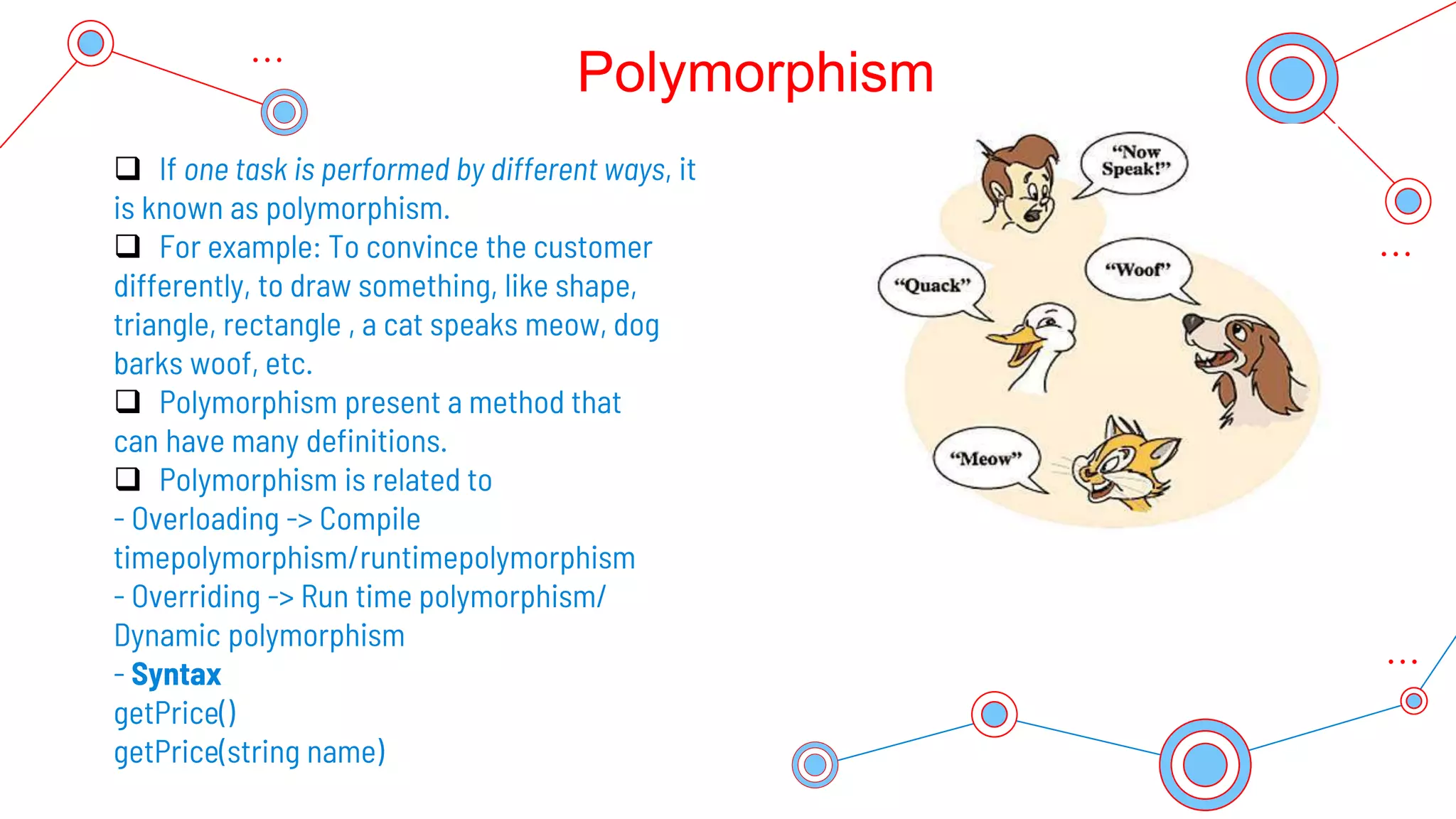
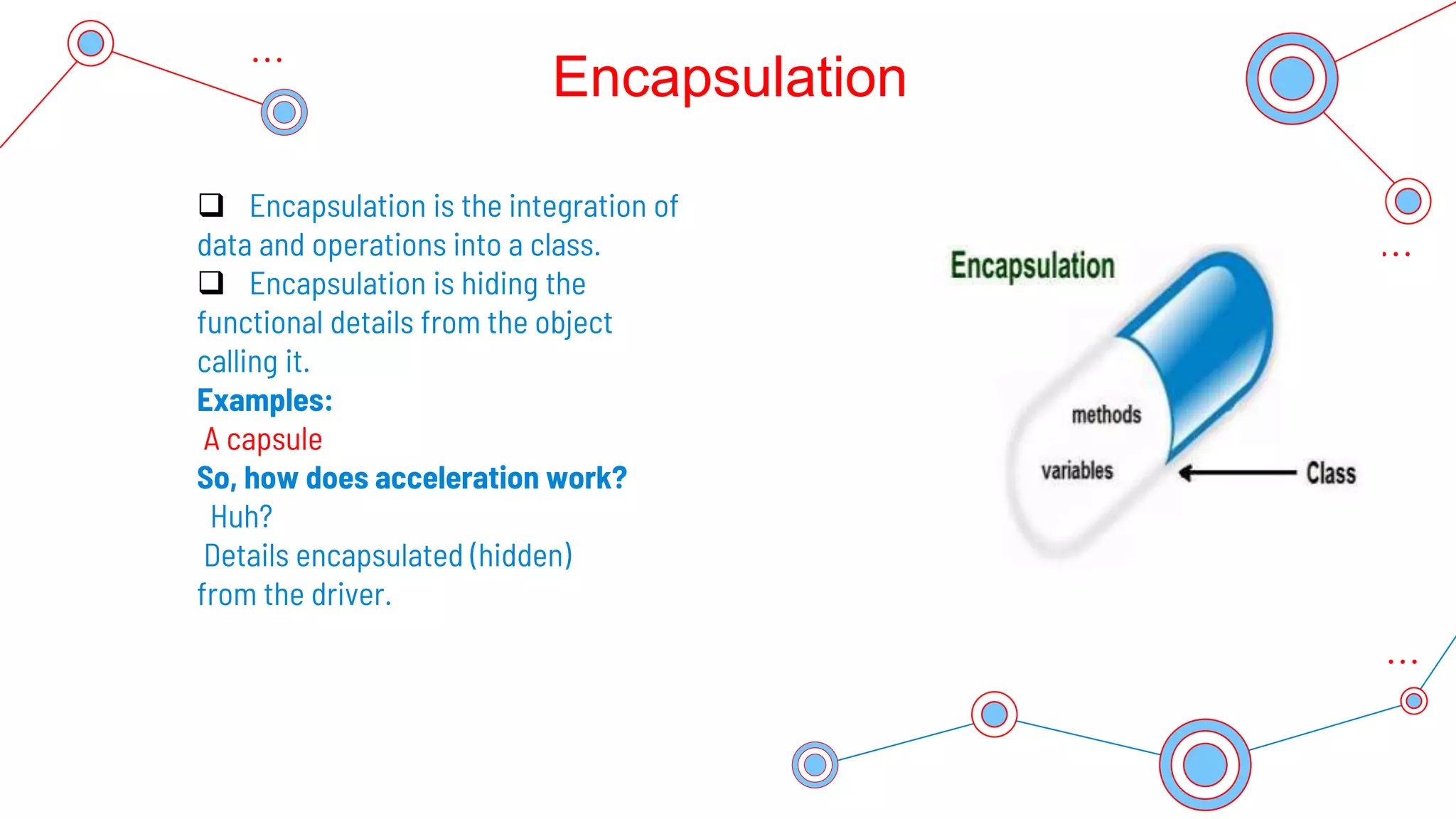
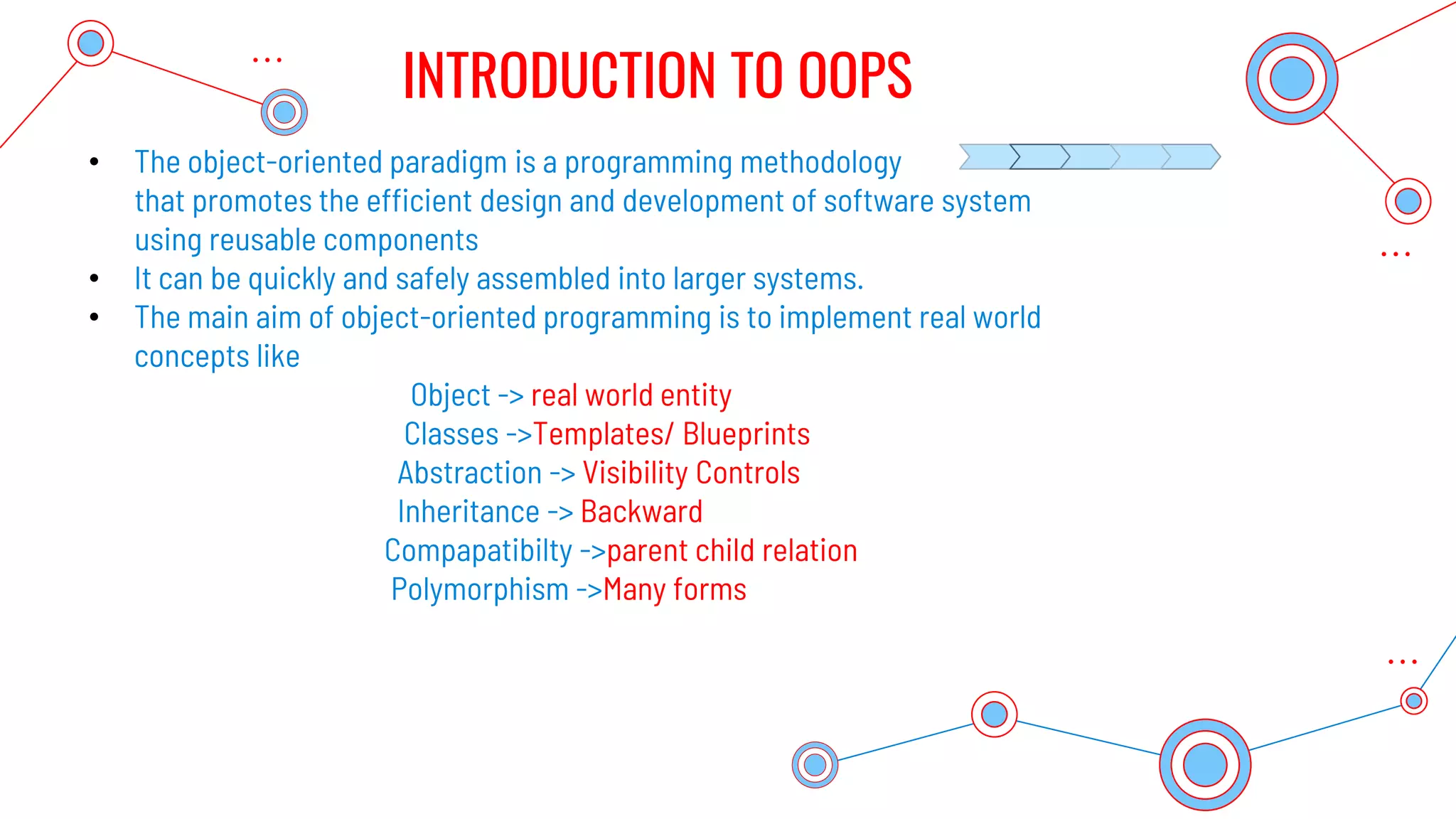
This presentation introduces object-oriented programming (OOP). It discusses the hierarchy of programming paradigms, comparing procedural programming to OOP. The need for OOP is that it models real-world things better and promotes reusability. The main components of OOP discussed are classes, objects, inheritance, polymorphism, encapsulation, and abstraction. Benefits of OOP include reusability, extensibility, and maintainability. The presentation concludes that OOP allows breaking problems into smaller pieces and facilitates upgrading systems from small to large.




![Programming Representation Of a
Class and Object
//Defining a Student class.
class Student{
//defining fields
int id; //field or data member or instance variable
String name;
//creating main method inside the Student class
public static void main(String args[]){
//Creating an object or instance
Student s1=new Student();//creating an object of Student
//Printing values of the object
System.out.println(s1.id);//accessing member through
reference variable
System.out.println(s1.name);
}
}](https://image.slidesharecdn.com/1669609053088oopsfinal-221128041831-d5f09350/75/1669609053088_oops_final-pptx-9-2048.jpg)

![Programming Representation of
Inheritance
Programming Representation of Inheritance
The syntax of Java Inheritance
class Subclass-name extends Superclass-name
{
//methods and fields
}
Example:
class Employee{
float salary=40000;
}
class Programmer extends Employee{
int bonus=10000;
public static void main(String args[]){
Programmer p=new Programmer();
System.out.println("Programmer salary is:"+p.salary);
System.out.println("Bonus of Programmer is:"+p.bonus);
}](https://image.slidesharecdn.com/1669609053088oopsfinal-221128041831-d5f09350/75/1669609053088_oops_final-pptx-11-2048.jpg)