Focus on: Thailand
Grant Thornton International Business Report 2013
4.8%

Rice-pledging

scheme

continues

Focus on: Thailand

b

countries where our

e

Audit, Tax and

Thai
business

leaders are

finding growth
a struggle

Introduction
0.8%
alia

unemployment
rate
economy of

and Advisory
Rice-pledging

scheme

professional work together

continues

$4.2bn

b

le

revenues
more than 67m people.

Thailand is an emerging
a key
In 2012, its GDP was approximately US$366bn, making it
artner 32nd largest economy in the world.
the

fi

2012

More than

15,000

Drawing on official data sources, such as the Economist
Intelligence Unit (EIU) and the International Monetary Fund
(IMF), and the Grant Thornton International Business Report
(IBR), this short report considers the outlook for the
Ranked in
economy, including the expectations of 200 businesses
the
interviewed in Thailand and more than 12,500 globally, top 6
in major markets
over the past 12 months.

0

u

Auditors
Austr

worldwide

f the

six’

Combined global

revenues of

habitants and growing
untancy

ations
gnised
Street

32nd

largest

economy

globally

2012

67 million
people
GDP

One o

‘large

global acc

organis
as reco
by Wall

1.2 billion inhabitants and growing
$366bn

re than 67 million people

Ian Pascoe
Managing partner
Grant Thornton Thailand

er firms’

$300m

in financial services

67m people and growing

%

remains
trade p

400
business
interviews

Over

approx.

2013 GDP

growth cut to

3.7%

67m people and growing

ents

60
3

of our mem

top cl
la
e

operate in fina

T +66 (0)22 05 8100
E ian.pascoe@th.gt.com
W www.grantthornton.co.th

ial services

Above the

More than 67 million people
Focus on: Thailand 2

g
Focus on: Thailand

Economy
The Thai economy is entering a transition phase in its macro-economy.
This change has been felt markedly in 2013. Fuelled by an increase in the
minimum wage, very low unemployment, a change in World consumption
towards higher-technology goods and still-low productivity, growth of just
1% in exports is projected for 2013.
The government have announced
years. From 2008 to now, it rose at
a series of measures that should
a pace of 12.8% per year, and its size
help combat some of these effects:
relative to GDP has gone from 56%
• a change to the corporate tax
to 79%.
rate to 20%
However, the Bank of Thailand
• some important changes to
has indicated this is a result of
manufacturing privileges
stimulus policies and that figure
remains a key
announced by the well regarded
should decline as such policies are
in major markets
trade partner
export-focussed Board of
wound back. Notwithstanding these
Investment (BOI). These include
policies, the outstanding public debt
a move away from labour-driven
continues to remain relatively low at
Combined global
manufacturing towards more
5.30 trillion baht, or 44.63% of GDP,
revenues of higher-value goods in production
as of 31st August, 2013.
• massive infrastructure spending
This protracted consumer
plans of around $64billion, to
slowdown has meant that the Bank
in financial services
be invested before 2020. Whilst
of Thailand has adjusted their forecast
2012
it is expected that these will move
for GDP growth downwards three
ahead, it is likely that the start date
times during the last 10 months from
global accountancy
will be delayed meaning there will
over 5% to 3.7% (actual growth was
organisations
be little effect on the growth
6.5% in 2012).
as recognised
numbers in Street
by Wall 2014.
These welcome changes will assist to drive growth however will take time for
GDP
their full effect to impact the economy. As a result we believe Thailand will
1.2 billion
finish 2013 on a more subdued economic note than it started.

The economies of Thailand’s major
trading partners are performing
relatively strongly, and tourism has
rebounded well in 2013, up around a
projected 23%, with Time magazine
reporting that Bangkok was the most
visited city in the world by the 2013
Global Destination Cities Index.
These externally positive facts
reinforce that Thailand’s economic
performance is due to domestic issues.
The potent mixture of this
slowdown, mixed with expensive
and out-of-control populist stimulus
measures has resulted in consumer
disquiet. Domestic consumption has
slowed over a longer-than-expected
period as consumers grow concerned
about their household debt. This has
been steadily increasing for some

Ranked in

the top 6

$300m

67 million
people

approx.

2013 Fcst

GDP (%)

2013 GDP

3.7

Exports (%)

growth cut to

3.7%

1

Headline inflation (%)

2.2

Core inflation (%)

1

Current account (US$ bn)

-6.8

53.4%

20.0%

China
Japan
US
UAE
Others

6.3%
5.3%

60%

400

“The important dynamic
business
elements that I’ll be considering
interviews
of our member firms’the consumer’s
will be certainly
disposable income and how that will pan
out into 2014. I’m keeping a very close
operate in financial services
eye on the tourism sector. The more tourist
Above
that come to Thailand, the better it the for
is
39%
businesses. We are also looking average
BRIC at the
government to start their India
Talent major
shortage
infrastructure programs
hampers
growth million
that we believe will certainly jobs
help push the economy.”

top clients

needs to create

Export destinations (2012)

Import originations (2012)

2014 GDP
11.7%
2014 GDP
growth

Mr. Rituraj Mohan
Managing director
Boots Retail (Thailand) Ltd

2014
31% GDP
growth
31%of Thai
cut to
of
4.8% Thai cut to

growth 10.2%
cut to

China
Japan
US
businesses
9.9%
expect
Hong Kong revenue
businesses to rise
revenue
5.7% expectOthers
Rice-pledging to rise

31%

Rice-pledging

120+
4.8% +
120

continues
Ranked

and
Thai Audit, Tax and
scheme Advisory
professional
business
and Advisorywork together
Thai leaders continues
are
Thai

4.8%

62.4%

scheme
continues
scheme

in

in

Over

100

Source: Bank of Thailand (2013)

14.9%

One of the

‘large six’

$366bn

Revised in October, 2013

Australia

of Thai

businesses
expect revenue
countries where our
to rise

Audit, Tax
countries where our
Rice-pledging

and

Focus on: Thailand 3

Mo
Focus on: Thailand
Economic outlook
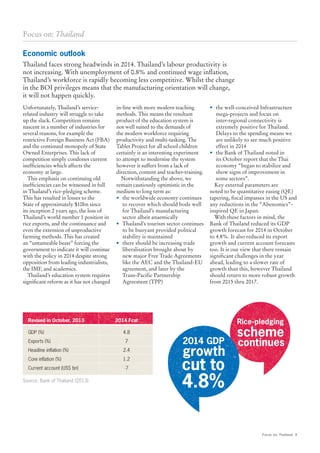
Thailand faces strong headwinds in 2014. Thailand’s labour productivity is
not increasing. With unemployment of 0.8% and continued wage inflation,
Thailand’s workforce is rapidly becoming less competitive. Whilst the change
in the BOI privileges means that the manufacturing orientation will change,
it will not happen quickly.
Unfortunately, Thailand’s servicerelated industry will struggle to take
up the slack. Competition remains
nascent in a number of industries for
several reasons, for example the
restrictive Foreign Business Act (FBA)
and the continued monopoly of State
Owned Enterprises. This lack of
competition simply condones current
inefficiencies which affects the
economy at large.
This emphasis on continuing old
inefficiencies can be witnessed in full
in Thailand’s rice-pledging scheme.
This has resulted in losses to the
State of approximately $10bn since
its inception 2 years ago, the loss of
Thailand’s world number 1 position in
rice exports, and the continuance and
even the extension of unproductive
farming methods. This has created
an “untameable beast” forcing the
government to indicate it will continue
with the policy in 2014 despite strong
opposition from leading industrialists,
the IMF, and academics.
Thailand’s education system requires
significant reform as it has not changed

in-line with more modern teaching
methods. This means the resultant
product of the education system is
not well suited to the demands of
the modern workforce requiring
productivity and multi-tasking. The
Tablet Project for all school children
certainly is an interesting experiment
to attempt to modernise the system
however it suffers from a lack of
direction, content and teacher-training.
Notwithstanding the above, we
remain cautiously optimistic in the
medium to long term as:
• the worldwide economy continues
to recover which should bode well
for Thailand’s manufacturing
sector albeit anaemically
• Thailand’s tourism sector continues
to be buoyant provided political
stability is maintained
• there should be increasing trade
liberalisation brought about by
new major Free Trade Agreements
like the AEC and the Thailand-EU
agreement, and later by the
Trans-Pacific Partnership
Agreement (TPP)

• the well-conceived Infrastructure
mega-projects and focus on
inter-regional connectivity is
extremely positive for Thailand.
Delays to the spending means we
are unlikely to see much positive
effect in 2014
• the Bank of Thailand noted in
its October report that the Thai
economy “began to stabilize and
show signs of improvement in
some sectors”.
Key external parameters are
noted to be quantitative easing (QE)
tapering, fiscal impasses in the US and
any reductions in the “Abenomics”inspired QE in Japan.
With these factors in mind, the
Bank of Thailand reduced its GDP
growth forecast for 2014 in October
to 4.8%. It also reduced its export
growth and current account forecasts
too. It is our view that there remain
significant challenges in the year
ahead, leading to a slower rate of
growth than this, however Thailand
should return to more robust growth
from 2015 thru 2017.

2014 GDP

growth

cut to

4.8%

Revised in October, 2013
GDP (%)
Exports (%)

in

p6

kets

7

Headline inflation (%)

2.4

Core inflation (%)

1.2

Australia

Current account (US$ bn)

remains a key
trade partner

Source: Bank of Thailand (2013)

obal

s of

Australia

remains a key

-7

of

bu

exp

Rice-pledging

2014 Fcst
4.8

3

2014 GDP

growth

cut to

4.8%

scheme

continues

31%

of Thai
businesses
expect revenue

to rise

Rice-pledging

lea

find
a

1
0

cou

scheme

continues

bu

une

Au

Thai
business 4
Focus on: Thailand
leaders are

finding growth
a struggle

an

profe
67m
people

Focus on: Thailand

and growing

Business growth prospects
Thai business confidence fell to its lowest level since the 2011 floods in Q3-2013,
dropping to net -28% – meaning more business leaders are pessimistic than are
optimistic for the economy over the next 12 months – down from 22% the
previous quarter.
By contrast, the ASEAN average ticked up to 39% in
Q3 from 26% in Q2, driven by sharp increases in the
Philippines and Vietnam. Importantly for the wider
growth of the region, Chinese business optimism
rebounded from a record low of 4% in Q2, to 31% in Q3.
This negativity is feeding through to business leader
confidence in the growth of their own operations. While
net 31% of Thai businesses expect revenues to rise over
the next 12 months, -10% expect their profits to rise
(meaning a majority expect a decrease in profits), down
from 28% in Q2. Export prospects remain depressed with
just net 2% of business leaders expecting an increase, the
same as Q2, and down from an average of 17% in 2012.
The proportion of businesses planning to increase
investment in plant and machinery has also dropped,
declining from 18% in Q2 to just 4% in Q3.

67m people
and growing

“The government should
be transparent in their mega-projects
and have a clear plan in each project.
They should review and evaluate their
populist policy’s and whether they really
drive real GDP or not, and fine-tune them.
Most important is the labour issue. The
government should develop skilled labour
and resolve the labour shortage issue.
The 300-baht [minimum wage] policy
has been announced and we know
that national productivity has not
increased at all”

Mr. Thana Thiramanus
Managing director
Property Care Services (Thailand) Ltd

Net percentage of Thai businesses expecting an increase
53

Net percentage of businesses optimistic for the
economic outlook

2012 (average)
40%

Q2-2013
Q3-2013

44

30%
20%
10%

31
28

0%

67m
24
people

28

-10%
-20%

and growing18

17

Q4
Q1
2011 2012

Q2
2012

Q3
Q4
2012 2012

Q1
2013

Q2
2013

Q3
2013

-30%
-40%
2

Revenue

Profits

Exports

2

4
Investment

-50%
-60%

Thailand
ASEAN

-10

Source: Grant Thornton IBR 2013

Source: Grant Thornton IBR 2013

Focus on: Thailand 5
2014 GDP

growth

Focus on: Thailand
Business growth constraints

cut to

4.8%

31%

of Thai
businesses

Business leaders in Thailand feel far more constrained in their ability to grow expect revenue
their operations compared with peers across the ASEAN region. Over the past
to rise
12 months, over half of Thai business leaders (53%) have cited a lack of demand
as a constraint on growth, rising to 60%Rice-pledging level since
in Q3 alone – the highest
Q4-2011. A lack of skilled workers (see next page) is also cited by over half
of businesses (52%).

scheme

continues

67m

Bureaucracy also remains a major concern. More than
people
two in five businesses cited regulations and red tape in
and growing
both 2012 and 2013, around double the level reported
before the financial crisis (20% in 2007). Infrastructure
concerns are also more pressing for Thai businesses
compared with ASEAN peers: more than a third cite
poor quality transport (37%) and ICT (34%)
infrastructure.
67m people
and growing
However, the most pressing overall concern in
Q3-2013 was economic uncertainty, perhaps reflecting
both political and economic problems both at 67m
home
67m
and abroad. This was cited as a constraint onpeople
growth
people
and growing and growing
by 80% of business leaders, above the Q2 result and
the ASEAN average (both 60%).

Thai
business

leaders are

finding growth
a struggle
“This is really the
year to focus on preparing
for the AEC. There’s no doubt
that we [Thailand] have to invest
in our infrastructure in order 67m
to
people
prepare for both the opportunities
unemployment
and
and challenges that come growing
rate
with that.”

0.8%

erviews

$

67m people
and growing

67m people

Mr. Thomas Nyborg
Managing director
Pandora Production Co. Ltd
67m people

and growing

Net percentage of businesses citing factor as a constraint
on growth (next 12 months)

1

and growing

67m
people

and growing

53

38

52

42

42

37

67m people

and growing
Shortage of orders

37

Regulations & red tape

Lack of skilled workers

29

34

31

33

2 billion inhabitants and growing

400
siness

1

Transport infrastructure

Source: Grant Thornton IBR 2013

ICT infrastructure

26

Shortage of finance
Thailand
ASEAN

32nd

largest

Focus on: Thailand 6

economy
h

o

%

g

e

s

67m people
and growing

Focus on: Thailand
Talent shortages
Thailand is going through a serious talent drought. The World Bank recently
reported that a lack of skilled labour has become the biggest impediment to
doing business in Thailand, while the Ministry of Labour said that demand for
workers outstripped supply for the first time in 2013. The government estimates
that 300,000 people are unemployed, which represents just 0.8% of the labour
force. As a result so these skills shortages, average wages rose by around 50%
in the decade to 2010.

31%

Percentage of businesses citing a lack of skilled workers
More than 50% of businesses in Thailand cite a lack of
as a constraint on growth (next 12 months)
skilled workers as a constraint on their expansion plans,
ten percentage points higher than the ASEAN average
Thailand
80%
(42%) where unemployment rates are higher. This is
ASEAN
however, far from a new phenomenon: in 2008, 68%
70%
of Thai businesses claimed that a lack of the right
expect revenue
60%
people was stopping them from growing.
The outlook for hiring workers has declined steadily
50%
over the past four quarters, falling from net 48% in
Q4-2012 to 0% in Q3-2013. Traditionally, Thailand
40%
has plugged skills gaps with migrant workers from
neighbours such as Myanmar, Cambodia and Laos,
30%
but with businesses issuing a collective warning on
profits, they are unlikely to be needed in the short-term.
20%
Longer term however, a review migration policies and
incentives, and improvements to the education system
will be needed to ensure that the Thailand continues
2008
2009
professional work together2010 2011 2012 2013
to offer the right people to support its development.

of Thai
businesses
to rise

120+
countries where our

Audit, Tax and

Thai
business

and Advisory

leaders are

finding growth
a struggle

0.8%

unemployment
rate

$4.2bn

Percentage of businesses expecting an increase
in employment (next 12 months)
50%

revenues

Thailand
ASEAN

40%

2012

30%

“The government
should solve the labour
shortage for the export industry.
Maybe they should look
for joint ventures with
neighbouring countries.”

67m
people

and growing

20%

67m people

More than

Mr. Anchatach Taechamatavorn
Chairman, Manufacturers Public Co. Ltd

67m
people

and growing

and growing

15,000
10%

Q4
2011

Q1
Q2
Q3
Q4
Q1
Q2
Q3
2012 2012 2012 2012 2013 2013 2013

Auditors
Source: Grant Thornton IBR 2013

worldwide

Focus on: Thailand 7
IBR 2013 methodology
The Grant Thornton International Business Report (IBR) is the leading mid-market business survey in the
world, interviewing approximately 3,300 senior executives every quarter in listed and privately-held businesses
all over the world. Launched in 1992 in nine European countries, the report now surveys more than 12,500
businesses leaders in 45 economies on an annual basis, providing insights on the economic and commercial
issues affecting companies globally.
The data in this report are drawn from interviews with chief executive officers, managing directors,
chairmen and other senior decision-makers from all industry sectors in mid-market businesses, defined
in Thailand as those with 20-599 employees.
Q3 data is drawn from 3,300 interviews globally (50 in Thailand) conducted in September 2013. 2013
average data is drawn from over 12,500 interviews (200 in Thailand) conducted between December 2012
and September 2013.
To find out more about IBR, please visit: www.internationalbusinessreport.com.
Dominic King
Grant Thornton International Ltd
Global research manager
T +44 (0)207 391 9537
E dominic.king@gti.gt.com

Lakpilai Worasaphya
Grant Thornton Thailand
Senior manager – Marketing & communications
T +66 2 205 8142
E lakpilai.worasaphya@th.gt.com  

© 2013 Grant Thornton International Ltd.
‘Grant Thornton’ refers to the brand under which the Grant Thornton
member firms provide assurance, tax and advisory services to their
clients and/or refers to one or more member firms, as the context requires.
Grant Thornton International Ltd (GTIL) and the member firms are not a
worldwide partnership. GTIL and each member firm is a separate legal
entity. Services are delivered by the member firms. GTIL does not provide
services to clients. GTIL and its member firms are not agents of, and do
not obligate, one another and are not liable for one another’s acts or omissions.

www.gti.org
CA1310-01

Focus on Thailand (IBR 2013)

  • 1.
    Focus on: Thailand GrantThornton International Business Report 2013
  • 2.
    4.8% Rice-pledging scheme continues Focus on: Thailand b countrieswhere our e Audit, Tax and Thai business leaders are finding growth a struggle Introduction 0.8% alia unemployment rate economy of and Advisory Rice-pledging scheme professional work together continues $4.2bn b le revenues more than 67m people. Thailand is an emerging a key In 2012, its GDP was approximately US$366bn, making it artner 32nd largest economy in the world. the fi 2012 More than 15,000 Drawing on official data sources, such as the Economist Intelligence Unit (EIU) and the International Monetary Fund (IMF), and the Grant Thornton International Business Report (IBR), this short report considers the outlook for the Ranked in economy, including the expectations of 200 businesses the interviewed in Thailand and more than 12,500 globally, top 6 in major markets over the past 12 months. 0 u Auditors Austr worldwide f the six’ Combined global revenues of habitants and growing untancy ations gnised Street 32nd largest economy globally 2012 67 million people GDP One o ‘large global acc organis as reco by Wall 1.2 billion inhabitants and growing $366bn re than 67 million people Ian Pascoe Managing partner Grant Thornton Thailand er firms’ $300m in financial services 67m people and growing % remains trade p 400 business interviews Over approx. 2013 GDP growth cut to 3.7% 67m people and growing ents 60 3 of our mem top cl la e operate in fina T +66 (0)22 05 8100 E ian.pascoe@th.gt.com W www.grantthornton.co.th ial services Above the More than 67 million people Focus on: Thailand 2 g
  • 3.
    Focus on: Thailand Economy TheThai economy is entering a transition phase in its macro-economy. This change has been felt markedly in 2013. Fuelled by an increase in the minimum wage, very low unemployment, a change in World consumption towards higher-technology goods and still-low productivity, growth of just 1% in exports is projected for 2013. The government have announced years. From 2008 to now, it rose at a series of measures that should a pace of 12.8% per year, and its size help combat some of these effects: relative to GDP has gone from 56% • a change to the corporate tax to 79%. rate to 20% However, the Bank of Thailand • some important changes to has indicated this is a result of manufacturing privileges stimulus policies and that figure remains a key announced by the well regarded should decline as such policies are in major markets trade partner export-focussed Board of wound back. Notwithstanding these Investment (BOI). These include policies, the outstanding public debt a move away from labour-driven continues to remain relatively low at Combined global manufacturing towards more 5.30 trillion baht, or 44.63% of GDP, revenues of higher-value goods in production as of 31st August, 2013. • massive infrastructure spending This protracted consumer plans of around $64billion, to slowdown has meant that the Bank in financial services be invested before 2020. Whilst of Thailand has adjusted their forecast 2012 it is expected that these will move for GDP growth downwards three ahead, it is likely that the start date times during the last 10 months from global accountancy will be delayed meaning there will over 5% to 3.7% (actual growth was organisations be little effect on the growth 6.5% in 2012). as recognised numbers in Street by Wall 2014. These welcome changes will assist to drive growth however will take time for GDP their full effect to impact the economy. As a result we believe Thailand will 1.2 billion finish 2013 on a more subdued economic note than it started. The economies of Thailand’s major trading partners are performing relatively strongly, and tourism has rebounded well in 2013, up around a projected 23%, with Time magazine reporting that Bangkok was the most visited city in the world by the 2013 Global Destination Cities Index. These externally positive facts reinforce that Thailand’s economic performance is due to domestic issues. The potent mixture of this slowdown, mixed with expensive and out-of-control populist stimulus measures has resulted in consumer disquiet. Domestic consumption has slowed over a longer-than-expected period as consumers grow concerned about their household debt. This has been steadily increasing for some Ranked in the top 6 $300m 67 million people approx. 2013 Fcst GDP (%) 2013 GDP 3.7 Exports (%) growth cut to 3.7% 1 Headline inflation (%) 2.2 Core inflation (%) 1 Current account (US$ bn) -6.8 53.4% 20.0% China Japan US UAE Others 6.3% 5.3% 60% 400 “The important dynamic business elements that I’ll be considering interviews of our member firms’the consumer’s will be certainly disposable income and how that will pan out into 2014. I’m keeping a very close operate in financial services eye on the tourism sector. The more tourist Above that come to Thailand, the better it the for is 39% businesses. We are also looking average BRIC at the government to start their India Talent major shortage infrastructure programs hampers growth million that we believe will certainly jobs help push the economy.” top clients needs to create Export destinations (2012) Import originations (2012) 2014 GDP 11.7% 2014 GDP growth Mr. Rituraj Mohan Managing director Boots Retail (Thailand) Ltd 2014 31% GDP growth 31%of Thai cut to of 4.8% Thai cut to growth 10.2% cut to China Japan US businesses 9.9% expect Hong Kong revenue businesses to rise revenue 5.7% expectOthers Rice-pledging to rise 31% Rice-pledging 120+ 4.8% + 120 continues Ranked and Thai Audit, Tax and scheme Advisory professional business and Advisorywork together Thai leaders continues are Thai 4.8% 62.4% scheme continues scheme in in Over 100 Source: Bank of Thailand (2013) 14.9% One of the ‘large six’ $366bn Revised in October, 2013 Australia of Thai businesses expect revenue countries where our to rise Audit, Tax countries where our Rice-pledging and Focus on: Thailand 3 Mo
  • 4.
    Focus on: Thailand Economicoutlook Thailand faces strong headwinds in 2014. Thailand’s labour productivity is not increasing. With unemployment of 0.8% and continued wage inflation, Thailand’s workforce is rapidly becoming less competitive. Whilst the change in the BOI privileges means that the manufacturing orientation will change, it will not happen quickly. Unfortunately, Thailand’s servicerelated industry will struggle to take up the slack. Competition remains nascent in a number of industries for several reasons, for example the restrictive Foreign Business Act (FBA) and the continued monopoly of State Owned Enterprises. This lack of competition simply condones current inefficiencies which affects the economy at large. This emphasis on continuing old inefficiencies can be witnessed in full in Thailand’s rice-pledging scheme. This has resulted in losses to the State of approximately $10bn since its inception 2 years ago, the loss of Thailand’s world number 1 position in rice exports, and the continuance and even the extension of unproductive farming methods. This has created an “untameable beast” forcing the government to indicate it will continue with the policy in 2014 despite strong opposition from leading industrialists, the IMF, and academics. Thailand’s education system requires significant reform as it has not changed in-line with more modern teaching methods. This means the resultant product of the education system is not well suited to the demands of the modern workforce requiring productivity and multi-tasking. The Tablet Project for all school children certainly is an interesting experiment to attempt to modernise the system however it suffers from a lack of direction, content and teacher-training. Notwithstanding the above, we remain cautiously optimistic in the medium to long term as: • the worldwide economy continues to recover which should bode well for Thailand’s manufacturing sector albeit anaemically • Thailand’s tourism sector continues to be buoyant provided political stability is maintained • there should be increasing trade liberalisation brought about by new major Free Trade Agreements like the AEC and the Thailand-EU agreement, and later by the Trans-Pacific Partnership Agreement (TPP) • the well-conceived Infrastructure mega-projects and focus on inter-regional connectivity is extremely positive for Thailand. Delays to the spending means we are unlikely to see much positive effect in 2014 • the Bank of Thailand noted in its October report that the Thai economy “began to stabilize and show signs of improvement in some sectors”. Key external parameters are noted to be quantitative easing (QE) tapering, fiscal impasses in the US and any reductions in the “Abenomics”inspired QE in Japan. With these factors in mind, the Bank of Thailand reduced its GDP growth forecast for 2014 in October to 4.8%. It also reduced its export growth and current account forecasts too. It is our view that there remain significant challenges in the year ahead, leading to a slower rate of growth than this, however Thailand should return to more robust growth from 2015 thru 2017. 2014 GDP growth cut to 4.8% Revised in October, 2013 GDP (%) Exports (%) in p6 kets 7 Headline inflation (%) 2.4 Core inflation (%) 1.2 Australia Current account (US$ bn) remains a key trade partner Source: Bank of Thailand (2013) obal s of Australia remains a key -7 of bu exp Rice-pledging 2014 Fcst 4.8 3 2014 GDP growth cut to 4.8% scheme continues 31% of Thai businesses expect revenue to rise Rice-pledging lea find a 1 0 cou scheme continues bu une Au Thai business 4 Focus on: Thailand leaders are finding growth a struggle an profe
  • 5.
    67m people Focus on: Thailand andgrowing Business growth prospects Thai business confidence fell to its lowest level since the 2011 floods in Q3-2013, dropping to net -28% – meaning more business leaders are pessimistic than are optimistic for the economy over the next 12 months – down from 22% the previous quarter. By contrast, the ASEAN average ticked up to 39% in Q3 from 26% in Q2, driven by sharp increases in the Philippines and Vietnam. Importantly for the wider growth of the region, Chinese business optimism rebounded from a record low of 4% in Q2, to 31% in Q3. This negativity is feeding through to business leader confidence in the growth of their own operations. While net 31% of Thai businesses expect revenues to rise over the next 12 months, -10% expect their profits to rise (meaning a majority expect a decrease in profits), down from 28% in Q2. Export prospects remain depressed with just net 2% of business leaders expecting an increase, the same as Q2, and down from an average of 17% in 2012. The proportion of businesses planning to increase investment in plant and machinery has also dropped, declining from 18% in Q2 to just 4% in Q3. 67m people and growing “The government should be transparent in their mega-projects and have a clear plan in each project. They should review and evaluate their populist policy’s and whether they really drive real GDP or not, and fine-tune them. Most important is the labour issue. The government should develop skilled labour and resolve the labour shortage issue. The 300-baht [minimum wage] policy has been announced and we know that national productivity has not increased at all” Mr. Thana Thiramanus Managing director Property Care Services (Thailand) Ltd Net percentage of Thai businesses expecting an increase 53 Net percentage of businesses optimistic for the economic outlook 2012 (average) 40% Q2-2013 Q3-2013 44 30% 20% 10% 31 28 0% 67m 24 people 28 -10% -20% and growing18 17 Q4 Q1 2011 2012 Q2 2012 Q3 Q4 2012 2012 Q1 2013 Q2 2013 Q3 2013 -30% -40% 2 Revenue Profits Exports 2 4 Investment -50% -60% Thailand ASEAN -10 Source: Grant Thornton IBR 2013 Source: Grant Thornton IBR 2013 Focus on: Thailand 5
  • 6.
    2014 GDP growth Focus on:Thailand Business growth constraints cut to 4.8% 31% of Thai businesses Business leaders in Thailand feel far more constrained in their ability to grow expect revenue their operations compared with peers across the ASEAN region. Over the past to rise 12 months, over half of Thai business leaders (53%) have cited a lack of demand as a constraint on growth, rising to 60%Rice-pledging level since in Q3 alone – the highest Q4-2011. A lack of skilled workers (see next page) is also cited by over half of businesses (52%). scheme continues 67m Bureaucracy also remains a major concern. More than people two in five businesses cited regulations and red tape in and growing both 2012 and 2013, around double the level reported before the financial crisis (20% in 2007). Infrastructure concerns are also more pressing for Thai businesses compared with ASEAN peers: more than a third cite poor quality transport (37%) and ICT (34%) infrastructure. 67m people and growing However, the most pressing overall concern in Q3-2013 was economic uncertainty, perhaps reflecting both political and economic problems both at 67m home 67m and abroad. This was cited as a constraint onpeople growth people and growing and growing by 80% of business leaders, above the Q2 result and the ASEAN average (both 60%). Thai business leaders are finding growth a struggle “This is really the year to focus on preparing for the AEC. There’s no doubt that we [Thailand] have to invest in our infrastructure in order 67m to people prepare for both the opportunities unemployment and and challenges that come growing rate with that.” 0.8% erviews $ 67m people and growing 67m people Mr. Thomas Nyborg Managing director Pandora Production Co. Ltd 67m people and growing Net percentage of businesses citing factor as a constraint on growth (next 12 months) 1 and growing 67m people and growing 53 38 52 42 42 37 67m people and growing Shortage of orders 37 Regulations & red tape Lack of skilled workers 29 34 31 33 2 billion inhabitants and growing 400 siness 1 Transport infrastructure Source: Grant Thornton IBR 2013 ICT infrastructure 26 Shortage of finance Thailand ASEAN 32nd largest Focus on: Thailand 6 economy
  • 7.
    h o % g e s 67m people and growing Focuson: Thailand Talent shortages Thailand is going through a serious talent drought. The World Bank recently reported that a lack of skilled labour has become the biggest impediment to doing business in Thailand, while the Ministry of Labour said that demand for workers outstripped supply for the first time in 2013. The government estimates that 300,000 people are unemployed, which represents just 0.8% of the labour force. As a result so these skills shortages, average wages rose by around 50% in the decade to 2010. 31% Percentage of businesses citing a lack of skilled workers More than 50% of businesses in Thailand cite a lack of as a constraint on growth (next 12 months) skilled workers as a constraint on their expansion plans, ten percentage points higher than the ASEAN average Thailand 80% (42%) where unemployment rates are higher. This is ASEAN however, far from a new phenomenon: in 2008, 68% 70% of Thai businesses claimed that a lack of the right expect revenue 60% people was stopping them from growing. The outlook for hiring workers has declined steadily 50% over the past four quarters, falling from net 48% in Q4-2012 to 0% in Q3-2013. Traditionally, Thailand 40% has plugged skills gaps with migrant workers from neighbours such as Myanmar, Cambodia and Laos, 30% but with businesses issuing a collective warning on profits, they are unlikely to be needed in the short-term. 20% Longer term however, a review migration policies and incentives, and improvements to the education system will be needed to ensure that the Thailand continues 2008 2009 professional work together2010 2011 2012 2013 to offer the right people to support its development. of Thai businesses to rise 120+ countries where our Audit, Tax and Thai business and Advisory leaders are finding growth a struggle 0.8% unemployment rate $4.2bn Percentage of businesses expecting an increase in employment (next 12 months) 50% revenues Thailand ASEAN 40% 2012 30% “The government should solve the labour shortage for the export industry. Maybe they should look for joint ventures with neighbouring countries.” 67m people and growing 20% 67m people More than Mr. Anchatach Taechamatavorn Chairman, Manufacturers Public Co. Ltd 67m people and growing and growing 15,000 10% Q4 2011 Q1 Q2 Q3 Q4 Q1 Q2 Q3 2012 2012 2012 2012 2013 2013 2013 Auditors Source: Grant Thornton IBR 2013 worldwide Focus on: Thailand 7
  • 8.
    IBR 2013 methodology TheGrant Thornton International Business Report (IBR) is the leading mid-market business survey in the world, interviewing approximately 3,300 senior executives every quarter in listed and privately-held businesses all over the world. Launched in 1992 in nine European countries, the report now surveys more than 12,500 businesses leaders in 45 economies on an annual basis, providing insights on the economic and commercial issues affecting companies globally. The data in this report are drawn from interviews with chief executive officers, managing directors, chairmen and other senior decision-makers from all industry sectors in mid-market businesses, defined in Thailand as those with 20-599 employees. Q3 data is drawn from 3,300 interviews globally (50 in Thailand) conducted in September 2013. 2013 average data is drawn from over 12,500 interviews (200 in Thailand) conducted between December 2012 and September 2013. To find out more about IBR, please visit: www.internationalbusinessreport.com. Dominic King Grant Thornton International Ltd Global research manager T +44 (0)207 391 9537 E dominic.king@gti.gt.com Lakpilai Worasaphya Grant Thornton Thailand Senior manager – Marketing & communications T +66 2 205 8142 E lakpilai.worasaphya@th.gt.com   © 2013 Grant Thornton International Ltd. ‘Grant Thornton’ refers to the brand under which the Grant Thornton member firms provide assurance, tax and advisory services to their clients and/or refers to one or more member firms, as the context requires. Grant Thornton International Ltd (GTIL) and the member firms are not a worldwide partnership. GTIL and each member firm is a separate legal entity. Services are delivered by the member firms. GTIL does not provide services to clients. GTIL and its member firms are not agents of, and do not obligate, one another and are not liable for one another’s acts or omissions. www.gti.org CA1310-01