1. EAT!
Bellwork
Schedule
1. EAT
2. Internship
3. Project presentations
4. Last Words
Objectives
• EAT!
• Learn from each other through
Plan/Project sharing
• Close out the semester
The Internship: Building Level
Educational Leadership
Frederick Buskey, Program Coordinator
Summer, 2015
•Activity Based
•Ongoing
•Formal and Informal
•Diverse
•Individually Focused
•Collaborative
Design Principles
•Specific Activity Lists:
• Applied leadership
course activities
•Essential
•Recommended
•Optional
•Site specific
•Diverse Setting
Activity Based
• Types:
• Course Activities: Throughout program, part of course
• Essential: Must make up 50 or more hours in each internship
• Recommended: Varies in importance based on experience
• Optional: May be important for some people
• Diverse: Required to be completed in a diverse setting
• Requirements
• Task completion
• Debrief with mentor
• Sign off verification
• 250 word reflection
Core Activities
• Pre-Internship: 20+ hours of activities
•Course-based
• Intern I: 100+ hours of activities
• Course-based
• Part of a PDP
• Approved by supervisor and mentor
• May include banked hours
• Intern I: 100+ hours of activities
• Course-based
• Part of a PDP
• Approved by supervisor and mentor
• Diverse Setting: 20+ hours of activities
• Pre, Int. I, or Int. II
• Counts toward hour/activity of Pre, I, II
• Setting must be approved
Activities and Hours
• Activities and hours completed in the semester prior
to Internship I
• Part of an approved PDP plan (Intern I)
• Not part of a course assignment
• Maximum of 50 hours
• Only counts towards Intern I, unless special
conditions apply
• Helpful for those without summer internship
• Helpful for diverse setting
Banking
Requirements: Semester 1 & 2
•7000
•7150
•7200
•7250
•7300
•7450
Course-Based Activities
Intern I
Intern II
• Within the first three weeks of each internship
• May complete draft in prior semester to bank activities
• Develop plan collaboratively with mentor
• Needs to be approved by supervisor
• Goal related to the ELCC and PADEPP standards.
• Explain how certain activities should support goals.
• Include all activities for the specific internship (100+
hours)
• Essential
• Recommended activities, as well as
• Candidate and principal developed activities.
• May include candidate initiated activities and
responsibilities that require leadership.
Professional Development Plan
• Completing the activity
• Debriefing with mentor
• Multiple activities may be debriefed in single
sitting
• Brief (250 words or less) reflection
• Incorporate content from mentor debrief
• Some activities require more reflection (e.g.,
ELCC 4.1, 4.2, 4.3)
• Completion log with the mentor signatures
Professional Development Plan
•TBA
Portfolio
• First Semester: choose a mentor
• Should be building administrator, ideally principal
• Intern I: identify two co-mentors.
• May be initial mentor
• One must be in building
• One must meet the criteria for being highly qualified
• University supervisor from Clemson University
• Should be person teaching the course
• Work with the candidate to coordinate the PDP
• Meets with mentors
• Conducts building walk-throughs
• Coordinates seminars
Mentor(s)
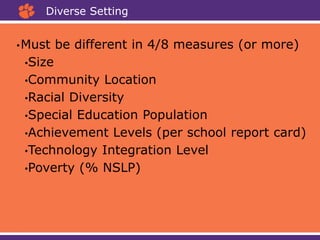
•Must be different in 4/8 measures (or more)
•Size
•Community Location
•Racial Diversity
•Special Education Population
•Achievement Levels (per school report card)
•Technology Integration Level
•Poverty (% NSLP)
Diverse Setting
Project Sharing
• Focus on the project part
• What is different today?
• What impact did this have on your leadership?
Assessing our PLC
Last Words
You will meet in mid-May, but with a different grouping
You will probably won’t see me until graduation..
What do you want to say to conclude this class?

16 presentation 715 s-15

  • 1.
  • 2.
    Schedule 1. EAT 2. Internship 3.Project presentations 4. Last Words
  • 3.
    Objectives • EAT! • Learnfrom each other through Plan/Project sharing • Close out the semester
  • 4.
    The Internship: BuildingLevel Educational Leadership Frederick Buskey, Program Coordinator Summer, 2015
  • 5.
    •Activity Based •Ongoing •Formal andInformal •Diverse •Individually Focused •Collaborative Design Principles
  • 6.
    •Specific Activity Lists: •Applied leadership course activities •Essential •Recommended •Optional •Site specific •Diverse Setting Activity Based
  • 7.
    • Types: • CourseActivities: Throughout program, part of course • Essential: Must make up 50 or more hours in each internship • Recommended: Varies in importance based on experience • Optional: May be important for some people • Diverse: Required to be completed in a diverse setting • Requirements • Task completion • Debrief with mentor • Sign off verification • 250 word reflection Core Activities
  • 8.
    • Pre-Internship: 20+hours of activities •Course-based • Intern I: 100+ hours of activities • Course-based • Part of a PDP • Approved by supervisor and mentor • May include banked hours • Intern I: 100+ hours of activities • Course-based • Part of a PDP • Approved by supervisor and mentor • Diverse Setting: 20+ hours of activities • Pre, Int. I, or Int. II • Counts toward hour/activity of Pre, I, II • Setting must be approved Activities and Hours
  • 9.
    • Activities andhours completed in the semester prior to Internship I • Part of an approved PDP plan (Intern I) • Not part of a course assignment • Maximum of 50 hours • Only counts towards Intern I, unless special conditions apply • Helpful for those without summer internship • Helpful for diverse setting Banking
  • 10.
  • 11.
  • 12.
  • 13.
  • 14.
    • Within thefirst three weeks of each internship • May complete draft in prior semester to bank activities • Develop plan collaboratively with mentor • Needs to be approved by supervisor • Goal related to the ELCC and PADEPP standards. • Explain how certain activities should support goals. • Include all activities for the specific internship (100+ hours) • Essential • Recommended activities, as well as • Candidate and principal developed activities. • May include candidate initiated activities and responsibilities that require leadership. Professional Development Plan
  • 15.
    • Completing theactivity • Debriefing with mentor • Multiple activities may be debriefed in single sitting • Brief (250 words or less) reflection • Incorporate content from mentor debrief • Some activities require more reflection (e.g., ELCC 4.1, 4.2, 4.3) • Completion log with the mentor signatures Professional Development Plan
  • 16.
  • 17.
    • First Semester:choose a mentor • Should be building administrator, ideally principal • Intern I: identify two co-mentors. • May be initial mentor • One must be in building • One must meet the criteria for being highly qualified • University supervisor from Clemson University • Should be person teaching the course • Work with the candidate to coordinate the PDP • Meets with mentors • Conducts building walk-throughs • Coordinates seminars Mentor(s)
  • 18.
    •Must be differentin 4/8 measures (or more) •Size •Community Location •Racial Diversity •Special Education Population •Achievement Levels (per school report card) •Technology Integration Level •Poverty (% NSLP) Diverse Setting
  • 20.
    Project Sharing • Focuson the project part • What is different today? • What impact did this have on your leadership?
  • 21.
  • 22.
    Last Words You willmeet in mid-May, but with a different grouping You will probably won’t see me until graduation.. What do you want to say to conclude this class?

Editor's Notes

  • #6 Editorial Guidelines on Bullets: 1. Vertical lists are best introduced by a grammatically complete sentence followed by a colon. No periods are required at the end of entries unless at least one entry is a complete sentence, in which case a period is necessary at the end of each entry. Example: A university can be judged by three measures: · The quality of its students · The quality of it faculty · The quality of its infrastructure 2. If a list completes the sentence that introduces it, items begin with lowercase letters, commas or semicolons (if individual items contain commas) are used to separate each item, and the last item ends with a period. Note that the introductory clause does not end with a colon. Example: A university can be judged by · the quality of its students, · the quality of its faculty, · the quality of its infrastructure. 3. Avoid mixing sentence and nonsentence items in a bulleted list.
  • #7 Editorial Guidelines on Bullets: 1. Vertical lists are best introduced by a grammatically complete sentence followed by a colon. No periods are required at the end of entries unless at least one entry is a complete sentence, in which case a period is necessary at the end of each entry. Example: A university can be judged by three measures: · The quality of its students · The quality of it faculty · The quality of its infrastructure 2. If a list completes the sentence that introduces it, items begin with lowercase letters, commas or semicolons (if individual items contain commas) are used to separate each item, and the last item ends with a period. Note that the introductory clause does not end with a colon. Example: A university can be judged by · the quality of its students, · the quality of its faculty, · the quality of its infrastructure. 3. Avoid mixing sentence and nonsentence items in a bulleted list.
  • #8 Editorial Guidelines on Bullets: 1. Vertical lists are best introduced by a grammatically complete sentence followed by a colon. No periods are required at the end of entries unless at least one entry is a complete sentence, in which case a period is necessary at the end of each entry. Example: A university can be judged by three measures: · The quality of its students · The quality of it faculty · The quality of its infrastructure 2. If a list completes the sentence that introduces it, items begin with lowercase letters, commas or semicolons (if individual items contain commas) are used to separate each item, and the last item ends with a period. Note that the introductory clause does not end with a colon. Example: A university can be judged by · the quality of its students, · the quality of its faculty, · the quality of its infrastructure. 3. Avoid mixing sentence and nonsentence items in a bulleted list.
  • #9 Editorial Guidelines on Bullets: 1. Vertical lists are best introduced by a grammatically complete sentence followed by a colon. No periods are required at the end of entries unless at least one entry is a complete sentence, in which case a period is necessary at the end of each entry. Example: A university can be judged by three measures: · The quality of its students · The quality of it faculty · The quality of its infrastructure 2. If a list completes the sentence that introduces it, items begin with lowercase letters, commas or semicolons (if individual items contain commas) are used to separate each item, and the last item ends with a period. Note that the introductory clause does not end with a colon. Example: A university can be judged by · the quality of its students, · the quality of its faculty, · the quality of its infrastructure. 3. Avoid mixing sentence and nonsentence items in a bulleted list.
  • #10 Editorial Guidelines on Bullets: 1. Vertical lists are best introduced by a grammatically complete sentence followed by a colon. No periods are required at the end of entries unless at least one entry is a complete sentence, in which case a period is necessary at the end of each entry. Example: A university can be judged by three measures: · The quality of its students · The quality of it faculty · The quality of its infrastructure 2. If a list completes the sentence that introduces it, items begin with lowercase letters, commas or semicolons (if individual items contain commas) are used to separate each item, and the last item ends with a period. Note that the introductory clause does not end with a colon. Example: A university can be judged by · the quality of its students, · the quality of its faculty, · the quality of its infrastructure. 3. Avoid mixing sentence and nonsentence items in a bulleted list.
  • #11 Editorial Guidelines on Bullets: 1. Vertical lists are best introduced by a grammatically complete sentence followed by a colon. No periods are required at the end of entries unless at least one entry is a complete sentence, in which case a period is necessary at the end of each entry. Example: A university can be judged by three measures: · The quality of its students · The quality of it faculty · The quality of its infrastructure 2. If a list completes the sentence that introduces it, items begin with lowercase letters, commas or semicolons (if individual items contain commas) are used to separate each item, and the last item ends with a period. Note that the introductory clause does not end with a colon. Example: A university can be judged by · the quality of its students, · the quality of its faculty, · the quality of its infrastructure. 3. Avoid mixing sentence and nonsentence items in a bulleted list.
  • #12 Editorial Guidelines on Bullets: 1. Vertical lists are best introduced by a grammatically complete sentence followed by a colon. No periods are required at the end of entries unless at least one entry is a complete sentence, in which case a period is necessary at the end of each entry. Example: A university can be judged by three measures: · The quality of its students · The quality of it faculty · The quality of its infrastructure 2. If a list completes the sentence that introduces it, items begin with lowercase letters, commas or semicolons (if individual items contain commas) are used to separate each item, and the last item ends with a period. Note that the introductory clause does not end with a colon. Example: A university can be judged by · the quality of its students, · the quality of its faculty, · the quality of its infrastructure. 3. Avoid mixing sentence and nonsentence items in a bulleted list.
  • #13 Editorial Guidelines on Bullets: 1. Vertical lists are best introduced by a grammatically complete sentence followed by a colon. No periods are required at the end of entries unless at least one entry is a complete sentence, in which case a period is necessary at the end of each entry. Example: A university can be judged by three measures: · The quality of its students · The quality of it faculty · The quality of its infrastructure 2. If a list completes the sentence that introduces it, items begin with lowercase letters, commas or semicolons (if individual items contain commas) are used to separate each item, and the last item ends with a period. Note that the introductory clause does not end with a colon. Example: A university can be judged by · the quality of its students, · the quality of its faculty, · the quality of its infrastructure. 3. Avoid mixing sentence and nonsentence items in a bulleted list.
  • #14 Editorial Guidelines on Bullets: 1. Vertical lists are best introduced by a grammatically complete sentence followed by a colon. No periods are required at the end of entries unless at least one entry is a complete sentence, in which case a period is necessary at the end of each entry. Example: A university can be judged by three measures: · The quality of its students · The quality of it faculty · The quality of its infrastructure 2. If a list completes the sentence that introduces it, items begin with lowercase letters, commas or semicolons (if individual items contain commas) are used to separate each item, and the last item ends with a period. Note that the introductory clause does not end with a colon. Example: A university can be judged by · the quality of its students, · the quality of its faculty, · the quality of its infrastructure. 3. Avoid mixing sentence and nonsentence items in a bulleted list.
  • #15 Editorial Guidelines on Bullets: 1. Vertical lists are best introduced by a grammatically complete sentence followed by a colon. No periods are required at the end of entries unless at least one entry is a complete sentence, in which case a period is necessary at the end of each entry. Example: A university can be judged by three measures: · The quality of its students · The quality of it faculty · The quality of its infrastructure 2. If a list completes the sentence that introduces it, items begin with lowercase letters, commas or semicolons (if individual items contain commas) are used to separate each item, and the last item ends with a period. Note that the introductory clause does not end with a colon. Example: A university can be judged by · the quality of its students, · the quality of its faculty, · the quality of its infrastructure. 3. Avoid mixing sentence and nonsentence items in a bulleted list.
  • #16 Editorial Guidelines on Bullets: 1. Vertical lists are best introduced by a grammatically complete sentence followed by a colon. No periods are required at the end of entries unless at least one entry is a complete sentence, in which case a period is necessary at the end of each entry. Example: A university can be judged by three measures: · The quality of its students · The quality of it faculty · The quality of its infrastructure 2. If a list completes the sentence that introduces it, items begin with lowercase letters, commas or semicolons (if individual items contain commas) are used to separate each item, and the last item ends with a period. Note that the introductory clause does not end with a colon. Example: A university can be judged by · the quality of its students, · the quality of its faculty, · the quality of its infrastructure. 3. Avoid mixing sentence and nonsentence items in a bulleted list.
  • #17 Editorial Guidelines on Bullets: 1. Vertical lists are best introduced by a grammatically complete sentence followed by a colon. No periods are required at the end of entries unless at least one entry is a complete sentence, in which case a period is necessary at the end of each entry. Example: A university can be judged by three measures: · The quality of its students · The quality of it faculty · The quality of its infrastructure 2. If a list completes the sentence that introduces it, items begin with lowercase letters, commas or semicolons (if individual items contain commas) are used to separate each item, and the last item ends with a period. Note that the introductory clause does not end with a colon. Example: A university can be judged by · the quality of its students, · the quality of its faculty, · the quality of its infrastructure. 3. Avoid mixing sentence and nonsentence items in a bulleted list.
  • #18 Editorial Guidelines on Bullets: 1. Vertical lists are best introduced by a grammatically complete sentence followed by a colon. No periods are required at the end of entries unless at least one entry is a complete sentence, in which case a period is necessary at the end of each entry. Example: A university can be judged by three measures: · The quality of its students · The quality of it faculty · The quality of its infrastructure 2. If a list completes the sentence that introduces it, items begin with lowercase letters, commas or semicolons (if individual items contain commas) are used to separate each item, and the last item ends with a period. Note that the introductory clause does not end with a colon. Example: A university can be judged by · the quality of its students, · the quality of its faculty, · the quality of its infrastructure. 3. Avoid mixing sentence and nonsentence items in a bulleted list.
  • #19 Editorial Guidelines on Bullets: 1. Vertical lists are best introduced by a grammatically complete sentence followed by a colon. No periods are required at the end of entries unless at least one entry is a complete sentence, in which case a period is necessary at the end of each entry. Example: A university can be judged by three measures: · The quality of its students · The quality of it faculty · The quality of its infrastructure 2. If a list completes the sentence that introduces it, items begin with lowercase letters, commas or semicolons (if individual items contain commas) are used to separate each item, and the last item ends with a period. Note that the introductory clause does not end with a colon. Example: A university can be judged by · the quality of its students, · the quality of its faculty, · the quality of its infrastructure. 3. Avoid mixing sentence and nonsentence items in a bulleted list.