Module-4
Preparation of project
• Meaning of the project: there are various
definitions
• Characterstics of project:
There are four characterstics
-Investment
-Benefits or gains
-Time limits
-Location
Project classification:
• It can be classified into different ways
-Power generation
-Health &education
-Spectral project
i. agricultural & allied sector
ii. Irrigation & power sector
iii. Industry and monitoring sector
iv. Transport & communication sector
v. Social service sector
vi. Miscellious
• Techno-economic projects
-Factory intensity oriented
-Causation oriented
-Magnitude oriented
• Financial institution
-expansion projects
-modernisation
-diversification
• Service project
-welfare projects
-service projects
-research & development
-educational
• Project featyres
-Simplicity & clarity
-Attractive technology to promote the project
-Integration of basic product services specially
those of input supply, create , marketing and
extention
-Compatibility of the project within the existing
administrative mix.
• Phases of project management
-Identification
-Formulation
-Appraisl
-Selection
-Implementation
-Management
• Identification:
Project identification is concern with
collection, completion & analysis of economic
data for the actual purpose of locating
possible opportunities for investment & with
development of such opportunities.
• There are three kinds of opportunities:
1.Additive opportunities: which enable the
decision maker to better utilize the exsisting
resources without any way involving a change
in the character of business.
2.Complimintary opportunities: involves the
introduction of new ideas & as such to lead to
certain amount of change in existing structure.
3.Brakethrough opportunities: involves
fundamental changes invoke the structure &
character of business
•Criteria for selecting a particular project
-investment size
-location
-Technology
-Equipment
-Marketing
• Importance of project identification: the
following are the reasons:
-it acts as the catalytic agent for project
- initiates the process of development
-provides the frame work of future pattern of
activities & services of the enterprises
-initiates development of basic infrastructure 7
environment
-brings the necessary changes in the society in
course of time
-accelerates the process sociocultural
development
• Formulation: It is defined as taking first look
carefully critically at the project idea by an
enterprises to build up an all round beneficial
project after carefully arranging its various
components.
• Sequential stages of project formulation
-Feasibility analysis
-Techno economic
-Project design
-network analysis
-input analysis
-finiancial analysis
-cost & benefit analysis
-preinvestment analysis
• Planning commission guideliness for project
formulation:
-General information
-preliminary analysis of altrenatives
-project discription
-marketing plans
-capital requirement & cost
-operating requirement & cost
-financial analysis
-Economic analysis
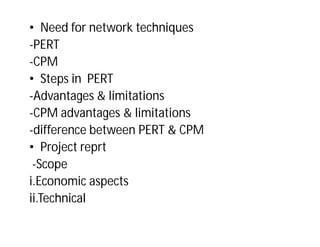
• Need for network techniques
-PERT
-CPM
• Steps in PERT
-Advantages & limitations
-CPM advantages & limitations
-difference between PERT & CPM
• Project reprt
-Scope
i.Economic aspects
ii.Technical
iii.Financial
iv.Production
v.Managerial
• Contents of project report:
-objective & scope of report
-Market position & trends
-raw material
-manifracture
-plant&machinary
-land & building
-financial implication
-marketing channel
-personnel

15CS51_Module 4_Management and Entrepreneurship

  • 1.
  • 2.
    • Meaning ofthe project: there are various definitions • Characterstics of project: There are four characterstics -Investment -Benefits or gains -Time limits -Location
  • 3.
    Project classification: • Itcan be classified into different ways -Power generation -Health &education -Spectral project i. agricultural & allied sector ii. Irrigation & power sector iii. Industry and monitoring sector iv. Transport & communication sector v. Social service sector vi. Miscellious
  • 4.
    • Techno-economic projects -Factoryintensity oriented -Causation oriented -Magnitude oriented • Financial institution -expansion projects -modernisation -diversification
  • 5.
    • Service project -welfareprojects -service projects -research & development -educational • Project featyres -Simplicity & clarity -Attractive technology to promote the project
  • 6.
    -Integration of basicproduct services specially those of input supply, create , marketing and extention -Compatibility of the project within the existing administrative mix. • Phases of project management -Identification -Formulation
  • 7.
    -Appraisl -Selection -Implementation -Management • Identification: Project identificationis concern with collection, completion & analysis of economic data for the actual purpose of locating possible opportunities for investment & with development of such opportunities.
  • 8.
    • There arethree kinds of opportunities: 1.Additive opportunities: which enable the decision maker to better utilize the exsisting resources without any way involving a change in the character of business. 2.Complimintary opportunities: involves the introduction of new ideas & as such to lead to certain amount of change in existing structure. 3.Brakethrough opportunities: involves fundamental changes invoke the structure & character of business
  • 9.
    •Criteria for selectinga particular project -investment size -location -Technology -Equipment -Marketing • Importance of project identification: the following are the reasons: -it acts as the catalytic agent for project - initiates the process of development
  • 10.
    -provides the framework of future pattern of activities & services of the enterprises -initiates development of basic infrastructure 7 environment -brings the necessary changes in the society in course of time -accelerates the process sociocultural development
  • 11.
    • Formulation: Itis defined as taking first look carefully critically at the project idea by an enterprises to build up an all round beneficial project after carefully arranging its various components. • Sequential stages of project formulation -Feasibility analysis -Techno economic -Project design -network analysis -input analysis
  • 12.
    -finiancial analysis -cost &benefit analysis -preinvestment analysis • Planning commission guideliness for project formulation: -General information -preliminary analysis of altrenatives -project discription -marketing plans -capital requirement & cost -operating requirement & cost -financial analysis -Economic analysis
  • 13.
    • Need fornetwork techniques -PERT -CPM • Steps in PERT -Advantages & limitations -CPM advantages & limitations -difference between PERT & CPM • Project reprt -Scope i.Economic aspects ii.Technical
  • 14.
    iii.Financial iv.Production v.Managerial • Contents ofproject report: -objective & scope of report -Market position & trends -raw material -manifracture -plant&machinary -land & building -financial implication -marketing channel -personnel