SonarQube
Should I stay or should I go ?
Jérémie Fays – 3 June 2015
Stay if you want to hear…
•  What is SonarQube ?
•  What is available at Interface ?
SonarWhat ?
Developers
–  Maintenability
–  Good programming practises
–  Bugs
Tech transfer
–  Info on software maturity
–  Better valuation
–  Preparation for a due diligence (Technical Debt)
Static code analysis
Sonar not what !
What it doesn’t do :
•  Performance analysis (memory, CPU)
•  Conformity to requirements specifications
•  Expertise on architecture and technological choices
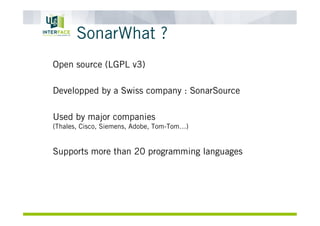
SonarWhat ?
Open source (LGPL v3)
Developped by a Swiss company : SonarSource
Used by major companies
(Thales, Cisco, Siemens, Adobe, Tom-Tom…)
Supports more than 20 programming languages
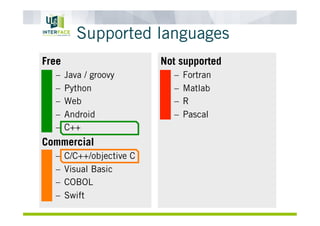
Supported languages
Free
–  Java / groovy
–  Python
–  Web
–  Android
–  C++
Commercial
–  C/C++/objective C
–  Visual Basic
–  COBOL
–  Swift
Not supported
–  Fortran
–  Matlab
–  R
–  Pascal
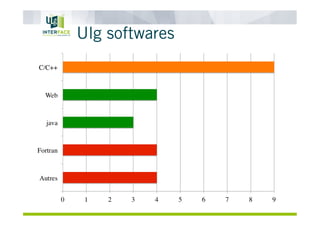
Ulg softwares
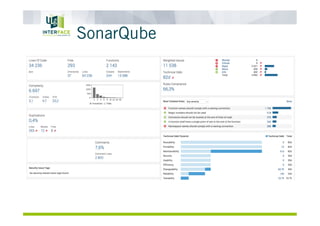
SonarQube
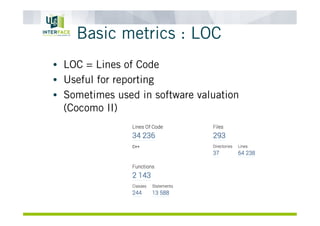
Basic metrics : LOC
•  LOC = Lines of Code
•  Useful for reporting
•  Sometimes used in software valuation
(Cocomo II)
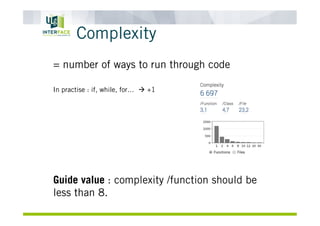
Complexity
= number of ways to run through code
In practise : if, while, for… à +1
Guide value : complexity /function should be
less than 8.
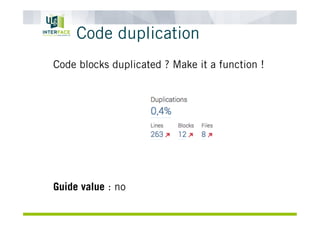
Code duplication
Code blocks duplicated ? Make it a function !
Guide value : no
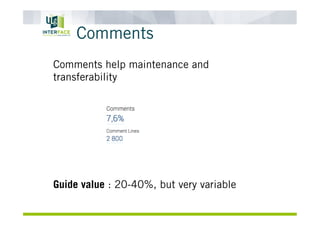
Comments
Comments help maintenance and
transferability
Guide value : 20-40%, but very variable
Code coverage
Percentage of code covered by unit tests
Guide value : >80%
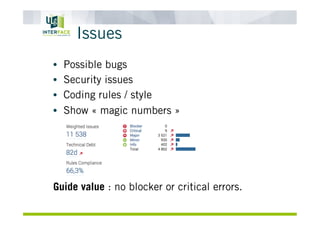
Issues
•  Possible bugs
•  Security issues
•  Coding rules / style
•  Show « magic numbers »
Guide value : no blocker or critical errors.
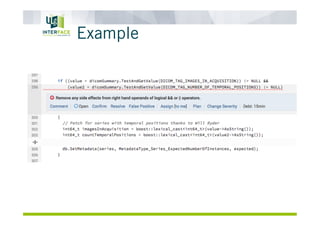
Example
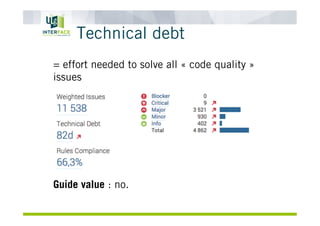
Technical debt
= effort needed to solve all « code quality »
issues
Guide value : no.
SonarQube, in short
•  A set of « quality » metrics
•  Better use : day-to-day
…or even continuous integration !
Situation at Interface
A continuous improvement
•  Software protection and licenses
http://www.interface.ulg.ac.be/docs/Researchers_Guide.pdf
Fossology installed and running
•  Software quality
http://www.interface.ulg.ac.be/docs/Metriques-qualite-logiciel.pdf
SonarQube installed and running + C/C++ commercial plugin
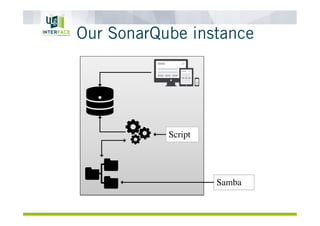
Our SonarQube instance
Samba
Script
SonarQube : our services
•  Snapshot analysis
–  A first contact with SonarQube
•  Preparation for a transfer
–  Before a tech transfer (license or spin-off)
–  Before opening the code
•  Operational use
–  Day-to-day use of our SonarQube instance
Future
Continuous integration with Jenkins ?
Conclusions
•  SonarQube is useful for :
–  Short term quality mission
–  Day-to-day use (up to continuous integration)
•  A SonarQube instance is available at ITF :
–  Commercial C/C++ plugin installed
–  One shot analysis
–  Account creation for day-to-day use
è Contact me !
Thanks !
Jérémie Fays
j.fays@ulg.ac.be
+32 4 349 85 21
www.linkedin.com/in/jeremiefays

SonarQube - Should I Stay or Should I Go ?

  • 1.
    SonarQube Should I stayor should I go ? Jérémie Fays – 3 June 2015
  • 2.
    Stay if youwant to hear… •  What is SonarQube ? •  What is available at Interface ?
  • 3.
    SonarWhat ? Developers –  Maintenability – Good programming practises –  Bugs Tech transfer –  Info on software maturity –  Better valuation –  Preparation for a due diligence (Technical Debt) Static code analysis
  • 4.
    Sonar not what! What it doesn’t do : •  Performance analysis (memory, CPU) •  Conformity to requirements specifications •  Expertise on architecture and technological choices
  • 5.
    SonarWhat ? Open source(LGPL v3) Developped by a Swiss company : SonarSource Used by major companies (Thales, Cisco, Siemens, Adobe, Tom-Tom…) Supports more than 20 programming languages
  • 6.
    Supported languages Free –  Java/ groovy –  Python –  Web –  Android –  C++ Commercial –  C/C++/objective C –  Visual Basic –  COBOL –  Swift Not supported –  Fortran –  Matlab –  R –  Pascal
  • 7.
  • 8.
  • 9.
    Basic metrics :LOC •  LOC = Lines of Code •  Useful for reporting •  Sometimes used in software valuation (Cocomo II)
  • 10.
    Complexity = number ofways to run through code In practise : if, while, for… à +1 Guide value : complexity /function should be less than 8.
  • 11.
    Code duplication Code blocksduplicated ? Make it a function ! Guide value : no
  • 12.
    Comments Comments help maintenanceand transferability Guide value : 20-40%, but very variable
  • 13.
    Code coverage Percentage ofcode covered by unit tests Guide value : >80%
  • 14.
    Issues •  Possible bugs • Security issues •  Coding rules / style •  Show « magic numbers » Guide value : no blocker or critical errors.
  • 15.
  • 16.
    Technical debt = effortneeded to solve all « code quality » issues Guide value : no.
  • 17.
    SonarQube, in short • A set of « quality » metrics •  Better use : day-to-day …or even continuous integration !
  • 18.
  • 19.
    A continuous improvement • Software protection and licenses http://www.interface.ulg.ac.be/docs/Researchers_Guide.pdf Fossology installed and running •  Software quality http://www.interface.ulg.ac.be/docs/Metriques-qualite-logiciel.pdf SonarQube installed and running + C/C++ commercial plugin
  • 20.
  • 21.
    SonarQube : ourservices •  Snapshot analysis –  A first contact with SonarQube •  Preparation for a transfer –  Before a tech transfer (license or spin-off) –  Before opening the code •  Operational use –  Day-to-day use of our SonarQube instance
  • 22.
  • 23.
    Conclusions •  SonarQube isuseful for : –  Short term quality mission –  Day-to-day use (up to continuous integration) •  A SonarQube instance is available at ITF : –  Commercial C/C++ plugin installed –  One shot analysis –  Account creation for day-to-day use è Contact me !
  • 24.
    Thanks ! Jérémie Fays j.fays@ulg.ac.be +324 349 85 21 www.linkedin.com/in/jeremiefays