UNDERSTANDING THE WATER
REQUIREMENTS OF THE POWER SECTOR
the complexities and challenges of determining water use by
different power generation technologies
Anna Delgado Martin, Technical Specialist, the World Bank
adelgado@worldbank.org
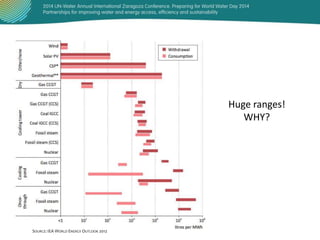
Huge ranges!
WHY?

SOURCE: IEA WORLD ENERGY OUTLOOK 2012
HYDROPOWER

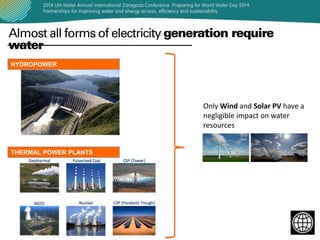
Only Wind and Solar PV have a
negligible impact on water
resources
3

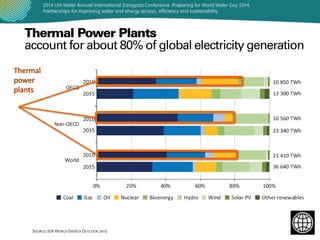
THERMAL POWER PLANTS
SOURCE: IEA WORLD ENERGY OUTLOOK 2012
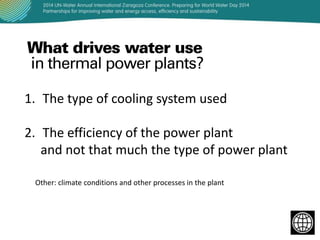
1. The type of cooling system used

2. The efficiency of the power plant
and not that much the type of power plant
Other: climate conditions and other processes in the plant
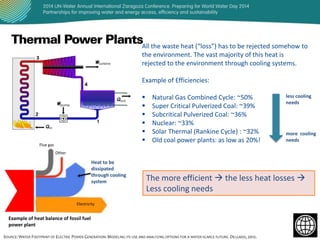
All the waste heat (“loss”) has to be rejected somehow to
the environment. The vast majority of this heat is
rejected to the environment through cooling systems.

Example of Efficiencies:







Flue gas

Natural Gas Combined Cycle: ~50%
Super Critical Pulverized Coal: ~39%
Subcritical Pulverized Coal: ~36%
Nuclear: ~33%
Solar Thermal (Rankine Cycle) : ~32%
Old coal power plants: as low as 20%!

less cooling
needs

more cooling
needs

Other

Heat to be
dissipated
through cooling
system

The more efficient  the less heat losses 
Less cooling needs

Electricity

Example of heat balance of fossil fuel
power plant
SOURCE: WATER FOOTPRINT OF ELECTRIC POWER GENERATION: MODELING ITS USE AND ANALYZING OPTIONS FOR A WATER-SCARCE FUTURE. DELGADO, 2012.
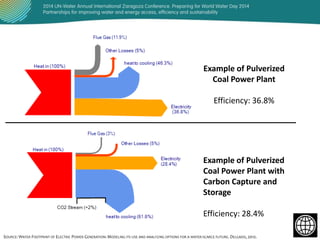
Example of Pulverized
Coal Power Plant
Efficiency: 36.8%

Example of Pulverized
Coal Power Plant with
Carbon Capture and
Storage
Efficiency: 28.4%
SOURCE: WATER FOOTPRINT OF ELECTRIC POWER GENERATION: MODELING ITS USE AND ANALYZING OPTIONS FOR A WATER-SCARCE FUTURE. DELGADO, 2012.
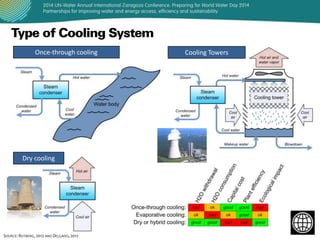
Once-through cooling

Dry cooling

SOURCE: RUTBERG, 2012 AND DELGADO, 2012

Cooling Towers
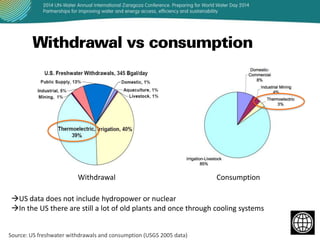
Withdrawal

Consumption

US data does not include hydropower or nuclear
In the US there are still a lot of old plants and once through cooling systems
Source: US freshwater withdrawals and consumption (USGS 2005 data)
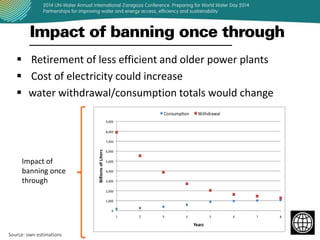
 Retirement of less efficient and older power plants
 Cost of electricity could increase
 water withdrawal/consumption totals would change

Impact of
banning once
through

Source: own estimations
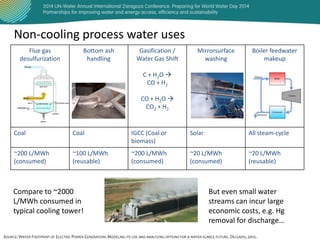
Non-cooling process water uses
Flue gas
desulfurization

Bottom ash
handling

Gasification /
Water Gas Shift

Mirrorsurface
washing

Boiler feedwater
makeup

C + H2O 
CO + H2
CO + H2O 
CO2 + H2

Coal

Coal

IGCC (Coal or
biomass)

Solar

All steam-cycle

~200 L/MWh
(consumed)

~100 L/MWh
(reusable)

~200 L/MWh
(consumed)

~20 L/MWh
(consumed)

~20 L/MWh
(reusable)

Compare to ~2000
L/MWh consumed in
typical cooling tower!

But even small water
streams can incur large
economic costs, e.g. Hg
removal for discharge…

SOURCE: WATER FOOTPRINT OF ELECTRIC POWER GENERATION: MODELING ITS USE AND ANALYZING OPTIONS FOR A WATER-SCARCE FUTURE. DELGADO, 2012.
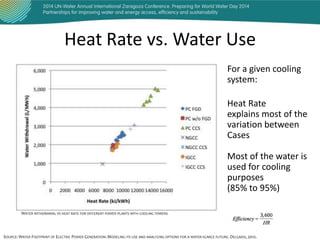
Heat Rate vs. Water Use
For a given cooling
system:
Heat Rate
explains most of the
variation between
Cases
Most of the water is
used for cooling
purposes
(85% to 95%)
WATER WITHDRAWAL VS HEAT RATE FOR DIFFERENT POWER PLANTS WITH COOLING TOWERS

SOURCE: WATER FOOTPRINT OF ELECTRIC POWER GENERATION: MODELING ITS USE AND ANALYZING OPTIONS FOR A WATER-SCARCE FUTURE. DELGADO, 2012.
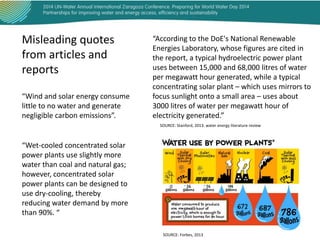
Misleading quotes
from articles and
reports
“Wind and solar energy consume
little to no water and generate
negligible carbon emissions”.

“According to the DoE's National Renewable
Energies Laboratory, whose figures are cited in
the report, a typical hydroelectric power plant
uses between 15,000 and 68,000 litres of water
per megawatt hour generated, while a typical
concentrating solar plant – which uses mirrors to
focus sunlight onto a small area – uses about
3000 litres of water per megawatt hour of
electricity generated.”
SOURCE: Stanford, 2013. water energy literature review

“Wet-cooled concentrated solar
power plants use slightly more
water than coal and natural gas;
however, concentrated solar
power plants can be designed to
use dry-cooling, thereby
reducing water demand by more
than 90%. “
SOURCE: Forbes, 2013
Misleading quotes from
articles and reports
“concentrated solar power consumes large quantities of water”
“Today’s generation of technology and cleaning frequency
assumptions result in CSP consuming approximately five times
more water than a gas-fired power plant, two times more than
a coal-fired plant and 1.5 times more than a nuclear plant”
“water intensive nuclear power stations should be replaced by renewables
and natural gas, which consume less water”.

“The figures also show that a nuclear power plant uses 2650 litres per megawatt
hour, whereas a typical coal fired power plant uses 1900 and a natural gas plant
750.”
 Most of power in the world is generated by thermal
power plants

messages

 Water use in thermal power plants is dominated by
cooling
 The amount of water required for cooling will depend on
the cooling system used
 Given the same type of cooling system, the amount of
cooling water consumed is mainly determined by the
power plants’ thermal efficiency, irrespective of the type of
fuel used
 Given the range of efficiencies within the same type of
power plant (old vs new) it is almost impossible to give a
single water factor for a a power plant technology
 Some low-carbon thermal generation technologies, which
tend to be less efficient, may be at risk from a water
availability standpoint or may have to use more expensive
dry cooling systems
 The Water and Energy Nexus is a regional problem
 Need context specific solutions. One solution does not fit
all
THANK YOU
UNDERSTANDING THE WATER REQUIREMENTS
OF THE POWER SECTOR
the complexities and challenges of determining water use by different
power generation technologies
Anna Delgado Martin, Technical Specialist, the World Bank
adelgado@worldbank.org

Understanding the water requirements of the power sector, by Anna Delgado from the World Bank

  • 1.
    UNDERSTANDING THE WATER REQUIREMENTSOF THE POWER SECTOR the complexities and challenges of determining water use by different power generation technologies Anna Delgado Martin, Technical Specialist, the World Bank adelgado@worldbank.org
  • 2.
    Huge ranges! WHY? SOURCE: IEAWORLD ENERGY OUTLOOK 2012
  • 3.
    HYDROPOWER Only Wind andSolar PV have a negligible impact on water resources 3 THERMAL POWER PLANTS
  • 4.
    SOURCE: IEA WORLDENERGY OUTLOOK 2012
  • 5.
    1. The typeof cooling system used 2. The efficiency of the power plant and not that much the type of power plant Other: climate conditions and other processes in the plant
  • 6.
    All the wasteheat (“loss”) has to be rejected somehow to the environment. The vast majority of this heat is rejected to the environment through cooling systems. Example of Efficiencies:       Flue gas Natural Gas Combined Cycle: ~50% Super Critical Pulverized Coal: ~39% Subcritical Pulverized Coal: ~36% Nuclear: ~33% Solar Thermal (Rankine Cycle) : ~32% Old coal power plants: as low as 20%! less cooling needs more cooling needs Other Heat to be dissipated through cooling system The more efficient  the less heat losses  Less cooling needs Electricity Example of heat balance of fossil fuel power plant SOURCE: WATER FOOTPRINT OF ELECTRIC POWER GENERATION: MODELING ITS USE AND ANALYZING OPTIONS FOR A WATER-SCARCE FUTURE. DELGADO, 2012.
  • 7.
    Example of Pulverized CoalPower Plant Efficiency: 36.8% Example of Pulverized Coal Power Plant with Carbon Capture and Storage Efficiency: 28.4% SOURCE: WATER FOOTPRINT OF ELECTRIC POWER GENERATION: MODELING ITS USE AND ANALYZING OPTIONS FOR A WATER-SCARCE FUTURE. DELGADO, 2012.
  • 8.
    Once-through cooling Dry cooling SOURCE:RUTBERG, 2012 AND DELGADO, 2012 Cooling Towers
  • 9.
    Withdrawal Consumption US data doesnot include hydropower or nuclear In the US there are still a lot of old plants and once through cooling systems Source: US freshwater withdrawals and consumption (USGS 2005 data)
  • 10.
     Retirement ofless efficient and older power plants  Cost of electricity could increase  water withdrawal/consumption totals would change Impact of banning once through Source: own estimations
  • 11.
    Non-cooling process wateruses Flue gas desulfurization Bottom ash handling Gasification / Water Gas Shift Mirrorsurface washing Boiler feedwater makeup C + H2O  CO + H2 CO + H2O  CO2 + H2 Coal Coal IGCC (Coal or biomass) Solar All steam-cycle ~200 L/MWh (consumed) ~100 L/MWh (reusable) ~200 L/MWh (consumed) ~20 L/MWh (consumed) ~20 L/MWh (reusable) Compare to ~2000 L/MWh consumed in typical cooling tower! But even small water streams can incur large economic costs, e.g. Hg removal for discharge… SOURCE: WATER FOOTPRINT OF ELECTRIC POWER GENERATION: MODELING ITS USE AND ANALYZING OPTIONS FOR A WATER-SCARCE FUTURE. DELGADO, 2012.
  • 12.
    Heat Rate vs.Water Use For a given cooling system: Heat Rate explains most of the variation between Cases Most of the water is used for cooling purposes (85% to 95%) WATER WITHDRAWAL VS HEAT RATE FOR DIFFERENT POWER PLANTS WITH COOLING TOWERS SOURCE: WATER FOOTPRINT OF ELECTRIC POWER GENERATION: MODELING ITS USE AND ANALYZING OPTIONS FOR A WATER-SCARCE FUTURE. DELGADO, 2012.
  • 13.
    Misleading quotes from articlesand reports “Wind and solar energy consume little to no water and generate negligible carbon emissions”. “According to the DoE's National Renewable Energies Laboratory, whose figures are cited in the report, a typical hydroelectric power plant uses between 15,000 and 68,000 litres of water per megawatt hour generated, while a typical concentrating solar plant – which uses mirrors to focus sunlight onto a small area – uses about 3000 litres of water per megawatt hour of electricity generated.” SOURCE: Stanford, 2013. water energy literature review “Wet-cooled concentrated solar power plants use slightly more water than coal and natural gas; however, concentrated solar power plants can be designed to use dry-cooling, thereby reducing water demand by more than 90%. “ SOURCE: Forbes, 2013
  • 14.
    Misleading quotes from articlesand reports “concentrated solar power consumes large quantities of water” “Today’s generation of technology and cleaning frequency assumptions result in CSP consuming approximately five times more water than a gas-fired power plant, two times more than a coal-fired plant and 1.5 times more than a nuclear plant” “water intensive nuclear power stations should be replaced by renewables and natural gas, which consume less water”. “The figures also show that a nuclear power plant uses 2650 litres per megawatt hour, whereas a typical coal fired power plant uses 1900 and a natural gas plant 750.”
  • 15.
     Most ofpower in the world is generated by thermal power plants messages  Water use in thermal power plants is dominated by cooling  The amount of water required for cooling will depend on the cooling system used  Given the same type of cooling system, the amount of cooling water consumed is mainly determined by the power plants’ thermal efficiency, irrespective of the type of fuel used  Given the range of efficiencies within the same type of power plant (old vs new) it is almost impossible to give a single water factor for a a power plant technology  Some low-carbon thermal generation technologies, which tend to be less efficient, may be at risk from a water availability standpoint or may have to use more expensive dry cooling systems  The Water and Energy Nexus is a regional problem  Need context specific solutions. One solution does not fit all
  • 16.
    THANK YOU UNDERSTANDING THEWATER REQUIREMENTS OF THE POWER SECTOR the complexities and challenges of determining water use by different power generation technologies Anna Delgado Martin, Technical Specialist, the World Bank adelgado@worldbank.org

Editor's Notes

  • #7 They all use steam as the primer mover. The fuel is burned to heat water, which turns into steam and spins a steam turbine that drives an electrical generator to produce electricity. Once the steam goes through the turbine, it is condensed in a condenser and sent to the boiler to be heated again, closing what is known as the Rankine Cycle. The main difference between these plants is that they use different fuels to heat the water –coal, oil, uranium, sun, etc.- and different technologies, which lead to different heat rates. All the heat put into the plant that is not converted into electricity is waste heat and has to be dissipated somehow to the environment. The majority of this heat is rejected to the environment through cooling systems, which usually use water as the heat transfer medium. Thus, the smaller the heat rate, the smaller the waste heat that needs to be rejected; and therefore, less cooling water is required per kWh produced.
  • #13 Moreover, since between 85% and 95% of the total water needs are for cooling purposes (DOE/NETL, 2010) (EPRI, 2002b), we can get a good estimate of the total water needs of power plants by knowing only the heat rate and the type of cooling system used.
  • #14 However, as one comment says, all thermal power plants (not only concentrated solar power -CSP- plants ) can incorporate dry cooling, therefore reducing water requirements as well. As much as I like renewables, their graph on water use by power plants, which only shows CSP with dry cooling and not the rest of power plants, is not fair. From the comments:
  • #15 Water consumption and withdrawal it really depends on the type of cooling system. Therefore, it could well be that the nuclear stations that are being closed are located in the sea (and using once through sea water) and the new plants (gas, renewable) use fresh water with cooling towers, therefore, increasing total fresh water consumption. For example, an old coal power plant with an efficiency of 20% will require more water for cooling than a new solar thermal power plant (using the same cooling system and similar meteorological conditions).