The Roles and
Responsibilities of Different
Stakeholders (School,
Division and Region)
By: Merle B. Federez
The expected advocate of CFSS is DepED,
through the Bureau of Secondary
Education. The Director of the Bureau
has organized a team for CFSS.
Who are Considered CFSS
Champions?
• Are visible to their constituents
• Can provide information to constituents
• Generate success within the system
• Recognize those who are responsible for
success
Effects of Constituency of
Having Champions
• Build credibility for CFSS
• Inspire others to become believers of
CFSS
• Develop a sense of ownership or
accountability for outcomes of CFSS
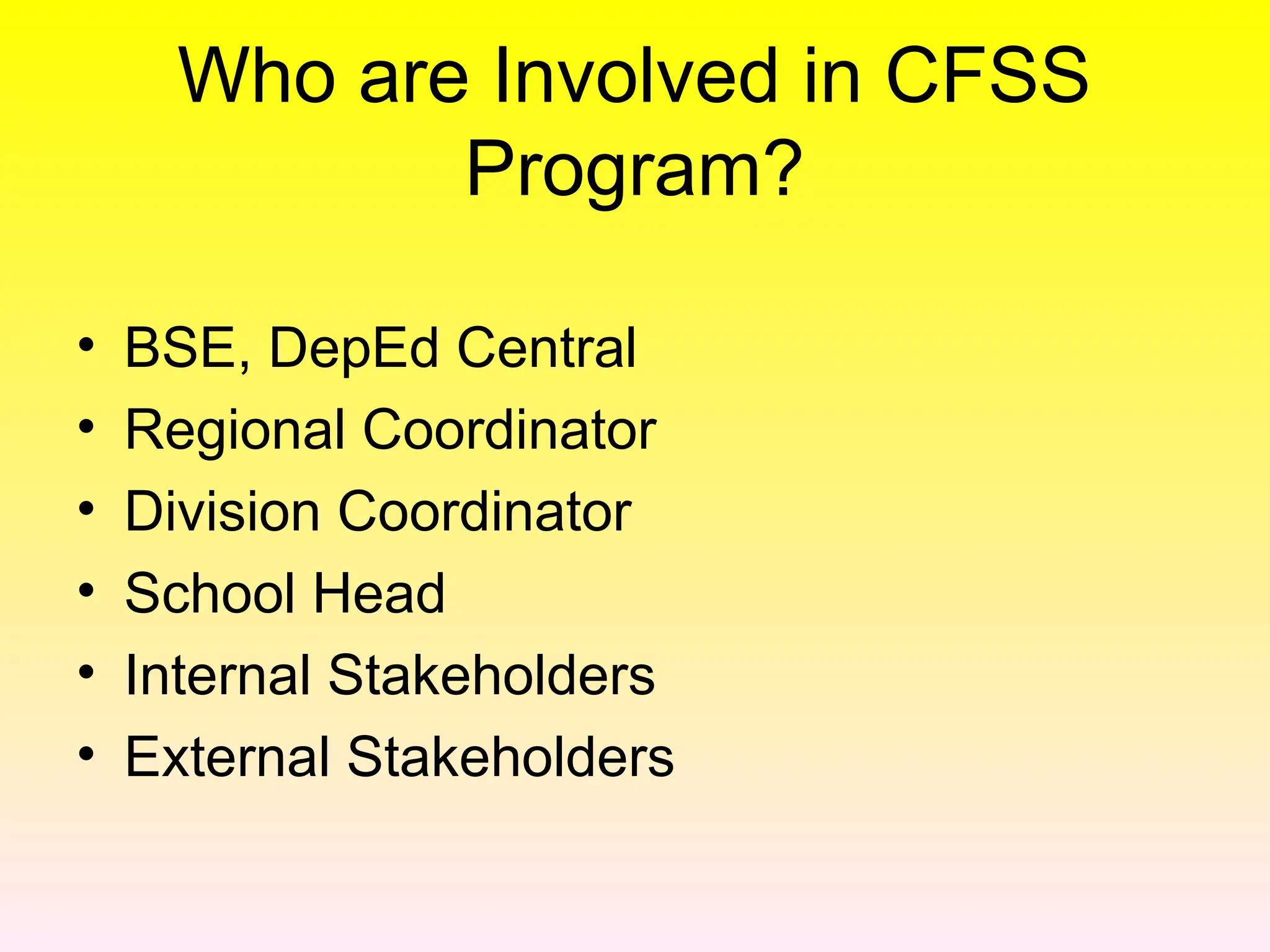
Who are Involved in CFSS
Program?
• BSE, DepEd Central
• Regional Coordinator
• Division Coordinator
• School Head
• Internal Stakeholders
• External Stakeholders
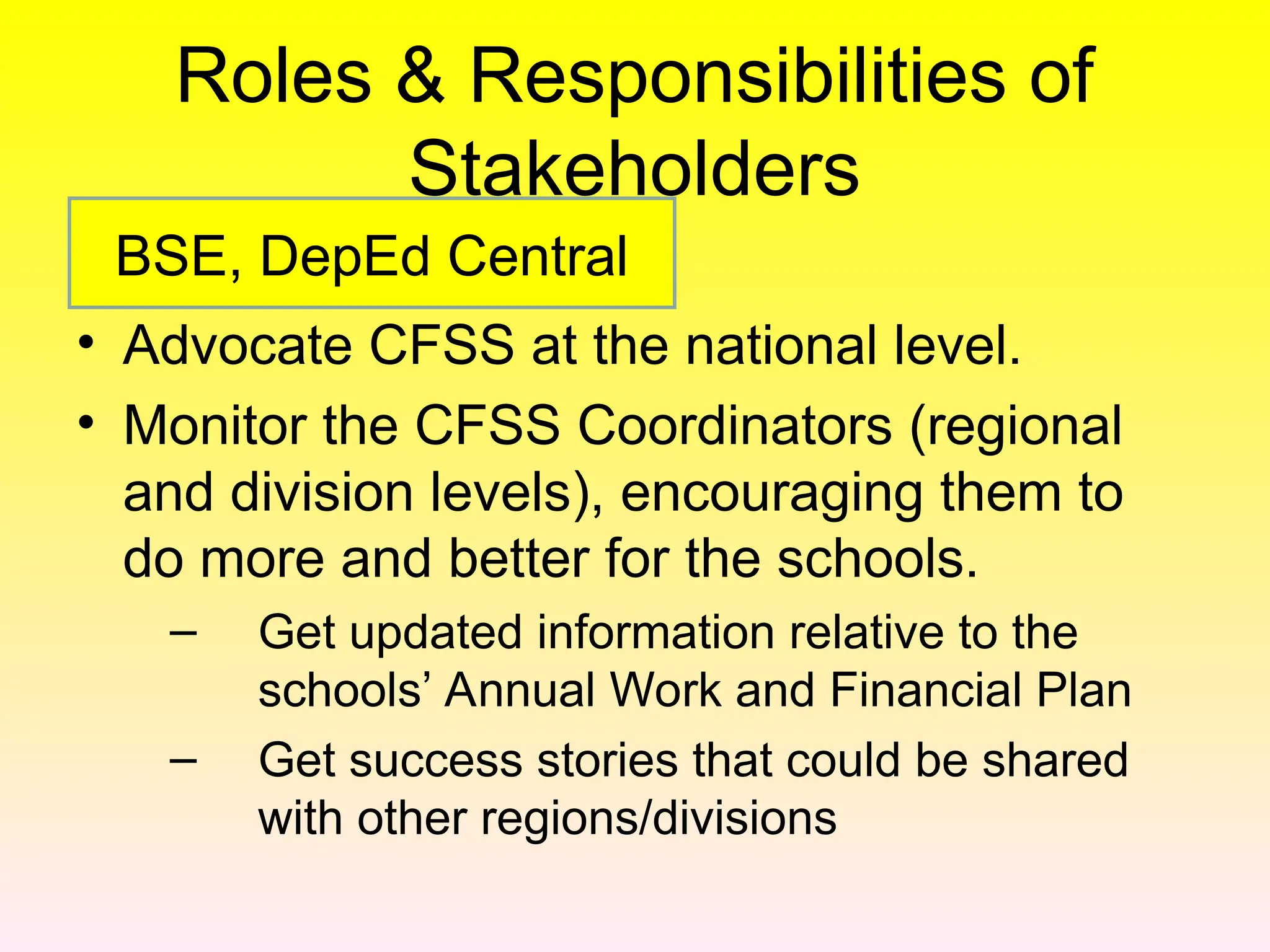
Roles & Responsibilities of
Stakeholders
• Advocate CFSS at the national level.
• Monitor the CFSS Coordinators (regional
and division levels), encouraging them to
do more and better for the schools.
– Get updated information relative to the
schools’ Annual Work and Financial Plan
– Get success stories that could be shared
with other regions/divisions
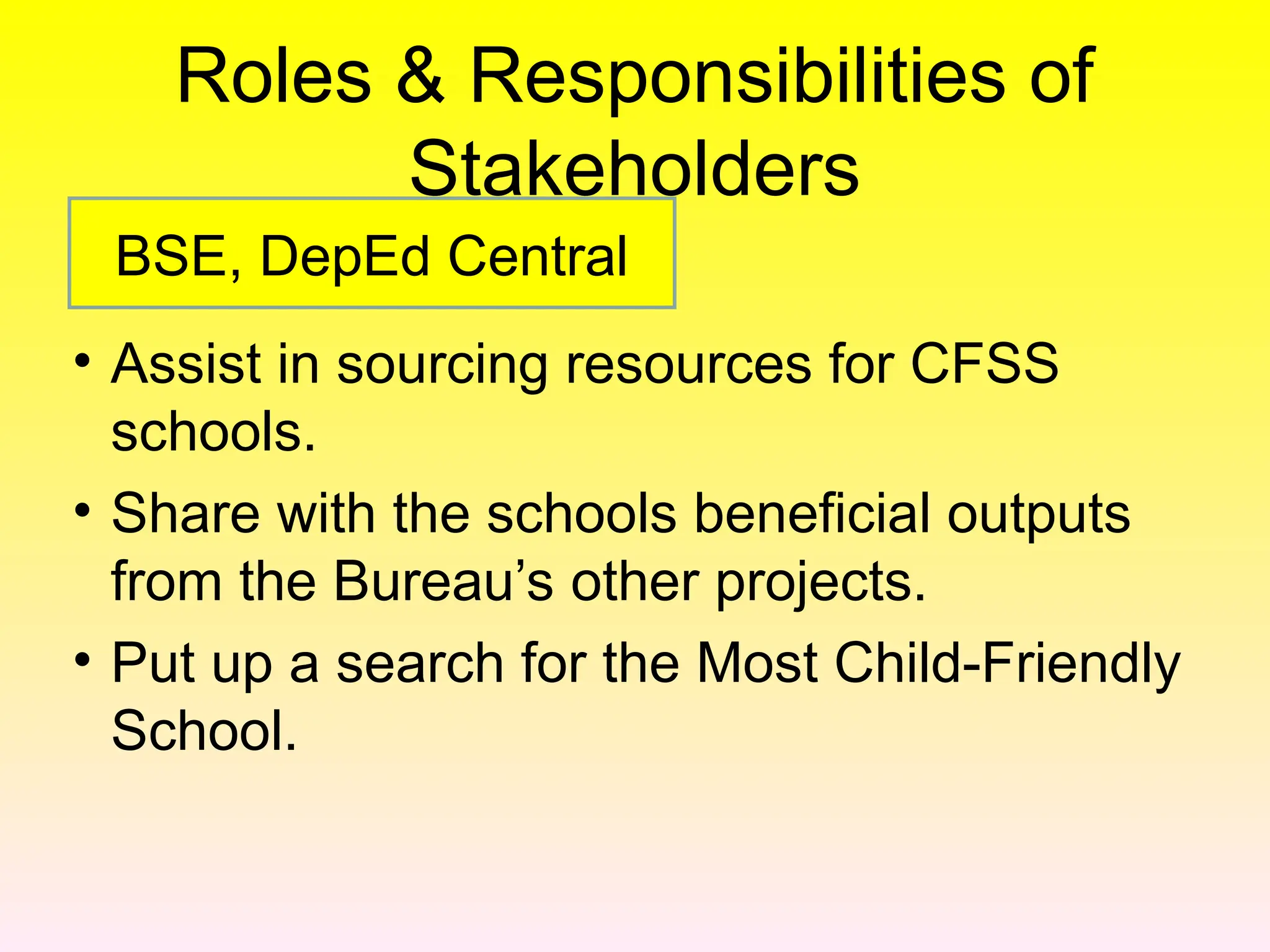
BSE, DepEd Central
Roles & Responsibilities of
Stakeholders
• Assist in sourcing resources for CFSS
schools.
• Share with the schools beneficial outputs
from the Bureau’s other projects.
• Put up a search for the Most Child-Friendly
School.
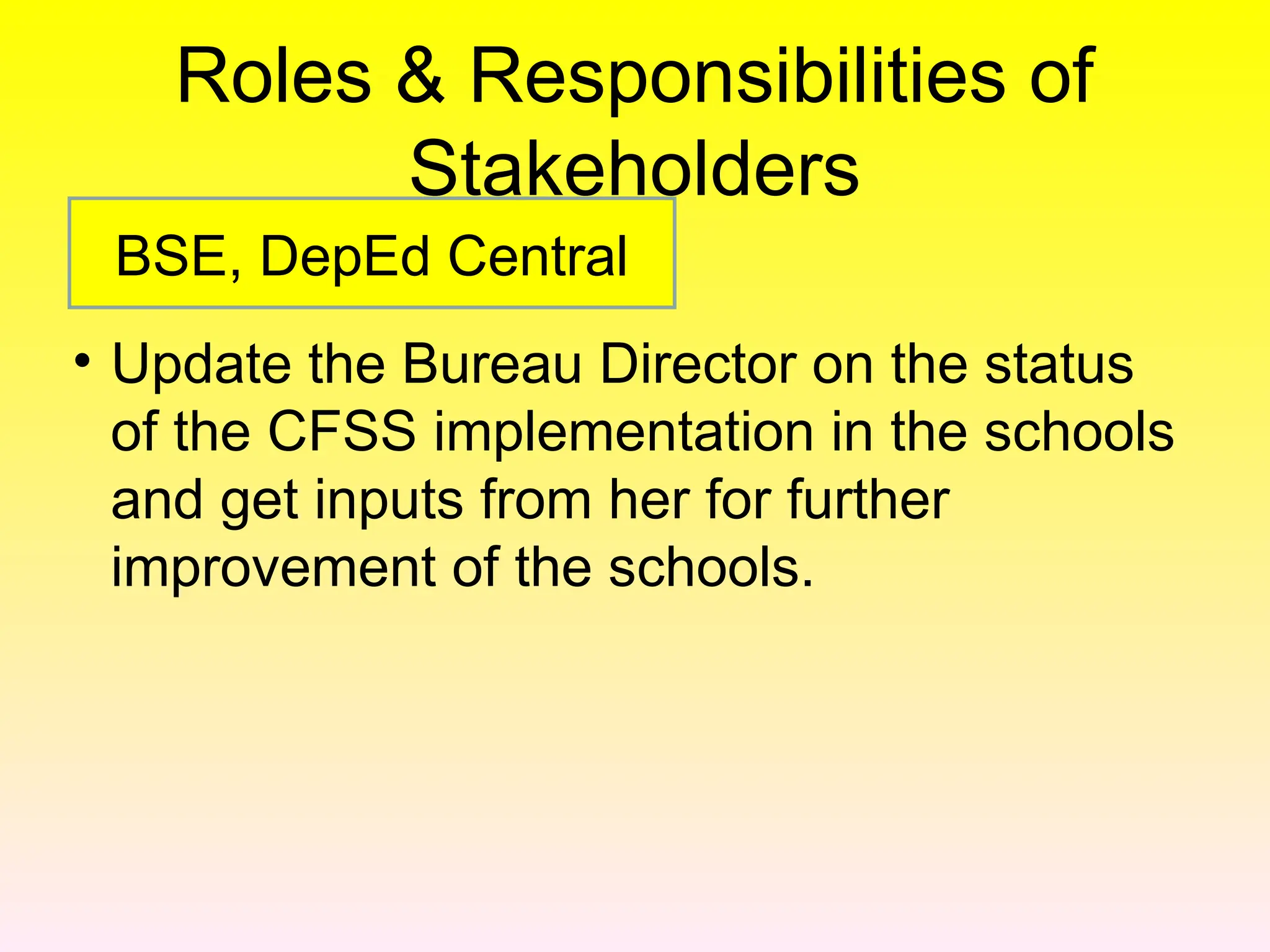
BSE, DepEd Central
Roles & Responsibilities of
Stakeholders
• Update the Bureau Director on the status
of the CFSS implementation in the schools
and get inputs from her for further
improvement of the schools.
BSE, DepEd Central
Roles & Responsibilities of
Stakeholders
• Share to the divisions and schools what
the Regional Office does in regard to
school improvement, be that in curriculum
improvement or in capability building
programs.
Regional Coordinator
Roles & Responsibilities of
Stakeholders
• Monitors changes in educational
performance in CFSS schools.
• Updates the Regional Director on the
status of the CFSS to mobilize support to
CFSS
Regional Coordinator
Roles & Responsibilities of
Stakeholders
• Advocacy and mobilize program
implementation in his/her catchment area.
• Helps the CFSS schools efforts of
advocacy and social mobilization.
Division Coordinator
Roles & Responsibilities of
Stakeholders
• Visits the CFSS schools not just for
monitoring purposes but to provide
assistance and/or advise to the school
principal and the school CFSS coordinator
for support and encouragement.
Division Coordinator
Roles & Responsibilities of
Stakeholders
• Mobilizes LGU resources for attainment of
CFSS goals, linking the CFSS schools with
individuals and institutions that could help
with school needs.
Division Coordinator
Roles & Responsibilities of
Stakeholders
• Provides advise to the school head in fine
tuning processes by providing professional
support and encouragement.
Division Coordinator
It is important that
It is important that Coordinators
Coordinators take
take
the initiative to institutionalize and
incorporate CFSS within the organic
functions of the Schools Division and
Regional Offices
Regional Offices
Roles & Responsibilities of
Stakeholders
• Fully accountable to stakeholders for school
performance, thus he/she should provide
directions for improving student
achievement, protecting children,
collaborating with families and community,
fostering teacher commitment and ensuring
the full implementation of DepEd policies
and programs.
School Head
Roles & Responsibilities of
Stakeholders
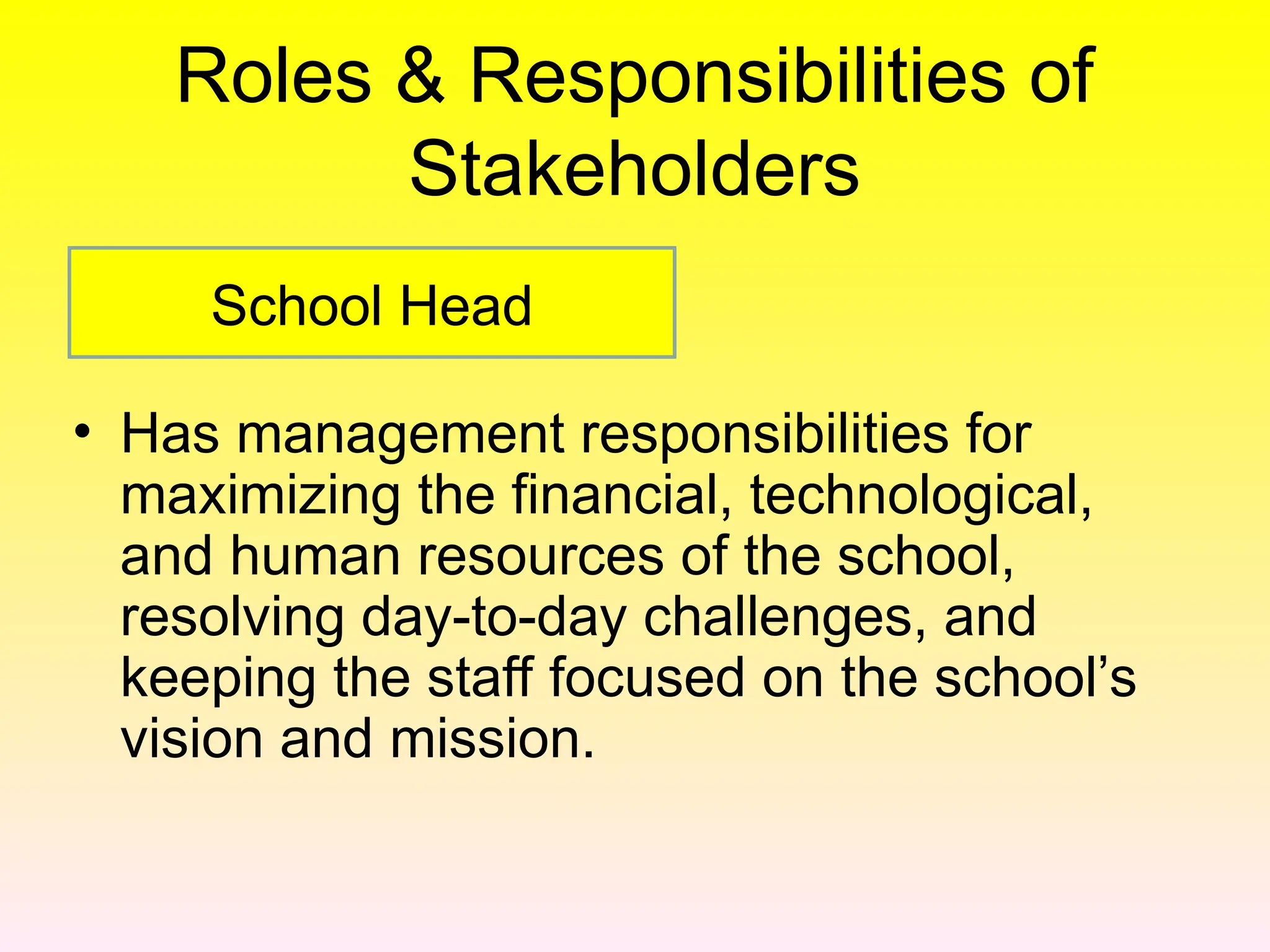
• Has management responsibilities for
maximizing the financial, technological,
and human resources of the school,
resolving day-to-day challenges, and
keeping the staff focused on the school’s
vision and mission.
School Head
Roles & Responsibilities of
Stakeholders
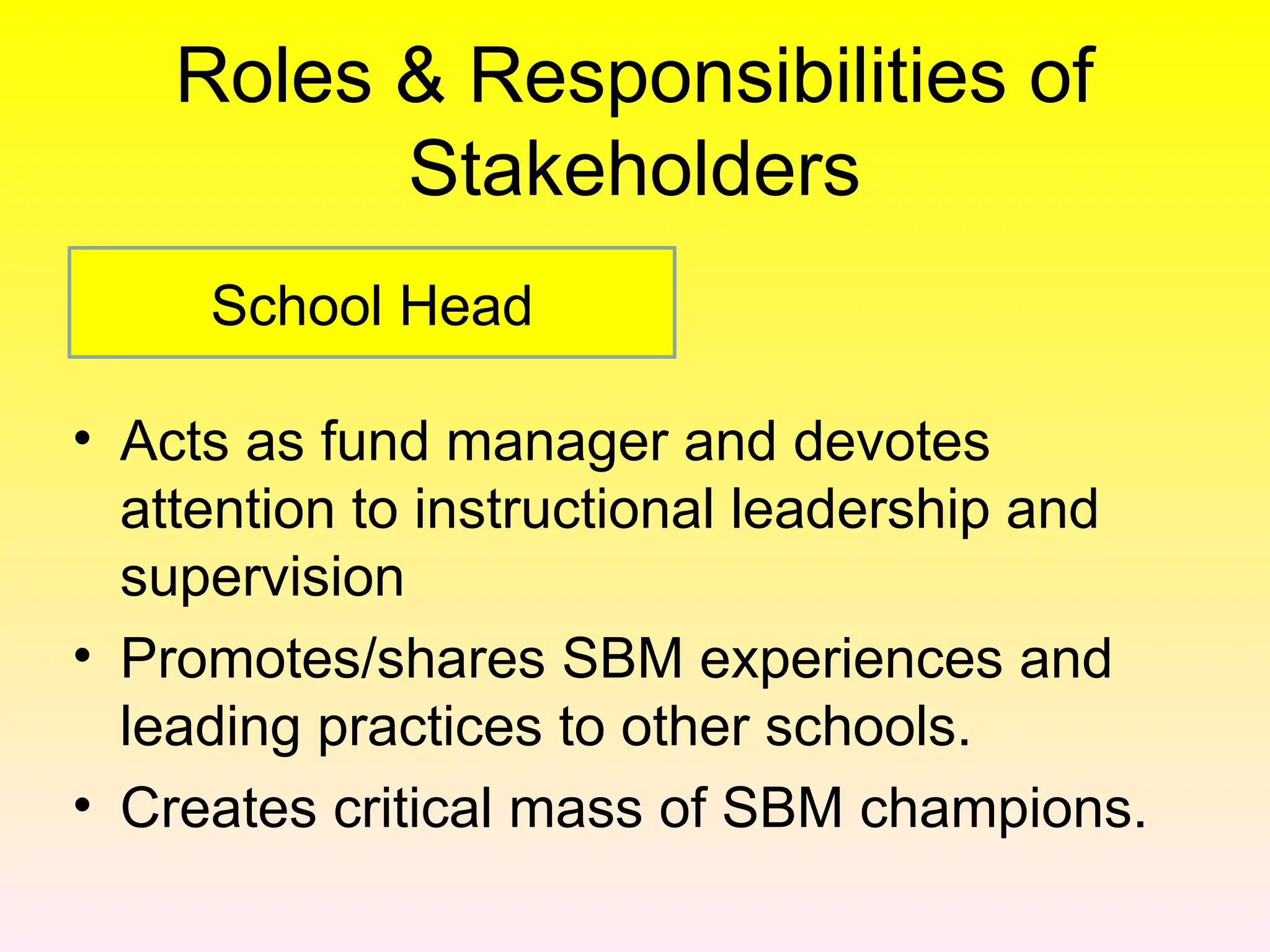
• Acts as fund manager and devotes
attention to instructional leadership and
supervision
• Promotes/shares SBM experiences and
leading practices to other schools.
• Creates critical mass of SBM champions.
School Head
Roles & Responsibilities of
Stakeholders
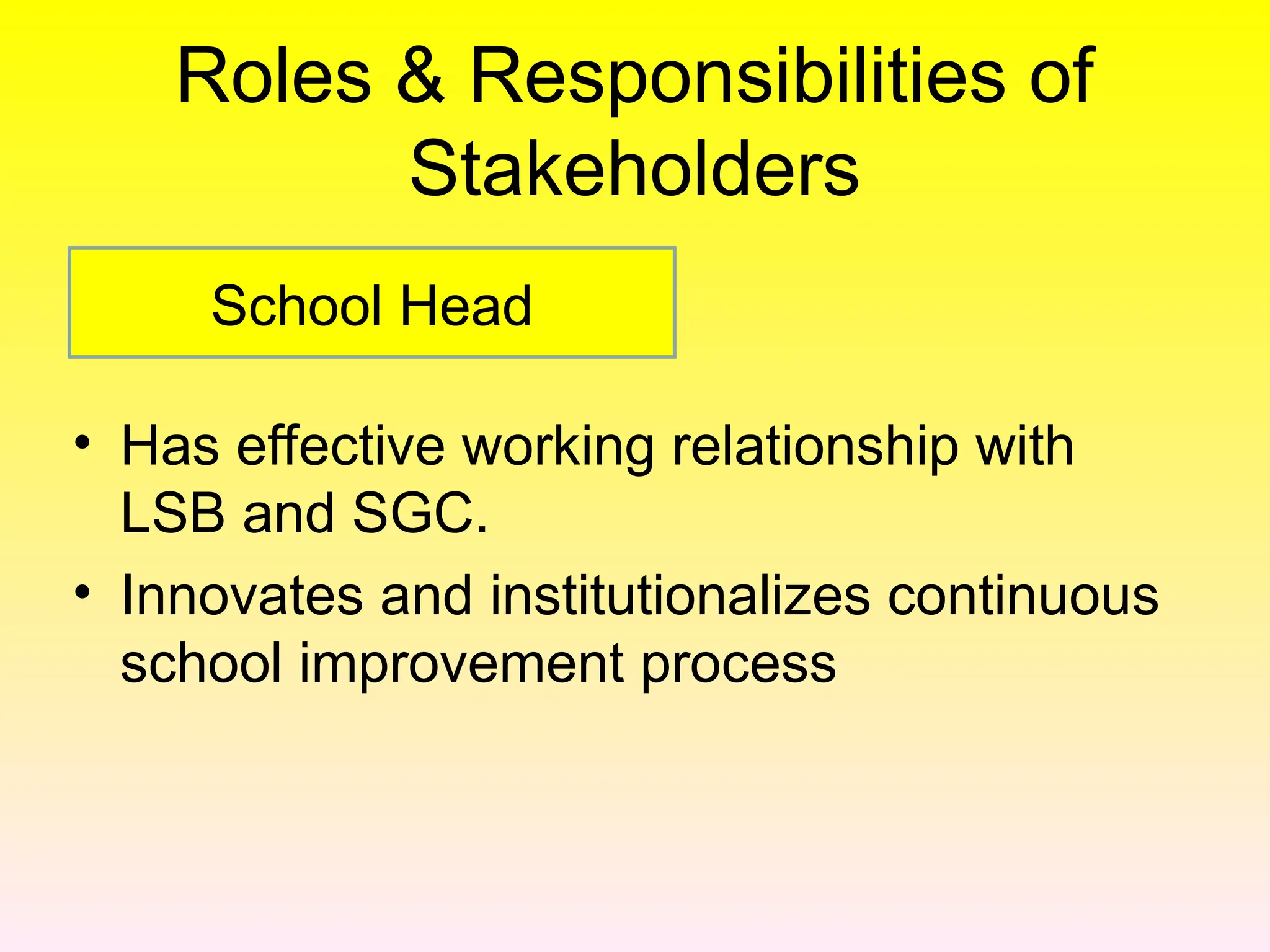
• Has effective working relationship with
LSB and SGC.
• Innovates and institutionalizes continuous
school improvement process
School Head
Roles & Responsibilities of
Stakeholders
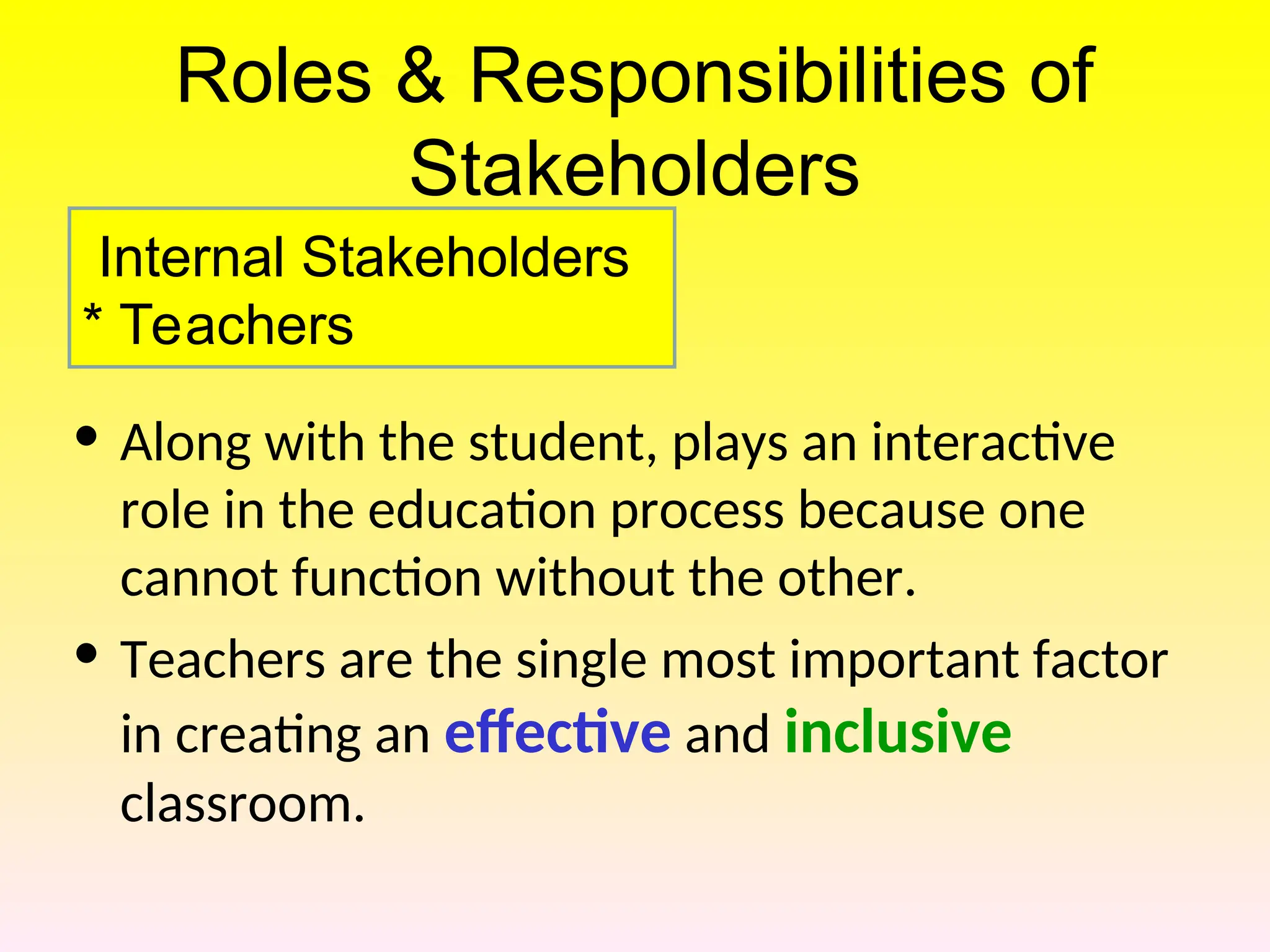
• Along with the student, plays an interactive
role in the education process because one
cannot function without the other.
• Teachers are the single most important factor
in creating an effective and inclusive
classroom.
Internal Stakeholders
* Teachers
Effective for learning:
• Promotes good quality teaching and learning
processes with individualized instruction
appropriate to each child's developmental level,
abilities, and learning style and with active,
cooperative, and democratic learning methods.
• Provides structured content and good quality
materials and resources.
• Enhances teacher capacity, morale,
commitment, status, and income — and their
own recognition of child rights.
• Promotes quality learning outcomes by defining
and helping children learn what they need to
learn and teaching them how to learn.
Inclusive of children:
• Does not exclude, discriminate, or stereotype on
the basis of difference.
• Provides education that is free and compulsory,
affordable and accessible, especially to families
and children at risk.
• Respects diversity and ensures equality of
learning for all children (e.g., girls, working
children, children of ethnic minorities and
affected by HIV/AIDS, children with disabilities,
victims of exploitation and violence).
• Responds to diversity by meeting the differing
circumstances and needs of children (e.g.,
based on gender, social class, ethnicity, and
ability level).
Roles & Responsibilities of
Stakeholders
• Play key roles as educational stakeholders
• Their primary objective is the assurance that
their children will receive a quality education,
which will enable the children to lead
productive rewarding lives as adults in a
global society.
Internal Stakeholders
* Parents
Roles & Responsibilities of
Stakeholders
• Assume responsibilities as partners in the
learning process
• Co-manage and co-monitor learning process
• Held accountable for the performance,
achievement, and well-being of their children
Internal Stakeholders
* Parents
Roles & Responsibilities of
Stakeholders
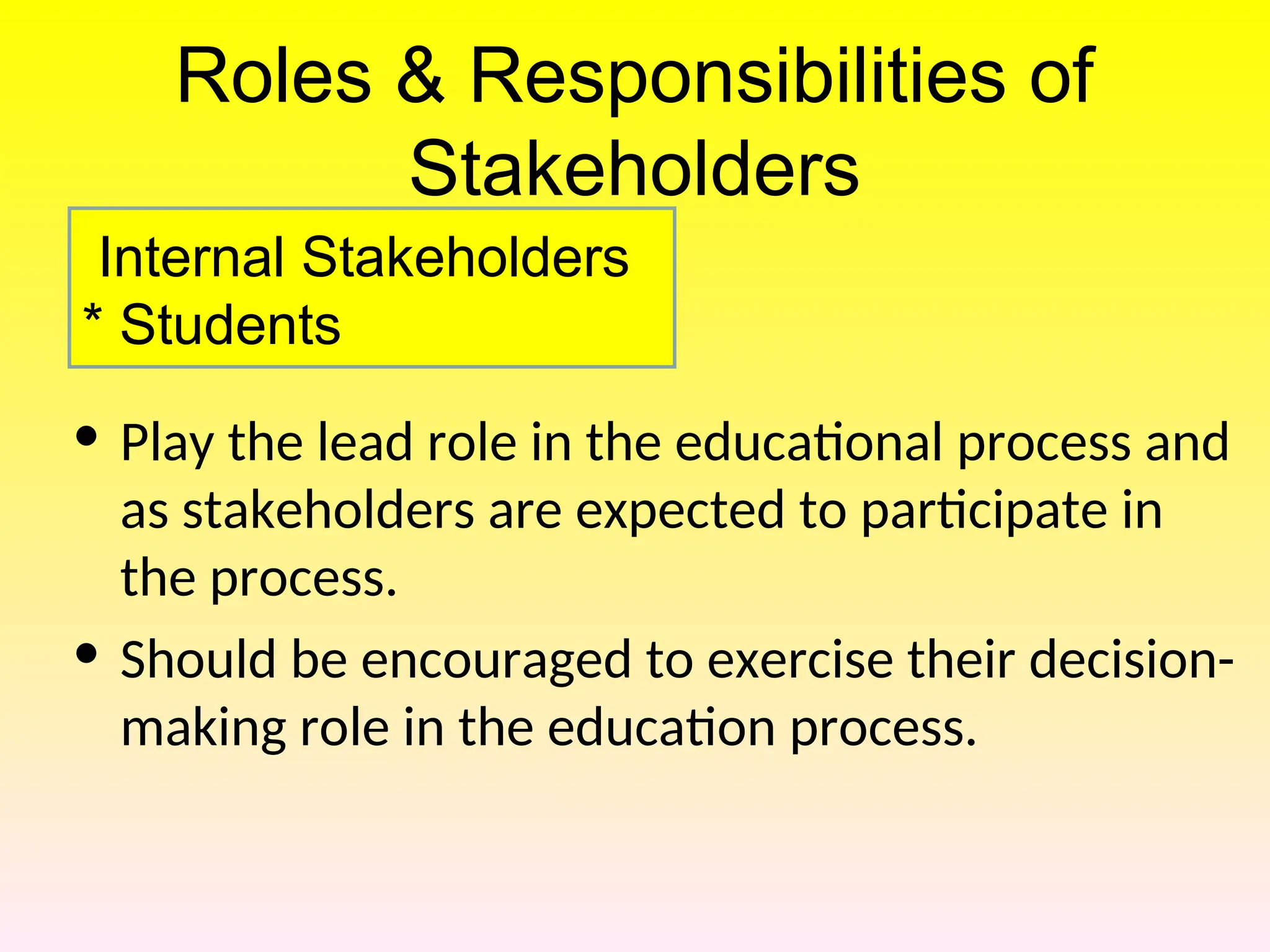
• Play the lead role in the educational process and
as stakeholders are expected to participate in
the process.
• Should be encouraged to exercise their decision-
making role in the education process.
Internal Stakeholders
* Students
Roles & Responsibilities of
Stakeholders
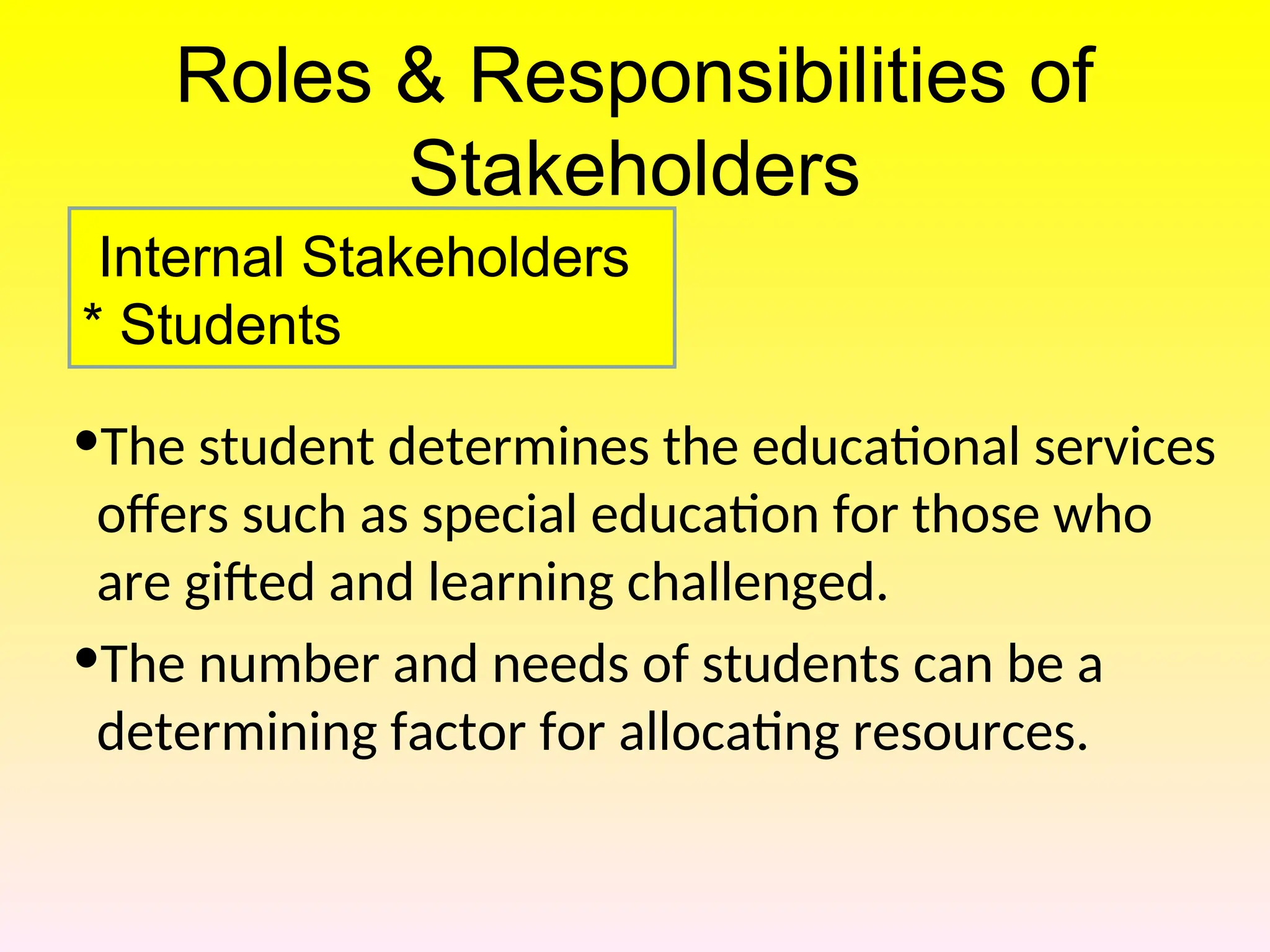
•The student determines the educational services
offers such as special education for those who
are gifted and learning challenged.
•The number and needs of students can be a
determining factor for allocating resources.
Internal Stakeholders
* Students
Roles & Responsibilities of
Stakeholders
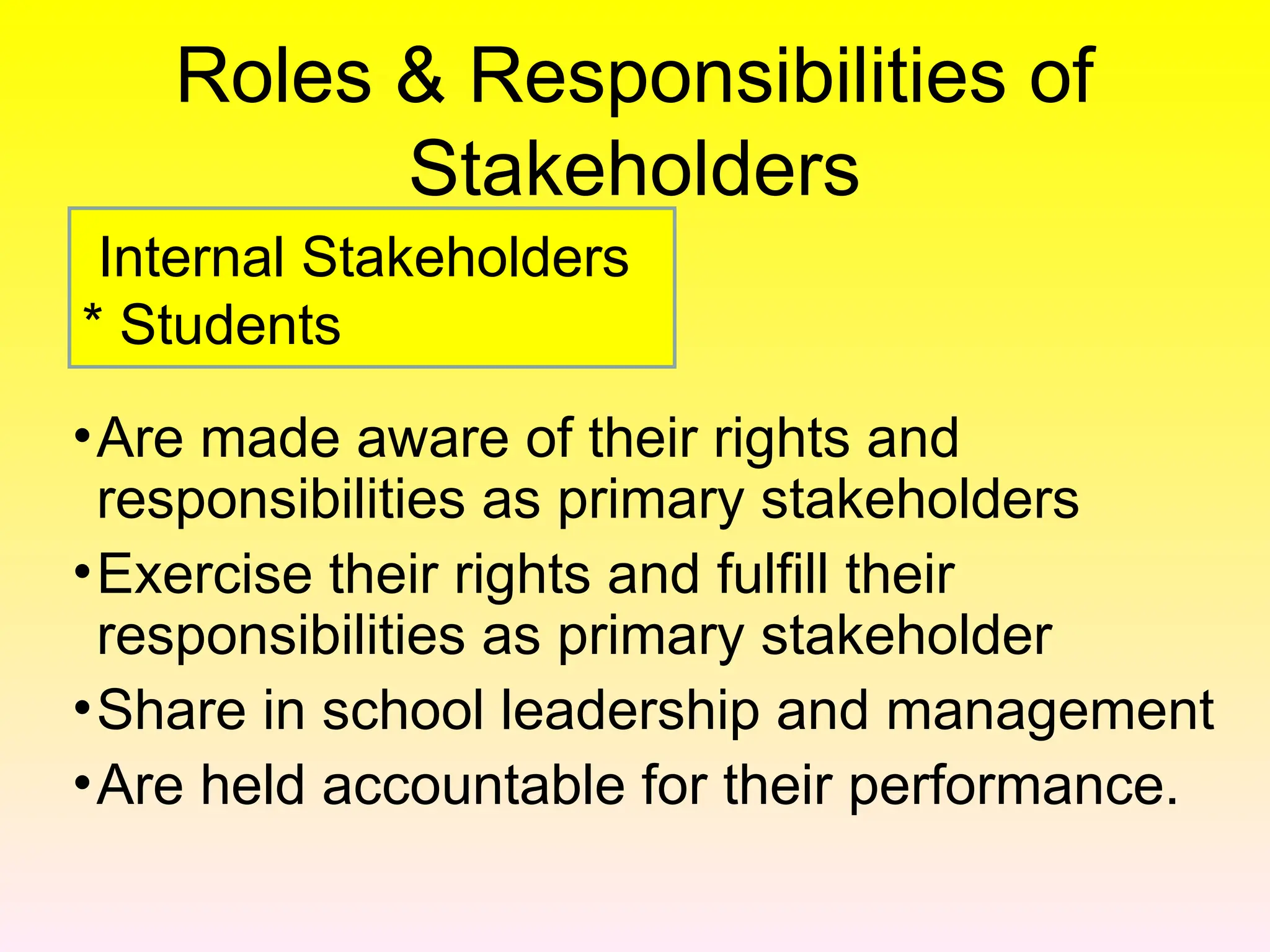
•Are made aware of their rights and
responsibilities as primary stakeholders
•Exercise their rights and fulfill their
responsibilities as primary stakeholder
•Share in school leadership and management
•Are held accountable for their performance.
Internal Stakeholders
* Students
Roles & Responsibilities of
Stakeholders
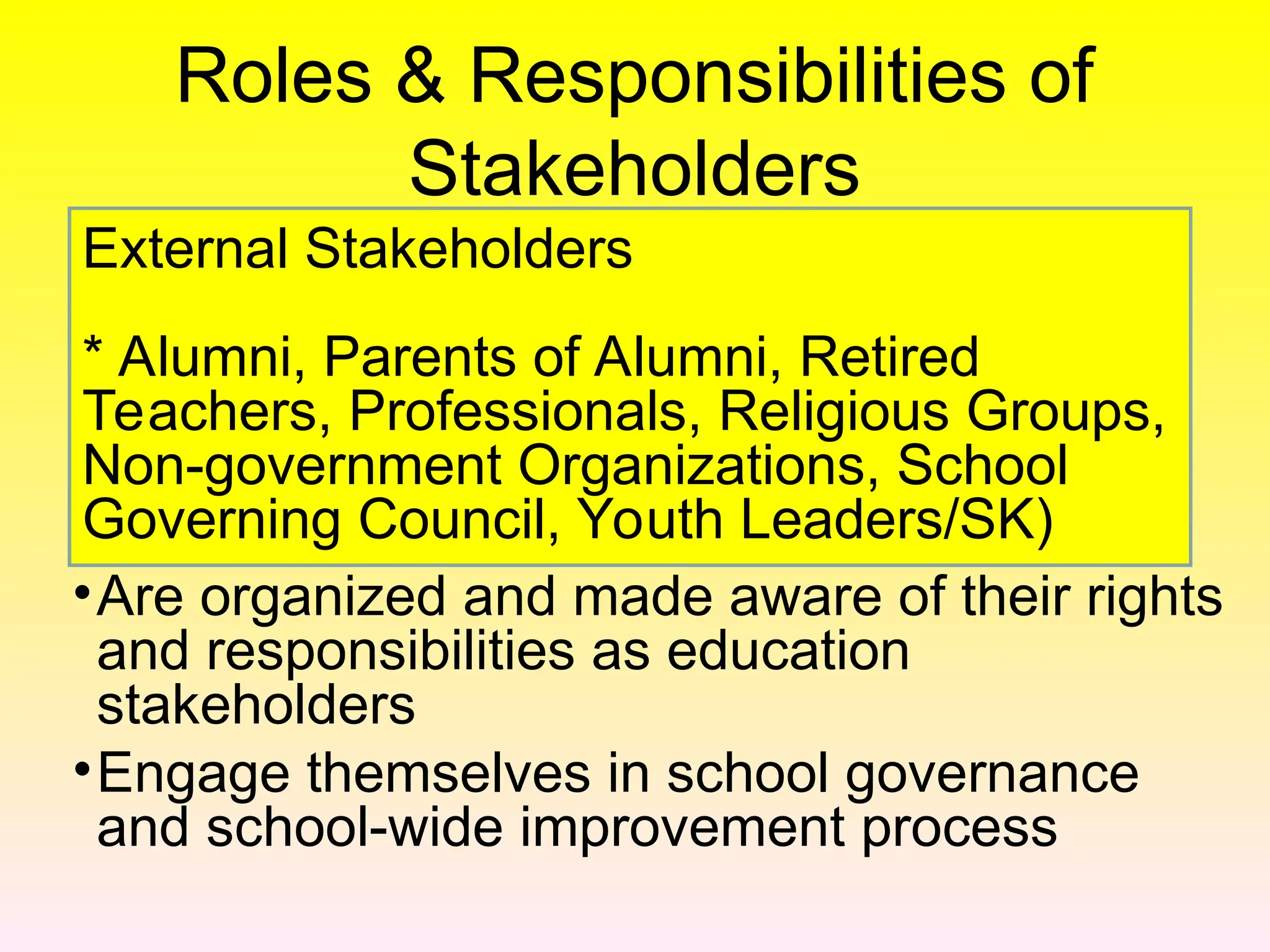
•Are organized and made aware of their rights
and responsibilities as education
stakeholders
•Engage themselves in school governance
and school-wide improvement process
External Stakeholders
* Alumni, Parents of Alumni, Retired
Teachers, Professionals, Religious Groups,
Non-government Organizations, School
Governing Council, Youth Leaders/SK)
Roles & Responsibilities of
Stakeholders
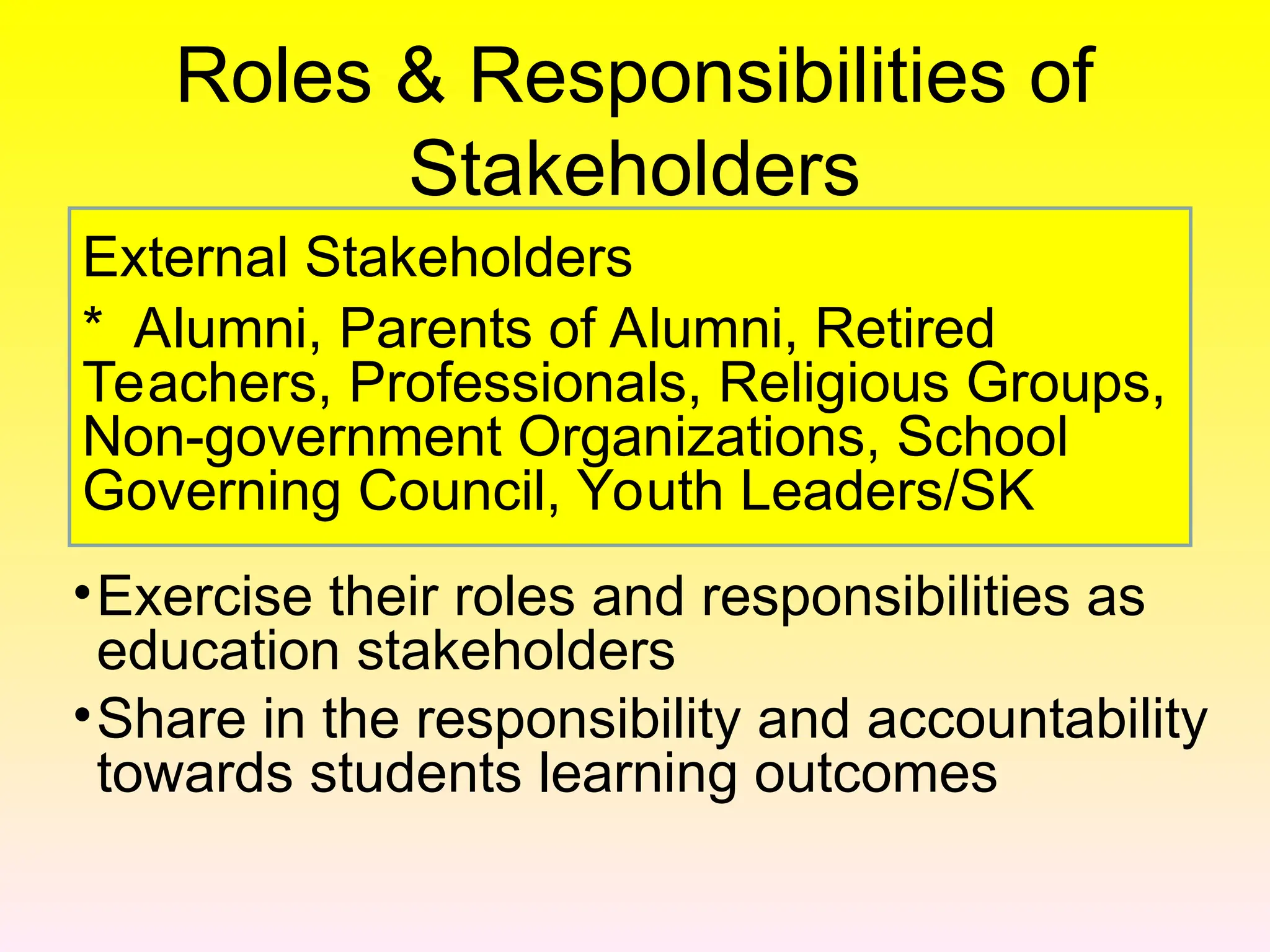
•Exercise their roles and responsibilities as
education stakeholders
•Share in the responsibility and accountability
towards students learning outcomes
External Stakeholders
* Alumni, Parents of Alumni, Retired
Teachers, Professionals, Religious Groups,
Non-government Organizations, School
Governing Council, Youth Leaders/SK
Roles & Responsibilities of
Stakeholders
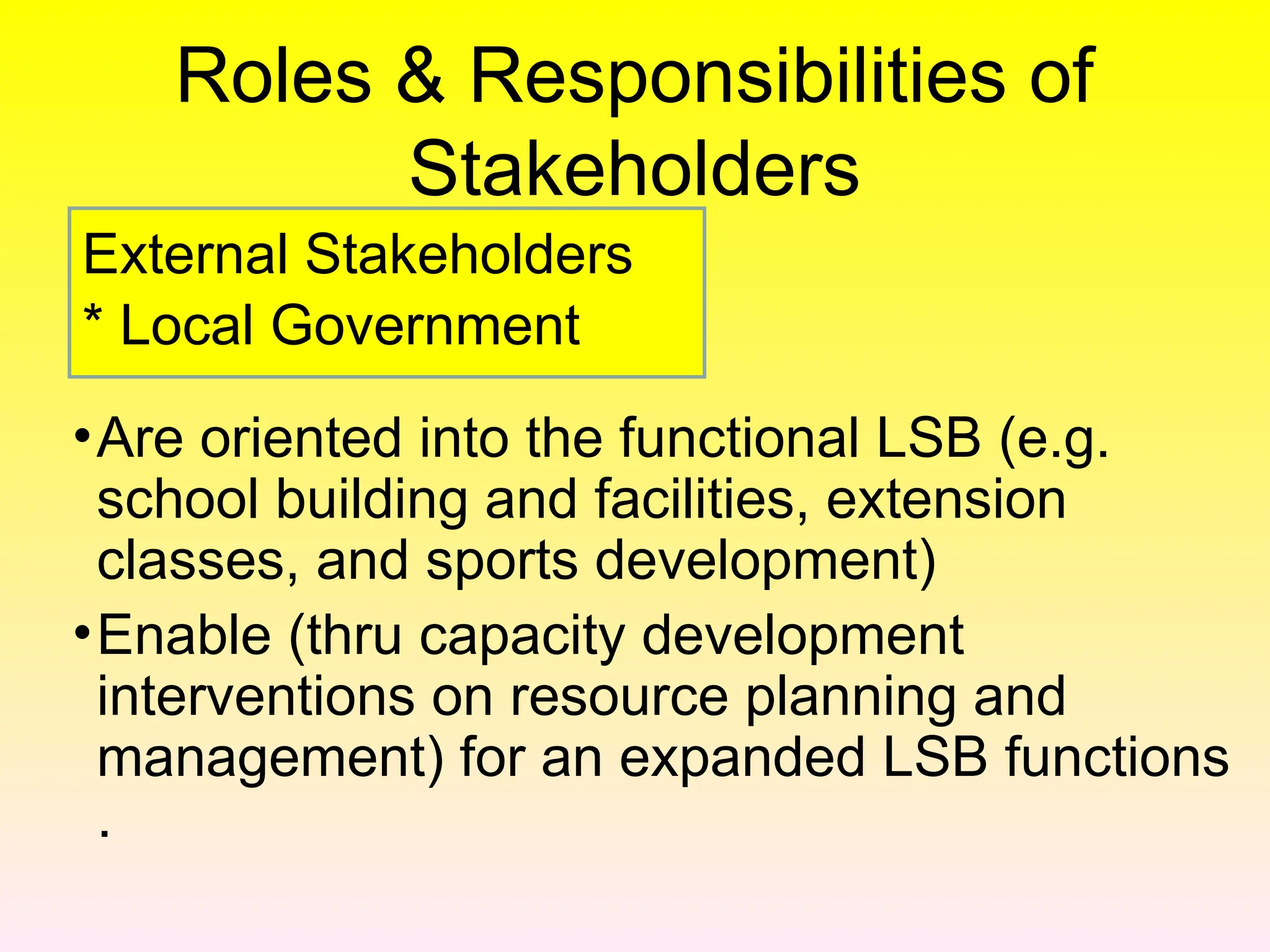
•Are oriented into the functional LSB (e.g.
school building and facilities, extension
classes, and sports development)
•Enable (thru capacity development
interventions on resource planning and
management) for an expanded LSB functions
.
External Stakeholders
* Local Government
Roles & Responsibilities of
Stakeholders
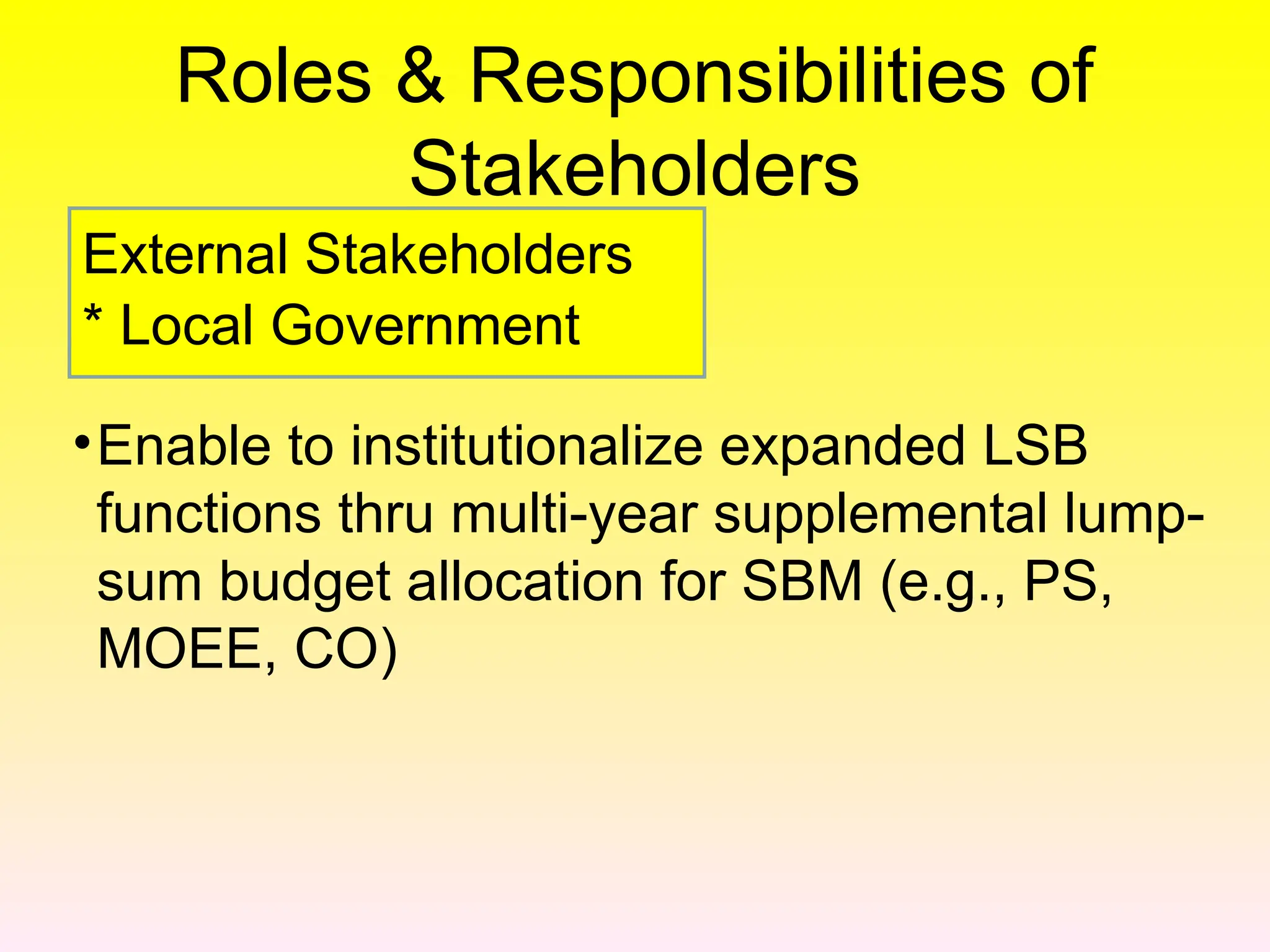
•Enable to institutionalize expanded LSB
functions thru multi-year supplemental lump-
sum budget allocation for SBM (e.g., PS,
MOEE, CO)
External Stakeholders
* Local Government
Roles & Responsibilities of
Stakeholders
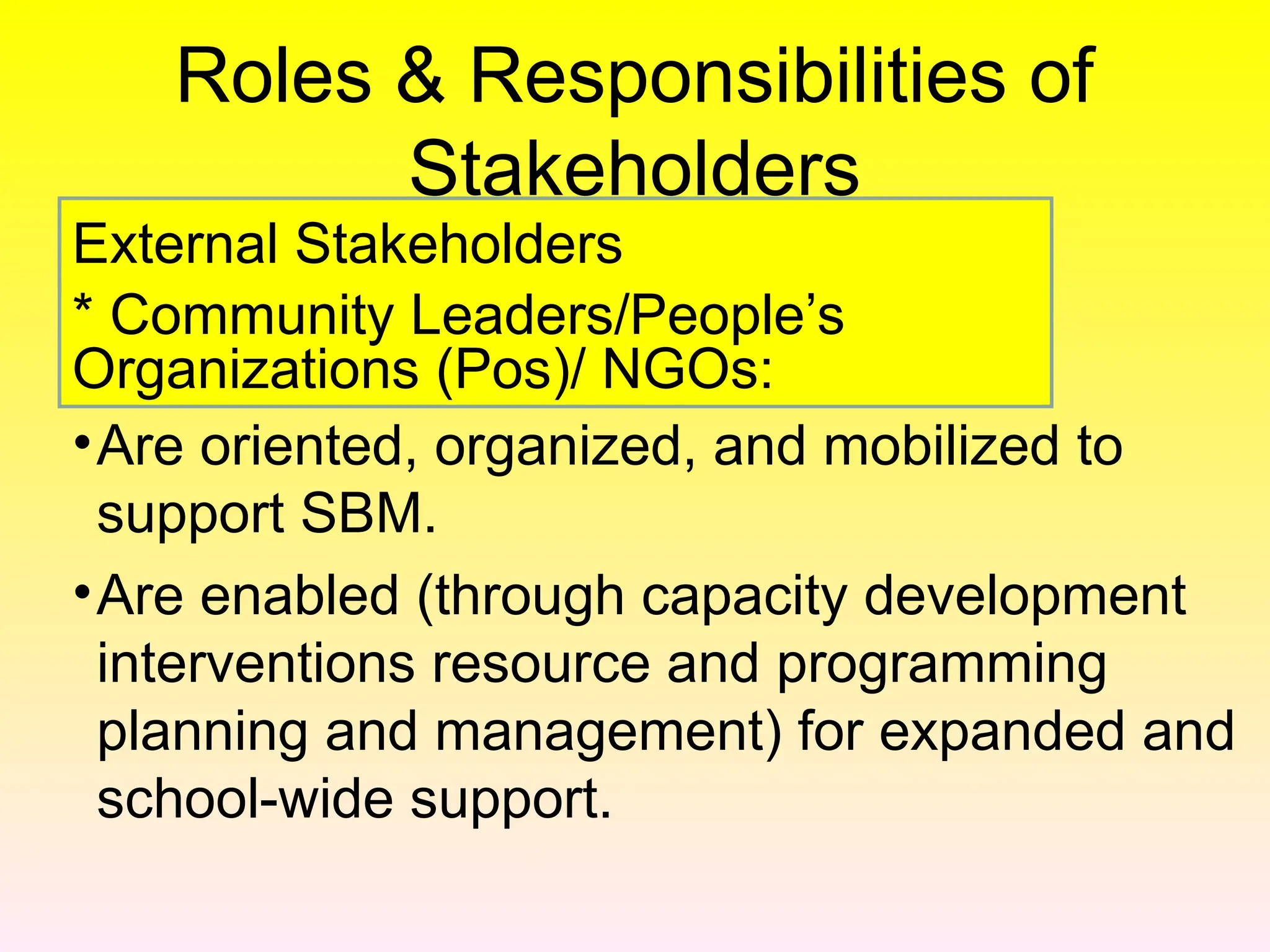
•Are oriented, organized, and mobilized to
support SBM.
•Are enabled (through capacity development
interventions resource and programming
planning and management) for expanded and
school-wide support.
External Stakeholders
* Community Leaders/People’s
Organizations (Pos)/ NGOs:
Roles & Responsibilities of
Stakeholders
•Are fully enabled to provide institutionalized
support community-wide programs to
continuously improve learning outcomes
(including ALS) and to promote children’s
welfare.
External Stakeholders
* Community Leaders/People’s
Organizations (Pos)/ NGOs:
Roles & Responsibilities of
Stakeholders
•School Community are organized to
support/implement SBM
•Expand school-wide support for implementation
of SIP priority programs and projects
•Support for continuous school improvement
institutionalized
External Stakeholders
* Community Leaders/People’s
Organizations (Pos)/ NGOs:

137018582-Session-4-Roles-and-Responsibilities-of-Stakeholders.ppt

  • 1.
    The Roles and Responsibilitiesof Different Stakeholders (School, Division and Region) By: Merle B. Federez
  • 2.
    The expected advocateof CFSS is DepED, through the Bureau of Secondary Education. The Director of the Bureau has organized a team for CFSS.
  • 3.
    Who are ConsideredCFSS Champions? • Are visible to their constituents • Can provide information to constituents • Generate success within the system • Recognize those who are responsible for success
  • 4.
    Effects of Constituencyof Having Champions • Build credibility for CFSS • Inspire others to become believers of CFSS • Develop a sense of ownership or accountability for outcomes of CFSS
  • 5.
    Who are Involvedin CFSS Program? • BSE, DepEd Central • Regional Coordinator • Division Coordinator • School Head • Internal Stakeholders • External Stakeholders
  • 6.
    Roles & Responsibilitiesof Stakeholders • Advocate CFSS at the national level. • Monitor the CFSS Coordinators (regional and division levels), encouraging them to do more and better for the schools. – Get updated information relative to the schools’ Annual Work and Financial Plan – Get success stories that could be shared with other regions/divisions BSE, DepEd Central
  • 7.
    Roles & Responsibilitiesof Stakeholders • Assist in sourcing resources for CFSS schools. • Share with the schools beneficial outputs from the Bureau’s other projects. • Put up a search for the Most Child-Friendly School. BSE, DepEd Central
  • 8.
    Roles & Responsibilitiesof Stakeholders • Update the Bureau Director on the status of the CFSS implementation in the schools and get inputs from her for further improvement of the schools. BSE, DepEd Central
  • 9.
    Roles & Responsibilitiesof Stakeholders • Share to the divisions and schools what the Regional Office does in regard to school improvement, be that in curriculum improvement or in capability building programs. Regional Coordinator
  • 10.
    Roles & Responsibilitiesof Stakeholders • Monitors changes in educational performance in CFSS schools. • Updates the Regional Director on the status of the CFSS to mobilize support to CFSS Regional Coordinator
  • 11.
    Roles & Responsibilitiesof Stakeholders • Advocacy and mobilize program implementation in his/her catchment area. • Helps the CFSS schools efforts of advocacy and social mobilization. Division Coordinator
  • 12.
    Roles & Responsibilitiesof Stakeholders • Visits the CFSS schools not just for monitoring purposes but to provide assistance and/or advise to the school principal and the school CFSS coordinator for support and encouragement. Division Coordinator
  • 13.
    Roles & Responsibilitiesof Stakeholders • Mobilizes LGU resources for attainment of CFSS goals, linking the CFSS schools with individuals and institutions that could help with school needs. Division Coordinator
  • 14.
    Roles & Responsibilitiesof Stakeholders • Provides advise to the school head in fine tuning processes by providing professional support and encouragement. Division Coordinator
  • 15.
    It is importantthat It is important that Coordinators Coordinators take take the initiative to institutionalize and the initiative to institutionalize and incorporate CFSS within the organic incorporate CFSS within the organic functions of the Schools Division and functions of the Schools Division and Regional Offices Regional Offices
  • 16.
    Roles & Responsibilitiesof Stakeholders • Fully accountable to stakeholders for school performance, thus he/she should provide directions for improving student achievement, protecting children, collaborating with families and community, fostering teacher commitment and ensuring the full implementation of DepEd policies and programs. School Head
  • 17.
    Roles & Responsibilitiesof Stakeholders • Has management responsibilities for maximizing the financial, technological, and human resources of the school, resolving day-to-day challenges, and keeping the staff focused on the school’s vision and mission. School Head
  • 18.
    Roles & Responsibilitiesof Stakeholders • Acts as fund manager and devotes attention to instructional leadership and supervision • Promotes/shares SBM experiences and leading practices to other schools. • Creates critical mass of SBM champions. School Head
  • 19.
    Roles & Responsibilitiesof Stakeholders • Has effective working relationship with LSB and SGC. • Innovates and institutionalizes continuous school improvement process School Head
  • 20.
    Roles & Responsibilitiesof Stakeholders • Along with the student, plays an interactive role in the education process because one cannot function without the other. • Teachers are the single most important factor in creating an effective and inclusive classroom. Internal Stakeholders * Teachers
  • 21.
    Effective for learning: •Promotes good quality teaching and learning processes with individualized instruction appropriate to each child's developmental level, abilities, and learning style and with active, cooperative, and democratic learning methods. • Provides structured content and good quality materials and resources. • Enhances teacher capacity, morale, commitment, status, and income — and their own recognition of child rights. • Promotes quality learning outcomes by defining and helping children learn what they need to learn and teaching them how to learn.
  • 22.
    Inclusive of children: •Does not exclude, discriminate, or stereotype on the basis of difference. • Provides education that is free and compulsory, affordable and accessible, especially to families and children at risk. • Respects diversity and ensures equality of learning for all children (e.g., girls, working children, children of ethnic minorities and affected by HIV/AIDS, children with disabilities, victims of exploitation and violence). • Responds to diversity by meeting the differing circumstances and needs of children (e.g., based on gender, social class, ethnicity, and ability level).
  • 23.
    Roles & Responsibilitiesof Stakeholders • Play key roles as educational stakeholders • Their primary objective is the assurance that their children will receive a quality education, which will enable the children to lead productive rewarding lives as adults in a global society. Internal Stakeholders * Parents
  • 24.
    Roles & Responsibilitiesof Stakeholders • Assume responsibilities as partners in the learning process • Co-manage and co-monitor learning process • Held accountable for the performance, achievement, and well-being of their children Internal Stakeholders * Parents
  • 25.
    Roles & Responsibilitiesof Stakeholders • Play the lead role in the educational process and as stakeholders are expected to participate in the process. • Should be encouraged to exercise their decision- making role in the education process. Internal Stakeholders * Students
  • 26.
    Roles & Responsibilitiesof Stakeholders •The student determines the educational services offers such as special education for those who are gifted and learning challenged. •The number and needs of students can be a determining factor for allocating resources. Internal Stakeholders * Students
  • 27.
    Roles & Responsibilitiesof Stakeholders •Are made aware of their rights and responsibilities as primary stakeholders •Exercise their rights and fulfill their responsibilities as primary stakeholder •Share in school leadership and management •Are held accountable for their performance. Internal Stakeholders * Students
  • 28.
    Roles & Responsibilitiesof Stakeholders •Are organized and made aware of their rights and responsibilities as education stakeholders •Engage themselves in school governance and school-wide improvement process External Stakeholders * Alumni, Parents of Alumni, Retired Teachers, Professionals, Religious Groups, Non-government Organizations, School Governing Council, Youth Leaders/SK)
  • 29.
    Roles & Responsibilitiesof Stakeholders •Exercise their roles and responsibilities as education stakeholders •Share in the responsibility and accountability towards students learning outcomes External Stakeholders * Alumni, Parents of Alumni, Retired Teachers, Professionals, Religious Groups, Non-government Organizations, School Governing Council, Youth Leaders/SK
  • 30.
    Roles & Responsibilitiesof Stakeholders •Are oriented into the functional LSB (e.g. school building and facilities, extension classes, and sports development) •Enable (thru capacity development interventions on resource planning and management) for an expanded LSB functions . External Stakeholders * Local Government
  • 31.
    Roles & Responsibilitiesof Stakeholders •Enable to institutionalize expanded LSB functions thru multi-year supplemental lump- sum budget allocation for SBM (e.g., PS, MOEE, CO) External Stakeholders * Local Government
  • 32.
    Roles & Responsibilitiesof Stakeholders •Are oriented, organized, and mobilized to support SBM. •Are enabled (through capacity development interventions resource and programming planning and management) for expanded and school-wide support. External Stakeholders * Community Leaders/People’s Organizations (Pos)/ NGOs:
  • 33.
    Roles & Responsibilitiesof Stakeholders •Are fully enabled to provide institutionalized support community-wide programs to continuously improve learning outcomes (including ALS) and to promote children’s welfare. External Stakeholders * Community Leaders/People’s Organizations (Pos)/ NGOs:
  • 34.
    Roles & Responsibilitiesof Stakeholders •School Community are organized to support/implement SBM •Expand school-wide support for implementation of SIP priority programs and projects •Support for continuous school improvement institutionalized External Stakeholders * Community Leaders/People’s Organizations (Pos)/ NGOs: