A Review of the Cognitive Concepts Surrounding Traumatic
Brain Injury and Memory
Basso, Melissa Nunez, Yvonne
Reece, Adrian Smith, Laketa
School of Professional Studies
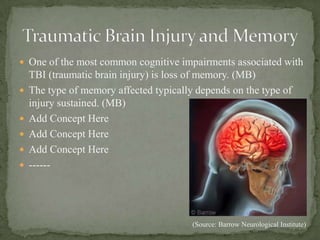
 One of the most common cognitive impairments associated with
TBI (traumatic brain injury) is loss of memory. (MB)
 The type of memory affected typically depends on the type of
injury sustained. (MB)
 Add Concept Here
 Add Concept Here
 Add Concept Here
 ------
(Source: Barrow Neurological Institute)
 Discuss the basics of the research, try not to include
specifics about the research just yet- that comes later
(background information).
Loss of LTM (long term memory) or the functions of LTM
can be detrimental to ones overall well being and social,
emotional and cognitive health.
The type of LTM damage can make a profound difference in
cognitive functioning and determining the level of
success in livelihood in those suffering with TBI.
 Explicit Memory: Often labeled “declarative” or
“conscious” memory. Based on facts and experiences.
 Implicit Memory: Often called “non-declarative” or
“unconscious” memory.
(MB)
 A study produced by David Shum et. al. (1999) revealed that like adults,
children and adolescence who have suffered TBI have limited issues with
implicit memory, but display deficits in explicit memory. The study focused
on priming, a form of implicit memory in which unconscious recognition is
applied to previously experienced concepts, unknowingly (Goldstein, 2011,
p. 156). Children were studied on the basis of visual stimuli, to rule out
reading comprehension (Shum et. al., 1999, p. 151). Priming was used to
observe implicit memory, while cued recall was used to observe explicit
memory during the assessments.
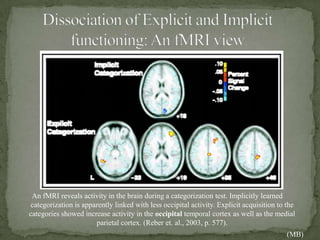
 Neuroscience supports this evidence; An article by Reber et. al. (2003),
discusses results of functional resonance images (fMRI) during
categorization tests. Activation is seen in different areas of the brain
depending on whether the task presented was relative to that which was
implicitly learned or explicitly learned. The following photo was presented
as evidence of the dissociation between Explicit and Implicit memory
(MB)
An fMRI reveals activity in the brain during a categorization test. Implicitly learned
categorization is apparently linked with less occipital activity. Explicit acquisition to the
categories showed increase activity in the occipital temporal cortex as well as the medial
parietal cortex. (Reber et. al., 2003, p. 577).
(MB)
 Autobiographical memory is the mental ability to place ones self into a
moment in time. It entails both semantic and episodic memory (explicit
memory).
 In study carried out by Pascale Piolino et. al. (2007), the impairment of
autobiographical memory was assessed in patients who suffered TBI at least
a year prior to observation. The results included amnesia of the sense of self
as well as a significant relationship between autonoetic consciousness
(mental time travel) and executive functioning (carrying out other cognitive
processes). Autobiographical memory often presented itself with a lack of
spatial and temporal details (semantic).
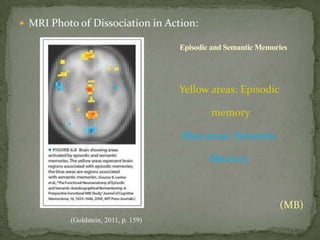
 Neuroscience: Brian Levine and coworkers(2004) conducted a study in
which participants were asked to listen to self recorded diary entries
containing episodic and semantic situations on an audio recording device.
Upon brain imaging, there were notable areas distinguishing between both
types of explicit memory (Goldstein, 2011, p.159).
(MB)
 MRI Photo of Dissociation in Action:
(Goldstein, 2011, p. 159)
Yellow areas: Episodic
memory
Blue areas: Semantic
Memory
(MB)
Episodic and Semantic Memories
 Keep font concise with 20pt. (times new roman) Summarize articles
reviewed. The tests, results and findings should be included in summary.
 Add photos if you like, charts and/or tables. Please cite and reference your
work in APA format.
 (Authors last name, year, page. If more than two authors, use first authors
last name, followed by; et. al., year and page #).
 Keep font concise with 20pt., and times new roman. Summarize articles
reviewed. The tests, results and findings should be included in summary.
 Add photos if you like, charts and/or tables. Please cite and reference your
work in APA format.
 (Authors last name, year, page. If more than two authors, use first authors
last name, followed by; et. al., year and page #).
Implicit & Explicit
Memory Impairment
 An explicit memory deficit is
probably the image most people
think of when they consider memory
loss.
 A good example of explicit memory
loss is if I am told that my money
was placed in a separate bank
account. However, a few days later I
forget where the money is and even
lose the memory of being told where
it is.
 Implicit memory loss,
comparatively, would be forgetting
to do something such as tying my
shoes or reading.
 K.C. is a man who suffered brain
injury to his hippocampus and
surrounding areas within the brain.
He retains the ability to discuss
various events that took place during
his life (semantic) but lacks the
ability to “relive” the situations.
(Goldstein, 2011, p. 158).K.C. lacks
an episodic memory and is unable to
feel emotions felt during past events
or even a sense of “self” during
those times.
 One who lacks memories for factual
events in the past but recalls the
feelings and emotions involved at a
certain time, can be said to lack an
semantic memory.
(MB)
Semantic & Episodic
Memory Impairment
Sum of your direction in a
few words
 Provide real life
examples of the
direction you are
discussing.
 Provide real life
examples of the
direction you are
discussing.
Sum of your direction in a
few words
Goldstein, E. B. (2011). Cognitive psychology: Connecting mind, research and
everyday experience. (3rd ed.). Belmont, CA: Wadsworth.
Piolino, P., Desgranges, B., Manning, L., North, P., Jokie, C., & Eustache, F.
(2007). Autobiographical memory, the sense of recollection and
executive functions after severe traumatic brain injury. Cortex, 43, 1
76-195.
Reber, P. J., Gitelman, D. R., & Parrish, T. B. (2003). Dissociating explicit and
implicit category knowledge with fMRI. Journal of Cognitive
Neuroscience, 15:4, 574-583.
Shum, D., Jamieson, E., Bahr, M., & Wallace, G. (1999). Implicit and explicit
memory in children with traumatic brain injury. Journal of Clinical
and Experimental Neuropsychology, 21:2, 149-158.
Traumatic Brain Injury Image. Retrieved April 21st, 2013 from:
http://www.thebarrow.org/Neurological_Services/Neurotrauma/204508
(MB)
Traumatic brain injury and memory

Traumatic brain injury and memory

  • 1.
    A Review ofthe Cognitive Concepts Surrounding Traumatic Brain Injury and Memory Basso, Melissa Nunez, Yvonne Reece, Adrian Smith, Laketa School of Professional Studies
  • 2.
     One ofthe most common cognitive impairments associated with TBI (traumatic brain injury) is loss of memory. (MB)  The type of memory affected typically depends on the type of injury sustained. (MB)  Add Concept Here  Add Concept Here  Add Concept Here  ------ (Source: Barrow Neurological Institute)
  • 3.
     Discuss thebasics of the research, try not to include specifics about the research just yet- that comes later (background information).
  • 4.
    Loss of LTM(long term memory) or the functions of LTM can be detrimental to ones overall well being and social, emotional and cognitive health. The type of LTM damage can make a profound difference in cognitive functioning and determining the level of success in livelihood in those suffering with TBI.  Explicit Memory: Often labeled “declarative” or “conscious” memory. Based on facts and experiences.  Implicit Memory: Often called “non-declarative” or “unconscious” memory. (MB)
  • 5.
     A studyproduced by David Shum et. al. (1999) revealed that like adults, children and adolescence who have suffered TBI have limited issues with implicit memory, but display deficits in explicit memory. The study focused on priming, a form of implicit memory in which unconscious recognition is applied to previously experienced concepts, unknowingly (Goldstein, 2011, p. 156). Children were studied on the basis of visual stimuli, to rule out reading comprehension (Shum et. al., 1999, p. 151). Priming was used to observe implicit memory, while cued recall was used to observe explicit memory during the assessments.  Neuroscience supports this evidence; An article by Reber et. al. (2003), discusses results of functional resonance images (fMRI) during categorization tests. Activation is seen in different areas of the brain depending on whether the task presented was relative to that which was implicitly learned or explicitly learned. The following photo was presented as evidence of the dissociation between Explicit and Implicit memory (MB)
  • 6.
    An fMRI revealsactivity in the brain during a categorization test. Implicitly learned categorization is apparently linked with less occipital activity. Explicit acquisition to the categories showed increase activity in the occipital temporal cortex as well as the medial parietal cortex. (Reber et. al., 2003, p. 577). (MB)
  • 7.
     Autobiographical memoryis the mental ability to place ones self into a moment in time. It entails both semantic and episodic memory (explicit memory).  In study carried out by Pascale Piolino et. al. (2007), the impairment of autobiographical memory was assessed in patients who suffered TBI at least a year prior to observation. The results included amnesia of the sense of self as well as a significant relationship between autonoetic consciousness (mental time travel) and executive functioning (carrying out other cognitive processes). Autobiographical memory often presented itself with a lack of spatial and temporal details (semantic).  Neuroscience: Brian Levine and coworkers(2004) conducted a study in which participants were asked to listen to self recorded diary entries containing episodic and semantic situations on an audio recording device. Upon brain imaging, there were notable areas distinguishing between both types of explicit memory (Goldstein, 2011, p.159). (MB)
  • 8.
     MRI Photoof Dissociation in Action: (Goldstein, 2011, p. 159) Yellow areas: Episodic memory Blue areas: Semantic Memory (MB) Episodic and Semantic Memories
  • 9.
     Keep fontconcise with 20pt. (times new roman) Summarize articles reviewed. The tests, results and findings should be included in summary.  Add photos if you like, charts and/or tables. Please cite and reference your work in APA format.  (Authors last name, year, page. If more than two authors, use first authors last name, followed by; et. al., year and page #).
  • 10.
     Keep fontconcise with 20pt., and times new roman. Summarize articles reviewed. The tests, results and findings should be included in summary.  Add photos if you like, charts and/or tables. Please cite and reference your work in APA format.  (Authors last name, year, page. If more than two authors, use first authors last name, followed by; et. al., year and page #).
  • 11.
    Implicit & Explicit MemoryImpairment  An explicit memory deficit is probably the image most people think of when they consider memory loss.  A good example of explicit memory loss is if I am told that my money was placed in a separate bank account. However, a few days later I forget where the money is and even lose the memory of being told where it is.  Implicit memory loss, comparatively, would be forgetting to do something such as tying my shoes or reading.  K.C. is a man who suffered brain injury to his hippocampus and surrounding areas within the brain. He retains the ability to discuss various events that took place during his life (semantic) but lacks the ability to “relive” the situations. (Goldstein, 2011, p. 158).K.C. lacks an episodic memory and is unable to feel emotions felt during past events or even a sense of “self” during those times.  One who lacks memories for factual events in the past but recalls the feelings and emotions involved at a certain time, can be said to lack an semantic memory. (MB) Semantic & Episodic Memory Impairment
  • 12.
    Sum of yourdirection in a few words  Provide real life examples of the direction you are discussing.  Provide real life examples of the direction you are discussing. Sum of your direction in a few words
  • 16.
    Goldstein, E. B.(2011). Cognitive psychology: Connecting mind, research and everyday experience. (3rd ed.). Belmont, CA: Wadsworth. Piolino, P., Desgranges, B., Manning, L., North, P., Jokie, C., & Eustache, F. (2007). Autobiographical memory, the sense of recollection and executive functions after severe traumatic brain injury. Cortex, 43, 1 76-195. Reber, P. J., Gitelman, D. R., & Parrish, T. B. (2003). Dissociating explicit and implicit category knowledge with fMRI. Journal of Cognitive Neuroscience, 15:4, 574-583. Shum, D., Jamieson, E., Bahr, M., & Wallace, G. (1999). Implicit and explicit memory in children with traumatic brain injury. Journal of Clinical and Experimental Neuropsychology, 21:2, 149-158. Traumatic Brain Injury Image. Retrieved April 21st, 2013 from: http://www.thebarrow.org/Neurological_Services/Neurotrauma/204508 (MB)