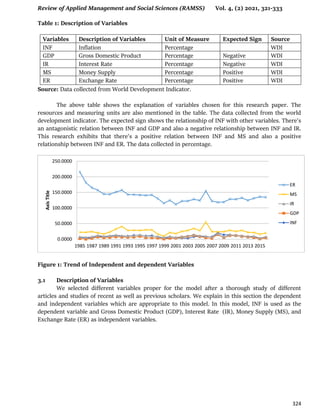
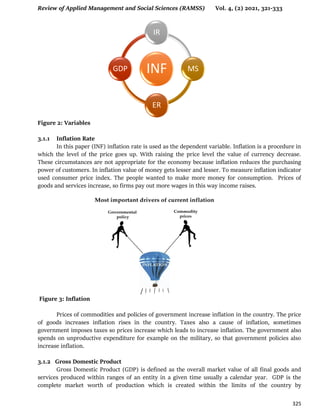
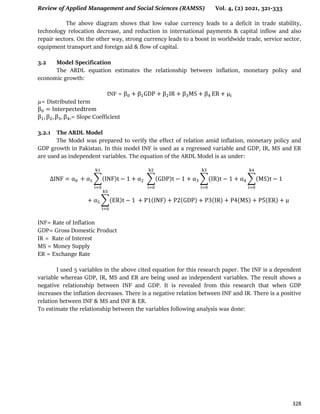
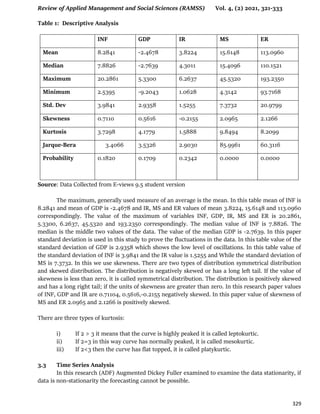
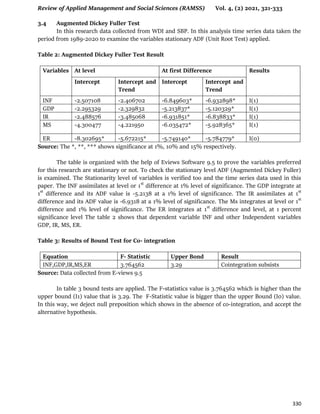
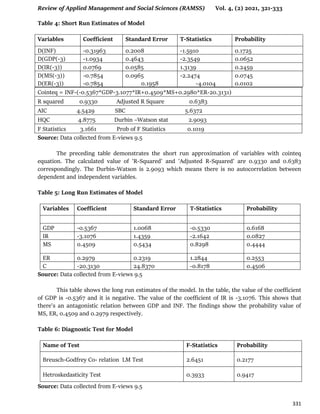
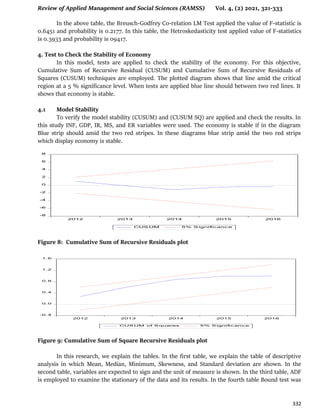
This study examines the relationship between inflation, monetary policy, and economic growth in Pakistan from 1989-2020. It uses inflation as the dependent variable and GDP, interest rate, money supply, and exchange rate as independent variables. Auto Regressive Distributive Lag techniques are employed. The findings show an inverse relationship between inflation and GDP, meaning inflation decreases as GDP increases. There is also a negative relationship between inflation and interest rate, but positive relationships between inflation and both money supply and exchange rate. Overall, the study aims to analyze how monetary policy tools like interest rates and money supply impact inflation and economic growth in Pakistan.


![1.[1 14]the impact of macroeconomic indicators on stock prices in nigeria](https://cdn.slidesharecdn.com/ss_thumbnails/1-1-14theimpactofmacroeconomicindicatorsonstockpricesinnigeria-111125091144-phpapp01-thumbnail.jpg?width=640&height=640&fit=bounds)


![6.[43 53]stock market volatility and macroeconomic variables volatility in ni...](https://cdn.slidesharecdn.com/ss_thumbnails/6-43-53stockmarketvolatilityandmacroeconomicvariablesvolatilityinnigeria-111125091154-phpapp02-thumbnail.jpg?width=640&height=640&fit=bounds)


