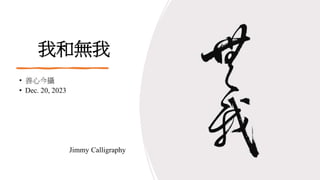
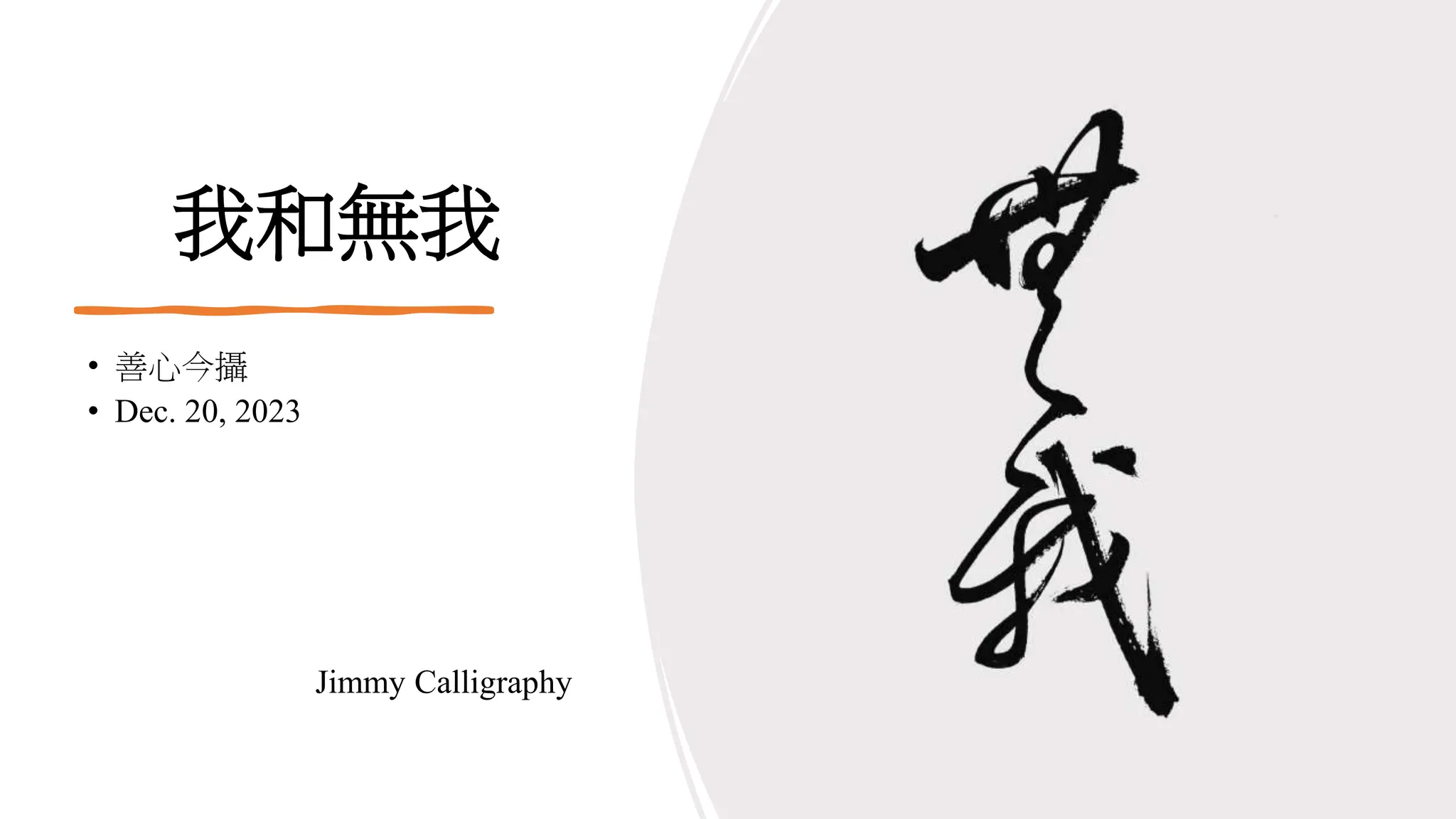
我和無我
• 善心今攝
• Dec. 20, 2023
Jimmy Calligraphy
喜心捨心練習
o想起一位朋友,並關注此人生活中的特定收穫或快樂來源。
o無論你想到她/他的好運或幸福,用以下的短語來欣喜。
• 願你的幸福和好運不要離開你。
• 願你的好運持續下去。
oMay I accept things the way they are
願我接受事物原本的樣子。
oMay I let people be for who they are
願我讓人們成為他們本來的樣子。
oMay I not be disturbed by the coming and going of all events
願我不為一切事件的來去所驚動 。
oMay I learn to see the arising and ceasing of all phenomena
願我學會看透一切現象的生起與滅去。
oMay I be open, balanced, and peaceful
願我開放、平衡、平和。
我和無我
上星期
• 成為某人(自我)與成為無名小卒(無我)
• 自我的重要性
• 無我的重要性
• 在靈性修行和日常生活中的活動和責任
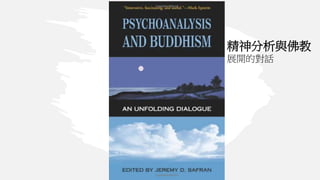
精神分析與佛教
展開的對話
Chapter 1. Being Somebody and Being Nobody: A Reexamination of the
Understanding of Self in Psychoanalysis and Buddhism
Jack Engler
第一章。
•成為某人與成為無名小卒:重新審視精神分
析與佛教中對自我的理解。
==
• 修佛時,我們需要有一個「健康的自我」的觀念//,然後
才修行無我。施心慧老師
CHANGE IN SPIRITUAL PRACTICE 精神練習的改變 :
GRADUAL OR SUDDEN 漸修或頓悟?
PARTIAL OR COMPLETE 部分或完整?
• Question: Doesn’t enlightenment clear away imperfections and
personality flaws?
問題:覺悟難道不能消除不完美和人格缺陷嗎?
• ROSHI: No, it shows them up! Before awakening, one can easily
ignore or rationalize his shortcomings, but after enlightenment this is
no longer possible.
老師: 不,它顯示了它們 (不完美和人格缺陷)! 在開悟
之前,一個人很容易忽略或合理化自己的缺點,但在開
悟之後,這就不再可能了。
• One’s failings are painfully evident.
一個人的失敗是顯而易見的。
• Yet at the same time a strong determination develops to rid oneself of
them.
但同時,一種強烈的決心要擺脫它們 (不完美和人格缺
陷)。
• Even opening the Mind’s eye fully does not at one fell swoop purify
the emotions.
即使心眼完全打開,也不能一下子淨化情緒。
• Continuous training after enlightenment is required to purify the
emotions so that our behavior accords with our understanding.
覺悟後需要不斷的修行來淨化情緒,使我們的行為符合
我們的理解。
• This vital point must be understood.
必須理解這一要點。
• Andrew Cohen (2000) asked me whether I didn’t agree that if one’s
enlightenment is deep enough,
Andrew Cohen (2000年) 問我是否不同意如果一個人的
[覺悟] 足夠深,
• the fixation on the personal self and all the suffering associated with it
will disappear because one’s perspective will shift completely,
對個人[自我]的執著以及與之相關的所有痛苦都會消失,
因為一個人的觀點將完全轉變,
• from seeing oneself as the one who was wounded to recognizing
oneself as that which was never wounded by anything.
從將自己視為受傷者,到意識到自己從未被任何事物傷
害過。
• Won’t realization of the emptiness and ultimate insubstantiality of the
personal self and its suffering completely change one’s relationship to
personal experience?
問題:認識個人 (自我) 的 [空性] 和最終的非實質及其痛
苦,難道不會徹底改變一個人與個人經驗的關係嗎?
• My reply was that this is an idealized view.
我的回答是,這是一種理想化的觀點。
• In practice, it just doesn’t seem to work that way.
但在實踐中,它似乎不是這樣運作的。
• This happens only if one has truly gone to the end of the path.
只有當一個人真正走到了道路的盡頭時(阿羅漢果),
這種情況才會發生。
• It is true that each moment of mindfulness shifts our normal
relationship to experience in that moment.
確實,正念的每一刻都會將我們正常的關係轉化為那一
刻的體驗。
• If a painful experience can be held without reactivity—
如果一次痛苦的經驗可以保持不變(沒有反應)——
• without judgment, censorship, condemnation, or the wish to extrude—
with clarity, openness, and compassion—
沒有評判、審查、譴責或排擠的願望——以清楚、開放
和悲心——
• the pain will not produce avoidance or aversion.
痛不會產生迴避或厭惡。
• Pleasurable experience will not produce attraction and clinging.
愉快的體驗不會產生吸引力和執著。
• Pain will simply remain pain, pleasure simply remain pleasure,
痛依然是痛,樂依然是樂,
• without the reactive approach-avoidance response that much of
psychoanalytic affect theory,
沒有大部分[精神分析影響理論]中的反應性接近-迴避反
應,
• by contrast, tends to consider innate and views as leading to the
constellation of enduring drive or motivational states.
相較之下,傾向於認為先天和觀點會導致持久的動力或
動機狀態。
• “Leave the arising (what arises) in the arising,”
「將生起(生起的事物)留在生起中,」
• a Tibetan teaching says, and the mind’s natural clarity and ease will
remain undisturbed.
西藏教義說,心的自然清明和自在將保持不受干擾。
• All enlightenment traditions agree that at the end of the spiritual path
all forms of self-generated suffering end.
所有覺悟(所有宗教?)傳統都同意,在靈性道路的終
點,所有形式的自製痛苦都會結束。
• But this is a huge “if.”
但這是一個巨大的「如果」。
• I know no one who claims it. 我不知道有人聲稱這一點。
• Short of that, the reality is much more complex.
除此之外,現實要複雜得多。
呼吸
• In the Theravada tradition, for instance, and in Buddhist traditions generally,
freedom from self-generated suffering doesn’t happen all at once.
例如在南傳佛教和佛教傳統來說, 擺脫自製痛苦的解脫並不
是一下子就能實現的。
• Buddhaghosa 1975; Mahasi Sayadaw 1965 describe it as a process occurring
by stages or increments, much as change occurs in psychotherapy.
Buddhaghosa 1975; Mahasi Sayadaw 1965: 他們將其描述為一個分
階段或漸進發生的過程,就像心理治療中發生的變化一樣。
• This was supported by the self-reports of the Buddhist practitioners I studied
in India (Engler 1983a),
我在印度學習的佛教徒的自我報告也支持了這一點,
• all of whom had experienced at least the first of the four enlightenment
experiences that are said to occur in Theravada practice.
他們都至少經歷過據說在上座部(南傳)修行中發生的
四果開悟體驗中的第一果//初果。
• Self-generated suffering is said to end in this tradition through a
progressive and irreversible “extinction” of the unwholesome mental
factors that cause it.
據說,在這個傳統中,自製的痛苦是透過導致痛苦的不
善心理因素的漸進和不可逆轉的「滅絕」來結束的。
• These pathogenic mental factors are said to be extinguished in a
specific and invariant sequence of four enlightenment experiences.
據說,這些致病的心理因素會在四果證悟體驗的特定且
不變的序列中被消除。
• On each occasion, a specific group of pathogenic mental factors are
eliminated from the mind once and for all and the practitioner will
never again act in these conflictual ways.
每一果,一組特定的致病心理因素都會從心中一勞永逸
地消除,修行者將永遠不會再以這些衝突的方式行事。
• The group of factors said to be extinguished at first enlightenment
comprises core beliefs about the self—
據說在第一果(初果:須陀洹)開悟時就會消失的這組
因素包括關於自我的核心信念——
• “maladaptive cognitions” or “core assumptions” in the language of
cognitive psychology—
認知心理學語言中的「適應不良認知」或「核心假設」
——
• pathogenic beliefs about who we are and how we become free.
關於我們是誰以及我們如何獲得自由的致病信念。
• The most important of these is the representation of self as singular,
separate, independent, and self-identical.
其中最重要的是將自我表現為單一的、獨立的、獨立的
和自我同一的。【開悟時就會消失】
• This is now recognized as illusory, a construct or representation only.
現在這被認為是虛幻的,只是一種構造或表徵。
• But insight in meditation doesn’t immediately change behavior any
more than insight does in psychotherapy.
但靜觀中的洞察力並不會像 心理治療 中的洞察力那樣立
即改變行為。
• conditioned motivations, affects, and impulses—that can still influence
the practitioner to act in unwholesome, selfish, and uncompassionate
ways.
條件動機、情緒和衝動-仍然會影響修行者以不健康、
自私和無同情心的方式行事。
呼吸
• The second set of “fetters,” in particular the two basic motivational
states of classic psychoanalytic theory, libido and aggression—
第二組的使「結使」//十結使,特別是經典精神分析理論
的兩種基本動機狀態,力比多和攻擊性——
• in Buddhist terms, kama-tanha, literally “desire for sense pleasure” or
behavior governed by the Pleasure Principle,
用佛教術語來說,欲愛, 字面意思是「感官快樂的渴望」
或受快樂原則支配的行為,
• and vyapada, literally “ill-will” or aggression toward others in its
various forms.
和惡意, 字面意思是「惡意」或以各種形式對他人進行
攻擊。
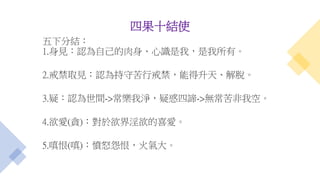
四果十結使
五下分結:
1.身見:認為自己的肉身、心識是我,是我所有。
2.戒禁取見:認為持守苦行戒禁,能得升天、解脫。
3.疑:認為世間->常樂我淨,疑惑四諦->無常苦非我空。
4.欲愛(貪):對於欲界淫欲的喜愛。
5.嗔恨(嗔):憤怒怨恨,火氣大。
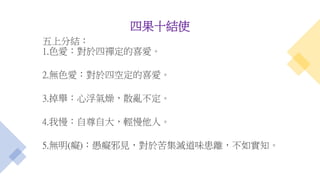
四果十結使
五上分結:
1.色愛:對於四禪定的喜愛。
2.無色愛:對於四空定的喜愛。
3.掉舉:心浮氣燥,散亂不定。
4.我慢:自尊自大,輕慢他人。
5.無明(癡):愚癡邪見,對於苦集滅道味患離,不如實知。
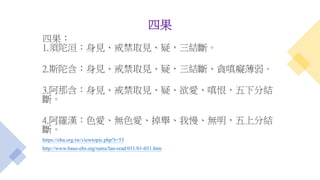
四果
四果:
1.須陀洹:身見、戒禁取見、疑,三結斷。
2.斯陀含:身見、戒禁取見、疑,三結斷、貪嗔癡薄弱。
3.阿那含:身見、戒禁取見、疑、欲愛、嗔恨,五下分結
斷。
4.阿羅漢:色愛、無色愛、掉舉、我慢、無明,五上分結
斷。
https://oba.org.tw/viewtopic.php?t=53
http://www.baus-ebs.org/sutra/fan-read/011/01-031.htm
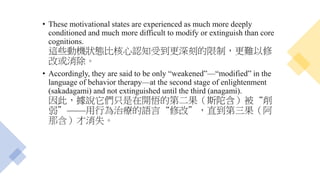
• These motivational states are experienced as much more deeply
conditioned and much more difficult to modify or extinguish than core
cognitions.
這些動機狀態比核心認知受到更深刻的限制,更難以修
改或消除。
• Accordingly, they are said to be only “weakened”—“modified” in the
language of behavior therapy—at the second stage of enlightenment
(sakadagami) and not extinguished until the third (anagami).
因此,據說它們只是在開悟的第二果(斯陀含)被“削
弱”——用行為治療的語言“修改”,直到第三果(阿
那含)才消失。
• But unlike psychoanalytic theory, they are viewed as conditioned
behaviors, not instinctually based drives and not inherent in
personality.
但與精神分析理論不同的是,它們被視為條件行為,而
不是基於本能的驅動力,也不是人格固有的。
呼吸
• The final group of fetters clusters around the mental factor of mana, the
“conceit” that “I am” and the remaining residual tendency to compare
self with others.
最後(十結的)一組結來說集中在法力的精神因素、
「我是」的「自負」以及剩餘的自我與他人比較的殘餘
傾向。
• This is the root of all narcissistic striving and is said not to be
extinguished until the fourth and final stage of enlightenment
(arahatta).
這是所有自戀努力的根源,據說直到第四果也是最後的
證悟階段(阿羅漢果)才會熄滅。
• Note how similar this progression is to change processes in therapy:
cognitions, beliefs, perspectives are more amenable to modification.
請注意,這種進展與治療過程的改變有多麼相似:認知、
信念、觀點更容易改變。
• Core motivational and drive states and their bases in affective
reactivity are much more resistant to intervention.
核心動機和驅動狀態及其情緒反應基礎更難以介入。
• Hardest of all to change are narcissistic investments in the core sense
of being a separate self.
最難改變的是對成為獨立自我的核心意識的自戀投資。
• This is exactly what we would expect: cognitive change first; affective
change next; change in core sense of selfhood last.
這正是我們所期望的:首先是認知改變; 接下來是情感
變化; 最後是核心自我意識的改變。
呼吸
• Zen tradition makes a similar point in distinguishing between little
kensho and great kensho.
宗傳統在區分小見性和大見性時也有類似的觀點。
• The realization of emptiness can be small or large, but it’s still just a
first glimpse of enlightenment.
空性的證悟可大可小,但它仍然只是開悟的初見。
• My teacher, Anagarika Munindra, used to call it “a little bit of
enlightenment,” holding his thumb and forefinger an inch apart.
我的老師 Anagarika Munindra 將拇指和食指保持一英寸
的距離,稱之為「一點點覺悟」。
• That first glimpse by its nature is not complete and does not shift
everything—
從本質上來說,第一眼的瞥見並不完整,也不會改變一
切——
• as we know all too well from the misconduct of so many spiritual
teachers in all traditions, East and West.
正如我們從東方和西方所有傳統中的許多精神導師的不
當行為中所知道的那樣。
• It is important to understand that certain misconduct, by itself, does not
mean they do not have deep understanding about the nature of reality.
重要的是要明白,某些不當行為本身並不意味著他們對
現實的本質沒有深刻的理解。
• It doesn’t mean they haven’t experienced enlightenment.
這並不意味著他們沒有經歷過開悟。
• It means that freedom from the maladaptive beliefs, the identifications,
the inner conflicts,
它意味著擺脫適應不良的信念、認同、內在衝突,
• and the narcissistic investments that create suffering for ourselves and
others aren’t extinguished—even granting you accept that notion—all
at once.
給我們自己和他人帶來痛苦的自戀投資並不會立即消失
——即使你接受這個想法也是如此。
• First enlightenment is still first enlightenment. Much work remains.
初果仍然是初果。 還有很多功夫要做//繼續努力修行。
願以此功德
普及於一切
我等與眾生
皆共成佛道

12/20/2023「同心共善」善心法師網上禪修班 (粵語) …………………..

  • 1.
    我和無我 • 善心今攝 • Dec.20, 2023 Jimmy Calligraphy
  • 2.
    喜心捨心練習 o想起一位朋友,並關注此人生活中的特定收穫或快樂來源。 o無論你想到她/他的好運或幸福,用以下的短語來欣喜。 • 願你的幸福和好運不要離開你。 • 願你的好運持續下去。 oMayI accept things the way they are 願我接受事物原本的樣子。 oMay I let people be for who they are 願我讓人們成為他們本來的樣子。 oMay I not be disturbed by the coming and going of all events 願我不為一切事件的來去所驚動 。 oMay I learn to see the arising and ceasing of all phenomena 願我學會看透一切現象的生起與滅去。 oMay I be open, balanced, and peaceful 願我開放、平衡、平和。
  • 3.
    我和無我 上星期 • 成為某人(自我)與成為無名小卒(無我) • 自我的重要性 •無我的重要性 • 在靈性修行和日常生活中的活動和責任
  • 4.
  • 5.
    Chapter 1. BeingSomebody and Being Nobody: A Reexamination of the Understanding of Self in Psychoanalysis and Buddhism Jack Engler 第一章。 •成為某人與成為無名小卒:重新審視精神分 析與佛教中對自我的理解。 == • 修佛時,我們需要有一個「健康的自我」的觀念//,然後 才修行無我。施心慧老師
  • 6.
    CHANGE IN SPIRITUALPRACTICE 精神練習的改變 : GRADUAL OR SUDDEN 漸修或頓悟? PARTIAL OR COMPLETE 部分或完整? • Question: Doesn’t enlightenment clear away imperfections and personality flaws? 問題:覺悟難道不能消除不完美和人格缺陷嗎? • ROSHI: No, it shows them up! Before awakening, one can easily ignore or rationalize his shortcomings, but after enlightenment this is no longer possible. 老師: 不,它顯示了它們 (不完美和人格缺陷)! 在開悟 之前,一個人很容易忽略或合理化自己的缺點,但在開 悟之後,這就不再可能了。 • One’s failings are painfully evident. 一個人的失敗是顯而易見的。
  • 7.
    • Yet atthe same time a strong determination develops to rid oneself of them. 但同時,一種強烈的決心要擺脫它們 (不完美和人格缺 陷)。 • Even opening the Mind’s eye fully does not at one fell swoop purify the emotions. 即使心眼完全打開,也不能一下子淨化情緒。 • Continuous training after enlightenment is required to purify the emotions so that our behavior accords with our understanding. 覺悟後需要不斷的修行來淨化情緒,使我們的行為符合 我們的理解。 • This vital point must be understood. 必須理解這一要點。
  • 8.
    • Andrew Cohen(2000) asked me whether I didn’t agree that if one’s enlightenment is deep enough, Andrew Cohen (2000年) 問我是否不同意如果一個人的 [覺悟] 足夠深, • the fixation on the personal self and all the suffering associated with it will disappear because one’s perspective will shift completely, 對個人[自我]的執著以及與之相關的所有痛苦都會消失, 因為一個人的觀點將完全轉變, • from seeing oneself as the one who was wounded to recognizing oneself as that which was never wounded by anything. 從將自己視為受傷者,到意識到自己從未被任何事物傷 害過。 • Won’t realization of the emptiness and ultimate insubstantiality of the personal self and its suffering completely change one’s relationship to personal experience? 問題:認識個人 (自我) 的 [空性] 和最終的非實質及其痛 苦,難道不會徹底改變一個人與個人經驗的關係嗎?
  • 9.
    • My replywas that this is an idealized view. 我的回答是,這是一種理想化的觀點。 • In practice, it just doesn’t seem to work that way. 但在實踐中,它似乎不是這樣運作的。 • This happens only if one has truly gone to the end of the path. 只有當一個人真正走到了道路的盡頭時(阿羅漢果), 這種情況才會發生。 • It is true that each moment of mindfulness shifts our normal relationship to experience in that moment. 確實,正念的每一刻都會將我們正常的關係轉化為那一 刻的體驗。
  • 10.
    • If apainful experience can be held without reactivity— 如果一次痛苦的經驗可以保持不變(沒有反應)—— • without judgment, censorship, condemnation, or the wish to extrude— with clarity, openness, and compassion— 沒有評判、審查、譴責或排擠的願望——以清楚、開放 和悲心—— • the pain will not produce avoidance or aversion. 痛不會產生迴避或厭惡。
  • 11.
    • Pleasurable experiencewill not produce attraction and clinging. 愉快的體驗不會產生吸引力和執著。 • Pain will simply remain pain, pleasure simply remain pleasure, 痛依然是痛,樂依然是樂, • without the reactive approach-avoidance response that much of psychoanalytic affect theory, 沒有大部分[精神分析影響理論]中的反應性接近-迴避反 應, • by contrast, tends to consider innate and views as leading to the constellation of enduring drive or motivational states. 相較之下,傾向於認為先天和觀點會導致持久的動力或 動機狀態。
  • 12.
    • “Leave thearising (what arises) in the arising,” 「將生起(生起的事物)留在生起中,」 • a Tibetan teaching says, and the mind’s natural clarity and ease will remain undisturbed. 西藏教義說,心的自然清明和自在將保持不受干擾。 • All enlightenment traditions agree that at the end of the spiritual path all forms of self-generated suffering end. 所有覺悟(所有宗教?)傳統都同意,在靈性道路的終 點,所有形式的自製痛苦都會結束。 • But this is a huge “if.” 但這是一個巨大的「如果」。 • I know no one who claims it. 我不知道有人聲稱這一點。 • Short of that, the reality is much more complex. 除此之外,現實要複雜得多。
  • 13.
  • 14.
    • In theTheravada tradition, for instance, and in Buddhist traditions generally, freedom from self-generated suffering doesn’t happen all at once. 例如在南傳佛教和佛教傳統來說, 擺脫自製痛苦的解脫並不 是一下子就能實現的。 • Buddhaghosa 1975; Mahasi Sayadaw 1965 describe it as a process occurring by stages or increments, much as change occurs in psychotherapy. Buddhaghosa 1975; Mahasi Sayadaw 1965: 他們將其描述為一個分 階段或漸進發生的過程,就像心理治療中發生的變化一樣。 • This was supported by the self-reports of the Buddhist practitioners I studied in India (Engler 1983a), 我在印度學習的佛教徒的自我報告也支持了這一點, • all of whom had experienced at least the first of the four enlightenment experiences that are said to occur in Theravada practice. 他們都至少經歷過據說在上座部(南傳)修行中發生的 四果開悟體驗中的第一果//初果。
  • 15.
    • Self-generated sufferingis said to end in this tradition through a progressive and irreversible “extinction” of the unwholesome mental factors that cause it. 據說,在這個傳統中,自製的痛苦是透過導致痛苦的不 善心理因素的漸進和不可逆轉的「滅絕」來結束的。 • These pathogenic mental factors are said to be extinguished in a specific and invariant sequence of four enlightenment experiences. 據說,這些致病的心理因素會在四果證悟體驗的特定且 不變的序列中被消除。 • On each occasion, a specific group of pathogenic mental factors are eliminated from the mind once and for all and the practitioner will never again act in these conflictual ways. 每一果,一組特定的致病心理因素都會從心中一勞永逸 地消除,修行者將永遠不會再以這些衝突的方式行事。
  • 16.
    • The groupof factors said to be extinguished at first enlightenment comprises core beliefs about the self— 據說在第一果(初果:須陀洹)開悟時就會消失的這組 因素包括關於自我的核心信念—— • “maladaptive cognitions” or “core assumptions” in the language of cognitive psychology— 認知心理學語言中的「適應不良認知」或「核心假設」 —— • pathogenic beliefs about who we are and how we become free. 關於我們是誰以及我們如何獲得自由的致病信念。 • The most important of these is the representation of self as singular, separate, independent, and self-identical. 其中最重要的是將自我表現為單一的、獨立的、獨立的 和自我同一的。【開悟時就會消失】
  • 17.
    • This isnow recognized as illusory, a construct or representation only. 現在這被認為是虛幻的,只是一種構造或表徵。 • But insight in meditation doesn’t immediately change behavior any more than insight does in psychotherapy. 但靜觀中的洞察力並不會像 心理治療 中的洞察力那樣立 即改變行為。 • conditioned motivations, affects, and impulses—that can still influence the practitioner to act in unwholesome, selfish, and uncompassionate ways. 條件動機、情緒和衝動-仍然會影響修行者以不健康、 自私和無同情心的方式行事。
  • 18.
  • 19.
    • The secondset of “fetters,” in particular the two basic motivational states of classic psychoanalytic theory, libido and aggression— 第二組的使「結使」//十結使,特別是經典精神分析理論 的兩種基本動機狀態,力比多和攻擊性—— • in Buddhist terms, kama-tanha, literally “desire for sense pleasure” or behavior governed by the Pleasure Principle, 用佛教術語來說,欲愛, 字面意思是「感官快樂的渴望」 或受快樂原則支配的行為, • and vyapada, literally “ill-will” or aggression toward others in its various forms. 和惡意, 字面意思是「惡意」或以各種形式對他人進行 攻擊。
  • 20.
  • 21.
  • 22.
  • 23.
    • These motivationalstates are experienced as much more deeply conditioned and much more difficult to modify or extinguish than core cognitions. 這些動機狀態比核心認知受到更深刻的限制,更難以修 改或消除。 • Accordingly, they are said to be only “weakened”—“modified” in the language of behavior therapy—at the second stage of enlightenment (sakadagami) and not extinguished until the third (anagami). 因此,據說它們只是在開悟的第二果(斯陀含)被“削 弱”——用行為治療的語言“修改”,直到第三果(阿 那含)才消失。
  • 24.
    • But unlikepsychoanalytic theory, they are viewed as conditioned behaviors, not instinctually based drives and not inherent in personality. 但與精神分析理論不同的是,它們被視為條件行為,而 不是基於本能的驅動力,也不是人格固有的。
  • 25.
  • 26.
    • The finalgroup of fetters clusters around the mental factor of mana, the “conceit” that “I am” and the remaining residual tendency to compare self with others. 最後(十結的)一組結來說集中在法力的精神因素、 「我是」的「自負」以及剩餘的自我與他人比較的殘餘 傾向。 • This is the root of all narcissistic striving and is said not to be extinguished until the fourth and final stage of enlightenment (arahatta). 這是所有自戀努力的根源,據說直到第四果也是最後的 證悟階段(阿羅漢果)才會熄滅。
  • 27.
    • Note howsimilar this progression is to change processes in therapy: cognitions, beliefs, perspectives are more amenable to modification. 請注意,這種進展與治療過程的改變有多麼相似:認知、 信念、觀點更容易改變。 • Core motivational and drive states and their bases in affective reactivity are much more resistant to intervention. 核心動機和驅動狀態及其情緒反應基礎更難以介入。 • Hardest of all to change are narcissistic investments in the core sense of being a separate self. 最難改變的是對成為獨立自我的核心意識的自戀投資。 • This is exactly what we would expect: cognitive change first; affective change next; change in core sense of selfhood last. 這正是我們所期望的:首先是認知改變; 接下來是情感 變化; 最後是核心自我意識的改變。
  • 28.
  • 29.
    • Zen traditionmakes a similar point in distinguishing between little kensho and great kensho. 宗傳統在區分小見性和大見性時也有類似的觀點。 • The realization of emptiness can be small or large, but it’s still just a first glimpse of enlightenment. 空性的證悟可大可小,但它仍然只是開悟的初見。 • My teacher, Anagarika Munindra, used to call it “a little bit of enlightenment,” holding his thumb and forefinger an inch apart. 我的老師 Anagarika Munindra 將拇指和食指保持一英寸 的距離,稱之為「一點點覺悟」。
  • 30.
    • That firstglimpse by its nature is not complete and does not shift everything— 從本質上來說,第一眼的瞥見並不完整,也不會改變一 切—— • as we know all too well from the misconduct of so many spiritual teachers in all traditions, East and West. 正如我們從東方和西方所有傳統中的許多精神導師的不 當行為中所知道的那樣。 • It is important to understand that certain misconduct, by itself, does not mean they do not have deep understanding about the nature of reality. 重要的是要明白,某些不當行為本身並不意味著他們對 現實的本質沒有深刻的理解。
  • 31.
    • It doesn’tmean they haven’t experienced enlightenment. 這並不意味著他們沒有經歷過開悟。 • It means that freedom from the maladaptive beliefs, the identifications, the inner conflicts, 它意味著擺脫適應不良的信念、認同、內在衝突, • and the narcissistic investments that create suffering for ourselves and others aren’t extinguished—even granting you accept that notion—all at once. 給我們自己和他人帶來痛苦的自戀投資並不會立即消失 ——即使你接受這個想法也是如此。 • First enlightenment is still first enlightenment. Much work remains. 初果仍然是初果。 還有很多功夫要做//繼續努力修行。
  • 32.