幸福就在你身邊//
幸福變成你:
永久改變你的生活的指南
• 善心今攝
• Jan. 30, 2024
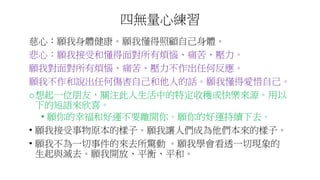
四無量心練習
慈心:願我身體健康。願我懂得照顧自己身體。
悲心:願我接受和懂得面對所有煩惱、痛苦、壓力。
願我對面對所有煩惱、痛苦、壓力不作出任何反應。
願我不作和說出任何傷害自己和他人的話。願我懂得愛惜自己。
o想起一位朋友,關注此人生活中的特定收穫或快樂來源。用以
下的短語來欣喜。
• 願你的幸福和好運不要離開你。願你的好運持續下去。
• 願我接受事物原本的樣子。願我讓人們成為他們本來的樣子。
• 願我不為一切事件的來去所驚動 。願我學會看透一切現象的
生起與滅去。願我開放、平衡、平和。
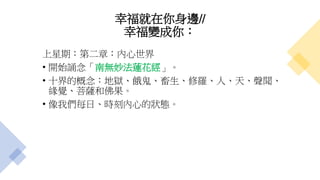
幸福就在你身邊//
幸福變成你:
上星期:第二章:內心世界
• 開始誦念「南無妙法蓮花經」。
• 十界的概念:地獄、餓鬼、畜生、修羅、人、天、聲聞、
緣覺、菩薩和佛果。
• 像我們每日、時刻內心的狀態。
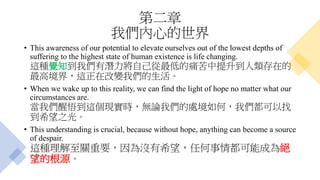
第二章
我們內心的世界
• This awareness of our potential to elevate ourselves out of the lowest depths of
suffering to the highest state of human existence is life changing.
這種覺知到我們有潛力將自己從最低的痛苦中提升到人類存在的
最高境界,這正在改變我們的生活。
• When we wake up to this reality, we can find the light of hope no matter what our
circumstances are.
當我們醒悟到這個現實時,無論我們的處境如何,我們都可以找
到希望之光。
• This understanding is crucial, because without hope, anything can become a source
of despair.
這種理解至關重要,因為沒有希望,任何事情都可能成為絕
望的根源。
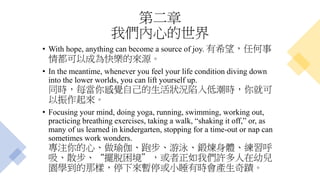
第二章
我們內心的世界
• With hope, anything can become a source of joy. 有希望,任何事
情都可以成為快樂的來源。
• In the meantime, whenever you feel your life condition diving down
into the lower worlds, you can lift yourself up.
同時,每當你感覺自己的生活狀況陷入低潮時,你就可
以振作起來。
• Focusing your mind, doing yoga, running, swimming, working out,
practicing breathing exercises, taking a walk, “shaking it off,” or, as
many of us learned in kindergarten, stopping for a time-out or nap can
sometimes work wonders.
專注你的心、做瑜伽、跑步、游泳、鍛煉身體、練習呼
吸、散步、“擺脫困境”,或者正如我們許多人在幼兒
園學到的那樣,停下來暫停或小睡有時會產生奇蹟。
• If these methods aren’t effective at raising your state of mind, you can
explore other ways, such as prayer, chanting, meditation, or study.
如果這些方法無法有效提升你的心態,你可以探索其他
方法,例如祈禱、念誦、禪修或學習。
• Choose whatever path works best for you.
選擇最適合您的道//練習。
• 1973, I began to chant. Buddhism taught me how to access a direct
path upward in my life condition,
1973年, 我開始念誦。 佛教教我如何在人生境遇中走上
一條直接向上的路,
• a spiritual express lane by chanting Nam-myoho-renge-kyo.
可以說是一條心靈快車道,念「南無妙法蓮花經」。
呼吸
第三章
天使的讚歌
• The transformation in my life from where I was upon first hearing
these words to where I am today is extraordinary.
從我第一次聽到這些話到現在我的生活發生了非凡的轉
變。
• If I hadn’t made the journey myself, it might seem like a fairy tale.
如果我沒有親自踏上這段旅程,這可能看起來就像一個
童話故事。
• Yet that’s exactly what I did—I made my dreams, my own vision of a
fairy tale, come true.
這正是我所做的事——我作我的夢想、我自己對童話故
事的想像成真。
• Whatever your dreams may be, I know you can make them come true,
too.
無論您的夢想是什麼,我知道您也可以實現它們。
• My wish for you is to succeed and achieve your own definition of
happiness, however you paint that picture.
我對你的願望是成功並實現你自己對幸福的定義,無論
你如何描繪這幅畫。
• I hope that my story of self-actualization will inform and inspire your
dreams, now and in the future.
我希望我的自我實現故事能夠啟發並激發您現在和未來
的夢想。
• What shifted for me, what enabled me to attain all the conspicuous
benefits I enjoy, was infinitely more important—
是什麼對我來說發生了變化,是什麼使我能夠獲得我所
享受的所有顯著的好處,這要重要得多——
• the deep, inner changes that resulted from my spiritual practice of
chanting, studying, and helping others.
我的念誦、學習和幫助他人的靈性修行所帶來的深刻的
內在變化。
• When I first received the gift of Nam-myoho-renge-kyo,
當我第一次收到「南無妙法蓮華經」的禮物時,
• it marked the beginning of a new life for me in more ways than I could
have imagined.
它以比我想像的更多的方式標誌著我新生活的開始。
• Thanks to the spiritual awakenings I experienced by chanting,
感謝我透過念誦所經歷的心靈覺醒,
• I gained the clarity and strength to make countless important changes
in my life.
我獲得了清晰度和力量,可以在我的生活中做出無數重
要的改變。
呼吸
• I began by chanting a little each day, sometimes just saying “Nam-
myoho-renge-kyo” a few times in a row.
我開始每天念誦一點,有時只是連續念幾次「南無妙法
蓮華經」。
• Then I started chanting five minutes a day, then fifteen, and noticed
small, yet definite, improvements and shifts in my life condition.
然後我開始每天念誦五分鐘,然後十五分鐘,並注意到
我的生活狀況出現了微小但明確的改善和變化。
• Bit by bit, my Buddhist practice was helping me to rearrange my place
in the universe.
一點一點地,我的佛教修行正在幫助我重新安排我在宇
宙中的位置。
• Soon, I increased my chanting to a half hour, sometimes an hour.
很快,我就把念誦時間增加到半小時,有時甚至一個小
時。
• Although I wanted to chant with my sangha, I was still married to Ike,
雖然我想和僧伽一起念誦,但我還是和 Ike 結婚了,
• and he was afraid of my chanting because he thought I might be able to
put a curse on him.
他害怕我的念誦,因為他認為我可能會對他施咒的。
• His hold on me was threatened because chanting strengthened me.
他對我的控制受到了威脅,因為念誦增強了我的力量。
• He almost never let me go out to meet people without him,
他幾乎不讓我出去見沒有他的朋友,
• so I found time whenever I could to chant secretly in the morning and
night.
所以我每天早上和晚上只要有時間就偷偷念誦。
• Sometimes, a few of my brave chanting friends would sneak into the
house to practice with me when my husband wasn’t around.
有時,當我丈夫不在的時候,我的幾個勇敢的唱誦朋友
會偷偷溜進屋內和我一起練習。
• Gradually, I felt I was getting in sync, in rhythm with life on the
deepest level.
漸漸地,我感覺自己在最深層與生活同步、合拍。
• The more I chanted, the more I felt my true self, my inherent Buddha
nature, awakening.
我念誦得越多,我就越感覺到我的真實自我,我固有的
佛性,覺醒了。
• My life condition kept rising, and I developed a newfound feeling of
detachment around my husband.
我的生活狀況不斷提高,我對丈夫產生了一種新的疏離
感。
• I became so strong inside that eventually our conflicts began to feel
like a game, like some sort of karmic test.
我的內心變得如此強大,最終我們的衝突開始感覺像一
場遊戲,就像某種業力測試。
• In the midst of chaos, I felt as if I had been reborn.
在混亂之中,我感覺自己彷彿獲得了重生。
呼吸
• The brighter my inner light shined, the more my environment
improved,
我內心的光芒越亮,我的環境就越好,
• and dreams I hadn’t even expressed outside of my chanting began to
come true.
我甚至在念誦之外沒有表達過的夢想開始成真。
• Slowly but surely, I increased my Buddhist practice over the next
couple of years.
在接下來的幾年裡,我慢慢地但肯定地增加了我的佛教
修行。
• I became so strong that in the summer of 1976, I finally found the
courage to run away from Ike,
我變得如此堅強,在1976年的夏天,我終於找到了逃離
Ike 的勇氣,
• to escape from the unhealthy domestic situation I had been trapped in
for so long,
為了擺脫長期困在不健康的家庭環境中,
• and I filed for divorce. 我提出離婚。
• Once I gained my independence, I also gained the freedom to go to
chanting meetings whenever I pleased.
一旦我獲得了獨立,我也獲得了隨時參加念經聚會的自
由。
• I joined the meetings nearest me, in the Brentwood area of West Los
Angeles.
我參加了距離我最近的會議 (念誦),在洛杉磯西部的地
區。
• Oh, how I enjoyed studying and practicing Buddhism with other
openminded people.
哦,我多麼喜歡和其他思想開放的人一起學習和修行佛
法。
• After years of oppression at home, having the freedom to express my
thoughts and beliefs was sheer joy.
在經歷了多年的家庭壓迫之後,能夠自由地表達我的想
法和信仰真是令人高興。
• Looking back on it now, it seems like such a simple thing.
現在回想起來,這 (表達我的想法和信仰) 似乎是一件很
簡單的事。
• But those of us who have survived abusive and codependent
relationships know the value of basic pleasures and rights that others
may take for granted.
但我們這些從虐待和相互依賴的關係中倖存下來的人知
道其他人可能認為理所當然的基本快樂和權利的價值。
• In West LA, I also discovered that a number of musicians, including
my friends Ana Maria and Wayne Shorter (the jazz genius), hosted
chanting meetings.
在西洛杉磯,我還發現了一些音樂家,兩位朋友主持誦
經會。
呼吸
• I had found my sacred space, my beloved community of spirit.
我找到了我的神聖空間,我心愛的精神共同體。
• As I began my daily chanting practice,
當我開始每天的念誦練習時,
• I discovered that someone I’d always admired, Mahatma Gandhi,
我發現有人總是欽佩,聖雄甘地 Mahatma Gandhi ,
• opened the daily prayer meetings at his ashram by chanting “Nam-
myoho-renge-kyo” with his disciples.
他與弟子們一起念誦「南無妙法蓮花經」,開始了他在
道場的每日祈禱會。
• The Soka Gakkai tradition was found by Nichiren in thirteenth-century
Japan.
創價學會的傳統是由日蓮 (1222-1282) 在十三世紀的日本
創立的。
• At the age of 12, he devoted his life to study and began researching the
vast wealth of Buddhist scriptures.
12歲時,他全心投入學習,開始研究浩瀚的佛經。
• For two decades, Nichiren sought to clarify the essence of Buddhism
and to simplify its practice,
二十年來,日蓮致力於闡明佛教的本質並簡化其修行,
• leading the way to Buddhahood for anyone, 為任何人引導成佛之
路,
• regardless of life condition or circumstances.
無論生活狀況或環境如何。
• Nichiren taught that chanting Nam-myoho-renge-kyo is the essence of
the Lotus Sutra.
日蓮教導說,念「南無妙法蓮華經」是《法華經》的精
髓。
• He dedicated his life to teaching people that this simple practice of
chanting “Nam-myoho-renge-kyo” contains the entirety of Buddhist
teachings and can open the door to enlightenment for all.
他畢生致力於教導人們,念「南無妙法蓮華經」這個簡
單的修行包含了全部的佛教教義,可以為所有人打開啟
蒙之門。
• Today, chanting “Nam-myoho-renge-kyo” is one of the best-known
and most widely embraced Buddhist practices around the globe.
如今,念「南無妙法蓮華經」已成為全球最著名、最廣
泛接受的佛教修行之一。
• Why do people chant? To become the embodiment of happiness.
人們為什麼要念誦? 成為幸福的化身。
• In my travels, there is one thing I know that all people have in
common: the desire for lasting happiness.
在我的旅行中,我知道所有人都有一件事:對持久幸福
的渴望。
• The trick is how to make happiness last. 秘訣在於如何讓幸福持
續下去。
• Happiness is a feeling. 幸福是一種感受。
• And, like all feelings, it can disappear as quickly as it appears.
而且,就像所有的感覺一樣,它來得快去得也快。
• True and lasting happiness is elusive.
真正而持久的幸福是難以捉摸的。
願以此功德
普及於一切
我等與眾生
皆共成佛道

1/30/2024「同心共善」善心法師網上禪修班 (粵語) ……………………..

  • 1.
  • 2.
  • 3.
  • 4.
    第二章 我們內心的世界 • This awarenessof our potential to elevate ourselves out of the lowest depths of suffering to the highest state of human existence is life changing. 這種覺知到我們有潛力將自己從最低的痛苦中提升到人類存在的 最高境界,這正在改變我們的生活。 • When we wake up to this reality, we can find the light of hope no matter what our circumstances are. 當我們醒悟到這個現實時,無論我們的處境如何,我們都可以找 到希望之光。 • This understanding is crucial, because without hope, anything can become a source of despair. 這種理解至關重要,因為沒有希望,任何事情都可能成為絕 望的根源。
  • 5.
    第二章 我們內心的世界 • With hope,anything can become a source of joy. 有希望,任何事 情都可以成為快樂的來源。 • In the meantime, whenever you feel your life condition diving down into the lower worlds, you can lift yourself up. 同時,每當你感覺自己的生活狀況陷入低潮時,你就可 以振作起來。 • Focusing your mind, doing yoga, running, swimming, working out, practicing breathing exercises, taking a walk, “shaking it off,” or, as many of us learned in kindergarten, stopping for a time-out or nap can sometimes work wonders. 專注你的心、做瑜伽、跑步、游泳、鍛煉身體、練習呼 吸、散步、“擺脫困境”,或者正如我們許多人在幼兒 園學到的那樣,停下來暫停或小睡有時會產生奇蹟。
  • 6.
    • If thesemethods aren’t effective at raising your state of mind, you can explore other ways, such as prayer, chanting, meditation, or study. 如果這些方法無法有效提升你的心態,你可以探索其他 方法,例如祈禱、念誦、禪修或學習。 • Choose whatever path works best for you. 選擇最適合您的道//練習。 • 1973, I began to chant. Buddhism taught me how to access a direct path upward in my life condition, 1973年, 我開始念誦。 佛教教我如何在人生境遇中走上 一條直接向上的路, • a spiritual express lane by chanting Nam-myoho-renge-kyo. 可以說是一條心靈快車道,念「南無妙法蓮花經」。
  • 7.
  • 8.
    第三章 天使的讚歌 • The transformationin my life from where I was upon first hearing these words to where I am today is extraordinary. 從我第一次聽到這些話到現在我的生活發生了非凡的轉 變。 • If I hadn’t made the journey myself, it might seem like a fairy tale. 如果我沒有親自踏上這段旅程,這可能看起來就像一個 童話故事。 • Yet that’s exactly what I did—I made my dreams, my own vision of a fairy tale, come true. 這正是我所做的事——我作我的夢想、我自己對童話故 事的想像成真。
  • 9.
    • Whatever yourdreams may be, I know you can make them come true, too. 無論您的夢想是什麼,我知道您也可以實現它們。 • My wish for you is to succeed and achieve your own definition of happiness, however you paint that picture. 我對你的願望是成功並實現你自己對幸福的定義,無論 你如何描繪這幅畫。 • I hope that my story of self-actualization will inform and inspire your dreams, now and in the future. 我希望我的自我實現故事能夠啟發並激發您現在和未來 的夢想。
  • 10.
    • What shiftedfor me, what enabled me to attain all the conspicuous benefits I enjoy, was infinitely more important— 是什麼對我來說發生了變化,是什麼使我能夠獲得我所 享受的所有顯著的好處,這要重要得多—— • the deep, inner changes that resulted from my spiritual practice of chanting, studying, and helping others. 我的念誦、學習和幫助他人的靈性修行所帶來的深刻的 內在變化。
  • 11.
    • When Ifirst received the gift of Nam-myoho-renge-kyo, 當我第一次收到「南無妙法蓮華經」的禮物時, • it marked the beginning of a new life for me in more ways than I could have imagined. 它以比我想像的更多的方式標誌著我新生活的開始。 • Thanks to the spiritual awakenings I experienced by chanting, 感謝我透過念誦所經歷的心靈覺醒, • I gained the clarity and strength to make countless important changes in my life. 我獲得了清晰度和力量,可以在我的生活中做出無數重 要的改變。
  • 12.
  • 13.
    • I beganby chanting a little each day, sometimes just saying “Nam- myoho-renge-kyo” a few times in a row. 我開始每天念誦一點,有時只是連續念幾次「南無妙法 蓮華經」。 • Then I started chanting five minutes a day, then fifteen, and noticed small, yet definite, improvements and shifts in my life condition. 然後我開始每天念誦五分鐘,然後十五分鐘,並注意到 我的生活狀況出現了微小但明確的改善和變化。 • Bit by bit, my Buddhist practice was helping me to rearrange my place in the universe. 一點一點地,我的佛教修行正在幫助我重新安排我在宇 宙中的位置。
  • 14.
    • Soon, Iincreased my chanting to a half hour, sometimes an hour. 很快,我就把念誦時間增加到半小時,有時甚至一個小 時。 • Although I wanted to chant with my sangha, I was still married to Ike, 雖然我想和僧伽一起念誦,但我還是和 Ike 結婚了, • and he was afraid of my chanting because he thought I might be able to put a curse on him. 他害怕我的念誦,因為他認為我可能會對他施咒的。 • His hold on me was threatened because chanting strengthened me. 他對我的控制受到了威脅,因為念誦增強了我的力量。
  • 15.
    • He almostnever let me go out to meet people without him, 他幾乎不讓我出去見沒有他的朋友, • so I found time whenever I could to chant secretly in the morning and night. 所以我每天早上和晚上只要有時間就偷偷念誦。 • Sometimes, a few of my brave chanting friends would sneak into the house to practice with me when my husband wasn’t around. 有時,當我丈夫不在的時候,我的幾個勇敢的唱誦朋友 會偷偷溜進屋內和我一起練習。
  • 16.
    • Gradually, Ifelt I was getting in sync, in rhythm with life on the deepest level. 漸漸地,我感覺自己在最深層與生活同步、合拍。 • The more I chanted, the more I felt my true self, my inherent Buddha nature, awakening. 我念誦得越多,我就越感覺到我的真實自我,我固有的 佛性,覺醒了。 • My life condition kept rising, and I developed a newfound feeling of detachment around my husband. 我的生活狀況不斷提高,我對丈夫產生了一種新的疏離 感。
  • 17.
    • I becameso strong inside that eventually our conflicts began to feel like a game, like some sort of karmic test. 我的內心變得如此強大,最終我們的衝突開始感覺像一 場遊戲,就像某種業力測試。 • In the midst of chaos, I felt as if I had been reborn. 在混亂之中,我感覺自己彷彿獲得了重生。
  • 18.
  • 19.
    • The brightermy inner light shined, the more my environment improved, 我內心的光芒越亮,我的環境就越好, • and dreams I hadn’t even expressed outside of my chanting began to come true. 我甚至在念誦之外沒有表達過的夢想開始成真。 • Slowly but surely, I increased my Buddhist practice over the next couple of years. 在接下來的幾年裡,我慢慢地但肯定地增加了我的佛教 修行。
  • 20.
    • I becameso strong that in the summer of 1976, I finally found the courage to run away from Ike, 我變得如此堅強,在1976年的夏天,我終於找到了逃離 Ike 的勇氣, • to escape from the unhealthy domestic situation I had been trapped in for so long, 為了擺脫長期困在不健康的家庭環境中, • and I filed for divorce. 我提出離婚。 • Once I gained my independence, I also gained the freedom to go to chanting meetings whenever I pleased. 一旦我獲得了獨立,我也獲得了隨時參加念經聚會的自 由。
  • 21.
    • I joinedthe meetings nearest me, in the Brentwood area of West Los Angeles. 我參加了距離我最近的會議 (念誦),在洛杉磯西部的地 區。 • Oh, how I enjoyed studying and practicing Buddhism with other openminded people. 哦,我多麼喜歡和其他思想開放的人一起學習和修行佛 法。 • After years of oppression at home, having the freedom to express my thoughts and beliefs was sheer joy. 在經歷了多年的家庭壓迫之後,能夠自由地表達我的想 法和信仰真是令人高興。
  • 22.
    • Looking backon it now, it seems like such a simple thing. 現在回想起來,這 (表達我的想法和信仰) 似乎是一件很 簡單的事。 • But those of us who have survived abusive and codependent relationships know the value of basic pleasures and rights that others may take for granted. 但我們這些從虐待和相互依賴的關係中倖存下來的人知 道其他人可能認為理所當然的基本快樂和權利的價值。 • In West LA, I also discovered that a number of musicians, including my friends Ana Maria and Wayne Shorter (the jazz genius), hosted chanting meetings. 在西洛杉磯,我還發現了一些音樂家,兩位朋友主持誦 經會。
  • 23.
  • 24.
    • I hadfound my sacred space, my beloved community of spirit. 我找到了我的神聖空間,我心愛的精神共同體。 • As I began my daily chanting practice, 當我開始每天的念誦練習時, • I discovered that someone I’d always admired, Mahatma Gandhi, 我發現有人總是欽佩,聖雄甘地 Mahatma Gandhi , • opened the daily prayer meetings at his ashram by chanting “Nam- myoho-renge-kyo” with his disciples. 他與弟子們一起念誦「南無妙法蓮花經」,開始了他在 道場的每日祈禱會。
  • 25.
    • The SokaGakkai tradition was found by Nichiren in thirteenth-century Japan. 創價學會的傳統是由日蓮 (1222-1282) 在十三世紀的日本 創立的。 • At the age of 12, he devoted his life to study and began researching the vast wealth of Buddhist scriptures. 12歲時,他全心投入學習,開始研究浩瀚的佛經。 • For two decades, Nichiren sought to clarify the essence of Buddhism and to simplify its practice, 二十年來,日蓮致力於闡明佛教的本質並簡化其修行, • leading the way to Buddhahood for anyone, 為任何人引導成佛之 路, • regardless of life condition or circumstances. 無論生活狀況或環境如何。
  • 26.
    • Nichiren taughtthat chanting Nam-myoho-renge-kyo is the essence of the Lotus Sutra. 日蓮教導說,念「南無妙法蓮華經」是《法華經》的精 髓。 • He dedicated his life to teaching people that this simple practice of chanting “Nam-myoho-renge-kyo” contains the entirety of Buddhist teachings and can open the door to enlightenment for all. 他畢生致力於教導人們,念「南無妙法蓮華經」這個簡 單的修行包含了全部的佛教教義,可以為所有人打開啟 蒙之門。 • Today, chanting “Nam-myoho-renge-kyo” is one of the best-known and most widely embraced Buddhist practices around the globe. 如今,念「南無妙法蓮華經」已成為全球最著名、最廣 泛接受的佛教修行之一。
  • 27.
    • Why dopeople chant? To become the embodiment of happiness. 人們為什麼要念誦? 成為幸福的化身。 • In my travels, there is one thing I know that all people have in common: the desire for lasting happiness. 在我的旅行中,我知道所有人都有一件事:對持久幸福 的渴望。 • The trick is how to make happiness last. 秘訣在於如何讓幸福持 續下去。 • Happiness is a feeling. 幸福是一種感受。 • And, like all feelings, it can disappear as quickly as it appears. 而且,就像所有的感覺一樣,它來得快去得也快。 • True and lasting happiness is elusive. 真正而持久的幸福是難以捉摸的。
  • 28.