PAGE
39
Journal of PhrapokklaoNursing College Vol.28 No.1 January - June 2017
ความเป็นมาและความส�ำคัญของปัญหา
การนอนหลับเป็นความจ�ำเป็นขั้นพื้นฐานของ
มนุษย์ทุกคน มนุษย์ใช้เวลาถึงหนึ่งในสามของชีวิตใน
การนอนหลับ (Montagna & Chokroverty, 2011)
คุณภาพการนอนหลับมีความส�ำคัญและเป็นตัวบ่งชี้ถึง
ภาวะสุขภาพ ความผาสุก และวิถีการด�ำเนินชีวิตที่มี
สุขภาพดีของบุคคล หากบุคคลใดมีปัญหาด้านการนอน
จะท�ำให้มีสุขภาพที่ไม่แข็งแรง กล่าวคือ บุคคลนั้นอาจมี
อาการเพลีย เหนื่อยง่าย อ่อนล้า และง่วงนอนในตอน
กลางวันเพิ่มขึ้น (ชลธิชา แย้มมา และพีรพนธ์ ลือบุญ
ธวัชชัย, 2556; Montagna & Chokroverty, 2011)
โดยเฉพาะวัยรุ่นที่มีอายุระหว่าง 18-25 ปี เพราะเป็นวัย
ที่มีการเจริญเติบโตและพัฒนาจากวัยรุ่นไปสู่วัยผู้ใหญ่
ตอนต้น การนอนหลับที่มีคุณภาพสูงสุดคือ การนอนหลับที่
ต่อมใต้สมองมีการหลั่งgrowthhormonesเพื่อซ่อมแซม
ส่วนที่สึกหรอของร่างกาย (สุจินดา ริมศรีทอง, สุดาพรรณ
ธัญจิรา, และอรุณศรี เตชัสหงส์, 2550) ซึ่งผลกระทบจาก
การนอนหลับไม่เพียงพอนี้ จะส่งผลให้รู้สึกไม่สดชื่น
เหนื่อยล้า ไม่กระตือรือร้นกับการเรียนในตอนเช้า และมี
พฤติกรรมหลับในเวลาเรียนได้
คณะผู้วิจัยได้ท�ำการสุ่มสัมภาษณ์นักศึกษาทุกชั้นปี
ของวิทยาลัยพยาบาลแห่งหนึ่ง รวมจ�ำนวน 40 คน พบว่า
นักศึกษาส่วนใหญ่ (ร้อยละ 82.50) มีพฤติกรรมหลับใน
เวลาเรียน และเมื่อถามถึงผลกระทบ นักศึกษาเหล่านี้
Abstract
The purposes of this predictive research were to examine factors affecting sleep quality
among nursing students. The samples consisted of 150 1st - 3rd year nursing students in one
CollegeofNursing,inanacademicyearof2014.Theresearchinstrumentsconsistedofaquestionnaire
of personal factors, an assessment form of environmental factors with the reliability of .70,
an assessment form of sleep habits with the reliability of .70, Suanprung Stress Test with
the reliability of .91, and the Thai version of the Pittsburgh Sleep Quality Index with the reliability
of .70. Data were collected from September to November, 2014. Statistics used for data analysis
included frequency, percentage, mean, standard deviation, Chi-square test, Pearson’s product
moment correlation, and stepwise multiple regression.
The results revealed that 1) most of the nursing students had average scores of environmental
factors, sleep habits, and stress at the moderate level (58%, 52%, and 47.30%, respectively);
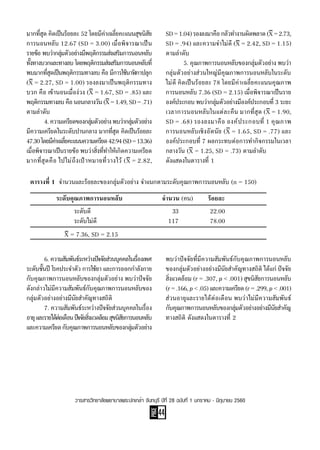
2) most of the nursing students had a poor sleep quality (78%); 3) the factors statistically significant
related to sleep quality were as follows—environmental factors (r = .307, p < .001), sleep habits
(r = .166, p < .05), and stress (r = .299, p < .001), and 4) environmental factors, sleep habits,
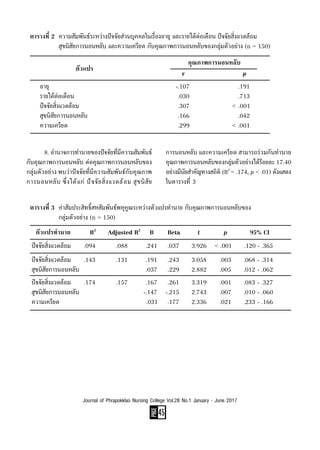
and stress could co-predict sleep quality by 17.40% (R2
= .174, p < .01).
Thisstudysuggestedthatinordertopromotesleepqualityofnursingstudents,themodification
of dormitory environment, the enhancement of good sleep habits, and stress management
should be taken into consideration.
Keywords : Sleep quality, Environment, Sleep habit, Stress
PAGE
49
Journal of PhrapokklaoNursing College Vol.28 No.1 January - June 2017
วิชิต อู่อ้น. (2550). การวิจัยและการสืบค้นข้อมูลทางธุรกิจ.
กรุงเทพฯ: พรินท์แอทมี.
สุจินดา ริมศรีทอง,สุดาพรรณ ธัญจิรา,และอรุณศรีเตชัสหงส์.
(บ.ก.). (2550). พยาธิสรีรวิทยาทางการพยาบาล
เล่ม1(พิมพ์ครั้งที่2). กรุงเทพฯ:สามเจริญพาณิชย์.
สุดารัตน์ ชัยอาจ, จิราภรณ์ เตชะอุดมเดช, พิกุล บุญช่วง,
และวิจิตร ศรีสุพรรณ. (2550). คุณภาพการนอนหลับ
และปัจจัยที่รบกวนการนอนหลับของผู้ป่วยใน
หอผู้ป่วยอายุรกรรม โรงพยาบาลมหาราชนคร
เชียงใหม่. วารสารสภาการพยาบาล,22(4),50-63.
สุวัฒน์ มหัตนิรันดร์กุล, วนิดา พุ่มไพศาลชัย, และ
พิมพ์มาศ ตาปัญญา. (2540). การสร้างแบบวัด
ความเครียดของสวนปรุง (รายงานผลการวิจัย).
เชียงใหม่: โรงพยาบาลสวนปรุง.
อนุชา ค�ำส้อม,มธุรส ทิพยมงคลกุล,สิริมา มงคลสัมฤทธิ์,
และวิสาข์สิริ ตันตระกูล. (2558). ความชุกและ
ปัจจัยที่มีความสัมพันธ์กับปัญหาการนอนหลับ
ของบุคลากรในโรงพยาบาล. สืบค้น วันที่ 6
มิถุนายน2560, จากhttp://phep.ph.mahidol.
ac.th/thai/presentation_2558.html
Bahammam, A. S., Alaseem, A. M., Alzakri, A. A.,
Almeneessier, A. S., & Sharif, M. M.
(2012). The relationship between sleep
andwakehabitsandacademicperformance
inmedicalstudents:Across-sectionalstudy.
BMC Medical Education, 12(1), 61.
Bailer, J., Schwarz, D., Witthöft, M., Stübinger, C.,
& Rist, F. (2008). Prevalence of mental
disordersamongcollegestudentsataGerman
university. Psychotherapie, Psychosomatik,
Medizinische Psychologie, 58(11), 423-429.
Cain, N., & Gradisar, M. (2010). Electronic media
use and sleep in school-aged children
and adolescents: A review. Sleep Medicine,
11(8), 735-742.
Fawzy, M., & Hamed, S. A. (2017). Prevalence
of psychological stress, depression and
anxiety among medical students in Egypt.
Psychiatry Research, 225, 186-194.
Gradisar, M., Wolfson, A. R., Harvey, A. G.,
Hale, L., Rosenberg, R., & Czeisler, C. A.
(2013). The sleep and technology use
of Americans: Findings from the National
Sleep Foundation’s 2011 Sleep in America
Poll. Journal of Clinical Sleep Medicine,
9(12), 1291-1299.
Hayley, A. C., Williams, L. J., Venugopal, K.,
Kennedy, G. A., Berk, M., & Pasco, J. A.
(2015). Therelationshipsbetweeninsomnia,
sleep apnoea and depression: Findings
from the American National Health and
Nutrition Examination Survey, 2005-2008.
Australian & New Zealand Journal of
Psychiatry, 49(2), 156-170.
Hershner, S. D., & Chervin, R. D. (2014). Causes
and consequences of sleepiness among
college students. Nature and Science of
Sleep, 6, 73-84.
Huang, Y. S., Wang, C. H., & Guilleminault, C.
(2010). An epidemiologic study of sleep
problems among adolescents in North
Taiwan. SleepMedicine,11(10),1035-1042.
Lim, D. K., Baek, K. O., Chung, I. S., & Lee, M. Y.
(2014). Factors related to sleep disorders
among male firefighters. Annals of
Occupational and Environmental Medicine,
26, 11.
Lockley, S. W., et al. (2007). Effects of health
care provider work hours and sleep
deprivation on safety and performance.
Joint Commission Journal on Quality and
Patient Safety, 33(Suppl. 11), 7-18.
13.
PAGE
50
วารสารวิทยาลัยพยาบาลพระปกเกล้า จันทบุรี ปีที่28 ฉบับที่ 1 มกราคม - มิถุนายน 2560
Lund, H. G., Reider, B. D., Whiting, A. B., &
Prichard, J. R. (2010). Sleep patterns and
predictors of disturbed sleep in a large
population of college students. Journal
of Adolescent Health, 46(2), 124-132.
Luo, J., et al. (2013). Prevalence and risk factors
of poor sleep quality among Chinese elderly
in an urban community: Results from
theShanghaiAgingStudy. PLoSOne,8(11),
e81261.
Montagna, P., & Chokroverty, S. (Eds.). (2011).
Handbook of clinical neurology: Sleep
disorder, Part 1. Edinburgh: Elsevier.
Morin,C.M. (2009). Foreword. InSilberman,S.A.
The insomnia workbook: A comprehensive
guide to getting the sleep you need.
Oakland, CA: New Harbinger Publications.
Schlarb, A. A., Claßen, M., Hellmann, S. M.,
Vögele, C., & Gulewitsch, M. D. (2017).
Sleep and somatic complaints in university
students. Journal of Pain Research, 10,
1189-1199.
Taylor, D. J., & Bramoweth, A. D. (2010). Pattern
and consequences of inadequate sleep
in college students: Substance use and
motorvehicleaccidents. JournalofAdolescent
Health, 46(6), 610-612.