

1
Level 1 Diploma in Carpentry and Joinery
PowerPointpresentation
Safety, Storage and Maintenance
Unit 114: Prepare and use
carpentry and joinery
Portable Power Tools
2
Level 1 Diploma in Carpentry and Joinery
Objectives
To be able to:
1.1 State types of power sources used for portable power tools
1.2 State the importance of valid PAT certificates
1.4 State the safety equipment required when using different types of
portable power tools
1.5 State the importance of maintaining tools in relation to manufacturers’
instructions
1.7 State the importance of storing portable power tools safely and securely
1.6 State current legislation associated with operation of portable power
tools
1.8 Identify potential hazards associated with power tools and their causes
3
Level 1 Diploma in Carpentry and Joinery
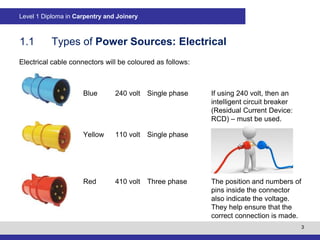
Electrical cable connectors will be coloured as follows:
Blue 240 volt Single phase If using 240 volt, then an
intelligent circuit breaker
(Residual Current Device:
RCD) – must be used.
Yellow 110 volt Single phase
Red 410 volt Three phase The position and numbers of
pins inside the connector
also indicate the voltage.
They help ensure that the
correct connection is made.
1.1 Types of Power Sources: Electrical
4
Level 1 Diploma in Carpentry and Joinery
• 110v is the maximum recommended
voltage on site because it is less
likely to kill than 240v.
• This transformer reduces voltage
from 240V to 110v, making use of
the tool safer.
Electrical Safety Measures
• All power tools manufactured in the EU
are now made with double insulation and
will be stamped with a double insulation
sign:
• Older tools and some unbranded Far
East imports may not have this safety
feature and are not allowed in site work.
5
Level 1 Diploma in Carpentry and Joinery
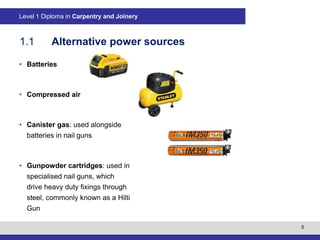
• Batteries
• Compressed air
• Canister gas: used alongside
batteries in nail guns
• Gunpowder cartridges: used in
specialised nail guns, which
drive heavy duty fixings through
steel, commonly known as a Hilti
Gun
1.1 Alternative power sources
6
Level 1 Diploma in Carpentry and Joinery
1.2 The importance of valid PAT certificates
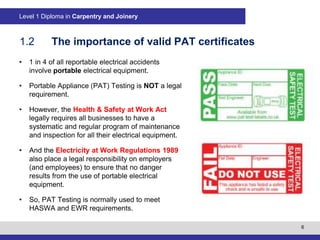
• 1 in 4 of all reportable electrical accidents
involve portable electrical equipment.
• Portable Appliance (PAT) Testing is NOT a legal
requirement.
• However, the Health & Safety at Work Act
legally requires all businesses to have a
systematic and regular program of maintenance
and inspection for all their electrical equipment.
• And the Electricity at Work Regulations 1989
also place a legal responsibility on employers
(and employees) to ensure that no danger
results from the use of portable electrical
equipment.
• So, PAT Testing is normally used to meet
HASWA and EWR requirements.
7
Level 1 Diploma in Carpentry and Joinery
1.2 The importance of valid PAT certificates?
• The person trained to perform a PAT test will
check the appliance for short circuits (which
would otherwise give the user an electrical
shock) and may also test for electrical
continuity (which could cause the appliance to
fail to work correctly).
• A sticker is placed on the tool after testing.
• A failed appliance must be taken out of use.
• An in-date PAT certificate DOES NOT
guarantee that the appliance is safe to
use. Like a vehicle’s MOT, it only identifies
that the appliance was (minimally)
electrically safe on the date of testing.
• What abuse could the appliance have
received since then? All the other
precautionary checks must still always be
carried out prior to use (see slide 13).
Can PATman guarantee your power tool is safe?
8
Level 1 Diploma in Carpentry and Joinery
1.4 Required Safety Equipment
• PPE Regulations state that PPE
should be used as a last resort:
meaning, use PPE when there are risks
to health and safety that cannot be
adequately controlled in other ways.
• Breathing wood dust from portable
power tools is a health risk, causing
respiratory (chest and lung) damage.
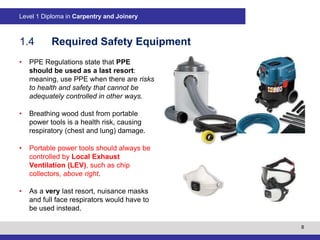
• Portable power tools should always be
controlled by Local Exhaust
Ventilation (LEV), such as chip
collectors, above right.
• As a very last resort, nuisance masks
and full face respirators would have to
be used instead.
9
Level 1 Diploma in Carpentry and Joinery
1.4 Required Safety Equipment 2
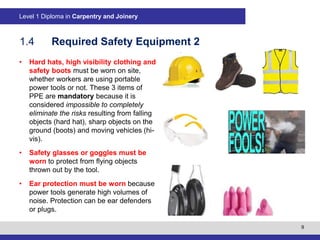
• Hard hats, high visibility clothing and
safety boots must be worn on site,
whether workers are using portable
power tools or not. These 3 items of
PPE are mandatory because it is
considered impossible to completely
eliminate the risks resulting from falling
objects (hard hat), sharp objects on the
ground (boots) and moving vehicles (hi-
vis).
• Safety glasses or goggles must be
worn to protect from flying objects
thrown out by the tool.
• Ear protection must be worn because
power tools generate high volumes of
noise. Protection can be ear defenders
or plugs.
10
Level 1 Diploma in Carpentry and Joinery
1.5 Power Tool Maintenance
Correct maintenance of power tools is important because:
1. It will ensure the safety of the operator (and
bystanders)
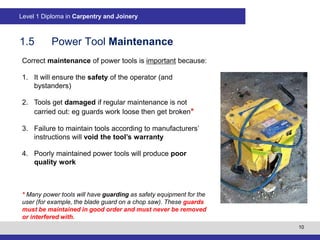
2. Tools get damaged if regular maintenance is not
carried out: eg guards work loose then get broken*
3. Failure to maintain tools according to manufacturers’
instructions will void the tool’s warranty
4. Poorly maintained power tools will produce poor
quality work
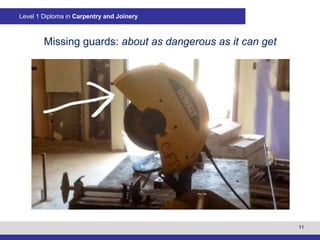
* Many power tools will have guarding as safety equipment for the
user (for example, the blade guard on a chop saw). These guards
must be maintained in good order and must never be removed
or interfered with.
11
Level 1 Diploma in Carpentry and Joinery
Missing guards: about as dangerous as it can get
12
Level 1 Diploma in Carpentry and Joinery
1.7 Power Tool Storage
Power tools must be stored in a secure, clean and dry location.
Before storage:
1. Check all components present
2. Clean the equipment
3. Check for damage (see next slide)
Correct storage of power tools is important:
1. To protect the tools from damage (especially water damage which may
cause the tool to become live in use and cause electric shock)
2. To protect the tools from theft (sadly, too common on site)
3. Failure to store according to manufacturers’ instructions will void the
tool’s warranty
13
Level 1 Diploma in Carpentry and Joinery
Many faults with work equipment can be found from a simple visual inspection.
So, before use, you must check that the equipment is in good condition and safe to use.
And before you perform any checks, you must switch off and unplug the equipment!!
1. Check the plug is not cracked or damaged and that the cable is properly secured
to both plug and tool
2. Run the whole length of the cable through your hands to check the cable
sheathing (insulation). Do not use a power tool if the cable has been repaired with
insulating tape or connector blocks.
3. Check the outer covers of the tool body are not cracked or damaged (this could
cause electric shock).
4. Check that any guarding is present, in good order and correctly fitted.
5. Check for burn marks or staining on cable, plug and tool body (suggests
overheating).
6. Check for a valid PAT certificate.
1.5 Power Tool Visual Checks
14
Level 1 Diploma in Carpentry and Joinery
1.5 Power Tool Visual Checks: what you’re looking for:
15
Level 1 Diploma in Carpentry and Joinery
1.5 Power Tool Visual Checks: why you’re looking:
16
Level 1 Diploma in Carpentry and Joinery
1.6 Legislation (law) associated with portable power tools
• Health & Safety at Work Act 1974
• Provision and Use of Work Equipment
Regulations 1998
• The Electricity at Work Regulations 1989
• The Personal Protective Equipment at Work
Regulations 1992
• Control of Substances Hazardous to Health
(COSHH) 2002
See Slide 6
PUWER applies to all work equipment, the primary
objective is to ensure equipment is provided that is safe
to use. PUWER covers cranes, scaffolding, wood-
working machines, dumper trucks, hand tools, portable
power tools, drill bits, shovels, wheelbarrows,
computers, etc.
See Slide 6
PUWER may require use of control measures such as
PPE. The PPE Regulations identify which items of PPE
must be worn.
COSHH: because we use gas in nail guns, and
compressed air in a range of workshop portable power
tools.
17
Level 1 Diploma in Carpentry and Joinery
1.8 Hazards associated with portable power tools
HAZARD (potential to cause harm) RISK (the harm that could result)
Noise Permanent hearing loss or damage
Dust Respiratory problems (breathing difficulties)
Flying objects/ejected materials Eye injury, head and bodily injury
Sharp tooling Cuts and lacerations
Hot tooling Burns
Electricity Electric shock, fire, explosion
Slip and trip hazards (from cable, dust,
shavings)
Tripping and slipping, causing bodily injury
Missing, broken, badly fitted tooling and
guarding
Eye injury, head and bodily injury
Improper maintenance, use, storage
Leads to physical injury and damage to
materials, tools and tooling (especially from
BLUNT tooling)

114_1_power tools

  • 1.
    1 Level 1 Diplomain Carpentry and Joinery PowerPointpresentation Safety, Storage and Maintenance Unit 114: Prepare and use carpentry and joinery Portable Power Tools
  • 2.
    2 Level 1 Diplomain Carpentry and Joinery Objectives To be able to: 1.1 State types of power sources used for portable power tools 1.2 State the importance of valid PAT certificates 1.4 State the safety equipment required when using different types of portable power tools 1.5 State the importance of maintaining tools in relation to manufacturers’ instructions 1.7 State the importance of storing portable power tools safely and securely 1.6 State current legislation associated with operation of portable power tools 1.8 Identify potential hazards associated with power tools and their causes
  • 3.
    3 Level 1 Diplomain Carpentry and Joinery Electrical cable connectors will be coloured as follows: Blue 240 volt Single phase If using 240 volt, then an intelligent circuit breaker (Residual Current Device: RCD) – must be used. Yellow 110 volt Single phase Red 410 volt Three phase The position and numbers of pins inside the connector also indicate the voltage. They help ensure that the correct connection is made. 1.1 Types of Power Sources: Electrical
  • 4.
    4 Level 1 Diplomain Carpentry and Joinery • 110v is the maximum recommended voltage on site because it is less likely to kill than 240v. • This transformer reduces voltage from 240V to 110v, making use of the tool safer. Electrical Safety Measures • All power tools manufactured in the EU are now made with double insulation and will be stamped with a double insulation sign: • Older tools and some unbranded Far East imports may not have this safety feature and are not allowed in site work.
  • 5.
    5 Level 1 Diplomain Carpentry and Joinery • Batteries • Compressed air • Canister gas: used alongside batteries in nail guns • Gunpowder cartridges: used in specialised nail guns, which drive heavy duty fixings through steel, commonly known as a Hilti Gun 1.1 Alternative power sources
  • 6.
    6 Level 1 Diplomain Carpentry and Joinery 1.2 The importance of valid PAT certificates • 1 in 4 of all reportable electrical accidents involve portable electrical equipment. • Portable Appliance (PAT) Testing is NOT a legal requirement. • However, the Health & Safety at Work Act legally requires all businesses to have a systematic and regular program of maintenance and inspection for all their electrical equipment. • And the Electricity at Work Regulations 1989 also place a legal responsibility on employers (and employees) to ensure that no danger results from the use of portable electrical equipment. • So, PAT Testing is normally used to meet HASWA and EWR requirements.
  • 7.
    7 Level 1 Diplomain Carpentry and Joinery 1.2 The importance of valid PAT certificates? • The person trained to perform a PAT test will check the appliance for short circuits (which would otherwise give the user an electrical shock) and may also test for electrical continuity (which could cause the appliance to fail to work correctly). • A sticker is placed on the tool after testing. • A failed appliance must be taken out of use. • An in-date PAT certificate DOES NOT guarantee that the appliance is safe to use. Like a vehicle’s MOT, it only identifies that the appliance was (minimally) electrically safe on the date of testing. • What abuse could the appliance have received since then? All the other precautionary checks must still always be carried out prior to use (see slide 13). Can PATman guarantee your power tool is safe?
  • 8.
    8 Level 1 Diplomain Carpentry and Joinery 1.4 Required Safety Equipment • PPE Regulations state that PPE should be used as a last resort: meaning, use PPE when there are risks to health and safety that cannot be adequately controlled in other ways. • Breathing wood dust from portable power tools is a health risk, causing respiratory (chest and lung) damage. • Portable power tools should always be controlled by Local Exhaust Ventilation (LEV), such as chip collectors, above right. • As a very last resort, nuisance masks and full face respirators would have to be used instead.
  • 9.
    9 Level 1 Diplomain Carpentry and Joinery 1.4 Required Safety Equipment 2 • Hard hats, high visibility clothing and safety boots must be worn on site, whether workers are using portable power tools or not. These 3 items of PPE are mandatory because it is considered impossible to completely eliminate the risks resulting from falling objects (hard hat), sharp objects on the ground (boots) and moving vehicles (hi- vis). • Safety glasses or goggles must be worn to protect from flying objects thrown out by the tool. • Ear protection must be worn because power tools generate high volumes of noise. Protection can be ear defenders or plugs.
  • 10.
    10 Level 1 Diplomain Carpentry and Joinery 1.5 Power Tool Maintenance Correct maintenance of power tools is important because: 1. It will ensure the safety of the operator (and bystanders) 2. Tools get damaged if regular maintenance is not carried out: eg guards work loose then get broken* 3. Failure to maintain tools according to manufacturers’ instructions will void the tool’s warranty 4. Poorly maintained power tools will produce poor quality work * Many power tools will have guarding as safety equipment for the user (for example, the blade guard on a chop saw). These guards must be maintained in good order and must never be removed or interfered with.
  • 11.
    11 Level 1 Diplomain Carpentry and Joinery Missing guards: about as dangerous as it can get
  • 12.
    12 Level 1 Diplomain Carpentry and Joinery 1.7 Power Tool Storage Power tools must be stored in a secure, clean and dry location. Before storage: 1. Check all components present 2. Clean the equipment 3. Check for damage (see next slide) Correct storage of power tools is important: 1. To protect the tools from damage (especially water damage which may cause the tool to become live in use and cause electric shock) 2. To protect the tools from theft (sadly, too common on site) 3. Failure to store according to manufacturers’ instructions will void the tool’s warranty
  • 13.
    13 Level 1 Diplomain Carpentry and Joinery Many faults with work equipment can be found from a simple visual inspection. So, before use, you must check that the equipment is in good condition and safe to use. And before you perform any checks, you must switch off and unplug the equipment!! 1. Check the plug is not cracked or damaged and that the cable is properly secured to both plug and tool 2. Run the whole length of the cable through your hands to check the cable sheathing (insulation). Do not use a power tool if the cable has been repaired with insulating tape or connector blocks. 3. Check the outer covers of the tool body are not cracked or damaged (this could cause electric shock). 4. Check that any guarding is present, in good order and correctly fitted. 5. Check for burn marks or staining on cable, plug and tool body (suggests overheating). 6. Check for a valid PAT certificate. 1.5 Power Tool Visual Checks
  • 14.
    14 Level 1 Diplomain Carpentry and Joinery 1.5 Power Tool Visual Checks: what you’re looking for:
  • 15.
    15 Level 1 Diplomain Carpentry and Joinery 1.5 Power Tool Visual Checks: why you’re looking:
  • 16.
    16 Level 1 Diplomain Carpentry and Joinery 1.6 Legislation (law) associated with portable power tools • Health & Safety at Work Act 1974 • Provision and Use of Work Equipment Regulations 1998 • The Electricity at Work Regulations 1989 • The Personal Protective Equipment at Work Regulations 1992 • Control of Substances Hazardous to Health (COSHH) 2002 See Slide 6 PUWER applies to all work equipment, the primary objective is to ensure equipment is provided that is safe to use. PUWER covers cranes, scaffolding, wood- working machines, dumper trucks, hand tools, portable power tools, drill bits, shovels, wheelbarrows, computers, etc. See Slide 6 PUWER may require use of control measures such as PPE. The PPE Regulations identify which items of PPE must be worn. COSHH: because we use gas in nail guns, and compressed air in a range of workshop portable power tools.
  • 17.
    17 Level 1 Diplomain Carpentry and Joinery 1.8 Hazards associated with portable power tools HAZARD (potential to cause harm) RISK (the harm that could result) Noise Permanent hearing loss or damage Dust Respiratory problems (breathing difficulties) Flying objects/ejected materials Eye injury, head and bodily injury Sharp tooling Cuts and lacerations Hot tooling Burns Electricity Electric shock, fire, explosion Slip and trip hazards (from cable, dust, shavings) Tripping and slipping, causing bodily injury Missing, broken, badly fitted tooling and guarding Eye injury, head and bodily injury Improper maintenance, use, storage Leads to physical injury and damage to materials, tools and tooling (especially from BLUNT tooling)