HISTORY OF CHEMISTRY
By 1000BC ancient civilizations where applying different branches
of chemistry. Examples are purifying and extracting metals, dying
cloth materials, fermentation of wine, cosmetics, painting,
medicines, embalming, food making, and making alloys.
first chemical reaction that was used in a controlled manner was
“FIRE”.
Greeks, Indian, and Egyptians where the ones to first to
utilize chemistry without realizing it.
Purification of metals was first recognized as early as 2600 BC by
the Egyptians when they purify gold
Purification of metals was first recognized as early as 2600 BC by
the Egyptians when they purify gold
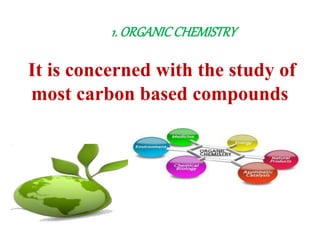
1. ORGANICCHEMISTRY
It is concerned with the study of
most carbon based compounds
INORGANICCHEMISTRY
It deals with all the substances
which are not considered
to organic , which may
contain any of over 100
elements ( including
carbon ).
PHYSICAL CHEMISTRY
It deals with the
application of
physical laws to
chemical change
and chemical system.
BIOCHEMISTRY
It is concerned with the chemistry of life
processes and living organisms .
OTHER BRANCHES
1. Analytical chemistry
2. Nanochemistry
3. Astrochemistry
4. Environmental chemistry
5. Food chemistry
6. Combinatorial chemistry
7. Medical chemistry
8. Solid state chemistry
9. Forensic chemistry
IN INDUSTRY
IN FORESICS /LAW
Solving crimes that involve forgery,
death, arson, paternity etc...
IN HEALTH
Chemist is involved in health/science related
professions like nursing, dentistry,
psychology, and nutrition.
IN TEACHING
Chemistry who have
effective instructional
skill are valuable in
educating students about
the world of chemistry
and its roles in improving
life and environment .
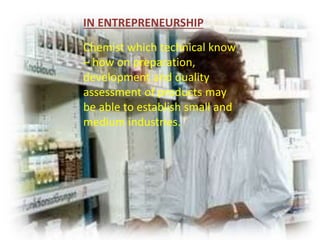
IN ENTREPRENEURSHIP
Chemist which technical know
– how on preparation,
development and quality
assessment of products may
be able to establish small and
medium industries.
CHEMISTRY PLAYS A GOOD FRIEN
SOMETIMES AS A FOE
11222presntation
11222presntation
11222presntation

11222presntation

  • 5.
    HISTORY OF CHEMISTRY By1000BC ancient civilizations where applying different branches of chemistry. Examples are purifying and extracting metals, dying cloth materials, fermentation of wine, cosmetics, painting, medicines, embalming, food making, and making alloys. first chemical reaction that was used in a controlled manner was “FIRE”. Greeks, Indian, and Egyptians where the ones to first to utilize chemistry without realizing it. Purification of metals was first recognized as early as 2600 BC by the Egyptians when they purify gold Purification of metals was first recognized as early as 2600 BC by the Egyptians when they purify gold
  • 8.
    1. ORGANICCHEMISTRY It isconcerned with the study of most carbon based compounds
  • 9.
    INORGANICCHEMISTRY It deals withall the substances which are not considered to organic , which may contain any of over 100 elements ( including carbon ).
  • 10.
    PHYSICAL CHEMISTRY It dealswith the application of physical laws to chemical change and chemical system.
  • 11.
    BIOCHEMISTRY It is concernedwith the chemistry of life processes and living organisms .
  • 12.
    OTHER BRANCHES 1. Analyticalchemistry 2. Nanochemistry 3. Astrochemistry 4. Environmental chemistry 5. Food chemistry 6. Combinatorial chemistry 7. Medical chemistry 8. Solid state chemistry 9. Forensic chemistry
  • 14.
  • 15.
    IN FORESICS /LAW Solvingcrimes that involve forgery, death, arson, paternity etc...
  • 16.
    IN HEALTH Chemist isinvolved in health/science related professions like nursing, dentistry, psychology, and nutrition.
  • 17.
    IN TEACHING Chemistry whohave effective instructional skill are valuable in educating students about the world of chemistry and its roles in improving life and environment .
  • 18.
    IN ENTREPRENEURSHIP Chemist whichtechnical know – how on preparation, development and quality assessment of products may be able to establish small and medium industries.
  • 19.
    CHEMISTRY PLAYS AGOOD FRIEN SOMETIMES AS A FOE