Social Venturing Economics in Europe Definitions, dimensions and main Characteristics of Social Venturing Economics 2011 Prof. dr. ir Gert van Dijk * Nyenrode Business Universiteit  * The Netherlands Institute for Social Venturing Economics & Cooperative Entrepreneurship
Economics of freedom?
COOPERATIVE BANKS IN EUROPE SURVIVED BEST
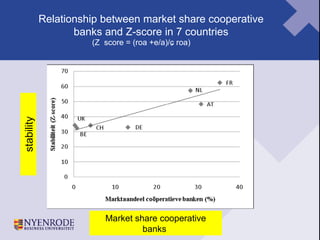
Relationship between market share cooperative banks and Z-score in 7 countries (Z  score = (roa +e/a)/ɕ roa) stability Market share cooperative banks
 
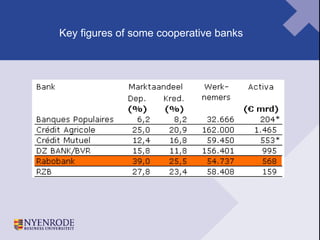
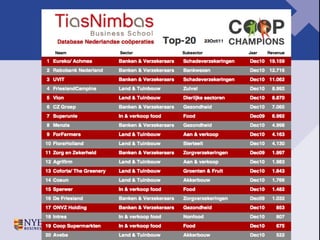
Key figures of some cooperative banks
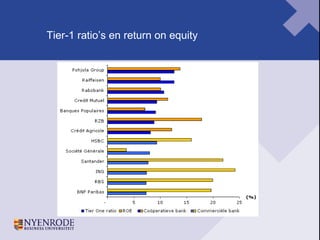
Tier-1 ratio’s en return on equity
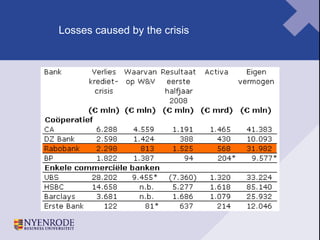
Losses caused by the crisis
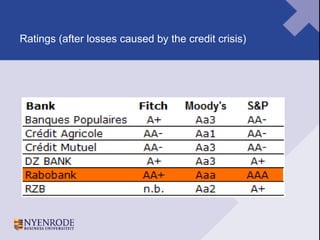
Ratings (after losses caused by the credit crisis)
COOPERATIVE (MUTUAL) INSURANCE
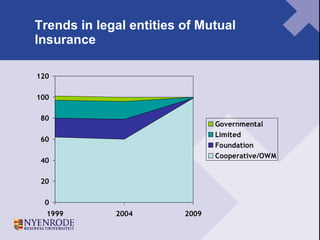
Trends in legal entities of Mutual Insurance
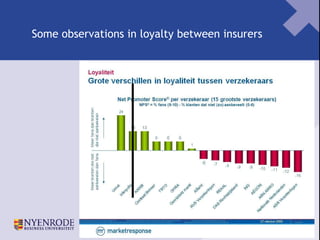
Some observations in loyalty between insurers
Difference in service perception
Social Venturing Economics  new forms of entrepreneurship
Social Venturing To contribute to ‘societal problems’ in a business-like manner ‘ Societal problems’ are problems which are not (yet) part of the market system and which cannot be solved by government  Societal venture capital Social venturers are experienced, most of them have ‘harvested’ at least once in their life and are committed
Social Venturing (formal definition) Social venturing entrepreneurship  (SVE) is the application  of entrepreneurship with the aim to contribute to solving societal goals; in situations where markets do not  (yet) operate; without seeking profit on the basis of  shareholder value or entrepreneurial rent.
 
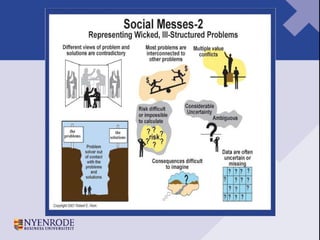
social venturing   innovation for direct benefits of society  ‘ wicked’ problems that can be solved by technological and social/institutional innovation - if  civic  driven
Sustainability Ecological  sustainability is long term economic sustainability (Planet)
(Social) Sustainability  Social institution development Entrepreneurship Long term commitment; however, exit opportunities are signs of success Cost of dispute, micro justice
In sum: Social venturing = Mobilizing the power of enterpreneurship for someone or something else than anonymous ‘shareholders’
Special questions: Measurement of ‘social dividends’ Status in public (government-)domain Relationship with corporate investments Methods of finance Governance
Turning a recipient structure for philantropy into SVE recipient structure Entrepreneurial behaviour Self-disciplined and autonomy ‘ we’ (new) respect voor institutions: constitution, clubs  and societies, church nobody is too poor to help
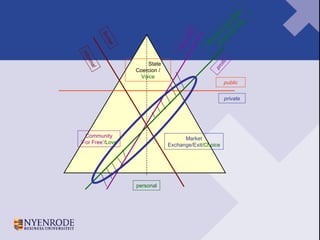
public private State Coercion /  Voice Market Exchange/Exit/ Choice Community ‘ For Free’/ Love personal profit Non-profit formal informal Maatschappelijke onderneming
SVE initiators are entrepreneurs who are able to involve politicians, army leaders, diplomats, governments, NGO's and corporates the effect should be enhanced entrepreneurship by the recipients particular attention to be given to the 'recipient structure‘ no gifts, all has to be repaid in due course no shareholder gains; profits will be allocated to the participating communities introduction of an independent judge, preferably the final market attached to the supply chain
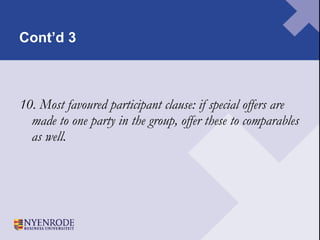
countervailing power and cooperative governance throughout the value chain (participation of all participants) concomitant policies: education, training, philanthropy by the recipients themselves two strategies: cooperation or defection. 1) Always start cooperatively; 2) if the other defects, also defect; 3) be forgiving, if the other is willing to cooperate again, then do so also not all parties need to profit to the same extent; no one should be worse off most favoured participant clause: if special offers are made to one party in the group, offer these to comparables as well.
Measurement Financial value (profit is an opinion, cash is a fact) Economic value (measurable via instrumental nomological methods (Social evaluator) Social value (micro insurance, micro justice)
Examples Stewardship wild life lands Gaza flower production and marketing  chain Uruzgan orchard Tendris light Vita valley health
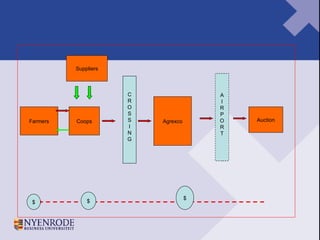
Farmers Coops Agrexco Suppliers Auction C R O S S I N G A I R P O R T $ $ $
 
10 commandments Initiators are entrepreneurs who are able to involve politicians, army leaders, diplomats, governments, NGO’s an corporates.  2. The effect should enhance entrepreneurship by the recipients.  3. Particular attention to be given to the “recipient structure”
Cont’d, 1 4. No gifts, all has to be repaid in due course 5. No shareholder gains; profits will be allocated to the participating communities 6. Introduction of an independent judge, preferably the final market attached to the supply chain
Cont’d, 2 7. Countervailing power and cooperative governance throughout the value chain (participation of all participants) 8. Concomitant policies: education, training, philanthropy by the recipients themselves 9. Not all parties need to profit to the same extent; no one should be worse off
Cont’d 3 10. Most favoured participant clause: if special offers are made to one party in the group, offer these to comparables as well.
COOPERATIVES AND AGRIBUSINESS – THE CASE OF MARKET FAILURE


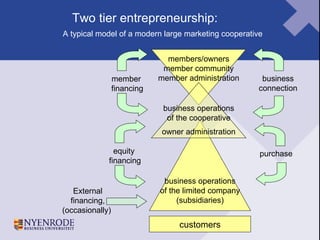
business operations of the limited company (subsidiaries) members/owners member community member administration business operations of the cooperative owner administration A typical model of a modern large marketing cooperative member  financing business connection equity  financing customers purchase External financing, (occasionally)  Two tier entrepreneurship:
Entrepreneurial strategies: both at farm and cooperative business level starch meat dairy Fruit &  vegetables Flower/ auction trading Seed potatoes Animal genetics Entrepreneurial - goals cooperative firms Entrepreneurial goals Member firms brand- strategy Marketing, complementary services, trade Product development Raw material
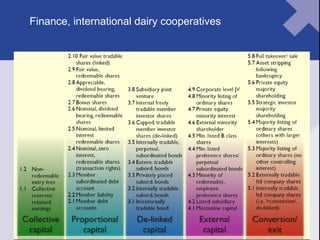
Finance, international dairy cooperatives
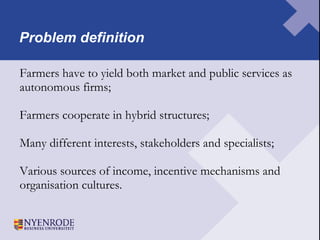
Problem definition Farmers have to yield both market and public services as  autonomous firms; Farmers cooperate in hybrid structures; Many different interests, stakeholders and specialists;  Various sources of income, incentive mechanisms and  organisation cultures.
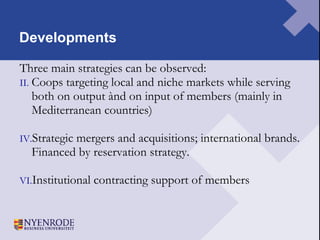
Developments Three main strategies can be observed: Coops targeting local and niche markets while serving both on output ànd on input of members (mainly in Mediterranean countries) Strategic mergers and acquisitions; international brands. Financed by reservation strategy.  Institutional contracting support of members
 

Rol de la Economía social en Europa

  • 1.
    Social Venturing Economicsin Europe Definitions, dimensions and main Characteristics of Social Venturing Economics 2011 Prof. dr. ir Gert van Dijk * Nyenrode Business Universiteit * The Netherlands Institute for Social Venturing Economics & Cooperative Entrepreneurship
  • 2.
  • 3.
    COOPERATIVE BANKS INEUROPE SURVIVED BEST
  • 4.
    Relationship between marketshare cooperative banks and Z-score in 7 countries (Z score = (roa +e/a)/ɕ roa) stability Market share cooperative banks
  • 5.
  • 6.
    Key figures ofsome cooperative banks
  • 7.
    Tier-1 ratio’s enreturn on equity
  • 8.
    Losses caused bythe crisis
  • 9.
    Ratings (after lossescaused by the credit crisis)
  • 10.
  • 11.
    Trends in legalentities of Mutual Insurance
  • 12.
    Some observations inloyalty between insurers
  • 13.
  • 14.
    Social Venturing Economics new forms of entrepreneurship
  • 15.
    Social Venturing Tocontribute to ‘societal problems’ in a business-like manner ‘ Societal problems’ are problems which are not (yet) part of the market system and which cannot be solved by government Societal venture capital Social venturers are experienced, most of them have ‘harvested’ at least once in their life and are committed
  • 16.
    Social Venturing (formaldefinition) Social venturing entrepreneurship (SVE) is the application of entrepreneurship with the aim to contribute to solving societal goals; in situations where markets do not (yet) operate; without seeking profit on the basis of shareholder value or entrepreneurial rent.
  • 17.
  • 18.
    social venturing innovation for direct benefits of society ‘ wicked’ problems that can be solved by technological and social/institutional innovation - if civic driven
  • 19.
    Sustainability Ecological sustainability is long term economic sustainability (Planet)
  • 20.
    (Social) Sustainability Social institution development Entrepreneurship Long term commitment; however, exit opportunities are signs of success Cost of dispute, micro justice
  • 21.
    In sum: Socialventuring = Mobilizing the power of enterpreneurship for someone or something else than anonymous ‘shareholders’
  • 22.
    Special questions: Measurementof ‘social dividends’ Status in public (government-)domain Relationship with corporate investments Methods of finance Governance
  • 23.
    Turning a recipientstructure for philantropy into SVE recipient structure Entrepreneurial behaviour Self-disciplined and autonomy ‘ we’ (new) respect voor institutions: constitution, clubs and societies, church nobody is too poor to help
  • 24.
    public private StateCoercion / Voice Market Exchange/Exit/ Choice Community ‘ For Free’/ Love personal profit Non-profit formal informal Maatschappelijke onderneming
  • 25.
    SVE initiators areentrepreneurs who are able to involve politicians, army leaders, diplomats, governments, NGO's and corporates the effect should be enhanced entrepreneurship by the recipients particular attention to be given to the 'recipient structure‘ no gifts, all has to be repaid in due course no shareholder gains; profits will be allocated to the participating communities introduction of an independent judge, preferably the final market attached to the supply chain
  • 26.
    countervailing power andcooperative governance throughout the value chain (participation of all participants) concomitant policies: education, training, philanthropy by the recipients themselves two strategies: cooperation or defection. 1) Always start cooperatively; 2) if the other defects, also defect; 3) be forgiving, if the other is willing to cooperate again, then do so also not all parties need to profit to the same extent; no one should be worse off most favoured participant clause: if special offers are made to one party in the group, offer these to comparables as well.
  • 27.
    Measurement Financial value(profit is an opinion, cash is a fact) Economic value (measurable via instrumental nomological methods (Social evaluator) Social value (micro insurance, micro justice)
  • 28.
    Examples Stewardship wildlife lands Gaza flower production and marketing chain Uruzgan orchard Tendris light Vita valley health
  • 29.
    Farmers Coops AgrexcoSuppliers Auction C R O S S I N G A I R P O R T $ $ $
  • 30.
  • 31.
    10 commandments Initiatorsare entrepreneurs who are able to involve politicians, army leaders, diplomats, governments, NGO’s an corporates. 2. The effect should enhance entrepreneurship by the recipients. 3. Particular attention to be given to the “recipient structure”
  • 32.
    Cont’d, 1 4.No gifts, all has to be repaid in due course 5. No shareholder gains; profits will be allocated to the participating communities 6. Introduction of an independent judge, preferably the final market attached to the supply chain
  • 33.
    Cont’d, 2 7.Countervailing power and cooperative governance throughout the value chain (participation of all participants) 8. Concomitant policies: education, training, philanthropy by the recipients themselves 9. Not all parties need to profit to the same extent; no one should be worse off
  • 34.
    Cont’d 3 10.Most favoured participant clause: if special offers are made to one party in the group, offer these to comparables as well.
  • 35.
    COOPERATIVES AND AGRIBUSINESS– THE CASE OF MARKET FAILURE
  • 36.
  • 37.
  • 38.
  • 39.
    business operations ofthe limited company (subsidiaries) members/owners member community member administration business operations of the cooperative owner administration A typical model of a modern large marketing cooperative member financing business connection equity financing customers purchase External financing, (occasionally) Two tier entrepreneurship:
  • 40.
    Entrepreneurial strategies: bothat farm and cooperative business level starch meat dairy Fruit & vegetables Flower/ auction trading Seed potatoes Animal genetics Entrepreneurial - goals cooperative firms Entrepreneurial goals Member firms brand- strategy Marketing, complementary services, trade Product development Raw material
  • 41.
  • 42.
    Problem definition Farmershave to yield both market and public services as autonomous firms; Farmers cooperate in hybrid structures; Many different interests, stakeholders and specialists; Various sources of income, incentive mechanisms and organisation cultures.
  • 43.
    Developments Three mainstrategies can be observed: Coops targeting local and niche markets while serving both on output ànd on input of members (mainly in Mediterranean countries) Strategic mergers and acquisitions; international brands. Financed by reservation strategy. Institutional contracting support of members
  • 44.