Author(s): Louis D’Alecy, 2009

License: Unless otherwise noted, this material is made available under the terms of the
Creative Commons Attribution–Non-commercial–Share Alike 3.0 License:
http://creativecommons.org/licenses/by-nc-sa/3.0/

We have reviewed this material in accordance with U.S. Copyright Law and have tried to maximize your ability to use,
share, and adapt it. The citation key on the following slide provides information about how you may share and adapt this
material.

Copyright holders of content included in this material should contact open.michigan@umich.edu with any questions,
corrections, or clarification regarding the use of content.

For more information about how to cite these materials visit http://open.umich.edu/education/about/terms-of-use.

Any medical information in this material is intended to inform and educate and is not a tool for self-diagnosis or a
replacement for medical evaluation, advice, diagnosis or treatment by a healthcare professional. Please speak to your
physician if you have questions about your medical condition.

Viewer discretion is advised: Some medical content is graphic and may not be suitable for all viewers.
Citation Key
                          for more information see: http://open.umich.edu/wiki/CitationPolicy


Use + Share + Adapt
  { Content the copyright holder, author, or law permits you to use, share and adapt. }
               Public Domain – Government: Works that are produced by the U.S. Government. (USC 17 § 105)
               Public Domain – Expired: Works that are no longer protected due to an expired copyright term.
               Public Domain – Self Dedicated: Works that a copyright holder has dedicated to the public domain.

               Creative Commons – Zero Waiver

               Creative Commons – Attribution License
               Creative Commons – Attribution Share Alike License
               Creative Commons – Attribution Noncommercial License
               Creative Commons – Attribution Noncommercial Share Alike License
               GNU – Free Documentation License

Make Your Own Assessment
  { Content Open.Michigan believes can be used, shared, and adapted because it is ineligible for copyright. }
               Public Domain – Ineligible: Works that are ineligible for copyright protection in the U.S. (USC 17 § 102(b)) *laws in
               your jurisdiction may differ
   { Content Open.Michigan has used under a Fair Use determination. }
               Fair Use: Use of works that is determined to be Fair consistent with the U.S. Copyright Act. (USC 17 § 107) *laws in
               your jurisdiction may differ
               Our determination DOES NOT mean that all uses of this 3rd-party content are Fair Uses and we DO NOT guarantee
               that your use of the content is Fair.
               To use this content you should do your own independent analysis to determine whether or not your use will be Fair.
Hemodynamics

            M1 – Cardiovascular/Respiratory
                       Sequence
                 Louis D’Alecy, Ph.D.


Fall 2008                                     3
Monday 11/03/08, 9:00
         Hemodynamics
              26 slides, 50 min
1.   Pressure & pressure pulses
2.   Pressure gradient (perfusion pressure)
3.   Determinants of Blood Flow
4.   Resistance in series and in parallel


                                              4
Hemodynamics
"Hemodynamics is concerned with
 the forces generated by the heart
and the motion of blood through the
     cardiovascular system.”
         from ucdavis.edu

Blood Pressures and Blood Flow

                                      5
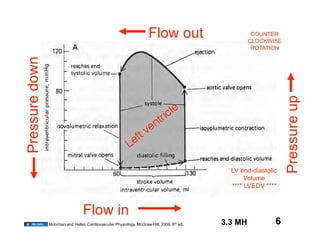
Flow out                         COUNTER
                                                                                                     CLOCKWISE
                                                                                                      ROTATION
Pressure down


                                                                                                                 Pressure up
                                                                                              LV end-diastolic
                                                                                                   Volume
                                                                                              **** LVEDV ****


                                  Flow in
                Mohrman and Heller. Cardiovascular Physiology. McGraw-Hill, 2006. 6th ed.   3.3 MH           6
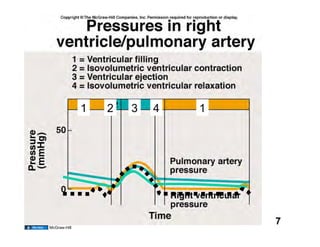
1   2   3   4   1


McGraw-Hill
                                  7
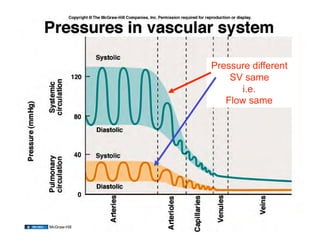
Pressure different
                  SV same
                     i.e.
                 Flow same


McGraw-Hill
                             8
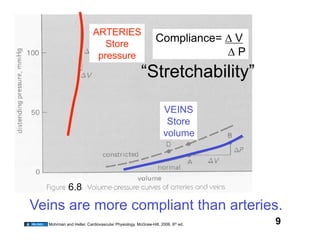
ARTERIES
                            Store
                                                           Compliance=        V
                          pressure                                            P
                                                   “Stretchability”

                                                                VEINS
                                                                 Store
                                                                volume


            6.8

Veins are more compliant than arteries.
  Mohrman and Heller. Cardiovascular Physiology. McGraw-Hill, 2006. 6th ed.       9
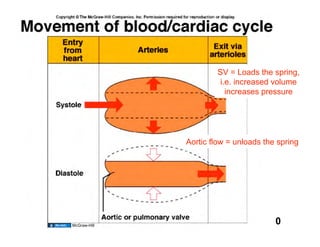
SV = Loads the spring,
                       i.e. increased volume
                         increases pressure


              Aortic flow = unloads the spring


McGraw-Hill
                                     10
4
1
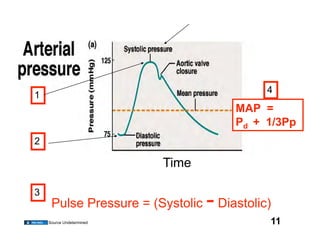
                                       MAP =
                                       Pd + 1/3Pp
2

                          Time

3
     Pulse Pressure = (Systolic   - Diastolic)
    Source Undetermined                      11
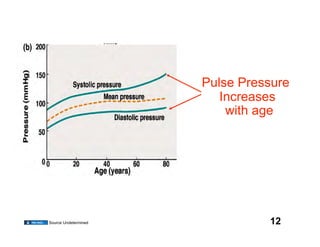
Pulse Pressure
                         Increases
                          with age


Source Undetermined             12
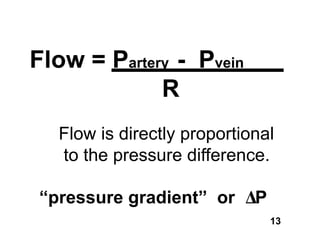
Flow = Partery - Pvein
             R
  Flow is directly proportional
  to the pressure difference.

“pressure gradient” or      P
                                13
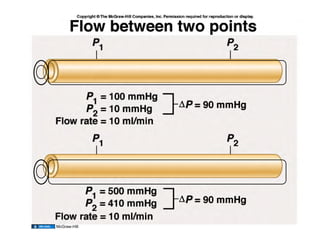
McGraw-Hill
              14
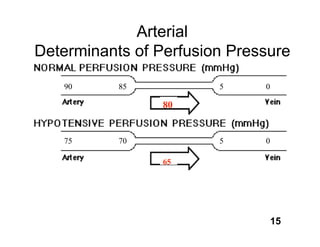
Arterial
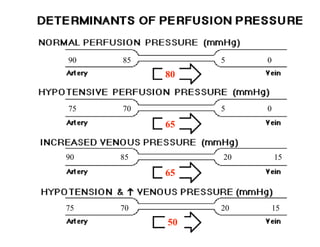
Determinants of Perfusion Pressure

   90      85           5     0

                 80


   75      70           5     0

                 65


                                  15
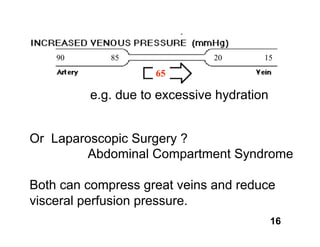
90       85               20       15

                    65

         e.g. due to excessive hydration


Or Laparoscopic Surgery ?
        Abdominal Compartment Syndrome

Both can compress great veins and reduce
visceral perfusion pressure.
                                           16
90   85        5    0
          80


75   70        5    0

          65


90   85        20       15

          65


75   70        20    15
          50        17
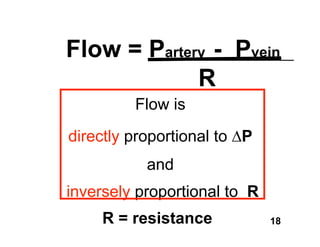
Flow = Partery - Pvein
             R
         Flow is
directly proportional to P
           and
inversely proportional to R
     R = resistance           18
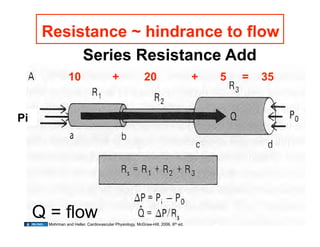
Resistance ~ hindrance to flow
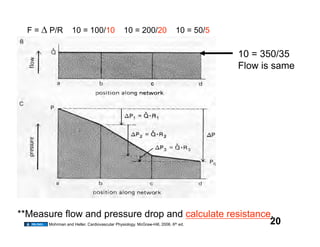
           Series Resistance Add
                10                      +                20                       +   5   =   35


Pi


     Q = flow
      Mohrman and Heller. Cardiovascular Physiology. McGraw-Hill, 2006. 6th ed.                19
F=     P/R    10 = 100/10     10 = 200/20     10 = 50/5


                                                                  10 = 350/35
                                                                  Flow is same


**Measure flow and pressure drop and calculate resistance.
                                               th
      Mohrman and Heller. Cardiovascular Physiology. McGraw-Hill, 2006. 6 ed. 20
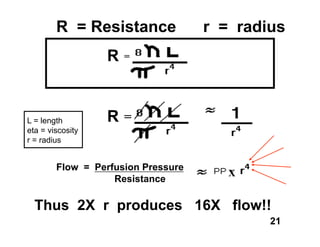
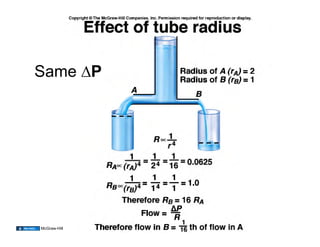
R = Resistance              r = radius
                  R   =


L = length        R=
eta = viscosity
r = radius


        Flow = Perfusion Pressure
                                       X
                   Resistance

  Thus 2X r produces 16X flow!!
                                            21
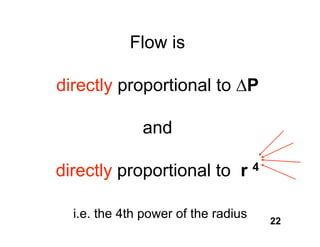
Flow is

directly proportional to P

              and

directly proportional to r           4


  i.e. the 4th power of the radius       22
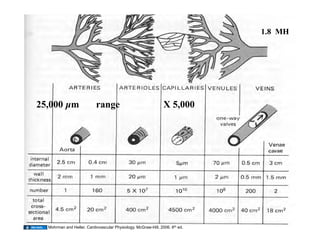
1.8 MH


25,000 μm                  range                                X 5,000


  Mohrman and Heller. Cardiovascular Physiology. McGraw-Hill, 2006. 6th ed.
                                                                               23
Same P


              24
McGraw-Hill
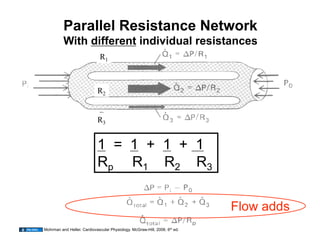
Parallel Resistance Network
          With different individual resistances
                              R1


                            R2


                            R3


                            1 = 1 + 1 + 1
                            Rp R 1 R R2 R3
                                R     R R         p            1            2   3


                                                                                    Flow adds
                                                                                          25
Mohrman and Heller. Cardiovascular Physiology. McGraw-Hill, 2006. 6th ed.
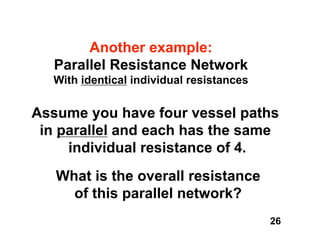
Another example:
   Parallel Resistance Network
   With identical individual resistances


Assume you have four vessel paths
 in parallel and each has the same
     individual resistance of 4.
   What is the overall resistance
     of this parallel network?
                                           26
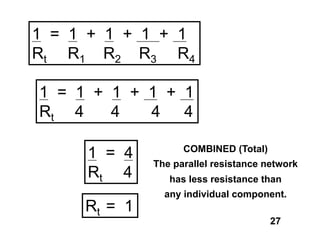
1 = 1 + 1 + 1 + 1
Rt R1 R2 R3 R4

1 = 1 + 1 + 1 + 1
Rt 4    4   4 4

                    COMBINED (Total)
     1 = 4
              The parallel resistance network
     Rt 4        has less resistance than
                any individual component.
     Rt = 1
                                       27
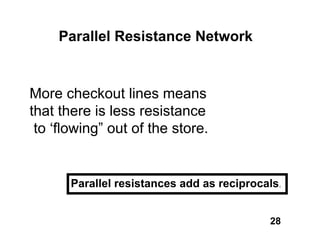
Parallel Resistance Network


More checkout lines means
that there is less resistance
 to flowing” out of the store.


      Parallel resistances add as reciprocals.


                                           28
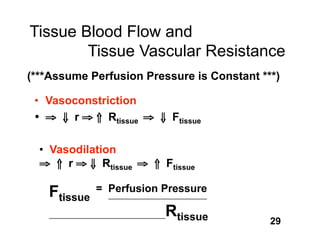
Tissue Blood Flow and
        Tissue Vascular Resistance
(***Assume Perfusion Pressure is Constant ***)

 • Vasoconstriction
 •     r      Rtissue     Ftissue

  • Vasodilation
       r      Rtissue    Ftissue

   Ftissue   = Perfusion Pressure

                         Rtissue            29
Monday 11/03/08, 10:00
     Vascular Smooth Muscle
               33 slides, 50 min.
1.   Vasoconstrictors and Vasodilators
2.   Neural control of resistance
3.   Humoral control of resistance
4.   Local control of resistance
5.   Nitric oxide, Nitric oxide synthase (NOS)
6.   Asymmetrical dimethylarginine

                                           30
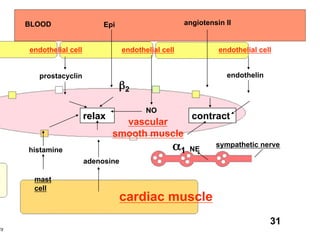
BLOOD                   Epi                       angiotensin II


     endothelial cell               endothelial cell             endothelial cell


       prostacyclin                                                endothelin
                                     2

                                           NO
                        relax                            contract
                                  vascular
                                smooth muscle
                                                                sympathetic nerve
     histamine                                         1 NE
                        adenosine

      mast
      cell
                                   cardiac muscle
                                                                                31
cy
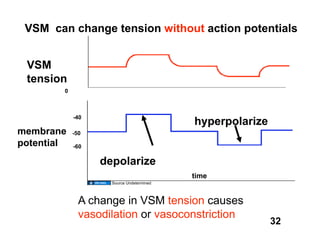
VSM can change tension without action potentials


 VSM
 tension
        0


            -40
                                          hyperpolarize
membrane    -50
potential   -60

                  depolarize
                                          time
                    Source Undetermined


              A change in VSM tension causes
              vasodilation or vasoconstriction
                                                          32
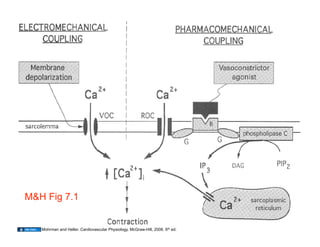
M&H Fig 7.1

                                                                               33
   Mohrman and Heller. Cardiovascular Physiology. McGraw-Hill, 2006. 6th ed.
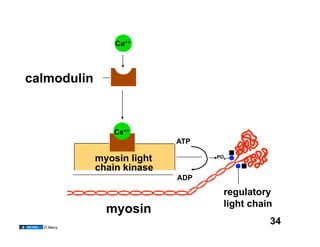
Ca++


calmodulin


                Ca++
                            ATP

             myosin light         PO4

             chain kinase
                            ADP

                                    regulatory
                                    light chain
               myosin
  D’Alecy
                                              34
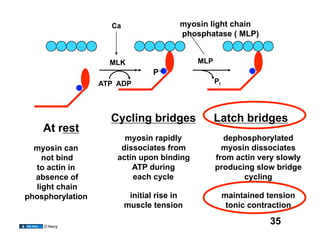
Ca                  myosin light chain
                                        phosphatase ( MLP)


                    MLK                     MLP
                                P
                  ATP ADP                         Pi


                    Cycling bridges               Latch bridges
    At rest
                        myosin rapidly              dephosphorylated
  myosin can           dissociates from             myosin dissociates
    not bind          actin upon binding          from actin very slowly
  to actin in             ATP during              producing slow bridge
  absence of              each cycle                     cycling
  light chain
phosphorylation           initial rise in              maintained tension
                         muscle tension                 tonic contraction

    D’Alecy
                                                                  35
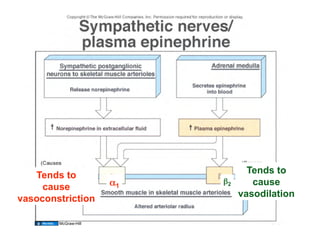
Tends to
   Tends to
                          2      cause
     cause            1
                              vasodilation
vasoconstriction

        McGraw-Hill                 36
McGraw-Hill   37
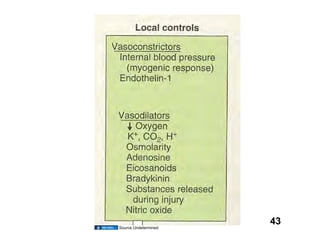
Local Influences on Arterioles
(Local = no neural or humoral control)


       Active Hyperemia

      Reactive Hyperemia

          Autoregulation
                                    38
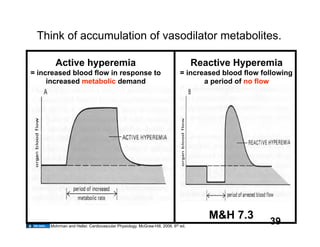
Think of accumulation of vasodilator metabolites.

       Active hyperemia                                                          Reactive Hyperemia
= increased blood flow in response to                                       = increased blood flow following
     increased metabolic demand                                                   a period of no flow


                                                                                    M&H 7.3
     Mohrman and Heller. Cardiovascular Physiology. McGraw-Hill, 2006. 6th ed.
                                                                                                   39
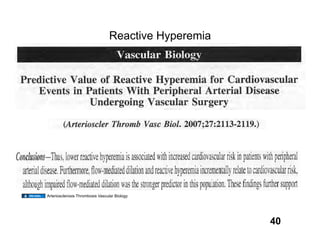
Reactive Hyperemia


Arteriosclerosis Thrombosis Vascular Biology


                                                      40
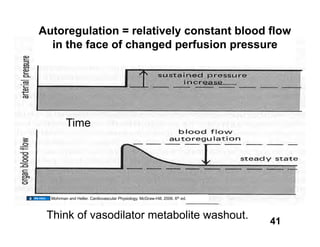
Autoregulation = relatively constant blood flow
                                      8.4 HM
  in the face of changed perfusion pressure


         Time


  Mohrman and Heller. Cardiovascular Physiology. McGraw-Hill, 2006. 6th ed.


 Think of vasodilator metabolite washout.
                                                                              41
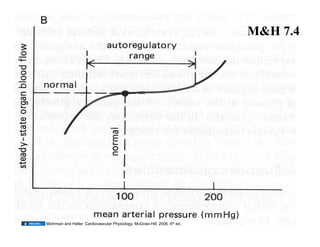
M&H 7.4


Mohrman and Heller. Cardiovascular Physiology. McGraw-Hill, 2006. 6th ed.      42
Source Undetermined
                      43
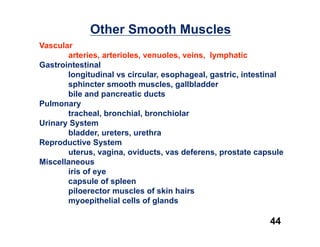
Other Smooth Muscles
Vascular
       arteries, arterioles, venuoles, veins, lymphatic
Gastrointestinal
       longitudinal vs circular, esophageal, gastric, intestinal
       sphincter smooth muscles, gallbladder
       bile and pancreatic ducts
Pulmonary
       tracheal, bronchial, bronchiolar
Urinary System
       bladder, ureters, urethra
Reproductive System
       uterus, vagina, oviducts, vas deferens, prostate capsule
Miscellaneous
       iris of eye
       capsule of spleen
       piloerector muscles of skin hairs
       myoepithelial cells of glands

                                                            44
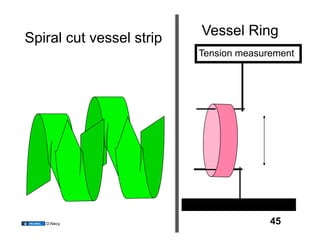
Vessel Ring
Spiral cut vessel strip
                          Tension measurement


   D’Alecy                              45
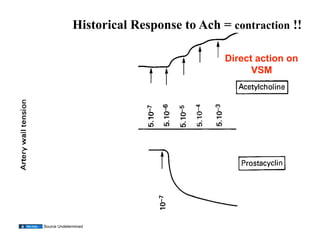
Historical Response to Ach = contraction !!

                                         Direct action on
                                               VSM


Source Undetermined
                                                  46
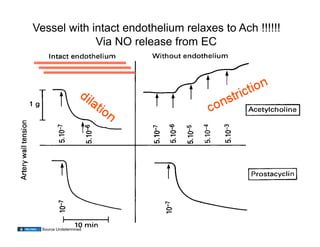
Vessel with intact endothelium relaxes to Ach !!!!!!
             Via NO release from EC


                                                 47
 Source Undetermined
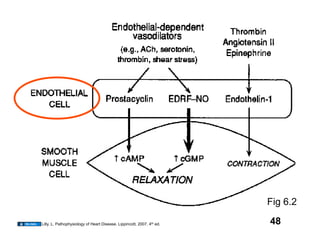
Fig 6.2

Lilly, L. Pathophysiology of Heart Disease. Lippincott, 2007. 4th ed.   48
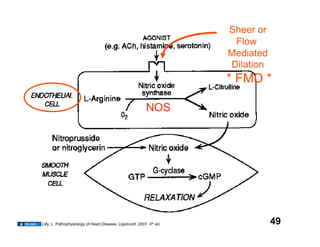
Sheer or
                                                                         Flow
                                                                        Mediated
                                                                        Dilation
                                                                        * FMD *

                                                            NOS


Lilly, L. Pathophysiology of Heart Disease. Lippincott, 2007. 4th ed.              49
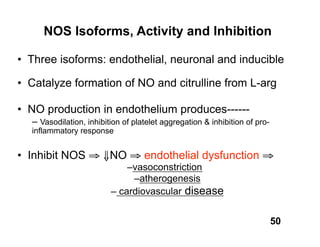
NOS Isoforms, Activity and Inhibition

• Three isoforms: endothelial, neuronal and inducible

• Catalyze formation of NO and citrulline from L-arg

• NO production in endothelium produces------
  – Vasodilation, inhibition of platelet aggregation & inhibition of pro-
  inflammatory response


• Inhibit NOS            NO        endothelial dysfunction
                             –vasoconstriction
                              –atherogenesis
                         – cardiovascular disease


                                                                            50
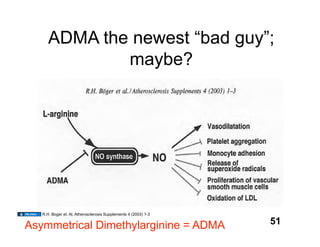
ADMA the newest “bad guy”;
              maybe?


   R.H. Boger et. Al, Atherosclerosis Supplements 4 (2003) 1-3


Asymmetrical Dimethylarginine = ADMA                             51
Asymmetrical Dimethylarginine
              (ADMA)
•   What is it?
•   What can it do?
•   Where does it come from?
•   Where does it go?
•   What does it really do?
•   Can we mimic or block it to therapeutic
    advantage?


                                              52
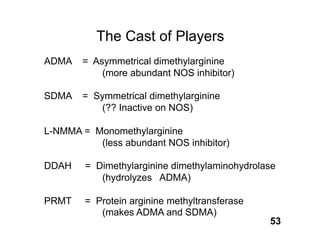
The Cast of Players
ADMA    = Asymmetrical dimethylarginine
            (more abundant NOS inhibitor)

SDMA    = Symmetrical dimethylarginine
           (?? Inactive on NOS)

L-NMMA = Monomethylarginine
          (less abundant NOS inhibitor)

DDAH    = Dimethylarginine dimethylaminohydrolase
           (hydrolyzes ADMA)

PRMT    = Protein arginine methyltransferase
           (makes ADMA and SDMA)
                                               53
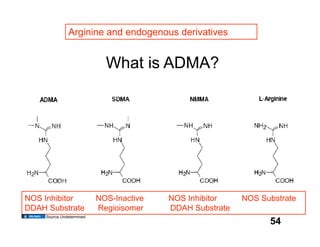
Arginine and endogenous derivatives


                             What is ADMA?


NOS Inhibitor              NOS-Inactive   NOS Inhibitor    NOS Substrate
DDAH Substrate             Regioisomer    DDAH Substrate
     Source Undetermined
                                                                 54
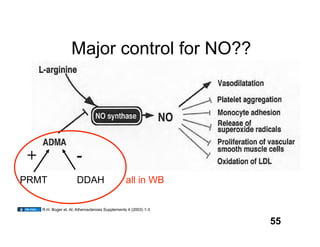
Major control for NO??


 +                     -
PRMT                   DDAH                       all in WB

     R.H. Boger et. Al, Atherosclerosis Supplements 4 (2003) 1-3


                                                                   55
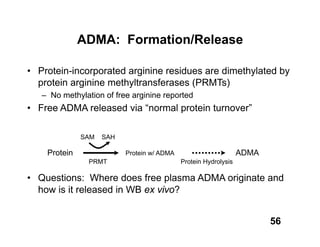
ADMA: Formation/Release

• Protein-incorporated arginine residues are dimethylated by
  protein arginine methyltransferases (PRMTs)
   – No methylation of free arginine reported
• Free ADMA released via “normal protein turnover”

              SAM   SAH

    Protein               Protein w/ ADMA                        ADMA
                PRMT                        Protein Hydrolysis

• Questions: Where does free plasma ADMA originate and
  how is it released in WB ex vivo?


                                                                        56
Plasma concentration of asymmetrical dimethylarginine
 and mortality in patients with end-stage renal disease:
                   a prospective study
                Lancet 2001; 358: 2113–17


Zoccali C. et al tested the predictive power of ADMA for mortality and
cardiovascular outcomes and concluded “ADMA is a stronger
independent predictor of all-cause mortality and cardiovascular
outcomes… in patients with CRF…”

                        “Predictor”

                                                                    57
Where does ADMA come from?
• Elevated plasma ADMA in :
  – Hypercholesterolemia
  – Hypertension
  – Hyperhomocyct(e)inemia
  – Tobacco exposure ,
  – Peripheral arterial occlusive disease
  – Experimental hemorrhage (acute)
  – Pre-eclampsia
  – Hyperglycemia
  – Insulin resistance in patients --- and so on
                                               58
Methods

• Incubation of rat whole blood (WB) and
                WB fractions
    – Sample placed in vial and incubated at 37˚C


• HPLC analysis of blood ADMA/SDMA

 • Acid hydrolysis of blood components
  – Liberates free amino acids for their quantification

                                                  59
Summary
• WB plasma contains free ADMA at < 1 M

• WB contains > 40 M protein-incorporated
  ADMA with the majority (>95%) in RBCs

• WB possesses the proteolytic machinery
  necessary for ADMA release into the plasma

• Inhibition of protease activity attenuates
  ADMA release from blood ex vivo
                                               60
Conclusion
• WB can be considered a 5 kg “liquid organ” in intimate

  contact with the vascular endothelium.

• WB has the capacity to release physiologically and

  pathophysiologically relevant amounts of ADMA ex vivo.

• WB is an independent source of ADMA and as such may

  play an etiological role in vascular disease.


                                                       61
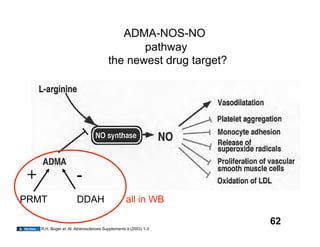
ADMA-NOS-NO
                                                pathway
                                         the newest drug target?


 +                      -
PRMT                    DDAH                       all in WB

                                                                   62
     R.H. Boger et. Al, Atherosclerosis Supplements 4 (2003) 1-3
Additional Source Information
                                 for more information see: http://open.umich.edu/wiki/CitationPolicy

Slide 6 : Mohrman and Heller. Cardiovascular Physiology. McGraw-Hill, 2006. 6th ed.
Slide 7: McGraw-Hill
Slide 8: McGraw-Hill
Slide 9 : Mohrman and Heller. Cardiovascular Physiology. McGraw-Hill, 2006. 6th ed.
Slide 10: McGraw-Hill
Slide 11: Source Undetermined
Slide 12: Source Undetermined
Slide 14: McGraw-Hill
Slide 19 : Mohrman and Heller. Cardiovascular Physiology. McGraw-Hill, 2006. 6th ed.
Slide 20 : Mohrman and Heller. Cardiovascular Physiology. McGraw-Hill, 2006. 6th ed.
Slide 23 : Mohrman and Heller. Cardiovascular Physiology. McGraw-Hill, 2006. 6th ed.
Slide 24: McGraw-Hill
Slide 25 : Mohrman and Heller. Cardiovascular Physiology. McGraw-Hill, 2006. 6th ed.
Slide 31: D’Alecy
Slide 32: Source Undetermined
Slide 33 : Mohrman and Heller. Cardiovascular Physiology. McGraw-Hill, 2006. 6th ed.
Slide 34: D’Alecy
Slide 35: D’Alecy
Slide 36: McGraw-Hill
Slide 37: McGraw-Hill
Slide 39 : Mohrman and Heller. Cardiovascular Physiology. McGraw-Hill, 2006. 6th ed.
Slide 40: Arteriosclerosis Thrombosis Vascular Biology
Slide 41 : Mohrman and Heller. Cardiovascular Physiology. McGraw-Hill, 2006. 6th ed.
Slide 42: Mohrman and Heller. Cardiovascular Physiology. McGraw-Hill, 2006. 6th ed.
Slide 43: Source Undetermined
Slide 45: D’Alecy
Slide 46: Source Undetermined
Slide 47: Source Undetermined
Slide 48: Lilly, L. Pathophysiology of Heart Disease. Lippincott, 2007. 4th ed.
Slide 49: Lilly, L. Pathophysiology of Heart Disease. Lippincott, 2007. 4th ed.
Slide 51: R.H. Boger et. Al, Atherosclerosis Supplements 4 (2003) 1-3
Slide 54: Source Undetermined
Slide 55: R.H. Boger et. Al, Atherosclerosis Supplements 4 (2003) 1-3

11.03.08(a): Hemodynamics

  • 1.
    Author(s): Louis D’Alecy,2009 License: Unless otherwise noted, this material is made available under the terms of the Creative Commons Attribution–Non-commercial–Share Alike 3.0 License: http://creativecommons.org/licenses/by-nc-sa/3.0/ We have reviewed this material in accordance with U.S. Copyright Law and have tried to maximize your ability to use, share, and adapt it. The citation key on the following slide provides information about how you may share and adapt this material. Copyright holders of content included in this material should contact open.michigan@umich.edu with any questions, corrections, or clarification regarding the use of content. For more information about how to cite these materials visit http://open.umich.edu/education/about/terms-of-use. Any medical information in this material is intended to inform and educate and is not a tool for self-diagnosis or a replacement for medical evaluation, advice, diagnosis or treatment by a healthcare professional. Please speak to your physician if you have questions about your medical condition. Viewer discretion is advised: Some medical content is graphic and may not be suitable for all viewers.
  • 2.
    Citation Key for more information see: http://open.umich.edu/wiki/CitationPolicy Use + Share + Adapt { Content the copyright holder, author, or law permits you to use, share and adapt. } Public Domain – Government: Works that are produced by the U.S. Government. (USC 17 § 105) Public Domain – Expired: Works that are no longer protected due to an expired copyright term. Public Domain – Self Dedicated: Works that a copyright holder has dedicated to the public domain. Creative Commons – Zero Waiver Creative Commons – Attribution License Creative Commons – Attribution Share Alike License Creative Commons – Attribution Noncommercial License Creative Commons – Attribution Noncommercial Share Alike License GNU – Free Documentation License Make Your Own Assessment { Content Open.Michigan believes can be used, shared, and adapted because it is ineligible for copyright. } Public Domain – Ineligible: Works that are ineligible for copyright protection in the U.S. (USC 17 § 102(b)) *laws in your jurisdiction may differ { Content Open.Michigan has used under a Fair Use determination. } Fair Use: Use of works that is determined to be Fair consistent with the U.S. Copyright Act. (USC 17 § 107) *laws in your jurisdiction may differ Our determination DOES NOT mean that all uses of this 3rd-party content are Fair Uses and we DO NOT guarantee that your use of the content is Fair. To use this content you should do your own independent analysis to determine whether or not your use will be Fair.
  • 3.
    Hemodynamics M1 – Cardiovascular/Respiratory Sequence Louis D’Alecy, Ph.D. Fall 2008 3
  • 4.
    Monday 11/03/08, 9:00 Hemodynamics 26 slides, 50 min 1. Pressure & pressure pulses 2. Pressure gradient (perfusion pressure) 3. Determinants of Blood Flow 4. Resistance in series and in parallel 4
  • 5.
    Hemodynamics "Hemodynamics is concernedwith the forces generated by the heart and the motion of blood through the cardiovascular system.” from ucdavis.edu Blood Pressures and Blood Flow 5
  • 6.
    Flow out COUNTER CLOCKWISE ROTATION Pressure down Pressure up LV end-diastolic Volume **** LVEDV **** Flow in Mohrman and Heller. Cardiovascular Physiology. McGraw-Hill, 2006. 6th ed. 3.3 MH 6
  • 7.
    1 2 3 4 1 McGraw-Hill 7
  • 8.
    Pressure different SV same i.e. Flow same McGraw-Hill 8
  • 9.
    ARTERIES Store Compliance= V pressure P “Stretchability” VEINS Store volume 6.8 Veins are more compliant than arteries. Mohrman and Heller. Cardiovascular Physiology. McGraw-Hill, 2006. 6th ed. 9
  • 10.
    SV = Loadsthe spring, i.e. increased volume increases pressure Aortic flow = unloads the spring McGraw-Hill 10
  • 11.
    4 1 MAP = Pd + 1/3Pp 2 Time 3 Pulse Pressure = (Systolic - Diastolic) Source Undetermined 11
  • 12.
    Pulse Pressure Increases with age Source Undetermined 12
  • 13.
    Flow = Partery- Pvein R Flow is directly proportional to the pressure difference. “pressure gradient” or P 13
  • 14.
  • 15.
    Arterial Determinants of PerfusionPressure 90 85 5 0 80 75 70 5 0 65 15
  • 16.
    90 85 20 15 65 e.g. due to excessive hydration Or Laparoscopic Surgery ? Abdominal Compartment Syndrome Both can compress great veins and reduce visceral perfusion pressure. 16
  • 17.
    90 85 5 0 80 75 70 5 0 65 90 85 20 15 65 75 70 20 15 50 17
  • 18.
    Flow = Partery- Pvein R Flow is directly proportional to P and inversely proportional to R R = resistance 18
  • 19.
    Resistance ~ hindranceto flow Series Resistance Add 10 + 20 + 5 = 35 Pi Q = flow Mohrman and Heller. Cardiovascular Physiology. McGraw-Hill, 2006. 6th ed. 19
  • 20.
    F= P/R 10 = 100/10 10 = 200/20 10 = 50/5 10 = 350/35 Flow is same **Measure flow and pressure drop and calculate resistance. th Mohrman and Heller. Cardiovascular Physiology. McGraw-Hill, 2006. 6 ed. 20
  • 21.
    R = Resistance r = radius R = L = length R= eta = viscosity r = radius Flow = Perfusion Pressure X Resistance Thus 2X r produces 16X flow!! 21
  • 22.
    Flow is directly proportionalto P and directly proportional to r 4 i.e. the 4th power of the radius 22
  • 23.
    1.8 MH 25,000 μm range X 5,000 Mohrman and Heller. Cardiovascular Physiology. McGraw-Hill, 2006. 6th ed. 23
  • 24.
    Same P 24 McGraw-Hill
  • 25.
    Parallel Resistance Network With different individual resistances R1 R2 R3 1 = 1 + 1 + 1 Rp R 1 R R2 R3 R R R p 1 2 3 Flow adds 25 Mohrman and Heller. Cardiovascular Physiology. McGraw-Hill, 2006. 6th ed.
  • 26.
    Another example: Parallel Resistance Network With identical individual resistances Assume you have four vessel paths in parallel and each has the same individual resistance of 4. What is the overall resistance of this parallel network? 26
  • 27.
    1 = 1+ 1 + 1 + 1 Rt R1 R2 R3 R4 1 = 1 + 1 + 1 + 1 Rt 4 4 4 4 COMBINED (Total) 1 = 4 The parallel resistance network Rt 4 has less resistance than any individual component. Rt = 1 27
  • 28.
    Parallel Resistance Network Morecheckout lines means that there is less resistance to flowing” out of the store. Parallel resistances add as reciprocals. 28
  • 29.
    Tissue Blood Flowand Tissue Vascular Resistance (***Assume Perfusion Pressure is Constant ***) • Vasoconstriction • r Rtissue Ftissue • Vasodilation r Rtissue Ftissue Ftissue = Perfusion Pressure Rtissue 29
  • 30.
    Monday 11/03/08, 10:00 Vascular Smooth Muscle 33 slides, 50 min. 1. Vasoconstrictors and Vasodilators 2. Neural control of resistance 3. Humoral control of resistance 4. Local control of resistance 5. Nitric oxide, Nitric oxide synthase (NOS) 6. Asymmetrical dimethylarginine 30
  • 31.
    BLOOD Epi angiotensin II endothelial cell endothelial cell endothelial cell prostacyclin endothelin 2 NO relax contract vascular smooth muscle sympathetic nerve histamine 1 NE adenosine mast cell cardiac muscle 31 cy
  • 32.
    VSM can changetension without action potentials VSM tension 0 -40 hyperpolarize membrane -50 potential -60 depolarize time Source Undetermined A change in VSM tension causes vasodilation or vasoconstriction 32
  • 33.
    M&H Fig 7.1 33 Mohrman and Heller. Cardiovascular Physiology. McGraw-Hill, 2006. 6th ed.
  • 34.
    Ca++ calmodulin Ca++ ATP myosin light PO4 chain kinase ADP regulatory light chain myosin D’Alecy 34
  • 35.
    Ca myosin light chain phosphatase ( MLP) MLK MLP P ATP ADP Pi Cycling bridges Latch bridges At rest myosin rapidly dephosphorylated myosin can dissociates from myosin dissociates not bind actin upon binding from actin very slowly to actin in ATP during producing slow bridge absence of each cycle cycling light chain phosphorylation initial rise in maintained tension muscle tension tonic contraction D’Alecy 35
  • 36.
    Tends to Tends to 2 cause cause 1 vasodilation vasoconstriction McGraw-Hill 36
  • 37.
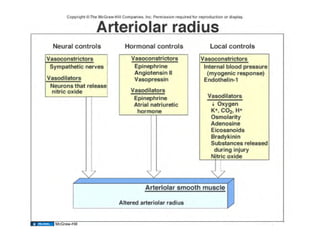
  • 38.
    Local Influences onArterioles (Local = no neural or humoral control) Active Hyperemia Reactive Hyperemia Autoregulation 38
  • 39.
    Think of accumulationof vasodilator metabolites. Active hyperemia Reactive Hyperemia = increased blood flow in response to = increased blood flow following increased metabolic demand a period of no flow M&H 7.3 Mohrman and Heller. Cardiovascular Physiology. McGraw-Hill, 2006. 6th ed. 39
  • 40.
  • 41.
    Autoregulation = relativelyconstant blood flow 8.4 HM in the face of changed perfusion pressure Time Mohrman and Heller. Cardiovascular Physiology. McGraw-Hill, 2006. 6th ed. Think of vasodilator metabolite washout. 41
  • 42.
    M&H 7.4 Mohrman andHeller. Cardiovascular Physiology. McGraw-Hill, 2006. 6th ed. 42
  • 43.
  • 44.
    Other Smooth Muscles Vascular arteries, arterioles, venuoles, veins, lymphatic Gastrointestinal longitudinal vs circular, esophageal, gastric, intestinal sphincter smooth muscles, gallbladder bile and pancreatic ducts Pulmonary tracheal, bronchial, bronchiolar Urinary System bladder, ureters, urethra Reproductive System uterus, vagina, oviducts, vas deferens, prostate capsule Miscellaneous iris of eye capsule of spleen piloerector muscles of skin hairs myoepithelial cells of glands 44
  • 45.
    Vessel Ring Spiral cutvessel strip Tension measurement D’Alecy 45
  • 46.
    Historical Response toAch = contraction !! Direct action on VSM Source Undetermined 46
  • 47.
    Vessel with intactendothelium relaxes to Ach !!!!!! Via NO release from EC 47 Source Undetermined
  • 48.
    Fig 6.2 Lilly, L.Pathophysiology of Heart Disease. Lippincott, 2007. 4th ed. 48
  • 49.
    Sheer or Flow Mediated Dilation * FMD * NOS Lilly, L. Pathophysiology of Heart Disease. Lippincott, 2007. 4th ed. 49
  • 50.
    NOS Isoforms, Activityand Inhibition • Three isoforms: endothelial, neuronal and inducible • Catalyze formation of NO and citrulline from L-arg • NO production in endothelium produces------ – Vasodilation, inhibition of platelet aggregation & inhibition of pro- inflammatory response • Inhibit NOS NO endothelial dysfunction –vasoconstriction –atherogenesis – cardiovascular disease 50
  • 51.
    ADMA the newest“bad guy”; maybe? R.H. Boger et. Al, Atherosclerosis Supplements 4 (2003) 1-3 Asymmetrical Dimethylarginine = ADMA 51
  • 52.
    Asymmetrical Dimethylarginine (ADMA) • What is it? • What can it do? • Where does it come from? • Where does it go? • What does it really do? • Can we mimic or block it to therapeutic advantage? 52
  • 53.
    The Cast ofPlayers ADMA = Asymmetrical dimethylarginine (more abundant NOS inhibitor) SDMA = Symmetrical dimethylarginine (?? Inactive on NOS) L-NMMA = Monomethylarginine (less abundant NOS inhibitor) DDAH = Dimethylarginine dimethylaminohydrolase (hydrolyzes ADMA) PRMT = Protein arginine methyltransferase (makes ADMA and SDMA) 53
  • 54.
    Arginine and endogenousderivatives What is ADMA? NOS Inhibitor NOS-Inactive NOS Inhibitor NOS Substrate DDAH Substrate Regioisomer DDAH Substrate Source Undetermined 54
  • 55.
    Major control forNO?? + - PRMT DDAH all in WB R.H. Boger et. Al, Atherosclerosis Supplements 4 (2003) 1-3 55
  • 56.
    ADMA: Formation/Release • Protein-incorporatedarginine residues are dimethylated by protein arginine methyltransferases (PRMTs) – No methylation of free arginine reported • Free ADMA released via “normal protein turnover” SAM SAH Protein Protein w/ ADMA ADMA PRMT Protein Hydrolysis • Questions: Where does free plasma ADMA originate and how is it released in WB ex vivo? 56
  • 57.
    Plasma concentration ofasymmetrical dimethylarginine and mortality in patients with end-stage renal disease: a prospective study Lancet 2001; 358: 2113–17 Zoccali C. et al tested the predictive power of ADMA for mortality and cardiovascular outcomes and concluded “ADMA is a stronger independent predictor of all-cause mortality and cardiovascular outcomes… in patients with CRF…” “Predictor” 57
  • 58.
    Where does ADMAcome from? • Elevated plasma ADMA in : – Hypercholesterolemia – Hypertension – Hyperhomocyct(e)inemia – Tobacco exposure , – Peripheral arterial occlusive disease – Experimental hemorrhage (acute) – Pre-eclampsia – Hyperglycemia – Insulin resistance in patients --- and so on 58
  • 59.
    Methods • Incubation ofrat whole blood (WB) and WB fractions – Sample placed in vial and incubated at 37˚C • HPLC analysis of blood ADMA/SDMA • Acid hydrolysis of blood components – Liberates free amino acids for their quantification 59
  • 60.
    Summary • WB plasmacontains free ADMA at < 1 M • WB contains > 40 M protein-incorporated ADMA with the majority (>95%) in RBCs • WB possesses the proteolytic machinery necessary for ADMA release into the plasma • Inhibition of protease activity attenuates ADMA release from blood ex vivo 60
  • 61.
    Conclusion • WB canbe considered a 5 kg “liquid organ” in intimate contact with the vascular endothelium. • WB has the capacity to release physiologically and pathophysiologically relevant amounts of ADMA ex vivo. • WB is an independent source of ADMA and as such may play an etiological role in vascular disease. 61
  • 62.
    ADMA-NOS-NO pathway the newest drug target? + - PRMT DDAH all in WB 62 R.H. Boger et. Al, Atherosclerosis Supplements 4 (2003) 1-3
  • 63.
    Additional Source Information for more information see: http://open.umich.edu/wiki/CitationPolicy Slide 6 : Mohrman and Heller. Cardiovascular Physiology. McGraw-Hill, 2006. 6th ed. Slide 7: McGraw-Hill Slide 8: McGraw-Hill Slide 9 : Mohrman and Heller. Cardiovascular Physiology. McGraw-Hill, 2006. 6th ed. Slide 10: McGraw-Hill Slide 11: Source Undetermined Slide 12: Source Undetermined Slide 14: McGraw-Hill Slide 19 : Mohrman and Heller. Cardiovascular Physiology. McGraw-Hill, 2006. 6th ed. Slide 20 : Mohrman and Heller. Cardiovascular Physiology. McGraw-Hill, 2006. 6th ed. Slide 23 : Mohrman and Heller. Cardiovascular Physiology. McGraw-Hill, 2006. 6th ed. Slide 24: McGraw-Hill Slide 25 : Mohrman and Heller. Cardiovascular Physiology. McGraw-Hill, 2006. 6th ed. Slide 31: D’Alecy Slide 32: Source Undetermined Slide 33 : Mohrman and Heller. Cardiovascular Physiology. McGraw-Hill, 2006. 6th ed. Slide 34: D’Alecy Slide 35: D’Alecy Slide 36: McGraw-Hill Slide 37: McGraw-Hill Slide 39 : Mohrman and Heller. Cardiovascular Physiology. McGraw-Hill, 2006. 6th ed. Slide 40: Arteriosclerosis Thrombosis Vascular Biology Slide 41 : Mohrman and Heller. Cardiovascular Physiology. McGraw-Hill, 2006. 6th ed. Slide 42: Mohrman and Heller. Cardiovascular Physiology. McGraw-Hill, 2006. 6th ed. Slide 43: Source Undetermined Slide 45: D’Alecy Slide 46: Source Undetermined Slide 47: Source Undetermined Slide 48: Lilly, L. Pathophysiology of Heart Disease. Lippincott, 2007. 4th ed. Slide 49: Lilly, L. Pathophysiology of Heart Disease. Lippincott, 2007. 4th ed. Slide 51: R.H. Boger et. Al, Atherosclerosis Supplements 4 (2003) 1-3 Slide 54: Source Undetermined Slide 55: R.H. Boger et. Al, Atherosclerosis Supplements 4 (2003) 1-3