


Still grading journals,
Please take out a blank
sheet of paper for today’s
opener.
DRAW A LINE SEPARATING TODAY &
YESTERDAY
1) Write: Date: 11/01/10, Topic: Primary Elections
2) Next line, write “Opener #38” and then:
1) Write 1 high+1 low in last 24 hours
2) Rate your understanding of
yesterday: lost<1-5>too easy (3 is perfect)
3) Respond to the Opener by writing
at least 1 sentences about:
Your opinions/thoughts OR/AND
Questions sparked by the clip OR/AND
Summary of the clip OR/AND
Agenda
1) Primary Elections
Primary Objective
1) How does each party choose it’s
candidate?
Reminder
1) Complete podcast, pick election
stories.
Review
1) Creating a Party: Anyone can create a
new political party. Party is a club that
runs for office. As a private club, parties
can set their own rules.
2) How to become a party member: Check
box on your voter reg form. Party
leaders are chosen by active members
or those who give a lot of money.
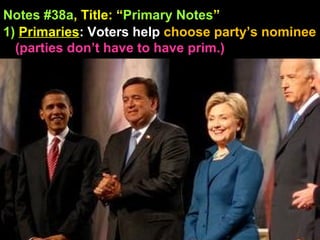
Notes #38a, Title: “Primary Notes”
1) Primaries: Voters help chose party’s nominee
(parties don’t have to have prim.)
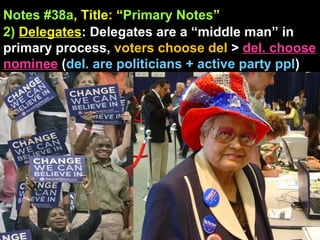
2) Delegates: Delegates are a “middle man” in
primary process, voters choose del > del. choose
nominee (del. are politicians + active party ppl)
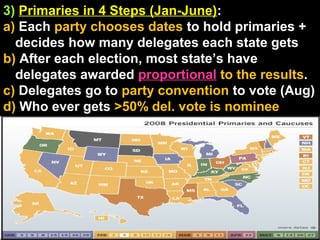
3) Primaries in 4 Steps (Jan-June):
a) Each party chooses dates to hold primary
elections + decides how many delegates each
state gets
b) After each election, most state’s have
delegates awarded proportional to the results.
c) Delegates go to party convention to vote
d) Who ever gets >50% del. vote is nominee
Notes #38a, Title: “Primary Notes”
1) Primaries: Voters help choose party’s nominee
(parties don’t have to have prim.)
Notes #38a, Title: “Primary Notes”
2) Delegates: Delegates are a “middle man” in
primary process, voters choose del > del. choose
nominee (del. are politicians + active party ppl)
3) Primaries in 4 Steps (Jan-June):
a) Each party chooses dates to hold primaries +
decides how many delegates each state gets
b) After each election, most state’s have
delegates awarded proportional to the results.
c) Delegates go to party convention to vote (Aug)
d) Who ever gets >50% del. vote is nominee
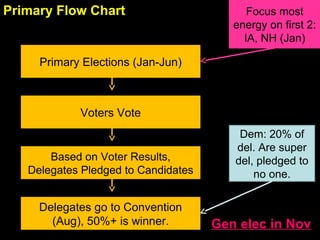
Primary Flow Chart
Primary Elections (Jan-Jun)
Voters Vote
Based on Voter Results,
Delegates Pledged to Candidates
Delegates go to Convention
(Aug), 50%+ is winner.
Dem: 20% of
del. Are super
del, pledged to
no one.
Focus most
energy on first 2:
IA, NH (Jan)
Gen elec in Nov
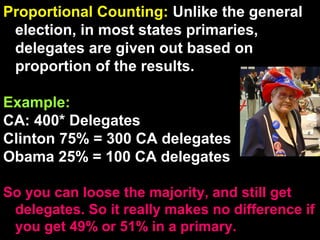
Proportional Counting: Unlike the general
election, in most states primaries,
delegates are given out based on
proportion of the results.
Example:
CA: 400* Delegates
Clinton 75% = 300 CA delegates
Obama 25% = 100 CA delegates
So you can loose the majority, and still get
delegates. So it really makes no difference if
you get 49% or 51% in a primary.
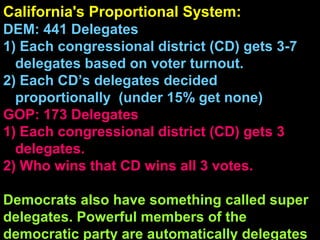
California's Proportional System:
DEM: 441 Delegates
1) Each congressional district (CD) gets 3-7
delegates based on voter turnout.
2) Each CD’s delegates decided
proportionally (under 15% get none)
GOP: 173 Delegates
1) Each congressional district (CD) gets 3
delegates.
2) Who wins that CD wins all 3 votes.
Democrats also have something called super
delegates. Powerful members of the
democratic party are automatically delegates
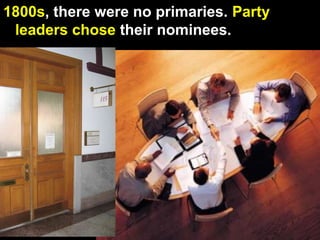
1800s, there were no primaries. Party
leaders chose their nominees.
1900s, Party creates primaries to provide
the people a say in the nominations.
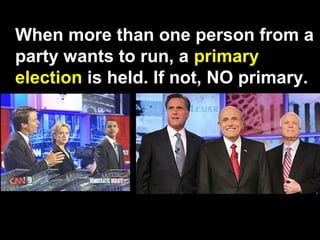
When more than one person from a
party wants to run, a primary
election is held. If not, NO primary.
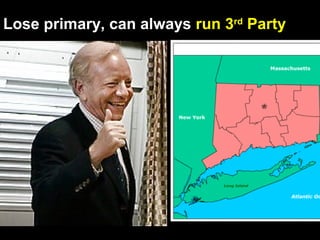
Lose primary, can always run 3rd
Party
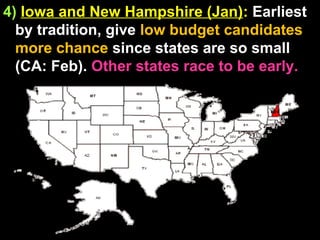
4) Iowa and New Hampshire (Jan): Earliest
by tradition, give low budget candidates
more chance since states are so small
(CA: Feb). Other states race to be early.
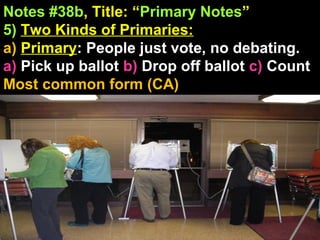
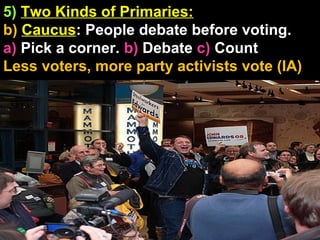
5) Two Kinds of Primaries:
a) Primary: People just vote, no debating.
a) Pick up ballot b) Drop off ballot c) Count
Most common form (CA)
b) Caucus: People debate before voting.
a) Pick a corner. b) Debate c) Count
Less voters, more party activists vote (IA)
4) Iowa and New Hampshire (Jan): Earliest
by tradition, give low budget candidates
more chance since states are so small
(CA: Feb). Other states race to be early.
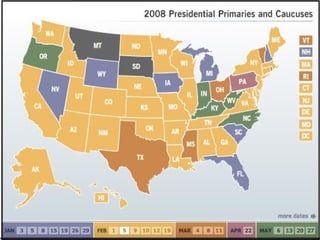
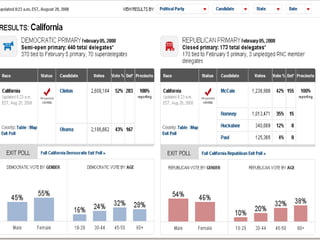
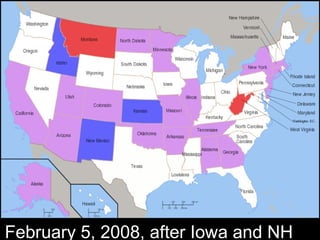
February 5, 2008, after Iowa and NH
Journ #38a, “Primary Debate”
1) Read the 2 sides, choose 1 side, and write
which you choose and explain why.
2) Then write down what your partner thinks
(include their name at the end).
1 2 3 4 5
CON: Big State/All State
1) Big states deserve
more say
2) It’s chaos if everyone
races to be after NH/IA
3) Iowa and New
Hampshire don’t reflect
PRO: Small States 1st
1) Small states take it
seriously
2) Small states are cheap
allow more to try to run
3) Iowa and New
Hampshire are the heart
Notes #38b, Title: “Primary Notes”
5) Two Kinds of Primaries:
a) Primary: People just vote, no debating.
a) Pick up ballot b) Drop off ballot c) Count
Most common form (CA)
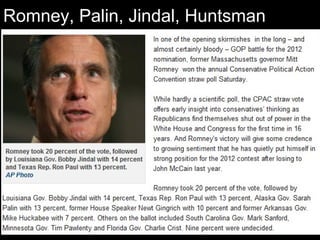
Romney, Palin, Jindal, Huntsman
5) Two Kinds of Primaries:
b) Caucus: People debate before voting.
a) Pick a corner. b) Debate c) Count
Less voters, more party activists vote (IA)
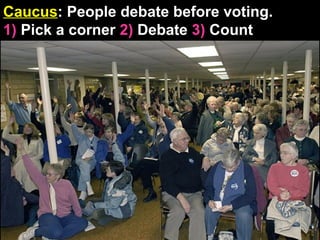
Caucus: People debate before voting.
1) Pick a corner 2) Debate 3) Count
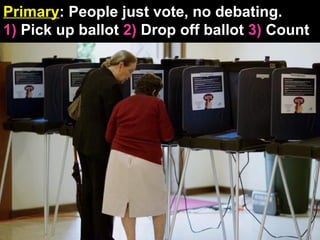
Primary: People just vote, no debating.
1) Pick up ballot 2) Drop off ballot 3) Count
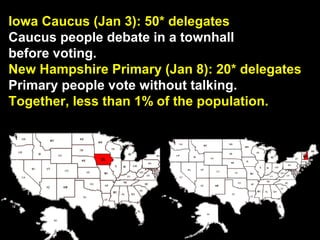
Iowa Caucus (Jan 3): 50* delegates
Caucus people debate in a townhall
before voting.
New Hampshire Primary (Jan 8): 20* delegates
Primary people vote without talking.
Together, less than 1% of the population.
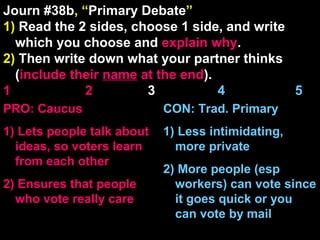
Journ #38b, “Primary Debate”
1) Read the 2 sides, choose 1 side, and write
which you choose and explain why.
2) Then write down what your partner thinks
(include their name at the end).
1 2 3 4 5
CON: Trad. Primary
1) Less intimidating,
more private
2) More people (esp
workers) can vote since
it goes quick or you
can vote by mail
PRO: Caucus
1) Lets people talk about
ideas, so voters learn
from each other
2) Ensures that people
who vote really care
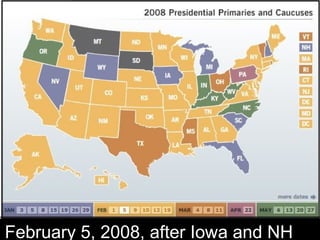
February 5, 2008, after Iowa and NH
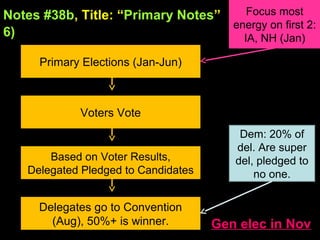
Notes #38b, Title: “Primary Notes”
6)
Primary Elections (Jan-Jun)
Voters Vote
Based on Voter Results,
Delegated Pledged to Candidates
Delegates go to Convention
(Aug), 50%+ is winner.
Dem: 20% of
del. Are super
del, pledged to
no one.
Focus most
energy on first 2:
IA, NH (Jan)
Gen elec in Nov
Journal #38c, Title “2008 Election”
1) Copy Source Title: By the People
2…) Discuss questions on the board
with a partner. Summarize your
discussion (include their name at the
end). Remember participation points
are deducted if off task.
5 Reading/Film Qs Come From These Work Sections

110110 gov primary election 50m

  • 1.
    Still grading journals, Pleasetake out a blank sheet of paper for today’s opener.
  • 2.
    DRAW A LINESEPARATING TODAY & YESTERDAY 1) Write: Date: 11/01/10, Topic: Primary Elections 2) Next line, write “Opener #38” and then: 1) Write 1 high+1 low in last 24 hours 2) Rate your understanding of yesterday: lost<1-5>too easy (3 is perfect) 3) Respond to the Opener by writing at least 1 sentences about: Your opinions/thoughts OR/AND Questions sparked by the clip OR/AND Summary of the clip OR/AND
  • 3.
    Agenda 1) Primary Elections PrimaryObjective 1) How does each party choose it’s candidate? Reminder 1) Complete podcast, pick election stories.
  • 4.
    Review 1) Creating aParty: Anyone can create a new political party. Party is a club that runs for office. As a private club, parties can set their own rules. 2) How to become a party member: Check box on your voter reg form. Party leaders are chosen by active members or those who give a lot of money.
  • 5.
    Notes #38a, Title:“Primary Notes” 1) Primaries: Voters help chose party’s nominee (parties don’t have to have prim.) 2) Delegates: Delegates are a “middle man” in primary process, voters choose del > del. choose nominee (del. are politicians + active party ppl) 3) Primaries in 4 Steps (Jan-June): a) Each party chooses dates to hold primary elections + decides how many delegates each state gets b) After each election, most state’s have delegates awarded proportional to the results. c) Delegates go to party convention to vote d) Who ever gets >50% del. vote is nominee
  • 6.
    Notes #38a, Title:“Primary Notes” 1) Primaries: Voters help choose party’s nominee (parties don’t have to have prim.)
  • 7.
    Notes #38a, Title:“Primary Notes” 2) Delegates: Delegates are a “middle man” in primary process, voters choose del > del. choose nominee (del. are politicians + active party ppl)
  • 8.
    3) Primaries in4 Steps (Jan-June): a) Each party chooses dates to hold primaries + decides how many delegates each state gets b) After each election, most state’s have delegates awarded proportional to the results. c) Delegates go to party convention to vote (Aug) d) Who ever gets >50% del. vote is nominee
  • 10.
    Primary Flow Chart PrimaryElections (Jan-Jun) Voters Vote Based on Voter Results, Delegates Pledged to Candidates Delegates go to Convention (Aug), 50%+ is winner. Dem: 20% of del. Are super del, pledged to no one. Focus most energy on first 2: IA, NH (Jan) Gen elec in Nov
  • 11.
    Proportional Counting: Unlikethe general election, in most states primaries, delegates are given out based on proportion of the results. Example: CA: 400* Delegates Clinton 75% = 300 CA delegates Obama 25% = 100 CA delegates So you can loose the majority, and still get delegates. So it really makes no difference if you get 49% or 51% in a primary.
  • 12.
    California's Proportional System: DEM:441 Delegates 1) Each congressional district (CD) gets 3-7 delegates based on voter turnout. 2) Each CD’s delegates decided proportionally (under 15% get none) GOP: 173 Delegates 1) Each congressional district (CD) gets 3 delegates. 2) Who wins that CD wins all 3 votes. Democrats also have something called super delegates. Powerful members of the democratic party are automatically delegates
  • 14.
    1800s, there wereno primaries. Party leaders chose their nominees.
  • 15.
    1900s, Party createsprimaries to provide the people a say in the nominations.
  • 16.
    When more thanone person from a party wants to run, a primary election is held. If not, NO primary.
  • 17.
    Lose primary, canalways run 3rd Party
  • 18.
    4) Iowa andNew Hampshire (Jan): Earliest by tradition, give low budget candidates more chance since states are so small (CA: Feb). Other states race to be early. 5) Two Kinds of Primaries: a) Primary: People just vote, no debating. a) Pick up ballot b) Drop off ballot c) Count Most common form (CA) b) Caucus: People debate before voting. a) Pick a corner. b) Debate c) Count Less voters, more party activists vote (IA)
  • 19.
    4) Iowa andNew Hampshire (Jan): Earliest by tradition, give low budget candidates more chance since states are so small (CA: Feb). Other states race to be early.
  • 20.
    February 5, 2008,after Iowa and NH
  • 21.
    Journ #38a, “PrimaryDebate” 1) Read the 2 sides, choose 1 side, and write which you choose and explain why. 2) Then write down what your partner thinks (include their name at the end). 1 2 3 4 5 CON: Big State/All State 1) Big states deserve more say 2) It’s chaos if everyone races to be after NH/IA 3) Iowa and New Hampshire don’t reflect PRO: Small States 1st 1) Small states take it seriously 2) Small states are cheap allow more to try to run 3) Iowa and New Hampshire are the heart
  • 22.
    Notes #38b, Title:“Primary Notes” 5) Two Kinds of Primaries: a) Primary: People just vote, no debating. a) Pick up ballot b) Drop off ballot c) Count Most common form (CA)
  • 23.
  • 24.
    5) Two Kindsof Primaries: b) Caucus: People debate before voting. a) Pick a corner. b) Debate c) Count Less voters, more party activists vote (IA)
  • 25.
    Caucus: People debatebefore voting. 1) Pick a corner 2) Debate 3) Count
  • 26.
    Primary: People justvote, no debating. 1) Pick up ballot 2) Drop off ballot 3) Count
  • 27.
    Iowa Caucus (Jan3): 50* delegates Caucus people debate in a townhall before voting. New Hampshire Primary (Jan 8): 20* delegates Primary people vote without talking. Together, less than 1% of the population.
  • 28.
    Journ #38b, “PrimaryDebate” 1) Read the 2 sides, choose 1 side, and write which you choose and explain why. 2) Then write down what your partner thinks (include their name at the end). 1 2 3 4 5 CON: Trad. Primary 1) Less intimidating, more private 2) More people (esp workers) can vote since it goes quick or you can vote by mail PRO: Caucus 1) Lets people talk about ideas, so voters learn from each other 2) Ensures that people who vote really care
  • 29.
    February 5, 2008,after Iowa and NH
  • 30.
    Notes #38b, Title:“Primary Notes” 6) Primary Elections (Jan-Jun) Voters Vote Based on Voter Results, Delegated Pledged to Candidates Delegates go to Convention (Aug), 50%+ is winner. Dem: 20% of del. Are super del, pledged to no one. Focus most energy on first 2: IA, NH (Jan) Gen elec in Nov
  • 31.
    Journal #38c, Title“2008 Election” 1) Copy Source Title: By the People 2…) Discuss questions on the board with a partner. Summarize your discussion (include their name at the end). Remember participation points are deducted if off task. 5 Reading/Film Qs Come From These Work Sections

Editor's Notes

  • #4 Mudd, Roger. (2000). 100 Years of Terror Series. New York, NY: History Channel. Hori, Lance (2006). Inside 9/11. Washington DC: National Geographic. Friedman, Thomas. (2003). Searching for the Roots of 9/11. Silverspring, MD: Discvoery Times.