DRAW A LINE SEPARATING TODAY & YESTERDAY 1) Write:   Date:  04/27/11 , Topic:  Lobbying 2) Next line, write “ Opener #49 ” and then:  1) Write  1 high + 1   low   in last 24 hours 2) Rate your understanding of yesterday:  lost < 1-5 > too easy (3 is perfect) 3) Respond to the  Opening Clip  by writing at least   1 sentences  about : Your opinions/thoughts  OR/AND Questions sparked by the clip   OR/AND Summary of the clip  OR/AND Announcements: None
Agenda 1)  Lobbying Introduction What you will be able to do: 1)  Know how to lobby Reminder 1)   Complete Podcast
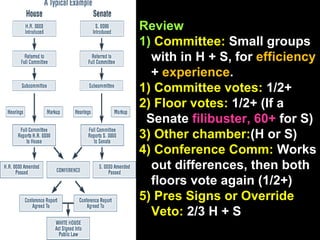
Review 1)  Committee:  Small groups with in H + S, for  efficiency  +  experience .  1) Committee votes:  1/2+ 2) Floor votes:  1/2+ (If a Senate  filibuster, 60+  for S) 3) Other chamber: (H or S) 4) Conference Comm:  Works out differences, then both floors vote again (1/2+) 5) Pres Signs or Override Veto:  2/3 H + S
2 )   Kinds of Incentives for Congressmembers : a) Money:  Need to run for re-election (2 or 6 yrs) (you a donor, party leadership money, + president star power all sources) b) President:  Veto your bills (2/3 vote to override) pres/exec branch can not be helpful, pres can campaign for you/against you,  not invite to parties c) Media:  Need to not look bad to voters d) Beliefs:  Personal desire to do what’s right e) Voter Demands:  Voter input in visits to office, letters, phones, emails, and faxes REMEMBER GOVT WORKS FOR YOU!
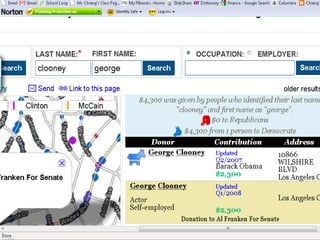
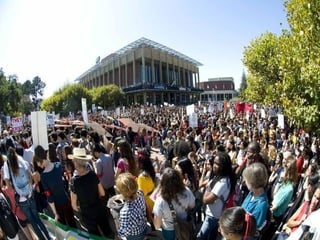
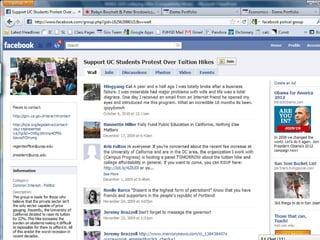
Notes #49a , Title: “ Lobbying Notes ”   1)   Lobbying : Act of persuading Congress/CA leg a) Expert info , provide research (think tanks) b) Donate  money (if SIG donates, it’s a PAC) c)  Using the  media  (letters to the editor, press release, rallies, protest, other attention getters) d) Campaigning  for or against them either with them or independently (talk to voters, mail ads) e) Sue  in court to pressure Congress 2)   Buckley v Valeo (1976) : Court states political speech is the most protected, money=speech ANYONE CAN DONATE OR SPEND ON CAMPAIGNS, THOSE WHO DO HAVE POWER! THOSE WHO BUNDLE EVEN MORE POWER!
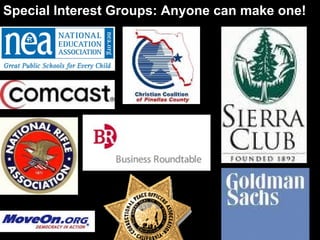
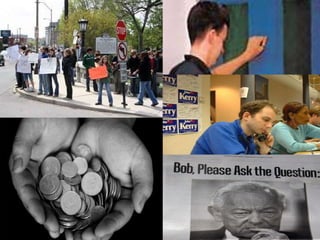
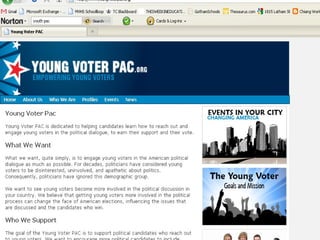
Special Interest Groups: Anyone can make one!


Journ #49a , Title “ Lobbying ” Work with partner ( include their name ), think of which lobbying tool from your Notes 49a, 1a-e is BEST and WORST (many SIGs use every method): 1)  College student marijuana group 2)  Coalition of cell phone service companies 3)  Statewide gay rights group 4)  Nationwide global warming group 5)  For a teen political special interest group, which methods can teens best utilize? .
Separate Peace of Paper: Create a SIG Make Your Own Special Interest Group (SIG) :  Example of a to do list: 1)  Find   believers, train, collect  dues 2)  Investigate  candidates’ position on your cause 3)  Endorse candidates favorable to you 4)  Donate part of member dues to candidate (PAC)  5)  Members campaign for the candidate 6)  After election,  monitor   if candidate defends your cause, otherwise, support other in next election (score their performance, like a grading system) 1)  Name + Logo (make it appealing) 2)  Mission 3)  To do list ( Where? What? )   of what your SIG will have them do, example above, see notes 1)
Separate Peace of Paper: Create a SIG Make Your Own Special Interest Group (SIG) :  1)  Find believers, train, collect dues
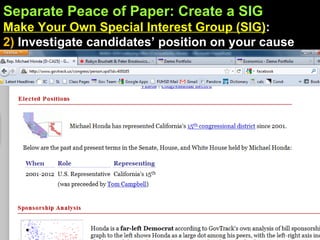
Separate Peace of Paper: Create a SIG Make Your Own Special Interest Group (SIG) :  2)  Investigate candidates’ position on your cause
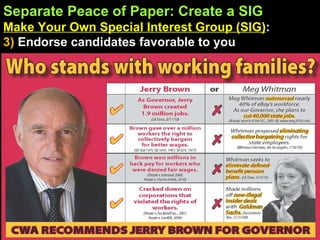
Separate Peace of Paper: Create a SIG Make Your Own Special Interest Group (SIG) :  3)  Endorse candidates favorable to you
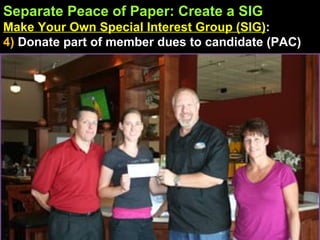
Separate Peace of Paper: Create a SIG Make Your Own Special Interest Group (SIG) :  4)  Donate part of member dues to candidate (PAC)
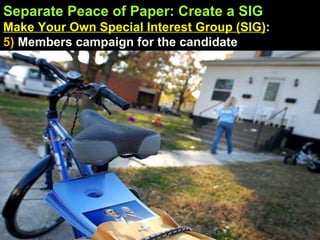
Separate Peace of Paper: Create a SIG Make Your Own Special Interest Group (SIG) :  5)  Members campaign for the candidate
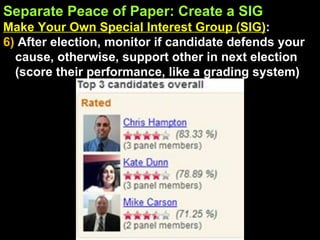
Separate Peace of Paper: Create a SIG Make Your Own Special Interest Group (SIG) :  6)  After election, monitor if candidate defends your cause, otherwise, support other in next election (score their performance, like a grading system)
Separate Peace of Paper: Create a SIG Make Your Own Special Interest Group (SIG) :  Example of a to do list: 1)  Find   believers, train, collect  dues 2)  Investigate  candidates’ position on your cause 3)  Endorse candidates favorable to you 4)  Donate part of member dues to candidate (PAC)  5)  Members campaign for the candidate 6)  After election,  monitor   if candidate defends your cause, otherwise, support other in next election (score their performance, like a grading system) 1)  Name + Logo (make it appealing) 2)  Mission 3)  To do list ( Where? What? )   of what your SIG will have them do, example above, see notes 1)
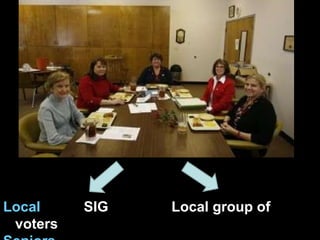
Local   SIG  Local group of voters Seniors
 
 
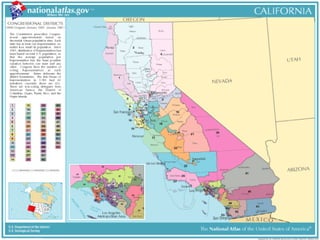
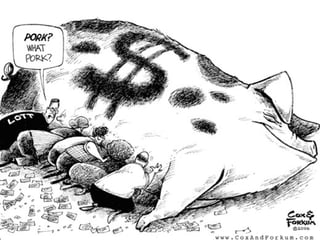
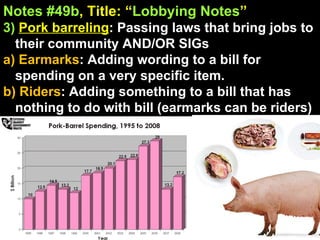
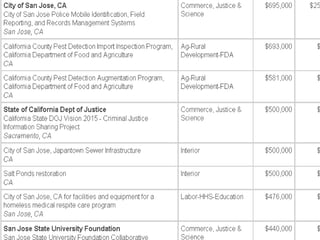
Notes #49b , Title: “ Lobbying Notes ”   3)   Pork barreling : Passing laws that bring jobs to their community AND/OR SIGs a) Earmarks : Adding wording to a bill for spending on a very specific item. b) Riders : Adding something to a bill that has nothing to do with bill (earmarks can be riders)
 
CA High Speed Rail $40 Billion Dollar Project Price Tag
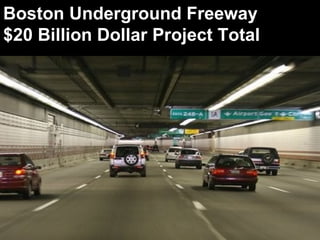
Boston Underground Freeway $20 Billion Dollar Project Total
 
 
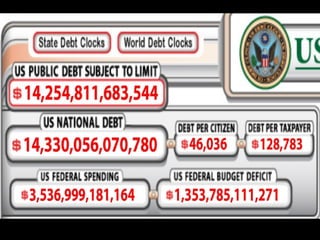
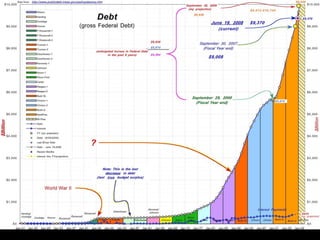
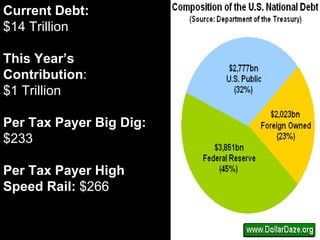
Current Debt: $14 Trillion This Year’s Contribution : $1 Trillion Per Tax Payer Big Dig: $233 Per Tax Payer High Speed Rail:  $266
Journ #49b , Title “ Making Earmarks and Riders ” Riders  can be  earmarks ,  earmarks  can be  riders , but not always.  Rider (off topic)  isn’t related to the main content of the bill,  earmarks ($)  sometimes are related, sometimes aren’t. Work with partner ( include their name ): 1)  Create a  earmark  (think of something in Cupertino you want Honda to spend federal tax money on ( pork spending ). 2)  Create a  rider  to the education bill we will write tomorrow that has  NOTHING to do with education .
Journ #49b , “ Pork Barrel Debate ” 1)  Read the 2 sides, choose 1 side, and write which you choose and  explain   why . 2)  Then write down what your partner thinks ( include their  name  at the end ). 1    2   3  4  5 CON: Honda should make sure the country overall is better off Our rep defends the country 2) If we spend like this, we’ll go deeper into debt PRO: Honda’s job is to bring home pork to Cupertino 1) We elect a local rep to defend local needs 2) If we don’t fight for federal tax money to be used here, other ppl will take it all for their places
Review  1)   House of Reps : 435 members, 2 year terms 2)   Senate : 100 members, 6 year terms 3)   Commiteees : Investigate and edit bills + problems 4)   Committee Chairpersons : Set com. schedule 5)   Speaker of the House/Senate Majority Leader : Picks committees and sends bills to committee: goal is to keep party disciplined 6)   Committee Vote : Over 1/2 7)   Floor Vote : Over 1/2 8)   Filibuster : Senator’s power to delay a bill to death 9)   Cloture : 60 votes to stop filibuster 10)   Veto : President kills the bill 11)   Veto Override : 2/3 to override presidential veto 12)   Earmarks : Bill wording that specifices spending  13)   Riders : Adding to a bill something off topic
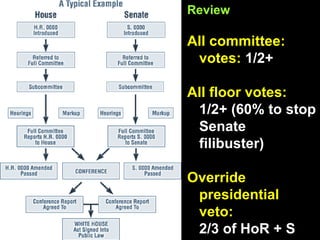
Review All committee: votes:  1/2+ All floor votes:  1/2+ (60% to stop Senate  filibuster) Override presidential veto: 2/3 of HoR + S
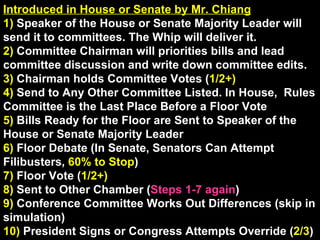
Introduced in House or Senate by Mr. Chiang 1)  Speaker of the House or Senate Majority Leader will send it to committees. The Whip will deliver it. 2)  Committee Chairman will priorities bills and lead committee discussion and write down committee edits. 3)  Chairman holds Committee Votes ( 1/2+) 4)  Send to Any Other Committee Listed. In House,  Rules Committee is the Last Place Before a Floor Vote 5)  Bills Ready for the Floor are Sent to Speaker of the House or Senate Majority Leader 6)  Floor Debate (In Senate, Senators Can Attempt Filibusters,  60% to Stop ) 7)  Floor Vote ( 1/2+) 8)  Sent to Other Chamber ( Steps 1-7 again ) 9)  Conference Committee Works Out Differences (skip in simulation) 10)  President Signs or Congress Attempts Override ( 2/3 )
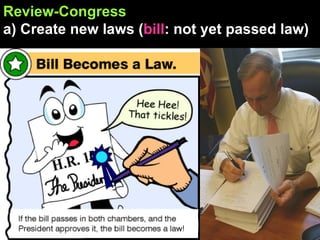
Review-Congress a) Create new laws ( bill : not yet passed law)
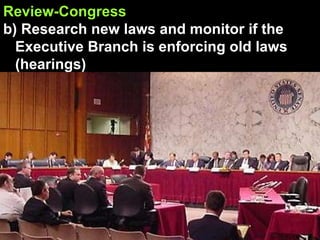
Review-Congress b) Research new laws and monitor if the Executive Branch is enforcing old laws (hearings)
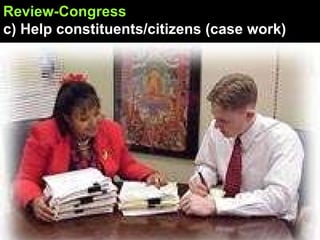
Review-Congress c) Help constituents/citizens (case work)
Journal #49d , Title “ Video: ” 1)  Copy Source Title:   A 2…)  Discuss questions on the board with a partner. Summarize your discussion ( include their  name  at the end ).  Remember participation points are deducted if off task.  5 Reading/Film Qs Come From These Journal Sections Time Bookmark: 00:00
Homework:  1)  Study today’s notes + journal sections for  a possible journal quiz . 2)  Pick and listen to your  4 news podcast  by next Monday. Journal Check:  If your name is called, drop off your journal with Mr. Chiang ( if requested, points lost if your journal is not turned in )

042611 gov lobbying 100m

  • 1.
    DRAW A LINESEPARATING TODAY & YESTERDAY 1) Write: Date: 04/27/11 , Topic: Lobbying 2) Next line, write “ Opener #49 ” and then: 1) Write 1 high + 1 low in last 24 hours 2) Rate your understanding of yesterday: lost < 1-5 > too easy (3 is perfect) 3) Respond to the Opening Clip by writing at least 1 sentences about : Your opinions/thoughts OR/AND Questions sparked by the clip OR/AND Summary of the clip OR/AND Announcements: None
  • 2.
    Agenda 1) Lobbying Introduction What you will be able to do: 1) Know how to lobby Reminder 1) Complete Podcast
  • 3.
    Review 1) Committee: Small groups with in H + S, for efficiency + experience . 1) Committee votes: 1/2+ 2) Floor votes: 1/2+ (If a Senate filibuster, 60+ for S) 3) Other chamber: (H or S) 4) Conference Comm: Works out differences, then both floors vote again (1/2+) 5) Pres Signs or Override Veto: 2/3 H + S
  • 4.
    2 ) Kinds of Incentives for Congressmembers : a) Money: Need to run for re-election (2 or 6 yrs) (you a donor, party leadership money, + president star power all sources) b) President: Veto your bills (2/3 vote to override) pres/exec branch can not be helpful, pres can campaign for you/against you, not invite to parties c) Media: Need to not look bad to voters d) Beliefs: Personal desire to do what’s right e) Voter Demands: Voter input in visits to office, letters, phones, emails, and faxes REMEMBER GOVT WORKS FOR YOU!
  • 5.
    Notes #49a ,Title: “ Lobbying Notes ” 1) Lobbying : Act of persuading Congress/CA leg a) Expert info , provide research (think tanks) b) Donate money (if SIG donates, it’s a PAC) c) Using the media (letters to the editor, press release, rallies, protest, other attention getters) d) Campaigning for or against them either with them or independently (talk to voters, mail ads) e) Sue in court to pressure Congress 2) Buckley v Valeo (1976) : Court states political speech is the most protected, money=speech ANYONE CAN DONATE OR SPEND ON CAMPAIGNS, THOSE WHO DO HAVE POWER! THOSE WHO BUNDLE EVEN MORE POWER!
  • 6.
    Special Interest Groups:Anyone can make one!
  • 7.
  • 8.
  • 9.
  • 10.
  • 11.
  • 12.
  • 13.
  • 14.
  • 15.
  • 16.
    Journ #49a ,Title “ Lobbying ” Work with partner ( include their name ), think of which lobbying tool from your Notes 49a, 1a-e is BEST and WORST (many SIGs use every method): 1) College student marijuana group 2) Coalition of cell phone service companies 3) Statewide gay rights group 4) Nationwide global warming group 5) For a teen political special interest group, which methods can teens best utilize? .
  • 17.
    Separate Peace ofPaper: Create a SIG Make Your Own Special Interest Group (SIG) : Example of a to do list: 1) Find believers, train, collect dues 2) Investigate candidates’ position on your cause 3) Endorse candidates favorable to you 4) Donate part of member dues to candidate (PAC) 5) Members campaign for the candidate 6) After election, monitor if candidate defends your cause, otherwise, support other in next election (score their performance, like a grading system) 1) Name + Logo (make it appealing) 2) Mission 3) To do list ( Where? What? ) of what your SIG will have them do, example above, see notes 1)
  • 18.
    Separate Peace ofPaper: Create a SIG Make Your Own Special Interest Group (SIG) : 1) Find believers, train, collect dues
  • 19.
    Separate Peace ofPaper: Create a SIG Make Your Own Special Interest Group (SIG) : 2) Investigate candidates’ position on your cause
  • 20.
    Separate Peace ofPaper: Create a SIG Make Your Own Special Interest Group (SIG) : 3) Endorse candidates favorable to you
  • 21.
    Separate Peace ofPaper: Create a SIG Make Your Own Special Interest Group (SIG) : 4) Donate part of member dues to candidate (PAC)
  • 22.
    Separate Peace ofPaper: Create a SIG Make Your Own Special Interest Group (SIG) : 5) Members campaign for the candidate
  • 23.
    Separate Peace ofPaper: Create a SIG Make Your Own Special Interest Group (SIG) : 6) After election, monitor if candidate defends your cause, otherwise, support other in next election (score their performance, like a grading system)
  • 24.
    Separate Peace ofPaper: Create a SIG Make Your Own Special Interest Group (SIG) : Example of a to do list: 1) Find believers, train, collect dues 2) Investigate candidates’ position on your cause 3) Endorse candidates favorable to you 4) Donate part of member dues to candidate (PAC) 5) Members campaign for the candidate 6) After election, monitor if candidate defends your cause, otherwise, support other in next election (score their performance, like a grading system) 1) Name + Logo (make it appealing) 2) Mission 3) To do list ( Where? What? ) of what your SIG will have them do, example above, see notes 1)
  • 25.
    Local SIG Local group of voters Seniors
  • 26.
  • 27.
  • 28.
    Notes #49b ,Title: “ Lobbying Notes ” 3) Pork barreling : Passing laws that bring jobs to their community AND/OR SIGs a) Earmarks : Adding wording to a bill for spending on a very specific item. b) Riders : Adding something to a bill that has nothing to do with bill (earmarks can be riders)
  • 29.
  • 30.
    CA High SpeedRail $40 Billion Dollar Project Price Tag
  • 31.
    Boston Underground Freeway$20 Billion Dollar Project Total
  • 32.
  • 33.
  • 34.
    Current Debt: $14Trillion This Year’s Contribution : $1 Trillion Per Tax Payer Big Dig: $233 Per Tax Payer High Speed Rail: $266
  • 35.
    Journ #49b ,Title “ Making Earmarks and Riders ” Riders can be earmarks , earmarks can be riders , but not always. Rider (off topic) isn’t related to the main content of the bill, earmarks ($) sometimes are related, sometimes aren’t. Work with partner ( include their name ): 1) Create a earmark (think of something in Cupertino you want Honda to spend federal tax money on ( pork spending ). 2) Create a rider to the education bill we will write tomorrow that has NOTHING to do with education .
  • 36.
    Journ #49b ,“ Pork Barrel Debate ” 1) Read the 2 sides, choose 1 side, and write which you choose and explain why . 2) Then write down what your partner thinks ( include their name at the end ). 1 2 3 4 5 CON: Honda should make sure the country overall is better off Our rep defends the country 2) If we spend like this, we’ll go deeper into debt PRO: Honda’s job is to bring home pork to Cupertino 1) We elect a local rep to defend local needs 2) If we don’t fight for federal tax money to be used here, other ppl will take it all for their places
  • 37.
    Review 1) House of Reps : 435 members, 2 year terms 2) Senate : 100 members, 6 year terms 3) Commiteees : Investigate and edit bills + problems 4) Committee Chairpersons : Set com. schedule 5) Speaker of the House/Senate Majority Leader : Picks committees and sends bills to committee: goal is to keep party disciplined 6) Committee Vote : Over 1/2 7) Floor Vote : Over 1/2 8) Filibuster : Senator’s power to delay a bill to death 9) Cloture : 60 votes to stop filibuster 10) Veto : President kills the bill 11) Veto Override : 2/3 to override presidential veto 12) Earmarks : Bill wording that specifices spending 13) Riders : Adding to a bill something off topic
  • 38.
    Review All committee:votes: 1/2+ All floor votes: 1/2+ (60% to stop Senate filibuster) Override presidential veto: 2/3 of HoR + S
  • 39.
    Introduced in Houseor Senate by Mr. Chiang 1) Speaker of the House or Senate Majority Leader will send it to committees. The Whip will deliver it. 2) Committee Chairman will priorities bills and lead committee discussion and write down committee edits. 3) Chairman holds Committee Votes ( 1/2+) 4) Send to Any Other Committee Listed. In House, Rules Committee is the Last Place Before a Floor Vote 5) Bills Ready for the Floor are Sent to Speaker of the House or Senate Majority Leader 6) Floor Debate (In Senate, Senators Can Attempt Filibusters, 60% to Stop ) 7) Floor Vote ( 1/2+) 8) Sent to Other Chamber ( Steps 1-7 again ) 9) Conference Committee Works Out Differences (skip in simulation) 10) President Signs or Congress Attempts Override ( 2/3 )
  • 40.
    Review-Congress a) Createnew laws ( bill : not yet passed law)
  • 41.
    Review-Congress b) Researchnew laws and monitor if the Executive Branch is enforcing old laws (hearings)
  • 42.
    Review-Congress c) Helpconstituents/citizens (case work)
  • 43.
    Journal #49d ,Title “ Video: ” 1) Copy Source Title: A 2…) Discuss questions on the board with a partner. Summarize your discussion ( include their name at the end ). Remember participation points are deducted if off task. 5 Reading/Film Qs Come From These Journal Sections Time Bookmark: 00:00
  • 44.
    Homework: 1) Study today’s notes + journal sections for a possible journal quiz . 2) Pick and listen to your 4 news podcast by next Monday. Journal Check: If your name is called, drop off your journal with Mr. Chiang ( if requested, points lost if your journal is not turned in )