UNIT AND MEASUREMENT
Class – 11th
Aditya Mishra
Email: adityakumar2009@gmail.com
Calendula Learning
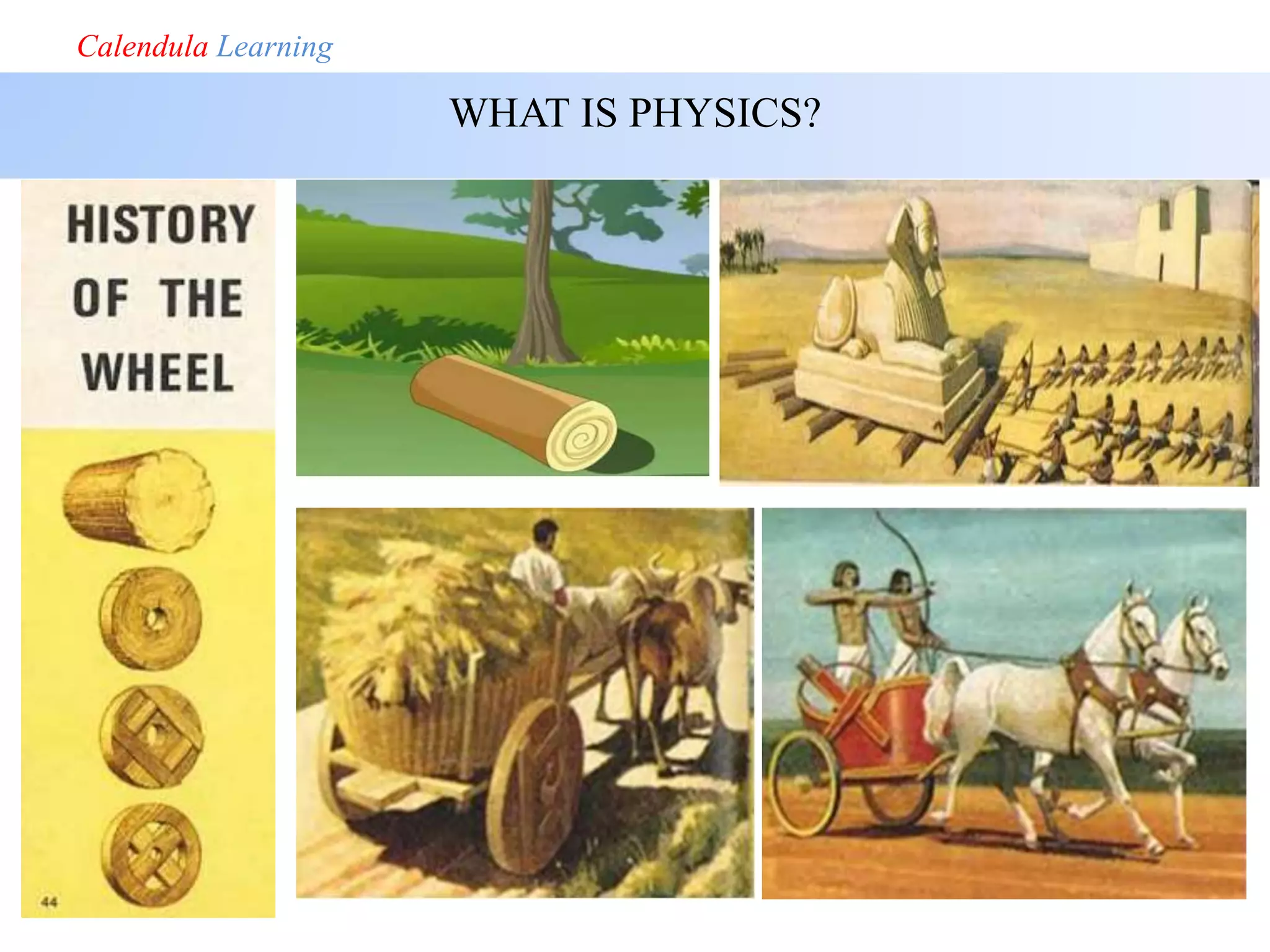
WHAT IS PHYSICS?
Physics :
• Study about nature
• Laws (rules ) of nature
Observation
• What is it ?
• Why something is happening ?
• How it is happening ?
• What if I change something ?
WHAT IS PHYSICS?
Calendula Learning
WHAT IS PHYSICS?
Calendula Learning
PHYSICAL QUANTITY
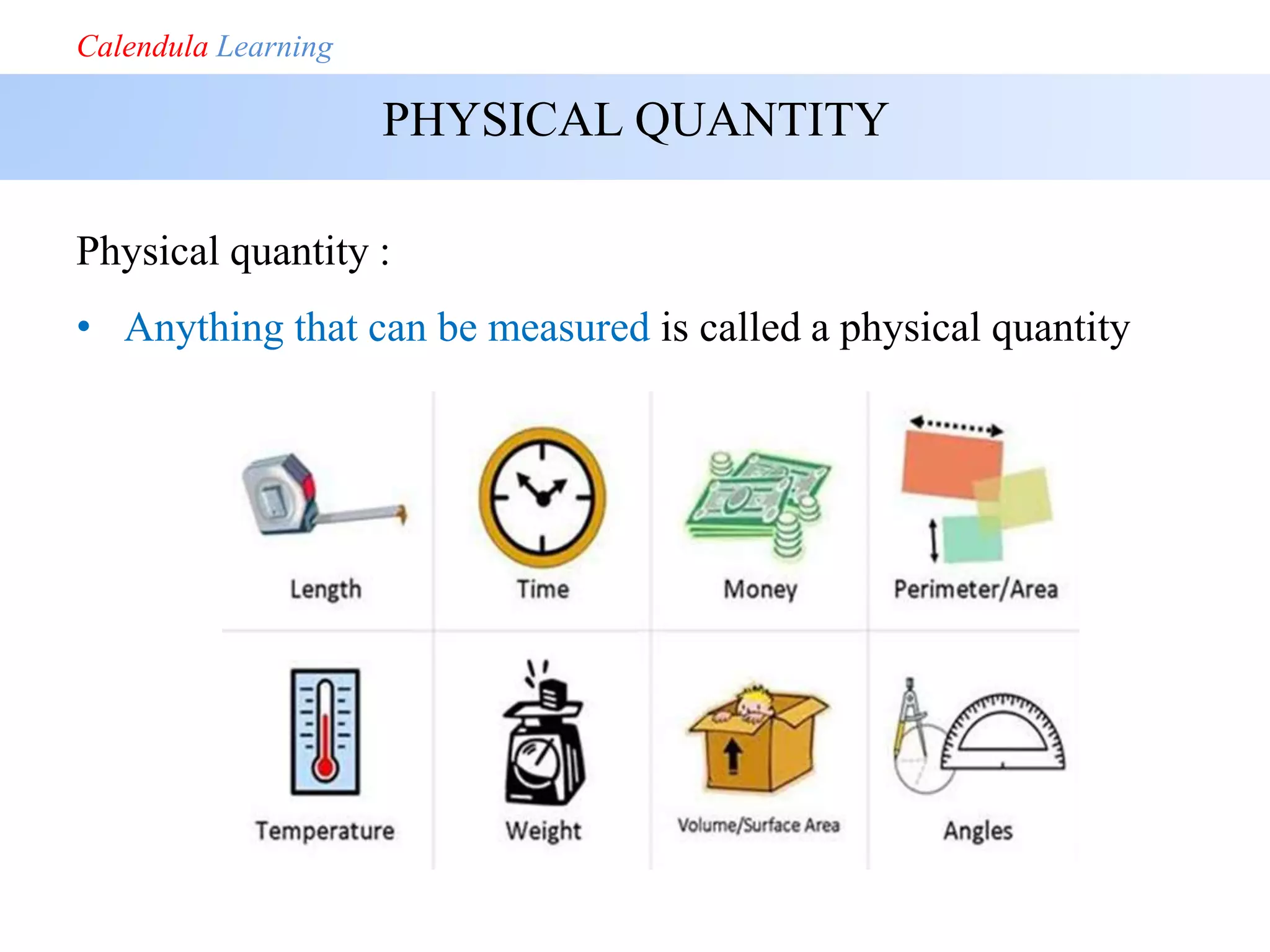
Physical quantity :
• Anything that can be measured is called a physical quantity
Calendula Learning
TYPES OF PHYSICAL QUANTITIES
Physical Quantity
Fundamental
Physical quantity
Derived
Physical quantity
2
1
• Depends on other physical
quantity
• Many
• Independent of other physical
quantity
• only 7
Calendula Learning
FUNDAMENTAL PHYSICAL QUANTITY
Fundamental physical quantity :
• A physical quantity which is independent of other physical
quantities is called fundamental physical quantity
• Only 7 in number
• Example : (1) Mass
(2) Length
(3) Time
Calendula Learning
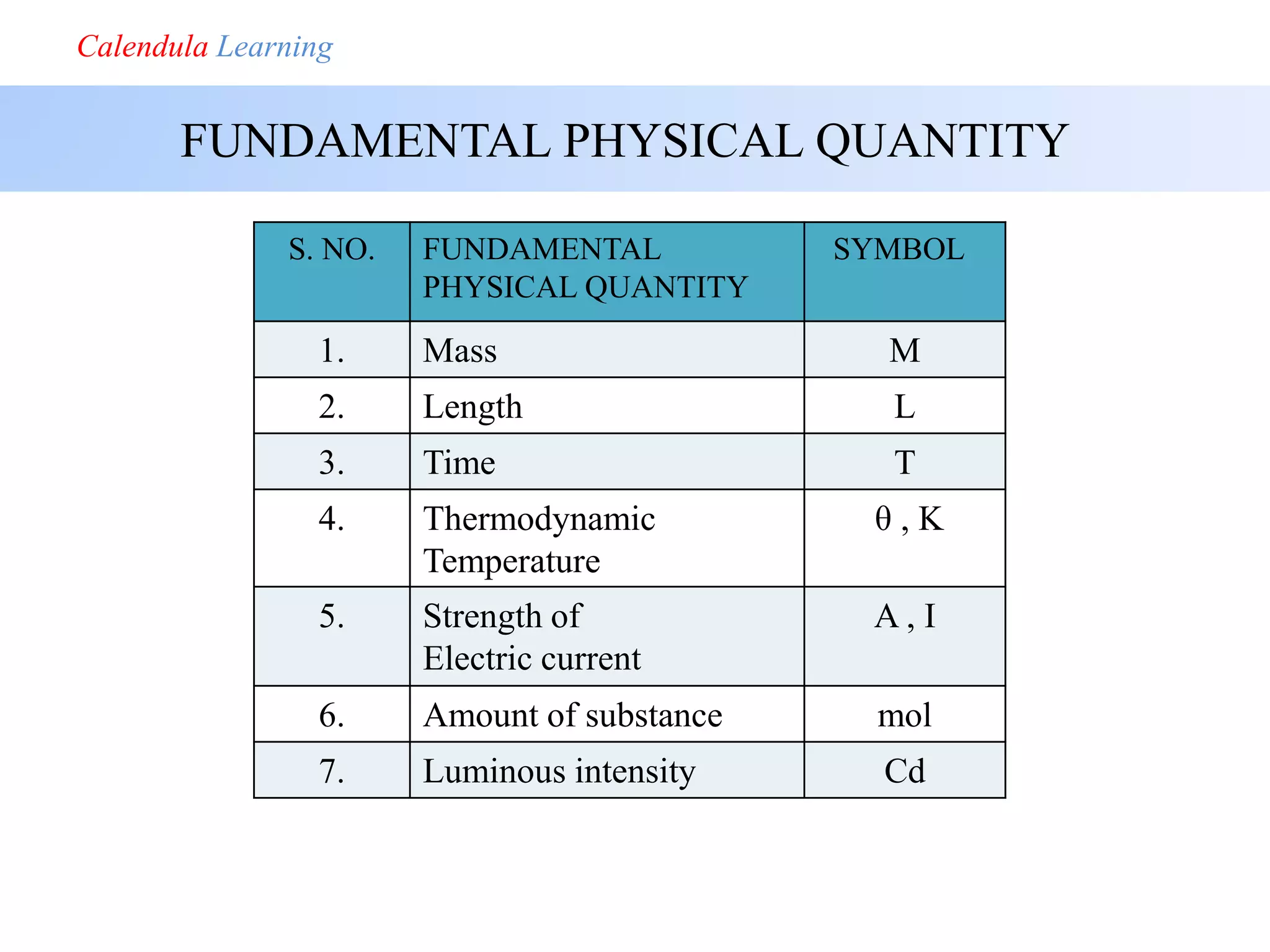
S. NO. FUNDAMENTAL
PHYSICAL QUANTITY
SYMBOL
1. Mass M
2. Length L
3. Time T
4. Thermodynamic
Temperature
θ , K
5. Strength of
Electric current
A , I
6. Amount of substance mol
7. Luminous intensity Cd
FUNDAMENTAL PHYSICAL QUANTITY
Calendula Learning
DERIVED PHYSICAL QUANTITY
Derived physical quantity :
• A physical quantity which depends on other physical quantities
is called derived physical quantity
• Many in number
• Example (1) Area = Length x Width
= Length x Length
= (Length) 2
(2) Volume = Length x Width x height
= Length x Length x Length
= (Length ) 3
Calendula Learning
DERIVED PHYSICAL QUANTITY
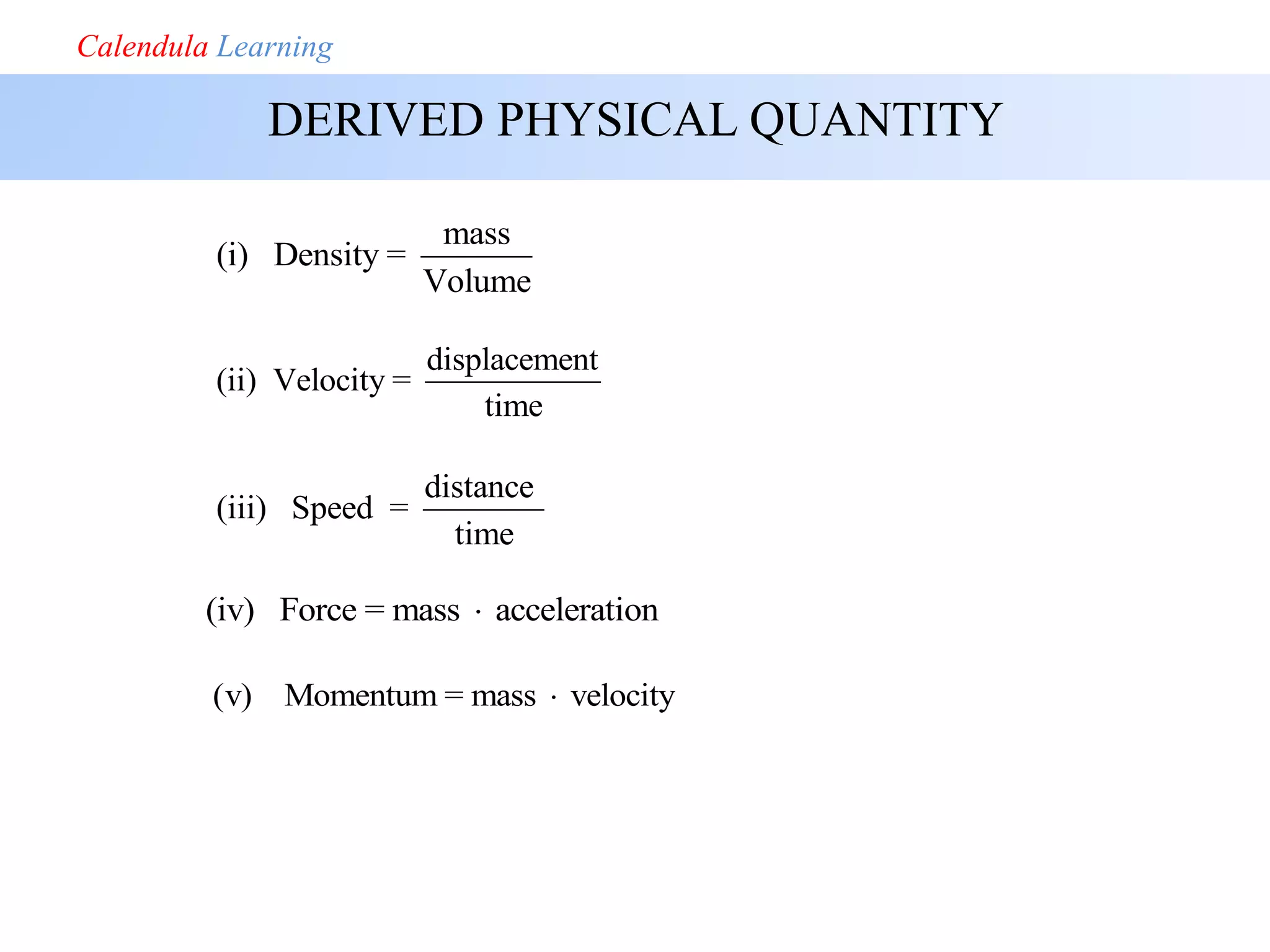
mass
(i) Density =
Volume
displacement
(ii) Velocity =
time
distance
(iii) Speed =
time
(iv) Force = mass acceleration

(v) Momentum = mass velocity

Calendula Learning
UNITS
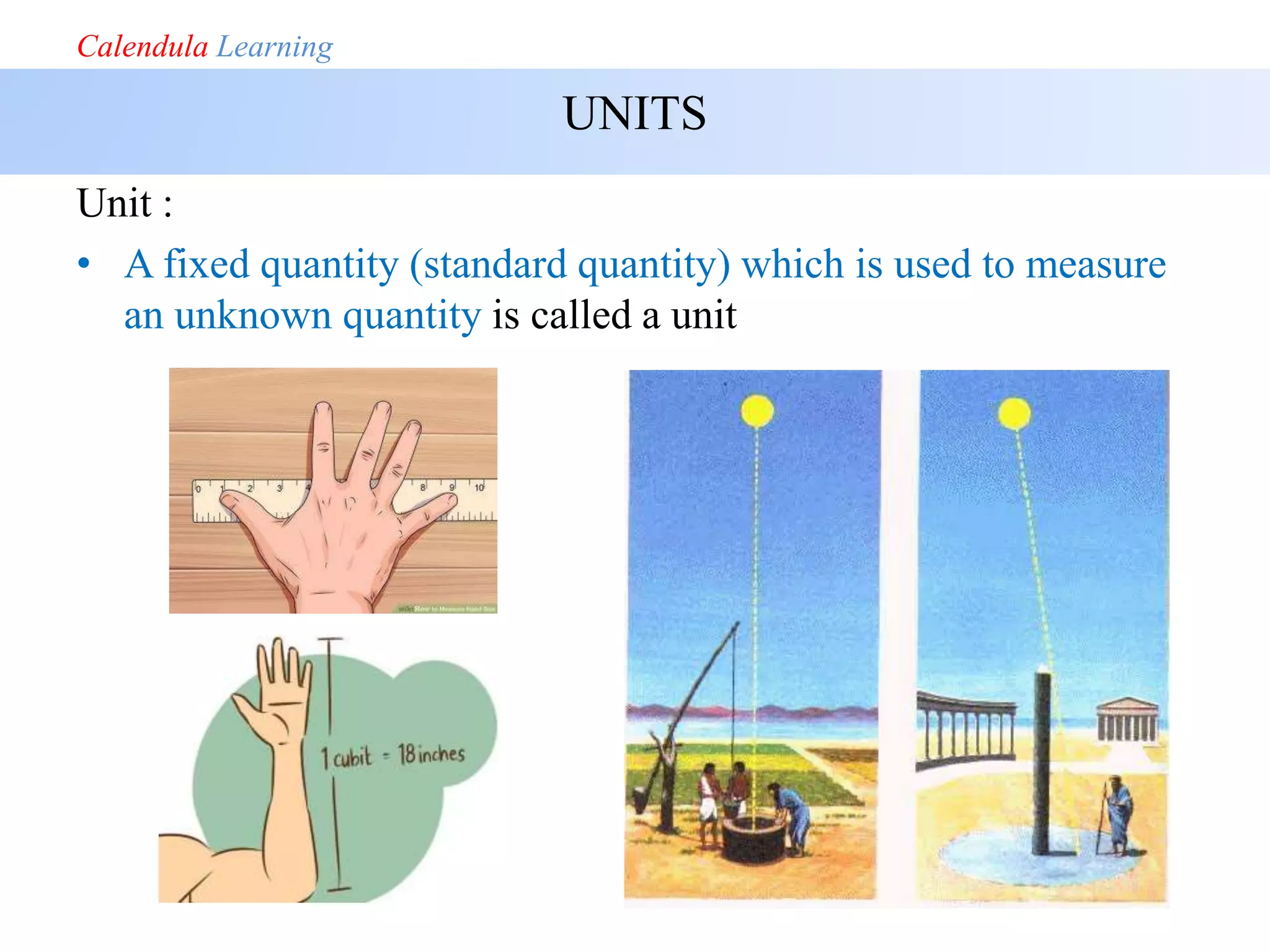
Unit :
• A fixed quantity (standard quantity) which is used to measure
an unknown quantity is called a unit
UNITS
Calendula Learning
TYPES OF UNITS
• FPS (Foot, Pound, Second ) system
• CGS (Centi, Gram, Second) system
• MKS (Meter, Kilo, Second) system
• SI ( Standard International System) system
Calendula Learning
C.G.S
Length
Centimeter (cm)
Time
Second (s)
Mass
Gram (g)
F. P. S
Length
foot (ft)
Time
Second (s)
Mass
Pound (lb)
M.K.S
Length
Meter (m)
Time
Second (s)
Mass
Kilogram (kg)
S.I
Length
Meter (m)
Time
Second (s)
Mass
Kilogram (kg)
TYPES OF UNITS
Calendula Learning
MULTIPLES AND SUB - MULTIPLES
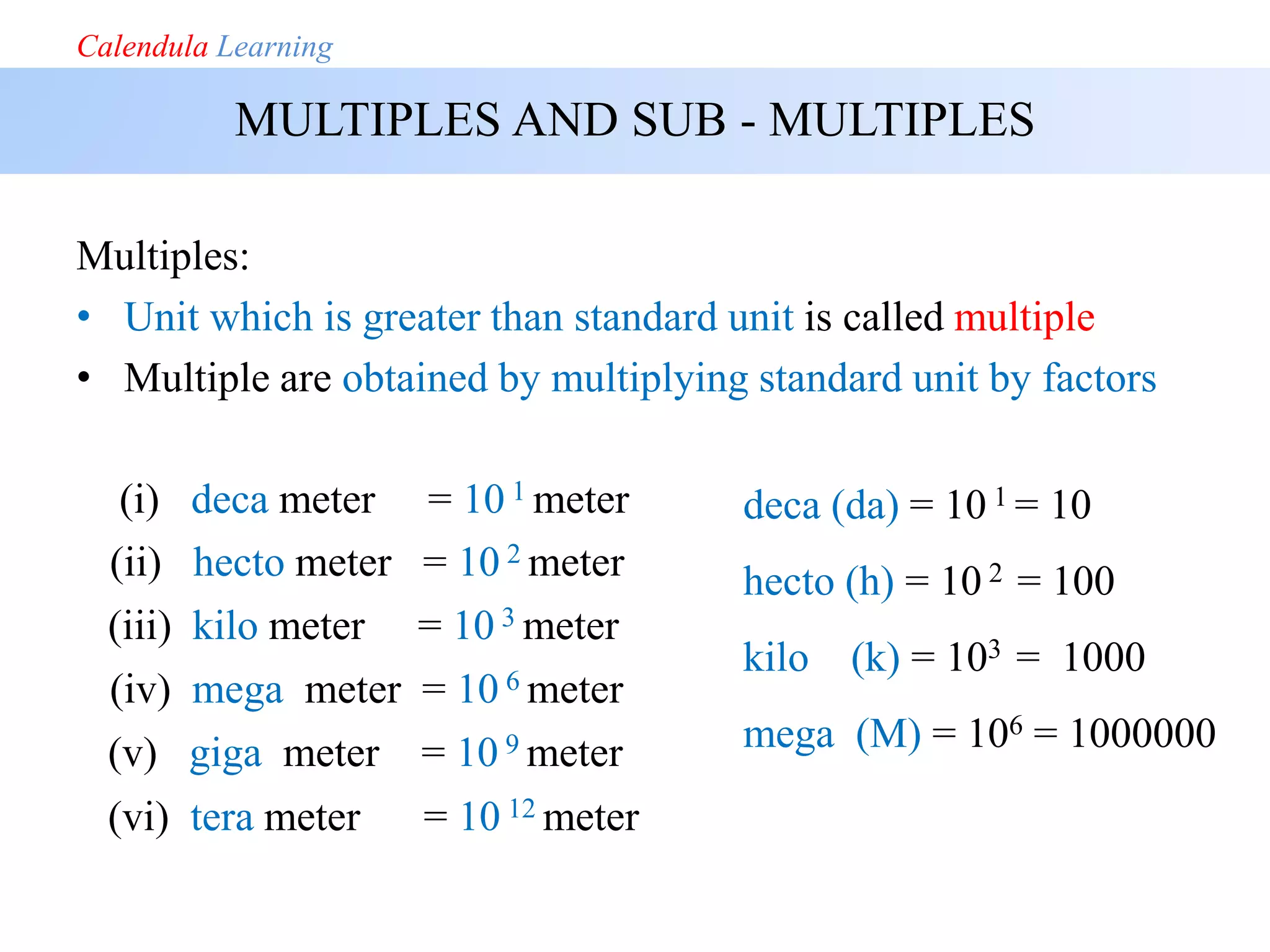
Multiples:
• Unit which is greater than standard unit is called multiple
• Multiple are obtained by multiplying standard unit by factors
(i) deca meter = 10 1 meter
(ii) hecto meter = 10 2 meter
(iii) kilo meter = 10 3 meter
(iv) mega meter = 10 6 meter
(v) giga meter = 10 9 meter
(vi) tera meter = 10 12 meter
deca (da) = 10 1 = 10
hecto (h) = 10 2 = 100
kilo (k) = 103 = 1000
mega (M) = 106 = 1000000
Calendula Learning
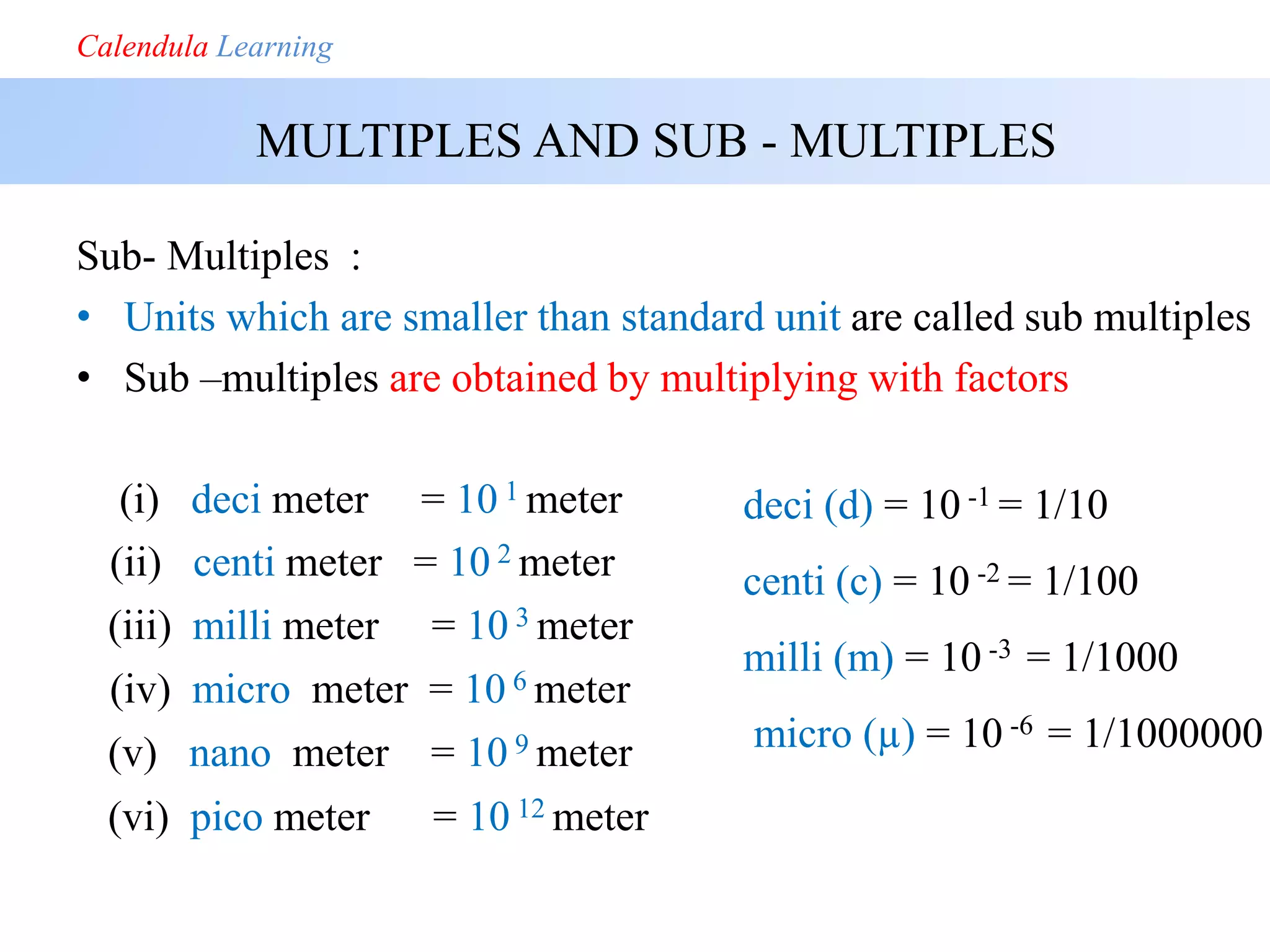
Sub- Multiples :
• Units which are smaller than standard unit are called sub multiples
• Sub –multiples are obtained by multiplying with factors
MULTIPLES AND SUB - MULTIPLES
(i) deci meter = 10 1 meter
(ii) centi meter = 10 2 meter
(iii) milli meter = 10 3 meter
(iv) micro meter = 10 6 meter
(v) nano meter = 10 9 meter
(vi) pico meter = 10 12 meter
deci (d) = 10 -1 = 1/10
centi (c) = 10 -2 = 1/100
milli (m) = 10 -3 = 1/1000
micro (µ) = 10 -6 = 1/1000000
Calendula Learning
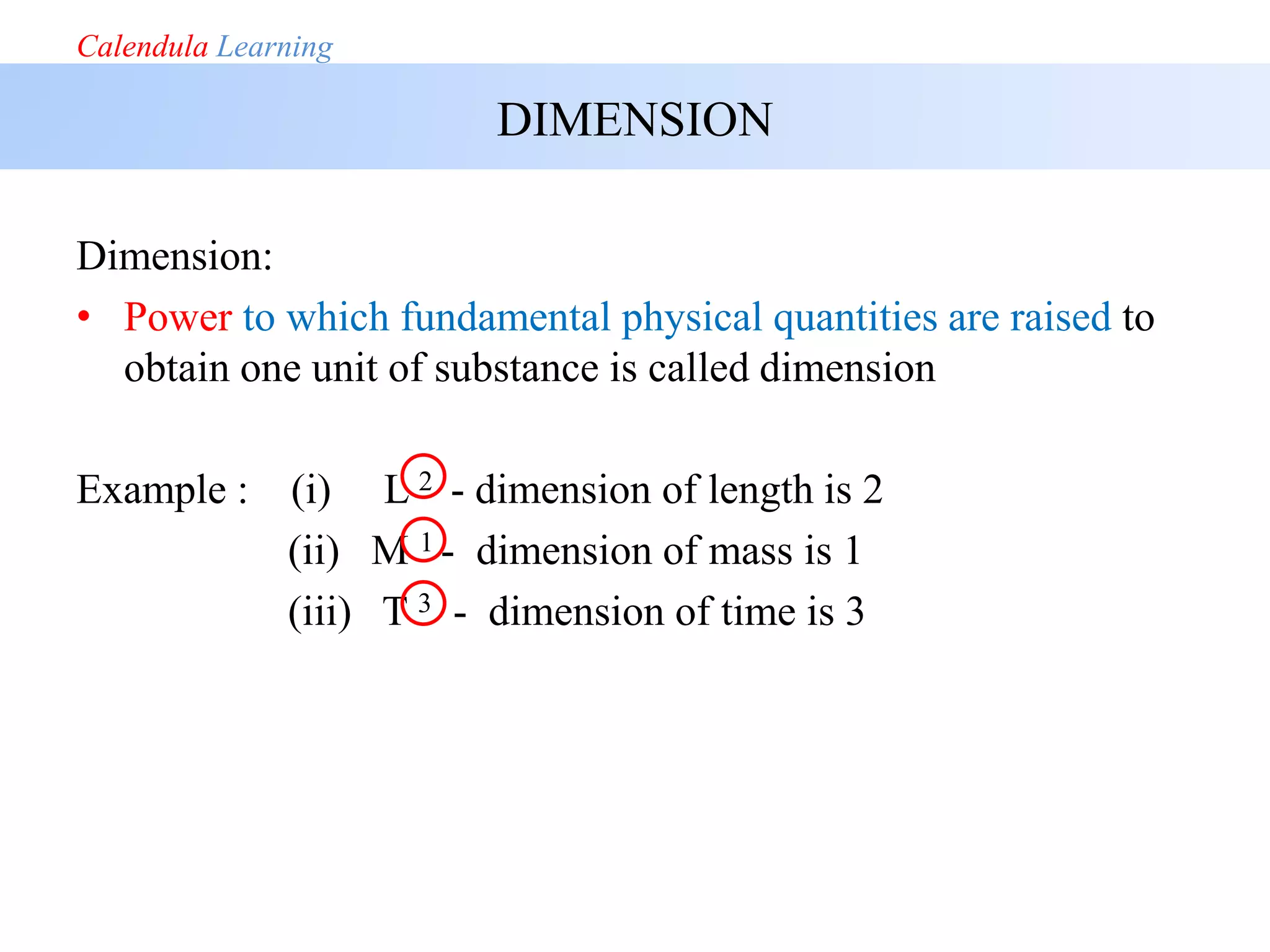
DIMENSION
Dimension:
• Power to which fundamental physical quantities are raised to
obtain one unit of substance is called dimension
Example : (i) L 2 - dimension of length is 2
(ii) M 1 - dimension of mass is 1
(iii) T 3 - dimension of time is 3
Calendula Learning

11_01 Units and measurements.pptx

  • 1.
    UNIT AND MEASUREMENT Class– 11th Aditya Mishra Email: adityakumar2009@gmail.com Calendula Learning
  • 2.
    WHAT IS PHYSICS? Physics: • Study about nature • Laws (rules ) of nature Observation • What is it ? • Why something is happening ? • How it is happening ? • What if I change something ? WHAT IS PHYSICS? Calendula Learning
  • 3.
  • 4.
    PHYSICAL QUANTITY Physical quantity: • Anything that can be measured is called a physical quantity Calendula Learning
  • 5.
    TYPES OF PHYSICALQUANTITIES Physical Quantity Fundamental Physical quantity Derived Physical quantity 2 1 • Depends on other physical quantity • Many • Independent of other physical quantity • only 7 Calendula Learning
  • 6.
    FUNDAMENTAL PHYSICAL QUANTITY Fundamentalphysical quantity : • A physical quantity which is independent of other physical quantities is called fundamental physical quantity • Only 7 in number • Example : (1) Mass (2) Length (3) Time Calendula Learning
  • 7.
    S. NO. FUNDAMENTAL PHYSICALQUANTITY SYMBOL 1. Mass M 2. Length L 3. Time T 4. Thermodynamic Temperature θ , K 5. Strength of Electric current A , I 6. Amount of substance mol 7. Luminous intensity Cd FUNDAMENTAL PHYSICAL QUANTITY Calendula Learning
  • 8.
    DERIVED PHYSICAL QUANTITY Derivedphysical quantity : • A physical quantity which depends on other physical quantities is called derived physical quantity • Many in number • Example (1) Area = Length x Width = Length x Length = (Length) 2 (2) Volume = Length x Width x height = Length x Length x Length = (Length ) 3 Calendula Learning
  • 9.
    DERIVED PHYSICAL QUANTITY mass (i)Density = Volume displacement (ii) Velocity = time distance (iii) Speed = time (iv) Force = mass acceleration  (v) Momentum = mass velocity  Calendula Learning
  • 10.
    UNITS Unit : • Afixed quantity (standard quantity) which is used to measure an unknown quantity is called a unit UNITS Calendula Learning
  • 11.
    TYPES OF UNITS •FPS (Foot, Pound, Second ) system • CGS (Centi, Gram, Second) system • MKS (Meter, Kilo, Second) system • SI ( Standard International System) system Calendula Learning
  • 12.
    C.G.S Length Centimeter (cm) Time Second (s) Mass Gram(g) F. P. S Length foot (ft) Time Second (s) Mass Pound (lb) M.K.S Length Meter (m) Time Second (s) Mass Kilogram (kg) S.I Length Meter (m) Time Second (s) Mass Kilogram (kg) TYPES OF UNITS Calendula Learning
  • 13.
    MULTIPLES AND SUB- MULTIPLES Multiples: • Unit which is greater than standard unit is called multiple • Multiple are obtained by multiplying standard unit by factors (i) deca meter = 10 1 meter (ii) hecto meter = 10 2 meter (iii) kilo meter = 10 3 meter (iv) mega meter = 10 6 meter (v) giga meter = 10 9 meter (vi) tera meter = 10 12 meter deca (da) = 10 1 = 10 hecto (h) = 10 2 = 100 kilo (k) = 103 = 1000 mega (M) = 106 = 1000000 Calendula Learning
  • 14.
    Sub- Multiples : •Units which are smaller than standard unit are called sub multiples • Sub –multiples are obtained by multiplying with factors MULTIPLES AND SUB - MULTIPLES (i) deci meter = 10 1 meter (ii) centi meter = 10 2 meter (iii) milli meter = 10 3 meter (iv) micro meter = 10 6 meter (v) nano meter = 10 9 meter (vi) pico meter = 10 12 meter deci (d) = 10 -1 = 1/10 centi (c) = 10 -2 = 1/100 milli (m) = 10 -3 = 1/1000 micro (µ) = 10 -6 = 1/1000000 Calendula Learning
  • 15.
    DIMENSION Dimension: • Power towhich fundamental physical quantities are raised to obtain one unit of substance is called dimension Example : (i) L 2 - dimension of length is 2 (ii) M 1 - dimension of mass is 1 (iii) T 3 - dimension of time is 3 Calendula Learning