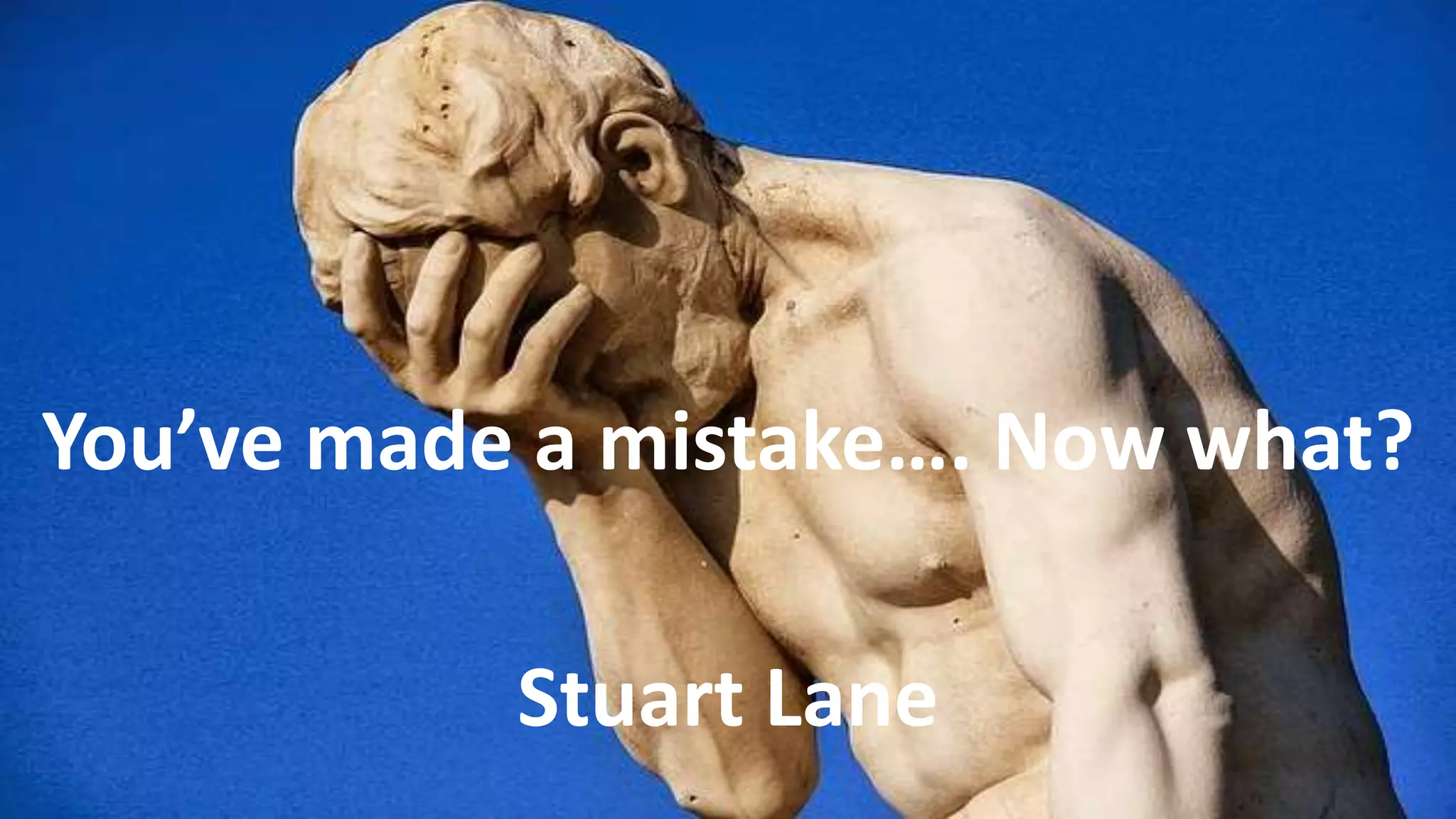









You’ve made a mistake…. Now what?
Stuart Lane
Patient
Hospital
Yourself
Critical reflection
The competency matrix
Professionalism
“The guy was fine, he was just super you
know anti-coagulated for a little while, which
was probably a good thing for him, you know
he had a thrombus basically”
“I gave somebody a heparin bolus based
on their PT rather than their APTT”
“Well it was a chain of errors.. nursing staff on this
ward are more proactive in getting things done..
the wrong test was ordered.. I took over the care,
checked it on the computer, saw it was low,
prescribed the bolus and then did not realise till
next morning”
“There was a complication during the procedure
which caused the patient to have too much
propofol or have a reaction to the medication..”
“…or was it because the medication and his
underlying condition, bradycardia, was a risk
factor for him to have that situation arise or was it
completely due as a side effect”
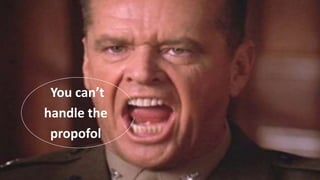
You can’t
handle the
propofol
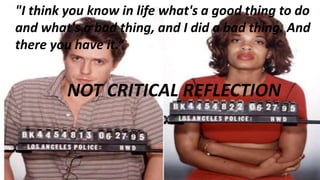
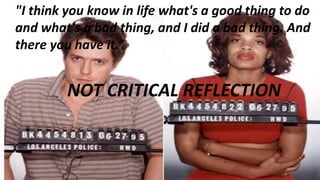
"I think you know in life what's a good thing to do
and what's a bad thing, and I did a bad thing. And
there you have it.“
NOT CRITICAL REFLECTION
Rationalisation
Euphemistic language
Advantageous comparison
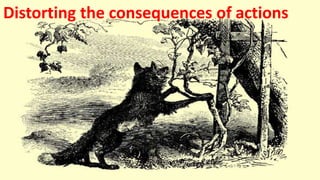
Distorting the consequences of actions
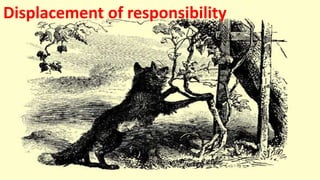
Displacement of responsibility
Diffusion of responsibility
Attributions of blame
Fragmentation
Moral attentiveness
Cognitive dissonance
‘It is almost impossible for practicing physicians to
deal with their errors in a psychologically healthy
fashion.. The climate of medical school and
residency training, for instance makes it nearly
impossible to confront the emotional
consequences of mistakes..
“little wonder that physicians are accused of having
a God complex; little wonder that we are defensive
about our judgements; little wonder the we blame
the patient or the previous physician when things
go wrong, that we yell at the nurses for our
mistakes”
"I think you know in life what's a good thing to do
and what's a bad thing, and I did a bad thing. And
there you have it.“
NOT CRITICAL REFLECTION
How to avoid rationalisation?
New theories emerge
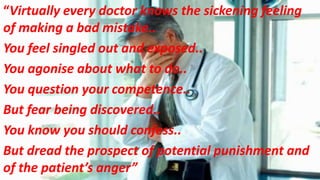
“Virtually every doctor knows the sickening feeling
of making a bad mistake..
You feel singled out and exposed..
You agonise about what to do..
You question your competence..
But fear being discovered..
You know you should confess..
But dread the prospect of potential punishment and
of the patient’s anger”
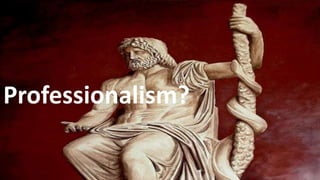
Professionalism?
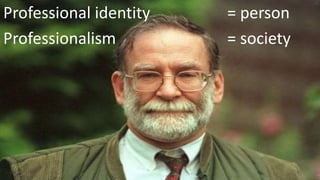
Professional identity = person
Professionalism = society
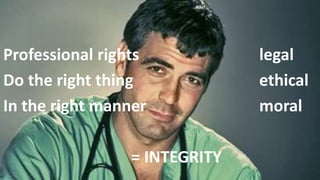
Professional rights legal
Do the right thing ethical
In the right manner moral
= INTEGRITY
You made a mistake.. Critically reflect.. Don’t
rationalise it.. Accept that it is a mistake and
you need support
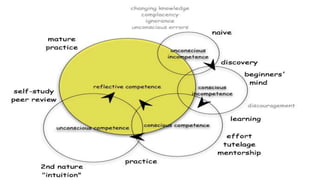
Reflective competence is what you require to
negotiate stages of learning, and maintain it..
What do believe is your professional identity
and what does professionalism mean to you?
Questions?

Lane, Stuart — You’ve made a mistake… Now What?

Editor's Notes

  • #2 Communication.. Were always banging on about it, and I am going to continue.. In the end the the medicine can often become very straightforward But what will give you headaches is poor communication, with anybody I can guarantee you unreservedly that this stuff is not fluff.. It is vital Hello my name is dr victoria brazil, the ED staff specialist is linguistic gold.. it is 2 seconds of your life that can save you 2 years in the future An old saying that manners cost you nothing, they also take no time.. You can make all sorts of mistakes, and people will forgive you.. But it you show them a lack of respect they will come after you.. Because you cannot put a price on pride.. You want to be an awesome doctor, then be an awesome communicator.. Including with yourself..
  • #3 I think there are 3 areas to consider.. Imogen has looked at the patient perspective Your institution is about OD Go through OD being 3B’s.. Show the print outs The problem with OD is that it did not focus on patient stories, and they need to tell it and be heard.. OD is about sharing stories sharing means listening, not just talking.. And finally, I am going to focus on what you need to do for you
  • #4 I believe in the rule of 3’s Omne trium perfectum Three little pigs, goldilocks and the 3 bears plus literature 2 establishes a pattern, three is the reinforcement A story has a start, middle and end.. Some personal work and some theory
  • #5 Discuss phd There is a problem here Discuss heparin
  • #6 Comment Accountability Ask audience
  • #7 Comment Emerging problem here
  • #8 comment
  • #9 Comment Side effecct vs reaction Too much vs. patient problem
  • #10 Is this what we are really saying?
  • #11 He was applauded, he reflected But why This is not critical reflection, or if it was he did not explain why
  • #12 Psychological defence mechanism where the true motivation is concealed by explaining your actions and feelings in a way that is not threatening.. There 7 forms described by John Banja Fox and the grapes
  • #13 Some mischief in the tummy – klebsiella throwing eggs at some e coli.. Unappreciated lesion – missed Super anticoagulated With enough repetition the person might believe it – barry roux
  • #14 Telling the family will only make them feel worse We know they feel worse when not told It was good for him, he had a thrombus The advantage trumps the moral behaviour
  • #15 Reinterpretation of what happened and the aftermath Similar to number 2 The lethal error became a blessing in disguise Reinterpretation relieves the need to disclose since it has now become something good
  • #16 It was not the fault of the individual, but somebody else Blaming your insurance for not being allowed to discuss error
  • #17 Individual responsibility transferred to the group Wayne jowett at queens medical centre, nottingham Now it is nobody’s fault, it was the system But the system is culture, and culture is due to people, so the people are the system
  • #18 Blames the victim You could not handle the propofol, or the side effects of the morphine.. It happened because they were obese..
  • #19 Good self vs. bad self If you done good all your life then you are a good person and so have not made an error. Yes you are a good person but have still made an error
  • #20 Diversion of moral attentiveness Goleman.. From an uncomfortable but morally right path, to a morally problematic one that feels more comfortable But also cognitive dissonance Excessive mental stress and discomfort experienced by an individual who holds two or more contradictory beliefs, ideas, or values at the same time. "The existence of dissonance, being psychologically uncomfortable, will motivate the person to try to reduce the dissonance and achieve consonance" "When dissonance is present, in addition to trying to reduce it, the person will actively avoid situations and information which would likely increase the dissonance
  • #23 We laugh at this, but know it is so true
  • #24 What is critical refelction? A deeper analysis of why, what, when and how Critical refelction goes to a level of understanding (considerations) and then unearthing and questioning (looking at assumptions)
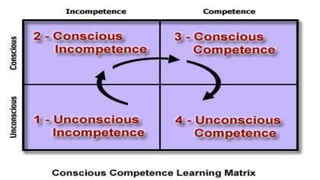
  • #26 Donald rumsveld.. There are unknown unknowns.. I think this is where it starts We all go through degrees of learning.. Describe it.. The interns speak as though they are at 1 but think they are at 3.. But easily taken to 2, which is where they need to be.. This is where critical reflection played its role.. The discussion helped them get to 2 and then the ball starts rolling But this model is incomplete What about practitioners who fall back from 4, they go back to 2, not via 3,2,1
  • #27 New theories e.g. prof jane mcgrath and bullying This is jonny lawrence
  • #28 Describe how reflective competence is constantly there Where mentorship is important. All the time, not just at 2-3 The importance of critical reflection to recognise your error, that it was an error and you feel bad about it.. not rationalise as a non-error because of guilt and fear as Goleman describes.
  • #29 Little uncomfortable at calling the physician a ‘victim’ but it reinforces a principle You are the ‘second victim’ You need the support of your colleagues You need to ask So where does it leave your practice?
  • #30 Asclepius (son of apollo) The profession of medicine is under attack.. Our resistance must be professionalism But what is professionalism
  • #31 Professional Profession Identity forged at the level of the individual.. Reality might not agree with the ideal.. It is about personal beliefs I disagree Professionalism decided by organisations and society.. Articulated in professional codes.. They may not be a reality
  • #32 Requirements Principles Behaviour
  • #33 Its all linked together
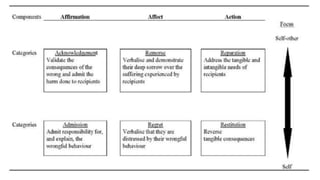
  • #34 Going back to imogen’s talk on the patient This is what apology is all about.. Describe it It was the drink that did it.. It was his decision to continue drinking that led to the end of our relationship Many different nuances of what people need.. What is important is an apology that is good enough.. Medicine / healthcare is all about context.. If you reflect on your role and listen to somebody’s story, yours will be good enough