God as Artist
     Lección # 11
     Lección # 11
Memory Text:
“One thing I have desired of the
Lord, that will I seek: that I may
dwell in the house of the Lord all
the days of my life, to behold the
beauty of the Lord” (Psalm 27:4, NKJV).

 Key Thought: God as artist?

Read for This Week’s Study: Isa. 64:5–8, Ps.
51:10,1 Chron. 23:5, Heb. 8:1–5, Rom. 11:33–36,
Acts 9:1–22.
So far, we’ve looked at various aspects of the Lord:
  the Trinity, God’s holiness, and God as Redeemer.
There is one picture of God in Scripture, however, that
        is rarely given attention—God as artist.
Many people claim they have no interest in art. Many Christians know
little about it. They may know what they like, but that is nothing more
than knowledge about themselves. Others acknowledge that art
exists, but they never consider its value or relevance. Christianity has
often been ambivalent about the arts. At times, the arts have been
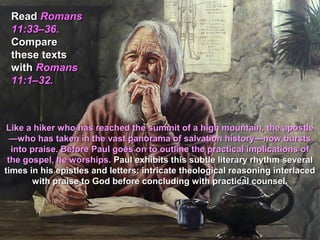
denounced as irreligious and evil; other times, aesthetics have
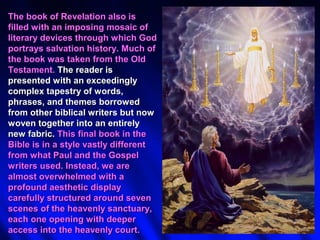
become a secular “religion” with serious devotees. There are also
plenty of Christian writers, but they have seldom made attempts to
relate the concept of “beauty” to the central Christian doctrines.
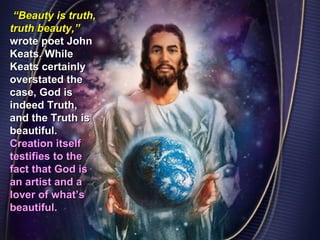
“Beauty is truth,
truth beauty,”
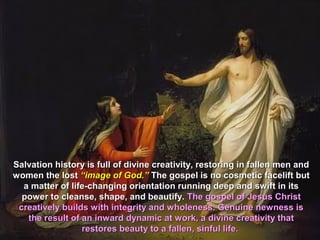
wrote poet John
Keats. While
Keats certainly
overstated the
case, God is
indeed Truth,
and the Truth is
beautiful.
Creation itself
testifies to the
fact that God is
an artist and a
lover of what’s
beautiful.
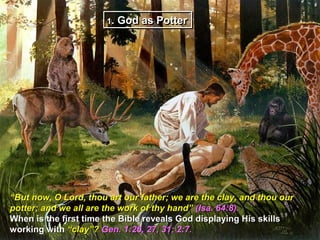
1. God as Potter
                       1


“But now, O Lord, thou art our father; we are the clay, and thou our
potter; and we all are the work of thy hand” (Isa. 64:8).
When is the first time the Bible reveals God displaying His skills
working with “clay”? Gen. 1:26, 27, 31; 2:7.
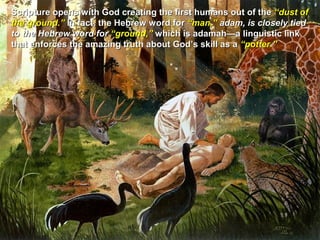
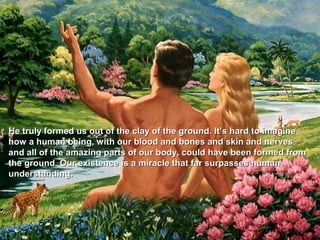
Scripture opens with God creating the first humans out of the “dust of
the ground.” In fact, the Hebrew word for “man,” adam, is closely tied
to the Hebrew word for “ground,” which is adamah—a linguistic link
that enforces the amazing truth about God’s skill as a “potter.”
He truly formed us out of the clay of the ground. It’s hard to imagine
how a human being, with our blood and bones and skin and nerves
and all of the amazing parts of our body, could have been formed from
the ground. Our existence is a miracle that far surpasses human
understanding.
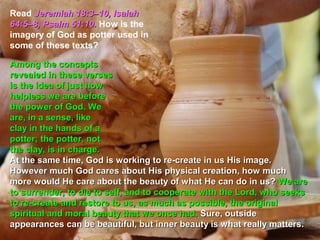
Read Jeremiah 18:3–10, Isaiah
64:5–8, Psalm 51:10. How is the
imagery of God as potter used in
some of these texts?

Among the concepts
revealed in these verses
is the idea of just how
helpless we are before
the power of God. We
are, in a sense, like
clay in the hands of a
potter; the potter, not
the clay, is in charge.
At the same time, God is working to re-create in us His image.
However much God cares about His physical creation, how much
more would He care about the beauty of what He can do in us? We are
to surrender, to die to self, and to cooperate with the Lord, who seeks
to re-create and restore to us, as much as possible, the original
spiritual and moral beauty that we once had. Sure, outside
appearances can be beautiful, but inner beauty is what really matters.
REFLECTION:


Russian writer Fyodor Dostoyevsky
 created a fictional character who
had, Dostoyevsky said, a “beautiful
               soul.”
 What is your idea of a “beautiful
 soul,” and what things in you do,
  and do not, correspond to that
                ideal?
2. God as Architect
2.

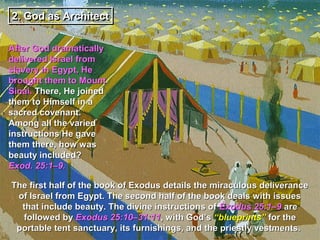
After God dramatically
delivered Israel from
slavery in Egypt, He
brought them to Mount
Sinai. There, He joined
them to Himself in a
sacred covenant.
Among all the varied
instructions He gave
them there, how was
beauty included?
Exod. 25:1–9.

The first half of the book of Exodus details the miraculous deliverance
 of Israel from Egypt. The second half of the book deals with issues
  that include beauty. The divine instructions of Exodus 25:1–9 are
  followed by Exodus 25:10–31:11, with God’s “blueprints” for the
 portable tent sanctuary, its furnishings, and the priestly vestments.
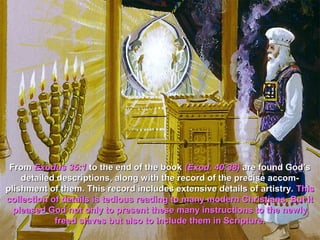
From Exodus 35:1 to the end of the book (Exod. 40:38) are found God’s
    detailed descriptions, along with the record of the precise accom-
plishment of them. This record includes extensive details of artistry. This
collection of details is tedious reading to many modern Christians. But it
  pleased God not only to present these many instructions to the newly
            freed slaves but also to include them in Scripture.
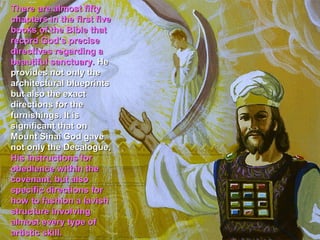
There are almost fifty
chapters in the first five
books of the Bible that
record God’s precise
directives regarding a
beautiful sanctuary. He
provides not only the
architectural blueprints
but also the exact
directions for the
furnishings. It is
significant that on
Mount Sinai God gave
not only the Decalogue,
His instructions for
obedience within the
covenant, but also
specific directions for
how to fashion a lavish
structure involving
almost every type of
artistic skill.
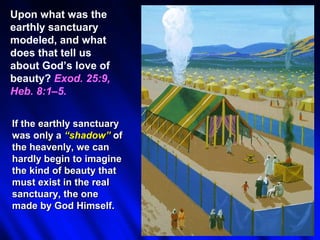
Upon what was the
earthly sanctuary
modeled, and what
does that tell us
about God’s love of
beauty? Exod. 25:9,
Heb. 8:1–5.


If the earthly sanctuary
was only a “shadow” of
the heavenly, we can
hardly begin to imagine
the kind of beauty that
must exist in the real
sanctuary, the one
made by God Himself.
REFLECTION:


   Why do you think it was important for the
         sanctuary to be so beautiful?
   Perhaps to give the people a sense of awe
    before the power and grandeur of God?
   Maybe to help them sense their own need
            before such grandeur?
    How can understanding the glory of the
sanctuary better help us to grasp the character
 of God in contrast to our own earthliness and
                  sinfulness?
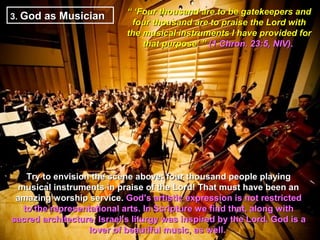
“ ‘Four thousand are to be gatekeepers and
3. God as Musician
                             four thousand are to praise the Lord with
                            the musical instruments I have provided for
                                that purpose’ ” (1 Chron. 23:5, NIV).


   Try to envision the scene above: four thousand people playing
 musical instruments in praise of the Lord! That must have been an
 amazing worship service. God’s artistic expression is not restricted
  to the representational arts. In Scripture we find that, along with
sacred architecture, Israel’s liturgy was inspired by the Lord. God is a
                  lover of beautiful music, as well.
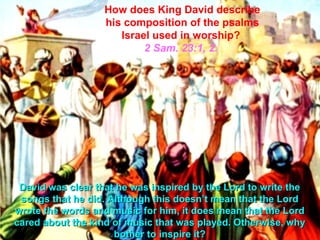
How does King David describe
                   his composition of the psalms
                      Israel used in worship?
                           2 Sam. 23:1, 2.


 David was clear that he was inspired by the Lord to write the
 songs that he did. Although this doesn’t mean that the Lord
wrote the words and music for him, it does mean that the Lord
cared about the kind of music that was played. Otherwise, why
                     bother to inspire it?
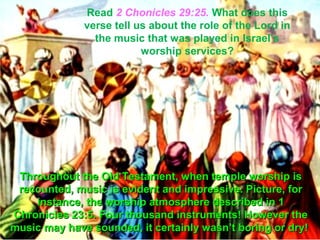
Read 2 Chonicles 29:25. What does this
              verse tell us about the role of the Lord in
                the music that was played in Israel’s
                          worship services?


 Throughout the Old Testament, when temple worship is
 recounted, music is evident and impressive. Picture, for
    instance, the worship atmosphere described in 1
Chronicles 23:5. Four thousand instruments! However the
music may have sounded, it certainly wasn’t boring or dry!
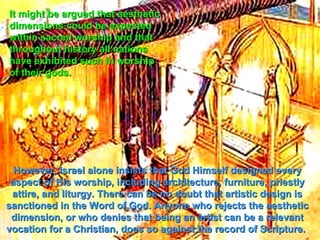
It might be argued that aesthetic
dimensions could be expected
within sacred worship and that
throughout history all nations
have exhibited such in worship
of their gods.


  However, Israel alone insists that God Himself designed every
 aspect of His worship, including architecture, furniture, priestly
 attire, and liturgy. There can be no doubt that artistic design is
sanctioned in the Word of God. Anyone who rejects the aesthetic
 dimension, or who denies that being an artist can be a relevant
vocation for a Christian, does so against the record of Scripture.
REFLECTION:


Although we don’t have the music that
accompanied Israelite worship, it must
  have been beautiful, and it certainly
must have lifted their souls toward the
  Lord. How does music in our church
  function today? How can we be sure
 that it does the same thing, that is, lift
our souls toward the Lord, as opposed
   to pushing us in another direction?
4. God as Author
4. God as Author
Bible scholars have often been impressed by the incredible literary
quality of the Bible. Many secular colleges also teach courses on the
Bible simply for its literary beauty, not because they view it as God’s
Word.
As Christians, we have the blessing not only of enjoying the literary
beauty of the Scriptures but of learning the truths about God as
revealed in the Bible. No doubt, too, the artful construction of the
narratives and the poetry, all influenced by the Spirit of the Lord (yet
written out through the words of God’s prophets), goes a long way in
helping us to understand the truth contained therein.

The apostle Paul, for instance, with his complex theological discourse,
regularly punctuates his theology with powerful literary devices. For
example, in the first eleven chapters
of the book of Romans, Paul gives a
comprehensive account of the gospel.
Look through these chapters and
note the various topics
Paul weaves together.
Read Romans
 11:33–36.
 Compare
 these texts
 with Romans
 11:1–32.


 Like a hiker who has reached the summit of a high mountain, the apostle
  —who has taken in the vast panorama of salvation history—now bursts
  into praise. Before Paul goes on to outline the practical implications of
 the gospel, he worships. Paul exhibits this subtle literary rhythm several
times in his epistles and letters: intricate theological reasoning interlaced
        with praise to God before concluding with practical counsel.
The book of Revelation also is
filled with an imposing mosaic of
literary devices through which God
portrays salvation history. Much of
the book was taken from the Old
Testament. The reader is
presented with an exceedingly
complex tapestry of words,
phrases, and themes borrowed
from other biblical writers but now
woven together into an entirely
new fabric. This final book in the
Bible is in a style vastly different
from what Paul and the Gospel
writers used. Instead, we are
almost overwhelmed with a
profound aesthetic display
carefully structured around seven
scenes of the heavenly sanctuary,
each one opening with deeper
access into the heavenly court.
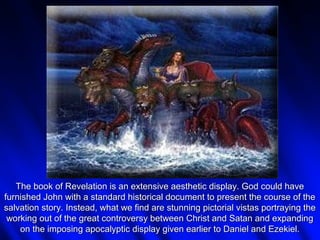
The book of Revelation is an extensive aesthetic display. God could have
furnished John with a standard historical document to present the course of the
salvation story. Instead, what we find are stunning pictorial vistas portraying the
 working out of the great controversy between Christ and Satan and expanding
    on the imposing apocalyptic display given earlier to Daniel and Ezekiel.
REFLECTION:


Imagine reading the Bible only as
            literature.
  Talk about missing the point!
 What lessons can we learn about
how easily we can have truth right
  before our eyes and yet miss it
           completely?
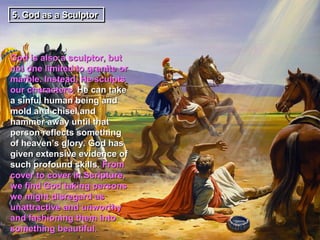
5. God as a Sculptor


God is also a sculptor, but
not one limited to granite or
marble. Instead, He sculpts
our characters. He can take
a sinful human being and
mold and chisel and
hammer away until that
person reflects something
of heaven’s glory. God has
given extensive evidence of
such profound skills. From
cover to cover in Scripture,
we find God taking persons
we might disregard as
unattractive and unworthy
and fashioning them into
something beautiful.
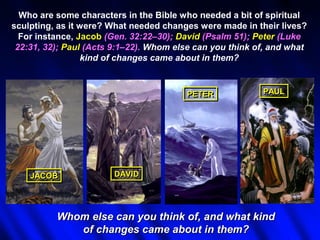
Who are some characters in the Bible who needed a bit of spiritual
sculpting, as it were? What needed changes were made in their lives?
  For instance, Jacob (Gen. 32:22–30); David (Psalm 51); Peter (Luke
 22:31, 32); Paul (Acts 9:1–22). Whom else can you think of, and what
                 kind of changes came about in them?


                                        PETER
                                        PETER             PAUL
                                                          PAUL


    JACOB
    JACOB               DAVID
                        DAVID


          Whom else can you think of, and what kind
             of changes came about in them?
Another good example is Mary Magdalene.
                                 “Mary had been . . . a great sinner, but
                               Christ knew the circumstances that had
                                 shaped her life. . . . It was He who had
                                       lifted her from despair and ruin.


 Seven times she had heard His rebuke of the demons that controlled her
heart and mind. She had heard His strong cries to the Father in her behalf.
She knew how offensive is sin to His unsullied purity, and in His strength
she had overcome. . . . [This woman] who had fallen, and whose mind had
   been a habitation of demons, was brought very near to the Saviour in
  fellowship and ministry. . . . Mary stood beside the Cross. . . . Mary was
first at the tomb after His resurrection. It was Mary who first proclaimed a
         risen Saviour.”—Ellen G. White, The Desire of Ages, p. 568.
Salvation history is full of divine creativity, restoring in fallen men and
women the lost “image of God.” The gospel is no cosmetic facelift but
  a matter of life-changing orientation running deep and swift in its
  power to cleanse, shape, and beautify. The gospel of Jesus Christ
 creatively builds with integrity and wholeness. Genuine newness is
   the result of an inward dynamic at work, a divine creativity that
                 restores beauty to a fallen, sinful life.
REFLECTION:


 Sculpting involves chiseling, filing,
maybe even the breaking off of parts.
 What areas in your life need to be
        sculpted a bit more?
How much resistance do you put up
  during a process that isn’t always
                fun?
Further Study:


   “Let the converting power of God be experienced in the heart of the
individual members, and then we shall see the deep moving of the Spirit
   of God. Mere forgiveness of sin is not the sole result of the death of
Jesus. He made the infinite sacrifice not only that sin might be removed,
  but that human nature might be restored, rebeautified, reconstructed
from its ruins, and made fit for the presence of God.”—EGW, Manuscript
                         Releases, vol. 6, p. 11,
“How earnestly and                     The artist’s work is
perseveringly the artist labors   small and unimportant
to transfer to canvas a perfect    compared with that of
likeness of his model; and
                                      the parent. The one
how diligently the sculptor
hews and chisels out the                 deals with lifeless
stone into a counterpart of          material, from which
the copy he is following. So        he fashions forms of
the parents should labor to         beauty; but the other
shape, polish, and refine their       deals with a human
children after the pattern          being whose life can
given them in Christ Jesus.       be shaped for good or
As the patient artist studies,      ill, to bless humanity
and works, and forms plans
                                       or to curse it; to go
to make the results of his
labors more perfect, so            out in darkness, or to
should the parent consider        live forever in a future
time well spent that is           sinless world.”—Ellen
occupied in training the                    G. White, Child
children for useful lives and           Guidance, pp. 476,
fitting them for the immortal                           477.
kingdom.
ADAPT it!                           Effective for
                                   SMALL GROUPS
      Teaching Approach


ASSOCIATE truth – Why should I study this lesson?
DISCOVER truth – What does the Bible say about this
truth?
APPLY truth – How can this truth affect my life today?
PLAN using the truth – How can I use this truth today?
TRANSFER truth to life – What changes do I need in my
life
  ?
                 We invite you to download and study
                  each one of the 13 lessons about
                         “Glimpses of God”
                     Slideshare.net/chucho1943

11 god as artist

  • 1.
    God as Artist Lección # 11 Lección # 11
  • 2.
    Memory Text: “One thingI have desired of the Lord, that will I seek: that I may dwell in the house of the Lord all the days of my life, to behold the beauty of the Lord” (Psalm 27:4, NKJV). Key Thought: God as artist? Read for This Week’s Study: Isa. 64:5–8, Ps. 51:10,1 Chron. 23:5, Heb. 8:1–5, Rom. 11:33–36, Acts 9:1–22.
  • 3.
    So far, we’velooked at various aspects of the Lord: the Trinity, God’s holiness, and God as Redeemer. There is one picture of God in Scripture, however, that is rarely given attention—God as artist.
  • 4.
    Many people claimthey have no interest in art. Many Christians know little about it. They may know what they like, but that is nothing more than knowledge about themselves. Others acknowledge that art exists, but they never consider its value or relevance. Christianity has often been ambivalent about the arts. At times, the arts have been denounced as irreligious and evil; other times, aesthetics have become a secular “religion” with serious devotees. There are also plenty of Christian writers, but they have seldom made attempts to relate the concept of “beauty” to the central Christian doctrines.
  • 5.
    “Beauty is truth, truthbeauty,” wrote poet John Keats. While Keats certainly overstated the case, God is indeed Truth, and the Truth is beautiful. Creation itself testifies to the fact that God is an artist and a lover of what’s beautiful.
  • 6.
    1. God asPotter 1 “But now, O Lord, thou art our father; we are the clay, and thou our potter; and we all are the work of thy hand” (Isa. 64:8). When is the first time the Bible reveals God displaying His skills working with “clay”? Gen. 1:26, 27, 31; 2:7.
  • 7.
    Scripture opens withGod creating the first humans out of the “dust of the ground.” In fact, the Hebrew word for “man,” adam, is closely tied to the Hebrew word for “ground,” which is adamah—a linguistic link that enforces the amazing truth about God’s skill as a “potter.”
  • 8.
    He truly formedus out of the clay of the ground. It’s hard to imagine how a human being, with our blood and bones and skin and nerves and all of the amazing parts of our body, could have been formed from the ground. Our existence is a miracle that far surpasses human understanding.
  • 9.
    Read Jeremiah 18:3–10,Isaiah 64:5–8, Psalm 51:10. How is the imagery of God as potter used in some of these texts? Among the concepts revealed in these verses is the idea of just how helpless we are before the power of God. We are, in a sense, like clay in the hands of a potter; the potter, not the clay, is in charge. At the same time, God is working to re-create in us His image. However much God cares about His physical creation, how much more would He care about the beauty of what He can do in us? We are to surrender, to die to self, and to cooperate with the Lord, who seeks to re-create and restore to us, as much as possible, the original spiritual and moral beauty that we once had. Sure, outside appearances can be beautiful, but inner beauty is what really matters.
  • 10.
    REFLECTION: Russian writer FyodorDostoyevsky created a fictional character who had, Dostoyevsky said, a “beautiful soul.” What is your idea of a “beautiful soul,” and what things in you do, and do not, correspond to that ideal?
  • 11.
    2. God asArchitect 2. After God dramatically delivered Israel from slavery in Egypt, He brought them to Mount Sinai. There, He joined them to Himself in a sacred covenant. Among all the varied instructions He gave them there, how was beauty included? Exod. 25:1–9. The first half of the book of Exodus details the miraculous deliverance of Israel from Egypt. The second half of the book deals with issues that include beauty. The divine instructions of Exodus 25:1–9 are followed by Exodus 25:10–31:11, with God’s “blueprints” for the portable tent sanctuary, its furnishings, and the priestly vestments.
  • 12.
    From Exodus 35:1to the end of the book (Exod. 40:38) are found God’s detailed descriptions, along with the record of the precise accom- plishment of them. This record includes extensive details of artistry. This collection of details is tedious reading to many modern Christians. But it pleased God not only to present these many instructions to the newly freed slaves but also to include them in Scripture.
  • 13.
    There are almostfifty chapters in the first five books of the Bible that record God’s precise directives regarding a beautiful sanctuary. He provides not only the architectural blueprints but also the exact directions for the furnishings. It is significant that on Mount Sinai God gave not only the Decalogue, His instructions for obedience within the covenant, but also specific directions for how to fashion a lavish structure involving almost every type of artistic skill.
  • 14.
    Upon what wasthe earthly sanctuary modeled, and what does that tell us about God’s love of beauty? Exod. 25:9, Heb. 8:1–5. If the earthly sanctuary was only a “shadow” of the heavenly, we can hardly begin to imagine the kind of beauty that must exist in the real sanctuary, the one made by God Himself.
  • 15.
    REFLECTION: Why do you think it was important for the sanctuary to be so beautiful? Perhaps to give the people a sense of awe before the power and grandeur of God? Maybe to help them sense their own need before such grandeur? How can understanding the glory of the sanctuary better help us to grasp the character of God in contrast to our own earthliness and sinfulness?
  • 16.
    “ ‘Four thousandare to be gatekeepers and 3. God as Musician four thousand are to praise the Lord with the musical instruments I have provided for that purpose’ ” (1 Chron. 23:5, NIV). Try to envision the scene above: four thousand people playing musical instruments in praise of the Lord! That must have been an amazing worship service. God’s artistic expression is not restricted to the representational arts. In Scripture we find that, along with sacred architecture, Israel’s liturgy was inspired by the Lord. God is a lover of beautiful music, as well.
  • 17.
    How does KingDavid describe his composition of the psalms Israel used in worship? 2 Sam. 23:1, 2. David was clear that he was inspired by the Lord to write the songs that he did. Although this doesn’t mean that the Lord wrote the words and music for him, it does mean that the Lord cared about the kind of music that was played. Otherwise, why bother to inspire it?
  • 18.
    Read 2 Chonicles29:25. What does this verse tell us about the role of the Lord in the music that was played in Israel’s worship services? Throughout the Old Testament, when temple worship is recounted, music is evident and impressive. Picture, for instance, the worship atmosphere described in 1 Chronicles 23:5. Four thousand instruments! However the music may have sounded, it certainly wasn’t boring or dry!
  • 19.
    It might beargued that aesthetic dimensions could be expected within sacred worship and that throughout history all nations have exhibited such in worship of their gods. However, Israel alone insists that God Himself designed every aspect of His worship, including architecture, furniture, priestly attire, and liturgy. There can be no doubt that artistic design is sanctioned in the Word of God. Anyone who rejects the aesthetic dimension, or who denies that being an artist can be a relevant vocation for a Christian, does so against the record of Scripture.
  • 20.
    REFLECTION: Although we don’thave the music that accompanied Israelite worship, it must have been beautiful, and it certainly must have lifted their souls toward the Lord. How does music in our church function today? How can we be sure that it does the same thing, that is, lift our souls toward the Lord, as opposed to pushing us in another direction?
  • 21.
    4. God asAuthor 4. God as Author Bible scholars have often been impressed by the incredible literary quality of the Bible. Many secular colleges also teach courses on the Bible simply for its literary beauty, not because they view it as God’s Word. As Christians, we have the blessing not only of enjoying the literary beauty of the Scriptures but of learning the truths about God as revealed in the Bible. No doubt, too, the artful construction of the narratives and the poetry, all influenced by the Spirit of the Lord (yet written out through the words of God’s prophets), goes a long way in helping us to understand the truth contained therein. The apostle Paul, for instance, with his complex theological discourse, regularly punctuates his theology with powerful literary devices. For example, in the first eleven chapters of the book of Romans, Paul gives a comprehensive account of the gospel. Look through these chapters and note the various topics Paul weaves together.
  • 22.
    Read Romans 11:33–36. Compare these texts with Romans 11:1–32. Like a hiker who has reached the summit of a high mountain, the apostle —who has taken in the vast panorama of salvation history—now bursts into praise. Before Paul goes on to outline the practical implications of the gospel, he worships. Paul exhibits this subtle literary rhythm several times in his epistles and letters: intricate theological reasoning interlaced with praise to God before concluding with practical counsel.
  • 23.
    The book ofRevelation also is filled with an imposing mosaic of literary devices through which God portrays salvation history. Much of the book was taken from the Old Testament. The reader is presented with an exceedingly complex tapestry of words, phrases, and themes borrowed from other biblical writers but now woven together into an entirely new fabric. This final book in the Bible is in a style vastly different from what Paul and the Gospel writers used. Instead, we are almost overwhelmed with a profound aesthetic display carefully structured around seven scenes of the heavenly sanctuary, each one opening with deeper access into the heavenly court.
  • 24.
    The book ofRevelation is an extensive aesthetic display. God could have furnished John with a standard historical document to present the course of the salvation story. Instead, what we find are stunning pictorial vistas portraying the working out of the great controversy between Christ and Satan and expanding on the imposing apocalyptic display given earlier to Daniel and Ezekiel.
  • 25.
    REFLECTION: Imagine reading theBible only as literature. Talk about missing the point! What lessons can we learn about how easily we can have truth right before our eyes and yet miss it completely?
  • 26.
    5. God asa Sculptor 5. God as a Sculptor God is also a sculptor, but not one limited to granite or marble. Instead, He sculpts our characters. He can take a sinful human being and mold and chisel and hammer away until that person reflects something of heaven’s glory. God has given extensive evidence of such profound skills. From cover to cover in Scripture, we find God taking persons we might disregard as unattractive and unworthy and fashioning them into something beautiful.
  • 27.
    Who are somecharacters in the Bible who needed a bit of spiritual sculpting, as it were? What needed changes were made in their lives? For instance, Jacob (Gen. 32:22–30); David (Psalm 51); Peter (Luke 22:31, 32); Paul (Acts 9:1–22). Whom else can you think of, and what kind of changes came about in them? PETER PETER PAUL PAUL JACOB JACOB DAVID DAVID Whom else can you think of, and what kind of changes came about in them?
  • 28.
    Another good exampleis Mary Magdalene. “Mary had been . . . a great sinner, but Christ knew the circumstances that had shaped her life. . . . It was He who had lifted her from despair and ruin. Seven times she had heard His rebuke of the demons that controlled her heart and mind. She had heard His strong cries to the Father in her behalf. She knew how offensive is sin to His unsullied purity, and in His strength she had overcome. . . . [This woman] who had fallen, and whose mind had been a habitation of demons, was brought very near to the Saviour in fellowship and ministry. . . . Mary stood beside the Cross. . . . Mary was first at the tomb after His resurrection. It was Mary who first proclaimed a risen Saviour.”—Ellen G. White, The Desire of Ages, p. 568.
  • 29.
    Salvation history isfull of divine creativity, restoring in fallen men and women the lost “image of God.” The gospel is no cosmetic facelift but a matter of life-changing orientation running deep and swift in its power to cleanse, shape, and beautify. The gospel of Jesus Christ creatively builds with integrity and wholeness. Genuine newness is the result of an inward dynamic at work, a divine creativity that restores beauty to a fallen, sinful life.
  • 30.
    REFLECTION: Sculpting involveschiseling, filing, maybe even the breaking off of parts. What areas in your life need to be sculpted a bit more? How much resistance do you put up during a process that isn’t always fun?
  • 31.
    Further Study: “Let the converting power of God be experienced in the heart of the individual members, and then we shall see the deep moving of the Spirit of God. Mere forgiveness of sin is not the sole result of the death of Jesus. He made the infinite sacrifice not only that sin might be removed, but that human nature might be restored, rebeautified, reconstructed from its ruins, and made fit for the presence of God.”—EGW, Manuscript Releases, vol. 6, p. 11,
  • 32.
    “How earnestly and The artist’s work is perseveringly the artist labors small and unimportant to transfer to canvas a perfect compared with that of likeness of his model; and the parent. The one how diligently the sculptor hews and chisels out the deals with lifeless stone into a counterpart of material, from which the copy he is following. So he fashions forms of the parents should labor to beauty; but the other shape, polish, and refine their deals with a human children after the pattern being whose life can given them in Christ Jesus. be shaped for good or As the patient artist studies, ill, to bless humanity and works, and forms plans or to curse it; to go to make the results of his labors more perfect, so out in darkness, or to should the parent consider live forever in a future time well spent that is sinless world.”—Ellen occupied in training the G. White, Child children for useful lives and Guidance, pp. 476, fitting them for the immortal 477. kingdom.
  • 33.
    ADAPT it! Effective for SMALL GROUPS Teaching Approach ASSOCIATE truth – Why should I study this lesson? DISCOVER truth – What does the Bible say about this truth? APPLY truth – How can this truth affect my life today? PLAN using the truth – How can I use this truth today? TRANSFER truth to life – What changes do I need in my life ? We invite you to download and study each one of the 13 lessons about “Glimpses of God” Slideshare.net/chucho1943